EP2480558B1 - Derives organophosphores et leur utilisation comme agents decouplants. - Google Patents
Derives organophosphores et leur utilisation comme agents decouplants. Download PDFInfo
- Publication number
- EP2480558B1 EP2480558B1 EP10749874.3A EP10749874A EP2480558B1 EP 2480558 B1 EP2480558 B1 EP 2480558B1 EP 10749874 A EP10749874 A EP 10749874A EP 2480558 B1 EP2480558 B1 EP 2480558B1
- Authority
- EP
- European Patent Office
- Prior art keywords
- comprised
- effective amount
- aqueous system
- uncoupling agent
- derivative
- Prior art date
- Legal status (The legal status is an assumption and is not a legal conclusion. Google has not performed a legal analysis and makes no representation as to the accuracy of the status listed.)
- Not-in-force
Links
- 239000004061 uncoupling agent Substances 0.000 title claims 11
- 238000000034 method Methods 0.000 claims description 27
- 230000001580 bacterial effect Effects 0.000 claims description 16
- 239000002028 Biomass Substances 0.000 claims description 14
- 150000001450 anions Chemical class 0.000 claims description 7
- CPELXLSAUQHCOX-UHFFFAOYSA-M Bromide Chemical compound [Br-] CPELXLSAUQHCOX-UHFFFAOYSA-M 0.000 claims description 6
- 229910019142 PO4 Inorganic materials 0.000 claims description 6
- 239000010452 phosphate Substances 0.000 claims description 6
- QAOWNCQODCNURD-UHFFFAOYSA-L Sulfate Chemical compound [O-]S([O-])(=O)=O QAOWNCQODCNURD-UHFFFAOYSA-L 0.000 claims description 5
- NBIIXXVUZAFLBC-UHFFFAOYSA-K phosphate Chemical compound [O-]P([O-])([O-])=O NBIIXXVUZAFLBC-UHFFFAOYSA-K 0.000 claims description 5
- 239000007787 solid Substances 0.000 claims description 5
- 238000004065 wastewater treatment Methods 0.000 claims description 5
- VEXZGXHMUGYJMC-UHFFFAOYSA-M Chloride anion Chemical compound [Cl-] VEXZGXHMUGYJMC-UHFFFAOYSA-M 0.000 claims description 3
- 239000000463 material Substances 0.000 claims description 2
- WSFSSNUMVMOOMR-UHFFFAOYSA-N Formaldehyde Chemical compound O=C WSFSSNUMVMOOMR-UHFFFAOYSA-N 0.000 description 45
- 239000003795 chemical substances by application Substances 0.000 description 24
- HEMHJVSKTPXQMS-UHFFFAOYSA-M Sodium hydroxide Chemical compound [OH-].[Na+] HEMHJVSKTPXQMS-UHFFFAOYSA-M 0.000 description 18
- 239000010802 sludge Substances 0.000 description 18
- 238000004519 manufacturing process Methods 0.000 description 15
- 230000000694 effects Effects 0.000 description 11
- 239000000203 mixture Substances 0.000 description 11
- 150000001875 compounds Chemical class 0.000 description 10
- 230000009467 reduction Effects 0.000 description 10
- AKXUUJCMWZFYMV-UHFFFAOYSA-M tetrakis(hydroxymethyl)phosphanium;chloride Chemical compound [Cl-].OC[P+](CO)(CO)CO AKXUUJCMWZFYMV-UHFFFAOYSA-M 0.000 description 10
- 239000000243 solution Substances 0.000 description 9
- XLYOFNOQVPJJNP-UHFFFAOYSA-N water Substances O XLYOFNOQVPJJNP-UHFFFAOYSA-N 0.000 description 9
- FAPWRFPIFSIZLT-UHFFFAOYSA-M Sodium chloride Chemical compound [Na+].[Cl-] FAPWRFPIFSIZLT-UHFFFAOYSA-M 0.000 description 8
- 239000011541 reaction mixture Substances 0.000 description 7
- LFQSCWFLJHTTHZ-UHFFFAOYSA-N Ethanol Chemical compound CCO LFQSCWFLJHTTHZ-UHFFFAOYSA-N 0.000 description 6
- 230000015572 biosynthetic process Effects 0.000 description 6
- 238000006243 chemical reaction Methods 0.000 description 6
- VLKZOEOYAKHREP-UHFFFAOYSA-N n-Hexane Chemical compound CCCCCC VLKZOEOYAKHREP-UHFFFAOYSA-N 0.000 description 6
- NFHFRUOZVGFOOS-UHFFFAOYSA-N palladium;triphenylphosphane Chemical compound [Pd].C1=CC=CC=C1P(C=1C=CC=CC=1)C1=CC=CC=C1.C1=CC=CC=C1P(C=1C=CC=CC=1)C1=CC=CC=C1.C1=CC=CC=C1P(C=1C=CC=CC=1)C1=CC=CC=C1.C1=CC=CC=C1P(C=1C=CC=CC=1)C1=CC=CC=C1 NFHFRUOZVGFOOS-UHFFFAOYSA-N 0.000 description 6
- 230000008569 process Effects 0.000 description 6
- SXXLKZCNJHJYFL-UHFFFAOYSA-N 4,5,6,7-tetrahydro-[1,2]oxazolo[4,5-c]pyridin-5-ium-3-olate Chemical compound C1CNCC2=C1ONC2=O SXXLKZCNJHJYFL-UHFFFAOYSA-N 0.000 description 5
- 101000799461 Homo sapiens Thrombopoietin Proteins 0.000 description 5
- 102100034195 Thrombopoietin Human genes 0.000 description 5
- 238000004821 distillation Methods 0.000 description 5
- 238000003786 synthesis reaction Methods 0.000 description 5
- 239000002351 wastewater Substances 0.000 description 5
- IJGRMHOSHXDMSA-UHFFFAOYSA-N Atomic nitrogen Chemical compound N#N IJGRMHOSHXDMSA-UHFFFAOYSA-N 0.000 description 4
- XEKOWRVHYACXOJ-UHFFFAOYSA-N Ethyl acetate Chemical compound CCOC(C)=O XEKOWRVHYACXOJ-UHFFFAOYSA-N 0.000 description 4
- 238000005481 NMR spectroscopy Methods 0.000 description 4
- XYFCBTPGUUZFHI-UHFFFAOYSA-N Phosphine Chemical compound P XYFCBTPGUUZFHI-UHFFFAOYSA-N 0.000 description 4
- 238000004458 analytical method Methods 0.000 description 4
- JMXMXKRNIYCNRV-UHFFFAOYSA-N bis(hydroxymethyl)phosphanylmethanol Chemical compound OCP(CO)CO JMXMXKRNIYCNRV-UHFFFAOYSA-N 0.000 description 4
- 230000007423 decrease Effects 0.000 description 4
- XYFCBTPGUUZFHI-UHFFFAOYSA-O phosphonium Chemical compound [PH4+] XYFCBTPGUUZFHI-UHFFFAOYSA-O 0.000 description 4
- 238000001556 precipitation Methods 0.000 description 4
- 230000001105 regulatory effect Effects 0.000 description 4
- 239000011780 sodium chloride Substances 0.000 description 4
- 230000003115 biocidal effect Effects 0.000 description 3
- 239000003139 biocide Substances 0.000 description 3
- 238000005266 casting Methods 0.000 description 3
- USJRLGNYCQWLPF-UHFFFAOYSA-N chlorophosphane Chemical compound ClP USJRLGNYCQWLPF-UHFFFAOYSA-N 0.000 description 3
- 238000002156 mixing Methods 0.000 description 3
- 235000015097 nutrients Nutrition 0.000 description 3
- 150000004714 phosphonium salts Chemical class 0.000 description 3
- 239000012429 reaction media Substances 0.000 description 3
- 239000000126 substance Substances 0.000 description 3
- ZKHQWZAMYRWXGA-KQYNXXCUSA-J ATP(4-) Chemical compound C1=NC=2C(N)=NC=NC=2N1[C@@H]1O[C@H](COP([O-])(=O)OP([O-])(=O)OP([O-])([O-])=O)[C@@H](O)[C@H]1O ZKHQWZAMYRWXGA-KQYNXXCUSA-J 0.000 description 2
- ZKHQWZAMYRWXGA-UHFFFAOYSA-N Adenosine triphosphate Natural products C1=NC=2C(N)=NC=NC=2N1C1OC(COP(O)(=O)OP(O)(=O)OP(O)(O)=O)C(O)C1O ZKHQWZAMYRWXGA-UHFFFAOYSA-N 0.000 description 2
- OKTJSMMVPCPJKN-UHFFFAOYSA-N Carbon Chemical compound [C] OKTJSMMVPCPJKN-UHFFFAOYSA-N 0.000 description 2
- 241001647970 Shinella granuli Species 0.000 description 2
- 238000005273 aeration Methods 0.000 description 2
- 125000002947 alkylene group Chemical group 0.000 description 2
- 239000008346 aqueous phase Substances 0.000 description 2
- QVGXLLKOCUKJST-UHFFFAOYSA-N atomic oxygen Chemical compound [O] QVGXLLKOCUKJST-UHFFFAOYSA-N 0.000 description 2
- 230000002051 biphasic effect Effects 0.000 description 2
- 229910052799 carbon Inorganic materials 0.000 description 2
- 230000032823 cell division Effects 0.000 description 2
- 230000001276 controlling effect Effects 0.000 description 2
- 230000007797 corrosion Effects 0.000 description 2
- 238000005260 corrosion Methods 0.000 description 2
- 239000002270 dispersing agent Substances 0.000 description 2
- 239000003112 inhibitor Substances 0.000 description 2
- 230000005764 inhibitory process Effects 0.000 description 2
- 238000002347 injection Methods 0.000 description 2
- 239000007924 injection Substances 0.000 description 2
- 244000005700 microbiome Species 0.000 description 2
- 229910052757 nitrogen Inorganic materials 0.000 description 2
- 229910052760 oxygen Inorganic materials 0.000 description 2
- 239000001301 oxygen Substances 0.000 description 2
- 230000036284 oxygen consumption Effects 0.000 description 2
- 125000005496 phosphonium group Chemical group 0.000 description 2
- 229910000073 phosphorus hydride Inorganic materials 0.000 description 2
- 238000002360 preparation method Methods 0.000 description 2
- 230000029058 respiratory gaseous exchange Effects 0.000 description 2
- 150000003839 salts Chemical class 0.000 description 2
- 238000012216 screening Methods 0.000 description 2
- 238000010792 warming Methods 0.000 description 2
- QRYOSNCUQBSECP-UHFFFAOYSA-N 1,1-diiodohexane Chemical compound CCCCCC(I)I QRYOSNCUQBSECP-UHFFFAOYSA-N 0.000 description 1
- DKLWRIQKXIBVIS-UHFFFAOYSA-N 1,1-diiodooctane Chemical compound CCCCCCCC(I)I DKLWRIQKXIBVIS-UHFFFAOYSA-N 0.000 description 1
- QTBSBXVTEAMEQO-UHFFFAOYSA-M Acetate Chemical compound CC([O-])=O QTBSBXVTEAMEQO-UHFFFAOYSA-M 0.000 description 1
- QTBSBXVTEAMEQO-UHFFFAOYSA-N Acetic acid Chemical compound CC(O)=O QTBSBXVTEAMEQO-UHFFFAOYSA-N 0.000 description 1
- VEXZGXHMUGYJMC-UHFFFAOYSA-N Hydrochloric acid Chemical compound Cl VEXZGXHMUGYJMC-UHFFFAOYSA-N 0.000 description 1
- NBIIXXVUZAFLBC-UHFFFAOYSA-N Phosphoric acid Chemical compound OP(O)(O)=O NBIIXXVUZAFLBC-UHFFFAOYSA-N 0.000 description 1
- 102000006270 Proton Pumps Human genes 0.000 description 1
- 108010083204 Proton Pumps Proteins 0.000 description 1
- QAOWNCQODCNURD-UHFFFAOYSA-N Sulfuric acid Chemical compound OS(O)(=O)=O QAOWNCQODCNURD-UHFFFAOYSA-N 0.000 description 1
- 230000009471 action Effects 0.000 description 1
- 230000004913 activation Effects 0.000 description 1
- TTWYZDPBDWHJOR-IDIVVRGQSA-L adenosine triphosphate disodium Chemical compound [Na+].[Na+].C1=NC=2C(N)=NC=NC=2N1[C@@H]1O[C@H](COP(O)(=O)OP(O)(=O)OP([O-])([O-])=O)[C@@H](O)[C@H]1O TTWYZDPBDWHJOR-IDIVVRGQSA-L 0.000 description 1
- OFHCOWSQAMBJIW-AVJTYSNKSA-N alfacalcidol Chemical compound C1(/[C@@H]2CC[C@@H]([C@]2(CCC1)C)[C@H](C)CCCC(C)C)=C\C=C1\C[C@@H](O)C[C@H](O)C1=C OFHCOWSQAMBJIW-AVJTYSNKSA-N 0.000 description 1
- 239000002518 antifoaming agent Substances 0.000 description 1
- 230000033228 biological regulation Effects 0.000 description 1
- 230000015556 catabolic process Effects 0.000 description 1
- 230000001413 cellular effect Effects 0.000 description 1
- 230000033077 cellular process Effects 0.000 description 1
- 238000002485 combustion reaction Methods 0.000 description 1
- 238000006731 degradation reaction Methods 0.000 description 1
- 230000003292 diminished effect Effects 0.000 description 1
- QTUOYBXDUHAXBB-UHFFFAOYSA-N diphosphanium sulfate Chemical compound [PH4+].[PH4+].[O-]S([O-])(=O)=O QTUOYBXDUHAXBB-UHFFFAOYSA-N 0.000 description 1
- 230000007613 environmental effect Effects 0.000 description 1
- 230000003203 everyday effect Effects 0.000 description 1
- 230000001747 exhibiting effect Effects 0.000 description 1
- 238000002474 experimental method Methods 0.000 description 1
- 230000004907 flux Effects 0.000 description 1
- 230000002401 inhibitory effect Effects 0.000 description 1
- 239000002054 inoculum Substances 0.000 description 1
- 238000009533 lab test Methods 0.000 description 1
- 230000003902 lesion Effects 0.000 description 1
- 230000007246 mechanism Effects 0.000 description 1
- 239000012528 membrane Substances 0.000 description 1
- 230000010627 oxidative phosphorylation Effects 0.000 description 1
- 239000002957 persistent organic pollutant Substances 0.000 description 1
- RDBMUARQWLPMNW-UHFFFAOYSA-N phosphanylmethanol Chemical compound OCP RDBMUARQWLPMNW-UHFFFAOYSA-N 0.000 description 1
- 238000010926 purge Methods 0.000 description 1
- 238000000746 purification Methods 0.000 description 1
- 238000000926 separation method Methods 0.000 description 1
- 239000004094 surface-active agent Substances 0.000 description 1
- 230000001988 toxicity Effects 0.000 description 1
- 231100000419 toxicity Toxicity 0.000 description 1
- 230000002110 toxicologic effect Effects 0.000 description 1
- 231100000027 toxicology Toxicity 0.000 description 1
Classifications
-
- C—CHEMISTRY; METALLURGY
- C02—TREATMENT OF WATER, WASTE WATER, SEWAGE, OR SLUDGE
- C02F—TREATMENT OF WATER, WASTE WATER, SEWAGE, OR SLUDGE
- C02F3/00—Biological treatment of water, waste water, or sewage
- C02F3/006—Regulation methods for biological treatment
-
- A—HUMAN NECESSITIES
- A01—AGRICULTURE; FORESTRY; ANIMAL HUSBANDRY; HUNTING; TRAPPING; FISHING
- A01N—PRESERVATION OF BODIES OF HUMANS OR ANIMALS OR PLANTS OR PARTS THEREOF; BIOCIDES, e.g. AS DISINFECTANTS, AS PESTICIDES OR AS HERBICIDES; PEST REPELLANTS OR ATTRACTANTS; PLANT GROWTH REGULATORS
- A01N57/00—Biocides, pest repellants or attractants, or plant growth regulators containing organic phosphorus compounds
- A01N57/18—Biocides, pest repellants or attractants, or plant growth regulators containing organic phosphorus compounds having phosphorus-to-carbon bonds
- A01N57/20—Biocides, pest repellants or attractants, or plant growth regulators containing organic phosphorus compounds having phosphorus-to-carbon bonds containing acyclic or cycloaliphatic radicals
-
- C—CHEMISTRY; METALLURGY
- C07—ORGANIC CHEMISTRY
- C07F—ACYCLIC, CARBOCYCLIC OR HETEROCYCLIC COMPOUNDS CONTAINING ELEMENTS OTHER THAN CARBON, HYDROGEN, HALOGEN, OXYGEN, NITROGEN, SULFUR, SELENIUM OR TELLURIUM
- C07F9/00—Compounds containing elements of Groups 5 or 15 of the Periodic Table
- C07F9/02—Phosphorus compounds
- C07F9/28—Phosphorus compounds with one or more P—C bonds
- C07F9/50—Organo-phosphines
- C07F9/5004—Acyclic saturated phosphines
-
- C—CHEMISTRY; METALLURGY
- C07—ORGANIC CHEMISTRY
- C07F—ACYCLIC, CARBOCYCLIC OR HETEROCYCLIC COMPOUNDS CONTAINING ELEMENTS OTHER THAN CARBON, HYDROGEN, HALOGEN, OXYGEN, NITROGEN, SULFUR, SELENIUM OR TELLURIUM
- C07F9/00—Compounds containing elements of Groups 5 or 15 of the Periodic Table
- C07F9/02—Phosphorus compounds
- C07F9/28—Phosphorus compounds with one or more P—C bonds
- C07F9/54—Quaternary phosphonium compounds
- C07F9/5407—Acyclic saturated phosphonium compounds
-
- C—CHEMISTRY; METALLURGY
- C02—TREATMENT OF WATER, WASTE WATER, SEWAGE, OR SLUDGE
- C02F—TREATMENT OF WATER, WASTE WATER, SEWAGE, OR SLUDGE
- C02F2209/00—Controlling or monitoring parameters in water treatment
- C02F2209/001—Upstream control, i.e. monitoring for predictive control
-
- C—CHEMISTRY; METALLURGY
- C02—TREATMENT OF WATER, WASTE WATER, SEWAGE, OR SLUDGE
- C02F—TREATMENT OF WATER, WASTE WATER, SEWAGE, OR SLUDGE
- C02F2209/00—Controlling or monitoring parameters in water treatment
- C02F2209/36—Biological material, e.g. enzymes or ATP
Definitions
- the invention relates to organophosphonium derivatives, process for their preparation and their use as decoupling agents.
- the present invention relates to such decoupling agents for use in the regulation of bacterial biomass in aqueous systems, particularly in wastewater treatment plants, as well as the use of such agents and a process use of these agents.
- the decoupling activity of a molecule consists in acting on the bacterial cellular energetics so as to reduce the biomass production of the wastewater while keeping the purifying activity of the bacterial cell by biological degradation of organic molecules.
- the details of the biochemistry and mechanisms involved in cell respiration are exposed, for example, in the publication "Biochemistry", 3rd edition, author: Lubert Stryer, publisher: WH Freemen & Company, New York, USA, 1998 and also in the publication "General Microbiology", 3rd Edition, Authors: Roger Y. Stanier, Michael Doudoroff and Edward A. Adelberg, Publisher: Macmillan, 1971 .
- the uncoupling activity of a molecule on bacterial growth is ultimately expressed by an overconsumption of oxygen induced by an imbalance of the bacterial energy.
- This decoupling activity of a molecule is interesting for an application in a treatment plant, hereinafter abbreviated as STEP, in the case where it makes it possible to reduce the production of activated sludge significantly at the source.
- the production of biomass and thus activated sludge in the treatment of wastewater originates from the consumption of nutrients in the wastewater.
- nutrients are oxidized and this releases energy that can be used by microorganisms as part of cell division.
- the consumption of nutrients induces a proton flux at the level of the bacterial membrane by the phenomenon of oxidative phosphorylation; this flow will establish a proton gradient that itself rotates proton pumps that allow the synthesis of ATP (Adenosine Triphosphate) from ADP + P.
- ATP provides energy to the cell as part of cellular processes including cell division.
- Decoupling is the inhibition of the formation of energy reserves in the form of ATP.
- a decoupling agent decreases the energy efficiency of carbon combustion while increasing the proportion of carbon oxidized to CO 2 . Decoupling results in lower biomass production and higher oxygen consumption.
- the bacterial biomass produced during wastewater treatment is expensive to eliminate and therefore a decrease in biomass leads to a reduction in disposal costs.
- An object of the present invention is to propose decoupling molecules whose efficiency is measured by a decrease in the production of biological sludge at source, that is to say in the aeration basins of urban wastewater treatment plants. at least 30%.
- Another object of the present invention is to provide uncoupling molecules whose efficiency is substantially equivalent to or even greater than a reference molecule THPS (Tetrakis hydroxymethyl phosphonium) whose effectiveness in reducing the production of biological sludge has been shown in FIG. the patent application WO 2004/113236 .
- EP0380359 A1 discloses EBTC as a biocide.
- Another aim of the present invention is to propose decoupler molecules that are alternative to THPS, whose abiotic and biotic degradability is less rapid than that of THPS, without the said molecules being non-degradable, which would pose environmental problems.
- Another object of the present invention is to provide decoupling molecules whose toxicological and ecotoxicological profile is satisfactory and adequate for the use thereof in STEP.
- n is between 5 and 10
- m is 0 or 1
- Y is a chloride, sulfate, phosphate, or bromide anion.
- n 8 and m is 0 or 1.
- n 8 and m is 0 or 1.
- the invention is also directed to a method for regulating the growth of bacterial biomass in an aqueous system comprising adding to the aqueous system, or bringing into contact with the aqueous system, an effective amount of a decoupling agent selected from a organophosphonium derivative as defined above.
- a decoupling agent selected from a organophosphonium derivative as defined above.
- the effective amount of organophosphonium derivative added to the aqueous system can be up to 100 mg / l, for example up to 50 mg / l, such as up to 30 mg / l.
- the effective amount of organophosphonium derivative added to the aqueous system is from 0.001 mg / l to 100 mg / l, from 0.005 mg / l to 50 mg / l, for example from 0.01 mg / l to 30 mg / l, such as from 0.05 mg / l to 10 mg / l. More preferably, the effective amount of organophosphonium derivative is 0.1 to 10 mg / l, e.g. 0.5 mg / l to 7.5 mg / l, such as 1 to 5 mg / l.
- the aqueous system will be a wastewater treatment plant that is used for the treatment of industrial or municipal effluents.
- This facility recovers wastewater from industrial processes (eg paper production, the food industry, the chemical industry) and / or domestic and institutional buildings and similar facilities, using microorganisms in aerobic, anoxic processes (eg denitrification), to consume organic pollutants and to make water suitable for reuse or release into the environment.
- the present invention thus provides a method for regulating the growth of bacterial biomass in an aqueous system comprising adding to, or contacting with the aqueous system an effective amount of a decoupling agent as defined previously.
- the present invention provides a method for regulating the growth of bacterial biomass in an aqueous system, which method comprises contacting an effective amount of a decoupling agent as previously defined. , directly with the bacterial biomass. To carry out this process, it is recommended to put in contact, in a limited time, a maximum volume of activated sludge with the decoupling agent so as to obtain an optimal efficiency thereof.
- the effective amount of said organophosphonium derivative can represent from 0.1 to 100 milligrams per gram of solids (expressed as Dry matter or MS) present in the sludge in the aqueous system, preferably from 0.5 to 100 mg / g, for example from 1 to 50 mg / g, such as from 2 to 10 mg / g.
- reaction medium is biphasic and the precipitation of salts is observed (NaI / NaCl)
- the mixture is cooled to 5-15 ° C;
- the sodium hydroxide solution NaOH 8% / 228 g is poured over 3 hours and the temperature is controlled at 5-15 ° C .;
- the formaldehyde formed is removed by distillation of a water / formaldehyde mixture at a temperature of 15-30 ° C and a pressure of less than 10 mbar;
- the reaction medium obtained is biphasic and the precipitation of salts is observed (NaI / NaCl);
- the temperature of the reaction mixture is kept at 50 ° C. for 30 hours with a presence of 15% THPC;
- reaction mixture is cooled to 10 ° C. and then filtered on sintered porosity 3;
- the formaldehyde formed is removed by distillation of a water / formaldehyde mixture at a temperature of 15-30 ° C and a pressure ⁇ 10 mbar; and 400 g of ethanol are added and distilled under the same conditions in order to exhaust the formaldehyde.
- reaction mixture is cooled to 10 ° C. and then filtered on sintered porosity 3;
- the formaldehyde formed is removed by distillation of a water / formaldehyde mixture at a temperature of 15-30 ° C and a pressure ⁇ 10 mbar; then 350 g of water are added and distilled under the same conditions in order to exhaust the formaldehyde;
- the product obtained is a clear pale yellow solution from which a mass of 327.7 g is withdrawn;
- the washed aqueous phase is desolvated on a rotary evaporator and
- bacterial strains particularly sensitive to decoupling agents. These model bacterial strains (in particular the Shinella granuli strain) are particularly representative of the activated sludges of the WWTPs since they are isolated from it in the aeration basins.
- Example 3 of WO 2004/113236 cited as a reference.
- the strain Shinella granuli was used as an inoculum in this methodology (which differs from Example 3 of WO 2004/113236 who used activated sludge).
- Example 2 The phosphonium derivatives synthesized in Example 2 are observed to have a fairly narrow concentration range in which these derivatives show good efficacy.
- This concentration range often shows an activation of the decoupling effect at low concentrations followed by a slight inhibition and then a toxicity obtained around 5 ppm (nominal concentration).
- Tests on biological pilots fed continuously with synthetic effluent on the molecule Ex2 show significant uncoupling effects on the reduction of sludge production.
- the biological pilots have a volume of 5 liters and are aerated continuously; a purge of these is practiced every day (except at the weekend) in order to obtain an age of mud of about 7 days.
- the biological pilots were seeded with activated sludge from the STEP urban St-Fons (France). After a short period of acclimation of the sludge, the treatment with the Ex2 molecule was carried out according to the flash mixing method also described in Example 1 of WO 2004/113236 cited as a reference.
- the Ex2 compound has been found to be effective in reducing sludge production, especially at 2.3 ppm, with a reduction slightly greater than 20% compared to the untreated control.
- the EX22 compound shows a good efficiency on the reduction of the mud production of 27.6% and a reduction of the growth rate of 26% (which confirms that at this concentration, it does not alter the purification capacity of the sludge).
Landscapes
- Life Sciences & Earth Sciences (AREA)
- Chemical & Material Sciences (AREA)
- Organic Chemistry (AREA)
- Health & Medical Sciences (AREA)
- General Health & Medical Sciences (AREA)
- Molecular Biology (AREA)
- Engineering & Computer Science (AREA)
- Biochemistry (AREA)
- Plant Pathology (AREA)
- Zoology (AREA)
- Microbiology (AREA)
- Environmental & Geological Engineering (AREA)
- Water Supply & Treatment (AREA)
- Agronomy & Crop Science (AREA)
- Hydrology & Water Resources (AREA)
- Dentistry (AREA)
- Pest Control & Pesticides (AREA)
- Wood Science & Technology (AREA)
- Biodiversity & Conservation Biology (AREA)
- Environmental Sciences (AREA)
- Micro-Organisms Or Cultivation Processes Thereof (AREA)
- Activated Sludge Processes (AREA)
- Agricultural Chemicals And Associated Chemicals (AREA)
Description
- L'invention concerne des dérivés organophosphoniums, leur procédé de préparation et leur utilisation comme agents découplants. L'invention concerne ces agents découplants en vue d'une utilisation dans le cadre de la régulation de la biomasse bactérienne dans les systèmes aqueux, en particulier en station d'épuration des eaux usées, ainsi que l'utilisation de ces agents et un procédé d'utilisation de ces agents.
- L'activité découplante d'une molécule, consiste à agir sur l'énergétique cellulaire bactérienne de manière à réduire la production de biomasse des eaux usées tout en gardant l'activité épuratoire de la cellule bactérienne par dégradation biologique de molécules organiques. Les détails de la biochimie et des mécanismes impliqués dans la respiration des cellules sont exposés, par exemple, dans la publication « Biochemistry », 3ème édition, auteur : Lubert Stryer, éditeur : W. H. Freemen & Company, New York, Etats-Unis, 1998 et également dans la publication « General Microbiology », 3ème édition, auteurs : Roger Y. Stanier, Michael Doudoroff et Edward A. Adelberg, éditeur : Macmillan, 1971. L'activité découplante d'une molécule sur la croissance bactérienne s'exprime in fine par une surconsommation d'oxygène induite par un déséquilibre de l'énergétique bactérienne.
- Cette activité découplante d'une molécule est intéressante pour une application en station d'épuration, dénommée par la suite en abrégé STEP, dans le cas où elle permet de réduire à la source la production de boues activées de manière significative.
- La production de biomasse et donc de boues activées dans le traitement des eaux usées, a pour origine la consommation des nutriments dans les eaux usées. Par un procédé de respiration, les nutriments sont oxydés et ceci dégage de l'énergie qui peut être utilisée par les micro-organismes dans le cadre de la division cellulaire. Or, la consommation des nutriments induit un flux de protons au niveau de la membrane bactérienne par le phénomène de phosphorylation oxydative; ce flux va établir un gradient de protons qui lui-même fait tourner des pompes à protons qui permettent la synthèse d'ATP(Adénosine Triphosphate) à partir d'ADP+P . L'ATP fournit l'énergie à la cellule dans le cadre des processus cellulaires y compris la division cellulaire.
- Si ce dégagement d'énergie pouvait être évité, cela conduirait à une diminution de génération de biomasse par inhibition de la production d'énergie. Le découplage correspond à l'inhibition de la formation de réserves énergétiques sous forme d'ATP. Un agent découplant diminue le rendement énergétique de la combustion du carbone tout en augmentant la proportion de carbone oxydé en CO2. Le découplage se traduit donc par une moindre production de biomasse et une plus grande consommation d'oxygène.
- La biomasse bactérienne produite au cours du traitement des eaux usées est coûteuse à éliminer et donc une diminution de la biomasse conduit à une réduction des coûts d'élimination.
- Un but de la présente invention est de proposer des molécules découplantes dont l'efficacité est mesurée par une baisse de la production des boues biologiques à la source, c'est-à-dire dans les bassins d'aération des stations d'épuration urbaine, d'au moins 30 %.
- Un autre but de la présente invention est de proposer des molécules découplantes dont l'efficacité est sensiblement équivalente ou même supérieure à une molécule de référence THPS (Tétrakis hydroxymethyl phosphonium) dont l'efficacité sur la réduction de production de boue biologique a été montrée dans la demande de brevet
WO 2004/113236 .EP0380359 A1 divulgue EBTC comme biocide. - Un autre but de la présente invention est de proposer des molécules découplantes alternatives au THPS dont la dégradabilité abiotique et biotique est moins rapide que celle du THPS sans toutefois que lesdites molécules soient non dégradables ce qui poserait des problèmes d'environnement.
- Enfin, un autre but de la présente invention est de proposer des molécules découplantes dont le profil toxicologique et écotoxicologique est satisfaisant et adéquate à l'usage de celles-ci en STEP.
- Ces buts et d'autres sont atteints par la présente invention qui concerne en effet un dérivé organophosphonium de formule générale moyenne (1) :

- n est un nombre compris entre 4 et 20 de préférence entre 5 et 10,
- m est un nombre compris entre 0 et 10 de préférence entre 0 et 1, et
- Y est un anion, de préférence chlorure, sulfate, phosphate, ou bromure.
- Pour les composés préférés de l'invention, n est compris entre 5 et 10,
m est 0 ou 1, et Y est un anion chlorure, sulfate, phosphate, ou bromure. - Pour les composés encore plus préférés de l'invention, n est 8 et
m est 0 ou 1. - La présente invention concerne également un procédé de préparation d'un dérivé organophosphonium tel que défini ci-dessus, comprenant les étapes suivantes :
- a) on fait réagir du chlorure de tetrakis(hydromethyl)phosphonium sur une base forte comme la soude, sous atmosphère inerte en vue d'obtenir de la trishydroxyméthyl phosphine avec élimination de formaldéhyde suivant le schéma réactionnel ci-dessous :

- b) sur la masse réactionnelle obtenue à l'exemple a), on fait réagir un alpha,oméga dihalogéno alkylène et l'on obtient le diphosphonium alkylène correspondant

- c) éventuellement le diphosphonium alkylène obtenu à l'étape b) réagit sur un excès de dihalogéno alkylène et de trishydroxyméthyl phosphine pour donner un tri ou polyphosphonium avec dégagement de formaldehyde selon le schéma réactionnel ci-dessus :

- La présente invention vise également un procédé pour réguler la croissance de la biomasse bactérienne dans un système aqueux comprenant l'addition au système aqueux, ou la mise en contact avec le système aqueux, d'une quantité efficace d'un agent découplant choisi parmi un dérivé organophosphonium de formule générale moyenne (1):

- n est un nombre compris entre 4 et 20 de préférence entre 5 et 10,
- m est un nombre compris entre 0 et 10 de préférence entre 0 et 1, et
- Y est un anion de préférence choisi parmi le groupe constitué par les ions chlorure, sulfate, phosphate, acétate et bromure.
- De façon encore plus préférée, n est 8 et m est 0 ou 1.
- L'invention vise également un procédé pour réguler la croissance de la biomasse bactérienne dans un système aqueux comprenant l'addition au système aqueux, ou la mise en contact avec le système aqueux, d'une quantité efficace d'un agent découplant choisi parmi un dérivé organophosphonium tel que défini ci-dessus. La quantité efficace de dérivé organophosphonium ajoutée au système aqueux peut représenter jusqu'à 100 mg/l, par exemple jusqu'à 50 mg/l, telle que jusqu'à 30 mg/l. De préférence, la quantité efficace de dérivé organophosphonium ajoutée au système aqueux représente de 0, 0001 mg/l à 100 mg/l, de 0,005 mg/l à 50 mg/l, par exemple de 0,01 mg/l à 30 mg/l, telle que de 0,05 mg/l à 10 mg/l. Plus préférablement, la quantité efficace de dérivé organophosphonium représente de 0,1 à 10 mg/l, par exemple de 0,5 mg/l à 7,5 mg/l, telle que de 1 à 5 mg/l.
- Le dérivé organophosphonium dans l'application agent découplant peut être formulé avec un ou plusieurs des produits chimiques suivants conventionnellement utilisés dans le traitement des eaux usées :
- un tensioactif ;
- un agent antimousse ;
- un inhibiteur d'entartrage ;
- un inhibiteur de corrosion ;
- un biocide ;
- un floculant ;
- un agent facilitant la séparation solides/eau ; et
- un dispersant.
- De préférence, le système aqueux sera une usine de traitement des eaux usées qui est utilisée pour le traitement des effluents industriels ou municipaux. Cette installation récupère les eaux usées des procédés industriels (par exemple, la production de papier, l'industrie alimentaire, l'industrie chimique) et/ou des habitations domestiques et des bâtiments institutionnels et des installations similaires, en utilisant des micro-organismes dans des procédés aérobies, anoxiques (par exemple la dénitrification), pour consommer les polluants organiques et rendre l'eau adaptée en vue d'une réutilisation ou d'un rejet dans l'environnement.
- La présente invention fournit donc un procédé pour réguler la croissance de la biomasse bactérienne dans un système aqueux comprenant l'addition à, ou la mise en contact avec le système aqueux d'une quantité efficace d'un agent découplant tel qu'il est défini précédemment.
- Dans un mode de réalisation préféré, la présente invention fournit un procédé pour réguler la croissance de la biomasse bactérienne dans un système aqueux, lequel procédé comprend la mise en contact d'une quantité efficace d'un agent découplant tel qu'il est défini précédemment, directement avec la biomasse bactérienne. Pour mettre en oeuvre ce procédé, il est recommandé de mettre en contact en un temps limité un volume maximal de boue activée avec l'agent découplant de manière à obtenir une efficacité optimale de celui-ci.
- Ainsi, pour les essais de pilote biologique en laboratoire, le contact direct de l'agent découplant dans l'eau avec la biomasse bactérienne est désigné par l'expression « dosage instantané » ou « mélangeage instantané » appelé en langue anglaise flashmixing.
- On a découvert que si l'agent découplant est simplement ajouté directement à un bioréacteur contenant des boues alors l'efficacité de l'agent est sensiblement diminuée puisque l'agent découplant est capable d'interagir avec les autres matières présentes dans le bioréacteur et que l'action du dérivé organophosphonium est sensiblement réduite.
- Par ailleurs, la quantité efficace dudit dérivé organophosphonium peut représenter de 0,1 à 100 milligrammes par gramme de solides (exprimé en Matières Sèches ou MS) présents dans les boues dans le système aqueux, de préférence de 0,5 à 100 mg/g, par exemple, de 1 à 50 mg/g, telle que de 2 à 10 mg/g.
- Les exemples suivants illustrent l'invention sans en limiter la portée.
-
- Dans un réacteur parfaitement agité équipé pour distiller sous vide, préalablement inerté sous azote, on charge :
- Une solution titrant 80 % en THPC (tetrakis(hydromethyl)phosphonium chlorure) et contenant 150 g de THPC (0,63 mole) ;
- on refroidit le mélange à 5 - 15°C ;
- on coule une solution de 385 g de soude à 8 % en 3 h et en contrôlant la température à 5 -15°C ;
- on maintient en fin de coulée le mélange réactionnel à 10°C durant 12 heures ;
- le formaldéhyde formé est éliminé par distillation d'un mélange eau / formaldéhyde à une température de 15- 30°C et à une pression < 10 mbar ; 970 g d'éthanol sont ajoutés et on distille dans les mêmes conditions afin d'épuiser le formaldéhyde ;
- on observe la précipitation de NaCl et après distillation la masse réactionnelle est analysée :
- Analyses : 93,5 % de THP / 3 % THPO / 3,5 % THPC
- Dans un réacteur parfaitement agité équipé pour distiller sous vide, préalablement inerté, on introduit la masse réactionnelle préparée à l'exemple 1.
- En contrôlant la température à 45 - 55°C, on coule en 30 minutes 111,8 g de I-8 di-iodooctane.
- Le milieu réactionnel est biphasique et la précipitation de sels est observée (Nal / NaCl)
- Après 50 heures de maintien à 50°C, le milieu réactionnel est filtré et le produit obtenu est une solution limpide jaune pâle dont on extrait une masse de 665 g présentant l'analyse RMN (raisonnance magnétique nucléaire) suivante :
- Analyses en RMN 31 P
- 3 % THPO
- 3% THP
- 14 % THPC
- 78 % de dérivés phosphoniums suivant une composition molaire
- des di-phosphonium et tri-phosphonium suivante :


- Dans un réacteur parfaitement agité équipé pour distiller sous vide, préalablement inerté sous azote, on charge une solution titrant 80 % en THPC. (tetrakis(hydromethyl)phosphonium chlorure) à 100 g de THPC (0,42 mole) et de l'eau : 50 g ;
- On refroidit le mélange à 5 - 15°C ;
- On coule la solution de soude NaOH 8 % / 228 g en 3 h et en contrôlant la température à 5 - 15°C ;
- On maintient en fin de coulée à 10°C durant 12 heures ;
- Le formaldéhyde formé est éliminé par distillation d'un mélange eau / formaldéhyde à une température de 15- 30°C et une pression inférieure à 10 mbar ;
- 786 g d'éthanol sont ajoutés et on distille le mélange réactionnel dans les mêmes conditions afin d'épuiser le formaldéhyde ;
- On observe la précipitation de NaCl.
- Dans un réacteur parfaitement agité équipé pour distiller sous vide, préalablement inerté, on introduit la masse réactionnelle préparée à l'exemple 3 en contrôlant la température à 45 - 55°C ;
- On coule en 30 minutes 111,8 g de I-6 diodo hexane et on contrôle la température à 45 - 55°C ;
- Le milieu réactionnel obtenu est biphasique et la précipitation de sels est observée (Nal / NaCl) ;
- On maintient 30 heures la température du mélange réactionnel à 50°C avec une présence de 15 % de THPC ;
- A une température de 10°C, on ajoute 30 g de NaOH à 8% ;
- Mise en température à 40°C ;
- Maintien du mélange réactionnel 12 heures à 50°C ;
- Le mélange réactionnel est refroidi à 10°C, puis filtré sur fritté de porosité 3 ;
- Le formaldéhyde formé est éliminé par distillation d'un mélange eau / formaldéhyde à une température 15- 30°C et à une pression < 10 mbar ; et 400 g d'éthanol sont ajoutés et distillés dans les mêmes conditions afin d'épuiser le formaldéhyde.
- A une température de 10°C, on ajoute 15 g NaOH à 8% ;
- Mise en température à 40% ;
- On coule 10 g de 1-6 di-iodo hexane avec maintien du mélange réactionnel 12 heures à 50°C ;
- Le mélange réactionnel est refroidi à 10°C puis filtré sur fritté de porosité 3 ;
- Le formaldéhyde formé est éliminé par distillation d'un mélange eau/ formaldéhyde à une température 15- 30°C et à une pression < 10 mbar ; puis 350 g d'eau sont ajoutés et distillés dans les mêmes conditions afin d'épuiser le formaldéhyde ;
- Le produit obtenu est une solution limpide jaune pâle d'où l'on soutire une masse de 327,7 g ;
- La phase aqueuse soutirée est lavée par 3 lavages à l'acétate d'éthyle AcOEt (350 g)
- La phase aqueuse lavée est désolvatée à l'évaporateur rotatif et
- 284 g d'une solution jaune pale sont obtenus présentant l'analyse de Résonance magnétique nucléaire suivante :
- Analyses en RMN 31 P
- 1,6 % THPO
- 3 % THPC
- 95 % de dérivés phosphoniums de composition :


- Pour évaluer la réduction de la production de boue par un agent chimique découplant en respirométrie (afin de mesurer la surconsommation d'oxygène, signature caractéristique des effets d'un agents découplant), on utilise la technique du test oxitop® contenant un milieu synthétique et des souches bactériennes particulièrement sensibles aux agents découplants. Ces souches bactériennes modèles (notamment la souche Shinella granuli) sont particulièrement représentatives des boues activées des STEP puisque isolées à partir de celle-ci dans les bassins d'aération.
- La méthode et l'appareillage utilisés sont ceux décrits à l'exemple 3 de
WO 2004/113236 cité comme référence. La souche Shinella granuli a été utilisée comme inoculum dans cette méthodologie (ce qui diffère de l'exemple 3 deWO 2004/113236 qui utilisait de la boue activée). - Les résultats obtenus en test de screening sont rassemblés dans le tableau 1 ci-dessous. Ils sont exprimés en pourcentage de découplage par rapport au témoin (ne comprenant pas d'agent découplant). Cela signifie que pour l'ex2 à 0.05 mg/l, nous avons une surconsommation d'oxygène de 18 % par rapport au témoin ne comprenant pas d'agent découplant. Le THPS (tetrakis(hydromethyl)phosphonium sulfate) produit des effets découplants dans les essais respirométrie oxitop® de 16 ± 8 % pour une concentration nominale de 3 ppm, l'intervalle de confiance à 95 % du THPS en terme de facteur de découplage étant de [10-22], valeurs calculées à partir des résultats obtenus dans 26 essais Oxitop®.
Tableau 1 Concentration en ppm Produit 0,05 0,1 0,5 1 2 3 4 5 Ex. 2 18% 12%-16% 15%-8%-14% 15%-16%-15% 10%-9% - - - THPS 16±8 % - On observe sur les dérivés phosphonium synthétisés à l'exemple 2 une gamme de concentration assez étroite dans laquelle ces dérivés montrent une bonne efficacité.
- Cette gamme de concentration montre souvent une activation de l'effet découplant aux faibles concentrations suivie d'une légère inhibition puis d'une toxicité obtenue vers 5 ppm (concentration nominale).
- On observe des effets découplants du même ordre de grandeur que ceux obtenus avec le THPS (16 ± 8 %, valeur moyenne obtenue sur 26 essais Oxitop® avec 3 ppm de THPS). Le mélange de tri phosphonium et di phosphonium de l'exemple 2 donne des effets découplants répétables et significatifs sur la gamme de concentration relativement basse comprise entre 0.1 et 2 ppm. La concentration optimale semble se situer à 1 ppm avec des effets de l'ordre de 15 %.
- Mise en évidence de la réduction de boue activée par un dérivé organophosphonium en pilote biologique chemostat®
- Des essais sur pilotes biologiques alimentés en continu par de l'effluent synthétique ont porté sur la molécule Ex2 (exemple 2 ci-dessus) montrent des effets découplants significatifs sur la réduction de production de boue. Les pilotes biologiques ont un volume de 5 litres et sont aérés en continu ; une purge de ceux-ci est pratiquée chaque jour (excepté le week-end) afin d'obtenir un âge de boue de 7 jours environ. Les pilotes biologiques ont été ensemencés par de la boue activée provenant de la STEP urbaine de St-Fons (France). Après une courte période d'acclimatation de la boue, le traitement par la molécule Ex2 a été réalisé selon la méthode du flash mixing également décrite dans l'exemple 1 de
WO 2004/113236 cité comme référence. - Une expérimentation dont la période totale d'injection du produit découplant selon la méthode du flash mixing a duré 3 mois a donné les résultats suivants :
Traitement Réduction de production de boue Taux de croissance (en g MLSS/g DCO éliminée) Réduction du taux de croissance Témoin (non traité) / 0.188 / THPS 2.9 ppm 13.6% 0.171 9.0% Composé Ex2, 1.1 ppm 14.9% 0.182 3.2 % Composé Ex2, 2.3 ppm 20.2 % 0.160 14.9% - On observe une bonne efficacité du composé Ex2 sur la réduction de la production de boue, notamment à 2.3 ppm, avec une réduction légèrement supérieure à 20 % comparativement au témoin non traité.
- Une expérimentation complémentaire utilisant cette-fois ci 2 grades différents du composé Ex2 de l'exemple 2 ci-dessus dénommés ci-après EX21 et EX22 a donné les résultats suivants sur une période d'injection de 1 mois :
Traitement Réduction de production de boue Taux de croissance (en g MLSS/g DCO éliminée) Réduction du taux de croissance Témoin (non traité) / 0.174 / Composé Ex21, 2.3 ppm 37.4% 0.113 35.1 % Composé Ex22, 2.3 ppm 24.3% 0.135 22.5% Composé Ex22, 5.7 ppm 27.6 % 0.129 26.0% - Le composé EX22 montre une bonne efficacité sur la réduction de la production de boue de 27.6 % et une réduction du taux de croissance de 26 % (ce qui confirme qu'à cette concentration, il n'altère pas la capacité épuratoire des boues).
Claims (14)
- Dérivé organophosphonium de formule générale moyenne (1) :
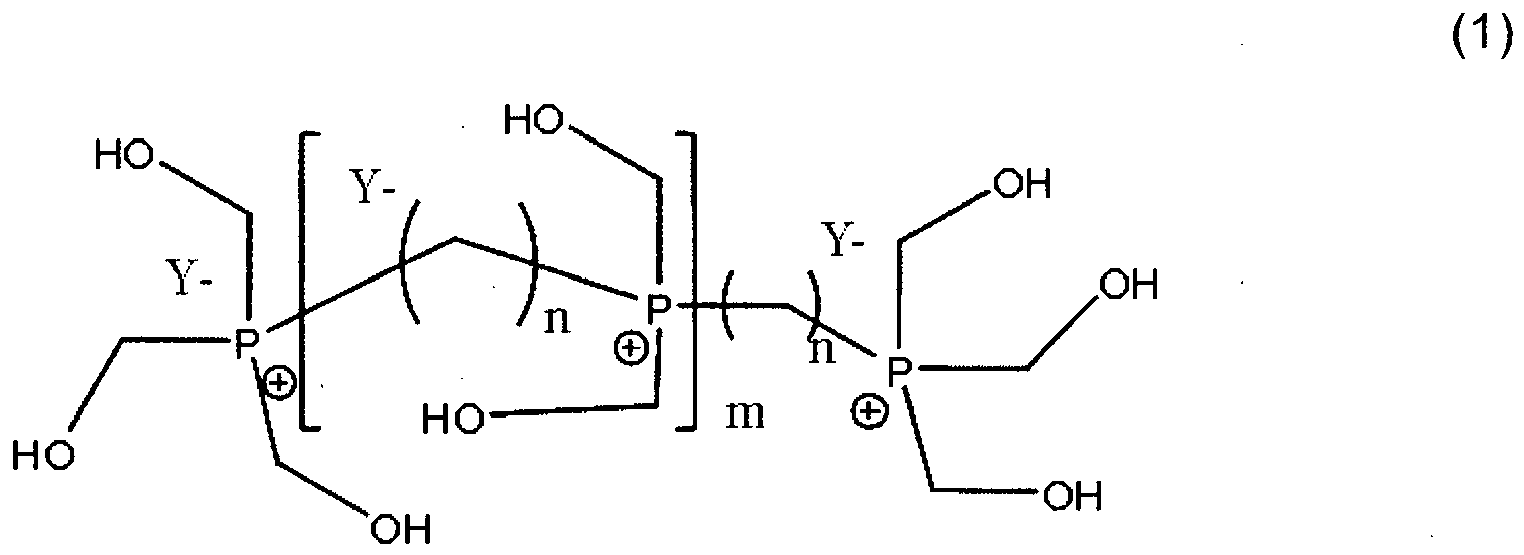 n est un nombre compris entre 4 et 20,m est un nombre compris entre 0 et 10, etY est un anion.
 - Dérivé selon la revendication 1, caractérisé en ce que n est compris entre 5 et 10,
m est 0 ou 1, et
Y est un anion chlorure, sulfate, phosphate, ou bromure. - Dérivé selon la revendication 1 ou 2, caractérisé en ce que n est 8 et
m est 0 ou 1. - Procédé pour réguler la croissance de la biomasse bactérienne dans un système aqueux comprenant l'addition au système aqueux, ou la mise en contact avec le système aqueux, d'une quantité efficace d'un agent découplant choisi parmi un dérivé organophosphonium tel que défini à l'une quelconque des revendications 1 à 3.
- Procédé selon la revendication 4, caractérisé en ce que la quantité efficace de l'agent découplant est comprise entre 0,001 et 100 mg/l.
- Procédé selon la revendication 5, caractérisé en ce que la quantité efficace de l'agent découplant est comprise entre 0,005 et 50 mg/l.
- Procédé selon la revendication 6, caractérisé en ce que la quantité efficace de l'agent découplant est comprise entre 0,01 mg/l à 30 mg/l.
- Procédé selon la revendication 7, caractérisé en ce que la quantité efficace de l'agent découplant est comprise entre 0,1 mg/l à 10 mg/l.
- Procédé selon la revendication 8, caractérisé en ce que la quantité efficace de l'agent découplant est comprise entre 0,5 mg/l à 7,5 mg/l.
- Procédé selon la revendication 9, caractérisé en ce que la quantité efficace de l'agent découplant est comprise entre 1 mg/l à 5 mg/l.
- Procédé selon la revendication 4, caractérisé en ce que la quantité efficace de l'agent découplant est comprise entre 0,1 mg à 100 mg par gramme de solides, exprimés en matière sèche, présents dans les boues dans le système aqueux.
- Procédé selon la revendication 11, caractérisé en ce que la quantité efficace de l'agent découplant est comprise entre 1 mg à 50 mg par gramme de solides présents dans les boues dans le système aqueux.
- Procédé selon la revendication 12, caractérisé en ce que la quantité efficace de l'agent découplant est comprise entre 2 mg à 10 mg par gramme de solides présents dans les boues dans le système aqueux.
- Procédé selon l'une quelconque des revendications 4 à 13, caractérisé en ce que le système aqueux est une usine de traitement des eaux usées en vue du traitement des effluents industriels ou municipaux.
Applications Claiming Priority (2)
| Application Number | Priority Date | Filing Date | Title |
|---|---|---|---|
| FR0904510A FR2950348B1 (fr) | 2009-09-22 | 2009-09-22 | Derives organophosphores et leur utilisation comme agents decouplants. |
| PCT/EP2010/063140 WO2011036052A1 (fr) | 2009-09-22 | 2010-09-08 | Derives organophosphores et leur utilisation comme agents decouplants. |
Publications (2)
| Publication Number | Publication Date |
|---|---|
| EP2480558A1 EP2480558A1 (fr) | 2012-08-01 |
| EP2480558B1 true EP2480558B1 (fr) | 2014-03-05 |
Family
ID=42154566
Family Applications (1)
| Application Number | Title | Priority Date | Filing Date |
|---|---|---|---|
| EP10749874.3A Not-in-force EP2480558B1 (fr) | 2009-09-22 | 2010-09-08 | Derives organophosphores et leur utilisation comme agents decouplants. |
Country Status (7)
| Country | Link |
|---|---|
| US (1) | US9181116B2 (fr) |
| EP (1) | EP2480558B1 (fr) |
| JP (1) | JP5933439B2 (fr) |
| KR (1) | KR20120100931A (fr) |
| CN (1) | CN102666558B (fr) |
| FR (1) | FR2950348B1 (fr) |
| WO (1) | WO2011036052A1 (fr) |
Families Citing this family (2)
| Publication number | Priority date | Publication date | Assignee | Title |
|---|---|---|---|---|
| EP2851370B1 (fr) | 2013-09-19 | 2016-03-09 | Magpie Polymers | Procédé de préparation de tris(hydroxyméthyl) phosphine |
| CN114805437A (zh) * | 2022-06-01 | 2022-07-29 | 山东科兴化工有限责任公司 | 一种油田污水杀菌剂及其制备方法 |
Family Cites Families (4)
| Publication number | Priority date | Publication date | Assignee | Title |
|---|---|---|---|---|
| DE1067811B (de) * | 1957-01-30 | 1959-10-29 | Hoechst Ag | Verfahren zur Herstellung von quaternaeren organischen Phosphorverbindungen |
| GB8901881D0 (en) * | 1989-01-27 | 1989-03-15 | Albright & Wilson | Biocidal compositions and treatments |
| CA2514798C (fr) * | 2003-02-05 | 2009-06-16 | Pulp And Paper Research Institute Of Canada | Procede de blanchiment et de stabilisation du brillant de materiaux lignocellulosiques a l'aide de phosphines hydrosolubles ou de composes de phosphonium |
| RU2323746C2 (ru) | 2003-06-20 | 2008-05-10 | РОДИА ЮКей ЛИМИТЕД | Разобщающие агенты |
-
2009
- 2009-09-22 FR FR0904510A patent/FR2950348B1/fr active Active
-
2010
- 2010-09-08 CN CN201080042485.0A patent/CN102666558B/zh not_active Expired - Fee Related
- 2010-09-08 US US13/497,133 patent/US9181116B2/en not_active Expired - Fee Related
- 2010-09-08 KR KR1020127010107A patent/KR20120100931A/ko not_active Abandoned
- 2010-09-08 JP JP2012530206A patent/JP5933439B2/ja not_active Expired - Fee Related
- 2010-09-08 WO PCT/EP2010/063140 patent/WO2011036052A1/fr not_active Ceased
- 2010-09-08 EP EP10749874.3A patent/EP2480558B1/fr not_active Not-in-force
Also Published As
| Publication number | Publication date |
|---|---|
| US9181116B2 (en) | 2015-11-10 |
| WO2011036052A1 (fr) | 2011-03-31 |
| FR2950348A1 (fr) | 2011-03-25 |
| US20120238527A1 (en) | 2012-09-20 |
| CN102666558A (zh) | 2012-09-12 |
| JP5933439B2 (ja) | 2016-06-08 |
| JP2013505279A (ja) | 2013-02-14 |
| EP2480558A1 (fr) | 2012-08-01 |
| KR20120100931A (ko) | 2012-09-12 |
| FR2950348B1 (fr) | 2012-08-10 |
| CN102666558B (zh) | 2015-04-22 |
Similar Documents
| Publication | Publication Date | Title |
|---|---|---|
| Huang et al. | Defluorination of perfluorooctanoic acid (PFOA) and perfluorooctane sulfonate (PFOS) by Acidimicrobium sp. strain A6 | |
| Pedersen et al. | Peracetic acid degradation and effects on nitrification in recirculating aquaculture systems | |
| Gómez et al. | Influence of carbon source on nitrate removal of contaminated groundwater in a denitrifying submerged filter | |
| Wang et al. | Inhibition by free nitrous acid (FNA) and the electron competition of nitrite in nitrous oxide (N2O) reduction during hydrogenotrophic denitrification | |
| Li et al. | Responses of soluble microbial products and extracellular polymeric substances to the presence of toxic 2, 6-dichlorophenol in aerobic granular sludge system | |
| Zeng et al. | Denitrification performance and microbial community under salinity and MIT stresses for reverse osmosis concentrate treatment | |
| Gutwiński et al. | Startup of the anammox process in a membrane bioreactor (AnMBR) from conventional activated sludge | |
| Wang et al. | Robustness of ANAMMOX granule sludge bed reactor: effect and mechanism of organic matter interference | |
| CA2531129C (fr) | Agents decouplants | |
| Cavanaugh et al. | Impact of nitrite and oxygen on nitrous oxide emissions from a granular sludge sequencing batch reactor | |
| JP4570069B2 (ja) | 廃水からのアンモニア性窒素の除去方法 | |
| RU2353587C2 (ru) | Повышение качества ила | |
| EP2480558B1 (fr) | Derives organophosphores et leur utilisation comme agents decouplants. | |
| Jia et al. | Spatial and daily variations of nitrous oxide emissions from biological reactors in a full-scale activated sludge anoxic/oxic process | |
| Lim et al. | Performance of phenol-acclimated activated sludge in the presence of various phenolic compounds | |
| WO2019161052A1 (fr) | Traitement des eaux contenant des cyanotoxines | |
| US5503775A (en) | Method of preventing yellow metal corrosion in aqueous systems with superior corrosion performance in reduced environmental impact | |
| WO2010150784A1 (fr) | Agent et procédé d'amélioration d'activité microbienne et procédé de traitement de déchets biologiques | |
| US20130005810A1 (en) | Organic uncoupling agents | |
| CN119751379B (zh) | 一种硝化抑制剂及其应用 | |
| FR2501709A1 (fr) | Procede et composition pour empecher la corrosion dans les systemes aqueux | |
| CA2529956A1 (fr) | Traitement de boues d'epuration | |
| EP0843652B1 (fr) | Procede de biodepollution d'effluents a fortes concentrations en polluants, et procede de selection de souches utilisable dans ledit procede | |
| JP2024084139A (ja) | 過酸化水素を含む緑藻除去剤 | |
| JPH10296296A (ja) | 生物硝化方法 |
Legal Events
| Date | Code | Title | Description |
|---|---|---|---|
| PUAI | Public reference made under article 153(3) epc to a published international application that has entered the european phase |
Free format text: ORIGINAL CODE: 0009012 |
|
| 17P | Request for examination filed |
Effective date: 20120320 |
|
| AK | Designated contracting states |
Kind code of ref document: A1 Designated state(s): AL AT BE BG CH CY CZ DE DK EE ES FI FR GB GR HR HU IE IS IT LI LT LU LV MC MK MT NL NO PL PT RO SE SI SK SM TR |
|
| RIN1 | Information on inventor provided before grant (corrected) |
Inventor name: PILAS-BEGUE, AGNES Inventor name: SCHANEN, VINCENT Inventor name: BERARD, MICKAEL Inventor name: CARRET-TRONCY, STEPHANE Inventor name: MARCHAL, PHILIPPE Inventor name: LOUVEL, LUC |
|
| DAX | Request for extension of the european patent (deleted) | ||
| 17Q | First examination report despatched |
Effective date: 20130417 |
|
| GRAP | Despatch of communication of intention to grant a patent |
Free format text: ORIGINAL CODE: EPIDOSNIGR1 |
|
| INTG | Intention to grant announced |
Effective date: 20130912 |
|
| RIC1 | Information provided on ipc code assigned before grant |
Ipc: C02F 11/14 20060101ALI20130903BHEP Ipc: C07F 9/54 20060101ALI20130903BHEP Ipc: C02F 1/50 20060101ALI20130903BHEP Ipc: C02F 3/00 20060101ALI20130903BHEP Ipc: C07F 9/50 20060101AFI20130903BHEP Ipc: A01N 57/20 20060101ALI20130903BHEP |
|
| GRAS | Grant fee paid |
Free format text: ORIGINAL CODE: EPIDOSNIGR3 |
|
| GRAA | (expected) grant |
Free format text: ORIGINAL CODE: 0009210 |
|
| AK | Designated contracting states |
Kind code of ref document: B1 Designated state(s): AL AT BE BG CH CY CZ DE DK EE ES FI FR GB GR HR HU IE IS IT LI LT LU LV MC MK MT NL NO PL PT RO SE SI SK SM TR |
|
| REG | Reference to a national code |
Ref country code: GB Ref legal event code: FG4D Free format text: NOT ENGLISH |
|
| REG | Reference to a national code |
Ref country code: CH Ref legal event code: EP |
|
| REG | Reference to a national code |
Ref country code: AT Ref legal event code: REF Ref document number: 654815 Country of ref document: AT Kind code of ref document: T Effective date: 20140315 |
|
| REG | Reference to a national code |
Ref country code: IE Ref legal event code: FG4D Free format text: LANGUAGE OF EP DOCUMENT: FRENCH |
|
| REG | Reference to a national code |
Ref country code: DE Ref legal event code: R096 Ref document number: 602010013999 Country of ref document: DE Effective date: 20140417 |
|
| REG | Reference to a national code |
Ref country code: AT Ref legal event code: MK05 Ref document number: 654815 Country of ref document: AT Kind code of ref document: T Effective date: 20140305 |
|
| REG | Reference to a national code |
Ref country code: NL Ref legal event code: VDEP Effective date: 20140305 |
|
| PG25 | Lapsed in a contracting state [announced via postgrant information from national office to epo] |
Ref country code: NO Free format text: LAPSE BECAUSE OF FAILURE TO SUBMIT A TRANSLATION OF THE DESCRIPTION OR TO PAY THE FEE WITHIN THE PRESCRIBED TIME-LIMIT Effective date: 20140605 Ref country code: LT Free format text: LAPSE BECAUSE OF FAILURE TO SUBMIT A TRANSLATION OF THE DESCRIPTION OR TO PAY THE FEE WITHIN THE PRESCRIBED TIME-LIMIT Effective date: 20140305 |
|
| REG | Reference to a national code |
Ref country code: LT Ref legal event code: MG4D |
|
| PG25 | Lapsed in a contracting state [announced via postgrant information from national office to epo] |
Ref country code: CY Free format text: LAPSE BECAUSE OF FAILURE TO SUBMIT A TRANSLATION OF THE DESCRIPTION OR TO PAY THE FEE WITHIN THE PRESCRIBED TIME-LIMIT Effective date: 20140305 Ref country code: FI Free format text: LAPSE BECAUSE OF FAILURE TO SUBMIT A TRANSLATION OF THE DESCRIPTION OR TO PAY THE FEE WITHIN THE PRESCRIBED TIME-LIMIT Effective date: 20140305 Ref country code: SE Free format text: LAPSE BECAUSE OF FAILURE TO SUBMIT A TRANSLATION OF THE DESCRIPTION OR TO PAY THE FEE WITHIN THE PRESCRIBED TIME-LIMIT Effective date: 20140305 Ref country code: AT Free format text: LAPSE BECAUSE OF FAILURE TO SUBMIT A TRANSLATION OF THE DESCRIPTION OR TO PAY THE FEE WITHIN THE PRESCRIBED TIME-LIMIT Effective date: 20140305 |
|
| PG25 | Lapsed in a contracting state [announced via postgrant information from national office to epo] |
Ref country code: HR Free format text: LAPSE BECAUSE OF FAILURE TO SUBMIT A TRANSLATION OF THE DESCRIPTION OR TO PAY THE FEE WITHIN THE PRESCRIBED TIME-LIMIT Effective date: 20140305 Ref country code: LV Free format text: LAPSE BECAUSE OF FAILURE TO SUBMIT A TRANSLATION OF THE DESCRIPTION OR TO PAY THE FEE WITHIN THE PRESCRIBED TIME-LIMIT Effective date: 20140305 |
|
| PG25 | Lapsed in a contracting state [announced via postgrant information from national office to epo] |
Ref country code: IS Free format text: LAPSE BECAUSE OF FAILURE TO SUBMIT A TRANSLATION OF THE DESCRIPTION OR TO PAY THE FEE WITHIN THE PRESCRIBED TIME-LIMIT Effective date: 20140705 Ref country code: BG Free format text: LAPSE BECAUSE OF FAILURE TO SUBMIT A TRANSLATION OF THE DESCRIPTION OR TO PAY THE FEE WITHIN THE PRESCRIBED TIME-LIMIT Effective date: 20140605 Ref country code: RO Free format text: LAPSE BECAUSE OF FAILURE TO SUBMIT A TRANSLATION OF THE DESCRIPTION OR TO PAY THE FEE WITHIN THE PRESCRIBED TIME-LIMIT Effective date: 20140305 Ref country code: CZ Free format text: LAPSE BECAUSE OF FAILURE TO SUBMIT A TRANSLATION OF THE DESCRIPTION OR TO PAY THE FEE WITHIN THE PRESCRIBED TIME-LIMIT Effective date: 20140305 Ref country code: NL Free format text: LAPSE BECAUSE OF FAILURE TO SUBMIT A TRANSLATION OF THE DESCRIPTION OR TO PAY THE FEE WITHIN THE PRESCRIBED TIME-LIMIT Effective date: 20140305 Ref country code: EE Free format text: LAPSE BECAUSE OF FAILURE TO SUBMIT A TRANSLATION OF THE DESCRIPTION OR TO PAY THE FEE WITHIN THE PRESCRIBED TIME-LIMIT Effective date: 20140305 |
|
| PG25 | Lapsed in a contracting state [announced via postgrant information from national office to epo] |
Ref country code: PL Free format text: LAPSE BECAUSE OF FAILURE TO SUBMIT A TRANSLATION OF THE DESCRIPTION OR TO PAY THE FEE WITHIN THE PRESCRIBED TIME-LIMIT Effective date: 20140305 Ref country code: ES Free format text: LAPSE BECAUSE OF FAILURE TO SUBMIT A TRANSLATION OF THE DESCRIPTION OR TO PAY THE FEE WITHIN THE PRESCRIBED TIME-LIMIT Effective date: 20140305 Ref country code: SK Free format text: LAPSE BECAUSE OF FAILURE TO SUBMIT A TRANSLATION OF THE DESCRIPTION OR TO PAY THE FEE WITHIN THE PRESCRIBED TIME-LIMIT Effective date: 20140305 |
|
| REG | Reference to a national code |
Ref country code: DE Ref legal event code: R097 Ref document number: 602010013999 Country of ref document: DE |
|
| PG25 | Lapsed in a contracting state [announced via postgrant information from national office to epo] |
Ref country code: PT Free format text: LAPSE BECAUSE OF FAILURE TO SUBMIT A TRANSLATION OF THE DESCRIPTION OR TO PAY THE FEE WITHIN THE PRESCRIBED TIME-LIMIT Effective date: 20140707 |
|
| PLBE | No opposition filed within time limit |
Free format text: ORIGINAL CODE: 0009261 |
|
| STAA | Information on the status of an ep patent application or granted ep patent |
Free format text: STATUS: NO OPPOSITION FILED WITHIN TIME LIMIT |
|
| PG25 | Lapsed in a contracting state [announced via postgrant information from national office to epo] |
Ref country code: DK Free format text: LAPSE BECAUSE OF FAILURE TO SUBMIT A TRANSLATION OF THE DESCRIPTION OR TO PAY THE FEE WITHIN THE PRESCRIBED TIME-LIMIT Effective date: 20140305 |
|
| 26N | No opposition filed |
Effective date: 20141208 |
|
| REG | Reference to a national code |
Ref country code: DE Ref legal event code: R097 Ref document number: 602010013999 Country of ref document: DE Effective date: 20141208 |
|
| PG25 | Lapsed in a contracting state [announced via postgrant information from national office to epo] |
Ref country code: IT Free format text: LAPSE BECAUSE OF FAILURE TO SUBMIT A TRANSLATION OF THE DESCRIPTION OR TO PAY THE FEE WITHIN THE PRESCRIBED TIME-LIMIT Effective date: 20140305 |
|
| PG25 | Lapsed in a contracting state [announced via postgrant information from national office to epo] |
Ref country code: LU Free format text: LAPSE BECAUSE OF FAILURE TO SUBMIT A TRANSLATION OF THE DESCRIPTION OR TO PAY THE FEE WITHIN THE PRESCRIBED TIME-LIMIT Effective date: 20140908 Ref country code: MC Free format text: LAPSE BECAUSE OF FAILURE TO SUBMIT A TRANSLATION OF THE DESCRIPTION OR TO PAY THE FEE WITHIN THE PRESCRIBED TIME-LIMIT Effective date: 20140305 |
|
| REG | Reference to a national code |
Ref country code: CH Ref legal event code: PL |
|
| PG25 | Lapsed in a contracting state [announced via postgrant information from national office to epo] |
Ref country code: SI Free format text: LAPSE BECAUSE OF FAILURE TO SUBMIT A TRANSLATION OF THE DESCRIPTION OR TO PAY THE FEE WITHIN THE PRESCRIBED TIME-LIMIT Effective date: 20140305 |
|
| REG | Reference to a national code |
Ref country code: IE Ref legal event code: MM4A |
|
| PG25 | Lapsed in a contracting state [announced via postgrant information from national office to epo] |
Ref country code: BE Free format text: LAPSE BECAUSE OF NON-PAYMENT OF DUE FEES Effective date: 20140930 |
|
| PG25 | Lapsed in a contracting state [announced via postgrant information from national office to epo] |
Ref country code: CH Free format text: LAPSE BECAUSE OF NON-PAYMENT OF DUE FEES Effective date: 20140930 Ref country code: LI Free format text: LAPSE BECAUSE OF NON-PAYMENT OF DUE FEES Effective date: 20140930 |
|
| PG25 | Lapsed in a contracting state [announced via postgrant information from national office to epo] |
Ref country code: IE Free format text: LAPSE BECAUSE OF NON-PAYMENT OF DUE FEES Effective date: 20140908 |
|
| PG25 | Lapsed in a contracting state [announced via postgrant information from national office to epo] |
Ref country code: SM Free format text: LAPSE BECAUSE OF FAILURE TO SUBMIT A TRANSLATION OF THE DESCRIPTION OR TO PAY THE FEE WITHIN THE PRESCRIBED TIME-LIMIT Effective date: 20140305 |
|
| PG25 | Lapsed in a contracting state [announced via postgrant information from national office to epo] |
Ref country code: GR Free format text: LAPSE BECAUSE OF FAILURE TO SUBMIT A TRANSLATION OF THE DESCRIPTION OR TO PAY THE FEE WITHIN THE PRESCRIBED TIME-LIMIT Effective date: 20140606 Ref country code: MT Free format text: LAPSE BECAUSE OF FAILURE TO SUBMIT A TRANSLATION OF THE DESCRIPTION OR TO PAY THE FEE WITHIN THE PRESCRIBED TIME-LIMIT Effective date: 20140305 |
|
| PG25 | Lapsed in a contracting state [announced via postgrant information from national office to epo] |
Ref country code: HU Free format text: LAPSE BECAUSE OF FAILURE TO SUBMIT A TRANSLATION OF THE DESCRIPTION OR TO PAY THE FEE WITHIN THE PRESCRIBED TIME-LIMIT; INVALID AB INITIO Effective date: 20100908 Ref country code: TR Free format text: LAPSE BECAUSE OF FAILURE TO SUBMIT A TRANSLATION OF THE DESCRIPTION OR TO PAY THE FEE WITHIN THE PRESCRIBED TIME-LIMIT Effective date: 20140305 |
|
| REG | Reference to a national code |
Ref country code: FR Ref legal event code: PLFP Year of fee payment: 7 |
|
| REG | Reference to a national code |
Ref country code: FR Ref legal event code: PLFP Year of fee payment: 8 |
|
| PGFP | Annual fee paid to national office [announced via postgrant information from national office to epo] |
Ref country code: DE Payment date: 20170905 Year of fee payment: 8 Ref country code: FR Payment date: 20170810 Year of fee payment: 8 Ref country code: GB Payment date: 20170906 Year of fee payment: 8 |
|
| PG25 | Lapsed in a contracting state [announced via postgrant information from national office to epo] |
Ref country code: MK Free format text: LAPSE BECAUSE OF FAILURE TO SUBMIT A TRANSLATION OF THE DESCRIPTION OR TO PAY THE FEE WITHIN THE PRESCRIBED TIME-LIMIT Effective date: 20140305 |
|
| PG25 | Lapsed in a contracting state [announced via postgrant information from national office to epo] |
Ref country code: AL Free format text: LAPSE BECAUSE OF FAILURE TO SUBMIT A TRANSLATION OF THE DESCRIPTION OR TO PAY THE FEE WITHIN THE PRESCRIBED TIME-LIMIT Effective date: 20140305 |
|
| REG | Reference to a national code |
Ref country code: DE Ref legal event code: R119 Ref document number: 602010013999 Country of ref document: DE |
|
| GBPC | Gb: european patent ceased through non-payment of renewal fee |
Effective date: 20180908 |
|
| PG25 | Lapsed in a contracting state [announced via postgrant information from national office to epo] |
Ref country code: DE Free format text: LAPSE BECAUSE OF NON-PAYMENT OF DUE FEES Effective date: 20190402 |
|
| PG25 | Lapsed in a contracting state [announced via postgrant information from national office to epo] |
Ref country code: FR Free format text: LAPSE BECAUSE OF NON-PAYMENT OF DUE FEES Effective date: 20180930 |
|
| PG25 | Lapsed in a contracting state [announced via postgrant information from national office to epo] |
Ref country code: GB Free format text: LAPSE BECAUSE OF NON-PAYMENT OF DUE FEES Effective date: 20180908 |