WO2011036052A1 - Derives organophosphores et leur utilisation comme agents decouplants. - Google Patents
Derives organophosphores et leur utilisation comme agents decouplants. Download PDFInfo
- Publication number
- WO2011036052A1 WO2011036052A1 PCT/EP2010/063140 EP2010063140W WO2011036052A1 WO 2011036052 A1 WO2011036052 A1 WO 2011036052A1 EP 2010063140 W EP2010063140 W EP 2010063140W WO 2011036052 A1 WO2011036052 A1 WO 2011036052A1
- Authority
- WO
- WIPO (PCT)
- Prior art keywords
- effective amount
- aqueous system
- decoupling agent
- derivative
- decoupling
- Prior art date
- Legal status (The legal status is an assumption and is not a legal conclusion. Google has not performed a legal analysis and makes no representation as to the accuracy of the status listed.)
- Ceased
Links
Classifications
-
- C—CHEMISTRY; METALLURGY
- C07—ORGANIC CHEMISTRY
- C07F—ACYCLIC, CARBOCYCLIC OR HETEROCYCLIC COMPOUNDS CONTAINING ELEMENTS OTHER THAN CARBON, HYDROGEN, HALOGEN, OXYGEN, NITROGEN, SULFUR, SELENIUM OR TELLURIUM
- C07F9/00—Compounds containing elements of Groups 5 or 15 of the Periodic Table
- C07F9/02—Phosphorus compounds
- C07F9/28—Phosphorus compounds with one or more P—C bonds
- C07F9/50—Organo-phosphines
- C07F9/5004—Acyclic saturated phosphines
-
- A—HUMAN NECESSITIES
- A01—AGRICULTURE; FORESTRY; ANIMAL HUSBANDRY; HUNTING; TRAPPING; FISHING
- A01N—PRESERVATION OF BODIES OF HUMANS OR ANIMALS OR PLANTS OR PARTS THEREOF; BIOCIDES, e.g. AS DISINFECTANTS, AS PESTICIDES OR AS HERBICIDES; PEST REPELLANTS OR ATTRACTANTS; PLANT GROWTH REGULATORS
- A01N57/00—Biocides, pest repellants or attractants, or plant growth regulators containing organic phosphorus compounds
- A01N57/18—Biocides, pest repellants or attractants, or plant growth regulators containing organic phosphorus compounds having phosphorus-to-carbon bonds
- A01N57/20—Biocides, pest repellants or attractants, or plant growth regulators containing organic phosphorus compounds having phosphorus-to-carbon bonds containing acyclic or cycloaliphatic radicals
-
- C—CHEMISTRY; METALLURGY
- C02—TREATMENT OF WATER, WASTE WATER, SEWAGE, OR SLUDGE
- C02F—TREATMENT OF WATER, WASTE WATER, SEWAGE, OR SLUDGE
- C02F3/00—Biological treatment of water, waste water, or sewage
- C02F3/006—Regulation methods for biological treatment
-
- C—CHEMISTRY; METALLURGY
- C07—ORGANIC CHEMISTRY
- C07F—ACYCLIC, CARBOCYCLIC OR HETEROCYCLIC COMPOUNDS CONTAINING ELEMENTS OTHER THAN CARBON, HYDROGEN, HALOGEN, OXYGEN, NITROGEN, SULFUR, SELENIUM OR TELLURIUM
- C07F9/00—Compounds containing elements of Groups 5 or 15 of the Periodic Table
- C07F9/02—Phosphorus compounds
- C07F9/28—Phosphorus compounds with one or more P—C bonds
- C07F9/54—Quaternary phosphonium compounds
- C07F9/5407—Acyclic saturated phosphonium compounds
-
- C—CHEMISTRY; METALLURGY
- C02—TREATMENT OF WATER, WASTE WATER, SEWAGE, OR SLUDGE
- C02F—TREATMENT OF WATER, WASTE WATER, SEWAGE, OR SLUDGE
- C02F2209/00—Controlling or monitoring parameters in water treatment
- C02F2209/001—Upstream control, i.e. monitoring for predictive control
-
- C—CHEMISTRY; METALLURGY
- C02—TREATMENT OF WATER, WASTE WATER, SEWAGE, OR SLUDGE
- C02F—TREATMENT OF WATER, WASTE WATER, SEWAGE, OR SLUDGE
- C02F2209/00—Controlling or monitoring parameters in water treatment
- C02F2209/36—Biological material, e.g. enzymes or ATP
Definitions
- the invention relates to organophosphonium derivatives, process for their preparation and their use as decoupling agents.
- the present invention relates to such decoupling agents for use in the regulation of bacterial biomass in aqueous systems, particularly in wastewater treatment plants, as well as the use of such agents and a process use of these agents.
- the decoupling activity of a molecule consists in acting on the bacterial cellular energetics so as to reduce the biomass production of the wastewater while keeping the purifying activity of the bacterial cell by biological degradation of organic molecules.
- the uncoupling activity of a molecule on bacterial growth is ultimately expressed by an overconsumption of oxygen induced by an imbalance of the bacterial energy.
- This decoupling activity of a molecule is interesting for an application in a treatment plant, hereinafter abbreviated as STEP, in the case where it makes it possible to reduce the production of activated sludge significantly at the source.
- the production of biomass and thus activated sludge in the treatment of wastewater originates from the consumption of nutrients in the wastewater.
- nutrients are oxidized and this releases energy that can be used by microorganisms as part of cell division.
- the consumption of nutrients induces a proton flux at the level of the bacterial membrane by the phenomenon of oxidative phosphorylation; this flow will establish a proton gradient that itself rotates proton pumps that allow the synthesis of ATP (Adenosine Triphosphate) from ADP + P.
- ATP provides energy to the cell as part of cellular processes including cell division.
- Decoupling is the inhibition of the formation of energy reserves in the form of ATP.
- a decoupling agent decreases the energy efficiency of carbon combustion while increasing the proportion of oxidized carbon to CO2. Decoupling results in lower biomass production and higher oxygen consumption.
- the bacterial biomass produced during wastewater treatment is expensive to eliminate and therefore a decrease in biomass leads to a reduction in disposal costs.
- An object of the present invention is to propose decoupling molecules whose efficiency is measured by a decrease in the production of biological sludge at source, that is to say in the aeration basins of urban wastewater treatment plants. at least 30%.
- Another object of the present invention is to provide uncoupling molecules whose efficiency is substantially equivalent to or even greater than a reference molecule THPS (Tetrakis hydroxymethyl phosphonium) whose effectiveness in reducing the production of biological sludge has been shown in FIG. the patent application WO 2004/1 13236.
- THPS Tetrakis hydroxymethyl phosphonium
- Another aim of the present invention is to propose decoupler molecules that are alternative to THPS, whose abiotic and biotic degradability is less rapid than that of THPS, without the said molecules being non-degradable, which would pose environmental problems.
- Another object of the present invention is to provide decoupling molecules whose toxicological and ecotoxicological profile is satisfactory and adequate for the use thereof in STEP.
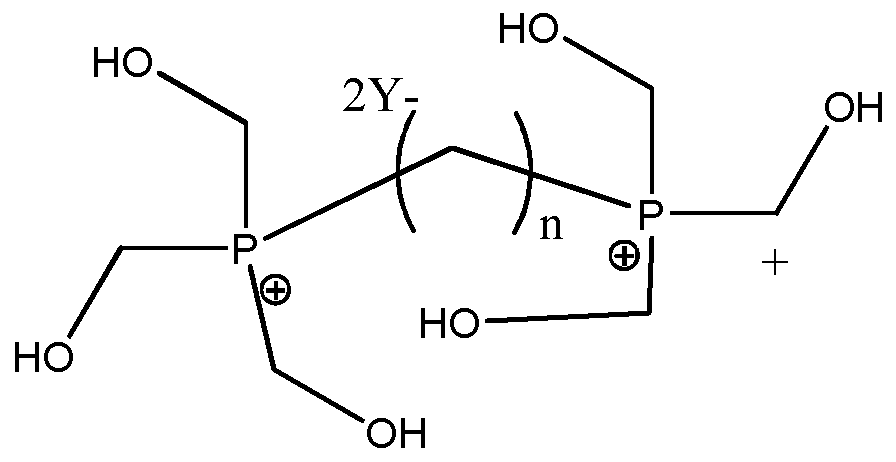
- n is a number between 4 and 20, preferably between 5 and 10,
- n is a number between 0 and 10, preferably between 0 and 1
- Y is an anion, preferably chloride, sulfate, phosphate, or bromide.
- n is between 5 and 10
- n 0 or 1
- Y is a chloride, sulfate, phosphate, or bromide anion.
- n 8 and
- m 0 or 1.
- the present invention also relates to a process for the preparation of an organophosphonium derivative as defined above, comprising the following steps:
- step b) optionally the diphosphonium alkylene obtained in step b) reacts with an excess of dihaloalkylene and trishydroxymethyl phosphine to give a tri or polyphosphonium with evolution of formaldehyde according to the reaction scheme above:
- the present invention also provides a method for regulating the growth of bacterial biomass in an aqueous system comprising adding to the aqueous system, or contacting with the aqueous system, an effective amount of a decoupling agent selected from organophosphonium derivative of average general formula (1):
- n is a number between 4 and 20, preferably between 5 and 10,
- n is a number between 0 and 10, preferably between 0 and 1
- Y is an anion preferably selected from the group consisting of chloride, sulfate, phosphate, acetate and bromide ions.
- n 8 and m is 0 or 1.
- the invention is also directed to a method for regulating the growth of bacterial biomass in an aqueous system comprising adding to the aqueous system, or bringing into contact with the aqueous system, an effective amount of a decoupling agent selected from a organophosphonium derivative as defined above.
- a decoupling agent selected from a organophosphonium derivative as defined above.
- the effective amount of organophosphonium derivative added to the aqueous system can be up to 100 mg / l, for example up to 50 mg / l, such as up to 30 mg / l.
- the effective amount of organophosphonium derivative added to the aqueous system is from 0.001 mg / l to 100 mg / l, from 0.005 mg / l to 50 mg / l, for example from 0.01 mg / l to 30 mg / l, such as from 0.05 mg / l to 10 mg / l. More preferably, the effective amount of organophosphonium derivative
- the organophosphonium derivative in the decoupling agent application can be formulated with one or more of the following chemicals
- the aqueous system will be a wastewater treatment plant that is used for the treatment of industrial or municipal effluents.
- This facility recovers wastewater from industrial processes (eg paper production, the food industry, the chemical industry) and / or domestic and institutional buildings and similar facilities, using microorganisms in aerobic, anoxic processes (eg denitrification), to consume organic pollutants and to make water suitable for reuse or release into the environment.
- the present invention thus provides a method for regulating the growth of bacterial biomass in an aqueous system comprising adding to, or contacting with the aqueous system an effective amount of a decoupling agent as defined previously.
- the present invention provides a method for regulating the growth of bacterial biomass in an aqueous system, which method comprises contacting an effective amount of a decoupling agent as previously defined. , directly with the bacterial biomass. To implement this method, it is recommended to contact in a limited time a maximum volume of activated sludge with the decoupling agent so as to obtain optimal efficiency thereof.
- organophosphonium is substantially reduced.
- the effective amount of said organophosphonium derivative can represent from 0.1 to 100 milligrams per gram of solids (expressed as Dry matter or MS) present in the sludge in the aqueous system, preferably from 0.5 to 100 mg / g, for example from 1 to 50 mg / g, such as from 2 to 10 mg / g.
- MS Dry matter
- the mixture is cooled to 5-15 ° C;
- the reaction mixture is kept at the end of the casting at 10 ° C. for 12 hours; the formaldehyde formed is removed by distillation of a water / formaldehyde mixture at a temperature of 15-30 ° C and a pressure ⁇ 10 mbar;
- the mixture is cooled to 5-15 ° C;
- the sodium hydroxide solution NaOH 8% / 228 g is poured over 3 hours and the temperature is controlled at 5-15 ° C .;
- the formaldehyde formed is removed by distillation of a water / formaldehyde mixture at a temperature of 15-30 ° C and a pressure of less than 10 mbar;
- the reaction medium obtained is biphasic and the precipitation of salts is observed (NaI / NaCl);
- the temperature of the reaction mixture is kept at 50 ° C. for 30 hours with a presence of 15% THPC;
- reaction mixture is cooled to 10 ° C. and then filtered on sintered porosity 3;
- the formaldehyde formed is removed by distillation of a water / formaldehyde mixture at a temperature of 15-30 ° C and a pressure ⁇ 10 mbar; and 400 g of ethanol are added and distilled under the same conditions in order to exhaust the formaldehyde.
- reaction mixture is cooled to 10 ° C. and then filtered on sintered porosity 3;
- the formaldehyde formed is removed by distillation of a water / formaldehyde mixture at a temperature of 15-30 ° C and a pressure ⁇ 10 mbar; then 350 g of water are added and distilled under the same conditions in order to exhaust the formaldehyde;
- the product obtained is a clear pale yellow solution from which a mass of 327.7 g is withdrawn;
- the washed aqueous phase is desolvated on a rotary evaporator and
- bacterial strains particularly sensitive to decoupling agents. These model bacterial strains (in particular the Shinella granuli strain) are particularly representative of the activated sludges of the WWTPs since they are isolated from it in the aeration basins.
- Example 2 The phosphonium derivatives synthesized in Example 2 are observed to have a fairly narrow concentration range in which these derivatives show good efficacy.
- This concentration range often shows an activation of the decoupling effect at low concentrations followed by a slight inhibition and then a toxicity obtained around 5 ppm (nominal concentration).
- Tests on biological pilots fed continuously with synthetic effluent on the molecule Ex2 show significant uncoupling effects on the reduction of sludge production.
- the biological pilots have a volume of 5 liters and are aerated continuously; a purge of these is practiced every day (except at the weekend) in order to obtain an age of mud of about 7 days.
- the biological pilots were seeded with activated sludge from the STEP urban St-Fons (France). After a short period of acclimation of the sludge, the treatment with the molecule Ex2 was carried out according to the method of flash mixing also described in Example 1 of WO 2004/1 13236 cited as reference.
- the Ex2 compound has been found to be effective in reducing sludge production, especially at 2.3 ppm, with a reduction slightly greater than 20% compared to the untreated control.
- the EX22 compound shows a good efficiency on the reduction of the mud production of 27.6% and a reduction of the growth rate of 26% (which confirms that at this concentration, it does not alter the purification capacity of the sludge).
Landscapes
- Life Sciences & Earth Sciences (AREA)
- Chemical & Material Sciences (AREA)
- Organic Chemistry (AREA)
- Health & Medical Sciences (AREA)
- General Health & Medical Sciences (AREA)
- Molecular Biology (AREA)
- Engineering & Computer Science (AREA)
- Biochemistry (AREA)
- Plant Pathology (AREA)
- Zoology (AREA)
- Microbiology (AREA)
- Environmental & Geological Engineering (AREA)
- Water Supply & Treatment (AREA)
- Agronomy & Crop Science (AREA)
- Hydrology & Water Resources (AREA)
- Dentistry (AREA)
- Pest Control & Pesticides (AREA)
- Wood Science & Technology (AREA)
- Biodiversity & Conservation Biology (AREA)
- Environmental Sciences (AREA)
- Micro-Organisms Or Cultivation Processes Thereof (AREA)
- Activated Sludge Processes (AREA)
- Agricultural Chemicals And Associated Chemicals (AREA)
Abstract
Description




Claims


Priority Applications (4)
| Application Number | Priority Date | Filing Date | Title |
|---|---|---|---|
| CN201080042485.0A CN102666558B (zh) | 2009-09-22 | 2010-09-08 | 有机磷鎓衍生物和其用作解偶联剂的用途 |
| US13/497,133 US9181116B2 (en) | 2009-09-22 | 2010-09-08 | Organophosphorus derivatives and use thereof as uncoupling agents |
| EP10749874.3A EP2480558B1 (fr) | 2009-09-22 | 2010-09-08 | Derives organophosphores et leur utilisation comme agents decouplants. |
| JP2012530206A JP5933439B2 (ja) | 2009-09-22 | 2010-09-08 | 有機リン誘導体及びその脱共役剤としての使用 |
Applications Claiming Priority (2)
| Application Number | Priority Date | Filing Date | Title |
|---|---|---|---|
| FR0904510 | 2009-09-22 | ||
| FR0904510A FR2950348B1 (fr) | 2009-09-22 | 2009-09-22 | Derives organophosphores et leur utilisation comme agents decouplants. |
Publications (1)
| Publication Number | Publication Date |
|---|---|
| WO2011036052A1 true WO2011036052A1 (fr) | 2011-03-31 |
Family
ID=42154566
Family Applications (1)
| Application Number | Title | Priority Date | Filing Date |
|---|---|---|---|
| PCT/EP2010/063140 Ceased WO2011036052A1 (fr) | 2009-09-22 | 2010-09-08 | Derives organophosphores et leur utilisation comme agents decouplants. |
Country Status (7)
| Country | Link |
|---|---|
| US (1) | US9181116B2 (fr) |
| EP (1) | EP2480558B1 (fr) |
| JP (1) | JP5933439B2 (fr) |
| KR (1) | KR20120100931A (fr) |
| CN (1) | CN102666558B (fr) |
| FR (1) | FR2950348B1 (fr) |
| WO (1) | WO2011036052A1 (fr) |
Families Citing this family (2)
| Publication number | Priority date | Publication date | Assignee | Title |
|---|---|---|---|---|
| EP2851370B1 (fr) | 2013-09-19 | 2016-03-09 | Magpie Polymers | Procédé de préparation de tris(hydroxyméthyl) phosphine |
| CN114805437A (zh) * | 2022-06-01 | 2022-07-29 | 山东科兴化工有限责任公司 | 一种油田污水杀菌剂及其制备方法 |
Citations (3)
| Publication number | Priority date | Publication date | Assignee | Title |
|---|---|---|---|---|
| US2937207A (en) * | 1957-01-30 | 1960-05-17 | Hoechst Ag | Process for the manufacture of quaternary organic phosphorus compounds |
| EP0380359A1 (fr) * | 1989-01-27 | 1990-08-01 | Albright & Wilson Limited | Compositions biocides et traitements |
| WO2004113236A2 (fr) | 2003-06-20 | 2004-12-29 | Rhodia Uk Ltd | Agents decouplants |
Family Cites Families (1)
| Publication number | Priority date | Publication date | Assignee | Title |
|---|---|---|---|---|
| CA2514798C (fr) * | 2003-02-05 | 2009-06-16 | Pulp And Paper Research Institute Of Canada | Procede de blanchiment et de stabilisation du brillant de materiaux lignocellulosiques a l'aide de phosphines hydrosolubles ou de composes de phosphonium |
-
2009
- 2009-09-22 FR FR0904510A patent/FR2950348B1/fr active Active
-
2010
- 2010-09-08 CN CN201080042485.0A patent/CN102666558B/zh not_active Expired - Fee Related
- 2010-09-08 US US13/497,133 patent/US9181116B2/en not_active Expired - Fee Related
- 2010-09-08 KR KR1020127010107A patent/KR20120100931A/ko not_active Abandoned
- 2010-09-08 JP JP2012530206A patent/JP5933439B2/ja not_active Expired - Fee Related
- 2010-09-08 WO PCT/EP2010/063140 patent/WO2011036052A1/fr not_active Ceased
- 2010-09-08 EP EP10749874.3A patent/EP2480558B1/fr not_active Not-in-force
Patent Citations (3)
| Publication number | Priority date | Publication date | Assignee | Title |
|---|---|---|---|---|
| US2937207A (en) * | 1957-01-30 | 1960-05-17 | Hoechst Ag | Process for the manufacture of quaternary organic phosphorus compounds |
| EP0380359A1 (fr) * | 1989-01-27 | 1990-08-01 | Albright & Wilson Limited | Compositions biocides et traitements |
| WO2004113236A2 (fr) | 2003-06-20 | 2004-12-29 | Rhodia Uk Ltd | Agents decouplants |
Non-Patent Citations (3)
| Title |
|---|
| "Biochemistry", 1998, W. H. FREEMEN & COMPANY |
| GRAYSON, J. AM. CHEM. SOC., vol. 85, 1963, pages 79 - 83, XP002582991 * |
| ROGER Y. STANIER; MICHAEL DOUDOROFF: "General Microbiology , 3eme edition,", 1971, MACMILLAN |
Also Published As
| Publication number | Publication date |
|---|---|
| US9181116B2 (en) | 2015-11-10 |
| FR2950348A1 (fr) | 2011-03-25 |
| US20120238527A1 (en) | 2012-09-20 |
| CN102666558A (zh) | 2012-09-12 |
| JP5933439B2 (ja) | 2016-06-08 |
| EP2480558B1 (fr) | 2014-03-05 |
| JP2013505279A (ja) | 2013-02-14 |
| EP2480558A1 (fr) | 2012-08-01 |
| KR20120100931A (ko) | 2012-09-12 |
| FR2950348B1 (fr) | 2012-08-10 |
| CN102666558B (zh) | 2015-04-22 |
Similar Documents
| Publication | Publication Date | Title |
|---|---|---|
| Pedersen et al. | Peracetic acid degradation and effects on nitrification in recirculating aquaculture systems | |
| Gómez et al. | Influence of carbon source on nitrate removal of contaminated groundwater in a denitrifying submerged filter | |
| Zhang et al. | Thiosulfate as external electron donor accelerating denitrification at low temperature condition in S0–based autotrophic denitrification biofilter | |
| Wang et al. | Inhibition by free nitrous acid (FNA) and the electron competition of nitrite in nitrous oxide (N2O) reduction during hydrogenotrophic denitrification | |
| Li et al. | Responses of soluble microbial products and extracellular polymeric substances to the presence of toxic 2, 6-dichlorophenol in aerobic granular sludge system | |
| HU177375B (en) | Process and composition for separating hydrocarbones of petrole origine from sweet and seawater | |
| Gutwiński et al. | Startup of the anammox process in a membrane bioreactor (AnMBR) from conventional activated sludge | |
| Wang et al. | Robustness of ANAMMOX granule sludge bed reactor: effect and mechanism of organic matter interference | |
| CA2531129C (fr) | Agents decouplants | |
| RU2353587C2 (ru) | Повышение качества ила | |
| Cavanaugh et al. | Impact of nitrite and oxygen on nitrous oxide emissions from a granular sludge sequencing batch reactor | |
| JP4570069B2 (ja) | 廃水からのアンモニア性窒素の除去方法 | |
| Liang et al. | Recovery of disintegrated halophilic aerobic granular sludge through ferric ion addition: Dual roles in filamentous fungal inhibition and microbial adhesion enhancement | |
| EP2480558B1 (fr) | Derives organophosphores et leur utilisation comme agents decouplants. | |
| Lim et al. | Performance of phenol-acclimated activated sludge in the presence of various phenolic compounds | |
| Al-Hashimia et al. | Performance of sequencing anoxic/anaerobic membrane bioreactor (SAM) system in hospital wastewater treatment and reuse | |
| Courtens et al. | Increased salinity improves the thermotolerance of mesophilic nitrification | |
| JP5205316B2 (ja) | 排水処理方法 | |
| EP2480072A2 (fr) | Agents decouplants organiques | |
| WO2010150784A1 (fr) | Agent et procédé d'amélioration d'activité microbienne et procédé de traitement de déchets biologiques | |
| CN119751379B (zh) | 一种硝化抑制剂及其应用 | |
| Zalivina | High Ammonia Strength Wastewater Treatment Using Algae, Bacteria and Ion Exchange | |
| JP2024084139A (ja) | 過酸化水素を含む緑藻除去剤 | |
| Geiling | Removal of the micropollutants DEET and DEP in biological grey water treatment and the effect of DEP on microbiological processes | |
| JPH10296296A (ja) | 生物硝化方法 |
Legal Events
| Date | Code | Title | Description |
|---|---|---|---|
| WWE | Wipo information: entry into national phase |
Ref document number: 201080042485.0 Country of ref document: CN |
|
| 121 | Ep: the epo has been informed by wipo that ep was designated in this application |
Ref document number: 10749874 Country of ref document: EP Kind code of ref document: A1 |
|
| WWE | Wipo information: entry into national phase |
Ref document number: 2010749874 Country of ref document: EP |
|
| NENP | Non-entry into the national phase |
Ref country code: DE |
|
| WWE | Wipo information: entry into national phase |
Ref document number: 2012530206 Country of ref document: JP |
|
| ENP | Entry into the national phase |
Ref document number: 20127010107 Country of ref document: KR Kind code of ref document: A |
|
| WWE | Wipo information: entry into national phase |
Ref document number: 13497133 Country of ref document: US |