EP2489461B1 - Draht mit einem lötmaterial für gasversiegeltes lichtbogenschweissen in jeder position - Google Patents
Draht mit einem lötmaterial für gasversiegeltes lichtbogenschweissen in jeder position Download PDFInfo
- Publication number
- EP2489461B1 EP2489461B1 EP10837713.6A EP10837713A EP2489461B1 EP 2489461 B1 EP2489461 B1 EP 2489461B1 EP 10837713 A EP10837713 A EP 10837713A EP 2489461 B1 EP2489461 B1 EP 2489461B1
- Authority
- EP
- European Patent Office
- Prior art keywords
- good
- inv
- none
- wire
- mass
- Prior art date
- Legal status (The legal status is an assumption and is not a legal conclusion. Google has not performed a legal analysis and makes no representation as to the accuracy of the status listed.)
- Not-in-force
Links
Images


Classifications
-
- B—PERFORMING OPERATIONS; TRANSPORTING
- B23—MACHINE TOOLS; METAL-WORKING NOT OTHERWISE PROVIDED FOR
- B23K—SOLDERING OR UNSOLDERING; WELDING; CLADDING OR PLATING BY SOLDERING OR WELDING; CUTTING BY APPLYING HEAT LOCALLY, e.g. FLAME CUTTING; WORKING BY LASER BEAM
- B23K35/00—Rods, electrodes, materials, or media, for use in soldering, welding, or cutting
- B23K35/02—Rods, electrodes, materials, or media, for use in soldering, welding, or cutting characterised by mechanical features, e.g. shape
- B23K35/0255—Rods, electrodes, materials, or media, for use in soldering, welding, or cutting characterised by mechanical features, e.g. shape for use in welding
- B23K35/0261—Rods, electrodes or wires
- B23K35/0266—Rods, electrodes or wires flux-cored
-
- B—PERFORMING OPERATIONS; TRANSPORTING
- B23—MACHINE TOOLS; METAL-WORKING NOT OTHERWISE PROVIDED FOR
- B23K—SOLDERING OR UNSOLDERING; WELDING; CLADDING OR PLATING BY SOLDERING OR WELDING; CUTTING BY APPLYING HEAT LOCALLY, e.g. FLAME CUTTING; WORKING BY LASER BEAM
- B23K35/00—Rods, electrodes, materials, or media, for use in soldering, welding, or cutting
- B23K35/02—Rods, electrodes, materials, or media, for use in soldering, welding, or cutting characterised by mechanical features, e.g. shape
-
- B—PERFORMING OPERATIONS; TRANSPORTING
- B23—MACHINE TOOLS; METAL-WORKING NOT OTHERWISE PROVIDED FOR
- B23K—SOLDERING OR UNSOLDERING; WELDING; CLADDING OR PLATING BY SOLDERING OR WELDING; CUTTING BY APPLYING HEAT LOCALLY, e.g. FLAME CUTTING; WORKING BY LASER BEAM
- B23K35/00—Rods, electrodes, materials, or media, for use in soldering, welding, or cutting
- B23K35/22—Rods, electrodes, materials, or media, for use in soldering, welding, or cutting characterised by the composition or nature of the material
- B23K35/24—Selection of soldering or welding materials proper
- B23K35/30—Selection of soldering or welding materials proper with the principal constituent melting at less than 1550°C
-
- B—PERFORMING OPERATIONS; TRANSPORTING
- B23—MACHINE TOOLS; METAL-WORKING NOT OTHERWISE PROVIDED FOR
- B23K—SOLDERING OR UNSOLDERING; WELDING; CLADDING OR PLATING BY SOLDERING OR WELDING; CUTTING BY APPLYING HEAT LOCALLY, e.g. FLAME CUTTING; WORKING BY LASER BEAM
- B23K35/00—Rods, electrodes, materials, or media, for use in soldering, welding, or cutting
- B23K35/22—Rods, electrodes, materials, or media, for use in soldering, welding, or cutting characterised by the composition or nature of the material
- B23K35/36—Selection of non-metallic compositions, e.g. coatings or fluxes; Selection of soldering or welding materials, conjoint with selection of non-metallic compositions, both selections being of interest
- B23K35/3601—Selection of non-metallic compositions, e.g. coatings or fluxes; Selection of soldering or welding materials, conjoint with selection of non-metallic compositions, both selections being of interest with inorganic compounds as principal constituents
- B23K35/3602—Carbonates, basic oxides or hydroxides
-
- B—PERFORMING OPERATIONS; TRANSPORTING
- B23—MACHINE TOOLS; METAL-WORKING NOT OTHERWISE PROVIDED FOR
- B23K—SOLDERING OR UNSOLDERING; WELDING; CLADDING OR PLATING BY SOLDERING OR WELDING; CUTTING BY APPLYING HEAT LOCALLY, e.g. FLAME CUTTING; WORKING BY LASER BEAM
- B23K35/00—Rods, electrodes, materials, or media, for use in soldering, welding, or cutting
- B23K35/22—Rods, electrodes, materials, or media, for use in soldering, welding, or cutting characterised by the composition or nature of the material
- B23K35/36—Selection of non-metallic compositions, e.g. coatings or fluxes; Selection of soldering or welding materials, conjoint with selection of non-metallic compositions, both selections being of interest
- B23K35/3601—Selection of non-metallic compositions, e.g. coatings or fluxes; Selection of soldering or welding materials, conjoint with selection of non-metallic compositions, both selections being of interest with inorganic compounds as principal constituents
- B23K35/3603—Halide salts
- B23K35/3605—Fluorides
-
- B—PERFORMING OPERATIONS; TRANSPORTING
- B23—MACHINE TOOLS; METAL-WORKING NOT OTHERWISE PROVIDED FOR
- B23K—SOLDERING OR UNSOLDERING; WELDING; CLADDING OR PLATING BY SOLDERING OR WELDING; CUTTING BY APPLYING HEAT LOCALLY, e.g. FLAME CUTTING; WORKING BY LASER BEAM
- B23K35/00—Rods, electrodes, materials, or media, for use in soldering, welding, or cutting
- B23K35/22—Rods, electrodes, materials, or media, for use in soldering, welding, or cutting characterised by the composition or nature of the material
- B23K35/36—Selection of non-metallic compositions, e.g. coatings or fluxes; Selection of soldering or welding materials, conjoint with selection of non-metallic compositions, both selections being of interest
- B23K35/362—Selection of compositions of fluxes
-
- B—PERFORMING OPERATIONS; TRANSPORTING
- B23—MACHINE TOOLS; METAL-WORKING NOT OTHERWISE PROVIDED FOR
- B23K—SOLDERING OR UNSOLDERING; WELDING; CLADDING OR PLATING BY SOLDERING OR WELDING; CUTTING BY APPLYING HEAT LOCALLY, e.g. FLAME CUTTING; WORKING BY LASER BEAM
- B23K35/00—Rods, electrodes, materials, or media, for use in soldering, welding, or cutting
- B23K35/22—Rods, electrodes, materials, or media, for use in soldering, welding, or cutting characterised by the composition or nature of the material
- B23K35/36—Selection of non-metallic compositions, e.g. coatings or fluxes; Selection of soldering or welding materials, conjoint with selection of non-metallic compositions, both selections being of interest
- B23K35/368—Selection of non-metallic compositions of core materials either alone or conjoint with selection of soldering or welding materials
Definitions
- the present invention relates to a flux-cored wire for gas shielded arc welding use enabling all-position welding, more particularly relates to a flux-cored wire for gas shielded arc welding use which can reduce the oxygen of the weld metal to 300 mass ppm or less to obtain a weld metal which is excellent in toughness and which can be used by direct current reverse polarity (polarity making welding wire positive electrode).
- Flux-cored wire for gas shielded welding use is spreading widely throughout the industrial world as a welding material which enables use of a high efficiency welding method, but the majority of this is flux-cored wire having Ti oxides such as rutile as the main slag-forming material (below, sometimes abbreviated as "rutile-type FCW").
- a rutile-type FCW has excellent welding work efficiency and has the feature of enable easy welding at flat, vertical, overhead, horizontal, and other various welding positions.
- the high content of oxygen of the weld metal becomes a problem. That is, when using a rutile-type FCW, in weld metal of high strength steel or low temperature use steel, securing the necessary extent of toughness often becomes difficult.
- the facts that this is caused by the oxygen in the weld metal being present as non-metal inclusions and that these inclusions become the initiation points of cracks has been well known from previous research works.
- a rutile-type FCW where reduction of the amount of oxygen of the weld metal is attempted has also been studied up to now. The specific results of the studies are disclosed in for example PLT's 1 to 3 etc.
- the deoxidizing elements Si, Mn, Mg, and Ti are added to restrict the total amount of oxides, including TiO 2 , and study the reduction of oxygen in the weld metal, but in the examples, only an effect of reduction down to 350 mass ppm is confirmed. The improvement is insufficient.
- PLT 3 use of restriction of the total amount of oxides, including TiO 2 , addition of CaF 2 , and addition of the deoxidizing elements Si, Mn, and Mg to reduce oxygen in weld metal is studied, but the amount of oxygen of the weld metal is 300 mass ppm or more. In this invention as well, the amount of oxygen of the weld metal cannot be sufficiently reduced.
- Flux-cored wire includes, in addition to the rutile-based wire, wire using fluorides as main slag-forming materials (below, sometimes indicated as "fluoride-based FCW").
- a fluoride-based FCW differs from a rutile-type FCW in that it enables easy reduction of the amount of oxygen of the weld metal, but has the issues that it is limited in welding position to flat or horizontal fillet and that vertical, overhead, and horizontal welding are extremely difficult. Specific case studies are for example disclosed by PLT's 4 to 7 which are listed below.
- the content of the amounts of BaF 2 , Ni, Mn, C, Al, Si, and oxides is restricted to reduce the amount of oxygen of the weld metal down to 50 mass ppm, but this is predicated on welding by a direct current straight polarity using the welding wire as the negative electrode. With direct current straight polarity, lack of fusion easily occurs and the arc also becomes unstable, so the discovery which is disclosed here is also not sufficient.
- PLT 6 a flux which contains CaF 2 and which contains composite oxides of alkali metals or alkali earth metals and Ti and Si is used to reduce the amount of oxygen of the weld metal down to 251 mass ppm, but there is no description of vertical, overhead, and horizontal welding. From PLT 6, no technical suggestions at all are obtained on flux-cored wire which enables all-position welding.
- PLT 7 as an essential condition for enabling vertical welding, the content of Al is limited to 0.3% or more, so there is the issue that the weld metal deteriorates in toughness. In PLT 7, the deterioration in toughness cannot be completely avoided, so in a Charpy test, a 55J or higher absorbed energy is deemed passing, but with a 55J absorbed energy, there would be many structures which would not satisfy the design standard.
- flux-cored wires for gas shield are welding are disclosed in JP-2-207996 , JP-2-217195 , JP-H10-296486 and JP-H09-248694 .
- the present invention was made in consideration of the above problems in the prior art and has as its object the provision of flux-cored wire for gas shielded welding use which has a totally new flux composition never before known in the past.
- the gist of the present invention for solving the above problems is as follows:
- wire of the present invention it is possible to strikingly reduce the amount of oxygen of the weld metal. Further, it becomes possible to use as is the direct current reverse polarity which is widely spread through the industrial world to enable welding in the flat, vertical, overhead, and horizontal positions. This discovery enables simultaneous achievement of greater welding work efficiency and improved reliability of welded joints. The value of utilization in industry can be said to be extremely high.
- the high melting point substance CaO is contained as an essential ingredient.
- CaO is an oxide, but is a strongly basic substance. Even if contained in wire, the amount of oxygen of the weld metal is never remarkably increased. Further, the melting point of CaO is an extremely high temperature of about 2570°C, it is also possible to raise the melting point of the slag.
- the content of CaO as a mass% with respect to the wire total mass is less than 0.2%, it is impossible to raise the melting point of the slag to an extent enabling welding in the vertical, overhead, and horizontal positions. Conversely, if more than 7.0% is contained, the slag melting point is too high, so solidification of the slag becomes faster and the fluidity of the slag cannot be secured, so slag inclusions easily occur.
- the content of CaO is made a mass% with respect to the wire total mass of 0.7% or more and 6.3% or less. Furthermore, to simultaneously obtain the spatter reducing effect and undercut inhibiting effect by arc stabilization, the content of CaO is made a mass% with respect to the wire total mass of 1.4% or more and 5.6% or less in range. According to the present invention the lower limit of CaO is made 1.7% or more and the upper limit of CaO is made 4.9% or less.
- the content is calculated using the mass of only the CaO part.
- These fluorides are effective for raising the basicity of the slag and reducing the amount of oxygen of the weld metal.
- the slag melting point can be adjusted to a suitable temperature.
- the melting point of CaO is an extremely high temperature of about 2570°C, but these four fluorides have melting points in the extremely close range of 1255°C to 1400°C, so one or more of these four fluorides may be contained.
- the total mass of the one or more of these four fluorides, to express this effect, has to be a mass% with respect to the wire total mass of 1.0% or more. Furthermore, the total mass of the one or more of MgF 2 , CaF 2 , SrF 2 , and BaF 2 and the CaO has to be a mass% with respect to the wire total mass of 3.0% or more and 12.0% or less.
- the total mass of the one or more of MgF 2 , CaF 2 , SrF 2 , and BaF 2 and the CaO is defined as 3.0% or more and 12.0% or less with respect to the wire total mass.
- the arc stability is further improved and as a result the effect of stabilizing the bead width is obtained.
- the total content of the one or more of MgF 2 , CaF 2 , SrF 2 , and BaF 2 and the CaO is preferably 4.0% or more and 10.0% or less with respect to the wire total mass.
- the lower limit may be made 5.0% or more and the upper limit may be made 9.0% or less.
- the metal state Si, Al, Ti, Mg, Zr, Ca, Ce, and La all are elements which have powerful deoxidizing actions and are effective for reducing the oxygen in the weld metal.
- One or more of these elements are added in a mass% with respect to the wire total mass of 0.2% or more and 2.0% or less.
- the content of Al is set to a mass% with respect to the wire total mass of less than 0.3%. In accordance with need, the content may be restricted to 0.2% or less or 0.1% or less.
- the content is too small and there is no effect on the reduction of the amount of oxygen of the weld metal. Further, if more than 2.0% is included, hard microstructures such as martensite-austenite constituents (hereinafter abbreviated as "MAC") easily form in the weld metal and the toughness of the weld metal is degraded.
- MAC martensite-austenite constituents
- the total mass of one or more of the metal states Si, Al, Ti, Mg, Zr, Ca, Ce, and La was made a mass% with respect to the wire total mass of 0.2% or more and 2.0% or less.
- the total mass may also be made, in accordance with need, a lower limit of 0.6% or more or 0.8% or more and an upper limit of 1.8% or less or 1.5% or less.
- these metal elements do not necessarily have to be pure metals (inclusion of unavoidable impurities is possible). There is no problem at all even if included in the form of an alloy such as Al-Mg. Note that, here, a deoxidation reaction during the welding is assumed, so Si, Al, Ti, Mg, Zr, Ca, Ce, and La are which are contained as oxides, fluorides, and carbonates are excluded. Further, whether these metal elements are contained in the steel sheath or contained in flux, the effect is the same, so inclusion in either the steel sheath or flux is possible.
- the present invention focuses on obtaining a weld metal with a high toughness, but an increase in toughness of the weld metal is not achieved by just the reduction of the oxygen. If the hardenability of the weld metal is not controlled to a suitable range, the weld metal comes to have coarse microstructures and hard microstructures. In this state, no matter how low the oxygen is reduced to, a high toughness weld metal cannot be obtained.
- ⁇ N C + N Si / 30 + N Mn / 20 + N Cu / 20 + N Ni / 60 + N Cr / 20 + N Mo / 15 + N V / 10 + N Nb / 10 + 5 N
- P and S are widely known as harmful elements causing solidification cracks, a reduction in toughness, etc., so P and S are restricted to a total mass of a mass% with respect to the wire total mass of 0.040% or less.
- the total mass of P and S is preferably made as low as possible, but making the mass ratio with respect to the wire total mass 0.001% or less forces an excessive load on the refining step and remarkably impairs productivity, so this is not realistic. Therefore, the total mass of P and S does not have to be reduced to less than 0.001% with respect to the wire total mass.
- Si oxides, Mn oxides, Al oxides, Ti oxides, B oxides, and Zr oxides will be explained.
- these oxides are contained in the slag, the amount of oxygen of the weld metal increases. Therefore, to reduce the amount of oxygen of the weld metal, the content of these oxides is preferably kept as low as possible.
- these oxides have the effect of suppressing bead offset since when the weld bead is covered by slag, the uniformity of the covering is enhanced and the behavior of the molten pool is stabilized.
- the inventors experimentally searched for the ranges of contents of these oxides by which the amount of oxygen of the weld metal can be stably reduced to 300 mass ppm or less.
- the inventors discovered that if the total mass of the Si oxides, Mn oxides, Al oxides, Ti oxides, B oxides, and Zr oxides is a mass% with respect to the wire total mass of 0.2% or more and 3.0% or less, it is possible to suppress the amount of oxygen of the weld metal to 300 mass ppm or less and simultaneously realize the effect of suppression of bead offset.
- the total mass of Si oxides, Mn oxides, Al oxides, Ti oxides, B oxides, and Zr oxides has to be restricted to a mass% with respect to the wire total mass of 0.2% or more and 3.0% or less. Further, the total mass may, in accordance with need, be restricted to a lower limit of 0.5% or more or 0.7% or more and to an upper limit of 2.8% or less or 2.2% or less.
- the masses of the corresponding parts are calculated by deeming the part of Al 2 O 3 the Al oxides and deeming the part of SiO 2 the Si oxides so as to find the total mass.
- the content of the Si oxides is defined as the SiO 2 converted value, the content of the Mn oxides as the MnO 2 converted value, the content of the Al oxides as the Al 2 O 3 converted value, the content of the Ti oxides as the TiO 2 converted value, the content of the B oxides as the B 2 O 3 converted value, and the content of the Zr oxides as the ZrO 2 converted value.
- the balance other than the above ingredients consists of Fe, an arc stabilizer, and unavoidable impurities.
- the content of the iron powder in the flux which is filled in the steel sheath has to be a mass% with respect to the wire total mass of 5.0% or less. Improvement of the welding efficiency and improvement of the arc stability due to the inclusion of iron powder in the flux are known, but iron powder is a powder, so has a large surface area so sometimes the oxygen of the weld metal is increased by the extremely thin iron oxide which is inevitably formed on the iron powder surface.
- the content of iron powder which is contained in the flux may be restricted to 4.0% or less or 2.4% or less in accordance with need.
- the mass corresponding to the Fe in the alloy is added to the iron powder defined here.
- oxides, fluorides, carbonates, etc. including Li, Na, K, and Rb which are known in the prior art may be suitably selected for use.
- the mass of the arc stabilizer is suitably made a mass ratio with respect to the wire total mass of 0.01% or more and 1.0% or less. A content in this range is preferable.
- the total content of one or more of CaCO 3 , MgCO 3 , SrCO 3 , and BaCO 3 is preferably a mass% with respect to the wire total mass of 0.1% or more.
- the gas which is produced from inside the wire results in droplets of liquid being splattered from the tip of the wire resulting in a remarkable increase in the large size spatter.
- the total content of one or more of CaCO 3 , MgCO 3 , SrCO 3 , and BaCO 3 is preferably a mass% with respect to the wire total mass of 0.1% or more and 4.0% or less.
- the lower limit is more preferably made 0.7% or more or 1.4% or more and the upper limit is more preferably made 3.6% or less or 2.3% or less.
- CaCO 3 , MgCO 3 , SrCO 3 , and BaCO 3 are respectively, as shown in the following formula (2) to formula (5), substances which contain CaO, MgO, BaO, and SrO.
- the CaO, MgO, SrO, and BaO which are formed by heat decomposition are added to the contents of the above-mentioned CaO and later explained MgO, BaO, and SrO.
- MgO, SrO, and BaO act to reduce the viscosity of the slag, so have the effect of smoothening the toe of the weld bead and suppressing concentration of stress at a weld joint.
- inclusion by a mass% with respect to the wire total mass of 0.1% or more is necessary, but if the content is too great, the slag remarkably falls in viscosity, so the molten pool cannot be maintained in vertical, overhead, and horizontal welding and welding easily becomes impossible.
- the total content is preferably restricted to 0.1% or more and 3.2% or less with respect to the wire total mass. Further, the total content is, in accordance with need, restricted to a lower limit of 0.3% or more or 0.5% or more and to an upper limit of 2.7% or less or 2.0% or less.
- the wire of the present invention particularly preferably has no slit-shaped opening in the steel sheath causing moisture absorption.
- the flux which is used in the wire of the present invention contains a substance such as CaO, MgO, BaO, SrO, and fluorides which basically easily absorb moisture. For this reason, eliminating the slit-shaped opening causing moisture absorption is extremely useful from the viewpoint of preventing moisture absorption of the wire and stabilizing the quality of the welding wire.
- the lubrication oil which is coated on the wire surface is preferably an oil not containing H such as perfluoro polyether.
- the diameter of the wire of the present invention is not particularly limited, but considering the welding efficiency and the wire productivity, 1.2 mm to 1.6 mm in range is preferable.
- the total mass of the flux which is filled in the steel sheath is preferably a mass% with respect to the wire total mass (below, this value being referred to as the "flux filling rate") of 6.0% or more and 18.0% or less.
- the flux which is contained in the steel sheath is in a powder state. The flux is stabilized in position inside the wire by being held from the steel sheath. If the flux filling rate is less than 6.0%, the amount of flux which is present becomes too small for the space formed inside of the steel sheath and the strength of inclusion of the flux becomes weak. For this reason, there is a high possibility of the flux ending up moving inside the wire and the ingredients in the wire becoming unstable.
- the flux filling rate is preferably 6.0% or more and 18.0% or less.
- the wire of the present invention CaO, MgO, Si oxides, and Ti oxides are observed to tend to affect the slag peeling. From the viewpoint of expression of better slag peeling, in the mass ratio with respect to the wire total mass, the ratio of (CaO+MgO)/(Ti oxides+Si oxides) preferably exceeds 1.50.
- the steel sheath of the chemical composition which is shown in Table 1 is formed into a U-shape as shown in FIG. 1 .
- flux is filled inside the steel sheath from the top.
- the sheath is formed into an O-shape.
- the resultant slitted wire is drawn to a prototype wire of a diameter of ⁇ 1.2 mm by a drawing step.
- a wire with no slit is formed by filling the steel sheath with flux, then welding together its seam so as to eliminate the slit-shaped opening in the steel sheet which causes absorption of moisture to the flux, then drawing the wire after this step to finish it to prototype wire of a diameter of ⁇ 1.2 mm.
- the ingredients of the wire were adjusted by the flux which is filled inside the steel sheath in all cases.
- Table 1 (mass%) C Si Mn P S Balance 0.03 0.10 0.50 0.007 0.005 Fe and unavoidable impurities
- SM490B steel plate defined in JIS G 3106
- grooves shown FIG. 2 and FIG. 3 were formed and the above-mentioned prototype wires were welded at the flat, vertical, overhead, and horizontal welding positions and evaluated.
- the chemical composition of the SM490B steel material which is used for the tests are shown in Table 2. Further, the welding conditions at the welding positions are shown in Table 3, while the evaluated items of the prototype wires and passing standards are described in Table 4. Note that, in the examples, a gas of Ar+20%CO 2 was used, but the wire of the present invention can be sufficiently used even if using a shield gas other than Ar+20%CO 2 (for example, CO 2 gas, He gas, or other generally used shield gas).
- a shield gas other than Ar+20%CO 2 for example, CO 2 gas, He gas, or other generally used shield gas.
- Table 2 (mass%) C Si Mn P S Balance 0.15 0.20 1.10 0.007 0.007 Fe and unavoidable impurities Table 3 Welding positions Current (A) Voltage (V) Welding rate (cm/min) Shield gas Power supply polarity Flat 270 25 24 Ar+20%CO 2 Direct current reverse polarity wire (+) Vertical 200 21 9 Ar+20%CO 2 Direct current reverse polarity wire (+) Overhead 200 21 9 Ar+20%CO 2 Direct current reverse polarity wire (+) Horizontal 250 24 28 Ar+20%CO 2 Direct current reverse polarity wire (+) Table 4 Evaluated items and evaluation method Passing standard Test coverage Bead formation Visual judgment Wire nos.
- Evaluation method Whether welds of 500 mm weld lengths are possible by grooves of different positions and whether test pieces for oxygen analysis tests and Charpy tests can be obtained from the weld metal. 1 to 124 149 to 155 Presence of weld defects Cases where no cracks or slag inclusions can be observed are judged as passing. Wire nos. Evaluation method: X-ray transmission and ultrasonic defect detection were used to confirm if there were cracks or slag inclusions in the weld metal. 1 to 124 In the table of test results, slag inclusions are abbreviated as "SI”, cracks as "C”, and blowholes as "BH".
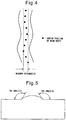
- Wire nos. Evaluation method The total amount of spatter trapped per one minute arc time was sieved by a screen of 1 mm mesh. The mass of the spatter not passing through the screen was measured. 97 to 112 Bead toe angle Cases where the average value of the toe angles were 120° or more were judged as passing. Further, in cases where the average value of the toe angles was 150° or more, it was judged that an effect of smoothening the toe angle was observed. Wire nos. Evaluation method: As shown in FIG. 5 , the weld zone was cut and 10 cross-sectional test pieces were cut out. The toe angles at two locations of the two sides of the test pieces, for a total of 20 locations, were measured and the average value was used for evaluation.
- Diffusive hydrogen of the weld joint was measured based on the test method prescribed in JIS Z 3118. 1, 7, 11, 14, 20, 29, 33, 43, 53, 57, 61, 65, 69, 76, 79, 87, 91, 95, 97, 104, 111, 113, 118, 123, and125 to 148 Slag peeling Cases where slag naturally peeled off from the bead surface were evaluated as A and judged as passing. Wire nos.
- Wire No. 55 where the total content of Si, Al, Ti, Mg, Zr, Ca, Ce, and La was a mass% with respect to the wire total mass of 0.1%, the deoxidation was insufficient, so blowholes formed and the wire was not passing.
- Wire No. 56 where the total content of Si, Al, Ti, Mg, Zr, Ca, Ce, and La was a mass% with respect to the wire total mass of 2.1%, hard microstructures such as MAC formed in the weld metal, so the Charpy test did not meet the passing standards and the wire was not passing.
- the ingredients other than the above were as follows.
- the units are mass% with respect to the wire total mass.
- Wire No. 85 where the total content of the Si oxides, Mn oxides, Al oxides, Fe oxides, Ti oxides, B oxides, and Zr oxides was a mass% with respect to the wire total mass of 0.1%, the slag covering become uneven and the bead offset failed to satisfy the passing standard, so the wire was not passing.
- Wire Nos. 86 and 152 where the total content of Si oxides, Mn oxides, Al oxides, Ti oxides, B oxides, and Zr oxides was a mass% with respect to the wire total mass of 3.1%, the amount of oxygen of the weld metal and the Charpy test did not meet the passing standards, so the wires were not passing.
- Table 30 Claim Verified items Class Wire nos. Flat Vertical Horizontal Overhead Results of overall evaluation Content of CaO Inventive and Reference ex. 1-11 Good Good Good Good Comp. ex. 12 Good Poor Poor Poor Poor 13 Poor Poor Poor Poor Total content of CaO and MgF 2 , CaF2, SrF 2 , BaF 2 Inv. ex. 14-29 Good Good Good Good Good Comp. ex. 30 Poor Poor Poor Poor Poor Comp. ex. 31 Good Poor Poor Poor Comp. ex. 32 Poor Poor Poor Poor Poor Deoxidizing metal elements Inv. ex. 33-53 Good Good Good Good Good Good Good 1 Comp. ex. 54-56 Poor Poor Poor Poor Poor Poor value of ⁇ and contents of P and S Inv. ex.
Landscapes
- Engineering & Computer Science (AREA)
- Mechanical Engineering (AREA)
- Chemical & Material Sciences (AREA)
- Inorganic Chemistry (AREA)
- Nonmetallic Welding Materials (AREA)
Claims (4)
- Fülldraht zum Schutzgasschweißen, der einen Stahlmantel aufweist, der mit einem Flussmittel gefüllt ist, wobei der Fülldraht zum Schutzgasschweißen dadurch gekennzeichnet ist, dass er die folgenden Bedingungen (a) bis (f) gleichzeitig erfüllt:(a) CaO ist in Masse-% im Hinblick auf eine Gesamtdrahtmasse mit mindestens 1,7 % und höchstens 4,9 % enthalten;(b) eines oder mehrere von MgF2, CaF2, SrF2 und BaF2 sind in Masse-% im Hinblick auf die Gesamtdrahtmasse mit insgesamt mindestens 1,0 % enthalten, und eines oder mehrere von MgF2, CaF2, SrF2 und BaF2 sowie CaO sind in Masse-% im Hinblick auf die Gesamtdrahtmasse mit insgesamt mindestens 3,0 % und höchstens 12,0 % enthalten;(c) im Metallzustand sind Si, Al, Ti, Mg, Zr, Ca, Ce und/oder La im Hinblick auf die Gesamtdrahtmasse mit insgesamt mindestens 0,2 % und höchstens 2,0 % enthalten, und in Masse-% ist ein Gehaltsbereich von Al im Metallzustand im Hinblick auf die Gesamtdrahtmasse auf weniger als 0,3 % begrenzt;(d) ein Wert α in der Definition durch die folgende Formel (1) liegt in einem Bereich von mindestens 0,15 und höchstens 0,40, und P und S sind in Masse-% im Hinblick auf die Gesamtdrahtmasse auf insgesamt höchstens 0,040 % begrenzt,

wobei N(X): Masse-% des Elements X im Hinblick auf die Gesamtdrahtmasse;(e) Si-Oxide, Mn-Oxide, Al-Oxide, Ti-Oxide, B-Oxide und Zr-Oxide sind in Masse-% im Hinblick auf die Gesamtdrahtmasse mit insgesamt mindestens 0,2 % und höchstens 3,0 % enthalten;(f) als Rest Fe, ein Lichtbogenstabilisator und unvermeidliche Verunreinigungen sowie Eisenpulver im Flussmittel sind in Masse-% im Hinblick auf die Gesamtdrahtmasse mit höchstens 5,0 % enthalten. - Fülldraht zum Schutzgasschweißen nach Anspruch 1, dadurch gekennzeichnet, dass ferner CaCO3, MgCO3, SrCO3 und/oder BaCO3 enthalten sind, und dadurch, dass sie in Masse-% im Hinblick auf die Gesamtdrahtmasse mit mindestens 0,1 % und höchstens 4,0 % enthalten sind.
- Fülldraht zum Schutzgasschweißen nach Anspruch 1 oder 2, dadurch gekennzeichnet, dass ferner MgO, SrO und/oder BaO enthalten sind, und dadurch, dass sie in Masse-% im Hinblick auf die Gesamtdrahtmasse mit mindestens 0,1 % und höchstens 3,2 % enthalten sind.
- Fülldraht zum Schutzgasschweißen nach einem der Ansprüche 1 bis 3, dadurch gekennzeichnet, dass keine schlitzförmige Öffnung vorhanden ist, die Feuchtigkeitsabsorption im Stahlmantel verursacht.
Applications Claiming Priority (2)
| Application Number | Priority Date | Filing Date | Title |
|---|---|---|---|
| JP2009285230 | 2009-12-16 | ||
| PCT/JP2010/072834 WO2011074689A1 (ja) | 2009-12-16 | 2010-12-14 | 全姿勢溶接が可能なガスシールドアーク溶接用フラックス入りワイヤ |
Publications (3)
| Publication Number | Publication Date |
|---|---|
| EP2489461A1 EP2489461A1 (de) | 2012-08-22 |
| EP2489461A4 EP2489461A4 (de) | 2014-12-31 |
| EP2489461B1 true EP2489461B1 (de) | 2016-04-13 |
Family
ID=44167439
Family Applications (1)
| Application Number | Title | Priority Date | Filing Date |
|---|---|---|---|
| EP10837713.6A Not-in-force EP2489461B1 (de) | 2009-12-16 | 2010-12-14 | Draht mit einem lötmaterial für gasversiegeltes lichtbogenschweissen in jeder position |
Country Status (7)
| Country | Link |
|---|---|
| US (1) | US9211613B2 (de) |
| EP (1) | EP2489461B1 (de) |
| JP (1) | JP4834191B2 (de) |
| KR (1) | KR101193273B1 (de) |
| CN (1) | CN102655978B (de) |
| TW (1) | TW201130594A (de) |
| WO (1) | WO2011074689A1 (de) |
Families Citing this family (32)
| Publication number | Priority date | Publication date | Assignee | Title |
|---|---|---|---|---|
| TW201318756A (zh) * | 2011-11-01 | 2013-05-16 | Sorex Welding Co Ltd | 耐熱鋼埋弧材料 |
| EP2848355B1 (de) * | 2012-05-08 | 2018-01-03 | Nippon Steel & Sumitomo Metal Corporation | Flussmittelhaltiger draht zum schweissen von ultrahochfestem stahl |
| JP5825210B2 (ja) * | 2012-07-09 | 2015-12-02 | 新日鐵住金株式会社 | パルスガスシールドアーク溶接方法 |
| CN102773631B (zh) * | 2012-08-09 | 2015-05-20 | 上海电力修造总厂有限公司 | 一种碱性渣系的核级镍基焊条的焊芯、药皮及其焊条和制备方法 |
| JP5644984B1 (ja) * | 2013-01-31 | 2014-12-24 | 新日鐵住金株式会社 | フラックス入りワイヤ、フラックス入りワイヤを用いた溶接方法、フラックス入りワイヤを用いた溶接継手の製造方法、および溶接継手 |
| US9700964B2 (en) * | 2013-03-15 | 2017-07-11 | Lincoln Global, Inc. | Boric acid free flux |
| JP6365063B2 (ja) * | 2013-07-29 | 2018-08-01 | 新日鐵住金株式会社 | 立向溶接の作業性に優れた高靭性ガスシールドアーク溶接用フラックス入りワイヤ |
| JP6221628B2 (ja) * | 2013-10-25 | 2017-11-01 | 新日鐵住金株式会社 | ボックス柱の製造方法 |
| JP6252104B2 (ja) * | 2013-10-25 | 2017-12-27 | 新日鐵住金株式会社 | ボックス柱の製造方法 |
| KR101674743B1 (ko) * | 2013-11-08 | 2016-11-09 | 신닛테츠스미킨 카부시키카이샤 | 가스 실드 아크 용접용 플럭스 내장 와이어 및 극저온용 강의 용접 방법 및 용접 조인트의 제조 방법 |
| WO2015068261A1 (ja) * | 2013-11-08 | 2015-05-14 | 新日鐵住金株式会社 | 溶接継手の製造方法 |
| CN103962743B (zh) * | 2014-04-30 | 2016-02-24 | 西安理工大学 | 用于x100管线钢全位置焊接的焊丝及其制备方法 |
| JP6382117B2 (ja) * | 2015-01-16 | 2018-08-29 | 日鐵住金溶接工業株式会社 | Ar−CO2混合ガスシールドアーク溶接用フラックス入りワイヤ |
| JP6437327B2 (ja) * | 2015-01-28 | 2018-12-12 | 日鐵住金溶接工業株式会社 | 炭酸ガスシールドアーク溶接用フラックス入りワイヤ |
| US11426821B2 (en) * | 2015-02-25 | 2022-08-30 | Hobart Brothers Llc | Aluminum metal-cored welding wire |
| US20160318115A1 (en) * | 2015-05-01 | 2016-11-03 | Lincoln Global, Inc. | Welding process |
| CN104942475B (zh) * | 2015-07-10 | 2017-06-16 | 北京工业大学 | 一种x90/x100管线钢用高强度金属芯埋弧焊丝及其制备方法 |
| JP6453178B2 (ja) * | 2015-07-17 | 2019-01-16 | 株式会社神戸製鋼所 | ガスシールドアーク溶接用フラックス入りワイヤ |
| JP2017094360A (ja) | 2015-11-25 | 2017-06-01 | 日鐵住金溶接工業株式会社 | Ar−CO2混合ガスシールドアーク溶接用フラックス入りワイヤ |
| EP3427890B1 (de) * | 2016-03-08 | 2021-06-02 | Nippon Steel Corporation | Flussmitttelkerndraht, verfahren zur herstellung von schweissverbindungen, und schweissverbindung |
| US10946486B2 (en) | 2016-03-08 | 2021-03-16 | Nippon Steel Corporation | Flux-cored wire, manufacturing method of welded joint, and welded joint |
| JP6726008B2 (ja) * | 2016-03-25 | 2020-07-22 | 株式会社神戸製鋼所 | ガスシールドアーク溶接用フラックス入りワイヤ |
| JP6762131B2 (ja) * | 2016-04-28 | 2020-09-30 | 株式会社神戸製鋼所 | フラックス入りワイヤ |
| CN106181122B (zh) * | 2016-08-10 | 2018-12-25 | 中国船舶重工集团公司第七二五研究所 | 一种用于屈服强度550MPa钢的无缝埋弧药芯焊丝 |
| CN106346166A (zh) * | 2016-08-31 | 2017-01-25 | 晋城市金菲机电有限公司 | 一种低温预热高强度药芯焊丝及其生产工艺 |
| CN110023030B (zh) | 2016-11-08 | 2022-04-15 | 日本制铁株式会社 | 药芯焊丝、焊接接头的制造方法以及焊接接头 |
| CN110315240A (zh) * | 2018-03-29 | 2019-10-11 | 株式会社神户制钢所 | 药芯焊丝 |
| JP7231476B2 (ja) * | 2019-05-09 | 2023-03-01 | 株式会社神戸製鋼所 | フラックス入りワイヤ、溶接方法及び溶接金属 |
| CN110900034B (zh) * | 2019-12-17 | 2021-08-24 | 天津市永昌焊丝有限公司 | 一种全位置碱性药芯焊丝 |
| JP7440303B2 (ja) * | 2020-03-06 | 2024-02-28 | 株式会社神戸製鋼所 | エレクトロスラグ溶接用フラックス及びエレクトロスラグ溶接方法 |
| WO2026063099A1 (ja) * | 2024-09-18 | 2026-03-26 | 日本製鉄株式会社 | フラックス入りワイヤ及び溶接継手の製造方法 |
| CN119952338B (zh) * | 2025-01-22 | 2025-10-28 | 首都航天机械有限公司 | 一种适用于电弧增材制造铝铜合金丝材及其制备方法 |
Family Cites Families (30)
| Publication number | Priority date | Publication date | Assignee | Title |
|---|---|---|---|---|
| JPS5149581B1 (de) * | 1965-11-15 | 1976-12-27 | ||
| US3542998A (en) * | 1967-06-07 | 1970-11-24 | Air Reduction | Cored electrode for welding in air |
| CA956366A (en) * | 1970-04-24 | 1974-10-15 | Cornelius J. Sullivan | Air wire electrode for stainless steel welding |
| US4149063A (en) * | 1977-03-28 | 1979-04-10 | The International Nickel Company, Inc. | Flux cored wire for welding Ni-Cr-Fe alloys |
| JPS57137094A (en) * | 1981-02-17 | 1982-08-24 | Kawasaki Steel Corp | High speed submerged arc welding method of single layer on both sides |
| US4571480A (en) * | 1984-02-27 | 1986-02-18 | Kabushiki Kaisha Kobe Seiko Sho | Flux cored wire electrodes for self-shielded arc welding |
| JPS62151293A (ja) | 1985-12-26 | 1987-07-06 | Kobe Steel Ltd | ガスシ−ルドア−ク溶接用フラツクス入りワイヤ |
| JPH02207996A (ja) * | 1989-02-08 | 1990-08-17 | Nippon Steel Corp | ガスシールドアーク溶接用フラックス入りワイヤ |
| JP2687006B2 (ja) * | 1989-02-18 | 1997-12-08 | 新日本製鐵株式会社 | 耐火鋼用ガスシールドアーク溶接用フラックス入りワイヤ |
| US5055655A (en) * | 1989-09-11 | 1991-10-08 | The Lincoln Electric Company | Low hydrogen basic metal cored electrode |
| US5171958A (en) * | 1990-08-16 | 1992-12-15 | Kawasaki Steel Corporation | High-efficiency fillet welding method for steel plate |
| JP2500020B2 (ja) | 1992-03-31 | 1996-05-29 | 株式会社神戸製鋼所 | ガスシ―ルドア―ク溶接用塩基性フラックス入りワイヤ |
| JP3203527B2 (ja) | 1993-02-15 | 2001-08-27 | 新日本製鐵株式会社 | ガスシールドアーク溶接用フラックス入りワイヤ |
| EP0652071A1 (de) * | 1993-08-12 | 1995-05-10 | Kabushiki Kaisha Kobe Seiko Sho | Flussmittelkerndraht zum Lichtbogenschweissen in Schutzgas mit niedriger Rauchentwicklung |
| JP3377271B2 (ja) | 1993-12-10 | 2003-02-17 | 新日本製鐵株式会社 | ガスシールドアーク溶接用フラックス入りワイヤ |
| JPH07276088A (ja) | 1994-04-04 | 1995-10-24 | Nippon Steel Corp | 低温鋼用mag溶接フラックス入りワイヤ |
| CN1117903A (zh) * | 1994-08-30 | 1996-03-06 | 天津大学 | 一种低合金钢高韧性自保护药芯焊丝 |
| JP3464334B2 (ja) * | 1996-03-19 | 2003-11-10 | 日鐵住金溶接工業株式会社 | プライマ塗装鋼板のすみ肉溶接に用いるガスシ−ルドア−ク溶接用フラックス入りワイヤ |
| CA2231985C (en) * | 1997-03-26 | 2004-05-25 | Sumitomo Metal Industries, Ltd. | Welded high-strength steel structures and methods of manufacturing the same |
| JPH10296486A (ja) * | 1997-05-02 | 1998-11-10 | Nippon Steel Corp | 9%Ni鋼溶接用フラックス入りワイヤ |
| JP3586362B2 (ja) | 1997-08-22 | 2004-11-10 | 株式会社神戸製鋼所 | ガスシールドアーク溶接用フラックス入りワイヤ |
| JP2001205482A (ja) | 2000-01-19 | 2001-07-31 | Nippon Steel Weld Prod & Eng Co Ltd | ガスシールドアーク溶接用フラックス入りワイヤ |
| US6784401B2 (en) * | 2001-01-30 | 2004-08-31 | Illinois Tool Works Inc. | Welding electrode and method for reducing manganese in fume |
| JP3758040B2 (ja) * | 2002-07-26 | 2006-03-22 | 株式会社神戸製鋼所 | 低合金耐熱鋼用ガスシールドアーク溶接用フラックス入りワイヤ |
| FR2866825B1 (fr) * | 2004-03-01 | 2007-04-20 | Air Liquide | Electrode enrobee a faible emission de fumees et bas chrome hexavalent pour le soudage des aciers inoxydables |
| US7812284B2 (en) * | 2005-07-12 | 2010-10-12 | Lincoln Global, Inc. | Barium and lithium ratio for flux cored electrode |
| US20070051702A1 (en) * | 2005-09-08 | 2007-03-08 | Lincoln Global, Inc., A Delaware Corporation | Flux system to reduce copper cracking |
| US8153934B2 (en) * | 2006-09-15 | 2012-04-10 | Lincoln Global, Inc. | Saw flux system for improved as-cast weld metal toughness |
| JP5097499B2 (ja) | 2006-10-19 | 2012-12-12 | 株式会社神戸製鋼所 | 低合金耐熱鋼用ガスシールドアーク溶接用フラックス入りワイヤ |
| JP5387192B2 (ja) | 2009-07-16 | 2014-01-15 | 新日鐵住金株式会社 | ガスシールド溶接用フラックス入りワイヤ |
-
2010
- 2010-12-14 EP EP10837713.6A patent/EP2489461B1/de not_active Not-in-force
- 2010-12-14 US US13/513,904 patent/US9211613B2/en not_active Expired - Fee Related
- 2010-12-14 CN CN201080056957.8A patent/CN102655978B/zh not_active Expired - Fee Related
- 2010-12-14 JP JP2011524042A patent/JP4834191B2/ja active Active
- 2010-12-14 KR KR1020127014896A patent/KR101193273B1/ko not_active Expired - Fee Related
- 2010-12-14 WO PCT/JP2010/072834 patent/WO2011074689A1/ja not_active Ceased
- 2010-12-15 TW TW099143978A patent/TW201130594A/zh not_active IP Right Cessation
Also Published As
| Publication number | Publication date |
|---|---|
| KR101193273B1 (ko) | 2012-10-19 |
| US20120241433A1 (en) | 2012-09-27 |
| JP4834191B2 (ja) | 2011-12-14 |
| WO2011074689A1 (ja) | 2011-06-23 |
| CN102655978B (zh) | 2015-08-05 |
| EP2489461A4 (de) | 2014-12-31 |
| EP2489461A1 (de) | 2012-08-22 |
| JPWO2011074689A1 (ja) | 2013-05-02 |
| KR20120084780A (ko) | 2012-07-30 |
| CN102655978A (zh) | 2012-09-05 |
| TW201130594A (en) | 2011-09-16 |
| US9211613B2 (en) | 2015-12-15 |
| TWI372089B (de) | 2012-09-11 |
Similar Documents
| Publication | Publication Date | Title |
|---|---|---|
| EP2489461B1 (de) | Draht mit einem lötmaterial für gasversiegeltes lichtbogenschweissen in jeder position | |
| US20220281024A1 (en) | Flux-cored wire, manufacturing method of welded joint, and welded joint | |
| KR101674743B1 (ko) | 가스 실드 아크 용접용 플럭스 내장 와이어 및 극저온용 강의 용접 방법 및 용접 조인트의 제조 방법 | |
| JP6291461B2 (ja) | ガスシールドアーク溶接用フラックス入りワイヤ | |
| EP3020504A1 (de) | Fülldraht zum auftragsschweissen | |
| EP3208030B1 (de) | Flusskerndraht zum lichtbogenschweissen von duplexedelstahl | |
| CN109789519B (zh) | 电渣焊用焊丝、电渣焊用焊剂和焊接接头 | |
| KR102013984B1 (ko) | 가스 실드 아크 용접용 플럭스 내장 와이어 | |
| EP4056312A1 (de) | Flussmittelkerndraht und verfahren zum herstellen einer schweissverbindung | |
| RU2707763C1 (ru) | Способ сварки с использованием специальной сварочной горелки | |
| KR20230162714A (ko) | 플럭스 코어드 와이어 및 용접 조인트의 제조 방법 | |
| EP3444063A2 (de) | Elektroden zur formung von austenitischem und duplex stahlschweissmetall | |
| JP6891630B2 (ja) | ガスシールドアーク溶接用フラックス入りワイヤ、及び溶接継手の製造方法 | |
| JP6257489B2 (ja) | ガスシールドアーク溶接方法 | |
| JP6365063B2 (ja) | 立向溶接の作業性に優れた高靭性ガスシールドアーク溶接用フラックス入りワイヤ | |
| JP2020015092A (ja) | 2相ステンレス鋼溶接用フラックス入りワイヤ、溶接方法および溶接金属 | |
| WO2020012925A1 (ja) | 2相ステンレス鋼溶接用フラックス入りワイヤ、溶接方法および溶接金属 | |
| JP4881512B2 (ja) | セルフシールドアーク溶接用フラックス入りワイヤ | |
| JPS6357155B2 (de) | ||
| JPH0669634B2 (ja) | 薄板用セルフシールドアーク溶接フラックス入りワイヤ | |
| JPH0818154B2 (ja) | 薄板用セルフシールドアーク溶接フラックス入りワイヤ | |
| JPH0832373B2 (ja) | ガスシールドアーク溶接フラックス入りワイヤ | |
| JPS6284892A (ja) | 鉄粉系フラツクス入りワイヤ |
Legal Events
| Date | Code | Title | Description |
|---|---|---|---|
| PUAI | Public reference made under article 153(3) epc to a published international application that has entered the european phase |
Free format text: ORIGINAL CODE: 0009012 |
|
| 17P | Request for examination filed |
Effective date: 20120515 |
|
| AK | Designated contracting states |
Kind code of ref document: A1 Designated state(s): AL AT BE BG CH CY CZ DE DK EE ES FI FR GB GR HR HU IE IS IT LI LT LU LV MC MK MT NL NO PL PT RO RS SE SI SK SM TR |
|
| RAP1 | Party data changed (applicant data changed or rights of an application transferred) |
Owner name: NIPPON STEEL & SUMITOMO METAL CORPORATION |
|
| DAX | Request for extension of the european patent (deleted) | ||
| A4 | Supplementary search report drawn up and despatched |
Effective date: 20141202 |
|
| RIC1 | Information provided on ipc code assigned before grant |
Ipc: B23K 35/30 20060101ALI20141126BHEP Ipc: B23K 35/02 20060101ALI20141126BHEP Ipc: B23K 35/368 20060101AFI20141126BHEP |
|
| GRAP | Despatch of communication of intention to grant a patent |
Free format text: ORIGINAL CODE: EPIDOSNIGR1 |
|
| INTG | Intention to grant announced |
Effective date: 20151006 |
|
| GRAS | Grant fee paid |
Free format text: ORIGINAL CODE: EPIDOSNIGR3 |
|
| GRAA | (expected) grant |
Free format text: ORIGINAL CODE: 0009210 |
|
| RIN1 | Information on inventor provided before grant (corrected) |
Inventor name: SHIMURA, RYUICHI Inventor name: SASAKI, KIYOHITO Inventor name: KOJIMA, KAZUHIRO |
|
| AK | Designated contracting states |
Kind code of ref document: B1 Designated state(s): AL AT BE BG CH CY CZ DE DK EE ES FI FR GB GR HR HU IE IS IT LI LT LU LV MC MK MT NL NO PL PT RO RS SE SI SK SM TR |
|
| REG | Reference to a national code |
Ref country code: GB Ref legal event code: FG4D |
|
| REG | Reference to a national code |
Ref country code: AT Ref legal event code: REF Ref document number: 789592 Country of ref document: AT Kind code of ref document: T Effective date: 20160415 Ref country code: CH Ref legal event code: EP |
|
| REG | Reference to a national code |
Ref country code: IE Ref legal event code: FG4D |
|
| REG | Reference to a national code |
Ref country code: DE Ref legal event code: R096 Ref document number: 602010032342 Country of ref document: DE |
|
| REG | Reference to a national code |
Ref country code: SE Ref legal event code: TRGR |
|
| REG | Reference to a national code |
Ref country code: LT Ref legal event code: MG4D |
|
| REG | Reference to a national code |
Ref country code: AT Ref legal event code: MK05 Ref document number: 789592 Country of ref document: AT Kind code of ref document: T Effective date: 20160413 |
|
| REG | Reference to a national code |
Ref country code: NL Ref legal event code: MP Effective date: 20160413 |
|
| PG25 | Lapsed in a contracting state [announced via postgrant information from national office to epo] |
Ref country code: LT Free format text: LAPSE BECAUSE OF FAILURE TO SUBMIT A TRANSLATION OF THE DESCRIPTION OR TO PAY THE FEE WITHIN THE PRESCRIBED TIME-LIMIT Effective date: 20160413 Ref country code: NO Free format text: LAPSE BECAUSE OF FAILURE TO SUBMIT A TRANSLATION OF THE DESCRIPTION OR TO PAY THE FEE WITHIN THE PRESCRIBED TIME-LIMIT Effective date: 20160713 Ref country code: PL Free format text: LAPSE BECAUSE OF FAILURE TO SUBMIT A TRANSLATION OF THE DESCRIPTION OR TO PAY THE FEE WITHIN THE PRESCRIBED TIME-LIMIT Effective date: 20160413 Ref country code: FI Free format text: LAPSE BECAUSE OF FAILURE TO SUBMIT A TRANSLATION OF THE DESCRIPTION OR TO PAY THE FEE WITHIN THE PRESCRIBED TIME-LIMIT Effective date: 20160413 Ref country code: NL Free format text: LAPSE BECAUSE OF FAILURE TO SUBMIT A TRANSLATION OF THE DESCRIPTION OR TO PAY THE FEE WITHIN THE PRESCRIBED TIME-LIMIT Effective date: 20160413 |
|
| REG | Reference to a national code |
Ref country code: FR Ref legal event code: PLFP Year of fee payment: 7 |
|
| PG25 | Lapsed in a contracting state [announced via postgrant information from national office to epo] |
Ref country code: ES Free format text: LAPSE BECAUSE OF FAILURE TO SUBMIT A TRANSLATION OF THE DESCRIPTION OR TO PAY THE FEE WITHIN THE PRESCRIBED TIME-LIMIT Effective date: 20160413 Ref country code: AT Free format text: LAPSE BECAUSE OF FAILURE TO SUBMIT A TRANSLATION OF THE DESCRIPTION OR TO PAY THE FEE WITHIN THE PRESCRIBED TIME-LIMIT Effective date: 20160413 Ref country code: HR Free format text: LAPSE BECAUSE OF FAILURE TO SUBMIT A TRANSLATION OF THE DESCRIPTION OR TO PAY THE FEE WITHIN THE PRESCRIBED TIME-LIMIT Effective date: 20160413 Ref country code: LV Free format text: LAPSE BECAUSE OF FAILURE TO SUBMIT A TRANSLATION OF THE DESCRIPTION OR TO PAY THE FEE WITHIN THE PRESCRIBED TIME-LIMIT Effective date: 20160413 Ref country code: PT Free format text: LAPSE BECAUSE OF FAILURE TO SUBMIT A TRANSLATION OF THE DESCRIPTION OR TO PAY THE FEE WITHIN THE PRESCRIBED TIME-LIMIT Effective date: 20160816 Ref country code: RS Free format text: LAPSE BECAUSE OF FAILURE TO SUBMIT A TRANSLATION OF THE DESCRIPTION OR TO PAY THE FEE WITHIN THE PRESCRIBED TIME-LIMIT Effective date: 20160413 Ref country code: GR Free format text: LAPSE BECAUSE OF FAILURE TO SUBMIT A TRANSLATION OF THE DESCRIPTION OR TO PAY THE FEE WITHIN THE PRESCRIBED TIME-LIMIT Effective date: 20160714 |
|
| PG25 | Lapsed in a contracting state [announced via postgrant information from national office to epo] |
Ref country code: BE Free format text: LAPSE BECAUSE OF FAILURE TO SUBMIT A TRANSLATION OF THE DESCRIPTION OR TO PAY THE FEE WITHIN THE PRESCRIBED TIME-LIMIT Effective date: 20160413 |
|
| REG | Reference to a national code |
Ref country code: DE Ref legal event code: R097 Ref document number: 602010032342 Country of ref document: DE |
|
| PG25 | Lapsed in a contracting state [announced via postgrant information from national office to epo] |
Ref country code: CZ Free format text: LAPSE BECAUSE OF FAILURE TO SUBMIT A TRANSLATION OF THE DESCRIPTION OR TO PAY THE FEE WITHIN THE PRESCRIBED TIME-LIMIT Effective date: 20160413 Ref country code: EE Free format text: LAPSE BECAUSE OF FAILURE TO SUBMIT A TRANSLATION OF THE DESCRIPTION OR TO PAY THE FEE WITHIN THE PRESCRIBED TIME-LIMIT Effective date: 20160413 Ref country code: SK Free format text: LAPSE BECAUSE OF FAILURE TO SUBMIT A TRANSLATION OF THE DESCRIPTION OR TO PAY THE FEE WITHIN THE PRESCRIBED TIME-LIMIT Effective date: 20160413 Ref country code: RO Free format text: LAPSE BECAUSE OF FAILURE TO SUBMIT A TRANSLATION OF THE DESCRIPTION OR TO PAY THE FEE WITHIN THE PRESCRIBED TIME-LIMIT Effective date: 20160413 Ref country code: DK Free format text: LAPSE BECAUSE OF FAILURE TO SUBMIT A TRANSLATION OF THE DESCRIPTION OR TO PAY THE FEE WITHIN THE PRESCRIBED TIME-LIMIT Effective date: 20160413 |
|
| PLBE | No opposition filed within time limit |
Free format text: ORIGINAL CODE: 0009261 |
|
| STAA | Information on the status of an ep patent application or granted ep patent |
Free format text: STATUS: NO OPPOSITION FILED WITHIN TIME LIMIT |
|
| PG25 | Lapsed in a contracting state [announced via postgrant information from national office to epo] |
Ref country code: SM Free format text: LAPSE BECAUSE OF FAILURE TO SUBMIT A TRANSLATION OF THE DESCRIPTION OR TO PAY THE FEE WITHIN THE PRESCRIBED TIME-LIMIT Effective date: 20160413 |
|
| 26N | No opposition filed |
Effective date: 20170116 |
|
| PG25 | Lapsed in a contracting state [announced via postgrant information from national office to epo] |
Ref country code: SI Free format text: LAPSE BECAUSE OF FAILURE TO SUBMIT A TRANSLATION OF THE DESCRIPTION OR TO PAY THE FEE WITHIN THE PRESCRIBED TIME-LIMIT Effective date: 20160413 |
|
| REG | Reference to a national code |
Ref country code: CH Ref legal event code: PL |
|
| PG25 | Lapsed in a contracting state [announced via postgrant information from national office to epo] |
Ref country code: MC Free format text: LAPSE BECAUSE OF FAILURE TO SUBMIT A TRANSLATION OF THE DESCRIPTION OR TO PAY THE FEE WITHIN THE PRESCRIBED TIME-LIMIT Effective date: 20160413 |
|
| REG | Reference to a national code |
Ref country code: IE Ref legal event code: MM4A |
|
| PG25 | Lapsed in a contracting state [announced via postgrant information from national office to epo] |
Ref country code: CH Free format text: LAPSE BECAUSE OF NON-PAYMENT OF DUE FEES Effective date: 20161231 Ref country code: LU Free format text: LAPSE BECAUSE OF NON-PAYMENT OF DUE FEES Effective date: 20161214 Ref country code: LI Free format text: LAPSE BECAUSE OF NON-PAYMENT OF DUE FEES Effective date: 20161231 |
|
| REG | Reference to a national code |
Ref country code: FR Ref legal event code: PLFP Year of fee payment: 8 |
|
| PG25 | Lapsed in a contracting state [announced via postgrant information from national office to epo] |
Ref country code: IE Free format text: LAPSE BECAUSE OF NON-PAYMENT OF DUE FEES Effective date: 20161214 |
|
| PG25 | Lapsed in a contracting state [announced via postgrant information from national office to epo] |
Ref country code: CY Free format text: LAPSE BECAUSE OF FAILURE TO SUBMIT A TRANSLATION OF THE DESCRIPTION OR TO PAY THE FEE WITHIN THE PRESCRIBED TIME-LIMIT Effective date: 20160413 Ref country code: HU Free format text: LAPSE BECAUSE OF FAILURE TO SUBMIT A TRANSLATION OF THE DESCRIPTION OR TO PAY THE FEE WITHIN THE PRESCRIBED TIME-LIMIT; INVALID AB INITIO Effective date: 20101214 |
|
| PG25 | Lapsed in a contracting state [announced via postgrant information from national office to epo] |
Ref country code: IS Free format text: LAPSE BECAUSE OF FAILURE TO SUBMIT A TRANSLATION OF THE DESCRIPTION OR TO PAY THE FEE WITHIN THE PRESCRIBED TIME-LIMIT Effective date: 20160413 Ref country code: MK Free format text: LAPSE BECAUSE OF FAILURE TO SUBMIT A TRANSLATION OF THE DESCRIPTION OR TO PAY THE FEE WITHIN THE PRESCRIBED TIME-LIMIT Effective date: 20160413 Ref country code: TR Free format text: LAPSE BECAUSE OF FAILURE TO SUBMIT A TRANSLATION OF THE DESCRIPTION OR TO PAY THE FEE WITHIN THE PRESCRIBED TIME-LIMIT Effective date: 20160413 |
|
| PG25 | Lapsed in a contracting state [announced via postgrant information from national office to epo] |
Ref country code: BG Free format text: LAPSE BECAUSE OF FAILURE TO SUBMIT A TRANSLATION OF THE DESCRIPTION OR TO PAY THE FEE WITHIN THE PRESCRIBED TIME-LIMIT Effective date: 20160413 |
|
| PG25 | Lapsed in a contracting state [announced via postgrant information from national office to epo] |
Ref country code: MT Free format text: LAPSE BECAUSE OF NON-PAYMENT OF DUE FEES Effective date: 20161214 |
|
| PG25 | Lapsed in a contracting state [announced via postgrant information from national office to epo] |
Ref country code: AL Free format text: LAPSE BECAUSE OF FAILURE TO SUBMIT A TRANSLATION OF THE DESCRIPTION OR TO PAY THE FEE WITHIN THE PRESCRIBED TIME-LIMIT Effective date: 20160413 |
|
| REG | Reference to a national code |
Ref country code: DE Ref legal event code: R082 Ref document number: 602010032342 Country of ref document: DE Representative=s name: VOSSIUS & PARTNER PATENTANWAELTE RECHTSANWAELT, DE Ref country code: DE Ref legal event code: R081 Ref document number: 602010032342 Country of ref document: DE Owner name: NIPPON STEEL CORPORATION, JP Free format text: FORMER OWNER: NIPPON STEEL & SUMITOMO METAL CORPORATION, TOKYO, JP |
|
| PGFP | Annual fee paid to national office [announced via postgrant information from national office to epo] |
Ref country code: DE Payment date: 20191203 Year of fee payment: 10 Ref country code: SE Payment date: 20191210 Year of fee payment: 10 |
|
| PGFP | Annual fee paid to national office [announced via postgrant information from national office to epo] |
Ref country code: IT Payment date: 20191209 Year of fee payment: 10 Ref country code: FR Payment date: 20191115 Year of fee payment: 10 |
|
| PGFP | Annual fee paid to national office [announced via postgrant information from national office to epo] |
Ref country code: GB Payment date: 20191213 Year of fee payment: 10 |
|
| REG | Reference to a national code |
Ref country code: DE Ref legal event code: R119 Ref document number: 602010032342 Country of ref document: DE |
|
| REG | Reference to a national code |
Ref country code: SE Ref legal event code: EUG |
|
| GBPC | Gb: european patent ceased through non-payment of renewal fee |
Effective date: 20201214 |
|
| PG25 | Lapsed in a contracting state [announced via postgrant information from national office to epo] |
Ref country code: FR Free format text: LAPSE BECAUSE OF NON-PAYMENT OF DUE FEES Effective date: 20201231 Ref country code: IT Free format text: LAPSE BECAUSE OF NON-PAYMENT OF DUE FEES Effective date: 20201214 |
|
| PG25 | Lapsed in a contracting state [announced via postgrant information from national office to epo] |
Ref country code: SE Free format text: LAPSE BECAUSE OF NON-PAYMENT OF DUE FEES Effective date: 20201215 Ref country code: GB Free format text: LAPSE BECAUSE OF NON-PAYMENT OF DUE FEES Effective date: 20201214 Ref country code: DE Free format text: LAPSE BECAUSE OF NON-PAYMENT OF DUE FEES Effective date: 20210701 |