EP2496250B1 - Quantifizierung des insulinähnlichen wachstumsfaktors i und des insulinähnlichen wachstumsfaktors ii durch hochauflösende massenspektrometrie - Google Patents
Quantifizierung des insulinähnlichen wachstumsfaktors i und des insulinähnlichen wachstumsfaktors ii durch hochauflösende massenspektrometrie Download PDFInfo
- Publication number
- EP2496250B1 EP2496250B1 EP10829122.0A EP10829122A EP2496250B1 EP 2496250 B1 EP2496250 B1 EP 2496250B1 EP 10829122 A EP10829122 A EP 10829122A EP 2496250 B1 EP2496250 B1 EP 2496250B1
- Authority
- EP
- European Patent Office
- Prior art keywords
- igf
- ions
- protein
- ionization
- sample
- Prior art date
- Legal status (The legal status is an assumption and is not a legal conclusion. Google has not performed a legal analysis and makes no representation as to the accuracy of the status listed.)
- Active
Links
Images





Classifications
-
- G—PHYSICS
- G01—MEASURING; TESTING
- G01N—INVESTIGATING OR ANALYSING MATERIALS BY DETERMINING THEIR CHEMICAL OR PHYSICAL PROPERTIES
- G01N33/00—Investigating or analysing materials by specific methods not covered by groups G01N1/00 - G01N31/00
- G01N33/48—Biological material, e.g. blood, urine; Haemocytometers
- G01N33/50—Chemical analysis of biological material, e.g. blood, urine; Testing involving biospecific ligand binding methods; Immunological testing
- G01N33/74—Chemical analysis of biological material, e.g. blood, urine; Testing involving biospecific ligand binding methods; Immunological testing involving hormones or other non-cytokine intercellular protein regulatory factors such as growth factors, including receptors to hormones and growth factors
-
- C—CHEMISTRY; METALLURGY
- C07—ORGANIC CHEMISTRY
- C07K—PEPTIDES
- C07K14/00—Peptides having more than 20 amino acids; Gastrins; Somatostatins; Melanotropins; Derivatives thereof
- C07K14/435—Peptides having more than 20 amino acids; Gastrins; Somatostatins; Melanotropins; Derivatives thereof from animals; from humans
- C07K14/575—Hormones
- C07K14/65—Insulin-like growth factors, i.e. somatomedins, e.g. IGF-1, IGF-2
-
- G—PHYSICS
- G01—MEASURING; TESTING
- G01N—INVESTIGATING OR ANALYSING MATERIALS BY DETERMINING THEIR CHEMICAL OR PHYSICAL PROPERTIES
- G01N33/00—Investigating or analysing materials by specific methods not covered by groups G01N1/00 - G01N31/00
- G01N33/48—Biological material, e.g. blood, urine; Haemocytometers
- G01N33/50—Chemical analysis of biological material, e.g. blood, urine; Testing involving biospecific ligand binding methods; Immunological testing
- G01N33/68—Chemical analysis of biological material, e.g. blood, urine; Testing involving biospecific ligand binding methods; Immunological testing involving proteins, peptides or amino acids
- G01N33/6803—General methods of protein analysis not limited to specific proteins or families of proteins
- G01N33/6848—Methods of protein analysis involving mass spectrometry
-
- G—PHYSICS
- G01—MEASURING; TESTING
- G01N—INVESTIGATING OR ANALYSING MATERIALS BY DETERMINING THEIR CHEMICAL OR PHYSICAL PROPERTIES
- G01N33/00—Investigating or analysing materials by specific methods not covered by groups G01N1/00 - G01N31/00
- G01N33/48—Biological material, e.g. blood, urine; Haemocytometers
- G01N33/50—Chemical analysis of biological material, e.g. blood, urine; Testing involving biospecific ligand binding methods; Immunological testing
- G01N33/68—Chemical analysis of biological material, e.g. blood, urine; Testing involving biospecific ligand binding methods; Immunological testing involving proteins, peptides or amino acids
- G01N33/6803—General methods of protein analysis not limited to specific proteins or families of proteins
- G01N33/6848—Methods of protein analysis involving mass spectrometry
- G01N33/6851—Methods of protein analysis involving laser desorption ionisation mass spectrometry
Definitions
- the invention relates to the quantitative analysis of large proteins using mass spectrometry.
- IGF-I is a hormone with a molecular structure similar to insulin. It is a peptide produced by the liver and contains 70 amino acids in a single chain with three intramolecular disulfide bridges. IGF-I has a molecular weight of about 7,649 Da, and is highly protein bound in serum. Production is stimulated by growth hormone and can be retarded by undernutrition, growth hormone insensitivity, lack of growth hormone receptors, or failure of a downstream signaling pathway. IGF-I plays an important role in childhood growth and continues to have anabolic effects in adults.
- IGF-II Insulin-like growth factor II
- IGF-II insulin-like growth factor II
- IGF-II is also a hormone with a molecular structure similar to insulin. It is a single chain peptide that contains 67 amino acids. IGF-II has a molecular weight of about 7,505 Da, and is highly protein bound in serum. IGF-II is used as an adjunct to insulin-like growth factor I (IGF-I) in clinical evaluation of growth hormone-related disorders. IGF-II plays a role primarily in fetal growth and development by interplaying with IGF-I and different cell surface receptors and circulating binding proteins to modulate tissue growth. IGF-II levels are reduced in children and adults as a result of growth hormone deficiency or malnutrition.
- IGF-II serum levels may be observed in acromegaly or with exogenous administration of IGF-I.
- measurement of circulating IGF-II levels i.e. in plasma/serum
- measurement of circulating IGF-II is also a valuable tool in various epidemiological research areas and clinical trials.
- IGF-I and IGF-II have proven to be particularly challenging to quantitatively analyze with a "bottom up" approach (i.e., enzymatic digestion and quantitation of one or more of the resulting peptides).
- a "bottom up” approach i.e., enzymatic digestion and quantitation of one or more of the resulting peptides.
- de Kock, et al. reported that typical trypsin, chymotrypsin, and pepsin digestion methods result in low digestion yield and non-specific enzyme cleavage.
- de Kock, et al. Rapid Commun. Mass Spectrom., 2001, 15:1191-97 .
- de Kock, et al. suggested that the unsatisfactory digestion results were likely due to steric restriction of the proteolytic enzymes by IGF-I's three disulfide bonds. Id.
- US patent application US 5 851 907 discloses methods for separating ligands from binding proteins, in particular separating an insulin-like growth factor (IGF) from its specific insulin-like growth factor binding protein (IGFBP). The methods include acidic separation and size separation.
- US patent application US 2009/054320 (A1) relates to vesiculin and fragments thereof, their preparation and use, as well as nucleic acids encoding the same. Disclosed is also mass spectrometric analysis of vesiculin fragments.
- LC-ion trap MS with single ion monitoring (SIM). See, e.g., Id.; Bobin, et al., Analyst, 2001, 126:1996-2001 ; and Popot, et al., Chromatographia, 2001, 54:737-741 (Popot I).
- SIM single ion monitoring
- These references disclose LC-ESI-ion trap MS of intact IGF-I at charge states ranging from 4+ to 9+ in SIM mode. More recently, LC-MS/MS techniques using multiple reaction monitoring (MRM) have been disclosed.
- MRM multiple reaction monitoring
- Popot II reports quantitative analysis of IGF-I at charge states ranging from 4+ to 9+ using LC-ion trap MS with SIM, followed by qualitative confirmation of the analyte with LC-ion trap MS/MS using MRM.
- the MRM experiments use selected multicharged IGF-I ions (7+ and 8+) as precursor ions in the fragmentation experiments. Bredehöft, et al.
- the methods described herein are for mass spectrometric determination of the amount of an insulin-like growth factor I (IGF-I) protein and/or an insulin-like growth factor II (IGF-II) protein in a sample with high resolution / high accuracy mass spectrometry.
- the methods have simplified pre-analytic steps which only optionally include protein fragmentation, digestion, and/or detection of protein fragments. No fragmentation or digestion of the intact protein or proteins is conducted following sample collection.
- the present invention provides a method for determining the amount of an IGF-1 protein or of an IGF-II protein in a sample.
- the method comprises subjecting IGF-1 protein in the sample to ionization by electron ionization, chemical ionization, electrospray ionization (ESI), photon ionization, atmospheric pressure chemical ionization (APCI), photoionization, atmospheric pressure photoionization (APPI), fast atom bombardment (FAB), liquid secondary ionization (LSI), matrix assisted laser desorption ionization (MALDI), field ionization, field desorption, thermospray/plasmaspray ionization, surface enhanced laser desorption ionization (SELDI), inductively coupled plasma (ICP), or particle beam ionization to produce ions detectable by mass spectrometry.
- ESI electrospray ionization
- APCI atmospheric pressure chemical ionization
- APPI atmospheric pressure photoionization
- FAB fast atom bombard
- This method further comprises determining the amount of said ions by high resolution / high accuracy mass spectrometry with a mass analyzer capable of a resolving power of full width at half maximum (FWHM) of greater than or equal to 10,000 and an accuracy of less than or equal to 50 ppm; wherein the amount of the determined ion or ions is related to the amount of the IGF-I protein in the sample.
- a mass analyzer capable of a resolving power of full width at half maximum (FWHM) of greater than or equal to 10,000 and an accuracy of less than or equal to 50 ppm
- the method comprises subjecting the IGF-II protein in the sample to electron ionization, chemical ionization, ESI, photon ionization, APCI, photoionization, APPI, FAB, LSI, MALDI, field ionization, field desorption, thermospray/plasmaspray ionization, SELDI, ICP, or particle beam ionization to produce ions detectable by mass spectrometry.
- This method further comprises determining the amount of said ions by high resolution / high accuracy mass spectrometry.
- the amount of the determined ion or ions is related to the amount of the IGF-II protein in the sample.
- the present invention provides a method for simultaneously determining the amount of an IGF-I protein and an IGF-II protein in a serum or plasma sample.
- the method comprises subjecting an IGF-I protein and an IGF-II protein in the sample to ionization by electron ionization, chemical ionization, ESI, photon ionization, APCI, photoionization, APPI, FAB, LSI, MALDI, field ionization, field desorption, thermospray/plasmaspray ionization, SELDI, ICP, or particle beam ionization to produce ions detectable by mass spectrometry.
- the method further comprises determining the amount of said IGF-I ions and said IGF-II ions by high resolution / high accuracy mass spectrometry.
- Said high resolution / high accuracy mass spectrometry is conducted with a mass analyzer capable of a FWHM of greater than or equal to 10,000 and an accuracy of less than or equal to 50 ppm; and wherein the amounts of the determined IGF-I and IGF-II ion or ions are related to the amounts of the IGF-I protein and IGF-II protein in the sample.
- the amount of an IGF-I protein or fragment thereof in a sample is determined by mass spectrometry methods which include subjecting an IGF-I protein or fragment thereof from the sample to ionization under conditions suitable to produce one or more IGF-I ions detectable by mass spectrometry; and determining the amount of one or more IGF-I ions by high resolution / high accuracy mass spectrometry.
- the amount of the determined IGF-I ion or ions is related to the amount of the IGF-I protein or fragment thereof in the sample.
- the IGF-I protein or fragment thereof whith a molecular weight of 1, 000 Daltons or larger, is native to the sample.
- the IGF-I protein or fragment thereof is intact long R3 IGF-I or a fragment thereof.
- the IGF-I protein is intact long R3 IGF-I.
- the amount of an IGF-II protein or fragment whith a molecular weight of 1, 000 Daltons or larger, thereof in a sample is determined by mass spectrometry methods which include subjecting the IGF-II protein or fragment thereof in the sample to ionization under conditions suitable to produce one or more IGF-II ions detectable by mass spectrometry; and determining the amount of one or more IGF-II ions by high resolution / high accuracy mass spectrometry.
- the amount of the determined IGF-II ion or ions is related to the amount of the IGF-II protein or fragment thereof in the sample.
- the IGF-II protein is native to the sample and intact.
- the amounts of both an IGF-I protein or fragment thereof and an IGF-II protein or fragment thereof are simultaneously determined by mass spectrometry methods which include subjecting an IGF-I protein or fragment thereof and an IGF-II protein or fragment thereof from the sample to ionization under conditions suitable to produce one or more IGF-I ions and one or more IGF-II ions detectable by mass spectrometry; and determining the amount of one or more IGF-I ions and one or more IGF-II ions by high resolution / high accuracy mass spectrometry.
- IGF-I and IGF-II proteins are related to the amount of the IGF-I and IGF-II proteins or fragments thereof in the sample.
- the IGF-I and IGF-II proteins are native to the sample and intact.
- the sample may be purified by solid phase extraction (SPE) prior to ionization.
- the sample may be purified by high performance liquid chromatography (HPLC) prior to ionization.
- the sample may be purified with both SPE and HPLC prior to ionization, and the purification may optionally be conducted with on-line processing.
- the high resolution / high accuracy mass spectrometry is conducted with a resolving power (FWHM) of greater than or equal to about 10,000, such as greater than or equal to about 15,000, such as greater than or equal to about 20,000, such as greater than or equal to about 25,000.
- FWHM resolving power
- the high resolution / high accuracy mass spectrometry is conducted at an accuracy of less than or equal to about 50 ppm, such as less than or equal to about 20 ppm, such as less than or equal to about 10 ppm, such as less than or equal to about 5 ppm; such as less than or equal to about 3 ppm.
- high resolution / high accuracy mass spectrometry is conducted at a resolving power (FWHM) of greater than or equal to about 10,000 and an accuracy of less than or equal to about 50 ppm.
- FWHM resolving power
- the resolving power is greater than about 15,000 and the accuracy is less than or equal to about 20 ppm.
- the resolving power is greater than or equal to about 20,000 and the accuracy is less than or equal to about 10 ppm; preferably resolving power is greater than or equal to about 25,000 and accuracy is less than or equal to about 5 ppm, such as less than or equal to about 3 ppm.
- the high resolution / high accuracy mass spectrometry may be conducted with an orbitrap mass spectrometer, a time of flight (TOF) mass spectrometer, or a Fourier transform ion cyclotron resonance mass spectrometer (sometimes known as a Fourier transform mass spectrometer).
- the sample may include a biological sample; preferably plasma or serum.
- the one or more IGF-I ions detectable by mass spectrometry are one or more ions selected from the group consisting of ions with m/z within the ranges of about 850.8 ⁇ 2, 957.1 ⁇ 2, 1093.7 ⁇ 2, and 1275.8 ⁇ 2. Ions within these ranges correspond to IGF-I ions with charges of 9+, 8+, 7+, and 6+, respectively, and predominantly fall within the ranges of the cited m/z values ⁇ 1.
- the one or more IGF-I ions comprise one or more ions selected from the group consisting of IGF-I ions with m/z within the ranges of 957.1 ⁇ 2 and 1093.7 ⁇ 2.
- IGF-I ions within the range of 1093.7 ⁇ 2 preferably comprise one or more IGF-I ions selected from the group consisting of IGF-I ions with m/z of about 1091.94 ⁇ 0.1, 1092.80 ⁇ 0.1, 1092.94 ⁇ 0.1, 1093.09 ⁇ 0.1,1093.23 ⁇ 0.1, 1093.37 ⁇ 0.1, 1093.52 ⁇ 0.1,1093.66 ⁇ 0.1, 1093.80 ⁇ 0.1, 1093.95 ⁇ 0.1,1094.09 ⁇ 0.1, 1094.23 ⁇ 0.1, 1094.38 ⁇ 0.1, 1094.52 ⁇ 0.1, 1094.66 ⁇ 0.1, and 1095.37 ⁇ 0.1.
- relating the amount of one or more IGF-I ions detected by mass spectrometry to the amount of an IGF-I protein in the sample includes comparison to an internal standard; such as a human or non-human IGF-I protein (e.g., intact recombinant mouse recombinant mouse IGF-I).
- the internal standard may optionally be isotopically labeled.
- the one or more IGF-II ions detectable by mass spectrometry are one or more IGF-II ions selected from the group consisting of IGF-II ions with m/z within the ranges of about 934.69 ⁇ 2, 1068.07 ⁇ 2, 1245.92 ⁇ 2, and 1494.89 ⁇ 2. Ions within these ranges correspond to IGF-II ions with charges of 8+, 7+, 6+, and 5+, respectively, and predominantly fall within the ranges of the cited m/z values ⁇ 1.
- the one or more IGF-II ions comprise an IGF-II ion selected from the group consisting of IGF-II ions with m/z of about 1067.36 ⁇ 0.1, 1067.51 ⁇ 0.1, 1067.65 ⁇ 0.1, 1067.80 ⁇ 0.1, 1067.94 ⁇ 0.1, 1068.08 ⁇ 0.1, 1068.23 ⁇ 0.1, 1068.37 ⁇ 0.1, 1068.51 ⁇ 0.1, 1068.65 ⁇ 0.1, 1068.80 ⁇ 0.1, 1068.94 ⁇ 0.1, and 1069.08 ⁇ 0.1; preferably, the one or more IGF-II ions are selected from the group consisting of ions with m/z of about 1067.94 ⁇ 0.1 and 1068.08 ⁇ 0.1.
- relating the amount of one or more IGF-II ions detected by mass spectrometry to the amount of IGF-II protein in the sample includes comparison to an internal standard; such as a human or non-human IGF-II protein (e.g., intact recombinant mouse IGF-II).
- an internal standard such as a human or non-human IGF-II protein (e.g., intact recombinant mouse IGF-II).
- the amounts of native intact IGF-I and/or IGF-II in a sample are determined by mass spectrometry methods which include subjecting intact IGF-I and/or IGF-II, native to the sample and purified by solid phase extraction (SPE) and high performance liquid chromatography (HPLC), to ionization under conditions suitable to produce one or more IGF-I and/or IGF-II ions detectable by mass spectrometry.
- mass spectrometry methods which include subjecting intact IGF-I and/or IGF-II, native to the sample and purified by solid phase extraction (SPE) and high performance liquid chromatography (HPLC), to ionization under conditions suitable to produce one or more IGF-I and/or IGF-II ions detectable by mass spectrometry.
- the one or more IGF-I ions include one or more IGF-I ions selected from the group consisting of IGF-I ions with m/z within the ranges of about 850.8 ⁇ 2, 957.1 ⁇ 2, 1093.7 ⁇ 2, and 1275.8 ⁇ 2. If the amount of native intact IGF-II is determined , the one or more IGF-II ions include one or more IGF-II ions selected from the group consisting of IGF-II ions with m/z within the ranges of about 934.69 ⁇ 2, 1068.07 ⁇ 2, 1245.92 ⁇ 2, and 1494.89 ⁇ 2.
- ions within the above ranges fall predominantly within the ranges of the indicted m/z value ⁇ 1.
- the amount of the one or more IGF-I and/or IGF-II ions are then determined by high resolution / high accuracy mass spectrometry; wherein the amount of the one or more IGF-I and/or IGF-II ions is used to determine the amount of native intact IGF-I and/or IGF-II in the sample.
- the high resolution / high accuracy mass spectrometry is conducted with an orbitrap or TOF mass spectrometer, and SPE and HPLC may be conducted in an on-line fashion.
- mass spectrometry is performed in positive ion mode.
- mass spectrometry is performed in negative ion mode.
- the preferred ionization technique used in methods described herein is electrospray ionization (ESI). Electrospray ionization may be conducted, for example, with a heated ionization source.
- one or more separately detectable internal standards is provided in the sample, the amount of which is also determined in the sample.
- all or a portion of both the analyte of interest and the one or more internal standards is ionized to produce a plurality of ions detectable in a mass spectrometer, and one or more ions produced from each are detected by mass spectrometry.
- the internal standards may be selected from the group consisting of intact non-human IGF-I (e.g., isotopically labeled or unlabeled intact recombinant mouse IGF-I), an isotopically labeled intact human IGF-I protein, an intact non-human IGF-II protein(e.g., isotopically labeled or unlabeled intact recombinant mouse IGF-II), and an isotopically labeled intact human IGF-II protein.
- intact non-human IGF-I e.g., isotopically labeled or unlabeled intact recombinant mouse IGF-I
- an isotopically labeled intact human IGF-II protein e.g., isotopically labeled or unlabeled intact recombinant mouse IGF-II
- the amount of an intact IGF-I and/or IGF-II protein in a sample may be determined by comparison to one or more external reference standards.
- external reference standards include blank plasma or serum spiked with an isotopically labeled or unlabeled, intact human or non-human IGF-I and/or IGF-II protein (e.g., isotopically labeled or unlabeled intact recombinant mouse IGF-I and or IGF-II).
- an isotopic signature comprising mass spectrometric peaks from two or more molecular isotopic forms of an analyte may be used to confirm the identity of an analyte being studied.
- a mass spectrometric peak from one or more isotopic forms may be used to quantitate the analyte of interest.
- a single the mass spectrometric peak from one isotopic form may be used to quantitate an analyte of interest.
- a plurality of isotopic peaks may be used to quantitate an analyte. The plurality of peaks may be subject to any appropriate mathematical treatment. Several mathematical treatments are known in the art and include, but are not limited to, summing the area under multiple peaks, or averaging the response from multiple peaks.
- IGF-I protein refers to full-length IGF-I polypeptides or fragments thereof, as well as full-length IGF-I variant polypeptides or fragments thereof.
- IGF-I variants include, for example, long R3 IGF-I, which is an 83 amino acid analog of IGF-I comprising the complete human IGF-I sequence with the substitution of an Arg(R) for the Glu(E) at position three (hence R3) and a 13 amino acid extension peptide at the N terminus.
- This analog of IGF-I has been produced with the purpose of increasing the biological activity of the IGF-I peptide.
- the mass of this analog is about 9111.4 Daltons, thus multiply charged long R3 IGF-I ions may be observed with m/z ratios of about 1014.1 ⁇ 1,1140.7 ⁇ 1, 1303.5 ⁇ 1, and 1520.6 ⁇ 1.
- IGF-I variant polypeptides are readily recognized by one of skill in the art, including for example full-length IGF-I polypeptides or fragments thereof that have been chemically modified.
- Exemplary chemical modifications may include reduction of one or more disulfide bridges or alkylation of one or more cystines. These exemplary chemical modifications result in an increase in the mass of an IGF-I variant polypeptide relative to the mass of the corresponding unmodified IGF-I polypeptide.
- Reduction of one or more disulfide bridges results in a relatively minor change in the mass of the molecule, with the resulting mass to charge ratios falling within the mass to charge ratio ranges described herein.
- IGF-I protein variants that result from chemical modification are included within the meaning IGF-I protein and detectable in accordance with the methods of the invention.
- IGF-II protein refers to full-length IGF-II polypeptides or fragments thereof, as well as full-length IGF-II variant polypeptides or fragments thereof.
- IGF-II variant polypeptides are readily recognized by one of skill in the art, including for example full-length IGF-II polypeptides or fragments thereof that have been chemically modified. Exemplary chemical modifications may include reduction of one or more disulfide bridges or alkylation of one or more cystines. These exemplary chemical modifications result in an increase in the mass of an IGF-II variant polypeptide relative to the mass of the corresponding unmodified IGF-II polypeptide.
- intact refers to the full-length (i.e., unfragmented) polypeptide.
- Intact IGF-I for example, is a polypeptide containing 70 amino acid residues, and intact long R3 IGF-I is an 83 amino acid analog of IGF-I comprising the complete human IGF-I sequence with the substitution of an Arg(R) for the GLu(E) at position three (hence R3) and a 13 amino acid extension peptide at the N terminus.
- Non-intact forms of IGF-I and/or IGF-II proteins may also be detected by the methods described herein.
- fragments of IGF-I and/or IGF-II proteins with a molecular weight of about 1,000 Daltons or larger, such as about 1500 Daltons or larger, such as about 2000 Daltons or larger, such as about 2500 Daltons or larger, such as about 3000 Daltons or larger, such as about 4000 Daltons or larger, such as about 5000 Daltons or larger, such as about 6000 Daltons or larger, such as about 7000 Daltons or larger may be detected by methods described herein.
- purification refers to a procedure that enriches the amount of one or more analytes of interest relative to other components in the sample that may interfere with detection of the analyte of interest. Although not required, “purification” may completely remove all interfering components, or even all material other than the analyte of interest. Purification of the sample by various means may allow relative reduction of one or more interfering substances, e.g., one or more substances that may or may not interfere with the detection of selected parent or daughter ions by mass spectrometry. Relative reduction as this term is used does not require that any substance, present with the analyte of interest in the material to be purified, is entirely removed by purification.
- sample refers to any sample that may contain an analyte of interest.
- body fluid means any fluid that can be isolated from the body of an individual.
- body fluid may include blood, plasma, serum, bile, saliva, urine, tears, perspiration, and the like.
- the sample comprises a body fluid sample; preferably plasma or serum.
- solid phase extraction refers to a process in which a chemical mixture is separated into components as a result of the affinity of components dissolved or suspended in a solution (i.e., mobile phase) for a solid through or around which the solution is passed (i.e., solid phase).
- a solution i.e., mobile phase
- solid phase a solution
- undesired components of the mobile phase may be retained by the solid phase resulting in a purification of the analyte in the mobile phase.
- the analyte may be retained by the solid phase, allowing undesired components of the mobile phase to pass through or around the solid phase.
- SPE may operate via a unitary or mixed mode mechanism.
- SPE can be conducted with an extraction column or cartridge such as, for example, a turbulent flow liquid chromatography (TFLC) column.
- TFLC turbulent flow liquid chromatography
- Mixed mode mechanisms utilize ion exchange and hydrophobic retention in the same column; for example, the solid phase of a mixed-mode SPE column may exhibit strong anion exchange and hydrophobic retention; or may exhibit strong cation exchange and hydrophobic retention.
- chromatography refers to a process in which a chemical mixture carried by a liquid or gas is separated into components as a result of differential distribution of the chemical entities as they flow through a stationary solid phase.
- liquid chromatography means a process of selective retardation of one or more components of a fluid solution as the fluid uniformly percolates through a column of a finely divided substance, or through capillary passageways. The retardation results from the distribution of the components of the mixture between one or more stationary phases and the bulk fluid, (i.e., mobile phase), as this fluid moves relative to the stationary phase(s).
- separation techniques include reverse phase liquid chromatography (RPLC), high performance liquid chromatography
- HPLC high turbulence liquid chromatography
- TFLC turbulent flow liquid chromatography
- HTLC high turbulence liquid chromatography
- an SPE column may be used in combination with an LC column.
- a sample may be purified with a TFLC extraction column, followed by additional purification with a HPLC analytical column.
- HPLC high performance liquid chromatography
- HPLC high pressure liquid chromatography
- TFLC turbulent flow liquid chromatography
- TFLC turbulent flow liquid chromatography
- TFLC has been applied in the preparation of samples containing two unnamed drugs prior to analysis by mass spectrometry. See, e.g., Zimmer et al., J Chromatogr A 854: 23-35 (1999 ); see also, U.S. Patents No. 5,968,367 , 5,919,368 , 5,795,469 , and 5,772,874 , which further explain TFLC.
- laminar flow When fluid flows slowly and smoothly, the flow is called “laminar flow”. For example, fluid moving through an HPLC column at low flow rates is laminar. In laminar flow, the motion of the particles of fluid is orderly with particles moving generally in straight lines. At faster velocities, the inertia of the water overcomes fluid frictional forces and turbulent flow results. Fluid not in contact with the irregular boundary "outruns” that which is slowed by friction or deflected by an uneven surface. When a fluid is flowing turbulently, it flows in eddies and whirls (or vortices), with more "drag" than when the flow is laminar.
- Turbulent Flow Analysis Measurement and Prediction, P.S. Bernard & J.M. Wallace, John Wiley & Sons, Inc., (2000 ); An Introduction to Turbulent Flow, Jean Mathieu & Julian Scott, Cambridge University Press (2001 )).
- GC gas chromatography
- on-line and inline for example as used in “on-line automated fashion” or “on-line extraction” refers to a procedure performed without the need for operator intervention.
- off-line refers to a procedure requiring manual intervention of an operator.
- MS mass spectrometry
- MS refers to an analytical technique to identify compounds by their mass.
- MS refers to methods of filtering, detecting, and measuring ions based on their mass-to-charge ratio, or "m/z”.
- MS technology generally includes (1) ionizing the compounds to form charged compounds; and (2) detecting the molecular weight of the charged compounds and calculating a mass-to-charge ratio.
- the compounds may be ionized and detected by any suitable means.
- a “mass spectrometer” generally includes an ionizer and an ion detector.
- one or more molecules of interest are ionized, and the ions are subsequently introduced into a mass spectrometric instrument where, due to a combination of magnetic and electric fields, the ions follow a path in space that is dependent upon mass (“m”) and charge (“z").
- mass m
- z charge
- high resolution / high accuracy mass spectrometry refers to mass spectrometry conducted with a mass analyzer capable of measuring the mass to charge ratio of a charged species with sufficient precision and accuracy to confirm a unique chemical ion. Confirmation of a unique chemical ion is possible for an ion when individual isotopic peaks from that ion are readily discernable. The particular resolving power and mass accuracy necessary to confirm a unique chemical ion varies with the mass and charge state of the ion.
- resolving power or “resolving power (FWHM)” (also known in the art as “m/ ⁇ m50%”) refers to an observed mass to charge ratio divided by the width of the mass peak at 50% maximum height (Full Width Half Maximum, “FWHM”).
- Figures 1A-C show theoretical mass spectra of an ion with a m/z of about 1093.
- Figure 1A shows a theoretical mass spectrum from a mass analyzer with resolving power of about 3000 (a typical operating condition for a conventional quadrupole mass analyzer). As seen in Figure 1A , no individual isotopic peaks are discernable.
- Figure 1B shows a theoretical mass spectrum from a mass analyzer with resolving power of about 10,000, with clearly discernable individual isotopic peaks.
- Figure 1C shows a theoretical mass spectrum from a mass analyzer with resolving power of about 12,000. At this highest resolving power, the individual isotopic peaks contain less than 1 % contribution from baseline.
- a "unique chemical ion" with respect to mass spectrometry refers a single ion with a single atomic makeup.
- the single ion may be singly or multiply charged.
- the term "accuracy" (or “mass accuracy”) with respect to mass spectrometry refers to potential deviation of the instrument response from the true m/z of the ion investigated. Accuracy is typically expressed in parts per million (ppm).
- Figures 2A-D show the boundaries of potential differences between a detected m/z and the actual m/z for a theoretical peak at m/z of 1093.52094.
- Figure 2A shows the potential range of detected m/z at an accuracy of 120 ppm.
- Figure 2B shows the potential range of detected m/z at an accuracy of 50 ppm.
- Figures 2C and 2D show the even narrower potential ranges of detected m/z at accuracies of 20 ppm and 10 ppm.
- High resolution / high accuracy mass spectrometry methods of the present invention may be conducted on instruments capable of performing mass analysis with FWHM of greater than 10,000, 15,000, 20,000, 25,000, 50,000, 100,000, or even more.
- methods of the present invention may be conducted on instruments capable of performing mass analysis with accuracy of less than 50 ppm, 20 ppm, 15 ppm, 10 ppm, 5 ppm, 3 ppm, or even less.
- Instruments capable of these performance characteristics may incorporate certain orbitrap mass analyzers, time-of-flight ("TOF") mass analyzers, or Fourier-transform ion cyclotron resonance mass analyzers.
- the methods are carried out with an instrument which includes an orbitrap mass analyzer or a TOF mass analyzer.
- orbitrap describes an ion trap consisting of an outer barrel-like electrode and a coaxial inner electrode. Ions are injected tangentially into the electric field between the electrodes and trapped because electrostatic interactions between the ions and electrodes are balanced by centrifugal forces as the ions orbit the coaxial inner electrode. As an ion orbits the coaxial inner electrode, the orbital path of a trapped ion oscillates along the axis of the central electrode at a harmonic frequency relative to the mass to charge ratio of the ion. Detection of the orbital oscillation frequency allows the orbitrap to be used as a mass analyzer with high accuracy (as low as 1 - 2 ppm) and high resolving power (FWHM) (up to about 200,000).
- FWHM resolving power
- a mass analyzer based on an orbitrap is described in detail in U.S. Pat. No. 6,995,364 .
- Use of orbitrap analyzers has been reported for qualitative and quantitative analyses of various analytes. See, e.g., U.S. Patent Application Pub. No. 2008/0118932 (filed Nov. 9, 2007 ); Bredehöft, et al., Rapid Commun. Mass Spectrom., 2008, 22:477-485 ; Le Breton, et al., Rapid Commun. Mass Spectrom., 2008, 22:3130-36 ; Thevis, et al., Mass Spectrom. Reviews, 2008, 27:35-50 ; Thomas, et al., J. Mass Spectrom., 2008, 43:908-15 ; Schenk, et al., BMC Medical Genomics, 2008, 1:41 ; and Olsen, et al., Nature Methods, 2007, 4:709-12 .
- operating in negative ion mode refers to those mass spectrometry methods where negative ions are generated and detected.
- operating in positive ion mode refers to those mass spectrometry methods where positive ions are generated and detected.
- ionization or “ionizing” refers to the process of generating an ion having a net electrical charge equal to one or more electron units. Negative ions are those having a net negative charge of one or more electron units, while positive ions are those having a net positive charge of one or more electron units.
- selective ion monitoring is a detection mode for a mass spectrometric instrument in which only ions within a relatively narrow mass range, typically about one mass unit or less, are detected.
- Multiple reaction mode is a detection mode for a mass spectrometric instrument in which a precursor ion and one or more fragment ions are selectively detected.
- lower limit of quantification refers to the point where measurements become quantitatively meaningful.
- the analyte response at this LLOQ is identifiable, discrete and reproducible with a relative standard deviation (RSD %) of less than 20% and an accuracy of 85% to 115%.
- RSD relative standard deviation
- LOD limit of detection
- the term "simultaneous" as applied to simultaneously detecting the amount of two or more analytes from a sample means acquiring data reflective of the amount of the two or more analytes in the sample from the same sample injection.
- the data for each analyte may be acquired sequentially or in parallel, depending on the instrumental techniques employed. For example, a single sample containing two analytes, such as intact IGF-I and IGF-II proteins, may be injected into a HPLC column, which may then elute each analyte one after the other, resulting in introduction of the analytes into a mass spectrometer sequentially. Determining the amount of each of these two analytes is simultaneous for the purposes herein, as both analytes result from the same sample injection into the HPLC.
- an “amount” of an analyte in a body fluid sample refers generally to an absolute value reflecting the mass of the analyte detectable in volume of sample. However, an amount also contemplates a relative amount in comparison to another analyte amount. For example, an amount of an analyte in a sample can be an amount which is greater than a control or normal level of the analyte normally present in the sample.
- Methods are described for measuring the amount of an IGF-I and/or IGF-II protein. More specifically, high accuracy / high resolution mass spectrometric methods are described for ionizing intact IGF-I and/or intact IGF-II, or fragments thereof, and detecting ions produced thereby. These methods may include purifying intact IGF-I and/or intact IGF-II, or fragments thereof, in the sample prior to ionization and mass spectrometry. However, the methods may be performed without purifying the sample with chromatography. Preferred embodiments are particularly well suited for application in large clinical laboratories for automated intact IGF-I and/or intact IGF-II, or fragment, quantification. Additionally, certain embodiments presented herein provide methods for IGF-I and/or IGF-II quantitation that are insensitive to interference from binding proteins that may also be present in the sample, such as, for example, IGFBP-3.
- IGF-I and/or IGF-II proteins may also be analyzed by the methods described herein.
- intact non-human IGF-I and/or IGF-II e.g., isotopically labeled or unlabeled intact recombinant mouse IGF-I and/or IGF-II
- isotopically labeled intact human IGF-I and/or IGF-II or long R3 IGF-I, or fragments thereof, in suitable test samples may all be quantitated with the following methods.
- Suitable test samples for use in methods of the present invention include any test sample that may contain the analyte of interest.
- a sample is a biological sample; that is, a sample obtained from any biological source, such as an animal, a cell culture, an organ culture, etc.
- samples are obtained from a mammalian animal, such as a dog, cat, horse, etc. Particularly preferred mammalian animals are primates, most preferably male or female humans.
- Preferred samples comprise bodily fluids such as blood, plasma, serum, saliva, cerebrospinal fluid, or tissue samples; preferably plasma and serum.
- Such samples may be obtained, for example, from a patient; that is, a living person, male or female, presenting oneself in a clinical setting for diagnosis, prognosis, or treatment of a disease or condition.
- kits for an IGF-I and/or IGF-II protein quantitation assay may include a kit comprising the compositions provided herein.
- a kit may include packaging material and measured amounts of an isotopically labeled internal standard in amounts sufficient for at least one assay.
- the kits will also include instructions recorded in a tangible form (e.g., contained on paper or an electronic medium) for using the packaged reagents for use in an IGF-I and/or IGF-II protein quantitation assay.
- Quality control (QC) pools having known concentrations for use in embodiments of the present invention, are preferably prepared using a matrix similar to the intended sample matrix.
- an IGF-I protein may be enriched relative to one or more other components in the sample (e.g. other proteins) by various methods known in the art, including for example, solid phase extraction (SPE), LC, filtration, centrifugation, thin layer chromatography (TLC), electrophoresis including capillary electrophoresis, affinity separations including immunoaffinity separations, extraction methods including ethyl acetate or methanol extraction, and the use of chaotropic agents or any combination of the above or the like.
- solid phase extraction SPE
- LC liquid phase extraction
- TLC thin layer chromatography
- electrophoresis including capillary electrophoresis
- affinity separations including immunoaffinity separations
- extraction methods including ethyl acetate or methanol extraction
- chaotropic agents any combination of the above or the like.
- liquid chromatography and/or SPE, and/or protein precipitation may be used in combination.
- Protein precipitation is one method of preparing a test sample, especially a biological sample, such as serum or plasma.
- Protein purification methods are well known in the art, for example, Polson et al., Journal of Chromatography B 2003, 785:263-275 , describes protein precipitation techniques suitable for use in methods of the present invention.
- Protein precipitation may be used to remove most of the protein from the sample leaving IGF-I and/or IGF-II proteins in the supernatant.
- the samples may be centrifuged to separate the liquid supernatant from the precipitated proteins; alternatively the samples may be filtered to remove precipitated proteins.
- the resultant supernatant or filtrate may then be applied directly to mass spectrometry analysis; or alternatively to solid phase extraction and/or liquid chromatography and subsequent mass spectrometry analysis.
- protein precipitation such as for example, acid ethanol protein precipitation, may obviate the need for TFLC, SPE, or other on-line extraction prior to mass spectrometry or HPLC and mass spectrometry.
- liquid-liquid extraction methods are used to extract native intact IGF-I and/or IGF-II from a sample.
- sample such as between 25 ⁇ l and 250 ⁇ l, such as about 100 ⁇ l
- the quantity of extraction solvent is commensurate with sample volume and may vary depending on the extraction solvent used, but is preferably between about 50 ⁇ l and 1000 ⁇ l.
- the sample/solvent mixtures are mixed and centrifuged, and a portion of the supernatant or organic phase (depending on solvent used) is drawn off for further analysis.
- Solvent may be removed from the drawn off portion, for example under a nitrogen flow, and the residue reconstituted in a different solvent from that used for the liquid-liquid extraction. At least a portion of the resulting solution may then be subjected to additional processing steps, such as SPE and/or LC, prior to mass spectrometry.
- LC liquid chromatography
- Traditional HPLC analysis relies on column packing in which laminar flow of the sample through the column is the basis for separation of the analyte of interest from the sample.
- separation in such columns is a diffusional process and may select LC, including HPLC, instruments and columns that are suitable for use with IGF-I and/or IGF-II.
- the chromatographic column typically includes a medium (i.e., a packing material) to facilitate separation of chemical moieties (i.e., fractionation).
- the medium may include minute particles, or may include a monolithic material with porous channels.
- a surface of the medium typically includes a bonded surface that interacts with the various chemical moieties to facilitate separation of the chemical moieties.
- One suitable bonded surface is a hydrophobic bonded surface such as an alkyl bonded or a cyano bonded surface.
- Alkyl bonded surfaces may include C-4, C-8, C-12, or C-18 bonded alkyl groups.
- the column is a C-18 alkyl bonded column (such as a Phenomenex Onyx monolithic C-18 column).
- the chromatographic column includes an inlet port for receiving a sample and an outlet port for discharging an effluent that includes the fractionated sample.
- the sample may be supplied to the inlet port directly, or from a SPE column, such as an on-line SPE guard cartridge or a TFLC column.
- the sample may be applied to the LC column at the inlet port, eluted with a solvent or solvent mixture, and discharged at the outlet port.
- Different solvent modes may be selected for eluting the analyte(s) of interest.
- liquid chromatography may be performed using a gradient mode, an isocratic mode, or a polytyptic (i.e. mixed) mode.
- the separation of materials is effected by variables such as choice of eluent (also known as a "mobile phase”), elution mode, gradient conditions, temperature, etc.
- an analyte may be purified by applying a sample to a column under conditions where the analyte of interest is reversibly retained by the column packing material, while one or more other materials are not retained.
- a first mobile phase condition can be employed where the analyte of interest is retained by the column, and a second mobile phase condition can subsequently be employed to remove retained material from the column, once the non-retained materials are washed through.
- an analyte may be purified by applying a sample to a column under mobile phase conditions where the analyte of interest elutes at a differential rate in comparison to one or more other materials. Such procedures may enrich the amount of one or more analytes of interest relative to one or more other components of the sample.
- HPLC is conducted with an alkyl bonded analytical column chromatographic system.
- a C-18 analytical column e.g., Phenomenex Onyx Monolithic C18, or equivalent
- HPLC and/or TFLC are performed using HPLC Grade 0.2% formic acid in water as mobile phase A and 0.2% formic acid in acetonitrile as mobile phase B.
- valves and connector plumbing By careful selection of valves and connector plumbing, two or more chromatography columns may be connected as needed such that material is passed from one to the next without the need for any manual steps.
- the selection of valves and plumbing is controlled by a computer pre-programmed to perform the necessary steps.
- the chromatography system is also connected in such an on-line fashion to the detector system, e.g., an MS system.
- the detector system e.g., an MS system.
- TFLC may be used for purification of an IGF-I protein or fragment prior to mass spectrometry.
- samples may be extracted using a TFLC column which captures the analyte, then eluted and chromatographed on a second TFLC column or on an analytical HPLC column prior to ionization.
- sample extraction with a TFLC extraction column may be accomplished with a large particle size (50 ⁇ m) packed column. Sample eluted off of this column may then be transferred to an HPLC analytical column for further purification prior to mass spectrometry. Because the steps involved in these chromatography procedures may be linked in an automated fashion, the requirement for operator involvement during the purification of the analyte can be minimized. This feature may result in savings of time and costs, and eliminate the opportunity for operator error.
- protein precipitation is accomplished with acid ethanol extraction from serum, and the resulting solution is subjected to SPE, preferably conducted on-line with a C-18 extraction column (e.g., a Phenomenex Onyx C-18 guard cartridge, or equivalent).
- SPE preferably conducted on-line with a C-18 extraction column (e.g., a Phenomenex Onyx C-18 guard cartridge, or equivalent).
- the eluent from the SPE column may then be applied to an analytical LC column, such as a HPLC column in an on-line fashion, prior to mass spectrometric analysis.
- Mass spectrometry is performed using a mass spectrometer, which includes an ion source for ionizing a sample and creating charged molecules for further analysis.
- an IGF-I and/or IGF-II protein may be ionized by any suitable method known to the skilled artisan.
- ionization of the sample may be performed by electron ionization, chemical ionization, electrospray ionization (ESI), photon ionization, atmospheric pressure chemical ionization (APCI), photoionization, atmospheric pressure photoionization (APPI), fast atom bombardment (FAB), liquid secondary ionization (LSI), matrix assisted laser desorption ionization (MALDI), field ionization, field desorption, thermospray/plasmaspray ionization, surface enhanced laser desorption ionization (SELDI), inductively coupled plasma (ICP) and particle beam ionization.
- ESI electron ionization
- APCI atmospheric pressure chemical ionization
- APPI atmospheric pressure photoionization
- FAB fast atom bombardment
- LSI liquid secondary ionization
- MALDI matrix assisted laser desorption ionization
- field ionization field desorption
- thermospray/plasmaspray ionization thermospray
- IGF-I and IGF-II proteins may be ionized to a number of different charge states.
- the ionization source may be selected to minimize the dispersion of charge states generated.
- ESI (optionally heated) is used as the ionization source, and the ionization conditions are optimized to minimize the disbursement of observed multiply charged IGF-I and/or IGF-II protein ions.
- IGF-I and/or IGF-II proteins may be ionized in positive or negative mode. In preferred embodiments, one or more IGF-I and/or IGF-II proteins are ionized in positive mode.
- multiply charged intact IGF-I ions are generated with m/z ratios within the ranges of about 850.8 ⁇ 2, 957.1 ⁇ 2,1093.7 ⁇ 2, and 1275.8 ⁇ 2.
- multiply charged intact IGF-II ions are generated with m/z ratios within the ranges of about 934.69 ⁇ 2, 1068.07 ⁇ 2, 1245.92 ⁇ 2, and 1494.89 ⁇ 2. The majority of the generated multiply charged ions within these ranges may fall within a narrower sub-range, such as the indicated m/z ⁇ 1.
- mass spectrometry techniques generally, after the sample has been ionized, the positively or negatively charged ions thereby created may be analyzed to determine a mass to charge ratio (m/z).
- Various analyzers for determining m/z include quadrupole analyzers, ion trap analyzers, and time-of-flight analyzers, and orbitrap analyzers. According to methods of the present invention, high resolution / high accuracy mass spectrometry is used for quantitative analysis of IGF-I and/or IGF-II proteins.
- mass spectrometry is conducted with a mass spectrometer capable of exhibiting a resolving power (FWHM) of at least 10,000, with accuracy of about 50 ppm or less for the ions of interest; preferably the mass spectrometer exhibits a resolving power (FWHM) of 20,000 or better and accuracy of about 20 ppm or less; such as a resolving power (FWHM) of 25,000 or better and accuracy of about 5 ppm or less; such as a resolving power (FWHM) of 25,000 or better and accuracy of about 3 ppm or less.
- FWHM resolving power
- Three exemplary mass spectrometers capable of exhibiting the requisite level of performance for IGF-I and/or IGF-II protein ions are those which include orbitrap mass analyzers, certain TOF mass analyzers, or Fourier transform ion cyclotron resonance mass analyzers.
- Elements found in biological active molecules such as carbon, oxygen, and nitrogen, naturally exist in a number of different isotopic forms. For example, most carbon is present as 12 C, but approximately 1% of all naturally occurring carbon is present as 13 C. Thus, some fraction of naturally occurring carbon containing molecules will contain at least one 13 C atom. Inclusion of naturally occurring elemental isotopes in molecules gives rise to multiple molecular isotopic forms. The difference in masses of molecular isotopic forms is at least 1 atomic mass unit (amu). This is because elemental isotopes differ by at least one neutron (mass of one neutron ⁇ 1 amu).
- the m/z ratios and relative abundances of multiple isotopic forms collectively comprise an isotopic signature for a molecular ion.
- the m/z ratios and relative abundances for two or more molecular isotopic forms may be utilized to confirm the identity of a molecular ion under investigation.
- the mass spectrometric peak from one or more isotopic forms is used to quantitate a molecular ion.
- a single mass spectrometric peak from one isotopic form is used to quantitate a molecular ion.
- a plurality of isotopic peaks are used to quantitate a molecular ion.
- the plurality of isotopic peaks may be subject to any appropriate mathematical treatment. Several mathematical treatments are known in the art and include, but are not limited to summing the area under multiple peaks or averaging the response from multiple peaks.
- FIG. 12 Another exemplary spectrum demonstrating such multiple isotopic forms of IGF-II ions within a m/z range of about 1067.0-1069.5 is seen in Figure 12 .
- peaks from various isotopic forms are observed at m/z of about 1067.36, 1067.51, 1067.65, 1067.80, 1067.94, 1068.08, 1068.23, 1068.37, 1068.51, 1068.65, 1068.80, 1068.94, and 1068.08.
- the precise masses observed for isotopic variants of any ion may vary slightly because of instrumental variance.
- ions may be detected using several detection modes. For example, selected ions may be detected, i.e. using a selective ion monitoring mode (SIM), or alternatively, ions may be detected using a scanning mode.
- SIM selective ion monitoring mode
- the mass spectrometer When operated in a scanning mode, the mass spectrometer typically provides the user with an ion scan; that is, the relative abundance of each ion with a particular mass/charge over a given range (e.g., 100 to 1000 amu).
- mass transitions resulting from collision induced dissociation or neutral loss may be monitored, e.g., multiple reaction monitoring (MRM) or selected reaction monitoring (SRM).
- MRM multiple reaction monitoring
- SRM selected reaction monitoring
- the results of an analyte assay may be related to the amount of the analyte in the original sample by numerous methods known in the art. For example, given that sampling and analysis parameters are carefully controlled, the relative abundance of a given ion may be compared to a table that converts that relative abundance to an absolute amount of the original molecule. Alternatively, internal or external standards may be run with the samples, and a standard curve constructed based on ions generated from those standards. Using such a standard curve, the relative abundance of a given ion may be converted into an absolute amount of the original molecule. In certain preferred embodiments, one or more standards are used to generate a standard curve for calculating the quantity of an IGF-I and/or IGF-II protein.
- isotopically labeled or unlabeled intact non-human IGF-I and/or IGF-II e.g., recombinant mouse IGF-I and/or IGF-II
- isotopically labeled intact human IGF-I and/or IGF-II may be used as a standard.
- Numerous other methods for relating the amount of an ion to the amount of the original molecule will be well known to those of ordinary skill in the art.
- an "isotopic label” produces a mass shift in the labeled molecule relative to the unlabeled molecule when analyzed by mass spectrometric techniques.
- suitable labels include deuterium ( 2 H), 13 C, and 15 N.
- the isotopic label can be incorporated at one or more positions in the molecule and one or more kinds of isotopic labels can be used on the same isotopically labeled molecule.
- One or more steps of the methods may be performed using automated machines.
- one or more purification steps are performed on-line, and more preferably all of the purification and mass spectrometry steps may be performed in an on-line fashion.
- intact IGF-I and/or IGF-II in a sample are detected and/or quantified using MS as follows.
- the samples are subjected to liquid chromatography, preferably HPLC; the flow of liquid solvent from a chromatographic column enters a heated nebulizer interface of an ESI ionization source; and the solvent/analyte mixture is converted to vapor in the heated charged tubing of the interface.
- the analyte e.g., intact IGF-I and/or IGF-II contained in the solvent, is ionized by applying a large voltage to the solvent/analyte mixture.
- the solvent/analyte mixture nebulizes and the solvent evaporates, leaving analyte ions in various charge states.
- Quantitative data is then collected for the intensity of one or more of ions.
- the quantitative data for signal intensity for one or more ions is then collected and related to the quantity of intact IGF-I and/or IGF-II in the sample.
- IGF-I For intact IGF-I, ions in various charge states may be observed with m/z within the ranges of about 850.8 ⁇ 2 (9+), 957.1 ⁇ 2 (8+), 1093.7 ⁇ 2 (7+), and 1275.8 ⁇ 2 (6+). In some embodiments, data from one or more IGF-I ions with m/z within the range of about 1093.7 ⁇ 2 is collected and used for quantitation.
- Exemplary ions within this m/z range include IGF-I ions with m/z of about 1091.9 ⁇ 0.1, 1092.8 ⁇ 0.1, 1092.9 ⁇ 0.1, 1093.1 ⁇ 0.1, 1093.2 ⁇ 0.1, 1093.4 ⁇ 0.1, 1093.5 ⁇ 0.1, 1093.7 ⁇ 0.1, 1093.8 ⁇ 0.1, 1093.9 ⁇ 0.1, 1094.1 ⁇ 0.1, 1094.2 ⁇ 0.1, 1094.4 ⁇ 0.1, 1094.5 ⁇ 0.1, 1094.7 ⁇ 0.1, and 1095.4 ⁇ 0.1.
- This listing is not meant to be limiting.
- IGF-II For intact IGF-II, ions various charge states may be observed with m/z within the ranges of about 934.69 ⁇ 2 (8+), 1068.07 ⁇ 2 (7+), 1245.92 ⁇ 2 (6+), and 1494.89 ⁇ 2 (5+). In some embodiments, data from one or more IGF-II ions with m/z within the range of about 1068.07 ⁇ 2 is collected and used for quantitation.
- Exemplary ions within this m/z range include IGF-II ions with m/z of about 1067.36 ⁇ 0.1,1067.51 ⁇ 0.1, 1067.65 ⁇ 0.1, 1067.80 ⁇ 0.1, 1067.94 ⁇ 0.1, 1068.08 ⁇ 0.1, 1068:23 ⁇ 0.1, 1068.37 ⁇ 0.1, 1068.51 ⁇ 0.1, 1068.65 ⁇ 0.1, 1068.80 ⁇ 0.1,1068.94 ⁇ 0.1, and 1069.08 ⁇ 0.1.
- the one or more IGF-II ions are selected from the group consisting of IGF-II ions with m/z of about 1067.94 ⁇ 0.1 and 1068.08 ⁇ 0.1. This listing is not meant to be limiting and other ions may be suitable for use in the instant methods.
- the use of a high resolution / high accuracy mass spectrometer may allow for the signal intensity of a peak from a single isotopic form of a single ion (such as the single IGF-I ion peak shown in Figure 4 at m/z of about 1093.66, or the single IGF-II peak shown in Figure 12 at m/z of about 1067.80) to be selected for data acquisition.
- a single isotopic form of a single ion such as the single IGF-I ion peak shown in Figure 4 at m/z of about 1093.66, or the single IGF-II peak shown in Figure 12 at m/z of about 1067.80
- quantitative data for signal intensity from one or more isotopic forms of a single ion such as one or more IGF-I or IGF-II isotopic forms as demonstrated in Figures 4 and 12
- signal intensity across a narrow m/z range such as all IGF-I signal intensity for a m/z range of about 1093.7 ⁇ 1, or all IGF-II signal intensity for a m/z range of about 1068.2 ⁇ 1
- IGF-I may be quantitated with signal intensity from one or more IGF-I ions at the 8+ charge state (i.e., IGF-I ions within a m/z range of about 957.1 ⁇ 2) and one or more IGF-I ions at the 7+ charge state (i.e., IGF-I ions within a m/z range 1093.7 ⁇ 2).
- the intensities may be combined by any mathematical method known in the art (such as summation, or averaging the area under the curves) for quantitative assessment of intact IGF-I and/or IGF-II in the sample.
- ions collide with the detector they produce a pulse of electrons that are converted to a digital signal.
- the acquired data is relayed to a computer, which plots counts of the ions collected versus time.
- the resulting mass chromatograms are similar to chromatograms generated in traditional HPLC-MS methods.
- the areas under the peaks corresponding to particular ions, or the amplitude of such peaks may be measured and correlated to the amount of the analyte of interest.
- the area under the curves, or amplitude of the peaks are measured to determine the amount of an IGF-I and/or IGF-II protein or fragment.
- the relative abundance of a given ion may be converted into an absolute amount of the original analyte using calibration standard curves based on peaks of one or more ions of an internal molecular standard.
- IGF-I and IGF-II are quantitated simultaneously.
- each IGF-I and IGF-II may each be quantitated by any of the methods provided above.
- the lower limit of quantitation (LLOQ) for IGF-I is within the range of about 15.0 ng/mL to 200 ng/dL, inclusive; preferably within the range of about 15.0 ng/dL to 100 ng/mL, inclusive; preferably within the range of about 15.0 ng/mL to 50 ng/mL, inclusive; preferably within the range of about 15.0 ng/mL to 25 ng/mL, inclusive; preferably within the range of about 15.0 ng/mL to 15 ng/mL, inclusive; preferably within the range of about 15.0 ng/mL to 10 ng/mL, inclusive; preferably about 15.0 ng/mL.
- the lower limits of quantitation (LLOQ) for IGF-II is within the range of about 30.0 ng/mL to 200 ng/dL, inclusive; preferably within the range of about 30.0 ng/dL to 100 ng/mL, inclusive; preferably within the range of about 30.0 ng/mL to 50 ng/mL, inclusive; preferably within the range of about 30.0 ng/mL to 25 ng/mL, inclusive; preferably within the range of about 30.0 ng/mL to 15 ng/mL, inclusive; preferably within the range of about 30.0 ng/mL to 10 ng/mL, inclusive; preferably about 30.0 ng/mL.
- the limit of detection (LOD) for IGF-I is within the range of about 4.9 ng/mL to 200 ng/mL, inclusive; preferably within the range of about 4.9 ng/mL to 100 ng/mL, inclusive; preferably within the range of about 4.9 ng/mL to 50 ng/mL, inclusive; preferably within the range of about 4.9 ng/mL to 25 ng/mL, inclusive; preferably within the range of about 4.9 ng/mL to 20 ng/mL, inclusive; preferably about 4.9 ng/mL.
- the limits of detection (LOD) for IGF-II is within the range of about 8.2 ng/mL to 200 ng/mL, inclusive; preferably within the range of about 8.2 ng/mL to 100 ng/mL, inclusive; preferably within the range of about 8.2 ng/mL to 50 ng/mL, inclusive; preferably within the range of about 8.2 ng/mL to 25 ng/mL, inclusive; preferably within the range of about 8.2 ng/mL to 20 ng/mL, inclusive; preferably about 8.2 ng/mL.
- Intact IGF-I was extracted from serum samples using a combination of sample preparation and subsequent on-line SPE. Acid ethanol extraction was conducted as follows.
- each serum sample was treated with 400 ⁇ L of acid/ethanol (87.5 % EtOH / 12.5 % 2M HCl) to form a precipitate.
- the mixture was subject to centrifugation to obtain a supernatant and pellet.
- 400 ⁇ L of supernatant is then withdrawn and mixed with 60 ⁇ L 1.5M Tris base. Any precipitate that formed with the addition of the Tris base was filtered out and discarded.
- the filtrate was diluted with an on-line dilution system with 5 % formic acid in water to reduce the ethanol concentration to sufficient levels that the IGF-I-in solution would bind to an extraction column.
- the diluted extracted samples were injected into a Cohesive LC system for on-line SPE and HPLC processing prior to mass spectrometric analysis.
- On-line extraction and enrichment of IGF-I was accomplished using a Phenomenex Monolithic Onyx C18 Guard Cartridge (10 x 4.6 mm) as an on-line SPE column.
- Analytical separation was accomplished by HPLC with a Phenomenex Onyx Monolithic C18 column (50 x 2.0 mm).
- Thermo Exactive MS was performed using a Thermo Exactive MS system (Thermo Electron Corporation). This system employs an orbitrap MS analyzer capable of high resolution / high accuracy MS. The instrument exhibited resolving power of approximately 25,000 FWHM, and mass accuracy of approximately 1 ppm while measuring intact IGF-I.
- Example 3 Detection and quantitation of intact IGF-I with high resolution/high accuracy TOF MS
- MS was also performed using an Agilent 6530 Accurate-Mass Q-TOF MS system (Agilent Technologies, Inc.). This system employs a high resolution/high accuracy TOF MS analyzer capable of high resolution / high accuracy MS. The instrument exhibited resolving power of approximately 25,000 FWHM, and mass accuracy of approximately 3 ppm while measuring intact IGF-I.
- the following software was used for these experiments: Agilent MassHunter Workstation Acquisition B.02.01; Agilent MassHunter Quantitative Software B.03.02; Agilent MassHunter Qualitative software B.02.00; and Cohesive Aria OS v.1.5.1.
- Exemplary spectra generated from samples at 40 fmol and 650 fmol in 100 ⁇ L blank serum across the range of m/z of about 1090 to 1098 are shown in Figures 6A and 7A , respectively.
- Extracted ion chromatograms (EICs) corresponding to the spectra shown in Figures 6A and 7A are presented in Figures 6B and 7B , respectively.
- Quantitative assessment was conducted with data from a single isotopic form (corresponding to a theoretical m/z of about 1093.5209), and with summed data from multiple isotopic forms.
- Data from the single isotopic form was used to generate a linear calibration curve from 20 fmol to 2600 fmol intact IGF-I on column. This corresponds to observation of linearity over sample concentrations of about 8.2 ng/mL to about 1054 ng/mL (with a sample size of 100 ⁇ L).
- Data collected for intact IGF-I and the internal standard is presented in Table 1, below. The calibration curve is shown in Figures 9A (over the full concentration range tested) and 9B (expanded view of the low end of the concentration range).
- the intra-assay precision was generated from assaying 10 replicates from each of six QC pools (in-house QC pools and Bio-Rad Tumor Marker Controls).
- the three QC pools were prepared by spiking known amounts of IGF-I into stripped serum at levels of 100 ng/mL, 400 ng/mL, and 741 ng/mL.
- the coefficient of variation (CV) for 10 replicates of a sample was used to evaluate the reproducibility of quantitation. Data from these analyses are presented in Table 2 (for in-house QC pools) and Table 3 (for Bio-Rad Tumor Marker Controls). Table 2.
- the inter-assay variation is defined as the reproducibility of measurements between assays.
- the same six QC pools as above were evaluated over 5 days. Data from these analyses are presented in Table 4 (for in-house QC pools) and Table 5 (for Bio-Rad Tumor Marker Controls). Table 4.
- the intra-assay accuracy is defined as the accuracy of measurements within a single assay.
- Each in-house QC pool was assayed in 10 replicates to determine the accuracy of repeatedly measuring intact IGF-I.
- the results for the QC pools yielded an accuracy of about 103%, 99%, and 102% for the three pools, respectively.
- the inter-assay accuracy is defined as the accuracy of measurement between assays.
- the three QC pools were analyzed in seven replicates over five assays on four days to determine the accuracy of measuring intact IGF-I.
- the results for the analysis of the QC pools yielded an over all accuracy of 104%, 103%, and 103% for the three pools, respectively. These results are within the acceptable accuracy range of 80% to 120%.
- Example 45 Analyte measurement range for quantitation of intact IGF-I with high resolution/high accuracy TOF MS
- Example 56 Limit of detection/lower limit of quantitation of intact IGF-I with high resolution/high accuracy TOF MS
- LOD Limit of detection
- the lower limit of quantitation is the point at which a measured value is quantifiably meaningful.
- the analyte response at the LLOQ is identifiable, discrete and reproducible with a precision of better than or equal to 20% and an accuracy of between 80% and 120%.
- the LLOQ was determined by assaying five different samples at concentrations close to the expected LLOQ (4.9 ng/mL, 7.8 ng/mL, 15.6 ng/mL, 31.2 ng/mL, and 62.5 ng/mL) and evaluating the intra-assay reproducibility in seven runs over five days. These analyses demonstrated that the LLOQ was 15 ng/mL for intact IGF-I.
- a recovery study was performed by spiking patient serum with a known low level of intact IGF-I with additional intact IGF-I to achieve final concentrations of 50 ng/mL, 100 ng/mL, 400 ng/mL, and 1000 ng/mL.
- the spiked samples were analyzed, and the results corrected for background levels of intact IGF-I.
- Recoveries were calculated for each spiked concentration, with mean recoveries being about 100%, 96%, 97%, and 92%, respectively. Data from these studies are shown in Table 6. Table 6.
- IGFBP-3 The effects of IGFBP-3 on intact IGF-I determination were evaluated by titrating recombinant IGFBP-3 into patient serum to establish estimated IGFBP-3 concentrations of 0 mg/L, 2 mg/L, 5 mg/L, 8 mg/L, and 9 mg/L.
- IGFBP-3 Three different patient samples were titrated as described and extracted for intact IGF-I analysis within three hours of their preparation.
- Another set of 15 patient samples were spiked with IGFBP-3 to a final concentration of 5 mg/L and equilibrated for three days at 4°C before extraction. In both experiments, the results were compared to the non-spiked pool results and the percent difference was calculated. Data generated for these comparisons are presented in Tables 11 and 12, respectively. Table 11.
- IGFBP-3 interference studies for intact IGF-I in patient serum samples (extracted 3 hours after preparation) % Recovery Compared to Control IGFBP-3 Concentration (mg/L) 2 5 8 9 Sample 1 80 94 92 106 Sample 2 111 102 104 101 Sample 3 99 109 119 98 Table 12.
- IGFBP-3 interference studies for intact IGF-I in patient serum samples (extracted 3 days after preparation) Sample % Recovery Compared to Control (5 mg/L IGFBP-3) 1 96.7 2 111.7 3 117.0 4 116.2 5 105.9 6 115.2 7 100.6 8 102.3 9 104.6 10 113.4 11 99.9 12 109.8 13 94.2 14 109.7 15 90.4 Mean 105%
- Intact human IGF-II was extracted from calibration, QC, and patient serum samples using a combination of off-line sample preparation and subsequent on-line SPE and HPLC. Acid ethanol extraction was conducted as follows.
- Example 12 Detection and quantitation of intact IGF-II with high resolution / high accuracy TOF MS
- MS was performed using an Agilent 6530 Accurate-Mass Q-TOF MS system (Agilent Technologies, Inc.). This system employs a high resolution / high accuracy TOF MS analyzer capable of high resolution / high accuracy MS. The instrument exhibited resolving power of approximately 21,000 FWHM, and mass accuracy of approximately 3 ppm while measuring intact IGF-II.
- the following software was used for these experiments: Agilent MassHunter Workstation Acquisition B.02.01; Agilent MassHunter Quantitative Software B.03.02; Agilent MassHunter Qualitative software B.02.00; and Cohesive Aria OS v.1.5.1.
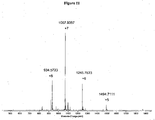
- FIG. 11 An exemplary spectrum generated from high resolution / high accuracy mass spectrometric analysis of intact human IGF-II demonstrating intact IGF-II ions in charge states of 8+, 7+, 6+, and 5+ is shown in Figure 11 .
- This spectrum was collected across the range of m/z of about 400 to 2000.
- peaks from different charge states are seen at m/z of about 934.57, 1067.94, 1245.76, and 1494.71.
- FIG. 12 An exemplary spectrum generated from high resolution / high accuracy mass spectrometric analysis of intact human IGF-II demonstrating intact IGF-II ions in a 7+ charge state is shown in Figure 12 .
- This spectrum was collected across the range of m/z of about 1066 to 1070.
- peaks from naturally occurring isotopes are seen at m/z ratios of about 1067.36, 1067.51, 1067.65, 1067.80, 1067.94, 1068.08, 1068.23, 1068.37, 1068.51, 1068.65, 1068.80, 1068.94, and 1068.08.
- Example 13 Accuracy and Precision of quantitation of intact IGF-II with high resolution / high accuracy TOF MS
- the intra-assay precision was generated from assaying 8 replicates from each of 6 QC pools (3 in-house QC pools and 3 off-the-clot human serum samples).
- the coefficient of variation (CV) for 8 replicates of a sample was used to evaluate the reproducibility of quantitation. Data from these analyses are presented in Table 15 (for in-house QC pools) and Table 16 (for off-the-clot human serum samples). Table 15.
- the intra-assay accuracy is defined as the accuracy of measurements within a single assay.
- the repeated measurement of intact human IGF-II in the in-house QC pools yielded accuracies of about 100.7%, 100.7%, and 100.4% for pools at 200 ng/mL, 500 ng/mL, and 1200 ng/mL, respectively.
- the inter-assay variation is defined as the reproducibility of measurements between assays.
- the same 6 QC pools as above were evaluated over 5 days. Data from these analyses are presented in Table 17 (for in-house QC pools) and Table 18 (for off-the-clot human serum samples). Table 17. Intact IGF-II Inter-Assay Variation for In-House QC Samples.
- In-House QC Pool 1 (200 ng/mL) day 1 day 2 day 3 day 4 day 5 run 1 193.6 208.7 196.7 235.3 196.1 run 2 189.8 216.4 210.8 224.9 199.4 run 3 197.4 198.3 187.1 209.5 198.3 run 4 195.0 210.3 191.8 230.0 194.4 run 5 215.6 197.3 196.8 200.9 198.1 run 6 200.5 223.5 191.2 -- 201.8 run 7 213.7 204.2 185.9 218.5 196.0 run 8 205.3 -- 192.0 224.2 198.7 Mean 201.4 208.4 194.1 220.5 197.9 SD 9.4 9.5 7.8 11.9 2.3 %CV 4.7 4.5 4.0 5.4 1.2 Accuracy 100.7 104.2 97.0 110.2 98.9 In-House QC Pool 2 (500 ng/mL) day 1 day 2 day 3 day 4 day 5 run 1 497.0 494.2 523.9 494.5 457.9 run 2 504.1 -- 496.2 491.5 499.1 run 3 504.1 498.9 51
- the inter-assay accuracy is defined as the accuracy of measurement between assays.
- the repeated measurement of intact human IGF-II in the in-house QC pools yielded accuracies of about 102.2%, 99.1 %, and 99.1% for the pools at 200 ng/mL, 500 ng/mL, and 1200 ng/mL, respectively. These results are within the acceptable accuracy range of 80% to 120%.
- the limit of blank is the point at which a measured value is larger than the uncertainty associated with it and is defined arbitrarily as 2 standard deviations (SD) from the zero concentration.
- Blank samples of the appropriate biological matrix were obtained and measured 15 times. The resulting area ratios were back calculated to establish a LOB of 4.9 ng/mL of intact human IGF-II in stripped serum.
- LOD Limit of detection
- the lower limit of quantitation is the point at which a measured value is quantifiably meaningful.
- the analyte response at the LLOQ is identifiable, discrete and reproducible with a precision of better than or equal to 20% and an accuracy of between 80% and 120%.
- the LLOQ was determined by assaying five different samples at concentrations close to the expected LLOQ (4.9 ng/mL, 7.8 ng/mL, 15.6 ng/mL, 31.2 ng/mL, and 62.5 ng/mL) and evaluating the intra-assay reproducibility in six runs over five days. These analyses demonstrated that the LLOQ was 30 ng/mL for intact human IGF-II.
- Example 15 Spike recovery of intact IGF-II with high resolution / high accuracy TOF MS
- a recovery study was performed by spiking stripped serum with intact human IGF-II to achieve final concentrations of 62.5 ng/mL, 125 ng/mL, 500 ng/mL, and 1200 ng/mL.
- the spiked samples were analyzed, and the results corrected for background levels of intact human IGF-II.
- Recoveries were calculated for each spiked concentration, with mean recoveries being about 106%, 104%, 99%, and 99%, respectively. Data from these studies are shown in Table 19.
- Samples from 42 patients were split and analyzed with the LC-MS method described above. Portions of the samples were also assayed using an IRMA methodology performed by Quest Diagnostics Nichols Institute.
- the effects of lipemia on intact human IGF-II determination were evaluated by titrating brain lipid extract into patient serum to establish estimated lipid concentrations of 0 mg/mL, 2.5 mg/mL, 5 mg/mL, 7.5 mg/mL, 10 mg/mL, and 20 mg/mL.
- Three different patient samples were titrated as described and extracted for human IGF-II analysis. The results were compared to the non-spiked pool results and the percent difference was calculated. Data generated for this comparison is presented in Table 22. Table 22.
- bilirubin The effects of bilirubin on intact human IGF-II determination were evaluated by titrating bilirubin into patient serum to establish estimated bilirubin concentrations of 0 mg/mL, 0.25 mg/mL, 0.5 mg/mL, 0.75 mg/mL, 1 mg/mL, and 2 mg/mL.
- Three different patient samples were titrated as described and extracted for intact human IGF-II analysis. The results were compared to the non-spiked pool results and the percent difference was calculated. Data generated for this comparison is presented in Table 23. Table 23.
- IGFBP-3 The effects of IGFBP-3 on intact human IGF-II determination were evaluated by titrating recombinant IGFBP-3 into patient serum to establish estimated IGFBP-3 concentrations of 5 mg/L, 10 mg/L, and 20 mg/L. Three different patient samples were titrated as described and extracted for intact human IGF-II analysis within three hours of their preparation. Another set of 15 patient samples were spiked with IGFBP-3 to a final concentration of 5 mg/L and equilibrated for three days at 4°C before extraction. In both experiments, the results were compared to the non-spiked pool results and the percent difference was calculated. Data generated for these comparisons are presented in Tables 24 and 25, respectively. Table 24.
- IGFBP-3 interference studies for intact human IGF-II in patient serum samples (extracted 3 hours after preparation) % Recovery Compared to Control IGFBP-3 Concentration (mg/L) 5 10 20 Sample1 104 108 107 Sample 2 101 95 102 Sample 3 101 102 102 Table 25.
- IGFBP-3 interference studies for intact human IGF-II in patient serum samples (extracted 3 days after preparation) Sample % Recovery Compared to Control (5 mg/L IGFBP-3) 1 102.6 2 111.0 3 117.5 4 105.6 5 91.9 6 87.5 7 111.2 8 105.9 9 99.1 10 111.8 11 104.6 12 95.5 13 99.9 14 87.7 15 99.3 Mean 102 %
Landscapes
- Life Sciences & Earth Sciences (AREA)
- Health & Medical Sciences (AREA)
- Engineering & Computer Science (AREA)
- Molecular Biology (AREA)
- Chemical & Material Sciences (AREA)
- Physics & Mathematics (AREA)
- Immunology (AREA)
- Biomedical Technology (AREA)
- Urology & Nephrology (AREA)
- Hematology (AREA)
- Bioinformatics & Cheminformatics (AREA)
- Bioinformatics & Computational Biology (AREA)
- General Health & Medical Sciences (AREA)
- Biochemistry (AREA)
- Medicinal Chemistry (AREA)
- General Physics & Mathematics (AREA)
- Cell Biology (AREA)
- Biotechnology (AREA)
- Food Science & Technology (AREA)
- Analytical Chemistry (AREA)
- Microbiology (AREA)
- Pathology (AREA)
- Proteomics, Peptides & Aminoacids (AREA)
- Biophysics (AREA)
- Spectroscopy & Molecular Physics (AREA)
- Endocrinology (AREA)
- Organic Chemistry (AREA)
- Optics & Photonics (AREA)
- Toxicology (AREA)
- Zoology (AREA)
- Gastroenterology & Hepatology (AREA)
- Genetics & Genomics (AREA)
- Diabetes (AREA)
- Other Investigation Or Analysis Of Materials By Electrical Means (AREA)
Claims (21)
- Verfahren zum Bestimmen der Menge eines Insulin-ähnlichem Wachstumsfaktor-I (IGF-I) Proteins oder eines Insulin-ähnlichem Wachstumsfaktor-II (IGF-II) Proteins in einer Serum- oder Plasma-Probe, wobei das Verfahren umfasst:Unterwerfen des IGF-I Proteins oder IGF-II Proteins in der Probe einer Ionisierung mittels Elektronenionisation, chemischer Ionisation, Elektronensprayionisation (ESI), Photonionisation, chemische Ionisation bei Atmosphärendruck (APCI), Photoionisation, Photoionisation bei Atmosphärendruck (APPI), schnellem Atombeschuss (FAB), Flüssigkeits-Sekundärionisation (LSI), matrixunterstützte Laser-Desorption/Ionisation (MALDI), Feldionisation, Felddesorption, Thermospray-/Plasmaspray-Ionisation, oberflächenverstärkte Laser-Desorption/Ionisation (SELDI), induktiv gekoppeltes Plasma (ICP) oder Teilchenstrahl-Ionisation zur Herstellung von Ionen, welche mittels Massenspektrometrie detektierbar sind; undwobei die Menge des bestimmten Ions oder der bestimmten Ionen mit der Menge des IGF-II Proteins in der Probe in Beziehung steht.(i) zur Bestimmung der Menge an IGF-I Protein Bestimmen der Menge der Ionen mittels hochauflösender/hochpräziser Massenspektrometrie mit einem Massenanalysator, der über ein Auflösungsvermögen der vollen Halbwertsbreite (FWHM) von größer oder gleich 10.000 und eine Genauigkeit von kleiner oder gleich 50 ppm verfügt, wobei die Menge des bestimmten Ions oder der bestimmten Ionen mit der Menge des IGF-I Proteins in der Probe in Beziehung steht; oder(ii) zur Bestimmung der Menge an IGF-II Protein Bestimmen der Menge der Ionen mittels hochauflösender / hochpräziser Massenspektrometrie,
- Verfahren nach Anspruch 1, wobei das IGF-I Protein ein intaktes IGF-I Protein oder ein Fragment mit einem Molekulargewicht von 1.000 Dalton oder größer ist.
- Verfahren nach Anspruch 1 oder 2, wobei das IGF-I Protein intaktes langes R3 IGF-I oder ein Fragment davon mit einem Molekulargewicht von 1.000 Dalton oder größer ist.
- Verfahren nach einem der Ansprüche 1 bis 3 zum Bestimmen der Menge eines IGF-I Proteins, wobei das eine oder die mehreren, mittels Massenspektrometrie detektierbaren Ionen ein oder mehrere IGF-I Ionen in einem 6+, 7+, 8+ oder 9+ Ladungszustand umfassen.
- Verfahren nach einem der Ansprüche 1 bis 4 zum Bestimmen der Menge eines IGF-I Proteins, wobei das eine oder die mehreren, mittels Massenspektrometrie detektierbaren Ionen ein oder mehrere Ionen umfassen, die aus der Gruppe ausgewählt werden, die aus Ionen mit Masse-Ladungsverhältnissen in den Bereichen von 850,8 ± 2, 957.1 ± 2, 1093,7 ± 2 und 1275,8 ± 2 besteht, oder
wobei das eine oder die mehreren, mittels Massenspektrometrie detektierbaren Ionen ein oder mehrere Ionen umfassen, die aus der Gruppe ausgewählt werden, die aus Ionen mit Masse-Ladungsverhältnissen in den Bereichen von 850,8 ± 1, 957,1 ± 1, 1093,7 ± 1 und 1275,8 ±1 besteht, oder
wobei das eine oder die mehreren, mittels Massenspektrometrie detektierbaren, Ionen ein oder mehrere Ionen umfassen, die aus der Gruppe von Ionen mit einem Masse-Ladungsverhältnis von 1091,9447 ± 0,1, 1092,8031 ± 0,1, 1092,9445 ± 0,1, 1093,0881 ± 0,1, 1093,2308 ± 0,1, 1093,3740 ± 0,1, 1093,5167 ± 0,1, 1093,6597 ± 0,1, 1093,8028 ± 0,1, 1093,9458 ± 0,1, 1094,0889 ± 0,1, 1094,2319 ± 0,1, 1094,3754 ± 0,1, 1094,5185 ± 0,1, 1094,6606 ± 0,1 und 1095,3717 ± 0,1 besteht. - Verfahren nach Anspruch 1, wobei das IGF-1 Protein ein menschliches IGF-I Protein ist oder das IGF-II Protein ein menschliches IGF-II Protein ist.
- Verfahren nach Anspruch 1 bis 6, wobei das IGF-I oder das IGF-II Protein nativ in der Probe vorliegt, und/oder wobei das IGF-I oder das IGF-II Protein ein intaktes IGF-I Protein oder ein intaktes IGF-II Protein ist.
- Verfahren nach einem der Ansprüche 1 bis 7, wobei das IGF-I oder IGF-II Protein vor der Ionisation chemisch modifiziert wird.
- Verfahren nach Anspruch 8, wobei die chemische Modifikation die Reduktion von einer oder mehreren Disulfidbrücken in dem IGF-I oder IGF-II Protein umfasst, oder wobei die chemische Modifikation die Alkylierung eines oder mehrerer Cysteine in dem IGF-I oder IGF-II Protein umfasst.
- Verfahren nach einem der Ansprüche 1 bis 9, wobei das IGF-I oder das IGF-II Protein der Probe vor der Ionisation mittels Festphasenextraktion (SPE) gereinigt wird, und/oder wobei das IGF-I oder das IGF-II Protein der Probe vor der Ionisation mittels Hochleistungs-Flüssigkeitschromatografie (HPLC) gereinigt wird.
- Verfahren nach Anspruch 8, wobei die Probe vor der Ionisation mittels HPLC weiter gereinigt wird und die SPE und HPLC mit Online-Verarbeitung durchgeführt wird.
- Verfahren nach einem der Ansprüche 1 bis 11, wobei die hochauflösende/hochpräzise Massenspektrometrie mit einem Orbitrap-Massenspektrometer oder mit einem Flugzeit-Massenspektrometer (TOF), oder mit einem Orbitrap- oder Flugzeit-Massenanalysator der über eine FWHM von größer oder gleich 20.000 und eine Genauigkeit von kleiner oder gleich 10 ppm verfügt, oder mit einem Orbitrap- oder Flugzeit-Massenanalysator der über eine FWHM von größer oder gleich 20.000 und eine Genauigkeit von kleiner oder gleich 5 ppm verfügt, durchgeführt wird.
- Verfahren nach einem der Ansprüche 1 bis 12, wobei der Schritt des Bestimmens der Menge von einem oder mehreren Ionen das Sammeln von spektrometrischen Daten von einem oder mehreren Peaks, wobei jeder Peak aus einer Isotopenform eines Ions resultiert, umfasst.
- Verfahren nach Anspruch 13, wobei zwei oder mehr Peaks, wovon jeder aus einer anderen Isotopenform eines Ions resultiert, verwendet werden, um die Identität eines IGF-I oder IGF-II Proteins zu bestätigen, oder
wobei spektrometrische Daten eines Peaks, der aus einer einzelnen Isotopenform resultiert, zur Bestimmung der Menge eines IGF-I oder IGF-II Proteins in der Probe verwendet werden, oder
wobei spektrometrische Daten von zwei oder mehr Peaks, wovon jede aus einer anderen Isotopenform resultiert, zur Bestimmung der Menge eines IGF-II Proteins in der Probe verwendet werden. - Verfahren nach einem der Ansprüche 1 bis 14, wobei die Probe eine biologische Flüssigkeit umfasst, oder wobei die Probe Plasma oder Serum umfasst.
- Verfahren nach einem der Ansprüche 1 bis 15, wobei das eine oder die mehreren, mittels Massenspektrometrie detektierbaren Ionen ein oder mehrere IGF-II Ionen in einem 8+, 7+, 6+ oder 5+ Ladungszustand umfassen.
- Verfahren nach einem der Ansprüche 1 bis 16, wobei das eine oder die mehreren, mittels Massenspektrometrie detektierbaren Ionen ein oder mehrere IGF-II Ionen umfasst, die aus der Gruppe ausgewählt werden, die aus IGF-II Ionen mit Masse-Ladungsverhältnissen in dem Bereich von 934,69 ± 2, 1068,07 ± 2, 1245,92 ± 2 und 1494,89 ± 2 besteht, oder
wobei das eine oder die mehreren, mittels Massenspektrometrie detektierbaren Ionen ein oder mehrere IGF-II Ionen umfasst, die aus der Gruppe ausgewählt werden, die aus IGF-II Ionen mit Masse-Ladungsverhältnissen in den Bereichen von 934,69 ± 1, 1068,07 ± 1, 1245,92 ± 1 und 1494,89 ± 1 besteht, oder
wobei das eine oder die mehreren, mittels Massenspektrometrie detektierbaren Ionen ein oder mehrere IGF-II Ionen umfasst, die aus der Gruppe ausgewählt werden, die aus Ionen mit Masse-Ladungsverhältnissen von 1067,36 ± 0,1, 1067,51 ± 0,1, 1067,65 ± 0,1, 1067,80 ± 0,1, 1067,94 ± 0,1, 1068,08 ± 0,1, 1068,23 ± 0,1, 1068,37 ± 0,1, 1068,51 ± 0,1, 1068,65 ± 0,1, 1068,80 ± 0,1, 1068,94 ± 0,1 und 1069,08 ± 0,1 besteht. - Verfahren nach einem der Ansprüche 1 bis 17, wobei das eine oder die mehreren, mittels Massenspektrometrie detektierbaren IGF-II Ionen ein oder mehrere Ionen umfasst, die aus der Gruppe ausgewählt werden, die aus Ionen mit Masse-Ladungsverhältnissen von 1067,94 ± 0,1 und 1068,08 ± 0,1 besteht.
- Verfahren nach einem der Ansprüche 1 bis 18, umfassend das gleichzeitige Bestimmen der Menge von IGF-I und IGF-II in derselben Probe, mittels Massenspektrometrie.
- Verfahren nach Anspruch 19, umfassend das Bestimmen der Menge eines oder mehrerer IGF-I Ionen, die aus der Gruppe ausgewählt werden, die aus IGF-I Ionen mit Masse-Ladungsverhältnissen in den Bereichen von 850,8 ± 2, 957,1 ± 2, 1093,7 ± 2 und 1275,8 ± 2 besteht und Verwenden der Menge von detektierten IGF-I Ion oder Ionen zur Bestimmung der Menge von intaktem IGF-I in der Probe.
- Verfahren zum gleichzeitigen Bestimmen der Menge eines Insulin-ähnlichem Wachstumsfaktor-I (IGF-I) Proteins und eines Insulin-ähnlichem Wachstumsfaktor-II (IGF-II) Proteins in einer Serum- oder Plasma-Probe, das Verfahren umfassend:a. Unterziehen eines IGF-I Proteins und eines IGF-II Proteins in der Probe einer Ionisierung mittels Elektronenionisation, chemischer Ionisation, Elektronensprayionisation (ESI), Photonionisation, chemische Ionisation bei Atmosphärendruck (APCI), Photoionisation, Photoionisation bei Atmosphärendruck (APPI), schnellem Atombeschuss (FAB), Flüssigkeits-Sekundärionisation (LSI), matrixunterstützte Laser-Desorption/Ionisation (MALDI), Feldionisation, Felddesorption, Thermospray-/Plasmaspray-Ionisation, oberflächenverstärkte Laser-Desorption/Ionisation (SELDI), induktiv gekoppeltes Plasma (ICP) oder Teilchenstrahl-Ionisation zur Herstellung von Ionen welche mittels Massenspektrometrie detektierbar sind; undb. Bestimmen der Menge der IGF-I Ionen und der IGF-II Ionen mittels hochauflösender / hochpräziser Massenspektrometrie;
wobei die hochauflösende/hochpräzise Massenspektrometrie mit einem Massenanalysator der über eine FWHM von größer oder gleich 10.000 und eine Genauigkeit von kleiner oder gleich 50 ppm verfügt; und wobei die Mengen des/der bestimmten IGF-I und IGF-II Ions oder Ionen mit der Menge des IGF-I Proteins und IGF-II Proteins in der Probe in Beziehung stehen.
Priority Applications (3)
| Application Number | Priority Date | Filing Date | Title |
|---|---|---|---|
| EP18168369.9A EP3381466B1 (de) | 2009-11-05 | 2010-11-04 | Quantifizierung des insulinähnlichen wachstumsfaktors i und des insulinähnlichen wachstumsfaktors ii durch hochauflösende massenspektrometrie |
| EP24178089.9A EP4410303A1 (de) | 2009-11-05 | 2010-11-04 | Quantifizierung von insulinähnlichem wachstumsfaktor i und insulinähnlichem wachstumsfaktor ii mittels hochauflösender massenspektrometrie |
| EP16174510.4A EP3095457B1 (de) | 2009-11-05 | 2010-11-04 | Quantifizierung des insulinähnlichen wachstumsfaktors i durch hochauflösende massenspektrometrie |
Applications Claiming Priority (3)
| Application Number | Priority Date | Filing Date | Title |
|---|---|---|---|
| US25856009P | 2009-11-05 | 2009-11-05 | |
| US40853510P | 2010-10-29 | 2010-10-29 | |
| PCT/US2010/055518 WO2011057021A1 (en) | 2009-11-05 | 2010-11-04 | Quantitation of insulin-like growth factor-i and insulin-like growth factor-ii with high-resolution mass spectrometry |
Related Child Applications (4)
| Application Number | Title | Priority Date | Filing Date |
|---|---|---|---|
| EP16174510.4A Division EP3095457B1 (de) | 2009-11-05 | 2010-11-04 | Quantifizierung des insulinähnlichen wachstumsfaktors i durch hochauflösende massenspektrometrie |
| EP16174510.4A Division-Into EP3095457B1 (de) | 2009-11-05 | 2010-11-04 | Quantifizierung des insulinähnlichen wachstumsfaktors i durch hochauflösende massenspektrometrie |
| EP24178089.9A Division EP4410303A1 (de) | 2009-11-05 | 2010-11-04 | Quantifizierung von insulinähnlichem wachstumsfaktor i und insulinähnlichem wachstumsfaktor ii mittels hochauflösender massenspektrometrie |
| EP18168369.9A Division EP3381466B1 (de) | 2009-11-05 | 2010-11-04 | Quantifizierung des insulinähnlichen wachstumsfaktors i und des insulinähnlichen wachstumsfaktors ii durch hochauflösende massenspektrometrie |
Publications (3)
| Publication Number | Publication Date |
|---|---|
| EP2496250A1 EP2496250A1 (de) | 2012-09-12 |
| EP2496250A4 EP2496250A4 (de) | 2013-03-27 |
| EP2496250B1 true EP2496250B1 (de) | 2016-07-27 |
Family
ID=43970339
Family Applications (4)
| Application Number | Title | Priority Date | Filing Date |
|---|---|---|---|
| EP16174510.4A Active EP3095457B1 (de) | 2009-11-05 | 2010-11-04 | Quantifizierung des insulinähnlichen wachstumsfaktors i durch hochauflösende massenspektrometrie |
| EP24178089.9A Pending EP4410303A1 (de) | 2009-11-05 | 2010-11-04 | Quantifizierung von insulinähnlichem wachstumsfaktor i und insulinähnlichem wachstumsfaktor ii mittels hochauflösender massenspektrometrie |
| EP18168369.9A Active EP3381466B1 (de) | 2009-11-05 | 2010-11-04 | Quantifizierung des insulinähnlichen wachstumsfaktors i und des insulinähnlichen wachstumsfaktors ii durch hochauflösende massenspektrometrie |
| EP10829122.0A Active EP2496250B1 (de) | 2009-11-05 | 2010-11-04 | Quantifizierung des insulinähnlichen wachstumsfaktors i und des insulinähnlichen wachstumsfaktors ii durch hochauflösende massenspektrometrie |
Family Applications Before (3)
| Application Number | Title | Priority Date | Filing Date |
|---|---|---|---|
| EP16174510.4A Active EP3095457B1 (de) | 2009-11-05 | 2010-11-04 | Quantifizierung des insulinähnlichen wachstumsfaktors i durch hochauflösende massenspektrometrie |
| EP24178089.9A Pending EP4410303A1 (de) | 2009-11-05 | 2010-11-04 | Quantifizierung von insulinähnlichem wachstumsfaktor i und insulinähnlichem wachstumsfaktor ii mittels hochauflösender massenspektrometrie |
| EP18168369.9A Active EP3381466B1 (de) | 2009-11-05 | 2010-11-04 | Quantifizierung des insulinähnlichen wachstumsfaktors i und des insulinähnlichen wachstumsfaktors ii durch hochauflösende massenspektrometrie |
Country Status (5)
| Country | Link |
|---|---|
| US (7) | US20110111512A1 (de) |
| EP (4) | EP3095457B1 (de) |
| CN (2) | CN105067698B (de) |
| CA (1) | CA2779688C (de) |
| WO (1) | WO2011057021A1 (de) |
Families Citing this family (16)
| Publication number | Priority date | Publication date | Assignee | Title |
|---|---|---|---|---|
| WO2011057021A1 (en) | 2009-11-05 | 2011-05-12 | Quest Diagnostics Investments Incorporated | Quantitation of insulin-like growth factor-i and insulin-like growth factor-ii with high-resolution mass spectrometry |
| US9177766B2 (en) | 2010-12-30 | 2015-11-03 | Quest Diagnostics Investments Incorporated | Mass spectrometric quantitation assay for metabolites of leflunomide |
| DE102012102875B4 (de) * | 2011-04-04 | 2024-04-18 | Wisconsin Alumni Research Foundation | Vorläuferauswahl mit einem Artificial-Intelligence-Algorithmus erhöht Abdeckung und Reproduzierbarkeit von proteomischen Proben |
| DE112013002122T5 (de) | 2012-04-18 | 2014-12-31 | Waters Technologies Corporation | Verfahren zur Quantifizierung von Polypeptiden mittels Massenspektrometrie |
| CN102721733B (zh) * | 2012-06-11 | 2014-12-31 | 上海大学 | 电喷雾萃取电离串联质谱快速检测尿中1-ohp的方法 |
| WO2014105858A1 (en) | 2012-12-26 | 2014-07-03 | Quest Diagnostics Investments Incorporated | C peptide detection by mass spectrometry |
| US11360098B2 (en) | 2015-09-28 | 2022-06-14 | Quest Diagnostics Investments Llc | Amyloid beta detection by mass spectrometry |
| GB201701986D0 (en) * | 2017-02-07 | 2017-03-22 | Thermo Fisher Scient (Bremen) Gmbh | n |
| JP7337701B2 (ja) * | 2017-03-31 | 2023-09-04 | クエスト ダイアグノスティックス インヴェストメンツ エルエルシー | インスリン及びc-ペプチドの定量の方法 |
| WO2022081645A1 (en) * | 2020-10-14 | 2022-04-21 | The Trustees Of Columbia University In The City Of New York | Ihh as a biomarker and therapeutic target for nonalcoholic steatohepatitis (nash) |
| CA3196351A1 (en) * | 2020-10-20 | 2022-04-28 | Definitek, Inc. | Quantification of previously undetectable quantities |
| US12222354B2 (en) | 2021-03-19 | 2025-02-11 | Quest Diagnostics Investments Llc | Identification and quantitation of insulin-like growth factor-I variants by mass spectrometry |
| US12105102B2 (en) * | 2022-03-30 | 2024-10-01 | University Of Utah Research Foundation | Methods for quantifying insulin-like growth factor-1 and insulin-like growth factor-2 |
| WO2023196587A1 (en) * | 2022-04-07 | 2023-10-12 | Quest Diagnostics Investments Llc | Detection of insulin-like growth factor-2 variants by mass spectrometry |
| CN116087386A (zh) * | 2023-04-11 | 2023-05-09 | 西湖欧米(杭州)生物科技有限公司 | 一种人胰岛素样生长因子检测方法及试剂盒 |
| CN116754678B (zh) * | 2023-06-19 | 2025-09-16 | 杭州度安医学检验实验室有限公司 | 一种血液中胰岛素样生长因子检测样本的处理及检测方法 |
Family Cites Families (28)
| Publication number | Priority date | Publication date | Assignee | Title |
|---|---|---|---|---|
| GB8927008D0 (en) * | 1989-11-29 | 1990-01-17 | Ciba Geigy | Novel process for the production of unfused protein in e.coli |
| KR930702534A (ko) * | 1990-08-31 | 1993-09-09 | 레나토 스가르비 | 항생물질 ge1655 복합체 및 그의 인자 a,b 및 c |
| US5605798A (en) | 1993-01-07 | 1997-02-25 | Sequenom, Inc. | DNA diagnostic based on mass spectrometry |
| EP0700521B1 (de) * | 1993-05-28 | 2003-06-04 | Baylor College Of Medicine | Verfahren und massenspektrometer zur desorption und ionisierung von analyten |
| DE69428454T2 (de) * | 1993-12-20 | 2002-05-02 | David Jeston Baylink | Verfahren zur freisetzung bindender proteine von liganden |
| US20080064044A9 (en) * | 1995-05-23 | 2008-03-13 | Nelson Randall W | Analysis of insulin-like growth factors from biological fluids by the use of affinity-based mass spectrometric methods |
| US5772874A (en) | 1995-11-02 | 1998-06-30 | Cohesive Technologies, Inc. | High performance liquid chromatography method and apparatus |
| AU712735B2 (en) * | 1996-01-19 | 1999-11-11 | Cohesive Technologies, Inc. | High performance liquid chromatography method and apparatus |
| US6514640B1 (en) * | 1996-04-23 | 2003-02-04 | Board Of Regents, The University Of Texas System | Cathode materials for secondary (rechargeable) lithium batteries |
| GB9717926D0 (en) | 1997-08-22 | 1997-10-29 | Micromass Ltd | Methods and apparatus for tandem mass spectrometry |
| JP2002502086A (ja) * | 1998-01-23 | 2002-01-22 | アナリティカ オブ ブランフォード インコーポレーテッド | 表面からの質量分光測定 |
| GB2404784B (en) | 2001-03-23 | 2005-06-22 | Thermo Finnigan Llc | Mass spectrometry method and apparatus |
| KR101209358B1 (ko) * | 2001-12-21 | 2012-12-07 | 메사추세츠 인스티튜트 오브 테크놀로지 | 전도성 리튬 저장 전극 |
| DE10206173B4 (de) | 2002-02-14 | 2006-08-31 | Bruker Daltonik Gmbh | Hochauflösende Detektion für Flugzeitmassenspektrometer |
| US7087897B2 (en) * | 2003-03-11 | 2006-08-08 | Waters Investments Limited | Mass spectrometer |
| US7745226B2 (en) * | 2005-04-06 | 2010-06-29 | Quest Diagnostics Investments Incorporated | Methods for detecting vitamin D metabolites |
| US20090054320A1 (en) * | 2005-04-20 | 2009-02-26 | Protemix Discovery Limited | Vesiculins |
| BRPI0718658A2 (pt) | 2006-11-09 | 2013-11-19 | Alcon Res Ltd | Tampão de pontos compreendendo uma matriz polimérica insolúvel em água. |
| WO2008057083A1 (en) * | 2006-11-09 | 2008-05-15 | Wyeth | Methods of analyzing glycomolecules |
| EP2130248B1 (de) * | 2007-03-19 | 2011-06-15 | Umicore | Zimmertemperatur-einphasen-li-einfüge-/-extraktionsmaterial zur verwendung in einer batterie auf li-basis |
| US7771943B2 (en) * | 2007-06-04 | 2010-08-10 | The University Of Wollongong | Method for the determination of the position of unsaturation in a compound |
| CN102037601B (zh) * | 2007-07-12 | 2014-04-23 | A123系统公司 | 用于锂离子电池的多功能混合金属橄榄石 |
| US20090035807A1 (en) * | 2007-07-31 | 2009-02-05 | Wyeth | Analysis of polypeptide production |
| WO2011057021A1 (en) | 2009-11-05 | 2011-05-12 | Quest Diagnostics Investments Incorporated | Quantitation of insulin-like growth factor-i and insulin-like growth factor-ii with high-resolution mass spectrometry |
| CN107064330B (zh) * | 2010-12-28 | 2022-02-25 | 探索诊断投资公司 | 通过质谱法定量胰岛素 |
| WO2014011416A2 (en) * | 2012-07-11 | 2014-01-16 | Biomimetic Therapeutics, Llc | Cell-based assay for neutralizing antibodies |
| PE20170088A1 (es) * | 2014-03-06 | 2017-03-09 | Nat Res Council Canada | Anticuerpos especificos del receptor del factor 1 de crecimiento similar a la insulina y usos de los mismos |
| DK3114141T3 (da) * | 2014-03-06 | 2020-08-10 | Nat Res Council Canada | Insulinlignende vækstfaktor 1-receptor-specifikke antistoffer og anvendelse deraf |
-
2010
- 2010-11-04 WO PCT/US2010/055518 patent/WO2011057021A1/en not_active Ceased
- 2010-11-04 US US12/939,996 patent/US20110111512A1/en not_active Abandoned
- 2010-11-04 CN CN201510507889.7A patent/CN105067698B/zh active Active
- 2010-11-04 EP EP16174510.4A patent/EP3095457B1/de active Active
- 2010-11-04 CN CN201080050194.6A patent/CN102596230B/zh active Active
- 2010-11-04 EP EP24178089.9A patent/EP4410303A1/de active Pending
- 2010-11-04 CA CA2779688A patent/CA2779688C/en active Active
- 2010-11-04 EP EP18168369.9A patent/EP3381466B1/de active Active
- 2010-11-04 EP EP10829122.0A patent/EP2496250B1/de active Active
-
2017
- 2017-05-23 US US15/602,764 patent/US10648989B2/en active Active
-
2020
- 2020-04-24 US US16/857,628 patent/US11454637B2/en active Active
-
2022
- 2022-09-21 US US17/949,863 patent/US11953507B2/en active Active
-
2023
- 2023-04-07 US US18/132,009 patent/US12181484B2/en active Active
-
2024
- 2024-07-01 US US18/760,381 patent/US12493049B2/en active Active
-
2025
- 2025-12-03 US US19/407,310 patent/US20260086101A1/en active Pending
Non-Patent Citations (1)
| Title |
|---|
| D.H. RUSSELL & R.D. EDMONDSON: "High resolution Mass Spectrometry and Accurate Mass Measurements with Emphasis on the Characterization of Peptides and Proteins by Matrix assisted Laser Desorption Ionization Time of flight Mass Spectrometry", JOURNAL OF MASS SPECTROMETRY (JOHN WILEY & SONS LTD), vol. 32, no. 3, 1 January 1997 (1997-01-01), New York NY USA, pages 263 - 276, XP002494130, ISSN: 1076-5174, DOI: 10.1002/(SICI)1096-9888(199703)32:3<263::AID-JMS501>3.0.CO;2-1 * |
Also Published As
| Publication number | Publication date |
|---|---|
| US10648989B2 (en) | 2020-05-12 |
| EP3095457B1 (de) | 2018-05-16 |
| US20230039315A1 (en) | 2023-02-09 |
| US20180128841A1 (en) | 2018-05-10 |
| US11454637B2 (en) | 2022-09-27 |
| EP3095457A1 (de) | 2016-11-23 |
| US20240369581A1 (en) | 2024-11-07 |
| US20230324414A1 (en) | 2023-10-12 |
| US12181484B2 (en) | 2024-12-31 |
| EP2496250A1 (de) | 2012-09-12 |
| CN102596230B (zh) | 2015-08-05 |
| US20210041462A1 (en) | 2021-02-11 |
| US12493049B2 (en) | 2025-12-09 |
| WO2011057021A1 (en) | 2011-05-12 |
| CN105067698B (zh) | 2018-11-20 |
| CA2779688C (en) | 2020-01-14 |
| CN102596230A (zh) | 2012-07-18 |
| EP3381466A1 (de) | 2018-10-03 |
| US11953507B2 (en) | 2024-04-09 |
| CN105067698A (zh) | 2015-11-18 |
| EP4410303A1 (de) | 2024-08-07 |
| CA2779688A1 (en) | 2011-05-12 |
| US20260086101A1 (en) | 2026-03-26 |
| US20110111512A1 (en) | 2011-05-12 |
| EP2496250A4 (de) | 2013-03-27 |
| EP3381466B1 (de) | 2024-05-29 |
Similar Documents
| Publication | Publication Date | Title |
|---|---|---|
| US12493049B2 (en) | Quantitation of insulin-like growth factor-I and insulin-like growth factor-II with high-resolution mass spectrometry | |
| US20250180586A1 (en) | Quantitation of insulin by mass spectrometry | |
| EP4275777B1 (de) | Amyloid-beta-detektion mittels massenspektrometrie | |
| EP3875959A1 (de) | C-peptid-nachweis mittels massenspektrometrie | |
| KR20230169172A (ko) | 질량 분광법에 의한 인슐린-유사 성장 인자-i 변이체의 식별화 및 정량화 | |
| HK40113272A (en) | Quantitation of insulin-like growth factor-i and insulin-like growth factor-ii with high-resolution mass spectrometry | |
| US20250224404A1 (en) | Detection of insulin-like growth factor-2 variants by mass spectrometry | |
| HK40126686A (en) | Amyloid beta detection by mass spectrometry | |
| HK40102059A (en) | Amyloid beta detection by mass spectrometry | |
| HK40054096A (en) | Quantitation of insulin by mass spectrometry |
Legal Events
| Date | Code | Title | Description |
|---|---|---|---|
| PUAI | Public reference made under article 153(3) epc to a published international application that has entered the european phase |
Free format text: ORIGINAL CODE: 0009012 |
|
| 17P | Request for examination filed |
Effective date: 20120531 |
|
| AK | Designated contracting states |
Kind code of ref document: A1 Designated state(s): AL AT BE BG CH CY CZ DE DK EE ES FI FR GB GR HR HU IE IS IT LI LT LU LV MC MK MT NL NO PL PT RO RS SE SI SK SM TR |
|
| DAX | Request for extension of the european patent (deleted) | ||
| A4 | Supplementary search report drawn up and despatched |
Effective date: 20130225 |
|
| RIC1 | Information provided on ipc code assigned before grant |
Ipc: A61K 38/30 20060101AFI20130219BHEP Ipc: G01N 33/74 20060101ALI20130219BHEP Ipc: C07K 14/65 20060101ALI20130219BHEP Ipc: G01N 33/68 20060101ALI20130219BHEP Ipc: C12Q 1/00 20060101ALI20130219BHEP |
|
| 17Q | First examination report despatched |
Effective date: 20131023 |
|
| GRAP | Despatch of communication of intention to grant a patent |
Free format text: ORIGINAL CODE: EPIDOSNIGR1 |
|
| INTG | Intention to grant announced |
Effective date: 20150811 |
|
| GRAS | Grant fee paid |
Free format text: ORIGINAL CODE: EPIDOSNIGR3 |
|
| INTG | Intention to grant announced |
Effective date: 20160204 |
|
| INTG | Intention to grant announced |
Effective date: 20160209 |
|
| GRAA | (expected) grant |
Free format text: ORIGINAL CODE: 0009210 |
|
| AK | Designated contracting states |
Kind code of ref document: B1 Designated state(s): AL AT BE BG CH CY CZ DE DK EE ES FI FR GB GR HR HU IE IS IT LI LT LU LV MC MK MT NL NO PL PT RO RS SE SI SK SM TR |
|
| REG | Reference to a national code |
Ref country code: GB Ref legal event code: FG4D |
|
| REG | Reference to a national code |
Ref country code: CH Ref legal event code: EP |
|
| REG | Reference to a national code |
Ref country code: AT Ref legal event code: REF Ref document number: 815251 Country of ref document: AT Kind code of ref document: T Effective date: 20160815 |
|
| REG | Reference to a national code |
Ref country code: IE Ref legal event code: FG4D |
|
| REG | Reference to a national code |
Ref country code: DE Ref legal event code: R096 Ref document number: 602010035111 Country of ref document: DE |
|
| REG | Reference to a national code |
Ref country code: LT Ref legal event code: MG4D |
|
| REG | Reference to a national code |
Ref country code: NL Ref legal event code: MP Effective date: 20160727 |
|
| REG | Reference to a national code |
Ref country code: AT Ref legal event code: MK05 Ref document number: 815251 Country of ref document: AT Kind code of ref document: T Effective date: 20160727 |
|
| PG25 | Lapsed in a contracting state [announced via postgrant information from national office to epo] |
Ref country code: FI Free format text: LAPSE BECAUSE OF FAILURE TO SUBMIT A TRANSLATION OF THE DESCRIPTION OR TO PAY THE FEE WITHIN THE PRESCRIBED TIME-LIMIT Effective date: 20160727 Ref country code: NO Free format text: LAPSE BECAUSE OF FAILURE TO SUBMIT A TRANSLATION OF THE DESCRIPTION OR TO PAY THE FEE WITHIN THE PRESCRIBED TIME-LIMIT Effective date: 20161027 Ref country code: LT Free format text: LAPSE BECAUSE OF FAILURE TO SUBMIT A TRANSLATION OF THE DESCRIPTION OR TO PAY THE FEE WITHIN THE PRESCRIBED TIME-LIMIT Effective date: 20160727 Ref country code: IT Free format text: LAPSE BECAUSE OF FAILURE TO SUBMIT A TRANSLATION OF THE DESCRIPTION OR TO PAY THE FEE WITHIN THE PRESCRIBED TIME-LIMIT Effective date: 20160727 Ref country code: NL Free format text: LAPSE BECAUSE OF FAILURE TO SUBMIT A TRANSLATION OF THE DESCRIPTION OR TO PAY THE FEE WITHIN THE PRESCRIBED TIME-LIMIT Effective date: 20160727 Ref country code: RS Free format text: LAPSE BECAUSE OF FAILURE TO SUBMIT A TRANSLATION OF THE DESCRIPTION OR TO PAY THE FEE WITHIN THE PRESCRIBED TIME-LIMIT Effective date: 20160727 Ref country code: IS Free format text: LAPSE BECAUSE OF FAILURE TO SUBMIT A TRANSLATION OF THE DESCRIPTION OR TO PAY THE FEE WITHIN THE PRESCRIBED TIME-LIMIT Effective date: 20161127 Ref country code: HR Free format text: LAPSE BECAUSE OF FAILURE TO SUBMIT A TRANSLATION OF THE DESCRIPTION OR TO PAY THE FEE WITHIN THE PRESCRIBED TIME-LIMIT Effective date: 20160727 |
|
| PG25 | Lapsed in a contracting state [announced via postgrant information from national office to epo] |
Ref country code: GR Free format text: LAPSE BECAUSE OF FAILURE TO SUBMIT A TRANSLATION OF THE DESCRIPTION OR TO PAY THE FEE WITHIN THE PRESCRIBED TIME-LIMIT Effective date: 20161028 Ref country code: PL Free format text: LAPSE BECAUSE OF FAILURE TO SUBMIT A TRANSLATION OF THE DESCRIPTION OR TO PAY THE FEE WITHIN THE PRESCRIBED TIME-LIMIT Effective date: 20160727 Ref country code: PT Free format text: LAPSE BECAUSE OF FAILURE TO SUBMIT A TRANSLATION OF THE DESCRIPTION OR TO PAY THE FEE WITHIN THE PRESCRIBED TIME-LIMIT Effective date: 20161128 Ref country code: ES Free format text: LAPSE BECAUSE OF FAILURE TO SUBMIT A TRANSLATION OF THE DESCRIPTION OR TO PAY THE FEE WITHIN THE PRESCRIBED TIME-LIMIT Effective date: 20160727 Ref country code: BE Free format text: LAPSE BECAUSE OF NON-PAYMENT OF DUE FEES Effective date: 20160727 Ref country code: SE Free format text: LAPSE BECAUSE OF FAILURE TO SUBMIT A TRANSLATION OF THE DESCRIPTION OR TO PAY THE FEE WITHIN THE PRESCRIBED TIME-LIMIT Effective date: 20160727 Ref country code: LV Free format text: LAPSE BECAUSE OF FAILURE TO SUBMIT A TRANSLATION OF THE DESCRIPTION OR TO PAY THE FEE WITHIN THE PRESCRIBED TIME-LIMIT Effective date: 20160727 Ref country code: AT Free format text: LAPSE BECAUSE OF FAILURE TO SUBMIT A TRANSLATION OF THE DESCRIPTION OR TO PAY THE FEE WITHIN THE PRESCRIBED TIME-LIMIT Effective date: 20160727 |
|
| PG25 | Lapsed in a contracting state [announced via postgrant information from national office to epo] |
Ref country code: RO Free format text: LAPSE BECAUSE OF FAILURE TO SUBMIT A TRANSLATION OF THE DESCRIPTION OR TO PAY THE FEE WITHIN THE PRESCRIBED TIME-LIMIT Effective date: 20160727 Ref country code: EE Free format text: LAPSE BECAUSE OF FAILURE TO SUBMIT A TRANSLATION OF THE DESCRIPTION OR TO PAY THE FEE WITHIN THE PRESCRIBED TIME-LIMIT Effective date: 20160727 |
|
| REG | Reference to a national code |
Ref country code: DE Ref legal event code: R097 Ref document number: 602010035111 Country of ref document: DE |
|
| PG25 | Lapsed in a contracting state [announced via postgrant information from national office to epo] |
Ref country code: SM Free format text: LAPSE BECAUSE OF FAILURE TO SUBMIT A TRANSLATION OF THE DESCRIPTION OR TO PAY THE FEE WITHIN THE PRESCRIBED TIME-LIMIT Effective date: 20160727 Ref country code: CZ Free format text: LAPSE BECAUSE OF FAILURE TO SUBMIT A TRANSLATION OF THE DESCRIPTION OR TO PAY THE FEE WITHIN THE PRESCRIBED TIME-LIMIT Effective date: 20160727 Ref country code: BG Free format text: LAPSE BECAUSE OF FAILURE TO SUBMIT A TRANSLATION OF THE DESCRIPTION OR TO PAY THE FEE WITHIN THE PRESCRIBED TIME-LIMIT Effective date: 20161027 Ref country code: DK Free format text: LAPSE BECAUSE OF FAILURE TO SUBMIT A TRANSLATION OF THE DESCRIPTION OR TO PAY THE FEE WITHIN THE PRESCRIBED TIME-LIMIT Effective date: 20160727 Ref country code: SK Free format text: LAPSE BECAUSE OF FAILURE TO SUBMIT A TRANSLATION OF THE DESCRIPTION OR TO PAY THE FEE WITHIN THE PRESCRIBED TIME-LIMIT Effective date: 20160727 |
|
| PLBE | No opposition filed within time limit |
Free format text: ORIGINAL CODE: 0009261 |
|
| STAA | Information on the status of an ep patent application or granted ep patent |
Free format text: STATUS: NO OPPOSITION FILED WITHIN TIME LIMIT |
|
| REG | Reference to a national code |
Ref country code: CH Ref legal event code: PL |
|
| 26N | No opposition filed |
Effective date: 20170502 |
|
| PG25 | Lapsed in a contracting state [announced via postgrant information from national office to epo] |
Ref country code: LI Free format text: LAPSE BECAUSE OF NON-PAYMENT OF DUE FEES Effective date: 20161130 Ref country code: CH Free format text: LAPSE BECAUSE OF NON-PAYMENT OF DUE FEES Effective date: 20161130 |
|
| REG | Reference to a national code |
Ref country code: IE Ref legal event code: MM4A |
|
| REG | Reference to a national code |
Ref country code: FR Ref legal event code: ST Effective date: 20170731 |
|
| PG25 | Lapsed in a contracting state [announced via postgrant information from national office to epo] |
Ref country code: SI Free format text: LAPSE BECAUSE OF FAILURE TO SUBMIT A TRANSLATION OF THE DESCRIPTION OR TO PAY THE FEE WITHIN THE PRESCRIBED TIME-LIMIT Effective date: 20160727 |
|
| PG25 | Lapsed in a contracting state [announced via postgrant information from national office to epo] |
Ref country code: LU Free format text: LAPSE BECAUSE OF NON-PAYMENT OF DUE FEES Effective date: 20161130 |
|
| PG25 | Lapsed in a contracting state [announced via postgrant information from national office to epo] |
Ref country code: FR Free format text: LAPSE BECAUSE OF NON-PAYMENT OF DUE FEES Effective date: 20161130 |
|
| PG25 | Lapsed in a contracting state [announced via postgrant information from national office to epo] |
Ref country code: IE Free format text: LAPSE BECAUSE OF NON-PAYMENT OF DUE FEES Effective date: 20161104 |
|
| PG25 | Lapsed in a contracting state [announced via postgrant information from national office to epo] |
Ref country code: CY Free format text: LAPSE BECAUSE OF FAILURE TO SUBMIT A TRANSLATION OF THE DESCRIPTION OR TO PAY THE FEE WITHIN THE PRESCRIBED TIME-LIMIT Effective date: 20160727 Ref country code: HU Free format text: LAPSE BECAUSE OF FAILURE TO SUBMIT A TRANSLATION OF THE DESCRIPTION OR TO PAY THE FEE WITHIN THE PRESCRIBED TIME-LIMIT; INVALID AB INITIO Effective date: 20101104 |
|
| PG25 | Lapsed in a contracting state [announced via postgrant information from national office to epo] |
Ref country code: MC Free format text: LAPSE BECAUSE OF FAILURE TO SUBMIT A TRANSLATION OF THE DESCRIPTION OR TO PAY THE FEE WITHIN THE PRESCRIBED TIME-LIMIT Effective date: 20160727 Ref country code: MK Free format text: LAPSE BECAUSE OF FAILURE TO SUBMIT A TRANSLATION OF THE DESCRIPTION OR TO PAY THE FEE WITHIN THE PRESCRIBED TIME-LIMIT Effective date: 20160727 Ref country code: TR Free format text: LAPSE BECAUSE OF FAILURE TO SUBMIT A TRANSLATION OF THE DESCRIPTION OR TO PAY THE FEE WITHIN THE PRESCRIBED TIME-LIMIT Effective date: 20160727 |
|
| PG25 | Lapsed in a contracting state [announced via postgrant information from national office to epo] |
Ref country code: MT Free format text: LAPSE BECAUSE OF NON-PAYMENT OF DUE FEES Effective date: 20161104 |
|
| PG25 | Lapsed in a contracting state [announced via postgrant information from national office to epo] |
Ref country code: AL Free format text: LAPSE BECAUSE OF FAILURE TO SUBMIT A TRANSLATION OF THE DESCRIPTION OR TO PAY THE FEE WITHIN THE PRESCRIBED TIME-LIMIT Effective date: 20160727 |
|
| P01 | Opt-out of the competence of the unified patent court (upc) registered |
Effective date: 20230524 |
|
| PGFP | Annual fee paid to national office [announced via postgrant information from national office to epo] |
Ref country code: GB Payment date: 20250911 Year of fee payment: 16 |
|
| PGFP | Annual fee paid to national office [announced via postgrant information from national office to epo] |
Ref country code: DE Payment date: 20250910 Year of fee payment: 16 |