EP2497465A2 - Gastroretentives System mit Alginat-Körper - Google Patents
Gastroretentives System mit Alginat-Körper Download PDFInfo
- Publication number
- EP2497465A2 EP2497465A2 EP12170347A EP12170347A EP2497465A2 EP 2497465 A2 EP2497465 A2 EP 2497465A2 EP 12170347 A EP12170347 A EP 12170347A EP 12170347 A EP12170347 A EP 12170347A EP 2497465 A2 EP2497465 A2 EP 2497465A2
- Authority
- EP
- European Patent Office
- Prior art keywords
- calcium
- drug
- gastroretentives
- zinc
- swelling body
- Prior art date
- Legal status (The legal status is an assumption and is not a legal conclusion. Google has not performed a legal analysis and makes no representation as to the accuracy of the status listed.)
- Withdrawn
Links
- FHVDTGUDJYJELY-UHFFFAOYSA-N 6-{[2-carboxy-4,5-dihydroxy-6-(phosphanyloxy)oxan-3-yl]oxy}-4,5-dihydroxy-3-phosphanyloxane-2-carboxylic acid Chemical compound O1C(C(O)=O)C(P)C(O)C(O)C1OC1C(C(O)=O)OC(OP)C(O)C1O FHVDTGUDJYJELY-UHFFFAOYSA-N 0.000 title 1
- 229940072056 alginate Drugs 0.000 title 1
- 235000010443 alginic acid Nutrition 0.000 title 1
- 229920000615 alginic acid Polymers 0.000 title 1
- 230000008961 swelling Effects 0.000 claims abstract description 73
- 239000013543 active substance Substances 0.000 claims abstract description 14
- 239000003814 drug Substances 0.000 claims description 84
- 229940079593 drug Drugs 0.000 claims description 83
- 210000002784 stomach Anatomy 0.000 claims description 34
- IXPNQXFRVYWDDI-UHFFFAOYSA-N 1-methyl-2,4-dioxo-1,3-diazinane-5-carboximidamide Chemical compound CN1CC(C(N)=N)C(=O)NC1=O IXPNQXFRVYWDDI-UHFFFAOYSA-N 0.000 claims description 27
- 235000010413 sodium alginate Nutrition 0.000 claims description 27
- 239000000661 sodium alginate Substances 0.000 claims description 27
- 229940005550 sodium alginate Drugs 0.000 claims description 27
- 229920000642 polymer Polymers 0.000 claims description 21
- 239000000203 mixture Substances 0.000 claims description 19
- VTYYLEPIZMXCLO-UHFFFAOYSA-L Calcium carbonate Chemical compound [Ca+2].[O-]C([O-])=O VTYYLEPIZMXCLO-UHFFFAOYSA-L 0.000 claims description 16
- BHPQYMZQTOCNFJ-UHFFFAOYSA-N Calcium cation Chemical compound [Ca+2] BHPQYMZQTOCNFJ-UHFFFAOYSA-N 0.000 claims description 15
- 229910001424 calcium ion Inorganic materials 0.000 claims description 15
- 230000002496 gastric effect Effects 0.000 claims description 15
- -1 aluminum ions Chemical class 0.000 claims description 14
- 150000003751 zinc Chemical class 0.000 claims description 11
- AZDRQVAHHNSJOQ-UHFFFAOYSA-N alumane Chemical class [AlH3] AZDRQVAHHNSJOQ-UHFFFAOYSA-N 0.000 claims description 10
- 239000000126 substance Substances 0.000 claims description 10
- 159000000007 calcium salts Chemical class 0.000 claims description 9
- 229910000019 calcium carbonate Inorganic materials 0.000 claims description 8
- 229960003563 calcium carbonate Drugs 0.000 claims description 8
- 235000010216 calcium carbonate Nutrition 0.000 claims description 8
- OSGAYBCDTDRGGQ-UHFFFAOYSA-L calcium sulfate Chemical compound [Ca+2].[O-]S([O-])(=O)=O OSGAYBCDTDRGGQ-UHFFFAOYSA-L 0.000 claims description 8
- 235000010980 cellulose Nutrition 0.000 claims description 8
- 229920002678 cellulose Polymers 0.000 claims description 8
- 239000001913 cellulose Substances 0.000 claims description 8
- 239000011248 coating agent Substances 0.000 claims description 8
- 238000000576 coating method Methods 0.000 claims description 8
- 239000000314 lubricant Substances 0.000 claims description 8
- HCHKCACWOHOZIP-UHFFFAOYSA-N Zinc Chemical compound [Zn] HCHKCACWOHOZIP-UHFFFAOYSA-N 0.000 claims description 7
- 239000002775 capsule Substances 0.000 claims description 7
- 239000011701 zinc Substances 0.000 claims description 7
- 229910052725 zinc Inorganic materials 0.000 claims description 7
- 229920003171 Poly (ethylene oxide) Polymers 0.000 claims description 6
- 239000011230 binding agent Substances 0.000 claims description 6
- 235000010979 hydroxypropyl methyl cellulose Nutrition 0.000 claims description 6
- 239000001866 hydroxypropyl methyl cellulose Substances 0.000 claims description 6
- 229920003088 hydroxypropyl methyl cellulose Polymers 0.000 claims description 6
- UFVKGYZPFZQRLF-UHFFFAOYSA-N hydroxypropyl methyl cellulose Chemical compound OC1C(O)C(OC)OC(CO)C1OC1C(O)C(O)C(OC2C(C(O)C(OC3C(C(O)C(O)C(CO)O3)O)C(CO)O2)O)C(CO)O1 UFVKGYZPFZQRLF-UHFFFAOYSA-N 0.000 claims description 6
- 239000000546 pharmaceutical excipient Substances 0.000 claims description 6
- JIAARYAFYJHUJI-UHFFFAOYSA-L zinc dichloride Chemical compound [Cl-].[Cl-].[Zn+2] JIAARYAFYJHUJI-UHFFFAOYSA-L 0.000 claims description 6
- 229910052782 aluminium Inorganic materials 0.000 claims description 5
- 239000003795 chemical substances by application Substances 0.000 claims description 5
- 238000005253 cladding Methods 0.000 claims description 5
- 235000010947 crosslinked sodium carboxy methyl cellulose Nutrition 0.000 claims description 5
- 235000019325 ethyl cellulose Nutrition 0.000 claims description 5
- 229920001249 ethyl cellulose Polymers 0.000 claims description 5
- 239000000945 filler Substances 0.000 claims description 5
- 229920002785 Croscarmellose sodium Polymers 0.000 claims description 4
- 239000001856 Ethyl cellulose Substances 0.000 claims description 4
- ZZSNKZQZMQGXPY-UHFFFAOYSA-N Ethyl cellulose Chemical compound CCOCC1OC(OC)C(OCC)C(OCC)C1OC1C(O)C(O)C(OC)C(CO)O1 ZZSNKZQZMQGXPY-UHFFFAOYSA-N 0.000 claims description 4
- 229920000148 Polycarbophil calcium Polymers 0.000 claims description 4
- 235000010410 calcium alginate Nutrition 0.000 claims description 4
- 239000000648 calcium alginate Substances 0.000 claims description 4
- 229960002681 calcium alginate Drugs 0.000 claims description 4
- MKJXYGKVIBWPFZ-UHFFFAOYSA-L calcium lactate Chemical compound [Ca+2].CC(O)C([O-])=O.CC(O)C([O-])=O MKJXYGKVIBWPFZ-UHFFFAOYSA-L 0.000 claims description 4
- 239000001527 calcium lactate Substances 0.000 claims description 4
- 235000011086 calcium lactate Nutrition 0.000 claims description 4
- 229960002401 calcium lactate Drugs 0.000 claims description 4
- 229940095672 calcium sulfate Drugs 0.000 claims description 4
- OKHHGHGGPDJQHR-YMOPUZKJSA-L calcium;(2s,3s,4s,5s,6r)-6-[(2r,3s,4r,5s,6r)-2-carboxy-6-[(2r,3s,4r,5s,6r)-2-carboxylato-4,5,6-trihydroxyoxan-3-yl]oxy-4,5-dihydroxyoxan-3-yl]oxy-3,4,5-trihydroxyoxane-2-carboxylate Chemical compound [Ca+2].O[C@@H]1[C@H](O)[C@H](O)O[C@@H](C([O-])=O)[C@H]1O[C@H]1[C@@H](O)[C@@H](O)[C@H](O[C@H]2[C@H]([C@@H](O)[C@H](O)[C@H](O2)C([O-])=O)O)[C@H](C(O)=O)O1 OKHHGHGGPDJQHR-YMOPUZKJSA-L 0.000 claims description 4
- 238000004519 manufacturing process Methods 0.000 claims description 4
- 229950005134 polycarbophil Drugs 0.000 claims description 4
- OPSXJNAGCGVGOG-DKWTVANSSA-L Calcium L-aspartate Chemical compound [Ca+2].[O-]C(=O)[C@@H](N)CC([O-])=O OPSXJNAGCGVGOG-DKWTVANSSA-L 0.000 claims description 3
- UXVMQQNJUSDDNG-UHFFFAOYSA-L Calcium chloride Chemical compound [Cl-].[Cl-].[Ca+2] UXVMQQNJUSDDNG-UHFFFAOYSA-L 0.000 claims description 3
- WHMDKBIGKVEYHS-IYEMJOQQSA-L Zinc gluconate Chemical compound [Zn+2].OC[C@@H](O)[C@@H](O)[C@H](O)[C@@H](O)C([O-])=O.OC[C@@H](O)[C@@H](O)[C@H](O)[C@@H](O)C([O-])=O WHMDKBIGKVEYHS-IYEMJOQQSA-L 0.000 claims description 3
- DPXJVFZANSGRMM-UHFFFAOYSA-N acetic acid;2,3,4,5,6-pentahydroxyhexanal;sodium Chemical compound [Na].CC(O)=O.OCC(O)C(O)C(O)C(O)C=O DPXJVFZANSGRMM-UHFFFAOYSA-N 0.000 claims description 3
- ZOIORXHNWRGPMV-UHFFFAOYSA-N acetic acid;zinc Chemical compound [Zn].CC(O)=O.CC(O)=O ZOIORXHNWRGPMV-UHFFFAOYSA-N 0.000 claims description 3
- WNROFYMDJYEPJX-UHFFFAOYSA-K aluminium hydroxide Chemical compound [OH-].[OH-].[OH-].[Al+3] WNROFYMDJYEPJX-UHFFFAOYSA-K 0.000 claims description 3
- ILRRQNADMUWWFW-UHFFFAOYSA-K aluminium phosphate Chemical compound O1[Al]2OP1(=O)O2 ILRRQNADMUWWFW-UHFFFAOYSA-K 0.000 claims description 3
- VSGNNIFQASZAOI-UHFFFAOYSA-L calcium acetate Chemical compound [Ca+2].CC([O-])=O.CC([O-])=O VSGNNIFQASZAOI-UHFFFAOYSA-L 0.000 claims description 3
- 239000001639 calcium acetate Substances 0.000 claims description 3
- 229960005147 calcium acetate Drugs 0.000 claims description 3
- 235000011092 calcium acetate Nutrition 0.000 claims description 3
- 229940034055 calcium aspartate Drugs 0.000 claims description 3
- 239000001110 calcium chloride Substances 0.000 claims description 3
- 229910001628 calcium chloride Inorganic materials 0.000 claims description 3
- 229960002713 calcium chloride Drugs 0.000 claims description 3
- FNAQSUUGMSOBHW-UHFFFAOYSA-H calcium citrate Chemical compound [Ca+2].[Ca+2].[Ca+2].[O-]C(=O)CC(O)(CC([O-])=O)C([O-])=O.[O-]C(=O)CC(O)(CC([O-])=O)C([O-])=O FNAQSUUGMSOBHW-UHFFFAOYSA-H 0.000 claims description 3
- 239000001354 calcium citrate Substances 0.000 claims description 3
- 229960004256 calcium citrate Drugs 0.000 claims description 3
- 229940043202 calcium cyclamate Drugs 0.000 claims description 3
- 235000013921 calcium diglutamate Nutrition 0.000 claims description 3
- KVUAALJSMIVURS-ZEDZUCNESA-L calcium folinate Chemical compound [Ca+2].C1NC=2NC(N)=NC(=O)C=2N(C=O)C1CNC1=CC=C(C(=O)N[C@@H](CCC([O-])=O)C([O-])=O)C=C1 KVUAALJSMIVURS-ZEDZUCNESA-L 0.000 claims description 3
- 235000008207 calcium folinate Nutrition 0.000 claims description 3
- 239000011687 calcium folinate Substances 0.000 claims description 3
- 239000004227 calcium gluconate Substances 0.000 claims description 3
- 235000013927 calcium gluconate Nutrition 0.000 claims description 3
- 229960004494 calcium gluconate Drugs 0.000 claims description 3
- PWKNEBQRTUXXLT-ZBHRUSISSA-L calcium lactate gluconate Chemical compound [Ca+2].CC(O)C([O-])=O.OC[C@@H](O)[C@@H](O)[C@H](O)[C@@H](O)C([O-])=O PWKNEBQRTUXXLT-ZBHRUSISSA-L 0.000 claims description 3
- 229940041131 calcium lactate gluconate Drugs 0.000 claims description 3
- 239000001506 calcium phosphate Substances 0.000 claims description 3
- 229910000389 calcium phosphate Inorganic materials 0.000 claims description 3
- 229960001714 calcium phosphate Drugs 0.000 claims description 3
- 235000011010 calcium phosphates Nutrition 0.000 claims description 3
- UMVAYAXXQSFULN-QHTZZOMLSA-L calcium;(2s)-2-aminopentanedioate;hydron Chemical compound [Ca+2].[O-]C(=O)[C@@H](N)CCC(O)=O.[O-]C(=O)[C@@H](N)CCC(O)=O UMVAYAXXQSFULN-QHTZZOMLSA-L 0.000 claims description 3
- NEEHYRZPVYRGPP-UHFFFAOYSA-L calcium;2,3,4,5,6-pentahydroxyhexanoate Chemical compound [Ca+2].OCC(O)C(O)C(O)C(O)C([O-])=O.OCC(O)C(O)C(O)C(O)C([O-])=O NEEHYRZPVYRGPP-UHFFFAOYSA-L 0.000 claims description 3
- 229960001681 croscarmellose sodium Drugs 0.000 claims description 3
- 239000000625 cyclamic acid and its Na and Ca salt Substances 0.000 claims description 3
- LFVPBERIVUNMGV-UHFFFAOYSA-N fasudil hydrochloride Chemical compound Cl.C=1C=CC2=CN=CC=C2C=1S(=O)(=O)N1CCCNCC1 LFVPBERIVUNMGV-UHFFFAOYSA-N 0.000 claims description 3
- TWNQGVIAIRXVLR-UHFFFAOYSA-N oxo(oxoalumanyloxy)alumane Chemical compound O=[Al]O[Al]=O TWNQGVIAIRXVLR-UHFFFAOYSA-N 0.000 claims description 3
- QORWJWZARLRLPR-UHFFFAOYSA-H tricalcium bis(phosphate) Chemical compound [Ca+2].[Ca+2].[Ca+2].[O-]P([O-])([O-])=O.[O-]P([O-])([O-])=O QORWJWZARLRLPR-UHFFFAOYSA-H 0.000 claims description 3
- 235000013337 tricalcium citrate Nutrition 0.000 claims description 3
- 239000004246 zinc acetate Substances 0.000 claims description 3
- 229940062776 zinc aspartate Drugs 0.000 claims description 3
- 239000011592 zinc chloride Substances 0.000 claims description 3
- 235000005074 zinc chloride Nutrition 0.000 claims description 3
- 239000011670 zinc gluconate Substances 0.000 claims description 3
- 235000011478 zinc gluconate Nutrition 0.000 claims description 3
- 229960000306 zinc gluconate Drugs 0.000 claims description 3
- POEVDIARYKIEGF-CEOVSRFSSA-L zinc;(2s)-2-aminobutanedioate;hydron Chemical compound [Zn+2].[O-]C(=O)[C@@H](N)CC(O)=O.[O-]C(=O)[C@@H](N)CC(O)=O POEVDIARYKIEGF-CEOVSRFSSA-L 0.000 claims description 3
- PTFCDOFLOPIGGS-UHFFFAOYSA-N Zinc dication Chemical compound [Zn+2] PTFCDOFLOPIGGS-UHFFFAOYSA-N 0.000 claims description 2
- 239000003826 tablet Substances 0.000 description 34
- HQKMJHAJHXVSDF-UHFFFAOYSA-L magnesium stearate Chemical compound [Mg+2].CCCCCCCCCCCCCCCCCC([O-])=O.CCCCCCCCCCCCCCCCCC([O-])=O HQKMJHAJHXVSDF-UHFFFAOYSA-L 0.000 description 28
- 210000004379 membrane Anatomy 0.000 description 16
- 239000012528 membrane Substances 0.000 description 16
- 235000019359 magnesium stearate Nutrition 0.000 description 14
- VYPSYNLAJGMNEJ-UHFFFAOYSA-N Silicium dioxide Chemical compound O=[Si]=O VYPSYNLAJGMNEJ-UHFFFAOYSA-N 0.000 description 13
- 239000004480 active ingredient Substances 0.000 description 13
- 230000003628 erosive effect Effects 0.000 description 12
- 239000002609 medium Substances 0.000 description 12
- 229910021485 fumed silica Inorganic materials 0.000 description 11
- 230000003204 osmotic effect Effects 0.000 description 11
- 239000012530 fluid Substances 0.000 description 9
- 239000002357 osmotic agent Substances 0.000 description 9
- 239000000243 solution Substances 0.000 description 9
- 230000002522 swelling effect Effects 0.000 description 9
- 229920002301 cellulose acetate Polymers 0.000 description 8
- 210000001035 gastrointestinal tract Anatomy 0.000 description 8
- 239000004615 ingredient Substances 0.000 description 8
- 238000002360 preparation method Methods 0.000 description 8
- LFQSCWFLJHTTHZ-UHFFFAOYSA-N Ethanol Chemical compound CCO LFQSCWFLJHTTHZ-UHFFFAOYSA-N 0.000 description 6
- 230000001070 adhesive effect Effects 0.000 description 6
- 238000012377 drug delivery Methods 0.000 description 6
- 239000008384 inner phase Substances 0.000 description 6
- 239000008385 outer phase Substances 0.000 description 6
- 229920005597 polymer membrane Polymers 0.000 description 6
- 229920000168 Microcrystalline cellulose Polymers 0.000 description 5
- 239000000853 adhesive Substances 0.000 description 5
- 238000013270 controlled release Methods 0.000 description 5
- 239000002552 dosage form Substances 0.000 description 5
- 239000008187 granular material Substances 0.000 description 5
- 230000000968 intestinal effect Effects 0.000 description 5
- 239000007788 liquid Substances 0.000 description 5
- 239000011159 matrix material Substances 0.000 description 5
- 229940016286 microcrystalline cellulose Drugs 0.000 description 5
- 235000019813 microcrystalline cellulose Nutrition 0.000 description 5
- 239000008108 microcrystalline cellulose Substances 0.000 description 5
- 229920000036 polyvinylpyrrolidone Polymers 0.000 description 5
- 235000013855 polyvinylpyrrolidone Nutrition 0.000 description 5
- 235000002639 sodium chloride Nutrition 0.000 description 5
- 239000007787 solid Substances 0.000 description 5
- CURLTUGMZLYLDI-UHFFFAOYSA-N Carbon dioxide Chemical compound O=C=O CURLTUGMZLYLDI-UHFFFAOYSA-N 0.000 description 4
- GUBGYTABKSRVRQ-QKKXKWKRSA-N Lactose Natural products OC[C@H]1O[C@@H](O[C@H]2[C@H](O)[C@@H](O)C(O)O[C@@H]2CO)[C@H](O)[C@@H](O)[C@H]1O GUBGYTABKSRVRQ-QKKXKWKRSA-N 0.000 description 4
- FAPWRFPIFSIZLT-UHFFFAOYSA-M Sodium chloride Chemical compound [Na+].[Cl-] FAPWRFPIFSIZLT-UHFFFAOYSA-M 0.000 description 4
- 238000010521 absorption reaction Methods 0.000 description 4
- 230000008859 change Effects 0.000 description 4
- 238000009792 diffusion process Methods 0.000 description 4
- 238000009472 formulation Methods 0.000 description 4
- 210000004051 gastric juice Anatomy 0.000 description 4
- 239000008101 lactose Substances 0.000 description 4
- 229960001375 lactose Drugs 0.000 description 4
- 239000001267 polyvinylpyrrolidone Substances 0.000 description 4
- CSCPPACGZOOCGX-UHFFFAOYSA-N Acetone Chemical compound CC(C)=O CSCPPACGZOOCGX-UHFFFAOYSA-N 0.000 description 3
- 238000013459 approach Methods 0.000 description 3
- 239000012736 aqueous medium Substances 0.000 description 3
- KRKNYBCHXYNGOX-UHFFFAOYSA-N citric acid Chemical compound OC(=O)CC(O)(C(O)=O)CC(O)=O KRKNYBCHXYNGOX-UHFFFAOYSA-N 0.000 description 3
- 238000013267 controlled drug release Methods 0.000 description 3
- 239000000599 controlled substance Substances 0.000 description 3
- 230000006378 damage Effects 0.000 description 3
- 230000009977 dual effect Effects 0.000 description 3
- 210000001198 duodenum Anatomy 0.000 description 3
- 238000002474 experimental method Methods 0.000 description 3
- 210000001156 gastric mucosa Anatomy 0.000 description 3
- 210000000936 intestine Anatomy 0.000 description 3
- 239000007942 layered tablet Substances 0.000 description 3
- 230000000149 penetrating effect Effects 0.000 description 3
- 229920000058 polyacrylate Polymers 0.000 description 3
- 150000003839 salts Chemical class 0.000 description 3
- XLYOFNOQVPJJNP-UHFFFAOYSA-N water Substances O XLYOFNOQVPJJNP-UHFFFAOYSA-N 0.000 description 3
- VBICKXHEKHSIBG-UHFFFAOYSA-N 1-monostearoylglycerol Chemical compound CCCCCCCCCCCCCCCCCC(=O)OCC(O)CO VBICKXHEKHSIBG-UHFFFAOYSA-N 0.000 description 2
- IJGRMHOSHXDMSA-UHFFFAOYSA-N Atomic nitrogen Chemical compound N#N IJGRMHOSHXDMSA-UHFFFAOYSA-N 0.000 description 2
- OYPRJOBELJOOCE-UHFFFAOYSA-N Calcium Chemical compound [Ca] OYPRJOBELJOOCE-UHFFFAOYSA-N 0.000 description 2
- FBPFZTCFMRRESA-KVTDHHQDSA-N D-Mannitol Chemical compound OC[C@@H](O)[C@@H](O)[C@H](O)[C@H](O)CO FBPFZTCFMRRESA-KVTDHHQDSA-N 0.000 description 2
- WQZGKKKJIJFFOK-GASJEMHNSA-N Glucose Natural products OC[C@H]1OC(O)[C@H](O)[C@@H](O)[C@@H]1O WQZGKKKJIJFFOK-GASJEMHNSA-N 0.000 description 2
- 229920000084 Gum arabic Polymers 0.000 description 2
- VEXZGXHMUGYJMC-UHFFFAOYSA-N Hydrochloric acid Chemical compound Cl VEXZGXHMUGYJMC-UHFFFAOYSA-N 0.000 description 2
- KFZMGEQAYNKOFK-UHFFFAOYSA-N Isopropanol Chemical compound CC(C)O KFZMGEQAYNKOFK-UHFFFAOYSA-N 0.000 description 2
- TWRXJAOTZQYOKJ-UHFFFAOYSA-L Magnesium chloride Chemical compound [Mg+2].[Cl-].[Cl-] TWRXJAOTZQYOKJ-UHFFFAOYSA-L 0.000 description 2
- CSNNHWWHGAXBCP-UHFFFAOYSA-L Magnesium sulfate Chemical compound [Mg+2].[O-][S+2]([O-])([O-])[O-] CSNNHWWHGAXBCP-UHFFFAOYSA-L 0.000 description 2
- 229920000881 Modified starch Polymers 0.000 description 2
- 239000002202 Polyethylene glycol Substances 0.000 description 2
- WCUXLLCKKVVCTQ-UHFFFAOYSA-M Potassium chloride Chemical compound [Cl-].[K+] WCUXLLCKKVVCTQ-UHFFFAOYSA-M 0.000 description 2
- 229920003081 Povidone K 30 Polymers 0.000 description 2
- 241000978776 Senegalia senegal Species 0.000 description 2
- CDBYLPFSWZWCQE-UHFFFAOYSA-L Sodium Carbonate Chemical compound [Na+].[Na+].[O-]C([O-])=O CDBYLPFSWZWCQE-UHFFFAOYSA-L 0.000 description 2
- UIIMBOGNXHQVGW-UHFFFAOYSA-M Sodium bicarbonate Chemical compound [Na+].OC([O-])=O UIIMBOGNXHQVGW-UHFFFAOYSA-M 0.000 description 2
- 229930006000 Sucrose Natural products 0.000 description 2
- CZMRCDWAGMRECN-UGDNZRGBSA-N Sucrose Chemical compound O[C@H]1[C@H](O)[C@@H](CO)O[C@@]1(CO)O[C@@H]1[C@H](O)[C@@H](O)[C@H](O)[C@@H](CO)O1 CZMRCDWAGMRECN-UGDNZRGBSA-N 0.000 description 2
- XSQUKJJJFZCRTK-UHFFFAOYSA-N Urea Chemical compound NC(N)=O XSQUKJJJFZCRTK-UHFFFAOYSA-N 0.000 description 2
- 235000010489 acacia gum Nutrition 0.000 description 2
- 239000000205 acacia gum Substances 0.000 description 2
- 239000002253 acid Substances 0.000 description 2
- 239000008186 active pharmaceutical agent Substances 0.000 description 2
- 230000008901 benefit Effects 0.000 description 2
- WQZGKKKJIJFFOK-VFUOTHLCSA-N beta-D-glucose Chemical compound OC[C@H]1O[C@@H](O)[C@H](O)[C@@H](O)[C@@H]1O WQZGKKKJIJFFOK-VFUOTHLCSA-N 0.000 description 2
- 229960005069 calcium Drugs 0.000 description 2
- 239000011575 calcium Substances 0.000 description 2
- 229910052791 calcium Inorganic materials 0.000 description 2
- 239000001569 carbon dioxide Substances 0.000 description 2
- 229910002092 carbon dioxide Inorganic materials 0.000 description 2
- 125000003178 carboxy group Chemical group [H]OC(*)=O 0.000 description 2
- 239000004359 castor oil Substances 0.000 description 2
- 235000019438 castor oil Nutrition 0.000 description 2
- 229920001577 copolymer Polymers 0.000 description 2
- 238000000354 decomposition reaction Methods 0.000 description 2
- 238000011161 development Methods 0.000 description 2
- 238000001035 drying Methods 0.000 description 2
- 230000007613 environmental effect Effects 0.000 description 2
- 239000007789 gas Substances 0.000 description 2
- 210000003736 gastrointestinal content Anatomy 0.000 description 2
- 239000008103 glucose Substances 0.000 description 2
- 150000004676 glycans Chemical class 0.000 description 2
- ZEMPKEQAKRGZGQ-XOQCFJPHSA-N glycerol triricinoleate Natural products CCCCCC[C@@H](O)CC=CCCCCCCCC(=O)OC[C@@H](COC(=O)CCCCCCCC=CC[C@@H](O)CCCCCC)OC(=O)CCCCCCCC=CC[C@H](O)CCCCCC ZEMPKEQAKRGZGQ-XOQCFJPHSA-N 0.000 description 2
- 230000002209 hydrophobic effect Effects 0.000 description 2
- KWGKDLIKAYFUFQ-UHFFFAOYSA-M lithium chloride Chemical compound [Li+].[Cl-] KWGKDLIKAYFUFQ-UHFFFAOYSA-M 0.000 description 2
- 238000000034 method Methods 0.000 description 2
- 229920000609 methyl cellulose Polymers 0.000 description 2
- 235000010981 methylcellulose Nutrition 0.000 description 2
- 239000001923 methylcellulose Substances 0.000 description 2
- 235000019426 modified starch Nutrition 0.000 description 2
- 239000006186 oral dosage form Substances 0.000 description 2
- 239000002245 particle Substances 0.000 description 2
- 230000036470 plasma concentration Effects 0.000 description 2
- 239000004014 plasticizer Substances 0.000 description 2
- 229920001223 polyethylene glycol Polymers 0.000 description 2
- 229920001282 polysaccharide Polymers 0.000 description 2
- 239000005017 polysaccharide Substances 0.000 description 2
- 229920001343 polytetrafluoroethylene Polymers 0.000 description 2
- 239000004810 polytetrafluoroethylene Substances 0.000 description 2
- 239000004800 polyvinyl chloride Substances 0.000 description 2
- 230000008569 process Effects 0.000 description 2
- 210000001187 pylorus Anatomy 0.000 description 2
- 230000000717 retained effect Effects 0.000 description 2
- 210000000813 small intestine Anatomy 0.000 description 2
- 239000011780 sodium chloride Substances 0.000 description 2
- GEHJYWRUCIMESM-UHFFFAOYSA-L sodium sulfite Chemical compound [Na+].[Na+].[O-]S([O-])=O GEHJYWRUCIMESM-UHFFFAOYSA-L 0.000 description 2
- 238000009498 subcoating Methods 0.000 description 2
- 229960004793 sucrose Drugs 0.000 description 2
- 238000013268 sustained release Methods 0.000 description 2
- 239000012730 sustained-release form Substances 0.000 description 2
- 238000002560 therapeutic procedure Methods 0.000 description 2
- LWIHDJKSTIGBAC-UHFFFAOYSA-K tripotassium phosphate Chemical compound [K+].[K+].[K+].[O-]P([O-])([O-])=O LWIHDJKSTIGBAC-UHFFFAOYSA-K 0.000 description 2
- 229960001939 zinc chloride Drugs 0.000 description 2
- TUSDEZXZIZRFGC-UHFFFAOYSA-N 1-O-galloyl-3,6-(R)-HHDP-beta-D-glucose Natural products OC1C(O2)COC(=O)C3=CC(O)=C(O)C(O)=C3C3=C(O)C(O)=C(O)C=C3C(=O)OC1C(O)C2OC(=O)C1=CC(O)=C(O)C(O)=C1 TUSDEZXZIZRFGC-UHFFFAOYSA-N 0.000 description 1
- QTBSBXVTEAMEQO-UHFFFAOYSA-M Acetate Chemical compound CC([O-])=O QTBSBXVTEAMEQO-UHFFFAOYSA-M 0.000 description 1
- 229910018072 Al 2 O 3 Inorganic materials 0.000 description 1
- WSVLPVUVIUVCRA-KPKNDVKVSA-N Alpha-lactose monohydrate Chemical compound O.O[C@@H]1[C@@H](O)[C@@H](O)[C@@H](CO)O[C@H]1O[C@@H]1[C@@H](CO)O[C@H](O)[C@H](O)[C@H]1O WSVLPVUVIUVCRA-KPKNDVKVSA-N 0.000 description 1
- 229920000856 Amylose Polymers 0.000 description 1
- 241000416162 Astragalus gummifer Species 0.000 description 1
- 229920008347 Cellulose acetate propionate Polymers 0.000 description 1
- 229920002284 Cellulose triacetate Polymers 0.000 description 1
- FBPFZTCFMRRESA-FSIIMWSLSA-N D-Glucitol Natural products OC[C@H](O)[C@H](O)[C@@H](O)[C@H](O)CO FBPFZTCFMRRESA-FSIIMWSLSA-N 0.000 description 1
- FBPFZTCFMRRESA-JGWLITMVSA-N D-glucitol Chemical compound OC[C@H](O)[C@@H](O)[C@H](O)[C@H](O)CO FBPFZTCFMRRESA-JGWLITMVSA-N 0.000 description 1
- 229920001353 Dextrin Polymers 0.000 description 1
- 239000004375 Dextrin Substances 0.000 description 1
- FEWJPZIEWOKRBE-JCYAYHJZSA-N Dextrotartaric acid Chemical compound OC(=O)[C@H](O)[C@@H](O)C(O)=O FEWJPZIEWOKRBE-JCYAYHJZSA-N 0.000 description 1
- 239000004593 Epoxy Substances 0.000 description 1
- 239000001263 FEMA 3042 Substances 0.000 description 1
- 108010010803 Gelatin Proteins 0.000 description 1
- SQUHHTBVTRBESD-UHFFFAOYSA-N Hexa-Ac-myo-Inositol Natural products CC(=O)OC1C(OC(C)=O)C(OC(C)=O)C(OC(C)=O)C(OC(C)=O)C1OC(C)=O SQUHHTBVTRBESD-UHFFFAOYSA-N 0.000 description 1
- 239000004354 Hydroxyethyl cellulose Substances 0.000 description 1
- 229920000663 Hydroxyethyl cellulose Polymers 0.000 description 1
- CKLJMWTZIZZHCS-REOHCLBHSA-N L-aspartic acid Chemical compound OC(=O)[C@@H](N)CC(O)=O CKLJMWTZIZZHCS-REOHCLBHSA-N 0.000 description 1
- VVQNEPGJFQJSBK-UHFFFAOYSA-N Methyl methacrylate Chemical compound COC(=O)C(C)=C VVQNEPGJFQJSBK-UHFFFAOYSA-N 0.000 description 1
- WHNWPMSKXPGLAX-UHFFFAOYSA-N N-Vinyl-2-pyrrolidone Chemical compound C=CN1CCCC1=O WHNWPMSKXPGLAX-UHFFFAOYSA-N 0.000 description 1
- LRBQNJMCXXYXIU-PPKXGCFTSA-N Penta-digallate-beta-D-glucose Natural products OC1=C(O)C(O)=CC(C(=O)OC=2C(=C(O)C=C(C=2)C(=O)OC[C@@H]2[C@H]([C@H](OC(=O)C=3C=C(OC(=O)C=4C=C(O)C(O)=C(O)C=4)C(O)=C(O)C=3)[C@@H](OC(=O)C=3C=C(OC(=O)C=4C=C(O)C(O)=C(O)C=4)C(O)=C(O)C=3)[C@H](OC(=O)C=3C=C(OC(=O)C=4C=C(O)C(O)=C(O)C=4)C(O)=C(O)C=3)O2)OC(=O)C=2C=C(OC(=O)C=3C=C(O)C(O)=C(O)C=3)C(O)=C(O)C=2)O)=C1 LRBQNJMCXXYXIU-PPKXGCFTSA-N 0.000 description 1
- 239000004952 Polyamide Substances 0.000 description 1
- 229920000954 Polyglycolide Polymers 0.000 description 1
- 239000004793 Polystyrene Substances 0.000 description 1
- 239000004372 Polyvinyl alcohol Substances 0.000 description 1
- 229920001328 Polyvinylidene chloride Polymers 0.000 description 1
- ZLMJMSJWJFRBEC-UHFFFAOYSA-N Potassium Chemical compound [K] ZLMJMSJWJFRBEC-UHFFFAOYSA-N 0.000 description 1
- MUPFEKGTMRGPLJ-RMMQSMQOSA-N Raffinose Natural products O(C[C@H]1[C@@H](O)[C@H](O)[C@@H](O)[C@@H](O[C@@]2(CO)[C@H](O)[C@@H](O)[C@@H](CO)O2)O1)[C@@H]1[C@H](O)[C@@H](O)[C@@H](O)[C@@H](CO)O1 MUPFEKGTMRGPLJ-RMMQSMQOSA-N 0.000 description 1
- PMZURENOXWZQFD-UHFFFAOYSA-L Sodium Sulfate Chemical compound [Na+].[Na+].[O-]S([O-])(=O)=O PMZURENOXWZQFD-UHFFFAOYSA-L 0.000 description 1
- 229920002125 Sokalan® Polymers 0.000 description 1
- 229920002472 Starch Chemical class 0.000 description 1
- 235000021355 Stearic acid Nutrition 0.000 description 1
- FEWJPZIEWOKRBE-UHFFFAOYSA-N Tartaric acid Natural products [H+].[H+].[O-]C(=O)C(O)C(O)C([O-])=O FEWJPZIEWOKRBE-UHFFFAOYSA-N 0.000 description 1
- 229920001615 Tragacanth Polymers 0.000 description 1
- DOOTYTYQINUNNV-UHFFFAOYSA-N Triethyl citrate Chemical compound CCOC(=O)CC(O)(C(=O)OCC)CC(=O)OCC DOOTYTYQINUNNV-UHFFFAOYSA-N 0.000 description 1
- MUPFEKGTMRGPLJ-UHFFFAOYSA-N UNPD196149 Natural products OC1C(O)C(CO)OC1(CO)OC1C(O)C(O)C(O)C(COC2C(C(O)C(O)C(CO)O2)O)O1 MUPFEKGTMRGPLJ-UHFFFAOYSA-N 0.000 description 1
- 208000027418 Wounds and injury Diseases 0.000 description 1
- TVXBFESIOXBWNM-UHFFFAOYSA-N Xylitol Natural products OCCC(O)C(O)C(O)CCO TVXBFESIOXBWNM-UHFFFAOYSA-N 0.000 description 1
- NNLVGZFZQQXQNW-ADJNRHBOSA-N [(2r,3r,4s,5r,6s)-4,5-diacetyloxy-3-[(2s,3r,4s,5r,6r)-3,4,5-triacetyloxy-6-(acetyloxymethyl)oxan-2-yl]oxy-6-[(2r,3r,4s,5r,6s)-4,5,6-triacetyloxy-2-(acetyloxymethyl)oxan-3-yl]oxyoxan-2-yl]methyl acetate Chemical compound O([C@@H]1O[C@@H]([C@H]([C@H](OC(C)=O)[C@H]1OC(C)=O)O[C@H]1[C@@H]([C@@H](OC(C)=O)[C@H](OC(C)=O)[C@@H](COC(C)=O)O1)OC(C)=O)COC(=O)C)[C@@H]1[C@@H](COC(C)=O)O[C@@H](OC(C)=O)[C@H](OC(C)=O)[C@H]1OC(C)=O NNLVGZFZQQXQNW-ADJNRHBOSA-N 0.000 description 1
- 238000009825 accumulation Methods 0.000 description 1
- YMNMXQILQOXZPB-UHFFFAOYSA-N acetic acid;4-methylbenzenesulfonic acid Chemical compound CC(O)=O.CC1=CC=C(S(O)(=O)=O)C=C1 YMNMXQILQOXZPB-UHFFFAOYSA-N 0.000 description 1
- IYKJEILNJZQJPU-UHFFFAOYSA-N acetic acid;butanedioic acid Chemical compound CC(O)=O.OC(=O)CCC(O)=O IYKJEILNJZQJPU-UHFFFAOYSA-N 0.000 description 1
- IIOPVJIGEATDBS-UHFFFAOYSA-N acetic acid;dodecanoic acid Chemical compound CC(O)=O.CCCCCCCCCCCC(O)=O IIOPVJIGEATDBS-UHFFFAOYSA-N 0.000 description 1
- MFOPEVCFSVUADB-UHFFFAOYSA-N acetic acid;methyl carbamate Chemical compound CC(O)=O.COC(N)=O MFOPEVCFSVUADB-UHFFFAOYSA-N 0.000 description 1
- 150000001252 acrylic acid derivatives Chemical class 0.000 description 1
- 230000009471 action Effects 0.000 description 1
- 239000000654 additive Substances 0.000 description 1
- 125000002947 alkylene group Chemical group 0.000 description 1
- 229940009098 aspartate Drugs 0.000 description 1
- 229940061587 calcium behenate Drugs 0.000 description 1
- CJZGTCYPCWQAJB-UHFFFAOYSA-L calcium stearate Chemical compound [Ca+2].CCCCCCCCCCCCCCCCCC([O-])=O.CCCCCCCCCCCCCCCCCC([O-])=O CJZGTCYPCWQAJB-UHFFFAOYSA-L 0.000 description 1
- 239000008116 calcium stearate Substances 0.000 description 1
- 235000013539 calcium stearate Nutrition 0.000 description 1
- 235000011132 calcium sulphate Nutrition 0.000 description 1
- SMBKCSPGKDEPFO-UHFFFAOYSA-L calcium;docosanoate Chemical compound [Ca+2].CCCCCCCCCCCCCCCCCCCCCC([O-])=O.CCCCCCCCCCCCCCCCCCCCCC([O-])=O SMBKCSPGKDEPFO-UHFFFAOYSA-L 0.000 description 1
- 239000004202 carbamide Substances 0.000 description 1
- 229920003086 cellulose ether Polymers 0.000 description 1
- 239000000919 ceramic Substances 0.000 description 1
- 238000002144 chemical decomposition reaction Methods 0.000 description 1
- 238000006243 chemical reaction Methods 0.000 description 1
- 150000001875 compounds Chemical class 0.000 description 1
- 238000007906 compression Methods 0.000 description 1
- 230000006835 compression Effects 0.000 description 1
- 239000000470 constituent Substances 0.000 description 1
- 239000001767 crosslinked sodium carboxy methyl cellulose Substances 0.000 description 1
- 239000007857 degradation product Substances 0.000 description 1
- 230000000593 degrading effect Effects 0.000 description 1
- 230000001419 dependent effect Effects 0.000 description 1
- 238000013461 design Methods 0.000 description 1
- 235000019425 dextrin Nutrition 0.000 description 1
- 230000001079 digestive effect Effects 0.000 description 1
- 238000010790 dilution Methods 0.000 description 1
- 239000012895 dilution Substances 0.000 description 1
- 239000006185 dispersion Substances 0.000 description 1
- 238000004090 dissolution Methods 0.000 description 1
- 238000001647 drug administration Methods 0.000 description 1
- 229940088679 drug related substance Drugs 0.000 description 1
- 230000000694 effects Effects 0.000 description 1
- 238000005516 engineering process Methods 0.000 description 1
- 125000003700 epoxy group Chemical group 0.000 description 1
- 150000002148 esters Chemical class 0.000 description 1
- HDERJYVLTPVNRI-UHFFFAOYSA-N ethene;ethenyl acetate Chemical class C=C.CC(=O)OC=C HDERJYVLTPVNRI-UHFFFAOYSA-N 0.000 description 1
- CYKDLUMZOVATFT-UHFFFAOYSA-N ethenyl acetate;prop-2-enoic acid Chemical compound OC(=O)C=C.CC(=O)OC=C CYKDLUMZOVATFT-UHFFFAOYSA-N 0.000 description 1
- 230000002349 favourable effect Effects 0.000 description 1
- 238000011049 filling Methods 0.000 description 1
- 235000012041 food component Nutrition 0.000 description 1
- 239000005417 food ingredient Substances 0.000 description 1
- 239000000499 gel Substances 0.000 description 1
- 239000008273 gelatin Substances 0.000 description 1
- 229920000159 gelatin Polymers 0.000 description 1
- 235000019322 gelatine Nutrition 0.000 description 1
- 235000011852 gelatine desserts Nutrition 0.000 description 1
- 230000014509 gene expression Effects 0.000 description 1
- 239000011521 glass Substances 0.000 description 1
- YQEMORVAKMFKLG-UHFFFAOYSA-N glycerine monostearate Natural products CCCCCCCCCCCCCCCCCC(=O)OC(CO)CO YQEMORVAKMFKLG-UHFFFAOYSA-N 0.000 description 1
- SVUQHVRAGMNPLW-UHFFFAOYSA-N glycerol monostearate Natural products CCCCCCCCCCCCCCCCC(=O)OCC(O)CO SVUQHVRAGMNPLW-UHFFFAOYSA-N 0.000 description 1
- KUQWZSZYIQGTHT-UHFFFAOYSA-N hexa-1,5-diene-3,4-diol Chemical compound C=CC(O)C(O)C=C KUQWZSZYIQGTHT-UHFFFAOYSA-N 0.000 description 1
- 239000000017 hydrogel Substances 0.000 description 1
- 235000019447 hydroxyethyl cellulose Nutrition 0.000 description 1
- 230000001771 impaired effect Effects 0.000 description 1
- 238000011534 incubation Methods 0.000 description 1
- 208000014674 injury Diseases 0.000 description 1
- CDAISMWEOUEBRE-GPIVLXJGSA-N inositol Chemical compound O[C@H]1[C@H](O)[C@@H](O)[C@H](O)[C@H](O)[C@@H]1O CDAISMWEOUEBRE-GPIVLXJGSA-N 0.000 description 1
- 229960000367 inositol Drugs 0.000 description 1
- 208000003243 intestinal obstruction Diseases 0.000 description 1
- 238000011835 investigation Methods 0.000 description 1
- INHCSSUBVCNVSK-UHFFFAOYSA-L lithium sulfate Inorganic materials [Li+].[Li+].[O-]S([O-])(=O)=O INHCSSUBVCNVSK-UHFFFAOYSA-L 0.000 description 1
- 230000005923 long-lasting effect Effects 0.000 description 1
- 229910001629 magnesium chloride Inorganic materials 0.000 description 1
- 235000011147 magnesium chloride Nutrition 0.000 description 1
- 229910052943 magnesium sulfate Inorganic materials 0.000 description 1
- 235000019341 magnesium sulphate Nutrition 0.000 description 1
- 235000010355 mannitol Nutrition 0.000 description 1
- 239000000463 material Substances 0.000 description 1
- HEBKCHPVOIAQTA-UHFFFAOYSA-N meso ribitol Natural products OCC(O)C(O)C(O)CO HEBKCHPVOIAQTA-UHFFFAOYSA-N 0.000 description 1
- 150000002734 metacrylic acid derivatives Chemical class 0.000 description 1
- 239000006082 mold release agent Substances 0.000 description 1
- 239000000178 monomer Substances 0.000 description 1
- 210000004877 mucosa Anatomy 0.000 description 1
- 210000004400 mucous membrane Anatomy 0.000 description 1
- 230000007935 neutral effect Effects 0.000 description 1
- 229910052757 nitrogen Inorganic materials 0.000 description 1
- QIQXTHQIDYTFRH-UHFFFAOYSA-N octadecanoic acid Chemical compound CCCCCCCCCCCCCCCCCC(O)=O QIQXTHQIDYTFRH-UHFFFAOYSA-N 0.000 description 1
- OQCDKBAXFALNLD-UHFFFAOYSA-N octadecanoic acid Natural products CCCCCCCC(C)CCCCCCCCC(O)=O OQCDKBAXFALNLD-UHFFFAOYSA-N 0.000 description 1
- 230000035515 penetration Effects 0.000 description 1
- 239000012466 permeate Substances 0.000 description 1
- 239000008177 pharmaceutical agent Substances 0.000 description 1
- 229940124531 pharmaceutical excipient Drugs 0.000 description 1
- 239000000825 pharmaceutical preparation Substances 0.000 description 1
- 239000012071 phase Substances 0.000 description 1
- XNGIFLGASWRNHJ-UHFFFAOYSA-N phthalic acid group Chemical group C(C=1C(C(=O)O)=CC=CC1)(=O)O XNGIFLGASWRNHJ-UHFFFAOYSA-N 0.000 description 1
- 239000000049 pigment Substances 0.000 description 1
- 229920000747 poly(lactic acid) Polymers 0.000 description 1
- 229920002647 polyamide Polymers 0.000 description 1
- 229920000647 polyepoxide Polymers 0.000 description 1
- 229920000728 polyester Polymers 0.000 description 1
- 229920000098 polyolefin Polymers 0.000 description 1
- 229920001451 polypropylene glycol Polymers 0.000 description 1
- 229920001296 polysiloxane Polymers 0.000 description 1
- 229920002223 polystyrene Polymers 0.000 description 1
- 239000011118 polyvinyl acetate Substances 0.000 description 1
- 229920002689 polyvinyl acetate Polymers 0.000 description 1
- 229920002451 polyvinyl alcohol Polymers 0.000 description 1
- 229920000915 polyvinyl chloride Polymers 0.000 description 1
- 239000005033 polyvinylidene chloride Substances 0.000 description 1
- 239000011591 potassium Substances 0.000 description 1
- 229910052700 potassium Inorganic materials 0.000 description 1
- 235000007686 potassium Nutrition 0.000 description 1
- 239000001103 potassium chloride Substances 0.000 description 1
- 235000011164 potassium chloride Nutrition 0.000 description 1
- 229910000160 potassium phosphate Inorganic materials 0.000 description 1
- 235000011009 potassium phosphates Nutrition 0.000 description 1
- OTYBMLCTZGSZBG-UHFFFAOYSA-L potassium sulfate Chemical compound [K+].[K+].[O-]S([O-])(=O)=O OTYBMLCTZGSZBG-UHFFFAOYSA-L 0.000 description 1
- 229910052939 potassium sulfate Inorganic materials 0.000 description 1
- 235000011151 potassium sulphates Nutrition 0.000 description 1
- 229940069328 povidone Drugs 0.000 description 1
- 230000002035 prolonged effect Effects 0.000 description 1
- 108090000623 proteins and genes Proteins 0.000 description 1
- 102000004169 proteins and genes Human genes 0.000 description 1
- MUPFEKGTMRGPLJ-ZQSKZDJDSA-N raffinose Chemical compound O[C@H]1[C@H](O)[C@@H](CO)O[C@@]1(CO)O[C@@H]1[C@H](O)[C@@H](O)[C@H](O)[C@@H](CO[C@@H]2[C@@H]([C@@H](O)[C@@H](O)[C@@H](CO)O2)O)O1 MUPFEKGTMRGPLJ-ZQSKZDJDSA-N 0.000 description 1
- 230000009467 reduction Effects 0.000 description 1
- 230000036186 satiety Effects 0.000 description 1
- 235000019627 satiety Nutrition 0.000 description 1
- CDAISMWEOUEBRE-UHFFFAOYSA-N scyllo-inosotol Natural products OC1C(O)C(O)C(O)C(O)C1O CDAISMWEOUEBRE-UHFFFAOYSA-N 0.000 description 1
- 239000000377 silicon dioxide Substances 0.000 description 1
- 235000017557 sodium bicarbonate Nutrition 0.000 description 1
- 229910000030 sodium bicarbonate Inorganic materials 0.000 description 1
- 229910000029 sodium carbonate Inorganic materials 0.000 description 1
- 235000017550 sodium carbonate Nutrition 0.000 description 1
- 229910052938 sodium sulfate Inorganic materials 0.000 description 1
- 235000011152 sodium sulphate Nutrition 0.000 description 1
- 235000010265 sodium sulphite Nutrition 0.000 description 1
- 239000007909 solid dosage form Substances 0.000 description 1
- 239000002904 solvent Substances 0.000 description 1
- 239000000600 sorbitol Substances 0.000 description 1
- 239000007921 spray Substances 0.000 description 1
- 239000003381 stabilizer Substances 0.000 description 1
- 239000008107 starch Chemical class 0.000 description 1
- 235000019698 starch Nutrition 0.000 description 1
- 239000008117 stearic acid Substances 0.000 description 1
- 239000005720 sucrose Substances 0.000 description 1
- 235000000346 sugar Nutrition 0.000 description 1
- 235000021092 sugar substitutes Nutrition 0.000 description 1
- 150000008163 sugars Chemical class 0.000 description 1
- 239000004094 surface-active agent Substances 0.000 description 1
- 230000009747 swallowing Effects 0.000 description 1
- 239000003765 sweetening agent Substances 0.000 description 1
- 229920002258 tannic acid Polymers 0.000 description 1
- LRBQNJMCXXYXIU-NRMVVENXSA-N tannic acid Chemical compound OC1=C(O)C(O)=CC(C(=O)OC=2C(=C(O)C=C(C=2)C(=O)OC[C@@H]2[C@H]([C@H](OC(=O)C=3C=C(OC(=O)C=4C=C(O)C(O)=C(O)C=4)C(O)=C(O)C=3)[C@@H](OC(=O)C=3C=C(OC(=O)C=4C=C(O)C(O)=C(O)C=4)C(O)=C(O)C=3)[C@@H](OC(=O)C=3C=C(OC(=O)C=4C=C(O)C(O)=C(O)C=4)C(O)=C(O)C=3)O2)OC(=O)C=2C=C(OC(=O)C=3C=C(O)C(O)=C(O)C=3)C(O)=C(O)C=2)O)=C1 LRBQNJMCXXYXIU-NRMVVENXSA-N 0.000 description 1
- 229940033123 tannic acid Drugs 0.000 description 1
- 235000015523 tannic acid Nutrition 0.000 description 1
- 239000011975 tartaric acid Substances 0.000 description 1
- 235000002906 tartaric acid Nutrition 0.000 description 1
- 229960001367 tartaric acid Drugs 0.000 description 1
- RBTVSNLYYIMMKS-UHFFFAOYSA-N tert-butyl 3-aminoazetidine-1-carboxylate;hydrochloride Chemical compound Cl.CC(C)(C)OC(=O)N1CC(N)C1 RBTVSNLYYIMMKS-UHFFFAOYSA-N 0.000 description 1
- 238000012360 testing method Methods 0.000 description 1
- OULAJFUGPPVRBK-UHFFFAOYSA-N tetratriacontan-1-ol Chemical compound CCCCCCCCCCCCCCCCCCCCCCCCCCCCCCCCCCO OULAJFUGPPVRBK-UHFFFAOYSA-N 0.000 description 1
- 235000010487 tragacanth Nutrition 0.000 description 1
- 239000000196 tragacanth Substances 0.000 description 1
- 229940116362 tragacanth Drugs 0.000 description 1
- ILJSQTXMGCGYMG-UHFFFAOYSA-N triacetic acid Chemical compound CC(=O)CC(=O)CC(O)=O ILJSQTXMGCGYMG-UHFFFAOYSA-N 0.000 description 1
- 239000001069 triethyl citrate Substances 0.000 description 1
- VMYFZRTXGLUXMZ-UHFFFAOYSA-N triethyl citrate Natural products CCOC(=O)C(O)(C(=O)OCC)C(=O)OCC VMYFZRTXGLUXMZ-UHFFFAOYSA-N 0.000 description 1
- 235000013769 triethyl citrate Nutrition 0.000 description 1
- 229940045136 urea Drugs 0.000 description 1
- 235000019871 vegetable fat Nutrition 0.000 description 1
- 239000001993 wax Substances 0.000 description 1
- 239000013585 weight reducing agent Substances 0.000 description 1
- 239000000811 xylitol Substances 0.000 description 1
- 235000010447 xylitol Nutrition 0.000 description 1
- HEBKCHPVOIAQTA-SCDXWVJYSA-N xylitol Chemical compound OC[C@H](O)[C@@H](O)[C@H](O)CO HEBKCHPVOIAQTA-SCDXWVJYSA-N 0.000 description 1
- 229960002675 xylitol Drugs 0.000 description 1
Images


Classifications
-
- A—HUMAN NECESSITIES
- A61—MEDICAL OR VETERINARY SCIENCE; HYGIENE
- A61K—PREPARATIONS FOR MEDICAL, DENTAL OR TOILETRY PURPOSES
- A61K9/00—Medicinal preparations characterised by special physical form
- A61K9/0012—Galenical forms characterised by the site of application
- A61K9/0053—Mouth and digestive tract, i.e. intraoral and peroral administration
- A61K9/0065—Forms with gastric retention, e.g. floating on gastric juice, adhering to gastric mucosa, expanding to prevent passage through the pylorus
-
- A—HUMAN NECESSITIES
- A61—MEDICAL OR VETERINARY SCIENCE; HYGIENE
- A61K—PREPARATIONS FOR MEDICAL, DENTAL OR TOILETRY PURPOSES
- A61K9/00—Medicinal preparations characterised by special physical form
- A61K9/0002—Galenical forms characterised by the drug release technique; Application systems commanded by energy
- A61K9/0004—Osmotic delivery systems; Sustained release driven by osmosis, thermal energy or gas
-
- A—HUMAN NECESSITIES
- A61—MEDICAL OR VETERINARY SCIENCE; HYGIENE
- A61K—PREPARATIONS FOR MEDICAL, DENTAL OR TOILETRY PURPOSES
- A61K9/00—Medicinal preparations characterised by special physical form
- A61K9/20—Pills, tablets, discs, rods
- A61K9/2004—Excipients; Inactive ingredients
- A61K9/2022—Organic macromolecular compounds
- A61K9/205—Polysaccharides, e.g. alginate, gums; Cyclodextrin
-
- A—HUMAN NECESSITIES
- A61—MEDICAL OR VETERINARY SCIENCE; HYGIENE
- A61K—PREPARATIONS FOR MEDICAL, DENTAL OR TOILETRY PURPOSES
- A61K9/00—Medicinal preparations characterised by special physical form
- A61K9/20—Pills, tablets, discs, rods
- A61K9/2004—Excipients; Inactive ingredients
- A61K9/2022—Organic macromolecular compounds
- A61K9/205—Polysaccharides, e.g. alginate, gums; Cyclodextrin
- A61K9/2054—Cellulose; Cellulose derivatives, e.g. hydroxypropyl methylcellulose
-
- A—HUMAN NECESSITIES
- A61—MEDICAL OR VETERINARY SCIENCE; HYGIENE
- A61K—PREPARATIONS FOR MEDICAL, DENTAL OR TOILETRY PURPOSES
- A61K9/00—Medicinal preparations characterised by special physical form
- A61K9/20—Pills, tablets, discs, rods
- A61K9/2072—Pills, tablets, discs, rods characterised by shape, structure or size; Tablets with holes, special break lines or identification marks; Partially coated tablets; Disintegrating flat shaped forms
- A61K9/2086—Layered tablets, e.g. bilayer tablets; Tablets of the type inert core-active coat
Definitions
- the dual undercoating composition comprises a first subcoating comprising a water-soluble film-forming polymer, such as povidone, applied to the capsule core, and a second subcoating, which in turn comprises a mixture of at least one water-soluble film-forming polymer and a hydrophobic plasticizer, such as castor oil, includes.
- the drug has a smooth, uniform and substantially bubble-free outer coating, so that the drug despite its relatively large volume is easily swallowable.
- US 4,983,401 describes a sustained-release pharmaceutical preparation using a pH-controllable diffusion membrane consisting of a pH-sensitive, film-forming polymer.
- This can be phthalic acid groups containing one of their carboxyl groups via an ester linkage to the starting polymer, while the second carboxyl group remains free as the free acid, so that the modified film-forming polymer is hydrophobic at low pH and hydrophilic at higher pH.
- EP 0 259 219 A2 describes a coated tablet having a central opening through which the active ingredient is released from an erodible tablet core to the outside.
- the thickness of the tablet core increases from the central opening to the periphery, which compensates for the increasing release in the distance between erosion front and opening by an area increase.
- a device for the controlled release of at least one active substance into a liquid medium which is in the form of a tablet.
- This device comprises a sheath which is impermeable to both the active agent and the medium and which has at least one opening and defines a cavity which is filled by an active substance core, the core reaching the opening.
- the geometric shape and formulation of the tablet are such that the active agent can be delivered at a constant rate over a significant period of time.
- EP 0 779 807 A1 discloses a coated tablet for the controlled release of active ingredients which comprises an erodible inner core containing at least one active substance and a largely erosion-resistant cladding layer which forms an envelope and has at least one opening.
- the inner core is pointed or tapered towards its end region and placed in the tablet so that its pointed or narrow end portion extends to the outer edge of the jacket tablet and interrupts at this point surrounding the core mass of the cladding layer, so that the tablet outer edge is formed opening.
- EP 0 797 429 A1 describes an osmotic device for the continuous release of active ingredients in fluids of the gastrointestinal tract, in which the active ingredient is released by an outlet opening arranged in the outer membrane of the device.
- the exit port is located at a relatively remote location on the outer membrane so that it can not contact the mucosal surface.
- the plasma level of the drug may vary in patients and is poorly predictable. This may be because the absorbability of the drug in different areas of the gastrointestinal tract changes greatly and the administered dosage form is transported through the gastrointestinal tract in different patients at different rates.
- absorbability windows In connection with the changing absorbability of a drug along the gastrointestinal tract, it is also referred to as "absorption windows".
- some drugs are preferably resorbed in intestinal sections that are close to the stomach exit.
- the duodenum which is approximately 20-30 cm long, shoots directly at the exit of the stomach and offers the highest absorption capacity for a large number of drugs. In more remote from the stomach outlet, deeper intestinal sections of these drugs are usually absorbed only in small quantities. Since it is currently not possible to make reliable statements about the transit speed of a drug form in patients, it can not be predicted when a drug form after its oral administration in a favorable for the absorption of the drug contained in her area of the gastrointestinal tract located.
- Gastroretentive systems ie drug forms that have a longer residence time in the stomach than capsules or tablets, are known per se. Without containing a drug they serve to at least partially fill the stomach to create a sense of satiety and thus to achieve weight reduction. Drug-containing gastroretentive systems enable sustained release of drugs in the stomach.
- Gastroretentive systems should largely comply with those of conventional solid oral dosage forms in terms of their intake requirements, so that the known intake habits can be maintained. They should be of reasonable size and easy to swallow. In addition, the gastroretentive systems should linger sufficiently long in the stomach and there deliver the drug contained in them controlled. After fulfilling this task, the gastroretentive system should either be broken down in the gastrointestinal tract or left safely by natural means.
- gastroretentive devices have been developed which have a lower density than the gastric contents. These devices are intended to float due to their buoyancy on the gastric fluid or gastric contents.
- gastroretentive devices have been developed which have a lower density than the gastric contents. These devices are intended to float due to their buoyancy on the gastric fluid or gastric contents.
- WO 02/85332 A1 Devices which contain a high proportion of low-density lipophilic substances.
- EP 0 326 816 A discloses a buoyant drug dosage form which ensures a long residence time in the gastrointestinal tract and is trapped within the cavities of at least one structural element.
- the structural element may be a foamed or microporous polymer matrix, for example of polyolefin, polyamide, polyester, polystyrene, polyacrylate, polytetrafluoroethylene (PTFE), polyvinyl chloride (PVC), polyvinylidene chloride or polysiloxane, optionally in the form of a foldable or rollable film, tablet core or in layer form.
- the structural elements may be hollow particles of, for example, glass or ceramic embedded in a matrix composition containing active ingredient, especially for use in capsules.
- the structures may be provided with an active agent controlling membrane.
- the WO 02/00213 A1 a gastroretentive dosage form with a rapidly expanding formulation consisting of a very rapidly degrading substance, tannic acid and at least one hydrogel.
- WO 2005/079384 A2 discloses an expandable gastroretentive device comprising a dried polysaccharide gel in which a drug may be contained.
- gastroretentive systems which are retained in the stomach over a longer period due to an increase in volume due to gas generation and also float on the stomach contents.
- Carbon dioxide or nitrogen generated in a closed bag made of a hydrophilic membrane Carbon dioxide or nitrogen generated in a closed bag made of a hydrophilic membrane.
- the active ingredient in this gastroretentive system is dissolved by the gastric juice entering the pouch and delivered in a controlled manner through the membrane of the pouch, which controls the release of the active ingredient.
- Such systems are eg in US 4,207,890 and DE 44 19 818 A1 described. Their mode of action is essentially based on filling a sachet with active ingredient which dissolves within a defined period of time and is released in a controlled manner into the environment.
- the increase in volume is achieved by the fact that within the bag are also suitable gas-generating substances (such as sodium bicarbonate) or gas-generating substance mixtures which release a gas, for example CO 2 , upon penetration of the hydrochloric acid gastric juice into the bag by a chemical reaction.
- the bag which consists of a membrane, is virtually inflated and reaches a size that prevents the passage of the system into the duodenum.
- the active substance is released at the same time.
- the release characteristic of the drug by its shape, e.g. present as microencapsulated particles or controlled by the properties of the membrane.
- the active ingredient Once the active ingredient has diffused through the membrane wall and thus entered the stomach contents, it can be absorbed through the gastric mucosa or the intestinal wall. Because the system lingers in the stomach for an extended period of time, the controlled release of active ingredient in the stomach takes place over this longer period of time, preferably up to 24 hours.
- Gastroretentive devices containing carbon dioxide generating components are also known in WO 03/011255 A1 and US 2006/003003 A1 described.
- the object underlying the present invention was to develop a gastroretentive system for a controlled drug administration over a longer period of time, which does not have the disadvantages of the gastroretentive systems known from the prior art.
- the object is achieved by a gastroretentives system comprising two elements which function independently of each other but which are firmly connected to each other.
- the first element is at least one swelling body which extends the residence time of the system in the stomach and is preferably based on a sodium alginate.
- the second element is at least one drug delivery device that allows controlled release of the drug, for example, osmotically controlled or erosion controlled release.
- the invention thus relates to a gastroretentive system comprising at least one swelling body and at least one device for the delivery of at least one drug substance, wherein the swelling body and the dispensing device (s) are firmly connected to each other, but can function independently of each other.
- the swelling body ensures a longer residence time of the system in the stomach by swelling in the stomach after application.
- the swelling body is based on sodium alginate, which is characterized by its good swelling properties. After introduction into the stomach, the swelling body can develop to its full size. In the environment of the human intestine, the swelling body dissolves rapidly, so that after emptying from the stomach an accumulation in the intestine and thus a possibly threatening intestinal obstruction can be avoided.
- a pharmaceutically acceptable calcium salt is added to the sodium alginate or a mixture of sodium alginate and calcium alginate is used.
- Sodium alginate is sufficiently stable only at pH values of 1 to 2, but dissolves relatively quickly in the environment of the human intestine.
- the addition of a calcium salt stabilizes the swelling properties of the swelling body or sodium alginate body at higher pH's than those mentioned above. Surprisingly, the decomposition properties of the swelling body required for safety reasons remain intact in the "neutral" intestinal environment, even if calcium ions or calcium alginate have been added to it.
- the addition of calcium ions can in principle be effected by the addition of any pharmaceutically acceptable calcium salt or a mixture of two or more of these calcium salts.
- Pharmaceutically acceptable calcium salts include, for example, calcium acetate, calcium aspartate, calcium carbonate, calcium chloride, calcium citrate, calcium cyclamate, calcium folinate, calcium gluconate, calcium glutamate, calcium lactate, calcium lactate gluconate, calcium phosphate and calcium sulfate.
- the proportion of calcium ions in the swelling body can be between 0.1 and 10% by weight. It is preferably between 0.3 and 8% by weight, more preferably between 0.5 and 5% by weight. Most preferably, the swelling body has a proportion of calcium ions of 0.6 to 2 wt .-%.
- zinc and / or aluminum ions may also be used in the form of pharmaceutically acceptable salts.
- Pharmaceutically acceptable zinc salts include zinc acetate, zinc aspartate, zinc bis-hydrogen aspartate, zinc chloride and zinc gluconate. From a pharmaceutical point of view Aluminum salts which can be used are, for example, aluminum hydroxide, Algedrat (47-60% aluminum oxide (Al 2 O 3 )) and aluminum phosphate.
- the proportion of zinc salt (s) or aluminum salt (s) in the swelling body is preferably between 0.1 and 30% by weight, more preferably between 1 and 25% by weight and most preferably between 5 and 15% by weight, based on the mass of the swelling body.
- mixtures of the sodium alginate with other polymers which also have swelling properties are also possible.
- mixtures of sodium alginate with croscarmellose sodium, polycarbophil (polyacrylate which is crosslinked with divinyl glycol), polyethylene oxide and / or cellulose derivatives may be mentioned, the addition of sodium croscarmellose being particularly preferred.
- croscarmellose polycarbophil (polyacrylate which is crosslinked with divinyl glycol), polyethylene oxide and / or cellulose derivatives
- the addition of sodium croscarmellose being particularly preferred.
- non-water-soluble cellulose derivatives are preferred, especially ethylcellulose and hydroxypropylmethylcellulose.
- the proportion of further polymers is preferably 1 to 30 wt .-%, more preferably 3 to 20 wt .-%, and most preferably 5 to 15 wt .-%, based on the mass of the swelling body.
- auxiliaries may additionally be used, such as flow regulators, lubricants or lubricants, fillers, binders and / or release agents.
- fillers it is possible to use starch derivatives, sugars such as sucrose or glucose, sugar substitutes such as xylitol or sorbitol. Particular preference is given to using lactose or microcrystalline cellulose.
- binders polyvinylpyrrolidone, gelatin, methylcellulose, ethylcellulose, gum arabic, tragacanth, polyethylene glycol, starch derivatives can be used.
- Useful lubricants are magnesium stearate, calcium stearate, calcium behenate, Glycerol monostearate, stearic acid and its salts, waxes, fumed silica and hydrogenated vegetable fats.
- substances can be used which can influence the pH locally in the drug form, eg. As citric acid, polycarbophil or Algedrat.
- the delivery device of the gastroretentive system enables a release of the drug contained therein at a constant rate over a longer period of time, preferably during the entire application period.
- the delivery of the drug is independent of environmental conditions that would affect a diffusion-controlled drug delivery, for example, osmotically controlled or erosion-controlled.
- the source body and the dispenser are firmly connected.
- the swelling body and the delivery device can be pressed together or glued together, so that the gastroretentive system according to the invention can be present for example in the form of a two- or multi-layered tablet or in the form of a coated tablet.
- adhesives As an adhesive to firmly bond together the swelling body and the dispenser, physiologically acceptable, pharmaceutically acceptable adhesives are used.
- adhesives polymers with adhesive properties can be used. These include, for example, acrylates, methyl methacrylate polymers, dextrin-based adhesives, acrylate-vinyl acetate-based adhesives, carboxyvinyl polymers, cellulose acetates, and ethylcelluloses.
- the swelling body and the dispenser within a common shell permeable to gastric fluid as well as to the drug, for example within a net.
- the delivery device is an osmotic system, which may be in the form of a single-chamber system or may be in the form of a multi-chamber system. It may also be in the form of an embodiment in which spatially separated areas for the drug and for the osmotically active substance are not separated by a membrane.
- a drug-containing core is enveloped by a semipermeable polymer membrane having a small opening.
- the drug-containing core of this dispenser is usually pressed from a mixture of drug and excipients as a tablet.
- the polymer membrane can be applied to the core by a spray process, in which the polymer is applied to the core with other auxiliaries as a solution or dispersion and then dried.
- the exit opening in the polymer membrane can be generated with a laser beam.
- the water contained in the gastric fluid diffuses through the polymer membrane into the drug-containing core.
- the drug and / or an intended osmotically active excipient begin to dissolve in the invaded fluid.
- an increased osmotic pressure relative to the external medium which results in the drug-containing solution being forced out through the outlet opening.
- pressure equalization occurs by exit of drug solution with great uniformity as long as drug is present in the core.
- the rate of drug delivery can be adjusted by the composition, nature, and extent of the membrane, as well as the solubility of the components.
- osmotically active substances may be added to the drug.
- osmotically effective additives are preferably salts such as sodium chloride, sodium carbonate, sodium sulfate, sodium sulfite, potassium sulfate, potassium chloride, potassium acid potassium phosphate (KH 2 PO 4 ), calcium carbonate, calcium sulfate, calcium lactate, magnesium sulfate, magnesium chloride, lithium chloride, lithium sulfate, D-mannitol, urea, inositol , Tartaric acid, cane sugar, raffinose, glucose or ⁇ -D-lactose monohydrate. If the drug itself is sufficiently osmotically effective, the addition of osmotically active substances can be dispensed with.
- the polymer membrane of the osmotic drug release delivery device is semipermeable. This means that it is permeable to water but substantially impermeable to dissolved substances.
- the materials that can be used to make semipermeable membranes for delivery devices that release the drug in an osmotically controlled manner include, for example: Cellulose acetate, cellulose triacetate, Agaracetat, amylose, ⁇ -Glucanacetat, ⁇ -Glucantriacetat, Acetaldehyddimethylacetat, cellulose acetate methyl carbamate, cellulose acetate succinate, Celluloseacetatdimethaminoacetat, Celluloseacetatethylcarbonat, Celluloseacetatchloracetat, Celluloseacetatethyloxalat, Celluloseacetatmethylsulfonat, Celluloseacetatbutylsulfonat, cellulose ethers, cellulose acetate propionate, poly (vinyl methyl) ether copolymers, Celluloseacetatdiethylaminoacetat, Cellulose acetate, cellulose acetate laurate, methyl cellulose,
- Peroral osmotic therapy systems may have the disadvantage of having a gastric mucosal injury potential in addition to the benefit of control of release rate.
- the damage potentials of the active ingredients and auxiliaries which are often released in a highly concentrated form, can be considerably increased as a result of the focusing through the small outlet opening, so that the intestinal wall is punctually severely damaged.
- the delivery device for osmotically controlled drug release is designed such that the outlet opening is arranged next to spaced apart from the mucosal surface formed areas of the device at a relatively backward position of the outer membrane at a distance from the surface of the mucosa.
- the dispenser can have depressions, concave curvatures, curved or angled axes, annularity or other design features in which direct or close contact of the outlet opening with the surface of the stomach lining mucous membrane is not possible.
- the drug solution exit port is thereby forcibly positioned at a distance from surface regions of the gastric wall by maintaining a clearance between the exit port and the portion of the adjacent gastric wall. This distance results in the drug solution not hitting a small area of the gastric mucosa corresponding to the exit opening in the same high concentration as it passes through the exit opening, but in dilute form over a larger area thereof.
- Drugs or excipients with mucosal damaging potential reach after application of a gastroretentive system according to the invention with a dispenser designed in such a way the gastric mucosa only after prior dilution and can - if at all - only significantly less damage than conventional osmotic therapy systems.
- the drug preparation and the osmotically-active substance are in separate chambers within a common shell, the chamber containing the osmotically-active substance. has no opening, the chamber containing the drug preparation, however, has an outwardly leading, possibly the common sheath penetrating opening for the exit of the drug.
- the chamber containing the osmotically active substance is bounded at least in a region by a semipermeable membrane. The limitation of the drug-containing chamber must be flexible at least in one area.
- the liquid entering the chamber containing the osmotically active substance leads to an increase in the volume of this chamber.
- the drug preparation is forced out of its compartment through the opening and thus enters the stomach.
- the system of the invention is constructed like a coated tablet in which the swelling body forms the cladding layer surrounding the tablet core.
- the tablet core consists of an erodible mass in which the drug is contained.
- the shell layer surrounding the tablet core has an opening through which drug can escape.
- the release rate of the drug from the tablet core can be adjusted by the shape and size of the tablet core, for example by forming an erosion front increasing with increasing distance from the orifice, as well as its solubility / erosion rate (depending on swelling behavior / Solubility of the polymers used for the matrix).
- the erodible mass consists of physiologically acceptable polymers or waxy substances and optionally other pharmaceutical excipients.
- polymers are polysaccharides such as gums, starch or cellulose derivatives, polyacrylates and methacrylates, polylactides, polyglycolides, polyoxyethylenes and polyoxypropylenes, proteins, polyvinyl alcohol, polyvinyl acetate, polyvinyl chloride or polyvinylpyrrolidone.
- Waxy substances are z. Hydrogenated castor oil or cetylstearyl alcohol.
- auxiliaries may be selected from the group of stabilizers, solubilizers, surfactants, fillers, plasticizers, hydrophilizing agents, pigments, pH adjusters, flow control agents, mold release agents, lubricants, and the like. Depending on the compatibility and the desired erosion speed, the proportion of the individual components must be adjusted.
- the invention also includes embodiments for erosion-controlled drug delivery in which the delivery device may be in the form of one or more layers.
- the gastroretentive system according to the invention can be present as a two-layered or multi-layered tablet or as a coated tablet.
- it has a coating which decomposes in the stomach or it is in the form of a capsule whose shell decomposes in the stomach. This coating or sheath should at least facilitate the swallowing of the gastroretentive system.
- the gastroretentive system of the invention has the advantage that another structural element assures the re-sorting of the system in the stomach than that which effects the continuous release of active ingredient. This can be ensured be that the remindsortiermechanismus of the digestive phase gastroretentive the inventive system as "not yet sufficiently comminuted food ingredient" retains and prevents its further transport into the small intestine before the end of the intended duration for the delivery of the drug.
- the residence time of the gastroretentive system according to the invention in the stomach can thus extend over the intended duration of delivery of the drug, which is at least 4 hours, but should not exceed 24 hours and should preferably be between 6 and 14 hours.
- Example 1 Production of a swelling body
- the sodium alginate was granulated with the microcrystalline cellulose by means of polyvinylpyrrolidone solution (Kollidon®30 in ethanol) as a binder. After drying, the resulting granules were classified (grain size 300 to 800 nm). This mixture, referred to as the inner phase, was equipped with the outer phase consisting of magnesium stearate and fumed silica.
- the formulation was pressed by means of a tablet press into biplane tablets with a diameter of 13 mm and a mass of 600 mg.
- Example 2 Production of a swelling body
- the sodium alginate was granulated with the lactose and the calcium carbonate using polyvinylpyrrolidone solution (Kollidon®30 in ethanol) as a binder. After drying, the resulting granules were classified (grain size 300 to 800 nm). This mixture, referred to as the inner phase, was equipped with the outer phase consisting of magnesium stearate and fumed silica.
- the formulation was pressed by means of a tablet press into biplane tablets with a diameter of 13 mm and a mass of 600 mg.
- Example 3 Preparation of a gastroretentive system with osmotically controlled drug release
- ingredient proportion of medicine 22.5% by weight hydroxypropyl methylcellulose 6.0% by weight polyethylene oxide 70.0% by weight magnesium stearate 1.0% by weight fumed silica 0.5% by weight
- the constituents of the inner phases of drug layer, osmotically effective layer and swelling body were individually granulated. After equipping the outer phase of magnesium stearate or magnesium stearate and highly dispersed silica, the drug layer and the osmotically effective layer were pressed into a biconvex bilayer tablet, which was then provided with the coating. The coating has been provided in the region of the active substance layer with an opening through which the drug can be released from this dispensing device.
- the granules of the swelling body was pressed after equipping the outer phase to a one-sided concave-shaped tablet and then glued with this side to the osmotically effective layer of the dispenser.
- Example 4 Preparation of a gastroretentive system with erosion-controlled drug release
- ingredient proportion of medicine 58.0% by weight hydroxypropyl methylcellulose 7.5% by weight lactose 33.0% by weight magnesium stearate 1.0% by weight fumed silica 0.5% by weight
- the components of the inner phases of the swelling body and the dispenser were individually granulated. After equipping the outer phase of magnesium stearate and fumed silica to the inner phase of the dispenser, a triangular pointed tablet core was pressed. To the granulated inner phase of the swelling body, the outer phase of magnesium stearate and fumed silica was also equipped. Ansch manend a portion of the granules for the jacket layer of the coated tablet was prepared in the mold of a tablet press, the previously prepared tablet core placed on it and filled with the remaining granules for the coated tablet, so that after compression a biconvex shell tablet was obtained.
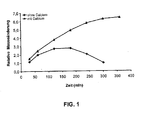
- Example 1 the relative mass changes of swelling bodies prepared according to Example 1 (without calcium) or Example 2 (with calcium) were determined.
- the swelling bodies were investigated in a dissolution tester with paddle stirrer at 50 revolutions per minute in 37 ° C ( ⁇ 0.5 ° C) warm medium.
- FIGS. 1 and 2 The results of these investigations are in the FIGS. 1 and 2 shown.
- the medium either had a pH of 3 ( FIG. 1 ) or a pH of 4.5 ( FIG. 2 ) on.
- the illustrations of these test results illustrate the better swelling properties of sodium alginate-based swelling bodies containing calcium ions compared to calcium-free swelling bodies.
- the swelling bodies with calcium ions show improved stability.
Landscapes
- Health & Medical Sciences (AREA)
- Public Health (AREA)
- Pharmacology & Pharmacy (AREA)
- Epidemiology (AREA)
- Life Sciences & Earth Sciences (AREA)
- Animal Behavior & Ethology (AREA)
- Medicinal Chemistry (AREA)
- General Health & Medical Sciences (AREA)
- Veterinary Medicine (AREA)
- Chemical & Material Sciences (AREA)
- Engineering & Computer Science (AREA)
- Bioinformatics & Cheminformatics (AREA)
- Nutrition Science (AREA)
- Physiology (AREA)
- Medicinal Preparation (AREA)
- Medicines That Contain Protein Lipid Enzymes And Other Medicines (AREA)
- Pharmaceuticals Containing Other Organic And Inorganic Compounds (AREA)
Abstract
Description
- Die Erfindung betrifft ein oral applizierbares gastroretentives System zur gesteuerten, kontinuierlichen Freisetzung mindestens eines pharmazeutischen Wirkstoffs (= Arzneistoff) im Magen, umfassend mindestens eine Abgabeeinrichtung und mindestens einen fest mit der Abgabeeinrichtung verbundenen Quellkörper, wobei die Abgabeeinrichtung(en) und der/die Quellkörper unabhängig voneinander funktionieren können.
- Ein Ziel bei der Entwicklung von Arzneimitteln ist, Arzneiformen bereitzustellen, mit denen ein über mehrere Stunden konstant hoher Wirkstoffspiegel im Körper des Patienten aufrecht erhalten werden kann. Mit schnell zerfallenden Tabletten ist dies jedoch nicht möglich, da sie den in ihnen enthaltenen Wirkstoff auf einmal freisetzen. Daher wurden tablettenförmige Arzneimittel entwickelt, die den in ihnen enthaltenen Arzneistoff gesteuert und über einen längeren Zeitraum hinweg kontinuierlich freisetzen können.
- So wird in
US 5,296,233 ein kapselartiges, zweifach unterschichtetes Medikament beschrieben, das einen festen, wirkstoffhaltigen Kapselkern und eine zweifache Unterbeschichtungszusammensetzung umfasst. Die zweifache Unterbeschichtungszusammensetzung umfasst eine erste Unterbeschichtung, die ein wasserlösliches, filmbildendes Polymer aufweist, beispielsweise Povidon, und auf den Kapselkern aufgetragen ist, sowie eine zweite Unterbeschichtung, die ihrerseits eine Mischung aus mindestens einem wasserlöslichen, filmbildenden Polymer und einem hydrophoben Weichmacher, beispielsweise Rizinusöl, umfasst. Ferner weist das Medikament eine glatte, gleichmäßige und substantiell blasenfreie äußere Beschichtung auf, damit das Medikament trotz seines vergleichsweise großen Volumens problemlos schluckbar ist. -
US 4,983,401 beschreibt ein pharmazeutisches Präparat zur verzögerten Wirkstofffreisetzung unter Verwendung einer pH-kontrollierbaren Diffusionsmembran, bestehend aus einem pH-sensitiven, filmbildenden Polymer. Dieses kann Phthalsäuregruppen enthalten, die mit einer ihrer Carboxylgruppen über eine Esterbindung an das Ausgangspolymer gebunden sind, während die zweite Carboxylgruppe als freie Säure frei bleibt, so dass das modifizierte Filmbildnerpolymer bei niedrigem pH-Wert hydrophob und bei höherem pH-Wert hydrophil ist. - In
EP 0 259 219 A2 wird eine umhüllte Tablette mit einer zentralen Öffnung beschrieben, durch welche der Wirkstoff aus einem erodierbaren Tablettenkern nach außen freigesetzt wird. Die Dicke des Tablettenkerns nimmt von der zentralen Öffnung zur Peripherie hin zu, wodurch sich die im Freisetzungsverlauf vergrößernde Distanz zwischen Erosionsfront und Öffnung durch eine Flächenvergrößerung kompensiert wird. - Aus der
EP 0 542 364 A1 ist eine Vorrichtung zur kontrollierten Freisetzung wenigstens eines Wirkstoffes in ein flüssiges Medium bekannt, die in Form einer Tablette vorliegt. Diese Vorrichtung umfasst eine sowohl für den Wirkstoff als auch für das Medium undurchlässige Umhüllung, die wenigstens eine Öffnung aufweist und einen Hohlraum begrenzt, der von einem wirkstofflialtigen Kern ausgefüllt wird, wobei der Kern an die Öffnung heranreicht. Die geometrische Form und die Formulierung der Tablette sind derart, dass der Wirkstoff über einen signifikanten Zeitraum hinweg mit einer konstanten Rate abgegeben werden kann. -
EP 0 779 807 A1 offenbart eine Manteltablette zur kontrollierten Freisetzung von Wirkstoffen, die einen erodierbaren, mindestens einen Wirkstoff enthaltenden Innenkern und eine weitgehend erosionsresistente Mantelschicht aufweist, welche eine Umhüllung bildet und wenigstens eine Öffnung aufweist. Der Innenkern ist zu seinem Endbereich hin spitz oder schmal zulaufend geformt und so in der Tablette plaziert, dass sein spitzer bzw. schmaler Endbereich an den Außenrand der Manteltablette heranreicht und an dieser Stelle die den Kern umgebende Masse der Mantelschicht unterbricht, so dass die am Tablettenaußenrand befindliche Öffnung ausbildet wird. -
EP 0 797 429 A1 beschreibt eine osmotische Vorrichtung zur kontinuierlichen Freisetzung von Wirkstoffen in Flüssigkeiten des Gastrointestinaltraktes, bei der der Wirkstoff durch eine in der äußeren Membran der Vorrichtung angeordnete Austrittsöffnung freigesetzt wird. Die Austrittsöffnung ist so an einer relativ zurückliegenden Stelle der äußeren Membran angeordnet, dass sie nicht mit der Schleimhautoberfläche in Kontakt kommen kann. - Auch bei diesen oral zu verabreichenden Darreichungsformen besteht ein Nachteil darin, dass der Plasmaspiegel des Arzneistoffs bei den Patienten unterschiedlich hoch sein kann und schlecht vorhersagbar ist. Dies kann daran liegen, dass sich die Absorbierbarkeit des Arzneistoffs in unterschiedlichen Bereichen des Magen-Darm-Traktes stark ändert und die verabreichte Darreichungsform bei unterschiedlichen Patienten mit unterschiedlicher Geschwindigkeit durch den Magen-Darm-Trakt transportiert wird. Man spricht im Zusammenhang mit der sich ändernden Absorbier-barkeit eines Arzneistoffs entlang des Magen-Darm-Traktes auch von "Resorptions-fenstern". Beispielsweise werden einige Arzneistoffe bevorzugt in Darmabschnitten resorbiert, die sich nah beim Magenausgang befinden. Direkt an den Magenausgang schießt sich der etwa 20-30 cm lange Zwölffingerdarm (Duodenum) an, der für eine Vielzahl von Arzneistoffen die höchste Resorptionskapazität bietet. In weiter vom Magenausgang entfernten, tiefer liegenden Darmabschnitten werden diese Arzneistoffe in der Regel nur noch in geringer Menge aufgenommen. Da es derzeit nicht möglich ist, verlässliche Aussagen über die Transitgeschwindigkeit einer Arzneiform bei Patienten zu machen, kann nicht vorhergesagt werden, wann sich eine Arzneiform nach ihrer oralen Verabreichung in einem für die Resorption des in ihr enthaltenen Arzneistoffs günstigen Bereich des Magen-Darm-Traktes befindet.
- Um einen langanhaltenden, konstanten Plasmaspiegel eines Arzneistoffs erreichen zu können, der im Magen-Darm-Trakt resorbiert wird, vorzugsweise sein Resorptionsfenster im Duodenum bzw. oberen Dünndarmabschnitt hat, stellen feste Arzneiformen mit einer verlängerten Verweilzeit im Magen einen vielversprechenden Ansatz zur Lösung der geschilderten Probleme dar. Derartige Arzneiformen werden auch als "Gastroretentive Systeme" bezeichnet.
- Gastroretentive Systeme, also Arzneiformen, die eine längere Verweildauer im Magen haben als Kapseln oder Tabletten, sind an sich bekannt. Ohne einen Arzneistoff zu enthalten dienen sie der zumindest teilweisen Füllung des Magens, um ein Sättigungsgefiihl zu erzeugen und so eine Gewichtsreduzierung zu erreichen. Arzneistoffhaltige gastroretentive Systeme ermöglichen eine retardierende Abgabe von Arzneistoffen im Magen.
- Gastroretentive Systeme sollen hinsichtlich ihrer Einnahmevorgaben denen herkömmlicher fester oraler Arzneiformen weitgehend entsprechen, damit die bekannten Einnahmegewohnheiten beibehalten werden können. Sie sollen eine annehmbare Größe haben und gut zu schlucken sein. Darüber hinaus sollen die gastroretentiven Systeme ausreichend lange im Magen verweilen und dort den in ihnen enthaltenen Arzneistoff kontrolliert abgeben. Nach Erfüllung dieser Aufgabe soll das gastroretentive System entweder im Magen-Darm-Trakt abgebaut werden oder ihn auf natürlichem Wege sicher verlassen.
- Hierfiir wurden gastroretentive Vorrichtungen entwickelt, die eine geringere Dichte als der Mageninhalt aufweisen. Diese Vorrichtungen sollen aufgrund ihres Auftriebs auf der Magenflüssigkeit bzw. dem Mageninhalt flotieren. Beispielsweise wurden in der
WO 02/85332 A1 -
EP 0 326 816 A offenbart eine schwimmfähige Wirkstoff-Dosierform, die eine lange Aufenthaltsdauer im Gastrointestinaltrakt gewährleistet und bei der Hohlräume von zumindest einem Strukturelement eingeschlossen werden. Insbesondere kann das Strukturelement eine geschäumte oder mikroporöse Polymermatrix sein, beispielsweise von Polyolefin, Polyamid, Polyester, Polystyrol, Polyacrylat, Polytetrafluorethylen (PTFE), Polyvinylchlorid (PVC), Polyvinylidenchlorid oder Polysiloxan, gegebenenfalls in Form eines faltbaren oder rollbaren Films, Tablettenkerns oder in Schichtform. Alternativ können die Strukturelemente hohle Partikel aus z.B. Glas oder Keramik sein, die in eine Wirkstoff enthaltende Matrix-Komposition eingelagert sind, insbesondere zur Verwendung in Kapseln. Die Gebilde können mit einer die Freisetzung von Wirkstoff kontrollierenden Membran versehen sein. - Ein anderer Lösungsweg, eine längere Verweildauer im Magen zu erreichen, wurde durch die Entwicklung von gastroretentiven Systemen beschritten, die aufgrund ihrer Größe oder Gestalt den Magenpförtner (Pylorus) nicht passieren und somit den Magen nicht verlassen können. Diese Vorrichtungen liegen in der Regel komprimiert vor und entfalten sich erst nach Kontakt mit der Magenflüssigkeit zu ihrer vorgesehenen Größe.
- Beispielsweise offenbart die
WO 02/00213 A1 - Auch mit der
WO 2005/079384 A2 wird eine expansionsfähige gastroretentive Vorrichtung offenbart, die ein getrocknetes Polysaccharid-Gel umfasst, in dem ein Arzneistoff enthalten sein kann. - In der
WO 01/97783 A1 - Bekannt sind darüber hinaus gastroretentive Systeme, die aufgrund einer Volumenvergrößerung durch Gaserzeugung über einen längeren Zeitraum im Magen zurückgehalten werden und auch auf dem Mageninhalt flotieren.
- Beispielsweise bei einer Darreichungsform gemäß
US 4,996,058 , bei der sich der Wirkstoff zusammen mit einer Verbindung, die bei Kontakt mit Magenflüssigkeit - Kohlendioxid oder Stickstoff erzeugt, in einem geschlossenen Beutels aus einer hydrophilen Membran befindet. Der Wirkstoff wird bei diesem gastroretentiven System durch den in den Beutel eindringenden Magensaft aufgelöst und kontrolliert durch die Membran des Beutels abgegeben, die die Freisetzung des Wirkstoffs kontrolliert.
- Solche Systeme sind z.B. in
US 4,207,890 undDE 44 19 818 A1 beschrieben. Ihre Wirkungsweise beruht im Wesentlichen darauf, dass ein Beutel mit Wirkstoff gefüllt wird, der sich innerhalb eines definierten Zeitraums auflöst und in kontrollierter Weise in die Umgebung freigesetzt wird. Die Volumenvergrößerung wird dadurch erreicht, dass sich innerhalb des Beutels auch geeignete, gaserzeugende Substanzen (wie z.B. Natriumhydrogencarbonat) oder gaserzeugende Substanzgemische befinden, die bei Eindringen des salzsäurehaltigen Magensafts in den Beutel durch chemische Reaktion ein Gas freisetzen, z.B. CO2. Dabei wird der Beutel, der aus einer Membran besteht, quasi aufgeblasen und erreicht eine Größe, die die Passage des Systems in den Zwölffingerdarm verhindert. - Tritt der Magensaft in den Beutel, so wird gleichzeitig Wirkstoff freigesetzt. Dabei kann die Freisetzungscharakteristik des Wirkstoffs durch seine Form, z.B. als mikroverkapselte Partikel vorliegend, oder durch die Eigenschaften der Membran kontrolliert werden. Sobald der Wirkstoff durch die Membranwand diffundiert und somit in den Mageninhalt gelangt ist, kann er über die Magenschleimhaut oder die Darmwand resorbiert werden. Da das System über einen längeren Zeitraum im Magen verweilt, erfolgt die kontrollierte Wirkstofffreisetzung im Magen über diesen längeren Zeitraum, vorzugsweise bis zu 24 Stunden.
- Gastroretentive Vorrichtungen, die Kohlendioxid erzeugende Bestandteile enthalten, werden auch in
WO 03/011255 A1 US 2006/003003 A1 beschrieben. - Das Funktionieren der flotierenden Systeme ist jedoch von der im Magen vorhandenen Flüssigkeitsmenge abhängig. Damit derartige Arzneiformen überhaupt schwimmen können, muss eine Mindestmenge an Mageninhalt bzw. Magensaft im Magen vorhanden sein. Bei nüchternen Probanden befanden sich jedoch nur durchschnittlich 20 bis 50 ml Flüssigkeit im Magen. Ein stabiles Flotieren und damit ein durch Auftrieb bedingtes Vermeiden, den Magen zu verlassen, dürften bei nüchternen Patienten somit kaum realisierbar sein. Dies dürfte auch ein Grund für die Unzuverlässigkeit derartiger Systeme sein.
- Ein weiterer Lösungsweg wurde dadurch beschritten, dass die Aufgabe der Freisetzung des Arzneistoffs von der Aufgabe der Ortsbeständigkeit des Systems im Magen getrennt wurde. Solche dualen Systeme, bestehend aus einer arzneistoffhaltigen Matrix und einer Quellschicht werden beispielsweise in
US 2005/0019409 A1 undUS 2006/0013876 A1 beschrieben. Nachteilig bei derartigen Systemen ist jedoch, dass die Freisetzung des Arzneistoffs aus der Matrix diffusionsgesteuert erfolgt und gegebenenfalls von den Umgebungsbedingungen wie Mageninhalt, pH-Wert, Ionenstärke und Druck abhängig ist. - Die der vorliegenden Erfindung zugrundeliegende Aufgabe bestand darin, ein gastroretentives System für eine kontrollierte Arzneistoffverabreichung über einen längeren Zeitraum zu entwickeln, das die Nachteile der aus dem Stand der Technik bekannten gastroretentiven Systeme nicht aufweist.
- Die Aufgabe wird durch ein gastroretentives System gelöst, das zwei Elemente umfasst, die unabhängig voneinander funktionieren, jedoch fest miteinander verbunden sind. Das erste Element (Element A) ist mindestens ein Quellkörper, der die Verweildauer des Systems im Magen verlängert und vorzugsweise auf einem Natriumalginat basiert. Das zweite Element (Element B) ist mindestens eine Abgabeeinrichtung für den Arzneistoff, die eine gesteuerte Freisetzung des Arzneistoffs ermöglicht, beispielsweise eine osmotisch gesteuerte oder eine erosionsgesteuerte Freisetzung.
- Gegenstand der Erfindung ist somit ein gastroretentives System, umfassend mindestens einen Quellkörper und mindestens eine Vorrichtung für die Abgabe mindestens eines Arzneistoffs, wobei der/die Quellkörper und die Abgabeeinrichtung(en) fest miteinander verbunden sind, aber unabhängig voneinander funktionieren können.
- Das erfindungsgemäße gastroretentive System kann somit Ausführungsformen mit nur einem Quellkörper oder aber auch mit mehreren Quellkörpern umfassen. Ebenso kann es Ausführungsformen mit nur einer Abgabeeinrichtung oder mit mehreren Abgabeeinrichtungen umfassen, mit denen derselbe Arzneistoff oder verschiedene Arzneistoffe verabreicht werden können. Selbstverständlich gelten die nachfolgenden Ausführungen bezüglich Quellkörper und Abgabeeinrichtung für alle Ausführungsformen des erfindungsgemäßen gastroretentiven Systems, auch wenn nachfolgend Ausdrucksweisen im Singular verwendet werden.
-
Figur 1 ist eine Graphik, die die relative Masseänderung von Quellkörpern auf Basis von Natriumalginat in einem wässrigen Medium mit einem pH-Wert von 3 veranschau-licht. -
Figur 2 ist eine Graphik, die die relative Masseänderung von Quellkörpern auf Basis von Natriumalginat in einem wässrigen Medium mit einem pH-Wert von 4,5 veran-schaulicht. -
Figur 3 ist eine Graphik, die die relative Masseänderung von Quellkörpern auf Basis von Natriumalginat in einem wässrigen Medium veranschaulicht, dessen pH-Wert schrittweise erhöht wurde. - Der Quellkörper gewährleistet eine längere Verweildauer des Systems im Magen, indem er nach Applikation im Magen quillt. Vorzugsweise basiert der Quellkörper auf Natriumalginat, das sich durch seine guten Quelleigenschaften auszeichnet. Nach Einbringen in den Magen kann sich der Quellkörper zu seiner vollständigen Größe entfalten. Im Milieu des menschlichen Darms löst sich der Quellkörper rasch auf, so dass nach Entleerung aus dem Magen eine Kumulation im Darm und damit ein eventuell drohender Darmverschluss vermieden werden kann.
- Bei einer bevorzugten Ausführungsform wird dem Natriumalginat ein pharmazeutisch annehmbares Calciumsalz zugesetzt oder eine Mischung aus Natriumalginat und Calciumalginat verwendet. Natriumalginat zeigt sich nur bei pH-Werten von 1 bis 2 ausreichend stabil, löst sich im Milieu des menschlichen Darms jedoch relativ schnell auf. Der Zusatz eines Calciumsalzes stabilisiert die Quelleigenschaften des Quellkörpers oder Natriumalginat-Körpers bei höheren pH-Werten als den zuvor genannten. Überraschenderweise bleiben die aus Sicherheitsgründen erforderlichen Zerfallseigen-schaften des Quellkörpers im "neutralen" Darmmilieu erhalten, auch wenn ihm Calciumionen oder Calciumalginat zugesetzt wurden.
- Der Zusatz von Calciumionen kann prinzipiell durch den Zusatz eines beliebigen, pharmazeutisch annehmbaren Calciumsalzes oder einer Mischung aus zwei oder mehreren dieser Calciumsalze erfolgen. Pharmazeutisch annehmbare Calciumsalze sind beispielsweise Calciumacetat, Calciumaspartat, Calciumcarbonat, Calciumchlorid, Calciumcitrat, Calciumcyclamat, Calciumfolinat, Calciumgluconat, Calciumglutamat, Calciumlactat, Calciumlactatgluconat, Calciumphosphat und Calciumsulfat.
- Der Anteil an Calciumionen im Quellkörper, bezogen auf die Masse des Quellkörpers, kann zwischen 0,1 und 10 Gew.-% liegen. Vorzugsweise beträgt er zwischen 0,3 und 8 Gew.-%, besonders bevorzugt zwischen 0,5 und 5 Gew.-%. Ganz besonders bevorzugt weist der Quellkörper einen Anteil an Calciumionen von 0,6 bis 2 Gew.-% auf.
- Alternativ oder zusätzlich zur Zugabe von Calciumionen können auch Zink- und/oder Aluminium-Ionen in Form pharmazeutisch annehmbarer Salze verwendet werden.
- Pharmazeutisch annehmbare Zinksalze sind beispielsweise Zinkacetat, Zinkaspartat, Zinkbishydrogenaspartat, Zinkchlorid und Zinkgluconat. Aus pharmazeutischer Sicht einsetzbare Aluminiumsalze sind zum Beispiel Aluminiumhydroxid, Algedrat (47 - 60% Aluminiumoxid (Al2O3)) und Aluminiumphosphat.
- Der Anteil an Zinksalz(en) oder Aluminiumsalz(en) im Quellkörper liegt vorzugsweise zwischen 0,1 und 30 Gew.-%, besonders bevorzugt zwischen 1 und 25 Gew.-% und ganz besonders bevorzugt zwischen 5 und 15 Gew.-%, bezogen auf die Masse des Quellkörpers.
- Es ist auch möglich, Mischungen des Natriumalginats mit weiteren Polymeren, die ebenfalls Quelleigenschaften haben, zu verwenden, sofern die pH-abhängigen Zerfallseigenschaften des Quellkörpers erhalten bleiben. Beispielsweise sind Mischungen von Natriumalginat mit Croscarmellose-Natrium, Polycarbophil (Polyacrylat, das mit Divinylglykol vernetzt ist), Polyethylenoxid und/oder Cellulosederivaten zu nennen, wobei der Zusatz von Natrium-Croscarmellose besonders bevorzugt wird. Unter den Cellulosederivaten werden nicht wasserlösliche Cellulosederivate bevorzugt, insbesondere Ethylcellulose und Hydroxypropylmethylcellulose.
- Der Anteil an weiteren Polymeren beträgt vorzugsweise 1 bis 30 Gew.-%, besonders bevorzugt 3 bis 20 Gew.-%, und ganz besonders bevorzugt 5 bis 15 Gew.-%, bezogen auf die Masse des Quellkörpers.
- Für die Herstellung des Quellkörpers können zusätzlich weitere geeignete Hilfsstoffe eingesetzt werden, wie beispielsweise Fließregulierer, Schmier- oder Gleitmittel, Füllstoffe, Bindemittel und/oder Trennmittel. Als Füllstoffe können Stärkederivate, Zucker wie Sucrose oder Glucose, Zuckeraustauschstoffe wie Xylitol oder Sorbitol verwendet werden. Besonders bevorzugt werden Lactose oder mikrokristalline Cellulose verwendet. Als Bindemittel können Polyvinylpyrrolidon, Gelatine, Methylcellulose, Ethylcellulose, Gummi arabicum, Traganth, Polyethylenglykol, Stärkederivate verwendet werden. Einsetzbare Gleitmittel sind Magnesiumstearat, Calciumstearat, Calciumbehenat, Glycerinmonostearat, Stearinsäure und ihre Salze, Wachse, hochdisperses Siliciumdioxid und hydrierte Pflanzenfette.
- Ferner können Stoffe zum Einsatz kommen, die den pH-Wert lokal in der Arzneiform beeinflussen können, z. B. Zitronensäure, Polycarbophil oder Algedrat.
- Die Abgabeeinrichtung des erfindungsgemäßen gastroretentiven Systems ermöglicht eine Freisetzung des in ihr enthaltenen Arzneistoffs mit konstanter Rate über einen längeren Zeitraum hinweg, vorzugsweise während des gesamten Applikationszeitraums. Die Abgabe des Arzneistoffs erfolgt unabhängig von Umgebungsbedingungen, die eine diffusionsgesteuerte Arzneistoffabgabe beeinträchtigen würden, beispielsweise osmotisch gesteuert oder erosionsgesteuert.
- Der Quellkörper und die Abgabeeinrichtung sind fest miteinander verbunden. Dazu können der Quellkörper und die Abgabeeinrichtung miteinander verpresst oder miteinander verklebt sein, so dass das erfindungsgemäße gastroretentive System beispielsweise in Form einer zwei- oder mehrschichtigen Tablette oder in Form einer Manteltablette vorliegen kann.
- Als Klebstoff, um den Quellkörper und die Abgabeeinrichtung fest miteinander zu verbinden, werden physiologisch verträgliche, pharmazeutisch annehmbare Klebstoffe verwendet. Als Kleber können Polymere mit adhäsiven Eigenschaften eingesetzt werden. Hierzu zählen beispielsweise Acrylate, Methylmethacrylat-Polymere, Dextrin-basierte Kleber, Acrylat-Vinylacetat-basierte Klebstoffe, Carboxyvinylpolymere, Celluloseacetate und Ethylcellulosen.
- Es besteht jedoch auch die Möglichkeit, den Quellkörper und die Abgabeeinrichtung innerhalb einer gemeinsamen, für Magenflüssigkeit wie für den Arzneistoff durchlässigen Hülle anzuordnen, beispielsweise innerhalb eines Netzes.
- Bei einer Ausführungsform des erfindungsgemäßen gastroretentiven Systems ist die Abgabeeinrichtung ein osmotisches System, das in Form eines Einkammer-Systems vorliegen oder als Mehrkammer-System ausgebildet sein kann. Es kann auch in Form einer Ausführungsform vorliegen, bei dem räumlich getrennte Bereiche für den Arzneistoff und für die osmotisch wirksame Substanz nicht durch eine Membran voneinander getrennt sind.
- Bei der Ausgestaltung der Abgabeeinrichtung als Einkammer-System ist ein arzneistoffhaltiger Kern von einer semipermeablen Polymermembran umhüllt, die eine kleine Öffnung aufweist. Der arzneistoffhaltige Kern dieser Abgabeeinrichtung wird in der Regel aus einer Mischung aus Arzneistoff und Hilfsstoffen als Tablette gepresst. Die Polymermembran kann durch ein Sprühverfahren auf den Kern aufgebracht werden, bei dem das Polymer mit weiteren Hilfsstoffen als Lösung oder Dispersion auf den Kern aufgetragen und anschließend getrocknet wird. Die Austrittsöffnung in der Polymermembran kann mit einem Laserstrahl erzeugt werden.
- Nach der peroralen Applikation einer derartigen Abgabeeinrichtung als Bestandteil des erfindungsgemäßen gastroretentiven Systems diffundiert das in der Magenflüssigkeit enthaltene Wasser durch die Polymermembran in den arzneistoffhaltigen Kern. Der Arzneistoffund/oder ein dafiir vorgesehener, osmotisch aktiver Hilfsstoff beginnen sich in der eingedrungenen Flüssigkeit zu lösen. Hierdurch entsteht im Innenraum der Abgabeeinrichtung ein gegenüber dem Außenmedium erhöhter osmotischer Druck, der dazu führt, dass arzneistoffhaltige Lösung durch die Austrittsöffnung nach außen gedrückt wird. Weil sich das Nachdiffundieren von Flüssigkeit durch die Polymermembran in den Kern kontinuierlich fortsetzt, erfolgt der Druckausgleich durch Austritt von Arzneistofflösung mit großer Gleichmäßigkeit, solange Arzneistoff im Kern vorhanden ist. Die Geschwindigkeit der Arzneistoffabgabe lässt sich über die Zusammensetzung, Beschaffenheit und Ausdehnung der Membran sowie über die Löslichkeit der Bestandteile einstellen.
- Soll ein Arzneistoff, der in dem Wasser der Magenflüssigkeit, das die Membran durchdringt, nur begrenzt löslich ist und daher keine ausreichende osmotische Wirkung ausübt, freigesetzt werden, können dem Arzneistoff eine oder mehrere osmotisch wirksame Substanzen zugesetzt werden. Als osmotisch wirksame Zusätze werden vorzugsweise Salze wie Natriumchlorid, Natriumcarbonat, Natriumsulfat, Natriumsulfit, Kaliumsulfat, Kaliumchlorid, saures Kaliumphosphat (KH2PO4), Calciumcarbonat, Calciumsulfat, Calciumlactat, Magnesiumsulfat, Magnesiumchlorid, Lithiumchlorid, Lithiumsulfat, D-Mannit, Harnstoff, Inosit, Weinsäure, Rohrzucker, Raffinose, Glucose oder α-D-Laktosemonohydrat verwendet. Sofern der Arzneistoff selbst hinreichend osmotisch wirksam ist, kann auf den Zusatz osmotisch wirksamer Substanzen verzichtet werden.
- Die Polymermembran der Abgabeeinrichtung zur osmotisch gesteuerten Arzneistoff-freisetzung ist semipermeabel. Das bedeutet, dass sie für Wasser durchlässig, aber für gelöste Substanzen im Wesentlichen undurchlässig ist.
- Zu den Materialien, die zur Herstellung semipermeabler Membranen für Abgabeeinrichtungen verwendet werden können, mit denen der Wirkstoff osmotisch gesteuert freigesetzt werden kann, gehören z. B. Celluloseacetat, Cellulosetriacetat, Agaracetat, Amylosetriacetat, β-Glucanacetat, β-Glucantriacetat, Acetaldehyddimethylacetat, Celluloseacetatmethylcarbamat, Celluloseacetatsuccinat, Celluloseacetatdimethaminoacetat, Celluloseacetatethylcarbonat, Celluloseacetatchloracetat, Celluloseacetatethyloxalat, Celluloseacetatmethylsulfonat, Celluloseacetatbutylsulfonat, Celluloseether, Celluloseacetatpropionat, Poly(vinylmethyl)ether-Copolymeren, Celluloseacetatdiethylaminoacetat, Celluloseacetacetat, Celluloseacetatlaurat, Methylcellulose, Celluloseacetatp-toluolsulfonat, Triacetat des Gummi arabicum, Celluloseacetat mit acetylierter Hydroxyethylcellulose, hydroxyliertes Ethlyenvinylacetat, polymere Epoxyde, Copolymere eines Alkylenoxyds und Alkylglycidylether.
- Perorale osmotische Therapie-Systeme können jedoch neben dem Vorteil einer Kontrolle der Freisetzungsgeschwindigkeit den Nachteil eines Schädigungspotentials für die Magenschleimhaut aufweisen. Dabei können die Schädigungspotentiale der oft in hochkonzentrierter Form freigesetzten Wirkstoffe und Hilfsstoffe infolge der Fokussierung durch die kleine Austrittsöffnung erheblich vergrößert werden, so dass die Darmwand punktuell gravierend beschädigt wird.
- Mit Vorteil ist dabei die Abgabeeinrichtung zur osmotisch gesteuerten Arzneistoff-freisetzung derart gestaltet, dass die Austrittsöffnung neben abstandshaltend gegenüber der Schleimhautoberfläche ausgebildeten Bereichen der Vorrichtung an einer relativ dazu zurückliegenden Stelle der äußeren Membran im Abstand zur Oberfläche der Schleimhaut angeordnet ist.
- Dabei kann die Abgabeeinrichtung Vertiefungen, konkave Krümmungen, gekrümmte oder gewinkelte Achsen, Ringförmigkeit oder sonstige Gestaltungsmerkmale aufweisen, bei welchen direkter oder enger Kontakt der Austrittsöffnung mit der Oberfläche der den Magen auskleidenden Schleimhaut nicht möglich ist. Die Austrittsöffnung für die Arzneistofflösung ist dadurch zwangsweise im Abstand von Oberflächenregionen der Magenwand positioniert, indem zwischen der Austrittsöffnung und dem Teil der angrenzenden Magenwand ein Abstand eingehalten wird. Dieser Abstand fiihrt dazu, dass die Arzneistofflösung nicht in derselben hohen Konzentration, in welcher sie die Austrittsöffnung passiert, auf eine kleine, der Austrittsöffnung entsprechende Fläche der Magenschleimhaut trifft, sondern in verdünnter Form auf eine größere Fläche derselben. Arznei- oder Hilfsstoffe mit schleimhautschädigendem Potential erreichen nach Applikation eines erfindungsgemäßen gastroretentiven Systems mit einer derart gestalteten Abgabeeinrichtung die Magenschleimhaut nur nach vorheriger Verdünnung und können - wenn überhaupt - diese nur erheblich weniger schädigen als herkömmliche osmotische Therapie-Systeme.
- Bei den Ausführungsformen des erfindungsgemäßen gastroretentiven Systems, bei dem die Abgabeeinrichtung zur osmotisch gesteuerten Arzneistoffabgabe ein Mehrkammer-System umfasst, liegen die Arzneistoffzubereitung und die osmotisch wirksame Substanz in getrennten Kammern innerhalb einer gemeinsamen Hülle vor, wobei die Kammer, welche die osmotisch wirksame Substanz enthält, keine Öffnung hat, die Arzneistoffzubereitung enthaltende Kammer jedoch eine nach außen führende, gegebenenfalls die gemeinsame Hülle durchdringende Öffnung für den Austritt des Arzneistoffs aufweist. Die Kammer, welche die osmotisch wirksame Substanz enthält, wird zumindest in einem Bereich von einer semipermeablen Membran begrenzt. Auch die Begrenzung der arzneistoffhaltigen Kammer muss zumindest in einem Bereich flexibel sein. Nach Applikation einer derartigen Abgabeeinrichtung führt die in die Kammer mit der osmotisch wirksamen Substanz eindringende Flüssigkeit zu einer Volumenvergrößerung dieser Kammer. Infolge ihrer Ausdehnung wird die Arzneistoffzubereitung durch die Öffnung aus seinem Kompartiment gedrückt und gelangt so in den Magen.
- Bei einer anderen Ausführungsform, bei der die Arzneistoffabgabe erosionsgesteuert erfolgt, ist das erfindungsgemäße System wie eine Manteltablette aufgebaut, bei der der Quellkörper die Mantelschicht bildet, die den Tablettenkern umgibt. Der Tablettenkern besteht aus einer erodierbaren Masse, in der der Arzneistoff enthalten ist. Die den Tablettenkern umhüllende Mantelschicht weist eine Öffnung auf, durch welche Arzneistoff austreten kann. Die Freisetzungsrate des Arzneistoffs aus dem Tablettenkern, der die Abgabeeinrichtung dieses Systems darstellt, kann durch die Form und Größe des Tablettenkerns, beispielsweise durch Bildung einer sich mit zunehmendem Abstand zu der Öffnung vergrößernden Erosionsfront, sowie durch seine Löslichkeit/Erosionsgeschwindigkeit eingestellt werden (je nach Quellverhalten/Löslichkeit der für die Matrix verwendeten Polymere).
- Der Begriff "Erosion" hat sich in der pharmazeutischen Technologie für alle Prozesse durchgesetzt, bei denen Feststoffmassen "abgetragen" werden. Dabei ist es nicht entscheidend, ob die Massenreduktion des festen Körpers dadurch zustande kommt, dass feste Bestandteile in Lösung gehen oder dass zunächst ein chemischer Abbau stattfindet, bei dem z. B. lange Polymerketten zu besser löslichen Oligomeren, Monomeren oder sonstigen Abbauprodukten gespalten werden.
- Die erodierbare Masse besteht aus physiologisch unbedenklichen Polymeren oder wachsartigen Substanzen und gegebenenfalls weiteren pharmazeutischen Hilfsstoffen. Beispiele für solche Polymere sind Polysaccharide wie Gummen, Stärke- oder Cellulosederivate, Polyacrylate und -methacrylate, Polylaktide, Polyglykolide, Polyoxyethylene und Polyoxypropylene, Proteine, Polyvinylalkohol, Polyvinylacetat, Polyvinylchlorid oder Polyvinylpyrrolidon. Wachsartige Substanzen sind z. B. hydriertes Ricinusöl oder Cetylstearylalkohol. Weitere pharmazeutische Hilfsstoffe können aus den Gruppen der Stabilisatoren, Lösungsvermittler, Tenside, Füllstoffe, Weichmacher, Hydrophilisierungsmittel, Pigmente bzw. Farbstoffe, Substanzen zur Einstellung des pH-Wertes, Fließregulierungsmittel, Formtrennmittel, Schmiermittel usw. stammen. Je nach Kompatibilität und gewünschter Erosionsgeschwindigkeit muss der Anteil der einzelnen Komponenten eingestellt werden.
- Die Erfindung umfasst auch Ausführungsformen für die erosionsgesteuerte Arzneistoffabgabe, bei denen die Abgabeeinrichtung in Form einer oder mehrerer Schichten vorliegen kann.
- Das erfindungsgemäße gastroretentive System kann als zwei- oder mehrschichtige Tablette, oder als Manteltablette vorliegen. In einer bevorzugten Ausführungsform weist es eine Beschichtung auf, die sich im Magen zersetzt, oder es liegt in Form einer Kapsel vor, deren Hülle sich im Magen zersetzt. Diese Beschichtung bzw. Hülle soll das Schlucken des gastroretentiven Systems zumindest erleichtern.
- Das erfindungsgemäße gastroretentive System hat im Besonderen den Vorteil, dass ein anderes Strukturelement die Rücksortierung des Systems im Magen sicherstellt als das, welches die kontinuierliche Wirkstoffabgabe bewirkt. Dadurch kann sichergestellt werden, dass der Rücksortiermechanismus des sich in der Verdauungsphase befindlichen Magens das erfindungsgemäße gastroretentive System als "noch nicht ausreichend zerkleinerten Nahrungsbestandteil" zurückhält und seinen Weitertransport in den Dünndarm vor Ende der vorgesehenen Dauer für die Abgabe des Arzneistoffs verhindert. Die Verweildauer des erfindungsgemäßen gastroretentiven Systems im Magen kann sich somit über die vorgesehene Dauer der Abgabe des Arzneistoffs erstrecken, die mindestens 4 Stunden beträgt, aber 24 Stunden nicht überschreiten und vorzugsweise zwischen 6 und 14 Stunden betragen soll.
-
Inhaltsstoff Anteil Natriumalginat 59,1 Gew.-% Mikrokristalline Cellulose 39,4 Gew.-% Magnesiumstearat 1,0 Gew.-% hochdisperses Siliciumdioxid 0,5 Gew.-% - Das Natriumalginat wurde mit der mikrokristallinen Cellulose mittels Polyvinylpyrrolidon-Lösung (Kollidon®30 in Ethanol) als Bindemittel granuliert. Nach dem Trocknen wurde das erhaltene Granulat klassiert (Korngröße 300 bis 800 nm). Zu dieser als innere Phase bezeichneten Mischung wurde die äußere Phase, bestehend aus Magnesiumstearat und hochdispersem Siliciumdioxid zugerüstet.
- Anschließend erfolgte das Verpressen der Rezeptur mittels einer Tablettenpresse zu biplanen Tabletten mit einem Durchmesser von 13 mm und einer Masse von 600 mg.
-
Inhaltsstoff Anteil Natriumalginat 58,2 Gew.-% Lactose 38,8 Gew.-% Calciumcarbonat 1,5 Gew.-% Magnesiumstearat 1,0 Gew.-% hochdisperses Siliciumdioxid 0,5 Gew.-% - Das Natriumalginat wurde mit der Lactose und dem Calciumcarbonat mittels Polyvinylpyrrolidon-Lösung (Kollidon®30 in Ethanol) als Bindemittel granuliert. Nach dem Trocknen wurde das erhaltene Granulat klassiert (Korngröße 300 bis 800 nm). Zu dieser als innere Phase bezeichneten Mischung wurde die äußere Phase, bestehend aus Magnesiumstearat und hochdispersem Siliciumdioxid zugerüstet.
- Anschließend erfolgte das Verpressen der Rezeptur mittels einer Tablettenpresse zu biplanen Tabletten mit einem Durchmesser von 13 mm und einer Masse von 600 mg.
-
Inhaltsstoff Anteil Arzneistoff 22,5 Gew.-% Hydroxypropylmethylcellulose 6,0 Gew.-% Polyethylenoxid 70,0 Gew.-% Magnesiumstearat 1,0 Gew.-% hochdisperses Siliciumdioxid 0,5 Gew.-% -
Inhaltsstoff Anteil Hydroxypropylmethylcellulose 4,0 Gew.-% Natriumchlorid 30,0 Gew.-% Polyethylenoxid 65,0 Gew.-% Magnesiumstearat 1,0 Gew.-% -
Inhaltsstoff Anteil Celluloseacetat 4,00 Gew.-% Triethylcitrat 0,14 Gew.-% Polyethylenglykol 2,00 Gew.% Aceton/Isopropanol 93,86 Gew.-% (70:30, Angaben in Gew.-%) -
Inhaltsstoff Anteil Natriumalginat 53,5 Gew.-% mikrokristalline Cellulose 35,5 Gew.-% Calciumcarbonat 1,5 Gew.-% quervernetzte Natriumcarboxymethylcellulose 8,0 Gew.-% Magnesiumstearat 1,0 Gew.-% hochdisperses Siliciumdioxid 0,5 Gew.-% - Die Bestandteile der inneren Phasen von Arzneistoffschicht, osmotisch wirksamer Schicht und Quellkörper wurden einzeln granuliert. Nach Zurüsten der äußeren Phase aus Magnesiumstearat bzw. Magnesiumstearat und hochdispersem Siliciumdioxid wurden die Arzneistoffschicht und die osmotisch wirksame Schicht zu einer bikonvexen Zweischichttablette verpresst, die anschließend mit dem Überzug versehen wurde. Der Überzug wurde im Bereich der Wirkstoffschicht mit einer Öffnung versehen, durch die der Arzneistoff aus dieser Abgabeeinrichtung abgegeben werden kann.
- Das Granulat des Quellkörpers wurde nach Zurüsten der äußeren Phase zu einer einseitig konkav geformten Tablette verpresst und anschließend mit dieser Seite an die osmotisch wirksame Schicht der Abgabeeinrichtung geklebt.
-
Inhaltsstoff Anteil Natriumalginat 58,2 Gew.-% Mikrokristalline Cellulose 38,8 Gew.-% Calciumcarbonat 1,5 Gew.-% Magnesiumstearat 1,0 Gew.-% hochdisperses Siliciumdioxid 0,5 Gew.-% -
Inhaltsstoff Anteil Arzneistoff 58,0 Gew.-% Hydroxypropylmethylcellulose 7,5 Gew.-% Lactose 33,0 Gew.-% Magnesiumstearat 1,0 Gew.-% hochdisperses Siliciumdioxid 0,5 Gew.-% - Die Bestandteile der inneren Phasen von Quellkörper und Abgabeeinrichtung wurden einzeln granuliert. Nach Zurüsten der äußeren Phase aus Magnesiumstearat und hochdispersem Siliciumdioxid zur inneren Phase der Abgabeeinrichtung wurde ein dreiecksförmiger spitzer Tablettenkern gepresst. Zur granulierten inneren Phase des Quellkörpers wurde ebenfalls die äußere Phase aus Magnesiumstearat und hochdispersem Siliciumdioxid zugerüstet. Anschießend wurde ein Teil des Granulats für die Mantelschicht der herzustellenden Manteltablette in die Matrize einer Tablettenpresse gefüllt, der zuvor gefertigte Tablettenkern darauf plaziert und mit dem restlichen Granulat für die Manteltablette aufgefüllt, so dass nach dem Verpressen eine bikonvexe Manteltablette erhalten wurde.
- Zur Bestimmung der Quelleigenschaften der verschiedenen Quellkörper wurden die relative Masseänderung von Quellkörpern, die gemäß Beispiel 1 (ohne Calcium) oder Beispiel 2 (mit Calcium) hergestellt wurden, bestimmt. Dazu wurden die Quellkörper in einem Dissolutionstester mit Blattrührer bei 50 Umdrehungen pro Minute in 37°C (±0,5°C) warmem Medium untersucht. Die relative Masseänderung ergibt sich aus der Formel (mt-m0)/m0, wobei m0 die Masse des Quellkörpers zu Versuchsbeginn (Zeitpunkt t=0) und mt die Masse des Quellkörpers nach Inkubation in dem Medium für t Minuten ist.
- Zunächst wurden die Quelleigenschaften von Quellkörpern bei konstantem pH-Wert des Mediums untersucht.
- Die Ergebnisse dieser Untersuchungen sind in den
Figuren 1 und2 dargestellt. Das Medium wies entweder einen pH-Wert von 3 (Figur 1 ) oder einen pH-Wert von 4,5 (Figur 2 ) auf. Die Darstellungen dieser Versuchsergebnisse verdeutlichen die besseren Quelleigenschaften von Quellkörpern auf Basis von Natriumalginat, die Calciumionen enthalten, gegenüber calciumfreien Quellkörpern. Zudem zeigen die Quellkörper mit Calciumionen eine verbesserte Stabilität. - In einer weiteren Versuchsreihe wurden die Quelleigenschaften der Quellkörper bei wechselndem pH-Wert des Mediums untersucht. Dazu wurde der pH-Wert des Mediums schrittweise von 1,2 über 3,0 und 4,5 auf 6,8 erhöht. Die Ergebnisse dieser Versuche sind in
Figur 3 dargestellt. Sie zeigen ebenfalls, dass der Zusatz von Calciumionen zum Natriumalginat die Quelleigenschaften des Quellkörpers verbessert. Zusätzlich wird deutlich, dass der Abbau gequollener Quellkörper bei höheren pH-Werten durch den Zusatz von Calciumionen nicht beeinträchtigt wird. -
- 1. Gastroretentives System, umfassend
- a) mindestens eine Abgabeeinrichtung für mindestens einen pharmazeutischen Wirkstoff, und
- b) mindestens einen Quellkörper, der mit der Abgabeeinrichtung verbunden ist.
- 2. Gastroretentives System nach 1, dadurch gekennzeichnet, dass der Quellkörper auf einem Natriumalginat basiert.
- 3. Gastroretentives System nach 2, dadurch gekennzeichnet, dass dem Natriumalginat Calciumionen oder Calciumalginat zugesetzt sind/ist.
- 4. Gastroretentives System nach 3, dadurch gekennzeichnet, dass die Calciumionen in Form eines pharmazeutisch annehmbaren Calciumsalzes zugesetzt wurden, das vorzugsweise aus der Gruppe der Calciumsalze ausgewählt ist, die aus Calciumacetat, Calciumaspartat, Calciumcarbonat, Calciumchlorid, Calciumcitrat, Calciumcyclamat, Calciumfolinat, Calciumgluconat, Calciumglutamat, Calciumlactat, Calciumlactatgluconat, Calciumphosphat und Calciumsulfat besteht.
- 5. Gastroretentives System nach 4, dadurch gekennzeichnet, dass der Anteil an Calciumionen 0,1 bis 10 Gew.-%, vorzugsweise 0,3 bis 8 Gew.-%, besonders bevorzugt 0,5 bis 5 Gew.-% und ganz besonders bevorzugt 0,6 bis 2 Gew.-%, bezogen auf die Masse des Quellkörpers, beträgt.
- 6. Gastroretentives System nach einem von 2 bis 5, dadurch gekennzeichnet, dass dem Natriumalginat Zink- und/oder Aluminiumionen zugesetzt sind, vorzugsweise in Form eines oder mehrerer pharmazeutisch annehmbarer Zink- und/oder Aluminiumsalze.
- 7. Gastroretentives System nach 6, dadurch gekennzeichnet, dass die Zinkionen in Form eines pharmazeutisch annehmbaren Zinksalzes zugesetzt wurden, das vorzugsweise aus der Gruppe der Zinksalze ausgewählt ist, die aus Zinkacetat, Zinkaspartat, Zinkbishydrogenaspartat, Zinkchlorid und Zinkgluconat besteht, und dass die Aluminiumionen in Form eines pharmazeutisch annehmbaren Aluminiumsalzes zugesetzt wurden, das vorzugsweise aus der Gruppe der Aluminiumsalze ausgewählt ist, die aus Aluminiumhydroxid, Algedrat (Aluminiumoxid) und Aluminiumphosphat besteht.
- 8. Gastroretentives System nach 6 oder 7, dadurch gekennzeichnet, dass der Anteil an Zinksalz oder Aluminiumsalz zwischen 0,1 und 30 Gew.-%, vorzugsweise zwischen 1 und 25 Gew.-%, und besonders bevorzugt zwischen 5 und 15 Gew.-%, bezogen auf die Masse des Quellkörpers, beträgt.
- 9. Gastroretentives System nach einem von 2 bis 8, dadurch gekennzeichnet, dass der Quellkörper eine Mischung von Natriumalginat mit mindestens einem weiteren Polymer umfasst, das vorzugsweise aus der Gruppe der Polymere ausgewählt ist, die aus Croscarmellose-Natrium, Polycarbophil, Polyethylenoxid und Cellulosederivaten, vorzugsweise nicht wasserlöslichen Cellulosederivaten, insbesondere Ethylcellulose und Hydroxypropylmethylcellulose, besteht.
- 10. Gastroretentives System nach 9, dadurch gekennzeichnet, dass der Anteil an weiterem Polymer 1 bis 30 Gew.-%, vorzugsweise 3 bis 20 Gew.-%, besonders bevorzugt 5 bis 15 Gew.-%, bezogen auf die Masse des Quellkörpers, beträgt.
- 11. Gastroretentives System nach einem von 1 bis 10, dadurch gekennzeichnet, dass der Quellkörper mindestens einen pharmazeutisch annehmbaren Hilfsstoff aufweist, der vorzugsweise aus der Gruppe ausgewählt ist, die aus Füllstoffen, Bindemitteln, Fließregulierern, Schmiermitteln, Gleitmitteln, Trennmitteln und den pH-Wert beeinflussenden Stoffen besteht.
- 12. Gastroretentives System nach einem von 1 bis 11, dadurch gekennzeichnet, dass die Abgabeeinrichtung den Arzneistoff osmotisch gesteuert oder erosionsgesteuert abgeben kann.
- 13. Gastroretentives System nach 12, dadurch gekennzeichnet, dass die Abgabeeinrichtung ein osmotisches System mit einer Kammer ist, bei welchem ein arzneistoffhaltiger Kern, der gegebenenfalls zusätzlich zum Arzneistoff eine osmotisch wirksame Substanz enthält, von einer Wandung umgeben ist, die zumindest in einem Bereich eine semipermeable Membran aufweist, und in der sich mindestens eine Austrittsöffnung für den Arzneistoff befindet.
- 14. Gastroretentives System nach 12, dadurch gekennzeichnet, dass die Abgabeeinrichtung ein osmotisches System mit mindestens zwei Kammern ist, bei der Arzneistoff und osmotisch wirksame Substanz in getrennten Kammern innerhalb einer gemeinsamen Hülle vorliegen, wobei die Kammer, welche die osmotisch wirksame Substanz enthält, keine Öffnung hat, die Arzneistoffzubereitung enthaltende Kammer jedoch eine nach außen führende, gegebenenfalls die gemeinsame Hülle durchdringende Öffnung für den Austritt des Arzneistoffs aufweist, so dass nach Applikation des gastroretentiven Systems die in die Kammer mit der osmotisch wirksamen Substanz eindringende Flüssigkeit zu einer Volumenvergrößerung dieser Kammer führt, durch welche die Arzneistoffzubereitung durch die Öffnung aus seiner Kammer gedrückt wird.
- 15. Gastroretentives System nach 12, dadurch gekennzeichnet, dass die Abgabeeinrichtung eine arzneistoffhaltige, erodierbare Masse umfasst.
- 16. Gastroretentives System nach einem von 1 bis 15, dadurch gekennzeichnet, dass der Quellkörper und die Abgabeeinrichtung miteinander verpresst oder verklebt wurden, oder in einer gemeinsamen Hülle vorliegen.
- 17. Gastroretentives System nach einem von 1 bis 16, dadurch gekennzeichnet, dass es als zwei- oder mehrschichtige Tablette oder als Manteltablette vorliegt, die vorzugsweise mit einer sich im Magen auflösenden Beschichtung versehen sind, oder als Inhalt einer Kapsel, die das gastroretentive System im Magen freigibt.
- 18. Verfahren zur Herstellung eines gastroretetiven Systems nach einem von 1 bis 17, dadurch gekennzeichnet, dass der Quellkörper und die Abgabeeinrichtung miteinander verklebt oder verpresst, oder in einer gemeinsamen Hülle untergebracht werden.
- 19. Verwendung eines gastroretentiven Systems nach einem von 1 bis 17 zur kontrollierten Verabreichung eines Arzneistoffs.
Claims (14)
- Gastroretentives System, das wie eine Manteltablette aufgebaut ist, umfassenda) mindestens eine Abgabeeinrichtung für mindestens einen pharmazeutischen Wirkstoff, umfassend eine arzneistoffhaltige erodierbare Masse, undb) mindestens einen Quellkörper, der auf einem Natriumalginat beruht und der mit der Abgabeeinrichtung verbunden ist,
dadurch gekennzeichnet, dass der Quellkörper eine Mantelschicht bildet, die den aus der erodierbaren Masse bestehenden Tablettenkern umgibt und eine Öffnung aufweist, durch welche Arzneistoff austreten kann. - Gastroretentives System nach Anspruch 1, dadurch gekennzeichnet, dass dem Natriumalginat Calciumionen oder Calciumalginat zugesetzt sind/ist.
- Gastroretentives System nach Anspruch 2, dadurch gekennzeichnet, dass die Calciumionen in Form eines pharmazeutisch annehmbaren Calciumsalzes zugesetzt wurden, das vorzugsweise aus der Gruppe der Calciumsalze ausgewählt ist, die aus Calciumacetat, Calciumaspartat, Calciumcarbonat, Calciumchlorid, Calciumcitrat, Calciumcyclamat, Calciumfolinat, Calciumgluconat, Calciumglutamat, Calciumlactat, Calciumlactatgluconat, Calciumphosphat und Calciumsulfat besteht.
- Gastroretentives System nach Anspruch 3, dadurch gekennzeichnet, dass der Anteil an Calciumionen 0,1 bis 10 Gew.-%, vorzugsweise 0,3 bis 8 Gew.-%, besonders bevorzugt 0,5 bis 5 Gew.-% und ganz besonders bevorzugt 0,6 bis 2 Gew.-%, bezogen auf die Masse des Quellkörpers, beträgt.
- Gastroretentives System nach einem der Ansprüche 1 bis 4, dadurch gekennzeichnet, dass dem Natriumalginat Zink- und/oder Aluminiumionen zugesetzt sind, vorzugsweise in Form eines oder mehrerer pharmazeutisch annehmbarer Zink- und/oder Aluminiumsalze.
- Gastroretentives System nach Anspruch 5, dadurch gekennzeichnet, dass die Zinkionen in Form eines pharmazeutisch annehmbaren Zinksalzes zugesetzt wurden, das vorzugsweise aus der Gruppe der Zinksalze ausgewählt ist, die aus Zinkacetat, Zinkaspartat, Zinkbishydrogenaspartat, Zinkchlorid und Zinkgluconat besteht, und das die Aluminiumionen in Form eines pharmazeutisch annehmbaren Aluminiumsalzes zugesetzt wurden, das vorzugsweise aus der Gruppe der Aluminiumsalze ausgewählt ist, die aus Aluminiumhydroxid, Algedrat (Aluminiumoxid) und Aluminiumphosphat besteht.
- Gastroretentives System nach Anspruch 5 oder 6, dadurch gekennzeichnet, dass der Anteil an Zinksalz oder Aluminiumsalz zwischen 0,1 und 30 Gew.-%, vorzugsweise zwischen 1 und 25 Gew.-%, und besonders bevorzugt zwischen 5 und 15 Gew.-%, bezogen auf die Masse des Quellkörpers, beträgt.
- Gastroretentives System nach einem der Ansprüche 1 bis 7, dadurch gekennzeichnet, dass der Quellkörper eine Mischung von Natriumalginat mit mindestens einem weiteren Polymer umfasst, das vorzugsweise aus der Gruppe der Polymere ausgewählt ist, die aus Croscarmellose-Natrium, Polycarbophil, Polyethylenoxid und Cellulosederivaten, vorzugsweise nicht wasserlöslichen Cellulosederivaten, insbesondere Ethylcellulose und Hydroxypropylmethylcellulose, besteht.
- Gastroretentives System nach Anspruch 8, dadurch gekennzeichnet, dass der Anteil an weiterem Polymer 1 bis 30 Gew.-%, vorzugsweise 3 bis 20 Gew.-%, besonders bevorzugt 5 bis 15 Gew.-%, bezogen auf die Masse des Quellkörpers, beträgt.
- Gastroretentives System nach einem der vorangehenden Ansprüche, dadurch gekennzeichnet, dass der Quellkörper mindestens einen pharmazeutisch annehmbaren Hilfsstoff aufweist, der vorzugsweise aus der Gruppe ausgewählt ist, die aus Füllstoffen, Bindemitteln, Fließregulierern, Schmiermitteln, Gleitmitteln, Trennmitteln und den pH-Wert beeinflussenden Stoffen besteht.
- Gastroretentives System nach einem der vorangehenden Ansprüchen, dadurch gekennzeichnet, dass der Quellkörper und die Abgabeeinrichtung miteinander verpresst oder verklebt wurden, oder in einer gemeinsamen Hülle vorliegen.
- Gastroretentives System nach einem der vorangehenden Ansprüche, dadurch gekennzeichnet , das es mit einer sich im Magen auflösenden Beschichtung versehen ist, oder als Inhalt einer Kapsel, die das gastroretentive System im Magen freigibt.
- Verfahren zur Herstellung eines gastroretetiven Systems nach einem der vorangehenden Ansprüche, dadurch gekennzeichnet, dass der Quellkörper und die Abgabeeinrichtung miteinander verklebt oder verpresst, oder in einer gemeinsamen Hülle untergebracht werden.
- Verwendung eines gastroretentiven Systems nach einem der Ansprüche 1 bis 12 zur kontrollierten Verabreichung eines Arzneistoffs.
Applications Claiming Priority (2)
| Application Number | Priority Date | Filing Date | Title |
|---|---|---|---|
| DE102007026037A DE102007026037A1 (de) | 2007-06-04 | 2007-06-04 | Gastroretentives System mit Alginat-Körper |
| EP08758774A EP2155172A2 (de) | 2007-06-04 | 2008-05-27 | Gastroretentives system mit alginat-körper |
Related Parent Applications (2)
| Application Number | Title | Priority Date | Filing Date |
|---|---|---|---|
| EP08758774.7 Division | 2008-05-27 | ||
| EP08758774A Division EP2155172A2 (de) | 2007-06-04 | 2008-05-27 | Gastroretentives system mit alginat-körper |
Publications (2)
| Publication Number | Publication Date |
|---|---|
| EP2497465A2 true EP2497465A2 (de) | 2012-09-12 |
| EP2497465A3 EP2497465A3 (de) | 2012-11-21 |
Family
ID=39942026
Family Applications (2)
| Application Number | Title | Priority Date | Filing Date |
|---|---|---|---|
| EP08758774A Withdrawn EP2155172A2 (de) | 2007-06-04 | 2008-05-27 | Gastroretentives system mit alginat-körper |
| EP12170347A Withdrawn EP2497465A3 (de) | 2007-06-04 | 2008-05-27 | Gastroretentives System mit Alginat-Körper |
Family Applications Before (1)
| Application Number | Title | Priority Date | Filing Date |
|---|---|---|---|
| EP08758774A Withdrawn EP2155172A2 (de) | 2007-06-04 | 2008-05-27 | Gastroretentives system mit alginat-körper |
Country Status (14)
| Country | Link |
|---|---|
| US (1) | US20100129445A1 (de) |
| EP (2) | EP2155172A2 (de) |
| JP (1) | JP5425058B2 (de) |
| KR (1) | KR101268215B1 (de) |
| CN (1) | CN102215826A (de) |
| AU (1) | AU2008258881B2 (de) |
| CA (1) | CA2689049C (de) |
| DE (1) | DE102007026037A1 (de) |
| IL (1) | IL202518A0 (de) |
| MX (1) | MX2009013086A (de) |
| NZ (1) | NZ581740A (de) |
| RU (1) | RU2468790C2 (de) |
| WO (1) | WO2008148478A2 (de) |
| ZA (1) | ZA200908355B (de) |
Families Citing this family (13)
| Publication number | Priority date | Publication date | Assignee | Title |
|---|---|---|---|---|
| KR101118794B1 (ko) * | 2009-11-10 | 2012-06-13 | 동아제약주식회사 | 비스포스포네이트를 함유하는 약학 조성물 |
| MX354210B (es) | 2010-12-16 | 2018-02-16 | Celgene Corp | Formas farmaceuticas orales de liberacion controlada de farmacos escasamente solubles y los usos de estas. |
| US9532977B2 (en) | 2010-12-16 | 2017-01-03 | Celgene Corporation | Controlled release oral dosage forms of poorly soluble drugs and uses thereof |
| DE102011051653A1 (de) * | 2011-07-07 | 2013-01-10 | Lts Lohmann Therapie-Systeme Ag | Quellfähige Manteltablette |
| US10507127B2 (en) | 2012-06-07 | 2019-12-17 | Epitomee Medical Ltd. | Expandable device |
| BR112015001371A8 (pt) * | 2012-08-27 | 2022-07-05 | Evonik Industries Ag | Composição farmacêutica ou nutracêutica resistente ao suco gástrico com resistência contra a influência de etanol |
| WO2014032676A1 (en) * | 2012-09-03 | 2014-03-06 | S-Biotek Holding Aps | A solid oral formulation for treatment and/or prevention of overweight and/or for stabilizing blood sugar levels in an individual. |
| WO2015083171A1 (en) * | 2013-12-05 | 2015-06-11 | Tulip Medical Ltd. | Retentive devices and systems for in-situ release of pharmaceutical active agents |
| EP3373916A1 (de) | 2015-11-11 | 2018-09-19 | Celgene Corporation | Orale retard-darreichungsformen von schwer löslichen arzneimitteln und verwendungen davon |
| CN108721246B (zh) * | 2018-05-29 | 2021-06-25 | 王喆明 | 高分子材料构建的多单元超长效口服制剂及其制备方法 |
| US11511093B2 (en) | 2019-10-11 | 2022-11-29 | Wonkwang University Center for Industry Academy Cooperation | Gastroretentive drug delivery device having expandable structure and manufacturing method therefor |
| KR102278915B1 (ko) | 2019-10-24 | 2021-07-19 | 중앙대학교 산학협력단 | 다공성 하이드로겔을 유효성분으로 함유하는 위 체류 및 약물 방출 제어형 경구용 제제 |
| US11529310B2 (en) | 2020-12-08 | 2022-12-20 | Ruminant Biotech Corp Limited | Devices and methods for delivery of substances to animals |
Citations (18)
| Publication number | Priority date | Publication date | Assignee | Title |
|---|---|---|---|---|
| US4207890A (en) | 1977-01-04 | 1980-06-17 | Mcneilab, Inc. | Drug-dispensing device and method |
| EP0259219A2 (de) | 1986-08-28 | 1988-03-09 | Universite De Montreal | Tablette mit gesteuerter Freisetzung |
| EP0326816A1 (de) | 1988-02-05 | 1989-08-09 | LTS Lohmann Therapie-Systeme GmbH & Co. KG | Schwimmfähiges orales therapeutisches System |
| US4983401A (en) | 1989-05-22 | 1991-01-08 | Kinaform Technology, Inc. | Sustained release pharmaceutical preparations having pH controlled membrane coatings |
| US4996058A (en) | 1987-09-18 | 1991-02-26 | Ciba-Geigy Corporation | Covered retard forms |
| EP0542364A1 (de) | 1991-11-13 | 1993-05-19 | Glaxo Canada Inc. | Vorrichtung zur kontrollierten Wirkstoffreigabe |
| US5296233A (en) | 1990-01-22 | 1994-03-22 | Mcneil-Ppc, Inc. | Dual subcoated simulated capsule-like medicament |
| DE4419818A1 (de) | 1994-06-07 | 1995-12-14 | Lohmann Therapie Syst Lts | Wirkstoffträger zur kontrollierten Freisetzung von Wirkstoffen im Gastrointestinaltrakt mit verzögerter Pyloruspassage |
| EP0779807A1 (de) | 1994-09-06 | 1997-06-25 | LTS LOHMANN Therapie-Systeme GmbH | Manteltablette mit spitzem kern |
| EP0797429A1 (de) | 1995-10-05 | 1997-10-01 | LTS LOHMANN Therapie-Systeme GmbH | Osmotische vorrichtung zur kontinuierlichen freisetzung von wirkstoffen in die flüssigkeiten des gastrointestinaltraktes |
| WO2001097783A1 (en) | 2000-06-20 | 2001-12-27 | Depomed, Inc. | Tablet shapes to enhance gastric retention of swellable controlled-release oral dosage forms |
| WO2002000213A1 (en) | 2000-06-23 | 2002-01-03 | Teva Pharmaceutical Industries Ltd. | Rapidly expanding composition for gastric retention and controlled release of therapeutic agents, and dosage forms including the composition |
| WO2002085332A1 (en) | 2001-03-31 | 2002-10-31 | Jagotec Ag | A pharmaceutical tablet system that floats on gastric fluid for multipulse release of active substance and respective processes of producing same and a cup-shaped envelope of same |
| WO2003011255A1 (en) | 2001-07-04 | 2003-02-13 | Sun Pharmaceutical Industries Limited | Gastric retention controlled drug delivery system |
| US20050019409A1 (en) | 1998-12-23 | 2005-01-27 | Edgren David E. | Gastric retention dosage form having multiple layers |
| WO2005079384A2 (en) | 2004-02-13 | 2005-09-01 | State Of Oregon Acting By And Through The State Board Of Higher Education On Behalf Of Oregon State University | Expandable gastric retention device |
| US20060003003A1 (en) | 2004-06-28 | 2006-01-05 | Bakker Johan A | Oral sustained release formulation of tedisamil with gastric retention properties |
| US20060013876A1 (en) | 2002-06-26 | 2006-01-19 | Lohray Braj B | Novel floating dosage form |
Family Cites Families (9)
| Publication number | Priority date | Publication date | Assignee | Title |
|---|---|---|---|---|
| US4735804A (en) * | 1985-05-10 | 1988-04-05 | Merck & Co., Inc. | Drug delivery device which can be retained in the stomach for a controlled period of time |
| US4695463A (en) * | 1985-05-24 | 1987-09-22 | Warner-Lambert Company | Delivery system for active ingredients and preparation thereof |
| US5198229A (en) * | 1991-06-05 | 1993-03-30 | Alza Corporation | Self-retaining gastrointestinal delivery device |
| AU692483B2 (en) * | 1993-10-29 | 1998-06-11 | R.P. Scherer Corporation | Gelatin capsule fill able to foam |
| US20020002364A1 (en) * | 1995-10-05 | 2002-01-03 | Karsten Cremer | Osmotic device for the continuous release of active compounds into the fluids of the gastrointestinal tract |
| FR2784583B1 (fr) * | 1998-10-16 | 2002-01-25 | Synthelabo | Composition pharmaceutique a residence gastrique et a liberation controlee |
| US6497902B1 (en) * | 1999-12-01 | 2002-12-24 | The Regents Of The University Of Michigan | Ionically crosslinked hydrogels with adjustable gelation time |
| ATE330586T1 (de) * | 2001-03-14 | 2006-07-15 | Pfizer Prod Inc | Pharmazeutische tablette und eine verfahren zu deren herstellung |
| IN191024B (de) * | 2001-09-25 | 2003-09-13 | J B Chemicals And Pharmaceutic |
-
2007
- 2007-06-04 DE DE102007026037A patent/DE102007026037A1/de not_active Withdrawn
-
2008
- 2008-05-27 CN CN2008800187472A patent/CN102215826A/zh active Pending
- 2008-05-27 CA CA2689049A patent/CA2689049C/en not_active Expired - Fee Related
- 2008-05-27 RU RU2009147730/15A patent/RU2468790C2/ru not_active IP Right Cessation
- 2008-05-27 KR KR1020107000051A patent/KR101268215B1/ko not_active Expired - Fee Related
- 2008-05-27 WO PCT/EP2008/004188 patent/WO2008148478A2/de not_active Ceased
- 2008-05-27 MX MX2009013086A patent/MX2009013086A/es not_active Application Discontinuation
- 2008-05-27 AU AU2008258881A patent/AU2008258881B2/en not_active Expired - Fee Related
- 2008-05-27 EP EP08758774A patent/EP2155172A2/de not_active Withdrawn
- 2008-05-27 US US12/451,926 patent/US20100129445A1/en not_active Abandoned
- 2008-05-27 EP EP12170347A patent/EP2497465A3/de not_active Withdrawn
- 2008-05-27 JP JP2010510670A patent/JP5425058B2/ja not_active Expired - Fee Related
- 2008-05-27 NZ NZ581740A patent/NZ581740A/en not_active IP Right Cessation
-
2009
- 2009-11-26 ZA ZA200908355A patent/ZA200908355B/xx unknown
- 2009-12-03 IL IL202518A patent/IL202518A0/en unknown
Patent Citations (18)
| Publication number | Priority date | Publication date | Assignee | Title |
|---|---|---|---|---|
| US4207890A (en) | 1977-01-04 | 1980-06-17 | Mcneilab, Inc. | Drug-dispensing device and method |
| EP0259219A2 (de) | 1986-08-28 | 1988-03-09 | Universite De Montreal | Tablette mit gesteuerter Freisetzung |
| US4996058A (en) | 1987-09-18 | 1991-02-26 | Ciba-Geigy Corporation | Covered retard forms |
| EP0326816A1 (de) | 1988-02-05 | 1989-08-09 | LTS Lohmann Therapie-Systeme GmbH & Co. KG | Schwimmfähiges orales therapeutisches System |
| US4983401A (en) | 1989-05-22 | 1991-01-08 | Kinaform Technology, Inc. | Sustained release pharmaceutical preparations having pH controlled membrane coatings |
| US5296233A (en) | 1990-01-22 | 1994-03-22 | Mcneil-Ppc, Inc. | Dual subcoated simulated capsule-like medicament |
| EP0542364A1 (de) | 1991-11-13 | 1993-05-19 | Glaxo Canada Inc. | Vorrichtung zur kontrollierten Wirkstoffreigabe |
| DE4419818A1 (de) | 1994-06-07 | 1995-12-14 | Lohmann Therapie Syst Lts | Wirkstoffträger zur kontrollierten Freisetzung von Wirkstoffen im Gastrointestinaltrakt mit verzögerter Pyloruspassage |
| EP0779807A1 (de) | 1994-09-06 | 1997-06-25 | LTS LOHMANN Therapie-Systeme GmbH | Manteltablette mit spitzem kern |
| EP0797429A1 (de) | 1995-10-05 | 1997-10-01 | LTS LOHMANN Therapie-Systeme GmbH | Osmotische vorrichtung zur kontinuierlichen freisetzung von wirkstoffen in die flüssigkeiten des gastrointestinaltraktes |
| US20050019409A1 (en) | 1998-12-23 | 2005-01-27 | Edgren David E. | Gastric retention dosage form having multiple layers |
| WO2001097783A1 (en) | 2000-06-20 | 2001-12-27 | Depomed, Inc. | Tablet shapes to enhance gastric retention of swellable controlled-release oral dosage forms |
| WO2002000213A1 (en) | 2000-06-23 | 2002-01-03 | Teva Pharmaceutical Industries Ltd. | Rapidly expanding composition for gastric retention and controlled release of therapeutic agents, and dosage forms including the composition |
| WO2002085332A1 (en) | 2001-03-31 | 2002-10-31 | Jagotec Ag | A pharmaceutical tablet system that floats on gastric fluid for multipulse release of active substance and respective processes of producing same and a cup-shaped envelope of same |
| WO2003011255A1 (en) | 2001-07-04 | 2003-02-13 | Sun Pharmaceutical Industries Limited | Gastric retention controlled drug delivery system |
| US20060013876A1 (en) | 2002-06-26 | 2006-01-19 | Lohray Braj B | Novel floating dosage form |
| WO2005079384A2 (en) | 2004-02-13 | 2005-09-01 | State Of Oregon Acting By And Through The State Board Of Higher Education On Behalf Of Oregon State University | Expandable gastric retention device |
| US20060003003A1 (en) | 2004-06-28 | 2006-01-05 | Bakker Johan A | Oral sustained release formulation of tedisamil with gastric retention properties |
Also Published As
| Publication number | Publication date |
|---|---|
| RU2009147730A (ru) | 2011-06-27 |
| AU2008258881B2 (en) | 2013-12-19 |
| EP2155172A2 (de) | 2010-02-24 |
| WO2008148478A3 (de) | 2009-04-09 |
| RU2468790C2 (ru) | 2012-12-10 |
| WO2008148478A2 (de) | 2008-12-11 |
| NZ581740A (en) | 2011-05-27 |
| KR20100028621A (ko) | 2010-03-12 |
| IL202518A0 (en) | 2010-06-30 |
| CA2689049A1 (en) | 2008-12-11 |
| CN102215826A (zh) | 2011-10-12 |
| JP5425058B2 (ja) | 2014-02-26 |
| EP2497465A3 (de) | 2012-11-21 |
| KR101268215B1 (ko) | 2013-05-31 |
| MX2009013086A (es) | 2010-01-18 |
| DE102007026037A1 (de) | 2008-12-11 |
| JP2010529056A (ja) | 2010-08-26 |
| US20100129445A1 (en) | 2010-05-27 |
| AU2008258881A1 (en) | 2008-12-11 |
| WO2008148478A8 (de) | 2009-02-05 |
| ZA200908355B (en) | 2010-07-28 |
| CA2689049C (en) | 2014-07-08 |
Similar Documents
| Publication | Publication Date | Title |
|---|---|---|
| EP2155172A2 (de) | Gastroretentives system mit alginat-körper | |
| EP0307904B1 (de) | Umhüllte Retardformen | |
| DE69427664T2 (de) | PH-induzierte durch Osmose zerplatzende Abgabevorrichtungen | |
| DE69524214T3 (de) | Azithromycin enthaltende arzneiverabreichungsformen mit gesteuerter wirkstoffabgabe | |
| DE69425828T2 (de) | Osmotische vorrichtung mit dampfdurchlaessiger beschichtung | |
| EP0339506B1 (de) | Orales osmotisches System mit verbesserter Haftwirkung der Membran am Kern | |
| EP0925060B2 (de) | Schnellzerfallende pellets | |
| DE69109557T2 (de) | Überzogene feste Arzneiform mit Verabreichungsmöglichkeit im Dickdarm. | |
| EP0961611B1 (de) | Expandierbares gastroretentives therapie-system mit kontrollierter wirkstofffreisetzung im gastrointestinaltrakt | |
| DE10107659B4 (de) | Mucoadhäsive zerfallsfähige Arzneizubereitung zur Wirkstoffverabreichung in der Veterinär- und Humanmedizin | |
| AT396329B (de) | Pharmazeutische granulate und verfahren zu ihrer herstellung | |
| DE3821426A1 (de) | Abgabesystem aus mehreren schichten | |
| CH636276A5 (de) | Durch osmose betaetigbare abgabevorrichtung. | |
| DE1093050B (de) | Verfahren zur Herstellung einer Penicillintablette mit verlaengerter Wirkung | |
| DE69104045T2 (de) | Oral anzuwendende osmotische vorrichtung zur abgabe von nicotin. | |
| EP1017392B1 (de) | Arzneimittelformulierung mit kontrollierter wirkstofffreisetzung | |
| DD266027A5 (de) | Arzneimittelhaltige fasern mit geregelter freisetzung | |
| EP2729133A1 (de) | Quellfähige manteltablette | |
| DE60309832T2 (de) | Osmotisches verabreichungssystem | |
| LU87331A1 (fr) | Orale magnesium und kalium enthaltende praeparate und deren verwendung | |
| EP1383485B1 (de) | Magensaftresistente vorrichtung zur freisetzung von mukoadhäsiven wirkstoffträgern und verfahren zur herstellung der magensaftresistenten vorrichtung | |
| DE3932987A1 (de) | System fuer die kontrollierte freisetzung von wirkstoffen und verfahren zu seiner herstellung | |
| WO2000069419A1 (de) | Kapsel mit kontrollierter wirkstofffreisetzung |
Legal Events
| Date | Code | Title | Description |
|---|---|---|---|
| PUAI | Public reference made under article 153(3) epc to a published international application that has entered the european phase |
Free format text: ORIGINAL CODE: 0009012 |
|
| AC | Divisional application: reference to earlier application |
Ref document number: 2155172 Country of ref document: EP Kind code of ref document: P |
|
| AK | Designated contracting states |
Kind code of ref document: A2 Designated state(s): AT BE BG CH CY CZ DE DK EE ES FI FR GB GR HR HU IE IS IT LI LT LU LV MC MT NL NO PL PT RO SE SI SK TR |
|
| PUAL | Search report despatched |
Free format text: ORIGINAL CODE: 0009013 |
|
| RIN1 | Information on inventor provided before grant (corrected) |
Inventor name: SCHILLER, CHRISTIANE Inventor name: ASMUSSEN, BODO Inventor name: WEITSCHIES, WERNER |
|
| AK | Designated contracting states |
Kind code of ref document: A3 Designated state(s): AT BE BG CH CY CZ DE DK EE ES FI FR GB GR HR HU IE IS IT LI LT LU LV MC MT NL NO PL PT RO SE SI SK TR |
|
| RIC1 | Information provided on ipc code assigned before grant |
Ipc: A61K 9/00 20060101ALI20121019BHEP Ipc: A61K 9/24 20060101AFI20121019BHEP Ipc: A61K 9/44 20060101ALI20121019BHEP |
|
| 17P | Request for examination filed |
Effective date: 20130422 |
|
| STAA | Information on the status of an ep patent application or granted ep patent |
Free format text: STATUS: THE APPLICATION HAS BEEN WITHDRAWN |
|
| 18W | Application withdrawn |
Effective date: 20140721 |