EP2500404A1 - Procédé de fabrication de corps de formage combustibles - Google Patents
Procédé de fabrication de corps de formage combustibles Download PDFInfo
- Publication number
- EP2500404A1 EP2500404A1 EP12159335A EP12159335A EP2500404A1 EP 2500404 A1 EP2500404 A1 EP 2500404A1 EP 12159335 A EP12159335 A EP 12159335A EP 12159335 A EP12159335 A EP 12159335A EP 2500404 A1 EP2500404 A1 EP 2500404A1
- Authority
- EP
- European Patent Office
- Prior art keywords
- fuel
- binder
- water
- amount
- final mixture
- Prior art date
- Legal status (The legal status is an assumption and is not a legal conclusion. Google has not performed a legal analysis and makes no representation as to the accuracy of the status listed.)
- Withdrawn
Links
Images
Classifications
-
- C—CHEMISTRY; METALLURGY
- C10—PETROLEUM, GAS OR COKE INDUSTRIES; TECHNICAL GASES CONTAINING CARBON MONOXIDE; FUELS; LUBRICANTS; PEAT
- C10L—FUELS NOT OTHERWISE PROVIDED FOR; NATURAL GAS; SYNTHETIC NATURAL GAS OBTAINED BY PROCESSES NOT COVERED BY SUBCLASSES C10G OR C10K; LIQUIFIED PETROLEUM GAS; USE OF ADDITIVES TO FUELS OR FIRES; FIRE-LIGHTERS
- C10L5/00—Solid fuels
- C10L5/02—Solid fuels such as briquettes consisting mainly of carbonaceous materials of mineral or non-mineral origin
- C10L5/04—Raw material of mineral origin to be used; Pretreatment thereof
-
- C—CHEMISTRY; METALLURGY
- C10—PETROLEUM, GAS OR COKE INDUSTRIES; TECHNICAL GASES CONTAINING CARBON MONOXIDE; FUELS; LUBRICANTS; PEAT
- C10L—FUELS NOT OTHERWISE PROVIDED FOR; NATURAL GAS; SYNTHETIC NATURAL GAS OBTAINED BY PROCESSES NOT COVERED BY SUBCLASSES C10G OR C10K; LIQUIFIED PETROLEUM GAS; USE OF ADDITIVES TO FUELS OR FIRES; FIRE-LIGHTERS
- C10L5/00—Solid fuels
- C10L5/02—Solid fuels such as briquettes consisting mainly of carbonaceous materials of mineral or non-mineral origin
- C10L5/06—Methods of shaping, e.g. pelletizing or briquetting
- C10L5/10—Methods of shaping, e.g. pelletizing or briquetting with the aid of binders, e.g. pretreated binders
- C10L5/12—Methods of shaping, e.g. pelletizing or briquetting with the aid of binders, e.g. pretreated binders with inorganic binders
-
- C—CHEMISTRY; METALLURGY
- C10—PETROLEUM, GAS OR COKE INDUSTRIES; TECHNICAL GASES CONTAINING CARBON MONOXIDE; FUELS; LUBRICANTS; PEAT
- C10L—FUELS NOT OTHERWISE PROVIDED FOR; NATURAL GAS; SYNTHETIC NATURAL GAS OBTAINED BY PROCESSES NOT COVERED BY SUBCLASSES C10G OR C10K; LIQUIFIED PETROLEUM GAS; USE OF ADDITIVES TO FUELS OR FIRES; FIRE-LIGHTERS
- C10L5/00—Solid fuels
- C10L5/02—Solid fuels such as briquettes consisting mainly of carbonaceous materials of mineral or non-mineral origin
- C10L5/06—Methods of shaping, e.g. pelletizing or briquetting
- C10L5/10—Methods of shaping, e.g. pelletizing or briquetting with the aid of binders, e.g. pretreated binders
- C10L5/14—Methods of shaping, e.g. pelletizing or briquetting with the aid of binders, e.g. pretreated binders with organic binders
-
- C—CHEMISTRY; METALLURGY
- C10—PETROLEUM, GAS OR COKE INDUSTRIES; TECHNICAL GASES CONTAINING CARBON MONOXIDE; FUELS; LUBRICANTS; PEAT
- C10L—FUELS NOT OTHERWISE PROVIDED FOR; NATURAL GAS; SYNTHETIC NATURAL GAS OBTAINED BY PROCESSES NOT COVERED BY SUBCLASSES C10G OR C10K; LIQUIFIED PETROLEUM GAS; USE OF ADDITIVES TO FUELS OR FIRES; FIRE-LIGHTERS
- C10L5/00—Solid fuels
- C10L5/02—Solid fuels such as briquettes consisting mainly of carbonaceous materials of mineral or non-mineral origin
- C10L5/06—Methods of shaping, e.g. pelletizing or briquetting
- C10L5/10—Methods of shaping, e.g. pelletizing or briquetting with the aid of binders, e.g. pretreated binders
- C10L5/14—Methods of shaping, e.g. pelletizing or briquetting with the aid of binders, e.g. pretreated binders with organic binders
- C10L5/20—Methods of shaping, e.g. pelletizing or briquetting with the aid of binders, e.g. pretreated binders with organic binders with sulfite lye
-
- C—CHEMISTRY; METALLURGY
- C10—PETROLEUM, GAS OR COKE INDUSTRIES; TECHNICAL GASES CONTAINING CARBON MONOXIDE; FUELS; LUBRICANTS; PEAT
- C10L—FUELS NOT OTHERWISE PROVIDED FOR; NATURAL GAS; SYNTHETIC NATURAL GAS OBTAINED BY PROCESSES NOT COVERED BY SUBCLASSES C10G OR C10K; LIQUIFIED PETROLEUM GAS; USE OF ADDITIVES TO FUELS OR FIRES; FIRE-LIGHTERS
- C10L5/00—Solid fuels
- C10L5/02—Solid fuels such as briquettes consisting mainly of carbonaceous materials of mineral or non-mineral origin
- C10L5/06—Methods of shaping, e.g. pelletizing or briquetting
- C10L5/10—Methods of shaping, e.g. pelletizing or briquetting with the aid of binders, e.g. pretreated binders
- C10L5/22—Methods of applying the binder to the other compounding ingredients; Apparatus therefor
-
- C—CHEMISTRY; METALLURGY
- C10—PETROLEUM, GAS OR COKE INDUSTRIES; TECHNICAL GASES CONTAINING CARBON MONOXIDE; FUELS; LUBRICANTS; PEAT
- C10L—FUELS NOT OTHERWISE PROVIDED FOR; NATURAL GAS; SYNTHETIC NATURAL GAS OBTAINED BY PROCESSES NOT COVERED BY SUBCLASSES C10G OR C10K; LIQUIFIED PETROLEUM GAS; USE OF ADDITIVES TO FUELS OR FIRES; FIRE-LIGHTERS
- C10L5/00—Solid fuels
- C10L5/02—Solid fuels such as briquettes consisting mainly of carbonaceous materials of mineral or non-mineral origin
- C10L5/34—Other details of the shaped fuels, e.g. briquettes
- C10L5/36—Shape
- C10L5/361—Briquettes
-
- C—CHEMISTRY; METALLURGY
- C10—PETROLEUM, GAS OR COKE INDUSTRIES; TECHNICAL GASES CONTAINING CARBON MONOXIDE; FUELS; LUBRICANTS; PEAT
- C10L—FUELS NOT OTHERWISE PROVIDED FOR; NATURAL GAS; SYNTHETIC NATURAL GAS OBTAINED BY PROCESSES NOT COVERED BY SUBCLASSES C10G OR C10K; LIQUIFIED PETROLEUM GAS; USE OF ADDITIVES TO FUELS OR FIRES; FIRE-LIGHTERS
- C10L5/00—Solid fuels
- C10L5/40—Solid fuels essentially based on materials of non-mineral origin
- C10L5/44—Solid fuels essentially based on materials of non-mineral origin on vegetable substances
- C10L5/442—Wood or forestry waste
-
- C—CHEMISTRY; METALLURGY
- C10—PETROLEUM, GAS OR COKE INDUSTRIES; TECHNICAL GASES CONTAINING CARBON MONOXIDE; FUELS; LUBRICANTS; PEAT
- C10L—FUELS NOT OTHERWISE PROVIDED FOR; NATURAL GAS; SYNTHETIC NATURAL GAS OBTAINED BY PROCESSES NOT COVERED BY SUBCLASSES C10G OR C10K; LIQUIFIED PETROLEUM GAS; USE OF ADDITIVES TO FUELS OR FIRES; FIRE-LIGHTERS
- C10L5/00—Solid fuels
- C10L5/40—Solid fuels essentially based on materials of non-mineral origin
- C10L5/44—Solid fuels essentially based on materials of non-mineral origin on vegetable substances
- C10L5/445—Agricultural waste, e.g. corn crops, grass clippings, nut shells or oil pressing residues
-
- C—CHEMISTRY; METALLURGY
- C10—PETROLEUM, GAS OR COKE INDUSTRIES; TECHNICAL GASES CONTAINING CARBON MONOXIDE; FUELS; LUBRICANTS; PEAT
- C10L—FUELS NOT OTHERWISE PROVIDED FOR; NATURAL GAS; SYNTHETIC NATURAL GAS OBTAINED BY PROCESSES NOT COVERED BY SUBCLASSES C10G OR C10K; LIQUIFIED PETROLEUM GAS; USE OF ADDITIVES TO FUELS OR FIRES; FIRE-LIGHTERS
- C10L5/00—Solid fuels
- C10L5/40—Solid fuels essentially based on materials of non-mineral origin
- C10L5/44—Solid fuels essentially based on materials of non-mineral origin on vegetable substances
- C10L5/447—Carbonized vegetable substances, e.g. charcoal, or produced by hydrothermal carbonization of biomass
-
- Y—GENERAL TAGGING OF NEW TECHNOLOGICAL DEVELOPMENTS; GENERAL TAGGING OF CROSS-SECTIONAL TECHNOLOGIES SPANNING OVER SEVERAL SECTIONS OF THE IPC; TECHNICAL SUBJECTS COVERED BY FORMER USPC CROSS-REFERENCE ART COLLECTIONS [XRACs] AND DIGESTS
- Y02—TECHNOLOGIES OR APPLICATIONS FOR MITIGATION OR ADAPTATION AGAINST CLIMATE CHANGE
- Y02E—REDUCTION OF GREENHOUSE GAS [GHG] EMISSIONS, RELATED TO ENERGY GENERATION, TRANSMISSION OR DISTRIBUTION
- Y02E50/00—Technologies for the production of fuel of non-fossil origin
- Y02E50/10—Biofuels, e.g. bio-diesel
-
- Y—GENERAL TAGGING OF NEW TECHNOLOGICAL DEVELOPMENTS; GENERAL TAGGING OF CROSS-SECTIONAL TECHNOLOGIES SPANNING OVER SEVERAL SECTIONS OF THE IPC; TECHNICAL SUBJECTS COVERED BY FORMER USPC CROSS-REFERENCE ART COLLECTIONS [XRACs] AND DIGESTS
- Y02—TECHNOLOGIES OR APPLICATIONS FOR MITIGATION OR ADAPTATION AGAINST CLIMATE CHANGE
- Y02E—REDUCTION OF GREENHOUSE GAS [GHG] EMISSIONS, RELATED TO ENERGY GENERATION, TRANSMISSION OR DISTRIBUTION
- Y02E50/00—Technologies for the production of fuel of non-fossil origin
- Y02E50/30—Fuel from waste, e.g. synthetic alcohol or diesel
Definitions
- the present invention is a process for the production of shaped fuel articles such as briquettes. Particularly preferred is the use of the process according to the invention for the production of briquettes from lignite or comprising lignite and at least one other fuel.
- the object of the present invention is to specify a method for producing shaped fuel bodies, in which the disadvantages known from the prior art are at least partially overcome.
- dry mixing is meant that the first fuel and the binder are mixed together without the addition of water.
- the binder is preferably in powder form and / or in swellable form. Adding the first amount of water in step b. preferably takes place during the mixing of the first fuel with the binder.
- the water is preferably added in drop form and particularly preferably with an average droplet size in the range of less than 10 ⁇ m, particularly preferably less than 5 ⁇ m and particularly preferably in the range of about 1 ⁇ m.
- the first amount of water leads to a preswelling of the binder and generally to an attachment of the binder to the first fuel.
- a second fuel was added until a total of a second amount of the second fuel was added.
- the addition of the second fuel takes place so slowly, so in such a small amount that it comes to a uniform mixing and a substantially homogeneous final mixture.
- the determination of the first amount of water and optionally the second amount can also be carried out as a function of the water content of the final mixture and / or the fuel moldings.
- the first and optionally the second amount depending on the water content of the first and / or the second fuel can be determined, so that a good binding effect is generated and can be dispensed at the same time drying of the fuel molding.
- the specification of the first amount of water and optionally the second amount of water is carried out taking into account the type of binder used, the amount of binder used and the amount, the surface and / or the water content of the first and / or second fuel, and the water content of Afterward Step d.
- the amount of the binder added is determined taking into consideration the amounts of the first and second fuels and the surface of the first and second fuels.
- the process according to the invention makes it possible to produce fuel moldings which are stable in storage and transport both in a single-fuel (that is to say the first and second fuels are identical) and also in roll presses, and also in the production of shaped fuel bodies from different fuels. It is possible in particular with the method according to the invention to produce briquettes of lignite in a roll press and produce mixed briquettes of lignite and, for example, anthracite or wood in both stamp and roll presses. The inventive method is therefore particularly suitable for increasing the throughput of the briquettes to be created, since usually with roller presses, a higher throughput can be achieved.
- step 1.c and before step 1.d a second amount of water is added to moisten the final mixture.
- stamping press allows the production of storage-stable briquettes at very low binder use by the long exposure to pressure during compression of the fuel moldings.
- fuel moldings can also be made from lignite or brown coal in roll presses. The resulting briquettes are stable in storage and transport.
- xylitol xylitol
- vegetable fibers is advantageous in this regard. This is understood to mean, for example, straw, flax and the like.
- fine coke and coke has proven to be advantageous.
- the second fuel comprises lignite.
- Lignite is readily available, it is easy to briquet and has good calorific values. In addition, it binds well due to the lignite own binding power, so that durable fuel moldings can be produced.
- lignite briquettes can be produced on roller presses which are stable in storage and transport.
- the first and the second fuel are identical.
- step 1.d. use, which can be used because of the shortness of time in which the compression takes place, such as roller presses, otherwise not for the production of corresponding fuel moldings.
- Starch is understood as meaning a polysaccharide, in particular having the formula (C 6 H 10 O 5 ) n , which consists of glucose units, in particular of ⁇ -D-glucose units.
- molasses is meant a sugar syrup comprising sugars such as sucrose or raffinose.
- Cellular glue is understood in particular to be a swellable and soluble fibrous material whose molecular structural unit is a glucose dimer.
- Sulfite waste liquor is understood as meaning, in particular, a ligninsulfonic acid-containing waste product of pulp extraction.
- Organic binders are understood as meaning binders with organic proportions. Modified starches and / or celluloses have proved to be particularly advantageous.
- binders have proved to be particularly advantageous. Particularly preferred here is the use of starch and in general of water-soluble, swellable and dispersible binders.
- the quotient of the mass of the binder used in step 1.a to the mass of the final mixture according to step 1.d, that is the optionally wetted final mixture in the range of 0.01 to 0.05.
- the binder has a moistened final blend content in the range of 1 to 5 wt%. It is thus possible in the method according to the invention to work with very small amounts of binders, so as to determine the influence of the binder on the calorific value, the combustion efficiency, to keep the combustion management and the exhaust gas composition as low as possible.
- the first amount of water is set so that the binder is fixed to the first fuel.
- just enough water is added so that the binder does not completely swell or dissolve, but that this binder-usually dry and optionally powdered or granular-binds to the first fuel.
- this binder usually dry and optionally powdered or granular-binds to the first fuel.
- the second amount of water is set so that the binder is activated.
- step 1.c Activation of the binder in and after step 1.c, which is most preferably carried out while the final mixture is being mixed, results in a final bondable mixture which is compressed into solid, storage and transport stable fuel moldings in step 1.d.
- the method according to the invention is at least one of the first and the second amount Water in drop form with a mean droplet size of less than 10 microns added.
- a mean droplet size of less than 5 microns or less than 2 microns is particularly preferred.
- the addition of water in finely divided form results in a uniform wetting with water, viewed over the volume of the mixtures, and thus uniform fixing of the binder to the first fuel and / or activation of the binder in the final mixture. It is thus achieved that the binder concentration over the final mixture is relatively uniform and that the quality of the shaped fuel bodies produced remains constant.
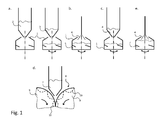
- Fig. 1 schematically shows an embodiment of the method according to the invention with the method steps a. to e.
- step a At first, a first fuel 2 is added to a mixer 1. With rotation of the mixer 1, dry, powdery binder 3 is then introduced into the mixer 1. After dry mixing, ie without the addition of water, the granular first fuel 2, which comprises, for example, lignite or hard coal dust and / or wood chips, has mixed. Subsequently, in step b. Water 4 is added, this is mixed with rotation of the mixer 1 with the first fuel 2 and the binder 3 to a premix 5. This premix 5 is already moistened.
- the moistened premix 5 is then added during operation of the mixer 1 continuously or discontinuously second fuel 6 until a total of a second amount of the second fuel 6 was added.
- the mixer 1 is in use, so that a final mixture 7 is formed.
- the second fuel 6 in step c. is continuously added in small doses to ensure the most homogeneous possible mixing of the final mixture 7.
- step e. the addition of a second amount of water 4 for wetting the final mixture 7.
- This humidified final mixture 7 is in step d. placed in a roller press 8. This consists of two rollers 9, which have a plurality of wells 10, which specify in cooperation the shape of the fuel molding.
- composite briquettes were prepared from dry lignite and wood chips. For this purpose, 15% by weight of wood chips with a grain size of 0 to 1.6 mm and with a water content of 10% by weight as the first fuel 2 and 5% by weight of starch powder as binder 3 were dry-mixed. It was a refined starch. After the premix, 5% by weight of water was sprayed on. The weight percentages given here are based on the final mass of final mixture 7 achieved.
- This free-flowing final mixture 7 was applied to a mold trough roller press with the aid of a plug screw and briquetted using a contact force of 60 to 70 kN / cm.
- the resulting briquette has a crush strength point 7-9 Mega Pascals, a bulk density 1.17 to 1.18 g / cm 3 and an abrasion resistance according to industry standard of 85 to 90%.
- composite briquettes were prepared from dry lignite and anthracite.
- 15% by weight of anthracite having a grain size of 0 to 1 mm and a water content of about 0% were premixed as the first fuel 2 and 5% by weight of starch powder as the binder 3.
- 3.33 wt .-% water were sprayed on and then slowly with mixing over a nZeitraum of about 1 minute 70 wt .-% dry lignite a grain size of 0 to 2 mm and a water content of 10% as a second fuel 6 to the premix added the mixer 1.
- 6.66% by weight of water was added to the final mixture for humidification.
- the total mixing time was also 3 min.
- the free-flowing final mixture was fed to a mold trough press using a plug screw and briquetted using a specific contact pressure of 70 to 80 kN / cm.
- the briquettes have a point compressive strength of 2 Mega Pascals, and a bulk density of 1.22 to 1.23 g / cm 3 and an abrasion resistance according to industry standard of about 80%.
- the inventive method is suitable for the production of solid fuel moldings also from fundamentally according to prevailing opinion bad brikettierbaren materials.
- fuel moldings or briquettes can be produced which are storable and transportable even when using a roller press 8.
Landscapes
- Chemical & Material Sciences (AREA)
- Life Sciences & Earth Sciences (AREA)
- Organic Chemistry (AREA)
- Oil, Petroleum & Natural Gas (AREA)
- Geochemistry & Mineralogy (AREA)
- Environmental & Geological Engineering (AREA)
- General Life Sciences & Earth Sciences (AREA)
- Geology (AREA)
- Wood Science & Technology (AREA)
- Forests & Forestry (AREA)
- Ecology (AREA)
- Biodiversity & Conservation Biology (AREA)
- Inorganic Chemistry (AREA)
- Engineering & Computer Science (AREA)
- Sustainable Development (AREA)
- Agronomy & Crop Science (AREA)
- Solid Fuels And Fuel-Associated Substances (AREA)
Applications Claiming Priority (1)
| Application Number | Priority Date | Filing Date | Title |
|---|---|---|---|
| DE201110014069 DE102011014069A1 (de) | 2011-03-16 | 2011-03-16 | Verfahren zum Herstellen von Brennstoffformkörpern |
Publications (1)
| Publication Number | Publication Date |
|---|---|
| EP2500404A1 true EP2500404A1 (fr) | 2012-09-19 |
Family
ID=45926411
Family Applications (1)
| Application Number | Title | Priority Date | Filing Date |
|---|---|---|---|
| EP12159335A Withdrawn EP2500404A1 (fr) | 2011-03-16 | 2012-03-13 | Procédé de fabrication de corps de formage combustibles |
Country Status (2)
| Country | Link |
|---|---|
| EP (1) | EP2500404A1 (fr) |
| DE (1) | DE102011014069A1 (fr) |
Cited By (3)
| Publication number | Priority date | Publication date | Assignee | Title |
|---|---|---|---|---|
| EP2749628A1 (fr) * | 2012-12-27 | 2014-07-02 | Europeenne de Biomasse | Combustible pour chaudière à charbon contenant de la biomasse et procédé de fabrication correspondant |
| CN112410092A (zh) * | 2020-11-13 | 2021-02-26 | 新奥科技发展有限公司 | 一种半焦处理方法及其应用 |
| EP4707362A1 (fr) * | 2024-09-05 | 2026-03-11 | ProFagus GmbH | Procédé de fabrication de combustibles à base de bois à faible teneur en co2 et à haute densité d'énergie |
Citations (3)
| Publication number | Priority date | Publication date | Assignee | Title |
|---|---|---|---|---|
| GB929810A (en) * | 1961-03-27 | 1963-06-26 | Great Lakes Carbon Corp | Fuel briquettes |
| EP0192807A2 (fr) * | 1985-02-23 | 1986-09-03 | C. Deilmann AG | Procédé pour la fabrication de pièces pressées actives, riches en carbone |
| DE19537238A1 (de) * | 1995-10-06 | 1997-04-10 | Zeitzer Maschinen Anlagen Gera | Verfahren zur Herstellung von wasserbeständigen Agglomeraten aus Braunkohlen |
Family Cites Families (5)
| Publication number | Priority date | Publication date | Assignee | Title |
|---|---|---|---|---|
| CH176580A (de) * | 1933-01-16 | 1935-04-30 | Hazelzet Leendert Johannes Jac | Verfahren zur Herstellung von Brennstoffbriketts und Vorrichtung zur Ausführung dieses Verfahrens. |
| DE751321C (de) * | 1940-05-18 | 1953-02-02 | Heinrich Dr Phil Hock | Verfahren zum Erzeugen von stand- und druckfesten Presslingen aus Braunkohlenkoks |
| DE803597C (de) * | 1948-10-02 | 1951-04-05 | Glanzstoff Ag | Verfahren zur Herstellung von Briketts unter Verwendung von Bindemitteln |
| DE1169887B (de) * | 1952-09-18 | 1964-05-14 | Bergwerksverband Ges Mit Besch | Verfahren zur Brikettierung von Kohle |
| DE3623325C2 (de) * | 1986-07-11 | 1996-07-25 | Ruhrkohle Ag | Verfahren zur Herstellung von Kohle- oder Koksbriketts |
-
2011
- 2011-03-16 DE DE201110014069 patent/DE102011014069A1/de not_active Withdrawn
-
2012
- 2012-03-13 EP EP12159335A patent/EP2500404A1/fr not_active Withdrawn
Patent Citations (3)
| Publication number | Priority date | Publication date | Assignee | Title |
|---|---|---|---|---|
| GB929810A (en) * | 1961-03-27 | 1963-06-26 | Great Lakes Carbon Corp | Fuel briquettes |
| EP0192807A2 (fr) * | 1985-02-23 | 1986-09-03 | C. Deilmann AG | Procédé pour la fabrication de pièces pressées actives, riches en carbone |
| DE19537238A1 (de) * | 1995-10-06 | 1997-04-10 | Zeitzer Maschinen Anlagen Gera | Verfahren zur Herstellung von wasserbeständigen Agglomeraten aus Braunkohlen |
Cited By (4)
| Publication number | Priority date | Publication date | Assignee | Title |
|---|---|---|---|---|
| EP2749628A1 (fr) * | 2012-12-27 | 2014-07-02 | Europeenne de Biomasse | Combustible pour chaudière à charbon contenant de la biomasse et procédé de fabrication correspondant |
| FR3000499A1 (fr) * | 2012-12-27 | 2014-07-04 | Europ De Biomasse | Combustible pour chaudiere a charbon contenant de la biomasse et procede de fabrication correspondant |
| CN112410092A (zh) * | 2020-11-13 | 2021-02-26 | 新奥科技发展有限公司 | 一种半焦处理方法及其应用 |
| EP4707362A1 (fr) * | 2024-09-05 | 2026-03-11 | ProFagus GmbH | Procédé de fabrication de combustibles à base de bois à faible teneur en co2 et à haute densité d'énergie |
Also Published As
| Publication number | Publication date |
|---|---|
| DE102011014069A1 (de) | 2012-09-20 |
Similar Documents
| Publication | Publication Date | Title |
|---|---|---|
| EP2300221B1 (fr) | Procédé destiné à la transformation de lignocellulose en matière fibreuse | |
| DE102022002721A1 (de) | Verfahren zum Einsatz von Biokohle bei der Herrstellung von Beton mit einer verbesserten CO2-Bilanz | |
| AT2995U1 (de) | Pellets für heizzwecke, verfahren und ring- oder flachmatrizenpresse zur herstellung | |
| DE10322228A1 (de) | Verfahren zur Herstellung von Presslingen | |
| DE102011014069A1 (de) | Verfahren zum Herstellen von Brennstoffformkörpern | |
| EP3194334B1 (fr) | Procede de fabrication de materiau microporeux de carbone et son utilisation | |
| EP3219756B1 (fr) | Liant de bois sans formaldehyde | |
| EP2295659B1 (fr) | Corps en matériau brut à base de typha et son procédé de fabrication | |
| EP2593536B1 (fr) | Procédé de production de produits pressés contenant des particules de carbone | |
| AT513075B1 (de) | Klebemittel mit zugabe von flüssigholz und verfahren zu seiner herstellung | |
| EP0985723B1 (fr) | Combustible solide | |
| DE102004048559A1 (de) | Verfahren zum Nasspelletieren von Kohlenstoffstaub zu Pellets | |
| DE19608386C2 (de) | Verfahren zur Herstellung von festen und porösen Braunkohlenbrennstoffen mit verbesserten Verbrennungseigenschaften | |
| DE102008039414A1 (de) | Verfahren zur Herstellung von kohlehaltigem Energieträger sowie Energieträger aus einer Kohle-Biomasse-Mischung | |
| EP0192807A2 (fr) | Procédé pour la fabrication de pièces pressées actives, riches en carbone | |
| DE10205105B4 (de) | Verfahren und Vorrichtung zum Herstellen von Pellets, insbesondere aus Holz | |
| DE102006047279A1 (de) | Verwendung von Popcorn für Holz- und Verbundwerkstoffe | |
| EP3352957B1 (fr) | Procédé de production de panneaux osb et panneau osb | |
| DE102008045520A1 (de) | Verfahren zur Herstellung von Brennstoff-Presslingen auf der Basis von Biomasse sowie Vorrichtung zur Durchführung des Verfahrens | |
| DE3232644A1 (de) | Verfahren zur herstellung von vollmoellerformlingen fuer die calciumcarbilderzeugung | |
| DE266457C (fr) | ||
| WO2023108185A1 (fr) | Procédé de production d'un matériau composite | |
| DE56793C (de) | Verfahren zur Herstellung von Steinkohlenbriquets auf kaltem Wege | |
| DE3041863A1 (de) | Brennstoffbrikett sowie verfahren zu seiner herstellung | |
| EP0272203A1 (fr) | Briquette de combustible |
Legal Events
| Date | Code | Title | Description |
|---|---|---|---|
| PUAI | Public reference made under article 153(3) epc to a published international application that has entered the european phase |
Free format text: ORIGINAL CODE: 0009012 |
|
| AK | Designated contracting states |
Kind code of ref document: A1 Designated state(s): AL AT BE BG CH CY CZ DE DK EE ES FI FR GB GR HR HU IE IS IT LI LT LU LV MC MK MT NL NO PL PT RO RS SE SI SK SM TR |
|
| AX | Request for extension of the european patent |
Extension state: BA ME |
|
| 17P | Request for examination filed |
Effective date: 20120816 |
|
| 17Q | First examination report despatched |
Effective date: 20121203 |
|
| STAA | Information on the status of an ep patent application or granted ep patent |
Free format text: STATUS: THE APPLICATION IS DEEMED TO BE WITHDRAWN |
|
| 18D | Application deemed to be withdrawn |
Effective date: 20140430 |