EP2501431B1 - Cathéter médical à ballonet extensible, libérant une composition et de profil étroit - Google Patents
Cathéter médical à ballonet extensible, libérant une composition et de profil étroit Download PDFInfo
- Publication number
- EP2501431B1 EP2501431B1 EP10787054.5A EP10787054A EP2501431B1 EP 2501431 B1 EP2501431 B1 EP 2501431B1 EP 10787054 A EP10787054 A EP 10787054A EP 2501431 B1 EP2501431 B1 EP 2501431B1
- Authority
- EP
- European Patent Office
- Prior art keywords
- balloon
- composition
- paclitaxel
- catheter
- wings
- Prior art date
- Legal status (The legal status is an assumption and is not a legal conclusion. Google has not performed a legal analysis and makes no representation as to the accuracy of the status listed.)
- Active
Links
- 0 C*C(C1=CC(C)CC=C1)OC Chemical compound C*C(C1=CC(C)CC=C1)OC 0.000 description 1
- JIRFUCAINBIPCW-UHFFFAOYSA-N C=[O]C(CCc1ccccc1)O Chemical compound C=[O]C(CCc1ccccc1)O JIRFUCAINBIPCW-UHFFFAOYSA-N 0.000 description 1
Images



Classifications
-
- A—HUMAN NECESSITIES
- A61—MEDICAL OR VETERINARY SCIENCE; HYGIENE
- A61M—DEVICES FOR INTRODUCING MEDIA INTO, OR ONTO, THE BODY; DEVICES FOR TRANSDUCING BODY MEDIA OR FOR TAKING MEDIA FROM THE BODY; DEVICES FOR PRODUCING OR ENDING SLEEP OR STUPOR
- A61M25/00—Catheters; Hollow probes
- A61M25/10—Balloon catheters
- A61M25/1027—Making of balloon catheters
- A61M25/1029—Production methods of the balloon members, e.g. blow-moulding, extruding, deposition or by wrapping a plurality of layers of balloon material around a mandril
-
- A—HUMAN NECESSITIES
- A61—MEDICAL OR VETERINARY SCIENCE; HYGIENE
- A61F—FILTERS IMPLANTABLE INTO BLOOD VESSELS; PROSTHESES; DEVICES PROVIDING PATENCY TO, OR PREVENTING COLLAPSING OF, TUBULAR STRUCTURES OF THE BODY, e.g. STENTS; ORTHOPAEDIC, NURSING OR CONTRACEPTIVE DEVICES; FOMENTATION; TREATMENT OR PROTECTION OF EYES OR EARS; BANDAGES, DRESSINGS OR ABSORBENT PADS; FIRST-AID KITS
- A61F2/00—Filters implantable into blood vessels; Prostheses, i.e. artificial substitutes or replacements for parts of the body; Appliances for connecting them with the body; Devices providing patency to, or preventing collapsing of, tubular structures of the body, e.g. stents
- A61F2/95—Instruments specially adapted for placement or removal of stents or stent-grafts
- A61F2/958—Inflatable balloons for placing stents or stent-grafts
-
- A—HUMAN NECESSITIES
- A61—MEDICAL OR VETERINARY SCIENCE; HYGIENE
- A61L—METHODS OR APPARATUS FOR STERILISING MATERIALS OR OBJECTS IN GENERAL; DISINFECTION, STERILISATION OR DEODORISATION OF AIR; CHEMICAL ASPECTS OF BANDAGES, DRESSINGS, ABSORBENT PADS OR SURGICAL ARTICLES; MATERIALS FOR BANDAGES, DRESSINGS, ABSORBENT PADS OR SURGICAL ARTICLES
- A61L29/00—Materials for catheters, medical tubing, cannulae, or endoscopes or for coating catheters
- A61L29/14—Materials characterised by their function or physical properties, e.g. lubricating compositions
- A61L29/16—Biologically active materials, e.g. therapeutic substances
-
- A—HUMAN NECESSITIES
- A61—MEDICAL OR VETERINARY SCIENCE; HYGIENE
- A61M—DEVICES FOR INTRODUCING MEDIA INTO, OR ONTO, THE BODY; DEVICES FOR TRANSDUCING BODY MEDIA OR FOR TAKING MEDIA FROM THE BODY; DEVICES FOR PRODUCING OR ENDING SLEEP OR STUPOR
- A61M25/00—Catheters; Hollow probes
- A61M25/10—Balloon catheters
-
- A—HUMAN NECESSITIES
- A61—MEDICAL OR VETERINARY SCIENCE; HYGIENE
- A61M—DEVICES FOR INTRODUCING MEDIA INTO, OR ONTO, THE BODY; DEVICES FOR TRANSDUCING BODY MEDIA OR FOR TAKING MEDIA FROM THE BODY; DEVICES FOR PRODUCING OR ENDING SLEEP OR STUPOR
- A61M25/00—Catheters; Hollow probes
- A61M25/10—Balloon catheters
- A61M25/1002—Balloon catheters characterised by balloon shape
-
- A—HUMAN NECESSITIES
- A61—MEDICAL OR VETERINARY SCIENCE; HYGIENE
- A61M—DEVICES FOR INTRODUCING MEDIA INTO, OR ONTO, THE BODY; DEVICES FOR TRANSDUCING BODY MEDIA OR FOR TAKING MEDIA FROM THE BODY; DEVICES FOR PRODUCING OR ENDING SLEEP OR STUPOR
- A61M25/00—Catheters; Hollow probes
- A61M25/10—Balloon catheters
- A61M25/1027—Making of balloon catheters
-
- A—HUMAN NECESSITIES
- A61—MEDICAL OR VETERINARY SCIENCE; HYGIENE
- A61L—METHODS OR APPARATUS FOR STERILISING MATERIALS OR OBJECTS IN GENERAL; DISINFECTION, STERILISATION OR DEODORISATION OF AIR; CHEMICAL ASPECTS OF BANDAGES, DRESSINGS, ABSORBENT PADS OR SURGICAL ARTICLES; MATERIALS FOR BANDAGES, DRESSINGS, ABSORBENT PADS OR SURGICAL ARTICLES
- A61L2300/00—Biologically active materials used in bandages, wound dressings, absorbent pads or medical devices
- A61L2300/40—Biologically active materials used in bandages, wound dressings, absorbent pads or medical devices characterised by a specific therapeutic activity or mode of action
- A61L2300/404—Biocides, antimicrobial agents, antiseptic agents
- A61L2300/406—Antibiotics
-
- A—HUMAN NECESSITIES
- A61—MEDICAL OR VETERINARY SCIENCE; HYGIENE
- A61L—METHODS OR APPARATUS FOR STERILISING MATERIALS OR OBJECTS IN GENERAL; DISINFECTION, STERILISATION OR DEODORISATION OF AIR; CHEMICAL ASPECTS OF BANDAGES, DRESSINGS, ABSORBENT PADS OR SURGICAL ARTICLES; MATERIALS FOR BANDAGES, DRESSINGS, ABSORBENT PADS OR SURGICAL ARTICLES
- A61L2300/00—Biologically active materials used in bandages, wound dressings, absorbent pads or medical devices
- A61L2300/40—Biologically active materials used in bandages, wound dressings, absorbent pads or medical devices characterised by a specific therapeutic activity or mode of action
- A61L2300/416—Anti-neoplastic or anti-proliferative or anti-restenosis or anti-angiogenic agents, e.g. paclitaxel, sirolimus
-
- A—HUMAN NECESSITIES
- A61—MEDICAL OR VETERINARY SCIENCE; HYGIENE
- A61M—DEVICES FOR INTRODUCING MEDIA INTO, OR ONTO, THE BODY; DEVICES FOR TRANSDUCING BODY MEDIA OR FOR TAKING MEDIA FROM THE BODY; DEVICES FOR PRODUCING OR ENDING SLEEP OR STUPOR
- A61M25/00—Catheters; Hollow probes
- A61M25/10—Balloon catheters
- A61M25/1002—Balloon catheters characterised by balloon shape
- A61M2025/1004—Balloons with folds, e.g. folded or multifolded
-
- A—HUMAN NECESSITIES
- A61—MEDICAL OR VETERINARY SCIENCE; HYGIENE
- A61M—DEVICES FOR INTRODUCING MEDIA INTO, OR ONTO, THE BODY; DEVICES FOR TRANSDUCING BODY MEDIA OR FOR TAKING MEDIA FROM THE BODY; DEVICES FOR PRODUCING OR ENDING SLEEP OR STUPOR
- A61M25/00—Catheters; Hollow probes
- A61M25/10—Balloon catheters
- A61M25/1027—Making of balloon catheters
- A61M25/1029—Production methods of the balloon members, e.g. blow-moulding, extruding, deposition or by wrapping a plurality of layers of balloon material around a mandril
- A61M2025/1031—Surface processing of balloon members, e.g. coating or deposition; Mounting additional parts onto the balloon member's surface
-
- A—HUMAN NECESSITIES
- A61—MEDICAL OR VETERINARY SCIENCE; HYGIENE
- A61M—DEVICES FOR INTRODUCING MEDIA INTO, OR ONTO, THE BODY; DEVICES FOR TRANSDUCING BODY MEDIA OR FOR TAKING MEDIA FROM THE BODY; DEVICES FOR PRODUCING OR ENDING SLEEP OR STUPOR
- A61M25/00—Catheters; Hollow probes
- A61M25/10—Balloon catheters
- A61M2025/1043—Balloon catheters with special features or adapted for special applications
- A61M2025/105—Balloon catheters with special features or adapted for special applications having a balloon suitable for drug delivery, e.g. by using holes for delivery, drug coating or membranes
Definitions
- the present invention is in the field of drug-eluting medical balloon catheters. More specifically, it is in the field of medical balloon catheters having controllable composition release, particularly a limited release prior to balloon expansion at the site of treatment.
- Balloon catheters of various forms are commonly employed in a number of surgical procedures. These devices comprise a thin catheter tube that can be guided through a body conduit of a patient such as a blood vessel and a distensible balloon located at the distal end of the catheter tube. Actuation of the balloon is accomplished through use of a fluid filled syringe or similar device that can inflate the balloon by filling it with fluid (e.g., water or saline solution or contrast solution) to a desired degree of expansion and then deflate the balloon by withdrawing the fluid back into the syringe.
- fluid e.g., water or saline solution or contrast solution
- a physician will guide the balloon catheter into a desired position and then expand the balloon to accomplish the desired result (e.g., clear a blockage, or install or actuate some other device). Once the procedure is accomplished, the balloon is then deflated and withdrawn from the blood vessel.
- the desired result e.g., clear a blockage, or install or actuate some other device.
- the balloon is commonly used to deploy a stent in order to permanently open a blockage, which remains in place after the catheter is withdrawn.
- the stent may be coated with a substance that prevent tissue stenosis / restenosis or promotes healing of the injury caused by opening the vessel.
- a stent While the use of a stent is established for blocked vessels, it is not always the most appropriate treatment. Stent deployment is known to cause damage to the vessel wall which in itself can be the cause of further vessel closure. When the stent is of the drug eluting variety, it is not possible to stop treatment without stent removal, entailing additional surgical procedures. Delivering a precise and/or intermittent treatment is also precluded by a drug-eluting stent, thus treatment optimization is not possible. Moreover, a stent is not suitable as a vehicle of high-dose treatment regimens. In addition, it is not suitable for treating large cavities, or cavities having a non-cylindrical profile.
- Coated balloons are useful for addressing the above, and are known in the art for the delivery of active pharmaceutical substances.
- US 2010/0076539 , US 2009/0054837 , WO 2009/111712 , DE 20 2009 006 632 , and US 2006/0020243 describe coated balloons in which the active pharmaceutical substance is held between the balloon folds.
- a problem in the art is systemic toxicity which arises from partial unfolding of the wings during advancement of the catheter through the vasculature, the bends of which can loosen the wings of conventionally folded balloons.
- EP 2 090 269 A1 discloses a system and method for introducing an intraluminal endoprosthesis, preferably a stent, into a body cavity.
- the system consisting of the intraluminal endoprosthesis and a catheter with a balloon, wherein in a non-dilated state, the balloon has at least one wing, and wherein at least one pharmaceutically active substance is arranged at least partially underneath the at least one wing of the balloon in the non-dilated state, and the intraluminal endoprosthesis is fixedly arranged on the folded balloon in such a manner that the intraluminal endoprosthesis at least partially encloses the balloon, wherein the at least one wing of the balloon is adhesively bonded by means of the at least one pharmaceutically active substance.
- WO 2009/111712 A1 discloses a catheter devices having an expandable balloon for delivering a therapeutic agent to a body site.
- the balloon has one or more folds which serve as a reservoir for containing the therapeutic agent.
- the fold may have any of various configurations to hold the therapeutic agent.
- the balloon comprises one or more lobes that forms the fold(s).
- US 2006/020243 A1 discloses selective treatment of diseased tissue sections or organ parts, the surface of medical devices entering into contact with areas thereof under pressure is coated with lipophilic substantially water-insoluble medicaments binding to various tissue components with good adherence thereto, said medicaments having an effect thereupon a short time after entering into contact therewith without exerting a harmful influence upon adjacent healthy tissue.
- WO 2009/066330 A1 discloses a balloon for treating stenosis and the method for obtaining this balloon.
- the method comprises the steps of: bringing the balloon in the deployed configuration; placing a plurality of stylets that are arranged in the axial direction along the outer wall of the balloon; pushing the stylets towards the balloon core in the radial direction such as to form a plurality of laps; laying the laps about the core in the tangential direction such as to lay each lap on an adjacent stylet; removing the stylets such as to form a plurality of cavities comprised between each lap and the balloon core; filling the cavities with the drug.
- WO 94/23787 A1 discloses catheter balloons having shaped surfaces, which allow for delivery of drugs to a site in the vessel, provide for agents which allow for determination of blood flow and definition of the vessel walls, and sampling of the materials at the site for diagnosis.
- compositions which are suitable for selective filling or selective coating of folds of a folded balloon, and especially relates to compositions of a contrast agent and an active agent in a solvent for filling of folds of a folded catheter balloon as well as to methods for selective filling or selective coating of folds of a folded catheter balloon and to filled or coated folded catheter balloons which can be obtained according to one of these methods.
- WO 96/32907 A1 discloses a stent for implantation in a body lumen location of interest in a patient and includes a generally flexible elastic, tubular body having open ends and a thin open porous sidewall structure and a relatively thin coating layer on the tubular body including a biostable elastomeric material incorporating an amount of biologically active material dispersed therein for timed delivery therefrom.
- US 2003/125761 discloses a balloon attached to a catheter tube.
- a stiffening wire extends from the catheter tube to a tip.
- a lumen is provided at the end of a flexible tube that at its opposite end is attached to the catheter tube.
- the present invention aims to overcome the problem of periodic delivery of medicaments to cylindrical or non-cylindrical bodily cavities and to provide a means to deliver doses that avoids systemic toxicity.
- composition-eluting balloon catheter (100) as defined in claim 1 having a proximal (20) and distal (15) end, comprising an elongated catheter tube (6) with an inflation lumen (7) extending therewithin and at least one inflatable balloon (4) having a central longitudinal balloon axis (B-B') towards the distal end (15) in fluid communication with the inflation lumen (7), wherein:
- a particular embodiment of the invention is a balloon catheter as described above, wherein the at least one groove (32) has a directional component which is transverse to the central longitudinal axis (B-B') of the balloon (4).
- Another particular embodiment of the invention is a balloon catheter as described above, wherein the wings (10', 10") are folded around a central longitudinal balloon axis (B-B') of the balloon (4).
- Another particular embodiment of the invention is a balloon catheter as described above, wherein at least two grooves (33, 34) extend from the distal end (15) to the proximal end (20) of the balloon (4) and cross each other.
- Another particular embodiment of the invention is a balloon catheter as described above, whereby the at least one groove (32) is ring or oval shaped, and has a directional component which is transverse to a central longitudinal axis (B-B') of the balloon (4).
- Another particular embodiment of the invention is a balloon catheter as described above, wherein at least two grooves (33, 34) extend from the distal end (15) to the proximal end (20) of the balloon (4) and cross each other.
- Another particular embodiment of the invention is a balloon catheter as described above, wherein the composition comprises paclitaxel.
- composition comprises:
- Another particular embodiment of the invention is a balloon catheter as described above, wherein the balloon is provided with a hydrophilic coating onto which the composition (12', 12") is at least partially disposed.
- the hydrophilic coating is any of polyvinylpyrrolidone (PVP) or copolymers containing N-vinylpyrrolidone, poly (meth) acrylic acid or copolymers containing (meth) acrylic acid or (meth) acrylic acid esters, polyacrylamides, polyvinylalcohol and copolymers of partially saponified vinylacetate copolymers, polyethylenglycol, polyvinylmethylether, polyvinylmethylether-maleic anhydride and copolymers containing maleic-anhydride or maleic-acidesters or copolymers containing vinylmethylether, or copolymers thereof, or water soluble polysaccharides or derivatives thereof such as carboxymethylcellulose (CMC) or hydroxyethylcellulose or Xanthane or a derivative thereof to the liquid for wetting a hydrophilic coating.
- PVP polyvinylpyrrolidone
- copolymers containing N-vinylpyrrolidone poly (me
- Another particular embodiment of the invention is a balloon catheter as described above, further provided with a stent.
- a balloon catheter as described above, wherein the stent is made from any of stainless steel, tantalum, titanium alloy, nitinol, cobalt alloy, cobalt-chromium-nickel alloy, cobalt-chromium alloy, cobalt-chromium F562, or magnesium alloys.
- Another particular example is a balloon catheter as described above, obtainable by a process comprising the steps:
- Another particular example is a balloon catheter as described above, further comprising the step of applying a relief structure as defined above, to the surface of the balloon after folding.
- Another particular example is a balloon catheter as described above, that is a rapid exchange catheter.
- Another particular example is a balloon catheter as described above, that is an over-the-wire catheter.
- Another embodiment of the invention is a process for obtaining a composition-eluting balloon catheter (100) as defined in claim 11 having a proximal (20) and distal (15) end, comprising an elongated catheter tube (6) with an inflation lumen (7) extending therewithin and at least one inflatable balloon (4) having a central longitudinal balloon axis (B-B') towards the distal end (15) in fluid communication with the inflation lumen (7), wherein the balloon (4) in the uninflated condition is configured as one or a plurality of folded wings (10', 10") comprising the steps:
- a particular embodiment of the invention is a process as described above, wherein:
- Another particular embodiment of the invention is a process as described above, wherein the relief structure has one or more of the features described above.
- composition-eluting balloon catheter (100) obtainable by a process described above.
- composition-eluting balloon catheter 100
- a guidewire lumen for a rapid exchange catheter or an over the wire catheter mode of operation is another particular embodiment of the invention.
- a medicament means one medicament or more than one medicament.
- distal distal end
- proximal distal end
- distal end proximal end
- the present invention concerns a composition (drug or medicament)-eluting balloon catheter configured to release composition after inflation of the balloon has been initiated.
- the balloon is suitable for the delivery of composition to tissue and cells present in a cavity of a subject, when the balloon is inflated and the balloon contacts at least part of the cavity wall.
- the balloon in the uninflated condition comprises one or a plurality of folded wings, and composition is provided within the folds of the wings, in such a manner that release of the composition is reduced or prevented until after inflation of the balloon has been initiated.
- the composition is present essentially exclusively within the balloon folds. In other words, the outer surface of the folded balloon is essentially devoid of composition. The folds protect the composition from exposure to an environment, such as a liquid environment, that would otherwise initiate diffusion.
- the use of the folds reduces or prevents natural diffusion in situ of composition prior to inflation.
- the site of treatment is located some distance from the point of entry of the catheter, it can take a surgeon time to advance and position the balloon correctly e.g. when advanced along the vasculature from an entry point in the groin to a vessel in the vicinity of the heart.
- the balloon is disposed with a high concentration of active ingredient which will commence diffusion from the moment it enters an aqueous environment for example in the vasculature.
- the arrangement of the present invention substantially limits unwarranted diffusion, reducing systemic toxicity and increasing locally-deliverable dose. Moreover, it provides a drug-eluting catheter having a substantially reduced profile.
- the medical balloon catheter is of any design where a catheter is disposed with a balloon. Typically, it has a proximal end and distal end, and comprises an elongated catheter tube with an inflation lumen extending therewithin and at least one inflatable balloon towards the distal end in fluid communication with the catheter tube inflation lumen.
- the inflation lumen is open at the proximal end, that permits the catheter tube to couple with an inflation means such as a syringe.
- the medical balloon catheter may be extended at the distal end by a flexible tip.
- the catheter may be a rapid-exchange or over-the-wire type which types are well understood in the art.
- the size of the medical balloon catheter is sufficiently narrow to introduce through the appropriate passage way e.g. nasopharyngeal route, vaginal and cervical route, or through a skin puncture.
- FIG. 1 shows a typical balloon catheter in the uninflated state provided with folded wings
- FIG. 1A shows a transverse cross-section (A-A') through the balloon of FIG. 1
- a balloon catheter 100 of the invention comprises a balloon 4 mounted at the distal end 15 of an elongated flexible shaft 6 and terminating in a flexible tip 8.
- Balloon 4 has a balloon wall.
- the catheter 100 may be conventional in construction, providing an inflation lumen 7 in fluid communication with a balloon 4 lumen 5 for inflation and deflation.
- the lumen is open at the proximal end.
- the catheter 100 allows inflation of the balloon 4 after placement in the cavity. Once in the cavity and after inflation, the catheter 100 remains in place for the duration of the treatment. It may provide treatments in addition to those delivered by the balloon 4, for example, through the catheter shaft 6.
- the catheter 100 may also be used to deliver circulating heating fluid, circulating cooling fluid, liquid medicament, radiopaque liquid tracer or ionizing or non-ionizing radiation to the balloon whose radiation can pass through the wall of the balloon 4.
- the catheter 100 can be single or multichannel, depending on the requirements of inflation, guidewire lumens, and delivery of other substances.
- the catheter may be provided with a guidewire lumen.
- the catheter 100 may be suitable for advancement over a guidewire in an over-the-wire mode in which case a guidewire lumen is provided from distal to proximal end of total catheter, or rapid-exchange mode, in which case a distal side guidewire lumen and terminal ports are provided.
- the guidewire lumen may be disposed within the inflation lumen 7 of the shaft 6.
- the balloon in the uninflated condition comprises one or a plurality ( e.g. 2, 3, 4, 5, 6) of folded wings 10', 10".
- the wings 10', 10" may be folded in any fashion, preferably folded around a central longitudinal balloon axis (B-B') as is well known in the art, and shown, for instance in FIG. 1A , to form the narrow cylindrical balloon profile.
- the wing 10', 10" structure is formed from the balloon in a flattened condition, each wing extending from the outer radial balloon edge towards the central (B-B') axis. Prior to folding, the wings may be radially extending, spaced from one another in the circumferential direction around the central longitudinal axis of the balloon.
- a wing 10', 10" in the folded condition is generally devoid of inflation medium, gaseous or fluid; FIGs. 1A , 3A to 3D indicate the presence of a void in the wings solely for reasons of clarity.
- the fold of a wing may be considered the region between an outside surface of a wing, and the surfaces it overlaps after folding.
- composition 12', 12" is provided at least partly between the fold of a wing 10', 10", the wing 10', 10" acting as a moisture-resistant barrier against exposure of the medicament to a fluidic environment in situ. Inflation causes the wings to unfold so exposing the composition 12', 12" to a fluidic environment and initiating diffusion.
- the fully inflated condition as shown in FIG.
- the wings 10', 10" lose their form, adopting a tubular balloon 4 configuration.
- almost the entire surface of the balloon 4 may be coated with said composition 12'a, 12'b, 12"a, 12"b in the inflated state.
- the balloon is suitable for insertion into a cavity, which after insertion and inflation at least partly contacts the cavity wall of a subject for the delivery of composition.
- Various types of balloon are known with a plurality of shapes and features suited, after inflation, to the cavity shape and treatment regime.
- a balloon after inflation may be longitudinal, ovoid, conical, cylindrical, barrel, hour-glass, bullet shaped or any shape that can accommodate the cavity receiving treatment.
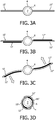
- the uninflated balloon is arranged, depending on the size of the balloon, into 1, 2, 3, 4, 5, or 6 wings 10', 10", in a manner known per se to provide a propeller-type profile as shown, for instance, in FIG. 3A , each wing having two opposing surfaces.
- one or both surfaces of a wing (e.g. 1, 2, 3, 4, 5, 6 or more wings, preferably each and every wing) is at least partially coated with composition; in FIG. 3B one surface of each wing is partially coated with composition 12', 12".
- the composition coated surface is preferably that which folds towards the central longitudinal balloon axis (B-B').
- Coating may be effected by dripping, dipping, brushing, or spraying the composition, or by any other means.
- the wings are folded ( FIG. 3C ) in a clock-wise or anti-clockwise direction, depending on the coated surface, such that the composition 12', 12" lies substantially in the fold created by the wing; in the case of FIG. 3C , the wings are folded in an anti-clockwise direction when viewed in the direction from the distal 15 to the proximal 20 end of the balloon 4.
- Folding creates a balloon ( FIG. 3D ) containing composition 12', 12" essentially sealed from the environment by virtue of the moisture impermeable balloon wings 10', 10". Excess composition on the folded balloon surface can be removed.
- FIG. 3B to 3C show medicament coated on one surface of each wing, however, the composition may also be at least partially coated on both surfaces, the excess composition removed, and / or the coating restricted to parts of the wing anticipated to form a fold.
- the outer surface of the balloon 4 may be pre-treated with a hydrophilic substance i.e. prior to application of the composition.
- the hydrophilic substance acts as a base onto which the composition is applied.
- the balloon is first coated with the hydrophilic substance, then the hydrophilic substance is coated with the composition.
- the hydrophilic substance increases adhesion of the composition to the balloon 4 surface.
- One or both surfaces of each wing may be at least partially coated with hydrophilic substance. It is understood that when one surface of the wing is treated with hydrophilic substance, the same surface is provided with composition. When both surfaces of the wings are treated, the hydrophilic substance serves to increase the lubricity of the cathether during advancement to the site of treatment.
- Hydrophilic treatment may be effected by dripping, dipping, brushing, spraying the hydrophilic substance onto the balloon, or any other means. Once it has dried partially or completely, the composition may be later applied thereover.
- the balloon provided with the hydrophilic coating may apply to a balloon of the invention. It may also apply to any drug eluting balloon of the art or future balloon; the composition need not be restricted to the folds of the balloon, and the balloon may not necessarily be provided with the additional relief structure described below.
- Hydrophilic substances are well known in the art, as coatings for medical devices. Whereas such coating is not particularly smooth when dry, so that the handling of the device may become inconvenient, it becomes extremely slippery when it is swelled with water, preferably immediately before introduction into the human body and thus ensures a substantially smooth introduction with a minimum of tissue damage.
- Hydrophilic coatings are described variously in US 3,967,728 , WO 86/06284 , GB 2 284 764 , and US 3,648,704 .
- Methods are known in the art for coating the surface of a balloon with a hydrophilic coating. These methods are most often based on the fact that the balloon to be provided with a hydrophilic surface coating, in the course of one or more process stages with intermediary drying and curing, is coated with one or more (mostly two) layers, which are brought to react with one another in various ways, for example, by polymerisation initiated by irradiation, by UV light, by graft polymerisation, by the formation of interpolymeric network structures, or by direct chemical reaction.
- hydrophilic coatings and processes for the application thereof are disclosed, for example, in DE 159,018 , EP 0 389 632 , EP 0 379 156 , EP 0 454 293 , EP 0 093 093 B2 , GB 1,600,963 , US 4,119,094 , US 4,373,009 , US 4,792,914 , US 5,041,100 and US 5,120,816 , WO 90/05162 and WO 91/19756 .
- the hydrophilic substance is coated onto the balloon by applying, in two stages or in one combined stage, on the balloon, a primer reactive with or adhesive to the balloon and then the actual hydrophilic substance.
- the hydrophilic substance may comprise a hydrophilic polymer, for example, polyvinylpyrrolidone (PVP) or copolymers containing N-vinylpyrrolidone, poly (meth) acrylic acid or copolymers containing (meth) acrylic acid or (meth) acrylic acid esters, polyacrylamides, polyvinylalcohol and copolymers of partially saponified vinylacetate copolymers, polyethylenglycol, polyvinylmethylether, polyvinylmethylether-maleic anhydride and copolymers containing maleic-anhydride or maleic-acidesters or copolymers containing vinylmethylether, or copolymers thereof, or water soluble polysaccharides or derivatives thereof such as carboxymethylcellulose (CMC) or hydroxyethylcellulose or Xanthane or a derivative thereof to the liquid for wetting a hydrophilic coating.
- Suitable hydrophilic polymers may be mixtures of the preferred species stated above. In an especially preferred
- the amount to be used according to the invention may vary and depends inter alia on the molecular weight of the specific PVP. The higher the molecular weight, the higher is the tendency of gelling. Thus, the use of higher amounts of low molecular weight PVP gives an effect similar to the use of lower amounts of a higher molecular weight PVP.
- the amount of a PVP of a given molecular weight PVP to be used is easily determined by the skilled in the art by routine experiments testing the water retention.
- the composition may be applied to the balloon using any suitable technique such as dripping, dipping, brushing, spraying, or any other means.
- the composition is applied in a solution of an organic solvent, such as methanol, ethanol, propanol, acetone, or ethyl acetate in high purity.
- the solvent evaporates after coating leaving little or no residue.
- the organic solvent is selected to be fast-evaporating, leaving no or little residue.
- hydrophilic coating and application of the composition in a solution of an organic solvent provides a uniform dispersion of medicament on the balloon, avoiding the formation of crystalline patches. Moreover, it provides a smooth surface. The combination also reduces or prevents the release of fragmented particles of composition upon expansion of the balloon, thereby delivering medicament locally to the wall of the cavity being treated, and reducing systemic release.
- the composition namely the medicament
- a hydrophilic coating After exposure of the uninflated balloon to an aqueous environment such as a water bath, the medicament is substantially retained. Retention of the medicament is observed even when the composition is not sealed within the balloon folds.
- the balloon pre-treated with hydrophilic substance advantageously substantially releases composition to the cavity wall only after inflation of the balloon. Release may be controlled by inflation and deflation, namely when the balloon is inflated, composition is released, and when the balloon is deflated, release of composition is effectively stopped. Where the balloon inflates and there is no contact by the balloon with the cavity wall, release of composition is minimised. This allows multiple inflation and deflation of the balloon in the same or at different locations, each inflation administering a separate dose.
- the composition comprises paclitaxel, or melatonin or a combination of both in ethanol that is applied to the balloon pre-treated with a hydrophilic coating.
- the solvent is rapidly evaporated leaving paclitaxel and/or melatonin evenly distributed, and without the formation of large crystals.
- a good adhesion of the active compounds is achieved, the composition layer more resistant to the release of particulate medicament during or after balloon inflation.
- a further example not forming part of the present invention is a balloon 4 as described herein obtainable by a process comprising the steps:
- composition-eluting balloon catheter 100 having a proximal 20 and distal 15 end, comprising an elongated catheter tube 6 with an inflation lumen 7 extending therewithin and at least one inflatable balloon 4 - having a central longitudinal balloon axis B-B' - towards the distal end 15 in fluid communication with the inflation lumen 7, wherein the composition 12', 12" is at least partially disposed over a hydrophilic coating provided on the balloon.
- Such balloon may optionally be provided with a stent, as discussed elsewhere herein.
- Another example not forming part of the invention is a process for obtaining a balloon as defined above comprising the steps performed in the following order:
- composition may be applied to the outer surface of the balloon 4 as a mixture with a hydrophilic substance i.e. composition and hydrophilic substance are simultaneously applied.
- Another example not forming part of the invention is a process for obtaining a balloon as described above comprising the steps performed in the following order:
- the wings 10', 10" of the balloon 4 may be maintained in the folded condition by way of an example not forming part of the invention by dint of a substance having light adhesive property present in the composition, or disposed over the wing edges.
- the folded wings may be subjected to a heat and/or pressure treatment to maintain their structure, the parameters of which will depend on the lability of the composition.
- the folded state are maintained by introducing a relief structure, namely a pattern of grooves applied to the outer surface of the folded wings of the balloon.
- this relief structure technology is known as "Wing-Seal" herein.
- the exemplary processes for obtaining a balloon stent may further comprise the step of introducing a relief structure to the outer surface of the folded wings of the balloon as will be described below.
- the outside surface of balloon 4 has a relief structure 30 configured, in the inflated state, to reduce in depth ( FIGS. 4B and 5B ).
- the balloon 4 in the uninflated (folded) condition is further provided with a relief structure 30 comprising at least one groove on the outside of the plurality of folded wings 10', 10".
- the relief in the uninflated condition, has a certain (average) impression depth that, upon inflation, is substantially reduced i.e. it becomes more shallow; the relief structure may be flattened-out upon inflation.
- the relief structure not only gives the catheter its required flexibility, it also maintains the wings in a folded condition, and reduces fluid ingress into the wing folds. In particular, it prevents the balloon wings from partially unfolding during advancement of the catheter through the vasculature, the bends of which can loosen the wings of conventionally folded balloons.
- the composition is effectively sealed between the wing folds, reducing composition diffusion even when the catheter is advanced through highly tortuous routes which normally flex the folded balloon and instigate unfolding. Since no additional membranes or bands placed over the balloon are needed to maintain balloon integrity, the balloon profile is also narrower.
- the balloon 4 in the uninflated condition is thus further provided with a relief structure 30 comprising at least one groove on the outside of the plurality of folded wings 10', 10".
- the at least one groove may be essentially devoid of composition. Where there is more than one groove, preferably each and every groove may be essentially devoid of composition.
- the relief structure 30 comprises at least one groove or indentation 32, which extends helically from the distal 15 to the proximal 20 end of the balloon 4, over the outside surface thereof.
- the uninflated balloon 4 has thereby obtained a helical relief surface.
- the relief structure 30 comprises two grooves 33, 34, which extend helically from the distal 15 to the proximal 20 end of the balloon 4 and thereby cross each other.
- the uninflated balloon 4 has hereby obtained a padded relief surface.
- the relief structure may comprise a series of circumferential groves that are ring (O-shaped), oval or C-shaped.
- the groove has a directional component that is transverse to the longitudinal axis (B-B') of the balloon.
- the number of grooves may be 20, 30, 40, 50, 60, 70, 80, 90, 100, 110, 120, 130, 140 or more, or a value in the range between any two of the aforementioned value, depending on the size of the balloon.
- One way of obtaining the relief structure as shown in the drawings is by winding a wire helically around the balloon 4 as described for instance in US 2003/0014100 and US 2003/0014070 . If the wire is wound only in the forward direction, the structure according to FIG. 4A is obtained, and if the wire is also wound in the return direction, the structure in FIG. 5A is obtained. After the wire has been wound around the balloon pressure is raised inside of the balloon, in such a way that, in an uninflated state, the balloon obtains a relief structure that on dilating of the balloon at the dilatation site in the vessel or lumen will reduce in depth, for example, virtually or completely disappear.
- the balloon may optionally be heated while under the raised pressure. The precise temperate and duration of heating can be determined optimally according to the lability of the composition.
- the balloon may be placed in a mould, which is provided with the relief pattern required in order for it to obtain, under raised pressure and optionally raised temperature, the relief structure required.
- Another way to achieve the relief structure is to crimp the pattern onto the surface, i.e. by the application of radial pressure to the outer surface of the folded balloon.
- the radial pressure is applied by a press having a central press axis disposed with a plurality of press jaws, configured to move radially towards the central press axis.
- the pressing end of the press jaws are disposed with the relief structure, and impress on the folded balloon when the jaws are in the closed position.
- the jaws may hammer the relief structure on to the balloon; according to one aspect of the invention, the jaws deliver a plurality of hammer blows.
- the hammer blows may be delivered at a frequency in the range of 1 to 200, 300, 400, 500, 600, 700, 800, 900, 1000 or more blows per second.
- Crimping devices suitable for applying the relief structure are well known in the art, for example, those manufactured by Fortimedix and Machine Solution Inc.
- the balloon Before the balloon is provided with its relief structure, preferably it is folded in the usual way in order to reduce its profile. By applying the relief structure, the profile will be reduced still further as an additional, advantageous effect.
- a catheter 100 is made of any biocompatible materials known in the art of catheter construction. Suitable biocompatible materials include, but are not limited to polypropylene, polyethylene, polyurethanes, polyamide, poly(ethylene terephthalate) (PET) or polyesters and copolymers thereof for the shaft 6; and any suitable elastomeric polymer material having moisture impermeable properties, able to withstand inflation pressure, such as polyamide (e.g. PA11, PA12), nylons, PEBAXTM, polyethylene, latex rubber, elastic, or plastic for the balloon 4.
- PET poly(ethylene terephthalate)
- the balloon 4 may optionally be provided with a stent.
- the stent is fitted at least partially, preferably entirely over the balloon 4.
- the stent is preferably a non-drug eluting stent, though drug-eluting stents are not excluded.
- the balloon 4 disposed with the stent may or may not be provided with the aforementioned hydrophilic coating. Additionally or independently, said balloon may or may not have composition exclusively between the folds. Additionally or independently, said balloon may or may not have the aforementioned relief structure.
- Stents have been extensively described in the art. For example they may be cylinders which are perforated with passages that are slots, ovoid, circular, regular, irregular or the like shape. They may also be composed of helically wound or serpentine wire structures in which the spaces between the wires form the passages. Stents may also be flat perforated structures that are subsequently rolled to form tubular structures or cylindrical structures that are woven, wrapped, drilled, etched or cut to form passages. A stent may also be combined with a graft to form a composite medical device, often referred to as a stent graft.
- Stents may be made of biocompatible materials including biostable and bioabsorbable materials. Suitable biocompatible metals include, but are not limited to, stainless steel, tantalum, titanium alloys (including nitinol), and cobalt alloys (including cobalt-chromium-nickel alloys, cobalt-chromium alloy and cobalt-chromium F562). Stents may be made of biocompatible and bioabsorbable materials such as magnesium based alloys. Bioabsorbable stents may inserted at the site of treatment, and left in place. The structure of the bioabsorbable stent is degraded with time.
- Suitable non-metallic biocompatible materials include, but are not limited to, polyamides, polyolefins (i.e. polypropylene, polyethylene etc.), nonabsorbable polyesters (i.e. polyethylene terephthalate), and bioabsorbable aliphatic polyesters (i.e. homopolymers and copolymers of lactic acid, glycolic acid, lactide, glycolide, para-dioxanone, trimethylene carbonate, epsilon -caprolactone, etc.
- polyamides i.e. polypropylene, polyethylene etc.
- nonabsorbable polyesters i.e. polyethylene terephthalate
- bioabsorbable aliphatic polyesters i.e. homopolymers and copolymers of lactic acid, glycolic acid, lactide, glycolide, para-dioxanone, trimethylene carbonate, epsilon -caprolactone, etc.
- lactide capronolactone poly(L-lactide) (PLLA), poly(D,L-lactide) (PLA), polyglycolide (PGA), poly(L-lactide-co-D,L-lactide) (PLLA/PLA), poly(L-lactide-co-glycolide) (PLLA/PGA), poly(D, L-lactide-co-glycolide) (PLA/PGA), poly(D, L-lactide-co-glycolide) (PLA/PGA), poly(glycolide-co-trimethylene carbonate) (PGA/PTMC), polyethylene oxide (PEO), polydioxanone (PDS), polycaprolactone (PCL), polyhydroxylbutyrate (PHBT), poly(phosphazene), polyD,L-lactide-co-caprolactone) (PLA/PCL), poly(glycolide-co-caprolactone) (PGA/PCL), polyanhydrides (PAN), poly(
- a stent can be balloon expandable or self-expanding.
- the stent may also be made from different sorts of wires, for instance from polymeric biodegradable wires containing the active compound, interweaved with the metallic struts of the stent (balloon expendable or self-expandable stent).
- Self-expanding stents may be braided, from flexible metal, such as special alloys, from nitinol, from phynox. Self-expandable stents made from nitinol may be laser cut.
- composition-eluting balloon of the invention may be placed on or adjacent to cells or tissue present in a bodily cavity that require treatment.
- the invention is particularly suited to the delivery of a high dose of medicament over a short time period. The period will depend on the location of treatment, for instance, delivery to the wall of a blood vessel, which will cause blockage after balloon inflation, may necessitate a shorter delivery period compared with delivery to the wall of the oesophasgus.
- the delivery period may be equal to or less than 10 seconds (s), 20 s, 30 s, 40 s, 50 s, 1 minute, 5 minutes, 10 minutes, 20 minutes, 30 minutes, 40 minutes, 50 minutes or 1 hour, or a value in the range between any two of the aforementioned values, preferably between 30 seconds and 10 minutes for use in the vasculature.
- a medical balloon catheter may be inserted into a cavity, for instance, a blood vessel of a subject and advanced therein until the balloon is in the vicinity of the treatment site that might be a stenosed region. After inflation, the expanded balloon contacts the cavity wall, delivering composition to the surrounding tissue and cells for a period. When the delivery period has expired, the balloon is deflated and withdrawn; alternatively it may be re-inflated for a further delivery for a defined period.
- a cavity may be a natural bodily cavity such as a duct, vascular duct, a bronchial duct, a biliary duct, the oesophasgus, digestive tract, urethral duct, uretheral duct, uterus, stomach, arteries, veins, urethral duct, aerie tract, the urogenital tract, nasopharyngeal area, the pharynx, the small and large bowels, the rectum, the trachea, the uterine cavity, the uterine cervix, the vagina, the urethra, and the bladder or colon.
- the natural cavity can be any walled cavity of a subject suitable for placing the balloon therein. Such cavity may be narrowed by a medical condition such as stenosis, cancer, benign tumours, or invasion of a cancer originating from the wall or passing through the wall of a duct.
- the composition comprises a medicament for the treatment of tissues and cells present in the cavity.
- medicaments suitable for the treatment of stenosis or restenosis include one or more of paclitaxel, taxol, melatonin, thalidomide, sirolimus, zotarolimus, everolimus, biolimus, 17- ⁇ estradiol, actinomucin D, docetaxel, and/or any derivatives thereof.
- the composition may comprise paclitaxel, melatonin, or a combination of paclitaxel and melatonin.
- a preferred medicament is paclitaxel, even more preferred is paclitaxel not in combination with melatonin.
- medicaments suitable for the treatment of tumours include one or more of cis-platin, paclitaxel, etoposide, amasecrine, teniposide, irinotecan, toptecan, doxorubicin, epirubicin, bleomycin, and/or any derivatives thereof.
- medicaments suitable for the treatment of bacterial infections include one or more of penicillin, erythromycin, ampicillin, clindamycin, tetracycline, streptomycin, amoxicillin, cefaclor, lincomycin, clarithromycin, cephalosporins, azithromycin, doxycycline, ciprofloxacin, cefuroxime, levofloxacin, chloramphenicol, minocycline, penicillins, vancomycin, kanamycin, gentamicins, neomycin, ceftriaxone, bacitracin, oxacillin, cloxacillin, cephalothin, amoxicillin, dicloxacillin, aminoglycosides, methicillin, carbenicillin, gentamicin, trimethoprim, oxytetracycline, rifampin, tetracyclines, polymyxins, cephalexin, chlortetracycline, metronid
- the medicament is provided in combination with a polymer (e.g. a controlled release polymer), however, it is preferred that no polymer is present in the composition. It is also preferred that the composition is not over-coated with a polymeric layer, though this option should not be excluded from the invention.
- a polymer e.g. a controlled release polymer
- Paclitaxel and melatonin and its derivatives and options for separate or simultaneous administration are described in more detail below.
- Paclitaxel refers to native paclitaxel, paclitaxel analogues and derivatives thereof, including, for example, a natural or synthetic functional analogue of paclitaxel which has paclitaxel biological activity, as well as a fragment of paclitaxel having paclitaxel biological activity.
- Paclitaxel includes the native compound having formula (I).
- a compound which is a paclitaxel analogue refers to a compound which interferes with cellular mitosis by affecting microtubule formation and/or action, thereby producing antimitotic and anti-cellular proliferation effects.
- paclitaxel and its analogues and derivatives are well-known in the art, and are described, for example, in U.S. Pat. Nos. 5,569,729 ; 5,565,478 ; 5,530,020 ; 5,527,924 ; 5,484,809 ; 5,475,120 ; 5,440,057 ; and 5,296,506 .
- Paclitaxel and its analogues and derivatives are also available commercially.
- Synthetic paclitaxel for example, can be obtained from Bristol-Myers Squibb Company, Oncology Division (Princeton, N.J.), under the registered trademark Taxol®.
- An analogue of paclitaxel may have a structure according to formula II, whereby paclitaxel is modified at the C10 position.
- R may be any of Propionyl, Isobutyryl, Valeryl, Hexanoyl, Octanoyl, Decanoyl, Tridecanoyl, Methoxyacetyl, Methylthioacetyl, Methylsulfonylacetyl Acetoxyacetyl, Ethylformyl, Monosuccinyl, Crotonoyl, Acryloyl, Cyclopropanecarbonyl Cyclobutanecarbonyl, Cyclopentanecarbonyl, Cyclohexanecarbonyl, Hydrocinnamoyl, trans-Cinnamoyl, Phenylacetyl, Diphenylacetyl, Benzoyl 2-Chlorobenzoyl, 3-Chlorobenzoyl, 4-Chlorobenzoyl,
- Taxol® and its analogues and derivatives have been used successfully to treat leukemias and tumors.
- Taxol® is useful in the treatment of breast, lung, and ovarian cancers.
- paclitaxel may be synthesized in accordance with known organic chemistry procedures ( Nerenberg et al., Total synthesis of the immunosuppressive agent (-)-discodermolide. J. Amer. Chem. Soc., 115:12,621-12,622, 1993 ) that are readily understood by one skilled in the art.
- Melatonin (N-acetyl-5-methoxytryptamine) is a hormone secreted by the pineal gland. Melatonin is often prescribed for the treatment of sleep disturbances and jet-lag. The pharmacological activity of melatonin has been described in numerous publications. One of the early investigations of the pharmacological activity of melatonin was by Barchas and coworkers ( Barchas et al. Nature 1967, 214, 919 ). Melatonin refers to native melatonin, melatonin analogues and derivatives thereof. An analogue of melatonin is a natural or synthetic functional variant of melatonin which has melatonin biological activity.
- An analogue of melatonin can be a compound which binds to the melatonin receptor; methods for identifying such melatonin analogues, for example by standard screening techniques, are well known in the art.
- An analogue may be a compound that binds to the melatonin receptor with an affinity better than 10 -6 M in suitable buffer conditions.
- Melatonin includes the native compound having formula (III).
- analogues of melatonin include 2-iodomelatonin, 6-chloromelatonin, 6,7-dichloro-2-methylmelatonin and 8-hydroxymelatonin, all of which contain the 5-methoxy indole ring as an essential moiety ( Dubocovich, et al. Proc. Nat'l.Acad. Sci. (USA) 1987, 84, 3916-3918 ; Dubocovich, M; . J. Pharmacol. Exp.Ther: 1985,234,395 ; Dubocovich, M. L. Trends Pharmacol. Sci. 1995, 16, 50-56 ).
- the paclitaxel comprises one or more analogues of paclitaxel optionally in combination with paclitaxel.
- the melatonin comprises one or more analogues of melatonin optionally in combination with melatonin.
- compositions comprising combinations of analogues may also be effective at reducing a proliferating cell mass.
- Stereoisomer, tautomers, racemates, prodrugs, metabolites, pharmaceutically acceptable salts, bases, esters, structurally related compounds or solvates of paclitaxel or melatonin are within the scope of the invention, unless otherwise stated.
- the pharmaceutically acceptable salts of paclitaxel or melatonin include the conventional non-toxic salts or the quaternary ammonium salts which are formed, e.g., from inorganic or organic acids or bases.
- acid addition salts include acetate, adipate, alginate, aspartate, benzoate, benzenesulfonate, bisulfate, butyrate, citrate, camphorate, camphorsulfonate, cyclopentanepropionate, digluconate, dodecylsulfate, ethanesulfonate, fumarate, glucoheptanoate, glycerophosphate, hemisulfate, heptanoate, hexanoate, hydrochloride, hydrobromide, hydroiodide, 2-hydroxyethanesulfonate, lactate, maleate, methanesulfonate, 2-naphthalenesulfonate, nicotinate, oxalate, pamoate, pectinate, persulfate, 3-phenylpropionate, picrate, pivalate, propionate, succinate, tartrate, thiocyanate, tos
- Base salts include ammonium salts, alkali metal salts such as sodium and potassium salts, alkaline earth metal salts such as calcium and magnesium salts, salts with organic bases such as dicyclohexylamine salts, N-methyl-D-glucamine, and salts with amino acids such a sarginine, lysine, and so forth.
- the basic nitrogen-containing groups may be quaternized with such agents as lower alkyl halides, such as methyl, ethyl, propyl, and butyl chloride, bromides and iodides; dialkyl sulfates like dimethyl, diethyl, dibutyl; and diamyl sulfates, long chain halides such as decyl, lauryl, myristyl and stearyl chlorides, bromides and iodides, aralkyl halides like benzyl and phenethyl-bromides and others.
- Other pharmaceutically acceptable salts include the sulfate salt ethanolate and sulfate salts.
- stereoisomer defines all possible compounds made up of the same atoms bonded by the same sequence of bonds but having different three-dimensional structures which are not interchangeable, which paclitaxel or melatonin may possess.
- chemical designation of paclitaxel or melatonin herein encompasses the mixture of all possible stereochemically isomeric forms, which said compound may possess. Said mixture may contain all diastereomers and/or enantiomers of the basic molecular structure of said compound. All stereochemically isomeric forms of paclitaxel or melatonin either in pure form or in admixture with each other are intended to fall within the scope of the present invention.
- Paclitaxel or melatonin may also exist in their tautomeric forms. Such forms, although not explicitly indicated in the compounds described herein, are intended to be included within the scope of the present invention.
- the salts of paclitaxel or melatonin according to the invention are those wherein the counter-ion is pharmaceutically or physiologically acceptable.
- pro-drug means the pharmacologically acceptable derivatives such as esters, amides and phosphates, such that the resulting in vivo biotransformation product of the derivative is the active drug.
- the reference by Goodman and Gilman (The Pharmacological Basis of Therapeutics, 8th Ed, McGraw-Hill, Int. Ed. 1992, "Biotransformation of Drugs", p 13-15 ) describing pro-drugs generally is hereby incorporated.
- Pro-drugs of the compounds of the invention can be prepared by modifying functional groups present in said component in such a way that the modifications are cleaved, either in routine manipulation or in vivo, to the parent component.
- pro-drugs are described for instance in WO 99/33795 , WO 99/33815 , WO 99/33793 and WO 99/33792 .
- Pro-drugs are characterized by increased bio-availability and are readily metabolized into the active paclitaxel or melatonin in vivo.
- composition comprises a combination of melatonin and paclitaxel
- said composition may be provided on the balloon such that the melatonin is separately or simultaneously administered to the subject with respect to the paclitaxel.
- balloon may be provided with a composition comprising a mixture melatonin and paclitaxel.
- the maximum thickness of a separately administered paclitaxel layer may be 0.007 mm, 0.008 mm, 0.009 mm, 0.01 mm, 0.012 mm, 0.014 mm, 0.016 mm, 0.018 mm, 0.02 mm, 0.03 mm, 0.04 mm, 0.06 mm, 0.08 mm, 0.09 mm, 0.10 mm, 0.15 mm or 0.20 mm, or a value in the range between any two of the aforementioned values, preferably between 0.007 to 0.1 mm, more preferably between 0.009 to 0.03 mm.
- the maximum thickness of a separately administered melatonin layer may be 0.007 mm, 0.008 mm, 0.009 mm, 0.01 mm, 0.012 mm, 0.014 mm, 0.016 mm, 0.018 mm, 0.02 mm, 0.03 mm, 0.04 mm, 0.06 mm, 0.08 mm, 0.09 mm, 0.10 mm, 0.15 mm or 0.20 mm, or a value in the range between any two of the aforementioned values, preferably between 0.007 to 0.1 mm, more preferably between 0.009 to 0.03 mm.
- the separate layers of paclitaxel and melatonin are disposed one over the other, so that an outer layer is first administered followed by an inner layer in situ.
- inner layer and “outer layer” refer to the relative positions of the layers, one over the other, with respect to the balloon.
- the inner layer is the layer of the two, closer to the balloon surface, and may or may not be the innermost layer.
- the balloon may first be coated with an innermost layer of hydrophilic substance to which the inner layer can attach.
- the outer layer is positioned at least partially over the inner layer. It is the layer of the two layers, further from the balloon surface; it will be the layer of the two layers, initially closer to the site of administration.
- the outer layer may or may not be the outermost layer.
- the balloon may optionally be further coated with a layer of polymer or other additional consecutive separate layers of paclitaxel and melatonin for example whereby the final coating forms the outermost layer.
- One or more intervening layers may be present between the inner and outer layers.
- one or more intervening layers comprises polymer ( e.g. controlled release polymer).
- no intervening layers may be present between the inner and outer layers.
- an inner layer comprises paclitaxel and an outer layer comprises melatonin.
- an inner layer comprises paclitaxel devoid of any polymer ( e.g. devoid of a controlled release polymer) and an outer layer comprises melatonin.
- an inner layer comprises paclitaxel devoid of any polymer ( e.g. devoid of a controlled release polymer), and an outer layer comprises melatonin and polymer (e.g. controlled release polymer).
- an inner layer comprises paclitaxel devoid of any polymer (e.g.
- an outer layer comprises melatonin devoid of any polymer (e.g. devoid of a controlled release polymer), and outermost layer comprises polymer ( e.g. controlled release polymer).
- the layers are distinct, separate and do not intermix in the undeployed balloon.
- Such balloons are prepared by applying a first coating (e.g. paclitaxel devoid of polymer), allow the coating to dry, and applying a second coating (e.g. melatonin devoid of polymer) and allowing the second coating to dry. Subsequent layers (e.g. controlled release polymer) are applied using similar steps of application and drying to ensure the respective coatings do not mix.
- a first coating e.g. paclitaxel devoid of polymer
- a second coating e.g. melatonin devoid of polymer
- Subsequent layers e.g. controlled release polymer
- the separate layers of paclitaxel and melatonin are provided at different locations on the balloon thereby achieving physical (spatial) separation.
- a balloon is provided with a plurality of discrete depositions of paclitaxel and a plurality of discrete depositions of melatonin, wherein the respective depositions do not overlap.
- the number of respective discrete depositions is equal for a given area of balloon.
- a balloon may be provided with a plurality of deposited paclitaxel-comprising strips, interlaced with a plurality of similarly deposited melatonin-comprising strips, which strips do not overlap.
- the strips may be aligned along the longitudinal axis of the balloon, perpendicular to the longitudinal axis of the balloon or at an angle thereto.
- the ratio of melatonin:paclitaxel strips may be 0.60, 0.80, 1.00, 1.50, 2.00, 3.00, 4.00, 5.00, 6.00 or 7.00:1 or a value in the range between any two of the aforementioned values, preferably 3.00 to 5.00:1.
- a balloon of the invention may be provided with a plurality of paclitaxel-comprising spots wherein at least part of a space between the spots is provided with a melatonin-comprising spot, where the respective spots do not overlap.
- the ratio of melatonin:paclitaxel spots may be 0.60, 0.80, 1.00, 1.50, 2.00, 3.00, 4.00, 5.00, 6.00 or 7.00:1 or a value in the range between any two of the aforementioned values, preferably 3.00 to 5.00:1.
- one set of discrete depositions comprises paclitaxel and another set of discrete depositions melatonin.
- one set of discrete depositions comprises paclitaxel devoid of any polymer ( e.g. controlled release polymer) and another set of discrete depositions comprises melatonin.
- one set of discrete depositions comprises paclitaxel devoid of any polymer ( e.g. controlled release polymer) and another set of discrete depositions comprises melatonin, and a distinct and separate layer of polymer (e.g. controlled release) is provided covering both set of spots.
- compositions described below also apply to the composition comprising melatonin and paclitaxel, for simultaneous, separate or sequential administration to a subject as disclosed here above.
- a composition may comprise additional substances, such as, for example, those that facilitate sobulisation of the melatonin and paclitaxel and/or the attachment of the melatonin and paclitaxel to the balloon, and those that facilitate the functioning or the performance of the balloon in situ.
- additional substances are known to the skilled artisan.
- the composition may further comprise a polymer.
- a polymer according to an example not forming part present invention is any that facilitates attachment of the medicament to the balloon and/or facilitates the controlled release of medicament.
- the polymer is used to tune the release of medicament to obtain an optimal response; in words, to control the rate at which the medicament is released from the balloon. A too fast release of the medicament could result in vessel wall toxicity. By tuning the release, and the vessel wall is impregnated for a certain time period ( e.g. minutes or seconds) with the composition resulting in an optimal effect.
- a certain time period e.g. minutes or seconds
- Polymers suitable for use are any that are capable of attaching to the balloon and releasing medicament. They must be biocompatible to minimize irritation to the vessel wall. Polymers may be, for example, film-forming polymers that are absorbable or non-absorbable. The polymer may be biostable or bioabsorbable depending on the desired rate of release or the desired degree of polymer stability.
- Suitable bioabsorbable polymers that could be used include polymers selected from the group consisting of aliphatic polyesters, poly(amino acids), copoly(ether-esters), polyalkylenes oxalates, polyamides, poly(iminocarbonates), polyanhydrides, polyorthoesters, polyoxaesters, polyamidoesters, polylactic acid (PLA), polyethylene oxide (PEO), polycaprolactone (PCL), polyhydroxybutyrate valerates, polyoxaesters containing amido groups, poly(anhydrides), polyphosphazenes, silicones, hydrogels, biomolecules and blends thereof.
- Another polymer is any poly(ester amide).
- aliphatic polyesters include homopolymers and copolymers of lactide (which includes lactic acid D-, L- and meso lactide), epsilon - caprolactone, glycolide (including glycolic acid), hydroxybutyrate, hydroxyvalerate, para-dioxanone, trimethylene carbonate (and its alkyl derivatives), 1,4-dioxepan-2-one, 1,5-dioxepan-2-one, 6,6-dimethyl-1,4-dioxan-2-one and polymer blends thereof.
- lactide which includes lactic acid D-, L- and meso lactide
- epsilon - caprolactone glycolide (including glycolic acid)
- glycolide including glycolic acid
- hydroxybutyrate hydroxyvalerate
- para-dioxanone trimethylene carbonate (and its alkyl derivatives)
- 1,4-dioxepan-2-one 1,5-diox
- Poly(iminocarbonate) include as described by Kemnitzer and Kohn, in the Handbook of Biodegradable Polymers, edited by Domb, Kost and Wisemen, Hardwood Academic Press, 1997, pages 251-272 .
- Copoly(ether-esters) include those copolyester-ethers described in Journal of Biomaterials Research, Vol. 22, pages 993-1009, 1988 by Cohn and Younes and Cohn, Polymer Preprints (ACS Division of Polymer Chemistry) Vol. 30(1), page 498, 1989 (e.g. PEO/PLA).
- Polyalkylene oxalates include Patent Nos.
- Polyoxaesters polyoxaamides and polyoxaesters containing amines and/or amido groups are described in one or more of the following U.S. Patent Nos. 5,464,929 ; 5,595,751 ; 5,597,579 ; 5,607,687 ; 5,618,552 ; 5,620,698 ; 5,645,850 ; 5,648,088 ; 5,698,213 and 5,700,583 .
- Polyorthoesters such as those described by Heller in Handbook of Biodegradable Polymers, edited by Domb, Kost and Wisemen, Hardwood Academic Press, 1997, pages 99-118 .
- Suitable biostable polymers with relatively low chronic tissue response such as polyurethanes, silicones, poly(meth)acrylates, polyesters, polyalkyl oxides (polyethylene oxide), polyvinyl alcohols, polyethylene glycols and polyvinyl pyrrolidone, as well as, hydrogels such as those formed from crosslinked polyvinyl pyrrolidinone and polyesters could also be used.
- Other polymers could also be used if they can be dissolved, cured or polymerized on the balloon.
- polystyrene resins include polyolefins, polyisobutylene and ethylene-alphaolefin copolymers; acrylic polymers (including methacrylate) and copolymers, vinyl halide polymers and copolymers, such as polyvinyl chloride; polyvinyl ethers, such as polyvinyl methyl ether; polyvinylidene halides such as polyvinylidene fluoride and polyvinylidene chloride; polyacrylonitrile, polyvinyl ketones; polyvinyl aromatics such as polystyrene; polyvinyl esters such as polyvinyl acetate; copolymers of vinyl monomers with each other and olefins, such as etheylene- methyl methacrylate copolymers, acrylonitrile-styrene copolymers, ABS resins and ethylene-vinyl acetate copolymers; polyamides,such as Nylon 66 and polycaprolactam
- Polyamides for the purpose of this application would also include polyamides of the form-NH-(CH 2 )n-CO- and NH-(CH 2 )x-NH-CO-(CH 2 )y-CO, wherein n is an integer in from 5 to 15, 7 to 11, 8 to 10 or preferably 6 to 13; x is an integer in the range of from 5 to 14, 7 to 11, 8 to 10 or preferably 6 to 12; and y is an integer in the range of from 3 to 18, 5 to 14, 6 to 10 or preferably 4 to 16.
- n is an integer in from 5 to 15, 7 to 11, 8 to 10 or preferably 6 to 13
- x is an integer in the range of from 5 to 14, 7 to 11, 8 to 10 or preferably 6 to 12
- y is an integer in the range of from 3 to 18, 5 to 14, 6 to 10 or preferably 4 to 16.
- the list provided above is illustrative but not limiting.
- bioabsorbable elastomers more preferably aliphatic polyester elastomers.
- aliphatic polyester copolymers are elastomers.
- Elastomers present the advantage that they tend to adhere well to the balloon and can withstand significant deformation without cracking. The high elongation and good adhesion provide superior performance to other polymer coatings when the coated balloon is expanded. Examples of suitable bioabsorbable elastomers are described in U.S. Patent No. 5,468,253 .
- the bioabsorbable biocompatible elastomers based on aliphatic polyester including but not limited to those selected from the group consisting of elastomeric copolymers of epsilon-caprolactone and glycolide (preferably having a mole ratio of epsilon -caprolactone to glycolide of from about 35:65 to about 65:35, more preferably 45:55 to 35:65) elastomeric copolymers of E-caprolactone and lactide, including L-lactide, D-lactide blends thereof or lactic acid copolymers (preferably having a mole ratio of epsilon -caprolactone to lactide of from about 35:65 to about 90:10 and more preferably from about 35:65 to about 65:35 and most preferably from about 45:55 to 30:70 or from about 90:10 to about 80:20) elastomeric copolymers of p-dioxanone (1,4-di
- elastomer may in part be based on the requirements for the coatings adsorption.
- epsilon-caprolactone-co-glycolide copolymer 45:55 mole percent, respectively
- films lose 90% of their initial strength after 2 weeks in simulated physiological buffer
- the epsilon -caprolactone-co-lactide copolymers 40:60 mole percent, respectively
- Mixtures of the fast hydrolyzing and slow hydrolyzing polymers can be used to adjust the time of strength retention.
- the amount of coating may range from about 0.1 to about 20 as a percent of the total weight of the balloon after coating and preferably will range from about 0.5 to about 15 percent.
- the polymer coatings may be applied in one or more coating steps depending on the amount of polymer to be applied. Different polymers may also be used for different layers in the balloon coating. In fact it may be an option to use a dilute first coating solution as primer to promote adhesion of a subsequent coating layers that may contain medicament.
- top coating can be applied to further delay release of medicament, or it could be used as the matrix for the delivery of a different pharmaceutically active material.
- the amount of top coatings on the balloon may vary, but will generally be less than about 2000 micrograms, preferably the amount of top coating will be in the range of about 1 micrograms to about 1700 micrograms and most preferably in the range of from about 100 micrograms to 1000 about micrograms.
- Layering of coating of fast and slow hydrolyzing copolymers can be used to stage release of the drug or to control release of different agents placed in different layers. Polymer blends may also be used to control the release rate of different agents or to provide desirable balance of coating (i.e. elasticity, toughness etc.) and drug delivery characteristics (release profile).
- Polymers with different solubilities in solvents can be used to build up different polymer layers that may be used to deliver different drugs or control the release profile of a drug. For example since epsilon - caprolactone-co-lactide elastomers are soluble in ethyl acetate and epsilon -caprolactone-co-glycolide elastomers are not soluble in ethyl acetate.
- a first layer of epsilon - caprolactone-co-glycolide elastomer containing a drug can be over coated with epsilon - caprolactone-co-glycolide elastomer using a coating solution made with ethyl acetate as the solvent. Additionally, different monomer ratios within a copolymer, polymer structure or molecular weights may result in different solubilities.
- the second coating (or multiple additional coatings) can be used as a top coating to delay the drug delivery of the drug contained in the first layer.
- the second layer could contain another medicament to provide for sequential delivery. Multiple layers of could be provided by alternating layers of first one polymer then the other. As will be readily appreciated by those skilled in the art numerous layering approaches can be used to provide the desired drug delivery.
- the coatings can be applied by suitable methodology known to the skilled person, such as, for example, dip coating, spray coating, electrostatic coating, melting a powdered form onto the balloon.
- the medicament disposed on the balloon is present in an amount for the treatment of tissues and cells present in the cavity.
- the size of balloon and concentration of composition thereon can be calculated using known techniques by the skilled person.
- the medicament is suitable for the treatment of stenosis or restenosis, for instance, it is preferably present in an amount to inhibit proliferation of smooth muscle cells. It is preferably present in an amount to prevent or treat stenosis or restenosis.
- An amount of medicament such as paclitaxel and/or melatonin that is effective to prevent or treat stenosis or restenosis is an amount that is effective to ameliorate or minimise the clinical impairment or symptoms of the stenosis or restenosis.
- the clinical impairment or symptoms of stenosis or restenosis may be ameliorated or minimised by diminishing any pain or discomfort suffered by the subject; by extending the survival of the subject beyond that which would otherwise be expected in the absence of such treatment; by inhibiting or preventing the development or spread of stenosis or restenosis; or by limiting, suspending, terminating, or otherwise controlling the maturation and proliferation of cells in stenosis or restenosis.
- the size of balloon and concentration of composition thereon will vary depending on the particular factors of each case, including the type of stenosis or restenosis, the stage of stenosis or restenosis. These amounts can be readily determined by the skilled artisan.
- a balloon is coated with a composition comprising paclitaxel such that the paclitaxel concentration delivered to a subject is greater than or equal to 0.00001, 0.00005, 0.0001, 0.0002, 0.0004, 0.0006, 0.0008, 0.001, 0.002, 0.003, 0.004, 0.005, 0.006, 0.007, 0.008, 0.009, 0.01, 0.05, 0.1, 0.5, 0.75 1, 1.5, 3, 4.5, 5, 9, 10, 20, 40, 60, 80, or 100 micrograms paclitaxel / mm 2 of balloon, or a concentration in the range between any two of the aforementioned values inclusive.
- a balloon is coated with a composition comprising melatonin such that the melatonin concentration delivered to a subject is greater than or equal to 0.00001, 0.00005, 0.0001, 0.0002, 0.0004, 0.0006, 0.0008, 0.001, 0.002, 0.003, 0.004, 0.005, 0.006, 0.007, 0.008, 0.009, 0.01, 0.05, 0.1, 0.5, 1, 5, 10, 20, 40, 60, 80 or 100 micrograms melatonin / mm 2 of balloon, or a concentration in the range between any two of the aforementioned values inclusive.
- the concentration of melatonin and / or paclitaxel per mm 2 of balloon required to arrive at the above doses can be readily calculated by the skilled person.
- the concentration of melatonin present on a balloon may be between 0.001 and 15, 0.005 and 10, 0.02 and 5, or 0.1 and 2 micrograms inclusive melatonin / mm 2 ; preferably it is between 0.005 and 10 micrograms inclusive melatonin / mm 2 of balloon.
- the concentration of paclitaxel on a balloon may be between 0.0001 and 0.05, 0.0005 and 0.5, or 0.001 and 5 micrograms inclusive paclitaxel / mm 2 ; preferably it is between 0.001 and 5 micrograms inclusive paclitaxel / mm 2 .
- the concentration of paclitaxel on a balloon is lower than the concentration of melatonin.
- the concentration of paclitaxel may be equal to or less than 0.95, 0.9, 0.85, 0.8, 0.75, 0.7, 0.65, 0.6, 0.55, 0.50, 0.45, 0.40, 0.35, 0.30, 0.2, 0.1, 0.05 times the concentration of melatonin, or may be a fraction of the melatonin concentration which fraction is in the range between any two of the aforementioned values inclusive. Preferably it is between 0.1 to 0.3 times the concentration of melatonin.
- Experiments by the present inventors indicate inhibition occurs with 0.885 micrograms melatonin / mm 2 balloon with a paclitaxel concentration of 0.118 micrograms / mm 2 balloon.
- compositions may comprise additives to facilitate storage, dissolubility and application of the medicament, for instance, salts, buffers, gels, surfactants, etc.
- Biocompatible coating or adhesive agents may be added. Under ordinary conditions of storage and use, these compositions may contain a preservative to prevent the growth of microorganisms.
- Examples of conditions treatable using the present invention include, but are not limited to stenosis, restenosis, tumourous growths, infections, and inflammations.
- Examples of tumours suitable for treatment according to the invention include, but are not limited to biliary tract adenocarcinoma, esophageal epidermoid or adenocarcinoma, colon and rectum adenocarcinoma, bronchial epidermoid or adeno-carcinomas, uterine.
- the medicament may useful for shrinking a mass of proliferating cells or may completely eradicate it.
- the treatment of proliferating cells or tissues may also be applied to regions from which a proliferating mass has been surgically removed to reduce the possibility of relapse or regrowth.
- the treatment can also be the prevention of regrowth.
- a subject may be any living body susceptible to treatment by the balloon. Examples include, but are not limited to humans, livestock, domestic animals, wild animals, or any animal in need of treatment. Examples of an animal is human, horse, cat, dog, mice, rat, gerbil, bovine species, pig, fowl, camelidae species, goat, sheep, rabbit, hare, bird, elephant, monkey, chimpanzee etc. An animal may be a mammal.
- composition-eluting balloon catheter 100 having a proximal 20 and distal 15 end, comprising an elongated catheter tube 6 with an inflation lumen 7 extending therewithin and at least one inflatable balloon ( 4 having a central longitudinal balloon axis B-B' towards the distal end 15 in fluid communication with the inflation lumen 7, wherein the balloon 4 in the uninflated condition is configured as a plurality of folded wings 10', 10", comprising the steps:
- one or both surfaces of the balloon wings 10', 10" may be at least partially coated with a hydrophilic coating, prior to application of the composition.
- the composition (12', 12") may be applied in a solution of organic solvent preferably methanol, propanol, acetone, or ethyl acetate, more preferably ethanol, at least partially over the coated surface.
- organic solvent preferably methanol, propanol, acetone, or ethyl acetate, more preferably ethanol
- the relief structure has one or more of the features describe above in respect of the relief structures.
- composition-eluting balloon catheter 100 obtainable or obtained by a process as described above.
- the balloon catheter may be a rapid exchange catheter or an over the wire catheter.
- a balloon was prepared by coating the outer surface with a PVP hydrophilic substance, then over-coating the hydrophilic substance with paclitaxel (PTX) and allowing the coating to dry.
- the paclitaxel was disposed exclusively between the balloon folds and at a concentration of 1.5 ⁇ g/mm 2 .
- a balloon was prepared according to experiment 1. In the uninflated state, the balloon was passed three times through a guiding catheter and coronary model in a water bath at 37 deg C. Analysis of the amount of paclitaxel remaining on the balloon indicated a reduction of less than 1% of the total load.
- Three balloons were prepared according to experiment 1, having a concentration of paclitaxel of 0.75 ⁇ g/mm 2 , 1.5 ⁇ g/mm 2 and 4.5 ⁇ g/mm 2 ., Each balloon was placed in ex vivo model living porcine artery forming a closed loop model. Concentration of paclitaxel dispersed in the system prior to inflation were measured, and the results are given in Table 1 below. The systemic effect of paclitaxel in the blood stream at the concentrations cited is negligible. Table 1: Blood concentration of paclitaxel on the balloon before inflation in an ex vivo model living porcine artery.
- DEB-Y 1.5 ⁇ g/mm 2 0.005
- DEB-Y/2 0.75 ⁇ g/mm 2 0.018
- DEB-3Y 4.5 ⁇ g/mm 2 0.002
- a balloon was prepared according to experiment 1. The balloon was repeatedly inflated and deflated in both wet and dry conditions, and visually inspected for cracking or other changes to the integrity of the surface. There was no cracking of the coating that could lead to particle release when the surface was analysed at 300x magnification.
- a balloon was prepared according to experiment 1.
- the balloon was sterilized by irradiation with a gamma-ray source under standard conditions.
- Analysis by HPLC of the paclitaxel on the balloon indicated a variation in paclitaxel of less than 3% between repeated products tested.
- Three balloons were prepared according to experiment 1, having a concentration of paclitaxel of 0.75 ⁇ g/mm 2 , 1.5 ⁇ g/mm 2 and 4.5 ⁇ g/mm 2 . Each was inserted into an ex vivo model living porcine artery, and inflated for 30 seconds. The dose of paclitaxel delivered to the arterial wall was measured. The result shown in FIG. 6 , reveals that dose administered is approximately directly proportional to the concentration of paclitaxel on the balloon. It is noted that after leaving the balloon in the blood stream for 2.5 minutes in a non-inflated condition, less than 3.5% of the total load was detected in the blood stream.
- a balloon was prepared according to experiment 1. It was inserted into an ex vivo model living porcine artery, and inflated for 30 seconds then deflated. This was repeated a further 2 times in the same location. The dose of paclitaxel delivered to the arterial wall was measured after each deflation. The result shown in FIG. 7 , reveals that dose administered to the wall increases with each inflation i.e. there is a cumulative effect.
- a balloon was prepared according to experiment 1. It was inserted into an ex vivo model living porcine artery, and inflated for 30 seconds then deflated. This was repeated a further 2 times at different locations. The dose of paclitaxel delivered to the arterial wall was measured after each deflation. The result shown in FIG. 8 , reveals that the balloon delivers paclitaxel after each inflation, with decreasing concentration.
- a balloon was prepared according to experiment 1. It was inserted into an ex vivo model living porcine artery, and inflated for 15, 30, 60, or 120 seconds then deflated. The dose of paclitaxel delivered to the arterial wall was measured after deflation. The result shown in FIG. 9 , reveals that the concentration of paclitaxel delivered to the vessel wall after each inflation is essentially directly proportional with inflation time.
- KEY PRE - prior to treatment; POST - after treatment; FUP - follow up; LLL - late luminal loss; VD - vessel diameter; MLD - minimum lumen diameter; RD - reference diameter; %DS - percentage diameter stenosis.
- Table 4 Histo-morphometry analysis after four week porcine in vivo Quantitative Coronary Angiography (QCA) using balloon of the invention.
- KEY IEL area - internal elastic lamina area; EEL - external elastic lamina area. Balloon paclitaxel concentration Lumen area (mm 2 ) Neointimal area (mm 2 ) IEL area (mm 2 ) Media area (mm 2 ) EEL area (mm 2 ) %Area stenosis (%) Max.
- Neointimal Thickness (mm) DEB-Y 1.5 ⁇ g/mm 2 3.23 0.16 3.39 1.07 4.46 5.40 0.02 DEB-Y/2: 0.75 ⁇ g/mm 2 2.43 0.32 2.75 0.91 3.67 12.10 0.06 DEB-3Y: 4.5 ⁇ g/mm 2 2.20 0.44 2.64 1.10 3.75 19.60 0.10
- the effect of the hydrophobic coating of the present invention provides a late luminal loss effect at least the same as existing products, with the advantages of controlled and reduced systemic release.
- Balloons with three different concentrations were prepared according to experiment 1, having a concentration of paclitaxel of 0.75 ⁇ g/mm 2 , 1.5 ⁇ g/mm 2 and 4.5 ⁇ g/mm 2 , and provided with a non-drug eluting stent of cobalt-chromium alloy (F562).
- F562 cobalt-chromium alloy
- Each was inserted into an ex vivo model living porcine artery, and inflated for 30 seconds, after which time the stent was deployed.
- the dose of paclitaxel delivered to the arterial wall was measured.
- the result shown in FIG. 10 reveals that dose administered is approximately proportional to the concentration of paclitaxel on the balloon. It is noted that after leaving the uninflated balloon in the blood stream for 2.5 minutes, no paclitaxel was detected in the blood stream.
- a balloon was prepared according to experiment 1 and provided with a non-drug eluting stent of cobalt-chromium alloy (F562). It was inserted into an ex vivo model living porcine artery, and inflated for 30 seconds then deflated; after inflation the stent was deployed. This was repeated a further 2 times in the same location. The dose of paclitaxel delivered to the arterial wall was measured after each deflation. The result shown in FIG. 11 , reveals that dose administered to the wall increases with each inflation i.e. there is a cumulative effect.
- F562 cobalt-chromium alloy
- a balloon was prepared according to experiment 1 with a non-drug eluting stent of cobalt-chromium alloy (F562). It was inserted into an ex vivo model living porcine artery, and inflated for 15, 30, 60, or 120 seconds then deflated; after inflation the stent was deployed.
- the dose of paclitaxel delivered to the arterial wall was measured after deflation.
- FIG. 12 reveals that the concentration of paclitaxel delivered to the vessel wall after each inflation is essentially directly proportional with inflation time. It is noted that the amount delivered is greater compared with the balloon alone ( FIG. 9 ).
- KEY CoCr - cobalt chromium stent; PRE - prior to treatment; POST - after treatment; FUP - follow up; LLL - late luminal loss; VD - vessel diameter; MLD - minimum lumen diameter; RD - reference diameter; %DS - percentage diameter stenosis.
- At least the FUP %DS indicates that all doses are effective, 4.5 ⁇ g/mm 2 (DEB-3Y) being the most effective dose.
- KEY BMS - bare metal stent, non-drug-eluting balloon; PRE - prior to treatment; POST - after treatment; FUP - follow up; LLL - late luminal loss; VD - vessel diameter; MLD - minimum lumen diameter; RD - reference diameter; %DS - percentage diameter stenosis.
- the effect of the hydrophobic coating of the present invention provides a late luminal loss effect at least comparable with existing products, with the advantages of controlled and reduced systemic release.
- a balloon is prepared by coating the outer surface with a carboxymethylcellulose hydrophilic substance, then over-coating the hydrophilic substance with sirolimus and allowing the coating to dry.
- the sirolimus is disposed exclusively between the balloon folds and a concentration of 1.5 ⁇ g/mm 2 .
- a balloon is prepared according to experiment 16. In the uninflated state, the balloon is passed three times through a guiding catheter and coronary model in a water bath at 37 deg C. Analysis of the amount of sirolimus remaining on the balloon indicates a reduction of less than 1% of the total load.
- Three balloons are prepared according to experiment 16, having a concentration of sirolimus of 0.75 ⁇ g/mm 2 , 1.5 ⁇ g/mm 2 and 4.5 ⁇ g/mm 2 .
- Each balloon is placed in ex vivo model living porcine artery forming a closed loop model. Concentration of sirolimus dispersed in the system prior to inflation is measured, and the results show that systemic effect of sirolimus in the blood stream is negligible.
- a balloon is prepared according to experiment 16.
- the balloon is repeatedly inflated and deflated in both wet and dry conditions, and visually inspected for cracking or other changes to the integrity of the surface. There is no cracking of the coating that could lead to particle release when the surface is analysed at 300x magnification.
- a balloon is prepared according to experiment 16.
- the balloon is sterilized by irradiation with a gamma-ray source under standard conditions.
- Analysis by HPLC of the sirolimus on the balloon shows a variation in sirolimus of less than 3% between repeated products tested.
- Three balloons are prepared according to experiment 16, having a concentration of sirolimus of 0.75 ⁇ g/mm 2 , 1.5 ⁇ g/mm 2 and 4.5 ⁇ g/mm 2 . Each is inserted into an ex vivo model living porcine artery, and inflated for 30 seconds. The dose of sirolimus delivered to the arterial wall is measured. The dose administered is approximately directly proportional to the concentration of sirolimus on the balloon.
- a balloon is prepared according to experiment 16. It is inserted into an ex vivo model living porcine artery, and inflated for 30 seconds then deflated. This is repeated a further 2 times in the same location. The dose of sirolimus delivered to the arterial wall is measured after each deflation. The dose administered to the wall increases with each inflation i.e. there is a cumulative effect.
Landscapes
- Health & Medical Sciences (AREA)
- Life Sciences & Earth Sciences (AREA)
- Heart & Thoracic Surgery (AREA)
- Engineering & Computer Science (AREA)
- Biomedical Technology (AREA)
- Public Health (AREA)
- Animal Behavior & Ethology (AREA)
- General Health & Medical Sciences (AREA)
- Veterinary Medicine (AREA)
- Pulmonology (AREA)
- Anesthesiology (AREA)
- Biophysics (AREA)
- Hematology (AREA)
- Child & Adolescent Psychology (AREA)
- Chemical & Material Sciences (AREA)
- Medicinal Chemistry (AREA)
- Molecular Biology (AREA)
- Epidemiology (AREA)
- Cardiology (AREA)
- Oral & Maxillofacial Surgery (AREA)
- Transplantation (AREA)
- Vascular Medicine (AREA)
- Manufacturing & Machinery (AREA)
- Materials For Medical Uses (AREA)
Claims (15)
- Cathéter à ballonnet à élution de composition (100) ayant une extrémité proximale (20) et distale (15), comprenant un tube de cathéter allongé (6) avec une lumière de gonflage (7) s'étendant en son sein et au moins un ballonnet gonflable (4) ayant un axe de ballonnet longitudinal central (B-B') vers l'extrémité distale (15) en communication fluidique avec la lumière de gonflage (7), dans lequel :- le ballonnet (4) dans l'état non gonflé est configuré en tant qu'une ou qu'une pluralité d'ailes pliées (10', 10''), et- une composition (12', 12") est fournie essentiellement exclusivement au sein des plis des ailes (10', 10") d'une manière telle qu'une libération de la composition est réduite ou empêchée jusqu'à ce que le gonflage du ballonnet ait commencé, caractérisé en ce que- le ballonnet (4) dans l'état plié est en outre pourvu d'une structure en relief (30) comprenant au moins une rainure sur la surface externe des ailes pliées (10', 10") du ballonnet, configuré pour se réduire sensiblement en profondeur dans un état gonflé du ballonnet (4),- dans lequel l'au moins une rainure (32) franchit le bord externe d'au moins une aile pliée (10', 10") et- moyennant quoi chaque rainure est essentiellement dépourvue de composition (12', 12"), et- moyennant quoi l'au moins une rainure (32) s'étend selon un angle prédéterminé par rapport à l'axe longitudinal du ballonnet (4).
- Cathéter à ballonnet selon la revendication 1, dans lequel l'au moins une rainure (32) a une composante directionnelle qui est transversale à l'axe longitudinal central (B-B') du ballonnet (4).
- Cathéter à ballonnet selon les revendications 1 à 2, dans lequel au moins deux rainures (33, 34) s'étendent de l'extrémité distale (15) à l'extrémité proximale (20) du ballonnet (4) et se croisent.
- Cathéter à ballonnet selon l'une quelconque des revendications 1 à 3, moyennant quoi l'au moins une rainure (32) est en forme de bague ou ovale, et a une composante directionnelle qui est transversale à un axe longitudinal central (B-B') du ballonnet (4).
- Cathéter à ballonnet selon l'une quelconque des revendications 1 à 4, dans lequel la composition comprend du paclitaxel.
- Cathéter à ballonnet selon l'une quelconque des revendications 1 à 4, dans lequel la composition comprend :- un ou plusieurs parmi paclitaxel, mélatonine, thalidomide, sirolimus, zotarolimus, évérolimus, biolimus, 17-13 estradiol, actinomucine D, docétaxel, et/ou tous dérivés de ceux-ci, ou- un ou plusieurs parmi cis-platine, paclitaxel, étoposide, amasecrine, téniposide, irinotécane, toptécane, doxorubicine, épirubicine, bléomycine, et/ou tous dérivés de ceux-ci, ou- un ou plusieurs parmi pénicilline, érythromycine, ampicilline, clindamycine, tétracycline, streptomycine, amoxicilline, céfaclor, lincomycine, clarithromycine, céphalosporines, azithromycine, doxycycline, ciprofloxacine, céfuroxime, lévofloxacine, chloramphénicol, minocycline, pénicillines, vancomycine, kanamycine, gentamicines, néomycine, ceftriaxone, bacitracine, oxacilline, cloxacilline, céphalothine, amoxicilline, dicloxacilline, aminoglycosides, méthicilline, carbénicilline, gentamicine, triméthoprime, oxytétracycline, rifampine, tétracyclines, polymyxines, céphalexine, chlortétracycline, métronidazole et/ou tous dérivés de ceux-ci.
- Cathéter à ballonnet selon l'une quelconque des revendications 1 à 6, dans lequel le ballonnet est pourvu d'un revêtement hydrophile sur lequel est au moins partiellement disposée la composition (12', 12").
- Cathéter à ballonnet selon la revendication 7, dans lequel le revêtement hydrophile est l'un quelconque parmi la polyvinylpyrrolidone (PVP) ou des copolymères contenant de la N-vinylpyrrolidone, du poly(acide méthacrylique) ou des copolymères contenant de l'acide méthacrylique ou des esters d'acide méthacrylique, des polyacrylamides, du poly(alcool vinylique) et des copolymères de copolymères d'acétate de vinyle saponifié partiellement, le polyéthylèneglycol, le polyvinylméthyléther, le poly(vinylméthyléther-anhydride maléique) et des copolymères contenant de l'anhydride maléique ou des esters d'acide maléique ou des copolymères contenant du vinylméthyléther, ou des copolymères de ceux-ci, ou des polysaccharides ou dérivés solubles dans l'eau de ceux-ci tels que la carboxyméthylcellulose (CMC) ou l'hydroxyéthylcellulose ou le Xanthane ou un dérivé de ceux-ci au liquide en vue de mouiller un revêtement hydrophile.
- Cathéter à ballonnet selon l'une quelconque des revendications 1 à 8, pourvu en outre d'un stent.
- Cathéter à ballonnet selon la revendication 9, dans lequel le stent est constitué d'un quelconque parmi l'acier inoxydable, le tantale, un alliage de titane, le nitinol, un alliage de cobalt, un alliage de cobalt-chrome-nickel, un alliage de cobalt-chrome, le cobalt-chrome F562, ou les alliages de magnésium.
- Procédé d'obtention d'un cathéter à ballonnet à élution de composition (100) ayant une extrémité proximale (20) et distale (15), comprenant un tube de cathéter allongé (6) avec une lumière de gonflage (7) s'étendant en son sein et au moins un ballonnet gonflable (4) ayant un axe de ballonnet longitudinal central (B-B') vers l'extrémité distale (15) en communication fluidique avec la lumière de gonflage (7), dans lequel le ballonnet (4) dans l'état non gonflé est configuré en tant qu'une ou qu'une pluralité d'ailes pliées (10', 10") comprenant les étapes de :a) application de la composition (12', 12") au moins partiellement sur une ou les deux surfaces de l'aile du ballonnet ;b) pliage des ailes de ballonnet (10', 10") autour de l'axe de ballonnet longitudinal central (B-B') de telle sorte qu'une composition appliquée (12', 12") est disposée au sein des plis des ailes ;c) enlèvement de la composition en excès (12', 12") de la surface du ballonnet plié ; etd) application d'une structure en relief (30) au ballonnet (4) dans l'état plié, comprenant au moins une rainure sur la surface externe des ailes pliées (10', 10") du ballonnet, configuré pour se réduire sensiblement en profondeur dans un état gonflé du ballonnet (4), dans lequel l'au moins une rainure (32) franchit le bord externe d'au moins une aile pliée (10', 10") et dans lequel chaque rainure est essentiellement dépourvue de composition (12', 12").
- Procédé selon la revendication 11, dans lequel :- une ou les deux surfaces des ailes de ballonnet (10', 10") sont au moins partiellement pourvues d'un revêtement hydrophile, avant application de la composition ; et- la composition (12', 12") est appliquée dans une solution de solvant organique qui est de préférence le méthanol, le propanol, l'acétone, ou l'acétate d'éthyle, de manière davantage préférée l'éthanol, au moins partiellement sur la surface revêtue.
- Procédé selon la revendication 11 ou 12, dans lequel la structure en relief comporte une ou plusieurs des particularités décrites dans l'une quelconque des revendications 2 à 5.
- Cathéter à ballonnet à élution de composition (100) pouvant être obtenu par un procédé selon l'une quelconque des revendications 11 à 13.
- Cathéter à ballonnet selon l'une quelconque des revendications 1 à 10 et 14, pourvu en outre d'une lumière de fil guide pour un cathéter à échange rapide ou un mode de fonctionnement de cathéter sur le fil.
Priority Applications (1)
| Application Number | Priority Date | Filing Date | Title |
|---|---|---|---|
| EP10787054.5A EP2501431B1 (fr) | 2009-11-19 | 2010-11-19 | Cathéter médical à ballonet extensible, libérant une composition et de profil étroit |
Applications Claiming Priority (4)
| Application Number | Priority Date | Filing Date | Title |
|---|---|---|---|
| US26271209P | 2009-11-19 | 2009-11-19 | |
| EP09176447 | 2009-11-19 | ||
| PCT/EP2010/067838 WO2011061295A1 (fr) | 2009-11-19 | 2010-11-19 | Cathéter à ballonnet médical extensible à libération de composition et profil étroit |
| EP10787054.5A EP2501431B1 (fr) | 2009-11-19 | 2010-11-19 | Cathéter médical à ballonet extensible, libérant une composition et de profil étroit |
Publications (2)
| Publication Number | Publication Date |
|---|---|
| EP2501431A1 EP2501431A1 (fr) | 2012-09-26 |
| EP2501431B1 true EP2501431B1 (fr) | 2020-01-08 |
Family
ID=42040321
Family Applications (1)
| Application Number | Title | Priority Date | Filing Date |
|---|---|---|---|
| EP10787054.5A Active EP2501431B1 (fr) | 2009-11-19 | 2010-11-19 | Cathéter médical à ballonet extensible, libérant une composition et de profil étroit |
Country Status (3)
| Country | Link |
|---|---|
| US (2) | US20120232640A1 (fr) |
| EP (1) | EP2501431B1 (fr) |
| WO (1) | WO2011061295A1 (fr) |
Families Citing this family (16)
| Publication number | Priority date | Publication date | Assignee | Title |
|---|---|---|---|---|
| US9265633B2 (en) | 2009-05-20 | 2016-02-23 | 480 Biomedical, Inc. | Drug-eluting medical implants |
| WO2012037507A1 (fr) | 2010-09-17 | 2012-03-22 | Abbott Cardiovascular Systems Inc. | Cathéter à ballonnet dont la longueur et le diamètre peuvent être ajustés |
| US9327101B2 (en) * | 2010-09-17 | 2016-05-03 | Abbott Cardiovascular Systems Inc. | Length and diameter adjustable balloon catheter |
| CN105101914B (zh) * | 2012-10-01 | 2017-03-29 | 奇麦克斯有限责任公司 | 螺旋状球囊导管 |
| US20140155821A1 (en) * | 2012-11-30 | 2014-06-05 | Cook Medical Technologies Llc | Infiltration Uterine Catheter Assembly |
| US9623216B2 (en) | 2013-03-12 | 2017-04-18 | Abbott Cardiovascular Systems Inc. | Length and diameter adjustable balloon catheter for drug delivery |
| CN106178233A (zh) * | 2014-12-26 | 2016-12-07 | 先健科技(深圳)有限公司 | 药物球囊扩张导管的制备方法及折翼卷绕球囊 |
| US10792477B2 (en) | 2016-02-08 | 2020-10-06 | Orbusneich Medical Pte. Ltd. | Drug eluting balloon |
| CN108601930B (zh) * | 2016-02-08 | 2021-12-14 | 祥丰医疗私人有限公司 | 药物洗脱球囊 |
| JP6907190B2 (ja) * | 2016-03-23 | 2021-07-21 | テルモ株式会社 | バルーンカテーテルおよびその製造方法 |
| WO2018008518A1 (fr) * | 2016-07-04 | 2018-01-11 | 株式会社カネカ | Cathéter à ballonnet et procédé de fabrication de celui-ci |
| US11027102B2 (en) | 2018-07-20 | 2021-06-08 | Teleflex Life Sciences Limited | Perfusion catheters and related methods |
| US11511086B2 (en) | 2018-08-16 | 2022-11-29 | Teleflex Life Sciences Limited | Eluting perfusion catheters and related methods |
| CN110420375B (zh) * | 2019-06-27 | 2022-09-02 | 先健科技(深圳)有限公司 | 球囊导管及其制作方法 |
| WO2021086851A1 (fr) * | 2019-10-28 | 2021-05-06 | Hollister Incorporated | Cathéters urinaires et procédés pour prévenir des infections bactériennes |
| US11617857B2 (en) * | 2020-01-30 | 2023-04-04 | Medtronic Vascular, Inc. | Endovascular catheter with internal balloon |
Family Cites Families (82)
| Publication number | Priority date | Publication date | Assignee | Title |
|---|---|---|---|---|
| US3648704A (en) | 1970-07-17 | 1972-03-14 | Frederick E Jackson | Disposable catheter apparatus |
| US3967728A (en) | 1973-03-02 | 1976-07-06 | International Paper Company | Catheter package |
| US4141087A (en) | 1977-01-19 | 1979-02-27 | Ethicon, Inc. | Isomorphic copolyoxalates and sutures thereof |
| US4208511A (en) | 1977-01-19 | 1980-06-17 | Ethicon, Inc. | Isomorphic copolyoxalates and sutures thereof |
| US4105034A (en) | 1977-06-10 | 1978-08-08 | Ethicon, Inc. | Poly(alkylene oxalate) absorbable coating for sutures |
| US4140678A (en) | 1977-06-13 | 1979-02-20 | Ethicon, Inc. | Synthetic absorbable surgical devices of poly(alkylene oxalates) |
| US4205399A (en) | 1977-06-13 | 1980-06-03 | Ethicon, Inc. | Synthetic absorbable surgical devices of poly(alkylene oxalates) |
| US4119094A (en) | 1977-08-08 | 1978-10-10 | Biosearch Medical Products Inc. | Coated substrate having a low coefficient of friction hydrophilic coating and a method of making the same |
| US4100309A (en) | 1977-08-08 | 1978-07-11 | Biosearch Medical Products, Inc. | Coated substrate having a low coefficient of friction hydrophilic coating and a method of making the same |
| US4130639A (en) | 1977-09-28 | 1978-12-19 | Ethicon, Inc. | Absorbable pharmaceutical compositions based on isomorphic copolyoxalates |
| US4373009A (en) | 1981-05-18 | 1983-02-08 | International Silicone Corporation | Method of forming a hydrophilic coating on a substrate |
| SE430695B (sv) | 1982-04-22 | 1983-12-05 | Astra Meditec Ab | Forfarande for framstellning av en hydrofil beleggning samt enligt forfarandet framstellda medicinska artiklar |
| SE447791B (sv) | 1985-04-30 | 1986-12-15 | Astra Meditec Ab | Vetnings- och forvaringsanordning for en kateter |
| FR2592244B1 (fr) | 1985-12-23 | 1994-05-13 | Thomson Csf | Synthetiseur numerique de frequences elevees a corrections aperiodiques optimalisant la purete spectrale. |
| AU2800489A (en) | 1987-12-02 | 1989-07-05 | Tyndale Plains-Hunter Ltd. | Hydrophilic polyurethanes of improved strength |
| US5079093A (en) | 1988-08-09 | 1992-01-07 | Toray Industries, Inc. | Easily-slippery medical materials and a method for preparation thereof |
| DK165415C (da) | 1988-11-02 | 1993-04-13 | Unoplast A S | Genstand med en ved befugtning friktionsnedsaettende overfladebelaegning, fremgangsmaade til fremstilling af samme og belaegningsmiddel til brug ved fremgangsmaaden |
| US5091205A (en) | 1989-01-17 | 1992-02-25 | Union Carbide Chemicals & Plastics Technology Corporation | Hydrophilic lubricious coatings |
| US5041100A (en) | 1989-04-28 | 1991-08-20 | Cordis Corporation | Catheter and hydrophilic, friction-reducing coating thereon |
| US5411947A (en) | 1989-06-28 | 1995-05-02 | Vestar, Inc. | Method of converting a drug to an orally available form by covalently bonding a lipid to the drug |
| US5077352A (en) | 1990-04-23 | 1991-12-31 | C. R. Bard, Inc. | Flexible lubricious organic coatings |
| DK146790D0 (da) | 1990-06-15 | 1990-06-15 | Meadox Surgimed As | Fremgangsmaade til fremstilling af en ved befrugtning friktionsnedsaettende belaegning samt medicinsk instrument med en friktionsnedsaettende belaegning |
| US5475120A (en) | 1990-11-02 | 1995-12-12 | University Of Florida | Method for the isolation and purification of taxol and its natural analogues |
| US5194635A (en) | 1991-03-18 | 1993-03-16 | Virginia Tech Intellectual Properties, Inc. | Rearranged taxol compounds and method of using in testing of in vivo activity |
| US5416225A (en) | 1992-03-30 | 1995-05-16 | Sloan-Kettering Institute For Cancer Research | Total synthesis of taxol |
| DE69325454T2 (de) | 1992-04-17 | 2000-01-20 | Abbott Laboratories, Abbott Park | Taxol-derivate |
| US5440057A (en) | 1993-08-20 | 1995-08-08 | The Scripps Research Institute | Access to taxol analogs |
| WO1994023787A1 (fr) * | 1993-04-22 | 1994-10-27 | Rammler David H | Catheter a ballon de prelevement |
| US5464650A (en) * | 1993-04-26 | 1995-11-07 | Medtronic, Inc. | Intravascular stent and method |
| FR2707642B1 (fr) | 1993-07-16 | 1995-10-13 | Electricite De France | Dérivés de polyéthers et d'hétérocycles pentacycliques, leurs polymères et leurs applications, notamment à la complexation d'ions métalliques. |
| WO1996014895A1 (fr) | 1994-11-14 | 1996-05-23 | Scimed Life Systems, Inc. | Ballonnet de catheter a revetement de retraction |
| GB2284764B (en) | 1993-11-30 | 1998-08-05 | Mmg | A catheter and urine collection device assembly |
| US5565478A (en) | 1994-03-14 | 1996-10-15 | The United States Of America As Represented By The Department Of Health & Human Services | Combination therapy using signal transduction inhibitors with paclitaxel and other taxane analogs |
| US6558798B2 (en) * | 1995-02-22 | 2003-05-06 | Scimed Life Systems, Inc. | Hydrophilic coating and substrates coated therewith having enhanced durability and lubricity |
| US6231600B1 (en) | 1995-02-22 | 2001-05-15 | Scimed Life Systems, Inc. | Stents with hybrid coating for medical devices |
| US5464929A (en) | 1995-03-06 | 1995-11-07 | Ethicon, Inc. | Absorbable polyoxaesters |
| US5648088A (en) | 1995-03-06 | 1997-07-15 | Ethicon, Inc. | Blends of absorbable polyoxaesters containing amines and/or amide groups |
| US5597579A (en) | 1995-03-06 | 1997-01-28 | Ethicon, Inc. | Blends of absorbable polyoxaamides |
| US5618552A (en) | 1995-03-06 | 1997-04-08 | Ethicon, Inc. | Absorbable polyoxaesters |
| US5698213A (en) | 1995-03-06 | 1997-12-16 | Ethicon, Inc. | Hydrogels of absorbable polyoxaesters |
| US5607687A (en) | 1995-03-06 | 1997-03-04 | Ethicon, Inc. | Polymer blends containing absorbable polyoxaesters |
| US5595751A (en) | 1995-03-06 | 1997-01-21 | Ethicon, Inc. | Absorbable polyoxaesters containing amines and/or amido groups |
| US5700583A (en) | 1995-03-06 | 1997-12-23 | Ethicon, Inc. | Hydrogels of absorbable polyoxaesters containing amines or amido groups |
| DE69623455T2 (de) | 1995-04-19 | 2003-01-16 | Schneider (Usa) Inc., Plymouth | Beschichteter dilatator zur abgabe eines arzneistoffs |
| US6120536A (en) | 1995-04-19 | 2000-09-19 | Schneider (Usa) Inc. | Medical devices with long term non-thrombogenic coatings |
| US5837313A (en) | 1995-04-19 | 1998-11-17 | Schneider (Usa) Inc | Drug release stent coating process |
| US5823996A (en) * | 1996-02-29 | 1998-10-20 | Cordis Corporation | Infusion balloon catheter |
| US5738664A (en) | 1996-09-30 | 1998-04-14 | Becton Dickinson And Company | Self-healing seal for use in medical devices |
| US6273913B1 (en) | 1997-04-18 | 2001-08-14 | Cordis Corporation | Modified stent useful for delivery of drugs along stent strut |
| WO1999033795A1 (fr) | 1997-12-24 | 1999-07-08 | Vertex Pharmaceuticals Incorporated | Promedicaments de la classe des inhibiteurs d'aspartyle protease |
| US6436989B1 (en) | 1997-12-24 | 2002-08-20 | Vertex Pharmaceuticals, Incorporated | Prodrugs of aspartyl protease inhibitors |
| WO1999033792A2 (fr) | 1997-12-24 | 1999-07-08 | Vertex Pharmaceuticals Incorporated | Promedicaments des inhibiteurs de l'aspartyl-transferase |
| BR9814484A (pt) | 1997-12-24 | 2000-10-10 | Vertex Pharma | "pró-drogas de inibidores de aspartil protease" |
| US6221425B1 (en) * | 1998-01-30 | 2001-04-24 | Advanced Cardiovascular Systems, Inc. | Lubricious hydrophilic coating for an intracorporeal medical device |
| US6153252A (en) | 1998-06-30 | 2000-11-28 | Ethicon, Inc. | Process for coating stents |
| CA2346460C (fr) * | 1998-10-05 | 2007-07-24 | Kaneka Corporation | Catheter a ballonnet et procede de production |
| CA2353606A1 (fr) | 1998-12-03 | 2000-06-08 | Boston Scientific Limited | Endoprothese comportant en surface un principe actif sous forme de cristaux |
| US6530950B1 (en) | 1999-01-12 | 2003-03-11 | Quanam Medical Corporation | Intraluminal stent having coaxial polymer member |
| US6419692B1 (en) | 1999-02-03 | 2002-07-16 | Scimed Life Systems, Inc. | Surface protection method for stents and balloon catheters for drug delivery |
| US6364903B2 (en) | 1999-03-19 | 2002-04-02 | Meadox Medicals, Inc. | Polymer coated stent |
| US6258121B1 (en) | 1999-07-02 | 2001-07-10 | Scimed Life Systems, Inc. | Stent coating |
| US20020055768A1 (en) | 1999-11-24 | 2002-05-09 | Kathy Hess | Method of manufacturing a thin-layered, endovascular, polymer-covered stent device |
| US8182527B2 (en) * | 2001-05-07 | 2012-05-22 | Cordis Corporation | Heparin barrier coating for controlled drug release |
| NL1018018C2 (nl) | 2001-05-08 | 2002-11-19 | Blue Medical Devices B V | Ballonkatheter en werkwijze voor het vervaardigen daarvan. |
| NL1018881C2 (nl) | 2001-05-08 | 2002-11-25 | Blue Medical Devices B V | Ballonkatheter met stent en werkwijze voor het vervaardigen daarvan. |
| US20030125761A1 (en) * | 2001-05-08 | 2003-07-03 | Meens Hendrik Jozef Maria | Balloon catheter |
| CA2484383C (fr) * | 2002-07-12 | 2016-05-31 | Cook Incorporated | Appareil medical recouvert d'un agent bioactif |
| DE10244847A1 (de) | 2002-09-20 | 2004-04-01 | Ulrich Prof. Dr. Speck | Medizinische Vorrichtung zur Arzneimittelabgabe |
| US6770729B2 (en) * | 2002-09-30 | 2004-08-03 | Medtronic Minimed, Inc. | Polymer compositions containing bioactive agents and methods for their use |
| US8021331B2 (en) * | 2003-09-15 | 2011-09-20 | Atrium Medical Corporation | Method of coating a folded medical device |
| US8048028B2 (en) * | 2005-02-17 | 2011-11-01 | Boston Scientific Scimed, Inc. | Reinforced medical balloon |
| US20060286071A1 (en) * | 2005-06-21 | 2006-12-21 | Epstein Samuel J | Therapeutic pastes for medical device coating |
| EP3150236B1 (fr) | 2006-02-09 | 2018-12-26 | B. Braun Melsungen AG | Procédé de revêtement de ballonnet repliable |
| CA2656386A1 (fr) * | 2006-07-07 | 2008-01-17 | Surmodics, Inc. | Articles medicaux implantables possedant des revetements favorisant la cicatrisation |
| US20080175887A1 (en) * | 2006-11-20 | 2008-07-24 | Lixiao Wang | Treatment of Asthma and Chronic Obstructive Pulmonary Disease With Anti-proliferate and Anti-inflammatory Drugs |
| US8425459B2 (en) * | 2006-11-20 | 2013-04-23 | Lutonix, Inc. | Medical device rapid drug releasing coatings comprising a therapeutic agent and a contrast agent |
| US20090041923A1 (en) * | 2007-08-06 | 2009-02-12 | Abbott Cardiovascular Systems Inc. | Medical device having a lubricious coating with a hydrophilic compound in an interlocking network |
| AU2007361589B9 (en) * | 2007-11-21 | 2014-05-08 | Invatec S.P.A. | Balloon for the treatment of stenosis and method for manufacturing the balloon |
| DE102008008926A1 (de) | 2008-02-13 | 2009-08-20 | Biotronik Vi Patent Ag | System zum Einbringen einer intraluminalen Endoprothese und Verfahren zur Herstellung eines derartigen Systems |
| EP2262547B1 (fr) | 2008-03-06 | 2013-01-09 | Boston Scientific Scimed, Inc. | Dispositifs de cathéter à ballonnet avec un polymère gonflable dans un solvant |
| US20100233228A1 (en) * | 2009-03-12 | 2010-09-16 | Invatec Technology Center Gmbh | Drug-Eluting Medical Device |
| DE202009006632U1 (de) | 2009-05-07 | 2009-07-16 | Sellin, Lothar | Beschichtung von medizinischen Oberflächen |
-
2010
- 2010-11-19 EP EP10787054.5A patent/EP2501431B1/fr active Active
- 2010-11-19 US US13/510,400 patent/US20120232640A1/en not_active Abandoned
- 2010-11-19 WO PCT/EP2010/067838 patent/WO2011061295A1/fr not_active Ceased
-
2016
- 2016-03-30 US US15/085,745 patent/US9610427B2/en active Active
Non-Patent Citations (1)
| Title |
|---|
| None * |
Also Published As
| Publication number | Publication date |
|---|---|
| US9610427B2 (en) | 2017-04-04 |
| WO2011061295A1 (fr) | 2011-05-26 |
| US20160213895A1 (en) | 2016-07-28 |
| EP2501431A1 (fr) | 2012-09-26 |
| US20120232640A1 (en) | 2012-09-13 |
Similar Documents
| Publication | Publication Date | Title |
|---|---|---|
| US9610427B2 (en) | Narrow profile composition-releasing expandable medical balloon catheter | |
| ES2950102T3 (es) | Recubrimientos que liberan fármacos para dispositivos médicos | |
| JP6849725B2 (ja) | 薬物放出性医療機器のための除去可能なカバー | |
| US20210154445A1 (en) | Balloon catheter including a drug delivery sheath | |
| JP6756664B2 (ja) | 薬剤を分散させるための医療器具 | |
| EP2682138B1 (fr) | Produits médicaux améliorés avec revêtement médicamenteux et leur fabrication | |
| ES2874952T3 (es) | Recubrimientos que liberan fármacos para dispositivos médicos | |
| EP3174567B1 (fr) | Ballonnet à élution de paclitaxel et son procédé de fabrication | |
| US20050159809A1 (en) | Implantable medical devices for treating or preventing restenosis | |
| JP5385785B2 (ja) | メラトニンとパクリタキセルとの組合せを備えた医療用ステント | |
| US20150190618A1 (en) | Balloon Catheter With Elastomeric Sheath and Methods | |
| JP2009523133A (ja) | 再狭窄病変治療に有用なナノ粒子含有の薬化合物類 | |
| WO2016101771A1 (fr) | Procédé de production d'un cathéter de dilatation de ballonnet de médicament et ballonnet enroulé présentant des volets | |
| CN104010671A (zh) | 涂药医疗装置 | |
| CN102869394B (zh) | 涂有利莫司的医疗装置 | |
| CN104203297B (zh) | 涂布组合物及医疗器械 | |
| US20140221961A1 (en) | Insertable medical device for delivering nano-carriers of mitomycin (and its analogues) to a target site, and methods for preparing and using the same | |
| CN114126678A (zh) | 具有可立即移除涂层的支架 | |
| HK1147216B (en) | Medical device for dispensing medicaments | |
| HK1146910A (en) | Medical device for dispensing medicaments | |
| HK1147216A (en) | Medical device for dispensing medicaments | |
| NZ538900A (en) | Medical device for dispensing medicaments |
Legal Events
| Date | Code | Title | Description |
|---|---|---|---|
| PUAI | Public reference made under article 153(3) epc to a published international application that has entered the european phase |
Free format text: ORIGINAL CODE: 0009012 |
|
| 17P | Request for examination filed |
Effective date: 20120523 |
|
| AK | Designated contracting states |
Kind code of ref document: A1 Designated state(s): AL AT BE BG CH CY CZ DE DK EE ES FI FR GB GR HR HU IE IS IT LI LT LU LV MC MK MT NL NO PL PT RO RS SE SI SK SM TR |
|
| DAX | Request for extension of the european patent (deleted) | ||
| RAP1 | Party data changed (applicant data changed or rights of an application transferred) |
Owner name: WELLINQ MEDICAL B.V. |
|
| RAP1 | Party data changed (applicant data changed or rights of an application transferred) |
Owner name: WELLINQ MEDICAL B.V. |
|
| STAA | Information on the status of an ep patent application or granted ep patent |
Free format text: STATUS: EXAMINATION IS IN PROGRESS |
|
| 17Q | First examination report despatched |
Effective date: 20171201 |
|
| RAP1 | Party data changed (applicant data changed or rights of an application transferred) |
Owner name: WELLINQ MEDICAL B.V. |
|
| GRAP | Despatch of communication of intention to grant a patent |
Free format text: ORIGINAL CODE: EPIDOSNIGR1 |
|
| STAA | Information on the status of an ep patent application or granted ep patent |
Free format text: STATUS: GRANT OF PATENT IS INTENDED |
|
| RIC1 | Information provided on ipc code assigned before grant |
Ipc: A61M 25/00 20060101ALI20190702BHEP Ipc: A61F 2/82 20130101ALI20190702BHEP Ipc: A61M 25/10 20130101AFI20190702BHEP Ipc: A61L 29/16 20060101ALI20190702BHEP |
|
| INTG | Intention to grant announced |
Effective date: 20190718 |
|
| GRAS | Grant fee paid |
Free format text: ORIGINAL CODE: EPIDOSNIGR3 |
|
| GRAA | (expected) grant |
Free format text: ORIGINAL CODE: 0009210 |
|
| STAA | Information on the status of an ep patent application or granted ep patent |
Free format text: STATUS: THE PATENT HAS BEEN GRANTED |
|
| AK | Designated contracting states |
Kind code of ref document: B1 Designated state(s): AL AT BE BG CH CY CZ DE DK EE ES FI FR GB GR HR HU IE IS IT LI LT LU LV MC MK MT NL NO PL PT RO RS SE SI SK SM TR |
|
| REG | Reference to a national code |
Ref country code: GB Ref legal event code: FG4D |
|
| REG | Reference to a national code |
Ref country code: CH Ref legal event code: EP |
|
| REG | Reference to a national code |
Ref country code: DE Ref legal event code: R096 Ref document number: 602010062733 Country of ref document: DE |
|
| REG | Reference to a national code |
Ref country code: IE Ref legal event code: FG4D |
|
| REG | Reference to a national code |
Ref country code: AT Ref legal event code: REF Ref document number: 1221932 Country of ref document: AT Kind code of ref document: T Effective date: 20200215 |
|
| REG | Reference to a national code |
Ref country code: NL Ref legal event code: FP |
|
| REG | Reference to a national code |
Ref country code: LT Ref legal event code: MG4D |
|
| PG25 | Lapsed in a contracting state [announced via postgrant information from national office to epo] |
Ref country code: RS Free format text: LAPSE BECAUSE OF FAILURE TO SUBMIT A TRANSLATION OF THE DESCRIPTION OR TO PAY THE FEE WITHIN THE PRESCRIBED TIME-LIMIT Effective date: 20200108 Ref country code: LT Free format text: LAPSE BECAUSE OF FAILURE TO SUBMIT A TRANSLATION OF THE DESCRIPTION OR TO PAY THE FEE WITHIN THE PRESCRIBED TIME-LIMIT Effective date: 20200108 Ref country code: NO Free format text: LAPSE BECAUSE OF FAILURE TO SUBMIT A TRANSLATION OF THE DESCRIPTION OR TO PAY THE FEE WITHIN THE PRESCRIBED TIME-LIMIT Effective date: 20200408 Ref country code: FI Free format text: LAPSE BECAUSE OF FAILURE TO SUBMIT A TRANSLATION OF THE DESCRIPTION OR TO PAY THE FEE WITHIN THE PRESCRIBED TIME-LIMIT Effective date: 20200108 Ref country code: PT Free format text: LAPSE BECAUSE OF FAILURE TO SUBMIT A TRANSLATION OF THE DESCRIPTION OR TO PAY THE FEE WITHIN THE PRESCRIBED TIME-LIMIT Effective date: 20200531 |
|
| PG25 | Lapsed in a contracting state [announced via postgrant information from national office to epo] |
Ref country code: LV Free format text: LAPSE BECAUSE OF FAILURE TO SUBMIT A TRANSLATION OF THE DESCRIPTION OR TO PAY THE FEE WITHIN THE PRESCRIBED TIME-LIMIT Effective date: 20200108 Ref country code: SE Free format text: LAPSE BECAUSE OF FAILURE TO SUBMIT A TRANSLATION OF THE DESCRIPTION OR TO PAY THE FEE WITHIN THE PRESCRIBED TIME-LIMIT Effective date: 20200108 Ref country code: GR Free format text: LAPSE BECAUSE OF FAILURE TO SUBMIT A TRANSLATION OF THE DESCRIPTION OR TO PAY THE FEE WITHIN THE PRESCRIBED TIME-LIMIT Effective date: 20200409 Ref country code: HR Free format text: LAPSE BECAUSE OF FAILURE TO SUBMIT A TRANSLATION OF THE DESCRIPTION OR TO PAY THE FEE WITHIN THE PRESCRIBED TIME-LIMIT Effective date: 20200108 Ref country code: IS Free format text: LAPSE BECAUSE OF FAILURE TO SUBMIT A TRANSLATION OF THE DESCRIPTION OR TO PAY THE FEE WITHIN THE PRESCRIBED TIME-LIMIT Effective date: 20200508 Ref country code: BG Free format text: LAPSE BECAUSE OF FAILURE TO SUBMIT A TRANSLATION OF THE DESCRIPTION OR TO PAY THE FEE WITHIN THE PRESCRIBED TIME-LIMIT Effective date: 20200408 |
|
| REG | Reference to a national code |
Ref country code: DE Ref legal event code: R097 Ref document number: 602010062733 Country of ref document: DE |
|
| PG25 | Lapsed in a contracting state [announced via postgrant information from national office to epo] |
Ref country code: RO Free format text: LAPSE BECAUSE OF FAILURE TO SUBMIT A TRANSLATION OF THE DESCRIPTION OR TO PAY THE FEE WITHIN THE PRESCRIBED TIME-LIMIT Effective date: 20200108 Ref country code: SK Free format text: LAPSE BECAUSE OF FAILURE TO SUBMIT A TRANSLATION OF THE DESCRIPTION OR TO PAY THE FEE WITHIN THE PRESCRIBED TIME-LIMIT Effective date: 20200108 Ref country code: ES Free format text: LAPSE BECAUSE OF FAILURE TO SUBMIT A TRANSLATION OF THE DESCRIPTION OR TO PAY THE FEE WITHIN THE PRESCRIBED TIME-LIMIT Effective date: 20200108 Ref country code: CZ Free format text: LAPSE BECAUSE OF FAILURE TO SUBMIT A TRANSLATION OF THE DESCRIPTION OR TO PAY THE FEE WITHIN THE PRESCRIBED TIME-LIMIT Effective date: 20200108 Ref country code: DK Free format text: LAPSE BECAUSE OF FAILURE TO SUBMIT A TRANSLATION OF THE DESCRIPTION OR TO PAY THE FEE WITHIN THE PRESCRIBED TIME-LIMIT Effective date: 20200108 Ref country code: EE Free format text: LAPSE BECAUSE OF FAILURE TO SUBMIT A TRANSLATION OF THE DESCRIPTION OR TO PAY THE FEE WITHIN THE PRESCRIBED TIME-LIMIT Effective date: 20200108 Ref country code: SM Free format text: LAPSE BECAUSE OF FAILURE TO SUBMIT A TRANSLATION OF THE DESCRIPTION OR TO PAY THE FEE WITHIN THE PRESCRIBED TIME-LIMIT Effective date: 20200108 |
|
| PLBE | No opposition filed within time limit |
Free format text: ORIGINAL CODE: 0009261 |
|
| STAA | Information on the status of an ep patent application or granted ep patent |
Free format text: STATUS: NO OPPOSITION FILED WITHIN TIME LIMIT |
|
| REG | Reference to a national code |
Ref country code: AT Ref legal event code: MK05 Ref document number: 1221932 Country of ref document: AT Kind code of ref document: T Effective date: 20200108 |
|
| 26N | No opposition filed |
Effective date: 20201009 |
|
| PG25 | Lapsed in a contracting state [announced via postgrant information from national office to epo] |
Ref country code: AT Free format text: LAPSE BECAUSE OF FAILURE TO SUBMIT A TRANSLATION OF THE DESCRIPTION OR TO PAY THE FEE WITHIN THE PRESCRIBED TIME-LIMIT Effective date: 20200108 Ref country code: IT Free format text: LAPSE BECAUSE OF FAILURE TO SUBMIT A TRANSLATION OF THE DESCRIPTION OR TO PAY THE FEE WITHIN THE PRESCRIBED TIME-LIMIT Effective date: 20200108 |
|
| PG25 | Lapsed in a contracting state [announced via postgrant information from national office to epo] |
Ref country code: PL Free format text: LAPSE BECAUSE OF FAILURE TO SUBMIT A TRANSLATION OF THE DESCRIPTION OR TO PAY THE FEE WITHIN THE PRESCRIBED TIME-LIMIT Effective date: 20200108 Ref country code: SI Free format text: LAPSE BECAUSE OF FAILURE TO SUBMIT A TRANSLATION OF THE DESCRIPTION OR TO PAY THE FEE WITHIN THE PRESCRIBED TIME-LIMIT Effective date: 20200108 |
|
| PG25 | Lapsed in a contracting state [announced via postgrant information from national office to epo] |
Ref country code: MC Free format text: LAPSE BECAUSE OF FAILURE TO SUBMIT A TRANSLATION OF THE DESCRIPTION OR TO PAY THE FEE WITHIN THE PRESCRIBED TIME-LIMIT Effective date: 20200108 |
|
| REG | Reference to a national code |
Ref country code: CH Ref legal event code: PL |
|
| GBPC | Gb: european patent ceased through non-payment of renewal fee |
Effective date: 20201119 |
|
| PG25 | Lapsed in a contracting state [announced via postgrant information from national office to epo] |
Ref country code: LU Free format text: LAPSE BECAUSE OF NON-PAYMENT OF DUE FEES Effective date: 20201119 |
|
| REG | Reference to a national code |
Ref country code: BE Ref legal event code: MM Effective date: 20201130 |
|
| PG25 | Lapsed in a contracting state [announced via postgrant information from national office to epo] |
Ref country code: LI Free format text: LAPSE BECAUSE OF NON-PAYMENT OF DUE FEES Effective date: 20201130 Ref country code: CH Free format text: LAPSE BECAUSE OF NON-PAYMENT OF DUE FEES Effective date: 20201130 |
|
| PG25 | Lapsed in a contracting state [announced via postgrant information from national office to epo] |
Ref country code: IE Free format text: LAPSE BECAUSE OF NON-PAYMENT OF DUE FEES Effective date: 20201119 |
|
| PG25 | Lapsed in a contracting state [announced via postgrant information from national office to epo] |
Ref country code: GB Free format text: LAPSE BECAUSE OF NON-PAYMENT OF DUE FEES Effective date: 20201119 |
|
| PG25 | Lapsed in a contracting state [announced via postgrant information from national office to epo] |
Ref country code: TR Free format text: LAPSE BECAUSE OF FAILURE TO SUBMIT A TRANSLATION OF THE DESCRIPTION OR TO PAY THE FEE WITHIN THE PRESCRIBED TIME-LIMIT Effective date: 20200108 Ref country code: MT Free format text: LAPSE BECAUSE OF FAILURE TO SUBMIT A TRANSLATION OF THE DESCRIPTION OR TO PAY THE FEE WITHIN THE PRESCRIBED TIME-LIMIT Effective date: 20200108 Ref country code: CY Free format text: LAPSE BECAUSE OF FAILURE TO SUBMIT A TRANSLATION OF THE DESCRIPTION OR TO PAY THE FEE WITHIN THE PRESCRIBED TIME-LIMIT Effective date: 20200108 |
|
| PG25 | Lapsed in a contracting state [announced via postgrant information from national office to epo] |
Ref country code: MK Free format text: LAPSE BECAUSE OF FAILURE TO SUBMIT A TRANSLATION OF THE DESCRIPTION OR TO PAY THE FEE WITHIN THE PRESCRIBED TIME-LIMIT Effective date: 20200108 Ref country code: AL Free format text: LAPSE BECAUSE OF FAILURE TO SUBMIT A TRANSLATION OF THE DESCRIPTION OR TO PAY THE FEE WITHIN THE PRESCRIBED TIME-LIMIT Effective date: 20200108 |
|
| PG25 | Lapsed in a contracting state [announced via postgrant information from national office to epo] |
Ref country code: BE Free format text: LAPSE BECAUSE OF NON-PAYMENT OF DUE FEES Effective date: 20201130 |
|
| REG | Reference to a national code |
Ref country code: NL Ref legal event code: PD Owner name: WELLINQ HOLDING B.V.; NL Free format text: DETAILS ASSIGNMENT: CHANGE OF OWNER(S), ASSIGNMENT; FORMER OWNER NAME: WELLINQ MEDICAL B.V. Effective date: 20230406 |
|
| P01 | Opt-out of the competence of the unified patent court (upc) registered |
Effective date: 20230515 |
|
| REG | Reference to a national code |
Ref country code: DE Ref legal event code: R081 Ref document number: 602010062733 Country of ref document: DE Owner name: WELLINQ HOLDING B.V., NL Free format text: FORMER OWNER: WELLINQ MEDICAL B.V., LEEK, NL Ref country code: DE Ref legal event code: R081 Ref document number: 602010062733 Country of ref document: DE Owner name: BLUE MEDICAL DEVICES B.V., NL Free format text: FORMER OWNER: WELLINQ MEDICAL B.V., LEEK, NL |
|
| REG | Reference to a national code |
Ref country code: DE Ref legal event code: R081 Ref document number: 602010062733 Country of ref document: DE Owner name: BLUE MEDICAL DEVICES B.V., NL Free format text: FORMER OWNER: WELLINQ HOLDING B.V., LEEK, NL |
|
| REG | Reference to a national code |
Ref country code: NL Ref legal event code: PD Owner name: BLUE MEDICAL DEVICES B.V.; NL Free format text: DETAILS ASSIGNMENT: CHANGE OF OWNER(S), ASSIGNMENT; FORMER OWNER NAME: WELLINQ MEDICAL B.V. Effective date: 20241004 |
|
| PGFP | Annual fee paid to national office [announced via postgrant information from national office to epo] |
Ref country code: NL Payment date: 20251126 Year of fee payment: 16 |
|
| PGFP | Annual fee paid to national office [announced via postgrant information from national office to epo] |
Ref country code: DE Payment date: 20251128 Year of fee payment: 16 |
|
| PGFP | Annual fee paid to national office [announced via postgrant information from national office to epo] |
Ref country code: FR Payment date: 20251125 Year of fee payment: 16 |