EP2502743A1 - Film poreux stratifié, séparateur pour batterie, et batterie - Google Patents
Film poreux stratifié, séparateur pour batterie, et batterie Download PDFInfo
- Publication number
- EP2502743A1 EP2502743A1 EP10831676A EP10831676A EP2502743A1 EP 2502743 A1 EP2502743 A1 EP 2502743A1 EP 10831676 A EP10831676 A EP 10831676A EP 10831676 A EP10831676 A EP 10831676A EP 2502743 A1 EP2502743 A1 EP 2502743A1
- Authority
- EP
- European Patent Office
- Prior art keywords
- porous film
- laminated porous
- resin
- laminated
- layer
- Prior art date
- Legal status (The legal status is an assumption and is not a legal conclusion. Google has not performed a legal analysis and makes no representation as to the accuracy of the status listed.)
- Withdrawn
Links
Images


Classifications
-
- H—ELECTRICITY
- H01—ELECTRIC ELEMENTS
- H01M—PROCESSES OR MEANS, e.g. BATTERIES, FOR THE DIRECT CONVERSION OF CHEMICAL ENERGY INTO ELECTRICAL ENERGY
- H01M10/00—Secondary cells; Manufacture thereof
- H01M10/05—Accumulators with non-aqueous electrolyte
- H01M10/052—Li-accumulators
- H01M10/0525—Rocking-chair batteries, i.e. batteries with lithium insertion or intercalation in both electrodes; Lithium-ion batteries
-
- B—PERFORMING OPERATIONS; TRANSPORTING
- B32—LAYERED PRODUCTS
- B32B—LAYERED PRODUCTS, i.e. PRODUCTS BUILT-UP OF STRATA OF FLAT OR NON-FLAT, e.g. CELLULAR OR HONEYCOMB, FORM
- B32B27/00—Layered products comprising a layer of synthetic resin
- B32B27/32—Layered products comprising a layer of synthetic resin comprising polyolefins
-
- B—PERFORMING OPERATIONS; TRANSPORTING
- B32—LAYERED PRODUCTS
- B32B—LAYERED PRODUCTS, i.e. PRODUCTS BUILT-UP OF STRATA OF FLAT OR NON-FLAT, e.g. CELLULAR OR HONEYCOMB, FORM
- B32B27/00—Layered products comprising a layer of synthetic resin
- B32B27/16—Layered products comprising a layer of synthetic resin specially treated, e.g. irradiated
-
- B—PERFORMING OPERATIONS; TRANSPORTING
- B32—LAYERED PRODUCTS
- B32B—LAYERED PRODUCTS, i.e. PRODUCTS BUILT-UP OF STRATA OF FLAT OR NON-FLAT, e.g. CELLULAR OR HONEYCOMB, FORM
- B32B27/00—Layered products comprising a layer of synthetic resin
- B32B27/18—Layered products comprising a layer of synthetic resin characterised by the use of special additives
- B32B27/20—Layered products comprising a layer of synthetic resin characterised by the use of special additives using fillers, pigments, thixotroping agents
-
- B—PERFORMING OPERATIONS; TRANSPORTING
- B32—LAYERED PRODUCTS
- B32B—LAYERED PRODUCTS, i.e. PRODUCTS BUILT-UP OF STRATA OF FLAT OR NON-FLAT, e.g. CELLULAR OR HONEYCOMB, FORM
- B32B5/00—Layered products characterised by the non- homogeneity or physical structure, i.e. comprising a fibrous, filamentary, particulate or foam layer; Layered products characterised by having a layer differing constitutionally or physically in different parts
- B32B5/18—Layered products characterised by the non- homogeneity or physical structure, i.e. comprising a fibrous, filamentary, particulate or foam layer; Layered products characterised by having a layer differing constitutionally or physically in different parts characterised by features of a layer of foamed material
-
- H—ELECTRICITY
- H01—ELECTRIC ELEMENTS
- H01M—PROCESSES OR MEANS, e.g. BATTERIES, FOR THE DIRECT CONVERSION OF CHEMICAL ENERGY INTO ELECTRICAL ENERGY
- H01M10/00—Secondary cells; Manufacture thereof
- H01M10/05—Accumulators with non-aqueous electrolyte
- H01M10/058—Construction or manufacture
- H01M10/0587—Construction or manufacture of accumulators having only wound construction elements, i.e. wound positive electrodes, wound negative electrodes and wound separators
-
- H—ELECTRICITY
- H01—ELECTRIC ELEMENTS
- H01M—PROCESSES OR MEANS, e.g. BATTERIES, FOR THE DIRECT CONVERSION OF CHEMICAL ENERGY INTO ELECTRICAL ENERGY
- H01M10/00—Secondary cells; Manufacture thereof
- H01M10/42—Methods or arrangements for servicing or maintenance of secondary cells or secondary half-cells
- H01M10/4235—Safety or regulating additives or arrangements in electrodes, separators or electrolyte
-
- H—ELECTRICITY
- H01—ELECTRIC ELEMENTS
- H01M—PROCESSES OR MEANS, e.g. BATTERIES, FOR THE DIRECT CONVERSION OF CHEMICAL ENERGY INTO ELECTRICAL ENERGY
- H01M50/00—Constructional details or processes of manufacture of the non-active parts of electrochemical cells other than fuel cells, e.g. hybrid cells
- H01M50/40—Separators; Membranes; Diaphragms; Spacing elements inside cells
- H01M50/403—Manufacturing processes of separators, membranes or diaphragms
-
- H—ELECTRICITY
- H01—ELECTRIC ELEMENTS
- H01M—PROCESSES OR MEANS, e.g. BATTERIES, FOR THE DIRECT CONVERSION OF CHEMICAL ENERGY INTO ELECTRICAL ENERGY
- H01M50/00—Constructional details or processes of manufacture of the non-active parts of electrochemical cells other than fuel cells, e.g. hybrid cells
- H01M50/40—Separators; Membranes; Diaphragms; Spacing elements inside cells
- H01M50/403—Manufacturing processes of separators, membranes or diaphragms
- H01M50/406—Moulding; Embossing; Cutting
-
- H—ELECTRICITY
- H01—ELECTRIC ELEMENTS
- H01M—PROCESSES OR MEANS, e.g. BATTERIES, FOR THE DIRECT CONVERSION OF CHEMICAL ENERGY INTO ELECTRICAL ENERGY
- H01M50/00—Constructional details or processes of manufacture of the non-active parts of electrochemical cells other than fuel cells, e.g. hybrid cells
- H01M50/40—Separators; Membranes; Diaphragms; Spacing elements inside cells
- H01M50/409—Separators, membranes or diaphragms characterised by the material
- H01M50/411—Organic material
-
- H—ELECTRICITY
- H01—ELECTRIC ELEMENTS
- H01M—PROCESSES OR MEANS, e.g. BATTERIES, FOR THE DIRECT CONVERSION OF CHEMICAL ENERGY INTO ELECTRICAL ENERGY
- H01M50/00—Constructional details or processes of manufacture of the non-active parts of electrochemical cells other than fuel cells, e.g. hybrid cells
- H01M50/40—Separators; Membranes; Diaphragms; Spacing elements inside cells
- H01M50/409—Separators, membranes or diaphragms characterised by the material
- H01M50/411—Organic material
- H01M50/414—Synthetic resins, e.g. thermoplastics or thermosetting resins
- H01M50/417—Polyolefins
-
- H—ELECTRICITY
- H01—ELECTRIC ELEMENTS
- H01M—PROCESSES OR MEANS, e.g. BATTERIES, FOR THE DIRECT CONVERSION OF CHEMICAL ENERGY INTO ELECTRICAL ENERGY
- H01M50/00—Constructional details or processes of manufacture of the non-active parts of electrochemical cells other than fuel cells, e.g. hybrid cells
- H01M50/40—Separators; Membranes; Diaphragms; Spacing elements inside cells
- H01M50/409—Separators, membranes or diaphragms characterised by the material
- H01M50/446—Composite material consisting of a mixture of organic and inorganic materials
-
- H—ELECTRICITY
- H01—ELECTRIC ELEMENTS
- H01M—PROCESSES OR MEANS, e.g. BATTERIES, FOR THE DIRECT CONVERSION OF CHEMICAL ENERGY INTO ELECTRICAL ENERGY
- H01M50/00—Constructional details or processes of manufacture of the non-active parts of electrochemical cells other than fuel cells, e.g. hybrid cells
- H01M50/40—Separators; Membranes; Diaphragms; Spacing elements inside cells
- H01M50/409—Separators, membranes or diaphragms characterised by the material
- H01M50/449—Separators, membranes or diaphragms characterised by the material having a layered structure
-
- H—ELECTRICITY
- H01—ELECTRIC ELEMENTS
- H01M—PROCESSES OR MEANS, e.g. BATTERIES, FOR THE DIRECT CONVERSION OF CHEMICAL ENERGY INTO ELECTRICAL ENERGY
- H01M50/00—Constructional details or processes of manufacture of the non-active parts of electrochemical cells other than fuel cells, e.g. hybrid cells
- H01M50/40—Separators; Membranes; Diaphragms; Spacing elements inside cells
- H01M50/409—Separators, membranes or diaphragms characterised by the material
- H01M50/449—Separators, membranes or diaphragms characterised by the material having a layered structure
- H01M50/457—Separators, membranes or diaphragms characterised by the material having a layered structure comprising three or more layers
-
- H—ELECTRICITY
- H01—ELECTRIC ELEMENTS
- H01M—PROCESSES OR MEANS, e.g. BATTERIES, FOR THE DIRECT CONVERSION OF CHEMICAL ENERGY INTO ELECTRICAL ENERGY
- H01M50/00—Constructional details or processes of manufacture of the non-active parts of electrochemical cells other than fuel cells, e.g. hybrid cells
- H01M50/40—Separators; Membranes; Diaphragms; Spacing elements inside cells
- H01M50/489—Separators, membranes, diaphragms or spacing elements inside the cells, characterised by their physical properties, e.g. swelling degree, hydrophilicity or shut down properties
- H01M50/491—Porosity
-
- H—ELECTRICITY
- H01—ELECTRIC ELEMENTS
- H01M—PROCESSES OR MEANS, e.g. BATTERIES, FOR THE DIRECT CONVERSION OF CHEMICAL ENERGY INTO ELECTRICAL ENERGY
- H01M50/00—Constructional details or processes of manufacture of the non-active parts of electrochemical cells other than fuel cells, e.g. hybrid cells
- H01M50/40—Separators; Membranes; Diaphragms; Spacing elements inside cells
- H01M50/489—Separators, membranes, diaphragms or spacing elements inside the cells, characterised by their physical properties, e.g. swelling degree, hydrophilicity or shut down properties
- H01M50/494—Tensile strength
-
- B—PERFORMING OPERATIONS; TRANSPORTING
- B32—LAYERED PRODUCTS
- B32B—LAYERED PRODUCTS, i.e. PRODUCTS BUILT-UP OF STRATA OF FLAT OR NON-FLAT, e.g. CELLULAR OR HONEYCOMB, FORM
- B32B2457/00—Electrical equipment
- B32B2457/10—Batteries
-
- Y—GENERAL TAGGING OF NEW TECHNOLOGICAL DEVELOPMENTS; GENERAL TAGGING OF CROSS-SECTIONAL TECHNOLOGIES SPANNING OVER SEVERAL SECTIONS OF THE IPC; TECHNICAL SUBJECTS COVERED BY FORMER USPC CROSS-REFERENCE ART COLLECTIONS [XRACs] AND DIGESTS
- Y02—TECHNOLOGIES OR APPLICATIONS FOR MITIGATION OR ADAPTATION AGAINST CLIMATE CHANGE
- Y02E—REDUCTION OF GREENHOUSE GAS [GHG] EMISSIONS, RELATED TO ENERGY GENERATION, TRANSMISSION OR DISTRIBUTION
- Y02E60/00—Enabling technologies; Technologies with a potential or indirect contribution to GHG emissions mitigation
- Y02E60/10—Energy storage using batteries
-
- Y—GENERAL TAGGING OF NEW TECHNOLOGICAL DEVELOPMENTS; GENERAL TAGGING OF CROSS-SECTIONAL TECHNOLOGIES SPANNING OVER SEVERAL SECTIONS OF THE IPC; TECHNICAL SUBJECTS COVERED BY FORMER USPC CROSS-REFERENCE ART COLLECTIONS [XRACs] AND DIGESTS
- Y02—TECHNOLOGIES OR APPLICATIONS FOR MITIGATION OR ADAPTATION AGAINST CLIMATE CHANGE
- Y02P—CLIMATE CHANGE MITIGATION TECHNOLOGIES IN THE PRODUCTION OR PROCESSING OF GOODS
- Y02P70/00—Climate change mitigation technologies in the production process for final industrial or consumer products
- Y02P70/50—Manufacturing or production processes characterised by the final manufactured product
-
- Y—GENERAL TAGGING OF NEW TECHNOLOGICAL DEVELOPMENTS; GENERAL TAGGING OF CROSS-SECTIONAL TECHNOLOGIES SPANNING OVER SEVERAL SECTIONS OF THE IPC; TECHNICAL SUBJECTS COVERED BY FORMER USPC CROSS-REFERENCE ART COLLECTIONS [XRACs] AND DIGESTS
- Y10—TECHNICAL SUBJECTS COVERED BY FORMER USPC
- Y10T—TECHNICAL SUBJECTS COVERED BY FORMER US CLASSIFICATION
- Y10T428/00—Stock material or miscellaneous articles
- Y10T428/249921—Web or sheet containing structurally defined element or component
- Y10T428/249953—Composite having voids in a component [e.g., porous, cellular, etc.]
-
- Y—GENERAL TAGGING OF NEW TECHNOLOGICAL DEVELOPMENTS; GENERAL TAGGING OF CROSS-SECTIONAL TECHNOLOGIES SPANNING OVER SEVERAL SECTIONS OF THE IPC; TECHNICAL SUBJECTS COVERED BY FORMER USPC CROSS-REFERENCE ART COLLECTIONS [XRACs] AND DIGESTS
- Y10—TECHNICAL SUBJECTS COVERED BY FORMER USPC
- Y10T—TECHNICAL SUBJECTS COVERED BY FORMER US CLASSIFICATION
- Y10T428/00—Stock material or miscellaneous articles
- Y10T428/249921—Web or sheet containing structurally defined element or component
- Y10T428/249953—Composite having voids in a component [e.g., porous, cellular, etc.]
- Y10T428/249981—Plural void-containing components
Definitions
- the present invention relates to a laminated porous film, a separator for a battery, and the battery and more particularly to a laminated porous film which can be utilized materials for packing supplies, hygiene products, livestock supplies, agricultural supplies, building supplies, medical supplies, separation films, light diffusing plates, and particularly the separator for the battery, and can be utilized as the separator for the nonaqueous electrolyte battery.
- a polymeric porous material having a large number of pores intercommunicable with each other is utilized in various fields.
- the polymeric porous material is utilized to produce ultrapure water, purify chemicals, and as a separation film to be used for water treatment, as a waterproof breathable film to be used for clothes and sanitary materials, and as the separator for the battery.
- a secondary battery is widely used as the power source of OA, FA, household appliances, and portable devices such as communication instruments.
- a lithium-ion secondary battery has a favorable volumetric efficiency when it is mounted on apparatuses and allows the apparatuses to be compact and lightweight. Therefore there is an increase in the use of portable devices in which the lithium-ion secondary battery is used.
- the lithium-ion secondary battery which is a kind of the nonaqueous electrolyte secondary battery has widely spread in its use because the lithium-ion secondary battery has a large capacity, a high output, a high voltage, and an excellent long-term storage stability.
- the lithium-ion secondary battery is so designed that the upper limit of the working voltage thereof is usually 4.1 to 4.2 V. Because electrolysis occurs in an aqueous solution at such a high voltage, the aqueous solution cannot be used as an electrolyte. Therefore as an electrolyte capable of withstanding a high voltage, a so-called nonaqueous electrolyte in which an organic solvent is used is adopted.
- a solvent for the nonaqueous electrolyte an organic solvent having a high permittivity which allows a large number of lithium ions to be present is widely used.
- Organic carbonate ester such as polypropylene carbonate or ethylene carbonate is mainly used as the organic solvent having a high permittivity.
- an electrolyte having a high reactivity such as lithium phosphate hexafluoride is used in the solvent by melting it therein.
- the separator is interposed between the positive electrode of the lithium-ion secondary battery and its negative electrode to prevent an internal short circuit from occurring. Needless to say, the separator is demanded to have insulating performance as its role. In addition the separator is required to have a porous structure so that air permeability of allowing lithium ions to pass therethrough and a function of diffusing and holding the electrolyte are imparted thereto. To satisfy these demands, a porous film is used as the separator
- a shut-down property contributes to the safety of the separator for the battery.
- the SD property is the function of preventing the temperature inside the battery from rising because of closing of pores when the battery has a high temperature of 100°C to 150°C, which leads to shut-off of ion conduction inside the battery off.
- "SD temperature” means the lowest temperature of temperatures at which the pores of a laminated porous film are closed. To use the laminated porous film as the separator for the battery, it is necessary for the porous film to have the SD property.
- the normal shut-down function does not sufficiently work and thus the temperature inside the battery exceeds 150°C which is the melting point of polyethylene and rises to higher temperatures, which may lead to the breakage of the separator.
- the development of a separator having the current SD property and heat resistance is demanded.
- the separator including the porous film having the shut-down function and the porous layer (patent document 1), the separator composed of the porous layer containing the thermoplastic resin as its main component and the heat-resistant porous layer laminated thereon (patent document 2), the separator composed of the porous film consisting of the water-soluble porous film and the porous film, consisting of polyolefin, which is laminated thereon (patent document 3), the laminated porous film composed of the porous layer, containing the inorganic filler and the resin binder, which is layered on at least one surface of the polyolefin resin porous film (patent document 4), and the porous film having the coating layer disposed on the porous polypropylene film (patent document 5).
- the slip properties include the pin extraction properties in assembling a battery.
- a positive electrode, and a negative electrode are layered one upon another, the separator, the positive electrode, and the negative electrode are wound round the pin.
- the battery is assembled.
- the slip performance of the separator which contacts the pin is unfavorable, the battery elements cannot be pulled out of the pin.
- the pin is surface-treated to make the friction coefficient thereof low (patent document 6).
- the slip performance is not considered.
- the separator of the patent document 1 has a problem that the aromatic polyamide used for the separator is low in its slip performance.
- the pin extraction property is favorable, the pin causes the film to wrinkle in winding the film at a film formation time.
- the separator has a problem that the processability is low and is unpreferable from the standpoint of the productivity.
- the present invention has been made to solve the above-described problem. Therefore it is an object of the present invention to provide a laminated porous film which has both an air-permeable property and heat resistance and an excellent slip performance and the pin extraction properties when the laminated porous film is used as a separator for a battery.
- the present invention provides a laminated porous film in which a heat-resistant layer containing a filler and a resin binder is layered on at least one surface of a polyolefin resin porous film; a coefficient of static friction of a surface of the heat-resistant layer is not more than 0.45; an air permeability of the laminated porous film is not more than 2000 seconds/100ml; and a tensile modulus of elasticity of the laminated porous film is 400 to 1000 MPa when the laminated porous film is elongated by 3% in a longitudinal direction thereof.
- the laminated porous film of the present invention when the laminated porous film is used as a separator for a battery, after the separator, a positive electrode, and a negative electrode are layered one upon another and wound round a pin to form spiral battery elements. Thereafter to improve the slip performance of the separator which contacts the pin at the step of pulling the battery elements out of the pin, the coefficient of static friction of the surface of the heat-resistant layer which contacts the pin is set to as low as 0.45. By setting the coefficient of static friction of the surface of the heat-resistant layer of the laminated porous film used as the separator for the battery to as low as 0.45, in pulling the battery elements out of the pin after the battery elements are wound round the pin, the battery elements can be pulled out of the pin without deforming them.
- the coefficient of static friction of the surface of the heat-resistant layer is important.
- the coefficient of static friction of the surface of the heat-resistant layer is set to not more than 0.45 and favorably 0.40.
- the lower limit of the coefficient of static friction of the surface thereof is not limited to a specific value, but from the standpoint of processability, the lower limit of the coefficient of static friction of the surface thereof is set to favorably not less than 0.10, more favorably not less than 0.15, and most favorably not less than 0.20.
- the laminated porous film of the present invention it is important that the tensile modulus of elasticity of the laminated porous film is set to 400 to 1000 MPa when it is elongated by 3% in its longitudinal direction.
- the tensile modulus of elasticity of the laminated porous film is set to not less than 400 MPa when the laminated porous film is elongated by 3%, in winding and transporting the laminated porous film used as the separator for the battery, the laminated porous film is elongated and there does not occur a problem that the laminated porous film wrinkles. Therefore the laminated porous film can be preferably used.
- the tensile modulus of elasticity of the laminated porous film is favorably not less than 450 MPa and more favorably not less than 500 MPa.
- the upper limit of the tensile modulus of elasticity thereof is favorably not more than 1000 MPa, more favorably not more than 900 MPa, and most favorably not more than 800 MPa.
- the method of measuring the tensile modulus of elasticity of the laminated porous film when it is elongated by 3% conforms to the measuring method described in an embodiment described later.
- the air permeability of the laminated porous film of the present invention measured in accordance with JIS P8117 is set to not more than 2000 seconds/100ml so that when the laminated porous film is used as the separator for the battery, it is allowed to have a required SD property.
- the air permeability of the laminated porous film is not more than 2000 seconds/100ml, the laminated porous film shows that it has intercommunicable property and thus an excellent air-permeable performance, which is preferable.
- the air permeability thereof is favorably 10 to 1000 seconds/100ml and more favorably 50 to 800 seconds/100ml.
- the air permeability means the degree of difficulty in pass-through of air in the thickness direction of the film and is expressed in seconds it takes for air having a volume of 100ml to pass through the film. Therefore the smaller a numerical value is, the more easily the air passes through the film. On the other hand, the larger the numerical value is, the more difficultly the air passes therethrough. That is, the smaller the numerical value is, the more favorable the intercommunicable property is in the thickness direction of the film. On the other hand, the larger the numerical value is, the less favorable the intercommunicable property is in the thickness direction thereof.
- the intercommunicable property means the degree of connection between pores in the thickness direction of the film.
- the air permeability thereof is set to favorably not less than 10000 seconds/100ml, more favorably not less than 25000 seconds/100ml, and most favorably not less than 50000 seconds/100ml.
- the ratio of the filler to the total of the amount of the filler and that of the resin binder is not less than 92 mass%.
- the polyolefin resin porous film is composed of a layer A consisting of a polypropylene resin porous film and a layer B, consisting of a polyethylene resin porous film, which is sandwiched between two of the layer A; and a surface of the laminated porous film is a corona-treated surface on which the heat-resistant layer is layered.
- the laminated porous film of the present invention has ⁇ activity.
- the ⁇ activity can be considered as an index indicating that the polypropylene resin of a membrane material generates ⁇ crystal before the membrane material is stretched.
- pores are formed by stretching the membrane material even in the case where an additive such as the filler is not used. Thereby it is possible to obtain the laminated porous film having an air-permeable property.
- a shrinkage factor of the laminated porous film of the present invention at 150°C is set to not more than 10%.
- the shrinkage factor of the laminated porous film at 150°C is set to not more than 10%, when heat is abnormally generated beyond an SD temperature, the laminated porous film has a favorable dimensional stability and is not broken. Thus it is possible to improve an internal short-circuit temperature.
- the lower limit of the shrinkage factor is not limited, it is more favorable that the shrinkage factor thereof at 150°C is not less than 2%.
- a porosity of the laminated porous film of the present invention is set to 30 to 70% and that a thickness thereof is set to 5 to 100 ⁇ m.
- the reason the porosity thereof is set to 30% to 70% is because when the porosity thereof is not less than 30%, the laminated porous film to be obtained secures intercommunicable property and has excellent air-permeable property.
- the porosity thereof is not more than 70%, the laminated porous film to be obtained is unlikely to deteriorate in its strength, which is preferable from the standpoint of handling it.
- the porosity of the laminated porous film is set to more favorably not less than 35% and most favorably not less than 40%.
- the porosity thereof is set to favorably not more than 65% and more favorably not less than 60%. The method of measuring the porosity is described later.
- the present invention provides a separator for a nonaqueous electrolyte battery in which the laminated porous film having above-described structure is used.
- the present invention provides a nonaqueous electrolyte battery in which the separator for the nonaqueous electrolyte battery is used.
- the laminated porous film of the present invention has air-permeable property and heat resistance and in addition is excellent in its slip performance and the performance of pulling the battery elements from the pin. Therefore the laminated porous film of the present invention can be preferably used as the separator for the battery.
- the laminated porous film of the present invention is preferably used as a separator for a nonaqueous electrolyte battery.
- a heat-resistant layer containing a filler and a resin binder is layered on at least one surface of a polyolefin resin porous film.
- the coefficient of static friction of the surface of the heat-resistant layer is not more than 0.45.
- the air permeability of the laminated porous film is set to not more than 2000 seconds/100ml.
- the tensile modulus of elasticity of the laminated porous film is 400 to 1000 MPa when the laminated porous film is elongated by 3% in its longitudinal direction.
- main component includes a case in which a resin composition contains components other than the main component in a range where the function of the main component is not inhibited.
- the expression of “main component” also means that the main component is contained in the resin composition at not less than 50 mass%, favorably not less than 70 mass%, and especially favorably not less than 90 mass% (including 100 mass%).
- X to Y (X, Y are any numerals) means “not less than X nor more than Y” and also includes meaning "preferably larger than X” and "preferably smaller than Y”.
- polyolefin resin to be used for the polyolefin resin porous film examples include homopolymers or copolymers formed by polymerizing ethylene, propylene, 1-butene, 4-methyl-1-pentene, hexane-1, 1-hexane, and the like. Of these polyolefin resins, the polypropylene resin and the polyethylene resin are preferable.
- polypropylene resin random copolymers or block copolymers consisting of homo-polypropylene (propylene homopolymer)or random copolymers or block copolymers of propylene and ⁇ -olefin such as ethylene, 1-butene, 1-pentene, 1-hexene, 1-heptene, 1-octene, 1-nonen or 1-decene are listed.
- ⁇ -olefin such as ethylene, 1-butene, 1-pentene, 1-hexene, 1-heptene, 1-octene, 1-nonen or 1-decene are listed.
- the homo-polypropylene is used more favorably from the standpoint that it is capable of maintaining the mechanical strength and heat resistance of the laminated porous film.
- the polypropylene resin having an isotactic structure pentad fraction showing tacticity at 80 to 99%. It is more favorable to use the polypropylene resin having the isotactic structure pentad fraction at 83 to 98% and most favorable to use the polypropylene resin having the isotactic structure pentad fraction at 85 to 97%.
- the isotactic structure pentad fraction is too low, there is a fear that the mechanical strength of the film is low.
- the upper limit of the isotactic structure pentad fraction is specified by the upper limit value currently industrially obtained.
- the isotactic structure pentad fraction means a three-dimensional structure in which all of five methyl groups which are side chains branched from a main chain consisting of a carbon-carbon bond composed of arbitrary continuous five propylene units are positioned in the same direction or the ratio thereof.
- the attribution of a signal in a methyl group region complies with A. Zambelli et al (Marcomolecules 8,687, (1975)).
- Mw/Mn which is a parameter showing the molecular-weight distribution of the polypropylene resin is 2.0 to 10.0. It is more favorable to use the polypropylene resin having the Mw/Mn of 2.0 to 8.0 and most favorable to use the polypropylene resin having the Mw/Mn of 2.0 to 6.0. The smaller is the Mw/Mn, the narrower is the molecular-weight distribution. When the Mw/Mn is less than 2.0, there occurs a problem that extrusion moldability is low, and in addition it is difficult to industrially produce the polypropylene resin. On the other hand, when the Mw/Mn exceeds 10.0, the amount of a low molecular-weight component becomes large. Thereby the mechanical strength of the laminated porous film is liable to be low.
- the Mw/Mn is obtained by a GPC (gel permeation chromatography) method.
- the melt flow rate (MFR) of the polypropylene resin is not specifically limited, normally, the melt flow rate (MFR) thereof is favorably 0.5 to 15g/10 minutes and more favorably 1.0 to 10g /10 minutes.
- MFR melt flow rate
- the MFR is measured in accordance with JIS K7210 in a condition where temperature is 230°C and a load is 2.16kg.
- the method of producing the polypropylene resin is not limited to a specific one, but it is possible to exemplify known polymerization methods using a known polymerization catalyst, for example, a multi-site catalyst represented by a Ziegler-Natta type catalyst and a single-site catalyst represented by a Metallocene catalyst.
- a known polymerization catalyst for example, a multi-site catalyst represented by a Ziegler-Natta type catalyst and a single-site catalyst represented by a Metallocene catalyst.
- polypropylene resin As the polypropylene resin, it is possible to use the following products commercially available: “Novatec PP” and “WINTEC” (produced by Japan Polypropylene Corporation), “Versify”, “Notio”, and “TAFMER XR” (produced by Mitsui Chemicals, Inc.), “ZELAS” and “Thermorun” (produced by Mitsubishi Chemical Corporation), “Sumitomo NOBRENE” and “Tafcelene” (produced by Sumitomo Chemical Co., Ltd.), “Prime TPO” (produced by Prime Polymer Corporation), “AdfleX”, “Adsyl”, and “HMS-PP (PF814)” (produced by SunAllomer Ltd.), and “Inspire” (produced by Dow Chemical Company).
- the laminated porous film of the present invention has " ⁇ activity". Whether the laminated porous film has the ⁇ activity is judged as follows: More specifically, after the temperature of the laminated porous film is raised from 25°C to 240°C at a heating speed of 10°C/minute, the temperature is held at 240°C for one minute. After the temperature of the laminated porous film is dropped from 240°C to 25°C at a cooling speed of 10°C/minute, the temperature is held at 25°C for one minute.
- the ⁇ activity degree of the laminated porous film is computed based on an equation shown below by using a detected crystal melting heat amount ( ⁇ Hm ⁇ ) derived from ⁇ crystal of the polypropylene resin and a detected crystal melting heat amount ⁇ Hm ⁇ ) derived from the ⁇ crystal thereof.
- the ⁇ activity degree % ⁇ Hm ⁇ / ⁇ Hm ⁇ + ⁇ Hm ⁇ ⁇ 100
- the ⁇ activity degree can be computed from the crystal melting heat amount ( ⁇ Hm ⁇ ), derived from the ⁇ crystal, which is detected mainly in a range not less than 145°C and less than 160°C and from the crystal melting heat amount ( ⁇ Hm ⁇ ), derived from the ⁇ crystal, which is detected mainly in a range not less than 160°C nor more than 170°C.
- the ⁇ activity degree can be computed from the crystal melting heat amount ( ⁇ Hm ⁇ ), derived from the ⁇ crystal, which is detected mainly in a range not less than 120°C and less than 140°C and from the crystal melting heat amount ( ⁇ Hm ⁇ ), derived from the ⁇ crystal, which is detected mainly in a range not less than 140°C nor more than 165°C.
- the ⁇ activity degree of the laminated porous film is favorably not less than 20%, more favorably not less than 40%, and especially favorably not less than 60%.
- the laminated porous film has the ⁇ activity degree not less than 20%, many pores fine and homogeneous can be formed by stretching the laminated porous film. Consequently a lithium-ion secondary battery to be obtained has a high mechanical strength and an excellent air-permeable performance.
- the upper limit value of the ⁇ activity degree is not limited to a specific value. But the higher the ⁇ activity degree is, the more effectively the above-described effect is obtained. Therefore it is preferable that the upper limit of the ⁇ activity degree is as close as to 100%.
- Whether the laminated porous film has the ⁇ activity can be also determined based on a diffraction profile to be obtained by conducting wide-angle X-ray diffraction measurement of the laminated porous film which has undergone specific heat treatment.
- the laminated porous film is thermally treated at 170 to 190°C higher than the melting point of the polypropylene resin, the laminated porous film is gradually cooled to carry out the wide-angle X-ray diffraction measurement thereof in which the ⁇ crystal has been generated and grown.
- the ⁇ activity can be measured in both the case in which the polypropylene resin porous film has a single-layer structure and the case in which the polypropylene resin porous film and other porous layers are laminated one upon another. It is preferable that in the case where a layer containing the polypropylene resin is layered on a layer other than a layer consisting of the polypropylene resin, both layers have the ⁇ activity.
- the ⁇ crystal nucleating agent to be used in the present invention those shown below can be used. Provided that the generation and growth of the ⁇ crystal of the polypropylene resin is increased, the use of the ⁇ crystal nucleating agent is not limited to specific kinds.
- the ⁇ crystal nucleating agents may be used by mixing not less than two kinds thereof with each other.
- ⁇ crystal nucleating agent As the ⁇ crystal nucleating agent, it is possible to list amide compounds; tetraoxaspiro compounds; quinacridones; iron oxides having a nano-scale size; alkaline metal salts or alkaline earth metal salts of carboxylic acid represented by 1,2-potassium hydroxystearate, magnesium benzoate, magnesium succinate, and magnesium phthalate; aromatic sulfonic acid compounds represented by sodium benzensulfonate and sodium naphthalene sulfonate; diesters or triesters of dibasic or tribasic carboxylic acid; phthalocyanine-based pigments represented by phthalocyanine blue; two-component compounds composed of a component A which is an organic dibasic acid and a component B which is an oxide, a hydroxide or a salt of the IIA group metals of the Periodic Table; and compositions consisting of a cyclic phosphorous compound and a magnesium compound.
- ⁇ crystal nucleating agent commercially available, "Enujesuta-NU-100" produced by New Japan Chemical Co., Ltd. is exemplified.
- polypropylene resin to which the ⁇ crystal nucleating agent is added it is possible to list Polypropylene "Bepol B-022SP” produced by Aristech Inc., Polypropylene “Beta ( ⁇ )-PP BE60-7032” produced by Borealis Inc., and Polypropylene "BNX BETAPP-LN” produced by Mayzo Inc. are listed.
- the mixing ratio of the ⁇ crystal nucleating agent to be added to the polypropylene resin it is necessary to appropriately adjust the mixing ratio of the ⁇ crystal nucleating agent to be added to the polypropylene resin according to the kind of the ⁇ crystal nucleating agent or the composition of the polypropylene resin. It is favorable to add 0.0001 to 5.0 parts by mass of the ⁇ crystal nucleating agent, more favorable to add 0.001 to 3.0 parts by mass thereof, and most favorable to add 0.01 to 1.0 part by mass thereof to 100 parts by mass of the polypropylene resin.
- the mixing ratio of the ⁇ crystal nucleating agent is not less than 0.0001 parts by mass, it is possible to generate and grow the ⁇ crystal sufficiently at a production time, secure the ⁇ crystal sufficiently when the laminated porous film is used as the separator for the battery, and obtain desired air-permeable performance.
- the ⁇ crystal nucleating agent does not bleed to the surface of the laminated porous film, which is preferable.
- the amounts of the ⁇ crystal nucleating agent to be contained in the layers may be equal to each other or different from each other.
- the amount of the ⁇ crystal nucleating agent By altering the amount of the ⁇ crystal nucleating agent, the porous structure of each layer can be appropriately adjusted.
- additives to be normally contained in the resin composition may be appropriately added to the polypropylene resin in a range in which they do not outstandingly inhibit the properties of the effect of the present invention.
- the additives are added to the polypropylene resin to improve and adjust molding processability, productivity, and various properties of the laminated porous film.
- recycle resin which is generated from trimming loss such as a lug, inorganic particles such as silica, talc, kaolin, calcium carbonate, and the like, pigments such as titanium oxide, carbon black, and the like, a flame retardant, a weathering stabilizer, a heat stabilizer, an antistatic agent, a melt viscosity improving agent, a crosslinking agent, a lubricant, a nucleating agent, plasticizer, an age resistor, an antioxidant, a light stabilizer, an ultraviolet ray absorber, a neutralizing agent, an antifog agent, an anti-blocking agent, a slip agent, and a coloring agent.
- trimming loss such as a lug, inorganic particles such as silica, talc, kaolin, calcium carbonate, and the like, pigments such as titanium oxide, carbon black, and the like, a flame retardant, a weathering stabilizer, a heat stabilizer, an antistatic agent, a melt viscosity improving agent, a crosslink
- the antioxidant described on pages 154 through 158 of "Plastic compounding agent”, the ultraviolet absorbing agent described on pages 178 through 182 thereof, the surface-active agent serving as the antistatic agent described on pages 271 through 275 thereof, and the lubricating agent described on pages 283 through 294 thereof are listed.
- a polyethylene resin porous film is preferably used as a porous film to be layered on the porous film consisting of the polypropylene resin.
- the polyethylene resin it is possible to list homopolymer polyethylene such as ultra-low-density polyethylene, low-density polyethylene, high-density polyethylene, linear low-density polyethylene, and ultrahigh-molecular-weight polyethylene characteristic in its molecular weight and in addition, an ethylene-propylene copolymer, and copolymer polyethylene of the polyethylene resin and other polyolefin resins.
- the homopolymer polyethylene and the copolymer polyethylene containing not more than 2 mol% of an ⁇ -olefin comonomer are favorable and the homopolymer polyethylene is more favorable.
- the kind of the ⁇ -olefin comonomer is not limited to a specific one.
- the density of the polyethylene resin is set to favorably 0.910 to 0.970g/cm 3 , more favorably 0.930 to 0.970g/cm 3 , and most favorably 0.940 to 0.970g/cm 3 .
- the density thereof is not less than 0.910g/cm 3
- the polyethylene resin is capable of having a proper SD property, which is preferable.
- the density thereof is not more than 0.970g/cm 3
- the polyethylene resin is capable of having a proper SD property and in addition maintains stretchability, which is preferable.
- the density thereof can be measured in accordance with JIS K7112 by using a density gradient tube method.
- the melt flow rate (MFR) of the polyethylene resin is not specifically limited, the melt flow rate (MFR) thereof is set to favorably 0.03 to 30g/10 minutes and more favorably 0.3 to 10g/10 minutes.
- the MFR is not less than 0.03g/10 minutes, the melt viscosity of the resin is sufficiently low at a molding processing time and excellent in productivity, which is preferable.
- the MFR is not more than 30g/10 minutes, the polyethylene resin is capable of obtaining a sufficient mechanical strength, which is preferable.
- the MFR is measured in accordance with JIS K7210 in the condition where temperature is 230°C and a load is 2.16kg.
- the catalyst for polymerizing the polyethylene resin is not limited to a specific kind, but it is possible to use any of a Ziegler-Natta type catalyst, a Phillips type catalyst, and a Kaminski type catalyst.
- methods of polymerizing the polyethylene resin it is possible to use one-step polymerization, two-step polymerization, and multistep polymerization. It is possible to use the polyethylene resin formed by any of the above-described methods.
- porousness acceleration compound X which accelerates porousness to the polyethylene resin.
- the kind of the porousness acceleration compound X is not limited to specific kinds. Modified polyolefin resin, alicyclic saturated hydrocarbon resin, modified substances thereof, ethylene copolymers, and wax are exemplified. It is favorable that the polyethylene resin contains at least one kind selected from among the above-described porousness acceleration compounds X.
- porousness acceleration compounds X the alicyclic saturated hydrocarbon resin, the modified substances thereof, the ethylene copolymers, and the wax having a high effect for making an unporous membrane material porous are favorable.
- the wax is more favorable from the standpoint of moldability.
- alicyclic saturated hydrocarbon resin and the modified substances thereof petroleum resin, rosin resin, terpene resin, coumarone resin, indene resin, coumarone-indene resin, and modified substances thereof are listed.
- the petroleum resin means aliphatic, aromatic, and copolymerization petroleum resins to be obtained by homo-polymerization or copolymerization of one or not less than two kinds of aliphatic olefins and diolefins with C4 to C10 to be obtained from side products resulting from thermal decomposition of naphtha and aromatic compounds with not less than C8 and olefinically unsaturated bonds.
- the petroleum resin includes aliphatic petroleum resin whose main raw material is C5 fraction, aromatic petroleum resin whose main raw material is C9 fraction, copolymerization petroleum resin of the aliphatic petroleum resin and the aromatic petroleum resin, and alicyclic petroleum resin.
- terpene resin it is possible to exemplify terpene resin and terpene-phenol resin to be obtained from ⁇ -pinene.
- rosin resin it is possible to exemplify rosin resin such as gum rosin, wood rosin, and the like and esterified rosin resin modified with glycerin or pentaerythritol.
- alicyclic saturated hydrocarbon resin and modified substances thereof are mixed with the polyethylene resin, they show a comparatively favorable compatibility with the polyethylene resin.
- the petroleum resin is more favorable from the standpoint of color and thermal stability. To use the hydrogenated petroleum resin is more favorable.
- the hydrogenated petroleum resin is obtained by hydrogenating the petroleum resin by conventional methods.
- hydrogenated aliphatic petroleum resin hydrogenated aromatic petroleum resin, hydrogenated copolymerization petroleum resin, hydrogenated alicyclic petroleum resin, and hydrogenated terpene resin are listed.
- the hydrogenated petroleum resin the hydrogenated alicyclic petroleum resin obtained by copolymerizing a cyclopentadiene compound and an aromatic vinyl compound with each other is especially preferable.
- “Arkon” (produced by Arakawa Chemical Industries, Ltd.) is exemplified.
- the ethylene copolymers mean compounds obtained by copolymerizing ethylene with not less than one kind selected from among vinyl acetate, unsaturated carboxylic acid, unsaturated carboxylic acid anhydride, and carboxylic acid ester.
- the content ratio of an ethylene monomer unit is favorably not less than 50 parts by mass, more favorably not less than 60 parts by mass, and most favorably not less than 65 parts by mass.
- the upper limit of the content ratio of the ethylene monomer unit is favorably not more than 95 parts by mass, more favorably not more than 90 parts by mass, and most favorably not more than 85 parts by mass.
- the ethylene copolymer having the MFR JIS K7210, temperature: 190°C, load: 2.16kg is preferably used.
- MFR JIS K7210, temperature: 190°C, load: 2.16kg
- the MFR is not less than 0.1g/10 minutes, extrusion processability can be favorably maintained.
- the MFR is not more than 10g/10 minutes, the strength of the film is unlikely to deteriorate, which is preferable.
- the ethylene copolymers shown below can be commercially obtained.
- ethylene-vinyl acetate copolymer "EVAFLEX” (produced by Dupont-Mitsui Polychemicals Co., Ltd.) and “Novatec EVA” (produced by Japan Polyethylene Corporation) are exemplified.
- ethylene-acrylic acid copolymer "NUC copolymer” (produced by Nippon Unicar Co., Ltd.), “EVAFLEX-EAA” (produced by Dupont-Mitsui Polychemicals Co., Ltd.), and “REXPEARL EAA” (produced by Japan Ethylene Corporation) are exemplified.
- ethylene-(metha)acrylate copolymer "ELVALOY” (produced by Dupont-Mitsui Polychemicals Co., Ltd.) and “REXPEARL EMA” (produced by Japan Ethylene Corporation) are exemplified.
- ethylene-ethyl acrylate copolymer “REXPEARL EEA” (produced by Japan Ethylene Corporation) is exemplified.
- ethylene-methyl(metha)acrylate copolymer "Acryft” (produced by Sumitomo Chemical Co., Ltd.) is exemplified.
- ethylene-vinyl acetate-maleic anhydride terpolymer "Bondine” (produced by Sumitomo Chemical Co., Ltd.) is exemplified.
- ethylene-glycidyl methacrylate copolymer an ethylene-vinyl acetate-glycidyl methacrylate terpolymer, and an ethyl-ethyl acrylate-glycidyl methacrylate terpolymer, "Bondfast” (produced by Sumitomo Chemical Co., Ltd.) is exemplified.
- the wax is organic compounds satisfying the properties of the following (a) and (b).
- the wax includes polar wax or nonpolar wax, polypropylene wax, polyethylene wax, and wax modifier. More specifically the polar wax, the nonpolar wax, Fischer-Tropsh wax, oxidized Fischer-Tropsh wax, hydroxysteroid wax, functionalized wax, the polypropylene wax, the polyethylene wax, the wax modifier, amorphous wax, carnauba wax, caster ⁇ oil wax, microcrystalline wax, beeswax, castor wax, vegetable wax, candelilla wax, Japan wax, ouricury wax, Douglas-fir Bark wax, rice bran wax, jojoba wax, bayberry wax, montan wax, ozokerite wax, ceresin wax, petroleum wax, paraffin wax, chemically modified hydrocarbon wax, substituted amide wax, combinations of these waxes, and derivatives thereof.
- the paraffin wax, the polyethylene wax, and the microcrystalline wax are favorable because these waxes allow the porous structure to be formed efficiently.
- the microcrystalline wax is more favorable because it allows pore diameters to be small, which is preferable for efficiently working the SD property.
- FT-115" produced by Nippon Seiro Co., Ltd.
- microcrystalline wax commercially available, "Hi-Mic” (produced by Nippon Seiro Co., Ltd.) is exemplified.
- the mixing amount of the porousness acceleration compound X for 100 parts by mass of the polyethylene resin contained in one layer is favorably not less than one part by mass, more favorably not less than five parts by mass, and most favorably not less than 10 parts by mass as the lower limit of the mixing amount thereof.
- the mixing amount thereof is favorably not more than 50 parts by mass, more favorably not more than 40 parts by mass, and most favorably not more than 30 parts by mass.
- thermoplastic resin may be used in a range where the thermal property of the porous film is not inhibited, specifically in a range where the use thereof does not impair porousness of the unporous membrane material.
- thermoplastic resins which can be mixed with the polyethylene resin, styrene resin such as styrene, AS resin, and ABS resin; ester resin such as polyvinyl chloride, fluororesin, polyethylene terephthalate, polybutylene terephthalate, polycarbonate, and polyarylate; ether resin such as polyacetal, polyphenylene ether, polysulfone, polyether sulfone, polyether ether ketone, and polyphenylene sulfide; and polyamide resin such as nylon 6, nylon 6-6, and nylon 6-12 are listed.
- styrene resin such as styrene, AS resin, and ABS resin
- ester resin such as polyvinyl chloride, fluororesin, polyethylene terephthalate, polybutylene terephthalate, polycarbonate, and polyarylate
- ether resin such as polyacetal, polyphenylene ether, polysulfone, polyether sulfone, polyether ether
- a rubber component such as a thermoplastic elastomer may be added to the polyethylene resin as necessary.
- a thermoplastic elastomer it is possible to list styrene ⁇ butadiene, polyolefin, urethane, polyester, polyamide, 1,2-polybutadiene, polyvinyl chloride, and ionomer.
- the resin composition may contain additives or other components to be normally contained therein.
- the additives are used to improve and adjust molding processability, productivity, and various properties of the laminated porous film. It is possible to list recycle resin generated from trimming loss such as a lug, inorganic particles such as silica, talc, kaolin, calcium carbonate, and the like, pigments such as titanium oxide, carbon black, and the like, a flame retardant, a weathering stabilizer, a heat stabilizer, an antistatic agent, a melt viscosity improving agent, a crosslinking agent, a lubricant, a nucleating agent, a plasticizer, an age resistor, an antioxidant, a light stabilizer, an ultraviolet ray absorber, a neutralizing agent, an antifog agent, an anti-blocking agent, a slip agent, and a coloring agent.
- trimming loss such as a lug, inorganic particles such as silica, talc, kaolin, calcium carbonate, and the like, pigments
- the nucleating agent is preferable because it has the effect of controlling the crystal structure of the polyethylene resin and making the porous structure fine when the unporous membrane material is stretched to form pores therein.
- the nucleating agent commercially available, “GEL ALL D” (produced by New Japan Science Ltd.), “ADK STAB” (produced by Asahi Denka Co., Ltd.), “Hyperform” (produced by Milliken & Company), and “IRGACLEAR D” (produced by Chiba Specialty Chemicals, Inc.) are listed.
- RIKEMASTER produced by Riken Vitamin Co., Ltd.
- the polyolefin resin porous film may be composed of a single layer or a plurality of layers laminated one upon another. But it is favorable to compose the polyolefin resin porous film of not less than two layers laminated one upon another. It is more favorable to compose the polyolefin resin porous film of the layer containing the polypropylene resin and the layer containing the polyethylene resin laminated one upon another.
- the layer structure of the polyolefin resin porous film is not limited to a specific one, provided that at least one layer (hereinafter referred to as "layer A") containing the polypropylene resin is present in the polyolefin resin porous film.
- layer B Other layer (hereinafter referred to as "layer B") can be laminated on the layer containing the polypropylene resin within the range in which the layer B does not inhibit the function of the polyolefin resin porous film.
- a structure in which a strength-holding layer, a heat-resistant layer (high-melting temperature layer), and a shut-down layer (low-melting temperature layer) are laminated one upon another is exemplified.
- the polyolefin resin porous film is used as the separator for the lithium ion battery, as described in Japanese Patent Application Laid-Open No.
- the low-melting temperature layer which closes pores in a high-temperature atmosphere and secures the safety of the battery on the layer containing the polypropylene resin. It is possible to exemplify a two-layer structure composed of the layer A/the layer laminated one upon another and a three-layer structure composed of the layer A/the layer B/the layer A or the layer B/the layer A/the layer B laminated one upon another. It is also possible to form a three-kind three-layer structure by combining a layer having a function different from that of the layer A and that of the layer B with the layer A and the layer B.
- the order of layering the layer A, the layer B, and the layer having the function different from that of the layer A and that of the layer B one upon another is not limited to a specific one. It is also possible to increase the number of layers to four layers, five layers, six layers, and seven layers if necessary.
- the properties of the polyolefin resin porous film of the present invention can be freely adjusted according to a layer structure, a layering ratio, the composition of each layer, and a production method.
- the method of producing the laminated porous film of the present invention is described below.
- the present invention is not limited to the laminated porous film to be produced by the production method described below.
- the method of producing the unporous membrane material is not limited to a specific method, but known methods may be used. It is possible to exemplify a method of fusing the thermoplastic resin composition by using an extruder, extruding it from a T-die, and cooling it with a cast roll to solidify it. It is also possible to use a method of cutting open the membrane material produced by using a tubular method to make it planar.
- the method of stretching the unporous membrane material includes a roll stretching method, a rolling method, a tenter stretching method, and a simultaneous biaxial stretching method. A uniaxial stretching or a biaxial stretching is performed by using one of the above-described methods or in combination of not less than two of the above-described methods. From the standpoint of control of the porous structure, a sequential biaxial stretching is preferable.
- the method of producing the polyolefin resin porous film is classified into the following four methods according to the order of the step at which the unporous membrane material is made porous and the step at which layers are laminated one upon another.
- the method of producing the polyolefin resin porous film is described in detail below. Initially a mixed resin composition of the polypropylene resin, the thermoplastic resin, and additives is prepared. The thermoplastic resin and the additives are used as necessary. Materials such as the polypropylene resin, the ⁇ nucleating agent, and the additives to be used as desired are mixed with one another by using a Henschel mixer, a super mixer or a tumbler-type mixer. Alternatively all the components are put in a bag and mixed with one another by hand. After the components are fused and kneaded with a uniaxial extruder, a twin screw extruder or a kneader, a mixture is cut to obtain a pellet. It is preferable to use the twin screw extruder.
- the pellet is supplied to the extruder and extruded from a co-extrusion mouthpiece of a T-die to form a membrane material.
- the kind of the T-die is not limited to a special one.
- the two-kind three-layer structure is adopted for the laminated porous film of this embodiment of the present invention, it is possible to use both a multi-manifold type for the two-kind three-layer structure and a feed block type for the two-kind three-layer structure.
- the gap of the T-die to be used is determined according to the thickness of an ultimately necessary film, a stretching condition, a draft ratio, and various conditions, the gap of the T-die is set to normally 0.1 to 3.0mm and favorably 0.5 to 1.0mm.
- the gap of the T-die It is unpreferable to set the gap of the T-die to less than 0.1mm from the standpoint of a production speed.
- the gap of the T-die is more than 3.0mm, the draft ratio becomes large, which is not preferable from the standpoint of stability in the production of the film.
- the extrusion processing temperature in the extrusion molding is appropriately adjusted according to the flow property of the resin composition and the moldability thereof, the extrusion processing temperature is set to favorably 180 to 350°C, more favorably 200 to 330°C, and most favorably 220 to 300°C.
- the extrusion processing temperature is not less than 180°C, the fused resin has a sufficiently low viscosity and thus an excellent moldability and improved productivity.
- the extrusion processing temperature is set to not more than 350°C, it is possible to restrain the resin composition from deteriorating and thus the mechanical strength of the laminated porous film to be obtained from lowering.
- the temperature at which the resin composition is cooled to solidify it by using the cast roll is very important in the present invention.
- the ratio of the ⁇ crystal of the polypropylene resin contained in the membrane material can be adjusted.
- the temperature at which the resin composition is cooled to solidify it by means of the cast roll is set to favorably 80 to 150°C, more favorably 90 to 140°C, and most favorably 100 to 130°C.
- the temperature at which the resin composition is cooled to solidify it is set to favorably 80 to 150°C, more favorably 90 to 140°C, and most favorably 100 to 130°C.
- the ratio of the ⁇ crystal contained in the membrane material can be sufficiently increased, which is preferable.
- By setting the temperature at which the resin composition is cooled to solidify it to not more than 150°C it is possible to restrain the occurrence of a trouble that extruded fused resin adheres to the cast roll and sticks thereto. Thus it is possible to efficiently process the resin composition into the membrane material, which is preferable.
- the ratio of the ⁇ crystal of the polypropylene resin of the unstretched membrane material is set to 20 to 100%, favorably to 40 to 100%, more favorably to 50 to 100%, and especially favorably to 60 to 100%.
- the ratio of the ⁇ crystal of the unstretched membrane material is set to not less than 30%, it is easy to make the unstretched membrane material porous by a stretching operation to be performed at a later step. Thereby it is possible to obtain the polyolefin resin porous film having an excellent air-permeable property.
- the ratio of the ⁇ crystal of the polypropylene resin of the unstretched membrane material is computed based on the following equation by using the crystal melting heat amount ( ⁇ Hm ⁇ ) derived from the ⁇ crystal of the polypropylene resin (A) and the crystal melting heat amount ( ⁇ Hm ⁇ ) derived from the ⁇ crystal detected when the temperature of the membrane material is raised from 25°C to 240°C at a heating speed of 10°C/minute.
- Ratio % of ⁇ crystal ⁇ Hm ⁇ / ⁇ Hm ⁇ + ⁇ Hm ⁇ ⁇ 100
- the membrane material may be uniaxially stretched in a length direction thereof or in a width direction thereof or biaxially stretched.
- simultaneous biaxial stretching or sequential biaxial stretching may be performed.
- the sequential biaxial stretching is more favorable than the simultaneous biaxial stretching because the sequential biaxial stretching allows a stretching condition to be selected at each stretching step and the porous structure to be easily controlled.
- the longitudinal direction of the membrane material and that of the film are called a "length direction”, whereas a direction vertical to the longitudinal direction is called a "width direction”. Stretching in the longitudinal direction thereof is called “length-direction stretching", whereas stretching in the direction vertical to the longitudinal direction is called “width-direction stretching".
- the stretching temperature in the length-direction stretching is controlled in the range of favorably 0 to 130°C, more favorably 10 to 120°C, and most favorably 20 to 110°C.
- the length-direction stretching ratio is set to favorably 2 to 10 times, more favorably 3 to 8 times, and most favorably 4 to 7 times longer than the original length of the membrane material.
- the stretching temperature in the width-direction stretching is set to 100 to 160°C, favorably 110 to 150°C, and most favorably 120 to 140°C.
- the width-direction stretching ratio is set to favorably 2 to 10 times, more favorably 3 to 8 times, and most favorably 4 to 7 times longer than the original length of the membrane material.
- the heat treatment temperature is set to favorably not more than 170°C, more favorably not more than 165°C, and most favorably not more than 160°C.
- Relaxation treatment may be performed at 1 to 20% as necessary while the heat treatment step is being performed.
- a heat-resistant layer containing the filler and the resin binder is layered on at least one surface of the polyolefin resin porous film.
- the filler which can be used in the present invention includes an inorganic filler and an organic filler and is not limited to specific ones.
- carbonates such as calcium carbonate, magnesium carbonate, and barium carbonate
- sulfates such as calcium sulfate, magnesium sulfate, barium sulfate
- chlorides such as sodium chloride, calcium chloride, and magnesium chloride
- oxides such as aluminum oxide, calcium oxide, magnesium oxide, zinc oxide, titanium oxide, and silica
- silicates such as talc, clay, and mica.
- the barium sulfate and the aluminum oxide are preferable.
- thermoplastic resins such as ultra-high-molecular-weight polyethylene, polystyrene, polymethyl methacrylate, polycarbonate, polyethylene terephthalate, polybutylene terephthalate, polyphenylene sulfide, polysulfone, polyethersulfone, polyether ether ketone, polytetrafluoroethylene, polyimide, polyetherimide, melamine, benzoguanamin; and thermosetting resins.
- the crosslinked polystyrene is especially preferable.
- the average particle diameter of the filler is favorably not less than 0.1 ⁇ m, more favorably not less than 0.2 ⁇ m, and most favorably not less than 0.3 ⁇ m.
- the upper limit of the average particle diameter thereof is favorably not more than 3.0 ⁇ m and more favorably not more than 1.5 ⁇ m. It is preferable to set the average particle diameter thereof to not less than 0.1 ⁇ m from the standpoint that the laminated porous film is unlikely to be broken owing to a decrease in the shrinkage factor thereof and from the standpoint that the heat resistance thereof is achieved. It is preferable to set the average particle diameter of the laminated porous film to not more than 3.0 ⁇ m from the standpoint that the laminated porous film is unlikely to be broken owing to a decrease in the shrinkage factor thereof.
- the average particle diameter of the inorganic filler is a value measured in conformity to the method of using SEM.
- the ratio (hereinafter referred to as "F%") of the filler to the total of the amount of the filler and that of the resin binder is favorably not less than 92 mass%, more favorably not less than 95 mass%, and most favorably not less than 98 mass%.
- F% is not less than 92 mass%, it is possible to produce the intercommunicable laminated porous film which shows an excellent air-permeable performance, which is preferable.
- Resin binders which can be used in the present invention are not limited to specific kinds, provided that they are capable of favorably bonding the filler and the polyolefin resin porous film, electrochemically stable, and stable for an organic electrolytic solution when the laminated porous film is used as the separator for the battery.
- an ethylene-vinyl acetate copolymer structural unit derived from vinyl acetate is 20 to 35 mol%)
- an ethylene-acrylic acid copolymer such as an ethylene-ethyl acrylic acid copolymer, fluororesin [polyvinylidene fluoride (PVDF) and the like], fluororubber, styrene-butadiene rubber (SBR), nitrile butadiene rubber (NBR), polybutadiene rubber (BR), polyacrylonitrile (PAN), polyacrylic acid (PAA), carboxymethyl cellulose (CMC), hydroxyethyl cellulose (HEC), polyvinyl alcohol (PVA), polyvinyl butyral (PVB), polyvinyl pyrrolidone (PVP), poly(N-vinylacetamide), crosslinked acrylic resin, polyurethane, and epoxy resin are listed.
- organic binders can be used singly or in combination of not less than two kinds thereof.
- the polyvinyl alcohol, the polyvinylidene fluoride, the styrene-butadiene rubber, the carboxymethyl cellulose, and the polyacrylic acid are preferable.
- the heat-resistant layer is formed on the surface of the porous film by applying a filler-containing resin solution (dispersion solution) in which the filler and the resin binder are dissolved or dispersed in a solvent to at least one surface of the polyolefin resin porous film.
- a filler-containing resin solution disersion solution
- the filler and the resin binder are dissolved or dispersed in a solvent
- solvents it is preferable to use solvents in which the filler and the resin binder can be uniformly and stably dissolved or dispersed.
- solvents it is possible to list N-methyl pyrrolidone, N-dimethyl formaldehyde, N,N-dimethylacetamide, water, ethanol, toluene, thermal xylene, and hexane.
- various additives including a dispersing agent such as a surface-active agent, a thickener, a wetting agent, an antifoam agent, a pH preparation agent including acid or alkali may be added to the dispersion solution. It is preferable that these additives can be removed from the dispersion solution at a solvent removal time and at a plasticizer extraction time. Those which are electrochemically stable in the range of use of the lithium-ion secondary battery, do not inhibit a battery reaction, and stable up to about 200°C may remain in the battery (in the laminated porous film).
- mechanical stirring methods to be carried out by using a ball mill, a bead mill, a planetary ball mill, a vibration ball mill, a sand mill, a colloid mill, an attritor, a roll mill, a high-speed impeller dispersion, a disperser, a homogenizer, a high-speed impact mill, ultrasonic dispersion, and a stirring blade are listed.
- a method of applying the dispersion liquid to the surface of the polyolefin resin porous film is not restricted to a specific method, provided that the method is capable of achieving a necessary layer thickness and dispersion liquid-applied area.
- the method of applying the dispersion liquid to the surface of the polyolefin resin porous film includes a gravure coating method, a small-diameter gravure coating method, a reverse roll coating method, a transfer roll coating method, a kiss coating method, a dip coating method, a knife coating method, an air doctor coating method, a blade coating method, a rod coating method, a squeeze coating method, a cast coating method, a die coating method, a screen printing method, and a spray applying method.
- the dispersion liquid may be applied to one surface of the polyolefin resin porous film or both surfaces thereof according to use.
- a solvent which can be removed from the dispersion solution applied to the polyolefin resin porous film is preferable.
- the method of removing the solvent from the dispersion solution methods which do not adversely affect the polyolefin resin porous film can be adopted without restriction.
- a method of drying the polyolefin resin porous film at temperatures not more than its melting point with the polyolefin resin porous film being fixed a method of drying the polyolefin resin porous film at low temperatures and under a reduced pressure, and a method of immersing the polyolefin resin porous film in a poor solvent for a resin binder to coagulate the resin binder and at the same time extract the solvent are listed.
- the laminated porous film of the present invention composed of the polyolefin resin porous film and the heat-resistant layer layered on the surface thereof by using methods different from the above-described producing method.
- the thickness of the laminated porous film of the present invention is favorably 5 to 100 ⁇ m.
- the thickness thereof is more favorably 8 to 50 ⁇ m and most favorably 10 to 30 ⁇ m.
- the laminated porous film when the thickness thereof is not less than 5 ⁇ m, it is possible to obtain substantially necessary electrical insulating property. For example, even though a great force is applied to a projected portion of an electrode, the projected portion thereof is unlikely to cut through the separator for the battery and be short-circuited.
- the laminated porous film having a thickness in the above-described range is excellent in safety.
- the thickness of the laminated porous film is not more than 100 ⁇ m, it is possible to decrease the electric resistance thereof and thus sufficiently secure the performance of the battery.
- the thickness thereof is not less than 0.5 ⁇ m, favorably not less than 2 ⁇ m, more favorably not less than 3 ⁇ m, and most favorably not less than 4 ⁇ m.
- the upper limit of the thickness of the heat-resistant layer is not more than 90 ⁇ m, favorably not more than 50 ⁇ m, more favorably not more than 30 ⁇ m, and most favorably not more than 10 ⁇ m.
- the porosity of the laminated porous film of the present invention is preferably 30% to 70%, as described above.
- the porosity thereof is not less than 30%, the laminated porous film to be obtained secures the intercommunicable property and is excellent in its air-permeable property.
- the porosity thereof is not more than 70%, the strength thereof is unlikely to deteriorate, which is preferable from the standpoint of handling the laminated porous film.
- the air permeability of the laminated porous film of the present invention measured in accordance with JIS P8117 is set to not more than 2000 seconds/100ml.
- the coefficient of static friction of the surface of the heat-resistant layer of the laminated porous film of the present invention is set to not more than 0.45.
- the coefficient of static friction is measured by the method described in the examples described later.
- the tensile modulus of the elasticity of the laminated porous film of the present invention is set to 400 to 1000 MPa when it is elongated by 3% in its longitudinal direction.
- the laminated porous film can be preferably used.
- the tensile modulus of elasticity thereof is not more than 1000 MPa when it is elongated by 3%.
- the tensile modulus of elasticity of the laminated porous film when it is elongated by 3% is measured by the measuring method described in the examples described later.
- the shrinkage factor of the laminated porous film of the present invention at 150°C is set to favorably not more than 10%, as described above to allow the laminated porous film to have a favorable dimensional stability and prevent it from being broken even when heat is abnormally generated at a temperature higher than the SD temperature so that an internal short-circuit temperature can be improved.
- the lower limit of the shrinkage factor thereof is not limited to a specific value, the lower limit of the shrinkage factor thereof is more favorably not less than 2%.
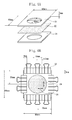
- a nonaqueous electrolyte battery accommodating the laminated porous film of the present invention as the separator thereof is described below with reference to Fig. 1 .
- Both a positive electrode plate 21 and a negative electrode plate 22 are spirally wound in such a way that the positive electrode plate 21 and the negative electrode plate 22 are overlapped each other via a separator 10.
- the outer side of the positive electrode plate 21 and that of the negative electrode plate 22 are fixed with a tape to hold the wound the positive electrode plate 21, negative electrode plate 22, and separator 10 together as a unit.
- one end of the separator for the battery is passed through a slit portion 1 of a pin 2.
- the pin 2 is rotated slightly to wind the other end of the separator for the battery round the pin 2. At this time, the surface of the pin 2 and the heat-resistant layer of the separator for the battery are in contact with each other. Thereafter the positive electrode and the negative electrode are so arranged as to sandwich the separator for the battery therebetween.
- the pin 2 is rotated to wind the positive electrode and the separator for the battery by means of a winding machine. After the winding operation finishes, the pin 2 is pulled out of the wound positive electrode plate, negative electrode plate, and separator held together as a unit.
- the wound positive electrode plate 21, separator 10, and negative electrode plate 22 held together as a unit are accommodated inside a bottomed cylindrical battery case and welded to a positive lead 24 and a negative lead 25. Thereafter the electrolyte is injected to a battery can. After the electrolyte penetrates into the separator 10 sufficiently, the periphery of the opening of the battery can is sealed with a positive lid 27 via a gasket 26. Thereafter preparatory charge and aging are carried out to produce a cylindrical secondary nonaqueous electrolyte battery 20.
- a lithium salt is dissolved in an organic solvent to obtain the electrolyte.
- the organic solvent is not limited to a specific kind, esters such as propylene carbonate, ethylene carbonate, butylene carbonate, ⁇ -butyrolactone, ⁇ -valerolactone, dimethyl carbonate, methyl propionate, and butyl acetate; nitriles such as acetonitrile; ethers such as 1,2-dimethoxyethane, 1,2-dimethoxymethane, dimethoxypropane, 1,3-dioxolane, tetrahydrofuran, 2-methyltetrahydrofuran, and 4-methyl-1,3-dioxofuran; and sulfolane.
- organic solvents can be used singly or in combination of not less than two kinds thereof. It is preferable to use an electrolyte in which 1.0 mol/L of lithium phosphate hexafluoride (LiPF 6 ) is dissolved in a solvent containing two parts by mass of the methyl ethyl carbonate mixed with one part by mass of the ethylene carbonate.
- LiPF 6 lithium phosphate hexafluoride
- an alkali metal or a compound containing the alkali metal integrated with a current collector such as a net made of stainless steel is used.
- the alkali metal lithium, sodium or potassium is used.
- the compound containing the alkali metal alloys of the alkali metal and aluminum, lead, indium, potassium, cadmium, tin or magnesium; compounds of the alkali metal and a carbon material; and compounds of the alkali metal having a low electric potential and metal oxides or sulfides are listed.
- the carbon material for the negative electrode it is possible to use those capable of doping or de-doping lithium ions.
- a negative electrode plate produced as follows is used in this embodiment.
- a carbon material having an average particle diameter of 10 ⁇ m is mixed with a solution in which vinylidene fluoride is dissolved in N-methylpyrrolidone to obtain slurry.
- the slurry consisting of the mixture of the above-described substances to form the negative electrode is passed through a 70-mesh net to remove large particles, the slurry is uniformly applied to both surfaces of a negative electrode current collector consisting of a belt-shaped copper foil having a thickness of 18 ⁇ m and is dried.
- the molding is cut to obtain the belt-shaped negative electrode plate.
- metal oxides such as lithium cobalt oxide, lithium nickel oxide, lithium manganese oxide, manganese dioxide, vanadium pentoxide or chromium oxide and metal sulfides such as molybdenum disulfide are used as an active substance.
- a conductive assistant and a binding agent such as polytetrafluoroethylene are added to the positive active substance to obtain a combination of these substances.
- the combination of these substances is processed into a molding by using a current collector such as stainless steel net as the core thereof. The molding formed in this manner is used as the positive electrode.
- the slurry consisting of the mixture of these substances to form the positive electrode is passed through the 70-mesh net to remove large particles, the slurry is uniformly applied to both surfaces of a positive current collector consisting of an aluminum foil having a thickness of 20 ⁇ m and dried. After the slurry is compression-molded with the roll press machine, the molding is cut to obtain the belt-shaped positive electrode plate.
- the longitudinal direction of the laminated porous film is called the "length direction”
- the direction vertical to the longitudinal direction is called the "width direction”.
- the in-plane thickness of each laminated porous film was measured at unspecified 30 points with a dial gauge of 1/1000mm. The average of the measured values was set as the film thickness.
- F% means the ratio of the amount of the filler to the total of the amount of the filler and that of the resin binder.
- the coefficient of static friction was measured in accordance with JIS K7125 based on the results obtained by measuring the surface of a SUS and that of the heat-resistant layer of the laminated porous film.
- samples 6 each consisting of two laminated porous films obtained by cutting a material rectangularly in the dimension of 5000mm long and 580mm wide were layered one upon another. After one end of each sample was inserted into a slit portion 2 of a pin 2 shown in Fig. 3 and wound round a rotating roller part 5, a weight 7 of 4.3N was hung from the opposite end of the sample to fix the laminated porous film. Thereafter the laminated porous films were wound round the pin 2 at a speed of 0.6m/minute in such a way that the heat-resistant layer is disposed at the inner side of the laminated porous film. Thereafter the laminated porous films were fixed with a scotch tape.
- the tensile modulus of elasticity of the laminated porous film of each of the examples and the comparison examples was measured in the length direction thereof in a condition of 23°C by using a universal testing machine produced by INTESCO CO., LTD. After each laminated porous film was cut to obtain a strip specimen 200mm long and 5mm wide, the distance between chucks was set to 150mm. The tensile modulus of elasticity of each laminated porous film was measured when the laminated porous film was elongated in its length direction by 3% at a pulling rate of 200mm/minute.
- the air permeability (second/100ml) of each specimen was measured in accordance with JIS P8117.
- Each laminated porous film 32 was cut square in the dimension of 60mm long and 60mm wide. As shown in Fig. 4(A) , each laminated porous film was sandwiched between two aluminum plates (material: JIS A5052, size: 60mm in the length direction 34 of the film, 60mm in the width direction 35 thereof, and 1mm in the thickness thereof) 31 where a circular hole having a diameter of ⁇ 40mm was formed at the central portion. As shown in 4(B), the periphery of the laminated porous film 32 was fixed with clips 33.
- each sample fixed with the two aluminum plates was immersed at a central portion of an oil bath, (OB-200A produced by Azuwan Co., Ltd.) having a temperature of 135°C, in which glycerin (first class produced by Nacalai Tesque Inc.) was filled up to 100mm from its bottom surface.
- OB-200A oil bath
- glycerin first class produced by Nacalai Tesque Inc.
- Each sample was heated for five seconds.
- each sample was immersed in a cooling bath in which separately prepared glycerin having a temperature of 25°C was filled to cool it for five minutes.
- each sample was cleaned with 2-propanol (high grade produced by Nacalai Tesque Inc.) and acetone (high grade produced by Nacalai Tesque Inc.), each sample was dried for 15 minutes in an air atmosphere having a temperature of 25°C.
- the air permeability of each of the dried samples was measured in accordance with the method used in the above-described method (6).
- each of the obtained laminated porous films was heated from 25°C up to 240°C at a scanning speed of 10°C/minute and held for one minute. Thereafter the laminated porous films were cooled from 240°C down to 25°C at the scanning speed of 10°C/minute and held for one minute. Thereafter the laminated porous films were heated again from 25°C up to 240°C at the scanning speed of 10°C/minute.
- DSC-7 differential scanning calorimeter
- Each laminated porous film was cut square in the dimension of 60mm long and 60mm wide. As shown in Fig. 4(A) , each laminated porous film was sandwiched between two aluminum plates (material: JIS A5052, size: 60mm long, 60mm wide, 1mm thick) where a circular hole having a diameter of ⁇ 40mm was formed at a central portion. As shown in 4(B), the periphery of the laminated porous film was fixed with clips. Each sample, consisting of the laminated porous film, which was fixed to two aluminum plates was put in a blow isothermal instrument (Model: DKN602 produced by Yamato Science Corporation) having a set temperature of 180°C and a display temperature of 180°C.
- a blow isothermal instrument Model: DKN602 produced by Yamato Science Corporation
- the set temperature was altered to 100°C, and the sample was gradually cooled to 100°C for not less than 10 minutes.
- the sample was taken out of the blow isothermal instrument.
- the sample was cooled for five minutes in an atmosphere having a temperature of 25°C with the sample being fixed to the two aluminum plates.
- wide-angle X-ray diffraction measurement was carried out on a circular central portion, of the sample, having a diameter of ⁇ 40mm in the following measuring conditions.
- polypropylene resin (F300SV" produced by Prime Polymer Corporation, density: 0.90g/cm 3 , MFR: 3.0g/10 minutes) and N,N'-dicyclohexyl-2,6-naphthalene dicarboxylic amide serving as the ⁇ crystal nucleating agent were prepared. 0.2 parts by mass of the ⁇ crystal nucleating agent was blended with 100 parts by mass of the polypropylene resin.
- a strand was cooled and solidified in a water bath and cut by a pelletizer to prepare a pellet of a polypropylene resin composition.
- the ⁇ activity of the polypropylene resin composition was 80%.
- the mixed resin composition composing a layer B 0.04 parts by mass of glycerol monoester and 10 parts by mass of microcrystalline wax ("Hi-Mic 1080" produced by Nippon Seiro Co., Ltd.) were added to 100 parts by mass of high-density polyethylene (Novatec HD HF560 produced by Japan Polyethylene Corporation, density: 0.963g/cm 3 , MFR: 7.0g/10 minutes).
- high-density polyethylene Novatec HD HF560 produced by Japan Polyethylene Corporation, density: 0.963g/cm 3 , MFR: 7.0g/10 minutes.
- the above-described three components were fused and kneaded at 220°C by using the same direction twin screw extruder used to form the layer A to obtain a pelletized resin composition.
- the above-described two kinds of the materials were extruded from mouthpieces for lamination molding through the feed block for the two-kind three-layer structure by using different extruders in such a way that the outer layer of the laminated membrane material to be obtained consisted of the layer A and the intermediate layer thereof consisted of the layer B. Thereafter the materials were cooled to solidify them by using a cast roll having a temperature of 124°C to prepare a two-kind three-layer laminated membrane material consisting of the layer A/the layer B/the layer A.
- the laminated membrane material was stretched 4.6 times longer than its original length in its length direction by using a lengthwise stretching machine and stretched 1.9 times longer than its original length in its width direction by using a widthwise stretching machine at 98°C.
- the obtained laminated porous film composed of the polyolefin resin was subjected to corona surface treatment by using a corona treatment apparatus (produced by KASUGA ELECTRIC WORKS LTD., line speed: 50m/minute, treatment output: 2kW).
- a corona treatment apparatus produced by KASUGA ELECTRIC WORKS LTD., line speed: 50m/minute, treatment output: 2kW.
- the polypropylene resin ("Prime polypro" F300SV, produced by Prime Polymer Corporation, F300SV, density: 0.90g/cm 3 , MFR: 3.0g/10 minutes) was prepared.
- the ⁇ crystal nucleating agent 3,9-bis[4-(N-cyclohexylcarbamoyl)phenyl]-2,4,8,10-tetraoxaspiro[5.5]undecane was prepared. 100 parts by mass of the polypropylene resin and 0.1 parts by mass of the ⁇ crystal nucleating agent were Kneaded. After a strand was cooled to solidify it at 280°C in a water bath by using the twin screw extruder produced by Toshiba Machine Co., Ltd. (diameter: 40mm ⁇ , L/D: 32), they were cut by a pelletizer to prepare a pellet of the polypropylene resin composition.
- the ⁇ activity of the polypropylene resin composition was 80%.
- a mixed resin composition composing the layer B 10 parts by mass of hydrogenated petroleum resin (Arkon P115 produced by Arakawa Chemical Industries, Ltd.) was added to 90 parts by mass of the high-density polyethylene (Hi-ZEX 3300F produced by Prime Polymer Corporation, density: 0.950g/cm 3 , MFR: 1.1g/10 minutes).
- the above-described two components were fused and kneaded at 230°C by using the same direction twin screw extruder to obtain a pelletized resin composition.
- the two kinds of the materials were extruded from mouthpieces for lamination molding through the feed block for the two-kind three-layer structure by using different extruders in such a way that the outer layer of the laminated membrane material to be obtained consisted of the layer A and the intermediate layer thereof consisted of the layer B. Thereafter the materials were cooled to solidify them by using the cast roll having a temperature of 124°C to prepare a two-kind three-layer laminated membrane material consisting of the layer A/the layer B/the layer A.
- the laminated membrane material was stretched 4.3 times longer than its original length in its length direction by using the lengthwise stretching machine and stretched 2.5 times longer than its original length in its width direction by using the widthwise stretching machine at 90°C. Thereafter the laminated membrane material was subjected to heat fixation/relaxation treatment. A heat-resistant layer was not formed on the surface of the obtained laminated porous film. Table 1 shows evaluated properties of the porous film.
- Table 1 shows property values ontained in the examples and the comparison examples.
- the laminated porous films of the examples 1 through 3 constructed in the range specified by the present invention were superior to the films of the comparison examples 1 through 4 constructed out of the range specified by the present invention in the slip performance, the pin extraction properties, and separator property thereof.
- the laminated porous films of the comparison examples 1 and 2 which had not more than 90% in the value of F% were low in the coefficient of static friction thereof. Although they were preferable in the pin extraction properties, they did not develop the separator property because they had a high air permeability.
- the laminated porous film of the comparison example 3 not provided with the heat-resistant layer had a high coefficient of static friction. Thus it was unpreferable in the pin extraction properties.
- the laminated porous film of the present invention can be applied to various uses in which air-permeable property is demanded.
- the laminated porous film can be suitably used as materials for the separator for a battery; hygienic materials such as disposable diaper, body fluid absorbing pats such as sanitary products, a bed sheet, and the like; medical materials such as surgical gown, a base material for stupe; clothing materials such as jumper, sportswear, rain wear, and the like; building materials such as wallpaper, a roof-waterproofing material, a heat insulation material, a sound-absorbing material, and the like; a desiccant; a moisture agent; a deoxidizer; a pocket warmer; and packing materials for packing foods to keep them fresh or only packing food.
Landscapes
- Chemical & Material Sciences (AREA)
- Electrochemistry (AREA)
- General Chemical & Material Sciences (AREA)
- Chemical Kinetics & Catalysis (AREA)
- Engineering & Computer Science (AREA)
- Manufacturing & Machinery (AREA)
- Materials Engineering (AREA)
- Composite Materials (AREA)
- Inorganic Chemistry (AREA)
- Cell Separators (AREA)
- Laminated Bodies (AREA)
- Secondary Cells (AREA)
- Coating Of Shaped Articles Made Of Macromolecular Substances (AREA)
- Manufacture Of Porous Articles, And Recovery And Treatment Of Waste Products (AREA)
Applications Claiming Priority (2)
| Application Number | Priority Date | Filing Date | Title |
|---|---|---|---|
| JP2009264589 | 2009-11-20 | ||
| PCT/JP2010/070760 WO2011062285A1 (fr) | 2009-11-20 | 2010-11-22 | Film poreux stratifié, séparateur pour batterie, et batterie |
Publications (2)
| Publication Number | Publication Date |
|---|---|
| EP2502743A1 true EP2502743A1 (fr) | 2012-09-26 |
| EP2502743A4 EP2502743A4 (fr) | 2014-05-07 |
Family
ID=44059756
Family Applications (1)
| Application Number | Title | Priority Date | Filing Date |
|---|---|---|---|
| EP10831676.1A Withdrawn EP2502743A4 (fr) | 2009-11-20 | 2010-11-22 | Film poreux stratifié, séparateur pour batterie, et batterie |
Country Status (6)
| Country | Link |
|---|---|
| US (3) | US20120231323A1 (fr) |
| EP (1) | EP2502743A4 (fr) |
| JP (1) | JP5502707B2 (fr) |
| KR (1) | KR101392131B1 (fr) |
| CN (1) | CN102712185A (fr) |
| WO (1) | WO2011062285A1 (fr) |
Cited By (6)
| Publication number | Priority date | Publication date | Assignee | Title |
|---|---|---|---|---|
| WO2013107911A1 (fr) * | 2012-01-19 | 2013-07-25 | Sihl Gmbh | Séparateur présentant une couche poreuse et procédé pour le produire |
| EP2548736A4 (fr) * | 2010-03-18 | 2014-05-14 | Mitsubishi Plastics Inc | Film en résine de polyoléfine de type poreux et séparateur pour batterie |
| WO2015082670A1 (fr) * | 2013-12-05 | 2015-06-11 | Basf Se | Séparateur, son procédé de fabrication et batterie lithium-soufre le comprenant |
| EP2837496A4 (fr) * | 2012-04-13 | 2016-01-06 | Toray Battery Separator Film | Film poreux multicouches, séparateur de cellule électrique et cellule électrique |
| CN106029380A (zh) * | 2014-05-30 | 2016-10-12 | 东丽电池隔膜株式会社 | 聚烯烃多层微多孔膜及电池用隔膜 |
| WO2017067656A1 (fr) * | 2015-10-20 | 2017-04-27 | Treofan Germany Gmbh & Co. Kg | Feuille poreuse à orientation biaxiale comprenant une couche poreuse renfermant des particules et un revêtement inorganique |
Families Citing this family (48)
| Publication number | Priority date | Publication date | Assignee | Title |
|---|---|---|---|---|
| WO2013015231A1 (fr) * | 2011-07-28 | 2013-01-31 | 住友化学株式会社 | Procédé de fabrication de film poreux stratifié |
| JP5940258B2 (ja) * | 2011-08-03 | 2016-06-29 | 帝人株式会社 | 非水電解質電池用セパレータ及び非水電解質電池 |
| CN103917370A (zh) * | 2011-09-22 | 2014-07-09 | 三菱树脂株式会社 | 叠层多孔膜的制造方法及叠层多孔膜 |
| JP6089581B2 (ja) * | 2011-11-01 | 2017-03-08 | 東レ株式会社 | 多孔性ポリオレフィンフィルム、積層多孔性フィルムおよび蓄電デバイス |
| JP2015018600A (ja) * | 2011-11-10 | 2015-01-29 | 日産自動車株式会社 | 耐熱絶縁層付セパレータ |
| JP6249589B2 (ja) * | 2011-11-11 | 2017-12-20 | 宇部興産株式会社 | 電池用セパレータ |
| JP2013116442A (ja) * | 2011-12-02 | 2013-06-13 | Mitsubishi Plastics Inc | 積層多孔フィルムの製造方法 |
| CN103314044A (zh) * | 2011-12-02 | 2013-09-18 | 三菱树脂株式会社 | 叠层多孔膜的制造方法 |
| JPWO2013080701A1 (ja) * | 2011-12-02 | 2015-04-27 | 三菱樹脂株式会社 | 積層多孔フィルムロール及びその製造方法 |
| KR101979053B1 (ko) * | 2012-01-19 | 2019-05-15 | 가부시키가이샤 무라타 세이사쿠쇼 | 세퍼레이터, 비수 전해질 전지, 전지 팩, 전자 기기, 전동 차량, 축전 장치 및 전력 시스템 |
| US9252412B2 (en) | 2012-03-26 | 2016-02-02 | Mitsubishi Plastics, Inc. | Multilayer porous film, separator for nonaqueous electrolyte secondary batteries, and nonaqueous electrolyte secondary battery |
| EP2838138B1 (fr) * | 2012-04-12 | 2019-02-27 | Kabushiki Kaisha Toyota Jidoshokki | Interrupteur de courant et dispositif de stockage électrique l'utilisant |
| WO2014007260A1 (fr) * | 2012-07-04 | 2014-01-09 | 東レ株式会社 | Film en polypropylène poreux, séparateur pour dispositifs de stockage de l'électricité, et dispositif de stockage de l'électricité |
| KR20230112733A (ko) | 2012-09-20 | 2023-07-27 | 셀가드 엘엘씨 | 박형 배터리 분리막 및 방법 |
| JP6027401B2 (ja) * | 2012-11-06 | 2016-11-16 | 三菱樹脂株式会社 | 塗工液、積層多孔フィルム、非水電解液二次電池用セパレータ、及び非水電解液二次電池 |
| JP6103921B2 (ja) * | 2012-12-25 | 2017-03-29 | 三菱樹脂株式会社 | 積層多孔性フィルム、電池用セパレータ、および電池 |
| US20150318528A1 (en) * | 2013-03-06 | 2015-11-05 | Teijin Limited | Non-aqueous-secondary-battery separator and non-aqueous secondary battery |
| KR102209823B1 (ko) * | 2013-04-16 | 2021-01-29 | 삼성에스디아이 주식회사 | 세퍼레이터 및 이를 채용한 리튬전지 |
| WO2014176217A1 (fr) * | 2013-04-23 | 2014-10-30 | E. I. Du Pont De Nemours And Company | Liant pour batteries |
| WO2016021987A1 (fr) * | 2014-08-08 | 2016-02-11 | 삼성에스디아이 주식회사 | Séparateur pour batterie secondaire au lithium et batterie secondaire au lithium le comprenant |
| KR101978373B1 (ko) * | 2014-08-13 | 2019-05-14 | 삼성에스디아이 주식회사 | 리튬 이차 전지용 세퍼레이터 및 이를 포함하는 리튬 이차 전지 |
| KR101693213B1 (ko) * | 2014-08-08 | 2017-01-17 | 삼성에스디아이 주식회사 | 리튬 이차 전지용 세퍼레이터 및 이를 포함하는 리튬 이차 전지 |
| KR101972801B1 (ko) * | 2014-08-08 | 2019-04-26 | 삼성에스디아이 주식회사 | 리튬 이차 전지용 세퍼레이터 및 이를 포함하는 리튬 이차 전지 |
| JP2016060061A (ja) * | 2014-09-16 | 2016-04-25 | 旭化成イーマテリアルズ株式会社 | 積層微多孔フィルム及びその製造方法、並びに電池用セパレータ |
| EP3207581B1 (fr) * | 2014-10-13 | 2020-07-01 | Research Foundation Of The City University Of New York | Cathode à matériau mélangé pour batteries alcalines secondaires |
| CN104979515B (zh) * | 2015-07-29 | 2017-05-10 | 沧州明珠隔膜科技有限公司 | 一种芳纶聚合体涂覆的锂离子电池隔膜及其制备方法 |
| WO2017075404A1 (fr) | 2015-10-29 | 2017-05-04 | Research Foundation Of The City University Of New York | Conceptions d'électrode pour densité, rendement et capacité d'énergie élevés dans des piles alcalines rechargeables |
| JP6014743B1 (ja) | 2015-11-30 | 2016-10-25 | 住友化学株式会社 | 非水電解液二次電池用セパレータおよびその利用 |
| WO2017136545A1 (fr) * | 2016-02-02 | 2017-08-10 | Research Foundation Of The City University Of New York | Batteries rechargeables bipolaires au zinc-dioxyde de manganèse alcalin |
| CN107452919B (zh) * | 2016-06-01 | 2020-08-28 | 上海恩捷新材料科技有限公司 | 一种高浸润性隔离膜及其制备方法和用途 |
| JP6939569B2 (ja) | 2016-07-25 | 2021-09-22 | 東レ株式会社 | 電池用セパレータ |
| EP3496200A4 (fr) * | 2016-08-05 | 2020-04-22 | Envision AESC Energy Devices Ltd. | Batterie et module de batterie |
| KR102640205B1 (ko) * | 2016-09-30 | 2024-02-23 | 삼성전자주식회사 | 원통형 금속-공기 전지 |
| KR102366059B1 (ko) * | 2016-10-13 | 2022-02-22 | 내셔날 인스티튜트 오브 어드밴스드 인더스트리얼 사이언스 앤드 테크놀로지 | 리튬 이온 2차 전지 및 이를 이용한 전기 기기 |
| JP6543291B2 (ja) * | 2017-03-03 | 2019-07-10 | 住友化学株式会社 | 非水電解液二次電池用セパレータ |
| JP2019079805A (ja) * | 2017-10-24 | 2019-05-23 | 住友化学株式会社 | 非水電解液二次電池用多孔質層 |
| DE112019003874T5 (de) * | 2018-07-31 | 2021-04-22 | Nitto Denko Corporation | Plättchen-artiges Verbundmaterial |
| JP7217870B2 (ja) * | 2018-10-16 | 2023-02-06 | 株式会社レゾナック・パッケージング | 蓄電デバイス用外装ケース |
| JP7344644B2 (ja) * | 2019-01-28 | 2023-09-14 | 旭化成株式会社 | ポリオレフィン微多孔膜を備える多層多孔膜 |
| KR102764796B1 (ko) * | 2019-03-20 | 2025-02-11 | 데이진 가부시키가이샤 | 비수계 이차전지용 세퍼레이터 및 비수계 이차전지 |
| US12528922B2 (en) * | 2019-04-19 | 2026-01-20 | Nitto Denko Corporation | Plate-shaped composite material |
| CN110911774A (zh) * | 2019-12-09 | 2020-03-24 | 天津市捷威动力工业有限公司 | 一种降低锂离子电池包内氧含量的吸附粉体、复合支撑基底及电池 |
| CN112595605B (zh) * | 2020-11-20 | 2023-08-08 | 浙江省医疗器械检验研究院 | 油浴环境下材料拉伸试验机 |
| US20240204261A1 (en) | 2021-04-26 | 2024-06-20 | Panasonic Energy Co., Ltd. | Non-aqueous electrolyte secondary battery |
| US20250300316A1 (en) * | 2022-05-27 | 2025-09-25 | Asahi Kasei Battery Separator Corporation | Separator for Power Storage Devices and Power Storage Device Comprising Same |
| WO2023229035A1 (fr) * | 2022-05-27 | 2023-11-30 | 旭化成株式会社 | Séparateur pour dispositif de stockage d'électricité et dispositif de stockage d'électricité le comprenant |
| JP2023174383A (ja) * | 2022-05-27 | 2023-12-07 | 旭化成株式会社 | 蓄電デバイス用セパレータ及びこれを含む蓄電デバイス |
| JPWO2024024506A1 (fr) | 2022-07-27 | 2024-02-01 |
Family Cites Families (37)
| Publication number | Priority date | Publication date | Assignee | Title |
|---|---|---|---|---|
| JP2883726B2 (ja) | 1990-11-14 | 1999-04-19 | 日東電工株式会社 | 電池用セパレータの製造法 |
| JPH06289566A (ja) | 1993-03-30 | 1994-10-18 | Fuji Photo Film Co Ltd | 感光材料処理装置 |
| US5491188A (en) * | 1993-05-20 | 1996-02-13 | New Japan Chemical Co., Ltd. | Porous stretched article of polypropylene-based resin and process for its preparation |
| AT404252B (de) * | 1994-05-13 | 1998-10-27 | Danubia Petrochem Polymere | Verfahren zur erhöhung des anteiles der beta-modifikation in polypropylen |
| JP3739481B2 (ja) | 1995-05-17 | 2006-01-25 | 昭和電工株式会社 | ポリプロピレン系樹脂材料及びその製造方法 |
| JP3539526B2 (ja) | 1996-01-23 | 2004-07-07 | チッソ株式会社 | 結晶性プロピレン重合体組成物 |
| US5952120A (en) * | 1997-04-15 | 1999-09-14 | Celgard Llc | Method of making a trilayer battery separator |
| JPH10316781A (ja) * | 1997-05-20 | 1998-12-02 | Nitto Denko Corp | 多孔質膜及びその製造方法 |
| JPH11115084A (ja) * | 1997-10-14 | 1999-04-27 | Ube Ind Ltd | 積層多孔質フイルム |
| JPH11198317A (ja) * | 1998-01-19 | 1999-07-27 | Hagiwara Kogyo Kk | 防炎性工事用シート |
| JP2000223107A (ja) | 1998-11-26 | 2000-08-11 | Sumitomo Chem Co Ltd | 非水電解液二次電池用セパレ―タ |
| WO2000079618A1 (fr) | 1999-06-22 | 2000-12-28 | Mitsubishi Denki Kabushiki Kaisha | Separateur de cellule, cellule, et procede de production dudit separateur |
| US6391069B1 (en) * | 2000-03-29 | 2002-05-21 | Valence Technology (Nevada), Inc. | Method of making bonded-electrode rechargeable electrochemical cells |
| TW595035B (en) * | 2000-08-30 | 2004-06-21 | Sumitomo Chemical Co | Separator for non-aqueous electrolyte secondary battery, and non-aqueous electrolyte secondary battery |
| JP4487457B2 (ja) * | 2000-08-30 | 2010-06-23 | 住友化学株式会社 | 非水電解液二次電池用セパレータおよび非水電解液二次電池 |
| JP2003306585A (ja) | 2002-04-15 | 2003-10-31 | Sekisui Chem Co Ltd | 樹脂−層状珪酸塩複合材料及びその製造方法 |
| JP4792688B2 (ja) | 2003-01-24 | 2011-10-12 | 住友化学株式会社 | 非水電解液二次電池用セパレータの製造方法 |
| EP1614710B1 (fr) * | 2003-03-24 | 2019-04-24 | Asahi Kasei Kabushiki Kaisha | Film en polyethylene microporeux |
| JP4761966B2 (ja) * | 2003-09-25 | 2011-08-31 | ダイセル化学工業株式会社 | 耐薬品性を有する多孔性フィルム |
| JP4876387B2 (ja) * | 2003-11-05 | 2012-02-15 | 東レ株式会社 | 二軸配向微多孔フィルムおよびその製造方法 |
| JP4707334B2 (ja) * | 2004-05-31 | 2011-06-22 | 三菱樹脂株式会社 | 多孔性フィルム、非水電解質電池用セパレーターおよび非水電解質電池 |
| CN101292378B (zh) * | 2005-10-18 | 2010-11-03 | 东丽株式会社 | 蓄电装置隔离物用微多孔膜以及使用该膜的蓄电装置隔离物 |
| WO2007046473A1 (fr) * | 2005-10-19 | 2007-04-26 | Tonen Chemical Corporation | Procede de production d'un film polyolefine microporeux multicouche |
| US20070264578A1 (en) * | 2006-05-15 | 2007-11-15 | Tonen Chemical Corporation | Microporous polyolefin membrane, its production method and battery separator |
| US7569630B2 (en) * | 2006-06-14 | 2009-08-04 | Chemtura Corporation | β-Crystalline polypropylenes |
| KR100971109B1 (ko) * | 2006-11-20 | 2010-07-20 | 데이진 가부시키가이샤 | 비수계 이차 전지용 세퍼레이터, 및 비수계 이차 전지 |
| JP4931083B2 (ja) | 2007-01-30 | 2012-05-16 | 旭化成イーマテリアルズ株式会社 | 多層多孔膜及びその製造方法 |
| JP2008186721A (ja) * | 2007-01-30 | 2008-08-14 | Asahi Kasei Chemicals Corp | 高耐熱性と高透過性を兼ね備えた多孔膜およびその製法 |
| ATE538167T1 (de) * | 2007-01-30 | 2012-01-15 | Asahi Kasei E Materials Corp | Mikroporöse polyolefinmembran |
| WO2008143005A1 (fr) * | 2007-05-10 | 2008-11-27 | Hitachi Maxell, Ltd. | Elément électrochimique et son procédé de fabrication |
| JP2008311220A (ja) * | 2007-05-11 | 2008-12-25 | Mitsubishi Plastics Inc | 積層多孔性フィルム、電池用セパレータおよび電池 |
| EP2517880B1 (fr) * | 2007-06-06 | 2014-03-26 | Asahi Kasei E-materials Corporation | Film poreux à couches multiples |
| JP2009070726A (ja) | 2007-09-14 | 2009-04-02 | Teijin Ltd | 非水電解質電池の製造方法 |
| JP5267032B2 (ja) * | 2007-10-15 | 2013-08-21 | 東レ株式会社 | 多孔性フィルム |
| JP2009143060A (ja) * | 2007-12-12 | 2009-07-02 | Asahi Kasei Chemicals Corp | 多層多孔膜 |
| JP5334281B2 (ja) * | 2008-02-20 | 2013-11-06 | 日立マクセル株式会社 | リチウム二次電池 |
| JP5245483B2 (ja) * | 2008-03-24 | 2013-07-24 | 東レ株式会社 | ポリプロピレン多孔性フィルム、その製造方法、および蓄電デバイス |
-
2010
- 2010-11-19 JP JP2010259098A patent/JP5502707B2/ja active Active
- 2010-11-22 WO PCT/JP2010/070760 patent/WO2011062285A1/fr not_active Ceased
- 2010-11-22 US US13/510,790 patent/US20120231323A1/en not_active Abandoned
- 2010-11-22 EP EP10831676.1A patent/EP2502743A4/fr not_active Withdrawn
- 2010-11-22 CN CN2010800515652A patent/CN102712185A/zh active Pending
- 2010-11-22 KR KR1020127015704A patent/KR101392131B1/ko active Active
-
2014
- 2014-07-29 US US14/445,633 patent/US20150044541A1/en not_active Abandoned
-
2015
- 2015-12-14 US US14/967,770 patent/US20160099452A1/en not_active Abandoned
Cited By (8)
| Publication number | Priority date | Publication date | Assignee | Title |
|---|---|---|---|---|
| EP2548736A4 (fr) * | 2010-03-18 | 2014-05-14 | Mitsubishi Plastics Inc | Film en résine de polyoléfine de type poreux et séparateur pour batterie |
| WO2013107911A1 (fr) * | 2012-01-19 | 2013-07-25 | Sihl Gmbh | Séparateur présentant une couche poreuse et procédé pour le produire |
| EP2837496A4 (fr) * | 2012-04-13 | 2016-01-06 | Toray Battery Separator Film | Film poreux multicouches, séparateur de cellule électrique et cellule électrique |
| WO2015082670A1 (fr) * | 2013-12-05 | 2015-06-11 | Basf Se | Séparateur, son procédé de fabrication et batterie lithium-soufre le comprenant |
| CN106029380A (zh) * | 2014-05-30 | 2016-10-12 | 东丽电池隔膜株式会社 | 聚烯烃多层微多孔膜及电池用隔膜 |
| CN106029380B (zh) * | 2014-05-30 | 2017-07-18 | 东丽电池隔膜株式会社 | 聚烯烃多层微多孔膜及电池用隔膜 |
| US9843030B2 (en) | 2014-05-30 | 2017-12-12 | Toray Industries, Inc. | Polyolefin multilayer microporous membrane and battery separator |
| WO2017067656A1 (fr) * | 2015-10-20 | 2017-04-27 | Treofan Germany Gmbh & Co. Kg | Feuille poreuse à orientation biaxiale comprenant une couche poreuse renfermant des particules et un revêtement inorganique |
Also Published As
| Publication number | Publication date |
|---|---|
| WO2011062285A1 (fr) | 2011-05-26 |
| US20160099452A1 (en) | 2016-04-07 |
| EP2502743A4 (fr) | 2014-05-07 |
| KR20120083532A (ko) | 2012-07-25 |
| JP2011126275A (ja) | 2011-06-30 |
| JP5502707B2 (ja) | 2014-05-28 |
| US20120231323A1 (en) | 2012-09-13 |
| CN102712185A (zh) | 2012-10-03 |
| KR101392131B1 (ko) | 2014-05-07 |
| US20150044541A1 (en) | 2015-02-12 |
Similar Documents
| Publication | Publication Date | Title |
|---|---|---|
| EP2502743A1 (fr) | Film poreux stratifié, séparateur pour batterie, et batterie | |
| US8785032B2 (en) | Multilayer porous film, separator for batteries, and battery | |
| EP2561984A1 (fr) | Film poreux stratifié, séparateur pour batterie rechargeable à électrolyte non aqueux, et batterie rechargeable à électrolyte non aqueux | |
| EP2623317A1 (fr) | Film poreux stratifié, séparateur pour batterie secondaire à électrolyte non aqueux, et batterie secondaire à électrolyte non aqueux | |
| US9343719B2 (en) | Method for producing laminated porous film, and laminated porous film | |
| EP2360014B1 (fr) | Film poreux stratifié, séparateur pour pile au lithium, et pile | |
| EP2337114B1 (fr) | Film poreux stratifié pour séparateur | |
| US9252412B2 (en) | Multilayer porous film, separator for nonaqueous electrolyte secondary batteries, and nonaqueous electrolyte secondary battery | |
| JP5440171B2 (ja) | 蓄電デバイス用セパレータ | |
| US9419266B2 (en) | Polyolefin resin porous film, and non-aqueous electrolyte cell separator using same | |
| US20140057057A1 (en) | Process for producing a laminated porous film | |
| KR102107364B1 (ko) | 적층 다공 필름, 비수 전해액 이차 전지용 세퍼레이터, 및 비수 전해액 이차 전지 | |
| EP2543697A1 (fr) | Film poreux de résine de polypropylène, séparateur de cellule, et cellule | |
| EP2623309A1 (fr) | Film poreux laminé, séparateur pour batterie, et batterie | |
| US9115277B2 (en) | Porous polyolefin resin film | |
| EP2860216A1 (fr) | Film poreux de résine de polyoléfine | |
| EP4216248A1 (fr) | Séparateur pour dispositif de stockage d'énergie et dispositif de stockage d'énergie | |
| US20230282938A1 (en) | Separator for electric storage device and electric storage device | |
| US20230327285A1 (en) | Separator for electric storage device and electric storage device | |
| US20230335860A1 (en) | Separator for electric storage device and electric storage device |
Legal Events
| Date | Code | Title | Description |
|---|---|---|---|
| PUAI | Public reference made under article 153(3) epc to a published international application that has entered the european phase |
Free format text: ORIGINAL CODE: 0009012 |
|
| 17P | Request for examination filed |
Effective date: 20120531 |
|
| AK | Designated contracting states |
Kind code of ref document: A1 Designated state(s): AL AT BE BG CH CY CZ DE DK EE ES FI FR GB GR HR HU IE IS IT LI LT LU LV MC MK MT NL NO PL PT RO RS SE SI SK SM TR |
|
| DAX | Request for extension of the european patent (deleted) | ||
| A4 | Supplementary search report drawn up and despatched |
Effective date: 20140404 |
|
| RIC1 | Information provided on ipc code assigned before grant |
Ipc: H01M 2/16 20060101ALI20140331BHEP Ipc: B32B 27/32 20060101AFI20140331BHEP Ipc: H01M 10/0587 20100101ALI20140331BHEP Ipc: B32B 27/20 20060101ALI20140331BHEP Ipc: B32B 5/18 20060101ALI20140331BHEP Ipc: H01M 10/0525 20100101ALI20140331BHEP Ipc: B32B 27/16 20060101ALI20140331BHEP |
|
| STAA | Information on the status of an ep patent application or granted ep patent |
Free format text: STATUS: THE APPLICATION IS DEEMED TO BE WITHDRAWN |
|
| 18D | Application deemed to be withdrawn |
Effective date: 20170601 |