EP2511087A2 - Procédé de fabrication d'une pièce usinée - Google Patents
Procédé de fabrication d'une pièce usinée Download PDFInfo
- Publication number
- EP2511087A2 EP2511087A2 EP12163724A EP12163724A EP2511087A2 EP 2511087 A2 EP2511087 A2 EP 2511087A2 EP 12163724 A EP12163724 A EP 12163724A EP 12163724 A EP12163724 A EP 12163724A EP 2511087 A2 EP2511087 A2 EP 2511087A2
- Authority
- EP
- European Patent Office
- Prior art keywords
- layer
- hard
- hard shell
- cavity
- shell
- Prior art date
- Legal status (The legal status is an assumption and is not a legal conclusion. Google has not performed a legal analysis and makes no representation as to the accuracy of the status listed.)
- Withdrawn
Links
- 238000000034 method Methods 0.000 title claims abstract description 19
- 239000006260 foam Substances 0.000 claims abstract description 28
- 239000002245 particle Substances 0.000 claims abstract description 22
- 238000001746 injection moulding Methods 0.000 claims abstract description 10
- 239000002861 polymer material Substances 0.000 claims abstract description 4
- 229920001169 thermoplastic Polymers 0.000 claims abstract description 4
- 238000004519 manufacturing process Methods 0.000 claims description 24
- 239000000463 material Substances 0.000 claims description 5
- 230000015572 biosynthetic process Effects 0.000 claims description 4
- 230000001681 protective effect Effects 0.000 claims description 2
- 239000011159 matrix material Substances 0.000 claims 1
- 238000002844 melting Methods 0.000 claims 1
- 230000008018 melting Effects 0.000 claims 1
- 238000007493 shaping process Methods 0.000 claims 1
- 238000000465 moulding Methods 0.000 abstract description 13
- 238000009434 installation Methods 0.000 description 8
- 238000005516 engineering process Methods 0.000 description 5
- 239000006261 foam material Substances 0.000 description 4
- 238000002347 injection Methods 0.000 description 4
- 239000007924 injection Substances 0.000 description 4
- 238000005187 foaming Methods 0.000 description 2
- 238000005304 joining Methods 0.000 description 2
- 230000004913 activation Effects 0.000 description 1
- 239000000853 adhesive Substances 0.000 description 1
- 230000001070 adhesive effect Effects 0.000 description 1
- 238000010276 construction Methods 0.000 description 1
- 230000001066 destructive effect Effects 0.000 description 1
- 238000002474 experimental method Methods 0.000 description 1
- 239000012530 fluid Substances 0.000 description 1
- 238000010097 foam moulding Methods 0.000 description 1
- 239000013518 molded foam Substances 0.000 description 1
- 230000002787 reinforcement Effects 0.000 description 1
- 239000007787 solid Substances 0.000 description 1
- 238000007711 solidification Methods 0.000 description 1
- 230000008023 solidification Effects 0.000 description 1
- 239000004753 textile Substances 0.000 description 1
Images


Classifications
-
- B—PERFORMING OPERATIONS; TRANSPORTING
- B29—WORKING OF PLASTICS; WORKING OF SUBSTANCES IN A PLASTIC STATE IN GENERAL
- B29C—SHAPING OR JOINING OF PLASTICS; SHAPING OF MATERIAL IN A PLASTIC STATE, NOT OTHERWISE PROVIDED FOR; AFTER-TREATMENT OF THE SHAPED PRODUCTS, e.g. REPAIRING
- B29C44/00—Shaping by internal pressure generated in the material, e.g. swelling or foaming ; Producing porous or cellular expanded plastics articles
- B29C44/02—Shaping by internal pressure generated in the material, e.g. swelling or foaming ; Producing porous or cellular expanded plastics articles for articles of definite length, i.e. discrete articles
- B29C44/08—Shaping by internal pressure generated in the material, e.g. swelling or foaming ; Producing porous or cellular expanded plastics articles for articles of definite length, i.e. discrete articles using several expanding or moulding steps
- B29C44/083—Increasing the size of the cavity after a first part has foamed, e.g. substituting one mould part with another
- B29C44/086—Increasing the size of the cavity after a first part has foamed, e.g. substituting one mould part with another and feeding more material into the enlarged cavity
-
- B—PERFORMING OPERATIONS; TRANSPORTING
- B29—WORKING OF PLASTICS; WORKING OF SUBSTANCES IN A PLASTIC STATE IN GENERAL
- B29C—SHAPING OR JOINING OF PLASTICS; SHAPING OF MATERIAL IN A PLASTIC STATE, NOT OTHERWISE PROVIDED FOR; AFTER-TREATMENT OF THE SHAPED PRODUCTS, e.g. REPAIRING
- B29C44/00—Shaping by internal pressure generated in the material, e.g. swelling or foaming ; Producing porous or cellular expanded plastics articles
- B29C44/02—Shaping by internal pressure generated in the material, e.g. swelling or foaming ; Producing porous or cellular expanded plastics articles for articles of definite length, i.e. discrete articles
- B29C44/04—Shaping by internal pressure generated in the material, e.g. swelling or foaming ; Producing porous or cellular expanded plastics articles for articles of definite length, i.e. discrete articles consisting of at least two parts of chemically or physically different materials, e.g. having different densities
-
- B—PERFORMING OPERATIONS; TRANSPORTING
- B29—WORKING OF PLASTICS; WORKING OF SUBSTANCES IN A PLASTIC STATE IN GENERAL
- B29C—SHAPING OR JOINING OF PLASTICS; SHAPING OF MATERIAL IN A PLASTIC STATE, NOT OTHERWISE PROVIDED FOR; AFTER-TREATMENT OF THE SHAPED PRODUCTS, e.g. REPAIRING
- B29C44/00—Shaping by internal pressure generated in the material, e.g. swelling or foaming ; Producing porous or cellular expanded plastics articles
- B29C44/34—Auxiliary operations
- B29C44/3461—Making or treating expandable particles
-
- B—PERFORMING OPERATIONS; TRANSPORTING
- B29—WORKING OF PLASTICS; WORKING OF SUBSTANCES IN A PLASTIC STATE IN GENERAL
- B29K—INDEXING SCHEME ASSOCIATED WITH SUBCLASSES B29B, B29C OR B29D, RELATING TO MOULDING MATERIALS OR TO MATERIALS FOR MOULDS, REINFORCEMENTS, FILLERS OR PREFORMED PARTS, e.g. INSERTS
- B29K2995/00—Properties of moulding materials, reinforcements, fillers, preformed parts or moulds
- B29K2995/0037—Other properties
- B29K2995/007—Hardness
-
- B—PERFORMING OPERATIONS; TRANSPORTING
- B29—WORKING OF PLASTICS; WORKING OF SUBSTANCES IN A PLASTIC STATE IN GENERAL
- B29L—INDEXING SCHEME ASSOCIATED WITH SUBCLASS B29C, RELATING TO PARTICULAR ARTICLES
- B29L2031/00—Other particular articles
- B29L2031/48—Wearing apparel
- B29L2031/4807—Headwear
- B29L2031/4814—Hats
- B29L2031/4821—Helmets
Definitions
- the invention relates to a method for producing a workpiece having at least one hard layer or hard shell as well as a comparatively soft cushion layer materially bonded thereto.
- the problem to be solved is essentially to ensure a good and reproducible quality of hard shell and cushion layer in a molding of the type specified in addition to a permanently strong connection between the hard shell and cushion layer.
- This object is achieved in that first the hard shell or layer is formed in a first cavity, and that then the cushion layer is formed in a second cavity, which between the previously formed and now used as a die hard shell or layer and a male is made.
- the invention is based on the general idea of using the previously formed hard shell or layer as the boundary wall of the cavity provided for the formation of the cushion layer. Even if the foam material should initially have a high and for the material of the hard shell or layer optionally even destructive temperature, this remains harmless with respect to the production quality of the molded part to be produced, because the density of the foam material in comparison to the density of the material Hard shell or layer is comparatively low and accordingly the heat input from the foam material into the material of the hard shell or layer remains extremely low.
- thermoplastic polymer material for the production of the hard shell or layer readily a thermoplastic polymer material can be used and an intimate and resilient connection between the hard shell or layer and cushion layer is generated during foaming of the intended for forming the cushion layer cavity.
- the method according to the invention differs above all in the fact that a different sequence of the process steps is provided. In this way, it is reliably prevented that in the production of the hard shell or layer a previously generated foam part could collapse or be destroyed.
- the hard shell or layer can be injection-molded in a basically known manner, wherein the die used during the injection molding process or die of the mold with the therein or first remaining hard shell or layer as a die or male for the formation of the foam material to be created cavity can be used.
- molded parts with a foam or cushion layer between two hard shells or layers can be produced without further ado.
- the two hard shells or layers can be produced, for example by an injection molding process. Thereafter, these two shells or layers are preferably together with the matrices and patrices of the previous injection molding process which they continue to carry as dies And Patrizen the now used for the formation of the foam cavity to be created, which is then foamed in a conventional manner.
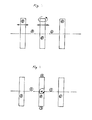
- a first cavity 4 is produced between a die 1 and a male part 2 of a molding tool 3, which corresponds to the desired shape of a hard shell or layer to be produced.
- this hard shell or layer 5 is then produced in a conventional manner by injection molding, by injecting into the cavity 4 a thermoplastic polymer material.
- the male part 2 is detached from the shell or layer 5 and adjusted so that between the male part 2 and the further the shell or layer 5 bearing die 1, a second cavity 6 produced becomes.
- this cavity 6 is then foamed with particle foam according to FIG. C, which thereby bonds to the shell or layer 5 in a materially bonded manner.
- a molded part is produced with a hard shell or layer 5 and a cushion layer 7 connected to it in a materially bonded manner.
- the female part 1 and the male part 2 can be made separable into segments. Instead, it is also possible to press in porosity in the die 1 or male part 2 a gaseous or vaporous separating fluid.
- the in Fig. 2 differs from the manufacturing process of Fig. 1 essentially only in that, for producing the second cavity 6 serving for forming the foam, a die 20 is used whose shape deviates from the die 2 provided for the injection molding process for producing the hard shell or layer 5.
- the invention has for its object to show the structural features of a system that produces inline sandwich components with a core of particle foam.
- a combination of technology consisting of a inserts injection molding machine for the production of injection molded component bodies with subsequent inline connection of the body part to a hollow body component, and a molding machine for particle foam production for inline production of the core of the hollow body made of particle foam.
- the combination technology system is structurally designed such that in at least one of the two tool installation spaces 1 and 2 of the insert machine, the hollow body is produced, and is foamed in the remaining tool installation space of the hollow body after a rotational movement of the insert with particle foam.
- the foaming apparatus is structurally designed such that it foams the hollow body within the cavity in the tool installation space.
- the insert 5 is designed structurally as a turntable with a vertical axis to the machine axis of the insert machine.
- hollow bodies are manufactured in both tool installation spaces 1 and 2 and the particle foam apparatus is structurally designed such that the hollow bodies are produced at the positions 3 and 4 of the insert with particle foam for the finished component.
- the invention comprises a combination technology, comprising a insert injection molding machine for producing component bodies with an injection-molded outer layer and a molding machine for inline production of the inner layer of particle foam and subsequent connection of the partial body to an overall component.
- the combination technology system is structurally designed such that the part of the injection molded body in the mold installation space of the insert machine. After opening the closing unit, the central mold clamping area, which is movable about a vertical axis, is rotated by 90 °.
- the construction is now designed such that on at least one of the cavities, which are rotated transversely to the longitudinal axis of the insert machine, an open molding device for production of particle foam is moved, and the tool halves are closed.
- the molding device is structurally designed such that particle foam is introduced into the hollow body, air is sucked out of the chamber and the particles are foamed by means of added steam overpressure. Thereafter, the particle foam molding device is released from the mold halves. Moving members provided for certain tool areas are pulled, and the center mold mounting area is again rotated 90 °. Thereafter, surface action elements move between the open mold halves to activate the injection molded part bodies to be joined. After pulling the activation elements the mold clamping area of the insert machine is closed and the component joined. Then the demoulding takes place.
- the insert machine is constructively designed so that textile reinforcements can be inserted before the injection process.
- All devices can be structurally designed such that in a first sequence of the injection-molded part body is made in the tool with at least one cavity. After opening the tool, the part-body (s) is removed with a handling and converted into the molding machine for particle foam production.
- the structural design of the molding machine and the associated tools are such that the component is present by inline production of the second particle foam body part as prefabricated component after demolding.
Landscapes
- Moulds For Moulding Plastics Or The Like (AREA)
- Injection Moulding Of Plastics Or The Like (AREA)
Applications Claiming Priority (4)
| Application Number | Priority Date | Filing Date | Title |
|---|---|---|---|
| DE202011005247U DE202011005247U1 (de) | 2011-04-13 | 2011-04-13 | Anlage zur Herstellung von Sandwich-Bauteilen mit spritzgegossener Außenschale und einem Kern aus Partikelschaum |
| DE202011005245U DE202011005245U1 (de) | 2011-04-13 | 2011-04-13 | Umsetz-Anlage zur Herstellung von Bauteilen aus Partikelschaum und spritzgegossener Schale |
| DE201110078668 DE102011078668A1 (de) | 2011-07-05 | 2011-07-05 | Verfahren zur Herstellung eines Werkstückes |
| DE201120106011 DE202011106011U1 (de) | 2011-09-22 | 2011-09-22 | Anlage zur Herstellung von Sandwich-Bauteilen aus Halbschalen mit spritzgegossener Außenseite und einem Kern aus Partikelschaum |
Publications (2)
| Publication Number | Publication Date |
|---|---|
| EP2511087A2 true EP2511087A2 (fr) | 2012-10-17 |
| EP2511087A3 EP2511087A3 (fr) | 2015-07-29 |
Family
ID=46027626
Family Applications (1)
| Application Number | Title | Priority Date | Filing Date |
|---|---|---|---|
| EP12163724.3A Withdrawn EP2511087A3 (fr) | 2011-04-13 | 2012-04-11 | Procédé de fabrication d'une pièce usinée |
Country Status (1)
| Country | Link |
|---|---|
| EP (1) | EP2511087A3 (fr) |
Cited By (2)
| Publication number | Priority date | Publication date | Assignee | Title |
|---|---|---|---|---|
| WO2015086118A1 (fr) * | 2013-12-09 | 2015-06-18 | Audi Ag | Procédé de fabrication d'un élément de carrosserie de véhicule et élément de carrosserie de véhicule |
| DE102014015710A1 (de) | 2014-10-23 | 2016-04-28 | Vereinigung zur Förderung des Instituts für Kunststoffverarbeitung in Industrie und Handwerk an der Rhein.-Westf. Technischen Hochschule Aachen e.V. | Verfahren zur Verschweißung von Kunststoffpartikeln zu schaumstoffartigen Produkten |
Citations (1)
| Publication number | Priority date | Publication date | Assignee | Title |
|---|---|---|---|---|
| EP1299219B1 (fr) | 2000-07-12 | 2004-10-06 | Fraunhofer-Gesellschaft zur Förderung der angewandten Forschung e.V. | Procede de fabrication de pieces moulees en mousse particulaire dotees d'une couche de couverture |
Family Cites Families (7)
| Publication number | Priority date | Publication date | Assignee | Title |
|---|---|---|---|---|
| US2908943A (en) * | 1957-10-25 | 1959-10-20 | Bill Jack Scient Instr Co | Process for molding two-layer polyurethane articles |
| US3935044A (en) * | 1971-12-23 | 1976-01-27 | Noel Daly | Method of manufacturing improved protective headgear |
| CH676446A5 (en) * | 1983-04-19 | 1991-01-31 | Kork Ag Boswil | Moulded plate made of plastics material |
| US5702810A (en) * | 1992-03-10 | 1997-12-30 | Mitsubishi Chemical Corporation | Cushioning composite molded article and a process for production thereof |
| DE4304751C2 (de) * | 1993-02-17 | 1998-08-20 | Bayerische Motoren Werke Ag | Verfahren zur Herstellung eines Kunststoffteils |
| FR2764229B1 (fr) * | 1997-06-06 | 1999-08-20 | Cera | Procede pour la realisation d'un panneau insonorisant |
| DE102006033059A1 (de) * | 2006-07-14 | 2008-01-17 | Huperz Automotive Systems Gmbh & Co.Kg | Kunststoff-Innenraumteil für ein Kraftfahrzeug und eine Vorrichtung zum Herstellen von Kunststoff-Innenraumteilen |
-
2012
- 2012-04-11 EP EP12163724.3A patent/EP2511087A3/fr not_active Withdrawn
Patent Citations (1)
| Publication number | Priority date | Publication date | Assignee | Title |
|---|---|---|---|---|
| EP1299219B1 (fr) | 2000-07-12 | 2004-10-06 | Fraunhofer-Gesellschaft zur Förderung der angewandten Forschung e.V. | Procede de fabrication de pieces moulees en mousse particulaire dotees d'une couche de couverture |
Cited By (3)
| Publication number | Priority date | Publication date | Assignee | Title |
|---|---|---|---|---|
| WO2015086118A1 (fr) * | 2013-12-09 | 2015-06-18 | Audi Ag | Procédé de fabrication d'un élément de carrosserie de véhicule et élément de carrosserie de véhicule |
| US10828810B2 (en) | 2013-12-09 | 2020-11-10 | Audi Ag | Method for the production of a vehicle body element and vehicle body element |
| DE102014015710A1 (de) | 2014-10-23 | 2016-04-28 | Vereinigung zur Förderung des Instituts für Kunststoffverarbeitung in Industrie und Handwerk an der Rhein.-Westf. Technischen Hochschule Aachen e.V. | Verfahren zur Verschweißung von Kunststoffpartikeln zu schaumstoffartigen Produkten |
Also Published As
| Publication number | Publication date |
|---|---|
| EP2511087A3 (fr) | 2015-07-29 |
Similar Documents
| Publication | Publication Date | Title |
|---|---|---|
| DE102009060689B4 (de) | Verfahren zur Herstellung eines faserverstärkten Bauteils sowie Vorrichtung zur Durchführung des Verfahrens | |
| EP1282500B1 (fr) | Procede et dispositif de fabrication d'une piece moulee a partir d'un compose plastique/metallique et utilisation dudit dispositif | |
| DE102010056293B4 (de) | Verfahren zum Herstellen eines hohlen Faserverbundbauteils und Formkörper | |
| DE2461580A1 (de) | Verfahren zur herstellung geformter gegenstaende aus synthetischen harzen | |
| EP3231572B1 (fr) | Outil et procédé de fabrication d'un corps en mousse et corps en mousse | |
| DE102010063094A1 (de) | Verfahren zur Herstellung eines materialhybriden Bauteils | |
| EP4056344B1 (fr) | Procédé de fabrication d'une pièce moulée élastiquement déformable | |
| WO2009052889A1 (fr) | Procédé et dispositif de fabrication d'une pièce moulée qui présente une ligne de rupture préférentielle pour l'ouverture d'un airbag | |
| DE102020106725B4 (de) | Verfahren und Werkzeug zur Herstellung eines Partikelschaum-Formteils | |
| DE102011105775A9 (de) | Verfahren zum Spritzgießen von Kunststoff-Formteilen aus thermoplastischem Kunststoff | |
| DE112015002064T5 (de) | Erstellung von Spritzgussformen mithilfe additiver Fertigung | |
| EP1813404A2 (fr) | Outil de formage | |
| DE2157132A1 (de) | Verfahren und vorrichtung zum herstellen von hohlkoerpern im spritzgussverfahren | |
| EP2540471A2 (fr) | Procédé de fabrication de pièces de formage et pièce de formage | |
| DE102012010469A1 (de) | Verfahren und Schalenwerkzeug zur Herstellung von faserverstärkten Bauteilen | |
| DE10110908B4 (de) | Verfahren zur Herstellung eines mehrschichtigen Verbundteils und Werkzeug | |
| EP2732951B1 (fr) | Procédé de fabrication d'un élément d'habillage ainsi que l'élément d'habillage fabriqué selon ce type de procédé | |
| DE10039332A1 (de) | Verfahren und Vorrichtung zum Herstellen eines Kunststoff-Formteiles mit mindestens einer Dekoreinlage | |
| DE102020105878A1 (de) | Kombiniertes spritzgiessen und extrudieren | |
| DE102010006407A1 (de) | Verfahren zur Herstellung eines Kunststoffbauteils | |
| DE102010018114B4 (de) | Verfahren zur Herstellung von Bauteilen mittels Polymer- oder Kunststoffguss oder aus Faserverbund-Kunststoffen | |
| DE102011078668A1 (de) | Verfahren zur Herstellung eines Werkstückes | |
| WO2012119952A2 (fr) | Procédé et dispositif pour produire un élément structural | |
| DE102008044026A1 (de) | Verfahren zur Herstellung eines Verbundbauteils und dadurch hergestelltes Verbundbauteil | |
| EP3808528B1 (fr) | Procédé de fabrication d'un élément d'appui revêtu à partir d'élastomère |
Legal Events
| Date | Code | Title | Description |
|---|---|---|---|
| PUAI | Public reference made under article 153(3) epc to a published international application that has entered the european phase |
Free format text: ORIGINAL CODE: 0009012 |
|
| AK | Designated contracting states |
Kind code of ref document: A2 Designated state(s): AL AT BE BG CH CY CZ DE DK EE ES FI FR GB GR HR HU IE IS IT LI LT LU LV MC MK MT NL NO PL PT RO RS SE SI SK SM TR |
|
| AX | Request for extension of the european patent |
Extension state: BA ME |
|
| PUAL | Search report despatched |
Free format text: ORIGINAL CODE: 0009013 |
|
| AK | Designated contracting states |
Kind code of ref document: A3 Designated state(s): AL AT BE BG CH CY CZ DE DK EE ES FI FR GB GR HR HU IE IS IT LI LT LU LV MC MK MT NL NO PL PT RO RS SE SI SK SM TR |
|
| AX | Request for extension of the european patent |
Extension state: BA ME |
|
| RIC1 | Information provided on ipc code assigned before grant |
Ipc: B29C 44/08 20060101AFI20150624BHEP Ipc: B29C 44/34 20060101ALI20150624BHEP Ipc: B29C 44/04 20060101ALI20150624BHEP Ipc: B29L 31/48 20060101ALN20150624BHEP |
|
| 17P | Request for examination filed |
Effective date: 20151111 |
|
| RBV | Designated contracting states (corrected) |
Designated state(s): AL AT BE BG CH CY CZ DE DK EE ES FI FR GB GR HR HU IE IS IT LI LT LU LV MC MK MT NL NO PL PT RO RS SE SI SK SM TR |
|
| GRAP | Despatch of communication of intention to grant a patent |
Free format text: ORIGINAL CODE: EPIDOSNIGR1 |
|
| STAA | Information on the status of an ep patent application or granted ep patent |
Free format text: STATUS: GRANT OF PATENT IS INTENDED |
|
| INTG | Intention to grant announced |
Effective date: 20200805 |
|
| STAA | Information on the status of an ep patent application or granted ep patent |
Free format text: STATUS: THE APPLICATION IS DEEMED TO BE WITHDRAWN |
|
| 18D | Application deemed to be withdrawn |
Effective date: 20201103 |