EP2520008B1 - Bobine de stator pour une machine à flux transversal - Google Patents
Bobine de stator pour une machine à flux transversal Download PDFInfo
- Publication number
- EP2520008B1 EP2520008B1 EP10803251.7A EP10803251A EP2520008B1 EP 2520008 B1 EP2520008 B1 EP 2520008B1 EP 10803251 A EP10803251 A EP 10803251A EP 2520008 B1 EP2520008 B1 EP 2520008B1
- Authority
- EP
- European Patent Office
- Prior art keywords
- stator
- stator winding
- flux machine
- strand
- transversal flux
- Prior art date
- Legal status (The legal status is an assumption and is not a legal conclusion. Google has not performed a legal analysis and makes no representation as to the accuracy of the status listed.)
- Not-in-force
Links
Images









Classifications
-
- H—ELECTRICITY
- H02—GENERATION; CONVERSION OR DISTRIBUTION OF ELECTRIC POWER
- H02K—DYNAMO-ELECTRIC MACHINES
- H02K1/00—Details of the magnetic circuit
- H02K1/06—Details of the magnetic circuit characterised by the shape, form or construction
- H02K1/12—Stationary parts of the magnetic circuit
- H02K1/14—Stator cores with salient poles
- H02K1/145—Stator cores with salient poles having an annular coil, e.g. of the claw-pole type
-
- H—ELECTRICITY
- H02—GENERATION; CONVERSION OR DISTRIBUTION OF ELECTRIC POWER
- H02K—DYNAMO-ELECTRIC MACHINES
- H02K2201/00—Specific aspects not provided for in the other groups of this subclass relating to the magnetic circuits
- H02K2201/12—Transversal flux machines
-
- H—ELECTRICITY
- H02—GENERATION; CONVERSION OR DISTRIBUTION OF ELECTRIC POWER
- H02K—DYNAMO-ELECTRIC MACHINES
- H02K3/00—Details of windings
- H02K3/46—Fastening of windings on the stator or rotor structure
- H02K3/50—Fastening of winding heads, equalising connectors, or connections thereto
Definitions
- stator winding particularly space-saving, compact and ordered connected and thereby the machine can be built very compact. Due to the insulation of the individual wires of the strand, the effect of the current displacement can be kept very low. The stator winding is thus better suited to carry high currents with low losses. Further advantages result for example by the bandage of the winding, resulting in a particularly compact design and thus particularly high copper content in the winding results. The efficiency is thereby increased. Particularly reliable is the connection between the strand and the connecting parts, in which the strand is bordered by a board.
- connection technology with corresponding savings in material.
- a particularly compact and reliable embodiment of a star point connection is obtained if each one of the star point-side connecting parts of the stator windings has a hole and these connection parts of the stator windings are arranged axially in the direction of rotation of an external rotor in a row, said connecting parts by a seated in the holes Bolts are mechanically and electrically connected to each other and thereby a star point is formed.
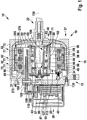
- FIG. 1 an electric machine in the form of a transverse flux machine 10 is shown. Like many electrical machines, this also has a stator 13 and a rotor, designed as a so-called external rotor 16. Both parts are arranged in a housing 19. By means of a shaft 22, the external rotor 16 is driven. The shaft 22 is driven for example by means of a pulley or a gear or other torque transmitting part. On the in the FIG. 1 left side is under a cover 25 electronics 28 arranged, for example, a passive rectifier or an active rectifier.
- a flange 31 On a flange 31 is supported in an approximately cup-shaped housing shell 34, which has an annular collar 37 with a central opening 40. Through the opening 40, the shaft 22 extends.
- stator 13 is supported on the flange 31.
- the stand 13 is attached indirectly by means of seven screws 43 on the flange 31.
- the screws 43 project through a passage opening in the flange 31 and engage in a respective threaded bore 46 of a further flange 49.
- This further flange 49 is integrally connected to a central sleeve 52, which also performs central tasks.
- the sleeve 52 carries on its inner contour 54 two bearings 55 and 56, which are designed here as deep groove ball bearings.
- the inner contour 54 has two annular webs 59 and 60.
- the annular web 60 serves the rolling bearing 56 as a stop.
- a plate spring 57 is clamped between the annular web 59 and the rolling bearing 55 to produce an axial preload on the two rolling bearings 55 and 56.
- the shaft 22 is fixed and rotatably mounted.
- the shaft 22 is offset between bearing seats for the bearings 55 and 56.
- a spacer sleeve 63 is pushed onto the shaft 22, so that a defined distance between the bearings 55 and 56th is set.
- Both roller bearings 55 and 56, or their unspecified here inner rings are braced by means of the spacer sleeve 63, a clamping sleeve 66 and a clamping screw 67 with each other and against a collar 69.
- An outer ring 70 of the rolling bearing 56 is secured by an inner retaining ring 71 in position.
- the collar 69 also has the task of protecting the bearings 55 and 56, but also the task of forming a stop for the external rotor 16.
- the external rotor 16 has a pot-like shape.
- a cylinder jacket-shaped portion 73 of the outer rotor 16 carries on its cylindrical inner side 75 in three axially successively arranged rows of permanent magnets 77.
- the cylinder jacket-shaped portion 73 of the outer rotor 16 connects at an axial end radially inwardly extends a kind of housing bottom 80, which with a central Bore 83 is seated on the shaft 22.
- a radially acting fan 86 is attached on an inner side of the housing bottom 80.
- a further fan 89 is fixed, which is designed as a narrow ring in the radial direction.
- This fan 89 rotates in a groove which is incorporated in an end face of the flange 31 directed towards the fan 89.
- a series of ventilation openings 90 is arranged in the housing casing 34 all around.
- This stator 13 comprises three individual special ring systems 92.
- Each ring system 92 has two half rings 94 and 96 which receive a ring coil as a stator winding 98 between them.
- the stator winding 98 is surrounded by two half-yokes 100 and 101, two ring walls 102 and 103 and claw poles 104 and 105, see also FIG. 6A , The claw poles 104 and 105 alternate with each other in the circumferential direction. In this case, a receiving space 106 for the stator winding 98 is formed.
- the receiving space 106 has a certain cross section bounded by the half yokes 100 and 101, the two ring walls 102 and 103 and the claw poles 104 and 105.
- this receiving space 106 which is rectangular in this example, the stator winding 98 is seated with a preformed cross section.
- the cross section of the stator winding 98 is adapted to the cross section of the receiving space 106.
- stator 13 Radially inside the stator 13, d. H. between the half-yokes 100 and 101, which are a total of an inner yoke 107, and the sleeve 52, are concentrated three outputs 108, 109 and 110 of the three stator windings 98. Each output 108, 109 and 110 is associated with a stator winding 98 , The three stator windings 98 are connected in a neutral point, this will be discussed below.
- Ventilation ducts 113 Radially inside the stator 13, d. H. also between the half yokes 100 and 101 and the sleeve 52, there are ventilation ducts 113, which are part of a ventilation system, which will also be discussed below.
- FIG. 2 shows an end view of the electric machine on the flange 31 with disassembled electronics.
- the flange 31 has at the time positions "half two" -, "six” - and “half past ten” each one attachment eye 114 through hole 115.
- These through holes 115 are preferably and as shown here with internal threads 116 and serve to attach the electrical machine to its environment.
- Six further through holes 118 two of which two through holes 118 are arranged in the fastening eyes 114 and one through hole 118 in each mounting eyes 119, serve to secure the housing shell 34 on the flange 31.
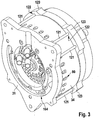
- six tie rods 121 designed as long screws, see also FIG. 3 , inserted through further through holes 122, which are incorporated in ring segments 123. By applying the tie rod 121 with a sufficient torque, the housing shell 34 is held on the flange 31 positionally secure.
- FIG. 1 Three on the time positions "two” -, "six” - and “ten” clock located threaded holes 125 are used to attach an example in FIG. 1 illustrated cooling plate 127 by means of screws 130.
- the cooling plate 127 itself is used to cool the electronics 28th
- connection tabs 155 are shown with cable sleeves 156. These connection tabs 155 serve to contact the three stator windings 98, see also FIG. 3 , In this example, three-phase current can be taken as a special form of alternating current. In contrast to the representation in FIG. 1 For example, by means of the connection lugs 155, the current of the three stator windings 98 can be led to a so-called "pathway" electronics (for example a passive rectifier or an active rectifier), which is not arranged on the cooling plate 127.
- pathway electronics for example a passive rectifier or an active rectifier
- the individual ventilation channels 113 are separated by radial webs 158. These outgoing from the inner yoke 107 webs 158 act as cooling fins, cool the stator 13 and extend from the inner yoke 107 radially inward. These webs 158 or cooling fins are integrally formed on the inner yoke 107. In the FIG. 2 directly detectable webs 158 are in the other webs 158, which are incorporated in the flange 49. The same arrangement of webs 158 and ventilation channels 113 is also realized in the half-rings 94 and 96.
- FIG. 3 the already mentioned ventilation openings 90 can be seen on the outer circumference of the housing jacket 34. Furthermore, a fan blade 164 of the fan 89 can be seen within the ventilation openings 90 representative of the entire fan 89.
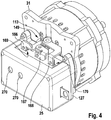
- FIG. 4 shows starting from FIG. 1 the technical solution with mounting electronics.
- the power supplied by the outputs 108, 109, 110 is conducted via three conductor rails 166, 167 and 168 to the terminals 169, 170.
- a third connection is indeed present, in FIG. 4 however, not shown, because hidden by the conductor rail 167.
- a positive terminal 173 is shown, for example, to supply a vehicle electrical system of a motor vehicle, not shown.
- the terminal lugs 155 may be attached.
- FIG. 5 shows a rear view of the electric machine on the flange 31 in de- or non-mounted electronics 28 and also without the housing shell 34 and without mounted shaft 22.
- the webs 158 are integrally formed on the half-ring 96.
- This one-piece molding of this structure of webs 158 and ventilation channels 113 with the annular region 162 is then technically less expensive if the material from which the half rings 94 and 96 are made a so-called ferromagnetic powder composite material (SMC, ie "soft magnetic composite”) is. Given that this material is currently expensive, the structures of webs 158 and ventilation ducts 113 can be made even less laborious, which will be discussed below.
- SMC ferromagnetic powder composite material
- FIG. 1 can be removed, the half rings 94 and 96 are pushed with the stator windings 98 to the stop on the flange 49 on the sleeve 52.
- the half rings 94 and 96 are replaced by a paragraph 176 (FIG. FIG. 6A centered).
- the half rings 94 and 96 are mutually centered.
- a pressure and centering ring 182 on the one hand ensures that a composite of the half-rings 94 and 96 centered around the sleeve 52 and a compressive force - generated by a tightened shaft nut 184 - is applied without or almost no transverse force on the SMC material.
- a corresponding transverse force would then be transmitted to the SMC material when the shaft nut 184 transferred directly to the SMC material the frictional force generated by its attraction between itself and a body to be clamped.
- the rolling bearing 56 is inserted into the sleeve and secured by the inner locking ring 71.
- the flange 31 has on its side facing the stator 13 in the outer edge region a shoulder 186. This paragraph 186 serves to center a housing shell 34 ( Figures 5 and 6A ).
- the half-ring 96 wiest on its side facing the viewer, ie on the side facing away from the flange 31 a groove 189 on. This groove serves to allow the potting compound 144 to flow between both radial sides of the half rings 94 and 96.
- FIG. 6B is a detail, here shown a section through two half rings 94 and 96. As can be seen there, both half rings 94 and 96 have a recess 190 or 191, the profiles of which run radially inward, are rectangular and complement each other to form a total rectangular overall profile. In these recesses 190 and 191 run special connection parts of the stator winding 98. Because of the corresponding similarity, all half rings 94 and 96 have a recess 190 and 191 on.
- FIG. 7 shows a spatial view of the stator 13.
- the half rings 94 and 96 have a further recess 194, at which no webs 158 are located.
- the outputs 108, 109 and 110 are axially guided, see also FIG. 1 and FIG. 6A ,
- each ring system 92 intervene alternately in claw-pawls 196 and claw-pawls 198, respectively, between the respective other claw-poles.
- the claw-pawls 196 are between claw poles 104
- the claw-pawls 198 are between the claw-poles 105.
- FIG. 7 can be seen is a claw pole 104 of a ring system 92 at a claw pole 105 of another ring system 92 at.
- the claw poles 104 and 105 of the three ring systems 92 are arranged such that wave-shaped paths 200 and helical paths 201 result between the claw poles 104 and 105. These paths 200 and 201 serve to let through cooling air.
- FIG. 8 another spatial view of the stator 13 is shown.
- the three terminals 108, 109, 110 of the three stator windings 98 extend.
- an insulating layer 205 or 206 which is made for example of a polyamide film.
- the insulating layer 205 extends at least from the outermost end face 213 of the terminal 108 facing away from the stator 13 to at least the outermost end face 215 of the terminal 109 pointing away from the end face 213 of the terminal 108. More generally, the insulating layer 205 extends between two directly adjacent terminals 108 and 109 at least the length that lies between two facing end faces 213 and 215.
- the insulation layer 206 extends at least from the outermost end face 218 of the terminal 110 facing away from the stator 13 to at least the outermost end face 220 of the terminal 110 facing away from the end face 218 of the terminal 110.
- the insulating layer 206 extends on or at the terminal 110 contacting the stator winding 98 farthest from the end face 209 of the ring system 92 which is closest to a terminal side 217 of the stator 13 over at least the whole axial length of the terminal 110.
- the three or the connections 108, 109, 110 are provided with a through hole 224 on the side facing away from the stator windings 98 at a location 222 which is superposed overall with respect to the connections 108, 109 and 110.
- the insulation layers 205 and 206 are likewise perforated at this point 222.
- a sleeve 225 is inserted from an insulating material. This sleeve 225 is available on both sides of the association of terminals 108, 109, 110 and insulating layers 205 and 206 via, sua FIG. 6A and FIG.
- FIG. 9 is the in FIG. 1 illustrated fan 86 shown as a single part in a three-dimensional view.
- This fan 86 is attached to the inside of the housing bottom 80 of the outer rotor 16 by means of some fasteners.
- the fan 86 has a central opening 230 whose diameter is greater than an outer diameter of the shaft nut 184, FIG. 1 ,
- FIG. 10 shows a view of the outer rotor 16 in its cavity. Good are the fan blades 152 of the fan 86 can be seen and inner ends of the fan blades 164 of the fan 89, which are secured by a stabilizing ring 233 against bending radially outward.
- the external rotor 16 is, see also FIG. 11 , constructed of different components: The housing bottom 80 is pressed against the collar 69 of the shaft 22. In this case, a screwed into a shaft end screw 234 presses a sleeve 235 against a stabilizing plate 237, this in turn transmits the pressure force on the housing bottom 80.
- the permanent magnets 77 are attached.
- the fan 89 which is made of plastic, for example, is plugged by means of a snap connection.
- a ring section 243 formed on the fan 89 surrounds the cylindrical outer side of the cylinder jacket-shaped section 73.
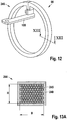
- FIG. 12 shows a spatial view of a stator winding 98, here the stator winding 98, which is the connection side 217 nearest.
- the stator winding 98 consists of just one winding 245.
- the stator winding 98 is embodied as a stranded wire 244, the stranded wire 244 having a plurality of individual wires 245, FIG. 13A ,
- the strand 244 has 1000 wires each with a diameter of 0.2 mm. All individual wires 245 of the strand 244 are thus wound only once (slightly less than 360 °, ie not quite 360 °).
- the individual wires 245, ie each individual wire cross-section, for example made of copper, of the stranded wire 244 are also insulated from one another, for example, by a lacquer layer as an insulating layer 247. Subsequently, the strand 244 is additionally insulated on its outer circumference, this being done here for example by a bandage 249.
- the strand 244 is first prepared in a straight shape. The individual wires 245 of the strand 244 are then all in a straight line next to each other. If one wanted to subsequently wind such a straight bandaged strand 244, this would lead to considerable uneven changes in length and internal stresses (between the individual wires) over the cross section of the strand 244.
- the individual wires 245 of the strand 244 can also be designed without insulation 247.
- the possible advantage of higher copper cross-section is then offset by the possible disadvantage of higher current displacement.
- the strand 244 has a current displacement of 1.14 at 10,000 revolutions per minute.
- the strand 244 is circumferentially compressed in the region of a shock to be provided (where the two ends of the strand 244 face each other) and the strand 244 is provided with two straight end surfaces.
- the insulating layer 247 is removed and the wires are connected together by a solder.
- the stator winding 98 now has an open circular ring shape of almost 360 °, wherein the stator winding 98 has two opposing ends 250, 251, wherein the end 251 with a connection part 108 and the end 250 with a connection part 253 ( ⁇ senan gleich) are materially interconnected ,
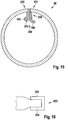
- an end 250, 251 is connected to a connection part 108, 253 such that a shelf 254 of a connection part 108, 253 encloses the end, FIG. 16 ,
- the connection part 108, 253 is still while a solder for cohesive connection liquid is pressed to the end 250, 251.
- a neck portion 258 is bandaged.
- This neck portion 258 comprises each of the connecting part 108 and the connecting part 253 ( ⁇ senan gleich) each having a radially inwardly projecting portion. This neck portion 258 protrudes in the assembled machine in the recesses 190 and 191, see also FIG. 6B ,
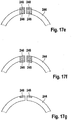
- a strand 244 is provided, Figure 17a ).
- the strand 244 is compacted, ie the strand 244 receives approximately a cross section corresponding to the stator winding 98, FIG. 17b ).
- Exemplary are in FIG. 17b ) three different shape cross sections after compacting or embossing of the strand 244 shown.
- bundling the strand 244 is useful (possibly already by a possibly single bandaging) to avoid a displacement of the wires, especially in the subsequent winding step.
- FIG. 17a the strand 244 is compacted, ie the strand 244 receives approximately a cross section corresponding to the stator winding 98, FIG. 17b ).
- FIG. 17b three different shape cross sections after compacting or embossing of the strand 244 shown.
- bundling the strand 244 is useful (possibly already by a possibly single bandaging) to avoid a displacement of the wires, especially in the subsequent winding step.
- FIG. 17c following executions of the strand 244 are shown, in which not only the actual winding section is embossed, but also both ends 246, which also extend in the axial direction. While in FIG. 17c ) a strand 244 is shown with a round cross-section, the strand in FIG. 17d ) has a rectangular cross section. In FIG. 17e ) is a rectangular embossed strand 244 or stator winding 98 is shown, wherein on a radial outer side or the two ends 246 of the strand 244 two sheets 248 are soldered or welded as terminals. In FIG.
- 17f is a rectangular embossed strand 244 or stator winding 98 is shown, wherein on a radial inner side or the two ends 246 of the strand 244 two sheets 248 are soldered or welded as terminals.
- FIG. 17g is a rectangular embossed strand 244 or stator winding 98 is shown, wherein on a radial outer side or the two ends 246 of the strand 244 two sheets 248 are soldered or welded as terminals.
- the strand 244 has previously been embossed in such a way that a recess into which the sheets 248 are fitted is stamped in the annular cross section of the stator winding 98.
- a stator winding 98 has an unbandaged cross section A1 with a radial height H in the direction of one Fulcrum of the outer rotor 16 and an axial width B in the direction of the axis of rotation of the outer rotor 16.
- the unbandaged cross section is therefore approximately 70mm 2 .
- a single wire of the strand 244 has a cross-section A2 of 0.1 mm 2 * ⁇ 2 and therefore approximately 0,0314mm. 2
- a ratio A1 / A2 is approximately 2228 in this case. In the context of the design of the stator winding 98, it is provided that the ratio is, to a first approximation, less than 2500, in a further approximation less than 2000 or less than 1500.
- a quotient of the cross section A1 and a circumference U of a single wire of the strand 244 can be determined. From the example results a quotient A1 / U of approx. 111mm, whereby U equals the product of ⁇ * 0,2 mm. As a first approximation, it is desirable that the ratio A1 / U is greater than 40, in the second approximation greater than 80, preferably greater than 120.
- FIG. 13B an alternative cross-sectional shape for the stator winding 98 is shown. This cross-sectional shape is a sum area ("house with saddle roof" shape) of a rectangle like in FIG. 13A and an attached triangle. The triangle is opposite to the cross-sectional shape in FIG.
- FIG. 13A an advantage that results from optimized adaptation of the receiving space radially below the claw poles 104 and 105.
- FIG. 13C is provided as a further cross-sectional shape of the stator winding 98 as a basic shape, a trapezoid, wherein the inclined surfaces are oriented substantially in the axial direction.
- the trapezoidal shape can be summarily supplemented by a triangular cross-sectional area below the claw poles 104 and 105.
- FIG. 18a Another embodiment of a stator winding 98 is shown in FIG. 18a ).
- This stator winding 98 is in contrast to the previously described variant, a stator winding 98 of strand 244 with more than one turn 245.
- This has the advantage that the current displacement is further reduced.
- a strand of strand 244 consisting of a plurality of insulated individual wires 245 (FIG. FIG. 14 ) made available. This strand is then isolated, for example by a bandage 249, FIG.
- step S1 the insulated strand 244 is first pressed to flatten the strand 244 (axial direction), preferably, an inner diameter of the stator winding 98 and the strand 244 is already preset. Subsequently, the flattened strand 244 is formed, step S2, possibly not only an outer diameter but also the inner diameter is set or formed.
- stator winding 98 or the strand 244 is embossed, so that the width B is set, step S3. Possibly. Thereafter, in a further step S4, a firm bond is produced, ie the stator winding 98 or the strand 244 is coated or impregnated with a preferably thermally curable resin (baked enamel), optionally heated in a mold, thereby producing a solid stator winding 98.
- a preferably thermally curable resin baked enamel
- FIG. 18d a possible cross-section of the stator winding 98 and the strand 244 is shown, as by winding as in FIG. 18a ) and produced after compaction or embossing.
- FIG. 18e a possible cross-section of the stator winding 98 and the strand 244 is shown, as by winding as in FIG. 18b ) and produced after compaction or embossing.
- stator winding 98 for a transverse flux machine 10 wherein the stator winding 98 is designed as a strand 244 and the strand 244 has a plurality of individual wires 245, wherein the stator winding 98 is designed as a coil with more than one winding 245. Finally, connections are made to the stator winding 98 before or after curing in one of the manners described.
- stator winding 98 of strand 244 wherein first a strand of strand is provided and in later steps S1, S2, S3 the stator winding 98 is formed into a ring shape, insulated and a cross-section of the stator winding is reshaped. It is envisaged that more than one turn 245 will be wound in a circumferential direction.
- stator winding 98 coated with hardenable material preferably resin or baked enamel and later this substance is cured.
- connection parts 253 of the three successively arranged stator windings 98 are shown. These are the parts that serve as ⁇ senan gleich.
- the three connection parts 253 are spaced from each other. Between two connection parts 253 is in each case a metallic bushing 260. Through the connection parts 253 and the bushes 260, a screw bolt 262 of a screw 264 is inserted. The connection parts 253 and the sockets 260 are clamped together so that there is an electrical connection between connection parts 253 and sockets 260. This arrangement is the star point of the three stator windings 98.
- each one of the terminals of the stator windings 98 has a hole 263 and these terminals or one of the connecting parts 253 of the stator windings 98 are arranged axially in the direction of rotation of an external rotor 16 in a row ,
- These connecting parts 253 are mechanically and electrically connected to each other by a seated in the holes 263 bolts (bolts 262) and thereby a star point is formed.
- This arrangement - either to form the star point or to lead out of the terminals 108, 109 and 110 - is independent of the choice of the design of the stator winding 98.
- stator winding 98 is executed with a connection part 253, wherein preferably all the stator windings 98 are executed in this way.
- connection part 253 wherein preferably all the stator windings 98 are executed in this way.
- one end of the stator windings 98 is connected to one of the terminals 108, 109 and 110.
- the negative pressure generated by the fan 86 causes at the fan 86 directly opposite end of the ventilation duct 113, a negative pressure and thus flows cooling air through the ventilation duct 113.
- cooling air is sucked in from the surroundings, for example in the region of the connections 108, 109 and 110, through the flange 31 and thus through the passage opening 149.
- FIG. 4 In addition, cooling air is sucked through openings 270 in the cover 25 in the machine to first cool the electronics 28 and then by in the FIG. 1 not shown openings in the cooling plate 127 to the through hole 149 (FIG. FIG. 2 ) and to flow into the ventilation ducts 113.
- To the sucks the fan 89 through the slots 142 and the groove 133 and not shown openings in the cooling plate 127 additional cooling air to cool the electronics 28 at.
- a transversal flux machine 10 having a stator 13 and an outer rotor 16 disposed about the stator 13, the stator 13 having two axially opposite end faces 273, 276, with an inner yoke 107 of the stator 13, with a cooling path , which is disposed radially inward of the inner yoke 107, wherein the cooling path at the axial end face 273 of the stator 13 emerges from the transverse flux machine 10 which faces the inlet side, wherein the cooling path between inlet and outlet in a space between the stator 13 and outer rotor 16 extends ,
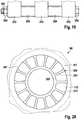
- FIG. 20 is a detail of a view of a variant of the stator 13 is shown.
- the half rings 94, 96 are bounded radially inwardly by the inner yoke 107, ie the half rings 94, 96 have no webs 158 on. Instead, the half rings 94, 96 have a central preferably round opening 279.
- a cooling fin element 280 made of a less expensive material such as an aluminum alloy used, which by means of cooling fins 283 heat release from the half-rings 94, 96 allows and centering the Half rings 94, 96 preferably by means of an inner ring 285 on the sleeve 52 allows.
- the cooling fin element 280 may be, for example, an extruded profile.
- FIG. 21 is another embodiment of a transverse flux machine 10 outlined. Equally functioning components are otherwise named with the same reference numbers.
- a three-phase stator 13 with three ring systems 92 is attached to a housing inner wall 290 on a housing 19.
- a shaft 22 is mounted both in the housing 19 and radially within the stator 13, to which the rolling bearings 55 and 56 serve.
- a support plate 293 is mounted co-rotating. This support plate 293 carries radially and axially outside fan blades 152.
- a cylindrical annular portion 73 is supported.
- the cooling air flows past webs 158 in the axial direction in the interior of the stator 13. Subsequently, the cooling air on the side facing away from the inlet side of the stator 13 exits again to be deflected radially outward and thrown by the fan blades 152 from the machine.
- transversal flux machine having a stator 13 and an outer rotor 16 disposed about the stator 13, the stator 13 having two axial end faces 273, 276, with an inner yoke 107 of the stator 13, with a cooling path that is radial is disposed within the inner yoke 107, wherein the cooling path on the axial end face 273 of the stator 13 emerges from the transverse flux machine 10, which faces away from an inlet side 303.
Landscapes
- Engineering & Computer Science (AREA)
- Power Engineering (AREA)
- Windings For Motors And Generators (AREA)
- Manufacture Of Motors, Generators (AREA)
- Insulation, Fastening Of Motor, Generator Windings (AREA)
Claims (8)
- Machine à flux transversal présentant un stator (13) et un enroulement (98) de stator,
caractérisée en ce que
l'enroulement (98) de stator est réalisé sous la forme d'une tresse (244),
en ce que la tresse (244) présente plusieurs fils individuels (245),
en ce que l'enroulement (98) de stator présente la forme d'un anneau circulaire ouvert et l'enroulement (98) de stator possède deux extrémités opposées (250, 251),
en ce qu'une extrémité (250) et une pièce de raccordement (253) sont reliées l'une à l'autre en correspondance de matière et
en ce que l'autre extrémité (251) et une pièce de raccordement (108) sont reliées l'une à l'autre en correspondance de matière. - Machine à flux transversal selon la revendication 1, caractérisée en ce que de fils individuels (245) sont entourés directement par une couche isolante (247).
- Machine à flux transversal selon les revendications 1 ou 2, caractérisée en ce que la tresse (244) est isolée à sa périphérie extérieure, de préférence par un bandage (249).
- Machine à flux transversal selon l'une des revendications précédentes, caractérisée en ce que l'extrémité (250, 251) est incorporée dans une bordure (254) d'une pièce de raccordement (108, 253).
- Machine à flux transversal selon l'une des revendications précédentes, caractérisée en ce que son stator (13) possède un espace de réception (106) pour l'enroulement de stator (98) et en ce que l'espace de réception (106) présente une section transversale définie, l'enroulement (98) de stator présentant une section transversale préformée est inséré dans l'espace de réception (106) et la section transversale de l'enroulement (98) de stator étant adaptée à la section transversale de l'espace de réception (106).
- Machine à flux transversal selon l'une des revendications précédentes, caractérisée en ce qu'elle présente plusieurs stators (13) et donc plusieurs enroulements de stator (98), chaque enroulement de stator (98) étant un raccordement (108, 109, 110) guidé dans le sens de rotation d'un induit extérieur (16) et les raccordements (108, 109, 110) étant empilés les uns au-dessus des autres en étant séparés par une couche isolante (205).
- Machine à flux transversal selon la revendication 6, caractérisée en ce qu'une pièce de raccordement (253) des enroulements de stator (98) présente un trou (263) et en ce que cette pièce de raccordement (253) des enroulements (98) de stator sont disposés les uns derrière les autres axialement dans le sens de rotation d'un induit extérieur (16), ces pièces de raccordement (253) étant reliées les unes aux autres mécaniquement et électriquement par un goujon placé dans les trous (263), pour ainsi former un point d'étoile électrique des enroulements de stator (98).
- Machine à flux transversal selon la revendication 7, caractérisée en ce qu'entre deux pièces de raccordement (253) se trouve une douille métallique (260), la douille métallique étant serrées avec les pièces de raccordement (253) par le goujon.
Applications Claiming Priority (2)
| Application Number | Priority Date | Filing Date | Title |
|---|---|---|---|
| DE102009060956A DE102009060956A1 (de) | 2009-12-30 | 2009-12-30 | Ständerwicklung für eine Transversalflussmaschine |
| PCT/EP2010/070836 WO2011080293A2 (fr) | 2009-12-30 | 2010-12-29 | Bobine de stator pour une machine à flux transversal |
Publications (2)
| Publication Number | Publication Date |
|---|---|
| EP2520008A2 EP2520008A2 (fr) | 2012-11-07 |
| EP2520008B1 true EP2520008B1 (fr) | 2017-09-27 |
Family
ID=44070507
Family Applications (1)
| Application Number | Title | Priority Date | Filing Date |
|---|---|---|---|
| EP10803251.7A Not-in-force EP2520008B1 (fr) | 2009-12-30 | 2010-12-29 | Bobine de stator pour une machine à flux transversal |
Country Status (3)
| Country | Link |
|---|---|
| EP (1) | EP2520008B1 (fr) |
| DE (2) | DE102009060956A1 (fr) |
| WO (1) | WO2011080293A2 (fr) |
Families Citing this family (8)
| Publication number | Priority date | Publication date | Assignee | Title |
|---|---|---|---|---|
| WO2010062764A2 (fr) | 2008-11-03 | 2010-06-03 | Motor Excellence, Llc | Concepts de stator de système d'écoulement transversal et/ou commuté |
| JP5748161B2 (ja) | 2010-03-15 | 2015-07-15 | エレクトリック トルク マシーンズ インコーポレイテッド | 位相オフセットを有する横方向および/または整流磁束システム |
| WO2011115632A1 (fr) | 2010-03-15 | 2011-09-22 | Motor Excellence Llc | Systèmes à flux transversal et/ou à flux commuté, configurés de façon à réduire les déperditions de flux, à réduire les déperditions d'hystérésis et à réaliser une adaptation de phase |
| US8395291B2 (en) | 2010-03-15 | 2013-03-12 | Electric Torque Machines, Inc. | Transverse and/or commutated flux systems for electric bicycles |
| CN103477538A (zh) | 2010-11-17 | 2013-12-25 | 电动转矩机器公司 | 具有分段定子层压件的横向和/或换向磁通系统 |
| US8952590B2 (en) | 2010-11-17 | 2015-02-10 | Electric Torque Machines Inc | Transverse and/or commutated flux systems having laminated and powdered metal portions |
| WO2012067895A2 (fr) | 2010-11-17 | 2012-05-24 | Motor Excellence, Llc | Concepts de bobine de système à flux transversal et/ou commuté |
| DE102013012749A1 (de) * | 2013-07-31 | 2015-02-05 | Audi Ag | Innen-Sicherungsring und Anordnung zur axialen Sicherung eines Lageraußenrings eines Lagers in einem Lagersitz einer Bohrung sowie Verfahren zur Montage eines Lagers in einer Bohrung |
Family Cites Families (2)
| Publication number | Priority date | Publication date | Assignee | Title |
|---|---|---|---|---|
| US2436042A (en) * | 1946-10-25 | 1948-02-17 | Hansen Mfg Company Inc | Motor terminal binding post |
| JP4419510B2 (ja) * | 2003-10-20 | 2010-02-24 | 株式会社豊田自動織機 | モータ、電機子、または発電機 |
-
2009
- 2009-12-30 DE DE102009060956A patent/DE102009060956A1/de not_active Withdrawn
-
2010
- 2010-12-29 WO PCT/EP2010/070836 patent/WO2011080293A2/fr not_active Ceased
- 2010-12-29 EP EP10803251.7A patent/EP2520008B1/fr not_active Not-in-force
- 2010-12-29 DE DE112010005060T patent/DE112010005060A5/de not_active Withdrawn
Non-Patent Citations (1)
| Title |
|---|
| None * |
Also Published As
| Publication number | Publication date |
|---|---|
| WO2011080293A3 (fr) | 2012-06-14 |
| DE112010005060A5 (de) | 2012-10-18 |
| EP2520008A2 (fr) | 2012-11-07 |
| WO2011080293A2 (fr) | 2011-07-07 |
| DE102009060956A1 (de) | 2011-07-07 |
Similar Documents
| Publication | Publication Date | Title |
|---|---|---|
| EP2520010B1 (fr) | Machine à flux transversal | |
| EP2520007A2 (fr) | Bobine de stator pour une machine à flux transversal et procédé correspondant de réalisation d'une bobine de stator | |
| EP2520008A2 (fr) | Bobine de stator pour une machine à flux transversal | |
| DE69222014T2 (de) | Kernloser gleichstrommotor in flachbauweise | |
| EP1845604A2 (fr) | Moteur tubulaire doté d'un dispositif de connection | |
| EP2962383B1 (fr) | Machine à flux axial légère | |
| EP4449586A1 (fr) | Rotor pour une machine électrique comprenant un canal de refroidissement dans un séparateur de pôles | |
| WO2021003510A2 (fr) | Stator pour une machine à flux axial | |
| DE102018102750A1 (de) | Stator für Drehfeldmaschine mit axialer Wärmeableitung | |
| DE102018215787A1 (de) | Stator für eine elektrische Maschine, eine elektrische Maschine und Verfahren zum Herstellen einer elektrischen Maschine | |
| EP0532526A1 (fr) | Procede pour la fabrication du stator d'une machine electrique, de preference d'un alternateur triphase. | |
| DE202016104830U1 (de) | Einphasiger Permanentmagnetmotor | |
| EP1018206B1 (fr) | Module stator pour un moteur electrique | |
| DE102020101149A1 (de) | Axialflussmaschine mit mechanisch fixierten Statorkernen mit radial verlaufenden Blechsegmenten | |
| WO2008092630A2 (fr) | Moteur électrique et élément de bobine pour un tel moteur | |
| EP3672041B1 (fr) | Machine électrique à rotor à disque | |
| WO2010066492A2 (fr) | Stator dans un moteur électrique | |
| EP1868282A2 (fr) | Moteur à rotor extérieur | |
| DE102014019763A1 (de) | Vorrichtung und Verfahren zur Herstellung eines Stators einer elektrischen Maschine | |
| WO2017194264A1 (fr) | Stator d'une machine électrique muni d'un dispositif d'interconnexion pour bobines de stator et machine électrique équipée d'un tel stator | |
| DE102014001023B4 (de) | Elektrische Maschine | |
| DE29918047U1 (de) | Stator für einen Axialfeldmotor | |
| DE102006044491A1 (de) | Elektrische Maschine | |
| DE29813023U1 (de) | TFM-Stator mit eingeschraubten Weicheisenelementen | |
| DE102023207689A1 (de) | Primärteil mit anschlusseinrichtung für eine elektrische maschine und verfahren zum herstellen eines solchen pimärteils |
Legal Events
| Date | Code | Title | Description |
|---|---|---|---|
| PUAI | Public reference made under article 153(3) epc to a published international application that has entered the european phase |
Free format text: ORIGINAL CODE: 0009012 |
|
| AK | Designated contracting states |
Kind code of ref document: A2 Designated state(s): AL AT BE BG CH CY CZ DE DK EE ES FI FR GB GR HR HU IE IS IT LI LT LU LV MC MK MT NL NO PL PT RO RS SE SI SK SM TR |
|
| AX | Request for extension of the european patent |
Extension state: BA ME |
|
| 17P | Request for examination filed |
Effective date: 20121214 |
|
| RBV | Designated contracting states (corrected) |
Designated state(s): AL AT BE BG CH CY CZ DE DK EE ES FI FR GB GR HR HU IE IS IT LI LT LU LV MC MK MT NL NO PL PT RO RS SE SI SK SM TR |
|
| DAX | Request for extension of the european patent (deleted) | ||
| REG | Reference to a national code |
Ref country code: DE Ref legal event code: R079 Ref document number: 502010014208 Country of ref document: DE Free format text: PREVIOUS MAIN CLASS: H02K0003180000 Ipc: H02K0003500000 |
|
| RIC1 | Information provided on ipc code assigned before grant |
Ipc: H02K 1/14 20060101ALI20170323BHEP Ipc: H02K 3/50 20060101AFI20170323BHEP |
|
| GRAP | Despatch of communication of intention to grant a patent |
Free format text: ORIGINAL CODE: EPIDOSNIGR1 |
|
| INTG | Intention to grant announced |
Effective date: 20170517 |
|
| GRAS | Grant fee paid |
Free format text: ORIGINAL CODE: EPIDOSNIGR3 |
|
| GRAA | (expected) grant |
Free format text: ORIGINAL CODE: 0009210 |
|
| AK | Designated contracting states |
Kind code of ref document: B1 Designated state(s): AL AT BE BG CH CY CZ DE DK EE ES FI FR GB GR HR HU IE IS IT LI LT LU LV MC MK MT NL NO PL PT RO RS SE SI SK SM TR |
|
| REG | Reference to a national code |
Ref country code: GB Ref legal event code: FG4D Free format text: NOT ENGLISH |
|
| REG | Reference to a national code |
Ref country code: CH Ref legal event code: EP |
|
| REG | Reference to a national code |
Ref country code: AT Ref legal event code: REF Ref document number: 932858 Country of ref document: AT Kind code of ref document: T Effective date: 20171015 |
|
| REG | Reference to a national code |
Ref country code: IE Ref legal event code: FG4D Free format text: LANGUAGE OF EP DOCUMENT: GERMAN |
|
| REG | Reference to a national code |
Ref country code: DE Ref legal event code: R096 Ref document number: 502010014208 Country of ref document: DE |
|
| REG | Reference to a national code |
Ref country code: DE Ref legal event code: R081 Ref document number: 502010014208 Country of ref document: DE Owner name: SEG AUTOMOTIVE GERMANY GMBH, DE Free format text: FORMER OWNER: ROBERT BOSCH GMBH, 70469 STUTTGART, DE |
|
| PG25 | Lapsed in a contracting state [announced via postgrant information from national office to epo] |
Ref country code: LT Free format text: LAPSE BECAUSE OF FAILURE TO SUBMIT A TRANSLATION OF THE DESCRIPTION OR TO PAY THE FEE WITHIN THE PRESCRIBED TIME-LIMIT Effective date: 20170927 Ref country code: FI Free format text: LAPSE BECAUSE OF FAILURE TO SUBMIT A TRANSLATION OF THE DESCRIPTION OR TO PAY THE FEE WITHIN THE PRESCRIBED TIME-LIMIT Effective date: 20170927 Ref country code: HR Free format text: LAPSE BECAUSE OF FAILURE TO SUBMIT A TRANSLATION OF THE DESCRIPTION OR TO PAY THE FEE WITHIN THE PRESCRIBED TIME-LIMIT Effective date: 20170927 Ref country code: NO Free format text: LAPSE BECAUSE OF FAILURE TO SUBMIT A TRANSLATION OF THE DESCRIPTION OR TO PAY THE FEE WITHIN THE PRESCRIBED TIME-LIMIT Effective date: 20171227 Ref country code: SE Free format text: LAPSE BECAUSE OF FAILURE TO SUBMIT A TRANSLATION OF THE DESCRIPTION OR TO PAY THE FEE WITHIN THE PRESCRIBED TIME-LIMIT Effective date: 20170927 |
|
| REG | Reference to a national code |
Ref country code: NL Ref legal event code: MP Effective date: 20170927 |
|
| REG | Reference to a national code |
Ref country code: LT Ref legal event code: MG4D |
|
| PG25 | Lapsed in a contracting state [announced via postgrant information from national office to epo] |
Ref country code: GR Free format text: LAPSE BECAUSE OF FAILURE TO SUBMIT A TRANSLATION OF THE DESCRIPTION OR TO PAY THE FEE WITHIN THE PRESCRIBED TIME-LIMIT Effective date: 20171228 Ref country code: RS Free format text: LAPSE BECAUSE OF FAILURE TO SUBMIT A TRANSLATION OF THE DESCRIPTION OR TO PAY THE FEE WITHIN THE PRESCRIBED TIME-LIMIT Effective date: 20170927 Ref country code: LV Free format text: LAPSE BECAUSE OF FAILURE TO SUBMIT A TRANSLATION OF THE DESCRIPTION OR TO PAY THE FEE WITHIN THE PRESCRIBED TIME-LIMIT Effective date: 20170927 Ref country code: BG Free format text: LAPSE BECAUSE OF FAILURE TO SUBMIT A TRANSLATION OF THE DESCRIPTION OR TO PAY THE FEE WITHIN THE PRESCRIBED TIME-LIMIT Effective date: 20171227 |
|
| PG25 | Lapsed in a contracting state [announced via postgrant information from national office to epo] |
Ref country code: NL Free format text: LAPSE BECAUSE OF FAILURE TO SUBMIT A TRANSLATION OF THE DESCRIPTION OR TO PAY THE FEE WITHIN THE PRESCRIBED TIME-LIMIT Effective date: 20170927 |
|
| PG25 | Lapsed in a contracting state [announced via postgrant information from national office to epo] |
Ref country code: CZ Free format text: LAPSE BECAUSE OF FAILURE TO SUBMIT A TRANSLATION OF THE DESCRIPTION OR TO PAY THE FEE WITHIN THE PRESCRIBED TIME-LIMIT Effective date: 20170927 Ref country code: ES Free format text: LAPSE BECAUSE OF FAILURE TO SUBMIT A TRANSLATION OF THE DESCRIPTION OR TO PAY THE FEE WITHIN THE PRESCRIBED TIME-LIMIT Effective date: 20170927 Ref country code: RO Free format text: LAPSE BECAUSE OF FAILURE TO SUBMIT A TRANSLATION OF THE DESCRIPTION OR TO PAY THE FEE WITHIN THE PRESCRIBED TIME-LIMIT Effective date: 20170927 |
|
| PG25 | Lapsed in a contracting state [announced via postgrant information from national office to epo] |
Ref country code: SM Free format text: LAPSE BECAUSE OF FAILURE TO SUBMIT A TRANSLATION OF THE DESCRIPTION OR TO PAY THE FEE WITHIN THE PRESCRIBED TIME-LIMIT Effective date: 20170927 Ref country code: IS Free format text: LAPSE BECAUSE OF FAILURE TO SUBMIT A TRANSLATION OF THE DESCRIPTION OR TO PAY THE FEE WITHIN THE PRESCRIBED TIME-LIMIT Effective date: 20180127 Ref country code: SK Free format text: LAPSE BECAUSE OF FAILURE TO SUBMIT A TRANSLATION OF THE DESCRIPTION OR TO PAY THE FEE WITHIN THE PRESCRIBED TIME-LIMIT Effective date: 20170927 Ref country code: IT Free format text: LAPSE BECAUSE OF FAILURE TO SUBMIT A TRANSLATION OF THE DESCRIPTION OR TO PAY THE FEE WITHIN THE PRESCRIBED TIME-LIMIT Effective date: 20170927 Ref country code: EE Free format text: LAPSE BECAUSE OF FAILURE TO SUBMIT A TRANSLATION OF THE DESCRIPTION OR TO PAY THE FEE WITHIN THE PRESCRIBED TIME-LIMIT Effective date: 20170927 |
|
| REG | Reference to a national code |
Ref country code: DE Ref legal event code: R097 Ref document number: 502010014208 Country of ref document: DE |
|
| PG25 | Lapsed in a contracting state [announced via postgrant information from national office to epo] |
Ref country code: DK Free format text: LAPSE BECAUSE OF FAILURE TO SUBMIT A TRANSLATION OF THE DESCRIPTION OR TO PAY THE FEE WITHIN THE PRESCRIBED TIME-LIMIT Effective date: 20170927 |
|
| REG | Reference to a national code |
Ref country code: CH Ref legal event code: PL |
|
| PLBE | No opposition filed within time limit |
Free format text: ORIGINAL CODE: 0009261 |
|
| STAA | Information on the status of an ep patent application or granted ep patent |
Free format text: STATUS: NO OPPOSITION FILED WITHIN TIME LIMIT |
|
| GBPC | Gb: european patent ceased through non-payment of renewal fee |
Effective date: 20171229 |
|
| PG25 | Lapsed in a contracting state [announced via postgrant information from national office to epo] |
Ref country code: PL Free format text: LAPSE BECAUSE OF FAILURE TO SUBMIT A TRANSLATION OF THE DESCRIPTION OR TO PAY THE FEE WITHIN THE PRESCRIBED TIME-LIMIT Effective date: 20170927 |
|
| 26N | No opposition filed |
Effective date: 20180628 |
|
| REG | Reference to a national code |
Ref country code: IE Ref legal event code: MM4A |
|
| PG25 | Lapsed in a contracting state [announced via postgrant information from national office to epo] |
Ref country code: MT Free format text: LAPSE BECAUSE OF FAILURE TO SUBMIT A TRANSLATION OF THE DESCRIPTION OR TO PAY THE FEE WITHIN THE PRESCRIBED TIME-LIMIT Effective date: 20170927 Ref country code: LU Free format text: LAPSE BECAUSE OF NON-PAYMENT OF DUE FEES Effective date: 20171229 |
|
| REG | Reference to a national code |
Ref country code: FR Ref legal event code: ST Effective date: 20180831 |
|
| REG | Reference to a national code |
Ref country code: BE Ref legal event code: MM Effective date: 20171231 |
|
| PG25 | Lapsed in a contracting state [announced via postgrant information from national office to epo] |
Ref country code: IE Free format text: LAPSE BECAUSE OF NON-PAYMENT OF DUE FEES Effective date: 20171229 Ref country code: FR Free format text: LAPSE BECAUSE OF NON-PAYMENT OF DUE FEES Effective date: 20180102 |
|
| PG25 | Lapsed in a contracting state [announced via postgrant information from national office to epo] |
Ref country code: LI Free format text: LAPSE BECAUSE OF NON-PAYMENT OF DUE FEES Effective date: 20171231 Ref country code: GB Free format text: LAPSE BECAUSE OF NON-PAYMENT OF DUE FEES Effective date: 20171229 Ref country code: CH Free format text: LAPSE BECAUSE OF NON-PAYMENT OF DUE FEES Effective date: 20171231 Ref country code: SI Free format text: LAPSE BECAUSE OF FAILURE TO SUBMIT A TRANSLATION OF THE DESCRIPTION OR TO PAY THE FEE WITHIN THE PRESCRIBED TIME-LIMIT Effective date: 20170927 Ref country code: BE Free format text: LAPSE BECAUSE OF NON-PAYMENT OF DUE FEES Effective date: 20171231 |
|
| REG | Reference to a national code |
Ref country code: AT Ref legal event code: MM01 Ref document number: 932858 Country of ref document: AT Kind code of ref document: T Effective date: 20171229 |
|
| PG25 | Lapsed in a contracting state [announced via postgrant information from national office to epo] |
Ref country code: AT Free format text: LAPSE BECAUSE OF NON-PAYMENT OF DUE FEES Effective date: 20171229 |
|
| PG25 | Lapsed in a contracting state [announced via postgrant information from national office to epo] |
Ref country code: MC Free format text: LAPSE BECAUSE OF FAILURE TO SUBMIT A TRANSLATION OF THE DESCRIPTION OR TO PAY THE FEE WITHIN THE PRESCRIBED TIME-LIMIT Effective date: 20170927 Ref country code: HU Free format text: LAPSE BECAUSE OF FAILURE TO SUBMIT A TRANSLATION OF THE DESCRIPTION OR TO PAY THE FEE WITHIN THE PRESCRIBED TIME-LIMIT; INVALID AB INITIO Effective date: 20101229 |
|
| PG25 | Lapsed in a contracting state [announced via postgrant information from national office to epo] |
Ref country code: CY Free format text: LAPSE BECAUSE OF NON-PAYMENT OF DUE FEES Effective date: 20170927 |
|
| PG25 | Lapsed in a contracting state [announced via postgrant information from national office to epo] |
Ref country code: MK Free format text: LAPSE BECAUSE OF FAILURE TO SUBMIT A TRANSLATION OF THE DESCRIPTION OR TO PAY THE FEE WITHIN THE PRESCRIBED TIME-LIMIT Effective date: 20170927 |
|
| PG25 | Lapsed in a contracting state [announced via postgrant information from national office to epo] |
Ref country code: TR Free format text: LAPSE BECAUSE OF FAILURE TO SUBMIT A TRANSLATION OF THE DESCRIPTION OR TO PAY THE FEE WITHIN THE PRESCRIBED TIME-LIMIT Effective date: 20170927 |
|
| PG25 | Lapsed in a contracting state [announced via postgrant information from national office to epo] |
Ref country code: PT Free format text: LAPSE BECAUSE OF FAILURE TO SUBMIT A TRANSLATION OF THE DESCRIPTION OR TO PAY THE FEE WITHIN THE PRESCRIBED TIME-LIMIT Effective date: 20170927 |
|
| PG25 | Lapsed in a contracting state [announced via postgrant information from national office to epo] |
Ref country code: AL Free format text: LAPSE BECAUSE OF FAILURE TO SUBMIT A TRANSLATION OF THE DESCRIPTION OR TO PAY THE FEE WITHIN THE PRESCRIBED TIME-LIMIT Effective date: 20170927 |
|
| REG | Reference to a national code |
Ref country code: DE Ref legal event code: R082 Ref document number: 502010014208 Country of ref document: DE Representative=s name: DEHNSGERMANY PARTNERSCHAFT VON PATENTANWAELTEN, DE Ref country code: DE Ref legal event code: R082 Ref document number: 502010014208 Country of ref document: DE Representative=s name: DEHNS GERMANY PARTNERSCHAFT MBB, DE |
|
| PGFP | Annual fee paid to national office [announced via postgrant information from national office to epo] |
Ref country code: DE Payment date: 20231220 Year of fee payment: 14 |
|
| REG | Reference to a national code |
Ref country code: DE Ref legal event code: R119 Ref document number: 502010014208 Country of ref document: DE |
|
| PG25 | Lapsed in a contracting state [announced via postgrant information from national office to epo] |
Ref country code: DE Free format text: LAPSE BECAUSE OF NON-PAYMENT OF DUE FEES Effective date: 20250701 |