EP2520629B1 - Procédé de fabrication d'une bande adhésive destinée à être enroulée autour de câbles et composée d'un support textile ouvert revêtu sur l'un de ses côtés par une masse auto-collante - Google Patents
Procédé de fabrication d'une bande adhésive destinée à être enroulée autour de câbles et composée d'un support textile ouvert revêtu sur l'un de ses côtés par une masse auto-collante Download PDFInfo
- Publication number
- EP2520629B1 EP2520629B1 EP12165338.0A EP12165338A EP2520629B1 EP 2520629 B1 EP2520629 B1 EP 2520629B1 EP 12165338 A EP12165338 A EP 12165338A EP 2520629 B1 EP2520629 B1 EP 2520629B1
- Authority
- EP
- European Patent Office
- Prior art keywords
- adhesive
- carrier
- adhesive tape
- fabric
- pressure
- Prior art date
- Legal status (The legal status is an assumption and is not a legal conclusion. Google has not performed a legal analysis and makes no representation as to the accuracy of the status listed.)
- Active
Links
Images
Classifications
-
- C—CHEMISTRY; METALLURGY
- C09—DYES; PAINTS; POLISHES; NATURAL RESINS; ADHESIVES; COMPOSITIONS NOT OTHERWISE PROVIDED FOR; APPLICATIONS OF MATERIALS NOT OTHERWISE PROVIDED FOR
- C09J—ADHESIVES; NON-MECHANICAL ASPECTS OF ADHESIVE PROCESSES IN GENERAL; ADHESIVE PROCESSES NOT PROVIDED FOR ELSEWHERE; USE OF MATERIALS AS ADHESIVES
- C09J7/00—Adhesives in the form of films or foils
- C09J7/20—Adhesives in the form of films or foils characterised by their carriers
- C09J7/21—Paper; Textile fabrics
-
- C—CHEMISTRY; METALLURGY
- C09—DYES; PAINTS; POLISHES; NATURAL RESINS; ADHESIVES; COMPOSITIONS NOT OTHERWISE PROVIDED FOR; APPLICATIONS OF MATERIALS NOT OTHERWISE PROVIDED FOR
- C09J—ADHESIVES; NON-MECHANICAL ASPECTS OF ADHESIVE PROCESSES IN GENERAL; ADHESIVE PROCESSES NOT PROVIDED FOR ELSEWHERE; USE OF MATERIALS AS ADHESIVES
- C09J2203/00—Applications of adhesives in processes or use of adhesives in the form of films or foils
- C09J2203/302—Applications of adhesives in processes or use of adhesives in the form of films or foils for bundling cables
-
- C—CHEMISTRY; METALLURGY
- C09—DYES; PAINTS; POLISHES; NATURAL RESINS; ADHESIVES; COMPOSITIONS NOT OTHERWISE PROVIDED FOR; APPLICATIONS OF MATERIALS NOT OTHERWISE PROVIDED FOR
- C09J—ADHESIVES; NON-MECHANICAL ASPECTS OF ADHESIVE PROCESSES IN GENERAL; ADHESIVE PROCESSES NOT PROVIDED FOR ELSEWHERE; USE OF MATERIALS AS ADHESIVES
- C09J2301/00—Additional features of adhesives in the form of films or foils
- C09J2301/10—Additional features of adhesives in the form of films or foils characterized by the structural features of the adhesive tape or sheet
- C09J2301/12—Additional features of adhesives in the form of films or foils characterized by the structural features of the adhesive tape or sheet by the arrangement of layers
- C09J2301/122—Additional features of adhesives in the form of films or foils characterized by the structural features of the adhesive tape or sheet by the arrangement of layers the adhesive layer being present only on one side of the carrier, e.g. single-sided adhesive tape
-
- C—CHEMISTRY; METALLURGY
- C09—DYES; PAINTS; POLISHES; NATURAL RESINS; ADHESIVES; COMPOSITIONS NOT OTHERWISE PROVIDED FOR; APPLICATIONS OF MATERIALS NOT OTHERWISE PROVIDED FOR
- C09J—ADHESIVES; NON-MECHANICAL ASPECTS OF ADHESIVE PROCESSES IN GENERAL; ADHESIVE PROCESSES NOT PROVIDED FOR ELSEWHERE; USE OF MATERIALS AS ADHESIVES
- C09J2301/00—Additional features of adhesives in the form of films or foils
- C09J2301/30—Additional features of adhesives in the form of films or foils characterized by the chemical, physicochemical or physical properties of the adhesive or the carrier
- C09J2301/302—Additional features of adhesives in the form of films or foils characterized by the chemical, physicochemical or physical properties of the adhesive or the carrier the adhesive being pressure-sensitive, i.e. tacky at temperatures inferior to 30°C
-
- C—CHEMISTRY; METALLURGY
- C09—DYES; PAINTS; POLISHES; NATURAL RESINS; ADHESIVES; COMPOSITIONS NOT OTHERWISE PROVIDED FOR; APPLICATIONS OF MATERIALS NOT OTHERWISE PROVIDED FOR
- C09J—ADHESIVES; NON-MECHANICAL ASPECTS OF ADHESIVE PROCESSES IN GENERAL; ADHESIVE PROCESSES NOT PROVIDED FOR ELSEWHERE; USE OF MATERIALS AS ADHESIVES
- C09J2400/00—Presence of inorganic and organic materials
- C09J2400/20—Presence of organic materials
- C09J2400/26—Presence of textile or fabric
- C09J2400/263—Presence of textile or fabric in the substrate
-
- C—CHEMISTRY; METALLURGY
- C09—DYES; PAINTS; POLISHES; NATURAL RESINS; ADHESIVES; COMPOSITIONS NOT OTHERWISE PROVIDED FOR; APPLICATIONS OF MATERIALS NOT OTHERWISE PROVIDED FOR
- C09J—ADHESIVES; NON-MECHANICAL ASPECTS OF ADHESIVE PROCESSES IN GENERAL; ADHESIVE PROCESSES NOT PROVIDED FOR ELSEWHERE; USE OF MATERIALS AS ADHESIVES
- C09J2433/00—Presence of (meth)acrylic polymer
-
- C—CHEMISTRY; METALLURGY
- C09—DYES; PAINTS; POLISHES; NATURAL RESINS; ADHESIVES; COMPOSITIONS NOT OTHERWISE PROVIDED FOR; APPLICATIONS OF MATERIALS NOT OTHERWISE PROVIDED FOR
- C09J—ADHESIVES; NON-MECHANICAL ASPECTS OF ADHESIVE PROCESSES IN GENERAL; ADHESIVE PROCESSES NOT PROVIDED FOR ELSEWHERE; USE OF MATERIALS AS ADHESIVES
- C09J2467/00—Presence of polyester
- C09J2467/006—Presence of polyester in the substrate
Definitions
- the invention relates to a method for producing an adhesive tape for wrapping cables of an open textile carrier and a pressure-sensitive adhesive coated thereon on one side. according to claim 1.
- Adhesive tapes have long been used in industry for the production of wiring harnesses.
- the adhesive tapes serve for bundling a plurality of electrical lines before installation or in the already mounted state, in order to reduce the space requirement of the cable bundle by bandaging and to achieve additional protective functions.
- the testing and classification of adhesive tapes for cable sheathing is carried out in the automotive industry according to extensive standards such as the LV 312-1 " Protective systems for wiring harnesses in automobiles, adhesive tapes; Test Guideline “(10/2009 ) as a common standard of the companies Daimler, Audi, BMW and Volkswagen or the Ford Specification ES-XU5T-1A303-aa (Revision 09/2009) "Harness Tape Performance Specification.” In the following these standards are shortened with LV 312 or with Ford Specification.
- the noise damping, the abrasion resistance and the temperature resistance of an adhesive tape are determined by means of defined test setups and test methods, as described in detail in the LV 312.
- Cable winding tapes are widespread with film and textile carriers, which are usually coated on one side with different pressure-sensitive adhesives.
- the EP 1 132 927 B1 includes the use of acrylate materials in taping tapes for cables.
- all textile carriers are included. It expressly mentions an acrylate compound which can be coated as an aqueous system. The description says that under Compound ready to process mixtures of polymers with the corresponding additives are to be understood. There are no indications as to how the coating should be carried out.
- the DE 44 19 169 A1 describes a flame-retardant tape for cable jacketing in which both the carrier and the adhesive contain flame retardants.
- Example 1 an adhesive of the raw materials Primal PS 83 D, Snowtack SE 380 A and flame retardants is expressly mixed. Even the use of a thickener "to raise the viscosity" is mentioned. It is noteworthy here that a transfer method is described. Although it is spoken in the disclosure of drying the coated fabric in the slope at specific temperatures, it remains within the meaning of the teaching of the patent, a transfer coating. This coating process has a number of disadvantages compared to the direct coating, which are not without reason. On the one hand, the mass anchorage in a transfer coating on a fabric is generally insufficient.
- Example 2 in contrast to Example 1, an acrylate bead polymer is coated directly. In contrast to acrylate dispersions, these are prepared instead of the emulsion polymerization process by suspension polymerization.
- the particle diameter of the bead polymers with about 0.01 to 0.5 mm by about a factor of 100 greater than that of the acrylate dispersions (see the Chemielexikon Römpp, keyword suspension polymerization (document identifier RD-19-05062, Inclusion in the database: March 2002)). It is understandable that these balls in the order of textile pores in these settle and thus can be coated directly, without stinging through the fabric massively
- the EP 2 000 516 A1 describes an adhesive tape, in particular cable wrapping tape for the automotive industry, with a band-shaped, made of tissue carrier, which is provided on at least one side with a self-adhesive layer consisting of a pressure sensitive adhesive, wherein a number of warp threads in the tissue of the carrier in the range of 20 to 42 per cm and a number of weft threads in the fabric of the support in the range of 10 to 22 per cm a flexural rigidity of the support of not more than 6 mN / cm 2 is set.
- the entire disclosure is directed to the mechanical properties of this fabric associated with this fabric construction.
- the adhesive is arbitrary.
- an adhesive tape comprising a woven backing of threads at least substantially composed of polyester fibers, one extending longitudinally of the ribbon and the other extending transversely thereto, and an adhesive layer covering at least one side of the backing; Titer of the longitudinal threads per unit width of the tape is smaller than the denier of the transverse threads per unit length of the tape and at most equal to 2,500 dtex / cm is that the carrier between 30 and 50 longitudinal threads per centimeter width and between 18 and 27 transverse threads per centimeter in length, and Longitudinal yarns are fixed in place by the adhesive in place so that the tape is given a tear strength in the transverse direction of less than 10 N.
- an adhesive tape that consists of a backing and adhesive layer applied on at least one side, wherein the backing is a woven fabric, preferably a polyester fabric. It is essential that the quotient of the length-related titer of the transverse threads and the width-related titer of the longitudinal threads is between 2.2 and 6 and the support has a basis weight of greater than or equal to 110 g / m 2 .
- the number of threads in the warp is preferably 30 to 60 / cm, the number of threads in the weft preferably 20 to 40 / cm.
- DE 15 69 888 A1 describes a process for the production of self-adhesive tapes or sheets, such as plaster, in which a resinous mixture of aqueous plastic dispersions for the adhesive layer is applied to a flexible support.
- the focus of the products shown in D1 is on medical applications.
- the object of the present invention is to provide a process for producing an adhesive tape, in particular for wrapping cables made of an open textile support and a pressure-sensitive adhesive coated thereon on one side, in which the pressure-sensitive adhesive does not penetrate during the coating and at the same time provides good anchoring the carrier is guaranteed.
- the invention relates to a method for producing an adhesive tape for wrapping cables made of a textile support and a pressure-sensitive adhesive coated thereon, wherein the shear viscosity of the PSA at a temperature of 25 ° C during the coating of dispersion 200 to 100,000 Pa * s at a Shear rate of 10 -2 S -1 and 0.1 to 10 Pa * s at a shear rate of 100 s -1 .
- the adhesive is a pressure-sensitive adhesive, that is to say an adhesive which, even under relatively slight pressure, permits a permanent bond with almost all adhesive properties and, after use, can be removed from the primer again without leaving any residue.
- a PSA is permanently tacky at room temperature, so it shows a sufficiently low viscosity and a high Anjanklebrtechnik so that it wets the surface of the respective Klebegrunds already at low pressure.
- the adhesiveness of the adhesive is based on its adhesive properties and the removability on their cohesive properties.
- the textile carrier is a fabric, preferably a polyester fabric.
- the carrier may have a one-sided or two-sided smooth-ground surface, preferably one over the entire surface smoothed surface.
- the smoothed surface may be chinted, as for example in the EP 1 448 744 A1 will be explained in detail.
- the carrier can be calendered for compaction in a rolling mill.
- the two rollers run in opposite directions and at the same peripheral speed, so that the carrier is pressed and compacted. If the peripheral speed of the rollers differs, then the carrier is additionally ground smooth.
- Starting materials for the carrier material for the adhesive tape are in particular (chemical) fibers (staple fiber or continuous filament) of synthetic polymers, also called synthetic fibers, of polyester, polyamide, polyimide, aramid, polyolefin, polyacrylonitrile or glass, (chemistry) fibers of natural polymers such as cellulosic fibers (viscose, modal, lyocell, cupro, acetate, triacetate, cellulon) such as gum fibers such as vegetable protein fibers and / or animal protein fibers and / or natural fibers of cotton, sisal, flax, silk, hemp, linen, coconut or wool intended.
- the present invention is not limited to the materials mentioned, but it can, recognizable to those skilled to work without having to be inventive, a variety of other fibers for the preparation of the carrier can be used.
- yarns made of the specified fibers are also suitable.
- individual threads can be produced from a mixed yarn, ie have synthetic and natural constituents.
- the warp threads and the weft threads are each of a type-specific design.
- the warp threads and / or the weft threads can in each case only consist of synthetic threads or only of threads of natural raw materials, that is to say they are sorted.
- the weft insertion is possible as a single and / or multiple shot.
- the execution of the fabric is possible in canvas, twill or satin weave.
- the fabric is preferably calendered at temperatures in the range of 80 to 250 ° C and under high pressure (greater than or equal to 400 bar, preferably 450 bar, or 170 N / mm), so that a compression of the surface occurs.
- the air permeability is lowered by this measure under a value of 200l / m 2 * s according to DIN EN ISO 9237 (200 Pa differential pressure in technical fabrics, 20 cm 2 test area).
- Particularly preferred are fabric designs that allow values below 130 l / m 2 * s.
- the air permeability of the fabric carrier according to a particularly preferred embodiment of the invention is below a value of 200 l / m 2 * s according to DIN EN ISO 9237 (200 Pa differential pressure in technical fabrics, 20 cm 2 test area), more preferably below 130 l / m 2 * s.
- the fabric is preferably black, with the yarns (filaments) being spinneret dyed.
- the adhesive tape can be torn sideways by hand, because the warp and weft threads through the adhesive in the textile structure of Tissue are fixed against slipping.
- this slippage during the tearing test causes an increasing toughness which makes hand tearability much more difficult, if not impossible.
- Preference is given to fabrics with a yarn count of less than 90 dtex.
- the PSA consists of an aqueous acrylate dispersion, ie a finely dispersed in water polyacrylate with pressure-sensitive adhesive properties, as described for example in the Handbook of Pressure Sensitive Technology by D. Satas.
- Acrylate PSAs are typically radically polymerized copolymers of alkyl acrylates or methacrylates of C 1 to C 20 alcohols such as, for example, methyl acrylate, ethyl (meth) acrylate, n-butyl (meth) acrylate, t-butyl (meth) acrylate, cyclohexyl (meth) acrylate, 2-ethylhexyl (meth) acrylate, n-octyl (meth) acrylate, iso-octyl (meth) acrylate, n-decyl (meth) acrylate, n-dodecyl (meth) acrylate, tetradec
- esters of ethylenically unsaturated di- and tricarboxylic acids and anhydrides such as ethyl maleate, dimethyl fumarate and ethyl methyl itaconate.
- vinyl aromatic monomers such as styrene, vinyl toluene, methyl styrene, n-butyl styrene, decyl styrene.
- vinyl esters of carboxylic acids containing up to 20 carbon atoms such as vinyl acetate or vinyl laurate, vinyl ethers of alcohols containing up to 10 carbon atoms, such as vinyl methyl ether or vinyl isobutyl ether, vinyl halides such as vinyl chloride or vinylidene dichloride, nitriles such as acrylonitrile or methacrylonitrile, acid amides such as acrylamide or methacrylamide and unsaturated hydrocarbons having 2 to 8 carbon atoms such as ethylene, propene, butadiene, isoprene, 1-hexene or 1-octene.
- vinyl esters of carboxylic acids containing up to 20 carbon atoms such as vinyl acetate or vinyl laurate
- vinyl ethers of alcohols containing up to 10 carbon atoms such as vinyl methyl ether or vinyl isobutyl ether
- vinyl halides such as vinyl chloride or vinylidene dichloride
- nitriles such as
- polyfunctional ethylenically unsaturated monomers are suitable as crosslinking monomers.
- these are divinylbenzene, alkyl diacrylates such as 1,2-ethylene glycol diacrylate, 1,4-butanediol diacrylate, 1,6-hexanediol diacrylate, 1,8-octanediol diacrylate or 1,12-dodecanediol diacrylate, triacrylates such as trimethylolpropane triacrylate and tetraacrylates such as pentaerythritol tetraacrylate.
- divinylbenzene alkyl diacrylates such as 1,2-ethylene glycol diacrylate, 1,4-butanediol diacrylate, 1,6-hexanediol diacrylate, 1,8-octanediol diacrylate or 1,12-dodecanediol diacrylate
- triacrylates such as trimethylolpropane triacrylate
- UV-crosslinkable monomers such as with (meth) acrylate-functionalized derivatives of benzophenone or benzoin.
- Another group of monomers are those which create a latent crosslinking potential in the polymer and after the drying of the adhesive spontaneously (often catalysed) lead to a network structure.
- Such a monomer is, for example, glycidyl methacrylate whose oxirane ring with hydroxyl or in particular carboxylate functions leads to a covalent bond under ring opening. This reaction occurs more rapidly in the presence of zinc ions or, especially in the presence of carboxyl functions, amines.
- the processing temperature of the adhesive must be above its glass transition temperature to have viscoelastic properties.
- Typical particle sizes of the dispersed polymer range from 20 nm to 10 ⁇ m.
- the polymer dispersion is prepared by the process of emulsion polymerization of acrylate and possibly other ethylenically unsaturated monomers. Descriptions of this procedure are given, for example, in “ Emulsion Polymerization and Emulsion Polymers "- Peter A. Lovell and Mohamed S. EI-Aasser - Wiley-VCH 1997 - ISBN 0-471-96746-7 or in EP 1 378 527 B1 ,
- rheology additives also called thickeners
- thickeners are generally used. Basically, a distinction is made here between organic and inorganic rheology additives.
- the organic thickeners split into two main principles of action: (a) the thickening of the aqueous phase, ie, not associating, and (b) associative formation between thickener molecule and particles, partly involving the stabilizers (emulsifiers).
- Representatives of the first group of substances are water-soluble polyacrylic acids and polycoacrylic acids, which form polyelectrolytes with a large hydrodynamic volume in the basic medium.
- ASE alkali swellable emulsion
- modified polysaccharides in particular cellulose ethers such as carboxymethylcellulose, 2-hydroxyethylcellulose, carboxymethyl-2-hydroxyethylcellulose, methylcellulose, 2-hydroxyethylmethylcellulose, 2-hydroxyethylethylcellulose, 2-hydroxypropylcellulose, 2-hydroxypropylmethylcellulose, 2-hydroxybutylmethylcellulose.
- starch derivatives and special polyethers belong to this class of substances.
- the active group of associative thickeners are, in principle, block copolymers with a water-soluble middle block and hydrophobic end blocks, the end blocks interacting with the particles or themselves, thereby forming a spatial network involving the particles.
- Typical representatives are familiar to the skilled person as HASE (hydrophobically modified alkali-swellable emulsion), HEUR (hydrophobically modified ethylene oxides urethane) or HMHEC (hydrophobically modified hydroxyethyl cellulose).
- HASE hydrophobically modified alkali-swellable emulsion
- HEUR hydrophobically modified ethylene oxides urethane
- HMHEC hydrophobically modified hydroxyethyl cellulose
- the middle block is an ASE; the end blocks are mostly long, hydrophobic alkyl chains coupled via polyethylene oxide bridges.
- HEUR the water-soluble middle block is a polyurethane
- HMHEC a 2-hydroxyethylcellulose
- the associative thickeners cause more or less Newtonian (shear rate independent) or pseudoplastic (shear fluidizing) flow behavior.
- the inorganic thickeners are mostly phyllosilicates of natural or synthetic origin, examples are hectorites and smectites. In contact with water, the individual layers separate from each other. Through different charges on surfaces and edges of the platelets, they form a space-filling house structure in peace, resulting in high quiescent viscosities up to yield points. When shearing collapses the house structure and there is a significant drop in shear viscosity observed. Depending on the charge, concentration and geometric dimensions of the platelets, the structural structure may take some time, so thixotropy can also be achieved with such inorganic thickeners.
- thickeners can be stirred directly into the adhesive dispersion or, in some cases, advantageously prediluted or predispersed in water. Typical use concentrations are 0.1 to 5 wt .-% based on the solids.
- the acrylate dispersion may be blended with tackifiers to improve adhesive properties.
- tackifiers are, for example, hydrocarbon resins (for example polymers based on unsaturated C 5 or C 9 monomers), terpene-phenolic resins, polyterpene resins based on raw materials such as ⁇ - or ⁇ -pinene, aromatic resins such as coumarone-indene resins or resins based on Styrene or ⁇ -methylstyrene such as rosin and its derivatives, for example disproportionated, dimerized or esterified rosin, for example reaction products with glycol, glycerol or pentaerythritol, to name but a few.
- resins without readily oxidizable double bonds such as terpene-phenolic resins, aromatic resins and particularly preferably resins which are prepared by hydrogenation, for example hydrogenated aromatic resins, hydrogenated polycyclopentadiene resins, hydrogenated rosin derivatives or hydrogenated polyterpene resins.
- Resins based on terpene phenols and rosin esters are also preferred.
- the resins are expediently used in dispersion form. They can be mixed so easily with the polymer dispersion finely divided. Typical amounts used are 10 to 100 parts by weight based on the solids.
- the adhesive formulation may optionally be blended with sunscreen or primary and / or secondary anti-aging agents.
- sunscreen agents products based on sterically hindered phenols, phosphites, thiosynergists, sterically hindered amines or UV absorbers can be used.
- primary antioxidants such as Irganox 1010 or Irganox 254, alone or in combination with secondary antioxidants such as Irgafos TNPP or Irgafos 168.
- the anti-aging agents can be used in any combination with each other, with mixtures of primary and secondary antioxidants in combination with light stabilizers such as Tinuvin 213 show particularly good aging protection.
- Anti-aging agents have proven particularly advantageous in which a primary antioxidant is combined with a secondary antioxidant in one molecule.
- These antioxidants are cresol derivatives whose aromatic ring is substituted with thioalkyl chains at any two different positions, preferably in the ortho and meta position relative to the OH group, the sulfurone also having one or more alkyl chains on the aromatic ring of the cresol component can be connected.
- the number of carbon atoms between the aromatic and the sulfur atom may be between 1 and 10, preferably between 1 and 4.
- the number of carbon atoms of the alkyl side chain may be between 1 and 25, preferably between 6 and 16.
- the amount of the added anti-aging agent or aging protection agent package should be in a range between 0.1 and 10 wt .-%, preferably in a range between 0.2 and 5 wt .-%, particularly preferably in a range between 0.5 and 3 wt .-% based on the total solids content.
- the dosage form is preferably in the form of a dispersion for particularly easy miscibility with the adhesive mass dispersion.
- liquid aging inhibitors can also be incorporated directly into the dispersion, wherein a lifetime of a few hours should follow the incorporation step to allow the homogeneous distribution in the dispersion or the inclusion of the aging inhibitor in the dispersion particles.
- Another alternative is the addition of an organic solution of the anti-aging agents in the dispersion. Suitable concentrations are in the range of 0.1 to 5 parts by weight based on the solids.
- the adhesive composition may furthermore be blended with conventional processing aids such as defoamers, deaerators, wetting agents or leveling agents. Suitable concentrations are in the range of 0.1 to 5 parts by weight based on the solids.
- Fillers such as silicas (spherical, needle-shaped, platelet-shaped or irregular, such as pyrogenic silicas), glass as solid or hollow spheres, microballoons, calcium carbonates, zinc oxides, titanium dioxides, aluminum oxides or aluminum oxide hydroxides can be used to adjust the processability as well as the serve adhesive properties. Suitable concentrations are in the range of 0.1 to 20 parts by weight based on the solids.
- the process according to the invention for the production of the adhesive tape for sheathing of cables also comprises the coating of the textile carrier directly with the dispersion in one or more successive operations.
- the method provides a direct coating of the carrier.
- a method of application come familiar to those skilled in question such as wire squeegee (Meyer-bar), brush, comma, doctor blade with V-profile or round profile, smooth roller or anilox roller application, nozzle coating, double chamber doctor blade or multiple cascade.
- the drying can be done in channel dryers, or in the slopes with hot air or IR emitters, this list is not intended to be limiting. Those skilled in the art are familiar with such other methods without mentioning them in detail here.
- the adhesive tape may comprise a covering material with which the one or two adhesive layers are covered until use.
- cover materials are all the materials detailed above.
- a non-fluffing material is used, such as a plastic film or a well-glued, long-fiber paper.
- a low flammability of the described adhesive tape is desired, it can be achieved by adding flame retardants to the carrier and / or the adhesive.
- flame retardants may be bromoorganic compounds, if necessary with Synergists such as antimony trioxide, but with regard to the freedom from halogens of the adhesive tape red phosphorus, organophosphorus, mineral or intumescent compounds such as ammonium polyphosphate alone or in combination with synergists are preferably used.
- adheresive tape encompasses all flat structures such as films or film sections which are expanded in two dimensions, tapes of extended length and limited width, strip sections and the like, and ultimately also diecuts or labels.
- the adhesive tape can be produced in the form of a roll, that is rolled up on itself in the form of an Archimedean spiral.
- a backside lacquer can be applied to favorably influence the unwinding properties of the adhesive tape wound on the Archimedean spiral.
- This backcoat can be equipped with silicone or fluorosilicone compounds as well as with Polyvinylstearylcarbamat, Polyethyleniminstearylcarbamid or fluoroorganic compounds as abhesive substances.
- the adhesive can be applied in the longitudinal direction of the adhesive tape in the form of a strip which has a smaller width than the carrier of the adhesive tape.
- a plurality of parallel strips of the adhesive can be coated on the carrier material.
- the position of the strip on the carrier is freely selectable, with an arrangement directly on one of the edges of the carrier being preferred.
- the adhesive is applied over the entire surface of the carrier.
- At least one strip of covering may be provided on the adhesive coating of the backing which extends in the longitudinal direction of the adhesive tape and which covers between 20% and 90% of the adhesive coating.
- the strip covers a total of between 50% and 80% of the adhesive coating.
- the degree of coverage is selected depending on the application and the diameter of the cable set. The percentages given refer to the width of the strips of the covering in relation to the width of the carrier.
- exactly one strip of the covering is present on the adhesive coating.
- the position of the strip on the adhesive coating is arbitrary, with an arrangement directly on one of the longitudinal edges of the carrier is preferred. In this way, an adhesive strip extending in the longitudinal direction of the adhesive tape results, which terminates with the other longitudinal edge of the carrier.
- the adhesive tape is used to encase a cable harness by guiding the adhesive tape around the cable harness in a helical movement, the cladding of the cable harness can be made so that the adhesive of the adhesive tape is glued only to the adhesive tape itself while the product is not coated with any adhesive Touch comes.
- the thus-sheathed wire harness has a very high flexibility due to the lack of fixation of the cables by any adhesive. Thus, its bending ability during installation - especially in narrow passages or sharp turns - significantly increased.
- the sheath can be made such that the adhesive strip is glued to a part on the tape itself and to another part on the estate.
- the strip is applied centrally on the adhesive coating, resulting in two adhesive strips extending on the longitudinal edges of the carrier in the longitudinal direction of the adhesive tape.
- the two adhesive strips respectively present at the longitudinal edges of the adhesive tape are advantageous, especially if one which is usually narrower than the second one is considered Fixing aid is used and the second, wider strip serves as a closure. In this way, the tape is glued to the cable so that the cable set is secured against slipping and yet flexible design.
- the adhesive tape produced by the process according to the invention is outstandingly suitable for wrapping cables, even for the high temperature classes T3 and T4, because of the acrylate adhesive base.
- the unwinding succeeds easily, because no adhesive has reached the back during the coating, at the same time the adhesive is so firmly anchored that there are no rewinding.
- Under certain constraints of the fabric it is easily tearable by hand and facilitates processing when making cable harnesses by eliminating cut-to-length tools. Such facilitated hand tearability is achieved primarily by the choice of a fine warp thread under 90 dtex thickness. In order to prevent the warp threads from being pushed together during the tearing operation, a sufficient fixation of the individual yarns of the fabric, for example by means of a tentering process at high temperatures, is essential.
- Further fixation can be achieved by coating / impregnation with aqueous dispersions which, due to capillary effects, can penetrate deep into the tissue interspaces and into the yarn itself, ie between the individual filaments.
- aqueous dispersions which, due to capillary effects, can penetrate deep into the tissue interspaces and into the yarn itself, ie between the individual filaments.
- the combination of conventional fixation in the tenter and coating with aqueous dispersion achieves optimized hand tearability.
- a fabric having the construction of 34 threads / cm with 84 dtex thickness in the warp direction and 28 threads / cm with 167 dtex in the weft direction is used.
- This fabric is not optimally hand tearable after fixation in the tenter frame and has a tear strength of 8 to 10 N according to the established method AFERA 4007.
- this value can be reduced to a level of 4 to 6 N, which is reflected in a very good tearability.
- the adhesive tape Due to the excellent suitability of the adhesive tape, it can be used in a sheathing, which consists of a covering, in which at least in an edge region of the covering the self-adhesive tape is present, which is glued to the covering, that the tape over one of Longitudinal edges of the covering extends, and preferably in a narrow compared to the width of the covering edge region.
- a sheathing which consists of a covering, in which at least in an edge region of the covering the self-adhesive tape is present, which is glued to the covering, that the tape over one of Longitudinal edges of the covering extends, and preferably in a narrow compared to the width of the covering edge region.
- the adhesive tape of the invention can be used in a process such as the EP 1 367 608 A2 disclosed.
- the EP 1 315 781 A1 as well as the DE 103 29 994 A1 Embodiments of adhesive tapes, as are also possible for the inventive adhesive tape.
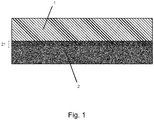
- FIG. 1 is shown in cross section (cross-section) the adhesive tape, which consists of a fabric carrier 1, on one side of which a layer of a self-adhesive coating 2 based on an acrylate dispersion is applied.
- the adhesive has been sunk to 20% in the carrier, which provides optimal anchoring while improving the hand tearability of the wearer.
- the coating was carried out on a laboratory coating system with a web width of 30 cm.
- the essential functional components of this system are the processing of the uncoated carrier bale, the applicator for the adhesive to achieve a defined wet film thickness, a floating nozzle channel dryer with four 5 m long, individually temperature-controlled temperature zones and a winder for the winding of the coated and dried product.
- the commissioned work was a doctor blade with V-profile, which was arranged radially above a co-rotating with the train coating cylinder, over which the carrier was performed (Knife-over-roll method). The distance between the fabric to be coated and the lower edge of the doctor blade was adjusted so that after drying the desired weight per unit area of the PSA according to the examples resulted.
- the wound, coated with adhesive and dried bales was made on a finishing machine by paper cut into rolls of 25 m length and 20 mm wide on 1.5 inch cardboard cores.
- the thickeners were diluted with distilled water in a ratio of 1: 1 before mixing into the acrylate dispersion (thus halving the solids content) in order to improve their homogeneous incorporation into the acrylate dispersion.
- the acrylate dispersion in the form of supply was stirred with an anchor stirrer at 200 rpm and placed in the trombe of the prediluted thickener.
- For homogenization was after addition stirred for another 10 minutes. Before coating, the mass was allowed to vent for 24 hours.
- Shear viscosity was measured with a cone-plate geometry rheometer (DSR 200N from Rheometric Scientific) at 25 ° C. A shear stress sweep of 0.1 to 4700 Pa was run at 10 measuring points per decade.
- the ground anchorage on the carrier is suitable for use if no rewinding of the PSA onto the back of the adhesive tape is observed during unrolling.
- the roll is unwound at speeds of 0.3 m / min and 30 m / min and visually inspected for adhesive residues on the back of the carrier, ie the side facing away from the adhesive. Adhesive residues are clearly visible from the black fabric.
- the tolerable measure specifies the LV312 automotive standard, according to which the unwinding force of an adhesive tape roll for the cable sheathing at a take-off speed of 30 m / min should be between 3 and 9 N / cm.
- both criteria must be marked "1".
- Table 1 lists the formulations of the dispersion adhesive formulations. The numbers indicate the thickener content in percent based on the solids. ⁇ u> Table 1 ⁇ / u> formulation Thickener name 1 2 3 4 5 Acrysol TT 615 ER 0.16 - - - - Acrysol RM-12W - 0.16 - - - Borchigel 0625 - - 0.20 - - Tafigel PUR 41 - - - - 0.05
- Table 2 shows the shear viscosities in Pa * s of example formulations 1 to 5 at shear rates of 0.01 s -1 and 100 s -1 .
- Table 2 ⁇ / u> Shear viscosities of the formulation in Pa * s shear rate 1 2 3 4 5 0.01 s -1 3000 1000 500 40 80 100 s -1 3 1.5 4 0.5 2
- Example B2 the coating gap was adjusted so that, after drying, a weight per unit area of the coating of 100 g / m 2 with a tolerance of ⁇ 3 g / m 2 resulted.
- Example B2 a two-step process variant was used: In a first step, a weight per unit area of the dried adhesive of approximately 20 g / m 2 was applied to the fabric using the air knife applicator. The fabric did not show tackiness after this coating step. The effective application was therefore zero, the entire adhesive was absorbed in the carrier.
- the precoated fabric was coated with another approximately 80 g / m 2 adhesive by the knife-over-roll method, so that after drying, a total surface weight of the coating of 100 g / m 2 with a tolerance of ⁇ 3 g / m 2 resulted.
- Table 4 shows the results of the tests on the criteria "ground anchorage on the support when unrolling" and "unwinding force”. ⁇ u> Table 4 ⁇ / u> Examples Comparative Examples B1 B2 B3 B4 V1 V2 V3 V4 Ground anchoring on the carrier when unrolling 1 1 1 1 1 1 1 1 1 unwind 1 1 1 1 0+ 0+ 0+ 0-
- Comparative examples 1 to 3 show the favorable effect of calendering compared to comparative example 4.
- the calendering leads to the desired coatability of the carrier, it is an interaction of calendering and fabric construction. Thinner or fabric constructions therefore require more intensive calendering than thick, closed carriers.
Landscapes
- Chemical & Material Sciences (AREA)
- Organic Chemistry (AREA)
- Adhesive Tapes (AREA)
- Adhesives Or Adhesive Processes (AREA)
- Laminated Bodies (AREA)
Claims (6)
- Procédé de fabrication d'une bande de bandage de câble, selon lequel un support textile est revêtu d'un côté avec une masse adhésive sensible à la pression,
la masse adhésive étant une dispersion aqueuse d'acrylate,
la viscosité sous cisaillement de la masse adhésive sensible à la pression à une température de 25 °C pendant le revêtement à partir de la dispersion étant de 200 à 100 000 Pa*s à une vitesse de cisaillement de 10-2 s-1 et de 0,1 à 10 Pa*s à une vitesse de cisaillement de 100 s-1,
des additifs de rhéologie sous la forme d'épaississants associatifs étant ajoutés à la masse adhésive sensible à la pression, la concentration de charge des épaississants associatifs étant comprise entre 0,1 et 5 % en poids, par rapport aux solides,
et
le support textile étant un tissu qui présente les caractéristiques suivantes :- le nombre de fils de chaîne se situe dans la plage allant de 30 à 60 par cm,- le nombre de fils de trame se situe dans la plage allant de 23 à 50 par cm,- le titre du fil dans la direction de la chaîne est de 40 à 180 dtex et/ou- le titre du fil dans la direction de la trame est de 100 à 400 dtex. - Procédé selon la revendication 1, caractérisé en ce que le support textile est un tissu de polyester.
- Procédé selon au moins l'une quelconque des revendications 1 et 2, caractérisé en ce que le support textile est un tissu qui est calandré à des températures dans la plage allant de 80 à 250 °C et sous une pression supérieure ou égale à 400 bar, de préférence 450 bar, ou à 170 N/mm.
- Procédé selon au moins l'une quelconque des revendications précédentes, caractérisé en ce que le support textile est un tissu, la perméabilité à l'air étant inférieure à une valeur de 200 1/m2*s selon DIN EN ISO 9237 (pression différentielle de 200 Pa pour des structures plates techniques, surface d'essai de 20 cm2), de préférence inférieure à 130 1/m2*s.
- Procédé selon la revendication 1, caractérisé en ce que la dispersion d'acrylate est fabriquée par le procédé de polymérisation en émulsion.
- Procédé selon au moins l'une quelconque des revendications précédentes, caractérisé en ce que des résines adhésives ayant un point de ramollissement supérieur à 80 °C selon ASTM E28-99 (2009), de préférence des résines à base de terpène-phénols et/ou d'esters de colophane ayant un point de ramollissement supérieur à 90 °C selon ASTM E28-99 (2009), sont utilisées en tant qu'agents collants.
Applications Claiming Priority (1)
| Application Number | Priority Date | Filing Date | Title |
|---|---|---|---|
| DE102011075160A DE102011075160A1 (de) | 2011-05-03 | 2011-05-03 | Verfahren zur Herstellung eines Klebebandes insbesondere zum Umwickeln von Kabeln aus einem offenen textilen Träger und einer darauf einseitig beschichteten Haftklebemasse |
Publications (2)
| Publication Number | Publication Date |
|---|---|
| EP2520629A1 EP2520629A1 (fr) | 2012-11-07 |
| EP2520629B1 true EP2520629B1 (fr) | 2019-06-12 |
Family
ID=46027698
Family Applications (1)
| Application Number | Title | Priority Date | Filing Date |
|---|---|---|---|
| EP12165338.0A Active EP2520629B1 (fr) | 2011-05-03 | 2012-04-24 | Procédé de fabrication d'une bande adhésive destinée à être enroulée autour de câbles et composée d'un support textile ouvert revêtu sur l'un de ses côtés par une masse auto-collante |
Country Status (6)
| Country | Link |
|---|---|
| US (1) | US20120279637A1 (fr) |
| EP (1) | EP2520629B1 (fr) |
| CN (1) | CN102766419B (fr) |
| DE (1) | DE102011075160A1 (fr) |
| ES (1) | ES2742825T3 (fr) |
| MX (1) | MX2012004764A (fr) |
Families Citing this family (54)
| Publication number | Priority date | Publication date | Assignee | Title |
|---|---|---|---|---|
| DE202012103442U1 (de) * | 2012-09-10 | 2012-09-28 | Certoplast Vorwerk & Sohn Gmbh | Klebeband, insbesondere Wickelband zur Bündelung von Kabeln in Automobilen |
| DE202012103975U1 (de) * | 2012-10-17 | 2014-02-06 | Coroplast Fritz Müller Gmbh & Co. Kg | Hoch abriebfestes technisches Klebeband mit doppellagigem Träger |
| CN102965852B (zh) * | 2012-11-22 | 2015-05-20 | 海东青非织工业(福建)有限公司 | 一种电气胶带基布用缝编非织造布及其制备方法 |
| US10858546B2 (en) | 2013-07-08 | 2020-12-08 | Coroplast Fritz Müller Gmbh & Co. Kg | Cable wrapping tape |
| EP2824153B1 (fr) * | 2013-07-08 | 2016-10-26 | Coroplast Fritz Müller GmbH & Co. KG | Bande d'enroulement de câble |
| DE102013213726A1 (de) * | 2013-07-12 | 2015-01-15 | Tesa Se | Verfahren zum Ummanteln von langgestrecktem Gut wie insbesondere Leitungen oder Kabelsätzen |
| EP3019571B2 (fr) | 2013-07-12 | 2021-11-17 | tesa SE | Procédé permettant d'envelopper un produit étendu en longueur, par exemple en particulier des fils ou des ensembles de câbles |
| DE102013223496A1 (de) | 2013-11-18 | 2015-05-21 | Tesa Se | Neuartiges Polyester geeignet zur Herstellung von Trägermaterialien für Klebebändern |
| DE102013223495A1 (de) | 2013-11-18 | 2015-05-21 | Tesa Se | Klebeband zum Ummanteln von langgestrecktem Gut wie insbesondere Kabelsätzen und Verfahren zur Ummantelung |
| DE102013223504A1 (de) | 2013-11-18 | 2015-05-21 | Tesa Se | Flammbeständige, temperaturbeständige und hydrolysebeständige Träger sowie deren Verwendung in Haftklebebändern für Automobilanwendungen |
| BE1021857B1 (nl) * | 2014-05-22 | 2016-01-22 | Lampe Textiles | Transparant weefsel met zelfklevende eigenschappen |
| DE102014223451A1 (de) | 2014-11-18 | 2016-05-19 | Tesa Se | Modifizierte Schichtsilikate zur Steuerung der Abrollkraft von Haftklebemassen und Verbesserung der Barriereeigenschaften von Klebebändern |
| DE202015100125U1 (de) * | 2015-01-13 | 2015-02-04 | Certoplast Technische Klebebänder Gmbh | Klebeband, insbesondere Wickelband |
| US11225592B2 (en) * | 2015-03-10 | 2022-01-18 | certoplast Technische Klebebaender GmbH | Method of making adhesive wrapping tape for bundling cables in cars |
| DE102016212483A1 (de) | 2016-07-08 | 2018-01-11 | Tesa Se | Gewebeklebeband |
| EP3658641B1 (fr) | 2017-07-27 | 2024-05-29 | Coroplast Fritz Müller GmbH & Co. KG | Ruban adhésif comprenant un revêtement multicouche et son procédé de production |
| DE102017219658A1 (de) * | 2017-11-06 | 2019-05-09 | Tesa Se | Verfahren zur Herstellung eines Klebebandes |
| DE102017223666B4 (de) | 2017-12-22 | 2023-02-09 | Tesa Se | Verwendung eines Gewebes für ein abriebfestes Gewebeklebeband |
| DE202018100248U1 (de) * | 2018-01-17 | 2018-01-23 | Certoplast Technische Klebebänder Gmbh | Abriebfestes Klebeband |
| DE102018204019A1 (de) * | 2018-03-16 | 2019-09-19 | Tesa Se | Klebeband zum Ummanteln von langgestrecktem Gut wie insbesondere Kabelsätzen und Verfahren zur Ummantelung |
| DE102018213969A1 (de) | 2018-08-20 | 2020-02-20 | Tesa Se | Klebeband zum Ummanteln von langgestrecktem Gut wie insbesondere Kabelsätzen und Verfahren zur Ummantelung |
| DE102019103123A1 (de) | 2019-02-08 | 2020-08-13 | Tesa Se | Thermisch erweichbares Klebeband und Verfahren zum Ummanteln von langgestrecktem Gut insbesondere Leitungen |
| DE102019103121A1 (de) | 2019-02-08 | 2020-08-13 | Tesa Se | Schrumpffolie und Verfahren zum Ummanteln von langgestrecktem Gut insbesondere Leitungen |
| DE102019103120A1 (de) | 2019-02-08 | 2020-08-13 | Tesa Se | UV-härtbares Klebeband und Verfahren zum Ummanteln von langgestrecktem Gut insbesondere Leitungen |
| DE102019103124B4 (de) | 2019-02-08 | 2022-02-03 | Tesa Se | Thermisch härtbares Klebeband, Verwendung zum Ummanteln von langgestrecktem Gut insbesondere Leitungen und Kabelstrang |
| DE102019103122A1 (de) | 2019-02-08 | 2020-08-13 | Tesa Se | Mit Feuchtigkeit härtbares Klebeband und Verfahren zum Ummanteln von langgestrecktem Gut insbesondere Leitungen |
| US20210040355A1 (en) * | 2019-08-07 | 2021-02-11 | Tesa Se | Adhesive tape for jacketing elongate items such as especially cable hamesses and method for jacketing |
| EP4010444A1 (fr) * | 2019-08-07 | 2022-06-15 | tesa SE | Ruban adhésif pour recouvrir des produits allongés, comme, en particulier, des ensembles de câbles, et procédé de recouvrement |
| DE102020208549B4 (de) | 2020-07-08 | 2022-06-15 | Tesa Se | Verfahren zur Herstellung von Klebebandtellerrollen, Klebebandtellerrollen und deren Verwendung |
| CN113928909B (zh) * | 2020-07-08 | 2024-06-25 | 德莎欧洲股份公司 | 用于制造胶带板卷的方法 |
| DE102020209289A1 (de) | 2020-07-23 | 2022-01-27 | Tesa Se | Stanzling insbesondere zum dauerhaften Verschließen von Löchern |
| EP3957695A1 (fr) | 2020-08-17 | 2022-02-23 | tesa SE | Bande adhésive permettant d'envelopper une marchandise allongée telle que, en particulier les faisceaux de câbles et procédé d'enveloppement |
| CN114316836A (zh) * | 2020-09-29 | 2022-04-12 | 德莎欧洲股份公司 | 用于包护细长物品例如特别地电缆束的胶带及包护方法 |
| US20220098448A1 (en) * | 2020-09-29 | 2022-03-31 | Tesa Se | Adhesive tape for jacketing elongate items such as especially cable harnesses and methods for jacketing |
| DE102020212233B4 (de) | 2020-09-29 | 2025-07-31 | Tesa Se | Klebeband zum Ummanteln von langgestrecktem Gut wie insbesondere Kabelsätzen und Verwendung des Klebebands zur Ummantelung |
| DE102020212530B4 (de) | 2020-10-05 | 2022-08-11 | Tesa Se | Stanzling insbesondere zum dauerhaften Verschließen von Löchern |
| CN116685653B (zh) * | 2020-12-22 | 2026-03-13 | 德莎欧洲股份公司 | 用于制造胶带的方法 |
| DE102021101908A1 (de) * | 2021-01-28 | 2022-07-28 | Dr. Ing. H.C. F. Porsche Aktiengesellschaft | Schutzdeckel einer Kraftfahrzeugkarosserie |
| DE102021201856A1 (de) | 2021-02-26 | 2022-09-01 | Tesa Se | Klebeband zum Ummanteln von langgestrecktem Gut wie insbesondere Kabelsätzen und Verfahren zur Ummantelung |
| DE102021205196A1 (de) | 2021-05-20 | 2022-11-24 | Tesa Se | Klebeband zum Ummanteln von langgestrecktem Gut wie insbesondere Kabelsätzen und Verfahren zur Ummantelung |
| WO2022253985A1 (fr) | 2021-06-04 | 2022-12-08 | Tesa Se | Ruban adhésif et procédé de recouvrement d'articles allongés, en particulier de lignes |
| DE102021210731B4 (de) | 2021-06-04 | 2025-06-18 | Tesa Se | Klebeband und Verfahren zum Ummanteln von langgestrecktem Gut insbesondere Leitungen sowie Kabelstrang |
| DE102021208046A1 (de) | 2021-07-26 | 2023-01-26 | Tesa Se | Stanzling insbesondere zum dauerhaften Verschließen von Löchern |
| DE102021210866A1 (de) | 2021-09-28 | 2023-03-30 | Tesa Se | Klebeband zum Ummanteln von langgestrecktem Gut wie insbesondere Kabelsätzen und Verfahren zur Ummantelung |
| DE102022132965A1 (de) | 2022-08-19 | 2024-02-22 | Tesa Se | Abriebfestes Klebeband mit einem textilen Träger |
| WO2024038125A1 (fr) | 2022-08-19 | 2024-02-22 | Tesa Se | Ruban adhésif résistant à l'abrasion pourvu d'un support textile |
| DE102022126654A1 (de) | 2022-10-13 | 2024-04-18 | Tesa Se | Klebeband und Verfahren zum Ummanteln von langgestrecktem Gut insbesondere Leitungen |
| DE102022127834B4 (de) | 2022-10-21 | 2025-09-04 | Tesa Se | Klebeband zum Umwickeln von langgestrecktem Gut, Verfahren zum Ummanteln, Verwendung und Langgestrecktes Gut |
| DE102023105349A1 (de) | 2023-03-03 | 2024-09-05 | Tesa Se | Verfahren zum Konfektionieren von textilen Klebebändern |
| DE102023108284A1 (de) | 2023-03-31 | 2024-10-02 | Tesa Se | Klebeband zum Ummanteln von langgestrecktem Gut wie insbesondere Kabelsätzen und Verfahren zur Ummantelung |
| CN120917114A (zh) | 2023-03-31 | 2025-11-07 | 德莎欧洲股份公司 | 用于包护细长物品例如线束的胶带和用于包护的方法 |
| WO2025249415A1 (fr) * | 2024-05-29 | 2025-12-04 | デンカ株式会社 | Ruban adhésif et faisceau de câbles |
| EP4696754A1 (fr) | 2024-08-14 | 2026-02-18 | Tesa Se | Bande adhésive pour envelopper des produits allongés, en particulier des faisceaux de câbles |
| EP4696752A1 (fr) | 2024-08-14 | 2026-02-18 | Tesa Se | Procédé pour enrober des produits allongés, en particulier des faisceaux de câbles |
Citations (3)
| Publication number | Priority date | Publication date | Assignee | Title |
|---|---|---|---|---|
| DE202007008003U1 (de) * | 2007-06-05 | 2008-10-16 | Coroplast Fritz Müller Gmbh & Co. Kg | Gewebeklebeband |
| DE202010001353U1 (de) * | 2010-01-25 | 2010-04-01 | Basf Se | Klebstoffartikel, hergestellt mit einem aus Propylheptylacrylat aufgebautem Copolymer |
| DE102009041898A1 (de) * | 2009-09-18 | 2011-04-07 | Tesa Se | Abriebfestes Gewebeklebeband |
Family Cites Families (20)
| Publication number | Priority date | Publication date | Assignee | Title |
|---|---|---|---|---|
| DE1569888A1 (de) * | 1964-01-08 | 1969-08-14 | Beiersdorf Ag | Verfahren zur Herstellung von selbstklebenden Baendern oder Blaettern |
| IL66103A0 (en) | 1981-07-27 | 1982-09-30 | Tesch G H | Mat shaped composite body and its preparation |
| DE4419169A1 (de) | 1994-06-01 | 1995-12-07 | Beiersdorf Ag | Gewebeklebeband |
| DE19846901A1 (de) | 1998-10-12 | 2000-04-13 | Beiersdorf Ag | Verfahren zur Herstellung von Klebebändern, wobei einseitig mit einer Klebmasse beschichtete Klebebänder einer strahlenchemischen Vernetzung unterworfen werdem, sowie Verwendung der Klebebänder |
| FR2797268B1 (fr) | 1999-08-02 | 2002-03-22 | Scapa Tapes France S A | Ruban adhesif sur tissu de polyester dechirable a la main |
| FR2798134B1 (fr) * | 1999-09-02 | 2002-07-05 | Scapa Tapes France S A | Ruban adhesif sur support non tisse dechirable a la main |
| DE10011788A1 (de) | 2000-03-10 | 2002-03-28 | Tesa Ag | Verwendung eines Klebebandes als Bandagierungsband für Kabel |
| DE10036805A1 (de) | 2000-07-28 | 2002-02-07 | Tesa Ag | Verfahren zur Ummantelung von langgestrecktem Gut, wie insbesondere Kabelsätzen |
| DE10042732A1 (de) | 2000-08-31 | 2002-03-28 | Tesa Ag | Verfahren zur Ummantelung von langgestrecktem Gut, wie insbesondere Kabelsätzen mit einem Klebeband |
| DE10129546A1 (de) * | 2001-06-19 | 2003-06-12 | Tesa Ag | Verwendung eines mindestens einseitig mit einer, kohäsiven Haftmasse beschichtetes Trägermaterial zum Ummanteln von langgestrecktem Gut, wie insbesondere Kabelsätzen |
| DE10149071A1 (de) | 2001-10-05 | 2003-04-17 | Tesa Ag | Verfahren zur Ummantelung von langgestrecktem Gut, wie insbesondere Kabelsätzen |
| WO2003033611A1 (fr) * | 2001-10-16 | 2003-04-24 | Certoplast Vorwerk & Sohn Gmbh | Bande adhesive a surface support lissee |
| DE10202454A1 (de) | 2002-01-22 | 2003-07-24 | Tesa Ag | Verfahren zum Ummanteln von langgestrecktem Gut, wie insbesondere Kabelsätzen, mit zwei streifenförmigen Eindeckungen, die das Gut schlauchartig umschließen |
| DE10229527A1 (de) | 2002-07-01 | 2004-01-15 | Tesa Ag | Band aus einer Reihe hintereinander und überlappend angeordneter einzelner Ummantelungsabschnitte zum Ummanteln von langgestrecktem Gut, wie insbesondere Kabelsätzen |
| DE10229733A1 (de) | 2002-07-02 | 2004-01-22 | Basf Ag | Haftklebstoffe für Träger aus Weich-PVC |
| DE10329994A1 (de) | 2003-07-02 | 2005-01-20 | Tesa Ag | Verfahren zur Ummantelung von langgestrecktem Gut, wie insbesondere Kabelsätzen, mit einem Klebeband |
| DE102005017381A1 (de) | 2005-04-14 | 2006-10-19 | Tesa Ag | Verfahren zum Ummanteln von langgestrecktem Gut, wie insbesondere Kabelsätzen, mit einer Umhüllung |
| BE1017122A5 (nl) * | 2006-05-02 | 2008-02-05 | Snailtex Com Bvba | Etiket en werkwijze voor het vervaardigen van dergelijke etiketten. |
| DE202007006816U1 (de) * | 2007-05-11 | 2008-09-18 | Coroplast Fritz Müller Gmbh & Co. Kg | Handeinreißbares Gewebe-Klebeband |
| DE102008036926A1 (de) * | 2008-08-08 | 2010-02-11 | Tesa Se | Verfahren zum Beschichten von bahnförmigen Trägermaterialien mit hohem Masseauftrag |
-
2011
- 2011-05-03 DE DE102011075160A patent/DE102011075160A1/de not_active Withdrawn
-
2012
- 2012-04-23 MX MX2012004764A patent/MX2012004764A/es not_active Application Discontinuation
- 2012-04-24 ES ES12165338T patent/ES2742825T3/es active Active
- 2012-04-24 EP EP12165338.0A patent/EP2520629B1/fr active Active
- 2012-04-26 US US13/456,613 patent/US20120279637A1/en not_active Abandoned
- 2012-05-03 CN CN201210135688.5A patent/CN102766419B/zh active Active
Patent Citations (3)
| Publication number | Priority date | Publication date | Assignee | Title |
|---|---|---|---|---|
| DE202007008003U1 (de) * | 2007-06-05 | 2008-10-16 | Coroplast Fritz Müller Gmbh & Co. Kg | Gewebeklebeband |
| DE102009041898A1 (de) * | 2009-09-18 | 2011-04-07 | Tesa Se | Abriebfestes Gewebeklebeband |
| DE202010001353U1 (de) * | 2010-01-25 | 2010-04-01 | Basf Se | Klebstoffartikel, hergestellt mit einem aus Propylheptylacrylat aufgebautem Copolymer |
Also Published As
| Publication number | Publication date |
|---|---|
| DE102011075160A1 (de) | 2012-11-08 |
| MX2012004764A (es) | 2012-11-27 |
| EP2520629A1 (fr) | 2012-11-07 |
| ES2742825T3 (es) | 2020-02-17 |
| CN102766419A (zh) | 2012-11-07 |
| US20120279637A1 (en) | 2012-11-08 |
| CN102766419B (zh) | 2016-07-13 |
Similar Documents
| Publication | Publication Date | Title |
|---|---|---|
| EP2520629B1 (fr) | Procédé de fabrication d'une bande adhésive destinée à être enroulée autour de câbles et composée d'un support textile ouvert revêtu sur l'un de ses côtés par une masse auto-collante | |
| EP2522705B1 (fr) | Utilisation d'une bande de collage destinée à l'enrobage de marchandise allongée, comme notamment des ensemble de câbles et marchandise allongée enrobée d'une bande de collage | |
| EP3433330B1 (fr) | Bande adhésive pour enrober des produits allongés, comme en particulier des ensembles de cables et procédé d' enrobage | |
| EP2520628B1 (fr) | Utilisation d'une bande de collage destinée à l'enrobage de marchandise allongée, comme notamment des ensemble de câbles et marchandise allongée enrobée de la bande de collage | |
| EP2520627B1 (fr) | Utilisation d'une bande de collage destinée à l'enrobage de marchandise allongée, comme notamment des ensemble de câbles et marchandise allongée enrobée de la bande de collage | |
| EP3540024B1 (fr) | Bande adhésive destinée au groupement d'une marchandise allongée comme, en particulier des jeux de câbles, et procédé de groupement de marchandise allongée | |
| EP3221411B1 (fr) | Phyllosilicates modifiés pour commander la force de déroulement de matières adhésives et améliorer les propriétés de barrière de bandes adhésives | |
| EP2695926A1 (fr) | Ruban adhésif réticulé par rayons électroniques destinée à l'enrobage de cables et utilisation pour l'enrobage | |
| EP2298845B1 (fr) | Ruban adhésif de tissu résistant à l'usure | |
| EP4092092B1 (fr) | Bande adhésive permettant d'envelopper une marchandise allongée telle que, en particulier les faisceaux de câbles et procédé d'enveloppement | |
| WO2018007006A1 (fr) | Ruban adhésif sur tissu | |
| DE102015217376A1 (de) | Haftklebstoff auf Basis EPDM | |
| EP2806005B1 (fr) | Masse collante à résine modifiée, pouvant être réticulée par UV | |
| DE102019211874B4 (de) | Klebeband zum Umwickeln von Kabeln und Verwendung | |
| DE102017223666B4 (de) | Verwendung eines Gewebes für ein abriebfestes Gewebeklebeband | |
| WO2021023810A1 (fr) | Ruban adhésif pour recouvrir des produits allongés, comme, en particulier, des ensembles de câbles, et procédé de recouvrement | |
| DE102020212233B4 (de) | Klebeband zum Ummanteln von langgestrecktem Gut wie insbesondere Kabelsätzen und Verwendung des Klebebands zur Ummantelung | |
| DE102019203489B3 (de) | Verwendung eines Klebebands zum Befestigen von Leitungen insbesondere auf Untergründen wie die Innenraum-Dekorteile eines Pkws, insbesondere Dachhimmel, Türseitenteil, Kofferraumdeckel | |
| WO2024038125A1 (fr) | Ruban adhésif résistant à l'abrasion pourvu d'un support textile | |
| DE102022132965A1 (de) | Abriebfestes Klebeband mit einem textilen Träger |
Legal Events
| Date | Code | Title | Description |
|---|---|---|---|
| PUAI | Public reference made under article 153(3) epc to a published international application that has entered the european phase |
Free format text: ORIGINAL CODE: 0009012 |
|
| AK | Designated contracting states |
Kind code of ref document: A1 Designated state(s): AL AT BE BG CH CY CZ DE DK EE ES FI FR GB GR HR HU IE IS IT LI LT LU LV MC MK MT NL NO PL PT RO RS SE SI SK SM TR |
|
| AX | Request for extension of the european patent |
Extension state: BA ME |
|
| 17P | Request for examination filed |
Effective date: 20130507 |
|
| RAP1 | Party data changed (applicant data changed or rights of an application transferred) |
Owner name: TESA SE |
|
| 17Q | First examination report despatched |
Effective date: 20160906 |
|
| STAA | Information on the status of an ep patent application or granted ep patent |
Free format text: STATUS: EXAMINATION IS IN PROGRESS |
|
| TPAC | Observations filed by third parties |
Free format text: ORIGINAL CODE: EPIDOSNTIPA |
|
| REG | Reference to a national code |
Ref country code: DE Ref legal event code: R079 Ref document number: 502012014887 Country of ref document: DE Free format text: PREVIOUS MAIN CLASS: C09J0007040000 Ipc: C09J0007210000 |
|
| RIC1 | Information provided on ipc code assigned before grant |
Ipc: C09J 7/21 20180101AFI20181127BHEP |
|
| GRAP | Despatch of communication of intention to grant a patent |
Free format text: ORIGINAL CODE: EPIDOSNIGR1 |
|
| STAA | Information on the status of an ep patent application or granted ep patent |
Free format text: STATUS: GRANT OF PATENT IS INTENDED |
|
| INTG | Intention to grant announced |
Effective date: 20190108 |
|
| RIC1 | Information provided on ipc code assigned before grant |
Ipc: C09J 7/21 20180101AFI20181127BHEP |
|
| GRAS | Grant fee paid |
Free format text: ORIGINAL CODE: EPIDOSNIGR3 |
|
| GRAA | (expected) grant |
Free format text: ORIGINAL CODE: 0009210 |
|
| STAA | Information on the status of an ep patent application or granted ep patent |
Free format text: STATUS: THE PATENT HAS BEEN GRANTED |
|
| AK | Designated contracting states |
Kind code of ref document: B1 Designated state(s): AL AT BE BG CH CY CZ DE DK EE ES FI FR GB GR HR HU IE IS IT LI LT LU LV MC MK MT NL NO PL PT RO RS SE SI SK SM TR |
|
| REG | Reference to a national code |
Ref country code: GB Ref legal event code: FG4D Free format text: NOT ENGLISH |
|
| REG | Reference to a national code |
Ref country code: CH Ref legal event code: EP |
|
| REG | Reference to a national code |
Ref country code: AT Ref legal event code: REF Ref document number: 1142518 Country of ref document: AT Kind code of ref document: T Effective date: 20190615 |
|
| REG | Reference to a national code |
Ref country code: DE Ref legal event code: R096 Ref document number: 502012014887 Country of ref document: DE |
|
| REG | Reference to a national code |
Ref country code: IE Ref legal event code: FG4D Free format text: LANGUAGE OF EP DOCUMENT: GERMAN |
|
| REG | Reference to a national code |
Ref country code: NL Ref legal event code: MP Effective date: 20190612 |
|
| REG | Reference to a national code |
Ref country code: LT Ref legal event code: MG4D |
|
| PG25 | Lapsed in a contracting state [announced via postgrant information from national office to epo] |
Ref country code: NO Free format text: LAPSE BECAUSE OF FAILURE TO SUBMIT A TRANSLATION OF THE DESCRIPTION OR TO PAY THE FEE WITHIN THE PRESCRIBED TIME-LIMIT Effective date: 20190912 Ref country code: FI Free format text: LAPSE BECAUSE OF FAILURE TO SUBMIT A TRANSLATION OF THE DESCRIPTION OR TO PAY THE FEE WITHIN THE PRESCRIBED TIME-LIMIT Effective date: 20190612 Ref country code: HR Free format text: LAPSE BECAUSE OF FAILURE TO SUBMIT A TRANSLATION OF THE DESCRIPTION OR TO PAY THE FEE WITHIN THE PRESCRIBED TIME-LIMIT Effective date: 20190612 Ref country code: LT Free format text: LAPSE BECAUSE OF FAILURE TO SUBMIT A TRANSLATION OF THE DESCRIPTION OR TO PAY THE FEE WITHIN THE PRESCRIBED TIME-LIMIT Effective date: 20190612 Ref country code: SE Free format text: LAPSE BECAUSE OF FAILURE TO SUBMIT A TRANSLATION OF THE DESCRIPTION OR TO PAY THE FEE WITHIN THE PRESCRIBED TIME-LIMIT Effective date: 20190612 Ref country code: AL Free format text: LAPSE BECAUSE OF FAILURE TO SUBMIT A TRANSLATION OF THE DESCRIPTION OR TO PAY THE FEE WITHIN THE PRESCRIBED TIME-LIMIT Effective date: 20190612 |
|
| PG25 | Lapsed in a contracting state [announced via postgrant information from national office to epo] |
Ref country code: GR Free format text: LAPSE BECAUSE OF FAILURE TO SUBMIT A TRANSLATION OF THE DESCRIPTION OR TO PAY THE FEE WITHIN THE PRESCRIBED TIME-LIMIT Effective date: 20190913 Ref country code: BG Free format text: LAPSE BECAUSE OF FAILURE TO SUBMIT A TRANSLATION OF THE DESCRIPTION OR TO PAY THE FEE WITHIN THE PRESCRIBED TIME-LIMIT Effective date: 20190912 Ref country code: LV Free format text: LAPSE BECAUSE OF FAILURE TO SUBMIT A TRANSLATION OF THE DESCRIPTION OR TO PAY THE FEE WITHIN THE PRESCRIBED TIME-LIMIT Effective date: 20190612 Ref country code: RS Free format text: LAPSE BECAUSE OF FAILURE TO SUBMIT A TRANSLATION OF THE DESCRIPTION OR TO PAY THE FEE WITHIN THE PRESCRIBED TIME-LIMIT Effective date: 20190612 |
|
| PG25 | Lapsed in a contracting state [announced via postgrant information from national office to epo] |
Ref country code: SK Free format text: LAPSE BECAUSE OF FAILURE TO SUBMIT A TRANSLATION OF THE DESCRIPTION OR TO PAY THE FEE WITHIN THE PRESCRIBED TIME-LIMIT Effective date: 20190612 Ref country code: PT Free format text: LAPSE BECAUSE OF FAILURE TO SUBMIT A TRANSLATION OF THE DESCRIPTION OR TO PAY THE FEE WITHIN THE PRESCRIBED TIME-LIMIT Effective date: 20191014 Ref country code: EE Free format text: LAPSE BECAUSE OF FAILURE TO SUBMIT A TRANSLATION OF THE DESCRIPTION OR TO PAY THE FEE WITHIN THE PRESCRIBED TIME-LIMIT Effective date: 20190612 Ref country code: CZ Free format text: LAPSE BECAUSE OF FAILURE TO SUBMIT A TRANSLATION OF THE DESCRIPTION OR TO PAY THE FEE WITHIN THE PRESCRIBED TIME-LIMIT Effective date: 20190612 Ref country code: NL Free format text: LAPSE BECAUSE OF FAILURE TO SUBMIT A TRANSLATION OF THE DESCRIPTION OR TO PAY THE FEE WITHIN THE PRESCRIBED TIME-LIMIT Effective date: 20190612 Ref country code: RO Free format text: LAPSE BECAUSE OF FAILURE TO SUBMIT A TRANSLATION OF THE DESCRIPTION OR TO PAY THE FEE WITHIN THE PRESCRIBED TIME-LIMIT Effective date: 20190612 |
|
| REG | Reference to a national code |
Ref country code: ES Ref legal event code: FG2A Ref document number: 2742825 Country of ref document: ES Kind code of ref document: T3 Effective date: 20200217 |
|
| PG25 | Lapsed in a contracting state [announced via postgrant information from national office to epo] |
Ref country code: IS Free format text: LAPSE BECAUSE OF FAILURE TO SUBMIT A TRANSLATION OF THE DESCRIPTION OR TO PAY THE FEE WITHIN THE PRESCRIBED TIME-LIMIT Effective date: 20191012 Ref country code: SM Free format text: LAPSE BECAUSE OF FAILURE TO SUBMIT A TRANSLATION OF THE DESCRIPTION OR TO PAY THE FEE WITHIN THE PRESCRIBED TIME-LIMIT Effective date: 20190612 Ref country code: IT Free format text: LAPSE BECAUSE OF FAILURE TO SUBMIT A TRANSLATION OF THE DESCRIPTION OR TO PAY THE FEE WITHIN THE PRESCRIBED TIME-LIMIT Effective date: 20190612 |
|
| REG | Reference to a national code |
Ref country code: DE Ref legal event code: R097 Ref document number: 502012014887 Country of ref document: DE |
|
| PG25 | Lapsed in a contracting state [announced via postgrant information from national office to epo] |
Ref country code: TR Free format text: LAPSE BECAUSE OF FAILURE TO SUBMIT A TRANSLATION OF THE DESCRIPTION OR TO PAY THE FEE WITHIN THE PRESCRIBED TIME-LIMIT Effective date: 20190612 |
|
| PLBE | No opposition filed within time limit |
Free format text: ORIGINAL CODE: 0009261 |
|
| STAA | Information on the status of an ep patent application or granted ep patent |
Free format text: STATUS: NO OPPOSITION FILED WITHIN TIME LIMIT |
|
| PG25 | Lapsed in a contracting state [announced via postgrant information from national office to epo] |
Ref country code: PL Free format text: LAPSE BECAUSE OF FAILURE TO SUBMIT A TRANSLATION OF THE DESCRIPTION OR TO PAY THE FEE WITHIN THE PRESCRIBED TIME-LIMIT Effective date: 20190612 Ref country code: DK Free format text: LAPSE BECAUSE OF FAILURE TO SUBMIT A TRANSLATION OF THE DESCRIPTION OR TO PAY THE FEE WITHIN THE PRESCRIBED TIME-LIMIT Effective date: 20190612 |
|
| 26N | No opposition filed |
Effective date: 20200313 |
|
| PG25 | Lapsed in a contracting state [announced via postgrant information from national office to epo] |
Ref country code: IS Free format text: LAPSE BECAUSE OF FAILURE TO SUBMIT A TRANSLATION OF THE DESCRIPTION OR TO PAY THE FEE WITHIN THE PRESCRIBED TIME-LIMIT Effective date: 20200224 Ref country code: SI Free format text: LAPSE BECAUSE OF FAILURE TO SUBMIT A TRANSLATION OF THE DESCRIPTION OR TO PAY THE FEE WITHIN THE PRESCRIBED TIME-LIMIT Effective date: 20190612 |
|
| PG2D | Information on lapse in contracting state deleted |
Ref country code: IS |
|
| PG25 | Lapsed in a contracting state [announced via postgrant information from national office to epo] |
Ref country code: MC Free format text: LAPSE BECAUSE OF FAILURE TO SUBMIT A TRANSLATION OF THE DESCRIPTION OR TO PAY THE FEE WITHIN THE PRESCRIBED TIME-LIMIT Effective date: 20190612 |
|
| REG | Reference to a national code |
Ref country code: CH Ref legal event code: PL |
|
| PG25 | Lapsed in a contracting state [announced via postgrant information from national office to epo] |
Ref country code: LU Free format text: LAPSE BECAUSE OF NON-PAYMENT OF DUE FEES Effective date: 20200424 Ref country code: CH Free format text: LAPSE BECAUSE OF NON-PAYMENT OF DUE FEES Effective date: 20200430 Ref country code: LI Free format text: LAPSE BECAUSE OF NON-PAYMENT OF DUE FEES Effective date: 20200430 |
|
| REG | Reference to a national code |
Ref country code: BE Ref legal event code: MM Effective date: 20200430 |
|
| PG25 | Lapsed in a contracting state [announced via postgrant information from national office to epo] |
Ref country code: BE Free format text: LAPSE BECAUSE OF NON-PAYMENT OF DUE FEES Effective date: 20200430 |
|
| PG25 | Lapsed in a contracting state [announced via postgrant information from national office to epo] |
Ref country code: IE Free format text: LAPSE BECAUSE OF NON-PAYMENT OF DUE FEES Effective date: 20200424 |
|
| REG | Reference to a national code |
Ref country code: AT Ref legal event code: MM01 Ref document number: 1142518 Country of ref document: AT Kind code of ref document: T Effective date: 20200424 |
|
| PG25 | Lapsed in a contracting state [announced via postgrant information from national office to epo] |
Ref country code: AT Free format text: LAPSE BECAUSE OF NON-PAYMENT OF DUE FEES Effective date: 20200424 |
|
| PG25 | Lapsed in a contracting state [announced via postgrant information from national office to epo] |
Ref country code: MT Free format text: LAPSE BECAUSE OF FAILURE TO SUBMIT A TRANSLATION OF THE DESCRIPTION OR TO PAY THE FEE WITHIN THE PRESCRIBED TIME-LIMIT Effective date: 20190612 Ref country code: CY Free format text: LAPSE BECAUSE OF FAILURE TO SUBMIT A TRANSLATION OF THE DESCRIPTION OR TO PAY THE FEE WITHIN THE PRESCRIBED TIME-LIMIT Effective date: 20190612 |
|
| PG25 | Lapsed in a contracting state [announced via postgrant information from national office to epo] |
Ref country code: MK Free format text: LAPSE BECAUSE OF FAILURE TO SUBMIT A TRANSLATION OF THE DESCRIPTION OR TO PAY THE FEE WITHIN THE PRESCRIBED TIME-LIMIT Effective date: 20190612 |
|
| PGFP | Annual fee paid to national office [announced via postgrant information from national office to epo] |
Ref country code: GB Payment date: 20220425 Year of fee payment: 11 Ref country code: ES Payment date: 20220629 Year of fee payment: 11 |
|
| GBPC | Gb: european patent ceased through non-payment of renewal fee |
Effective date: 20230424 |
|
| PG25 | Lapsed in a contracting state [announced via postgrant information from national office to epo] |
Ref country code: GB Free format text: LAPSE BECAUSE OF NON-PAYMENT OF DUE FEES Effective date: 20230424 |
|
| PG25 | Lapsed in a contracting state [announced via postgrant information from national office to epo] |
Ref country code: GB Free format text: LAPSE BECAUSE OF NON-PAYMENT OF DUE FEES Effective date: 20230424 |
|
| REG | Reference to a national code |
Ref country code: ES Ref legal event code: FD2A Effective date: 20240604 |
|
| PG25 | Lapsed in a contracting state [announced via postgrant information from national office to epo] |
Ref country code: ES Free format text: LAPSE BECAUSE OF NON-PAYMENT OF DUE FEES Effective date: 20230425 |
|
| PG25 | Lapsed in a contracting state [announced via postgrant information from national office to epo] |
Ref country code: ES Free format text: LAPSE BECAUSE OF NON-PAYMENT OF DUE FEES Effective date: 20230425 |
|
| PGFP | Annual fee paid to national office [announced via postgrant information from national office to epo] |
Ref country code: DE Payment date: 20250422 Year of fee payment: 14 |
|
| PGFP | Annual fee paid to national office [announced via postgrant information from national office to epo] |
Ref country code: FR Payment date: 20250425 Year of fee payment: 14 |