EP2520930A1 - Procédé et dispositif pour mesurer la teneur en eau d'un composé contenant du fluorure d'hydrogène - Google Patents
Procédé et dispositif pour mesurer la teneur en eau d'un composé contenant du fluorure d'hydrogène Download PDFInfo
- Publication number
- EP2520930A1 EP2520930A1 EP11750496A EP11750496A EP2520930A1 EP 2520930 A1 EP2520930 A1 EP 2520930A1 EP 11750496 A EP11750496 A EP 11750496A EP 11750496 A EP11750496 A EP 11750496A EP 2520930 A1 EP2520930 A1 EP 2520930A1
- Authority
- EP
- European Patent Office
- Prior art keywords
- water content
- hydrogen fluoride
- thermal decomposition
- containing compound
- content measurement
- Prior art date
- Legal status (The legal status is an assumption and is not a legal conclusion. Google has not performed a legal analysis and makes no representation as to the accuracy of the status listed.)
- Withdrawn
Links
- XLYOFNOQVPJJNP-UHFFFAOYSA-N water Substances O XLYOFNOQVPJJNP-UHFFFAOYSA-N 0.000 title claims abstract description 261
- KRHYYFGTRYWZRS-UHFFFAOYSA-N Fluorane Chemical compound F KRHYYFGTRYWZRS-UHFFFAOYSA-N 0.000 title claims abstract description 119
- 229910000040 hydrogen fluoride Inorganic materials 0.000 title claims abstract description 117
- 150000001875 compounds Chemical class 0.000 title claims abstract description 73
- 238000000034 method Methods 0.000 title claims description 43
- 238000005979 thermal decomposition reaction Methods 0.000 claims abstract description 148
- 239000007789 gas Substances 0.000 claims abstract description 110
- 238000011002 quantification Methods 0.000 claims abstract description 29
- 238000000691 measurement method Methods 0.000 claims abstract description 19
- 238000005259 measurement Methods 0.000 claims description 139
- 238000001816 cooling Methods 0.000 claims description 53
- 238000010438 heat treatment Methods 0.000 claims description 42
- 238000006386 neutralization reaction Methods 0.000 claims description 42
- 238000006243 chemical reaction Methods 0.000 claims description 21
- 239000007788 liquid Substances 0.000 claims description 15
- 239000000159 acid neutralizing agent Substances 0.000 claims description 6
- 238000009530 blood pressure measurement Methods 0.000 claims description 4
- 230000003472 neutralizing effect Effects 0.000 claims description 3
- 238000000354 decomposition reaction Methods 0.000 description 16
- ZMANZCXQSJIPKH-UHFFFAOYSA-N Triethylamine Chemical compound CCN(CC)CC ZMANZCXQSJIPKH-UHFFFAOYSA-N 0.000 description 15
- QFLWZFQWSBQYPS-AWRAUJHKSA-N (3S)-3-[[(2S)-2-[[(2S)-2-[5-[(3aS,6aR)-2-oxo-1,3,3a,4,6,6a-hexahydrothieno[3,4-d]imidazol-4-yl]pentanoylamino]-3-methylbutanoyl]amino]-3-(4-hydroxyphenyl)propanoyl]amino]-4-[1-bis(4-chlorophenoxy)phosphorylbutylamino]-4-oxobutanoic acid Chemical compound CCCC(NC(=O)[C@H](CC(O)=O)NC(=O)[C@H](Cc1ccc(O)cc1)NC(=O)[C@@H](NC(=O)CCCCC1SC[C@@H]2NC(=O)N[C@H]12)C(C)C)P(=O)(Oc1ccc(Cl)cc1)Oc1ccc(Cl)cc1 QFLWZFQWSBQYPS-AWRAUJHKSA-N 0.000 description 14
- PXHVJJICTQNCMI-UHFFFAOYSA-N Nickel Chemical compound [Ni] PXHVJJICTQNCMI-UHFFFAOYSA-N 0.000 description 14
- 238000012360 testing method Methods 0.000 description 13
- JUJWROOIHBZHMG-UHFFFAOYSA-N Pyridine Chemical compound C1=CC=NC=C1 JUJWROOIHBZHMG-UHFFFAOYSA-N 0.000 description 12
- 239000007787 solid Substances 0.000 description 9
- 229910052759 nickel Inorganic materials 0.000 description 7
- 150000007530 organic bases Chemical class 0.000 description 6
- BASFCYQUMIYNBI-UHFFFAOYSA-N platinum Chemical compound [Pt] BASFCYQUMIYNBI-UHFFFAOYSA-N 0.000 description 6
- UMJSCPRVCHMLSP-UHFFFAOYSA-N pyridine Natural products COC1=CC=CN=C1 UMJSCPRVCHMLSP-UHFFFAOYSA-N 0.000 description 6
- IJGRMHOSHXDMSA-UHFFFAOYSA-N Atomic nitrogen Chemical compound N#N IJGRMHOSHXDMSA-UHFFFAOYSA-N 0.000 description 5
- 150000001412 amines Chemical class 0.000 description 5
- OKKJLVBELUTLKV-UHFFFAOYSA-N Methanol Chemical compound OC OKKJLVBELUTLKV-UHFFFAOYSA-N 0.000 description 4
- 238000010521 absorption reaction Methods 0.000 description 4
- 238000009835 boiling Methods 0.000 description 4
- 238000007710 freezing Methods 0.000 description 4
- 230000008014 freezing Effects 0.000 description 4
- 229910052740 iodine Inorganic materials 0.000 description 4
- 239000011630 iodine Substances 0.000 description 4
- 238000002844 melting Methods 0.000 description 4
- 230000008018 melting Effects 0.000 description 4
- 239000002808 molecular sieve Substances 0.000 description 4
- 239000012071 phase Substances 0.000 description 4
- URGAHOPLAPQHLN-UHFFFAOYSA-N sodium aluminosilicate Chemical compound [Na+].[Al+3].[O-][Si]([O-])=O.[O-][Si]([O-])=O URGAHOPLAPQHLN-UHFFFAOYSA-N 0.000 description 4
- GETQZCLCWQTVFV-UHFFFAOYSA-N trimethylamine Chemical compound CN(C)C GETQZCLCWQTVFV-UHFFFAOYSA-N 0.000 description 4
- ZCYVEMRRCGMTRW-UHFFFAOYSA-N 7553-56-2 Chemical compound [I] ZCYVEMRRCGMTRW-UHFFFAOYSA-N 0.000 description 3
- 238000001159 Fisher's combined probability test Methods 0.000 description 3
- 229910000792 Monel Inorganic materials 0.000 description 3
- LDDQLRUQCUTJBB-UHFFFAOYSA-N ammonium fluoride Chemical compound [NH4+].[F-] LDDQLRUQCUTJBB-UHFFFAOYSA-N 0.000 description 3
- 229910001873 dinitrogen Inorganic materials 0.000 description 3
- 238000005868 electrolysis reaction Methods 0.000 description 3
- 229910052697 platinum Inorganic materials 0.000 description 3
- 230000008016 vaporization Effects 0.000 description 3
- DRGAZIDRYFYHIJ-UHFFFAOYSA-N 2,2':6',2''-terpyridine Chemical compound N1=CC=CC=C1C1=CC=CC(C=2N=CC=CC=2)=N1 DRGAZIDRYFYHIJ-UHFFFAOYSA-N 0.000 description 2
- ROFVEXUMMXZLPA-UHFFFAOYSA-N Bipyridyl Chemical compound N1=CC=CC=C1C1=CC=CC=N1 ROFVEXUMMXZLPA-UHFFFAOYSA-N 0.000 description 2
- PNEYBMLMFCGWSK-UHFFFAOYSA-N aluminium oxide Inorganic materials [O-2].[O-2].[O-2].[Al+3].[Al+3] PNEYBMLMFCGWSK-UHFFFAOYSA-N 0.000 description 2
- 239000012159 carrier gas Substances 0.000 description 2
- 239000003795 chemical substances by application Substances 0.000 description 2
- 230000000052 comparative effect Effects 0.000 description 2
- 238000007872 degassing Methods 0.000 description 2
- 238000001514 detection method Methods 0.000 description 2
- 238000001704 evaporation Methods 0.000 description 2
- 239000000463 material Substances 0.000 description 2
- 238000002156 mixing Methods 0.000 description 2
- 239000007790 solid phase Substances 0.000 description 2
- 239000000243 solution Substances 0.000 description 2
- 229910001220 stainless steel Inorganic materials 0.000 description 2
- 239000010935 stainless steel Substances 0.000 description 2
- UXVMQQNJUSDDNG-UHFFFAOYSA-L Calcium chloride Chemical compound [Cl-].[Cl-].[Ca+2] UXVMQQNJUSDDNG-UHFFFAOYSA-L 0.000 description 1
- LFQSCWFLJHTTHZ-UHFFFAOYSA-N Ethanol Chemical compound CCO LFQSCWFLJHTTHZ-UHFFFAOYSA-N 0.000 description 1
- UFHFLCQGNIYNRP-UHFFFAOYSA-N Hydrogen Chemical compound [H][H] UFHFLCQGNIYNRP-UHFFFAOYSA-N 0.000 description 1
- VYPSYNLAJGMNEJ-UHFFFAOYSA-N Silicium dioxide Chemical compound O=[Si]=O VYPSYNLAJGMNEJ-UHFFFAOYSA-N 0.000 description 1
- 239000006096 absorbing agent Substances 0.000 description 1
- 239000001110 calcium chloride Substances 0.000 description 1
- 229910001628 calcium chloride Inorganic materials 0.000 description 1
- 239000002826 coolant Substances 0.000 description 1
- 238000001035 drying Methods 0.000 description 1
- 230000000694 effects Effects 0.000 description 1
- 230000005611 electricity Effects 0.000 description 1
- 239000008151 electrolyte solution Substances 0.000 description 1
- 238000003682 fluorination reaction Methods 0.000 description 1
- XLYOFNOQVPJJNP-ZSJDYOACSA-N heavy water Substances [2H]O[2H] XLYOFNOQVPJJNP-ZSJDYOACSA-N 0.000 description 1
- 239000001257 hydrogen Substances 0.000 description 1
- 229910052739 hydrogen Inorganic materials 0.000 description 1
- 239000012535 impurity Substances 0.000 description 1
- 239000011261 inert gas Substances 0.000 description 1
- -1 iodine ions Chemical class 0.000 description 1
- 238000012986 modification Methods 0.000 description 1
- 230000004048 modification Effects 0.000 description 1
- 229910052757 nitrogen Inorganic materials 0.000 description 1
- 230000008520 organization Effects 0.000 description 1
- 150000003222 pyridines Chemical class 0.000 description 1
- 238000011160 research Methods 0.000 description 1
- 150000003839 salts Chemical class 0.000 description 1
- 239000000741 silica gel Substances 0.000 description 1
- 229910002027 silica gel Inorganic materials 0.000 description 1
- 239000011343 solid material Substances 0.000 description 1
- 238000001179 sorption measurement Methods 0.000 description 1
- 238000011144 upstream manufacturing Methods 0.000 description 1
- 238000009834 vaporization Methods 0.000 description 1
Images

Classifications
-
- G—PHYSICS
- G01—MEASURING; TESTING
- G01N—INVESTIGATING OR ANALYSING MATERIALS BY DETERMINING THEIR CHEMICAL OR PHYSICAL PROPERTIES
- G01N31/00—Investigating or analysing non-biological materials by the use of the chemical methods specified in the subgroup; Apparatus specially adapted for such methods
- G01N31/12—Investigating or analysing non-biological materials by the use of the chemical methods specified in the subgroup; Apparatus specially adapted for such methods using combustion
-
- G—PHYSICS
- G01—MEASURING; TESTING
- G01N—INVESTIGATING OR ANALYSING MATERIALS BY DETERMINING THEIR CHEMICAL OR PHYSICAL PROPERTIES
- G01N31/00—Investigating or analysing non-biological materials by the use of the chemical methods specified in the subgroup; Apparatus specially adapted for such methods
- G01N31/005—Investigating or analysing non-biological materials by the use of the chemical methods specified in the subgroup; Apparatus specially adapted for such methods investigating the presence of an element by oxidation
- G01N31/007—Investigating or analysing non-biological materials by the use of the chemical methods specified in the subgroup; Apparatus specially adapted for such methods investigating the presence of an element by oxidation by measuring the quantity of water resulting therefrom
-
- G—PHYSICS
- G01—MEASURING; TESTING
- G01N—INVESTIGATING OR ANALYSING MATERIALS BY DETERMINING THEIR CHEMICAL OR PHYSICAL PROPERTIES
- G01N25/00—Investigating or analyzing materials by the use of thermal means
- G01N25/56—Investigating or analyzing materials by the use of thermal means by investigating moisture content
-
- G—PHYSICS
- G01—MEASURING; TESTING
- G01N—INVESTIGATING OR ANALYSING MATERIALS BY DETERMINING THEIR CHEMICAL OR PHYSICAL PROPERTIES
- G01N31/00—Investigating or analysing non-biological materials by the use of the chemical methods specified in the subgroup; Apparatus specially adapted for such methods
Definitions
- the water content of a hydrogen fluoride-containing compound of the general formula: XF ⁇ n HF (where X is either one of K, NH 4 , Na and Li; and n is a rational number greater than 0) is determined by causing thermal decomposition of the hydrogen fluoride-containing compound and quantifying the water content of a thermal decomposition gas generated by the thermal decomposition.
- the heating temperature is preferably set higher than or equal to the boiling point of water or the decomposition temperature of the hydrogen fluoride-containing compound in order to completely evaporate water contained in the hydrogen fluoride-containing compound.
- the heating temperature is preferably higher than or equal to 220°C, that is, the decomposition temperature of KF ⁇ HF.
- the heating temperature is preferably higher than or equal to 270°C, that is, the decomposition temperature of NaF ⁇ HF.
- the heating temperature is preferably higher than or equal to 150°C, that is, the decomposition temperature of NH 4 F ⁇ HF.
- the heating temperature is preferably higher than or equal to 20°C, that is, the decomposition temperature of LiF ⁇ HF. If the heating temperature is at about the decomposition temperature, there is a possibility that the decomposition efficiency may deteriorate due to a low decomposition rate. If the heating temperature is too high, there is a possibility of damage to a reaction vessel in which the thermal decomposition take places.
- the heating temperature is set to within the range of 400 to 500°C in the case where X is either one of K, Na and Li in the general formula: XF ⁇ n HF and to within the range of 200 to 300°C in the case where X is NH 4 in the general formula: XF ⁇ n HF.
- the thermal decomposition gas In order to liquefy the thermal decomposition gas by cooling, it is necessary to cool the thermal decomposition gas at a temperature lower than or equal to the melting point (19°C) of hydrogen fluoride that is a main component of the thermal decomposition gas.
- the hydrogen fluoride-containing compound is thermally decomposed into a solid phase and a gas phase (i.e. in the case where X is either one of K, Na and Li in the general formula: XF ⁇ n HF)
- X is either one of K, Na and Li in the general formula: XF ⁇ n HF
- the gas phase product may be extracted and separated by the use of an inert gas as a carrier gas. In this case, however, the carrier gas of controlled water content needs to be used or accurate water content quantification.
- the thermal decomposition gas is preferably cooled at a temperature lower than or equal to the freezing point (-84°C) of hydrogen fluoride and thereby collected in solid form in terms of collection efficiency due to the fact that hydrogen fluoride in liquid form has a vapor pressure.
- the thermal decomposition gas is collected in solid form, the thermal decomposition gasis brought into liquid form by heating at a temperature lower than or equal to the melting point (19°C) of hydrogen fluoride.
- the thermal decomposition gas is preferably liquefied by the above process.
- the thus-obtained water content measurement result is converted to the water content of the hydrogen fluoride-containing compound, by multiplying the water content measurement result by a difference between the mass of the hydrogen fluoride-containing compound used for the water content measurement and the mass of the solid remaining after the removal of the thermal decomposition gas generated by the thermal decomposition, as indicated in the following conversion formula (1).
- an organic base is used as the base in the neutralization.
- the organic base are amines such as trimethylamine, triethylamine, pyridine, bipyridine and tripyridine.
- the amount of the amine used is preferably 1 mole equivalent or more based on the total amount of the thermal decomposition gas. If the amount of the amine is less than 1 mole equivalent, there is a possibility of an error in the subsequent water content measurement due to insufficient neutralization of the thermal decomposition gas.
- the melting point of the hydrogen fluoride-containing compound is at the same level as that of hydrogen fluoride so that the hydrogen fluoride-containing compound can be handled in liquid form as in the case of hydrogen fluoride.
- the water content of the hydrogen fluoride-containing compound could conceivably be quantified by direct electric conductivity measurement without causing thermal decomposition.
- the accurate water content quantification of the hydrogen fluoride-containing compound is, however, difficult in the presence of the XF component. It is possible according to the present invention to separate the XF component by the thermal decomposition and accurately quantify the water content even by the water content measurement method based on the electric conductivity measurement.
- the water content of the hydrogen fluoride-containing compound could also conceivably be quantified by the Karl Fischer method after neutralizing the hydrogen fluoride-containing compound without causing thermal decomposition.
- the accurate water content quantification of the hydrogen fluoride-containing compound is difficult because the XF component remains undissolved after the neutralization. It is possible according to the present invention to separate the XF component by the thermal decomposition in the present invention and accurately quantify the water content even by the Karl Fischer method.
- the water content of the hydrogen fluoride-containing compound could conceivably directly be quantified without thermal decomposition.
- the accurate water content quantification of the hydrogen fluoride-containing compound is also difficult in the presence of the XF component. It is possible according to the present invention to separate the XF component by the thermal decomposition and accurately quantify the water content even by any method other than the electric conductivity measurement and the Karl Fischer method.
- the water content measurement device 100 includes: an introduction line 22 equipped with a valve; a thermal decomposition unit 12 for generating the thermal decomposition gas by thermal decomposition of the hydrogen fluoride-containing compound introduced through the introduction line 22; an introduction line 8 arranged to introduce the thermal decomposition gas from the thermal decomposition unit 12; a cooling trap 13 for collecting the thermal decomposition gas introduced through the introduction line 8 by cooling at the temperature lower than or equal to the freezing point (-84°C) of hydrogen fluoride, and then, vaporizing the collected thermal decomposition gas by heating at the temperature higher than or equal to the melting point (19°C) of hydrogen fluoride; an introduction line 18 arranged to introduce the vaporized thermal decomposition gas from the cooling trap 13; and water content measurement means 20 for measuring the water content of the thermal decomposition gas introduced through the introduction line 18.
- the hydrogen fluoride-containing compound is sampled and stored into the thermal decomposition unit 12.
- the thermal decomposition unit 12 has a heater 9 for heating the hydrogen fluoride-containing compound.
- the material of the thermal decomposition unit 12 it is preferable to use Monel metal, nickel, platinum, alumina or the like that does not react with hydrogen fluoride in the generated thermal decomposition gas. Among others, Monel metal or nickel is particularly preferably used.
- the cooling trap 13 has a cooler 10 for cooling the thermal decomposition gas.
- the cooler 10 can be of any type as long as it is capable of cooling the thermal decomposition gas to the temperature lower than or equal to the freezing point (-84°C) of hydrogen fluoride during the collection.
- the hydrogen fluoride-containing compound taken as a sample for measurement, is introduced and stored into the thermal decomposition unit 12 through the introduction line 22 upon opening of the valve after the device system pressure is reduced to 0.1 kPa under gas replacement by the action of the vacuum pump and the nitrogen gas feeding line.
- the valve on the introduction line 22 and the valves 1, 2, 5 and 6 are closed; and the valves 3 and 4 are opened. In this state, the thermal decomposition unit 12 is heated by the heater 9.
- the heating temperature is set to within the range of 400 to 500°C in the case where X is either one of K, Na and Li in the general formula: XF ⁇ n HF and to within the range of 200 to 300°C in the case where X is NH 4 in the general formula: XF ⁇ n HF.
- the thermal decomposition gas is introduced into the cooling trap 13 through the introduction line 8 and collected in the cooling trap 8 by cooling at the temperature lower than or equal to the freezing point (84°C) of hydrogen fluoride.
- the valves 3 and 4 are closed. The heating operation of the thermal decomposition unit 12 is then stopped.
- the cooling operation of the cooling trap 13 is stopped.
- the temperature of the cooling trap 13 is raised so that the collected gas is brought into liquid or gas form.
- the collected gas is taken out of the cooling trap 13 upon opening of the valves 5 and 17, and then, introduced into the water content measurement means 20 through the introduction line 18.
- the water content of the collected gas is measured by the water content measurement means 20.
- the thus-obtained water content measurement result of the water content measurement means 20 is converted to the water content of the hydrogen fluoride-containing compound. In this way, the water content of the hydrogen fluoride-containing compound is quantified.
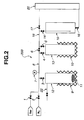
- a water content measurement method and device for the hydrogen fluoride-containing compound according to a second embodiment of the present invention will be described below in detail with reference to FIG. 2 .
- the water content measurement device 200 of the second embodiment is structured to cause thermal decomposition of the hydrogen fluoride-containing compound, collect by cooling the resulting thermal decomposition gas, neutralize the collected thermal decomposition gas and quantify the water content of the thermal decomposition gas.
- the same parts of the water content measurement device 200 as those of the water content measurement device 100 are designated by the same reference numerals so as to omit explanations thereof for simplicity. The different parts of the water content measurement device 200 will be explained below.
- the introduction line 18 is branched at a position upstream of the valve 17.
- the water content measurement device 20 has a neutralization chamber 19 connected to the branched part of the introduction line 18 via a valve 14 and connected to the water content measurement means 20 via a valve 16 so as to freely select whether the gas is fed from the introduction line 18 into the water content measurement means 20 through or not through the neutralization chamber 19 by combination of open/close states of the valves 14 and 16.
- the neutralization chamber 19 is filled with a neutralization agent so as to neutralize the hydrogen fluoride with the neutralization agent.
- the valve 14 is mounted to an inlet of the neutralization chamber 19 through which the vaporized gas is introduced from the cooling trap 13, whereas the valve 16 is mounted to an outlet of the neutralization chamber 19 through which the neutralized gas is discharged.
- a base is used as the neutralization agent.
- the base used is preferably an organic base. Among various organic bases, amines such as trimethylamine, triethylamine, pyridine, bipyridine and tripyridine are particularly preferred.
- the introduction line 18 may be directly connected to the valve 14 without being branched. In this case, the introduction line 18 would not be directly connected to the water content measurement means 20.
- the water content measurement means 20 can be provided as equipment capable of water content measurement by electric conductivity measurement or by Karl Fisher method. In the case of using equipment for water content measurement by Karl Fisher method, it is preferable to introduce the neutralization product from the neutralization chamber 19 into the water content measurement equipment in order to obtain a measurement accuracy of 1 mass ppm or lower. In the case of using equipment for water content measurement by electric conductivity measurement, the gas sample is introduced into the water content measurement means 20 without passing through the neutralization chamber 19.
- the water content measurement device 200 operates in the same manner as the water content measurement device 100 until the stop of the cooling operation of the cooling trap 13. In the case of bypassing the neutralization chamber 19, the water content measurement device 200 operates in the same manner as the water content measurement device 100, except for closing the valve 14, until it quantifies the water content of the hydrogen fluoride-containing compound by conversion of the water content measurement result of the water content measurement means 20.
- the temperature of the cooling trap 13 is raised to the temperature higher than equal to the boiling point (19°C) of hydrogen fluoride so as to vaporize the collected gas after the cooling operation of the cooling trap 13 is stopped. Further, the valves 5 and 14 are opened; and the valves 16 and 17 are closed.
- the thermal decomposition gas generated by heating is fed through the introduction line 18, introduced into the neutralization chamber 19 through the valve 14 and neutralized with the neutralization agent within the neutralization chamber 19.
- the resulting liquid neutralization product is introduced into the water content measurement means 20 upon opening of the valve 16.
- the water content of the neutralization product is measured by the water content measurement means 20.
- the thus-obtained water content measurement result of the water content measurement means 20 is converted to the water content of the hydrogen fluoride-containing compound. In this way, the water content of the hydrogen fluoride-containing compound is quantified.
- the second embodiment it is possible in the second embodiment to obtain the same effects as those in the first embodiment and, even when the Karl Fischer method is adopted in the water content measurement means 20, quantify the water content of the hydrogen fluoride-containing compound more accurately. It is also possible to select the measurement accuracy as appropriate depending on the presence or absence of the neutralization treatment in the second embodiment.
- the thermal decomposition unit 12 was of the closed type and made of nickel; and the cooling trap 13 was made of nickel.
- KF ⁇ HF having a water content of 123 mass ppm was prepared by mixing anhydrous KF, anhydrous HF and water.
- the anhydrous KF was produced by reacting F 2 with KF in such a manner as to convert the whole of H 2 O in KF to HF, and then, completely evaporating HF by heating at 700°C; and the anhydrous HF was produced by reacting F 2 with HF in such a manner as to convert the whole of H 2 O in HF to HF, and then, degassing the resulting O 2 and OF 2 .
- the cooler 10 of the cooling trap 13 was of the type using liquid nitrogen as cooling medium; and the water content measurement means 20 was of the type adopting Karl Fisher method (available as "MKC-610-NT" from Kyoto Electronics Manufacturing Co., Ltd.).
- the thermal decomposition unit 12 was subjected to gas replacement in advance. Then, 10.2 g of the KF ⁇ HF containing 123 mass ppm of water was introduced as the hydrogen fluoride-containing compound 11 into the thermal decomposition unit 12 and heated at 220°C by the heater 9. By closing the valve 5 and opening the valves 3 and 4, the thermal decomposition gas generated in the thermal decomposition unit 12 was introduced into the cooling trap 13 through the introduction line 8 and collected in the cooling trap 13 by cooling at -196°C by the cooler 10.
- the water content measurement value of the thermal decomposition gas was 42 mass ppm.
- Water content quantification test was performed in the same manner as in Example 1, except that KF ⁇ 5.1HF having a water content of 76.5 mass ppm was prepared by the same process as in Example 1 as the hydrogen fluoride-containing compound 11 to be tested and sampled in an amount of 14.2 g into the thermal decomposition unit 12; the heating temperature of the heater 9 was set to 500°C; and triethylamine was used in place of pyridine.
- Water content quantification test was performed in the same manner as in Example 1, except that KF ⁇ 2.1HF having a water content of 5.6 mass ppm was prepared by the same process as in Example 1 as the hydrogen fluoride-containing compound 11 to be tested and sampled in an amount of 13.5 g into the thermal decomposition unit 12; the heating temperature of the heater 9 was set to 450°C; and the water content measurement means 20 used was of the type based on electric conductivity measurement (Miki and Maeno; Analytical Chemistry, 29, 288 (1980)) such that the collected gas was vaporized by raising the temperature of the cooling trap 13 to 150°C and introduced into the water content measurement means 20, rather than the neutralization chamber 19, by closing the valves 14 and 16 and opening the valves 5 and 17, to measure the water content of the sample in a state where the sample was kept in liquid form by cooling down to -10°C.
- the water content measurement value of the thermal decomposition gas was 172 mass ppm.
- Water content quantification test was performed in the same manner as in Example 1, except that NaF ⁇ 2.1HF having a water content of 7.5 mass ppm was sampled in an amount of 13.2 g as the hydrogen fluoride-containing compound 11 to be tested into the thermal decomposition unit 12; and the heating temperature of the heater 9 was set to 400°C.
- the NaF ⁇ 2.1HF containing 7.5 mass ppm of water was prepared by mixing anhydrous NaF, anhydrous HF and water.
- the anhydrous NaF was produced by reacting F 2 with NaF in such a manner as to to convert the whole of H 2 O in NaF to HF, and then, completely evaporating HF by heating to 700°C; and the anhydrous HF was produced by reacting F 2 with HF in such a manner as to convert the whole of H 2 O in HF to HF, and then, degassing the resulting O 2 and OF 2 .
- Water content quantification test was performed in the same manner as in Example 1, except that NaF ⁇ 3.1HF having a water content of 63.4 mass ppm was prepared by the same process as in Example 10 as the hydrogen fluoride-containing compound 11 to be tested and sampled in an amount of 20.1 g into the thermal decomposition unit 12; and the heating temperature of the heater 9 was set to 300°C.
- Water content quantification test was performed in the same manner as in Example 1, except that NaF ⁇ HF having a water content of 300 mass ppm was prepared by the same process as in Example 10 as the hydrogen fluoride-containing compound 11 to be tested and sampled in an amount of 15.5 g into the thermal decomposition unit 12; and the heating temperature of the heater 9 was set to 300°C.
Landscapes
- Life Sciences & Earth Sciences (AREA)
- Health & Medical Sciences (AREA)
- Chemical & Material Sciences (AREA)
- Biochemistry (AREA)
- Physics & Mathematics (AREA)
- Analytical Chemistry (AREA)
- General Health & Medical Sciences (AREA)
- General Physics & Mathematics (AREA)
- Immunology (AREA)
- Pathology (AREA)
- Molecular Biology (AREA)
- Engineering & Computer Science (AREA)
- Combustion & Propulsion (AREA)
- Investigating Or Analyzing Non-Biological Materials By The Use Of Chemical Means (AREA)
- Sampling And Sample Adjustment (AREA)
Applications Claiming Priority (2)
| Application Number | Priority Date | Filing Date | Title |
|---|---|---|---|
| JP2010044146A JP5633158B2 (ja) | 2010-03-01 | 2010-03-01 | フッ化水素を含む化合物中の水分量の測定方法及び装置 |
| PCT/JP2011/053663 WO2011108384A1 (fr) | 2010-03-01 | 2011-02-21 | Procédé et dispositif pour mesurer la teneur en eau d'un composé contenant du fluorure d'hydrogène |
Publications (1)
| Publication Number | Publication Date |
|---|---|
| EP2520930A1 true EP2520930A1 (fr) | 2012-11-07 |
Family
ID=44542040
Family Applications (1)
| Application Number | Title | Priority Date | Filing Date |
|---|---|---|---|
| EP11750496A Withdrawn EP2520930A1 (fr) | 2010-03-01 | 2011-02-21 | Procédé et dispositif pour mesurer la teneur en eau d'un composé contenant du fluorure d'hydrogène |
Country Status (6)
| Country | Link |
|---|---|
| US (1) | US9097688B2 (fr) |
| EP (1) | EP2520930A1 (fr) |
| JP (1) | JP5633158B2 (fr) |
| KR (1) | KR101469668B1 (fr) |
| CN (1) | CN102782491A (fr) |
| WO (1) | WO2011108384A1 (fr) |
Cited By (1)
| Publication number | Priority date | Publication date | Assignee | Title |
|---|---|---|---|---|
| CN103245586A (zh) * | 2013-04-15 | 2013-08-14 | 广州天赐高新材料股份有限公司 | 一种硼酸酯类化合物中微量水分含量的测定方法 |
Families Citing this family (6)
| Publication number | Priority date | Publication date | Assignee | Title |
|---|---|---|---|---|
| JP5375673B2 (ja) * | 2010-03-01 | 2013-12-25 | セントラル硝子株式会社 | フッ素ガス生成装置 |
| CN103344676B (zh) * | 2013-07-26 | 2015-11-25 | 森田化工(张家港)有限公司 | 一种氟化氢中微量水份的测定方法 |
| CN103674615B (zh) * | 2013-12-17 | 2016-05-04 | 福建省邵武市永晶化工有限公司 | 一种无水氟化氢取样装置及取样方法 |
| KR102365573B1 (ko) | 2020-03-30 | 2022-02-22 | (주)한국에이티아이 | 수산화나트륨을 이용한 반도체 에칭액에 함유된 불화수소 및 불화암모늄의 측정방법 |
| CN112505242B (zh) * | 2020-12-24 | 2022-04-22 | 红宝丽集团泰兴化学有限公司 | 一种氧化物中水分的测定方法 |
| CN116678920A (zh) * | 2023-04-20 | 2023-09-01 | 兴国兴氟化工有限公司 | 一种氢氟酸生产过程中混酸含水率的在线检测方法 |
Family Cites Families (14)
| Publication number | Priority date | Publication date | Assignee | Title |
|---|---|---|---|---|
| US3607076A (en) * | 1969-02-18 | 1971-09-21 | Nasa | Procedure and apparatus for determination of water in nitrogen tetroxide |
| US3607080A (en) * | 1969-08-11 | 1971-09-21 | Nasa | Method for determining presence of oh in magnesium oxide |
| US3847554A (en) * | 1973-02-05 | 1974-11-12 | Phillips Fibers Corp | Analysis of materials to measure vaporizable components |
| JPS6171356A (ja) | 1984-09-17 | 1986-04-12 | Nippon Kokan Kk <Nkk> | 石炭の窒素分析法 |
| JPH0658340B2 (ja) * | 1985-04-26 | 1994-08-03 | 三菱化成株式会社 | カ−ルフイツシヤ−電量滴定用電解液 |
| JPH02234056A (ja) | 1989-03-07 | 1990-09-17 | Ricoh Co Ltd | 水分測定方法 |
| JP2854934B2 (ja) * | 1990-06-25 | 1999-02-10 | 三井化学株式会社 | 三弗化窒素ガスの製造方法 |
| JP3058748B2 (ja) * | 1992-03-30 | 2000-07-04 | 日本碍子株式会社 | 硫黄の水分定量方法 |
| JP3139818B2 (ja) * | 1992-03-30 | 2001-03-05 | 日本碍子株式会社 | 固体の水分定量における正確さの検証方法 |
| JP3284783B2 (ja) | 1994-09-30 | 2002-05-20 | 三菱化学株式会社 | 水分測定方法 |
| CN1186240A (zh) * | 1996-12-27 | 1998-07-01 | 化学工业部北京化工研究院 | 一种微量水的测定方法 |
| JP2004333413A (ja) * | 2003-05-12 | 2004-11-25 | Dia Instr:Kk | 水分測定方法および水分測定装置 |
| CN100368808C (zh) * | 2004-04-07 | 2008-02-13 | 董慧茹 | 卡尔费休水分测定装置的改进方法及改进装置 |
| JP4616069B2 (ja) * | 2005-05-02 | 2011-01-19 | 三菱電機株式会社 | Sf6ガス中の水分濃度検出装置 |
-
2010
- 2010-03-01 JP JP2010044146A patent/JP5633158B2/ja active Active
-
2011
- 2011-02-21 US US13/581,424 patent/US9097688B2/en not_active Expired - Fee Related
- 2011-02-21 KR KR1020127025207A patent/KR101469668B1/ko not_active Expired - Fee Related
- 2011-02-21 WO PCT/JP2011/053663 patent/WO2011108384A1/fr not_active Ceased
- 2011-02-21 CN CN2011800118510A patent/CN102782491A/zh active Pending
- 2011-02-21 EP EP11750496A patent/EP2520930A1/fr not_active Withdrawn
Non-Patent Citations (1)
| Title |
|---|
| See references of WO2011108384A1 * |
Cited By (2)
| Publication number | Priority date | Publication date | Assignee | Title |
|---|---|---|---|---|
| CN103245586A (zh) * | 2013-04-15 | 2013-08-14 | 广州天赐高新材料股份有限公司 | 一种硼酸酯类化合物中微量水分含量的测定方法 |
| CN103245586B (zh) * | 2013-04-15 | 2016-04-27 | 广州天赐高新材料股份有限公司 | 一种硼酸酯类化合物中微量水分含量的测定方法 |
Also Published As
| Publication number | Publication date |
|---|---|
| KR101469668B1 (ko) | 2014-12-05 |
| KR20120136374A (ko) | 2012-12-18 |
| JP2011179951A (ja) | 2011-09-15 |
| WO2011108384A1 (fr) | 2011-09-09 |
| CN102782491A (zh) | 2012-11-14 |
| US9097688B2 (en) | 2015-08-04 |
| US20120322158A1 (en) | 2012-12-20 |
| JP5633158B2 (ja) | 2014-12-03 |
Similar Documents
| Publication | Publication Date | Title |
|---|---|---|
| EP2520930A1 (fr) | Procédé et dispositif pour mesurer la teneur en eau d'un composé contenant du fluorure d'hydrogène | |
| RU2291229C2 (ru) | Способ электролиза воды и устройство для определения состава стабильных изотопов водорода и кислорода | |
| Taylor et al. | High vacuum distillation of ionic liquids and separation of ionic liquid mixtures | |
| Hoffmann et al. | TG–MS of air-sensitive compounds in argon | |
| Nóbrega et al. | UV photochemical generation of volatile cadmium species | |
| PT2277042T (pt) | Aparelho e método para determinação de uma composição isotópica de hidrogénio não permutável e átomos de deutério em amostras de etanol | |
| Lee et al. | Behaviors of SO2 absorption in [BMIm][OAc] as an absorbent to recover SO2 in thermochemical processes to produce hydrogen | |
| Hwang et al. | Effect of boric acid on thermal dehydrogenation of ammonia borane: Mechanistic studies | |
| SG144844A1 (en) | Deterioration diagnosis device and method for silicone fluid used for an electrical apparatus | |
| Semavin et al. | Evaporation and thermal decomposition of 1-ethyl-3-methylimidazolium chloride | |
| Dai et al. | Measurement, correlation, and prediction of vapor pressure for binary and ternary systems containing an ionic liquid 1, 3-dimethylimidazolium methylsulfate | |
| CN101788514B (zh) | 测定六氟化硫电气设备的特征故障气体的方法 | |
| Tu et al. | Kinetics of the exchange of oxygen between carbon dioxide and carbonate in aqueous solution | |
| Dubaj et al. | Assessment of thermal stability of two N-ethoxyethyl-N-methylpiperidinium borate ionic liquids by non-Arrhenian incremental kinetic method | |
| Gromov | System researches “fluorides of alkaline metals–hydrogen fluoride” | |
| JP3511380B1 (ja) | 低温凝縮型の水電解装置及びこれを利用した質量分析の前処理方法 | |
| CN102288700A (zh) | 一种烟气液态脱硫剂溶液的预处理方法和检测方法 | |
| JP4233179B2 (ja) | ケルダール法による有機化合物中の窒素定量法 | |
| Scaccia et al. | Effect of Ba and Ca additions on the oxygen solubility properties of a (70/30) mol% Li2CO3/Na2CO3 carbonate melt | |
| JP5167753B2 (ja) | 微量化学物質の測定方法およびその装置 | |
| JP2011257381A (ja) | 熱加水分解装置及びそれを用いてなる分析システム | |
| Parks et al. | The application of the third law of thermodynamics to some organic reactions | |
| Zieliński et al. | Carbon-13 intermolecular isotope effect in the decarbonylation of liquid extra pure Merck formic acid | |
| CN103893986B (zh) | 烟气脱硫溶液中有机组分的蒸馏方法和检测方法 | |
| CN103977586B (zh) | 烟气脱硫水溶液中脱硫有机组分的分离富集和测定方法 |
Legal Events
| Date | Code | Title | Description |
|---|---|---|---|
| PUAI | Public reference made under article 153(3) epc to a published international application that has entered the european phase |
Free format text: ORIGINAL CODE: 0009012 |
|
| 17P | Request for examination filed |
Effective date: 20120730 |
|
| AK | Designated contracting states |
Kind code of ref document: A1 Designated state(s): AL AT BE BG CH CY CZ DE DK EE ES FI FR GB GR HR HU IE IS IT LI LT LU LV MC MK MT NL NO PL PT RO RS SE SI SK SM TR |
|
| DAX | Request for extension of the european patent (deleted) | ||
| STAA | Information on the status of an ep patent application or granted ep patent |
Free format text: STATUS: THE APPLICATION HAS BEEN WITHDRAWN |
|
| 18W | Application withdrawn |
Effective date: 20140702 |