WO2011108384A1 - フッ化水素を含む化合物中の水分量の測定方法及び装置 - Google Patents
フッ化水素を含む化合物中の水分量の測定方法及び装置 Download PDFInfo
- Publication number
- WO2011108384A1 WO2011108384A1 PCT/JP2011/053663 JP2011053663W WO2011108384A1 WO 2011108384 A1 WO2011108384 A1 WO 2011108384A1 JP 2011053663 W JP2011053663 W JP 2011053663W WO 2011108384 A1 WO2011108384 A1 WO 2011108384A1
- Authority
- WO
- WIPO (PCT)
- Prior art keywords
- hydrogen fluoride
- containing compound
- water
- moisture content
- measuring
- Prior art date
- Legal status (The legal status is an assumption and is not a legal conclusion. Google has not performed a legal analysis and makes no representation as to the accuracy of the status listed.)
- Ceased
Links
Images

Classifications
-
- G—PHYSICS
- G01—MEASURING; TESTING
- G01N—INVESTIGATING OR ANALYSING MATERIALS BY DETERMINING THEIR CHEMICAL OR PHYSICAL PROPERTIES
- G01N31/00—Investigating or analysing non-biological materials by the use of the chemical methods specified in the subgroup; Apparatus specially adapted for such methods
- G01N31/005—Investigating or analysing non-biological materials by the use of the chemical methods specified in the subgroup; Apparatus specially adapted for such methods investigating the presence of an element by oxidation
- G01N31/007—Investigating or analysing non-biological materials by the use of the chemical methods specified in the subgroup; Apparatus specially adapted for such methods investigating the presence of an element by oxidation by measuring the quantity of water resulting therefrom
-
- G—PHYSICS
- G01—MEASURING; TESTING
- G01N—INVESTIGATING OR ANALYSING MATERIALS BY DETERMINING THEIR CHEMICAL OR PHYSICAL PROPERTIES
- G01N31/00—Investigating or analysing non-biological materials by the use of the chemical methods specified in the subgroup; Apparatus specially adapted for such methods
- G01N31/12—Investigating or analysing non-biological materials by the use of the chemical methods specified in the subgroup; Apparatus specially adapted for such methods using combustion
-
- G—PHYSICS
- G01—MEASURING; TESTING
- G01N—INVESTIGATING OR ANALYSING MATERIALS BY DETERMINING THEIR CHEMICAL OR PHYSICAL PROPERTIES
- G01N25/00—Investigating or analyzing materials by the use of thermal means
- G01N25/56—Investigating or analyzing materials by the use of thermal means by investigating moisture content
-
- G—PHYSICS
- G01—MEASURING; TESTING
- G01N—INVESTIGATING OR ANALYSING MATERIALS BY DETERMINING THEIR CHEMICAL OR PHYSICAL PROPERTIES
- G01N31/00—Investigating or analysing non-biological materials by the use of the chemical methods specified in the subgroup; Apparatus specially adapted for such methods
Definitions
- the present invention relates to a method and apparatus for quantifying the amount of water in a compound containing hydrogen fluoride.
- a solid sample is heated at a temperature slightly higher than the boiling point of water (100 ° C.), for example, 100 to 110 ° C., and the moisture content is determined from the weight loss.
- a drying method in which a moisture content such as silica gel or calcium chloride is stored and dried in a desiccator, and the moisture content is determined from the weight increase of the adsorbent (Non-patent Document 1).
- the Karl Fischer method is used to measure the amount of water in solids and liquids
- the infrared spectrophotometer is used to measure the amount of water in gases
- the electrical conductivity is measured to measure the amount of water in liquids. Widely used.
- the Karl Fischer method utilizes the fact that water reacts quantitatively as shown in the reaction formula (A) in the presence of a lower alcohol such as methanol and an organic base such as pyridine, and further in an electrolytic solution containing iodide ions.
- reaction formula (B) iodine is generated from iodine ions by electrolysis, and it is detected that iodine is consumed at the detection electrode.
- reaction formula (A) the reaction of H 2 O and I 2 is 1: 1. Since it is a reaction, the amount of water is quantified from the amount of electricity required for electrolysis.
- the amount of water can be quantified by detecting absorption in the vicinity of 3000 to 4000 cm ⁇ 1 due to OH stretching vibration and absorption at 1500 to 1700 cm ⁇ 1 due to H—O—H bending vibration.
- Non-patent Document 2 As a method for measuring electrical conductivity, for example, the method for determining moisture in anhydrous hydrofluoric acid (0.01-0.4%) is measured by the International Organization for Standardization (ISO). Thus, a method for quantifying the contained water is determined (Non-patent Document 2). As another method, it has been reported that the moisture content can be analyzed by measuring the electrical conductivity between the electrodes as a method for analyzing moisture in SF 6 (Patent Document 1).
- an object of the present invention is to provide a method and apparatus for accurately quantifying the amount of water in a hydrogen fluoride-containing compound.
- the inventor thermally decomposes the hydrogen fluoride-containing compound and analyzes the moisture content in the generated pyrolysis gas, thereby accurately quantifying the moisture content in the hydrogen fluoride-containing compound.
- the present inventors have found that this is possible and have arrived at the present invention.
- the present invention is a fluorination represented by the general formula: XF ⁇ nHF (wherein X represents one of K, NH 4 , Na and Li, and n represents a rational number greater than 0).
- X represents one of K, NH 4 , Na and Li
- n represents a rational number greater than 0
- the electrical conductivity of the liquid is measured, whereby the amount of moisture in the pyrolysis gas can be quantified, or After neutralization with a base, the water content can be quantified by the Karl Fischer method.
- the present invention is a fluoride represented by the general formula: XF ⁇ nHF (wherein X represents any one of K, NH 4 , Na and Li, and n represents a rational number greater than 0).
- a heat decomposition part having a reactor equipped with a heating means for thermally decomposing the hydrogen fluoride-containing compound, a conduit for introducing the hydrogen fluoride-containing compound into the heat decomposition part, and a reaction
- a collector with a cooling trap that collects hydrogen fluoride in the pyrolysis gas generated by pyrolysis in the reactor is connected to the reactor and the cooling trap, and the pyrolysis gas is introduced from the reactor into the cooling trap.
- a water content measuring device for determining the water content in the hydrogen fluoride-containing compound from the measurement result of the water content measuring means, provided with a conduit and a water content measuring means for measuring the water content in the collected hydrogen fluoride, cooling Connect the trap and moisture measurement device A conduit for introducing the collected hydrogen fluoride from the cooling trap to the moisture content measuring means, and a pressure measuring means for measuring a pressure increase due to generation of pyrolysis gas, provided in a conduit connecting the reactor and the cooling trap; It is characterized by comprising.
- the moisture content measuring means can measure the electrical conductivity of hydrogen fluoride in a liquid state to quantify the moisture content.
- the measuring device is connected to a neutralizing section having a neutralizing tank filled with a neutralizing agent for neutralizing hydrogen fluoride, and a conduit connecting the cooling trap and the moisture content measuring means.
- the means for switching the introduction destination of hydrogen fluoride collected in step 1 from the moisture content measuring means to the neutralization tank, and the neutralized product obtained by neutralizing hydrogen fluoride with the neutralizing agent are introduced from the neutralization tank to the moisture content measurement means.
- the moisture content measuring means may be configured to measure the moisture content of the neutralized product. In this case, the water content of the neutralized product can be quantified by the Karl Fischer method.
- the present measuring apparatus can be configured to stop the heating means when the pressure measuring means obtains a predetermined measurement result.
- the present invention contains hydrogen fluoride represented by the general formula: XF ⁇ nHF (wherein X represents one of K, NH 4 , Na and Li, and n represents a rational number greater than 0).
- the amount of water in the hydrogen fluoride-containing compound is determined by thermally decomposing the compound and determining the amount of water in the pyrolysis gas generated by the heat decomposition.
- the heating temperature during the thermal decomposition is preferably equal to or higher than the boiling point of water or the decomposition temperature of the hydrogen fluoride-containing compound.
- the decomposition temperature of KF ⁇ HF is 220 ° C. or higher
- X is Na
- the decomposition temperature of NaF ⁇ HF is 270 ° C. or higher
- X is NH 4
- X in the general formula: XF ⁇ nHF is In the case of any one of K, Na, and Li, it is more preferable to heat at 400 to 500 ° C., and when X in the general formula: XF ⁇ nHF is NH 4 , heating in the range of 200 to 300 ° C. is more preferable.
- the gas in the gas phase it is preferable to take out the gas in the gas phase by cooling and collecting the pyrolysis gas with a collection trap or the like.
- the hydrogen fluoride collected in liquid form has a vapor pressure. Therefore, considering the collection efficiency, the solid is obtained by cooling and collecting at a temperature below the freezing point (-84 ° C). It is preferable to collect in the state.
- the temperature can be raised to the melting point of hydrogen fluoride (19 ° C.) or lower to be in a liquid state.
- a known method for measuring the amount of moisture such as a method for measuring electrical conductivity or the Karl Fischer method can be used.
- the method described above is preferably used as a method for turning the pyrolysis gas into a liquid.
- the measurement result of the moisture content in the pyrolysis gas obtained by the measurement of electrical conductivity is the mass of the hydrogen difluoride-containing compound in the moisture content and the mass of the remaining solid excluding the pyrolysis gas generated by the thermal decomposition. By multiplying the difference, the water content in the hydrogen fluoride-containing compound can be converted. Specifically, the conversion formula (1) is shown below.
- An organic base is preferable as a base used for neutralization, and amines such as trimethylamine, triethylamine, pyridine, bipyridine, and tripyridine are particularly preferable. Moreover, when using amines as an organic base, it is preferable to use 1 mol equivalent or more of amines with respect to the total amount of pyrolysis gas, and if less than 1 mol equivalent, neutralization may not be performed sufficiently. Therefore, there is a risk that an error will occur in the subsequent moisture measurement.
- the moisture content in the pyrolysis gas obtained by the Karl Fischer method (the water content of the neutralized product obtained by neutralizing hydrogen fluoride in the pyrolysis gas with a base)
- the amount of water in the hydrogen fluoride-containing compound is multiplied by the value obtained by subtracting the mass of the hydrogen fluoride-containing compound used to measure the amount of water and the mass of the remaining solid excluding the pyrolysis gas generated by thermal decomposition.
- the conversion formula (2) is shown below.
- the moisture content can be more accurately quantified by preventing the entry of moisture from the outside.
- the melting point becomes the same as that of hydrogen fluoride. it can. For this reason, it is possible to measure the electrical conductivity directly without thermally decomposing the hydrogen fluoride-containing compound, but it is possible to quantify the amount of water, but it is difficult to accurately quantify because of the presence of the XF component. . According to the present invention, since the XF component can be separated by thermal decomposition, the amount of water can be accurately quantified even by a method using measurement of electrical conductivity. In addition, it is possible to neutralize hydrogen fluoride-containing compounds without thermal decomposition and to quantify the water content by the Karl Fischer method.
- the XF component does not dissolve after neutralization, it must be accurately quantified. It is difficult. According to the present invention, even when the Karl Fischer method is used, the moisture content can be accurately quantified because the XF component can be separated by thermal decomposition. Also, when using a method other than the electrical conductivity measurement and the Karl Fischer method, the amount of water can be directly quantified without thermal decomposition, but it is difficult to accurately quantitate because of the presence of the XF component. According to the present invention, even when a method other than the measurement of electrical conductivity and the Karl Fischer method is used, the XF component can be separated by thermal decomposition, so that the amount of water can be accurately quantified.
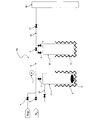
- the moisture content measuring device 100 is a device that thermally decomposes a hydrogen fluoride-containing compound, cools and collects the generated pyrolysis gas, and measures the moisture content.
- the water content measuring apparatus 100 includes a heat decomposer 12 that generates gas by thermally decomposing the hydrogen fluoride-containing compound 11 introduced from a conduit 22 that includes a valve, and a cooling trap 13 that generates pyrolysis gas generated in the heat decomposer 12. 8 and the gas introduced from the conduit 8 are collected by cooling to below the freezing point of hydrogen fluoride ( ⁇ 84 ° C.), and after collection, the temperature is raised above the melting point of hydrogen fluoride (19 ° C.).
- a vacuum pump and a nitrogen gas introduction path for gas replacement in the apparatus system are connected to the conduit 8 through the valve 1 and the valve 2, further to the thermal cracker 12 through the valve 3, and the conduit 8 and the conduit 18.
- the conduit 8 is connected to the cooling trap 13 via the valve 4
- the conduit 18 is connected to the cooling trap 13 via the valve 5
- the conduit 18 is further connected to the moisture measuring means 20 via the valve 17.
- a pressure gauge 7 is installed in the conduit 8.
- the thermal decomposer 12 stores the collected hydrogen fluoride-containing compound, and includes a heater 9 for heating the hydrogen fluoride-containing compound.
- the material of the thermal cracker 12 is preferably monel, nickel, platinum, or alumina that does not react with hydrogen fluoride in the generated pyrolysis gas, and among them, monel or nickel is particularly preferred.
- the cryogenic trap 13 includes a cooler 10 for cooling.
- the cooler 10 only needs to be capable of cooling to the freezing point ( ⁇ 84 ° C.) or lower of hydrogen fluoride during collection.
- the material of the deep trap 13 is preferably stainless steel, monel, nickel, platinum, alumina or the like, among which stainless steel or nickel is particularly preferable.
- the water content measuring means 20 can be an apparatus that quantifies the water content by measuring electrical conductivity.
- a moisture content measuring device using the Karl Fischer method can be used as the moisture content measuring means 20.
- the inside of the system is replaced with a vacuum pump and a nitrogen gas introduction passage, and the pressure is reduced to 0.0 kPa. Then, the hydrogen fluoride-containing compound collected for measurement is opened to the heating cracker 12 through the conduit 22 with the valve opened. Install and store. After storage, the valve of the conduit 22, the valve 1, the valve 2, the valve 5, and the valve 6 are closed, and the valve 3 and the valve 4 are opened, and the heater 9 is heated.
- the heating temperature is preferably not less than the boiling point of water or not less than the decomposition temperature of the hydrogen fluoride-containing compound.
- the decomposition temperature of KF ⁇ HF is 220 ° C. or more
- X is Na
- it is the decomposition temperature of NaF ⁇ HF.
- XF ⁇ nHF is any one of K, Na, and Li
- the pyrolysis gas is introduced from the conduit 8 into the deep trap 13 and is cooled and collected in the deep trap 13 below the freezing point of hydrogen fluoride ( ⁇ 84 ° C.). .
- the pressure of the pressure gauge 7 does not exceed 0.0 kPa, the valve 3 and the valve 4 are closed, and the heating of the heat decomposer 12 is stopped.
- the cooling of the deep trap 13 is stopped, the temperature is raised to a liquid or gas state, and the valves 5 and 17 are opened and taken out.
- the compound collected in the cryogenic trap 13 is introduced into the moisture content measuring means 20 through the conduit 18 and the moisture content is measured.
- the moisture content in the hydrogen fluoride-containing compound can be quantified.
- the amount of water in the hydrogen fluoride-containing compound can be accurately quantified.
- the moisture content measuring apparatus 200 measures the moisture content after thermally decomposing the hydrogen fluoride-containing compound, cooling and collecting the generated pyrolysis gas, and neutralizing the collected gas.
- Device Portions having the same reference numerals as those of the water content measuring device 100 are the same as those of the water content measuring device 100, and thus description thereof is omitted, and portions different from the water content measuring device 100 are described.
- the conduit 18 branches upstream of the valve 17 of the moisture measuring device 100 and a neutralization tank 19 is connected via the valve 14, and the neutralizing tank 19 measures the moisture content via the valve 16. Connected to means 20. Therefore, depending on the combination of opening and closing of the valves 14 and 16, it is possible to arbitrarily select the case where the gas from the conduit 18 is introduced into the moisture content measuring means 20 and the case where the gas is not passed through the neutralization tank 19.
- the neutralization tank 19 is filled with a neutralizing agent for neutralizing hydrogen fluoride.
- the neutralization tank 19 discharges the neutralized gas through the valve 14 to the inlet for introducing the gas vaporized by the cooling trap 13.
- a valve 16 is provided at the discharge port.
- a base is used as the neutralizing agent.
- an organic base is preferable, and among them, amines such as trimethylamine, triethylamine, pyridine, bipyridine, and tripyridine are particularly preferable.
- conduit 18 may be directly connected to the valve 14 without branching. Therefore, in this case, the conduit 18 is not directly connected to the moisture content measuring means 20.
- the water content measuring means 20 can use a water content measuring device or a water content measuring device using the Karl Fischer method by measuring electrical conductivity.
- a water content measuring apparatus using the Karl Fischer method in order to obtain a measurement accuracy of 1 ppm by mass or less, it is preferable to introduce a neutralized product into the neutralization tank 19 and measure the water content.
- a device that measures the amount of water by measuring electrical conductivity it is introduced into the water content measuring means 20 without going through the neutralization tank 19.
- the operation is the same as that of the water content measuring apparatus 100 until the cooling of the deep trap 13 is stopped. Further, when not passing through the neutralization tank 19, the moisture content obtained by the moisture content measuring means 20 is converted into the moisture content in the compound, except that the valve 14 is closed, in the hydrogen fluoride-containing compound. The operation is the same as that of the water content measuring apparatus 100 until the water content is quantified.
- the neutralization tank 19 When passing through the neutralization tank 19, the cooling of the deep trap 13 is stopped, the temperature is raised to the boiling point of hydrogen fluoride (19 ° C.) or more for vaporization, the valves 5 and 14 are opened, 16 and valve 17 are closed. The pyrolysis gas generated by the temperature rise is introduced into the neutralization tank 19 through the conduit 18 via the valve 14 and is neutralized with the neutralizing agent inside. Thereafter, the neutralized liquid in the neutralization tank 19 is opened to open the valve 16 to be introduced into the moisture content measuring means 20 and introduced into the moisture content measuring means 20 to measure the moisture content.
- the water content in the hydrogen fluoride-containing compound can be quantified by converting the water content obtained by the water content measuring means 20 into the water content in the compound.
- the same effects as those of the first embodiment can be obtained. Furthermore, even when the Karl Fischer method is used as the moisture content measuring means 20, the moisture content in the hydrogen fluoride-containing compound is further increased. It is possible to quantify with high accuracy. Further, the measurement accuracy can be appropriately selected depending on the presence or absence of the neutralization treatment.
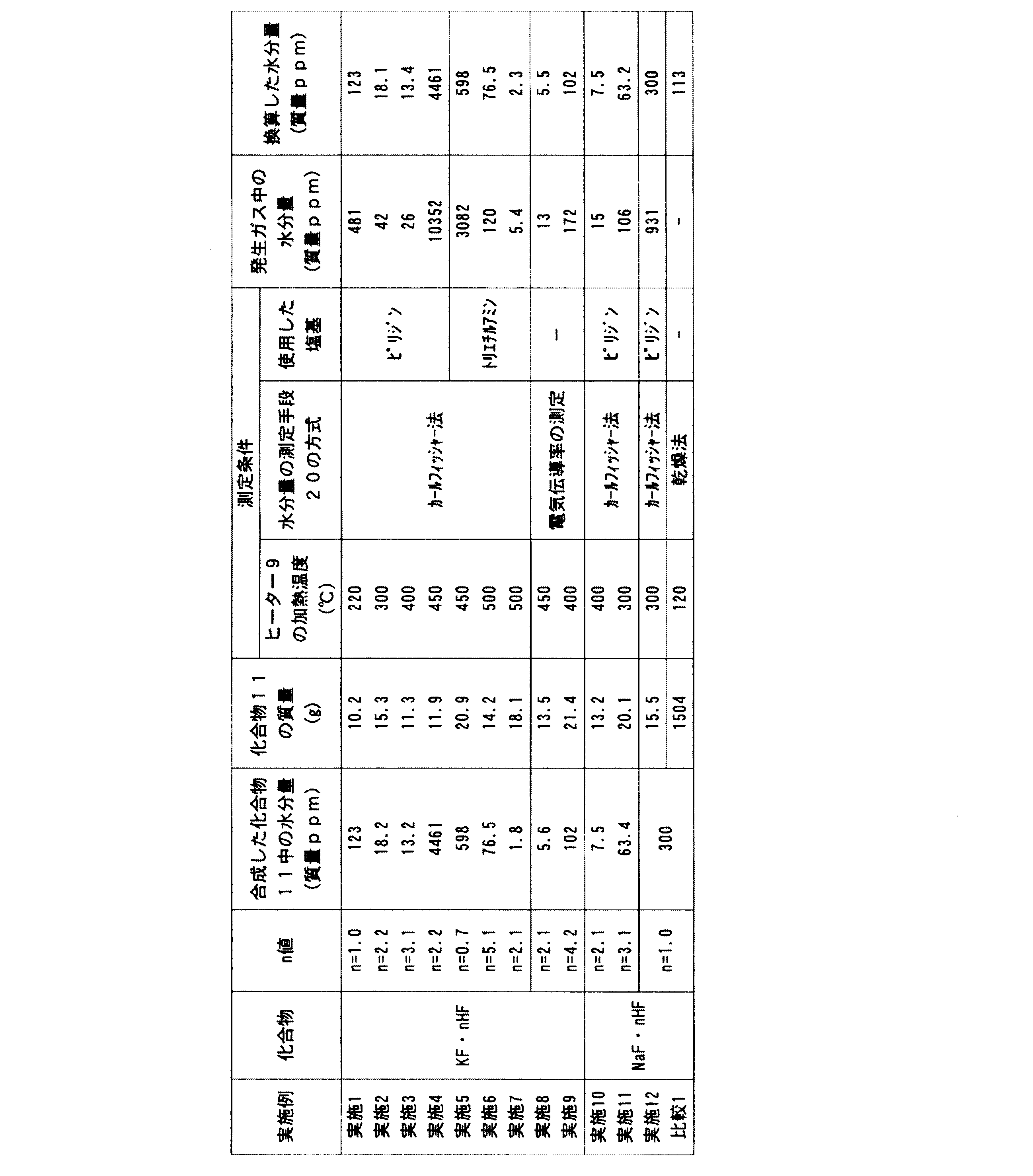
- Example 1 Using the apparatus shown in FIG. 2, the moisture content was quantitatively tested by the following procedure.
- a nickel-made closed heating cracker 12 and a nickel deep-cooled trap 13 were used.
- anhydrous KF, anhydrous HF, and H 2 O were mixed to prepare and use KF ⁇ HF containing a moisture content of 123 mass ppm.
- anhydrous KF can be obtained by reacting of H 2 O in the KF by reacting F 2 and KF in total amount HF, and heated to 700 ° C. synthesized completely volatilize the HF, anhydrous HF, F 2 And HF were reacted to react the entire amount of H 2 O in HF with HF, and then generated O 2 and OF 2 were degassed and synthesized.
- a cooler 10 using liquid nitrogen as a refrigerant was used, and a moisture content measuring means 20 (MKC-610-NT, manufactured by Kyoto Electronics Industry Co., Ltd.) based on the Karl Fischer method was used.
- the heating cracker 12 is heated until the pressure gauge 7 installed in the conduit 8 reaches 0.0 kPa, and after the pressure drops to 0.0 kPa, the valves 3 and 4 are closed to stop the heating cracker 12 from being heated. did. Thereafter, the gas obtained by elevating the temperature of the cryogenic trap 13 to 150 ° C. and opening the valves 5 and 14 are filled with 40.0 g of dehydrated pyridine in a nickel sealed container via a conduit 18. The neutralization tank 19 was introduced to neutralize hydrogen fluoride. Then, the valve
- the amount of water in the generated pyrolysis gas was 481 ppm by mass, which was 123 ppm by mass when converted to the amount of water in KF / HF.
- Example 2 15.3 g of KF ⁇ 2.2HF containing 18.2 mass ppm of water prepared by the same method as in Example 1 as a hydrogen fluoride-containing compound 11 to be quantified for water content was collected in the thermal cracker 12. Then, the test was performed in the same manner as in Example 1 except that the heating temperature in the heater 9 was changed to 300 ° C.
- the moisture content in the generated pyrolysis gas was 42 ppm by mass, which was 18.1 ppm by mass when converted to the moisture content in KF / 2.2HF.
- Example 3 As the hydrogen fluoride-containing compound 11 to be quantified in the amount of water, 11.3 g of KF ⁇ 3.1HF containing 13.2 mass ppm of water synthesized in the same manner as in Example 1 was collected in the thermal cracker 12. The test was conducted in the same manner as in Example 1 except that the heating temperature in the heater 9 was set to 400 ° C.
- the amount of water in the generated gas was 26 ppm by mass, and when converted to the amount of water in KF ⁇ 3.1HF, it was 13.4 ppm by mass.
- Example 4 11.9 g of KF ⁇ 2.2HF containing 4461 mass ppm of water synthesized in the same manner as in Example 1 as the hydrogen fluoride-containing compound 11 to be quantified for water content was collected in the thermal cracker 12, The test was performed in the same manner as in Example 1 except that the heating temperature in the heater 9 was changed to 450 ° C.
- the amount of water in the generated pyrolysis gas was 10352 ppm by mass, which was 4461 ppm by mass when converted to the amount of water in KF ⁇ 2.2HF.
- Example 5 As a hydrogen fluoride-containing compound 11 to be quantified in the amount of water, 20.9 g of KF ⁇ 0.7HF containing 598 mass ppm of water synthesized by the same method as in Example 1 was collected in the thermal cracker 12, The test was performed in the same manner as in Example 1 except that the heating temperature in the heater 9 was 450 ° C., and triethylamine was used instead of pyridine.
- the amount of water in the generated pyrolysis gas was 3082 ppm by mass, which was 598 ppm by mass when converted to the amount of water in KF / 0.7HF.
- Example 6 14.4 g of KF ⁇ 5.1HF containing 76.5 mass ppm of water synthesized as the hydrogen fluoride-containing compound 11 to be quantified in the same manner as in Example 1 was collected in the thermal cracker 12. Then, the test was performed in the same manner as in Example 1 except that the heating temperature in the heater 9 was set to 500 ° C., and triethylamine was used instead of pyridine.
- the amount of water in the generated pyrolysis gas was 120 ppm by mass, which was 76.5 ppm by mass when converted to the amount of water in KF ⁇ 5.1HF.
- Example 7 18.1 g of KF ⁇ 2.1HF containing 1.8 mass ppm of water synthesized as the hydrogen fluoride-containing compound 11 to be quantified in the same manner as in Example 1 was collected in the thermal cracker 12. Then, the test was performed in the same manner as in Example 1 except that the heating temperature in the heater 9 was set to 500 ° C., and triethylamine was used instead of pyridine.
- the moisture content in the generated pyrolysis gas was 5.4 ppm by mass, and 2.3 ppm by mass when converted to the moisture content in KF ⁇ 2.1HF.
- Example 8 As the hydrogen fluoride-containing compound 11 to be quantified in the amount of water, 13.5 g of KF ⁇ 2.1HF containing 5.6 mass ppm of water synthesized in the same manner as in Example 1 was collected in the thermal cracker 12. Then, the heating temperature in the heater 9 is set to 450 ° C., and further, the water content measuring means 20 based on the electric conductivity measurement method (described in Miki, Maeno: differentiation, 29, 288 (1980)) is used for deep cooling. Instead of introducing the gas vaporized by raising the temperature of the trap 13 to 150 ° C. into the neutralization tank 19, the valves 14 and 16 are closed, the valves 5 and 17 are opened, and the moisture amount measuring means 20 is connected via the conduit 18. The test was conducted in the same manner as in Example 1 except that the sample was introduced into the sample and cooled to ⁇ 10 ° C. to obtain a liquid.
- the amount of water in the generated pyrolysis gas was 13 ppm by mass, which was 5.5 ppm by mass when converted to the amount of water in KF ⁇ 2.1HF.
- Example 9 As the hydrogen fluoride-containing compound 11 to be quantified in the amount of water, 21.4 g of KF ⁇ 4.2HF containing 102 mass ppm of water synthesized by the same method as in Example 1 was collected in the thermal cracker 12, The test was performed in the same manner as in Example 8 except that the heating temperature in the heater 9 was set to 400 ° C.
- the moisture content in the generated pyrolysis gas was 172 mass ppm, which was 102 mass ppm when converted to the moisture content in KF ⁇ 4.2HF.
- Example 10 13.2 g of NaF ⁇ 2.1HF containing 7.5 mass ppm of water as the hydrogen fluoride-containing compound 11 to be quantified for moisture content is sampled in the thermal cracker 12 and the heating temperature in the heater 9 is set to 400. The test was performed in the same manner as in Example 1 except that the temperature was changed to ° C. NaF ⁇ 2.1HF containing 7.5 mass ppm of water was prepared by mixing anhydrous NaF, anhydrous HF, and H 2 O.
- NaF anhydride can be obtained by reacting of H 2 O in the NaF by reacting F 2 and NaF in the total amount HF, used after synthesized completely volatilize the HF was heated to 700 ° C., anhydrous HF, F 2 And HF were reacted to react the entire amount of H 2 O in HF with HF, and then synthesized by degassing the generated O 2 and OF 2 .
- the amount of water in the generated pyrolysis gas was 15 ppm by mass, which was 7.5 ppm by mass when converted to the amount of water in NaF ⁇ 2.1HF.
- Example 11 NaF3.1HF and 20.1 g containing 63.4 mass ppm of water synthesized as the hydrogen fluoride-containing compound 11 to be quantified in the same manner as in Example 10 were collected in the thermal cracker 12. The test was conducted in the same manner as in Example 1 except that the heating temperature in the heater 9 was set to 300 ° C.
- the moisture content in the generated pyrolysis gas was 106 mass ppm, which was 63.2 mass ppm when converted to the moisture content in NaF ⁇ 2.1HF.
- Example 12 15.5 g of NaF ⁇ HF containing 300 ppm by mass of water synthesized as the hydrogen fluoride-containing compound 11 to be quantified in the same manner as in Example 10 was collected in the thermal cracker 12 and heated 9 The test was performed in the same manner as in Example 1 except that the heating temperature in was changed to 300 ° C.
- the moisture content in the generated pyrolysis gas was 931 ppm by mass, which was 300 ppm by mass when converted to the moisture content in NaF / HF.
- the molecular sieves had a mass of 9.52 g, the adsorbed water content was 0.12 g, and the water content in NaF ⁇ HF was 113 mass ppm.
- the amount of water in the hydrogen fluoride-containing compound can be accurately quantified.
- the measuring method and apparatus of the present invention are used to determine the amount of water in a compound used as an electrolysis molten salt such as KF ⁇ nHF or NH 4 F ⁇ nHF, or a compound used as a fluorinating agent such as KF ⁇ HF or NaF ⁇ HF. Can be applied to.
Landscapes
- Life Sciences & Earth Sciences (AREA)
- Health & Medical Sciences (AREA)
- Chemical & Material Sciences (AREA)
- Biochemistry (AREA)
- Physics & Mathematics (AREA)
- Analytical Chemistry (AREA)
- General Health & Medical Sciences (AREA)
- General Physics & Mathematics (AREA)
- Immunology (AREA)
- Pathology (AREA)
- Molecular Biology (AREA)
- Engineering & Computer Science (AREA)
- Combustion & Propulsion (AREA)
- Investigating Or Analyzing Non-Biological Materials By The Use Of Chemical Means (AREA)
- Sampling And Sample Adjustment (AREA)
Abstract
Description

[1]カールフィッシャー法の場合、フッ化水素含有化合物がカールフィッシャー液中に溶解が困難な為、水分気化法を用いることが考えられるが、この方法ではフッ化水素とカールフィッシャー液中の沃素が反応する。
[2]赤外吸光光度計を用いる方法の場合、フッ化水素と水のO-H伸縮振動による3000~4000cm-1付近の吸収のピーク位置が重なる。
[3]電気伝導率を測定する方法の場合、化合物中の不純物の影響を受ける。
この様に、フッ化水素含有化合物中の水分量を精度よく定量できる方法は報告されていない。


図2の装置を用いて、下記の手順により水分量の定量試験を行った。
水分量の定量対象となるフッ化水素含有化合物11として実施例1と同様の方法で調製した18.2質量ppmの水分量を含むKF・2.2HF、15.3gを加熱分解器12に採取し、ヒーター9での加熱温度を300℃にしたこと以外は、実施例1と同様に試験を行なった。
水分量の定量対象となるフッ化水素含有化合物11として実施例1と同様の方法で合成した13.2質量ppmの水分量を含むKF・3.1HF、11.3gを加熱分解器12に採取し、ヒーター9での加熱温度を400℃にしたこと以外は、実施例1と同様に試験を行なった。
水分量の定量対象となるフッ化水素含有化合物11として実施例1と同様の方法で合成した4461質量ppmの水分量を含むKF・2.2HF、11.9gを加熱分解器12に採取し、ヒーター9での加熱温度を450℃にしたこと以外は、実施例1と同様に試験を行なった。
水分量の定量対象となるフッ化水素含有化合物11として実施例1と同様の方法で合成した598質量ppmの水分量を含むKF・0.7HF、20.9gを加熱分解器12に採取し、ヒーター9での加熱温度を450℃とし、ピリジンの代わりにトリエチルアミンを用いたこと以外は、実施例1と同様に試験を行なった。
水分量の定量対象となるフッ化水素含有化合物11として実施例1と同様の方法で合成した76.5質量ppmの水分量を含むKF・5.1HF、14.2gを加熱分解器12に採取し、ヒーター9での加熱温度を500℃とし、ピリジンの代わりにトリエチルアミンを用いたこと以外は、実施例1と同様に試験を行なった。
水分量の定量対象となるフッ化水素含有化合物11として実施例1と同様の方法で合成した1.8質量ppmの水分量を含むKF・2.1HF、18.1gを加熱分解器12に採取し、ヒーター9での加熱温度を500℃とし、ピリジンの代わりにトリエチルアミンを用いたこと以外は、実施例1と同様に試験を行なった。
水分量の定量対象となるフッ化水素含有化合物11として実施例1と同様の方法で合成した5.6質量ppmの水分量を含むKF・2.1HF、13.5gを加熱分解器12に採取し、ヒーター9での加熱温度を450℃とし、さらには、電気伝導度測定法(三木、前野:分化,29,288(1980)の記載。)に基づく水分量測定手段20を用い、深冷トラップ13を150℃まで昇温させて気化したガスを、中和槽19に導入する代わりに、バルブ14、16を閉じ、バルブ5、17を開けて、導管18を介して水分量測定手段20に導入し、-10℃まで冷却して液体の状態にし、その水分量を測定したこと以外は、実施例1と同様に試験を行なった。
水分量の定量対象となるフッ化水素含有化合物11として実施例1と同様の方法で合成した102質量ppmの水分量を含むKF・4.2HF、21.4gを加熱分解器12に採取し、ヒーター9での加熱温度を400℃にしたこと以外は、実施例8と同様に試験を行なった。
水分量の定量対象となるフッ化水素含有化合物11として7.5質量ppmの水分量を含むNaF・2.1HF、13.2gを加熱分解器12に採取し、ヒーター9での加熱温度を400℃としたこと以外は、実施例1と同様に試験を行なった。尚、7.5質量ppmの水分量を含むNaF・2.1HFは、無水NaFと無水HFとH2Oとを混合して調製した。無水NaFは、F2とNaFを反応させNaF中のH2Oを全量HFに反応させた後、700℃まで加熱させHFを完全に揮発させて合成したものを用い、無水HFは、F2とHFを反応させHF中のH2Oを全量HFに反応させた後、発生するO2、OF2を脱気して合成したものを用いた。
水分量の定量対象となるフッ化水素含有化合物11として実施例10と同様の方法で合成した63.4質量ppmの水分量を含むNaF・3.1HF、20.1gを加熱分解器12に採取し、ヒーター9での加熱温度を300℃としたこと以外は、実施例1と同様に試験を行なった。
水分量の定量対象となるフッ化水素含有化合物11として実施例10と同様の方法で合成した300質量ppmの水分量を含むNaF・HF、15.5gを加熱分解器12に採取し、ヒーター9での加熱温度を300℃としたこと以外は、実施例1と同様に試験を行なった。
フッ化水素含有化合物11として実施例12で調製した300質量ppmの水分量を含むNaF・HF、1504gをステンレス製のデシケーター内で120℃で加熱させ、揮発する水分をモレキュラーシーブス4A 9.35gを用いて48時間吸着させた。
Claims (6)
- 一般式:XF・nHF(式中、XはK、NH4、Na、Liのいずれか1種類を示し、nは0より大きい有理数を示す。)で表されるフッ化水素含有化合物の水分量の測定方法であって、フッ化水素含有化合物を加熱分解する工程と、加熱分解により発生する熱分解ガス中の水分量を定量することにより、フッ化水素含有化合物中の水分量を求める工程と、を含むフッ化水素含有化合物の水分量の測定方法。
- 熱分解ガスを冷却して液体にした後、該液体の電気伝導率の測定を行なうことにより、熱分解ガス中の水分量を定量することを特徴とする、請求項1に記載のフッ化水素含有化合物の水分量の測定方法。
- 熱分解ガスを塩基で中和した後に、熱分解ガスを塩基で中和した中和物の水分量をカールフィッシャー法により定量することを特徴とする、請求項1に記載のフッ化水素含有化合物の水分量の測定方法。
- 一般式:XF・nHF(式中、X:K、NH4、Na、Liのいずれか1種類を示し、nは0より大きい有理数を示す。)で表されるフッ化水素含有化合物の水分量の測定装置において、フッ化水素含有化合物を加熱分解する加熱手段を備えた反応器を有する加熱分解部と、フッ化水素含有化合物を加熱分解部に導入する導管と、反応器内で加熱分解により発生する熱分解ガス中のフッ化水素を捕集する冷却トラップを有する捕集部と、熱分解ガスを反応器から冷却トラップに導入する導管と、捕集されたフッ化水素中の水分量を測定する水分量測定手段を備え、水分量測定手段の測定結果からフッ化水素含有化合物中の水分量を求める水分量測定器と、捕集されたフッ化水素を冷却トラップから水分量測定手段に導入する導管と、加熱分解部と捕集部を接続する導管に設けられ、熱分解ガスの発生による圧力上昇を計測する圧力測定手段と、で構成されることを特徴とする。
- 内部にフッ化水素を中和する中和剤が充填された中和槽を有する中和部と、冷却トラップと水分量測定手段を接続する導管に接続され、冷却トラップで捕集されたフッ化水素の導入先を水分量測定手段から中和槽に切り換える手段と、フッ化水素を中和剤で中和した中和物を中和槽から水分量測定手段に導入する導管と、を備え、水分量測定手段は、中和物の水分量を測定するように構成された、請求項4に記載のフッ化水素含有化合物の水分量の測定装置。
- 圧力測定手段が所定の計測結果を得た場合に、加熱手段を停止することを特徴とする、請求項4又は5に記載のフッ化水素含有化合物の水分量の測定装置。
Priority Applications (4)
| Application Number | Priority Date | Filing Date | Title |
|---|---|---|---|
| KR1020127025207A KR101469668B1 (ko) | 2010-03-01 | 2011-02-21 | 불화수소를 포함하는 화합물 중의 수분량의 측정 방법 및 장치 |
| US13/581,424 US9097688B2 (en) | 2010-03-01 | 2011-02-21 | Method and device for measuring water content in hydrogen fluoride-containing fluoride salt compounds |
| EP11750496A EP2520930A1 (en) | 2010-03-01 | 2011-02-21 | Method and device for measuring water content in hydrogen fluoride-containing compound |
| CN2011800118510A CN102782491A (zh) | 2010-03-01 | 2011-02-21 | 含有氟化氢的化合物中的含水量的测定方法和装置 |
Applications Claiming Priority (2)
| Application Number | Priority Date | Filing Date | Title |
|---|---|---|---|
| JP2010-044146 | 2010-03-01 | ||
| JP2010044146A JP5633158B2 (ja) | 2010-03-01 | 2010-03-01 | フッ化水素を含む化合物中の水分量の測定方法及び装置 |
Publications (1)
| Publication Number | Publication Date |
|---|---|
| WO2011108384A1 true WO2011108384A1 (ja) | 2011-09-09 |
Family
ID=44542040
Family Applications (1)
| Application Number | Title | Priority Date | Filing Date |
|---|---|---|---|
| PCT/JP2011/053663 Ceased WO2011108384A1 (ja) | 2010-03-01 | 2011-02-21 | フッ化水素を含む化合物中の水分量の測定方法及び装置 |
Country Status (6)
| Country | Link |
|---|---|
| US (1) | US9097688B2 (ja) |
| EP (1) | EP2520930A1 (ja) |
| JP (1) | JP5633158B2 (ja) |
| KR (1) | KR101469668B1 (ja) |
| CN (1) | CN102782491A (ja) |
| WO (1) | WO2011108384A1 (ja) |
Cited By (1)
| Publication number | Priority date | Publication date | Assignee | Title |
|---|---|---|---|---|
| CN103674615A (zh) * | 2013-12-17 | 2014-03-26 | 福建省邵武市永晶化工有限公司 | 一种无水氟化氢取样装置及取样方法 |
Families Citing this family (6)
| Publication number | Priority date | Publication date | Assignee | Title |
|---|---|---|---|---|
| JP5375673B2 (ja) * | 2010-03-01 | 2013-12-25 | セントラル硝子株式会社 | フッ素ガス生成装置 |
| CN103245586B (zh) * | 2013-04-15 | 2016-04-27 | 广州天赐高新材料股份有限公司 | 一种硼酸酯类化合物中微量水分含量的测定方法 |
| CN103344676B (zh) * | 2013-07-26 | 2015-11-25 | 森田化工(张家港)有限公司 | 一种氟化氢中微量水份的测定方法 |
| KR102365573B1 (ko) | 2020-03-30 | 2022-02-22 | (주)한국에이티아이 | 수산화나트륨을 이용한 반도체 에칭액에 함유된 불화수소 및 불화암모늄의 측정방법 |
| CN112505242B (zh) * | 2020-12-24 | 2022-04-22 | 红宝丽集团泰兴化学有限公司 | 一种氧化物中水分的测定方法 |
| CN116678920A (zh) * | 2023-04-20 | 2023-09-01 | 兴国兴氟化工有限公司 | 一种氢氟酸生产过程中混酸含水率的在线检测方法 |
Citations (7)
| Publication number | Priority date | Publication date | Assignee | Title |
|---|---|---|---|---|
| JPS6171356A (ja) * | 1984-09-17 | 1986-04-12 | Nippon Kokan Kk <Nkk> | 石炭の窒素分析法 |
| JPH02234056A (ja) * | 1989-03-07 | 1990-09-17 | Ricoh Co Ltd | 水分測定方法 |
| JPH0456789A (ja) * | 1990-06-25 | 1992-02-24 | Mitsui Toatsu Chem Inc | 三弗化窒素ガスの製造方法 |
| JPH05281170A (ja) * | 1992-03-30 | 1993-10-29 | Ngk Insulators Ltd | 固体の水分定量方法 |
| JPH05281121A (ja) * | 1992-03-30 | 1993-10-29 | Ngk Insulators Ltd | 固体の水分定量における正確さの検証方法 |
| JPH08101145A (ja) * | 1994-09-30 | 1996-04-16 | Mitsubishi Chem Corp | 水分測定方法 |
| JP2006308502A (ja) * | 2005-05-02 | 2006-11-09 | Mitsubishi Electric Corp | Sf6ガス中の水分濃度検出装置 |
Family Cites Families (7)
| Publication number | Priority date | Publication date | Assignee | Title |
|---|---|---|---|---|
| US3607076A (en) * | 1969-02-18 | 1971-09-21 | Nasa | Procedure and apparatus for determination of water in nitrogen tetroxide |
| US3607080A (en) * | 1969-08-11 | 1971-09-21 | Nasa | Method for determining presence of oh in magnesium oxide |
| US3847554A (en) * | 1973-02-05 | 1974-11-12 | Phillips Fibers Corp | Analysis of materials to measure vaporizable components |
| JPH0658340B2 (ja) * | 1985-04-26 | 1994-08-03 | 三菱化成株式会社 | カ−ルフイツシヤ−電量滴定用電解液 |
| CN1186240A (zh) * | 1996-12-27 | 1998-07-01 | 化学工业部北京化工研究院 | 一种微量水的测定方法 |
| JP2004333413A (ja) * | 2003-05-12 | 2004-11-25 | Dia Instr:Kk | 水分測定方法および水分測定装置 |
| CN100368808C (zh) * | 2004-04-07 | 2008-02-13 | 董慧茹 | 卡尔费休水分测定装置的改进方法及改进装置 |
-
2010
- 2010-03-01 JP JP2010044146A patent/JP5633158B2/ja active Active
-
2011
- 2011-02-21 US US13/581,424 patent/US9097688B2/en not_active Expired - Fee Related
- 2011-02-21 KR KR1020127025207A patent/KR101469668B1/ko not_active Expired - Fee Related
- 2011-02-21 WO PCT/JP2011/053663 patent/WO2011108384A1/ja not_active Ceased
- 2011-02-21 CN CN2011800118510A patent/CN102782491A/zh active Pending
- 2011-02-21 EP EP11750496A patent/EP2520930A1/en not_active Withdrawn
Patent Citations (7)
| Publication number | Priority date | Publication date | Assignee | Title |
|---|---|---|---|---|
| JPS6171356A (ja) * | 1984-09-17 | 1986-04-12 | Nippon Kokan Kk <Nkk> | 石炭の窒素分析法 |
| JPH02234056A (ja) * | 1989-03-07 | 1990-09-17 | Ricoh Co Ltd | 水分測定方法 |
| JPH0456789A (ja) * | 1990-06-25 | 1992-02-24 | Mitsui Toatsu Chem Inc | 三弗化窒素ガスの製造方法 |
| JPH05281170A (ja) * | 1992-03-30 | 1993-10-29 | Ngk Insulators Ltd | 固体の水分定量方法 |
| JPH05281121A (ja) * | 1992-03-30 | 1993-10-29 | Ngk Insulators Ltd | 固体の水分定量における正確さの検証方法 |
| JPH08101145A (ja) * | 1994-09-30 | 1996-04-16 | Mitsubishi Chem Corp | 水分測定方法 |
| JP2006308502A (ja) * | 2005-05-02 | 2006-11-09 | Mitsubishi Electric Corp | Sf6ガス中の水分濃度検出装置 |
Cited By (2)
| Publication number | Priority date | Publication date | Assignee | Title |
|---|---|---|---|---|
| CN103674615A (zh) * | 2013-12-17 | 2014-03-26 | 福建省邵武市永晶化工有限公司 | 一种无水氟化氢取样装置及取样方法 |
| CN103674615B (zh) * | 2013-12-17 | 2016-05-04 | 福建省邵武市永晶化工有限公司 | 一种无水氟化氢取样装置及取样方法 |
Also Published As
| Publication number | Publication date |
|---|---|
| KR101469668B1 (ko) | 2014-12-05 |
| KR20120136374A (ko) | 2012-12-18 |
| JP2011179951A (ja) | 2011-09-15 |
| CN102782491A (zh) | 2012-11-14 |
| US9097688B2 (en) | 2015-08-04 |
| EP2520930A1 (en) | 2012-11-07 |
| US20120322158A1 (en) | 2012-12-20 |
| JP5633158B2 (ja) | 2014-12-03 |
Similar Documents
| Publication | Publication Date | Title |
|---|---|---|
| WO2011108384A1 (ja) | フッ化水素を含む化合物中の水分量の測定方法及び装置 | |
| RU2291229C2 (ru) | Способ электролиза воды и устройство для определения состава стабильных изотопов водорода и кислорода | |
| Ratcliffe et al. | Some perfluoroalkylsulfinyl halides. New preparations of trifluoromethylsulfur trifluoride | |
| EP3588064A1 (en) | Oh radical detection probe, oh radical measurement device, and oh radical measurement method | |
| Chandran et al. | Synthesis and characterization of sodium alkoxides | |
| Lee et al. | Behaviors of SO2 absorption in [BMIm][OAc] as an absorbent to recover SO2 in thermochemical processes to produce hydrogen | |
| Neise et al. | Stability studies of ionic liquid [EMIm][NTf 2] under short-term thermal exposure | |
| JP4211983B2 (ja) | F2ガス濃度の測定方法並びに測定装置 | |
| CN102495006A (zh) | 一种非阳极效应cf4的检测方法 | |
| JP4837687B2 (ja) | クロロシラン類の化学処理方法 | |
| CN101750456B (zh) | 甲基磺酰氟ch3so2f电化学氟化气相产物的分析测定方法 | |
| KR100837477B1 (ko) | 미량 성분의 분석 방법 및 그 분석 장치 | |
| CN101788514B (zh) | 测定六氟化硫电气设备的特征故障气体的方法 | |
| Chandran et al. | Kinetics of thermal decomposition of sodium methoxide and ethoxide | |
| CN117871194A (zh) | 一种用于碳酸盐双团簇同位素分析的样品制备装置及方法 | |
| Dubaj et al. | Assessment of thermal stability of two N-ethoxyethyl-N-methylpiperidinium borate ionic liquids by non-Arrhenian incremental kinetic method | |
| Boltalina et al. | Reaction of [60] fullerene with terbium (IV) fluoride | |
| Johnson et al. | The preparation of gallium tribromide and gallium triiodide | |
| CN205786046U (zh) | 一种挥发性有机物气体捕集装置 | |
| JP3511380B1 (ja) | 低温凝縮型の水電解装置及びこれを利用した質量分析の前処理方法 | |
| JP4233179B2 (ja) | ケルダール法による有機化合物中の窒素定量法 | |
| JP6657851B2 (ja) | 微量塩素成分の定量方法 | |
| CN114935598A (zh) | 一种sf6降解后气液相产物的检测方法 | |
| CN102854082B (zh) | 电解-电渗析装置对含碘氢碘酸中碘化氢浓缩效果的评价方法 | |
| US3814587A (en) | Method for monitoring an aqueous stream for the presence of fluorocarbons |
Legal Events
| Date | Code | Title | Description |
|---|---|---|---|
| WWE | Wipo information: entry into national phase |
Ref document number: 201180011851.0 Country of ref document: CN |
|
| 121 | Ep: the epo has been informed by wipo that ep was designated in this application |
Ref document number: 11750496 Country of ref document: EP Kind code of ref document: A1 |
|
| WWE | Wipo information: entry into national phase |
Ref document number: 2011750496 Country of ref document: EP |
|
| WWE | Wipo information: entry into national phase |
Ref document number: 13581424 Country of ref document: US |
|
| NENP | Non-entry into the national phase |
Ref country code: DE |
|
| ENP | Entry into the national phase |
Ref document number: 20127025207 Country of ref document: KR Kind code of ref document: A |