EP2523736B1 - Spielbaustein - Google Patents
Spielbaustein Download PDFInfo
- Publication number
- EP2523736B1 EP2523736B1 EP11700166.9A EP11700166A EP2523736B1 EP 2523736 B1 EP2523736 B1 EP 2523736B1 EP 11700166 A EP11700166 A EP 11700166A EP 2523736 B1 EP2523736 B1 EP 2523736B1
- Authority
- EP
- European Patent Office
- Prior art keywords
- toy building
- building block
- toy
- produced
- raw material
- Prior art date
- Legal status (The legal status is an assumption and is not a legal conclusion. Google has not performed a legal analysis and makes no representation as to the accuracy of the status listed.)
- Revoked
Links
- 239000002994 raw material Substances 0.000 claims description 30
- 239000000463 material Substances 0.000 claims description 19
- JVTAAEKCZFNVCJ-UHFFFAOYSA-N lactic acid Chemical compound CC(O)C(O)=O JVTAAEKCZFNVCJ-UHFFFAOYSA-N 0.000 claims description 14
- 239000003208 petroleum Substances 0.000 claims description 12
- 229920002472 Starch Polymers 0.000 claims description 10
- 229920000747 poly(lactic acid) Polymers 0.000 claims description 10
- 239000008107 starch Substances 0.000 claims description 10
- 235000019698 starch Nutrition 0.000 claims description 10
- 239000002131 composite material Substances 0.000 claims description 9
- 229920008262 Thermoplastic starch Polymers 0.000 claims description 8
- 239000004628 starch-based polymer Substances 0.000 claims description 8
- 235000014655 lactic acid Nutrition 0.000 claims description 7
- 239000004310 lactic acid Substances 0.000 claims description 7
- -1 polytrimethylene Polymers 0.000 claims description 7
- 239000002023 wood Substances 0.000 claims description 7
- 244000005700 microbiome Species 0.000 claims description 6
- 235000013339 cereals Nutrition 0.000 claims description 5
- 235000013312 flour Nutrition 0.000 claims description 5
- 229920000515 polycarbonate Polymers 0.000 claims description 5
- 239000004417 polycarbonate Substances 0.000 claims description 5
- 229920002101 Chitin Polymers 0.000 claims description 4
- 229920001661 Chitosan Polymers 0.000 claims description 4
- 239000005018 casein Substances 0.000 claims description 4
- BECPQYXYKAMYBN-UHFFFAOYSA-N casein, tech. Chemical compound NCCCCC(C(O)=O)N=C(O)C(CC(O)=O)N=C(O)C(CCC(O)=N)N=C(O)C(CC(C)C)N=C(O)C(CCC(O)=O)N=C(O)C(CC(O)=O)N=C(O)C(CCC(O)=O)N=C(O)C(C(C)O)N=C(O)C(CCC(O)=N)N=C(O)C(CCC(O)=N)N=C(O)C(CCC(O)=N)N=C(O)C(CCC(O)=O)N=C(O)C(CCC(O)=O)N=C(O)C(COP(O)(O)=O)N=C(O)C(CCC(O)=N)N=C(O)C(N)CC1=CC=CC=C1 BECPQYXYKAMYBN-UHFFFAOYSA-N 0.000 claims description 4
- 235000021240 caseins Nutrition 0.000 claims description 4
- 239000004359 castor oil Substances 0.000 claims description 4
- 235000019438 castor oil Nutrition 0.000 claims description 4
- 235000013305 food Nutrition 0.000 claims description 4
- ZEMPKEQAKRGZGQ-XOQCFJPHSA-N glycerol triricinoleate Natural products CCCCCC[C@@H](O)CC=CCCCCCCCC(=O)OC[C@@H](COC(=O)CCCCCCCC=CC[C@@H](O)CCCCCC)OC(=O)CCCCCCCC=CC[C@H](O)CCCCCC ZEMPKEQAKRGZGQ-XOQCFJPHSA-N 0.000 claims description 4
- 229920005610 lignin Polymers 0.000 claims description 4
- 229920000728 polyester Polymers 0.000 claims description 4
- 229920006149 polyester-amide block copolymer Polymers 0.000 claims description 4
- 235000018102 proteins Nutrition 0.000 claims description 4
- 108090000623 proteins and genes Proteins 0.000 claims description 4
- 102000004169 proteins and genes Human genes 0.000 claims description 4
- 235000004977 Brassica sinapistrum Nutrition 0.000 claims description 3
- 102000004190 Enzymes Human genes 0.000 claims description 3
- 108090000790 Enzymes Proteins 0.000 claims description 3
- 239000004372 Polyvinyl alcohol Substances 0.000 claims description 3
- 239000005862 Whey Substances 0.000 claims description 3
- 102000007544 Whey Proteins Human genes 0.000 claims description 3
- 108010046377 Whey Proteins Proteins 0.000 claims description 3
- 229920002635 polyurethane Polymers 0.000 claims description 3
- 239000004814 polyurethane Substances 0.000 claims description 3
- 229920002451 polyvinyl alcohol Polymers 0.000 claims description 3
- 239000010902 straw Substances 0.000 claims description 3
- 239000002028 Biomass Substances 0.000 claims description 2
- 239000000758 substrate Substances 0.000 claims description 2
- 229920001059 synthetic polymer Polymers 0.000 claims description 2
- FERIUCNNQQJTOY-UHFFFAOYSA-N Butyric acid Chemical compound CCCC(O)=O FERIUCNNQQJTOY-UHFFFAOYSA-N 0.000 claims 2
- 235000014698 Brassica juncea var multisecta Nutrition 0.000 claims 1
- 235000006008 Brassica napus var napus Nutrition 0.000 claims 1
- 240000000385 Brassica napus var. napus Species 0.000 claims 1
- 235000006618 Brassica rapa subsp oleifera Nutrition 0.000 claims 1
- CERQOIWHTDAKMF-UHFFFAOYSA-M Methacrylate Chemical compound CC(=C)C([O-])=O CERQOIWHTDAKMF-UHFFFAOYSA-M 0.000 claims 1
- 239000010773 plant oil Substances 0.000 claims 1
- 229920000704 biodegradable plastic Polymers 0.000 description 18
- 238000004519 manufacturing process Methods 0.000 description 16
- 229920003023 plastic Polymers 0.000 description 11
- 239000004033 plastic Substances 0.000 description 11
- 229920001222 biopolymer Polymers 0.000 description 8
- 229920002215 polytrimethylene terephthalate Polymers 0.000 description 6
- 229920000642 polymer Polymers 0.000 description 5
- 230000002787 reinforcement Effects 0.000 description 5
- 239000011449 brick Substances 0.000 description 4
- 239000000203 mixture Substances 0.000 description 4
- 108010010803 Gelatin Proteins 0.000 description 3
- 240000000528 Ricinus communis Species 0.000 description 3
- 239000002253 acid Substances 0.000 description 3
- 239000007795 chemical reaction product Substances 0.000 description 3
- 229920000159 gelatin Polymers 0.000 description 3
- 239000008273 gelatin Substances 0.000 description 3
- 235000019322 gelatine Nutrition 0.000 description 3
- 235000011852 gelatine desserts Nutrition 0.000 description 3
- 238000000034 method Methods 0.000 description 3
- 229920003229 poly(methyl methacrylate) Polymers 0.000 description 3
- 239000004626 polylactic acid Substances 0.000 description 3
- 239000004926 polymethyl methacrylate Substances 0.000 description 3
- 235000015112 vegetable and seed oil Nutrition 0.000 description 3
- 239000008158 vegetable oil Substances 0.000 description 3
- 240000002791 Brassica napus Species 0.000 description 2
- AEMRFAOFKBGASW-UHFFFAOYSA-N Glycolic acid Chemical compound OCC(O)=O AEMRFAOFKBGASW-UHFFFAOYSA-N 0.000 description 2
- 238000010276 construction Methods 0.000 description 2
- 230000007613 environmental effect Effects 0.000 description 2
- 239000000835 fiber Substances 0.000 description 2
- 230000013011 mating Effects 0.000 description 2
- 239000003921 oil Substances 0.000 description 2
- 235000019198 oils Nutrition 0.000 description 2
- 238000006116 polymerization reaction Methods 0.000 description 2
- 239000000047 product Substances 0.000 description 2
- 229920001169 thermoplastic Polymers 0.000 description 2
- DNIAPMSPPWPWGF-VKHMYHEASA-N (+)-propylene glycol Chemical compound C[C@H](O)CO DNIAPMSPPWPWGF-VKHMYHEASA-N 0.000 description 1
- YPFDHNVEDLHUCE-UHFFFAOYSA-N 1,3-propanediol Substances OCCCO YPFDHNVEDLHUCE-UHFFFAOYSA-N 0.000 description 1
- 244000291564 Allium cepa Species 0.000 description 1
- 235000002732 Allium cepa var. cepa Nutrition 0.000 description 1
- 241000894006 Bacteria Species 0.000 description 1
- 241000196324 Embryophyta Species 0.000 description 1
- 240000003183 Manihot esculenta Species 0.000 description 1
- 235000016735 Manihot esculenta subsp esculenta Nutrition 0.000 description 1
- 240000007594 Oryza sativa Species 0.000 description 1
- 235000007164 Oryza sativa Nutrition 0.000 description 1
- 239000004952 Polyamide Substances 0.000 description 1
- 235000004443 Ricinus communis Nutrition 0.000 description 1
- 244000061456 Solanum tuberosum Species 0.000 description 1
- 235000002595 Solanum tuberosum Nutrition 0.000 description 1
- 235000019714 Triticale Nutrition 0.000 description 1
- 235000021307 Triticum Nutrition 0.000 description 1
- 244000098338 Triticum aestivum Species 0.000 description 1
- 229920001587 Wood-plastic composite Polymers 0.000 description 1
- 240000008042 Zea mays Species 0.000 description 1
- 235000016383 Zea mays subsp huehuetenangensis Nutrition 0.000 description 1
- 235000002017 Zea mays subsp mays Nutrition 0.000 description 1
- 230000003698 anagen phase Effects 0.000 description 1
- 230000009286 beneficial effect Effects 0.000 description 1
- 229920002988 biodegradable polymer Polymers 0.000 description 1
- 239000004621 biodegradable polymer Substances 0.000 description 1
- 230000000035 biogenic effect Effects 0.000 description 1
- 230000000295 complement effect Effects 0.000 description 1
- 150000001875 compounds Chemical class 0.000 description 1
- 229920001577 copolymer Polymers 0.000 description 1
- 239000010779 crude oil Substances 0.000 description 1
- 230000001419 dependent effect Effects 0.000 description 1
- 230000000694 effects Effects 0.000 description 1
- 238000005516 engineering process Methods 0.000 description 1
- 238000003912 environmental pollution Methods 0.000 description 1
- 230000002349 favourable effect Effects 0.000 description 1
- 238000000855 fermentation Methods 0.000 description 1
- 230000004151 fermentation Effects 0.000 description 1
- 239000002803 fossil fuel Substances 0.000 description 1
- 239000008187 granular material Substances 0.000 description 1
- 235000009973 maize Nutrition 0.000 description 1
- 239000012778 molding material Substances 0.000 description 1
- 229920005615 natural polymer Polymers 0.000 description 1
- 229920002647 polyamide Polymers 0.000 description 1
- 229920000166 polytrimethylene carbonate Polymers 0.000 description 1
- 235000012015 potatoes Nutrition 0.000 description 1
- 239000002243 precursor Substances 0.000 description 1
- 239000005871 repellent Substances 0.000 description 1
- 235000009566 rice Nutrition 0.000 description 1
- 239000000126 substance Substances 0.000 description 1
- 239000004416 thermosoftening plastic Substances 0.000 description 1
- 239000012780 transparent material Substances 0.000 description 1
- 239000002699 waste material Substances 0.000 description 1
- 239000011155 wood-plastic composite Substances 0.000 description 1
- 241000228158 x Triticosecale Species 0.000 description 1
Images


Classifications
-
- A—HUMAN NECESSITIES
- A63—SPORTS; GAMES; AMUSEMENTS
- A63H—TOYS, e.g. TOPS, DOLLS, HOOPS OR BUILDING BLOCKS
- A63H33/00—Other toys
- A63H33/04—Building blocks, strips, or similar building parts
- A63H33/06—Building blocks, strips, or similar building parts to be assembled without the use of additional elements
- A63H33/08—Building blocks, strips, or similar building parts to be assembled without the use of additional elements provided with complementary holes, grooves, or protuberances, e.g. dovetails
Definitions
- the present invention relates to toy building blocks.
- blocks or toy blocks which are made of a synthetic plastic, in particular ABS (acrylic-butadiene-styrene) or PC (polycarbonate) find use.
- ABS acrylic-butadiene-styrene
- PC polycarbonate
- the German Utility Model DE 20 2008 011 326 U1 has a toy building block for jamming with other toy building blocks, wherein the building block consists of biodegradable material.
- Petroleum-based commodities are becoming more and more expensive, as these commodities are only available in limited quantities and inventories are running out, or efforts to produce sufficient quantities of crude oil-based raw materials are required.
- the toy bricks made of pure renewable raw material are not sufficiently stable and durable.
- a toy building block according to claim 1 is provided.
- toy building blocks for mating and / or joint clamping can be produced partly from natural raw materials, whereby the petroleum deposits can be spared.
- Biopolymers are produced, from which in a mixture with synthetic plastics, the toy building blocks can be produced.
- the toy building blocks can be produced from the natural raw materials, e.g. Biopolymers are produced, from which in a mixture with synthetic plastics, the toy building blocks can be produced.
- biopolymer can be used to produce toy building blocks, wherein alternatively synthetic biopolymers can be mixed in addition.
- ABS acrylic-butadiene-styrene
- PMMA polymethyl methacrylate
- PC polycarbonate
- a toy building block is provided, wherein the toy building block consists of a composite material according to claim 2.
- a toy building block wherein the first material is natural fibers.
- the game building blocks biodegradable to a greater extent, making the game building blocks environmentally friendly.
- a toy building block wherein the first material can be produced by means of optimized enzymes, cells or microorganisms.
- a toy building block wherein the first raw material is starch, lignin, lactic acid, castor oil, wood flour, chitin, chitosan, casein, gelatin, cereal proteins, rapeseed, straw, whey, crab shells or another vegetable oil.
- the raw materials starch, lignin, lactic acid, castor oil, wood flour, chitin, chitosan, casein, gelatin, cereal proteins, rapeseed, straw, whey, crab shells or another vegetable oil are natural raw materials, ie non-petroleum-based raw materials whose use can lead to biodegradable end products which makes these end products environmentally sound.
- a toy building block wherein the first material is a natural polyester, polyesteramide, polylactide, polyhydroxybutyric acid, polytrimethylene terephthalate or thermoplastic starch.
- the materials natural polyester, polyester amide, polylactide, polyhydroxybutyric acid, polytrimethylene terephthalate or thermoplastic starch are natural materials that are decomposable and therefore, even if improperly disposed of, can not lead to permanent environmental pollution.
- a toy building block comprising: an upper side, wherein at least one nub is arranged on the upper side and a lower side, wherein at least one tube is arranged on the underside, wherein the upper side with the Bottoms of other game building blocks of similar construction can be clamped and wherein the bottom is clamped with the tops of other game building blocks similar structure.
- Fig. 1 shows a game module in a perspective view from above with four knobs 101 on the top 102 of the game module.
- Fig. 2 shows the same game module in a perspective view from below with nubs 202 on the top 201 and tubes 203 on the bottom 204, wherein the top 201 of the toy block with an underside of another toy block similar structure due to the complementary structure of respective top to bottom are clamped together can.
- the bottom 204 of the toy building block can be jammed with an upper surface of another toy building block of similar structure.
- reinforcements 205 are shown, which can lead to a stiffening of the toy building block, whereby the mechanical stability of the toy building block can be increased. Shown are eight reinforcements 205, wherein two are each arranged on an inner side of a wall of the toy building block. Alternatively, only one or three, four, five, or any number of reinforcements can be placed on the inside of a wall. It can also be arranged at a game module on the individual walls different amounts of reinforcements.
- toy building blocks are made available, the material of which can be produced in part from renewable, biological raw materials.
- renewable raw materials are sustainable raw materials, biological raw materials, natural resources or renewable resource.
- the material obtained from such a raw material is also referred to as bioplastic, wherein a bioplastic can be made entirely from renewable raw materials or partly from renewable and partly from fossil, petroleum-based raw materials.
- Renewable resources are organic raw materials that can be obtained through agricultural or forestry production. Are used as a raw material for the production of bioplastic residual or waste products, then not only the finite resource oil is conserved in the production of bioplastic, also occurs in this case, the production of bioplastic in competition with the production of food or feed.
- Bioplastics can be made entirely or partially from renewable raw materials. For example, at least 20% of bioplastics can be produced from renewable raw materials, with the remainder being covered by petroleum-based plastics. In contrast, synthetic plastics are made from 100% petroleum-based raw materials.
- bioplastics e.g. Starch, lignin, lactic acid, castor oil, wood flour, chitin, chitosan, casein, gelatin, cereal proteins or other vegetable oils.
- thermoplastic starch polylactide (PLA) or polyhydroxybutyric acid (PHB) can be produced, which can be used as bioplastics.
- Starch can be obtained in particular from seeds, tubers, onions, rhizomes of various cereal plants or crops, such as potatoes, wheat, triticale, maize, manioc or rice or, for example, from wood. If castor beans of the castor bean plant are used for the production of bioplastics, this has the additional ecological advantage that large quantities of CO 2 can be bound during the growth phase of the castor bean plant.
- bioplastics can be used for the production of toy building blocks, and these bioplastics can be produced to a predominant or, alternatively, to a non-predominant proportion from biopolymers.
- the biopolymers and / or their precursors can be subjected to the customary in synthetic plastics process.
- the production of bioplastics such as by the use of PA1010 or PA610 molding materials or the production of partially bio-based amorphous transparent bio-polyamide, usually compared to the production of fully synthetic plastics, such as ABS, PMMA or PC, significantly lower CO 2 emissions, which can reduce negative environmental impacts.
- the toy building blocks are at least partially made of composite materials, for example wood-plastic composites.
- the toy building blocks made of composite materials, wherein the composite materials contain biogenic components, such as wood flour, and petroleum-based plastics or bioplastics.
- the composite material contains natural-fiber-reinforced synthetic plastics or natural-fiber-reinforced bioplastics.
- the toy bricks can contain any mixture of petroleum-based and renewable raw materials, such as e.g. Wood Plastic Compound (WPC), starch blends consisting of water-repellent, biodegradable polymers, e.g. Polyester, polyester amides, polyurethanes or polyvinyl alcohol.
- WPC Wood Plastic Compound
- starch blends consisting of water-repellent, biodegradable polymers, e.g. Polyester, polyester amides, polyurethanes or polyvinyl alcohol.
- the toy building blocks may e.g. from thermoplastic starch, polylactic acid or polytrimethylene terephthalate.
- Thermoplastic starch is a bioplastic that exists as a thermoplastic biopolymer, destroying the starch granules used as raw materials. Thermoplastic starch is assigned to the starch polymers due to its raw material base.
- Polylactic acid (polylactide, PLA) is produced by polymerization of lactic acid, which in turn is a product of fermentation from sugar and starch by lactic acid bacteria.
- the polymers are subsequently mixed in the polymerization from the different isomers of lactic acid, the D and the L form, according to the desired properties of the resulting plastic.
- Other properties can be achieved by the addition of copolymers such as glycolic acid.
- a bioplastic a transparent material is obtained, which is very similar in properties to conventional, synthetic, thermoplastic plastics, whereby polylactic acid can be readily used in the usual equipment for the production of end products.
- toy bricks are made wholly or partly of polytrimethylene terephthalate (PTT), polytrimethylene terephthalate being a bioplastic based on 1,3-propanediol (PDO).
- PTT polytrimethylene terephthalate
- PDO 1,3-propanediol
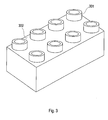
- Fig. 3 shows a game module with a game block of the FIGS. 1 and 2 similar structure on the bottom and top 302, wherein the game module on the top 302 has eight nubs 301.
Landscapes
- Toys (AREA)
- Compositions Of Macromolecular Compounds (AREA)
- Biological Depolymerization Polymers (AREA)
Description
- Die vorliegende Erfindung betrifft Spielbausteine.
- Im Stand der Technik sind Spielbausteine, Bauklötze oder Spielzeugklötzchen bekannt, die aus einem synthetischen Kunststoff hergestellt werden, wobei insbesondere ABS (Acryl-Butadien-Styrol) oder PC (Polycarbonat) Verwendung finden. Diese synthetischen Kunststoffe werden größtenteils aus erdölbasierten, fossilen Rohstoffen hergestellt.
- Die deutsche Gebrauchsmusterschrift
DE 20 2008 011 326 U1 weist einen Spielzeugbaustein zum Verklemmen mit anderen Spielzeugbausteinen auf, wobei der Baustein aus biologisch abbaubarem Material besteht. - Erdölbasierte Rohstoffe werden immer teurer, da diese Rohstoffe nur in begrenzter Menge vorliegen und die Vorräte langsam zur Neige gehen bzw. es immer höhere Anstrengungen erfordert, erdölbasierte Rohstoffe in ausreichender Menge zu fördern.
- Außerdem sind die aus reinem nachwachsenden Rohstoff hergestellten Spielbausteine nicht ausreichend stabil und langlebig.
- Eine Aufgabe der Erfindung ist daher, Spielbausteine zum Verklemmen mit Spielbausteinen ähnlichen Aufbaus zur Verfügung zu stellen, die aus Materialen hergestellt werden, die nicht nur eine Alternative zu erdölbasierten Rohstoffen darstellen, sondern auch die die Spielzeugbausteine langlebiger und mechanisch stabiler machen.
- Als erste Ausführungsform der Erfindung wird ein Spielbaustein gemäß Anspruch 1 zur Verfügung gestellt.
- Erfindungsgemäß können Spielbausteine zum Zusammenstecken und/oder Miteinanderverklemmen teilweise aus natürlichen Rohstoffen hergestellt werden, wodurch die Erdölvorkommen geschont werden können.
- Aus den natürlichen Rohstoffen können z.B. Biopolymere hergestellt werden, aus denen in einer Mischung mit synthetischen Kunststoffen die Spielbausteine hergestellt werden können. Alternativ können auch mehrere unterschiedliche Biopolymerarten verwendet werden, um Spielbausteine herzustellen, wobei alternativ zusätzlich synthetische Biopolymere beigemischt werden können.
- Aufgrund einer Mischung von natürlichen Polymeren mit synthetischen Polymeren wie beispielsweise Acryl-Butadien-Styrol (ABS), Polymethylmethacrylat (PMMA), Polyurethan, Polyvinylalkohol oder Polycarbonat (PC) können im Vergleich zu Spielbausteinen, die vollständig aus Biopolymeren hergestellt werden, langlebigere bzw. mechanisch stabilere Spielbausteine erhalten werden.
- Beispielhafte Ausführungsformen werden in den abhängigen Ansprüchen beschrieben. Gemäß einem weiteren Ausführungsbeispiel der vorliegenden Erfindung wird ein Spielbaustein zur Verfügung gestellt, wobei der Spielbaustein aus einem Verbundwerkstoff gemäß Anspruch 2 besteht.
- Durch die Verwendung von Verbundwerkstoffen können mechanisch sehr stabile Spielbausteine erhalten werden, wobei die Herstellung von Verbundwerkstoffen im Vergleich zu Polymeren herstellungstechnisch einfacher und daher günstiger ist.
- Gemäß einer beispielhaften Ausführungsform der Erfindung wird ein Spielbaustein zur Verfügung gestellt, wobei das erste Material Naturfasern ist.
- Durch Naturfasern werden die Spielbausteine in größerem Umfang biologisch abbaubar, wodurch die Spielbausteine umweltverträglicher werden.
- In einer weiteren erfindungsgemäßen Ausführungsform wird ein Spielbaustein zur Verfügung gestellt, wobei das erste Material mithilfe optimierter Enzyme, Zellen oder Mikroorganismen herstellbar ist.
- Durch das Nutzen der Techniken der weißen Biotechnologie, also die Verwendung von z.B. optimierten Enzymen, Zellen oder Mikroorganismen, wird sozusagen die Natur als chemische Fabrik genutzt. Hierdurch kann der gerätetechnische Aufwand bei der Herstellung verringert werden, wodurch Polymere, und zwar Biopolymere, kostengünstiger hergestellt werden können als herkömmliche, also synthetische, Polymere.
- Die Prozesse werden vor allem dann nachhaltig und stehen nicht in Konkurrenz zur Nahrungsmittelproduktion, wenn Restbiomasse aus der Forst- oder Landwirtschaft oder Reststoffe aus der Lebensmittelindustrie als Substrate für die Mikroorganismen genutzt werden können.
- Gemäß einer beispielhaften Ausführungsform der Erfindung wird ein Spielbaustein zur Verfügung gestellt, wobei der erste Rohstoff Stärke, Lignin, Milchsäure, Rizinusöl, Holzmehl, Chitin, Chitosan, Casein, Gelatine, Getreideproteine, Raps, Stroh, Molke, Krabbenschalen oder ein weiteres Pflanzenöl ist.
- Die Rohstoffe Stärke, Lignin, Milchsäure, Rizinusöl, Holzmehl, Chitin, Chitosan, Casein, Gelatine, Getreideproteine, Raps, Stroh, Molke, Krabbenschalen oder ein weiteres Pflanzenöl sind natürliche Rohstoffe, also nicht erdölbasierte Rohstoffe, deren Verwendung zu biologisch abbaubaren Endprodukten führen kann, wodurch diese Endprodukte als umweltverträglich zu bewerten sind.
- In einer weiteren erfindungsgemäßen Ausführungsform wird ein Spielbaustein zur Verfügung gestellt, wobei das erste Material ein natürlicher Polyester, Polyesteramid, Polylactid, Polyhydroxybuttersäure, Polytrimethylenterephthalat oder thermoplastische Stärke ist.
- Die Materialien natürlicher Polyester, Polyesteramid, Polylactid, Polyhydroxybuttersäure, Polytrimethylenterephthalat oder thermoplastische Stärke sind natürliche Materialien, die verrottbar sind und daher auch bei falscher Entsorgung zu keiner dauerhaften Umweltverschmutzung führen können.
- Gemäß einem weiteren Ausführungsbeispiel der vorliegenden Erfindung wird ein Spielbaustein zur Verfügung gestellt, wobei der Spielbaustein umfasst: eine Oberseite, wobei auf der Oberseite mindestens eine Noppe angeordnet ist und eine Unterseite, wobei auf der Unterseite mindestens eine Röhre angeordnet ist, wobei die Oberseite mit den Unterseiten weiterer Spielbausteine ähnlichen Aufbaus verklemmbar ist und wobei die Unterseite mit den Oberseiten weiterer Spielbausteine ähnlichen Aufbaus verklemmbar ist.
- Als eine Idee der Erfindung kann angesehen werden, Spielbausteine zum Zusammenstecken oder Miteinanderverklemmen bereit zu stellen, die teilweise aus natürlichen Rohstoffen hergestellt werden. Hierdurch können die begrenzten Erdölressourcen geschont werden. Ein weiterer Vorteil der erfindungsgemäßen Spielbausteine ist deren verbesserte Umweltverträglichkeit, da sie zumindest teilweise biologisch abbaubar sind.
- Die einzelnen Merkmale können selbstverständlich auch untereinander kombiniert werden, wodurch sich zum Teil auch vorteilhafte Wirkungen einstellen können, die über die Summe der Einzelwirkungen hinausgehen.
- Weitere Einzelheiten und Vorteile der Erfindung werden anhand der in den Zeichnungen dargestellten Ausführungsbeispiele deutlich. Es zeigen
-
Fig. 1 einen Spielbaustein in einer perspektivischen Ansicht von oben, -
Fig. 2 den Spielbaustein in einer perspektivischen Ansicht von unten, -
Fig. 3 einen weiteren Spielbaustein in einer perspektivischen Ansicht. -
Fig. 1 zeigt einen Spielbaustein in einer perspektivischen Ansicht von oben mit vier Noppen 101 auf der Oberseite 102 des Spielbausteins. -
Fig. 2 zeigt denselben Spielbaustein in einer perspektivischen Ansicht von unten mit Noppen 202 auf der Oberseite 201 und Röhren 203 auf der Unterseite 204, wobei die Oberseite 201 des Spielbausteins mit einer Unterseite eines anderen Spielbausteins ähnlicher Struktur aufgrund der komplementären Struktur von jeweiliger Oberseite zu Unterseite miteinander verklemmt werden kann. Außerdem kann die Unterseite 204 des Spielbausteins mit einer Oberseite eines anderen Spielbausteins ähnlicher Struktur verklemmt werden. Ferner sind Verstärkungen 205 dargestellt, die zu einer Versteifung des Spielbausteins führen können, wodurch die mechanische Stabilität des Spielbausteins erhöht werden kann. Dargestellt sind acht Verstärkungen 205, wobei jeweils zwei an eine Innenseite einer Wandung des Spielbausteins angeordnet sind. Alternativ kann auch nur eine Verstärkung oder drei, vier, fünf oder beliebig viele Verstärkungen an der Innenseite einer Wandung angeordnet werden. Es können auch bei einem Spielbaustein an den einzelnen Wandungen unterschiedlich viele Verstärkungen angeordnet werden. - Erfindungsgemäß werden Spielbausteine zur Verfügung gestellt, deren Material teilweise aus nachwachsenden, biologischen Rohstoffen hergestellt werden kann. Weitere Bezeichnungen für nachwachsende Rohstoffe sind nachhaltige Rohstoffe, biologische Rohstoffe, natürliche Rohstoffe bzw. renewable resource. Das aus einem derartigen Rohstoff gewonnene Material wird auch als Biokunststoff bezeichnet, wobei ein Biokunststoff vollständig aus nachwachsenden Rohstoffen oder teilweise aus nachwachsenden und teilweise aus fossilen, erdölbasierten Rohstoffen hergestellt werden kann. Nachwachsende Rohstoffe sind organische Rohstoffe, die durch land- oder forstwirtschaftliche Produktion gewonnen werden können. Werden als Rohstoff für die Herstellung von Biokunststoff Rest- oder Abfallprodukte verwendet, dann wird bei der Herstellung von Biokunststoff nicht nur die endliche Ressource Erdöl geschont, ferner tritt in diesem Fall die Herstellung von Biokunststoff nicht in Konkurrenz zur Herstellung von Lebens- bzw. Futtermitteln.
- Biokunststoffe können vollständig oder teilweise aus nachwachsenden Rohstoffen hergestellt werden. Beispielsweise kann ein Biokunststoff zu mindestens 20% aus nachwachsenden Rohstoffen hergestellt werden, wobei der restliche Anteil durch erdölbasierte Kunststoffe abgedeckt wird. Im Gegensatz hierzu werden synthetische Kunststoffe zu 100% aus erdölbasierten Rohstoffen hergestellt.
- Als nachwachsende Rohstoffe zur Erzeugung von Biokunststoffen können z.B. Stärke, Lignin, Milchsäure, Rizinusöl, Holzmehl, Chitin, Chitosan, Casein, Gelatine, Getreideproteine oder weitere Pflanzenöle verwendet werden.
- Ausgehend von Stärke kann thermoplastische Stärke, Polylactid (PLA) oder Polyhydroxybuttersäure (PHB) hergestellt werden, die als Biokunststoffe genutzt werden können. Stärke kann insbesondere aus Samen, Knollen, Zwiebeln, Rhizome verschiedener Getreidepflanzen bzw. Feldfrüchten, wie z.B. Kartoffeln, Weizen, Triticale, Mais, Maniok oder Reis oder z.B. aus Holz gewonnen werden. Falls Rizinussamen der Rizinuspflanze zur Herstellung von Biokunststoffen genutzt werden, folgt daraus der zusätzliche ökologische Vorteil, dass während der Wachstumsphase der Rizinuspflanze große Mengen CO2 gebunden werden können.
- Erfindungsgemäß können zur Herstellung von Spielbausteinen Biokunststoffe genutzt werden, wobei diese Biokunststoffe zu einem überwiegenden Anteil oder weiter alternativ hierzu zu einem nicht überwiegenden Anteil aus Biopolymeren hergestellt werden können. Die Biopolymere und/oder deren Vorstufen können dabei den bei synthetischen Kunststoffen üblichen Verfahren unterzogen werden. Vorteilhafterweise führt die Herstellung von Biokunststoffen, wie z.B. durch den Einsatz von PA1010- oder PA610-Formmassen oder die Produktion von partiell biobasiertem amorphem transparentem Bio-Polyamid, i.d.R. zu im Vergleich zur Herstellung von vollständig synthetischen Kunststoffen, wie z.B. ABS, PMMA oder PC, deutlich geringeren CO2-Emissionen, wodurch negative ökologische Auswirkungen reduziert werden können.
- In einer alternativen Ausführungsform werden die Spielbausteine zumindest teilweise aus Verbundwerkstoffen hergestellt, z.B. wood-plastic-composites. In einer weiteren alternativen Ausführungsform der Erfindung werden die Spielbausteine aus Verbundwerkstoffen hergestellt, wobei die Verbundwerkstoffe biogene Anteile, z.B. Holzmehl, und erdölbasierte Kunststoffe oder Biokunststoffe enthalten. In einer weiteren alternativen Ausführungsform enthält der Verbundwerkstoff naturfaserverstärkte synthetische Kunststoffe oder naturfaserverstärkte Biokunststoffe.
- Erfindungsgemäß können die Spielbausteine jede beliebige Mischung aus erdölbasierten und nachwachsenden Rohstoffen enthalten, wie z.B. holzmehlgefüllte Kunststoffe (WPC - Wood Plastic Compound), Stärkeblends, bestehend aus wasserabweisenden, biologisch abbaubaren Polymeren wie z.B. Polyester, Polyesteramiden, Polyurethanen oder Polyvinylalkohol.
- Erfindungsgemäß können die Spielbausteine z.B. aus thermoplastischer Stärke, Polymilchsäure oder Polytrimethylenterephthalat hergestellt werden.
- Thermoplastische Stärke (TPS) ist ein Biokunststoff, der als thermoplastisches Biopolymer vorliegt, wobei die als Rohstoff dienenden Stärkekörner destrukturiert werden. Thermoplastische Stärke wird aufgrund seiner Rohstoffbasis den Stärkepolymeren zugeordnet.
- Polymilchsäure (Polylactid, PLA) entsteht durch Polymerisation von Milchsäure, die wiederum ein Produkt der Fermentation aus Zucker und Stärke durch Milchsäurebakterien ist. Die Polymere werden nachfolgend bei der Polymerisation aus den unterschiedlichen Isomeren der Milchsäure, der D- und der L-Form, entsprechend der gewünschten Eigenschaften des resultierenden Kunststoffs gemischt. Weitere Eigenschaften können durch die Zugabe von Copolymeren, wie Glykolsäure, erreicht werden. Als Biokunststoff wird hierbei ein durchsichtiges Material erhalten, das in seinen Eigenschaften sehr den herkömmlichen, synthetischen, thermoplastischen Kunststoffen gleicht, wodurch Polymilchsäure ohne weiteres auf den üblichen Anlagen zur Herstellung von Endprodukten verwendet werden kann.
- In einer weiteren Ausführungsform der Erfindung werden Spielbausteine vollständig oder teilweise aus Polytrimethylenterephthalat (PTT) hergestellt, wobei Polytrimethylenterephthalat ein Biokunststoff auf Basis von 1,3-Propandiol (PDO) ist.
-
Fig. 3 zeigt einen Spielbaustein mit einer zum Spielbaustein derFiguren 1 und2 ähnlichen Struktur auf der Unter- und Oberseite 302, wobei der Spielbaustein auf der Oberseite 302 acht Noppen 301 aufweist. -
- 101
- Noppe
- 102
- Oberseite
- 201
- Oberseite
- 202
- Noppe
- 203
- Röhre
- 204
- Unterseite
- 205
- Verstärkung
- 301
- Noppe
- 302
- Oberseite
Claims (7)
- Spielbaustein zum Verklemmen mit Spielbausteinen ähnlichen Aufbaus, wobei der Spielbaustein aus einem Biokunststoff besteht, wobei der Biokunststoff umfasst
ein erstes Material, wobei das erste Material aus einem ersten nachwachsenden Rohstoff hergestellt ist, wobei das erste Material mithilfe Mikroorganismen hergestellt ist, wobei als Substrat für die Mikroorganismen Restbiomasse aus der Forst- oder Landwirtschaft oder Reststoffe aus der Lebensmittelindustrie verwendet wird,
ein zweites Material, wobei das zweite Material aus einem erdölbasierten Rohstoff hergestellt ist, wobei das zweite Material aus synthetischen Polymeren besteht, insbesondere Acryl-Butadien-Styrol (ABS), Polymethylmethacrylat (PMMA), Polyurethan, Polyvinylalkohol oder Polycarbonat (PC). - Spielbaustein nach Anspruch 1, wobei der Spielbaustein aus einem Verbundwerkstoff besteht, wobei der Verbundwerkstoff umfasst
ein drittes Material, wobei das dritte Material aus einem erdölbasierten Rohstoff hergestellt ist oder wobei das dritte Material aus einem dritten nachwachsenden Rohstoff hergestellt ist, wobei der erste Rohstoff unterschiedlich zum dritten Rohstoff ist. - Spielbaustein nach Anspruch 2, wobei das erste Material Naturfasern ist.
- Spielbaustein nach einem der vorhergehenden Ansprüche, wobei das erste Material mithilfe optimierter Enzyme, Zellen oder Mikroorganismen hergestellt ist.
- Spielbaustein nach einem der vorhergehenden Ansprüche, wobei der erste Rohstoff Stärke, Lignin, Milchsäure, Rizinusöl, Holzmehl, Chitin, Chitosan, Casein, Gelatine, Getreideproteine, Raps, Stroh, Molke, Krabbenschalen oder ein weiteres Pflanzenöl ist.
- Spielbaustein nach einem der vorhergehenden Ansprüche, wobei das erste Material ein natürlicher Polyester, Polyesteramid, Polylactid, Polyhydroxybuttersäure, Polytrimethylenterephthalat oder thermoplastische Stärke ist.
- Spielbaustein nach einem der vorhergehenden Ansprüche, wobei der Spielbaustein umfasst
eine Oberseite (102, 201, 302), wobei auf der Oberseite (102, 201, 302) mindestens eine Noppe (101, 202, 301) angeordnet ist,
eine Unterseite (204), wobei auf der Unterseite (204) mindestens eine Röhre (203) angeordnet ist, wobei die Oberseite (102, 201, 302) mit den Unterseiten weiterer Spielbausteine ähnlichen Aufbaus verklemmbar ist und wobei die Unterseite (204) mit den Oberseiten weiterer Spielbausteine ähnlichen Aufbaus verklemmbar ist.
Applications Claiming Priority (2)
| Application Number | Priority Date | Filing Date | Title |
|---|---|---|---|
| DE201010004338 DE102010004338A1 (de) | 2010-01-11 | 2010-01-11 | Spielbaustein |
| PCT/EP2011/050266 WO2011083173A1 (de) | 2010-01-11 | 2011-01-11 | Spielbaustein |
Publications (2)
| Publication Number | Publication Date |
|---|---|
| EP2523736A1 EP2523736A1 (de) | 2012-11-21 |
| EP2523736B1 true EP2523736B1 (de) | 2015-10-14 |
Family
ID=43838277
Family Applications (1)
| Application Number | Title | Priority Date | Filing Date |
|---|---|---|---|
| EP11700166.9A Revoked EP2523736B1 (de) | 2010-01-11 | 2011-01-11 | Spielbaustein |
Country Status (5)
| Country | Link |
|---|---|
| EP (1) | EP2523736B1 (de) |
| DE (1) | DE102010004338A1 (de) |
| DK (1) | DK2523736T3 (de) |
| ES (1) | ES2558747T3 (de) |
| WO (1) | WO2011083173A1 (de) |
Cited By (1)
| Publication number | Priority date | Publication date | Assignee | Title |
|---|---|---|---|---|
| WO2022187326A1 (en) * | 2021-03-02 | 2022-09-09 | Philbrick Jane | Manufacture of goods using an eco-friendly material |
Families Citing this family (6)
| Publication number | Priority date | Publication date | Assignee | Title |
|---|---|---|---|---|
| DE202015002996U1 (de) * | 2015-04-21 | 2015-06-22 | Joachim Peiler | Flächig verbindbare Spielbausteine |
| CN105833541A (zh) * | 2016-04-06 | 2016-08-10 | 苏州乐派特机器人有限公司 | 一种积木拼接结构单元 |
| DK3717086T3 (da) * | 2017-12-01 | 2024-03-25 | Lego As | Legetøjsbyggeelement fremstilllet af et polymerisk pet-materiale |
| BR112020010254A2 (pt) * | 2017-12-01 | 2020-11-10 | Lego A/S | blocos de construção de brinquedos produzidos de material biopolimérico |
| WO2019106133A1 (en) * | 2017-12-01 | 2019-06-06 | Lego A/S | An additively manufactured toy building brick |
| CN223069076U (zh) * | 2024-07-22 | 2025-07-08 | 浙江忠协工艺品有限公司 | 一种木质积木结构及木质积木 |
Citations (14)
| Publication number | Priority date | Publication date | Assignee | Title |
|---|---|---|---|---|
| DE19703038A1 (de) | 1997-01-29 | 1998-07-30 | Reichenecker Hans Storopack | Spielzeug |
| DE19747738A1 (de) | 1997-10-29 | 1999-05-06 | Dirk Glootz | System zum Erstellen eines statischen Gebildes |
| DE19802053A1 (de) | 1997-11-08 | 1999-07-22 | Fischer Artur Prof Dr H C Dr I | Spielelement |
| DE19823689A1 (de) | 1998-05-27 | 1999-12-02 | Axel Mehnert | Zerlegbarer Spielbaustein, insbesondere aus zellulosehaltigem Material |
| DE20105330U1 (de) | 2001-03-26 | 2001-06-13 | Artur Fischer Tip GmbH & Co. KG, 72178 Waldachtal | Bauplatte als Spiel- und Konstruktionsbauplatte |
| US20030100635A1 (en) | 2001-10-05 | 2003-05-29 | William Ho | Biodegradable starch resin and method for making same |
| DE202006008907U1 (de) | 2006-06-02 | 2006-08-10 | Zitzer, Vladimir | Modulares System |
| US20060208387A1 (en) | 2003-04-14 | 2006-09-21 | Harald Zodl | Moulded bodies consisting of biological fibrous material and plastic |
| US20060225667A1 (en) | 2005-04-06 | 2006-10-12 | Simon Handelsman | Flexible configuration dog bone |
| JP2007238908A (ja) | 2006-03-06 | 2007-09-20 | Elegaphy Inc | 複合糖材成形品及びその製造方法 |
| DE202008011326U1 (de) | 2008-08-25 | 2009-02-12 | Schwemmer, Martin | Umweltfreundliche biologisch abbaubare Spielzeug Bausteine mit Leuchteffekt und Nanobeschichtung |
| US20090246501A1 (en) | 2008-03-26 | 2009-10-01 | Fina Technology, Inc. | Reduced Weight Multilayer Polymeric Articles and Methods of Making and Using Same |
| WO2009146991A2 (de) | 2008-06-03 | 2009-12-10 | Evonik Oxeno Gmbh | Zitronensäureestergemische und ihre verwendung |
| US20090326152A1 (en) | 2008-06-30 | 2009-12-31 | Fina Technology, Inc. | Compatibilized polypropylene and polylactic acid blends and methods of making and using same |
-
2010
- 2010-01-11 DE DE201010004338 patent/DE102010004338A1/de not_active Withdrawn
-
2011
- 2011-01-11 DK DK11700166.9T patent/DK2523736T3/en active
- 2011-01-11 ES ES11700166.9T patent/ES2558747T3/es active Active
- 2011-01-11 EP EP11700166.9A patent/EP2523736B1/de not_active Revoked
- 2011-01-11 WO PCT/EP2011/050266 patent/WO2011083173A1/de not_active Ceased
Patent Citations (14)
| Publication number | Priority date | Publication date | Assignee | Title |
|---|---|---|---|---|
| DE19703038A1 (de) | 1997-01-29 | 1998-07-30 | Reichenecker Hans Storopack | Spielzeug |
| DE19747738A1 (de) | 1997-10-29 | 1999-05-06 | Dirk Glootz | System zum Erstellen eines statischen Gebildes |
| DE19802053A1 (de) | 1997-11-08 | 1999-07-22 | Fischer Artur Prof Dr H C Dr I | Spielelement |
| DE19823689A1 (de) | 1998-05-27 | 1999-12-02 | Axel Mehnert | Zerlegbarer Spielbaustein, insbesondere aus zellulosehaltigem Material |
| DE20105330U1 (de) | 2001-03-26 | 2001-06-13 | Artur Fischer Tip GmbH & Co. KG, 72178 Waldachtal | Bauplatte als Spiel- und Konstruktionsbauplatte |
| US20030100635A1 (en) | 2001-10-05 | 2003-05-29 | William Ho | Biodegradable starch resin and method for making same |
| US20060208387A1 (en) | 2003-04-14 | 2006-09-21 | Harald Zodl | Moulded bodies consisting of biological fibrous material and plastic |
| US20060225667A1 (en) | 2005-04-06 | 2006-10-12 | Simon Handelsman | Flexible configuration dog bone |
| JP2007238908A (ja) | 2006-03-06 | 2007-09-20 | Elegaphy Inc | 複合糖材成形品及びその製造方法 |
| DE202006008907U1 (de) | 2006-06-02 | 2006-08-10 | Zitzer, Vladimir | Modulares System |
| US20090246501A1 (en) | 2008-03-26 | 2009-10-01 | Fina Technology, Inc. | Reduced Weight Multilayer Polymeric Articles and Methods of Making and Using Same |
| WO2009146991A2 (de) | 2008-06-03 | 2009-12-10 | Evonik Oxeno Gmbh | Zitronensäureestergemische und ihre verwendung |
| US20090326152A1 (en) | 2008-06-30 | 2009-12-31 | Fina Technology, Inc. | Compatibilized polypropylene and polylactic acid blends and methods of making and using same |
| DE202008011326U1 (de) | 2008-08-25 | 2009-02-12 | Schwemmer, Martin | Umweltfreundliche biologisch abbaubare Spielzeug Bausteine mit Leuchteffekt und Nanobeschichtung |
Non-Patent Citations (6)
| Title |
|---|
| "Technology Focus Report: Blends of PLA with other Thermoplastics", NATUREWORKS, February 2007 (2007-02-01) |
| "Verbundwerkstoff", WIKIPEDIA, 14 December 2017 (2017-12-14), XP055453295 |
| KOICHI KIMURA ET AL.: "Bio-Based Polymers", FUJITSU SCI. TECH. J., vol. 41, July 2005 (2005-07-01), pages 173 - 180, XP055296162 |
| PAULINE OLIVIER ET AL.: "Biopoymère, PHA, emballage complexe laminé, papier, carton, mar - ché", MÉMOIRE CERIG, February 2009 (2009-02-01), XP055296159 |
| PAULINE OLIVIER ET AL: "Biopolymère, PHA, emballage complexe laminé, papier, carton, marché", MÉMOIRE CERIG, 28 February 2009 (2009-02-28), XP055154065, Retrieved from the Internet <URL:http://cerig.pagora.grenoble-inp.fr//memoire/2009/biopolymere-emballage.htm#map-biopolymere_bibliographie> [retrieved on 20141119] * |
| STORZ H. ET AL.: "Bio-based plastics: status, challenges and trends", APPL. AGRIC. FORESTRY, 2013, pages 321 - 332, XP055453293 |
Cited By (1)
| Publication number | Priority date | Publication date | Assignee | Title |
|---|---|---|---|---|
| WO2022187326A1 (en) * | 2021-03-02 | 2022-09-09 | Philbrick Jane | Manufacture of goods using an eco-friendly material |
Also Published As
| Publication number | Publication date |
|---|---|
| DE102010004338A1 (de) | 2011-07-14 |
| ES2558747T3 (es) | 2016-02-08 |
| EP2523736A1 (de) | 2012-11-21 |
| WO2011083173A1 (de) | 2011-07-14 |
| DK2523736T3 (en) | 2016-02-01 |
Similar Documents
| Publication | Publication Date | Title |
|---|---|---|
| Raman et al. | Mycofabrication of mycelium-based leather from brown-rot fungi | |
| Sethupathi et al. | Recent developments of pineapple leaf fiber (PALF) utilization in the polymer composites—a review | |
| EP2523736A1 (de) | Spielbaustein | |
| Siracusa | Microbial degradation of synthetic biopolymers waste | |
| Bari et al. | Current strategies for the production of sustainable biopolymer composites | |
| Enarevba et al. | The emerging hemp industry: a review of industrial hemp materials and product manufacturing | |
| Nukala et al. | Development of wood polymer composites from recycled wood and plastic waste: thermal and mechanical properties | |
| Irbe et al. | Characterization of self-growing biomaterials made of fungal mycelium and various lignocellulose-containing ingredients | |
| Rammou et al. | The potential use of seaweed (Posidonia oceanica) as an alternative lignocellulosic raw material for wood composites manufacture | |
| Zykova et al. | Biocomposites of low-density polyethylene plus wood flour or flax straw: biodegradation kinetics across three environments | |
| Osman et al. | Influence of alkaline treatment and fiber morphology on the mechanical, physical, and thermal properties of polypropylene and polylactic acid biocomposites reinforced with kenaf, bagasse, hemp fibers and softwood | |
| da Silveira et al. | Amazon natural fibers for application in engineering composites and sustainable actions: a review | |
| Asadollahzadeh et al. | Application of fungal biomass for the development of new polylactic acid-based biocomposites | |
| Terroba-Delicado et al. | Valorization of liquor waste derived spent coffee grains for the development of injection-molded polylactide pieces of interest as disposable food packaging and serving materials | |
| Rendón-Castrillón et al. | The industrial potential of fique cultivated in Colombia | |
| Ekielski et al. | Properties of biocomposites produced with thermoplastic starch and digestate: Physicochemical and mechanical characteristics | |
| Sierra et al. | Current situation and future perspectives for the use of fungi in the biomaterial industry and proposal for a new classification of fungal-derived materials | |
| Mosquera Rodríguez et al. | Study of the degradation of a TPS/PCL/fique biocomposite material in soil, compost, and water | |
| Cesarino et al. | Deterioration of wood plastics composites by the white-rot fungus Pycnoporus sanguineus | |
| Liew et al. | Potential of using natural and synthetic binder in wood composites | |
| Kovačević et al. | Zero waste concept in production of PLA biocomposites reinforced with fibers derived from wild plant (Spartium junceum L.) and energy crop (Sida hermaphrodita (L.) rusby) | |
| Song et al. | The effects of the substrate length and cultivation time on the physical and mechanical properties of mycelium-based cushioning materials from Salix psammophila and peanut straw | |
| Navin et al. | CRITIC–EDAS approach for evaluating mechanical properties of flax/vetiver/MFF hybrid composites | |
| He et al. | Four-ingredient blends of poly (lactic acid) with cottonseed oil and meal for biocomposite utilization | |
| Kim et al. | Changes of lignin molecular structures in a modification of kraft lignin using acid catalyst |
Legal Events
| Date | Code | Title | Description |
|---|---|---|---|
| PUAI | Public reference made under article 153(3) epc to a published international application that has entered the european phase |
Free format text: ORIGINAL CODE: 0009012 |
|
| 17P | Request for examination filed |
Effective date: 20120709 |
|
| AK | Designated contracting states |
Kind code of ref document: A1 Designated state(s): AL AT BE BG CH CY CZ DE DK EE ES FI FR GB GR HR HU IE IS IT LI LT LU LV MC MK MT NL NO PL PT RO RS SE SI SK SM TR |
|
| DAX | Request for extension of the european patent (deleted) | ||
| 17Q | First examination report despatched |
Effective date: 20141128 |
|
| GRAP | Despatch of communication of intention to grant a patent |
Free format text: ORIGINAL CODE: EPIDOSNIGR1 |
|
| INTG | Intention to grant announced |
Effective date: 20150618 |
|
| GRAS | Grant fee paid |
Free format text: ORIGINAL CODE: EPIDOSNIGR3 |
|
| GRAA | (expected) grant |
Free format text: ORIGINAL CODE: 0009210 |
|
| AK | Designated contracting states |
Kind code of ref document: B1 Designated state(s): AL AT BE BG CH CY CZ DE DK EE ES FI FR GB GR HR HU IE IS IT LI LT LU LV MC MK MT NL NO PL PT RO RS SE SI SK SM TR |
|
| REG | Reference to a national code |
Ref country code: GB Ref legal event code: FG4D Free format text: NOT ENGLISH |
|
| REG | Reference to a national code |
Ref country code: AT Ref legal event code: REF Ref document number: 754673 Country of ref document: AT Kind code of ref document: T Effective date: 20151015 Ref country code: CH Ref legal event code: EP |
|
| REG | Reference to a national code |
Ref country code: IE Ref legal event code: FG4D Free format text: LANGUAGE OF EP DOCUMENT: GERMAN |
|
| REG | Reference to a national code |
Ref country code: DE Ref legal event code: R096 Ref document number: 502011008090 Country of ref document: DE |
|
| REG | Reference to a national code |
Ref country code: FR Ref legal event code: PLFP Year of fee payment: 6 |
|
| REG | Reference to a national code |
Ref country code: DK Ref legal event code: T3 Effective date: 20160125 |
|
| REG | Reference to a national code |
Ref country code: ES Ref legal event code: FG2A Ref document number: 2558747 Country of ref document: ES Kind code of ref document: T3 Effective date: 20160208 |
|
| REG | Reference to a national code |
Ref country code: NL Ref legal event code: MP Effective date: 20151014 |
|
| REG | Reference to a national code |
Ref country code: LT Ref legal event code: MG4D |
|
| PG25 | Lapsed in a contracting state [announced via postgrant information from national office to epo] |
Ref country code: NO Free format text: LAPSE BECAUSE OF FAILURE TO SUBMIT A TRANSLATION OF THE DESCRIPTION OR TO PAY THE FEE WITHIN THE PRESCRIBED TIME-LIMIT Effective date: 20160114 Ref country code: IS Free format text: LAPSE BECAUSE OF FAILURE TO SUBMIT A TRANSLATION OF THE DESCRIPTION OR TO PAY THE FEE WITHIN THE PRESCRIBED TIME-LIMIT Effective date: 20160214 Ref country code: HR Free format text: LAPSE BECAUSE OF FAILURE TO SUBMIT A TRANSLATION OF THE DESCRIPTION OR TO PAY THE FEE WITHIN THE PRESCRIBED TIME-LIMIT Effective date: 20151014 Ref country code: LT Free format text: LAPSE BECAUSE OF FAILURE TO SUBMIT A TRANSLATION OF THE DESCRIPTION OR TO PAY THE FEE WITHIN THE PRESCRIBED TIME-LIMIT Effective date: 20151014 Ref country code: NL Free format text: LAPSE BECAUSE OF FAILURE TO SUBMIT A TRANSLATION OF THE DESCRIPTION OR TO PAY THE FEE WITHIN THE PRESCRIBED TIME-LIMIT Effective date: 20151014 |
|
| PG25 | Lapsed in a contracting state [announced via postgrant information from national office to epo] |
Ref country code: PT Free format text: LAPSE BECAUSE OF FAILURE TO SUBMIT A TRANSLATION OF THE DESCRIPTION OR TO PAY THE FEE WITHIN THE PRESCRIBED TIME-LIMIT Effective date: 20160215 Ref country code: GR Free format text: LAPSE BECAUSE OF FAILURE TO SUBMIT A TRANSLATION OF THE DESCRIPTION OR TO PAY THE FEE WITHIN THE PRESCRIBED TIME-LIMIT Effective date: 20160115 Ref country code: BE Free format text: LAPSE BECAUSE OF NON-PAYMENT OF DUE FEES Effective date: 20160131 Ref country code: SE Free format text: LAPSE BECAUSE OF FAILURE TO SUBMIT A TRANSLATION OF THE DESCRIPTION OR TO PAY THE FEE WITHIN THE PRESCRIBED TIME-LIMIT Effective date: 20151014 Ref country code: LV Free format text: LAPSE BECAUSE OF FAILURE TO SUBMIT A TRANSLATION OF THE DESCRIPTION OR TO PAY THE FEE WITHIN THE PRESCRIBED TIME-LIMIT Effective date: 20151014 Ref country code: FI Free format text: LAPSE BECAUSE OF FAILURE TO SUBMIT A TRANSLATION OF THE DESCRIPTION OR TO PAY THE FEE WITHIN THE PRESCRIBED TIME-LIMIT Effective date: 20151014 Ref country code: RS Free format text: LAPSE BECAUSE OF FAILURE TO SUBMIT A TRANSLATION OF THE DESCRIPTION OR TO PAY THE FEE WITHIN THE PRESCRIBED TIME-LIMIT Effective date: 20151014 Ref country code: PL Free format text: LAPSE BECAUSE OF FAILURE TO SUBMIT A TRANSLATION OF THE DESCRIPTION OR TO PAY THE FEE WITHIN THE PRESCRIBED TIME-LIMIT Effective date: 20151014 |
|
| REG | Reference to a national code |
Ref country code: DE Ref legal event code: R026 Ref document number: 502011008090 Country of ref document: DE |
|
| PLBI | Opposition filed |
Free format text: ORIGINAL CODE: 0009260 |
|
| PG25 | Lapsed in a contracting state [announced via postgrant information from national office to epo] |
Ref country code: CZ Free format text: LAPSE BECAUSE OF FAILURE TO SUBMIT A TRANSLATION OF THE DESCRIPTION OR TO PAY THE FEE WITHIN THE PRESCRIBED TIME-LIMIT Effective date: 20151014 |
|
| 26 | Opposition filed |
Opponent name: LEGO A/S Effective date: 20160713 |
|
| PLAX | Notice of opposition and request to file observation + time limit sent |
Free format text: ORIGINAL CODE: EPIDOSNOBS2 |
|
| PG25 | Lapsed in a contracting state [announced via postgrant information from national office to epo] |
Ref country code: LU Free format text: LAPSE BECAUSE OF FAILURE TO SUBMIT A TRANSLATION OF THE DESCRIPTION OR TO PAY THE FEE WITHIN THE PRESCRIBED TIME-LIMIT Effective date: 20160111 Ref country code: SK Free format text: LAPSE BECAUSE OF FAILURE TO SUBMIT A TRANSLATION OF THE DESCRIPTION OR TO PAY THE FEE WITHIN THE PRESCRIBED TIME-LIMIT Effective date: 20151014 Ref country code: SM Free format text: LAPSE BECAUSE OF FAILURE TO SUBMIT A TRANSLATION OF THE DESCRIPTION OR TO PAY THE FEE WITHIN THE PRESCRIBED TIME-LIMIT Effective date: 20151014 Ref country code: RO Free format text: LAPSE BECAUSE OF FAILURE TO SUBMIT A TRANSLATION OF THE DESCRIPTION OR TO PAY THE FEE WITHIN THE PRESCRIBED TIME-LIMIT Effective date: 20151014 Ref country code: EE Free format text: LAPSE BECAUSE OF FAILURE TO SUBMIT A TRANSLATION OF THE DESCRIPTION OR TO PAY THE FEE WITHIN THE PRESCRIBED TIME-LIMIT Effective date: 20151014 |
|
| REG | Reference to a national code |
Ref country code: CH Ref legal event code: PL |
|
| PG25 | Lapsed in a contracting state [announced via postgrant information from national office to epo] |
Ref country code: MC Free format text: LAPSE BECAUSE OF FAILURE TO SUBMIT A TRANSLATION OF THE DESCRIPTION OR TO PAY THE FEE WITHIN THE PRESCRIBED TIME-LIMIT Effective date: 20151014 |
|
| PG25 | Lapsed in a contracting state [announced via postgrant information from national office to epo] |
Ref country code: LI Free format text: LAPSE BECAUSE OF NON-PAYMENT OF DUE FEES Effective date: 20160131 Ref country code: CH Free format text: LAPSE BECAUSE OF NON-PAYMENT OF DUE FEES Effective date: 20160131 |
|
| REG | Reference to a national code |
Ref country code: IE Ref legal event code: MM4A |
|
| PG25 | Lapsed in a contracting state [announced via postgrant information from national office to epo] |
Ref country code: SI Free format text: LAPSE BECAUSE OF FAILURE TO SUBMIT A TRANSLATION OF THE DESCRIPTION OR TO PAY THE FEE WITHIN THE PRESCRIBED TIME-LIMIT Effective date: 20151014 |
|
| PLBB | Reply of patent proprietor to notice(s) of opposition received |
Free format text: ORIGINAL CODE: EPIDOSNOBS3 |
|
| REG | Reference to a national code |
Ref country code: FR Ref legal event code: PLFP Year of fee payment: 7 |
|
| PG25 | Lapsed in a contracting state [announced via postgrant information from national office to epo] |
Ref country code: IE Free format text: LAPSE BECAUSE OF NON-PAYMENT OF DUE FEES Effective date: 20160111 |
|
| REG | Reference to a national code |
Ref country code: AT Ref legal event code: MM01 Ref document number: 754673 Country of ref document: AT Kind code of ref document: T Effective date: 20160111 |
|
| PG25 | Lapsed in a contracting state [announced via postgrant information from national office to epo] |
Ref country code: AT Free format text: LAPSE BECAUSE OF NON-PAYMENT OF DUE FEES Effective date: 20160111 |
|
| PG25 | Lapsed in a contracting state [announced via postgrant information from national office to epo] |
Ref country code: MT Free format text: LAPSE BECAUSE OF FAILURE TO SUBMIT A TRANSLATION OF THE DESCRIPTION OR TO PAY THE FEE WITHIN THE PRESCRIBED TIME-LIMIT Effective date: 20151014 |
|
| REG | Reference to a national code |
Ref country code: FR Ref legal event code: PLFP Year of fee payment: 8 |
|
| REG | Reference to a national code |
Ref country code: DE Ref legal event code: R064 Ref document number: 502011008090 Country of ref document: DE Ref country code: DE Ref legal event code: R103 Ref document number: 502011008090 Country of ref document: DE |
|
| RDAF | Communication despatched that patent is revoked |
Free format text: ORIGINAL CODE: EPIDOSNREV1 |
|
| PGFP | Annual fee paid to national office [announced via postgrant information from national office to epo] |
Ref country code: ES Payment date: 20180201 Year of fee payment: 8 Ref country code: DK Payment date: 20180125 Year of fee payment: 8 Ref country code: GB Payment date: 20180125 Year of fee payment: 8 Ref country code: DE Payment date: 20180124 Year of fee payment: 8 |
|
| PG25 | Lapsed in a contracting state [announced via postgrant information from national office to epo] |
Ref country code: HU Free format text: LAPSE BECAUSE OF FAILURE TO SUBMIT A TRANSLATION OF THE DESCRIPTION OR TO PAY THE FEE WITHIN THE PRESCRIBED TIME-LIMIT; INVALID AB INITIO Effective date: 20110111 Ref country code: CY Free format text: LAPSE BECAUSE OF FAILURE TO SUBMIT A TRANSLATION OF THE DESCRIPTION OR TO PAY THE FEE WITHIN THE PRESCRIBED TIME-LIMIT Effective date: 20151014 |
|
| PGFP | Annual fee paid to national office [announced via postgrant information from national office to epo] |
Ref country code: FR Payment date: 20180124 Year of fee payment: 8 Ref country code: IT Payment date: 20180126 Year of fee payment: 8 |
|
| PG25 | Lapsed in a contracting state [announced via postgrant information from national office to epo] |
Ref country code: TR Free format text: LAPSE BECAUSE OF FAILURE TO SUBMIT A TRANSLATION OF THE DESCRIPTION OR TO PAY THE FEE WITHIN THE PRESCRIBED TIME-LIMIT Effective date: 20151014 Ref country code: MK Free format text: LAPSE BECAUSE OF FAILURE TO SUBMIT A TRANSLATION OF THE DESCRIPTION OR TO PAY THE FEE WITHIN THE PRESCRIBED TIME-LIMIT Effective date: 20151014 |
|
| RDAG | Patent revoked |
Free format text: ORIGINAL CODE: 0009271 |
|
| STAA | Information on the status of an ep patent application or granted ep patent |
Free format text: STATUS: PATENT REVOKED |
|
| PG25 | Lapsed in a contracting state [announced via postgrant information from national office to epo] |
Ref country code: BG Free format text: LAPSE BECAUSE OF FAILURE TO SUBMIT A TRANSLATION OF THE DESCRIPTION OR TO PAY THE FEE WITHIN THE PRESCRIBED TIME-LIMIT Effective date: 20151014 |
|
| 27W | Patent revoked |
Effective date: 20180308 |
|
| GBPR | Gb: patent revoked under art. 102 of the ep convention designating the uk as contracting state |
Effective date: 20180308 |
|
| REG | Reference to a national code |
Ref country code: BE Ref legal event code: MM Effective date: 20160131 |
|
| PG25 | Lapsed in a contracting state [announced via postgrant information from national office to epo] |
Ref country code: AL Free format text: LAPSE BECAUSE OF FAILURE TO SUBMIT A TRANSLATION OF THE DESCRIPTION OR TO PAY THE FEE WITHIN THE PRESCRIBED TIME-LIMIT Effective date: 20151014 |
|
| REG | Reference to a national code |
Ref country code: AT Ref legal event code: MA03 Ref document number: 754673 Country of ref document: AT Kind code of ref document: T Effective date: 20180308 |