EP2530341A1 - Element für ein rollenlager und rollenlager - Google Patents
Element für ein rollenlager und rollenlager Download PDFInfo
- Publication number
- EP2530341A1 EP2530341A1 EP11737087A EP11737087A EP2530341A1 EP 2530341 A1 EP2530341 A1 EP 2530341A1 EP 11737087 A EP11737087 A EP 11737087A EP 11737087 A EP11737087 A EP 11737087A EP 2530341 A1 EP2530341 A1 EP 2530341A1
- Authority
- EP
- European Patent Office
- Prior art keywords
- rolling bearing
- resin
- cage
- seal
- outer ring
- Prior art date
- Legal status (The legal status is an assumption and is not a legal conclusion. Google has not performed a legal analysis and makes no representation as to the accuracy of the status listed.)
- Granted
Links
Images

Classifications
-
- F—MECHANICAL ENGINEERING; LIGHTING; HEATING; WEAPONS; BLASTING
- F16—ENGINEERING ELEMENTS AND UNITS; GENERAL MEASURES FOR PRODUCING AND MAINTAINING EFFECTIVE FUNCTIONING OF MACHINES OR INSTALLATIONS; THERMAL INSULATION IN GENERAL
- F16C—SHAFTS; FLEXIBLE SHAFTS; ELEMENTS OR CRANKSHAFT MECHANISMS; ROTARY BODIES OTHER THAN GEARING ELEMENTS; BEARINGS
- F16C33/00—Parts of bearings; Special methods for making bearings or parts thereof
- F16C33/30—Parts of ball or roller bearings
- F16C33/38—Ball cages
- F16C33/44—Selection of substances
-
- C—CHEMISTRY; METALLURGY
- C08—ORGANIC MACROMOLECULAR COMPOUNDS; THEIR PREPARATION OR CHEMICAL WORKING-UP; COMPOSITIONS BASED THEREON
- C08G—MACROMOLECULAR COMPOUNDS OBTAINED OTHERWISE THAN BY REACTIONS ONLY INVOLVING UNSATURATED CARBON-TO-CARBON BONDS
- C08G69/00—Macromolecular compounds obtained by reactions forming a carboxylic amide link in the main chain of the macromolecule
- C08G69/02—Polyamides derived from amino-carboxylic acids or from polyamines and polycarboxylic acids
- C08G69/36—Polyamides derived from amino-carboxylic acids or from polyamines and polycarboxylic acids derived from amino acids, polyamines and polycarboxylic acids
-
- C—CHEMISTRY; METALLURGY
- C08—ORGANIC MACROMOLECULAR COMPOUNDS; THEIR PREPARATION OR CHEMICAL WORKING-UP; COMPOSITIONS BASED THEREON
- C08L—COMPOSITIONS OF MACROMOLECULAR COMPOUNDS
- C08L77/00—Compositions of polyamides obtained by reactions forming a carboxylic amide link in the main chain; Compositions of derivatives of such polymers
- C08L77/06—Polyamides derived from polyamines and polycarboxylic acids
-
- F—MECHANICAL ENGINEERING; LIGHTING; HEATING; WEAPONS; BLASTING
- F16—ENGINEERING ELEMENTS AND UNITS; GENERAL MEASURES FOR PRODUCING AND MAINTAINING EFFECTIVE FUNCTIONING OF MACHINES OR INSTALLATIONS; THERMAL INSULATION IN GENERAL
- F16C—SHAFTS; FLEXIBLE SHAFTS; ELEMENTS OR CRANKSHAFT MECHANISMS; ROTARY BODIES OTHER THAN GEARING ELEMENTS; BEARINGS
- F16C33/00—Parts of bearings; Special methods for making bearings or parts thereof
- F16C33/30—Parts of ball or roller bearings
- F16C33/66—Special parts or details in view of lubrication
- F16C33/6603—Special parts or details in view of lubrication with grease as lubricant
- F16C33/6633—Grease properties or compositions, e.g. rheological properties
-
- F—MECHANICAL ENGINEERING; LIGHTING; HEATING; WEAPONS; BLASTING
- F16—ENGINEERING ELEMENTS AND UNITS; GENERAL MEASURES FOR PRODUCING AND MAINTAINING EFFECTIVE FUNCTIONING OF MACHINES OR INSTALLATIONS; THERMAL INSULATION IN GENERAL
- F16C—SHAFTS; FLEXIBLE SHAFTS; ELEMENTS OR CRANKSHAFT MECHANISMS; ROTARY BODIES OTHER THAN GEARING ELEMENTS; BEARINGS
- F16C33/00—Parts of bearings; Special methods for making bearings or parts thereof
- F16C33/72—Sealings
- F16C33/76—Sealings of ball or roller bearings
- F16C33/78—Sealings of ball or roller bearings with a diaphragm, disc, or ring, with or without resilient members
- F16C33/784—Sealings of ball or roller bearings with a diaphragm, disc, or ring, with or without resilient members mounted to a groove in the inner surface of the outer race and extending toward the inner race
- F16C33/7843—Sealings of ball or roller bearings with a diaphragm, disc, or ring, with or without resilient members mounted to a groove in the inner surface of the outer race and extending toward the inner race with a single annular sealing disc
- F16C33/7846—Sealings of ball or roller bearings with a diaphragm, disc, or ring, with or without resilient members mounted to a groove in the inner surface of the outer race and extending toward the inner race with a single annular sealing disc with a gap between the annular disc and the inner race
-
- C—CHEMISTRY; METALLURGY
- C08—ORGANIC MACROMOLECULAR COMPOUNDS; THEIR PREPARATION OR CHEMICAL WORKING-UP; COMPOSITIONS BASED THEREON
- C08K—Use of inorganic or non-macromolecular organic substances as compounding ingredients
- C08K7/00—Use of ingredients characterised by shape
- C08K7/02—Fibres or whiskers
- C08K7/04—Fibres or whiskers inorganic
- C08K7/06—Elements
-
- C—CHEMISTRY; METALLURGY
- C08—ORGANIC MACROMOLECULAR COMPOUNDS; THEIR PREPARATION OR CHEMICAL WORKING-UP; COMPOSITIONS BASED THEREON
- C08K—Use of inorganic or non-macromolecular organic substances as compounding ingredients
- C08K7/00—Use of ingredients characterised by shape
- C08K7/02—Fibres or whiskers
- C08K7/04—Fibres or whiskers inorganic
- C08K7/14—Glass
-
- F—MECHANICAL ENGINEERING; LIGHTING; HEATING; WEAPONS; BLASTING
- F16—ENGINEERING ELEMENTS AND UNITS; GENERAL MEASURES FOR PRODUCING AND MAINTAINING EFFECTIVE FUNCTIONING OF MACHINES OR INSTALLATIONS; THERMAL INSULATION IN GENERAL
- F16C—SHAFTS; FLEXIBLE SHAFTS; ELEMENTS OR CRANKSHAFT MECHANISMS; ROTARY BODIES OTHER THAN GEARING ELEMENTS; BEARINGS
- F16C19/00—Bearings with rolling contact, for exclusively rotary movement
- F16C19/02—Bearings with rolling contact, for exclusively rotary movement with bearing balls essentially of the same size in one or more circular rows
- F16C19/04—Bearings with rolling contact, for exclusively rotary movement with bearing balls essentially of the same size in one or more circular rows for radial load mainly
- F16C19/06—Bearings with rolling contact, for exclusively rotary movement with bearing balls essentially of the same size in one or more circular rows for radial load mainly with a single row or balls
-
- F—MECHANICAL ENGINEERING; LIGHTING; HEATING; WEAPONS; BLASTING
- F16—ENGINEERING ELEMENTS AND UNITS; GENERAL MEASURES FOR PRODUCING AND MAINTAINING EFFECTIVE FUNCTIONING OF MACHINES OR INSTALLATIONS; THERMAL INSULATION IN GENERAL
- F16C—SHAFTS; FLEXIBLE SHAFTS; ELEMENTS OR CRANKSHAFT MECHANISMS; ROTARY BODIES OTHER THAN GEARING ELEMENTS; BEARINGS
- F16C2208/00—Plastics; Synthetic resins, e.g. rubbers
- F16C2208/02—Plastics; Synthetic resins, e.g. rubbers comprising fillers, fibres
- F16C2208/04—Glass fibres
-
- F—MECHANICAL ENGINEERING; LIGHTING; HEATING; WEAPONS; BLASTING
- F16—ENGINEERING ELEMENTS AND UNITS; GENERAL MEASURES FOR PRODUCING AND MAINTAINING EFFECTIVE FUNCTIONING OF MACHINES OR INSTALLATIONS; THERMAL INSULATION IN GENERAL
- F16C—SHAFTS; FLEXIBLE SHAFTS; ELEMENTS OR CRANKSHAFT MECHANISMS; ROTARY BODIES OTHER THAN GEARING ELEMENTS; BEARINGS
- F16C2208/00—Plastics; Synthetic resins, e.g. rubbers
- F16C2208/20—Thermoplastic resins
- F16C2208/60—Polyamides [PA]
- F16C2208/62—Polyamides [PA] high performance polyamides, e.g. PA12, PA46
-
- F—MECHANICAL ENGINEERING; LIGHTING; HEATING; WEAPONS; BLASTING
- F16—ENGINEERING ELEMENTS AND UNITS; GENERAL MEASURES FOR PRODUCING AND MAINTAINING EFFECTIVE FUNCTIONING OF MACHINES OR INSTALLATIONS; THERMAL INSULATION IN GENERAL
- F16C—SHAFTS; FLEXIBLE SHAFTS; ELEMENTS OR CRANKSHAFT MECHANISMS; ROTARY BODIES OTHER THAN GEARING ELEMENTS; BEARINGS
- F16C2300/00—Application independent of particular apparatuses
- F16C2300/20—Application independent of particular apparatuses related to type of movement
- F16C2300/22—High-speed rotation
-
- F—MECHANICAL ENGINEERING; LIGHTING; HEATING; WEAPONS; BLASTING
- F16—ENGINEERING ELEMENTS AND UNITS; GENERAL MEASURES FOR PRODUCING AND MAINTAINING EFFECTIVE FUNCTIONING OF MACHINES OR INSTALLATIONS; THERMAL INSULATION IN GENERAL
- F16C—SHAFTS; FLEXIBLE SHAFTS; ELEMENTS OR CRANKSHAFT MECHANISMS; ROTARY BODIES OTHER THAN GEARING ELEMENTS; BEARINGS
- F16C33/00—Parts of bearings; Special methods for making bearings or parts thereof
- F16C33/30—Parts of ball or roller bearings
- F16C33/38—Ball cages
- F16C33/41—Ball cages comb-shaped
- F16C33/412—Massive or moulded comb cages, e.g. snap ball cages
- F16C33/414—Massive or moulded comb cages, e.g. snap ball cages formed as one-piece cages, i.e. monoblock comb cages
- F16C33/416—Massive or moulded comb cages, e.g. snap ball cages formed as one-piece cages, i.e. monoblock comb cages made from plastic, e.g. injection moulded comb cages
Definitions
- the present invention relates to a resin-made cage composing a rolling bearing, a member such as a seal for the rolling bearing, and the rolling bearing in which the member for the rolling bearing is used.
- the resin-made cage and the resin-made seal deform owing to swelling and expansion caused by moisture absorption made by the resin itself.
- the rolling bearing is used in a wide range of fields such as home electrical appliance, cars, various industrial equipments, and the like. In dependence on a use, the rolling bearing is often used in an environment where it is exposed to rainwater, in an environment where rainwater penetrates thereinto, in an environment where humidity becomes high, and the like. It is necessary to select a material which is unlikely to be affected by humidity for the resin-made member, for the rolling bearing, which is used in the environment where it is affected by humidity.
- the PA66 resin and the PA6 resin to be used in the inventions of the patent documents 1 through 3 have a high water absorption ratio, and the size of the member for the rolling bearing changes accordingly. Therefore generally the dimension of the cage and that of the seal are regulated in a moisture-absorbed state. But the strength and the modulus of elasticity of the cage and those of the seal after they absorb moisture become much lower than those before they absorb moisture. Thus based on the strength thereof after they absorb moisture, the dimensions thereof are designed.
- the polylactic acid and the PTT resin are polyester resins and thus in dependence on an environment where they are used, for example, in the case where they are used in a high-temperature and high-moisture environment or in water, hydrolysis may accelerate.
- the PA11 resin which is polyamide resin has a lower modulus of elasticity than other resin materials generally used for the bearing and a larger centrifugal force-caused deformation when the bearing is in operation.
- these plant resin materials are used for the cage of the bearing, it is necessary to set a limitation in a range in which they can be used.
- the rolling bearing is used with a lubricating composition such as grease being filled therein.
- the grease is prepared by adding additives such as an extreme pressure agent, a rust-proofing agent, an antioxidant, a corrosion prevention agent, and the like as necessary to the base grease consisting of a base oil and a thickener.
- the cage and the seal contact the lubricating composition such as the grease inside the bearing and are thus affected thereby.
- the member of the present invention for a rolling bearing is composed of a molding of a synthetic resin.
- the synthetic resin is polyphthalamide resin (hereinafter referred to as PPA resin) to be prepared by polymerizing monomers comprise 11-aminoundecanoic acid or its derivatives, benzenedicarboxylic acid or its derivatives, and diamines.
- the synthetic resin is a synthetic resin composition composed of the PPA resin and at least a fibrous reinforcing material added thereto.
- the fibrous reinforcing material is glass fibers and/or carbon fibers.
- a mixing ratio of the fibrous reinforcing material to an entirety of the synthetic resin composition is not less than 10 wt% nor more than 60 wt%.
- the PPA resin for the member of the present invention for the rolling bearing contains carbon 14( 14 C) which is a radioactive isotope.
- the member of the present invention for the rolling bearing is a molding to be formed by injection-molding the synthetic resin.
- the member of the present invention for the rolling bearing is used in an environment where the member contacts grease containing a sulfur-based compound or a phosphorous-based compound as an additive thereof.
- the rolling bearing of the present invention for the rolling bearing has an inner ring, an outer ring, a plurality of rolling elements interposed between the inner ring and the outer ring, and a cage for retaining the rolling elements.
- At least one member selected from among the inner ring, the outer ring, the rolling elements, and the cage is the member of the present invention for the rolling bearing composed of the molding of the synthetic resin.
- the member for the rolling bearing is the cage.
- the cage is crown-shaped. Grease containing the sulfur-based compound or the phosphorous-based compound as an additive thereof is enclosed in the rolling bearing of the present invention.
- the rolling bearing has a seal covering an opening disposed at a gap between the inner ring and the outer ring.
- the seal is the member, for the rolling bearing, composed of the molding of the synthetic resin.
- the member of the present invention for the rolling bearing is composed of the PPA resin to be prepared by polymerizing the monomers comprise the 11-aminoundecanoic acid or its derivatives, the benzenedicarboxylic acid or its derivatives, and the diamines or the molding of the synthetic resin composition composed of the polyphthalamide resin and at least the fibrous reinforcing material added thereto. Therefore the member of the present invention for the rolling bearing has a lower moisture absorption ratio than the member, for the rolling bearing, composed of the PA66 resin or the PA6 resin and thus has a smaller dimensional change and a lower degree of deterioration in its mechanical properties.
- the member of the present invention for the rolling bearing contains the benzenedicarboxylic acid or its derivatives
- the member of the present invention for the rolling bearing is excellent in its heat resistance.
- the PPA resin and the synthetic resin composition thereof are superior to the PA66 resin and the PA46 resin in the resistance to grease deterioration and can be preferably utilized as a material of the cage and seal of the bearing in which the grease containing the extreme pressure additive consisting of the sulfur-based compound or the phosphorous-based compound is used at a high ratio. Therefore the member of the present invention for the rolling bearing can be preferably utilized as the cage of the rolling bearing and the seal thereof.
- the former can be thinned.
- the former which has absorbed moisture has a higher modulus of elasticity than the PA66 resin and PA6 resin which have absorbed moisture. Therefore the amount of centrifugal force-caused deformation of the former is small in a high-speed rotation. Thereby in the case where the former is used as the cage, the cage can be used without contacting the outer ring even in the high-speed rotation in the environment where the humidity becomes high.
- the matrix resin component of the PPA resin and the synthetic resin composition thereof contain the monomer component synthesized from plant, the PPA resin and the synthetic resin composition thereof are capable of making the carbon dioxide emission smaller than petroleum-derived synthetic resin such as the PA6 resin and the PA66 resin at a combustion time.
- the rolling bearing is excellent in its sealing performance in the environment where the humidity becomes high and can be used in the high-speed rotation.
- the member of the present invention for the rolling bearing is a constituent element of the rolling bearing. More specifically, an inner ring, an outer ring, a rolling element, a cage, and a seal are listed as the member for the rolling bearing.
- a molding of PPA resin having a specific molecular structure or a molding of a synthetic resin composition composed of the PPA resin and at least a fibrous reinforcing material added thereto is the member for the rolling bearing.
- the PPA resin to be used in the present invention is prepared by polymerizing monomers comprise (1) 11-aminoundecanoic acid or its derivatives, (2) benzenedicarboxylic acid or its derivatives, and (3) diamines.
- Rilsan (registered trademark) HT produced by Arkema Inc. is exemplified.
- the PPA resin can be modified with aliphatic hydrocarbon dibasic acid or alicyclic hydrocarbon dibasic acid.
- Table 1 shows the properties of the PPA resin of the present invention and the PA66 resin.
- the melting point of the PPA resin is 240 to 260°C.
- the PPA resin can be molded in a condition equal to a condition in which the PA66 resin having a melting point of 260°C is molded.
- the molding of the synthetic resin composition composed of the PPA resin and the fibrous reinforcing material added thereto has a water absorption ratio not more than 1/10 (see table 2 to be described later) of the molding of a PA66 resin composition.
- the molding of the PPA resin composition As compared with the molding of the PA66 resin composition whose tensile strength and tensile modulus of elasticity greatly lower after it absorbs moisture, the molding of the PPA resin composition has a characteristic that its tensile strength and tensile modulus of elasticity lower to a very low extent after it absorbs moisture and also a characteristic that it dimensionally changes to a low extent after it absorbs moisture.
- the PPA resin of the present invention is excellent in its chemical resistance and resistance to grease deterioration because the molecular chain thereof composing the amide bond is longer than that of the PA66 resin and PA46 resin and the amount of the amide bond contained therein is smaller than that of the amide bond contained in the PA66 resin and PA46 resin. Therefore the member of the present invention for the rolling bearing can be preferably used as a material of the cage, the seal, and the like of the rolling bearing composed of a lubricating composition such as grease containing an extreme pressure additive (sulfur compounds and phosphorous compounds to be described later) at a high ratio which is apt to attack the amide bond.
- a bearing for the axle of a railroad vehicle, a bearing for wind-generated power, and a bearing for an industrial motor are listed.
- the fibrous reinforcing material without limiting the kind thereof, provided that they are favorably dispersed for the PPA resin and impart a strength thereto according to the object of a use.
- the fibrous reinforcing material having a reinforcing effect glass fibers; carbon fibers such as PAN-based carbon fibers and pitch-based carbon fibers; metal fibers such as aluminum fibers and brass fibers; mineral fibers; organic fibers such as whiskers and aromatic polyamide fibers are listed. These fibers can be used singly or as mixtures thereof.
- the fibrous reinforcing materials having a tensile modulus of elasticity of not less than 50 MPa.
- the glass fibers or the carbon fibers are especially favorable.
- the mixing amount of the fibrous reinforcing material for the entire synthetic resin composition is favorably 10 to 60 wt%. When the mixing amount of the fibers is less than 10 wt%, the modulus of elasticity of the fibrous reinforcing material is low. Thus there is a fear that a deformation amount of the member for the rolling bearing is large in a high-speed rotation.
- a composition containing more than 60 wt% of fibers is incapable of coping with forcible drawing at a molding time in forming a crown-shaped cage and thus crack and whitening may occur on a pocket surface of the cage or a claw portion thereof.
- the mixing amount of the fibrous reinforcing material for the entire synthetic resin composition is more favorably 15 to 50 wt% and most favorably 20 to 50 wt%.
- the synthetic resin composition may contain a solid lubricant, an inorganic filler, an antioxidant, a pigment, a thermoplastic elastomer or a rubber component as necessary.
- the member of the present invention for the rolling bearing is the molding of the PPA resin or the molding of its synthetic resin composition excellent in the mechanical, thermal, and chemical properties thereof, the member for the rolling bearing is capable of restraining its deformation caused by a high-speed rotation of the rolling bearing, swelling after moisture absorption, and expansion-caused deformation. It is necessary to mold the PA66 resin and the PA6 resin in consideration of a change of the properties thereof after they absorb moisture. On the other hand, in the present invention, it is unnecessary to do so.
- the member for the rolling bearing it is unnecessary to design the member for the rolling bearing by taking into consideration an extra dimensional tolerance and strength to cover the deformation of the dimension thereof and the deterioration of the strength thereof when the member for the rolling bearing is used in an environment where the member absorbs moisture and in an environment where an external stress is applied thereto. Thus it is possible to thin the member for the rolling bearing.
- the PPA resin can be produced as plant plastics in which the 11-aminoundecanoic acid whose starting material is castor oil is used. Whether or not the plant plastics are biomass-derived can be determined by measuring the concentration of carbon 14 ( 14 C) which is a radioactive isotope of carbons composing the resin. Because the half-life of 14 C is 5730 years, 14 C is not contained in carbon derived from a fossil resource which is generated in the elapse of not less than 10 million years. For this reason, when 14 C is contained in the carbon derived from the fossil resource, it is possible to determine that the plant plastic contains at least the biomass-derived material.
- the PPA resin containing the biomass-derived material By using the PPA resin containing the biomass-derived material, it is possible to make the exhaust amount of carbon dioxide caused by incineration of the member for the rolling bearing such as the resin-made cage and the resin-made seal smaller than the exhaust amount of carbon dioxide caused by the incineration of the existing member, for the rolling bearing, which does not contain the biomass-derived material.
- the member of the present invention for the rolling bearing is formed by molding the PPA resin or the synthetic resin composition thereof.
- a molding method injection molding, extrusion molding, insert molding, and blow molding can be used. These molding methods can be adopted in consideration of the kind of the member such as the cage and the seal for the rolling bearing and the kind and mixing amount of the fibrous reinforcing material contained in the synthetic resin composition.
- the synthetic resin composition may be shaped into an intended configuration by mechanical processing.
- the injection molding is preferable from the standpoint of the production cost.
- the injection molding is especially preferable when the member for the rolling bearing is the crown-shaped cage having a complicated configuration or is the seal formed by molding the PPA resin or the synthetic resin composition thereof integrally with a metal.
- the member of the present invention for the rolling bearing can be used as the molding of the PPA resin or the molding of the synthetic resin composition composed of the PPA resin and the fibrous reinforcing material added thereto according to the kind, size, use of the rolling bearing, and the kind of the member.
- the molding of the synthetic resin composition is preferable.
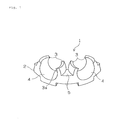
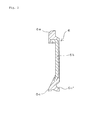
- a cage and a seal formed by injection-molding the synthetic resin composition are shown in Figs. 1 and 2 respectively.
- Fig. 1 is a partly enlarged perspective view of a crown-shaped resin-made cage which is an example of the member of the present invention for the rolling bearing.
- a cage 1 in a cage 1, two pairs of opposed retention claws 3 are formed on an upper surface of an annular cage body 2 at a certain interval in its circumferential direction, and the opposed retention claws 3 of each pair are curved in an approach direction, and a pocket 4 for retaining a ball serving as a rolling element is formed between the opposed retention claws 3.
- a flat portion 5 is formed as a reference plane from which the retention claws 3 rise between the back surface of one of one pair of the opposed retention claws 3 between which the pocket 4 is formed and that of one of the other pair of the opposed retention claws 3 between which the adjacent pocket 4 is formed.
- the retention claw 3 has a curved distal portion 3a.
- the cage 1 is a molding of the synthetic resin composition, even after the cage 1 absorbs moisture, the cage 1 is capable of keeping a higher modulus of elasticity than moldings made of the PA66 resin and the PA6 resin and thus the amount of centrifugal force-caused deformation at a high-speed rotation is small. Therefore the cage 1 can be used without contacting the outer ring at even a high-speed rotation.
- the curved distal portion 3a of the retention claw 3 is forcibly drawn out of a die when the cage 1 is taken out of the die. In this operation, it is possible to restrain the cage 1 from being cracked or whitened because the synthetic resin composition is used for the cage 1.
- Fig. 2 is a sectional view of a resin-made seal which is another example of the member of the present invention for the rolling bearing.
- a seal 6 has a peripheral edge 6a to be locked to a locking groove of a sealing member formed on an inside diameter surface of an outer ring of the bearing, a metal plate (core) 6b for reinforcing the seal 6, seal lips 6c, 6c' which slide along a sealing groove circumferentially formed at both sides of an inner ring raceway of the bearing.
- the seal 6 is a molding of the synthetic resin composition except the metal plate 6b, the seal 6 has a lower moisture absorption ratio than seals made of the PA66 resin and the PA6 resin and thus has a small dimensional change. Therefore when the seal 6 is used in an environment where the humidity becomes high, it is possible to prevent the sealing performance thereof from deteriorating. It is possible to form the entire seal 6 as the molding of the PPA resin or that of the synthetic resin composition containing the PPA resin without using the metal plate 6b.
- Fig. 3 is a sectional view of the rolling bearing (grease-enclosed deep groove ball bearing).
- a rolling bearing an inner ring 8 having a rolling surface 8a on its outer circumferential surface and an outer ring 9 having a rolling surface 9a on its inner circumferential surface are concentrically disposed.
- a plurality of rolling elements 10 is interposed between the rolling surface 8a of the inner ring 8 and the rolling surface 9a of the outer ring 9.
- a plurality of the rolling elements 10 is retained by a crown-shaped cage 11.
- a seal 12 covering an opening disposed at the gap between the inner ring 8 and the outer ring 9 is fixed to the outer ring 9.
- a lubricating grease 13 is enclosed on the circumferences of the rolling elements 10.
- At least one member selected from among the inner ring 8, the outer ring 9, the rolling elements 10, the cage 11, and the seal 12 is the member of the present invention for the rolling bearing, namely, the molding of the PPA resin or that of the synthetic resin composition thereof.
- the bearing is excellent in its sealing performance, can be rotated at a high speed even in the environment where the humidity becomes high, and is allowed to decrease the exhaust amount of carbon dioxide in a disposal operation.
- the base oil of the lubricating grease 13 is not limited to a specific one, but it is possible to use base oils generally used in the field of the grease.
- base oils generally used in the field of the grease.
- mineral oil, animal and plant oil ester synthetic oil, synthetic hydrocarbon oil, ester phosphate oil, silicone oil, fluorine oil, and mixed oils of these oils.
- the thickener of the lubricating grease 13 is not limited to a specific one, but it is possible to use thickeners generally used in the field of the grease.
- a metal soap-based thickener such as metal soap, composite metal soap
- a nonmetal soap-based thickener such as Bentone, silica gel, urea compounds, urea-urethane compounds, and fluororesin.
- metal soap sodium soap, calcium soap, aluminum soap, and lithium soap are listed.
- urea compounds and the urea-urethane compounds diurea compounds, triurea compounds, tetraurea compounds, other polyurea compounds, and diurethane compounds are listed.
- the lubricating grease 13 may contain known additives as necessary.
- an extreme pressure additive consisting of a sulfur-based compound or a phosphorous-based compound; a rust-proofing agent such as sorbitan ester; an antioxidant such as amine compounds and phenolic compounds; a corrosion inhibitor such as sodium nitrite and sodium sebacate; a solid lubricant such as graphite, molybdenum disulfide, and polytetrafluoroethylene resin; an oily agent such as fatty acid amide, aliphatic acid, amine, and lipids; and a viscosity index improver such as polymethacrylate and polystyrene are listed.
- the lubricating grease 13 may contain these additives singly or in combination of not less than two kinds thereof.
- sulfur-based compound sulfide compounds such as dibenzyl sulfide, sulfurized olefin, and sulfurized fats and oils are listed.
- phosphorous-based compound phosphate ester such as trioctylphosphate, tricresylphosphate and phosphite ester are listed.
- sulfur-phosphorous based compound zinc dithiophosphate and molybdenum dithiophosphate are exemplified.
- the cage 11 and the seal 12 are excellent in its resistance to grease deterioration.
- the lubricating grease 13 contains the extreme pressure additive consisting of the sulfur-based compound or the phosphorous-based compound
- the cage 11 and the seal 12 are capable of restraining the deterioration of the mechanical strength thereof and the resin thereof from cracking.
- any of oil lubrication, air oil lubrication, and solid lubrication can be adopted.
- oil lubrication and the lubrication to be performed by using oil it is possible to use not only a material, derived from fossil resource such as mineral oil, which has been conventionally used, but also a material to which biodegradability has been imparted and a material derived from biomass.
- the rolling bearing of the present invention may be of any type of a ball bearing, a tapered roller bearing, a self-aligning roller bearing, and a needle roller bearing.
- the member of the present invention for the rolling bearing was applied to a resin-made cage.
- Materials each having the composition shown in table 2 were injection-molded to prepare JIS No. 1 dumbbells. After moisture was regulated at 80°C and a relative humidity of 95% for three hours, specimens each consisting of a resin molding were prepared. The water absorption ratio of each of the prepared resin molding specimens was measured from the weight thereof before and after the moisture was regulated by using a computing equation shown below. Thereafter each resin molding specimen was subjected to a tensile test (JIS K 7113) to measure the tensile strength, tensile strain, and tensile modulus of elasticity thereof. The dumbbell specimens before the moisture was regulated were subjected to a test for examining the resistance thereof to hydrolysis. Table 2 shows the results.
- dumbbell specimens before the moisture was regulated were left in a high-temperature and high-humidity bath where the temperature and the humidity were adjusted to 80°C and 95%RH respectively. After the dumbbell specimens were taken out of the bath and dried after the elapse of 1500 hours to measure the tensile strength thereof in the tensile test (JIS K 7113). The tensile strengths before the moisture was regulated were compared with each other. The mark of "O” was given to the dumbbell specimens whose strength retention ratios was not less than 70% after the humidity was regulated and they were dried. The mark of " ⁇ ” was given to the dumbbell specimens whose strength retention ratios were less than 70% after the humidity was regulated and they were dried.
- Cages composed of materials each having the composition shown in table 2 were prepared and subjected to a cage-forming test. After the moldability of each cage was evaluated, it was incorporated in a ball bearing (bearing number 608) to prepared bearing specimens for use in a bearing high-speed rotation test.
- the prepared bearing high-speed specimens were subj ected to the bearing high-speed rotation test shown below to measure the number of rotations until before the cage specimens contacted the outer ring and fused. Table 2 shows the results.
- the cage specimens of the examples 1 through 5 had a low water absorption ratio and after the humidity was regulated, they had a sufficiently higher strength and elastic modulus respectively than the cage specimen of the comparative example 1 composed of the existing materials. That is, the resin-made cage specimens of the examples 1 through 5 were made thinner than the resin-made cage specimen designed in the existing manner and thus allow the bearing to be lightweight and have a low torque. In addition, the cage specimens of the examples 1 through 5 had a high elastic modulus and a small centrifugal force-caused deformation amount respectively when the rolling bearing was rotated at a high speed. Thus the cage specimens of the examples 1 through 5 can be used without contacting the outer ring when the rolling bearing is rotated at a high speed (not less than 120000 rpm).
- the member of the present invention for the rolling bearing was applied to a resin-made seal.
- seal specimens were prepared.
- each seal specimen had a metal plate (core) for reinforcing the seal.
- Humidity-regulated seal specimens were prepared by regulating humidity at 80°C and 95% relative humidity for three hours.
- Dried seal specimens were prepared by drying seal specimens at 150°C for three hours.
- a test for examining the sealing performance of each of the prepared humidity-regulated and dried seal specimens shown below was conducted to compute the grease leak ratio of each seal specimen. Table 3 shows the results.
- Grease leak ratio wt % weight of bearing before sealing performance test - weight of bearing after sealing performance test ⁇ 100 / weight of enclosed grease
- Example 1 Example 2
- Example 3 Example 4
- Example 5 Comparative example 1
- Grease leak ratio (wt%) Humidity-regulated seal 2.9 2.5 2.7 2.8 2.8 3.0 Dried seal 3.1 2.8 2.9 3.0 2.9 6.8
- seal specimens of the examples 6 through 10 there was no difference between the sealing performance of the humidity-regulated seal specimen and that of the dried seal specimen.
- the seal specimens of the examples 6 through 10 had preferable results.
- the seal specimens of the examples 6 through 10 had a low water absorption ratio. Thus it is considered that there was little dimensional change between the humidity-regulated seal and the dried seal.
- the humidity-regulated seal specimen of the comparative example 6 showed a sealing performance similar to that of the seal specimens of the examples6 through 10, but in the case of the dried seal specimen of the comparative example 6, the gap between the seal specimen and the inner ring as well as the outer ring was large. Thus the sealing performance of the dried seal specimen of the comparative example 6 was inferior to that of the dried seal specimens of the examples 6 through 10.
- Lithium soap grease for experimental use [contained (16.0 wt% of thickener for entire grease, mineral oil (additive-free turbine oil ISO VG32) used as the base oil, and 3.0 wt% of sulfurized olefin (Anglamol 33 produced by Lubrizol Corporation) used for the entire grease as a sulfur-based additive] was made as a trial product.
- a No. 1 dumbbell specimen of the PPA resin composition and that of the PA66 resin composition were immersed in the grease.
- the grease in which the resin dumbbell specimens were immersed was allowed to stand in a high-temperature bath having a temperature of 140°C for 1500 hours to deteriorate the resin dumbbell specimens.
- the member of the present invention for the rolling bearing is excellent in the resistance to grease deterioration.
- the member of the present invention for the rolling bearing has a low extent of a moisture absorption-caused change in its dimension and mechanical properties and has sufficiently high mechanical properties after the member absorbs moisture. Therefore the member for the rolling bearing can be preferably utilized as the cage and seal of the rolling bearing which is used in the environment where the humidity becomes high.
Landscapes
- General Engineering & Computer Science (AREA)
- Engineering & Computer Science (AREA)
- Chemical & Material Sciences (AREA)
- Mechanical Engineering (AREA)
- Polymers & Plastics (AREA)
- Health & Medical Sciences (AREA)
- Chemical Kinetics & Catalysis (AREA)
- Medicinal Chemistry (AREA)
- Organic Chemistry (AREA)
- Proteomics, Peptides & Aminoacids (AREA)
- Life Sciences & Earth Sciences (AREA)
- Rolling Contact Bearings (AREA)
- Sealing Of Bearings (AREA)
- Compositions Of Macromolecular Compounds (AREA)
Applications Claiming Priority (2)
| Application Number | Priority Date | Filing Date | Title |
|---|---|---|---|
| JP2010017216A JP5411010B2 (ja) | 2010-01-28 | 2010-01-28 | 転がり軸受用部材および転がり軸受 |
| PCT/JP2011/051590 WO2011093376A1 (ja) | 2010-01-28 | 2011-01-27 | 転がり軸受用部材および転がり軸受 |
Publications (3)
| Publication Number | Publication Date |
|---|---|
| EP2530341A1 true EP2530341A1 (de) | 2012-12-05 |
| EP2530341A4 EP2530341A4 (de) | 2015-04-22 |
| EP2530341B1 EP2530341B1 (de) | 2019-02-27 |
Family
ID=44319359
Family Applications (1)
| Application Number | Title | Priority Date | Filing Date |
|---|---|---|---|
| EP11737087.4A Active EP2530341B1 (de) | 2010-01-28 | 2011-01-27 | Element für ein rollenlager und rollenlager |
Country Status (4)
| Country | Link |
|---|---|
| EP (1) | EP2530341B1 (de) |
| JP (1) | JP5411010B2 (de) |
| CN (1) | CN102725549B (de) |
| WO (1) | WO2011093376A1 (de) |
Cited By (3)
| Publication number | Priority date | Publication date | Assignee | Title |
|---|---|---|---|---|
| EP3470697A1 (de) * | 2017-10-11 | 2019-04-17 | NTN Corporation | Wälzlager |
| US10518445B2 (en) | 2014-12-24 | 2019-12-31 | Ntn Corporation | Cage for rolling bearing, and rolling bearing |
| EP4481218A4 (de) * | 2022-02-17 | 2025-06-18 | NSK Ltd. | Käfig für wälzlager und wälzlager mit dem käfig |
Families Citing this family (6)
| Publication number | Priority date | Publication date | Assignee | Title |
|---|---|---|---|---|
| JP5703894B2 (ja) * | 2011-03-29 | 2015-04-22 | 日本精工株式会社 | 玉軸受 |
| JP5769013B2 (ja) * | 2011-08-31 | 2015-08-26 | 株式会社ジェイテクト | ローラおよびローラ装置 |
| DE102012219497A1 (de) * | 2012-10-25 | 2014-04-30 | Schaeffler Technologies Gmbh & Co. Kg | Dichtelement für ein Wälzlager |
| JP2020024013A (ja) * | 2018-08-08 | 2020-02-13 | Ntn株式会社 | 転がり軸受の樹脂被膜付き保持器 |
| JPWO2022071172A1 (de) * | 2020-09-29 | 2022-04-07 | ||
| DE102021116417A1 (de) * | 2021-06-24 | 2022-12-29 | Hasse & Wrede Gmbh | Viskositätsdrehschwingungsdämpfer oder Viskositätsdrehschwingungstilger |
Family Cites Families (16)
| Publication number | Priority date | Publication date | Assignee | Title |
|---|---|---|---|---|
| JP2640320B2 (ja) | 1993-04-30 | 1997-08-13 | エスケーエフ インダストリー エス.ピー.エー. | 転がり軸受の密閉シール |
| JP3507554B2 (ja) * | 1994-07-15 | 2004-03-15 | 光洋精工株式会社 | 合成樹脂製保持器 |
| JP2000227120A (ja) | 1999-02-05 | 2000-08-15 | Nsk Ltd | 転がり軸受 |
| FR2792043B1 (fr) * | 1999-04-08 | 2001-05-04 | Skf France | Procede de fabrication de cage pour roulement |
| US6517250B1 (en) * | 1999-10-27 | 2003-02-11 | Ntn Corporation | Rolling bearing |
| JP4097409B2 (ja) | 2000-04-07 | 2008-06-11 | Ntn株式会社 | 転がり軸受 |
| JP2003065342A (ja) * | 2001-08-27 | 2003-03-05 | Nsk Ltd | 機械部品 |
| JP4389428B2 (ja) | 2002-03-12 | 2009-12-24 | 日本精工株式会社 | プラスチックシール |
| JP4383766B2 (ja) * | 2003-04-18 | 2009-12-16 | Ntn株式会社 | アンギュラ玉軸受用の合成樹脂製保持器およびアンギュラ玉軸受 |
| EP1518891A1 (de) * | 2003-09-18 | 2005-03-30 | Minebea Co., Ltd. | Synthetisches Harz und daraus hergestellte Lagerteile |
| WO2006030669A1 (ja) * | 2004-09-15 | 2006-03-23 | Ntn Corporation | 回転センサ付き軸受装置 |
| JP2007057011A (ja) * | 2005-08-25 | 2007-03-08 | Nsk Ltd | 転がり軸受 |
| JP2007198433A (ja) * | 2006-01-24 | 2007-08-09 | Jtekt Corp | 4点接触玉軸受 |
| JP2008144777A (ja) * | 2006-12-06 | 2008-06-26 | Ntn Corp | オルタネータ用転がり軸受 |
| JP2009204121A (ja) * | 2008-02-28 | 2009-09-10 | Ntn Corp | 転がり軸受用部材および転がり軸受 |
| EP2249052B1 (de) * | 2008-02-22 | 2017-06-21 | NTN Corporation | Element für ein rollenlager und rollenlager |
-
2010
- 2010-01-28 JP JP2010017216A patent/JP5411010B2/ja not_active Expired - Fee Related
-
2011
- 2011-01-27 WO PCT/JP2011/051590 patent/WO2011093376A1/ja not_active Ceased
- 2011-01-27 EP EP11737087.4A patent/EP2530341B1/de active Active
- 2011-01-27 CN CN201180007340.1A patent/CN102725549B/zh not_active Expired - Fee Related
Cited By (4)
| Publication number | Priority date | Publication date | Assignee | Title |
|---|---|---|---|---|
| US10518445B2 (en) | 2014-12-24 | 2019-12-31 | Ntn Corporation | Cage for rolling bearing, and rolling bearing |
| EP3470697A1 (de) * | 2017-10-11 | 2019-04-17 | NTN Corporation | Wälzlager |
| EP4481218A4 (de) * | 2022-02-17 | 2025-06-18 | NSK Ltd. | Käfig für wälzlager und wälzlager mit dem käfig |
| US12345297B2 (en) | 2022-02-17 | 2025-07-01 | Nsk Ltd. | Cage for rolling bearing and rolling bearing incorporating cage |
Also Published As
| Publication number | Publication date |
|---|---|
| WO2011093376A1 (ja) | 2011-08-04 |
| EP2530341B1 (de) | 2019-02-27 |
| JP2011153699A (ja) | 2011-08-11 |
| EP2530341A4 (de) | 2015-04-22 |
| CN102725549A (zh) | 2012-10-10 |
| JP5411010B2 (ja) | 2014-02-12 |
| CN102725549B (zh) | 2016-05-04 |
Similar Documents
| Publication | Publication Date | Title |
|---|---|---|
| EP2530341B1 (de) | Element für ein rollenlager und rollenlager | |
| CN102471572B (zh) | 树脂组合物及其制造方法、以及滚动及滑动轴承 | |
| US8672556B2 (en) | Member for rolling bearing and rolling bearing | |
| EP4223859A1 (de) | Wälzlager | |
| EP4481218A1 (de) | Käfig für wälzlager und wälzlager mit dem käfig | |
| JP5600493B2 (ja) | 転がり軸受用保持器およびそれを用いた転がり軸受 | |
| US6346566B1 (en) | Lubricant-feeding material | |
| JP3629344B2 (ja) | 固形潤滑剤充填転がり軸受 | |
| EP4372240A1 (de) | Walzvorrichtung | |
| JP2009108251A (ja) | プラスチック成形品の改質方法及びプラスチック成形品 | |
| JP5321211B2 (ja) | 生分解性樹脂製機械部品及び転がり軸受 | |
| JP3886248B2 (ja) | 転がり軸受および保持器の製造方法 | |
| JP2007107614A (ja) | 転がり軸受用保持器 | |
| JP2002241779A (ja) | 潤滑剤供給体 | |
| JP3981793B2 (ja) | 潤滑剤供給体並びに前記潤滑剤供給体を備える転がり軸受、リニアガイド及びボールねじ | |
| JP2000345179A (ja) | 潤滑剤供給組成物及びそれを充填した転がり軸受 | |
| JP2006206917A (ja) | 潤滑剤供給体並びに前記潤滑剤供給体を備える転がり軸受、リニアガイド及びボールねじ | |
| JP2026029037A (ja) | 転がり軸受 | |
| JP2003306599A (ja) | 生分解性樹脂組成物及び機械部品 | |
| JP2022069965A (ja) | 転がり軸受 | |
| JP2002168247A (ja) | 直動装置 | |
| JP2008095912A (ja) | オルタネータ用軸受 | |
| JP2003139148A (ja) | 転がり軸受 | |
| JP2005321107A (ja) | 潤滑剤含有ポリマ充填転がり軸受 |
Legal Events
| Date | Code | Title | Description |
|---|---|---|---|
| PUAI | Public reference made under article 153(3) epc to a published international application that has entered the european phase |
Free format text: ORIGINAL CODE: 0009012 |
|
| 17P | Request for examination filed |
Effective date: 20120813 |
|
| AK | Designated contracting states |
Kind code of ref document: A1 Designated state(s): AL AT BE BG CH CY CZ DE DK EE ES FI FR GB GR HR HU IE IS IT LI LT LU LV MC MK MT NL NO PL PT RO RS SE SI SK SM TR |
|
| DAX | Request for extension of the european patent (deleted) | ||
| RA4 | Supplementary search report drawn up and despatched (corrected) |
Effective date: 20150324 |
|
| RIC1 | Information provided on ipc code assigned before grant |
Ipc: F16C 33/44 20060101ALI20150318BHEP Ipc: C08K 7/06 20060101AFI20150318BHEP Ipc: F16C 19/00 20060101ALI20150318BHEP Ipc: F16C 33/66 20060101ALI20150318BHEP Ipc: C08L 77/00 20060101ALI20150318BHEP Ipc: C08K 7/04 20060101ALI20150318BHEP Ipc: F16C 33/78 20060101ALI20150318BHEP Ipc: F16C 19/06 20060101ALI20150318BHEP Ipc: C08K 7/14 20060101ALI20150318BHEP Ipc: C08L 77/06 20060101ALI20150318BHEP Ipc: C08G 69/36 20060101ALI20150318BHEP Ipc: F16C 33/41 20060101ALI20150318BHEP |
|
| 17Q | First examination report despatched |
Effective date: 20160811 |
|
| STAA | Information on the status of an ep patent application or granted ep patent |
Free format text: STATUS: EXAMINATION IS IN PROGRESS |
|
| GRAP | Despatch of communication of intention to grant a patent |
Free format text: ORIGINAL CODE: EPIDOSNIGR1 |
|
| STAA | Information on the status of an ep patent application or granted ep patent |
Free format text: STATUS: GRANT OF PATENT IS INTENDED |
|
| INTG | Intention to grant announced |
Effective date: 20181005 |
|
| GRAS | Grant fee paid |
Free format text: ORIGINAL CODE: EPIDOSNIGR3 |
|
| GRAA | (expected) grant |
Free format text: ORIGINAL CODE: 0009210 |
|
| STAA | Information on the status of an ep patent application or granted ep patent |
Free format text: STATUS: THE PATENT HAS BEEN GRANTED |
|
| AK | Designated contracting states |
Kind code of ref document: B1 Designated state(s): AL AT BE BG CH CY CZ DE DK EE ES FI FR GB GR HR HU IE IS IT LI LT LU LV MC MK MT NL NO PL PT RO RS SE SI SK SM TR |
|
| REG | Reference to a national code |
Ref country code: GB Ref legal event code: FG4D |
|
| REG | Reference to a national code |
Ref country code: CH Ref legal event code: EP |
|
| REG | Reference to a national code |
Ref country code: DE Ref legal event code: R096 Ref document number: 602011056604 Country of ref document: DE |
|
| REG | Reference to a national code |
Ref country code: AT Ref legal event code: REF Ref document number: 1101261 Country of ref document: AT Kind code of ref document: T Effective date: 20190315 |
|
| REG | Reference to a national code |
Ref country code: IE Ref legal event code: FG4D |
|
| REG | Reference to a national code |
Ref country code: NL Ref legal event code: MP Effective date: 20190227 |
|
| REG | Reference to a national code |
Ref country code: LT Ref legal event code: MG4D |
|
| PG25 | Lapsed in a contracting state [announced via postgrant information from national office to epo] |
Ref country code: PT Free format text: LAPSE BECAUSE OF FAILURE TO SUBMIT A TRANSLATION OF THE DESCRIPTION OR TO PAY THE FEE WITHIN THE PRESCRIBED TIME-LIMIT Effective date: 20190627 Ref country code: SE Free format text: LAPSE BECAUSE OF FAILURE TO SUBMIT A TRANSLATION OF THE DESCRIPTION OR TO PAY THE FEE WITHIN THE PRESCRIBED TIME-LIMIT Effective date: 20190227 Ref country code: NO Free format text: LAPSE BECAUSE OF FAILURE TO SUBMIT A TRANSLATION OF THE DESCRIPTION OR TO PAY THE FEE WITHIN THE PRESCRIBED TIME-LIMIT Effective date: 20190527 Ref country code: NL Free format text: LAPSE BECAUSE OF FAILURE TO SUBMIT A TRANSLATION OF THE DESCRIPTION OR TO PAY THE FEE WITHIN THE PRESCRIBED TIME-LIMIT Effective date: 20190227 Ref country code: LT Free format text: LAPSE BECAUSE OF FAILURE TO SUBMIT A TRANSLATION OF THE DESCRIPTION OR TO PAY THE FEE WITHIN THE PRESCRIBED TIME-LIMIT Effective date: 20190227 Ref country code: FI Free format text: LAPSE BECAUSE OF FAILURE TO SUBMIT A TRANSLATION OF THE DESCRIPTION OR TO PAY THE FEE WITHIN THE PRESCRIBED TIME-LIMIT Effective date: 20190227 |
|
| PG25 | Lapsed in a contracting state [announced via postgrant information from national office to epo] |
Ref country code: BG Free format text: LAPSE BECAUSE OF FAILURE TO SUBMIT A TRANSLATION OF THE DESCRIPTION OR TO PAY THE FEE WITHIN THE PRESCRIBED TIME-LIMIT Effective date: 20190527 Ref country code: RS Free format text: LAPSE BECAUSE OF FAILURE TO SUBMIT A TRANSLATION OF THE DESCRIPTION OR TO PAY THE FEE WITHIN THE PRESCRIBED TIME-LIMIT Effective date: 20190227 Ref country code: IS Free format text: LAPSE BECAUSE OF FAILURE TO SUBMIT A TRANSLATION OF THE DESCRIPTION OR TO PAY THE FEE WITHIN THE PRESCRIBED TIME-LIMIT Effective date: 20190627 Ref country code: LV Free format text: LAPSE BECAUSE OF FAILURE TO SUBMIT A TRANSLATION OF THE DESCRIPTION OR TO PAY THE FEE WITHIN THE PRESCRIBED TIME-LIMIT Effective date: 20190227 Ref country code: HR Free format text: LAPSE BECAUSE OF FAILURE TO SUBMIT A TRANSLATION OF THE DESCRIPTION OR TO PAY THE FEE WITHIN THE PRESCRIBED TIME-LIMIT Effective date: 20190227 Ref country code: GR Free format text: LAPSE BECAUSE OF FAILURE TO SUBMIT A TRANSLATION OF THE DESCRIPTION OR TO PAY THE FEE WITHIN THE PRESCRIBED TIME-LIMIT Effective date: 20190528 |
|
| REG | Reference to a national code |
Ref country code: AT Ref legal event code: MK05 Ref document number: 1101261 Country of ref document: AT Kind code of ref document: T Effective date: 20190227 |
|
| PG25 | Lapsed in a contracting state [announced via postgrant information from national office to epo] |
Ref country code: SK Free format text: LAPSE BECAUSE OF FAILURE TO SUBMIT A TRANSLATION OF THE DESCRIPTION OR TO PAY THE FEE WITHIN THE PRESCRIBED TIME-LIMIT Effective date: 20190227 Ref country code: IT Free format text: LAPSE BECAUSE OF FAILURE TO SUBMIT A TRANSLATION OF THE DESCRIPTION OR TO PAY THE FEE WITHIN THE PRESCRIBED TIME-LIMIT Effective date: 20190227 Ref country code: EE Free format text: LAPSE BECAUSE OF FAILURE TO SUBMIT A TRANSLATION OF THE DESCRIPTION OR TO PAY THE FEE WITHIN THE PRESCRIBED TIME-LIMIT Effective date: 20190227 Ref country code: DK Free format text: LAPSE BECAUSE OF FAILURE TO SUBMIT A TRANSLATION OF THE DESCRIPTION OR TO PAY THE FEE WITHIN THE PRESCRIBED TIME-LIMIT Effective date: 20190227 Ref country code: ES Free format text: LAPSE BECAUSE OF FAILURE TO SUBMIT A TRANSLATION OF THE DESCRIPTION OR TO PAY THE FEE WITHIN THE PRESCRIBED TIME-LIMIT Effective date: 20190227 Ref country code: AL Free format text: LAPSE BECAUSE OF FAILURE TO SUBMIT A TRANSLATION OF THE DESCRIPTION OR TO PAY THE FEE WITHIN THE PRESCRIBED TIME-LIMIT Effective date: 20190227 Ref country code: CZ Free format text: LAPSE BECAUSE OF FAILURE TO SUBMIT A TRANSLATION OF THE DESCRIPTION OR TO PAY THE FEE WITHIN THE PRESCRIBED TIME-LIMIT Effective date: 20190227 Ref country code: RO Free format text: LAPSE BECAUSE OF FAILURE TO SUBMIT A TRANSLATION OF THE DESCRIPTION OR TO PAY THE FEE WITHIN THE PRESCRIBED TIME-LIMIT Effective date: 20190227 |
|
| REG | Reference to a national code |
Ref country code: DE Ref legal event code: R097 Ref document number: 602011056604 Country of ref document: DE |
|
| PG25 | Lapsed in a contracting state [announced via postgrant information from national office to epo] |
Ref country code: PL Free format text: LAPSE BECAUSE OF FAILURE TO SUBMIT A TRANSLATION OF THE DESCRIPTION OR TO PAY THE FEE WITHIN THE PRESCRIBED TIME-LIMIT Effective date: 20190227 Ref country code: SM Free format text: LAPSE BECAUSE OF FAILURE TO SUBMIT A TRANSLATION OF THE DESCRIPTION OR TO PAY THE FEE WITHIN THE PRESCRIBED TIME-LIMIT Effective date: 20190227 |
|
| PG25 | Lapsed in a contracting state [announced via postgrant information from national office to epo] |
Ref country code: AT Free format text: LAPSE BECAUSE OF FAILURE TO SUBMIT A TRANSLATION OF THE DESCRIPTION OR TO PAY THE FEE WITHIN THE PRESCRIBED TIME-LIMIT Effective date: 20190227 |
|
| PLBE | No opposition filed within time limit |
Free format text: ORIGINAL CODE: 0009261 |
|
| STAA | Information on the status of an ep patent application or granted ep patent |
Free format text: STATUS: NO OPPOSITION FILED WITHIN TIME LIMIT |
|
| 26N | No opposition filed |
Effective date: 20191128 |
|
| PG25 | Lapsed in a contracting state [announced via postgrant information from national office to epo] |
Ref country code: SI Free format text: LAPSE BECAUSE OF FAILURE TO SUBMIT A TRANSLATION OF THE DESCRIPTION OR TO PAY THE FEE WITHIN THE PRESCRIBED TIME-LIMIT Effective date: 20190227 |
|
| PG25 | Lapsed in a contracting state [announced via postgrant information from national office to epo] |
Ref country code: TR Free format text: LAPSE BECAUSE OF FAILURE TO SUBMIT A TRANSLATION OF THE DESCRIPTION OR TO PAY THE FEE WITHIN THE PRESCRIBED TIME-LIMIT Effective date: 20190227 |
|
| REG | Reference to a national code |
Ref country code: DE Ref legal event code: R119 Ref document number: 602011056604 Country of ref document: DE |
|
| PG25 | Lapsed in a contracting state [announced via postgrant information from national office to epo] |
Ref country code: MC Free format text: LAPSE BECAUSE OF FAILURE TO SUBMIT A TRANSLATION OF THE DESCRIPTION OR TO PAY THE FEE WITHIN THE PRESCRIBED TIME-LIMIT Effective date: 20190227 |
|
| REG | Reference to a national code |
Ref country code: CH Ref legal event code: PL |
|
| GBPC | Gb: european patent ceased through non-payment of renewal fee |
Effective date: 20200127 |
|
| REG | Reference to a national code |
Ref country code: BE Ref legal event code: MM Effective date: 20200131 |
|
| PG25 | Lapsed in a contracting state [announced via postgrant information from national office to epo] |
Ref country code: GB Free format text: LAPSE BECAUSE OF NON-PAYMENT OF DUE FEES Effective date: 20200127 Ref country code: DE Free format text: LAPSE BECAUSE OF NON-PAYMENT OF DUE FEES Effective date: 20200801 Ref country code: LU Free format text: LAPSE BECAUSE OF NON-PAYMENT OF DUE FEES Effective date: 20200127 Ref country code: FR Free format text: LAPSE BECAUSE OF NON-PAYMENT OF DUE FEES Effective date: 20200131 |
|
| PG25 | Lapsed in a contracting state [announced via postgrant information from national office to epo] |
Ref country code: LI Free format text: LAPSE BECAUSE OF NON-PAYMENT OF DUE FEES Effective date: 20200131 Ref country code: CH Free format text: LAPSE BECAUSE OF NON-PAYMENT OF DUE FEES Effective date: 20200131 Ref country code: BE Free format text: LAPSE BECAUSE OF NON-PAYMENT OF DUE FEES Effective date: 20200131 |
|
| PG25 | Lapsed in a contracting state [announced via postgrant information from national office to epo] |
Ref country code: IE Free format text: LAPSE BECAUSE OF NON-PAYMENT OF DUE FEES Effective date: 20200127 |
|
| PG25 | Lapsed in a contracting state [announced via postgrant information from national office to epo] |
Ref country code: MT Free format text: LAPSE BECAUSE OF FAILURE TO SUBMIT A TRANSLATION OF THE DESCRIPTION OR TO PAY THE FEE WITHIN THE PRESCRIBED TIME-LIMIT Effective date: 20190227 Ref country code: CY Free format text: LAPSE BECAUSE OF FAILURE TO SUBMIT A TRANSLATION OF THE DESCRIPTION OR TO PAY THE FEE WITHIN THE PRESCRIBED TIME-LIMIT Effective date: 20190227 |
|
| PG25 | Lapsed in a contracting state [announced via postgrant information from national office to epo] |
Ref country code: MK Free format text: LAPSE BECAUSE OF FAILURE TO SUBMIT A TRANSLATION OF THE DESCRIPTION OR TO PAY THE FEE WITHIN THE PRESCRIBED TIME-LIMIT Effective date: 20190227 |