EP2534483B1 - Dispositif de test - Google Patents
Dispositif de test Download PDFInfo
- Publication number
- EP2534483B1 EP2534483B1 EP11706460.0A EP11706460A EP2534483B1 EP 2534483 B1 EP2534483 B1 EP 2534483B1 EP 11706460 A EP11706460 A EP 11706460A EP 2534483 B1 EP2534483 B1 EP 2534483B1
- Authority
- EP
- European Patent Office
- Prior art keywords
- enzyme
- arrangement according
- laccase
- matrix
- siloxane
- Prior art date
- Legal status (The legal status is an assumption and is not a legal conclusion. Google has not performed a legal analysis and makes no representation as to the accuracy of the status listed.)
- Not-in-force
Links
Images


Classifications
-
- C—CHEMISTRY; METALLURGY
- C12—BIOCHEMISTRY; BEER; SPIRITS; WINE; VINEGAR; MICROBIOLOGY; ENZYMOLOGY; MUTATION OR GENETIC ENGINEERING
- C12Q—MEASURING OR TESTING PROCESSES INVOLVING ENZYMES, NUCLEIC ACIDS OR MICROORGANISMS; COMPOSITIONS OR TEST PAPERS THEREFOR; PROCESSES OF PREPARING SUCH COMPOSITIONS; CONDITION-RESPONSIVE CONTROL IN MICROBIOLOGICAL OR ENZYMOLOGICAL PROCESSES
- C12Q1/00—Measuring or testing processes involving enzymes, nucleic acids or microorganisms; Compositions therefor; Processes of preparing such compositions
- C12Q1/001—Enzyme electrodes
-
- C—CHEMISTRY; METALLURGY
- C12—BIOCHEMISTRY; BEER; SPIRITS; WINE; VINEGAR; MICROBIOLOGY; ENZYMOLOGY; MUTATION OR GENETIC ENGINEERING
- C12Q—MEASURING OR TESTING PROCESSES INVOLVING ENZYMES, NUCLEIC ACIDS OR MICROORGANISMS; COMPOSITIONS OR TEST PAPERS THEREFOR; PROCESSES OF PREPARING SUCH COMPOSITIONS; CONDITION-RESPONSIVE CONTROL IN MICROBIOLOGICAL OR ENZYMOLOGICAL PROCESSES
- C12Q1/00—Measuring or testing processes involving enzymes, nucleic acids or microorganisms; Compositions therefor; Processes of preparing such compositions
- C12Q1/02—Measuring or testing processes involving enzymes, nucleic acids or microorganisms; Compositions therefor; Processes of preparing such compositions involving viable microorganisms
- C12Q1/04—Determining presence or kind of microorganism; Use of selective media for testing antibiotics or bacteriocides; Compositions containing a chemical indicator therefor
Definitions
- microorganisms in general and the identification of the detected microorganisms in a sample is of considerable importance in many areas.
- microorganisms may be responsible for the spoilage or short shelf life of food.
- microorganisms also play an important role in many diseases (e.g., inflammation) of humans and animals. It is therefore of great importance to detect the presence of microorganisms in time to take appropriate action.
- the state of the art describes various systems and methods which are suitable for determining microorganisms in a sample. Some of these systems can also be used to detect specific substances (e.g., proteins such as enzymes) in a sample.
- specific substances e.g., proteins such as enzymes
- WO 2006/065350 A2 the detection of microorganisms by means of a dye, which shows a visible color change in the presence of one or more microorganisms. This color change is based on differences in the polarity of the solvent or acid-base reactions, redox reactions, which are caused by the interaction between microorganism and sensor.
- WO 98/010556 A1 a method is disclosed by means of which molecules can be bound to binding sites within a gel droplet.
- molecules which are secreted by cells located within the gel droplet are bound to the free binding sites of the gel droplets.
- WO 03/033691 A1 A microchip is disclosed that can be used to test the antibacterial activity of antibiotics.
- prokaryotic and eukaryotic cells are immobilized in a gel by polymerizing it.
- a matrix consisting of a protein "backbone" cross-linked with polyethylene glycol. This matrix is particularly suitable for tissue regeneration.
- the matrix may additionally comprise a biologically active agent which is released by the degradation of the matrix at the site of action to the surrounding tissue. To test the extent to which this matrix releases the biological active substance contained therein, colored fibrinogen fragments were incorporated into the matrix.
- the US 2008/0057534 A1 describes the visual detection of a Microbial contamination through the degradation of a topcoat consisting of microbe-sensitive dyes. These microbe-sensitive dyes change color in the presence of microbes in the sample, either causing loss of color or color change.
- the dyes can be applied to any surface. A certain, albeit very limited, selectivity is made possible by the nature of the dyes.
- Such systems can, for example, in a system such as in US 2004/0018641 A1 described, are used.
- the appearance or disappearance of computer-readable barcodes can indicate contamination in the food sector.
- the indication is based on the detection of gases, temperature and pH differences, as well as toxins or other metabolites from bacteria.
- the US 6,297,059 B1 describes a method for measuring microbial contamination by fluorescence built on a liquid bilayer membrane. By addressing polyvalent or polyvalent target biomolecules, two or more fluorescence quenchers or a transmission of the extinction energy to a fluorescence acceptor are triggered per molecule and thus signal amplification is achieved.
- the present invention relates to an assembly comprising a solid support and a matrix disposed on the solid support comprising at least one enzymatically convertible or modifiable molecule, preferably polymer or oligomer, which matrix is at least one enzyme releasable by reacting or modifying the molecule, preferably polymer or oligomer which is capable of converting at least one color-producing substrate located in the matrix and / or on the solid support.
- the arrangement according to the invention comprises, in addition to a solid support and an optional semipermeable membrane opposite thereto, a matrix which is arranged on the solid support or optionally between the solid support and the semipermeable membrane.
- the matrix comprises at least one molecule, preferably polymer, which is degraded, reacted or modified by substances present in the sample (eg enzymes) can be.
- the degradation, the conversion or the modification of such molecules or polymers in the matrix change their properties.
- the reaction or modification of the molecule or polymer or oligomer can lead to their structural properties changing, which can lead to a reduction in the degree of crosslinking or viscosity, to change the pores in the polymer or to degradation of the polymer chains.
- the releasable enzyme in the matrix becomes more mobile and can move more freely within the matrix, especially in the space between the solid support and the semipermeable membrane.
- this makes it possible to react or liberate a color-producing substrate located in the matrix and / or on the solid support and / or to degrade the molecule or polymer present in the matrix.
- Such a system is suitable, for example, for even the smallest amounts of microorganisms, such as bacteria or Mushrooms to prove in a sample.
- An enzyme secreted by a contaminating bacterium or fungus penetrates the protective, semi-permeable membrane, degrades a matrix applied to a support material (eg, a polysaccharide, an enzyme, or combinations thereof, with or without cross-linking), thus initiating the release of the enzyme. which accelerates the release as an enzymatic amplification system and / or enables the detection of a microbial contamination.
- Bioresponsive behavior is imparted to components by coating with biomaterials that can be degraded by extracellular enzymes.
- Extracellular microbial enzymes can act as so-called triggers and thus initiate the release of active enzymes included and / or bound in the polymer.
- the type of polymer (polypeptide, polysaccharide, synthetic polymer ...) defines the type of trigger enzymes required.
- Microorganisms produce a variety of extracellular enzymes that they release to the environment, among many other functions, e.g. To digest food components, in order to be able to take these into the cell. Extracellular enzymes thus serve, inter alia, the degradation of large molecules and polymers. Hydrolysis of a variety of biopolymers is catalyzed by hydrolases which, depending on the substrate, are converted into lipases, proteases, esterases, glycosidases, and the like. can be divided.
- polypeptide as used herein includes polypeptides with a minimum size of 50 amino acids and thus also includes proteins.
- a "polymer-releasable enzyme” (polypeptide) is an enzyme which is incorporated into the polymer of the matrix and which can not diffuse due to cross-linking of the polymer or which is bound to the polymer by covalent and / or non-covalent bonds. In both cases, the enzymes are immobilized in the polymer prior to degradation of the polymer or only limited mobility. As a result of the degradation, modification or conversion of the polymer, its long-chain or crosslinked chains are shortened or split so that the enzymes in the matrix are released, i. be more mobile, and be able to diffuse around in it.
- “Semipermeable membrane” as used herein refers to membranes that allow access of the triggers or enzymes from the outside into the arrangement of the invention, but prevent the diffusion of the enzymes and other matrix constituents present in the matrix outwards.
- the enzyme present in the polymer and the color-producing substrate is chosen so that when contacting both substances, the substrate is reacted and it comes to color formation.
- in situ dye synthesis or dye staining may also take place by the enzymatic reaction of one or more substrates, e.g. Polymerization or depolymerization of a phenol by oxidoreductase.
- the indicator system may also be that the enhancer enzyme is capable of hydrolytically degrading a masking polymer layer to reveal the hidden color layer.
- polymer Degrading trigger enzyme Included polypeptide (enhancer enzyme) or bound dye Color reaction by turnover of pectin pectinase PEG protease Siloxane -N succinyl Ala-Ala-Pro-Leu-p-nitroanilide pectin pectinase protease Siloxane -N succinyl Ala-Ala-Pro-Leu-p-nitroanilide pectin pectinase PVA protease Siloxane -N succinyl Ala-Ala-Pro-Leu-p-nitroanilide pectin pectinase laccase Siloxane ferulic acid pectin pectinase laccase Siloxane caffeic acid pectin pectinase laccase Siloxane 3,4, dihydroxy
- Oxidoreductases such as laccases or peroxidases, proteases, lipases, esterases, peptidases, etc. can be used as amplifier enzymes for the amplification of the display.
- the matrix is arranged as a layer, in the form of capsules or as a hydrogel, on the solid support.
- the matrix between the solid support and the semipermeable membrane may have different shapes.
- the matrix can be applied, for example, as a layer or capsules.
- the use of capsules or multiple layers (at least two, three or four) has the advantage that the capsules and layers can have different compositions.
- other capsules or layers may comprise enzymes which are capable of converting color-producing substrates.
- the polymer composition of the various capsules or layers can also vary.
- the matrix may comprise a degradable, modifiable molecule or polymer which can be degraded or modified by enzymes.
- a degradable, modifiable molecule or polymer which can be degraded or modified by enzymes.
- molecules or polymers which are degradable in the course of a pH change or by changing the ionic strength.
- the enzymatically decomposable, metabolizable or modifiable polymer is preferably a polysaccharide, polypeptide, polyester, polyamide or a combination thereof.
- the degradable polymer may, for example, be esterified to control the degradation or modification by enzymes present in the sample.
- the polysaccharide is selected from the group consisting of pectin, amylose, amylopectin, agarose, alginate, carrageenan, chitin, chitosan, dextran, glycogen, guar, locust bean gum, levan, pectin, pollulan, tamarind kernel flour, xanthan gum, Cellulose and xylan.
- the polymers can be provided with specific sequences (e.g., amino acid or oligosaccharide sequences) which are cleavage sites for particular enzymes. This makes it possible to produce polymers which are cleaved in contact with the substances to be detected (e.g., enzymes).
- specific sequences e.g., amino acid or oligosaccharide sequences
- the degradable polymer is selected from the group consisting of gum arabic, agar, agarose, maltodextrins, alginic acid and its salts, in particular sodium alginate or calcium alginate, liposomes, fats, cetyl alcohol, collagen, chitosan, peptidoglycan, Leithine, Gelatin, albumin, shellac, polysaccharides, especially starch or dextran, cyclodextrins, pectin, carrageenan and waxes.
- the polymer degrading compound is an enzyme.
- the enzyme which is included in the matrix is preferably selected from the group consisting of the groups of the hydrolases and oxidoreductases such as, for example, proteases, laccases or peroxidases.
- the color-producing substrate is selected from the group consisting of phenolic compounds and azo dyes such as ferulic acid, caffeic acid, 3,4-dihydroxybenzoic acid, reactive blue, indigo carmine, ABTS or guaiacol.
- a semi-permeable character is achieved by modification of the surface of a side made more hydrophilic or hydrophobic, for example. This can be achieved by, for example, chemical, physical (plasma) or enzymatic treatment (eg Guebitz, GM, Cavaco-Paulo, A., 2008. Trends in Biotechnology 26, 32-38 ).
- plasma chemical, physical
- enzymatic treatment eg Guebitz, GM, Cavaco-Paulo, A., 2008. Trends in Biotechnology 26, 32-38 ).
- the solid support comprises a material selected from the group consisting of inorganic materials, preferably silica gel, aluminum, silicon or glass, organic materials, preferably polyester, polystyrene, polyamide, polyacrylamide or polyvinyl alcohol, or biopolymers , preferably paper.
- inorganic materials preferably silica gel, aluminum, silicon or glass
- organic materials preferably polyester, polystyrene, polyamide, polyacrylamide or polyvinyl alcohol, or biopolymers , preferably paper.
- the carrier material can be chemically modified.
- functional groups are applied to the surface, which can then covalently cross-link with components of the matrix.
- trimethylsilyl methacrylate may be mentioned at this point.
- trimethylsilyl groups with hydroxy groups can form covalent ether bridges on surfaces as they occur in glass but also in other polymers.
- the methacrylic group can then crosslink with methacrylic groups of the matrix.
- microorganisms to be determined and / or characterized are selected from the group consisting of bacteria and mushrooms.
- the arrangement according to the invention can be used according to a further aspect for the detection of at least one enzyme in a sample.
- Yet another aspect of the present invention relates to the use of an inventive wound infection detection assembly by determining the presence of at least one sore-specific enzyme.
- "sore-specific" enzymes are enzymes that commonly occur in infections of wounds.
- Exemplary enzymes are those enzymes secreted by the microorganisms causing the infection or those secreted by the body in response to an infection.
- a 5% solution of pectin derived from citrus peel with a degree of esterification of 50-60% was prepared by dissolving in water overnight at 50 ° C.
- pectin from apple peel with a degree of esterification of 70-75% can be used.
- the polysaccharide was dyed with various dyes such as Alizarin, Cibacrom, Remazol, Victoria Blue or others.
- various dyes such as Alizarin, Cibacrom, Remazol, Victoria Blue or others.
- 10 g of pectin were suspended in acetone with 5 mM dye, heated to reflux overnight and then washed several times with acetone.
- the pectin solution was polymerized by dropping into a 200mM CaCl 2 solution and the resulting pectin beads were washed with water.
- silica gel 10g was stirred in 30mL of a 3-9% aminopropyltriethoxysilane in ethanol (95%) for 4 hours at 40 ° C. Subsequently, the aminated silica gel was decanted, washed 3 times with 70% ethanol and dried in a desiccator to constant weight.
- N-succinyl-Ala-Ala-Pro-Leu-p-nitroanilide, N-succinyl-Ala-Ala-Pro-Val-p-nitroanilide or L-leucine p-nitroanilide can be immobilized in the same manner.
- silica gel 10 g was stirred in 30 mL of a 3-9% mercaptopropyltriethoxysilane in ethanol (95%) for 4 hours at 40 ° C. The silica gel was then decanted off, washed 3 times with 2-propanol and dried in a desiccator to constant weight. To 5 g pretreated silica gel suspended in 20 mL dichloromethane, 155 mg ferulic acid and 38 mg dimethylaminopyridine are added. To the reaction mixture cooled with ice to 0 ° C was added 165 mg DCC and stirred for 3 hours. The temperature was left at room temperature (about 20 ° C). Subsequently, the solid, modified silica gel was filtered off, washed 3 times with dichloromethane and dried overnight in a desiccator.
- a mixture consisting of 4.5 g of pectin and 0.5 g of sodium alginate in 100 ml of water was used.
- the gel preparation was carried out by dropping the pectin alginate solution in a submitted 200mM CaCl 2 solution. The resulting pectin beads were washed with water.
- the polymer After mixing the polysaccharide solution with the enzyme, the polymer was dripped into 200mM CaCl 2 solution and gelled. The polymer beads thus obtained were screened off, washed 3 times with 50 mM Tris-HCl buffer pH 7.5 and each of 1 g wet mass in reaction vessels with 5mL 50mM Tris-HCl buffer pH 7.5 portioned.
- biopolymer B (Example 4) was loaded with a protease of Aspergillus oryzae.
- the biopolymer may be loaded with any other enzyme, such as laccases, from the group of oxidoreductases.
- laccases from the group of oxidoreductases.
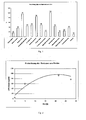
- the activity of the liberated laccase is determined accordingly by means of ABTS ( Fig. 3 ).
- Example 2 10 mg silica gel with immobilized N-succinyl-Ala-Ala-Pro-Leu-p-nitroanilide or L-leucine p-nitroanilide or N-succinyl-Ala-Ala-Pro-Val-p-nitroanilide as protease substrates (Example 2) were suspended in 1300 ⁇ L 50mM Tris-HCl buffer pH8.3 and incubated with commercially available protease from Aspergillus oryzae or wound fluid at room temperature. The activity was determined by UV absorption of the cleaved p-nitroanilide in the supernatant at 375 nm or at 405 nm ( Fig. 4 ).
- silica gel with immobilized ferulic acid as Laccasesubstrat (Example 2) or with immobilized Fast Blue RR were suspended in 1300 ⁇ L 50mM succinate buffer pH4.5 and incubated with laccase from Trametes hirsuta or wound fluid at room temperature. The activity is determined by means of a color measurement (yellow-orange) by means of spectrophotometer.
- the polymer spheres were screened off, washed 3 times with 50 mM succinate buffer pH4.5 and portioned to 1 g wet mass in reaction vessels with 5 mM 50 mM succinate buffer pH4.5 in the presence of 10 mg silica gel with immobilized ferulic acid as Laccaseubstrat from Example 2.
- the enzymatic degradation was started by adding commercially available pectinase at room temperature and with shaking. After the incubation, the color change to yellow-orange was determined by means of a color measurement by means of a spectrophotometer ( Fig. 5 ).
- the biopolymer may be loaded with a protease of Aspergillus oryzae.
- the activity of the released protease is then determined by UV absorption of the cleaved p-nitroanilide in the supernatant at 375 nm.
- the response of the bioresponsive polymers can be adjusted via the diffusion behavior of both the trigger and the amplifier enzymes.
- chemically or genetically modifying e.g., increasing
- correspondingly lower levels of cross-linking of the biopolymer may be employed, while minimizing the outdiffusion of the enhancer enzyme.
- Example 6 the biopolymer was loaded with modified protease.
- the polymer spheres obtained in this way were screened off, washed 3 times with 50 mM succinate buffer pH4.5 and portioned with 1 g wet mass in reaction vessels with 5 mM 50 mM succinate buffer pH4.5 in the presence of 10 mg silica gel with immobilized ferulic acid as Laccase substrate from Example 2.
- Enzymatic degradation at room temperature and with shaking was started by adding commercial pectinase. After the incubation, the color change to yellow-orange was determined by means of a color measurement by means of a spectrophotometer ( Fig. 5 ).
- the molecular weight of the trigger enzyme can be increased by genetic engineering.
- a system that can be used in the medical field uses the enzyme lysozyme as a trigger enzyme.
- This enzyme of the body's native immune response is formed and secreted in the case of infection.
- the main task of the enzyme is a destruction of bacteria by degradation of peptidoglycan, a component of the bacterial cell wall. It was demonstrated that increased amounts of enzyme are present in the case of wound infection.
- 3.12 mg of micrococcus lysodeicticus cell wall from Sigma were suspended with 1 ml of 1% agarose in phosphate buffer pH 7.00. 100 ⁇ l of this suspension were mixed in a microtiter plate with 50 ⁇ l of a PEG-modified laccase.
- PES fabric is modified with trimethylsilyl methacrylate and overcoated with a modified with glycidyl methacrylate matrix and polymerized free-radically and covalently cross-linked.
- Extracellular enzymes such as pectinases or cellulases, can now overcome the PES tissue by diffusion and functional molecules, e.g. Release enzymes, which in turn trigger a color reaction.
Landscapes
- Chemical & Material Sciences (AREA)
- Organic Chemistry (AREA)
- Life Sciences & Earth Sciences (AREA)
- Health & Medical Sciences (AREA)
- Wood Science & Technology (AREA)
- Proteomics, Peptides & Aminoacids (AREA)
- Zoology (AREA)
- Engineering & Computer Science (AREA)
- Immunology (AREA)
- Biochemistry (AREA)
- Microbiology (AREA)
- Molecular Biology (AREA)
- Analytical Chemistry (AREA)
- Biotechnology (AREA)
- Physics & Mathematics (AREA)
- Biophysics (AREA)
- Bioinformatics & Cheminformatics (AREA)
- General Engineering & Computer Science (AREA)
- General Health & Medical Sciences (AREA)
- Genetics & Genomics (AREA)
- Toxicology (AREA)
- Measuring Or Testing Involving Enzymes Or Micro-Organisms (AREA)
- Immobilizing And Processing Of Enzymes And Microorganisms (AREA)
- Apparatus Associated With Microorganisms And Enzymes (AREA)
Claims (15)
- Arrangement comprenant un support solide et une matrice disposée contre le support solide, comprenant au moins une molécule pouvant être convertie ou modifiée par voie enzymatique, laquelle matrice comprend au moins une enzyme pouvant être libérée par conversion ou modification de la molécule, enzyme qui est à même de convertir au moins un substrat modificateur de couleur, se trouvant dans la matrice et/ou contre le support solide.
- Arrangement selon la revendication 1, caractérisé en ce que la matrice est disposée sur le support solide sous forme d'une couche, sous forme de capsules ou sous forme d'un hydrogel.
- Arrangement selon la revendication 1 ou 2, caractérisé en ce que la molécule pouvant être convertie ou modifiée par voie enzymatique est un polymère, de préférence un polysaccharide, un polypeptide, un polyester, un polyamide ou une combinaison de ceux-ci.
- Arrangement selon la revendication 3, caractérisé en ce que le polysaccharide est choisi dans le groupe consistant en la pectine, l'amylose, l'amylopectine, l'agarose, l'alginate, le carragénane, la chitine, le chitosan, le dextran, le glycogène, la gomme de guar, la gomme de caroube, le lévane, la pectine, le pollulane, la farine de tamarin, le xanthane et le xylane.
- Arrangement selon l'une des revendications 1 à 4, caractérisé en ce que la molécule comprend en outre une enzyme pouvant être libérée par conversion ou modification de la molécule, enzyme qui est à même de convertir ou de modifier aussi la molécule se trouvant dans la matrice.
- Arrangement selon la revendication 5, caractérisé en ce que l'enzyme est choisie dans le groupe consistant en les groupes des hydrolases et des oxydoréductases, telles que les protéases, les laccases ou les peroxydases.
- Arrangement selon l'une des revendications 1 à 6, caractérisé en ce que l'enzyme pouvant être libérée par conversion ou modification de la molécule est liée à un poly(alcool vinylique), à un polyéthylèneglycol (PEG), à des polypeptides, en particulier l'élastine, ou à des peptides.
- Arrangement selon la revendication 7, caractérisé en ce que l'enzyme pouvant être libérée, qui est liée par l'intermédiaire d'un polypeptide ou d'un peptide à la molécule pouvant être convertie ou modifiée par voie enzymatique, peut être libérée par une enzyme, de préférence une enzyme microbienne ou une enzyme du système immunitaire, telle que l'élastase.
- Arrangement selon l'une des revendications 1 à 8, caractérisé en ce que le substrat chromogène est choisi dans le groupe consistant en les composés phénoliques et les colorants azoïques.
- Arrangement selon la revendication 9, caractérisé en ce que le substrat chromogène peut être converti directement par des enzymes, de préférence des enzymes microbiennes telles que les laccases ou les peroxydases, ou des enzymes du système immunitaire, telles que la myéloperoxydase.
- Arrangement selon l'une des revendications 1 à 10, caractérisé en ce que l'arrangement présente une membrane semi-perméable opposée au support solide, la membrane semi-perméable étant de préférence choisie dans le groupe consistant en les dérivés de la cellulose, les polyamides, les polyacrylamides et les polyesters.
- Arrangement selon l'une des revendications 3 à 11, caractérisé en ce que le polymère, l'enzyme et le substrat modificateur de couleur sont choisis dans le Tableau A.
- Utilisation d'un arrangement selon l'une des revendications 1 à 12 pour déterminer dans un échantillon la présence et/ou la caractérisation des cellules, de préférence de microorganismes, de préférence choisies dans le groupe consistant en les bactéries et les champignons.
- Utilisation, dans un échantillon, d'un arrangement selon l'une des revendications 1 à 12 pour la détection d'au moins une enzyme, de préférence choisie dans le groupes des hydrolases consistant en une amylase, une cellulase, une xylanase, une mannanase, une protéase, un lysozyme, une élastase, une collagénase, une cathepsine, une myéloperoxydase, une lipase et une estérase.
- Utilisation d'un arrangement selon l'une des revendications 1 à 12 pour la détection de l'infection d'une plaie par détermination de la présence d'au moins une enzyme spécifique de plaie, de préférence du groupe des hydrolases, consistant en une amylase, une cellulase, une xylanase, une mannanase, une protéase, un lysozyme, une élastase, une collagénase, une cathepsine, une myéloperoxydase, une lipase et une estérase.
Applications Claiming Priority (2)
| Application Number | Priority Date | Filing Date | Title |
|---|---|---|---|
| ATA184/2010A AT509355B1 (de) | 2010-02-10 | 2010-02-10 | Testanordnung |
| PCT/AT2011/000074 WO2011097664A2 (fr) | 2010-02-10 | 2011-02-09 | Dispositif de test |
Publications (2)
| Publication Number | Publication Date |
|---|---|
| EP2534483A2 EP2534483A2 (fr) | 2012-12-19 |
| EP2534483B1 true EP2534483B1 (fr) | 2016-09-14 |
Family
ID=44352351
Family Applications (1)
| Application Number | Title | Priority Date | Filing Date |
|---|---|---|---|
| EP11706460.0A Not-in-force EP2534483B1 (fr) | 2010-02-10 | 2011-02-09 | Dispositif de test |
Country Status (5)
| Country | Link |
|---|---|
| US (1) | US8785142B2 (fr) |
| EP (1) | EP2534483B1 (fr) |
| JP (1) | JP5859984B2 (fr) |
| AT (1) | AT509355B1 (fr) |
| WO (1) | WO2011097664A2 (fr) |
Families Citing this family (4)
| Publication number | Priority date | Publication date | Assignee | Title |
|---|---|---|---|---|
| WO2017173069A1 (fr) | 2016-03-30 | 2017-10-05 | Convatec Technologies Inc. | Détection d'infections microbiennes dans des plaies |
| US11453905B2 (en) | 2016-04-18 | 2022-09-27 | Trubac, LTD. | Method of detecting bacterial infection in a biological sample |
| CA3172525A1 (fr) * | 2020-03-23 | 2021-09-30 | Tanya Jeradechachai | Test rapide de purete de grains de ble a haute teneur en amylose |
| CN112662656B (zh) * | 2021-03-18 | 2021-07-06 | 凯莱英医药集团(天津)股份有限公司 | 酶固定化载体及其制备方法、固定化酶及其制备方法 |
Family Cites Families (24)
| Publication number | Priority date | Publication date | Assignee | Title |
|---|---|---|---|---|
| US4888287A (en) * | 1986-09-24 | 1989-12-19 | Eastman Kodak Company | Rapid differentiation of fungi from bacteria using polyene antibiotics |
| JPH03503845A (ja) | 1988-04-22 | 1991-08-29 | マサチユセツツ・インスチチユート・オブ・テクノロジー | 微小滴を形成しそして使用する方法 |
| NL8801073A (nl) * | 1988-04-26 | 1989-11-16 | Univ Twente | Detectiemethode. |
| AU616957B2 (en) | 1988-06-20 | 1991-11-14 | Becton Dickinson & Company | Device for enhancing fluorescence and kinetics and methods of using the device |
| CA2029172C (fr) * | 1989-11-28 | 2002-04-02 | Eric Flam | Pansement muni d'un dispositif indicateur |
| JPH0786497B2 (ja) * | 1989-12-22 | 1995-09-20 | 国税庁長官 | 非多孔固定化酵素膜を使用する酵素電極 |
| US5366881A (en) * | 1993-02-23 | 1994-11-22 | The United States Of America As Represented By The Secretary Of The Navy | Polymerizable lipids for preparing vesicles that controllably release an encapsulant |
| BR9405963A (pt) * | 1993-04-14 | 1996-01-30 | Litmus Concepts Inc | Processo para testar a presença de hidrolase enzimaticamente ativa e de um inibidor de uma hidrolase alvo em uma amostra e para detectar candidíase e trichomonas vaginalis e dispositivos de teste para testar em uma amostra a presença de uma hidrolase enzimaticamente ativa de candidíase de protease aspártica enzimaticamente ativa e de um inibidor de uma hidrolase alvo |
| SE9301270D0 (sv) | 1993-04-19 | 1993-04-17 | Biosensor | |
| US7157048B2 (en) | 1993-05-19 | 2007-01-02 | Sira Technologies, Inc. | Detection of contaminants |
| IL109079A (en) * | 1994-03-22 | 1998-02-22 | Israel Fiber Inst State Of Isr | Polyionic hydrogels |
| US6160820A (en) | 1996-09-02 | 2000-12-12 | Telia Ab | Multi-carrier transmission systems |
| WO1999067640A1 (fr) | 1998-06-22 | 1999-12-29 | The Regents Of The University Of California | Biocapteur optique declenche |
| WO2003033691A1 (fr) * | 2001-10-19 | 2003-04-24 | Institut Molekulyarnoi Biologii Im. V.A. Engelgardta Rossiiskoi Akademii Nauk | Micropuce cellulaire et son utilisation dans un procede d'analyse de cellules vivantes |
| JP2005528887A (ja) * | 2002-01-31 | 2005-09-29 | エクスプレッシブ コンストラクツ,インコーポレイテッド | 微生物の検出方法 |
| CA2564426C (fr) * | 2003-09-02 | 2013-01-08 | Expressive Constructs, Inc. | Amplification de signaux au moyen d'une proenzyme synthetique |
| US7399608B2 (en) | 2003-12-16 | 2008-07-15 | Kimberly-Clark Worldwide, Inc. | Microbial detection and quantification |
| EP2289567A3 (fr) * | 2003-12-22 | 2011-06-22 | Regentis Biomaterials Ltd. | Matrice à base de protéines naturelles réticulées |
| WO2005084257A2 (fr) * | 2004-02-26 | 2005-09-15 | Vpn Solutions, Llc | Detecteur de glucose a couche mince composite |
| US20070122831A1 (en) | 2005-11-12 | 2007-05-31 | Dave Bachoon | Detection and source identification of microbial contaminants in water samples |
| US20090215079A1 (en) * | 2005-12-05 | 2009-08-27 | Technische Universitat Dresden | Method and Devices for the Detection of Microorganisms and/or the Activity Thereof |
| WO2007139854A2 (fr) * | 2006-05-22 | 2007-12-06 | George John | Procédé de préparation de gélifiants hydro-organiques à partir de sucres disaccharides par biocatalyse et leur utilisation dans l'administration de médicaments déclenchée par une enzyme |
| US20080057534A1 (en) | 2006-08-31 | 2008-03-06 | Kimberly-Clark Worldwide, Inc. | Microbe-sensitive indicators and use of the same |
| RU2444980C2 (ru) * | 2007-03-07 | 2012-03-20 | Эко Терапьютикс, Инк. | Трансдермальная система мониторинга аналита и способы детекции аналита |
-
2010
- 2010-02-10 AT ATA184/2010A patent/AT509355B1/de not_active IP Right Cessation
-
2011
- 2011-02-09 WO PCT/AT2011/000074 patent/WO2011097664A2/fr not_active Ceased
- 2011-02-09 US US13/577,366 patent/US8785142B2/en not_active Expired - Fee Related
- 2011-02-09 JP JP2012552209A patent/JP5859984B2/ja not_active Expired - Fee Related
- 2011-02-09 EP EP11706460.0A patent/EP2534483B1/fr not_active Not-in-force
Non-Patent Citations (1)
| Title |
|---|
| K SCHNEIDER ET AL: "Trigger enzymes for pectin based bioresponsive polymers", XVITH INTERNATIONAL CONFERENCE ON BIOENCAPSULATION, 4 September 2008 (2008-09-04), XP055222948, Retrieved from the Internet <URL:http://impascience.eu/bioencapsulation/340_contribution_texts/2008-09-04_P76.pdf> [retrieved on 20151022] * |
Also Published As
| Publication number | Publication date |
|---|---|
| US20120309036A1 (en) | 2012-12-06 |
| WO2011097664A3 (fr) | 2012-03-22 |
| US8785142B2 (en) | 2014-07-22 |
| JP5859984B2 (ja) | 2016-02-16 |
| WO2011097664A8 (fr) | 2012-09-20 |
| JP2013518600A (ja) | 2013-05-23 |
| WO2011097664A2 (fr) | 2011-08-18 |
| AT509355A1 (de) | 2011-08-15 |
| EP2534483A2 (fr) | 2012-12-19 |
| AT509355B1 (de) | 2012-04-15 |
Similar Documents
| Publication | Publication Date | Title |
|---|---|---|
| JP7698167B2 (ja) | 生物機能材料 | |
| Peniche et al. | Formation and stability of shark liver oil loaded chitosan/calcium alginate capsules | |
| Yi et al. | Amino acid modified chitosan beads: improved polymer supports for immobilization of lipase from Candida rugosa | |
| Mendez‐Encinas et al. | Partial removal of protein associated with arabinoxylans: Impact on the viscoelasticity, crosslinking content, and microstructure of the gels formed | |
| EP2534483B1 (fr) | Dispositif de test | |
| de Souza et al. | Enzymatic hydrolysis of starch into sugars is influenced by microgel assembly | |
| EP1468968A1 (fr) | Biocatalyseur contenant une laccase | |
| Magnin et al. | Immobilization of enzymes into a polyionic hydrogel: Chitoxan | |
| Esparza-Flores et al. | Genipin crosslinked porous chitosan beads as robust supports for β-galactosidase immobilization: Characterization, stability, and bioprocessing potential | |
| Cerón et al. | Study of stability, kinetic parameters and release of lysozyme immobilized on chitosan microspheres by crosslinking and covalent attachment for cotton fabric functionalization | |
| DD294729A5 (de) | Verfahren zur herstellung von immobilisaten mit biologisch aktiven, makromolekularen verbindungen | |
| CH680668A5 (fr) | ||
| Akdemir et al. | Preparation and characterization of UV-curable polymeric support for covalent immobilization of xylanase enzyme | |
| DD263663A7 (de) | Verfahren zur herstellung eines immobilisierten cholinestetase-praeparates | |
| Wang et al. | Immobilization of lipase on epoxy activated (1→ 3)-α-d-glucan isolated from Penicillium chrysongenum | |
| DE4005927A1 (de) | Immobilisierung von proteinen an traegern | |
| RU2771183C1 (ru) | Способ получения препарата фицина в геле на основе карбоксиметилцеллюлозы | |
| Schneider et al. | Bioresponsive systems based on polygalacturonate containing hydrogels | |
| Roheen et al. | Improved Destaining and Antimicrobial Potential of Pepsin Cross-linked HPMC-Se Nanoparticles | |
| EP3473716A1 (fr) | Matériaux réactifs et sorbants |
Legal Events
| Date | Code | Title | Description |
|---|---|---|---|
| PUAI | Public reference made under article 153(3) epc to a published international application that has entered the european phase |
Free format text: ORIGINAL CODE: 0009012 |
|
| 17P | Request for examination filed |
Effective date: 20120910 |
|
| AK | Designated contracting states |
Kind code of ref document: A2 Designated state(s): AL AT BE BG CH CY CZ DE DK EE ES FI FR GB GR HR HU IE IS IT LI LT LU LV MC MK MT NL NO PL PT RO RS SE SI SK SM TR |
|
| DAX | Request for extension of the european patent (deleted) | ||
| RIN1 | Information on inventor provided before grant (corrected) |
Inventor name: ROLLETT, ALEXANDRA Inventor name: GUEBITZ, GEORG Inventor name: KAUFMANN, FRANZ Inventor name: SIGL, EVA Inventor name: SCHROEDER, MARC Inventor name: SCHNEIDER, KONSTANTIN Inventor name: HAFNER, ANDREAS Inventor name: HASMANN, ANDREA |
|
| 17Q | First examination report despatched |
Effective date: 20140924 |
|
| GRAP | Despatch of communication of intention to grant a patent |
Free format text: ORIGINAL CODE: EPIDOSNIGR1 |
|
| INTG | Intention to grant announced |
Effective date: 20151111 |
|
| GRAP | Despatch of communication of intention to grant a patent |
Free format text: ORIGINAL CODE: EPIDOSNIGR1 |
|
| INTG | Intention to grant announced |
Effective date: 20160414 |
|
| RIN1 | Information on inventor provided before grant (corrected) |
Inventor name: GUEBITZ, GEORG Inventor name: KAUFMANN, FRANZ Inventor name: HASMANN, ANDREA Inventor name: ROLLETT, ALEXANDRA Inventor name: SCHROEDER, MARC Inventor name: HAFNER, ANDREAS Inventor name: SCHNEIDER, KONSTANTIN Inventor name: SIGL, EVA |
|
| GRAS | Grant fee paid |
Free format text: ORIGINAL CODE: EPIDOSNIGR3 |
|
| GRAA | (expected) grant |
Free format text: ORIGINAL CODE: 0009210 |
|
| AK | Designated contracting states |
Kind code of ref document: B1 Designated state(s): AL AT BE BG CH CY CZ DE DK EE ES FI FR GB GR HR HU IE IS IT LI LT LU LV MC MK MT NL NO PL PT RO RS SE SI SK SM TR |
|
| REG | Reference to a national code |
Ref country code: GB Ref legal event code: FG4D Free format text: NOT ENGLISH |
|
| REG | Reference to a national code |
Ref country code: CH Ref legal event code: EP |
|
| REG | Reference to a national code |
Ref country code: IE Ref legal event code: FG4D Free format text: LANGUAGE OF EP DOCUMENT: GERMAN |
|
| REG | Reference to a national code |
Ref country code: AT Ref legal event code: REF Ref document number: 829544 Country of ref document: AT Kind code of ref document: T Effective date: 20161015 |
|
| REG | Reference to a national code |
Ref country code: DE Ref legal event code: R096 Ref document number: 502011010676 Country of ref document: DE |
|
| REG | Reference to a national code |
Ref country code: LT Ref legal event code: MG4D |
|
| REG | Reference to a national code |
Ref country code: NL Ref legal event code: MP Effective date: 20160914 |
|
| REG | Reference to a national code |
Ref country code: FR Ref legal event code: PLFP Year of fee payment: 7 |
|
| PG25 | Lapsed in a contracting state [announced via postgrant information from national office to epo] |
Ref country code: NO Free format text: LAPSE BECAUSE OF FAILURE TO SUBMIT A TRANSLATION OF THE DESCRIPTION OR TO PAY THE FEE WITHIN THE PRESCRIBED TIME-LIMIT Effective date: 20161214 Ref country code: HR Free format text: LAPSE BECAUSE OF FAILURE TO SUBMIT A TRANSLATION OF THE DESCRIPTION OR TO PAY THE FEE WITHIN THE PRESCRIBED TIME-LIMIT Effective date: 20160914 Ref country code: LT Free format text: LAPSE BECAUSE OF FAILURE TO SUBMIT A TRANSLATION OF THE DESCRIPTION OR TO PAY THE FEE WITHIN THE PRESCRIBED TIME-LIMIT Effective date: 20160914 Ref country code: FI Free format text: LAPSE BECAUSE OF FAILURE TO SUBMIT A TRANSLATION OF THE DESCRIPTION OR TO PAY THE FEE WITHIN THE PRESCRIBED TIME-LIMIT Effective date: 20160914 Ref country code: RS Free format text: LAPSE BECAUSE OF FAILURE TO SUBMIT A TRANSLATION OF THE DESCRIPTION OR TO PAY THE FEE WITHIN THE PRESCRIBED TIME-LIMIT Effective date: 20160914 |
|
| REG | Reference to a national code |
Ref country code: CH Ref legal event code: NV Representative=s name: RENTSCH PARTNER AG, CH |
|
| PG25 | Lapsed in a contracting state [announced via postgrant information from national office to epo] |
Ref country code: LV Free format text: LAPSE BECAUSE OF FAILURE TO SUBMIT A TRANSLATION OF THE DESCRIPTION OR TO PAY THE FEE WITHIN THE PRESCRIBED TIME-LIMIT Effective date: 20160914 Ref country code: GR Free format text: LAPSE BECAUSE OF FAILURE TO SUBMIT A TRANSLATION OF THE DESCRIPTION OR TO PAY THE FEE WITHIN THE PRESCRIBED TIME-LIMIT Effective date: 20161215 Ref country code: NL Free format text: LAPSE BECAUSE OF FAILURE TO SUBMIT A TRANSLATION OF THE DESCRIPTION OR TO PAY THE FEE WITHIN THE PRESCRIBED TIME-LIMIT Effective date: 20160914 Ref country code: SE Free format text: LAPSE BECAUSE OF FAILURE TO SUBMIT A TRANSLATION OF THE DESCRIPTION OR TO PAY THE FEE WITHIN THE PRESCRIBED TIME-LIMIT Effective date: 20160914 |
|
| PG25 | Lapsed in a contracting state [announced via postgrant information from national office to epo] |
Ref country code: EE Free format text: LAPSE BECAUSE OF FAILURE TO SUBMIT A TRANSLATION OF THE DESCRIPTION OR TO PAY THE FEE WITHIN THE PRESCRIBED TIME-LIMIT Effective date: 20160914 Ref country code: RO Free format text: LAPSE BECAUSE OF FAILURE TO SUBMIT A TRANSLATION OF THE DESCRIPTION OR TO PAY THE FEE WITHIN THE PRESCRIBED TIME-LIMIT Effective date: 20160914 |
|
| PG25 | Lapsed in a contracting state [announced via postgrant information from national office to epo] |
Ref country code: SK Free format text: LAPSE BECAUSE OF FAILURE TO SUBMIT A TRANSLATION OF THE DESCRIPTION OR TO PAY THE FEE WITHIN THE PRESCRIBED TIME-LIMIT Effective date: 20160914 Ref country code: ES Free format text: LAPSE BECAUSE OF FAILURE TO SUBMIT A TRANSLATION OF THE DESCRIPTION OR TO PAY THE FEE WITHIN THE PRESCRIBED TIME-LIMIT Effective date: 20160914 Ref country code: BG Free format text: LAPSE BECAUSE OF FAILURE TO SUBMIT A TRANSLATION OF THE DESCRIPTION OR TO PAY THE FEE WITHIN THE PRESCRIBED TIME-LIMIT Effective date: 20161214 Ref country code: PT Free format text: LAPSE BECAUSE OF FAILURE TO SUBMIT A TRANSLATION OF THE DESCRIPTION OR TO PAY THE FEE WITHIN THE PRESCRIBED TIME-LIMIT Effective date: 20170116 Ref country code: IS Free format text: LAPSE BECAUSE OF FAILURE TO SUBMIT A TRANSLATION OF THE DESCRIPTION OR TO PAY THE FEE WITHIN THE PRESCRIBED TIME-LIMIT Effective date: 20170114 Ref country code: BE Free format text: LAPSE BECAUSE OF NON-PAYMENT OF DUE FEES Effective date: 20170228 Ref country code: CZ Free format text: LAPSE BECAUSE OF FAILURE TO SUBMIT A TRANSLATION OF THE DESCRIPTION OR TO PAY THE FEE WITHIN THE PRESCRIBED TIME-LIMIT Effective date: 20160914 Ref country code: SM Free format text: LAPSE BECAUSE OF FAILURE TO SUBMIT A TRANSLATION OF THE DESCRIPTION OR TO PAY THE FEE WITHIN THE PRESCRIBED TIME-LIMIT Effective date: 20160914 Ref country code: PL Free format text: LAPSE BECAUSE OF FAILURE TO SUBMIT A TRANSLATION OF THE DESCRIPTION OR TO PAY THE FEE WITHIN THE PRESCRIBED TIME-LIMIT Effective date: 20160914 |
|
| REG | Reference to a national code |
Ref country code: DE Ref legal event code: R097 Ref document number: 502011010676 Country of ref document: DE |
|
| PG25 | Lapsed in a contracting state [announced via postgrant information from national office to epo] |
Ref country code: IT Free format text: LAPSE BECAUSE OF FAILURE TO SUBMIT A TRANSLATION OF THE DESCRIPTION OR TO PAY THE FEE WITHIN THE PRESCRIBED TIME-LIMIT Effective date: 20160914 |
|
| PLBE | No opposition filed within time limit |
Free format text: ORIGINAL CODE: 0009261 |
|
| STAA | Information on the status of an ep patent application or granted ep patent |
Free format text: STATUS: NO OPPOSITION FILED WITHIN TIME LIMIT |
|
| PG25 | Lapsed in a contracting state [announced via postgrant information from national office to epo] |
Ref country code: DK Free format text: LAPSE BECAUSE OF FAILURE TO SUBMIT A TRANSLATION OF THE DESCRIPTION OR TO PAY THE FEE WITHIN THE PRESCRIBED TIME-LIMIT Effective date: 20160914 |
|
| 26N | No opposition filed |
Effective date: 20170615 |
|
| PG25 | Lapsed in a contracting state [announced via postgrant information from national office to epo] |
Ref country code: MC Free format text: LAPSE BECAUSE OF FAILURE TO SUBMIT A TRANSLATION OF THE DESCRIPTION OR TO PAY THE FEE WITHIN THE PRESCRIBED TIME-LIMIT Effective date: 20160914 |
|
| REG | Reference to a national code |
Ref country code: CH Ref legal event code: PCAR Free format text: NEW ADDRESS: BELLERIVESTRASSE 203 POSTFACH, 8034 ZUERICH (CH) |
|
| REG | Reference to a national code |
Ref country code: IE Ref legal event code: MM4A |
|
| PG25 | Lapsed in a contracting state [announced via postgrant information from national office to epo] |
Ref country code: SI Free format text: LAPSE BECAUSE OF FAILURE TO SUBMIT A TRANSLATION OF THE DESCRIPTION OR TO PAY THE FEE WITHIN THE PRESCRIBED TIME-LIMIT Effective date: 20160914 |
|
| PG25 | Lapsed in a contracting state [announced via postgrant information from national office to epo] |
Ref country code: LU Free format text: LAPSE BECAUSE OF NON-PAYMENT OF DUE FEES Effective date: 20170209 |
|
| REG | Reference to a national code |
Ref country code: FR Ref legal event code: PLFP Year of fee payment: 8 |
|
| REG | Reference to a national code |
Ref country code: BE Ref legal event code: MM Effective date: 20170228 |
|
| PG25 | Lapsed in a contracting state [announced via postgrant information from national office to epo] |
Ref country code: IE Free format text: LAPSE BECAUSE OF NON-PAYMENT OF DUE FEES Effective date: 20170209 |
|
| REG | Reference to a national code |
Ref country code: AT Ref legal event code: MM01 Ref document number: 829544 Country of ref document: AT Kind code of ref document: T Effective date: 20170209 |
|
| PG25 | Lapsed in a contracting state [announced via postgrant information from national office to epo] |
Ref country code: AT Free format text: LAPSE BECAUSE OF NON-PAYMENT OF DUE FEES Effective date: 20170209 |
|
| PG25 | Lapsed in a contracting state [announced via postgrant information from national office to epo] |
Ref country code: MT Free format text: LAPSE BECAUSE OF FAILURE TO SUBMIT A TRANSLATION OF THE DESCRIPTION OR TO PAY THE FEE WITHIN THE PRESCRIBED TIME-LIMIT Effective date: 20160914 |
|
| PG25 | Lapsed in a contracting state [announced via postgrant information from national office to epo] |
Ref country code: AL Free format text: LAPSE BECAUSE OF FAILURE TO SUBMIT A TRANSLATION OF THE DESCRIPTION OR TO PAY THE FEE WITHIN THE PRESCRIBED TIME-LIMIT Effective date: 20160914 |
|
| PG25 | Lapsed in a contracting state [announced via postgrant information from national office to epo] |
Ref country code: HU Free format text: LAPSE BECAUSE OF FAILURE TO SUBMIT A TRANSLATION OF THE DESCRIPTION OR TO PAY THE FEE WITHIN THE PRESCRIBED TIME-LIMIT; INVALID AB INITIO Effective date: 20110209 |
|
| PG25 | Lapsed in a contracting state [announced via postgrant information from national office to epo] |
Ref country code: CY Free format text: LAPSE BECAUSE OF NON-PAYMENT OF DUE FEES Effective date: 20160914 |
|
| PG25 | Lapsed in a contracting state [announced via postgrant information from national office to epo] |
Ref country code: MK Free format text: LAPSE BECAUSE OF FAILURE TO SUBMIT A TRANSLATION OF THE DESCRIPTION OR TO PAY THE FEE WITHIN THE PRESCRIBED TIME-LIMIT Effective date: 20160914 |
|
| PG25 | Lapsed in a contracting state [announced via postgrant information from national office to epo] |
Ref country code: TR Free format text: LAPSE BECAUSE OF FAILURE TO SUBMIT A TRANSLATION OF THE DESCRIPTION OR TO PAY THE FEE WITHIN THE PRESCRIBED TIME-LIMIT Effective date: 20160914 |
|
| PGFP | Annual fee paid to national office [announced via postgrant information from national office to epo] |
Ref country code: FR Payment date: 20201130 Year of fee payment: 11 |
|
| PGFP | Annual fee paid to national office [announced via postgrant information from national office to epo] |
Ref country code: CH Payment date: 20210217 Year of fee payment: 11 |
|
| PGFP | Annual fee paid to national office [announced via postgrant information from national office to epo] |
Ref country code: GB Payment date: 20210222 Year of fee payment: 11 Ref country code: DE Payment date: 20210225 Year of fee payment: 11 |
|
| REG | Reference to a national code |
Ref country code: DE Ref legal event code: R119 Ref document number: 502011010676 Country of ref document: DE |
|
| REG | Reference to a national code |
Ref country code: CH Ref legal event code: PL |
|
| GBPC | Gb: european patent ceased through non-payment of renewal fee |
Effective date: 20220209 |
|
| PG25 | Lapsed in a contracting state [announced via postgrant information from national office to epo] |
Ref country code: FR Free format text: LAPSE BECAUSE OF NON-PAYMENT OF DUE FEES Effective date: 20220228 |
|
| PG25 | Lapsed in a contracting state [announced via postgrant information from national office to epo] |
Ref country code: LI Free format text: LAPSE BECAUSE OF NON-PAYMENT OF DUE FEES Effective date: 20220228 Ref country code: GB Free format text: LAPSE BECAUSE OF NON-PAYMENT OF DUE FEES Effective date: 20220209 Ref country code: DE Free format text: LAPSE BECAUSE OF NON-PAYMENT OF DUE FEES Effective date: 20220901 Ref country code: CH Free format text: LAPSE BECAUSE OF NON-PAYMENT OF DUE FEES Effective date: 20220228 |