EP2535486A2 - Türanlage - Google Patents
Türanlage Download PDFInfo
- Publication number
- EP2535486A2 EP2535486A2 EP12171011A EP12171011A EP2535486A2 EP 2535486 A2 EP2535486 A2 EP 2535486A2 EP 12171011 A EP12171011 A EP 12171011A EP 12171011 A EP12171011 A EP 12171011A EP 2535486 A2 EP2535486 A2 EP 2535486A2
- Authority
- EP
- European Patent Office
- Prior art keywords
- door
- door leaf
- locking
- door system
- receptacle
- Prior art date
- Legal status (The legal status is an assumption and is not a legal conclusion. Google has not performed a legal analysis and makes no representation as to the accuracy of the status listed.)
- Granted
Links
Images


Classifications
-
- E—FIXED CONSTRUCTIONS
- E05—LOCKS; KEYS; WINDOW OR DOOR FITTINGS; SAFES
- E05B—LOCKS; ACCESSORIES THEREFOR; HANDCUFFS
- E05B17/00—Accessories in connection with locks
- E05B17/20—Means independent of the locking mechanism for preventing unauthorised opening, e.g. for securing the bolt in the fastening position
- E05B17/2084—Means to prevent forced opening by attack, tampering or jimmying
-
- E—FIXED CONSTRUCTIONS
- E05—LOCKS; KEYS; WINDOW OR DOOR FITTINGS; SAFES
- E05C—BOLTS OR FASTENING DEVICES FOR WINGS, SPECIALLY FOR DOORS OR WINDOWS
- E05C9/00—Arrangements of simultaneously actuated bolts or other securing devices at well-separated positions on the same wing
- E05C9/18—Details of fastening means or of fixed retaining means for the ends of bars
- E05C9/1808—Keepers
-
- E—FIXED CONSTRUCTIONS
- E05—LOCKS; KEYS; WINDOW OR DOOR FITTINGS; SAFES
- E05B—LOCKS; ACCESSORIES THEREFOR; HANDCUFFS
- E05B65/00—Locks or fastenings for special use
- E05B65/08—Locks or fastenings for special use for sliding wings
- E05B65/087—Locks or fastenings for special use for sliding wings the bolts sliding parallel to the wings
Definitions
- the invention relates to a door system according to the preamble of patent claim 1.
- a locking device for locking the door leaf in its closed position, a locking device is provided, wherein the locking device has at least one latch, which engages in its locking position in a stationary, sunk for example in the building floor arranged latch receptacle.
- the door is deformable, for example in the form of a bulge, whereby the depth of immersion of the bolt in the bolt receptacle can decrease so far that the bolt can get out of engagement with the bolt receptacle and The door can then be opened undesirably despite befindlichem in the locked position locking device.
- the invention has for its object to provide a door system, which ensures increased security against burglary.
- the locking device should remain effective even with a violent deformation of the door leaf.
- a projection at least on the side facing away from the potential collapse side of the door leaf side of the door system, at least adjacent to the bolt receptacle arranged a projection.
- the projection blocks the bolt when it no longer engages due to deformation of the door leaf in the bolt receptacle, so that further a locking effect is given and a sliding or pivoting of the door is prevented.
- the profiles of the door can be slimmer and thus designed visually advantageous.
- the projection may be arranged on a base plate of a reinforcing element. As a result, an extremely simple, yet stable attachment of the projection is made possible at its intended position.
- the projection may have at least one bevel and is thus hardly disturbing in the passage area of the door system.
- the reinforcing element can be formed separately from the bolt receptacle and can have a coupling portion which defines the exact alignment of the reinforcing element to the bolt receptacle.
- the reinforcing element may be formed integrally with the bolt receptacle.
- the door system 1 is designed as an automatic sliding door and has two counter-driven by a drive device 7 door 2, which are guided on the top side slidably on a stationary guide means, for example by means of roller carriage in a running rail, which together with the drive means 7 in the region of stationary bolt 6 is arranged.
- a locking device In the area of the drive device 7, a locking device is arranged, which cooperates with rod-shaped locking elements 8 displaceably mounted in the profiles of the door leaves 2.
- the locking elements 8 have in their lower end region depending on a bolt or are designed as such, wherein the bolt with a bottom-side latch receptacle 9, here designed as a ground socket, can cooperate when the door leaf 2 is in its closed position.
- Fig. 1a In the operating state according to Fig. 1a are the door leaves 2 in the partially open position, wherein the locking elements 8 are not effective and the door leaves 2 can be moved by the drive means 7 in both directions.
- the door 2 are in the in Fig. 1b shown operating state in its closed position, so that the locking elements 8, actuated by the locking device of the drive means 7, engage in the bolt receptacles 9 and thus lock the door 2 in this position.
- the lock acts both in the direction of movement of the door 2, so that the door 2 can not be moved manually out of their closed position, as well as perpendicular to the wing plane, so that the door 2 can not be pressed in this direction. That is, in this operating state, the door leaves 2 without violence by unauthorized persons can not be opened.
- the arrangement according to the invention is intended to remedy this security deficiency of generic door systems 1.
- Fig. 3a to 3c are three phases of a burglary attempt in a door system 1 according to the invention shown, wherein the three phases shown in the phases according to Fig. 2a to 2c correspond.
- a reinforcing element 11 with a projection 15 is arranged adjacent to the latch receptacle 9.
- the door system 1 thus satisfies relevant regulations in the field of burglary protection, which in Germany may be designated as "WK2", for example.
- the reinforcing element 11 has a thin base plate 12 which can be fixed on the building floor 10 by means of a plurality of fastening bores 13 and these bolts, which are not shown here, and which engage through them.
- the base plate 12 Approximately in the middle, the base plate 12 has a through-hole 14, which is arranged in the mounting position of the reinforcing member 11 is substantially coaxial with the embedded in the building floor 10, not visible from this perspective bolt receptacle 9.
- the base plate 12 of the reinforcing element 11 may also be formed integrally with the sunken in the building floor 10 can be arranged sleeve of the bolt receptacle 9, which greatly facilitates the assembly of this arrangement.
- the projection may be, for example, about 1 to 2 cm high in order to develop a sufficient effect.
- the projection 15 may be formed integrally with the base plate 12. Alternatively, it is conceivable to manufacture the projection 5 as a separate component and to attach it to the base plate 12, e.g. by welding.
- the reinforcing element 11 due to the tapered shape of the projection 15 and possible further bevels on the sides of the projection 15 and the edge of the base plate 12 in the passage area of the door system 1 hardly disturbing, the benefit clearly outweighs. Retrofitting existing door systems 1 with the reinforcing element 11 is due to its small footprint in principle easily possible, so - to achieve better burglary protection - in itself sufficiently stable door wings 2.
- Fig. 6 is a respect to the execution according to Fig. 4 modified embodiment of the reinforcing element 11 shown enlarged.
- the cooperating with the locking element 8 chamfer 16 is concave in this embodiment, to give the locking element 8 also laterally support and thus to prevent displacement of the door leaf 2 in its opening direction.
Landscapes
- Engineering & Computer Science (AREA)
- Mechanical Engineering (AREA)
- Wing Frames And Configurations (AREA)
- Lock And Its Accessories (AREA)
Abstract
Description
- Die Erfindung betrifft eine Türanlage nach dem Oberbegriff des Patentanspruchs 1.
- Aus der
DE 199 08 191 C1 ist eine als automatische Schiebetür ausgebildete Türanlage mit mindestens einem beweglichen Türflügel bekannt. Zur Verriegelung des Türflügels in seiner Geschlossenlage ist eine Verriegelungseinrichtung vorhanden, wobei die Verriegelungseinrichtung mindestens einen Riegel aufweist, welcher in seiner Verriegelungsstellung in eine ortsfest, beispielsweise im Gebäudeboden versenkt angeordnete Riegelaufnahme eingreift. Durch Einleitung einer hohen Kraft senkrecht zur Türflügelebene, insbesondere im Falle eines Einbruchversuchs, ist der Türflügel verformbar, beispielsweise in Form einer Auswölbung, wodurch die Eintauchtiefe des Riegels in der Riegelaufnahme sich soweit verringern kann, dass der Riegel außer Eingriff mit der Riegelaufnahme gelangen kann und der Türflügel sodann unerwünschterweise trotz in Verriegelungsstellung befindlicher Verriegelungseinrichtung geöffnet werden kann. - Der Erfindung liegt die Aufgabe zugrunde, eine Türanlage zu schaffen, welche eine erhöhte Sicherheit gegenüber Einbruch gewährleistet. Insbesondere soll die Verriegelungseinrichtung auch bei einer gewaltsamen Verformung des Türflügels wirksam bleiben.
- Die Aufgabe wird durch die Merkmale des Patentanspruchs 1 gelöst.
- Die Unteransprüche bilden vorteilhafte Ausgestaltungsmöglichkeiten der Erfindung.
- Erfindungsgemäß ist benachbart zur Riegelaufnahme, zumindest auf der der potenziellen Einbruchsseite des Türflügels abgewandten Seite der Türanlage, mindestens ein Vorsprung angeordnet. Der Vorsprung blockiert den Riegel, wenn er aufgrund einer Verformung des Türflügels nicht mehr in die Riegelaufnahme eingreift, so dass weiterhin eine Verriegelungswirkung gegeben ist und ein Aufschieben oder -schwenken des Türflügels verhindert wird.
- Da der Türflügel weiter aufgewölbt werden kann, ohne dass die Verriegelungswirkung aufgehoben wird, können die Profile des Türflügels schlanker und somit optisch vorteilhaft gestaltet werden.
- Der Vorsprung kann auf einer Grundplatte eines Verstärkungselements angeordnet sein. Hierdurch wird eine äußerst einfache und dennoch stabile Befestigung des Vorsprungs an seiner vorgesehenen Position ermöglicht.
- Der Vorsprung kann mindestens eine Abschrägung aufweisen und ist somit im Durchgangsbereich der Türanlage kaum störend.
- Das Verstärkungselement kann separat von der Riegelaufnahme ausgebildet sein und kann einen Kupplungsabschnitt aufweisen, welcher die exakte Ausrichtung des Verstärkungselements zu der Riegelaufnahme definiert. Alternativ kann das Verstärkungselement einstückig mit der Riegelaufnahme ausgebildet sein.
- Im Nachfolgenden werden Ausführungsbeispiele in der Zeichnung anhand der Figuren näher erläutert.
- Dabei zeigen:
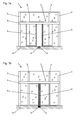
- Fig. 1a und
- 1b eine Frontansicht einer gattungsgemäßen Türanlage, in zwei unterschiedlichen Betriebszuständen;
- Fig. 2a bis 2c
- einen Horizontalschnitt des unteren Bereichs eines Türflügels einer gattungsgemäßen Türanlage, in drei unterschiedlichen Phasen eines Einbruchversuchs;
- Fig. 3a bis 3c
- einen Horizontalschnitt des unteren Bereichs eines Türflügels einer erfindungsgemäßen Türanlage, in drei unterschiedlichen Phasen eines Einbruchversuchs;
- Fig. 4
- eine perspektivische Ansicht des Verstärkungselements gemäß
Fig. 3a bis 3c ; - Fig. 5
- eine perspektivische Ansicht des Verstärkungselements gemäß
Fig. 4 , mit in Geschlossenlage befindlichem Türflügel; - Fig. 6
- eine perspektivische Ansicht eines gegenüber
Fig. 4 abgewandelten Ausführungsbeispiels des Verstärkungselements. - In den
Fig. 1 a und 1 b ist eine gattungsgemäße Türanlage 1 in zwei verschiedenen Betriebszuständen dargestellt. Beim konkreten Ausführungsbeispiel ist die Türanlage 1 als automatische Schiebetür ausgebildet und weist zwei gegenläufig durch eine Antriebseinrichtung 7 angetriebene Türflügel 2 auf, welche obenseitig an einer ortsfesten Führungseinrichtung verschiebbar geführt sind, beispielsweise mittels Rollenwagen in einer Laufschiene, welche gemeinsam mit der Antriebseinrichtung 7 im Bereich eines ortsfesten Riegels 6 angeordnet ist. - Im Bereich der Antriebseinrichtung 7 ist eine Verriegelungseinrichtung angeordnet, welche mit in den Profilen der Türflügel 2 verschieblich gelagerten, stangenförmigen Verriegelungselementen 8 zusammenwirkt. Die Verriegelungselemente 8 weisen in ihrem unteren Endbereich je einen Riegel auf bzw. sind als solcher ausgebildet, wobei der Riegel mit einer bodenseitigen Riegelaufnahme 9, hier als Bodenhülse ausgebildet, zusammenwirken kann, wenn sich der Türflügel 2 in seiner Geschlossenlage befindet.
- In dem Betriebszustand gemäß
Fig. 1a befinden sich die Türflügel 2 in teilgeöffneter Stellung, wobei die Verriegelungselemente 8 nicht wirksam sind und die Türflügel 2 durch die Antriebseinrichtung 7 in beiden Richtungen verschoben werden können. - Hingegen befinden sich die Türflügel 2 in dem in
Fig. 1b dargestellten Betriebszustand in ihrer Geschlossenlage, so dass die Verriegelungselemente 8, durch die Verriegelungseinrichtung der Antriebseinrichtung 7 betätigt, in die Riegelaufnahmen 9 eingreifen und die Türflügel 2 somit in dieser Position verriegeln. Die Verriegelung wirkt sowohl in Bewegungsrichtung der Türflügel 2, so dass die Türflügel 2 nicht manuell aus ihrer Geschlossenlage heraus verschoben werden können, als auch senkrecht zur Flügelebene, so dass die Türflügel 2 nicht in diese Richtung aufgedrückt werden können. D.h. in diesem Betriebszustand sind die Türflügel 2 ohne Gewaltanwendung von nichtautorisierten Personen nicht zu öffnen. - Jedoch besteht die Möglichkeit, dass nichtautorisierte Personen versuchen, die verriegelten Türflügel 2 gewaltsam, konkret insbesondere unter Zuhilfenahme von Werkzeugen zu öffnen, um sich unberechtigt Zugang zu dem durch die verschlossene und verriegelte Türanlage 1 abgesperrten Gebäudeabschnitt zu verschaffen. Ein solcher Vorgang ist in den
Fig. 2a bis 2c für eine gattungsgemäße Türanlage 1 dargestellt. - In der in
Fig. 2a dargestellten Phase hat der Einbruchversuch noch nicht stattgefunden, d.h. der in Schnittdarstellung seines unteren Bereichs gezeigte Türflügel 2 ist noch unbeschädigt und ordnungsgemäß verriegelt, indem das Verriegelungselement 8 mit seinem unteren Ende in die bodenseitig versenkt angeordnete Riegelaufnahme 9 eingreift. - In der Phase gemäß
Fig. 2b wurde in Pfeilrichtung A eine hohe Kraft senkrecht zur Flügelebene in den Türflügel 2 eingeleitet, beispielsweise unter Verwendung von geeigneten Einbruchwerkzeugen wie Schraubendreher, Meißel, Stemmeisen oder dergleichen. Da sowohl die Anbindung des Türflügels 2 an die nicht dargestellte, obere Führungseinrichtung als auch das Verriegelungselement 8 relativ stabil sind, kommt es zu einer Verformung des Türflügels 2 in Form einer Auswölbung. Dies kann zwar das Brechen einer in dem Türflügel 2 vorhandenen Verglasung bewirken, jedoch kann diese vorzugsweise als Sicherheitsverglasung gestaltet sein und somit auch im gebrochenen Zustand noch einen Durchtritt durch die Türanlage 1 verhindern. Durch die Auswölbung des Türflügels 2 hat sich das Ende des Verriegelungselements 8 bereits in der Riegelaufnahme 9 nach oben verschoben und greift daher nicht mehr so tief darin ein, bewirkt aber noch die Verriegelung des Türflügels 2. - In der in
Fig. 2c dargestellten Phase ist die Auswölbung des Türflügels 2 durch weitere Krafteinleitung in Pfeilrichtung A weiter vergrößert. Nunmehr taucht das Ende des Verriegelungselements 8 - trotz weiterhin vorhandener Verriegelungsstellung der Verriegelungseinrichtung - nicht mehr in die Riegelaufnahme 9 ein, so dass das untere Ende des Türflügels 2 in Pfeilrichtung B frei verschwenkbar ist. Es ist der nicht autorisierten Person also, ggf. unter weiterer Beschädigung der Türflügel 2, nun möglich, den durch die Türanlage 1 abgetrennten Gebäudeabschnitt zu betreten. - Die erfindungsgemäße Anordnung soll diesem Sicherheitsmangel gattungsgemäßer Türanlagen 1 abhelfen.
- In den
Fig. 3a bis 3c sind drei Phasen eines Einbruchversuchs bei einer erfindungsgemäßen Türanlage 1 dargestellt, wobei die drei dargestellten Phasen den Phasen gemäßFig. 2a bis 2c entsprechen. - An der Innenseite des durch die Türanlage 1 zu schützenden Gebäudebereichs, d.h. an der von der potenziellen Einbruchsseite abgewandten Seite, ist benachbart zu der Riegelaufnahme 9 ein Verstärkungselement 11 mit einem Vorsprung 15 angeordnet.
- In der in
Fig. 3a dargestellten Phase hat der Einbruchversuch noch nicht stattgefunden, so dass der Türflügel 2 noch unbeschädigt und ordnungsgemäß verriegelt ist. - In der Phase gemäß
Fig. 3b wurde in Pfeilrichtung A eine hohe Kraft senkrecht zur Flügelebene in den Türflügel 2 eingeleitet. Wie bei der vorangehend beschriebenen, gattungsgemäßen Anordnung verlagert sich auch bei der erfindungsgemäßen Türanlage 1 durch die damit einhergehende Auswölbung des Türflügels 2 das untere Ende des Verriegelungselements 8 nach oben und greift daher nicht mehr vollständig in die Riegelaufnahme 9 ein. - Wenn das untere Ende des Verriegelungselements 8, wie in der
Fig. 3c dargestellt, durch ein weiteres Aufwölben des Türflügels 2 vollständig aus der Riegelaufnahme 9 heraus gelangt ist, verhindert nunmehr das Verstärkungselement 11 mit seinem Vorsprung 15 ein Verschwenken des Türflügels 2, da das untere Ende des Verriegelungselements 8 durch den Vorsprung 15 blockiert wird. - Zwar wäre es prinzipiell ggf. möglich, den Türflügel 2 noch weiter aufzuwölben, um mit dem unteren Ende des Verriegelungselements 8 auch den Vorsprung 15 zu überwinden, jedoch wären hierfür erheblich mehr Zeit und Aufwand erforderlich. Die erfindungsgemäße Türanlage 1 genügt somit einschlägigen Vorschriften auf dem Gebiet des Einbruchschutzes, welche in Deutschland beispielsweise als "WK2" bezeichnet sein kann.
- In den
Fig. 4 und 5 ist ein Ausführungsbeispiel des Verstärkungselements 11 vergrößert dargestellt. Das Verstärkungselement 11 weist eine dünne Grundplatte 12 auf, welche mittels mehrerer Befestigungsbohrungen 13 und diese durchgreifender, hier nicht dargestellter Schrauben auf dem Gebäudeboden 10 fixierbar ist. Etwa mittig weist die Grundplatte 12 eine Durchgriffsbohrung 14 auf, welche in der Montageposition des Verstärkungselements 11 im Wesentlichen koaxial zu der im Gebäudeboden 10 eingelassenen, aus dieser Perspektive nicht sichtbaren Riegelaufnahme 9 angeordnet ist. - Alternativ kann die Grundplatte 12 des Verstärkungselements 11 auch einstückig mit der im Gebäudeboden 10 versenkt anordenbaren Hülse der Riegelaufnahme 9 ausgebildet sein, was die Montage dieser Anordnung wesentlich erleichtert.
- Unmittelbar neben der Durchgriffsbohrung 14 und der darunterliegenden Riegelaufnahme 9 erstreckt sich auf der Grundplatte 12 der Vorsprung 15, welcher im Querschnitt zwei gegeneinander gerichtete Abschrägungen 16, 17 aufweist, wobei die an die Durchgriffsbohrung 14 angrenzende, mit dem Verriegelungselement 8 zusammenwirkende Abschrägung 16 etwas steiler ist als die abgewandte Abschrägung 17, um ein "Aufklettern" des Verriegelungselements 8 sicher zu verhindern. Der Vorsprung kann beispielsweise etwa 1 bis 2 cm hoch sein, um eine ausreichende Wirkung zu entfalten.
- Der Vorsprung 15 kann mit der Grundplatte 12 einstückig ausgebildet sein. Alternativ ist es denkbar, den Vorsprung 5 als separates Bauteil zu fertigen und an die Grundplatte 12 anzufügen, z.B. durch Schweißen.
- Insgesamt ist das Verstärkungselement 11 aufgrund der abgeschrägten Form des Vorsprungs 15 sowie möglicher weiterer Abschrägungen an den Seiten des Vorsprungs 15 sowie am Rand der Grundplatte 12 im Durchgangsbereich der Türanlage 1 kaum störend, wobei der Nutzen deutlich überwiegt. Auch eine Nachrüstung bereits bestehender Türanlagen 1 mit dem Verstärkungselement 11 ist aufgrund dessen geringen Platzbedarfs prinzipiell problemlos möglich, um so - bei an sich ausreichend stabilen Türflügeln 2 - einen besseren Einbruchschutz zu erreichen.
- In
Fig. 6 ist ein gegenüber der Ausführung gemäßFig. 4 abgewandeltes Ausführungsbeispiel des Verstärkungselements 11 vergrößert dargestellt. Die mit dem Verriegelungselement 8 zusammenwirkende Abschrägung 16 ist bei diesem Ausführungsbeispiel konkav geformt, um dem Verriegelungselement 8 auch seitlich Halt zu geben und somit ein Verschieben des Türflügels 2 in seine Öffnungsrichtung zu verhindern. -
- 1
- Türanlage
- 2
- Türflügel
- 3
- Festfeld
- 4
- Oberlicht
- 5
- Pfosten
- 6
- Riegel
- 7
- Antriebseinrichtung
- 8
- Verriegelungselement
- 9
- Riegelaufnahme
- 10
- Gebäudeboden
- 11
- Verstärkungselement
- 12
- Grundplatte
- 13
- Befestigungsbohrung
- 14
- Durchgriffsbohrung
- 15
- Vorsprung
- 16
- Abschrägung
- 17
- Abschrägung
Claims (5)
- Türanlage (1) mit mindestens einem beweglichen Türflügel (2),
mit einer Verriegelungseinrichtung zur Verriegelung des Türflügels (2) in seiner Geschlossenlage,
wobei die Verriegelungseinrichtung mindestens ein Verriegelungselement (8) mit einem Riegel aufweist, welcher in seiner Verriegelungsstellung in eine ortsfest angeordnete Riegelaufnahme (9) eingreift, und
wobei der Türflügel (2) durch Einleitung einer hohen Kraft senkrecht zur Türflügelebene, insbesondere im Falle eines Einbruchversuchs, verformbar ist, wodurch die Eintauchtiefe des Riegels in der Riegelaufnahme sich verringern kann,
dadurch gekennzeichnet,
dass benachbart zur Riegelaufnahme (9), zumindest auf der der potenziellen Einbruchsseite des Türflügels (2) abgewandten Seite der Türanlage (1), mindestens ein Vorsprung (15) angeordnet ist. - Türanlage nach Anspruch 1,
dadurch gekennzeichnet , dass der Vorsprung (15) auf einer Grundplatte (12) eines Verstärkungselements (11) angeordnet ist. - Türanlage nach Anspruch 1 oder 2,
dadurch gekennzeichnet , dass der Vorsprung (15) mindestens eine Abschrägung (16, 17) aufweist. - Türanlage nach Anspruch 2 oder 3,
dadurch gekennzeichnet , dass das Verstärkungselement (11) einstückig mit der Riegelaufnahme (9) ausgebildet ist. - Türanlage nach Anspruch 2 oder 3,
dadurch gekennzeichnet , dass das Verstärkungselement (11) separat von der Riegelaufnahme (9) ausgebildet ist.
Priority Applications (1)
| Application Number | Priority Date | Filing Date | Title |
|---|---|---|---|
| PL12171011T PL2535486T3 (pl) | 2011-06-16 | 2012-06-06 | Układ drzwi |
Applications Claiming Priority (1)
| Application Number | Priority Date | Filing Date | Title |
|---|---|---|---|
| DE102011077630A DE102011077630B4 (de) | 2011-06-16 | 2011-06-16 | Türanlage |
Publications (3)
| Publication Number | Publication Date |
|---|---|
| EP2535486A2 true EP2535486A2 (de) | 2012-12-19 |
| EP2535486A3 EP2535486A3 (de) | 2017-12-13 |
| EP2535486B1 EP2535486B1 (de) | 2020-02-19 |
Family
ID=46197160
Family Applications (1)
| Application Number | Title | Priority Date | Filing Date |
|---|---|---|---|
| EP12171011.5A Active EP2535486B1 (de) | 2011-06-16 | 2012-06-06 | Türanlage |
Country Status (4)
| Country | Link |
|---|---|
| EP (1) | EP2535486B1 (de) |
| DE (1) | DE102011077630B4 (de) |
| ES (1) | ES2785103T3 (de) |
| PL (1) | PL2535486T3 (de) |
Citations (1)
| Publication number | Priority date | Publication date | Assignee | Title |
|---|---|---|---|---|
| DE19908191C1 (de) | 1999-02-25 | 2000-07-06 | Agta Record Ag Fehraltorf | Automatische Flügel- oder Türanlage |
Family Cites Families (17)
| Publication number | Priority date | Publication date | Assignee | Title |
|---|---|---|---|---|
| US1460991A (en) * | 1922-08-02 | 1923-07-03 | Howard M Van Alstyne | Sliding-door fastener |
| DE1114722B (de) * | 1957-08-30 | 1961-10-05 | Walter Bruenner | Verschluss fuer eine doppelfluegelige Tuer |
| US3976317A (en) * | 1976-01-02 | 1976-08-24 | Blomberg Glass | Strike plate construction for sliding glass door or window lock |
| FR2384929A1 (fr) * | 1977-03-25 | 1978-10-20 | Losserand Madoux Guy | Dispositif de retenue et de verrouillage pour des battants de portails et autres systemes de fermeture et d'obturation |
| US4216986A (en) * | 1978-08-09 | 1980-08-12 | Lawrence Brothers, Inc. | Releasable door stop assembly |
| US5024475A (en) * | 1986-12-22 | 1991-06-18 | John D. Gassett | Strengthening door jamb |
| FR2627538B3 (fr) * | 1988-02-24 | 1990-07-27 | Monin R | Dispositif de blocage d'un panneau tel qu'un vantail de portail |
| US5120094A (en) * | 1991-01-17 | 1992-06-09 | Marvin Lumber And Cedar Co. | Sliding door locking device |
| DE9209894U1 (de) * | 1992-07-23 | 1992-10-01 | Friedrich Wilhelm und Gustav Kettling GmbH, 5880 Lüdenscheid | Bodenriegel für einen Doppeltorflügel |
| US5575321A (en) * | 1995-02-07 | 1996-11-19 | Currier; Ken E. | Security door system for sliding screen doors |
| US5836628A (en) * | 1996-12-11 | 1998-11-17 | Beier; Ronald A. | Doorjamb reinforcing device |
| DE19916338C2 (de) * | 1999-04-12 | 2002-10-31 | Unilux Ag | Sicherheitsvorrichtung für ein Fenster und Fenster mit einer solchen Sicherheitsvorrichtung |
| US6415565B1 (en) * | 2000-04-18 | 2002-07-09 | Vent-Alarm Corporation | Storm rail for sliding door |
| JP4864665B2 (ja) * | 2006-11-30 | 2012-02-01 | 三和シヤッター工業株式会社 | 引き戸式のドア装置におけるこじ開け防止装置 |
| DE202008001358U1 (de) * | 2008-01-31 | 2008-04-03 | Heger, Karl | Bügel an einem Schließblech und an einem Schloß |
| PL214348B1 (pl) * | 2008-09-04 | 2013-07-31 | Fakro Pp Spolka Z Ograniczona Odpowiedzialnoscia | Zaczep dla rygla klamki, zwlaszcza w oknie dachowym |
| GB2474644A (en) * | 2009-10-20 | 2011-04-27 | Giovanni Maria Laporta | Frame member with bolt receiving channel |
-
2011
- 2011-06-16 DE DE102011077630A patent/DE102011077630B4/de not_active Withdrawn - After Issue
-
2012
- 2012-06-06 EP EP12171011.5A patent/EP2535486B1/de active Active
- 2012-06-06 PL PL12171011T patent/PL2535486T3/pl unknown
- 2012-06-06 ES ES12171011T patent/ES2785103T3/es active Active
Patent Citations (1)
| Publication number | Priority date | Publication date | Assignee | Title |
|---|---|---|---|---|
| DE19908191C1 (de) | 1999-02-25 | 2000-07-06 | Agta Record Ag Fehraltorf | Automatische Flügel- oder Türanlage |
Also Published As
| Publication number | Publication date |
|---|---|
| PL2535486T3 (pl) | 2020-07-27 |
| EP2535486B1 (de) | 2020-02-19 |
| DE102011077630A1 (de) | 2012-12-20 |
| EP2535486A3 (de) | 2017-12-13 |
| DE102011077630B4 (de) | 2013-01-24 |
| ES2785103T3 (es) | 2020-10-05 |
Similar Documents
| Publication | Publication Date | Title |
|---|---|---|
| DE102009031035B4 (de) | Einbruchsicherung | |
| EP0493689B1 (de) | Treibstangenbeschlag für Fenster, Türen od.dgl. | |
| EP2113624B1 (de) | Tür- oder Fenstersicherungsvorrichtung | |
| DE9407569U1 (de) | Einbruchsicherung | |
| DE19531040C2 (de) | Schiebeladen für ein Fenster- oder Türelement | |
| EP2535486B1 (de) | Türanlage | |
| DE102011077631B4 (de) | Automatische Schiebetüranlage | |
| EP2787160B1 (de) | Dichtung für einen Riegel und Dichtungsanordnung mit einer solchen Dichtung | |
| DE9214723U1 (de) | Schließblech | |
| EP3425149A1 (de) | Hebe-schiebe-einrichtung, insbesondere hebe-schiebe-tür oder hebe-schiebe-fenster | |
| DE102012020025A1 (de) | Einbruchsicherung für ein Fenster oder eine Türe | |
| EP0733761B1 (de) | Flügelrahmen | |
| AT519408B1 (de) | Überfahrbares automatisch schließendes Vertikalschott | |
| EP2857624A1 (de) | Gebäudeabschluss in einbruchhemmender und/oder durchschusshemmender Ausführung | |
| DE202014000301U1 (de) | Sicherungsvorrichtung für Fenster und Türen | |
| DE20313024U1 (de) | Einbruchhemmendes Holzfenster-/Türelement | |
| EP3511493B1 (de) | Schiebetürsystem | |
| DE19646585C2 (de) | Ortsveränderliche Tür | |
| DE2914376C2 (de) | Zweiflügelige Tür mit Schloß-Einstecktaschen | |
| EP4245956A1 (de) | Verriegelungseinrichtung und schiebeanlage | |
| DE102024114865A1 (de) | Verriegelungsbeschlag und Tür- oder Fensteranordnung | |
| DE202021102462U1 (de) | Torsystem | |
| EP3140821A1 (de) | Vorrichtung zur alarmauslösung und einbruchsicherung für ein fenster oder eine tür | |
| EP4390027A1 (de) | Hebe-schiebe-einrichtung | |
| DE9207452U1 (de) | Schließblech |
Legal Events
| Date | Code | Title | Description |
|---|---|---|---|
| PUAI | Public reference made under article 153(3) epc to a published international application that has entered the european phase |
Free format text: ORIGINAL CODE: 0009012 |
|
| AK | Designated contracting states |
Kind code of ref document: A2 Designated state(s): AL AT BE BG CH CY CZ DE DK EE ES FI FR GB GR HR HU IE IS IT LI LT LU LV MC MK MT NL NO PL PT RO RS SE SI SK SM TR |
|
| AX | Request for extension of the european patent |
Extension state: BA ME |
|
| REG | Reference to a national code |
Ref country code: DE Ref legal event code: R079 Ref document number: 502012015776 Country of ref document: DE Free format text: PREVIOUS MAIN CLASS: E05B0015020000 Ipc: E05B0017200000 |
|
| PUAL | Search report despatched |
Free format text: ORIGINAL CODE: 0009013 |
|
| AK | Designated contracting states |
Kind code of ref document: A3 Designated state(s): AL AT BE BG CH CY CZ DE DK EE ES FI FR GB GR HR HU IE IS IT LI LT LU LV MC MK MT NL NO PL PT RO RS SE SI SK SM TR |
|
| AX | Request for extension of the european patent |
Extension state: BA ME |
|
| RIC1 | Information provided on ipc code assigned before grant |
Ipc: E05B 65/08 20060101ALI20171108BHEP Ipc: E05C 9/18 20060101ALI20171108BHEP Ipc: E05B 17/20 20060101AFI20171108BHEP |
|
| STAA | Information on the status of an ep patent application or granted ep patent |
Free format text: STATUS: REQUEST FOR EXAMINATION WAS MADE |
|
| STAA | Information on the status of an ep patent application or granted ep patent |
Free format text: STATUS: EXAMINATION IS IN PROGRESS |
|
| 17P | Request for examination filed |
Effective date: 20180605 |
|
| RBV | Designated contracting states (corrected) |
Designated state(s): AL AT BE BG CH CY CZ DE DK EE ES FI FR GB GR HR HU IE IS IT LI LT LU LV MC MK MT NL NO PL PT RO RS SE SI SK SM TR |
|
| 17Q | First examination report despatched |
Effective date: 20180704 |
|
| GRAP | Despatch of communication of intention to grant a patent |
Free format text: ORIGINAL CODE: EPIDOSNIGR1 |
|
| STAA | Information on the status of an ep patent application or granted ep patent |
Free format text: STATUS: GRANT OF PATENT IS INTENDED |
|
| INTG | Intention to grant announced |
Effective date: 20191001 |
|
| GRAS | Grant fee paid |
Free format text: ORIGINAL CODE: EPIDOSNIGR3 |
|
| GRAA | (expected) grant |
Free format text: ORIGINAL CODE: 0009210 |
|
| STAA | Information on the status of an ep patent application or granted ep patent |
Free format text: STATUS: THE PATENT HAS BEEN GRANTED |
|
| AK | Designated contracting states |
Kind code of ref document: B1 Designated state(s): AL AT BE BG CH CY CZ DE DK EE ES FI FR GB GR HR HU IE IS IT LI LT LU LV MC MK MT NL NO PL PT RO RS SE SI SK SM TR |
|
| REG | Reference to a national code |
Ref country code: GB Ref legal event code: FG4D Free format text: NOT ENGLISH |
|
| REG | Reference to a national code |
Ref country code: CH Ref legal event code: EP |
|
| REG | Reference to a national code |
Ref country code: DE Ref legal event code: R096 Ref document number: 502012015776 Country of ref document: DE |
|
| REG | Reference to a national code |
Ref country code: AT Ref legal event code: REF Ref document number: 1235125 Country of ref document: AT Kind code of ref document: T Effective date: 20200315 |
|
| REG | Reference to a national code |
Ref country code: IE Ref legal event code: FG4D Free format text: LANGUAGE OF EP DOCUMENT: GERMAN |
|
| REG | Reference to a national code |
Ref country code: FI Ref legal event code: FGE |
|
| REG | Reference to a national code |
Ref country code: NO Ref legal event code: T2 Effective date: 20200219 |
|
| REG | Reference to a national code |
Ref country code: NL Ref legal event code: FP |
|
| REG | Reference to a national code |
Ref country code: SE Ref legal event code: TRGR |
|
| PG25 | Lapsed in a contracting state [announced via postgrant information from national office to epo] |
Ref country code: RS Free format text: LAPSE BECAUSE OF FAILURE TO SUBMIT A TRANSLATION OF THE DESCRIPTION OR TO PAY THE FEE WITHIN THE PRESCRIBED TIME-LIMIT Effective date: 20200219 |
|
| REG | Reference to a national code |
Ref country code: LT Ref legal event code: MG4D |
|
| PG25 | Lapsed in a contracting state [announced via postgrant information from national office to epo] |
Ref country code: LV Free format text: LAPSE BECAUSE OF FAILURE TO SUBMIT A TRANSLATION OF THE DESCRIPTION OR TO PAY THE FEE WITHIN THE PRESCRIBED TIME-LIMIT Effective date: 20200219 Ref country code: HR Free format text: LAPSE BECAUSE OF FAILURE TO SUBMIT A TRANSLATION OF THE DESCRIPTION OR TO PAY THE FEE WITHIN THE PRESCRIBED TIME-LIMIT Effective date: 20200219 Ref country code: IS Free format text: LAPSE BECAUSE OF FAILURE TO SUBMIT A TRANSLATION OF THE DESCRIPTION OR TO PAY THE FEE WITHIN THE PRESCRIBED TIME-LIMIT Effective date: 20200619 Ref country code: BG Free format text: LAPSE BECAUSE OF FAILURE TO SUBMIT A TRANSLATION OF THE DESCRIPTION OR TO PAY THE FEE WITHIN THE PRESCRIBED TIME-LIMIT Effective date: 20200519 Ref country code: GR Free format text: LAPSE BECAUSE OF FAILURE TO SUBMIT A TRANSLATION OF THE DESCRIPTION OR TO PAY THE FEE WITHIN THE PRESCRIBED TIME-LIMIT Effective date: 20200520 |
|
| REG | Reference to a national code |
Ref country code: ES Ref legal event code: FG2A Ref document number: 2785103 Country of ref document: ES Kind code of ref document: T3 Effective date: 20201005 |
|
| PG25 | Lapsed in a contracting state [announced via postgrant information from national office to epo] |
Ref country code: RO Free format text: LAPSE BECAUSE OF FAILURE TO SUBMIT A TRANSLATION OF THE DESCRIPTION OR TO PAY THE FEE WITHIN THE PRESCRIBED TIME-LIMIT Effective date: 20200219 Ref country code: CZ Free format text: LAPSE BECAUSE OF FAILURE TO SUBMIT A TRANSLATION OF THE DESCRIPTION OR TO PAY THE FEE WITHIN THE PRESCRIBED TIME-LIMIT Effective date: 20200219 Ref country code: LT Free format text: LAPSE BECAUSE OF FAILURE TO SUBMIT A TRANSLATION OF THE DESCRIPTION OR TO PAY THE FEE WITHIN THE PRESCRIBED TIME-LIMIT Effective date: 20200219 Ref country code: DK Free format text: LAPSE BECAUSE OF FAILURE TO SUBMIT A TRANSLATION OF THE DESCRIPTION OR TO PAY THE FEE WITHIN THE PRESCRIBED TIME-LIMIT Effective date: 20200219 Ref country code: SM Free format text: LAPSE BECAUSE OF FAILURE TO SUBMIT A TRANSLATION OF THE DESCRIPTION OR TO PAY THE FEE WITHIN THE PRESCRIBED TIME-LIMIT Effective date: 20200219 Ref country code: EE Free format text: LAPSE BECAUSE OF FAILURE TO SUBMIT A TRANSLATION OF THE DESCRIPTION OR TO PAY THE FEE WITHIN THE PRESCRIBED TIME-LIMIT Effective date: 20200219 Ref country code: PT Free format text: LAPSE BECAUSE OF FAILURE TO SUBMIT A TRANSLATION OF THE DESCRIPTION OR TO PAY THE FEE WITHIN THE PRESCRIBED TIME-LIMIT Effective date: 20200712 Ref country code: SK Free format text: LAPSE BECAUSE OF FAILURE TO SUBMIT A TRANSLATION OF THE DESCRIPTION OR TO PAY THE FEE WITHIN THE PRESCRIBED TIME-LIMIT Effective date: 20200219 |
|
| REG | Reference to a national code |
Ref country code: DE Ref legal event code: R097 Ref document number: 502012015776 Country of ref document: DE |
|
| PLBE | No opposition filed within time limit |
Free format text: ORIGINAL CODE: 0009261 |
|
| STAA | Information on the status of an ep patent application or granted ep patent |
Free format text: STATUS: NO OPPOSITION FILED WITHIN TIME LIMIT |
|
| 26N | No opposition filed |
Effective date: 20201120 |
|
| PG25 | Lapsed in a contracting state [announced via postgrant information from national office to epo] |
Ref country code: MC Free format text: LAPSE BECAUSE OF FAILURE TO SUBMIT A TRANSLATION OF THE DESCRIPTION OR TO PAY THE FEE WITHIN THE PRESCRIBED TIME-LIMIT Effective date: 20200219 |
|
| PG25 | Lapsed in a contracting state [announced via postgrant information from national office to epo] |
Ref country code: SI Free format text: LAPSE BECAUSE OF FAILURE TO SUBMIT A TRANSLATION OF THE DESCRIPTION OR TO PAY THE FEE WITHIN THE PRESCRIBED TIME-LIMIT Effective date: 20200219 |
|
| PG25 | Lapsed in a contracting state [announced via postgrant information from national office to epo] |
Ref country code: IE Free format text: LAPSE BECAUSE OF NON-PAYMENT OF DUE FEES Effective date: 20200606 |
|
| PG25 | Lapsed in a contracting state [announced via postgrant information from national office to epo] |
Ref country code: MT Free format text: LAPSE BECAUSE OF FAILURE TO SUBMIT A TRANSLATION OF THE DESCRIPTION OR TO PAY THE FEE WITHIN THE PRESCRIBED TIME-LIMIT Effective date: 20200219 Ref country code: CY Free format text: LAPSE BECAUSE OF FAILURE TO SUBMIT A TRANSLATION OF THE DESCRIPTION OR TO PAY THE FEE WITHIN THE PRESCRIBED TIME-LIMIT Effective date: 20200219 |
|
| PG25 | Lapsed in a contracting state [announced via postgrant information from national office to epo] |
Ref country code: MK Free format text: LAPSE BECAUSE OF FAILURE TO SUBMIT A TRANSLATION OF THE DESCRIPTION OR TO PAY THE FEE WITHIN THE PRESCRIBED TIME-LIMIT Effective date: 20200219 Ref country code: AL Free format text: LAPSE BECAUSE OF FAILURE TO SUBMIT A TRANSLATION OF THE DESCRIPTION OR TO PAY THE FEE WITHIN THE PRESCRIBED TIME-LIMIT Effective date: 20200219 |
|
| P01 | Opt-out of the competence of the unified patent court (upc) registered |
Effective date: 20230510 |
|
| PGFP | Annual fee paid to national office [announced via postgrant information from national office to epo] |
Ref country code: NL Payment date: 20230620 Year of fee payment: 12 Ref country code: FR Payment date: 20230627 Year of fee payment: 12 |
|
| PGFP | Annual fee paid to national office [announced via postgrant information from national office to epo] |
Ref country code: TR Payment date: 20230605 Year of fee payment: 12 Ref country code: LU Payment date: 20230621 Year of fee payment: 12 |
|
| PGFP | Annual fee paid to national office [announced via postgrant information from national office to epo] |
Ref country code: BE Payment date: 20230620 Year of fee payment: 12 |
|
| PGFP | Annual fee paid to national office [announced via postgrant information from national office to epo] |
Ref country code: ES Payment date: 20230829 Year of fee payment: 12 |
|
| REG | Reference to a national code |
Ref country code: NL Ref legal event code: MM Effective date: 20240701 |
|
| PG25 | Lapsed in a contracting state [announced via postgrant information from national office to epo] |
Ref country code: LU Free format text: LAPSE BECAUSE OF NON-PAYMENT OF DUE FEES Effective date: 20240606 |
|
| PG25 | Lapsed in a contracting state [announced via postgrant information from national office to epo] |
Ref country code: NL Free format text: LAPSE BECAUSE OF NON-PAYMENT OF DUE FEES Effective date: 20240701 |
|
| PG25 | Lapsed in a contracting state [announced via postgrant information from national office to epo] |
Ref country code: NL Free format text: LAPSE BECAUSE OF NON-PAYMENT OF DUE FEES Effective date: 20240701 |
|
| PG25 | Lapsed in a contracting state [announced via postgrant information from national office to epo] |
Ref country code: BE Free format text: LAPSE BECAUSE OF NON-PAYMENT OF DUE FEES Effective date: 20240630 |
|
| PG25 | Lapsed in a contracting state [announced via postgrant information from national office to epo] |
Ref country code: FR Free format text: LAPSE BECAUSE OF NON-PAYMENT OF DUE FEES Effective date: 20240630 |
|
| REG | Reference to a national code |
Ref country code: BE Ref legal event code: MM Effective date: 20240630 |
|
| REG | Reference to a national code |
Ref country code: ES Ref legal event code: FD2A Effective date: 20250728 |
|
| PGFP | Annual fee paid to national office [announced via postgrant information from national office to epo] |
Ref country code: SE Payment date: 20250618 Year of fee payment: 14 |
|
| PG25 | Lapsed in a contracting state [announced via postgrant information from national office to epo] |
Ref country code: ES Free format text: LAPSE BECAUSE OF NON-PAYMENT OF DUE FEES Effective date: 20240607 |
|
| PGFP | Annual fee paid to national office [announced via postgrant information from national office to epo] |
Ref country code: CH Payment date: 20250701 Year of fee payment: 14 |
|
| PG25 | Lapsed in a contracting state [announced via postgrant information from national office to epo] |
Ref country code: TR Free format text: LAPSE BECAUSE OF NON-PAYMENT OF DUE FEES Effective date: 20240606 |
|
| REG | Reference to a national code |
Ref country code: CH Ref legal event code: U11 Free format text: ST27 STATUS EVENT CODE: U-0-0-U10-U11 (AS PROVIDED BY THE NATIONAL OFFICE) Effective date: 20260701 |
|
| PGFP | Annual fee paid to national office [announced via postgrant information from national office to epo] |
Ref country code: GB Payment date: 20260625 Year of fee payment: 15 Ref country code: PL Payment date: 20260529 Year of fee payment: 15 |
|
| PGFP | Annual fee paid to national office [announced via postgrant information from national office to epo] |
Ref country code: IT Payment date: 20260623 Year of fee payment: 15 |
|
| PGFP | Annual fee paid to national office [announced via postgrant information from national office to epo] |
Ref country code: DE Payment date: 20260630 Year of fee payment: 15 |
|
| PGFP | Annual fee paid to national office [announced via postgrant information from national office to epo] |
Ref country code: NO Payment date: 20260622 Year of fee payment: 15 |
|
| PGFP | Annual fee paid to national office [announced via postgrant information from national office to epo] |
Ref country code: FI Payment date: 20260626 Year of fee payment: 15 Ref country code: AT Payment date: 20260619 Year of fee payment: 15 |