EP2542206B1 - Blockcopolymere und deren verwendung - Google Patents
Blockcopolymere und deren verwendung Download PDFInfo
- Publication number
- EP2542206B1 EP2542206B1 EP20110708015 EP11708015A EP2542206B1 EP 2542206 B1 EP2542206 B1 EP 2542206B1 EP 20110708015 EP20110708015 EP 20110708015 EP 11708015 A EP11708015 A EP 11708015A EP 2542206 B1 EP2542206 B1 EP 2542206B1
- Authority
- EP
- European Patent Office
- Prior art keywords
- compounds
- compound
- group
- acid
- weight
- Prior art date
- Legal status (The legal status is an assumption and is not a legal conclusion. Google has not performed a legal analysis and makes no representation as to the accuracy of the status listed.)
- Active
Links
- 229920001400 block copolymer Polymers 0.000 title description 5
- 239000000203 mixture Substances 0.000 claims description 316
- 150000001875 compounds Chemical class 0.000 claims description 288
- -1 vinyl halides Chemical class 0.000 claims description 239
- 229920001577 copolymer Polymers 0.000 claims description 187
- 239000000178 monomer Substances 0.000 claims description 126
- 239000013256 coordination polymer Substances 0.000 claims description 117
- 238000002360 preparation method Methods 0.000 claims description 107
- 229920002367 Polyisobutene Polymers 0.000 claims description 80
- 238000006116 polymerization reaction Methods 0.000 claims description 77
- 238000000034 method Methods 0.000 claims description 72
- NIXOWILDQLNWCW-UHFFFAOYSA-N 2-Propenoic acid Natural products OC(=O)C=C NIXOWILDQLNWCW-UHFFFAOYSA-N 0.000 claims description 60
- 229920001296 polysiloxane Polymers 0.000 claims description 56
- 239000002537 cosmetic Substances 0.000 claims description 47
- LFQSCWFLJHTTHZ-UHFFFAOYSA-N Ethanol Chemical compound CCO LFQSCWFLJHTTHZ-UHFFFAOYSA-N 0.000 claims description 45
- 230000008569 process Effects 0.000 claims description 45
- SMZOUWXMTYCWNB-UHFFFAOYSA-N 2-(2-methoxy-5-methylphenyl)ethanamine Chemical compound COC1=CC=C(C)C=C1CCN SMZOUWXMTYCWNB-UHFFFAOYSA-N 0.000 claims description 39
- 125000002947 alkylene group Chemical group 0.000 claims description 38
- 150000001412 amines Chemical class 0.000 claims description 38
- 125000001165 hydrophobic group Chemical group 0.000 claims description 33
- QGZKDVFQNNGYKY-UHFFFAOYSA-N Ammonia Chemical compound N QGZKDVFQNNGYKY-UHFFFAOYSA-N 0.000 claims description 32
- XLYOFNOQVPJJNP-UHFFFAOYSA-N water Substances O XLYOFNOQVPJJNP-UHFFFAOYSA-N 0.000 claims description 32
- 150000001298 alcohols Chemical class 0.000 claims description 31
- 150000002148 esters Chemical class 0.000 claims description 30
- 229920000570 polyether Polymers 0.000 claims description 30
- 239000004480 active ingredient Substances 0.000 claims description 29
- 239000004721 Polyphenylene oxide Substances 0.000 claims description 27
- 239000000047 product Substances 0.000 claims description 27
- 239000002253 acid Substances 0.000 claims description 26
- 150000002009 diols Chemical class 0.000 claims description 26
- 125000000129 anionic group Chemical group 0.000 claims description 25
- 229920003171 Poly (ethylene oxide) Polymers 0.000 claims description 24
- 125000002091 cationic group Chemical group 0.000 claims description 24
- 150000002763 monocarboxylic acids Chemical class 0.000 claims description 22
- 239000004094 surface-active agent Substances 0.000 claims description 22
- 229920001228 polyisocyanate Polymers 0.000 claims description 21
- 239000007795 chemical reaction product Substances 0.000 claims description 20
- 238000012673 precipitation polymerization Methods 0.000 claims description 19
- 150000003839 salts Chemical class 0.000 claims description 19
- 150000001991 dicarboxylic acids Chemical class 0.000 claims description 18
- 238000007334 copolymerization reaction Methods 0.000 claims description 17
- QJGQUHMNIGDVPM-UHFFFAOYSA-N nitrogen group Chemical group [N] QJGQUHMNIGDVPM-UHFFFAOYSA-N 0.000 claims description 17
- 239000005056 polyisocyanate Substances 0.000 claims description 17
- 239000011541 reaction mixture Substances 0.000 claims description 17
- 239000007787 solid Substances 0.000 claims description 17
- 150000001414 amino alcohols Chemical class 0.000 claims description 16
- 238000004132 cross linking Methods 0.000 claims description 16
- 150000001732 carboxylic acid derivatives Chemical group 0.000 claims description 15
- IQPQWNKOIGAROB-UHFFFAOYSA-N isocyanate group Chemical group [N-]=C=O IQPQWNKOIGAROB-UHFFFAOYSA-N 0.000 claims description 14
- 238000005956 quaternization reaction Methods 0.000 claims description 14
- 150000003673 urethanes Chemical class 0.000 claims description 13
- XXROGKLTLUQVRX-UHFFFAOYSA-N allyl alcohol Chemical compound OCC=C XXROGKLTLUQVRX-UHFFFAOYSA-N 0.000 claims description 12
- LCGLNKUTAGEVQW-UHFFFAOYSA-N Dimethyl ether Chemical compound COC LCGLNKUTAGEVQW-UHFFFAOYSA-N 0.000 claims description 10
- 150000001252 acrylic acid derivatives Chemical class 0.000 claims description 10
- 150000008064 anhydrides Chemical group 0.000 claims description 10
- 150000004985 diamines Chemical class 0.000 claims description 10
- 125000000391 vinyl group Chemical group [H]C([*])=C([H])[H] 0.000 claims description 10
- 150000001408 amides Chemical class 0.000 claims description 9
- 229930195733 hydrocarbon Natural products 0.000 claims description 9
- 229920002554 vinyl polymer Polymers 0.000 claims description 9
- QYKIQEUNHZKYBP-UHFFFAOYSA-N Vinyl ether Chemical class C=COC=C QYKIQEUNHZKYBP-UHFFFAOYSA-N 0.000 claims description 8
- 229920000233 poly(alkylene oxides) Polymers 0.000 claims description 8
- 239000004753 textile Substances 0.000 claims description 7
- 239000003814 drug Substances 0.000 claims description 6
- 235000013305 food Nutrition 0.000 claims description 6
- 150000002430 hydrocarbons Chemical class 0.000 claims description 6
- JOYRKODLDBILNP-UHFFFAOYSA-N Ethyl urethane Chemical compound CCOC(N)=O JOYRKODLDBILNP-UHFFFAOYSA-N 0.000 claims description 5
- 150000001299 aldehydes Chemical class 0.000 claims description 5
- 239000008194 pharmaceutical composition Substances 0.000 claims description 5
- ATRRKUHOCOJYRX-UHFFFAOYSA-N Ammonium bicarbonate Chemical compound [NH4+].OC([O-])=O ATRRKUHOCOJYRX-UHFFFAOYSA-N 0.000 claims description 4
- 229910000013 Ammonium bicarbonate Inorganic materials 0.000 claims description 4
- 235000012538 ammonium bicarbonate Nutrition 0.000 claims description 4
- 239000001099 ammonium carbonate Substances 0.000 claims description 4
- 150000007514 bases Chemical class 0.000 claims description 4
- IMROMDMJAWUWLK-UHFFFAOYSA-N Ethenol Chemical compound OC=C IMROMDMJAWUWLK-UHFFFAOYSA-N 0.000 claims description 3
- 239000000853 adhesive Substances 0.000 claims description 3
- 230000001070 adhesive effect Effects 0.000 claims description 3
- 239000008199 coating composition Substances 0.000 claims description 3
- 125000005265 dialkylamine group Chemical group 0.000 claims description 3
- 239000010985 leather Substances 0.000 claims description 3
- 238000007639 printing Methods 0.000 claims description 3
- 125000005270 trialkylamine group Chemical group 0.000 claims description 3
- 229920005652 polyisobutylene succinic anhydride Polymers 0.000 claims 2
- 229920000642 polymer Polymers 0.000 description 84
- XEKOWRVHYACXOJ-UHFFFAOYSA-N Ethyl acetate Chemical compound CCOC(C)=O XEKOWRVHYACXOJ-UHFFFAOYSA-N 0.000 description 68
- 238000006243 chemical reaction Methods 0.000 description 65
- NIXOWILDQLNWCW-UHFFFAOYSA-M Acrylate Chemical compound [O-]C(=O)C=C NIXOWILDQLNWCW-UHFFFAOYSA-M 0.000 description 51
- HRPVXLWXLXDGHG-UHFFFAOYSA-N Acrylamide Chemical compound NC(=O)C=C HRPVXLWXLXDGHG-UHFFFAOYSA-N 0.000 description 49
- 229920001983 poloxamer Polymers 0.000 description 46
- 150000003254 radicals Chemical class 0.000 description 43
- 239000003795 chemical substances by application Substances 0.000 description 40
- 229920002266 Pluriol® Polymers 0.000 description 37
- 239000002904 solvent Substances 0.000 description 36
- WHNWPMSKXPGLAX-UHFFFAOYSA-N N-Vinyl-2-pyrrolidone Chemical compound C=CN1CCCC1=O WHNWPMSKXPGLAX-UHFFFAOYSA-N 0.000 description 34
- 239000004698 Polyethylene Substances 0.000 description 34
- 125000000217 alkyl group Chemical group 0.000 description 33
- SLCVBVWXLSEKPL-UHFFFAOYSA-N neopentyl glycol Chemical compound OCC(C)(C)CO SLCVBVWXLSEKPL-UHFFFAOYSA-N 0.000 description 33
- 239000003921 oil Substances 0.000 description 31
- 229910052739 hydrogen Inorganic materials 0.000 description 30
- 239000002562 thickening agent Substances 0.000 description 30
- 229920001567 vinyl ester resin Polymers 0.000 description 30
- 239000000499 gel Substances 0.000 description 29
- 235000019198 oils Nutrition 0.000 description 29
- 229910052757 nitrogen Inorganic materials 0.000 description 28
- 239000000126 substance Substances 0.000 description 28
- IAYPIBMASNFSPL-UHFFFAOYSA-N Ethylene oxide Chemical compound C1CO1 IAYPIBMASNFSPL-UHFFFAOYSA-N 0.000 description 27
- 238000009472 formulation Methods 0.000 description 27
- 239000012071 phase Substances 0.000 description 26
- LYCAIKOWRPUZTN-UHFFFAOYSA-N ethylene glycol Natural products OCCO LYCAIKOWRPUZTN-UHFFFAOYSA-N 0.000 description 25
- 229920001223 polyethylene glycol Polymers 0.000 description 25
- 210000004209 hair Anatomy 0.000 description 24
- 239000001257 hydrogen Substances 0.000 description 24
- PEDCQBHIVMGVHV-UHFFFAOYSA-N Glycerine Chemical compound OCC(O)CO PEDCQBHIVMGVHV-UHFFFAOYSA-N 0.000 description 23
- 239000000546 pharmaceutical excipient Substances 0.000 description 23
- 125000002924 primary amino group Chemical group [H]N([H])* 0.000 description 23
- 125000000467 secondary amino group Chemical group [H]N([*:1])[*:2] 0.000 description 23
- 235000014113 dietary fatty acids Nutrition 0.000 description 22
- MTHSVFCYNBDYFN-UHFFFAOYSA-N diethylene glycol Chemical compound OCCOCCO MTHSVFCYNBDYFN-UHFFFAOYSA-N 0.000 description 22
- 230000000694 effects Effects 0.000 description 22
- 239000000194 fatty acid Substances 0.000 description 22
- 229930195729 fatty acid Natural products 0.000 description 22
- GOOHAUXETOMSMM-UHFFFAOYSA-N Propylene oxide Chemical group CC1CO1 GOOHAUXETOMSMM-UHFFFAOYSA-N 0.000 description 21
- WNLRTRBMVRJNCN-UHFFFAOYSA-N adipic acid Chemical compound OC(=O)CCCCC(O)=O WNLRTRBMVRJNCN-UHFFFAOYSA-N 0.000 description 21
- RAXXELZNTBOGNW-UHFFFAOYSA-N imidazole Natural products C1=CNC=N1 RAXXELZNTBOGNW-UHFFFAOYSA-N 0.000 description 21
- 239000000975 dye Substances 0.000 description 20
- 239000000839 emulsion Substances 0.000 description 20
- 125000002496 methyl group Chemical group [H]C([H])([H])* 0.000 description 20
- 239000004971 Cross linker Substances 0.000 description 19
- 229920000909 polytetrahydrofuran Polymers 0.000 description 19
- CERQOIWHTDAKMF-UHFFFAOYSA-N Methacrylic acid Chemical compound CC(=C)C(O)=O CERQOIWHTDAKMF-UHFFFAOYSA-N 0.000 description 18
- 239000002202 Polyethylene glycol Substances 0.000 description 18
- 125000004432 carbon atom Chemical group C* 0.000 description 17
- 150000004665 fatty acids Chemical class 0.000 description 17
- QQVIHTHCMHWDBS-UHFFFAOYSA-N isophthalic acid Chemical compound OC(=O)C1=CC=CC(C(O)=O)=C1 QQVIHTHCMHWDBS-UHFFFAOYSA-N 0.000 description 17
- IJGRMHOSHXDMSA-UHFFFAOYSA-N Atomic nitrogen Chemical compound N#N IJGRMHOSHXDMSA-UHFFFAOYSA-N 0.000 description 16
- 150000007513 acids Chemical class 0.000 description 16
- 125000003277 amino group Chemical group 0.000 description 16
- 239000003995 emulsifying agent Substances 0.000 description 16
- 125000001495 ethyl group Chemical group [H]C([H])([H])C([H])([H])* 0.000 description 16
- 239000003999 initiator Substances 0.000 description 16
- 229940117969 neopentyl glycol Drugs 0.000 description 16
- 229920000728 polyester Polymers 0.000 description 16
- 239000002671 adjuvant Substances 0.000 description 15
- 125000003118 aryl group Chemical group 0.000 description 15
- 239000007788 liquid Substances 0.000 description 15
- OSSNTDFYBPYIEC-UHFFFAOYSA-N 1-ethenylimidazole Chemical class C=CN1C=CN=C1 OSSNTDFYBPYIEC-UHFFFAOYSA-N 0.000 description 14
- WSFSSNUMVMOOMR-UHFFFAOYSA-N Formaldehyde Chemical compound O=C WSFSSNUMVMOOMR-UHFFFAOYSA-N 0.000 description 14
- 239000005058 Isophorone diisocyanate Substances 0.000 description 14
- 239000003925 fat Substances 0.000 description 14
- 235000019197 fats Nutrition 0.000 description 14
- NIMLQBUJDJZYEJ-UHFFFAOYSA-N isophorone diisocyanate Chemical compound CC1(C)CC(N=C=O)CC(C)(CN=C=O)C1 NIMLQBUJDJZYEJ-UHFFFAOYSA-N 0.000 description 14
- 229920001451 polypropylene glycol Polymers 0.000 description 14
- VZCYOOQTPOCHFL-UHFFFAOYSA-N trans-butenedioic acid Natural products OC(=O)C=CC(O)=O VZCYOOQTPOCHFL-UHFFFAOYSA-N 0.000 description 14
- OFOBLEOULBTSOW-UHFFFAOYSA-N Malonic acid Chemical compound OC(=O)CC(O)=O OFOBLEOULBTSOW-UHFFFAOYSA-N 0.000 description 13
- DNIAPMSPPWPWGF-UHFFFAOYSA-N Propylene glycol Chemical compound CC(O)CO DNIAPMSPPWPWGF-UHFFFAOYSA-N 0.000 description 13
- WERYXYBDKMZEQL-UHFFFAOYSA-N butane-1,4-diol Chemical compound OCCCCO WERYXYBDKMZEQL-UHFFFAOYSA-N 0.000 description 13
- 239000006071 cream Substances 0.000 description 13
- 150000002431 hydrogen Chemical class 0.000 description 13
- CSCPPACGZOOCGX-UHFFFAOYSA-N Acetone Chemical compound CC(C)=O CSCPPACGZOOCGX-UHFFFAOYSA-N 0.000 description 12
- 229920002368 Glissopal ® Polymers 0.000 description 12
- KFZMGEQAYNKOFK-UHFFFAOYSA-N Isopropanol Chemical compound CC(C)O KFZMGEQAYNKOFK-UHFFFAOYSA-N 0.000 description 12
- 150000001735 carboxylic acids Chemical class 0.000 description 12
- KRKNYBCHXYNGOX-UHFFFAOYSA-N citric acid Chemical compound OC(=O)CC(O)(C(O)=O)CC(O)=O KRKNYBCHXYNGOX-UHFFFAOYSA-N 0.000 description 12
- 239000006260 foam Substances 0.000 description 12
- 125000004108 n-butyl group Chemical group [H]C([H])([H])C([H])([H])C([H])([H])C([H])([H])* 0.000 description 12
- 229920000223 polyglycerol Polymers 0.000 description 12
- 229920000036 polyvinylpyrrolidone Polymers 0.000 description 12
- 239000000344 soap Substances 0.000 description 12
- 238000005406 washing Methods 0.000 description 12
- 229910021529 ammonia Inorganic materials 0.000 description 11
- 125000000753 cycloalkyl group Chemical group 0.000 description 11
- 150000002191 fatty alcohols Chemical class 0.000 description 11
- 125000001449 isopropyl group Chemical group [H]C([H])([H])C([H])(*)C([H])([H])[H] 0.000 description 11
- 235000013855 polyvinylpyrrolidone Nutrition 0.000 description 11
- 239000003755 preservative agent Substances 0.000 description 11
- 125000000999 tert-butyl group Chemical group [H]C([H])([H])C(*)(C([H])([H])[H])C([H])([H])[H] 0.000 description 11
- XNWFRZJHXBZDAG-UHFFFAOYSA-N 2-METHOXYETHANOL Chemical compound COCCO XNWFRZJHXBZDAG-UHFFFAOYSA-N 0.000 description 10
- VZCYOOQTPOCHFL-OWOJBTEDSA-N Fumaric acid Chemical compound OC(=O)\C=C\C(O)=O VZCYOOQTPOCHFL-OWOJBTEDSA-N 0.000 description 10
- 239000005057 Hexamethylene diisocyanate Substances 0.000 description 10
- 239000013543 active substance Substances 0.000 description 10
- 239000001361 adipic acid Substances 0.000 description 10
- 235000011037 adipic acid Nutrition 0.000 description 10
- 238000007037 hydroformylation reaction Methods 0.000 description 10
- 125000002887 hydroxy group Chemical group [H]O* 0.000 description 10
- VZCYOOQTPOCHFL-UPHRSURJSA-N maleic acid Chemical compound OC(=O)\C=C/C(O)=O VZCYOOQTPOCHFL-UPHRSURJSA-N 0.000 description 10
- 239000002609 medium Substances 0.000 description 10
- 239000001267 polyvinylpyrrolidone Substances 0.000 description 10
- XDTMQSROBMDMFD-UHFFFAOYSA-N Cyclohexane Chemical compound C1CCCCC1 XDTMQSROBMDMFD-UHFFFAOYSA-N 0.000 description 9
- UFHFLCQGNIYNRP-UHFFFAOYSA-N Hydrogen Chemical compound [H][H] UFHFLCQGNIYNRP-UHFFFAOYSA-N 0.000 description 9
- VQTUBCCKSQIDNK-UHFFFAOYSA-N Isobutene Chemical group CC(C)=C VQTUBCCKSQIDNK-UHFFFAOYSA-N 0.000 description 9
- ISWSIDIOOBJBQZ-UHFFFAOYSA-N Phenol Chemical compound OC1=CC=CC=C1 ISWSIDIOOBJBQZ-UHFFFAOYSA-N 0.000 description 9
- 229920002125 Sokalan® Polymers 0.000 description 9
- 239000002585 base Substances 0.000 description 9
- 238000000354 decomposition reaction Methods 0.000 description 9
- RRAMGCGOFNQTLD-UHFFFAOYSA-N hexamethylene diisocyanate Chemical compound O=C=NCCCCCCN=C=O RRAMGCGOFNQTLD-UHFFFAOYSA-N 0.000 description 9
- NAQMVNRVTILPCV-UHFFFAOYSA-N hexane-1,6-diamine Chemical compound NCCCCCCN NAQMVNRVTILPCV-UHFFFAOYSA-N 0.000 description 9
- XXMIOPMDWAUFGU-UHFFFAOYSA-N hexane-1,6-diol Chemical compound OCCCCCCO XXMIOPMDWAUFGU-UHFFFAOYSA-N 0.000 description 9
- 230000002209 hydrophobic effect Effects 0.000 description 9
- 239000006210 lotion Substances 0.000 description 9
- 239000011976 maleic acid Substances 0.000 description 9
- 125000001997 phenyl group Chemical group [H]C1=C([H])C([H])=C(*)C([H])=C1[H] 0.000 description 9
- 239000003381 stabilizer Substances 0.000 description 9
- 239000001993 wax Substances 0.000 description 9
- OSCJHTSDLYVCQC-UHFFFAOYSA-N 2-ethylhexyl 4-[[4-[4-(tert-butylcarbamoyl)anilino]-6-[4-(2-ethylhexoxycarbonyl)anilino]-1,3,5-triazin-2-yl]amino]benzoate Chemical compound C1=CC(C(=O)OCC(CC)CCCC)=CC=C1NC1=NC(NC=2C=CC(=CC=2)C(=O)NC(C)(C)C)=NC(NC=2C=CC(=CC=2)C(=O)OCC(CC)CCCC)=N1 OSCJHTSDLYVCQC-UHFFFAOYSA-N 0.000 description 8
- RNLHGQLZWXBQNY-UHFFFAOYSA-N 3-(aminomethyl)-3,5,5-trimethylcyclohexan-1-amine Chemical compound CC1(C)CC(N)CC(C)(CN)C1 RNLHGQLZWXBQNY-UHFFFAOYSA-N 0.000 description 8
- RTZKZFJDLAIYFH-UHFFFAOYSA-N Diethyl ether Chemical class CCOCC RTZKZFJDLAIYFH-UHFFFAOYSA-N 0.000 description 8
- 239000000654 additive Substances 0.000 description 8
- 239000003054 catalyst Substances 0.000 description 8
- 239000000470 constituent Substances 0.000 description 8
- 238000005886 esterification reaction Methods 0.000 description 8
- 235000011187 glycerol Nutrition 0.000 description 8
- CRVGTESFCCXCTH-UHFFFAOYSA-N methyl diethanolamine Chemical compound OCCN(C)CCO CRVGTESFCCXCTH-UHFFFAOYSA-N 0.000 description 8
- 125000004123 n-propyl group Chemical group [H]C([H])([H])C([H])([H])C([H])([H])* 0.000 description 8
- 230000007935 neutral effect Effects 0.000 description 8
- 125000004433 nitrogen atom Chemical group N* 0.000 description 8
- 239000008177 pharmaceutical agent Substances 0.000 description 8
- XNGIFLGASWRNHJ-UHFFFAOYSA-N phthalic acid Chemical compound OC(=O)C1=CC=CC=C1C(O)=O XNGIFLGASWRNHJ-UHFFFAOYSA-N 0.000 description 8
- 229920000435 poly(dimethylsiloxane) Polymers 0.000 description 8
- 239000007921 spray Substances 0.000 description 8
- XTXRWKRVRITETP-UHFFFAOYSA-N Vinyl acetate Chemical compound CC(=O)OC=C XTXRWKRVRITETP-UHFFFAOYSA-N 0.000 description 7
- 125000003368 amide group Chemical group 0.000 description 7
- VHRGRCVQAFMJIZ-UHFFFAOYSA-N cadaverine Chemical compound NCCCCCN VHRGRCVQAFMJIZ-UHFFFAOYSA-N 0.000 description 7
- 230000032050 esterification Effects 0.000 description 7
- 239000003349 gelling agent Substances 0.000 description 7
- 125000001072 heteroaryl group Chemical group 0.000 description 7
- HJOVHMDZYOCNQW-UHFFFAOYSA-N isophorone Chemical compound CC1=CC(=O)CC(C)(C)C1 HJOVHMDZYOCNQW-UHFFFAOYSA-N 0.000 description 7
- 238000004519 manufacturing process Methods 0.000 description 7
- 125000001280 n-hexyl group Chemical group C(CCCCC)* 0.000 description 7
- 125000000740 n-pentyl group Chemical group [H]C([H])([H])C([H])([H])C([H])([H])C([H])([H])C([H])([H])* 0.000 description 7
- 230000005588 protonation Effects 0.000 description 7
- 125000002914 sec-butyl group Chemical group [H]C([H])([H])C([H])([H])C([H])(*)C([H])([H])[H] 0.000 description 7
- 238000011282 treatment Methods 0.000 description 7
- GBXQPDCOMJJCMJ-UHFFFAOYSA-M trimethyl-[6-(trimethylazaniumyl)hexyl]azanium;bromide Chemical compound [Br-].C[N+](C)(C)CCCCCC[N+](C)(C)C GBXQPDCOMJJCMJ-UHFFFAOYSA-M 0.000 description 7
- VBICKXHEKHSIBG-UHFFFAOYSA-N 1-monostearoylglycerol Chemical compound CCCCCCCCCCCCCCCCCC(=O)OCC(O)CO VBICKXHEKHSIBG-UHFFFAOYSA-N 0.000 description 6
- JAHNSTQSQJOJLO-UHFFFAOYSA-N 2-(3-fluorophenyl)-1h-imidazole Chemical compound FC1=CC=CC(C=2NC=CN=2)=C1 JAHNSTQSQJOJLO-UHFFFAOYSA-N 0.000 description 6
- HZAXFHJVJLSVMW-UHFFFAOYSA-N 2-Aminoethan-1-ol Chemical compound NCCO HZAXFHJVJLSVMW-UHFFFAOYSA-N 0.000 description 6
- ZWEHNKRNPOVVGH-UHFFFAOYSA-N 2-Butanone Chemical compound CCC(C)=O ZWEHNKRNPOVVGH-UHFFFAOYSA-N 0.000 description 6
- MLMGJTAJUDSUKA-UHFFFAOYSA-N 2-ethenyl-1h-imidazole Chemical class C=CC1=NC=CN1 MLMGJTAJUDSUKA-UHFFFAOYSA-N 0.000 description 6
- QTBSBXVTEAMEQO-UHFFFAOYSA-N Acetic acid Chemical compound CC(O)=O QTBSBXVTEAMEQO-UHFFFAOYSA-N 0.000 description 6
- UHOVQNZJYSORNB-UHFFFAOYSA-N Benzene Chemical compound C1=CC=CC=C1 UHOVQNZJYSORNB-UHFFFAOYSA-N 0.000 description 6
- 244000007835 Cyamopsis tetragonoloba Species 0.000 description 6
- 239000004166 Lanolin Substances 0.000 description 6
- VVQNEPGJFQJSBK-UHFFFAOYSA-N Methyl methacrylate Chemical compound COC(=O)C(C)=C VVQNEPGJFQJSBK-UHFFFAOYSA-N 0.000 description 6
- 229920002873 Polyethylenimine Polymers 0.000 description 6
- 229920002472 Starch Polymers 0.000 description 6
- QAOWNCQODCNURD-UHFFFAOYSA-N Sulfuric acid Chemical compound OS(O)(=O)=O QAOWNCQODCNURD-UHFFFAOYSA-N 0.000 description 6
- YXFVVABEGXRONW-UHFFFAOYSA-N Toluene Chemical compound CC1=CC=CC=C1 YXFVVABEGXRONW-UHFFFAOYSA-N 0.000 description 6
- 230000015572 biosynthetic process Effects 0.000 description 6
- 235000013870 dimethyl polysiloxane Nutrition 0.000 description 6
- 239000000986 disperse dye Substances 0.000 description 6
- 125000005842 heteroatom Chemical group 0.000 description 6
- 229920001519 homopolymer Polymers 0.000 description 6
- 235000019388 lanolin Nutrition 0.000 description 6
- 229940039717 lanolin Drugs 0.000 description 6
- LVHBHZANLOWSRM-UHFFFAOYSA-N methylenebutanedioic acid Natural products OC(=O)CC(=C)C(O)=O LVHBHZANLOWSRM-UHFFFAOYSA-N 0.000 description 6
- 230000003020 moisturizing effect Effects 0.000 description 6
- 239000000049 pigment Substances 0.000 description 6
- 229920000056 polyoxyethylene ether Polymers 0.000 description 6
- 238000001556 precipitation Methods 0.000 description 6
- BDERNNFJNOPAEC-UHFFFAOYSA-N propan-1-ol Chemical compound CCCO BDERNNFJNOPAEC-UHFFFAOYSA-N 0.000 description 6
- KIDHWZJUCRJVML-UHFFFAOYSA-N putrescine Chemical compound NCCCCN KIDHWZJUCRJVML-UHFFFAOYSA-N 0.000 description 6
- 235000019698 starch Nutrition 0.000 description 6
- KZNICNPSHKQLFF-UHFFFAOYSA-N succinimide Chemical class O=C1CCC(=O)N1 KZNICNPSHKQLFF-UHFFFAOYSA-N 0.000 description 6
- LDHQCZJRKDOVOX-UHFFFAOYSA-N trans-crotonic acid Natural products CC=CC(O)=O LDHQCZJRKDOVOX-UHFFFAOYSA-N 0.000 description 6
- XSQUKJJJFZCRTK-UHFFFAOYSA-N urea group Chemical group NC(=O)N XSQUKJJJFZCRTK-UHFFFAOYSA-N 0.000 description 6
- 235000015112 vegetable and seed oil Nutrition 0.000 description 6
- JWYVGKFDLWWQJX-UHFFFAOYSA-N 1-ethenylazepan-2-one Chemical compound C=CN1CCCCCC1=O JWYVGKFDLWWQJX-UHFFFAOYSA-N 0.000 description 5
- JKNCOURZONDCGV-UHFFFAOYSA-N 2-(dimethylamino)ethyl 2-methylprop-2-enoate Chemical compound CN(C)CCOC(=O)C(C)=C JKNCOURZONDCGV-UHFFFAOYSA-N 0.000 description 5
- 239000004215 Carbon black (E152) Substances 0.000 description 5
- WOBHKFSMXKNTIM-UHFFFAOYSA-N Hydroxyethyl methacrylate Chemical compound CC(=C)C(=O)OCCO WOBHKFSMXKNTIM-UHFFFAOYSA-N 0.000 description 5
- 239000004435 Oxo alcohol Substances 0.000 description 5
- 108010009736 Protein Hydrolysates Proteins 0.000 description 5
- KDYFGRWQOYBRFD-UHFFFAOYSA-N Succinic acid Natural products OC(=O)CCC(O)=O KDYFGRWQOYBRFD-UHFFFAOYSA-N 0.000 description 5
- 229920004482 WACKER® Polymers 0.000 description 5
- 239000003513 alkali Substances 0.000 description 5
- 239000003963 antioxidant agent Substances 0.000 description 5
- 235000006708 antioxidants Nutrition 0.000 description 5
- 150000004945 aromatic hydrocarbons Chemical class 0.000 description 5
- 125000002511 behenyl group Chemical group [H]C([*])([H])C([H])([H])C([H])([H])C([H])([H])C([H])([H])C([H])([H])C([H])([H])C([H])([H])C([H])([H])C([H])([H])C([H])([H])C([H])([H])C([H])([H])C([H])([H])C([H])([H])C([H])([H])C([H])([H])C([H])([H])C([H])([H])C([H])([H])C([H])([H])C([H])([H])[H] 0.000 description 5
- 229910052799 carbon Inorganic materials 0.000 description 5
- 125000002843 carboxylic acid group Chemical group 0.000 description 5
- 239000000084 colloidal system Substances 0.000 description 5
- 230000003750 conditioning effect Effects 0.000 description 5
- LDHQCZJRKDOVOX-NSCUHMNNSA-N crotonic acid Chemical compound C\C=C\C(O)=O LDHQCZJRKDOVOX-NSCUHMNNSA-N 0.000 description 5
- 238000004090 dissolution Methods 0.000 description 5
- 239000001530 fumaric acid Substances 0.000 description 5
- 125000004435 hydrogen atom Chemical group [H]* 0.000 description 5
- YAMHXTCMCPHKLN-UHFFFAOYSA-N imidazolidin-2-one Chemical class O=C1NCCN1 YAMHXTCMCPHKLN-UHFFFAOYSA-N 0.000 description 5
- 239000012948 isocyanate Substances 0.000 description 5
- 150000002513 isocyanates Chemical class 0.000 description 5
- FPYJFEHAWHCUMM-UHFFFAOYSA-N maleic anhydride Chemical compound O=C1OC(=O)C=C1 FPYJFEHAWHCUMM-UHFFFAOYSA-N 0.000 description 5
- FQPSGWSUVKBHSU-UHFFFAOYSA-N methacrylamide Chemical compound CC(=C)C(N)=O FQPSGWSUVKBHSU-UHFFFAOYSA-N 0.000 description 5
- 230000004048 modification Effects 0.000 description 5
- 238000012986 modification Methods 0.000 description 5
- 229910052760 oxygen Inorganic materials 0.000 description 5
- 239000003973 paint Substances 0.000 description 5
- GJVFBWCTGUSGDD-UHFFFAOYSA-L pentamethonium bromide Chemical compound [Br-].[Br-].C[N+](C)(C)CCCCC[N+](C)(C)C GJVFBWCTGUSGDD-UHFFFAOYSA-L 0.000 description 5
- 239000002304 perfume Substances 0.000 description 5
- 229920002552 poly(isobornyl acrylate) polymer Polymers 0.000 description 5
- 229920000136 polysorbate Polymers 0.000 description 5
- 239000003380 propellant Substances 0.000 description 5
- 235000013772 propylene glycol Nutrition 0.000 description 5
- 230000001681 protective effect Effects 0.000 description 5
- 239000003531 protein hydrolysate Substances 0.000 description 5
- 239000002453 shampoo Substances 0.000 description 5
- 239000011877 solvent mixture Substances 0.000 description 5
- 239000008107 starch Substances 0.000 description 5
- 150000005846 sugar alcohols Polymers 0.000 description 5
- 230000008719 thickening Effects 0.000 description 5
- OSSNTDFYBPYIEC-UHFFFAOYSA-O 1-ethenylimidazole;hydron Chemical class C=CN1C=C[NH+]=C1 OSSNTDFYBPYIEC-UHFFFAOYSA-O 0.000 description 4
- BBMCTIGTTCKYKF-UHFFFAOYSA-N 1-heptanol Chemical compound CCCCCCCO BBMCTIGTTCKYKF-UHFFFAOYSA-N 0.000 description 4
- XUJLWPFSUCHPQL-UHFFFAOYSA-N 11-methyldodecan-1-ol Chemical compound CC(C)CCCCCCCCCCO XUJLWPFSUCHPQL-UHFFFAOYSA-N 0.000 description 4
- WNWHHMBRJJOGFJ-UHFFFAOYSA-N 16-methylheptadecan-1-ol Chemical compound CC(C)CCCCCCCCCCCCCCCO WNWHHMBRJJOGFJ-UHFFFAOYSA-N 0.000 description 4
- MXRGSJAOLKBZLU-UHFFFAOYSA-N 3-ethenylazepan-2-one Chemical compound C=CC1CCCCNC1=O MXRGSJAOLKBZLU-UHFFFAOYSA-N 0.000 description 4
- FJKROLUGYXJWQN-UHFFFAOYSA-N 4-hydroxybenzoic acid Chemical compound OC(=O)C1=CC=C(O)C=C1 FJKROLUGYXJWQN-UHFFFAOYSA-N 0.000 description 4
- SJIXRGNQPBQWMK-UHFFFAOYSA-N DEAEMA Natural products CCN(CC)CCOC(=O)C(C)=C SJIXRGNQPBQWMK-UHFFFAOYSA-N 0.000 description 4
- BRLQWZUYTZBJKN-UHFFFAOYSA-N Epichlorohydrin Chemical compound ClCC1CO1 BRLQWZUYTZBJKN-UHFFFAOYSA-N 0.000 description 4
- 241001465754 Metazoa Species 0.000 description 4
- IGFHQQFPSIBGKE-UHFFFAOYSA-N Nonylphenol Natural products CCCCCCCCCC1=CC=C(O)C=C1 IGFHQQFPSIBGKE-UHFFFAOYSA-N 0.000 description 4
- NBIIXXVUZAFLBC-UHFFFAOYSA-N Phosphoric acid Chemical compound OP(O)(O)=O NBIIXXVUZAFLBC-UHFFFAOYSA-N 0.000 description 4
- GLUUGHFHXGJENI-UHFFFAOYSA-N Piperazine Chemical compound C1CNCCN1 GLUUGHFHXGJENI-UHFFFAOYSA-N 0.000 description 4
- FAPWRFPIFSIZLT-UHFFFAOYSA-M Sodium chloride Chemical compound [Na+].[Cl-] FAPWRFPIFSIZLT-UHFFFAOYSA-M 0.000 description 4
- PPBRXRYQALVLMV-UHFFFAOYSA-N Styrene Chemical compound C=CC1=CC=CC=C1 PPBRXRYQALVLMV-UHFFFAOYSA-N 0.000 description 4
- KKEYFWRCBNTPAC-UHFFFAOYSA-N Terephthalic acid Chemical compound OC(=O)C1=CC=C(C(O)=O)C=C1 KKEYFWRCBNTPAC-UHFFFAOYSA-N 0.000 description 4
- WYURNTSHIVDZCO-UHFFFAOYSA-N Tetrahydrofuran Chemical compound C1CCOC1 WYURNTSHIVDZCO-UHFFFAOYSA-N 0.000 description 4
- 239000000443 aerosol Substances 0.000 description 4
- 125000003342 alkenyl group Chemical group 0.000 description 4
- 150000003863 ammonium salts Chemical class 0.000 description 4
- 239000002280 amphoteric surfactant Substances 0.000 description 4
- 239000007864 aqueous solution Substances 0.000 description 4
- 229920006317 cationic polymer Polymers 0.000 description 4
- 238000007796 conventional method Methods 0.000 description 4
- 125000000113 cyclohexyl group Chemical group [H]C1([H])C([H])([H])C([H])([H])C([H])(*)C([H])([H])C1([H])[H] 0.000 description 4
- MWKFXSUHUHTGQN-UHFFFAOYSA-N decan-1-ol Chemical compound CCCCCCCCCCO MWKFXSUHUHTGQN-UHFFFAOYSA-N 0.000 description 4
- 239000004205 dimethyl polysiloxane Substances 0.000 description 4
- UIWXSTHGICQLQT-UHFFFAOYSA-N ethenyl propanoate Chemical compound CCC(=O)OC=C UIWXSTHGICQLQT-UHFFFAOYSA-N 0.000 description 4
- 238000001914 filtration Methods 0.000 description 4
- 238000007306 functionalization reaction Methods 0.000 description 4
- 239000007789 gas Substances 0.000 description 4
- 238000007429 general method Methods 0.000 description 4
- 150000004676 glycans Chemical class 0.000 description 4
- 239000008266 hair spray Substances 0.000 description 4
- 125000000592 heterocycloalkyl group Chemical group 0.000 description 4
- ZSIAUFGUXNUGDI-UHFFFAOYSA-N hexan-1-ol Chemical compound CCCCCCO ZSIAUFGUXNUGDI-UHFFFAOYSA-N 0.000 description 4
- 229910052500 inorganic mineral Inorganic materials 0.000 description 4
- 150000002576 ketones Chemical class 0.000 description 4
- 239000011707 mineral Substances 0.000 description 4
- 125000003136 n-heptyl group Chemical group [H]C([H])([H])C([H])([H])C([H])([H])C([H])([H])C([H])([H])C([H])([H])C([H])([H])* 0.000 description 4
- 239000002736 nonionic surfactant Substances 0.000 description 4
- SNQQPOLDUKLAAF-UHFFFAOYSA-N nonylphenol Chemical compound CCCCCCCCCC1=CC=CC=C1O SNQQPOLDUKLAAF-UHFFFAOYSA-N 0.000 description 4
- 239000003960 organic solvent Substances 0.000 description 4
- 239000002245 particle Substances 0.000 description 4
- WXZMFSXDPGVJKK-UHFFFAOYSA-N pentaerythritol Chemical compound OCC(CO)(CO)CO WXZMFSXDPGVJKK-UHFFFAOYSA-N 0.000 description 4
- 229920000191 poly(N-vinyl pyrrolidone) Polymers 0.000 description 4
- 229920001515 polyalkylene glycol Polymers 0.000 description 4
- 229920005862 polyol Polymers 0.000 description 4
- 150000003077 polyols Chemical class 0.000 description 4
- 229920001282 polysaccharide Polymers 0.000 description 4
- 239000005017 polysaccharide Substances 0.000 description 4
- WGYKZJWCGVVSQN-UHFFFAOYSA-N propylamine Chemical compound CCCN WGYKZJWCGVVSQN-UHFFFAOYSA-N 0.000 description 4
- 238000006268 reductive amination reaction Methods 0.000 description 4
- 239000006254 rheological additive Substances 0.000 description 4
- YGSDEFSMJLZEOE-UHFFFAOYSA-N salicylic acid Chemical compound OC(=O)C1=CC=CC=C1O YGSDEFSMJLZEOE-UHFFFAOYSA-N 0.000 description 4
- 239000011734 sodium Substances 0.000 description 4
- 229910052708 sodium Inorganic materials 0.000 description 4
- 125000004079 stearyl group Chemical group [H]C([*])([H])C([H])([H])C([H])([H])C([H])([H])C([H])([H])C([H])([H])C([H])([H])C([H])([H])C([H])([H])C([H])([H])C([H])([H])C([H])([H])C([H])([H])C([H])([H])C([H])([H])C([H])([H])C([H])([H])C([H])([H])[H] 0.000 description 4
- 125000001302 tertiary amino group Chemical group 0.000 description 4
- 239000008158 vegetable oil Substances 0.000 description 4
- 229940088594 vitamin Drugs 0.000 description 4
- 229930003231 vitamin Natural products 0.000 description 4
- 235000013343 vitamin Nutrition 0.000 description 4
- 239000011782 vitamin Substances 0.000 description 4
- PUPZLCDOIYMWBV-UHFFFAOYSA-N (+/-)-1,3-Butanediol Chemical compound CC(O)CCO PUPZLCDOIYMWBV-UHFFFAOYSA-N 0.000 description 3
- RGZSQWQPBWRIAQ-CABCVRRESA-N (-)-alpha-Bisabolol Chemical compound CC(C)=CCC[C@](C)(O)[C@H]1CCC(C)=CC1 RGZSQWQPBWRIAQ-CABCVRRESA-N 0.000 description 3
- ALSTYHKOOCGGFT-KTKRTIGZSA-N (9Z)-octadecen-1-ol Chemical compound CCCCCCCC\C=C/CCCCCCCCO ALSTYHKOOCGGFT-KTKRTIGZSA-N 0.000 description 3
- 229940058020 2-amino-2-methyl-1-propanol Drugs 0.000 description 3
- KWOLFJPFCHCOCG-UHFFFAOYSA-N Acetophenone Chemical compound CC(=O)C1=CC=CC=C1 KWOLFJPFCHCOCG-UHFFFAOYSA-N 0.000 description 3
- 241000195940 Bryophyta Species 0.000 description 3
- 102000008186 Collagen Human genes 0.000 description 3
- 108010035532 Collagen Proteins 0.000 description 3
- FBPFZTCFMRRESA-FSIIMWSLSA-N D-Glucitol Natural products OC[C@H](O)[C@H](O)[C@@H](O)[C@H](O)CO FBPFZTCFMRRESA-FSIIMWSLSA-N 0.000 description 3
- FBPFZTCFMRRESA-JGWLITMVSA-N D-glucitol Chemical compound OC[C@H](O)[C@@H](O)[C@H](O)[C@H](O)CO FBPFZTCFMRRESA-JGWLITMVSA-N 0.000 description 3
- SNPLKNRPJHDVJA-ZETCQYMHSA-N D-panthenol Chemical compound OCC(C)(C)[C@@H](O)C(=O)NCCCO SNPLKNRPJHDVJA-ZETCQYMHSA-N 0.000 description 3
- YMWUJEATGCHHMB-UHFFFAOYSA-N Dichloromethane Chemical compound ClCCl YMWUJEATGCHHMB-UHFFFAOYSA-N 0.000 description 3
- RPNUMPOLZDHAAY-UHFFFAOYSA-N Diethylenetriamine Chemical compound NCCNCCN RPNUMPOLZDHAAY-UHFFFAOYSA-N 0.000 description 3
- GDFCSMCGLZFNFY-UHFFFAOYSA-N Dimethylaminopropyl Methacrylamide Chemical compound CN(C)CCCNC(=O)C(C)=C GDFCSMCGLZFNFY-UHFFFAOYSA-N 0.000 description 3
- JIGUQPWFLRLWPJ-UHFFFAOYSA-N Ethyl acrylate Chemical compound CCOC(=O)C=C JIGUQPWFLRLWPJ-UHFFFAOYSA-N 0.000 description 3
- PIICEJLVQHRZGT-UHFFFAOYSA-N Ethylenediamine Chemical compound NCCN PIICEJLVQHRZGT-UHFFFAOYSA-N 0.000 description 3
- QIGBRXMKCJKVMJ-UHFFFAOYSA-N Hydroquinone Chemical compound OC1=CC=C(O)C=C1 QIGBRXMKCJKVMJ-UHFFFAOYSA-N 0.000 description 3
- DGAQECJNVWCQMB-PUAWFVPOSA-M Ilexoside XXIX Chemical compound C[C@@H]1CC[C@@]2(CC[C@@]3(C(=CC[C@H]4[C@]3(CC[C@@H]5[C@@]4(CC[C@@H](C5(C)C)OS(=O)(=O)[O-])C)C)[C@@H]2[C@]1(C)O)C)C(=O)O[C@H]6[C@@H]([C@H]([C@@H]([C@H](O6)CO)O)O)O.[Na+] DGAQECJNVWCQMB-PUAWFVPOSA-M 0.000 description 3
- OKKJLVBELUTLKV-UHFFFAOYSA-N Methanol Chemical compound OC OKKJLVBELUTLKV-UHFFFAOYSA-N 0.000 description 3
- BAVYZALUXZFZLV-UHFFFAOYSA-N Methylamine Chemical compound NC BAVYZALUXZFZLV-UHFFFAOYSA-N 0.000 description 3
- 239000004909 Moisturizer Substances 0.000 description 3
- ZMXDDKWLCZADIW-UHFFFAOYSA-N N,N-Dimethylformamide Chemical compound CN(C)C=O ZMXDDKWLCZADIW-UHFFFAOYSA-N 0.000 description 3
- MWUXSHHQAYIFBG-UHFFFAOYSA-N Nitric oxide Chemical compound O=[N] MWUXSHHQAYIFBG-UHFFFAOYSA-N 0.000 description 3
- MUBZPKHOEPUJKR-UHFFFAOYSA-N Oxalic acid Chemical compound OC(=O)C(O)=O MUBZPKHOEPUJKR-UHFFFAOYSA-N 0.000 description 3
- ALQSHHUCVQOPAS-UHFFFAOYSA-N Pentane-1,5-diol Chemical compound OCCCCCO ALQSHHUCVQOPAS-UHFFFAOYSA-N 0.000 description 3
- 239000004952 Polyamide Substances 0.000 description 3
- RWRDLPDLKQPQOW-UHFFFAOYSA-N Pyrrolidine Chemical compound C1CCNC1 RWRDLPDLKQPQOW-UHFFFAOYSA-N 0.000 description 3
- 235000019484 Rapeseed oil Nutrition 0.000 description 3
- ZMANZCXQSJIPKH-UHFFFAOYSA-N Triethylamine Chemical compound CCN(CC)CC ZMANZCXQSJIPKH-UHFFFAOYSA-N 0.000 description 3
- ORLQHILJRHBSAY-UHFFFAOYSA-N [1-(hydroxymethyl)cyclohexyl]methanol Chemical compound OCC1(CO)CCCCC1 ORLQHILJRHBSAY-UHFFFAOYSA-N 0.000 description 3
- YIMQCDZDWXUDCA-UHFFFAOYSA-N [4-(hydroxymethyl)cyclohexyl]methanol Chemical compound OCC1CCC(CO)CC1 YIMQCDZDWXUDCA-UHFFFAOYSA-N 0.000 description 3
- 230000002378 acidificating effect Effects 0.000 description 3
- 125000001931 aliphatic group Chemical group 0.000 description 3
- 150000001338 aliphatic hydrocarbons Chemical class 0.000 description 3
- 150000008044 alkali metal hydroxides Chemical class 0.000 description 3
- 150000001346 alkyl aryl ethers Chemical class 0.000 description 3
- 239000002168 alkylating agent Substances 0.000 description 3
- 229940100198 alkylating agent Drugs 0.000 description 3
- FPIPGXGPPPQFEQ-OVSJKPMPSA-N all-trans-retinol Chemical compound OC\C=C(/C)\C=C\C=C(/C)\C=C\C1=C(C)CCCC1(C)C FPIPGXGPPPQFEQ-OVSJKPMPSA-N 0.000 description 3
- RGZSQWQPBWRIAQ-LSDHHAIUSA-N alpha-Bisabolol Natural products CC(C)=CCC[C@@](C)(O)[C@@H]1CCC(C)=CC1 RGZSQWQPBWRIAQ-LSDHHAIUSA-N 0.000 description 3
- CBTVGIZVANVGBH-UHFFFAOYSA-N aminomethyl propanol Chemical compound CC(C)(N)CO CBTVGIZVANVGBH-UHFFFAOYSA-N 0.000 description 3
- 239000010775 animal oil Substances 0.000 description 3
- 229920006318 anionic polymer Polymers 0.000 description 3
- 239000003945 anionic surfactant Substances 0.000 description 3
- 230000001741 anti-phlogistic effect Effects 0.000 description 3
- 239000012736 aqueous medium Substances 0.000 description 3
- 239000008346 aqueous phase Substances 0.000 description 3
- 239000000872 buffer Substances 0.000 description 3
- 150000001244 carboxylic acid anhydrides Chemical class 0.000 description 3
- 239000004359 castor oil Substances 0.000 description 3
- 235000019438 castor oil Nutrition 0.000 description 3
- 238000010538 cationic polymerization reaction Methods 0.000 description 3
- 239000003093 cationic surfactant Substances 0.000 description 3
- 229920002678 cellulose Polymers 0.000 description 3
- 239000001913 cellulose Substances 0.000 description 3
- 239000011248 coating agent Substances 0.000 description 3
- 229920001436 collagen Polymers 0.000 description 3
- JHIVVAPYMSGYDF-UHFFFAOYSA-N cyclohexanone Chemical compound O=C1CCCCC1 JHIVVAPYMSGYDF-UHFFFAOYSA-N 0.000 description 3
- 230000001877 deodorizing effect Effects 0.000 description 3
- ZBCBWPMODOFKDW-UHFFFAOYSA-N diethanolamine Chemical compound OCCNCCO ZBCBWPMODOFKDW-UHFFFAOYSA-N 0.000 description 3
- DENRZWYUOJLTMF-UHFFFAOYSA-N diethyl sulfate Chemical compound CCOS(=O)(=O)OCC DENRZWYUOJLTMF-UHFFFAOYSA-N 0.000 description 3
- 229940008406 diethyl sulfate Drugs 0.000 description 3
- HPNMFZURTQLUMO-UHFFFAOYSA-N diethylamine Chemical compound CCNCC HPNMFZURTQLUMO-UHFFFAOYSA-N 0.000 description 3
- GPLRAVKSCUXZTP-UHFFFAOYSA-N diglycerol Chemical compound OCC(O)COCC(O)CO GPLRAVKSCUXZTP-UHFFFAOYSA-N 0.000 description 3
- UAOMVDZJSHZZME-UHFFFAOYSA-N diisopropylamine Chemical compound CC(C)NC(C)C UAOMVDZJSHZZME-UHFFFAOYSA-N 0.000 description 3
- 229940008099 dimethicone Drugs 0.000 description 3
- 239000006185 dispersion Substances 0.000 description 3
- 238000004821 distillation Methods 0.000 description 3
- 125000003438 dodecyl group Chemical group [H]C([H])([H])C([H])([H])C([H])([H])C([H])([H])C([H])([H])C([H])([H])C([H])([H])C([H])([H])C([H])([H])C([H])([H])C([H])([H])C([H])([H])* 0.000 description 3
- 238000006735 epoxidation reaction Methods 0.000 description 3
- 125000001033 ether group Chemical group 0.000 description 3
- SUPCQIBBMFXVTL-UHFFFAOYSA-N ethyl 2-methylprop-2-enoate Chemical compound CCOC(=O)C(C)=C SUPCQIBBMFXVTL-UHFFFAOYSA-N 0.000 description 3
- 239000000284 extract Substances 0.000 description 3
- YQEMORVAKMFKLG-UHFFFAOYSA-N glycerine monostearate Natural products CCCCCCCCCCCCCCCCCC(=O)OC(CO)CO YQEMORVAKMFKLG-UHFFFAOYSA-N 0.000 description 3
- SVUQHVRAGMNPLW-UHFFFAOYSA-N glycerol monostearate Natural products CCCCCCCCCCCCCCCCC(=O)OCC(O)CO SVUQHVRAGMNPLW-UHFFFAOYSA-N 0.000 description 3
- ZEMPKEQAKRGZGQ-XOQCFJPHSA-N glycerol triricinoleate Natural products CCCCCC[C@@H](O)CC=CCCCCCCCC(=O)OC[C@@H](COC(=O)CCCCCCCC=CC[C@@H](O)CCCCCC)OC(=O)CCCCCCCC=CC[C@H](O)CCCCCC ZEMPKEQAKRGZGQ-XOQCFJPHSA-N 0.000 description 3
- 150000004820 halides Chemical class 0.000 description 3
- BXWNKGSJHAJOGX-UHFFFAOYSA-N hexadecan-1-ol Chemical compound CCCCCCCCCCCCCCCCO BXWNKGSJHAJOGX-UHFFFAOYSA-N 0.000 description 3
- 239000003906 humectant Substances 0.000 description 3
- 238000006197 hydroboration reaction Methods 0.000 description 3
- 150000002433 hydrophilic molecules Chemical class 0.000 description 3
- WGCNASOHLSPBMP-UHFFFAOYSA-N hydroxyacetaldehyde Natural products OCC=O WGCNASOHLSPBMP-UHFFFAOYSA-N 0.000 description 3
- 150000002460 imidazoles Chemical class 0.000 description 3
- 239000011261 inert gas Substances 0.000 description 3
- HLJDOURGTRAFHE-UHFFFAOYSA-N isocyanic acid;3,5,5-trimethylcyclohex-2-en-1-one Chemical compound N=C=O.N=C=O.CC1=CC(=O)CC(C)(C)C1 HLJDOURGTRAFHE-UHFFFAOYSA-N 0.000 description 3
- 239000004611 light stabiliser Substances 0.000 description 3
- 125000005644 linolenyl group Chemical group 0.000 description 3
- 125000002960 margaryl group Chemical group [H]C([*])([H])C([H])([H])C([H])([H])C([H])([H])C([H])([H])C([H])([H])C([H])([H])C([H])([H])C([H])([H])C([H])([H])C([H])([H])C([H])([H])C([H])([H])C([H])([H])C([H])([H])C([H])([H])C([H])([H])[H] 0.000 description 3
- 229920003145 methacrylic acid copolymer Polymers 0.000 description 3
- QPJVMBTYPHYUOC-UHFFFAOYSA-N methyl benzoate Chemical compound COC(=O)C1=CC=CC=C1 QPJVMBTYPHYUOC-UHFFFAOYSA-N 0.000 description 3
- ZAZKJZBWRNNLDS-UHFFFAOYSA-N methyl tetradecanoate Chemical compound CCCCCCCCCCCCCC(=O)OC ZAZKJZBWRNNLDS-UHFFFAOYSA-N 0.000 description 3
- 230000001333 moisturizer Effects 0.000 description 3
- 235000011929 mousse Nutrition 0.000 description 3
- 125000001421 myristyl group Chemical group [H]C([*])([H])C([H])([H])C([H])([H])C([H])([H])C([H])([H])C([H])([H])C([H])([H])C([H])([H])C([H])([H])C([H])([H])C([H])([H])C([H])([H])C([H])([H])C([H])([H])[H] 0.000 description 3
- VLKZOEOYAKHREP-UHFFFAOYSA-N n-Hexane Chemical compound CCCCCC VLKZOEOYAKHREP-UHFFFAOYSA-N 0.000 description 3
- ADTJPOBHAXXXFS-UHFFFAOYSA-N n-[3-(dimethylamino)propyl]prop-2-enamide Chemical compound CN(C)CCCNC(=O)C=C ADTJPOBHAXXXFS-UHFFFAOYSA-N 0.000 description 3
- 125000001196 nonadecyl group Chemical group [H]C([*])([H])C([H])([H])C([H])([H])C([H])([H])C([H])([H])C([H])([H])C([H])([H])C([H])([H])C([H])([H])C([H])([H])C([H])([H])C([H])([H])C([H])([H])C([H])([H])C([H])([H])C([H])([H])C([H])([H])C([H])([H])C([H])([H])[H] 0.000 description 3
- 239000002674 ointment Substances 0.000 description 3
- 125000001117 oleyl group Chemical group [H]C([*])([H])C([H])([H])C([H])([H])C([H])([H])C([H])([H])C([H])([H])C([H])([H])C([H])([H])/C([H])=C([H])\C([H])([H])C([H])([H])C([H])([H])C([H])([H])C([H])([H])C([H])([H])C([H])([H])C([H])([H])[H] 0.000 description 3
- 235000008390 olive oil Nutrition 0.000 description 3
- 239000004006 olive oil Substances 0.000 description 3
- 239000003605 opacifier Substances 0.000 description 3
- 125000000913 palmityl group Chemical group [H]C([*])([H])C([H])([H])C([H])([H])C([H])([H])C([H])([H])C([H])([H])C([H])([H])C([H])([H])C([H])([H])C([H])([H])C([H])([H])C([H])([H])C([H])([H])C([H])([H])C([H])([H])C([H])([H])[H] 0.000 description 3
- 229940101267 panthenol Drugs 0.000 description 3
- 239000011619 pantothenol Substances 0.000 description 3
- 235000020957 pantothenol Nutrition 0.000 description 3
- 125000002958 pentadecyl group Chemical group [H]C([*])([H])C([H])([H])C([H])([H])C([H])([H])C([H])([H])C([H])([H])C([H])([H])C([H])([H])C([H])([H])C([H])([H])C([H])([H])C([H])([H])C([H])([H])C([H])([H])C([H])([H])[H] 0.000 description 3
- PNJWIWWMYCMZRO-UHFFFAOYSA-N pent‐4‐en‐2‐one Natural products CC(=O)CC=C PNJWIWWMYCMZRO-UHFFFAOYSA-N 0.000 description 3
- 229920002647 polyamide Polymers 0.000 description 3
- 229920000768 polyamine Polymers 0.000 description 3
- 229940051841 polyoxyethylene ether Drugs 0.000 description 3
- 229950008882 polysorbate Drugs 0.000 description 3
- 239000004814 polyurethane Substances 0.000 description 3
- ANBFRLKBEIFNQU-UHFFFAOYSA-M potassium;octadecanoate Chemical compound [K+].CCCCCCCCCCCCCCCCCC([O-])=O ANBFRLKBEIFNQU-UHFFFAOYSA-M 0.000 description 3
- 150000003141 primary amines Chemical class 0.000 description 3
- 125000004805 propylene group Chemical group [H]C([H])([H])C([H])([*:1])C([H])([H])[*:2] 0.000 description 3
- 125000001453 quaternary ammonium group Chemical group 0.000 description 3
- 230000009467 reduction Effects 0.000 description 3
- 238000006722 reduction reaction Methods 0.000 description 3
- 238000010992 reflux Methods 0.000 description 3
- 239000005871 repellent Substances 0.000 description 3
- 230000002940 repellent Effects 0.000 description 3
- 229920002050 silicone resin Polymers 0.000 description 3
- 239000000992 solvent dye Substances 0.000 description 3
- 239000004334 sorbic acid Substances 0.000 description 3
- 235000010199 sorbic acid Nutrition 0.000 description 3
- 239000000600 sorbitol Substances 0.000 description 3
- 235000010356 sorbitol Nutrition 0.000 description 3
- 239000007858 starting material Substances 0.000 description 3
- 238000003756 stirring Methods 0.000 description 3
- 125000001424 substituent group Chemical group 0.000 description 3
- BDHFUVZGWQCTTF-UHFFFAOYSA-M sulfonate Chemical compound [O-]S(=O)=O BDHFUVZGWQCTTF-UHFFFAOYSA-M 0.000 description 3
- 150000003460 sulfonic acids Chemical class 0.000 description 3
- ISXSCDLOGDJUNJ-UHFFFAOYSA-N tert-butyl prop-2-enoate Chemical compound CC(C)(C)OC(=O)C=C ISXSCDLOGDJUNJ-UHFFFAOYSA-N 0.000 description 3
- 125000003944 tolyl group Chemical group 0.000 description 3
- 125000002889 tridecyl group Chemical group [H]C([*])([H])C([H])([H])C([H])([H])C([H])([H])C([H])([H])C([H])([H])C([H])([H])C([H])([H])C([H])([H])C([H])([H])C([H])([H])C([H])([H])C([H])([H])[H] 0.000 description 3
- IMNIMPAHZVJRPE-UHFFFAOYSA-N triethylenediamine Chemical compound C1CN2CCN1CC2 IMNIMPAHZVJRPE-UHFFFAOYSA-N 0.000 description 3
- 239000008096 xylene Substances 0.000 description 3
- 125000005023 xylyl group Chemical group 0.000 description 3
- WTVHAMTYZJGJLJ-UHFFFAOYSA-N (+)-(4S,8R)-8-epi-beta-bisabolol Natural products CC(C)=CCCC(C)C1(O)CCC(C)=CC1 WTVHAMTYZJGJLJ-UHFFFAOYSA-N 0.000 description 2
- DNIAPMSPPWPWGF-VKHMYHEASA-N (+)-propylene glycol Chemical compound C[C@H](O)CO DNIAPMSPPWPWGF-VKHMYHEASA-N 0.000 description 2
- OOCCDEMITAIZTP-QPJJXVBHSA-N (E)-cinnamyl alcohol Chemical compound OC\C=C\C1=CC=CC=C1 OOCCDEMITAIZTP-QPJJXVBHSA-N 0.000 description 2
- XVOUMQNXTGKGMA-OWOJBTEDSA-N (E)-glutaconic acid Chemical compound OC(=O)C\C=C\C(O)=O XVOUMQNXTGKGMA-OWOJBTEDSA-N 0.000 description 2
- 239000001124 (E)-prop-1-ene-1,2,3-tricarboxylic acid Substances 0.000 description 2
- DSSYKIVIOFKYAU-XCBNKYQSSA-N (R)-camphor Chemical class C1C[C@@]2(C)C(=O)C[C@@H]1C2(C)C DSSYKIVIOFKYAU-XCBNKYQSSA-N 0.000 description 2
- GVJHHUAWPYXKBD-UHFFFAOYSA-N (±)-α-Tocopherol Chemical compound OC1=C(C)C(C)=C2OC(CCCC(C)CCCC(C)CCCC(C)C)(C)CCC2=C1C GVJHHUAWPYXKBD-UHFFFAOYSA-N 0.000 description 2
- VWBHJJNWHBJGKS-UHFFFAOYSA-N 1,2,3-trihydroxypropyl octadecanoate Chemical compound CCCCCCCCCCCCCCCCCC(=O)OC(O)C(O)CO VWBHJJNWHBJGKS-UHFFFAOYSA-N 0.000 description 2
- MYRTYDVEIRVNKP-UHFFFAOYSA-N 1,2-Divinylbenzene Chemical compound C=CC1=CC=CC=C1C=C MYRTYDVEIRVNKP-UHFFFAOYSA-N 0.000 description 2
- HMYBDZFSXBJDGL-UHFFFAOYSA-N 1,3-bis(ethenyl)imidazolidin-2-one Chemical compound C=CN1CCN(C=C)C1=O HMYBDZFSXBJDGL-UHFFFAOYSA-N 0.000 description 2
- YPFDHNVEDLHUCE-UHFFFAOYSA-N 1,3-propanediol Substances OCCCO YPFDHNVEDLHUCE-UHFFFAOYSA-N 0.000 description 2
- XWJBRBSPAODJER-UHFFFAOYSA-N 1,7-octadiene Chemical compound C=CCCCCC=C XWJBRBSPAODJER-UHFFFAOYSA-N 0.000 description 2
- VXNZUUAINFGPBY-UHFFFAOYSA-N 1-Butene Chemical compound CCC=C VXNZUUAINFGPBY-UHFFFAOYSA-N 0.000 description 2
- 239000005968 1-Decanol Substances 0.000 description 2
- ZSGCBBCGHYYEGU-UHFFFAOYSA-N 1-dimethylphosphoryltetradecane Chemical compound CCCCCCCCCCCCCCP(C)(C)=O ZSGCBBCGHYYEGU-UHFFFAOYSA-N 0.000 description 2
- QJJDJWUCRAPCOL-UHFFFAOYSA-N 1-ethenoxyoctadecane Chemical compound CCCCCCCCCCCCCCCCCCOC=C QJJDJWUCRAPCOL-UHFFFAOYSA-N 0.000 description 2
- FRPZMMHWLSIFAZ-UHFFFAOYSA-N 10-undecenoic acid Chemical compound OC(=O)CCCCCCCCC=C FRPZMMHWLSIFAZ-UHFFFAOYSA-N 0.000 description 2
- FPIPGXGPPPQFEQ-UHFFFAOYSA-N 13-cis retinol Natural products OCC=C(C)C=CC=C(C)C=CC1=C(C)CCCC1(C)C FPIPGXGPPPQFEQ-UHFFFAOYSA-N 0.000 description 2
- VILCJCGEZXAXTO-UHFFFAOYSA-N 2,2,2-tetramine Chemical compound NCCNCCNCCN VILCJCGEZXAXTO-UHFFFAOYSA-N 0.000 description 2
- OVSKIKFHRZPJSS-UHFFFAOYSA-N 2,4-D Chemical compound OC(=O)COC1=CC=C(Cl)C=C1Cl OVSKIKFHRZPJSS-UHFFFAOYSA-N 0.000 description 2
- GIAFURWZWWWBQT-UHFFFAOYSA-N 2-(2-aminoethoxy)ethanol Chemical compound NCCOCCO GIAFURWZWWWBQT-UHFFFAOYSA-N 0.000 description 2
- OZAIFHULBGXAKX-UHFFFAOYSA-N 2-(2-cyanopropan-2-yldiazenyl)-2-methylpropanenitrile Chemical compound N#CC(C)(C)N=NC(C)(C)C#N OZAIFHULBGXAKX-UHFFFAOYSA-N 0.000 description 2
- PFPUZMSQZJFLBK-UHFFFAOYSA-N 2-(2-oxoimidazolidin-1-yl)ethyl 2-methylprop-2-enoate Chemical compound CC(=C)C(=O)OCCN1CCNC1=O PFPUZMSQZJFLBK-UHFFFAOYSA-N 0.000 description 2
- WYGWHHGCAGTUCH-UHFFFAOYSA-N 2-[(2-cyano-4-methylpentan-2-yl)diazenyl]-2,4-dimethylpentanenitrile Chemical compound CC(C)CC(C)(C#N)N=NC(C)(C#N)CC(C)C WYGWHHGCAGTUCH-UHFFFAOYSA-N 0.000 description 2
- SZTBMYHIYNGYIA-UHFFFAOYSA-N 2-chloroacrylic acid Chemical compound OC(=O)C(Cl)=C SZTBMYHIYNGYIA-UHFFFAOYSA-N 0.000 description 2
- WROUWQQRXUBECT-UHFFFAOYSA-N 2-ethylacrylic acid Chemical compound CCC(=C)C(O)=O WROUWQQRXUBECT-UHFFFAOYSA-N 0.000 description 2
- WWUVJRULCWHUSA-UHFFFAOYSA-N 2-methyl-1-pentene Chemical compound CCCC(C)=C WWUVJRULCWHUSA-UHFFFAOYSA-N 0.000 description 2
- KDSNLYIMUZNERS-UHFFFAOYSA-N 2-methylpropanamine Chemical compound CC(C)CN KDSNLYIMUZNERS-UHFFFAOYSA-N 0.000 description 2
- AGNTUZCMJBTHOG-UHFFFAOYSA-N 3-[3-(2,3-dihydroxypropoxy)-2-hydroxypropoxy]propane-1,2-diol Chemical compound OCC(O)COCC(O)COCC(O)CO AGNTUZCMJBTHOG-UHFFFAOYSA-N 0.000 description 2
- ITADNSURISDPLT-UHFFFAOYSA-N 3-[[[dimethyl(trimethylsilyloxy)silyl]oxy-[3-[2-(2-methoxypropoxy)ethoxy]propyl]-methylsilyl]oxy-methyl-trimethylsilyloxysilyl]propan-1-amine Chemical compound COC(C)COCCOCCC[Si](C)(O[Si](C)(C)O[Si](C)(C)C)O[Si](C)(CCCN)O[Si](C)(C)C ITADNSURISDPLT-UHFFFAOYSA-N 0.000 description 2
- FYRWKWGEFZTOQI-UHFFFAOYSA-N 3-prop-2-enoxy-2,2-bis(prop-2-enoxymethyl)propan-1-ol Chemical compound C=CCOCC(CO)(COCC=C)COCC=C FYRWKWGEFZTOQI-UHFFFAOYSA-N 0.000 description 2
- UQRONKZLYKUEMO-UHFFFAOYSA-N 4-methyl-1-(2,4,6-trimethylphenyl)pent-4-en-2-one Chemical group CC(=C)CC(=O)Cc1c(C)cc(C)cc1C UQRONKZLYKUEMO-UHFFFAOYSA-N 0.000 description 2
- 150000007578 6-membered cyclic compounds Chemical class 0.000 description 2
- 150000007579 7-membered cyclic compounds Chemical class 0.000 description 2
- QGFSQVPRCWJZQK-UHFFFAOYSA-N 9-Decen-1-ol Chemical compound OCCCCCCCCC=C QGFSQVPRCWJZQK-UHFFFAOYSA-N 0.000 description 2
- 244000215068 Acacia senegal Species 0.000 description 2
- 229920002126 Acrylic acid copolymer Polymers 0.000 description 2
- 229920001817 Agar Polymers 0.000 description 2
- 238000006596 Alder-ene reaction Methods 0.000 description 2
- VVJKKWFAADXIJK-UHFFFAOYSA-N Allylamine Chemical compound NCC=C VVJKKWFAADXIJK-UHFFFAOYSA-N 0.000 description 2
- PAYRUJLWNCNPSJ-UHFFFAOYSA-N Aniline Chemical compound NC1=CC=CC=C1 PAYRUJLWNCNPSJ-UHFFFAOYSA-N 0.000 description 2
- CIWBSHSKHKDKBQ-JLAZNSOCSA-N Ascorbic acid Chemical compound OC[C@H](O)[C@H]1OC(=O)C(O)=C1O CIWBSHSKHKDKBQ-JLAZNSOCSA-N 0.000 description 2
- 241000416162 Astragalus gummifer Species 0.000 description 2
- 239000004604 Blowing Agent Substances 0.000 description 2
- KAKZBPTYRLMSJV-UHFFFAOYSA-N Butadiene Chemical compound C=CC=C KAKZBPTYRLMSJV-UHFFFAOYSA-N 0.000 description 2
- GAWIXWVDTYZWAW-UHFFFAOYSA-N C[CH]O Chemical group C[CH]O GAWIXWVDTYZWAW-UHFFFAOYSA-N 0.000 description 2
- 229920002134 Carboxymethyl cellulose Polymers 0.000 description 2
- WQZGKKKJIJFFOK-QTVWNMPRSA-N D-mannopyranose Chemical compound OC[C@H]1OC(O)[C@@H](O)[C@@H](O)[C@@H]1O WQZGKKKJIJFFOK-QTVWNMPRSA-N 0.000 description 2
- 208000001840 Dandruff Diseases 0.000 description 2
- FEWJPZIEWOKRBE-JCYAYHJZSA-N Dextrotartaric acid Chemical compound OC(=O)[C@H](O)[C@@H](O)C(O)=O FEWJPZIEWOKRBE-JCYAYHJZSA-N 0.000 description 2
- ROSDSFDQCJNGOL-UHFFFAOYSA-N Dimethylamine Chemical compound CNC ROSDSFDQCJNGOL-UHFFFAOYSA-N 0.000 description 2
- QUSNBJAOOMFDIB-UHFFFAOYSA-N Ethylamine Chemical compound CCN QUSNBJAOOMFDIB-UHFFFAOYSA-N 0.000 description 2
- 229920000084 Gum arabic Polymers 0.000 description 2
- VEXZGXHMUGYJMC-UHFFFAOYSA-N Hydrochloric acid Chemical compound Cl VEXZGXHMUGYJMC-UHFFFAOYSA-N 0.000 description 2
- 229940124091 Keratolytic Drugs 0.000 description 2
- 239000002841 Lewis acid Substances 0.000 description 2
- BZLVMXJERCGZMT-UHFFFAOYSA-N Methyl tert-butyl ether Chemical compound COC(C)(C)C BZLVMXJERCGZMT-UHFFFAOYSA-N 0.000 description 2
- YNAVUWVOSKDBBP-UHFFFAOYSA-N Morpholine Chemical compound C1COCCN1 YNAVUWVOSKDBBP-UHFFFAOYSA-N 0.000 description 2
- UFWIBTONFRDIAS-UHFFFAOYSA-N Naphthalene Chemical compound C1=CC=CC2=CC=CC=C21 UFWIBTONFRDIAS-UHFFFAOYSA-N 0.000 description 2
- CTQNGGLPUBDAKN-UHFFFAOYSA-N O-Xylene Chemical compound CC1=CC=CC=C1C CTQNGGLPUBDAKN-UHFFFAOYSA-N 0.000 description 2
- 235000019482 Palm oil Nutrition 0.000 description 2
- OFBQJSOFQDEBGM-UHFFFAOYSA-N Pentane Chemical compound CCCCC OFBQJSOFQDEBGM-UHFFFAOYSA-N 0.000 description 2
- NQRYJNQNLNOLGT-UHFFFAOYSA-N Piperidine Chemical compound C1CCNCC1 NQRYJNQNLNOLGT-UHFFFAOYSA-N 0.000 description 2
- 229920000289 Polyquaternium Polymers 0.000 description 2
- 229920002396 Polyurea Polymers 0.000 description 2
- WUGQZFFCHPXWKQ-UHFFFAOYSA-N Propanolamine Chemical compound NCCCO WUGQZFFCHPXWKQ-UHFFFAOYSA-N 0.000 description 2
- 239000005700 Putrescine Substances 0.000 description 2
- JUJWROOIHBZHMG-UHFFFAOYSA-N Pyridine Chemical compound C1=CC=NC=C1 JUJWROOIHBZHMG-UHFFFAOYSA-N 0.000 description 2
- 238000006434 Ritter amidation reaction Methods 0.000 description 2
- WQDUMFSSJAZKTM-UHFFFAOYSA-N Sodium methoxide Chemical compound [Na+].[O-]C WQDUMFSSJAZKTM-UHFFFAOYSA-N 0.000 description 2
- CZMRCDWAGMRECN-UGDNZRGBSA-N Sucrose Chemical compound O[C@H]1[C@H](O)[C@@H](CO)O[C@@]1(CO)O[C@@H]1[C@H](O)[C@@H](O)[C@H](O)[C@@H](CO)O1 CZMRCDWAGMRECN-UGDNZRGBSA-N 0.000 description 2
- 229930006000 Sucrose Natural products 0.000 description 2
- NINIDFKCEFEMDL-UHFFFAOYSA-N Sulfur Chemical compound [S] NINIDFKCEFEMDL-UHFFFAOYSA-N 0.000 description 2
- 235000019486 Sunflower oil Nutrition 0.000 description 2
- FEWJPZIEWOKRBE-UHFFFAOYSA-N Tartaric acid Natural products [H+].[H+].[O-]C(=O)C(O)C(O)C([O-])=O FEWJPZIEWOKRBE-UHFFFAOYSA-N 0.000 description 2
- GWEVSGVZZGPLCZ-UHFFFAOYSA-N Titan oxide Chemical compound O=[Ti]=O GWEVSGVZZGPLCZ-UHFFFAOYSA-N 0.000 description 2
- 229920001615 Tragacanth Polymers 0.000 description 2
- GSEJCLTVZPLZKY-UHFFFAOYSA-N Triethanolamine Chemical compound OCCN(CCO)CCO GSEJCLTVZPLZKY-UHFFFAOYSA-N 0.000 description 2
- ZJCCRDAZUWHFQH-UHFFFAOYSA-N Trimethylolpropane Chemical compound CCC(CO)(CO)CO ZJCCRDAZUWHFQH-UHFFFAOYSA-N 0.000 description 2
- 239000004904 UV filter Substances 0.000 description 2
- XLOMVQKBTHCTTD-UHFFFAOYSA-N Zinc monoxide Chemical compound [Zn]=O XLOMVQKBTHCTTD-UHFFFAOYSA-N 0.000 description 2
- 235000010489 acacia gum Nutrition 0.000 description 2
- 239000000205 acacia gum Substances 0.000 description 2
- 238000007171 acid catalysis Methods 0.000 description 2
- 229940091181 aconitic acid Drugs 0.000 description 2
- 239000008186 active pharmaceutical agent Substances 0.000 description 2
- 235000010419 agar Nutrition 0.000 description 2
- 235000010443 alginic acid Nutrition 0.000 description 2
- 229920000615 alginic acid Polymers 0.000 description 2
- 229910052783 alkali metal Inorganic materials 0.000 description 2
- 150000001340 alkali metals Chemical class 0.000 description 2
- 150000001447 alkali salts Chemical class 0.000 description 2
- 229910001860 alkaline earth metal hydroxide Inorganic materials 0.000 description 2
- 150000001336 alkenes Chemical class 0.000 description 2
- 125000003545 alkoxy group Chemical group 0.000 description 2
- 150000008051 alkyl sulfates Chemical class 0.000 description 2
- POJWUDADGALRAB-UHFFFAOYSA-N allantoin Chemical compound NC(=O)NC1NC(=O)NC1=O POJWUDADGALRAB-UHFFFAOYSA-N 0.000 description 2
- HIMXGTXNXJYFGB-UHFFFAOYSA-N alloxan Chemical compound O=C1NC(=O)C(=O)C(=O)N1 HIMXGTXNXJYFGB-UHFFFAOYSA-N 0.000 description 2
- 229910000147 aluminium phosphate Inorganic materials 0.000 description 2
- 230000009435 amidation Effects 0.000 description 2
- 238000007112 amidation reaction Methods 0.000 description 2
- QGZKDVFQNNGYKY-UHFFFAOYSA-O ammonium group Chemical group [NH4+] QGZKDVFQNNGYKY-UHFFFAOYSA-O 0.000 description 2
- 229940035674 anesthetics Drugs 0.000 description 2
- MWPLVEDNUUSJAV-UHFFFAOYSA-N anthracene Chemical compound C1=CC=CC2=CC3=CC=CC=C3C=C21 MWPLVEDNUUSJAV-UHFFFAOYSA-N 0.000 description 2
- 239000001000 anthraquinone dye Substances 0.000 description 2
- 230000003266 anti-allergic effect Effects 0.000 description 2
- 230000000844 anti-bacterial effect Effects 0.000 description 2
- 230000002528 anti-freeze Effects 0.000 description 2
- 239000002220 antihypertensive agent Substances 0.000 description 2
- 229940030600 antihypertensive agent Drugs 0.000 description 2
- 239000004599 antimicrobial Substances 0.000 description 2
- 239000002216 antistatic agent Substances 0.000 description 2
- 235000021302 avocado oil Nutrition 0.000 description 2
- 239000008163 avocado oil Substances 0.000 description 2
- 239000003899 bactericide agent Substances 0.000 description 2
- 239000003788 bath preparation Substances 0.000 description 2
- WPYMKLBDIGXBTP-UHFFFAOYSA-N benzoic acid Chemical compound OC(=O)C1=CC=CC=C1 WPYMKLBDIGXBTP-UHFFFAOYSA-N 0.000 description 2
- WGQKYBSKWIADBV-UHFFFAOYSA-N benzylamine Chemical compound NCC1=CC=CC=C1 WGQKYBSKWIADBV-UHFFFAOYSA-N 0.000 description 2
- 229940036350 bisabolol Drugs 0.000 description 2
- HHGZABIIYIWLGA-UHFFFAOYSA-N bisabolol Natural products CC1CCC(C(C)(O)CCC=C(C)C)CC1 HHGZABIIYIWLGA-UHFFFAOYSA-N 0.000 description 2
- IISBACLAFKSPIT-UHFFFAOYSA-N bisphenol A Chemical compound C=1C=C(O)C=CC=1C(C)(C)C1=CC=C(O)C=C1 IISBACLAFKSPIT-UHFFFAOYSA-N 0.000 description 2
- 239000007844 bleaching agent Substances 0.000 description 2
- 238000009835 boiling Methods 0.000 description 2
- UORVGPXVDQYIDP-UHFFFAOYSA-N borane Chemical compound B UORVGPXVDQYIDP-UHFFFAOYSA-N 0.000 description 2
- GZUXJHMPEANEGY-UHFFFAOYSA-N bromomethane Chemical compound BrC GZUXJHMPEANEGY-UHFFFAOYSA-N 0.000 description 2
- MKUWVMRNQOOSAT-UHFFFAOYSA-N but-3-en-2-ol Chemical compound CC(O)C=C MKUWVMRNQOOSAT-UHFFFAOYSA-N 0.000 description 2
- HQABUPZFAYXKJW-UHFFFAOYSA-N butan-1-amine Chemical compound CCCCN HQABUPZFAYXKJW-UHFFFAOYSA-N 0.000 description 2
- KHAVLLBUVKBTBG-UHFFFAOYSA-N caproleic acid Natural products OC(=O)CCCCCCCC=C KHAVLLBUVKBTBG-UHFFFAOYSA-N 0.000 description 2
- 239000004202 carbamide Substances 0.000 description 2
- 125000003178 carboxy group Chemical group [H]OC(*)=O 0.000 description 2
- 235000010948 carboxy methyl cellulose Nutrition 0.000 description 2
- 239000001768 carboxy methyl cellulose Substances 0.000 description 2
- 150000007942 carboxylates Chemical class 0.000 description 2
- 150000001733 carboxylic acid esters Chemical class 0.000 description 2
- 239000008112 carboxymethyl-cellulose Substances 0.000 description 2
- 235000010418 carrageenan Nutrition 0.000 description 2
- 229920001525 carrageenan Polymers 0.000 description 2
- 238000005119 centrifugation Methods 0.000 description 2
- 150000001805 chlorine compounds Chemical class 0.000 description 2
- GTZCVFVGUGFEME-IWQZZHSRSA-N cis-aconitic acid Chemical compound OC(=O)C\C(C(O)=O)=C\C(O)=O GTZCVFVGUGFEME-IWQZZHSRSA-N 0.000 description 2
- HNEGQIOMVPPMNR-IHWYPQMZSA-N citraconic acid Chemical compound OC(=O)C(/C)=C\C(O)=O HNEGQIOMVPPMNR-IHWYPQMZSA-N 0.000 description 2
- 229940018557 citraconic acid Drugs 0.000 description 2
- QMVPMAAFGQKVCJ-UHFFFAOYSA-N citronellol Chemical compound OCCC(C)CCC=C(C)C QMVPMAAFGQKVCJ-UHFFFAOYSA-N 0.000 description 2
- 235000019864 coconut oil Nutrition 0.000 description 2
- 239000003240 coconut oil Substances 0.000 description 2
- 230000000052 comparative effect Effects 0.000 description 2
- 239000007859 condensation product Substances 0.000 description 2
- 235000005687 corn oil Nutrition 0.000 description 2
- 239000002285 corn oil Substances 0.000 description 2
- ZYGHJZDHTFUPRJ-UHFFFAOYSA-N coumarin Chemical compound C1=CC=C2OC(=O)C=CC2=C1 ZYGHJZDHTFUPRJ-UHFFFAOYSA-N 0.000 description 2
- PFURGBBHAOXLIO-UHFFFAOYSA-N cyclohexane-1,2-diol Chemical compound OC1CCCCC1O PFURGBBHAOXLIO-UHFFFAOYSA-N 0.000 description 2
- PAFZNILMFXTMIY-UHFFFAOYSA-N cyclohexylamine Chemical compound NC1CCCCC1 PAFZNILMFXTMIY-UHFFFAOYSA-N 0.000 description 2
- 125000001511 cyclopentyl group Chemical group [H]C1([H])C([H])([H])C([H])([H])C([H])(*)C1([H])[H] 0.000 description 2
- NNBZCPXTIHJBJL-UHFFFAOYSA-N decalin Chemical compound C1CCCC2CCCCC21 NNBZCPXTIHJBJL-UHFFFAOYSA-N 0.000 description 2
- FOTKYAAJKYLFFN-UHFFFAOYSA-N decane-1,10-diol Chemical compound OCCCCCCCCCCO FOTKYAAJKYLFFN-UHFFFAOYSA-N 0.000 description 2
- 239000003241 dermatological agent Substances 0.000 description 2
- 229940000033 dermatological agent Drugs 0.000 description 2
- 239000002274 desiccant Substances 0.000 description 2
- 239000003599 detergent Substances 0.000 description 2
- ZQMIGQNCOMNODD-UHFFFAOYSA-N diacetyl peroxide Chemical compound CC(=O)OOC(C)=O ZQMIGQNCOMNODD-UHFFFAOYSA-N 0.000 description 2
- GDVKFRBCXAPAQJ-UHFFFAOYSA-A dialuminum;hexamagnesium;carbonate;hexadecahydroxide Chemical compound [OH-].[OH-].[OH-].[OH-].[OH-].[OH-].[OH-].[OH-].[OH-].[OH-].[OH-].[OH-].[OH-].[OH-].[OH-].[OH-].[Mg+2].[Mg+2].[Mg+2].[Mg+2].[Mg+2].[Mg+2].[Al+3].[Al+3].[O-]C([O-])=O GDVKFRBCXAPAQJ-UHFFFAOYSA-A 0.000 description 2
- 239000012973 diazabicyclooctane Substances 0.000 description 2
- VILAVOFMIJHSJA-UHFFFAOYSA-N dicarbon monoxide Chemical group [C]=C=O VILAVOFMIJHSJA-UHFFFAOYSA-N 0.000 description 2
- 235000015872 dietary supplement Nutrition 0.000 description 2
- RXKJFZQQPQGTFL-UHFFFAOYSA-N dihydroxyacetone Chemical compound OCC(=O)CO RXKJFZQQPQGTFL-UHFFFAOYSA-N 0.000 description 2
- 125000005442 diisocyanate group Chemical group 0.000 description 2
- GQOKIYDTHHZSCJ-UHFFFAOYSA-M dimethyl-bis(prop-2-enyl)azanium;chloride Chemical compound [Cl-].C=CC[N+](C)(C)CC=C GQOKIYDTHHZSCJ-UHFFFAOYSA-M 0.000 description 2
- XBDQKXXYIPTUBI-UHFFFAOYSA-N dimethylselenoniopropionate Natural products CCC(O)=O XBDQKXXYIPTUBI-UHFFFAOYSA-N 0.000 description 2
- DMBHHRLKUKUOEG-UHFFFAOYSA-N diphenylamine Chemical compound C=1C=CC=CC=1NC1=CC=CC=C1 DMBHHRLKUKUOEG-UHFFFAOYSA-N 0.000 description 2
- 238000009826 distribution Methods 0.000 description 2
- GHLKSLMMWAKNBM-UHFFFAOYSA-N dodecane-1,12-diol Chemical compound OCCCCCCCCCCCCO GHLKSLMMWAKNBM-UHFFFAOYSA-N 0.000 description 2
- 229940079593 drug Drugs 0.000 description 2
- 238000001035 drying Methods 0.000 description 2
- 239000003623 enhancer Substances 0.000 description 2
- JBKVHLHDHHXQEQ-UHFFFAOYSA-N epsilon-caprolactam Chemical compound O=C1CCCCCN1 JBKVHLHDHHXQEQ-UHFFFAOYSA-N 0.000 description 2
- UYMKPFRHYYNDTL-UHFFFAOYSA-N ethenamine Chemical class NC=C UYMKPFRHYYNDTL-UHFFFAOYSA-N 0.000 description 2
- FJKIXWOMBXYWOQ-UHFFFAOYSA-N ethenoxyethane Chemical compound CCOC=C FJKIXWOMBXYWOQ-UHFFFAOYSA-N 0.000 description 2
- 238000007046 ethoxylation reaction Methods 0.000 description 2
- LIWAQLJGPBVORC-UHFFFAOYSA-N ethylmethylamine Chemical compound CCNC LIWAQLJGPBVORC-UHFFFAOYSA-N 0.000 description 2
- 238000011156 evaluation Methods 0.000 description 2
- 125000000524 functional group Chemical group 0.000 description 2
- 239000003193 general anesthetic agent Substances 0.000 description 2
- 229940093915 gynecological organic acid Drugs 0.000 description 2
- 238000010438 heat treatment Methods 0.000 description 2
- 150000002390 heteroarenes Chemical class 0.000 description 2
- UIZVMOZAXAMASY-UHFFFAOYSA-N hex-5-en-1-ol Chemical compound OCCCCC=C UIZVMOZAXAMASY-UHFFFAOYSA-N 0.000 description 2
- 238000005984 hydrogenation reaction Methods 0.000 description 2
- 230000007062 hydrolysis Effects 0.000 description 2
- 238000006460 hydrolysis reaction Methods 0.000 description 2
- 239000012052 hydrophilic carrier Substances 0.000 description 2
- 229910001701 hydrotalcite Inorganic materials 0.000 description 2
- 229960001545 hydrotalcite Drugs 0.000 description 2
- 229920003088 hydroxypropyl methyl cellulose Polymers 0.000 description 2
- 230000000544 hyperemic effect Effects 0.000 description 2
- 238000006358 imidation reaction Methods 0.000 description 2
- 239000004615 ingredient Substances 0.000 description 2
- ZFSLODLOARCGLH-UHFFFAOYSA-N isocyanuric acid Chemical compound OC1=NC(O)=NC(O)=N1 ZFSLODLOARCGLH-UHFFFAOYSA-N 0.000 description 2
- 238000002955 isolation Methods 0.000 description 2
- 229940119170 jojoba wax Drugs 0.000 description 2
- 230000001530 keratinolytic effect Effects 0.000 description 2
- JVTAAEKCZFNVCJ-UHFFFAOYSA-N lactic acid Chemical compound CC(O)C(O)=O JVTAAEKCZFNVCJ-UHFFFAOYSA-N 0.000 description 2
- 235000010445 lecithin Nutrition 0.000 description 2
- 239000000787 lecithin Substances 0.000 description 2
- 150000007517 lewis acids Chemical class 0.000 description 2
- 150000002632 lipids Chemical class 0.000 description 2
- 238000010552 living cationic polymerization reaction Methods 0.000 description 2
- 229920002521 macromolecule Polymers 0.000 description 2
- 239000011777 magnesium Substances 0.000 description 2
- 229910052749 magnesium Inorganic materials 0.000 description 2
- 230000000873 masking effect Effects 0.000 description 2
- HNEGQIOMVPPMNR-NSCUHMNNSA-N mesaconic acid Chemical compound OC(=O)C(/C)=C/C(O)=O HNEGQIOMVPPMNR-NSCUHMNNSA-N 0.000 description 2
- 229910052751 metal Inorganic materials 0.000 description 2
- 239000002184 metal Substances 0.000 description 2
- QYDYPVFESGNLHU-KHPPLWFESA-N methyl oleate Chemical compound CCCCCCCC\C=C/CCCCCCCC(=O)OC QYDYPVFESGNLHU-KHPPLWFESA-N 0.000 description 2
- HNEGQIOMVPPMNR-UHFFFAOYSA-N methylfumaric acid Natural products OC(=O)C(C)=CC(O)=O HNEGQIOMVPPMNR-UHFFFAOYSA-N 0.000 description 2
- LXCFILQKKLGQFO-UHFFFAOYSA-N methylparaben Chemical compound COC(=O)C1=CC=C(O)C=C1 LXCFILQKKLGQFO-UHFFFAOYSA-N 0.000 description 2
- 244000005700 microbiome Species 0.000 description 2
- 239000004200 microcrystalline wax Substances 0.000 description 2
- 235000019808 microcrystalline wax Nutrition 0.000 description 2
- 235000013336 milk Nutrition 0.000 description 2
- 239000008267 milk Substances 0.000 description 2
- 210000004080 milk Anatomy 0.000 description 2
- ZQXSMRAEXCEDJD-UHFFFAOYSA-N n-ethenylformamide Chemical compound C=CNC=O ZQXSMRAEXCEDJD-UHFFFAOYSA-N 0.000 description 2
- 150000002790 naphthalenes Chemical class 0.000 description 2
- 125000001624 naphthyl group Chemical group 0.000 description 2
- 230000003472 neutralizing effect Effects 0.000 description 2
- BDJRBEYXGGNYIS-UHFFFAOYSA-N nonanedioic acid Chemical compound OC(=O)CCCCCCCC(O)=O BDJRBEYXGGNYIS-UHFFFAOYSA-N 0.000 description 2
- VSMOENVRRABVKN-UHFFFAOYSA-N oct-1-en-3-ol Chemical compound CCCCCC(O)C=C VSMOENVRRABVKN-UHFFFAOYSA-N 0.000 description 2
- 229940055577 oleyl alcohol Drugs 0.000 description 2
- XMLQWXUVTXCDDL-UHFFFAOYSA-N oleyl alcohol Natural products CCCCCCC=CCCCCCCCCCCO XMLQWXUVTXCDDL-UHFFFAOYSA-N 0.000 description 2
- 150000007524 organic acids Chemical class 0.000 description 2
- 235000005985 organic acids Nutrition 0.000 description 2
- 239000002540 palm oil Substances 0.000 description 2
- SSZBUIDZHHWXNJ-UHFFFAOYSA-N palmityl stearate Chemical compound CCCCCCCCCCCCCCCCCC(=O)OCCCCCCCCCCCCCCCC SSZBUIDZHHWXNJ-UHFFFAOYSA-N 0.000 description 2
- 238000007911 parenteral administration Methods 0.000 description 2
- 239000006072 paste Substances 0.000 description 2
- DPBLXKKOBLCELK-UHFFFAOYSA-N pentan-1-amine Chemical compound CCCCCN DPBLXKKOBLCELK-UHFFFAOYSA-N 0.000 description 2
- 239000013500 performance material Substances 0.000 description 2
- 239000000825 pharmaceutical preparation Substances 0.000 description 2
- 150000003009 phosphonic acids Chemical class 0.000 description 2
- 229910052615 phyllosilicate Inorganic materials 0.000 description 2
- WLJVNTCWHIRURA-UHFFFAOYSA-N pimelic acid Chemical compound OC(=O)CCCCCC(O)=O WLJVNTCWHIRURA-UHFFFAOYSA-N 0.000 description 2
- 239000004014 plasticizer Substances 0.000 description 2
- 239000003505 polymerization initiator Substances 0.000 description 2
- 229920000166 polytrimethylene carbonate Polymers 0.000 description 2
- 229920002635 polyurethane Polymers 0.000 description 2
- 229910052700 potassium Inorganic materials 0.000 description 2
- 239000000843 powder Substances 0.000 description 2
- QQONPFPTGQHPMA-UHFFFAOYSA-N propylene Natural products CC=C QQONPFPTGQHPMA-UHFFFAOYSA-N 0.000 description 2
- QELSKZZBTMNZEB-UHFFFAOYSA-N propylparaben Chemical compound CCCOC(=O)C1=CC=C(O)C=C1 QELSKZZBTMNZEB-UHFFFAOYSA-N 0.000 description 2
- 238000000746 purification Methods 0.000 description 2
- 150000003856 quaternary ammonium compounds Chemical class 0.000 description 2
- 239000012429 reaction media Substances 0.000 description 2
- 229920005989 resin Polymers 0.000 description 2
- 239000011347 resin Substances 0.000 description 2
- 229960004889 salicylic acid Drugs 0.000 description 2
- 229920006395 saturated elastomer Polymers 0.000 description 2
- CXMXRPHRNRROMY-UHFFFAOYSA-N sebacic acid Chemical compound OC(=O)CCCCCCCCC(O)=O CXMXRPHRNRROMY-UHFFFAOYSA-N 0.000 description 2
- 238000000926 separation method Methods 0.000 description 2
- LIVNPJMFVYWSIS-UHFFFAOYSA-N silicon monoxide Chemical compound [Si-]#[O+] LIVNPJMFVYWSIS-UHFFFAOYSA-N 0.000 description 2
- 229920002545 silicone oil Polymers 0.000 description 2
- 239000002884 skin cream Substances 0.000 description 2
- 239000011780 sodium chloride Substances 0.000 description 2
- 159000000000 sodium salts Chemical class 0.000 description 2
- 239000007909 solid dosage form Substances 0.000 description 2
- 239000000243 solution Substances 0.000 description 2
- PRAKJMSDJKAYCZ-UHFFFAOYSA-N squalane Chemical compound CC(C)CCCC(C)CCCC(C)CCCCC(C)CCCC(C)CCCC(C)C PRAKJMSDJKAYCZ-UHFFFAOYSA-N 0.000 description 2
- TYFQFVWCELRYAO-UHFFFAOYSA-N suberic acid Chemical compound OC(=O)CCCCCCC(O)=O TYFQFVWCELRYAO-UHFFFAOYSA-N 0.000 description 2
- 239000001384 succinic acid Substances 0.000 description 2
- RINCXYDBBGOEEQ-UHFFFAOYSA-N succinic anhydride Chemical class O=C1CCC(=O)O1 RINCXYDBBGOEEQ-UHFFFAOYSA-N 0.000 description 2
- 239000005720 sucrose Substances 0.000 description 2
- 235000000346 sugar Nutrition 0.000 description 2
- 150000003871 sulfonates Chemical class 0.000 description 2
- 229910052717 sulfur Inorganic materials 0.000 description 2
- 239000011593 sulfur Substances 0.000 description 2
- 150000003467 sulfuric acid derivatives Chemical class 0.000 description 2
- 239000002600 sunflower oil Substances 0.000 description 2
- 239000011975 tartaric acid Substances 0.000 description 2
- 235000002906 tartaric acid Nutrition 0.000 description 2
- BWSZXUOMATYHHI-UHFFFAOYSA-N tert-butyl octaneperoxoate Chemical compound CCCCCCCC(=O)OOC(C)(C)C BWSZXUOMATYHHI-UHFFFAOYSA-N 0.000 description 2
- CIHOLLKRGTVIJN-UHFFFAOYSA-N tert‐butyl hydroperoxide Chemical compound CC(C)(C)OO CIHOLLKRGTVIJN-UHFFFAOYSA-N 0.000 description 2
- HQHCYKULIHKCEB-UHFFFAOYSA-N tetradecanedioic acid Chemical compound OC(=O)CCCCCCCCCCCCC(O)=O HQHCYKULIHKCEB-UHFFFAOYSA-N 0.000 description 2
- UWHCKJMYHZGTIT-UHFFFAOYSA-N tetraethylene glycol Chemical compound OCCOCCOCCOCCO UWHCKJMYHZGTIT-UHFFFAOYSA-N 0.000 description 2
- YLQBMQCUIZJEEH-UHFFFAOYSA-N tetrahydrofuran Natural products C=1C=COC=1 YLQBMQCUIZJEEH-UHFFFAOYSA-N 0.000 description 2
- CWERGRDVMFNCDR-UHFFFAOYSA-N thioglycolic acid Chemical compound OC(=O)CS CWERGRDVMFNCDR-UHFFFAOYSA-N 0.000 description 2
- JOXIMZWYDAKGHI-UHFFFAOYSA-N toluene-4-sulfonic acid Chemical compound CC1=CC=C(S(O)(=O)=O)C=C1 JOXIMZWYDAKGHI-UHFFFAOYSA-N 0.000 description 2
- 235000010487 tragacanth Nutrition 0.000 description 2
- 239000000196 tragacanth Substances 0.000 description 2
- 229940116362 tragacanth Drugs 0.000 description 2
- GTZCVFVGUGFEME-UHFFFAOYSA-N trans-aconitic acid Natural products OC(=O)CC(C(O)=O)=CC(O)=O GTZCVFVGUGFEME-UHFFFAOYSA-N 0.000 description 2
- VPYJNCGUESNPMV-UHFFFAOYSA-N triallylamine Chemical compound C=CCN(CC=C)CC=C VPYJNCGUESNPMV-UHFFFAOYSA-N 0.000 description 2
- 229920000428 triblock copolymer Polymers 0.000 description 2
- ZIBGPFATKBEMQZ-UHFFFAOYSA-N triethylene glycol Chemical compound OCCOCCOCCO ZIBGPFATKBEMQZ-UHFFFAOYSA-N 0.000 description 2
- ARCGXLSVLAOJQL-UHFFFAOYSA-N trimellitic acid Chemical compound OC(=O)C1=CC=C(C(O)=O)C(C(O)=O)=C1 ARCGXLSVLAOJQL-UHFFFAOYSA-N 0.000 description 2
- GETQZCLCWQTVFV-UHFFFAOYSA-N trimethylamine Chemical compound CN(C)C GETQZCLCWQTVFV-UHFFFAOYSA-N 0.000 description 2
- XFNJVJPLKCPIBV-UHFFFAOYSA-N trimethylenediamine Chemical compound NCCCN XFNJVJPLKCPIBV-UHFFFAOYSA-N 0.000 description 2
- 229960002703 undecylenic acid Drugs 0.000 description 2
- 229940099259 vaseline Drugs 0.000 description 2
- 235000019155 vitamin A Nutrition 0.000 description 2
- 239000011719 vitamin A Substances 0.000 description 2
- 235000019165 vitamin E Nutrition 0.000 description 2
- 239000011709 vitamin E Substances 0.000 description 2
- 239000000080 wetting agent Substances 0.000 description 2
- 229920001285 xanthan gum Polymers 0.000 description 2
- 150000003738 xylenes Chemical class 0.000 description 2
- NOOLISFMXDJSKH-UTLUCORTSA-N (+)-Neomenthol Chemical compound CC(C)[C@@H]1CC[C@@H](C)C[C@@H]1O NOOLISFMXDJSKH-UTLUCORTSA-N 0.000 description 1
- MQLPUOPZIBQSJG-UHFFFAOYSA-N (2-ethyl-3-hydroxyhexyl) 2-methylprop-2-enoate Chemical compound CCCC(O)C(CC)COC(=O)C(C)=C MQLPUOPZIBQSJG-UHFFFAOYSA-N 0.000 description 1
- VGPBTNMZOCCNAK-UHFFFAOYSA-N (2-ethyl-3-hydroxyhexyl) prop-2-enoate Chemical compound CCCC(O)C(CC)COC(=O)C=C VGPBTNMZOCCNAK-UHFFFAOYSA-N 0.000 description 1
- ZICNIEOYWVIEQJ-UHFFFAOYSA-N (2-methylbenzoyl) 2-methylbenzenecarboperoxoate Chemical compound CC1=CC=CC=C1C(=O)OOC(=O)C1=CC=CC=C1C ZICNIEOYWVIEQJ-UHFFFAOYSA-N 0.000 description 1
- KIUKXJAPPMFGSW-DNGZLQJQSA-N (2S,3S,4S,5R,6R)-6-[(2S,3R,4R,5S,6R)-3-Acetamido-2-[(2S,3S,4R,5R,6R)-6-[(2R,3R,4R,5S,6R)-3-acetamido-2,5-dihydroxy-6-(hydroxymethyl)oxan-4-yl]oxy-2-carboxy-4,5-dihydroxyoxan-3-yl]oxy-5-hydroxy-6-(hydroxymethyl)oxan-4-yl]oxy-3,4,5-trihydroxyoxane-2-carboxylic acid Chemical compound CC(=O)N[C@H]1[C@H](O)O[C@H](CO)[C@@H](O)[C@@H]1O[C@H]1[C@H](O)[C@@H](O)[C@H](O[C@H]2[C@@H]([C@@H](O[C@H]3[C@@H]([C@@H](O)[C@H](O)[C@H](O3)C(O)=O)O)[C@H](O)[C@@H](CO)O2)NC(C)=O)[C@@H](C(O)=O)O1 KIUKXJAPPMFGSW-DNGZLQJQSA-N 0.000 description 1
- JNYAEWCLZODPBN-JGWLITMVSA-N (2r,3r,4s)-2-[(1r)-1,2-dihydroxyethyl]oxolane-3,4-diol Chemical class OC[C@@H](O)[C@H]1OC[C@H](O)[C@H]1O JNYAEWCLZODPBN-JGWLITMVSA-N 0.000 description 1
- DSEKYWAQQVUQTP-XEWMWGOFSA-N (2r,4r,4as,6as,6as,6br,8ar,12ar,14as,14bs)-2-hydroxy-4,4a,6a,6b,8a,11,11,14a-octamethyl-2,4,5,6,6a,7,8,9,10,12,12a,13,14,14b-tetradecahydro-1h-picen-3-one Chemical compound C([C@H]1[C@]2(C)CC[C@@]34C)C(C)(C)CC[C@]1(C)CC[C@]2(C)[C@H]4CC[C@@]1(C)[C@H]3C[C@@H](O)C(=O)[C@@H]1C DSEKYWAQQVUQTP-XEWMWGOFSA-N 0.000 description 1
- AVBJHQDHVYGQLS-AWEZNQCLSA-N (2s)-2-(dodecanoylamino)pentanedioic acid Chemical compound CCCCCCCCCCCC(=O)N[C@H](C(O)=O)CCC(O)=O AVBJHQDHVYGQLS-AWEZNQCLSA-N 0.000 description 1
- 125000004400 (C1-C12) alkyl group Chemical group 0.000 description 1
- 125000004178 (C1-C4) alkyl group Chemical group 0.000 description 1
- 125000006701 (C1-C7) alkyl group Chemical group 0.000 description 1
- 125000006552 (C3-C8) cycloalkyl group Chemical group 0.000 description 1
- WRIDQFICGBMAFQ-UHFFFAOYSA-N (E)-8-Octadecenoic acid Natural products CCCCCCCCCC=CCCCCCCC(O)=O WRIDQFICGBMAFQ-UHFFFAOYSA-N 0.000 description 1
- 229920002818 (Hydroxyethyl)methacrylate Polymers 0.000 description 1
- QMVPMAAFGQKVCJ-SNVBAGLBSA-N (R)-(+)-citronellol Natural products OCC[C@H](C)CCC=C(C)C QMVPMAAFGQKVCJ-SNVBAGLBSA-N 0.000 description 1
- DNIAPMSPPWPWGF-GSVOUGTGSA-N (R)-(-)-Propylene glycol Chemical compound C[C@@H](O)CO DNIAPMSPPWPWGF-GSVOUGTGSA-N 0.000 description 1
- XOESUTAJRUJGHH-QXMHVHEDSA-N (Z)-1-ethenoxyoctadec-9-ene Chemical compound CCCCCCCC\C=C/CCCCCCCCOC=C XOESUTAJRUJGHH-QXMHVHEDSA-N 0.000 description 1
- ORTVZLZNOYNASJ-OWOJBTEDSA-N (e)-but-2-ene-1,4-diol Chemical compound OC\C=C\CO ORTVZLZNOYNASJ-OWOJBTEDSA-N 0.000 description 1
- WBYWAXJHAXSJNI-VOTSOKGWSA-M .beta-Phenylacrylic acid Natural products [O-]C(=O)\C=C\C1=CC=CC=C1 WBYWAXJHAXSJNI-VOTSOKGWSA-M 0.000 description 1
- NWRZGFYWENINNX-UHFFFAOYSA-N 1,1,2-tris(ethenyl)cyclohexane Chemical compound C=CC1CCCCC1(C=C)C=C NWRZGFYWENINNX-UHFFFAOYSA-N 0.000 description 1
- BQCIDUSAKPWEOX-UHFFFAOYSA-N 1,1-Difluoroethene Chemical compound FC(F)=C BQCIDUSAKPWEOX-UHFFFAOYSA-N 0.000 description 1
- ZORQXIQZAOLNGE-UHFFFAOYSA-N 1,1-difluorocyclohexane Chemical compound FC1(F)CCCCC1 ZORQXIQZAOLNGE-UHFFFAOYSA-N 0.000 description 1
- 125000005919 1,2,2-trimethylpropyl group Chemical group 0.000 description 1
- QMMJWQMCMRUYTG-UHFFFAOYSA-N 1,2,4,5-tetrachloro-3-(trifluoromethyl)benzene Chemical compound FC(F)(F)C1=C(Cl)C(Cl)=CC(Cl)=C1Cl QMMJWQMCMRUYTG-UHFFFAOYSA-N 0.000 description 1
- ZWVMLYRJXORSEP-UHFFFAOYSA-N 1,2,6-Hexanetriol Chemical compound OCCCCC(O)CO ZWVMLYRJXORSEP-UHFFFAOYSA-N 0.000 description 1
- 125000005918 1,2-dimethylbutyl group Chemical group 0.000 description 1
- 229940015975 1,2-hexanediol Drugs 0.000 description 1
- QLAJNZSPVITUCQ-UHFFFAOYSA-N 1,3,2-dioxathietane 2,2-dioxide Chemical compound O=S1(=O)OCO1 QLAJNZSPVITUCQ-UHFFFAOYSA-N 0.000 description 1
- ZPFAVCIQZKRBGF-UHFFFAOYSA-N 1,3,2-dioxathiolane 2,2-dioxide Chemical compound O=S1(=O)OCCO1 ZPFAVCIQZKRBGF-UHFFFAOYSA-N 0.000 description 1
- NQPJDJVGBDHCAD-UHFFFAOYSA-N 1,3-diazinan-2-one Chemical compound OC1=NCCCN1 NQPJDJVGBDHCAD-UHFFFAOYSA-N 0.000 description 1
- PXGZQGDTEZPERC-UHFFFAOYSA-N 1,4-cyclohexanedicarboxylic acid Chemical compound OC(=O)C1CCC(C(O)=O)CC1 PXGZQGDTEZPERC-UHFFFAOYSA-N 0.000 description 1
- FBMQNRKSAWNXBT-UHFFFAOYSA-N 1,4-diaminoanthracene-9,10-dione Chemical compound O=C1C2=CC=CC=C2C(=O)C2=C1C(N)=CC=C2N FBMQNRKSAWNXBT-UHFFFAOYSA-N 0.000 description 1
- ALQLPWJFHRMHIU-UHFFFAOYSA-N 1,4-diisocyanatobenzene Chemical compound O=C=NC1=CC=C(N=C=O)C=C1 ALQLPWJFHRMHIU-UHFFFAOYSA-N 0.000 description 1
- OVBFMUAFNIIQAL-UHFFFAOYSA-N 1,4-diisocyanatobutane Chemical compound O=C=NCCCCN=C=O OVBFMUAFNIIQAL-UHFFFAOYSA-N 0.000 description 1
- SBJCUZQNHOLYMD-UHFFFAOYSA-N 1,5-Naphthalene diisocyanate Chemical compound C1=CC=C2C(N=C=O)=CC=CC2=C1N=C=O SBJCUZQNHOLYMD-UHFFFAOYSA-N 0.000 description 1
- ASUXVRTUKCAVDQ-UHFFFAOYSA-N 1,6-diisocyanato-2,3,3-trimethylhexane Chemical compound O=C=NCC(C)C(C)(C)CCCN=C=O ASUXVRTUKCAVDQ-UHFFFAOYSA-N 0.000 description 1
- XIVYNCQMVDVSMR-UHFFFAOYSA-N 1-(2-ethenoxyethyl)imidazolidin-2-one Chemical compound C=COCCN1CCNC1=O XIVYNCQMVDVSMR-UHFFFAOYSA-N 0.000 description 1
- JRLAKNMVEGRRGK-UHFFFAOYSA-N 1-(ethylamino)butan-2-ol Chemical compound CCNCC(O)CC JRLAKNMVEGRRGK-UHFFFAOYSA-N 0.000 description 1
- VSMOENVRRABVKN-MRVPVSSYSA-N 1-Octen-3-ol Natural products CCCCC[C@H](O)C=C VSMOENVRRABVKN-MRVPVSSYSA-N 0.000 description 1
- GVSYDZASZJTRJM-UHFFFAOYSA-N 1-[2-[3-[[dimethyl(trimethylsilyloxy)silyl]oxy-methyl-trimethylsilyloxysilyl]propoxy]ethoxy]propan-2-ol Chemical compound OC(C)COCCOCCC[Si](C)(O[Si](C)(C)C)O[Si](C)(C)O[Si](C)(C)C GVSYDZASZJTRJM-UHFFFAOYSA-N 0.000 description 1
- PSFOIBGTOPUJFX-UHFFFAOYSA-N 1-[4-[2-[4-(2-hydroxypropyl)phenyl]propan-2-yl]phenyl]propan-2-ol Chemical compound C1=CC(CC(O)C)=CC=C1C(C)(C)C1=CC=C(CC(C)O)C=C1 PSFOIBGTOPUJFX-UHFFFAOYSA-N 0.000 description 1
- DURPTKYDGMDSBL-UHFFFAOYSA-N 1-butoxybutane Chemical compound CCCCOCCCC DURPTKYDGMDSBL-UHFFFAOYSA-N 0.000 description 1
- UZKWTJUDCOPSNM-UHFFFAOYSA-N 1-ethenoxybutane Chemical compound CCCCOC=C UZKWTJUDCOPSNM-UHFFFAOYSA-N 0.000 description 1
- NSOAQRMLVFRWIT-UHFFFAOYSA-N 1-ethenoxydecane Chemical compound CCCCCCCCCCOC=C NSOAQRMLVFRWIT-UHFFFAOYSA-N 0.000 description 1
- PSYZZPZSAKLGJZ-UHFFFAOYSA-N 1-ethenoxydocosane Chemical compound CCCCCCCCCCCCCCCCCCCCCCOC=C PSYZZPZSAKLGJZ-UHFFFAOYSA-N 0.000 description 1
- LAYAKLSFVAPMEL-UHFFFAOYSA-N 1-ethenoxydodecane Chemical compound CCCCCCCCCCCCOC=C LAYAKLSFVAPMEL-UHFFFAOYSA-N 0.000 description 1
- ZOKFVDHJHJESGH-UHFFFAOYSA-N 1-ethenoxyheptadecane Chemical compound CCCCCCCCCCCCCCCCCOC=C ZOKFVDHJHJESGH-UHFFFAOYSA-N 0.000 description 1
- SWZSKZZXXULJHU-UHFFFAOYSA-N 1-ethenoxyheptane Chemical compound CCCCCCCOC=C SWZSKZZXXULJHU-UHFFFAOYSA-N 0.000 description 1
- UKDKWYQGLUUPBF-UHFFFAOYSA-N 1-ethenoxyhexadecane Chemical compound CCCCCCCCCCCCCCCCOC=C UKDKWYQGLUUPBF-UHFFFAOYSA-N 0.000 description 1
- YAOJJEJGPZRYJF-UHFFFAOYSA-N 1-ethenoxyhexane Chemical compound CCCCCCOC=C YAOJJEJGPZRYJF-UHFFFAOYSA-N 0.000 description 1
- FCLGHJYIQVUKER-UHFFFAOYSA-N 1-ethenoxynonadecane Chemical compound CCCCCCCCCCCCCCCCCCCOC=C FCLGHJYIQVUKER-UHFFFAOYSA-N 0.000 description 1
- MIMKRVLJPMYKID-UHFFFAOYSA-N 1-ethenoxynonane Chemical compound CCCCCCCCCOC=C MIMKRVLJPMYKID-UHFFFAOYSA-N 0.000 description 1
- XXCVIFJHBFNFBO-UHFFFAOYSA-N 1-ethenoxyoctane Chemical compound CCCCCCCCOC=C XXCVIFJHBFNFBO-UHFFFAOYSA-N 0.000 description 1
- MUCVBXYYBWEXHD-UHFFFAOYSA-N 1-ethenoxypentadecane Chemical compound CCCCCCCCCCCCCCCOC=C MUCVBXYYBWEXHD-UHFFFAOYSA-N 0.000 description 1
- IOSXLUZXMXORMX-UHFFFAOYSA-N 1-ethenoxypentane Chemical compound CCCCCOC=C IOSXLUZXMXORMX-UHFFFAOYSA-N 0.000 description 1
- OVGRCEFMXPHEBL-UHFFFAOYSA-N 1-ethenoxypropane Chemical compound CCCOC=C OVGRCEFMXPHEBL-UHFFFAOYSA-N 0.000 description 1
- LPYHXIHXJREIMY-UHFFFAOYSA-N 1-ethenoxytetradecane Chemical compound CCCCCCCCCCCCCCOC=C LPYHXIHXJREIMY-UHFFFAOYSA-N 0.000 description 1
- YVDYGBNMUBYYDF-UHFFFAOYSA-N 1-ethenoxytridecane Chemical compound CCCCCCCCCCCCCOC=C YVDYGBNMUBYYDF-UHFFFAOYSA-N 0.000 description 1
- IOCKYAKQWNEQIY-UHFFFAOYSA-N 1-ethenoxyundecane Chemical compound CCCCCCCCCCCOC=C IOCKYAKQWNEQIY-UHFFFAOYSA-N 0.000 description 1
- UHKIGXVNMXYBOP-UHFFFAOYSA-M 1-ethenyl-3-methylimidazol-3-ium;chloride Chemical compound [Cl-].C[N+]=1C=CN(C=C)C=1 UHKIGXVNMXYBOP-UHFFFAOYSA-M 0.000 description 1
- DJABNVJZYFGAJE-UHFFFAOYSA-N 1-ethenyl-5-ethylpyrrolidin-2-one Chemical compound CCC1CCC(=O)N1C=C DJABNVJZYFGAJE-UHFFFAOYSA-N 0.000 description 1
- HQGPZXPTJWUDQR-UHFFFAOYSA-N 1-ethenyl-5-methylpyrrolidin-2-one Chemical compound CC1CCC(=O)N1C=C HQGPZXPTJWUDQR-UHFFFAOYSA-N 0.000 description 1
- GIQLJJKZKUIRIU-UHFFFAOYSA-N 1-ethenyl-6-ethylpiperidin-2-one Chemical compound CCC1CCCC(=O)N1C=C GIQLJJKZKUIRIU-UHFFFAOYSA-N 0.000 description 1
- FFDNCQYZAAVSSF-UHFFFAOYSA-N 1-ethenyl-6-methylpiperidin-2-one Chemical compound CC1CCCC(=O)N1C=C FFDNCQYZAAVSSF-UHFFFAOYSA-N 0.000 description 1
- LAKYLJMGQGMRCY-UHFFFAOYSA-N 1-ethenylimidazole Chemical compound C=CN1C=CN=C1.C=CN1C=CN=C1 LAKYLJMGQGMRCY-UHFFFAOYSA-N 0.000 description 1
- PBGPBHYPCGDFEZ-UHFFFAOYSA-N 1-ethenylpiperidin-2-one Chemical compound C=CN1CCCCC1=O PBGPBHYPCGDFEZ-UHFFFAOYSA-N 0.000 description 1
- 125000006218 1-ethylbutyl group Chemical group [H]C([H])([H])C([H])([H])C([H])([H])C([H])(*)C([H])([H])C([H])([H])[H] 0.000 description 1
- IWDFHWZHHOSSGR-UHFFFAOYSA-N 1-ethylimidazole Chemical compound CCN1C=CN=C1 IWDFHWZHHOSSGR-UHFFFAOYSA-N 0.000 description 1
- BMVXCPBXGZKUPN-UHFFFAOYSA-N 1-hexanamine Chemical compound CCCCCCN BMVXCPBXGZKUPN-UHFFFAOYSA-N 0.000 description 1
- MCTWTZJPVLRJOU-UHFFFAOYSA-N 1-methyl-1H-imidazole Chemical compound CN1C=CN=C1 MCTWTZJPVLRJOU-UHFFFAOYSA-N 0.000 description 1
- QQLIGMASAVJVON-UHFFFAOYSA-N 1-naphthalen-1-ylethanone Chemical compound C1=CC=C2C(C(=O)C)=CC=CC2=C1 QQLIGMASAVJVON-UHFFFAOYSA-N 0.000 description 1
- IIZPXYDJLKNOIY-JXPKJXOSSA-N 1-palmitoyl-2-arachidonoyl-sn-glycero-3-phosphocholine Chemical compound CCCCCCCCCCCCCCCC(=O)OC[C@H](COP([O-])(=O)OCC[N+](C)(C)C)OC(=O)CCC\C=C/C\C=C/C\C=C/C\C=C/CCCCC IIZPXYDJLKNOIY-JXPKJXOSSA-N 0.000 description 1
- QEDJMOONZLUIMC-UHFFFAOYSA-N 1-tert-butyl-4-ethenylbenzene Chemical compound CC(C)(C)C1=CC=C(C=C)C=C1 QEDJMOONZLUIMC-UHFFFAOYSA-N 0.000 description 1
- GIEMHYCMBGELGY-UHFFFAOYSA-N 10-undecen-1-ol Chemical compound OCCCCCCCCCC=C GIEMHYCMBGELGY-UHFFFAOYSA-N 0.000 description 1
- QFGCFKJIPBRJGM-UHFFFAOYSA-N 12-[(2-methylpropan-2-yl)oxy]-12-oxododecanoic acid Chemical compound CC(C)(C)OC(=O)CCCCCCCCCCC(O)=O QFGCFKJIPBRJGM-UHFFFAOYSA-N 0.000 description 1
- ULQISTXYYBZJSJ-UHFFFAOYSA-N 12-hydroxyoctadecanoic acid Chemical compound CCCCCCC(O)CCCCCCCCCCC(O)=O ULQISTXYYBZJSJ-UHFFFAOYSA-N 0.000 description 1
- KJUGUADJHNHALS-UHFFFAOYSA-N 1H-tetrazole Substances C=1N=NNN=1 KJUGUADJHNHALS-UHFFFAOYSA-N 0.000 description 1
- JCTXKRPTIMZBJT-UHFFFAOYSA-N 2,2,4-trimethylpentane-1,3-diol Chemical compound CC(C)C(O)C(C)(C)CO JCTXKRPTIMZBJT-UHFFFAOYSA-N 0.000 description 1
- GQEKAPMWKCXNCF-UHFFFAOYSA-N 2,2-bis(ethenyl)-1,4-dioxane Chemical compound C=CC1(C=C)COCCO1 GQEKAPMWKCXNCF-UHFFFAOYSA-N 0.000 description 1
- CZZVAVMGKRNEAT-UHFFFAOYSA-N 2,2-dimethylpropane-1,3-diol;3-hydroxy-2,2-dimethylpropanoic acid Chemical compound OCC(C)(C)CO.OCC(C)(C)C(O)=O CZZVAVMGKRNEAT-UHFFFAOYSA-N 0.000 description 1
- QQGRFMIMXPWKPM-UHFFFAOYSA-N 2,3,4-tributylphenol Chemical compound CCCCC1=CC=C(O)C(CCCC)=C1CCCC QQGRFMIMXPWKPM-UHFFFAOYSA-N 0.000 description 1
- GRMNJXQBRPJVQV-UHFFFAOYSA-N 2,3-dihydroxybutanediamide Chemical compound NC(=O)C(O)C(O)C(N)=O GRMNJXQBRPJVQV-UHFFFAOYSA-N 0.000 description 1
- OFRKYCJLCQRYTG-UHFFFAOYSA-N 2,5-dimethylhexane-1,3-diol Chemical compound CC(C)CC(O)C(C)CO OFRKYCJLCQRYTG-UHFFFAOYSA-N 0.000 description 1
- AVTLBBWTUPQRAY-UHFFFAOYSA-N 2-(2-cyanobutan-2-yldiazenyl)-2-methylbutanenitrile Chemical compound CCC(C)(C#N)N=NC(C)(CC)C#N AVTLBBWTUPQRAY-UHFFFAOYSA-N 0.000 description 1
- PRAMZQXXPOLCIY-UHFFFAOYSA-N 2-(2-methylprop-2-enoyloxy)ethanesulfonic acid Chemical compound CC(=C)C(=O)OCCS(O)(=O)=O PRAMZQXXPOLCIY-UHFFFAOYSA-N 0.000 description 1
- WFYBYTMONXCPBQ-UHFFFAOYSA-N 2-(2-oxoimidazolidin-1-yl)ethyl prop-2-enoate Chemical compound C=CC(=O)OCCN1CCNC1=O WFYBYTMONXCPBQ-UHFFFAOYSA-N 0.000 description 1
- OEPOKWHJYJXUGD-UHFFFAOYSA-N 2-(3-phenylmethoxyphenyl)-1,3-thiazole-4-carbaldehyde Chemical compound O=CC1=CSC(C=2C=C(OCC=3C=CC=CC=3)C=CC=2)=N1 OEPOKWHJYJXUGD-UHFFFAOYSA-N 0.000 description 1
- FALRKNHUBBKYCC-UHFFFAOYSA-N 2-(chloromethyl)pyridine-3-carbonitrile Chemical compound ClCC1=NC=CC=C1C#N FALRKNHUBBKYCC-UHFFFAOYSA-N 0.000 description 1
- GVNVAWHJIKLAGL-UHFFFAOYSA-N 2-(cyclohexen-1-yl)cyclohexan-1-one Chemical compound O=C1CCCCC1C1=CCCCC1 GVNVAWHJIKLAGL-UHFFFAOYSA-N 0.000 description 1
- DPBJAVGHACCNRL-UHFFFAOYSA-N 2-(dimethylamino)ethyl prop-2-enoate Chemical compound CN(C)CCOC(=O)C=C DPBJAVGHACCNRL-UHFFFAOYSA-N 0.000 description 1
- BEWCNXNIQCLWHP-UHFFFAOYSA-N 2-(tert-butylamino)ethyl 2-methylprop-2-enoate Chemical compound CC(=C)C(=O)OCCNC(C)(C)C BEWCNXNIQCLWHP-UHFFFAOYSA-N 0.000 description 1
- 229920000536 2-Acrylamido-2-methylpropane sulfonic acid Polymers 0.000 description 1
- WCASXYBKJHWFMY-NSCUHMNNSA-N 2-Buten-1-ol Chemical compound C\C=C\CO WCASXYBKJHWFMY-NSCUHMNNSA-N 0.000 description 1
- RWLALWYNXFYRGW-UHFFFAOYSA-N 2-Ethyl-1,3-hexanediol Chemical compound CCCC(O)C(CC)CO RWLALWYNXFYRGW-UHFFFAOYSA-N 0.000 description 1
- KIHBGTRZFAVZRV-UHFFFAOYSA-N 2-Hydroxyoctadecanoic acid Natural products CCCCCCCCCCCCCCCCC(O)C(O)=O KIHBGTRZFAVZRV-UHFFFAOYSA-N 0.000 description 1
- XHZPRMZZQOIPDS-UHFFFAOYSA-N 2-Methyl-2-[(1-oxo-2-propenyl)amino]-1-propanesulfonic acid Chemical compound OS(=O)(=O)CC(C)(C)NC(=O)C=C XHZPRMZZQOIPDS-UHFFFAOYSA-N 0.000 description 1
- LCZVSXRMYJUNFX-UHFFFAOYSA-N 2-[2-(2-hydroxypropoxy)propoxy]propan-1-ol Chemical compound CC(O)COC(C)COC(C)CO LCZVSXRMYJUNFX-UHFFFAOYSA-N 0.000 description 1
- HXXLWTPFYWMBSC-UHFFFAOYSA-N 2-[3-chloro-4-[(2,6-dichloro-4-nitrophenyl)diazenyl]-n-(2-hydroxyethyl)anilino]ethanol Chemical compound ClC1=CC(N(CCO)CCO)=CC=C1N=NC1=C(Cl)C=C([N+]([O-])=O)C=C1Cl HXXLWTPFYWMBSC-UHFFFAOYSA-N 0.000 description 1
- XSAYZAUNJMRRIR-UHFFFAOYSA-N 2-acetylnaphthalene Chemical compound C1=CC=CC2=CC(C(=O)C)=CC=C21 XSAYZAUNJMRRIR-UHFFFAOYSA-N 0.000 description 1
- JVTIXNMXDLQEJE-UHFFFAOYSA-N 2-decanoyloxypropyl decanoate 2-octanoyloxypropyl octanoate Chemical compound C(CCCCCCC)(=O)OCC(C)OC(CCCCCCC)=O.C(=O)(CCCCCCCCC)OCC(C)OC(=O)CCCCCCCCC JVTIXNMXDLQEJE-UHFFFAOYSA-N 0.000 description 1
- YLADKEYOXNWTMS-UHFFFAOYSA-N 2-ethenoxy-2,4,4-trimethylpentane Chemical compound CC(C)(C)CC(C)(C)OC=C YLADKEYOXNWTMS-UHFFFAOYSA-N 0.000 description 1
- PGYJSURPYAAOMM-UHFFFAOYSA-N 2-ethenoxy-2-methylpropane Chemical compound CC(C)(C)OC=C PGYJSURPYAAOMM-UHFFFAOYSA-N 0.000 description 1
- GNUGVECARVKIPH-UHFFFAOYSA-N 2-ethenoxypropane Chemical compound CC(C)OC=C GNUGVECARVKIPH-UHFFFAOYSA-N 0.000 description 1
- 125000006176 2-ethylbutyl group Chemical group [H]C([H])([H])C([H])([H])C([H])(C([H])([H])*)C([H])([H])C([H])([H])[H] 0.000 description 1
- FECDACOUYKFOOP-UHFFFAOYSA-N 2-ethylhexyl 2-hydroxypropanoate Chemical compound CCCCC(CC)COC(=O)C(C)O FECDACOUYKFOOP-UHFFFAOYSA-N 0.000 description 1
- SQVSEQUIWOQWAH-UHFFFAOYSA-N 2-hydroxy-3-(2-methylprop-2-enoyloxy)propane-1-sulfonic acid Chemical compound CC(=C)C(=O)OCC(O)CS(O)(=O)=O SQVSEQUIWOQWAH-UHFFFAOYSA-N 0.000 description 1
- MAQHZPIRSNDMAT-UHFFFAOYSA-N 2-hydroxy-3-prop-2-enoyloxypropane-1-sulfonic acid Chemical compound OS(=O)(=O)CC(O)COC(=O)C=C MAQHZPIRSNDMAT-UHFFFAOYSA-N 0.000 description 1
- OYINQIKIQCNQOX-UHFFFAOYSA-M 2-hydroxybutyl(trimethyl)azanium;chloride Chemical compound [Cl-].CCC(O)C[N+](C)(C)C OYINQIKIQCNQOX-UHFFFAOYSA-M 0.000 description 1
- OMIGHNLMNHATMP-UHFFFAOYSA-N 2-hydroxyethyl prop-2-enoate Chemical compound OCCOC(=O)C=C OMIGHNLMNHATMP-UHFFFAOYSA-N 0.000 description 1
- VHSHLMUCYSAUQU-UHFFFAOYSA-N 2-hydroxypropyl methacrylate Chemical compound CC(O)COC(=O)C(C)=C VHSHLMUCYSAUQU-UHFFFAOYSA-N 0.000 description 1
- GWZMWHWAWHPNHN-UHFFFAOYSA-N 2-hydroxypropyl prop-2-enoate Chemical compound CC(O)COC(=O)C=C GWZMWHWAWHPNHN-UHFFFAOYSA-N 0.000 description 1
- JJRDRFZYKKFYMO-UHFFFAOYSA-N 2-methyl-2-(2-methylbutan-2-ylperoxy)butane Chemical compound CCC(C)(C)OOC(C)(C)CC JJRDRFZYKKFYMO-UHFFFAOYSA-N 0.000 description 1
- NJBCRXCAPCODGX-UHFFFAOYSA-N 2-methyl-n-(2-methylpropyl)propan-1-amine Chemical compound CC(C)CNCC(C)C NJBCRXCAPCODGX-UHFFFAOYSA-N 0.000 description 1
- 125000004493 2-methylbut-1-yl group Chemical group CC(C*)CC 0.000 description 1
- WLAMNBDJUVNPJU-UHFFFAOYSA-N 2-methylbutyric acid Chemical compound CCC(C)C(O)=O WLAMNBDJUVNPJU-UHFFFAOYSA-N 0.000 description 1
- ZKYCLDTVJCJYIB-UHFFFAOYSA-N 2-methylidenedecanamide Chemical compound CCCCCCCCC(=C)C(N)=O ZKYCLDTVJCJYIB-UHFFFAOYSA-N 0.000 description 1
- 125000005916 2-methylpentyl group Chemical group 0.000 description 1
- QWGRWMMWNDWRQN-UHFFFAOYSA-N 2-methylpropane-1,3-diol Chemical compound OCC(C)CO QWGRWMMWNDWRQN-UHFFFAOYSA-N 0.000 description 1
- AGBXYHCHUYARJY-UHFFFAOYSA-N 2-phenylethenesulfonic acid Chemical compound OS(=O)(=O)C=CC1=CC=CC=C1 AGBXYHCHUYARJY-UHFFFAOYSA-N 0.000 description 1
- GQTFHSAAODFMHB-UHFFFAOYSA-N 2-prop-2-enoyloxyethanesulfonic acid Chemical compound OS(=O)(=O)CCOC(=O)C=C GQTFHSAAODFMHB-UHFFFAOYSA-N 0.000 description 1
- 125000003903 2-propenyl group Chemical group [H]C([*])([H])C([H])=C([H])[H] 0.000 description 1
- YZTJKOLMWJNVFH-UHFFFAOYSA-N 2-sulfobenzene-1,3-dicarboxylic acid Chemical compound OC(=O)C1=CC=CC(C(O)=O)=C1S(O)(=O)=O YZTJKOLMWJNVFH-UHFFFAOYSA-N 0.000 description 1
- LQJBNNIYVWPHFW-UHFFFAOYSA-N 20:1omega9c fatty acid Natural products CCCCCCCCCCC=CCCCCCCCC(O)=O LQJBNNIYVWPHFW-UHFFFAOYSA-N 0.000 description 1
- HRWRJUVJOLBMST-LXWZSJDBSA-N 27137-33-3 Chemical compound C1C[C@@H]2C3C(O)C=CC3[C@H]1C2 HRWRJUVJOLBMST-LXWZSJDBSA-N 0.000 description 1
- WDGCBNTXZHJTHJ-UHFFFAOYSA-N 2h-1,3-oxazol-2-id-4-one Chemical class O=C1CO[C-]=N1 WDGCBNTXZHJTHJ-UHFFFAOYSA-N 0.000 description 1
- PLYTVAFAKDFFKM-UHFFFAOYSA-N 3,4-dimethylmorpholine Chemical compound CC1COCCN1C PLYTVAFAKDFFKM-UHFFFAOYSA-N 0.000 description 1
- HQNOODJDSFSURF-UHFFFAOYSA-N 3-(1h-imidazol-2-yl)propan-1-amine Chemical compound NCCCC1=NC=CN1 HQNOODJDSFSURF-UHFFFAOYSA-N 0.000 description 1
- FRIBMENBGGCKPD-UHFFFAOYSA-N 3-(2,3-dimethoxyphenyl)prop-2-enal Chemical compound COC1=CC=CC(C=CC=O)=C1OC FRIBMENBGGCKPD-UHFFFAOYSA-N 0.000 description 1
- KFNGWPXYNSJXOP-UHFFFAOYSA-N 3-(2-methylprop-2-enoyloxy)propane-1-sulfonic acid Chemical compound CC(=C)C(=O)OCCCS(O)(=O)=O KFNGWPXYNSJXOP-UHFFFAOYSA-N 0.000 description 1
- YDXQPTHHAPCTPP-UHFFFAOYSA-N 3-Octen-1-ol Natural products CCCCC=CCCO YDXQPTHHAPCTPP-UHFFFAOYSA-N 0.000 description 1
- BJOWTLCTYPKRRU-UHFFFAOYSA-N 3-ethenoxyoctane Chemical compound CCCCCC(CC)OC=C BJOWTLCTYPKRRU-UHFFFAOYSA-N 0.000 description 1
- VHNJXLWRTQNIPD-UHFFFAOYSA-N 3-hydroxybutyl 2-methylprop-2-enoate Chemical compound CC(O)CCOC(=O)C(C)=C VHNJXLWRTQNIPD-UHFFFAOYSA-N 0.000 description 1
- JRCGLALFKDKSAN-UHFFFAOYSA-N 3-hydroxybutyl prop-2-enoate Chemical compound CC(O)CCOC(=O)C=C JRCGLALFKDKSAN-UHFFFAOYSA-N 0.000 description 1
- GNSFRPWPOGYVLO-UHFFFAOYSA-N 3-hydroxypropyl 2-methylprop-2-enoate Chemical compound CC(=C)C(=O)OCCCO GNSFRPWPOGYVLO-UHFFFAOYSA-N 0.000 description 1
- QZPSOSOOLFHYRR-UHFFFAOYSA-N 3-hydroxypropyl prop-2-enoate Chemical compound OCCCOC(=O)C=C QZPSOSOOLFHYRR-UHFFFAOYSA-N 0.000 description 1
- 125000003542 3-methylbutan-2-yl group Chemical group [H]C([H])([H])C([H])(*)C([H])(C([H])([H])[H])C([H])([H])[H] 0.000 description 1
- SXFJDZNJHVPHPH-UHFFFAOYSA-N 3-methylpentane-1,5-diol Chemical compound OCCC(C)CCO SXFJDZNJHVPHPH-UHFFFAOYSA-N 0.000 description 1
- 125000005917 3-methylpentyl group Chemical group 0.000 description 1
- ATVJXMYDOSMEPO-UHFFFAOYSA-N 3-prop-2-enoxyprop-1-ene Chemical compound C=CCOCC=C ATVJXMYDOSMEPO-UHFFFAOYSA-N 0.000 description 1
- NYUTUWAFOUJLKI-UHFFFAOYSA-N 3-prop-2-enoyloxypropane-1-sulfonic acid Chemical compound OS(=O)(=O)CCCOC(=O)C=C NYUTUWAFOUJLKI-UHFFFAOYSA-N 0.000 description 1
- UPMLOUAZCHDJJD-UHFFFAOYSA-N 4,4'-Diphenylmethane Diisocyanate Chemical compound C1=CC(N=C=O)=CC=C1CC1=CC=C(N=C=O)C=C1 UPMLOUAZCHDJJD-UHFFFAOYSA-N 0.000 description 1
- BCPQALWAROJVLE-UHFFFAOYSA-N 4-(2,4-dinitroanilino)phenol Chemical compound C1=CC(O)=CC=C1NC1=CC=C([N+]([O-])=O)C=C1[N+]([O-])=O BCPQALWAROJVLE-UHFFFAOYSA-N 0.000 description 1
- MKTOIPPVFPJEQO-UHFFFAOYSA-N 4-(3-carboxypropanoylperoxy)-4-oxobutanoic acid Chemical compound OC(=O)CCC(=O)OOC(=O)CCC(O)=O MKTOIPPVFPJEQO-UHFFFAOYSA-N 0.000 description 1
- JCYPECIVGRXBMO-UHFFFAOYSA-N 4-(dimethylamino)azobenzene Chemical compound C1=CC(N(C)C)=CC=C1N=NC1=CC=CC=C1 JCYPECIVGRXBMO-UHFFFAOYSA-N 0.000 description 1
- AHWMWMNEYBHQNL-UHFFFAOYSA-N 4-(naphthalen-1-yldiazenyl)benzene-1,3-diamine Chemical compound NC1=CC(N)=CC=C1N=NC1=CC=CC2=CC=CC=C12 AHWMWMNEYBHQNL-UHFFFAOYSA-N 0.000 description 1
- JLBJTVDPSNHSKJ-UHFFFAOYSA-N 4-Methylstyrene Chemical compound CC1=CC=C(C=C)C=C1 JLBJTVDPSNHSKJ-UHFFFAOYSA-N 0.000 description 1
- BBDKZWKEPDTENS-UHFFFAOYSA-N 4-Vinylcyclohexene Chemical compound C=CC1CCC=CC1 BBDKZWKEPDTENS-UHFFFAOYSA-N 0.000 description 1
- QDPSGELUBXFKSB-UHFFFAOYSA-N 4-[(4-aminophenyl)diazenyl]naphthalen-1-amine Chemical compound C1=CC(N)=CC=C1N=NC1=CC=C(N)C2=CC=CC=C12 QDPSGELUBXFKSB-UHFFFAOYSA-N 0.000 description 1
- YFVXLROHJBSEDW-UHFFFAOYSA-N 4-[(4-nitrophenyl)diazenyl]-n-phenylaniline Chemical compound C1=CC([N+](=O)[O-])=CC=C1N=NC(C=C1)=CC=C1NC1=CC=CC=C1 YFVXLROHJBSEDW-UHFFFAOYSA-N 0.000 description 1
- GZTKJFBKAZBXIB-UHFFFAOYSA-N 4-amino-4-methylpentan-2-ol Chemical compound CC(O)CC(C)(C)N GZTKJFBKAZBXIB-UHFFFAOYSA-N 0.000 description 1
- ALYNCZNDIQEVRV-UHFFFAOYSA-N 4-aminobenzoic acid Chemical class NC1=CC=C(C(O)=O)C=C1 ALYNCZNDIQEVRV-UHFFFAOYSA-N 0.000 description 1
- BLFRQYKZFKYQLO-UHFFFAOYSA-N 4-aminobutan-1-ol Chemical compound NCCCCO BLFRQYKZFKYQLO-UHFFFAOYSA-N 0.000 description 1
- KFDVPJUYSDEJTH-UHFFFAOYSA-N 4-ethenylpyridine Chemical compound C=CC1=CC=NC=C1 KFDVPJUYSDEJTH-UHFFFAOYSA-N 0.000 description 1
- FNOZUFJGAUPCET-UHFFFAOYSA-N 4-ethyl-5-hydroxy-2-methylideneoctanamide Chemical compound CCCC(O)C(CC)CC(=C)C(N)=O FNOZUFJGAUPCET-UHFFFAOYSA-N 0.000 description 1
- SBVKVAIECGDBTC-UHFFFAOYSA-N 4-hydroxy-2-methylidenebutanamide Chemical compound NC(=O)C(=C)CCO SBVKVAIECGDBTC-UHFFFAOYSA-N 0.000 description 1
- 229940090248 4-hydroxybenzoic acid Drugs 0.000 description 1
- YKXAYLPDMSGWEV-UHFFFAOYSA-N 4-hydroxybutyl 2-methylprop-2-enoate Chemical compound CC(=C)C(=O)OCCCCO YKXAYLPDMSGWEV-UHFFFAOYSA-N 0.000 description 1
- NDWUBGAGUCISDV-UHFFFAOYSA-N 4-hydroxybutyl prop-2-enoate Chemical compound OCCCCOC(=O)C=C NDWUBGAGUCISDV-UHFFFAOYSA-N 0.000 description 1
- BPTKLSBRRJFNHJ-UHFFFAOYSA-N 4-phenyldiazenylbenzene-1,3-diol Chemical compound OC1=CC(O)=CC=C1N=NC1=CC=CC=C1 BPTKLSBRRJFNHJ-UHFFFAOYSA-N 0.000 description 1
- MKXAREWNUVZNTJ-UHFFFAOYSA-N 5-acetyl-7-butyl-6-hydroxyundecane-4,5,6-tricarboxylic acid Chemical compound CCCCC(CCCC)(C(O)=O)C(O)(C(O)=O)C(CCCC)(C(C)=O)C(O)=O MKXAREWNUVZNTJ-UHFFFAOYSA-N 0.000 description 1
- YADGLJHCIWQZDV-UHFFFAOYSA-N 5-ethyl-6-hydroxy-2-methylnon-2-enamide Chemical compound OC(C(CC=C(C(=O)N)C)CC)CCC YADGLJHCIWQZDV-UHFFFAOYSA-N 0.000 description 1
- WXFIFTYQCGZRGR-UHFFFAOYSA-N 5-hydroxy-2-methylhex-2-enamide Chemical compound CC(O)CC=C(C)C(N)=O WXFIFTYQCGZRGR-UHFFFAOYSA-N 0.000 description 1
- CIEPFRNCKNFWFP-UHFFFAOYSA-N 5-hydroxy-2-methylidenehexanamide Chemical compound CC(O)CCC(=C)C(N)=O CIEPFRNCKNFWFP-UHFFFAOYSA-N 0.000 description 1
- SERIZWCPINYSDI-UHFFFAOYSA-N 5-hydroxy-2-methylidenepentanamide Chemical compound NC(=O)C(=C)CCCO SERIZWCPINYSDI-UHFFFAOYSA-N 0.000 description 1
- IQAGXMNEUYBTLG-UHFFFAOYSA-N 5-hydroxy-2-methylpent-2-enamide Chemical compound NC(=O)C(C)=CCCO IQAGXMNEUYBTLG-UHFFFAOYSA-N 0.000 description 1
- URBTVUBGGYKBTB-UHFFFAOYSA-N 6-hydroxy-2-methylhept-2-enamide Chemical compound CC(O)CCC=C(C)C(N)=O URBTVUBGGYKBTB-UHFFFAOYSA-N 0.000 description 1
- YSFGBPCBPNVLOK-UHFFFAOYSA-N 6-hydroxy-2-methylhex-2-enamide Chemical compound NC(=O)C(C)=CCCCO YSFGBPCBPNVLOK-UHFFFAOYSA-N 0.000 description 1
- AZPHVIUCHNNDTJ-UHFFFAOYSA-N 6-hydroxy-2-methylidenehexanamide Chemical compound NC(=O)C(=C)CCCCO AZPHVIUCHNNDTJ-UHFFFAOYSA-N 0.000 description 1
- XFOFBPRPOAWWPA-UHFFFAOYSA-N 6-hydroxyhexyl 2-methylprop-2-enoate Chemical compound CC(=C)C(=O)OCCCCCCO XFOFBPRPOAWWPA-UHFFFAOYSA-N 0.000 description 1
- OCIFJWVZZUDMRL-UHFFFAOYSA-N 6-hydroxyhexyl prop-2-enoate Chemical compound OCCCCCCOC(=O)C=C OCIFJWVZZUDMRL-UHFFFAOYSA-N 0.000 description 1
- XCVCJXPPQJJBRA-UHFFFAOYSA-N 8-hydroxy-2-methylideneoctanamide Chemical compound NC(=O)C(=C)CCCCCCO XCVCJXPPQJJBRA-UHFFFAOYSA-N 0.000 description 1
- QSBYPNXLFMSGKH-UHFFFAOYSA-N 9-Heptadecensaeure Natural products CCCCCCCC=CCCCCCCCC(O)=O QSBYPNXLFMSGKH-UHFFFAOYSA-N 0.000 description 1
- JKZWOGCVVXXJHH-UHFFFAOYSA-N 9-hydroxy-2-methylnon-2-enamide Chemical compound NC(=O)C(C)=CCCCCCCO JKZWOGCVVXXJHH-UHFFFAOYSA-N 0.000 description 1
- GJCOSYZMQJWQCA-UHFFFAOYSA-N 9H-xanthene Chemical compound C1=CC=C2CC3=CC=CC=C3OC2=C1 GJCOSYZMQJWQCA-UHFFFAOYSA-N 0.000 description 1
- 239000005541 ACE inhibitor Substances 0.000 description 1
- QTBSBXVTEAMEQO-UHFFFAOYSA-M Acetate Chemical compound CC([O-])=O QTBSBXVTEAMEQO-UHFFFAOYSA-M 0.000 description 1
- QZCLKYGREBVARF-UHFFFAOYSA-N Acetyl tributyl citrate Chemical compound CCCCOC(=O)CC(C(=O)OCCCC)(OC(C)=O)CC(=O)OCCCC QZCLKYGREBVARF-UHFFFAOYSA-N 0.000 description 1
- NLHHRLWOUZZQLW-UHFFFAOYSA-N Acrylonitrile Chemical compound C=CC#N NLHHRLWOUZZQLW-UHFFFAOYSA-N 0.000 description 1
- POJWUDADGALRAB-PVQJCKRUSA-N Allantoin Natural products NC(=O)N[C@@H]1NC(=O)NC1=O POJWUDADGALRAB-PVQJCKRUSA-N 0.000 description 1
- OSDWBNJEKMUWAV-UHFFFAOYSA-N Allyl chloride Chemical compound ClCC=C OSDWBNJEKMUWAV-UHFFFAOYSA-N 0.000 description 1
- 244000144725 Amygdalus communis Species 0.000 description 1
- 235000011437 Amygdalus communis Nutrition 0.000 description 1
- NOWKCMXCCJGMRR-UHFFFAOYSA-N Aziridine Chemical compound C1CN1 NOWKCMXCCJGMRR-UHFFFAOYSA-N 0.000 description 1
- 239000005711 Benzoic acid Substances 0.000 description 1
- OMPJBNCRMGITSC-UHFFFAOYSA-N Benzoylperoxide Chemical compound C=1C=CC=CC=1C(=O)OOC(=O)C1=CC=CC=C1 OMPJBNCRMGITSC-UHFFFAOYSA-N 0.000 description 1
- WVDDGKGOMKODPV-UHFFFAOYSA-N Benzyl alcohol Chemical compound OCC1=CC=CC=C1 WVDDGKGOMKODPV-UHFFFAOYSA-N 0.000 description 1
- 235000004758 Bergkiefer Nutrition 0.000 description 1
- 235000018185 Betula X alpestris Nutrition 0.000 description 1
- 235000018212 Betula X uliginosa Nutrition 0.000 description 1
- 208000035985 Body Odor Diseases 0.000 description 1
- 240000007124 Brassica oleracea Species 0.000 description 1
- WKBOTKDWSSQWDR-UHFFFAOYSA-N Bromine atom Chemical compound [Br] WKBOTKDWSSQWDR-UHFFFAOYSA-N 0.000 description 1
- DKPFZGUDAPQIHT-UHFFFAOYSA-N Butyl acetate Natural products CCCCOC(C)=O DKPFZGUDAPQIHT-UHFFFAOYSA-N 0.000 description 1
- MRABAEUHTLLEML-UHFFFAOYSA-N Butyl lactate Chemical compound CCCCOC(=O)C(C)O MRABAEUHTLLEML-UHFFFAOYSA-N 0.000 description 1
- 125000000739 C2-C30 alkenyl group Chemical group 0.000 description 1
- 229940127291 Calcium channel antagonist Drugs 0.000 description 1
- 108010078791 Carrier Proteins Proteins 0.000 description 1
- 102000014914 Carrier Proteins Human genes 0.000 description 1
- 239000004970 Chain extender Substances 0.000 description 1
- 229920001661 Chitosan Polymers 0.000 description 1
- GHXZTYHSJHQHIJ-UHFFFAOYSA-N Chlorhexidine Chemical compound C=1C=C(Cl)C=CC=1NC(N)=NC(N)=NCCCCCCN=C(N)N=C(N)NC1=CC=C(Cl)C=C1 GHXZTYHSJHQHIJ-UHFFFAOYSA-N 0.000 description 1
- ZAMOUSCENKQFHK-UHFFFAOYSA-N Chlorine atom Chemical compound [Cl] ZAMOUSCENKQFHK-UHFFFAOYSA-N 0.000 description 1
- 101150065749 Churc1 gene Proteins 0.000 description 1
- WBYWAXJHAXSJNI-SREVYHEPSA-N Cinnamic acid Chemical compound OC(=O)\C=C/C1=CC=CC=C1 WBYWAXJHAXSJNI-SREVYHEPSA-N 0.000 description 1
- 241000723346 Cinnamomum camphora Species 0.000 description 1
- 241000911175 Citharexylum caudatum Species 0.000 description 1
- KRKNYBCHXYNGOX-UHFFFAOYSA-K Citrate Chemical compound [O-]C(=O)CC(O)(CC([O-])=O)C([O-])=O KRKNYBCHXYNGOX-UHFFFAOYSA-K 0.000 description 1
- 241000675108 Citrus tangerina Species 0.000 description 1
- JWOWFSLPFNWGEM-UHFFFAOYSA-N Cl.Cl.NC(=N)C(C)CN=NCC(C)C(N)=N Chemical compound Cl.Cl.NC(=N)C(C)CN=NCC(C)C(N)=N JWOWFSLPFNWGEM-UHFFFAOYSA-N 0.000 description 1
- ZAKOWWREFLAJOT-CEFNRUSXSA-N D-alpha-tocopherylacetate Chemical compound CC(=O)OC1=C(C)C(C)=C2O[C@@](CCC[C@H](C)CCC[C@H](C)CCCC(C)C)(C)CCC2=C1C ZAKOWWREFLAJOT-CEFNRUSXSA-N 0.000 description 1
- NOOLISFMXDJSKH-UHFFFAOYSA-N DL-menthol Natural products CC(C)C1CCC(C)CC1O NOOLISFMXDJSKH-UHFFFAOYSA-N 0.000 description 1
- 229920002307 Dextran Polymers 0.000 description 1
- 239000004375 Dextrin Substances 0.000 description 1
- 229920001353 Dextrin Polymers 0.000 description 1
- XBPCUCUWBYBCDP-UHFFFAOYSA-N Dicyclohexylamine Chemical compound C1CCCCC1NC1CCCCC1 XBPCUCUWBYBCDP-UHFFFAOYSA-N 0.000 description 1
- RUPBZQFQVRMKDG-UHFFFAOYSA-M Didecyldimethylammonium chloride Chemical compound [Cl-].CCCCCCCCCC[N+](C)(C)CCCCCCCCCC RUPBZQFQVRMKDG-UHFFFAOYSA-M 0.000 description 1
- JSFUMBWFPQSADC-UHFFFAOYSA-N Disperse Blue 1 Chemical compound O=C1C2=C(N)C=CC(N)=C2C(=O)C2=C1C(N)=CC=C2N JSFUMBWFPQSADC-UHFFFAOYSA-N 0.000 description 1
- FOQABOMYTOFLPZ-ISLYRVAYSA-N Disperse Red 1 Chemical compound C1=CC(N(CCO)CC)=CC=C1\N=N\C1=CC=C([N+]([O-])=O)C=C1 FOQABOMYTOFLPZ-ISLYRVAYSA-N 0.000 description 1
- 206010013786 Dry skin Diseases 0.000 description 1
- 241000196324 Embryophyta Species 0.000 description 1
- 240000002989 Euphorbia neriifolia Species 0.000 description 1
- 238000005727 Friedel-Crafts reaction Methods 0.000 description 1
- 108010010803 Gelatin Proteins 0.000 description 1
- 241000206672 Gelidium Species 0.000 description 1
- 229920002148 Gellan gum Polymers 0.000 description 1
- WQZGKKKJIJFFOK-GASJEMHNSA-N Glucose Natural products OC[C@H]1OC(O)[C@H](O)[C@@H](O)[C@@H]1O WQZGKKKJIJFFOK-GASJEMHNSA-N 0.000 description 1
- 201000005569 Gout Diseases 0.000 description 1
- 229920002907 Guar gum Polymers 0.000 description 1
- 241000238631 Hexapoda Species 0.000 description 1
- 102100039856 Histone H1.1 Human genes 0.000 description 1
- 102100039855 Histone H1.2 Human genes 0.000 description 1
- 102100027368 Histone H1.3 Human genes 0.000 description 1
- 102100022653 Histone H1.5 Human genes 0.000 description 1
- 102100033558 Histone H1.8 Human genes 0.000 description 1
- 101001035402 Homo sapiens Histone H1.1 Proteins 0.000 description 1
- 101001035375 Homo sapiens Histone H1.2 Proteins 0.000 description 1
- 101001009450 Homo sapiens Histone H1.3 Proteins 0.000 description 1
- 101000899879 Homo sapiens Histone H1.5 Proteins 0.000 description 1
- 101000872218 Homo sapiens Histone H1.8 Proteins 0.000 description 1
- 101000897979 Homo sapiens Putative spermatid-specific linker histone H1-like protein Proteins 0.000 description 1
- 101000843236 Homo sapiens Testis-specific H1 histone Proteins 0.000 description 1
- 241000384507 Hoplostethus Species 0.000 description 1
- OAKJQQAXSVQMHS-UHFFFAOYSA-N Hydrazine Chemical compound NN OAKJQQAXSVQMHS-UHFFFAOYSA-N 0.000 description 1
- 229920000663 Hydroxyethyl cellulose Polymers 0.000 description 1
- 239000004354 Hydroxyethyl cellulose Substances 0.000 description 1
- 229920001479 Hydroxyethyl methyl cellulose Polymers 0.000 description 1
- 229920001612 Hydroxyethyl starch Polymers 0.000 description 1
- AVXURJPOCDRRFD-UHFFFAOYSA-N Hydroxylamine Chemical compound ON AVXURJPOCDRRFD-UHFFFAOYSA-N 0.000 description 1
- 108060003951 Immunoglobulin Proteins 0.000 description 1
- 240000007049 Juglans regia Species 0.000 description 1
- 235000009496 Juglans regia Nutrition 0.000 description 1
- YIVJZNGAASQVEM-UHFFFAOYSA-N Lauroyl peroxide Chemical compound CCCCCCCCCCCC(=O)OOC(=O)CCCCCCCCCCC YIVJZNGAASQVEM-UHFFFAOYSA-N 0.000 description 1
- 244000165082 Lavanda vera Species 0.000 description 1
- 235000010663 Lavandula angustifolia Nutrition 0.000 description 1
- 241000283986 Lepus Species 0.000 description 1
- 235000004431 Linum usitatissimum Nutrition 0.000 description 1
- 240000006240 Linum usitatissimum Species 0.000 description 1
- 229920000161 Locust bean gum Polymers 0.000 description 1
- 235000019493 Macadamia oil Nutrition 0.000 description 1
- FYYHWMGAXLPEAU-UHFFFAOYSA-N Magnesium Chemical compound [Mg] FYYHWMGAXLPEAU-UHFFFAOYSA-N 0.000 description 1
- 238000006683 Mannich reaction Methods 0.000 description 1
- 239000004594 Masterbatch (MB) Substances 0.000 description 1
- GYCMBHHDWRMZGG-UHFFFAOYSA-N Methylacrylonitrile Chemical compound CC(=C)C#N GYCMBHHDWRMZGG-UHFFFAOYSA-N 0.000 description 1
- 229920000881 Modified starch Polymers 0.000 description 1
- MMOXZBCLCQITDF-UHFFFAOYSA-N N,N-diethyl-m-toluamide Chemical compound CCN(CC)C(=O)C1=CC=CC(C)=C1 MMOXZBCLCQITDF-UHFFFAOYSA-N 0.000 description 1
- SECXISVLQFMRJM-UHFFFAOYSA-N N-Methylpyrrolidone Chemical compound CN1CCCC1=O SECXISVLQFMRJM-UHFFFAOYSA-N 0.000 description 1
- UEEJHVSXFDXPFK-UHFFFAOYSA-N N-dimethylaminoethanol Chemical compound CN(C)CCO UEEJHVSXFDXPFK-UHFFFAOYSA-N 0.000 description 1
- AKNUHUCEWALCOI-UHFFFAOYSA-N N-ethyldiethanolamine Chemical compound OCCN(CC)CCO AKNUHUCEWALCOI-UHFFFAOYSA-N 0.000 description 1
- OPKOKAMJFNKNAS-UHFFFAOYSA-N N-methylethanolamine Chemical compound CNCCO OPKOKAMJFNKNAS-UHFFFAOYSA-N 0.000 description 1
- JANFDGBNJBORBH-UHFFFAOYSA-N NC(=O)C(C)=CCCCCO Chemical compound NC(=O)C(C)=CCCCCO JANFDGBNJBORBH-UHFFFAOYSA-N 0.000 description 1
- 229930192627 Naphthoquinone Natural products 0.000 description 1
- 239000005642 Oleic acid Substances 0.000 description 1
- ZQPPMHVWECSIRJ-UHFFFAOYSA-N Oleic acid Natural products CCCCCCCCC=CCCCCCCCC(O)=O ZQPPMHVWECSIRJ-UHFFFAOYSA-N 0.000 description 1
- 235000019502 Orange oil Nutrition 0.000 description 1
- 229910019142 PO4 Inorganic materials 0.000 description 1
- QVHMSMOUDQXMRS-UHFFFAOYSA-N PPG n4 Chemical compound CC(O)COC(C)COC(C)COC(C)CO QVHMSMOUDQXMRS-UHFFFAOYSA-N 0.000 description 1
- 229930012538 Paclitaxel Natural products 0.000 description 1
- 241000282372 Panthera onca Species 0.000 description 1
- 239000005662 Paraffin oil Substances 0.000 description 1
- 235000019483 Peanut oil Nutrition 0.000 description 1
- 235000010450 Pino mugo Nutrition 0.000 description 1
- 241001136577 Pinus mugo Species 0.000 description 1
- 235000002914 Pinus uncinata Nutrition 0.000 description 1
- 229920000805 Polyaspartic acid Polymers 0.000 description 1
- 229920001214 Polysorbate 60 Polymers 0.000 description 1
- ZLMJMSJWJFRBEC-UHFFFAOYSA-N Potassium Chemical compound [K] ZLMJMSJWJFRBEC-UHFFFAOYSA-N 0.000 description 1
- 229920003082 Povidone K 90 Polymers 0.000 description 1
- 102100038239 Protein Churchill Human genes 0.000 description 1
- 102100021861 Putative spermatid-specific linker histone H1-like protein Human genes 0.000 description 1
- 244000178231 Rosmarinus officinalis Species 0.000 description 1
- 235000019485 Safflower oil Nutrition 0.000 description 1
- 235000003434 Sesamum indicum Nutrition 0.000 description 1
- 244000040738 Sesamum orientale Species 0.000 description 1
- 206010040880 Skin irritation Diseases 0.000 description 1
- 206010040904 Skin odour abnormal Diseases 0.000 description 1
- YCUVUDODLRLVIC-UHFFFAOYSA-N Sudan black B Chemical compound C1=CC(=C23)NC(C)(C)NC2=CC=CC3=C1N=NC(C1=CC=CC=C11)=CC=C1N=NC1=CC=CC=C1 YCUVUDODLRLVIC-UHFFFAOYSA-N 0.000 description 1
- 229920004933 Terylene® Polymers 0.000 description 1
- 102100031010 Testis-specific H1 histone Human genes 0.000 description 1
- XEFQLINVKFYRCS-UHFFFAOYSA-N Triclosan Chemical compound OC1=CC(Cl)=CC=C1OC1=CC=C(Cl)C=C1Cl XEFQLINVKFYRCS-UHFFFAOYSA-N 0.000 description 1
- DOOTYTYQINUNNV-UHFFFAOYSA-N Triethyl citrate Chemical compound CCOC(=O)CC(O)(C(=O)OCC)CC(=O)OCC DOOTYTYQINUNNV-UHFFFAOYSA-N 0.000 description 1
- 238000006887 Ullmann reaction Methods 0.000 description 1
- BZHJMEDXRYGGRV-UHFFFAOYSA-N Vinyl chloride Chemical compound ClC=C BZHJMEDXRYGGRV-UHFFFAOYSA-N 0.000 description 1
- FPIPGXGPPPQFEQ-BOOMUCAASA-N Vitamin A Natural products OC/C=C(/C)\C=C\C=C(\C)/C=C/C1=C(C)CCCC1(C)C FPIPGXGPPPQFEQ-BOOMUCAASA-N 0.000 description 1
- 229930003316 Vitamin D Natural products 0.000 description 1
- QYSXJUFSXHHAJI-XFEUOLMDSA-N Vitamin D3 Natural products C1(/[C@@H]2CC[C@@H]([C@]2(CCC1)C)[C@H](C)CCCC(C)C)=C/C=C1\C[C@@H](O)CCC1=C QYSXJUFSXHHAJI-XFEUOLMDSA-N 0.000 description 1
- 229930003427 Vitamin E Natural products 0.000 description 1
- 229930003448 Vitamin K Natural products 0.000 description 1
- 235000018936 Vitellaria paradoxa Nutrition 0.000 description 1
- 241001135917 Vitellaria paradoxa Species 0.000 description 1
- 239000004164 Wax ester Substances 0.000 description 1
- IJCWFDPJFXGQBN-RYNSOKOISA-N [(2R)-2-[(2R,3R,4S)-4-hydroxy-3-octadecanoyloxyoxolan-2-yl]-2-octadecanoyloxyethyl] octadecanoate Chemical compound CCCCCCCCCCCCCCCCCC(=O)OC[C@@H](OC(=O)CCCCCCCCCCCCCCCCC)[C@H]1OC[C@H](O)[C@H]1OC(=O)CCCCCCCCCCCCCCCCC IJCWFDPJFXGQBN-RYNSOKOISA-N 0.000 description 1
- ORMZLCYXFALIGS-UHFFFAOYSA-N [dimethyl(trimethylsilyloxy)silyl]oxy-[3-(2-methoxyethoxy)propyl]-methyl-trimethylsilyloxysilane Chemical compound COCCOCCC[Si](C)(O[Si](C)(C)C)O[Si](C)(C)O[Si](C)(C)C ORMZLCYXFALIGS-UHFFFAOYSA-N 0.000 description 1
- 239000006096 absorbing agent Substances 0.000 description 1
- 230000001133 acceleration Effects 0.000 description 1
- 150000001242 acetic acid derivatives Chemical class 0.000 description 1
- 239000000061 acid fraction Substances 0.000 description 1
- 229920006322 acrylamide copolymer Polymers 0.000 description 1
- 150000003926 acrylamides Chemical class 0.000 description 1
- 230000009471 action Effects 0.000 description 1
- 125000002015 acyclic group Chemical group 0.000 description 1
- 125000002252 acyl group Chemical group 0.000 description 1
- 230000002411 adverse Effects 0.000 description 1
- 239000008272 agar Substances 0.000 description 1
- 239000002170 aldosterone antagonist Substances 0.000 description 1
- 229940083712 aldosterone antagonist Drugs 0.000 description 1
- 229910000287 alkaline earth metal oxide Inorganic materials 0.000 description 1
- 150000001342 alkaline earth metals Chemical class 0.000 description 1
- 238000005904 alkaline hydrolysis reaction Methods 0.000 description 1
- 125000004453 alkoxycarbonyl group Chemical group 0.000 description 1
- 150000003973 alkyl amines Chemical class 0.000 description 1
- 150000008055 alkyl aryl sulfonates Chemical class 0.000 description 1
- 125000005907 alkyl ester group Chemical group 0.000 description 1
- 150000005215 alkyl ethers Chemical class 0.000 description 1
- 125000005211 alkyl trimethyl ammonium group Chemical group 0.000 description 1
- 230000029936 alkylation Effects 0.000 description 1
- 238000005804 alkylation reaction Methods 0.000 description 1
- 125000005263 alkylenediamine group Chemical group 0.000 description 1
- 229960000458 allantoin Drugs 0.000 description 1
- 239000001068 allium cepa oil Substances 0.000 description 1
- OOCCDEMITAIZTP-UHFFFAOYSA-N allylic benzylic alcohol Natural products OCC=CC1=CC=CC=C1 OOCCDEMITAIZTP-UHFFFAOYSA-N 0.000 description 1
- 239000008168 almond oil Substances 0.000 description 1
- XYLMUPLGERFSHI-UHFFFAOYSA-N alpha-Methylstyrene Chemical compound CC(=C)C1=CC=CC=C1 XYLMUPLGERFSHI-UHFFFAOYSA-N 0.000 description 1
- 229910052782 aluminium Inorganic materials 0.000 description 1
- NNCOOIBIVIODKO-UHFFFAOYSA-N aluminum;hypochlorous acid Chemical compound [Al].ClO NNCOOIBIVIODKO-UHFFFAOYSA-N 0.000 description 1
- 238000005576 amination reaction Methods 0.000 description 1
- 150000001413 amino acids Chemical class 0.000 description 1
- 150000003868 ammonium compounds Chemical class 0.000 description 1
- ROOXNKNUYICQNP-UHFFFAOYSA-N ammonium persulfate Chemical class [NH4+].[NH4+].[O-]S(=O)(=O)OOS([O-])(=O)=O ROOXNKNUYICQNP-UHFFFAOYSA-N 0.000 description 1
- 235000019395 ammonium persulphate Nutrition 0.000 description 1
- 239000002269 analeptic agent Substances 0.000 description 1
- 230000003555 analeptic effect Effects 0.000 description 1
- 229940035676 analgesics Drugs 0.000 description 1
- 229940044094 angiotensin-converting-enzyme inhibitor Drugs 0.000 description 1
- 239000003674 animal food additive Substances 0.000 description 1
- 235000019728 animal nutrition Nutrition 0.000 description 1
- 239000000730 antalgic agent Substances 0.000 description 1
- 230000000507 anthelmentic effect Effects 0.000 description 1
- 229940124339 anthelmintic agent Drugs 0.000 description 1
- 239000000921 anthelmintic agent Substances 0.000 description 1
- 230000003288 anthiarrhythmic effect Effects 0.000 description 1
- 125000002178 anthracenyl group Chemical group C1(=CC=CC2=CC3=CC=CC=C3C=C12)* 0.000 description 1
- 239000000058 anti acne agent Substances 0.000 description 1
- 239000003242 anti bacterial agent Substances 0.000 description 1
- 230000000567 anti-anemic effect Effects 0.000 description 1
- 230000001088 anti-asthma Effects 0.000 description 1
- 230000003178 anti-diabetic effect Effects 0.000 description 1
- 230000003474 anti-emetic effect Effects 0.000 description 1
- 230000003556 anti-epileptic effect Effects 0.000 description 1
- 230000001567 anti-fibrinolytic effect Effects 0.000 description 1
- 230000002991 anti-hyperkinetic effect Effects 0.000 description 1
- 239000000883 anti-obesity agent Substances 0.000 description 1
- 230000001166 anti-perspirative effect Effects 0.000 description 1
- 230000001153 anti-wrinkle effect Effects 0.000 description 1
- 229940124340 antiacne agent Drugs 0.000 description 1
- 239000000043 antiallergic agent Substances 0.000 description 1
- 229940124344 antianaemic agent Drugs 0.000 description 1
- 239000003416 antiarrhythmic agent Substances 0.000 description 1
- 239000000924 antiasthmatic agent Substances 0.000 description 1
- 229940088710 antibiotic agent Drugs 0.000 description 1
- 239000003146 anticoagulant agent Substances 0.000 description 1
- 229940127219 anticoagulant drug Drugs 0.000 description 1
- 239000001961 anticonvulsive agent Substances 0.000 description 1
- 239000000935 antidepressant agent Substances 0.000 description 1
- 229940005513 antidepressants Drugs 0.000 description 1
- 239000000729 antidote Substances 0.000 description 1
- 229940075522 antidotes Drugs 0.000 description 1
- 229940125683 antiemetic agent Drugs 0.000 description 1
- 239000002111 antiemetic agent Substances 0.000 description 1
- 229960003965 antiepileptics Drugs 0.000 description 1
- 239000000504 antifibrinolytic agent Substances 0.000 description 1
- 229940082620 antifibrinolytics Drugs 0.000 description 1
- 229940121375 antifungal agent Drugs 0.000 description 1
- 239000003524 antilipemic agent Substances 0.000 description 1
- 230000003078 antioxidant effect Effects 0.000 description 1
- 239000003213 antiperspirant Substances 0.000 description 1
- 229940127218 antiplatelet drug Drugs 0.000 description 1
- 229940111121 antirheumatic drug quinolines Drugs 0.000 description 1
- 239000010477 apricot oil Substances 0.000 description 1
- 239000000010 aprotic solvent Substances 0.000 description 1
- 125000003710 aryl alkyl group Chemical group 0.000 description 1
- 125000004104 aryloxy group Chemical group 0.000 description 1
- 235000010323 ascorbic acid Nutrition 0.000 description 1
- 229960005070 ascorbic acid Drugs 0.000 description 1
- 239000011668 ascorbic acid Substances 0.000 description 1
- 239000012298 atmosphere Substances 0.000 description 1
- QVGXLLKOCUKJST-UHFFFAOYSA-N atomic oxygen Chemical compound [O] QVGXLLKOCUKJST-UHFFFAOYSA-N 0.000 description 1
- 239000000987 azo dye Substances 0.000 description 1
- 239000010619 basil oil Substances 0.000 description 1
- 229940018006 basil oil Drugs 0.000 description 1
- 238000003287 bathing Methods 0.000 description 1
- 235000013871 bee wax Nutrition 0.000 description 1
- 239000012166 beeswax Substances 0.000 description 1
- DMSMPAJRVJJAGA-UHFFFAOYSA-N benzo[d]isothiazol-3-one Chemical compound C1=CC=C2C(=O)NSC2=C1 DMSMPAJRVJJAGA-UHFFFAOYSA-N 0.000 description 1
- XJHABGPPCLHLLV-UHFFFAOYSA-N benzo[de]isoquinoline-1,3-dione Chemical compound C1=CC(C(=O)NC2=O)=C3C2=CC=CC3=C1 XJHABGPPCLHLLV-UHFFFAOYSA-N 0.000 description 1
- 229940049706 benzodiazepine Drugs 0.000 description 1
- 125000003310 benzodiazepinyl group Chemical class N1N=C(C=CC2=C1C=CC=C2)* 0.000 description 1
- 235000010233 benzoic acid Nutrition 0.000 description 1
- 229960004365 benzoic acid Drugs 0.000 description 1
- 239000012965 benzophenone Substances 0.000 description 1
- 150000008366 benzophenones Chemical class 0.000 description 1
- 235000019400 benzoyl peroxide Nutrition 0.000 description 1
- 125000001797 benzyl group Chemical group [H]C1=C([H])C([H])=C(C([H])=C1[H])C([H])([H])* 0.000 description 1
- 239000002876 beta blocker Substances 0.000 description 1
- WQZGKKKJIJFFOK-VFUOTHLCSA-N beta-D-glucose Chemical compound OC[C@H]1O[C@@H](O)[C@H](O)[C@@H](O)[C@@H]1O WQZGKKKJIJFFOK-VFUOTHLCSA-N 0.000 description 1
- JGQFVRIQXUFPAH-UHFFFAOYSA-N beta-citronellol Natural products OCCC(C)CCCC(C)=C JGQFVRIQXUFPAH-UHFFFAOYSA-N 0.000 description 1
- 210000003445 biliary tract Anatomy 0.000 description 1
- SAOKZLXYCUGLFA-UHFFFAOYSA-N bis(2-ethylhexyl) adipate Chemical class CCCCC(CC)COC(=O)CCCCC(=O)OCC(CC)CCCC SAOKZLXYCUGLFA-UHFFFAOYSA-N 0.000 description 1
- 238000004061 bleaching Methods 0.000 description 1
- 229910000085 borane Inorganic materials 0.000 description 1
- KGBXLFKZBHKPEV-UHFFFAOYSA-N boric acid Chemical compound OB(O)O KGBXLFKZBHKPEV-UHFFFAOYSA-N 0.000 description 1
- 239000004327 boric acid Substances 0.000 description 1
- GDTBXPJZTBHREO-UHFFFAOYSA-N bromine Substances BrBr GDTBXPJZTBHREO-UHFFFAOYSA-N 0.000 description 1
- 229910052794 bromium Inorganic materials 0.000 description 1
- 150000001649 bromium compounds Chemical class 0.000 description 1
- RDHPKYGYEGBMSE-UHFFFAOYSA-N bromoethane Chemical compound CCBr RDHPKYGYEGBMSE-UHFFFAOYSA-N 0.000 description 1
- 230000001813 broncholytic effect Effects 0.000 description 1
- BMRWNKZVCUKKSR-UHFFFAOYSA-N butane-1,2-diol Chemical compound CCC(O)CO BMRWNKZVCUKKSR-UHFFFAOYSA-N 0.000 description 1
- OWBTYPJTUOEWEK-UHFFFAOYSA-N butane-2,3-diol Chemical compound CC(O)C(C)O OWBTYPJTUOEWEK-UHFFFAOYSA-N 0.000 description 1
- SNCZNSNPXMPCGN-UHFFFAOYSA-N butanediamide Chemical class NC(=O)CCC(N)=O SNCZNSNPXMPCGN-UHFFFAOYSA-N 0.000 description 1
- KDYFGRWQOYBRFD-NUQCWPJISA-N butanedioic acid Chemical compound O[14C](=O)CC[14C](O)=O KDYFGRWQOYBRFD-NUQCWPJISA-N 0.000 description 1
- 239000001191 butyl (2R)-2-hydroxypropanoate Substances 0.000 description 1
- 125000000484 butyl group Chemical group [H]C([*])([H])C([H])([H])C([H])([H])C([H])([H])[H] 0.000 description 1
- UTOVMEACOLCUCK-PLNGDYQASA-N butyl maleate Chemical compound CCCCOC(=O)\C=C/C(O)=O UTOVMEACOLCUCK-PLNGDYQASA-N 0.000 description 1
- ULBTUVJTXULMLP-UHFFFAOYSA-N butyl octadecanoate Chemical compound CCCCCCCCCCCCCCCCCC(=O)OCCCC ULBTUVJTXULMLP-UHFFFAOYSA-N 0.000 description 1
- AHVOFPQVUVXHNL-UHFFFAOYSA-N butyl prop-2-enoate;methyl 2-methylprop-2-enoate Chemical compound COC(=O)C(C)=C.CCCCOC(=O)C=C AHVOFPQVUVXHNL-UHFFFAOYSA-N 0.000 description 1
- 239000006227 byproduct Substances 0.000 description 1
- 239000011575 calcium Substances 0.000 description 1
- 229910052791 calcium Inorganic materials 0.000 description 1
- 239000002302 calcium metabolism regulator Substances 0.000 description 1
- CNYFJCCVJNARLE-UHFFFAOYSA-L calcium;2-sulfanylacetic acid;2-sulfidoacetate Chemical compound [Ca+2].[O-]C(=O)CS.[O-]C(=O)CS CNYFJCCVJNARLE-UHFFFAOYSA-L 0.000 description 1
- 229930008380 camphor Natural products 0.000 description 1
- 229960000846 camphor Drugs 0.000 description 1
- 239000002775 capsule Substances 0.000 description 1
- 229960001631 carbomer Drugs 0.000 description 1
- BVKZGUZCCUSVTD-UHFFFAOYSA-N carbonic acid Chemical class OC(O)=O BVKZGUZCCUSVTD-UHFFFAOYSA-N 0.000 description 1
- 150000001734 carboxylic acid salts Chemical class 0.000 description 1
- 230000000747 cardiac effect Effects 0.000 description 1
- 239000004203 carnauba wax Substances 0.000 description 1
- 235000013869 carnauba wax Nutrition 0.000 description 1
- 239000000679 carrageenan Substances 0.000 description 1
- 229940113118 carrageenan Drugs 0.000 description 1
- 239000000969 carrier Substances 0.000 description 1
- 239000005018 casein Substances 0.000 description 1
- BECPQYXYKAMYBN-UHFFFAOYSA-N casein, tech. Chemical compound NCCCCC(C(O)=O)N=C(O)C(CC(O)=O)N=C(O)C(CCC(O)=N)N=C(O)C(CC(C)C)N=C(O)C(CCC(O)=O)N=C(O)C(CC(O)=O)N=C(O)C(CCC(O)=O)N=C(O)C(C(C)O)N=C(O)C(CCC(O)=N)N=C(O)C(CCC(O)=N)N=C(O)C(CCC(O)=N)N=C(O)C(CCC(O)=O)N=C(O)C(CCC(O)=O)N=C(O)C(COP(O)(O)=O)N=C(O)C(CCC(O)=N)N=C(O)C(N)CC1=CC=CC=C1 BECPQYXYKAMYBN-UHFFFAOYSA-N 0.000 description 1
- 235000021240 caseins Nutrition 0.000 description 1
- 238000010531 catalytic reduction reaction Methods 0.000 description 1
- 229920002301 cellulose acetate Polymers 0.000 description 1
- 229920003086 cellulose ether Polymers 0.000 description 1
- 229960000541 cetyl alcohol Drugs 0.000 description 1
- 229940119217 chamomile extract Drugs 0.000 description 1
- 235000020221 chamomile extract Nutrition 0.000 description 1
- 239000002738 chelating agent Substances 0.000 description 1
- ALLOLPOYFRLCCX-UHFFFAOYSA-N chembl1986529 Chemical compound COC1=CC=CC=C1N=NC1=C(O)C=CC2=CC=CC=C12 ALLOLPOYFRLCCX-UHFFFAOYSA-N 0.000 description 1
- 229960003260 chlorhexidine Drugs 0.000 description 1
- 239000000460 chlorine Substances 0.000 description 1
- 229910052801 chlorine Inorganic materials 0.000 description 1
- NEHMKBQYUWJMIP-NJFSPNSNSA-N chloro(114C)methane Chemical compound [14CH3]Cl NEHMKBQYUWJMIP-NJFSPNSNSA-N 0.000 description 1
- HRYZWHHZPQKTII-UHFFFAOYSA-N chloroethane Chemical compound CCCl HRYZWHHZPQKTII-UHFFFAOYSA-N 0.000 description 1
- 230000001713 cholinergic effect Effects 0.000 description 1
- 235000013985 cinnamic acid Nutrition 0.000 description 1
- 229930016911 cinnamic acid Natural products 0.000 description 1
- 150000001851 cinnamic acid derivatives Chemical class 0.000 description 1
- PMMYEEVYMWASQN-IMJSIDKUSA-N cis-4-Hydroxy-L-proline Chemical compound O[C@@H]1CN[C@H](C(O)=O)C1 PMMYEEVYMWASQN-IMJSIDKUSA-N 0.000 description 1
- IAQRGUVFOMOMEM-ARJAWSKDSA-N cis-but-2-ene Chemical compound C\C=C/C IAQRGUVFOMOMEM-ARJAWSKDSA-N 0.000 description 1
- ALSTYHKOOCGGFT-UHFFFAOYSA-N cis-oleyl alcohol Natural products CCCCCCCCC=CCCCCCCCCO ALSTYHKOOCGGFT-UHFFFAOYSA-N 0.000 description 1
- 150000001860 citric acid derivatives Chemical class 0.000 description 1
- 235000000484 citronellol Nutrition 0.000 description 1
- 238000005253 cladding Methods 0.000 description 1
- 239000002734 clay mineral Substances 0.000 description 1
- 238000004140 cleaning Methods 0.000 description 1
- 235000012716 cod liver oil Nutrition 0.000 description 1
- 239000003026 cod liver oil Substances 0.000 description 1
- 229960005188 collagen Drugs 0.000 description 1
- 239000008139 complexing agent Substances 0.000 description 1
- 238000009833 condensation Methods 0.000 description 1
- 230000005494 condensation Effects 0.000 description 1
- 239000008341 cosmetic lotion Substances 0.000 description 1
- 239000006184 cosolvent Substances 0.000 description 1
- 239000004064 cosurfactant Substances 0.000 description 1
- 235000001671 coumarin Nutrition 0.000 description 1
- 229960000956 coumarin Drugs 0.000 description 1
- 150000007973 cyanuric acids Chemical class 0.000 description 1
- 125000004122 cyclic group Chemical group 0.000 description 1
- 125000000000 cycloalkoxy group Chemical group 0.000 description 1
- 125000000582 cycloheptyl group Chemical group [H]C1([H])C([H])([H])C([H])([H])C([H])([H])C([H])(*)C([H])([H])C1([H])[H] 0.000 description 1
- 125000000640 cyclooctyl group Chemical group [H]C1([H])C([H])([H])C([H])([H])C([H])([H])C([H])(*)C([H])([H])C([H])([H])C1([H])[H] 0.000 description 1
- NISGSNTVMOOSJQ-UHFFFAOYSA-N cyclopentanamine Chemical compound NC1CCCC1 NISGSNTVMOOSJQ-UHFFFAOYSA-N 0.000 description 1
- 239000000824 cytostatic agent Substances 0.000 description 1
- 229960002887 deanol Drugs 0.000 description 1
- NLDGJRWPPOSWLC-UHFFFAOYSA-N deca-1,9-diene Chemical compound C=CCCCCCCC=C NLDGJRWPPOSWLC-UHFFFAOYSA-N 0.000 description 1
- XJOBOFWTZOKMOH-UHFFFAOYSA-N decanoyl decaneperoxoate Chemical compound CCCCCCCCCC(=O)OOC(=O)CCCCCCCCC XJOBOFWTZOKMOH-UHFFFAOYSA-N 0.000 description 1
- 239000002781 deodorant agent Substances 0.000 description 1
- 230000001419 dependent effect Effects 0.000 description 1
- 230000002951 depilatory effect Effects 0.000 description 1
- 230000000249 desinfective effect Effects 0.000 description 1
- 235000019425 dextrin Nutrition 0.000 description 1
- LSXWFXONGKSEMY-UHFFFAOYSA-N di-tert-butyl peroxide Chemical compound CC(C)(C)OOC(C)(C)C LSXWFXONGKSEMY-UHFFFAOYSA-N 0.000 description 1
- 125000000664 diazo group Chemical group [N-]=[N+]=[*] 0.000 description 1
- 235000005911 diet Nutrition 0.000 description 1
- 230000000378 dietary effect Effects 0.000 description 1
- PQZTVWVYCLIIJY-UHFFFAOYSA-N diethyl(propyl)amine Chemical compound CCCN(CC)CC PQZTVWVYCLIIJY-UHFFFAOYSA-N 0.000 description 1
- 229940079919 digestives enzyme preparation Drugs 0.000 description 1
- 229940105990 diglycerin Drugs 0.000 description 1
- GYZLOYUZLJXAJU-UHFFFAOYSA-N diglycidyl ether Chemical compound C1OC1COCC1CO1 GYZLOYUZLJXAJU-UHFFFAOYSA-N 0.000 description 1
- SBZXBUIDTXKZTM-UHFFFAOYSA-N diglyme Chemical compound COCCOCCOC SBZXBUIDTXKZTM-UHFFFAOYSA-N 0.000 description 1
- 229940120503 dihydroxyacetone Drugs 0.000 description 1
- 229940043279 diisopropylamine Drugs 0.000 description 1
- VAYGXNSJCAHWJZ-UHFFFAOYSA-N dimethyl sulfate Chemical compound COS(=O)(=O)OC VAYGXNSJCAHWJZ-UHFFFAOYSA-N 0.000 description 1
- IUNMPGNGSSIWFP-UHFFFAOYSA-N dimethylaminopropylamine Chemical compound CN(C)CCCN IUNMPGNGSSIWFP-UHFFFAOYSA-N 0.000 description 1
- 239000012972 dimethylethanolamine Substances 0.000 description 1
- 125000000532 dioxanyl group Chemical group 0.000 description 1
- POLCUAVZOMRGSN-UHFFFAOYSA-N dipropyl ether Chemical compound CCCOCCC POLCUAVZOMRGSN-UHFFFAOYSA-N 0.000 description 1
- WEHWNAOGRSTTBQ-UHFFFAOYSA-N dipropylamine Chemical compound CCCNCCC WEHWNAOGRSTTBQ-UHFFFAOYSA-N 0.000 description 1
- SZXQTJUDPRGNJN-UHFFFAOYSA-N dipropylene glycol Chemical compound OCCCOCCCO SZXQTJUDPRGNJN-UHFFFAOYSA-N 0.000 description 1
- KPUWHANPEXNPJT-UHFFFAOYSA-N disiloxane Chemical class [SiH3]O[SiH3] KPUWHANPEXNPJT-UHFFFAOYSA-N 0.000 description 1
- 239000002934 diuretic Substances 0.000 description 1
- 229940030606 diuretics Drugs 0.000 description 1
- LQZZUXJYWNFBMV-UHFFFAOYSA-N dodecan-1-ol Chemical compound CCCCCCCCCCCCO LQZZUXJYWNFBMV-UHFFFAOYSA-N 0.000 description 1
- QFTYSVGGYOXFRQ-UHFFFAOYSA-N dodecane-1,12-diamine Chemical compound NCCCCCCCCCCCCN QFTYSVGGYOXFRQ-UHFFFAOYSA-N 0.000 description 1
- ZITKDVFRMRXIJQ-UHFFFAOYSA-N dodecane-1,2-diol Chemical compound CCCCCCCCCCC(O)CO ZITKDVFRMRXIJQ-UHFFFAOYSA-N 0.000 description 1
- YRIUSKIDOIARQF-UHFFFAOYSA-N dodecyl benzenesulfonate Chemical class CCCCCCCCCCCCOS(=O)(=O)C1=CC=CC=C1 YRIUSKIDOIARQF-UHFFFAOYSA-N 0.000 description 1
- 239000003937 drug carrier Substances 0.000 description 1
- 239000000428 dust Substances 0.000 description 1
- QYDYPVFESGNLHU-UHFFFAOYSA-N elaidic acid methyl ester Natural products CCCCCCCCC=CCCCCCCCC(=O)OC QYDYPVFESGNLHU-UHFFFAOYSA-N 0.000 description 1
- 230000008030 elimination Effects 0.000 description 1
- 238000003379 elimination reaction Methods 0.000 description 1
- 239000002895 emetic Substances 0.000 description 1
- 239000003974 emollient agent Substances 0.000 description 1
- 230000001804 emulsifying effect Effects 0.000 description 1
- 238000005516 engineering process Methods 0.000 description 1
- 239000002532 enzyme inhibitor Substances 0.000 description 1
- MEGHWIAOTJPCHQ-UHFFFAOYSA-N ethenyl butanoate Chemical compound CCCC(=O)OC=C MEGHWIAOTJPCHQ-UHFFFAOYSA-N 0.000 description 1
- BLCTWBJQROOONQ-UHFFFAOYSA-N ethenyl prop-2-enoate Chemical compound C=COC(=O)C=C BLCTWBJQROOONQ-UHFFFAOYSA-N 0.000 description 1
- 125000005670 ethenylalkyl group Chemical group 0.000 description 1
- BEFDCLMNVWHSGT-UHFFFAOYSA-N ethenylcyclopentane Chemical compound C=CC1CCCC1 BEFDCLMNVWHSGT-UHFFFAOYSA-N 0.000 description 1
- 238000006266 etherification reaction Methods 0.000 description 1
- 150000002170 ethers Chemical class 0.000 description 1
- 229940093499 ethyl acetate Drugs 0.000 description 1
- XYIBRDXRRQCHLP-UHFFFAOYSA-N ethyl acetoacetate Chemical compound CCOC(=O)CC(C)=O XYIBRDXRRQCHLP-UHFFFAOYSA-N 0.000 description 1
- 229920001249 ethyl cellulose Polymers 0.000 description 1
- 229960003750 ethyl chloride Drugs 0.000 description 1
- 239000010642 eucalyptus oil Substances 0.000 description 1
- 229940044949 eucalyptus oil Drugs 0.000 description 1
- 238000001704 evaporation Methods 0.000 description 1
- 230000008020 evaporation Effects 0.000 description 1
- 210000004709 eyebrow Anatomy 0.000 description 1
- 230000003480 fibrinolytic effect Effects 0.000 description 1
- 229940013317 fish oils Drugs 0.000 description 1
- 235000013312 flour Nutrition 0.000 description 1
- 239000012530 fluid Substances 0.000 description 1
- 125000003983 fluorenyl group Chemical group C1(=CC=CC=2C3=CC=CC=C3CC12)* 0.000 description 1
- XUCNUKMRBVNAPB-UHFFFAOYSA-N fluoroethene Chemical compound FC=C XUCNUKMRBVNAPB-UHFFFAOYSA-N 0.000 description 1
- UQSQSQZYBQSBJZ-UHFFFAOYSA-N fluorosulfonic acid Chemical compound OS(F)(=O)=O UQSQSQZYBQSBJZ-UHFFFAOYSA-N 0.000 description 1
- 239000004088 foaming agent Substances 0.000 description 1
- 239000003205 fragrance Substances 0.000 description 1
- 238000010528 free radical solution polymerization reaction Methods 0.000 description 1
- NKHAVTQWNUWKEO-UHFFFAOYSA-N fumaric acid monomethyl ester Natural products COC(=O)C=CC(O)=O NKHAVTQWNUWKEO-UHFFFAOYSA-N 0.000 description 1
- 239000000417 fungicide Substances 0.000 description 1
- WCASXYBKJHWFMY-UHFFFAOYSA-N gamma-methylallyl alcohol Natural products CC=CCO WCASXYBKJHWFMY-UHFFFAOYSA-N 0.000 description 1
- WIGCFUFOHFEKBI-UHFFFAOYSA-N gamma-tocopherol Natural products CC(C)CCCC(C)CCCC(C)CCCC1CCC2C(C)C(O)C(C)C(C)C2O1 WIGCFUFOHFEKBI-UHFFFAOYSA-N 0.000 description 1
- 239000008273 gelatin Substances 0.000 description 1
- 229920000159 gelatin Polymers 0.000 description 1
- 235000019322 gelatine Nutrition 0.000 description 1
- 235000011852 gelatine desserts Nutrition 0.000 description 1
- 235000019717 geranium oil Nutrition 0.000 description 1
- 239000010648 geranium oil Substances 0.000 description 1
- 239000010649 ginger oil Substances 0.000 description 1
- 239000008103 glucose Substances 0.000 description 1
- 150000002306 glutamic acid derivatives Chemical class 0.000 description 1
- 125000005456 glyceride group Chemical group 0.000 description 1
- 150000002314 glycerols Chemical class 0.000 description 1
- 229920000578 graft copolymer Polymers 0.000 description 1
- 239000010651 grapefruit oil Substances 0.000 description 1
- 235000010417 guar gum Nutrition 0.000 description 1
- 239000000665 guar gum Substances 0.000 description 1
- 229960002154 guar gum Drugs 0.000 description 1
- 230000003793 hair pigmentation Effects 0.000 description 1
- 230000026030 halogenation Effects 0.000 description 1
- 238000005658 halogenation reaction Methods 0.000 description 1
- 125000000623 heterocyclic group Chemical group 0.000 description 1
- XAMHKORMKJIEFW-AYTKPMRMSA-N hexadecyl (z,12r)-12-hydroxyoctadec-9-enoate Chemical compound CCCCCCCCCCCCCCCCOC(=O)CCCCCCC\C=C/C[C@H](O)CCCCCC XAMHKORMKJIEFW-AYTKPMRMSA-N 0.000 description 1
- DWMMZQMXUWUJME-UHFFFAOYSA-N hexadecyl octanoate Chemical compound CCCCCCCCCCCCCCCCOC(=O)CCCCCCC DWMMZQMXUWUJME-UHFFFAOYSA-N 0.000 description 1
- QAKXLTNAJLFSQC-UHFFFAOYSA-N hexadecyl tetradecanoate Chemical compound CCCCCCCCCCCCCCCCOC(=O)CCCCCCCCCCCCC QAKXLTNAJLFSQC-UHFFFAOYSA-N 0.000 description 1
- IIRDTKBZINWQAW-UHFFFAOYSA-N hexaethylene glycol Chemical compound OCCOCCOCCOCCOCCOCCO IIRDTKBZINWQAW-UHFFFAOYSA-N 0.000 description 1
- FHKSXSQHXQEMOK-UHFFFAOYSA-N hexane-1,2-diol Chemical compound CCCCC(O)CO FHKSXSQHXQEMOK-UHFFFAOYSA-N 0.000 description 1
- FUZZWVXGSFPDMH-UHFFFAOYSA-N hexanoic acid Chemical compound CCCCCC(O)=O FUZZWVXGSFPDMH-UHFFFAOYSA-N 0.000 description 1
- HNDVDQJCIGZPNO-UHFFFAOYSA-N histidine Natural products OC(=O)C(N)CC1=CN=CN1 HNDVDQJCIGZPNO-UHFFFAOYSA-N 0.000 description 1
- 125000000487 histidyl group Chemical group [H]N([H])C(C(=O)O*)C([H])([H])C1=C([H])N([H])C([H])=N1 0.000 description 1
- 239000005556 hormone Substances 0.000 description 1
- 229940088597 hormone Drugs 0.000 description 1
- 235000020721 horse chestnut extract Nutrition 0.000 description 1
- 229920002674 hyaluronan Polymers 0.000 description 1
- 229960003160 hyaluronic acid Drugs 0.000 description 1
- 239000000416 hydrocolloid Substances 0.000 description 1
- 238000005669 hydrocyanation reaction Methods 0.000 description 1
- 239000008173 hydrogenated soybean oil Substances 0.000 description 1
- 239000008172 hydrogenated vegetable oil Substances 0.000 description 1
- 235000019447 hydroxyethyl cellulose Nutrition 0.000 description 1
- 229920013819 hydroxyethyl ethylcellulose Polymers 0.000 description 1
- 229940050526 hydroxyethylstarch Drugs 0.000 description 1
- 239000003326 hypnotic agent Substances 0.000 description 1
- 230000000147 hypnotic effect Effects 0.000 description 1
- 150000002462 imidazolines Chemical class 0.000 description 1
- ZCTXEAQXZGPWFG-UHFFFAOYSA-N imidurea Chemical compound O=C1NC(=O)N(CO)C1NC(=O)NCNC(=O)NC1C(=O)NC(=O)N1CO ZCTXEAQXZGPWFG-UHFFFAOYSA-N 0.000 description 1
- 125000001841 imino group Chemical group [H]N=* 0.000 description 1
- 102000018358 immunoglobulin Human genes 0.000 description 1
- 229940072221 immunoglobulins Drugs 0.000 description 1
- 230000001024 immunotherapeutic effect Effects 0.000 description 1
- 230000006872 improvement Effects 0.000 description 1
- 239000012535 impurity Substances 0.000 description 1
- 230000002779 inactivation Effects 0.000 description 1
- 238000010348 incorporation Methods 0.000 description 1
- 150000002475 indoles Chemical class 0.000 description 1
- 150000002478 indolizines Chemical class 0.000 description 1
- 239000012442 inert solvent Substances 0.000 description 1
- 239000003112 inhibitor Substances 0.000 description 1
- 230000000977 initiatory effect Effects 0.000 description 1
- 229940079865 intestinal antiinfectives imidazole derivative Drugs 0.000 description 1
- 125000003010 ionic group Chemical group 0.000 description 1
- 239000002563 ionic surfactant Substances 0.000 description 1
- 239000002085 irritant Substances 0.000 description 1
- 125000000959 isobutyl group Chemical group [H]C([H])([H])C([H])(C([H])([H])[H])C([H])([H])* 0.000 description 1
- 125000004491 isohexyl group Chemical group C(CCC(C)C)* 0.000 description 1
- 150000002518 isoindoles Chemical class 0.000 description 1
- PXZQEOJJUGGUIB-UHFFFAOYSA-N isoindolin-1-one Chemical compound C1=CC=C2C(=O)NCC2=C1 PXZQEOJJUGGUIB-UHFFFAOYSA-N 0.000 description 1
- GWVMLCQWXVFZCN-UHFFFAOYSA-N isoindoline Chemical compound C1=CC=C2CNCC2=C1 GWVMLCQWXVFZCN-UHFFFAOYSA-N 0.000 description 1
- QXJSBBXBKPUZAA-UHFFFAOYSA-N isooleic acid Natural products CCCCCCCC=CCCCCCCCCC(O)=O QXJSBBXBKPUZAA-UHFFFAOYSA-N 0.000 description 1
- 125000001972 isopentyl group Chemical group [H]C([H])([H])C([H])(C([H])([H])[H])C([H])([H])C([H])([H])* 0.000 description 1
- JJWLVOIRVHMVIS-UHFFFAOYSA-N isopropylamine Chemical compound CC(C)N JJWLVOIRVHMVIS-UHFFFAOYSA-N 0.000 description 1
- 150000002537 isoquinolines Chemical class 0.000 description 1
- 239000000177 juniperus communis l. berry Substances 0.000 description 1
- 150000003951 lactams Chemical class 0.000 description 1
- 239000004310 lactic acid Substances 0.000 description 1
- 235000014655 lactic acid Nutrition 0.000 description 1
- 150000003903 lactic acid esters Chemical class 0.000 description 1
- 229940094522 laponite Drugs 0.000 description 1
- 239000010699 lard oil Substances 0.000 description 1
- 239000001102 lavandula vera Substances 0.000 description 1
- 235000018219 lavender Nutrition 0.000 description 1
- 229940067606 lecithin Drugs 0.000 description 1
- 229920005610 lignin Polymers 0.000 description 1
- 230000000670 limiting effect Effects 0.000 description 1
- 235000021388 linseed oil Nutrition 0.000 description 1
- 239000000944 linseed oil Substances 0.000 description 1
- 239000002502 liposome Substances 0.000 description 1
- 239000011344 liquid material Substances 0.000 description 1
- XCOBTUNSZUJCDH-UHFFFAOYSA-B lithium magnesium sodium silicate Chemical compound [Li+].[Li+].[OH-].[OH-].[OH-].[OH-].[OH-].[OH-].[OH-].[OH-].[OH-].[OH-].[OH-].[OH-].[Na+].[Na+].[Mg+2].[Mg+2].[Mg+2].[Mg+2].[Mg+2].[Mg+2].[Mg+2].[Mg+2].[Mg+2].[Mg+2].[Mg+2].[Mg+2].[Mg+2].[Mg+2].[Mg+2].[Mg+2].O1[Si](O2)([O-])O[Si]3([O-])O[Si]1([O-])O[Si]2([O-])O3.O1[Si](O2)([O-])O[Si]3([O-])O[Si]1([O-])O[Si]2([O-])O3.O1[Si](O2)([O-])O[Si]3([O-])O[Si]1([O-])O[Si]2([O-])O3.O1[Si](O2)([O-])O[Si]3([O-])O[Si]1([O-])O[Si]2([O-])O3.O1[Si](O2)([O-])O[Si]3([O-])O[Si]1([O-])O[Si]2([O-])O3.O1[Si](O2)([O-])O[Si]3([O-])O[Si]1([O-])O[Si]2([O-])O3 XCOBTUNSZUJCDH-UHFFFAOYSA-B 0.000 description 1
- 210000004185 liver Anatomy 0.000 description 1
- 235000010420 locust bean gum Nutrition 0.000 description 1
- 239000000711 locust bean gum Substances 0.000 description 1
- 150000004668 long chain fatty acids Chemical class 0.000 description 1
- 239000000314 lubricant Substances 0.000 description 1
- 239000010469 macadamia oil Substances 0.000 description 1
- NEMFQSKAPLGFIP-UHFFFAOYSA-N magnesiosodium Chemical compound [Na].[Mg] NEMFQSKAPLGFIP-UHFFFAOYSA-N 0.000 description 1
- 239000000391 magnesium silicate Substances 0.000 description 1
- 235000012243 magnesium silicates Nutrition 0.000 description 1
- 239000000463 material Substances 0.000 description 1
- 239000001525 mentha piperita l. herb oil Substances 0.000 description 1
- 229940041616 menthol Drugs 0.000 description 1
- NYGZLYXAPMMJTE-UHFFFAOYSA-M metanil yellow Chemical group [Na+].[O-]S(=O)(=O)C1=CC=CC(N=NC=2C=CC(NC=3C=CC=CC=3)=CC=2)=C1 NYGZLYXAPMMJTE-UHFFFAOYSA-M 0.000 description 1
- 125000005395 methacrylic acid group Chemical group 0.000 description 1
- WSFSSNUMVMOOMR-NJFSPNSNSA-N methanone Chemical compound O=[14CH2] WSFSSNUMVMOOMR-NJFSPNSNSA-N 0.000 description 1
- 125000001434 methanylylidene group Chemical group [H]C#[*] 0.000 description 1
- 229940095102 methyl benzoate Drugs 0.000 description 1
- 229940102396 methyl bromide Drugs 0.000 description 1
- 229920000609 methyl cellulose Polymers 0.000 description 1
- 150000004702 methyl esters Chemical class 0.000 description 1
- 229940044591 methyl glucose dioleate Drugs 0.000 description 1
- NKHAVTQWNUWKEO-IHWYPQMZSA-N methyl hydrogen fumarate Chemical compound COC(=O)\C=C/C(O)=O NKHAVTQWNUWKEO-IHWYPQMZSA-N 0.000 description 1
- 229940073769 methyl oleate Drugs 0.000 description 1
- 239000004292 methyl p-hydroxybenzoate Substances 0.000 description 1
- 235000010270 methyl p-hydroxybenzoate Nutrition 0.000 description 1
- WBYWAXJHAXSJNI-UHFFFAOYSA-N methyl p-hydroxycinnamate Natural products OC(=O)C=CC1=CC=CC=C1 WBYWAXJHAXSJNI-UHFFFAOYSA-N 0.000 description 1
- JZMJDSHXVKJFKW-UHFFFAOYSA-M methyl sulfate(1-) Chemical compound COS([O-])(=O)=O JZMJDSHXVKJFKW-UHFFFAOYSA-M 0.000 description 1
- XJRBAMWJDBPFIM-UHFFFAOYSA-N methyl vinyl ether Chemical compound COC=C XJRBAMWJDBPFIM-UHFFFAOYSA-N 0.000 description 1
- RRPJQNOJVXGCKC-UHFFFAOYSA-M methyl-tris(prop-2-enyl)azanium;chloride Chemical compound [Cl-].C=CC[N+](C)(CC=C)CC=C RRPJQNOJVXGCKC-UHFFFAOYSA-M 0.000 description 1
- 235000010981 methylcellulose Nutrition 0.000 description 1
- 229920003087 methylethyl cellulose Polymers 0.000 description 1
- 239000004005 microsphere Substances 0.000 description 1
- 239000002480 mineral oil Substances 0.000 description 1
- 150000007522 mineralic acids Chemical class 0.000 description 1
- 235000019426 modified starch Nutrition 0.000 description 1
- DJDSLBVSSOQSLW-UHFFFAOYSA-N mono(2-ethylhexyl) phthalate Chemical class CCCCC(CC)COC(=O)C1=CC=CC=C1C(O)=O DJDSLBVSSOQSLW-UHFFFAOYSA-N 0.000 description 1
- 150000005673 monoalkenes Chemical class 0.000 description 1
- 150000002762 monocarboxylic acid derivatives Chemical class 0.000 description 1
- 125000000896 monocarboxylic acid group Chemical group 0.000 description 1
- 229910052901 montmorillonite Inorganic materials 0.000 description 1
- 150000002780 morpholines Chemical class 0.000 description 1
- 125000002757 morpholinyl group Chemical group 0.000 description 1
- 229940035363 muscle relaxants Drugs 0.000 description 1
- 239000003158 myorelaxant agent Substances 0.000 description 1
- ONHFWHCMZAJCFB-UHFFFAOYSA-N myristamine oxide Chemical compound CCCCCCCCCCCCCC[N+](C)(C)[O-] ONHFWHCMZAJCFB-UHFFFAOYSA-N 0.000 description 1
- UDGSVBYJWHOHNN-UHFFFAOYSA-N n',n'-diethylethane-1,2-diamine Chemical compound CCN(CC)CCN UDGSVBYJWHOHNN-UHFFFAOYSA-N 0.000 description 1
- DILRJUIACXKSQE-UHFFFAOYSA-N n',n'-dimethylethane-1,2-diamine Chemical compound CN(C)CCN DILRJUIACXKSQE-UHFFFAOYSA-N 0.000 description 1
- ZIUHHBKFKCYYJD-UHFFFAOYSA-N n,n'-methylenebisacrylamide Chemical compound C=CC(=O)NCNC(=O)C=C ZIUHHBKFKCYYJD-UHFFFAOYSA-N 0.000 description 1
- ZYWUVGFIXPNBDL-UHFFFAOYSA-N n,n-diisopropylaminoethanol Chemical compound CC(C)N(C(C)C)CCO ZYWUVGFIXPNBDL-UHFFFAOYSA-N 0.000 description 1
- IPGRTXQKFZCLJS-UHFFFAOYSA-N n-(2-hydroxypropyl)prop-2-enamide Chemical compound CC(O)CNC(=O)C=C IPGRTXQKFZCLJS-UHFFFAOYSA-N 0.000 description 1
- CXSANWNPQKKNJO-UHFFFAOYSA-N n-[2-(diethylamino)ethyl]prop-2-enamide Chemical compound CCN(CC)CCNC(=O)C=C CXSANWNPQKKNJO-UHFFFAOYSA-N 0.000 description 1
- DCBBWYIVFRLKCD-UHFFFAOYSA-N n-[2-(dimethylamino)ethyl]-2-methylprop-2-enamide Chemical compound CN(C)CCNC(=O)C(C)=C DCBBWYIVFRLKCD-UHFFFAOYSA-N 0.000 description 1
- JPJMSWSYYHNPLD-UHFFFAOYSA-N n-[2-(dimethylamino)ethyl]-n',n'-dimethylethane-1,2-diamine Chemical compound CN(C)CCNCCN(C)C JPJMSWSYYHNPLD-UHFFFAOYSA-N 0.000 description 1
- WDQKICIMIPUDBL-UHFFFAOYSA-N n-[2-(dimethylamino)ethyl]prop-2-enamide Chemical compound CN(C)CCNC(=O)C=C WDQKICIMIPUDBL-UHFFFAOYSA-N 0.000 description 1
- LKZTYRFSAJOGIT-UHFFFAOYSA-N n-[4-(dimethylamino)butyl]-2-methylprop-2-enamide Chemical compound CN(C)CCCCNC(=O)C(C)=C LKZTYRFSAJOGIT-UHFFFAOYSA-N 0.000 description 1
- QYMUDOWMRHNHHP-UHFFFAOYSA-N n-[4-(dimethylamino)butyl]prop-2-enamide Chemical compound CN(C)CCCCNC(=O)C=C QYMUDOWMRHNHHP-UHFFFAOYSA-N 0.000 description 1
- QJUUSZDOMRLEKH-UHFFFAOYSA-N n-[4-(dimethylamino)cyclohexyl]-2-methylprop-2-enamide Chemical compound CN(C)C1CCC(NC(=O)C(C)=C)CC1 QJUUSZDOMRLEKH-UHFFFAOYSA-N 0.000 description 1
- OPAXUYFLCNSBLZ-UHFFFAOYSA-N n-[4-(dimethylamino)cyclohexyl]prop-2-enamide Chemical compound CN(C)C1CCC(NC(=O)C=C)CC1 OPAXUYFLCNSBLZ-UHFFFAOYSA-N 0.000 description 1
- OBYVIBDTOCAXSN-UHFFFAOYSA-N n-butan-2-ylbutan-2-amine Chemical compound CCC(C)NC(C)CC OBYVIBDTOCAXSN-UHFFFAOYSA-N 0.000 description 1
- FUUUBHCENZGYJA-UHFFFAOYSA-N n-cyclopentylcyclopentanamine Chemical compound C1CCCC1NC1CCCC1 FUUUBHCENZGYJA-UHFFFAOYSA-N 0.000 description 1
- GORGQKRVQGXVEB-UHFFFAOYSA-N n-ethenyl-n-ethylacetamide Chemical compound CCN(C=C)C(C)=O GORGQKRVQGXVEB-UHFFFAOYSA-N 0.000 description 1
- PNLUGRYDUHRLOF-UHFFFAOYSA-N n-ethenyl-n-methylacetamide Chemical compound C=CN(C)C(C)=O PNLUGRYDUHRLOF-UHFFFAOYSA-N 0.000 description 1
- OFESGEKAXKKFQT-UHFFFAOYSA-N n-ethenyl-n-methylformamide Chemical compound C=CN(C)C=O OFESGEKAXKKFQT-UHFFFAOYSA-N 0.000 description 1
- DSENQNLOVPYEKP-UHFFFAOYSA-N n-ethenyl-n-methylpropanamide Chemical compound CCC(=O)N(C)C=C DSENQNLOVPYEKP-UHFFFAOYSA-N 0.000 description 1
- RQAKESSLMFZVMC-UHFFFAOYSA-N n-ethenylacetamide Chemical compound CC(=O)NC=C RQAKESSLMFZVMC-UHFFFAOYSA-N 0.000 description 1
- HAZULKRCTMKQAS-UHFFFAOYSA-N n-ethenylbutanamide Chemical compound CCCC(=O)NC=C HAZULKRCTMKQAS-UHFFFAOYSA-N 0.000 description 1
- IUWVWLRMZQHYHL-UHFFFAOYSA-N n-ethenylpropanamide Chemical compound CCC(=O)NC=C IUWVWLRMZQHYHL-UHFFFAOYSA-N 0.000 description 1
- PXSXRABJBXYMFT-UHFFFAOYSA-N n-hexylhexan-1-amine Chemical compound CCCCCCNCCCCCC PXSXRABJBXYMFT-UHFFFAOYSA-N 0.000 description 1
- UVBMZKBIZUWTLV-UHFFFAOYSA-N n-methyl-n-propylpropan-1-amine Chemical compound CCCN(C)CCC UVBMZKBIZUWTLV-UHFFFAOYSA-N 0.000 description 1
- JACMPVXHEARCBO-UHFFFAOYSA-N n-pentylpentan-1-amine Chemical compound CCCCCNCCCCC JACMPVXHEARCBO-UHFFFAOYSA-N 0.000 description 1
- DYUWTXWIYMHBQS-UHFFFAOYSA-N n-prop-2-enylprop-2-en-1-amine Chemical compound C=CCNCC=C DYUWTXWIYMHBQS-UHFFFAOYSA-N 0.000 description 1
- CATWEXRJGNBIJD-UHFFFAOYSA-N n-tert-butyl-2-methylpropan-2-amine Chemical compound CC(C)(C)NC(C)(C)C CATWEXRJGNBIJD-UHFFFAOYSA-N 0.000 description 1
- XFHJDMUEHUHAJW-UHFFFAOYSA-N n-tert-butylprop-2-enamide Chemical compound CC(C)(C)NC(=O)C=C XFHJDMUEHUHAJW-UHFFFAOYSA-N 0.000 description 1
- PSZYNBSKGUBXEH-UHFFFAOYSA-N naphthalene-1-sulfonic acid Chemical class C1=CC=C2C(S(=O)(=O)O)=CC=CC2=C1 PSZYNBSKGUBXEH-UHFFFAOYSA-N 0.000 description 1
- LKKPNUDVOYAOBB-UHFFFAOYSA-N naphthalocyanine Chemical compound N1C(N=C2C3=CC4=CC=CC=C4C=C3C(N=C3C4=CC5=CC=CC=C5C=C4C(=N4)N3)=N2)=C(C=C2C(C=CC=C2)=C2)C2=C1N=C1C2=CC3=CC=CC=C3C=C2C4=N1 LKKPNUDVOYAOBB-UHFFFAOYSA-N 0.000 description 1
- 150000002791 naphthoquinones Chemical class 0.000 description 1
- 239000005445 natural material Substances 0.000 description 1
- 125000001971 neopentyl group Chemical group [H]C([*])([H])C(C([H])([H])[H])(C([H])([H])[H])C([H])([H])[H] 0.000 description 1
- 201000001119 neuropathy Diseases 0.000 description 1
- 230000007823 neuropathy Effects 0.000 description 1
- 238000006386 neutralization reaction Methods 0.000 description 1
- 150000002825 nitriles Chemical class 0.000 description 1
- 239000001005 nitro dye Substances 0.000 description 1
- 125000000449 nitro group Chemical group [O-][N+](*)=O 0.000 description 1
- 229910000069 nitrogen hydride Inorganic materials 0.000 description 1
- 229910052756 noble gas Inorganic materials 0.000 description 1
- 150000002835 noble gases Chemical class 0.000 description 1
- QIQXTHQIDYTFRH-UHFFFAOYSA-N octadecanoic acid Chemical compound CCCCCCCCCCCCCCCCCC(O)=O QIQXTHQIDYTFRH-UHFFFAOYSA-N 0.000 description 1
- CXQXSVUQTKDNFP-UHFFFAOYSA-N octamethyltrisiloxane Chemical class C[Si](C)(C)O[Si](C)(C)O[Si](C)(C)C CXQXSVUQTKDNFP-UHFFFAOYSA-N 0.000 description 1
- SRSFOMHQIATOFV-UHFFFAOYSA-N octanoyl octaneperoxoate Chemical compound CCCCCCCC(=O)OOC(=O)CCCCCCC SRSFOMHQIATOFV-UHFFFAOYSA-N 0.000 description 1
- JPMIIZHYYWMHDT-UHFFFAOYSA-N octhilinone Chemical compound CCCCCCCCN1SC=CC1=O JPMIIZHYYWMHDT-UHFFFAOYSA-N 0.000 description 1
- 125000002347 octyl group Chemical group [H]C([*])([H])C([H])([H])C([H])([H])C([H])([H])C([H])([H])C([H])([H])C([H])([H])C([H])([H])[H] 0.000 description 1
- 235000014593 oils and fats Nutrition 0.000 description 1
- 239000003883 ointment base Substances 0.000 description 1
- 229940049964 oleate Drugs 0.000 description 1
- JRZJOMJEPLMPRA-UHFFFAOYSA-N olefin Natural products CCCCCCCC=C JRZJOMJEPLMPRA-UHFFFAOYSA-N 0.000 description 1
- ZQPPMHVWECSIRJ-KTKRTIGZSA-N oleic acid Chemical compound CCCCCCCC\C=C/CCCCCCCC(O)=O ZQPPMHVWECSIRJ-KTKRTIGZSA-N 0.000 description 1
- 239000006186 oral dosage form Substances 0.000 description 1
- 239000010502 orange oil Substances 0.000 description 1
- 239000012044 organic layer Substances 0.000 description 1
- 235000006408 oxalic acid Nutrition 0.000 description 1
- 150000002916 oxazoles Chemical class 0.000 description 1
- 150000002917 oxazolidines Chemical class 0.000 description 1
- 239000007800 oxidant agent Substances 0.000 description 1
- 230000001590 oxidative effect Effects 0.000 description 1
- 238000007248 oxidative elimination reaction Methods 0.000 description 1
- 239000001301 oxygen Substances 0.000 description 1
- 238000005949 ozonolysis reaction Methods 0.000 description 1
- 229960001592 paclitaxel Drugs 0.000 description 1
- 239000012188 paraffin wax Substances 0.000 description 1
- 235000011837 pasties Nutrition 0.000 description 1
- 239000000312 peanut oil Substances 0.000 description 1
- 235000010987 pectin Nutrition 0.000 description 1
- 239000001814 pectin Substances 0.000 description 1
- 229920001277 pectin Polymers 0.000 description 1
- DBSDMAPJGHBWAL-UHFFFAOYSA-N penta-1,4-dien-3-ylbenzene Chemical compound C=CC(C=C)C1=CC=CC=C1 DBSDMAPJGHBWAL-UHFFFAOYSA-N 0.000 description 1
- JLFNLZLINWHATN-UHFFFAOYSA-N pentaethylene glycol Chemical compound OCCOCCOCCOCCOCCO JLFNLZLINWHATN-UHFFFAOYSA-N 0.000 description 1
- 125000003538 pentan-3-yl group Chemical group [H]C([H])([H])C([H])([H])C([H])(*)C([H])([H])C([H])([H])[H] 0.000 description 1
- WEAYWASEBDOLRG-UHFFFAOYSA-N pentane-1,2,5-triol Chemical compound OCCCC(O)CO WEAYWASEBDOLRG-UHFFFAOYSA-N 0.000 description 1
- WCVRQHFDJLLWFE-UHFFFAOYSA-N pentane-1,2-diol Chemical compound CCCC(O)CO WCVRQHFDJLLWFE-UHFFFAOYSA-N 0.000 description 1
- 229940100684 pentylamine Drugs 0.000 description 1
- 235000019477 peppermint oil Nutrition 0.000 description 1
- DGBWPZSGHAXYGK-UHFFFAOYSA-N perinone Chemical compound C12=NC3=CC=CC=C3N2C(=O)C2=CC=C3C4=C2C1=CC=C4C(=O)N1C2=CC=CC=C2N=C13 DGBWPZSGHAXYGK-UHFFFAOYSA-N 0.000 description 1
- 208000033808 peripheral neuropathy Diseases 0.000 description 1
- 229940083254 peripheral vasodilators imidazoline derivative Drugs 0.000 description 1
- 125000002080 perylenyl group Chemical group C1(=CC=C2C=CC=C3C4=CC=CC5=CC=CC(C1=C23)=C45)* 0.000 description 1
- CSHWQDPOILHKBI-UHFFFAOYSA-N peryrene Natural products C1=CC(C2=CC=CC=3C2=C2C=CC=3)=C3C2=CC=CC3=C1 CSHWQDPOILHKBI-UHFFFAOYSA-N 0.000 description 1
- 239000003208 petroleum Substances 0.000 description 1
- 239000008024 pharmaceutical diluent Substances 0.000 description 1
- 229940124531 pharmaceutical excipient Drugs 0.000 description 1
- 229940127557 pharmaceutical product Drugs 0.000 description 1
- 230000000144 pharmacologic effect Effects 0.000 description 1
- 125000001792 phenanthrenyl group Chemical group C1(=CC=CC=2C3=CC=CC=C3C=CC12)* 0.000 description 1
- 150000002989 phenols Chemical class 0.000 description 1
- WVDDGKGOMKODPV-ZQBYOMGUSA-N phenyl(114C)methanol Chemical compound O[14CH2]C1=CC=CC=C1 WVDDGKGOMKODPV-ZQBYOMGUSA-N 0.000 description 1
- 235000021317 phosphate Nutrition 0.000 description 1
- ACVYVLVWPXVTIT-UHFFFAOYSA-N phosphinic acid Chemical compound O[PH2]=O ACVYVLVWPXVTIT-UHFFFAOYSA-N 0.000 description 1
- 150000003904 phospholipids Chemical class 0.000 description 1
- 150000003014 phosphoric acid esters Chemical class 0.000 description 1
- 125000005498 phthalate group Chemical class 0.000 description 1
- IEQIEDJGQAUEQZ-UHFFFAOYSA-N phthalocyanine Chemical compound N1C(N=C2C3=CC=CC=C3C(N=C3C4=CC=CC=C4C(=N4)N3)=N2)=C(C=CC=C2)C2=C1N=C1C2=CC=CC=C2C4=N1 IEQIEDJGQAUEQZ-UHFFFAOYSA-N 0.000 description 1
- SHUZOJHMOBOZST-UHFFFAOYSA-N phylloquinone Natural products CC(C)CCCCC(C)CCC(C)CCCC(=CCC1=C(C)C(=O)c2ccccc2C1=O)C SHUZOJHMOBOZST-UHFFFAOYSA-N 0.000 description 1
- 230000001766 physiological effect Effects 0.000 description 1
- CGIHFIDULQUVJG-VNTMZGSJSA-N phytantriol Natural products CC(C)CCC[C@H](C)CCC[C@H](C)CCC[C@@](C)(O)[C@H](O)CO CGIHFIDULQUVJG-VNTMZGSJSA-N 0.000 description 1
- CGIHFIDULQUVJG-UHFFFAOYSA-N phytantriol Chemical compound CC(C)CCCC(C)CCCC(C)CCCC(C)(O)C(O)CO CGIHFIDULQUVJG-UHFFFAOYSA-N 0.000 description 1
- 239000010665 pine oil Substances 0.000 description 1
- 150000004885 piperazines Chemical class 0.000 description 1
- 150000003053 piperidines Chemical class 0.000 description 1
- 125000003386 piperidinyl group Chemical group 0.000 description 1
- 125000005936 piperidyl group Chemical group 0.000 description 1
- 239000000419 plant extract Substances 0.000 description 1
- 239000000106 platelet aggregation inhibitor Substances 0.000 description 1
- 239000002798 polar solvent Substances 0.000 description 1
- 229920002006 poly(N-vinylimidazole) polymer Polymers 0.000 description 1
- 229920000058 polyacrylate Polymers 0.000 description 1
- 239000004584 polyacrylic acid Substances 0.000 description 1
- 108010064470 polyaspartate Proteins 0.000 description 1
- 229920002857 polybutadiene Polymers 0.000 description 1
- 238000006068 polycondensation reaction Methods 0.000 description 1
- 229920000573 polyethylene Polymers 0.000 description 1
- 239000005020 polyethylene terephthalate Substances 0.000 description 1
- 229920002503 polyoxyethylene-polyoxypropylene Polymers 0.000 description 1
- 229940068965 polysorbates Drugs 0.000 description 1
- 229920002689 polyvinyl acetate Polymers 0.000 description 1
- 239000011118 polyvinyl acetate Substances 0.000 description 1
- 239000011148 porous material Substances 0.000 description 1
- 150000004032 porphyrins Chemical class 0.000 description 1
- 239000011591 potassium Substances 0.000 description 1
- GRLPQNLYRHEGIJ-UHFFFAOYSA-J potassium aluminium sulfate Chemical compound [Al+3].[K+].[O-]S([O-])(=O)=O.[O-]S([O-])(=O)=O GRLPQNLYRHEGIJ-UHFFFAOYSA-J 0.000 description 1
- 229940114930 potassium stearate Drugs 0.000 description 1
- 239000002244 precipitate Substances 0.000 description 1
- 230000002335 preservative effect Effects 0.000 description 1
- 150000003140 primary amides Chemical class 0.000 description 1
- 108090000765 processed proteins & peptides Proteins 0.000 description 1
- 102000004196 processed proteins & peptides Human genes 0.000 description 1
- 238000012545 processing Methods 0.000 description 1
- 229940002612 prodrug Drugs 0.000 description 1
- 239000000651 prodrug Substances 0.000 description 1
- UIIIBRHUICCMAI-UHFFFAOYSA-N prop-2-ene-1-sulfonic acid Chemical compound OS(=O)(=O)CC=C UIIIBRHUICCMAI-UHFFFAOYSA-N 0.000 description 1
- RZKYDQNMAUSEDZ-UHFFFAOYSA-N prop-2-enylphosphonic acid Chemical compound OP(O)(=O)CC=C RZKYDQNMAUSEDZ-UHFFFAOYSA-N 0.000 description 1
- KIWATKANDHUUOB-UHFFFAOYSA-N propan-2-yl 2-hydroxypropanoate Chemical compound CC(C)OC(=O)C(C)O KIWATKANDHUUOB-UHFFFAOYSA-N 0.000 description 1
- DQJSKCFIYCTPBV-UHFFFAOYSA-N propan-2-yl n-(propan-2-yloxycarbonylamino)peroxycarbamate Chemical compound CC(C)OC(=O)NOONC(=O)OC(C)C DQJSKCFIYCTPBV-UHFFFAOYSA-N 0.000 description 1
- 235000019260 propionic acid Nutrition 0.000 description 1
- 125000001436 propyl group Chemical group [H]C([*])([H])C([H])([H])C([H])([H])[H] 0.000 description 1
- 239000004405 propyl p-hydroxybenzoate Substances 0.000 description 1
- 235000010232 propyl p-hydroxybenzoate Nutrition 0.000 description 1
- AOHJOMMDDJHIJH-UHFFFAOYSA-N propylenediamine Chemical compound CC(N)CN AOHJOMMDDJHIJH-UHFFFAOYSA-N 0.000 description 1
- 229940001470 psychoactive drug Drugs 0.000 description 1
- 239000004089 psychotropic agent Substances 0.000 description 1
- 150000003212 purines Chemical class 0.000 description 1
- 150000003216 pyrazines Chemical class 0.000 description 1
- 150000003217 pyrazoles Chemical class 0.000 description 1
- 150000004892 pyridazines Chemical class 0.000 description 1
- UMJSCPRVCHMLSP-UHFFFAOYSA-N pyridine Natural products COC1=CC=CN=C1 UMJSCPRVCHMLSP-UHFFFAOYSA-N 0.000 description 1
- 150000003222 pyridines Chemical class 0.000 description 1
- 125000004076 pyridyl group Chemical group 0.000 description 1
- 150000003230 pyrimidines Chemical class 0.000 description 1
- 125000000714 pyrimidinyl group Chemical group 0.000 description 1
- 150000003233 pyrroles Chemical class 0.000 description 1
- 150000003235 pyrrolidines Chemical class 0.000 description 1
- FYNROBRQIVCIQF-UHFFFAOYSA-N pyrrolo[3,2-b]pyrrole-5,6-dione Chemical compound C1=CN=C2C(=O)C(=O)N=C21 FYNROBRQIVCIQF-UHFFFAOYSA-N 0.000 description 1
- IUVKMZGDUIUOCP-BTNSXGMBSA-N quinbolone Chemical compound O([C@H]1CC[C@H]2[C@H]3[C@@H]([C@]4(C=CC(=O)C=C4CC3)C)CC[C@@]21C)C1=CCCC1 IUVKMZGDUIUOCP-BTNSXGMBSA-N 0.000 description 1
- 150000003248 quinolines Chemical class 0.000 description 1
- 238000010526 radical polymerization reaction Methods 0.000 description 1
- 239000002516 radical scavenger Substances 0.000 description 1
- 230000002829 reductive effect Effects 0.000 description 1
- 230000029219 regulation of pH Effects 0.000 description 1
- 230000001105 regulatory effect Effects 0.000 description 1
- 230000001846 repelling effect Effects 0.000 description 1
- 235000020944 retinol Nutrition 0.000 description 1
- 239000011607 retinol Substances 0.000 description 1
- 229960003471 retinol Drugs 0.000 description 1
- 229960000342 retinol acetate Drugs 0.000 description 1
- 235000019173 retinyl acetate Nutrition 0.000 description 1
- 239000011770 retinyl acetate Substances 0.000 description 1
- QGNJRVVDBSJHIZ-QHLGVNSISA-N retinyl acetate Chemical compound CC(=O)OC\C=C(/C)\C=C\C=C(/C)\C=C\C1=C(C)CCCC1(C)C QGNJRVVDBSJHIZ-QHLGVNSISA-N 0.000 description 1
- WBHHMMIMDMUBKC-XLNAKTSKSA-N ricinelaidic acid Chemical compound CCCCCC[C@@H](O)C\C=C\CCCCCCCC(O)=O WBHHMMIMDMUBKC-XLNAKTSKSA-N 0.000 description 1
- FEUQNCSVHBHROZ-UHFFFAOYSA-N ricinoleic acid Natural products CCCCCCC(O[Si](C)(C)C)CC=CCCCCCCCC(=O)OC FEUQNCSVHBHROZ-UHFFFAOYSA-N 0.000 description 1
- 229960003656 ricinoleic acid Drugs 0.000 description 1
- 125000006413 ring segment Chemical group 0.000 description 1
- 235000020748 rosemary extract Nutrition 0.000 description 1
- 229940092258 rosemary extract Drugs 0.000 description 1
- 239000010668 rosemary oil Substances 0.000 description 1
- 229940058206 rosemary oil Drugs 0.000 description 1
- 239000001233 rosmarinus officinalis l. extract Substances 0.000 description 1
- 235000005713 safflower oil Nutrition 0.000 description 1
- 239000003813 safflower oil Substances 0.000 description 1
- 108700004121 sarkosyl Proteins 0.000 description 1
- 150000004671 saturated fatty acids Chemical class 0.000 description 1
- 235000003441 saturated fatty acids Nutrition 0.000 description 1
- BHRZNVHARXXAHW-UHFFFAOYSA-N sec-butylamine Chemical compound CCC(C)N BHRZNVHARXXAHW-UHFFFAOYSA-N 0.000 description 1
- 125000003548 sec-pentyl group Chemical group [H]C([H])([H])C([H])([H])C([H])([H])C([H])(*)C([H])([H])[H] 0.000 description 1
- 229940125723 sedative agent Drugs 0.000 description 1
- 239000000932 sedative agent Substances 0.000 description 1
- 239000012056 semi-solid material Substances 0.000 description 1
- 235000011803 sesame oil Nutrition 0.000 description 1
- 239000008159 sesame oil Substances 0.000 description 1
- 229940057910 shea butter Drugs 0.000 description 1
- 238000010008 shearing Methods 0.000 description 1
- 230000036556 skin irritation Effects 0.000 description 1
- 231100000475 skin irritation Toxicity 0.000 description 1
- KSAVQLQVUXSOCR-UHFFFAOYSA-M sodium lauroyl sarcosinate Chemical compound [Na+].CCCCCCCCCCCC(=O)N(C)CC([O-])=O KSAVQLQVUXSOCR-UHFFFAOYSA-M 0.000 description 1
- 229940045885 sodium lauroyl sarcosinate Drugs 0.000 description 1
- AXMCIYLNKNGNOT-UHFFFAOYSA-N sodium;3-[[4-[(4-dimethylazaniumylidenecyclohexa-2,5-dien-1-ylidene)-[4-[ethyl-[(3-sulfophenyl)methyl]amino]phenyl]methyl]-n-ethylanilino]methyl]benzenesulfonate Chemical compound [Na+].C=1C=C(C(=C2C=CC(C=C2)=[N+](C)C)C=2C=CC(=CC=2)N(CC)CC=2C=C(C=CC=2)S([O-])(=O)=O)C=CC=1N(CC)CC1=CC=CC(S(O)(=O)=O)=C1 AXMCIYLNKNGNOT-UHFFFAOYSA-N 0.000 description 1
- 239000011343 solid material Substances 0.000 description 1
- 238000007711 solidification Methods 0.000 description 1
- 230000008023 solidification Effects 0.000 description 1
- 229940075582 sorbic acid Drugs 0.000 description 1
- 235000011069 sorbitan monooleate Nutrition 0.000 description 1
- 239000001593 sorbitan monooleate Substances 0.000 description 1
- 229940035049 sorbitan monooleate Drugs 0.000 description 1
- 235000011078 sorbitan tristearate Nutrition 0.000 description 1
- 239000001589 sorbitan tristearate Substances 0.000 description 1
- 229960004129 sorbitan tristearate Drugs 0.000 description 1
- 235000012424 soybean oil Nutrition 0.000 description 1
- 239000003549 soybean oil Substances 0.000 description 1
- 230000002048 spasmolytic effect Effects 0.000 description 1
- 235000015096 spirit Nutrition 0.000 description 1
- 238000003892 spreading Methods 0.000 description 1
- 230000007480 spreading Effects 0.000 description 1
- 230000006641 stabilisation Effects 0.000 description 1
- 238000011105 stabilization Methods 0.000 description 1
- 229940114926 stearate Drugs 0.000 description 1
- 239000011550 stock solution Substances 0.000 description 1
- 125000003107 substituted aryl group Chemical group 0.000 description 1
- 239000000758 substrate Substances 0.000 description 1
- JDVPQXZIJDEHAN-UHFFFAOYSA-N succinamic acid Chemical class NC(=O)CCC(O)=O JDVPQXZIJDEHAN-UHFFFAOYSA-N 0.000 description 1
- 229940014800 succinic anhydride Drugs 0.000 description 1
- 150000008163 sugars Chemical class 0.000 description 1
- 229940124530 sulfonamide Drugs 0.000 description 1
- 150000003456 sulfonamides Chemical class 0.000 description 1
- 239000000375 suspending agent Substances 0.000 description 1
- 239000000725 suspension Substances 0.000 description 1
- 238000003786 synthesis reaction Methods 0.000 description 1
- 239000003826 tablet Substances 0.000 description 1
- 239000000454 talc Substances 0.000 description 1
- 229910052623 talc Inorganic materials 0.000 description 1
- 239000003760 tallow Substances 0.000 description 1
- RCINICONZNJXQF-MZXODVADSA-N taxol Chemical compound O([C@@H]1[C@@]2(C[C@@H](C(C)=C(C2(C)C)[C@H](C([C@]2(C)[C@@H](O)C[C@H]3OC[C@]3([C@H]21)OC(C)=O)=O)OC(=O)C)OC(=O)[C@H](O)[C@@H](NC(=O)C=1C=CC=CC=1)C=1C=CC=CC=1)O)C(=O)C1=CC=CC=C1 RCINICONZNJXQF-MZXODVADSA-N 0.000 description 1
- OPQYOFWUFGEMRZ-UHFFFAOYSA-N tert-butyl 2,2-dimethylpropaneperoxoate Chemical compound CC(C)(C)OOC(=O)C(C)(C)C OPQYOFWUFGEMRZ-UHFFFAOYSA-N 0.000 description 1
- ISIJQEHRDSCQIU-UHFFFAOYSA-N tert-butyl 2,7-diazaspiro[4.5]decane-7-carboxylate Chemical compound C1N(C(=O)OC(C)(C)C)CCCC11CNCC1 ISIJQEHRDSCQIU-UHFFFAOYSA-N 0.000 description 1
- WYKYCHHWIJXDAO-UHFFFAOYSA-N tert-butyl 2-ethylhexaneperoxoate Chemical compound CCCCC(CC)C(=O)OOC(C)(C)C WYKYCHHWIJXDAO-UHFFFAOYSA-N 0.000 description 1
- GJBRNHKUVLOCEB-UHFFFAOYSA-N tert-butyl benzenecarboperoxoate Chemical compound CC(C)(C)OOC(=O)C1=CC=CC=C1 GJBRNHKUVLOCEB-UHFFFAOYSA-N 0.000 description 1
- SWAXTRYEYUTSAP-UHFFFAOYSA-N tert-butyl ethaneperoxoate Chemical compound CC(=O)OOC(C)(C)C SWAXTRYEYUTSAP-UHFFFAOYSA-N 0.000 description 1
- YBRBMKDOPFTVDT-UHFFFAOYSA-N tert-butylamine Chemical compound CC(C)(C)N YBRBMKDOPFTVDT-UHFFFAOYSA-N 0.000 description 1
- 125000001973 tert-pentyl group Chemical group [H]C([H])([H])C([H])([H])C(*)(C([H])([H])[H])C([H])([H])[H] 0.000 description 1
- 125000001935 tetracenyl group Chemical group C1(=CC=CC2=CC3=CC4=CC=CC=C4C=C3C=C12)* 0.000 description 1
- TUNFSRHWOTWDNC-UHFFFAOYSA-N tetradecanoic acid Chemical class CCCCCCCCCCCCCC(O)=O TUNFSRHWOTWDNC-UHFFFAOYSA-N 0.000 description 1
- JYKSTGLAIMQDRA-UHFFFAOYSA-N tetraglycerol Chemical compound OCC(O)CO.OCC(O)CO.OCC(O)CO.OCC(O)CO JYKSTGLAIMQDRA-UHFFFAOYSA-N 0.000 description 1
- 125000003718 tetrahydrofuranyl group Chemical group 0.000 description 1
- 125000001412 tetrahydropyranyl group Chemical group 0.000 description 1
- UFHILTCGAOPTOV-UHFFFAOYSA-N tetrakis(ethenyl)silane Chemical compound C=C[Si](C=C)(C=C)C=C UFHILTCGAOPTOV-UHFFFAOYSA-N 0.000 description 1
- AKRQMTFHUVDMIL-UHFFFAOYSA-N tetrakis(prop-2-enyl)silane Chemical compound C=CC[Si](CC=C)(CC=C)CC=C AKRQMTFHUVDMIL-UHFFFAOYSA-N 0.000 description 1
- 150000003536 tetrazoles Chemical class 0.000 description 1
- YODZTKMDCQEPHD-UHFFFAOYSA-N thiodiglycol Chemical compound OCCSCCO YODZTKMDCQEPHD-UHFFFAOYSA-N 0.000 description 1
- 210000001685 thyroid gland Anatomy 0.000 description 1
- XOLBLPGZBRYERU-UHFFFAOYSA-N tin dioxide Chemical compound O=[Sn]=O XOLBLPGZBRYERU-UHFFFAOYSA-N 0.000 description 1
- 229910001887 tin oxide Inorganic materials 0.000 description 1
- 239000004408 titanium dioxide Substances 0.000 description 1
- 229940042585 tocopherol acetate Drugs 0.000 description 1
- 150000003611 tocopherol derivatives Chemical class 0.000 description 1
- RUELTTOHQODFPA-UHFFFAOYSA-N toluene 2,6-diisocyanate Chemical compound CC1=C(N=C=O)C=CC=C1N=C=O RUELTTOHQODFPA-UHFFFAOYSA-N 0.000 description 1
- 230000000699 topical effect Effects 0.000 description 1
- IAQRGUVFOMOMEM-ONEGZZNKSA-N trans-but-2-ene Chemical compound C\C=C\C IAQRGUVFOMOMEM-ONEGZZNKSA-N 0.000 description 1
- 150000003626 triacylglycerols Chemical class 0.000 description 1
- 150000003918 triazines Chemical class 0.000 description 1
- 150000003852 triazoles Chemical class 0.000 description 1
- 229960003500 triclosan Drugs 0.000 description 1
- 239000001069 triethyl citrate Substances 0.000 description 1
- VMYFZRTXGLUXMZ-UHFFFAOYSA-N triethyl citrate Natural products CCOC(=O)C(O)(C(=O)OCC)C(=O)OCC VMYFZRTXGLUXMZ-UHFFFAOYSA-N 0.000 description 1
- 235000013769 triethyl citrate Nutrition 0.000 description 1
- RKBCYCFRFCNLTO-UHFFFAOYSA-N triisopropylamine Chemical compound CC(C)N(C(C)C)C(C)C RKBCYCFRFCNLTO-UHFFFAOYSA-N 0.000 description 1
- OEIXGLMQZVLOQX-UHFFFAOYSA-N trimethyl-[3-(prop-2-enoylamino)propyl]azanium;chloride Chemical compound [Cl-].C[N+](C)(C)CCCNC(=O)C=C OEIXGLMQZVLOQX-UHFFFAOYSA-N 0.000 description 1
- JSPLKZUTYZBBKA-UHFFFAOYSA-N trioxidane Chemical compound OOO JSPLKZUTYZBBKA-UHFFFAOYSA-N 0.000 description 1
- VXYADVIJALMOEQ-UHFFFAOYSA-K tris(lactato)aluminium Chemical compound CC(O)C(=O)O[Al](OC(=O)C(C)O)OC(=O)C(C)O VXYADVIJALMOEQ-UHFFFAOYSA-K 0.000 description 1
- 150000004670 unsaturated fatty acids Chemical class 0.000 description 1
- 235000021122 unsaturated fatty acids Nutrition 0.000 description 1
- AVWRKZWQTYIKIY-UHFFFAOYSA-N urea-1-carboxylic acid Chemical compound NC(=O)NC(O)=O AVWRKZWQTYIKIY-UHFFFAOYSA-N 0.000 description 1
- 150000003672 ureas Chemical class 0.000 description 1
- 235000019871 vegetable fat Nutrition 0.000 description 1
- 239000003981 vehicle Substances 0.000 description 1
- PXXNTAGJWPJAGM-UHFFFAOYSA-N vertaline Natural products C1C2C=3C=C(OC)C(OC)=CC=3OC(C=C3)=CC=C3CCC(=O)OC1CC1N2CCCC1 PXXNTAGJWPJAGM-UHFFFAOYSA-N 0.000 description 1
- ZTWTYVWXUKTLCP-UHFFFAOYSA-N vinylphosphonic acid Chemical compound OP(O)(=O)C=C ZTWTYVWXUKTLCP-UHFFFAOYSA-N 0.000 description 1
- NLVXSWCKKBEXTG-UHFFFAOYSA-N vinylsulfonic acid Chemical compound OS(=O)(=O)C=C NLVXSWCKKBEXTG-UHFFFAOYSA-N 0.000 description 1
- 235000019154 vitamin C Nutrition 0.000 description 1
- 239000011718 vitamin C Substances 0.000 description 1
- 235000019166 vitamin D Nutrition 0.000 description 1
- 239000011710 vitamin D Substances 0.000 description 1
- 150000003710 vitamin D derivatives Chemical class 0.000 description 1
- 229940046009 vitamin E Drugs 0.000 description 1
- 235000019168 vitamin K Nutrition 0.000 description 1
- 239000011712 vitamin K Substances 0.000 description 1
- 150000003721 vitamin K derivatives Chemical class 0.000 description 1
- 229940045997 vitamin a Drugs 0.000 description 1
- 229940046008 vitamin d Drugs 0.000 description 1
- 150000003722 vitamin derivatives Chemical class 0.000 description 1
- 229940046010 vitamin k Drugs 0.000 description 1
- 239000000341 volatile oil Substances 0.000 description 1
- 239000012855 volatile organic compound Substances 0.000 description 1
- 239000007762 w/o emulsion Substances 0.000 description 1
- 235000020234 walnut Nutrition 0.000 description 1
- 239000002699 waste material Substances 0.000 description 1
- 235000019386 wax ester Nutrition 0.000 description 1
- 235000010493 xanthan gum Nutrition 0.000 description 1
- 239000000230 xanthan gum Substances 0.000 description 1
- 229940082509 xanthan gum Drugs 0.000 description 1
- 239000010457 zeolite Substances 0.000 description 1
- 239000011787 zinc oxide Substances 0.000 description 1
- GAWWVVGZMLGEIW-GNNYBVKZSA-L zinc ricinoleate Chemical compound [Zn+2].CCCCCC[C@@H](O)C\C=C/CCCCCCCC([O-])=O.CCCCCC[C@@H](O)C\C=C/CCCCCCCC([O-])=O GAWWVVGZMLGEIW-GNNYBVKZSA-L 0.000 description 1
- 229940100530 zinc ricinoleate Drugs 0.000 description 1
- UHVMMEOXYDMDKI-JKYCWFKZSA-L zinc;1-(5-cyanopyridin-2-yl)-3-[(1s,2s)-2-(6-fluoro-2-hydroxy-3-propanoylphenyl)cyclopropyl]urea;diacetate Chemical compound [Zn+2].CC([O-])=O.CC([O-])=O.CCC(=O)C1=CC=C(F)C([C@H]2[C@H](C2)NC(=O)NC=2N=CC(=CC=2)C#N)=C1O UHVMMEOXYDMDKI-JKYCWFKZSA-L 0.000 description 1
Classifications
-
- A—HUMAN NECESSITIES
- A61—MEDICAL OR VETERINARY SCIENCE; HYGIENE
- A61Q—SPECIFIC USE OF COSMETICS OR SIMILAR TOILETRY PREPARATIONS
- A61Q5/00—Preparations for care of the hair
- A61Q5/06—Preparations for styling the hair, e.g. by temporary shaping or colouring
-
- C—CHEMISTRY; METALLURGY
- C08—ORGANIC MACROMOLECULAR COMPOUNDS; THEIR PREPARATION OR CHEMICAL WORKING-UP; COMPOSITIONS BASED THEREON
- C08F—MACROMOLECULAR COMPOUNDS OBTAINED BY REACTIONS ONLY INVOLVING CARBON-TO-CARBON UNSATURATED BONDS
- C08F220/00—Copolymers of compounds having one or more unsaturated aliphatic radicals, each having only one carbon-to-carbon double bond, and only one being terminated by only one carboxyl radical or a salt, anhydride ester, amide, imide or nitrile thereof
- C08F220/02—Monocarboxylic acids having less than ten carbon atoms; Derivatives thereof
- C08F220/04—Acids; Metal salts or ammonium salts thereof
- C08F220/06—Acrylic acid; Methacrylic acid; Metal salts or ammonium salts thereof
-
- A—HUMAN NECESSITIES
- A61—MEDICAL OR VETERINARY SCIENCE; HYGIENE
- A61K—PREPARATIONS FOR MEDICAL, DENTAL OR TOILETRY PURPOSES
- A61K8/00—Cosmetics or similar toiletry preparations
-
- A—HUMAN NECESSITIES
- A61—MEDICAL OR VETERINARY SCIENCE; HYGIENE
- A61K—PREPARATIONS FOR MEDICAL, DENTAL OR TOILETRY PURPOSES
- A61K8/00—Cosmetics or similar toiletry preparations
- A61K8/02—Cosmetics or similar toiletry preparations characterised by special physical form
- A61K8/04—Dispersions; Emulsions
- A61K8/042—Gels
-
- A—HUMAN NECESSITIES
- A61—MEDICAL OR VETERINARY SCIENCE; HYGIENE
- A61K—PREPARATIONS FOR MEDICAL, DENTAL OR TOILETRY PURPOSES
- A61K8/00—Cosmetics or similar toiletry preparations
- A61K8/18—Cosmetics or similar toiletry preparations characterised by the composition
- A61K8/72—Cosmetics or similar toiletry preparations characterised by the composition containing organic macromolecular compounds
- A61K8/90—Block copolymers
-
- A—HUMAN NECESSITIES
- A61—MEDICAL OR VETERINARY SCIENCE; HYGIENE
- A61Q—SPECIFIC USE OF COSMETICS OR SIMILAR TOILETRY PREPARATIONS
- A61Q5/00—Preparations for care of the hair
- A61Q5/02—Preparations for cleaning the hair
-
- C—CHEMISTRY; METALLURGY
- C08—ORGANIC MACROMOLECULAR COMPOUNDS; THEIR PREPARATION OR CHEMICAL WORKING-UP; COMPOSITIONS BASED THEREON
- C08F—MACROMOLECULAR COMPOUNDS OBTAINED BY REACTIONS ONLY INVOLVING CARBON-TO-CARBON UNSATURATED BONDS
- C08F220/00—Copolymers of compounds having one or more unsaturated aliphatic radicals, each having only one carbon-to-carbon double bond, and only one being terminated by only one carboxyl radical or a salt, anhydride ester, amide, imide or nitrile thereof
- C08F220/02—Monocarboxylic acids having less than ten carbon atoms; Derivatives thereof
- C08F220/10—Esters
-
- C—CHEMISTRY; METALLURGY
- C08—ORGANIC MACROMOLECULAR COMPOUNDS; THEIR PREPARATION OR CHEMICAL WORKING-UP; COMPOSITIONS BASED THEREON
- C08F—MACROMOLECULAR COMPOUNDS OBTAINED BY REACTIONS ONLY INVOLVING CARBON-TO-CARBON UNSATURATED BONDS
- C08F255/00—Macromolecular compounds obtained by polymerising monomers on to polymers of hydrocarbons as defined in group C08F10/00
- C08F255/08—Macromolecular compounds obtained by polymerising monomers on to polymers of hydrocarbons as defined in group C08F10/00 on to polymers of olefins having four or more carbon atoms
- C08F255/10—Macromolecular compounds obtained by polymerising monomers on to polymers of hydrocarbons as defined in group C08F10/00 on to polymers of olefins having four or more carbon atoms on to butene polymers
Definitions
- the present invention relates to a process for producing a crosslinked copolymer having anionogenic / anionic groups by free-radical copolymerization by the precipitation polymerization method, the copolymers obtained by this process and their use.
- Rheology modifiers which are often processed in solid, powdered form, are used in many technical fields, e.g. As the paints, papermaking, textile industry, hygiene, cosmetic and pharmaceutical agents used. Crosslinked polyacrylic acids are currently among the most widely used rheology modifiers.
- the US 3,915,921 describes copolymers which contain in copolymerized form an olefinically unsaturated carboxylic acid, a C 10 -C 30 -alkyl (meth) acrylate and optionally a crosslinking monomer having at least 2 ethylenically unsaturated double bonds. In neutralized form they serve as thickeners for various applications.
- the US 2,798,053 describes copolymers of acrylic acid and polyethers having at least two allyl groups per molecule.
- the US 4,758,641 (and the equivalents EP 279892 ) describes a process for the preparation of polymers of olefinically unsaturated C 3 -C 5 -carboxylic acids in a solvent, which is selected from acetone and lower alkyl acetates, and in the presence of a crosslinker.
- the US 4,692,502 describes a process for the polymerization of olefinically unsaturated carboxylic acids in an organic solvent and in the presence of ionic surfactants.
- the US 4,526,937 describes a process for the precipitation polymerization of olefinically unsaturated carboxylic acids in the presence of polyoxyethylene-polyoxypropylene block copolymers having terminal OH groups and an HLB value of greater than 10.
- the US 4,267,103 describes the solution polymerization of carboxyl group-containing monomers, which are at least partially neutralized by conversion with an alkali metal hydroxide, ammonia or an amine.
- the US 4,419,502 describes a process for the precipitation polymerization of olefinically unsaturated carboxylic acids in methylene chloride and in the presence of a polyoxyethylene alkyl ether and / or polyoxyethylene sorbitol ester having an HLB value of greater than 12.
- the EP 0 584 771 A1 describes a polymer of an olefinically unsaturated carboxylic acid and a steric stabilizer.
- Suitable steric stabilizers are linear block copolymers and random comb polymers with hydrophilic and hydrophobic units.
- the US 4,375,533 describes a process for the polymerization of olefinically unsaturated carboxylic acids in a polymerization medium in which the carboxylic acid polymer is insoluble in the presence of a surfactant having an HLB value of less than 10.
- the US 4,420,596 describes a process for the polymerization of olefinically unsaturated carboxylic acids in a polymerization medium containing mineral spirits in the presence of 1) a sorbitan ester, 2) a nonionic surfactant having an HLB value of less than 10, which is an ester of glycerine or an alkylene glycol and 3) a long-chain alcohol.
- the EP 1 209 198 A1 describes a polymer composition containing A) a crosslinked carboxyl group-containing polymer and B) at least one compound selected from esters of polyhydric alcohols with fatty acids and the alkylene oxide adducts thereof.
- the polymer composition serves as a thickener for various aqueous solutions.
- the unpublished European patent application 08163686.2 describes a process for preparing a copolymer composition A) by free radical copolymerization of a monomer composition comprising acrylic acid and a crosslinker by precipitation polymerization in the presence of an adjuvant composition H), H1) glycerol monostearate, and H2) at least one compound having an HLB value in the range of 4 to 10.
- polymeric thickeners which are well suited for adjusting the rheological properties of various products, so that they z. B. can be formulated in the form of gels.
- the products should be distinguished by a high dissolution rate or redispersion rate in aqueous media.
- Aqueous media in the context of the invention are water and mixtures of water and at least one water-miscible solvent.
- the resulting polymer formulations should have high stability and not tend to form precipitated solid.
- the component H2) is selected from basic compounds other than H1) which have at least one nitrogen atom-containing group selected from amine groups and ammonium groups.
- a further subject of the invention is a copolymer composition CP) obtainable by the method described above and below.
- Another object of the invention is the use of such a copolymer composition CP) or a copolymer obtainable therefrom in an aqueous composition for modifying the rheological properties of this composition.
- Another object of the invention is the use of a copolymer composition CP), obtainable by a method as defined above and below, in the food sector for modifying the rheological properties.
- Another object of the invention is the use of a copolymer composition CP), obtainable by a method as defined above and hereinafter, as auxiliaries in pharmacy, preferably as or in coating agent (s) for solid dosage forms, for the modification of rheological properties, as a surface-active Compound, as or in adhesive (s) and as or in coating composition (s) for the textile, paper, printing and leather industries.
- a copolymer composition CP obtainable by a method as defined above and hereinafter, as auxiliaries in pharmacy, preferably as or in coating agent (s) for solid dosage forms, for the modification of rheological properties, as a surface-active Compound, as or in adhesive (s) and as or in coating composition (s) for the textile, paper, printing and leather industries.
- alkyl includes straight-chain and branched alkyl groups. Suitable short-chain alkyl groups are, for. B. straight-chain or branched C 1 -C 7 alkyl, preferably C 1 -C 6 alkyl and particularly preferably C 1 -C 4 alkyl groups.
- Suitable longer-chain C 8 -C 30 -alkyl or C 8 -C 30 -alkenyl groups are straight-chain and branched alkyl or alkenyl groups. Preferably, these are predominantly linear alkyl radicals, as they also occur in natural or synthetic fatty acids and fatty alcohols and oxo alcohols, or predominantly linear alkenyl radicals, as they occur in natural or synthetic fatty acids and fatty alcohols and oxo alcohols, which may be mono-, di- or polyunsaturated.
- Suitable longer-chain C 8 -C 30 -alkyl groups are, for. B.
- Suitable longer-chain C 8 -C 30 alkenyl groups include, for. B.
- n-octenyl n-nonenyl, n-decenyl, n-undecenyl, n-dodecenyl, n-tridecenyl, n-tetradecenyl, n-pentadecenyl, n-hexadecenyl, n-heptadecenyl, n-octadecenyl, n-nonadecenyl, n-eicosenyl, n-docosenyl, n-tetracosenyl, hexacosenyl, triacontenyl, etc.
- Cycloalkyl is preferably C 5 -C 8 -cycloalkyl, such as cyclopentyl, cyclohexyl, cycloheptyl or cyclooctyl.
- Aryl includes unsubstituted and substituted aryl groups and is preferably phenyl, tolyl, xylyl, mesityl, naphthyl, fluorenyl, anthracenyl, phenanthrenyl, naphthacenyl and especially phenyl, tolyl, xylyl or mesityl.
- the copolymer compositions CP) according to the invention can advantageously be formulated as gels under normal conditions (20 ° C.).
- "Gel-like consistency” show formulations that have a higher viscosity than a liquid and that are self-supporting, d. H. which retain a form given to them without a form-stabilizing cladding.
- gel formulations are easily deformed using shear forces.
- the viscosity of the gelled agent is preferably in a range of greater than 600 to about 60,000 mPas, more preferably from 6,000 to 30,000 mPas.
- the gels are hair gels.
- water-soluble monomers and polymers are understood as meaning monomers and polymers which dissolve in water at at least 1 g / l at 20 ° C.
- Water-dispersible monomers and polymers are understood as meaning monomers and polymers which decompose into dispersible particles with the aid of shearing forces, for example by stirring.
- Hydrophilic monomers are preferably water-soluble or at least water-dispersible.
- the copolymers contained in the copolymer compositions CP) according to the invention are generally water-soluble.
- a group reactive toward isocyanate groups is preferably understood as meaning a hydroxyl group, a primary amino group or a secondary amino group.
- the compound H 1 is preferably selected from compounds of the general formulas (I), (II) or (III) (A) n -X- (B) m (I) [AX] p -B (II) (A) - [XB] q (III) wherein n is an integer of at least 1, m is an integer of at least 1, p is an integer of at least 2, q is an integer of at least 2, A is a hydrophobic group, wherein in the compounds of the formulas (I) and (II), the groups A may each have the same or different meanings and in each case have a binding site to the group X, in the compounds of the formula (III) the group A q has binding sites to one of the groups X, X in the compounds of the formula (I) is a chemical bond or an (n + m) valent organic radical and in the compounds of the formulas (II) and (III) is a chemical bond or a bivalent organic radical,
- Suitable C 8 -C 30 -alkyl groups are straight-chain and branched C 8 -C 30 -alkyl groups. Preference is given to predominantly linear alkyl radicals, as they also occur in natural or synthetic fatty acids and fatty alcohols and oxoalcohols or predominantly linear alkenyl radicals, as they occur in natural or synthetic fatty acids and fatty alcohols and oxo alcohols, which are single, double or multiple can be unsaturated. Suitable longer-chain C 8 -C 30 -alkyl groups are, for. B.
- n-octyl n-nonyl, n-decyl, n-undecyl, n-dodecyl, n-tridecyl, n-tetradecyl, n-pentadecyl, n-hexadecyl, n-heptadecyl, n-octadecyl, n-nonadecyl, Arachynyl, behenyl, lignocerinyl, melissinyl, etc.
- Polyisobutenyl groups suitable as the hydrophobic group may be linear or branched.
- the polyisobutenyl group may be composed only of isobutene units or may contain copolymerized comonomers.
- Substantially homopolymeric polyisobutenyl groups are preferred.
- polyisobutenyl groups which contain at least 85% by weight, preferably at least 90% by weight and more preferably at least 95% by weight, of isobutene units [-CH 2 C (CH 3 ) 2 -] are constructed.
- the amount of comonomers is preferably less than 15 wt .-%, particularly preferably less than 10 wt .-%, in particular less than 5 wt .-%, based on the total weight of the polyisobutenyl group.
- Preferred comonomers are vinylaromatics, 4 to 10 C-olefins other than isobutene and mixtures thereof.
- the comonomers are preferably selected from styrene, C 1 -C 4 -alkylstyrenes, such as 2-, 3-, 4-methylstyrene and 4-tert-butylstyrene, 2-methyl-1-butene-1, 2-methylpentene-1, 2 Methylhexene-1,2-ethylpentene-1,2-ethylhexene-1,2-propylheptene-1,1-butene, cis-2-butene, trans-2-butene and mixtures thereof.
- the polyisobutenyl groups preferably have a number average molecular weight M n of from 150 to 10,000, particularly preferably from 200 to 6,000, in particular from 300 to 4,000.
- the polyisobutenyl groups preferably have a narrow molecular weight distribution.
- the preparation of compounds H1) with polyisobutenyl groups is preferably based on "highly reactive" polyisobutenes.
- “Highly reactive” polyisobutenes differ from the "low-reactivity" polyisobutenes in the content of terminal double bonds.
- highly reactive polyisobutenes contain at least 50 mol%, based on the total number of polyisobutene macromolecules, terminally arranged double bonds.
- Particular preference is given to polyisobutenes having at least 60 mol% and in particular at least 80 mol%, based on the total number of polyisobutene macromolecules, terminal double bonds.
- essentially homopolymeric polyisobutenes are used.
- polyisobutenes which contain at least 85% by weight, preferably at least 90% by weight and more preferably at least 95% by weight, of isobutene units [-CH 2 C (CH 3 ) 2 -] are constructed.
- Suitable polyisobutenes for the preparation of compounds H1) are all polyisobutenes obtainable by conventional cationic or living cationic polymerization. However, preferred are so-called “highly reactive" polyisobutenes, which have already been described above.
- Suitable polyisobutenes for the preparation of compounds H1) are, for example, the Glissopal brands of BASF SE, such. Glissopal® 1000, Glissopal® 1300, Glissopal® 2300, Glissopal® SA, Glissopal® V 190, Glissopal® V 230, Glissopal® V 500, Glissopal® V 640, Glissopal® V 700 and Glissopal® V 1500.
- Glissopal® 1000 Glissopal® 1300, Glissopal® 2300, Glissopal® SA, Glissopal® V 190, Glissopal® V 230, Glissopal® V 500, Glissopal® V 640, Glissopal® V 700 and Glissopal® V 1500.
- polyisobutenes are known, for example from DE-A 27 02 604 .
- EP-A 807 641 and WO 99/31151 Polyisobutenes which are prepared by living cationic polymerization of isobutene or isobutene-containing monomer mixtures are, for example, in US 4,946,899 . US 4,327,201 . US 5,169,914 .
- EP-A 206 756 EP-A 265 053 .
- WO 02/48216 and in JP Kennedy, B. Ivan, "Designed Polymers by Carbocationic Macromolecular Engineering", Oxford University Press, New York 1991 described. This and other publications describing polyisobutenes are hereby incorporated by reference in their entirety.
- the preparation of compounds H1) with polyisobutenyl groups is preferably based on highly reactive polyisobutenes or otherwise functionalized polyisobutenes which are suitable for attaching at least one hydrophilic group.
- the otherwise functionalized polyisobutenes may, for. B. from highly reactive polyisobutenes by one or more stages functionalization of the terminal double bond.
- a highly reactive polyisobutene is used for the preparation of compounds H1) having at least one polyisobutenyl group as the hydrophobic group.
- a polyisobutene having at least one nitrogen-containing end group is used to prepare compounds H1) having at least one polyisobutenyl group as the hydrophobic group.
- the nitrogen-containing end group may include one or more nitrogen atoms.
- the nitrogen-containing end group has 1, 2, 3, 4, 5, 6, 7, 8, 9 or 10 nitrogen atoms.
- the nitrogen atoms may for example be incorporated in the form of amino groups, imino groups or amide groups in the nitrogen-containing end group. Suitable amino groups are primary, secondary or tertiary amino groups.
- a polyisobutene having at least one nitrogen-containing end group which has at least one primary or secondary amino group is used to prepare compounds H1) having at least one polyisobutenyl group as the hydrophobic group. These are advantageously suitable for the further reaction for the preparation of the compounds H1) with at least one compound having at least one hydrophilic group.
- the attachment can also be effected by reacting at least one polyisobutene having at least one nitrogen-containing end group with at least one compound having at least one hydrophilic group and with a further compound which is capable of reacting with both. This includes z. B. the linkage by means of polyisocyanates, as described in detail below.
- the amino groups are selected from primary, secondary and / or tertiary amino groups. These may be, for example, groups derived from straight-chain or branched alkylene-polyamines.
- the nitrogen-containing end groups can also comprise other functionalities in addition to the nitrogen functionalities. These include in particular oxygen-containing functional groups such as OH groups or ether groups.
- the amines for the preparation of polyisobutenes having at least one nitrogen-containing end group selected from ammonia and different amines of the formula HNR c R d , wherein the radicals R c and R d are selected from hydrogen, and C 1 - to C 20 alkyl , C 3 - to C 8 -cycloalkyl and C 1 - to C 20 -alkoxy radicals.
- the alkyl and alkoxy groups may be interrupted by 1 to 10 non-adjacent heteroatoms, preferably selected from N and O, depending on their chain length, the N-heteroatoms in turn each having one substituent, preferably selected from C 1 -C 6 -alkyl , C 3 -C 8 -cycloalkyl, C 6 -C 14 -aryl and heteroaryl, can carry.
- R c and R d may together with the N-atom to which they are attached form a 5-, 6- or 7-membered cycle having one or two further heteroatoms selected from N and O and / or with one, two or three C 1 - to C 6 alkyl radicals may be substituted.
- R c and R d may also be aryl and heteroaryl.
- Aryl and heteroaryl optionally have one to three substituents selected, for. B. under hydroxy and the aforementioned alkyl, cycloalkyl or alkoxy radicals and polyisobutene radicals on.
- Suitable radicals R c , R d are, for example, hydrogen, methyl, ethyl, n-propyl, isopropyl, n-butyl, isobutyl, sec-butyl, tert-butyl, n-pentyl and n-hexyl, cyclopentyl, cyclohexyl , Phenyl, tolyl, xylyl, naphthyl, tetrahydrofuranyl, tetrahydropyranyl, dioxanyl, pyrrolidyl, piperidyl, pyridyl and pyrimidyl.
- Suitable compounds of the formula HNR c R d which have exclusively a primary amino function are, for example, methylamine, ethylamine, n-propylamine, isopropylamine, n-butylamine, isobutylamine, sec-butylamine, tert-butylamine, pentylamine, hexylamine, Cyclopentylamine, cyclohexylamine, aniline and benzylamine.
- Suitable compounds of the formula HNR c R d which have exclusively one primary amino function and in which the radical R c or R d is interrupted and / or substituted by the heteroatom O are alkyl radicals, for example CH 3 -OC 2 H 4 -NH 2 , C 2 H 5 -OC 2 H 4 -NH 2 , CH 3 -OC 3 H 6 -NH 2 , C 2 H 5 -OC 3 H 6 -NH 2 , nC 4 H 9 -OC 4 H 8 -NH 2 , HO-C 2 H 4 -NH 2 , HO-C 3 H 7 -NH 2 and HO-C 4 H 8 -NH 2 .
- Suitable compounds of the formula HNR c R d which have exclusively a secondary amino function are, for example, dimethylamine, diethylamine, methylethylamine, di-n-propylamine, diisopropylamine, diisobutylamine, di-sec-butylamine, di-tert-butylamine, dipentylamine, Dihexylamine, dicyclopentylamine, dicyclohexylamine and diphenylamine.
- Suitable compounds of the formula HNR c R d which have exclusively a secondary amino function and in which the radical R c and R d are interrupted and / or substituted by the heteroatom O alkyl radicals are, for example, (CH 3 -OC 2 H 4 ) 2 NH, (C 2 H 5 -OC 2 H 4 ) 2 NH, (CH 3 -OC 3 H 6 ) 2 NH, (C 2 H 5 -OC 3 H 6 ) 2 NH, (nC 4 H 9 -OC 4 H 8 ) 2 NH, (HO-C 2 H 4 ) 2 NH, (HO-C 3 H 6 ) 2 NH and (HO-C 4 H 8 ) 2 NH.
- Suitable compounds of the formula HNR c R d in which R c and R d together with the N-atom to which they are attached form a 5-, 6- or 7-membered cycle containing one or two heteroatoms selected from N and O, and may be substituted with one, two or three C 1 to C 6 alkyl radicals are, for example, pyrrolidine, piperidine, morpholine and piperazine and their substituted derivatives, such as NC 1 to C 6 alkylpiperazines and dimethylmorpholine.
- Suitable compounds of the formula HNR c R d which have interrupted and / or substituted alkyl radicals are alkylenediamines, dialkylenetriamines, trialkylenetretamines and polyalkylenepolyamines thereof. These include oligo- or polyalkyleneimines, in particular oligo- or polyethylenimines. Preferred oligoethyleneimines consisting of 2 to 20, particularly preferably 2 to 10 and in particular 2 to 3 Ethyleniminticianen.
- ethylenediamine, n-propylenediamine, 1,4-butanediamine, 1,6-hexanediamine, diethylenetriamine and triethylenetetramine and their alkylation products which still have at least one primary or secondary amino function, for.
- HNR c R d are the reaction products of alkylene oxides, in particular ethylene oxide, with primary amines, and also copolymers of ethylene oxide with ethyleneimine and / or primary or secondary C 1 - to C 6 -alkylamines.
- Polyisobutenes having at least one nitrogen-containing end group which are particularly suitable for preparing compounds H1) having at least one polyisobutenyl group as the hydrophobic group are the reaction products of polyisobutenyl succinic anhydrides (PIBSA) with ammonia or, in particular, amines.
- PIBSA polyisobutenyl succinic anhydrides
- Polyisobutenyl succinic anhydrides can be prepared by reacting highly reactive polyisobutenes with maleic anhydride. This reaction in the sense of an ene reaction, and the further implementation of the products thus obtained with amines is already in the DE 27 02 604 A1 described.
- PIBSI polyisobutenyl succinimides
- R f is a polyisobutenyl radical
- R g is hydrocarbon radical having a terminal amino group.
- PIBSI are obtained by reacting PIBSA with ammonia or primary amines H 2 NR g (especially di- or polyamines).
- R g preferably has one of the meanings given above for the radicals R c and R d in the case of the amines of the formula HNR c R d . This is referred to in full.
- R g is hydrogen or a hydrocarbon radical which has a terminal amino group and may be aliphatic or aromatic.
- R g is particularly preferably an aliphatic carbon radical having 1 to 60 C atoms, in particular 2 to 30 C atoms and especially 2 to 16 C atoms.
- radicals R g are straight-chain or branched ⁇ -aminoalkylene radicals, such as ⁇ -aminomethylene, ⁇ -aminoethylene, ⁇ -aminopropylene, ⁇ -aminobutylene, ⁇ -aminopentylene and ⁇ -aminohexylene.
- R g is preferably an aminoalkylene radical in which the alkylene chain is interrupted by one or more amino groups of the formula NR h , where the radicals R h independently of one another are hydrogen or C 1 -C 6 -alkyl. R h is particularly preferably hydrogen. Such radicals R g have z.
- Example the following structure: - (CH 2 ) x -NH - [(CH 2 ) y -NH] z - (CH 2 ) x -NR k R l
- x and y independently of one another are from 1 to 6, preferably from 2 to 4, more preferably from 2 or 3, and z from 0 to 8
- R k and R l independently of one another represent hydrogen or C 1 -C 6 -alkyl
- R k and R l are hydrogen or methyl and in particular hydrogen.
- radicals R g are derived from polyalkylenepolyamines, in particular polyethylene polyamines and polyethyleneimines.
- Particularly suitable radicals R g are derived from the following amines: diethylenetriamine, triethylenetetramine and pentaethylenetetramine.
- Example of a particularly preferred radical R g is -CH 2 -CH 2 -NH-CH 2 -CH 2 -NH-CH 2 -CH 2 -NH-CH 2 -CH 2 -NH 2 -CH 2 -NH 2
- the radicals R g may also comprise further functional groups, in particular hydroxyl and / or ether groups. However, they are preferably functionalized only by amino groups.
- mixtures of different polyisobutylene succinimides of the general formula (A) or mixtures of the polyisobutylene succinimides (A) with other, different nitrogen-containing Polyisobutylenderivaten be used as a component for the preparation of (H1).
- reaction products of PIBSA with amines are preferably selected from compounds of the formulas (B), (C) and (D) and mixtures thereof wherein R f is a polyisobutenyl radical, and R m stands for hydrocarbon radical.
- the compounds of the formulas (B), (C) and (D) can be produced selectively by varying the reaction conditions or can be present as by-products in compositions of the polyisobutylene succinimides (A).
- Polyisobutylene succinamic acids of the formula (B) result in the equimolar reaction of PIBSA with primary amines as intermediate to the polyisobutylene succinimides (A).
- Polyisobutylene succinamides of formula (C) are formed as major products in the reaction of PIBSA with a molar excess of amine.
- the molar ratio is preferably from PIBSA to amine in the preparation of compounds (C) at about 1: 2.
- R m is a residue derived from R g incorporated into the second succinimide ring via an amino group.
- At least one polyisobutene which is selected from polyisobutenyl alcohols, polyisobutenyl aldehydes and mixtures thereof, is used to prepare compounds H1) having at least one polyisobutenyl group as the hydrophobic group.
- the preparation of compounds H1) with polyisobutenyl groups according to this third embodiment is preferably based on polyisobutenes which are selected from products obtained by hydroformylation of polyisobutenes. Preference is given to using highly reactive polyisobutenes for the hydroformylation.
- the oxo product formed in the hydroformylation contains polyisobutenyl aldehydes and / or polyisobutenyl alcohols.
- Polyisobutenyl aldehydes and polyisobutenyl aldehyde-containing mixtures can be converted by hydrogenation by known methods into polyisobutenyl alcohols.
- the hydroformylation and hydrogenation of highly reactive polyisobutenes is, for. B.
- polyisobutenyl alcohols obtained by hydroformylation have a CH 2 group more than the starting polyisobutenes. They can be represented by the formula R-CH 2 -OH, wherein R is a polyisobutenyl radical.
- ROH polyisobutenyl radical
- At least one polyisobutene selected from polyisobutenes having at least one terminal carboxylic acid group or a derivative thereof is used.
- Suitable derivatives are, for.
- polyisobutenes with carboxylic acid groups and / or carboxylic anhydride groups can, as described above, be prepared by reacting highly reactive polyisobutenes with maleic anhydride.
- This reaction in the sense of an ene reaction for the preparation of polyisobutenylsuccinic anhydrides (PIBSA) is described in US Pat DE 27 02 604 A1 and WO 2008/132083 described.
- PIBSA are commercially available, e.g. From BASF SE under the name Glissopal® SA.
- Suitable for preparing compounds H1) having at least one polyisobutenyl group as the hydrophobic group are also derivatives.
- Suitable alcohols for reaction with the PIBSA are, for example, diols or polyols having preferably 2 to 5 hydroxyl groups, eg. As ethylene glycol, glycerol, diglycerol, triglycerol, trimethylolpropane, pentaerythritol.
- suitable amino alcohols for reaction with the PIBSA include alkanolamines such as ethanolamine and 3-aminopropanol.
- the molar ratio of PIBSA to said amines, alcohols or aminoalcohols in the reaction is usually in the range of 0.4: 1 to 4: 1, preferably 0.5: 1 to 3: 1.
- the abovementioned PIBSA derivatives can be subjected to ethoxylation and / or propoxylation. Preference is given to ethoxylated and / or propoxylated derivatives of the reaction products of PIBSA with the stated diols, polyols, amines and amino alcohols.
- the preparation of compounds H1) with polyisobutenyl groups starts from polyisobutenes which have at least one isocyanate-reactive group.
- polytetrahydrofuran groups are also suitable. Preference is given to polytetrahydrofuran groups having a number-average molecular weight in the range from about 300 to 10,000, more preferably from about 400 to 5,000.
- Suitable Polytetrahydrofurandiole can be prepared by cationic polymerization of tetrahydrofuran in the presence of acidic catalysts such. For example, sulfuric acid or fluorosulfuric acid, are produced. Such production processes are known to the person skilled in the art.
- the preparation of compounds H1) with polytetrahydrofuran groups is based on polytetrahydrofurans which have at least one isocyanate-reactive group.
- Polyester groups are furthermore suitable as the hydrophobic group in the compounds H1), especially as the hydrophobic group A in the compounds of the general formulas (I), (II) or (III). Preferred are polyester groups having a number average molecular weight in the range of about 300 to 10,000, preferably 400 to 5000.
- polyester diols The preparation of compounds H1) with polyester groups is preferably based on polyester diols. Preference is given to polyesterdiols based on aromatic dicarboxylic acids, aliphatic dicarboxylic acids, cycloaliphatic dicarboxylic acids, and mixtures thereof.
- the dicarboxylic acids are preferably selected from terephthalic acid, isophthalic acid, phthalic acid, Na or K sulfoisophthalic acid, adipic acid, succinic acid, 1,2-, 1,3- or 1,4-cyclohexanedicarboxylic acid and mixtures thereof.
- diols are aliphatic diols, such as ethylene glycol, propylene glycol, 1,6-hexanediol, neopentyl glycol, diethylene glycol, polyethylene glycols, polypropylene glycols, 1,4-dimethylolcyclohexane, and mixtures thereof.
- aliphatic diols such as ethylene glycol, propylene glycol, 1,6-hexanediol, neopentyl glycol, diethylene glycol, polyethylene glycols, polypropylene glycols, 1,4-dimethylolcyclohexane, and mixtures thereof.
- polyester diols based on at least one aromatic dicarboxylic acids, at least one aliphatic dicarboxylic acids and at least one aliphatic diol. These include, in particular, those in which the aromatic dicarboxylic acid constitutes 10 to 95 mol%, in particular 40 to 90 mol%, of the total dicarboxylic acid fraction (residual aliphatic dicarboxylic acids).
- polyester diols are the reaction products of phthalic acid / diethylene glycol, isophthalic acid / 1,4-butanediol, isophthalic acid / adipic acid / 1,6-hexanediol, 5-NaSO 3 -Isophthalic acid / phthalic acid / adipic acid / 1,6-hexanediol, adipic acid / ethylene glycol, Isophthalic acid / adipic acid / neopentyl glycol, isophthalic acid / adipic acid / neopentyl glycol / diethylene glycol / dimethylolcyclohexane and 5-NaSO 3 -Isophthalic acid / isophthalic acid / adipic acid / neopentyl glycol / diethylene glycol / dimethylolcyclohexane, isophthalic acid / adipic acid
- polyester diols based on linear or branched, C 8 -C 30 -di or polycarboxylic acids and C 8 -C 30 -hydroxycarboxylic acids.
- Preferred carboxylic acids and hydroxycarboxylic acids are, for.
- diol component for the preparation of these polyester diols preference is given to using 1,4-butanediol, 1,5-pentanediol, 1,6-hexanediol, neopentyl glycol, 1,4-dimethylolcyclohexane, diethylene glycol and mixtures thereof.
- the preparation of compounds H1) with polyester groups starts from polyesters which have at least one isocyanate-reactive group.
- silicone groups are furthermore suitable.
- Preferred silicone groups are polysiloxane groups having a number average molecular weight in the range of about 300 to 50,000, more preferably 400 to 30,000.
- the preparation of compounds H1) with silicone groups is based on polysiloxanes which have at least one isocyanate-reactive group.
- the aforementioned silcon compounds may be subjected to a reaction for introducing at least one polyether group.
- the ether groups are selected from polyethylene oxide groups, polypropylene oxide groups and poly (ethylene oxide / propylene oxide) groups.
- Suitable silicone compounds H1) and for the preparation of silicone compounds H1) are the compounds known under the INCI names dimethicone copolyols or silicone surfactants, for example those sold under the brand name Abil® (from Th. Goldschmidt), Alkasil® (from the company. Rhône-Poulenc), Silicone Polyol Copolymer® (from Genesee), Belsil® (from Wacker), Silwet® (from OSI) or Dow Corning (from Dow Corning). These include compounds with CAS numbers 64365-23-7; 68937-54-2; 68938-54-5; 68937-55-3. A suitable commercially available compound is Belsil® DMC 6031.
- the compounds (E), (G), (J) and (K) listed below are, because of their silicone groups, preferably suitable for introducing hydrophobic groups (especially groups A)) in the preparation of the compounds H1). If the compounds (E), (G), (J) and (K) listed below also already have at least one hydrophilic group (especially groups B)), they may also be used as such (ie without further reaction) as component H1) be used. This is especially true for the compounds (E), (G), (J) and (K) which have at least one group (F) with alkylene oxide repeating units.
- Preferred silicone compounds H1) and compounds for the preparation of silicone compounds H1) are polysiloxanes of the general formula (E) wherein a and b independently of one another represent 1 to 8, c stands for 2 to 1000, R n and R o independently of one another represent alkyl, cycloalkyl, aryl or arylalkyl, Z 1 and Z 2 independently of one another represent radicals of the formula (F) - (OCH 2 CH 2 ) u (OCH (CH 3 ) CH 2 ) v -X 1 -H (F) stand, where
- the order of the alkylene oxide units is arbitrary, u and v independently of one another represent an integer from 0 to 500, the sum of u and v being> 0,
- X 1 is O or NR p , where R p is hydrogen, alkyl, cycloalkyl or aryl.
- the sum of u and v is selected so that the molecular weight of the polysiloxanes H1) is in a range of about 300 to 30,000.
- the radicals R n and R o are preferably independently selected from among methyl, ethyl, cyclohexyl, phenyl and benzyl. Particularly preferably, R n and R o are both methyl.
- Suitable compounds of the formula (E) are the bis (polyethyleneglycol) dimethicones of the general formula (E.1) wherein c is an integer from 3 to 500, preferably 5 to 250, and u1 and u2 independently of one another represent 2 to 500, in particular 3 to 250, especially 5 to 100.
- Preferred silicone compounds H1) and compounds for the preparation of silicone compounds H1) are furthermore selected from polysiloxanes of the general formula (G) wherein the order of the siloxane units is arbitrary, the radicals R q are each independently of one another alkyl, cycloalkyl or aryl, d is an integer from 2 to 1000, e is an integer from 2 to 100, f stands for an integer from 2 to 8, and Z 3 is OH, NHR r or a radical of the formula (F) as defined above, where R r is hydrogen, C 1 -C 8 -alkyl, C 5 -C 8 -cycloalkyl or a radical of the formula - (CH 2 ) w -NH 2 , where w is an integer from 1 to 10, preferably 2 to 6, stands, and mixtures thereof.
- G general formula
- Suitable compounds of the formula (G) are the ethoxylated and / or propoxylated polydimethylsiloxanes of the general formula (G.1) wherein the order of the siloxane units is arbitrary, d is an integer from 2 to 1000, preferably 3 to 500, in particular 5 to 100, e is an integer from 2 to 100, preferably 3 to 50, in particular 4 to 20, f stands for an integer from 2 to 8, and u and v independently of one another are an integer from 0 to 500, preferably 0 to 250, where the sum of u and v is ⁇ 1, preferably ⁇ 5, in particular ⁇ 10.
- Suitable compounds of the formula G.1 are obtainable under the name Wacker-Belsil® DMC 6031 and Pluriol® ST 4005 (BASF SE).
- Preferred silicone compounds H1) and compounds for the preparation of silicone compounds H1) are furthermore polysiloxanes having repeating units of the general formula (I) wherein d is an integer from 0 to 100, g is an integer from 1 to 8, R s and R t independently of one another represent C 1 to C 8 -alkylene, the sequence of the alkylene oxide units is arbitrary and e and f independently of one another are an integer from 0 to 200, the sum of r and s being> 0.
- R s and R t are each, independently of one another, a C 2 -C 4 -alkylene radical.
- R s and R t independently of one another represent a C 2 - to C 3 -alkylene radical.
- the molecular weight of the compound of formula (J) ranges from about 300 to 100,000.
- d is an integer from 1 to 20, such as. B. 2 to 10.
- the end groups of the polysiloxanes having repeating units of the general formula (I) are selected from (CH 3 ) 3 SiO, H, C 1 -C 8 -alkyl and mixtures thereof.
- a preferred alkyl end group is methyl.
- Amino-containing compounds having repeating units of the general formula (I) preferably have an amine number in the range from about 2 to 50, in particular from 3 to 20.
- Suitable alkoxylated Siloxanamine of formula 1.3 are, for. B. in the WO 97/32917 which is incorporated herein by reference in its entirety.
- Commercially available compounds are z. B. the Silsoft brands of Momentive Performance Materials (formerly Witco), z. Silsoft A-843.
- Preferred silicone compounds H1) and compounds for the preparation of silicone compounds H1) are furthermore polysiloxanes having repeating units of the general formula (K) wherein R u is a C 1 - to C 8 -alkylene radical, R v and R w independently of one another represent hydrogen, C 1 -C 8 -alkyl or C 5 -C 8 -cycloalkyl, the order of the siloxane units is arbitrary, h, i and k independently of one another stand for 0 to 100, the sum of h, i and k being at least 3, I stands for an integer from 2 to 8, Z 4 is a radical of the formula (F.1) - (OCH 2 CH 2 ) u (OCH (CH 3 ) CH 2 ) v -OR x (F.1) stands, where in the formula (F.1) the order of the alkylene oxide units is arbitrary, u and v independently of one another represent an integer from 0 to 500, the sum of u and v being> 0,
- the radical R u is preferably a C 2 -C 4 -alkylene radical.
- R v and R w are preferably independently of one another hydrogen or C 1 - to C 4 -alkyl.
- the sum of h, I and k is chosen such that the molecular weight of the compound of formula (K) is in a range of about 300 to 100,000, preferably 500 to 50,000.
- the radical R x is preferably hydrogen or C 1 - to C 4 -alkyl.
- a suitable compound of the formula (K) is z.
- silicone compounds H1 and for the preparation of silicone compounds H1) suitable compound is the compound with the INCI name Methoxy PEG / PPG-7/3 Aminopropyl Dimethicone. This is commercially available under the name ABIL® Soft AF 100 from Evonik Industries.
- polyether-containing groups having a number-average molecular weight in the range from about 300 to 10,000, preferably from 400 to 5,000.
- Poly (ethylene oxide / propylene oxide) -containing groups may comprise the ethylene oxide units and the propylene oxide units in a random distribution or in copolymerized form in the form of blocks.
- the preparation of compounds H1) with polyether groups is preferably based on polyether diols or polyether monoalcohols.
- Preferred polyether monoalcohols are the polyalkylene glycol monoalkyl ethers.
- Preferred polyalkylene glycol monoalkyl ethers are polyalkylene glycol monomethyl ethers and polyalkylene glycol monoethyl ethers. Particularly preferred are polyethylene glycol monomethyl ether.
- Preferred for the preparation of compounds H1) are polyethylene glycol monomethyl ethers.
- Suitable polyethylene glycol monomethyl ethers are the Pluriol® A ... E grades of BASF SE (molecular weight in parentheses), especially Pluriol A 350 E (350 g / mol), Pluriol A 500 E (500 g / mol), Pluriol A 750 E (750 g / mol), Pluriol A 760 E (750 g / mol), Pluriol A 1000 E (1000 g / mol), Pluriol A 1020 E * (1000 g / mol), Pluriol A 2000 E (2000 g / mol), Pluriol A 3010 E * (3000 g / mol) and Pluriol A 5010 E * (5000 g / mol).
- Suitable hydrophilic groups for the preparation of compounds H1) are also polyethers which have one or two terminal amino groups. These can be prepared by amination of the abovementioned polyethylene oxide-containing groups, polypropylene oxide-containing groups and poly (ethylene oxide / propylene oxide) -containing groups with ammonia.
- Suitable as a hydrophilic group for the preparation of compounds H1) are also polyethyleneimine-containing groups. These preferably have a number average molecular weight in the range of about 300 to 10,000, preferably 400 to 5000, on.
- Suitable as a hydrophilic group for the preparation of compounds H1) are also polysorbate-containing groups.
- Polysorbates are obtained by esterification of sorbitol a fatty acid and subsequent ethoxylation.
- the products are commercially available, for. B. under the name Tween.
- Suitable as a hydrophilic group for the preparation of compounds H1) are also polyglycerol-containing groups.
- Polyglycerol blends can be prepared by alkaline catalyzed condensation of glycerol at elevated temperatures ( Fats, soaps, paints, Volume 88, No. 3, 1986, pp. 101-106 (4)) or by reaction of glycerol with epichlorohydrin in the presence of an acidic catalyst at elevated temperatures ( DE-A 38 42 692 ) getting produced.
- the preparation of compounds H1) is preferably carried out starting from polyglycerols by esterification with at least one compound which has at least one carboxylic acid group or a derivative capable of esterification thereof and at least one hydrophobic group.
- polyglycerols by esterification with at least one compound which has at least one carboxylic acid group or a derivative capable of esterification thereof and at least one hydrophobic group.
- fatty acids and fatty acid mixtures include preferably polyisobutenes having at least one carboxylic acid end group or a derivative thereof.
- the polyglycerol esters are prepared by esterification reaction between the corresponding polyglycerol mixtures and the desired carboxylic acid or carboxylic acid mixture or a derivative thereof by the usual methods. Suitable derivatives are the anhydrides, halides and esters with C 1 -C 4 -alkanols. Usually, the esterification is carried out in the presence of an acidic or basic esterification catalyst such as hypophosphorous acid, phosphorous acid, sulfuric acid, p-toluenesulfonic acid, citric acid, sodium methoxide, tin oxide or a soap.
- an acidic or basic esterification catalyst such as hypophosphorous acid, phosphorous acid, sulfuric acid, p-toluenesulfonic acid, citric acid, sodium methoxide, tin oxide or a soap.
- Polyglycerols and polyglycerol esters and their preparation are in the DE 40 23 593 A1 described herein incorporated by reference.
- the preparation of compounds H1) with polyvinylpyrrolidone groups is preferably carried out by polyvinylpyrrolidone homopolymers and copolymers which comprise copolymerized N-vinylpyrrolidone and another ethylenically unsaturated monomer other than these.
- Suitable N-vinylpyrrolidone copolymers are generally neutral, anionic, cationic and amphoteric polymers.
- N-vinylpyrrolidone copolymers are selected from Copolymers of N-vinylpyrrolidone and vinyl acetate, Copolymers of N-vinylpyrrolidone and vinyl propionate, Copolymers of N-vinylpyrrolidone, vinyl acetate and vinyl propionate, Copolymers of N-vinylpyrrolidone and vinyl acrylate, Copolymers of N-vinylpyrrolidone, ethyl methacrylate and methacrylic acid, copolymers of N-vinylpyrrolidone and N-vinylimidazole and their derivatives obtained by protonation and / or quaternization, Copolymers of N-vinylpyrrolidone and dimethylaminoethyl methacrylate and their derivatives obtained by protonation and / or quaternization, Copolymers of N-vinylpyrrolidone, N-vinylcaprolactam
- the preparation of compounds H1) with polyvinylpyrrolidone groups starts from polyvinylpyrrolidone homopolymers and polyvinylpyrrolidone copolymers, each of which has at least one isocyanate-reactive group.
- the compounds H1) preferably have at least one bridging group X) which connects at least one hydrophobic group and at least one hydrophilic group to one another.
- the bridging group X) is selected from a chemical bond or a divalent or polyvalent radical to which at least one hydrophilic group and at least one hydrophobic group are bonded.
- the compound H1 is selected from compounds of the general formulas (I), (II) or (III), as defined above.
- the group X is preferably selected from groups of the formulas: where # in each group X stands once for a binding site to a group A and once for a binding site to a group B,
- R a and R b independently of one another represent hydrogen, alkyl, cycloalkyl, heterocycloalkyl, aryl or hetaryl.
- a preferred embodiment are urethane compounds H1).
- suitable and preferred compounds having at least one hydrophobic group p1) and compounds having at least one hydrophilic group p2) is based on the previous information on hydrophobic and hydrophilic groups (especially groups A) and B)) and compounds, which have these groups, fully incorporated by reference.
- Suitable polyisocyanates p3) are selected from compounds having 2 to 5 isocyanate groups, isocyanate prepolymers having an average number of 2 to 5 isocyanate groups, and mixtures thereof. These include z. For example, aliphatic, cycloaliphatic and aromatic di-, tri- and polyisocyanates. Suitable diisocyanates p3) are z.
- a suitable triisocyanate p3) is z.
- isocyanate prepolymers and polyisocyanates obtainable by addition of the abovementioned isocyanates to polyfunctional hydroxyl or amine group-containing compounds. Allophanate or isocyanurate formation arise.
- the polyisocyanate component p3) comprises at least one diisocyanate having two different reactive isocyanate groups.
- the polyisocyanate component p3) then particularly preferably comprises isophorone diisocyanate and its biurets, allophanates and / or isocyanurates.
- the polyisocyanate component p3) preferably comprises hexamethylene diisocyanate.
- the polyisocyanate component p3) consists only of isophorone diisocyanate or only of hexamethylene diisocyanate or of a mixture of isophorone diisocyanate and hexamethylene diisocyanate.
- the urethane compounds H1) additionally contain at least one compound p4), which is preferably selected from compounds having a molecular weight in the range from 56 to 280 g / mol, containing two isocyanate-reactive groups per molecule.
- Suitable compounds p4) are z. Diols, diamines, amino alcohols and mixtures thereof.
- diols whose molecular weight is in a range from about 62 to 286 g / mol. These include z.
- Preferred amino alcohols p4) are z.
- Preferred diamines p4) are z. Ethylenediamine, propylenediamine, 1,4-diaminobutane, 1,5-diaminopentane, 1,6-diaminohexane (hexamethylenediamine), isophoronediamine and mixtures thereof.
- the compounds mentioned as component p4) can be used individually or in mixtures. Particular preference is given to using 1,2-ethanediol, 1,4-butanediol, 1,6-hexanediol, neopentyl glycol, diethylene glycol, cyclohexanedimethylol, N-methyldiethanolamine and mixtures thereof.
- the urethane compounds H1) additionally contain at least one compound p5), which is preferably selected from compounds having a molecular weight in the range of 56 to 280 g / mol, containing one isocyanate group-reactive group per molecule. Such compounds having an isocyanate-reactive group per molecule are also referred to as stoppers. Suitable compounds p5) are z. As monoalcohols and amines and amino alcohols, which have only one reactive with NCO groups group. These include methanol, ethanol, n-propanol, etc.
- the preparation of the urethane compounds H1) can be carried out by conventional methods.
- the preparation of the urethane compounds H1 is preferably carried out by a two-stage process.
- the reaction of the components is preferably carried out in such a way that the resulting urethane compounds contain at least one hydrophobic compound p1) and at least one hydrophilic compound p2).
- an NCO-group-containing prepolymer is first prepared from the hydrophobic compounds p1) and the polyisocyanates p3). If desired, in this stage, if present, the compounds of component p4) and / or stopper p5) can be used partially or completely for the preparation of the prepolymer. However, stopper p5) are preferably used in stage ii). In any case, it is ensured by suitably selecting the amount of component p3) that in stage i) an isocyanate group-containing prepolymer is obtained becomes.
- the ratio of NCO equivalents of component p3) to equivalents of active hydrogen atoms of components p1) and, if present, p4) and p5) is preferably in a range from about 1: 1 to 3: 1, more preferably 1.01: 1 to 2.5: 1, especially 1.05: 1 to 2: 1.
- the reaction takes place in both stages i) and ii) under an inert gas atmosphere, such as. B. under nitrogen. Furthermore, the reaction preferably takes place in both stages i) and ii) at ambient pressure or under elevated pressure.
- an inert gas atmosphere such as. B. under nitrogen.
- the reaction preferably takes place in both stages i) and ii) at ambient pressure or under elevated pressure.
- the reaction is carried out in step i), preferably in a suitable inert solvent or solvent mixture.
- suitable solvents are hydrocarbons and hydrocarbon mixtures, such as pentane, hexane, cyclohexane, decalin, ligroin, petroleum ether, etc.
- aromatic hydrocarbons such as benzene, toluene or xylene.
- Suitable solvents are also aprotic polar solvents, for. For example, tetrahydrofuran, ethyl acetate, N-methylpyrrolidone, dimethylformamide and preferably ketones, such as acetone and, methyl ethyl ketone.
- the reaction temperature in step i) is preferably in a range of about 0 to 120 ° C, particularly preferably 5 to 90 ° C. Contain the components p1) and, if present, p4) and / or p5) amine group-containing compounds, the reaction temperature is preferably in a range of about 0 to 60 ° C, particularly preferably from 10 to 40 ° C.
- the reaction may, if desired, also be carried out in a solvent or solvent mixture which may have active hydrogen atoms.
- cosmetically acceptable solvents preferably alcohols, such as ethanol and isopropanol, and mixtures of alcohols and water.
- the NCO-group-containing prepolymers obtained in step i) may be subjected to isolation and / or purification by conventional methods known to the person skilled in the art before the further reaction in step ii).
- the prepolymers are produced and the urethane compounds H1) are prepared therefrom without isolation of an intermediate.
- the preparation of the urethane compound according to the invention in step ii) is carried out by reacting the prepolymers obtained in step i) with the hydrophilic compounds p2) and optionally compounds of the components p4) and / or p5).
- the reaction preferably also takes place in the second stage ii) in one of the abovementioned solvents, preferably in a cosmetically acceptable solvent. If the attachment of the component p2) takes place via amine groups, and also the optionally used compounds p4) and p5) have amine groups as NCO-reactive groups, the reaction can be carried out in alcohols and alcohol / water mixtures. Preference is given to ethanol, isopropanol, mixtures thereof and mixtures of these alcohols with water.
- the reaction temperature in step ii) is then preferably in a range of about 0 to 60 ° C, particularly preferably 10 to 40 ° C.
- a specific embodiment of compounds H1) are the alkoxylates of polyisobutenyl alcohols and polyisobutenylamines with ethylene oxide and / or propylene oxide.
- the degree of alkoxylation, d. H. the average chain length of the polyether chains of the alkoxylates can be determined by the molar ratio of alcohol or amine to alkylene oxide.
- Alcohol alkoxylates having from about 1 to 1000, preferably from about 2 to 500, in particular from 3 to 100, alkylene oxide units are preferred.
- the respective degree of alkoxylation is obtained. This is usually a statistical average as the number of alkylene oxide units of the alcohol alkoxylates resulting from the reaction varies.
- a preferred embodiment is ethylene oxide homoalkoxilates or 1,2-propylene oxide homoalkoxylates. Particularly preferred are ethylene oxide homoalkoxylates.
- polyisobutenyl alcohol alkoxylates or polyisobutenylamine alkoxilates to be used is based on ethylene oxide and 1,2-propylene oxide.
- the alkylene oxides can be incorporated randomly.
- the alkylene oxides can be used in the form of mixtures for alkoxylation.
- the alkylene oxide units are arranged in a block, so that at least two different alkylene oxide blocks result, which are each formed from a plurality of units of the same alkylene oxides. If such block alkoxylates are used, it is preferred for the alkylene oxide part to be composed of 2 to 5, preferably 2 or 3 and in particular 2 blocks.
- the block copolyethers can be prepared by reacting one of the above-described polyisobutenyl alcohols or polyisobutenylamines with a first alkylene oxide, subsequent reaction with a different second alkylene oxide and optionally further sequential addition in each case one of the just added alkylene oxide of various alkylene oxide are obtained until the desired block structure is achieved.
- EO-PO coalkoxilates Preference is given to EO-PO coalkoxilates in which the molar ratio of EO to PO is preferably in a range from 10: 1 to 1:10.
- the ethylene oxide in the same molar amount as the propylene oxide or ethylene oxide is used in a molar excess of propylene oxide.
- reaction of the alcohols or amines with the alkylene oxide (s) is carried out by customary methods known to the person skilled in the art and in customary apparatuses equipped for working under pressure.
- the alkoxylation can be catalyzed by strong bases, such as alkali metal hydroxides and alkaline earth metal hydroxides, Brönsted acids or Lewis acids, such as AlCl 3 , BF 3, etc.
- strong bases such as alkali metal hydroxides and alkaline earth metal hydroxides, Brönsted acids or Lewis acids, such as AlCl 3 , BF 3, etc.
- catalysts such as hydrotalcite or double metal cyanides (DMC) can be used.
- the alkoxylation is preferably carried out at temperatures of about 50 to 250 ° C, particularly preferably from 90 to 200 ° C.
- the alkylene oxide or the mixture of different alkylene oxides is fed to the mixture of alcohol or amine and catalyst used according to the invention under the vapor pressure of the alkylene oxide mixture prevailing at the selected reaction temperature or at a higher pressure.
- the alkylene oxide can be diluted with an inert gas (for example, noble gases, nitrogen, CO 2 ) up to 99.9%.
- an inert gas for example, noble gases, nitrogen, CO 2
- a further alkylene oxide for example propylene oxide
- Suitable alkoxylation conditions are also described in Nikolaus Schonfeldt, Grenz inhabitassitule ⁇ thylenoxid adducts,ticianliche Verlagsgesellschaft mbH, Stuttgart 1984.
- the alkoxylation is carried out in the presence of the catalyst without addition of a solvent.
- the alkoxylation can also be carried out with the use of a solvent which is inert under the alkoxylation conditions.
- the alkoxylation is catalyzed by at least one strong base.
- Suitable strong bases are for. B. alkali metal, alkali metal hydroxides, alkaline earth metal or alkaline earth metal hydroxides.
- the bases are usually in a crowd from 0.01 to 1 wt .-% based on the amount of the alkoxylating alcohol used (see. G. Gee et al., J. Chem. Soc. (1961), p. 1345 ; B. Wojtech, Makromol. Chem. 66, (1966), p. 180 ).
- Acid catalysis of the alkoxylation reaction is also possible.
- Brönsted acids are also Lewis acids such as AlCl 3 , BF 3 , BF 3 -Dietherate, BF 3 x H 3 PO 4 , SbCl 4 x 2 H 2 O, hydrotalcite (see. PH Plesch, The Chemistry of Cationic Polymerization, Pergamon Press, New York (1963 )).
- the alkoxylation is carried out in the presence of a double metal cyanide compound as a catalyst.
- a double metal cyanide compound as a catalyst.
- DMC compounds suitable as catalyst are described, for example, in US Pat WO 99/16775 and the DE-A-101 17 273 described.
- a specific embodiment of compounds H1) are the reaction products of at least one polyisobutenes having at least one carboxylic acid end group or a derivative thereof and at least one polyalkylene oxide having a terminal reactive group which is reactive with carboxylic acid groups, carboxylic anhydride groups or other derivatized carboxylic acid groups.
- a polyisobutenyl anhydride especially PIBSA
- a compound having a hydrophilic group which is selected from polyethylene oxide diols, polyethylene oxide monoalcohols, polypropylene oxide diols, polypropylene oxide monoalcohols, poly (ethylene oxide / propylene oxide) diols, poly (ethylene oxide / propylene oxide) monoalcohols, polyethylene oxide diamines, Polyethylene oxide monoamines, polypropylene oxide diamines, polypropylene oxide monoamines, poly (ethylene oxide / propylene oxide) diamines, poly (ethylene oxide / propylene oxide) monoamines, and mixtures thereof.
- PIBSA and a polyethylene oxide monoalkyl ether are used for the reaction. Particular preference is given to using PIBSA and a polyethylene oxide monomethyl ether for the reaction. Reference is made to the foregoing for suitable Pluriol® grades.
- adjuvant H1) comprises a reaction product of PIBSA and a polyethylene oxide monomethyl ether.
- the excipient H1) consists of a reaction product of PIBSA and a polyethylene oxide monomethyl ether.
- the PIBSA preferably has a molecular weight in a range of 350 to 2,500, preferably 500 to 1,500.
- the polyethylene oxide monomethyl ether preferably has a molecular weight in a range of 350 to 2,500, preferably 500 to 2,000.
- Silicone compounds (H1) having at least one polyether group having at least one polyether group
- silicone compounds (E), (G), (J) and (K) described above, which already have at least one hydrophilic group (especially at least one group B), are suitable as such for use as Component H1). This is especially true for the compounds (E), (G), (J) and (K) which have at least one group (F) with alkylene oxide repeating units.
- the foregoing disclosure of silicone compounds (E), (G), (J) and (K) is incorporated herein by reference.
- the compound with the INCI name methoxy PEG / PPG-7/3 aminopropyl dimethicone eg ABIL® Soft AF 100, Evonik Industries.
- the component H1) is preferably used in an amount of 0.1 to 15 parts by weight, particularly preferably 0.3 to 10 parts by weight, based on 100 parts by weight of the monomers used for the polymerization.
- the compound H2) is selected from NH 3 , (NH 4 ) 2 CO 3 , NH 4 HCO 3 , monoalkylamines, dialkylamines, trialkylamines, aminoalcohols, nitrogen-containing heterocycles and mixtures thereof.
- Suitable compounds H2) are NH 3 and compounds which are capable of liberating NH 3 under the reaction conditions. These preferably include (NH 4 ) 2 CO 3 and NH 4 HCO 3 .
- the component H2) particularly preferably comprises ammonium bicarbonate or consists of ammonium hydrogencarbonate.
- the amino-containing compound used in the process according to the invention is preferably anhydrous.
- anhydrous is understood to mean that the amount of water added to the reaction mixture with the amino-containing compound and the amount of water liberated when using compounds containing quaternary ammonium groups is so low that the reaction mixture used to prepare the copolymer composition CP) is the entire course of the copolymerization has a water content of at most 2 wt .-%.
- Preferred amino-containing compounds H2) are C 1 -C 6 -alkylamines, more preferably n-propylamine and n-butylamine.
- Preferred amino-containing compounds H2) are furthermore di (C 1 -C 6 -alkyl) amines, more preferably diethylpropylamine and dipropylmethylamine.
- Preferred amino-containing compounds H2) are also tri (C 1 -C 6 -alkyl) amines, more preferably trimethylamine, triethylamine, triisopropylamine, etc.
- Preferred amino-containing compounds H2) are furthermore amino alcohols, for. Monoalkanolamines, dialkanolamines, trialkanolamines, alkyldialkanolamines, dialkylalkanolamines and mixtures thereof.
- the compound H2) is particularly preferably selected from ethanolamine, diethanolamine, triethanolamine, methyldiethanolamine, ethyldiethanolamine, dimethylethanolamine, 2-amino-2-methyl-1-propanol and mixtures thereof.
- the base is preferably selected from nitrogen-containing heterocycles.
- the nitrogen-containing heterocycles are selected from the group of pyrroles, pyrrolidines, pyridines, quinolines, isoquinolines, purines, pyrazoles, imidazoles, triazoles, tetrazoles, indolizines, pyridazines, pyrimidines, pyrazines, triazines, indoles, isoindoles, oxazoles, oxazolidones, oxazolidines, Morpholines, piperazines, piperidines and their derivatives.
- Suitable derivatives of the aforementioned nitrogen-containing heterocycles may have at least one further substituent, which is preferably selected from alkyl, cycloalkyl, heterocycloalkyl, aryl, hetaryl, alkoxy, cycloalkoxy, aryloxy, COOH, carboxylate, SO 3 H, sulfonate, alkoxycarbonyl, acyl and nitro ,
- the nitrogen-containing heterocycles may especially have one or more C 1 -C 6 -alkyl substituents, such as methyl, ethyl, n-propyl, isopropyl, n-butyl, sec-butyl, tert-butyl, etc.
- the component H2) comprises imidazole or a derivative thereof.
- Particularly preferred is N-vinylimidazole.
- Another preferred imidazole derivative is histidine.
- the component H2) comprises at least one imidazole compound or consists of at least one imidazole compound.
- the imidazole compound H2) is particularly preferably selected from imidazole and N-alkylimidazoles.
- Preferred N-alkylimidazoles are N-methylimidazole and N-ethylimidazole.
- the component H2) particularly preferably comprises imidazole or consists of imidazole.
- amino-containing compounds can be used individually or in the form of any desired mixtures.
- the component H2) is preferably used in an amount of 0.1 to 15 parts by weight, particularly preferably 0.3 to 10 parts by weight, based on 100 parts by weight of the monomers used for the polymerization.
- the preparation of the copolymer compositions CP) according to the invention is carried out by precipitation polymerization.
- the monomers used are soluble in the reaction medium (monomer, solvent), but the corresponding polymer is not.
- the resulting polymer becomes insoluble under the chosen polymerization conditions and precipitates out of the reaction mixture.
- the inventive method itself is characterized by advantageous properties and also leads to copolymer compositions having particularly advantageous properties.
- the precipitation polymers present in the polymer compositions according to the invention are distinguished by their capability as rheology modifiers (especially as thickeners).
- the dried formulations are very readily redispersible and are characterized by a high dissolution rate.
- the reaction mixture used to prepare the copolymer composition CP) preferably has a water content of at most 5% by weight, particularly preferably at most 3% by weight, in particular at most 2% by weight, throughout the course of the copolymerization.
- acrylic acid is used as component a).
- Component a) is used according to the invention in an amount of from 70 to 100% by weight, based on the total weight of the compounds used for the polymerization.
- the component a) is particularly preferably used in an amount of 70 to 99.99 wt .-%, in particular 75 to 99.9 wt .-%, based on the total weight of the compounds used for the polymerization, (ie the monomers a) and if present, b) to f) add up to 100% by weight).
- the monomer composition used for the preparation of the copolymer composition CP) by free-radical copolymerization consists only of components a) and c).
- the component a) is preferably used in an amount of 95 to 99.99 wt .-%, particularly preferably from 98 to 99.9 wt .-%, based on the total weight of the compounds used for the polymerization a) and c) ,
- the process of the invention is then used specifically for the preparation of crosslinked polyacrylic acid.
- the component a) in an amount of 70 to 99.99 wt .-%, preferably 75 to 99.9 wt .-%, based on the total weight of the compounds used for the polymerization (ie components a) to g)).
- the monomer composition used to prepare the copolymer composition CP) comprises, in addition to the components a) and c), at least one further monomer.
- the monomer b) is preferably selected from the monomers b1) to b4) listed below, mixtures of monomers from one of the monomer classes b1) to b4) and mixtures of monomers from a plurality of monomer classes b1) to b4).
- Component b) is used according to the invention in an amount of from 0 to 30% by weight, based on the total weight of the compounds used for the polymerization.
- Component b) is preferably used in an amount of 0.1 to 29.99% by weight, particularly preferably 0.5 to 25% by weight, based on the total weight of the monomers used for the polymerization.
- the compounds of component b1) have, in addition to the carbonyl carbon atom of the amide group, at most 7 further carbon atoms.
- the compounds of component b1) are preferably selected from primary amides of ⁇ , ⁇ -ethylenically unsaturated monocarboxylic acids, N-vinylamides of saturated monocarboxylic acids, N-vinyllactams, N-alkyl and N, N-dialkylamides of ⁇ , ⁇ -ethylenically unsaturated monocarboxylic acids and mixtures thereof ,
- Preferred monomers b1) are N-vinyllactams and their derivatives, which, for.
- N-vinylpyrrolidone N-vinylpiperidone, N-vinylcaprolactam
- N-vinyl-5-methyl-2-pyrrolidone N-vinyl-5-ethyl-2-pyrrolidone
- N-vinyl-6-methyl-2-piperidone N-vinyl-6-ethyl-2-piperidone
- N-vinyl-7-methyl-2-caprolactam N-vinyl-7-ethyl-2-caprolactam, etc.
- N-vinylpyrrolidone and / or N-vinylcaprolactam.
- Suitable monomers b1) are furthermore acrylamide and methacrylamide.
- N-alkyl and N, N-dialkylamides of .alpha.,. Beta.-ethylenically unsaturated monocarboxylic acids which have at most 7 further carbon atoms in addition to the carbonyl carbon atom of the amide group are, for example, N-methyl (meth) acrylamide, N-ethyl (meth) acrylamide, N-propyl (meth) acrylamide, N- (n-butyl) (meth) acrylamide, N-tert-butyl (meth) acrylamide, n-pentyl (meth) acrylamide, n-hexyl (meth) acrylamide, n -Heptyl (meth) acrylamide, N, N-dimethyl (meth) acrylamide, N, N-diethyl (meth) acrylamide, piperidinyl (meth) acrylamide, morpholinyl (meth) acrylamide, and mixtures thereof.
- suitable open-chain N-vinylamide compounds as monomers b1) are N-vinylformamide, N-vinyl-N-methylformamide, N-vinylacetamide, N-vinyl-N-methylacetamide, N-vinyl-N-ethylacetamide, N-vinylpropionamide, N-vinyl N-methylpropionamide, N-vinyl-butyramide and mixtures thereof. Preference is given to using N-vinylformamide.
- the component b1) is preferably used in an amount of 0.1 to 29.99% by weight, particularly preferably 0.5 to 25% by weight, based on the total weight of the monomers used for the polymerization.
- the monomer b2) is preferably selected from monomers having a group of the formulas (Va.1) or (Vb.1)
- Preferred as monomers b2) are the compounds of the formula: wherein Y is O or NR y , wherein R y is H, alkyl, cycloalkyl or aryl.
- Specific monomers b2) are the compounds of the formula: Suitable urea group-containing monomers b2) are z.
- Preferred urea group-containing monomers b2) are N- (2-acryloxyethyl) imidazolidin-2-one and N- (2-methacryloxyethyl) imidazolidin-2-one. Particularly preferred is N- (2-methacryloxyethyl) imidazolidin-2-one (2-ureidomethacrylate, UMA).
- Component b2) is preferably used in an amount of from 0.1 to 20% by weight, particularly preferably from 0.5 to 10% by weight, based on the total weight of the monomers used for the polymerization.
- the monomer composition used to prepare the copolymer composition may additionally comprise, in copolymerized form, at least one further monomer b3) which is selected from esters of ⁇ , ⁇ -ethylenically unsaturated mono- and dicarboxylic acids with C 2 -C 30 -diols, amides ⁇ , ⁇ ethylenically unsaturated mono- and dicarboxylic acids with C 2 -C 30 aminoalcohols having a primary or secondary amino group, and mixtures thereof.
- at least one further monomer b3) which is selected from esters of ⁇ , ⁇ -ethylenically unsaturated mono- and dicarboxylic acids with C 2 -C 30 -diols, amides ⁇ , ⁇ ethylenically unsaturated mono- and dicarboxylic acids with C 2 -C 30 aminoalcohols having a primary or secondary amino group, and mixtures thereof.
- Suitable additional monomers b3) are furthermore 2-hydroxyethyl acrylate, 2-hydroxyethyl methacrylate, 2-hydroxyethyl methacrylate, 2-hydroxypropyl acrylate, 2-hydroxypropyl methacrylate, 3-hydroxypropyl acrylate, 3-hydroxypropyl methacrylate, 3-hydroxybutyl acrylate, 3-hydroxybutyl methacrylate, 4-hydroxybutyl acrylate, 4-hydroxybutyl methacrylate , 6-hydroxyhexyl acrylate, 6-hydroxyhexyl methacrylate, 3-hydroxy-2-ethylhexyl acrylate and 3-hydroxy-2-ethylhexyl methacrylate.
- Suitable additional monomers b3) are furthermore 2-hydroxyethylacrylamide, 2-hydroxyethylmethacrylamide, 2-hydroxyethylethacrylamide, 2-hydroxypropylacrylamide, 2-hydroxypropylmethacrylamide, 3-hydroxypropylacrylamide, 3-hydroxypropylmethacrylamide, 3-hydroxybutylacrylamide, 3-hydroxybutylmethacrylamide, 4-hydroxybutylacrylamide, 4-hydroxybutylmethacrylamide, 6-hydroxyhexylacrylamide, 6-hydroxyhexylmethacrylamide, 3-hydroxy-2-ethylhexylacrylamide and 3-hydroxy-2-ethylhexylmethacrylamide.
- Component b3) is preferably used in an amount of from 0.1 to 25% by weight, particularly preferably from 0.5 to 20% by weight, based on the total weight of the monomers used for the polymerization.
- copolymer composition CP) it is additionally possible to use at least one monomer b4) which is different from the components a) to f) and copolymerizable therewith.
- Suitable compounds b4) are selected from compounds of the general formulas VI a) and VI b) wherein the order of the alkylene oxide units is arbitrary, k and I independently of one another represent an integer from 0 to 1000, the sum of k and l being at least 5, R 8 is hydrogen or C 1 -C 8 alkyl R 9 is hydrogen, C 1 -C 30 -alkyl, C 2 -C 30 -alkenyl or C 5 -C 8 -cycloalkyl, X is O or a group of the formula NR 10 , wherein R 10 is H, alkyl, alkenyl, cycloalkyl, heterocycloalkyl, aryl or hetaryl.
- VI a) and VI b) k is preferably an integer from 1 to 500, in particular 3 to 250.
- I is an integer from 0 to 100.
- R 8 in the formula VI a) is preferably hydrogen, methyl, ethyl, n-propyl, isopropyl, n-butyl, sec-butyl, tert-butyl, n-pentyl or n-hexyl, in particular hydrogen, methyl or ethyl.
- R 9 in the formulas VI a) and VI b) is preferably hydrogen, methyl, ethyl, n-propyl, isopropyl, n-butyl, sec-butyl, n-pentyl, n-hexyl, n-heptyl, n- Octyl, 1,1,3,3-tetramethylbutyl, ethylhexyl, n-nonyl, n-decyl, n-undecyl, tridecyl, myristyl, pentadecyl, palmityl, heptadecyl, octadecyl, nonadecyl, arrachinyl, behenyl, lignocerenyl, cerotinyl, melissinyl, Palmitoleinyl, oleyl, linolyl, linolenyl, stearyl, lauryl
- X in the formula VI a) is O or NH.
- Suitable polyether acrylates VI a) are z.
- Suitable polyetherols can be readily prepared by reacting ethylene oxide, 1,2-propylene oxide and / or epichlorohydrin with a starter molecule such as water or a short-chain alcohol R 9 -OH.
- the alkylene oxides can be used individually, alternately in succession or as a mixture.
- the polyether acrylates VI a) can be used alone or in mixtures for the preparation of the polymers used according to the invention.
- Suitable allyl alcohol alkoxilates VI b) are z.
- Suitable polyetherols can be readily prepared by reacting ethylene oxide, 1,2-propylene oxide and / or epichlorohydrin with a starter alcohol R 9 -OH.
- the alkylene oxides can be used individually, alternately in succession or as a mixture.
- the allyl alcohol alkoxylates VI b) can be used alone or in mixtures for the preparation of the polymers used according to the invention.
- At least one crosslinker ie a compound having two or more than two ethylenically unsaturated, non-conjugated double bonds, is used according to the invention.
- Crosslinkers are preferably used in an amount of 0.01 to 5 wt .-%, particularly preferably 0.1 to 4 wt .-%, based on the total weight of the compounds used for the polymerization.
- Suitable crosslinkers c) are, for example, acrylic esters, methacrylic esters, allyl ethers or vinyl ethers of at least dihydric alcohols.
- the OH groups of the underlying alcohols may be completely or partially etherified or esterified; however, the crosslinkers contain at least two ethylenically unsaturated groups.
- Examples of the underlying alcohols are dihydric alcohols such as 1,2-ethanediol, 1,2-propanediol, 1,3-propanediol, 1,2-butanediol, 1,3-butanediol, 2,3-butanediol, 1,4- Butanediol, but-2-ene-1,4-diol, 1,2-pentanediol, 1,5-pentanediol, 1,2-hexanediol, 1,6-hexanediol, 1,10-decanediol, 1,2-dodecanediol, 1,12-dodecanediol, neopentyl glycol, 3-methylpentane-1,5-diol, 2,5-dimethyl-1,3-hexanediol, 2,2,4-trimethyl-1,3-pentanediol, 1,2-cyclohexan
- ethylene oxide or propylene oxide and block copolymers of ethylene oxide or propylene xid or copolymers which contain incorporation of ethylene oxide and propylene oxide groups are used.
- underlying alcohols having more than two OH groups are trimethylolpropane, glycerol, pentaerythritol, 1,2,5-pentanetriol, 1,2,6-hexanetriol, cyanuric acid, sorbitans, sugars such as sucrose, glucose, mannose.
- the polyhydric alcohols can also be used after reaction with ethylene oxide or propylene oxide as the corresponding ethoxylates or propoxylates.
- the polyhydric alcohols can also be first converted by reaction with epichlorohydrin in the corresponding glycidyl ether.
- crosslinkers c) are the vinyl esters or the esters of monohydric, unsaturated alcohols with ethylenically unsaturated C 3 -C 6 -carboxylic acids, for example acrylic acid, methacrylic acid, itaconic acid, maleic acid or fumaric acid.
- examples of such alcohols are allyl alcohol, 1-buten-3-ol, 5-hexen-1-ol, 1-octen-3-ol, 9-decen-1-ol, dicyclopentenyl alcohol, 10-undecen-1-ol, cinnamyl alcohol , Citronellol, crotyl alcohol or cis-9-octadecen-1-ol.
- esterify the monohydric, unsaturated alcohols with polybasic carboxylic acids for example malonic acid, tartaric acid, trimellitic acid, phthalic acid, terephthalic acid, citric acid or succinic acid.
- crosslinkers c) are (meth) acrylic esters, various esters of unsaturated carboxylic acids with the polyhydric alcohols described above, for example oleic acid, crotonic acid, cinnamic acid or 10-undecenoic acid.
- Suitable crosslinkers c) are also straight-chain or branched, linear or cyclic, aliphatic or aromatic hydrocarbons which have at least two double bonds which may not be conjugated in aliphatic hydrocarbons, eg. As divinylbenzene, divinyltoluene, 1,7-octadiene, 1,9-decadiene, 4-vinyl-1-cyclohexene, trivinylcyclohexane or polybutadienes having molecular weights of 200 to 20,000.
- crosslinkers c) are the acrylamides, methacrylamides and N-allylamines of at least divalent amines.
- amines are, for example, 1,2-diaminoethane, 1,3-diaminopropane, 1,4-diaminobutane, 1,6-diaminohexane, 1,12-dodecanediamine, piperazine, diethylenetriamine or isophoronediamine.
- amides of allylamine and unsaturated carboxylic acids such as acrylic acid, methacrylic acid, itaconic acid, maleic acid, or at least dibasic carboxylic acids, as described above.
- triallylmethylammonium chloride or methyl sulfate, as crosslinker c) suitable.
- N-vinyl compounds of urea derivatives at least divalent amides, cyanurates or urethanes, for example of urea, ethyleneurea, propyleneurea or tartaramide, for. N, N'-divinylethyleneurea or N, N'-divinylpropyleneurea.
- crosslinkers c) are divinyldioxane, tetraallylsilane or tetravinylsilane.
- mixtures of the abovementioned compounds c) can also be used.
- Very particularly preferred crosslinkers c) are ethylene glycol di (meth) acrylate, polyethylene glycol di (meth) acrylates, pentaerythritol triallyl ether, methylenebisacrylamide, N, N'-divinylethyleneurea, triallylamine and triallylmonoalkylammonium salts.
- the monomer composition used to prepare the copolymer composition CP) may additionally contain at least one compound d) having a free-radically polymerizable, ⁇ , ⁇ -ethylenically unsaturated double bond and at least one cationogenic and / or cationic groups per molecule.
- Component d) is preferably used in an amount of from 0.1 to 29.99% by weight, particularly preferably from 0.2 to 25% by weight, based on the total weight of the compounds used for the polymerization.
- copolymers present in the copolymer composition CP) preferably have an excess of anionogenic and / or anionic groups. Therefore, monomers d) are used, preferably in amounts such that the copolymer in CP) has a molar excess of anionogenic / anionic groups over cationogenic / cationic groups or of at least 5: 1, preferably at least 10: 1.
- the cationogenic and / or cationic groups of component d) are preferably nitrogen-containing groups, such as primary, secondary and tertiary amino groups, and quaternary ammonium groups.
- the nitrogen-containing groups are tertiary amino groups or quaternary ammonium groups.
- Charged cationic groups can be generated from the amine nitrogens either by protonation or by quaternization with acids or alkylating agents. These include z.
- carboxylic acids such as lactic acid, or mineral acids such as phosphoric acid, sulfuric acid and hydrochloric acid, or as alkylating agent C 1 -C 4 alkyl halides or sulfates such as ethyl chloride, ethyl bromide, methyl chloride, methyl bromide, dimethyl sulfate and diethyl sulfate.
- Protonation or quaternization can generally be carried out both before and after the polymerization.
- component d) is selected from esters of ⁇ , ⁇ -ethylenically unsaturated mono- and dicarboxylic acids with aminoalcohols which may be mono- or dialkylated on the amine nitrogen, amides of ⁇ , ⁇ -ethylenically unsaturated mono- and dicarboxylic acids with diamines which contain at least one primary or secondary amino group, N, N-diallylamine, N, N-diallyl-N-alkylamines and their derivatives, vinyl- and allyl-substituted nitrogen heterocycles, vinyl- and allyl-substituted heteroaromatic compounds, and mixtures thereof.
- Preferred compounds d) are the esters of ⁇ , ⁇ -ethylenically unsaturated mono- and dicarboxylic acids with amino alcohols.
- Preferred amino alcohols are C 2 -C 12 -amino alcohols which are mono- or -dialkylated on the amino nitrogen C 1 -C 8 .
- the acid component of these esters are z.
- the acid component used is preferably acrylic acid, methacrylic acid and mixtures thereof.
- Preferred monomers d) are N-methylaminoethyl (meth) acrylate, N-ethylaminoethyl (meth) acrylate, N- (n-propyl) aminoethyl (meth) acrylate, N- (tert-butyl) aminoethyl (meth) acrylate, N, N-dimethylaminomethyl (meth) acrylate, N, N-dimethylaminoethyl (meth) acrylate, N, N-diethylaminomethyl (meth) acrylate, N, N-diethylaminoethyl ( meth) acrylate, N, N-dimethylaminopropyl (meth) acrylate, N, N-diethylaminopropyl (meth) acrylate and N, N-dimethylaminocyclohexyl (meth) acrylate.
- Preferred monomers d) are, in particular, also the quaternization products of the abovementioned compounds.
- component d) consists only of N, N-dimethylaminoethyl (meth) acrylate.
- Suitable monomers d) are furthermore the amides of the abovementioned ⁇ , ⁇ -ethylenically unsaturated mono- and dicarboxylic acids with diamines which have at least one primary or secondary amino group.
- diamines having a tertiary and a primary or secondary amino group.
- Preferred as monomers d) are z. N- [tert -butylaminoethyl] (meth) acrylamide, N- [2- (dimethylamino) ethyl] acrylamide, N- [2- (dimethylamino) ethyl] methacrylamide, N- [3- (dimethylamino) propyl] acrylamide , N- [3- (Dimethylamino) propyl] methacrylamide, N- [4- (dimethylamino) butyl] acrylamide, N- [4- (dimethylamino) butyl] methacrylamide, N- [2- (diethylamino) ethyl] acrylamide, N - [4- (dimethylamino) cyclohexyl] acrylamide and N- [4- (dimethylamino) cyclohexyl] methacrylamide.
- component d) comprises as vinyl-substituted heteroaromatic compound at least one N-vinylimidazole compound.
- component d) is selected from N-vinylimidazole compounds and mixtures containing at least one N-vinylimidazole compound.
- Suitable N-vinylimidazole compounds are compounds of the formula wherein R 1 to R 3 are independently hydrogen, C 1 -C 4 alkyl or phenyl. Preferably, R 1 to R 3 are hydrogen.
- Preferred monomer d) is 1-vinylimidazole (N-vinylimidazole) and are mixtures containing N-vinylimidazole.
- Suitable monomers d) are also the compounds obtainable by protonation or quaternization of the abovementioned N-vinylimidazole compounds.
- Examples of such charged monomers d) are quaternized vinylimidazoles, especially 3-methyl-1-vinylimidazolium chloride, methosulfate and ethosulfate.
- Suitable acids and alkylating agents are those listed above.
- protonation or quaternization takes place after the polymerization.
- Suitable monomers d) are also vinyl- and allyl-substituted nitrogen heterocycles, other than vinylimidazoles, such as 2- and 4-vinylpyridine, 2- and 4-allylpyridine, and the salts thereof.
- component e) a compound other than acrylic acid having a free-radically polymerizable, ⁇ , ⁇ -ethylenically unsaturated double bond and at least one anionogenic and / or anionic group per molecule.
- the component e) is preferably used in an amount of 0 to 29.99 wt .-%, particularly preferably from 0 to 25 wt .-%, based on the total weight of the compounds used for the polymerization. If present, component e) is preferably used in an amount of from 0.1 to 29.99% by weight, particularly preferably from 0.5 to 25% by weight, based on the total weight of the compounds used for the polymerization.
- the compounds e) are selected from monoethylenically unsaturated carboxylic acids, sulfonic acids, phosphonic acids and mixtures thereof.
- the monomers e) include monoethylenically unsaturated mono- and dicarboxylic acids having 3 to 25, preferably 3 to 6, carbon atoms, which can also be used in the form of their salts or anhydrides. Examples thereof are methacrylic acid, ethacrylic acid, ⁇ -chloroacrylic acid, crotonic acid, maleic acid, maleic anhydride, itaconic acid, citraconic acid, mesaconic acid, glutaconic acid, aconitic acid and fumaric acid.
- the monomers e) furthermore include the half-esters of monoethylenically unsaturated dicarboxylic acids having 4 to 10, preferably 4 to 6, carbon atoms, eg. B.
- the monomers e) also include monoethylenically unsaturated sulfonic acids and phosphonic acids, for example vinylsulfonic acid, allylsulfonic acid, sulfoethyl acrylate, sulfoethyl methacrylate, sulfopropyl acrylate, sulfopropyl methacrylate, 2-hydroxy-3-acryloxypropylsulfonic acid, 2-hydroxy-3-methacryloxypropylsulfonic acid, styrenesulfonic acid, 2-acrylamido-2-methylpropanesulfonic acid, vinylphosphonic acid and allylphosphonic acid.
- monoethylenically unsaturated sulfonic acids and phosphonic acids for example vinylsulfonic acid, allylsulfonic acid, sulfoethyl acrylate, sulfoethyl methacrylate, sulfopropyl acrylate, sul
- the monomers e) also include the salts of the abovementioned acids, in particular the sodium, potassium and ammonium salts and the salts with amines.
- the monomers e) can be used as such or as mixtures with one another. The stated proportions by weight are all based on the acid form.
- component e) is selected from methacrylic acid, ethacrylic acid, ⁇ -chloroacrylic acid, crotonic acid, maleic acid, maleic anhydride, fumaric acid, itaconic acid, citraconic acid, mesaconic acid, glutaconic acid, aconitic acid and mixtures thereof.
- Methacrylic acid is particularly preferably used as component e).
- the copolymer composition CP it is additionally possible to use at least one compound f) which is selected from esters of ⁇ , ⁇ -ethylenically unsaturated mono- and dicarboxylic acids with C 1 -C 30 -alkanols, amides ⁇ , ⁇ -ethylenically unsaturated mono- and Dicarboxylic acids with mono- and di- (C 1 -C 30 -alkyl) amines, N, N-diallylamines, their acid addition salts and quaternization products, N, N-diallyl-N-alkylamines, their acid addition salts and quaternization, urethane (meth) acrylates with Alkylene oxide groups, esters of vinyl alcohol and allyl alcohol with C 1 -C 30 monocarboxylic acids, C 1 -C 30 alkyl vinyl ethers, vinyl aromatics, vinyl halides, vinylidene halides, C 2 -C 8 monoolefins,
- Suitable esters of ⁇ , ⁇ -ethylenically unsaturated mono- and dicarboxylic acids with C 1 -C 30 -alkanols are, for. Methyl (meth) acrylate, methyl methacrylate, ethyl (meth) acrylate, ethyl methacrylate, n-propyl (meth) acrylate, isopropyl (meth) acrylate, n-butyl (meth) acrylate, tert-butyl (meth) acrylate, tert Butyl acrylate, n-pentyl (meth) acrylate, n-hexyl (meth) acrylate, n-heptyl (meth) acrylate, n-octyl (meth) acrylate, 1,1,3,3-tetramethylbutyl (meth) acrylate, Ethylhexyl (meth) acrylate, n
- Suitable amides of ⁇ , ⁇ -ethylenically unsaturated mono- and dicarboxylic acids with mono- and di- (C 1 -C 30 -alkyl) amines are, for. Methyl (meth) acrylamide, methylethacrylamide, ethyl (meth) acrylamide, ethylethacrylamide, n-propyl (meth) acrylamide, isopropyl (meth) acrylamide, n-butyl (meth) acrylamide, tert-butyl (meth) acrylamide, tert-butylethacrylamide, n-pentyl (meth) acrylamide, n-hexyl (meth) acrylamide, n-heptyl (meth) acrylamide, n-octyl ( meth) acrylamide, 1,1,3,3-tetramethylbutyl (meth) acrylamide, ethylhexyl
- Suitable C 1 -C 30 -alkyl vinyl ethers are, for. Methyl vinyl ether, ethyl vinyl ether, n-propyl vinyl ether, isopropyl vinyl ether, n-butyl vinyl ether, tert-butyl vinyl ether, n-pentyl vinyl ether, n-hexyl vinyl ether, n-heptyl vinyl ether, n-octyl vinyl ether, 1,1,3,3-tetramethylbutyl vinyl ether, ethylhexyl vinyl ether, n Nonyl vinyl ether, n-decyl vinyl ether, n-undecyl vinyl ether, tridecyl vinyl ether, myristyl vinyl ether, pentadecyl vinyl ether, palmityl vinyl ether, heptadecyl vinyl ether, octadecyl vinyl ether, nonadecyl vinyl ether
- Suitable esters of vinyl alcohol with C 1 -C 30 monocarboxylic acids are, for. Methyl vinyl ester, ethyl vinyl ester, n-propyl vinyl ester, isopropyl vinyl ester, n-butyl vinyl ester, tert-butyl vinyl ester, n-pentyl vinyl ester, n-hexyl vinyl ester, n-heptyl vinyl ester, n-octyl vinyl ester, 1,1,3,3-tetramethylbutyl vinyl ester, ethylhexyl vinyl ester, n Nonylvinyl esters, n-decylvinyl esters, n-undecylvinyl esters, tridecylvinyl esters, myristyl vinyl esters, pentadecyl vinyl esters, palmityl vinyl esters, heptadecyl vinyl esters, octadecyl vinyl est
- Suitable monomers f) are furthermore N, N-diallylamines and N, N-diallyl-N-alkylamines and their acid addition salts and quaternization products.
- Alkyl is preferably C 1 -C 24 -alkyl. Preference is given to N, N-diallyl-N-methylamine and N, N-diallyl-N, N-dimethylammonium compounds, such as.
- chlorides and bromides Particularly preferred is N, N-diallyl-N-methylammonium chloride (DADMAC).
- DADMAC N-diallyl-N-methylammonium chloride
- Suitable urethane (meth) acrylates with alkylene oxide groups f) are in the DE 198 38 851 (Component e2)), which is incorporated herein by reference.
- Suitable additional monomers f) are also vinyl acetate, vinyl propionate, vinyl butyrate and mixtures thereof.
- Suitable additional monomers f) are furthermore ethylene, propylene, isobutylene, butadiene, styrene, ⁇ -methylstyrene, acrylonitrile, methacrylonitrile, vinyl chloride, vinylidene chloride, vinyl fluoride, vinylidene fluoride and mixtures thereof.
- the abovementioned monomers f) can each be used individually or in the form of any desired mixtures.
- the component f) is used in an amount of 0 to 20 wt .-%, based on the total weight of the monomers used for the polymerization.
- a suitable amount used for additional monomers f) is in a range of 0.1 to 10 wt .-%, in particular 0.2 to 5 wt .-%, based on the total weight of the compounds used for the polymerization.
- methacrylic acid is preferably used as component e).
- a preferred ester of an ⁇ , ⁇ -ethylenically unsaturated monocarboxylic acid with a C 1 -C 7 alkanol is methyl methacrylate.
- a mixture of a C 18-22 alkyl polyethylene glycol methacrylate with methyl methacrylate is commercially available under the designation Plex-6877-O.
- a mixture of C 16-18 alkyl polyethylene glycol methacrylate with methacrylic acid is commercially available under the name Lutencryl 250.
- methacrylic acid is preferably used as component e).
- the copolymer composition CP is produced by the precipitation polymerization method.
- solvents are used in which the starting materials for the polymerization soluble and the resulting polymer are insoluble. Preference is given to using an anhydrous aprotic solvent or solvent mixture.
- Suitable solvents are, for example, aromatic hydrocarbons such as toluene, xylenes, benzene; aliphatic and cycloaliphatic hydrocarbons, such as n-alkanes or cyclohexane; Ester of Acetic acid such as ethyl acetate or butyl acetate; Ether such.
- aromatic hydrocarbons such as toluene, xylenes, benzene
- aliphatic and cycloaliphatic hydrocarbons such as n-alkanes or cyclohexane
- Ester of Acetic acid such as ethyl acetate or butyl acetate
- Ether such.
- the polymerization preferably takes place in a mixture of cyclohexane and ethyl acetate.
- the ratio of cyclohexane to ethyl acetate is preferably in a range of 60:40 to 30:70.
- a preferred mixture is the azeotropic mixture of 53% cyclohexane and 47% ethyl acetate.
- the precipitation polymerization is usually carried out at temperatures of from 20 to 150.degree. C., preferably from 40 to 120.degree. C., in particular from 60 to 100.degree.
- the precipitation polymerization is usually carried out at pressures of 1 to 15 bar, in particular 1 to 6 bar. If the polymerization is not carried out under elevated pressure, the solvent or solvent mixture determined by the corresponding boiling temperatures, the maximum reaction temperature.
- the monomers can be polymerized by means of free-radical initiators.
- the peroxo and / or azo compounds customary for this purpose can be used, for example alkali or ammonium peroxydisulfates, diacetyl peroxide, dibenzoyl peroxide, succinyl peroxide, di-tert-butyl peroxide, tert-butyl perbenzoate, tert-butyl perpivalate, tert-butyl peroxy-2-ethylhexanoate, tert-butyl permalate, cumene hydroperoxide, diisopropyl peroxydicarbamate, bis (o-toluoyl) peroxide, didecanoyl peroxide, dioctanoyl peroxide, tert-butyl peroctoate, dilauroyl peroxide, tert-butyl perisobutyrate, tert-butyl peracetate, di tert-amyl peroxid
- At least two free-radical initiators are used to prepare the copolymers of the invention, which enable substantially independent initiation in at least two phases.
- copolymers can be achieved with particularly low residual monomer contents.
- at least two initiators whose decomposition temperatures differ from one another by at least 10 ° C. are preferably used.
- the decomposition temperature is defined as the temperature at which 50% of the molecules decompose into free radicals within 2.5 hours.
- the copolymerization in this procedure is carried out until completion of the precipitation of the copolymer at a temperature greater than or equal to the lower decomposition temperature and less the higher decomposition temperature, and after the precipitation further reaction takes place at a temperature greater than or equal to the higher decomposition temperature.
- the process according to the invention preferably comprises a first polymerization phase at a first polymerization temperature and a second polymerization phase at a second polymerization temperature above the first polymerization temperature, wherein at least two initiators are used for the polymerization whose half-lives at the first polymerization temperature differ so that at least one of these initiators during The first polymerization phase decomposes into free radicals and at least one of these initiators during the first polymerization substantially does not decompose into radicals and decomposes into free radicals during the second polymerization.
- the second Polymerisationspreheatse essentially begins after precipitation of the copolymer.
- the copolymer is preferably at least 80% by weight, preferably at least 90% by weight, especially at least 95% by weight, based on the total weight of the copolymer, in precipitated form is present.
- the half-life of an initiator can be determined by conventional methods known to those skilled in the art, such as. For example, in the publication "initiators for high polymers", Akzo Nobel, no. 10737 described.
- the half-life of the first polymerization initiator at the first polymerization temperature and the second polymerization initiator at the second polymerization temperature is in a range of about 1 minute to 3 hours, more preferably 5 minutes to 2.5 hours. If desired, shorter half-lives z. From 1 second to 1 minute or longer half lives than 3 hours, as long as it is ensured that the initiator (s) decomposing at the higher temperature essentially decomposes into free radicals during the second polymerization phase.
- the initiator system used contains at least two initiators whose decomposition temperatures differ by at least 15 ° C from each other.
- the decomposing at the lower temperature initiator preferably has a decomposition temperature of 50 to 100 ° C.
- the decomposing at the higher temperature initiator preferably has a decomposition temperature of 80 to 150 ° C.
- the precipitation polymerization can be carried out at solids contents of up to about 30%. Preferred is a range of 15 to 26%.
- the adjuvants H1) and H2) can be dispensed with the use of further protective colloids in the rule.
- a protective colloid other than H1) and H2) can additionally be used in the process according to the invention. Suitable are the known protective colloid polymers which dissolve well in the solvents used and do not react with the monomers. Suitable polymers are z.
- the amount of protective colloid polymer used is generally 0.05 to 4 wt .-%, preferably 0.1 to 2 wt .-% (based on the total weight of the monomers used).
- the polymerization can be carried out by heating a portion of the solvent which provides auxiliaries H1) and / or H2) and / or optionally protective colloid polymer, and heating the polymerization by addition of initiator, monomer (s) and crosslinker (in each case possibly dissolved in the same solvent or solvent mixture).
- the crosslinker c) partially or completely submit. It is also possible to introduce some of the monomers and the initiator (eg up to 50%, preferably up to 35%).
- the template may then be heated to polymerization temperature and, after the reaction has started, the remainder of the mixture to be polymerized added after the polymerization has progressed.
- the adjuvant H1) is preferably initially charged at least in part before the beginning of the polymerization.
- the adjuvant H1) can be added at least partially with one of the monomer feeds or as a separate feed.
- the auxiliary H2) is preferably added together with the acrylic acid a).
- the precipitated polymer is then isolated from the reaction mixture, for which any general method for isolating the polymers in conventional precipitation polymerization can be used. Such methods are filtration, centrifugation, evaporation of the solvent or combinations of these methods.
- the copolymer composition may be subjected to purification if desired. This serves z. B. for the separation of unpolymerized components and / or at least a portion of the excipients.
- the copolymer composition CP) is isolated after the precipitation polymerization and subjected to washing with a liquid washing medium. Suitable washing media are in principle the same solvents as are suitable for the polymerization. For easier drying of the polymers, it is recommended, however, low-boiling solvents such. B acetone, to use.
- the copolymer composition CP may be subjected to a treatment with a washing medium one or more times in succession.
- the copolymer composition is brought into intimate contact with the washing medium in a suitable device and the washing medium is subsequently separated from the copolymer composition.
- Suitable devices are for. B. stirred tank.
- the treatment with the washing medium can be carried out in the container used for the polymerization.
- the separation of copolymer and washing medium takes place z. B. by filtration or centrifugation.
- the filtration can be carried out under pressure increased on the polymer side or reduced on the outlet side.
- a further subject of the invention is the copolymer composition CP) obtainable by the process described above.
- the copolymer composition CP) according to the invention generally contains at least one of the auxiliary components H1) and / or H2).
- the adjuvants H1) and H2) used for the polymerization are not removed from the copolymer composition CP) according to the invention.
- Such copolymer compositions CP) generally have particularly advantageous properties.
- the copolymer composition CP) based on this auxiliary system can be dried well, the resulting dry compositions are very readily redispersible and are characterized by a high dissolution rate.
- the adjuvants H1) and / or H2) can be partially or completely removed from the copolymer composition CP), eg. By at least one washing step, as previously described.
- the adjuvants H1) and / or H2) may have an advantageous effect on other performance properties of the copolymer composition CP), z.
- the adjuvants H1) and / or H2) may also have an advantageous effect on one or more other performance properties of formulations of the copolymer composition CP). So z. For example, the presence of at least one of these excipients may favorably affect the clarity of gels formulated with CP).
- copolymer compositions CP) according to the invention and the copolymers contained therein are distinguished by their pH-dependent solubility. They are advantageously generally well soluble even in a physiologically acceptable pH range of 5 to 9. Furthermore, a good thickening effect is usually achieved in this pH range as well.
- copolymers contained in the copolymer composition CP are both quaternized and neutralized, the quaternization and then the neutralization are preferably carried out first.
- copolymers contained in the copolymer composition CP are advantageously suitable for modifying the rheological properties of aqueous compositions. It may be z. B. be an aqueous active or allegedlystoffzusammen arrangement. In general, they may be, for example, cosmetic compositions, pharmaceutical compositions, hygiene products, paints, compositions for the paper industry and the textile industry.
- the compositions contain at least one water-soluble or at least water-dispersible active or effect substance.
- the copolymers present in the copolymer composition CP) are also suitable for modifying the rheological properties of compositions containing at least one water-insoluble (hydrophobic) active or effect substance.
- Modification of rheological properties is widely understood in the context of the present invention.
- the copolymers contained in the copolymer composition CP) are generally suitable for thickening the consistency of aqueous compositions in a wide range. Depending on the basic consistency of the liquid compositions, depending on the amount of copolymer used, as a rule, flow properties can be achieved from low viscosity to solid (in the sense of "no longer flowing”). Under “modification rheological properties” is therefore u. a. Increasing the viscosity of liquids, improving the Tixotropie properties of gels, the solidification of gels and waxes, etc. understood.
- the compositions according to the invention are preferably suitable for the formulation of aqueous cosmetic and pharmaceutical products.
- the compositions of the copolymers CP are generally clear.
- the compositions can be formulated in the form of clear gels.
- the copolymer compositions CP) prepared in the presence of the adjuvant system according to the invention have advantageous rheological properties. Further control of the rheology-modifying properties can be effected via the type and amount of monomers used for the preparation of the copolymer compositions CP). This is especially true for the type and Amount of crosslinker used c). This also applies specifically to the use of surface-active monomers in the production of CP), such.
- a 0.2% strength by weight aqueous solution of a copolymer composition CP generally has a viscosity in the range from 7000 to 15,000 mPas (values determined by means of Brookfield viscometer at 23 ° C. and 100 s -1 ).
- a 0.5% strength by weight aqueous solution of a copolymer composition CP generally has a viscosity in the range from 15,000 to 60,000 mPas (values determined by means of Brookfield viscometer at 23 ° C. and 100 s -1 ).
- the copolymer compositions CP) are suitable both for producing homogeneous-phase aqueous compositions and for formulating heterogeneous phase compositions which additionally comprise at least one water-insoluble (hydrophobic) liquid or solid compound.
- "Homogeneous phase compositions” have only a single phase regardless of the number of their constituents.
- "Heterogeneous phase compositions” are disperse systems of two or more immiscible components. These include solid / liquid, liquid / liquid and solid / liquid / liquid compositions, such as dispersions and emulsions, eg. As O / W and W / O formulations containing at least one of the oil or fat components described in more detail below and water as immiscible phases.
- the copolymers CP) can be used both in the water phase and in the oil phase.
- heterogeneous liquid / liquid compositions contain the copolymers CP) substantially in the water phase.
- Active ingredients for cosmetics eg hair or skin cosmetics
- pharmaceuticals eg hair or skin cosmetics
- hygiene products e.g., a pharmacological action in an organism, a cleaning and / or disinfecting effect, a modification of a textile material, for.
- a specific property such as color pigments for Make-up or emulsion paints are often formulated and used in the form of aqueous active or effect compositions.
- the active and effect compositions according to the invention contain the polymer component A) preferably in an amount of 0.01 to 50 wt .-%, particularly preferably 0.05 to 30 wt .-%, in particular 0.1 to 20 wt .-%, based on the total weight of the agent.
- the copolymer compositions of the invention exhibit good performance properties even in small amounts, for. B. a good thickening effect.
- the active and effect compositions according to the invention comprise polymer component A) in an amount of from 0.1 to 5% by weight, based on the total weight of the composition.
- Components B) and C) are selected according to the desired area of use of the composition.
- typical use components eg certain pharmaceutical agents
- they are z.
- B. selected from excipients, excipients, emulsifiers, surfactants, preservatives, fragrances, of component A) different thickeners, polymers, gelling agents, dyes, pigments, light stabilizers, bodying agents, antioxidants, defoamers, antistatic agents, resins, solvents, solubilizers, neutralizing agents, stabilizers , Sterilants, blowing agents, drying agents, opacifiers, etc.
- compositions comprise a carrier component C) selected from water, hydrophilic carriers other than water, and mixtures thereof.
- Suitable hydrophilic carrier C) are z.
- compositions of the invention may be used as active ingredient, for. B. as a cosmetic and / or pharmaceutical active ingredient B) (as well as optionally as excipient C)), at least one polymer which differs from the copolymer compositions CP) according to the invention.
- active ingredient for. B. as a cosmetic and / or pharmaceutical active ingredient B) (as well as optionally as excipient C)
- polymer which differs from the copolymer compositions CP) according to the invention.
- These include, in general, anionic, cationic, amphoteric and neutral polymers.
- anionic polymers are copolymers of acrylic acid and acrylamide and their salts; Sodium salts of polyhydroxycarboxylic acids, water-soluble or water-dispersible polyesters, polyurethanes, eg. B. Luviset PUR® Fa. BASF, and polyureas.
- Particularly suitable polymers are copolymers of t-butyl acrylate, ethyl acrylate, methacrylic acid (for example Luvimer® 100P), copolymers of ethyl acrylate and methacrylic acid (for example Luvimer® MAE), copolymers of N-tert-butylacrylamide, ethyl acrylate, Acrylic acid (Ultrahold® 8, strong), copolymers of vinyl acetate, crotonic acid and optionally further vinyl esters (eg Luviset® brands), maleic anhydride copolymers, optionally reacted with alcohol, anionic polysiloxanes, eg.
- Carboxy-functional, t-butyl acrylate, methacrylic acid e.g., Luviskol® VBM
- copolymers of acrylic acid and methacrylic acid with hydrophobic monomers e.g. C 4 -C 30 alkyl esters of (meth) acrylic acid, C 4 -C 30 -alkyl vinyl esters, C 4 -C 30 -alkyl vinyl ethers and hyaluronic acid.
- An example of an anionic polymer is furthermore the methyl methacrylate / methacrylic acid / acrylic acid / urethane acrylate copolymer available under the name Luviset® Shape (INCI name: Polyacrylate-22).
- anionic polymers are furthermore vinyl acetate / crotonic acid copolymers, for example those sold under the names Resyn® (National Starch) and Gafset® (GAF), and vinylpyrrolidone / vinyl acrylate copolymers, available, for example, under the trademark Luviflex® (BASF)
- Further suitable polymers are the vinylpyrrolidone / acrylate terpolymer available under the name Luviflex® VBM-35 (BASF) and sodium sulfonate-containing polyamides or sodium sulfonate-containing polyesters.
- vinylpyrrolidone / ethyl methacrylate / methacrylic acid copolymers as are sold by Stepan under the names Stepanhold-Extra and -R1 and the Carboset® grades by BF Goodrich.
- Suitable cationic polymers are, for. As cationic polymers called Polyquaternium INCI, z. B. Copolymers of vinylpyrrolidone / N-vinylimidazolium salts (Luviquat® FC, Luviquat® HM, Luviquat® MS, Luviset Clear®, Luviquat Supreme®, Luviquat® Care), copolymers of N-vinylpyrrolidone / dimethylaminoethyl methacrylate, quaternized with diethyl sulfate (Luviquat ® PQ 11), copolymers of N-vinylcaprolactam / N-vinylpyrrolidone / N-vinylimidazolium salts (Luviquat® Hold); cationic cellulose derivatives (Polyquaternium-4 and -10), acrylamidocopolymers (Polyquaternium-7) and chitosan.
- Suitable cationic (quaternized) polymers are also Merquat® (dimethyldiallylammonium chloride-based polymer), Gafquat® (quaternary polymers formed by reaction of polyvinylpyrrolidone with quaternary ammonium compounds), polymer JR (hydroxyethylcellulose with cationic groups), and plant-based cationic polymers, z.
- guar polymers such as the Jaguar® brands of Fa. Rhodia.
- Especially suitable polymers are neutral polymers, such as polyvinylpyrrolidones, copolymers of N-vinylpyrrolidone and vinyl acetate and / or vinyl propionate, polysiloxanes, polyvinylcaprolactam and other copolymers with N-vinylpyrrolidone, polyethyleneimines and their salts, polyvinylamines and their salts, cellulose derivatives, polyaspartic acid salts and derivatives.
- neutral polymers such as polyvinylpyrrolidones, copolymers of N-vinylpyrrolidone and vinyl acetate and / or vinyl propionate, polysiloxanes, polyvinylcaprolactam and other copolymers with N-vinylpyrrolidone, polyethyleneimines and their salts, polyvinylamines and their salts, cellulose derivatives, polyaspartic acid salts and derivatives.
- Luviflex® Swing partially saponified copoly
- Suitable polymers are also nonionic, water-soluble or water-dispersible polymers or oligomers, such as polyvinyl caprolactam, z. B. Luviskol® Plus (BASF SE), or polyvinylpyrrolidone and their copolymers, in particular with vinyl esters, such as vinyl acetate, for. Luviskol® VA 37, VA 55, VA 64, VA 73 (BASF SE); Polyamides, z. B. based on itaconic acid and aliphatic diamines, as z. B. in the DE-A-43 33 238 are described.
- nonionic, water-soluble or water-dispersible polymers or oligomers such as polyvinyl caprolactam, z. B. Luviskol® Plus (BASF SE), or polyvinylpyrrolidone and their copolymers, in particular with vinyl esters, such as vinyl acetate, for. Luviskol® VA 37, VA 55, VA 64, VA 73 (BASF SE);
- Suitable polymers are also amphoteric or zwitterionic polymers, such as those available under the names Amphomer® (National Starch) octylacrylamide / methyl methacrylate / tert-butylaminoethyl methacrylate / 2-hydroxypropyl methacrylate copolymers and zwitterionic polymers, as described for example in German patent applications DE 39 29 973 . DE 21 50 557 . DE 28 17 369 and DE 37 08 451 are disclosed.
- Acrylamidopropyltrimethylammonium chloride / acrylic acid or methacrylic acid copolymers and their alkali metal and ammonium salts are preferred zwitterionic polymers.
- zwitterionic polymers are methacroylethylbetaine / - methacrylate copolymers, which are commercially available under the name Amersette® (AMERCHOL), and copolymers of hydroxyethyl methacrylate, methyl methacrylate, N, N-dimethylaminoethyl methacrylate and acrylic acid (Jordapon®).
- Suitable polymers are also nonionic, siloxane-containing, water-soluble or -dispersible polymers, for.
- polyether siloxanes such as Tegopren® (Goldschmidt) or Belsil® (Wacker).
- compositions according to the invention comprise at least one polymer which differs from the polymers contained in the copolymer compositions CP) and which acts as thickener.
- Suitable polymeric thickeners are, for example, optionally modified polymeric natural substances (carboxymethylcellulose and other cellulose ethers, hydroxyethyl and propylcellulose and the like) and also synthetic polymeric thickeners (polyacrylic and polymethacrylic compounds, vinyl polymers, polycarboxylic acids, polyethers, polyimines, polyamides). These include the polyacrylic and polymethacrylic compounds, some of which have already been mentioned above, for example the high molecular weight homopolymers of acrylic acid crosslinked with a polyalkenyl polyether, in particular an allyl ether of sucrose, pentaerythritol or propylene (INCI name: Carbomer).
- Such polyacrylic acids are available, inter alia, from the company. BF Goodrich under the trade name Carbopol ®, z. Carbopol 940 (molecular weight about 4,000,000), Carbopol 941 (molecular weight about 1,250,000) or Carbopol 934 (molecular weight about 3,000,000).
- these include acrylic acid copolymers which are obtainable, for example, from Rohm & Haas under the trade names Aculyn® and Acusol®, eg.
- the anionic non-associative polymers Aculyn 22, Aculyn 28, Aculyn 33 (crosslinked), Acusol 810, Acusol 823 and Acusol 830 (CAS 25852-37-3).
- associative thickeners for. B. based on modified polyurethanes (HEUR) or hydrophobic modified acrylic or methacrylic acid copolymers (HASE thickener, High Alkali Swellable Emulsion).
- the amount of additional thickener used is preferably in a range of 0.001 to 5 wt .-%, preferably 0.1 to 3%, based on the total weight of the composition.
- effect substances which can be formulated as aqueous active substance composition according to the invention are dyes: z. B. the in DE-A 102 45 209 described dyes and the color Index referred to as disperse dyes and as solvent dyes compounds, which are also referred to as disperse dyes.
- a compilation of suitable disperse dyes can be found for example in Ullmanns Enzyklopadie der ischen Chemie, 4th Edition, Vol. 10, pp. 155-165 (see also Vol. 7, p. 585ff - anthraquinone dyes ; Vol. 8, p. 244ff - azo dyes ; Vol. 9, p. 313ff - quinophthalone dyes ).
- Disperse dyes and solvent dyes suitable for the present invention include various classes of dyes having different chromophores, for example, anthraquinone dyes, monoazo and disazo dyes, quinophthalones, methine and azamethine dyes, naphthalimide dyes, naphthoquinone dyes, and nitro dyes.
- disperse dyes which are suitable according to the invention are the disperse dyes of the following Color Index list: CI Disperse Yellow 1 - 228, CI Disperse Orange 1 - 148, CI Disperse Red 1 - 349, CI Disperse Violet 1 - 97, CI Disperse Blue 1 - 349, CI Disperse Green 1 - 9, CI Disperse Brown 1 - 21, CI Disperse Black 1 - 36.
- solvent dyes suitable according to the invention are the compounds of the following Color Index list: CI Solvent Yellow 2 - 191, CI Solvent Orange 1 - 113, CI Solvent Red 1 - 248, CI Solvent Violet 2 - 61, CI Solvent Blue 2 - 143, CI Solvent Green 1 - 35, CI Solvent Brown 1 - 63, CI Solvent Black 3 - 50.
- Dyes which are suitable according to the invention are also derivatives of naphthalene, anthracene, perylene, terylene, quarterylene, and diketopyrrolopyrrole dyes, perinone dyes, coumarin dyes, isoindoline and isoindolinone dyes, porphyrin dyes, phthalocyanine and naphthalocyanine dyes.
- the active ingredient and effect compositions according to the invention may also contain conventional surface-active substances and other additives.
- Surfactants include surfactants, dispersing aids and wetting agents.
- the other additives include in particular thickeners, defoamers, preservatives, antifreeze, stabilizers, etc.
- anionic, cationic, nonionic and amphoteric surfactants are useful, with polymeric surfactants and surfactants with heteroatoms in the hydrophobic group are included.
- the anionic surfactants include, for example, carboxylates, especially alkali, alkaline earth and ammonium salts of fatty acids, eg. B. potassium stearate, which are commonly referred to as soaps; glutamates; Sarcosinates, e.g.
- the cationic surfactants include, for example, quaternized ammonium compounds, especially alkyltrimethylammonium and dialkyldimethylammonium halides and alkylsulfates, and pyridine and imidazoline derivatives, especially alkylpyridinium halides.
- amphoteric surfactants include, for example, sulfobetaines, carboxybetaines and alkyldimethylamine oxides, e.g. B. tetradecyldimethylamine oxide.
- surfactants which are to be mentioned as examples here are perfluorosurfactants, silicone surfactants, phospholipids, such as lecithin or chemically modified lecithins, amino acid surfactants, eg. B. N-lauroylglutamate.
- alkyl chains of the surfactants listed above are linear or branched radicals of usually 8 to 20 carbon atoms.
- compositions of the invention may contain water-soluble salts as component B) and / or C), for. B. NaCl.
- the copolymer compositions CP) can be used together with conventional thickeners. These include the aforementioned polymers acting as thickeners. These also include polysaccharides and organic layer minerals such as Xanthan Gum ® (Kelzan ® from. Kelco), Rhodopol ® 23 (Rhone Poulenc) or Veegum ® (from RT Vanderbilt) or Attaclay ® (Engelhardt).
- Xanthan Gum ® Kelzan ® from. Kelco
- Rhodopol ® 23 Rhone Poulenc
- Veegum ® from RT Vanderbilt
- Attaclay ® Engelhardt
- Suitable thickening agents are also organic natural thickeners (agar-agar, carrageenan, tragacanth, gum arabic, alginates, pectins, polyoses, guar flour, locust bean gum, starch, dextrins, gelatin, casein) and inorganic thickeners (polysilicic acids, clay minerals such as montmorillonites, zeolites , Silicas).
- organic natural thickeners agar-agar, carrageenan, tragacanth, gum arabic, alginates, pectins, polyoses, guar flour, locust bean gum, starch, dextrins, gelatin, casein
- inorganic thickeners polysilicic acids, clay minerals such as montmorillonites, zeolites , Silicas.
- Further thickeners are the polysaccharides and heteropolysaccharides, in particular the polysaccharide gums, for example gum arabic, agar, alginates, carrageenans and their salts, guar, guar gum, tragacanth, gellan, Ramzan, dextran or xanthan and their derivatives, eg. B. propoxylated guar, and their mixtures.
- Other polysaccharide thickeners are, for example, starches of various origins and starch derivatives, eg.
- thickeners it is also possible to use phyllosilicates. These include, for example, available under the trade name Laponite® magnesium or sodium-magnesium phyllosilicates from Solvay Alkali and the magnesium silicates from Süd-Chemie.
- the amount of additional thickener used is preferably in a range of 0.001 to 10 wt .-%, preferably 0.1 to 5%, based on the total weight of the composition.
- Suitable antifoams for dispersions according to the invention are, for example, silicone emulsions (such as, for example, Silikon® SRE, Wacker or Rhodorsil® the company Rhodia), long-chain alcohols, fatty acids, fluoroorganic compounds and mixtures thereof.
- silicone emulsions such as, for example, Silikon® SRE, Wacker or Rhodorsil® the company Rhodia
- long-chain alcohols such as, for example, Silikon® SRE, Wacker or Rhodorsil® the company Rhodia
- fatty acids such as, for example, fluoroorganic compounds and mixtures thereof.
- Bactericides may be added to stabilize the compositions of the invention against attack by microorganisms.
- Suitable bactericides are, for example, Proxel® from the company ICI or Acticide® RS from Thor Chemie and Kathon® MK from Rohm & Haas.
- Suitable antifreeze are organic polyols, eg. As ethylene glycol, propylene glycol or glycerol. These are usually used in amounts of not more than 10 wt .-%, based on the total weight of the active ingredient composition, so as not to exceed the desired content of volatile compounds. In one embodiment of the invention, the proportion thereof of various volatile organic compounds is preferably not more than 1 wt .-%, in particular not more than 1000 ppm.
- the active compound compositions of the invention may contain 1 to 5 wt .-% buffer, based on the total amount of the formulation prepared, for pH regulation, wherein the amount and type of buffer used depends on the chemical properties of the active ingredient or the active ingredients.
- buffers are alkali salts of weak inorganic or organic acids such. For example, phosphoric acid, boric acid, acetic acid, propionic acid, citric acid, fumaric acid, tartaric acid, oxalic acid and succinic acid.
- the copolymers according to the invention are used as component in a cosmetic agent. As described above, they can serve to modify the rheological properties of a cosmetic agent based on an aqueous medium.
- Component C) preferably comprises at least one cosmetically or pharmaceutically acceptable carrier.
- Suitable hydrophilic components C) are the aforementioned organic solvents, oils and fats.
- the cosmetic agents according to the invention may be skin-cosmetic, hair-cosmetic, dermatological, hygienic or pharmaceutical agents. Due to their thickening properties, the above-described copolymer compositions CP) are particularly suitable as additives for hair and skin cosmetics. They are especially suitable for the formulation of gels.
- the agents according to the invention are preferably in the form of a gel, foam, spray, ointment, cream, emulsion, suspension, lotion, milk or paste. If desired, liposomes or microspheres can also be used.
- the cosmetically active agents according to the invention may additionally contain cosmetically and / or dermatologically active active substances and effect substances as well as auxiliaries.
- the previously mentioned active substances and effect substances B) and auxiliaries C) are suitable.
- the cosmetic compositions according to the invention preferably comprise at least one copolymer composition CP) as defined above, at least one carrier C as defined above and at least one different constituent, which is preferably selected from cosmetically active ingredients, emulsifiers, surfactants, preservatives, perfume oils, additional thickeners, hair polymers, Hair and skin conditioners, graft polymers, water-soluble or dispersible silicone-containing polymers, light stabilizers, bleaches, gelling agents, conditioners, tinting agents, tanning agents, dyes, pigments, bodying agents, moisturizers, fats, collagen, protein hydrolysates, lipids, antioxidants, defoamers, antistatic agents, emollients and plasticizers ,
- Suitable cosmetically and / or dermatologically active agents are, for.
- Artificial skin tanning agents that are suitable for tanning the skin without natural or artificial irradiation with UV rays, z. B. dihydroxyacetone, alloxan and walnut shell extract.
- Suitable keratin-hardening substances are generally active ingredients, as used in antiperspirants, such as. For example, potassium aluminum sulfate, aluminum hydroxychloride, aluminum lactate, etc.
- Antimicrobial agents are used to destroy or inhibit their growth microorganisms and thus serve both as a preservative and as a deodorizing substance, which reduces the formation or intensity of body odor. These include z.
- Suitable light filtering agents are substances that absorb UV rays in the UV-B and / or UV-A range. Suitable UV filters are those mentioned above.
- Suitable repellent agents are compounds capable of preventing or repelling certain animals, particularly insects, from humans. This includes z. B. 2-ethyl-1,3-hexanediol, N, N-diethyl-m-toluamide, etc. Suitable hyperemic substances which stimulate the circulation of the skin are, for.
- essential oils such as mountain pine, lavender, rosemary, juniper berry, horse chestnut extract, birch leaf extract, hay flower extract, ethyl acetate, camphor, menthol, peppermint oil, rosemary extract, eucalyptus oil, etc.
- Suitable keratolytic and keratoplastic substances such. Salicylic acid, calcium thioglycolate, thioglycolic acid and their salts, sulfur, etc.
- Suitable anti-dandruff agents are e.g. As sulfur, Schwefelpolyethylenglykolsorbitanmonooleat, Schwefelricinolpolyethoxylat, Zinkpyrithion, Aluminiumpyrithion, etc.
- Suitable antiphlogistics which counteract skin irritation, z. Allantoin, bisabolol, dragosantol, chamomile extract, panthenol, etc.
- the cosmetic agents according to the invention may contain as cosmetic active ingredient (as well as optionally as adjuvant) at least one cosmetically or pharmaceutically acceptable polymer which differs from the copolymers CP) according to the invention.
- cosmetically or pharmaceutically acceptable polymer which differs from the copolymers CP) according to the invention.
- These include, in general, anionic, cationic, amphoteric and neutral polymers.
- anionic, cationic, amphoteric and neutral polymers are fully incorporated herein by reference.
- the agents according to the invention are a skin cleanser.
- Preferred skin cleansing agents are soaps of liquid to gelatinous consistency, such as transparent soaps, luxury soaps, deep soaps, cream soaps, baby soaps, skin soaps, abrasive soaps and syndets, pasty soaps, greases and washing pastes, liquid detergents, shower and bath preparations such as washing lotions, shower baths and gels , Bubble baths, oil baths and scrub preparations, shaving foams, lotions and creams.
- the agents according to the invention are cosmetic agents for the care and protection of the skin, nail care preparations or preparations for decorative cosmetics.
- Suitable skin cosmetic agents are, for.
- face lotions face masks, deodorants, and other cosmetic lotions.
- Means for use in decorative cosmetics include, for example, masking pens, theatrical paints, mascara and eye shadows, lipsticks, kohl pencils, eyeliners, rouges, powders, and eyebrow pencils.
- copolymer compositions CP can be used in nasal strips for pore cleansing, in anti-acne agents, repellents, shaving agents, depilatories, personal care products, foot care products and in baby care.
- the skin care agents according to the invention are in particular W / O or O / W skin creams, day and night creams, eye creams, face creams, anti-wrinkle creams, moisturizing creams, bleaching creams, vitamin creams, skin lotions, skin lotions and moisturizing lotions.
- Skin cosmetic and dermatological compositions based on the previously described copolymers CP show advantageous effects.
- the polymers can contribute to moisturizing and conditioning the skin and to improving the feel on the skin.
- By adding the polymers of the invention can be achieved in certain formulations, a significant improvement in skin compatibility.
- Skin cosmetic and dermatological compositions preferably comprise at least one copolymer composition CP) in a proportion of about 0.001 to 30% by weight, preferably 0.01 to 20% by weight, very particularly preferably 0.1 to 12% by weight, based on the total weight of the agent.
- compositions of the invention in a form suitable for skin care, such.
- a cream, foam, gel, pen, mousse, milk, spray (pump spray or.treibstoffmaschiner spray) or lotion can be applied.
- the skin cosmetic preparations may contain further active ingredients and auxiliaries customary in skin cosmetics, as described above. These preferably include emulsifiers, preservatives, perfume oils, cosmetic active ingredients such as phytantriol, vitamins A, E and C, retinol, bisabolol, panthenol, light stabilizers, bleaching agents, tanning agents, collagen, protein hydrolysates, stabilizers, pH regulators, dyes, salts, thickeners , Gelling agents, bodying agents, silicones, humectants, moisturizers and other common additives.
- active ingredients and auxiliaries customary in skin cosmetics as described above. These preferably include emulsifiers, preservatives, perfume oils, cosmetic active ingredients such as phytantriol, vitamins A, E and C, retinol, bisabolol, panthenol, light stabilizers, bleaching agents, tanning agents, collagen, protein hydrolysates, stabilizers, pH regulators, dyes, salts, thick
- Preferred oil and fat components of the skin cosmetic and dermatological agents are the aforementioned mineral and synthetic oils, such as.
- the polymers according to the invention can also be mixed with conventional polymers as described above if special properties are to be set.
- the skin cosmetic and dermatological preparations may additionally contain conditioning substances based on silicone compounds.
- Suitable silicone compounds are, for example, polyalkylsiloxanes, polyarylsiloxanes, polyarylalkylsiloxanes, polyethersiloxanes or silicone resins.
- the preparation of the cosmetic or dermatological preparations is carried out by customary methods known to the person skilled in the art.
- the cosmetic and dermatological agents are preferably present in the form of emulsions, in particular as water-in-oil (W / O) or oil-in-water (O / W) emulsions.
- W / O water-in-oil
- O / W oil-in-water
- Emulsions are prepared by known methods.
- the emulsions contain, in addition to at least one copolymer composition CP), usually customary constituents, such as fatty alcohols, fatty acid esters and especially fatty acid triglycerides, fatty acids, lanolin and derivatives thereof, natural or synthetic oils or waxes and emulsifiers in the presence of water.
- CP copolymer composition
- customary constituents such as fatty alcohols, fatty acid esters and especially fatty acid triglycerides, fatty acids, lanolin and derivatives thereof, natural or synthetic oils or waxes and emulsifiers in the presence of water.
- a suitable emulsion for.
- a skin cream, etc. generally contains an aqueous phase which is emulsified by means of a suitable emulsifier in an oil or fat phase.
- a copolymer composition CP can be used.
- Preferred fat components which may be included in the fat phase of the emulsions are: hydrocarbon oils such as paraffin oil, purcellin oil, perhydrosqualene and solutions of microcrystalline waxes in these oils; animal or vegetable oils, such as sweet almond oil, avocado oil, calophilum oil, lanolin and derivatives thereof, castor oil, sesame oil, olive oil, jojoba oil, shea butter, hoplostethus oil; Mineral oils whose beginning of distillation under atmospheric pressure at about 250 ° C and the distillation end point at 410 ° C, such. Vaseline oil; Esters of saturated or unsaturated fatty acids, such as alkyl myristates, e.g.
- i-propyl, butyl or cetyl myristate hexadecyl stearate, ethyl or i-propyl palmitate, octanoic or Decanklandretriglyceride and Cetylricinoleat.
- the fat phase may also contain other oil-soluble silicone oils such as dimethylpolysiloxane, methylphenylpolysiloxane and the silicone glycol copolymer, fatty acids and fatty alcohols.
- oil-soluble silicone oils such as dimethylpolysiloxane, methylphenylpolysiloxane and the silicone glycol copolymer, fatty acids and fatty alcohols.
- waxes may also be used, such as. Carnauba wax, candililla wax, beeswax, microcrystalline wax, ozokerite wax and Ca, Mg and Al oleates, myristates, linoleates and stearates.
- an emulsion of the invention may be present as O / W emulsion.
- Such an emulsion usually contains an oil phase, emulsifiers that stabilize the oil phase in the water phase, and an aqueous phase that is usually thickened.
- Suitable emulsifiers are preferably O / W emulsifiers, such as polyglycerol esters, sorbitan esters or partially esterified glycerides.
- the agents according to the invention are a shower gel, a shampoo formulation or a bathing preparation.
- Such formulations contain at least one copolymer composition CP) and usually anionic surfactants as base surfactants and amphoteric and / or nonionic surfactants as cosurfactants.
- suitable active ingredients and / or adjuvants are generally selected from lipids, perfume oils, dyes, organic acids, preservatives and antioxidants, as well as thickeners / gelling agents, skin conditioners and humectants.
- formulations preferably contain from 2 to 50% by weight, preferably from 5 to 40% by weight, particularly preferably from 8 to 30% by weight of surfactants, based on the total weight of the formulation.
- Suitable surfactants are those mentioned above.
- shower gel / shampoo formulations additional thickeners, such.
- sodium chloride PEG-55, propylene glycol oleate, PEG-120-methylglucose dioleate and others, and preservatives, other active ingredients and excipients and water.
- the agents according to the invention are a hair treatment agent.
- Hair treatment agents according to the invention preferably contain at least one copolymer composition CP) in an amount in the range from about 0.1 to 30% by weight, preferably 0.5 to 20% by weight, based on the total weight of the composition.
- the hair treatment compositions according to the invention are preferably in the form of a mousse, hair mousse, hair gel, shampoo, hair spray, hair foam, Top fluids, leveling agent or hot oil treatments.
- the hair cosmetic preparations can be applied as (aerosol) spray, (aerosol) foam, gel, gel spray, cream, lotion or wax.
- Hairsprays include both aerosol sprays and pump sprays without propellant gas.
- Hair foams include both aerosol foams and pump foams without propellant gas.
- Hair sprays and hair foams preferably comprise predominantly or exclusively water-soluble or water-dispersible components.
- the compounds used in the hair sprays and hair foams according to the invention are water-dispersible, they can be used in the form of aqueous microdispersions with particle diameters of usually from 1 to 350 nm, preferably from 1 to 250 nm.
- the solids contents of these preparations are usually in a range of about 0.5 to 20 wt .-%.
- these microdispersions do not require emulsifiers or surfactants for their stabilization.
- alcohol all alcohols customary in cosmetics are to be understood, for.
- ethanol isopropanol, n-propanol.
- Further constituents are understood to mean the additives customary in cosmetics, for example propellants, defoamers, surface-active compounds, ie surfactants, emulsifiers, foaming agents and solubilizers.
- the surface-active compounds used can be anionic, cationic, amphoteric or neutral. Further usual ingredients may also be z.
- perfume oils, opacifiers, active ingredients, UV filters, care agents such as panthenol, collagen, vitamins, protein hydrolysates, alpha- and beta-hydroxycarboxylic acids, stabilizers, pH regulators, dyes, viscosity regulators, gel formers, salts, humectants, moisturizers , Complexing agents and other common additives.
- this includes all known in cosmetics styling and conditioner polymers, which can be used in combination with the polymers of the invention, if very special properties are to be set.
- Suitable conventional hair cosmetic polymers include, for example, the abovementioned cationic, anionic, neutral, nonionic and amphoteric polymers, to which reference is hereby made.
- the preparations may additionally contain conditioning substances based on silicone compounds.
- Suitable silicone compounds are, for example, polyalkylsiloxanes, polyarylsiloxanes, polyarylalkylsiloxanes, polyethersiloxanes, silicone resins or dimethicone copolyols (CTFA) and amino-functional silicone compounds such as amodimethicones (CTFA).
- copolymer compositions according to the invention are particularly suitable as thickeners in hairstyling preparations, in particular hair foams and hair gels.
- emulsifiers all emulsifiers commonly used in hair foams can be used. Suitable emulsifiers may be nonionic, cationic or anionic or amphoteric.
- copolymer compositions CP) according to the invention are also suitable for shampoo formulations which additionally contain conventional surfactants.
- customary conditioning agents can be used in combination with the copolymer compositions CP) to achieve certain effects.
- these include, for example, the aforementioned cationic polymers with the name Polyquaternium according to INCI, in particular copolymers of vinylpyrrolidone / N-vinylimidazolium salts (Luviquat® FC, Luviquat® HM, Luviquat® MS, Luviquat® Care), copolymers of N-vinylpyrrolidone / dimethylaminoethyl methacrylate, quaternized with diethyl sulfate (Luviquat® PQ 11), copolymers of N-vinylcaprolactam / N-vinylpyrrolidone / N-vinylimidazolium salts (Luviquat® Hold); cationic cellulose derivatives (Polyquaternium-4 and -10), acrylamide copolymers (Polyquaternium-7).
- protein hydrolysates can be used, as well as conditioning substances based on silicone compounds, for example polyalkylsiloxanes, polyarylsiloxanes, polyarylalkylsiloxanes, polyethersiloxanes or silicone resins.
- silicone compounds for example polyalkylsiloxanes, polyarylsiloxanes, polyarylalkylsiloxanes, polyethersiloxanes or silicone resins.
- suitable silicone compounds are dimethicone copolyols (CTFA) and amino-functional silicone compounds such as amodimethicones (CTFA).
- CTFA dimethicone copolyols
- amino-functional silicone compounds such as amodimethicones
- cationic guar derivatives such as guar hydroxypropyltrimonium chloride (INCI) can be used.
- copolymer compositions CP) to be used according to the invention are likewise suitable for use for modifying the rheological properties in pharmaceutical preparations of any type.
- the formulation base of the pharmaceutical compositions of the invention preferably contains pharmaceutically acceptable excipients.
- Pharmaceutically acceptable excipients which are known to be useful in the pharmaceutical, food technology and related fields, in particular those listed in relevant pharmacopoeias (eg DAB, Ph. Eur., BP, NF) and other excipients, have no physiological properties conflict.
- Suitable auxiliaries may be: lubricants, wetting agents, emulsifying and suspending agents, preservatives, antioxidants, anti-irritants, chelating agents, Emulsion stabilizers, film formers, gelling agents, odor masking agents, resins, hydrocolloids, solvents, solubilizers, neutralizing agents, permeation enhancers, pigments, quaternary ammonium compounds, reprecipitating and superfatting agents, ointment, cream or oil bases, silicone derivatives, stabilizers, sterilants, blowing agents, drying agents, Opacifiers, additional thickeners, waxes, plasticizers, white oils.
- a related embodiment is based on expert knowledge, such as in Fiedler, HP Lexicon of Excipients for Pharmacy, Cosmetics and Adjacent Areas, 4th ed., Aulendorf: ECV Editio-Kantor-Verlag, 1996 , are shown.
- the active compounds can be mixed or diluted with a suitable excipient (excipient).
- excipients may be solid, semi-solid or liquid materials which may serve as a vehicle, carrier or medium for the active ingredient.
- the admixing of further auxiliaries takes place in the manner known to the person skilled in the art.
- these are aqueous solutions or solubilisates for oral or parenteral administration.
- the copolymers to be used according to the invention are also suitable for use in oral dosage forms such as tablets, capsules, powders, solutions. Here they can provide the poorly soluble drug with increased bioavailability.
- emulsions for example fat emulsions, can be used in addition to solubilisates.
- compositions of the abovementioned type can be obtained by processing the pharmaceutical compositions of the invention with copolymeric active ingredients according to the invention by conventional methods and using known and new active substances.
- the application according to the invention may additionally contain pharmaceutical excipients and / or diluents.
- adjuvants cosolvents, stabilizers, preservatives are particularly listed.
- the pharmaceutical active substances used are water-soluble or else insoluble or sparingly soluble substances.
- DAB 9 German Pharmacopoeia
- the classification of the solubility of active pharmaceutical ingredients is as follows: sparingly soluble (soluble in 30 to 100 parts of solvent); poorly soluble (soluble in 100 to 1000 parts of solvent); practically insoluble (soluble in more than 10 000 parts of solvent).
- the active ingredients can come from any indication.
- the content of copolymer CP) in the pharmaceutical agents is, depending on the active ingredient, in the range of 0.01 to 50 wt .-%, preferably 0.1 to 40 wt .-%, particularly preferably 1 to 30 wt .-%, based on the total weight of the agent.
- all pharmaceutical active ingredients and prodrugs are suitable for the production of the pharmaceutical agents according to the invention.
- These include benzodiazepines, antihypertensives, vitamins, cytostatic drugs - especially taxol, anesthetics, neuroleptics, antidepressants, antibiotics, antifungals, fungicides, chemotherapeutics, urologics, antiplatelet agents, sulfonamides, spasmolytics, hormones, immunoglobulins, sera, thyroid drugs, psychotropic drugs, Parkinson's and other antihyperkinetics, Ophthalmics, neuropathy preparations, calcium metabolism regulators, muscle relaxants, anesthetics, lipid lowering agents, liver therapeutics, coronary agents, cardiacs, immunotherapeutics, regulatory peptides and their inhibitors, hypnotics, sedatives, gynecologics, gout, fibrinolytics, enzyme preparations and transport proteins, enzyme inhibitors, emetics, circulation enhancers, diuretics,
- the copolymer compositions CP) to be used according to the invention are also suitable in the foodstuffs sector for modifying the rheological properties.
- the invention therefore also relates to food-grade preparations which contain at least one of the copolymer compositions CP) to be used according to the invention.
- Food preparations are in the context of the present invention, dietary supplements such. As food-containing preparations and dietary foods to understand.
- said copolymer compositions CP) are also suitable for modifying the rheological properties of feed additives for animal nutrition.
- copolymer compositions CP are suitable for the preparation of aqueous preparations of food supplements such as water-insoluble vitamins and provitamins such as vitamin A, vitamin A acetate, vitamin D, vitamin E, tocopherol derivatives such as tocopherol acetate and vitamin K.
- Another object of the invention is the use of a copolymer composition CP), as defined above, as auxiliaries in pharmacy, preferably as or in coating agent (s) for solid dosage forms, for the modification of rheological properties, as a surface-active compound, as or in adhesives (n ) as well as in or coating agent (s) for the textile, paper, printing and leather industries.
- a copolymer composition CP as defined above, as auxiliaries in pharmacy, preferably as or in coating agent (s) for solid dosage forms, for the modification of rheological properties, as a surface-active compound, as or in adhesives (n ) as well as in or coating agent (s) for the textile, paper, printing and leather industries.
- copolymer compositions of Examples 1 to 5, 10, 11 and 12 in Table 4 were prepared.
- copolymer compositions of Examples 7, 8 and 9 were prepared, wherein in Example 7 feed 1 additionally indicated in Table 4 amount of vinylpyrrolidone, in Example 8 in addition the specified in Table 4 amount of methacrylamide and in Example 9 additionally in Table 4 contained amounts of vinylpyrrolidone and vinylimidazole.
- Table 5 lists the product properties of the copolymer compositions according to the invention and of the comparative copolymer compositions VB1, VB2 and VB3. A scale of 1 to 5 was used. Table 5: example redispersed speed *) grade Stability / remark *) VB1 5 0 / insoluble mass VB2 4 +++ / high viscosity.
- Luviskol® K90-F (BASF SE) 3 g water 47 g
- Phases 1 and 2 were weighed separately and homogenized. Then phase 2 was slowly stirred into phase 1. The mixture was adjusted to pH 7 with triethanolamine. A clear, stable gel was formed.
Landscapes
- Health & Medical Sciences (AREA)
- Life Sciences & Earth Sciences (AREA)
- Chemical & Material Sciences (AREA)
- Animal Behavior & Ethology (AREA)
- General Health & Medical Sciences (AREA)
- Public Health (AREA)
- Veterinary Medicine (AREA)
- Birds (AREA)
- Epidemiology (AREA)
- Chemical Kinetics & Catalysis (AREA)
- Medicinal Chemistry (AREA)
- Polymers & Plastics (AREA)
- Organic Chemistry (AREA)
- Dispersion Chemistry (AREA)
- Cosmetics (AREA)
- Compositions Of Macromolecular Compounds (AREA)
- Paints Or Removers (AREA)
- Adhesives Or Adhesive Processes (AREA)
- Addition Polymer Or Copolymer, Post-Treatments, Or Chemical Modifications (AREA)
- General Preparation And Processing Of Foods (AREA)
- Medicinal Preparation (AREA)
Description
- Die vorliegende Erfindung betrifft ein Verfahren zur Herstellung eines vernetzten Copolymers mit anionogenen/anionischen Gruppen durch radikalische Copolymerisation nach der Methode der Fällungspolymerisation, die nach diesem Verfahren erhaltenen Copolymere und deren Verwendung.
- Rheologiemodifizierungsmittel, die häufig in fester, pulverförmiger Form verarbeitet werden, werden in vielen technischen Bereichen, z. B. der Anstrichmittel, Papierherstellung, Textilindustrie, der Hygienemittel, kosmetischen und pharmazeutischen Mittel eingesetzt. Zu den derzeit am meisten eingesetzten Rheologiemodifizierungsmitteln zählen vernetzte Polyacrylsäuren.
- Die
US 3,915,921 beschreibt Copolymere, die eine olefinisch ungesättigte Carbonsäure, ein C10-C30-Alkyl(meth)acrylat und gegebenenfalls ein vernetzendes Monomer mit wenigstens 2 ethylenisch ungesättigten Doppelbindungen einpolymerisiert enthalten. In neutralisierter Form dienen sie als Verdicker für diverse Anwendungen. - Die
US 2,798,053 beschreibt Copolymere von Acrylsäure und Polyethern mit wenigstens zwei Allylgruppen pro Molekül. - Die
WO 2007/010034 beschreibt ein ampholytisches Copolymer A), erhältlich durch radikalische Copolymerisation von - a) wenigstens einer Verbindung mit einer radikalisch polymerisierbaren, α,β-ethylenisch ungesättigten Doppelbindung und mindestens einer anionogenen und/oder anionischen Gruppe pro Molekül,
- b) wenigstens einer Verbindung, die ausgewählt ist unter N-Vinylimidazol-Verbindungen, N-[3-(dimethylamino)propyl]acrylamid, N-[3-(dimethylamino)propyl]methacrylamid und Mischungen davon, und
- c) wenigstens einer radikalisch polymerisierbaren vernetzenden Verbindung, die wenigstens zwei α,β-ethylenisch ungesättigte Doppelbindungen pro Molekül enthält.
- Die
WO 2007/012610 beschreibt ein Silicongruppen-haltiges Copolymer A) erhältlich durch radikalische Copolymerisation von - a) wenigstens einer Verbindung mit einer radikalisch polymerisierbaren, α,β-ethylenisch ungesättigten Doppelbindung und mindestens einer ionogenen und/oder ionischen Gruppe pro Molekül,
- b) wenigstens einer radikalisch polymerisierbaren vernetzenden Verbindung, die wenigstens zwei α,β-ethylenisch ungesättigte Doppelbindungen pro Molekül enthält,
- a1) wenigstens einer Verbindung mit einer radikalisch polymerisierbaren, α,β-ethylenisch ungesättigten Doppelbindung und mindestens einer anionogenen und/oder anionischen Gruppe pro Molekül,
- a2) wenigstens einer Verbindung mit einer radikalisch polymerisierbaren, α,β-ethylenisch ungesättigten Doppelbindung, und mindestens einer kationogenen und/oder kationischen Gruppe pro Molekül,
- b) wenigstens einer radikalisch polymerisierbaren vernetzenden Verbindung, die wenigstens zwei α,β-ethylenisch ungesättigte Doppelbindungen pro Molekül enthält,
- c) gegebenenfalls in Gegenwart wenigstens einer eine Polyethergruppe und/oder eine radikalisch polymerisierbare olefinisch ungesättigte Doppelbindung enthaltenden Siliconverbindung,
- Die
US 4,758,641 (und die äquivalenteEP 279892 - Die
US 4,692,502 beschreibt ein Verfahren zur Polymerisation olefinisch ungesättigter Carbonsäuren in einem organischen Lösungsmittel und in Gegenwart von ionischen Tensiden. - Die
US 4,526,937 beschreibt ein Verfahren zur Fällungspolymerisation olefinisch ungesättigter Carbonsäuren in Gegenwart von Polyoxyethylen-polyoxypropylen-Blockcopolymeren mit terminalen OH-Gruppen und einem HLB-Wert von größer als 10. - Die
US 4,267,103 beschreibt die Lösungspolymerisation Carboxylgruppen-haltiger Monomere, wobei diese durch Umsatz mit einem Alkalihydroxid, Ammoniak oder einem Amin zumindest teilneutralisiert werden. - Die
US 4,419,502 beschreibt ein Verfahren zur Fällungspolymerisation von olefinisch ungesättigten Carbonsäuren in Methylenchlorid und in Gegenwart eines Polyoxyethylenalkylethers und/oder Polyoxyethylensorbitesters mit einem HLB-Wert von größer als 12. - Die
EP 0 584 771 A1 beschreibt ein Polymer einer olefinisch ungesättigten Carbonsäure und eines sterischen Stabilisator. Geeignete sterische Stabilisatoren sind lineare Blockcopolymere und statistische Kammpolymere mit hydrophilen und hydrophoben Einheiten. - Die
US 4,375,533 beschreibt ein Verfahren zur Polymerisation olefinisch ungesättigter Carbonsäuren in einem Polymerisationsmedium, in dem das Carbonsäurepolymer unlöslich ist, in Gegenwart von einem Tensid mit einem HLB-Wert von weniger als 10. - Die
US 4,420,596 beschreibt ein Verfahren zur Polymerisation olefinisch ungesättigter Carbonsäuren in einem Polymerisationsmedium, das Lösungsbenzin enthält, in Gegenwart von 1) einem Sorbitanester, 2) einem nichtionischen Tensid mit einem HLB-Wert von weniger als 10, wobei es sich um einen Ester von Glycerin oder einem Alkylenglykol handelt und 3) einem langkettigen Alkohol. - Die
EP 1 209 198 A1 beschreibt eine Polymerzusammensetzung, die A) ein vernetztes Carboxylgruppen-haltiges Polymer und B) wenigstens eine Verbindung, die ausgewählt ist unter Estern mehrwertiger Alkohole mit Fettsäuren und den Alkylenoxidaddukten davon, enthält. Die Polymerzusammensetzung dient als Verdicker für diverse wässrige Lösungen. - Die unveröffentlichte europäische Patentanmeldung
08163686.2 - Es ist weiterhin bekannt, Polyisobutenpolymere mit einer polaren Endgruppe in kosmetischen oder dermatologischen Zusammensetzungen einzusetzen. So beschreibt die
EP 1 481 677 A1 eine topische Zusammensetzung, die Ascorbinsäure, ein Polyisobutenpolymer mit einer terminalen polaren Gruppe und ein N-Vinylimidazolpolymer enthält. - Es besteht nach wie vor Bedarf an polymeren Verdickern, die sich gut für eine Einstellung der rheologischen Eigenschaften diverser Produkte eignen, so dass sie z. B. in Form von Gelen formuliert werden können. Bevorzugt sind dabei pulverförmige Produkte, die sich durch eine hohe Auflösungsgeschwindigkeit bzw. Redispergiergeschwindigkeit auszeichnen. Vorzugsweise sollen sich die Produkte durch eine hohe Auflösungsgeschwindigkeit bzw. Redispergiergeschwindigkeit in wässrigen Medien auszeichnen. Wässrige Medien im Sinne der Erfindung sind Wasser und Gemische aus Wasser und wenigstens einem wassermischbaren Lösungsmittel. Die resultierenden Polymerformulierungen sollen eine hohe Stabilität haben und nicht zur Bildung von abgesetztem Feststoff neigen.
- Überraschenderweise wurde nun gefunden, dass diese Aufgabe durch ein Polymerisationsverfahren gelöst wird, wobei die Herstellung eines vernetzen Copolymers mit anionogenen und/oder anionischen Gruppen durch radikalische Copolymerisation nach der Methode der Fällungspolymerisation in Gegenwart einer Hilfsstoffzusammensetzung erfolgt, die i) wenigstens eine Verbindung mit Blockstruktur und ii) wenigstens eine von i) verschiedene Verbindung, die wenigstens eine stickstoffatomhaltige Gruppe aufweist, die ausgewählt ist unter Amingruppen und Ammoniumgruppen, enthält.
- Ein erster Gegenstand der Erfindung ist daher ein Verfahren zur Herstellung einer Copolymerzusammensetzung CP) durch radikalische Copolymerisation einer Monomerzusammensetzung, enthaltend
- a) 70 bis 100 Gew.-%, bezogen auf das Gesamtgewicht der zur Polymerisation eingesetzten Monomere, Acrylsäure,
- b) 0 bis 30 Gew.-%, bezogen auf das Gesamtgewicht der zur Polymerisation eingesetzten Monomere, wenigstens eine von a) verschiedene wasserlösliche nichtionische Verbindung mit einer radikalisch polymerisierbaren, α,β-ethylenisch ungesättigten Doppelbindung,
- c) 0 bis 1 Gew.-%, bezogen auf das Gesamtgewicht der zur Polymerisation eingesetzten Monomere, wenigstens eine radikalisch polymerisierbare vernetzende Verbindung, die wenigstens zwei α,β-ethylenisch ungesättigte Doppelbindungen pro Molekül enthält,
- H1) wenigstens eine Verbindung mit Blockstruktur, die wenigstens eine hydrophobe Gruppe und wenigstens eine hydrophile Gruppe umfasst, wobei die Verbindung mit Blockstruktur H1) ausgewählt ist unter
- Polyisobutenylalkoholalkoxilaten,
- Polyisobutenylaminalkoxilaten,
- Umsetzungsprodukten aus wenigstens einem Polyisobuten mit mindestens einer Carbonsäureendgruppe oder einem Derivat davon und wenigstens einem Polyalkylenoxid mit einer terminalen, gegenüber Anhydridgruppen reaktiven Gruppe,
- Siliconverbindungen, die wenigstens eine Polyethergruppe aufweisen,
- Umsetzungsprodukten aus wenigstens einer Verbindung, die mindestens eine hydrophobe Gruppe und mindestens eine gegenüber Isocyanatgruppen reaktive Gruppe umfasst, wenigstens einer Verbindung, die mindestens eine hydrophile Gruppe und mindestens eine gegenüber Isocyanatgruppen reaktive Gruppe umfasst, und wenigstens einem Polyisocyanat,
- H2) wenigstens eine von H1) verschiedene basische Verbindung, wobei die Komponente H2) ausgewählt ist unter NH3, (NH4)2CO3, NH4HCO3, Monoalkylaminen, Dialkylaminen, Trialkylaminen, Aminoalkoholen, stickstoffhaltigen Heterocyclen und Mischungen davon.
- In einer bevorzugten Ausführung ist die Komponente H2) ausgewählt unter von H1) verschiedenen basischen Verbindungen, die wenigstens eine stickstoffatomhaltige Gruppe aufweisen, die ausgewählt ist unter Amingruppen und Ammoniumgruppen.
- In einer weiteren bevorzugten Ausführung enthält die zur Herstellung der Copolymerzusammensetzung CP) eingesetzte Monomerzusammensetzung
- a) 70 bis 99,99 Gew.-%, bezogen auf das Gesamtgewicht der zur Polymerisation eingesetzten Monomere, Acrylsäure,
- b) 0 bis 29,99 Gew.-%, bezogen auf das Gesamtgewicht der zur Polymerisation eingesetzten Monomere, wenigstens eine von a) verschiedene hydrophile nichtionische Verbindung mit einer radikalisch polymerisierbaren, α,β-ethylenisch ungesättigten Doppelbindung,
- c) 0,01 bis 1 Gew.-%, bezogen auf das Gesamtgewicht der zur Polymerisation eingesetzten Monomere, wenigstens eine radikalisch polymerisierbare vernetzende Verbindung, die wenigstens zwei α,β-ethylenisch ungesättigte Doppelbindungen pro Molekül enthält.
- Ein weiterer Gegenstand der Erfindung ist eine nach dem zuvor und im Folgenden beschriebenen Verfahren erhältliche Copolymerzusammensetzung CP).
- Ein weiterer Gegenstand der Erfindung ist die Verwendung einer solchen Copolymerzusammensetzung CP) oder eines daraus erhältlichen Copolymers in einer wässrigen Zusammensetzung zur Modifizierung der rheologischen Eigenschaften dieser Zusammensetzung.
- Ein weiterer Gegenstand der Erfindung ist ein kosmetisches Mittel, enthaltend
- A) wenigstens eine Copolymerzusammensetzung CP), erhältlich durch ein Verfahren, wie zuvor und im Folgenden definiert,
- B) wenigstens einen kosmetisch akzeptablen Wirkstoff und
- C) gegebenenfalls wenigstens einen weiteren, von CP) und B) verschiedenen kosmetisch akzeptablen Hilfsstoff.
- A) wenigstens eine Copolymerzusammensetzung CP), erhältlich durch ein Verfahren, wie zuvor und im Folgenden definiert,
- B) wenigstens einen pharmazeutisch akzeptablen Wirkstoff und
- C) gegebenenfalls wenigstens einen weiteren, von A) und B) verschiedenen pharmazeutisch akzeptablen Hilfsstoff.
- Ein weiterer Gegenstand der Erfindung ist die Verwendung einer Copolymerzusammensetzung CP), erhältlich durch ein Verfahren, wie zuvor und im Folgenden definiert, im Lebensmittelbereich zur Modifizierung der rheologischen Eigenschaften.
- Ein weiterer Gegenstand der Erfindung ist die Verwendung einer Copolymerzusammensetzung CP), erhältlich durch ein Verfahren, wie zuvor und im Folgenden definiert, als Hilfsmittel in der Pharmazie, bevorzugt als oder in Beschichtungsmittel(n) für feste Arzneiformen, zur Modifizierung rheologischer Eigenschaften, als oberflächenaktive Verbindung, als oder in Klebemittel(n) sowie als oder in Beschichtungsmittel(n) für die Textil-, Papier-, Druck- und Lederindustrie.
- Bevorzugt ist die Verwendung eines Blockcopolymers, wie zuvor und im Folgenden definiert, als Hilfsstoff zur Herstellung einer Copolymerzusammensetzung CP) durch radikalische Copolymerisation einer Monomerzusammensetzung, enthaltend
- a) 70 bis 99,99 Gew.-%, bezogen auf das Gesamtgewicht der zur Polymerisation eingesetzten Monomere, Acrylsäure,
- b) 0 bis 29,99 Gew.-%, bezogen auf das Gesamtgewicht der zur Polymerisation eingesetzten Monomere, wenigstens eine von a) verschiedene hydrophile nichtionische Verbindung mit einer radikalisch polymerisierbaren, α,β-ethylenisch ungesättigten Doppelbindung,
- c) 0,01 bis 1 Gew.-%, bezogen auf das Gesamtgewicht der zur Polymerisation eingesetzten Monomere, wenigstens eine radikalisch polymerisierbare vernetzende Verbindung, die wenigstens zwei α,β-ethylenisch ungesättigte Doppelbindungen pro Molekül enthält.
- Der Einsatz des erfindungsgemäßen Hilfsstoffsystems zur Herstellung von CP) durch Fällungspolymerisation bringt wenigstens einen der folgenden Vorteile mit sich:
- Die Copolymerzusammensetzung auf Basis dieses Hilfsstoffsystems lässt sich gut trocknen; die erhaltenen trockenen Zusammensetzungen sind sehr gut redispergierbar und zeichnen sich durch eine hohe Auflösungsgeschwindigkeit aus;
- die Copolymerzusammensetzung auf Basis dieses Hilfsstoffsystems lässt sich gut als stabile flüssige Zusammensetzung hoher Konzentration formulieren (z. B. als so genannte Stammlösung) und zu Produkten weiterverarbeiten;
- auch in einem physiologisch verträglichen pH-Bereich von etwa 5 bis 9 werden sehr gute Verdickungseigenschaften erzielt;
- das Reaktionsgemisch bei der Herstellung der Copolymerzusammensetzung CP) weist eine geringere Viskosität auf, so dass die Reaktionswärme besser abgeführt werden kann;
- bei der Reaktion und/oder den Formulierungen werden höhere Feststoffgehalte ermöglicht;
- eine Belagbildung im Polymerisationsreaktor kann in der Regel erfolgreich vermieden werden;
- durch die geringere Viskosität und/oder die hohen Feststoffgehalte lässt sich das Verfahren wirtschaftlicher gestalten;
- die erhaltenen Gele zeichnen sich durch wenigstens eine der folgenden anwendungstechnischen Eigenschaften aus: eine sehr gute Klarheit, sehr gute Struktur, gute Auswaschbarkeit.
- Im Rahmen der vorliegenden Erfindung umfasst der Ausdruck Alkyl geradkettige und verzweigte Alkylgruppen. Geeignete kurzkettige Alkylgruppen sind z. B. geradkettige oder verzweigte C1-C7-Alkyl-, bevorzugt C1-C6-Alkyl- und besonders bevorzugt C1-C4-Alkylgruppen. Dazu zählen insbesondere Methyl, Ethyl, Propyl, Isopropyl, n-Butyl, 2-Butyl, sec.-Butyl, tert.-Butyl, n-Pentyl, 1-Methylbutyl, 2-Methylbutyl, 3-Methylbutyl, 1,2-Dimethylpropyl, 1,1-Dimethylpropyl, 2,2-Dimethylpropyl, 1-Ethylpropyl, n-Hexyl, 1-Methylpentyl, 2-Methylpentyl, 3-Methylpentyl, 4-Methylpentyl, 1,2-Dimethylbutyl, 1,3-Dimethylbutyl, 2,3-Dimethylbutyl, 1,1-Dimethylbutyl, 2,2-Dimethylbutyl, 3,3-Dimethylbutyl, 1,1,2-Trimethylpropyl, 1,2,2-Trimethylpropyl, 1-Ethylbutyl, 2-Ethylbutyl, 1-Ethyl- 2-methylpropyl, n-Heptyl, 2-Heptyl, 3-Heptyl, 2-Ethylpentyl, 1-Propylbutyl, etc.
- Geeignete längerkettige C8-C30-Alkyl- bzw. C8-C30-Alkenylgruppen sind geradkettige und verzweigte Alkyl- bzw. Alkenylgruppen. Bevorzugt handelt es sich dabei um überwiegend lineare Alkylreste, wie sie auch in natürlichen oder synthetischen Fettsäuren und Fettalkoholen sowie Oxoalkoholen vorkommen, bzw. um überwiegend lineare Alkenylreste, wie sie auch in natürlichen oder synthetischen Fettsäuren und Fettalkoholen sowie Oxoalkoholen vorkommen, die einfach, zweifach oder mehrfach ungesättigt sein können. Geeignete längerkettige C8-C30-Alkylgruppen sind z. B. n-Octyl, n-Nonyl, n-Decyl, n-Undecyl, n-Dodecyl, n-Tridecyl, n-Tetradecyl, n-Pentadecyl, n-Hexadecyl, n-Heptadecyl, n-Octadecyl, n-Nonadecyl, Arachinyl, Behenyl, Lignocerinyl, Melissinyl, etc. Geeignete längerkettige C8-C30-Alkenylgruppen umfassen z. B. n-Octenyl, n-Nonenyl, n-Decenyl, n-Undecenyl, n-Dodecenyl, n-Tridecenyl, n-Tetradecenyl, n-Pentadecenyl, n-Hexadecenyl, n-Heptadecenyl, n-Octadecenyl, n-Nonadecenyl, n-Eicosenyl, n-Docosenyl, n-Tetracosenyl, Hexacosenyl, Triacontenyl, etc.
- Cycloalkyl steht vorzugsweise für C5-C8-Cycloalkyl, wie Cyclopentyl, Cyclohexyl, Cycloheptyl oder Cyclooctyl.
- Aryl umfasst unsubstituierte und substituierte Arylgruppen und steht vorzugsweise für Phenyl, Tolyl, Xylyl, Mesityl, Naphthyl, Fluorenyl, Anthracenyl, Phenanthrenyl, Naphthacenyl und insbesondere für Phenyl, Tolyl, Xylyl oder Mesityl.
- Im Folgenden werden Verbindungen, die sich von Acrylsäure und Methacrylsäure ableiten können teilweise verkürzt durch Einfügen der Silbe "(meth)" in die von der Acrylsäure abgeleitete Verbindung bezeichnet.
- Die erfindungsgemäßen Copolymerzusammensetzungen CP) lassen sich unter Normalbedingungen (20 °C) vorteilhaft als Gele formulieren. "Gelförmige Konsistenz" zeigen Formulierungen, die eine höhere Viskosität als eine Flüssigkeit aufweisen und die selbsttragend sind, d. h. die eine ihnen verliehene Form ohne formstabilisierende Umhüllung behalten. Im Gegensatz zu festen Formulierungen lassen sich gelförmige Formulierungen jedoch leicht unter Anwendung von Scherkräften deformieren. Die Viskosität der gelförmigen Mittel liegt vorzugsweise in einem Bereich von größer als 600 bis etwa 60000 mPas, besonders bevorzugt von 6000 bis 30000 mPas. Vorzugsweise handelt es sich bei den Gelen um Haargele.
- Unter wasserlöslichen Monomeren und Polymeren werden im Rahmen der vorliegenden Erfindung Monomere und Polymere verstanden, die sich zu mindestens 1 g/l bei 20 °C in Wasser lösen. Unter wasserdispergierbaren Monomeren und Polymeren werden Monomere und Polymere verstanden, die unter Anwendung von Scherkräften, beispielsweise durch Rühren, in dispergierbare Partikel zerfallen. Hydrophile Monomere sind vorzugsweise wasserlöslich oder zumindest wasserdispergierbar. Die in den erfindungsgemäßen Copolymerzusammensetzungen CP) enthaltenen Copolymere sind im Allgemeinen wasserlöslich.
- Unter einer gegenüber Isocyanatgruppen reaktiven Gruppe wird im Rahmen der Erfindung vorzugsweise eine Hydroxylgruppe, eine primäre Aminogruppe oder eine sekundäre Aminogruppe verstanden.
- Bevorzugt ist die Verbindung H1 ausgewählt unter Verbindungen der allgemeinen Formeln (I), (II) oder (III)
(A)n-X-(B)m (I)
[A-X]p-B (II)
(A)-[X-B]q (III)
worin
n für eine ganze Zahl von wenigstens 1 steht,
m für eine ganze Zahl von wenigstens 1 steht,
p für eine ganze Zahl von wenigstens 2 steht,
q für eine ganze Zahl von wenigstens 2 steht,
A für eine hydrophobe Gruppe steht, wobei
in den Verbindungen der Formeln (I) und (II) die Gruppen A jeweils gleiche oder verschiedene Bedeutungen aufweisen können und jeweils eine Bindungsstelle zu der Gruppe X aufweisen,
in den Verbindungen der Formel (III) die Gruppe A q Bindungsstellen zu je einer der Gruppen X aufweist,
X in den Verbindungen der Formel (I) für eine chemische Bindung oder einen (n + m)valenten organischen Rest steht und in den Verbindungen der Formeln (II) und (III) für eine chemische Bindung oder einen bivalenten organischen Rest steht, - Bevorzugt steht in den Verbindungen der allgemeinen Formeln (I), (II) oder (III) wenigstens eine der Gruppen A oder B für eine polymere Gruppe einem zahlenmittleren Molekulargewicht in einem Bereich von 150 bis 1 000 000, besonders bevorzugt 250 bis 500 000.
- Bevorzugt ist in den Verbindungen H1) die hydrophobe Gruppe ausgewählt ist unter
- C8-C30-Alkylgruppen
- Polyisobutenylgruppen
- Polytetrahydrofurangruppen
- Polyestergruppen
- Polysilicongruppen
- Speziell ist die hydrophobe Gruppe A in den Verbindungen der allgemeinen Formeln (I), (II) oder (III) ausgewählt unter
- C8-C30-Alkylgruppen
- Polyisobutenylgruppen
- Polytetrahydrofurangruppen
- Polyestergruppen
- Polysilicongruppen
- Geeignete C8-C30-Alkylgruppen sind geradkettige und verzweigte C8-C30-Alkylgruppen. Bevorzugt handelt es sich dabei um überwiegend lineare Alkylreste, wie sie auch in natürlichen oder synthetischen Fettsäuren und Fettalkoholen sowie Oxoalkoholen vorkommen bzw. um überwiegend lineare Alkenylreste, wie sie auch in natürlichen oder synthetischen Fettsäuren und Fettalkoholen sowie Oxoalkoholen vorkommen, die einfach, zweifach oder mehrfach ungesättigt sein können. Geeignete längerkettige C8-C30-Alkylgruppen sind z. B. n-Octyl, n-Nonyl, n-Decyl, n-Undecyl, n-Dodecyl, n-Tridecyl, n-Tetradecyl, n-Pentadecyl, n-Hexadecyl, n-Heptadecyl, n-Octadecyl, n-Nonadecyl, Arachinyl, Behenyl, Lignocerinyl, Melissinyl, etc.
- Als hydrophobe Gruppe geeignete Polyisobutenylgruppen können linear oder verzweigt sein. Die Polyisobutenylgruppe kann dabei nur aus Isobuteneinheiten aufgebaut sein oder auch Comonomere einpolymerisiert enthalten. Bevorzugt sind im Wesentlichen homopolymere Polyisobutenylgruppen. Darunter werden im Rahmen der vorliegenden Erfindung solche Polyisobutenylgruppen verstanden, die zu wenigstens 85 Gew.-%, vorzugsweise zu wenigstens 90 Gew.-% und besonders bevorzugt zu wenigstens 95 Gew.-% aus Isobuteneinheiten [-CH2C(CH3)2-] aufgebaut sind. Der Anteil an Comonomeren beträgt vorzugsweise weniger als 15 Gew.-%, besonders bevorzugt weniger als 10 Gew.-%, insbesondere weniger als 5 Gew.-%, bezogen auf das Gesamtgewicht der Polyisobutenylgruppe. Bevorzugte Comonomere sind Vinylaromaten, von Isobuten verschiedene Olefine mit 4 bis 10 C-Atomen und Mischungen davon. Die Comonomere sind vorzugsweise ausgewählt unter Styrol, C1-C4-Alkylstyrolen, wie 2-, 3-, 4-Methylstyrol und 4-tert.-Butylstyrol, 2-Methyl-buten-1, 2- Methylpenten-1, 2-Methylhexen-1, 2-Ethylpenten-1, 2-Ethylhexen-1, 2-Propylhepten-1, 1-Buten, cis-2-Buten, trans-2-Buten und Mischungen davon.
- Die Polyisobutenylgruppen weisen vorzugsweise ein zahlenmittleres Molekulargewicht Mn von 150 bis 10 000, besonders bevorzugt von 200 bis 6 000, insbesondere von 300 bis 4 000 auf.
- Die Polyisobutenylgruppen weisen vorzugsweise eine enge Molekulargewichtsverteilung auf. Die Polydispersität beträgt vorzugsweise höchstens 1,4, besonders bevorzugt höchstens 1,3, insbesondere höchstens 1,2. Unter Polydispersität versteht man den Quotienten aus gewichtsmittlerem Molekulargewicht Mw und zahlenmittlerem Molekulargewicht Mn (PDI = Mw/Mn).
- Die Herstellung von Verbindungen H1) mit Polyisobutenylgruppen geht vorzugsweise aus von "hochreaktiven" Polyisobutenen aus. "Hochreaktive" Polyisobutene unterscheiden sich von den "niedrigreaktiven" Polyisobutenen durch den Gehalt an terminal angeordneten Doppelbindungen. So enthalten hochreaktive Polyisobutene wenigstens 50 Mol-%, bezogen auf die Gesamtanzahl an Polyisobuten-Makromolekülen, terminal angeordnete Doppelbindungen. Besonders bevorzugt sind Polyisobutene mit wenigstens 60 Mol-% und insbesondere mit wenigstens 80 Mol-%, bezogen auf die Gesamtanzahl an Polyisobuten-Makromolekülen, terminal angeordneten Doppelbindungen. Bei den terminal angeordneten Doppelbindungen kann es sich sowohl um Vinyldoppelbindungen [-CH=C(CH3)2] (β-Olefin) als auch um Vinyliden-Doppelbindungen [-CH-C(=CH2)-CH3] (α-Olefin) handeln. Außerdem werden zur Herstellung von Verbindungen H1), wie erwähnt, im Wesentlichen homopolymere Polyisobutene eingesetzt. Darunter werden im Rahmen der vorliegenden Erfindung solche Polyisobutene verstanden, die zu wenigstens 85 Gew.-%, vorzugsweise zu wenigstens 90 Gew.-% und besonders bevorzugt zu wenigstens 95 Gew.-% aus Isobuteneinheiten [-CH2C(CH3)2-] aufgebaut sind.
- Geeignete Polyisobutene für die Herstellung von Verbindungen H1) sind alle durch gängige kationische oder lebende kationische Polymerisation erhältlichen Polyisobutene. Bevorzugt sind jedoch so genannte "hochreaktive" Polyisobutene, die vorstehend bereits beschrieben wurden.
- Geeignete Polyisobutene für die Herstellung von Verbindungen H1) sind beispielsweise die Glissopal-Marken der BASF SE, so z. B. Glissopal® 1000, Glissopal® 1300, Glissopal® 2300, Glissopal® SA, Glissopal® V 190, Glissopal® V 230, Glissopal® V 500, Glissopal® V 640, Glissopal® V 700 und Glissopal® V 1500.
- Verfahren zur Herstellung von für die Herstellung von Verbindungen H1) geeigneten Polyisobutenen sind bekannt, beispielsweise aus der
DE-A 27 02 604 ,EP-A 145 235 EP-A 481 297 EP-A 671 419 EP-A 628 575 EP-A 807 641 WO 99/31151 US 4,946,899 ,US 4,327,201 ,US 5,169,914 ,EP-A 206 756 EP-A 265 053 WO 02/48216 - Die Herstellung von Verbindungen H1) mit Polyisobutenylgruppen geht vorzugsweise aus von Polyisobutenen, die ausgewählt sind unter:
- hochreaktiven Polyisobutenen,
- Polyisobutenen mit mindestens einer stickstoffhaltigen Endgruppe,
- Polyisobutenylalkoholen,
- Polyisobutenylaldehyden,
- Polyisobutenen mit mindestens einer Carbonsäureendgruppe oder einem Derivat davon,
- Mischungen aus zwei oder mehr als zwei der zuvor genannten Verbindungen.
- Die Herstellung von Verbindungen H1) mit Polyisobutenylgruppen geht vorzugsweise aus von hochreaktiven Polyisobutenen oder in anderer Weise funktionalisierten Polyisobutenen, die sich zur Anbindung wenigstens einer hydrophilen Gruppe eignen. Die in anderer Weise funktionalisierten Polyisobutene können z. B. aus hochreaktiven Polyisobutenen durch ein- oder mehrstufige Funktionalisierung der terminalen Doppelbindung erhalten werden.
- In einer ersten Ausführungsform wird zur Herstellung von Verbindungen H1) mit wenigstens einer Polyisobutenylgruppe als hydrophober Gruppe ein hochreaktives Polyisobuten eingesetzt.
- In einer zweiten Ausführungsform wird zur Herstellung von Verbindungen H1) mit wenigstens einer Polyisobutenylgruppe als hydrophober Gruppe ein Polyisobuten mit mindestens einer stickstoffhaltigen Endgruppe eingesetzt.
- Die stickstoffhaltige Endgruppe kann ein Stickstoffatom oder mehrere Stickstoffatome umfassen. Bevorzugt weist die stickstoffhaltige Endgruppe 1, 2, 3, 4, 5, 6, 7, 8, 9 oder 10 Stickstoffatome auf. Die Stickstoffatome können beispielsweise in Form von Aminogruppen, Iminogruppen oder Amidgruppen in die stickstoffhaltige Endgruppe eingebaut sein. Geeignete Aminogruppen sind primäre, sekundäre oder tertiäre Aminogruppen.
- In einer speziellen Ausführung wird zur Herstellung von Verbindungen H1) mit wenigstens einer Polyisobutenylgruppe als hydrophober Gruppe ein Polyisobuten mit mindestens einer stickstoffhaltigen Endgruppe eingesetzt, die wenigstens eine primäre oder sekundäre Aminogruppe aufweist. Diese eignen sich vorteilhaft für die weitere Umsetzung zur Herstellung der Verbindungen H1) mit wenigstens einer Verbindung mit mindestens einer hydrophilen Gruppe. Die Anbindung kann dabei auch durch Umsetzung wenigstens eines Polyisobutens mit mindestens einer stickstoffhaltigen Endgruppe mit wenigstens einer Verbindung mit mindestens einer hydrophilen Gruppe und mit einer weiteren Verbindung, die zur Reaktion mit beiden befähigt ist, erfolgen. Dazu zählt z. B. die Verknüpfung mittels Polyisocyanaten, wie im Folgenden eingehend beschrieben.
- Bevorzugt handelt es sich um 1 bis 10 Aminogruppen pro terminaler Gruppe. Weiterhin bevorzugt sind die Aminogruppen ausgewählt unter primären, sekundären und/oder tertiären Aminogruppen. Bei den kann sich beispielsweise um von geradkettigen oder verzweigten Alkylenpolyaminen abgeleitete Gruppen handeln. Die stickstoffhaltigen Endgruppen können neben den Stickstofffunktionalitäten auch noch andere Funktionalitäten umfassen. Dazu zählen insbesondere sauerstoffhaltige funktionelle Gruppen wie OH-Gruppen oder Ethergruppen.
- Polyisobutene mit mindestens einer stickstoffhaltigen Endgruppe (auch als Polyisobutenamine oder PIBA bezeichnet) und Verfahren zu ihrer Herstellung sind bekannt. Übersichten über geeignete Verfahren zur Aminofunktionalisierung findet man in der der
WO 03/085011 EP-A 382 405 WO 98/20053 EP-A 468 966 - (1) Umsetzung des Polyisobutens zu Polyisobutenylsuccinanhydriden (PIBSA) und weitere Umsetzung mit Ammoniak oder Aminen;
- (2) Hydroformylierung des Polyisobutens mit nachfolgender reduktiver Aminierung des Hydroformylierungsprodukts in Gegenwart von Ammoniak, Aminen oder Aminoalkoholen oder Hydroformylierung des Polyisobutens in Gegenwart von Ammoniak oder Aminen unter reduzierenden Bedingungen wie in
EP-A 244 616 WO 94/24231 - (3) Hydroborierung des Polyisobutens mit anschließender oxidativer Spaltung des Boran-Addukts (siehe J.P. Kennedy und B. Ivan "Designed Polymers by Carbocationic Macromolecular Engineering", S. 178f.) und nachfolgender reduktiver Aminierung in Gegenwart von Ammoniak oder Aminen in an sich bekannter Weise;
- (4) Hydroborierung oder Hydroformylierung unter reduzierenden Bedingungen zu einem Polyisobutenyl-Alkohol, gefolgt von einer Alkoxylierung und einer reduktiven Aminierung in Gegenwart von Ammoniak oder Aminen (siehe
EP-A 277 345 WO 98/20053 WO 00/50543 - (5) Umsetzung des Polyisobutens mit einem Stickoxid-haltigen Oxidans und anschließende Reduktion der so eingeführten NOx-Gruppen zu NH2-Gruppen, vgl. z. B.
DE-A 4425834 ,WO 96/03367 WO 96/03479 WO 97/03946 - (6) Epoxidierung des Polyisobutens und anschließende Umsetzung des Epoxidierungsprodukts mit Ammoniak, einem Amin oder einem Aminoalkohol, gegebenenfalls mit anschließender oder gleichzeitiger Eliminierung von Wasser und katalytischer Reduktion, vgl. z. B.
WO 92/12221 WO 92/14806 EP-A 476 485 EP 539 821 EP-A 696572 DE-A 19620262 ; - (7) Hydrocyanierung des Polyisobutens unter saurer Katalyse und anschließende Hydrolyse im Sinne einer Ritter-Reaktion wie in
DE-OS 2061057 oderEP-A 567 810 - (8) Umsetzung des Polyisobutens mit Phenol unter Friedel-Crafts-Bedingungen und nachfolgende Umsetzung des Polyisobutenylphenols mit Formaldehyd und Amin im Sinne einer Mannich-Reaktion (siehe z. B.
WO 01/25293 WO 01/25294 - Vorzugsweise sind die Amine zur Herstellung von Polyisobutenen mit mindestens einer stickstoffhaltigen Endgruppe ausgewählt unter Ammoniak und davon verschiedenen Aminen der Formel HNRcRd, worin die Reste Rc und Rd ausgewählt sind unter Wasserstoff, und C1- bis C20-Alkyl-, C3- bis C8-Cycloalkyl- und C1- bis C20-Alkoxyresten. Dabei können die Alkyl- und Alkoxygruppen in Abhängigkeit von ihrer Kettenlänge durch 1 bis 10 nicht benachbarte Heteroatome, vorzugsweise ausgewählt unter N und O, unterbrochen sein, wobei die N-Heteroatome wiederum jeweils einen Substituenten, vorzugsweise ausgewählt unter C1-C6-Alkyl, C3-C8-Cycloalkyl, C6-C14-Aryl und Heteroaryl, tragen können. Weiterhin können Rc und Rd gemeinsam mit dem N-Atom, an das sie gebunden sind, einen 5-, 6-oder 7-gliedrigen Cyclus bilden, der ein oder zwei weitere Heteroatome, ausgewählt unter N und O aufweisen und/oder mit einem, zwei oder drei C1- bis C6-Alkylresten substituiert sein kann. Weiterhin können Rc und Rd auch für Aryl- und Heteroarylreste stehen. Aryl- und Heteroarylreste weisen gegebenenfalls einen bis drei Substituenten, ausgewählt z. B. unter Hydroxy und den vorgenannten Alkyl-, Cycloalkyl- oder Alkoxyresten und Polyisobutenresten, auf.
- Geeignete Reste Rc, Rd sind beispielsweise Wasserstoff, Methyl, Ethyl, n-Propyl, Isopropyl, n-Butyl, iso-Butyl, sek.-Butyl, tert.-Butyl, n-Pentyl und n-Hexyl, Cyclopentyl, Cyclohexyl, Phenyl, Tolyl, Xylyl, Naphthyl, Tetrahydrofuranyl, Tetrahydropyranyl, Dioxanyl, Pyrrolidyl, Piperidyl, Pyridyl und Pyrimidyl.
- Geeignete Verbindungen der Formel HNRcRd, die ausschließlich eine primäre Aminofunktion aufweisen, sind beispielsweise Methylamin, Ethylamin, n-Propylamin, Isopropylamin, n-Butylamin, iso-Butylamin, sek.-Butylamin, tert.-Butylamin, Pentylamin, Hexylamin, Cyclopentylamin, Cyclohexylamin, Anilin und Benzylamin.
- Geeignete Verbindungen der Formel HNRcRd, die ausschließlich eine primäre Aminofunktion aufweisen und bei denen der Rest Rc oder Rd für durch das Heteroatom O unterbrochene und/oder substituierte Alkylreste steht, sind beispielweise CH3-O-C2H4-NH2, C2H5-O-C2H4-NH2, CH3-O-C3H6-NH2, C2H5-O-C3H6-NH2, n-C4H9-O-C4H8-NH2,- HO-C2H4-NH2, HO-C3H7-NH2 und HO-C4H8-NH2.
- Geeignete Verbindungen der Formel HNRcRd, die ausschließslich eine sekundäre Aminofunktion aufweisen, sind beispielweise Dimethylamin, Diethylamin, Methylethylamin, Di-n-propylamin, Diisopropylamin, Diisobutylamin, Di-sek.-butylamin, Di-tert.-butylamin, Dipentylamin, Dihexylamin, Dicyclopentylamin, Dicyclohexylamin und Diphenylamin.
- Geeignete Verbindungen der Formel HNRcRd, die ausschließlich eine sekundäre Aminofunktion aufweisen und bei denen der Rest Rc und Rd für durch das Heteroatom O unterbrochene und/oder substituierte Alkylreste steht, sind beispielweise (CH3-O-C2H4)2NH, (C2H5-O-C2H4)2NH, (CH3-O-C3H6)2NH, (C2H5-O-C3H6)2NH, (n-C4H9-O-C4H8)2NH, (HO-C2H4)2NH, (HO-C3H6)2NH und (HO-C4H8)2NH.
- Geeignete Verbindungen der Formel HNRcRd, bei denen Rc und Rd gemeinsam mit dem N-Atom, an das sie gebunden sind, einen 5-, 6- oder 7-gliedrigen Cyclus bilden, der ein oder zwei Heteroatome, ausgewählt unter N und O, aufweisen und mit einem, zwei oder drei C1-bis C6-Alkylresten substituiert sein kann, sind beispielsweise Pyrrolidin, Piperidin, Morpholin und Piperazin sowie deren substituierte Derivate, wie N-C1-bis C6-Alkylpiperazine und Dimethylmorpholin.
- Geeignete Verbindungen der Formel HNRcRd, die durch N unterbrochene und/oder substituierte Alkylreste aufweisen, sind Alkylendiamine, Dialkylentriamine, Trialkylentetramine und davon verschiedene Polyalkylenpolyamine. Dazu zählen Oligo- oder Polyalkylenimine, insbesondere Oligo- oder Polyethylenimine. Bevorzugte Oligoethylenimine, bestehend aus 2 bis 20, besonders bevorzugt 2 bis 10 und insbesondere 2 bis 3 Ethylenimineinheiten. Geeignet sind insbesondere Ethylendiamin, n-Propylendiamin, 1,4-Butandiamin, 1,6-Hexandiamin, Diethylentriamin und Triethylentetramin, sowie deren Alkylierungsprodukte, die noch wenigstens eine primäre oder sekundäre Aminofunktion aufweisen, z. B. 3-(Dimethylamino)-n-propylamin, N, N-Dimethylethylendiamin, N,N-Diethylethylendiamin und N,N,N',N'-Tetramethyldiethylentriamin.
- Weitere geeignete Verbindungen der Formel HNRcRd sind die Umsetzungsprodukte von Alkylenoxiden, insbesondere Ethylenoxid, mit primären Aminen, sowie Copolymerisate von Ethylenoxid mit Ethylenimin und/oder primären oder sekundären C1- bis C6-Alkylaminen.
- Zur Herstellung von Verbindungen H1) mit wenigstens einer Polyisobutenylgruppe als hydrophober Gruppe besonders geeignete Polyisobutene mit mindestens einer stickstoffhaltigen Endgruppe eingesetzt sind die Umsetzungsprodukte von Polyisobutenylsuccinanhydriden (PIBSA) mit Ammoniak oder insbesondere Aminen. Polyisobutenylsuccinanhydride können durch Umsetzung von hochreaktiven Polyisobutenen mit Maleinsäureanhydrid hergestellt werden. Diese Umsetzung im Sinne einer En-Reaktion, und die weitere Umsetzung der so erhaltenen Produkte mit Aminen ist bereits in der
DE 27 02 604 A1 beschrieben. Eine aktuelle Übersicht findet sich in derWO 2008/132083 . Unter diesen PIBSA-Umsetzungsprodukten besonders bevorzugt sind Polyisobutenylsuccinimide (PIBSI) der Formel (A)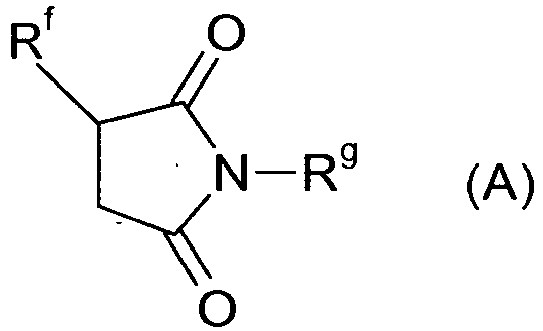
Rf für einen Polyisobutenylrest steht, und
Rg für Kohlenwasserstoffrest steht, der eine endständige Aminogruppe aufweist.
PIBSI werden durch Umsetzung von PIBSA mit Ammoniak oder primären Aminen H2NRg (insbesondere Di- oder Polyaminen) erhalten.
Rg hat vorzugsweise eine der zuvor für die Reste Rc und Rd bei den Aminen der Formel HNRcRd angegebenen Bedeutungen. Darauf wird hier in vollem Umfang Bezug genommen. - Bevorzugt steht Rg für Wasserstoff oder einen Kohlenwasserstoffrest, der eine endständige Aminogruppe aufweist und aliphatisch oder aromatisch sein kann.
- Besonders bevorzugt steht Rg für einen aliphatischen Kohlenstoffrest mit 1 bis 60 C-Atomen, insbesondere 2 bis 30 C-Atomen und vor allem 2 bis 16 C-Atomen.
- Beispiele für besonders geeignete Reste Rg sind geradkettige oder verzweigte ω-Aminoalkylenreste, wie ω-Aminomethylen, ω-Aminoethylen, ω-Aminopropylen, ω-Aminobutylen, ω-Aminopentylen und ω-Aminohexylen.
- Weiterhin bevorzugt steht Rg für einen Aminoalkylenrest, worin die Alkylenkette durch eine Aminogruppe oder mehrere Aminogruppen der Formel NRh unterbrochen ist, wobei die Reste Rh unabhängig voneinander für Wasserstoff oder C1-C6-Alkyl stehen. Besonders bevorzugt steht Rh für Wasserstoff. Solche Reste Rg weisen z. B. folgende Struktur auf:
-(CH2)x-NH-[(CH2)y-NH]z-(CH2)x-NRkRl
wobei x und y unabhängig voneinander für 1 bis 6, bevorzugt für 2 bis 4, besonders bevorzugt für 2 oder 3, und z für 0 bis 8 stehen und Rk und Rl unabhängig voneinander für Wasserstoff oder C1-C6-Alkyl stehen, Besonders stehen Rk und Rl für Wasserstoff oder Methyl und insbesondere für Wasserstoff. - Besonders bevorzugte Reste Rg leiten sich von Polyalkylenpolyaminen, vor allem Polyethylenpolyaminen und Polyethyleniminen, ab. Besonders geeignete Reste Rg leiten sich von den folgenden Aminen ab: Diethylentriamin, Triethylentetramin und Pentaethylentetramin.
- Beispiel für einen ganz besonders bevorzugten Rest Rg ist
-CH2-CH2-NH-CH2-CH2-NH-CH2-CH2-NH-CH2-CH2-NH2
- Die Reste Rg können auch weitere funktionelle Gruppen, insbesondere Hydroxy- und/oder Ethergruppen, umfassen. Bevorzugt sind sie jedoch nur durch Aminogruppen funktionalisiert.
- Selbstverständlich können auch Mischungen verschiedener Polyisobutylensuccinimide der allgemeinen Formel (A) oder Mischungen der Polyisobutylensuccinimide (A) mit weiteren, davon verschiedenen stickstoffhaltigen Polyisobutylenderivaten als Komponente zur Herstellung von (H1) eingesetzt werden.
- Weitere geeignete Umsetzungsprodukte von PIBSA mit Aminen sind vorzugsweise ausgewählt unter Verbindungen der Formeln (B), (C) und (D) und Mischungen davon


Rf für einen Polyisobutenylrest steht, und
Rm für Kohlenwasserstoffrest steht. - Die Verbindungen der Formeln (B), (C) und (D) können durch Variation der Reaktionsbedingungen gezielt hergestellt werden oder als Nebenprodukte in Zusammensetzungen der Polyisobutylensuccinimide (A) enthalten sein.
- Polyisobutylensuccinamidsäuren der Formel (B) resultieren intermediär bei der äquimolaren Umsetzung von PIBSA mit primären Aminen zu den Polyisobutylensuccinimiden (A).
- Polyisobutylensuccinamide der Formel (C) entstehen als Hauptprodukte bei der Umsetzung von PIBSA mit einem molaren Überschuss Amin. Bevorzugt liegt das Molmengenverhältnis von PIBSA zu Amin bei der Herstellung von Verbindungen (C) etwa bei 1 : 2.
- In den Di-Succinimiden der Formel (D) steht Rm für einen von Rg abgeleiteten Rest, der über eine Aminogruppe in den zweiten Succinimidring eingebaut ist.
- In einer dritten Ausführungsform wird zur Herstellung von Verbindungen H1) mit wenigstens einer Polyisobutenylgruppe als hydrophober Gruppe wenigstens ein Polyisobuten eingesetzt, das ausgewählt ist unter Polyisobutenylalkoholen, Polyisobutenylaldehyden und Mischungen davon.
- Die Herstellung von Verbindungen H1) mit Polyisobutenylgruppen geht nach dieser dritten Ausführungsform vorzugsweise aus von Polyisobutenen, die ausgewählt sind unter durch Hydroformylierung von Polyisobutenen erhaltenen Produkten. Bevorzugt werden zur Hydroformylierung hochreaktive Polyisobutene eingesetzt. Das bei der Hydroformylierung entstehende Oxoprodukt enthält Polyisobutenylaldehyde und/oder Polyisobutenylalkohole. Polyisobutenylaldehyde und Polyisobutenylaldehyd-haltige Gemische können durch Hydrierung nach bekannten Verfahren in Polyisobutenylalkohole überführt werden. Die Hydroformylierung und Hydrierung von hochreaktiven Polyisobutenen ist z. B. in der
EP-A-244 616 EP-A-277 345 WO 00/50543 - In einer vierten Ausführungsform wird zur Herstellung von Verbindungen H1) mit wenigstens einer Polyisobutenylgruppe als hydrophober Gruppe wenigstens ein Polyisobuten eingesetzt, das ausgewählt ist unter Polyisobutenen mit mindestens einer Carbonsäureendgruppe oder einem Derivat davon. Geeignete Derivate sind z. B. Carbonsäureanhydride, Carbonsäureester, Carbonsäureamide, Carbonsäureimide und Carbonsäuresalze.
- Die Herstellung von Polyisobutenen mit Carbonsäuregruppen und/oder Carbonsäureanhydridgruppen kann, wie zuvor beschrieben, durch Umsetzung von hochreaktiven Polyisobutenen mit Maleinsäureanhydrid hergestellt werden. Diese Umsetzung im Sinne einer En-Reaktion zur Herstellung von Polyisobutenylbernsteinsäureanhydriden (PIBSA) ist in der
DE 27 02 604 A1 undWO 2008/132083 beschrieben. - PIBSA sind kommerziell erhältlich, z. B. von BASF SE unter der Bezeichnung Glissopal® SA. Geeignet zur Herstellung von Verbindungen H1) mit wenigstens einer Polyisobutenylgruppe als hydrophober Gruppe sind auch Derivate. Zur Umsetzung mit den PIBSA geeignete Alkohole sind beispielsweise Di- oder Polyole mit vorzugsweise 2 bis 5 Hydroxylgruppen, z. B. Ethylenglykol, Glycerin, Diglycerin, Triglycerin, Trimethylolpropan, Pentaerythrit. Zur Umsetzung mit den PIBSA geeignete Aminoalkohole sind beispielsweise Alkanolamine wie Ethanolamin und 3-Aminopropanol.
- Das Molverhältnis von PIBSA zu den genannten Aminen, Alkoholen oder Aminoalkoholen liegt bei der Umsetzung in der Regel im Bereich von 0,4 : 1 bis 4 : 1 , vorzugsweise 0,5 : 1 bis 3 : 1. Bei Verbindungen mit nur einer primären oder sekundären Aminogruppe wird man häufig wenigstens äquimolare Mengen an Amin einsetzen.
- Zur Einführung einer hydrophilen Gruppe und Bereitstellung von Verbindungen H1) können die zuvor genannten PIBSA-Derivate einer Ethoxilierung und/oder Propoxilierung unterzogen werden. Bevorzugt sind ethoxylierte und/oder propoxylierte Derivate der Umsetzungsprodukte von PIBSA mit den genannten Diolen, Polyolen, Aminen und Aminoalkohole.
- In einer speziellen Ausführung geht die Herstellung von Verbindungen H1) mit Polyisobutenylgruppen aus von Polyisobutenen, die wenigstens eine gegenüber Isocyanatgruppen reaktive Gruppe aufweisen.
- Als hydrophobe Gruppe in den Verbindungen H1), speziell als hydrophobe Gruppe A in den Verbindungen der allgemeinen Formeln (I), (II) oder (III), eignen sich weiterhin Polytetrahydrofurangruppen. Bevorzugt sind Polytetrahydrofurangruppen mit einem zahlenmittleren Molekulargewicht im Bereich von etwa 300 bis 10 000, besonders bevorzugt etwa 400 bis 5000.
- Die Herstellung von Verbindungen H1) mit Polytetrahydrofurangruppen geht vorzugsweise aus von Polytetrahydrofurandiolen. Geeignete Polytetrahydrofurandiole können durch kationische Polymerisation von Tetrahydrofuran in Gegenwart von sauren Katalysatoren, wie z. B. Schwefelsäure oder Fluoroschwefelsäure, hergestellt werden. Derartige Herstellungsverfahren sind dem Fachmann bekannt.
- In einer speziellen Ausführung geht die Herstellung von Verbindungen H1) mit Polytetrahydrofurangruppen aus von Polytetrahydrofuranen, die wenigstens eine gegenüber Isocyanatgruppen reaktive Gruppe aufweisen.
- Als hydrophobe Gruppe in den Verbindungen H1), speziell als hydrophobe Gruppe A in den Verbindungen der allgemeinen Formeln (I), (II) oder (III), eignen sich weiterhin Polyestergruppen. Bevorzugt sind Polyestergruppen mit einem zahlenmittleren Molekulargewicht im Bereich von etwa 300 bis 10 000, bevorzugt 400 bis 5000.
- Die Herstellung von Verbindungen H1) mit Polyestergruppen geht vorzugsweise aus von Polyesterdiolen. Bevorzugt sind Polyesterdiole auf Basis aromatischer Dicarbonsäuren, aliphatischer Dicarbonsäuren, cycloaliphatischer Dicarbonsäuren, und Mischungen davon. Die Dicarbonsäuren sind vorzugsweise ausgewählt unter Terephthalsäure, Isophthalsäure, Phthalsäure, Na- oder K-Sulfoisophthalsäure, Adipinsäure, Bernsteinsäure, 1,2-, 1,3- oder 1,4-Cyclohexandicarbonsäure und Mischungen davon. Als Diole kommen insbesondere aliphatische Diole in Betracht, wie Ethylenglykol, Propylenglykol, 1,6-Hexandiol, Neopentylglykol, Diethylenglykol, Polyethylenglykole, Polypropylenglykole, 1,4-Dimethylolcyclohexan, und Mischungen davon.
- Bevorzugt sind Polyesterdiole auf Basis wenigstens einer aromatischen Dicarbonsäuren, wenigstens einer aliphatischen Dicarbonsäuren und wenigstens eines aliphatischen Diols. Dazu zählen insbesondere solche, bei denen die aromatische Dicarbonsäure 10 bis 95 Mol-%, insbesondere 40 bis 90 Mol-% des gesamten Dicarbonsäureanteils (Rest aliphatische Dicarbonsäuren) ausmacht.
- Besonders bevorzugte Polyesterdiole sind die Umsetzungsprodukte aus Phthalsäure/Diethylenglykol, Isophthalsäure/1,4-Butandiol, Isophthalsäure/Adipinsäure/ 1,6-Hexandiol, 5-NaSO3-Isophthalsäure/Phthalsäure/Adipinsäure/1,6-Hexandiol, Adipinsäure/Ethylenglykol, Isophthalsäure/Adipinsäure/Neopentylglykol, Isophthalsäure/Adipinsäure/Neopentylglykol/Diethylenglykol/Dimethylolcyclohexan und 5-NaSO3-Isophthalsäure/Isophthalsäure/Adipinsäure/Neopentylglykol/Diethylenglykol/Dimethylolcyclohexan, Isophthalsäure/Adipinsäure, Neopentylglykol/Dimethylolcyclohexan.
- Bevorzugt sind weiterhin Polyesterdiole auf Basis von linearen oder verzweigten, C8-C30-Di- oder Polycarbonsäuren und C8-C30-Hydroxycarbonsäuren. Bevorzugte Carbonsäuren und Hydroxycarbonsäuren sind z. B. Acelainsäure, Dodecandisäure, Korksäure, Pimelinsäure, Sebacinsäure, Tetradecandisäure, Citronensäure, Ricinolsäure, Hydroxystearinsäure und Gemische davon. Als Diolkomponente zur Herstellung dieser Polyesterdiole werden vorzugsweise 1,4-Butandiol, 1,5-Pentandiol, 1,6-Hexandiol, Neopentylglykol, 1,4-Dimethylolcyclohexan, Diethylenglykol und Gemische davon eingesetzt.
- In einer speziellen Ausführung geht die Herstellung von Verbindungen H1) mit Polyestergruppen aus von Polyestern, die wenigstens eine gegenüber Isocyanatgruppen reaktive Gruppe aufweisen.
- Als hydrophobe Gruppe in den Verbindungen H1), speziell als hydrophobe Gruppe A in den Verbindungen der allgemeinen Formeln (I), (II) oder (III), eignen sich weiterhin Silicongruppen.
- Bevorzugt als Silicongruppen sind Polysiloxangruppen mit einem zahlenmittleren Molekulargewicht im Bereich von etwa 300 bis 50 000, besonders bevorzugt 400 bis 30 000.
- In einer speziellen Ausführung geht die Herstellung von Verbindungen H1) mit Silicongruppen aus von Polysiloxanen, die wenigstens eine gegenüber Isocyanatgruppen reaktive Gruppe aufweisen.
- Zur Einführung einer hydrophilen Gruppe und Bereitstellung von Verbindungen H1) können die zuvor genannten Silconverbindungen einer Umsetzung zur Einführung wenigstens einer Polyethergruppe unterzogen werden. Bevorzugt sind die Ethergruppen ausgewählt unter Polyethylenoxidgruppen, Polypropylenoxidgruppen und Poly(ethylenoxid/propylenoxid)gruppen.
- Geeignete Siliconverbindungen H1) und zur Herstellung von Siliconverbindungen H1) sind die unter den INCI-Namen Dimethicone-Copolyole oder Silicontenside bekannten Verbindungen, wie zum Beispiel die unter den Markennamen Abil® (der Fa. Th. Goldschmidt), Alkasil® (der Fa. Rhône-Poulenc), Silicone Polyol Copolymer® (der Fa Genesee), Belsil® (der Fa. Wacker), Silwet® (der Fa. OSI) oder Dow Corning (der Fa. Dow Corning) erhältlich Verbindungen. Diese beinhalten Verbindungen mit den CAS-Nummern 64365-23-7; 68937-54-2; 68938-54-5; 68937-55-3. Eine geeignete, kommerziell erhältliche Verbindung ist Belsil ® DMC 6031.
- Die im Folgenden aufgeführten Verbindungen (E), (G), (J) und (K), eignen sich aufgrund ihrer Silicongruppen bevorzugt zur Einführung hydrophober Gruppen (speziell Gruppen A)) bei der Herstellung der Verbindungen H1). Sofern die im Folgenden aufgeführten Verbindungen (E), (G), (J) und (K) auch bereits wenigstens eine hydrophile Gruppe (speziell Gruppen B))aufweisen, können sie auch als solche (d. h. ohne weitere Umsetzung) als Komponente H1) eingesetzt werden. Das gilt speziell für die Verbindungen (E), (G), (J) und (K), die wenigstens eine Gruppe (F) mit Alkylenoxid-Wiederholungseinheiten aufweisen.
- Bevorzugte Siliconverbindungen H1) und Verbindungen zur Herstellung von Siliconverbindungen H1) sind Polysiloxane der allgemeinen Formel (E)

a und b unabhängig voneinander für 1 bis 8 stehen,
c für 2 bis 1000 steht,
Rn und Ro unabhängig voneinander für Alkyl, Cycloalkyl, Aryl oder Arylalkyl stehen,
Z1 und Z2 unabhängig voneinander für Reste der Formel (F)
-(OCH2CH2)u(OCH(CH3)CH2)v-X1-H (F)
stehen, wobei - in der Formel (F) die Reihenfolge der Alkylenoxideinheiten beliebig ist,
u und v unabhängig voneinander für eine ganze Zahl von 0 bis 500 stehen, wobei die Summe aus u und v > 0 ist, - X1 für O oder NRp steht, worin Rp für Wasserstoff, Alkyl, Cycloalkyl oder Aryl steht.
- Vorzugsweise ist in der Formel (E) die Summe aus u und v so gewählt, dass das Molekulargewicht der Polysiloxane H1) in einem Bereich von etwa 300 bis 30 000 liegt.
- Bevorzugt liegt die Gesamtzahl der Alkylenoxideinheiten der Polysiloxane H1), d. h. die Summe aus u und v, in einem Bereich von etwa 3 bis 200, bevorzugt 5 bis 180.
- Bevorzugt sind in den Verbindungen der Formel (E) die Reste Rn und Ro unabhängig voneinander ausgewählt unter Methyl, Ethyl, Cyclohexyl, Phenyl und Benzyl. Besonders bevorzugt stehen Rn und Ro beide für Methyl.
- Ein Beispiel für geeignete Verbindungen der Formel (E) sind die Bis(polyethylenglycol)dimethicone der allgemeinen Formel (E.1)

c für eine ganze Zahl von 3 bis 500, bevorzugt 5 bis 250, steht und
u1 und u2 unabhängig voneinander für 2 bis 500, insbesondere 3 bis 250, speziell 5 bis 100, stehen. - Bevorzugte Siliconverbindungen H1) und Verbindungen zur Herstellung von Siliconverbindungen H1) sind weiterhin ausgewählt unter Polysiloxanen der allgemeinen Formel (G)

die Reihenfolge der Siloxaneinheiten beliebig ist,
die Reste Rq jeweils unabhängig voneinander für Alkyl, Cycloalkyl oder Aryl stehen,
d für eine ganze Zahl von 2 bis 1000 steht,
e für eine ganze Zahl von 2 bis 100 steht,
f für eine ganze Zahl von 2 bis 8 steht, und
Z3 für OH, NHRr oder einen Rest der Formel (F), wie zuvor definiert, steht,
wobei Rr für Wasserstoff, C1-C8-Alkyl, C5-C8-Cycloalkyl oder einen Rest der Formel -(CH2)w-NH2 steht, wobei w für eine ganze Zahl von 1 bis 10, bevorzugt 2 bis 6, steht,
und Mischungen davon. - Ein Beispiel für geeignete Verbindungen der Formel (G) sind die ethoxilierten und/oder propoxylierten Polydimethylsiloxane der allgemeinen Formel (G.1)

die Reihenfolge der Siloxaneinheiten beliebig ist,
d für eine ganze Zahl von 2 bis 1000, bevorzugt 3 bis 500, insbesondere 5 bis 100, steht,
e für eine ganze Zahl von 2 bis 100, bevorzugt 3 bis 50, insbesondere 4 bis 20, steht,
f für eine ganze Zahl von 2 bis 8 steht, und
u und v unabhängig voneinander für eine ganze Zahl von 0 bis 500, bevorzugt 0 bis 250, steht, wobei die Summe aus u und v ≥ 1, bevorzugt ≥ 5, insbesondere ≥ 10, ist. - Geeignete Verbindungen der Formel G.1 sind unter der Bezeichnung Wacker-Belsil® DMC 6031 und Pluriol® ST 4005 (Fa. BASF SE) erhältlich.
- Bevorzugte Siliconverbindungen H1) und Verbindungen zur Herstellung von Siliconverbindungen H1) sind weiterhin Polysiloxane mit sich wiederholenden Einheiten der allgemeinen Formel (J)

d für eine ganze Zahl von 0 bis 100 steht,
g für eine ganze Zahl von 1 bis 8 steht,
Rs und Rt unabhängig voneinander für C1-bis C8-Alkylen stehen,
die Reihenfolge der Alkylenoxideinheiten beliebig ist und e und f unabhängig voneinander für eine ganze Zahl von 0 bis 200 stehen, wobei die Summe aus r und s > 0 ist. - Bevorzugt stehen in der Formel (J) Rs und Rt unabhängig voneinander für einen C2- bis C4-Alkylenrest.
- Insbesondere stehen Rs und Rt unabhängig voneinander für einen C2- bis C3-Alkylenrest.
- Vorzugsweise liegt das Molekulargewicht der Verbindung der Formel (J) in einem Bereich von etwa 300 bis 100 000.
- Vorzugsweise steht in der Formel 1.3 d für eine ganze Zahl von 1 bis 20, wie z. B. 2 bis 10.
- Bevorzugt liegt die Gesamtzahl der Alkylenoxideinheiten der Verbindung der Formel (J), d. h. die Summe aus e und f, in einem Bereich von etwa 3 bis 200, bevorzugt 5 bis 180.
- Bevorzugt sind die Endgruppen der Polysiloxane mit Wiederholungseinheiten der allgemeinen Formel (J) ausgewählt unter (CH3)3SiO, H, C1-C8-Alkyl und Mischungen davon. Eine bevorzugte Alkylendgruppe ist Methyl.
- Aminogruppenhaltige Verbindungen mit Wiederholungseinheiten der allgemeinen Formel (J) weisen bevorzugt eine Aminzahl in einem Bereich von etwa 2 bis 50, insbesondere 3 bis 20 auf.
- Geeignete alkoxylierte Siloxanamine der Formel 1.3 sind z. B. in der
WO-A-97/32917 - Bevorzugte Siliconverbindungen H1) und Verbindungen zur Herstellung von Siliconverbindungen H1) sind weiterhin Polysiloxane mit sich wiederholenden Einheiten der allgemeinen Formel (K)
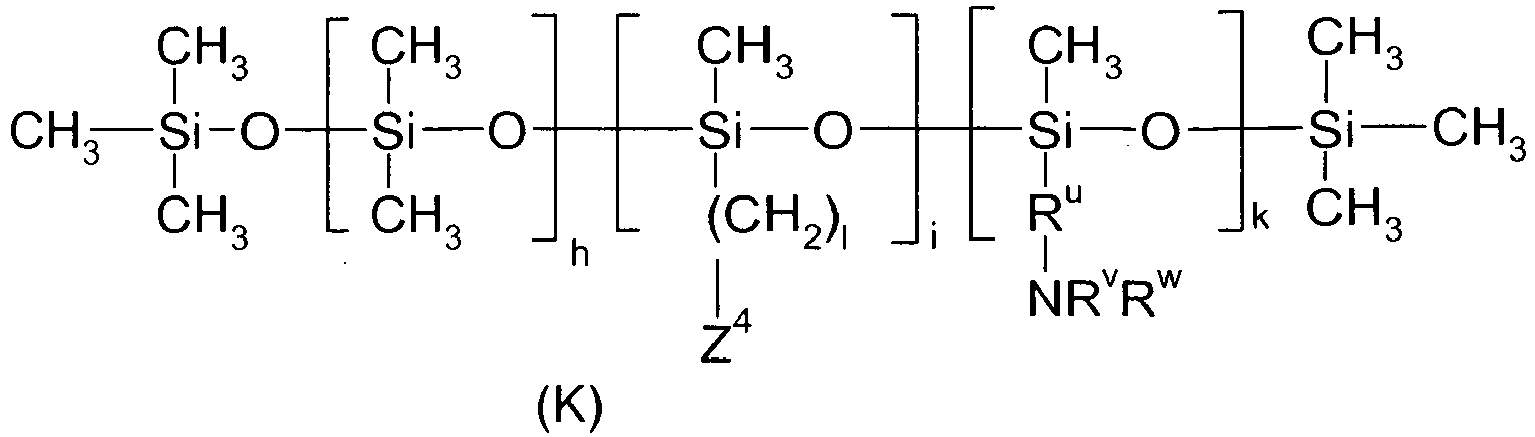
Ru für einen C1- bis C8-Alkylenrest steht,
Rv und Rw unabhängig voneinander für Wasserstoff, C1-C8-Alkyl oder C5-C8-Cycloalkyl stehen,
die Reihenfolge der Siloxaneinheiten beliebig ist,
h, i und k unabhängig voneinander für 0 bis 100 stehen, wobei die Summe aus h, i und k mindestens 3 ist,
I für eine ganze Zahl von 2 bis 8 steht,
Z4 für einen Rest der Formel (F.1)
-(OCH2CH2)u(OCH(CH3)CH2)v-ORx (F.1)
steht, wobei
in der Formel (F.1) die Reihenfolge der Alkylenoxideinheiten beliebig ist,
u und v unabhängig voneinander für eine ganze Zahl von 0 bis 500 stehen, wobei die Summe aus u und v > 0 ist,
Rx für Wasserstoff oder einen C1-C8-Alkylrest steht,
und Mischungen davon. - Bevorzugt steht in der Formel (K) der Rest Ru für einen C2- bis C4-Alkylenrest.
- Bevorzugt stehen in der Formel (K) Rv und Rw unabhängig voneinander für Wasserstoff oder C1- bis C4-Alkyl.
- Vorzugsweise wird die Summe aus h, I und k so gewählt, dass das Molekulargewicht der Verbindung der Formel (K) in einem Bereich von etwa 300 bis 100 000, bevorzugt 500 bis 50 000, liegt.
- Bevorzugt liegt die Gesamtzahl der Alkylenoxideinheiten des Restes der Formel (F.1), d. h. die Summe aus u und v, in einem Bereich von etwa 3 bis 200, bevorzugt 5 bis 80.
- Bevorzugt steht in der Formel (F.1) der Rest Rx für Wasserstoff oder C1- bis C4-Alkyl.
- Eine geeignete Verbindung der Formel (K) ist z. B. Silsoft A-858 der Fa. der Momentive Performance Materials (vormals Fa. Witco).
- Eine weitere bevorzugte Siliconverbindungen H1) und zur Herstellung von Siliconverbindungen H1) geeignete Verbindung ist die Verbindung mit der INCI-Bezeichnung Methoxy PEG/PPG-7/3 Aminopropyl Dimethicone. Diese ist kommerziell unter der Bezeichnung ABIL® Soft AF 100 von Evonik Industries erhältlich.
- Geeignete Polysiloxandiamine zur Herstellung von Siliconverbindungen H1) sind Tegomer® A-Si 2122 (Mn = 900 g/mol) und Tegomer® A-Si 2322 (Mn = 2800 g/mol) der Evonik Industries (vormals Th. Goldschmidt).
- Bevorzugt ist in den Verbindungen H1) die hydrophile Gruppe ausgewählt unter
- Polyethylenoxid-haltigen Gruppen,
- Polypropylenoxid-haltigen Gruppen,
- Poly(ethylenoxid/propylenoxid)-haltigen Gruppen,
- Polyethylenimin-haltigen Gruppen,
- Polysorbat-haltigen Gruppen,
- Polyglycerin-haltigen Gruppen,
- Polyvinylpyrrolidon-haltigen Gruppen,
- Speziell ist die hydrophile Gruppe B in den Verbindungen der allgemeinen Formeln (I), (II) oder (III) ausgewählt unter
- Polyethylenoxid-haltigen Gruppen,
- Polypropylenoxid-haltigen Gruppen,
- Poly(ethylenoxid/propylenoxid)-haltigen Gruppen,
- Polyethylenimin-haltigen Gruppen,
- Polysorbat-haltigen Gruppen,
- Polyglycerin-haltigen Gruppen,
- Polyvinylpyrrolidon-haltigen Gruppen,
- Als hydrophile Gruppe in den Verbindungen H1), speziell als hydrophile Gruppe A in den Verbindungen der allgemeinen Formeln (I), (II) oder (III), eignen sich bevorzugt Polyether-haltige Gruppen, spezieller Polyethylenoxid-haltige Gruppen (= Polyethylenglykol-haltige Gruppen), Polypropylenoxid-haltige Gruppen (= Polypropylenglykolhaltige Gruppen) und Copolymere, deren Wiederholungseinheiten sich von Polyethylenoxid und Polypropylenoxid ableiten. Bevorzugt sind Polyether-haltige Gruppen mit einem zahlenmittleren Molekulargewicht im Bereich von etwa 300 bis 10 000, bevorzugt 400 bis 5000. Poly(ethylenoxid/propylenoxid)-haltigen Gruppen können die Ethylenoxideinheiten und die Propylenoxideinheiten statistisch verteilt oder in Form von Blöcken einpolymerisiert enthalten.
- Die Herstellung von Verbindungen H1) mit Polyethergruppen geht vorzugsweise aus von Polyetherdiolen oder Polyethermonoalkoholen. Bevorzugte Polyethermonoalkohole sind die Polyalkylenglykolmonoalkylether. Bevorzugte Polyalkylenglykolmonoalkylether sind Polyalkylenglykolmonomethylether und Polyalkylenglykolmonoethylether. Besonders bevorzugt sind Polyethylenglykolmonomethylether.
- Bevorzugt für die Herstellung von Verbindungen H1) sind Polyethylenglykolmonomethylether. Geeignete Polyethylenglykolmonomethylether sind die Pluriol ® A ... E Marken der BASF SE (Molekulargewicht in Klammern), speziell Pluriol A 350 E (350 g/mol), Pluriol A 500 E (500 g/mol), Pluriol A 750 E (750 g/mol), Pluriol A 760 E (750 g/mol), Pluriol A 1000 E (1000 g/mol), Pluriol A 1020 E* (1000 g/mol), Pluriol A 2000 E (2000 g/mol), Pluriol A 3010 E* (3000 g/mol) und Pluriol A 5010 E* (5000 g/mol).
- Bevorzugt für die Herstellung von Verbindungen H1) sind Polyetherdiole in Form von Polyethylenoxiddiolen (Polyethylenglykolen). Kommerziell sind sie als die Pluriol® E-Marken der BASF SE erhältlich. Dazu zählen:
- Pluriol E 200, 300, 400, 600, 1000, 1500, 3400, 4000, 6000, 8000, 9000 und 12000.
- Geeignet für die Herstellung von Verbindungen H1) sind Polyetherdiole in Form von EO/PO/EO-Triblockcopolymeren. Kommerziell sind sie als die Pluronic® PE-Marken der BASF SE erhältlich. Dazu zählen:
- (Bezeichnung/ EO-Gehalt in %/ Molekulargewicht)
- Pluronic PE 3100 / ca. 10 / ca. 1000
- Pluronic PE 3500 / ca. 50 / ca. 1900
- Pluronic PE 4300 / ca. 30 / ca. 1750
- Pluronic PE 6100 / ca. 10 / ca. 2000
- Pluronic PE 6120 / ca. 12 / ca. 2100
- Pluronic PE 6200 / ca. 20 / ca. 2450
- Pluronic PE 6400 / ca. 40 / ca. 2900
- Pluronic PE 6800 / ca. 80 / ca. 8000
- Pluronic PE 7400 / ca. 40 / ca. 3500
- Pluronic PE 8100 / ca. 10 / ca. 2600
- Pluronic PE 9200 / ca. 20 / ca. 3650
- Pluronic PE 9400 / ca. 40 / ca. 4600
- Pluronic PE 10100 / ca. 10 / ca. 3500
- Pluronic PE 10300 / ca. 30 / ca. 4950
- Pluronic PE 10400 / ca. 40 / ca. 5900
- Pluronic PE 10500 / ca. 50 / ca. 6500
- Geeignet für die Herstellung von Verbindungen H1) sind Polyetherdiole in Form von PO/EO/PO-Triblockcopolymeren. Kommerziell sind sie als die Pluronic® RPE-Marken der BASF SE erhältlich. Dazu zählen:
- (Bezeichnung/ EO-Gehalt in %/ Molekulargewicht)
- Pluronic RPE 1720 / ca. 20 / ca. 2150
- Pluronic RPE 1740 / ca. 40 / ca. 2650
- Pluronic RPE 2035 / ca. 35 / ca. 4100
- Pluronic RPE 2520 / ca. 20 / ca. 3100
- Pluronic RPE 2525 / ca. 25 / ca. 2000
- Pluronic RPE 3110 / ca. 10 / ca. 3500
- Geeignet als hydrophile Gruppe für die Herstellung von Verbindungen H1) sind auch Polyether, die eine oder zwei endständige Aminogruppen aufweisen. Diese sind durch Aminierung der zuvor genannten Polyethylenoxid-haltigen Gruppen, Polypropylenoxid-haltigen Gruppen und Poly(ethylenoxid/propylenoxid)-haltigen Gruppen mit Ammoniak herstellbar.
- Geeignet als hydrophile Gruppe für die Herstellung von Verbindungen H1) sind auch Polyethylenimin-haltigen Gruppen. Diese weisen vorzugsweise ein zahlenmittleres Molekulargewicht im Bereich von etwa 300 bis 10 000, bevorzugt 400 bis 5000, auf.
- Geeignet als hydrophile Gruppe für die Herstellung von Verbindungen H1) sind auch Polysorbat-haltige Gruppen. Polysorbate werden durch Veresterung von Sorbitol mit einer Fettsäure und anschließende Ethoxilierung erhalten. Die Produkte sind kommerziell erhältlich, z. B. unter der Bezeichnung Tween.
- Geeignet als hydrophile Gruppe für die Herstellung von Verbindungen H1) sind auch Polyglycerin-haltige Gruppen. Polyglycerinmischungen können durch alkalisch katalysierte Kondensation von Glycerin bei erhöhten Temperaturen (Fette, Seifen, Anstrichmittel, 88. Jahrgang, Nr. 3, 1986, S. 101-106 (4)) oder durch Umsetzung von Glycerin mit Epichlorhydrin in Gegenwart eines sauren Katalysators bei erhöhten Temperaturen (
DE-A 38 42 692 ) hergestellt werden. - Eine typische geeignete Polyglycerinmischung hat die folgende Zusammensetzung: 0 bis 5 Gew.-% Glycerin,
- 20 bis 40 Gew.-% Diglycerin,
- 35 bis 55 Gew.-% Triglycerin,
- 10 bis 20 Gew.-% Tetraglycerin,
- 5 bis 10 Gew.-% Pentaglycerin,
- 1 bis 5 Gew.-% Hexaglycerin und
- 0 bis 5 Gew.-% höhere Polyglycerine.
- Die Herstellung von Verbindungen H1) erfolgt vorzugsweise ausgehend von Polyglycerinen durch Veresterung mit wenigstens einer Verbindung, die wenigstens eine Carbonsäuregruppe oder ein zur Veresterung befähigtes Derivat davon und wenigstens eine hydrophobe Gruppe aufweist. Dazu zählen z. B. Fettsäuren und Fettsäuremischungen. Dazu zählen bevorzugt Polyisobutene mit mindestens einer Carbonsäureendgruppe oder ein Derivat davon.
- Die Polyglycerinester stellt man durch Veresterungsreaktion zwischen den entsprechenden Polyglycerinmischungen und der gewünschten Carbonsäure oder Carbonsäuremischung oder einem Derivat davon nach den üblichen Methoden her. Geeignete Derivate sind die Anhydride, Halogenide und Ester mit C1-C4-Alkanolen. Üblicherweise erfolgt die Veresterung in Gegenwart eines sauren oder basischen Veresterungskatalysators wie hypophosphoriger Säure, phosphoriger Säure, Schwefelsäure, p-Toluolsulfonsäure, Citronensäure, Natriummethylat, Zinnoxid oder einer Seife.
- Polyglycerine und Polyglycerinester und deren Herstellung sind in der
DE 40 23 593 A1 beschrieben, auf die hier Bezug genommen wird. - Die Herstellung von Verbindungen H1) mit Polyvinylpyrrolidongruppen geht vorzugsweise von Polyvinylpyrrolidon-Homopolymeren und Copolymeren, die N-Vinylpyrrolidon und ein weiteres davon verschiedenes ethylenisch ungesättigtes Monomer einpolymerisiert enthalten. Geeignete N-Vinylpyrrolidon-Copolymere sind ganz allgemein neutrale, anionische, kationische und amphotere Polymere.
Bevorzugte N-Vinylpyrrolidon-Copolymere sind ausgewählt unter
Copolymeren aus N-Vinylpyrrolidon und Vinylacetat,
Copolymeren aus N-Vinylpyrrolidon und Vinylpropionat,
Copolymeren aus N-Vinylpyrrolidon, Vinylacetat und Vinylpropionat,
Copolymeren aus N-Vinylpyrrolidon und Vinylacrylat,
Copolymeren aus N-Vinylpyrrolidon, Ethylmethacrylat und Methacrylsäure, Copolymeren aus N-Vinylpyrrolidon und N-Vinylimidazol und deren durch Protonierung und/oder Quaternisierung erhaltenen Derivaten,
Copolymeren aus N-Vinylpyrrolidon und Dimethylaminoethyl-methacrylat und deren durch Protonierung und/oder Quaternisierung erhaltenen Derivaten,
Copolymeren aus N-Vinylpyrrolidon, N-Vinylcaprolactam und N-Vinylimidazol und deren durch Protonierung und/oder Quaternisierung erhaltenen Derivaten. - In einer speziellen Ausführung geht die Herstellung von Verbindungen H1) mit Polyvinylpyrrolidongruppen aus von Polyvinylpyrrolidon-Homopolymeren und Polyvinylpyrrolidon-Copolymeren, die jeweils wenigstens eine gegenüber Isocyanatgruppen reaktive Gruppe aufweisen.
- Bevorzugt weisen die Verbindungen H1) wenigstens eine verbrückende Gruppe X) auf, die wenigstens eine hydrophobe Gruppe und wenigstens eine hydrophile Gruppe miteinander verbindet.
- Ganz allgemein ist die verbrückende Gruppe X) ausgewählt unter einer chemischen Bindung oder einem divalenten oder polyvalenten Rest, an den wenigstens eine hydrophile Gruppe und wenigstens eine hydrophobe Gruppe gebunden sind.
- Bevorzugt ist die Verbindung H1, ausgewählt ist unter Verbindungen der allgemeinen Formeln (I), (II) oder (III), wie zuvor definiert. Dann ist die Gruppe X vorzugsweise ausgewählt ist unter Gruppen der Formeln:


- Ra und Rb unabhängig voneinander für Wasserstoff, Alkyl, Cycloalkyl, Heterocycloalkyl, Aryl oder Hetaryl stehen.
- Erfindungsgemäß ist die Verbindung mit Blockstruktur H1) ausgewählt unter
- Polyisobutenylalkoholalkoxilaten,
- Polyisobutenylaminalkoxilaten,
- Umsetzungsprodukten aus wenigstens einem Polyisobutenen mit mindestens einer Carbonsäureendgruppe oder einem Derivat davon und wenigstens einem Polyalkylenoxid mit einer terminalen gegenüber Anhydridgruppen reaktiven Gruppe,
- Siliconverbindungen, die wenigstens eine Polyethergruppe aufweisen,
- Umsetzungsprodukten aus wenigstens einer Verbindung, die mindestens eine hydrophobe Gruppe und mindestens eine gegenüber Isocyanatgruppen reaktive Gruppe umfasst, wenigstens einer Verbindung, die mindestens eine hydrophile Gruppe und mindestens eine gegenüber Isocyanatgruppen reaktive Gruppe umfasst, und wenigstens einem Polyisocyanat.
- Eine bevorzugte Ausführungsform sind Urethanverbindungen H1).
- Bevorzugt ist eine Urethanverbindung H1), die
- p1) wenigstens eine Verbindung, die mindestens eine hydrophobe Gruppe und mindestens eine gegenüber Isocyanatgruppen reaktive Gruppe umfasst,
- p2) wenigstens eine Verbindung, die mindestens eine hydrophile Gruppe und mindestens eine gegenüber Isocyanatgruppen reaktive Gruppe, und
- p3) wenigstens ein Polyisocyanat,
eingebaut enthält. - Bezüglich zur Herstellung von Urethanverbindungen H1) geeigneter und bevorzugter Verbindungen mit mindestens eine hydrophoben Gruppe p1) und Verbindungen mit mindestens einer hydrophilen Gruppe p2) wird auf die vorherigen Angaben zu hydrophoben und hydrophilen Gruppen (speziell Gruppen A) und B)) und zu Verbindungen, die diese Gruppen aufweisen, in vollem Umfang Bezug genommen.
- Geeignete Polyisocyanate p3) sind ausgewählt unter Verbindungen mit 2 bis 5 Isocyanatgruppen, Isocyanatpräpolymeren mit mittleren Anzahl von 2 bis 5 Isocyanatgruppen, und Mischungen davon. Dazu zählen z. B. aliphatische, cycloaliphatische und aromatische Di-, Tri- und Polyisocyanate. Geeignete Diisocyanate p3) sind z. B. Tetramethylendiisocyanat, Hexamethylendiisocyanat, 2,3,3-Trimethylhexamethylendiisocyanat, 1,4-Cyclohexylendüsocyanat, Isophorondiisocyanat, 1,4-Phenylendiisocyanat, 2,4- und 2,6-Toluylendiisocyanat und deren Isomerengemische (z. B. 80 % 2,4- und 20 % 2,6-Isomer), 1,5-Naphthylendiisocyanat, 2,4- und 4,4'-Diphenylmethandiisocyanat. Ein geeignetes Triisocyanat p3) ist z. B. Triphenylmethan-4,4',4"-triisocyanat. Weiterhin geeignet sind Isocyanatpräpolymere und Polyisocyanate, die durch Addition der zuvor genannten Isocyanate an polyfunktionelle Hydroxyl- oder Amingruppen-haltige Verbindungen erhältlich sind. Weiterhin geeignet sind Polyisocyanate, die durch Biuret-, Allophanat- oder Isocyanuratbildung entstehen.
- Vorzugsweise umfasst die Polyisocyanat-Komponente p3) wenigstens ein Diisocyanat mit zwei unterschiedlich reaktiven Isocyanatgruppen. Besonders bevorzugt umfasst die Polyisocyanat-Komponente p3) dann Isophorondiisocyanat und dessen Biurete, Allophanate und/oder Isocyanurate. Des Weiteren bevorzugt umfasst die Polyisocyanat-Komponente p3) Hexamethylendiisocyanat. Insbesondere besteht die Polyisocyanat-Komponente p3) nur aus Isophorondiisocyanat oder nur aus Hexamethylendiisocyanat oder aus einem Gemisch aus Isophorondiisocyanat und Hexamethylendiisocyanat.
- In einer weiteren Ausführungsform enthalten die Urethanverbindungen H1) zusätzlich wenigstens eine Verbindung p4) eingebaut, die vorzugsweise ausgewählt ist unter Verbindungen mit einem Molekulargewicht im Bereich von 56 bis 280 g/mol, die zwei gegenüber Isocyanatgruppen reaktive Gruppen pro Molekül enthalten. Geeignete Verbindungen p4) sind z. B. Diole, Diamine, Aminoalkohole und Mischungen davon.
- Bevorzugt werden als Komponente p4) Diole eingesetzt, deren Molekulargewicht in einem Bereich von etwa 62 bis 286 g/mol liegt. Dazu zählen z. B. Diole mit 2 bis 18 Kohlenstoffatomen, vorzugsweise 2 bis 10 Kohlenstoffatomen, wie 1,2-Ethandiol, 1,3-Propandiol, 1,4-Butandiol, 1,6-Hexandiol, 1,5-Pentandiol, 1,10-Decandiol, 2-Methyl-1,3-propandiol, 2,2-Dimethyl-1,3-propandiol, Di-, Tri-, Tetra-, Penta- und Hexaethylenglykol, Neopentylglykol, Cyclohexandimethylol und Mischungen davon. Besonders bevorzugt ist Neopentylglykol.
- Bevorzugte Aminoalkohole p4) sind z. B. 2-Aminoethanol, 2-(N-Methylamino)ethanol, 3-Aminopropanol, 4-Aminobutanol, 1-Ethylaminobutan-2-ol, 2-Amino-2-methyl-1-propanol, 4-Methyl-4-aminopentan-2-ol, N-Methyldiethanolamin, etc.
- Bevorzugte Diamine p4) sind z. B. Ethylendiamin, Propylendiamin, 1,4-Diaminobutan, 1,5-Diaminopentan, 1,6-Diaminohexan (Hexamethylendiamin), Isophorondiamin und Mischungen davon.
- Die als Komponente p4) genannten Verbindungen können einzeln oder in Mischungen eingesetzt werden. Besonders bevorzugt werden 1,2-Ethandiol, 1,4-Butandiol, 1,6-Hexandiol, Neopentylglykol, Diethylenglykol, Cyclohexandimethylol, N-Methyldiethänolamin und Mischungen davon eingesetzt.
- In einer weiteren Ausführungsform enthalten die Urethanverbindungen H1) zusätzlich wenigstens eine Verbindung p5) eingebaut, die vorzugsweise ausgewählt ist unter Verbindungen mit einem Molekulargewicht im Bereich von 56 bis 280 g/mol, die eine gegenüber Isocyanatgruppen reaktive Gruppe pro Molekül enthalten. Derartige Verbindungen mit einer gegenüber Isocyanatgruppen reaktive Gruppe pro Molekül werden auch als Abstopper bezeichnet. Geeignete Verbindungen p5) sind z. B. Monoalkohole sowie Amine und Aminoalkohole, die nur eine gegenüber NCO-Gruppen reaktive Gruppe aufweisen. Dazu zählen Methanol, Ethanol, n-Propanol, etc.
- Eine spezielle Ausführungsform ist eine Urethanverbindungen H1), die
- p1) wenigstens eine Verbindung, die mindestens eine hydrophobe Gruppe und mindestens eine gegenüber Isocyanatgruppen reaktive Gruppe umfasst, ausgewählt unter Polyisobutenen mit mindestens einer stickstoffhaltigen Endgruppe, Polytetrahydrofuranen und Mischungen davon,
- p2) wenigstens eine Verbindung, die mindestens eine hydrophile Gruppe und mindestens eine gegenüber Isocyanatgruppen reaktive Gruppe umfasst, ausgewählt unter Polyethylenoxiden , Polyvinylpyrrolidon und Mischungen davon,
- p3) Hexamethylendiisocyanat und/oder Isophorondiisocyanat,
- p4) gegebenenfalls wenigstens eine Verbindung, die ausgewählt ist unter Neopentylglykol, N-Methyldiethanolamin, 1,5-Diaminopentan, 1,6-Diaminohexan, Isophorondiamin und Mischungen davon,
eingebaut enthält. - Die Herstellung der Urethanverbindungen H1) kann nach üblichen Verfahren erfolgen. Bevorzugt erfolgt die Herstellung der Urethanverbindungen H1 durch ein zweistufiges Verfahren. Die Umsetzung der Komponenten erfolgt dabei vorzugsweise so, dass die erhaltenen Urethanverbindungen wenigstens eine hydrophobe Verbindung p1) und wenigstens eine hydrophile Verbindung p2) eingebaut enthalten.
- Gegenstand der Erfindung ist auch ein Verfahren zur Herstellung einer Urethanverbindung H1), die
- p1) wenigstens eine Verbindung, die mindestens eine hydrophobe Gruppe und mindestens eine gegenüber Isocyanatgruppen reaktive Gruppe umfasst,
- p2) wenigstens eine Verbindung, die mindestens eine hydrophile Gruppe und mindestens eine gegenüber Isocyanatgruppen reaktive Gruppe umfasst, und
- p3) wenigstens ein Polyisocyanat,
- p4) wenigstens eine Verbindung, die ausgewählt ist unter Verbindungen mit einem Molekulargewicht im Bereich von 56 bis 280 g/mol, die zwei gegenüber Isocyanatgruppen reaktive Gruppen pro Molekül enthalten,
- p5) wenigstens eine Verbindung, die ausgewählt ist unter Verbindungen mit einem Molekulargewicht im Bereich von 56 bis 280 g/mol, die eine gegenüber Isocyanatgruppen reaktive Gruppe pro Molekül enthalten,
- i) in einer ersten Stufe die hydrophoben Verbindungen p1), die Polyisocyanate p3) sowie, falls vorhanden, gegebenenfalls wenigstens einen Teil der Verbindungen p4) und/oder p5) zu einem Isocyanatgruppen-haltigen Präpolymer umsetzt, und
- ii) in einer zweiten Stufe das in i) erhaltene Präpolymer mit den hydrophilen Verbindungen p2) und, falls vorhanden, den nicht bereits in Schritt i) eingesetzten Verbindungen p4) und/oder p5) umsetzt.
- In der ersten Stufe i) wird zunächst aus den hydrophoben Verbindungen p1) und den Polyisocyanaten p3) ein NCO-Gruppen-haltiges Präpolymer hergestellt. Gewünschtenfalls können in dieser Stufe, falls vorhanden, auch die Verbindungen der Komponente p4) und/oder Abstopper p5) teilweise oder vollständig zur Herstellung des Präpolymers eingesetzt werden. Abstopper p5) werden jedoch vorzugsweise in der stufe ii) eingesetzt. In jedem Falle wird durch geeignete Wahl der Menge der Komponente p3) sichergestellt, dass in der Stufe i) ein Isocyanatgruppen-haltiges Präpolymer erhalten wird. Das Verhältnis von NCO-Äquivalenten der Komponente p3) zu Äquivalenten aktiven Wasserstoffatomen der Komponenten p1) und, falls vorhanden, p4) und p5) liegt vorzugsweise in einem Bereich von etwa 1 : 1 bis 3 : 1, besonders bevorzugt 1,01 : 1 bis 2,5 : 1, insbesondere 1,05 : 1 bis 2 : 1.
- Vorzugsweise erfolgt die Reaktion in beiden Stufen i) und ii) unter einer Inertgasatmosphäre, wie z. B. unter Stickstoff. Des Weiteren erfolgt die Reaktion vorzugsweise in beiden Stufen i) und ii) bei Umgebungsdruck oder unter erhöhtem Druck.
- Die Reaktion wird in der Stufe i) vorzugsweise in einem geeigneten inerten Lösungsmittel oder Lösungsmittelgemisch durchzuführen. Geeignete Lösungsmittel sind Kohlenwasserstoffe und Kohlenwasserstoffgemische, wie Pentan, Hexan, Cyclohexan, Dekalin, Ligroin, Petrolether, etc. Geeignet sind auch aromatische Kohlenwasserstoffe, wie Benzol, Toluol oder Xylol. Geeignete Lösungsmittel sind auch aprotisch polare Lösungsmittel, z. B. Tetrahydrofuran, Essigsäureethylester, N-Methylpyrrolidon, Dimethylformamid und bevorzugt Ketone, wie Aceton und, Methylethylketon.
- Die Reaktionstemperatur in Schritt i) liegt vorzugsweise in einem Bereich von etwa 0 bis 120 °C, besonders bevorzugt 5 bis 90 °C. Enthalten die Komponenten p1) und, falls vorhanden, p4) und/oder p5) Amingruppen-haltige Verbindungen, so liegt die Reaktionstemperatur bevorzugt in einem Bereich von etwa 0 bis 60 °C, besonders bevorzugt von 10 bis 40 °C. Im Falle des Einsatzes von Amingruppen-haltigen Komponenten kann die Reaktion gewünschtenfalls auch in einem Lösungsmittel oder Lösungsmittelgemisch erfolgen, welches aktive Wasserstoffatome aufweisen kann. Neben den zuvor genannten werden dann bevorzugt kosmetisch akzeptable Lösungsmittel, vorzugsweise Alkohole, wie Ethanol und Isopropanol sowie Gemische aus Alkoholen und Wasser eingesetzt.
- Die in Schritt i) erhaltenen NCO-Gruppen-haltigen Präpolymere können gewünschtenfalls vor der weiteren Umsetzung in Schritt ii) einer Isolierung und/oder Reinigung nach üblichen, dem Fachmann bekannten Verfahren unterzogen werden. Vorzugsweise erfolgt die Herstellung der Präpolymere und die Herstellung der Urethanverbindungen H1) daraus ohne Isolierung eines Zwischenprodukts.
- Die Herstellung der erfindungsgemäßen Urethanverbindung in Schritt ii) erfolgt durch Umsetzung der in Schritt i) erhaltenen Präpolymere mit den hydrophilen Verbindungen p2) sowie gegebenenfalls Verbindungen der Komponenten p4) und/oder p5). Dabei liegt das Verhältnis von NCO-Äquivalenten der Präpolymere zu Äquivalenten aktiven Wasserstoffatomen der Komponenten p2) und, falls vorhanden, p4) und p5) in einem Bereich von etwa 0,6 : 1 bis 1,4 : 1, bevorzugt 0,8 : 1 bis 1,2 : 1, insbesondere 0,9 : 1 bis 1,1 : 1.
- Die Reaktion erfolgt vorzugsweise auch in der zweiten Stufe ii) in einem der zuvor genannten Lösungsmittel, vorzugsweise in einem kosmetisch akzeptablen Lösungsmittel. Sofern die Anbindung der Komponente p2) über Amingruppen erfolgt, und auch die optional eingesetzten Verbindungen p4) und p5) Amingruppen als NCO-reaktive Gruppen aufweisen, kann die Reaktion in Alkoholen und Alkohol/Wasser-Gemischen durchgeführt werden. Bevorzugt sind Ethanol, Isopropanol, deren Gemische und Gemische dieser Alkohole mit Wasser. Die Reaktionstemperatur in Schritt ii) liegt dann bevorzugt in einem Bereich von etwa 0 bis 60 °C, besonders bevorzugt 10 bis 40 °C. Weisen die resultierenden Urethanverbindungen noch freie Isocyanatgruppen auf, so werden diese abschließend durch Zusatz von Verbindungen p4), p5) oder von Wasser inaktiviert. Bevorzugt wird zur Inaktivierung freier Isocyanatgruppen z. B. 2-Amino-2-methyl-1-propanol verwendet.
- Eine spezielle Ausführung von Verbindungen H1) sind die Alkoxilate von Polyisobutenylalkoholen und Polyisobutenylaminen mit Ethylenoxid und/oder Propylenoxid.
- Der Alkoxilierungsgrad, d. h. die mittlere Kettenlänge der Polyetherketten der Alkoxilate, kann durch das Molmengenverhältnis von Alkohol oder Amin zu Alkylenoxid bestimmt werden. Bevorzugt sind Alkoholalkoxilate mit etwa 1 bis 1000, bevorzugt etwa 2 bis 500, insbesondere 3 bis 100 Alkylenoxideinheiten. In Abhängigkeit von den für die Umsetzung gewählten Einsatzmengen an Alkylenoxid(en) sowie den Reaktionsbedingungen ergibt sich der jeweilige Alkoxilierungsgrad. Hierbei handelt es sich in der Regel um einen statistischen Mittelwert, da die Anzahl von Alkylenoxid-Einheiten der aus der Umsetzung resultierenden Alkoholalkoxilate variiert.
- Eine bevorzugte Ausführung sind Ethylenoxid-Homoalkoxilate oder 1,2-Propylenoxid-Homoalkoxilate. Besonders bevorzugt sind Ethylenoxid-Homoalkoxilate.
- Ein weiterer Typ zu verwendender Polyisobutenylalkoholalkoxilate oder Polyisobutenylaminalkoxilate basiert auf Ethylenoxid und 1,2-Propylenoxid. Dabei können die Alkylenoxide gewünschtenfalls statistisch eingebaut werden. Dazu können die Alkylenoxide in Form von Gemischen zur Alkoxilierung eingesetzt werden. Bevorzugt werden die Alkylenoxid-Einheiten blockartig angeordnet, so dass sich wenigstens zwei unterschiedliche Alkylenoxid-Blöcke ergeben, die jeweils aus mehreren Einheiten gleicher Alkylenoxide gebildet werden. Sofern derartige Blockalkoxilate verwendet werden, ist es bevorzugt, dass sich der Alkylenoxidteil aus 2 bis 5, bevorzugt 2 oder 3 und insbesondere aus 2 Blöcken zusammensetzt. Die Blockcopolyether können durch Umsetzung eines der zuvor beschriebenen Polyisobutenylalkohole oder Polyisobutenylamine mit einem ersten Alkylenoxid, nachfolgende Reaktion mit einem davon verschiedenen zweiten Alkylenoxid und gegebenenfalls weitere sequentielle Addition jeweils eines von dem gerade vorher addierten Alkylenoxid verschiedenen Alkylenoxids erhalten werden, bis die gewünschte Blockstruktur erzielt ist.
- Bevorzugt sind EO-PO-Coalkoxilate, bei denen das molare Verhältnis von EO zu PO bevorzugt in einem Bereich von 10 : 1 bis 1 : 10 liegt. Bevorzugt wird das Ethylenoxid in der gleichen molaren Menge wie das Propylenoxid oder wird Ethylenoxid in einem molaren Überschuss über Propylenoxid eingesetzt. Bevorzugt sind dann EO-PO-Coalkoxilate, bei denen das molare Verhältnis von EO zu PO bevorzugt in einem Bereich von 1 : 1 bis 10 : 1 und insbesondere 1,5 : 1 bis 5 : 1 liegt.
- Die Umsetzung der Alkohole bzw. Amine mit dem/den Alkylenoxid(en) erfolgt nach üblichen, dem Fachmann bekannten Verfahren und in dafür üblichen Apparaturen, die für das Arbeiten unter Druck ausgestattet sind.
- Die Alkoxylierung kann durch starke Basen, wie Alkalihydroxide und Erdalkalihydroxide, Brönstedsäuren oder Lewissäuren, wie AlCl3, BF3 etc. katalysiert werden. Für eng verteilte Alkoholoxylate können Katalysatoren wie Hydrotalcit oder Doppelmetallcyanide (DMC) verwendet werden.
- Die Alkoxilierung wird vorzugsweise bei Temperaturen von etwa 50 bis 250 °C, besonders bevorzugt von 90 bis 200 °C durchgeführt. Das Alkylenoxid oder die Mischung verschiedener Alkylenoxide wird der Mischung aus erfindungsgemäß eingesetztem Alkohol oder Amin und Katalysator unter dem bei der gewählten Reaktionstemperatur herrschenden Dampfdruck des Alkylenoxidgemischs oder einem höheren Druck zugeführt.
- Gewünschtenfalls kann das Alkylenoxid mit einem Inertgas (beispielsweise Edelgase, Stickstoff, CO2) bis zu 99,9 % verdünnt werden. Dadurch wird insbesondere im Fall des Ethylenoxids eine zusätzliche Sicherheit gegen den Gasphasenzerfall dieses Alkylenoxids gegeben, wobei bei dieser Ausführungsform auch ein weiteres Alkylenoxid, beispielsweise Propylenoxid, als Inertgas im Sinne der Erfindung verwendet werden kann.
- Geeignete Alkoxilierungsbedingungen sind auch in Nikolaus Schönfeldt, Grenzflächenaktive Äthylenoxid-Addukte, Wissenschaftliche Verlagsgesellschaft mbH, Stuttgart 1984, beschrieben. In der Regel wird die Alkoxylierung in Gegenwart des Katalysators ohne Zusatz eines Lösungsmittels durchgeführt. Die Alkoxylierung kann jedoch auch unter Mitverwendung eines unter den Alkoxilierungsbedingungen inerten Lösungsmittels durchgeführt werden.
- In einer geeigneten Ausführung wird die Alkoxylierung durch wenigstens eine starke Base katalysiert. Geeignete starke Basen sind z. B. Alkalialkoholate, Alkalihydroxide, Erdalkalioxide oder Erdalkalihydroxide. Die Basen werden in der Regel in einer Menge von 0,01 bis 1 Gew.-% bezogen auf die Menge des zu alkoxilierenden Alkohols eingesetzt (vgl. G. Gee et al., J. Chem. Soc. (1961), S. 1345; B. Wojtech, Makromol. Chem. 66, (1966), S. 180).
- Auch eine saure Katalyse der Alkoxilierungsreaktion ist möglich. Neben Brönstedsäuren eignen sich auch Lewissäuren wie zum Beispiel AlCl3, BF3, BF3-Dietherate, BF3 x H3PO4, SbCl4 x 2 H2O, Hydrotalcit (vgl. P. H. Plesch, The Chemistry of Cationic Polymerization, Pergamon Press, New York(1963)).
- In einer weiteren Ausführungsform wird die Alkoxilierung in Gegenwart einer Doppelmetallcyanid-Verbindung als Katalysator durchgeführt. Als DMC-Verbindung können prinzipiell alle dem Fachmann bekannten geeigneten Verbindungen verwendet werden. Als Katalysator geeignete DMC-Verbindungen sind beispielsweise in der
WO 99/16775 DE-A-101 17 273 beschrieben. - Eine spezielle Ausführung von Verbindungen H1) sind die Umsetzungsprodukte aus wenigstens einem Polyisobutenen mit mindestens einer Carbonsäureendgruppe oder einem Derivat davon und wenigstens einem Polyalkylenoxid mit einer terminalen reaktiven Gruppe, die gegenüber Carbonsäuregruppen, Carbonsäureanhydridgruppen oder anders derivatisierten Carbonsäuregruppen reaktiv ist.
- Bezüglich geeigneter Polyisobutene zur Herstellung dieser Umsetzungsprodukte H1) mit mindestens einer Carbonsäureendgruppe oder einer durch Veresterung, Amidierung oder Imidierung erhaltenen Gruppe wird auf die vorherige Offenbarung zu diesen Polyisobutenen in vollem Umfang Bezug genommen. Weiterhin wird bezüglich geeigneter Polyalkylenoxide mit wenigstens einer terminalen OH-Gruppe oder wenigstens einer terminalen primären oder sekundären Aminogruppe auf die vorherige Offenbarung zu diesen Polyalkylenoxiden in vollem Umfang Bezug genommen.
- Verfahren zur Veresterung, Amidierung oder Imidierung von Polyisobutenen mit mindestens einer Carbonsäureendgruppe oder einem Derivat davon sind prinzipiell bekannt und z. B. in der
EP 0 744 413 A2 und der darin in Bezug genommenenUS 5,137,980 beschrieben. - Bevorzugt wird zur Umsetzung ein Polyisobutenylanhydrid, speziell PIBSA eingesetzt. Des Weiteren bevorzugt wird zur Umsetzung eine Verbindung mit einer hydrophilen Gruppe eingesetzt, die ausgewählt ist unter Polyethylenoxiddiolen, Polyethylenoxidmonoalkoholen, Polypropylenoxiddiolen, Polypropylenoxidmonoalkoholen, Poly-(ethylenoxid/propylenoxid)diolen, Poly(ethylenoxid/propylenoxid)monoalkoholen, Polyethylenoxiddiaminen, Polyethylenoxidmonoaminen, Polypropylenoxiddiaminen, Polypropylenoxidmonoaminen, Poly(ethylenoxid/propylenoxid)diaminen, Poly(ethylenoxid/-propylenoxid)monoaminen und Mischungen davon.
- Bevorzugt wird zur Umsetzung PIBSA und ein Polyethylenoxidmonoalkylether eingesetzt. Besonders bevorzugt wird zur Umsetzung PIBSA und ein Polyethylenoxidmonomethylether eingesetzt. Auf die vorherigen Ausführungen zu geeigneten Pluriol®-Marken wird Bezug genommen.
- In einer speziellen Ausführungsform umfasst der Hilfsstoff H1) ein Umsetzungsprodukt von PIBSA und einem Polyethylenoxidmonomethylether. In einer ganz speziellen Ausführungsform besteht der Hilfsstoff H1) aus einem Umsetzungsprodukt von PIBSA und einem Polyethylenoxidmonomethylether. Bevorzugt wird zur Herstellung dieses Hilfsstoffs H1) ein PIBSA und ein Polyethylenoxidmonomethylether in einem Molverhältnis von 0,9 : 1 bis 1 : 2,5, besonders bevorzugt von etwa 1 : 1, eingesetzt. Das PIBSA hat vorzugsweise ein Molekulargewicht in einem Bereich von 350 bis 2500, vorzugsweise 500 bis 1500. Der Polyethylenoxidmonomethylether hat vorzugsweise ein Molekulargewicht in einem Bereich von 350 bis 2500, vorzugsweise 500 bis 2000.
- Wie zuvor bereits ausgeführt, eignen sich die zuvor beschriebenen Siliconverbindungen (E), (G), (J) und (K), die auch bereits wenigstens eine hydrophile Gruppe (speziell wenigstens eine Gruppe B)) aufweisen, als solche für den Einsatz als Komponente H1). Das gilt speziell für die Verbindungen (E), (G), (J) und (K), die wenigstens eine Gruppe (F) mit Alkylenoxid-Wiederholungseinheiten aufweisen. Auf die vorherige Offenbarung zu Siliconverbindungen (E), (G), (J) und (K) wird hier in vollem Umfang Bezug genommen. Speziell geeignet ist auch die Verbindung mit der INCI-Bezeichnung Methoxy PEG/PPG-7/3 Aminopropyl Dimethicone (z. B. ABIL® Soft AF 100, Evonik Industries).
- Vorzugsweise wird die Komponente H1) in einer Menge von 0,1 bis 15 Gew.-Teilen, besonders bevorzugt 0,3 bis 10 Gew.-Teilen, bezogen auf 100 Gew.-Teile der zur Polymerisation eingesetzten Monomere, verwendet.
- Die Verbindung H2) ist ausgewählt unter NH3, (NH4)2CO3, NH4HCO3, Monoalkylaminen, Dialkylaminen, Trialkylaminen, Aminoalkoholen, stickstoffhaltigen Heterocyclen und Mischungen davon.
- Geeignete Verbindungen H2) sind NH3 und Verbindungen, die unter den Reaktionsbedingungen befähigt sind, NH3 freizusetzen. Dazu zählen bevorzugt (NH4)2CO3 und NH4HCO3. Besonders bevorzugt umfasst die Komponente H2) Ammoniumhydrogencarbonat oder besteht aus Ammoniumhydrogencarbonat.
- Die in dem erfindungsgemäßen Verfahren eingesetzte Aminogruppen-haltige Verbindung ist vorzugsweise wasserfrei. Unter "wasserfrei" wird im Rahmen der Erfindung verstanden, dass die mit der Aminogruppen-haltigen Verbindung dem Reaktionsgemisch zugefügte Wassermenge und die gegebenenfalls beim Einsatz von Verbindungen mit quartären Ammoniumgruppen freigesetzte Wassermenge so gering ist, dass das zur Herstellung der Copolymerzusammensetzung CP) eingesetzte Reaktionsgemisch im gesamten Verlauf der Copolymerisation einen Wassergehalt von höchstens 2 Gew.-% aufweist.
- Bevorzugte Aminogruppen-haltige Verbindungen H2) sind C1-C6-Alkylamine, besonders bevorzugt n-Propylamin und n-Butylamin.
- Bevorzugte Aminogruppen-haltige Verbindungen H2) sind weiterhin Di(C1-C6-alkyl)amine, besonders bevorzugt Diethylpropylamin und Dipropylmethylamin.
- Bevorzugte Aminogruppen-haltige Verbindungen H2) sind weiterhin Tri(C1-C6-alkyl)amine, besonders bevorzugt Trimethylamin, Triethylamin, Triisopropylamin, etc.
- Bevorzugte Aminogruppen-haltige Verbindungen H2) sind weiterhin Aminoalkohole, z. B. Monoalkanolamine, Dialkanolamine, Trialkanolamine, Alkyldialkanolamine, Dialkylalkanolamine und Mischungen davon.
- Besonders bevorzugt ist die Verbindung H2) ausgewählt unter Ethanolamin, Diethanolamin, Triethanolamin, Methyldiethanolamin, Ethyldiethanolamin, Dimethylethanolamin, 2-Amino-2-methyl-1-propanol und Mischungen davon.
- Des Weiteren bevorzugt ist die Base ausgewählt unter stickstoffhaltigen Heterocyclen. Vorzugsweise sind die stickstoffhaltigen Heterocyclen ausgewählt aus der Gruppe der Pyrrole, Pyrrolidine, Pyridine, Chinoline, Isochinoline, Purine, Pyrazole, Imidazole, Triazole, Tetrazole, Indolizine, Pyridazine, Pyrimidine, Pyrazine, Triazine, Indole, Isoindole, Oxazole, Oxazolidone, Oxazolidine, Morpholine, Piperazine, Piperidine und deren Derivaten. Geeignete Derivate der zuvor genannten stickstoffhaltigen Heterocyclen können wenigstens einen weiteren Substituenten aufweisen, der vorzugsweise ausgewählt ist unter Alkyl, Cycloalkyl, Heterocycloalkyl, Aryl, Hetaryl, Alkoxy, Cycloalkoxy, Aryloxy, COOH, Carboxylat, SO3H, Sulfonat, Alkoxycarbonyl, Acyl und Nitro. Die stickstoffhaltigen Heterocyclen können speziell einen oder mehrere C1-C6-Alkylsubstituenten, wie Methyl, Ethyl, n-Propyl, Isopropyl, n-Butyl, sec.-Butyl, tert.-Butyl etc., aufweisen.
- Vorzugsweise umfasst die Komponente H2) Imidazol oder ein Derivat davon. Besonders bevorzugt ist N-Vinylimidazol. Bevorzugt sind weiterhin Imidazol und ImidazolDerivate der allgemeinen Formel (L),

- Beispiele für Verbindungen der allgemeinen Formel (L) sind folgender Tabelle 1 zu entnehmen:
Tabelle 1 Raa Rbb Rcc Rdd H H H H Me H H H H Me H H H H Me H Me Me H H H Me Me H Me H Me H Ph H H H H Ph H H H H Ph H Ph Me H H Ph H Me H Me Ph H H H Ph Me H H Me Ph H Me H Ph H H H H Me H H H C2H5 Me = Methyl
Ph = Phenyl - Ein weiteres bevorzugtes Imidazolderivat ist Histidin.
- Bevorzugt umfasst die Komponente H2) wenigstens eine Imidazolverbindung oder besteht aus wenigstens einer Imidazolverbindung. Besonders bevorzugt ist die Imidazolverbindung H2) ausgewählt unter Imidazol und N-Alkylimidazolen. Bevorzugte N-Alkylimidazole sind N-Methylimidazol und N-Ethylimidazol. Besonders bevorzugt umfasst die Komponente H2) Imidazol oder besteht aus Imidazol.
- Die zuvor genannten Aminogruppen-haltigen Verbindungen können einzeln oder in Form von beliebigen Mischungen eingesetzt werden.
- Vorzugsweise wird die Komponente H2) in einer Menge von 0,1 bis 15 Gew.-Teile, besonders bevorzugt 0,3 bis 10 Gew.-Teile, bezogen auf 100 Gew.-Teile der zur Polymerisation eingesetzten Monomere, verwendet.
- Die Herstellung der erfindungsgemäßen Copolymerzusammensetzungen CP) erfolgt durch Fällungspolymerisation. Bei der Fällungspolymerisation sind die eingesetzten Monomere im Reaktionsmedium (Monomer, Lösungsmittel) löslich, das entsprechende Polymer aber nicht. Das entstehende Polymer wird unter den gewählten Polymerisationsbedingungen unlöslich und fällt aus dem Reaktionsgemisch aus. Das erfindungsgemäße Verfahren selbst zeichnet sich durch vorteilhafte Eigenschaften aus und führt zudem auch zu Copolymerzusammensetzungen mit besonders vorteilhaften Eigenschaften. Die in den erfindungsgemäßen Polymerzusammensetzungen enthaltenen Fällungspolymerisate zeichnen sich durch ihre Befähigung als Rheologiemodifizierungsmittel (speziell als Verdicker) aus. Die getrockneten Formulierungen sind sehr gut redispergierbar und zeichnen sich durch eine hohe Auflösungsgeschwindigkeit aus. Sie eignen sich zur Formulierung von Gelen mit verbesserter Klarheit und/oder verbesserten Struktureigenschaften und/oder verbesserter Auswaschbarkeit gegenüber Gelen auf Basis konventioneller Polymerzusammensetzungen. Zudem kommt es bei der Polymerisation nicht zu einer unerwünscht starken Erhöhung der Viskosität des Reaktionsmediums. Eine Belagbildung kann in der Regel erfolgreich vermieden werden.
- Bevorzugt weist das zur Herstellung der Copolymerzusammensetzung CP) eingesetzte Reaktionsgemisch im gesamten Verlauf der Copolymerisation einen Wassergehalt von höchstens 5 Gew.-%, besonders bevorzugt höchstens 3 Gew.-%, insbesondere höchstens 2 Gew.-%, auf.
- Zur Herstellung der erfindungsgemäßen Copolymerzusammensetzungen CP) wird als Komponente a) Acrylsäure eingesetzt. Die Komponente a) wird erfindungsgemäß in einer Menge von 70 bis 100 Gew.-%, bezogen auf das Gesamtgewicht der zur Polymerisation eingesetzten Verbindungen, eingesetzt. Die Komponente a) wird besonders bevorzugt in einer Menge von 70 bis 99,99 Gew.-%, insbesondere 75 bis 99,9 Gew.-%, bezogen auf das Gesamtgewicht der zur Polymerisation eingesetzten Verbindungen, eingesetzt (d. h. die Monomere a) und, soweit vorhanden, b) bis f) addieren sich zu 100 Gew.-%).
- In einer ersten bevorzugten Ausführungsform besteht die zur Herstellung der Copolymerzusammensetzung CP) durch radikalische Copolymerisation eingesetzte Monomerzusammensetzung nur aus den Komponenten a) und c). Dann wird die Komponente a) bevorzugt in einer Menge von 95 bis 99,99 Gew.-%, besonders bevorzugt von 98 bis 99,9 Gew.-%, bezogen auf das Gesamtgewicht der zur Polymerisation eingesetzten Verbindungen a) und c), eingesetzt. Das erfindungsgemäße Verfahren dient dann speziell zur Herstellung vernetzter Polyacrylsäure.
- In einer zweiten bevorzugten Ausführungsform wird die Komponente a) in einer Menge von 70 bis 99,99 Gew.-%, vorzugsweise 75 bis 99,9 Gew.-%, bezogen auf das Gesamtgewicht der zur Polymerisation eingesetzten Verbindungen (d. h. Komponenten a) bis g)), eingesetzt. Bei dieser Ausführungsform umfasst die zur Herstellung der Copolymerzusammensetzung CP) eingesetzte Monomerzusammensetzung neben den Komponenten a) und c) noch wenigstens ein weiteres Monomer.
- Das Monomer b) ist vorzugsweise ausgewählt unter den im Folgenden aufgeführten Monomeren b1) bis b4), Mischungen von Monomeren aus einer der Monomerklassen b1) bis b4) sowie Mischungen von Monomeren aus mehreren Monomerklassen b1) bis b4).
- Die Komponente b) wird erfindungsgemäß in einer Menge von 0 bis 30 Gew.-%, bezogen auf das Gesamtgewicht der zur Polymerisation eingesetzten Verbindungen, eingesetzt. Vorzugsweise wird die Komponente b) in einer Menge von 0,1 bis 29,99 Gew.-%, besonders bevorzugt 0,5 bis 25 Gew.-%, bezogen auf das Gesamtgewicht der zur Polymerisation eingesetzten Monomere, eingesetzt.
- Die zur Herstellung der Copolymerzusammensetzung CP) eingesetzte Monomerzusammensetzung kann zusätzlich wenigstens ein amidgruppenhaltiges Monomer b1) der allgemeinen Formel (IV) einpolymerisiert enthalten

einer der Reste R4 bis R6 für eine Gruppe der Formel CH2=CR7- mit R7 = H oder C1-C4-Alkyl steht und die übrigen Reste R4 bis R6 unabhängig voneinander für H, Alkyl, Cycloalkyl, Heterocycloalkyl, Aryl oder Hetaryl stehen,
wobei R4 und R5 gemeinsam mit der Amidgruppe, an die sie gebunden sind, auch für ein Lactam mit 5 bis 8 Ringatomen stehen können,
wobei R5 und R6 gemeinsam mit dem Stickstoffatom, an das sie gebunden sind, auch für einen fünf- bis siebengliedrigen Heterocyclus stehen können,
mit der Maßgabe, dass die Summe der Kohlenstoffatome der Reste R4, R5 und R6 höchstens 8 beträgt. - Vorzugsweise weisen die Verbindungen der Komponente b1) zusätzlich zu dem Carbonyl-Kohlenstoffatom der Amidgruppe höchstens 7 weitere Kohlenstoffatome auf. Bevorzugt sind die Verbindungen der Komponente b1) ausgewählt unter primären Amiden α,β-ethylenisch ungesättigter Monocarbonsäuren, N-Vinylamiden gesättigter Monocarbonsäuren, N-Vinyllactamen, N-Alkyl- und N,N-Dialkylamiden α,β-ethylenisch ungesättigter Monocarbonsäuren und Mischungen davon.
- Bevorzugte Monomere b1) sind N-Vinyllactame und deren Derivate, die z. B. einen oder mehrere C1-C6-Alkylsubstituenten, wie Methyl, Ethyl, n-Propyl, Isopropyl, n-Butyl, sec.-Butyl, tert.-Butyl, etc. aufweisen können. Dazu zählen z. B. N-Vinylpyrrolidon, N-Vinylpiperidon, N-Vinylcaprolactam, N-Vinyl-5-methyl-2-pyrrolidon, N-Vinyl-5-ethyl-2-pyrrolidon, N-Vinyl-6-methyl-2-piperidon, N-Vinyl-6-ethyl-2-piperidon, N-Vinyl-7-methyl-2-caprolactam, N-Vinyl-7-ethyl-2-caprolactam etc.
- Besonders bevorzugt werden N-Vinylpyrrolidon und/oder N-Vinylcaprolactam eingesetzt.
- Geeignete Monomere b1) sind weiterhin Acrylsäureamid und Methacrylsäureamid.
- Geeignete N-Alkyl- und N,N-Dialkylamide α,β-ethylenisch ungesättigter Monocarbonsäuren, die zusätzlich zu dem Carbonyl-Kohlenstoffatom der Amidgruppe höchstens 7 weitere Kohlenstoffatome aufweisen, sind beispielsweise N-Methyl(meth)acrylamid, N-Ethyl(meth)acrylamid, N-Propyl(meth)acrylamid, N-(n-Butyl)(meth)acrylamid, N-tert.-Butyl(meth)acrylamid, n-Pentyl(meth)acrylamid, n-Hexyl(meth)acrylamid, n-Heptyl(meth)acrylamid, N,N-Dimethyl(meth)acrylamid, N,N-Diethyl(meth)acrylamid, Piperidinyl(meth)acrylamid, Morpholinyl(meth)acrylamid und Mischungen davon.
- Als Monomere b1) geeignete offenkettige N-Vinylamidverbindungen sind beispielsweise N-Vinylformamid, N-Vinyl-N-methylformamid, N-Vinylacetamid, N-Vinyl-N-methylacetamid, N-Vinyl-N-ethylacetamid, N-Vinylpropionamid, N-Vinyl-N-methylpropionamid, N-Vinyl-butyramid und Mischungen davon. Bevorzugt wird N-Vinylformamid eingesetzt.
- Vorzugsweise wird die Komponente b1) in einer Menge von 0,1 bis 29,99 Gew.-%, besonders bevorzugt 0,5 bis 25 Gew.-%, bezogen auf das Gesamtgewicht der zur Polymerisation eingesetzten Monomere, eingesetzt.
- In einer weiteren Ausführungsform kann die zur Herstellung der Copolymerzusammensetzung eingesetzte Monomerzusammensetzung zusätzlich wenigstens ein weiteres Monomer b2) einpolymerisiert enthalten, das eine Gruppe der Formeln (Va) oder (Vb)

# für die Bindungsstelle zu einer Gruppe mit einer radikalisch polymerisierbaren, α,β-ethylenisch ungesättigten Doppelbindung steht, wobei in den Verbindungen (Va) # nicht für die Bindungsstelle zu einer Gruppe der Formel CH2=CR7- mit R7 = H oder C1-C4-Alkyl steht (= Monomere b1),
Rdd für H oder C1-C4-Alkyl steht,
Ree für H oder C1-C4-Alkyl steht, oder
Rdd und Ree gemeinsam für (CH2)1-4 stehen. - Bevorzugt ist das Monomer b2) ausgewählt unter Monomeren mit einer Gruppe der Formeln (Va.1) oder (Vb.1)

- Bevorzugt als Monomere b2) sind die Verbindungen der Formel:

- Spezielle Monomere b2) sind die Verbindungen der Formel:

- Bevorzugte Harnstoffgruppen aufweisende Monomere b2) sind N-(2-Acryloxyethyl)imidazolidin-2-on und N-(2-Methacryloxyethyl)imidazolidin-2-on. Besonders bevorzugt ist N-(2-Methacryloxyethyl)imidazolidin-2-on (2-Ureidomethacrylat, UMA).
- Vorzugsweise wird die Komponente b2) in einer Menge von 0,1 bis 20 Gew.-%, besonders bevorzugt 0,5 bis 10 Gew.-%, bezogen auf das Gesamtgewicht der zur Polymerisation eingesetzten Monomere, eingesetzt.
- In einer weiteren Ausführungsform kann die zur Herstellung der Copolymerzusammensetzung eingesetzte Monomerzusammensetzung zusätzlich wenigstens ein weiteres Monomer b3) einpolymerisiert enthalten, das ausgewählt ist unter Estern α,β-ethylenisch ungesättigter Mono- und Dicarbonsäuren mit C2-C30-Diolen, Amiden α,β-ethylenisch ungesättigter Mono- und Dicarbonsäuren mit C2-C30-Aminoalkoholen, die eine primäre oder sekundäre Aminogruppe aufweisen, und Mischungen davon.
- Geeignete zusätzliche Monomere b3) sind weiterhin 2-Hydroxyethylacrylat, 2-Hydroxyethylmethacrylat, 2-Hydroxyethylethacrylat, 2-Hydroxypropylacrylat, 2-Hydroxypropylmethacrylat, 3-Hydroxypropylacrylat, 3-Hydroxypropylmethacrylat, 3-Hydroxybutylacrylat, 3-Hydroxybutylmethacrylat, 4-Hydroxybutylacrylat, 4-Hydroxybutylmethacrylat, 6-Hydroxyhexylacrylat, 6-Hydroxyhexylmethacrylat, 3-Hydroxy-2-ethylhexylacrylat und 3-Hydroxy-2-ethylhexylmethacrylat.
- Geeignete zusätzliche Monomere b3) sind weiterhin 2-Hydroxyethylacrylamid, 2-Hydroxyethylmethacrylamid, 2-Hydroxyethylethacrylamid, 2-Hydroxypropylacrylamid, 2-Hydroxypropylmethacrylamid, 3-Hydroxypropylacrylamid, 3-Hydroxypropylmethacrylamid, 3-Hydroxybutylacrylamid, 3-Hydroxybutylmethacrylamid, 4-Hydroxybutylacrylamid, 4-Hydroxybutylmethacrylamid, 6-Hydroxyhexylacrylamid, 6-Hydroxyhexylmethacrylamid, 3-Hydroxy-2-ethylhexylacrylamid und 3-Hydroxy-2-ethylhexylmethacrylamid.
- Vorzugsweise wird die Komponente b3) in einer Menge von 0,1 bis 25 Gew.-%, besonders bevorzugt 0,5 bis 20 Gew.-%, bezogen auf das Gesamtgewicht der zur Polymerisation eingesetzten Monomere, eingesetzt.
- Zur Herstellung der erfindungsgemäßen Copolymerzusammensetzung CP) kann zusätzlich wenigstens ein von den Komponenten a) bis f) verschiedenes, damit copolymerisierbares Monomer b4) eingesetzt werden.
- Geeignete Verbindungen b4) sind ausgewählt ist unter Verbindungen der allgemeinen Formeln VI a) und VI b)


die Reihenfolge der Alkylenoxideinheiten beliebig ist,
k und I unabhängig voneinander für eine ganze Zahl von 0 bis 1000 stehen, wobei die Summe aus k und l mindestens 5 beträgt,
R8 für Wasserstoff oder C1-C8-Alkyl steht
R9 für Wasserstoff, C1-C30-Alkyl, C2-C30-Alkenyl oder C5-C8-Cycloalkyl steht,
X für O oder eine Gruppe der Formel NR10 steht, worin R10 für H, Alkyl, Alkenyl, Cycloalkyl, Heterocycloalkyl, Aryl oder Hetaryl steht. - In den Formeln VI a) und VI b) steht k vorzugsweise für eine ganze Zahl von 1 bis 500, insbesondere 3 bis 250. Bevorzugt steht I für eine ganze Zahl von 0 bis 100.
- Bevorzugt steht R8 in der Formel VI a) für Wasserstoff, Methyl, Ethyl, n-Propyl, Isopropyl, n-Butyl, sec.-Butyl, tert.-Butyl, n-Pentyl oder n-Hexyl, insbesondere für Wasserstoff, Methyl oder Ethyl.
- Vorzugsweise steht R9 in den Formeln VI a) und VI b) für Wasserstoff, Methyl, Ethyl, n-Propyl, Isopropyl, n-Butyl, sec.-Butyl, n-Pentyl, n-Hexyl, n-Heptyl, n-Octyl, 1,1,3,3-Tetramethylbutyl, Ethylhexyl, n-Nonyl, n-Decyl, n-Undecyl, Tridecyl, Myristyl, Pentadecyl, Palmityl, Heptadecyl, Octadecyl, Nonadecyl, Arrachinyl, Behenyl, Lignocerenyl, Cerotinyl, Melissinyl, Palmitoleinyl, Oleyl, Linolyl, Linolenyl, Stearyl, Lauryl.
- Vorzugsweise steht X in der Formel VI a) für O oder NH.
- Geeignete Polyetheracrylate VI a) sind z. B. die Polykondensationsprodukte der zuvor genannten α,β-ethylenisch ungesättigten Mono- und/oder Dicarbonsäuren und deren Säurechloriden, -amiden und Anhydriden mit Polyetherolen. Geeignete Polyetherole können leicht durch Umsetzung von Ethylenoxid, 1,2-Propylenoxid und/oder Epichlorhydrin mit einem Startermolekül, wie Wasser oder einem kurzkettigen Alkohol R9-OH hergestellt werden. Die Alkylenoxide können einzeln, alternierend nacheinander oder als Mischung eingesetzt werden. Die Polyetheracrylate VI a) können allein oder in Mischungen zur Herstellung der erfindungsgemäß eingesetzten Polymere verwendet werden.
- Geeignete Allylalkoholalkoxilate VI b) sind z. B. die Veretherungsprodukte von Allylchlorid mit entsprechenden Polyetherolen. Geeignete Polyetherole können leicht durch Umsetzung von Ethylenoxid, 1,2-Propylenoxid und/oder Epichlorhydrin mit einem Starteralkohol R9-OH hergestellt werden. Die Alkylenoxide können einzeln, alternierend nacheinander oder als Mischung eingesetzt werden. Die Allylalkoholalkoxilate VI b) können allein oder in Mischungen zur Herstellung der erfindungsgemäß eingesetzten Polymere verwendet werden.
- Zur Herstellung der Copolymerzusammensetzungen CP) wird erfindungsgemäß wenigstens ein Vernetzer, d. h. eine Verbindung mit zwei oder mehr als zwei ethylenisch ungesättigten, nichtkonjugierten Doppelbindungen, eingesetzt.
- Vorzugsweise werden Vernetzer in einer Menge von 0,01 bis 5 Gew.-%, besonders bevorzugt 0,1 bis 4 Gew.-%, bezogen auf das Gesamtgewicht der zur Polymerisation eingesetzten Verbindungen, eingesetzt.
- Geeignete Vernetzer c) sind zum Beispiel Acrylester, Methacrylester, Allylether oder Vinylether von mindestens zweiwertigen Alkoholen. Die OH-Gruppen der zugrunde liegenden Alkohole können dabei ganz oder teilweise verethert oder verestert sein; die Vernetzer enthalten aber mindestens zwei ethylenisch ungesättigte Gruppen.
- Beispiele für die zugrunde liegenden Alkohole sind zweiwertige Alkohole wie 1,2-Ethandiol, 1,2-Propandiol, 1,3-Propandiol, 1,2-Butandiol, 1,3-Butandiol, 2,3-Butandiol, 1,4-Butandiol, But-2-en-1,4-diol, 1,2-Pentandiol, 1,5-Pentandiol, 1,2-Hexandiol, 1,6-Hexandiol, 1,10-Decandiol, 1,2-Dodecandiol, 1,12-Dodecandiol, Neopentylglykol, 3-Methylpentan-1,5-diol, 2,5-Dimethyl-1,3-hexandiol, 2,2,4-Trimethyl-1,3-pentandiol, 1,2-Cyclohexandiol, 1,4-Cyclohexandiol, 1,4-Bis(hydroxymethyl)cyclohexan, Hydroxypivalinsäure-neopentylglykolmonoester, 2,2-Bis(4-hydroxyphenyl)-propan, 2,2-Bis[4-(2-hydroxypropyl)phenyl]propan, Diethylenglykol, Triethylenglykol, Tetraethylenglykol, Dipropylenglykol, Tripropylenglykol, Tetrapropylenglykol, 3-Thiapentan-1,5-diol, sowie Polyethylenglykole, Polypropylenglykole und Polytetrahydrofurane mit Molekulargewichten von jeweils 200 bis 10 000. Außer den Homopolymerisaten des Ethylenoxids bzw. Propylenoxids können auch Blockcopolymerisate aus Ethylenoxid oder Propylenoxid oder Copolymerisate, die Ethylenoxid- und Propylenoxid-Gruppen eingebaut enthalten, eingesetzt werden. Beispiele für zugrunde liegende Alkohole mit mehr als zwei OH-Gruppen sind Trimethylolpropan, Glycerin, Pentaerythrit, 1,2,5-Pentantriol, 1,2,6-Hexantriol, Cyanursäure, Sorbitane, Zucker wie Saccharose, Glucose, Mannose. Selbstverständlich können die mehrwertigen Alkohole auch nach Umsetzung mit Ethylenoxid oder Propylenoxid als die entsprechenden Ethoxylate bzw. Propoxylate eingesetzt werden. Die mehrwertigen Alkohole können auch zunächst durch Umsetzung mit Epichlorhydrin in die entsprechenden Glycidylether überführt werden. Bevorzugt sind Ethylenglykoldi(meth)acrylat und Polyethylenglykoldi(meth)acrylate.
- Weitere geeignete Vernetzer c) sind die Vinylester oder die Ester einwertiger, ungesättigter Alkohole mit ethylenisch ungesättigten C3-C6-Carbonsäuren, beispielsweise Acrylsäure, Methacrylsäure, Itaconsäure, Maleinsäure oder Fumarsäure. Beispiele für solche Alkohole sind Allylalkohol, 1-Buten-3-ol, 5-Hexen-1-ol, 1-Octen-3-ol, 9-Decen-1-ol, Dicyclopentenylalkohol, 10-Undecen-1-ol, Zimtalkohol, Citronellol, Crotylalkohol oder cis-9-Octadecen-1-ol. Man kann aber auch die einwertigen, ungesättigten Alkohole mit mehrwertigen Carbonsäuren verestern, beispielsweise Malonsäure, Weinsäure, Trimellithsäure, Phthalsäure, Terephthalsäure, Zitronensäure oder Bernsteinsäure.
- Weitere geeignete Vernetzer c) sind von (Meth)acrylestern verschiedene Ester ungesättigter Carbonsäuren mit den oben beschriebenen mehrwertigen Alkoholen, beispielsweise der Ölsäure, Crotonsäure, Zimtsäure oder 10-Undecensäure.
- Geeignet als Vernetzer c) sind außerdem geradkettige oder verzweigte, lineare oder cyclische, aliphatische oder aromatische Kohlenwasserstoffe, die über mindestens zwei Doppelbindungen verfügen, die bei aliphatischen Kohlenwasserstoffen nicht konjugiert sein dürfen, z. B. Divinylbenzol, Divinyltoluol, 1,7-Octadien, 1,9-Decadien, 4-Vinyl-1-cyclohexen, Trivinylcyclohexan oder Polybutadiene mit Molekulargewichten von 200 bis 20 000.
- Als Vernetzer c) sind ferner geeignet die Acrylsäureamide, Methacrylsäureamide und N-Allylamine von mindestens zweiwertigen Aminen. Solche Amine sind zum Beispiel 1,2-Diaminoethan, 1,3-Diaminopropan, 1,4-Diaminobutan, 1,6-Diaminohexan, 1,12-Dodecandiamin, Piperazin, Diethylentriamin oder Isophorondiamin. Ebenfalls geeignet sind die Amide aus Allylamin und ungesättigten Carbonsäuren, wie Acrylsäure, Methacrylsäure, Itaconsäure, Maleinsäure, oder mindestens zweiwertigen Carbonsäuren, wie sie oben beschrieben wurden.
- Ferner sind Triallylamin und Triallylinonoalkylammoniumsalze, z. B. Triallylmethylammoniumchlorid oder -methylsulfat, als Vernetzer c) geeignet.
- Geeignet sind auch N-Vinyl-Verbindungen von Harnstoffderivaten, mindestens zweiwertigen Amiden, Cyanuraten oder Urethanen, beispielsweise von Harnstoff, Ethylenharnstoff, Propylenharnstoff oder Weinsäurediamid, z. B. N,N'-Divinylethylenharnstoff oder N,N'-Divinylpropylenharnstoff.
- Weitere geeignete Vernetzer c) sind Divinyldioxan, Tetraallylsilan oder Tetravinylsilan.
- Selbstverständlich können auch Mischungen der vorgenannten Verbindungen c) eingesetzt werden.
- Ganz besonders bevorzugt als Vernetzer c) sind Ethylenglykoldi(meth)acrylat, Polyethylenglykoldi(meth)acrylate, Pentaerythrittriallylether, Methylenbisacrylamid, N,N'-Divinylethylenharnstoff, Triallylamin und Triallylmonoalkylammoniumsalze.
- Die zur Herstellung der Copolymerzusammensetzung CP) eingesetzte Monomerzusammensetzung kann zusätzlich wenigstens eine Verbindung d) mit einer radikalisch polymerisierbaren, α,β-ethylenisch ungesättigten Doppelbindung und wenigstens einer kationogenen und/oder kationischen Gruppen pro Molekül enthalten.
- Vorzugsweise wird die Komponente d) in einer Menge von 0,1 bis 29,99 Gew.-%, besonders bevorzugt 0,2 bis 25 Gew.-%, bezogen auf das Gesamtgewicht der zur Polymerisation eingesetzten Verbindungen, eingesetzt.
- Bevorzugt weisen die in der Copolymerzusammensetzung CP) enthaltenen Copolymere einen Überschuss an anionogenen und/oder anionischen Gruppen auf. Werden daher Monomere d) eingesetzt, dann vorzugsweise in solchen Mengen, dass das Copolymer in CP) einen molaren Überschuss an anionogenen/anionischen Gruppen gegenüber kationogenen/kationischen Gruppen oder von wenigstens 5 : 1, vorzugsweise wenigstens 10 : 1, aufweist.
- Bevorzugt handelt es sich bei den kationogenen und/oder kationischen Gruppen der Komponente d) um stickstoffhaltige Gruppen, wie primäre, sekundäre und tertiäre Aminogruppen sowie quaternäre Ammoniumgruppen. Vorzugsweise handelt es sich bei den stickstoffhaltigen Gruppen um tertiäre Aminogruppen oder quaternäre Ammoniumgruppen. Geladene kationische Gruppen lassen sich aus den Aminstickstoffen entweder durch Protonierung oder durch Quaternisierung mit Säuren oder Alkylierungsmitteln erzeugen. Dazu zählen z. B. Carbonsäuren, wie Milchsäure, oder Mineralsäuren, wie Phosphorsäure, Schwefelsäure und Salzsäure, oder als Alkylierungsmittel C1-C4-Alkylhalogenide oder -sulfate, wie Ethylchlorid, Ethylbromid, Methylchlorid, Methylbromid, Dimethylsulfat und Diethylsulfat. Eine Protonierung oder Quaternisierung kann im Allgemeinen sowohl vor als auch nach der Polymerisation erfolgen.
- Vorzugsweise ist die Komponente d) ausgewählt unter Estern α,β-ethylenisch ungesättigter Mono- und Dicarbonsäuren mit Aminoalkoholen, welche am Aminstickstoff mono- oder dialkyliert sein können, Amiden α,β-ethylenisch ungesättigter Mono- und Dicarbonsäuren mit Diaminen, welche mindestens eine primäre oder sekundäre Aminogruppe aufweisen, N,N-Diallylamin, N,N-Diallyl-N-alkylaminen und deren Derivaten, vinyl- und allylsubstituierten Stickstoffheterocyclen, vinyl- und allylsubstituierten heteroaromatischen Verbindungen, und Mischungen davon.
- Bevorzugte Verbindungen d) sind die Ester von α,β-ethylenisch ungesättigten Mono- und Dicarbonsäuren mit Aminoalkoholen. Bevorzugte Aminoalkohole sind C2-C12-Aminoalkohole, welche am Aminstickstoff C1-C8-mono- oder -dialkyliert sind. Als Säurekomponente dieser Ester eignen sich z. B. Acrylsäure, Methacrylsäure, Fumarsäure, Maleinsäure, Itaconsäure, Crotonsäure, Maleinsäureanhydrid, Monobutylmaleat und Gemische davon. Bevorzugt werden als Säurekomponente Acrylsäure, Methacrylsäure und deren Gemische eingesetzt.
- Bevorzugte Monomere d) sind N-Methylaminoethyl(meth)acrylat, N-Ethylaminoethyl(meth)acrylat, N-(n-Propyl)aminoethyl(meth)acrylat, N-(tert.-Butyl)aminoethyl(meth)acrylat, N,N-Dimethylaminomethyl(meth)acrylat, N,N-Dimethylaminoethyl(meth)acrylat, N,N-Diethylaminomethyl(meth)acrylat, N,N-Diethylaminoethyl(meth)acrylat, N,N-Dimethylaminopropyl(meth)acrylat, N,N-Diethylaminopropyl(meth)acrylat und N,N-Dimethylaminocyclohexyl(meth)acrylat.
- Besonders bevorzugt sind N,N-Dimethylaminoethylacrylat, N,N-Dimethylaminoethylmethacrylat und Mischungen davon. Bevorzugte Monomere d) sind insbesondere auch die Quaternisierungsprodukte der zuvor genannten Verbindungen.
- In einer ganz speziellen Ausführung besteht die Komponente d) nur aus N,N-Dimethylaminoethyl(meth)acrylat.
- Geeignete Monomere d) sind weiterhin die Amide der zuvor genannten α,β-ethylenisch ungesättigten Mono- und Dicarbonsäuren mit Diaminen, welche mindestens eine primäre oder sekundäre Aminogruppe aufweisen. Bevorzugt sind Diamine, die eine tertiäre und eine primäre oder sekundäre Aminogruppe aufweisen.
- Bevorzugt als Monomere d) sind z. B. N-[tert.-Butylaminoethyl](meth)acrylamid, N-[2-(Dimethylamino)ethyl]acrylamid, N-[2-(Dimethylamino)ethyl]methacrylamid, N-[3-(Dimethylamino)propyl]acrylamid, N-[3-(Dimethylamino)propyl]methacrylamid, N-[4-(Dimethylamino)butyl]acrylamid, N-[4-(Dimethylamino)butyl]methacrylamid, N-[2-(Diethylamino)ethyl]acrylamid, N-[4-(Dimethylamino)cyclohexyl]acrylamid und N-[4-(Dimethylamino)cyclohexyl]methacrylamid.
- In einer geeigneten Ausführungsform umfasst die Komponente d) als vinylsubstituierte heteroaromatische Verbindung wenigstens eine N-Vinylimidazol-Verbindung. In einer speziellen Ausführungsform ist die Komponente d) ausgewählt unter N-Vinylimidazol-Verbindungen und Mischungen, die wenigstens eine N-Vinylimidazol-Verbindung enthalten.
- Geeignete N-Vinylimidazol-Verbindungen sind Verbindungen der Formel

- Geeignet sind weiterhin N-Vinylimidazol-Verbindungen der allgemeinen Formel (VII)

- Beispiele für Verbindungen der allgemeinen Formel (VII) sind folgender Tabelle 1a zu entnehmen:
Tabelle 1a R1 R2 R3 H H H Me H H H Me H H H Me Me Me H H Me Me Me H Me Ph H H H Ph H H H Ph Ph Me H Ph H Me Me Ph H H Ph Me H Me Ph Me H Ph Me = Methyl
Ph = Phenyl - Bevorzugt als Monomer d) ist 1-Vinylimidazol (N-Vinylimidazol) und sind Mischungen, die N-Vinylimidazol enthalten.
- Geeignete Monomere d) sind auch die durch Protonierung oder Quaternisierung der zuvor genannten N-Vinylimidazolverbindungen erhältlichen Verbindungen. Beispiele für solche geladenen Monomere d) sind quaternisierte Vinylimidazole, insbesondere 3-Methyl-1-vinylimidazoliumchlorid, -methosulfat und -ethosulfat. Geeignete Säuren und Alkylierungsmittel sind die zuvor aufgeführten. Bevorzugt erfolgt eine Protonierung oder Quaternisierung nach der Polymerisation.
- Geeignete Monomere d) sind weiterhin von Vinylimidazolen verschiedene vinyl- und allylsubstituierte Stickstoffheterocyclen, wie 2- und 4-Vinylpyridin, 2- und 4-Allylpyridin, und die Salze davon.
- In dem erfindungsgemäßen Verfahren zur Herstellung der Copolymerzusammensetzung CP) kann gegebenenfalls als Komponente e) eine von Acrylsäure verschiedene Verbindung mit einer radikalisch polymerisierbaren, α,β-ethylenisch ungesättigten Doppelbindung und mindestens einer anionogenen und/oder anionischen Gruppe pro Molekül eingesetzt werden. Die Komponente e) wird vorzugsweise in einer Menge von 0 bis 29,99 Gew.-%, besonders bevorzugt von 0 bis 25 Gew.-%, bezogen auf das Gesamtgewicht der zur Polymerisation eingesetzten Verbindungen, eingesetzt. Soweit vorhanden wird die Komponente e) vorzugsweise in einer Menge von 0,1 bis 29,99 Gew.-%, besonders bevorzugt von 0,5 bis 25 Gew.-%, bezogen auf das Gesamtgewicht der zur Polymerisation eingesetzten Verbindungen, eingesetzt.
- Vorzugsweise sind die Verbindungen e) ausgewählt unter monoethylenisch ungesättigten Carbonsäuren, Sulfonsäuren, Phosphonsäuren und Mischungen davon.
- Zu den Monomeren e) zählen monoethylenisch ungesättigte Mono- und Dicarbonsäuren mit 3 bis 25 vorzugsweise 3 bis 6 C-Atomen, die auch in Form ihrer Salze oder Anhydride eingesetzt werden können. Beispiele hierfür sind Methacrylsäure, Ethacrylsäure, α-Chloracrylsäure, Crotonsäure, Maleinsäure, Maleinsäureanhydrid, Itaconsäure, Citraconsäure, Mesaconsäure, Glutaconsäure, Aconitsäure und Fumarsäure. Zu den Monomeren e) zählen weiterhin die Halbester von monoethylenisch ungesättigten Dicarbonsäuren mit 4 bis 10 vorzugsweise 4 bis 6 C-Atomen, z. B. von Maleinsäure wie Maleinsäuremonomethylester. Zu den Monomeren e) zählen auch monoethylenisch ungesättigte Sulfonsäuren und Phosphonsäuren, beispielsweise Vinylsulfonsäure, Allylsulfonsäure, Sulfoethylacrylat, Sulfoethylmethacrylat, Sulfopropylacrylat, Sulfopropylmethacrylat, 2-Hydroxy-3-acryloxypropylsulfonsäure, 2-Hydroxy-3-methacryloxypropylsulfonsäure, Styrolsulfonsäure, 2-Acrylamido-2-methylpropansulfonsäure, Vinylphosphonsäure und Allylphosphonsäure. Zu den Monomeren e) zählen auch die Salze der zuvor genannten Säuren, insbesondere die Natrium-, Kalium- und Ammoniumsalze sowie die Salze mit Aminen. Die Monomere e) können als solche oder als Mischungen untereinander eingesetzt werden. Die angegebenen Gewichtsanteile beziehen sich sämtlich auf die Säureform.
- Vorzugsweise ist die Komponente e) ausgewählt unter Methacrylsäure, Ethacrylsäure, α-Chloracrylsäure, Crotonsäure, Maleinsäure, Maleinsäureanhydrid, Fumarsäure, Itaconsäure, Citraconsäure, Mesaconsäure, Glutaconsäure, Aconitsäure und Mischungen davon.
- Besonders bevorzugt wird als Komponente e) Methacrylsäure eingesetzt.
- Zur Herstellung der Copolymerzusammensetzung CP) kann zusätzlich wenigstens eine Verbindung f) eingesetzt werden, die ausgewählt ist unter Estern α,β-ethylenisch ungesättigter Mono- und Dicarbonsäuren mit C1-C30-Alkanolen, Amiden α,β-ethylenisch ungesättigter Mono- und Dicarbonsäuren mit Mono- und Di-(C1-C30-Alkyl)aminen, N,N-Diallylaminen, deren Säureadditionssalzen und Quaternisierungsprodukten, N,N-Diallyl-N-alkylaminen, deren Säureadditionssalzen und Quaternisierungsprodukten, Urethan(meth)acrylaten mit Alkylenoxidgruppen, Estern von Vinylalkohol und Allylalkohol mit C1-C30-Monocarbonsäuren, C1-C30-Alkylvinylethern, Vinylaromaten, Vinylhalogeniden, Vinylidenhalogeniden, C2-C8-Monoolefinen, nicht aromatischen Kohlenwasserstoffen mit mindestens zwei konjugierten Doppelbindungen und Mischungen davon.
- Geeignete Ester α,β-ethylenisch ungesättigter Mono- und Dicarbonsäuren mit C1-C30-Alkanolen sind z. B. Methyl(meth)acrylat, Methylethacrylat, Ethyl(meth)acrylat, Ethylethacrylat, n-Propyl(meth)acrylat, Isopropyl(meth)acrylat, n-Butyl(meth)acrylat, tert.-Butyl(meth)acrylat, tert.-Butylethacrylat, n-Pentyl(meth)acrylat, n-Hexyl(meth)acrylat, n-Heptyl(meth)acrylat, n-Octyl(meth)acrylat,1,1,3,3-Tetramethylbutyl(meth)acrylat, Ethylhexyl(meth)acrylat, n-Nonyl(meth)acrylat, n-Decyl(meth)acrylat, n-Undecyl(meth)acrylat, Tridecyl(meth)acrylat, Myristyl(meth)acrylat, Pentadecyl(meth)acrylat, Palmityl(meth)acrylat, Heptadecyl(meth)acrylat, Nonadecyl(meth)acrylat, Arrachinyl(meth)acrylat, Behenyl(meth)acrylat, Lignocerenyl(meth)acrylat, Cerotinyl(meth)acrylat, Melissinyl(meth)acrylat, Palmitoleinyl(meth)acrylat, Oleyl(meth)acrylat, Linolyl(meth)acrylat, Linolenyl(meth)acrylat, Stearyl(meth)acrylat, Lauryl(meth)acrylat und Mischungen davon.
- Geeignete Amide α,β-ethylenisch ungesättigter Mono- und Dicarbonsäuren mit Mono- und Di-(C1-C30-Alkyl)aminen sind z. B. Methyl(meth)acrylamid, Methylethacrylamid, Ethyl(meth)acrylamid, Ethylethacrylamid, n-Propyl(meth)acrylamid, Isopropyl(meth)-acrylamid, n-Butyl(meth)acrylamid, tert.-Butyl(meth)acrylamid, tert.-Butylethacrylamid, n-Pentyl(meth)acrylamid, n-Hexyl(meth)acrylamid, n-Heptyl(meth)acrylamid, n-Octyl(meth)acrylamid,1,1,3,3-Tetramethylbutyl(meth)acrylamid, Ethylhexyl(meth)acrylamid, n-Nonyl(meth)acrylamid, n-Decyl(meth)acrylamid, n-Undecyl(meth)acrylamid, Tridecyl(meth)acrylamid, Myristyl(meth)acrylamid, Pentadecyl(meth)acrylamid, Palmityl(meth)acrylamid, Heptadecyl(meth)acrylamid, Nonadecyl(meth)acrylamid, Arrachinyl(meth)acrylamid, Behenyl(meth)acrylamid, Lignocerenyl(meth)acrylamid, Cerotinyl(meth)acrylamid, Melissinyl(meth)acrylamid, Palmitoleinyl(meth)acrylamid, Oleyl(meth)acrylamid, Linolyl(meth)acrylamid, Linolenyl(meth)acrylamid, Stearyl(meth)acrylamid, Lauryl(meth)acrylamid, N-Methyl-N-(n-octyl)(meth)acrylamid, N,N'-Di-(n-octyl)(meth)acrylamid und Mischungen davon.
- Geeignete C1-C30-Alkylvinylether sind z. B. Methylvinylether, Ethylvinylether, n-Propylvinylether, Isopropylvinylether, n-Butylvinylether, tert.-Butylvinylether, n-Pentylvinylether, n-Hexylvinylether, n-Heptylvinylether, n-Octylvinylether, 1,1,3,3-Tetramethylbutylvinylether, Ethylhexylvinylether, n-Nonylvinylether, n-Decylvinylether, n-Undecylvinylether, Tridecylvinylether, Myristylvinylether, Pentadecylvinylether, Palmitylvinylether, Heptadecylvinylether, Octadecylvinylether, Nonadecylvinylether, Arrachinylvinylether, Behenylvinylether, Lignocerenylvinylether, Cerotinylvinylether, Melissinylvinylether, Palmitoleinylvinylether, Oleylvinylether, Linolylvinylether, Linolenylvinylether, Stearylvinylether, Laurylvinylether und Mischungen davon.
- Geeignete Ester von Vinylalkohol mit C1-C30-Monocarbonsäuren sind z. B. Methylvinylester, Ethylvinylester, n-Propylvinylester, Isopropylvinylester, n-Butylvinylester, tert.-Butylvinylester, n-Pentylvinylester, n-Hexylvinylester, n-Heptylvinylester, n-Octylvinylester, 1,1,3,3-Tetramethylbutylvinylester, Ethylhexylvinylester, n-Nonylvinylester, n-Decylvinylester, n-Undecylvinylester, Tridecylvinylester, Myristyl-vinylester, Pentadecylvinylester, Palmitylvinylester, Heptadecylvinylester, Octadecyl-vinylester, Nonadecylvinylester, Arrachinylvinylester, Behenylvinylester, Lignocerenylvinylester, Cerotinylvinylester, Melissinylvinylester, Palmitoleinylvinylester, Oleylvinylester, Linolylvinylester, Linolenylvinylester, Stearylvinylester, Laurylvinylester und Mischungen davon.
- Geeignete Monomere f) sind weiterhin N,N-Diallylamine und N,N-Diallyl-N-alkylamine und deren Säureadditionssalze und Quaternisierungsprodukte. Alkyl steht dabei vorzugsweise für C1-C24-Alkyl. Bevorzugt sind N,N-Diallyl-N-methylamin und N,N-Diallyl-N,N-dimethylammonium-Verbindungen, wie z. B. die Chloride und Bromide. Besonders bevorzugt ist N,N-Diallyl-N-methylammmoniumchlorid (DADMAC). Geeignete Urethan(meth)acrylate mit Alkylenoxidgruppen f) sind in der
DE 198 38 851 (Komponente e2)) beschrieben, worauf hier in vollem Umfang Bezug genommen wird. - Geeignete zusätzliche Monomere f) sind weiterhin Vinylacetat, Vinylpropionat, Vinylbutyrat und Mischungen davon.
- Geeignete zusätzliche Monomere f) sind weiterhin Ethylen, Propylen, Isobutylen, Butadien, Styrol, α-Methylstyrol, Acrylnitril, Methacrylnitril, Vinylchlorid, Vinylidenchlorid, Vinylfluorid, Vinylidenfluorid und Mischungen davon.
- Die zuvor genannten Monomere f) können jeweils einzeln oder in Form von beliebigen Mischungen eingesetzt werden.
- Vorzugsweise wird die Komponente f) in einer Menge von 0 bis 20 Gew.-%, bezogen auf das Gesamtgewicht der zur Polymerisation eingesetzten Monomere eingesetzt. Eine geeignete Einsatzmenge für zusätzliche Monomere f) liegt in einem Bereich von 0,1 bis 10 Gew.-%, insbesondere 0,2 bis 5 Gew.-%, bezogen auf das Gesamtgewicht der zur Polymerisation eingesetzten Verbindungen.
- In einer ersten bevorzugten Ausführungsform des erfindungsgemäßen Verfahrens werden zur Herstellung der Copolymerzusammensetzung CP), bezogen auf das Gesamtgewicht der zur Polymerisation eingesetzten Monomere,
- 98 bis 99,9 Gew.-% Acrylsäure a), und
- 0,1 bis 2 Gew.-% wenigstens einer vernetzenden Verbindung c),
- In einer weiteren bevorzugten Ausführungsform des erfindungsgemäßen Verfahrens werden zur Herstellung der Copolymerzusammensetzung CP), bezogen auf das Gesamtgewicht der zur Polymerisation eingesetzten Monomere,
- 93 bis 99,7 Gew.-%, Acrylsäure a),
- 0,2 bis 5 Gew.-%, wenigstens einer Verbindung d) mit einer radikalisch polymerisierbaren, α,β-ethylenisch ungesättigten Doppelbindung und wenigstens einer kationogenen und/oder kationischen Gruppen pro Molekül, vorzugsweise Vinylimidazol, und
- 0,1 bis 2 Gew.-% wenigstens einer vernetzenden Verbindung c), eingesetzt.
- In einer weiteren bevorzugten Ausführungsform des erfindungsgemäßen Verfahrens werden zur Herstellung der Copolymerzusammensetzung CP), bezogen auf das Gesamtgewicht der zur Polymerisation eingesetzten Monomere,
- 70 bis 99,4 Gew.-% Acrylsäure a),
- 0 bis 29,4 Gew.-% wenigstens einer von Acrylsäure verschiedenen Verbindung e) mit einer radikalisch polymerisierbaren α,β-ethylenisch ungesättigten Doppelbindung und mindestens einer anionogenen und/oder anionischen Gruppe pro Molekül,
- 0,5 bis 20 Gew.-% wenigstens einer Verbindung b3) und/oder b4), und
- 0,1 bis 2 Gew.-% wenigstens einer vernetzenden Verbindung c),
- In einer speziellen Ausführung zu der zuvor genannten Ausführungsform werden zur Herstellung der Copolymerzusammensetzung CP), bezogen auf das Gesamtgewicht der zur Polymerisation eingesetzten Monomere,
- 70 bis 99,4 Gew.-% Acrylsäure a),
- 0 bis 29,9 Gew.-% wenigstens einer von Acrylsäure verschiedenen Verbindung e) mit einer radikalisch polymerisierbaren α,β-ethylenisch ungesättigten Doppelbindung und mindestens einer anionogenen und/oder anionischen Gruppe pro Molekül,
- 0 bis 20 Gew.-% wenigstens eines Monomers b3), das ausgewählt ist unter C1-C7-Alkyl(meth)acrylaten, insbesondere Methyl(meth)acrylat, Ethyl(meth)acrylat, n-Butyl(meth)acrylat und Mischungen davon,
- 0 bis 20 Gew.-% wenigstens einer Verbindung b4), die vorzugsweise ausgewählt ist unter C8-C22-Alkyl(meth)acrylaten, C8-C22-Alkylvinylethern, mit C8-C22-Alkylgruppen terminierten Polyether(meth)acrylaten, mit C8-C22-Alkylgruppen terminierten Allylalkoholalkoxilaten, C8-C22-Carbonsäurevinylestern und Mischungen davon, und
- 0,1 bis 2 Gew.-% wenigstens einer vernetzenden Verbindung c) eingesetzt, mit der Maßgabe, das die Gesamtmenge der Monomere a) und e) 78 bis 99,4 Gew.-% beträgt und die Summe aus Monomeren b3) und b4) 0,5 bis 20 Gew.-% beträgt.
- In den zwei zuvor genannten Ausführungsformen wird als Komponente e) vorzugsweise Methacrylsäure eingesetzt. Ein bevorzugter Ester einer α,β-ethylenisch ungesättigten Monocarbonsäure mit einem C1-C7-Alkanol ist Methylmethacrylat. Eine Mischung eines C18-22-Alkyl-polyethylenglykolmethacrylats mit Methylmethacrylat ist kommerziell unter der Bezeichnung Plex-6877-O erhältlich. Eine Mischung eines C16-18-Alkylpolyethylenglykolmethacrylats mit Methacrylsäure ist kommerziell unter der Bezeichnung Lutencryl 250 erhältlich.
- In einer weiteren bevorzugten Ausführungsform des erfindungsgemäßen Verfahrens werden zur Herstellung der Copolymerzusammensetzung CP), bezogen auf das Gesamtgewicht der zur Polymerisation eingesetzten Monomere,
- 70 bis 99,4 Gew.-% Acrylsäure a),
- 0 bis 29,4 Gew.-% wenigstens einer von Acrylsäure verschiedenen Verbindung e) mit einer radikalisch polymerisierbaren α,β-ethylenisch ungesättigten Doppelbindung und mindestens einer anionogenen und/oder anionischen Gruppe pro Molekül,
- 0,5 bis 10 Gew.-%, bezogen auf das Gesamtgewicht von a) und e), wenigstens einer Verbindung b4), die vorzugsweise ausgewählt ist unter Estern α,β-ethylenisch ungesättigter Mono- und Dicarbonsäuren mit C8-C30-Alkanolen, und
- 0,1 bis 2 Gew.-% wenigstens einer vernetzenden Verbindung c),
- In der zuvor genannten Ausführungsform wird als Komponente e) vorzugsweise Methacrylsäure eingesetzt.
- In einer weiteren bevorzugten Ausführungsform des erfindungsgemäßen Verfahrens werden zur Herstellung der Copolymerzusammensetzung CP), bezogen auf das Gesamtgewicht der zur Polymerisation eingesetzten Monomere,
- 70 bis 99,4 Gew.-% Acrylsäure a),
- 0 bis 29,8 Gew.-% wenigstens einer von Acrylsäure verschiedenen Verbindung b) mit einer radikalisch polymerisierbaren α,β-ethylenisch ungesättigten Doppelbindung und mindestens einer anionogenen und/oder anionischen Gruppe pro Molekül,
- 0 bis 5 Gew.-%, wenigstens einer Verbindung d) mit einer radikalisch polymerisierbaren, α,β-ethylenisch ungesättigten Doppelbindung und wenigstens einer kationogenen und/oder kationischen Gruppen pro Molekül, vorzugsweise Vinylimidazol,
- 0,1 bis 30 Gew.-%, wenigstens einer amidgruppenhaltigen Verbindung e), vorzugsweise Vinylpyrrolidon und/oder Vinylcaprolactam,
- 0,1 bis 2 Gew.-% wenigstens einer vernetzenden Verbindung c),
- 65 bis 98,7 Gew.-% Acrylsäure a),
- 0,2 bis 5 Gew.-% Vinylimidazol,
- 1 bis 30 Gew.-% Vinylpyrrolidon und/oder Vinylcaprolactam,
- 0,1 bis 2 Gew.-% wenigstens einer vernetzenden Verbindung c),
- Erfindungsgemäß erfolgt die Herstellung der Copolymerzusammensetzung CP) nach der Methode der Fällungspolymerisation. Für diese Polymerisation werden Lösungsmittel verwendet, in denen die Ausgangsstoffe für die Polymerisation löslich und das entstehende Polymer unlöslich sind. Bevorzugt wird ein wasserfreies aprotisches Lösungsmittel oder Lösungsmittelgemisch eingesetzt. Geeignete Lösungsmittel sind beispielsweise aromatische Kohlenwasserstoffe wie Toluol, Xylole, Benzol; aliphatische und cycloaliphatische Kohlenwasserstoffe wie n-Alkane oder Cyclohexan; Ester der Essigsäure wie Ethylacetat oder Butylacetat; Ether wie z. B. Diethylether, Dipropylether, Dibutylether, Methyl-tert.-butylether oder Diethylenglykoldimethylether; Ketone wie Aceton oder Methylethylketon, und Mischungen dieser Lösungsmittel.
- Bevorzugt erfolgt die Polymerisation in einem Gemisch aus Cyclohexan und Ethylacetat. Das Verhältnis von Cyclohexan zu Ethylacetat liegt vorzugsweise in einem Bereich von 60 : 40 bis 30 : 70. Ein bevorzugtes Gemisch ist das azeotrope Gemisch aus 53 % Cyclohexan und 47 % Ethylacetat.
- Die Fällungspolymerisation wird üblicherweise bei Temperaturen von 20 bis 150 °C, bevorzugt 40 bis 120 °C, insbesondere 60 bis100 °C durchgeführt.
- Die Fällungspolymerisation wird üblicherweise bei Drücken von 1 bis 15 bar, insbesondere 1 bis 6 bar durchgeführt. Sofern die Polymerisation nicht unter erhöhtem Druck durchgeführt wird, bestimmt das Lösungsmittel bzw. Lösungsmittelgemisch durch die entsprechenden Siedetemperaturen die maximale Reaktionstemperatur.
- Zur Herstellung der Polymerisate können die Monomeren mit Hilfe von Radikale bildenden Initiatoren polymerisiert werden.
- Als Initiatoren für die radikalische Polymerisation können die hierfür üblichen Peroxo- und/oder Azo-Verbindungen eingesetzt werden, beispielsweise Alkali- oder Ammoniumperoxidisulfate, Diacetylperoxid, Dibenzoylperoxid, Succinylperoxid, Di-tert.-butylperoxid, tert.-Butylperbenzoat, tert.-Butylperpivalat, tert.-Butylperoxy-2-ethylhexanoat, tert.-Butylpermaleinat, Cumolhydroperoxid, Diisopropylperoxidicarbamat, Bis-(o-toluoyl)-peroxid, Didecanoylperoxid, Dioctanoylperoxid, tert.-Butylperoctoat, Dilauroylperoxid, tert.-Butylperisobutyrat, tert.-Butylperacetat, Di-tert.-amylperoxid, tert.-Butylhydroperoxid, 2,2'-Azo-bis-isobutyronitril, Azo-bis-(2-amidinopropan)dihydrochlorid, Azobis(2,4-dimethylvaleronitril) oder 2,2'-Azo-bis-(2-methyl-butyronitril).
- In einer speziellen Ausführung werden zur Herstellung der erfindungsgemäßen Copolymere wenigstens zwei Radikalinitiatoren eingesetzt, die eine im Wesentlichen unabhängige Initiierung in wenigstens zwei Phasen ermöglichen. Dabei können Copolymere mit besonders geringen Restmonomergehalten erzielt werden. Bevorzugt werden zur Copolymerisation dann wenigstens zwei Initiatoren eingesetzt, deren Zerfallstemperaturen um wenigstens 10 °C voneinander verschieden sind. Im Rahmen der Erfindung ist die Zerfallstemperatur definiert als die Temperatur, bei der 50 % der Moleküle innerhalb von 2,5 Stunden in freie Radikale zerfallen. Vorzugsweise erfolgt die Copolymerisation bei dieser Vorgehensweise bis zum Abschluss der Fällung des Copolymers bei einer Temperatur größer oder gleich der niedrigeren Zerfallstemperatur und kleiner der höheren Zerfallstemperatur, und nach der Fällung erfolgt eine weitere Umsetzung bei einer Temperatur größer oder gleich der höheren Zerfallstemperatur.
- Bevorzugt umfasst das erfindungsgemäße Verfahren eine erste Polymerisationsphase bei einer ersten Polymerisationstemperatur und eine zweite Polymerisationsphase bei einer zweiten Polymerisationstemperatur oberhalb der ersten Polymerisationstemperatur, wobei zur Polymerisation wenigstens zwei Initiatoren eingesetzt werden, deren Halbwertszeiten bei der ersten Polymerisationstemperatur sich so unterscheiden, dass wenigstens einer dieser Initiatoren während der ersten Polymerisationsphase in Radikale zerfällt und wenigstens einer dieser Initiatoren während der ersten Polymerisationsphase im Wesentlichen nicht in Radikale zerfällt und während der zweiten Polymerisationsphase in Radikale zerfällt. Vorzugsweise beginnt bei dieser Vorgehensweise die zweite Polymerisationsphäse im Wesentlichen nach Fällung des Copolymers. Unter "im Wesentlichen" nach Fällung des Copolymers wird verstanden, dass das Copolymer vorzugsweise zu mindestens 80 Gew.-%, vorzugsweise mindestens 90 Gew.-%, insbesondere wenigstens 95 Gew.-%, bezogen auf das Gesamtgewicht des Copolymers, in gefällter Form vorliegt.
- Die Halbwertszeit eines Initiators kann nach üblichen, dem Fachmann bekannten Verfahren bestimmt werden, wie z. B. in der Druckschrift "Initiators for high polymers", Akzo Nobel, Nr. 10737, beschrieben. Vorzugsweise liegt die Halbwertszeit des ersten Polymerisationsinitiators bei der ersten Polymerisationstemperatur und des zweiten Polymerisationsinitiators bei der zweiten Polymerisationstemperatur in einem Bereich von etwa 1 Minute bis 3 Stunden, besonders bevorzugt 5 Minuten bis 2,5 Stunden. Gewünschtenfalls können auch kürzere Halbwertszeiten z. B. von 1 Sekunde bis 1 Minute oder längere Halbwertszeiten als 3 Stunden zum Einsatz kommen, solange sichergestellt ist, dass der/die bei der höheren Temperatur zerfallende(n) Initiator(en) im Wesentlichen während der zweiten Polymerisationsphase in Radikale zerfällt.
- Vorzugsweise enthält das eingesetzte Initiatorsystem wenigstens zwei Initiatoren, deren Zerfallstemperaturen sich um wenigstens 15 °C voneinander unterscheiden. Der bei der niedrigeren Temperatur zerfallende Initiator weist vorzugsweise eine Zerfallstemperatur von 50 bis 100 °C auf. Der bei der höheren Temperatur zerfallende Initiator weist vorzugsweise eine Zerfallstemperatur von 80 bis 150 °C auf.
- Im Allgemeinen kann die Fällungspolymerisation bei Feststoffgehalten bis ca. 30 % durchgeführt werden. Bevorzugt wird ein Bereich von 15 bis 26 %. Durch den Einsatz der Hilfsstoffe H1) und H2) kann in der Regel auf den Einsatz weiterer Schutzkolloide verzichtet werden. Gewünschtenfalls kann in dem erfindungsgemäßen Verfahren jedoch zusätzlich ein von H1) und H2) verschiedenes Schutzkolloid eingesetzt werden. Geeignet sind die bekannten Schutzkolloid-Polymere, die sich gut in den verwendeten Lösungsmitteln lösen und nicht mit den Monomeren reagieren. Geeignete Polymere sind z. B. Copolymere der Maleinsäure mit Vinylalkylethern und/oder Olefinen mit 8 bis 20 C-Atomen oder entsprechende Copolymere der Maleinsäurehalbester mit C10-C20-Alkoholen oder auch Mono- und Diamide der Maleinsäure mit C10-C20-Alkylaminen sowie Polyvinylalkoholether mit Alkylgruppen, die 1 bis 20 C-Atome tragen oder auch Polyvinylmethyl-, -ethyl-,-isobutyl- oder -octadecylether. Die Menge an verwendetem Schutzkolloid-Polymer beträgt in der Regel 0,05 bis 4 Gew.-%, vorzugsweise 0,1 bis 2 Gew.-% (bezogen auf das Gesamtgewicht der eingesetzten Monomere).
- Die Polymerisation kann so durchgeführt werden, dass man einen Teil des Lösungsmittels, die Hilfsstoffe H1) und/oder H2) und/oder gegebenenfalls Schutzkolloidpolymer vorlegt, aufheizt und die Polymerisation durch Zugabe von Initiator, Monomer(en) und Vernetzer (jeweils eventuell gelöst im gleichen Lösungsmittel oder Lösungsmittelgemisch) durchführt.
- In einer alternativen Ausführung kann man den Vernetzer c) teilweise oder vollständig vorlegen. Ebenso ist es möglich, einen Teil der Monomere und des Initiators vorzulegen (z. B. bis zu 50 %, bevorzugt bis zu 35 %). Die Vorlage kann dann auf Polymerisationstemperatur erhitzt und nach Anspringen der Reaktion den Rest der zu polymerisierenden Mischung nach Fortschritt der Polymerisation zugegeben werden.
- Ebenso ist es möglich, den verwendeten Vernetzer c) nicht vorzulegen, sondern vollständig im Verlauf der Polymerisation zuzugeben.
- Der Hilfsstoff H1) wird vorzugsweise zumindest teilweise vor Beginn der Polymerisation vorgelegt. Alternativ dazu kann der Hilfsstoff H1) zumindest teilweise mit einem der Monomerzuläufe oder als separater Zulauf zugegeben werden. Der Hilfsstoff H2) wird vorzugsweise zusammen mit der Acrylsäure a) zugegeben.
- Das ausgefallene Polymer wird anschließend aus der Reaktionsmischung isoliert, wofür jede allgemeine Methode zur Isolierung der Polymere in der konventionellen Fällungspolymerisation verwendet werden kann. Solche Methoden sind Filtration, Zentrifugation, Eindampfen des Lösungsmittels oder Kombinationen dieser Methoden.
- Die Copolymerzusammensetzung kann gewünschtenfalls einer Reinigung unterzogen werden. Diese dient z. B. zur Abtrennung von nichtpolymerisierten Bestandteilen und/oder wenigstens einem Teil der Hilfsstoffe. In einer bevorzugten Ausführung wird die Copolymerzusammensetzung CP) nach der Fällungspolymerisation isoliert und einer Wäsche mit einem flüssigen Waschmedium unterzogen. Geeignete Waschmedien sind prinzipiell die gleichen Lösungsmittel wie sie für die Polymerisation geeignet sind. Zur leichteren Trocknung der Polymere empfiehlt es sich aber, niedrig siedende Lösungsmittel, wie z. B Aceton, zu verwenden.
- Zur Entfernung von Verunreinigungen kann die Copolymerzusammensetzung CP) einmal oder mehrmals nacheinander einer Behandlung mit einem Waschmedium unterzogen werden. Dazu wird die Copolymerzusammensetzung in einer geeigneten Vorrichtung mit dem Waschmedium in innigen Kontakt gebracht und das Waschmedium anschließend von der Copolymerzusammensetzung abgetrennt. Geeignete Vorrichtungen sind z. B. Rührkessel. Dabei kann die Behandlung mit dem Waschmedium in dem auch zur Polymerisation eingesetzten Behälter erfolgen. Die Trennung von Copolymer und Waschmedium erfolgt z. B. durch Filtration oder Zentrifugieren. Zur Beschleunigung kann die Filtration unter polymerseitig erhöhtem oder auslaufseitig vermindertem Druck erfolgen.
- Ein weiterer Gegenstand der Erfindung ist die nach dem zuvor beschriebenen Verfahren erhältliche Copolymerzusammensetzung CP).
- Die erfindungsgemäße Copolymerzusammensetzung CP) enthält zusätzlich zu den bei der Fällungspolymerisation erhaltenen Polymerteilchen in der Regel wenigstens eine der Hilfsstoffkomponenten H1) und/oder H2). In einer speziellen Ausführung werden die zur Polymerisation eingesetzten Hilfsstoffe H1) und H2) nicht aus der erfindungsgemäßen Copolymerzusammensetzung CP) entfernt. Solche Copolymerzusammensetzungen CP) weisen in der Regel besonders vorteilhafte Eigenschaften auf. Die Copolymerzusammensetzung CP) auf Basis dieses Hilfsstoffsystems lässt sich gut trocknen, die erhaltenen trockenen Zusammensetzungen sind sehr gut redispergierbar und zeichnen sich durch eine hohe Auflösungsgeschwindigkeit aus. Gewünschtenfalls lassen sich die Hilfsstoffe H1) und/oder H2) teilweise oder vollständig aus der Copolymerzusammensetzung CP) entfernen, z. B. durch wenigstens einen Waschschritt, wie zuvor beschrieben.
- Die Hilfsstoffe H1) und/oder H2) können sich vorteilhaft auf weitere anwendungstechnischen Eigenschaften der Copolymerzusammensetzung CP) auswirken, z. B. durch eine Verringerung der Staubbildung, die Förderung rieselfähiger Produkte oder eine Steuerung von Teilchengröße, Molekulargewicht, Morphologie, etc.
- Die Hilfsstoffe H1) und/oder H2) können sich auch vorteilhaft auf eine oder mehrere andere anwendungstechnische Eigenschaften von Formulierungen der Copolymerzusammensetzung CP) auswirken. So kann sich z. B. die Anwesenheit wenigstens eines dieser Hilfsstoffe vorteilhaft auf die Klarheit der mit CP) formulierten Gele auswirken.
- Die erfindungsgemäßen Copolymerzusammensetzungen CP) und die darin enthaltenen Copolymere zeichnen sich durch ihre pH-abhängige Löslichkeit aus. Dabei sind sie vorteilhafterweise in der Regel auch in einem physiologisch verträglichen pH-Bereich von 5 bis 9 gut löslich. Des Weiteren wird in der Regel auch in diesem pH-Bereich eine gute Verdickungswirkung erzielt.
- Sollen die in der Copolymerzusammensetzung CP) enthaltenen Copolymere sowohl quaternisiert als auch neutralisiert werden, so erfolgt vorzugsweise zuerst die Quaternisierung und anschließend die Neutralisierung.
- Die in der Copolymerzusammensetzung CP) enthaltenen Copolymere eignen sich in vorteilhafter Weise zur Modifizierung der rheologischen Eigenschaften wässriger Zusammensetzungen. Dabei kann es sich z. B. um eine wässriger Wirk- oder Effektstoffzusammensetzung handeln. Es kann sich ganz allgemein beispielsweise um kosmetische Zusammensetzungen, pharmazeutische Zusammensetzungen, Hygieneprodukte, Anstrichmittel, Zusammensetzungen für die Papierindustrie sowie die Textilindustrie handeln.
- In einer bevorzugten Ausführungsform enthalten die Zusammensetzungen wenigstens einen wasserlöslichen oder zumindest wasserdispergierbaren Wirk- oder Effektstoff. Selbstverständlich eignen sich die in der Copolymerzusammensetzung CP) enthaltenen Copolymere auch zur Modifizierung der rheologischen Eigenschaften von Zusammensetzungen, die wenigstens einen wasserunlöslichen (hydrophoben) Wirk- oder Effektstoff enthalten.
- "Modifizierung rheologischer Eigenschaften" wird im Rahmen der vorliegenden Erfindung weit verstanden. Die in der Copolymerzusammensetzung CP) enthaltenen Copolymere eignen sich im Allgemeinen zur Verdickung der Konsistenz von wässrigen Zusammensetzungen in einem weiten Bereich. Je nach Grundkonsistenz der flüssigen Zusammensetzungen können in Abhängigkeit von der Einsatzmenge des Copolymers in der Regel Fließeigenschaften von dünnflüssig bis hin zu fest (im Sinne von "nicht mehr fließend") erzielt werden. Unter "Modifizierung rheologischer Eigenschaften" wird daher u. a. die Erhöhung der Viskosität von Flüssigkeiten, die Verbesserung der Tixotropie-Eigenschaften von Gelen, die Verfestigung von Gelen und Wachsen etc. verstanden. Die erfindungsgemäßen Mittel eignen sich vorzugsweise zur Formulierung von wässrigen kosmetischen und pharmazeutischen Produkten. Vorzugsweise sind dabei die Zusammensetzungen der Copolymere CP) im Allgemeinen klar. Vorteilhafterweise können somit Formulierungen, insbesondere kosmetische Formulierungen, ohne Beeinträchtigung durch die Eigenfarbe der Zusammensetzungen angefärbt werden. Des Weiteren können die Zusammensetzungen in Form von klaren Gelen formuliert werden.
- Die in Gegenwart des erfindungsgemäßen Hilfsstoffsystems hergestellten Copolymerzusammensetzungen CP) zeichnen sich insgesamt durch vorteilhafte rheologische Eigenschaften aus. Eine weitere Steuerung der rheologiemodifizierenden Eigenschaften kann über die Art und Einsatzmenge der zur Herstellung der Copolymerzusammensetzungen CP) eingesetzten Monomere erfolgen. Dies gilt speziell für die Art und Menge des eingesetzten Vernetzers c). Dies gilt weiterhin speziell für den Einsatz oberflächenaktiver Monomere bei der Herstellung von CP), wie z. B. die Polyetheracrylate IV a) oder Allylalkoholalkoxilate IV b).
- Eine 0,2 gew.-%ige wässrige Lösung einer Copolymerzusammensetzungen CP) weist im Allgemeinen eine Viskosität im Bereich von 7000 bis 15 000 mPas (Werte bestimmt mittels Brookfield-Viskosimeter bei 23 °C und 100 s-1) auf.
- Eine 0,5 gew.-%ige wässrige Lösung einer Copolymerzusammensetzungen CP) weist im Allgemeinen eine Viskosität im Bereich von 15 000 bis 60 000 mPas (Werte bestimmt mittels Brookfield-Viskosimeter bei 23 °C und 100 s-1) auf.
- Die Copolymerzusammensetzungen CP) eignen sich sowohl zur Herstellung homogenphasiger wässriger Zusammensetzungen als auch zur Formulierung von heterogenphasigen Zusammensetzungen, die zusätzlich wenigstens eine wasserunlösliche (hydrophobe) flüssige oder feste Verbindung umfassen. "Homogenphasige Zusammensetzungen" weisen unabhängig von der Anzahl ihrer Bestandteile nur eine einzige Phase auf. "Heterogenphasige Zusammensetzungen" sind disperse Systeme von zwei oder mehreren miteinander nicht mischbaren Komponenten. Dazu zählen fest/flüssig-, flüssig/flüssig- und fest/flüssig/flüssig-Zusammensetzungen, wie Dispersionen und Emulsionen, z. B. O/W- und W/O-Formulierungen, die wenigstens eine der im Folgenden näher beschriebenen Öl- bzw. Fettkomponenten und Wasser als nicht mischbare Phasen aufweisen. Prinzipiell können die Copolymere CP) sowohl in der Wasserphase als auch in der Ölphase eingesetzt werden. Im Allgemeinen enthalten heterogenphasige flüssig/flüssig-Zusammensetzungen die Copolymere CP) im Wesentlichen in der Wasserphase.
- Die erfindungsgemäßen Copolymerzusammensetzungen CP) eignen sich ganz allgemein zur Herstellung von Wirk- oder Effektstoffzusammensetzungen, enthaltend
- A) wenigstens eine Copolymerzusammensetzung CP), wie zuvor definiert,
- B) wenigstens einen Wirk- oder Effektstoff und
- C) gegebenenfalls wenigstens einen weiteren, von A) und B) verschiedenen Hilfsstoff.
- Wirkstoffe für Kosmetika (z. B. Haar- oder Hautkosmetika), Arzneimittel, Hygienemittel, Textilbehandlungsmittel etc., d. h. Substanzen, die im Allgemeinen bereits in geringer Konzentration eine Wirkung entfalten, z. B. eine kosmetische Wirkung auf Haut und/oder Haaren, eine pharmakologische Wirkung in einem Organismus, eine reinigende und/oder desinfizierende Wirkung, eine Modifizierung eines textilen Stoffes, z. B. eine knitterfreie Ausrüstung, sowie Effektstoffe, die Lebewesen oder unbelebten Substraten eine bestimmte Eigenschaft verleihen, beispielsweise Farbpigmente für Schminken oder Dispersionsfarben, werden häufig in Form wässriger Wirk- oder Effektstoffzusammensetzungen formuliert und angewendet.
- Die erfindungsgemäßen Wirk- und Effektstoffzusammensetzungen enthalten die Polymerkomponente A) vorzugsweise in einer Menge von 0,01 bis 50 Gew.-%, besonders bevorzugt 0,05 bis 30 Gew.-%, insbesondere 0,1 bis 20 Gew.-%, bezogen auf das Gesamtgewicht des Mittels. Vorteilhafterweise zeigen die erfindungsgemäßen Copolymerzusammensetzungen bereits in geringen Einsatzmengen gute anwendungstechnische Eigenschaften, z. B. eine gute verdickende Wirkung. In einer speziellen Ausführung enthalten die erfindungsgemäßen Wirk- und Effektstoffzusammensetzungen Polymerkomponente A) in einer Menge von 0,1 bis 5 Gew.-%, bezogen auf das Gesamtgewicht des Mittels.
- Die Komponenten B) und C) werden nach dem gewünschten Einsatzbereich der Zusammensetzung ausgewählt. Neben einsatzbereichtypischen Komponenten (z. B. bestimmten pharmazeutischen Wirkstoffen) sind sie z. B. ausgewählt unter Trägern, Exzipienten, Emulgatoren, Tensiden, Konservierungsmitteln, Duftstoffen, von Komponente A) verschiedenen Verdickern, Polymeren, Gelbildnern, Farbstoffen, Pigmenten, Lichtschutzmitteln, Konsistenzgebern, Antioxidantien, Entschäumern, Antistatika, Harzen, Lösemitteln, Lösungsvermittlern, Neutralisierungsmitteln, Stabilisatoren, Sterilantien, Treibmitteln, Trocknungsmitteln, Trübungsmitteln, etc.
- Vorzugsweise weisen die Zusammensetzungen eine Trägerkomponente C) auf, die ausgewählt ist unter Wasser, von Wasser verschiedenen hydrophilen Trägern und Mischungen davon.
- Geeignete hydrophile Träger C) sind z. B. ein-, zwei- oder mehrwertige Alkohole mit vorzugsweise 1 bis 8 Kohlenstoffatomen, wie Ethanol, n-Propanol, Isopropanol, Propylenglycol, Glycerin, Sorbit, etc.
- Die erfindungsgemäßen Zusammensetzungen können als Wirkstoff, z. B. als kosmetischen und/oder pharmazeutischen Wirkstoff B) (wie auch gegebenenfalls als Hilfsstoff C)), wenigstens ein Polymer enthalten, das sich von den erfindungsgemäßen Copolymerzusammensetzungen CP) unterscheidet. Dazu zählen ganz allgemein anionische, kationische, amphotere und neutrale Polymere.
- Beispiele für anionische Polymere sind Copolymere von Acrylsäure und Acrylamid und deren Salze; Natriumsalze von Polyhydroxycarbonsäuren, wasserlösliche oder wasserdispergierbare Polyester, Polyurethane, z. B. Luviset PUR® der Fa. BASF, und Polyharnstoffe. Besonders geeignete Polymere sind Copolymere aus t-Butylacrylat, Ethylacrylat, Methacrylsäure (z. B. Luvimer® 100P), Copolymere aus Ethylacrylat und Methacrylsäure (z. B. Luvimer® MAE), Copolymere aus N-tert.-Butylacrylamid, Ethylacrylat, Acrylsäure (Ultrahold® 8, strong), Copolymere aus Vinylacetat, Crotonsäure und gegebenenfalls weitere Vinylester (z. B. Luviset®-Marken), Maleinsäureanhydridcopolymere, gegebenenfalls mit Alkohol umgesetzt, anionische Polysiloxane, z. B. carboxyfunktionelle, t-Butylacrylat, Methacrylsäure (z. B. Luviskol® VBM), Copolymere von Acrylsäure und Methacrylsäure mit hydrophoben Monomeren, wie z. B. C4-C30-Alkylester der (Meth)acrylsäure, C4-C30-Alkylvinylester, C4-C30-Alkylvinylether und Hyaluronsäure. Ein Beispiel für ein anionisches Polymer ist weiterhin das unter der Bezeichnung Luviset® Shape (INCI Name: Polyacrylate-22) erhältliche Methylmethacrylat/Methacrylsäure/Acrylsäure/Urethanacrylat-Copolymer. Beispiele für anionische Polymere sind weiterhin Vinylacetat/Crotonsäure-Copolymere, wie sie beispielsweise unter den Bezeichnungen Resyn® (National Starch) und Gafset® (GAF) im Handel sind und Vinylpyrrolidon/Vinylacrylat-Copolymere, erhältlich beispielsweise unter dem Warenzeichen Luviflex® (BASF). Weitere geeignete Polymere sind das unter der Bezeichnung Luviflex® VBM-35 (BASF) erhältliche Vinylpyrrolidon/Acrylat-Terpolymer und Natriumsulfonat-haltige Polyamide oder Natriumsulfonat-haltige Polyester. Weiterhin geeignet sind Vinylpyrrolidon/Ethylmethacrylat/Methacrylsäure-Copolymere wie sie von der Fa. Stepan unter den Bezeichnungen Stepanhold-Extra und - R1 vertrieben werden und die Carboset®-Marken der Fa. BF Goodrich.
- Geeignete kationische Polymere sind z. B. kationische Polymere mit der Bezeichnung Polyquaternium nach INCI, z. B. Copolymere aus Vinylpyrrolidon/N-Vinylimidazoliumsalzen (Luviquat® FC, Luviquat® HM, Luviquat® MS, Luviset Clear ®, Luviquat Supreme ®, Luviquat® Care), Copolymere aus N-Vinylpyrrolidon/Dimethylaminoethyl-methacrylat, quaternisiert mit Diethylsulfat (Luviquat® PQ 11), Copolymere aus N-Vinylcaprolactam/N-Vinylpyrrolidon/N-Vinylimidazoliumsalzen (Luviquat® Hold); kationische Cellulosederivate (Polyquaternium-4 und -10), Acrylamidocopolymere (Polyquaternium-7) und Chitosan. Geeignete kationische (quaternisierte) Polymere sind auch Merquat® (Polymer auf Basis von Dimethyldiallylammoniumchlorid), Gafquat® (quaternäre Polymere, die durch Reaktion von Polyvinylpyrrolidon mit quaternären Ammoniumverbindungen entstehen), Polymer JR (Hydroxyethylcellulose mit kationischen Gruppen) und kationische Polymere auf pflanzlicher Basis, z. B. Guarpolymere, wie die Jaguar®-Marken der Fa. Rhodia.
- Ganz besonders geeignete Polymere sind neutrale Polymere, wie Polyvinylpyrrolidone, Copolymere aus N-Vinylpyrrolidon und Vinylacetat und/oder Vinylpropionat, Polysiloxane, Polyvinylcaprolactam und andere Copolymere mit N-Vinylpyrrolidon, Polyethylenimine und deren Salze, Polyvinylamine und deren Salze, Cellulosederivate, Polyasparaginsäuresalze und Derivate. Dazu zählt beispielsweise Luviflex® Swing (teilverseiftes Copolymerisat von Polyvinylacetat und Polyethylenglykol, Fa. BASF).
- Geeignete Polymere sind auch nichtionische, wasserlösliche bzw. wasserdispergierbare Polymere oder Oligomere, wie Polyvinylcaprolactam, z. B. Luviskol® Plus (BASF SE), oder Polyvinylpyrrolidon und deren Copolymere, insbesondere mit Vinylestern, wie Vinylacetat, z. B. Luviskol® VA 37, VA 55, VA 64, VA 73 (BASF SE); Polyamide, z. B. auf Basis von Itaconsäure und aliphatischen Diaminen, wie sie z. B. in der
DE-A-43 33 238 beschrieben sind. - Geeignete Polymere sind auch amphotere oder zwitterionische Polymere, wie die unter den Bezeichnungen Amphomer® (National Starch) erhältlichen Octylacrylamid/Methylmethacrylat/tert.-Butylaminoethylmethacrylat/2-Hydroxypropylmethacrylat-Copolymere sowie zwitterionische Polymere, wie sie beispielsweise in den deutschen Patentanmeldungen
DE 39 29 973 ,DE 21 50 557 ,DE 28 17 369 undDE 37 08 451 offenbart sind. Acrylamidopropyltrimethylammoniumchlorid/Acrylsäure- bzw. -Methacrylsäure-Copolymerisate und deren Alkali- und Ammoniumsalze sind bevorzugte zwitterionische Polymere. Weiterhin geeignete zwitterionische Polymere sind Methacroylethylbetain/- Methacrylat-Copolymere, die unter der Bezeichnung Amersette® (AMERCHOL) im Handel erhältlich sind, und Copolymere aus Hydroxyethylmethacrylat, Methylmethacrylat, N,N-Dimethylaminoethylmethacrylat und Acrylsäure (Jordapon®). - Geeignete Polymere sind auch nichtionische, siloxanhaltige, wasserlösliche oder -dispergierbare Polymere, z. B. Polyethersiloxane, wie Tegopren® (Fa. Goldschmidt) oder Belsil® (Fa. Wacker).
- In einer speziellen Ausführung enthalten die erfindungsgemäßen Zusammensetzungen wenigstens ein Polymer, das sich von den in den Copolymerzusammensetzungen CP) enthaltenen Polymeren unterscheidet und das als Verdicker wirkt.
- Geeignete polymere Verdicker sind beispielsweise gegebenenfalls modifizierte polymere Naturstoffe (Carboxymethylcellulose und andere Celluloseether, Hydroxyethyl- und -propylcellulose und dergleichen) sowie synthetische polymere Verdicker (Polyacryl- und Polymethacryl-Verbindungen, Vinylpolymere, Polycarbonsäuren, Polyether, Polyimine, Polyamide). Dazu zählen die zum Teil bereits zuvor genannten Polyacryl- und Polymethacryl-Verbindungen, beispielsweise die hochmolekularen mit einem Polyalkenylpolyether, insbesondere einem Allylether von Saccharose, Pentaerythrit oder Propylen, vernetzten Homopolymere der Acrylsäure (INCI-Bezeichnung: Carbomer). Solche Polyacrylsäuren sind u. a. von der Fa. BF Goodrich unter dem Handelsnamen Carbopol ® erhältlich, z. B. Carbopol 940 (Molekulargewicht ca. 4 000 000), Carbopol 941 (Molekulargewicht ca. 1 250 000) oder Carbopol 934 (Molekulargewicht ca. 3 000 000). Weiterhin fallen darunter Acrylsäure-Copolymere, die beispielsweise von der Fa. Rohm & Haas unter den Handelsnamen Aculyn ® und Acusol ® erhältlich sind, z. B. die anionischen, nicht-assoziativen Polymere Aculyn 22, Aculyn 28, Aculyn 33 (vernetzt), Acusol 810, Acusol 823 und Acusol 830 (CAS 25852-37-3). Speziell geeignet sind auch assoziative Verdicker, z. B. auf Basis modifizierter Polyurethane (HEUR) oder hydrophob modifizierter Acryl- oder Methacrylsäure-Copolymere (HASE-Verdicker, High Alkali Swellable Emulsion).
- Die Einsatzmenge der zusätzlichen Verdicker liegt vorzugsweise in einem Bereich von 0,001 bis 5 Gew.-%, bevorzugt 0,1 bis 3 %, bezogen auf das Gesamtgewicht der Zusammensetzung.
- Beispiele für Effektstoffe, die als erfindungsgemäße wässrige Wirkstoffzusammensetzung formuliert werden können, sind Farbstoffe: z. B. die in
DE-A 102 45 209 beschriebenen Farbstoffe sowie die gemäß Colour-Index als Disperse-Farbstoffe und als Solvent-Farbstoffe bezeichneten Verbindungen, die auch als Dispersionsfarbstoffe bezeichnet werden. Eine Zusammenstellung geeigneter Dispersionsfarbstoffe findet sich beispielsweise in Ullmanns Enzyklopädie der technischen Chemie, 4. Auflage, Bd. 10, S. 155-165 (siehe auch Bd. 7, S. 585ff - Anthrachinonfarbstoffe; Bd. 8, S. 244ff - Azofarbstoffe; Bd. 9, S. 313ff - Chinophthalonfarbstoffe). Auf diese Literaturstelle und die darin genannten Verbindungen wird hiermit ausdrücklich Bezug genommen. Erfindungsgemäß geeignete Dispersionsfarbstoffe und Solvent-Farbstoffe umfassen verschiedenste Farbstoffklassen mit unterschiedlichen Chromophoren, beispielsweise Anthrachinonfarbstoffe, Monoazo- und Disazofarbstoffe, Chinophthalone, Methin- und Azamethinfarbstoffe, Naphthalimidfarbstoffe, Naphthochinonfarbstoffe und Nitrofarbstoffe. Beispiele für erfindungsgemäß geeignete Dispersionsfarbstoffe sind die Dispersionsfarbstoffe der folgenden Colour-Index Liste: C. I. Disperse Yellow 1 - 228, C. I. Disperse Orange 1 - 148, C. I. Disperse Red 1 - 349, C. I. Disperse Violet 1 - 97, C. I. Disperse Blue 1 - 349, C. I. Disperse Green 1 - 9, C. I. Disperse Brown 1 - 21, C. I. Disperse Black 1 - 36. Beispiele für erfindungsgemäß geeignete Solvent-Farbstoffe sind die Verbindungen der folgenden Colour-Index Liste: C. I. Solvent Yellow 2 - 191, C. I. Solvent Orange 1 - 113, C. I. Solvent Red 1 - 248, C. I. Solvent Violet 2 - 61, C. I. Solvent Blue 2 - 143, C. I. Solvent Green 1 - 35, C. I. Solvent Brown 1 - 63, C. I. Solvent Black 3 - 50. Erfindungsgemäß geeignete Farbstoffe sind weiterhin Derivate des Naphthalins, des Anthracens, des Perylens, des Terylens, des Quarterylens, sowie Diketopyrrolopyrrolfarbstoffe, Perinonfarbstoffe, Cumarinfarbstoffe, Isoindolin- und Isoindolinonfarbstoffe, Porphyrinfarbstoffe, Phthalocyanin- und Naphthalocyaninfarbstoffe. - Neben den vorgenannten Bestandteilen können die erfindungsgemäßen Wirk- und Effektstoffzusammensetzungen auch konventionelle oberflächenaktive Substanzen und sonstige Additive enthalten. Zu den oberflächenaktiven Substanzen zählen Tenside, Dispergierhilfsmittel und Netzmittel. Zu den sonstigen Additiven zählen insbesondere Verdickungsmittel, Entschäumer, Konservierungsmittel, Frostschutzmittel, Stabilisierungsmittel, etc.
- Prinzipiell brauchbar sind anionische, kationische, nichtionische und amphotere Tenside, wobei Polymertenside sowie Tenside mit Heteroatomen in der hydrophoben Gruppe eingeschlossen sind.
- Zu den anionischen Tensiden gehören beispielsweise Carboxylate, insbesondere Alkali-, Erdalkali- und Ammoniumsalze von Fettsäuren, z. B. Kaliumstearat, die üblicherweise auch als Seifen bezeichnet werden; Acylglutamate; Sarkosinate, z. B. Natriumlauroylsarkosinat; Taurate; Methylcellulosen; Alkylphosphate, insbesondere Mono- und Diphosphorsäurealkylester; Sulfate, insbesondere Alkylsulfate und Alkylethersulfate; Sulfonate, weitere Alkyl- und Alkylarylsulfonate, insbesondere Alkali-, Erdalkali- und Ammoniumsalze von Arylsulfonsäuren sowie alkylsubstituierten Arylsulfonsäuren, Alkylbenzolsulfonsäuren, wie beispielsweise Lignin- und Phenolsulfonsäure, Naphthalinund Dibutylnaphthalinsulfonsäuren, oder Dodecylbenzolsulfonate, Alkylnaphthalinsulfonate, Alkylmethylestersulfonate, Kondensationsprodukte von sulfoniertem Naphthalin und Derivaten davon mit Formaldehyd, Kondensationsprodukte von Naphthalinsulfonsäuren, Phenol- und/oder Phenolsulfonsäuren mit Formaldehyd oder mit Formaldehyd und Harnstoff, Mono- oder Dialkylbernsteinsäureestersulfonate; sowie Eiweißhydrolysate und Lignin-Sulfitablaugen. Die zuvor genannten Sulfonsäuren werden vorteilhafterweise in Form ihrer neutralen oder gegebenenfalls basischen Salze verwendet.
- Zu den kationischen Tensiden gehören beispielsweise quaternierte Ammoniumverbindungen, insbesondere Alkyltrimethylammonium- und Dialkyldimethylammonium-Halogenide und -alkylsulfate sowie Pyridin- und Imidazolin-Derivate, insbesondere Alkylpyridinium-Halogenide.
- Zu den nichtionischen Tensiden gehören beispielsweise:
- Fettalkoholpolyoxyethylenester, beispielsweise Laurylalkoholpolyoxyethylenetheracetat,
- Alkyl-Polyoxyethylen- und -polyoxypropylenether, z. B. von iso-Tridecylalkohol und Fettalkohol-Polyoxyethylenether,
- Alkylarylalkohol-Polyoxyethylenether, z. B. Octylphenol-Polyoxyethylenether,
- alkoxylierte tierische und/oder pflanzliche Fette und/oder Öle, beispielsweise Maisölethoxylate, Rizinusölethoxylate, Talgfettethoxylate,
- Glycerinester, wie beispielsweise Glycerinmonostearat,
- Fettalkoholalkoxylate und Oxoalkoholalkoxylate, insbesondere vom Typ RO-(R18O)r(R19O)sR20 mit R18 und R19 unabhängig voneinander = C2H4, C3H6, C4H8 und R20 = H, oder C1-C12-Alkyl, R = C3-C30-Alkyl oder C6-C30-Alkenyl, r und s unabhängig voneinander 0 bis 50, wobei nicht beide für 0 stehen können, wie iso-Tridecylalkohol und Oleylalkoholpolyoxyethylenether,
- Alkylphenolalkoxylate, wie beispielsweise ethoxyliertes iso-Octyl-, Octyl- oder Nonylphenol, Tributylphenolpolyoxyethylenether,
- Fettaminalkoxylate, Fettsäureamid- und Fettsäurediethanolamidalkoxylate, insbesondere deren Ethoxylate,
- Zuckertenside, Sorbitester, wie beispielsweise Sorbitanfettsäureester (Sorbitanmonooleat, Sorbitantristearat), Polyoxyethylensorbitanfettsäureester, Alkylpolyglycoside, N-Alkylgluconamide,
- Alkylmethylsulfoxide,
- Alkyldimethylphosphinoxide, wie beispielsweise Tetradecyldimethylphosphinoxid.
- Zu den amphoteren Tensiden gehören beispielsweise Sulfobetaine, Carboxybetaine und Alkyldimethylaminoxide, z. B. Tetradecyldimethylaminoxid.
- Weitere Tenside, die hier beispielhaft genannt werden sollen, sind Perfluortenside, Silicontenside, Phospholipide, wie beispielsweise Lecithin oder chemisch modifizierte Lecithine, Aminosäuretenside, z. B. N-Lauroylglutamat.
- Sofern nicht spezifiziert, handelt es sich bei den Alkylketten der oben aufgeführten Tenside um lineare oder verzweigte Reste mit üblicherweise 8 bis 20 Kohlenstoffatomen.
- Die erfindungsgemäßen Wirk- oder Effektstoffzusammensetzungen können wasserlösliche Salze als Komponente B) und/oder C) enthalten, z. B. NaCl.
- Die erfindungsgemäßen Wirk- oder Effektstoffzusammensetzungen können für einige Anwendungen organische Lösungsmittel, Öle und/oder Fette enthalten. Bevorzugt sind solche Lösungsmittel, Öle und/oder Fette, die umweltverträglich oder biokompatibel sind. Dazu zählen z. B.:
- Paraffinöle, aromatische Kohlenwasserstoffe und aromatische Kohlenwasserstoffgemische, z. B. Xylole, Solvesso 100, 150 oder 200, und dergleichen,
- Phenole und Alkylphenole, z. B. Phenol, Hydrochinon, Nonylphenol, etc.
- Ketone mit mehr als 4 C-Atomen wie Cyclohexanon, Isophoron, Isopheron, Acetophenon, Acetonaphthon,
- Alkohole mit mehr als 4 C-Atomen wie acetylierter Lanolinalkohol, Cetylalkohol, 1-Decanol, 1-Heptanol, 1-Hexanol, Isooctadecanol, Isopropylalkohol, Oleylalkohol, Benzylalkohol,
- Carbonsäureester, z. B. Adipinsäuredialkylester wie Adipinsäurebis(2-ethylhexyl)ester, Phthalsäuredialkylester wie Phthalsäurebis(2-ethylhexyl)ester, Essigsäurealkylester (auch verzweigte Alkylgruppen) wie Ethylacetat und Acetoessigsäureethylester, Stearate wie Butylstearat, Glycerinmonostearat, Citrate wie Acetyltributylcitrat, weiterhin Cetyloctanoat, Methyloleat, Methyl-p-hydroxybenzoat, Methyltetradecanoat, Propyl-p-hydroxybenzoat, Methylbenzoat, Milchsäureester wie Isopropyllactat, Butyllactat und 2-Ethylhexyllactat,
- Pflanzenöle wie Palmöl, Rapsöl, Rizinusöl und Derivate davon wie z. B. oxydiert, Kokosnussöl, Lebertran, Maiskeimöl, Sojabohnenöl, Leinsamenöl, Olivenöl, Erdnussöl, Färberdistelöl, Sesamsamenöl, Grapefruitöl, Basilikumöl, Aprikosenöl, Ingweröl, Geranienöl, Orangenöl, Rosmarinöl, Macadamiaöl, Zwiebelöl, Mandarinenöl, Kiefernöl, Sonnenblumenöl,
- hydrogenierte Pflanzenöle wie hydrogeniertes Palmöl, hydrogeniertes Rapsöl, hydrogeniertes Sojabohnenöl,
- tierische Öle wie Schweinefettöl, Fischöle,
- Dialkylamide mittel- bis langkettiger Fettsäuren, z. B. Hallcomide, sowie
- Pflanzenölester wie Rapsölmethylester.
- Die Copolymerzusammensetzungen CP) können gemeinsam mit konventionellen Verdickern eingesetzt werden. Dazu zählen die zuvor genannten als Verdicker wirksamen Polymere. Dazu zählen weiterhin Polysaccharide und organische Schichtmineralien wie Xanthan Gum® (Kelzan® der Fa. Kelco), Rhodopol® 23 (Rhone Poulenc) oder Veegum® (Firma R. T. Vanderbilt) oder Attaclay® (Firma Engelhardt). Geeignete Verdickungsmittel sind auch organische natürliche Verdickungsmittel (Agar-Agar, Carrageen, Tragant, Gummi arabicum, Alginate, Pektine, Polyosen, Guar-Mehl, Johannisbrotbaumkernmehl, Stärke, Dextrine, Gelatine, Casein) und anorganische Verdickungsmittel (Polykieselsäuren, Tonmineralien wie Montmorillonite, Zeolithe, Kieselsäuren). Weitere Verdickungsmittel sind die Polysaccharide und Heteropolysaccharide, insbesondere die Polysaccharidgummen, beispielsweise Gummi arabicum, Agar, Alginate, Carrageene und ihre Salze, Guar, Guaran, Traganth, Gellan, Ramsan, Dextran oder Xanthan und ihre Derivate, z. B. propoxyliertes Guar, sowie ihre Mischungen. Andere Polysaccharidverdicker sind beispielsweise Stärken verschiedensten Ursprungs und Stärkederivate, z. B. Hydroxyethylstärke, Stärkephosphatester oder Stärkeacetate, oder Carboxymethylcellulose bzw. ihr Natriumsalz, Methyl-, Ethyl-, Hydroxyethyl-, Hydroxypropyl-, Hydroxypropyl-methyl- oder Hydroxyethyl-methyl-cellulose oder Celluloseacetat. Als Verdickungsmittel können weiterhin Schichtsilikate eingesetzt werden. Hierzu zählen beispielsweise die unter dem Handelsnamen Laponite® erhältlichen Magnesium- oder Natrium-Magnesium-Schichtsilikate der Firma Solvay Alkali sowie die Magnesiumsilikate der Firma Süd-Chemie.
- Die Einsatzmenge der zusätzlichen Verdicker liegt vorzugsweise in einem Bereich von 0,001 bis 10 Gew.-%, bevorzugt 0,1 bis 5 %, bezogen auf das Gesamtgewicht der Zusammensetzung.
- Als für erfindungsgemäße Dispersionen geeignete Antischaummittel kommen beispielsweise Siliconemulsionen (wie z. B. Silikon® SRE, Firma Wacker oder Rhodorsil® der Firma Rhodia), langkettige Alkohole, Fettsäuren, fluororganische Verbindungen und deren Gemische in Betracht.
- Bakterizide können zur Stabilisierung den erfindungsgemäßen Zusammensetzungen gegen Befall mit Mikroorganismen zugesetzt werden. Geeignete Bakterizide sind beispielsweise Proxel® der Fa. ICI oder Acticide® RS der Fa. Thor Chemie und Kathon® MK der Firma Rohm & Haas.
- Geeignete Frostschutzmittel sind organische Polyole, z. B. Ethylenglycol, Propylenglycol oder Glycerin. Diese werden üblicherweise in Mengen von nicht mehr als 10 Gew.-%, bezogen auf das Gesamtgewicht der Wirkstoffzusammensetzung eingesetzt, um den gewünschten Gehalt an flüchtigen Verbindungen nicht zu überschreiten. In einer Ausführungsform der Erfindung beträgt der Anteil hiervon verschiedener flüchtiger organischer Verbindungen vorzugsweise nicht mehr als 1 Gew.-%, insbesondere nicht mehr als 1000 ppm.
- Gegebenenfalls können die erfindungsgemäßen Wirkstoffzusammensetzungen 1 bis 5 Gew.-% Puffer, bezogen auf die Gesamtmenge der hergestellten Formulierung, zur pH-Wert Regulation enthalten, wobei sich die Menge und Art des eingesetzten Puffers nach den chemischen Eigenschaften des Wirkstoffes bzw. der Wirkstoffe richtet. Beispiele für Puffer sind Alkalisalze schwacher anorganischer oder organischer Säuren wie z. B. Phosphorsäure, Borsäure, Essigsäure, Propionsäure, Citronensäure, Fumarsäure, Weinsäure, Oxalsäure und Bernsteinsäure.
- In einer besonders bevorzugten Ausführungsform werden die erfindungsgemäßen Copolymere als Komponente in einem kosmetischen Mittel eingesetzt. Sie können dabei, wie zuvor beschrieben, zur Modifizierung der rheologischen Eigenschaften eines kosmetischen Mittels auf Basis eines wässrigen Mediums dienen.
- Ein weiterer Gegenstand der Erfindung ist ein kosmetisches Mittel, enthaltend
- A) wenigstens eine Copolymerzusammensetzung CP), erhältlich durch ein Verfahren, wie zuvor definiert,
- B) wenigstens einen kosmetisch akzeptablen Wirkstoff und
- C) gegebenenfalls wenigstens einen weiteren, von A) und B) verschiedenen kosmetisch akzeptablen Hilfsstoff.
- Bevorzugt umfasst die Komponente C) wenigstens einen kosmetisch oder pharmazeutisch akzeptablen Träger.
- Vorzugsweise ist die Träger-Komponente C) ausgewählt unter
- i) Wasser,
- ii) wassermischbaren organischen Lösungsmitteln, vorzugsweise C2-C4-Alkanolen, insbesondere Ethanol,
- iii) Ölen, Fetten, Wachsen,
- iv) von iii) verschiedenen Estern von C6-C30-Monocarbonsäuren mit ein-, zwei- oder dreiwertigen Alkoholen,
- v) gesättigten acyclischen und cyclischen Kohlenwasserstoffen,
- vi) Fettsäuren,
- vii) Fettalkoholen,
- viii) Treibgasen,
- Geeignete hydrophile Komponenten C) sind die zuvor genannten organischen Lösungsmittel, Öle und Fette.
- Speziell geeignete kosmetisch verträgliche Öl- bzw. Fettkomponenten C) sind in Karl-Heinz Schrader, Grundlagen und Rezepturen der Kosmetika, 2. Auflage, Verlag Hüthig, Heidelberg, S. 319 - 355 beschrieben, worauf hier Bezug genommen wird.
- Bei den erfindungsgemäßen kosmetischen Mitteln kann es sich um hautkosmetische, haarkosmetische, dermatologische, hygienische oder pharmazeutische Mittel handeln. Aufgrund ihrer verdickenden Eigenschaften eignen sich die zuvor beschriebenen Copolymerzusammensetzungen CP) insbesondere als Zusatzstoffe für Haar- und Hautkosmetika. Sie eignen sich speziell zur Formulierung von Gelen.
- Vorzugsweise liegen die erfindungsgemäßen Mittel in Form eines Gels, Schaums, Sprays, einer Salbe, Creme, Emulsion, Suspension, Lotion, Milch oder Paste vor. Gewünschtenfalls können auch Liposomen oder Mikrosphären eingesetzt werden.
- Die erfindungsgemäßen kosmetisch aktiven Mittel können zusätzlich kosmetisch und/oder dermatologisch aktive Wirk- und Effektstoffe sowie Hilfsstoffe enthalten. Geeignet sind prinzipiell die zuvor genannten Wirk- und Effektstoffe B) sowie Hilfsstoffe C).
- Vorzugsweise enthalten die erfindungsgemäßen kosmetischen Mittel wenigstens eine wie vorstehend definierte Copolymerzusammensetzung CP), wenigstens einen wie vorstehend definierten Träger C) und wenigstens einen davon verschiedenen Bestandteil, der vorzugsweise ausgewählt ist unter kosmetisch aktiven Wirkstoffen, Emulgatoren, Tensiden, Konservierungsmitteln, Parfümölen, zusätzlichen Verdickern, Haarpolymeren, Haar- und Hautconditionern, Pfropfpolymeren, wasserlöslichen oder dispergierbaren silikonhaltigen Polymeren, Lichtschutzmitteln, Bleichmitteln, Gelbildnern, Pflegemitteln, Tönungsmitteln, Bräunungsmitteln, Farbstoffen, Pigmenten, Konsistenzgebern, Feuchthaltemitteln, Rückfettern, Collagen, Eiweißhydrolysaten, Lipiden, Antioxidantien, Entschäumern, Antistatika, Emollienzien und Weichmachern.
- Zusätzlich zu den Copolymerzusammensetzungen CP) für den Einsatz in kosmetischen Mitteln geeignete konventionelle Verdickungsmittel sind die zuvor genannten.
- Geeignete kosmetisch und/oder dermatologisch aktive Wirkstoffe sind z. B. Haut- und Haarpigmentierungsmittel, Bräunungsmittel, Bleichmittel, Keratin-härtende Stoffe, antimikrobielle Wirkstoffe, Lichtfilterwirkstoffe, Repellentwirkstoffe, hyperemisierend wirkende Stoffe, keratolytisch und keratoplastisch wirkende Stoffe, Antischuppenwirkstoffe, Antiphlogistika, keratinisierend wirkende Stoffe, antioxidativ bzw. als Radikalfänger aktive Wirkstoffe, hautbefeuchtende oder -feuchthaltende Stoffe, rückfettende Wirkstoffe, desodorierende Wirkstoffe, sebostatische Wirkstoffe, Pflanzenextrakte, antierythimatös oder antiallergisch aktive Wirkstoffe und Mischungen davon.
- Künstlich hautbräunende Wirkstoffe, die geeignet sind, die Haut ohne natürliche oder künstliche Bestrahlung mit UV-Strahlen zu bräunen, sind z. B. Dihydroxyaceton, Alloxan und Walnussschalenextrakt. Geeignete Keratin-härtende Stoffe sind in der Regel Wirkstoffe, wie sie auch in Antitranspirantien eingesetzt werden, wie z. B. Kaliumaluminiumsulfat, Aluminiumhydroxychlorid, Aluminiumlactat, etc. Antimikrobielle Wirkstoffe werden eingesetzt, um Mikroorganismen zu zerstören bzw. ihr Wachstum zu hemmen und dienen somit sowohl als Konservierungsmittel als auch als desodorierend wirkender Stoff, welcher die Entstehung oder die Intensität von Körpergeruch vermindert. Dazu zählen z. B. übliche, dem Fachmann bekannte Konservierungsmittel, wie p-Hydroxybenzoesäureester, Imidazolidinyl-Harnstoff, Formaldehyd, Sorbinsäure, Benzoesäure, Salicylsäure, etc. Derartige desodorierend wirkende Stoffe sind z. B. Zinkricinoleat, Triclosan, Undecylensäurealkylolamide, Citronensäuretriethylester, Chlorhexidin etc. Geeignete Lichtfilterwirkstoffe sind Stoffe, die UV-Strahlen im UV-B-und/oder UV-A-Bereich absorbieren. Geeignete UV-Filter sind die zuvor genannten. Geeignet sind weiterhin p-Aminobenzoesäureester, Zimtsäureester, Benzophenone, Campherderivate sowie UV-Strahlen abhaltende Pigmente, wie Titandioxid, Talkum und Zinkoxid. Geeignete Repellentwirkstoffe sind Verbindungen, die in der Lage sind, bestimmte Tiere, insbesondere Insekten, vom Menschen abzuhalten oder zu vertreiben. Dazu gehört z. B. 2-Ethyl-1,3-hexandiol, N,N-Diethyl-m-toluamid etc. Geeignete hyperemisierend wirkende Stoffe, welche die Durchblutung der Haut anregen, sind z. B. ätherische Öle, wie Latschenkiefer, Lavendel, Rosmarin, Wacholderbeer, Rosskastanienextrakt, Birkenblätterextrakt, Heublumenextrakt, Ethylacetat, Campher, Menthol, Pfefferminzöl, Rosmarinextrakt, Eukalyptusöl, etc. Geeignete keratolytisch und keratoplastisch wirkende Stoffe sind z. B. Salicylsäure, Kalziumthioglykolat, Thioglykolsäure und ihre Salze, Schwefel, etc. Geeignete Antischuppen-Wirkstoffe sind z. B. Schwefel, Schwefelpolyethylenglykolsorbitanmonooleat, Schwefelricinolpolyethoxylat, Zinkpyrithion, Aluminiumpyrithion, etc. Geeignete Antiphlogistika, die Hautreizungen entgegenwirken, sind z. B. Allantoin, Bisabolol, Dragosantol, Kamillenextrakt, Panthenol, etc.
- Die erfindungsgemäßen kosmetischen Mittel können als kosmetischen Wirkstoff (wie auch gegebenenfalls als Hilfsstoff) wenigstens ein kosmetisch oder pharmazeutisch akzeptables Polymer enthalten, das sich von den erfindungsgemäßen Copolymeren CP) unterscheidet. Dazu zählen ganz allgemein anionische, kationische, amphotere und neutrale Polymere. Auf die zuvor genannten Polymere wird hier voll Bezug genommen.
- Nach einer bevorzugten Ausführungsform handelt es sich bei den erfindungsgemäßen Mitteln um ein Hautreinigungsmittel.
- Bevorzugte Hautreinigungsmittel sind Seifen von flüssiger bis gelförmiger Konsistenz, wie Transparentseifen, Luxusseifen, Deoseifen, Cremeseifen, Babyseifen, Hautschutzseifen, Abrasivseifen und Syndets, pasteuse Seifen, Schmierseifen und Waschpasten, flüssige Wasch-, Dusch- und Badepräparate, wie Waschlotionen, Duschbäder und -gele, Schaumbäder, Ölbäder und Scrub-Präparate, Rasierschäume, -Iotionen und -cremes.
- Nach einer weiteren bevorzugten Ausführungsform handelt es sich bei den erfindungsgemäßen Mitteln um kosmetische Mittel zur Pflege und zum Schutz der Haut, Nagelpflegemittel oder Zubereitungen für die dekorative Kosmetik.
- Geeignete hautkosmetische Mittel sind z. B. Gesichtswässer, Gesichtsmasken, Deodorantien und andere kosmetische Lotionen. Mittel für die Verwendung in der dekorativen Kosmetik umfassen beispielsweise Abdeckstifte, Theaterfarben, Mascara und Lidschatten, Lippenstifte, Kajalstifte, Eyeliner, Rouges, Puder und Augenbrauenstifte.
- Außerdem können die Copolymerzusammensetzungen CP) verwendet werden in Nose-Strips zur Porenreinigung, in Antiaknemitteln, Repellents, Rasiermitteln, Haarentfernungsmitteln, Intimpflegemitteln, Fußpflegemitteln sowie in der Babypflege.
- Bei den erfindungsgemäßen Hautpflegemitteln handelt es sich insbesondere um W/O-oder O/W-Hautcremes, Tag- und Nachtcremes, Augencremes, Gesichtscremes, Antifaltencremes, Feuchthaltecremes, Bleichcremes, Vitamincremes, Hautlotionen, Pflegelotionen und Feuchthaltelotionen.
- Hautkosmetische und dermatologische Mittel auf Basis der zuvor beschriebenen Copolymere CP) zeigen vorteilhafte Wirkungen. Die Polymere können unter anderem zur Feuchthaltung und Konditionierung der Haut und zur Verbesserung des Hautgefühls beitragen. Durch Zusatz der erfindungsgemäßen Polymere kann in bestimmten Formulierungen eine erhebliche Verbesserung der Hautverträglichkeit erreicht werden.
- Hautkosmetische und dermatologische Mittel enthalten vorzugsweise wenigstens eine Copolymerzusammensetzungen CP) in einem Anteil von etwa 0,001 bis 30 Gew.-%, vorzugsweise 0,01 bis 20 Gew.-%, ganz besonders bevorzugt 0,1 bis 12 Gew.-%, bezogen auf das Gesamtgewicht des Mittels.
- Je nach Anwendungsgebiet können die erfindungsgemäßen Mittel in einer zur Hautpflege geeigneten Form, wie z. B. als Creme, Schaum, Gel, Stift, Mousse, Milch, Spray (Pumpspray oder.treibmittelhaltiger Spray) oder Lotion, appliziert werden.
- Die hautkosmetischen Zubereitungen können neben den Copolymerzusammensetzungen CP) und geeigneten Trägern noch weitere in der Hautkosmetik übliche Wirkstoffe und Hilfsstoffe, wie zuvor beschrieben, enthalten. Dazu zählen vorzugsweise Emulgatoren, Konservierungsmittel, Parfümöle, kosmetische Wirkstoffe wie Phytantriol, Vitamin A, E und C, Retinol, Bisabolol, Panthenol, Lichtschutzmittel, Bleichmittel, Bräunungsmittel, Collagen, Eiweißhydrolysate, Stabilisatoren, pH-Wert-Regulatoren, Farbstoffe, Salze, Verdicker, Gelbildner, Konsistenzgeber, Silicone, Feuchthaltemittel, Rückfetter und weitere übliche Additive.
- Bevorzugte Öl- und Fettkomponenten der hautkosmetischen und dermatologischen Mittel sind die zuvor genannten mineralischen und synthetischen Öle, wie z. B. Paraffine, Siliconöle und aliphatische Kohlenwasserstoffe mit mehr als 8 Kohlenstoffatomen, tierische und pflanzliche Öle, wie z. B. Sonnenblumenöl, Kokosöl, Avocadoöl, Olivenöl, Lanolin, oder Wachse, Fettsäuren, Fettsäureester, wie z. B. Triglyceride von C6-C30-Fettsäuren, Wachsester, wie z. B. Jojobaöl, Fettalkohole, Vaseline, hydriertes Lanolin und acetyliertes Lanolin sowie Mischungen davon.
- Man kann die erfindungsgemäßen Polymere auch mit herkömmlichen Polymeren, wie zuvor beschrieben, abmischen, falls spezielle Eigenschaften eingestellt werden sollen.
- Zur Einstellung bestimmter Eigenschaften, wie z. B. Verbesserung des Anfassgefühls, des Spreitverhaltens, der Wasserresistenz und/oder der Bindung von Wirk- und Hilfsstoffen, wie Pigmenten, können die hautkosmetischen und dermatologischen Zubereitungen zusätzlich auch konditionierende Substanzen auf Basis von Siliconverbindungen enthalten. Geeignete Siliconverbindungen sind beispielsweise Polyalkylsiloxane, Polyarylsiloxane, Polyarylalkylsiloxane, Polyethersiloxane oder Siliconharze.
- Die Herstellung der kosmetischen oder dermatologischen Zubereitungen erfolgt nach üblichen, dem Fachmann bekannten Verfahren.
- Bevorzugt liegen die kosmetischen und dermatologischen Mittel in Form von Emulsionen insbesondere als Wasser-in-Öl-(W/O)- oder Öl-in-Wasser-(O/W)-Emulsionen vor. Es ist aber auch möglich, andere Formulierungsarten zu wählen, beispielsweise Hydrodispersionen, Gele, Öle, Oleogele, multiple Emulsionen, beispielsweise in Form von W/O/W- oder O/W/O-Emulsionen, wasserfreie Salben bzw. Salbengrundlagen, usw.
- Die Herstellung von Emulsionen erfolgt nach bekannten Methoden. Die Emulsionen enthalten neben wenigstens einer Copolymerzusammensetzung CP) in der Regel übliche Bestandteile, wie Fettalkohole, Fettsäureester und insbesondere Fettsäuretriglyceride, Fettsäuren, Lanolin und Derivate davon, natürliche oder synthetische Öle oder Wachse und Emulgatoren in Anwesenheit von Wasser. Die Auswahl der Emulsionstypspezifischen Zusätze und die Herstellung geeigneter Emulsionen ist beispielsweise beschrieben in Schrader, Grundlagen und Rezepturen der Kosmetika, Hüthig Buch Verlag, Heidelberg, 2. Auflage, 1989, dritter Teil, worauf hiermit ausdrücklich Bezug genommen wird.
- Eine geeignete Emulsion, z. B. für eine Hautcreme etc., enthält im Allgemeinen eine wässrige Phase, die mittels eines geeigneten Emulgatorsystems in einer Öl- oder Fettphase emulgiert ist. Zur Bereitstellung der wässrigen Phase kann eine Copolymerzusammensetzung CP) eingesetzt werden.
- Bevorzugte Fettkomponenten, welche in der Fettphase der Emulsionen enthalten sein können, sind: Kohlenwasserstofföle, wie Paraffinöl, Purcellinöl, Perhydrosqualen und Lösungen mikrokristalliner Wachse in diesen Ölen; tierische oder pflanzliche Öle, wie Süßmandelöl, Avocadoöl, Calophylumöl, Lanolin und Derivate davon, Ricinusöl, Sesamöl, Olivenöl, Jojobaöl, Karité-Öl, Hoplostethus-Öl; mineralische Öle, deren Destillationsbeginn unter Atmosphärendruck bei ca. 250 °C und deren Destillationsendpunkt bei 410 °C liegt, wie z. B. Vaselinöl; Ester gesättigter oder ungesättigter Fettsäuren, wie Alkylmyristate, z. B. i-Propyl-, Butyl- oder Cetylmyristat, Hexadecylstearat, Ethyl- oder i-Propylpalmitat, Octan- oder Decansäuretriglyceride und Cetylricinoleat.
- Die Fettphase kann auch in anderen Ölen lösliche Siliconöle, wie Dimethylpolysiloxan, Methylphenylpolysiloxan und das Siliconglykol-Copolymer, Fettsäuren und Fettalkohole enthalten.
- Neben den Copolymerzusammensetzungen CP) können auch Wachse verwendet werden, wie z. B. Carnaubawachs, Candilillawachs, Bienenwachs, mikrokristallines Wachs, Ozokeritwachs und Ca-, Mg- und Al-Oleate, -Myristate, -Linoleate und -Stearate.
- Weiterhin kann eine erfindungsgemäße Emulsion als O/W-Emulsion vorliegen. Eine derartige Emulsion enthält üblicherweise eine Ölphase, Emulgatoren, die die Ölphase in der Wasserphase stabilisieren, und eine wässrige Phase, die üblicherweise verdickt vorliegt. Als Emulgatoren kommen vorzugsweise O/W-Emulgatoren, wie Polyglycerinester, Sorbitanester oder teilveresterte Glyceride, in Betracht.
- Nach einer weiteren bevorzugten Ausführungsform handelt es sich bei den erfindungsgemäßen Mitteln um ein Duschgel, eine Shampoo-Formulierung oder ein Badepräparat.
- Solche Formulierungen enthalten wenigstens eine Copolymerzusammensetzung CP) sowie üblicherweise anionische Tenside als Basistenside und amphotere und/oder nichtionische Tenside als Cotenside. Weitere geeignete Wirkstoffe und/oder Hilfsstoffe sind im Allgemeinen ausgewählt unter Lipiden, Parfümölen, Farbstoffen, organischen Säuren, Konservierungsstoffen und Antioxidantien sowie Verdickern/Gelbildnern, Hautkonditioniermitteln und Feuchthaltemitteln.
- Diese Formulierungen enthalten vorzugsweise 2 bis 50 Gew.-%, bevorzugt 5 bis 40 Gew.-%, besonders bevorzugt 8 bis 30 Gew.-% Tenside, bezogen auf das Gesamtgewicht der Formulierung.
- In den Wasch-, Dusch- und Badepräparaten können alle in Körperreinigungsmitteln üblicherweise eingesetzten anionischen, neutralen, amphoteren oder kationischen Tenside verwendet werden.
- Geeignete Tenside sind die zuvor Genannten.
- Weiterhin können die Duschgel-/Shampoo-Formulierungen zusätzliche Verdicker, wie z. B. Kochsalz, PEG-55, Propylenglykol-Oleat, PEG-120-Methylglucosedioleat und andere, sowie Konservierungsmittel, weitere Wirk- und Hilfsstoffe und Wasser enthalten.
- Nach einer weiteren bevorzugten Ausführungsform handelt es sich bei den erfindungsgemäßen Mitteln um ein Haarbehandlungsmittel.
- Erfindungsgemäße Haarbehandlungsmittel enthalten vorzugsweise wenigstens eine Copolymerzusammensetzung CP) in einer Menge im Bereich von etwa 0,1 bis 30 Gew.-%, bevorzugt 0,5 bis 20 Gew.-%, bezogen auf das Gesamtgewicht des Mittels.
- Vorzugsweise liegen die erfindungsgemäßen Haarbehandlungsmittel in Form eines Schaumfestigers, Haarmousses, Haargels, Shampoos, Haarsprays, Haarschaums, Spitzenfluids, Egalisierungsmittels für Dauerwellen oder "Hot-Oil-Treatments" vor. Je nach Anwendungsgebiet können die haarkosmetischen Zubereitungen als (Aerosol-)Spray, (Aerosol-)Schaum, Gel, Gelspray, Creme, Lotion oder Wachs appliziert werden. Haarsprays umfassen dabei sowohl Aerosolsprays als auch Pumpsprays ohne Treibgas. Haarschäume umfassen sowohl Aerosolschäume wie auch Pumpschäume ohne Treibgas. Haarsprays und Haarschäume umfassen vorzugsweise überwiegend oder ausschließlich wasserlösliche oder wasserdispergierbare Komponenten. Sind die in den erfindungsgemäßen Haarsprays und Haarschäumen eingesetzten Verbindungen wasserdispergierbar, können sie in Form von wässrigen Mikrodispersionen mit Teilchendurchmessern von üblicherweise 1 bis 350 nm, bevorzugt 1 bis 250 nm, zur Anwendung gebracht werden. Die Feststoffgehalte dieser Präparate liegen dabei üblicherweise in einem Bereich von etwa 0,5 bis 20 Gew.-%. Diese Mikrodispersionen benötigen in der Regel keine Emulgatoren oder Tenside zu ihrer Stabilisierung.
- Die erfindungsgemäßen haarkosmetischen Formulierungen enthalten in einer bevorzugten Ausführungsform
- a) 0,05 bis 5 Gew.-%, vorzugsweise 0,1 bis 3 Gew.-%, wenigstens einer Copolymerzusammensetzung CP),
- b) 20 bis 99,95 Gew.-% Wasser und/oder Alkohol,
- c) 0 bis 50 Gew.-% wenigstens eines Treibgases,
- d) 0 bis 5 Gew.-% wenigstens eines Emulgators,
- e) 0 bis 3 Gew.-% wenigstens eines von a) verschiedenen Verdickers, sowie
- f) 0 bis 20 Gew.-%, vorzugsweise 0,1 bis 10 Gew.-%, wenigstens eines von a) bis e) und g) verschiedenen wasserlöslichen oder wasserdispergierbaren Polymers,
- g) 0 bis 45 Gew.-%, vorzugsweise 0,05 bis 25 Gew.-%, weitere Bestandteile,
- Unter Alkohol sind alle in der Kosmetik üblichen Alkohole zu verstehen, z. B. Ethanol, Isopropanol, n-Propanol.
- Unter weiteren Bestandteilen sind die in der Kosmetik üblichen Zusätze zu verstehen, beispielsweise Treibmittel, Entschäumer, grenzflächenaktive Verbindungen, d. h. Tenside, Emulgatoren, Schaumbildner und Solubilisatoren. Die eingesetzten grenzflächenaktiven Verbindungen können anionisch, kationisch, amphoter oder neutral sein. Weitere übliche Bestandteile können ferner sein z. B. Konservierungsmittel, Parfümöle, Trübungsmittel, Wirkstoffe, UV-Filter, Pflegestoffe wie Panthenol, Collagen, Vitamine, Eiweißhydrolysate, Alpha- und Beta-Hydroxycarbonsäuren, Stabilisatoren, pH-Wert-Regulatoren, Farbstoffe, Viskositätsregulierer, Gelbildner, Salze, Feuchthaltemittel, Rückfetter, Komplexbildner und weitere übliche Additive.
- Weiterhin zählen hierzu alle in der Kosmetik bekannten Styling- und Conditionerpolymere, die in Kombination mit den erfindungsgemäßen Polymerisaten eingesetzt werden können, falls ganz spezielle Eigenschaften eingestellt werden sollen.
- Als herkömmliche Haarkosmetik-Polymere eignen sich beispielsweise die zuvor genannten kationischen, anionischen, neutralen, nichtionischen und amphoteren Polymere, auf die hier Bezug genommen wird.
- Zur Einstellung bestimmter Eigenschaften können die Zubereitungen zusätzlich auch konditionierende Substanzen auf Basis von Silikonverbindungen enthalten. Geeignete Silikonverbindungen sind beispielsweise Polyalkylsiloxane, Polyarylsiloxane, Polyarylalkylsiloxane, Polyethersiloxane, Silikonharze oder Dimethicon Copolyole (CTFA) und aminofunktionelle Silikonverbindungen wie Amodimethicone (CTFA).
- Die erfindungsgemäßen Copolymerzusammensetzungen eignen sich insbesondere als Verdicker in Haarstyling-Zubereitungen, insbesondere Haarschäumen und Haargelen.
- Als Emulgatoren können alle in Haarschäumen üblicherweise eingesetzten Emulgatoren verwendet werden. Geeignete Emulgatoren können nichtionisch, kationisch bzw. anionisch oder amphoter sein.
- Eine erfindungsgemäß für Styling-Gele geeignete Zubereitung kann beispielsweise wie folgt zusammengesetzt sein:
- a) 0,1 bis 5 Gew.-% wenigstens einer Copolymerzusammensetzung CP),
- b) 0 bis 5 Gew.-% wenigstens eines von CP) verschiedenen kosmetisch akzeptablen wasserlöslichen oder wasserdispergierbaren Haarfestigerpolymers,
- c) 80 bis 99,85 Gew.-% Wasser und/oder Alkohol,
- d) 0 bis 1 Gew.-% eines von CP) verschiedenen Gelbildners,
- e) 0 bis 20 Gew.-% weitere Bestandteile.
- Als zusätzliche Gelbildner können alle in der Kosmetik üblichen Gelbildner eingesetzt werden. Hierzu wird auf die zuvor genannten konventionellen Verdicker Bezug genommen.
- Die erfindungsgemäßen Copolymerzusammensetzungen CP) eignen sich auch für Shampooformulierungen, die zusätzlich übliche Tenside enthalten.
- In den Shampooformulierungen können zur Erzielung bestimmter Effekte übliche Konditioniermittel in Kombination mit den Copolymerzusammensetzungen CP) eingesetzt werden. Hierzu zählen beispielsweise die zuvor genannten kationischen Polymere mit der Bezeichnung Polyquaternium nach INCI, insbesondere Copolymere aus Vinylpyrrolidon/N-Vinylimidazoliumsalzen (Luviquat® FC, Luviquat® HM, Luviquat® MS, Luviquat® Care), Copolymere aus N-Vinylpyrrolidon/Dimethylaminoethylmethacrylat, quaternisiert mit Diethylsulfat (Luviquat® PQ 11), Copolymere aus N-Vinylcaprolactam/N-Vinylpyrrolidon/N-Vinylimidazoliumsalzen (Luviquat® Hold); kationische Cellulosederivate (Polyquaternium-4 und -10), Acrylamidcopolymere (Polyquaternium-7). Ferner können Eiweißhydrolysate verwendet werden, sowie konditionierende Substanzen auf Basis von Silikonverbindungen, beispielsweise Polyalkylsiloxane, Polyarylsiloxane, Polyarylalkylsiloxane, Polyethersiloxane oder Silikonharze. Weitere geeignete Silikonverbindungen sind Dimethicon Copolyole (CTFA) und aminofunktionelle Silikonverbindungen wie Amodimethicone (CTFA). Ferner können kationische Guarderivate wie Guarhydroxypropyltrimoniumchlorid (INCI) verwendet werden.
- Die erfindungsgemäß zu verwendenden Copolymerzusammensetzungen CP) eignen sich ebenso für die Verwendung zur Modifizierung der rheologischen Eigenschaften in pharmazeutischen Zubereitungen jeder Art.
- Ein weiterer Gegenstand der Erfindung ist daher ein pharmazeutisches Mittel, enthaltend
- A) wenigstens eine Copolymerzusammensetzung CP), wie zuvor definiert,
- B) wenigstens einen pharmazeutisch akzeptablen Wirkstoff und
- C) gegebenenfalls wenigstens einen weiteren, von A) und B) verschiedenen pharmazeutisch akzeptablen Hilfsstoff.
- Die Formulierungsgrundlage der erfindungsgemäßen pharmazeutischen Mittel enthält bevorzugt pharmazeutisch akzeptable Hilfsstoffe. Pharmazeutisch akzeptabel sind die im Bereich der Pharmazie, der Lebensmitteltechnologie und angrenzenden Gebieten bekanntermaßen verwendbaren Hilfsstoffe, insbesondere die in einschlägigen Arzneibüchern (z. B. DAB, Ph. Eur., BP, NF) gelisteten sowie andere Hilfsstoffe, deren Eigenschaften einer physiologischen Anwendung nicht entgegenstehen.
- Geeignete Hilfsstoffe können sein: Gleitmittel, Netzmittel, emulgierende und suspendierende Mittel, konservierende Mittel, Antioxidantien, Antireizstoffe, Chelatbildner, Emulsionsstabilisatoren, Filmbildner, Gelbildner, Geruchsmaskierungsmittel, Harze, Hydrokolloide, Lösemittel, Lösungsvermittler, Neutralisierungsmittel, Permeationsbeschleuniger, Pigmente, quaternäre Ammoniumverbindungen, Rückfettungs- und Überfettungsmittel, Salben-, Creme- oder Öl-Grundstoffe, Siliconderivate, Stabilisatoren, Sterilantien, Treibmittel, Trocknungsmittel, Trübungsmittel, zusätzliche Verdicker, Wachse, Weichmacher, Weißöle. Eine diesbezügliche Ausgestaltung beruht auf fachmännischem Wissen, wie sie beispielsweise in Fiedler, H. P. Lexikon der Hilfsstoffe für Pharmazie, Kosmetik und angrenzende Gebiete, 4. Aufl., Aulendorf: ECV-Editio-Kantor-Verlag, 1996, dargestellt sind.
- Zur Herstellung von erfindungsgemäßen pharmazeutischen Mitteln können die Wirkstoffe mit einem geeigneten Hilfsstoff (Exzipient) vermischt oder verdünnt werden. Exzipienten können feste, halb feste oder flüssige Materialien sein, die als Vehikel, Träger oder Medium für den Wirkstoff dienen können. Die Zumischung weiterer Hilfsstoffe erfolgt gewünschtenfalls in der dem Fachmann bekannten Weise. Insbesondere handelt es sich dabei um wässrige Lösungen bzw. Solubilisate zur oralen oder zur parenteralen Applikation. Des Weiteren eignen sich die erfindungsgemäß zu verwendenden Copolymere auch zum Einsatz in oralen Darreichungsformen wie Tabletten, Kapseln, Pulvern, Lösungen. Hier können sie den schwerlöslichen Arzneistoff mit einer erhöhten Bioverfügbarkeit zur Verfügung stellen. Bei der parenteralen Applikation können neben Solubilisaten auch Emulsionen, beispielsweise Fettemulsionen eingesetzt werden.
- Pharmazeutische Formulierungen der oben genannten Art können durch Verarbeiten der erfindungsgemäß zu verwendenden Copolymerzusammensetzungen CP) mit pharmazeutischen Wirkstoffen nach herkömmlichen Methoden und unter Einsatz bekannter und neuer Wirkstoffe erhalten werden.
- Die erfindungsgemäße Anwendung kann zusätzlich pharmazeutische Hilfsstoffe und/oder Verdünnungsmittel enthalten. Als Hilfsstoffe werden Cosolventien, Stabilisatoren, Konservierungsmittel besonders aufgeführt.
- Die verwendeten pharmazeutischen Wirkstoffe sind in Wasser lösliche oder auch unlösliche bzw. wenig lösliche Substanzen. Gemäß DAB 9 (Deutsches Arzneimittelbuch) erfolgt die Einstufung der Löslichkeit pharmazeutischer Wirkstoffe wie folgt: wenig löslich (löslich in 30 bis 100 Teilen Lösungsmittel); schwer löslich (löslich in 100 bis 1000 Teilen Lösungsmittel); praktisch unlöslich (löslich in mehr als 10 000 Teilen Lösungsmittel). Die Wirkstoffe können dabei aus jedem Indikationsbereich kommen.
- Der Gehalt an Copolymer CP) in den pharmazeutischen Mitteln liegt, abhängig vom Wirkstoff, im Bereich von 0,01 bis 50 Gew.-%, bevorzugt 0,1 bis 40 Gew.-%, besonders bevorzugt 1 bis 30 Gew.-%, bezogen auf das Gesamtgewicht des Mittels.
- Zur Herstellung der erfindungsgemäßen pharmazeutischen Mittel eignen sich prinzipiell alle pharmazeutischen Wirkstoffe und Pro-Drugs. Hierzu zählen Benzodiazepine, Antihypertensiva, Vitamine, Cytostatika - insbesondere Taxol, Anästhetika, Neuroleptika, Antidepressiva, Antibiotika, Antimykotika, Fungizide, Chemotherapeutika, Urologika, Thrombozytenaggregationshemmer, Sulfonamide, Spasmolytika, Hormone, Immunglobuline, Sera, Schilddrüsentherapeutika, Psychopharmaka, Parkinsonmittel und andere Antihyperkinetika, Ophthalmika, Neuropathiepräparate, Calciumstoffwechselregulatoren, Muskelrelaxantia, Narkosemittel, Lipidsenker, Lebertherapeutika, Koronarmittel, Kardiaka, Immuntherapeutika, regulatorische Peptide und ihre Hemmstoffe, Hypnotika, Sedativa, Gynäkologika, Gichtmittel, Fibrinolytika, Enzympräparate und Transportproteine, Enzyminhibitoren, Emetika, durchblutungsfördernde Mittel, Diuretika, Diagnostika, Corticoide, Cholinergika, Gallenwegstherapeutika, Antiasthmatika, Broncholytika, Betarezeptorenblocker, Calciumantagonisten, ACE-Hemmer, Arteriosklerosemittel, Antiphlogistika, Antikoagulantia, Antihypotonika, Antihypoglykämika, Antihypertonika, Antifibrinolytika, Antiepileptika, Antiemetika, Antidota, Antidiabetika, Antiarrhythmika, Antianämika, Antiallergika, Anthelmintika, Analgetika, Analeptika, Aldosteronantagonisten, Abmagerungsmittel. Beispiele für geeignete pharmazeutische Wirkstoffe sind die insbesondere die in den Absätzen 0105 bis 0131 der
US 2003/0157170 genannten Wirkstoffe. - Neben der Anwendung in der Kosmetik und in der Pharmazie eignen sich die erfindungsgemäß zu verwendenden Copolymerzusammensetzungen CP) auch im Lebensmittelbereich zur Modifizierung der rheologischen Eigenschaften. Gegenstand der Erfindung sind daher auch lebensmitteltechnische Zubereitungen, die mindestens eine der erfindungsgemäß zu verwendenden Copolymerzusammensetzungen CP) enthalten. Zu den Lebensmittelzubereitungen sind im Rahmen der vorliegenden Erfindung auch Nahrungsergänzungsmittel wie z. B. Lebensmittelfarbstoffe enthaltende Zubereitungen und diätetische Lebensmittel zu verstehen. Darüber hinaus eigenen sich die genannten Copolymerzusammensetzungen CP) auch zur Modifizierung der rheologischen Eigenschaften für Futtermittelzusätze für die Tierernährung.
- Außerdem eignen sich die Copolymerzusammensetzungen CP) zur Herstellung wässriger Zubereitungen von Nahrungsergänzungsmitteln wie wasserunlöslichen Vitaminen und Provitaminen wie Vitamin A, Vitamin A-Acetat, Vitamin D, Vitamin E, Tocopherol-Derivate wie Tocopherolacetat und Vitamin K.
- Ein weiterer Gegenstand der Erfindung ist die Verwendung einer Copolymerzusammensetzung CP), wie zuvor definiert, als Hilfsmittel in der Pharmazie, bevorzugt als oder in Beschichtungsmittel(n) für feste Arzneiformen, zur Modifizierung rheologischer Eigenschaften, als oberflächenaktive Verbindung, als oder in Klebemittel(n) sowie als oder in Beschichtungsmittel(n) für die Textil-, Papier-, Druck- und Lederindustrie.
- Die Erfindung wird anhand der folgenden, nicht einschränkenden Beispiele näher erläutert.
- In einem 4-Hals-Kolben, der mit Rührer, Tropftrichter, Thermometer, Rückflusskühler und einer Vorrichtung für das Arbeiten unter Stickstoff ausgestattet war, wurden langkettiges Diol, Neopentylglykol, N-Methyldiethanolamin und Polyethylenglykolmonomethylether, d. h. die Komponenten a), b), c) und d) in den in Tabelle 2 angegebenen Mengen und 0,2 Gew.-% (bezogen auf alle Komponenten einschließlich des Lösungsmittels Essigsäureethylester) 1,4-Diazabicyclo[2.2.2]octan (DABCO) in Essigsäureethylester (Feststoffgehalt des Reaktionsgemischs etwa 70 %; für ca. 400 g Produkt etwa 100 g Essigsäureethylester) vorgelegt und unter Erwärmen auf eine Temperatur von 60 bis 65 °C und unter Rühren gelöst. Anschließend dosierte man innerhalb 30 Minuten Hexamethylendiisocyanat (Komponente e1) in der in Tabelle 2 angegebenen Mengen so zu, dass die Reaktionstemperatur unterhalb 80 °C blieb. Danach wurde das Reaktionsgemisch 30 Minuten bei 75 bis 80 °C nachgerührt, bis der NCO-Gehalt des Gemischs praktisch konstant blieb. Anschließend gab man 0,2 Gew.- %, bezogen auf alle Komponenten einschließlich des Lösungsmittels Essigsäureethylester, DABCO zu und dosierte Isophorondiisocyanat (Komponente e2) in der in Tabelle 2 angegebenen Menge bei einer Innentemperatur unterhalb 85 °C innerhalb von 30 Minauten zu. Man rührte das Reaktionsgemisch 4 bis 8 Stunden bei 82 ± 3 °C nach, bis der NCO-Gehalt konstant blieb. Danach ließ man das Reaktionsgemisch abkühlen und verdünnte mit Essigsäureethylester auf einen Feststoffgehalt von 50 %. Anschließend gab man die Komponente f) so zu, dass die Reaktionstemperatur unterhalb 40 °C blieb. Man rührte 1 Stunde bei 40 bis 50 °C nach. Man verdünnte das Reaktionsprodukt erneut mit Essigsäureethylester.
Tabelle 2: Kompo nente a) langkettiges Diol b) kurzkettiges Diol c) NME-DA d) MPEG-OH e1): HDI e2): IPDI f) Kettenverlängerer bzw. Abstopper H1-1 PTHF 2 mol NPG 1,5 mol 0,5 mol Pluriol A500E 1,5 mol 2 mol 3 mol A Si 2322 0,054 mol H1-2 PTHF 2 mol NPG 1,5 mol 0,5 mol Pluriol A500E 1,5 mol 2 mol 3 mol Isophorondiamin 0,054 mol H1-3 VP 9186 1 mol NPG 1 mol -- Pluriol A500E 1,5 mol 1,5 mol 1,5 mol 1,5-Pentandiamin 0,054 mol H1-4 VP 9186 1 mol NPG 1 mol -- Pluriol A500E 1,5 mol 1,5 mol 1,5 mol Isophorondiamin 0,054 mol H1-5 PTHF 2 mol NPG 2 mol -- Pluriol A500E 1,5 mol 1 mol 4 mol Hexamethylendiamin 0,25 mol H1-6 PTHF (0,8 mol) + VP 9186 (0,8 mol) NPG 0,4 mol 0,25 mol Pluriol A500E 1,5 mol 1,5 mol 1,5 mol 1,5 mol -- H1-7 T 22/98/99 1,6 mol NPG 0,4 mol 0,25 mol Pluriol A1000E 1,5 mol 1,5 mol 1,5 mol 1,5 mol -- H1-8 T 22/98/99 1 mol -- -- Pluriol A1000E 1,5 mol -- 2,0 mol Isophoron-diamin 0,25 mol H1-9 -- -- -- Pluriol A1000E (0,5 mol) + Pluriol A2000E (0,5 mol) -- 1,05 mol Kerocom PIBA 1 mol H1-10 PTHF 2 mol NPG 1,7 mol 0,3 mol Pluriol A1000E 1,5 mol 2,5 mol 2,5 mol Isophoron-diamin 0,25 mol H1-11 PTHF 2 mol NPG 1,7 mol 0,3 mol Pluriol A1000E 1,5 mol 2,5 mol 2,5 mol Kerocom PIBA 1 mol H1-12 PTHF 2 mol NPG 2,0 mol -- Pluriol A1000E 1,5 mol 2,5 mol 2,5 mol Isophoron-diamin 0,25 mol H1-13 PTHF 2 mol NPG 2,0 mol -- Pluriol A1000E 1,5 mol 2,5 mol 2,5 mol 3-Amino-propylimidazol - PTHF
- Polytetrahydrofuran, Mn etwa 1000 g/mol
- VP 9186
- Lupraphen® VP 9186 der BASF SE (Polyesterdiol aus Adipinsäure und 1,4-Butandiol), Mn etwa 2000 g/mol
- T 22/98/99
- Polyesterdiol aus Isophthalsäure, 1,6-Hexandiol und Neopentylglykol, Mn etwa 2000 g/mol
- NPG
- Neopentylglykol
- NMEDA
- N-Methyldiethanolamin
- MPEG-OH
- Polyethylenglykolmonomethylether
- Pluriol® A500E
- Polyethylenglykolmonomethylether, Mn 500 g/mol, BASF SE
- Pluriol® A1000E
- Polyethylenglykolmonomethylether, Mn etwa 1000 g/mol, BASF SE
- Pluriol® A2000E
- Polyethylenglykolmonomethylether, Mn etwa 2000 g/mol, BASF SE
- HDI
- Hexamethylendiisocyanat
- IPDI
- Isophorondiisocyanat
- A Si 2322
- Tegomer® A Si 2322, Goldschmidt, α,ω-amino-funktionelles Polysiloxan
- Kerocom® PIBA
- Polyisobutenamin, Mn etwa 1000 g/mol, BASF SE
- Umsetzung von Polyisobutenylbemsteinsäureanhydrid mit Methylpolyethylenglykol bzw. Polyethylenglykol zum entsprechenden Halbester
- In einem 4 I-Dreihalskolben mit Stickstoffzuleitung wurden 1 mol PIBSA1000 und Polyether in der in Tabelle 3 angegebenen Menge sowie Essigsäureethylester (etwa 20 Gew.-%, bezogen auf das Gesamtgemisch) eingewogen und 1 Stunde auf 50 °C erwärmt. Anschließend erwärmte man auf 70 bis 80 °C. Während der Reaktion destillierten teilweise flüchtige Bestandteile über. Zur Vollständigkeit wurde gegen Ende der Reaktion bei einer Temperatur von 80 bis 100 °C der Druck auf 20 hPa gesenkt. Danach kühlt man auf Raumtemperatur ab.
- Umsetzung von Polyisobutenylbemsteinsäureanhydrid mit Alkanolamin
- In einem Vierhalskolben wurde 1 mol PIBSA1000 in Essigsäureethylester (30 Gew.-%, bezogen auf alle Komponenten) eingewogen und danach wurde bei 30 °C das Alkanolamin gemäß Tabelle 3 zugetropft. Man erwärmte auf 40 bis 50 °C und hielt das Reaktionsgemisch 1 h bei dieser Temperatur. Anschließend erwärmte man auf 70 bis 80 °C. Während der Reaktion destillierten teilweise flüchtige Bestandteile über. Zur Vollständigkeit wurde gegen Ende der Reaktion bei einer Temperatur von 80 bis 100 °C der Druck auf 20 hPa gesenkt. Die gesamte Destillationszeit betrug ca. 1 h. Danach kühlte man auf Raumtemperatur ab und gab Essigsäureethylester zu, so dass der Feststoffgehalt des Reaktionsgemischs 40 % betrug.
- Umsetzung von Urethanprepolymeren mit Polyisobutylenamin
- In einem 4-Hals-Kolben, der mit Rührer, Tropftrichter, Thermometer, Rückflusskühler und einer Vorrichtung für das Arbeiten unter Stickstoff ausgestattet war, wurden der Polyether und gegebenenfalls Neopentylglykol in den in Tabelle 3 angegebenen Mengen und 0,2 Gew.-% (bezogen auf alle Komponenten einschließlich des Lösungsmittels Essigsäureethylester) DABCO in Essigsäureethylester (Feststoffgehalt des Reaktionsgemischs etwa 70 %) eingewogen. Anschließend dosierte man innerhalb 30 Minuten 1 mol Isophorondiisocyant so zu, dass die Reaktionstemperatur unterhalb 80 °C blieb. Danach wurde das Reaktionsgemisch 2 bis 4 Stunden bei 75 bis 80 °C nachgerührt, bis der NCO-Gehalt des Gemischs praktisch konstant blieb. Man verdünnte das Reaktionsgemisch mit Essigsäureethylester auf einen Feststoffgehalt von 30 bis 50 %. Anschließend gab man 1 mol Polyisobutylenamin so zu, dass die Reaktionstemperatur im Bereich von 40 bis 80 °C lag. Zur Vervollständigung der Umsetzung rührte man 1 Stunde bei 40 bis 80 °C nach.
Tabelle 3 PIBSA1000 PIB1000-NH2 Polyether Alkanolamin NPG IPDI Metho de H1-14 1 mol -- MPEG1000 1 mol -- -- A H1-15 1 mol -- MPEG500 1 mol -- -- A H1-16 1 mol -- MPEG350 1 mol -- -- A H1-17 1 mol -- PEG200 2 mol -- -- A H1-18 1 mol -- -- AE-Gly 1 mol -- -- B H1-19 1 mol -- -- DEA 1 mol -- -- B H1-20 -- 1 mol MPEG1000 1 mol -- 1 mol C H1-21 -- 1 mol MPEG500 1 mol -- 1 mol C H1-22 -- 1mol MPEG 350 1 mol -- 1 mol C H1-23 -- 1 mol PEG200 2 mol -- 1 mol C* H1-24 -- 1 mol MPEG500 1 mol 1 mol 2 mol C * Umsetzung wird variiert: Zuerst Umsetzung aus PIB-Amin mit IPDI, anschließend mit PEG200 - PIBSA1000
- Polyisobutenylbemsteinsäureanhydrid, Mn etwa 1000 g/mol
- PIB1000-NH2
- Polyisobutylenamin, Mn etwa 1000 g/mol
- MPEG300, 500, 1000
- Methylpolyethylenglykol, Mn 300, 500 bzw. 1000 g/mol
- PEG200
- Polyethylenglykol, Mn 200 g/mol
- AE-GLy
- 2-(2-Aminoethoxy)ethanol
- DEA
- Diethanolamin
- NPG
- Neopentylglykol
- IPDI
- Isophorondiisocyanat
-
Vorlage Essigsäureethylester 204,55 g Cyclohexan 180,85 g H1-26 11,92 g Zulauf 1 Essigsäureethylester 109,80 g Cyclohexan 97,38 g Acrylsäure 592,00 g Pentaerythrittriallylether, 70% 4,24 g NH4CO3 17,76 g Zulauf 2 Essigsäureethylester 170,91 g Cyclohexan 151,55 g Wako® V65 0,12 g tert.-Butylperoctoat, 98%ig 1,08 g Zulauf 3 Essigsäureethylester 446,66 g Cyclohexan 396,10 g Wako® V65 Azobis(2,4-dimethylvaleronitril), erhältlich von Wako Chemicals - In einer Druckapparatur mit Rückflusskühler, Innenthermometer und drei separaten Zulaufvorrichtungen wurde die Vorlage eingewogen, dreimal mit 2 bar Stickstoff abgepresst und unter Rühren auf ca. 70 °C erwärmt. Man dosierte Zulauf 1 und Zulauf 2 bei 70 °C zu, wobei Zulauf 1 innerhalb 3 Stunden und Zulauf 2 innerhalb 5 Stunden zudosiert wurden. 1 Stunde nach dem Start von Zulauf 1 dosierte man Zulauf 3 innerhalb 3 Stunden zu. Nach beendeter Zugabe des Zulaufs 2 erwärmte man das Reaktionsgemisch auf 75 °C und ließ 9 Stunden nachpolymerisieren. Man filtrierte das erhaltene Produkt und trocknete es in einem Trockenschrank.
- In analoger Weise wurden die Copolymerzusammensetzungen der Beispiele 1 bis 5, 10, 11 und 12 in Tabelle 4 hergestellt. In analoger Weise wurde die Copolymerzusammensetzungen der Beispiele 7, 8 und 9 hergestellt, wobei in Beispiel 7 Zulauf 1 zusätzlich die in Tabelle 4 angegebene Menge an Vinylpyrrolidon, in Beispiel 8 zusätzlich die in Tabelle 4 angegebene Menge an Methacrylamid und in Beispiel 9 zusätzlich die in Tabelle 4 angegebenen Mengen an Vinylpyrrolidon und Vinylimidazol enthielt.
- Die nach dem obigen Verfahren erhaltenen Copolymerzusammensetzungen sind in Tabelle 4 aufgelistet. Die Mengenangaben in Tabelle 4 sind (soweit nicht abweichend angegeben) in Gew.-%, bezogen auf die zur Polymerisation eingesetzten ungesättigten Monomeren. Aufgelistet sind ebenfalls Vergleichszusammensetzungen VB1, VB2 und VB3, die in analoger Weise hergestellt wurden.
Tabelle 4 Beispiel AS VP MAM PETAE VI H1)** H2)*** NH4HCO3 [%] VB1 99,5 -- -- 0,5 -- -- -- VB2 99,5 -- -- 0,5 -- -- 3 % VB3 99,5 -- -- 0,5 -- H1-15 2 % -- 1 99,5 -- -- 0,5 -- H1-15 2% 1 % 2 99,5 -- -- 0,5 -- H1-15 2 % 2 % 3 99,5 -- -- 0,5 -- H1-15 2% 3 % 4 99,5 -- -- 0,5 -- H1-15 2 % 6 % 5 99,5 -- -- 0,5 -- H1-25 2 % 3 % 6 99,5 -- -- 0,5 -- H1-26 2% 3 % 7 84,5 15 -- 0,5 -- H1-26 2 % 3 % 8 84,5 -- 15 0,5 -- H1-26 2 % 3 % 9 84,5 13 -- 0,5 2 H1-26 2% 3 % 10 99,5 -- -- 0,5 -- H1-11 2 % 2 % 11 99,5 -- -- 0,5 -- H1-18 2 % 2 % 12 99,5 -- -- 0,5 -- H1-21 2% 2 % - AS:
- Acrylsäure
- VP:
- Vinylpyrrolidon
- VI:
- Vinylimidazol
- MAM:
- Methacrylamid
- PETAE
- Pentaerythrittriallylether
- H1-15
- PIBSA1000/ Pluriol A500E
- H1-25 :
- Belsil DMC 6031 (Wacker)
- H1-26:
- ABIL Soft AF 100 (Evonik)
- **)
- %-Angabe: bezogen auf 100 % Monomere (inklusiv. Vernetzer)
- ***)
- %-Angabe: Einsatz von NH4HCO3 bezogen auf Acrylsäure
- In Tabelle 5 sind Angaben zu Produkteigenschaften der erfindungsgemäßen Copolymerzusammensetzungen sowie der Vergleichscopolymerzusammensetzungen VB1, VB2 und VB3 aufgelistet. Zugrunde gelegt wurde eine Skala von 1 bis 5.
Tabelle 5: Beispiel redispergierte Geschwindigkeit*) Note Stabilität / Bemerkung *) VB1 5 0 / unlösliche Masse VB2 4 +++ / hohe Viskosität. VB3 2 0 / sofort abgesetzt 1 2+ +/-; nach ca. 20 min abgesetzt 2 2 ++; gerade stabil, leicht abgesetzt nach 24 h 3 2- +++; stabil nach 24 h, Viskosität niedrig 4 3 +++; hohe Viskosität, stabil nach 24 h 5 3-4 +++; stabil nach 24 h, Viskosität niedrig 6 3 +++; stabil nach 24 h, Viskosität niedrig 7 3 +++; stabil nach 24 h, Viskosität niedrig 8 3 +++; stabil nach 24 h, Viskosität niedrig 9 3 +++; Stabil nach 24 h, Viskosität niedrig *) Herstellung einer 1%igen wässrigen Polymerstammdispersion Bewertung redispergierter Geschwindigkeit Bewertung der Stabilität / Bemerkung: Note 1: 0 - 5 min 0 = nicht stabil, viel unlöslicher Anteil Note 2: 5 - 20 min +/- stabil, allerdings unmittelbar nach dem Ansetzen Note 3: 20 - 60 min + stabil ca. 1 h Note 4: > 60 min ++ stabil ca. 24 h Note 5: unlöslich +++ stabil länger als 24 h -
Polymer aus Beispiel Nr. 1 (1 %ige wässrige Dispersion) Additive (Parfüm, UV-Absorber, Silikon). 50,00 g -
Luviskol® K90-F (BASF SE) 3 g Wasser 47 g - Die Phasen 1 und 2 wurden getrennt eingewogen und homogenisiert. Dann wurde Phase 2 langsam in Phase 1 eingerührt. Man stellte die Mischung mit Triethanolamin auf pH 7. Es bildete sich ein klares, stabiles Gel.
- Das Beispiel wurde mit den Copolymerisaten der Beispiele 2, 3, 4, 5, 6, 7, 8, 9, 10, 11 bzw. 12 wiederholt. Es bildete sich ein klares, stabiles Gel.
Die
In einer speziellen Ausführung zu der zuvor genannten Ausführungsform werden zur Herstellung der Copolymerzusammensetzung CP), bezogen auf das Gesamtgewicht der zur Polymerisation eingesetzten Monomere,
Claims (16)
- Verfahren zur Herstellung einer Copolymerzusammensetzung CP) durch radikalische Copolymerisation einer Monomerzusammensetzung, enthaltenda) 70 bis 100 Gew.-%, bezogen auf das Gesamtgewicht der zur Polymerisation eingesetzten Monomere, Acrylsäure,b) 0 bis 30 Gew.-%, bezogen auf das Gesamtgewicht der zur Polymerisation eingesetzten Monomere, wenigstens einer von a) verschiedenen hydrophilen nichtionischen Verbindung mit einer radikalisch polymerisierbaren, α,β-ethylenisch ungesättigten Doppelbindung,c) 0 bis 1 Gew.-%, bezogen auf das Gesamtgewicht der zur Polymerisation eingesetzten Monomere, wenigstens einer radikalisch polymerisierbaren vernetzenden Verbindung, die wenigstens zwei α,β-ethylenisch ungesättigte Doppelbindungen pro Molekül enthält,
nach der Methode der Fällungspolymerisation in Gegenwart einer Hilfsstoffzusammensetzung H), enthaltendH1) wenigstens eine Verbindung mit Blockstruktur, die wenigstens eine hydrophobe Gruppe und wenigstens eine hydrophile Gruppe umfasst, wobei die Verbindung mit Blockstruktur H1) ausgewählt ist unter- Polyisobutenylalkoholalkoxilaten,- Polyisobutenylaminalkoxilaten,- Umsetzungsprodukten aus wenigstens einem Polyisobuten mit mindestens einer Carbonsäureendgruppe oder einem Derivat davon und wenigstens einem Polyalkylenoxid mit einer terminalen, gegenüber Anhydridgruppen reaktiven Gruppe,- Siliconverbindungen, die wenigstens eine Polyethergruppe aufweisen,- Umsetzungsprodukten aus wenigstens einer Verbindung, die mindestens eine hydrophobe Gruppe und mindestens eine gegenüber Isocyanatgruppen reaktive Gruppe umfasst, wenigstens einer Verbindung, die mindestens eine hydrophile Gruppe und mindestens eine gegenüber Isocyanatgruppen reaktive Gruppe umfasst, und wenigstens einem Polyisocyanat,undH2) wenigstens eine von H1) verschiedene basische Verbindung, wobei die Komponente H2) ausgewählt ist unter NH3, (NH4)2CO3, NH4HCO3, Monoalkylaminen, Dialkylaminen, Trialkylaminen, Aminoalkoholen, stickstoffhaltigen Heterocyclen und Mischungen davon. - Verfahren nach Anspruch 1, wobei die zur Herstellung der Copolymerzusammensetzung CP) eingesetzte Monomerzusammensetzunga) 70 bis 99,99 Gew.-%, bezogen auf das Gesamtgewicht der zur Polymerisation eingesetzten Monomere, Acrylsäure,b) 0 bis 29,99 Gew.-%, bezogen auf das Gesamtgewicht der zur Polymerisation eingesetzten Monomere, wenigstens einer von a) verschiedenen hydrophilen nichtionischen Verbindung mit einer radikalisch polymerisierbaren, α,β-ethylenisch ungesättigten Doppelbindung,c) 0,01 bis 1 Gew.-%, bezogen auf das Gesamtgewicht der zur Polymerisation eingesetzten Monomere, wenigstens einer radikalisch polymerisierbaren vernetzenden Verbindung, die wenigstens zwei α,β-ethylenisch ungesättigte Doppelbindungen pro Molekül enthält,
enthält. - Verfahren nach Anspruch 1, wobei die Herstellung der Verbindungen H1) mit Polyisobutenylgruppen ausgeht von Polyisobutenen, die ausgewählt sind unter:- hochreaktiven Polyisobutenen,- Polyisobutenen mit mindestens einer stickstoffhaltigen Endgruppe,- Polyisobutenylalkoholen,- Polyisobutenylaldehyden,- Polyisobutenen mit mindestens einer Carbonsäureendgruppe oder einem Derivat davon,- Mischungen aus zwei oder mehr als zwei der zuvor genannten Verbindungen.
- Verfahren nach einem der vorhergehenden Ansprüche, wobei der Hilfsstoff H1) ein Umsetzungsprodukt von PIBSA und einem Polyethylenoxidmonomethylether umfasst oder aus einem Umsetzungsprodukt von PIBSA und einem Polyethylenoxidmonomethylether besteht.
- Verfahren nach einem der vorhergehenden Ansprüche, wobei die Verbindung mit Blockstruktur H1) ausgewählt ist unter Urethanverbindungen, diep1) wenigstens eine Verbindung, die mindestens eine hydrophobe Gruppe und mindestens eine gegenüber Isocyanatgruppen reaktive Gruppe umfasst,p2) wenigstens eine Verbindung, die mindestens eine hydrophile Gruppe und mindestens eine gegenüber Isocyanatgruppen reaktive Gruppe umfasst, undp3) wenigstens ein Polyisocyanat,
eingebaut enthalten. - Verfahren nach Anspruch 5, wobei die Urethanverbindungen H1) zusätzlich wenigstens eine Verbindung p4) eingebaut enthalten, die ausgewählt ist unter Verbindungen mit einem Molekulargewicht im Bereich von 56 bis 280 g/mol, die zwei gegenüber Isocyanatgruppen reaktive Gruppen pro Molekül enthalten, vorzugsweise ausgewählt unter Diolen, Diaminen, Aminoalkoholen und Mischungen davon.
- Verfahren nach einem der Ansprüche 5 oder 6, wobei die Urethanverbindungen H1) zusätzlich wenigstens eine Verbindung p5) eingebaut enthalten, die ausgewählt ist unter Verbindungen mit einem Molekulargewicht im Bereich von 56 bis 280 g/mol, die nur eine gegenüber Isocyanatgruppen reaktive Gruppe pro Molekül enthalten.
- Verfahren nach einem der vorhergehenden Ansprüche, wobei die Komponente H2) Ammoniumhydrogencarbonat umfasst oder aus Ammoniumhydrogencarbonat besteht.
- Verfahren nach einem der vorhergehenden Ansprüche, wobei das zur Herstellung der Copolymerzusammensetzung CP) eingesetzte Reaktionsgemisch im gesamten Verlauf der Copolymerisation einen Wassergehalt von höchstens 5 Gew.-%. bevorzugt höchstens 3 Gew.-%, insbesondere höchstens 2 Gew.-%, aufweist.
- Verfahren nach einem der vorhergehenden Ansprüche, wobei die zur Herstellung der Copolymerzusammensetzung CP) eingesetzte Monomerzusammensetzung zusätzlich wenigstens eine Verbindung d) mit einer radikalisch polymerisierbaren, α,β-ethylenisch ungesättigten Doppelbindung und wenigstens einer kationogenen und/oder kationischen Gruppe pro Molekül enthält.
- Verfahren nach einem der vorhergehenden Ansprüche, wobei die zur Herstellung der Copolymerzusammensetzung CP) eingesetzte Monomerzusammensetzung zusätzlich wenigstens eine von Acrylsäure verschiedene Verbindung e) mit einer radikalisch polymerisierbaren, α,β-ethylenisch ungesättigten Doppelbindung und wenigstens einer anionogenen und/oder anionischen Gruppe pro Molekül enthält.
- Verfahren nach einem der vorhergehenden Ansprüche, wobei die zur Herstellung der Copolymerzusammensetzung CP) eingesetzte Monomerzusammensetzung zusätzlich wenigstens eine Verbindung f) enthält, die ausgewählt ist unter Estern α,β-ethylenisch ungesättigter Mono- und Dicarbonsäuren mit C1-C30-Alkanolen, Amiden α,β-ethylenisch ungesättigter Mono- und Dicarbonsäuren mit Mono- und Di-(C1-C30-Alkyl)aminen, N,N-Diallylaminen, deren Säureadditionssalzen und Quaternisierungsprodukten, N,N-Diallyl-N-alkylaminen, deren Säureadditionssalzen und Quaternisierungsprodukten, Urethan(meth)acrylaten mit Alkylenoxidgruppen, Estern von Vinylalkohol und Allylalkohol mit C1-C30-Monocarbonsäuren, C1-C30-Alkylvinylethern, Vinylaromaten, Vinylhalogeniden, Vinylidenhalogeniden, C2-C8-Monoolefinen, nicht aromatischen Kohlenwasserstoffen mit mindestens zwei konjugierten Doppelbindungen und Mischungen davon.
- Copolymerzusammensetzung CP), erhältlich durch ein Verfahren, wie in einem der Ansprüche 1 bis 12 definiert.
- Kosmetisches Mittel, enthaltendA) wenigstens eine Copolymerzusammensetzung CP), erhältlich durch ein Verfahren, wie in einem der Ansprüche 1 bis 12 definiert,B) wenigstens einen kosmetisch akzeptablen Wirkstoff undC) gegebenenfalls wenigstens einen weiteren, von CP) und B) verschiedenen kosmetisch akzeptablen Hilfsstoff.
- Pharmazeutisches Mittel, enthaltendA) wenigstens eine Copolymerzusammensetzung, erhältlich durch ein Verfahren, wie in einem der Ansprüche 1 bis 12 definiert,B) wenigstens einen pharmazeutisch akzeptablen Wirkstoff undC) gegebenenfalls wenigstens einen weiteren, von A) und B) verschiedenen pharmazeutisch akzeptablen Hilfsstoff.
- Verwendung einer Copolymerzusammensetzungen CP), erhältlich durch ein Verfahren, wie in einem der Ansprüche 1 bis 12 definiert, im Lebensmittelbereich zur Modifizierung der rheologischen Eigenschaften, als Hilfsmittel in der Pharmazie, bevorzugt als oder in Beschichtungsmittel(n) für feste Arzneiformen, zur Modifizierung rheologischer Eigenschaften, als oberflächenaktive Verbindung, als oder in Klebemittel(n) sowie als oder in Beschichtungsmittel(n) für die Textil-, Papier-, Druck- und Lederindustrie.
Priority Applications (1)
| Application Number | Priority Date | Filing Date | Title |
|---|---|---|---|
| EP20110708015 EP2542206B1 (de) | 2010-03-02 | 2011-03-01 | Blockcopolymere und deren verwendung |
Applications Claiming Priority (3)
| Application Number | Priority Date | Filing Date | Title |
|---|---|---|---|
| EP10155218 | 2010-03-02 | ||
| PCT/EP2011/053000 WO2011107460A1 (de) | 2010-03-02 | 2011-03-01 | Blockcopolymere und deren verwendung |
| EP20110708015 EP2542206B1 (de) | 2010-03-02 | 2011-03-01 | Blockcopolymere und deren verwendung |
Publications (2)
| Publication Number | Publication Date |
|---|---|
| EP2542206A1 EP2542206A1 (de) | 2013-01-09 |
| EP2542206B1 true EP2542206B1 (de) | 2015-05-13 |
Family
ID=44115631
Family Applications (1)
| Application Number | Title | Priority Date | Filing Date |
|---|---|---|---|
| EP20110708015 Active EP2542206B1 (de) | 2010-03-02 | 2011-03-01 | Blockcopolymere und deren verwendung |
Country Status (7)
| Country | Link |
|---|---|
| EP (1) | EP2542206B1 (de) |
| JP (1) | JP2013521363A (de) |
| KR (1) | KR20130036188A (de) |
| CN (1) | CN102770111A (de) |
| CA (1) | CA2789068A1 (de) |
| ES (1) | ES2544283T3 (de) |
| WO (1) | WO2011107460A1 (de) |
Families Citing this family (12)
| Publication number | Priority date | Publication date | Assignee | Title |
|---|---|---|---|---|
| CN103547605B (zh) * | 2011-03-25 | 2016-10-05 | 科思创德国股份有限公司 | 用于发用化妆品的聚氨酯脲混合物 |
| WO2015059084A1 (de) | 2013-10-21 | 2015-04-30 | Basf Se | Fällungspolymerisation in gegenwart eines tertiären amins und eines anhydrids |
| WO2015151031A1 (en) * | 2014-03-31 | 2015-10-08 | The Charlotte Mecklenburg Hospital Authority D/B/A Carolinas Healthcare System | Triazine cationic polymers and methods of use thereof |
| US10308745B2 (en) | 2015-03-31 | 2019-06-04 | Toray Industries, Inc. | Copolymer and medical device, separation membrane module for medical use, and blood purifier including the same |
| CN106519248A (zh) * | 2016-10-20 | 2017-03-22 | 南方科技大学 | 油溶性聚胺、分散卤化碳材料的方法及含有卤化碳材料的混合物 |
| CN108341956B (zh) * | 2018-01-31 | 2021-03-05 | 杭州美高华颐化工有限公司 | 一种涤棉通用型亚胺改性嵌段有机硅柔软剂的制备方法 |
| GB201904612D0 (en) | 2019-04-02 | 2019-05-15 | Univ Leuven Kath | Reaction of glycoladehyde |
| EP3789359A1 (de) * | 2019-09-03 | 2021-03-10 | Sika Technology AG | Verwendung von kammpolymeren als inertisierungsmittel für quellfeste schichtsilikate |
| CN112080185A (zh) * | 2020-09-29 | 2020-12-15 | 湖北奥斯鸣环保科技有限公司 | 一种水性聚氨酯工业漆及其制备方法 |
| WO2022073879A1 (en) * | 2020-10-09 | 2022-04-14 | Rhodia Operations | Metal surface treatment |
| CN112266758B (zh) * | 2020-10-13 | 2022-07-01 | 深圳市安博瑞新材料科技有限公司 | 一种含微胶囊的聚氨酯单组份胶黏剂及其制备方法 |
| CN114292541A (zh) * | 2021-12-23 | 2022-04-08 | 南通纳尔材料科技有限公司 | 一种光学透明抗污耐刮擦保护膜组合物 |
Family Cites Families (68)
| Publication number | Priority date | Publication date | Assignee | Title |
|---|---|---|---|---|
| US2798053A (en) | 1952-09-03 | 1957-07-02 | Goodrich Co B F | Carboxylic polymers |
| CA954141A (en) | 1969-12-12 | 1974-09-03 | Louis De Vries | Hcn-olefin adduct using hf |
| FR2110268B1 (de) | 1970-10-07 | 1976-06-04 | Minnesota Mining & Mfg | |
| CH606154A5 (de) | 1974-07-02 | 1978-11-15 | Goodrich Co B F | |
| DE2702604C2 (de) | 1977-01-22 | 1984-08-30 | Basf Ag, 6700 Ludwigshafen | Polyisobutene |
| US4237253A (en) | 1977-04-21 | 1980-12-02 | L'oreal | Copolymers, their process of preparation, and cosmetic compounds containing them |
| US4267103A (en) | 1978-12-07 | 1981-05-12 | The B. F. Goodrich Company | Solvent polymerization of carboxyl containing monomers |
| US4327201A (en) | 1980-10-22 | 1982-04-27 | The University Of Akron | Cationically polymerizable macromolecular monomers and graft copolymers therefrom |
| US4375533A (en) | 1981-07-08 | 1983-03-01 | The Bf Goodrich Company | Polymerization process for carboxyl containing polymers |
| US4420596A (en) | 1982-09-27 | 1983-12-13 | The B. F. Goodrich Company | Process for polymerizing unsaturated acids in mineral spirits |
| US4419502A (en) | 1982-09-29 | 1983-12-06 | The B. F. Goodrich Company | Polymerization process for carboxyl containing polymers |
| US4526937A (en) | 1983-08-31 | 1985-07-02 | The B. F. Goodrich Company | Polycarbonates having plasticizers with fugitive activity |
| GB8329082D0 (en) | 1983-11-01 | 1983-12-07 | Bp Chem Int Ltd | Low molecular weight polymers of 1-olefins |
| DE3650231T2 (de) | 1985-06-20 | 1995-08-24 | Univ Akron | Lebende Katalysatoren, Komplexe und Polymere daraus. |
| DE3611230A1 (de) | 1986-04-04 | 1987-10-08 | Basf Ag | Polybutyl- und polyisobutylamine, verfahren zu deren herstellung und diese enthaltende kraft- und schmierstoffzusammensetzungen |
| US4692502A (en) * | 1986-06-09 | 1987-09-08 | The Standard Oil Company | Polymerization process for carboxyl containing polymers utilizing oil soluble ionic surface active agents |
| EP0265053B1 (de) | 1986-08-25 | 1996-10-23 | Joseph Paul Kennedy | Lebende Polymerisation von Olefinen zu endfunktionsfähigen Polymeren |
| DE3700363A1 (de) | 1987-01-08 | 1988-07-21 | Basf Ag | Kraft- oder schmierstoffzusammensetzung und verwendung von polybutyl- oder polyisobutylderivaten in denselben |
| US4758641A (en) | 1987-02-24 | 1988-07-19 | The B F Goodrich Company | Polycarboxylic acids with small amount of residual monomer |
| DE3708451A1 (de) | 1987-03-16 | 1988-10-06 | Henkel Kgaa | Zwitterionische polymere und deren verwendung in haarbehandlungsmitteln |
| US5169914A (en) | 1988-05-03 | 1992-12-08 | Edison Polymer Innovation Corporation | Uniform molecular weight polymers |
| US4946899A (en) | 1988-12-16 | 1990-08-07 | The University Of Akron | Thermoplastic elastomers of isobutylene and process of preparation |
| DE3842692A1 (de) | 1988-12-19 | 1990-06-21 | Solvay Werke Gmbh | Verfahren zur herstellung von polyglycerinen |
| GB8902987D0 (en) | 1989-02-10 | 1989-03-30 | Bp Chemicals Additives | Chemical product |
| EP0385039A1 (de) | 1989-03-03 | 1990-09-05 | BP Chimie Société Anonyme | Synthese von Carbonylverbindungen |
| DE3929973A1 (de) | 1989-09-08 | 1991-03-14 | Henkel Kgaa | Haarpflegemittel |
| DE4023593A1 (de) | 1990-07-25 | 1992-01-30 | Basf Ag | Verwendung von mischungen aus polyglycerinfettsaeureestern als emulgatoren in kosmetischen und pharmazeutischen zubereitungen |
| US5137980A (en) | 1990-05-17 | 1992-08-11 | Ethyl Petroleum Additives, Inc. | Ashless dispersants formed from substituted acylating agents and their production and use |
| DE4030164A1 (de) | 1990-09-24 | 1992-03-26 | Basf Ag | Kraftstoffe fuer verbrennungsmotoren und schmierstoffe enthaltende hochmolekulare aminoalkohole |
| DE4033195A1 (de) | 1990-10-19 | 1992-04-23 | Basf Ag | Verfahren zur herstellung von polyisobuten |
| ATE140022T1 (de) | 1990-12-27 | 1996-07-15 | Chevron Chem Co | Brennstoffzusammensetzungen welche hydroxyalkyl- substituierte amine enthalten |
| ES2119811T3 (es) | 1991-02-26 | 1998-10-16 | Ferro Corp | Procedimiento para la produccion de aditivos anticalamina sin halogeno para carburante, incluyendo una amina de hidroxipolialqueno. |
| BE1006694A5 (fr) | 1991-06-22 | 1994-11-22 | Basf Ag | Procede de preparation de polyisobutenes extremement reactifs. |
| DE4135946A1 (de) | 1991-10-31 | 1993-05-06 | Basf Ag, 6700 Ludwigshafen, De | Verfahren zur herstellung von alkanolaminen und verwendung des reaktionsprodukts als kraftstoff- oder schmierstoffadditiv |
| JP3120887B2 (ja) * | 1992-02-12 | 2000-12-25 | 花王株式会社 | 吸水性ポリマー微粒子の製造法 |
| DE4213677A1 (de) | 1992-04-25 | 1993-10-28 | Basf Ag | Kraftstoffe und Schmierstoffe, enthaltend N-Alkyl-Carbon-säureamide |
| US5288814A (en) | 1992-08-26 | 1994-02-22 | The B. F. Goodrich Company | Easy to disperse polycarboxylic acid thickeners |
| DE4313088A1 (de) | 1993-04-22 | 1994-10-27 | Basf Ag | Poly-1-n-alkenamine und diese enthaltende Kraft- und Schmierstoffzusammensetzungen |
| DE4325158A1 (de) * | 1993-07-28 | 1995-02-02 | Basf Ag | Verwendung von vernetzten Copolymerisaten monoethylenisch ungesättigter Carbonsäuren als Stabilisator in Öl-in-Wasser-Emulsionen |
| DE4333238A1 (de) | 1993-09-30 | 1995-04-06 | Basf Ag | Pyrrolidongruppenhaltige Polyester und Polyamide |
| GB9404368D0 (en) | 1994-03-07 | 1994-04-20 | Bp Chem Int Ltd | Production of polyisobutenes |
| DE4425834A1 (de) | 1994-07-21 | 1996-01-25 | Basf Ag | Umsetzungsprodukte aus Polyisobutenen und Stickoxiden oder Gemischen aus Stickoxiden und Sauerstoff und ihre Verwendung als Kraft- und Schmierstoffadditive |
| DE4425835A1 (de) | 1994-07-21 | 1996-01-25 | Basf Ag | Verwendung von Umsetzungsprodukten aus Polyolefinen und Stickoxiden oder Gemischen aus Stickoxiden und Sauerstoff als Additive für Kraftstoffe |
| DE4428004A1 (de) | 1994-08-08 | 1996-02-15 | Basf Ag | Verfahren zur Herstellung von Aminen |
| DE19519042A1 (de) | 1995-05-24 | 1996-11-28 | Basf Ag | Herstellung von Polyalkenylbernsteinsäure-Derivaten und ihre Verwendung als Kraft- und Schmierstoffadditive |
| DE19525938A1 (de) | 1995-07-17 | 1997-01-23 | Basf Ag | Verfahren zur Herstellung von organischen Stickstoffverbindungen, spezielle organische Stickstoffverbindungen und Mischungen aus solchen Verbindungen sowie deren Verwendung als Kraft- und Schmierstoffadditive |
| AU726675B2 (en) | 1996-03-04 | 2000-11-16 | General Electric Company | Silicone aminopolyalkyleneoxide block copolymers |
| DE19619267A1 (de) | 1996-05-13 | 1997-11-20 | Basf Ag | Verfahren zur Herstellung von mittelmolekularem, hochreaktivem Polyisobuten |
| DE19620262A1 (de) | 1996-05-20 | 1997-11-27 | Basf Ag | Verfahren zur Herstellung von Polyalkenaminen |
| DE19645430A1 (de) | 1996-11-04 | 1998-05-07 | Basf Ag | Polyolefine und deren funktionalisierte Derivate |
| DE19742978A1 (de) | 1997-09-29 | 1999-04-01 | Basf Ag | Multimetallcyanidkomplexe als Katalysatoren |
| US6407186B1 (en) | 1997-12-12 | 2002-06-18 | Basf Aktiengesellschaft | Method for producing low-molecular, highly reactive polyisobutylene |
| DE19838851A1 (de) | 1998-08-26 | 2000-03-02 | Basf Ag | Kosmetisches Mittel |
| DE19908262A1 (de) | 1999-02-25 | 2000-08-31 | Basf Ag | Polyalkenalkohol-Polyalkoxylate und deren Verwendung in Kraft- und Schmierstoffen |
| JP2000355614A (ja) | 1999-06-15 | 2000-12-26 | Sumitomo Seika Chem Co Ltd | カルボキシル基含有重合体組成物 |
| DE19948111A1 (de) | 1999-10-06 | 2001-04-12 | Basf Ag | Verfahren zur Herstellung Polyisobutenphenol-haltiger Mannichaddukte |
| DE19948114A1 (de) | 1999-10-06 | 2001-04-12 | Basf Ag | Verfahren zur Herstellung Polyisobutenphenol-haltiger Mannichaddukte |
| DE10061715A1 (de) | 2000-12-12 | 2002-06-13 | Basf Ag | Verfahren zur Herstellung von Homo- und Copolymeren des Isobutens |
| US20030157170A1 (en) | 2001-03-13 | 2003-08-21 | Richard Liggins | Micellar drug delivery vehicles and precursors thereto and uses thereof |
| DE10117273A1 (de) | 2001-04-06 | 2002-10-17 | Basf Ag | Verfahren zur Herstellung von Hydroxyalkylcarbonsäureestern |
| DE10215108A1 (de) | 2002-04-05 | 2003-10-16 | Basf Ag | Polyisobutenamine |
| DE10245209A1 (de) | 2002-09-27 | 2004-04-08 | Basf Ag | Aufzeichnungsflüssigkeiten |
| FR2841139B1 (fr) | 2003-05-27 | 2008-03-28 | Oreal | Composition cosmetique et/ou dermatologique contenant au moins un actif hydrophile sensible a l'oxydation stabilise par au moins un polymere amphiphile choisi parmi les oligomeres ou polymeres derives de polyolefines |
| DE102005034412A1 (de) | 2005-07-22 | 2007-01-25 | Basf Ag | Ampholytisches Copolymer, dessen Herstellung und Verwendung |
| US20080199416A1 (en) | 2005-07-22 | 2008-08-21 | Basf Aktiengesellschaft | Use of Anionically and Cationically Ampholytic Copolymers |
| DE102005034906A1 (de) * | 2005-07-26 | 2007-02-01 | Basf Ag | Silicongruppen-haltiges Copolymer, dessen Herstellung und Verwendung |
| ATE534675T1 (de) | 2007-04-27 | 2011-12-15 | Basf Se | Verfahren zur herstellung von en-addukten mittels mikrowellenstrahlung |
| DE102007039777A1 (de) * | 2007-08-23 | 2009-02-26 | Mitsubishi Polyester Film Gmbh | Zubereitung zur permanenten hydrophilen Beschichtung von Polyesterfolien |
-
2011
- 2011-03-01 CN CN2011800106301A patent/CN102770111A/zh active Pending
- 2011-03-01 EP EP20110708015 patent/EP2542206B1/de active Active
- 2011-03-01 WO PCT/EP2011/053000 patent/WO2011107460A1/de not_active Ceased
- 2011-03-01 CA CA2789068A patent/CA2789068A1/en not_active Abandoned
- 2011-03-01 ES ES11708015.0T patent/ES2544283T3/es active Active
- 2011-03-01 KR KR1020127022972A patent/KR20130036188A/ko not_active Ceased
- 2011-03-01 JP JP2012555395A patent/JP2013521363A/ja active Pending
Also Published As
| Publication number | Publication date |
|---|---|
| EP2542206A1 (de) | 2013-01-09 |
| ES2544283T3 (es) | 2015-08-28 |
| CA2789068A1 (en) | 2011-09-06 |
| WO2011107460A1 (de) | 2011-09-09 |
| CN102770111A (zh) | 2012-11-07 |
| KR20130036188A (ko) | 2013-04-11 |
| JP2013521363A (ja) | 2013-06-10 |
Similar Documents
| Publication | Publication Date | Title |
|---|---|---|
| US8673275B2 (en) | Block copolymers and their use | |
| EP1581569B1 (de) | Ampholytisches copolymer und dessen verwendung | |
| EP1694725B1 (de) | Anionische ampholytische copolymere | |
| EP1913039B1 (de) | Silicongruppen-haltiges copolymer, dessen herstellung und verwendung | |
| EP2064253B1 (de) | Ampholytisches copolymer auf basis quaternisierter stickstoffhaltiger monomere | |
| EP2542206A1 (de) | Blockcopolymere und deren verwendung | |
| EP1503722B1 (de) | Kosmetisches mittel enthaltend wenigstens ein wasserlösliches copolymer mit (meth)acrylsäureamideinheiten | |
| EP2066705B1 (de) | Kationische polymere als verdicker für wässrige und alkoholische zusammensetzungen | |
| EP1912620B1 (de) | Verwendung anionisch und kationisch ampholytischer copolymere | |
| JP4277041B2 (ja) | 高分子電解質複合体を主成分とする化粧品及び医薬品用の物質 | |
| EP1576025B1 (de) | Allylgruppen-haltiges polyetherurethan | |
| EP2324068A2 (de) | Fällungspolymerisation in gegenwart von glycerinmonostearat | |
| DE102005034412A1 (de) | Ampholytisches Copolymer, dessen Herstellung und Verwendung | |
| EP2023892A1 (de) | Neutralisierte säuregruppenhaltige polymere und deren verwendung | |
| DE102004062201A1 (de) | Urethanverbindung, die ein Polyethergruppen-haltiges Siliconderivat und einen Stickstoffheterocyclus eingebaut enthält | |
| EP1455739B1 (de) | Kosmetisches mittel enthaltend wenigstens ein copolymer mit n-vinyllactameinheiten | |
| WO2015059084A1 (de) | Fällungspolymerisation in gegenwart eines tertiären amins und eines anhydrids | |
| DE10259815A1 (de) | Polymere enthaltend Pyrrolidon-4-carbonsäuregruppen und deren Verwendung | |
| EP2913351A1 (de) | Verfahren zur Herstellung von Copolymeren der 2-Acrylamido-2-methylpropansulfonsäure | |
| DE102005046916A1 (de) | Verwendung kationisch ampholytischer Copolymere | |
| DE102005009668A1 (de) | Wässrige Zubereitung enthaltend wenigstens ein wasserlösliches oder wasserdispergierbares Copolymer mit kationogenen Gruppen | |
| DE102005046918A1 (de) | Verwendung anionisch ampholytischer Copolymere | |
| DE102004029773A1 (de) | Wässerige Zubereitungen enthaltend wenigstens ein wasserlösliches oder wasserdispergierbares Copolymer mit kationogenen Gruppen | |
| DE102005010108A1 (de) | Wässrige Zubereitungen enthaltend wenigstens ein wasserlösliches oder wasserdispergierbares Copolymer mit kationogenen Gruppen |
Legal Events
| Date | Code | Title | Description |
|---|---|---|---|
| PUAI | Public reference made under article 153(3) epc to a published international application that has entered the european phase |
Free format text: ORIGINAL CODE: 0009012 |
|
| 17P | Request for examination filed |
Effective date: 20121002 |
|
| AK | Designated contracting states |
Kind code of ref document: A1 Designated state(s): AL AT BE BG CH CY CZ DE DK EE ES FI FR GB GR HR HU IE IS IT LI LT LU LV MC MK MT NL NO PL PT RO RS SE SI SK SM TR |
|
| DAX | Request for extension of the european patent (deleted) | ||
| 17Q | First examination report despatched |
Effective date: 20130730 |
|
| GRAP | Despatch of communication of intention to grant a patent |
Free format text: ORIGINAL CODE: EPIDOSNIGR1 |
|
| INTG | Intention to grant announced |
Effective date: 20141211 |
|
| GRAS | Grant fee paid |
Free format text: ORIGINAL CODE: EPIDOSNIGR3 |
|
| GRAA | (expected) grant |
Free format text: ORIGINAL CODE: 0009210 |
|
| AK | Designated contracting states |
Kind code of ref document: B1 Designated state(s): AL AT BE BG CH CY CZ DE DK EE ES FI FR GB GR HR HU IE IS IT LI LT LU LV MC MK MT NL NO PL PT RO RS SE SI SK SM TR |
|
| REG | Reference to a national code |
Ref country code: GB Ref legal event code: FG4D Free format text: NOT ENGLISH |
|
| REG | Reference to a national code |
Ref country code: CH Ref legal event code: EP |
|
| REG | Reference to a national code |
Ref country code: IE Ref legal event code: FG4D Free format text: LANGUAGE OF EP DOCUMENT: GERMAN |
|
| REG | Reference to a national code |
Ref country code: AT Ref legal event code: REF Ref document number: 726556 Country of ref document: AT Kind code of ref document: T Effective date: 20150615 |
|
| REG | Reference to a national code |
Ref country code: DE Ref legal event code: R096 Ref document number: 502011006833 Country of ref document: DE Effective date: 20150625 |
|
| REG | Reference to a national code |
Ref country code: ES Ref legal event code: FG2A Ref document number: 2544283 Country of ref document: ES Kind code of ref document: T3 Effective date: 20150828 |
|
| REG | Reference to a national code |
Ref country code: NL Ref legal event code: MP Effective date: 20150513 |
|
| REG | Reference to a national code |
Ref country code: LT Ref legal event code: MG4D |
|
| PG25 | Lapsed in a contracting state [announced via postgrant information from national office to epo] |
Ref country code: FI Free format text: LAPSE BECAUSE OF FAILURE TO SUBMIT A TRANSLATION OF THE DESCRIPTION OR TO PAY THE FEE WITHIN THE PRESCRIBED TIME-LIMIT Effective date: 20150513 Ref country code: LT Free format text: LAPSE BECAUSE OF FAILURE TO SUBMIT A TRANSLATION OF THE DESCRIPTION OR TO PAY THE FEE WITHIN THE PRESCRIBED TIME-LIMIT Effective date: 20150513 Ref country code: HR Free format text: LAPSE BECAUSE OF FAILURE TO SUBMIT A TRANSLATION OF THE DESCRIPTION OR TO PAY THE FEE WITHIN THE PRESCRIBED TIME-LIMIT Effective date: 20150513 Ref country code: NO Free format text: LAPSE BECAUSE OF FAILURE TO SUBMIT A TRANSLATION OF THE DESCRIPTION OR TO PAY THE FEE WITHIN THE PRESCRIBED TIME-LIMIT Effective date: 20150813 Ref country code: PT Free format text: LAPSE BECAUSE OF FAILURE TO SUBMIT A TRANSLATION OF THE DESCRIPTION OR TO PAY THE FEE WITHIN THE PRESCRIBED TIME-LIMIT Effective date: 20150914 |
|
| PG25 | Lapsed in a contracting state [announced via postgrant information from national office to epo] |
Ref country code: IS Free format text: LAPSE BECAUSE OF FAILURE TO SUBMIT A TRANSLATION OF THE DESCRIPTION OR TO PAY THE FEE WITHIN THE PRESCRIBED TIME-LIMIT Effective date: 20150913 Ref country code: LV Free format text: LAPSE BECAUSE OF FAILURE TO SUBMIT A TRANSLATION OF THE DESCRIPTION OR TO PAY THE FEE WITHIN THE PRESCRIBED TIME-LIMIT Effective date: 20150513 Ref country code: BG Free format text: LAPSE BECAUSE OF FAILURE TO SUBMIT A TRANSLATION OF THE DESCRIPTION OR TO PAY THE FEE WITHIN THE PRESCRIBED TIME-LIMIT Effective date: 20150813 Ref country code: GR Free format text: LAPSE BECAUSE OF FAILURE TO SUBMIT A TRANSLATION OF THE DESCRIPTION OR TO PAY THE FEE WITHIN THE PRESCRIBED TIME-LIMIT Effective date: 20150814 Ref country code: RS Free format text: LAPSE BECAUSE OF FAILURE TO SUBMIT A TRANSLATION OF THE DESCRIPTION OR TO PAY THE FEE WITHIN THE PRESCRIBED TIME-LIMIT Effective date: 20150513 |
|
| PG25 | Lapsed in a contracting state [announced via postgrant information from national office to epo] |
Ref country code: EE Free format text: LAPSE BECAUSE OF FAILURE TO SUBMIT A TRANSLATION OF THE DESCRIPTION OR TO PAY THE FEE WITHIN THE PRESCRIBED TIME-LIMIT Effective date: 20150513 Ref country code: DK Free format text: LAPSE BECAUSE OF FAILURE TO SUBMIT A TRANSLATION OF THE DESCRIPTION OR TO PAY THE FEE WITHIN THE PRESCRIBED TIME-LIMIT Effective date: 20150513 |
|
| REG | Reference to a national code |
Ref country code: DE Ref legal event code: R097 Ref document number: 502011006833 Country of ref document: DE |
|
| PG25 | Lapsed in a contracting state [announced via postgrant information from national office to epo] |
Ref country code: SK Free format text: LAPSE BECAUSE OF FAILURE TO SUBMIT A TRANSLATION OF THE DESCRIPTION OR TO PAY THE FEE WITHIN THE PRESCRIBED TIME-LIMIT Effective date: 20150513 Ref country code: PL Free format text: LAPSE BECAUSE OF FAILURE TO SUBMIT A TRANSLATION OF THE DESCRIPTION OR TO PAY THE FEE WITHIN THE PRESCRIBED TIME-LIMIT Effective date: 20150513 Ref country code: RO Free format text: LAPSE BECAUSE OF NON-PAYMENT OF DUE FEES Effective date: 20150513 Ref country code: CZ Free format text: LAPSE BECAUSE OF FAILURE TO SUBMIT A TRANSLATION OF THE DESCRIPTION OR TO PAY THE FEE WITHIN THE PRESCRIBED TIME-LIMIT Effective date: 20150513 |
|
| PLBE | No opposition filed within time limit |
Free format text: ORIGINAL CODE: 0009261 |
|
| STAA | Information on the status of an ep patent application or granted ep patent |
Free format text: STATUS: NO OPPOSITION FILED WITHIN TIME LIMIT |
|
| REG | Reference to a national code |
Ref country code: FR Ref legal event code: PLFP Year of fee payment: 6 |
|
| 26N | No opposition filed |
Effective date: 20160216 |
|
| PG25 | Lapsed in a contracting state [announced via postgrant information from national office to epo] |
Ref country code: SI Free format text: LAPSE BECAUSE OF FAILURE TO SUBMIT A TRANSLATION OF THE DESCRIPTION OR TO PAY THE FEE WITHIN THE PRESCRIBED TIME-LIMIT Effective date: 20150513 |
|
| PGFP | Annual fee paid to national office [announced via postgrant information from national office to epo] |
Ref country code: FR Payment date: 20160330 Year of fee payment: 6 Ref country code: GB Payment date: 20160331 Year of fee payment: 6 |
|
| PGFP | Annual fee paid to national office [announced via postgrant information from national office to epo] |
Ref country code: DE Payment date: 20160531 Year of fee payment: 6 Ref country code: ES Payment date: 20160422 Year of fee payment: 6 |
|
| PG25 | Lapsed in a contracting state [announced via postgrant information from national office to epo] |
Ref country code: BE Free format text: LAPSE BECAUSE OF NON-PAYMENT OF DUE FEES Effective date: 20160331 |
|
| PG25 | Lapsed in a contracting state [announced via postgrant information from national office to epo] |
Ref country code: MC Free format text: LAPSE BECAUSE OF FAILURE TO SUBMIT A TRANSLATION OF THE DESCRIPTION OR TO PAY THE FEE WITHIN THE PRESCRIBED TIME-LIMIT Effective date: 20150513 Ref country code: LU Free format text: LAPSE BECAUSE OF FAILURE TO SUBMIT A TRANSLATION OF THE DESCRIPTION OR TO PAY THE FEE WITHIN THE PRESCRIBED TIME-LIMIT Effective date: 20160301 |
|
| REG | Reference to a national code |
Ref country code: CH Ref legal event code: PL |
|
| REG | Reference to a national code |
Ref country code: IE Ref legal event code: MM4A |
|
| PG25 | Lapsed in a contracting state [announced via postgrant information from national office to epo] |
Ref country code: LI Free format text: LAPSE BECAUSE OF NON-PAYMENT OF DUE FEES Effective date: 20160331 Ref country code: IE Free format text: LAPSE BECAUSE OF NON-PAYMENT OF DUE FEES Effective date: 20160301 Ref country code: CH Free format text: LAPSE BECAUSE OF NON-PAYMENT OF DUE FEES Effective date: 20160331 |
|
| REG | Reference to a national code |
Ref country code: AT Ref legal event code: MM01 Ref document number: 726556 Country of ref document: AT Kind code of ref document: T Effective date: 20160301 |
|
| PG25 | Lapsed in a contracting state [announced via postgrant information from national office to epo] |
Ref country code: IT Free format text: LAPSE BECAUSE OF NON-PAYMENT OF DUE FEES Effective date: 20160301 Ref country code: SE Free format text: LAPSE BECAUSE OF FAILURE TO SUBMIT A TRANSLATION OF THE DESCRIPTION OR TO PAY THE FEE WITHIN THE PRESCRIBED TIME-LIMIT Effective date: 20150513 Ref country code: NL Free format text: LAPSE BECAUSE OF FAILURE TO SUBMIT A TRANSLATION OF THE DESCRIPTION OR TO PAY THE FEE WITHIN THE PRESCRIBED TIME-LIMIT Effective date: 20150513 |
|
| PG25 | Lapsed in a contracting state [announced via postgrant information from national office to epo] |
Ref country code: IT Free format text: LAPSE BECAUSE OF NON-PAYMENT OF DUE FEES Effective date: 20160301 Ref country code: AT Free format text: LAPSE BECAUSE OF NON-PAYMENT OF DUE FEES Effective date: 20160301 Ref country code: MT Free format text: LAPSE BECAUSE OF FAILURE TO SUBMIT A TRANSLATION OF THE DESCRIPTION OR TO PAY THE FEE WITHIN THE PRESCRIBED TIME-LIMIT Effective date: 20150513 |
|
| PGFP | Annual fee paid to national office [announced via postgrant information from national office to epo] |
Ref country code: IT Payment date: 20160325 Year of fee payment: 6 |
|
| PGRI | Patent reinstated in contracting state [announced from national office to epo] |
Ref country code: IT Effective date: 20170710 |
|
| REG | Reference to a national code |
Ref country code: DE Ref legal event code: R119 Ref document number: 502011006833 Country of ref document: DE |
|
| GBPC | Gb: european patent ceased through non-payment of renewal fee |
Effective date: 20170301 |
|
| REG | Reference to a national code |
Ref country code: FR Ref legal event code: ST Effective date: 20171130 |
|
| PG25 | Lapsed in a contracting state [announced via postgrant information from national office to epo] |
Ref country code: FR Free format text: LAPSE BECAUSE OF NON-PAYMENT OF DUE FEES Effective date: 20170331 Ref country code: DE Free format text: LAPSE BECAUSE OF NON-PAYMENT OF DUE FEES Effective date: 20171003 |
|
| PG25 | Lapsed in a contracting state [announced via postgrant information from national office to epo] |
Ref country code: IT Free format text: LAPSE BECAUSE OF NON-PAYMENT OF DUE FEES Effective date: 20170301 Ref country code: GB Free format text: LAPSE BECAUSE OF NON-PAYMENT OF DUE FEES Effective date: 20170301 |
|
| PGRI | Patent reinstated in contracting state [announced from national office to epo] |
Ref country code: IT Effective date: 20170710 |
|
| PG25 | Lapsed in a contracting state [announced via postgrant information from national office to epo] |
Ref country code: CY Free format text: LAPSE BECAUSE OF FAILURE TO SUBMIT A TRANSLATION OF THE DESCRIPTION OR TO PAY THE FEE WITHIN THE PRESCRIBED TIME-LIMIT Effective date: 20150513 Ref country code: SM Free format text: LAPSE BECAUSE OF FAILURE TO SUBMIT A TRANSLATION OF THE DESCRIPTION OR TO PAY THE FEE WITHIN THE PRESCRIBED TIME-LIMIT Effective date: 20150513 Ref country code: HU Free format text: LAPSE BECAUSE OF FAILURE TO SUBMIT A TRANSLATION OF THE DESCRIPTION OR TO PAY THE FEE WITHIN THE PRESCRIBED TIME-LIMIT; INVALID AB INITIO Effective date: 20110301 |
|
| REG | Reference to a national code |
Ref country code: ES Ref legal event code: FD2A Effective date: 20180627 |
|
| PG25 | Lapsed in a contracting state [announced via postgrant information from national office to epo] |
Ref country code: MK Free format text: LAPSE BECAUSE OF FAILURE TO SUBMIT A TRANSLATION OF THE DESCRIPTION OR TO PAY THE FEE WITHIN THE PRESCRIBED TIME-LIMIT Effective date: 20150513 Ref country code: TR Free format text: LAPSE BECAUSE OF FAILURE TO SUBMIT A TRANSLATION OF THE DESCRIPTION OR TO PAY THE FEE WITHIN THE PRESCRIBED TIME-LIMIT Effective date: 20150513 |
|
| PG25 | Lapsed in a contracting state [announced via postgrant information from national office to epo] |
Ref country code: ES Free format text: LAPSE BECAUSE OF NON-PAYMENT OF DUE FEES Effective date: 20170302 |
|
| PG25 | Lapsed in a contracting state [announced via postgrant information from national office to epo] |
Ref country code: AL Free format text: LAPSE BECAUSE OF FAILURE TO SUBMIT A TRANSLATION OF THE DESCRIPTION OR TO PAY THE FEE WITHIN THE PRESCRIBED TIME-LIMIT Effective date: 20150513 |