EP2543416A2 - Thermisches Auslöseelement für Sprinkler, Ventile oder dergleichen - Google Patents
Thermisches Auslöseelement für Sprinkler, Ventile oder dergleichen Download PDFInfo
- Publication number
- EP2543416A2 EP2543416A2 EP20120169902 EP12169902A EP2543416A2 EP 2543416 A2 EP2543416 A2 EP 2543416A2 EP 20120169902 EP20120169902 EP 20120169902 EP 12169902 A EP12169902 A EP 12169902A EP 2543416 A2 EP2543416 A2 EP 2543416A2
- Authority
- EP
- European Patent Office
- Prior art keywords
- hydrocarbon
- carbon atom
- liquid
- benzene ring
- group
- Prior art date
- Legal status (The legal status is an assumption and is not a legal conclusion. Google has not performed a legal analysis and makes no representation as to the accuracy of the status listed.)
- Granted
Links
Images
Classifications
-
- A—HUMAN NECESSITIES
- A62—LIFE-SAVING; FIRE-FIGHTING
- A62C—FIRE-FIGHTING
- A62C37/00—Control of fire-fighting equipment
- A62C37/08—Control of fire-fighting equipment comprising an outlet device containing a sensor, or itself being the sensor, i.e. self-contained sprinklers
- A62C37/10—Releasing means, e.g. electrically released
- A62C37/11—Releasing means, e.g. electrically released heat-sensitive
- A62C37/14—Releasing means, e.g. electrically released heat-sensitive with frangible vessels
-
- Y—GENERAL TAGGING OF NEW TECHNOLOGICAL DEVELOPMENTS; GENERAL TAGGING OF CROSS-SECTIONAL TECHNOLOGIES SPANNING OVER SEVERAL SECTIONS OF THE IPC; TECHNICAL SUBJECTS COVERED BY FORMER USPC CROSS-REFERENCE ART COLLECTIONS [XRACs] AND DIGESTS
- Y10—TECHNICAL SUBJECTS COVERED BY FORMER USPC
- Y10T—TECHNICAL SUBJECTS COVERED BY FORMER US CLASSIFICATION
- Y10T137/00—Fluid handling
- Y10T137/1624—Destructible or deformable element controlled
-
- Y—GENERAL TAGGING OF NEW TECHNOLOGICAL DEVELOPMENTS; GENERAL TAGGING OF CROSS-SECTIONAL TECHNOLOGIES SPANNING OVER SEVERAL SECTIONS OF THE IPC; TECHNICAL SUBJECTS COVERED BY FORMER USPC CROSS-REFERENCE ART COLLECTIONS [XRACs] AND DIGESTS
- Y10—TECHNICAL SUBJECTS COVERED BY FORMER USPC
- Y10T—TECHNICAL SUBJECTS COVERED BY FORMER US CLASSIFICATION
- Y10T137/00—Fluid handling
- Y10T137/1624—Destructible or deformable element controlled
- Y10T137/1797—Heat destructible or fusible
-
- Y—GENERAL TAGGING OF NEW TECHNOLOGICAL DEVELOPMENTS; GENERAL TAGGING OF CROSS-SECTIONAL TECHNOLOGIES SPANNING OVER SEVERAL SECTIONS OF THE IPC; TECHNICAL SUBJECTS COVERED BY FORMER USPC CROSS-REFERENCE ART COLLECTIONS [XRACs] AND DIGESTS
- Y10—TECHNICAL SUBJECTS COVERED BY FORMER USPC
- Y10T—TECHNICAL SUBJECTS COVERED BY FORMER US CLASSIFICATION
- Y10T137/00—Fluid handling
- Y10T137/1624—Destructible or deformable element controlled
- Y10T137/1797—Heat destructible or fusible
- Y10T137/1819—Safety cut-off
-
- Y—GENERAL TAGGING OF NEW TECHNOLOGICAL DEVELOPMENTS; GENERAL TAGGING OF CROSS-SECTIONAL TECHNOLOGIES SPANNING OVER SEVERAL SECTIONS OF THE IPC; TECHNICAL SUBJECTS COVERED BY FORMER USPC CROSS-REFERENCE ART COLLECTIONS [XRACs] AND DIGESTS
- Y10—TECHNICAL SUBJECTS COVERED BY FORMER USPC
- Y10T—TECHNICAL SUBJECTS COVERED BY FORMER US CLASSIFICATION
- Y10T137/00—Fluid handling
- Y10T137/1842—Ambient condition change responsive
- Y10T137/1939—Atmospheric
- Y10T137/1963—Temperature
Definitions
- the invention relates to a thermal triggering element for sprinklers, valves or the like in the form of a filled in a completely enclosed interior with an explosive vessel.
- Such glass kegs as a thermal tripping element are for example in the DE 36 01 203 A1 described.
- Such triggering elements are filled with an explosive liquid, which expands when heated and leads to bursting of the typically clamped in a valve seat, the valve in the closed position holding vessel, so that a triggering of the valve or the like.
- the groups include heterocyclic hydrocarbons having attached to a carbon atom OH, NH or NH 2 group, at least one benzene ring-containing hydrocarbons having an attached to a carbon atom of the benzene OH group and phosphates having at least one hydrocarbon radical.
- Heterocyclic hydrocarbons having an OH, NH or NH 2 group bonded to a carbon atom are distinguished, in particular, by a very narrow range of the triggering temperature, which means they have a high coefficient of expansion coupled with low compressibility.
- At least one benzene ring-containing hydrocarbons having an OH group bonded to a carbon atom of the benzene ring also have a high expansion coefficient or low compressibilities, resulting in a narrow range of the triggering temperature. These substances also have the advantage of faster tripping times.
- phosphates containing at least one hydrocarbon radical are particularly suitable for use in high temperature ranges, where they have clear advantages in terms of the triggering behavior (range of the triggering temperature, triggering speed) over the triggering fluids known for use in these areas.
- heterocyclic hydrocarbons having OH, NH or NH 2 groups bonded to a carbon atom may be those in which a heteroatom in the ring is an oxygen atom.
- such a form of this molecule is advantageous in which the OH, NH or NH 2 group is bonded to a carbon atom of a radical bound to the ring.
- the benzene ring in addition to an OH group bonded to one of its carbon atoms also contains another radical having at least one carbon atom with an oxygen atom bonded to it double-bonded.
- a substance according to alternative c) of claim 1 ie a phosphate with a hydrocarbon radical
- the hydrocarbon radical is a methyl, ethyl or butyl radical.
- the phosphate may have three hydrocarbon radicals, preferably three identical radicals.
- the triggering properties of the thermal tripping elements can be determined in a controlled manner, that is, they can be designed.
- the explosive liquid may be added with advantage additives, in particular one or more dye (s). Because most of the chosen trip fluids are colorless transparent, the addition of a dye facilitates not only in quality control, for example, the recognition of a deliberately left in the interior gas bubble and estimating the size of the same, but it can on the addition of different dyes known in the art and already used codings for different trigger temperatures are indicated.
- advantage additives in particular one or more dye (s).
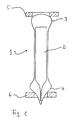
- Fig. 1 in the schematically clamped between two bearing elements, a trigger element is shown, which is filled in accordance with the invention with a described and claimed explosive liquid.
- the triggering element shown is a glass keg 1, as it is known in principle from the prior art.
- the glass keg shown here essentially corresponds in its design to that in the DE 36 01 203 described form and expression.
- the glass keg encloses a hollow interior 2 completely and lies in its use as a trigger element with opposite ends 3 and 4 on bearing elements 5 and 6, is clamped between them.
- one of the bearing elements for example, the bearing element 5 is a valve plate of a sprinkler, the other layer element, such as the bearing element 6, a bearing bracket opposite this, as is often encountered in sprinkler systems.
- the glass keg 1 can also be integrated as a thermal triggering element in an emergency discharge valve of a gas container or in similar devices.
- the essential feature of the invention is now the explosive liquid introduced into the interior 2, which leads to bursting of the glass bottle 1 and thus triggering of the thermal release device when heated due to the thermal expansion.
- the triggering liquid is filled while leaving a defined gas bubble (usually air) filled in the interior, the gas bubbles catching the first thermal expansion of the triggering liquid until, in particular by a phase transition, an explosive expansion takes place, which bursts the glass keg 1.
- the triggering liquid in the interior of the interior space 2 contains at least one hydrocarbon compound selected from the group of a heterocyclic hydrocarbon having OH, NH or NH 2 group attached to a carbon atom, a hydrocarbon having at least one benzene ring and having one bound to a carbon atom of the benzene ring OH group and a phosphate with at least one hydrocarbon radical, or a mixture of different hydrocarbon compounds from one or more of these categories.
- the explosive liquid may contain these hydrocarbon compounds only as a constituent, but in particular consists entirely of one or more of the said hydrocarbons.
- substance group examples heterocyclic hydrocarbons having an OH, NH or NH 2 group bonded to a carbon atom tetrahydrofurfuryl 2-tetrahydrofurfurylamine a benzene ring-containing hydrocarbons having an OH group bonded to a carbon atom of the benzene ring salicylaldehyde methyl salicylate Phosphates with at least one hydrocarbon radical triisobutyl trimethyl
- tetrahydrofurfuryl alcohol polyethylene glycol ethers shown in the above column in the uppermost column, as well as a 2-tetrahydrofurfurylamine shown there, when used as the triggering liquid, have the advantage of providing a very narrow temperature range of the triggering temperature due to their high expansion coefficients and low compressibilities.
- the substances salicylaldehyde and methyl salicylate shown in the second group (second column) are likewise distinguished by high coefficients of expansion or low compressibilities, which again leads to a narrow temperature range of the triggering temperature of a thermal triggering element equipped with this liquid as a triggering liquid.
- these substances used as a triggering liquid used fast triggering times.
- the triisobutyl phosphate and trimethyl phosphate mentioned in the table in the bottom column as examples of another substance group have high boiling points and are thus particularly well suited for use as tripping liquids in thermal tripping elements for high tripping temperatures or temperature ranges. There they have over known, conventional tripping liquids significant advantages in tripping behavior, such as tripping speed and low expansion of the triggering temperature window.
- additives can be added to the explosive liquid, in particular one or more dyes. Since most of the selected tripping liquids are colorless transparent, the addition of a dye not only facilitates recognition of the desired gas bubble and estimation of the size of the same, but by the addition of different dyes, the codes known in the art and already used for different trigger temperatures are indicated.
Landscapes
- Health & Medical Sciences (AREA)
- Public Health (AREA)
- Business, Economics & Management (AREA)
- Emergency Management (AREA)
- Organic Low-Molecular-Weight Compounds And Preparation Thereof (AREA)
- Physical Or Chemical Processes And Apparatus (AREA)
- Fire-Extinguishing By Fire Departments, And Fire-Extinguishing Equipment And Control Thereof (AREA)
- Feeding, Discharge, Calcimining, Fusing, And Gas-Generation Devices (AREA)
Abstract
Description
- Die Erfindung betrifft ein thermisches Auslöseelement für Sprinkler, Ventile oder dergleichen in Form eines in einem vollständig umschlossenen Innenraum mit einer Sprengflüssigkeit gefüllten Gefäßes.
- Es ist seit langem bekannt, thermische Auslöseelemente für Sprinkler, aber auch für andere Ventile, z.B. für Notablassventile von Gasbehältern in Form von im Inneren einen vollständig umschlossenen, mit einer Sprengflüssigkeit gefüllten Hohlraum aufweisenden Gefäßen auszuführen. Dabei sind die Gefäße zumeist aus Glas gebildet, sie können auch als Glasfässchen bezeichnet werden.
- Solche Glasfässchen als thermisches Auslöseelement sind beispielsweise in der
DE 36 01 203 A1 beschrieben. - Derartige Auslöseelemente sind mit einer Sprengflüssigkeit gefüllt, die sich bei Erwärmung ausdehnt und zum Bersten des typischerweise in einem Ventilsitz eingespannten, das Ventil in Schließstellung haltenden Gefäßes führt, so dass ein Auslösen des Ventils oder dgl. erfolgt.
- Als Sprengflüssigkeiten wurden unterschiedliche Stoffe vorgeschlagen. So nennt das
US-Patent Nr. 4,938,294 Toluen, Xylen, Trichlorethylen, Tetrachlorethylen bzw. Mischungen daraus als geeignete Sprengflüssigkeiten. In derEP 0 838 242 B1 sind ein Halogenderivat eines aromatischen Kohlenwasserstoffs mit zwei oder mehr Halogensubstituenten, ein aliphatisches Amid sowie Mischungen daraus als geeignete Sprengflüssigkeiten genannt. - In der
DE 197 80 041 C1 wird ein von einem halogenfreien oder halogenierten Kohlenwasserstoff abgeleiteter Stoff als geeignete Sprengflüssigkeit beschrieben, bei dem in seiner Strukturformel - a)
- i) wenigstens eine CH2-Gruppe durch Sauerstoff (O), Schwefel (S), Sulfinyl (SO) oder Sulfonyl (SO2) ersetzt ist, oder
- ii) wenigstens eine CH-Gruppe durch Stickstoff ersetzt ist,
- b) keine direkt an Sauerstoff, Stickstoff der Schwefel gebundenen Wasserstoffatome vorkommen,
- c)
- i) wenigstens ein Ring vorkommt, oder
- ii) mindestens zwei Sauerstoffatome mit jeweils zwei Einfachbindungen vorkommen oder
- iii) mindestens zwei Carbonylgruppen von Ketonen und/oder Aldehyden vorkommen oder
- iv) mindestens ein oxidiertes Schwefelatom (SO oder SO2) vorkommt oder
- v) mindestens ein Stickstoffatom in Form eines Amids, Imids, Imins oder Nitrils vorhanden ist.
- In der
DE 20 2009 007 987 U1 schließlich wird als Sprengflüssigkeit vorgeschlagen Kohlenwasserstoff oder eine Mischung aus Kohlenwasserstoffen aus der Gruppe: - a) ein aliphatisches Bromid;
- b) ein Kohlenwasserstoff mit einer Nitrogruppe;
- c) ein einfach halogenierter Benzolring;
- d) eine aliphatische Esterverbindung mit je zwei doppelt gebundenen Sauerstoffatomen.
- Zwar haben sich all die genannten Auslöseflüssigkeiten prinzipiell bewährt, und sind grundsätzlich geeignet, in gattungsgemäßen Auslöseelementen verwendet zu werden. Jedoch besteht fortwährender Bedarf nach Verbesserungen, insbesondere unter folgenden Gesichtspunkten:
- So sind die Anforderungen an moderne Auslöseelemente hinsichtlich der Genauigkeit der Auslösetemperatur gestiegen, es besteht also ein Bedarf nach hoch temperatursensitiven Sprengflüssigkeiten, die für eine exakte und reproduzierbare Einstellung einer Auslösetemperatur im Bereich von wenigen Grad Celsius geeignet sind. Das Spektrum der durch die Wahl einer geeigneten Sprengflüssigkeit einstellbaren Auslösetemperaturen soll dabei erweitert werden.
- Hier gilt es, mit der Erfindung Abhilfe zu schaffen und weitere Sprengflüssigkeiten anzugeben, die einerseits eine hochgradig temperaturgenaue und temperaturempfindliche Auslösung des damit bestückten Auslöseelementes gestatten und andererseits weitere Bereiche für Auslösetemperaturen eröffnen.
- Auf der Suche nach möglichen Alternativen haben die Erfinder umfangreiche Versuche und Untersuchungen durchgeführt und sind schließlich auf die in Anspruch 1 genannten Gruppen von Kohlenwasserstoffverbindungen gestoßen, aus denen einzelne Stoffe ausgewählt und zur Verarbeitung zu einer Auslöseflüssigkeit verwendet werden können, wie auch Mischungen von Stoffen aus diesen Gruppen.
- Die Gruppen umfassen dabei heterocyclische Kohlenwasserstoffe mit an ein Kohlenstoffatom gebundener OH-, NH- oder NH2-Gruppe, wenigstens einen Benzolring aufweisende Kohlenwasserstoffe mit einer an ein Kohlenstoffatom des Benzolringes gebundenen OH-Gruppe und Phosphate mit wenigstens einem Kohlenwasserstoffrest.
- Heterocyclische Kohlenwasserstoffe mit an ein Kohlenstoffatom gebundener OH-, NH- oder NH2-Gruppe zeichnen sich insbesondere durch einen sehr engen Bereich der Auslösetemperatur aus, das sie einen hohen Ausdehnungskoeffizienten bei gleichzeitig geringer Kompressibilität aufweisen.
- Wenigstens einen Benzolring aufweisende Kohlenwasserstoffe mit einer an ein Kohlenstoffatom des Benzolringes gebundenen OH-Gruppe besitzen gleichfalls einen hohen Ausdehnungskoeffizienten bzw. geringe Kompressibilitäten, was zu einem engen Bereich der Auslösetemperatur führt. Diese Stoffe haben zudem den Vorteil schneller Auslösezeiten.
- Phosphate mit wenigstens einem Kohlenwasserstoffrest sind durch ihren hohen Siedepunkt besonders gut für den Einsatz in hohen Temperaturbereichen geeignet, wo sie im Auslöseverhalten (Bereich der Auslösetemperatur, Auslösegeschwindigkeit) gegenüber den für den Einsatz in diesen Bereichen bekannten Auslöseflüssigkeiten deutliche Vorteile aufweisen.
- Insbesondere können die heterocyclischen Kohlenwasserstoffe mit an ein Kohlenstoffatom gebundener OH-, NH- oder NH2-Gruppe solche sein, bei denen ein Heteroatom im Ring ein Sauerstoffatom ist. Auch ist eine solche Form dieses Moleküls (dem Stoffvorschlag aus Variante a) des Anspruchs 1) von Vorteil, bei der die OH-, NH- oder NH2-Gruppe an ein Kohlenstoffatom eines an dem Ring gebundenen Restes gebunden ist.
- Bei Wahl eines Stoffes gemäß Alternative b) des Anspruchs 1 ist es von Vorteil, wenn der Benzolring neben einer an eines seiner Kohlenstoffatome gebundenen OH-Gruppe zudem noch einen weiteren wenigstens ein Kohlenstoffatom mit einem doppelt daran gebundenen Sauerstoffatom aufweisenden Rest enthält.
- Wird ein Stoff gemäß Alternative c) des Anspruchs 1, also ein Phosphat mit Kohlenwasserstoffrest, gewählt, so ist es von Vorteil, wenn der Kohlenwasserstoffrest ein Methyl-, Ethyl- oder Butylrest ist. Insbesondere kann das Phosphat drei Kohlenwasserstoffreste, vorzugsweise drei gleiche solche Reste, aufweisen.
- Durch die Wahl von Mischungen von Stoffen aus den genannten Stoffgruppen können die Auslöseeigenschaften der thermischen Auslöseelemente in gesteuerter Weise bestimmt, also gestaltet werden.
- Der Sprengflüssigkeit können mit Vorteil Zusatzstoffe zugesetzt sein, insbesondere ein oder mehrere Farbstoff(e). Da die meisten der gewählten Auslöseflüssigkeiten farblos transparent sind, erleichtert die Zugabe eines Farbstoffes nicht nur in der Qualitätskontrolle z.B. das Erkennen einer bewusst in dem Innenraum belassenen Gasblase und ein Abschätzen der Größe derselben, sondern es können über die Zugabe unterschiedlicher Farbstoffe die im Stand der Technik bekannten und bereits verwendeten Codierungen für unterschiedliche Auslösetemperaturen indiziert werden.
- Weitere Vorteile und Merkmale der Erfindung ergeben sich aus der nachfolgenden Beschreibung eines Ausführungsbeispiels, wozu auf die einzig beigefügte
Fig. 1 verwiesen wird, in der schematisch eingespannt zwischen zwei Lagerelementen ein Auslöseelement gezeigt ist, welches in erfindungsgemäßer Weise mit einer beschriebenen und beanspruchten Sprengflüssigkeit gefüllt ist. - Das in
Fig. 1 gezeigte Auslöseelement ist ein Glasfässchen 1, wie es grundsätzlich aus dem Stand der Technik bekannt ist. So entspricht das hier gezeigte Glasfässchen in seiner Gestaltung im Wesentlichen dem in derDE 36 01 203 beschriebenen Form und Ausprägung. Das Glasfässchen umschließt einen hohlen Innenraum 2 vollständig und liegt in seiner Verwendung als Auslöseelement mit einander gegenüberliegenden Enden 3 und 4 an Lagerelementen 5 und 6 an, ist zwischen diesen eingespannt. Dabei kann eines der Lagerelemente, z.B. das Lagerelement 5 ein Ventilteller eines Sprinklers, das andere Lageelement, z.B. das Lagerelement 6, ein diesem gegenüberliegender Lagerbügel sein, wie dies häufig in Sprinkleranlagen anzutreffen ist. Gleichermaßen kann das Glasfässchen 1 aber auch als thermisches Auslöseelement in ein Notablassventil eines Gasbehälters oder in ähnlichen Vorrichtungen eingebunden sein. - Das Erfindungswesentliche ist nun die in den Innenraum 2 eingefüllte Sprengflüssigkeit, die bei Erwärmung aufgrund der thermischen Ausdehnung zu einem Bersten des Glasfässchens 1 und damit einem Auslösen der thermischen Auslösevorrichtung führt. Typischerweise, auch dies ist aus dem Stand der Technik bekannt, wird die Auslöseflüssigkeit unter Belassung eines definierten Gasbläschens (üblicherweise Luft) in dem Innenraum eingefüllt, wobei das Gasbläschen die erste thermische Ausdehnung der Auslöseflüssigkeit auffängt, bis insbesondere durch einen Phasenübergang eine explosionsartige Ausdehnung erfolgt, die das Glasfässchen 1 bersten lässt. Nach der Erfindung enthält die Auslöseflüssigkeit im Inneren des Innenraumes 2 wenigstens eine Kohlenwasserstoffverbindung aus der Gruppe eines heterocyclischen Kohlenwasserstoffs mit an ein Kohlenstoffatom gebundener OH-, NH- oder NH2-Gruppe, ein wenigstens einen Benzolring aufweisender Kohlenwasserstoff mit einer an ein Kohlenstoffatom des Benzolringes gebundenen OH-Gruppe und ein Phosphat mit wenigstens einem Kohlenwasserstoffrest, bzw. eine Mischung aus verschiedenen Kohlenwasserstoffverbindungen aus einer oder mehrerer dieser Kategorien. Die Sprengflüssigkeit kann diese Kohlenwasserstoffverbindungen lediglich als Bestandteil enthalten, besteht aber insbesondere vollständig aus einem oder mehreren der genannten Kohlenwasserstoffe.
- Beispiele für in erfindungsgemäßer Weise zur Verwendung für die Sprengflüssigkeit geeignete Kohlenwasserstoffverbindungen aus den genannten Gruppen ergeben sich aus der nachstehenden Tabelle:
Stoffgruppe Beispiele heterocyclische Kohlenwasserstoffe mit an ein Kohlenstoffatom gebundener OH-, NH- oder NH2-Gruppe 

Tetrahydrofurfurylalkoholpolyethylenglycolether 2-Tetrahydrofurfurylamin einen Benzolring aufweisende Kohlenwasserstoffe mit einer an ein Kohlenstoffatom des Benzolringes gebundenen OH-Gruppe 

Salicylaldehyd Methylsalicylat Phosphate mit wenigstens einem Kohlenwasserstoffrest 

Triisobutylphosphat Trimethylphosphat - Mit der Wahl einer entsprechenden Auslöseflüssigkeit sind gegenüber dem Stand der Technik erhebliche Vorteile verbunden, die insbesondere in der präzisen Einstellbarkeit einer über einen erweiterten Temperaturbereich wählbaren Auslösetemperatur, in eng einstellbaren Temperaturfenstern für die Auslösung sowie der Erhöhung der Ansprechempfindlichkeit bestehen.
- So bieten ein in der oben dargestellten Tabelle in der obersten Spalte dargestellter Tetrahydrofurfurylalkoholpolyethylenglycolether wie auch ein dort gezeigtes 2-Tetrahydrofurfurylamin bei deren Verwendung als Auslöseflüssigkeit den Vorteil, dass sie aufgrund ihrer hohen Ausdehnungskoeffizienten und geringen Kompressibilitäten einen sehr engen Temperaturbereich der Auslösetemperatur ergeben.
- Die in der zweiten Gruppe (zweite Spalte) dargestellten Stoffe Salicylaldehyd und Methylsalicylat zeichnen sich ebenfalls durch hohe Ausdehnungskoeffizienten bzw. geringe Kompressibilitäten aus, was erneut zu einem engen Temperaturbereich der Auslösetemperatur eines mit dieser Flüssigkeit als Auslöseflüssigkeit bestückten thermischen Auslöseelementes führt. Diese Stoffe ergeben als Auslöseflüssigkeit verwendet darüber hinaus schnelle Auslösezeiten.
- Die in der Tabelle in der untersten Spalte als Beispiele einer weiteren Stoffgruppe genannten Triisobutylphosphat und Trimethylphosphat haben hohe Siedepunkte und eignen sich dadurch besonders gut für den Einsatz als Auslöseflüssigkeiten in thermischen Auslöseelementen für hohe Auslösetemperaturen bzw. -temperaturbereiche. Dort haben sie gegenüber bekannten, herkömmlichen Auslöseflüssigkeiten deutliche Vorteile im Auslöseverhalten, wie Auslösegeschwindigkeit und geringe Ausdehnung des Auslösetemperaturfensters.
- Der Sprengflüssigkeit können dabei Zusatzstoffe zugesetzt sein, insbesondere ein oder mehrere Farbstoff(e). Da die meisten der gewählten Auslöseflüssigkeiten farblos transparent sind, erleichtert die Zugabe eines Farbstoffes nicht nur in der Qualitätskontrolle das Erkennen der gewünschten Gasblase und Abschätzen der Größe derselben, sondern es können über die Zugabe unterschiedlicher Farbstoffe die im Stand der Technik bekannten und bereits verwendeten Codierungen für unterschiedliche Auslösetemperaturen indiziert werden.
-
- 1
- Glasfässchen
- 2
- Innenraum
- 3
- Ende
- 4
- Ende
- 5
- Lagerelement
- 6
- Lagerelement
Claims (7)
- Thermisches Auslöseelement für Sprinkler, Ventile oder dergleichen in Form eines in einem vollständig umschlossenen Innenraum (2) mit einer Sprengflüssigkeit gefüllten Gefäßes (1), wobei die Auslöseflüssigkeit einen aus einer der folgenden Stoffgruppen gewählten Kohlenwasserstoffverbindung oder eine Mischung aus solchen Kohlenwasserstoffenverbindungen enthält oder aus einer solchen Kohlenwasserstoffverbindung oder einer Mischung aus solchen Kohlenwasserstoffverbindungen besteht:e) ein heterocyclischer Kohlenwasserstoff mit an ein Kohlenstoffatom gebundener OH-, NH- oder NH2-Gruppe;f) ein wenigstens einen Benzolring aufweisender Kohlenwasserstoff mit einer an ein Kohlenstoffatom des Benzolringes gebundenen OH-Gruppe;g) ein Phosphat mit wenigstens einem Kohlenwasserstoffrest.
- Thermisches Auslöseelement nach Anspruch 1, dadurch gekennzeichnet, dass die Sprengflüssigkeit ein heterocyclischer Kohlenwasserstoff mit an ein Kohlenstoffatom gebundener OH-, NH- oder NH2-Gruppe ist oder ein solches enthält, in der ein Heteroatom im Ring ein Sauerstoffatom ist.
- Thermisches Auslöseelement nach einem der Ansprüch 1 oder 2, dadurch gekennzeichnet, dass die Sprengflüssigkeit ein heterocyclischer Kohlenwasserstoff mit an ein Kohlenstoffatom eines an dem Ring gebundenen Restes gebundener OH-, NH- oder NH2-Gruppe ist oder ein solches enthält.
- Thermisches Auslöseelement nach einem der vorhergehenden Ansprüche, dadurch gekennzeichnet, dass die Sprengflüssigkeit ein wenigstens einen Benzolring aufweisender Kohlenwasserstoff mit einer an ein Kohlenstoffatom des Benzolringes gebundenen OH-Gruppe und einem weiteren wenigstens ein Kohlenstoffatom mit einem doppelt daran gebundenen Sauerstoffatom aufweisenden Rest ist oder ein solches enthält.
- Thermisches Auslöseelement nach einem der vorhergehenden Ansprüche, dadurch gekennzeichnet, dass die Sprengflüssigkeit ein Phosphat mit wenigstens einem Kohlenwasserstoffrest in Form einer Methyl-, einer Ethyl-oder einer Butylgruppe ist oder ein solches enthält.
- Thermisches Auslöseelement nach einem der vorhergehenden Ansprüche, dadurch gekennzeichnet, dass die Sprengflüssigkeit ein Phosphat mit drei Kohlenwasserstoffresten ist oder ein solches enthält.
- Thermisches Auslöseelement nach einem der vorhergehenden Ansprüche, dadurch gekennzeichnet, dass die Sprengflüssigkeit Zusatzstoffe, wie insbesondere einen oder mehrere Farbstoffe, enthält.
Applications Claiming Priority (1)
| Application Number | Priority Date | Filing Date | Title |
|---|---|---|---|
| DE201120050661 DE202011050661U1 (de) | 2011-07-07 | 2011-07-07 | Thermisches Auslöseelement für Sprinkler, Ventile oder dergleichen |
Publications (3)
| Publication Number | Publication Date |
|---|---|
| EP2543416A2 true EP2543416A2 (de) | 2013-01-09 |
| EP2543416A3 EP2543416A3 (de) | 2014-04-09 |
| EP2543416B1 EP2543416B1 (de) | 2016-04-06 |
Family
ID=44786744
Family Applications (1)
| Application Number | Title | Priority Date | Filing Date |
|---|---|---|---|
| EP12169902.9A Active EP2543416B1 (de) | 2011-07-07 | 2012-05-30 | Thermisches auslöseelement für sprinkler, ventile oder dergleichen |
Country Status (4)
| Country | Link |
|---|---|
| US (1) | US8714180B2 (de) |
| EP (1) | EP2543416B1 (de) |
| CN (1) | CN102872566B (de) |
| DE (1) | DE202011050661U1 (de) |
Families Citing this family (10)
| Publication number | Priority date | Publication date | Assignee | Title |
|---|---|---|---|---|
| DE202012100623U1 (de) | 2012-02-24 | 2012-03-22 | Job Lizenz Gmbh & Co. Kg | Brandschutzeinrichtung für elektrische Kleingeräte |
| ITBS20120122A1 (it) * | 2012-07-27 | 2014-01-28 | Emer Spa | Dispositivo di sicurezza, particolarmente per impianti a gas per autotrazione |
| US8910651B2 (en) * | 2013-03-13 | 2014-12-16 | GM Global Technology Operations LLC | Thermal pressure relief devices and related systems and methods |
| US9573007B2 (en) | 2013-03-15 | 2017-02-21 | Tyco Fire Products Lp | Fire protection sprinkler |
| US11354616B1 (en) * | 2017-05-11 | 2022-06-07 | State Farm Mutual Automobile Insurance Company | Vehicle driver safety performance based on relativity |
| US10493994B1 (en) | 2017-05-11 | 2019-12-03 | State Farm Mutual Automobile Insurance Company | Vehicle driver performance based on contextual changes and driver response |
| US12013695B1 (en) | 2017-05-16 | 2024-06-18 | State Farm Mutual Automobile Insurance Company | Autonomous vehicle operation based on real-time analytics |
| US11560177B1 (en) | 2017-09-13 | 2023-01-24 | State Farm Mutual Automobile Insurance Company | Real-time vehicle driver feedback based on analytics |
| FR3096177B1 (fr) * | 2019-05-15 | 2021-06-04 | Commissariat Energie Atomique | Procede d’extinction d’un generateur electrochimique dans le cas d’un emballement thermique |
| ES2984542T3 (es) * | 2020-12-04 | 2024-10-29 | Marioff Corp Oy | Bulbo de rociador |
Citations (5)
| Publication number | Priority date | Publication date | Assignee | Title |
|---|---|---|---|---|
| DE3601203A1 (de) | 1985-09-09 | 1987-03-19 | Eduard J Dipl Ing Job | Glasfaesschen fuer sprinkler fuer feuerloeschanlagen oder andere thermische ausloeseeinrichtungen |
| US4938294A (en) | 1987-02-13 | 1990-07-03 | Mohler Johann G | Trigger element for a sprinkler |
| DE19780041C1 (de) | 1996-01-25 | 2002-02-21 | Norbulb Sprinkler Elemente Gmb | Auslöseglied für einen Sprinkler |
| EP0838242B1 (de) | 1996-10-03 | 2002-06-05 | Tyco Fire Products Manufacturing Limited | Wärmeempfindliche zerbrechbare Ampulle |
| DE202009007987U1 (de) | 2009-06-05 | 2010-10-28 | Job Lizenz Gmbh & Co. Kg | Thermisches Auslöseelement für Sprinkler, Ventile o.dgl. |
Family Cites Families (12)
| Publication number | Priority date | Publication date | Assignee | Title |
|---|---|---|---|---|
| US1905676A (en) * | 1930-04-15 | 1933-04-25 | Gen Fire Extinguisher Co | Automatic sprinkler or fire extinguisher and other fire device |
| US3548949A (en) * | 1968-08-19 | 1970-12-22 | Jefferson Chem Co Inc | Method for extinguishing fire |
| GB1566724A (en) * | 1976-04-06 | 1980-05-08 | Chubb Fire Security Ltd | Fire fighting compositions |
| US4898246A (en) * | 1987-07-06 | 1990-02-06 | Total Walther Feuerschutz Gmbh | Quick release valve for sprinkler head |
| US4830687A (en) * | 1987-11-23 | 1989-05-16 | Atlas Powder Company | Stable fluid systems for preparing high density explosive compositions |
| DE3819749A1 (de) * | 1988-06-10 | 1989-12-14 | Verband Der Sachversicherer Ev | Thermische ausloesevorrichtung fuer sprinkler fuer ortsfeste feuerloeschanlagen |
| DE4416746A1 (de) * | 1994-05-12 | 1995-11-16 | Igv Ingenieur Ges Versorgungst | Sprühkopf für Sprinkleranlagen |
| RU2159649C1 (ru) * | 2000-03-28 | 2000-11-27 | Общество с ограниченной ответственностью "ЮНИПАТ" | Спринклер (варианты) |
| EP1454598A1 (de) * | 2001-11-22 | 2004-09-08 | Gtl Co., Ltd. | Fluorotensid-freier schaum-feuerlöscher |
| SE521179C2 (sv) * | 2002-02-28 | 2003-10-07 | Filtrator Vaerme & Ventilation | Sätt att simulera en attack med kemiska stridsmedel, övningssubstans för användning vid sättet samt komposition för framställning av övningssubstansen |
| WO2009046122A2 (en) * | 2007-10-01 | 2009-04-09 | Bay Materials, Llc | Temperature-switching materials having improved strength and thermal properties |
| EP2246324A1 (de) * | 2009-04-21 | 2010-11-03 | Maflon S.R.L. | Fluorverbindung mit Sulfonfunktion und deren Verwendung |
-
2011
- 2011-07-07 DE DE201120050661 patent/DE202011050661U1/de not_active Expired - Lifetime
-
2012
- 2012-05-30 EP EP12169902.9A patent/EP2543416B1/de active Active
- 2012-06-12 US US13/494,368 patent/US8714180B2/en active Active
- 2012-07-06 CN CN201210233975.XA patent/CN102872566B/zh active Active
Patent Citations (5)
| Publication number | Priority date | Publication date | Assignee | Title |
|---|---|---|---|---|
| DE3601203A1 (de) | 1985-09-09 | 1987-03-19 | Eduard J Dipl Ing Job | Glasfaesschen fuer sprinkler fuer feuerloeschanlagen oder andere thermische ausloeseeinrichtungen |
| US4938294A (en) | 1987-02-13 | 1990-07-03 | Mohler Johann G | Trigger element for a sprinkler |
| DE19780041C1 (de) | 1996-01-25 | 2002-02-21 | Norbulb Sprinkler Elemente Gmb | Auslöseglied für einen Sprinkler |
| EP0838242B1 (de) | 1996-10-03 | 2002-06-05 | Tyco Fire Products Manufacturing Limited | Wärmeempfindliche zerbrechbare Ampulle |
| DE202009007987U1 (de) | 2009-06-05 | 2010-10-28 | Job Lizenz Gmbh & Co. Kg | Thermisches Auslöseelement für Sprinkler, Ventile o.dgl. |
Also Published As
| Publication number | Publication date |
|---|---|
| US8714180B2 (en) | 2014-05-06 |
| CN102872566B (zh) | 2017-11-21 |
| EP2543416B1 (de) | 2016-04-06 |
| US20130008521A1 (en) | 2013-01-10 |
| DE202011050661U1 (de) | 2011-09-09 |
| EP2543416A3 (de) | 2014-04-09 |
| CN102872566A (zh) | 2013-01-16 |
Similar Documents
| Publication | Publication Date | Title |
|---|---|---|
| EP2543416B1 (de) | Thermisches auslöseelement für sprinkler, ventile oder dergleichen | |
| EP2258451B1 (de) | Thermisches Auslöseelement für Sprinkler, Ventile oder dergleichen | |
| Bouaziz et al. | Flavonolignans from Hyparrhenia hirta | |
| DE1890802U (de) | Vorsatzobjektiv. | |
| Kvenvolden et al. | Fluid inclusions in quartz crystals from South-West Africa | |
| DE10358056A1 (de) | Temperaturempfindliche Ventilbaugruppe für eine Gasfeder | |
| DE69318179T2 (de) | Auf raffiniertem erdölwachs basierende zusammensetzung | |
| Hidajati et al. | Antioxidant activity of palmitic acid and pinostrobin from methanol extract of Syzygium litoralle (Myrtaceae) | |
| EP4215912A1 (de) | Chromatographie-anlage | |
| Vieira et al. | Natural product mixture analysis by matrix-assisted DOSY using Brij surfactants in mixed solvents | |
| George et al. | Modulatory Effect of Selected Dietary Phytochemicals on Delayed Rectifier K+ Current in Human Prostate Cancer Cells: K. George et al.: Modulatory Effect of Selected Dietary Phytochemicals | |
| DE102013200357A1 (de) | Kammer zur Aufnahme einer Probe mit integrierter Schneide | |
| DE2552299A1 (de) | Vorrichtung und verfahren zum einstellen der konzentration einer substanz in einem fluessigkeitsstrom | |
| DE69519057T2 (de) | Konstruktionsmaterial einer Beschichtungsvorrichtung sowie Verwendung der Vorrichtung | |
| WO1997015565A2 (de) | Photochrome diaryl-3h-naphthopyrane | |
| DE516599C (de) | Hahn oder Schieber | |
| DE102005009194B4 (de) | Verfahren zur Herstellung von polymorph stabilem Triamcinolonacetonid | |
| DE580618C (de) | Bei Erhoehung der Raumtemperatur sich selbsttaetig ausloesende Feststellvorrichtung fuer Tueren, insbesondere Schiebe- und Fluegeltueren, Rolladen o. dgl. | |
| Omran et al. | Phytochemical Components Analysis by Using Gas Chromatography-mass and Fourier transform-Infrared Techniques of Cressa cretica L. Flowers Extracts | |
| Thome et al. | Structure, chemical and physical behavior of aluminum hydride | |
| DE60222236T2 (de) | Zubereitungen enthaltend cyclohexamantan | |
| Abutaha et al. | Psiadia punctulata (DC.) Vatke induces cell apoptosis in highly metastatic MDA-MB-231 cells | |
| DE862727C (de) | Verfahren zur Herstellung von Versilberungspraeparaten und mit denselben hergestellte Gegenstaende | |
| Krishna Kumar et al. | Isolation and Characterization of The Active Constituents Present In The Chonemorpha macrophylla Roots. | |
| DE1909340C3 (de) | Ultraviolett-Absorptionsmittel für organische Polymere |
Legal Events
| Date | Code | Title | Description |
|---|---|---|---|
| PUAI | Public reference made under article 153(3) epc to a published international application that has entered the european phase |
Free format text: ORIGINAL CODE: 0009012 |
|
| AK | Designated contracting states |
Kind code of ref document: A2 Designated state(s): AL AT BE BG CH CY CZ DE DK EE ES FI FR GB GR HR HU IE IS IT LI LT LU LV MC MK MT NL NO PL PT RO RS SE SI SK SM TR |
|
| AX | Request for extension of the european patent |
Extension state: BA ME |
|
| PUAL | Search report despatched |
Free format text: ORIGINAL CODE: 0009013 |
|
| AK | Designated contracting states |
Kind code of ref document: A3 Designated state(s): AL AT BE BG CH CY CZ DE DK EE ES FI FR GB GR HR HU IE IS IT LI LT LU LV MC MK MT NL NO PL PT RO RS SE SI SK SM TR |
|
| AX | Request for extension of the european patent |
Extension state: BA ME |
|
| RIC1 | Information provided on ipc code assigned before grant |
Ipc: A62C 37/14 20060101AFI20140304BHEP |
|
| 17P | Request for examination filed |
Effective date: 20140326 |
|
| RBV | Designated contracting states (corrected) |
Designated state(s): AL AT BE BG CH CY CZ DE DK EE ES FI FR GB GR HR HU IE IS IT LI LT LU LV MC MK MT NL NO PL PT RO RS SE SI SK SM TR |
|
| GRAP | Despatch of communication of intention to grant a patent |
Free format text: ORIGINAL CODE: EPIDOSNIGR1 |
|
| INTG | Intention to grant announced |
Effective date: 20160112 |
|
| GRAS | Grant fee paid |
Free format text: ORIGINAL CODE: EPIDOSNIGR3 |
|
| GRAA | (expected) grant |
Free format text: ORIGINAL CODE: 0009210 |
|
| AK | Designated contracting states |
Kind code of ref document: B1 Designated state(s): AL AT BE BG CH CY CZ DE DK EE ES FI FR GB GR HR HU IE IS IT LI LT LU LV MC MK MT NL NO PL PT RO RS SE SI SK SM TR |
|
| REG | Reference to a national code |
Ref country code: GB Ref legal event code: FG4D Free format text: NOT ENGLISH |
|
| REG | Reference to a national code |
Ref country code: AT Ref legal event code: REF Ref document number: 787088 Country of ref document: AT Kind code of ref document: T Effective date: 20160415 Ref country code: CH Ref legal event code: EP |
|
| REG | Reference to a national code |
Ref country code: IE Ref legal event code: FG4D Free format text: LANGUAGE OF EP DOCUMENT: GERMAN |
|
| REG | Reference to a national code |
Ref country code: DE Ref legal event code: R096 Ref document number: 502012006561 Country of ref document: DE |
|
| REG | Reference to a national code |
Ref country code: LT Ref legal event code: MG4D Ref country code: NL Ref legal event code: MP Effective date: 20160406 |
|
| PG25 | Lapsed in a contracting state [announced via postgrant information from national office to epo] |
Ref country code: BE Free format text: LAPSE BECAUSE OF NON-PAYMENT OF DUE FEES Effective date: 20160531 |
|
| PG25 | Lapsed in a contracting state [announced via postgrant information from national office to epo] |
Ref country code: NL Free format text: LAPSE BECAUSE OF FAILURE TO SUBMIT A TRANSLATION OF THE DESCRIPTION OR TO PAY THE FEE WITHIN THE PRESCRIBED TIME-LIMIT Effective date: 20160406 |
|
| PG25 | Lapsed in a contracting state [announced via postgrant information from national office to epo] |
Ref country code: PL Free format text: LAPSE BECAUSE OF FAILURE TO SUBMIT A TRANSLATION OF THE DESCRIPTION OR TO PAY THE FEE WITHIN THE PRESCRIBED TIME-LIMIT Effective date: 20160406 Ref country code: IS Free format text: LAPSE BECAUSE OF FAILURE TO SUBMIT A TRANSLATION OF THE DESCRIPTION OR TO PAY THE FEE WITHIN THE PRESCRIBED TIME-LIMIT Effective date: 20160806 Ref country code: NO Free format text: LAPSE BECAUSE OF FAILURE TO SUBMIT A TRANSLATION OF THE DESCRIPTION OR TO PAY THE FEE WITHIN THE PRESCRIBED TIME-LIMIT Effective date: 20160706 Ref country code: FI Free format text: LAPSE BECAUSE OF FAILURE TO SUBMIT A TRANSLATION OF THE DESCRIPTION OR TO PAY THE FEE WITHIN THE PRESCRIBED TIME-LIMIT Effective date: 20160406 Ref country code: LT Free format text: LAPSE BECAUSE OF FAILURE TO SUBMIT A TRANSLATION OF THE DESCRIPTION OR TO PAY THE FEE WITHIN THE PRESCRIBED TIME-LIMIT Effective date: 20160406 |
|
| PG25 | Lapsed in a contracting state [announced via postgrant information from national office to epo] |
Ref country code: LV Free format text: LAPSE BECAUSE OF FAILURE TO SUBMIT A TRANSLATION OF THE DESCRIPTION OR TO PAY THE FEE WITHIN THE PRESCRIBED TIME-LIMIT Effective date: 20160406 Ref country code: HR Free format text: LAPSE BECAUSE OF FAILURE TO SUBMIT A TRANSLATION OF THE DESCRIPTION OR TO PAY THE FEE WITHIN THE PRESCRIBED TIME-LIMIT Effective date: 20160406 Ref country code: PT Free format text: LAPSE BECAUSE OF FAILURE TO SUBMIT A TRANSLATION OF THE DESCRIPTION OR TO PAY THE FEE WITHIN THE PRESCRIBED TIME-LIMIT Effective date: 20160808 Ref country code: SE Free format text: LAPSE BECAUSE OF FAILURE TO SUBMIT A TRANSLATION OF THE DESCRIPTION OR TO PAY THE FEE WITHIN THE PRESCRIBED TIME-LIMIT Effective date: 20160406 Ref country code: RS Free format text: LAPSE BECAUSE OF FAILURE TO SUBMIT A TRANSLATION OF THE DESCRIPTION OR TO PAY THE FEE WITHIN THE PRESCRIBED TIME-LIMIT Effective date: 20160406 Ref country code: ES Free format text: LAPSE BECAUSE OF FAILURE TO SUBMIT A TRANSLATION OF THE DESCRIPTION OR TO PAY THE FEE WITHIN THE PRESCRIBED TIME-LIMIT Effective date: 20160406 Ref country code: GR Free format text: LAPSE BECAUSE OF FAILURE TO SUBMIT A TRANSLATION OF THE DESCRIPTION OR TO PAY THE FEE WITHIN THE PRESCRIBED TIME-LIMIT Effective date: 20160707 |
|
| PG25 | Lapsed in a contracting state [announced via postgrant information from national office to epo] |
Ref country code: IT Free format text: LAPSE BECAUSE OF FAILURE TO SUBMIT A TRANSLATION OF THE DESCRIPTION OR TO PAY THE FEE WITHIN THE PRESCRIBED TIME-LIMIT Effective date: 20160406 |
|
| REG | Reference to a national code |
Ref country code: CH Ref legal event code: PL |
|
| REG | Reference to a national code |
Ref country code: DE Ref legal event code: R097 Ref document number: 502012006561 Country of ref document: DE |
|
| PG25 | Lapsed in a contracting state [announced via postgrant information from national office to epo] |
Ref country code: EE Free format text: LAPSE BECAUSE OF FAILURE TO SUBMIT A TRANSLATION OF THE DESCRIPTION OR TO PAY THE FEE WITHIN THE PRESCRIBED TIME-LIMIT Effective date: 20160406 Ref country code: DK Free format text: LAPSE BECAUSE OF FAILURE TO SUBMIT A TRANSLATION OF THE DESCRIPTION OR TO PAY THE FEE WITHIN THE PRESCRIBED TIME-LIMIT Effective date: 20160406 Ref country code: LI Free format text: LAPSE BECAUSE OF NON-PAYMENT OF DUE FEES Effective date: 20160531 Ref country code: RO Free format text: LAPSE BECAUSE OF FAILURE TO SUBMIT A TRANSLATION OF THE DESCRIPTION OR TO PAY THE FEE WITHIN THE PRESCRIBED TIME-LIMIT Effective date: 20160406 Ref country code: SK Free format text: LAPSE BECAUSE OF FAILURE TO SUBMIT A TRANSLATION OF THE DESCRIPTION OR TO PAY THE FEE WITHIN THE PRESCRIBED TIME-LIMIT Effective date: 20160406 Ref country code: CZ Free format text: LAPSE BECAUSE OF FAILURE TO SUBMIT A TRANSLATION OF THE DESCRIPTION OR TO PAY THE FEE WITHIN THE PRESCRIBED TIME-LIMIT Effective date: 20160406 Ref country code: CH Free format text: LAPSE BECAUSE OF NON-PAYMENT OF DUE FEES Effective date: 20160531 Ref country code: MC Free format text: LAPSE BECAUSE OF FAILURE TO SUBMIT A TRANSLATION OF THE DESCRIPTION OR TO PAY THE FEE WITHIN THE PRESCRIBED TIME-LIMIT Effective date: 20160406 |
|
| PLBE | No opposition filed within time limit |
Free format text: ORIGINAL CODE: 0009261 |
|
| STAA | Information on the status of an ep patent application or granted ep patent |
Free format text: STATUS: NO OPPOSITION FILED WITHIN TIME LIMIT |
|
| REG | Reference to a national code |
Ref country code: IE Ref legal event code: MM4A |
|
| PG25 | Lapsed in a contracting state [announced via postgrant information from national office to epo] |
Ref country code: SM Free format text: LAPSE BECAUSE OF FAILURE TO SUBMIT A TRANSLATION OF THE DESCRIPTION OR TO PAY THE FEE WITHIN THE PRESCRIBED TIME-LIMIT Effective date: 20160406 |
|
| REG | Reference to a national code |
Ref country code: FR Ref legal event code: ST Effective date: 20170131 |
|
| 26N | No opposition filed |
Effective date: 20170110 |
|
| PG25 | Lapsed in a contracting state [announced via postgrant information from national office to epo] |
Ref country code: FR Free format text: LAPSE BECAUSE OF NON-PAYMENT OF DUE FEES Effective date: 20160606 |
|
| PG25 | Lapsed in a contracting state [announced via postgrant information from national office to epo] |
Ref country code: SI Free format text: LAPSE BECAUSE OF FAILURE TO SUBMIT A TRANSLATION OF THE DESCRIPTION OR TO PAY THE FEE WITHIN THE PRESCRIBED TIME-LIMIT Effective date: 20160406 Ref country code: IE Free format text: LAPSE BECAUSE OF NON-PAYMENT OF DUE FEES Effective date: 20160530 |
|
| PG25 | Lapsed in a contracting state [announced via postgrant information from national office to epo] |
Ref country code: HU Free format text: LAPSE BECAUSE OF FAILURE TO SUBMIT A TRANSLATION OF THE DESCRIPTION OR TO PAY THE FEE WITHIN THE PRESCRIBED TIME-LIMIT; INVALID AB INITIO Effective date: 20120530 Ref country code: CY Free format text: LAPSE BECAUSE OF FAILURE TO SUBMIT A TRANSLATION OF THE DESCRIPTION OR TO PAY THE FEE WITHIN THE PRESCRIBED TIME-LIMIT Effective date: 20160406 |
|
| PG25 | Lapsed in a contracting state [announced via postgrant information from national office to epo] |
Ref country code: LU Free format text: LAPSE BECAUSE OF NON-PAYMENT OF DUE FEES Effective date: 20160530 Ref country code: MK Free format text: LAPSE BECAUSE OF FAILURE TO SUBMIT A TRANSLATION OF THE DESCRIPTION OR TO PAY THE FEE WITHIN THE PRESCRIBED TIME-LIMIT Effective date: 20160406 Ref country code: MT Free format text: LAPSE BECAUSE OF FAILURE TO SUBMIT A TRANSLATION OF THE DESCRIPTION OR TO PAY THE FEE WITHIN THE PRESCRIBED TIME-LIMIT Effective date: 20160406 |
|
| REG | Reference to a national code |
Ref country code: AT Ref legal event code: MM01 Ref document number: 787088 Country of ref document: AT Kind code of ref document: T Effective date: 20170530 |
|
| PG25 | Lapsed in a contracting state [announced via postgrant information from national office to epo] |
Ref country code: BG Free format text: LAPSE BECAUSE OF FAILURE TO SUBMIT A TRANSLATION OF THE DESCRIPTION OR TO PAY THE FEE WITHIN THE PRESCRIBED TIME-LIMIT Effective date: 20160406 |
|
| PG25 | Lapsed in a contracting state [announced via postgrant information from national office to epo] |
Ref country code: AT Free format text: LAPSE BECAUSE OF NON-PAYMENT OF DUE FEES Effective date: 20170530 |
|
| PG25 | Lapsed in a contracting state [announced via postgrant information from national office to epo] |
Ref country code: AL Free format text: LAPSE BECAUSE OF FAILURE TO SUBMIT A TRANSLATION OF THE DESCRIPTION OR TO PAY THE FEE WITHIN THE PRESCRIBED TIME-LIMIT Effective date: 20160406 |
|
| REG | Reference to a national code |
Ref country code: DE Ref legal event code: R081 Ref document number: 502012006561 Country of ref document: DE Owner name: JOB LIZENZ GMBH, DE Free format text: FORMER OWNER: JOB LIZENZ GMBH & CO. KG, 22926 AHRENSBURG, DE |
|
| PGFP | Annual fee paid to national office [announced via postgrant information from national office to epo] |
Ref country code: DE Payment date: 20250526 Year of fee payment: 14 |
|
| PGFP | Annual fee paid to national office [announced via postgrant information from national office to epo] |
Ref country code: TR Payment date: 20250523 Year of fee payment: 14 |
|
| PGFP | Annual fee paid to national office [announced via postgrant information from national office to epo] |
Ref country code: GB Payment date: 20260330 Year of fee payment: 15 |