EP2543986A2 - Procédé de mesure de l'épaisseur de couche de revêtements organiques de matériaux de base métalliques - Google Patents
Procédé de mesure de l'épaisseur de couche de revêtements organiques de matériaux de base métalliques Download PDFInfo
- Publication number
- EP2543986A2 EP2543986A2 EP12174971A EP12174971A EP2543986A2 EP 2543986 A2 EP2543986 A2 EP 2543986A2 EP 12174971 A EP12174971 A EP 12174971A EP 12174971 A EP12174971 A EP 12174971A EP 2543986 A2 EP2543986 A2 EP 2543986A2
- Authority
- EP
- European Patent Office
- Prior art keywords
- coating
- thickness
- sample
- acid bath
- base material
- Prior art date
- Legal status (The legal status is an assumption and is not a legal conclusion. Google has not performed a legal analysis and makes no representation as to the accuracy of the status listed.)
- Withdrawn
Links
- 238000000576 coating method Methods 0.000 title claims abstract description 111
- 239000000463 material Substances 0.000 title claims abstract description 52
- 238000000034 method Methods 0.000 title claims description 69
- 239000011248 coating agent Substances 0.000 claims abstract description 100
- 239000002253 acid Substances 0.000 claims abstract description 52
- 238000009210 therapy by ultrasound Methods 0.000 claims abstract description 9
- VEXZGXHMUGYJMC-UHFFFAOYSA-N Hydrochloric acid Chemical compound Cl VEXZGXHMUGYJMC-UHFFFAOYSA-N 0.000 claims description 28
- 238000005259 measurement Methods 0.000 claims description 26
- XEEYBQQBJWHFJM-UHFFFAOYSA-N Iron Chemical compound [Fe] XEEYBQQBJWHFJM-UHFFFAOYSA-N 0.000 claims description 16
- 229910000831 Steel Inorganic materials 0.000 claims description 12
- 239000010959 steel Substances 0.000 claims description 12
- 238000004090 dissolution Methods 0.000 claims description 10
- 238000012360 testing method Methods 0.000 claims description 10
- HCHKCACWOHOZIP-UHFFFAOYSA-N Zinc Chemical compound [Zn] HCHKCACWOHOZIP-UHFFFAOYSA-N 0.000 claims description 9
- 239000011701 zinc Substances 0.000 claims description 9
- 229910052725 zinc Inorganic materials 0.000 claims description 9
- 229910052742 iron Inorganic materials 0.000 claims description 8
- 239000000126 substance Substances 0.000 claims description 8
- 238000012937 correction Methods 0.000 claims description 7
- 229910052793 cadmium Inorganic materials 0.000 claims description 4
- BDOSMKKIYDKNTQ-UHFFFAOYSA-N cadmium atom Chemical compound [Cd] BDOSMKKIYDKNTQ-UHFFFAOYSA-N 0.000 claims description 4
- 229910000398 iron phosphate Inorganic materials 0.000 claims description 4
- WBJZTOZJJYAKHQ-UHFFFAOYSA-K iron(3+) phosphate Chemical compound [Fe+3].[O-]P([O-])([O-])=O WBJZTOZJJYAKHQ-UHFFFAOYSA-K 0.000 claims description 4
- LRXTYHSAJDENHV-UHFFFAOYSA-H zinc phosphate Chemical compound [Zn+2].[Zn+2].[Zn+2].[O-]P([O-])([O-])=O.[O-]P([O-])([O-])=O LRXTYHSAJDENHV-UHFFFAOYSA-H 0.000 claims description 4
- 229910000165 zinc phosphate Inorganic materials 0.000 claims description 4
- 230000000052 comparative effect Effects 0.000 claims description 3
- FYYHWMGAXLPEAU-UHFFFAOYSA-N Magnesium Chemical compound [Mg] FYYHWMGAXLPEAU-UHFFFAOYSA-N 0.000 claims description 2
- 229910052782 aluminium Inorganic materials 0.000 claims description 2
- XAGFODPZIPBFFR-UHFFFAOYSA-N aluminium Chemical compound [Al] XAGFODPZIPBFFR-UHFFFAOYSA-N 0.000 claims description 2
- 229910052749 magnesium Inorganic materials 0.000 claims description 2
- 239000011777 magnesium Substances 0.000 claims description 2
- 238000010561 standard procedure Methods 0.000 claims description 2
- 239000003599 detergent Substances 0.000 claims 1
- 230000007935 neutral effect Effects 0.000 claims 1
- 239000000523 sample Substances 0.000 description 51
- 239000010410 layer Substances 0.000 description 44
- 229910019142 PO4 Inorganic materials 0.000 description 13
- 238000006243 chemical reaction Methods 0.000 description 13
- 239000010452 phosphate Substances 0.000 description 13
- HEMHJVSKTPXQMS-UHFFFAOYSA-M Sodium hydroxide Chemical compound [OH-].[Na+] HEMHJVSKTPXQMS-UHFFFAOYSA-M 0.000 description 12
- NBIIXXVUZAFLBC-UHFFFAOYSA-K phosphate Chemical compound [O-]P([O-])([O-])=O NBIIXXVUZAFLBC-UHFFFAOYSA-K 0.000 description 12
- 239000000243 solution Substances 0.000 description 12
- 238000004458 analytical method Methods 0.000 description 7
- LFQSCWFLJHTTHZ-UHFFFAOYSA-N Ethanol Chemical compound CCO LFQSCWFLJHTTHZ-UHFFFAOYSA-N 0.000 description 6
- 239000003795 chemical substances by application Substances 0.000 description 6
- 230000001419 dependent effect Effects 0.000 description 6
- 238000002474 experimental method Methods 0.000 description 6
- 239000007769 metal material Substances 0.000 description 6
- 238000002604 ultrasonography Methods 0.000 description 6
- XLYOFNOQVPJJNP-UHFFFAOYSA-N water Chemical compound O XLYOFNOQVPJJNP-UHFFFAOYSA-N 0.000 description 5
- WGLPBDUCMAPZCE-UHFFFAOYSA-N Trioxochromium Chemical compound O=[Cr](=O)=O WGLPBDUCMAPZCE-UHFFFAOYSA-N 0.000 description 4
- 150000007513 acids Chemical class 0.000 description 4
- 238000010438 heat treatment Methods 0.000 description 3
- CPSYWNLKRDURMG-UHFFFAOYSA-L hydron;manganese(2+);phosphate Chemical compound [Mn+2].OP([O-])([O-])=O CPSYWNLKRDURMG-UHFFFAOYSA-L 0.000 description 3
- GSEJCLTVZPLZKY-UHFFFAOYSA-N Triethanolamine Chemical compound OCCN(CCO)CCO GSEJCLTVZPLZKY-UHFFFAOYSA-N 0.000 description 2
- 238000010306 acid treatment Methods 0.000 description 2
- 230000002378 acidificating effect Effects 0.000 description 2
- 238000007743 anodising Methods 0.000 description 2
- 230000005540 biological transmission Effects 0.000 description 2
- 238000004532 chromating Methods 0.000 description 2
- 238000005260 corrosion Methods 0.000 description 2
- 230000007797 corrosion Effects 0.000 description 2
- 238000001035 drying Methods 0.000 description 2
- 238000004043 dyeing Methods 0.000 description 2
- 238000011049 filling Methods 0.000 description 2
- 238000011534 incubation Methods 0.000 description 2
- 230000003287 optical effect Effects 0.000 description 2
- 238000005554 pickling Methods 0.000 description 2
- 238000005070 sampling Methods 0.000 description 2
- UEUXEKPTXMALOB-UHFFFAOYSA-J tetrasodium;2-[2-[bis(carboxylatomethyl)amino]ethyl-(carboxylatomethyl)amino]acetate Chemical compound [Na+].[Na+].[Na+].[Na+].[O-]C(=O)CN(CC([O-])=O)CCN(CC([O-])=O)CC([O-])=O UEUXEKPTXMALOB-UHFFFAOYSA-J 0.000 description 2
- 238000005303 weighing Methods 0.000 description 2
- XFXPMWWXUTWYJX-UHFFFAOYSA-N Cyanide Chemical compound N#[C-] XFXPMWWXUTWYJX-UHFFFAOYSA-N 0.000 description 1
- BDAGIHXWWSANSR-UHFFFAOYSA-N Formic acid Chemical compound OC=O BDAGIHXWWSANSR-UHFFFAOYSA-N 0.000 description 1
- 229910000746 Structural steel Inorganic materials 0.000 description 1
- 230000001133 acceleration Effects 0.000 description 1
- 239000012670 alkaline solution Substances 0.000 description 1
- JOSWYUNQBRPBDN-UHFFFAOYSA-P ammonium dichromate Chemical compound [NH4+].[NH4+].[O-][Cr](=O)(=O)O[Cr]([O-])(=O)=O JOSWYUNQBRPBDN-UHFFFAOYSA-P 0.000 description 1
- 239000007864 aqueous solution Substances 0.000 description 1
- XAQCJVGGJJFLPP-UHFFFAOYSA-L azane;hydroxy-(hydroxy(dioxo)chromio)oxy-dioxochromium Chemical compound N.N.O[Cr](=O)(=O)O[Cr](O)(=O)=O XAQCJVGGJJFLPP-UHFFFAOYSA-L 0.000 description 1
- 239000001506 calcium phosphate Substances 0.000 description 1
- 229910000389 calcium phosphate Inorganic materials 0.000 description 1
- 235000011010 calcium phosphates Nutrition 0.000 description 1
- 238000004364 calculation method Methods 0.000 description 1
- 230000000711 cancerogenic effect Effects 0.000 description 1
- 231100000315 carcinogenic Toxicity 0.000 description 1
- 150000001768 cations Chemical class 0.000 description 1
- KXZJHVJKXJLBKO-UHFFFAOYSA-N chembl1408157 Chemical compound N=1C2=CC=CC=C2C(C(=O)O)=CC=1C1=CC=C(O)C=C1 KXZJHVJKXJLBKO-UHFFFAOYSA-N 0.000 description 1
- 231100000481 chemical toxicant Toxicity 0.000 description 1
- ZCDOYSPFYFSLEW-UHFFFAOYSA-N chromate(2-) Chemical compound [O-][Cr]([O-])(=O)=O ZCDOYSPFYFSLEW-UHFFFAOYSA-N 0.000 description 1
- 150000001875 compounds Chemical class 0.000 description 1
- 238000010924 continuous production Methods 0.000 description 1
- 238000007739 conversion coating Methods 0.000 description 1
- 238000003869 coulometry Methods 0.000 description 1
- 239000008367 deionised water Substances 0.000 description 1
- 229910021641 deionized water Inorganic materials 0.000 description 1
- 230000008021 deposition Effects 0.000 description 1
- 239000002274 desiccant Substances 0.000 description 1
- 238000013461 design Methods 0.000 description 1
- 238000001514 detection method Methods 0.000 description 1
- 238000009826 distribution Methods 0.000 description 1
- 238000010292 electrical insulation Methods 0.000 description 1
- 238000005868 electrolysis reaction Methods 0.000 description 1
- 230000002349 favourable effect Effects 0.000 description 1
- 230000005294 ferromagnetic effect Effects 0.000 description 1
- 238000011010 flushing procedure Methods 0.000 description 1
- 235000019253 formic acid Nutrition 0.000 description 1
- 231100001261 hazardous Toxicity 0.000 description 1
- QWPPOHNGKGFGJK-UHFFFAOYSA-N hypochlorous acid Chemical compound ClO QWPPOHNGKGFGJK-UHFFFAOYSA-N 0.000 description 1
- 238000009533 lab test Methods 0.000 description 1
- 239000002346 layers by function Substances 0.000 description 1
- 239000000314 lubricant Substances 0.000 description 1
- 230000005291 magnetic effect Effects 0.000 description 1
- 229910052748 manganese Inorganic materials 0.000 description 1
- 239000011572 manganese Substances 0.000 description 1
- 238000013208 measuring procedure Methods 0.000 description 1
- 230000001404 mediated effect Effects 0.000 description 1
- 229910052751 metal Inorganic materials 0.000 description 1
- 239000002184 metal Substances 0.000 description 1
- 238000006386 neutralization reaction Methods 0.000 description 1
- -1 phosphate anion Chemical class 0.000 description 1
- 229910052827 phosphophyllite Inorganic materials 0.000 description 1
- 238000000275 quality assurance Methods 0.000 description 1
- 230000035484 reaction time Effects 0.000 description 1
- 230000001105 regulatory effect Effects 0.000 description 1
- 238000007493 shaping process Methods 0.000 description 1
- MNWBNISUBARLIT-UHFFFAOYSA-N sodium cyanide Chemical compound [Na+].N#[C-] MNWBNISUBARLIT-UHFFFAOYSA-N 0.000 description 1
- 239000007787 solid Substances 0.000 description 1
- 238000000527 sonication Methods 0.000 description 1
- 238000005482 strain hardening Methods 0.000 description 1
- 239000000758 substrate Substances 0.000 description 1
- 238000004381 surface treatment Methods 0.000 description 1
- 238000003856 thermoforming Methods 0.000 description 1
- 231100000331 toxic Toxicity 0.000 description 1
- 230000002588 toxic effect Effects 0.000 description 1
- 239000003440 toxic substance Substances 0.000 description 1
- QORWJWZARLRLPR-UHFFFAOYSA-H tricalcium bis(phosphate) Chemical compound [Ca+2].[Ca+2].[Ca+2].[O-]P([O-])([O-])=O.[O-]P([O-])([O-])=O QORWJWZARLRLPR-UHFFFAOYSA-H 0.000 description 1
- SPDJAIKMJHJYAV-UHFFFAOYSA-H trizinc;diphosphate;tetrahydrate Chemical compound O.O.O.O.[Zn+2].[Zn+2].[Zn+2].[O-]P([O-])([O-])=O.[O-]P([O-])([O-])=O SPDJAIKMJHJYAV-UHFFFAOYSA-H 0.000 description 1
- 238000005406 washing Methods 0.000 description 1
- 238000003466 welding Methods 0.000 description 1
Images

Classifications
-
- G—PHYSICS
- G01—MEASURING; TESTING
- G01N—INVESTIGATING OR ANALYSING MATERIALS BY DETERMINING THEIR CHEMICAL OR PHYSICAL PROPERTIES
- G01N5/00—Analysing materials by weighing, e.g. weighing small particles separated from a gas or liquid
- G01N5/04—Analysing materials by weighing, e.g. weighing small particles separated from a gas or liquid by removing a component, e.g. by evaporation, and weighing the remainder
-
- B—PERFORMING OPERATIONS; TRANSPORTING
- B08—CLEANING
- B08B—CLEANING IN GENERAL; PREVENTION OF FOULING IN GENERAL
- B08B3/00—Cleaning by methods involving the use or presence of liquid or steam
- B08B3/04—Cleaning involving contact with liquid
- B08B3/10—Cleaning involving contact with liquid with additional treatment of the liquid or of the object being cleaned, e.g. by heat, by electricity or by vibration
- B08B3/12—Cleaning involving contact with liquid with additional treatment of the liquid or of the object being cleaned, e.g. by heat, by electricity or by vibration by sonic or ultrasonic vibrations
-
- C—CHEMISTRY; METALLURGY
- C23—COATING METALLIC MATERIAL; COATING MATERIAL WITH METALLIC MATERIAL; CHEMICAL SURFACE TREATMENT; DIFFUSION TREATMENT OF METALLIC MATERIAL; COATING BY VACUUM EVAPORATION, BY SPUTTERING, BY ION IMPLANTATION OR BY CHEMICAL VAPOUR DEPOSITION, IN GENERAL; INHIBITING CORROSION OF METALLIC MATERIAL OR INCRUSTATION IN GENERAL
- C23G—CLEANING OR DE-GREASING OF METALLIC MATERIAL BY CHEMICAL METHODS OTHER THAN ELECTROLYSIS
- C23G1/00—Cleaning or pickling metallic material with solutions or molten salts
- C23G1/02—Cleaning or pickling metallic material with solutions or molten salts with acid solutions
-
- C—CHEMISTRY; METALLURGY
- C23—COATING METALLIC MATERIAL; COATING MATERIAL WITH METALLIC MATERIAL; CHEMICAL SURFACE TREATMENT; DIFFUSION TREATMENT OF METALLIC MATERIAL; COATING BY VACUUM EVAPORATION, BY SPUTTERING, BY ION IMPLANTATION OR BY CHEMICAL VAPOUR DEPOSITION, IN GENERAL; INHIBITING CORROSION OF METALLIC MATERIAL OR INCRUSTATION IN GENERAL
- C23G—CLEANING OR DE-GREASING OF METALLIC MATERIAL BY CHEMICAL METHODS OTHER THAN ELECTROLYSIS
- C23G1/00—Cleaning or pickling metallic material with solutions or molten salts
- C23G1/02—Cleaning or pickling metallic material with solutions or molten salts with acid solutions
- C23G1/08—Iron or steel
Definitions
- the invention relates to a method for determining a measure that is indicative of the thickness of an inorganic coating applied to a metallic base material, wherein according to the method, a first measurement is made on a sample consisting of the base material provided with the coating, then the coating chemically is removed from the sample, then a second measurement is made on the sample, and finally, from the difference in the result of measurements taken before and after removal of the coating, the thickness indicative of the thickness of the coating is determined.
- Inorganic coatings in the form of thin functional layers are widely used in engineering and science.
- the inorganic coating can be used for example as a primer, to protect against corrosion or wear, to improve the sliding properties or to influence the hardness, electrical resistance or other surface features.
- the knowledge of the average thickness or of the weight per unit area specified occupancy weight - also called "run thickness” - the coating of central importance.
- run thickness the coating of central importance.
- the thickness measured on a sample of the respective base material can be used to directly deduce the thickness distribution of the coating on the product from which the sample has been taken.
- An exactly set and reproducible layer thickness is an important quality feature of many coating processes and, associated therewith, of the products coated according to these processes.
- An example of such a product is a phosphated steel rod made of steel, which is transformed into components such as screws, nails, valves, ropes or springs by the end user.
- the scale adhered to the wire rod after thermoforming is usually removed in a pickling apparatus in which hydrochloric acid is usually used to chemically activate the wire rod surface and remove the scale. Subsequently, the wire rod is coated with a phosphating layer for later cold forming.
- Phosphating is a chemical surface treatment of metallic materials, which are incubated with acidic, phosphate-containing treatment solutions.
- a phosphate-containing layer is deposited on the metallic material.
- the phosphate anion is always supplied from the treatment solution, the cation either from the solution or from the metallic material.
- the actual process in phosphating consists of a pickling reaction and the deposition of a phosphate layer on the pickled material surface.
- the layer thickness of the phosphating must generally correspond to exact specifications. Due to their solid adhesion to the metal surface and their high hardness, the phosphating process also persists in the case of cold forming in a multi-stage and high-forming process. It thus provides protection against cold welding of the workpiece with the tool. In addition, the phosphating acts as a lubricant carrier and ensures emergency running properties, so that the coating as a whole, the tool wear is reduced in the shaping of the wire rod. However, if the applied layer thickness deviates from the respective specifications, these advantages of the phosphate coating can not be used with the required safety.
- the thickness of nonmagnetic coatings on ferromagnetic base materials such as iron or steel can be determined, for example, by eddy current and magnetic techniques based on electromagnetism. These methods are described in DIN EN ISO 2187: 1995 and DIN EN ISO 2360: 2003.
- radiometric and optical methods for measuring the coating thickness are known, which allow an immediate detection of the thickness of a coating present on a sample.
- DIN EN ISO 2177: 2004 describes a coulometric method in which coatings are electrolytically peeled off and the layer thickness is determined gravimetrically.
- DIN EN ISO 3892 also regulates a gravimetric method for measuring the coating weight of conversion coatings on metallic materials, in which the coating is chemically dissolved.
- iron phosphate or manganese phosphate layers on iron or steel materials are removed by incubation in a 5% by weight chromium (VI) oxide aqueous solution at 75 ° C. for 15 minutes.
- chromium (VI) oxide aqueous solution at 75 ° C. for 15 minutes.
- zinc phosphate coatings on iron or steel materials by reaction with a strongly alkaline solution (10 wt .-% NaOH, 9 wt .-% EDTA tetrasodium salt, 0.4 wt .-% triethanolamine) for 5 minutes at 70 ° C replaced.
- Phosphate layers on zinc and cadmium materials can be coated according to the standard with ammonium dichromate, Dissolve chromate layers on zinc and cadmium materials with cyanide (NaCN) and sodium hydroxide (NaOH) under electrolysis conditions.
- cyanide NaCN
- NaOH sodium hydroxide
- the object of the invention to provide a cost-effective method, with which it is possible in a simple and economically effective manner to determine the measurement of the layer thickness of inorganic coatings of metallic base materials within a short time.
- the thickness of a on a metallic Characteristic of base material applied inorganic coating is, in accordance with the above-explained, for example, regulated in DIN EN ISO 3892 procedure initially carried out a first measurement on a sample consisting of the provided with the coating base sample. Subsequently, the coating is chemically removed from the sample. Then, a second measurement is made on the sample thus stripped. Finally, the measurement of the thickness of the coating is determined from the difference in the result of the measurements made before and after the removal of the coating on the sample.
- the coating is then dissolved in an acid bath which does not attack the base material.
- the chemical dissolution of the coating in the acid bath is accelerated by ultrasonic treatment.
- the layer thickness characterizing size is that it allows the procedure according to the invention to apply such a weak acid concentration that the Base material of the steel product is certainly not attacked. With the invention, a timely analysis of the phosphate layer can thus be carried out in ongoing shift operation, so that even the strictest quality assurance requirements are met.
- Another advantage of the method according to the invention consists in the fact that it can be guaranteed that, after the removal of the phosphate layer according to the invention, no residual layer is left on the treated samples which would falsify the measurement result.
- a significant advantage of the procedure according to the invention is that the results of the method according to the invention are more reproducible than the results of the layer thickness measurements carried out in a known manner.
- the inorganic coating is selectively brought into solution in an acid bath with the aid of ultrasound and determined from the difference in weight or dependent on the thickness of the coating reference dimension of the sample before and after the dissolution of the coating in the acid bath, the layer thickness.
- the average layer thickness can be determined from the weight per unit area if the density of the coating and the each coated with the coating surface are known.
- a preferred application of the method according to the invention is the measurement of the layer thickness of conversion layers on metallic base materials.
- Conversion layers are very thin, inorganic and non-metallic coatings of metallic materials, which are usually formed by a chemical reaction of the metallic substrate with an aqueous treatment solution.
- phosphating, chromating, anodizing, blackening and metal-dyeing techniques have gained industrial significance for producing such conversion layers.
- the corresponding conversion layers are known as phosphatizations, chromating, anodizing, burnishing and dyeing.
- Conversion layers can fulfill different functions. For example, phosphating provides an excellent primer for subsequent coatings, provides good corrosion and wear protection, electrical insulation, reduced sliding resistance, and improved cold working.
- Phosphate layers produced with zinc phosphating chemicals on iron or steel mainly contain hopeite and phosphophyllite, those produced with calcium phosphate baths, also scholzite, and containing manganese phosphate solutions (Mn, Fe) 5 H 2 (PO 4 ) 4 ⁇ 4H 2 O (h reflexaulith).
- the method according to the invention is used in particular for measuring the layer thickness of zinc phosphate or iron phosphate layers.
- the existing on the respective sample inorganic coating by means of a Acid bath selectively removed, which attacks the coating, but not the supporting base material.
- the acid bath thus contains according to the invention a sufficiently strong acid.
- acids suitable for this purpose have a pK s value of less than 4 measured at room temperature.
- the pK s value of an acid (“acid exponent") is according to the Rompp-Komplexlexikon Basislexikon Chemie, 1999, p. 1944 , defined as the negative decadic logarithm of the acid constant.
- acids with a pK s value below 4 are: HClO 4 , HI, HCl, H 2 SO 4 , H 3 O + , HNO 3 , HSO 4 , H 3 PO 4 , [Fe (H 2 O) 6 ] 3 + , HF, HNO 2 , HCOOH.
- hydrochloric acid HCl
- Useful concentration ranges for the hydrochloric acid used in the acid bath are concentrations of 0.05 to 5 wt .-%.
- a hydrochloric acid concentration of 0.4-0.6% by weight, in particular 0.5% by weight is particularly practical.
- the pH of the acid bath is optimally adjusted to a value between 0 and 2.
- the already favorable effect of a suitable acid with regard to the rate of dissolution of the coating is further accelerated by ultrasonic treatment according to the invention.
- ultrasonic treatment Through this Treatment, the exchange between acid bath and coating is intensified and, accordingly, the coating adhering to the sample peeled faster.
- Practical tests have shown that optimum results are achieved when the ultrasonic frequency is between 20 and 50 kHz. In particular, an ultrasonic frequency of 30-40 kHz, in particular 35 kHz, has proven to be particularly practical.
- the combined with the ultrasonic treatment dissolution of the coating in the acid bath can be carried out in a conventional ultrasonic bath apparatus, which is filled with deionized water and into which a reaction vessel containing the acid bath was admitted.
- a reaction vessel may be, for example, a commercially available chemical grade beaker.
- the filling level of the ultrasonic bath should match that of the acid bath as much as possible.
- the acid bath can be heated. This measure leads to a further reaction acceleration. Suitable temperatures for this purpose are in the range of 20-50 ° C in practice.
- the optimum reaction time for the removal of the coating can be determined once for each coating or product to be tested in a series of experiments.
- the aim of this test series is to determine the time from which the coating is completely dissolved is or no further material removal can be determined. If necessary, the time up to that point in time may be considered by adding a tolerance allowance as the optimal duration of treatment used in all further examinations.
- Measurement inaccuracies can be avoided by washing and drying the respective sample which has been stripped off in accordance with the invention after removal from the acid bath and before the second measurement, ie before the determination of its weight or the reference dimension dependent on the thickness of the coating ,
- demineralized water has proven itself as a flushing agent.
- the drying of the sample can be accelerated by ethanol treatment or use of another suitable drying agent.
- the determination of the weight of the sample before and after dissolution of the coating in the acid bath can be carried out gravimetrically by weighing in a conventional manner.
- the method according to the invention is particularly suitable for determining the layer thickness or the coating weight of long or flat products whose base materials consist of an iron, cadmium, magnesium, zinc or aluminum material.
- base materials consist of an iron, cadmium, magnesium, zinc or aluminum material.
- This steel product may be, for example, a Long product, such as a coated wire rod, act.
- a correction factor can be taken into account when determining the thickness indicative of the thickness of the coating, which is based on the difference between the result of before and after the removal of the coating measurements taken.
- This correction factor can be determined empirically, for example, based on the respective coating to be removed on the basis of comparative test series, in which the inventively determined, the thickness of Coating characteristic measure is compared with the corresponding dimension, which is determined when performing a standard standardized method. As a rule, a one-time performance of the comparative experiments is sufficient to determine a stable reproducible correction factor.
- the coating weight of zinc phosphating has been determined by a wire rod obtained from the engineering grade 1.3505 (100Cr6).
- a sample P provided with the zinc phosphating coating has been taken from the wire rod, measured and cleaned with ethanol. The weight of the sample P was then determined gravimetrically by weighing.
- the phosphated sample P has been immersed in the feed vessel 2 with activated ultrasound for 30 seconds. The entire procedure was carried out at room temperature (20 ° C) without heating the acid bath L.
- the sample P was completely dephosphated. It was then removed from use vessel 2, rinsed for neutralization with demineralized water, cleaned with ethanol and dried. Subsequently, the sample P was weighed again.
- the coating weight was in g / m 2 . From the thus determined occupancy weight, a correction value of 1 g / m 2 has been subtracted, which has been determined, for example, as explained in Example 4.
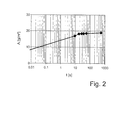
- Samples P were measured and weighed and placed in the beaker 2 filled with a 0.5% HCl solution L for different time intervals with activated ultrasonic operation at an ultrasonic frequency of 38 kHz.
- the material removal achieved in each case in the ultrasound bath U was determined for each time interval by reweighing and converted into g / m 2 for indication as material removal per unit area.
- samples of the wire rod were measured and weighed and inserted for different time intervals in activated ultrasonic mode at an ultrasonic frequency of 38 kHz in the filled with a 0.5% HCl solution L insert cup 2.
- the material removal was then determined for each time interval by reweighing and the material removal in g / m 2 converted.
- the ultrasound-assisted acid treatment based on an acid bath consisting of a 0.5% strength HCl solution can accordingly only replace the phosphate layer and scarcely attacks the underlying base material.
- the coating weight of the zinc phosphating of wire rod of engineering grade 1.3505 (100Cr6) was determined.
- the samples were divided into 2 groups.
- sample group 1 was measured by the method according to the invention as described for working example 1.
- the weighed and measured samples P were inserted into the fixed insert beaker 2 for 30 seconds each with activated ultrasound operation.
- the beaker 2 contained as acid bath a 0.5% HCl solution.
- the ultrasonic frequency was 35 kHz.
- the dephosphated samples P were removed, rinsed, dried and re-weighed.
- the entire measuring method according to the invention lasted under 5 minutes per sample P.
- sample group 2 was measured according to the specifications of DIN EN ISO 3892.
- a strong alkaline release agent was prepared (10 wt .-% NaOH, 9 wt .-% EDTA tetrasodium salt, 0.4 wt .-% triethanolamine) and heated under the hood in a beaker to 70 ° C.
- fresh release agent was used for each sample according to DIN EN ISO 3892.
- the dephosphated samples were rinsed, dried and re-weighed.
- the weight difference before and after desphosphating was then related to the known surface of the sample and the coating weight, expressed in coating weight in g / m 2 , was calculated.
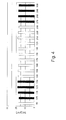
- the occupancy weights Sd thus determined for the samples are in FIG. 4 shown.
- the coating weights Sd of the samples with the sample numbers 1B, 14B, 15B, 16B, 17B, 18B, 19B, 20B, 21B, 22B and 26B determined according to DIN EN ISO 3892 are white bars and those for the samples having the sample numbers 10B, 11B, 12B, 13B, 27B, 28B, 29B and 30B in accordance with the invention determined occupancy weights Sd indicated as black bars.
- the deviation from DIN EN ISO 3892 amounts to an average of +1 g / m 2 for the examined samples and is reproducible. After deducting this correction factor determined by applying the ultrasonic dephosphation according to the invention occupancy weights Sd with the mean of the according to DIN EN ISO 3892 determined occupancy weights Sd in a sufficient for practice dimensions.
Landscapes
- Chemical & Material Sciences (AREA)
- Chemical Kinetics & Catalysis (AREA)
- General Chemical & Material Sciences (AREA)
- Engineering & Computer Science (AREA)
- Materials Engineering (AREA)
- Mechanical Engineering (AREA)
- Metallurgy (AREA)
- Organic Chemistry (AREA)
- Physics & Mathematics (AREA)
- Health & Medical Sciences (AREA)
- Life Sciences & Earth Sciences (AREA)
- Analytical Chemistry (AREA)
- Biochemistry (AREA)
- General Health & Medical Sciences (AREA)
- General Physics & Mathematics (AREA)
- Immunology (AREA)
- Pathology (AREA)
- Chemical Treatment Of Metals (AREA)
- Investigating And Analyzing Materials By Characteristic Methods (AREA)
Applications Claiming Priority (1)
| Application Number | Priority Date | Filing Date | Title |
|---|---|---|---|
| DE201110051696 DE102011051696B3 (de) | 2011-07-08 | 2011-07-08 | Verfahren zur Messung der Schichtdicke von organischen Beschichtungen metallischer Grundwerkstoffe |
Publications (2)
| Publication Number | Publication Date |
|---|---|
| EP2543986A2 true EP2543986A2 (fr) | 2013-01-09 |
| EP2543986A3 EP2543986A3 (fr) | 2015-03-04 |
Family
ID=46458301
Family Applications (1)
| Application Number | Title | Priority Date | Filing Date |
|---|---|---|---|
| EP12174971.7A Withdrawn EP2543986A3 (fr) | 2011-07-08 | 2012-07-04 | Procédé de mesure de l'épaisseur de couche de revêtements organiques de matériaux de base métalliques |
Country Status (2)
| Country | Link |
|---|---|
| EP (1) | EP2543986A3 (fr) |
| DE (1) | DE102011051696B3 (fr) |
Cited By (1)
| Publication number | Priority date | Publication date | Assignee | Title |
|---|---|---|---|---|
| CN106706462A (zh) * | 2017-03-13 | 2017-05-24 | 湖北富亿建材股份有限公司 | 一种高分子防水卷材质量监控设备 |
Families Citing this family (2)
| Publication number | Priority date | Publication date | Assignee | Title |
|---|---|---|---|---|
| CN113340758A (zh) * | 2021-06-02 | 2021-09-03 | 山东省海洋资源与环境研究院(山东省海洋环境监测中心、山东省水产品质量检验中心) | 一种从海水中获取栉孔扇贝饵料的装置、检测栉孔扇贝饵料中镉含量的方法 |
| CN113933207A (zh) * | 2021-10-22 | 2022-01-14 | 骆驼集团华中蓄电池有限公司 | 一种评价铅酸电池质量的定量方法 |
Family Cites Families (3)
| Publication number | Priority date | Publication date | Assignee | Title |
|---|---|---|---|---|
| JPS52104556A (en) * | 1976-02-28 | 1977-09-02 | Matsushita Electric Works Ltd | Process for stripping inorganic coats |
| DE4016076A1 (de) * | 1990-05-18 | 1991-08-22 | Boehringer Ingelheim Kg | Verfahren und vorrichtung zur kontinuierlichen duchfuehrung sonochemischer reaktionen |
| EP1411149A1 (fr) * | 2002-10-18 | 2004-04-21 | Siemens Aktiengesellschaft | Procédé pour l'enlèvement d'un revêtement d'un composant |
-
2011
- 2011-07-08 DE DE201110051696 patent/DE102011051696B3/de not_active Expired - Fee Related
-
2012
- 2012-07-04 EP EP12174971.7A patent/EP2543986A3/fr not_active Withdrawn
Non-Patent Citations (1)
| Title |
|---|
| RÖMPP-KOMPAKTLEXIKON BASISLEXIKON CHEMIE, 1999, pages 1944 |
Cited By (1)
| Publication number | Priority date | Publication date | Assignee | Title |
|---|---|---|---|---|
| CN106706462A (zh) * | 2017-03-13 | 2017-05-24 | 湖北富亿建材股份有限公司 | 一种高分子防水卷材质量监控设备 |
Also Published As
| Publication number | Publication date |
|---|---|
| EP2543986A3 (fr) | 2015-03-04 |
| DE102011051696B3 (de) | 2012-08-02 |
Similar Documents
| Publication | Publication Date | Title |
|---|---|---|
| EP2588646B1 (fr) | Procédé de phosphatation sélective d'une construction métallique composite | |
| EP1888819B1 (fr) | Procédé de préparation de pièces métalliques pour le formage à froid | |
| EP2092090A1 (fr) | Solution de phosphatage à base de zr/ti utilisée pour passiver des surfaces composites métalliques | |
| DE102017207237A1 (de) | Verfahren zur korrosionsschützenden Behandlung einer metallischen Oberfläche mit vermindertem Beizabtrag | |
| DE69906555T2 (de) | Verzinkte, mit einer hydroxysulfat-schmierschicht überzogene stahlbleche und verfahren zur herstellung | |
| DE102011051696B3 (de) | Verfahren zur Messung der Schichtdicke von organischen Beschichtungen metallischer Grundwerkstoffe | |
| DE69600613T2 (de) | Verfahren zur Oberflächenbehandlung von mit Zink oder Zinklegierung teilplattiertem Stahlblech | |
| EP3230491B1 (fr) | Réception de métaux légers dans un procédé de prétraitement et de décapage de l'acier | |
| EP3755825A1 (fr) | Procédé de phosphatation sélective d'une construction métallique composite | |
| DE3812692A1 (de) | Verfahren zur vorbereitung von werkstuecken aus titan oder titanlegierungen | |
| DE10322446A1 (de) | Vorbehandlung von Metalloberflächen vor einer Lackierung | |
| WO2015039762A1 (fr) | Couche de conversion anorganique à base de carbonate, appliquée sur de l'acier galvanisé | |
| EP0042631A1 (fr) | Procédé de phosphatation de surfaces métalliques | |
| WO1991002829A2 (fr) | Procede pour la realisation de revetements de phosphate de zinc comportant du manganese sur de l'acier galvanise | |
| EP1290242B1 (fr) | Procede pour traiter ou pretraiter des pieces comportant des surfaces en aluminium | |
| EP2893054A1 (fr) | Procédé de traitement de surface anticorrosion d'éléments métalliques en série | |
| DE69303525T2 (de) | Verfahren zur Herstellung eines Films durch chemische Umwandlung | |
| DE10309888B4 (de) | Bearbeitungsfluid zur Oberflächenbearbeitung von Aluminium oder einer Aluminiumlegierung und entsprechendes Oberflächenbearbeitungsverfahren | |
| DE3700933A1 (de) | Verfahren zur erleichterung der kaltumformung von edelstahl | |
| EP3405600B1 (fr) | Procédé de fabrication d'un produit en acier doté d'un revêtement de zinc et d'une couche active tribilogiquement appliquée sur celui-ci ainsi que produit en acier obtenu de maniere correspondante | |
| DE60115843T2 (de) | Verfahren zur oxalierung einer zinkbeschichteten bandoberfläche | |
| EP3456864B1 (fr) | Prétraitement d'aluminium, en particulier d'alliages d'aluminium, à deux étapes comprenant le bain de décapage et le traitement de conversion | |
| DE102014203412A1 (de) | Verfahren und Formulierung zur gleichzeitigen Entschichtung und Passivierung von Edelstahloberflächen | |
| DE69001680T2 (de) | Methode zum Einschmieren von Eisen und Stahl vor der Kaltverarbeitung. | |
| DE2034627C3 (de) | Verfahren zum Phosphatieren von Eisen und Stahl |
Legal Events
| Date | Code | Title | Description |
|---|---|---|---|
| PUAI | Public reference made under article 153(3) epc to a published international application that has entered the european phase |
Free format text: ORIGINAL CODE: 0009012 |
|
| AK | Designated contracting states |
Kind code of ref document: A2 Designated state(s): AL AT BE BG CH CY CZ DE DK EE ES FI FR GB GR HR HU IE IS IT LI LT LU LV MC MK MT NL NO PL PT RO RS SE SI SK SM TR |
|
| AX | Request for extension of the european patent |
Extension state: BA ME |
|
| RIN1 | Information on inventor provided before grant (corrected) |
Inventor name: KOZARISZCZUK, MATTHIAS DR. Inventor name: BANGE, SEBASTIAN |
|
| PUAL | Search report despatched |
Free format text: ORIGINAL CODE: 0009013 |
|
| AK | Designated contracting states |
Kind code of ref document: A3 Designated state(s): AL AT BE BG CH CY CZ DE DK EE ES FI FR GB GR HR HU IE IS IT LI LT LU LV MC MK MT NL NO PL PT RO RS SE SI SK SM TR |
|
| AX | Request for extension of the european patent |
Extension state: BA ME |
|
| RIC1 | Information provided on ipc code assigned before grant |
Ipc: C23G 1/08 20060101ALN20150126BHEP Ipc: G01N 5/04 20060101AFI20150126BHEP Ipc: B08B 3/12 20060101ALN20150126BHEP |
|
| STAA | Information on the status of an ep patent application or granted ep patent |
Free format text: STATUS: THE APPLICATION IS DEEMED TO BE WITHDRAWN |
|
| 18D | Application deemed to be withdrawn |
Effective date: 20150905 |