EP2550102B1 - Zone de regeneration du catalyseur divisee en secteurs pour unites catalytiques regeneratives - Google Patents
Zone de regeneration du catalyseur divisee en secteurs pour unites catalytiques regeneratives Download PDFInfo
- Publication number
- EP2550102B1 EP2550102B1 EP11709998.6A EP11709998A EP2550102B1 EP 2550102 B1 EP2550102 B1 EP 2550102B1 EP 11709998 A EP11709998 A EP 11709998A EP 2550102 B1 EP2550102 B1 EP 2550102B1
- Authority
- EP
- European Patent Office
- Prior art keywords
- combustion
- sectors
- stage
- sector
- catalyst
- Prior art date
- Legal status (The legal status is an assumption and is not a legal conclusion. Google has not performed a legal analysis and makes no representation as to the accuracy of the status listed.)
- Not-in-force
Links
Images

Classifications
-
- B—PERFORMING OPERATIONS; TRANSPORTING
- B01—PHYSICAL OR CHEMICAL PROCESSES OR APPARATUS IN GENERAL
- B01J—CHEMICAL OR PHYSICAL PROCESSES, e.g. CATALYSIS OR COLLOID CHEMISTRY; THEIR RELEVANT APPARATUS
- B01J8/00—Chemical or physical processes in general, conducted in the presence of fluids and solid particles; Apparatus for such processes
- B01J8/08—Chemical or physical processes in general, conducted in the presence of fluids and solid particles; Apparatus for such processes with moving particles
- B01J8/12—Chemical or physical processes in general, conducted in the presence of fluids and solid particles; Apparatus for such processes with moving particles moved by gravity in a downward flow
- B01J8/125—Chemical or physical processes in general, conducted in the presence of fluids and solid particles; Apparatus for such processes with moving particles moved by gravity in a downward flow with multiple sections one above the other separated by distribution aids, e.g. reaction and regeneration sections
-
- B—PERFORMING OPERATIONS; TRANSPORTING
- B01—PHYSICAL OR CHEMICAL PROCESSES OR APPARATUS IN GENERAL
- B01J—CHEMICAL OR PHYSICAL PROCESSES, e.g. CATALYSIS OR COLLOID CHEMISTRY; THEIR RELEVANT APPARATUS
- B01J38/00—Regeneration or reactivation of catalysts, in general
-
- B—PERFORMING OPERATIONS; TRANSPORTING
- B01—PHYSICAL OR CHEMICAL PROCESSES OR APPARATUS IN GENERAL
- B01J—CHEMICAL OR PHYSICAL PROCESSES, e.g. CATALYSIS OR COLLOID CHEMISTRY; THEIR RELEVANT APPARATUS
- B01J38/00—Regeneration or reactivation of catalysts, in general
- B01J38/02—Heat treatment
-
- B—PERFORMING OPERATIONS; TRANSPORTING
- B01—PHYSICAL OR CHEMICAL PROCESSES OR APPARATUS IN GENERAL
- B01J—CHEMICAL OR PHYSICAL PROCESSES, e.g. CATALYSIS OR COLLOID CHEMISTRY; THEIR RELEVANT APPARATUS
- B01J38/00—Regeneration or reactivation of catalysts, in general
- B01J38/04—Gas or vapour treating; Treating by using liquids vaporisable upon contacting spent catalyst
- B01J38/12—Treating with free oxygen-containing gas
-
- B—PERFORMING OPERATIONS; TRANSPORTING
- B01—PHYSICAL OR CHEMICAL PROCESSES OR APPARATUS IN GENERAL
- B01J—CHEMICAL OR PHYSICAL PROCESSES, e.g. CATALYSIS OR COLLOID CHEMISTRY; THEIR RELEVANT APPARATUS
- B01J38/00—Regeneration or reactivation of catalysts, in general
- B01J38/04—Gas or vapour treating; Treating by using liquids vaporisable upon contacting spent catalyst
- B01J38/12—Treating with free oxygen-containing gas
- B01J38/14—Treating with free oxygen-containing gas with control of oxygen content in oxidation gas
-
- B—PERFORMING OPERATIONS; TRANSPORTING
- B01—PHYSICAL OR CHEMICAL PROCESSES OR APPARATUS IN GENERAL
- B01J—CHEMICAL OR PHYSICAL PROCESSES, e.g. CATALYSIS OR COLLOID CHEMISTRY; THEIR RELEVANT APPARATUS
- B01J38/00—Regeneration or reactivation of catalysts, in general
- B01J38/04—Gas or vapour treating; Treating by using liquids vaporisable upon contacting spent catalyst
- B01J38/12—Treating with free oxygen-containing gas
- B01J38/20—Plural distinct oxidation stages
-
- B—PERFORMING OPERATIONS; TRANSPORTING
- B01—PHYSICAL OR CHEMICAL PROCESSES OR APPARATUS IN GENERAL
- B01J—CHEMICAL OR PHYSICAL PROCESSES, e.g. CATALYSIS OR COLLOID CHEMISTRY; THEIR RELEVANT APPARATUS
- B01J38/00—Regeneration or reactivation of catalysts, in general
- B01J38/04—Gas or vapour treating; Treating by using liquids vaporisable upon contacting spent catalyst
- B01J38/12—Treating with free oxygen-containing gas
- B01J38/22—Moving bed, e.g. vertically or horizontally moving bulk
- B01J38/24—Moving bed, e.g. vertically or horizontally moving bulk having mainly transverse, i.e. lateral, flow of oxygen-containing gas and material
-
- B—PERFORMING OPERATIONS; TRANSPORTING
- B01—PHYSICAL OR CHEMICAL PROCESSES OR APPARATUS IN GENERAL
- B01J—CHEMICAL OR PHYSICAL PROCESSES, e.g. CATALYSIS OR COLLOID CHEMISTRY; THEIR RELEVANT APPARATUS
- B01J38/00—Regeneration or reactivation of catalysts, in general
- B01J38/04—Gas or vapour treating; Treating by using liquids vaporisable upon contacting spent catalyst
- B01J38/12—Treating with free oxygen-containing gas
- B01J38/30—Treating with free oxygen-containing gas in gaseous suspension, e.g. fluidised bed
- B01J38/32—Indirectly heating or cooling material within regeneration zone or prior to entry into regeneration zone
-
- B—PERFORMING OPERATIONS; TRANSPORTING
- B01—PHYSICAL OR CHEMICAL PROCESSES OR APPARATUS IN GENERAL
- B01J—CHEMICAL OR PHYSICAL PROCESSES, e.g. CATALYSIS OR COLLOID CHEMISTRY; THEIR RELEVANT APPARATUS
- B01J38/00—Regeneration or reactivation of catalysts, in general
- B01J38/04—Gas or vapour treating; Treating by using liquids vaporisable upon contacting spent catalyst
- B01J38/12—Treating with free oxygen-containing gas
- B01J38/30—Treating with free oxygen-containing gas in gaseous suspension, e.g. fluidised bed
- B01J38/34—Treating with free oxygen-containing gas in gaseous suspension, e.g. fluidised bed with plural distinct serial combustion stages
-
- B—PERFORMING OPERATIONS; TRANSPORTING
- B01—PHYSICAL OR CHEMICAL PROCESSES OR APPARATUS IN GENERAL
- B01J—CHEMICAL OR PHYSICAL PROCESSES, e.g. CATALYSIS OR COLLOID CHEMISTRY; THEIR RELEVANT APPARATUS
- B01J38/00—Regeneration or reactivation of catalysts, in general
- B01J38/04—Gas or vapour treating; Treating by using liquids vaporisable upon contacting spent catalyst
- B01J38/12—Treating with free oxygen-containing gas
- B01J38/38—Treating with free oxygen-containing gas and adding heat by solid heat carrier
-
- B—PERFORMING OPERATIONS; TRANSPORTING
- B01—PHYSICAL OR CHEMICAL PROCESSES OR APPARATUS IN GENERAL
- B01J—CHEMICAL OR PHYSICAL PROCESSES, e.g. CATALYSIS OR COLLOID CHEMISTRY; THEIR RELEVANT APPARATUS
- B01J38/00—Regeneration or reactivation of catalysts, in general
- B01J38/04—Gas or vapour treating; Treating by using liquids vaporisable upon contacting spent catalyst
- B01J38/42—Gas or vapour treating; Treating by using liquids vaporisable upon contacting spent catalyst using halogen-containing material
- B01J38/44—Gas or vapour treating; Treating by using liquids vaporisable upon contacting spent catalyst using halogen-containing material and adding simultaneously or subsequently free oxygen; using oxyhalogen compound
-
- C—CHEMISTRY; METALLURGY
- C10—PETROLEUM, GAS OR COKE INDUSTRIES; TECHNICAL GASES CONTAINING CARBON MONOXIDE; FUELS; LUBRICANTS; PEAT
- C10G—CRACKING HYDROCARBON OILS; PRODUCTION OF LIQUID HYDROCARBON MIXTURES, e.g. BY DESTRUCTIVE HYDROGENATION, OLIGOMERISATION, POLYMERISATION; RECOVERY OF HYDROCARBON OILS FROM OIL-SHALE, OIL-SAND, OR GASES; REFINING MIXTURES MAINLY CONSISTING OF HYDROCARBONS; REFORMING OF NAPHTHA; MINERAL WAXES
- C10G11/00—Catalytic cracking, in the absence of hydrogen, of hydrocarbon oils
-
- C—CHEMISTRY; METALLURGY
- C10—PETROLEUM, GAS OR COKE INDUSTRIES; TECHNICAL GASES CONTAINING CARBON MONOXIDE; FUELS; LUBRICANTS; PEAT
- C10G—CRACKING HYDROCARBON OILS; PRODUCTION OF LIQUID HYDROCARBON MIXTURES, e.g. BY DESTRUCTIVE HYDROGENATION, OLIGOMERISATION, POLYMERISATION; RECOVERY OF HYDROCARBON OILS FROM OIL-SHALE, OIL-SAND, OR GASES; REFINING MIXTURES MAINLY CONSISTING OF HYDROCARBONS; REFORMING OF NAPHTHA; MINERAL WAXES
- C10G11/00—Catalytic cracking, in the absence of hydrogen, of hydrocarbon oils
- C10G11/14—Catalytic cracking, in the absence of hydrogen, of hydrocarbon oils with preheated moving solid catalysts
- C10G11/18—Catalytic cracking, in the absence of hydrogen, of hydrocarbon oils with preheated moving solid catalysts according to the "fluidised-bed" technique
- C10G11/187—Controlling or regulating
-
- C—CHEMISTRY; METALLURGY
- C10—PETROLEUM, GAS OR COKE INDUSTRIES; TECHNICAL GASES CONTAINING CARBON MONOXIDE; FUELS; LUBRICANTS; PEAT
- C10G—CRACKING HYDROCARBON OILS; PRODUCTION OF LIQUID HYDROCARBON MIXTURES, e.g. BY DESTRUCTIVE HYDROGENATION, OLIGOMERISATION, POLYMERISATION; RECOVERY OF HYDROCARBON OILS FROM OIL-SHALE, OIL-SAND, OR GASES; REFINING MIXTURES MAINLY CONSISTING OF HYDROCARBONS; REFORMING OF NAPHTHA; MINERAL WAXES
- C10G35/00—Reforming naphtha
-
- C—CHEMISTRY; METALLURGY
- C10—PETROLEUM, GAS OR COKE INDUSTRIES; TECHNICAL GASES CONTAINING CARBON MONOXIDE; FUELS; LUBRICANTS; PEAT
- C10G—CRACKING HYDROCARBON OILS; PRODUCTION OF LIQUID HYDROCARBON MIXTURES, e.g. BY DESTRUCTIVE HYDROGENATION, OLIGOMERISATION, POLYMERISATION; RECOVERY OF HYDROCARBON OILS FROM OIL-SHALE, OIL-SAND, OR GASES; REFINING MIXTURES MAINLY CONSISTING OF HYDROCARBONS; REFORMING OF NAPHTHA; MINERAL WAXES
- C10G45/00—Refining of hydrocarbon oils using hydrogen or hydrogen-generating compounds
-
- C—CHEMISTRY; METALLURGY
- C10—PETROLEUM, GAS OR COKE INDUSTRIES; TECHNICAL GASES CONTAINING CARBON MONOXIDE; FUELS; LUBRICANTS; PEAT
- C10G—CRACKING HYDROCARBON OILS; PRODUCTION OF LIQUID HYDROCARBON MIXTURES, e.g. BY DESTRUCTIVE HYDROGENATION, OLIGOMERISATION, POLYMERISATION; RECOVERY OF HYDROCARBON OILS FROM OIL-SHALE, OIL-SAND, OR GASES; REFINING MIXTURES MAINLY CONSISTING OF HYDROCARBONS; REFORMING OF NAPHTHA; MINERAL WAXES
- C10G45/00—Refining of hydrocarbon oils using hydrogen or hydrogen-generating compounds
- C10G45/58—Refining of hydrocarbon oils using hydrogen or hydrogen-generating compounds to change the structural skeleton of some of the hydrocarbon content without cracking the other hydrocarbons present, e.g. lowering pour point; Selective hydrocracking of normal paraffins
-
- B—PERFORMING OPERATIONS; TRANSPORTING
- B01—PHYSICAL OR CHEMICAL PROCESSES OR APPARATUS IN GENERAL
- B01J—CHEMICAL OR PHYSICAL PROCESSES, e.g. CATALYSIS OR COLLOID CHEMISTRY; THEIR RELEVANT APPARATUS
- B01J2208/00—Processes carried out in the presence of solid particles; Reactors therefor
- B01J2208/00008—Controlling the process
- B01J2208/00017—Controlling the temperature
- B01J2208/00327—Controlling the temperature by direct heat exchange
- B01J2208/00336—Controlling the temperature by direct heat exchange adding a temperature modifying medium to the reactants
- B01J2208/00353—Non-cryogenic fluids
- B01J2208/00371—Non-cryogenic fluids gaseous
-
- B—PERFORMING OPERATIONS; TRANSPORTING
- B01—PHYSICAL OR CHEMICAL PROCESSES OR APPARATUS IN GENERAL
- B01J—CHEMICAL OR PHYSICAL PROCESSES, e.g. CATALYSIS OR COLLOID CHEMISTRY; THEIR RELEVANT APPARATUS
- B01J2208/00—Processes carried out in the presence of solid particles; Reactors therefor
- B01J2208/00008—Controlling the process
- B01J2208/00017—Controlling the temperature
- B01J2208/00504—Controlling the temperature by means of a burner
-
- C—CHEMISTRY; METALLURGY
- C10—PETROLEUM, GAS OR COKE INDUSTRIES; TECHNICAL GASES CONTAINING CARBON MONOXIDE; FUELS; LUBRICANTS; PEAT
- C10G—CRACKING HYDROCARBON OILS; PRODUCTION OF LIQUID HYDROCARBON MIXTURES, e.g. BY DESTRUCTIVE HYDROGENATION, OLIGOMERISATION, POLYMERISATION; RECOVERY OF HYDROCARBON OILS FROM OIL-SHALE, OIL-SAND, OR GASES; REFINING MIXTURES MAINLY CONSISTING OF HYDROCARBONS; REFORMING OF NAPHTHA; MINERAL WAXES
- C10G2300/00—Aspects relating to hydrocarbon processing covered by groups C10G1/00 - C10G99/00
- C10G2300/70—Catalyst aspects
-
- C—CHEMISTRY; METALLURGY
- C10—PETROLEUM, GAS OR COKE INDUSTRIES; TECHNICAL GASES CONTAINING CARBON MONOXIDE; FUELS; LUBRICANTS; PEAT
- C10G—CRACKING HYDROCARBON OILS; PRODUCTION OF LIQUID HYDROCARBON MIXTURES, e.g. BY DESTRUCTIVE HYDROGENATION, OLIGOMERISATION, POLYMERISATION; RECOVERY OF HYDROCARBON OILS FROM OIL-SHALE, OIL-SAND, OR GASES; REFINING MIXTURES MAINLY CONSISTING OF HYDROCARBONS; REFORMING OF NAPHTHA; MINERAL WAXES
- C10G2300/00—Aspects relating to hydrocarbon processing covered by groups C10G1/00 - C10G99/00
- C10G2300/70—Catalyst aspects
- C10G2300/708—Coking aspect, coke content and composition of deposits
-
- Y—GENERAL TAGGING OF NEW TECHNOLOGICAL DEVELOPMENTS; GENERAL TAGGING OF CROSS-SECTIONAL TECHNOLOGIES SPANNING OVER SEVERAL SECTIONS OF THE IPC; TECHNICAL SUBJECTS COVERED BY FORMER USPC CROSS-REFERENCE ART COLLECTIONS [XRACs] AND DIGESTS
- Y10—TECHNICAL SUBJECTS COVERED BY FORMER USPC
- Y10S—TECHNICAL SUBJECTS COVERED BY FORMER USPC CROSS-REFERENCE ART COLLECTIONS [XRACs] AND DIGESTS
- Y10S502/00—Catalyst, solid sorbent, or support therefor: product or process of making
- Y10S502/514—Process applicable either to preparing or to regenerating or to rehabilitating catalyst or sorbent
-
- Y—GENERAL TAGGING OF NEW TECHNOLOGICAL DEVELOPMENTS; GENERAL TAGGING OF CROSS-SECTIONAL TECHNOLOGIES SPANNING OVER SEVERAL SECTIONS OF THE IPC; TECHNICAL SUBJECTS COVERED BY FORMER USPC CROSS-REFERENCE ART COLLECTIONS [XRACs] AND DIGESTS
- Y10—TECHNICAL SUBJECTS COVERED BY FORMER USPC
- Y10S—TECHNICAL SUBJECTS COVERED BY FORMER USPC CROSS-REFERENCE ART COLLECTIONS [XRACs] AND DIGESTS
- Y10S502/00—Catalyst, solid sorbent, or support therefor: product or process of making
- Y10S502/515—Specific contaminant removal
-
- Y—GENERAL TAGGING OF NEW TECHNOLOGICAL DEVELOPMENTS; GENERAL TAGGING OF CROSS-SECTIONAL TECHNOLOGIES SPANNING OVER SEVERAL SECTIONS OF THE IPC; TECHNICAL SUBJECTS COVERED BY FORMER USPC CROSS-REFERENCE ART COLLECTIONS [XRACs] AND DIGESTS
- Y10—TECHNICAL SUBJECTS COVERED BY FORMER USPC
- Y10S—TECHNICAL SUBJECTS COVERED BY FORMER USPC CROSS-REFERENCE ART COLLECTIONS [XRACs] AND DIGESTS
- Y10S502/00—Catalyst, solid sorbent, or support therefor: product or process of making
- Y10S502/515—Specific contaminant removal
- Y10S502/518—Carbonaceous contaminant
Definitions
- the present invention is in the field of units using mobile bed technology, a technology that is found, for example, in the catalytic reforming units of gasolines, in skeletal isomerization units, in metathesis units or in in certain oligocracking or dehydrogenation units.
- This technology is characterized by the fact that the catalytic bed follows a slow gravitational movement while the load to be treated crosses the bed transversely or radially. To do this the charge is generally introduced at the periphery of the catalytic bed in gravity flow, and the effluents of the reaction are collected in a central collector. Circulation from the center to the periphery of the catalytic bed is also possible.
- the regeneration zone of the coked catalyst is also used according to the technology of the moving bed.
- This regeneration zone comprises several stages of combustion, oxychlorination, calcination and reduction of the catalyst which are described in FIGS. FR2641712 , FR2761910 and FR2922786 for example.
- the present invention relates more particularly to an arrangement of the combustion zone forming part of the regeneration zone, this combustion zone being divided into radial sectors, each sector being traversed by the combustion gas along a specific path.
- the advantages of this new configuration over the prior art are better temperature control of said combustion zone and optimized consumption of oxidizing gas.
- the present invention also entails a simplification of the combustion zone internals with respect to the prior art.
- regenerative units such as, for example, catalytic reforming of gasolines
- the regeneration of the coked catalyst after its passage in the reaction zone is carried out continuously.
- the catalyst is continuously extracted from the reactor (s), purged from the hydrogen it contains and sent to a regeneration zone in which the coke is burned in a controlled manner. to restore the activity of the catalyst.
- Other operations are carried out in the regeneration zone such as oxychlorination, calcination and reduction of the catalyst, but the present invention particularly relates to the combustion zone.
- the combustion of the coke is generally carried out in two thin radial beds disposed in a ring in which the catalyst flows from top to bottom at low speed by gravity flow, the combustion gas flowing horizontally through the radial bed, most often from outside the bed to the inside.
- the gases withdrawn from the different regeneration zones are recovered and treated so that they can be recycled back into the regeneration zone. Indeed, according to the prior art it is known to dilute oxygen with nitrogen. Nitrogen is a very expensive gas. For example, for a reforming unit of 40 tons of catalyst, if one did not reuse the regeneration gases, one would be led to use about 6000 to 10000 Nm3 / h of nitrogen.
- the regeneration gas circuit includes various expensive equipment such as recycle compressor, dryer, electric furnace and exchanger. Any reduction in the nitrogen flow therefore has a very important impact on the investment costs and the operating costs of the catalyst regeneration loop.
- One of the objects of the present invention is to optimize the use of the inert gas flow and thus reduce the size of equipment for the same amount of regenerated catalyst, using a regeneration zone of a new type.
- the combustion is managed by the concept of molar composition with a constant oxygen content at the inlet of each sector. This results in a variation of the amount of coke burned from one sector to another of the same floor, and therefore a possible inhomogeneity of the combustion quality in the different sectors.
- the present invention is the molar rate of oxygen that is kept constant on all sectors of a stage so that the amount of coke burned is the same on all sectors of a stage.
- the improvement of the homogeneity of the combustion on all the sectors constituting a stage thus guarantees optimized catalytic performances, necessary to obtain the high octane numbers sought for example in the regenerative reforming units.
- the present invention describes a method of regenerating a coked catalyst at the end of a reaction zone, the catalyst circulating in the regeneration zone in the moving bed state.
- a moving bed is understood to mean a mode of gravitational circulation of the catalyst, the gas enabling the regeneration of said catalyst in the regeneration zone flowing in a direction substantially perpendicular to that of the flow of the catalyst.
- the present invention consists more precisely of a regeneration process of the coked catalyst at the end of the reaction zone which comprises at least one combustion zone of the coke deposited on the catalyst. This process is defined in claims 1 to 5.
- the regeneration process according to the present invention can be applied to so-called regenerative units in which the coked catalyst during the reaction must be regenerated continuously.
- the catalyst regeneration process generally consists of a step of oxychlorination, calcination followed by a step of reducing the catalyst.
- the regenerated catalyst is reintroduced into the reaction zone.
- the steps downstream of the combustion step are not part of the present invention which is perfectly compatible with any embodiment of said downstream steps.
- the present invention therefore relates to the combustion step of the regeneration zone, hereinafter called the combustion zone.
- the combustion zone according to the present invention is a two-stage zone in which the catalyst circulates in a moving bed, that is to say in gravity flow, and in which the oxidizing gas crosses the catalyst bed radially, preferably from the periphery. external bed to its inner periphery.
- the catalyst bed has an annular shape and is divided into a number of radial sectors.
- the sectors of the first combustion stage are numbered from 1 to N, and the sectors of the second stage are numbered from 1 'to N'.
- a sector i of the first stage and the sector i 'of the second stage are approximately plumb with each other, and the number of sectors of the first stage and equal to the number of sectors of the second stage.
- the sectors i and i ', in line with one another, are called corresponding sectors.
- the circulation of the combustion gas consists in traversing all the sectors of the first stage in any order, then all the sectors of the second stage in any order.
- a possible circulation circuit according to the present invention is the circuit 1, 2, 3, 4, 1 ', 2', 3 ', 4'.
- circuit 1, 2, 3, 4, 4 ', 3', 2 ', 1' Another possible circuit is the circuit 1, 2, 3, 4, 4 ', 3', 2 ', 1', depending on how the transition of the combustion gas between the two combustion stages is ensured.
- each combustion stage operates with a constant oxygen molar flow rate. More precisely, each sector of a given combustion stage receives as input an oxidizing gas such that the molar flow rate of oxygen is always the same.
- the quantity of oxygen introduced into each sector corresponds to the combustion of a quantity of coke comprised between 50% and 90% of the total coke deposited on the catalyst, and preferably between 60% and 80%. %, and at the level of the second stage, the amount of oxygen introduced corresponds to the total combustion of the residual coke.
- the oxidizing gas is introduced on all sectors of the second stage in excess, this excess being quantifiable by an excess of oxygen at the outlet of the sector of between 0.1% and 0.5% and preferably between 0.2%. % and 0.4% oxygen.
- the number of combustion stage is two, and the number of sectors per stage is between 2 and 8, and preferably between 2 and 4.
- Additions of a cooling gas are made at the inlet of each sector so as to maintain the inlet temperature between 460 ° C and 480 ° C for the first stage sectors, and 470 ° C at 490 ° C for the sectors of the second floor.
- This cooling gas is generally the combustion gas taken out of the compressor of the recycle loop, therefore before it passes through the series of exchangers and / or reheating furnaces forming part of the conventional circuit for regenerative reforming type units.
- Cooling gas backups are usually done by means of specific lines that open into the lines to connect the output of a sector to the entrance of the neighboring sector. In this same line, the cooling gas is mixed with a flow of oxidizing gas in order to allow the addition of oxidant between the different sectors of the same floor.
- the oxidizing gas can generally contain between 4% and 21% oxygen.
- a variant of the combustion zone according to the present invention is to no longer cool the oxidizing gas by cooling gas additions, but by using heat exchangers thus further reducing substantially the total oxidizer gas flow required for regeneration catalyst.
- Another variant of the process consists in simplifying the combustion gas distribution circuit by adopting an alternating configuration between the different sectors.
- alternating configuration is meant a configuration in which the oxidant gas flows from the outside to the inside over a given sector, and then flows from the inside out to the next sector, and so on.
- the next sector of a given sector is the geometrically neighboring sector which is traversed by the oxidizing gas.
- the present invention can be described as a combustion zone for regenerative units, for example for regenerative reforming or skeletal isomerization in which the flow of the catalyst takes place in a moving bed (that is to say in gravity flow) from a first stage up to a second stage, each stage being divided into a number of radial sectors, and the circulation of the oxidizing gas following a circuit characterized in that the combustion gas passes successively through all the sectors of the first stage, then successively all sectors of the second floor.
- the catalyst regeneration zone comprises, in addition to the combustion zone which allows the combustion of the coke deposited on the catalyst, other zones in which Oxychlorination, calcination and reduction of the catalyst are carried out. These other areas will not be described in this text because they remain according to their configuration of the prior art.
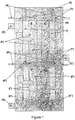
- the figure 1 allows to visualize the structure of the regeneration zone according to the invention. We describe below the catalyst circuit in sector 4, and that of the oxidant gas in sector 1.
- the numbering of the sectors of the first combustion stage is: 1, 2, 3, 4.
- the numbering of the sectors of the second stage, vis-à-vis those of the first combustion stage is: 1 ', 2', 3 'and 4'. These sectors are separated by walls (9). The sectors which are plumb with each other such that 1 and 1 ', 2 and 2', 3 and 3 ', 4 and 4' are said corresponding sectors.
- the catalyst is introduced into the upper chamber (I) by the leg (5) and circulates in the enclosure (I) of the sector 4 in gravity flow, then it passes through the leg (5 ') to be introduced into the lower enclosure (I ') of the sector 4'. It leaves the sector 4 'by the line of descent (5 ").
- the oxidizing gas is introduced into the enclosure (I) by the peripheral pipe (E) communicating with the sector 1, a baffle (6) forcing the gas to circulate towards the crown outside this area.
- the gas passes radially through the catalytic bed (I) from the outer periphery to the inner periphery of the catalytic bed, and is found in the annular space (II).
- This annular space (II) makes it possible to return the oxidizing gas via the line (7) to the inlet of the next sector of the same annular space, ie the sector 2 which appears on the figure 2 .
- the sector next to a given sector is called the geometrically adjacent sector which is traversed by the oxidizing gas along the direction of travel of said oxidant gas.
- the gas circuit in sector 2 is the same as that described for sector 1.
- the oxidizing gas is introduced at the inlet of the sector 4 'belonging to the second combustion stage disposed below said sector 4.
- the oxidizing gas continues its circuit in the second combustion stage: mains output 4 'to mains inlet 3'; 3 'mains output to 2' mains input; mains output 2 'to mains input 1', and mains output 1 'outwards via line (S).
- the introductions of the cooling gas / booster gas mixture are made by the lines (8) which are connected to the lines (7).
- the combustion gas leaves the last sector of the second combustion stage via the evacuation pipe (S).
- the present invention can therefore be defined as a regeneration process of a coke catalyst circulating in a moving bed, said catalyst being coked at the end of the reaction zone.
- the regeneration process according to the invention comprises at least one combustion zone of the coke deposited on the catalyst, the said combustion zone having an annular shape and being divided into at least two combustion stages, each combustion stage being divided into a number N of radial sectors, substantially equal.
- the catalyst flows in a gravitational manner from a sector of the first combustion stage to the area directly above the second combustion stage by means of descent legs, and the circulation of the combustion gas is such that the combustion gas passes successively all sectors of the first combustion stage in any order, then all sectors of the second combustion stage in any order.
- the molar flow rate of oxidizing gas has the same first value for all sectors of the first stage, said first value allowing the combustion of a quantity of coke between 50% and 90% of the total coke deposited on the catalyst, preferably between 60% and 80%.
- the molar flow rate of oxidant has the same second value, distinct from the preceding one, for all the sectors of the second combustion stage, said second value allowing the total combustion of the residual coke with an excess of oxygen in the oxidizing gas of between 0, 1 and 0.5% oxygen, and preferably between 0.2 and 0.4% oxygen.
- the inlet temperature of all the sectors of the first combustion stage is generally between 460 ° C. and 490 ° C.
- the inlet temperature of all the sectors of the second combustion stage is generally between 470 ° C. and 510 ° C. ° C.
- the number of sectors in each combustion stage is generally between 2 and 8, and preferably between 2 and 4.
- the number of sectors being 4 at each combustion stage, and by numbering 1, 2, 3, 4 the sectors of the first stage and 1 ', 2', 3 ', 4' the corresponding sectors of the second stage, the combustion gas follows the circuit 1, 2, 3, 4, 4 ', 3', 2 ', 1'.
- the number of sectors being 2 at each combustion stage, and by numbering 1,2 the sectors of the first stage and 1 ', 2' corresponding sectors of the second stage, the oxidizing gas follows circuit 1, 2, 2 ', 1'.
- the oxidizing gas travels each sector from the outer periphery to the inner periphery of each of the sectors. According to another variant, the oxidizing gas travels each sector from the inner periphery to the outer periphery of each of the sectors.
- the oxidizing gas flows from the outer periphery to the inner periphery on a given sector, and from the inner periphery to the outer periphery on the sector adjacent to the sector considered.
- the oxidizing gas is air having an oxygen content of between 4% and 21%.
- the cooling of the oxidizing gas at the inlet of each sector can in a variant of the present invention be achieved by means of a set of exchangers.
- the following example compares the configuration according to the prior art represented by the application published under the number FR 2 934 963 A1 , with the configuration according to the present invention.
- the regeneration zone is divided into 2 stages, each stage comprising 4 sectors marked 1, 2, 3, 4 for the first stage and 1 ', 2', 3 ', 4' for the second stage.
- the management of the flow rates of oxidizing gas is made by maintaining a constant oxygen content at the inlet of each section, which causes relatively large disparities in the amount of coke burnt and therefore in the exit temperatures of the sectors. on the same floor.
Landscapes
- Chemical & Material Sciences (AREA)
- Engineering & Computer Science (AREA)
- Organic Chemistry (AREA)
- Chemical Kinetics & Catalysis (AREA)
- Materials Engineering (AREA)
- Oil, Petroleum & Natural Gas (AREA)
- General Chemical & Material Sciences (AREA)
- Combustion & Propulsion (AREA)
- Physics & Mathematics (AREA)
- Thermal Sciences (AREA)
- Crystallography & Structural Chemistry (AREA)
- Production Of Liquid Hydrocarbon Mixture For Refining Petroleum (AREA)
- Catalysts (AREA)
- Organic Low-Molecular-Weight Compounds And Preparation Thereof (AREA)
Description
- La présente invention se situe dans le domaine des unités faisant appel à la technologie du lit mobile, technologie que l'on rencontre par exemple dans les unités de reformage catalytique des essences, dans les unités d'isomérisation squelettale, dans les unités de métathèse ou dans certaines unités d'oligocraquage ou de déshydrogénation.. Cette technologie se caractérise par le fait que le lit catalytique suit un mouvement gravitaire lent tandis que la charge à traiter traverse le lit de façon transversale ou radiale. Pour ce faire la charge est généralement introduite à la périphérie du lit catalytique en écoulement gravitaire, et les effluents de la réaction sont collectés dans un collecteur central. Une circulation depuis le centre vers la périphérie du lit catalytique est également envisageable.
- Dans les unités de reformage catalytique la zone de régénération du catalyseur coké est également mis en oeuvre selon la technologie du lit mobile. Cette zone de régénération comprend plusieurs étapes, de combustion, d'oxychloration, de calcination et de réduction du catalyseur qui sont décrites dans les
brevets FR2641712 FR2761910 FR2922786 - La présente invention concerne plus particulièrement une disposition de la zone de combustion faisant partie de la zone de régénération, cette zone de combustion étant divisée en secteurs radiaux, chaque secteur étant traversé par le gaz comburant selon un trajet spécifique.
- Les avantages de cette nouvelle configuration par rapport à l'art antérieur sont un meilleur contrôle en température de ladite zone de combustion et une consommation optimisée de gaz comburant. La présente invention entraine également une simplification des internes de la zone de combustion par rapport à l'art antérieur.
- Dans les unités dite régénératives, telle que par exemple le reformage catalytique des essences, la régénération du catalyseur coké après son passage en zone réactionnelle est effectuée en continu.
- C'est le cas par exemple du reformage catalytique à forte sévérité. Dans ce type d'unité, le catalyseur est extrait en continu du ou des réacteurs, purgé de l'hydrogène qu'il contient et envoyé vers une zone de régénération dans laquelle le coke est brûlé de manière contrôlée pour rétablir l'activité du catalyseur. D'autres opérations sont effectuées dans la zone de régénération telles que l'oxychloration, la calcination et la réduction du catalyseur, mais la présente invention concerne particulièrement la zone de combustion.
- Dans cette zone de combustion, il convient d'éviter de trop chauffer le catalyseur pour ne pas détériorer ses performances catalytiques et d'éviter la formation de point chaud, ce qui oblige à travailler avec de l'oxygène fortement dilué par des gaz inertes (azote et gaz carbonique par exemple).
- Dans ce but, il est habituel de recycler les gaz de combustion appauvris en oxygène pour servir de diluant, en injectant une petite quantité d'air de manière à ce que la teneur en oxygène soit suffisamment faible pour limiter l'exothermicité de la réaction de combustion.
- Il est connu de l'homme du métier de réaliser la combustion en deux étapes, une première étape à température faible et en défaut de comburant pour brûler de manière contrôlée la plus grande partie du coke avec une augmentation de température importante mais néanmoins limitée, suivie d'une seconde étape à température plus élevée et en excès de comburant pour terminer la combustion, mais s'accompagnant d'une augmentation de température relativement faible du fait de la faible quantité de coke restant à brûler.
- Dans l'art antérieur la combustion du coke est généralement effectuée dans deux lits radiaux de faible épaisseur disposés en couronne dans lequel le catalyseur circule de haut en bas à vitesse faible par écoulement gravitaire, le gaz de combustion circulant horizontalement à travers le lit radial, le plus souvent de l'extérieur du lit vers l'intérieur.
- Les gaz soutirés des différentes zones de régénération sont récupérés et traités de manière à pouvoir être recyclés de nouveau dans la zone de régénération. En effet, selon l'art antérieur il est connu de diluer l'oxygène par de l'azote. Or l'azote est un gaz très onéreux. Par exemple, pour une unité de reformage de 40 tonnes de catalyseur, si l'on ne réutilisait pas les gaz de régénération , on serait conduit à utiliser environ 6000 à 10000 Nm3/h d'azote.
- En recyclant les gaz de régénération, la consommation d'azote frais tombe à environ 80 Nm3/h. De plus, le circuit gaz de régénération comprend divers équipements onéreux comme le compresseur de recyclage, le sécheur, four électrique et échangeur. Toute réduction du débit d'azote a donc un impact très important sur les coûts d'investissement et les coûts opératoires de la boucle de régénération du catalyseur.
- Un des objets de la présente invention est d'optimiser l'utilisation du débit de gaz inertes et ainsi de réduire la taille des équipements pour une même quantité de catalyseur régénéré, en utilisant une zone de régénération d'un type nouveau.
- L'art antérieur est constitué en particulier de la demande de brevet publiée sous le numéro
FR 2 934 963 A1 - Dans la demande citée, la combustion est gérée par la notion de composition molaire avec une teneur en oxygène constante à l'entrée de chaque secteur. Il en résulte une variation de la quantité de coke brûlé d'un secteur à un autre d'un même étage, et donc une possible inhomogénéité de la qualité de combustion dans les différents secteurs.
- Selon la présente invention, c'est le débit molaire d'oxygène qui est maintenu constant sur tous les secteurs d'un étage de sorte que la quantité de coke brûlé est la même sur tous les secteurs d'un étage. L'amélioration de l'homogénéité de la combustion sur tous les secteurs constituant un étage, garantit alors des performances catalytiques optimisées, nécessaires à l'obtention des indices d'octane élevés recherchés par exemple dans les unités de reformage régénératif.
- Le document
EP 0 872 277 décrit un procédé de régénération de catalyseur en lit mobile dans lequel chaque zone de combustion est séparée des zones de combustion adjacentes, et la sévérité des conditions opératoires dans chaque zone s'accroit avec le sens d'écoulement du catalyseur. Ce document ne décrit aucune division d'une zone de combustion en différents secteurs. Il est simplement indiqué que dans chaque zone est introduit au moins un gaz contenant de l'oxygène. -
- La
figure 1 est une vue schématique en coupe d'une zone de combustion selon l'invention avec plus de 2 secteurs par étage et qui montre le circuit du gaz comburant. - La
figure 2 est une vue schématique en vue de dessus de la zone de combustion selon l'invention qui permet de distinguer 4 secteurs par étage. - La présente invention décrit un procédé de régénération d'un catalyseur coké à l'issue d'une zone réactionnelle, le catalyseur circulant dans la zone de régénération à l'état de lit mobile. On entend par lit mobile un mode de circulation gravitaire du catalyseur, le gaz permettant la régénération dudit catalyseur dans la zone de régénération circulant selon une direction sensiblement perpendiculaire à celle de l'écoulement du catalyseur.
- La présente invention consiste plus précisément en un procédé de régénération du catalyseur coké à l'issue de la zone réactionnelle qui comprend au moins une zone de combustion du coke déposé sur le catalyseur. Ce procédé est défini dans les revendications 1 à 5.
- Le procédé de régénération selon la présente invention peut être appliqué à des unités dites régénératives dans lesquelles le catalyseur coké au cours de la réaction doit être régénéré en continu. Le procédé de régénération du catalyseur consiste généralement en une étape de d'oxychloration, de calcination suivie d'une étape de réduction du catalyseur. Le catalyseur régénéré est réintroduit dans la zone de réaction. Les étapes situées en aval de l'étape de combustion ne font pas partie de la présente invention qui est parfaitement compatible avec tout mode de réalisation desdites étapes aval.
- La présente invention concerne donc l'étape de combustion de la zone de régénération, appelée par la suite zone de combustion.
- La zone de combustion selon la présente invention est une zone à deux étages dans laquelle le catalyseur circule en lit mobile c'est à dire en écoulement gravitaire, et dans laquelle le gaz comburant traverse le lit de catalyseur de manière radiale, préférentiellement depuis la périphérie externe du lit jusqu'à sa périphérie interne. Le lit de catalyseur a une forme annulaire et est divisé en un certain nombre de secteurs radiaux.
- Pour la compréhension du circuit de circulation des gaz, les secteurs du premier étage de combustion sont numérotés de 1 à N, et les secteurs du second étage sont numérotés de 1' à N'.
- Un secteur i du premier étage et le secteur i' du second étage se trouvent approximativement à l'aplomb l'une de l'autre, et le nombre de secteurs du premier étage et égal au nombre de secteurs du second étage. Les secteurs i et i', à l'aplomb l'un de l'autre, sont dits secteurs correspondants.
- La circulation du gaz de combustion consiste à parcourir tous les secteurs du premier étage dans un ordre quelconque, puis tous les secteurs du second étage dans un ordre quelconque. Par exemple, dans une configuration où chaque étage est divisé en 4 secteurs un circuit de circulation possible selon la présente invention est le circuit 1, 2, 3, 4, 1', 2', 3', 4'.
- Un autre circuit possible est le circuit 1, 2, 3, 4, 4', 3', 2', 1', selon la façon dont est assurée la transition du gaz comburant entre les deux étages de combustion.
- On peut aussi envisager un circuit du type 1, 3, 4, 2, 2', 4', 3',1'. En fait, tout circuit parcourant les secteurs du premier étage dans un ordre quelconque, puis les secteurs du second étage dans un ordre également quelconque, reste dans le cadre de la présente invention.
- Une autre caractéristique importante de la présente invention qui la distingue de l'art antérieur est le fait que chaque étage de combustion travaille avec un débit molaire d'oxygène constant. Plus précisément, chaque secteur d'un étage de combustion donné reçoit en entrée un gaz comburant tel que le débit molaire d'oxygène est toujours le même.
- Ainsi le débit de coke brûlé dans chaque secteur d'un même étage est le même. L'homogénéité du gradient thermique dans les différents secteurs d'un même étage de combustion garantit alors la qualité de la régénération du catalyseur.
- Comme le débit du gaz comburant évolue d'un secteur au suivant, cela signifie que la teneur en oxygène n'est pas constante d'un secteur au suivant d'un même étage. Cela reste vrai pour les secteurs du second étage de combustion.
- Au niveau du premier étage de combustion, la quantité d'oxygène introduite sur chaque secteur correspond à la combustion d'une quantité de coke comprise entre 50% et 90% du coke total déposé sur le catalyseur, et préférentiellement comprise entre 60% et 80%, et au niveau du second étage, la quantité d'oxygène introduite correspond à la combustion totale du coke résiduel.
- En pratique le gaz comburant est introduit sur tous les secteurs du second étage en excès, cet excès pouvant se quantifier par un excès d'oxygène en sortie de secteur compris entre 0,1% et 0,5 % et préférentiellement compris entre 0,2 % et 0,4 % d'oxygène.
- De manière préférée, le nombre d'étage de combustion est de deux, et le nombre de secteurs par étage est compris entre 2 et 8, et préférentiellement compris entre 2 et 4.
- Des appoints d'un gaz de refroidissement sont faits à l'entrée de chaque secteur de manière à maintenir la température d'entrée entre 460°C à 480°C pour les secteurs du premier étage, et 470°C à 490°C pour les secteurs du second étage.
- Ce gaz de refroidissement est généralement le gaz comburant pris en sortie du compresseur de la boucle de recycle, donc avant son passage à travers la série d'échangeurs et/ou fours de réchauffage faisant partie du circuit traditionnel pour les unités de type reformage régénératif. Les appoints de gaz de refroidissement sont généralement effectués par le moyen de lignes spécifiques qui débouchent dans les lignes permettant de relier la sortie d'un secteur à l'entrée du secteur voisin. Dans cette même ligne, le gaz de refroidissement est mélangé à un débit de gaz comburant afin de permettre l'appoint en comburant entre les différents secteurs du même étage. Le gaz comburant peut de manière générale contenir entre 4% et 21 % d'oxygène.
- Une variante de la zone de combustion selon la présente invention consiste à ne plus refroidir le gaz comburant par des appoints de gaz de refroidissement, mais en utilisant des échangeurs de chaleur permettant ainsi de diminuer encore sensiblement le débit de gaz comburant total nécessaire à la régénération du catalyseur.
- Une autre variante du procédé consiste à simplifier le circuit de distribution du gaz comburant en adoptant une configuration alternée entre les différents secteurs.
- On entend par configuration alternée une configuration dans laquelle le gaz comburant circule de l'extérieur vers l'intérieur sur un secteur donné, et circule alors de l'intérieur vers l'extérieur sur le secteur suivant, et ainsi de suite. On appelle secteur suivant d'un secteur donné, le secteur géométriquement voisin qui est parcouru par le gaz comburant.
- La présente invention peut se décrire comme une zone de combustion pour unités régénératives, par exemple pour le reformage régénératif ou l'isomérisation squelettale dans laquelle l'écoulement du catalyseur a lieu en lit mobile (c'est à dire en écoulement gravitaire) depuis un premier étage jusqu'à un second étage, chaque étage étant divisé en un certain nombre de secteurs radiaux, et la circulation du gaz comburant suivant un circuit caractérisé en ce que le gaz comburant traverse successivement tous les secteurs du premier étage, puis successivement tous les secteurs du deuxième étage.
- Dans le cas d'une unité de reformage régénératif ou tous autres procédés nécessitant une régénération continue de catalyseur, la zone de régénération du catalyseur comprend outre la zone de combustion qui permet la combustion du coke déposé sur le catalyseur, d'autres zones dans lesquelles s'effectuent l'oxychloration, la calcination et la réduction du catalyseur. Ces autres zones ne seront pas décrites dans le présent texte car elles restent selon leur configuration de l'art antérieur.
- La
figure 1 permet de visualiser la structure de la zone de régénération selon l'invention. Nous décrivons ci-dessous le circuit du catalyseur dans le secteur 4, et celui du gaz comburant dans le secteur 1. - La numérotation des secteurs du premier étage de combustion est: 1, 2, 3, 4.
- La numérotation des secteurs du second étage, en vis à vis de ceux du premier étage de combustion est: 1', 2', 3' et 4'. Ces secteurs sont séparés par des parois (9). Les secteurs qui se trouvent à l'aplomb l'un de l'autre tels que 1 et 1', 2 et 2', 3 et 3', 4 et 4' sont dits secteurs correspondants.
- Le catalyseur est introduit dans l'enceinte supérieure (I) par la jambe (5) et circule dans l'enceinte (I) du secteur 4 en écoulement gravitaire, puis il passe à travers la jambe (5') pour être introduit dans l'enceinte inférieure (I') du secteur 4'. Il quitte le secteur 4' par la ligne de descente (5").
- Le gaz comburant est introduit dans l'enceinte (I) par la conduite périphérique (E) communiquant avec le secteur 1, un baffle (6) obligeant le gaz à circuler vers la couronne extérieure de cette zone. Le gaz traverse radialement le lit catalytique (I) depuis la périphérie extérieure vers la périphérie intérieure du lit catalytique, et se retrouve dans l'espace annulaire (II).
- Cet espace annulaire (II) permet de renvoyer le gaz comburant par l'intermédiaire de la ligne (7) à l'entrée du secteur suivant du même espace annulaire, soit le secteur 2 qui apparait sur la
figure 2 . On appelle secteur suivant un secteur donné le secteur géométriquement voisin qui est parcouru par le gaz comburant selon le sens de parcours dudit gaz comburant. - Le circuit du gaz dans le secteur 2 est le même que celui décrit pour le secteur 1.
- De la sortie du secteur 2 le gaz comburant passe à l'entrée du secteur 3, puis de la sortie du secteur 3 le gaz comburant passe à l'entrée du secteur 4
- De la sortie du secteur 4 le gaz comburant est introduit à l'entrée du secteur 4' appartenant au second étage de combustion disposé au dessous dudit secteur 4.
- Le gaz comburant poursuit son circuit dans le deuxième étage de combustion : sortie secteur 4' vers entrée secteur 3'; sortie secteur 3' vers entrée secteur 2'; sortie secteur 2' vers entrée secteur 1', et sortie secteur 1' vers l'extérieur par la conduite (S).
- Les introductions du mélange gaz de refroidissement / appoint de gaz comburant sont effectuées par les lignes (8) qui sont connectées aux lignes (7).
- Le gaz comburant quitte le dernier secteur du deuxième étage de combustion par la conduite d'évacuation (S).
- La présente invention peut donc se définir comme un procédé de régénération d'un catalyseur coké circulant en lit mobile, ledit catalyseur étant coké à l'issue de la zone réactionnelle.
- Le procédé de régénération selon l'invention comporte au moins une zone de combustion du coke déposé sur le catalyseur, la dite zone de combustion ayant une forme annulaire et étant divisée en au moins deux étages de combustion, chaque étage de combustion étant divisé en un nombre N de secteurs radiaux, sensiblement égaux.
- Le catalyseur s'écoule de manière gravitaire d'un secteur du premier étage de combustion au secteur situé à l'aplomb du second étage de combustion au moyen de jambes de descente, et la circulation du gaz de combustion est telle que le gaz de combustion parcourt successivement tous les secteurs du premier étage de combustion dans un ordre quelconque, puis tous les secteurs du second étage de combustion dans un ordre quelconque.
- Le débit molaire de gaz comburant a une même première valeur pour tous les secteurs du premier étage, ladite première valeur permettant la combustion d'une quantité de coke comprise entre 50% et 90% du coke total déposé sur le catalyseur, préférentiellement comprise entre 60% et 80%.
- Le débit molaire de comburant a une même seconde valeur, distincte de la précédente, pour tous les secteurs du second étage de combustion, ladite seconde valeur permettant la combustion totale du coke résiduel avec un excès d'oxygène dans le gaz comburant compris entre 0,1 et 0,5 % d'oxygène, et préférentiellement compris entre 0,2 et 0,4 % d'oxygène.
- La température d'entrée de tous les secteurs du premier étage de combustion est généralement comprise entre 460°C et 490°C, et la température d'entrée de tous les secteurs du second étage de combustion est généralement comprise entre 470°C et 510°C.
- Le nombre de secteurs dans chaque étage de combustion est généralement compris entre 2 et 8, et préférentiellement compris entre 2 et 4.
- Selon une première variante de la présente invention, le nombre de secteurs étant de 4 à chaque étage de combustion, et en numérotant 1, 2, 3, 4 les secteurs du premier étage et 1', 2', 3', 4' les secteurs correspondant du second étage, le gaz comburant suit le circuit 1, 2, 3, 4, 4', 3', 2', 1'.
- Selon une seconde variante de la présente invention, le nombre de secteurs étant de 2 à chaque étage de combustion, et en numérotant 1,2 les secteurs du premier étage et 1' ,2' les secteurs correspondant du second étage, le gaz comburant suit le circuit 1, 2, 2', 1'.
- Selon une troisième variante de la présente invention le gaz comburant parcourt chaque secteur en allant de la périphérie externe vers la périphérie interne de chacun des secteurs. Selon une autre variante, le gaz comburant parcourt chaque secteur en allant de la périphérie interne vers la périphérie externe de chacun des secteurs.
- Enfin selon une autre variante, le gaz comburant circule de la périphérie externe vers la périphérie interne sur un secteur donné, et de la périphérie interne vers la périphérie externe sur le secteur voisin du secteur considéré.
- De manière générale, le gaz comburant est de l'air ayant une teneur en oxygène comprise entre 4% et 21%.
- Le refroidissement du gaz comburant à l'entrée de chaque secteur peut dans une variante de la présente invention être réalisé au moyen d'un ensemble d'échangeurs.
- Le procédé de régénération du catalyseur selon la présente invention peut s'appliquer à toutes les unités faisant appel à un catalyseur nécessitant une régénération en continue et dans lesquelles le catalyseur s'écoule en lit mobile. On peut citer à titre d'exemples les unités suivantes:
- reformage régénératif des essences, isomérisation squelettale, métathèse, oligocraquage, déshydrogénation.
- L'exemple qui suit compare la configuration selon l'art antérieur représenté par la demande publiée sous le numéro
FR 2 934 963 A1 - On compare deux types de circulation du gaz comburant :
- 1, 1', 2, 2', 3, 3', 4, 4' selon la configuration géométrique de l'art antérieur
- 1, 2, 3, 4, 4', 3', 2', 1' selon l'invention.
- Les conditions communes aux deux configurations sont les suivantes:
- 120 kg.h-1 de coke à brûler (soit 1800 kg.h-1 de catalyseur coké)
- 2 étages de combustion,
- 4 secteurs par étage,
- température moyenne d'entrée pour les secteurs 1 à 4 du premier étage de combustion (475°C) :
- température moyenne d'entrée pour les secteurs 1 à 4 du second étage de combustion (480°C).
- Selon l'art antérieur la gestion des débits de gaz comburant est faite en maintenant une teneur constante d'oxygène en entrée de chaque section, ce qui entraine des disparités relativement importantes dans la quantité de coke brûlé et donc dans les températures de sortie des secteurs d'un même étage.
- Selon la présente invention la gestion des débits de gaz comburant est faite en maintenant le débit d'oxygène constant à une certaine valeur sur tous les secteurs du premier étage, puis à une autre valeur sur tous les étages du second étage, soit :
- flux molaire d'oxygène arrivant sur les secteurs 1 à 4 du premier étage de combustion ajusté pour brûler 2/3 du coke,
- flux molaire d'oxygène arrivant sur les secteurs 1' à 4' du second étage de combustion ajusté pour brûler le coke restant, avec un excès de 30% par rapport à la quantité d'oxygène stoechiométrique,
- On constate sur le tableau 1 ci dessous, selon l'invention, que les températures de sortie des secteurs du premier étage sont situées dans la plage de 530 à 521°C et dans la plage de 506 à 501°C pour les secteurs du second étage. Alors que selon l'art antérieur (Cf tableau 2), la dispersion des températures de sortie de chaque secteur est beaucoup plus prononcée.
- On constate également que, selon l'invention, le pourcentage de coke brûlé est bien constant sur tous les secteurs d'un même étage (66,6 % au premier étage et 100 % au second étage), alors qu'il est très différent d'un secteur à l'autre selon l'art antérieur.
Tableau1 (selon l'invention) Étage 1 / Secteurs 1 2 3 4 Conversion Coke (%) 66,6 66,6 66,6 66,6 Débit (t.h-1) 7,4 8,7 10,0 11,3 %mol O2 0,80 0,68 0,59 0,52 Tentrée (°C) 470 473 475 477 Tsortie (°C) 530 529 525 521 Etage 2 / Secteurs 1' 2' 3' 4' Conversion Coke (%) 100 100 100 100 Débit (t.h-1) 12,6 13,6 14,6 15,6 %mol O2 0,55 0,51 0,47 0,44 Tentrée (°C) 480 480 480 480 Tsortie (°C) 506 504 502 501 Tableau 2 (selon l'art antérieur) Etage1/ Secteurs 1 2 3 4 Conversion Coke (%) 66,6 87,6 100 100 Débit (t.h-1) 7,4 9,7 11,4 12,7 %mol O2 0,8 0,8 0,8 0,8 Tentrée (°C) 475 475 475 475 Tsortie (°C) 536 522 516 511 Etage 2 / secteurs 1' 2' 3' 4' Conversion Coke (%) 100 100 100 100 Débit (t.h-1) 8,6 10,9 12,6 13,9 %mol O2 0,55 0,55 0,55 0,55 Tentrée (°C) 480 480 480 480 Tsortie (°C) 518 491 480 480
Claims (5)
- Procédé de régénération d'un catalyseur coké circulant en lit mobile, comportant au moins une zone de combustion du coke déposé sur le catalyseur, la dite zone de combustion ayant une forme annulaire et étant divisée en au moins deux étages de combustion, chaque étage étant divisé en un nombre N de secteurs radiaux, sensiblement égaux, N étant compris entre 2 et 4, le procédé étant caractérisé en ce que le catalyseur s'écoule de manière gravitaire d'un secteur du premier étage de combustion au secteur situé à l'aplomb du second étage de combustion au moyen de jambes de descente, et la circulation du gaz de combustion étant sensiblement perpendiculaire à celle du catalyseur, et telle que le gaz de combustion parcourt successivement tous les secteurs du premier étage de combustion dans l'ordre suivant 1, 2, 3, 4, puis tous les secteurs du second étage de combustion dans l'ordre suivant 4',3', 2',1', lorsque le nombre de secteurs radiaux est de 4, et dans l'ordre suivant 1,2 puis 2',1' lorsque le nombre de secteurs est de 2, ledit procédé étant tel que le débit molaire de comburant a une même première valeur pour tous les secteurs du premier étage, ladite première valeur permettant la combustion d'une quantité de coke comprise entre 60% et 80% du coke total déposé sur le catalyseur, et une seconde valeur, distincte de la précédente, pour tous les secteurs du second étage de combustion, ladite seconde valeur permettant la combustion totale du coke résiduel avec un excès d'oxygène dans le gaz comburant compris entre 0,2% et 0,4 %, et la température d'entrée de tous les secteurs du premier étage de la zone de combustion étant comprise entre 460°C et 480°C, et la température d'entrée de tous les secteurs du second étage de la zone de combustion étant comprise entre 470°C et 490°C, procédé de régénération dans lequel des appoints de gaz de refroidissement sont faits à l'entrée de chaque secteur d'un étage de manière à maintenir la température d'entrée dans les limites précitées, ce gaz de refroidissement étant le gaz comburant pris en sortie du compresseur de la boucle de recycle, et ces appoints étant réalisés au moyen de lignes spécifiques qui débouchent dans les lignes permettant de relier la sortie d'un secteur à l'entrée du secteur voisin.
- Procédé de régénération d'un catalyseur coké selon la revendications 1, dans lequel le gaz comburant circule de l'extérieur vers l'intérieur sur un secteur donné de la zone de combustion et de l'intérieur vers l'extérieur sur le secteur voisin du secteur considéré.
- Procédé de régénération d'un catalyseur coké selon l'une quelconque des revendications 1 à 2, dans lequel le gaz comburant est de l'air ayant une teneur en oxygène comprise entre 4% et 21 %.
- Procédé de régénération d'un catalyseur coké selon l'une quelconque des revendications 1 à 3, dans lequel le gaz comburant est refroidi à l'entrée de chaque secteur de la zone de combustion par un dispositif d'échangeurs.
- Application du procédé de régénération d'un catalyseur coké selon la revendication 1 aux procédés suivants: reformage régénératif, isomérisation squelettale, métathèse, oligocraquage, déshydrogénation.
Applications Claiming Priority (2)
| Application Number | Priority Date | Filing Date | Title |
|---|---|---|---|
| FR1001161A FR2957821B1 (fr) | 2010-03-24 | 2010-03-24 | Nouvelle zone de regeneration du catalyseur divisee en secteurs pour unites catalytiques regeneratives |
| PCT/FR2011/000103 WO2011117478A1 (fr) | 2010-03-24 | 2011-02-18 | Zone de regeneration du catalyseur divisee en secteurs pour unites catalytiques regeneratives |
Publications (2)
| Publication Number | Publication Date |
|---|---|
| EP2550102A1 EP2550102A1 (fr) | 2013-01-30 |
| EP2550102B1 true EP2550102B1 (fr) | 2016-05-04 |
Family
ID=42985314
Family Applications (1)
| Application Number | Title | Priority Date | Filing Date |
|---|---|---|---|
| EP11709998.6A Not-in-force EP2550102B1 (fr) | 2010-03-24 | 2011-02-18 | Zone de regeneration du catalyseur divisee en secteurs pour unites catalytiques regeneratives |
Country Status (8)
| Country | Link |
|---|---|
| US (1) | US8901025B2 (fr) |
| EP (1) | EP2550102B1 (fr) |
| KR (1) | KR101844613B1 (fr) |
| CN (1) | CN102869447B (fr) |
| BR (1) | BR112012023915B1 (fr) |
| ES (1) | ES2587759T3 (fr) |
| FR (1) | FR2957821B1 (fr) |
| WO (1) | WO2011117478A1 (fr) |
Families Citing this family (82)
| Publication number | Priority date | Publication date | Assignee | Title |
|---|---|---|---|---|
| US6262242B1 (en) | 1997-01-30 | 2001-07-17 | Board Of Regents, The University Of Texas System | Tumor suppressor designated TS10Q23.3 |
| PT1040192E (pt) | 1997-12-18 | 2006-12-29 | Monsanto Technology Llc | Plantas transgénicas resistentes a insectos e métodos para melhoramento da actividade 8-endotoxina contra insectos |
| US6156515A (en) | 1999-02-09 | 2000-12-05 | Urocor, Inc. | Prostate-specific gene for diagnosis, prognosis and management of prostate cancer |
| EP2325198A1 (fr) | 1999-06-01 | 2011-05-25 | Baylor College Of Medicine | Compositions et procédés pour l'utilisation thérapeutique d'une séquence à association atonale |
| AU2001255596A1 (en) | 2000-04-21 | 2001-11-07 | Corixa Corporation | Compounds and methods for treatment and diagnosis of chlamydial infection |
| US20020164715A1 (en) | 2000-07-10 | 2002-11-07 | Lin Ji | Chromosome 3p21.3 genes are tumor suppressors |
| JP4338402B2 (ja) | 2001-05-22 | 2009-10-07 | ユニバーシティ オブ シカゴ | N4ウイルス一本鎖dna依存的rnaポリメラーゼ |
| JP2005532780A (ja) | 2001-09-19 | 2005-11-04 | インタージェネティックス インコーポレイテッド | 発癌リスク層別化のための遺伝的解析 |
| EP1581119B1 (fr) | 2001-12-17 | 2013-01-30 | Corixa Corporation | Compositions et procedes applicables a la therapie et au diagnostic pour la maladie intestinale inflammatoire |
| EP1636561B1 (fr) | 2002-07-15 | 2011-02-09 | Board Of Regents, The University Of Texas System | Criblage combinatoire de banques de proteines par expression periplasmique |
| WO2004014314A2 (fr) | 2002-08-12 | 2004-02-19 | David Kirn | Procedes et compositions concernant les poxvirus et le cancer |
| SI1589934T1 (sl) | 2003-01-06 | 2016-02-29 | Corixa Corporation Corporation Service Company | Določene aminoalkil glukozaminid fosfat spojine in njih uporaba |
| US7960522B2 (en) | 2003-01-06 | 2011-06-14 | Corixa Corporation | Certain aminoalkyl glucosaminide phosphate compounds and their use |
| US7718403B2 (en) | 2003-03-07 | 2010-05-18 | Rubicon Genomics, Inc. | Amplification and analysis of whole genome and whole transcriptome libraries generated by a DNA polymerization process |
| US20050059024A1 (en) | 2003-07-25 | 2005-03-17 | Ambion, Inc. | Methods and compositions for isolating small RNA molecules |
| WO2005054466A2 (fr) | 2003-07-25 | 2005-06-16 | Ambion, Inc. | Procedes et compositions de preparation d'une arn a partir d'un echantillon fixe |
| EP1766014A4 (fr) | 2004-06-03 | 2008-12-10 | Athlomics Pty Ltd | Agents et procedes pour le diagnostic de stress |
| CN101501215A (zh) | 2005-07-07 | 2009-08-05 | 阿什洛米克斯控股有限公司 | 用于诊断内毒素血症的多核苷酸标记基因及它们的表达 |
| US8249814B2 (en) | 2005-10-21 | 2012-08-21 | Genenews Inc. | Method, computer readable medium, and system for determining a probability of colorectal cancer in a test subject |
| AU2007281934B2 (en) | 2006-01-18 | 2012-11-15 | University Of Chicago | Compositions and methods related to Staphylococcal bacterium proteins |
| WO2009016433A2 (fr) | 2006-09-15 | 2009-02-05 | Ottawa Health Research Institute | Rhabdovirus oncolytique |
| DK2102239T3 (da) | 2006-11-30 | 2012-05-29 | Res Dev Foundation | Forbedrede immunoglobulin-biblioteker |
| DK2623605T3 (en) | 2007-04-09 | 2019-03-25 | Univ Florida | RAAV VECTOR COMPOSITIONS WITH TYROSIN MODIFIED CAPSIDE PROTEINS AND PROCEDURES FOR USE THEREOF |
| US8629245B2 (en) | 2007-05-01 | 2014-01-14 | Research Development Foundation | Immunoglobulin Fc libraries |
| US20110262477A1 (en) | 2008-10-06 | 2011-10-27 | University Of Chicago | Compositions and Methods Related to Bacterial EAP, EMP, and/or ADSA Proteins |
| HRP20160274T1 (hr) | 2009-04-03 | 2016-04-08 | University Of Chicago | Pripravci i metode vezane za varijante proteina a (spa) |
| JP5785942B2 (ja) | 2009-06-29 | 2015-09-30 | ルミネックス コーポレーション | ヘアピンコンフォメーションを有するキメラプライマーおよびその使用法 |
| EP2272979A1 (fr) | 2009-06-30 | 2011-01-12 | Centre National de la Recherche Scientifique (CNRS) | Procédé de test d'un sujet dont on pense qu'il est prédisposé à un cancer |
| SG10201700096VA (en) | 2009-07-17 | 2017-02-27 | Bioatla Llc | Simultaneous, Integrated Selection And Evolution Of Antibody/Protein Performance And Expression In Production Hosts |
| ES2587191T3 (es) | 2009-12-23 | 2016-10-21 | Arca Biopharma, Inc. | Métodos y composiciones para enfermedades y afecciones cardiovasculares |
| EP2555794A4 (fr) | 2010-04-05 | 2014-01-15 | Univ Chicago | COMPOSITIONS ET PROCÉDÉS LIÉS AUX ANTICORPS DE LA PROTÉINE A (SpA) EN TANT QUE AMPLIFICATEUR DE LA RÉPONSE IMMUNITAIRE |
| HUE041571T2 (hu) | 2010-04-23 | 2019-05-28 | Univ Florida | RAAV-guanilát-cikláz-készítmények és ejárások 1-es típusú Leber-féle veleszületett vakság (LCA1) kezelésére |
| AU2011274367B2 (en) | 2010-07-02 | 2015-04-23 | The University Of Chicago | Compositions and methods related to protein A (SpA) variants |
| DK2593797T3 (da) | 2010-07-16 | 2019-08-05 | Bioatla Llc | Hidtil ukendte fremgangsmåder til proteinevolution |
| CA2826467C (fr) | 2011-02-07 | 2019-11-12 | Research Development Foundation | Polypeptides fc modifies d'immunoglobuline |
| US20140057295A1 (en) | 2011-02-28 | 2014-02-27 | Barbara J. Stegmann | Anti-mullerian hormone changes in pregnancy and prediction of adverse pregnancy outcomes and gender |
| EP2683835B1 (fr) | 2011-03-08 | 2017-01-11 | King Abdullah University Of Science And Technology | Biomarqueur moléculaire destiné à la détection précoce du cancer des ovaires |
| EP2694534B1 (fr) | 2011-04-08 | 2018-06-20 | Evaxion Biotech ApS | Protéines et acides nucléiques utiles dans des vaccins ciblant le staphylococcus aureus |
| JP2014527398A (ja) | 2011-06-21 | 2014-10-16 | オンコファクター コーポレイション | がんの療法および診断のための組成物および方法 |
| EP2766388A1 (fr) | 2011-10-12 | 2014-08-20 | Møller, Niels Iversen | Peptides dérivés de campylobacter jejuni et leur utilisation en vaccination |
| EP3269820A1 (fr) | 2011-12-22 | 2018-01-17 | Ibis Biosciences, Inc. | Trousse pour l'amplification d'une séquence d'un acide ribonucléique |
| WO2013116698A2 (fr) | 2012-02-02 | 2013-08-08 | Invenra, Inc. | Crible haut débit pour des polypeptides biologiquement actifs |
| WO2013162746A1 (fr) | 2012-04-26 | 2013-10-31 | University Of Chicago | Antigènes des staphylocoques coagulase et leurs méthodes d'utilisation |
| EP3524691A1 (fr) | 2012-12-07 | 2019-08-14 | SuppreMol GmbH | Stratification et traitement de patients du purpura thrombocytopénique idiopathique |
| EP3077820B1 (fr) | 2013-12-03 | 2025-02-26 | Evaxion Biotech A/S | Protéines et acides nucléiques utiles dans des vaccins ciblant staphylococcus aureus |
| ES2819865T3 (es) | 2014-01-07 | 2021-04-19 | Bioatla Llc | Proteínas dirigidas a ortólogos |
| KR20170016915A (ko) | 2014-06-11 | 2017-02-14 | 마이크로닉스 인코포레이티드. | 핵산의 분석을 위한 통합 검정 대조군을 갖는 마이크로 유체 공학적 카트리지 및 장치 |
| EP3777883A1 (fr) | 2014-11-13 | 2021-02-17 | Evaxion Biotech ApS | Peptides dérivés d'acinetobacter baumannii et leur utilisation en vaccination |
| US20180057839A1 (en) | 2014-11-26 | 2018-03-01 | The Regents Of The University Of California | Therapeutic compositions comprising transcription factors and methods of making and using the same |
| KR102657306B1 (ko) | 2014-12-08 | 2024-04-12 | 버그 엘엘씨 | 전립선암의 진단 및 치료에서 필라민을 포함하는 마커의 용도 |
| EP3485907B1 (fr) | 2015-01-12 | 2023-06-28 | Evaxion Biotech ApS | Traitement et prophylaxie d'une infection k. pneumoniae |
| JP6724023B2 (ja) | 2015-02-09 | 2020-07-15 | リサーチ ディベロップメント ファウンデーション | 改善された補体活性化を示す操作された免疫グロブリンfcポリペプチド |
| EP3070178B1 (fr) | 2015-03-20 | 2020-02-12 | Albert-Ludwigs-Universität Freiburg | Procédé de diagnostic du cancer du sein |
| EP4116316A1 (fr) | 2015-07-04 | 2023-01-11 | Evaxion Biotech A/S | Protéines et acides nucléiques utiles dans des vaccins ciblant pseudomonas aeruginosa |
| US10894980B2 (en) | 2015-07-17 | 2021-01-19 | President And Fellows Of Harvard College | Methods of amplifying nucleic acid sequences mediated by transposase/transposon DNA complexes |
| US10526408B2 (en) | 2015-08-28 | 2020-01-07 | Research Development Foundation | Engineered antibody FC variants |
| US10946084B2 (en) | 2016-02-22 | 2021-03-16 | Evaxion Biotech Aps | Proteins and nucleic acids useful in vaccines targeting Staphylococcus aureus |
| US20200185063A1 (en) | 2016-06-05 | 2020-06-11 | Berg Llc | Systems and methods for patient stratification and identification of potential biomarkers |
| US11274345B2 (en) | 2016-06-07 | 2022-03-15 | The Board Of Trustees Of The Leland Stanford Junior University | Methods for diagnosis of bacterial and viral infections |
| EP3565576A1 (fr) | 2017-01-05 | 2019-11-13 | Evaxion Biotech ApS | Vaccins ciblantpseudomonas aeruginosa |
| EP3574114B1 (fr) | 2017-01-26 | 2022-06-29 | Oklahoma Medical Research Foundation | Biomarqueurs de l'activité, de l'intensité et de l'éruption de la maladie du lupus érythémateux disséminé |
| EP3867645B1 (fr) | 2018-10-18 | 2024-06-05 | Oklahoma Medical Research Foundation | Biomarqueurs d'indice immunitaire d'activité de maladie du lupus érythémateux disséminé (sle) qui caractérise une activité de maladie |
| EP3870207A1 (fr) | 2018-10-22 | 2021-09-01 | Evaxion Biotech ApS | Vaccins ciblant m. catharrhalis |
| EP3931206A1 (fr) | 2019-02-27 | 2022-01-05 | Evaxion Biotech ApS | Vaccins ciblant h. influenzae |
| CA3138566A1 (fr) | 2019-04-30 | 2020-11-05 | Larimar Therapeutics, Inc. | Marqueurs sensibles a la frataxine pour determiner l'efficacite d'une therapie de remplacement de frataxine |
| EP3772543B1 (fr) | 2019-08-09 | 2023-09-27 | Albert-Ludwigs-Universität Freiburg | Procédé de diagnostic du cancer du sein |
| EP4031118B1 (fr) | 2019-09-16 | 2026-01-28 | The Children's Hospital of Philadelphia | Analogue de mithramycine pour le traitement de tumeurs mutantes swi-snf |
| WO2021077415A1 (fr) | 2019-10-25 | 2021-04-29 | Peking University | Détection et analyse de méthylation d'adn de mammifère |
| US20230050225A1 (en) | 2020-01-06 | 2023-02-16 | Evaxion Biotech A/S | Vaccines targeting Neisseria gonorrhoeae |
| US20230266325A1 (en) | 2020-06-30 | 2023-08-24 | Lunglife Ai, Inc. | Methods for detecting lung cancer |
| WO2022047359A1 (fr) | 2020-08-31 | 2022-03-03 | Berg Llc | Biomarqueurs protéiques du cancer du pancréas |
| CA3214821A1 (fr) | 2021-04-06 | 2022-10-13 | Guisong WANG | Marqueurs proteiques pour le cancer du sein du type positif aux recepteurs des oestrogenes (er) et du type negatif aux recepteurs des oestrogenes (er) |
| WO2022216798A1 (fr) | 2021-04-06 | 2022-10-13 | Berg Llc | Marqueurs protéiques pour le pronostic de la progression du cancer du sein |
| US20240402177A1 (en) | 2021-04-06 | 2024-12-05 | Bpgbio, Inc. | Protein markers for estrogen receptor (er)-positive luminal a (la)-like and luminal b1 (lb1)-like breast cancer |
| WO2022235765A2 (fr) | 2021-05-04 | 2022-11-10 | Inflammatix, Inc. | Systèmes et procédés d'évaluation d'un état bactérien ou viral d'un échantillon |
| CA3224564A1 (fr) | 2021-07-05 | 2023-01-12 | Andreas Holm MATTSSON | Vaccins ciblant neisseria gonorrhoeae |
| CA3247402A1 (fr) | 2022-04-06 | 2023-10-12 | Larimar Therapeutics, Inc. | Marqueurs sensibles à la frataxine pour surveiller une thérapie de remplacement de frataxine |
| EP4532772A1 (fr) | 2022-05-24 | 2025-04-09 | Lunglife Ai, Inc. | Procédés de détection de cellules génétiquement anormales circulantes |
| WO2023240201A1 (fr) | 2022-06-08 | 2023-12-14 | Larimar Therapeutics, Inc. | Marqueurs sensibles à la frataxine pour surveiller la progression et le traitement du syndrome de leigh |
| WO2023239940A1 (fr) | 2022-06-10 | 2023-12-14 | Research Development Foundation | Variants de fc igg1 sélectifs de fcriib modifiés et leurs utilisations |
| WO2025155991A2 (fr) | 2024-01-19 | 2025-07-24 | Bpgbio, Inc. | Biomarqueurs prédictifs pour la réponse à un traitement par coenzyme q10 dans le cadre d'un cancer du pancréas |
| WO2026044153A1 (fr) | 2024-08-21 | 2026-02-26 | Bpgbio, Inc. | Utilisation de biomarqueurs dans le diagnostic du cancer du pancréas |
Family Cites Families (9)
| Publication number | Priority date | Publication date | Assignee | Title |
|---|---|---|---|---|
| US4647549A (en) * | 1985-12-27 | 1987-03-03 | Upo Inc. | Regeneration of hydrocarbon conversion catalyst |
| CN1023077C (zh) * | 1989-01-13 | 1993-12-15 | 法国石油公司 | 芳香烃制备或重整催化剂的再生方法 |
| FR2641712B1 (fr) | 1989-01-13 | 1991-05-03 | Inst Francais Du Petrole | Procede de regeneration d'un catalyseur de production d'hydrocarbures aromatiques ou de reformage |
| DE69018487T2 (de) * | 1989-01-13 | 1995-09-07 | Inst Francais Du Petrol | Verfahren zur Regenerierung eines Katalysators zur Reformierung oder zur Herstellung von aromatischen Kohlenwasserstoffen. |
| FR2761910B1 (fr) | 1997-04-14 | 1999-05-14 | Inst Francais Du Petrole | Procede et enceinte de regeneration d'un catalyseur de production d'aromatiques ou de reformage avec oxychloration amelioree |
| FR2761907B1 (fr) * | 1997-04-14 | 1999-05-14 | Inst Francais Du Petrole | Procede et dispositif a combustion etagee pour la regeneration d'un catalyseur de reformage ou de production d'aromatiques en lit mobile |
| ES2180126T3 (es) * | 1997-04-14 | 2003-02-01 | Inst Francais Du Petrole | Procedimiento y recinto para la regeneracion de un catalizador que incluye un control del final de la combustion. |
| FR2922786B1 (fr) | 2007-10-26 | 2010-02-26 | Inst Francais Du Petrole | Procede et enceinte de regeneration d'un catalyseur de reformage |
| FR2934963B1 (fr) * | 2008-08-13 | 2010-11-26 | Inst Francais Du Petrole | Appareil de regeneration de catalyseur et procede de regeneration associe |
-
2010
- 2010-03-24 FR FR1001161A patent/FR2957821B1/fr not_active Expired - Fee Related
-
2011
- 2011-02-18 CN CN201180015771.2A patent/CN102869447B/zh not_active Expired - Fee Related
- 2011-02-18 WO PCT/FR2011/000103 patent/WO2011117478A1/fr not_active Ceased
- 2011-02-18 EP EP11709998.6A patent/EP2550102B1/fr not_active Not-in-force
- 2011-02-18 KR KR1020127027778A patent/KR101844613B1/ko not_active Expired - Fee Related
- 2011-02-18 US US13/636,406 patent/US8901025B2/en not_active Expired - Fee Related
- 2011-02-18 ES ES11709998.6T patent/ES2587759T3/es active Active
- 2011-02-18 BR BR112012023915-5A patent/BR112012023915B1/pt not_active IP Right Cessation
Also Published As
| Publication number | Publication date |
|---|---|
| BR112012023915B1 (pt) | 2019-02-26 |
| CN102869447A (zh) | 2013-01-09 |
| BR112012023915A2 (pt) | 2016-08-02 |
| ES2587759T3 (es) | 2016-10-26 |
| KR101844613B1 (ko) | 2018-04-02 |
| EP2550102A1 (fr) | 2013-01-30 |
| US20130072376A1 (en) | 2013-03-21 |
| US8901025B2 (en) | 2014-12-02 |
| WO2011117478A1 (fr) | 2011-09-29 |
| FR2957821B1 (fr) | 2014-08-29 |
| FR2957821A1 (fr) | 2011-09-30 |
| CN102869447B (zh) | 2015-09-02 |
| KR20130007631A (ko) | 2013-01-18 |
Similar Documents
| Publication | Publication Date | Title |
|---|---|---|
| WO2011117478A1 (fr) | Zone de regeneration du catalyseur divisee en secteurs pour unites catalytiques regeneratives | |
| CA2007707C (fr) | Procede de regeneration d'un catalyseur de production d'hydrocarbures aromatiques ou de reformage | |
| CA2232529C (fr) | Procede et dispositif a combustion etagee pour la regeneration d'un catalyseur de reformage ou de production d'aromatiques en lit mobile | |
| EP1998883B1 (fr) | Reacteur echangeur a combustion interne pour reaction endothermique en lit fixe | |
| EP0332536A1 (fr) | Procédé et dispositif de régénération en lit fluidisé d'un catalyseur | |
| EP2395067B1 (fr) | Procédé de reformage catalytique avec recyclage de l'effluent de réduction du catalyseur en amont du premier réacteur et recyclage du gaz de recyclage sur l'avant dernier réacteur de la série | |
| EP2394735A1 (fr) | Reacteur echangeur a tubes baionnettes et a tubes de fumees suspendus a la voute superieure du reacteur | |
| EP0405038B1 (fr) | Procédé de reformage catalytique avec circulation d'un fluide caloporteur dans une pluralité d'espaces internes creux | |
| EP2366760B1 (fr) | Procédé de craquage catalytique avec contrôle fin de la teneur en coke résiduelle sur le catalyseur après régénération | |
| CA2232613C (fr) | Procede et enceinte pour la regeneration d'un catalyseur incluant un controle de la fin de la combustion | |
| FR2761909A1 (fr) | Procede et installation perfectionnes pour la regeneration d'un catalyseur de production d'aromatiques ou de reformage | |
| EP0699224B1 (fr) | Procede de regulation du niveau thermique d'un solide dans un echangeur de chaleur presentant des nappes cylindriques de tubes | |
| EP0438349A1 (fr) | Enceinte réactionnelle comprenant un réacteur calandre et des moyens de stratification du courant d'un fluide caloporteur | |
| FR2642330A1 (fr) | Procede de regeneration d'un catalyseur de reformage ou de production d'hydrocarbures aromatiques | |
| WO2009141372A1 (fr) | Procédé de transformation thermique et/ou catalytique de fluides réactifs traversant différents volumes longitudinaux de réaction d'un lit fluidifié rotatif | |
| FR2777806A1 (fr) | Procede de regeneration en mode degrade d'un catalyseur | |
| FR2711374A1 (fr) | Procédé de décokage thermique d'un four de craquage et du refroidisseur de gaz de craquage en aval. | |
| FR3105795A1 (fr) | Procede integre de conversion thermique d’une charge hydrocarbonee lourde et de combustion indirecte en boucle chimique d'oxydo-reduction | |
| EP1339483B1 (fr) | Reacteur de conversion chimique d'une charge avec apports de chaleur et circulation croisee de la charge et d'un catalyseur | |
| WO1998039095A1 (fr) | Regeneration de catalyseurs de reformage ou d'isomerisation ou de deshydrogenation des paraffines dans une spire helicoïdale vibrante | |
| FR2816935A1 (fr) | Procede et installation d'obtention d'un flux gazeux enrichi en co2 | |
| EP0439388B1 (fr) | Procédé de réformage catalytique dans plusieurs zones réactionnelles à lit mobile côte à côte | |
| EP2468681A1 (fr) | Procédé de production d'hydrogène integré thermiquement par reformage d'une charge hydrocarbonée | |
| FR2761906A1 (fr) | Procede et dispositif pour la regeneration d'un catalyseur incluant un controle de la fin de la combustion | |
| FR2811975A1 (fr) | Procede et dispositif de production d'un melange gazeux contenant de l'hydrogene et du co |
Legal Events
| Date | Code | Title | Description |
|---|---|---|---|
| PUAI | Public reference made under article 153(3) epc to a published international application that has entered the european phase |
Free format text: ORIGINAL CODE: 0009012 |
|
| 17P | Request for examination filed |
Effective date: 20121024 |
|
| AK | Designated contracting states |
Kind code of ref document: A1 Designated state(s): AL AT BE BG CH CY CZ DE DK EE ES FI FR GB GR HR HU IE IS IT LI LT LU LV MC MK MT NL NO PL PT RO RS SE SI SK SM TR |
|
| DAX | Request for extension of the european patent (deleted) | ||
| 17Q | First examination report despatched |
Effective date: 20140109 |
|
| GRAP | Despatch of communication of intention to grant a patent |
Free format text: ORIGINAL CODE: EPIDOSNIGR1 |
|
| INTG | Intention to grant announced |
Effective date: 20151222 |
|
| GRAS | Grant fee paid |
Free format text: ORIGINAL CODE: EPIDOSNIGR3 |
|
| GRAA | (expected) grant |
Free format text: ORIGINAL CODE: 0009210 |
|
| AK | Designated contracting states |
Kind code of ref document: B1 Designated state(s): AL AT BE BG CH CY CZ DE DK EE ES FI FR GB GR HR HU IE IS IT LI LT LU LV MC MK MT NL NO PL PT RO RS SE SI SK SM TR |
|
| REG | Reference to a national code |
Ref country code: GB Ref legal event code: FG4D Free format text: NOT ENGLISH |
|
| REG | Reference to a national code |
Ref country code: CH Ref legal event code: EP |
|
| REG | Reference to a national code |
Ref country code: AT Ref legal event code: REF Ref document number: 796413 Country of ref document: AT Kind code of ref document: T Effective date: 20160515 |
|
| REG | Reference to a national code |
Ref country code: IE Ref legal event code: FG4D Free format text: LANGUAGE OF EP DOCUMENT: FRENCH |
|
| REG | Reference to a national code |
Ref country code: DE Ref legal event code: R096 Ref document number: 602011026142 Country of ref document: DE |
|
| REG | Reference to a national code |
Ref country code: NL Ref legal event code: FP |
|
| REG | Reference to a national code |
Ref country code: LT Ref legal event code: MG4D |
|
| REG | Reference to a national code |
Ref country code: ES Ref legal event code: FG2A Ref document number: 2587759 Country of ref document: ES Kind code of ref document: T3 Effective date: 20161026 |
|
| PG25 | Lapsed in a contracting state [announced via postgrant information from national office to epo] |
Ref country code: FI Free format text: LAPSE BECAUSE OF FAILURE TO SUBMIT A TRANSLATION OF THE DESCRIPTION OR TO PAY THE FEE WITHIN THE PRESCRIBED TIME-LIMIT Effective date: 20160504 Ref country code: NO Free format text: LAPSE BECAUSE OF FAILURE TO SUBMIT A TRANSLATION OF THE DESCRIPTION OR TO PAY THE FEE WITHIN THE PRESCRIBED TIME-LIMIT Effective date: 20160804 Ref country code: LT Free format text: LAPSE BECAUSE OF FAILURE TO SUBMIT A TRANSLATION OF THE DESCRIPTION OR TO PAY THE FEE WITHIN THE PRESCRIBED TIME-LIMIT Effective date: 20160504 |
|
| REG | Reference to a national code |
Ref country code: AT Ref legal event code: MK05 Ref document number: 796413 Country of ref document: AT Kind code of ref document: T Effective date: 20160504 |
|
| PG25 | Lapsed in a contracting state [announced via postgrant information from national office to epo] |
Ref country code: RS Free format text: LAPSE BECAUSE OF FAILURE TO SUBMIT A TRANSLATION OF THE DESCRIPTION OR TO PAY THE FEE WITHIN THE PRESCRIBED TIME-LIMIT Effective date: 20160504 Ref country code: GR Free format text: LAPSE BECAUSE OF FAILURE TO SUBMIT A TRANSLATION OF THE DESCRIPTION OR TO PAY THE FEE WITHIN THE PRESCRIBED TIME-LIMIT Effective date: 20160805 Ref country code: SE Free format text: LAPSE BECAUSE OF FAILURE TO SUBMIT A TRANSLATION OF THE DESCRIPTION OR TO PAY THE FEE WITHIN THE PRESCRIBED TIME-LIMIT Effective date: 20160504 Ref country code: PT Free format text: LAPSE BECAUSE OF FAILURE TO SUBMIT A TRANSLATION OF THE DESCRIPTION OR TO PAY THE FEE WITHIN THE PRESCRIBED TIME-LIMIT Effective date: 20160905 Ref country code: LV Free format text: LAPSE BECAUSE OF FAILURE TO SUBMIT A TRANSLATION OF THE DESCRIPTION OR TO PAY THE FEE WITHIN THE PRESCRIBED TIME-LIMIT Effective date: 20160504 Ref country code: HR Free format text: LAPSE BECAUSE OF FAILURE TO SUBMIT A TRANSLATION OF THE DESCRIPTION OR TO PAY THE FEE WITHIN THE PRESCRIBED TIME-LIMIT Effective date: 20160504 |
|
| PG25 | Lapsed in a contracting state [announced via postgrant information from national office to epo] |
Ref country code: RO Free format text: LAPSE BECAUSE OF FAILURE TO SUBMIT A TRANSLATION OF THE DESCRIPTION OR TO PAY THE FEE WITHIN THE PRESCRIBED TIME-LIMIT Effective date: 20160504 Ref country code: EE Free format text: LAPSE BECAUSE OF FAILURE TO SUBMIT A TRANSLATION OF THE DESCRIPTION OR TO PAY THE FEE WITHIN THE PRESCRIBED TIME-LIMIT Effective date: 20160504 Ref country code: CZ Free format text: LAPSE BECAUSE OF FAILURE TO SUBMIT A TRANSLATION OF THE DESCRIPTION OR TO PAY THE FEE WITHIN THE PRESCRIBED TIME-LIMIT Effective date: 20160504 Ref country code: DK Free format text: LAPSE BECAUSE OF FAILURE TO SUBMIT A TRANSLATION OF THE DESCRIPTION OR TO PAY THE FEE WITHIN THE PRESCRIBED TIME-LIMIT Effective date: 20160504 Ref country code: SK Free format text: LAPSE BECAUSE OF FAILURE TO SUBMIT A TRANSLATION OF THE DESCRIPTION OR TO PAY THE FEE WITHIN THE PRESCRIBED TIME-LIMIT Effective date: 20160504 |
|
| REG | Reference to a national code |
Ref country code: DE Ref legal event code: R097 Ref document number: 602011026142 Country of ref document: DE |
|
| REG | Reference to a national code |
Ref country code: FR Ref legal event code: PLFP Year of fee payment: 7 |
|
| PG25 | Lapsed in a contracting state [announced via postgrant information from national office to epo] |
Ref country code: PL Free format text: LAPSE BECAUSE OF FAILURE TO SUBMIT A TRANSLATION OF THE DESCRIPTION OR TO PAY THE FEE WITHIN THE PRESCRIBED TIME-LIMIT Effective date: 20160504 Ref country code: AT Free format text: LAPSE BECAUSE OF FAILURE TO SUBMIT A TRANSLATION OF THE DESCRIPTION OR TO PAY THE FEE WITHIN THE PRESCRIBED TIME-LIMIT Effective date: 20160504 Ref country code: SM Free format text: LAPSE BECAUSE OF FAILURE TO SUBMIT A TRANSLATION OF THE DESCRIPTION OR TO PAY THE FEE WITHIN THE PRESCRIBED TIME-LIMIT Effective date: 20160504 |
|
| PLBE | No opposition filed within time limit |
Free format text: ORIGINAL CODE: 0009261 |
|
| STAA | Information on the status of an ep patent application or granted ep patent |
Free format text: STATUS: NO OPPOSITION FILED WITHIN TIME LIMIT |
|
| 26N | No opposition filed |
Effective date: 20170207 |
|
| PG25 | Lapsed in a contracting state [announced via postgrant information from national office to epo] |
Ref country code: SI Free format text: LAPSE BECAUSE OF FAILURE TO SUBMIT A TRANSLATION OF THE DESCRIPTION OR TO PAY THE FEE WITHIN THE PRESCRIBED TIME-LIMIT Effective date: 20160504 |
|
| PG25 | Lapsed in a contracting state [announced via postgrant information from national office to epo] |
Ref country code: MC Free format text: LAPSE BECAUSE OF FAILURE TO SUBMIT A TRANSLATION OF THE DESCRIPTION OR TO PAY THE FEE WITHIN THE PRESCRIBED TIME-LIMIT Effective date: 20160504 |
|
| REG | Reference to a national code |
Ref country code: CH Ref legal event code: PL |
|
| PG25 | Lapsed in a contracting state [announced via postgrant information from national office to epo] |
Ref country code: CH Free format text: LAPSE BECAUSE OF NON-PAYMENT OF DUE FEES Effective date: 20170228 Ref country code: LI Free format text: LAPSE BECAUSE OF NON-PAYMENT OF DUE FEES Effective date: 20170228 |
|
| REG | Reference to a national code |
Ref country code: IE Ref legal event code: MM4A |
|
| PG25 | Lapsed in a contracting state [announced via postgrant information from national office to epo] |
Ref country code: LU Free format text: LAPSE BECAUSE OF NON-PAYMENT OF DUE FEES Effective date: 20170218 |
|
| REG | Reference to a national code |
Ref country code: FR Ref legal event code: PLFP Year of fee payment: 8 |
|
| PG25 | Lapsed in a contracting state [announced via postgrant information from national office to epo] |
Ref country code: IE Free format text: LAPSE BECAUSE OF NON-PAYMENT OF DUE FEES Effective date: 20170218 |
|
| PG25 | Lapsed in a contracting state [announced via postgrant information from national office to epo] |
Ref country code: MT Free format text: LAPSE BECAUSE OF FAILURE TO SUBMIT A TRANSLATION OF THE DESCRIPTION OR TO PAY THE FEE WITHIN THE PRESCRIBED TIME-LIMIT Effective date: 20160504 |
|
| PG25 | Lapsed in a contracting state [announced via postgrant information from national office to epo] |
Ref country code: AL Free format text: LAPSE BECAUSE OF FAILURE TO SUBMIT A TRANSLATION OF THE DESCRIPTION OR TO PAY THE FEE WITHIN THE PRESCRIBED TIME-LIMIT Effective date: 20160504 |
|
| PG25 | Lapsed in a contracting state [announced via postgrant information from national office to epo] |
Ref country code: HU Free format text: LAPSE BECAUSE OF FAILURE TO SUBMIT A TRANSLATION OF THE DESCRIPTION OR TO PAY THE FEE WITHIN THE PRESCRIBED TIME-LIMIT; INVALID AB INITIO Effective date: 20110218 |
|
| PG25 | Lapsed in a contracting state [announced via postgrant information from national office to epo] |
Ref country code: BG Free format text: LAPSE BECAUSE OF FAILURE TO SUBMIT A TRANSLATION OF THE DESCRIPTION OR TO PAY THE FEE WITHIN THE PRESCRIBED TIME-LIMIT Effective date: 20160504 |
|
| PG25 | Lapsed in a contracting state [announced via postgrant information from national office to epo] |
Ref country code: CY Free format text: LAPSE BECAUSE OF NON-PAYMENT OF DUE FEES Effective date: 20160504 |
|
| PG25 | Lapsed in a contracting state [announced via postgrant information from national office to epo] |
Ref country code: MK Free format text: LAPSE BECAUSE OF FAILURE TO SUBMIT A TRANSLATION OF THE DESCRIPTION OR TO PAY THE FEE WITHIN THE PRESCRIBED TIME-LIMIT Effective date: 20160504 |
|
| PG25 | Lapsed in a contracting state [announced via postgrant information from national office to epo] |
Ref country code: TR Free format text: LAPSE BECAUSE OF FAILURE TO SUBMIT A TRANSLATION OF THE DESCRIPTION OR TO PAY THE FEE WITHIN THE PRESCRIBED TIME-LIMIT Effective date: 20160504 |
|
| PG25 | Lapsed in a contracting state [announced via postgrant information from national office to epo] |
Ref country code: IS Free format text: LAPSE BECAUSE OF FAILURE TO SUBMIT A TRANSLATION OF THE DESCRIPTION OR TO PAY THE FEE WITHIN THE PRESCRIBED TIME-LIMIT Effective date: 20160904 |
|
| PGFP | Annual fee paid to national office [announced via postgrant information from national office to epo] |
Ref country code: GB Payment date: 20220222 Year of fee payment: 12 |
|
| PGFP | Annual fee paid to national office [announced via postgrant information from national office to epo] |
Ref country code: NL Payment date: 20220224 Year of fee payment: 12 Ref country code: IT Payment date: 20220221 Year of fee payment: 12 Ref country code: FR Payment date: 20220224 Year of fee payment: 12 Ref country code: ES Payment date: 20220311 Year of fee payment: 12 Ref country code: BE Payment date: 20220224 Year of fee payment: 12 |
|
| PGFP | Annual fee paid to national office [announced via postgrant information from national office to epo] |
Ref country code: DE Payment date: 20220428 Year of fee payment: 12 |
|
| REG | Reference to a national code |
Ref country code: DE Ref legal event code: R119 Ref document number: 602011026142 Country of ref document: DE |
|
| REG | Reference to a national code |
Ref country code: NL Ref legal event code: MM Effective date: 20230301 |
|
| REG | Reference to a national code |
Ref country code: BE Ref legal event code: MM Effective date: 20230228 |
|
| GBPC | Gb: european patent ceased through non-payment of renewal fee |
Effective date: 20230218 |
|
| PG25 | Lapsed in a contracting state [announced via postgrant information from national office to epo] |
Ref country code: NL Free format text: LAPSE BECAUSE OF NON-PAYMENT OF DUE FEES Effective date: 20230301 |
|
| PG25 | Lapsed in a contracting state [announced via postgrant information from national office to epo] |
Ref country code: GB Free format text: LAPSE BECAUSE OF NON-PAYMENT OF DUE FEES Effective date: 20230218 |
|
| PG25 | Lapsed in a contracting state [announced via postgrant information from national office to epo] |
Ref country code: IT Free format text: LAPSE BECAUSE OF NON-PAYMENT OF DUE FEES Effective date: 20230218 Ref country code: GB Free format text: LAPSE BECAUSE OF NON-PAYMENT OF DUE FEES Effective date: 20230218 Ref country code: FR Free format text: LAPSE BECAUSE OF NON-PAYMENT OF DUE FEES Effective date: 20230228 Ref country code: DE Free format text: LAPSE BECAUSE OF NON-PAYMENT OF DUE FEES Effective date: 20230901 |
|
| PG25 | Lapsed in a contracting state [announced via postgrant information from national office to epo] |
Ref country code: BE Free format text: LAPSE BECAUSE OF NON-PAYMENT OF DUE FEES Effective date: 20230228 |
|
| REG | Reference to a national code |
Ref country code: ES Ref legal event code: FD2A Effective date: 20240405 |
|
| PG25 | Lapsed in a contracting state [announced via postgrant information from national office to epo] |
Ref country code: ES Free format text: LAPSE BECAUSE OF NON-PAYMENT OF DUE FEES Effective date: 20230219 |
|
| PG25 | Lapsed in a contracting state [announced via postgrant information from national office to epo] |
Ref country code: ES Free format text: LAPSE BECAUSE OF NON-PAYMENT OF DUE FEES Effective date: 20230219 |