EP2555016A1 - Nutzlast eines Satelliten für Leistungserhöhungssysteme - Google Patents
Nutzlast eines Satelliten für Leistungserhöhungssysteme Download PDFInfo
- Publication number
- EP2555016A1 EP2555016A1 EP12178258A EP12178258A EP2555016A1 EP 2555016 A1 EP2555016 A1 EP 2555016A1 EP 12178258 A EP12178258 A EP 12178258A EP 12178258 A EP12178258 A EP 12178258A EP 2555016 A1 EP2555016 A1 EP 2555016A1
- Authority
- EP
- European Patent Office
- Prior art keywords
- signal
- navigation
- nles
- station
- satellite
- Prior art date
- Legal status (The legal status is an assumption and is not a legal conclusion. Google has not performed a legal analysis and makes no representation as to the accuracy of the status listed.)
- Granted
Links
Images




Classifications
-
- G—PHYSICS
- G01—MEASURING; TESTING
- G01S—RADIO DIRECTION-FINDING; RADIO NAVIGATION; DETERMINING DISTANCE OR VELOCITY BY USE OF RADIO WAVES; LOCATING OR PRESENCE-DETECTING BY USE OF THE REFLECTION OR RERADIATION OF RADIO WAVES; ANALOGOUS ARRANGEMENTS USING OTHER WAVES
- G01S19/00—Satellite radio beacon positioning systems; Determining position, velocity or attitude using signals transmitted by such systems
- G01S19/01—Satellite radio beacon positioning systems transmitting time-stamped messages, e.g. GPS [Global Positioning System], GLONASS [Global Orbiting Navigation Satellite System] or GALILEO
- G01S19/02—Details of the space or ground control segments
-
- G—PHYSICS
- G01—MEASURING; TESTING
- G01S—RADIO DIRECTION-FINDING; RADIO NAVIGATION; DETERMINING DISTANCE OR VELOCITY BY USE OF RADIO WAVES; LOCATING OR PRESENCE-DETECTING BY USE OF THE REFLECTION OR RERADIATION OF RADIO WAVES; ANALOGOUS ARRANGEMENTS USING OTHER WAVES
- G01S19/00—Satellite radio beacon positioning systems; Determining position, velocity or attitude using signals transmitted by such systems
- G01S19/01—Satellite radio beacon positioning systems transmitting time-stamped messages, e.g. GPS [Global Positioning System], GLONASS [Global Orbiting Navigation Satellite System] or GALILEO
- G01S19/03—Cooperating elements; Interaction or communication between different cooperating elements or between cooperating elements and receivers
- G01S19/08—Cooperating elements; Interaction or communication between different cooperating elements or between cooperating elements and receivers providing integrity information, e.g. health of satellites or quality of ephemeris data
Definitions
- the present invention relates to the field of augmentation systems, performance and availability of satellite navigation systems.
- the invention more particularly relates to the uplink between several ground navigation stations and a satellite dedicated to the transmission of augmentation data.
- the invention particularly relates to a digital and semi-transparent navigation payload for such a satellite.
- Satellite navigation and positioning systems are generally referred to as Global Navigation Satellite Systems (GNSS). Performance augmentation systems are called Satellite Based Augmentation Systems (SBAS). Suitable ground stations for transmitting augmentation data to the satellite are called Navigation Land Earth Stations (NLES). Ground stations adapted to receiving satellite signals with augmentation data and making measurements on these signals are commonly referred to as RIMS (Ranging & Integrity Monitoring Station) stations.
- GNSS Global Navigation Satellite Systems
- SBAS Satellite Based Augmentation Systems
- NLES Navigation Land Earth Stations
- NLES Navigation Land Earth Stations
- the known SBAS augmentation systems make it possible to deliver real-time corrections to the GNSS receivers in order, in particular, to increase the accuracy of the geolocation performed. They also allow the dissemination of information to improve the integrity of the service provided by the system.
- the corrections and other information generated and broadcast by such systems are called augmentation data and are transmitted as augmentation messages directly in the navigation signal.
- SBAS systems are generally composed of RIMS ground stations that continuously measure GNSS signals transmitted by navigation satellites, from processing centers that receive these measurements and elaborate augmentation and station messages. NLE floors which transmit these messages with the GNSS navigation signal to an SBAS augmentation satellite which acts as a relay by retransmitting the received signal to the GNSS receivers.
- the payload of an SBAS satellite is said to be transparent, which means that no processing causing a modification of the content of the received signal is performed on board the satellite.
- an SBAS satellite Since the payload of an SBAS satellite is transparent, it does not allow simultaneous access to its resources. The implementation of a hot redundancy between a nominal NLES ground station and a redundant backup NLES station is thus not possible because the SBAS satellite is only capable of receiving and retransmitting a signal at nominal power both transmitted by a single NLES station called master or nominal station.
- hot redundancy is used with reference to a system for which at least two NLES ground stations can simultaneously transmit a signal on the SBAS satellite uplink.
- cold redundancy when at least two stations are available for sending the navigation signal to the satellite SBAS but they do not transmit simultaneously.
- the principle of cold redundancy applies to known SBAS systems.
- the known solutions implement a signal integrity check at the NLES ground stations. This control is achieved by comparing the navigation signal transmitted on the uplink with the signal transmitted by the SBAS satellite on the downstream channel, which is picked up by the NLES stations.
- Detection of possible interference or decoy navigation signals is performed on the ground and causes either the dissemination of a specific alert message that is not instantaneous or a termination of emission of the NLES station. No prohibition of broadcasting a deceptive signal is possible at the SBAS satellite itself, except to extinguish the payload from a remote control link from the ground. This type of operation causes a loss of availability for GNSS receivers that must wait for the satellite to transmit a new valid signal.
- a third problem lies in the use, for the transmission of the navigation signals emitted by the NLES stations, of multiple frequency bands.
- GPS systems can use three frequency sub-bands in the L-band, namely the L1, L2 and L5 bands for various uses.
- the European Galileo system provides for the use of four frequency subbands.
- the Operational maintenance of the system may require the transmission of test channels.
- the transmission of signals on the uplink between a NLES station and the satellite is conventionally done according to a FDMA type frequency plan and a single polarization. That is, each signal is transmitted in the corresponding frequency band (L1, L2, L5, ..).
- the multiplicity of channels can therefore generate a very important spectral occupation, and lead to an increase in the complexity of the ground stations and the payload.
- the payload Onboard the satellite, the payload provides several processing channels adapted to each frequency band.
- the transmission of the signals on at least two distinct frequency bands results in a differential dispersion in gain and phase between the navigation channels relating to these different frequencies.
- the propagation channel causes different disturbances (noise, impact of the ionosphere) as a function of the transmission frequency.
- the signals must therefore be corrected in amplitude, lag and phase to compensate for these differential errors.
- difficulties of pairing and calibration of the channels between them result in simultaneous mismanagement of signals transmitted on two or more distinct frequency bands, which causes performance degradation for the user of the system.
- the present invention aims in particular to overcome the above-mentioned limitations of known SBAS systems by proposing a payload for satellite SBAS digital and semi-transparent, that is to say that always allows to fulfill the mission of the satellite relay transparent messages of navigation and augmentation while introducing some specific processing at the satellite level to improve security, continuity of service, integrity control management as well as radio performance.
- said pilot signal is previously demodulated according to a "Cyclic Code Shift Keying" type modulation, the authentication of the pilot signal being carried out by identifying the code associated with said modulation.
- the new nominal signal adopted is that which has the highest signal-to-noise and interference ratio.
- the payload according to the invention further comprises a return channel adapted to the broadcasting, in said first frequency band, of at least one service signal to at least one navigation earth station, said service signal comprising at least the measurement of the signal-to-noise ratio and interferences of at least the nominal signal, said service signal being adapted to achieve a control of the transmission power of said redundant stations on the transmission power of the rated station.
- said service signal furthermore comprises measurements of the signal to noise ratio and interferences of the navigation signals received by the satellite and transmitted by all the transmitting stations.
- said service signal further comprises a measurement of the time offsets between the reception, by the satellite, of the nominal signal on the one hand and the signals emitted by the redundant navigation earth stations, said signal service being adapted to perform a temporal synchronization of said stations together.
- said return path is further adapted to broadcast, in said first frequency band, the nominal navigation signal.
- said first frequency band is the C or Ku band and said broadcast frequency bands are at least the L1 and L5 bands.
- said spreading codes are Walsh codes.
- the invention also relates to an augmentation satellite comprising a payload according to the invention, adapted to receive a navigation signal on an uplink in a first frequency band and to rebroadcast said signal on a downlink in a plurality broadcast frequency bands.
- the subject of the invention is also a navigation earth station adapted to receive an augmentation message and to generate a navigation signal containing said message, said navigation signal being spread spectrally by means of a first spreading code. associated with its broadcast frequency band, said navigation signal being transmitted on an uplink in a first frequency band different from the broadcast frequency band.
- said navigation signal is summed in quadrature with a spectrally spread pilot signal by means of a second spreading code associated with said navigation earth station.
- a "Cyclic Code Shift Keying" type modulation is applied in advance to said navigation signal or to said pilot signal.
- the polarization of the transmitted navigation signal is different according to the broadcast frequency band.
- the augmentation system according to the invention is adapted to implement a switching of hot-redundant type navigation earth stations.
- the polarization of the transmitted navigation signal is different between two redundant terrestrial navigation stations.
- said navigation earth stations on reception of a service signal transmitted by said augmentation satellite and comprising at least the measurement of the signal-to-noise ratio and interference of at least said nominal signal, said navigation earth stations perform a control of their transmission power on the transmission power of the nominal station.
- said navigation earth stations on reception of said service signal, perform a time synchronization of their respective emissions.
- the figure 1 schematizes, on a synoptic, the overall architecture of an SBAS system according to the prior art.
- a system is adapted to produce augmentation data from measurements made on navigation signals 101 transmitted by a plurality of NAV navigation satellites.
- the measurements and data from the NAV radionavigation satellites are collected by a plurality of RIMS observation stations and then transmitted 102, at a given rate, to a plurality of CPF processing centers.
- the latter perform, from the received measurements, an estimate of the differential corrections to be applied to the radionavigation signal and then develop augmentation messages, which include these corrections and are then transmitted 103 to an NLES land navigation station.
- the NLES station receives the augmentation messages and transmits them 104 to a SAT augmentation satellite for broadcast 105 thereafter to the U users and to the RIMS, NLES ground stations.
- the augmentation messages are, for this purpose, integrated, in a similar way to the navigation messages, into a compatible navigation signal of the GNSS system.
- a navigation signal generated by a NLES station and then broadcast by a satellite SAT, thus contains both navigation messages and augmentation messages that can be exploited by the GNSS receivers to improve their localization performance.
- the augmentation satellite SAT can be a geostationary satellite or a high orbiting satellite HEO or a geostationary satellite inclined geostationary orbit type IGSO (inclined Geosynchronous Satellite Orbit).
- the NLES station carries out an integrity check of the received messages, transmitted by the CPF processing centers, with the messages broadcast by the satellite SAT augmentation on the downlink.
- the signal retransmitted by the SAT augmentation satellite is also received by the RIMS stations.
- the processing center CPF can address a second redundant NLES station, in case of failure of the main NLES station, but this redundancy is of the cold type, that is to say that the redundant NLES station is off when the main station transmits.
- the uplink between a NLES station and an augmentation SAT satellite operates in Ku-band or C-band.
- the downlink between an augmentation SAT satellite and a RIMS station or a U-user operates in L-band for signal transmission navigation.
- some known augmentation systems such as the European EGNOS system, implement a Ku-band or C-band return path between the SAT augmentation satellite and the NLES ground stations for dual-frequency estimation (Ku or C and L) physical parameters of the satellite link.
- This return channel is only used to achieve a slaving of the transmission time of the satellite through a long loop.
- NLES ground stations advance or delay the transmission of their signal on the uplink to synchronize the satellite with a fixed clock.
- the time control can also be realized by means of the transmitted navigation signal.
- users in L-band but with a PRN code specific to the test procedures, which will be ignored by users.
- the scheme of the figure 1 It represents only one unit for each entity that the system comprises, but this system actually comprises several SAT augmentation satellites, several RIMS observation stations, several CPF processing centers and several NLES transmission stations. As a general rule, two NLES transmitters (nominal and redundant) are used for an augmentation satellite.
- the figure 2 schematizes on a synoptic, the main functions of the payload of a SBAS augmentation satellite according to the prior art.
- the signals emitted by the NLES station are received on an input 201, adapted to the reception of C-band or Ku-band signals, amplified by a low-noise amplifier 202, then are oriented, via a splitter 203, to a frequency conversion channel in one of the L band subbands used by the GNSS system.
- a splitter 203 On the diagram of the figure 2 , two conversion paths are shown, respectively converting the signal L1 band or L5 band for retransmission to users of the GNSS system.
- a conversion channel comprises a first frequency transposition device 204, 214 to an intermediate frequency, a second frequency transposition device 205 235 to a band frequency L1 or L5, a local reference oscillator 209, an amplifier 206, 216, a pass filter. band 207,217 and an output 208,218 adapted to the transmission of L1 or L5 band signals.
- Such a payload is said to be transparent because it does not perform any specific processing on the received signal other than those necessary for the transposition in frequency towards the band of the user.
- the signals received by the satellite are always retransmitted to the ground, without control, at this level, of their integrity.
- such a payload consists solely of analog circuits and the adaptation to two user frequency bands requires duplicating the frequency conversion path, which has drawbacks. Both channels must be matched in amplitude, phase and differential delays.
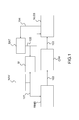
- the figure 3 schematizes the generation of the signal transmitted on the uplink between a NLES station of the prior art and a satellite SAT.
- the signal to be transmitted 301, 302 is first converted into frequency L1 or L5 according to the frequency band of the end user.
- Two local oscillators IF1, IF2 are used for this purpose.
- the resulting signal follows a FDMA type frequency plan, it is then converted to C or Ku band by means of a third local oscillator IF.
- the frequency bandwidth of the navigation signal is therefore proportional to the number of increase signals to be transmitted.
- the invention aims in particular to overcome the disadvantages of known systems described in support of figures 1 , 2 and 3 .
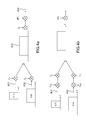
- the figure 4a represents, in a diagram, the modification, according to the invention, of the signal transmitted by a NLES station towards a satellite SAT increase.
- the modification, according to the invention of the signal transmitted by a NLES station towards a satellite SAT increase.
- L1, L5 frequency bands For simplification of description, only the case of two navigation signals containing augmentation messages to be transmitted is presented on two distinct L1, L5 frequency bands.
- Each navigation signal to be transmitted 301, 302 is spread by a specific spreading code C1, C5, for example a Walsh code, so that each signal 401, 402 occupies the same spectral bandwidth.
- the purpose of this code is to unambiguously identify the transmission channel associated with the L1 or L5 frequency band.
- the signals 401, 402 thus spread are then transmitted on the same central frequency, in accordance with a CDMA access method.
- the spreading codes used are orthogonal to each other so as to allow simultaneous transmission of signals on the uplink coming from several NLES stations.
- To the navigation signal 403 thus obtained is added a pilot signal, phase shifted by 90 °, and also spread via a specific spreading code C0 which serves to identify the transmitting NLES station and to authenticate the navigation signal.
- the authentication method used may be any known method for ensuring identification of the received signal.
- Watermarking techniques adapted to satellite links can also be used.
- the resulting signal is finally transposed in C or Ku band through a local oscillator IF to be transmitted on the upstream channel to the satellite SAT augmentation.
- the invention By modifying the generation of the navigation signal as indicated in figure 4a the invention notably makes it possible to eliminate the differential errors induced by the propagation channels associated with the various rising frequency bands L1, L5.
- the introduction of the pilot signal makes it possible both to authenticate the transmitted signal on board the satellite and to increase the estimation performance of the signal-to-noise ratio.
- the synchronization problems between the two channels are also eliminated since the signals previously intended for L1 or L5 band transmission are now spectrally coded and transmitted on the same frequency.
- the use of a spreading code C0 specific to each transmitting NLES station makes it possible to implement a redundancy between hot type stations as will be explained later.
- a modulation of CCSK type (Cyclic Code Shift Keying) is applied beforehand on the L1 and L5 band navigation signals before the spectral spreading step using Walsh codes C1, C5.
- the CCSK modulation technique is well known to those skilled in the art, for example from the publication Cyclic Code Shift Keying: A Low Probability of Intercept Communication Technique, IEEE Transactions on Aerospace and Electronic Systems, Vol. 39, No 3, July 2003 » . It consists of using a single PN-type spreading code (Pseudo Noise) Csk to modulate each navigation signal by shifting the code sequence by a predetermined number of symbols to achieve the modulation of each signal.
- PN-type spreading code Pseudo Noise
- This variant embodiment makes it possible to eliminate the pilot signal and to authenticate the NLES station directly by identifying the CCSK codes applied to the navigation signals. Only one CCSK code is used for all transmitting NLES stations by shifting each time the code sequence of a predetermined number of symbols before performing the modulation of the signal.
- the pilot signal can be kept but over-modulated by a CCSK code in order to improve the detection performance and therefore the authentication of the different NLES stations by the good properties of the autocorrelation function of the CCSK modulation.
- different polarizations are used for the transmission of the L1 and L5 band signals. For example, one right polarization is used for one of the signals and one left polarization for the other. In this way, the cross-correlation between the two signals is limited which further improves performance while keeping a low differential dispersion between the signals.
- the same polarizations are used for the transmission of the L1 and L5 band signals of the same NLES station, but different polarizations are used for two different redundant NLES stations.
- This scenario also includes the case where a given NLES station transmits only L1 band signals and another redundant NLES station transmits only L5 band signals with different polarization of the L1 band signals transmitted by the first station.
- FIG 5a schematizes, on a synoptic, the main functions of the payload of an SBAS augmentation satellite according to the invention.
- the elements common to the payload according to the prior art described in figure 2 are numbered by the same references.
- the frequency transposition devices 204, 205, 214, 14 for each channel are deleted and replaced by a single navigation processor 501 which receives the navigation signal transmitted by one or more NLES stations and transmits it to one of the amplification and filtering channels for broadcasting to users according to the frequency band L1, L5 identified by the spreading code C1, C5 associated.
- the figure 5b schematizes an alternative embodiment of the payload according to the invention.
- a specific return path to the ground NLES station (s) is implemented via an amplifier 502 and a bandpass filter 504.
- a second bandpass filter 503 is required to separate the signal received by a NLES station from the signal retransmitted to that same station.
- This return path operates in Ku-band or C-band as is the rising channel to the augmentation satellite.
- some augmentation systems such as the European EGNOS system, already implement a specific return channel for augmentation satellites, this channel serving only for the time-dependent servocontrol of the satellite on a time base linked to the stations. soils.
- the return channel of the augmentation satellite also makes it possible to transmit certain information to the NLES ground stations in order to further improve continuity of service when switching between two stations. emitting.
- a measurement of the signal-to-noise ratio plus SNIR interference of the uplink is carried out on board the satellite and then retransmitted to the NLES stations via this return channel. Relative synchronization between the nominal station and the redundant station is also performed.
- the figure 6 illustrates the overall operation of an SBAS system according to the embodiment of the invention for which a return channel 611 is implemented between the augmentation satellite 600 and the earth stations 601,602. From the information transmitted by the satellite, the earth stations 601, 602 establish a synchronization link 612 between them. This link 612 makes it possible in particular to ensure the temporal synchronization of the stations between them.
- the figure 7 describes a functional block diagram of the navigation processor 501 according to the invention.
- the analog signal received at the input of the processor 501 is digitally converted via a digital analog converter 701.
- the digital signal obtained is inputted to a first module 702 for processing the pilot signal.
- This module 702 synchronizes and demodulates the pilot signal from the spreading codes referenced for each NLES station in a memory 703.
- the demodulated pilot signal is authenticated, according to the authentication method of the state of the art. chosen, via an authentication module 706.
- the ratio between the signal and the combination of noise and interference, SNIR is measured via a measurement module 707.
- the quadrature signal corresponding to the navigation signal transmitted by different NLES stations, is transmitted to a demultiplexer 704 which associates the received navigation signal with an identifier of a NLES station according to the reference spread code C0
- the navigation signal associated with the identifier of the transmitting NLES station is then transmitted to a module 705 in particular responsible for authorizing the retransmission of the signal to the users.
- the signal is possibly blocked in the case where this result is negative.
- the authentication of the sending NLES station is carried out directly on the CCSK codes applied to the navigation signals.
- the measurement of the signal to noise ratio plus interference SNIR of the link rising is also performed directly on the navigation signals and not on the pilot signal.
- the signal-to-noise ratio and SNIR interference obtained for the different NLES stations are compared and only the signal transmitted by the station with the best link budget is selected to be retransmitted to the ground.
- the payload according to the invention realizes a switching of stations by selecting the new optimal signal such as that transmitted. by the redundant station with the highest SNIR ratio.
- the switching is performed transparently on board the satellite, without causing service interruption.
- the switching decision between two transmitting NLE stations is performed by the navigation processor 501 when the SNIR ratio measured on the nominal signal decreases below a predetermined threshold.
- signal-to-noise ratio and SNIR interference measurements are relayed to NLES stations on the ground via the available return path.
- said measurements are transmitted by a modulated signal, for example using a BPSK modulation, and on a frequency different from that used to transmit the navigation signal.
- An FDM type frequency plan is used.
- the return channel according to the invention therefore makes it possible, on the one hand, to transmit, on a first frequency band, the navigation signal, which is both nominal and redundant, for purposes of temporal slaving of the signal transmitted by the satellite, and on the other hand, transmitting, over a second frequency band, a service signal carrying the SNIR report information for each identified transmitting NLES station.
- the module 705 is for this purpose responsible for generating the service signal carrying the SNIR report information estimated by the module 707.
- the return path is implemented in the form of at least one oversampling module 708 and a digital to analog converter 709.
- the choice of the nominal NLES station can also be retransmitted via this service signal to inform ground stations that switching has occurred.
- the NLES stations 601, 602 When the NLES stations 601, 602 receive the service signal transmitted by the augmentation satellite 600, they adjust their transmission power so that each station transmits a signal controlled in gain, or amplitude, on the optimal signal, that is to say ie the one sent by the NLES station.
- all the signals transmitted on the rising channel of the augmentation satellite have an equivalent power, which further facilitates the transparent switching between stations on board the satellite when the nominal station fails.
- all the SNIR report measurements are transmitted by the satellite, to allow redundant NLES stations to estimate the quality of their link.
- the satellite payload in addition to the measurement of the SNIR ratio, realizes a measurement of the time difference between the different signals received on the uplink from the nominal NLES station. one part and redundant NLES stations on the other hand.
- the signal of the nominal station is identified by means of the spreading code of the pilot signal transmitted as explained above or directly from the identification of the CCSK codes of the navigation signals themselves according to the variant of the chosen invention.
- a measurement of the time difference between the instant of reception of the nominal signal and the instant of reception of each of the signals emitted by the NLES stations in redundancy is realized.
- This offset measurement is also transmitted in the service signal via the return channel of the satellite. This information is received by NLES ground stations which can then time synchronize, via a terrestrial link 612, their respective transmitters, in order to synchronize their emissions on the uplink.
- This synchronization further improves the continuity of service when switching stations performed by the payload.
- the invention aims to synchronize in time and power all the signals emitted by the various NLES stations on the uplink in order to implement a so-called hot redundancy.
- each station upon reception of the navigation signal transmitted on the return channel, carries out an integrity check by comparing the received augmentation message with that previously transmitted. If this control is negative, the station stops transmitting. The satellite will no longer receive a navigation signal transmitted by this station and may switch to the redundant station with the best link budget.
- the optimal navigation signal has been authenticated and selected from among the various signals emitted by the NLES stations, it is then transmitted to a second signal processing module 710 which demodulates the navigation signal according to its associated spreading code. 711, and / or its polarization component. Specifically, a despreading operation of the signal from the known spreading code is performed.
- Each spreading code corresponds to a frequency band, in the band L, used to transmit the navigation signals to the users.
- the frequency band identified for example the L1 or L5 band
- the navigation signal is retransmitted to the users of the system via a frequency conversion channel comprising at least one oversampling module 713 and a digital-to-analog converter 714.
- the authentication of the transmitting NLES station is performed in conjunction with the CCSK demodulation.
- the signal processing module 710 also makes it possible to apply to the signals corrections, in amplitude, phase and / or delay, from one or more calibration tables 712. These calibration tables are filled in from measurements made, at temperatures, on the payload, and making it possible to identify imbalances in amplitude, delay and phase, differentials between each transmission channel in L-band. These tables are generated from measurements carried out before commissioning of the satellite. The corrections are then updated according to the temperature of the equipment in service, measured by a temperature measuring device. These corrections allow accurate balancing of the differential transmission paths.
- An alternative way of realizing the differential correction of the different transmission channels in the L-band consists in using one or more transmission redundancy channels which indirectly enable the transmitted signal to be saved and then to measure the drifts between the saved transmitted signal and the received signal. .
- a particular use of the invention consists in using the nominal station NLES for broadcasting operational signals in bands L1 and L5 and a redundant NLES station for transmitting test signals used for the validation of the system in order to test some of the its features or perform a system qualification.
- the different spreading codes C1, C5, C0 used are specific to the test signals.
- test signals used may be transmitted by the same NLES station used to transmit the nominal navigation signals, with the same antenna polarization or with a cross polarization. relative to the navigation signals.
- the test signals can also be transmitted by a NLES station specifically dedicated to testing.
- the invention particularly has the advantage of retaining the primary mission of the augmentation satellite, that is to say relay the increase messages to the users, while improving continuity of service when switching between NLES stations. redundant. It also makes it possible to improve the authentication of the emitted signals and to fight against possible lures, and it also improves the performances of the system when different frequency bands L1, L5 are used to transmit the navigation signals.
Landscapes
- Engineering & Computer Science (AREA)
- Radar, Positioning & Navigation (AREA)
- Remote Sensing (AREA)
- Computer Networks & Wireless Communication (AREA)
- Physics & Mathematics (AREA)
- General Physics & Mathematics (AREA)
- Computer Security & Cryptography (AREA)
- Radio Relay Systems (AREA)
- Mobile Radio Communication Systems (AREA)
- Position Fixing By Use Of Radio Waves (AREA)
Applications Claiming Priority (1)
| Application Number | Priority Date | Filing Date | Title |
|---|---|---|---|
| FR1102464A FR2978835B1 (fr) | 2011-08-05 | 2011-08-05 | Charge utile de satellite pour systemes d'augmentation |
Publications (2)
| Publication Number | Publication Date |
|---|---|
| EP2555016A1 true EP2555016A1 (de) | 2013-02-06 |
| EP2555016B1 EP2555016B1 (de) | 2015-07-01 |
Family
ID=46548343
Family Applications (1)
| Application Number | Title | Priority Date | Filing Date |
|---|---|---|---|
| EP12178258.5A Active EP2555016B1 (de) | 2011-08-05 | 2012-07-27 | Nutzlast eines Satelliten für Erweiterungssysteme |
Country Status (9)
| Country | Link |
|---|---|
| US (1) | US9063221B2 (de) |
| EP (1) | EP2555016B1 (de) |
| JP (1) | JP6056102B2 (de) |
| CN (1) | CN102914778B (de) |
| AR (1) | AR087465A1 (de) |
| BR (1) | BR102012019145A2 (de) |
| ES (1) | ES2544930T3 (de) |
| FR (1) | FR2978835B1 (de) |
| RU (1) | RU2595539C2 (de) |
Cited By (4)
| Publication number | Priority date | Publication date | Assignee | Title |
|---|---|---|---|---|
| WO2015022356A1 (fr) * | 2013-08-14 | 2015-02-19 | Sagem Defense Securite | Procédé et dispositif de mesure du rapport des puissances interférence à bruit dans un récepteur gnss |
| CN110290087A (zh) * | 2019-07-05 | 2019-09-27 | 电子科技大学 | 一种gfdm信号的调制、解调方法及装置 |
| CN111323791A (zh) * | 2020-04-10 | 2020-06-23 | 航天恒星科技有限公司 | 导航增强产品的质量评估方法和装置 |
| EP3706238A1 (de) * | 2019-03-07 | 2020-09-09 | Thales | Kalibriersystem einer nutzlast eines satelliten vom boden aus |
Families Citing this family (9)
| Publication number | Priority date | Publication date | Assignee | Title |
|---|---|---|---|---|
| US9094392B1 (en) * | 2013-10-28 | 2015-07-28 | Rockwell Collins, Inc. | GNSS receiver autonomous signal authentication using signal stability analysis system and related method |
| FR3037661B1 (fr) * | 2015-06-17 | 2020-06-12 | Thales | Systeme d'augmentation spatial ou aeronautique avec gestion simplifiee de ses messages de navigation |
| CN105738922B (zh) * | 2015-09-21 | 2018-02-23 | 北京圣涛平试验工程技术研究院有限责任公司 | 导航卫星星座系统的服务可靠性分析方法及系统 |
| FR3047626B1 (fr) * | 2016-02-05 | 2018-03-02 | Thales Sa | Procede de transport transparent de paquets de donnees de bout en bout dans un systeme de telecommunications spatial utilisant un reseau de satellites regeneratifs avec isls |
| CN108761504A (zh) * | 2018-04-04 | 2018-11-06 | 南京航空航天大学 | 低轨导航增强卫星系统 |
| CN112615686B (zh) * | 2019-09-18 | 2025-02-11 | 罗德施瓦兹两合股份有限公司 | 提供至少一个信号的方法和系统以及用于信号接收器的鲁棒性测试的测试和测量系统 |
| CN113701783A (zh) * | 2020-10-20 | 2021-11-26 | 方彭 | 基于大数据的蓝牙导航系统 |
| CN112257191B (zh) * | 2020-12-23 | 2021-03-16 | 中国人民解放军国防科技大学 | 载荷平台一体化微小卫星的热控分系统优化方法及系统 |
| US11622355B2 (en) * | 2021-03-29 | 2023-04-04 | Cisco Technology, Inc. | Wireless fidelity uplink non-orthogonal multiple access |
Citations (4)
| Publication number | Priority date | Publication date | Assignee | Title |
|---|---|---|---|---|
| US20050041955A1 (en) | 1998-03-25 | 2005-02-24 | Canal+ Societe Anonyme | Authentification of data in a digital transmission system |
| US7460828B2 (en) * | 2003-12-04 | 2008-12-02 | Eads Deutschland Gmbh | Method and arrangement for an alternative signal path in a navigation transmitter |
| FR2921528A1 (fr) | 2007-09-21 | 2009-03-27 | Thales Sa | Procede fournissant les moyens de reconnaitre l'origine et/ou le contenu d'un signal rf |
| US20090179743A1 (en) | 2006-05-15 | 2009-07-16 | Nxp B.V. | Pseudo-random authentification code altering scheme for a transponder and a base station |
Family Cites Families (19)
| Publication number | Priority date | Publication date | Assignee | Title |
|---|---|---|---|---|
| MY123040A (en) * | 1994-12-19 | 2006-05-31 | Salbu Res And Dev Proprietary Ltd | Multi-hop packet radio networks |
| US5640386A (en) * | 1995-06-06 | 1997-06-17 | Globalstar L.P. | Two-system protocol conversion transceiver repeater |
| JP3557079B2 (ja) * | 1997-03-03 | 2004-08-25 | 株式会社東芝 | 衛星放送システムとそのギャップフィラー装置 |
| KR100644173B1 (ko) * | 1997-07-03 | 2006-11-10 | 가부시끼가이샤 도시바 | 무선 수신 장치 |
| US6463279B1 (en) * | 1999-11-17 | 2002-10-08 | Globalstar L.P. | Channel frequency allocation for multiple-satellite communication network |
| JP2003018061A (ja) * | 2001-06-27 | 2003-01-17 | Nec Corp | 衛星航法監視システム |
| US7310064B2 (en) * | 2004-04-29 | 2007-12-18 | Novariant Inc. | Rebroadcasting method and system for navigation signals |
| US7240879B1 (en) * | 2005-05-06 | 2007-07-10 | United States of America as represented by the Administration of the National Aeronautics and Space Administration | Method and associated apparatus for capturing, servicing and de-orbiting earth satellites using robotics |
| US7532161B2 (en) * | 2005-09-22 | 2009-05-12 | Raytheon Company | Method and apparatus for wide area augmentation system having L1/L5 bias estimation |
| JP2007171082A (ja) * | 2005-12-26 | 2007-07-05 | Nec Toshiba Space Systems Ltd | 電離層遅延補正方法、電離層遅延補正システム、地上局および移動局 |
| US9658341B2 (en) * | 2006-04-28 | 2017-05-23 | Telecommunication Systems, Inc. | GNSS long-code acquisition, ambiguity resolution, and signal validation |
| US7860145B2 (en) * | 2006-05-03 | 2010-12-28 | Navcom Technology, Inc. | Adaptive code generator for satellite navigation receivers |
| GB0612142D0 (en) * | 2006-06-20 | 2006-08-02 | Secr Defence | Spreading modulation spectrum control |
| RU2354590C2 (ru) * | 2006-09-06 | 2009-05-10 | Открытое акционерное общество "Ракетно-космическая корпорация "Энергия" имени С.П. Королева" | Способ управления ориентацией геостационарного космического аппарата, оснащенного радиомаяком |
| EP2074711A2 (de) * | 2006-10-06 | 2009-07-01 | ViaSat, Inc. | Vorwärts- und rückwärtskalibration für bodengestützte strahlformung |
| JP4842883B2 (ja) * | 2007-04-26 | 2011-12-21 | 三菱電機株式会社 | 移動体衛星通信システム |
| US8059027B2 (en) * | 2008-12-29 | 2011-11-15 | Microsoft Corporation | Correcting GPS through secondary sensors and signal strength |
| US8401546B2 (en) * | 2010-04-26 | 2013-03-19 | Ecole De Technologie Superieure | Universal acquisition and tracking apparatus for global navigation satellite system (GNSS) |
| LT2703838T (lt) * | 2011-04-26 | 2016-11-25 | Gnss Technologies Inc. | Navigacijos signalų siųstuvas ir navigacijos signalų generavimo būdas |
-
2011
- 2011-08-05 FR FR1102464A patent/FR2978835B1/fr not_active Expired - Fee Related
-
2012
- 2012-07-20 RU RU2012131232/08A patent/RU2595539C2/ru active
- 2012-07-27 EP EP12178258.5A patent/EP2555016B1/de active Active
- 2012-07-27 ES ES12178258.5T patent/ES2544930T3/es active Active
- 2012-07-31 CN CN201210270263.5A patent/CN102914778B/zh not_active Expired - Fee Related
- 2012-07-31 BR BRBR102012019145-8A patent/BR102012019145A2/pt active Search and Examination
- 2012-08-02 JP JP2012172038A patent/JP6056102B2/ja active Active
- 2012-08-03 US US13/566,786 patent/US9063221B2/en active Active
- 2012-08-03 AR ARP120102864A patent/AR087465A1/es active IP Right Grant
Patent Citations (4)
| Publication number | Priority date | Publication date | Assignee | Title |
|---|---|---|---|---|
| US20050041955A1 (en) | 1998-03-25 | 2005-02-24 | Canal+ Societe Anonyme | Authentification of data in a digital transmission system |
| US7460828B2 (en) * | 2003-12-04 | 2008-12-02 | Eads Deutschland Gmbh | Method and arrangement for an alternative signal path in a navigation transmitter |
| US20090179743A1 (en) | 2006-05-15 | 2009-07-16 | Nxp B.V. | Pseudo-random authentification code altering scheme for a transponder and a base station |
| FR2921528A1 (fr) | 2007-09-21 | 2009-03-27 | Thales Sa | Procede fournissant les moyens de reconnaitre l'origine et/ou le contenu d'un signal rf |
Non-Patent Citations (4)
| Title |
|---|
| "Cyclic Code Shift Keying: A Low Probability of Intercept Communication Technique", IEEE TRANSACTIONS ON AEROSPACE AND ELECTRONIC SYSTEMS, vol. 39, no. 3, July 2003 (2003-07-01) |
| ILCEV D ET AL: "European Geostationary Navigation Overlay Service (EGNOS)", IST-AFRICA CONFERENCE PROCEEDINGS, 2011, IEEE, 11 May 2011 (2011-05-11), pages 1 - 14, XP032077102, ISBN: 978-1-4577-1077-3 * |
| JAVIER VENTURA-TRAVESET ET AL: "EGNOS GEO Replenishment: Planning for the Future", 1 January 2000 (2000-01-01), pages 1 - 11, XP055020792, Retrieved from the Internet <URL:http://www.egnos-pro.esa.int/Publications/GNSS%202000/GNSS2000_GEO.pdf> [retrieved on 20120302] * |
| MOHAMED SAHMOUDI ET AL: "U-SBAS: A universal multi-SBAS standard to ensure compatibility, interoperability and interchangeability", SATELLITE NAVIGATION TECHNOLOGIES AND EUROPEAN WORKSHOP ON GNSS SIGNALS AND SIGNAL PROCESSING (NAVITEC), 2010 5TH ESA WORKSHOP ON, IEEE, 8 December 2010 (2010-12-08), pages 1 - 18, XP031898945, ISBN: 978-1-4244-8740-0, DOI: 10.1109/NAVITEC.2010.5708076 * |
Cited By (7)
| Publication number | Priority date | Publication date | Assignee | Title |
|---|---|---|---|---|
| WO2015022356A1 (fr) * | 2013-08-14 | 2015-02-19 | Sagem Defense Securite | Procédé et dispositif de mesure du rapport des puissances interférence à bruit dans un récepteur gnss |
| FR3009755A1 (fr) * | 2013-08-14 | 2015-02-20 | Sagem Defense Securite | Procede et dispositif de mesure du rapport des puissances interference a bruit dans un recepteur gnss |
| EP3706238A1 (de) * | 2019-03-07 | 2020-09-09 | Thales | Kalibriersystem einer nutzlast eines satelliten vom boden aus |
| FR3093595A1 (fr) * | 2019-03-07 | 2020-09-11 | Thales | Systeme de calibration depuis le sol d'une charge utile d'un satellite |
| US11070283B2 (en) | 2019-03-07 | 2021-07-20 | Thales | System for calibrating from the ground a payload of a satellite |
| CN110290087A (zh) * | 2019-07-05 | 2019-09-27 | 电子科技大学 | 一种gfdm信号的调制、解调方法及装置 |
| CN111323791A (zh) * | 2020-04-10 | 2020-06-23 | 航天恒星科技有限公司 | 导航增强产品的质量评估方法和装置 |
Also Published As
| Publication number | Publication date |
|---|---|
| EP2555016B1 (de) | 2015-07-01 |
| JP6056102B2 (ja) | 2017-01-11 |
| BR102012019145A2 (pt) | 2013-08-06 |
| JP2013036995A (ja) | 2013-02-21 |
| CN102914778B (zh) | 2017-04-12 |
| FR2978835B1 (fr) | 2013-08-09 |
| ES2544930T3 (es) | 2015-09-07 |
| RU2595539C2 (ru) | 2016-08-27 |
| AR087465A1 (es) | 2014-03-26 |
| CN102914778A (zh) | 2013-02-06 |
| US9063221B2 (en) | 2015-06-23 |
| US20130034124A1 (en) | 2013-02-07 |
| FR2978835A1 (fr) | 2013-02-08 |
| RU2012131232A (ru) | 2014-01-27 |
Similar Documents
| Publication | Publication Date | Title |
|---|---|---|
| EP2555016B1 (de) | Nutzlast eines Satelliten für Erweiterungssysteme | |
| US11175634B2 (en) | Robust and resilient timing architecture for critical infrastructure | |
| EP3185032B1 (de) | Laufweg ausgleich in einem kommunikationsnetwerk mit einer vielzahl von satelliten. | |
| EP2916470B1 (de) | Verfahren zur Detektion eines Ungleichgewichts und zur Kalibrierung eines Multiport-Verstärkers eines Telekommunikationssatelliten | |
| EP2674779A1 (de) | Funknavigationssystem über Satellit mit versetzter Architektur | |
| EP2015096A1 (de) | Verfahren zur Korrektur von Fehlern beim Empfang in einem Mobilgerät, welche die Funknavigationssignalübertragung über eine Trägerwelle mit doppelter Phasenverschiebung beeinträchtigen | |
| EP2959308B1 (de) | Verfahren und system zur abschätzung der einfallsrichtung eines zielsignals relativ zu einem satelliten | |
| EP2715392B1 (de) | Verfahren für das orten eines endgerätes in einem deckungsgebiet mit hilfe eines telekommunikationsnetzwerkes, das ein mehrfachkeulensatelliten verwendet | |
| EP3345013B1 (de) | Nutzlast des messsatelliten eines positionierungssystems und positionierungsverfahren | |
| Rügamer et al. | Validation of a combined GNSS correction and NMA L-band service against spoofing | |
| EP1327159A1 (de) | Vorrichtung zur verfolgung einer mobileinheit | |
| EP2654222B1 (de) | Testverfahren eines Verstärkungskanals eines Telekommunikationsatellitenverstärkers. | |
| EP3350080A1 (de) | Verfahren und system zur abschätzung der lage eines satelliten mittels von bodenstationen durchgeführter messungen | |
| EP1017189A1 (de) | Satellit mit rundstrahlender Antenne | |
| EP2629439B1 (de) | Verfahren zur Erzeugung eines Sende- oder Empfangsdiagramms einer Satellitenantenne | |
| FR3106216A1 (fr) | Procédé de fourniture d’un service de temps et/ou de positionnement, dispositif régénérateur, dispositif récepteur et serveur de temps correspondants. | |
| EP4580075A1 (de) | Kommunikation in einem privaten zugangskanal | |
| EP2919035A1 (de) | System und Verfahren zur Informationsverbreitung in einem Doppelfrequenz-Satellitensystem | |
| FR2811834A1 (fr) | Systeme differentiel de navigation par satellites avec liaison cryptee de donnees |
Legal Events
| Date | Code | Title | Description |
|---|---|---|---|
| PUAI | Public reference made under article 153(3) epc to a published international application that has entered the european phase |
Free format text: ORIGINAL CODE: 0009012 |
|
| AK | Designated contracting states |
Kind code of ref document: A1 Designated state(s): AL AT BE BG CH CY CZ DE DK EE ES FI FR GB GR HR HU IE IS IT LI LT LU LV MC MK MT NL NO PL PT RO RS SE SI SK SM TR |
|
| AX | Request for extension of the european patent |
Extension state: BA ME |
|
| 17P | Request for examination filed |
Effective date: 20130618 |
|
| RBV | Designated contracting states (corrected) |
Designated state(s): AL AT BE BG CH CY CZ DE DK EE ES FI FR GB GR HR HU IE IS IT LI LT LU LV MC MK MT NL NO PL PT RO RS SE SI SK SM TR |
|
| 17Q | First examination report despatched |
Effective date: 20140313 |
|
| GRAP | Despatch of communication of intention to grant a patent |
Free format text: ORIGINAL CODE: EPIDOSNIGR1 |
|
| INTG | Intention to grant announced |
Effective date: 20150205 |
|
| GRAS | Grant fee paid |
Free format text: ORIGINAL CODE: EPIDOSNIGR3 |
|
| GRAA | (expected) grant |
Free format text: ORIGINAL CODE: 0009210 |
|
| AK | Designated contracting states |
Kind code of ref document: B1 Designated state(s): AL AT BE BG CH CY CZ DE DK EE ES FI FR GB GR HR HU IE IS IT LI LT LU LV MC MK MT NL NO PL PT RO RS SE SI SK SM TR |
|
| REG | Reference to a national code |
Ref country code: GB Ref legal event code: FG4D Free format text: NOT ENGLISH |
|
| REG | Reference to a national code |
Ref country code: AT Ref legal event code: REF Ref document number: 734284 Country of ref document: AT Kind code of ref document: T Effective date: 20150715 Ref country code: CH Ref legal event code: EP |
|
| REG | Reference to a national code |
Ref country code: IE Ref legal event code: FG4D Free format text: LANGUAGE OF EP DOCUMENT: FRENCH |
|
| REG | Reference to a national code |
Ref country code: DE Ref legal event code: R096 Ref document number: 602012008327 Country of ref document: DE |
|
| REG | Reference to a national code |
Ref country code: ES Ref legal event code: FG2A Ref document number: 2544930 Country of ref document: ES Kind code of ref document: T3 Effective date: 20150907 |
|
| REG | Reference to a national code |
Ref country code: AT Ref legal event code: MK05 Ref document number: 734284 Country of ref document: AT Kind code of ref document: T Effective date: 20150701 |
|
| REG | Reference to a national code |
Ref country code: NL Ref legal event code: MP Effective date: 20150701 |
|
| REG | Reference to a national code |
Ref country code: LT Ref legal event code: MG4D |
|
| PG25 | Lapsed in a contracting state [announced via postgrant information from national office to epo] |
Ref country code: GR Free format text: LAPSE BECAUSE OF FAILURE TO SUBMIT A TRANSLATION OF THE DESCRIPTION OR TO PAY THE FEE WITHIN THE PRESCRIBED TIME-LIMIT Effective date: 20151002 Ref country code: LT Free format text: LAPSE BECAUSE OF FAILURE TO SUBMIT A TRANSLATION OF THE DESCRIPTION OR TO PAY THE FEE WITHIN THE PRESCRIBED TIME-LIMIT Effective date: 20150701 Ref country code: FI Free format text: LAPSE BECAUSE OF FAILURE TO SUBMIT A TRANSLATION OF THE DESCRIPTION OR TO PAY THE FEE WITHIN THE PRESCRIBED TIME-LIMIT Effective date: 20150701 Ref country code: LV Free format text: LAPSE BECAUSE OF FAILURE TO SUBMIT A TRANSLATION OF THE DESCRIPTION OR TO PAY THE FEE WITHIN THE PRESCRIBED TIME-LIMIT Effective date: 20150701 Ref country code: NO Free format text: LAPSE BECAUSE OF FAILURE TO SUBMIT A TRANSLATION OF THE DESCRIPTION OR TO PAY THE FEE WITHIN THE PRESCRIBED TIME-LIMIT Effective date: 20151001 |
|
| PG25 | Lapsed in a contracting state [announced via postgrant information from national office to epo] |
Ref country code: SE Free format text: LAPSE BECAUSE OF FAILURE TO SUBMIT A TRANSLATION OF THE DESCRIPTION OR TO PAY THE FEE WITHIN THE PRESCRIBED TIME-LIMIT Effective date: 20150701 Ref country code: RS Free format text: LAPSE BECAUSE OF FAILURE TO SUBMIT A TRANSLATION OF THE DESCRIPTION OR TO PAY THE FEE WITHIN THE PRESCRIBED TIME-LIMIT Effective date: 20150701 Ref country code: AT Free format text: LAPSE BECAUSE OF FAILURE TO SUBMIT A TRANSLATION OF THE DESCRIPTION OR TO PAY THE FEE WITHIN THE PRESCRIBED TIME-LIMIT Effective date: 20150701 Ref country code: IS Free format text: LAPSE BECAUSE OF FAILURE TO SUBMIT A TRANSLATION OF THE DESCRIPTION OR TO PAY THE FEE WITHIN THE PRESCRIBED TIME-LIMIT Effective date: 20151101 Ref country code: HR Free format text: LAPSE BECAUSE OF FAILURE TO SUBMIT A TRANSLATION OF THE DESCRIPTION OR TO PAY THE FEE WITHIN THE PRESCRIBED TIME-LIMIT Effective date: 20150701 Ref country code: PL Free format text: LAPSE BECAUSE OF FAILURE TO SUBMIT A TRANSLATION OF THE DESCRIPTION OR TO PAY THE FEE WITHIN THE PRESCRIBED TIME-LIMIT Effective date: 20150701 Ref country code: PT Free format text: LAPSE BECAUSE OF FAILURE TO SUBMIT A TRANSLATION OF THE DESCRIPTION OR TO PAY THE FEE WITHIN THE PRESCRIBED TIME-LIMIT Effective date: 20151102 |
|
| REG | Reference to a national code |
Ref country code: CH Ref legal event code: PL |
|
| PG25 | Lapsed in a contracting state [announced via postgrant information from national office to epo] |
Ref country code: MC Free format text: LAPSE BECAUSE OF FAILURE TO SUBMIT A TRANSLATION OF THE DESCRIPTION OR TO PAY THE FEE WITHIN THE PRESCRIBED TIME-LIMIT Effective date: 20150701 |
|
| REG | Reference to a national code |
Ref country code: DE Ref legal event code: R097 Ref document number: 602012008327 Country of ref document: DE |
|
| REG | Reference to a national code |
Ref country code: IE Ref legal event code: MM4A |
|
| PG25 | Lapsed in a contracting state [announced via postgrant information from national office to epo] |
Ref country code: CZ Free format text: LAPSE BECAUSE OF FAILURE TO SUBMIT A TRANSLATION OF THE DESCRIPTION OR TO PAY THE FEE WITHIN THE PRESCRIBED TIME-LIMIT Effective date: 20150701 Ref country code: EE Free format text: LAPSE BECAUSE OF FAILURE TO SUBMIT A TRANSLATION OF THE DESCRIPTION OR TO PAY THE FEE WITHIN THE PRESCRIBED TIME-LIMIT Effective date: 20150701 Ref country code: CH Free format text: LAPSE BECAUSE OF NON-PAYMENT OF DUE FEES Effective date: 20150731 Ref country code: DK Free format text: LAPSE BECAUSE OF FAILURE TO SUBMIT A TRANSLATION OF THE DESCRIPTION OR TO PAY THE FEE WITHIN THE PRESCRIBED TIME-LIMIT Effective date: 20150701 Ref country code: LI Free format text: LAPSE BECAUSE OF NON-PAYMENT OF DUE FEES Effective date: 20150731 Ref country code: SK Free format text: LAPSE BECAUSE OF FAILURE TO SUBMIT A TRANSLATION OF THE DESCRIPTION OR TO PAY THE FEE WITHIN THE PRESCRIBED TIME-LIMIT Effective date: 20150701 |
|
| PLBE | No opposition filed within time limit |
Free format text: ORIGINAL CODE: 0009261 |
|
| STAA | Information on the status of an ep patent application or granted ep patent |
Free format text: STATUS: NO OPPOSITION FILED WITHIN TIME LIMIT |
|
| PG25 | Lapsed in a contracting state [announced via postgrant information from national office to epo] |
Ref country code: RO Free format text: LAPSE BECAUSE OF FAILURE TO SUBMIT A TRANSLATION OF THE DESCRIPTION OR TO PAY THE FEE WITHIN THE PRESCRIBED TIME-LIMIT Effective date: 20150701 |
|
| 26N | No opposition filed |
Effective date: 20160404 |
|
| REG | Reference to a national code |
Ref country code: FR Ref legal event code: PLFP Year of fee payment: 5 |
|
| PG25 | Lapsed in a contracting state [announced via postgrant information from national office to epo] |
Ref country code: IE Free format text: LAPSE BECAUSE OF NON-PAYMENT OF DUE FEES Effective date: 20150727 |
|
| PG25 | Lapsed in a contracting state [announced via postgrant information from national office to epo] |
Ref country code: SI Free format text: LAPSE BECAUSE OF FAILURE TO SUBMIT A TRANSLATION OF THE DESCRIPTION OR TO PAY THE FEE WITHIN THE PRESCRIBED TIME-LIMIT Effective date: 20150701 |
|
| PG25 | Lapsed in a contracting state [announced via postgrant information from national office to epo] |
Ref country code: MT Free format text: LAPSE BECAUSE OF FAILURE TO SUBMIT A TRANSLATION OF THE DESCRIPTION OR TO PAY THE FEE WITHIN THE PRESCRIBED TIME-LIMIT Effective date: 20150701 |
|
| PG25 | Lapsed in a contracting state [announced via postgrant information from national office to epo] |
Ref country code: SM Free format text: LAPSE BECAUSE OF FAILURE TO SUBMIT A TRANSLATION OF THE DESCRIPTION OR TO PAY THE FEE WITHIN THE PRESCRIBED TIME-LIMIT Effective date: 20150701 Ref country code: HU Free format text: LAPSE BECAUSE OF FAILURE TO SUBMIT A TRANSLATION OF THE DESCRIPTION OR TO PAY THE FEE WITHIN THE PRESCRIBED TIME-LIMIT; INVALID AB INITIO Effective date: 20120727 Ref country code: BG Free format text: LAPSE BECAUSE OF FAILURE TO SUBMIT A TRANSLATION OF THE DESCRIPTION OR TO PAY THE FEE WITHIN THE PRESCRIBED TIME-LIMIT Effective date: 20150701 |
|
| REG | Reference to a national code |
Ref country code: FR Ref legal event code: PLFP Year of fee payment: 6 |
|
| PG25 | Lapsed in a contracting state [announced via postgrant information from national office to epo] |
Ref country code: NL Free format text: LAPSE BECAUSE OF FAILURE TO SUBMIT A TRANSLATION OF THE DESCRIPTION OR TO PAY THE FEE WITHIN THE PRESCRIBED TIME-LIMIT Effective date: 20150701 Ref country code: CY Free format text: LAPSE BECAUSE OF FAILURE TO SUBMIT A TRANSLATION OF THE DESCRIPTION OR TO PAY THE FEE WITHIN THE PRESCRIBED TIME-LIMIT Effective date: 20150701 |
|
| PG25 | Lapsed in a contracting state [announced via postgrant information from national office to epo] |
Ref country code: BE Free format text: LAPSE BECAUSE OF NON-PAYMENT OF DUE FEES Effective date: 20150731 |
|
| PG25 | Lapsed in a contracting state [announced via postgrant information from national office to epo] |
Ref country code: TR Free format text: LAPSE BECAUSE OF FAILURE TO SUBMIT A TRANSLATION OF THE DESCRIPTION OR TO PAY THE FEE WITHIN THE PRESCRIBED TIME-LIMIT Effective date: 20150701 |
|
| PG25 | Lapsed in a contracting state [announced via postgrant information from national office to epo] |
Ref country code: LU Free format text: LAPSE BECAUSE OF NON-PAYMENT OF DUE FEES Effective date: 20150727 |
|
| REG | Reference to a national code |
Ref country code: FR Ref legal event code: PLFP Year of fee payment: 7 |
|
| PG25 | Lapsed in a contracting state [announced via postgrant information from national office to epo] |
Ref country code: MK Free format text: LAPSE BECAUSE OF FAILURE TO SUBMIT A TRANSLATION OF THE DESCRIPTION OR TO PAY THE FEE WITHIN THE PRESCRIBED TIME-LIMIT Effective date: 20150701 |
|
| PG25 | Lapsed in a contracting state [announced via postgrant information from national office to epo] |
Ref country code: AL Free format text: LAPSE BECAUSE OF FAILURE TO SUBMIT A TRANSLATION OF THE DESCRIPTION OR TO PAY THE FEE WITHIN THE PRESCRIBED TIME-LIMIT Effective date: 20150701 |
|
| PGFP | Annual fee paid to national office [announced via postgrant information from national office to epo] |
Ref country code: GB Payment date: 20250619 Year of fee payment: 14 |
|
| PGFP | Annual fee paid to national office [announced via postgrant information from national office to epo] |
Ref country code: FR Payment date: 20250623 Year of fee payment: 14 |
|
| PGFP | Annual fee paid to national office [announced via postgrant information from national office to epo] |
Ref country code: ES Payment date: 20250806 Year of fee payment: 14 |
|
| PGFP | Annual fee paid to national office [announced via postgrant information from national office to epo] |
Ref country code: DE Payment date: 20250618 Year of fee payment: 14 |
|
| PGFP | Annual fee paid to national office [announced via postgrant information from national office to epo] |
Ref country code: IT Payment date: 20250626 Year of fee payment: 14 |