EP2557575A1 - Elément à coefficient de température positif et module d'élément chauffant - Google Patents
Elément à coefficient de température positif et module d'élément chauffant Download PDFInfo
- Publication number
- EP2557575A1 EP2557575A1 EP11765940A EP11765940A EP2557575A1 EP 2557575 A1 EP2557575 A1 EP 2557575A1 EP 11765940 A EP11765940 A EP 11765940A EP 11765940 A EP11765940 A EP 11765940A EP 2557575 A1 EP2557575 A1 EP 2557575A1
- Authority
- EP
- European Patent Office
- Prior art keywords
- semiconductor ceramic
- ceramic composition
- electrodes
- temperature
- electrode
- Prior art date
- Legal status (The legal status is an assumption and is not a legal conclusion. Google has not performed a legal analysis and makes no representation as to the accuracy of the status listed.)
- Withdrawn
Links
- 239000000203 mixture Substances 0.000 claims abstract description 156
- 239000004065 semiconductor Substances 0.000 claims abstract description 127
- 239000000919 ceramic Substances 0.000 claims abstract description 126
- 230000007547 defect Effects 0.000 claims abstract description 30
- 229910052760 oxygen Inorganic materials 0.000 claims abstract description 30
- QVGXLLKOCUKJST-UHFFFAOYSA-N atomic oxygen Chemical compound [O] QVGXLLKOCUKJST-UHFFFAOYSA-N 0.000 claims abstract description 24
- 239000001301 oxygen Substances 0.000 claims abstract description 24
- 229910052751 metal Inorganic materials 0.000 claims abstract description 23
- 239000002184 metal Substances 0.000 claims abstract description 23
- 239000013078 crystal Substances 0.000 claims abstract description 19
- 229910002113 barium titanate Inorganic materials 0.000 claims abstract description 16
- 238000010030 laminating Methods 0.000 claims description 3
- 230000000779 depleting effect Effects 0.000 abstract description 2
- 239000000843 powder Substances 0.000 description 72
- 238000001354 calcination Methods 0.000 description 29
- 239000010410 layer Substances 0.000 description 25
- PXHVJJICTQNCMI-UHFFFAOYSA-N Nickel Chemical compound [Ni] PXHVJJICTQNCMI-UHFFFAOYSA-N 0.000 description 18
- 238000002156 mixing Methods 0.000 description 18
- CDBYLPFSWZWCQE-UHFFFAOYSA-L Sodium Carbonate Chemical compound [Na+].[Na+].[O-]C([O-])=O CDBYLPFSWZWCQE-UHFFFAOYSA-L 0.000 description 16
- 239000002994 raw material Substances 0.000 description 16
- 238000004544 sputter deposition Methods 0.000 description 15
- 239000010936 titanium Substances 0.000 description 15
- 229910010252 TiO3 Inorganic materials 0.000 description 14
- 230000004888 barrier function Effects 0.000 description 14
- WMWLMWRWZQELOS-UHFFFAOYSA-N bismuth(iii) oxide Chemical compound O=[Bi]O[Bi]=O WMWLMWRWZQELOS-UHFFFAOYSA-N 0.000 description 14
- 238000010438 heat treatment Methods 0.000 description 14
- 238000000034 method Methods 0.000 description 14
- 238000007669 thermal treatment Methods 0.000 description 14
- GWEVSGVZZGPLCZ-UHFFFAOYSA-N Titan oxide Chemical compound O=[Ti]=O GWEVSGVZZGPLCZ-UHFFFAOYSA-N 0.000 description 12
- 230000000052 comparative effect Effects 0.000 description 12
- XLYOFNOQVPJJNP-UHFFFAOYSA-N water Substances O XLYOFNOQVPJJNP-UHFFFAOYSA-N 0.000 description 12
- BQCADISMDOOEFD-UHFFFAOYSA-N Silver Chemical compound [Ag] BQCADISMDOOEFD-UHFFFAOYSA-N 0.000 description 10
- AYJRCSIUFZENHW-UHFFFAOYSA-L barium carbonate Chemical compound [Ba+2].[O-]C([O-])=O AYJRCSIUFZENHW-UHFFFAOYSA-L 0.000 description 10
- 239000000463 material Substances 0.000 description 10
- 229910052709 silver Inorganic materials 0.000 description 10
- 239000004332 silver Substances 0.000 description 10
- 238000010298 pulverizing process Methods 0.000 description 9
- 229910000029 sodium carbonate Inorganic materials 0.000 description 8
- 239000011247 coating layer Substances 0.000 description 7
- 230000007423 decrease Effects 0.000 description 7
- 238000004519 manufacturing process Methods 0.000 description 7
- 229910052759 nickel Inorganic materials 0.000 description 7
- 229910052708 sodium Inorganic materials 0.000 description 7
- 238000012360 testing method Methods 0.000 description 7
- 230000015572 biosynthetic process Effects 0.000 description 6
- 229910052797 bismuth Inorganic materials 0.000 description 6
- 230000008859 change Effects 0.000 description 6
- 239000011651 chromium Substances 0.000 description 6
- 238000005259 measurement Methods 0.000 description 6
- 238000005245 sintering Methods 0.000 description 6
- 239000002245 particle Substances 0.000 description 5
- BSWGGJHLVUUXTL-UHFFFAOYSA-N silver zinc Chemical compound [Zn].[Ag] BSWGGJHLVUUXTL-UHFFFAOYSA-N 0.000 description 5
- VYZAMTAEIAYCRO-UHFFFAOYSA-N Chromium Chemical compound [Cr] VYZAMTAEIAYCRO-UHFFFAOYSA-N 0.000 description 4
- LFQSCWFLJHTTHZ-UHFFFAOYSA-N Ethanol Chemical compound CCO LFQSCWFLJHTTHZ-UHFFFAOYSA-N 0.000 description 4
- VYPSYNLAJGMNEJ-UHFFFAOYSA-N Silicium dioxide Chemical compound O=[Si]=O VYPSYNLAJGMNEJ-UHFFFAOYSA-N 0.000 description 4
- 229910052804 chromium Inorganic materials 0.000 description 4
- 238000007580 dry-mixing Methods 0.000 description 4
- 239000012530 fluid Substances 0.000 description 4
- 230000007246 mechanism Effects 0.000 description 4
- 238000004645 scanning capacitance microscopy Methods 0.000 description 4
- 229910052693 Europium Inorganic materials 0.000 description 3
- 229910052688 Gadolinium Inorganic materials 0.000 description 3
- 239000000654 additive Substances 0.000 description 3
- 230000000996 additive effect Effects 0.000 description 3
- 229910052787 antimony Inorganic materials 0.000 description 3
- 230000008901 benefit Effects 0.000 description 3
- 230000001276 controlling effect Effects 0.000 description 3
- 239000007772 electrode material Substances 0.000 description 3
- 238000011156 evaluation Methods 0.000 description 3
- 238000005469 granulation Methods 0.000 description 3
- 230000003179 granulation Effects 0.000 description 3
- 239000007788 liquid Substances 0.000 description 3
- 229910052758 niobium Inorganic materials 0.000 description 3
- 238000007639 printing Methods 0.000 description 3
- 238000012545 processing Methods 0.000 description 3
- 230000001105 regulatory effect Effects 0.000 description 3
- 229910052715 tantalum Inorganic materials 0.000 description 3
- 229910052727 yttrium Inorganic materials 0.000 description 3
- IJGRMHOSHXDMSA-UHFFFAOYSA-N Atomic nitrogen Chemical compound N#N IJGRMHOSHXDMSA-UHFFFAOYSA-N 0.000 description 2
- UFHFLCQGNIYNRP-UHFFFAOYSA-N Hydrogen Chemical compound [H][H] UFHFLCQGNIYNRP-UHFFFAOYSA-N 0.000 description 2
- 239000004372 Polyvinyl alcohol Substances 0.000 description 2
- RTAQQCXQSZGOHL-UHFFFAOYSA-N Titanium Chemical compound [Ti] RTAQQCXQSZGOHL-UHFFFAOYSA-N 0.000 description 2
- 238000004458 analytical method Methods 0.000 description 2
- 238000013459 approach Methods 0.000 description 2
- 238000004364 calculation method Methods 0.000 description 2
- 150000001768 cations Chemical class 0.000 description 2
- 238000006243 chemical reaction Methods 0.000 description 2
- 229910052681 coesite Inorganic materials 0.000 description 2
- 150000001875 compounds Chemical class 0.000 description 2
- 239000010949 copper Substances 0.000 description 2
- RKTYLMNFRDHKIL-UHFFFAOYSA-N copper;5,10,15,20-tetraphenylporphyrin-22,24-diide Chemical compound [Cu+2].C1=CC(C(=C2C=CC([N-]2)=C(C=2C=CC=CC=2)C=2C=CC(N=2)=C(C=2C=CC=CC=2)C2=CC=C3[N-]2)C=2C=CC=CC=2)=NC1=C3C1=CC=CC=C1 RKTYLMNFRDHKIL-UHFFFAOYSA-N 0.000 description 2
- 229910052906 cristobalite Inorganic materials 0.000 description 2
- 238000005520 cutting process Methods 0.000 description 2
- 230000000694 effects Effects 0.000 description 2
- 238000003912 environmental pollution Methods 0.000 description 2
- 239000001257 hydrogen Substances 0.000 description 2
- 229910052739 hydrogen Inorganic materials 0.000 description 2
- 238000011835 investigation Methods 0.000 description 2
- MRELNEQAGSRDBK-UHFFFAOYSA-N lanthanum oxide Inorganic materials [O-2].[O-2].[O-2].[La+3].[La+3] MRELNEQAGSRDBK-UHFFFAOYSA-N 0.000 description 2
- 238000002844 melting Methods 0.000 description 2
- 230000008018 melting Effects 0.000 description 2
- 239000011812 mixed powder Substances 0.000 description 2
- ZKATWMILCYLAPD-UHFFFAOYSA-N niobium pentoxide Chemical compound O=[Nb](=O)O[Nb](=O)=O ZKATWMILCYLAPD-UHFFFAOYSA-N 0.000 description 2
- KTUFCUMIWABKDW-UHFFFAOYSA-N oxo(oxolanthaniooxy)lanthanum Chemical compound O=[La]O[La]=O KTUFCUMIWABKDW-UHFFFAOYSA-N 0.000 description 2
- 230000002093 peripheral effect Effects 0.000 description 2
- 229920002451 polyvinyl alcohol Polymers 0.000 description 2
- 239000000377 silicon dioxide Substances 0.000 description 2
- 235000012239 silicon dioxide Nutrition 0.000 description 2
- 229910052682 stishovite Inorganic materials 0.000 description 2
- 239000000126 substance Substances 0.000 description 2
- 229910052719 titanium Inorganic materials 0.000 description 2
- OGIDPMRJRNCKJF-UHFFFAOYSA-N titanium oxide Inorganic materials [Ti]=O OGIDPMRJRNCKJF-UHFFFAOYSA-N 0.000 description 2
- 229910052905 tridymite Inorganic materials 0.000 description 2
- RYGMFSIKBFXOCR-UHFFFAOYSA-N Copper Chemical compound [Cu] RYGMFSIKBFXOCR-UHFFFAOYSA-N 0.000 description 1
- HCHKCACWOHOZIP-UHFFFAOYSA-N Zinc Chemical compound [Zn] HCHKCACWOHOZIP-UHFFFAOYSA-N 0.000 description 1
- 239000011230 binding agent Substances 0.000 description 1
- 230000001364 causal effect Effects 0.000 description 1
- 239000011248 coating agent Substances 0.000 description 1
- 229910052802 copper Inorganic materials 0.000 description 1
- 230000001419 dependent effect Effects 0.000 description 1
- 238000009792 diffusion process Methods 0.000 description 1
- 238000004090 dissolution Methods 0.000 description 1
- 238000007606 doctor blade method Methods 0.000 description 1
- 230000001747 exhibiting effect Effects 0.000 description 1
- 230000001771 impaired effect Effects 0.000 description 1
- 239000011261 inert gas Substances 0.000 description 1
- 229910052757 nitrogen Inorganic materials 0.000 description 1
- 230000000149 penetrating effect Effects 0.000 description 1
- 239000011148 porous material Substances 0.000 description 1
- 238000002360 preparation method Methods 0.000 description 1
- 230000008569 process Effects 0.000 description 1
- 230000009467 reduction Effects 0.000 description 1
- 230000000630 rising effect Effects 0.000 description 1
- 239000012266 salt solution Substances 0.000 description 1
- 229920006395 saturated elastomer Polymers 0.000 description 1
- 238000007650 screen-printing Methods 0.000 description 1
- 239000002002 slurry Substances 0.000 description 1
- 229910001415 sodium ion Inorganic materials 0.000 description 1
- 239000006104 solid solution Substances 0.000 description 1
- 239000002904 solvent Substances 0.000 description 1
- 238000003756 stirring Methods 0.000 description 1
- 238000003826 uniaxial pressing Methods 0.000 description 1
- 229910052725 zinc Inorganic materials 0.000 description 1
- 239000011701 zinc Substances 0.000 description 1
Images





Classifications
-
- C—CHEMISTRY; METALLURGY
- C04—CEMENTS; CONCRETE; ARTIFICIAL STONE; CERAMICS; REFRACTORIES
- C04B—LIME, MAGNESIA; SLAG; CEMENTS; COMPOSITIONS THEREOF, e.g. MORTARS, CONCRETE OR LIKE BUILDING MATERIALS; ARTIFICIAL STONE; CERAMICS; REFRACTORIES; TREATMENT OF NATURAL STONE
- C04B35/00—Shaped ceramic products characterised by their composition; Ceramics compositions; Processing powders of inorganic compounds preparatory to the manufacturing of ceramic products
- C04B35/01—Shaped ceramic products characterised by their composition; Ceramics compositions; Processing powders of inorganic compounds preparatory to the manufacturing of ceramic products based on oxide ceramics
- C04B35/46—Shaped ceramic products characterised by their composition; Ceramics compositions; Processing powders of inorganic compounds preparatory to the manufacturing of ceramic products based on oxide ceramics based on titanium oxides or titanates
- C04B35/462—Shaped ceramic products characterised by their composition; Ceramics compositions; Processing powders of inorganic compounds preparatory to the manufacturing of ceramic products based on oxide ceramics based on titanium oxides or titanates based on titanates
- C04B35/465—Shaped ceramic products characterised by their composition; Ceramics compositions; Processing powders of inorganic compounds preparatory to the manufacturing of ceramic products based on oxide ceramics based on titanium oxides or titanates based on titanates based on alkaline earth metal titanates
- C04B35/468—Shaped ceramic products characterised by their composition; Ceramics compositions; Processing powders of inorganic compounds preparatory to the manufacturing of ceramic products based on oxide ceramics based on titanium oxides or titanates based on titanates based on alkaline earth metal titanates based on barium titanates
- C04B35/4682—Shaped ceramic products characterised by their composition; Ceramics compositions; Processing powders of inorganic compounds preparatory to the manufacturing of ceramic products based on oxide ceramics based on titanium oxides or titanates based on titanates based on alkaline earth metal titanates based on barium titanates based on BaTiO3 perovskite phase
-
- C—CHEMISTRY; METALLURGY
- C04—CEMENTS; CONCRETE; ARTIFICIAL STONE; CERAMICS; REFRACTORIES
- C04B—LIME, MAGNESIA; SLAG; CEMENTS; COMPOSITIONS THEREOF, e.g. MORTARS, CONCRETE OR LIKE BUILDING MATERIALS; ARTIFICIAL STONE; CERAMICS; REFRACTORIES; TREATMENT OF NATURAL STONE
- C04B35/00—Shaped ceramic products characterised by their composition; Ceramics compositions; Processing powders of inorganic compounds preparatory to the manufacturing of ceramic products
- C04B35/01—Shaped ceramic products characterised by their composition; Ceramics compositions; Processing powders of inorganic compounds preparatory to the manufacturing of ceramic products based on oxide ceramics
- C04B35/46—Shaped ceramic products characterised by their composition; Ceramics compositions; Processing powders of inorganic compounds preparatory to the manufacturing of ceramic products based on oxide ceramics based on titanium oxides or titanates
- C04B35/462—Shaped ceramic products characterised by their composition; Ceramics compositions; Processing powders of inorganic compounds preparatory to the manufacturing of ceramic products based on oxide ceramics based on titanium oxides or titanates based on titanates
- C04B35/465—Shaped ceramic products characterised by their composition; Ceramics compositions; Processing powders of inorganic compounds preparatory to the manufacturing of ceramic products based on oxide ceramics based on titanium oxides or titanates based on titanates based on alkaline earth metal titanates
- C04B35/468—Shaped ceramic products characterised by their composition; Ceramics compositions; Processing powders of inorganic compounds preparatory to the manufacturing of ceramic products based on oxide ceramics based on titanium oxides or titanates based on titanates based on alkaline earth metal titanates based on barium titanates
- C04B35/4686—Shaped ceramic products characterised by their composition; Ceramics compositions; Processing powders of inorganic compounds preparatory to the manufacturing of ceramic products based on oxide ceramics based on titanium oxides or titanates based on titanates based on alkaline earth metal titanates based on barium titanates based on phases other than BaTiO3 perovskite phase
-
- C—CHEMISTRY; METALLURGY
- C04—CEMENTS; CONCRETE; ARTIFICIAL STONE; CERAMICS; REFRACTORIES
- C04B—LIME, MAGNESIA; SLAG; CEMENTS; COMPOSITIONS THEREOF, e.g. MORTARS, CONCRETE OR LIKE BUILDING MATERIALS; ARTIFICIAL STONE; CERAMICS; REFRACTORIES; TREATMENT OF NATURAL STONE
- C04B35/00—Shaped ceramic products characterised by their composition; Ceramics compositions; Processing powders of inorganic compounds preparatory to the manufacturing of ceramic products
- C04B35/622—Forming processes; Processing powders of inorganic compounds preparatory to the manufacturing of ceramic products
- C04B35/626—Preparing or treating the powders individually or as batches ; preparing or treating macroscopic reinforcing agents for ceramic products, e.g. fibres; mechanical aspects section B
- C04B35/62605—Treating the starting powders individually or as mixtures
- C04B35/62645—Thermal treatment of powders or mixtures thereof other than sintering
- C04B35/62675—Thermal treatment of powders or mixtures thereof other than sintering characterised by the treatment temperature
-
- C—CHEMISTRY; METALLURGY
- C04—CEMENTS; CONCRETE; ARTIFICIAL STONE; CERAMICS; REFRACTORIES
- C04B—LIME, MAGNESIA; SLAG; CEMENTS; COMPOSITIONS THEREOF, e.g. MORTARS, CONCRETE OR LIKE BUILDING MATERIALS; ARTIFICIAL STONE; CERAMICS; REFRACTORIES; TREATMENT OF NATURAL STONE
- C04B35/00—Shaped ceramic products characterised by their composition; Ceramics compositions; Processing powders of inorganic compounds preparatory to the manufacturing of ceramic products
- C04B35/622—Forming processes; Processing powders of inorganic compounds preparatory to the manufacturing of ceramic products
- C04B35/626—Preparing or treating the powders individually or as batches ; preparing or treating macroscopic reinforcing agents for ceramic products, e.g. fibres; mechanical aspects section B
- C04B35/62605—Treating the starting powders individually or as mixtures
- C04B35/62685—Treating the starting powders individually or as mixtures characterised by the order of addition of constituents or additives
-
- H—ELECTRICITY
- H01—ELECTRIC ELEMENTS
- H01C—RESISTORS
- H01C7/00—Non-adjustable resistors formed as one or more layers or coatings; Non-adjustable resistors made from powdered conducting material or powdered semi-conducting material with or without insulating material
- H01C7/02—Non-adjustable resistors formed as one or more layers or coatings; Non-adjustable resistors made from powdered conducting material or powdered semi-conducting material with or without insulating material having positive temperature coefficient
- H01C7/022—Non-adjustable resistors formed as one or more layers or coatings; Non-adjustable resistors made from powdered conducting material or powdered semi-conducting material with or without insulating material having positive temperature coefficient mainly consisting of non-metallic substances
- H01C7/023—Non-adjustable resistors formed as one or more layers or coatings; Non-adjustable resistors made from powdered conducting material or powdered semi-conducting material with or without insulating material having positive temperature coefficient mainly consisting of non-metallic substances containing oxides or oxidic compounds, e.g. ferrites
- H01C7/025—Perovskites, e.g. titanates
-
- C—CHEMISTRY; METALLURGY
- C04—CEMENTS; CONCRETE; ARTIFICIAL STONE; CERAMICS; REFRACTORIES
- C04B—LIME, MAGNESIA; SLAG; CEMENTS; COMPOSITIONS THEREOF, e.g. MORTARS, CONCRETE OR LIKE BUILDING MATERIALS; ARTIFICIAL STONE; CERAMICS; REFRACTORIES; TREATMENT OF NATURAL STONE
- C04B2235/00—Aspects relating to ceramic starting mixtures or sintered ceramic products
- C04B2235/02—Composition of constituents of the starting material or of secondary phases of the final product
- C04B2235/30—Constituents and secondary phases not being of a fibrous nature
- C04B2235/32—Metal oxides, mixed metal oxides, or oxide-forming salts thereof, e.g. carbonates, nitrates, (oxy)hydroxides, chlorides
- C04B2235/3201—Alkali metal oxides or oxide-forming salts thereof
-
- C—CHEMISTRY; METALLURGY
- C04—CEMENTS; CONCRETE; ARTIFICIAL STONE; CERAMICS; REFRACTORIES
- C04B—LIME, MAGNESIA; SLAG; CEMENTS; COMPOSITIONS THEREOF, e.g. MORTARS, CONCRETE OR LIKE BUILDING MATERIALS; ARTIFICIAL STONE; CERAMICS; REFRACTORIES; TREATMENT OF NATURAL STONE
- C04B2235/00—Aspects relating to ceramic starting mixtures or sintered ceramic products
- C04B2235/02—Composition of constituents of the starting material or of secondary phases of the final product
- C04B2235/30—Constituents and secondary phases not being of a fibrous nature
- C04B2235/32—Metal oxides, mixed metal oxides, or oxide-forming salts thereof, e.g. carbonates, nitrates, (oxy)hydroxides, chlorides
- C04B2235/3205—Alkaline earth oxides or oxide forming salts thereof, e.g. beryllium oxide
- C04B2235/3208—Calcium oxide or oxide-forming salts thereof, e.g. lime
-
- C—CHEMISTRY; METALLURGY
- C04—CEMENTS; CONCRETE; ARTIFICIAL STONE; CERAMICS; REFRACTORIES
- C04B—LIME, MAGNESIA; SLAG; CEMENTS; COMPOSITIONS THEREOF, e.g. MORTARS, CONCRETE OR LIKE BUILDING MATERIALS; ARTIFICIAL STONE; CERAMICS; REFRACTORIES; TREATMENT OF NATURAL STONE
- C04B2235/00—Aspects relating to ceramic starting mixtures or sintered ceramic products
- C04B2235/02—Composition of constituents of the starting material or of secondary phases of the final product
- C04B2235/30—Constituents and secondary phases not being of a fibrous nature
- C04B2235/32—Metal oxides, mixed metal oxides, or oxide-forming salts thereof, e.g. carbonates, nitrates, (oxy)hydroxides, chlorides
- C04B2235/3205—Alkaline earth oxides or oxide forming salts thereof, e.g. beryllium oxide
- C04B2235/3213—Strontium oxides or oxide-forming salts thereof
-
- C—CHEMISTRY; METALLURGY
- C04—CEMENTS; CONCRETE; ARTIFICIAL STONE; CERAMICS; REFRACTORIES
- C04B—LIME, MAGNESIA; SLAG; CEMENTS; COMPOSITIONS THEREOF, e.g. MORTARS, CONCRETE OR LIKE BUILDING MATERIALS; ARTIFICIAL STONE; CERAMICS; REFRACTORIES; TREATMENT OF NATURAL STONE
- C04B2235/00—Aspects relating to ceramic starting mixtures or sintered ceramic products
- C04B2235/02—Composition of constituents of the starting material or of secondary phases of the final product
- C04B2235/30—Constituents and secondary phases not being of a fibrous nature
- C04B2235/32—Metal oxides, mixed metal oxides, or oxide-forming salts thereof, e.g. carbonates, nitrates, (oxy)hydroxides, chlorides
- C04B2235/3224—Rare earth oxide or oxide forming salts thereof, e.g. scandium oxide
-
- C—CHEMISTRY; METALLURGY
- C04—CEMENTS; CONCRETE; ARTIFICIAL STONE; CERAMICS; REFRACTORIES
- C04B—LIME, MAGNESIA; SLAG; CEMENTS; COMPOSITIONS THEREOF, e.g. MORTARS, CONCRETE OR LIKE BUILDING MATERIALS; ARTIFICIAL STONE; CERAMICS; REFRACTORIES; TREATMENT OF NATURAL STONE
- C04B2235/00—Aspects relating to ceramic starting mixtures or sintered ceramic products
- C04B2235/02—Composition of constituents of the starting material or of secondary phases of the final product
- C04B2235/30—Constituents and secondary phases not being of a fibrous nature
- C04B2235/32—Metal oxides, mixed metal oxides, or oxide-forming salts thereof, e.g. carbonates, nitrates, (oxy)hydroxides, chlorides
- C04B2235/3224—Rare earth oxide or oxide forming salts thereof, e.g. scandium oxide
- C04B2235/3225—Yttrium oxide or oxide-forming salts thereof
-
- C—CHEMISTRY; METALLURGY
- C04—CEMENTS; CONCRETE; ARTIFICIAL STONE; CERAMICS; REFRACTORIES
- C04B—LIME, MAGNESIA; SLAG; CEMENTS; COMPOSITIONS THEREOF, e.g. MORTARS, CONCRETE OR LIKE BUILDING MATERIALS; ARTIFICIAL STONE; CERAMICS; REFRACTORIES; TREATMENT OF NATURAL STONE
- C04B2235/00—Aspects relating to ceramic starting mixtures or sintered ceramic products
- C04B2235/02—Composition of constituents of the starting material or of secondary phases of the final product
- C04B2235/30—Constituents and secondary phases not being of a fibrous nature
- C04B2235/32—Metal oxides, mixed metal oxides, or oxide-forming salts thereof, e.g. carbonates, nitrates, (oxy)hydroxides, chlorides
- C04B2235/3224—Rare earth oxide or oxide forming salts thereof, e.g. scandium oxide
- C04B2235/3227—Lanthanum oxide or oxide-forming salts thereof
-
- C—CHEMISTRY; METALLURGY
- C04—CEMENTS; CONCRETE; ARTIFICIAL STONE; CERAMICS; REFRACTORIES
- C04B—LIME, MAGNESIA; SLAG; CEMENTS; COMPOSITIONS THEREOF, e.g. MORTARS, CONCRETE OR LIKE BUILDING MATERIALS; ARTIFICIAL STONE; CERAMICS; REFRACTORIES; TREATMENT OF NATURAL STONE
- C04B2235/00—Aspects relating to ceramic starting mixtures or sintered ceramic products
- C04B2235/02—Composition of constituents of the starting material or of secondary phases of the final product
- C04B2235/30—Constituents and secondary phases not being of a fibrous nature
- C04B2235/32—Metal oxides, mixed metal oxides, or oxide-forming salts thereof, e.g. carbonates, nitrates, (oxy)hydroxides, chlorides
- C04B2235/3231—Refractory metal oxides, their mixed metal oxides, or oxide-forming salts thereof
- C04B2235/3232—Titanium oxides or titanates, e.g. rutile or anatase
- C04B2235/3234—Titanates, not containing zirconia
-
- C—CHEMISTRY; METALLURGY
- C04—CEMENTS; CONCRETE; ARTIFICIAL STONE; CERAMICS; REFRACTORIES
- C04B—LIME, MAGNESIA; SLAG; CEMENTS; COMPOSITIONS THEREOF, e.g. MORTARS, CONCRETE OR LIKE BUILDING MATERIALS; ARTIFICIAL STONE; CERAMICS; REFRACTORIES; TREATMENT OF NATURAL STONE
- C04B2235/00—Aspects relating to ceramic starting mixtures or sintered ceramic products
- C04B2235/02—Composition of constituents of the starting material or of secondary phases of the final product
- C04B2235/30—Constituents and secondary phases not being of a fibrous nature
- C04B2235/32—Metal oxides, mixed metal oxides, or oxide-forming salts thereof, e.g. carbonates, nitrates, (oxy)hydroxides, chlorides
- C04B2235/3231—Refractory metal oxides, their mixed metal oxides, or oxide-forming salts thereof
- C04B2235/3251—Niobium oxides, niobates, tantalum oxides, tantalates, or oxide-forming salts thereof
- C04B2235/3255—Niobates or tantalates, e.g. silver niobate
-
- C—CHEMISTRY; METALLURGY
- C04—CEMENTS; CONCRETE; ARTIFICIAL STONE; CERAMICS; REFRACTORIES
- C04B—LIME, MAGNESIA; SLAG; CEMENTS; COMPOSITIONS THEREOF, e.g. MORTARS, CONCRETE OR LIKE BUILDING MATERIALS; ARTIFICIAL STONE; CERAMICS; REFRACTORIES; TREATMENT OF NATURAL STONE
- C04B2235/00—Aspects relating to ceramic starting mixtures or sintered ceramic products
- C04B2235/02—Composition of constituents of the starting material or of secondary phases of the final product
- C04B2235/30—Constituents and secondary phases not being of a fibrous nature
- C04B2235/32—Metal oxides, mixed metal oxides, or oxide-forming salts thereof, e.g. carbonates, nitrates, (oxy)hydroxides, chlorides
- C04B2235/3294—Antimony oxides, antimonates, antimonites or oxide forming salts thereof, indium antimonate
-
- C—CHEMISTRY; METALLURGY
- C04—CEMENTS; CONCRETE; ARTIFICIAL STONE; CERAMICS; REFRACTORIES
- C04B—LIME, MAGNESIA; SLAG; CEMENTS; COMPOSITIONS THEREOF, e.g. MORTARS, CONCRETE OR LIKE BUILDING MATERIALS; ARTIFICIAL STONE; CERAMICS; REFRACTORIES; TREATMENT OF NATURAL STONE
- C04B2235/00—Aspects relating to ceramic starting mixtures or sintered ceramic products
- C04B2235/02—Composition of constituents of the starting material or of secondary phases of the final product
- C04B2235/30—Constituents and secondary phases not being of a fibrous nature
- C04B2235/32—Metal oxides, mixed metal oxides, or oxide-forming salts thereof, e.g. carbonates, nitrates, (oxy)hydroxides, chlorides
- C04B2235/3298—Bismuth oxides, bismuthates or oxide forming salts thereof, e.g. zinc bismuthate
-
- C—CHEMISTRY; METALLURGY
- C04—CEMENTS; CONCRETE; ARTIFICIAL STONE; CERAMICS; REFRACTORIES
- C04B—LIME, MAGNESIA; SLAG; CEMENTS; COMPOSITIONS THEREOF, e.g. MORTARS, CONCRETE OR LIKE BUILDING MATERIALS; ARTIFICIAL STONE; CERAMICS; REFRACTORIES; TREATMENT OF NATURAL STONE
- C04B2235/00—Aspects relating to ceramic starting mixtures or sintered ceramic products
- C04B2235/02—Composition of constituents of the starting material or of secondary phases of the final product
- C04B2235/30—Constituents and secondary phases not being of a fibrous nature
- C04B2235/34—Non-metal oxides, non-metal mixed oxides, or salts thereof that form the non-metal oxides upon heating, e.g. carbonates, nitrates, (oxy)hydroxides, chlorides
- C04B2235/3418—Silicon oxide, silicic acids or oxide forming salts thereof, e.g. silica sol, fused silica, silica fume, cristobalite, quartz or flint
-
- C—CHEMISTRY; METALLURGY
- C04—CEMENTS; CONCRETE; ARTIFICIAL STONE; CERAMICS; REFRACTORIES
- C04B—LIME, MAGNESIA; SLAG; CEMENTS; COMPOSITIONS THEREOF, e.g. MORTARS, CONCRETE OR LIKE BUILDING MATERIALS; ARTIFICIAL STONE; CERAMICS; REFRACTORIES; TREATMENT OF NATURAL STONE
- C04B2235/00—Aspects relating to ceramic starting mixtures or sintered ceramic products
- C04B2235/02—Composition of constituents of the starting material or of secondary phases of the final product
- C04B2235/50—Constituents or additives of the starting mixture chosen for their shape or used because of their shape or their physical appearance
- C04B2235/54—Particle size related information
- C04B2235/5409—Particle size related information expressed by specific surface values
-
- C—CHEMISTRY; METALLURGY
- C04—CEMENTS; CONCRETE; ARTIFICIAL STONE; CERAMICS; REFRACTORIES
- C04B—LIME, MAGNESIA; SLAG; CEMENTS; COMPOSITIONS THEREOF, e.g. MORTARS, CONCRETE OR LIKE BUILDING MATERIALS; ARTIFICIAL STONE; CERAMICS; REFRACTORIES; TREATMENT OF NATURAL STONE
- C04B2235/00—Aspects relating to ceramic starting mixtures or sintered ceramic products
- C04B2235/02—Composition of constituents of the starting material or of secondary phases of the final product
- C04B2235/50—Constituents or additives of the starting mixture chosen for their shape or used because of their shape or their physical appearance
- C04B2235/54—Particle size related information
- C04B2235/5418—Particle size related information expressed by the size of the particles or aggregates thereof
- C04B2235/5436—Particle size related information expressed by the size of the particles or aggregates thereof micrometer sized, i.e. from 1 to 100 micron
-
- C—CHEMISTRY; METALLURGY
- C04—CEMENTS; CONCRETE; ARTIFICIAL STONE; CERAMICS; REFRACTORIES
- C04B—LIME, MAGNESIA; SLAG; CEMENTS; COMPOSITIONS THEREOF, e.g. MORTARS, CONCRETE OR LIKE BUILDING MATERIALS; ARTIFICIAL STONE; CERAMICS; REFRACTORIES; TREATMENT OF NATURAL STONE
- C04B2235/00—Aspects relating to ceramic starting mixtures or sintered ceramic products
- C04B2235/02—Composition of constituents of the starting material or of secondary phases of the final product
- C04B2235/50—Constituents or additives of the starting mixture chosen for their shape or used because of their shape or their physical appearance
- C04B2235/54—Particle size related information
- C04B2235/5418—Particle size related information expressed by the size of the particles or aggregates thereof
- C04B2235/5445—Particle size related information expressed by the size of the particles or aggregates thereof submicron sized, i.e. from 0,1 to 1 micron
-
- C—CHEMISTRY; METALLURGY
- C04—CEMENTS; CONCRETE; ARTIFICIAL STONE; CERAMICS; REFRACTORIES
- C04B—LIME, MAGNESIA; SLAG; CEMENTS; COMPOSITIONS THEREOF, e.g. MORTARS, CONCRETE OR LIKE BUILDING MATERIALS; ARTIFICIAL STONE; CERAMICS; REFRACTORIES; TREATMENT OF NATURAL STONE
- C04B2235/00—Aspects relating to ceramic starting mixtures or sintered ceramic products
- C04B2235/70—Aspects relating to sintered or melt-casted ceramic products
- C04B2235/72—Products characterised by the absence or the low content of specific components, e.g. alkali metal free alumina ceramics
-
- C—CHEMISTRY; METALLURGY
- C04—CEMENTS; CONCRETE; ARTIFICIAL STONE; CERAMICS; REFRACTORIES
- C04B—LIME, MAGNESIA; SLAG; CEMENTS; COMPOSITIONS THEREOF, e.g. MORTARS, CONCRETE OR LIKE BUILDING MATERIALS; ARTIFICIAL STONE; CERAMICS; REFRACTORIES; TREATMENT OF NATURAL STONE
- C04B2235/00—Aspects relating to ceramic starting mixtures or sintered ceramic products
- C04B2235/70—Aspects relating to sintered or melt-casted ceramic products
- C04B2235/80—Phases present in the sintered or melt-cast ceramic products other than the main phase
-
- C—CHEMISTRY; METALLURGY
- C04—CEMENTS; CONCRETE; ARTIFICIAL STONE; CERAMICS; REFRACTORIES
- C04B—LIME, MAGNESIA; SLAG; CEMENTS; COMPOSITIONS THEREOF, e.g. MORTARS, CONCRETE OR LIKE BUILDING MATERIALS; ARTIFICIAL STONE; CERAMICS; REFRACTORIES; TREATMENT OF NATURAL STONE
- C04B2235/00—Aspects relating to ceramic starting mixtures or sintered ceramic products
- C04B2235/70—Aspects relating to sintered or melt-casted ceramic products
- C04B2235/80—Phases present in the sintered or melt-cast ceramic products other than the main phase
- C04B2235/85—Intergranular or grain boundary phases
Definitions
- the present invention relates to a PTC (Positive Temperature Coefficient) element having a semiconductor ceramic composition having a positive resistance temperature coefficient, which is used for a PTC thermistor, a PTC heater, a PTC switch, a temperature detector and the like, and a heating-element module using the same.
- a PTC Physical Temperature Coefficient
- Patent Document 1 As a semiconductor ceramic composition having a positive resistance temperature coefficient, one described in Patent Document 1 has been known. Since such a semiconductor ceramic composition has a characteristic that a resistance sharply increases at a high temperature more than the Curie point, the composition is used for a PTC thermistor, a PTC heater, a PTC switch, a temperature detector and the like.
- Patent Document 1 JP-B-48-27556
- an object of the invention is to provide a PTC element, which is thin and excellent in withstand voltage, using a Pb-free semiconductor ceramic composition.
- the PTC element of the invention there can be realized a PTC element which expresses a PTCR characteristic by the resistance component at the interface between the semiconductor ceramic composition and the electrode.
- the PTCR characteristic of the PTC element of the invention is determined by the resistance component at the interface between the semiconductor ceramic composition and the electrode, and different from conventional semiconductor ceramic compositions in which the PTCR characteristic is determined by the resistance component at crystal grain boundaries at the inside of the composition, the resistance and the jump characteristic are not determined by the thickness and thus a PTC element having high withstand voltage is obtained even in the case of thin one. Therefore, since it is not necessary to thicken the element in order to obtain a predetermined resistance, a PTC element, which has high withstand voltage but is thin, can be realized.
- the PTC element according to the invention is a PTC element including a plurality of electrodes and a BaTi0 3 system semiconductor ceramic composition arranged between the electrodes, which expresses a PTCR characteristic by a resistance component in the vicinity of the interface between the semiconductor ceramic composition and the electrode.
- a portion of Ba in the BaTiO 3 system semiconductor ceramic composition is substituted by Bi-Na and a semiconductorizing element, vacancies are formed on Bi sites by depleting at least a portion of Bi, and oxygen defects are formed on the crystal thereof.
- the vacancy content of Bi is preferably more than 5% and 75% or less relative to the Bi sites.
- the Schottky barrier disappears at the interface between the electrode and the PTC element and hence jump is difficult to occur when the vacancy content of Bi is 5% or less, while pores increase (density decreases) to increase room-temperature resistance and evaluation itself becomes difficult to perform when the vacancy content of Bi exceeds 75%.
- the vacancy content of Bi is preferably more than 10% and about 35% or less.
- vacancies are formed at both or one of Ba sites and Na sites in addition to the Bi sites.
- the vacancy content of Ba is more than 0% and 4% or less relative to the Ba sites, and that the vacancy content of the Na is more than 0% and 60% or less relative to the Na sites.
- the reason is that a heterogeneous phase increases and semiconductorization becomes difficult when the vacancy content of Ba exceeds 4%, and the content is further preferably 3% or less.
- the vacancy content of Na it is because a heterogeneous phase increases and room-temperature resistance increases when the content exceeds 60%, and the content is further preferably 40% or less.
- a (BaQ)TiO 3 calcined powder (Q is a semiconductorizing element) is prepared.
- BaCO 3 , TiO 2 and a raw material powder of the semiconductorizing element, for example La 2 O 3 are mixed to make a mixed raw material powder, which is then calcined.
- the calcination temperature is preferably in the range of 900°C to 1300°C and the calcination time is preferably 0.5 hour or more. When the calcination temperature is less than 900°C or the calcination time is less than 0.5 hour, (BaQ)TiO 3 is not completely formed and unreacted BaO reacts with water in the atmosphere and the mixing medium to cause deviation in composition, so that the cases are not preferred.
- BT calcined powder when the calcination temperature exceeds 1300°C, sintered grains are formed in the calcined powder and hinder the formation of a solid solution with a (Bi-Na)TiO 3 calcined powder to be mixed later, so that the case is not preferred.
- BaCO 3 , TiO 2 and a semiconductorizing element Nb 2 O 5 may be mixed to prepare Ba(TiM)O 3 (M is any semiconductorizing element of Nb, Ta, and Sb).
- M is any semiconductorizing element of Nb, Ta, and Sb.
- the (Bi-Na)TiO 3 calcined powder is prepared.
- Na 2 CO 3 , Bi 2 O 3 , and TiO 2 as raw powders are mixed to make a mixed raw material powder, which is then calcined.
- Na 2 CO 3 and Bi 2 O 3 are blended in amounts deviating from the stoichiometric composition.
- the calcination time and temperature are also controlled.
- the vacancy content of Bi increases
- Na is also blended in an amount smaller than stoichiometric composition
- the vacancy content of Na increases.
- the calcination time taking 2 hours at 800°C as a standard, for example, when the time is changed to 4 hours, the vacancy content of Bi becomes about 1.1 to 1.2 times.
- the temperature is changed to 900°C, the content becomes about 1.6 times.
- the calcination temperature is preferably in the range of 700°C to 950°C and the calcination time is preferably 0.5 to 10 hours so that Bi is not volatilized as far as possible and a hyperreaction of Na does not occur.
- the calcination temperature is less than 700°C or the calcination time is less than 0.5 hour, unreacted NaO reacts with water in the atmosphere or a solvent thereof in the case of wet mixing to generate the deviation in composition and fluctuation of characteristics, so that the cases are not preferred.
- the volatilization of Bi proceeds to generate the deviation in composition and the formation of the heterogeneous phase is accelerated, so that the cases are not preferred.
- the calcined powder obtained in this step is referred to as BNT calcined powder.
- the calcination temperature (900°C to 1300°C) in the step of preparing the above BT calcined powder and the calcination temperature (700°C to 950°C) in the step of preparing the above BNT calcined powder optimum temperature is properly selected also depending on uses.
- the calcination temperature of BNT in order to carrying out the reaction sufficiently with suppressing the volatilization of Bi, it is preferred to perform the calcination at a relatively low temperature with adjusting the calcination time.
- the calcination temperature of BNT is preferably set at a temperature lower than the calcination temperature of BT.
- the step of preparing the BT calcined powder and the step of preparing the BNT calcined powder are separately conducted (separate calcination method).
- the volatilization of Bi in BNT in the calcination step can be suppressed and the deviation in composition of Bi-Na can be prevented to suppress the formation of the heterogeneous phase, the room-temperature resistivity can be further lowered and also a semiconductor ceramic composition exhibiting suppressed fluctuation of the Curie temperature can be realized.
- pulverization may be performed depending on particle sizes of the raw material powders.
- mixing and pulverization may be any of wet mixing/pulverization using pure water or ethanol and dry mixing/pulverization, but the dry mixing/pulverization is preferred since the deviation in composition can be more effectively prevented.
- BaCO 3 , Na 2 CO 3 , and TiO 2 are exemplified as the raw material powders but the advantage of the invention is not impaired even when other Ba compounds, Na compounds, and the like are used.
- BT calcined powder and the BNT calcined powder are separately prepared as mentioned above, respective calcined powders are blended in predetermined amounts and then mixed.
- the mixing may be either wet mixing using pure water or ethanol or dry mixing, but the dry mixing is preferred since the deviation in composition can be more effectively prevented.
- pulverization may be conducted after the mixing or the mixing and pulverization may be conducted simultaneously.
- the average particle size of the mixed calcined powder after the mixing and pulverization is preferably 0.6 ⁇ m to 1.5 ⁇ m.
- the mixed calcined powder obtained by the step of mixing the BT calcined powder and the BNT calcined powder is subjected to forming by an appropriate forming method.
- the pulverized powder may be granulated in a granulation apparatus.
- the density of the formed body after the forming is preferably 2 to 3 g/cm 3 .
- the melting point of the BNT calcined powder becomes 1250°C or higher and is stabilized at a high value, it becomes possible to conduct baking at a higher temperature even when it is mixed with the BT calcined powder.
- One of advantages of the separate calcination method is to use the BNT calcined powder which suppresses the volatilization of Bi and the superreaction of Na and gives a small deviation in composition of Bi-Na relative to the weighed value.
- the sintering is conducted at a sintering temperature of 1200°C to 1400°C for a sintering time of 2 hours to 6 hours in the air or a reduction atmosphere or in an inert gas atmosphere having a low oxygen concentration.
- a sintering temperature of 1200°C to 1400°C for a sintering time of 2 hours to 6 hours in the air or a reduction atmosphere or in an inert gas atmosphere having a low oxygen concentration.
- a portion of Ba in BaTiO 3 is substituted by Bi-Na and a semiconductorizing element is further added, thereby performing valence control.
- a semiconductorizing element Q is added to BaTiO 3 to form a (BaQ)TiO 3 calcined powder.
- the semiconductorizing element Q at least one of La, Dy, Eu, Gd, and Y is preferred.
- the resulting semiconductor ceramic composition has a compositional formula [(Bi-Na) x (Ba 1-y Q y ) 1-x ]TiO 3 and x and y satisfy the following: 0 ⁇ x ⁇ 0.2, 0 ⁇ y ⁇ 0.02.
- La is particularly preferred among La, Dy, Eu, Gd, and Y.
- x represents a component range of Bi+Na and preferably satisfies the following: 0 ⁇ x ⁇ 0.2. en x is 0, the Curie temperature cannot be shifted to a high temperature side, while when x exceeds 0.2, the room-temperature resistivity approaches to 10 4 ⁇ cm, and it becomes difficult to apply the semiconductor ceramic composition to a PTC heater and the like.
- y represents a component range of Q and preferably satisfies the following: 0 ⁇ y ⁇ 0.02. This is because the composition is not semiconductorized when y is 0 and the room-temperature resistivity increases when y exceeds 0.02.
- the valence control is performed by changing the value of y but, when a trivalent cation is added as a semiconductorizing element in the system where a portion of Ba is substituted by Bi-Na, there is a problem that the effect of semiconductorization decreases due to the presence of a monovalent Na ion and the room-temperature resistivity increases. Therefore, a more preferred range is 0.002 ⁇ y ⁇ 0.02.
- the above range of 0.002 ⁇ y ⁇ 0.02 is represented as a range of 0.2 mol% to 2.0 mol% in terms of mol% notation.
- semiconductor ceramic compositions having a compositional formula [(Bi-Na) x (Ba 1-y Q y ) 1-x ]TiO 3 (Q is at least one of La, Dy, Eu, Gd and Y, and x and y satisfy the following: 0 ⁇ x ⁇ 0.2, 0 ⁇ y ⁇ 0,02), These semiconductor ceramic compositions can elevate the Curie temperature and further lower the room-temperature resistivity, without using Pb which causes environmental pollution.
- the semiconductor ceramic composition where a portion of Ba in BaTiO 3 is substituted by Bi-Na use may be also made of a composition where the semiconductorizing element M is Nb, Ta or Sb, and the compositional formula is represented by [(Bi-Na) x Ba 1-x ][Ti 1-z M z ]O 3 (where M is at least one of Nb, Ta and Sb), and the above x and z satisfy the following: 0 ⁇ x ⁇ 0.2, 0 ⁇ z ⁇ 0.005.
- the invention can be carried out by a method wherein the blending is conducted for the BNT calcined powder with deviating from the stoichiometric composition as mentioned below.
- Raw material powders of BaCO 3 , TiO 2 , and La 2 O 3 were prepared and these raw material powders were blended so as to be (Ba 0.994 La 0.006 )TiO 3 .
- the blended raw material powder was mixed with pure water and the raw material powder was calcined at 900°C for 4 hours in the air to obtain a BT calcined powder.
- raw material powders of Bi 2 O 3 , Na 2 CO 3 , and TiO 2 were prepared and then blended so that ⁇ is 0.05 and ⁇ is 0.002 in (Bi 0.5- ⁇ Na 0.5- ⁇ )TiO 3 , and they were mixed in a dry mixer.
- the resulting mixed raw material powder was calcined at 800°C for 2 hours in the air to prepare a BNT calcined powder.
- the resulting BT calcined powder and BNT calcined powder were blended in a ratio of about 92:8 in terms of molar ratio and were mixed and pulverized in a pot mil using pure water as a medium until a central particle diameter became 0.5 to 2.0 ⁇ m.
- 30 kg of the BT calcined powder was subjected to ball-mil mixing in 100 L of pure water for 6 hours to dissolve Ba into pure water and then the whole was allowed to stand for 12 hours.
- the content is regulated by stirring in a pot mil.
- ball-mil media are not charged.
- the mixed powder of the BT calcined powder and the BNT calcined powder was dried in a hot-air drier.
- PVA polyvinyl alcohol
- the resulting granulated powder was subjected to forming in a uniaxial pressing machine and the formed body was subjected to binder removal at 700°C and then sintered in nitrogen to obtain a sintered body.
- the vacancy contents of Bi, Na and Ba in the above sintered body were 18.4% relative to Bi sites, 6.3% relative to Na sites, and 2.5% relative to Ba site, respectively.
- oxygen defects were 1 ppm relative to O sites.
- the manufactured PTC element was heated from 14°C to 256°C and resistances between both electrodes were measured by a four-terminal method, thereby measuring temperature change of the resistances.
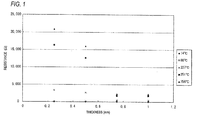
- Fig. 1 shows the results.
- Fig. 1 Since it can be read from Fig. 1 that a linear relationship stands up between the thickness and the resistance, the measurement data are approximated by a straight line in Fig. 1 .
- the resistance R 0 (T) at a thickness of 0 depends on temperature.
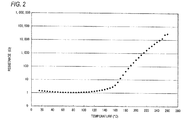
- Fig. 2 is a figure in which the resistance R 0 (T) at a thickness of 0 is plotted at every temperature.
- the PTCR characteristic that the resistance is sharply increased from a predetermined temperature (around 160°C in the present example) is theoretically expressed at a thickness of 0.
- the resistance R 0 (T) at a thickness of 0 is considered to be attributable to the resistance component generated not at the inside of the semiconductor ceramic composition but at the interface between the semiconductor ceramic composition and the electrode.
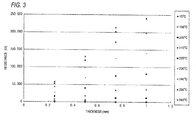
- Fig. 3 shows the relationship between the thickness and the resistance in a Pb-containing semiconductor ceramic composition.
- Fig. 3 shows the relationship between the temperature and the resistance of a PTC element having a Pb-containing semiconductor ceramic composition.
- a Pb-containing semiconductor ceramic composition Ba 0.65 Sr 0.12 Ca 0.06 Pb 0.17
- plate-like test pieces having sizes of 10 mm ⁇ 10 mm ⁇ 1.00 mm, 10 mm ⁇ 10 mm ⁇ 1.75 mm, 10 mm ⁇ 10 mm ⁇ 0.5 mm, and 10 mm ⁇ 10 mm ⁇ 0.25 mm were prepared as mentioned above. Same electrodes were formed on both end faces thereof to manufacture a PTC element, and a graph similar to Fig. 1 was made. Also in Fig.
- a linear relationship stands up between the thickness and the resistance and an approximation straight line can be introduced but, differently from the PTC element of the invention in Fig. 1 , the extrapolated value of the resistance at zero thickness is independent of temperature and is maintained at 0.
- a Pb-free semiconductor ceramic composition other than that of the invention also has the same relationship between the temperature and the resistance as in Fig. 3 .
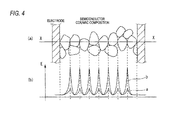
- the (a) in Fig. 4 is a schematic view showing a state that a Pb-containing semiconductor ceramic composition comprising a plurality of crystal grains is sandwiched between one pair of electrodes and (b) in Fig. 4 is a schematic view showing an energy potential E on a straight line X-X in (a) in Fig. 4 .
- the curve a in (b) in Fig. 4 represents an energy potential at room temperature and the curve b represents an energy potential at 200°C.
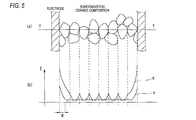
- the (a) in Fig. 5 is a schematic view showing a state that a semiconductor ceramic composition of the invention comprising a plurality of crystal grains is sandwiched between one pair of electrodes and (b) in Fig. 5 is a schematic view showing an energy potential E on a straight line Y-Y in (a) in Fig. 5 .
- the curve c in (b) in Fig. 5 represents an energy potential at room temperature and the curve d represents an energy potential at 200°C.
- w in (b) in Fig. 5 represents width of the region which shows the Schottky barrier at the interface between the electrode and the semiconductor ceramic composition.
- the Schottky barrier is generated at the interface between the electrode and the semiconductor ceramic composition and there is shown the jump characteristic that the energy potentials are remarkably different between at room temperature and at 200°C.
- the jump characteristic is expressed at the interface between the electrode and the semiconductor ceramic composition shown in (b) in Fig.
- the jump characteristic is not dependent on the thickness and is influenced by the composition of the semiconductor ceramic composition and the electrodes.
- the interface between the electrode and the semiconductor ceramic composition, where the Schottky barrier is generated means not the interface itself that has no thickness but a region having a width w (for example, 2 ⁇ m or less) in a depth direction from the electrode to the semiconductor ceramic composition.
- an energy potential is generated also at the crystal grain boundaries at the inside of the semiconductor ceramic composition but, since such energy potential is small as compared with the energy potential at the interface between the semiconductor ceramic composition and the electrode, the jump characteristic in the semiconductor ceramic composition may be considered to be controlled by the interface between the semiconductor ceramic composition and the electrode.
- the inventors of the invention have considered that validity of the above model may be proved if the jump characteristic be also changed when the kind of the metal constituting the electrodes is changed, so that the above resistance R 0 (T) is investigated with changing the kind of the metal and Fig. 6 to Fig. 10 show the results.
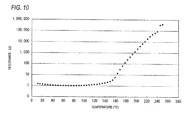
- Fig. 6 to Fig. 10 for the PTC elements having a size of 10 mm ⁇ 10 mm ⁇ 1.00 mm among the PTC elements measured in Figs. 1 and 3 , the resistance R 0 (T) when the thickness is 0 at each temperature is calculated and the relationship between the temperature and the resistance R 0 (T) at a thickness of 0 is shown.
- the PTC element measured in Fig. 6 is one where nickel electrodes were formed as ohmic electrodes by sputtering and silver electrodes were formed thereon as cover electrodes by sputtering and then thermal treatment was performed in the air at 300°C for 2 hours.
- the PTC element measured in Fig. 7 is one where silver electrodes as cover electrodes and nickel electrodes as ohmic electrodes were formed by sputtering and then thermal treatment was performed in oxygen at 300°C for 3 hours.
- the PTC element measured in Fig. 8 is one where silver electrodes as cover electrodes and nickel electrodes as ohmic electrodes were formed by sputtering and thermal treatment was not performed.
- Fig. 9 is one where titanium electrodes as cover electrodes and copper electrodes as ohmic electrodes were formed by sputtering and then thermal treatment was performed in the air at 300°C for 5 hours.
- the PTC element measured in Fig. 10 is one where nickel electrodes as cover electrodes and titanium electrodes as ohmic electrodes were formed by sputtering and then thermal treatment was performed in the air at 300°C for 5 hours.
- the resistance component is generated at the interface between the semiconductor ceramic composition and the metal electrode, the room-temperature resistivity ⁇ 25 , Curie temperature T sc , and resistance temperature coefficient ⁇ were measured in the case where the interface was increased by providing an intermediate layer electrode.
- the resistance (the whole resistance) in the material and the resistance (resistance R 0 (T) at a thickness of 0) at the interface between the electrode and the material were separated from the measured resistance of the semiconductor ceramic composition and a temperature at which the resistance at the interface became twice the resistance at the interface at room temperature was taken as the Curie temperature T sc for convenience.
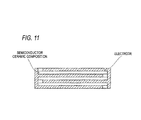
- Table 1 shows measurement results of the room-temperature resistivity ⁇ 25 , Curie temperature T sc , and resistance temperature coefficient ⁇ of laminated PTC elements, the elements being formed by using the aforementioned PTC elements used in Fig. 1 and Fig. 2 and laminating one to four pieces of each of the PTC elements having the same thickness as shown in Fig. 11 .
- a positive electrode was formed on one surface of the PTC element by printing and a negative electrode was formed on another surface by printing and a comb-like electrode structure where the positive electrodes were connected one another and the negative electrodes were connected one another with each external electrode was formed.
- the sheet material having a thickness of about 20 to 200 ⁇ m can be used.
- the thickness is less than 20 ⁇ m, a chemical reaction of the electrode with the material proceeds at the baking to change the characteristics, so that the case is not preferred.
- a sheet of several hundred ⁇ m can be manufactured by a doctor blade method or the like.
- the semiconductor ceramic composition used in the present measurement was one having a Ba vacancy content of 2.21 %, an Na vacancy content of 6.44%, a Bi vacancy content of 18.01 %, and oxygen defect amount of 1 ppm.
- the resistance temperature coefficient ⁇ is an index that shows how the resistance increases before and after the jump. The larger value shows the more excellent in the jump characteristic.
- the room-temperature resistivity ⁇ 25 and the resistance temperature coefficient ⁇ increase with the increase in the number of the laminated elements. Therefore, owing to the peculiar effect of the invention that a high resistance is shown in the vicinity of the interface, when the semiconductor ceramic composition according to the invention is used, the PTC element can be applied to uses where high room-temperature resistivity and resistance temperature coefficient are required, with increasing the number of the laminated elements without changing the material itself and thickness of the semiconductor ceramic composition.
- the laminated structure is suitable for uses where high withstand voltage is required even when the thickness is equal to or smaller than conventional thickness.
- Fig. 12 shows measurement results of temperature-resistance R 0 (T) at a thickness of 0 of a test piece where electrodes composed of a silver cover electrode, a nickel intermediate electrode, and a chromium ohmic electrode were formed on both sides of the semiconductor ceramic composition by sputtering and the thermal treatment was not conducted.
- Fig. 12 shows measurement results of temperature-resistance R 0 (T) at a thickness of 0 of a test piece where electrodes composed of a silver cover electrode, a nickel intermediate electrode, and a chromium ohmic electrode were formed on both sides of the semiconductor ceramic composition by sputtering and the thermal treatment was not conducted.
- Fig. 12 shows measurement results of temperature-resistance R 0 (T) at a thickness of 0 of a test piece where electrodes composed of a silver cover electrode, a nickel intermediate electrode, and a chromium ohmic electrode were formed on both sides of the semiconductor ceramic composition by sputtering and the thermal
- FIG. 13 shows measurement results of temperature-resistance R 0 (T) at a thickness of 0 of a test piece where electrodes composed of a silver cover electrode, a nickel intermediate electrode, and a chromium ohmic electrode were formed on both sides of the semiconductor ceramic composition by sputtering and the thermal treatment was conducted in the air at 300°C for 5 hours.
- Fig. 14 shows measurement results of temperature-resistance R 0 (T) at a thickness of 0 of a test piece where electrodes composed of a silver cover electrode, a nickel intermediate electrode, and a chromium ohmic electrode were formed on both sides of the semiconductor ceramic composition by sputtering and the thermal treatment was conducted in oxygen at 300°C for 5 hours.
- the jump characteristic was expressed and particularly, those subjected to the thermal treatment after the electrodes were formed showed an excellent jump characteristic. It seems that this is because the metal (chromium) of the ohmic electrode and the components in the air influence each other by the thermal treatment to increase the density of state of the interface.
- the jump characteristic is expressed independent of the method for forming the electrodes. Moreover, even in the case of the PTC elements having electrodes derived from the same materials, it is confirmed that the PTC element subjected to the thermal treatment is excellent in the jump characteristic.
- a plurality of semiconductor ceramic compositions which have metal electrodes provided on both end faces and are different in thickness one another are prepared, resistances of individual semiconductor ceramic compositions are measured at every predetermined temperature with heating the semiconductor ceramic compositions, an approximation straight line between the thickness and the resistance is determined at every predetermined temperature, a resistance on the approximation straight line at a thickness of 0 is determined at every predetermined temperature, and it is judged that the PTCR characteristic is expressed at the interface between the semiconductor ceramic composition and the electrode at the time when the resistance at a thickness of 0 sharply increases at a specific temperature as a border, whereby a position of expressing the PTCR characteristic can be specified.
- the atomic vacancy content in the semiconductor ceramic composition which influences the above jump characteristic, was considered.
- the vacancy contents of Bi, Ba, Na, and O were analyzed. This is because, although Bi and Na should be theoretically contained in an amount of 0.08 and 0.5 relative to Ti:1, since the values of Bi, Ba, Na, and O were smaller than the theoretical values as a result of analyzing the actual semiconductor ceramic composition, it was presumed that defects are generated at Bi, Ba, Na, and O sites. Accordingly, there was obtained an idea that the degree of the defects may influence the room-temperature resistivity ⁇ 25 , Curie temperature T sc , and resistance temperature coefficient ⁇ , and hence the analysis was performed.
- the quantity of the oxygen defects was determined according to the following calculation formula.
- the resistance temperature coefficient ⁇ is 5.0%/C or more
- the PTC element can be sufficiently utilized as a PTC element for sensor uses and heater uses.
- suitable Curie temperature is determined depending on uses of the PTC element, when the Curie temperature may be changed in a certain range, the element can be applied to various uses.
- the semiconductor ceramic composition according to the invention mentioned above can vary the temperature from about 150°C to about 190°C, the range to which the PTC element of the invention can be applied is said to be broad.
- the element of up to about 70 ⁇ cm is suitable for auxiliary heaters for vehicles
- the element of up to about 1000 ⁇ cm is suitable for steam-generating modules
- the element of 1000 ⁇ cm or more is suitable for heaters for hybrid vehicles and electric vehicles, heating-element modules, and the like. This is because, when a PTC element having low resistivity is used for parts where high withstand voltage is required, there is a concern that too much electric current flows through other electronic parts to damage the other electronic parts.
- the vacancy content of Bi is preferably more than 5% and 75% or less relative to the Bi sites.
- the vacancy content of Bi is in the range, an interface having a depletion layer (having a Schottky barrier) is easily configured.
- the Bi vacancy content does not exceed 80%, it is preferred to control an amount of Bi 2 O 3 to be charged so that ⁇ in (Bi 0.5- ⁇ Na 0.5- ⁇ )TiO 3 does not exceed 0.4 at the control stage of the raw material powders.
- ⁇ exceeds 0.4 and becomes extremely large, an extremely large number of a heterogeneous phase, where Bi is lacked from a normal tetragonal phase, is formed, so that it is preferred to volatilize Bi as far as possible at the calcination or sintering stage.
- Bi defects can be formed in the tetragonal phase with suppressing the heterogeneous phase formation to the minimum.
- ⁇ is also preferably as small as possible. Since Ba has a low saturated vapor pressure and thus cannot be volatilized at the calcination or sintering stage, the content is controlled by dissolving Ba into water at the preparation stage of the raw material powder.
- the semiconductor ceramic composition does not show the jump characteristic, so that the quantity of the oxygen defects is preferably 10 ppm or less.
- the vacancy content of Bi is considered to be a component which directly influences the jump characteristic of the semiconductor ceramic composition but, when the formation of the heterogeneous phase in the semiconductor ceramic composition is considered, it is preferred that the vacancy content of Ba is more than 0% and 4% or less, further preferably 3% or less relative to the Ba sites. Moreover, the vacancy content of Na is preferably more than 0% and 60% or less relative to the Na sites.
- the jump characteristic is expressed but vacancy ratio of Ba or Na in the semiconductor ceramic composition becomes too large to form a regular crystal structure and heterogeneous phases are formed, so that the case is not preferred.
- the aforementioned jump characteristic is expressed at the interface between the metal and the semiconductor ceramic composition and the jump characteristic is influenced by the vacancy contents of Bi and O, a depletion layer is considered to be present at the interface between the metal and the semiconductor ceramic composition.
- the depletion layer is considered to be present at the interface between the metal and the semiconductor ceramic composition
- the depletion layer of the PTC element where electrodes are provided on the semiconductor ceramic composition was confirmed using a scanning capacitance microscope SCM (Scanning Capacitance Microscopy).
- Fig. 15 is an SCM image obtained by investigating electric capacitance of the surface of the PTC element where electrodes are provided on a part of the surface of the semiconductor ceramic composition on a scanning capacitance microscope (manufactured by Veeco Company, Model: NanoScope Iva AFM Dimension 3100).
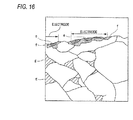
- Fig. 16 is a schematic view which traces crystal grain boundaries in Fig. 15 and shows the density of electric capacitance of the depletion layer at three stages.
- the electric capacitance C of the depletion layer is proportional to the square root of donor density, i.e., density of state at the interface between the semiconductor ceramic composition and the electrode, as the following (Numeral 2).
- the region having high density of state also has a large electric capacitance C and appears with deep color.
- Figs. 15 and 16 are results of observing change in electric capacitance with changing the voltage to be applied to the interface between the semiconductor ceramic composition and the electrode. In Figs. 15 and 16 , it is shown that the region having higher density has larger electric capacitance.
- the regions e having large electric capacitance i.e., high density of state or the regions f having medium electric capacitance/density of state appeared in the vicinity of the interface where the electrode was formed and it can be confirmed that many depletion layers were formed in the regions.
- the regions having small electric capacitance i.e., low density of state appeared on the end faces and the inside of the semiconductor composition at which the electrode was not formed and it is confirmed that these regions were regions g where, even when the depletion layers were present, the density was low. Since the density of state increases as the Bi vacancy content increases, it is presumed that the depletion layer is formed to a degree that the jump characteristic can be expressed.
- the Bi defects are considered to have high influence on the Schottky barrier at the electrode/material interface. This is because the resistance and the jump characteristic are remarkably expressed in the case where Bi is little.
- the width w of the Schottky barrier (width of the depletion layer) at the interface of the metal and the semiconductor ceramic composition is determined according to the following (Numeral 3).
- the expression shows that the width w of the region showing the Schottky barrier is inversely proportional to the electric capacitance C.
- the width w e of the region showing the Schottky barrier in the region e showing large electric capacitance C is narrower than the width w f of the region f showing medium electric capacitance C and this fact is coincident with the results of Figs. 15 and 16 .
- the width (depth) w e of the depletion layer in the high density region e in the vicinity of the interface was 0.04 to 0.8 ⁇ m and the width (depth) w f of the depletion layer in the medium density region f was about 2 ⁇ m.
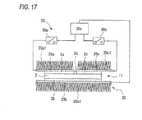
- the PTC element of the invention was fixed by sandwiching it among radiating fins 20a1, 20b1, and 20c1 as shown in Fig. 17 to obtain a heating-element module 20.
- Electrodes 2a and 2c formed on one face of a heating element 11 are thermally and electrically closely attached to power supply electrodes 20a and 20c, respectively, and an electrode 2b formed on another face is thermally and electrically closely attached to a power supply electrode 20b.
- the power supply electrodes 20a, 20b, and 20c are thermally connected to the radiating fins 20a1, 20b1, and 20c1.
- An insulating layer 2d is provided between the power supply electrode 20a and the power supply electrode 20c to insulate the both electrically.
- the heat generated at the heating element 11 is transmitted to the electrodes 2a, 2b, and 2c, the power supply electrodes 20a, 20b, and 20c, and the radiating fins 20a1, 20b1, and 20c1 in the order and is released into the atmosphere mainly from the radiating fins 20a1, 20b1, and 20c1.
- the heating-element module 20 can switch the heating capacity according to the load situation of the power source 30c and the desired degree of requirement for rapid or slow heating.
- a heating apparatus 30 can be configured by connecting the heating-element module 20 capable of switching the heating capacity to the power source 30c.
- the power source 30c may be either direct current one or alternative current one.
- the power supply electrode 20a and the power supply electrode 20c of the heating-element module 20 are connected in parallel to one electrode of the power source 30c through separate switches 30a and 30b and the power supply electrode 20b is connected as a common terminal to another electrode of the power source 30c.
- the heating capacity is small and the load on the power source 30c can be lightened.
- the heating capacity can be enlarged.
- the element 2 can be maintained at a constant temperature without equipping the power source 30c with a particular mechanism. That is, when the element 2 having the PTCR characteristic is heated to around the Curie temperature, the resistance of the element 2 sharply increases and the flow of the current through the element 2 decreases, so that the material is no more heated automatically. Moreover, when the temperature of the element 2 lowers from the Curie temperature, the current is again allowed to flow through the element and the element 2 is heated.
- the temperature of the element 2 and also the whole heating-element module 20 can be made constant through repetition of such a cycle, a circuit for regulating the phase and width of the power source 30c and also a temperature detecting mechanism or a mechanism for comparison with a target temperature, a circuit for controlling power for heating, and the like are also unnecessary.
- the heating apparatus 30 can heat air with introducing air between the radiating fins 20a1 to 20c1 or can heat a liquid such as water with connecting a metal tube for liquid flow between the radiating fins 20a1 to 20c1. On this occasion, since the element 2 is also kept at a constant temperature, a safe heating apparatus 30 can be configured.
- a heating-element module 12 according to a modified example of the invention will be explained with reference to Fig. 18 .
- the heating-element module 12 is shown with cutting a part thereof for the purpose of illustration in Fig. 18 .
- the heating-element module 12 is an approximately flat rectangular module and has a element 3 obtained by processing a semiconductor ceramic composition of Example into an approximately rectangular shape, electrodes 3a and 3b provided on upper and lower faces of the element 3, an insulating coating layer 5 covering the element 3 and the electrodes 3a and 3b, and outgoing electrodes 4a and 4b connected to the electrodes 3a and 3b, respectively, and exposed from the insulating coating layer 5 toward outside.
- the heating-element module 12 there are provided a plurality of through-holes 6 which penetrate the upper and lower faces of the heating-element module 12 and whose inner peripheral faces are covered with the insulating coating layer 5.
- the heating-element module 12 can be made as follows. First, in the element 3 obtained by processing the semiconductor ceramic composition of Example 1, a plurality of holes penetrating the element 3 in a thickness direction are formed. Next, the electrodes 3a and 3b are formed on both faces of the element 3 excluding opening peripheries at which the holes open on the upper and lower faces of the element 3. In this regard, the electrodes 3a and 3b are formed by printing with overlaying an ohmic electrode and a surface electrode as mentioned above.
- the whole of the element 3 and the electrodes 3a and 3b is covered with an insulating coating agent so that the outgoing electrodes 4a and 4b are exposed toward outside to form the insulating coating layer 5, thereby obtaining the heating-element module 12.
- the inner peripheral faces of the holes of the element 3 are covered with the insulating coating layer 5 to form the through-holes 6.
- the heating-element module 12 can heat a fluid by introducing the fluid into the through-holes 6.
- the element 3 and the electrodes 3a and 4a through which an electric current is allowed to flow are covered with the insulating coating layer 5, they do not come into direct contact with the fluid, so that a conductive liquid can be heated. Therefore, the heating-element module 12 is suitable for uses where fluids having electric conductivity, such as a salt solution, are instantaneously heated.
Landscapes
- Engineering & Computer Science (AREA)
- Chemical & Material Sciences (AREA)
- Ceramic Engineering (AREA)
- Materials Engineering (AREA)
- Manufacturing & Machinery (AREA)
- Structural Engineering (AREA)
- Organic Chemistry (AREA)
- Inorganic Chemistry (AREA)
- Physics & Mathematics (AREA)
- Microelectronics & Electronic Packaging (AREA)
- Thermal Sciences (AREA)
- Electromagnetism (AREA)
- Thermistors And Varistors (AREA)
- Compositions Of Oxide Ceramics (AREA)
Applications Claiming Priority (2)
| Application Number | Priority Date | Filing Date | Title |
|---|---|---|---|
| JP2010089758 | 2010-04-08 | ||
| PCT/JP2011/058681 WO2011126040A1 (fr) | 2010-04-08 | 2011-04-06 | Elément à coefficient de température positif et module d'élément chauffant |
Publications (2)
| Publication Number | Publication Date |
|---|---|
| EP2557575A1 true EP2557575A1 (fr) | 2013-02-13 |
| EP2557575A4 EP2557575A4 (fr) | 2013-12-11 |
Family
ID=44762974
Family Applications (1)
| Application Number | Title | Priority Date | Filing Date |
|---|---|---|---|
| EP11765940.9A Withdrawn EP2557575A4 (fr) | 2010-04-08 | 2011-04-06 | Elément à coefficient de température positif et module d'élément chauffant |
Country Status (6)
| Country | Link |
|---|---|
| US (1) | US8686827B2 (fr) |
| EP (1) | EP2557575A4 (fr) |
| JP (1) | JP5803906B2 (fr) |
| CN (1) | CN102822911B (fr) |
| TW (1) | TWI470653B (fr) |
| WO (1) | WO2011126040A1 (fr) |
Families Citing this family (6)
| Publication number | Priority date | Publication date | Assignee | Title |
|---|---|---|---|---|
| WO2013051486A1 (fr) | 2011-10-03 | 2013-04-11 | 日立金属株式会社 | Composition de porcelaine semi-conductrice, élément à coefficient de température positif, et module générateur de chaleur |
| JP6245222B2 (ja) * | 2015-06-05 | 2017-12-13 | 株式会社村田製作所 | 積層セラミックコンデンサの製造方法 |
| KR102116675B1 (ko) * | 2015-12-04 | 2020-05-29 | 가부시키가이샤 무라타 세이사쿠쇼 | 유전체 자기 조성물, 적층 세라믹 콘덴서 및 적층 세라믹 콘덴서의 제조 방법 |
| WO2017104539A1 (fr) * | 2015-12-18 | 2017-06-22 | 株式会社村田製作所 | Composition de céramique diélectrique, procédé de production de composition de céramique diélectrique et composant électronique multi-couche en céramique |
| CN107721412A (zh) * | 2017-11-13 | 2018-02-23 | 陕西科技大学 | 一种nbt基半导体陶瓷及其制备方法 |
| CN113475755B (zh) * | 2021-08-06 | 2024-07-09 | 广东省奇思智能制造有限公司 | 发热体及其制备方法和雾化器、雾化装置 |
Family Cites Families (14)
| Publication number | Priority date | Publication date | Assignee | Title |
|---|---|---|---|---|
| JPS4827556A (fr) | 1971-08-13 | 1973-04-11 | ||
| JPS56169301A (en) * | 1980-06-02 | 1981-12-26 | Tohoku Metal Ind Ltd | Method of producing barium titanate semiconductor porcelain |
| TW369514B (en) * | 1994-01-13 | 1999-09-11 | Tam Ceramics Inc | A method of sintering Pb(Mg1/3Nb2/3)O3 or the oxide precursors thereof without using lead oxide |
| JP3498211B2 (ja) * | 1999-12-10 | 2004-02-16 | 株式会社村田製作所 | 積層型半導体セラミック電子部品 |
| JP2006179692A (ja) | 2004-12-22 | 2006-07-06 | Komatsu Electronics Inc | サーミスタの製造方法 |
| JP4827556B2 (ja) | 2005-03-18 | 2011-11-30 | キヤノン株式会社 | 積層型半導体パッケージ |
| CN101213155B (zh) * | 2005-04-28 | 2012-11-21 | 日立金属株式会社 | 半导体陶瓷组合物及其制备方法 |
| US8067325B2 (en) * | 2006-02-27 | 2011-11-29 | Hitachi Metals, Ltd. | Semiconductor ceramic composition |
| JP2008063188A (ja) * | 2006-09-07 | 2008-03-21 | Furukawa Co Ltd | Ptcサーミスタ用配合材料およびptcサーミスタ用半導体磁器組成物 |
| EP2067755A4 (fr) | 2006-09-28 | 2016-02-10 | Murata Manufacturing Co | Composition de porcelaine semiconductrice de titanate de baryum et dispositif ptc utilisant celle-ci |
| US20090105064A1 (en) * | 2006-10-27 | 2009-04-23 | Takeshi Shimada | Semiconductor ceramic composition and method for producing the same |
| JP5251119B2 (ja) * | 2007-12-26 | 2013-07-31 | 日立金属株式会社 | 半導体磁器組成物 |
| JP5590494B2 (ja) * | 2008-03-27 | 2014-09-17 | 日立金属株式会社 | 半導体磁器組成物−電極接合体の製造方法 |
| JP2010089758A (ja) | 2008-10-10 | 2010-04-22 | Autonetworks Technologies Ltd | 車両用電源装置 |
-
2011
- 2011-04-06 EP EP11765940.9A patent/EP2557575A4/fr not_active Withdrawn
- 2011-04-06 CN CN201180017538.8A patent/CN102822911B/zh not_active Expired - Fee Related
- 2011-04-06 WO PCT/JP2011/058681 patent/WO2011126040A1/fr not_active Ceased
- 2011-04-06 US US13/639,804 patent/US8686827B2/en not_active Expired - Fee Related
- 2011-04-06 JP JP2012509682A patent/JP5803906B2/ja not_active Expired - Fee Related
- 2011-04-08 TW TW100112183A patent/TWI470653B/zh not_active IP Right Cessation
Non-Patent Citations (2)
| Title |
|---|
| No further relevant documents disclosed * |
| See also references of WO2011126040A1 * |
Also Published As
| Publication number | Publication date |
|---|---|
| JPWO2011126040A1 (ja) | 2013-07-11 |
| WO2011126040A1 (fr) | 2011-10-13 |
| US20130037904A1 (en) | 2013-02-14 |
| TWI470653B (zh) | 2015-01-21 |
| US8686827B2 (en) | 2014-04-01 |
| EP2557575A4 (fr) | 2013-12-11 |
| JP5803906B2 (ja) | 2015-11-04 |
| CN102822911A (zh) | 2012-12-12 |
| TW201212050A (en) | 2012-03-16 |
| CN102822911B (zh) | 2015-11-25 |
Similar Documents
| Publication | Publication Date | Title |
|---|---|---|
| JP5757239B2 (ja) | 半導体磁器組成物およびその製造方法、ptc素子および発熱モジュール | |
| EP2557575A1 (fr) | Elément à coefficient de température positif et module d'élément chauffant | |
| EP2371788A1 (fr) | Céramique de semi-conducteur et thermistance à coefficient de température positif | |
| EP2765122A1 (fr) | Composition de porcelaine semi-conductrice, élément à coefficient de température positif, et module générateur de chaleur | |
| CN102597724B (zh) | 电阻元件、红外线传感器及电气设备 | |
| US10629322B2 (en) | Electrically conductive oxide sintered compact, member for electrical conduction, gas sensor, piezoelectric element, and method for producing piezoelectric element | |
| JP5765611B2 (ja) | Ptc素子および発熱モジュール | |
| JP5626204B2 (ja) | 半導体磁器組成物、発熱体及び発熱モジュール | |
| JP2012004496A (ja) | Ptc素子および発熱モジュール | |
| EP3202747B1 (fr) | Céramique semi-conductrice de titanate de baryum, composition céramique semi-conductrice de titanate de baryum et thermistance ptc pour détection de température | |
| JP2012046372A (ja) | Ptc素子および発熱モジュール | |
| JP5263668B2 (ja) | 半導体磁器組成物 | |
| JP2012036032A (ja) | 半導体磁器組成物、その製造方法、ptc素子及び発熱モジュール | |
| JP2012001416A (ja) | Ptc素子および発熱モジュール | |
| JP5737634B2 (ja) | 半導体磁器組成物の製造方法 | |
| JP2012224537A (ja) | Ptc素子用焼結体、その製造方法、ptc素子、及び発熱モジュール | |
| Jayanthi et al. | Giant dielectrics from modified boundary layers in n-BaTiO3 ceramics involving selective melting reactions of silver/glass composites at the grain boundaries | |
| JP2016225404A (ja) | 酸化亜鉛系バリスタ用焼結体およびこれを用いた多層基板、ならびにそれらの製造方法 | |
| CN105359227A (zh) | Ptc元件和发热模块 | |
| JP2016225406A (ja) | 酸化亜鉛系バリスタ用焼結体およびこれを用いた多層基板、ならびにそれらの製造方法 | |
| WO2015012057A1 (fr) | Composant électronique | |
| JP2016225405A (ja) | 酸化亜鉛系バリスタ用焼結体およびこれを用いた多層基板、ならびにそれらの製造方法 |
Legal Events
| Date | Code | Title | Description |
|---|---|---|---|
| PUAI | Public reference made under article 153(3) epc to a published international application that has entered the european phase |
Free format text: ORIGINAL CODE: 0009012 |
|
| 17P | Request for examination filed |
Effective date: 20121008 |
|
| AK | Designated contracting states |
Kind code of ref document: A1 Designated state(s): AL AT BE BG CH CY CZ DE DK EE ES FI FR GB GR HR HU IE IS IT LI LT LU LV MC MK MT NL NO PL PT RO RS SE SI SK SM TR |
|
| DAX | Request for extension of the european patent (deleted) | ||
| A4 | Supplementary search report drawn up and despatched |
Effective date: 20131112 |
|
| RIC1 | Information provided on ipc code assigned before grant |
Ipc: H01B 3/12 20060101ALI20131106BHEP Ipc: C04B 35/468 20060101ALI20131106BHEP Ipc: H01C 7/02 20060101AFI20131106BHEP Ipc: H01L 35/00 20060101ALI20131106BHEP |
|
| 17Q | First examination report despatched |
Effective date: 20140812 |
|
| STAA | Information on the status of an ep patent application or granted ep patent |
Free format text: STATUS: THE APPLICATION IS DEEMED TO BE WITHDRAWN |
|
| 18D | Application deemed to be withdrawn |
Effective date: 20170921 |