EP2563525B1 - Verfahren und verwendung eines binders zur metallischen beschichtung einer oberfläche - Google Patents
Verfahren und verwendung eines binders zur metallischen beschichtung einer oberfläche Download PDFInfo
- Publication number
- EP2563525B1 EP2563525B1 EP11716262.8A EP11716262A EP2563525B1 EP 2563525 B1 EP2563525 B1 EP 2563525B1 EP 11716262 A EP11716262 A EP 11716262A EP 2563525 B1 EP2563525 B1 EP 2563525B1
- Authority
- EP
- European Patent Office
- Prior art keywords
- binder
- electrically conductive
- metallic coat
- present
- metallic
- Prior art date
- Legal status (The legal status is an assumption and is not a legal conclusion. Google has not performed a legal analysis and makes no representation as to the accuracy of the status listed.)
- Active
Links
Images


Classifications
-
- C—CHEMISTRY; METALLURGY
- C23—COATING METALLIC MATERIAL; COATING MATERIAL WITH METALLIC MATERIAL; CHEMICAL SURFACE TREATMENT; DIFFUSION TREATMENT OF METALLIC MATERIAL; COATING BY VACUUM EVAPORATION, BY SPUTTERING, BY ION IMPLANTATION OR BY CHEMICAL VAPOUR DEPOSITION, IN GENERAL; INHIBITING CORROSION OF METALLIC MATERIAL OR INCRUSTATION IN GENERAL
- C23C—COATING METALLIC MATERIAL; COATING MATERIAL WITH METALLIC MATERIAL; SURFACE TREATMENT OF METALLIC MATERIAL BY DIFFUSION INTO THE SURFACE, BY CHEMICAL CONVERSION OR SUBSTITUTION; COATING BY VACUUM EVAPORATION, BY SPUTTERING, BY ION IMPLANTATION OR BY CHEMICAL VAPOUR DEPOSITION, IN GENERAL
- C23C16/00—Chemical coating by decomposition of gaseous compounds, without leaving reaction products of surface material in the coating, i.e. chemical vapour deposition [CVD] processes
- C23C16/44—Chemical coating by decomposition of gaseous compounds, without leaving reaction products of surface material in the coating, i.e. chemical vapour deposition [CVD] processes characterised by the method of coating
- C23C16/50—Chemical coating by decomposition of gaseous compounds, without leaving reaction products of surface material in the coating, i.e. chemical vapour deposition [CVD] processes characterised by the method of coating using electric discharges
-
- B—PERFORMING OPERATIONS; TRANSPORTING
- B05—SPRAYING OR ATOMISING IN GENERAL; APPLYING FLUENT MATERIALS TO SURFACES, IN GENERAL
- B05D—PROCESSES FOR APPLYING FLUENT MATERIALS TO SURFACES, IN GENERAL
- B05D1/00—Processes for applying liquids or other fluent materials
- B05D1/02—Processes for applying liquids or other fluent materials performed by spraying
- B05D1/04—Processes for applying liquids or other fluent materials performed by spraying involving the use of an electrostatic field
-
- B—PERFORMING OPERATIONS; TRANSPORTING
- B05—SPRAYING OR ATOMISING IN GENERAL; APPLYING FLUENT MATERIALS TO SURFACES, IN GENERAL
- B05D—PROCESSES FOR APPLYING FLUENT MATERIALS TO SURFACES, IN GENERAL
- B05D1/00—Processes for applying liquids or other fluent materials
- B05D1/02—Processes for applying liquids or other fluent materials performed by spraying
- B05D1/04—Processes for applying liquids or other fluent materials performed by spraying involving the use of an electrostatic field
- B05D1/06—Applying particulate materials
-
- B—PERFORMING OPERATIONS; TRANSPORTING
- B05—SPRAYING OR ATOMISING IN GENERAL; APPLYING FLUENT MATERIALS TO SURFACES, IN GENERAL
- B05D—PROCESSES FOR APPLYING FLUENT MATERIALS TO SURFACES, IN GENERAL
- B05D1/00—Processes for applying liquids or other fluent materials
- B05D1/02—Processes for applying liquids or other fluent materials performed by spraying
- B05D1/12—Applying particulate materials
-
- C—CHEMISTRY; METALLURGY
- C23—COATING METALLIC MATERIAL; COATING MATERIAL WITH METALLIC MATERIAL; CHEMICAL SURFACE TREATMENT; DIFFUSION TREATMENT OF METALLIC MATERIAL; COATING BY VACUUM EVAPORATION, BY SPUTTERING, BY ION IMPLANTATION OR BY CHEMICAL VAPOUR DEPOSITION, IN GENERAL; INHIBITING CORROSION OF METALLIC MATERIAL OR INCRUSTATION IN GENERAL
- C23C—COATING METALLIC MATERIAL; COATING MATERIAL WITH METALLIC MATERIAL; SURFACE TREATMENT OF METALLIC MATERIAL BY DIFFUSION INTO THE SURFACE, BY CHEMICAL CONVERSION OR SUBSTITUTION; COATING BY VACUUM EVAPORATION, BY SPUTTERING, BY ION IMPLANTATION OR BY CHEMICAL VAPOUR DEPOSITION, IN GENERAL
- C23C16/00—Chemical coating by decomposition of gaseous compounds, without leaving reaction products of surface material in the coating, i.e. chemical vapour deposition [CVD] processes
- C23C16/56—After-treatment
-
- H—ELECTRICITY
- H05—ELECTRIC TECHNIQUES NOT OTHERWISE PROVIDED FOR
- H05K—PRINTED CIRCUITS; CASINGS OR CONSTRUCTIONAL DETAILS OF ELECTRIC APPARATUS; MANUFACTURE OF ASSEMBLAGES OF ELECTRICAL COMPONENTS
- H05K3/00—Apparatus or processes for manufacturing printed circuits
- H05K3/10—Apparatus or processes for manufacturing printed circuits in which conductive material is applied to the insulating support in such a manner as to form the desired conductive pattern
- H05K3/14—Apparatus or processes for manufacturing printed circuits in which conductive material is applied to the insulating support in such a manner as to form the desired conductive pattern using spraying techniques to apply the conductive material, e.g. vapour evaporation
-
- B—PERFORMING OPERATIONS; TRANSPORTING
- B05—SPRAYING OR ATOMISING IN GENERAL; APPLYING FLUENT MATERIALS TO SURFACES, IN GENERAL
- B05D—PROCESSES FOR APPLYING FLUENT MATERIALS TO SURFACES, IN GENERAL
- B05D1/00—Processes for applying liquids or other fluent materials
- B05D1/02—Processes for applying liquids or other fluent materials performed by spraying
- B05D1/04—Processes for applying liquids or other fluent materials performed by spraying involving the use of an electrostatic field
- B05D1/045—Processes for applying liquids or other fluent materials performed by spraying involving the use of an electrostatic field on non-conductive substrates
-
- B—PERFORMING OPERATIONS; TRANSPORTING
- B05—SPRAYING OR ATOMISING IN GENERAL; APPLYING FLUENT MATERIALS TO SURFACES, IN GENERAL
- B05D—PROCESSES FOR APPLYING FLUENT MATERIALS TO SURFACES, IN GENERAL
- B05D1/00—Processes for applying liquids or other fluent materials
- B05D1/34—Applying different liquids or other fluent materials simultaneously
-
- B—PERFORMING OPERATIONS; TRANSPORTING
- B05—SPRAYING OR ATOMISING IN GENERAL; APPLYING FLUENT MATERIALS TO SURFACES, IN GENERAL
- B05D—PROCESSES FOR APPLYING FLUENT MATERIALS TO SURFACES, IN GENERAL
- B05D2503/00—Polyurethanes
-
- B—PERFORMING OPERATIONS; TRANSPORTING
- B05—SPRAYING OR ATOMISING IN GENERAL; APPLYING FLUENT MATERIALS TO SURFACES, IN GENERAL
- B05D—PROCESSES FOR APPLYING FLUENT MATERIALS TO SURFACES, IN GENERAL
- B05D3/00—Pretreatment of surfaces to which liquids or other fluent materials are to be applied; After-treatment of applied coatings, e.g. intermediate treating of an applied coating preparatory to subsequent applications of liquids or other fluent materials
- B05D3/02—Pretreatment of surfaces to which liquids or other fluent materials are to be applied; After-treatment of applied coatings, e.g. intermediate treating of an applied coating preparatory to subsequent applications of liquids or other fluent materials by baking
- B05D3/0254—After-treatment
- B05D3/0263—After-treatment with IR heaters
-
- B—PERFORMING OPERATIONS; TRANSPORTING
- B05—SPRAYING OR ATOMISING IN GENERAL; APPLYING FLUENT MATERIALS TO SURFACES, IN GENERAL
- B05D—PROCESSES FOR APPLYING FLUENT MATERIALS TO SURFACES, IN GENERAL
- B05D3/00—Pretreatment of surfaces to which liquids or other fluent materials are to be applied; After-treatment of applied coatings, e.g. intermediate treating of an applied coating preparatory to subsequent applications of liquids or other fluent materials
- B05D3/10—Pretreatment of surfaces to which liquids or other fluent materials are to be applied; After-treatment of applied coatings, e.g. intermediate treating of an applied coating preparatory to subsequent applications of liquids or other fluent materials by other chemical means
- B05D3/107—Post-treatment of applied coatings
-
- B—PERFORMING OPERATIONS; TRANSPORTING
- B05—SPRAYING OR ATOMISING IN GENERAL; APPLYING FLUENT MATERIALS TO SURFACES, IN GENERAL
- B05D—PROCESSES FOR APPLYING FLUENT MATERIALS TO SURFACES, IN GENERAL
- B05D3/00—Pretreatment of surfaces to which liquids or other fluent materials are to be applied; After-treatment of applied coatings, e.g. intermediate treating of an applied coating preparatory to subsequent applications of liquids or other fluent materials
- B05D3/12—Pretreatment of surfaces to which liquids or other fluent materials are to be applied; After-treatment of applied coatings, e.g. intermediate treating of an applied coating preparatory to subsequent applications of liquids or other fluent materials by mechanical means
-
- B—PERFORMING OPERATIONS; TRANSPORTING
- B05—SPRAYING OR ATOMISING IN GENERAL; APPLYING FLUENT MATERIALS TO SURFACES, IN GENERAL
- B05D—PROCESSES FOR APPLYING FLUENT MATERIALS TO SURFACES, IN GENERAL
- B05D5/00—Processes for applying liquids or other fluent materials to surfaces to obtain special surface effects, finishes or structures
- B05D5/06—Processes for applying liquids or other fluent materials to surfaces to obtain special surface effects, finishes or structures to obtain multicolour or other optical effects
- B05D5/067—Metallic effect
-
- H—ELECTRICITY
- H05—ELECTRIC TECHNIQUES NOT OTHERWISE PROVIDED FOR
- H05K—PRINTED CIRCUITS; CASINGS OR CONSTRUCTIONAL DETAILS OF ELECTRIC APPARATUS; MANUFACTURE OF ASSEMBLAGES OF ELECTRICAL COMPONENTS
- H05K2203/00—Indexing scheme relating to apparatus or processes for manufacturing printed circuits covered by H05K3/00
- H05K2203/12—Using specific substances
- H05K2203/122—Organic non-polymeric compounds, e.g. oil, wax or thiol
-
- H—ELECTRICITY
- H05—ELECTRIC TECHNIQUES NOT OTHERWISE PROVIDED FOR
- H05K—PRINTED CIRCUITS; CASINGS OR CONSTRUCTIONAL DETAILS OF ELECTRIC APPARATUS; MANUFACTURE OF ASSEMBLAGES OF ELECTRICAL COMPONENTS
- H05K2203/00—Indexing scheme relating to apparatus or processes for manufacturing printed circuits covered by H05K3/00
- H05K2203/13—Moulding and encapsulation; Deposition techniques; Protective layers
- H05K2203/1333—Deposition techniques, e.g. coating
- H05K2203/1344—Spraying small metal particles or droplets of molten metal
Definitions
- the present invention relates to a method for providing a metallic coat covering a surface. According to another aspect, the present invention relates to the use of a binder for providing a metallic coat.
- Metallic coatings change the properties of surfaces to the properties of the metal being applied.
- metallic coatings may provide an attractive appearance such as the gleam of polished metals.
- metallic coatings may protect a surface against for example moisture, salt spray, oxidation and wear resistance.
- Metallic coatings are widely used in the automotive industry, construction sector, offshore industry or for decoration and restoration of objects.
- a metal coat is provided by mixing small amounts of metal powder with a binder whereafter the mixture is applied to a surface. Additionally, processes are known wherein mixtures comprising a binder and a metal powder are sprayed on an object.
- a binder comprises polyester and epoxy.
- Another known process for providing a metallic coat is galvanizing, wherein an object is usually dipped into a bath of a melted metal of interest.
- An example is the protection of a metal object by covering it with a zinc coat.
- a first drawback can be found in the precipitation of a metal powder in a mixture of a binder and a metal powder. This precipitation may cause a non equal coat. Moreover, the pot-life of the mixture of binder and metal powder is limited.
- Another drawback of mixtures comprising a metal powder and a binder is that the saturation of the binder with metal powder is limited. For example, in spraying techniques for applying a mixture of a binder and metal powder the amount of metal powder that can be mixed with the binder is limited.
- galvanizing methods are hazardous for the environment.
- the galvanizing process requires for example high energy consumption since large amounts of metal has to be heated.
- galvanizing methods produce toxic metal sludge waste as a result of the required use of solvents and acids.
- US2004115477A1 describes a reinforcing underlayment including dry uniform particles evenly applied to a wet bonding material layer on a surface of a substrate.
- the substrate, including the layers, is then cured to harden the one or more of the layers.
- a final coating or topcoat is applied to the cured surface of the substrate.
- GB1529997A describes coating compositions wherein the binder comprises a mixture of:(a) a polyisocyanate component which contains free isocyanate groups and urethane groups and which has been obtained by reacting the following components (i) and (ii) in an NCO:OH equivalent ratio of from 300:1 to 10:1: (i) a polyisocyanate mixture which contains from 20 to 80 %, by weight, of 2,4 '-diisocyanato 15 diphenyl methane and from 80 to 20 %, by weight, of 4,4 '-diisocyanato diphenyl methane or of a mixture of 4,4 '-diisocyanato diphenyl methane with 2,2 '-diisocyanato diphenyl methane and/or with higher molecular weight polyisocyanates of the diphenyl methane series; and (ii) a polyhydroxy polyether containing at least one tertiary amine nitrogen atom
- Said electro-optic display comprises: a layer of solid electro-optic material; a backplane comprising at least one electrode; and an adhesive layer disposed between the layer of electro-optic material and the backplane and adhesively securing the layer of electro-optic material to the backplane, the adhesive layer comprising a thermally-activated cross-linking agent comprising an epoxidized vegetable oil fatty acid or an epoxidized ester of such a fatty acid.
- a metallic coat as used in the present context denotes a coat, a layer, a film or a sheet of a metal.
- Covering a surface should be understood according to its interpretation by the skilled person in the technical field of metallic coatings.
- covering may denote a constant or uniform covering, protecting, sealing or masking of a surface by evenly distributing a layer on the present surface.
- the present surface may be any kind of surface.
- surfaces of a three dimensional object For example surfaces of a three dimensional object.
- Applying of the present binder may be provided via several techniques. Examples of application techniques are non-spraying techniques such as dip coating, flow coating, dip-spin coating or roll coating, or spray techniques such as conventional air atomization, airless spraying, air-assisted airless atomization, high volume low pressure air atomizing spray or flame spray coating. Further, applying an electrically conductive two component binder on the present surface may thereby provide a surface with an applied binder. Still further, applying an electrically conductive two component binder on the present surface may take place for a time period sufficient to provide an evenly distributed coat, cover, layer or mask over the present surface.
- non-spraying techniques such as dip coating, flow coating, dip-spin coating or roll coating
- spray techniques such as conventional air atomization, airless spraying, air-assisted airless atomization, high volume low pressure air atomizing spray or flame spray coating.
- 'electrically conductive two component binder' is intended to mean that the two component binder as well as the layer of applied two component binder, or at least the layer of the applied two component binder is electrically conductive.
- Electrostatic spraying of the metal powder on the applied binder comprises charging an atomized powder comprising metal particles by, for example, an electrostatic spray gun which metal particles are then attracted by the electrically conductive binder.
- the step of electrostatic spraying of a metal powder on the binder applied takes place for a period of time sufficient to saturate the binder with metal particles.
- the present electrostatic spraying of a metal powder on the binder applied may provide a metallic coat covering the present surface.
- the metallic coat covering the present surface is less than 200 micron thick.
- the present metal powder may comprise one kind of metal or may comprise a metal alloy. Further, each metal, or metal alloy, may be used in the present invention.
- the present step (ii) follows immediately, or directly, after present step (i), i.e. without allowing the present electrically conductive two component binder applied to dry.
- the inventors of the present invention found that by a method according to the present invention a metallic coat is provided in an efficient, environmental friendly and sustainable way. For example in comparison with conventional galvanizing processes; none large amounts of metal (such as baths filled with metal) are required, thus heating costs are reduced significantly.
- a metallic coat is provided with a high percentage of metal particles. More specifically, the saturation of the binder, or matrix, with metal powder is maximal. An advantage of such a maximal saturation of the binder, or the matrix, is that an easy final processing, when desired, of the coated surface is provided.
- the inventors found that the metallic coat obtained has the properties and appearance of the metal used, e.g. a perfect metal-like gleam is obtained.
- Another advantage of the method of the present invention is that the application force of the electrostatic applied metal powder on the binder is such low that the prior applied binder is not pushed away. Accordingly, a perfect flat surface is obtained.
- Yet another advantage of the method of the present invention is that the method enables the providing of said advantageous coat on any surfaces such as vertical, leaning, or not horizontal surfaces or even three dimensional surfaces.
- a perfect smooth surface with an evenly distributed and maximal saturation of the matrix, i.e. the binder, with the present metal powder is provided on these vertical, leaning, or not horizontal surfaces or even three dimensional surfaces.
- thin metallic coats can be obtained. Typically such a layer is less than 200 micron thick. When a thicker metallic coat is desired, the present steps of the method can be repeated, for example for one, two, or three times.
- the provided metallic coat is electrically conductive. This is advantageous in for example the production of printed circuit boards. Accordingly the present method can replace the currently applied etching processes.
- applying of the electrically conductive two component binder comprises airless spraying.
- An advantage of using airless spraying is that the method is fast and applicable on high-speed production lines or where surface areas are large.
- the two components of the electrically conductive two component binder are mixed in the nozzle of a spray device.
- This is advantageous since none premixed binder is required, avoiding problems with the short pot-life of suspensions and, moreover, may provide a continue process.
- Such a continue process is advantageous for providing a metallic coat covering large surfaces.
- the two component binder comprises polyurethane and/or polyurea and between 0.2 and 10% (w/w) quaternary nitrogen compounds, such as 1, 2, 3, 4, 5, 6, 7, 8 or 9, or 0.2 or 1 to 9%, preferably 0.5 to 8% or less than 10, 6, 5 or 4 % (w/w) quaternary nitrogen compounds.
- the quaternary nitrogen compounds are quaternary ammonium salts.
- the two component binder may comprise an isocyanate, such as an aromatic polyisocyanate.
- the binder comprises diphenylmethane-4.4-diisocyanate.
- the binders are special developed to be suitable for application of metal powders by electrostatic spraying.
- the binders enable the method of the present invention to be carried out inside as well as outside. Moreover, the binders are resistant to UV light, acids, caustics, salts and solvents as well as to temperatures in the range of -30 to +130 °C.
- the present binder may comprise fillers or additives for influencing the surface tension and viscosity of the binder and/or the present binder may comprise additives such as defoamers or wetting agents. Fillers and additives are commonly known by the skilled person of the present technical field.
- a solvent free binder has advantages in processing metal powders which oxidate in the presence of water, such as iron. Additionally, the present binder has a low viscosity and/or low surface tension.
- the advantage of a binder with low viscosity and/or low surface tension is the veracious reproduction of original details in the surface, without filling these original details with the coat. This can be very important, for example in the field of art reconstruction such as the reconstruction of bronze statues and busts or for classic wooden picture frames.
- the polyurethane and/or polyurea is dispersed in a vegetable oil chosen from the group consisting of castor oil, soy bean oil, sunflower oil and canola oil. More preferably the polyurethane is dispersed in castor oil.
- a vegetable oil chosen from the group consisting of castor oil, soy bean oil, sunflower oil and canola oil.
- castor oil is the commercial available ALBODUR 921 of Alberdingk Boley.
- the metal particles have an average diameter smaller than 60 micron, preferably between 2 to 55 micron, such as 2 to 40, 2 to 30 or 2 to 20, or 5 to 55, 10 to 55, 20 to 55 or 30 to 55 micrometer.
- the metal particles have a spherical shape.
- the metal particles may also have a nodular shape or irregular shape.
- the metal particles may also have any combination of said shapes.
- all metals or metal alloys may be used.
- Some examples of metals are chromium, iron, nickel, lead, zinc, tin, platinum, silver, gold, copper or cadmium particles and combinations thereof such as bronze and brass.
- copper used for providing copper (roof) panels.
- An advantage of this application is that copper (roof) panels of each size can be obtained without being dependent of the normal trading measures of such construction panels.
- the present method comprises applying a primer on the surface prior to the present step of applying the electrically conductive two component binder.
- a primer By using a primer, the present method is applicable in an even broader range. Some surfaces require such a preliminary treatment. For example fresh moulded concrete due to its alkalinity.
- the preliminary treatment by primers avoids leakage of the binder in a strongly absorbing surface, before the metal powder is applied on the applied binder. Further, smooth surfaces may require a preliminary treatment comprising roughening of the surface by etching or by mechanical means.
- the present binder is used as a primer. However, other, common used and commercial available primers are also encompassed by the present invention.
- the present method comprises subjecting the metallic coat covering a surface to a drying step, preferably comprising subjecting the metallic coat covering a surface to infra-red light.
- the coated surface may also be subjected to another source of heat.
- the metallic coat covering a surface is subjected to a drying step for a period of time sufficient to cure the metallic coat covering a surface.
- the present method comprises after the present step (ii) one or more steps selected from the group consisting of patination, polishing, protecting and sanding.
- This step of patination, polishing, protecting and/or sanding takes place after the present optional dry step.
- Patination may be understood in the present context as applying a patina layer. The aim of applying such a layer is to influence the natural oxidation process in order to obtain a certain effect.
- Such a patination step may comprise treating of the metallic coated surface with acids, such as copper nitrate in water, calcium carbonate or ammonium chloride for the greening of copper, or with bases. Another possibility is to shortly treat the metallic coated surface with a flame, in order to color the metallic coat.
- Other finishing steps for the coat such as applying a transparent top coating, for example for curing a copper surface, are also encompassed by the present invention.
- the present method forms a metallic coat which is less than 200 micron thick, such as less than 180, 160, 140, 120 or even less than 100 micron.
- the advantage of such a thin coat is the veracious reproduction of original details in the surface, without filling these original details with coat. This can be very important, for example in the field of art reconstruction such as the reconstruction of bronze statues and bursts.
- the present surface is a circuit board, or plastic support, a roof, a panel or floor panels such as parquet floor parts.
- the present method has a wide variety of applications. For instance, the present method can be used in order to provide printed circuit boards by producing small lanes of metallic coat on a support, e.g. a plastic support. In this application the currently used etching is avoided. Contrary, the present method can be used in order to provide panels with a metallic coat. These panels are normally used in the field of construction for finishing outer or upper areas, or surfaces, or buildings.
- the present surface may be ceramics, crosses, weathercocks, picture frames and/or (other) art objects. For instance for gilding these subjects.
- the present invention relates to a metallic coat comprising an electrically conductive two component binder and a metal powder, wherein the electrically conductive two component binder comprises polyurethane and/or polyurea and between 0.2 and 10 % (w/w) quaternary nitrogen atoms, and wherein the metal powder comprises metal particles with an average diameter less than 80 micron.
- coated surfaces are obtainable by a method of the present invention, wherein the coated surface comprises said metallic coat. These coated surfaces excel in a smooth, constant, equal coat wherein the matrix, i.e. the binder, is completely saturated with metallic powder.
- This metallic coat may have a thickness of less than 200 micron, such as less than 180, 160, 140, 120 or even less than 100 micrometer.
- the metallic coat has the properties of the metal being applied, for example is the coat electrically conductive.
- the present invention relates to the use of an electrically conductive two component binder comprising polyurethane and/or polyurea dispersed in castor oil and 1 to 10% (w/w) quaternary nitrogen compounds, preferably ammonium salts, for providing a metallic coat, preferably a metallic coat covering a surface.
- the provided metallic coat has a thickness of less than 200 micrometer and/or is electrically conductive.
- the present invention relates to the use of an electrically conductive two component binder comprising polyurethane and/or polyurea dispersed in castor oil and 1 to 10% (w/w) quaternary nitrogen compounds, preferably ammonium salts, for providing a metallic coat on ceramics, crosses, weathercocks, picture frames and/or (other) art objects, and/or on panels such as roof panels or parquet panels and plastic supports.
- these plastic supports are intended to form, by the present method, printed circuit boards.
- a 3 dimensional object is coated with a conventional method.
- a two component polyurethane binder ('ALBODUR 921' of Alberdingk Boley) is applied by airless spraying on the surfaces of the object. Subsequently, a metal powder comprising copper particles with an average diameter of 30 micrometer were applied to the binder by scattering of the metal powder to the binder.
- Figure 1 shows how the copper particles (3) reach the binder (2) on the object (1) by gravity. Thereafter the applied coat is cured by subjecting it to ultra red light and a polishing step was performed.
- a 3 dimensional object is coated with a method according to the present invention.
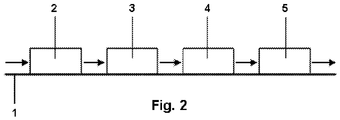
- Figure 2 is a schematic overview of the method followed in this example. More specifically, figure 2 shows transport means (1), wherein the placed 3 dimensional object is placed an is subjected to applying of the binder (2), electrostatic applying of the metal powder (3), drying (4) and finally grating and/or polishing (5).
- the binder used is a two component polyurethane binder dispersed in castor oil, namely the 'ALBODUR 921' of Alberdingk Boley.
- the second component is diphenylmethane-4.4-diisocyanate.
- This two component polyurethane binder is made electrically conductive by mixing it with commercially available quaternary nitrogen compounds sold under the name of 'Tego@ADDID 240' from Evonik Industries AG, until a mixture comprising 5% quaternary nitrogen compounds is obtained.
- the coated object is subjected to infrared in order to cure the coat.
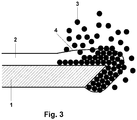
- Figure 4 shows a complete and equal saturation of the matrix, i.e. the binder, on horizontal as well as on the leaning surface of the 3 dimensional object.
- example 1 The steps of example 1 were followed on a similar 3 dimensional object.
- the binder was a two component binder of polyurea in castor oil, and the second component was diphenylmethane-4.4-diisocyanate.
- This two component binder is made electrically conductive by mixing it with commercially available quaternary nitrogen compounds sold under the name of 'Tego@ADDID 240' from Evonik Industries AG, until a mixture comprising 3% quaternary nitrogen compounds is obtained.
- the 3 dimensional object exhibited a smooth coat with a complete and equal saturation of the matrix, i.e. the binder, on horizontal as well as on leaning surfaces.
Landscapes
- Chemical & Material Sciences (AREA)
- Engineering & Computer Science (AREA)
- Materials Engineering (AREA)
- General Chemical & Material Sciences (AREA)
- Chemical Kinetics & Catalysis (AREA)
- Mechanical Engineering (AREA)
- Metallurgy (AREA)
- Organic Chemistry (AREA)
- Microelectronics & Electronic Packaging (AREA)
- Manufacturing & Machinery (AREA)
- Physics & Mathematics (AREA)
- Plasma & Fusion (AREA)
- Application Of Or Painting With Fluid Materials (AREA)
- Paints Or Removers (AREA)
- Adhesives Or Adhesive Processes (AREA)
Claims (14)
- Verfahren zur Herstellung einer metallischen Beschichtung einer Oberfläche, wobei das Verfahren folgende Schritte aufweist:(i) Aufbringen eines elektrisch leitfähigen Zweikomponenten-Bindemittels auf die Oberfläche;(ii) elektrostatisches Sprühen eines Metallpulvers auf das in Schritt (i) aufgebrachte Bindemittel;wobei das Metallpulver Metalltpartikel mit einem durchschnittlichen Durchmesser von weniger als 80 Mikrometer umfasst, wobei das elektrisch leitfähige Zweikomponenten-Bindemittel Polyurethan und/oder Polyharnstoff und zwischen 0,2 und 10 Gew % quaternäre Stickstoffverbindungen umfasst.
- Verfahren nach Anspruch 1, wobei das Auftragen des elektrisch leitfähigen Zweikomponenten-Bindemittels durch Airless-Spritzen erfolgt.
- Verfahren nach Anspruch 1 oder 2,
wobei die beiden Komponenten des elektrisch leitfähigen Zweikomponenten-Bindemittels in der Düse einer Sprühvorrichtung vermischt werden. - Verfahren nach einem der Ansprüche 1 bis 3,
wobei das Polyurethan und/oder der Polyharnstoff in einem Pflanzenöl dispergiert wird, welches aus der Gruppe ausgewählt wird, die aus Rizinusöl, Sojaöl, Sonnenblumenöl und Rapsöl besteht. - Verfahren nach einem der Ansprüche 1 bis 4,
wobei die Metallpartikel einen durchschnittlichen Durchmesser von weniger als 60 Mikrometer aufweisen. - Verfahren nach einem der Ansprüche 1 bis 5,
wobei die Metallpartikel eine kugelförmige Gestalt aufweisen. - Verfahren nach einem der Ansprüche 1 bis 6,
ferner aufweisend das Aufbringen einer Grundierung auf die Oberfläche vor Schritt (i). - Verfahren nach einem der Ansprüche 1 bis 7,
ferner aufweisend den Schritt des Trocknens der eine Oberfläche bedeckenden Metallschicht, vorzugsweise durch Einwirkung der eine Oberfläche bedeckenden Metallschicht von Infrarotlicht. - Verfahren nach einem der Ansprüche 1 bis 8,
nach Schritt (ii) weiterhin aufweisend einen oder mehrere Schritte, die aus der Gruppe ausgewählt werden, welche aus Patinieren, Polieren, Schützen und Schleifen besteht. - Verfahren nach einem der Ansprüche 1 bis 9,
aufweisend das Bilden einer metallischen Schicht mit einer Dicke von weniger als 200 Mikrometer. - Verfahren nach einem der Ansprüche 1 bis 10,
wobei die Oberfläche eine Leiterplatte, ein Dach oder eine Platte darstellt. - Metallische Beschichtung, die ein elektrisch leitfähiges Zweikomponenten-Bindemittel und ein Metallpulver umfasst, wobei das elektrisch leitfähige Zweikomponenten-Bindemittel Polyurethan und/oder Polyharnstoff und zwischen 0,2 und 10 Gew % quaternäre Stickstoffatome aufweist und wobei das Metallpulver Metallpartikel mit einem durchschnittlichen Durchmesser von weniger als 80 Mikrometer umfasst.
- Oberfläche aufweisend die metallische Beschichtung nach Anspruch 12.
- Verwendung eines elektrisch leitfähigen Zweikomponenten-Bindemittels, welches Polyurethan und/oder Polyharnstoff, das bzw. der in Rizinusöl dispergiert ist, sowie zwischen 1 und 10 Gew % quaternäre Stickstoffverbindungen umfasst, zum Bereitstellen einer metallischen Beschichtung.
Applications Claiming Priority (2)
| Application Number | Priority Date | Filing Date | Title |
|---|---|---|---|
| NL2004623A NL2004623C2 (en) | 2010-04-28 | 2010-04-28 | Method and use of a binder for providing a metallic coat covering a surface. |
| PCT/EP2011/056575 WO2011134956A1 (en) | 2010-04-28 | 2011-04-26 | Method and use of a binder for providing a metallic coat covering a surface |
Publications (2)
| Publication Number | Publication Date |
|---|---|
| EP2563525A1 EP2563525A1 (de) | 2013-03-06 |
| EP2563525B1 true EP2563525B1 (de) | 2021-11-03 |
Family
ID=44080208
Family Applications (1)
| Application Number | Title | Priority Date | Filing Date |
|---|---|---|---|
| EP11716262.8A Active EP2563525B1 (de) | 2010-04-28 | 2011-04-26 | Verfahren und verwendung eines binders zur metallischen beschichtung einer oberfläche |
Country Status (9)
| Country | Link |
|---|---|
| US (2) | US8828497B2 (de) |
| EP (1) | EP2563525B1 (de) |
| JP (1) | JP5986069B2 (de) |
| CN (2) | CN102905800B (de) |
| AU (1) | AU2011247636B2 (de) |
| CA (1) | CA2797470C (de) |
| NL (1) | NL2004623C2 (de) |
| RU (1) | RU2569082C2 (de) |
| WO (1) | WO2011134956A1 (de) |
Families Citing this family (5)
| Publication number | Priority date | Publication date | Assignee | Title |
|---|---|---|---|---|
| CN103506260A (zh) * | 2012-06-19 | 2014-01-15 | 翟波 | 一种快装隔板的表面喷涂方法 |
| CN107335595A (zh) * | 2017-06-27 | 2017-11-10 | 昆山特酷信息科技有限公司 | 一种新型机箱外壳的喷涂工艺 |
| KR102322533B1 (ko) * | 2019-10-21 | 2021-11-05 | 한밭대학교 산학협력단 | 다층 인쇄회로기판의 제조방법 |
| CN114135238B (zh) * | 2021-07-13 | 2024-09-03 | 中石化石油工程技术服务有限公司 | 一种卡瓦及其制备方法 |
| CN116586264A (zh) * | 2023-05-15 | 2023-08-15 | 厦门道益人生物医药科技有限公司 | 一种电磁波纳米矿物粉的成膜工艺 |
Citations (1)
| Publication number | Priority date | Publication date | Assignee | Title |
|---|---|---|---|---|
| US20070286975A1 (en) * | 2003-11-05 | 2007-12-13 | E Ink Corporation | Electro-optic displays, and materials for use therein |
Family Cites Families (19)
| Publication number | Priority date | Publication date | Assignee | Title |
|---|---|---|---|---|
| NL275608A (de) * | 1961-03-06 | |||
| GB1095117A (en) * | 1963-12-26 | 1967-12-13 | Matsushita Electric Industrial Co Ltd | Method of making printed circuit board |
| JPS5067848A (de) * | 1973-10-19 | 1975-06-06 | ||
| DE2555535C2 (de) * | 1975-12-10 | 1978-01-05 | Bayer Ag, 5090 Leverkusen | Verfahren zur Herstellung von Überzügen |
| JPS5638471A (en) * | 1979-09-04 | 1981-04-13 | Toagosei Chem Ind Co Ltd | Painting method of enamel powder |
| JPS6126675A (ja) * | 1984-07-16 | 1986-02-05 | Dainippon Toryo Co Ltd | ウレタン樹脂塗料組成物 |
| JPH0618911B2 (ja) * | 1987-09-25 | 1994-03-16 | ポリプラスチックス株式会社 | 静電塗装プラスチックス成形品の製造方法 |
| CA2148885A1 (en) * | 1994-07-20 | 1996-01-21 | Frank Stubbs | Conductive color-keyed automotive primers |
| US5585426A (en) * | 1994-10-05 | 1996-12-17 | Nexus Corporation | Process for imparting an electrostatic charge to powders to render them useful for coating application |
| US5518546A (en) * | 1994-10-05 | 1996-05-21 | Enexus Corporation | Apparatus for coating substrates with inductively charged resinous powder particles |
| JPH10298539A (ja) * | 1997-04-22 | 1998-11-10 | Arutetsuku Kk | 静電防止剤及びこの静電防止剤を用いて成る塗布及び接着剤 |
| US6291025B1 (en) * | 1999-06-04 | 2001-09-18 | Argonide Corporation | Electroless coatings formed from organic liquids |
| CN1211444C (zh) * | 1999-12-23 | 2005-07-20 | 阿克佐诺贝尔股份有限公司 | 包含加聚物和聚氨酯的水性涂料组合物 |
| JP2002028542A (ja) * | 2000-07-13 | 2002-01-29 | Kansai Paint Co Ltd | 塗装システム |
| US20040115477A1 (en) * | 2002-12-12 | 2004-06-17 | Bruce Nesbitt | Coating reinforcing underlayment and method of manufacturing same |
| JP4756626B2 (ja) * | 2004-05-24 | 2011-08-24 | 日東電工株式会社 | 表面保護フィルム付光学フィルムおよび画像表示装置 |
| JP4891603B2 (ja) * | 2005-12-07 | 2012-03-07 | 電気化学工業株式会社 | 粘着シート及びそれを用いた電子部品製造方法。 |
| EP2859961B1 (de) * | 2006-02-08 | 2018-10-10 | Avent, Inc. | Verfahren um Silber Nanopartikeln herzustellen |
| JP5341346B2 (ja) * | 2007-12-21 | 2013-11-13 | 第一工業製薬株式会社 | 2液反応型ポリウレタン樹脂組成物及びこれを硬化させてなるポリウレタン樹脂 |
-
2010
- 2010-04-28 NL NL2004623A patent/NL2004623C2/en not_active IP Right Cessation
-
2011
- 2011-04-26 EP EP11716262.8A patent/EP2563525B1/de active Active
- 2011-04-26 CN CN201180021237.2A patent/CN102905800B/zh not_active Expired - Fee Related
- 2011-04-26 RU RU2012150922/05A patent/RU2569082C2/ru not_active IP Right Cessation
- 2011-04-26 WO PCT/EP2011/056575 patent/WO2011134956A1/en not_active Ceased
- 2011-04-26 US US13/643,362 patent/US8828497B2/en not_active Expired - Fee Related
- 2011-04-26 AU AU2011247636A patent/AU2011247636B2/en not_active Ceased
- 2011-04-26 JP JP2013506630A patent/JP5986069B2/ja active Active
- 2011-04-26 CA CA2797470A patent/CA2797470C/en active Active
- 2011-04-26 CN CN201510347685.1A patent/CN105127069B/zh not_active Expired - Fee Related
-
2014
- 2014-09-05 US US14/478,953 patent/US10000848B2/en active Active
Patent Citations (1)
| Publication number | Priority date | Publication date | Assignee | Title |
|---|---|---|---|---|
| US20070286975A1 (en) * | 2003-11-05 | 2007-12-13 | E Ink Corporation | Electro-optic displays, and materials for use therein |
Also Published As
| Publication number | Publication date |
|---|---|
| NL2004623C2 (en) | 2011-10-31 |
| JP2013525102A (ja) | 2013-06-20 |
| RU2012150922A (ru) | 2014-06-10 |
| CA2797470C (en) | 2019-11-05 |
| CN102905800A (zh) | 2013-01-30 |
| CN105127069A (zh) | 2015-12-09 |
| US20130236653A1 (en) | 2013-09-12 |
| US20140377474A1 (en) | 2014-12-25 |
| CA2797470A1 (en) | 2011-11-03 |
| JP5986069B2 (ja) | 2016-09-06 |
| US10000848B2 (en) | 2018-06-19 |
| EP2563525A1 (de) | 2013-03-06 |
| AU2011247636A1 (en) | 2012-11-15 |
| AU2011247636B2 (en) | 2016-09-08 |
| CN102905800B (zh) | 2015-07-22 |
| RU2569082C2 (ru) | 2015-11-20 |
| US8828497B2 (en) | 2014-09-09 |
| CN105127069B (zh) | 2018-06-08 |
| WO2011134956A1 (en) | 2011-11-03 |
Similar Documents
| Publication | Publication Date | Title |
|---|---|---|
| EP2563525B1 (de) | Verfahren und verwendung eines binders zur metallischen beschichtung einer oberfläche | |
| DE50015604D1 (de) | Pulverslurry und verfahren zur herstellung einer farb- und/oder effektgebenden mehrschichtlackierung auf einem grundierten oder ungrundierten substrat | |
| CN103694871A (zh) | 一种油漆组合物及其制备方法、塑胶件以及复合工件的表面装饰方法 | |
| CN101638543B (zh) | 用于空调器铜管的仿铜金油漆材料及其制作方法 | |
| CN114466705A (zh) | 具有哑光和/或结构化金属效果的高光泽、可抛光的涂层及其制备方法 | |
| KR100512765B1 (ko) | 페이스트 형태의 금속 함유 수용성 도료 조성물 및 이를 이용한 금속 코팅 형성 방법 | |
| JP2703018B2 (ja) | 模様塗膜形成法 | |
| Sathish Kumar et al. | Paints and coating of multicomponent product | |
| KR100555878B1 (ko) | 핸드레일 소재에 무늬를 형성하는 방법 | |
| CN110626107A (zh) | 触摸后发出香味的pcm彩涂板 | |
| CN103182371A (zh) | 一种工程机械及其涂装工艺 | |
| CN203004455U (zh) | 一种合成板材 | |
| CN203010181U (zh) | 一种合成板材 | |
| CN114672204B (zh) | 一种磨砂水性乳胶漆及其应用方法 | |
| KR100424193B1 (ko) | 페이스트 형태의 금속 함유 도료 조성물 | |
| JPS6224466B2 (de) | ||
| DE102006024143B4 (de) | Verfahren zum dekorativen Beschichten von Werkstücken | |
| JP2006257381A (ja) | 水溶性金属含有塗料組成物 | |
| WO2005044929A1 (en) | Paste type waterbased paint composition containing metal powder and coating method of metal film using the same | |
| JP5053521B2 (ja) | 塗膜形成方法 | |
| JPH04185671A (ja) | 無機質建材塗装方法及び塗料組成物 | |
| JPH032395B2 (de) | ||
| JPH0568931A (ja) | 塗装方法 | |
| DE29710910U1 (de) | Flüssige Pulverlackbeschichtung und Gummierung mit Einbrennwirkung durch gesteuerte Überlagerung der Mehrfachvernetzung in den rezeptierten Komponenten | |
| CN108299905A (zh) | 一种汽车涂料配方 |
Legal Events
| Date | Code | Title | Description |
|---|---|---|---|
| PUAI | Public reference made under article 153(3) epc to a published international application that has entered the european phase |
Free format text: ORIGINAL CODE: 0009012 |
|
| 17P | Request for examination filed |
Effective date: 20121120 |
|
| AK | Designated contracting states |
Kind code of ref document: A1 Designated state(s): AL AT BE BG CH CY CZ DE DK EE ES FI FR GB GR HR HU IE IS IT LI LT LU LV MC MK MT NL NO PL PT RO RS SE SI SK SM TR |
|
| DAX | Request for extension of the european patent (deleted) | ||
| 17Q | First examination report despatched |
Effective date: 20150210 |
|
| STAA | Information on the status of an ep patent application or granted ep patent |
Free format text: STATUS: EXAMINATION IS IN PROGRESS |
|
| GRAP | Despatch of communication of intention to grant a patent |
Free format text: ORIGINAL CODE: EPIDOSNIGR1 |
|
| STAA | Information on the status of an ep patent application or granted ep patent |
Free format text: STATUS: GRANT OF PATENT IS INTENDED |
|
| RIC1 | Information provided on ipc code assigned before grant |
Ipc: B05D 1/04 20060101AFI20210426BHEP Ipc: B05D 1/06 20060101ALI20210426BHEP Ipc: H05K 3/10 20060101ALI20210426BHEP Ipc: B05D 1/34 20060101ALI20210426BHEP Ipc: B05D 3/02 20060101ALI20210426BHEP Ipc: B05D 3/10 20060101ALI20210426BHEP Ipc: B05D 3/12 20060101ALI20210426BHEP Ipc: B05D 5/06 20060101ALI20210426BHEP Ipc: H05K 3/14 20060101ALI20210426BHEP |
|
| INTG | Intention to grant announced |
Effective date: 20210528 |
|
| GRAS | Grant fee paid |
Free format text: ORIGINAL CODE: EPIDOSNIGR3 |
|
| GRAA | (expected) grant |
Free format text: ORIGINAL CODE: 0009210 |
|
| STAA | Information on the status of an ep patent application or granted ep patent |
Free format text: STATUS: THE PATENT HAS BEEN GRANTED |
|
| AK | Designated contracting states |
Kind code of ref document: B1 Designated state(s): AL AT BE BG CH CY CZ DE DK EE ES FI FR GB GR HR HU IE IS IT LI LT LU LV MC MK MT NL NO PL PT RO RS SE SI SK SM TR |
|
| REG | Reference to a national code |
Ref country code: GB Ref legal event code: FG4D |
|
| REG | Reference to a national code |
Ref country code: AT Ref legal event code: REF Ref document number: 1443495 Country of ref document: AT Kind code of ref document: T Effective date: 20211115 Ref country code: CH Ref legal event code: EP |
|
| REG | Reference to a national code |
Ref country code: IE Ref legal event code: FG4D |
|
| REG | Reference to a national code |
Ref country code: DE Ref legal event code: R096 Ref document number: 602011072038 Country of ref document: DE |
|
| REG | Reference to a national code |
Ref country code: NL Ref legal event code: FP |
|
| REG | Reference to a national code |
Ref country code: LT Ref legal event code: MG9D |
|
| REG | Reference to a national code |
Ref country code: AT Ref legal event code: MK05 Ref document number: 1443495 Country of ref document: AT Kind code of ref document: T Effective date: 20211103 |
|
| PG25 | Lapsed in a contracting state [announced via postgrant information from national office to epo] |
Ref country code: RS Free format text: LAPSE BECAUSE OF FAILURE TO SUBMIT A TRANSLATION OF THE DESCRIPTION OR TO PAY THE FEE WITHIN THE PRESCRIBED TIME-LIMIT Effective date: 20211103 Ref country code: LT Free format text: LAPSE BECAUSE OF FAILURE TO SUBMIT A TRANSLATION OF THE DESCRIPTION OR TO PAY THE FEE WITHIN THE PRESCRIBED TIME-LIMIT Effective date: 20211103 Ref country code: FI Free format text: LAPSE BECAUSE OF FAILURE TO SUBMIT A TRANSLATION OF THE DESCRIPTION OR TO PAY THE FEE WITHIN THE PRESCRIBED TIME-LIMIT Effective date: 20211103 Ref country code: BG Free format text: LAPSE BECAUSE OF FAILURE TO SUBMIT A TRANSLATION OF THE DESCRIPTION OR TO PAY THE FEE WITHIN THE PRESCRIBED TIME-LIMIT Effective date: 20220203 Ref country code: AT Free format text: LAPSE BECAUSE OF FAILURE TO SUBMIT A TRANSLATION OF THE DESCRIPTION OR TO PAY THE FEE WITHIN THE PRESCRIBED TIME-LIMIT Effective date: 20211103 |
|
| PG25 | Lapsed in a contracting state [announced via postgrant information from national office to epo] |
Ref country code: IS Free format text: LAPSE BECAUSE OF FAILURE TO SUBMIT A TRANSLATION OF THE DESCRIPTION OR TO PAY THE FEE WITHIN THE PRESCRIBED TIME-LIMIT Effective date: 20220303 Ref country code: SE Free format text: LAPSE BECAUSE OF FAILURE TO SUBMIT A TRANSLATION OF THE DESCRIPTION OR TO PAY THE FEE WITHIN THE PRESCRIBED TIME-LIMIT Effective date: 20211103 Ref country code: PT Free format text: LAPSE BECAUSE OF FAILURE TO SUBMIT A TRANSLATION OF THE DESCRIPTION OR TO PAY THE FEE WITHIN THE PRESCRIBED TIME-LIMIT Effective date: 20220303 Ref country code: PL Free format text: LAPSE BECAUSE OF FAILURE TO SUBMIT A TRANSLATION OF THE DESCRIPTION OR TO PAY THE FEE WITHIN THE PRESCRIBED TIME-LIMIT Effective date: 20211103 Ref country code: NO Free format text: LAPSE BECAUSE OF FAILURE TO SUBMIT A TRANSLATION OF THE DESCRIPTION OR TO PAY THE FEE WITHIN THE PRESCRIBED TIME-LIMIT Effective date: 20220203 Ref country code: LV Free format text: LAPSE BECAUSE OF FAILURE TO SUBMIT A TRANSLATION OF THE DESCRIPTION OR TO PAY THE FEE WITHIN THE PRESCRIBED TIME-LIMIT Effective date: 20211103 Ref country code: HR Free format text: LAPSE BECAUSE OF FAILURE TO SUBMIT A TRANSLATION OF THE DESCRIPTION OR TO PAY THE FEE WITHIN THE PRESCRIBED TIME-LIMIT Effective date: 20211103 Ref country code: GR Free format text: LAPSE BECAUSE OF FAILURE TO SUBMIT A TRANSLATION OF THE DESCRIPTION OR TO PAY THE FEE WITHIN THE PRESCRIBED TIME-LIMIT Effective date: 20220204 Ref country code: ES Free format text: LAPSE BECAUSE OF FAILURE TO SUBMIT A TRANSLATION OF THE DESCRIPTION OR TO PAY THE FEE WITHIN THE PRESCRIBED TIME-LIMIT Effective date: 20211103 |
|
| PG25 | Lapsed in a contracting state [announced via postgrant information from national office to epo] |
Ref country code: SM Free format text: LAPSE BECAUSE OF FAILURE TO SUBMIT A TRANSLATION OF THE DESCRIPTION OR TO PAY THE FEE WITHIN THE PRESCRIBED TIME-LIMIT Effective date: 20211103 Ref country code: SK Free format text: LAPSE BECAUSE OF FAILURE TO SUBMIT A TRANSLATION OF THE DESCRIPTION OR TO PAY THE FEE WITHIN THE PRESCRIBED TIME-LIMIT Effective date: 20211103 Ref country code: RO Free format text: LAPSE BECAUSE OF FAILURE TO SUBMIT A TRANSLATION OF THE DESCRIPTION OR TO PAY THE FEE WITHIN THE PRESCRIBED TIME-LIMIT Effective date: 20211103 Ref country code: EE Free format text: LAPSE BECAUSE OF FAILURE TO SUBMIT A TRANSLATION OF THE DESCRIPTION OR TO PAY THE FEE WITHIN THE PRESCRIBED TIME-LIMIT Effective date: 20211103 Ref country code: DK Free format text: LAPSE BECAUSE OF FAILURE TO SUBMIT A TRANSLATION OF THE DESCRIPTION OR TO PAY THE FEE WITHIN THE PRESCRIBED TIME-LIMIT Effective date: 20211103 Ref country code: CZ Free format text: LAPSE BECAUSE OF FAILURE TO SUBMIT A TRANSLATION OF THE DESCRIPTION OR TO PAY THE FEE WITHIN THE PRESCRIBED TIME-LIMIT Effective date: 20211103 |
|
| REG | Reference to a national code |
Ref country code: DE Ref legal event code: R097 Ref document number: 602011072038 Country of ref document: DE |
|
| PLBE | No opposition filed within time limit |
Free format text: ORIGINAL CODE: 0009261 |
|
| STAA | Information on the status of an ep patent application or granted ep patent |
Free format text: STATUS: NO OPPOSITION FILED WITHIN TIME LIMIT |
|
| 26N | No opposition filed |
Effective date: 20220804 |
|
| PG25 | Lapsed in a contracting state [announced via postgrant information from national office to epo] |
Ref country code: AL Free format text: LAPSE BECAUSE OF FAILURE TO SUBMIT A TRANSLATION OF THE DESCRIPTION OR TO PAY THE FEE WITHIN THE PRESCRIBED TIME-LIMIT Effective date: 20211103 |
|
| PG25 | Lapsed in a contracting state [announced via postgrant information from national office to epo] |
Ref country code: SI Free format text: LAPSE BECAUSE OF FAILURE TO SUBMIT A TRANSLATION OF THE DESCRIPTION OR TO PAY THE FEE WITHIN THE PRESCRIBED TIME-LIMIT Effective date: 20211103 |
|
| REG | Reference to a national code |
Ref country code: CH Ref legal event code: PL |
|
| REG | Reference to a national code |
Ref country code: BE Ref legal event code: MM Effective date: 20220430 |
|
| PG25 | Lapsed in a contracting state [announced via postgrant information from national office to epo] |
Ref country code: MC Free format text: LAPSE BECAUSE OF FAILURE TO SUBMIT A TRANSLATION OF THE DESCRIPTION OR TO PAY THE FEE WITHIN THE PRESCRIBED TIME-LIMIT Effective date: 20211103 Ref country code: LU Free format text: LAPSE BECAUSE OF NON-PAYMENT OF DUE FEES Effective date: 20220426 Ref country code: LI Free format text: LAPSE BECAUSE OF NON-PAYMENT OF DUE FEES Effective date: 20220430 Ref country code: CH Free format text: LAPSE BECAUSE OF NON-PAYMENT OF DUE FEES Effective date: 20220430 |
|
| PG25 | Lapsed in a contracting state [announced via postgrant information from national office to epo] |
Ref country code: BE Free format text: LAPSE BECAUSE OF NON-PAYMENT OF DUE FEES Effective date: 20220430 |
|
| PG25 | Lapsed in a contracting state [announced via postgrant information from national office to epo] |
Ref country code: IE Free format text: LAPSE BECAUSE OF NON-PAYMENT OF DUE FEES Effective date: 20220426 |
|
| PG25 | Lapsed in a contracting state [announced via postgrant information from national office to epo] |
Ref country code: IT Free format text: LAPSE BECAUSE OF FAILURE TO SUBMIT A TRANSLATION OF THE DESCRIPTION OR TO PAY THE FEE WITHIN THE PRESCRIBED TIME-LIMIT Effective date: 20211103 |
|
| P01 | Opt-out of the competence of the unified patent court (upc) registered |
Effective date: 20230526 |
|
| PG25 | Lapsed in a contracting state [announced via postgrant information from national office to epo] |
Ref country code: HU Free format text: LAPSE BECAUSE OF FAILURE TO SUBMIT A TRANSLATION OF THE DESCRIPTION OR TO PAY THE FEE WITHIN THE PRESCRIBED TIME-LIMIT; INVALID AB INITIO Effective date: 20110426 |
|
| PG25 | Lapsed in a contracting state [announced via postgrant information from national office to epo] |
Ref country code: MK Free format text: LAPSE BECAUSE OF FAILURE TO SUBMIT A TRANSLATION OF THE DESCRIPTION OR TO PAY THE FEE WITHIN THE PRESCRIBED TIME-LIMIT Effective date: 20211103 Ref country code: CY Free format text: LAPSE BECAUSE OF FAILURE TO SUBMIT A TRANSLATION OF THE DESCRIPTION OR TO PAY THE FEE WITHIN THE PRESCRIBED TIME-LIMIT Effective date: 20211103 |
|
| PG25 | Lapsed in a contracting state [announced via postgrant information from national office to epo] |
Ref country code: MT Free format text: LAPSE BECAUSE OF FAILURE TO SUBMIT A TRANSLATION OF THE DESCRIPTION OR TO PAY THE FEE WITHIN THE PRESCRIBED TIME-LIMIT Effective date: 20211103 |
|
| PGFP | Annual fee paid to national office [announced via postgrant information from national office to epo] |
Ref country code: NL Payment date: 20250427 Year of fee payment: 15 |
|
| PGFP | Annual fee paid to national office [announced via postgrant information from national office to epo] |
Ref country code: DE Payment date: 20250429 Year of fee payment: 15 |
|
| PGFP | Annual fee paid to national office [announced via postgrant information from national office to epo] |
Ref country code: GB Payment date: 20250428 Year of fee payment: 15 |
|
| PGFP | Annual fee paid to national office [announced via postgrant information from national office to epo] |
Ref country code: FR Payment date: 20250425 Year of fee payment: 15 |
|
| PG25 | Lapsed in a contracting state [announced via postgrant information from national office to epo] |
Ref country code: TR Free format text: LAPSE BECAUSE OF FAILURE TO SUBMIT A TRANSLATION OF THE DESCRIPTION OR TO PAY THE FEE WITHIN THE PRESCRIBED TIME-LIMIT Effective date: 20211103 |