EP2565862B1 - Système de traitement pour cryptage, dispositif de génération de clés, dispositif de cryptage, dispositif de décryptage, système de traitement de signatures, dispositif de signature et dispositif d'authentification - Google Patents
Système de traitement pour cryptage, dispositif de génération de clés, dispositif de cryptage, dispositif de décryptage, système de traitement de signatures, dispositif de signature et dispositif d'authentification Download PDFInfo
- Publication number
- EP2565862B1 EP2565862B1 EP11774680.0A EP11774680A EP2565862B1 EP 2565862 B1 EP2565862 B1 EP 2565862B1 EP 11774680 A EP11774680 A EP 11774680A EP 2565862 B1 EP2565862 B1 EP 2565862B1
- Authority
- EP
- European Patent Office
- Prior art keywords
- integer
- basis
- vector
- coefficient
- variable
- Prior art date
- Legal status (The legal status is an assumption and is not a legal conclusion. Google has not performed a legal analysis and makes no representation as to the accuracy of the status listed.)
- Active
Links
Images


Classifications
-
- H—ELECTRICITY
- H04—ELECTRIC COMMUNICATION TECHNIQUE
- H04L—TRANSMISSION OF DIGITAL INFORMATION, e.g. TELEGRAPHIC COMMUNICATION
- H04L9/00—Cryptographic mechanisms or cryptographic arrangements for secret or secure communications; Network security protocols
- H04L9/08—Key distribution or management, e.g. generation, sharing or updating, of cryptographic keys or passwords
-
- H—ELECTRICITY
- H04—ELECTRIC COMMUNICATION TECHNIQUE
- H04L—TRANSMISSION OF DIGITAL INFORMATION, e.g. TELEGRAPHIC COMMUNICATION
- H04L9/00—Cryptographic mechanisms or cryptographic arrangements for secret or secure communications; Network security protocols
- H04L9/08—Key distribution or management, e.g. generation, sharing or updating, of cryptographic keys or passwords
- H04L9/0861—Generation of secret information including derivation or calculation of cryptographic keys or passwords
- H04L9/0869—Generation of secret information including derivation or calculation of cryptographic keys or passwords involving random numbers or seeds
-
- H—ELECTRICITY
- H04—ELECTRIC COMMUNICATION TECHNIQUE
- H04L—TRANSMISSION OF DIGITAL INFORMATION, e.g. TELEGRAPHIC COMMUNICATION
- H04L9/00—Cryptographic mechanisms or cryptographic arrangements for secret or secure communications; Network security protocols
- H04L9/08—Key distribution or management, e.g. generation, sharing or updating, of cryptographic keys or passwords
- H04L9/0816—Key establishment, i.e. cryptographic processes or cryptographic protocols whereby a shared secret becomes available to two or more parties, for subsequent use
- H04L9/0838—Key agreement, i.e. key establishment technique in which a shared key is derived by parties as a function of information contributed by, or associated with, each of these
- H04L9/0847—Key agreement, i.e. key establishment technique in which a shared key is derived by parties as a function of information contributed by, or associated with, each of these involving identity based encryption [IBE] schemes
-
- H—ELECTRICITY
- H04—ELECTRIC COMMUNICATION TECHNIQUE
- H04L—TRANSMISSION OF DIGITAL INFORMATION, e.g. TELEGRAPHIC COMMUNICATION
- H04L9/00—Cryptographic mechanisms or cryptographic arrangements for secret or secure communications; Network security protocols
- H04L9/12—Transmitting and receiving encryption devices synchronised or initially set up in a particular manner
-
- H—ELECTRICITY
- H04—ELECTRIC COMMUNICATION TECHNIQUE
- H04L—TRANSMISSION OF DIGITAL INFORMATION, e.g. TELEGRAPHIC COMMUNICATION
- H04L9/00—Cryptographic mechanisms or cryptographic arrangements for secret or secure communications; Network security protocols
- H04L9/30—Public key, i.e. encryption algorithm being computationally infeasible to invert or user's encryption keys not requiring secrecy
- H04L9/3066—Public key, i.e. encryption algorithm being computationally infeasible to invert or user's encryption keys not requiring secrecy involving algebraic varieties, e.g. elliptic or hyper-elliptic curves
- H04L9/3073—Public key, i.e. encryption algorithm being computationally infeasible to invert or user's encryption keys not requiring secrecy involving algebraic varieties, e.g. elliptic or hyper-elliptic curves involving pairings, e.g. identity based encryption [IBE], bilinear mappings or bilinear pairings, e.g. Weil or Tate pairing
-
- H—ELECTRICITY
- H04—ELECTRIC COMMUNICATION TECHNIQUE
- H04L—TRANSMISSION OF DIGITAL INFORMATION, e.g. TELEGRAPHIC COMMUNICATION
- H04L9/00—Cryptographic mechanisms or cryptographic arrangements for secret or secure communications; Network security protocols
- H04L9/32—Cryptographic mechanisms or cryptographic arrangements for secret or secure communications; Network security protocols including means for verifying the identity or authority of a user of the system or for message authentication, e.g. authorization, entity authentication, data integrity or data verification, non-repudiation, key authentication or verification of credentials
- H04L9/3247—Cryptographic mechanisms or cryptographic arrangements for secret or secure communications; Network security protocols including means for verifying the identity or authority of a user of the system or for message authentication, e.g. authorization, entity authentication, data integrity or data verification, non-repudiation, key authentication or verification of credentials involving digital signatures
Definitions
- the present invention relates to a functional encryption (FE) scheme.
- FE functional encryption
- Non-Patent Literatures 3 to 6, 10, 12, 13, 15, and 18 describe an ID (Identity)-based encryption (IBE) scheme which constitutes one class of the functional encryption scheme.
- Non-Patent Literatures 2, 7, 9, 16, 19, 23 to 26, and 28 describe an attribute-based encryption (ABE) scheme which constitutes another class of the functional encryption scheme.
- the cryptographic processing system implements a large number of cryptographic functions, and implements functional encryption by employing a span program and an inner-product predicate. Also, this cryptographic processing system is more secure than a conventional functional encryption scheme.
- the processing device is, for example, a CPU 911 (to be described later).
- the storage device is, for example, a ROM 913, a RAM 914, or a magnetic disk 920 (each will be described later).
- the communication device is, for example, a communication board 915 (to be described later).
- the input device is, for example, a keyboard 902 or the communication board 915 (to be described later). Namely, the processing device, the storage device, the communication device, and the input device are hardware.
- Formula 101 denotes that y is randomly selected from A according to the distribution of A. Namely, in Formula 101, y is a random number. y ⁇ R A
- Formula 102 denotes that y is uniformly selected from A. Namely, in Formula 102, y is a uniform random number. y ⁇ U A
- Formula 104 denotes an event that a machine (algorithm) A outputs a on input x.
- Formula 105 namely, F q , denotes a finite field of order q.
- a vector symbol denotes a vector representation over the finite field F q . Namely, Formula 106 is established.
- Formula 107 denotes the inner-product, indicated by Formula 109, of two vectors x ⁇ and y ⁇ indicated in Formula 108.
- X T denotes the transpose of matrix M.
- Formula 111 denotes a subspace generated by Formula 112.
- nt when “nt” is indicated to include a subscript or superscript, nt is n t .
- Vt is indicated to include a subscript or superscript
- Vt is V t .
- ⁇ i,j when “ ⁇ i,j” is indicated to include a superscript, ⁇ i,j is ⁇ i,j .
- B0 or Bd+1 representing a basis When B0 or Bd+1 representing a basis is indicated to include a subscript, B0 or Bd+1 represents B 0 or B d+1 . Likewise, when B*0 or B*d+1 representing a basis is indicated to include a subscript, B*0 or B*d+1 represents B* 0 or B* d+1 .
- a cryptographic process includes a key generation process, an encryption process, and a decryption process
- a signature process includes a key generation process, a signature process, and a verification process.
- This embodiment describes a basic concept for implementing the "functional encryption scheme to be described in the following embodiments, and one structure of the functional encryption.
- DPVS dual pairing vector spaces
- a "functional encryption scheme” will be described.
- KP-FE key-policy functional encryption
- the basic structure of the "key-policy functional encryption scheme” will be described.
- the basic structure of a "cryptographic processing system 10" which implements the "key-policy functional encryption scheme” will be described.
- a "key-policy functional encryption scheme” and a “cryptographic processing system 10" according to this embodiment will be described in detail.
- the functional encryption scheme is an encryption scheme that provides more sophisticated and flexible relations between an encryption key (ek) and a decryption key (dk).
- an attribute x and an attribute y are set in an encryption key and a decryption key, respectively.
- the functional encryption scheme has various applications in the areas of access control of databases, mail services, contents distribution, and the like (see Non-Patent Literatures 2, 7, 9, 16, 19, 23 to 26, and 28).
- attribute-based encryption schemes have been proposed.
- each attribute which is set for an encryption key and decryption key is a tuple of attributes.
- the attribute-based encryption (ABE) scheme is called key-policy ABE (KP-ABE). If the access structure S is embedded into a ciphertext, the attribute-based encryption (ABE) scheme is called ciphertext-policy ABE (CP-ABE).
- Inner-product encryption (IPE) described in Non-Patent Literature 19 is also a class of functional encryption, where each attribute for the encryption key and decryption key is a vector over a field or ring.
- x ⁇ : (x 1 , ..., x n ) ⁇ F q n
- the symmetric bilinear pairing groups (q, G, G T , g, e) are a tuple of a prime q, a cyclic additive group G of order q and a cyclic multiplicative group G T of order q, g ⁇ 0 ⁇ G, and a polynomial-time computable nondegenerate bilinear pairing e : G ⁇ G ⁇ G T .
- a i : 0, ... ,0 ⁇ i ⁇ 1 , g , 0, ... ,0 ⁇ N ⁇ i
- the pairing on the space V is defined by Formula 118.
- Linear transformation ⁇ i,j on the space V indicated in Formula 119 can achieve Formula 120.
- g 1 , ... g N : x
- Dual pairing vector spaces are constructed from the symmetric bilinear pairing groups described above.
- Dual pairing vector spaces can be constructed from asymmetric bilinear pairing groups as well. The following description can be easily applied to a case where dual pairing vector spaces are constructed from asymmetric bilinear pairing groups.
- Fig. 1 is an explanatory drawing of a matrix M ⁇ .
- M ⁇ : (M, ⁇ ) is a labeled matrix where the matrix M is a (L rows ⁇ r columns) matrix over F q , and ⁇ is a label of the column of the matrix M and is related to one of literals ⁇ p 1 , ..., p n , ⁇ p 1 , ..., ⁇ p n ⁇ .
- a submatrix M ⁇ of the matrix M is defined.
- the matrix M ⁇ is a submatrix consisting of those rows of the matrix M, whose labels ⁇ are related to a value "1" by the input sequence ⁇ .
- Fig. 2 is an explanatory drawing of the matrix M ⁇ .
- the labels ⁇ are related such that ⁇ 1 corresponds to ⁇ -p 2 , ⁇ 2 to p 1 , ⁇ 3 to p 4 , ⁇ 4 to ⁇ p 5 , ⁇ 5 to ⁇ p 3 , and ⁇ 6 to ⁇ p 5 .
- a submatrix consisting of the rows of the matrix M which are related to literals (p 1 , p 3 , p 6 , p 7 , ⁇ p 2 , ⁇ p 4 , ⁇ p 5 ) surrounded by broken lines is the matrix M ⁇ . That is, the submatrix consisting of the 1st row (M 1 ), 2nd row (M 2 ), and 4th row (M 4 ) of the matrix M is the matrix M ⁇ .
- whether or not the i-th row of the matrix M is included in the matrix M ⁇ is determined by whether the value of the map ⁇ (j) is "0" or "1".
- the span program M ⁇ accepts an input sequence ⁇ if and only if 1 ⁇ ⁇ span ⁇ M ⁇ >, and rejects the input sequence ⁇ otherwise. Namely, the span program M ⁇ accepts an input sequence ⁇ if and only if linear combination of the rows of the matrix M ⁇ which are obtained from the matrix ⁇ by the input sequence ⁇ gives 1 ⁇ . 1 ⁇ is a row vector which has a value "1" in each element.
- a span program is called monotone if the labels ⁇ are related to only positive literals ⁇ p 1 , ..., p n ⁇ .
- a span program is called non-monotone if the labels ⁇ are related to the literals ⁇ p 1 , ..., p n , ⁇ p 1 , ..., ⁇ p n ⁇ .
- the span program is non-monotone.
- An access structure (non-monotone access structure) is constituted using the non-monotone span program. Briefly, an access structure controls access to encryption, namely, it controls whether a ciphertext is to be decrypted or not.
- Map ⁇ (j) described above will be calculated using the inner-products of attribute vectors. Namely, which row of the matrix M is to be included in the matrix M ⁇ will be determined using the inner-products of the attribute vectors.
- Each U t includes identification information (t) of the sub-universe and n t -dimensional vector (v ⁇ ). Namely, U t is (t, v ⁇ ) where t ⁇ ⁇ 1, ..., d ⁇ and v ⁇ ⁇ F q nt .
- Set ⁇ (j) 0 otherwise.
- the map ⁇ is calculated based on the inner-product of the attribute vectors v ⁇ and x ⁇ .
- which row of the matrix M is to be included in the matrix M ⁇ is determined by the map ⁇ . More specifically, which row of the matrix M is to be included in the matrix M ⁇ is determined by the inner-product of the attribute vectors v ⁇ and x ⁇ .
- the secret sharing scheme is letting secret information be shared to render it nonsense shared information.
- secret information s is let to be shared among 10 lumps to generate 10 pieces of shared information.
- Each of the 10 pieces of shared information does not have information on the secret information s.
- no information can be obtained on the secret information s.
- the secret information s can be recovered.
- Another secret sharing scheme is also available according to which even when all of the 10 pieces of shared information cannot be obtained, if one or more, but not all, (for example, 8 pieces) of shared information can be obtained, then the secret information can be recovered.
- a case like this where the secret information s can be recovered using 8 out of 10 pieces of shared information will be called 8-out-of-10. That is, a case where the secret information s can be recovered using t out of n pieces of shared information will be called t-out-of-n. This t will be called a threshold.
- Still another secret sharing scheme is available according to which when 10 pieces of shared information d 1 , ..., d 10 are generated, the secret information s can be recovered if 8 pieces of shared information d 1 , ..., d 8 are given, but cannot if 8 pieces of shared information d 3 , ..., d 10 are given.
- there is a secret sharing scheme with which whether or not the secret information s can be recovered is controlled not only by the number of pieces of shared information obtained but also depending on the combination of the shared information.
- Fig. 3 is an explanatory drawing of s 0 .
- Fig. 4 is an explanatory drawing of s ⁇ T .
- a matrix M be a (L rows ⁇ r columns) matrix.
- f ⁇ a column vector indicated in Formula 122.
- s 0 indicated in Formula 123 be secret information to be shared.
- the access structure is constructed by applying the inner-product predicate and the secret sharing scheme to the span program, as described above. Therefore, access control can be designed freely by designing the matrix M in the span program and the attribute information x and the attribute information v (predicate information) in the inner-product predicate. Namely, access control can be designed with a very high degree of freedom. Designing of the matrix M corresponds to designing conditions such as the threshold of the secret sharing scheme.
- the attribute-based encryption scheme described above corresponds to a case, in the access structure in the functional encryption scheme according to this and the following embodiments, where designing of the inner-product predicate is limited to a certain condition. That is, when compared to the access structure in the functional encryption scheme according to this and the following embodiments, the access structure in the attribute-based encryption scheme has a lower degree of freedom in access control design because it lacks the degree of freedom in designing the attribute information x and the attribute information v (predicate information) in the inner-product predicate.
- the inner-product predicate encryption scheme described above corresponds to a case, in the access structure in the functional encryption scheme according to this and the following embodiments, where designing of the matrix M in the span program is limited to a certain condition. That is, when compared to the access structure in the functional encryption scheme according to this and the following embodiments, the access structure in the inner-product predicate encryption scheme has a lower degree of freedom in access control design because it lacks the degree of freedom in designing the matrix M in the span program. More specifically, the inner-product predicate encryption scheme corresponds to a case where the secret sharing scheme is limited to 1-out-of-1 (or d-out-of-d).
- the access structure in the functional encryption scheme according to this and the following embodiments constitutes a non-monotone access structure that uses a non-monotone span program.
- the degree of freedom in access control designing improves.
- a negative condition can be set.
- First Company includes four departments of A, B, C, and D.
- access control is to be performed that only the users belonging to departments other than B department of First Company are capable of access (capable of decryption).
- a negative condition cannot be set, a condition that "the user belongs to any one of A, C, and D departments of First Company" must be set.
- a negative condition can be set, a condition that "the user is an employee of First Company and belongs to a department other than department B" can be set. Namely, since a negative condition can be set, natural condition setting is possible. Although the number of departments is small in this case, this scheme is very effective in a case where the number of departments is large.
- key-policy means that policy is embedded in the decryption key, that is, an access structure is embedded in the decryption key.
- the key-policy functional scheme consists of four algorithms: Setup, KeyGen, Enc, and Dec.
- a Dec algorithm is an algorithm that takes as input the encrypted data c encrypted under the attribute set ⁇ , the decryption key sk s for the access structure S, and the public parameters pk, and outputs either the message m or distinguished symbol ⁇ .
- a cryptographic processing system 10 that executes the algorithms of the key-policy functional encryption scheme described above will be described.
- Fig. 5 is a configuration diagram of the cryptographic processing system 10 which executes the key-policy functional encryption scheme.
- the cryptographic processing system 10 is provided with a key generation device 100, an encryption device 200, and a decryption device 300.
- the key generation device 100 publicizes the generated public parameters pk.
- the key generation device 100 also executes the KeyGen algorithm by taking as input an access structure S, generates a decryption key sk s , and distributes the decryption key sk s to the decryption device 300 in secrecy.
- the encryption device 200 executes the Enc algorithm by taking as input a message m, an attribute set ⁇ , and the public parameters pk, and generates encrypted data c.
- the encryption device 200 transmits the generated encrypted data c to the decryption device 300.
- the decryption device 300 executes the Dec algorithm by taking as input the public parameters pk, the decryption key sk s , and the encrypted data c, and outputs a message m or distinguished symbol 1.
- Fig. 6 is a function block diagram showing the function of the cryptographic processing system 10 which executes the key-policy functional encryption scheme.
- the cryptographic processing system 10 is provided with the key generation device 100, the encryption device 200, and the decryption device 300, as described above.
- Figs. 7 and 8 are flowcharts showing the operation of the key generation device 100. Note that Fig. 7 is a flowchart showing the process of the Setup algorithm, and that Fig. 8 is a flowchart showing the process of the KeyGen algorithm. Fig. 9 is a flowchart showing the operation of the encryption device 200 and the process of the Enc algorithm. Fig. 10 is a flowchart showing the operation of the decryption device 300 and the process of the Dec algorithm.
- the key generation device 100 is provided with a master key generation part 110, a master key storage part 120, an information input part 130 (first information input part), a decryption key generation part 140, and a key distribution part 150.
- the decryption key generation part 140 is provided with an f vector generation part 141, an s vector generation part 142, a random number generation part 143, and a key element generation part 144.
- the master key generation part 110 executes the following processes.
- the master key generation part 110 treats the generated subbases B ⁇ 0 and B ⁇ t , the security parameter ⁇ (1 ⁇ ) inputted in (S101), and param ⁇ generated in (S101), as the public parameters pk.
- the master key generation part 110 treats the generated subbases B ⁇ * 0 and B ⁇ * t , as the master key sk,.
- the master key generation part 110 generates the public parameters pk and the master key sk by executing the Setup algorithm indicated in Formula 131. Then, in (S104), the master key storage part 120 stores the generated public parameters pk and master key sk, in the storage device.
- the public parameters are publicized via, e.g., a network, so the encryption device 200 and decryption device 300 can acquire them.
- the matrix M of the access structure S is set depending on the condition of the system the user wishes to realize. Also, for example, the attribute information of the user of the decryption key sk s is set in ⁇ of the access structure S.
- the f vector generation part 141 With the processing device, the f vector generation part 141 generates a vector f ⁇ having r pieces of elements, randomly as indicated in Formula 132.
- the key element generation part 144 With the processing device, the key element generation part 144 generates an element k* 0 of the decryption key sk s , as indicated in Formula 136.
- Formula 136 means setting -s 0 as the coefficient for a basis vector b* 0,1 of a basis B* 0 , 0 as the coefficient for a basis vector b* 0,2 , 1 as the coefficient for a basis vector b* 0,3 , ⁇ 0 as the coefficient for a basis vector b* 0,4 , and 0 as the coefficient for a basis vector b* 0,5 .
- Formula 137 means, when ⁇ (i) is a positive tuple (t, v ⁇ i ), setting s i + ⁇ i v i,1 as the coefficient for a basis vector b* t,1 , ⁇ i v i,2 , ..., ⁇ i v i,nt as the coefficients for basis vectors b* t,2 , ..., b* t,nt , 0 as the coefficients for basis vectors b* t,nt+1 , ..., b* t,2nt , ⁇ i,1 , ..., ⁇ i,nt as the coefficients for basis vectors b* t,2nt+1 , ..., b* t,3nt , and 0 as the coefficients for basis vectors b* t,3nt+1 , ..., b* t,4nt , of the basis
- Formula 137 also means, when ⁇ (i) is a negative tuple ⁇ (t, v ⁇ i ), setting s i v i,1 , ..., s i v i,nt as the coefficients for the basis vectors b* t,1 , ..., b* t,nt , 0 as the coefficients for the basis vectors b* t,nt+1 , ..., b* t,2nt , ⁇ i,1 , ..., ⁇ i,nt as the coefficients for the basis vectors b* t,2nt+1 , ..., b* t,3nt , and 0 as the coefficients for the basis vectors b* t,3nt+1 , ..., b* t,4nt , of the basis B* t .
- the key distribution part 150 distributes the decryption key sk s constituted by, as elements, the access structure S inputted in (S201) and k* 0 , k* 1 , ..., k* L generated in (S205), to the decryption device 300 in secrecy via the network.
- the decryption key sk s may be distributed to the decryption device 300 by another method.
- the information input part 130 and decryption key generation part 140 generate the decryption key sk s by executing the KeyGen algorithm indicated in Formula 138. Then, in (S206), the key distribution part 150 distributes the generated decryption key sk s to the decryption device 300.
- the encryption device 200 is provided with a public parameter acquisition part 210, an information input part 220 (second information input part), an encrypted data generation part 230, and a data transmission part 240 (data output part).
- the encrypted data generation part 230 is provided with a random number generation part 231 and a cryptographic element generation part 232.
- the public parameter acquisition part 210 acquires the public parameters pk generated by the key generation device 100, via the network.
- the information input part 220 takes as input the message m to be transmitted to the decryption device 300.
- t need not be all of the integers t falling within the range of 1 ⁇ t ⁇ d, but may be one or more of integers t falling within the range of 1 ⁇ t ⁇ d.
- attribute information of a decryptable user is set in the attribute set ⁇ .
- the random number generation part 231 With the processing device, the random number generation part 231 generates random numbers ⁇ , ⁇ 0 , ⁇ t,1 , ..., ⁇ t,nt , and ⁇ , as indicated in Formula 139.
- the cryptographic element generation part 232 With the processing device, the cryptographic element generation part 232 generates an element c 0 of the encrypted data c as indicated in Formula 140.
- the cryptographic element generation part 232 also generates an element c t of the encrypted data c for each integer t of (t, x ⁇ t ) included in ⁇ , as indicated in Formula 141.
- the cryptographic element generation part 232 also generates an element c d+1 of the encrypted data c, as indicated in Formula 142.
- c d + 1 : g T ⁇ m
- the data transmission part 240 transmits the encrypted data c, constituted by the attribute set ⁇ inputted in (S302) and c 0 , c t , and c d+1 generated in (S304), as elements to the decryption device 300 via the network.
- the encrypted data c may be transmitted to the decryption device 300 by another method.
- the public parameter acquisition part 210, the information input part 220, and the encrypted data generation part 230 generate the encrypted data c by executing the Enc algorithm indicated in Formula 143.
- the data transmission part 240 transmits the generated encrypted data c to the decryption device 300.
- the decryption device 300 is provided with a decryption key acquisition part 310, a data reception part 320 (data acquisition part), a span program calculation part 330, a complementary coefficient calculation part 340, a pairing operation part 350, and a plaintext information calculation part 360.
- the decryption key acquisition part 310 also acquires the public parameters pk generated by the key generation device 100.
- the data reception part 320 receives the encrypted data c transmitted by the encryption device 200, via the network.
- the span program calculation part 330 checks whether or not the access structure S included in the decryption key sk s acquired in (S401) accepts ⁇ included in the encrypted data c received in (S402).
- the method of checking whether or not the access structure S accepts ⁇ is the same as that described in "3. Concept for Implementing Functional Encryption".
- the span program calculation part 330 advances the process to (S404) if the access structure S accepts ⁇ (accept in S403). If the access structure S rejects ⁇ (reject in S403), the span program calculation part 330 judges that the encrypted data c cannot be decrypted with the decryption key sk s , and ends the process.
- the complementary coefficient calculation part 340 calculates I and a constant (complementary coefficient) ⁇ i ⁇ i ⁇ I , with which Formula 144 is established.
- s 0 ⁇ i ⁇ I ⁇ i s i , and I ⁇ ⁇ i ⁇ 1, ... , L
- the key K g T ⁇ is obtained, as indicated in Formula 146.
- the cryptographic processing system 10 implements the encryption scheme (functional encryption scheme) using the access structure S constructed using the span program, inner-product predicate, and secret sharing. Therefore, the cryptographic processing system 10 implements an encryption scheme that can design access control with a very high degree of freedom.
- the encryption scheme implemented by the cryptographic processing system 10 is very secure. As described above, the functional encryption scheme includes, as its one class (the most limited class), ID-based encryption. Even when compared to an existing, practical ID-based encryption, the encryption scheme implemented by the cryptographic processing system 10 is more secure in a certain sense of meaning.
- n t + n t + n t + n t may be replaced by n t + u t + w t + z t . More specifically, the first n t may remain n t , the second n t may be changed to u t , the third n t may be changed to w t , and the fourth n t may be changed to z t . That is, n t + u t + w t + z t may be set in N t .
- n t , u t , w t , and z t can be different values where n t is an integer of 1 or more, as described above, and each of u t , w t , and z t is an integer of 0 or more.
- N 0 need not be 5 but may be an integer of 2 or more.
- the bases B 0 and B* 0 become two-dimensional.
- k* 0 : (-s 0 , 1) B*0 in the KeyGen algorithm
- c o : ( ⁇ , ⁇ ) B0 in the Enc algorithm.
- ⁇ ⁇ may be limited to injection.
- This embodiment describes a "ciphertext-policy functional encryption (CP-FE) scheme".
- the ciphertext-policy functional encryption described in this embodiment is constituted based on the concept described in Embodiment 1.
- ciphertext-policy means that policy is embedded in the ciphertext, that is, an access structure is embedded in the ciphertext.
- the ciphertext-policy functional scheme consists of four algorithms: Setup, KeyGen, Enc, and Dec, in the same manner as the key-policy functional encryption scheme.
- a Dec algorithm is an algorithm that takes as input the encrypted data c encrypted under the access structure S, the decryption key sk ⁇ for the attribute set ⁇ , and the public parameters pk, and outputs either the message m or distinguished symbol 1.
- the cryptographic processing system 10 that executes the algorithms of the ciphertext-policy functional encryption scheme described above will be described.
- Fig. 11 is a configuration diagram of the cryptographic processing system 10.
- the cryptographic processing system 10 is provided with a key generation device 100, an encryption device 200, and a decryption device 300.
- the key generation device 100 publicizes the generated public parameters pk.
- the key generation device 100 also executes the KeyGen algorithm by taking as input the attribute set ⁇ , generates a decryption key sk ⁇ , and distributes the decryption key sk ⁇ to the decryption device 300 in secrecy.
- the encryption device 200 executes the Enc algorithm by taking as input a message m, an access structure S, and the public parameters pk, and generates encrypted data c.
- the encryption device 200 transmits the generated encrypted data c to the decryption device 300.
- the decryption device 300 executes the Dec algorithm by taking as input the public parameters pk, the decryption key sk s , and the encrypted data c, and outputs the message m or distinguished symbol ⁇ .
- the ciphertext-policy functional encryption scheme, and the function and operation of the cryptographic processing system 10 which executes the ciphertext-policy functional encryption scheme will be described with reference to Figs. 12 to 15 .
- Fig. 12 is a function block diagram showing the function of the cryptographic processing system 10 which executes the ciphertext-policy functional encryption scheme.
- the cryptographic processing system 10 is provided with the key generation device 100, the encryption device 200, and the decryption device 300, as described above.
- Fig. 13 is a flowchart showing the operation of the key generation device 100 and the process of the Gen algorithm.
- the Setup algorithm is the same as that of the key-policy functional encryption scheme, and accordingly its detailed description will be omitted.
- Fig. 14 is a flowchart the operation of the encryption device 200 and the process of the Enc algorithm.
- Fig. 15 is a flowchart showing the operation of the decryption device 300 and the process of the Dec algorithm.
- the key generation device 100 is provided with a master key generation part 110, a master key storage part 120, an information input part 130 (first information input part), a decryption key generation part 140, and a key distribution part 150.
- the decryption key generation part 140 is provided with a random number generation part 143 and a key element generation part 144.
- the Setup algorithm is similar to that of the key-policy functional encryption scheme, and is as indicated in Formula 131.
- the attribute information of the user of the decryption key sk ⁇ is set in the attribute set ⁇ .
- the random number generation part 143 With a processing device, the random number generation part 143 generates random numbers ⁇ , ⁇ 0 , ⁇ t,1 , ..., and ⁇ t,nt , as indicated in Formula 152.
- the key element generation part 144 With the processing device, the key element generation part 144 generates an element k* 0 of the decryption key sk ⁇ , as indicated in Formula 153.
- the key element generation part 144 also generates an element k* t of the decryption key sk ⁇ for each integer t of (t, x ⁇ t ) included in ⁇ , as indicated in Formula 154.
- the key distribution part 150 distributes the decryption key sk ⁇ constituted by the attribute set ⁇ inputted in (S501) and k* 0 and k* t generated in (S503) as elements, to the decryption device 300 in secrecy via the network.
- the decryption key sk ⁇ may be distributed to the decryption device 300 by another method.
- the information input part 130 and decryption key generation part 140 generate the decryption key sk ⁇ by executing the KeyGen algorithm indicated in Formula 155. Then, in (S504), the decryption key sk ⁇ generated by the key distribution part 150 is distributed to the decryption device 300.
- the encryption device 200 is provided with a public parameter acquisition part 210, an information input part 220 (second information input part), an encrypted data generation part 230, and a data transmission part 240 (data output part).
- the encrypted data generation part 230 is provided with a random number generation part 231, a cryptographic element generation part 232, an f vector generation part 233, and an s vector generation part 234.
- the public parameter acquisition part 210 acquires the public parameters pk generated by the key generation device 100, via the network.
- the access structure S is set depending on the condition of the system the user wishes to realize. Also, for example, the attribute information of the user who can decrypt the data is set in ⁇ of the access structure S.
- the information input part 220 also takes as input the message m to be transmitted to the decryption device 300.
- the f vector generation part 233 generates a vector f ⁇ having r pieces of elements, randomly as indicated in Formula 156.
- the s vector generation part 234 also generates a value s 0 based on the vector f ⁇ generated in (S603), as indicated in Formula 158.
- s 0 : 1 ⁇ ⁇ f ⁇ T
- the cryptographic element generation part 232 With the processing device, the cryptographic element generation part 232 generates an element c 0 of the encrypted data c, as indicated in Formula 160.
- the cryptographic element generation part 232 also generates an element c d+1 of the encrypted data c, as indicated in Formula 162.
- c d + 1 : g T ⁇ m
- the data transmission part 240 transmits the encrypted data c, constituted by the access structure S inputted in (S602) and c 0 , c 1 , ..., c L , and c d+1 generated in (S606), as elements to the decryption device 300 via the network.
- the encrypted data c may be transmitted to the decryption device 300 by another method.
- the public parameter acquisition part 210, the information input part 220, and the encrypted data generation part 230 generate the encrypted data c by executing the Enc algorithm indicated in Formula 163.
- the data transmission part 240 transmits the generated encrypted data c to the decryption device 300.
- the decryption device 300 is provided with a decryption key acquisition part 310, a data reception part 320 (data acquisition part), a span program calculation part 330, a complementary coefficient calculation part 340, a pairing operation part 350, and a plaintext information calculation part 360.
- the decryption key acquisition part 310 acquires the decryption key sk ⁇ distributed from the key generation device 100, via the network.
- the decryption key acquisition part 310 also acquires the public parameters pk generated by the key generation device 100.
- the data reception part 320 receives the encrypted data c transmitted by the encryption device 200, via the network.
- the span program calculation part 330 checks whether or not the access structure S included in the encrypted data c acquired in (S702) accepts ⁇ included in the decryption key sk ⁇ received in (S701).
- the method of checking whether or not the access structure S accepts ⁇ is the same as that described in "3. Concept for Implementing Functional Encryption".
- the span program calculation part 330 advances the process to (S704) if the access structure S accepts ⁇ (accept in S703). If the access structure S rejects ⁇ (reject in S403), the span program calculation part 330 judges that the encrypted data c cannot be decrypted with the decryption key sk s , and ends the process.
- the cryptographic processing system 10 according to Embodiment 2 implements an encryption scheme that can design access control with a very high degree of freedom, in the same manner as the cryptographic processing system 10 according to Embodiment 1. Also, the cryptographic processing system 10 according to Embodiment 2 is very secure, as the cryptographic processing system 10 according to Embodiment 1 is.
- n t , u t , w t , and z t can be different values where n t is an integer of 1 or more, as described above, and each of u t , w t , and z t is an integer of 0 or more.
- N 0 need not be 5 but may be an integer of 2 or more.
- the bases B 0 and B* 0 become two-dimensional.
- ⁇ ⁇ may be limited to injection.
- Embodiment 1 has described the key-policy functional encryption with which the access structure S is contained in the decryption key sk s and the attribute set ⁇ is contained in the encrypted data c. Also, Embodiment 2 has described the ciphertext-policy functional encryption with which the access structure S is contained in the encrypted data c and the attribute set ⁇ is contained in the decryption key sk ⁇ .
- two access structures S 1 and S 2 may be prepared. Namely, one access structure S 1 may be contained in the decryption key, and the other access structure S 2 may be contained in the encrypted data c. At the same time, an attribute set ⁇ 2 corresponding to the access structure S 2 may be contained in the decryption key, and an attribute set ⁇ 1 corresponding to the access structure S 1 may be contained in the decrypted data c.
- the encrypted data c may be decryptable with the decryption key if and only if the access structure S 1 accepts the attribute set ⁇ 1 and the access structure S 2 accepts the attribute set ⁇ 2 .
- an encryption scheme may be employed in which the key-policy functional encryption and the ciphertext-policy functional encryption are combined.
- the signature scheme based on the ciphertext-policy functional encryption scheme consists of four algorithms: Setup, KeyGen, Sig, and Ver.
- the signature processing system 20 that executes the algorithms of the signature process described above will be described.
- Fig. 16 is a configuration diagram of the signature processing system 20.
- the signature processing system 20 is provided with a key generation device 100, a signature device 400, and a verification device 500.
- the key generation device 100 publicizes the generated public parameters pk.
- the key generation device 100 also executes the KeyGen algorithm by taking as input an attribute set ⁇ , generates a signature key sk ⁇ , and distributes the signature key skr to the signature device 400 in secrecy.
- the signature device 400 executes the Sig algorithm by taking as input a message m, an access structure S, the public parameters pk, and the signature key sk ⁇ , and generates a signature vector s ⁇ *.
- the signature device 400 transmits the generated signature vector s ⁇ *, the message m, and the access structure S to the verification device 500.
- the verification device 500 executes the Ver algorithm by taking as input the signature vector s ⁇ *, the message m, the access structure S, and the public parameters pk, and outputs a value "1" or "0".
- Fig. 17 is a function block diagram showing the function of the signature processing system 20.
- the signature processing system 20 is provided with the key generation device 100, the signature device 400, and the verification device 500, as described above.
- Figs. 18 and 19 are flowcharts showing the operation of the key generation device 100.
- Fig. 18 is a flowchart showing the process of the Setup algorithm
- Fig. 19 is a flowchart showing the process of the KeyGen algorithm.
- Fig. 20 is a flowchart showing the operation of the signature device 400 and the process of the Sig algorithm.
- Fig. 21 is a flowchart showing the operation of the verification device 500 and the process of the Ver algorithm.
- the key generation device 100 is provided with a master key generation part 110, a master key storage part 120, an information input part 130 (first information input part), a signature key generation part 160, and a key distribution part 150.
- the signature key generation part 160 is provided with a random number generation part 161, a key element generation part 162, and a confidential element generation part 163.
- the master key generation part 110 treats the basis vector b* 0,1 as the master key sk.
- the master key storage part 120 stores the public parameters pk and the master key sk, in the storage device.
- the master key generation part 110 generates the public parameters pk and the master key sk by executing the Setup algorithm indicated in Formula 171. Then, in (S804), the master key storage part 120 stores the generated public parameters pk and master key sk, in the storage device.
- the public parameters are publicized via, e.g., a network, so the signature device 400 and verification device 500 can acquire them.
- the attribute information of the user of the signature key sk ⁇ is set in the attribute set ⁇ .
- the key element generation part 162 With the processing device, the key element generation part 162 generates an element k* 0 of the signature key sk ⁇ , as indicated in Formula 173.
- the key element generation part 162 also generates an element k* t of the signature key sk ⁇ for each integer t of (t, x ⁇ t ) included in ⁇ , as indicated in Formula 174.
- the key element generation part 162 generates elements k* d+2 and k* d+3 of the signature key sk ⁇ , as indicated in Formula 175.
- the key distribution part 150 distributes the signature key sk ⁇ constituted by, as elements, the attribute set ⁇ inputted in (S901) and k* 0 , k* t , k* d+2 , and k* d+3 generated in (S903), to the signature device 400 in secrecy via the network.
- the decryption key sk ⁇ may be distributed to the signature device 400 by another method.
- the information input part 130 and signature key generation part 160 generate the signature key sk ⁇ by executing the KeyGen algorithm indicated in Formula 176. Then, in (S904), the key distribution part 150 distributes the generated signature key sk ⁇ to the signature device 400.
- the signature device 400 is provided with a signature key acquisition part 410, an information input part 420 (second information input part), a complementary coefficient calculation part 430, a matrix generation part 440, a signature generation part 450, and a data transmission part 460 (data output part).
- the signature generation part 450 is provided with a random number generation part 451 and a signature element generation part 452.
- the signature key acquisition part 410 also acquires the public parameters pk generated by the key generation device 100.
- the information input part 220 takes as input the message m to which the signature is to be attached.
- the complementary coefficient calculation part 430 calculates I and a constant (complementary coefficient) ⁇ i ⁇ i ⁇ I , with which Formula 177 is established.
- M i denotes the i-th row of a matrix M.
- the matrix generation part 440 With the processing device, the matrix generation part 440 generates a vector M L+1 to be added to the matrix M, and a label ⁇ (L+1) of the vector M L+1 , as indicated in Formula 178.
- the random number generation part 451 generates a random number ⁇ , as indicated in Formula 179.
- the signature element generation part 452 With the processing device, the signature element generation part 452 generates s* 0 which is an element of the signature vector s ⁇ *, as indicated in Formula 180.
- s 0 * : ⁇ k 0 * + r 0 * Note that r 0 * ⁇ U span ⁇ b 0,3 * ⁇
- r i * is defined as follows. r i * ⁇ U span ⁇ b t ,2 n t + 1 * , ... , b t ,3 n t * ⁇
- ⁇ i is defined as follows. ⁇ i ⁇ U ⁇ i
- the signature element generation part 452 also generates s* L+2 which is an element of the signature vector s ⁇ *, as indicated in Formula 182.
- s L + 2 * : ⁇ k d + 2 * + m ⁇ k d + 3 * + r L + 2 *
- signature data sig may be transmitted to the verification device 500 by another method.
- the signature key acquisition part 410 the information input part 420, the complementary coefficient calculation part 430, the matrix generation part 440, and the signature generation part 450 generate the signature data sig by executing the Sig algorithm indicated in Formula 183.
- the data transmission part 460 transmits the generated signature data to the verification device 500.
- the verification device 500 is provided with a public parameter acquisition part 510, a data reception part 520 (data acquisition part), an encrypted data generation part 530, and a pairing operation part 540.
- the encrypted data generation part 530 is provided with a random number generation part 531, a cryptographic element generation part 532, an f vector generation part 533, and an s vector generation part 534.
- the public parameter acquisition part 510 acquires the public parameters pk generated by the key generation device 100, via the network.
- the data reception part 320 receives the signature data sig transmitted by the signature device 400, via the network.
- the f vector generation part 533 randomly generates a vector f ⁇ having r pieces of elements, as indicated in Formula 184.
- the s vector generation part 534 also generates values s 0 and s L+1 based on the vector f ⁇ generated in (S1103), as indicated in Formula 186.
- the cryptographic element generation part 532 With the processing device, the cryptographic element generation part 532 generates an element c 0 of the encrypted data c, as indicated in Formula 188.
- the cryptographic element generation part 532 also generates an element c L+2 of the encrypted data c, as indicated in Formula 190.
- the pairing operation part 540 outputs a value "1” if the calculation result of Formula 191 is a value "1"; and a value "0” otherwise. If the calculation result of Formula 191 is a value "1", this indicates that the signature is verified; otherwise, the signature is not verified.
- the public parameter acquisition part 510, the data reception part 520, the encrypted data generation part 530, and the pairing operation part 540 verify the signature data sig by executing the Ver algorithm indicated in Formula 193.
- the signature processing system 20 implements the signature scheme using the access structure S constructed using the span program, inner-product predicate, and secret sharing.
- the element of the signature vector s ⁇ * is generated using the random numbers ⁇ and r, so that the variables ⁇ and ⁇ of the elements k of the signature key sk ⁇ which is information on the generator of the element of the signature vector s ⁇ * are randomized. If the variables ⁇ and ⁇ of the elements k of the signature key sk ⁇ are randomized, these variables can be prevented from being read from s ⁇ * which is an element of the signature data. Namely, based on which signature key sk ⁇ the signature data is generated, can be prevented from being read. That is, the link ability can be increased.
- n t + n t + n t + n t may be replaced by n t + u t + w t + z t . More specifically, the first n t may remain n t , the second n t may be changed to u t , the third n t may be changed to w t , and the fourth n t may be changed to z t . That is, n t + u t + w t + z t may be set in N t .
- n t , u t , and z t can be different values where n t is an integer of 1 or more, as described above, and each of u t , w t , and z t is an integer of 0 or more.
- Ver algorithm indicated in Formula 193 is rewritten as indicated in Formula 197.
- each of N 0 and N d+1 need not be 4 but may be an integer of 1 or more.
- N 0 is 1, the bases B 0 and B* 0 become one-dimensional.
- N d+2 need not be 8 but may be an integer of 2 or more.
- the bases B d+2 and B* d+2 become two-dimensional.
- k* d+2 : ( ⁇ j (1,0))
- B*d+2 and k* d+3 : ( ⁇ j (0,1))
- B*d+2 may be set in the KeyGen algorithm
- c 0 : (s L+2 - ⁇ L+2 m, ⁇ L+2 ) Bd+2 may be set in the Ver algorithm.
- ⁇ ⁇ may be injection.
- the first row of the vector M L+1 is added, as the (L+1)th row, to the matrix M.
- the rows to be added are not limited to 1 ⁇ but other vectors.
- the label of the row to be added is not limited to this but suffices as far as the process is established.
- the label of the row may be set such that the information on the added rows is 0 when the pairing operation is performed in the pairing operation step (S1107) of the Ver algorithm.
- the number of repetition times of the process of the Sig algorithm or Ver algorithm need be changed in accordance with the number of added rows.
- the signature algorithm indicated in Formula 171 may be changed as in Formula 198, and the Sig algorithm indicated in Formula 183 may be changed as in Formula 199.
- the Setup algorithm is changed in that the confidential vector p* t, ⁇ in which a random value is set is generated, and the Sig algorithm is changed in that the element s* i of the signature vector s ⁇ * is generated using the confidential vector p* t, ⁇ .
- the Setup algorithm is changed in that the basis B ⁇ * t is included in the master key sk instead of in the public parameters pk, and is kept secret. This enhances the security of the signature process.
- c 0 and c L+2 are linked by a random number s L+2 , and s L+2 is canceled between c 0 and c L+2 when the pairing operation is executed.
- s L+2 need not be used in advance, so the process is simplified.
- k* 0 need not be generated in the KeyGen algorithm.
- s* 0 need not be generated in the Sig algorithm.
- the Setup algorithm, the KeyGen algorithm, and the Enc algorithm of the Key-Policy functional encryption described in Embodiment 1 may be modified as follows. Only the modified portions of the respective algorithms of the Key-Policy functional encryption described in Embodiment 1 will be explained.
- ⁇ be a value indicated in Formula 201.
- ⁇ ⁇ max t 1 d # i
- ⁇ ⁇ i t
- the generating method of c t is modified as indicated in Formula 203.
- Embodiment 5 a method of implementing a cryptographic process and signature process in dual additive groups will be described.
- the cryptographic process is implemented in the cyclic group of the prime order q.
- a ring R is expressed using a composite number M as indicated in Formula 204
- the cryptographic process described in the above embodiments can also be applied to an additive group having the ring R as a coefficient.
- the Setup algorithm in the above embodiments may be executed only once at the setup of the cryptographic processing system 10 or signature processing system 20, and need not be executed every time a decryption key is to be generated.
- the Setup algorithm and the KeyGen algorithm are executed by the key generation device 100.
- the Setup algorithm and the KeyGen algorithm may be executed by different devices respectively.
- the span program M ⁇ accepts the input sequence ⁇ if and only if linear combination of the rows of the matrix M ⁇ obtained from the matrix ⁇ by the input sequence ⁇ gives 1 ⁇ .
- the span program M ⁇ may accept the input sequence ⁇ only if another vector v ⁇ is obtained instead of 1 ⁇ .
- Authority delegation means that a person having a decryption key generates a lower-level decryption key having weaker authority than the decryption key of his or her own.
- Weaker authority means that encrypted data that the decryption key can decrypt is limited.
- bases B t and B* t for t - 1 are used.
- bases B t and B* t for t - 1 are used.
- bases B* t and B* t to be used increase, a larger number of pieces of attribute information are set. Accordingly, authority of the decryption key is limited more.
- the hardware configuration of the cryptographic processing system 10 (the key generation device 100, the encryption device 200, and the decryption device 300) and of the signature processing system 20 (the key generation device 100, the signature device 400, and the verification device 500) in the above embodiments will be described.
- Fig. 22 is an illustration showing an example of the hardware configuration of each of the key generation device 100, encryption device 200, decryption device 300, signature device 400, and verification device 500.
- each of the key generation device 100, encryption device 200, decryption device 300, signature device 400, and verification device 500 includes a CPU 911 (also referred to as a Central Processing Unit, central processing device, processing device, computation device, microprocessor, microcomputer, or processor) which executes programs.
- the CPU 911 is connected to a ROM 913, a RAM 914, an LCD 901 (Liquid Crystal Display), the keyboard 902 (K/B), the communication board 915, and the magnetic disk device 920 via a bus 912, and controls these hardware devices.
- a storage device such as an optical disk device or memory card read/write device may be connected.
- the magnetic disk device 920 is connected via a predetermined fixed disk interface.
- the ROM 913 and the magnetic disk device 920 are examples of a nonvolatile memory.
- the RAM 914 is an example of a volatile memory.
- the ROM 913, the RAM 914, and the magnetic disk device 920 are examples of the storage device (memory).
- the keyboard 902 and the communication board 915 are examples of an input device.
- the communication board 915 is an example of a communication device (network interface).
- the LCD 901 is an example of a display device.
- the magnetic disk device 920, ROM 913, or the like stores an operating system 921 (OS), a window system 922, programs 923, and files 924.
- OS operating system
- the CPU 911, the operating system 921, and the window system 922 execute each program of the programs 923.
- the programs 923 store software and programs that execute the functions described as the "master key generation part 110", “master key storage part 120", “information input part 130", “decryption key generation part 140", “key distribution part 150”, "public parameter acquisition part 210", “information input part 220”, “encrypted data generation part 230", “data transmission part 240", “decryption key acquisition part 310", “data reception part 320”, “span program calculation part 330”, “complementary coefficient calculation part 340”, “pairing operation part 350”, "plaintext information calculation part 360”, “signature key acquisition part 410", “information input part 420”, “complementary coefficient calculation part 430”, “signature generation part 450”, “data transmission part 460”, “public parameter acquisition part 510", “data reception part 520”, “encrypted data generation part 530", “pairing operation part 540”, and the like in the above description.
- the programs 923 store other programs as well. The programs are read and executed by the CPU 911.
- the files 924 store information, data, signal values, variable values, and parameters such as the "public parameters pk”, “master key sk”, “encrypted data c”, “decryption key sk s ", “decryption key sk ⁇ “, “access structure S”, “attribute set ⁇ ”, “message m”, “signature data sig”, and the like of the above explanation, as the items of a “file” and “database”.
- the "file” and “database” are stored in a recording medium such as a disk or memory.
- the information, data, signal values, variable values, and parameters stored in the recording medium such as the disk or memory are read out to the main memory or cache memory by the CPU 911 through a read/write circuit, and are used for the operations of the CPU 911 such as extraction, search, look-up, comparison, computation, calculation, process, output, print, and display.
- the information, data, signal values, variable values, and parameters are temporarily stored in the main memory, cache memory, buffer memory, or the like during the operations of the CPU 1911 including extraction, search, look-up, comparison, computation, calculation, process, output, print, and display.
- the arrows of the flowcharts in the above explanation mainly indicate input/output of data and signals.
- the data and signal values are stored in the memory of the RAM 914, the recording medium such as an optical disk, or in an IC chip.
- the data and signals are transmitted online via a transmission medium such as the bus 912, signal lines, or cables, or electric waves.
- the “part” in the above explanation may be a “circuit”, “device”, “equipment”, “means” or “function”; or a “step”, “procedure”, or “process”.
- the “device” may be a “circuit”, “equipment”, “means”, or “function”; or a “step”, “procedure”, or “process”.
- the “process” may be a “step”. Namely, the “part” may be implemented as firmware stored in the ROM 913. Alternatively, the “part” may be implemented by only software; by only hardware such as an element, a device, a substrate, or a wiring line; by a combination of software and hardware; or furthermore by a combination of software, hardware, and firmware.
- the firmware and software are stored, as programs, in the recording medium such as the ROM 913.
- the program is read by the CPU 911 and executed by the CPU 911. Namely, the program causes the computer to function as a "part” described above. Alternatively, the program causes the computer or the like to execute the procedure and method of the "part” described above.
- 10 cryptographic processing system
- 20 signature processing system
- 100 key generation device
- 110 master key generation part
- 120 master key storage part
- 130 information input part
- 140 decryption key generation part
- 141 f vector generation part
- 142 s vector generation part
- 143 random number generation part
- 144 key element generation part
- 145 confidential element generation part
- 150 key distribution part
- 160 signature key generation part
- 161 random number generation part
- 162 key element generation part
- 200 encryption device
- 210 public parameter acquisition part
- 220 information input part
- 230 encrypted data generation part
- 231 random number generation part
- 232 cryptographic element generation part
- 233 f vector generation part
- 234 s vector generation part
- 240 data transmission part
- 300 decryption device
- 310 decryption key acquisition part
- 320 data reception part
- 330 span program calculation part
- 340 complementary coefficient calculation part
- 350 pairing operation part
- 360 plaintext information calculation part
- 400 signature device
- 410 signature
Landscapes
- Engineering & Computer Science (AREA)
- Computer Security & Cryptography (AREA)
- Computer Networks & Wireless Communication (AREA)
- Signal Processing (AREA)
- Theoretical Computer Science (AREA)
- General Physics & Mathematics (AREA)
- Algebra (AREA)
- Mathematical Analysis (AREA)
- Mathematical Optimization (AREA)
- Mathematical Physics (AREA)
- Pure & Applied Mathematics (AREA)
- Physics & Mathematics (AREA)
- Computing Systems (AREA)
- Storage Device Security (AREA)
Claims (15)
- Système de traitement cryptographique (10) comprenant un dispositif de génération de clés (100), un dispositif de chiffrement (200) et un dispositif de déchiffrement (300), et servant à exécuter un processus cryptographique en utilisant une base « Bt » et une base « B*t », pour chaque nombre entier « t = 0, ..., d » (où « d » est un nombre entier égal à « 1 » ou plus) ;
dans lequel le dispositif de génération de clés (100) inclut :une première partie d'entrée d'informations (130) qui prend, en tant qu'entrée, une variable « ρ(i) » pour chaque nombre entier i = 1, ..., L (où « L » est un nombre entier égal à « 1 » ou plus), laquelle variable « ρ(i) » correspond à l'un ou l'autre parmi un uplet positif « (t, v→ i) » et un uplet négatif « ¬(t, v→ i) » d'informations d'identification « t » (où « t » est un nombre entier quelconque de t = 1, ..., d) et un vecteur d'attribut v→ i := (vi,i') (i' = 1, ..., nt où « nt » est un nombre entier égal à « 1 » ou plus), et une matrice prédéterminée « M » présentant « L » lignes et « r » colonnes (où « r » est un nombre entier égal à « 1 » ou plus) ; etune partie de génération de clés de déchiffrement (140) qui génère un élément « k*0 », et un élément « k*i » pour chaque nombre entier i = 1, ...,L, sur la base d'un vecteur colonne « s→T := (s1, ..., sL)T := M·f→T » généré sur la base d'un vecteur « f→ » et d'un vecteur « w→ », présentant chacun « r » morceaux d'éléments, et de la matrice « M » appliquée en entrée par la première partie d'entrée d'informations ; d'une valeur « s0 :=w→·f→ » ; et d'une valeur prédéterminée « θi, » (i = 1, ..., L), la partie de génération de clés de déchiffrement (140) étant configurée de manière à :générer l'élément « k*0 » en définissant une valeur « -s0 » en tant qu'un coefficient pour un vecteur de base « b*0,p » (où « p » est une valeur prédéterminée) de la base « B*0 », et en définissant une valeur prédéterminée « k » en tant qu'un coefficient pour un vecteur de base « b*0,q » (où « q » est une valeur prédéterminée différente de la valeur « p » prescrite) ; etgénérer l'élément « k*i » pour chaque nombre entier « i = 1, ..., L », lorsque la variable « ρ(i) » est un uplet positif « (t, v→i) », en définissant « si + θivi,1 » en tant qu'un coefficient pour un vecteur de base « b*t,1 » de la base « B*t » indiqué par des informations d'identification « t » de l'uplet positif, et en définissant « θivi,i' » en tant qu'un coefficient pour un vecteur de base « b*t,i' » indiqué par les informations d'identification « t », et par chaque nombre entier i' = 2, ..., nt, et lorsque la variable « ρ(i) » est un uplet négatif ¬(t, v→ i), en définissant « sivi,i' », en tant qu'un coefficient pour le vecteur de base « b*t,i, » indiqué par les informations d'identification « t » de l'uplet négatif et par chaque nombre entier i' = 1, ..., nt ;dans lequel le dispositif de chiffrement (200) inclut :une seconde partie d'entrée d'informations (220) qui prend, en tant qu'entrée, un ensemble d'attributs « Γ » présentant les informations d'identification « t » et un vecteur d'attribut x→ t := (xt,i') (i' = 1, ..., nt, où « nt » est un nombre entier égal à « 1 » ou plus) pour au moins un nombre entier t = 1, ..., d ; etune partie de génération de données chiffrées (230) qui génère un élément « c0 », et un élément « ct » en ce qui concerne chacune des informations d'identification « t » incluses dans l'ensemble d'attributs « Γ », sur la base de l'ensemble d'attributs « Γ » appliqué en entrée par la seconde partie d'entrée d'informations, la partie de génération de données chiffrées étant configurée de manière à :générer l'élément « c0 » où une valeur aléatoire « δ » est définie en tant qu'un coefficient pour un vecteur de base « b0,p » (où « p » est la valeur « p » prescrite) d'une base « B0 », et où une valeur prédéterminée « ζ » est définie en tant qu'un coefficient pour un vecteur de base « b0,q » (où « q » est la valeur « q » prescrite) d'une base « B0 » ; etgénérer l'élément « ct », où « xt,i' » multiplié par la valeur aléatoire « δ » est défini en tant qu'un coefficient pour un vecteur de base « bt,i' » (i' = 1, ..., nt) de la base « Bt » pour chacune des informations d'identification « t » incluses dans l'ensemble d'attributs « Γ » ; etdans lequel le dispositif de déchiffrement (300) inclut :une partie d'acquisition de données (320) qui acquiert des données chiffrées « c » incluant les éléments « c0 » et « ct » et l'ensemble d'attributs « Γ », les éléments « c0 » et « ct » étant générés par la partie de génération de données chiffrées (230) ;une partie d'acquisition de clé de déchiffrement (310) qui acquiert une clé de déchiffrement « sks » incluant les éléments « k*0 » et « k*i » et le nombre variable « p(i) », les éléments « k*0 » et « k*i » étant générés par la partie de génération de clés de déchiffrement (140) ;une partie de calcul de coefficient complémentaire (340) qui, sur la base de l'ensemble d'attributs « Γ » inclus dans les données chiffrées « c » acquises par la partie d'acquisition de données, et de la variable « ρ(i) » incluse dans la clé de déchiffrement « sks » acquise par la partie d'acquisition de clé de déchiffrement, spécifie, parmi les nombres entiers i = 1, ..., L, un ensemble « I » d'un nombre entier « i » pour lequel la variable « ρ(i) » est un uplet positif « (t, v→ i) » et avec lequel un produit interne de « v→ i » de l'uplet positif et « x→ t » inclus dans « Γ » indiqué par des informations d'identification « t » de l'uplet positif devient « 0 », et d'un nombre entier « i » pour lequel la variable « ρ(i) » est un uplet négatif « ¬(t, v→ i) » et avec lequel un produit interne de « v→ i » de l'uplet négatif et « x→ t » inclus dans « Γ » indiqué par des informations d'identification « t » de l'uplet négatif ne devient pas « 0 » ; et calcule un coefficient complémentaire « αi » avec lequel un total de « αisi » pour « i » inclus dans l'ensemble « I » spécifié devient « s0 » ; etune partie d'opération d'appariement (350) qui calcule une valeur « K = gT ζχ » en mettant en oeuvre une opération d'appariement indiquée dans la Formule 1 pour les éléments « c0 » et « ct » inclus dans les données chiffrées « c » et les éléments « k*0 » et « k*i » inclus dans la clé de déchiffrement « sks », sur la base de l'ensemble « l » spécifié par la partie de calcul de coefficient complémentaire (340) et du coefficient complémentaire « αi » calculé par la partie de calcul de coefficient complémentaire (340).
- Système de traitement cryptographique (10) selon la revendication 1, lequel exécute le processus cryptographique en utilisant la base « B0 » présentant au moins un vecteur de base « b0,i » (i = 1, ..., 5), la base « Bt » (t = 1, ..., d) présentant au moins un vecteur de base « bt,i » (i = 1, ..., nt, ..., nt + ut, ...., nt + ut + wt, ..., nt + ut + wt + zt (où « ut », « wt » et « zt » correspondent chacun à un nombre entier égal à « 1 » ou plus), la base « B*0 » présentant au moins un vecteur de base « b*0,i » (i = 1, ..., 5), et la base « B*t » (t = 1, ..., d) présentant au moins un vecteur de base « b*t,i » (i = 1, ..., nt, ..., nt + ut, ...., nt + ut + wt, ..., nt + ut + wt + zt) ;
dans lequel la partie de génération de clés de déchiffrement (140) du dispositif de génération de clés (100) génère l'élément « k*0 » indiqué dans la Formule 2, sur la base d'une valeur aléatoire « η0 » et de la valeur prédéterminée « K », génère l'élément « k*i » indiqué dans la Formule 3, sur la base de la valeur aléatoire θi, (i = 1, ..., L) et d'une valeur aléatoire « ηi,i' » (i = 1, ..., L, i' = 1, ..., wt) lorsque la variable « p(i) » est un uplet positif « (t, v→ i) », et génère l'élément « k*i » indiqué dans la Formule 4, sur la base de la valeur aléatoire « ηi,i' », (i = 1, ..., L, i' = 1, ..., wt) lorsque la variable « ρ(i) » est un uplet négatif « ¬(t, v→ i) » ; et
dans lequel la partie de génération de données chiffrées (230) du dispositif de chiffrement (200) génère l'élément « c0 » indiqué dans la Formule 5, sur la base de la valeur aléatoire « δ », d'une valeur aléatoire « φ0 » et d'une valeur prédéterminée ζ, et génère l'élément « ct » indiqué dans la Formule 6, sur la base de la valeur aléatoire « δ » et d'une valeur aléatoire « φt,i » (i = 1, ..., zt).


- Dispositif de génération de clés (100) qui génère une clé de déchiffrement « sks » dans un système de traitement cryptographique (10) qui exécute un processus cryptographique en utilisant une base « Bt » et une base « B*t » pour chaque nombre entier t = 0, ..., d (où « d » est un nombre entier égal à « 1 » ou plus), le dispositif de génération de clés (100) comprenant :une première partie d'entrée d'informations (130) qui prend, en tant qu'entrée, une variable « ρ(i) » pour chaque nombre entier i = 1, ..., L (où « L » est un nombre entier égal à « 1 » ou plus), qui est l'un ou l'autre parmi un uplet positif « (t, v→ i) » et un uplet négatif « ¬(t, v→ i) » d'informations d'identification « t » (où « t » est un nombre entier quelconque de t = 1, ..., d) et un vecteur d'attribut v→ i := (vi,i') (i' = 1, ..., nt où « nt » est un nombre entier égal à « 1 » ou plus), et une matrice prédéterminée « M » présentant « L » lignes et « r » colonnes (où « r » est un nombre entier égal à « 1 » ou plus) ;une partie de génération de clés de déchiffrement (140) qui génère un élément « k*0 », et un élément « k*i » pour chaque nombre entier i = 1, ..., L, sur la base d'un vecteur colonne « s→T := (si, ..., sL)T := M·f→T » généré sur la base d'un vecteur « f→ » et d'un vecteur « w→ », présentant chacun « r » morceaux d'éléments, et de la matrice « M » appliquée en entrée par la première partie d'entrée d'informations ; d'une valeur s0 := w→·f→ ; et d'une valeur prédéterminée « θi » (i = 1, ..., L), la partie de génération de clés de déchiffrement (140) étant configurée de manière à :générer l'élément « k*0 » en définissant une valeur « -s0 » en tant qu'un coefficient pour un vecteur de base « b*0,p » (où « p » est une valeur prédéterminée) de la base « B*0 », et en définissant une valeur prédéterminée « k » en tant qu'un coefficient pour le vecteur de base « b*0,q » (où « q » est une valeur prédéterminée différente de la valeur « p » prescrite) ; etgénérer l'élément « k*i » pour chaque nombre entier i = 1, ..., L, lorsque la variable « ρ(i) » est un uplet positif « (t, v→ i) », en définissant « si + θivi,i » en tant qu'un coefficient pour un vecteur de base « b*t,i » de la base « B*t » indiquée par les informations d'identification « t » de l'uplet positif, et en définissant « θivi,i' » en tant qu'un coefficient pour un vecteur de base « b*t,i' » indiqué par les informations d'identification « t » et chaque nombre entier i' = 2, ..., nt, et lorsque la variable « ρ(i) » est un uplet négatif ¬(t, v→i), en définissant « sivi,i' » en tant qu'un coefficient pour le vecteur de base « b*t,i' » indiqué par les informations d'identification « t » de l'uplet négatif et par chaque nombre entier i' = 1, ..., nt ; etune partie de distribution de clés (150) qui distribue des données incluant la variable « ρ(i) » appliquée en entrée par la première partie d'entrée d'informations (130) et les éléments « k*0 » et « k*i » générés par la partie de génération de clés de déchiffrement (140), en tant que la clé de déchiffrement « sks ».
- Dispositif de chiffrement (200) qui génère des données chiffrées « c » dans un système de traitement cryptographique (10) qui exécute un processus de chiffrement cryptographique en utilisant une base « Bt », et une base « B*t » pour chaque nombre entier t = 0, ..., d (« 1 » est un nombre entier égal à « 1 » ou plus), le dispositif de chiffrement (200) comprenant :une seconde partie d'entrée d'informations (220) qui prend, en tant qu'entrée, un ensemble d'attributs « Γ » présentant les informations d'identification « t » et un vecteur d'attribut x→t := (xt,i') (i' = 1, .... nt où « nt » est un nombre entier égal à « 1 » ou plus) pour au moins un nombre entier t = 1, ..., d ;une partie de génération de données chiffrées (230) qui génère un élément « c0 », et un élément « ct », en ce qui concerne chacune des informations d'identification « t » incluses dans l'ensemble d'attributs « Γ », sur la base de l'ensemble d'attributs « Γ » appliqué en entrée par la seconde partie d'entrée d'informations, la partie de génération de données chiffrées étant configurée de manière à :générer l'élément « c0 » où une valeur aléatoire « δ » est définie en tant qu'un coefficient pour un vecteur de base « b0,p » (où « p » est la valeur « p » prescrite) d'une base « B0 », et où une valeur prédéterminée « ζ » est définie en tant qu'un coefficient pour un vecteur de base « B0,q » (où « q » est la valeur « q » prescrite) d'une base « B0 » ; etgénérer l'élément « ct » où « xt,i' » multiplié par la valeur aléatoire « δ » est défini en tant qu'un coefficient pour un vecteur de base « bt,i' » (i = 1, ..., nt) de la base « Bt » pour chacune des informations d'identification « t » incluses dans l'ensemble d'attributs ; etune partie de sortie de données (240) qui fournit en sortie l'ensemble d'attributs « Γ » appliqué en entrée par la seconde partie d'entrée d'informations (220) et les éléments « c0 » et « ct » générés par la partie de génération de données chiffrées (230), en tant que des données chiffrées « c ».
- Dispositif de déchiffrement (300) qui déchiffre des données chiffrées « c » avec une clé de déchiffrement « sks » dans un système de traitement cryptographique (10) qui exécute un processus cryptographique en utilisant une base « Bt » et une base « B*t » pour chaque nombre entier t = 0, ..., d (où « d » est un nombre entier égal à « 1 » ou plus), le dispositif de déchiffrement (300) comprenant :une partie d'acquisition de données (320) qui acquiert un élément « c0 » et un élément « ct », (représentant chacun un nombre entier inclus dans l'ensemble d'attributs « Γ ») générés sur la base d'un ensemble d'attributs « Γ » présentant des informations d'identification « t » et un vecteur d'attribut x→ t := (xt,i') (i' = 1, ..., nt où « nt » est un nombre entier égal à « 1 » ou plus) pour au moins un nombre entier t = 1, ..., d, conjointement avec l'ensemble d'attributs « Γ », en tant que des données chiffrées « c »,l'élément « c0 » étant défini avec une valeur aléatoire « δ » en tant qu'un coefficient pour un vecteur de base « b0,p » (où « p » est une valeur prédéterminée) d'une base « B0 » et étant défini avec une valeur prédéterminée « ζ » en tant qu'un coefficient pour un vecteur de base « b0,q » (où « q » est une valeur prédéterminée différente de la valeur « p » prescrite) de la base « B0 » ;l'élément « ct » étant défini avec « xt,i' » multiplié par la valeur aléatoire « δ », en tant qu'un coefficient pour un vecteur de base « bt,i' » (i' = 1, ..., nt) d'un vecteur de base « Bt », pour chacune des informations d'identification « t » incluses dans l'ensemble d'attributs « Γ » ;une partie d'acquisition de clé de déchiffrement (310) qui acquiert un élément « k*0 » et un élément « k*i » (représentant chacun un nombre entier i = 1, ..., L) générés sur la base d'un vecteur colonne s→T := (s1, ..., sL)T := M·f→T généré sur la base d'un vecteur « f→ » et d'un vecteur « w→ » présentant chacun « r » (où « r » est un nombre entier égal à « 1 » ou plus) morceaux d'éléments, et d'une matrice prédéterminée « M » présentant « L » lignes et « r » colonnes ; d'une valeur « s0 := w→·f→ » ; d'une valeur prédéterminée « θi » (i = 1, ..., L) ; et d'une variable « ρ(i) » pour chaque nombre entier i = 1, ..., L (où « L » est un nombre entier égal à « 1 » ou plus), conjointement avec la variable « ρ(i) », la variable « p(i) » étant l'un ou l'autre parmi un uplet positif « (t, v→ i) » et un uplet négatif « ¬(t, v→ i) » des informations d'identification « t » (où « t » est un nombre entier quelconque de t = 1, ..., d) et un vecteur d'attribut v→ i := (vi,i') (i' = 1, ..., nt, « nt » est un nombre entier égal à « 1 » ou plus), en tant que la clé de déchiffrement « sks » ;l'élément « k*0 » étant défini avec la valeur « -s0 » en tant qu'un coefficient pour un vecteur de base « b*0,p » (où « p » est la valeur « p » prescrite) d'une base « B*0 », et étant défini avec une valeur prédéterminée « k » en tant qu'un coefficient pour le vecteur de base « b*0,q » (où « q » est la valeur « q » prescrite) de la base « B*0 » ; etl'élément « k*i » pour chaque nombre entier « i = 1, ..., L », lorsque la variable « ρ(i) » est un uplet positif ((t, v→ i)), étant défini avec « si + θivi,1 » en tant qu'un coefficient pour un vecteur de base « b*t,i » de la base « B*t » indiquée par des informations d'identification « t » de l'uplet positif, et étant défini avec « θivi,i' » en tant qu'un coefficient d'un vecteur de base « b*t,i » indiqué par les informations d'identification « t » et par chaque nombre entier i' = 2, ..., nt, et lorsque la variable « ρ(i) » est un uplet négatif ¬(t, v→ i), étant défini avec « sivi,i' » en tant qu'un coefficient pour le vecteur de base « b*t,i' » indiqué par les informations d'identification « t » de l'uplet négatif et par chaque nombre entier i' = 1, ..., nt ;une partie de calcul de coefficient complémentaire (340) qui, sur la base de l'ensemble d'attributs « Γ » inclus dans les données chiffrées « c » acquises par la partie d'acquisition de données, et de la variable « ρ(i) » incluse dans la clé de déchiffrement « sks », acquise par la partie d'acquisition de clé de déchiffrement, spécifie, parmi les nombres entiers i = 1, ..., L, un ensemble « I » d'un nombre entier « i » pour lequel la variable « ρ(i) » est un uplet positif « (t, v→ i) » et avec lequel un produit interne de « v→ i » de l'uplet positif et « x→ t » inclus dans « Γ » indiqué par des informations d'identification « t » de l'uplet positif devient « 0 », et un nombre entier « i » pour lequel la variable « ρ(i) » est un uplet négatif « ¬(t, v→ i) » et avec lequel un produit interne de « v→ i » de l'uplet négatif et « x→ t » inclus dans « Γ » indiqué par des informations d'identification « t » de l'uplet négatif ne devient pas « 0 » ; et calcule un coefficient complémentaire « αi » avec lequel un total de « αisi » pour « i » inclus dans l'ensemble « I » spécifié devient « s0 » ; etune partie d'opération d'appariement (350) qui calcule une valeur « K = gT ζχ » en mettant en oeuvre une opération d'appariement indiquée dans la Formule 7 pour les éléments « c0 » et « ct » inclus dans les données chiffrées « c » et les éléments « k*0 » et « k*i » inclus dans la clé de déchiffrement « sks », sur la base de l'ensemble « I » spécifié par la partie de calcul de coefficient complémentaire et du coefficient complémentaire « αt » calculé par la partie de calcul de coefficient complémentaire (340).

- Système de traitement cryptographique (10) comprenant un dispositif de génération de clés (100), un dispositif de chiffrement (200) et un dispositif de déchiffrement (300), et servant à exécuter un processus cryptographique en utilisant une base « Bt » et une base « B*t » pour chaque nombre entier t = 0, ..., d (où « d » est un nombre entier égal à « 1 » ou plus),
dans lequel le dispositif de génération de clés (100) inclut :une partie d'entrée d'informations de reste (130) qui prend, en tant qu'entrée, un ensemble d'attributs « Γ » présentant des informations d'identification « t » et un vecteur d'attribut x→ t := (xt,i') (i' = 1, ..., nt où « nt » est un nombre entier égal à « 1 » ou plus) pour au moins un nombre entier « t = 1, ..., d » ; etune partie de génération de clés de déchiffrement (140) qui génère un élément « k*0 », et un élément « k*t » en ce qui concerne chacune des informations d'identification « t » incluses dans l'ensemble d'attributs « Γ », sur la base de l'ensemble d'attributs « Γ » appliqué en entrée par la première partie d'entrée d'informations, la partie de génération de clés de déchiffrement (140) étant configurée de manière à :générer l'élément « k*0 » où une valeur aléatoire « δ » est définie en tant qu'un coefficient pour un vecteur de base « b*0,p » (où « p » est une valeur prédéterminée) d'une base « B*0 », et où une valeur prédéterminée « k » est définie en tant qu'un coefficient pour un vecteur de base « b*0,q » (où « p » est une valeur prédéterminée différente de la valeur « p » prescrite) ; etgénérer l'élément « k*t » où « xt,i' » multiplié par la valeur aléatoire « δ » est défini en tant qu'un coefficient pour un vecteur de base « b*t,i' » (i' = 1, ..., nt) de la base « B*t », pour chacune des informations d'identification « t » incluses dans l'ensemble d'attributs « Γ » ;dans lequel le dispositif de chiffrement (200) inclut :une seconde partie d'entrée d'informations (220) qui prend, en tant qu'entrée, une variable « ρ(i) » pour chaque nombre entier i= 1, ..., L (où « L » est un nombre entier égal à « 1 » ou plus), qui correspond à l'un ou l'autre parmi un uplet positif « (t, v→ i) » et un uplet négatif « ¬(t, v→ i) » d'informations d'identification « t » (où « t » est un nombre entier quelconque de t = 1, ..., d) et un vecteur d'attribut v→ i := (vi,i') (i' = 1, ..., nt où « nt » est un nombre entier égal à « 1 » ou plus), et une matrice prédéterminée « M » présentant « L » lignes et « r » colonnes (où « r » est un nombre entier égal à « 1 » ou plus) ; etune partie de génération de données chiffrées (230) qui génère un élément « c0 », et un élément « ci » pour chaque nombre entier i = 1, ..., L, sur la base d'un vecteur colonne s := (s1, ..., sL)T := M·f→T généré sur la base d'un vecteur « f→ » et d'un vecteur « w→ ») présentant chacun « r » morceaux d'éléments, et de la matrice « M » appliquée en entrée par la seconde partie d'entrée d'informations ; d'une valeur s0 := w→·f→; et d'une valeur prédéterminée « θi, » (i = 1, ..., L), la partie de génération de données chiffrées (230) étant configurée de manière à :générer l'élément « c0 » en définissant la valeur « -s0 » en tant qu'un coefficient pour un vecteur de base « b0,p » (où « p » est la valeur « p » prescrite) de la base « B0 » et en définissant une valeur prédéterminée « ζ » en tant qu'un coefficient pour le vecteur de base « b0,q » (où « q » est la valeur « q » prescrite) ; etgénérer l'élément « ci » pour chaque nombre entier i = 1, ..., L, lorsque la variable « ρ(i) » est un uplet positif « (t, v→ i) », en définissant si + θivi,1 en tant qu'un coefficient pour un vecteur de base « bt,1 » de la base « Bt » indiquée par des informations d'identification « t » de l'uplet positif, et en définissant « θivi,i' » en tant qu'un coefficient pour un vecteur de base « bt,i' » indiqué par les informations d'identification « t » et chaque nombre entier i' = 2, ..., nt, et lorsque la variable « ρ(i) » est un uplet négatif « ¬(t, v→ i) », en définissant sivi,i' en tant qu'un coefficient pour le vecteur de base « bt,i' » indiqué par les informations d'identification « t » de l'uplet négatif et par chaque nombre entier i' = 1, ..., nt ; etdans lequel le dispositif de déchiffrement (300) inclut :une partie d'acquisition de données (320) qui acquiert des données chiffrées « c » incluant les éléments « c0 » et « ct » et la variable « ρ(i) », les éléments « c0 » et « ct » étant générés par la partie de génération de données chiffrées (230) ;une partie d'acquisition de clé de déchiffrement (310) qui acquiert la clé de déchiffrement « skΓ » incluant les éléments « k*0 » et « k*i » et l'ensemble d'attributs « Γ », les éléments « k*0 » et « k*i » étant générés par la partie de génération de clés de déchiffrement (140) ;une partie de calcul de coefficient complémentaire (340) qui, sur la base de la variable « ρ(i) » en ce qui concerne chaque nombre entier i = 1, ..., L inclus dans les données chiffrées « c » acquises par la partie d'acquisition de données (320) et l'ensemble d'attributs « Γ » inclus dans la clé de déchiffrement « skΓ » acquise par la partie d'acquisition de clé de déchiffrement, spécifie, parmi les nombres entiers i = 1, ..., L, un ensemble « I » d'un nombre entier « i » pour lequel la variable « ρ(i) » est un uplet positif « (t, v→ i) » et avec lequel un produit interne de « v→ i » de l'uplet positif et « x→ t » inclus dans « Γ » indiqué par les informations d'identification « t » de l'uplet positif devient « 0 », et un nombre entier « i » pour lequel la variable « ρ(i) » est un uplet négatif « ¬(t, v→ i) » et avec lequel un produit interne de « v→ i » de l'uplet négatif et « x→ t » inclus dans « Γ » indiqué par les informations d'identification « t » de l'uplet négatif ne devient pas « 0 » ; et calcule un coefficient complémentaire « αi » avec lequel un total de « αisi » pour « i » inclus dans l'ensemble « I » spécifié devient « s0 » ; etune partie d'opération d'appariement (350) qui calcule une valeur « K = gT ζχ » en mettant en oeuvre une opération d'appariement indiquée dans la Formule 8 pour les éléments « c0 » et « ct » inclus dans les données chiffrées « c », et les éléments « k*0 » et « k*j » inclus dans la clé de déchiffrement « skΓ », sur la base de l'ensemble « I » spécifié par la partie de calcul de coefficient complémentaire (340) et du coefficient complémentaire « αi » calculé par la partie de calcul de coefficient complémentaire (340).
- Système de traitement cryptographique selon la revendication 6, lequel exécute le processus cryptographique en utilisant la base « B0 » présentant au moins un vecteur de base « b0,i » (i = 1, ..., 5), la base « Bt » (t = 1,..., d) présentant au moins un vecteur de base « bt,i » (i = 1, ..., nt, ..., nt + ut, ...., nt + ut + wt, ..., nt + ut + wt + zt) (où « ut », « wt » et « zt » correspondent chacun à un nombre entier égal à « 1 » ou plus), la base « B*0 » présentant au moins un vecteur de base « b*0,i » (i = 1, ..., 5), et la base « B*t » (t = 1, ..., d) présentant au moins un vecteur de base « b*t,i' » (i = 1, ..., nt, ..., nt + ut, ...., nt + ut + wt, ..., nt + ut + wt + zt) ;
dans lequel la partie de génération de clés de déchiffrement (140) du dispositif de génération de clés (100) génère l'élément « k*0 » indiqué dans la Formule 9, sur la base de la valeur aléatoire « δ », d'une valeur aléatoire « φ0 », et de la valeur prédéterminée « K », génère l'élément « k*t » indiqué dans la Formule 10, sur la base des valeurs aléatoires « δ » et « φt,i » (i = 1, ..., wt) ; et
dans lequel la partie de génération de données chiffrées (230) du dispositif de chiffrement (200) génère l'élément « c0 » indiqué dans la Formule 11 sur la base d'une valeur aléatoire « η0 » et d'une valeur prédéterminée « ζ », génère un élément « ci » indiqué dans la Formule 12 sur la base d'une valeur aléatoire « θi », (i 1, ..., L) et d'une valeur aléatoire « ηi,i' » (i = 1, ..., L, i' = 1, ..., zt) lorsque la variable « p(i) » est un uplet positif « (t, v→ i) », et génère un élément « ci » indiqué dans la Formule 13 sur la base de la valeur aléatoire « ηi,i' » (i = 1, ..., L, i' = 1, ..., zt) lorsque la variable « ρ(i) » est un uplet négatif « ¬(t, v→ i) ».

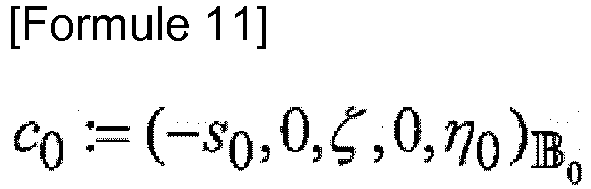


- Dispositif de génération de clés (100) qui génère une clé de déchiffrement « skΓ » dans un système de traitement cryptographique (10) qui exécute un processus cryptographique en utilisant une base « Bt » et une base « B*t », pour chaque nombre entier t = 0, ..., d (où « d » est un nombre entier égal à « 1 » ou plus), le dispositif de génération de clés (100) comprenant :une première partie d'entrée d'informations (130) qui prend, en tant qu'entrée, un ensemble d'attributs « Γ » présentant des informations d'identification « t » et un vecteur d'attribut x→ t := (xt,i') (i' = 1, ..., nt où « nt » est un nombre entier égal à « 1 » ou plus) pour au moins un nombre entier t = 1, ..., d ;une partie de génération de clés de déchiffrement (140) qui génère un élément « k*0 », et un élément « k*t » en ce qui concerne chacune des informations d'identification « t » incluses dans l'ensemble d'attributs « Γ », sur la base de l'ensemble d'attributs « Γ » appliqué en entrée par la première partie d'entrée d'informations, la partie de génération de clés de déchiffrement (140) étant configurée de manière à :générer l'élément « k*0 » où une valeur aléatoire « δ » est définie en tant qu'un coefficient pour un vecteur de base « b*0,p » (où « p » est une valeur prédéterminée) d'une base « B*0 », et où une valeur prédéterminée « K » est définie en tant qu'un coefficient pour un vecteur de base « b*0,q » (où « q » est une valeur prédéterminée différente de la valeur « p » prescrite) ; etgénérer l'élément « k*t » où « xt,i' » multiplié par la valeur aléatoire « δ » est défini en tant qu'un coefficient pour un vecteur de base « b*t,i' » (i' = 1, ..., nt) de la base « B*t », pour chacune des informations d'identification « t » incluses dans l'ensemble d'attributs « Γ » ; etune partie de distribution de clé (150) qui distribue des données incluant l'ensemble d'attributs « Γ » appliqué en entrée par la première partie d'entrée d'informations (130) et les éléments « k*0 » et « k*i » générés par la partie de génération de clés de déchiffrement (140), en tant que la clé de déchiffrement « sks ».
- Dispositif de chiffrement (200) qui génère des données chiffrées « c » dans un système de traitement cryptographique (10) qui exécute un processus cryptographique en utilisant une base « Bt » et une base « B*t » pour chaque nombre entier « t = 0, ..., d » (où « d » est un nombre entier égal à « 1 » ou plus), le dispositif de chiffrement (200) comprenantune seconde partie d'entrée d'informations (220) qui prend, en tant qu'entrée, une variable « ρ(i) » pour chaque nombre entier i = 1, ..., L (où « L » est un nombre entier égal à « 1 » ou plus), qui correspond à l'un ou l'autre parmi un uplet positif « (t, v→ i) » et un uplet négatif « ¬(t, v→ i) » d'informations d'identification « t » (où « t » est un nombre entier quelconque de t = 1,..., d) et un vecteur d'attribut v→ i := (vi,i') (i' = 1, ..., nt, où « nt » est un nombre entier égal à « 1 » ou plus), et une matrice « M » prédéterminée présentant « L » lignes et « r » colonnes (où « r » est un nombre entier égal à « 1 » ou plus) ;une partie de génération de données chiffrées (230) qui génère un élément « c0 », et un élément « ci » pour chaque nombre entier i = 1, ..., L, sur la base d'un vecteur colonne s→T := (s1, ..., sL)T := M·f→T généré sur la base d'un vecteur « f→ » et d'un vecteur « w→ » présentant chacun « r » morceaux d'éléments, et de la matrice « M » appliquée en entrée par la seconde partie d'entrée d'informations ; d'une valeur s0 := w→·f→; et d'une valeur prédéterminée « θi » (i = 1, ..., L), la partie de génération de données chiffrées (230) étant configurée de manière à :générer l'élément « c0 » en définissant la valeur « -s0 » en tant qu'un coefficient pour un vecteur de base « b0,p » (où « p » est la valeur « p » prescrite) de la base « B0 » et en définissant une valeur prédéterminée « ζ » en tant qu'un coefficient pour le vecteur de base « b0,q » (où « q » est la valeur « q » prescrite) ; etgénérer l'élément « ci » pour chaque nombre entier i = 1, ..., L, lorsque la variable « ρ(i) » est un uplet positif « (t, v→ i) », en définissant si + θivi,1 en tant qu'un coefficient pour un vecteur de base « bt,i » de la base « Bt » indiquée par des informations d'identification « t » de l'uplet positif, et en définissant « θivi,i' » en tant qu'un coefficient pour un vecteur de base « bt,i' » indiqué par les informations d'identification « t » et chaque nombre entier i' = 2, ..., nt, et lorsque la variable « ρ(i) » est un uplet négatif ¬(t, v→ i), en définissant sivi,i' en tant qu'un coefficient pour le vecteur de base « bt,i' » indiqué par les informations d'identification « t » de l'uplet négatif et par chaque nombre entier i' = 1, ..., nt ; etune partie de sortie de données (240) qui fournit en sortie la variable « ρ(i) » appliquée en entrée par la seconde partie d'entrée d'informations (220) et les éléments « c0 » et « ct » générés par la partie de génération de données chiffrées (230), en tant que les données chiffrées « c ».
- Dispositif de déchiffrement (300) qui déchiffre des données chiffrées « c » avec une clé de déchiffrement « skΓ » dans un système de traitement cryptographique (10) qui exécute un processus cryptographique en utilisant une base « Bt » et une base « B*t » pour chaque nombre entier t = 0, ..., d (où « d » est un nombre entier égal à « 1 » ou plus), le dispositif de déchiffrement comprenant :une partie d'acquisition de données (320) qui acquiert un élément « c0 » et un élément « ci » (pour chaque nombre entier i = 1,..., L) générés sur la base d'un vecteur colonne « s→T := (s1, ..., sL)T := M·f→T » généré sur la base d'un vecteur « f→ » et d'un vecteur « w→ » présentant chacun « r » (où « r » est un nombre entier égal à « 1 » ou plus) morceaux d'éléments, et d'une matrice prédéterminée « M » présentant « L » lignes et « r » colonnes ; d'une valeur « s0 := w→·f→ » ; d'une valeur prédéterminée « θi, » (i = 1, ..., L) ; et d'une variable « ρ(i) » pour chaque nombre entier « i = 1,..., L » (où « L » est un nombre entier égal à « 1 » ou plus), conjointement avec la variable « ρ(i) », la variable « p(i) » étant l'un ou l'autre parmi un uplet positif « (t, v→ i) » et un uplet négatif « ¬(t, v→ i) », d'informations d'identification « t » (où « t » est un nombre entier quelconque de t = 1, ..., d) et d'un vecteur d'attribut v→ i := (vi,i') (i' = 1, ..., nt, où « nt » est un nombre entier égal à « 1 » ou plus), en tant que les données chiffrées « c » ;l'élément « c0 » étant défini avec une valeur « -s0 » en tant qu'un coefficient pour un vecteur de base « b0,p » (où « p » est une valeur prédéterminée) d'un vecteur de base « B0 », et étant défini avec une valeur prédéterminée « ζ » en tant qu'un coefficient pour un vecteur de base « b0,q » (où « q » est une valeur prédéterminée différente de la valeur « p » prescrite) de la base « B0 » ; etl'élément « ct » pour chaque nombre entier i = 1, ..., L, lorsque la variable « ρ(i) » est un uplet positif « (t, v→ i) », étant défini avec « si + θivi,1 » en tant qu'un coefficient pour un vecteur de base « bt,1 » de la base « Bt » indiquée par des informations d'identification « t » de l'uplet positif, et étant défini avec « θivi,i' » en tant qu'un coefficient pour un vecteur de base « bt,i' » indiqué par les informations d'identification « t » et par chaque nombre entier i' = 2, ..., nt, et lorsque la variable « ρ(i) » est un uplet négatif « ¬(t, v→ i) », étant défini avec « sivi,i' » en tant qu'un coefficient pour le vecteur de base « bt,i' » indiqué par les informations d'identification « t » de l'uplet négatif et par chaque nombre entier i'= 1, ..., nt ;une partie d'acquisition de clé de déchiffrement (310) qui acquiert un élément « k*0 » généré sur la base d'un ensemble d'attributs « Γ » présentant des informations d'identification « t » et un vecteur d'attribut « x→ t := (xt,i') » (i' = 1, ..., nt, où « nt » est un nombre entier égal à « 1 » ou plus) pour au moins un nombre entier « t = 1, ....d, » et un élément « k*t » (où « t » correspond à chaque nombre entier inclus dans l'ensemble d'attributs « Γ »), en tant qu'une clé de déchiffrement « skΓ » conjointement avec l'ensemble d'attributs « Γ » ;l'élément « k*0 » étant défini avec une valeur aléatoire « δ » en tant qu'un coefficient pour un vecteur de base « b*0,p » (où « p » est la valeur « p » prescrite) d'une base « B*0 » et étant défini avec une valeur prédéterminée « k » en tant qu'un coefficient pour un vecteur de base « b*0,q » (où « q » est la valeur « q » prescrite) de la base « B*0 » ;l'élément « k*t » étant défini avec « xt,i' » multiplié par la valeur aléatoire « δ », en tant qu'un coefficient pour un vecteur de base « b*t,i' », (i' = 1,..., nt) d'une base « B*t », pour chacune des informations d'identification « t » incluses dans l'ensemble d'attributs « Γ » ;une partie de calcul de coefficient complémentaire (340) qui, sur la base de la variable « ρ(i) » incluse dans les données chiffrées « c » acquises par la partie d'acquisition de données (320), et de l'ensemble d'attributs « Γ » inclus dans la clé de déchiffrement « sks » acquise par la partie d'acquisition de clé de déchiffrement (310), spécifie, parmi les nombres entiers i = 1, ..., L, un ensemble « l » d'un nombre entier « i » pour lequel la variable « ρ(i) » est un uplet positif « (t, v→ i) » et avec lequel un produit interne de « v→ i » de l'uplet positif et « x→ t » » inclus dans « Γ » indiqué par des informations d'identification « t » de l'uplet positif devient « 0 », et d'un nombre entier « i » pour lequel la variable « ρ(i) » est un uplet négatif « ¬(t, v→ i) » et avec lequel un produit interne de « v→ i » de l'uplet négatif et « x→ t » inclus dans « Γ » indiqué par des informations d'identification « t » de l'uplet négatif ne devient pas « 0 » ; et calcule un coefficient complémentaire « αi » avec lequel un total de « αisi » pour « i » inclus dans l'ensemble « l » spécifié devient « s0 » ; etune partie d'opération d'appariement (350) qui calcule une valeur « k = gT ζχ » en mettant en oeuvre une opération d'appariement indiquée dans la Formule 14 pour les éléments « c0 » et « ct » inclus dans les données chiffrées « c » et les éléments « k*0 » et « k* i » inclus dans la clé de déchiffrement « sks », sur la base de l'ensemble « l » spécifié par la partie de calcul de coefficient complémentaire (340) et du coefficient complémentaire « αi » calculé par la partie de calcul de coefficient complémentaire (340).

- Système de traitement de signature (20) comprenant un dispositif de génération de clés (100), un dispositif de signature (400) et un dispositif de vérification (500), et servant à exécuter un processus de signature en utilisant une base « Bt » et une base « B*t » pour chaque nombre entier t = 1, ..., d, d+2 (où « d » est un nombre entier égal à « 1 » ou plus) ;
dans lequel le dispositif de génération de clés (100) inclut :une première partie d'entrée d'informations (130) qui prend, en tant qu'entrée, un ensemble d'attributs « Γ » présentant des informations d'identification « t » et un vecteur d'attribut x→ t := (xt,i) (i' = 1 ...nt, où « nt » est un nombre entier égal à « 1 » ou plus) pour au moins un nombre entier t = 1, ..., d ; etune partie de génération de clé de signature (160) qui génère un élément « k*t » en ce qui concerne chacune des informations d'identification « t » incluses dans l'ensemble d'attributs « Γ », et un élément « k*d+2 » et un élément « k*d+3 » sur la base de l'ensemble d'attributs « Γ » appliqué en entrée par la première partie d'entrée d'informations, la partie de génération de clé de signature (160) étant configurée de manière à :générer l'élément « k*t » où « xt,i' » multiplié par une valeur aléatoire « δ » est défini en tant qu'un coefficient pour un vecteur de base « b*t,i' » (i' = 1, ..., nt) de la base « B*t », pour chacune des informations d'identification « t » incluses dans l'ensemble d'attributs « Γ » ;générer l'élément « k*d+2 » où la valeur aléatoire « δ » est définie en tant qu'un coefficient pour un vecteur de base « b*d+2,p' » (où « p' » est une valeur prédéterminée) d'une base « B*d+2 » ; etgénérer l'élément « k*d+3 » où la valeur aléatoire « δ » est définie en tant qu'un coefficient pour un vecteur de base « b*d+2,q » (où « q' » est une valeur prédéterminée différente de la valeur « p' » prescrite) de la base « B*d+2 » ;dans lequel le dispositif de signature (400) inclut :une seconde partie d'entrée d'informations (420) qui prend, en tant qu'entrée, une variable « ρ(i) » pour chaque nombre entier i = 1, ..., L (où « L » est un nombre entier égal à « 1 » ou plus), qui correspond à l'un ou l'autre parmi un uplet positif « (t, v→ i) » et un uplet négatif « ¬(t, v→ i) » d'informations d'identification « t » (où « t » est un nombre entier quelconque de t = 1, ..., d) et un vecteur d'attribut « v→ i := (vi,i') » (i' = 1, ..., nt, où « nt » est un nombre entier égal à « 1 » ou plus), une matrice prédéterminée « M » présentant « L » lignes et « r » colonnes (où « r » est un nombre entier égal à « 1 » ou plus), et un message « m » ;une partie d'acquisition de clé de signature (410) qui acquiert les éléments « k*t », « k*d+2 », et « k*d+3 » générés par la partie de génération de clé de signature (160), et l'ensemble d'attributs « Γ », en tant qu'une clé de signature « skΓ » ;une partie de calcul de coefficient complémentaire (430) qui, sur la base de la variable « ρ(i) » pour chaque nombre entier i = 1, ..., L et de l'ensemble d'attributs « Γ » inclus dans la clé de signature « skΓ » acquise par la partie d'acquisition de clé de signature (410), spécifie, parmi les nombres entiers « i = 1, ..., L », un ensemble « l » d'un nombre entier « i » pour lequel la variable « ρ(i) » est un uplet positif « (t, v→ i) » et avec lequel un produit interne de « v→ i » de l'uplet positif et « v→ t » inclus dans « Γ » indiqué par des informations d'identification « t » de l'uplet positif devient « 0 », et d'un nombre entier « i » pour lequel la variable « ρ(i) » est un uplet négatif « ¬(t, v→ i) » et avec lequel un produit interne de « v→ i » de l'uplet négatif et « v→t » inclus dans « Γ » indiqué par des informations d'identification « t » de l'uplet négatif ne devient pas « 0 » ; et calcule un coefficient complémentaire « αi » avec lequel un total de « αiMi » pour « i » inclus dans l'ensemble « l » spécifié, sur la base de « Mi » qui est un élément sur une i-ème ligne de la matrice « M » appliquée en entrée par la seconde partie d'entrée d'informations (420), devient un vecteur prédéterminé « w→ » ; etune partie de génération de signature (450) qui, sur la base de la variable « ρ((i) », de l'ensemble d'attributs « Γ », de l'ensemble « l » spécifié par la partie de calcul de coefficient complémentaire (430), et du coefficient complémentaire « αi » calculé par la partie de calcul de coefficient complémentaire (430), génère « s*i » pour chaque nombre entier « i = 1, ..., L » représentant chaque numéro de ligne de la matrice « M », et « s*x », tel qu'indiqué dans la Formule 15, où« βi » est une valeur avec laquelle chaque élément devient « 0 » lorsque « βiMi » est totalisé pour chaque nombre entier « i » représentant chaque numéro de ligne de la matrice « M », et pour chaque nombre entier « i » représentant chaque numéro de ligne de la matrice « M » ;lorsque « i ∈ I » est établi et que la variable « ρ(i) » est un uplet positif « (t, v→ i) », laisser une valeur « γi := αi », et laisser un vecteur « y→i := (yi,ι) (ι := 1, ..., nt) être un vecteur avec lequel un produit interne de « y→ i » et « v→ i » est « 0 » et « yi,1 » = « 1 » ;lorsque « i ∈ I » est établi et que la variable « ρ(i) » est un uplet négatif « ¬(t, v→ i) », laisser une valeur « γi := αi/(v→ i·x→ t) », et laisser un vecteur « y→ i := (yi,ι) (ι := l, ..., nt) » être un vecteur avec lequel un produit interne de « y→ i » et « v→ i » est « 1 » ;lorsque « i ∈ I » n'est pas établi et que la variable « ρ(i) » est un uplet positif « (t, v→ i) », laisser une valeur « γi := 0 », et laisser un vecteur « y→ i := (yi,ι) (ι := 1, ..., nt) être un vecteur avec lequel un produit interne de « y→ i » et « v→ i » est « 0 » et « yi,1 = 1 » ; etlorsque « i ∈ I » n'est pas établi et que la variable « ρ(i) » est un uplet négatif, laisser une valeur « γi := 0 », et laisser un vecteur « y→ i := (yi,ι) (ι := 1, ..., nt) » être un vecteur avec lequel un produit interne de « y→ i » et « v→ i » est « 1 » ; etdans lequel le dispositif de vérification (500) inclut :une partie d'acquisition de données (520) qui acquiert des données de signature « sig » incluant « s*1 » et « s*x » générés par la partie de génération de signature (450), le message « m », la variable « ρ(i) », et la matrice « M » ;une partie de génération de données chiffrées (530) qui génère un élément « ci » et un élément « cx », l'élément « ci » étant généré pour chaque nombre entier « i » représentant un numéro de ligne de la matrice « M », sur la base d'un vecteur colonne « s→T := (st, ..., sL)T := M·→T » généré sur la base d'un vecteur « f→ » présentant « r » morceaux d'éléments, du vecteur « w→ », et de la matrice « M » acquise par la partie d'acquisition de données (520) ; d'une valeur « s0 = w→·f→T » ; et d'une valeur prédéterminée « θi » (« i » correspondant à chaque numéro de ligne de la matrice « M », et « X »), la partie de génération de données chiffrées (530) étant configurée de manière à :générer l'élément « ci » pour chaque nombre entier i = 1 représentant un numéro de ligne de la matrice « M », lorsque la variable « ρ(i) » est un uplet positif « (t, v→ i) » en définissant « si + θivi,1 » en tant qu'un coefficient pour un vecteur de base « bt,1 » de la base « Bt » indiquée par les informations d'identification « t » de l'uplet positif, et en définissant « θivi,1' » en tant qu'un coefficient pour un vecteur de base « bt,i' » indiqué par les informations d'identification « t » et chaque nombre entier i' = 2, ..., nt, et lorsque la variable « ρ(i) » est un uplet négatif « ¬(t, v→ i) », en définissant « sivi,i' » en tant qu'un coefficient pour le vecteur de base « bt,i' » indiqué par les informations d'identification « t » de l'uplet négatif et chaque nombre entier i'= 1, ..., nt ; etgénérer l'élément « cx » en définissant « s0-θxm » dans un vecteur de base « bd+.2,p' » (où « 'p » est la valeur « p' » prescrite), dans un vecteur de base « Bd+2 », et en définissant « θx » dans un vecteur de base « bd+2,q' » (où « 'q » est la valeur « q' » prescrite) du vecteur de base « Bd+2 » ; etune partie d'opération d'appariement (540) qui vérifie la validité des données de signature « sig » en mettant en oeuvre une opération d'appariement indiquée dans la Formule 16 pour chaque nombre entier « i » indiquant « X » et un numéro de ligne de la matrice « M ».
« ζ »,

- Système de traitement de signature (20) selon la revendication 11, qui exécute le processus de signature en utilisant une base « B0 » présentant au moins un vecteur de base « b0,i » (i = 1,..., 4), une base « Bt » (t = 1, ..., d) présentant au moins un vecteur de base « bt,i » (i = 1, ..., nt, ..., nt + ut, ..., nt + ut + wt, ..., nt + ut + wt + zt) (« ut », « wt », et « zt » correspondant chacun à un nombre entier égal à « 1 » ou plus), une base « Bd+1 » présentant au moins un vecteur de base « bd+1,i » (i = 1, ..., 4), une base « Bd+2 » présentant au moins un vecteur de base « bd+2,i » (i = 1, ..., 8), une base « B*0 » présentant au moins un vecteur de base « b*0,i » (i = 1, ..., 4), une base « B*t » (t = 1, ..., d) présentant au moins un vecteur de base « b*t,i » (i = 1, ..., nt, ..., nt + ut, ..., nt + ut + wt, ..., nt + ut + wt + zt), une base « B*d+1 » présentant au moins un vecteur de base « b*d+1,i » (i = 1, ...,4), et la base « B*d+2 » présentant au moins un vecteur de base « b*d+2,i » (i = 1, ..., 8) ;
dans lequel la partie de génération de clé de signature (160) du dispositif de génération de clés (100) génère un élément « k*0 », un élément « k*t », un élément « k*d+2 », et un élément « k*d+3 », pour chacune des informations d'identification « t » incluses dans l'ensemble d'attributs « Γ » et chaque nombre entier t = 1, ..., wt, sur la base de valeurs aléatoires δ, φ0, φt,ι φd+2,1, φd+2,2, φd+3,1, et φd+3,2, tel qu'indiqué dans la Formule 17 ;
dans lequel le dispositif de signature (400) inclut en outre :une partie de génération de matrice (440) qui ajoute un vecteur de ligne prédéterminé « ML+1 » à une (L+1)ième ligne de la matrice « M » ;dans lequel la partie de génération de signature (450) du dispositif de signature (400) génère « s*i » pour chaque nombre entier « i = 1, ..., L+1 », et « s*0 » et « s*L+2 » en tant que « s*x », sur la base des éléments « k*0 », « k*t », « k*d+2 », et « k*d+3 », et de la valeur aléatoire « ζ » tel qu'indiqué dans la Formule 18 ;dans lequel la partie de génération de données chiffrées (530) du dispositif de vérification (500) génère un élément « ci », et des éléments « c0 » et « CL+2 » en tant qu'un élément « cx », pour chaque nombre entier « i = 1, ..., L+1 » et chaque nombre entier i' = 1, ..., zt, sur la base de valeurs aléatoires « θi, ηi,i', », « ηL+2,1, » et « ηL+2,2 », tel qu'indiqué dans la Formule 19 ; etdans lequel la partie d'opération d'appariement (540) met en oeuvre l'opération d'appariement pour chaque nombre entier « i = 0, ..., L+2 ».

ξ,


- Dispositif de génération de clés (100) qui génère une clé de signature « skΓ » dans un système de traitement de signature (20) qui exécute un processus de signature en utilisant une base « Bt », et une base « B*t », où chaque nombre entier « t = 1, ..., d, d+2 » (où « d » est un nombre entier égal à « 1 » ou plus),
le dispositif de génération de clés (100) comprenant :une première partie d'entrée d'informations (130) qui prend, en tant qu'entrée, un ensemble d'attributs « Γ » présentant des informations d'identification « t » et un vecteur d'attribut v→ i := (vi,i') (i' = 1, ...nt, où « nt » est un nombre entier égal à « 1 » ou plus) pour au moins un nombre entier t = 1, ..., d ;une partie de génération de clé de signature (160) qui génère un élément « k*t » un élément « k*d+2 », et un élément « k*d+3 » sur la base de l'ensemble d'attributs « Γ » appliqué en entrée par la première partie d'entrée d'informations, de l'élément « k*t » en ce qui concerne chacune des informations d'identification « t » incluses dans l'ensemble d'attributs « Γ », la partie de génération de clé de signature (160) étant configurée de manière à :générer l'élément « k*t » où « xt,i » multiplié par la valeur aléatoire « δ » est défini en tant qu'un coefficient pour un vecteur de base « b*t,i, » (i' = 1, ..., nt) d'une base « B*t », pour chacune des informations d'identification « t » incluses dans l'ensemble d'attributs « Γ » ;générer l'élément « k*i,2 » où la valeur aléatoire « δ » est définie en tant qu'un coefficient pour un vecteur de base « b*d+2,p' », (où « p' » est une valeur prédéterminée) d'une base « B*d+2 » ; etgénérer l'élément « k*d+3 » où la valeur aléatoire « δ » est définie en tant qu'un coefficient pour un vecteur de base « b*d+2,q' » (où « q' » est une valeur prédéterminée différente de la valeur « p' » prescrite) de la base « B*d+2 » ; etune partie de distribution de clés (150) qui distribue des données incluant l'ensemble d'attributs « Γ » appliqué en entrée par la partie d'entrée d'informations (130) et les éléments « k*t », « k*d+2 » et « k*d+3 », en tant qu'une clé de signature « skΓ ». - Dispositif de signature (400) qui génère des données de signature « sig » dans un système de traitement de signature (20) qui exécute un processus de signature en utilisant une base « Bt » et une base « B*t » pour chaque nombre entier « t = 1, ..., d, d+2 » (où « d » est un nombre entier égal à « 1 » ou plus), le dispositif de signature (400) comprenant :une seconde partie d'entrée d'informations (420) qui prend, en tant qu'entrée, une variable « ρ(i) » pour chaque nombre entier i = 1, ..., L (où « L » est un nombre entier égal à « 1 » ou plus), qui correspond à l'un ou l'autre parmi un uplet positif « (t, v→ i) » et un uplet négatif « ¬(t, v→ i) » d'informations d'identification « t » (où « t » est un nombre entier quelconque de t = 1, ..., d) et un vecteur d'attribut v→ i := (vi,i') (i' = 1, ..., nt, où « nt » est un nombre entier égal à « 1 » ou plus), une matrice prédéterminée « M » présentant « L » lignes et « r » colonnes (où « r » est un nombre entier égal à « 1 » ou plus), et un message « m » ;une partie d'acquisition de clé de signature (410) qui acquiert un élément « k*t », un élément « k*d+2 », et un élément « k*d+3 » générés pour au moins un nombre entier « t = 1, ..., d, » sur la base d'un ensemble d'attributs « Γ » présentant des informations d'identification « t » et d'un vecteur d'attribut x→ t := (xt,i') (i' = 1, ..., nt où « nt » est un nombre entier égal à « 1 » ou plus) (où « t » correspond à chacune des informations d'identification incluses dans l'ensemble d'attributs « Γ »), conjointement avec l'ensemble d'attributs « Γ », en tant qu'une clé de signature « skΓ », la partie d'acquisition de clé de signature (410) étant configurée de manière à :générer l'élément « k*t » défini avec « xt,i » multiplié par la valeur aléatoire « δ » en tant qu'un coefficient pour un vecteur de base « b*t,i' » (i' = 1, ..., nt) d'un vecteur de base « B*t », pour chacune des informations d'identification « t » incluses dans l'ensemble d'attributs « Γ » ;générer l'élément « k*d+2 » défini avec la valeur aléatoire « δ » en tant qu'un coefficient pour un vecteur de base « b*d+2,p' » (où « p' » est une valeur prédéterminée) d'une base « B*d+2 » ; etgénérer l'élément « k*d+3 » défini avec la valeur aléatoire « δ » en tant qu'un coefficient pour un vecteur de base « b*d+2,q' » (où « q' » est une valeur prédéterminée différente de la valeur « p' » prescrite) de la base « B*d+2 » ;une partie de calcul de coefficient complémentaire (430) qui, sur la base de la variable « ρ(i) » pour chaque nombre entier « i = 1,..., L » et de l'ensemble d'attributs « Γ » inclus dans la clé de signature « skΓ » acquise par la partie d'acquisition de clé de signature (410), spécifie, parmi les nombres entiers « i = 1,..., L », un ensemble « I » d'un nombre entier « i » pour lequel la variable « ρ(i) » est un uplet positif « (t, v→ i) » et avec lequel un produit interne de « v→ i » de l'uplet positif et « x→ t » inclus dans « Γ » indiqué par des informations d'identification « t » de l'uplet positif devient « 0 », et d'un nombre entier « i » pour lequel la variable « ρ(i) » est un uplet négatif « ¬(t, v→ i) » et avec lequel un produit interne de « v→ i » de l'uplet négatif et « x→ t » inclus dans « Γ » indiqué par des informations d'identification « t » de l'uplet négatif ne devient pas « 0 » ; et calcule un coefficient complémentaire « αi » avec lequel un total de « αiMi » pour « i » inclus dans l'ensemble « I » spécifié, sur la base de « Mi » qui est un élément sur une i-ème ligne de la matrice « M » appliquée en entrée par la seconde partie d'entrée d'informations (420), devient un vecteur prédéterminé w→ ;une partie de génération de signature (450) qui, sur la base de la variable « ρ((i) », de l'ensemble d'attributs « Γ », de l'ensemble « l » spécifié par la partie de calcul de coefficient complémentaire (430), et du coefficient complémentaire « αi » calculé par la partie de calcul de coefficient complémentaire (430), génère « s*i » pour chaque nombre entier « i » représentant chaque numéro de ligne de la matrice « M », et « s*x », tel qu'indiqué dans la Formule 20, où« βi » est une valeur avec laquelle chaque élément devient « 0 » lorsque « βiMi » est totalisé pour chaque nombre entier « i » représentant chaque numéro de ligne de la matrice « M », et pour chaque nombre entier « i » représentant chaque numéro de ligne de la matrice « M » ;lorsque « i ∈ I » est établi et que la variable « ρ(i) » est un uplet positif « (t, v→ i) », laisser une valeur « γi := αi », et laisser un vecteur « y→ i := (yi,ι) (ι := 1, ..., nt) être un vecteur avec lequel un produit interne de « y→ i » et « v→ i » est « 0 » et « yi,1 » = « 1 » ;lorsque « i ∈ I » est établi et que la variable « ρ(i) » est un uplet négatif « ¬(t, v→i) », laisser une valeur « γi := αi/(v→ i·x→ t) », et laisser un vecteur « y→ i := (yi,ι) (ι := 1, ..., nt) » être un vecteur avec lequel un produit interne de « y→ i » et « v→ i » est « 1 » ;lorsque « i ∈ I » n'est pas établi et que la variable « ρ(i) » est un uplet positif « (t, v→ i) », laisser une valeur « γi := 0 », et laisser un vecteur « y→ i := (yi,ι) (ι := 1, ..., nt) être un vecteur avec lequel un produit interne de « y→ i » et « v→ i » est « 0 » et « yi,1 = 1 » ; etlorsque « i ∈ I » n'est pas établi et que la variable « ρ(i) » est un uplet négatif, laisser une valeur « γi := 0 », et laisser un vecteur « y→ i := (yi,ι) (ι := 1, ..., nt) » être un vecteur avec lequel un produit interne de « y→ i » et « v→i » est « 1 » ; etune partie de sortie de données (460) qui fournit en sortie des données incluant la variable « ρ(i) », la matrice « M », et le message « m » qui sont appliqués en entrée par la partie d'entrée d'informations (420), et « s*0 », « s*i » et « s*x » générés par la partie de génération de signature (450), en tant que des données de signature « sig ».

ξ,

- Dispositif de vérification (500) qui vérifie des données de signature « sig » dans un système de traitement de signature (20) qui exécute un processus de signature en utilisant une base « Bt » et une base « B*t » pour chaque nombre entier « t = 1, ..., d, d+2 » (où « d » est un nombre entier égal à « 1 » ou plus), le dispositif de vérification (500) comprenant :une partie d'acquisition de données (520) qui acquiert les données de signature « sig » incluant « s*i », « s*x », un message « m », un nombre variable « ρ(i) », et une matrice « M », parmi : des éléments « k*t », « k*d+2 », « k*d+3 », un ensemble « l » et un coefficient complémentaire « αi » ; et « S*i » ; et « S*x » ;dans lequel les éléments « k*t », « k*d+2 », « k*d+3 » sont générés pour au moins un nombre entier « t = 1, ..., d », sur la base d'un ensemble d'attributs « Γ » présentant des informations d'identification « t » et un vecteur d'attribut x→ t := (xt,i') (i' = 1, ..., nt où « nt » est un nombre entier égal à « 1 » ou plus) (où « t » correspond à chacune des informations d'identification incluses dans l'ensemble d'attributs « Γ ») ;l'élément « k*t » étant défini avec « xt,i' » multiplié par la valeur aléatoire « δ », en tant qu'un coefficient pour un vecteur de base « b*t,i' » (i' = 1, ..., nt) d'une base « B*t » pour chacune des informations d'identification « t » incluses dans l'ensemble d'attributs « Γ » ;l'élément « k*d+2 » étant défini avec la valeur aléatoire « δ », en tant qu'un coefficient pour un vecteur de base « b*d+2,p' » (où « p' » est une valeur prédéterminée) d'une base « B*d+2 » ; etl'élément « k*d+3 » étant défini avec la valeur aléatoire « δ », en tant qu'un coefficient pour un vecteur de base « b*d+2,q' » (où « q' » est une valeur prédéterminée différente de la valeur « p' » prescrite) de la base « B*d+2 » ;dans lequel l'ensemble « l » et le coefficient complémentaire « αi » sont calculés sur la base d'une variable « ρ(i) » pour chaque nombre entier « i = 1, ..., L » (où « L » est un nombre entier égal à « 1 » ou plus), qui correspond à l'un ou l'autre parmi un uplet positif « (t, v→ i) » et un uplet négatif « ¬(t, v→ i) » d'informations d'identification « t » (où « t » est un nombre entier quelconque de t = 1, ..., d) et d'un vecteur d'attribut v→ i := (vi,i') (i' = 1, ..., nt où « nt » est un nombre entier égal à « 1 » ou plus), et sur la base de l'ensemble d'attributs « Γ » ;l'ensemble « l » étant un ensemble de, parmi des nombres entiers « i = 1, ..., L », un nombre entier « i » pour lequel la variable « ρ(i) » est un uplet positif « (t, v→ i) » et avec lequel un produit interne de « v→ i » de l'uplet positif et « v→ t » inclus dans « Γ » indiqué par les informations d'identification « t » de l'uplet positif devient « 0 », et d'un nombre entier « i » pour lequel la variable « ρ(i) » est un uplet négatif « ¬(t, v→ i) » et avec lequel un produit interne de « v→ i » de l'uplet négatif et « v→ t » inclus dans « Γ » indiqué par les informations d'identification « t » de l'uplet négatif ne devient pas « 0 » ;le coefficient complémentaire « αi » étant tel qu'un total de « αiMi » pour « i » inclus dans l'ensemble « l », sur la base de « Mi », qui est un élément sur une i-ème ligne de la matrice « M » appliquée en entrée, devient un vecteur prédéterminé « w→ » ; etdans lequel « s*i » (pour chaque nombre entier de i = 1, ..., L) et « s*x », sont générés sur la base de la variable « ρ(i) », de l'ensemble d'attributs « Γ », de l'ensemble « l », et du coefficient complémentaire « αi », tel qu'indiqué dans la Formule 21, où« βi » est une valeur avec laquelle chaque élément devient « 0 » lorsque « βiMi » est totalisé pour chaque nombre entier « i » représentant chaque numéro de ligne de la matrice « M », etpour chaque nombre entier « i » représentant chaque numéro de ligne de la matrice « M » ;lorsque « i ∈ I » est établi et que la variable « ρ(i) » est un uplet positif « (t, v→ i) », laisser une valeur « γi := αi », et laisser un vecteur « y→ i := (yi,ι,) (ι := 1, ..., nt) être un vecteur avec lequel un produit interne de « y→ i » et « v→ i » est « 0 » et « yi,1 » = « 1 » ;lorsque « i ∈ I » est établi et que la variable « ρ(i) » est un uplet négatif « ¬(t, v→ i) », laisser une valeur « γi := αi/(v→ i·v→ t) », et laisser un vecteur « y→ i := (yi,ι) (ι := 1, ..., nt) » être un vecteur avec lequel un produit interne de « y→ i » et « v→ i » est « 1 » ;lorsque « i ∈ I » n'est pas établi et que la variable « ρ(i) » est un uplet positif « (t, v→ i) », laisser une valeur « γi := 0 », et laisser un vecteur « y→ i := (yi,ι) (ι := 1, ..., nt) être un vecteur avec lequel un produit interne de « y→ i » et « v→ i » est « 0 » et « yi,1 = 1 » ; etlorsque « i ∈ I » n'est pas établi et que la variable « ρ(i) » est un uplet négatif ¬(t, v→ i), laisser une valeur « γi := 0», et laisser un vecteur « y→ i := (yi,ι) (ι := 1, ..., nt) » être un vecteur avec lequel un produit interne de « y→ i » et « v→ i » est « 1 » ; etune partie de génération de données chiffrées (530) qui génère un élément « ci » et un élément « cx », l'élément « ci » étant généré pour chaque nombre entier « i = 1, ... L », sur la base d'un vecteur colonne « s→T := (s1, ..., SL)T := M·f→T » généré sur la base d'un vecteur « f→ » présentant « r » morceaux d'éléments, du vecteur « w→ », et de la matrice « M » appliquée en entrée par la partie d'acquisition de données (520) ; d'une valeur « s0 : w→·f→T » ; et d'une valeur prédéterminée « θi » (où « i » correspond à chaque numéro de ligne de la matrice « M », et « X »), la partie de génération de données chiffrées (530) étant configurée de manière à :générer l'élément « ci », pour chaque nombre entier « i = 1 » représentant un numéro de ligne de la matrice « M », lorsque la variable « ρ(i) » est un uplet positif « (t, v→ i) » en définissant « si + θivi,1 » en tant qu'un coefficient pour un vecteur de base « bt,1 » de la base « Bt » indiquée par des informations d'identification « t » de l'uplet positif, et en définissant « θivi,i' » en tant qu'un coefficient pour un vecteur de base « bt,i' » indiqué par les informations d'identification « t » et chaque nombre entier i' = 2, ..., nt, et lorsque la variable « ρ(i) » est un uplet négatif ¬(t, v→ i), en définissant « sivi,i' » en tant qu'un coefficient pour le vecteur de base « bt,i' »indiqué par les informations d'identification « t » de l'uplet négatif et chaque nombre entier i' = 1, ..., nt ; etgénérer l'élément « cx » en définissant « s0-θxm » dans un vecteur de base « bd+.2,p' » (où « 'p » est la valeur « p' » prescrite), dans un vecteur de base « Bd+2 », et en définissant « θx » dans un vecteur de base « bd+2,q' » (où « 'q » est la valeur « q' » prescrite) du vecteur de base « Bd+2 » ; etune partie d'opération d'appariement (540) qui vérifie la validité des données de signature « sig » en mettant en oeuvre une opération d'appariement indiquée dans la Formule 22 pour chaque nombre entier « i » indiquant « X » et un numéro de ligne de la matrice « M ».

ξ,

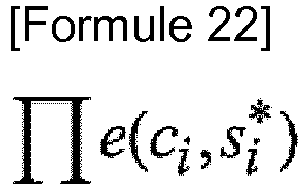
Applications Claiming Priority (2)
| Application Number | Priority Date | Filing Date | Title |
|---|---|---|---|
| JP2010101657A JP5424974B2 (ja) | 2010-04-27 | 2010-04-27 | 暗号処理システム、鍵生成装置、暗号化装置、復号装置、署名処理システム、署名装置及び検証装置 |
| PCT/JP2011/053174 WO2011135895A1 (fr) | 2010-04-27 | 2011-02-15 | Système de traitement pour cryptage, dispositif de génération de clés, dispositif de cryptage, dispositif de décryptage, système de traitement de signatures, dispositif de signature et dispositif d'authentification |
Publications (3)
| Publication Number | Publication Date |
|---|---|
| EP2565862A1 EP2565862A1 (fr) | 2013-03-06 |
| EP2565862A4 EP2565862A4 (fr) | 2017-07-19 |
| EP2565862B1 true EP2565862B1 (fr) | 2018-08-01 |
Family
ID=44861216
Family Applications (1)
| Application Number | Title | Priority Date | Filing Date |
|---|---|---|---|
| EP11774680.0A Active EP2565862B1 (fr) | 2010-04-27 | 2011-02-15 | Système de traitement pour cryptage, dispositif de génération de clés, dispositif de cryptage, dispositif de décryptage, système de traitement de signatures, dispositif de signature et dispositif d'authentification |
Country Status (7)
| Country | Link |
|---|---|
| US (1) | US8913742B2 (fr) |
| EP (1) | EP2565862B1 (fr) |
| JP (1) | JP5424974B2 (fr) |
| KR (1) | KR101386294B1 (fr) |
| CN (1) | CN102859571B (fr) |
| ES (1) | ES2693146T3 (fr) |
| WO (1) | WO2011135895A1 (fr) |
Families Citing this family (49)
| Publication number | Priority date | Publication date | Assignee | Title |
|---|---|---|---|---|
| JP5492007B2 (ja) * | 2010-08-04 | 2014-05-14 | 日本放送協会 | コンテンツサーバ、コンテンツ受信装置、属性鍵発行サーバ、ユーザ鍵発行サーバ、アクセス制御システム、コンテンツ配信プログラムおよびコンテンツ受信プログラム |
| JP5693206B2 (ja) * | 2010-12-22 | 2015-04-01 | 三菱電機株式会社 | 暗号処理システム、鍵生成装置、暗号化装置、復号装置、暗号処理方法及び暗号処理プログラム |
| JP5618881B2 (ja) * | 2011-03-25 | 2014-11-05 | 三菱電機株式会社 | 暗号処理システム、鍵生成装置、暗号化装置、復号装置、暗号処理方法及び暗号処理プログラム |
| JP5677273B2 (ja) | 2011-11-18 | 2015-02-25 | 三菱電機株式会社 | 暗号処理システム、暗号処理方法、暗号処理プログラム及び鍵生成装置 |
| JP5650630B2 (ja) * | 2011-11-22 | 2015-01-07 | 日本電信電話株式会社 | 鍵交換システム、鍵交換装置、鍵交換方法、鍵交換プログラム |
| JP2013150026A (ja) * | 2012-01-17 | 2013-08-01 | Mitsubishi Electric Corp | データ処理システム及び秘匿化装置及び秘密鍵生成装置及び秘匿化方法及び秘密鍵生成方法及びプログラム |
| JP5680007B2 (ja) * | 2012-03-06 | 2015-03-04 | 三菱電機株式会社 | 暗号システム、暗号方法及び暗号プログラム |
| JP5814880B2 (ja) | 2012-07-31 | 2015-11-17 | 三菱電機株式会社 | 暗号システム、暗号方法、暗号プログラム及び復号装置 |
| JP5921410B2 (ja) * | 2012-10-19 | 2016-05-24 | 三菱電機株式会社 | 暗号システム |
| KR101493212B1 (ko) * | 2012-10-31 | 2015-02-23 | 삼성에스디에스 주식회사 | 아이디 기반 암호화, 복호화 방법 및 이를 수행하기 위한 장치 |
| EP2945313B1 (fr) | 2013-01-12 | 2017-09-06 | Mitsubishi Electric Corporation | Dispositif de génération de clé, programme de génération de clé, système de recherche de données cachées et procédé de distribution de clé |
| EP2860905A1 (fr) * | 2013-10-09 | 2015-04-15 | Thomson Licensing | Méthode pour chiffrer un message au moyen d'une fonction de chiffrage avec clé, et appareil électronique et produit programme d'ordinateur correspondants |
| JP6022073B2 (ja) * | 2013-10-09 | 2016-11-09 | 三菱電機株式会社 | 暗号システム、再暗号化鍵生成装置及び再暗号化装置 |
| CN105850072B (zh) * | 2013-12-02 | 2018-11-20 | 三菱电机株式会社 | 数据处理系统、加密装置以及解密装置 |
| JP6053983B2 (ja) | 2014-02-24 | 2016-12-27 | 三菱電機株式会社 | 暗号システム、署名システム、暗号プログラム及び署名プログラム |
| CN106471558B (zh) * | 2014-07-02 | 2018-03-20 | 三菱电机株式会社 | 矩阵生成装置及矩阵生成方法 |
| WO2016088250A1 (fr) * | 2014-12-05 | 2016-06-09 | 三菱電機株式会社 | Dispositif d'addition de conditions de décodage, système de chiffrement et programme d'addition de conditions de décodage |
| CN107005406B (zh) | 2014-12-05 | 2020-07-17 | 三菱电机株式会社 | 函数型加密系统、主密钥更新装置和存储介质 |
| WO2016132546A1 (fr) * | 2015-02-20 | 2016-08-25 | 三菱電機株式会社 | Dispositif de mémorisation de données, procédé de traitement de données et programme de traitement de données |
| CN107251480B (zh) * | 2015-02-20 | 2018-07-10 | 三菱电机株式会社 | 数据保管装置、数据更新系统和数据处理方法 |
| JP6305638B2 (ja) | 2015-04-07 | 2018-04-04 | 三菱電機株式会社 | 暗号システム及び鍵生成装置 |
| US9209974B1 (en) * | 2015-05-03 | 2015-12-08 | Zeutro, Llc | Functional encryption key management |
| JP5957126B1 (ja) * | 2015-06-24 | 2016-07-27 | 日本電信電話株式会社 | 秘密計算装置、秘密計算方法、およびプログラム |
| CN109074463A (zh) | 2016-04-27 | 2018-12-21 | 三菱电机株式会社 | 属性协作装置、转送系统、属性协作方法以及属性协作程序 |
| JP6974461B2 (ja) * | 2016-08-02 | 2021-12-01 | エックス−ロゴス、エルエルシー | 幾何代数を用いた高度データ中心型暗号化システムのための方法およびシステム |
| WO2018136811A1 (fr) | 2017-01-20 | 2018-07-26 | Enveil, Inc. | Navigation web sécurisée par chiffrement homomorphique |
| US11507683B2 (en) | 2017-01-20 | 2022-11-22 | Enveil, Inc. | Query processing with adaptive risk decisioning |
| US11196541B2 (en) | 2017-01-20 | 2021-12-07 | Enveil, Inc. | Secure machine learning analytics using homomorphic encryption |
| WO2018136801A1 (fr) | 2017-01-20 | 2018-07-26 | Enveil, Inc. | Opérations sécurisées de bout en bout à l'aide d'une matrice d'interrogation |
| US11777729B2 (en) | 2017-01-20 | 2023-10-03 | Enveil, Inc. | Secure analytics using term generation and homomorphic encryption |
| US10880275B2 (en) | 2017-01-20 | 2020-12-29 | Enveil, Inc. | Secure analytics using homomorphic and injective format-preserving encryption |
| SG10201701044SA (en) | 2017-02-09 | 2018-09-27 | Huawei Int Pte Ltd | System and method for computing private keys for self certified identity based signature schemes |
| US20200175893A1 (en) * | 2017-07-20 | 2020-06-04 | Mitsubishi Electric Corporation | Encryption device, decryption device, encryption method, decryption method, and computer readable medium |
| WO2019053778A1 (fr) | 2017-09-12 | 2019-03-21 | 三菱電機株式会社 | Terminal d'enregistrement, terminal de recherche, serveur de recherche, système de recherche, programme d'enregistrement et programme de recherche |
| JP6456451B1 (ja) | 2017-09-25 | 2019-01-23 | エヌ・ティ・ティ・コミュニケーションズ株式会社 | 通信装置、通信方法、及びプログラム |
| US10193690B1 (en) * | 2017-09-29 | 2019-01-29 | U.S. Bancorp, National Association | Systems and methods to secure data using computer system attributes |
| JP7024666B2 (ja) * | 2018-08-28 | 2022-02-24 | 日本電信電話株式会社 | Idベースハッシュ証明系構成装置、idベース暗号装置及びプログラム |
| JP7117964B2 (ja) * | 2018-10-04 | 2022-08-15 | 三菱電機株式会社 | 復号装置、暗号システム、復号方法及び復号プログラム |
| US10902133B2 (en) | 2018-10-25 | 2021-01-26 | Enveil, Inc. | Computational operations in enclave computing environments |
| US10817262B2 (en) | 2018-11-08 | 2020-10-27 | Enveil, Inc. | Reduced and pipelined hardware architecture for Montgomery Modular Multiplication |
| US11469903B2 (en) * | 2019-02-28 | 2022-10-11 | Microsoft Technology Licensing, Llc | Autonomous signing management operations for a key distribution service |
| WO2021001990A1 (fr) * | 2019-07-04 | 2021-01-07 | 三菱電機株式会社 | Dispositif de traitement des données, dispositif de décryptage, procédé de traitement des données, procédé de décryptage, programme de traitement des données et programme de décryptage |
| WO2021112877A1 (fr) * | 2019-12-06 | 2021-06-10 | Hewlett-Packard Development Company, L.P. | Distribution de clé |
| US12099997B1 (en) | 2020-01-31 | 2024-09-24 | Steven Mark Hoffberg | Tokenized fungible liabilities |
| US11601258B2 (en) | 2020-10-08 | 2023-03-07 | Enveil, Inc. | Selector derived encryption systems and methods |
| CN112733111B (zh) * | 2020-12-31 | 2023-05-23 | 暨南大学 | 一种基于片段分割的阈值谓词加密生物特征认证方法 |
| KR20230136950A (ko) | 2022-03-21 | 2023-10-04 | 삼성전자주식회사 | 함수 암호 시스템 및 함수 암호 수행 방법 |
| US12519613B2 (en) * | 2022-11-07 | 2026-01-06 | Crypto Lab Inc. | Apparatus for calculating matrix multiplication of homomorphic encryption and method thereof |
| CN120050030B (zh) * | 2025-01-24 | 2025-07-29 | 北京邮电大学 | 一种云存储环境下加密数据的自主路径访问授权方法 |
Family Cites Families (9)
| Publication number | Priority date | Publication date | Assignee | Title |
|---|---|---|---|---|
| US7113594B2 (en) * | 2001-08-13 | 2006-09-26 | The Board Of Trustees Of The Leland Stanford University | Systems and methods for identity-based encryption and related cryptographic techniques |
| JP2006107274A (ja) * | 2004-10-07 | 2006-04-20 | Matsushita Electric Ind Co Ltd | ハッシュ関数演算システム、暗号化システムおよび不正解析・改竄防止システム |
| JP2007235659A (ja) | 2006-03-02 | 2007-09-13 | Mebius Corp | 鍵管理方法、暗号処理方法、電子署名方法、アクセス管理方法 |
| WO2007105709A1 (fr) * | 2006-03-14 | 2007-09-20 | Nec Corporation | Systeme, procede et programme de traitement d'informations |
| JP4882598B2 (ja) * | 2006-07-28 | 2012-02-22 | ソニー株式会社 | 暗号処理装置、暗号処理アルゴリズム構築方法、および暗号処理方法、並びにコンピュータ・プログラム |
| CN101617351B (zh) * | 2007-01-19 | 2011-06-22 | 三菱电机株式会社 | 密文生成装置、密码通信系统以及群参数生成装置 |
| JP5349261B2 (ja) | 2009-04-23 | 2013-11-20 | 三菱電機株式会社 | 暗号処理システム、鍵生成装置、鍵委譲装置、暗号化装置、復号装置、暗号処理方法及び暗号処理プログラム |
| CN102369687B (zh) | 2009-04-24 | 2014-09-17 | 日本电信电话株式会社 | 密码系统、密码通信方法、加密装置、密钥生成装置、解密装置、内容服务器装置、程序、存储介质 |
| CN102396012B (zh) | 2009-04-24 | 2014-05-07 | 日本电信电话株式会社 | 秘密分散系统、分散装置、分散管理装置、取得装置、其处理方法、秘密分散方法 |
-
2010
- 2010-04-27 JP JP2010101657A patent/JP5424974B2/ja active Active
-
2011
- 2011-02-15 CN CN201180020997.1A patent/CN102859571B/zh active Active
- 2011-02-15 ES ES11774680.0T patent/ES2693146T3/es active Active
- 2011-02-15 US US13/640,885 patent/US8913742B2/en active Active
- 2011-02-15 EP EP11774680.0A patent/EP2565862B1/fr active Active
- 2011-02-15 KR KR1020127025089A patent/KR101386294B1/ko not_active Expired - Fee Related
- 2011-02-15 WO PCT/JP2011/053174 patent/WO2011135895A1/fr not_active Ceased
Non-Patent Citations (1)
| Title |
|---|
| None * |
Also Published As
| Publication number | Publication date |
|---|---|
| JP2011232475A (ja) | 2011-11-17 |
| US8913742B2 (en) | 2014-12-16 |
| JP5424974B2 (ja) | 2014-02-26 |
| EP2565862A4 (fr) | 2017-07-19 |
| CN102859571A (zh) | 2013-01-02 |
| KR20120139753A (ko) | 2012-12-27 |
| ES2693146T3 (es) | 2018-12-07 |
| EP2565862A1 (fr) | 2013-03-06 |
| CN102859571B (zh) | 2015-06-10 |
| WO2011135895A1 (fr) | 2011-11-03 |
| US20130028415A1 (en) | 2013-01-31 |
| KR101386294B1 (ko) | 2014-04-17 |
Similar Documents
| Publication | Publication Date | Title |
|---|---|---|
| EP2565862B1 (fr) | Système de traitement pour cryptage, dispositif de génération de clés, dispositif de cryptage, dispositif de décryptage, système de traitement de signatures, dispositif de signature et dispositif d'authentification | |
| EP2690817B1 (fr) | Système de gestion de code, dispositif de génération de clé, encodeur, décodeur, procédé de gestion de code et programme de gestion de code | |
| EP2613472A1 (fr) | Système de traitement de chiffrement, dispositif de génération de clé, dispositif de chiffrement, dispositif de déchiffrement, procédé de traitement de chiffrement et programme de traitement de chiffrement | |
| EP2424154B1 (fr) | Système de traitement par chiffrement | |
| EP2503533B1 (fr) | Système de traitement de chiffrement, dispositif de génération de clé, dispositif de délégation de clé, dispositif de cryptage, dispositif de décryptage, procédé et programme de traitement de chiffrement | |
| EP2824652B1 (fr) | Système de chiffrement, procédé de chiffrement et programme de chiffrement | |
| EP2670081B1 (fr) | Système de traitement de signature, dispositif de génération de clé, dispositif de signature, dispositif de vérification, procédé et programme de traitement de signature | |
| EP2523178B1 (fr) | Systéme de traitement cryptographique, dispositif de génération de clé, dispositif de délégation de clé, dispositif de cryptage, dispositif de décryptage, cryptographique procédé de traitement et programme de traitement cryptographique | |
| EP2911137B1 (fr) | Système cryptographique | |
| EP2675107B1 (fr) | Système de traitement de cryptage, dispositif générateur de clé, dispositif de cryptage, dispositif de décryptage, dispositif de délégation de clé, procédé de traitement de cryptage et programme de traitement de cryptage |
Legal Events
| Date | Code | Title | Description |
|---|---|---|---|
| PUAI | Public reference made under article 153(3) epc to a published international application that has entered the european phase |
Free format text: ORIGINAL CODE: 0009012 |
|
| 17P | Request for examination filed |
Effective date: 20121012 |
|
| AK | Designated contracting states |
Kind code of ref document: A1 Designated state(s): AL AT BE BG CH CY CZ DE DK EE ES FI FR GB GR HR HU IE IS IT LI LT LU LV MC MK MT NL NO PL PT RO RS SE SI SK SM TR |
|
| DAX | Request for extension of the european patent (deleted) | ||
| RA4 | Supplementary search report drawn up and despatched (corrected) |
Effective date: 20170620 |
|
| RIC1 | Information provided on ipc code assigned before grant |
Ipc: H04L 9/14 20060101ALI20170613BHEP Ipc: H04L 9/08 20060101ALI20170613BHEP Ipc: G09C 1/00 20060101AFI20170613BHEP Ipc: H04L 9/30 20060101ALI20170613BHEP Ipc: H04L 9/32 20060101ALI20170613BHEP |
|
| GRAP | Despatch of communication of intention to grant a patent |
Free format text: ORIGINAL CODE: EPIDOSNIGR1 |
|
| STAA | Information on the status of an ep patent application or granted ep patent |
Free format text: STATUS: GRANT OF PATENT IS INTENDED |
|
| RIC1 | Information provided on ipc code assigned before grant |
Ipc: H04L 9/30 20060101ALI20180124BHEP Ipc: G09C 1/00 20060101AFI20180124BHEP Ipc: H04L 9/32 20060101ALI20180124BHEP Ipc: H04L 9/14 20060101ALI20180124BHEP Ipc: H04L 9/08 20060101ALI20180124BHEP |
|
| INTG | Intention to grant announced |
Effective date: 20180214 |
|
| GRAS | Grant fee paid |
Free format text: ORIGINAL CODE: EPIDOSNIGR3 |
|
| GRAA | (expected) grant |
Free format text: ORIGINAL CODE: 0009210 |
|
| STAA | Information on the status of an ep patent application or granted ep patent |
Free format text: STATUS: THE PATENT HAS BEEN GRANTED |
|
| AK | Designated contracting states |
Kind code of ref document: B1 Designated state(s): AL AT BE BG CH CY CZ DE DK EE ES FI FR GB GR HR HU IE IS IT LI LT LU LV MC MK MT NL NO PL PT RO RS SE SI SK SM TR |
|
| REG | Reference to a national code |
Ref country code: GB Ref legal event code: FG4D |
|
| REG | Reference to a national code |
Ref country code: CH Ref legal event code: EP Ref country code: AT Ref legal event code: REF Ref document number: 1025223 Country of ref document: AT Kind code of ref document: T Effective date: 20180815 |
|
| REG | Reference to a national code |
Ref country code: IE Ref legal event code: FG4D |
|
| REG | Reference to a national code |
Ref country code: DE Ref legal event code: R096 Ref document number: 602011050597 Country of ref document: DE |
|
| REG | Reference to a national code |
Ref country code: NL Ref legal event code: MP Effective date: 20180801 |
|
| REG | Reference to a national code |
Ref country code: ES Ref legal event code: FG2A Ref document number: 2693146 Country of ref document: ES Kind code of ref document: T3 Effective date: 20181207 |
|
| REG | Reference to a national code |
Ref country code: LT Ref legal event code: MG4D |
|
| REG | Reference to a national code |
Ref country code: AT Ref legal event code: MK05 Ref document number: 1025223 Country of ref document: AT Kind code of ref document: T Effective date: 20180801 |
|
| PG25 | Lapsed in a contracting state [announced via postgrant information from national office to epo] |
Ref country code: FI Free format text: LAPSE BECAUSE OF FAILURE TO SUBMIT A TRANSLATION OF THE DESCRIPTION OR TO PAY THE FEE WITHIN THE PRESCRIBED TIME-LIMIT Effective date: 20180801 Ref country code: LT Free format text: LAPSE BECAUSE OF FAILURE TO SUBMIT A TRANSLATION OF THE DESCRIPTION OR TO PAY THE FEE WITHIN THE PRESCRIBED TIME-LIMIT Effective date: 20180801 Ref country code: AT Free format text: LAPSE BECAUSE OF FAILURE TO SUBMIT A TRANSLATION OF THE DESCRIPTION OR TO PAY THE FEE WITHIN THE PRESCRIBED TIME-LIMIT Effective date: 20180801 Ref country code: RS Free format text: LAPSE BECAUSE OF FAILURE TO SUBMIT A TRANSLATION OF THE DESCRIPTION OR TO PAY THE FEE WITHIN THE PRESCRIBED TIME-LIMIT Effective date: 20180801 Ref country code: GR Free format text: LAPSE BECAUSE OF FAILURE TO SUBMIT A TRANSLATION OF THE DESCRIPTION OR TO PAY THE FEE WITHIN THE PRESCRIBED TIME-LIMIT Effective date: 20181102 Ref country code: NO Free format text: LAPSE BECAUSE OF FAILURE TO SUBMIT A TRANSLATION OF THE DESCRIPTION OR TO PAY THE FEE WITHIN THE PRESCRIBED TIME-LIMIT Effective date: 20181101 Ref country code: IS Free format text: LAPSE BECAUSE OF FAILURE TO SUBMIT A TRANSLATION OF THE DESCRIPTION OR TO PAY THE FEE WITHIN THE PRESCRIBED TIME-LIMIT Effective date: 20181201 Ref country code: SE Free format text: LAPSE BECAUSE OF FAILURE TO SUBMIT A TRANSLATION OF THE DESCRIPTION OR TO PAY THE FEE WITHIN THE PRESCRIBED TIME-LIMIT Effective date: 20180801 Ref country code: BG Free format text: LAPSE BECAUSE OF FAILURE TO SUBMIT A TRANSLATION OF THE DESCRIPTION OR TO PAY THE FEE WITHIN THE PRESCRIBED TIME-LIMIT Effective date: 20181101 Ref country code: NL Free format text: LAPSE BECAUSE OF FAILURE TO SUBMIT A TRANSLATION OF THE DESCRIPTION OR TO PAY THE FEE WITHIN THE PRESCRIBED TIME-LIMIT Effective date: 20180801 Ref country code: PL Free format text: LAPSE BECAUSE OF FAILURE TO SUBMIT A TRANSLATION OF THE DESCRIPTION OR TO PAY THE FEE WITHIN THE PRESCRIBED TIME-LIMIT Effective date: 20180801 |
|
| PG25 | Lapsed in a contracting state [announced via postgrant information from national office to epo] |
Ref country code: HR Free format text: LAPSE BECAUSE OF FAILURE TO SUBMIT A TRANSLATION OF THE DESCRIPTION OR TO PAY THE FEE WITHIN THE PRESCRIBED TIME-LIMIT Effective date: 20180801 Ref country code: LV Free format text: LAPSE BECAUSE OF FAILURE TO SUBMIT A TRANSLATION OF THE DESCRIPTION OR TO PAY THE FEE WITHIN THE PRESCRIBED TIME-LIMIT Effective date: 20180801 Ref country code: AL Free format text: LAPSE BECAUSE OF FAILURE TO SUBMIT A TRANSLATION OF THE DESCRIPTION OR TO PAY THE FEE WITHIN THE PRESCRIBED TIME-LIMIT Effective date: 20180801 |
|
| PG25 | Lapsed in a contracting state [announced via postgrant information from national office to epo] |
Ref country code: CZ Free format text: LAPSE BECAUSE OF FAILURE TO SUBMIT A TRANSLATION OF THE DESCRIPTION OR TO PAY THE FEE WITHIN THE PRESCRIBED TIME-LIMIT Effective date: 20180801 Ref country code: RO Free format text: LAPSE BECAUSE OF FAILURE TO SUBMIT A TRANSLATION OF THE DESCRIPTION OR TO PAY THE FEE WITHIN THE PRESCRIBED TIME-LIMIT Effective date: 20180801 Ref country code: EE Free format text: LAPSE BECAUSE OF FAILURE TO SUBMIT A TRANSLATION OF THE DESCRIPTION OR TO PAY THE FEE WITHIN THE PRESCRIBED TIME-LIMIT Effective date: 20180801 |
|
| REG | Reference to a national code |
Ref country code: DE Ref legal event code: R097 Ref document number: 602011050597 Country of ref document: DE |
|
| PG25 | Lapsed in a contracting state [announced via postgrant information from national office to epo] |
Ref country code: DK Free format text: LAPSE BECAUSE OF FAILURE TO SUBMIT A TRANSLATION OF THE DESCRIPTION OR TO PAY THE FEE WITHIN THE PRESCRIBED TIME-LIMIT Effective date: 20180801 Ref country code: SM Free format text: LAPSE BECAUSE OF FAILURE TO SUBMIT A TRANSLATION OF THE DESCRIPTION OR TO PAY THE FEE WITHIN THE PRESCRIBED TIME-LIMIT Effective date: 20180801 Ref country code: SK Free format text: LAPSE BECAUSE OF FAILURE TO SUBMIT A TRANSLATION OF THE DESCRIPTION OR TO PAY THE FEE WITHIN THE PRESCRIBED TIME-LIMIT Effective date: 20180801 |
|
| PLBE | No opposition filed within time limit |
Free format text: ORIGINAL CODE: 0009261 |
|
| STAA | Information on the status of an ep patent application or granted ep patent |
Free format text: STATUS: NO OPPOSITION FILED WITHIN TIME LIMIT |
|
| 26N | No opposition filed |
Effective date: 20190503 |
|
| PG25 | Lapsed in a contracting state [announced via postgrant information from national office to epo] |
Ref country code: SI Free format text: LAPSE BECAUSE OF FAILURE TO SUBMIT A TRANSLATION OF THE DESCRIPTION OR TO PAY THE FEE WITHIN THE PRESCRIBED TIME-LIMIT Effective date: 20180801 |
|
| REG | Reference to a national code |
Ref country code: CH Ref legal event code: PL |
|
| PG25 | Lapsed in a contracting state [announced via postgrant information from national office to epo] |
Ref country code: LU Free format text: LAPSE BECAUSE OF NON-PAYMENT OF DUE FEES Effective date: 20190215 Ref country code: MC Free format text: LAPSE BECAUSE OF FAILURE TO SUBMIT A TRANSLATION OF THE DESCRIPTION OR TO PAY THE FEE WITHIN THE PRESCRIBED TIME-LIMIT Effective date: 20180801 |
|
| REG | Reference to a national code |
Ref country code: BE Ref legal event code: MM Effective date: 20190228 |
|
| REG | Reference to a national code |
Ref country code: IE Ref legal event code: MM4A |
|
| PG25 | Lapsed in a contracting state [announced via postgrant information from national office to epo] |
Ref country code: CH Free format text: LAPSE BECAUSE OF NON-PAYMENT OF DUE FEES Effective date: 20190228 Ref country code: LI Free format text: LAPSE BECAUSE OF NON-PAYMENT OF DUE FEES Effective date: 20190228 |
|
| PG25 | Lapsed in a contracting state [announced via postgrant information from national office to epo] |
Ref country code: IE Free format text: LAPSE BECAUSE OF NON-PAYMENT OF DUE FEES Effective date: 20190215 |
|
| PG25 | Lapsed in a contracting state [announced via postgrant information from national office to epo] |
Ref country code: BE Free format text: LAPSE BECAUSE OF NON-PAYMENT OF DUE FEES Effective date: 20190228 |
|
| PG25 | Lapsed in a contracting state [announced via postgrant information from national office to epo] |
Ref country code: TR Free format text: LAPSE BECAUSE OF FAILURE TO SUBMIT A TRANSLATION OF THE DESCRIPTION OR TO PAY THE FEE WITHIN THE PRESCRIBED TIME-LIMIT Effective date: 20180801 |
|
| PG25 | Lapsed in a contracting state [announced via postgrant information from national office to epo] |
Ref country code: PT Free format text: LAPSE BECAUSE OF FAILURE TO SUBMIT A TRANSLATION OF THE DESCRIPTION OR TO PAY THE FEE WITHIN THE PRESCRIBED TIME-LIMIT Effective date: 20181201 Ref country code: MT Free format text: LAPSE BECAUSE OF NON-PAYMENT OF DUE FEES Effective date: 20190215 |
|
| PG25 | Lapsed in a contracting state [announced via postgrant information from national office to epo] |
Ref country code: CY Free format text: LAPSE BECAUSE OF FAILURE TO SUBMIT A TRANSLATION OF THE DESCRIPTION OR TO PAY THE FEE WITHIN THE PRESCRIBED TIME-LIMIT Effective date: 20180801 |
|
| PG25 | Lapsed in a contracting state [announced via postgrant information from national office to epo] |
Ref country code: HU Free format text: LAPSE BECAUSE OF FAILURE TO SUBMIT A TRANSLATION OF THE DESCRIPTION OR TO PAY THE FEE WITHIN THE PRESCRIBED TIME-LIMIT; INVALID AB INITIO Effective date: 20110215 |
|
| PG25 | Lapsed in a contracting state [announced via postgrant information from national office to epo] |
Ref country code: MK Free format text: LAPSE BECAUSE OF FAILURE TO SUBMIT A TRANSLATION OF THE DESCRIPTION OR TO PAY THE FEE WITHIN THE PRESCRIBED TIME-LIMIT Effective date: 20180801 |
|
| P01 | Opt-out of the competence of the unified patent court (upc) registered |
Effective date: 20230512 |
|
| PGFP | Annual fee paid to national office [announced via postgrant information from national office to epo] |
Ref country code: FR Payment date: 20251231 Year of fee payment: 16 |
|
| REG | Reference to a national code |
Ref country code: DE Ref legal event code: R081 Ref document number: 602011050597 Country of ref document: DE Owner name: MITSUBISHI ELECTRIC CORP., JP Free format text: FORMER OWNERS: MITSUBISHI ELECTRIC CORPORATION, TOKYO, JP; NIPPON TELEGRAPH AND TELEPHONE CORPORATION, TOKYO, JP Ref country code: DE Ref legal event code: R081 Ref document number: 602011050597 Country of ref document: DE Owner name: NTT, INC., JP Free format text: FORMER OWNERS: MITSUBISHI ELECTRIC CORPORATION, TOKYO, JP; NIPPON TELEGRAPH AND TELEPHONE CORPORATION, TOKYO, JP |
|
| PGFP | Annual fee paid to national office [announced via postgrant information from national office to epo] |
Ref country code: GB Payment date: 20260106 Year of fee payment: 16 |
|
| PGFP | Annual fee paid to national office [announced via postgrant information from national office to epo] |
Ref country code: ES Payment date: 20260304 Year of fee payment: 16 |
|
| PGFP | Annual fee paid to national office [announced via postgrant information from national office to epo] |
Ref country code: DE Payment date: 20251230 Year of fee payment: 16 |
|
| PGFP | Annual fee paid to national office [announced via postgrant information from national office to epo] |
Ref country code: IT Payment date: 20260122 Year of fee payment: 16 |