EP2824652B1 - Système de chiffrement, procédé de chiffrement et programme de chiffrement - Google Patents
Système de chiffrement, procédé de chiffrement et programme de chiffrement Download PDFInfo
- Publication number
- EP2824652B1 EP2824652B1 EP13757621.1A EP13757621A EP2824652B1 EP 2824652 B1 EP2824652 B1 EP 2824652B1 EP 13757621 A EP13757621 A EP 13757621A EP 2824652 B1 EP2824652 B1 EP 2824652B1
- Authority
- EP
- European Patent Office
- Prior art keywords
- vector
- integer
- basis
- index
- key
- Prior art date
- Legal status (The legal status is an assumption and is not a legal conclusion. Google has not performed a legal analysis and makes no representation as to the accuracy of the status listed.)
- Not-in-force
Links
Images















Classifications
-
- H—ELECTRICITY
- H04—ELECTRIC COMMUNICATION TECHNIQUE
- H04L—TRANSMISSION OF DIGITAL INFORMATION, e.g. TELEGRAPHIC COMMUNICATION
- H04L9/00—Cryptographic mechanisms or cryptographic arrangements for secret or secure communications; Network security protocols
- H04L9/14—Cryptographic mechanisms or cryptographic arrangements for secret or secure communications; Network security protocols using a plurality of keys or algorithms
- H04L9/16—Cryptographic mechanisms or cryptographic arrangements for secret or secure communications; Network security protocols using a plurality of keys or algorithms the keys or algorithms being changed during operation
-
- H—ELECTRICITY
- H04—ELECTRIC COMMUNICATION TECHNIQUE
- H04L—TRANSMISSION OF DIGITAL INFORMATION, e.g. TELEGRAPHIC COMMUNICATION
- H04L9/00—Cryptographic mechanisms or cryptographic arrangements for secret or secure communications; Network security protocols
- H04L9/30—Public key, i.e. encryption algorithm being computationally infeasible to invert or user's encryption keys not requiring secrecy
- H04L9/3066—Public key, i.e. encryption algorithm being computationally infeasible to invert or user's encryption keys not requiring secrecy involving algebraic varieties, e.g. elliptic or hyper-elliptic curves
- H04L9/3073—Public key, i.e. encryption algorithm being computationally infeasible to invert or user's encryption keys not requiring secrecy involving algebraic varieties, e.g. elliptic or hyper-elliptic curves involving pairings, e.g. identity based encryption [IBE], bilinear mappings or bilinear pairings, e.g. Weil or Tate pairing
Definitions
- the present invention relates to a cryptographic system that allows for addition of an attribute category without reissuing a public parameter.
- Non-Patent Literature 29 describes a functional encryption scheme.
- Non-Patent Literature 29 a pair of a basis B t and a basis B* t is required for each attribute category.
- a new pair of a basis B t and a basis B* t needs to be generated. This makes it necessary to reissue a public parameter because the basis B t is included in the public parameter.
- a cryptographic system is configured to perform a process using a predetermined basis B and a predetermined basis B*, and the cryptographic system includes:
- information J which is assigned in advance to index j is set in a transmission-side vector t j
- information J' having an inner-product of 0 with the information J is set in a reception-side vector r j' .
- a basis B and a basis B* can be used commonly for all attribute categories with security maintained, thus eliminating the need for using a basis B t and a basis B* t for each category.
- an attribute category is to be added, there is no need to newly generate a basis B t and a basis B* t, thus allowing for addition of an attribute category without reissuing a public parameter.
- a processing device is a CPU 911 or the like to be described later.
- a storage device is a ROM 913, a RAM 914, a magnetic disk 920 or the like to be described later.
- a communication device is a communication board 915 or the like to be described later.
- An input device is a keyboard 902, the communication board 915 or the like to be described later. That is, the processing device, the storage device, the communication device, and the input device are hardware.
- Formula 101 denotes that y is randomly selected from A according to the distribution of A. That is, y is a random number in Formula 101. y ⁇ R A
- Formula 102 denotes that y is uniformly selected from A. That is, y is a uniform random number in Formula 102. y ⁇ U A
- Formula 104 denotes that a machine (algorithm) A outputs a on input x.
- Formula 105 namely Fq, denotes a finite field of order q.
- F q a finite field of order q.
- a vector symbol denotes a vector representation over the finite field F q , as indicated in Formula 106.
- x ⁇ denotes x 1 , ... , x n ⁇ F q n
- Formula 107 denotes that the inner-product, indicated in Formula 109, of two vectors x ⁇ and v ⁇ indicated in Formula 108.
- X T denotes the transpose of a matrix X.
- Formula 111 denotes a subspace generated by Formula 112.
- b i ⁇ V i 1 , ... , n span ⁇ b 1 , ... , b n ⁇ ⁇ V resp . span ⁇ x ⁇ 1 , ... , x ⁇ n ⁇ b 1 , ... , b n resp . x ⁇ 1 , ... , x ⁇ n
- Formula 114 is established.
- e ⁇ j denotes an orthonormal basis vector indicated in Formula 115.
- Vt when “Vt” is shown as a subscript or superscript, this Vt denotes V t .
- ⁇ i,j when “ ⁇ i,j” is shown as a superscript, this ⁇ i,j denotes ⁇ i,j .
- processes of cryptographic primitives include not only a narrowly-defined cryptographic process for keeping information secure from a third party, but also include a signature process.
- the processes of the cryptographic primitives include a key generation process, an encryption process, a decryption process, a key delegation process, a signature process, and a verification process.
- This embodiment describes a basic concept for implementing the processes of the cryptographic primitives to be described in the following embodiments that allow for addition of an attribute category without reissuing a public parameter.
- An attribute category is a classification of an attribute of each user, such as belonging organization, belonging department, position in company, age, and gender.
- the processes of the cryptographic primitives to be described in the following embodiments realize access control based on the user's attribute. For example, with a narrowly-defined cryptographic process for securing information from a third party, whether or not the user can decrypt a ciphertext is controlled based on the user's attribute.
- attribute categories used for access control are determined in advance at the design stage of a system. However, there may be a case where the operational rules of the system are changed at a later stage, necessitating addition of an attribute category used for access control.
- the attribute categories to be used are, for example, belonging department, position in company, and individual ID.
- belonging company needs to be newly set as an attribute category to be used.
- attribute categories used for access control are specified by a public parameter
- adding an attribute category at a later stage requires that the public parameter be reissued and redistributed to each user. For this reason, an attribute category cannot be easily added at a later stage, and an operational mode that was not taken into consideration at the design stage of the system cannot be flexibly adopted.
- the functional encryption scheme is an encryption scheme that provides more sophisticated and flexible relations between an encryption key ek and a decryption key dk.
- a parameter ⁇ and a parameter ⁇ are set in the encryption key ek and the decryption key dk, respectively.
- the decryption key dk can decrypt a ciphertext encrypted with the encryption key ek if and only if a relation R ( ⁇ , ⁇ ) holds.
- the functional encryption scheme includes an attribute-based encryption scheme and an ID-based encryption scheme.
- the functional encryption scheme consists of four algorithms: Setup, KeyGen, Enc, and Dec.
- a Setup algorithm is an algorithm that outputs a public parameter pk and a master key sk.
- a KeyGen algorithm is an algorithm that takes as input the public parameter pk, the master key sk, and a parameter ⁇ , and outputs a decryption key sk ⁇ .
- An Enc algorithm is an algorithm that takes as input the public parameter pk, a parameter ⁇ , and a message m, and outputs a ciphertext ct ⁇ .
- a Dec algorithm is an algorithm that takes as input the public parameter pk, the decryption key sk ⁇ , and the ciphertext ct ⁇ , and outputs the message m or a distinguished symbol 1 ⁇ .
- the ciphertext ct ⁇ can be decrypted with the decryption key sk ⁇ to obtain the message m if and only if the parameter ⁇ and the parameter ⁇ satisfy the relation R (if R( ⁇ , ⁇ ) holds).
- the Setup algorithm is executed only once at system setup.
- the KeyGen algorithm is executed each time a decryption key sk ⁇ of a user is to be generated.
- the Enc algorithm is executed each time a message m is to be encrypted.
- the Dec algorithm is executed each time a ciphertext ct ⁇ is to be decrypted.
- the key technique for realizing addition of an attribute category without reissuing a public parameter is to apply an indexing technique to dual system encryption in the dual pairing vector spaces.
- a basis B ⁇ 1 ,..., and a basis B ⁇ d are generated as a public parameter.
- the public parameter needs to be reissued to add a basis B ⁇ , that is, to increase the value of d, at a later stage.
- the value of d is bounded by the public parameter.
- a basis B ⁇ is generated as a public parameter.
- the public parameter includes the basis B ⁇ but not the index vectors. Hence, when index vectors are to be added at a later stage to increase the value of d, there is no need to reissue the public parameter. In other words, the value of d is not bounded by the public parameter.
- Symmetric bilinear pairing groups (q, G, G T , g, e) are a tuple of a prime q, a cyclic additive group G of order q, a cyclic multiplicative group G T of order q, g ⁇ 0 ⁇ G, and a polynomial-time computable nondegenerate bilinear pairing e : G x G ⁇ G T .
- a pairing in the space V is defined by Formula 118.
- G 1 , ... , G N : x ⁇ V
- H 1 , ... , H N : y ⁇ V
- the linear transformations ⁇ i,j will be called distortion maps.
- the dual pairing vector spaces can also be constructed using asymmetric bilinear pairing groups.
- the following description can easily be adapted to a case where the dual pairing vector spaces are constructed using asymmetric bilinear pairing groups.
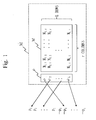
- Fig. 1 is an explanatory drawing of a matrix M ⁇ .
- ⁇ p 1 , ..., p n ⁇ be a set of variables.
- the matrix M is an (L rows x r columns) matrix over Fq, and p is a label of columns of the matrix M and is related to one of literals ⁇ p 1 , ..., p n , ⁇ p 1 , ..., ⁇ p n ⁇ .
- a submatrix M ⁇ of the matrix M is defined.
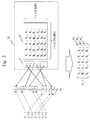
- Fig. 2 is an explanatory drawing of the matrix M ⁇ .
- the labels p are related such that ⁇ 1 is related to ⁇ p 2 , ⁇ 2 to p 1 , ⁇ 3 to p 4 , ⁇ 4 to ⁇ p 5 , ⁇ 5 to ⁇ p 3 , and ⁇ 6 to p 5 .
- a submatrix consisting of the rows of the matrix M which are related to literals (p 1 , p 3 , p 6 , p 7 , ⁇ p 2 , ⁇ p 4 , ⁇ p 5 ) surrounded by broken lines is the matrix M ⁇ . That is, the submatrix consisting of the first row (M 1 ), second row (M 2 ), and fourth row (M 4 ) of the matrix M is the matrix M ⁇ .
- whether or not the j-th row of the matrix M is included in the matrix M ⁇ is determined by whether the value of the map ⁇ (j) is "0" or "1".
- the span program M ⁇ accepts an input sequence ⁇ if and only if 1 ⁇ ⁇ span ⁇ M ⁇ >, and rejects the input sequence ⁇ otherwise. That is, the span program M ⁇ accepts the input sequence ⁇ if and only if linear combination of the rows of the matrix M ⁇ which are obtained from the matrix M ⁇ by the input sequence ⁇ gives 1 ⁇ .
- 1 ⁇ is a row vector which has a value "1" in each element.
- the span program is called monotone if its labels ⁇ are related to only positive literals ⁇ p 1 , ..., p n ⁇ .
- the span program is called non-monotone if its labels ⁇ are related to the literals ⁇ p 1 , ..., p n , ⁇ p 1 , ..., ⁇ p n ⁇ . It is assumed herein that the span program is non-monotone.
- An access structure (non-monotone access structure) is constituted using the non-monotone span program. Briefly, an access structure controls access to encryption, that is, it controls whether a ciphertext is to be decrypted or not.
- the span program being non-monotone, instead of being monotone, allows for a wider range of applications of the functional encryption scheme constituted using the span program.
- the above-described map ⁇ (j) is computed using the inner-product of attribute information. That is, the inner-product of attribute information is used to determine which row of the matrix M is to be included in the matrix M ⁇ .
- Each U t includes identification information (t) of the sub-universe and an n-dimensional vector (v ⁇ ). That is, U t is (t, v ⁇ ), where t ⁇ ⁇ 1, ...,d ⁇ and v ⁇ ⁇ F q n .
- the access structure S : (M, ⁇ ) and ⁇ : ⁇ 1, ..., L ⁇ ⁇ ⁇ (t, v ⁇ ), (t', v' ⁇ ), ..., ⁇ (t, v ⁇ ), ⁇ (t', v' ⁇ ), ... ⁇ .
- Set ⁇ (j) 0 otherwise.
- the map ⁇ is computed based on the inner-product of the attribute information v ⁇ and x ⁇ .
- which row of the matrix M is to be included in the matrix M ⁇ is determined by the map ⁇ . More specifically, which row of the matrix M is to be included in the matrix M ⁇ is determined by the inner-product of the attribute information v ⁇ and x ⁇ .
- the secret distribution scheme is distributing secret information to render it nonsense distributed information.
- secret information s is distributed into 10 pieces to generate 10 pieces of distributed information.
- Each of the 10 pieces of distributed information does not have information on the secret information s.
- no information can be obtained on the secret information s.
- the secret information s can be recovered.
- Another secret distribution scheme is also available according to which the secret information s can be recovered if some (for example, 8 pieces) of distributed information can be obtained, without obtaining all of the 10 pieces of distributed information.
- a case like this where the secret information s can be recovered using 8 pieces out of 10 pieces of distributed information will be called 8-out-of-10. That is, a case where the secret information s can be recovered using t pieces out of n pieces of distributed information will be called t-out-of-n. This t will be called a threshold.
- secret distribution schemes include a scheme according to which whether or not the secret information s can be recovered is controlled not only by the number of pieces of distributed information obtained, but also the combination of distributed information obtained.
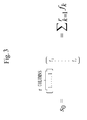
- Fig. 3 is an explanatory drawing of s 0 .
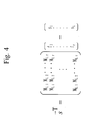
- Fig. 4 is an explanatory drawing of s ⁇ T .
- a matrix M be an (L rows x r columns) matrix.
- f ⁇ T be a column vector indicated in Formula 121.
- f ⁇ T : f 1 , ... , f r T ⁇ U F q r
- s 0 indicated in Formula 122 be secret information to be shared.
- an access structure is constructed by applying the inner-product predicate and the secret distribution scheme to the span program, as described above. Therefore, access control can be designed flexibly by designing the matrix M in the span program and the attribute information x and the attribute information v (predicate information) in the inner-product predicate. That is, access control can be designed very flexibly. Designing of the matrix M corresponds to designing of conditions such as a threshold of the secret distribution scheme.
- the attribute-based encryption scheme described above corresponds to a case where designing of the inner-product predicate is limited to a certain condition in the access structure in the functional encryption scheme according to the following embodiments. That is, when compared to the access structure in the functional encryption scheme according to the following embodiments, the access structure in the attribute-based encryption scheme has a lower flexibility in access control design because it lacks the flexibility in designing the attribute information x and the attribute information v (predicate information) in the inner-product predicate.
- An inner-product predicate encryption scheme corresponds to a case where designing of the matrix M in the span program is limited to a certain condition in the access structure in the functional encryption scheme according to the following embodiments. That is, when compared to the access structure in the functional encryption scheme according to the following embodiments, the access structure in the inner-product predicate encryption scheme has a lower flexibility in access control design because it lacks the flexibility in designing the matrix M in the span program. More specifically, the inner-product predicate encryption scheme corresponds to a case where the secret distribution scheme is limited to 1-out-of-1 (or d-out-of-d).
- the access structure in the functional encryption scheme according to the following embodiments constitutes a non-monotone access structure that uses a non-monotone span program.
- the flexibility in access control designing improves.
- a negative condition can be set.
- First Company includes four departments, A, B, C, and D.
- access control is to be performed such that only users belonging to departments other than department B of First Company are capable of access (capable of decryption).
- a negative condition cannot be set, a condition that "the user belongs to any one of departments A, C, and D of First Company" must be set.
- a negative condition can be set, a condition that "the user is an employee of First Company and belongs to a department other than department B" can be set.
- a negative condition can be set, natural condition setting is possible.
- this scheme is very effective in a case where the number of departments is large.
- This embodiment describes a narrowly-defined cryptographic processing scheme.
- this embodiment describes a key-policy functional encryption (KP-FE) scheme.
- KP-FE key-policy functional encryption
- key-policy means that a policy, namely an access structure, is embedded in a decryption key.
- the KP-FE scheme consists of four algorithms: Setup, KeyGen, Enc, and Dec.
- a Setup algorithm is a probabilistic algorithm that takes as input a security parameter ⁇ , and outputs a public parameter pk and a master key sk.
- a Dec algorithm is an algorithm that takes as input the ciphertext ct ⁇ encrypted under the attribute set ⁇ , the decryption key sk s for the access structure S, and the public parameter pk, and outputs the message m or a distinguished symbol ⁇ .
- Fig. 5 is a configuration diagram of the cryptographic system 10 that implements the KP-FE scheme according to Embodiment 2.
- the cryptographic system 10 includes a key generation device 100, an encryption device 200, and a decryption device 300.
- the key generation device 100 executes the Setup algorithm taking as input a security parameter ⁇ , and thus generates a public parameter pk and a master key sk. Then, the key generation device 100 publishes the generated public parameter pk. The key generation device 100 also executes the KeyGen algorithm taking as input an access structure S, and thus generates a decryption key sk s , and distributes the decryption key sk s to the decryption device 300 in secrecy.
- the encryption device 200 executes the Enc algorithm taking as input a message m, an attribute set ⁇ , and the public parameter pk, and thus generates a ciphertext ct ⁇ .
- the encryption device 200 transmits the generated ciphertext ct ⁇ to the decryption device 300.
- the decryption device 300 executes the Dec algorithm taking as input the public parameter pk, the decryption key sk s , and the ciphertext ct ⁇ , and thus outputs the message m or a distinguished symbol ⁇ .
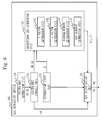
- Fig. 6 is a configuration diagram of the key generation device 100 according to Embodiment 2.
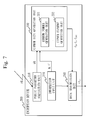
- Fig. 7 is a configuration diagram of the encryption device 200 according to Embodiment 2.
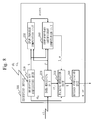
- Fig. 8 is a configuration diagram of the decryption device 300 according to Embodiment 2.
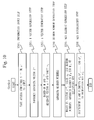
- Figs. 9 and 10 show flowcharts illustrating the operation of the key generation device 100.
- Fig. 9 is a flowchart illustrating the process of the Setup algorithm
- Fig. 10 is a flowchart illustrating the process of the KeyGen algorithm.
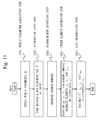
- Fig. 11 is a flowchart illustrating the operation of the encryption device 200 and illustrating the process of the Enc algorithm.
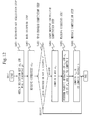
- Fig. 12 is a flowchart illustrating the operation of the decryption device 300 and illustrating the process of the Dec algorithm.
- the function and operation of the key generation device 100 will be described.
- the key generation device 100 includes a master key generation unit 110, a master key storage unit 120, an information input unit 130, a decryption key generation unit 140, and a key distribution unit 150.
- the decryption key generation unit 140 includes an f vector generation unit 141, an s vector generation unit 142, a random number generation unit 143, and a key element generation unit 144.
- the master key generation unit 110 computes Formula 125, and thus generates a parameter param, a basis B 0 and a basis B* 0 , and a basis B 1 (basis B) and a basis B* 1 (basis B*).
- the master key generation unit 110 executes the following process.
- the master key generation unit 110 executes an algorithm G ob indicated in Formula 126, and thus generates param, the basis B 0 and the basis B* 0 , and the basis B 1 (basis B) and the basis B* 1 (basis B*).
- the master key generation unit 110 uses the processing device to generate a subbasis B ⁇ 0 of the basis B 0 and a subbasis B ⁇ of the basis B, as indicated in Formula 127, the bases B 0 and B having been generated in (S101).
- the master key generation unit 110 generates a public parameter pk by putting together the generated subbasis B ⁇ 0 and subbasis B ⁇ , the security parameter ⁇ (1 ⁇ ) inputted in (S101), and param generated in (S101).
- the master key generation unit 110 uses the processing device to generate a subbasis B ⁇ * 0 of the basis B* 0 and a subspace B ⁇ * of the basis B*, as indicated in Formula 128, the bases B* 0 and B ⁇ * having been generated in (S101).
- the master key generation unit 110 generates a master key sk which is constituted by the generated subbasis B ⁇ * 0 and subbasis B ⁇ *.
- the master key storage unit 120 stores the parameter pk generated in (S102) in the storage device.
- the master key storage unit 120 also stores the master key sk generated in (S103) in the storage device.
- the key generation device 100 executes the Setup algorithm indicated in Formula 129, and thus generates the public parameter pk and the master key sk.
- the key generation device 100 stores the generated public parameter pk and master key sk in the storage device.
- the public parameter is published, for example, via the network, and is made available for the encryption device 200 and the decryption device 300.
- the matrix M of the access structure S is to be set according to the conditions of a system to be implemented.
- attribute information of the user of a decryption key sk s is set in ⁇ of the access structure S, for example.
- the f vector generation unit 141 randomly generates a vector f ⁇ having r pieces of elements, as indicated in Formula 130. f ⁇ ⁇ U F q r
- the random number generation unit 143 uses the processing device to generate random numbers, as indicated in Formula 133.
- the key element generation unit 144 uses the processing device to generate an element k* 0 of the decryption key sk s , as indicated in Formula 134.
- Formula 134 means that -so is set as the coefficient of a basis vector b* 0,1 of the basis B * 0 , 0 is set as the coefficient of basis vectors b* 0,1+1 , ..., b* 0,1+u0 , 1 is set as the coefficient of a basis vector b * 0,1+u0+1 , ⁇ 0 , 1 , ..., ⁇ 0,w0 are respectively set as the coefficient of basis vectors b* 0,1+u0+1+1 , ..., b* 0,1+u0+1+w0 , and 0 is set as the coefficient of basis vectors b* 0,1+u0+1+w0+1, ..., b* 0,1+u0+1 + w0+z0 , where u0, w0, and z0 respectively denote u 0 , w 0 , and z 0 .
- ⁇ i t is set as the coefficient of the basis vector b * 1 of the basis B *
- - ⁇ i is set as the coefficient of the basis vector b* 2
- s i v i,1 , ..., s i v i,n are respectively set as the coefficient of the basis vectors b* 2+1 , ...,b* 2+n
- 0 is set as the coefficient of the basis vectors b * 2+n+1 , ..., b * 2+n+u
- ⁇ i,1, ..., ⁇ i,w are respectively set as the coefficient of the basis vectors b * 2+n+u+1 , ..., b * 2+n+u+w
- 0 is set as the coefficient of the basis vectors b * 2+n+u+w+1 , ..., b * 2+n+u+w+z
- the key distribution unit 150 distributes the decryption key sk s having, as elements, the access structure S inputted in (S201) and k * 0 , k * 1 , ..., and k * L generated in (S205) to the decryption device 300 in secrecy.
- the decryption key sk s may be distributed to the decryption device 300 by another method.
- the key generation device 100 executes the KeyGen algorithm indicated in Formula 136, and thus generates the decryption key sk s .
- the key generation device 100 distributes the generated decryption key sk s to the decryption device 300.
- the encryption device 200 includes a public parameter acquisition unit 210, an information input unit 220, a cipher data generation unit 230, and a data transmission unit 240.
- the cipher data generation unit 230 includes a random number generation unit 231 and a cipher element generation unit 232.
- the public parameter acquisition unit 210 obtains the public parameter pk generated by the key generation device 100.
- the information input unit 220 takes as input a message m to be transmitted to the decryption device 300.
- t may be at least some integers from 1 to d, instead of being all of integers from 1 to d.
- information on the attributes of the user capable of decryption is set in the attribute set ⁇ , for example.
- the random number generation unit 231 uses the processing device to generate random numbers, as indicated in Formula 137.
- the cipher element generation unit 232 uses the processing device to generate an element c 0 of a ciphertext ct ⁇ , as indicated in Formula 138.
- c 0 : ⁇ , 0 u 0 , ⁇ u 0 ⁇ , 0 w 0 , ⁇ w 0 ⁇ ⁇ 0 ⁇ z 0 B 0
- the cipher element generation unit 232 uses the processing device to generate an element c t of the ciphertext ct ⁇ for each integer t included in the attribute information ⁇ , as indicated in Formula 139.
- c t ⁇ t 1 t , ⁇ x ⁇ t , ⁇ 2 + n 0 u , ⁇ u 0 w , ⁇ w ⁇ ⁇ t ⁇ z B
- the cipher element generation unit 232 uses the processing device to generate an element c d+1 of the ciphertext ct ⁇ , as indicated in Formula 140.
- c d + 1 : g T ⁇ m
- the data transmission unit 240 transmits the ciphertext ct ⁇ having, as elements, the attribute set ⁇ inputted in (S302) and c 0 , c t , and c d+1 generated in (S304) to the decryption device 300.
- the ciphertext ct ⁇ may be transmitted to the decryption device 300 by another method.
- the encryption device 200 executes the Enc algorithm indicated in Formula 141, and thus generates the ciphertext ct ⁇ .
- the encryption device 200 transmits the generated ciphertext ct ⁇ to the decryption device 300.
- the function and operation of the decryption device 300 will be described.
- the decryption device 300 includes a decryption key acquisition unit 310, a data receiving unit 320, a span program computation unit 330, a complementary coefficient computation unit 340, a pairing operation unit 350, and a message computation unit 360.
- the decryption key acquisition unit 310 also obtains the public parameter pk generated by the key generation device 100.
- the data receiving unit 320 receives the ciphertext ct ⁇ transmitted by the encryption device 200.
- the span program computation unit 330 checks whether or not the access structure S included in the decryption key sk s obtained in (S401) accepts ⁇ included in the ciphertext ct ⁇ received in (S402).
- the method for checking whether or not the access structure S accepts ⁇ is the same as that described in "5. Concept for implementing functional encryption in Embodiment 1".
- the span program computation unit 330 advances the process to (S404). If the access structure S rejects ⁇ (reject in S403), the span program computation unit 330 determines that the ciphertext ct ⁇ cannot be decrypted with the decryption key sk s , and ends the process.
- the complementary coefficient computation unit 340 computes I and a constant (complementary coefficient) ⁇ i ⁇ i ⁇ I such that Formula 142 is satisfied.
- 1 ⁇ ⁇ i ⁇ I ⁇ i M i , where M i is the i ⁇ th row of M , and I ⁇ i ⁇ 1 , ... , L
- c d+1 is g T ⁇ m, as indicated in Formula 142, and that K is 9 T ⁇ .
- ⁇ i t and - ⁇ i are respectively set as the coefficient of the basis vectors b * 1 and b * 2 for the element k * i of the decryption key sk s .
- ⁇ t and ⁇ t t are respectively set as the coefficient of the basis vectors b 1 and b 2 for the element c t of the ciphertext ct ⁇ .
- the index parts are provided, so that the bases that are used for every attribute category can be constructed as the common bases (basis B and basis B*).
- the bases that are used for every attribute category can be constructed as the common bases (basis B and basis B*).
- the public parameter and the master secret key are of smaller sizes compared with those in the functional encryption scheme described in Non-Patent Literature 29. Therefore, calculations using the public parameter and the master secret key can be performed efficiently.
- the index parts it is required that 0 be obtained as a result of an inner-product operation of the index parts. Therefore, although the 2-dimensional index parts, namely the basis vectors b * 1 and b * 2 and the basis vectors b 1 and b 2 , are employed in the above description, the index parts are not limited to 2-dimensional and may be 3-dimensional or higher-dimensional. The values assigned to the index parts are not limited to those described above, and a different assignment arrangement may be employed.
- this embodiment describes a narrowly-defined cryptographic processing scheme.
- this embodiment describes a ciphertext-policy functional encryption (CP-FE) scheme.
- CP-FE ciphertext-policy functional encryption
- cipher-text policy means that a policy, namely an access structure, is embedded in a ciphertext.
- the CP-FE scheme consists of four algorithms: Setup, KeyGen, Enc, and Dec.
- a Setup algorithm is a probabilistic algorithm that takes as input a security parameter ⁇ , and outputs a public parameter pk and a master key sk.
- a Dec algorithm is an algorithm that takes as input the ciphertext ct s encrypted under the access structure S, the decryption key sk ⁇ for the attribute set ⁇ , and the public parameter pk, and outputs the message m or a distinguished symbol ⁇ .
- Fig. 13 is a configuration diagram of the cryptographic system 10 that implements the CP-FE scheme according to Embodiment 3.
- the cryptographic system 10 includes a key generation device 100, an encryption device 200, and a decryption device 300.
- the key generation device 100 executes the Setup algorithm taking as input a security parameter ⁇ , and thus generates a public parameter pk and a master key sk. Then, the key generation device 100 publishes the generated public parameter pk. The key generation device 100 also executes the KeyGen algorithm taking as input an attribute set ⁇ , and thus generates a decryption key sk ⁇ , and distributes the decryption key sk ⁇ to the decryption device 300 in secrecy.
- the encryption device 200 executes the Enc algorithm taking as input a message m, an access structure S, and the public parameter pk, and thus generates a ciphertext ct s .
- the encryption device 200 transmits the generated ciphertext ct s to the decryption device 300.
- the decryption device 300 executes the Dec algorithm taking as input the public parameter pk, the decryption key sk s , and the ciphertext ct s , and outputs the message m or a distinguished symbol ⁇ .
- Fig. 14 is a configuration diagram of the key generation device 100 according to Embodiment 3.
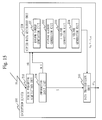
- Fig. 15 is a configuration diagram of the encryption device 200 according to Embodiment 3.
- Fig. 16 is a configuration diagram of the decryption device 300 according to Embodiment 3.
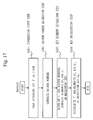
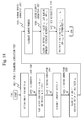
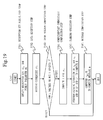
- Fig. 17 is a flowchart illustrating the operation of the key generation device 100 and illustrating the process of the KeyGen algorithm.
- Fig. 18 is a flowchart illustrating the operation of the encryption device 200 and illustrating the process of the Enc algorithm.
- Fig. 19 is a flowchart illustrating the operation of the decryption device 300 and illustrating the process of the Dec algorithm.
- the function and operation of the key generation device 100 will be described.
- the key generation device 100 includes a master key generation unit 110, a master key storage unit 120, an information input unit 130, a decryption key generation unit 140, and a key distribution unit 150.
- the decryption key generation unit 140 includes a random number generation unit 143 and a key element generation unit 144.
- attribute information of the user of a decryption key sk ⁇ is set in the attribute set ⁇ , for example.
- the random number generation unit 143 uses the processing device to generate random numbers, as indicated in Formula 150.
- the key element generation unit 144 uses the processing device to generate an element k* 0 of the decryption key sk ⁇ , as indicated in Formula 151.
- the key element generation unit 144 uses the processing device to generate an element k* t of the decryption key sk ⁇ for each integer t included in the attribute set ⁇ , as indicated in Formula 152.
- the key distribution unit 150 distributes the decryption key sk ⁇ having, as elements, the attribute set ⁇ inputted in (S501) and k * 0 and k * t generated in (S503) to the decryption device 300 in secrecy.
- the decryption key sk ⁇ may be distributed to the decryption device 300 by another method.
- the key generation device 100 executes the KeyGen algorithm indicated in Formula 153, and thus generates the decryption key sk ⁇ .
- the key generation device 100 distributes the generated decryption key sk ⁇ to the decryption device 300.
- the encryption device 200 includes a public parameter acquisition unit 210, an information input unit 220, a cipher data generation unit 230, and a data transmission unit 240.
- the cipher data generation unit 230 includes a random number generation unit 231, a cipher element generation unit 232, an f vector generation unit 233, and an s vector generation unit 234.
- the public parameter acquisition unit 210 obtains the public parameter pk generated by the key generation device 100.
- the access structure S is to be set according to the conditions of a system to be implemented.
- attribute information of the user capable of decryption is set in ⁇ of the access structure S, for example.
- the information input unit 220 also takes as input a message m to be transmitted to the decryption device 300.
- the f vector generation unit 233 randomly generates a vector f ⁇ having r pieces of elements, as indicated in Formula 154. f ⁇ ⁇ U F q r
- the s vector generation unit 234 uses the processing device and based on the vector f ⁇ generated in (S603) to generate a value s 0 , as indicated in Formula 156.
- s 0 : 1 ⁇ ⁇ f ⁇ T
- the random number generation unit 231 uses the processing device to generate random numbers, as indicated in Formula 157.
- the cipher element generation unit 232 uses the processing device to generate an element c 0 of cipher data c, as indicated in Formula 158.
- c 0 : ⁇ s 0 , 0 u 0 , ⁇ u 0 ⁇ , 0 w 0 , ⁇ w 0 ⁇ ⁇ 0 ⁇ z 0 B 0
- the cipher element generation unit 232 uses the processing device to generate an element c d+1 of the cipher data c, as indicated in Formula 160.
- c d + 1 : g T ⁇ m
- the data transmission unit 240 uses the communication device and via the network, for example, the data transmission unit 240 transmits a ciphertext ct s having, as elements, the access structure S inputted in (S602) and c 0 , c 1 , ..., c L , and c d+1 generated in (S606) to the decryption device 300.
- the ciphertext ct s may be transmitted to the decryption device 300 by another method.
- the encryption device 200 executes the Enc algorithm indicated in Formula 161, and thus generates the ciphertext ct s .
- the encryption device 200 transmits the generated ciphertext ct s to the decryption device 300.
- the function and operation of the decryption device 300 will be described.
- the decryption device 300 includes a decryption key acquisition unit 310, a data receiving unit 320, a span program computation unit 330, a complementary coefficient computation unit 340, a pairing operation unit 350, and a message computation unit 360.
- the decryption key acquisition unit 310 obtains the decryption key sk ⁇ distributed by the key generation device 100.
- the decryption key acquisition unit 310 also obtains the public parameter pk generated by the key generation device 100.
- the data receiving unit 320 receives the ciphertext ct s transmitted by the encryption device 200.
- the span program computation unit 330 checks whether or not the access structure S included in the ciphertext ct s obtained in (S702) accepts ⁇ included in the decryption key sk ⁇ received in (S701).
- the method for checking whether or not the access structure S accepts ⁇ is the same as that described in "5. Concept for implementing functional encryption in Embodiment 1".
- the span program computation unit 330 advances the process to (S704). If the access structure S rejects ⁇ (reject in S703), the span program computation unit 330 determines that the ciphertext ct s cannot be decrypted with the decryption key sk ⁇ and ends the process.
- ⁇ i t v ⁇ i ⁇ t x ⁇ t ⁇ ⁇ ⁇ v ⁇ i ⁇ x
- the index parts are provided, so that the bases that are used for every attribute category can be constructed as the common bases (basis B and basis B * ).
- the basis B and the basis B * need to be included in a public parameter, eliminating the need for reissuing the public parameter when an attribute category is to be added at a later stage.
- the index parts As in Embodiment 2, for the index parts, it is required that 0 be obtained as a result of an inner-product operation of the index parts. Therefore, although the 2-dimensional index parts, namely the basis vectors b * 1 and b * 2 and the basis vectors b 1 and b 2 , are employed in the above description, the index parts are not limited to 2-dimensional and may be 3-dimensional or higher-dimensional. The values assigned to the index parts are not limited to those described above, and a different assignment arrangement may be employed.
- the KP-FE scheme has been described.
- the CP-FE scheme has been described.
- the unified-policy (UP-FE) scheme described in Non-Patent Literature 30 may be constructed such that there is no need to reissue a public parameter when an attribute category is to be added.
- this embodiment describes a narrowly-defined cryptographic processing scheme.
- this embodiment describes a hierarchical inner-product predicate encryption (HIPE) scheme.
- HIPE hierarchical inner-product predicate encryption
- the HIPE scheme is an inner-product predicate encryption scheme which is capable of delegation.
- Delegation means that a user who has a higher-level key generates a lower-level key having more limited capabilities than the user's (higher-level) key.
- the limited capabilities mean that the lower-level key can decrypt only some of ciphertexts that can be decrypted with the higher-level key.
- the inner-product predicate encryption scheme corresponds to a case where the design of the access structure in the functional encryption scheme is limited.
- the HIPE scheme includes a first scheme which is efficient, and a second scheme which is less efficient than the first scheme, but guarantees security of even attribute information that is set in a ciphertext (see Non-Patent Literature 29).
- a second scheme which is less efficient than the first scheme, but guarantees security of even attribute information that is set in a ciphertext
- the second scheme a scheme which allows for addition of an attribute category without reissuing a public parameter will be described.
- the first scheme can also be constructed to allow for addition of an attribute category without reissuing a public parameter.
- the HIPE scheme consists of five algorithms: Setup, KeyGen, Enc, Dec, and Delegate L .
- a Setup algorithm is a probabilistic algorithm that takes as input a security parameter 1 ⁇ , and outputs a master public key pk and a master secret key sk.
- the master secret key sk is a top-level key.
- a KeyGen algorithm is a probabilistic algorithm that takes as input the master public key pk, the master secret key sk, and predicate information (v ⁇ 1 , ..., v ⁇ L ) (1 ⁇ L ⁇ d), and outputs an L-th-level secret key sk L .
- An Enc algorithm is a probabilistic algorithm that takes as input the master public key pk, attribute information (x ⁇ 1 , ..., x ⁇ h ) (1 ⁇ h ⁇ d), and a message m, and outputs a ciphertext ct.
- a Dec algorithm is a probabilistic algorithm that takes as input the master public key pk, the L-th-level secret key sk L , and the ciphertext ct, and outputs the message m or a distinguished symbol ⁇ .
- Delegate L is a probabilistic algorithm that takes as input the master public key pk, the L-th-level secret key sk L , and (L+1)-th level predicate information v ⁇ L+1 (L+1 ⁇ d), and outputs an (L+1)-th-level secret key sk L+1 . That is, the Delegate L algorithm outputs a lower-level secret key.
- Fig. 20 is a configuration diagram of the cryptographic system 10 that implements the HIPE scheme according to Embodiment 4.
- the cryptographic system 10 includes a key generation device 100, an encryption device 200, a decryption device 300, and a key delegation device 400. It is assumed in the following description that the decryption device 300 includes the key delegation device 400. However, the key delegation device 400 may be provided separately from the decryption device 300.
- the key generation device 100 executes the Setup algorithm taking as input a security parameter ⁇ , and thus generates a master public key pk and a master secret key sk. Then, the key generation device 100 publishes the generated master public key pk. The key generation device 100 also executes the KeyGen algorithm taking as input the master public key pk, the master secret key sk, and predicate information (v ⁇ 1 , ..., v ⁇ L ) (1 ⁇ L ⁇ d), and thus generates an L-th-level secret key sk L , and distributes the L-th-level secret key sk L to the L-th level decryption device 300 in secrecy.
- the encryption device 200 executes the Enc algorithm taking as input the master public key pk, attribute information (x ⁇ 1 , ..., x ⁇ h ) (1 ⁇ h ⁇ d), and a message m, and thus generates a ciphertext ct.
- the encryption device 200 transmits the generated ciphertext ct to the decryption device 300.
- the decryption device 300 executes the Dec algorithm taking as input the master public key pk, the L-th-level secret key sk L , and the ciphertext ct, and outputs the message m or a distinguished symbol ⁇ .
- the key delegation device 400 executes the Delegate L algorithm taking as input the master public key pk, the L-th-level secret key sk L , and (L+1)-th-level predicate information v ⁇ L+1 (L+1 ⁇ d), and thus generates an (L+1)-th-level secret key sk L+1 , and distributes the (L+1)-th-level secret key sk L+1 to the (L+1)-th-level decryption device 300 in secrecy.
- Fig. 21 is a configuration diagram of the key generation device 100 according to Embodiment 4.
- Fig. 22 is a configuration diagram of the encryption device 200 according to Embodiment 4.
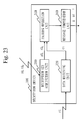
- Fig. 23 is a configuration diagram of the decryption device 300 according to Embodiment 4.
- Fig. 24 is a configuration diagram of the key delegation device 400 according to Embodiment 4.
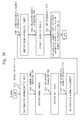
- Figs. 25 and 26 show flowcharts illustrating the operation of the key generation device 100.
- Fig. 25 is a flowchart illustrating the process of the Setup algorithm.
- Fig. 26 is a flowchart illustrating the process of the KeyGen algorithm.
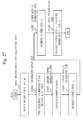
- Fig. 27 is a flowchart illustrating the operation of the encryption device 200 and illustrating the process of the Enc algorithm.
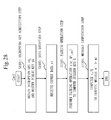
- Fig. 28 is a flowchart illustrating the operation of the decryption device 300 and illustrating the process of the Dec algorithm.
- Fig. 29 is a flowchart illustrating the operation of the key delegation device 400 and illustrating the process of the Delegate L algorithm.
- the function and operation of the key generation device 100 will be described.
- the key generation device 100 includes a master key generation unit 110, a master key storage unit 120, an information input unit 130, a decryption key generation unit 140, and a key distribution unit 150.
- the decryption key generation unit 140 includes a random number generation unit 143, a key element generation unit 144, a randomizing element generation unit 145, and a delegation element generation unit 146.
- S801 is substantially the same as (S101) in Embodiment 2 shown in Fig. 9 .
- the master key generation unit 110 uses the processing device to generate a subbasis B ⁇ 0 of the basis B 0 , a subbasis B ⁇ of the basis B, a subbasis B ⁇ * 0,pk of the basis B * 0 , and a subbasis B ⁇ * pk of the basis B * , as indicated in Formula 167, the bases B 0 , B ⁇ , B, and B * 0 having been generated in (S801).
- the master key generation unit 110 generates a public parameter pk by putting together the generated subbasis B ⁇ 0 , subbasis B ⁇ , subbasis B ⁇ * 0,pk , and subbasis B ⁇ * pk , the security parameter ⁇ (1 ⁇ ) inputted in (S801), and param generated in (S801).
- the master key generation unit 110 uses the processing device to generate a subbasis B ⁇ * 0,sk of the basis B * 0 and a subbasis B ⁇ * sk of the basis B * , as indicated in Formula 168, the bases B * 0 and B * having been generated in (S801).
- B ⁇ 0 , sk * : b 0 , 1 * b 0 , 1 + u 0 + 1 *
- B ⁇ sk * : b 2 + 1 * , ... , b 2 + n *
- the master key generation unit 110 generates a master key sk which is constituted by the generated subbasis B ⁇ * 0 and subbasis B ⁇ * .
- the master key storage unit 120 stores the public parameter pk generated in (S802) in the storage device.
- the master key storage unit 120 also stores the master key sk generated in (S803) in the storage device.
- the key generation device 100 executes the Setup algorithm indicated in Formula 169, and thus generates the public parameter pk and the master key sk.
- the key generation device 100 stores the generated public parameter pk and master key sk in the storage device.
- the public parameter is published via the network, for example, and is made available for the encryption device 200 and the decryption device 300.
- the random number generation unit 143 uses the processing device to generate random numbers, as indicated in Formula 170.
- the random number generation unit 143 also sets s dec , 0 , S ran,1 , j,0 , S ran , 2, ⁇ ,0 , and S de1,( ⁇ ,l) ,0, as indicated in Formula 171.
- the key element generation unit 144 uses the processing device to generate a key element k * L,dec which is an element of the decryption key sk L , as indicated in Formula 172.
- the key distribution unit 150 distributes the decryption key sk L having, as elements, the key element k * L,dec , the first randomizing element k * L,ran,1,j , the second randomizing element k * L,ran,2, ⁇ , and the delegation element ) to the decryption device 300 in secrecy.
- the decryption key sk L may be distributed to the decryption device 300 by another method.
- the key generation device 100 executes the KeyGen algorithm indicated in Formula 176 and Formula 177, and thus generates the decryption key sk L .
- the key generation device 100 distributes the generated decryption key sk L to the decryption device 300.
- the encryption device 200 includes a public parameter acquisition unit 210, an information input unit 220, a cipher data generation unit 230, and a data transmission unit 240.
- the cipher data generation unit 230 includes a random number generation unit 231 and a cipher element generation unit 232.
- the public parameter acquisition unit 210 obtains the master public key pk generated by the key generation device 100.
- the information input unit 220 uses the input device to take as input a message m to be encrypted.
- the random number generation unit 231 uses the processing device to generate random numbers, as indicated in Formula 178.
- the cipher element generation unit 232 uses the processing device to generate a cipher element c 1 which is an element of a ciphertext ct, as indicated in Formula 179.
- the cipher element generation unit 232 uses the processing device to generate a cipher element c 2 which is an element of the ciphertext ct, as indicated in Formula 180.
- c 2 : g ⁇ T m ⁇
- the data transmission unit 240 transmits the ciphertext ct including the cipher element c 1 and the cipher element c 2 to the decryption device 300.
- the ciphertext ct may be transmitted to the decryption device 300 by another method.
- the encryption device 200 executes the Enc algorithm indicated in Formula 181, and thus generates the ciphertext ct.
- the encryption device 200 transmits the generated ciphertext ct to the decryption device 300.
- the function and operation of the decryption device 300 will be described.
- the decryption device 300 includes a decryption key acquisition unit 310, a data receiving unit 320, a pairing operation unit 350, and a message computation unit 360.
- the decryption key acquisition unit 310 obtains the decryption key sk L .
- the decryption key acquisition unit 310 also obtains the public parameter pk generated by the key generation device 100.
- the data receiving unit 320 receives the ciphertext ct transmitted by the encryption device 200.
- the key delegation device 400 includes a decryption key acquisition unit 410, an information input unit 420, a delegation key generation unit 430, and a key distribution unit 440.
- the delegation key generation unit 430 includes a random number generation unit 431, a lower-level key element generation unit 432, a lower-level randomizing element generation unit 433, and a lower-level delegation element generation unit 434.
- the decryption key acquisition unit 410 obtains the decryption key sk L .
- the decryption key acquisition unit 410 also obtains the public parameter pk generated by the key generation device 100.
- the random number generation unit 431 uses the processing device to generate random numbers, as indicated in Formula 184.
- j ′ 1 , ... , 2 L + 1 ;
- ⁇ L + 2 , ... , d ;
- ⁇ 1 , ... , n ;
- ⁇ del , ⁇ ⁇ ′ , ⁇ ran , 2 , ⁇ ′ , ⁇ del , ⁇ i , ⁇ ran , 2 , ⁇ , ⁇ ′ ⁇ U F q , p dec * , p del , ⁇ ⁇ * , p ran , 1 , j ′ * , p ran , 2 , ⁇ * * ⁇ R CoreDel L pk sk L v L + 1 , where CoreDel L pk sk L v L + 1 : ⁇ t ′ , ⁇ , ⁇ j ⁇ U F q for t 1
- the lower-level key element generation unit 432 uses the processing device to generate a lower-level key element k * L+1,dec which is an element of a delegation key sk L+1 , as indicated in Formula 185.
- k L + 1 , dec * : k L , dec * + p dec * + r dec *
- k L + 1 , ran , 1 , j ′ * : p ran , 1 , j ′ * + r ran , 1 , j ′ *
- k L + 1 , ran , 2 , ⁇ * : p ran , 2 , ⁇ * + ⁇ ran , 2 , ⁇ ′ ⁇ b 1 * ⁇ b 2 * ⁇ + ⁇ ran , 2 , ⁇ k L , ran , 2 ⁇ * + r ran , 2 , ⁇ *
- del ⁇ ⁇ * p del ⁇ ⁇ * + ⁇ del ⁇ ⁇ ′ ⁇ b 1 * ⁇ b 2 * ⁇ + ⁇ del , ⁇ ⁇ k L , ran , 2 , ⁇ * + ⁇ ′ k L , del ⁇ ⁇ * + r del ⁇ ⁇ *
- the key distribution unit 150 distributes the delegation key sk L+1 (lower-level decryption key) having, as elements, the lower-level key element k * L+1,dec , the first lower-level randomizing element k * L+1,ran,1,j' , the second lower-level randomizing element k * L+1,ran,2, ⁇ , and the lower-level delegation element k * L+1,del,( ⁇ , ) to the lower-level decryption device 300 in secrecy.
- the delegation key sk L+1 may be distributed to the lower-level decryption device 300 by another method.
- the key delegation device 400 executes the Delegate L algorithm indicated in Formula 189, and thus generates the delegation key sk L+1 .
- the key delegation device 400 distributes the generated delegation key sk L+1 to the lower-level decryption device 300.
- the index parts are provided, so that the bases that are used for every attribute category can be constructed as the common bases (basis B and basis B * ).
- the basis B and the basis B * need to be included in a public parameter, eliminating the need for reissuing the public parameter when an attribute category is to be added at a later stage.
- the index parts As in Embodiments 2 and 3, for the index parts, it is required that 0 be obtained as a result of an inner-product operation of the index parts. Therefore, although the 2-dimensional index parts, namely the basis vectors b * 1 and b * 2 and the basis vectors b 1 and b 2 , are employed in the above description, the index parts are not limited to 2-dimensional and may be 3-dimensional or higher-dimensional. The values assigned to the index parts are not limited to those described above, and a different assignment arrangement may be employed.
- This embodiment describes a signature scheme.
- this embodiment describes a signature scheme based on the CP-FE scheme described in Embodiment 3.
- the signature scheme consists of four algorithms: Setup, KeyGen, Sig, and Ver.
- a Setup algorithm is a probabilistic algorithm that takes as input a security parameter ⁇ , and outputs a public parameter pk and a master key sk.
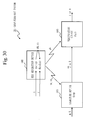
- Fig. 30 is a configuration diagram of the cryptographic system 10 that implements the signature scheme according to Embodiment 5.
- the cryptographic system 10 includes a key generation device 100, a signature device 500, and a verification device 600.
- the key generation device 100 executes the Setup algorithm taking as input a security parameter ⁇ , and thus generates a public parameter pk and a master key sk. Then, the key generation device 100 publishes the generated public parameter pk. The key generation device 100 also executes the KeyGen algorithm taking as input an attribute set ⁇ , and thus generates a signature key sk ⁇ , and distributes the signature key sk ⁇ to the signature device 500 in secrecy.
- the signature device 500 executes the Sig algorithm taking as input a message m, an access structure S, the public parameter pk, and the signature key sk ⁇ , and thus generates signature information s ⁇ * .
- the signature device 500 transmits the generated signature information s ⁇ * , the message m, and the access structure S to the verification device 600.
- the verification device 600 executes the Ver algorithm taking as input the signature information s ⁇ * , the message m, the access structure S, and the public parameter pk, and outputs a value "1" or a value "0".
- Fig. 31 is a configuration diagram of the key generation device 100 according to Embodiment 5.
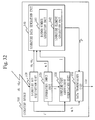
- Fig. 32 is a configuration diagram of the signature device 500 according to Embodiment 5.
- Fig. 33 is a configuration diagram of the verification device 600 according to Embodiment 5.
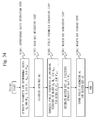
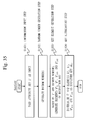
- Figs. 34 and 35 show flowcharts illustrating the operation of the key generation device 100.
- Fig. 34 is a flowchart illustrating the process of the Setup algorithm.
- Fig. 35 is a flowchart illustrating the process of the KeyGen algorithm.
- Fig. 36 is a flowchart illustrating the operation of the signature device 500 and illustrating the process of the Sig algorithm.
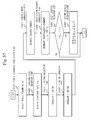
- Fig. 37 is a flowchart illustrating the operation of the verification device 600 and illustrating the process of the Ver algorithm.
- H : (KH ⁇ , H hk ⁇ ,D ) is a collision resistant hash function (see Non-Patent Literature 30).
- a collision resistant hash function is a hash function for which it is difficult to find two inputs that hash to the same output.
- a collision resistant hash function family H associated with the algorithm G bpg and a polynomial poly( ⁇ ) specify two items:
- the function and operation of the key generation device 100 will be described.
- the key generation device 100 includes a master key generation unit 110, a master key storage unit 120, an information input unit 130, a decryption key generation unit 140, and a key distribution unit 150.
- the decryption key generation unit 140 includes a random number generation unit 143 and a key element generation unit 144.
- the master key generation unit 110 uses the processing device to compute Formula 196, and thus generates a hash key hk randomly. hk ⁇ R KH ⁇
- the master key generation unit 110 uses the processing device to generate a subbasis B ⁇ 0 of the basis B 0 , a subbasis B ⁇ of the basis B, a subbasis B ⁇ d+1 of the basis B d+1 , a subbasis B ⁇ * 0 of the basis B * 0 , a subbasis B ⁇ * of the basis B * , and a subbasis B ⁇ * d+1 of the basis B * d+1 , as indicated in Formula 197, the bases B 0 , B, B d+1 , B * 0 , B ⁇ * , and B * d+1 having been generated in (S1301).
- the master key generation unit 110 generates a public parameter pk by putting together the generated subbasis B ⁇ 0 , subbasis B ⁇ , subbasis B ⁇ d+1 , subbasis B ⁇ * 0 , subbasis B ⁇ * , and subbasis B ⁇ * d+1, the security parameter ⁇ (1 ⁇ ) inputted in (S1301), param generated in (S1301), and the hash key hk generated in (S1302).
- the master key generation unit 110 generates a master key sk which is constituted by a basis vector b * 0,1 of the basis B ⁇ * 0 .
- the master key storage unit 120 stores the public parameter pk generated in (S1303) in the storage device.
- the master key storage unit 120 also stores the master key sk generated in (S1304) in the storage device.
- the key generation device 100 executes the Setup algorithm indicated in Formula 198, and thus generates the public parameter pk and the master key sk.
- the key generation device 100 stores the generated public parameter pk and master key sk in the storage device.
- the public parameter is published via the network, for example, and is made available for the signature device 500 and the verification device 600.
- attribute information of the user of a signature key sk ⁇ is set in the attribute set ⁇ , for example.
- the random number generation unit 143 uses the processing device to generate random numbers, as indicated in Formula 199.
- the key element generation unit 144 uses the processing device to generate an element k * 0 of the signature key sk ⁇ , as indicated in Formula 200.
- k 0 * : ⁇ 0 u 0 ⁇ u 0 ⁇ ⁇ 0 ⁇ w 0 0 z 0 ⁇ z 0 B 0 *
- the key element generation unit 144 uses the processing device to generate an element k * t of the signature key sk ⁇ for each integer t included in the attribute set ⁇ , as indicated in Formula 201.
- k t * : ( ⁇ 1 t , ⁇ x ⁇ t ⁇ , 2 + n 0 u ⁇ u , ⁇ ⁇ t ⁇ w 0 z ⁇ z ) B * for t x t ⁇ ⁇ ⁇ ⁇
- the key element generation unit 144 uses the processing device to generate elements k * d+1 and k * d+2 of the signature key sk ⁇ , as indicated in Formula 202.
- k d + 1 , 1 * : ⁇ 1 0 , ⁇ 2 0 u d + 1 ⁇ u d + 1 , ⁇ ⁇ d + 1 , 1 , ⁇ w d + 1 0 z d + 1 ⁇ z d + 1 B d + 1 *
- k d + 1 , 2 * : ⁇ 0 1 , ⁇ 2 0 u d + 1 ⁇ u d + 1 , ⁇ ⁇ d + 1 , 2 , ⁇ w d + 1 0 z d + 1 ⁇ z d + 1 B d + 1 *
- the key distribution unit 150 distributes the signature key sk ⁇ having, as elements, the attribute set ⁇ inputted in (S1401) and k * 0 , k * t , k * d+1 , and k * d+2 generated in (S1403) to the signature device 500 in secrecy.
- the signature key sk ⁇ may be distributed to the signature device 500 by another method.
- the key generation device 100 executes the KeyGen algorithm indicated in Formula 203, and thus generates the signature key sk ⁇ .
- the key generation device 100 distributes the generated signature key sk ⁇ to the signature device 500.
- the signature device 500 includes a signature key acquisition unit 510, an information input unit 520, a complementary coefficient computation unit 530, a signature data generation unit 540, and a data transmission unit 550.
- the signature data generation unit 540 includes a random number generation unit 541 and a signature element generation unit 542.
- the signature key acquisition unit 510 obtains the signature key sk ⁇ generated by the key generation device 100.
- the signature key acquisition unit 510 also obtains the public parameter pk generated by the key generation device 100.
- the information input unit 520 uses the input device to take as input a message m to which a signature is to be appended.
- the complementary coefficient computation unit 530 checks whether or not the access structure S inputted in (S1502) accepts the attribute set ⁇ included in the signature key sk ⁇ obtained in (S1501).
- the complementary coefficient computation unit 530 advances the process to (S1504). If the access structure S rejects the attribute set ⁇ (reject in S1503), the complementary coefficient computation unit 530 ends the process.
- the complementary coefficient computation unit 530 computes I and a constant (complementary coefficient) ⁇ i for each integer i included in I such that Formula 204 is satisfied.
- ⁇ i ⁇ I ⁇ i M i : 1 ⁇ and I ⁇ i ⁇ 1 , ... , L
- p i ⁇ t v i ⁇ ⁇ t x t ⁇ ⁇ ⁇ ⁇ v i ⁇ x t ⁇ 0
- the random number generation unit 541 uses the processing device to generate random numbers, as indicated in Formula 205. ⁇ ⁇ U F q ⁇ , ⁇ i ⁇ U ⁇ 1 , ... , ⁇ L
- the signature element generation unit 542 uses the processing device to generate a signature element s * 0 which is an element of signature data sig, as indicated in Formula 206.
- s 0 * : ⁇ k 0 * + r 0 *
- r * 0 is defined by Formula 207 (see Formula 110 through Formula 112 and explanations thereof). r 0 * ⁇ U span ⁇ b 0 , 1 + u 0 + 1 * , ... , b 0 , 1 + u 0 + w 0 * ⁇
- r * i is defined by Formula 209. r i * ⁇ U span ⁇ b t , 2 + n + u + 1 * , ... , b t , 2 + n + u + w * ⁇
- y ⁇ i ⁇ v i ⁇ i
- the signature element generation unit 542 uses the processing device to generate a signature element s * L+1 which is an element of the signature data sig, as indicated in Formula 211.
- s L + 1 * : ⁇ k d + 1 , 1 * + H hk ⁇ , D m ⁇ S ⁇ k d + 1 , 2 * + r L + 1 *
- r * L+1 is defined by Formula 212. r L + 1 * ⁇ U span ⁇ b d + 1 , 2 + u d + 1 + 1 * , ... , b d + 1 , 2 + u d + 1 + w d + 1 * ⁇
- the signature data sig may be transmitted to the verification device 600 by another method.
- the signature device 500 executes the Sig algorithm indicated in Formula 213, and thus generates the signature data sig.
- the signature device 500 transmits the generated signature data sig to the verification device 600.
- the verification device 600 includes a public parameter acquisition unit 610, a data receiving unit 620, a verification data generation unit 630, and a pairing operation unit 640.
- the verification data generation unit 630 includes an f vector generation unit 631, an s vector generation unit 632, a random number generation unit 633, and a verification element generation unit 634.
- the public parameter acquisition unit 610 obtains the public parameter pk generated by the key generation device 100.
- the data receiving unit 620 receives the signature data sig transmitted by the signature device 500.
- the f vector generation unit 631 randomly generates a vector f ⁇ having r pieces of elements, as indicated in Formula 214. f ⁇ ⁇ U F q r
- the s vector generation unit 632 uses the processing device and based on the (L rows ⁇ r columns) matrix M of the access structure S included in the signature data sig received in (S1602) and the vector f ⁇ having r pieces of elements generated in (S1603), the s vector generation unit 632 generates a vector s ⁇ T , as indicated in Formula 215.
- s ⁇ T : s 1 , ... , s L T : M ⁇ f ⁇ T
- the random number generation unit 633 uses the processing device to generate random numbers, as indicated in Formula 217.
- the verification element generation unit 634 uses the processing device to generate a verification element c 0 which is an element of a verification key, as indicated in Formula 218.
- c 0 : ⁇ s 0 ⁇ s L + 1 , 0 u 0 ⁇ u 0 , 0 w 0 ⁇ w 0 , ⁇ 0 ⁇ z 0 B 0
- the verification element generation unit 634 uses the processing device to generate a verification element c L+1 which is an element of the verification key, as indicated in Formula 220.
- c L + 1 : s L + 1 ⁇ ⁇ L + 1 H hk ⁇ , D m ⁇ S , ⁇ L + 1 , ⁇ 2 0 u d + 1 ⁇ , u d + 1 0 w d + 1 , ⁇ w d + 1 ⁇ ⁇ L + 1 ⁇ z d + 1 B d + 1
- the pairing operation unit 640 computes a pairing operation e (b 0,1 , s * 0 ).
- the pairing operation unit 640 If the result of computing the pairing operation e (b 0,1 , s * 0 ) is a value 1, the pairing operation unit 640 outputs a value 0 indicating failure of verification of the signature and ends the process. If the result of computing the pairing operation e (b 0,1 , s * 0 ) is other than a value 1, the pairing operation unit 640 advances the process to S1608.
- the pairing operation unit 640 If the result of computing the pairing operation indicated in Formula 221 is a value 1, the pairing operation unit 640 outputs a value 1 indicating success of verification of the signature. If the result is any other value, the pairing operation unit 640 outputs a value 0 indicating failure of verification of the signature.
- the verification device 600 executes the Ver algorithm indicated in Formula 222, and thus verifies the signature data sig.
- the index parts are provided, so that the bases that are used for every attribute category can be constructed as the common bases (basis B and basis B * ).
- the basis B and the basis B * need to be included in a public parameter, eliminating the need for reissuing the public parameter when an attribute category is to be added at a later stage.
- the index parts As in Embodiments 2 to 4, for the index parts, it is required that 0 be obtained as a result of an inner-product operation of the index parts. Therefore, although the 2-dimensional index parts, namely the basis vectors b * 1 and b * 2 and the basis vectors b 1 and b 2 , are employed in the above description, the index parts are not limited to 2-dimensional and may be 3-dimensional or higher-dimensional. The values assigned to the index parts are not limited to those described above, and a different assignment arrangement may be employed.
- the signature scheme based on the functional encryption scheme has been described above. However, as explained in Embodiment 3 that the functional encryption scheme can be modified into an attribute-based encryption scheme, so the signature scheme based on the functional encryption scheme can be modified into a signature scheme based on the attribute-based encryption scheme.
- This embodiment describes a multi-authority functional encryption scheme and a multi-authority signature scheme.
- Multi-authority signifies the presence of a plurality of authorities who generate the user's decryption key (or signature key).
- the security of the whole system depends on one certain party (authority).
- the security of the whole system depends on the key generation device 100. If the master secret key sk which is the secret key of the key generation device 100 is compromised, the security of the whole system will be broken.
- Fig. 38 is an explanatory drawing of the multi-authority.
- a narrowly-defined cryptographic process is used as an example.
- a government office manages attributes such as address, telephone number, and age.
- the police manage attributes such as type of driver's license.
- Company A manages attributes such as position in Company A and belonging department in Company A.
- a decryption key 1 associated with the attributes managed by the government office is issued by the government office.
- a decryption key 2 associated with the attributes managed by the police is issued by the police.
- a decryption key 3 associated with the attributes managed by Company A is issued by Company A.
- a decryptor who decrypts a ciphertext decrypts the ciphertext using a decryption key formed by putting together the decryption keys 1, 2, and 3 issued by the respective authorities such as the government office, the police, and Company A. That is, when seen from the decryptor, a decryption key formed by putting together the decryption keys issued by the respective authorities is the single decryption key issued to him or her.
- the cryptographic processing system does not function regarding the attributes of Company A, it functions regarding the attributes managed by the other authorities. That is, concerning the attributes managed by Company A there is a risk of decryption by a user having attributes other than the specified attributes. However, concerning attributes other than those managed by Company A, decryption is possible only by a user having the specified attributes.
- each authority manages a certain category (subspace) or definition range in the attributes and issues (a part of) a decryption key regarding the attribute of the user in this category.
- this scheme is called a decentralized multi-authority scheme.
- a central authority exists, the scheme is not decentralized.
- a central authority is an authority superior to the other authorities. If the security of the central authority is broken, the security of every authority will be broken.
- Non-Patent Literature 31 describes a decentralized multi-authority functional encryption scheme
- Non-Patent Literature 30 describes a non-decentralized multi-authority signature scheme.
- the schemes described in Non-Patent Literature 30 and Non-Patent Literature 31 can be constructed such that there is no need to reissue a public parameter when an attribute category is to be added.
- Fig. 39 is an explanatory drawing of a functional encryption scheme that allows for addition of an attribute category in a case of multi-authority.
- a government office manages attributes such as address, telephone number, and age.
- the police manage attributes such as type of driver's license.
- Company A manages attributes such as position in Company A and belonging department in Company A.
- a decryption key 1 associated with the attributes managed by the government office is issued by the government office.
- a decryption key 2 associated with the attributes managed by the police is issued by the police.
- a decryption key 3 associated with the attributes managed by Company A is issued by Company A.
- the government office generates a basis B ⁇ 1 and a basis B ⁇ * 1 as a public parameter pk and a master secret key sk, respectively.
- the government office uses the basis B ⁇ * 1 to generate the decryption key 1 concerning the attributes such as address, telephone number, and age.
- the police generate a basis B ⁇ 2 and a basis B ⁇ * 2 as a public parameter pk and a master secret key sk, respectively.
- the police generate the decryption key 2 concerning the attributes such as type of driver's license.
- Company A generates a basis B ⁇ 3 and a basis B ⁇ * 3 as a public parameter pk and a master secret key sk, respectively.
- Company A uses the basis B ⁇ * 3 to generate the decryption key 3 concerning the attributes such as position in Company A and belonging department in Company A.
- a sender generates a ciphertext by setting the attributes such as address, telephone number, and age using the basis B ⁇ 1 , setting the attributes such as type of driver's license using basis B ⁇ 2 , and setting the attributes such as position in Company A and belonging department in Company A using basis B ⁇ 3 .
- a decryptor decrypts the ciphertext using the decryption keys 1 to 3.
- the attribute category can be added without reissuing the public parameter pk of the government office.
- the processes of the cryptographic primitives are implemented in the cyclic group of the prime order q.
- a ring R is expressed using a composite M as indicated in Formula 223
- the processes of the cryptographic primitives described in the above embodiments can also be applied to an additive group having the ring R as a coefficient.
- R : / M Z Z
- a hardware configuration of the cryptographic system 10 (the key generation device 100, the encryption device 200, the decryption device 300, the key delegation device 400, the signature device 500, and the verification device 600) according to the embodiments will be described.
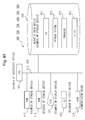
- Fig. 40 is a diagram showing an example of a hardware configuration of the key generation device 100, the encryption device 200, the decryption device 300, the key delegation device 400, the signature device 500, and the verification device 600.
- each of the key generation device 100, the encryption device 200, the decryption device 300, the key delegation device 400, the signature device 500, and the verification device 600 includes the CPU 911 (also referred to as a Central Processing Unit, central processing device, processing device, arithmetic device, microprocessor, microcomputer, or processor) that executes programs.
- the CPU 911 is connected via a bus 912 to the ROM 913, the RAM 914, an LCD 901 (Liquid Crystal Display), the keyboard 902 (K/B), the communication board 915, and the magnetic disk device 920, and controls these hardware devices.
- a storage device such as an optical disk device or memory card read/write device may be employed.
- the magnetic disk device 920 is connected via a predetermined fixed disk interface.
- the ROM 913 and the magnetic disk device 920 are examples of a nonvolatile memory.
- the RAM 914 is an example of a volatile memory.
- the ROM 913, the RAM 914, and the magnetic disk device 920 are examples of a storage device (memory).
- the keyboard 902 and the communication board 915 are examples of an input device.
- the keyboard 902 is an example of a communication device.
- the LCD 901 is an example of a display device.
- the magnetic disk device 920, the ROM 913, or the like stores an operating system 921 (OS), a window system 922, programs 923, and files 924.
- the programs 923 are executed by the CPU 911, the operating system 921, and the window system 922.
- the programs 923 store software and programs that execute the functions described in the above description as the "master key generation unit 110", the “master key storage unit 120", the “information input unit 130", the “decryption key generation unit 140", the “key distribution unit 150”, the "public parameter acquisition unit 210", the “information input unit 220", the “cipher data generation unit 230", the “data transmission unit 240", the “decryption key acquisition unit 310", the “data receiving unit 320”, the “span program computation unit 330", the “complementary coefficient computation unit 340”, the “pairing operation unit 350”, the “message computation unit 360”, the "decryption key acquisition unit 410", the “information input unit 420”, the “delegation key generation unit 430”, the “key distribution unit 440", the "signature key acquisition unit 510", the "information input unit 520”, the “complementary coefficient computation unit 530", the “signature data generation unit 540", the “data transmission unit 550”, the "public parameter acquisition unit 610", the “data receiving unit 620
- the files 924 store information, data, signal values, variable values, and parameters such as the "public parameter pk”, the "master secret key sk”, the “decryption keys sk S and sk ⁇ ", the "ciphertexts ct ⁇ and ct S ", the "access structure S”, the “attribute information”, and the “message m”, as the items of a "file” and “database”.
- the "file” and “database” are stored in a recording medium such as a disk or memory.
- the information, data, signal values, variable values, and parameters stored in the recording medium such as the disk or memory are read out to the main memory or cache memory by the CPU 911 through a read/write circuit, and used for operations of the CPU 911 such as extraction, search, look-up, comparison, calculation, computation, processing, output, printing, and display.
- the information, data, signal values, variable values, and parameters are temporarily stored in the main memory, cache memory, or buffer memory during the operations of the CPU 911 including extraction, search, look-up, comparison, calculation, computation, processing, output, printing, and display.
- the arrows in the flowcharts in the above description mainly indicate input/output of data and signals.
- the data and signal values are stored in the memory of the RAM 914, the recording medium such as an optical disk, or in an IC chip.
- the data and signals are transmitted online via a transmission medium such as the bus 912, signal lines, or cables, or via electric waves.
- What is described as “unit” in the above description may be “circuit”, “device”, “equipment”, “means”, or “function”, and may also be “step”, “procedure”, or “process”. What is described as “device” may be “circuit”, “equipment”, “means”, or “function”, and may also be “step”, “procedure”, or “process”. What is described as “process” may be “step”. In other words, what is described as “unit” may be realized by firmware stored in the ROM 913. Alternatively, what is described as “unit” may be implemented solely by software, or solely by hardware such as an element, a device, a substrate, or a wiring line, or by a combination of software and firmware, or by a combination including firmware.
- the firmware and software are stored as programs in the recording medium such as the ROM 913.
- the programs are read by the CPU 911 and are executed by the CPU 911. That is, each program causes the computer or the like to function as each "unit” described above. Alternatively, each program causes the computer or the like to execute a procedure or a method of each "unit” described above.
Landscapes
- Engineering & Computer Science (AREA)
- Theoretical Computer Science (AREA)
- Signal Processing (AREA)
- Computer Networks & Wireless Communication (AREA)
- Computer Security & Cryptography (AREA)
- Mathematical Physics (AREA)
- Physics & Mathematics (AREA)
- Pure & Applied Mathematics (AREA)
- Mathematical Optimization (AREA)
- Computing Systems (AREA)
- Mathematical Analysis (AREA)
- General Physics & Mathematics (AREA)
- Algebra (AREA)
- Storage Device Security (AREA)
- Information Retrieval, Db Structures And Fs Structures Therefor (AREA)
Claims (11)
- Système cryptographique (10) configuré de manière à mettre en oeuvre un processus utilisant une base prédéterminée B et une base prédéterminée B*, le système cryptographique comprenant :un dispositif de transmission (200, 500) configuré de manière à générer un vecteur de côté transmission tj pour au moins un indice j parmi une pluralité d'indices j, le vecteur de côté transmission tj étant un vecteur dans lequel des informations J affectées à l'avance à l'indice j sont définies en tant qu'un coefficient d'un vecteur de base prédéterminé bindex de la base B et un paramètre Φj pour l'indice j est défini en tant qu'un coefficient d'un autre vecteur de base batt de la base B ; etun dispositif de réception (300, 600) configuré de manière à utiliser un vecteur de côté réception rj' pour au moins un indice j' parmi une pluralité d'indices j', le vecteur de côté réception rj' étant un vecteur dans lequel des informations J' présentant un produit intérieur de 0 avec les informations J affectées à l'avance à l'indice j correspondant à l'indice j' sont définies en tant qu'un coefficient d'un vecteur de base b* index de la base B* correspondant au vecteur de base bindex, et un paramètre Ψj' pour l'indice j'est défini en tant qu'un coefficient d'un vecteur de base b* att de la base B* correspondant au vecteur de base batt, et calculer un produit d'opérations de jumelage sur des paires correspondantes des vecteurs de base du vecteur de côté transmission tj pour l'indice j et du vecteur de côté réception r j' pour l'indice j' correspondant à l'indice j.
- Système cryptographique selon la revendication 1,
dans lequel le dispositif de transmission est un dispositif de chiffrement (200) qui génère un cryptogramme ct, et est configuré de manière à utiliser un nombre entier t où t = 1, ..., d (d correspondant à un nombre entier de 1 ou plus) en tant que l'indice j, à utiliser des informations d'attribut xt pour le nombre entier t en tant que le paramètre Φj pour l'indice j, et à générer le cryptogramme ct, en incluant, en tant que le vecteur de côté transmission tj, un vecteur de chiffrement ct dans lequel des informations J affectées au nombre entier t sont définies en tant que le coefficient du vecteur de base bindex et les informations d'attribut xj pour le nombre entier t sont définies en tant que le coefficient du vecteur de base batt, pour au moins un nombre entier t ; et
dans lequel le dispositif de réception est un dispositif de déchiffrement (300) qui déchiffre le cryptogramme ct, et est configuré de manière à utiliser un nombre entier i où i = 1, ..., L (L correspondant à un nombre entier de 1 ou plus) en tant que l'indice j', à utiliser des informations de prédicat vi pour le nombre entier i en tant que le paramètre Ψj' pour l'indice j', à utiliser, en tant que le vecteur de côté réception rj', un vecteur clé k* i dans lequel des informations J' présentant un produit intérieur de 0 avec les informations J affectées au nombre entier t correspondant au nombre entier i sont définies en tant que le coefficient du vecteur de base b* index, et des informations de prédicat vi pour le nombre entier i sont définies en tant que le coefficient du vecteur de base b* att, pour chaque nombre entier i, et à calculer un produit d'opérations de jumelage sur des paires correspondantes des vecteurs de base du vecteur clé k* i pour ledit chaque nombre entier i et le vecteur de chiffrement ct pour le nombre entier t correspondant audit chaque nombre entier i. - Système cryptographique selon la revendication 2,
dans lequel le système cryptographique est configuré de manière à mettre en oeuvre le processus en utilisant une base prédéterminée B0 et une base prédéterminée B* 0, ainsi qu'une base prédéterminée B et une base prédéterminée B* ;
dans lequel le dispositif de transmission est configuré de manière à générer le cryptogramme ct en incluant un vecteur de chiffrement c0 et un vecteur de chiffrement c1 pour au moins un nombre entier t, où t = 1, ..., d, tel qu'indiqué dans la formule 1 ; et
dans lequel le dispositif de réception est configuré de manière à calculer la formule 3 pour un vecteur clé k* i pour chaque nombre entier i où i = 0, ..., L, tel qu'indiqué dans la formule 2, et le vecteur de chiffrement ct

 n est un nombre entier de 1 ou plus, etu 0, w 0, z 0, u, w, z correspondent chacun à un nombre entier de 0 ou plus,


f est un vecteur présentant r fragments d'éléments ;M est une matrice à L lignes et r colonnes ;ρ(i) est une variable à laquelle (t,v i ) ou est affecté à l'avance,n est un nombre entier de 1 ou plus ; etu 0, w 0, z 0, u, w, z correspondent chacun à un nombre entier de 0 ou plus,


- Système cryptographique selon la revendication 1,
dans lequel le dispositif de transmission est un dispositif de chiffrement (200) qui génère un cryptogramme ct, et est configuré de manière à utiliser un nombre entier i, où i = 1, ..., L (L correspondant à un nombre entier de 1 ou plus) en tant que l'indice j, à utiliser des informations de prédicat vi pour le nombre entier i en tant que le paramètre Φj pour l'indice j, et à générer le cryptogramme ct en incluant, en tant que le vecteur de côté transmission tj, un vecteur de chiffrement ci, dans lequel des informations J affectées au nombre entier i sont définies en tant que le coefficient du vecteur de base bindex et les informations de prédicat vi pour le nombre entier i sont définies en tant que le coefficient du vecteur de base batt, pour chaque nombre entier i ; et
dans lequel le dispositif de réception est un dispositif de déchiffrement (300) qui déchiffre le cryptogramme ct, et est configuré de manière à utiliser un nombre entier t, où t = 1, ..., d (d correspondant à un nombre entier de 1 ou plus) en tant que l'indice j', à utiliser des informations d'attribut xt pour le nombre entier t en tant que le paramètre Ψj' pour l'indice j', à utiliser, en tant que le vecteur de côté réception rj', un vecteur clé k* t dans lequel des informations J'présentant un produit intérieur de 0 avec les informations J affectées au nombre entier i correspondant au nombre entier t sont définies en tant que le coefficient du vecteur de base b* index, et des informations d'attribut xt pour le nombre entier t sont définies en tant que le coefficient du vecteur de base b* att, pour au moins un nombre entier t, et à calculer un produit d'opérations de jumelage sur des paires correspondantes des vecteurs de base du vecteur de chiffrement ci pour ledit chaque nombre entier i et le vecteur clé k* t pour le nombre entier t correspondant audit chaque nombre entier i. - Système cryptographique selon la revendication 4,
dans lequel le système cryptographique est configuré de manière à mettre en oeuvre le processus en utilisant une base prédéterminée B0 et une base prédéterminée B* 0, ainsi qu'une base prédéterminée B et une base prédéterminée B* ;
dans lequel le dispositif de transmission est configuré de manière à générer le cryptogramme ct en incluant un vecteur de chiffrement ci pour chaque nombre entier i, où i = 0, ..., L, tel qu'indiqué dans la formule 4 ; et
dans lequel le dispositif de réception est configuré de manière à calculer la formule 6 pour un vecteur clé k* 0 et un vecteur clé k* t pour au moins un nombre entier t, où t = 1, ..., d, tel qu'indiqué dans la formule 5, et le vecteur de chiffrement ci




f est un vecteur présentant r fragments d'éléments ;M est une matrice à L lignes et r colonnes ;ρ(i) est une variable à laquelle (t,ν i ) ou ¬(t,ν i ) est affecté à l'avance,n est un nombre entier de 1 ou plus ; etu 0, w 0, z 0, u, w, z correspondent chacun à un nombre entier de 0 ou plus.

 n correspond à un nombre entier de 1 ou plus ;u 0, w 0, z 0, u, w, z correspondent chacun à un nombre entier de 0 ou plus.


- Système cryptographique selon la revendication 1,
dans lequel le dispositif de transmission est un dispositif de chiffrement (200) qui génère un cryptogramme ct, et est configuré de manière à utiliser un nombre entier i, où i = 1, ..., L (L correspondant à un nombre entier de 1 ou plus) en tant que l'indice j, à utiliser des informations d'attribut xi pour le nombre entier i en tant que le paramètre Φj pour l'indice j, et à générer le cryptogramme ct, en incluant, en tant que le vecteur de côté transmission tj, un vecteur de chiffrement ci dans lequel des informations J affectées au nombre entier i sont définies en tant que le coefficient du vecteur de base bindex, et des informations d'attribut xi pour le nombre entier i sont définies en tant que le coefficient du vecteur de base batt, pour ledit chaque nombre entier i ; et
dans lequel le dispositif de réception est un dispositif de déchiffrement (300) qui déchiffre le cryptogramme ct, et est configuré de manière à utiliser un nombre entier i en tant que l'indice j', à utiliser des informations de prédicat vi pour le nombre entier i en tant que le paramètre Ψj' pour l'indice j', à utiliser, en tant que le vecteur de côté réception rj', un vecteur clé k* i dans lequel des informations J'présentant un produit intérieur de 0 avec les informations J affectées au nombre entier i sont définies en tant que le coefficient du vecteur de base b* index, et des informations de prédicat vi pour le nombre entier i sont définies en tant que le coefficient du vecteur de base b* att, pour chaque nombre entier i, et à calculer un produit d'opérations de jumelage sur des paires correspondantes des vecteurs de base du vecteur clé k* i et le vecteur de chiffrement ci pour ledit chaque nombre entier i. - Système cryptographique selon la revendication 6,
dans lequel le système cryptographique est configuré de manière à mettre en oeuvre le processus en utilisant une base prédéterminée B0 et une base prédéterminée B* 0, ainsi qu'une base prédéterminée B et une base prédéterminée B* ;
dans lequel le dispositif de transmission est configuré de manière à générer le cryptogramme ct en incluant un vecteur de chiffrement c1 lequel correspond à une somme de vecteurs de chiffrement ci pour chaque nombre entier i, où i = 0, ..., L, tel qu'indiqué dans la formule 7 ; et
dans lequel le dispositif de réception est configuré de manière à calculer un produit d'opérations de jumelage sur les paires correspondantes des vecteurs de base du vecteur de chiffrement c1 et un vecteur clé k* L,dec lequel correspond à une somme de vecteurs clés k* i pour ledit chaque nombre entier i, tel qu'indiqué dans la formule 8

 u 0, w 0, z 0, u, w, z correspondent chacun à un nombre entier de 0 ou plus.
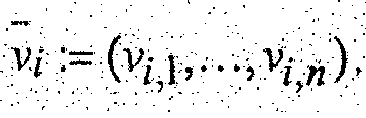


 n correspond à un nombre entier de 1 ou plus ; etu 0, w 0, z 0, u, w, z correspondent chacun à un nombre entier de 0 ou plus.
 - Système cryptographique selon la revendication 1,
dans lequel le dispositif de transmission est un dispositif de signature (500) qui génère des données de signature sig, et est configuré de manière à utiliser un nombre entier t, où t = 1, ..., d (d correspondant à un nombre entier de 1 ou plus) en tant que l'indice j, à utiliser des informations d'attribut xt, pour le nombre entier t en tant que le paramètre Φj pour l'indice j, à utiliser un vecteur clé k* t dans lequel des informations J affectées au nombre entier t sont définies en tant que le coefficient du vecteur de base bindex, et des informations d'attribut xt pour le nombre entier t sont définies en tant que le coefficient du vecteur de base batt, pour au moins un nombre entier t, et à générer les données de signature sig en incluant, en tant que le vecteur de côté transmission tj, un élément de signature Si, pour chaque nombre entier i, où i = 1, ..., L (L correspondant à un nombre entier de 1 ou plus), et en incluant le vecteur clé k* t pour le nombre entier t correspondant audit chaque nombre entier i ; et
dans lequel le dispositif de réception est un dispositif de vérification (600) qui vérifie les données de signature sig, et est configuré de manière à utiliser le nombre entier i en tant que l'indice j', à utiliser des informations de prédicat vi pour le nombre entier i en tant que le paramètre Ψj' pour l'indice j', à utiliser, en tant que le vecteur de côté réception rj', un élément de vérification ci dans lequel, pour chaque nombre entier i, des informations J' présentant un produit intérieur de 0 avec les informations J affectées à chaque nombre entier t correspondant audit chaque nombre entier i sont définies en tant que le coefficient du vecteur de base b* index, et des informations de prédicat vi pour ledit chaque nombre entier i sont définies en tant que le coefficient du vecteur de base b* att, et à calculer un produit d'opérations de jumelage sur des paires correspondantes des vecteurs de base de l'élément de signature si et l'élément de vérification ci pour ledit chaque nombre entier i. - Système cryptographique selon la revendication 8,
dans lequel le système cryptographique est configuré de manière à mettre en oeuvre le processus en utilisant une base prédéterminée B0 et une base prédéterminée B* 0, une base prédéterminée B et une base prédéterminée B*, ainsi qu'une base prédéterminée Bd+1, et une base prédéterminée B* d+1 ;
dans lequel le dispositif de transmission est configuré de manière à générer les données de signature sig en incluant un élément de signature si, tel qu'indiqué dans la formule 10, en utilisant un vecteur clé k* 0, un vecteur clé k* t pour au moins un nombre entier t, où t = 1, ..., d, un vecteur clé d+1,1 et un vecteur clé d+1,2, tel qu'indiqué dans la formule 9 ; et
dans lequel le dispositif de réception calcule la formule 12 pour un élément de vérification ci pour ledit chaque nombre entier i, tel qu'indiqué dans la formule 11, et l'élément de signature si


 n correspond à un nombre entier de 1 ou plus ; etu 0, w 0, z 0, u, w, z correspondent chacun à un nombre entier de 0 ou plus.


 si
si si
si si
si
 M est une matrice à L lignes et r colonnes ;ρ(i) est une variable à laquelle (t,
v i ) ou ¬(t,v i ) est affecté à l'avance ; etH est une valeur de hachage.


v est un vecteur présentant r fragments d'éléments, M est une matrice à L lignes et r colonnes,ρ(i) est une variable à laquelle (t,v i ) ou ¬(t,v i ) est affecté à l'avance,n correspond à un nombre entier de 1 ou plus et u 0, w 0, z 0, u, w, z correspondent chacun à un nombre entier de 0 ou plus.
- Procédé cryptographique destiné à mettre en oeuvre un processus utilisant une base prédéterminée B et une base prédéterminée B*, le procédé cryptographique comprenant les étapes ci-dessous consistant à :générer un vecteur de côté transmission tj pour au moins un indice j parmi une pluralité d'indices j, le vecteur de côté transmission tj étant un vecteur dans lequel des informations J affectées à l'avance à l'indice j sont définies en tant qu'un coefficient d'un vecteur de base prédéterminé bindex de la base B et un paramètre Φj pour l'indice j est défini en tant qu'un coefficient d'un autre vecteur de base batt de la base B, par le dispositif de transmission (200, 500) ; etutiliser un vecteur de côté réception rj' pour au moins un indice j' parmi une pluralité d'indices j', le vecteur de côté réception rj' étant un vecteur dans lequel des informations J' présentant un produit intérieur de 0 avec les informations J affectées à l'avance à l'indice j correspondant à l'indice j' sont définies en tant qu'un coefficient d'un vecteur de base bindex de la base B* correspondant au vecteur de base bindex, et un paramètre Ψj' pour l'indice j' est défini en tant qu'un coefficient d'un vecteur de base b* att de la base B* correspondant au vecteur de base batt, et calculer un produit d'opérations de jumelage sur des paires correspondantes des vecteurs de base du vecteur de côté transmission tj pour l'indice j et du vecteur de côté réception rj' pour l'indice j' correspondant à l'indice j, par un dispositif de réception (300, 600).
- Programme cryptographique destiné à mettre en oeuvre des processus utilisant une base prédéterminée B et une base prédéterminée B*, le programme cryptographique amenant un ordinateur à exécuter :un processus de transmission consistant à générer un vecteur de côté transmission tj pour au moins un indice j parmi une pluralité d'indices j, le vecteur de côté transmission tj étant un vecteur dans lequel des informations J affectées à l'avance à l'indice j sont définies en tant qu'un coefficient d'un vecteur de base prédéterminé bindex de la base B, et un paramètre Φj pour l'indice j est défini en tant qu'un coefficient d'un autre vecteur de base batt de la base B ; etun processus de réception consistant à utiliser un vecteur de côté réception rj' pour au moins un indice j' parmi une pluralité d'indices j', le vecteur de côté réception rj' étant un vecteur dans lequel des informations J' présentant un produit intérieur de 0 avec les informations J affectées à l'avance à l'indice j correspondant à l'indice j' sont définies en tant qu'un coefficient d'un vecteur de base b* index de la base B* correspondant au vecteur de base bindex, et un paramètre Ψj' pour l'indice j' est défini en tant qu'un coefficient d'un vecteur de base b* att de la base B* correspondant au vecteur de base batt, et à calculer un produit d'opérations de jumelage sur des paires correspondantes des vecteurs de base du vecteur de côté transmission tj pour l'indice j et du vecteur de côté réception rj' pour l'indice j' correspondant à l'indice j.
Applications Claiming Priority (2)
| Application Number | Priority Date | Filing Date | Title |
|---|---|---|---|
| JP2012049275A JP5680007B2 (ja) | 2012-03-06 | 2012-03-06 | 暗号システム、暗号方法及び暗号プログラム |
| PCT/JP2013/055661 WO2013133158A1 (fr) | 2012-03-06 | 2013-03-01 | Système de chiffrement, procédé de chiffrement et programme de chiffrement |
Publications (3)
| Publication Number | Publication Date |
|---|---|
| EP2824652A1 EP2824652A1 (fr) | 2015-01-14 |
| EP2824652A4 EP2824652A4 (fr) | 2015-12-02 |
| EP2824652B1 true EP2824652B1 (fr) | 2016-10-19 |
Family
ID=49116638
Family Applications (1)
| Application Number | Title | Priority Date | Filing Date |
|---|---|---|---|
| EP13757621.1A Not-in-force EP2824652B1 (fr) | 2012-03-06 | 2013-03-01 | Système de chiffrement, procédé de chiffrement et programme de chiffrement |
Country Status (7)
| Country | Link |
|---|---|
| US (1) | US9407438B2 (fr) |
| EP (1) | EP2824652B1 (fr) |
| JP (1) | JP5680007B2 (fr) |
| KR (1) | KR101588992B1 (fr) |
| CN (1) | CN104160437B (fr) |
| ES (1) | ES2604817T3 (fr) |
| WO (1) | WO2013133158A1 (fr) |
Families Citing this family (16)
| Publication number | Priority date | Publication date | Assignee | Title |
|---|---|---|---|---|
| WO2016088250A1 (fr) * | 2014-12-05 | 2016-06-09 | 三菱電機株式会社 | Dispositif d'addition de conditions de décodage, système de chiffrement et programme d'addition de conditions de décodage |
| US10965459B2 (en) | 2015-03-13 | 2021-03-30 | Fornetix Llc | Server-client key escrow for applied key management system and process |
| US10931653B2 (en) * | 2016-02-26 | 2021-02-23 | Fornetix Llc | System and method for hierarchy manipulation in an encryption key management system |
| US10333695B2 (en) * | 2016-11-10 | 2019-06-25 | Microsoft Technology Licensing, Llc | Rational number arithmetic in homomorphic encryption |
| US10880275B2 (en) | 2017-01-20 | 2020-12-29 | Enveil, Inc. | Secure analytics using homomorphic and injective format-preserving encryption |
| US11777729B2 (en) | 2017-01-20 | 2023-10-03 | Enveil, Inc. | Secure analytics using term generation and homomorphic encryption |
| WO2018136811A1 (fr) | 2017-01-20 | 2018-07-26 | Enveil, Inc. | Navigation web sécurisée par chiffrement homomorphique |
| US11507683B2 (en) | 2017-01-20 | 2022-11-22 | Enveil, Inc. | Query processing with adaptive risk decisioning |
| WO2018136801A1 (fr) * | 2017-01-20 | 2018-07-26 | Enveil, Inc. | Opérations sécurisées de bout en bout à l'aide d'une matrice d'interrogation |
| US11196541B2 (en) | 2017-01-20 | 2021-12-07 | Enveil, Inc. | Secure machine learning analytics using homomorphic encryption |
| US10205713B2 (en) * | 2017-04-05 | 2019-02-12 | Fujitsu Limited | Private and mutually authenticated key exchange |
| US10902133B2 (en) | 2018-10-25 | 2021-01-26 | Enveil, Inc. | Computational operations in enclave computing environments |
| US10817262B2 (en) | 2018-11-08 | 2020-10-27 | Enveil, Inc. | Reduced and pipelined hardware architecture for Montgomery Modular Multiplication |
| JP7087965B2 (ja) * | 2018-11-29 | 2022-06-21 | 日本電信電話株式会社 | 暗号システム、暗号化装置、復号装置、暗号化方法、復号方法及びプログラム |
| US12099997B1 (en) | 2020-01-31 | 2024-09-24 | Steven Mark Hoffberg | Tokenized fungible liabilities |
| US11601258B2 (en) | 2020-10-08 | 2023-03-07 | Enveil, Inc. | Selector derived encryption systems and methods |
Family Cites Families (8)
| Publication number | Priority date | Publication date | Assignee | Title |
|---|---|---|---|---|
| US7634085B1 (en) | 2005-03-25 | 2009-12-15 | Voltage Security, Inc. | Identity-based-encryption system with partial attribute matching |
| US20090080658A1 (en) | 2007-07-13 | 2009-03-26 | Brent Waters | Method and apparatus for encrypting data for fine-grained access control |
| JP5349261B2 (ja) | 2009-04-23 | 2013-11-20 | 三菱電機株式会社 | 暗号処理システム、鍵生成装置、鍵委譲装置、暗号化装置、復号装置、暗号処理方法及び暗号処理プログラム |
| EP2424155B1 (fr) * | 2009-04-24 | 2014-09-03 | Nippon Telegraph And Telephone Corporation | Dispositif de génération d'informations, procédé de génération d'informations, et programme de génération d'informations et support de stockage apparenté |
| JP5334873B2 (ja) * | 2010-01-08 | 2013-11-06 | 三菱電機株式会社 | 暗号処理システム、鍵生成装置、鍵委譲装置、暗号化装置、復号装置、暗号処理方法及び暗号処理プログラム |
| US8615668B2 (en) * | 2010-01-15 | 2013-12-24 | Mitsubishi Electric Corporation | Confidential search system and cryptographic processing system |
| JP5424974B2 (ja) | 2010-04-27 | 2014-02-26 | 三菱電機株式会社 | 暗号処理システム、鍵生成装置、暗号化装置、復号装置、署名処理システム、署名装置及び検証装置 |
| US8995660B2 (en) | 2010-07-23 | 2015-03-31 | Nippon Telegraph And Telephone Corporation | Cryptographic system, cryptographic communication method, encryption apparatus, key generation apparatus, decryption apparatus, content server, program, and storage medium |
-
2012
- 2012-03-06 JP JP2012049275A patent/JP5680007B2/ja active Active
-
2013
- 2013-03-01 EP EP13757621.1A patent/EP2824652B1/fr not_active Not-in-force
- 2013-03-01 WO PCT/JP2013/055661 patent/WO2013133158A1/fr not_active Ceased
- 2013-03-01 KR KR1020147026078A patent/KR101588992B1/ko not_active Expired - Fee Related
- 2013-03-01 US US14/376,147 patent/US9407438B2/en active Active
- 2013-03-01 CN CN201380012925.1A patent/CN104160437B/zh not_active Expired - Fee Related
- 2013-03-01 ES ES13757621.1T patent/ES2604817T3/es active Active
Also Published As
| Publication number | Publication date |
|---|---|
| CN104160437B (zh) | 2016-06-08 |
| WO2013133158A1 (fr) | 2013-09-12 |
| US20150010147A1 (en) | 2015-01-08 |
| EP2824652A1 (fr) | 2015-01-14 |
| US9407438B2 (en) | 2016-08-02 |
| KR101588992B1 (ko) | 2016-01-26 |
| JP5680007B2 (ja) | 2015-03-04 |
| KR20140138176A (ko) | 2014-12-03 |
| CN104160437A (zh) | 2014-11-19 |
| JP2013186181A (ja) | 2013-09-19 |
| EP2824652A4 (fr) | 2015-12-02 |
| ES2604817T3 (es) | 2017-03-09 |
Similar Documents
| Publication | Publication Date | Title |
|---|---|---|
| EP2824652B1 (fr) | Système de chiffrement, procédé de chiffrement et programme de chiffrement | |
| EP2565862B1 (fr) | Système de traitement pour cryptage, dispositif de génération de clés, dispositif de cryptage, dispositif de décryptage, système de traitement de signatures, dispositif de signature et dispositif d'authentification | |
| EP2690817B1 (fr) | Système de gestion de code, dispositif de génération de clé, encodeur, décodeur, procédé de gestion de code et programme de gestion de code | |
| EP2424154B1 (fr) | Système de traitement par chiffrement | |
| EP2670081B1 (fr) | Système de traitement de signature, dispositif de génération de clé, dispositif de signature, dispositif de vérification, procédé et programme de traitement de signature | |
| EP2503533B1 (fr) | Système de traitement de chiffrement, dispositif de génération de clé, dispositif de délégation de clé, dispositif de cryptage, dispositif de décryptage, procédé et programme de traitement de chiffrement | |
| EP2911137B1 (fr) | Système cryptographique | |
| EP2947810B1 (fr) | Système de cryptage, dispositif de génération de clé de recryptage, dispositif de recryptage, procédé de cryptage et programme de cryptage | |
| EP2613472A1 (fr) | Système de traitement de chiffrement, dispositif de génération de clé, dispositif de chiffrement, dispositif de déchiffrement, procédé de traitement de chiffrement et programme de traitement de chiffrement | |
| EP2523178B1 (fr) | Systéme de traitement cryptographique, dispositif de génération de clé, dispositif de délégation de clé, dispositif de cryptage, dispositif de décryptage, cryptographique procédé de traitement et programme de traitement cryptographique | |
| EP3057262B1 (fr) | Système de chiffrement, dispositif de cryptage, dispositif de génération de clé de recryptage, dispositif de recryptage et programme de chiffrement | |
| EP2675107B1 (fr) | Système de traitement de cryptage, dispositif générateur de clé, dispositif de cryptage, dispositif de décryptage, dispositif de délégation de clé, procédé de traitement de cryptage et programme de traitement de cryptage |
Legal Events
| Date | Code | Title | Description |
|---|---|---|---|
| PUAI | Public reference made under article 153(3) epc to a published international application that has entered the european phase |
Free format text: ORIGINAL CODE: 0009012 |
|
| 17P | Request for examination filed |
Effective date: 20140825 |
|
| AK | Designated contracting states |
Kind code of ref document: A1 Designated state(s): AL AT BE BG CH CY CZ DE DK EE ES FI FR GB GR HR HU IE IS IT LI LT LU LV MC MK MT NL NO PL PT RO RS SE SI SK SM TR |
|
| AX | Request for extension of the european patent |
Extension state: BA ME |
|
| DAX | Request for extension of the european patent (deleted) | ||
| RA4 | Supplementary search report drawn up and despatched (corrected) |
Effective date: 20151102 |
|
| RIC1 | Information provided on ipc code assigned before grant |
Ipc: H04L 9/30 20060101AFI20151027BHEP |
|
| REG | Reference to a national code |
Ref country code: DE Ref legal event code: R079 Ref document number: 602013013018 Country of ref document: DE Free format text: PREVIOUS MAIN CLASS: G09C0001000000 Ipc: H04L0009300000 |
|
| GRAP | Despatch of communication of intention to grant a patent |
Free format text: ORIGINAL CODE: EPIDOSNIGR1 |
|
| RIC1 | Information provided on ipc code assigned before grant |
Ipc: H04L 9/30 20060101AFI20160211BHEP |
|
| INTG | Intention to grant announced |
Effective date: 20160224 |
|
| RIN1 | Information on inventor provided before grant (corrected) |
Inventor name: OKAMOTO, TATSUAKI Inventor name: TAKASHIMA, KATSUYUKI |
|
| GRAP | Despatch of communication of intention to grant a patent |
Free format text: ORIGINAL CODE: EPIDOSNIGR1 |
|
| INTG | Intention to grant announced |
Effective date: 20160506 |
|
| GRAS | Grant fee paid |
Free format text: ORIGINAL CODE: EPIDOSNIGR3 |
|
| GRAA | (expected) grant |
Free format text: ORIGINAL CODE: 0009210 |
|
| AK | Designated contracting states |
Kind code of ref document: B1 Designated state(s): AL AT BE BG CH CY CZ DE DK EE ES FI FR GB GR HR HU IE IS IT LI LT LU LV MC MK MT NL NO PL PT RO RS SE SI SK SM TR |
|
| REG | Reference to a national code |
Ref country code: GB Ref legal event code: FG4D |
|
| REG | Reference to a national code |
Ref country code: CH Ref legal event code: EP |
|
| REG | Reference to a national code |
Ref country code: AT Ref legal event code: REF Ref document number: 839124 Country of ref document: AT Kind code of ref document: T Effective date: 20161115 |
|
| REG | Reference to a national code |
Ref country code: IE Ref legal event code: FG4D |
|
| REG | Reference to a national code |
Ref country code: DE Ref legal event code: R096 Ref document number: 602013013018 Country of ref document: DE |
|
| REG | Reference to a national code |
Ref country code: FR Ref legal event code: PLFP Year of fee payment: 5 |
|
| REG | Reference to a national code |
Ref country code: NL Ref legal event code: MP Effective date: 20161019 |
|
| REG | Reference to a national code |
Ref country code: LT Ref legal event code: MG4D |
|
| PG25 | Lapsed in a contracting state [announced via postgrant information from national office to epo] |
Ref country code: LV Free format text: LAPSE BECAUSE OF FAILURE TO SUBMIT A TRANSLATION OF THE DESCRIPTION OR TO PAY THE FEE WITHIN THE PRESCRIBED TIME-LIMIT Effective date: 20161019 |
|
| REG | Reference to a national code |
Ref country code: ES Ref legal event code: FG2A Ref document number: 2604817 Country of ref document: ES Kind code of ref document: T3 Effective date: 20170309 |
|
| REG | Reference to a national code |
Ref country code: AT Ref legal event code: MK05 Ref document number: 839124 Country of ref document: AT Kind code of ref document: T Effective date: 20161019 |
|
| PG25 | Lapsed in a contracting state [announced via postgrant information from national office to epo] |
Ref country code: GR Free format text: LAPSE BECAUSE OF FAILURE TO SUBMIT A TRANSLATION OF THE DESCRIPTION OR TO PAY THE FEE WITHIN THE PRESCRIBED TIME-LIMIT Effective date: 20170120 Ref country code: LT Free format text: LAPSE BECAUSE OF FAILURE TO SUBMIT A TRANSLATION OF THE DESCRIPTION OR TO PAY THE FEE WITHIN THE PRESCRIBED TIME-LIMIT Effective date: 20161019 Ref country code: SE Free format text: LAPSE BECAUSE OF FAILURE TO SUBMIT A TRANSLATION OF THE DESCRIPTION OR TO PAY THE FEE WITHIN THE PRESCRIBED TIME-LIMIT Effective date: 20161019 Ref country code: NO Free format text: LAPSE BECAUSE OF FAILURE TO SUBMIT A TRANSLATION OF THE DESCRIPTION OR TO PAY THE FEE WITHIN THE PRESCRIBED TIME-LIMIT Effective date: 20170119 |
|
| PG25 | Lapsed in a contracting state [announced via postgrant information from national office to epo] |
Ref country code: PL Free format text: LAPSE BECAUSE OF FAILURE TO SUBMIT A TRANSLATION OF THE DESCRIPTION OR TO PAY THE FEE WITHIN THE PRESCRIBED TIME-LIMIT Effective date: 20161019 Ref country code: AT Free format text: LAPSE BECAUSE OF FAILURE TO SUBMIT A TRANSLATION OF THE DESCRIPTION OR TO PAY THE FEE WITHIN THE PRESCRIBED TIME-LIMIT Effective date: 20161019 Ref country code: BE Free format text: LAPSE BECAUSE OF FAILURE TO SUBMIT A TRANSLATION OF THE DESCRIPTION OR TO PAY THE FEE WITHIN THE PRESCRIBED TIME-LIMIT Effective date: 20161019 Ref country code: PT Free format text: LAPSE BECAUSE OF FAILURE TO SUBMIT A TRANSLATION OF THE DESCRIPTION OR TO PAY THE FEE WITHIN THE PRESCRIBED TIME-LIMIT Effective date: 20170220 Ref country code: NL Free format text: LAPSE BECAUSE OF FAILURE TO SUBMIT A TRANSLATION OF THE DESCRIPTION OR TO PAY THE FEE WITHIN THE PRESCRIBED TIME-LIMIT Effective date: 20161019 Ref country code: RS Free format text: LAPSE BECAUSE OF FAILURE TO SUBMIT A TRANSLATION OF THE DESCRIPTION OR TO PAY THE FEE WITHIN THE PRESCRIBED TIME-LIMIT Effective date: 20161019 Ref country code: FI Free format text: LAPSE BECAUSE OF FAILURE TO SUBMIT A TRANSLATION OF THE DESCRIPTION OR TO PAY THE FEE WITHIN THE PRESCRIBED TIME-LIMIT Effective date: 20161019 Ref country code: IS Free format text: LAPSE BECAUSE OF FAILURE TO SUBMIT A TRANSLATION OF THE DESCRIPTION OR TO PAY THE FEE WITHIN THE PRESCRIBED TIME-LIMIT Effective date: 20170219 Ref country code: HR Free format text: LAPSE BECAUSE OF FAILURE TO SUBMIT A TRANSLATION OF THE DESCRIPTION OR TO PAY THE FEE WITHIN THE PRESCRIBED TIME-LIMIT Effective date: 20161019 |
|
| REG | Reference to a national code |
Ref country code: DE Ref legal event code: R097 Ref document number: 602013013018 Country of ref document: DE |
|
| PG25 | Lapsed in a contracting state [announced via postgrant information from national office to epo] |
Ref country code: RO Free format text: LAPSE BECAUSE OF FAILURE TO SUBMIT A TRANSLATION OF THE DESCRIPTION OR TO PAY THE FEE WITHIN THE PRESCRIBED TIME-LIMIT Effective date: 20161019 Ref country code: DK Free format text: LAPSE BECAUSE OF FAILURE TO SUBMIT A TRANSLATION OF THE DESCRIPTION OR TO PAY THE FEE WITHIN THE PRESCRIBED TIME-LIMIT Effective date: 20161019 Ref country code: SK Free format text: LAPSE BECAUSE OF FAILURE TO SUBMIT A TRANSLATION OF THE DESCRIPTION OR TO PAY THE FEE WITHIN THE PRESCRIBED TIME-LIMIT Effective date: 20161019 Ref country code: EE Free format text: LAPSE BECAUSE OF FAILURE TO SUBMIT A TRANSLATION OF THE DESCRIPTION OR TO PAY THE FEE WITHIN THE PRESCRIBED TIME-LIMIT Effective date: 20161019 Ref country code: CZ Free format text: LAPSE BECAUSE OF FAILURE TO SUBMIT A TRANSLATION OF THE DESCRIPTION OR TO PAY THE FEE WITHIN THE PRESCRIBED TIME-LIMIT Effective date: 20161019 |
|
| PLBE | No opposition filed within time limit |
Free format text: ORIGINAL CODE: 0009261 |
|
| STAA | Information on the status of an ep patent application or granted ep patent |
Free format text: STATUS: NO OPPOSITION FILED WITHIN TIME LIMIT |
|
| PG25 | Lapsed in a contracting state [announced via postgrant information from national office to epo] |
Ref country code: SM Free format text: LAPSE BECAUSE OF FAILURE TO SUBMIT A TRANSLATION OF THE DESCRIPTION OR TO PAY THE FEE WITHIN THE PRESCRIBED TIME-LIMIT Effective date: 20161019 Ref country code: BG Free format text: LAPSE BECAUSE OF FAILURE TO SUBMIT A TRANSLATION OF THE DESCRIPTION OR TO PAY THE FEE WITHIN THE PRESCRIBED TIME-LIMIT Effective date: 20170119 |
|
| 26N | No opposition filed |
Effective date: 20170720 |
|
| REG | Reference to a national code |
Ref country code: CH Ref legal event code: PL |
|
| PG25 | Lapsed in a contracting state [announced via postgrant information from national office to epo] |
Ref country code: MC Free format text: LAPSE BECAUSE OF FAILURE TO SUBMIT A TRANSLATION OF THE DESCRIPTION OR TO PAY THE FEE WITHIN THE PRESCRIBED TIME-LIMIT Effective date: 20161019 Ref country code: SI Free format text: LAPSE BECAUSE OF FAILURE TO SUBMIT A TRANSLATION OF THE DESCRIPTION OR TO PAY THE FEE WITHIN THE PRESCRIBED TIME-LIMIT Effective date: 20161019 |
|
| REG | Reference to a national code |
Ref country code: IE Ref legal event code: MM4A |
|
| PG25 | Lapsed in a contracting state [announced via postgrant information from national office to epo] |
Ref country code: LU Free format text: LAPSE BECAUSE OF NON-PAYMENT OF DUE FEES Effective date: 20170301 |
|
| REG | Reference to a national code |
Ref country code: FR Ref legal event code: PLFP Year of fee payment: 6 |
|
| PG25 | Lapsed in a contracting state [announced via postgrant information from national office to epo] |
Ref country code: CH Free format text: LAPSE BECAUSE OF NON-PAYMENT OF DUE FEES Effective date: 20170331 Ref country code: IE Free format text: LAPSE BECAUSE OF NON-PAYMENT OF DUE FEES Effective date: 20170301 Ref country code: LI Free format text: LAPSE BECAUSE OF NON-PAYMENT OF DUE FEES Effective date: 20170331 |
|
| PG25 | Lapsed in a contracting state [announced via postgrant information from national office to epo] |
Ref country code: MT Free format text: LAPSE BECAUSE OF NON-PAYMENT OF DUE FEES Effective date: 20170301 |
|
| PG25 | Lapsed in a contracting state [announced via postgrant information from national office to epo] |
Ref country code: HU Free format text: LAPSE BECAUSE OF FAILURE TO SUBMIT A TRANSLATION OF THE DESCRIPTION OR TO PAY THE FEE WITHIN THE PRESCRIBED TIME-LIMIT; INVALID AB INITIO Effective date: 20130301 |
|
| PG25 | Lapsed in a contracting state [announced via postgrant information from national office to epo] |
Ref country code: CY Free format text: LAPSE BECAUSE OF FAILURE TO SUBMIT A TRANSLATION OF THE DESCRIPTION OR TO PAY THE FEE WITHIN THE PRESCRIBED TIME-LIMIT Effective date: 20161019 |
|
| PG25 | Lapsed in a contracting state [announced via postgrant information from national office to epo] |
Ref country code: MK Free format text: LAPSE BECAUSE OF FAILURE TO SUBMIT A TRANSLATION OF THE DESCRIPTION OR TO PAY THE FEE WITHIN THE PRESCRIBED TIME-LIMIT Effective date: 20161019 |
|
| PG25 | Lapsed in a contracting state [announced via postgrant information from national office to epo] |
Ref country code: TR Free format text: LAPSE BECAUSE OF FAILURE TO SUBMIT A TRANSLATION OF THE DESCRIPTION OR TO PAY THE FEE WITHIN THE PRESCRIBED TIME-LIMIT Effective date: 20161019 |
|
| PGFP | Annual fee paid to national office [announced via postgrant information from national office to epo] |
Ref country code: IT Payment date: 20200221 Year of fee payment: 8 Ref country code: DE Payment date: 20200218 Year of fee payment: 8 Ref country code: GB Payment date: 20200219 Year of fee payment: 8 |
|
| PGFP | Annual fee paid to national office [announced via postgrant information from national office to epo] |
Ref country code: FR Payment date: 20200214 Year of fee payment: 8 |
|
| PG25 | Lapsed in a contracting state [announced via postgrant information from national office to epo] |
Ref country code: AL Free format text: LAPSE BECAUSE OF FAILURE TO SUBMIT A TRANSLATION OF THE DESCRIPTION OR TO PAY THE FEE WITHIN THE PRESCRIBED TIME-LIMIT Effective date: 20161019 |
|
| PGFP | Annual fee paid to national office [announced via postgrant information from national office to epo] |
Ref country code: ES Payment date: 20200401 Year of fee payment: 8 |
|
| REG | Reference to a national code |
Ref country code: DE Ref legal event code: R119 Ref document number: 602013013018 Country of ref document: DE |
|
| GBPC | Gb: european patent ceased through non-payment of renewal fee |
Effective date: 20210301 |
|
| PG25 | Lapsed in a contracting state [announced via postgrant information from national office to epo] |
Ref country code: DE Free format text: LAPSE BECAUSE OF NON-PAYMENT OF DUE FEES Effective date: 20211001 Ref country code: FR Free format text: LAPSE BECAUSE OF NON-PAYMENT OF DUE FEES Effective date: 20210331 Ref country code: GB Free format text: LAPSE BECAUSE OF NON-PAYMENT OF DUE FEES Effective date: 20210301 |
|
| PG25 | Lapsed in a contracting state [announced via postgrant information from national office to epo] |
Ref country code: IT Free format text: LAPSE BECAUSE OF NON-PAYMENT OF DUE FEES Effective date: 20210301 |
|
| REG | Reference to a national code |
Ref country code: ES Ref legal event code: FD2A Effective date: 20220523 |
|
| PG25 | Lapsed in a contracting state [announced via postgrant information from national office to epo] |
Ref country code: ES Free format text: LAPSE BECAUSE OF NON-PAYMENT OF DUE FEES Effective date: 20210302 |