EP2566427B1 - Verfahren zur herstellung eines elastischen vliesstoffverbundmaterials - Google Patents
Verfahren zur herstellung eines elastischen vliesstoffverbundmaterials Download PDFInfo
- Publication number
- EP2566427B1 EP2566427B1 EP11715173.8A EP11715173A EP2566427B1 EP 2566427 B1 EP2566427 B1 EP 2566427B1 EP 11715173 A EP11715173 A EP 11715173A EP 2566427 B1 EP2566427 B1 EP 2566427B1
- Authority
- EP
- European Patent Office
- Prior art keywords
- nonwoven
- composite material
- elastic
- elastic filaments
- regions
- Prior art date
- Legal status (The legal status is an assumption and is not a legal conclusion. Google has not performed a legal analysis and makes no representation as to the accuracy of the status listed.)
- Active
Links
Images



Classifications
-
- A—HUMAN NECESSITIES
- A61—MEDICAL OR VETERINARY SCIENCE; HYGIENE
- A61F—FILTERS IMPLANTABLE INTO BLOOD VESSELS; PROSTHESES; DEVICES PROVIDING PATENCY TO, OR PREVENTING COLLAPSING OF, TUBULAR STRUCTURES OF THE BODY, e.g. STENTS; ORTHOPAEDIC, NURSING OR CONTRACEPTIVE DEVICES; FOMENTATION; TREATMENT OR PROTECTION OF EYES OR EARS; BANDAGES, DRESSINGS OR ABSORBENT PADS; FIRST-AID KITS
- A61F13/00—Bandages or dressings; Absorbent pads
- A61F13/15—Absorbent pads, e.g. sanitary towels, swabs or tampons for external or internal application to the body; Supporting or fastening means therefor; Tampon applicators
- A61F13/15577—Apparatus or processes for manufacturing
- A61F13/15585—Apparatus or processes for manufacturing of babies' napkins, e.g. diapers
- A61F13/15593—Apparatus or processes for manufacturing of babies' napkins, e.g. diapers having elastic ribbons fixed thereto; Devices for applying the ribbons
-
- A—HUMAN NECESSITIES
- A61—MEDICAL OR VETERINARY SCIENCE; HYGIENE
- A61F—FILTERS IMPLANTABLE INTO BLOOD VESSELS; PROSTHESES; DEVICES PROVIDING PATENCY TO, OR PREVENTING COLLAPSING OF, TUBULAR STRUCTURES OF THE BODY, e.g. STENTS; ORTHOPAEDIC, NURSING OR CONTRACEPTIVE DEVICES; FOMENTATION; TREATMENT OR PROTECTION OF EYES OR EARS; BANDAGES, DRESSINGS OR ABSORBENT PADS; FIRST-AID KITS
- A61F13/00—Bandages or dressings; Absorbent pads
- A61F13/15—Absorbent pads, e.g. sanitary towels, swabs or tampons for external or internal application to the body; Supporting or fastening means therefor; Tampon applicators
- A61F13/15577—Apparatus or processes for manufacturing
- A61F13/15617—Making absorbent pads from fibres or pulverulent material with or without treatment of the fibres
- A61F13/15658—Forming continuous, e.g. composite, fibrous webs, e.g. involving the application of pulverulent material on parts thereof
-
- A—HUMAN NECESSITIES
- A61—MEDICAL OR VETERINARY SCIENCE; HYGIENE
- A61F—FILTERS IMPLANTABLE INTO BLOOD VESSELS; PROSTHESES; DEVICES PROVIDING PATENCY TO, OR PREVENTING COLLAPSING OF, TUBULAR STRUCTURES OF THE BODY, e.g. STENTS; ORTHOPAEDIC, NURSING OR CONTRACEPTIVE DEVICES; FOMENTATION; TREATMENT OR PROTECTION OF EYES OR EARS; BANDAGES, DRESSINGS OR ABSORBENT PADS; FIRST-AID KITS
- A61F13/00—Bandages or dressings; Absorbent pads
- A61F13/15—Absorbent pads, e.g. sanitary towels, swabs or tampons for external or internal application to the body; Supporting or fastening means therefor; Tampon applicators
- A61F13/15577—Apparatus or processes for manufacturing
- A61F13/15699—Forming webs by bringing together several webs, e.g. by laminating or folding several webs, with or without additional treatment of the webs
-
- A—HUMAN NECESSITIES
- A61—MEDICAL OR VETERINARY SCIENCE; HYGIENE
- A61F—FILTERS IMPLANTABLE INTO BLOOD VESSELS; PROSTHESES; DEVICES PROVIDING PATENCY TO, OR PREVENTING COLLAPSING OF, TUBULAR STRUCTURES OF THE BODY, e.g. STENTS; ORTHOPAEDIC, NURSING OR CONTRACEPTIVE DEVICES; FOMENTATION; TREATMENT OR PROTECTION OF EYES OR EARS; BANDAGES, DRESSINGS OR ABSORBENT PADS; FIRST-AID KITS
- A61F13/00—Bandages or dressings; Absorbent pads
- A61F13/15—Absorbent pads, e.g. sanitary towels, swabs or tampons for external or internal application to the body; Supporting or fastening means therefor; Tampon applicators
- A61F13/45—Absorbent pads, e.g. sanitary towels, swabs or tampons for external or internal application to the body; Supporting or fastening means therefor; Tampon applicators characterised by the shape
- A61F13/49—Absorbent pads, e.g. sanitary towels, swabs or tampons for external or internal application to the body; Supporting or fastening means therefor; Tampon applicators characterised by the shape specially adapted to be worn around the waist, e.g. diapers, nappies
- A61F13/49007—Form-fitting, self-adjusting disposable diapers
- A61F13/49009—Form-fitting, self-adjusting disposable diapers with elastic means
- A61F13/4902—Form-fitting, self-adjusting disposable diapers with elastic means characterised by the elastic material
-
- B—PERFORMING OPERATIONS; TRANSPORTING
- B32—LAYERED PRODUCTS
- B32B—LAYERED PRODUCTS, i.e. PRODUCTS BUILT-UP OF STRATA OF FLAT OR NON-FLAT, e.g. CELLULAR OR HONEYCOMB, FORM
- B32B5/00—Layered products characterised by the non- homogeneity or physical structure, i.e. comprising a fibrous, filamentary, particulate or foam layer; Layered products characterised by having a layer differing constitutionally or physically in different parts
- B32B5/02—Layered products characterised by the non- homogeneity or physical structure, i.e. comprising a fibrous, filamentary, particulate or foam layer; Layered products characterised by having a layer differing constitutionally or physically in different parts characterised by structural features of a fibrous or filamentary layer
- B32B5/022—Non-woven fabric
-
- B—PERFORMING OPERATIONS; TRANSPORTING
- B32—LAYERED PRODUCTS
- B32B—LAYERED PRODUCTS, i.e. PRODUCTS BUILT-UP OF STRATA OF FLAT OR NON-FLAT, e.g. CELLULAR OR HONEYCOMB, FORM
- B32B5/00—Layered products characterised by the non- homogeneity or physical structure, i.e. comprising a fibrous, filamentary, particulate or foam layer; Layered products characterised by having a layer differing constitutionally or physically in different parts
- B32B5/02—Layered products characterised by the non- homogeneity or physical structure, i.e. comprising a fibrous, filamentary, particulate or foam layer; Layered products characterised by having a layer differing constitutionally or physically in different parts characterised by structural features of a fibrous or filamentary layer
- B32B5/028—Net structure, e.g. spaced apart filaments bonded at the crossing points
-
- B—PERFORMING OPERATIONS; TRANSPORTING
- B32—LAYERED PRODUCTS
- B32B—LAYERED PRODUCTS, i.e. PRODUCTS BUILT-UP OF STRATA OF FLAT OR NON-FLAT, e.g. CELLULAR OR HONEYCOMB, FORM
- B32B5/00—Layered products characterised by the non- homogeneity or physical structure, i.e. comprising a fibrous, filamentary, particulate or foam layer; Layered products characterised by having a layer differing constitutionally or physically in different parts
- B32B5/02—Layered products characterised by the non- homogeneity or physical structure, i.e. comprising a fibrous, filamentary, particulate or foam layer; Layered products characterised by having a layer differing constitutionally or physically in different parts characterised by structural features of a fibrous or filamentary layer
- B32B5/04—Layered products characterised by the non- homogeneity or physical structure, i.e. comprising a fibrous, filamentary, particulate or foam layer; Layered products characterised by having a layer differing constitutionally or physically in different parts characterised by structural features of a fibrous or filamentary layer characterised by a layer being specifically extensible by reason of its structure or arrangement, e.g. by reason of the chemical nature of the fibres or filaments
-
- B—PERFORMING OPERATIONS; TRANSPORTING
- B32—LAYERED PRODUCTS
- B32B—LAYERED PRODUCTS, i.e. PRODUCTS BUILT-UP OF STRATA OF FLAT OR NON-FLAT, e.g. CELLULAR OR HONEYCOMB, FORM
- B32B5/00—Layered products characterised by the non- homogeneity or physical structure, i.e. comprising a fibrous, filamentary, particulate or foam layer; Layered products characterised by having a layer differing constitutionally or physically in different parts
- B32B5/22—Layered products characterised by the non- homogeneity or physical structure, i.e. comprising a fibrous, filamentary, particulate or foam layer; Layered products characterised by having a layer differing constitutionally or physically in different parts characterised by the presence of two or more layers which are next to each other and are fibrous, filamentary, formed of particles or foamed
- B32B5/24—Layered products characterised by the non- homogeneity or physical structure, i.e. comprising a fibrous, filamentary, particulate or foam layer; Layered products characterised by having a layer differing constitutionally or physically in different parts characterised by the presence of two or more layers which are next to each other and are fibrous, filamentary, formed of particles or foamed one layer being a fibrous or filamentary layer
- B32B5/26—Layered products characterised by the non- homogeneity or physical structure, i.e. comprising a fibrous, filamentary, particulate or foam layer; Layered products characterised by having a layer differing constitutionally or physically in different parts characterised by the presence of two or more layers which are next to each other and are fibrous, filamentary, formed of particles or foamed one layer being a fibrous or filamentary layer another layer next to it also being fibrous or filamentary
-
- B—PERFORMING OPERATIONS; TRANSPORTING
- B32—LAYERED PRODUCTS
- B32B—LAYERED PRODUCTS, i.e. PRODUCTS BUILT-UP OF STRATA OF FLAT OR NON-FLAT, e.g. CELLULAR OR HONEYCOMB, FORM
- B32B7/00—Layered products characterised by the relation between layers; Layered products characterised by the relative orientation of features between layers, or by the relative values of a measurable parameter between layers, i.e. products comprising layers having different physical, chemical or physicochemical properties; Layered products characterised by the interconnection of layers
- B32B7/04—Interconnection of layers
- B32B7/12—Interconnection of layers using interposed adhesives or interposed materials with bonding properties
-
- A—HUMAN NECESSITIES
- A61—MEDICAL OR VETERINARY SCIENCE; HYGIENE
- A61F—FILTERS IMPLANTABLE INTO BLOOD VESSELS; PROSTHESES; DEVICES PROVIDING PATENCY TO, OR PREVENTING COLLAPSING OF, TUBULAR STRUCTURES OF THE BODY, e.g. STENTS; ORTHOPAEDIC, NURSING OR CONTRACEPTIVE DEVICES; FOMENTATION; TREATMENT OR PROTECTION OF EYES OR EARS; BANDAGES, DRESSINGS OR ABSORBENT PADS; FIRST-AID KITS
- A61F13/00—Bandages or dressings; Absorbent pads
- A61F13/15—Absorbent pads, e.g. sanitary towels, swabs or tampons for external or internal application to the body; Supporting or fastening means therefor; Tampon applicators
- A61F13/53—Absorbent pads, e.g. sanitary towels, swabs or tampons for external or internal application to the body; Supporting or fastening means therefor; Tampon applicators characterised by the absorbing medium
- A61F13/539—Absorbent pads, e.g. sanitary towels, swabs or tampons for external or internal application to the body; Supporting or fastening means therefor; Tampon applicators characterised by the absorbing medium characterised by the connection of the absorbent layers with each other or with the outer layers
-
- A—HUMAN NECESSITIES
- A61—MEDICAL OR VETERINARY SCIENCE; HYGIENE
- A61F—FILTERS IMPLANTABLE INTO BLOOD VESSELS; PROSTHESES; DEVICES PROVIDING PATENCY TO, OR PREVENTING COLLAPSING OF, TUBULAR STRUCTURES OF THE BODY, e.g. STENTS; ORTHOPAEDIC, NURSING OR CONTRACEPTIVE DEVICES; FOMENTATION; TREATMENT OR PROTECTION OF EYES OR EARS; BANDAGES, DRESSINGS OR ABSORBENT PADS; FIRST-AID KITS
- A61F13/00—Bandages or dressings; Absorbent pads
- A61F13/15—Absorbent pads, e.g. sanitary towels, swabs or tampons for external or internal application to the body; Supporting or fastening means therefor; Tampon applicators
- A61F13/45—Absorbent pads, e.g. sanitary towels, swabs or tampons for external or internal application to the body; Supporting or fastening means therefor; Tampon applicators characterised by the shape
- A61F13/49—Absorbent pads, e.g. sanitary towels, swabs or tampons for external or internal application to the body; Supporting or fastening means therefor; Tampon applicators characterised by the shape specially adapted to be worn around the waist, e.g. diapers, nappies
- A61F13/49007—Form-fitting, self-adjusting disposable diapers
- A61F13/49009—Form-fitting, self-adjusting disposable diapers with elastic means
- A61F13/4902—Form-fitting, self-adjusting disposable diapers with elastic means characterised by the elastic material
- A61F2013/49025—Form-fitting, self-adjusting disposable diapers with elastic means characterised by the elastic material having multiple elastic strands
-
- A—HUMAN NECESSITIES
- A61—MEDICAL OR VETERINARY SCIENCE; HYGIENE
- A61F—FILTERS IMPLANTABLE INTO BLOOD VESSELS; PROSTHESES; DEVICES PROVIDING PATENCY TO, OR PREVENTING COLLAPSING OF, TUBULAR STRUCTURES OF THE BODY, e.g. STENTS; ORTHOPAEDIC, NURSING OR CONTRACEPTIVE DEVICES; FOMENTATION; TREATMENT OR PROTECTION OF EYES OR EARS; BANDAGES, DRESSINGS OR ABSORBENT PADS; FIRST-AID KITS
- A61F13/00—Bandages or dressings; Absorbent pads
- A61F13/15—Absorbent pads, e.g. sanitary towels, swabs or tampons for external or internal application to the body; Supporting or fastening means therefor; Tampon applicators
- A61F13/45—Absorbent pads, e.g. sanitary towels, swabs or tampons for external or internal application to the body; Supporting or fastening means therefor; Tampon applicators characterised by the shape
- A61F13/49—Absorbent pads, e.g. sanitary towels, swabs or tampons for external or internal application to the body; Supporting or fastening means therefor; Tampon applicators characterised by the shape specially adapted to be worn around the waist, e.g. diapers, nappies
- A61F13/49007—Form-fitting, self-adjusting disposable diapers
- A61F2013/49042—Form-fitting, self-adjusting disposable diapers with only stretchable part, i.e. part being not elastic but only extensible with not a full recovery of its original length
- A61F2013/49052—Form-fitting, self-adjusting disposable diapers with only stretchable part, i.e. part being not elastic but only extensible with not a full recovery of its original length having a specific direction of stretchability
- A61F2013/49053—Form-fitting, self-adjusting disposable diapers with only stretchable part, i.e. part being not elastic but only extensible with not a full recovery of its original length having a specific direction of stretchability being stretchable in the longitudinal direction or machine direction, i.e. longitudinal
-
- A—HUMAN NECESSITIES
- A61—MEDICAL OR VETERINARY SCIENCE; HYGIENE
- A61F—FILTERS IMPLANTABLE INTO BLOOD VESSELS; PROSTHESES; DEVICES PROVIDING PATENCY TO, OR PREVENTING COLLAPSING OF, TUBULAR STRUCTURES OF THE BODY, e.g. STENTS; ORTHOPAEDIC, NURSING OR CONTRACEPTIVE DEVICES; FOMENTATION; TREATMENT OR PROTECTION OF EYES OR EARS; BANDAGES, DRESSINGS OR ABSORBENT PADS; FIRST-AID KITS
- A61F13/00—Bandages or dressings; Absorbent pads
- A61F13/15—Absorbent pads, e.g. sanitary towels, swabs or tampons for external or internal application to the body; Supporting or fastening means therefor; Tampon applicators
- A61F13/53—Absorbent pads, e.g. sanitary towels, swabs or tampons for external or internal application to the body; Supporting or fastening means therefor; Tampon applicators characterised by the absorbing medium
- A61F2013/530481—Absorbent pads, e.g. sanitary towels, swabs or tampons for external or internal application to the body; Supporting or fastening means therefor; Tampon applicators characterised by the absorbing medium having superabsorbent materials, i.e. highly absorbent polymer gel materials
- A61F2013/53051—Absorbent pads, e.g. sanitary towels, swabs or tampons for external or internal application to the body; Supporting or fastening means therefor; Tampon applicators characterised by the absorbing medium having superabsorbent materials, i.e. highly absorbent polymer gel materials being only in particular parts or specially arranged
-
- A—HUMAN NECESSITIES
- A61—MEDICAL OR VETERINARY SCIENCE; HYGIENE
- A61F—FILTERS IMPLANTABLE INTO BLOOD VESSELS; PROSTHESES; DEVICES PROVIDING PATENCY TO, OR PREVENTING COLLAPSING OF, TUBULAR STRUCTURES OF THE BODY, e.g. STENTS; ORTHOPAEDIC, NURSING OR CONTRACEPTIVE DEVICES; FOMENTATION; TREATMENT OR PROTECTION OF EYES OR EARS; BANDAGES, DRESSINGS OR ABSORBENT PADS; FIRST-AID KITS
- A61F13/00—Bandages or dressings; Absorbent pads
- A61F13/15—Absorbent pads, e.g. sanitary towels, swabs or tampons for external or internal application to the body; Supporting or fastening means therefor; Tampon applicators
- A61F13/53—Absorbent pads, e.g. sanitary towels, swabs or tampons for external or internal application to the body; Supporting or fastening means therefor; Tampon applicators characterised by the absorbing medium
- A61F2013/530481—Absorbent pads, e.g. sanitary towels, swabs or tampons for external or internal application to the body; Supporting or fastening means therefor; Tampon applicators characterised by the absorbing medium having superabsorbent materials, i.e. highly absorbent polymer gel materials
- A61F2013/53051—Absorbent pads, e.g. sanitary towels, swabs or tampons for external or internal application to the body; Supporting or fastening means therefor; Tampon applicators characterised by the absorbing medium having superabsorbent materials, i.e. highly absorbent polymer gel materials being only in particular parts or specially arranged
- A61F2013/530547—Absorbent pads, e.g. sanitary towels, swabs or tampons for external or internal application to the body; Supporting or fastening means therefor; Tampon applicators characterised by the absorbing medium having superabsorbent materials, i.e. highly absorbent polymer gel materials being only in particular parts or specially arranged positioned in a separate layer or layers
-
- A—HUMAN NECESSITIES
- A61—MEDICAL OR VETERINARY SCIENCE; HYGIENE
- A61F—FILTERS IMPLANTABLE INTO BLOOD VESSELS; PROSTHESES; DEVICES PROVIDING PATENCY TO, OR PREVENTING COLLAPSING OF, TUBULAR STRUCTURES OF THE BODY, e.g. STENTS; ORTHOPAEDIC, NURSING OR CONTRACEPTIVE DEVICES; FOMENTATION; TREATMENT OR PROTECTION OF EYES OR EARS; BANDAGES, DRESSINGS OR ABSORBENT PADS; FIRST-AID KITS
- A61F13/00—Bandages or dressings; Absorbent pads
- A61F13/15—Absorbent pads, e.g. sanitary towels, swabs or tampons for external or internal application to the body; Supporting or fastening means therefor; Tampon applicators
- A61F13/53—Absorbent pads, e.g. sanitary towels, swabs or tampons for external or internal application to the body; Supporting or fastening means therefor; Tampon applicators characterised by the absorbing medium
- A61F2013/530481—Absorbent pads, e.g. sanitary towels, swabs or tampons for external or internal application to the body; Supporting or fastening means therefor; Tampon applicators characterised by the absorbing medium having superabsorbent materials, i.e. highly absorbent polymer gel materials
- A61F2013/530569—Absorbent pads, e.g. sanitary towels, swabs or tampons for external or internal application to the body; Supporting or fastening means therefor; Tampon applicators characterised by the absorbing medium having superabsorbent materials, i.e. highly absorbent polymer gel materials characterized by the particle size
-
- A—HUMAN NECESSITIES
- A61—MEDICAL OR VETERINARY SCIENCE; HYGIENE
- A61F—FILTERS IMPLANTABLE INTO BLOOD VESSELS; PROSTHESES; DEVICES PROVIDING PATENCY TO, OR PREVENTING COLLAPSING OF, TUBULAR STRUCTURES OF THE BODY, e.g. STENTS; ORTHOPAEDIC, NURSING OR CONTRACEPTIVE DEVICES; FOMENTATION; TREATMENT OR PROTECTION OF EYES OR EARS; BANDAGES, DRESSINGS OR ABSORBENT PADS; FIRST-AID KITS
- A61F13/00—Bandages or dressings; Absorbent pads
- A61F13/15—Absorbent pads, e.g. sanitary towels, swabs or tampons for external or internal application to the body; Supporting or fastening means therefor; Tampon applicators
- A61F13/53—Absorbent pads, e.g. sanitary towels, swabs or tampons for external or internal application to the body; Supporting or fastening means therefor; Tampon applicators characterised by the absorbing medium
- A61F13/534—Absorbent pads, e.g. sanitary towels, swabs or tampons for external or internal application to the body; Supporting or fastening means therefor; Tampon applicators characterised by the absorbing medium having an inhomogeneous composition through the thickness of the pad
- A61F13/537—Absorbent pads, e.g. sanitary towels, swabs or tampons for external or internal application to the body; Supporting or fastening means therefor; Tampon applicators characterised by the absorbing medium having an inhomogeneous composition through the thickness of the pad characterised by a layer facilitating or inhibiting flow in one direction or plane, e.g. a wicking layer
- A61F2013/53791—Absorbent pads, e.g. sanitary towels, swabs or tampons for external or internal application to the body; Supporting or fastening means therefor; Tampon applicators characterised by the absorbing medium having an inhomogeneous composition through the thickness of the pad characterised by a layer facilitating or inhibiting flow in one direction or plane, e.g. a wicking layer being resilient or elastic
-
- A—HUMAN NECESSITIES
- A61—MEDICAL OR VETERINARY SCIENCE; HYGIENE
- A61F—FILTERS IMPLANTABLE INTO BLOOD VESSELS; PROSTHESES; DEVICES PROVIDING PATENCY TO, OR PREVENTING COLLAPSING OF, TUBULAR STRUCTURES OF THE BODY, e.g. STENTS; ORTHOPAEDIC, NURSING OR CONTRACEPTIVE DEVICES; FOMENTATION; TREATMENT OR PROTECTION OF EYES OR EARS; BANDAGES, DRESSINGS OR ABSORBENT PADS; FIRST-AID KITS
- A61F13/00—Bandages or dressings; Absorbent pads
- A61F13/15—Absorbent pads, e.g. sanitary towels, swabs or tampons for external or internal application to the body; Supporting or fastening means therefor; Tampon applicators
- A61F13/53—Absorbent pads, e.g. sanitary towels, swabs or tampons for external or internal application to the body; Supporting or fastening means therefor; Tampon applicators characterised by the absorbing medium
- A61F13/539—Absorbent pads, e.g. sanitary towels, swabs or tampons for external or internal application to the body; Supporting or fastening means therefor; Tampon applicators characterised by the absorbing medium characterised by the connection of the absorbent layers with each other or with the outer layers
- A61F2013/5395—Absorbent pads, e.g. sanitary towels, swabs or tampons for external or internal application to the body; Supporting or fastening means therefor; Tampon applicators characterised by the absorbing medium characterised by the connection of the absorbent layers with each other or with the outer layers with thermoplastic agent, i.e. softened by heat
-
- B—PERFORMING OPERATIONS; TRANSPORTING
- B32—LAYERED PRODUCTS
- B32B—LAYERED PRODUCTS, i.e. PRODUCTS BUILT-UP OF STRATA OF FLAT OR NON-FLAT, e.g. CELLULAR OR HONEYCOMB, FORM
- B32B2262/00—Composition or structural features of fibres which form a fibrous or filamentary layer or are present as additives
- B32B2262/02—Synthetic macromolecular fibres
- B32B2262/0253—Polyolefin fibres
-
- B—PERFORMING OPERATIONS; TRANSPORTING
- B32—LAYERED PRODUCTS
- B32B—LAYERED PRODUCTS, i.e. PRODUCTS BUILT-UP OF STRATA OF FLAT OR NON-FLAT, e.g. CELLULAR OR HONEYCOMB, FORM
- B32B2262/00—Composition or structural features of fibres which form a fibrous or filamentary layer or are present as additives
- B32B2262/02—Synthetic macromolecular fibres
- B32B2262/0261—Polyamide fibres
-
- B—PERFORMING OPERATIONS; TRANSPORTING
- B32—LAYERED PRODUCTS
- B32B—LAYERED PRODUCTS, i.e. PRODUCTS BUILT-UP OF STRATA OF FLAT OR NON-FLAT, e.g. CELLULAR OR HONEYCOMB, FORM
- B32B2262/00—Composition or structural features of fibres which form a fibrous or filamentary layer or are present as additives
- B32B2262/02—Synthetic macromolecular fibres
- B32B2262/0276—Polyester fibres
-
- B—PERFORMING OPERATIONS; TRANSPORTING
- B32—LAYERED PRODUCTS
- B32B—LAYERED PRODUCTS, i.e. PRODUCTS BUILT-UP OF STRATA OF FLAT OR NON-FLAT, e.g. CELLULAR OR HONEYCOMB, FORM
- B32B2262/00—Composition or structural features of fibres which form a fibrous or filamentary layer or are present as additives
- B32B2262/02—Synthetic macromolecular fibres
- B32B2262/0292—Polyurethane fibres
-
- B—PERFORMING OPERATIONS; TRANSPORTING
- B32—LAYERED PRODUCTS
- B32B—LAYERED PRODUCTS, i.e. PRODUCTS BUILT-UP OF STRATA OF FLAT OR NON-FLAT, e.g. CELLULAR OR HONEYCOMB, FORM
- B32B2264/00—Composition or properties of particles which form a particulate layer or are present as additives
-
- B—PERFORMING OPERATIONS; TRANSPORTING
- B32—LAYERED PRODUCTS
- B32B—LAYERED PRODUCTS, i.e. PRODUCTS BUILT-UP OF STRATA OF FLAT OR NON-FLAT, e.g. CELLULAR OR HONEYCOMB, FORM
- B32B2307/00—Properties of the layers or laminate
- B32B2307/50—Properties of the layers or laminate having particular mechanical properties
- B32B2307/51—Elastic
-
- B—PERFORMING OPERATIONS; TRANSPORTING
- B32—LAYERED PRODUCTS
- B32B—LAYERED PRODUCTS, i.e. PRODUCTS BUILT-UP OF STRATA OF FLAT OR NON-FLAT, e.g. CELLULAR OR HONEYCOMB, FORM
- B32B2307/00—Properties of the layers or laminate
- B32B2307/70—Other properties
- B32B2307/726—Permeability to liquids, absorption
-
- B—PERFORMING OPERATIONS; TRANSPORTING
- B32—LAYERED PRODUCTS
- B32B—LAYERED PRODUCTS, i.e. PRODUCTS BUILT-UP OF STRATA OF FLAT OR NON-FLAT, e.g. CELLULAR OR HONEYCOMB, FORM
- B32B2307/00—Properties of the layers or laminate
- B32B2307/70—Other properties
- B32B2307/758—Odour absorbent
-
- B—PERFORMING OPERATIONS; TRANSPORTING
- B32—LAYERED PRODUCTS
- B32B—LAYERED PRODUCTS, i.e. PRODUCTS BUILT-UP OF STRATA OF FLAT OR NON-FLAT, e.g. CELLULAR OR HONEYCOMB, FORM
- B32B2555/00—Personal care
Definitions
- the invention relates to a process for producing a nonwoven elastic composite material for use in a disposable article, such as in an OR clothing article or sanitary article, especially in an absorbent incontinence article.
- Disposable absorbent articles such as sanitary articles or surgical garments often include elastic components to improve the fit of the article and thus the comfort of wear.
- the elastic components often comprise a plurality of elastification means, often in the form of elastic threads, which in the pre-tensioned state tend to be adhesively bonded to substantially inelastic chassis materials.
- a waistband region is usually preferably continuously elasticated in the circumferential direction.
- elasticizing means are provided in known diaper pants.
- the peripheral regions surrounding the leg openings or forming the leg openings are elastically configured, at least in sections, so that there is ensured a largely sealing engagement of the hygiene article against the skin surface of the user in order to prevent the lateral escape of body exudates.
- upstanding cuff elements which provide next to the elastic leg openings another lateral leakage protection, are already used in known diaper pants and are (for example EP-1184017-A1 . EP-1199058-A1 . EP-1308148-A2 ) known.
- nonwoven composite materials between the waistband and crotch region with substantially transversely extending elastomers in the form of elastic threads which are mostly adhesively bonded (stretch-bonded) to the biased state with substantially inelastic chassis materials.
- a method for producing such a composite material already discloses the WO / 0188245 , The method comprises extruding the elastic filaments and bonding the filaments to a nonwoven web by means of an adhesive, wherein the elastic filaments are bonded in a pretensioned state to the nonwoven web (stretch-bonding).
- the EP2136753A2 already discloses a process for producing a nonwoven elastic composite material comprising feeding and conveying a first nonwoven fabric layer in a longitudinal direction; Feeding a plurality of elastic filaments; Bonding the plurality of elastic filaments to a first side of the nonwoven layer to form a composite material; At least partially overstretching the first nonwoven fabric layer in the longitudinal direction by passing the composite material through the nip of a first pair of profiled interdigitated expansion rolls, thereby stretching the composite material in the longitudinal direction, wherein the elastic filaments are arranged to orient substantially in the longitudinal direction are such that they have at most 10 intersections per cm 2 .
- the available stretching of the laminate by the stretch bonding, so the joining of the prestressed elastic filaments is ensured with the nonwoven fabric layer, with the EP2136753A2 at least a substantial part of the available elongation achieved in that the nonwoven fabric layer in the already connected composite material is subjected to a subsequent overstretching, that is, a permanent deformation, while deforming the elastic filaments during the stretching process substantially elastic.
- the overstretching is accomplished by passing the composite of material through the nip of a first pair of profiled intermeshing stretching rolls. The bonding of elastic filaments and the nonwoven layer may thus take place at a time when the elastic filaments are not subjected to any significant bias.
- nonwoven composite material disclosed is only suitable as a sheath or chassis material for hygienic or surgical garments.
- the object of the present invention was therefore to make the composite material suitable for further components of a hygiene or surgical clothing article and to provide an advantageous manufacturing method for this purpose.
- the nonwoven composite By sandwiching a plurality of particulate materials, such as in particular superabsorbent materials, or odor adsorbing materials, such as zeolites or cyclodextrins, between the nonwoven fabric layers, those formed by the unbonded regions Freedom be introduced, the nonwoven composite can be used as a fluid-absorbing or odor adsorbing component of a hygiene or surgical clothing article.
- particulate materials such as in particular superabsorbent materials, or odor adsorbing materials, such as zeolites or cyclodextrins
- a plurality in particular at least 60 wt .-%, preferably at least 75 wt .-% and more preferably at least 85 wt .-% of the particulate material remains but in the free space.
- the limitation of the particle size span of at least 80 wt .-% of the particles to a range between 45 microns and 1200 microns ensures that the particles in the intended use of the nonwoven composite on the one hand no unpleasant hard spots and on the other hand the risk of unwanted loss of particles the open-pored nonwoven fabric layers is reduced.
- at least 90% by weight, in particular at least 95% by weight, of the particulate materials have a particle size of 45-1200 ⁇ m, in particular of 45-850 ⁇ m, more particularly of 45-600 ⁇ m.
- the particle size is measured in the context of this invention according to the standard test method WSP 220.2 (05).
- the test method WSP 220.2 (05) is described in "Standard Test Methods for the Nonwoven and Related Industries", Edition 2008 (edited by EDANA and INDA).
- WSP 220.2 (05) according to EDANA / INDA is a standard test method for determining the particle sizes of superabsorbent polymer materials.
- the determination of the particle sizes of other particles, such as odor adsorbing particles is carried out in a corresponding manner. In each case a Retsch VE 1000 sieve shaker is used.
- Standard sieves use a sieve with a pore size of 1200 ⁇ m. Before screening, the particles are conditioned at 23 ⁇ 2 ° C and 50 ⁇ 5% humidity for 24 hours.
- the clearance provides a relatively large volume compared to the total volume of the particulate materials.
- the total volume of the free space is at least by a factor of 2, in particular at least by a factor of 3 and more particularly at least by a factor of 5 greater than the volume of the sum of the introduced into the free space particulate materials. This further reduces the risk of the formation of hard spots and also allows in the case of superabsorbent particulate materials, the largely unhindered swelling of the materials with proper absorption of body fluid.
- the particulate materials comprise or consist of superabsorbent materials.
- the proportion of the superabsorbent particles in the total weight of the nonwoven composite is preferably 10-200% by weight, in particular 20-150% by weight, more particularly 30-120% by weight.
- the term "superabsorbent material” is understood to mean a superabsorbent polymer, in particular a polymer which according to the standard test method WSP 240.2 (05) has a free swell capacity of at least 10 g / g, preferably at least 20 g / g, more preferably at most 80 g / g, more preferably at most 70 g / g.
- the test method WSP 240.2 (05) for determining the w value is described in "Standard Test Methods for the Nonwoven and Related Industries", Edition 2008 (edited by EDANA and INDA).
- WSP 240.2 (05) according to EDANA / INDA is a standard test method for determining the w value ("free swell capacity") of superabsorbent polyacrylate powder. According to WSP 240.2 (05), the free uptake capacity is determined for a 0.9% (weight percent) saline solution. In the context of the present invention, the determination of the w-value of superabsorbent material which is not polyacrylate powder is carried out in a corresponding manner.
- the bonding pattern connecting the nonwoven fabric layers is preferably a spotbond pattern, that is, the nonwoven fabric layers are bonded by selectively thermally generated weld bonds so as to surround point-like bonded regions of unbonded, free-space forming regions.
- the binding pattern is such stated that each of the elastic filaments extends through at least one binding region, in particular at least two, more particularly at least three binding regions.
- nonwoven fabric layers and the elastic filaments in addition to the thermal bonding by an adhesion promoter, in particular by small amounts of a hot melt adhesive applied discontinuously, ie not over the entire surface, for example in the form of a grid or dot.
- a hot melt adhesive applied discontinuously, ie not over the entire surface, for example in the form of a grid or dot.
- the elastic filaments are substantially unstretched, in particular with a bias of less than 1.5, in particular less than 1.3, more particularly less than 1.2, more preferably less than 1.1 and preferably less as 1.05 connected to the first and / or second nonwoven layer.
- a bias of 1.5 the stretching of the elastic filaments by 50%, that is, for example, the stretching of a 10 cm long filament section to 15 cm.
- the material composite is stretched in the longitudinal direction by 35-300%, in particular by 50-200%, during the passage of the composite material through the gap of a first pair of profiled, intermeshing expansion rolls.
- stretch or elongation is meant the ratio of the change in length to the initial length.
- nonwoven composite material having a longitudinally available elongation (extensibility) of preferably 35-300%, in particular 50-200%.
- Available elongation or extensibility is understood to mean the ratio of the possible change in length to the initial length of a section of the nonwoven composite material.
- the possible change in length is here after the in EP 2136753A2 determined method determined.
- the composite material after passing the composite material through the gap of a first pair of profiled, intermeshing stretching rolls, can be passed through a respective gap of further pairs, in particular two further pairs, preferably of a further pair of profiled, intermeshing stretching rolls.
- the overstretching can take place in stages.
- the material composite is preferably stretched more by passing the composite material through the gap of the first pair of profiled, intermeshing stretching rolls than by passing the composite material through the respective nip of each further pair of profiled intermeshing stretching rolls.
- the nonwoven fabric layer or the nonwoven fabric layers are formed of inelastic material.
- the elastic filaments are produced in a manner known per se in a separate production process, ie offline, then endlessly wound on rolls and the elastic filaments are unwound from the roll in the course of production of the nonwoven composite material.
- the method of producing the nonwoven composite material comprises extruding the elastic filaments. In this case one would speak of an in-line production of elastic filaments.
- the elastic filaments may contain a polymer with permanent adhesion.
- the permanent connection between elastic filaments and nonwoven fabric layer can also take place in that the elastic filaments are brought into contact with the nonwoven fabric layer shortly after the extrusion in not yet fully solidified state.
- Conceivable and advantageous is also the elastic filaments together with the nonwoven fabric layers by a Pressing gap, in particular to pass a heatable press nip of a pair of rollers, in particular a Kalanderwalzencrues.
- the nonwoven fabric layers and the elastic filaments by a binding pattern, ie a pattern of bound and non-bonded areas, in particular a point bonding pattern thermally, so be connected by thermally generated weld bonds.
- the binding pattern is designed such that each of the elastic filaments extends through at least one binding region, in particular at least two, more particularly at least three binding regions.
- LQ0 is the length of the web in the transverse direction before the overstretching step
- LQ1 is the length of the web in the transverse direction after the overstretching step.
- the nonwoven composite material with at least slight extensibility in the transverse direction as well.
- the first and / or the second nonwoven fabric layer can be produced in a manner known per se in a separate production process, ie offline by one of the processes known in the prior art, such as spunbonded, carded nonwoven, spunlace nonwoven or melblown nonwoven production processes, and then endlessly on rolls are then wound to unwind the prefabricated nonwoven fabric layers from the roll in the course of the production of the elastic nonwoven composite material.
- Conceivable and advantageous is alternatively that the method of manufacturing the elastic nonwoven composite material inline production at least one, preferably both nonwoven fabric layers, in particular according to the Spinnvliesherstell compiler.
- the first nonwoven fabric layer and preferably also the second nonwoven fabric layer preferably have a basis weight of 5-30 g / m 2 , in particular of 8-25 g / m 2 , more particularly of 10-22 g / m 2 , very particularly of 12-18 g / m 2 on.
- the first and / or the second nonwoven fabric layer are substantially inelastic, in particular in the longitudinal direction and preferably also in the transverse direction. This helps to save costs and to make the biphasic expansion characteristic described below possible.
- an inelastic nonwoven fabric layer is understood as meaning a nonwoven material which, after a single stretch of a 25 mm wide strip of material, either tears by 30% of its initial length at a stretching speed of 500 mm / min or, if subsequently released immediately, has a permanent elongation of at least 7 , 5%. This means that, for example, a 100 mm long strip of material which has been stretched to a length of 130 mm, after discharge has a length of at least 107.5 cm.
- first regions of the nonwoven fabric layer are overstretched more than second regions of the nonwoven fabric layer. It is particularly advantageous not to substantially overstretch the second regions.
- the first and second regions are then alternately arranged in strip form transverse to the longitudinal direction of the web of the nonwoven composite material.
- the thickness of the elastic filaments is 4-700 dtex, in particular 50-300 dtex and more particularly 100-200 dtex.
- the proportion of the weight of the elastic filaments in the total weight of the nonwoven composite material is preferably less than 40%, in particular less than 30%, more particularly less than 20%, more particularly less than 15%, but preferably more than 3%.
- the elastic filaments contain or consist preferably of a thermoplastic polymer, in particular an extrudable polymer selected from the group of polyurethanes, elastic polyesters, elastic polyamides, elastic polyolefins or elastic block copolymers.
- Preferred extrudable elastic polymers disclose the WO01 / 88245 and the WO06 / 124092 , which in this respect are made in their entirety the disclosure content of the present invention.
- the elastic filaments contain a polymer component with permanent adhesive force or the elastic filaments consist of a polymer component with permanent adhesive force.
- the distance between the elastic filaments in the transverse direction is preferably 0.5-10 mm, more preferably 1-5 mm, in particular 1.2-3.5 mm.
- the water vapor permeability of the nonwoven composite material is especially at least 300g / m 2 / 24h, more particularly at least 1000g / m 2 / 24h, more particularly at least 2000g / m 2 / 24h, more particularly at least 3000g / m 2 / 24h, more particularly at least 4000 g / m 2 / 24h, more particularly at most 6000g / m 2 / 24h measured according to DIN 53 122-1 (Edition: 2001-08).
- the present invention also relates to a nonwoven composite material preparable or prepared by the process as characterized above.
- the nonwoven composite material having a longitudinal direction and a transverse direction perpendicular thereto comprises at least partially overstretched first and second nonwoven fabric layers each having a first side and a second side, and a plurality of substantially longitudinally oriented elastic filaments at least on the first side of the nonwoven fabric layer are connected, wherein the elastic filaments are arranged so that they are at most 10 have intersection points per cm 2 , wherein the nonwoven composite material in the longitudinal direction preferably has a stretchability of 35-300% and wherein particulate materials are sandwiched between the first and second nonwoven layer, wherein at least 80 wt .-% of the particulate materials have a particle size of 45-1200 microns, and wherein the nonwoven fabric layers are connected to a composite material by means of a binding pattern comprising bonded areas and unbonded areas, wherein by the binding pattern first fusion bonds are generated directly between the first and second
- the elastic filaments are aligned so consistently in the longitudinal direction that they have at most 8, in particular at most 3, more particularly at most 1 and most especially none, ie 0 points of intersection per cm 2 of nonwoven composite material.
- the elastic filaments are parallel to each other in the longitudinal direction.
- a disposable absorbent sanitary or surgical garment article such as an open-type occlusive diaper or an incontinent panty incontinence diaper or incontinence napkin or sheath having at least one nonwoven composite material as described above is the subject of the present invention.
- an absorbent sanitary or surgical garment article such as an open-type occlusive diaper or pant-incontinence diaper or incontinence garment or gown exhibits at least one nonwoven composite as described above as adsorbing off a liquid or odor Component on. It is conceivable and advantageous if this component simultaneously forms the wrapping material and chassis-forming component of the article.
- the article further comprises a second nonwoven composite material, preferably as in FIG EP 2136753A2 described as a chassis or shell material.
- the nonwoven composite material according to the invention preferably comes to lie close to the body relative to the second nonwoven composite material.
- the article is a panting incontinence diaper having a waistband circumferentially continuous waist edge and leg openings, and front side and back panel portions having front and rear portions spaced from each other longitudinally of the sanitary article, and one at the front and the back part connecting in the longitudinal direction of the sanitary article absorbent part
- the absorbent part comprises or consists of a nonwoven composite material according to the invention, and wherein the circumferentially continuously closed waist edge and the leg openings are formed by long side edge portions of a front part and a back part are connected to each other manufacturer, and wherein the front part and / or the back part a second nonwoven composite material, preferably as in EP 2136753A2 described, or consist of, and wherein the longitudinal direction of the second nonwoven composite material is substantially perpendicular to a longitudinal direction of the sanitary article .
- the extensibility of the front and / or back forming second nonwoven composite material perpendicular to the longitudinal direction of the hygiene article is 80-250%, in particular 100-200%.
- the extensibility of the absorbent member is perpendicular to the longitudinal direction of the sanitary article preferably 90-260%, in particular 110-210%.
- the extensibility of the absorbent member perpendicular to the longitudinal direction of the sanitary article is greater than the extensibility of the second nonwoven composite material.
- the extent of the nonwoven composite material of the front part and / or the back part in the longitudinal direction of the hygiene article is 8-50 cm, in particular 10-40 cm and more particularly 12-30 cm.
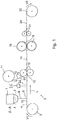
- FIG. 1 shows schematically an apparatus generally designated by the reference numeral 2 for operating a method according to the invention for producing a resilient nonwoven composite material.
- a first already prepared inelastic nonwoven fabric layer 4 in particular a PP spunbonded nonwoven layer having a basis weight of in particular 18 g / m 2 is unrolled at a speed v1 and fed in the longitudinal direction L a contact region 5, in which the elastic filaments 6 on a first side 70 of the first nonwoven fabric layer 4 are stored substantially stress-free.
- the elastic filaments 6 are inline in the illustrated case by an extruder 7 generated. It would also be conceivable, of course, to manufacture the elastic filaments 6 offline and feed them endlessly to the nonwoven composite material production process as a prefabricated material in a manner known per se, for example, from the roll.
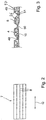
- FIG. 2 shows schematically, not to scale, the head of the extruder 7 in cross section along a line AA. Recognizable are the outlet nozzles 8 for the elastic filaments 6. The distance of the outlet nozzles is about 3 mm.
- the contact of the elastic filaments 6 with the nonwoven layer 4 in the contact region 5 is preferably carried out at a time at which the extruded elastic filaments 6 are not yet completely hardened and thus in still fused, thus still sticky state.
- particulate material 26 in the illustrated case superabsorbent material, is applied to the first side 70 of the first nonwoven fabric layer 4 by means of a schematically indicated particle doser 25.
- the prelaminate 9 consisting of the first nonwoven fabric layer 4, the elastic filaments 6 and the particulate material 26 is coated in the illustrated case with a further, second inelastic nonwoven fabric layer 10 having a first side 72 and a second side 71, in particular a PP spunbonded nonwoven layer Surface weight of in particular 18 g / m 2 , which is unrolled from a roll 11.
- the second side 71 of the second nonwoven fabric layer 10 faces the first side 70 of the first nonwoven fabric layer 4. This layer arrangement is subsequently fed to a press nip 12 formed by a pair of calender rolls 13.
- the calender roll pair 13 comprises a first smooth roll and a second, in particular heated, roll executed with island projections, so that by passing through the press nip, prelaminate 9 and second nonwoven fabric layer 10 can be obtained NOTEbindemuster, so the formation of point-like bound areas 48 and these surrounding unbonded areas 49, permanently connected.
- both first melt bonds 50 are produced directly between the first and second nonwoven fabric layers 4, 10 and also second melt bonds 51 between the first and / or second nonwoven fabric layers 4, 10 and the elastic filaments 6.
- the nonwoven fabric layers 4, 10 are arranged such that the elastic filaments 6 are positioned between the first side 70 of the first nonwoven fabric layer 4 and the second side 71 of the second nonwoven fabric layer 10.
- the unbound areas also form free spaces 47, in which a multiplicity of the particulate material 26 is accommodated.
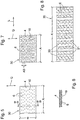
- FIG. 3 illustrates the described point bond pattern in an enlarged partial view of a cross section along a line BB of FIG. 5 ,
- FIG. 4 shows in an enlarged view the engagement region of the Dehnwalzencrues 15.
- the rollers of this Dehnwalzencrues 15 have a grooved surface 16, wherein the grooves 17 extend transversely to the longitudinal direction L.
- the groove geometry of the stretching rollers is matched to one another in such a way that they can intermesh without contact, wherein the extent of meshing and thus the extent of stretching of the material composite 14 can be regulated.
- the geometry of the grooves can be as in FIG. 4 be wavy or square beforehand or assume other conceivable configurations. As FIG.
- the stretching of the material composite 14 results in an overstretching of the nonwoven fabric layers 4, 10, since the nonwoven fabric layers 4, 10 are substantially inelastic in the longitudinal direction. This means that the nonwoven fabric layers 4, 10 experience a permanent, non-elastic deformation.
- the elastic filaments are only elastically deformed during stretching of the composite material 14.
- the nonwoven composite material 24 can be elastically deformed after the stretching process in the longitudinal direction L, the extent of the available elongation corresponding approximately to the previous extent.
- the elastic filaments 6 have a fiber thickness of 100 dtex.
- the fibers of both nonwoven layers have a fiber thickness of 4 dtex.
- FIG. 6 In schematically illustrated cross section along BB ( FIG. 6 ), the two nonwoven fabric layers 4, 10 and the sandwiched therebetween substantially tensionless arranged elastic filaments 6 can be seen.
- An illustration of the point bonding pattern and the particulate materials was presented in FIG. 6 waived.
- the dot binding pattern shows in detail FIG. 3 ,
- FIG. 7 shows this portion 30 immediately after passing through the gap of the Dehnwalzencrues 15, whereby at first an extension of the section by 100 %, ie to a length of 200 cm.
- first regions 20 of the nonwoven fabric layer 4, 10 have been overstretched more than second regions 21 of the nonwoven fabric layers 4, 10.
- First and second regions 20, 21 are arranged alternately in strip form transversely to the longitudinal direction L, as described below FIG. 8 can be seen.
- the stretching of the nonwoven fabric layers 4, 10 by 100% results in a permanent elongation (overstretching) of the nonwoven fabric layers by also 100%, the surplus nonwoven fabric material leads as it does in FIG FIG. 7 recognizable for the pleating / gathering of the nonwoven fabric layers 4, 10.
- the distance AB between the substantially parallel elastic filaments is in the transverse direction Q 3mm.
- the elastic filaments 6 thus have 0 points of intersection per cm 2 .
- the basis weight of the nonwoven fabric layers 4, 10 is in each case 18 g / m 2 .
- the weight ratio of the elastic filaments 6 to the total weight of the nonwoven composite 24 is 4.5%.
- the section 30 of the finished nonwoven composite material 24 can now be elastically stretched in the longitudinal direction L to a length of 200 cm, and therefore by 100% ( FIG. 8 ).
- the present process allows substantial material savings of up to 100%, as “stretch-bonding” would require the use of 200 cm stretchable non-woven fabric sections while the 200 cm stretchable section would require method described here requires the use of only 100 cm long nonwoven fabric sections.
- a further pair of rollers 31 serve, which fixes the web at least at its two longitudinal edges. It is advantageous to counteract the constriction at least to the extent that the constriction, ie the shortening of the web in the transverse direction Q, ie the width of the web, based on the initial width of a maximum of 50%, in particular less than 30%, more preferably less than 20% and completely especially less than 10%.
- the speed v2 is preferably selected to be higher than the speed v1 in order to provide the path with a certain amount To be able to wind up pretension. It would also be conceivable and advantageous to supply the web of the nonwoven composite material 24 directly, ie without prior winding on the roll 32, to the intended further processing, for example a high-speed machine for the production of hygiene or surgical clothing articles, in particular pantiform absorbent hygiene articles. Even so, this would be done with a web speed that is higher than the speed v1.
- the method of producing the nonwoven composite material 24 comprises the inline production of at least one, preferably both nonwoven fabric layers 4a, 10a, in particular according to the spunbonding method (spunbonding).
- spunbonding The technology of spunbonding is familiar to the person skilled in the art.
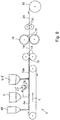
- FIG. 9 schematically shows a preferred arrangement of the manufacturing device 2 '. Instead of in FIG. 1 shown rollers 3, 11 for unwinding prefabricated nonwoven fabric layers 4, 10 are shown schematically two spinning beams 40, 41 for melt spinning of still substantially unbound spunbond layers 4a and 10a.
- the spunbonded layers 4a and 10a are preferably completely bound, as it were in one operation, by passage through the calendering roller pair 13 and simultaneously connected to each other and to the elastic filaments 6.
- FIG. 10 a disposable absorbent sanitary article 60 in pant-form, however, in the flat, extended state before the manufacturer side connection of the longitudinal side edge portions 61, with a waist opening forming a hip opening in the circumferential direction after the manufacturer side connection of the longitudinal side edge portions 61 continuously closed waist edge 62 and leg openings 63, and with longitudinal side edge portions 61 having the front part 64 and back 65.
- Front 64 and back 65 are spaced from each other in the longitudinal direction LR of the sanitary article 60 and are joined in the longitudinal direction LR of the sanitary article by an absorbent 66 bridging the distance between the front 64 and back 65.
- FIG. 11 FIG. 12 shows the disposable absorbent sanitary article 60 after the manufacturer side connection of the longitudinal side edge portions 61.
- the absorption part 66 is fixed on the body-facing side of the front and back parts.
- the absorption part 66 can as shown from a In addition, it has a liquid-impermeable backsheet and / or a liquid-permeable topsheet and a liquid-absorbing and -absorbing absorbent core arranged between them.
- the absorbent core is anyhow formed from the nonwoven composite material according to the present invention, wherein a nonwoven composite portion 91 is cut out from a nonwoven composite sheet 24, for example, cut out or punched out, wherein the longitudinal direction L of the nonwoven composite sheet 24 is substantially perpendicular to a longitudinal direction LR of the sanitary article 60.
- the extensibility of the absorbent core in the circumferential direction of the hip opening, ie perpendicular to a longitudinal direction LR of the hygiene article 60 is 120%, so that the transverse extent of the absorbent core can be doubled and thus adapted to a large number of clothing sizes.
- the front part 64 and the back part 65 are preferably made of a nonwoven composite material section 68, each made of a nonwoven composite material web, produced according to a in EP 2136753A2 has been cut out or punched out, for example, wherein the longitudinal direction L of the nonwoven composite material web is substantially perpendicular to a longitudinal direction LR of the hygiene article 60.
- the extension of the front part 64 in the longitudinal direction LR is 20 cm, that of the back part 65 is 25 cm in the longitudinal direction LR.
- the extensibility of the front and back part in the circumferential direction of the hip opening, that is perpendicular to a longitudinal direction LR of the hygiene article 60 is 100%, so that the circumference of the hip opening in a similar extent as the absorbent core extendable and thus the article a total of a variety of clothing sizes is customizable.
Landscapes
- Health & Medical Sciences (AREA)
- Engineering & Computer Science (AREA)
- Life Sciences & Earth Sciences (AREA)
- Animal Behavior & Ethology (AREA)
- Epidemiology (AREA)
- Biomedical Technology (AREA)
- Heart & Thoracic Surgery (AREA)
- Vascular Medicine (AREA)
- Veterinary Medicine (AREA)
- Public Health (AREA)
- General Health & Medical Sciences (AREA)
- Manufacturing & Machinery (AREA)
- Textile Engineering (AREA)
- Nonwoven Fabrics (AREA)
- Absorbent Articles And Supports Therefor (AREA)
- Laminated Bodies (AREA)
Description
- Die Erfindung betrifft ein Verfahren zur Herstellung eines elastischen Vliesstoffverbundmaterials zur Verwendung in einem Einwegartikel, wie in einem OP-Bekleidungsartikel oder Hygieneartikel, insbesondere in einem absorbierenden Inkontinenzartikel.
- Absorbierende Einwegartikel wie Hygieneartikel oder OP-Bekleidungsartikel umfassen häufig elastische Komponenten, um die Passform des Artikels und damit den Tragekomfort zu verbessern.
- Die elastischen Komponenten umfassen häufig eine Vielzahl von Elastifizierungsmitteln, häufig in Form von elastischen Fäden, die im vorgespannten Zustand mit im Wesentlichen unelastischen Chassismaterialien zumeist klebend verbunden werden. Dabei ist zum Beispiel in Windelhosen üblicherweise ein Hüftrandbereich vorzugsweise durchgehend in Umfangsrichtung elastifiziert. Auch im Vorderbereich und im Rückenbereich sind bei bekannten Windelhosen Elastifizierungsmittel vorgesehen. Desgleichen werden die Beinöffnungen umgebende bzw. die Beinöffnungen bildende Umfangsbereiche zumindest abschnittsweise elastisch ausgestaltet, damit dort ein weitgehend dichtendes Anliegen des Hygieneartikels an die Hautoberfläche des Benutzers gewährleistet ist, um das seitliche Austreten von Körperausscheidungen zu verhindern. Auch aufstehende Bündchenelemente, die neben den elastischen Beinöffnungen einen weiteren seitlichen Auslaufschutz bieten, werden bei bekannten Windelhosen bereits eingesetzt und sind (beispielsweise aus
EP-1184017-A1 ,EP-1199058-A1 ,EP-1308148-A2 ) bekannt. - Es ist ferner bekannt, zwischen Hüftrand und Schrittbereich Vliesstoffverbundmaterialien zu verwenden mit im Wesentlichen in einer Querrichtung erstreckten Elastifizierungsmitteln in Form von elastischen Fäden, die im vorgespannten Zustand mit im Wesentlichen unelastischen Chassismaterialien zumeist klebend verbunden werden (stretch-bonding).
- Ein Verfahren zur Herstellung eines derartigen Verbundmaterials offenbart bereits die
WO/0188245 - Nachteil dieses Verfahrens ist die Notwendigkeit der Verwendung großer Klebermengen zur Verbindung der elastischen Filamente mit der Vliesstoffbahn.
- Die
EP2136753A2 offenbart bereits ein Verfahren zur Herstellung eines elastischen Vliesstoffverbundmaterials umfassend das Zuführen und Fördern einer ersten Vliesstofflage in einer Längsrichtung; Zuführen einer Vielzahl elastischer Filamente; Verbinden der Vielzahl elastischer Filamente mit einer ersten Seite der Vliesstofflage zur Bildung eines Materialverbundes; Zumindest bereichsweises Überdehnen der ersten Vliesstofflage in der Längsrichtung durch Hindurchführen des Materialverbundes durch den Spalt eines ersten Paars profilierter, ineinander greifender Dehnwalzen, wodurch der Materialverbund in der Längsrichtung gestreckt wird, wobei die elastischen Filamente derart angeordnet werden, dass sie im Wesentlichen in der Längsrichtung orientiert sind, so dass sie höchstens 10 Schnittpunkte miteinander pro cm2 aufweisen. - Während im durch die
WO01/88245 EP2136753A2 zumindest ein wesentlicher Teil der verfügbaren Dehnung dadurch erzielt, dass die Vliesstofflage im bereits verbundenen Materialverbund einem nachträglichen Überdehnen, das heißt einer permanenten Verformung unterzogen wird, während sich die elastischen Filamente während des Streckvorganges im Wesentlichen elastisch verformen. Das Überdehnen erfolgt durch Hindurchführen des Materialverbundes durch den Spalt eines ersten Paars profilierter, ineinander greifender Dehnwalzen. Das Verbinden von elastischen Filamenten und der Vliesstofflage kann also zu einem Zeitpunkt stattfinden, zu dem die elastischen Filamente keiner signifikanten Vorspannung unterzogen sind. Dies hat den Vorteil, dass den Haltekräften zwischen der Vliesstofflage und den elastischen Filamenten im Zuge der Herstellung des Vliesstoffverbundmaterials weitaus weniger Kräfte entgegengesetzt werden und mithin weniger Klebstoff verwendet werden muss oder gar auf den Einsatz eines zusätzlichen Haftvermittlers ganz verzichtet werden kann. - Das in
EP2136753A2 offenbarte Vliesstoffverbundmaterial ist jedoch lediglich als Hüll- oder Chassismaterial für Hygiene- oder OP-Bekleidungsartikel geeignet. Aufgabe der vorliegenden Erfindung war es daher, das Verbundmaterial für weitere Komponenten eines Hygiene- oder OP-Bekleidungsartikel geeignet zu gestalten und hierfür ein vorteilhaftes Herstellverfahren bereit zu stellen. - Gelöst wird diese Aufgabe durch ein Verfahren mit den Merkmalen des Anspruch 1. Indem eine Vielzahl partikelförmiger Materialien, wie insbesondere superabsorbierende Materialien, oder geruchsadsorbierende Materialien, wie zum Beispiel Zeolithe oder Cyclodextrine, sandwichartig zwischen die Vliesstofflagen, und zwar in den durch die ungebundenen Bereiche gebildeten Freiraum eingebracht werden, kann der Vliesstoffverbund als Flüssigkeiten absorbierende oder Gerüche adsorbierenden Komponente eines Hygiene- oder OP-Bekleidungsartikels Verwendung finden. Durch das thermische Verbinden mittels Schmelzbindungen, kann zwar nicht ausgeschlossen werden, dass vereinzelt partikelförmiges Material von den Schmelzbindungen mit erfasst wird und damit zumindest anteilig deaktiviert wird; eine Vielzahl, insbesondere mindestens 60 Gew.-%, vorzugsweise mindestens 75 Gew.-% und weiter vorzugsweise mindestens 85 Gew.-% des partikelförmigen Materials verbleibt aber im Freiraum. Die Beschränkung der Partikelgrößenspannweite von mindestens 80-Gew.-% der Partikel auf einen Bereich zwischen 45 µm und 1200 µm stellt sicher, dass die Partikel bei der bestimmungsgemäßen Verwendung des Vliesstoffverbundes einerseits keine unangenehmen Hartstellen bilden und andererseits die Gefahr des unerwünschten Verlustes von Partikeln durch die offenporigen Vliesstofflagen reduziert ist. Vorzugsweise weisen mindestens 90 Gew.-%, insbesondere mindestens 95 Gew.-% der partikelförmigen Materialien eine Partikelgröße von 45-1200 µm, insbesondere von 45-850 µm, weiter insbesondere von 45-600 µm auf.
- Die Partikelgröße wird im Rahmen dieser Erfindung gemäß der Standard-Testmethode WSP 220.2 (05) gemessen. Die Testmethode WSP 220.2 (05) ist in "Standard Test Methods for the Nonwovens and Related Industries", Ausgabe 2008 beschrieben (herausgegeben von EDANA und INDA). WSP 220.2 (05) nach EDANA/INDA ist eine Standard-Testmethode zur Ermittlung der Partikelgrößen von superabsorbierenden Polymermaterialien. Im Zusammenhang mit der vorliegenden Erfindung wird die Bestimmung der Partikelgrößen von anderen Partikeln, wie zum Beispiel von geruchsadsorbierenden Partikeln, auf entsprechende Weise durchgeführt. Verwendet wird jeweils ein Retsch VE 1000 sieve shaker. In Ergänzung zu den nach WSP 220.2 (05) vorgesehenen Standardsieben wird ein Sieb mit einer Porengröße von 1200 µm verwendet. Vor der Siebung werden die Partikel bei 23±2 °C und 50±5 % Luftfeuchte über 24 h klimatisiert.
- Vorzugsweise stellt der Freiraum ein im Vergleich zum Gesamtvolumen der partikelförmigen Materialien relativ großes Volumen zur Verfügung. Vorzugsweise ist das Geamtvolumen des Freiraums zumindest um den Faktor 2, insbesondere zumindest um den Faktor 3 und weiter insbesondere zumindest um den Faktor 5 größer als das Volumen der Summe der in den Freiraum eingebrachten partikelförmigen Materialien. Dies reduziert weiter die Gefahr der Bildung von Hartstellen und ermöglicht außerdem im Falle von superabsorbierenden partikelförmigen Materialien das weitgehend ungehinderte Quellen der Materialien bei bestimmungsgemäßer Absorption von Körperflüssigkeit.
- In bevorzugter Ausführungsform umfassen die partikelförmigen Materialien superabsorbierende Materialien oder bestehen daraus. Der Anteil der superabsorbierenden Partikel am Gesamtgewicht des Vliesstoffverbundes beträgt vorzugsweise 10-200 Gew.-%, insbesondere 20-150 Gew.-%, weiter insbesondere 30-120 Gew.-%.
- Im Rahmen dieser Erfindung wird unter dem Ausdruck "superabsorbierendes Material" ein superabsorbierendes Polymer insbesondere ein Polymer verstanden, welches gemäß der Standard-Testmethode WSP 240.2 (05) einen w-Wert ("free swell capacity") von mindestens 10 g/g, vorzugsweise mindestens 20 g/g, weiter vorzugsweise höchstens 80 g/g, weiter vorzugsweise höchstens 70 g/g aufweist. Die Testmethode WSP 240.2 (05) zur Bestimmung des w-Wertes ist in "Standard Test Methods for the Nonwovens and Related Industries", Ausgabe 2008 beschrieben (herausgegeben EDANA und INDA). WSP 240.2 (05) nach EDANA/INDA ist eine Standard-Testmethode zur Ermittlung des w-Wertes ("free swell capacity") von superabsorbierendem Polyacrylat-Pulver. Nach WSP 240.2 (05) wird die freie Aufnahmekapazität für eine 0,9 % (Gewichtsprozent) Kochsalzlösung bestimmt. Im Zusammenhang mit der vorliegenden Erfindung wird die Bestimmung des w-Wertes von superabsorbierendem Material, bei dem es sich nicht um Polyacrylat-Pulver handelt, auf entsprechende Weise durchgeführt.
- Das die Vliesstofflagen verbindende Bindemuster ist vorzugsweise ein Punktbindemuster, das heißt die Vliesstofflagen sind durch punktuell, thermisch erzeugte Schweißbindungen verbunden, so dass punktartige gebundene Bereiche von ungebundenen, Freiräume bildenden Bereichen umgeben sind. Vorteilhafterweise ist das Bindemuster derart ausgeführt, dass jedes der elastischen Filamente durch mindestens einen Bindebereich, insbesondere mindestens zwei, weiter insbesondere mindestens drei Bindebereiche verläuft.
- Denkbar und vorteilhaft ist auch, das Bindemuster derart zu gestalten, dass inselartig ungebundene, die Freiräume bildende Bereiche von gebundenen Bereichen umgeben sind. Diesbezüglich wird beispielhaft auf die in
EP1806989A1 offenbarten Bindemuster verwiesen. Solchenfalls wären die partikelförmigen Materialien innerhalb des Vliesstoffverbundes sicherer fixiert. - Denkbar wäre auch, die Vliesstofflagen und die elastischen Filamente zusätzlich zum thermischen Verbinden durch einen Haftvermittler, insbesondere durch geringe Mengen eines diskontinuierlich, also nicht vollflächig, beispielsweise raster- oder punktförmig aufgetragenen Hotmeltklebstoffes zu verbinden. Dieser würde vorzugsweise über an sich bekannte Module wie Hotmeltsprüh- oder schlitzkopf- oder Druckauftragsvorrichtungen auf eine der oder beide Vliesstofflagen aufgetragen werden. Auch dies trägt dazu bei, die partikelförmigen Materialien sicherer innerhalb des Vliesstoffverbundes zu fixieren.
- In einer bevorzugten Weiterbildung der Erfindung werden die elastischen Filamente im Wesentlichen ungedehnt, insbesondere mit einer Vorspannung von weniger als 1,5, insbesondere weniger als 1,3, weiter insbesondere weniger als 1,2, weiter insbesondere weniger als 1,1 und vorzugsweise weniger als 1,05 mit der ersten und/oder zweiten Vliesstofflage verbunden. Hierbei bedeutet eine Vorspannung von 1,5, das Dehnen der elastischen Filamente um 50 %, also beispielsweise, das Dehnen eines 10 cm langen Filamentabschnittes auf 15 cm.
- In einer bevorzugten Form des Verfahrens wird der Materialverbund beim Hindurchführen des Materialverbundes durch den Spalt eines ersten Paars profilierter, ineinander greifender Dehnwalzen in Längsrichtung um 35-300%, insbesondere um 50-200% gestreckt. Unter Dehnung oder Streckung wird hierbei das Verhältnis der Längenänderung zur Ausgangslänge verstanden. Ein Abschnitt einer Ausgangslänge von beispielsweise 100 cm, welcher auf eine Länge von 150 cm gedehnt wird, würde nach diesem Verständnis um 50% gedehnt werden.
- Je nach Ausmaß der mit der Streckung verbundenen permanenten Dehnung der Vliesstofflage resultiert daraus ein Vliesstoffverbundmaterial mit einer in Längsrichtung verfügbaren Dehnung (Dehnbarkeit) von vorzugsweise 35-300%, insbesondere 50-200%.
- Unter verfügbarer Dehnung oder Dehnbarkeit wird das Verhältnis der möglichen Längenänderung zur Ausgangslänge eines Abschnittes des Vliesstoffverbundmaterials verstanden. Die mögliche Längenänderung wird hierbei nach der in
EP 2136753A2 beschriebenen Methode ermittelt. - Nach einem weiteren Erfindungsgedanken kann der Materialverbund nach dem Hindurchführen des Materialverbundes durch den Spalt eines ersten Paars profilierter, ineinander greifender Dehnwalzen durch einen jeweiligen Spalt weiterer Paare, insbesondere zweier weiterer Paare, vorzugsweise eines weiteren Paares profilierter, ineinander greifender Dehnwalzen hindurchgeführt werden. Solchenfalls kann die Überdehnung stufenweise erfolgen. In Weiterbildung dieses Erfindungsgedankens wird der Materialverbund durch das Hindurchführen des Materialverbundes durch den Spalt des ersten Paars profilierter, ineinander greifender Dehnwalzen vorzugsweise stärker gedehnt als durch das Hindurchführen des Materialverbundes durch den jeweiligen Spalt jedes weiteren Paares profilierter, ineinander greifender Dehnwalzen.
- Aus wirtschaftlichen Gründen ist es vorteilhaft, dass die Vliesstofflage oder die Vliesstofflagen aus unelastischem Material gebildet sind.
- In einer ersten Alternative des erfindungsgemäßen Verfahrens ist vorgesehen, die elastischen Filamente in an sich bekannter Weise in einem separaten Herstellprozess, also offline zu fertigen, anschließend endlos auf Rollen zu wickeln und die elastischen Filamente im Zuge der Herstellung des Vliesstoffverbundmaterials von der Rolle abzuwickeln. Denkbar und besonders vorteilhaft ist hingegen, dass das Verfahren der Herstellung des Vliesstoffverbundmaterials das Extrudieren der elastischen Filamente mit umfasst. Solchenfalls würde man von einer inline-Fertigung der elastischen Filamente sprechen.
- Wie bereits weiter oben angedeutet erweist es sich insbesondere aus Kostengründen als vorteilhaft, die elastischen Filamente direkt, also insbesondere ohne weiteren Haftvermittler mit der Vliesstofflage zu verbinden. Hierzu können die elastischen Filamente ein Polymer mit permanenter Haftkraft enthalten. Im Falle der inline-Fertigung der elastischen Filamente kann die dauerhafte Verbindung zwischen elastischen Filamenten und Vliesstofflage auch dadurch erfolgen, dass die elastischen Filamente kurz nach der Extrusion in noch nicht völlig erstarrtem Zustand mit der Vliesstofflage in Kontakt gebracht werden. Denkbar und vorteilhaft ist auch, die elastischen Filamente gemeinsam mit den Vliesstofflagen durch einen Pressspalt, insbesondere einen beheizbaren Pressspalt eines Walzenpaars, insbesondere eines Kalanderwalzenpaares hindurchzuführen. Hierbei werden die Vliesstofflagen und die elastischen Filamente durch ein Bindemuster, also ein Muster gebundener und nicht gebundener Bereiche, insbesondere ein Punktbindemuster thermisch, also durch thermisch erzeugte Schweißbindungen verbunden werden. Vorteilhafterweise ist das Bindemuster derart ausgeführt, dass jedes der elastischen Filamente durch mindestens einen Bindebereich, insbesondere mindestens zwei, weiter insbesondere mindestens drei Bindebereiche verläuft.
- Im Zusammenhang mit dem Schritt des Streckens des Vliesstoffverbundmaterials in seiner Längsrichtung kann es sich als vorteilhaft erweisen, nach dem Überdehnen durch Hindurchführen des Materialverbundes durch den Spalt eines Paares profilierter, ineinander greifender Dehnwalzen, die Bahn des Vliesstoffverbundmaterials in Querrichtung zu fixieren, um einer Einschnürung der Bahn in Querrichtung, das heißt einer Verringerung der Erstreckung in der Querrichtung entgegenzuwirken. Gleichwohl kann es vorteilhaft sein, gezielt ein geringes Maß an Einschnürung in Querrichtung, insbesondere weniger als 50%, weiter insbesondere weniger als 30%, weiter insbesondere weniger als 20% und ganz besonderes weniger als 10% zuzulassen. Die Einschnürung in Querrichtung in % wird hierbei nach folgender Formel berechnet:

- Solchenfalls ist es möglich, das Vliesstoffverbundmaterial mit einer zumindest geringfügigen Dehnbarkeit auch in Querrichtung auszustatten.
- Die erste und/oder die zweite Vliesstofflage können in an sich bekannter Weise in einem separaten Herstellprozess, also offline nach einem der im Stand der Technik bekannten Verfahren, wie zum Beispiel Spinnvlies-, Kardenvlies-, Spunlacevlies- oder Melblownvliesherstellverfahren gefertigt und anschließend endlos auf Rollen gewickelt werden, um die vorgefertigten Vliesstofflagen dann im Zuge der Herstellung des elastischen Vliesstoffverbundmaterials von der Rolle abzuwickeln. Denkbar und vorteilhaft ist alternativ, dass das Verfahren der Herstellung des elastischen Vliesstoffverbundmaterials die inline-Fertigung mindestens einer, vorzugsweise beider Vliesstofflagen, insbesondere nach dem Spinnvliesherstellverfahren umfasst.
- Die erste Vliesstofflage und vorzugsweise auch die zweite Vliesstofflage weisen vorzugsweise ein Flächengewicht von 5-30 g/m2, insbesondere von 8-25 g/m2, weiter insbesondere von 10-22 g/m2, ganz besonders von 12-18 g/m2 auf.
- Die erste und/oder die zweite Vliesstofflage sind insbesondere in Längsrichtung und vorzugsweise auch in Querrichtung im Wesentlichen unelastisch. Dies trägt dazu bei, Kosten zu sparen und die weiter unten beschriebene zweiphasige Dehnungscharakteristik möglich machen zu können. Unter einer unelastischen Vliesstofflage wird im Rahmen der vorliegenden Erfindung ein Vliesstoffmaterial verstanden, das nach einer einmaligen Dehnung eines 25 mm breiten Materialstreifens um 30 % seiner Ausgangslänge bei einer Dehngeschwindigkeit von 500 mm/min entweder reißt oder bei anschließender sofortiger Entlastung eine permanente Dehnung von mindestens 7,5 % aufweist. Dies bedeutet, dass beispielsweise ein 100 mm langer Materialstreifen, der auf eine Länge von 130 mm gedehnt wurde, nach Entlastung eine Länge von mindestens 107,5 cm aufweist.
- In Weiterbildung der Erfindung wird ferner vorgeschlagen, das Strecken des Vliesstoffmaterials derart auszuführen, dass erste Bereiche der Vliesstofflage stärker überdehnt werden als zweite Bereiche der Vliesstofflage. Insbesondere vorteilhaft ist, die zweiten Bereiche im Wesentlichen gar nicht zu überdehnen. Vorzugsweise sind die ersten und zweiten Bereiche dann alternierend, streifenförmig quer zu der Längsrichtung der Bahn des Vliesstoffverbundmaterials angeordnet. Dies hat zur Folge, dass die Dehnungscharakteristik des Vliesstoffverbundmaterials in Gebrauch durch zwei Phasen gekennzeichnet ist. Die ersten stärker überdehnten Bereiche setzen dem Dehnen in Längsrichtung zunächst einen ersten, geringen Widerstand entgegen. Nach maximaler Ausdehnung der stark überdehnten Bereiche erfordert das weitere Dehnen der weniger stark oder gar nicht überdehnten Bereiche dann eine höhere Kraft, welche deutlich über den Kräften liegt, die bei normalem Gebrauch zu erwarten sind. Diese Zweiphasigkeit gibt dem Anwender einen Hinweis auf die maximale Dehnbarkeit des Materials, noch lange bevor das Material der Gefahr des Zerreißens ausgesetzt wird.
- In einer weiteren vorteilhaften Ausführung der Erfindung beträgt die Stärke der elastischen Filamente 4-700 dtex, insbesondere 50-300 dtex und weiter insbesondere 100-200 dtex. In Weiterbildung dieses Erfindungsgedankens enthalten die erste und vorzugsweise auch die zweite Vliesstofflage Fasern mit einem ersten Titer, gemessen in dtex, oder bestehen daraus, während die elastischen Filamente einen zweiten Titer aufweisen, wobei der zweite Titer größer ist, vorzugsweise um bis zu 100% größer, besonders bevorzugt um bis zu 200% größer, insbesondere um bis zu 500% größer, vorzugsweise jedoch um höchstens 5000%, besonders bevorzugt um höchstens 4000 % und ganz besonders bevorzugt um höchstens 3000% größer ist als der erste Titer. Der Anteil des Gewichts der elastischen Filamente am Gesamtgewicht des Vliesstoffverbundmaterials beträgt dabei vorzugsweise weniger als 40 %, insbesondere weniger als 30 %, weiter insbesondere weniger als 20 %, weiter insbesondere weniger als 15 %, vorzugsweise aber mehr als 3%.
- Die elastischen Filamente enthalten oder bestehen vorzugsweise aus einem thermoplastischen Polymer insbesondere einem extrudierbaren Polymer ausgewählt aus der Gruppe Polyurethane, elastische Polyester, elastische Polyamide, elastische Polyolefine oder elastische Blockcopolymere. Bevorzugte extrudierbare elastische Polymere offenbaren die
WO01/88245 WO06/124092
Weiter bevorzugt enthalten die elastischen Filamente eine Polymerkomponente mit permanenter Haftkraft oder die elastischen Filamente bestehen aus einer Polymerkomponente mit permanenter Haftkraft. - Der Abstand der elastischen Filamente voneinander in Querrichtung beträgt vorzugsweise 0,5-10 mm, besonders bevorzugt 1-5 mm, insbesondere 1,2 - 3,5 mm.
- Die Wasserdampfdurchlässigkeit des Vliesstoffverbundmaterials beträgt insbesondere wenigstens 300g/m2/24h , weiter insbesondere wenigstens 1000g/m2/24h, weiter insbesondere wenigstens 2000g/m2/24h, weiter insbesondere wenigstens 3000g/m2/24h, weiter insbesondere wenigstens 4000g/m2/24h, weiter insbesondere höchstens 6000g/m2/24h gemessen nach DIN 53 122-1 (Ausgabe: 2001-08).
- Die vorliegende Erfindung betrifft außerdem ein Vliesstoffverbundmaterial herstellbar oder hergestellt nach dem Verfahren wie zuvor gekennzeichnet. Das Vliesstoffverbundmaterial mit einer Längsrichtung und einer senkrecht dazu verlaufenden Querrichtung umfasst eine zumindest bereichsweise überdehnte erste und zweite Vliesstofflage mit je einer ersten Seite und einer zweiten Seite, sowie eine Vielzahl im Wesentlichen in der Längsrichtung orientierter elastischer Filamente, die zumindest mit der ersten Seite der Vliesstofflage verbunden sind, wobei die elastischen Filamente derart angeordnet sind, dass sie höchstens 10 Schnittpunkte miteinander pro cm2 aufweisen, wobei das Vliesstoffverbundmaterial in der Längsrichtung vorzugsweise eine Dehnbarkeit von 35-300% aufweist und wobei partikelförmige Materialien sandwichartig zwischen die erste und zweite Vliesstofflage eingebracht sind, wobei mindestens 80 Gew.-% der partikelförmigen Materialien eine Partikelgröße von 45-1200 µm aufweisen, und wobei die Vliesstofflagen zu einem Materialverbund mittels eines Bindemusters, welches gebundene Bereiche und ungebundene Bereichen umfasst, verbunden sind, wobei durch das Bindemuster erste Schmelzbindungen direkt zwischen erster und zweiter Vliesstofflage erzeugt sind, und wobei die ungebundenen Bereiche zwischen der ersten und der zweiten Vliesstofflage einen Freiraum bilden und wobei eine Vielzahl der partikelförmigen Materialien innerhalb dieses Freiraums angeordnet ist. Insbesondere sind die elastischen Filamente derart konsequent in der Längsrichtung ausgerichtet, dass sie höchstens 8, insbesondere höchstens 5, insbesondere höchstens 3, weiter insbesondere höchstens 1 und ganz besonders gar keinen, also 0 Schnittpunkte pro cm2 Vliesstoffverbundmaterial miteinander aufweisen. Vorzugsweise verlaufen die elastischen Filamente in der Längsrichtung parallel zu einander.
- Außerdem ist ein wegwerfbarer absorbierender Hygiene- oder OP-Bekleidungsartikel wie eine Inkontinenzwindel des offenen, mit Verschlusselementen versehenen Typs oder eine pantförmige Inkontinenzwindel oder eine Inkontinenzvorlage oder ein OP-Mantel mit mindestens einem Vliesstoffverbundmaterial herstellbar wie oben beschrieben Gegenstand der vorliegenden Erfindung.
- Nach einem weiteren Erfindungsgedanken weist ein absorbierender Hygiene- oder OP-Bekleidungsartikel wie eine Inkontinenzwindel des offenen, mit Verschlusselementen versehenen Typs oder eine pantförmige Inkontinenzwindel oder eine Inkontinenzvorlage oder ein OP-Mantel mindestens ein Vliesstoffverbundmaterial wie oben beschrieben als eine Flüssigkeiten oder Gerüche ab- oder adsorbierende Komponente auf. Es ist denkbar und vorteilhaft, wenn diese Komponente gleichzeitig die hüllmaterial- und chassisbildende Komponente des Artikels bildet. In einer alternativen Ausführungsform weist der Artikel jedoch des Weiteren ein zweites Vliesstoffverbundmaterial, vorzugsweise wie in
EP 2136753A2 beschrieben, als Chassis- oder Hüllmaterial auf. Solchenfalls kommt in einer mehrlagigen Anordnung innerhalb des Artikels das erfindungsgemäße Vliesstoffverbundmaterial relativ zum zweiten Vliesstoffverbundmaterial vorzugsweise körpernah zu liegen. - In einer bevorzugten Ausführungsform ist der Artikel eine Inkontinenzwindel in Pantform mit einem eine Hüftöffnung bildenden in Umfangsrichtung durchgehend geschlossenen Hüftrand und mit Beinöffnungen, und mit Längsseitenrandabschnitte aufweisendem Vorderteil und Rückenteil, wobei Vorderteil und Rückenteil voneinander in Längsrichtung des Hygieneartikels beabstandet sind, und mit einem das Vorderteil und Rückenteil in Längsrichtung des Hygieneartikels verbindenden Absorptionsteil, wobei der Absorptionsteils ein erfindungsgemäßes Vliesstoffverbundmaterial aufweist oder daraus besteht, und wobei der in Umfangsrichtung durchgehend geschlossene Hüftrand und die Beinöffnungen gebildet sind, indem Längsseitenrandabschnitte eines Vorderteils und eines Rückenteils herstellerseitig miteinander verbunden sind, und wobei das Vorderteil und/oder das Rückenteil ein zweites Vliesstoffverbundmaterial, vorzugsweise wie in
EP 2136753A2 beschrieben, aufweisen oder daraus bestehen und wobei die Längsrichtung des zweiten Vliesstoffverbundmaterials im Wesentlichen senkrecht zu einer Längsrichtung des Hygieneartikels verläuft.. - In Weiterbildung dieses Erfindungsgedankens beträgt die Dehnbarkeit des Vorder- und/oder Rückenteil bildenden zweiten Vliesstoffverbundmaterials senkrecht zur Längsrichtung des Hygieneartikels 80-250 %, insbesondere 100-200 %. Die Dehnbarkeit des Absorptionsteils beträgt senkrecht zur Längsrichtung des Hygieneartikels vorzugsweise 90-260 %, insbesondere 110-210 %. Vorzugsweise ist die Dehnbarkeit des Absorptionsteils senkrecht zur Längsrichtung des Hygieneartikels größer als die Dehnbarkeit des zweiten Vliesstoffverbundmaterials. Dies hat den Vorteil, dass beim Anlegen des Hygieneartikels an den Benutzer Vorder- oder Rückenteil bis zu ihrer maximalen Dehnbarkeit verlängert werden können, ohne dass der Absorptionsteil Gefahr liefe durch diese Dehnung geschädigt zu werden.
- Insbesondere beträgt die Erstreckung des Vliesstoffverbundmaterials des Vorderteils und/oder des Rückenteils in Längsrichtung des Hygieneartikels 8-50 cm, insbesondere 10-40 cm und weiter insbesondere 12- 30 cm.
- Weitere Merkmale, Einzelheiten und Vorteile der Erfindung ergeben sich aus den beigefügten Patentansprüchen und aus der zeichnerischen Darstellung und nachfolgenden Beschreibung bevorzugter Ausführungsformen der Erfindung. In der Zeichnung zeigt:
- Figur 1
- in schematisierter Form eine Seitenansicht einer Vorrichtung für den Betrieb eines erfindungsgemäßen Verfahrens
- Figur 2
- eine Schnittansicht entlang einer Linie A-A der
Figur 1 - Figur 3
- eine Teilansicht eines Querschnittes der
Figur 5 entlang der Linie B-B - Figur 4
- eine vergrößerte Darstellung des Eingriffsbereich eines Dehnwalzenpaares
- Figur 5
- einen Teilabschnitt eines Materialverbundes in der Aufsicht
- Figur 6
- einen Querschnitt eines Teilabschnittes eines Materialverbundes entlang einer Linie B-B aus
Figur 5 - Figur 7
- einen Teilabschnitt eines elastischen Vliesstoffverbundmaterials in der Aufsicht im entspannten Zustand
- Figur 8
- einen Teilabschnitt eines elastischen Vliesstoffverbundmaterials in gedehntem Zustand
- Figur 9
- in schematisierter Form eine Seitenansicht einer weiteren Vorrichtung für den Betrieb eines weiteren erfindungsgemäßen Verfahrens
- Figur 10
- eine Draufsicht auf eine erste Ausführungsform eines pantförmigen Hygieneartikels im flachgelegten Zustand vor der herstellerseitigen Verbindung von Längsseitenrandbereichen
- Figur 11
- eine perspektivische Ansicht eines pantförmigen Hygieneartikels nach der herstellerseitigen Verbindung von Längsseitenrandbereichen
-
Figur 1 zeigt schematisch eine insgesamt mit dem Bezugszeichen 2 bezeichnete Vorrichtung zum Betreiben eines erfindungsgemäßen Verfahrens zur Herstellung eines elastischen Vliesstoffverbundmaterials. Von einer Rolle 3 wird eine erste bereits vorgefertigte unelastische Vliesstofflage 4, insbesondere eine PP- Spinnvlieslage mit einem Flächengewicht von insbesondere 18 g/m2 mit einer Geschwindigkeit v1 abgerollt und in Längsrichtung L einem Kontaktbereich 5 zugeführt, in dem die elastischen Filamente 6 auf eine erste Seite 70 der ersten Vliesstofflage 4 im Wesentlichen spannungsfrei abgelegt werden. Die elastischen Filamente 6 werden im dargestellten Fall inline durch einen Extruder 7 erzeugt. Denkbar wäre natürlich auch, die elastischen Filamente 6 offline zu fertigen und dem Vliesstoffverbundmaterialherstellungsprozess als vorgefertigtes Material in an sich bekannter Weise zum Beispiel von der Rolle endlos zuzuführen. -
Figur 2 zeigt schematisch, nicht maßstabsgerecht, den Kopf des Extruders 7 im Querschnitt entlang einer Linie A-A. Erkennbar sind die Austrittsdüsen 8 für die elastischen Filamente 6. Der Abstand der Austrittsdüsen beträgt etwa 3 mm. - Der Kontakt der elastischen Filamente 6 mit der Vliesstofflage 4 im Kontaktbereich 5 erfolgt vorzugsweise zu einem Zeitpunkt, zu dem die extrudierten elastischen Filamente 6 noch nicht völlig erhärtet sind und somit in noch angeschmolzenem, mithin noch klebrigem Zustand.
- Vor der Zuführung der zweiten Vliesstofflage 10 wird mittels eines schematisch angedeuteten Partikeldosierers 25 partikelförmiges Material 26, im dargestellten Fall superabsorbierendes Material auf die erste Seite 70 der ersten Vliesstofflage 4 aufgebracht.
- Das aus der ersten Vliesstofflage 4, den elastischen Filamenten 6 und dem partikelförmigen Material 26 bestehenden Vorlaminat 9 wird im dargestellten Fall beschichtet mit einer weiteren, zweiten unelastischen Vliesstofflage 10 mit einer ersten Seite 72 und einer zweiten Seite 71, insbesondere eine PP-Spinnvliesstofflage mit einem Flächengewicht von insbesondere 18 g/m2, welche von einer Rolle 11 abgerollt wird. Die zweite Seite 71 der zweiten Vliesstofflage 10 ist dabei der ersten Seite 70 der ersten Vliesstofflage 4 zugewandt. Diese Lagenanordnung wird nachfolgend einem aus einem Kalanderwalzenpaar 13 gebildeten Pressspalt 12 zugeführt.. Das Kalanderwalzenpaar 13 umfasst eine erste glatte, sowie eine mit inselförmigen Erhebungen ausgeführte zweite, insbesondere beheizte Walze, so dass durch das Hindurchführen durch den Pressspalt Vorlaminat 9 und zweite Vliesstofflage 10 mittels Punktbindemuster, also der Bildung von punktartigen gebundenen Bereichen 48 und diese umgebenden ungebundenen Bereichen 49, dauerhaft verbunden werden können. Hierbei werden sowohl erste Schmelzbindungen 50 direkt zwischen erster und zweiter Vliesstofflage 4, 10 als auch zweite Schmelzbindungen 51 zwischen erster und/oder zweiter Vliesstofflage 4, 10 und den elastischen Filamenten 6 erzeugt. Dabei sind die Vliesstofflagen 4, 10 so angeordnet, dass die elastischen Filamente 6 zwischen der ersten Seite 70 der ersten Vliesstofflage 4 und der zweiten Seite 71 der zweiten Vliesstofflage 10 positioniert sind. Die ungebundenen Bereiche bilden zugleich Freiräume 47, in denen eine Vielzahl des partikelförmigen Materials 26 aufgenommen ist.
Figur 3 veranschaulicht das beschriebene Punktbindemuster in einer vergrößerten Teilansicht eines Querschnittes entlang einer Linie B-B derFigur 5 . - Im weiteren Verlauf wird der so gebildete Materialverbund 14 in den Spalt eines Dehnwalzenpaares 15 geführt.
Figur 4 zeigt in einer vergrößerten Darstellung den Eingriffsbereich des Dehnwalzenpaares 15. Die Walzen dieses Dehnwalzenpaares 15 weisen eine gerillte Oberfläche 16 auf, wobei die Rillen 17 quer zur Längsrichtung L verlaufen. Die Rillengeometrie der Dehnwalzen ist derart aufeinander abgestimmt, dass diese berührungslos ineinander greifen können, wobei das Ausmaß des Ineinandergreifens und damit das Ausmaß das Streckens des Materialverbundes 14 regelbar ist. Die Geometrie der Rillen kann wie inFigur 4 dargestellt wellenförmig oder auch eckig gezähnt sein oder andere denkbare Konfigurationen annehmen. WieFigur 4 veranschaulicht erfolgt das Strecken des Materialverbundes 14 derart, dass erste Bereiche 20 zwischen den Auflageabschnitten 22 des Materialsverbundes 14 auf den Rillenbergen 23 stärker gedehnt werden als zweite Bereiche 21, die mit den Auflageabschnitten 22 korrespondieren. Die Streckung des Materialverbundes 14 resultiert in einer Überdehnung der Vliesstofflagen 4, 10, da die Vliesstofflagen 4, 10 in Längsrichtung im Wesentlichen unelastisch sind. Dies bedeutet, dass die Vliesstofflagen 4, 10 eine permanente, nicht elastische Verformung erfahren. Die elastischen Filamente hingegen werden beim Strecken des Materialverbundes 14 lediglich elastisch verformt. Somit lässt sich das Vliesstoffverbundmaterial 24 nach dem Streckprozess in Längsrichtung L elastisch verformen, wobei das Ausmaß der verfügbaren Dehnung in etwa der vorangegangenen Streckung entspricht. - Zur weiteren Veranschaulichung zeigt
Figur 5 in der Aufsicht einen Teilabschnitt 30 des Materialverbundes 14 unmittelbar vor dem Hindurchführen durch den Spalt des Dehnwalzenpaares 15 mit der Ausgangslänge A = 100 cm und der Breite B = 60 cm. Die elastischen Filamente 6 weisen eine Faserstärke von 100 dtex auf. Die Fasern beider Vliesstofflagen weisen eine Faserstärke von 4 dtex auf. Im schematisch illustrierten Querschnitt entlang B-B (Figur 6 ) sind die beiden Vliesstofflagen 4, 10 sowie die sandwichartig dazwischen im Wesentlichen spannungslos angeordneten elastischen Filamente 6 erkennbar. Auf eine Darstellung des Punktbindemusters sowie der partikelförmigen Materialien wurde inFigur 6 verzichtet. Das Punktbindemuster im Detail zeigtFigur 3 . -
Figur 7 zeigt diesen Teilabschnitt 30 unmittelbar nach dem Hindurchführen durch den Spalt des Dehnwalzenpaares 15, wodurch zunächst eine Streckung des Teilabschnittes um 100 %, also auf eine Länge von 200 cm erfolgt. Hierbei sind erste Bereiche 20 der Vliesstofflage 4, 10 stärker überdehnt worden als zweite Bereiche 21 der Vliesstofflagen 4, 10. Erste und zweite Bereiche 20, 21 sind alternierend streifenförmig quer zu der Längsrichtung L angeordnet, wie in der weiter unten beschriebenenFigur 8 zu erkennen ist. Die Rückstellkräfte der mit den Vliesstofflagen 4, 10 verbundenen elastisch verformten elastischen Filamente 6 führen dazu, dass der Teilabschnitt 30 des Vliesverbundmaterials 24 sich wieder bis zur Ausgangslänge A = 100 cm zusammenzieht. Da die Streckung der Vliesstofflagen 4, 10 um 100% eine permanente Dehnung (Überdehnung) der Vliesstofflagen um ebenfalls 100% zur Folge hat, führt das gleichsam überschüssige Vliesstofflagenmaterial wie inFigur 7 erkennbar zur Fältelung/Raffung des Vliesstofflagen 4, 10. Der Abstand AB zwischen den im Wesentlichen parallel zueinander angeordneten elastischen Filamenten beträgt in Querrichtung Q 3mm. Die elastischen Filamente 6 weisen somit 0 Schnittpunkte miteinander pro cm2 auf. Das Flächengewicht der Vliesstofflagen 4, 10 beträgt jeweils 18 g/m2. Der Gewichtsanteil der elastischen Filamente 6 am Gesamtgewicht des Vliesstoffverbundmaterials 24 beträgt 4,5%. - Der Teilabschnitt 30 des fertigen Vliesverbundmaterials 24 lässt sich nun in Längsrichtung L auf eine Länge von 200 cm, mithin um 100% elastisch dehnen (
Figur 8 ). Somit ist mit dem vorliegenden Verfahren im Vergleich zum bekannten "Stretch-Bonding" eine wesentliche Materialeinsparung von bis zu 100% möglich, da beim "Stretch-Bonding" ein auf 200 cm ausdehnbarer Teilabschnitt die Verwendung ebenfalls 200 cm langer Vlieslagenabschnitte erfordern würde, während das hier beschriebene Verfahren die Verwendung lediglich 100 cm langer Vlieslagenabschnitte erfordert. - Nach dem Hindurchführen durch den Spalt des Dehnwalzenpaares 15 kann es vorteilhaft sein, einer Einschnürung der Vliesverbundmaterialbahn 14 in Querrichtung Q entgegenzuwirken. Hierzu kann ein weiteres Walzenpaar 31 dienen, welches die Bahn zumindest an dessen beiden Längsrändern fixiert. Vorteilhaft ist, der Einschnürung zumindest insoweit entgegenzuwirken, dass die Einschnürung, also die Verkürzung der Bahn in Querrichtung Q, also der Breite der Bahn, bezogen auf die Ausgangsbreite maximal 50%, insbesondere weniger als 30%, weiter insbesondere weniger als 20% und ganz besonders weniger als 10% beträgt.
- Schließlich wird das Vliesverbundmaterial 24 im dargestellten Fall (
Figur 1 ) auf eine Rolle 32 mit der Bahngeschwindigkeit v2 endlos aufgewickelt. Die Geschwindigkeit v2 wird hierbei vorzugsweise höher gewählt als die Geschwindigkeit v1, um die Bahn mit einer gewissen Vorspannung aufwickeln zu können. Denkbar und vorteilhaft wäre auch, die Bahn des Vliesverbundmaterials 24 direkt, also ohne vorheriges Aufwickeln auf die Rolle 32, der bestimmungsgemäßen Weiterverarbeitung, beispielsweise einer schnelllaufenden Maschine zur Herstellung von Hygiene- oder OP-Bekleidungsartikeln, insbesondere pantförmigen absorbierenden Hygieneartikeln zuzuführen. Auch solchenfalls würde dies mit einer Bahngeschwindigkeit erfolgen, die höher ist als die Geschwindigkeit v1. - Nach einer weiteren Ausführungsform des erfindungsgemäßen Verfahrens ist denkbar und vorteilhaft, dass das Verfahren der Herstellung des Vliesstoffverbundmaterials 24 die inline-Fertigung mindestens einer, vorzugsweise beider Vliesstofflagen 4a, 10a, insbesondere nach dem Spinnvliesherstellverfahren (Spunbonding) umfasst. Die Technologie des Spunbonding ist dem Fachmann an sich geläufig.
Figur 9 zeigt schematisch eine bevorzugte Anordnung der Herstellvorrichtung 2'. Anstelle der inFigur 1 dargestellten Rollen 3, 11 zum Abwickeln vorgefertigter Vliesstofflagen 4, 10 sind schematisch zwei Spinnbalken 40, 41 zum Schmelzspinnen von noch im Wesentlichen ungebundenen Spinnvlieslagen 4a und 10a dargestellt. Die Spinnvlieslagen 4a und 10a werden vorzugsweise - gleichsam in einem Arbeitsgang - durch das Hindurchführen durch das Kalanderwalzenpaar 13 vollständig gebunden und gleichzeitig miteinander und mit den elastischen Filamenten 6 verbunden. Mit gleichen Bezugszeichen versehene Vorrichtungsmodule und Materialkomponenten entsprechen ansonsten den inFigur 1 dargestellten und näher beschriebenen Vorrichtungsmodulen und Materialkomponenten. - Schließlich zeigt
Figur 10 einen wegwerfbaren absorbierenden Hygieneartikel 60 in Pantform jedoch im flachgelegten, ausgestreckten Zustand vor der herstellerseitigen Verbindung der Längsseitenrandabschnitte 61, mit einem eine Hüftöffnung bildenden in Umfangsrichtung nach der herstellerseitigen Verbindung der Längsseitenrandabschnitte 61 durchgehend geschlossenen Hüftrand 62 und mit Beinöffnungen 63, und mit Längsseitenrandabschnitte 61 aufweisendem Vorderteil 64 und Rückenteil 65. Vorderteil 64 und Rückenteil 65 sind voneinander in Längsrichtung LR des Hygieneartikels 60 beabstandet und werden in Längsrichtung LR des Hygieneartikels durch einen Absorptionsteil 66, der den Abstand zwischen Vorderteil 64 und Rückenteil 65 überbrückt verbunden.Figur 11 zeigt den wegwerfbaren absorbierenden Hygieneartikel 60 nach der herstellerseitigen Verbindung der Längsseitenrandabschnitte 61. - Das Absorptionsteil 66 ist auf der dem Körper zugewandten Seite des Vorder- und Rückenteils fixiert. Das Absorptionsteil 66 kann wie dargestellt aus einem flüssigkeitsaufnehmenden und -speichernden Absorptionskern 90 bestehen oder es weist seinerseits ein flüssigkeitsundurchlässiges Backsheet und/oder ein flüssigkeitsdurchlässiges Topsheet und einen dazwischen angeordneten flüssigkeitsaufnehmenden und - speichernden Absorptionskern auf. Der Absorptionskern ist jedenfalls gebildet aus dem erfindungsgemäßen Vliesstoffverbundmaterial, wobei aus einer Vliesstoffverbundmaterialbahn 24 ein Vliesstoffverbundmaterialabschnitt 91 herausgetrennt, zum Beispiel herausgeschnitten oder herausgestanzt wurde, wobei die Längsrichtung L der Vliesstoffverbundmaterialbahn 24 im Wesentlichen senkrecht zu einer Längsrichtung LR des Hygieneartikels 60 verläuft. Die Dehnbarkeit des Absorptionskerns in Umfangsrichtung der Hüftöffnung, also senkrecht zu einer Längsrichtung LR des Hygieneartikels 60 beträgt 120%, so dass die Quererstreckung des Absorptionskerns verdoppelbar und damit einer Vielzahl von Konfektionsgrößen anpassbar ist.
- Vorderteil 64 und Rückenteil 65 bestehen vorzugsweise aus einem Vliesstoffverbundmaterialabschnitt 68, welcher jeweils aus einer Vliesstoffverbundmaterialbahn, hergestellt nach einem in
EP 2136753A2 beschriebenen Verfahren, herausgetrennt, zum Beispiel herausgeschnitten oder herausgestanzt wurde, wobei die Längsrichtung L der Vliesstoffverbundmaterialbahn im Wesentlichen senkrecht zu einer Längsrichtung LR des Hygieneartikels 60 verläuft. Die Erstreckung des Vorderteils 64 beträgt in Längsrichtung LR 20 cm, die des Rückenteils 65 beträgt in Längsrichtung LR 25 cm. Die Dehnbarkeit des Vorder- und Rückenteils in Umfangsrichtung der Hüftöffnung, also senkrecht zu einer Längsrichtung LR des Hygieneartikels 60 beträgt 100%, so dass der Umfang der Hüftöffnung in ähnlichem Maße wie der Absorptionskern verlängerbar und damit der Artikel insgesamt einer Vielzahl von Konfektionsgrößen anpassbar ist.
Claims (16)
- Verfahren zur Herstellung einer Bahn eines elastischen Vliesstoffverbundmaterials (24) umfassend die folgenden Schritte:Zuführen und Fördern einer ersten Vliesstofflage (4, 4a) in einer Längsrichtung (L);Zuführen einer Vielzahl elastischer Filamente (6) in der Längsrichtung (L);Zuführen einer zweiten Vliesstofflage (10, 10a);Zusammenführen der zweiten Vliesstofflage (10, 10a) mit der ersten Vliesstofflage (4, 4a) derart, dass die elastischen Filamente (6) sandwichartig zwischen der ersten Vliesstofflage (4, 4a) und zweiten Vliesstofflage (10, 10a) zur Bildung einer Lagenanordnung angeordnet werden,Hindurchführen der Lagenanordnung durch einen Pressspalt eines Kalanderwalzenpaares (13), zur Verbindung der Lagenanordnung zu einem Materialverbund (14) mittels eines Bindemusters, welches gebundene Bereiche (48) und ungebundene Bereichen (49) umfasst, wobei durch das Bindemuster erste Schmelzbindungen (50) direkt zwischen erster und zweiter Vliesstofflage (4, 4a, 10, 10a) erzeugt werden, und wobei die ungebundenen Bereiche (49) zwischen der ersten und der zweiten Vliesstofflage einen Freiraum (47) bilden,zumindest bereichsweises Überdehnen der ersten Vliesstofflage (4, 4a) und der zweiten Vliesstofflage in der Längsrichtung (L) durch Hindurchführen des Materialverbunds (14) durch den Spalt eines Paars profilierter, ineinander greifender Dehnwalzen (15), wodurch der Materialverbund (14) in der Längsrichtung (L) gestreckt wird,wobei die elastischen Filamente (6) in dem Vliesstoffverbundmaterial derart angeordnet sind, dass sie im Wesentlichen in der Längsrichtung (L) orientiert sind, so dass sie höchstens 10 Schnittpunkte miteinander pro cm2 aufweisen,dadurch gekennzeichnet, dassvor dem Verbinden der Vliesstofflagen (4, 4a, 10, 10a) partikelförmige Materialien (26) auf die erste oder zweite Vliesstofflage aufgebracht werden, derart, dass die partikelförmigen Materialien (26) nach dem Verbinden der Vliesstofflagen (4, 4a, 10, 10a) sandwichartig zwischen den Vliesstofflagen (4, 4a, 10, 10a) angeordnet sind, wobei mindestens 80 Gew.-% der partikelförmigen Materialien (26) eine Partikelgröße von 45-1200 µm aufweisen und wobei nach dem Verbinden der Vliesstofflagen (4, 4a, 10, 10a) eine Vielzahl der partikelförmigen Materialien (26) innerhalb des Freiraums (47) eingebracht ist.
- Verfahren nach Anspruch 1, dadurch gekennzeichnet, dass das Vliesstoffverbundmaterial (24) in der Längsrichtung (L) eine Dehnbarkeit von 35-300%, vorzugsweise von 50-200% aufweist.
- Verfahren nach einem der Ansprüche 1 bis 2, dadurch gekennzeichnet, dass die partikelförmigen Materialien superabsorbierende oder geruchsadsorbierende Materialien sind.
- Verfahren nach einem der Ansprüche 1-3, dadurch gekennzeichnet, dass das Verfahren das Extrudieren der elastischen Filamente (6) umfasst.
- Verfahren nach einem der Ansprüche 1-4, dadurch gekennzeichnet, dass die Bahn des Vliesstoffverbundmaterials (24) nach dem Überdehnen der ersten und zweiten Vliesstofflage (4, 4a, 10, 10a) in seiner Quererstreckung fixiert wird, so dass einer Einschnürung der Bahn in Querrichtung (Q) entgegengewirkt wird.
- Verfahren nach einem der Ansprüche 1-5, dadurch gekennzeichnet, dass erste Bereiche (20) der ersten und zweiten Vliesstofflage (4, 4a, 10, 10a) stärker überdehnt werden als zweite Bereiche (21) der Vliesstofflagen (4, 4a, 10, 10a).
- Verfahren nach Anspruch 6, dadurch gekennzeichnet, dass die zweiten Bereiche (21) im Wesentlichen nicht überdehnt werden.
- Verfahren nach Anspruch 6 oder 7, dadurch gekennzeichnet, dass die ersten Bereiche (20) und die zweiten Bereiche (21) der ersten und zweiten Vliesstofflage (4, 4a, 10, 10a) alternierend streifenförmig quer zu der Längsrichtung (L) angeordnet werden.
- Verfahren nach einem der Ansprüche 1-8, dadurch gekennzeichnet, dass der Materialverbund (14) beim Hindurchführen durch den Spalt eines Paars profilierter, ineinander greifender Dehnwalzen (15) um 35-300%, insbesondere um 50-200% gestreckt wird.
- Verfahren nach einem der Ansprüche 1-9, dadurch gekennzeichnet, dass die Stärke der elastischen Filamente (6) 4-700 dtex, insbesondere 50-300 dtex, weiter insbesondere 100-200 dtex beträgt.
- Verfahren nach einem der Ansprüche 1-10 , dadurch gekennzeichnet, dass die elastischen Filamente (6) ein thermoplastisches, insbesondere extrudierbares Polymer ausgewählt aus der Gruppe Polyurethane, elastische Polyester, elastische Polyamide, elastische Polyolefine, elastische Blockcopolymere, enthalten oder daraus bestehen.
- Elastisches Vliesstoffverbundmaterial (24) herstellbar oder hergestellt nach einem Verfahren gemäß einem oder mehreren der Ansprüche 1-11, wobei das Vliesstoffverbundmaterial eine erste Vliesstofflage (4, 4a), eine zweite Vliesstofflage (10, 10a), einer Vielzahl elastischer Filamente (6) sowie partikelförmige Materialien (26) umfasst, wobei zumindest 80 Gew.-% der partikelförmigen Materialien (26) eine Partikelgröße von 45-1200 µm aufweisen, wobei das Vliesstoffverbundmaterial (24) mittels eines Bindemusters, welches gebundene Bereiche (48) und diese umgebende ungebundene Bereichen (49) umfasst, verbunden ist, wobei durch das Bindemuster erste Schmelzbindungen (50) direkt zwischen erster und zweiter Vliesstofflage (4, 4a, 10, 10a) gebildet sind,
und wobei die ungebundenen Bereiche (49) zwischen der ersten und der zweiten Vliesstofflage einen Freiraum (47) bilden,
und wobei eine Vielzahl der partikelförmigen Materialien (26) innerhalb dieses Freiraums (47) angeordnet ist, wobei die elastischen Filamente (6) in dem Vliesstoffverbundmaterial derart angeordnet sind, dass sie im Wesentlichen in der Längsrichtung (L) orientiert sind, so dass sie höchstens 10 Schnittpunkte miteinander pro cm2 aufweisen und wobei die erste und zweite Vliesstofflage durch den Spalt eines Paars profilierter, ineinander greifender Dehnwalzen (15) hindurchgeführt und dadurch überdehnt sind. - Vliesstoffverbundmaterial (24) nach Anspruch 12, dadurch gekennzeichnet, dass die elastischen Filamente (6) in Querrichtung einen Abstand von 0,5-10 mm, vorzugsweise von 1-5 mm, vorzugsweise von 1,2-3,5 mm voneinander aufweisen.
- Vliesstoffverbundmaterial (24) nach einem der vorstehenden Ansprüche 12 oder 13, dadurch gekennzeichnet, dass der Anteil des Gewichts der elastischen Filamente (6) am Gesamtgewicht des Vliesstoffverbundmaterials (24) weniger als 40 %, vorzugsweise weniger als 30 %, weiter vorzugsweise weniger als 20 %, weiter vorzugsweise weniger 15 %, weiter vorzugsweise weniger als 10 %, insbesondere aber mehr als 3 % beträgt.
- Vliesstoffverbundmaterial (24) nach einem der vorstehenden Ansprüche 12-14, dadurch gekennzeichnet, dass die erste Vliesstofflage (4, 4a) und vorzugsweise auch die zweite Vliesstofflage (10, 10a) Fasern mit einem ersten Titer, gemessen in dtex, enthalten oder daraus bestehen und die elastischen Filamente (6) einen zweiten Titer aufweisen, wobei der zweite Titer größer ist, vorzugsweise um bis zu 100% größer, weiter vorzugsweise um bis zu 200% größer, weiter vorzugsweise um bis zu 500% größer, insbesondere jedoch um höchstens 5000%, vorzugsweise um höchstens 4000 %, weiter vorzugsweise um höchstens 3000% größer ist als der erste Titer.
- Vliesstoffverbundmaterial (24) nach einem der vorstehenden Ansprüche 12-15, dadurch gekennzeichnet, dass die partikelförmigen Materialien superabsorbierende Materialien umfassen oder daraus bestehen.
Applications Claiming Priority (2)
| Application Number | Priority Date | Filing Date | Title |
|---|---|---|---|
| DE102010019702A DE102010019702A1 (de) | 2010-05-07 | 2010-05-07 | Verfahren zur Herstellung eines elastischen Vliesstoffverbundmaterials |
| PCT/EP2011/001806 WO2011137962A1 (de) | 2010-05-07 | 2011-04-12 | Verfahren zur herstellung eines elastischen vliesstoffverbundmaterials |
Publications (2)
| Publication Number | Publication Date |
|---|---|
| EP2566427A1 EP2566427A1 (de) | 2013-03-13 |
| EP2566427B1 true EP2566427B1 (de) | 2018-06-06 |
Family
ID=44123477
Family Applications (1)
| Application Number | Title | Priority Date | Filing Date |
|---|---|---|---|
| EP11715173.8A Active EP2566427B1 (de) | 2010-05-07 | 2011-04-12 | Verfahren zur herstellung eines elastischen vliesstoffverbundmaterials |
Country Status (3)
| Country | Link |
|---|---|
| EP (1) | EP2566427B1 (de) |
| DE (1) | DE102010019702A1 (de) |
| WO (1) | WO2011137962A1 (de) |
Families Citing this family (13)
| Publication number | Priority date | Publication date | Assignee | Title |
|---|---|---|---|---|
| US20140155853A1 (en) * | 2012-11-09 | 2014-06-05 | Curt G. Joa, Inc. | Apparatus and methods for forming laminates containing additive matter |
| DE102013002561A1 (de) | 2013-02-15 | 2014-08-21 | Innovatec Microfibre Technology Gmbh & Co. Kg | Mehrlagiges Verbundmaterial mit Superabsorber |
| US10973699B2 (en) | 2016-12-20 | 2021-04-13 | The Procter & Gamble Company | Methods and apparatuses for making elastomeric laminates with elastic strands unwound from beams |
| US11925537B2 (en) | 2017-09-01 | 2024-03-12 | The Procter & Gamble Company | Beamed elastomeric laminate structure, fit, and texture |
| EP3675785B1 (de) | 2017-09-01 | 2021-11-10 | The Procter & Gamble Company | Verfahren und vorrichtung zur herstellung elastomerer laminate |
| US11547613B2 (en) | 2017-12-05 | 2023-01-10 | The Procter & Gamble Company | Stretch laminate with beamed elastics and formed nonwoven layer |
| US10765565B2 (en) | 2018-01-25 | 2020-09-08 | The Procter & Gamble Company | Method for manufacturing topsheets for absorbent articles |
| EP3810057B1 (de) | 2018-06-19 | 2025-01-08 | The Procter & Gamble Company | Saugfähiger artikel mit funktionsgeformter deckschicht und verfahren zu seiner herstellung |
| US11819393B2 (en) | 2019-06-19 | 2023-11-21 | The Procter & Gamble Company | Absorbent article with function-formed topsheet, and method for manufacturing |
| US12053357B2 (en) | 2019-06-19 | 2024-08-06 | The Procter & Gamble Company | Absorbent article with function-formed topsheet, and method for manufacturing |
| DE102019134100A1 (de) * | 2019-12-12 | 2021-06-17 | Rkw Se | Dehnbares Windelelement |
| WO2021183420A1 (en) | 2020-03-13 | 2021-09-16 | The Procter & Gamble Company | Beamed elastomeric laminate performance and zones |
| EP3960141B1 (de) * | 2020-08-31 | 2024-02-14 | W. Pelz GmbH & Co. KG | Hygieneartikel in höschenform |
Family Cites Families (15)
| Publication number | Priority date | Publication date | Assignee | Title |
|---|---|---|---|---|
| US5219633A (en) * | 1991-03-20 | 1993-06-15 | Tuff Spun Fabrics, Inc. | Composite fabrics comprising continuous filaments locked in place by intermingled melt blown fibers and methods and apparatus for making |
| US5389095A (en) * | 1993-07-28 | 1995-02-14 | Paragon Trade Brands, Inc. | Suspended absorbent diaper article |
| DE19509953A1 (de) * | 1995-03-18 | 1996-09-19 | Hartmann Paul Ag | Kleidungsstück, insbesondere Wegwerf-Kleidungsstück zum einmaligen Gebrauch |
| US6969441B2 (en) | 2000-05-15 | 2005-11-29 | Kimberly-Clark Worldwide, Inc. | Method and apparatus for producing laminated articles |
| JP3734694B2 (ja) | 2000-09-01 | 2006-01-11 | ユニ・チャーム株式会社 | パンツ型の使い捨ておむつ |
| AR030767A1 (es) * | 2000-09-22 | 2003-09-03 | Kimberly Clark Co | Un sistema absorbente para productos para la higiene personal tales como panales, calzoncillos de aprendizaje, productos para la incontinencia, vendajes y toallas sanitarias |
| JP3732399B2 (ja) | 2000-10-16 | 2006-01-05 | ユニ・チャーム株式会社 | 使い捨て着用物品 |
| DE10057518A1 (de) * | 2000-11-21 | 2002-07-18 | Sca Hygiene Prod Gmbh | Mehrlagiges flächiges Erzeugnis, das aus Tissuepapier und/oder nicht-gewebtem Faservlies(Nonwoven) besteht |
| DE10058512A1 (de) * | 2000-11-24 | 2002-06-06 | Pelz & Co Kg W | Flüssigkeitsabsorbierendes Erzeugnis |
| US20020176964A1 (en) * | 2001-05-24 | 2002-11-28 | Koslow Technologies Corp. | Rapid absorbent structures |
| JP3957048B2 (ja) | 2001-10-24 | 2007-08-08 | ユニ・チャーム株式会社 | 使い捨ておむつ |
| DE102004053469A1 (de) | 2004-11-03 | 2006-05-04 | Paul Hartmann Ag | Schlaufenbildendes Vliesstoffmaterial für ein mechanisches Verschlussmittel |
| US20060258249A1 (en) | 2005-05-11 | 2006-11-16 | Fairbanks Jason S | Elastic laminates and process for producing same |
| US20070148433A1 (en) * | 2005-12-27 | 2007-06-28 | Mallory Mary F | Elastic laminate made with absorbent foam |
| DE102007018377A1 (de) * | 2007-04-17 | 2008-10-23 | Paul Hartmann Ag | Verfahren zur Herstellung eines elastischen Vliesstoffverbundmaterials |
-
2010
- 2010-05-07 DE DE102010019702A patent/DE102010019702A1/de not_active Withdrawn
-
2011
- 2011-04-12 WO PCT/EP2011/001806 patent/WO2011137962A1/de not_active Ceased
- 2011-04-12 EP EP11715173.8A patent/EP2566427B1/de active Active
Non-Patent Citations (1)
| Title |
|---|
| None * |
Also Published As
| Publication number | Publication date |
|---|---|
| WO2011137962A1 (de) | 2011-11-10 |
| EP2566427A1 (de) | 2013-03-13 |
| DE102010019702A1 (de) | 2011-11-10 |
Similar Documents
| Publication | Publication Date | Title |
|---|---|---|
| EP2136753B1 (de) | Verfahren zur herstellung eines elastischen vliesstoffverbundmaterials | |
| EP2566427A1 (de) | Verfahren zur herstellung eines elastischen vliesstoffverbundmaterials | |
| DE69310406T2 (de) | Zusammengesetzte elastische Bahn für Hygieneartikel, ihr Herstellungsverfahren und ihre Verwendung | |
| EP2020215B1 (de) | Absorbierende Inkontinenzwegwerfwindel | |
| EP2180865B1 (de) | Verfahren zum herstellen von inkontinenzartikeln in höschenform | |
| DE69321138T2 (de) | Verfahren und anordnung zum verkleben von aufeinanderzubewegenden folien und absorbierende gegenstände, die die verklebten materialschichten, entsprechend des verfahrens, aufweisen | |
| EP2533741B1 (de) | Inkontinenzartikel in höschenform | |
| DE69515563T2 (de) | Verfahren zum Verbinden von einem elastischen Band mit einer kontinuierlich-transportierten, teilelastischen Unterlage | |
| EP2083782B1 (de) | Absorbierender inkontinenzartikel mit verbessertem verschlusssystem | |
| DE69700500T2 (de) | Schichtverbundmaterial, Verfahren zur Herstellung und davon abgeleitete Produkten | |
| DE69620773T2 (de) | Verfahren zum selektiven perforieren einer nichtgewebten bahn | |
| EP2337541B1 (de) | Absorbierende inkontinenzwegwerfwindel | |
| EP2849695B1 (de) | Inkontinenzartikel in höschenform | |
| EP2241296B1 (de) | Inkontinenzartikel in Höschenform | |
| EP2849696B1 (de) | Inkontinenzartikel in höschenform | |
| DE102008046607A1 (de) | Inkontinenzartikel in Höschenform | |
| EP4072490B1 (de) | Dehnbares windelelement | |
| EP1909721B1 (de) | Verfahren zum herstellen einer vielzahl von elastischen, körperflüssigkeiten absorbierenden wegwerfinkontinenzwindeln | |
| WO2019166338A1 (de) | Inkontinenzwegwerfwindel mit seitenabschnitten und elastischer komponente | |
| DE202006021198U1 (de) | Absorbierender Inkontinenzartikel mit verbessertem Verschlusssystem |
Legal Events
| Date | Code | Title | Description |
|---|---|---|---|
| PUAI | Public reference made under article 153(3) epc to a published international application that has entered the european phase |
Free format text: ORIGINAL CODE: 0009012 |
|
| 17P | Request for examination filed |
Effective date: 20121031 |
|
| AK | Designated contracting states |
Kind code of ref document: A1 Designated state(s): AL AT BE BG CH CY CZ DE DK EE ES FI FR GB GR HR HU IE IS IT LI LT LU LV MC MK MT NL NO PL PT RO RS SE SI SK SM TR |
|
| DAX | Request for extension of the european patent (deleted) | ||
| REG | Reference to a national code |
Ref country code: DE Ref legal event code: R079 Ref document number: 502011014294 Country of ref document: DE Free format text: PREVIOUS MAIN CLASS: A61F0013150000 Ipc: A61F0013539000 |
|
| GRAP | Despatch of communication of intention to grant a patent |
Free format text: ORIGINAL CODE: EPIDOSNIGR1 |
|
| STAA | Information on the status of an ep patent application or granted ep patent |
Free format text: STATUS: GRANT OF PATENT IS INTENDED |
|
| RIC1 | Information provided on ipc code assigned before grant |
Ipc: A61F 13/53 20060101ALI20171127BHEP Ipc: A61F 13/539 20060101AFI20171127BHEP Ipc: A61F 13/15 20060101ALI20171127BHEP Ipc: B32B 5/26 20060101ALI20171127BHEP Ipc: A61F 13/49 20060101ALI20171127BHEP Ipc: B32B 7/12 20060101ALI20171127BHEP Ipc: B32B 5/04 20060101ALI20171127BHEP Ipc: A61F 13/537 20060101ALI20171127BHEP Ipc: B32B 5/02 20060101ALI20171127BHEP |
|
| INTG | Intention to grant announced |
Effective date: 20180103 |
|
| GRAS | Grant fee paid |
Free format text: ORIGINAL CODE: EPIDOSNIGR3 |
|
| GRAA | (expected) grant |
Free format text: ORIGINAL CODE: 0009210 |
|
| STAA | Information on the status of an ep patent application or granted ep patent |
Free format text: STATUS: THE PATENT HAS BEEN GRANTED |
|
| AK | Designated contracting states |
Kind code of ref document: B1 Designated state(s): AL AT BE BG CH CY CZ DE DK EE ES FI FR GB GR HR HU IE IS IT LI LT LU LV MC MK MT NL NO PL PT RO RS SE SI SK SM TR |
|
| REG | Reference to a national code |
Ref country code: GB Ref legal event code: FG4D Free format text: NOT ENGLISH |
|
| REG | Reference to a national code |
Ref country code: CH Ref legal event code: EP Ref country code: AT Ref legal event code: REF Ref document number: 1005242 Country of ref document: AT Kind code of ref document: T Effective date: 20180615 |
|
| REG | Reference to a national code |
Ref country code: IE Ref legal event code: FG4D Free format text: LANGUAGE OF EP DOCUMENT: GERMAN |
|
| REG | Reference to a national code |
Ref country code: DE Ref legal event code: R096 Ref document number: 502011014294 Country of ref document: DE |
|
| REG | Reference to a national code |
Ref country code: NL Ref legal event code: MP Effective date: 20180606 |
|
| REG | Reference to a national code |
Ref country code: LT Ref legal event code: MG4D |
|
| PG25 | Lapsed in a contracting state [announced via postgrant information from national office to epo] |
Ref country code: NO Free format text: LAPSE BECAUSE OF FAILURE TO SUBMIT A TRANSLATION OF THE DESCRIPTION OR TO PAY THE FEE WITHIN THE PRESCRIBED TIME-LIMIT Effective date: 20180906 Ref country code: BG Free format text: LAPSE BECAUSE OF FAILURE TO SUBMIT A TRANSLATION OF THE DESCRIPTION OR TO PAY THE FEE WITHIN THE PRESCRIBED TIME-LIMIT Effective date: 20180906 Ref country code: CY Free format text: LAPSE BECAUSE OF FAILURE TO SUBMIT A TRANSLATION OF THE DESCRIPTION OR TO PAY THE FEE WITHIN THE PRESCRIBED TIME-LIMIT Effective date: 20180606 Ref country code: LT Free format text: LAPSE BECAUSE OF FAILURE TO SUBMIT A TRANSLATION OF THE DESCRIPTION OR TO PAY THE FEE WITHIN THE PRESCRIBED TIME-LIMIT Effective date: 20180606 Ref country code: ES Free format text: LAPSE BECAUSE OF FAILURE TO SUBMIT A TRANSLATION OF THE DESCRIPTION OR TO PAY THE FEE WITHIN THE PRESCRIBED TIME-LIMIT Effective date: 20180606 Ref country code: SE Free format text: LAPSE BECAUSE OF FAILURE TO SUBMIT A TRANSLATION OF THE DESCRIPTION OR TO PAY THE FEE WITHIN THE PRESCRIBED TIME-LIMIT Effective date: 20180606 Ref country code: FI Free format text: LAPSE BECAUSE OF FAILURE TO SUBMIT A TRANSLATION OF THE DESCRIPTION OR TO PAY THE FEE WITHIN THE PRESCRIBED TIME-LIMIT Effective date: 20180606 |
|
| PG25 | Lapsed in a contracting state [announced via postgrant information from national office to epo] |
Ref country code: LV Free format text: LAPSE BECAUSE OF FAILURE TO SUBMIT A TRANSLATION OF THE DESCRIPTION OR TO PAY THE FEE WITHIN THE PRESCRIBED TIME-LIMIT Effective date: 20180606 Ref country code: HR Free format text: LAPSE BECAUSE OF FAILURE TO SUBMIT A TRANSLATION OF THE DESCRIPTION OR TO PAY THE FEE WITHIN THE PRESCRIBED TIME-LIMIT Effective date: 20180606 Ref country code: RS Free format text: LAPSE BECAUSE OF FAILURE TO SUBMIT A TRANSLATION OF THE DESCRIPTION OR TO PAY THE FEE WITHIN THE PRESCRIBED TIME-LIMIT Effective date: 20180606 Ref country code: GR Free format text: LAPSE BECAUSE OF FAILURE TO SUBMIT A TRANSLATION OF THE DESCRIPTION OR TO PAY THE FEE WITHIN THE PRESCRIBED TIME-LIMIT Effective date: 20180907 |
|
| PG25 | Lapsed in a contracting state [announced via postgrant information from national office to epo] |
Ref country code: NL Free format text: LAPSE BECAUSE OF FAILURE TO SUBMIT A TRANSLATION OF THE DESCRIPTION OR TO PAY THE FEE WITHIN THE PRESCRIBED TIME-LIMIT Effective date: 20180606 |
|
| PG25 | Lapsed in a contracting state [announced via postgrant information from national office to epo] |
Ref country code: EE Free format text: LAPSE BECAUSE OF FAILURE TO SUBMIT A TRANSLATION OF THE DESCRIPTION OR TO PAY THE FEE WITHIN THE PRESCRIBED TIME-LIMIT Effective date: 20180606 Ref country code: PL Free format text: LAPSE BECAUSE OF FAILURE TO SUBMIT A TRANSLATION OF THE DESCRIPTION OR TO PAY THE FEE WITHIN THE PRESCRIBED TIME-LIMIT Effective date: 20180606 Ref country code: IS Free format text: LAPSE BECAUSE OF FAILURE TO SUBMIT A TRANSLATION OF THE DESCRIPTION OR TO PAY THE FEE WITHIN THE PRESCRIBED TIME-LIMIT Effective date: 20181006 Ref country code: SK Free format text: LAPSE BECAUSE OF FAILURE TO SUBMIT A TRANSLATION OF THE DESCRIPTION OR TO PAY THE FEE WITHIN THE PRESCRIBED TIME-LIMIT Effective date: 20180606 Ref country code: CZ Free format text: LAPSE BECAUSE OF FAILURE TO SUBMIT A TRANSLATION OF THE DESCRIPTION OR TO PAY THE FEE WITHIN THE PRESCRIBED TIME-LIMIT Effective date: 20180606 Ref country code: RO Free format text: LAPSE BECAUSE OF FAILURE TO SUBMIT A TRANSLATION OF THE DESCRIPTION OR TO PAY THE FEE WITHIN THE PRESCRIBED TIME-LIMIT Effective date: 20180606 |
|
| PG25 | Lapsed in a contracting state [announced via postgrant information from national office to epo] |
Ref country code: SM Free format text: LAPSE BECAUSE OF FAILURE TO SUBMIT A TRANSLATION OF THE DESCRIPTION OR TO PAY THE FEE WITHIN THE PRESCRIBED TIME-LIMIT Effective date: 20180606 Ref country code: IT Free format text: LAPSE BECAUSE OF FAILURE TO SUBMIT A TRANSLATION OF THE DESCRIPTION OR TO PAY THE FEE WITHIN THE PRESCRIBED TIME-LIMIT Effective date: 20180606 |
|
| REG | Reference to a national code |
Ref country code: DE Ref legal event code: R097 Ref document number: 502011014294 Country of ref document: DE |
|
| PLBE | No opposition filed within time limit |
Free format text: ORIGINAL CODE: 0009261 |
|
| STAA | Information on the status of an ep patent application or granted ep patent |
Free format text: STATUS: NO OPPOSITION FILED WITHIN TIME LIMIT |
|
| 26N | No opposition filed |
Effective date: 20190307 |
|
| PG25 | Lapsed in a contracting state [announced via postgrant information from national office to epo] |
Ref country code: DK Free format text: LAPSE BECAUSE OF FAILURE TO SUBMIT A TRANSLATION OF THE DESCRIPTION OR TO PAY THE FEE WITHIN THE PRESCRIBED TIME-LIMIT Effective date: 20180606 Ref country code: SI Free format text: LAPSE BECAUSE OF FAILURE TO SUBMIT A TRANSLATION OF THE DESCRIPTION OR TO PAY THE FEE WITHIN THE PRESCRIBED TIME-LIMIT Effective date: 20180606 |
|
| PG25 | Lapsed in a contracting state [announced via postgrant information from national office to epo] |
Ref country code: AL Free format text: LAPSE BECAUSE OF FAILURE TO SUBMIT A TRANSLATION OF THE DESCRIPTION OR TO PAY THE FEE WITHIN THE PRESCRIBED TIME-LIMIT Effective date: 20180606 |
|
| REG | Reference to a national code |
Ref country code: CH Ref legal event code: PL |
|
| REG | Reference to a national code |
Ref country code: BE Ref legal event code: MM Effective date: 20190430 |
|
| PG25 | Lapsed in a contracting state [announced via postgrant information from national office to epo] |
Ref country code: LU Free format text: LAPSE BECAUSE OF NON-PAYMENT OF DUE FEES Effective date: 20190412 Ref country code: MC Free format text: LAPSE BECAUSE OF FAILURE TO SUBMIT A TRANSLATION OF THE DESCRIPTION OR TO PAY THE FEE WITHIN THE PRESCRIBED TIME-LIMIT Effective date: 20180606 |
|
| PG25 | Lapsed in a contracting state [announced via postgrant information from national office to epo] |
Ref country code: CH Free format text: LAPSE BECAUSE OF NON-PAYMENT OF DUE FEES Effective date: 20190430 Ref country code: LI Free format text: LAPSE BECAUSE OF NON-PAYMENT OF DUE FEES Effective date: 20190430 |
|
| PG25 | Lapsed in a contracting state [announced via postgrant information from national office to epo] |
Ref country code: BE Free format text: LAPSE BECAUSE OF NON-PAYMENT OF DUE FEES Effective date: 20190430 |
|
| PG25 | Lapsed in a contracting state [announced via postgrant information from national office to epo] |
Ref country code: TR Free format text: LAPSE BECAUSE OF FAILURE TO SUBMIT A TRANSLATION OF THE DESCRIPTION OR TO PAY THE FEE WITHIN THE PRESCRIBED TIME-LIMIT Effective date: 20180606 |
|
| PG25 | Lapsed in a contracting state [announced via postgrant information from national office to epo] |
Ref country code: IE Free format text: LAPSE BECAUSE OF NON-PAYMENT OF DUE FEES Effective date: 20190412 |
|
| PG25 | Lapsed in a contracting state [announced via postgrant information from national office to epo] |
Ref country code: PT Free format text: LAPSE BECAUSE OF FAILURE TO SUBMIT A TRANSLATION OF THE DESCRIPTION OR TO PAY THE FEE WITHIN THE PRESCRIBED TIME-LIMIT Effective date: 20181008 |
|
| REG | Reference to a national code |
Ref country code: AT Ref legal event code: MM01 Ref document number: 1005242 Country of ref document: AT Kind code of ref document: T Effective date: 20190412 |
|
| PG25 | Lapsed in a contracting state [announced via postgrant information from national office to epo] |
Ref country code: AT Free format text: LAPSE BECAUSE OF NON-PAYMENT OF DUE FEES Effective date: 20190412 |
|
| PG25 | Lapsed in a contracting state [announced via postgrant information from national office to epo] |
Ref country code: MT Free format text: LAPSE BECAUSE OF FAILURE TO SUBMIT A TRANSLATION OF THE DESCRIPTION OR TO PAY THE FEE WITHIN THE PRESCRIBED TIME-LIMIT Effective date: 20180606 Ref country code: HU Free format text: LAPSE BECAUSE OF FAILURE TO SUBMIT A TRANSLATION OF THE DESCRIPTION OR TO PAY THE FEE WITHIN THE PRESCRIBED TIME-LIMIT; INVALID AB INITIO Effective date: 20110412 |
|
| PG25 | Lapsed in a contracting state [announced via postgrant information from national office to epo] |
Ref country code: MK Free format text: LAPSE BECAUSE OF FAILURE TO SUBMIT A TRANSLATION OF THE DESCRIPTION OR TO PAY THE FEE WITHIN THE PRESCRIBED TIME-LIMIT Effective date: 20180606 |
|
| P01 | Opt-out of the competence of the unified patent court (upc) registered |
Effective date: 20230518 |
|
| PGFP | Annual fee paid to national office [announced via postgrant information from national office to epo] |
Ref country code: DE Payment date: 20250417 Year of fee payment: 15 |
|
| PGFP | Annual fee paid to national office [announced via postgrant information from national office to epo] |
Ref country code: FR Payment date: 20250422 Year of fee payment: 15 |
|
| PGFP | Annual fee paid to national office [announced via postgrant information from national office to epo] |
Ref country code: GB Payment date: 20260324 Year of fee payment: 16 |