EP2566427B1 - Procédé pour la fabrication d'un matériau composite élastique en non-tissé - Google Patents
Procédé pour la fabrication d'un matériau composite élastique en non-tissé Download PDFInfo
- Publication number
- EP2566427B1 EP2566427B1 EP11715173.8A EP11715173A EP2566427B1 EP 2566427 B1 EP2566427 B1 EP 2566427B1 EP 11715173 A EP11715173 A EP 11715173A EP 2566427 B1 EP2566427 B1 EP 2566427B1
- Authority
- EP
- European Patent Office
- Prior art keywords
- nonwoven
- composite material
- elastic
- elastic filaments
- regions
- Prior art date
- Legal status (The legal status is an assumption and is not a legal conclusion. Google has not performed a legal analysis and makes no representation as to the accuracy of the status listed.)
- Active
Links
Images



Classifications
-
- A—HUMAN NECESSITIES
- A61—MEDICAL OR VETERINARY SCIENCE; HYGIENE
- A61F—FILTERS IMPLANTABLE INTO BLOOD VESSELS; PROSTHESES; DEVICES PROVIDING PATENCY TO, OR PREVENTING COLLAPSING OF, TUBULAR STRUCTURES OF THE BODY, e.g. STENTS; ORTHOPAEDIC, NURSING OR CONTRACEPTIVE DEVICES; FOMENTATION; TREATMENT OR PROTECTION OF EYES OR EARS; BANDAGES, DRESSINGS OR ABSORBENT PADS; FIRST-AID KITS
- A61F13/00—Bandages or dressings; Absorbent pads
- A61F13/15—Absorbent pads, e.g. sanitary towels, swabs or tampons for external or internal application to the body; Supporting or fastening means therefor; Tampon applicators
- A61F13/15577—Apparatus or processes for manufacturing
- A61F13/15585—Apparatus or processes for manufacturing of babies' napkins, e.g. diapers
- A61F13/15593—Apparatus or processes for manufacturing of babies' napkins, e.g. diapers having elastic ribbons fixed thereto; Devices for applying the ribbons
-
- A—HUMAN NECESSITIES
- A61—MEDICAL OR VETERINARY SCIENCE; HYGIENE
- A61F—FILTERS IMPLANTABLE INTO BLOOD VESSELS; PROSTHESES; DEVICES PROVIDING PATENCY TO, OR PREVENTING COLLAPSING OF, TUBULAR STRUCTURES OF THE BODY, e.g. STENTS; ORTHOPAEDIC, NURSING OR CONTRACEPTIVE DEVICES; FOMENTATION; TREATMENT OR PROTECTION OF EYES OR EARS; BANDAGES, DRESSINGS OR ABSORBENT PADS; FIRST-AID KITS
- A61F13/00—Bandages or dressings; Absorbent pads
- A61F13/15—Absorbent pads, e.g. sanitary towels, swabs or tampons for external or internal application to the body; Supporting or fastening means therefor; Tampon applicators
- A61F13/15577—Apparatus or processes for manufacturing
- A61F13/15617—Making absorbent pads from fibres or pulverulent material with or without treatment of the fibres
- A61F13/15658—Forming continuous, e.g. composite, fibrous webs, e.g. involving the application of pulverulent material on parts thereof
-
- A—HUMAN NECESSITIES
- A61—MEDICAL OR VETERINARY SCIENCE; HYGIENE
- A61F—FILTERS IMPLANTABLE INTO BLOOD VESSELS; PROSTHESES; DEVICES PROVIDING PATENCY TO, OR PREVENTING COLLAPSING OF, TUBULAR STRUCTURES OF THE BODY, e.g. STENTS; ORTHOPAEDIC, NURSING OR CONTRACEPTIVE DEVICES; FOMENTATION; TREATMENT OR PROTECTION OF EYES OR EARS; BANDAGES, DRESSINGS OR ABSORBENT PADS; FIRST-AID KITS
- A61F13/00—Bandages or dressings; Absorbent pads
- A61F13/15—Absorbent pads, e.g. sanitary towels, swabs or tampons for external or internal application to the body; Supporting or fastening means therefor; Tampon applicators
- A61F13/15577—Apparatus or processes for manufacturing
- A61F13/15699—Forming webs by bringing together several webs, e.g. by laminating or folding several webs, with or without additional treatment of the webs
-
- A—HUMAN NECESSITIES
- A61—MEDICAL OR VETERINARY SCIENCE; HYGIENE
- A61F—FILTERS IMPLANTABLE INTO BLOOD VESSELS; PROSTHESES; DEVICES PROVIDING PATENCY TO, OR PREVENTING COLLAPSING OF, TUBULAR STRUCTURES OF THE BODY, e.g. STENTS; ORTHOPAEDIC, NURSING OR CONTRACEPTIVE DEVICES; FOMENTATION; TREATMENT OR PROTECTION OF EYES OR EARS; BANDAGES, DRESSINGS OR ABSORBENT PADS; FIRST-AID KITS
- A61F13/00—Bandages or dressings; Absorbent pads
- A61F13/15—Absorbent pads, e.g. sanitary towels, swabs or tampons for external or internal application to the body; Supporting or fastening means therefor; Tampon applicators
- A61F13/45—Absorbent pads, e.g. sanitary towels, swabs or tampons for external or internal application to the body; Supporting or fastening means therefor; Tampon applicators characterised by the shape
- A61F13/49—Absorbent pads, e.g. sanitary towels, swabs or tampons for external or internal application to the body; Supporting or fastening means therefor; Tampon applicators characterised by the shape specially adapted to be worn around the waist, e.g. diapers, nappies
- A61F13/49007—Form-fitting, self-adjusting disposable diapers
- A61F13/49009—Form-fitting, self-adjusting disposable diapers with elastic means
- A61F13/4902—Form-fitting, self-adjusting disposable diapers with elastic means characterised by the elastic material
-
- B—PERFORMING OPERATIONS; TRANSPORTING
- B32—LAYERED PRODUCTS
- B32B—LAYERED PRODUCTS, i.e. PRODUCTS BUILT-UP OF STRATA OF FLAT OR NON-FLAT, e.g. CELLULAR OR HONEYCOMB, FORM
- B32B5/00—Layered products characterised by the non- homogeneity or physical structure, i.e. comprising a fibrous, filamentary, particulate or foam layer; Layered products characterised by having a layer differing constitutionally or physically in different parts
- B32B5/02—Layered products characterised by the non- homogeneity or physical structure, i.e. comprising a fibrous, filamentary, particulate or foam layer; Layered products characterised by having a layer differing constitutionally or physically in different parts characterised by structural features of a fibrous or filamentary layer
- B32B5/022—Non-woven fabric
-
- B—PERFORMING OPERATIONS; TRANSPORTING
- B32—LAYERED PRODUCTS
- B32B—LAYERED PRODUCTS, i.e. PRODUCTS BUILT-UP OF STRATA OF FLAT OR NON-FLAT, e.g. CELLULAR OR HONEYCOMB, FORM
- B32B5/00—Layered products characterised by the non- homogeneity or physical structure, i.e. comprising a fibrous, filamentary, particulate or foam layer; Layered products characterised by having a layer differing constitutionally or physically in different parts
- B32B5/02—Layered products characterised by the non- homogeneity or physical structure, i.e. comprising a fibrous, filamentary, particulate or foam layer; Layered products characterised by having a layer differing constitutionally or physically in different parts characterised by structural features of a fibrous or filamentary layer
- B32B5/028—Net structure, e.g. spaced apart filaments bonded at the crossing points
-
- B—PERFORMING OPERATIONS; TRANSPORTING
- B32—LAYERED PRODUCTS
- B32B—LAYERED PRODUCTS, i.e. PRODUCTS BUILT-UP OF STRATA OF FLAT OR NON-FLAT, e.g. CELLULAR OR HONEYCOMB, FORM
- B32B5/00—Layered products characterised by the non- homogeneity or physical structure, i.e. comprising a fibrous, filamentary, particulate or foam layer; Layered products characterised by having a layer differing constitutionally or physically in different parts
- B32B5/02—Layered products characterised by the non- homogeneity or physical structure, i.e. comprising a fibrous, filamentary, particulate or foam layer; Layered products characterised by having a layer differing constitutionally or physically in different parts characterised by structural features of a fibrous or filamentary layer
- B32B5/04—Layered products characterised by the non- homogeneity or physical structure, i.e. comprising a fibrous, filamentary, particulate or foam layer; Layered products characterised by having a layer differing constitutionally or physically in different parts characterised by structural features of a fibrous or filamentary layer characterised by a layer being specifically extensible by reason of its structure or arrangement, e.g. by reason of the chemical nature of the fibres or filaments
-
- B—PERFORMING OPERATIONS; TRANSPORTING
- B32—LAYERED PRODUCTS
- B32B—LAYERED PRODUCTS, i.e. PRODUCTS BUILT-UP OF STRATA OF FLAT OR NON-FLAT, e.g. CELLULAR OR HONEYCOMB, FORM
- B32B5/00—Layered products characterised by the non- homogeneity or physical structure, i.e. comprising a fibrous, filamentary, particulate or foam layer; Layered products characterised by having a layer differing constitutionally or physically in different parts
- B32B5/22—Layered products characterised by the non- homogeneity or physical structure, i.e. comprising a fibrous, filamentary, particulate or foam layer; Layered products characterised by having a layer differing constitutionally or physically in different parts characterised by the presence of two or more layers which are next to each other and are fibrous, filamentary, formed of particles or foamed
- B32B5/24—Layered products characterised by the non- homogeneity or physical structure, i.e. comprising a fibrous, filamentary, particulate or foam layer; Layered products characterised by having a layer differing constitutionally or physically in different parts characterised by the presence of two or more layers which are next to each other and are fibrous, filamentary, formed of particles or foamed one layer being a fibrous or filamentary layer
- B32B5/26—Layered products characterised by the non- homogeneity or physical structure, i.e. comprising a fibrous, filamentary, particulate or foam layer; Layered products characterised by having a layer differing constitutionally or physically in different parts characterised by the presence of two or more layers which are next to each other and are fibrous, filamentary, formed of particles or foamed one layer being a fibrous or filamentary layer another layer next to it also being fibrous or filamentary
-
- B—PERFORMING OPERATIONS; TRANSPORTING
- B32—LAYERED PRODUCTS
- B32B—LAYERED PRODUCTS, i.e. PRODUCTS BUILT-UP OF STRATA OF FLAT OR NON-FLAT, e.g. CELLULAR OR HONEYCOMB, FORM
- B32B7/00—Layered products characterised by the relation between layers; Layered products characterised by the relative orientation of features between layers, or by the relative values of a measurable parameter between layers, i.e. products comprising layers having different physical, chemical or physicochemical properties; Layered products characterised by the interconnection of layers
- B32B7/04—Interconnection of layers
- B32B7/12—Interconnection of layers using interposed adhesives or interposed materials with bonding properties
-
- A—HUMAN NECESSITIES
- A61—MEDICAL OR VETERINARY SCIENCE; HYGIENE
- A61F—FILTERS IMPLANTABLE INTO BLOOD VESSELS; PROSTHESES; DEVICES PROVIDING PATENCY TO, OR PREVENTING COLLAPSING OF, TUBULAR STRUCTURES OF THE BODY, e.g. STENTS; ORTHOPAEDIC, NURSING OR CONTRACEPTIVE DEVICES; FOMENTATION; TREATMENT OR PROTECTION OF EYES OR EARS; BANDAGES, DRESSINGS OR ABSORBENT PADS; FIRST-AID KITS
- A61F13/00—Bandages or dressings; Absorbent pads
- A61F13/15—Absorbent pads, e.g. sanitary towels, swabs or tampons for external or internal application to the body; Supporting or fastening means therefor; Tampon applicators
- A61F13/53—Absorbent pads, e.g. sanitary towels, swabs or tampons for external or internal application to the body; Supporting or fastening means therefor; Tampon applicators characterised by the absorbing medium
- A61F13/539—Absorbent pads, e.g. sanitary towels, swabs or tampons for external or internal application to the body; Supporting or fastening means therefor; Tampon applicators characterised by the absorbing medium characterised by the connection of the absorbent layers with each other or with the outer layers
-
- A—HUMAN NECESSITIES
- A61—MEDICAL OR VETERINARY SCIENCE; HYGIENE
- A61F—FILTERS IMPLANTABLE INTO BLOOD VESSELS; PROSTHESES; DEVICES PROVIDING PATENCY TO, OR PREVENTING COLLAPSING OF, TUBULAR STRUCTURES OF THE BODY, e.g. STENTS; ORTHOPAEDIC, NURSING OR CONTRACEPTIVE DEVICES; FOMENTATION; TREATMENT OR PROTECTION OF EYES OR EARS; BANDAGES, DRESSINGS OR ABSORBENT PADS; FIRST-AID KITS
- A61F13/00—Bandages or dressings; Absorbent pads
- A61F13/15—Absorbent pads, e.g. sanitary towels, swabs or tampons for external or internal application to the body; Supporting or fastening means therefor; Tampon applicators
- A61F13/45—Absorbent pads, e.g. sanitary towels, swabs or tampons for external or internal application to the body; Supporting or fastening means therefor; Tampon applicators characterised by the shape
- A61F13/49—Absorbent pads, e.g. sanitary towels, swabs or tampons for external or internal application to the body; Supporting or fastening means therefor; Tampon applicators characterised by the shape specially adapted to be worn around the waist, e.g. diapers, nappies
- A61F13/49007—Form-fitting, self-adjusting disposable diapers
- A61F13/49009—Form-fitting, self-adjusting disposable diapers with elastic means
- A61F13/4902—Form-fitting, self-adjusting disposable diapers with elastic means characterised by the elastic material
- A61F2013/49025—Form-fitting, self-adjusting disposable diapers with elastic means characterised by the elastic material having multiple elastic strands
-
- A—HUMAN NECESSITIES
- A61—MEDICAL OR VETERINARY SCIENCE; HYGIENE
- A61F—FILTERS IMPLANTABLE INTO BLOOD VESSELS; PROSTHESES; DEVICES PROVIDING PATENCY TO, OR PREVENTING COLLAPSING OF, TUBULAR STRUCTURES OF THE BODY, e.g. STENTS; ORTHOPAEDIC, NURSING OR CONTRACEPTIVE DEVICES; FOMENTATION; TREATMENT OR PROTECTION OF EYES OR EARS; BANDAGES, DRESSINGS OR ABSORBENT PADS; FIRST-AID KITS
- A61F13/00—Bandages or dressings; Absorbent pads
- A61F13/15—Absorbent pads, e.g. sanitary towels, swabs or tampons for external or internal application to the body; Supporting or fastening means therefor; Tampon applicators
- A61F13/45—Absorbent pads, e.g. sanitary towels, swabs or tampons for external or internal application to the body; Supporting or fastening means therefor; Tampon applicators characterised by the shape
- A61F13/49—Absorbent pads, e.g. sanitary towels, swabs or tampons for external or internal application to the body; Supporting or fastening means therefor; Tampon applicators characterised by the shape specially adapted to be worn around the waist, e.g. diapers, nappies
- A61F13/49007—Form-fitting, self-adjusting disposable diapers
- A61F2013/49042—Form-fitting, self-adjusting disposable diapers with only stretchable part, i.e. part being not elastic but only extensible with not a full recovery of its original length
- A61F2013/49052—Form-fitting, self-adjusting disposable diapers with only stretchable part, i.e. part being not elastic but only extensible with not a full recovery of its original length having a specific direction of stretchability
- A61F2013/49053—Form-fitting, self-adjusting disposable diapers with only stretchable part, i.e. part being not elastic but only extensible with not a full recovery of its original length having a specific direction of stretchability being stretchable in the longitudinal direction or machine direction, i.e. longitudinal
-
- A—HUMAN NECESSITIES
- A61—MEDICAL OR VETERINARY SCIENCE; HYGIENE
- A61F—FILTERS IMPLANTABLE INTO BLOOD VESSELS; PROSTHESES; DEVICES PROVIDING PATENCY TO, OR PREVENTING COLLAPSING OF, TUBULAR STRUCTURES OF THE BODY, e.g. STENTS; ORTHOPAEDIC, NURSING OR CONTRACEPTIVE DEVICES; FOMENTATION; TREATMENT OR PROTECTION OF EYES OR EARS; BANDAGES, DRESSINGS OR ABSORBENT PADS; FIRST-AID KITS
- A61F13/00—Bandages or dressings; Absorbent pads
- A61F13/15—Absorbent pads, e.g. sanitary towels, swabs or tampons for external or internal application to the body; Supporting or fastening means therefor; Tampon applicators
- A61F13/53—Absorbent pads, e.g. sanitary towels, swabs or tampons for external or internal application to the body; Supporting or fastening means therefor; Tampon applicators characterised by the absorbing medium
- A61F2013/530481—Absorbent pads, e.g. sanitary towels, swabs or tampons for external or internal application to the body; Supporting or fastening means therefor; Tampon applicators characterised by the absorbing medium having superabsorbent materials, i.e. highly absorbent polymer gel materials
- A61F2013/53051—Absorbent pads, e.g. sanitary towels, swabs or tampons for external or internal application to the body; Supporting or fastening means therefor; Tampon applicators characterised by the absorbing medium having superabsorbent materials, i.e. highly absorbent polymer gel materials being only in particular parts or specially arranged
-
- A—HUMAN NECESSITIES
- A61—MEDICAL OR VETERINARY SCIENCE; HYGIENE
- A61F—FILTERS IMPLANTABLE INTO BLOOD VESSELS; PROSTHESES; DEVICES PROVIDING PATENCY TO, OR PREVENTING COLLAPSING OF, TUBULAR STRUCTURES OF THE BODY, e.g. STENTS; ORTHOPAEDIC, NURSING OR CONTRACEPTIVE DEVICES; FOMENTATION; TREATMENT OR PROTECTION OF EYES OR EARS; BANDAGES, DRESSINGS OR ABSORBENT PADS; FIRST-AID KITS
- A61F13/00—Bandages or dressings; Absorbent pads
- A61F13/15—Absorbent pads, e.g. sanitary towels, swabs or tampons for external or internal application to the body; Supporting or fastening means therefor; Tampon applicators
- A61F13/53—Absorbent pads, e.g. sanitary towels, swabs or tampons for external or internal application to the body; Supporting or fastening means therefor; Tampon applicators characterised by the absorbing medium
- A61F2013/530481—Absorbent pads, e.g. sanitary towels, swabs or tampons for external or internal application to the body; Supporting or fastening means therefor; Tampon applicators characterised by the absorbing medium having superabsorbent materials, i.e. highly absorbent polymer gel materials
- A61F2013/53051—Absorbent pads, e.g. sanitary towels, swabs or tampons for external or internal application to the body; Supporting or fastening means therefor; Tampon applicators characterised by the absorbing medium having superabsorbent materials, i.e. highly absorbent polymer gel materials being only in particular parts or specially arranged
- A61F2013/530547—Absorbent pads, e.g. sanitary towels, swabs or tampons for external or internal application to the body; Supporting or fastening means therefor; Tampon applicators characterised by the absorbing medium having superabsorbent materials, i.e. highly absorbent polymer gel materials being only in particular parts or specially arranged positioned in a separate layer or layers
-
- A—HUMAN NECESSITIES
- A61—MEDICAL OR VETERINARY SCIENCE; HYGIENE
- A61F—FILTERS IMPLANTABLE INTO BLOOD VESSELS; PROSTHESES; DEVICES PROVIDING PATENCY TO, OR PREVENTING COLLAPSING OF, TUBULAR STRUCTURES OF THE BODY, e.g. STENTS; ORTHOPAEDIC, NURSING OR CONTRACEPTIVE DEVICES; FOMENTATION; TREATMENT OR PROTECTION OF EYES OR EARS; BANDAGES, DRESSINGS OR ABSORBENT PADS; FIRST-AID KITS
- A61F13/00—Bandages or dressings; Absorbent pads
- A61F13/15—Absorbent pads, e.g. sanitary towels, swabs or tampons for external or internal application to the body; Supporting or fastening means therefor; Tampon applicators
- A61F13/53—Absorbent pads, e.g. sanitary towels, swabs or tampons for external or internal application to the body; Supporting or fastening means therefor; Tampon applicators characterised by the absorbing medium
- A61F2013/530481—Absorbent pads, e.g. sanitary towels, swabs or tampons for external or internal application to the body; Supporting or fastening means therefor; Tampon applicators characterised by the absorbing medium having superabsorbent materials, i.e. highly absorbent polymer gel materials
- A61F2013/530569—Absorbent pads, e.g. sanitary towels, swabs or tampons for external or internal application to the body; Supporting or fastening means therefor; Tampon applicators characterised by the absorbing medium having superabsorbent materials, i.e. highly absorbent polymer gel materials characterized by the particle size
-
- A—HUMAN NECESSITIES
- A61—MEDICAL OR VETERINARY SCIENCE; HYGIENE
- A61F—FILTERS IMPLANTABLE INTO BLOOD VESSELS; PROSTHESES; DEVICES PROVIDING PATENCY TO, OR PREVENTING COLLAPSING OF, TUBULAR STRUCTURES OF THE BODY, e.g. STENTS; ORTHOPAEDIC, NURSING OR CONTRACEPTIVE DEVICES; FOMENTATION; TREATMENT OR PROTECTION OF EYES OR EARS; BANDAGES, DRESSINGS OR ABSORBENT PADS; FIRST-AID KITS
- A61F13/00—Bandages or dressings; Absorbent pads
- A61F13/15—Absorbent pads, e.g. sanitary towels, swabs or tampons for external or internal application to the body; Supporting or fastening means therefor; Tampon applicators
- A61F13/53—Absorbent pads, e.g. sanitary towels, swabs or tampons for external or internal application to the body; Supporting or fastening means therefor; Tampon applicators characterised by the absorbing medium
- A61F13/534—Absorbent pads, e.g. sanitary towels, swabs or tampons for external or internal application to the body; Supporting or fastening means therefor; Tampon applicators characterised by the absorbing medium having an inhomogeneous composition through the thickness of the pad
- A61F13/537—Absorbent pads, e.g. sanitary towels, swabs or tampons for external or internal application to the body; Supporting or fastening means therefor; Tampon applicators characterised by the absorbing medium having an inhomogeneous composition through the thickness of the pad characterised by a layer facilitating or inhibiting flow in one direction or plane, e.g. a wicking layer
- A61F2013/53791—Absorbent pads, e.g. sanitary towels, swabs or tampons for external or internal application to the body; Supporting or fastening means therefor; Tampon applicators characterised by the absorbing medium having an inhomogeneous composition through the thickness of the pad characterised by a layer facilitating or inhibiting flow in one direction or plane, e.g. a wicking layer being resilient or elastic
-
- A—HUMAN NECESSITIES
- A61—MEDICAL OR VETERINARY SCIENCE; HYGIENE
- A61F—FILTERS IMPLANTABLE INTO BLOOD VESSELS; PROSTHESES; DEVICES PROVIDING PATENCY TO, OR PREVENTING COLLAPSING OF, TUBULAR STRUCTURES OF THE BODY, e.g. STENTS; ORTHOPAEDIC, NURSING OR CONTRACEPTIVE DEVICES; FOMENTATION; TREATMENT OR PROTECTION OF EYES OR EARS; BANDAGES, DRESSINGS OR ABSORBENT PADS; FIRST-AID KITS
- A61F13/00—Bandages or dressings; Absorbent pads
- A61F13/15—Absorbent pads, e.g. sanitary towels, swabs or tampons for external or internal application to the body; Supporting or fastening means therefor; Tampon applicators
- A61F13/53—Absorbent pads, e.g. sanitary towels, swabs or tampons for external or internal application to the body; Supporting or fastening means therefor; Tampon applicators characterised by the absorbing medium
- A61F13/539—Absorbent pads, e.g. sanitary towels, swabs or tampons for external or internal application to the body; Supporting or fastening means therefor; Tampon applicators characterised by the absorbing medium characterised by the connection of the absorbent layers with each other or with the outer layers
- A61F2013/5395—Absorbent pads, e.g. sanitary towels, swabs or tampons for external or internal application to the body; Supporting or fastening means therefor; Tampon applicators characterised by the absorbing medium characterised by the connection of the absorbent layers with each other or with the outer layers with thermoplastic agent, i.e. softened by heat
-
- B—PERFORMING OPERATIONS; TRANSPORTING
- B32—LAYERED PRODUCTS
- B32B—LAYERED PRODUCTS, i.e. PRODUCTS BUILT-UP OF STRATA OF FLAT OR NON-FLAT, e.g. CELLULAR OR HONEYCOMB, FORM
- B32B2262/00—Composition or structural features of fibres which form a fibrous or filamentary layer or are present as additives
- B32B2262/02—Synthetic macromolecular fibres
- B32B2262/0253—Polyolefin fibres
-
- B—PERFORMING OPERATIONS; TRANSPORTING
- B32—LAYERED PRODUCTS
- B32B—LAYERED PRODUCTS, i.e. PRODUCTS BUILT-UP OF STRATA OF FLAT OR NON-FLAT, e.g. CELLULAR OR HONEYCOMB, FORM
- B32B2262/00—Composition or structural features of fibres which form a fibrous or filamentary layer or are present as additives
- B32B2262/02—Synthetic macromolecular fibres
- B32B2262/0261—Polyamide fibres
-
- B—PERFORMING OPERATIONS; TRANSPORTING
- B32—LAYERED PRODUCTS
- B32B—LAYERED PRODUCTS, i.e. PRODUCTS BUILT-UP OF STRATA OF FLAT OR NON-FLAT, e.g. CELLULAR OR HONEYCOMB, FORM
- B32B2262/00—Composition or structural features of fibres which form a fibrous or filamentary layer or are present as additives
- B32B2262/02—Synthetic macromolecular fibres
- B32B2262/0276—Polyester fibres
-
- B—PERFORMING OPERATIONS; TRANSPORTING
- B32—LAYERED PRODUCTS
- B32B—LAYERED PRODUCTS, i.e. PRODUCTS BUILT-UP OF STRATA OF FLAT OR NON-FLAT, e.g. CELLULAR OR HONEYCOMB, FORM
- B32B2262/00—Composition or structural features of fibres which form a fibrous or filamentary layer or are present as additives
- B32B2262/02—Synthetic macromolecular fibres
- B32B2262/0292—Polyurethane fibres
-
- B—PERFORMING OPERATIONS; TRANSPORTING
- B32—LAYERED PRODUCTS
- B32B—LAYERED PRODUCTS, i.e. PRODUCTS BUILT-UP OF STRATA OF FLAT OR NON-FLAT, e.g. CELLULAR OR HONEYCOMB, FORM
- B32B2264/00—Composition or properties of particles which form a particulate layer or are present as additives
-
- B—PERFORMING OPERATIONS; TRANSPORTING
- B32—LAYERED PRODUCTS
- B32B—LAYERED PRODUCTS, i.e. PRODUCTS BUILT-UP OF STRATA OF FLAT OR NON-FLAT, e.g. CELLULAR OR HONEYCOMB, FORM
- B32B2307/00—Properties of the layers or laminate
- B32B2307/50—Properties of the layers or laminate having particular mechanical properties
- B32B2307/51—Elastic
-
- B—PERFORMING OPERATIONS; TRANSPORTING
- B32—LAYERED PRODUCTS
- B32B—LAYERED PRODUCTS, i.e. PRODUCTS BUILT-UP OF STRATA OF FLAT OR NON-FLAT, e.g. CELLULAR OR HONEYCOMB, FORM
- B32B2307/00—Properties of the layers or laminate
- B32B2307/70—Other properties
- B32B2307/726—Permeability to liquids, absorption
-
- B—PERFORMING OPERATIONS; TRANSPORTING
- B32—LAYERED PRODUCTS
- B32B—LAYERED PRODUCTS, i.e. PRODUCTS BUILT-UP OF STRATA OF FLAT OR NON-FLAT, e.g. CELLULAR OR HONEYCOMB, FORM
- B32B2307/00—Properties of the layers or laminate
- B32B2307/70—Other properties
- B32B2307/758—Odour absorbent
-
- B—PERFORMING OPERATIONS; TRANSPORTING
- B32—LAYERED PRODUCTS
- B32B—LAYERED PRODUCTS, i.e. PRODUCTS BUILT-UP OF STRATA OF FLAT OR NON-FLAT, e.g. CELLULAR OR HONEYCOMB, FORM
- B32B2555/00—Personal care
Definitions
- the invention relates to a process for producing a nonwoven elastic composite material for use in a disposable article, such as in an OR clothing article or sanitary article, especially in an absorbent incontinence article.
- Disposable absorbent articles such as sanitary articles or surgical garments often include elastic components to improve the fit of the article and thus the comfort of wear.
- the elastic components often comprise a plurality of elastification means, often in the form of elastic threads, which in the pre-tensioned state tend to be adhesively bonded to substantially inelastic chassis materials.
- a waistband region is usually preferably continuously elasticated in the circumferential direction.
- elasticizing means are provided in known diaper pants.
- the peripheral regions surrounding the leg openings or forming the leg openings are elastically configured, at least in sections, so that there is ensured a largely sealing engagement of the hygiene article against the skin surface of the user in order to prevent the lateral escape of body exudates.
- upstanding cuff elements which provide next to the elastic leg openings another lateral leakage protection, are already used in known diaper pants and are (for example EP-1184017-A1 . EP-1199058-A1 . EP-1308148-A2 ) known.
- nonwoven composite materials between the waistband and crotch region with substantially transversely extending elastomers in the form of elastic threads which are mostly adhesively bonded (stretch-bonded) to the biased state with substantially inelastic chassis materials.
- a method for producing such a composite material already discloses the WO / 0188245 , The method comprises extruding the elastic filaments and bonding the filaments to a nonwoven web by means of an adhesive, wherein the elastic filaments are bonded in a pretensioned state to the nonwoven web (stretch-bonding).
- the EP2136753A2 already discloses a process for producing a nonwoven elastic composite material comprising feeding and conveying a first nonwoven fabric layer in a longitudinal direction; Feeding a plurality of elastic filaments; Bonding the plurality of elastic filaments to a first side of the nonwoven layer to form a composite material; At least partially overstretching the first nonwoven fabric layer in the longitudinal direction by passing the composite material through the nip of a first pair of profiled interdigitated expansion rolls, thereby stretching the composite material in the longitudinal direction, wherein the elastic filaments are arranged to orient substantially in the longitudinal direction are such that they have at most 10 intersections per cm 2 .
- the available stretching of the laminate by the stretch bonding, so the joining of the prestressed elastic filaments is ensured with the nonwoven fabric layer, with the EP2136753A2 at least a substantial part of the available elongation achieved in that the nonwoven fabric layer in the already connected composite material is subjected to a subsequent overstretching, that is, a permanent deformation, while deforming the elastic filaments during the stretching process substantially elastic.
- the overstretching is accomplished by passing the composite of material through the nip of a first pair of profiled intermeshing stretching rolls. The bonding of elastic filaments and the nonwoven layer may thus take place at a time when the elastic filaments are not subjected to any significant bias.
- nonwoven composite material disclosed is only suitable as a sheath or chassis material for hygienic or surgical garments.
- the object of the present invention was therefore to make the composite material suitable for further components of a hygiene or surgical clothing article and to provide an advantageous manufacturing method for this purpose.
- the nonwoven composite By sandwiching a plurality of particulate materials, such as in particular superabsorbent materials, or odor adsorbing materials, such as zeolites or cyclodextrins, between the nonwoven fabric layers, those formed by the unbonded regions Freedom be introduced, the nonwoven composite can be used as a fluid-absorbing or odor adsorbing component of a hygiene or surgical clothing article.
- particulate materials such as in particular superabsorbent materials, or odor adsorbing materials, such as zeolites or cyclodextrins
- a plurality in particular at least 60 wt .-%, preferably at least 75 wt .-% and more preferably at least 85 wt .-% of the particulate material remains but in the free space.
- the limitation of the particle size span of at least 80 wt .-% of the particles to a range between 45 microns and 1200 microns ensures that the particles in the intended use of the nonwoven composite on the one hand no unpleasant hard spots and on the other hand the risk of unwanted loss of particles the open-pored nonwoven fabric layers is reduced.
- at least 90% by weight, in particular at least 95% by weight, of the particulate materials have a particle size of 45-1200 ⁇ m, in particular of 45-850 ⁇ m, more particularly of 45-600 ⁇ m.
- the particle size is measured in the context of this invention according to the standard test method WSP 220.2 (05).
- the test method WSP 220.2 (05) is described in "Standard Test Methods for the Nonwoven and Related Industries", Edition 2008 (edited by EDANA and INDA).
- WSP 220.2 (05) according to EDANA / INDA is a standard test method for determining the particle sizes of superabsorbent polymer materials.
- the determination of the particle sizes of other particles, such as odor adsorbing particles is carried out in a corresponding manner. In each case a Retsch VE 1000 sieve shaker is used.
- Standard sieves use a sieve with a pore size of 1200 ⁇ m. Before screening, the particles are conditioned at 23 ⁇ 2 ° C and 50 ⁇ 5% humidity for 24 hours.
- the clearance provides a relatively large volume compared to the total volume of the particulate materials.
- the total volume of the free space is at least by a factor of 2, in particular at least by a factor of 3 and more particularly at least by a factor of 5 greater than the volume of the sum of the introduced into the free space particulate materials. This further reduces the risk of the formation of hard spots and also allows in the case of superabsorbent particulate materials, the largely unhindered swelling of the materials with proper absorption of body fluid.
- the particulate materials comprise or consist of superabsorbent materials.
- the proportion of the superabsorbent particles in the total weight of the nonwoven composite is preferably 10-200% by weight, in particular 20-150% by weight, more particularly 30-120% by weight.
- the term "superabsorbent material” is understood to mean a superabsorbent polymer, in particular a polymer which according to the standard test method WSP 240.2 (05) has a free swell capacity of at least 10 g / g, preferably at least 20 g / g, more preferably at most 80 g / g, more preferably at most 70 g / g.
- the test method WSP 240.2 (05) for determining the w value is described in "Standard Test Methods for the Nonwoven and Related Industries", Edition 2008 (edited by EDANA and INDA).
- WSP 240.2 (05) according to EDANA / INDA is a standard test method for determining the w value ("free swell capacity") of superabsorbent polyacrylate powder. According to WSP 240.2 (05), the free uptake capacity is determined for a 0.9% (weight percent) saline solution. In the context of the present invention, the determination of the w-value of superabsorbent material which is not polyacrylate powder is carried out in a corresponding manner.
- the bonding pattern connecting the nonwoven fabric layers is preferably a spotbond pattern, that is, the nonwoven fabric layers are bonded by selectively thermally generated weld bonds so as to surround point-like bonded regions of unbonded, free-space forming regions.
- the binding pattern is such stated that each of the elastic filaments extends through at least one binding region, in particular at least two, more particularly at least three binding regions.
- nonwoven fabric layers and the elastic filaments in addition to the thermal bonding by an adhesion promoter, in particular by small amounts of a hot melt adhesive applied discontinuously, ie not over the entire surface, for example in the form of a grid or dot.
- a hot melt adhesive applied discontinuously, ie not over the entire surface, for example in the form of a grid or dot.
- the elastic filaments are substantially unstretched, in particular with a bias of less than 1.5, in particular less than 1.3, more particularly less than 1.2, more preferably less than 1.1 and preferably less as 1.05 connected to the first and / or second nonwoven layer.
- a bias of 1.5 the stretching of the elastic filaments by 50%, that is, for example, the stretching of a 10 cm long filament section to 15 cm.
- the material composite is stretched in the longitudinal direction by 35-300%, in particular by 50-200%, during the passage of the composite material through the gap of a first pair of profiled, intermeshing expansion rolls.
- stretch or elongation is meant the ratio of the change in length to the initial length.
- nonwoven composite material having a longitudinally available elongation (extensibility) of preferably 35-300%, in particular 50-200%.
- Available elongation or extensibility is understood to mean the ratio of the possible change in length to the initial length of a section of the nonwoven composite material.
- the possible change in length is here after the in EP 2136753A2 determined method determined.
- the composite material after passing the composite material through the gap of a first pair of profiled, intermeshing stretching rolls, can be passed through a respective gap of further pairs, in particular two further pairs, preferably of a further pair of profiled, intermeshing stretching rolls.
- the overstretching can take place in stages.
- the material composite is preferably stretched more by passing the composite material through the gap of the first pair of profiled, intermeshing stretching rolls than by passing the composite material through the respective nip of each further pair of profiled intermeshing stretching rolls.
- the nonwoven fabric layer or the nonwoven fabric layers are formed of inelastic material.
- the elastic filaments are produced in a manner known per se in a separate production process, ie offline, then endlessly wound on rolls and the elastic filaments are unwound from the roll in the course of production of the nonwoven composite material.
- the method of producing the nonwoven composite material comprises extruding the elastic filaments. In this case one would speak of an in-line production of elastic filaments.
- the elastic filaments may contain a polymer with permanent adhesion.
- the permanent connection between elastic filaments and nonwoven fabric layer can also take place in that the elastic filaments are brought into contact with the nonwoven fabric layer shortly after the extrusion in not yet fully solidified state.
- Conceivable and advantageous is also the elastic filaments together with the nonwoven fabric layers by a Pressing gap, in particular to pass a heatable press nip of a pair of rollers, in particular a Kalanderwalzencrues.
- the nonwoven fabric layers and the elastic filaments by a binding pattern, ie a pattern of bound and non-bonded areas, in particular a point bonding pattern thermally, so be connected by thermally generated weld bonds.
- the binding pattern is designed such that each of the elastic filaments extends through at least one binding region, in particular at least two, more particularly at least three binding regions.
- LQ0 is the length of the web in the transverse direction before the overstretching step
- LQ1 is the length of the web in the transverse direction after the overstretching step.
- the nonwoven composite material with at least slight extensibility in the transverse direction as well.
- the first and / or the second nonwoven fabric layer can be produced in a manner known per se in a separate production process, ie offline by one of the processes known in the prior art, such as spunbonded, carded nonwoven, spunlace nonwoven or melblown nonwoven production processes, and then endlessly on rolls are then wound to unwind the prefabricated nonwoven fabric layers from the roll in the course of the production of the elastic nonwoven composite material.
- Conceivable and advantageous is alternatively that the method of manufacturing the elastic nonwoven composite material inline production at least one, preferably both nonwoven fabric layers, in particular according to the Spinnvliesherstell compiler.
- the first nonwoven fabric layer and preferably also the second nonwoven fabric layer preferably have a basis weight of 5-30 g / m 2 , in particular of 8-25 g / m 2 , more particularly of 10-22 g / m 2 , very particularly of 12-18 g / m 2 on.
- the first and / or the second nonwoven fabric layer are substantially inelastic, in particular in the longitudinal direction and preferably also in the transverse direction. This helps to save costs and to make the biphasic expansion characteristic described below possible.
- an inelastic nonwoven fabric layer is understood as meaning a nonwoven material which, after a single stretch of a 25 mm wide strip of material, either tears by 30% of its initial length at a stretching speed of 500 mm / min or, if subsequently released immediately, has a permanent elongation of at least 7 , 5%. This means that, for example, a 100 mm long strip of material which has been stretched to a length of 130 mm, after discharge has a length of at least 107.5 cm.
- first regions of the nonwoven fabric layer are overstretched more than second regions of the nonwoven fabric layer. It is particularly advantageous not to substantially overstretch the second regions.
- the first and second regions are then alternately arranged in strip form transverse to the longitudinal direction of the web of the nonwoven composite material.
- the thickness of the elastic filaments is 4-700 dtex, in particular 50-300 dtex and more particularly 100-200 dtex.
- the proportion of the weight of the elastic filaments in the total weight of the nonwoven composite material is preferably less than 40%, in particular less than 30%, more particularly less than 20%, more particularly less than 15%, but preferably more than 3%.
- the elastic filaments contain or consist preferably of a thermoplastic polymer, in particular an extrudable polymer selected from the group of polyurethanes, elastic polyesters, elastic polyamides, elastic polyolefins or elastic block copolymers.
- Preferred extrudable elastic polymers disclose the WO01 / 88245 and the WO06 / 124092 , which in this respect are made in their entirety the disclosure content of the present invention.
- the elastic filaments contain a polymer component with permanent adhesive force or the elastic filaments consist of a polymer component with permanent adhesive force.
- the distance between the elastic filaments in the transverse direction is preferably 0.5-10 mm, more preferably 1-5 mm, in particular 1.2-3.5 mm.
- the water vapor permeability of the nonwoven composite material is especially at least 300g / m 2 / 24h, more particularly at least 1000g / m 2 / 24h, more particularly at least 2000g / m 2 / 24h, more particularly at least 3000g / m 2 / 24h, more particularly at least 4000 g / m 2 / 24h, more particularly at most 6000g / m 2 / 24h measured according to DIN 53 122-1 (Edition: 2001-08).
- the present invention also relates to a nonwoven composite material preparable or prepared by the process as characterized above.
- the nonwoven composite material having a longitudinal direction and a transverse direction perpendicular thereto comprises at least partially overstretched first and second nonwoven fabric layers each having a first side and a second side, and a plurality of substantially longitudinally oriented elastic filaments at least on the first side of the nonwoven fabric layer are connected, wherein the elastic filaments are arranged so that they are at most 10 have intersection points per cm 2 , wherein the nonwoven composite material in the longitudinal direction preferably has a stretchability of 35-300% and wherein particulate materials are sandwiched between the first and second nonwoven layer, wherein at least 80 wt .-% of the particulate materials have a particle size of 45-1200 microns, and wherein the nonwoven fabric layers are connected to a composite material by means of a binding pattern comprising bonded areas and unbonded areas, wherein by the binding pattern first fusion bonds are generated directly between the first and second
- the elastic filaments are aligned so consistently in the longitudinal direction that they have at most 8, in particular at most 3, more particularly at most 1 and most especially none, ie 0 points of intersection per cm 2 of nonwoven composite material.
- the elastic filaments are parallel to each other in the longitudinal direction.
- a disposable absorbent sanitary or surgical garment article such as an open-type occlusive diaper or an incontinent panty incontinence diaper or incontinence napkin or sheath having at least one nonwoven composite material as described above is the subject of the present invention.
- an absorbent sanitary or surgical garment article such as an open-type occlusive diaper or pant-incontinence diaper or incontinence garment or gown exhibits at least one nonwoven composite as described above as adsorbing off a liquid or odor Component on. It is conceivable and advantageous if this component simultaneously forms the wrapping material and chassis-forming component of the article.
- the article further comprises a second nonwoven composite material, preferably as in FIG EP 2136753A2 described as a chassis or shell material.
- the nonwoven composite material according to the invention preferably comes to lie close to the body relative to the second nonwoven composite material.
- the article is a panting incontinence diaper having a waistband circumferentially continuous waist edge and leg openings, and front side and back panel portions having front and rear portions spaced from each other longitudinally of the sanitary article, and one at the front and the back part connecting in the longitudinal direction of the sanitary article absorbent part
- the absorbent part comprises or consists of a nonwoven composite material according to the invention, and wherein the circumferentially continuously closed waist edge and the leg openings are formed by long side edge portions of a front part and a back part are connected to each other manufacturer, and wherein the front part and / or the back part a second nonwoven composite material, preferably as in EP 2136753A2 described, or consist of, and wherein the longitudinal direction of the second nonwoven composite material is substantially perpendicular to a longitudinal direction of the sanitary article .
- the extensibility of the front and / or back forming second nonwoven composite material perpendicular to the longitudinal direction of the hygiene article is 80-250%, in particular 100-200%.
- the extensibility of the absorbent member is perpendicular to the longitudinal direction of the sanitary article preferably 90-260%, in particular 110-210%.
- the extensibility of the absorbent member perpendicular to the longitudinal direction of the sanitary article is greater than the extensibility of the second nonwoven composite material.
- the extent of the nonwoven composite material of the front part and / or the back part in the longitudinal direction of the hygiene article is 8-50 cm, in particular 10-40 cm and more particularly 12-30 cm.
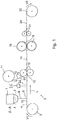
- FIG. 1 shows schematically an apparatus generally designated by the reference numeral 2 for operating a method according to the invention for producing a resilient nonwoven composite material.
- a first already prepared inelastic nonwoven fabric layer 4 in particular a PP spunbonded nonwoven layer having a basis weight of in particular 18 g / m 2 is unrolled at a speed v1 and fed in the longitudinal direction L a contact region 5, in which the elastic filaments 6 on a first side 70 of the first nonwoven fabric layer 4 are stored substantially stress-free.
- the elastic filaments 6 are inline in the illustrated case by an extruder 7 generated. It would also be conceivable, of course, to manufacture the elastic filaments 6 offline and feed them endlessly to the nonwoven composite material production process as a prefabricated material in a manner known per se, for example, from the roll.
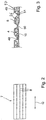
- FIG. 2 shows schematically, not to scale, the head of the extruder 7 in cross section along a line AA. Recognizable are the outlet nozzles 8 for the elastic filaments 6. The distance of the outlet nozzles is about 3 mm.
- the contact of the elastic filaments 6 with the nonwoven layer 4 in the contact region 5 is preferably carried out at a time at which the extruded elastic filaments 6 are not yet completely hardened and thus in still fused, thus still sticky state.
- particulate material 26 in the illustrated case superabsorbent material, is applied to the first side 70 of the first nonwoven fabric layer 4 by means of a schematically indicated particle doser 25.
- the prelaminate 9 consisting of the first nonwoven fabric layer 4, the elastic filaments 6 and the particulate material 26 is coated in the illustrated case with a further, second inelastic nonwoven fabric layer 10 having a first side 72 and a second side 71, in particular a PP spunbonded nonwoven layer Surface weight of in particular 18 g / m 2 , which is unrolled from a roll 11.
- the second side 71 of the second nonwoven fabric layer 10 faces the first side 70 of the first nonwoven fabric layer 4. This layer arrangement is subsequently fed to a press nip 12 formed by a pair of calender rolls 13.
- the calender roll pair 13 comprises a first smooth roll and a second, in particular heated, roll executed with island projections, so that by passing through the press nip, prelaminate 9 and second nonwoven fabric layer 10 can be obtained NOTEbindemuster, so the formation of point-like bound areas 48 and these surrounding unbonded areas 49, permanently connected.
- both first melt bonds 50 are produced directly between the first and second nonwoven fabric layers 4, 10 and also second melt bonds 51 between the first and / or second nonwoven fabric layers 4, 10 and the elastic filaments 6.
- the nonwoven fabric layers 4, 10 are arranged such that the elastic filaments 6 are positioned between the first side 70 of the first nonwoven fabric layer 4 and the second side 71 of the second nonwoven fabric layer 10.
- the unbound areas also form free spaces 47, in which a multiplicity of the particulate material 26 is accommodated.
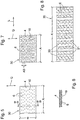
- FIG. 3 illustrates the described point bond pattern in an enlarged partial view of a cross section along a line BB of FIG. 5 ,
- FIG. 4 shows in an enlarged view the engagement region of the Dehnwalzencrues 15.
- the rollers of this Dehnwalzencrues 15 have a grooved surface 16, wherein the grooves 17 extend transversely to the longitudinal direction L.
- the groove geometry of the stretching rollers is matched to one another in such a way that they can intermesh without contact, wherein the extent of meshing and thus the extent of stretching of the material composite 14 can be regulated.
- the geometry of the grooves can be as in FIG. 4 be wavy or square beforehand or assume other conceivable configurations. As FIG.
- the stretching of the material composite 14 results in an overstretching of the nonwoven fabric layers 4, 10, since the nonwoven fabric layers 4, 10 are substantially inelastic in the longitudinal direction. This means that the nonwoven fabric layers 4, 10 experience a permanent, non-elastic deformation.
- the elastic filaments are only elastically deformed during stretching of the composite material 14.
- the nonwoven composite material 24 can be elastically deformed after the stretching process in the longitudinal direction L, the extent of the available elongation corresponding approximately to the previous extent.
- the elastic filaments 6 have a fiber thickness of 100 dtex.
- the fibers of both nonwoven layers have a fiber thickness of 4 dtex.
- FIG. 6 In schematically illustrated cross section along BB ( FIG. 6 ), the two nonwoven fabric layers 4, 10 and the sandwiched therebetween substantially tensionless arranged elastic filaments 6 can be seen.
- An illustration of the point bonding pattern and the particulate materials was presented in FIG. 6 waived.
- the dot binding pattern shows in detail FIG. 3 ,
- FIG. 7 shows this portion 30 immediately after passing through the gap of the Dehnwalzencrues 15, whereby at first an extension of the section by 100 %, ie to a length of 200 cm.
- first regions 20 of the nonwoven fabric layer 4, 10 have been overstretched more than second regions 21 of the nonwoven fabric layers 4, 10.
- First and second regions 20, 21 are arranged alternately in strip form transversely to the longitudinal direction L, as described below FIG. 8 can be seen.
- the stretching of the nonwoven fabric layers 4, 10 by 100% results in a permanent elongation (overstretching) of the nonwoven fabric layers by also 100%, the surplus nonwoven fabric material leads as it does in FIG FIG. 7 recognizable for the pleating / gathering of the nonwoven fabric layers 4, 10.
- the distance AB between the substantially parallel elastic filaments is in the transverse direction Q 3mm.
- the elastic filaments 6 thus have 0 points of intersection per cm 2 .
- the basis weight of the nonwoven fabric layers 4, 10 is in each case 18 g / m 2 .
- the weight ratio of the elastic filaments 6 to the total weight of the nonwoven composite 24 is 4.5%.
- the section 30 of the finished nonwoven composite material 24 can now be elastically stretched in the longitudinal direction L to a length of 200 cm, and therefore by 100% ( FIG. 8 ).
- the present process allows substantial material savings of up to 100%, as “stretch-bonding” would require the use of 200 cm stretchable non-woven fabric sections while the 200 cm stretchable section would require method described here requires the use of only 100 cm long nonwoven fabric sections.
- a further pair of rollers 31 serve, which fixes the web at least at its two longitudinal edges. It is advantageous to counteract the constriction at least to the extent that the constriction, ie the shortening of the web in the transverse direction Q, ie the width of the web, based on the initial width of a maximum of 50%, in particular less than 30%, more preferably less than 20% and completely especially less than 10%.
- the speed v2 is preferably selected to be higher than the speed v1 in order to provide the path with a certain amount To be able to wind up pretension. It would also be conceivable and advantageous to supply the web of the nonwoven composite material 24 directly, ie without prior winding on the roll 32, to the intended further processing, for example a high-speed machine for the production of hygiene or surgical clothing articles, in particular pantiform absorbent hygiene articles. Even so, this would be done with a web speed that is higher than the speed v1.
- the method of producing the nonwoven composite material 24 comprises the inline production of at least one, preferably both nonwoven fabric layers 4a, 10a, in particular according to the spunbonding method (spunbonding).
- spunbonding The technology of spunbonding is familiar to the person skilled in the art.
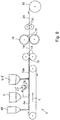
- FIG. 9 schematically shows a preferred arrangement of the manufacturing device 2 '. Instead of in FIG. 1 shown rollers 3, 11 for unwinding prefabricated nonwoven fabric layers 4, 10 are shown schematically two spinning beams 40, 41 for melt spinning of still substantially unbound spunbond layers 4a and 10a.
- the spunbonded layers 4a and 10a are preferably completely bound, as it were in one operation, by passage through the calendering roller pair 13 and simultaneously connected to each other and to the elastic filaments 6.
- FIG. 10 a disposable absorbent sanitary article 60 in pant-form, however, in the flat, extended state before the manufacturer side connection of the longitudinal side edge portions 61, with a waist opening forming a hip opening in the circumferential direction after the manufacturer side connection of the longitudinal side edge portions 61 continuously closed waist edge 62 and leg openings 63, and with longitudinal side edge portions 61 having the front part 64 and back 65.
- Front 64 and back 65 are spaced from each other in the longitudinal direction LR of the sanitary article 60 and are joined in the longitudinal direction LR of the sanitary article by an absorbent 66 bridging the distance between the front 64 and back 65.
- FIG. 11 FIG. 12 shows the disposable absorbent sanitary article 60 after the manufacturer side connection of the longitudinal side edge portions 61.
- the absorption part 66 is fixed on the body-facing side of the front and back parts.
- the absorption part 66 can as shown from a In addition, it has a liquid-impermeable backsheet and / or a liquid-permeable topsheet and a liquid-absorbing and -absorbing absorbent core arranged between them.
- the absorbent core is anyhow formed from the nonwoven composite material according to the present invention, wherein a nonwoven composite portion 91 is cut out from a nonwoven composite sheet 24, for example, cut out or punched out, wherein the longitudinal direction L of the nonwoven composite sheet 24 is substantially perpendicular to a longitudinal direction LR of the sanitary article 60.
- the extensibility of the absorbent core in the circumferential direction of the hip opening, ie perpendicular to a longitudinal direction LR of the hygiene article 60 is 120%, so that the transverse extent of the absorbent core can be doubled and thus adapted to a large number of clothing sizes.
- the front part 64 and the back part 65 are preferably made of a nonwoven composite material section 68, each made of a nonwoven composite material web, produced according to a in EP 2136753A2 has been cut out or punched out, for example, wherein the longitudinal direction L of the nonwoven composite material web is substantially perpendicular to a longitudinal direction LR of the hygiene article 60.
- the extension of the front part 64 in the longitudinal direction LR is 20 cm, that of the back part 65 is 25 cm in the longitudinal direction LR.
- the extensibility of the front and back part in the circumferential direction of the hip opening, that is perpendicular to a longitudinal direction LR of the hygiene article 60 is 100%, so that the circumference of the hip opening in a similar extent as the absorbent core extendable and thus the article a total of a variety of clothing sizes is customizable.
Landscapes
- Health & Medical Sciences (AREA)
- Engineering & Computer Science (AREA)
- Life Sciences & Earth Sciences (AREA)
- Animal Behavior & Ethology (AREA)
- Epidemiology (AREA)
- Biomedical Technology (AREA)
- Heart & Thoracic Surgery (AREA)
- Vascular Medicine (AREA)
- Veterinary Medicine (AREA)
- Public Health (AREA)
- General Health & Medical Sciences (AREA)
- Manufacturing & Machinery (AREA)
- Textile Engineering (AREA)
- Nonwoven Fabrics (AREA)
- Absorbent Articles And Supports Therefor (AREA)
- Laminated Bodies (AREA)
Claims (16)
- Procédé de fabrication d'une bande d'un matériau composite non-tissé élastique (24), comprenant les étapes suivantes :l'introduction et le transport d'une première couche de non-tissé (4, 4a) dans une direction longitudinale (L) ;l'introduction d'une pluralité de filaments élastiques (6) dans la direction longitudinale (L) ;l'introduction d'une deuxième couche de non-tissé (10, 10a) ;la réunion de la deuxième couche de non tissé (10, 10a) avec la première couche de non-tissé (4, 4a) de sorte que les filaments élastiques (6) soient agencés en sandwich entre la première couche de non-tissé (4, 4a) et la deuxième couche de non-tissé (10, 10a) pour former un agencement de couches,le passage de l'agencement de couches dans une fente de pressage d'une paire de cylindres de calandrage (13), en vue de la liaison de l'agencement de couches en un matériau composite (14) au moyen d'un motif de liaison qui comprend des zones reliées (48) et des zones non reliées (49), des premières liaisons en masse fondue (50) étant produites directement entre la première et la deuxième couche de non-tissé (4, 4a, 10, 10a) par le motif de liaison, et les zones non reliées (49) formant un espace libre (47) entre la première et la deuxième couche de non-tissé,la distension au moins en zones de la première couche de non-tissé (4, 4a) et de la deuxième couche de non-tissé dans la direction longitudinale (L) par passage du matériau composite (14) dans la fente d'une paire de cylindres d'allongement profilés engrenants (15), suite à quoi le matériau composite (14) est étiré dans la direction longitudinale (L),les filaments élastiques (6) étant agencés dans le matériau composite non-tissé de manière à être essentiellement orientés dans la direction longitudinale (L), de sorte qu'ils présentent au plus 10 points d'intersection par cm2 les uns avec les autres,caractérisé en ce qu'avant la liaison des couches de non-tissé (4, 4a, 10, 10a), des matériaux particulaires (26) sont appliqués sur la première ou la deuxième couche de non-tissé, de sorte que les matériaux particulaires (26) soient agencés après la liaison des couches de non-tissé (4, 4a, 10, 10a) en sandwich entre les couches de non-tissé (4, 4a, 10, 10a), au moins 80 % en poids des matériaux particulaires (26) présentant une taille de particule de 45 à 1 200 µm et, après la liaison des couches de non-tissé (4, 4a, 10, 10a), une pluralité des matériaux particulaires (26) étant introduite dans l'espace libre (47).
- Procédé selon la revendication 1, caractérisé en ce que le matériau composite non-tissé (24) présente dans la direction longitudinale (L) une extensibilité de 35 à 300 %, de préférence de 50 à 200 %.
- Procédé selon l'une quelconque des revendications 1 à 2, caractérisé en ce que les matériaux particulaires sont des matériaux superabsorbants ou adsorbant les odeurs.
- Procédé selon l'une quelconque des revendications 1 à 3, caractérisé en ce que le procédé comprend l'extrusion des filaments élastiques (6).
- Procédé selon l'une quelconque des revendications 1 à 4, caractérisé en ce que la bande du matériau composite non-tissé (24) est fixée au niveau de son extension transversale après la distension de la première et de la deuxième couche de non-tissé (4, 4a, 10, 10a), de manière à contrer une striction de la bande dans la direction transversale (Q).
- Procédé selon l'une quelconque des revendications 1 à 5, caractérisé en ce que des premières zones (20) de la première et de la deuxième couche de non-tissé (4, 4a, 10, 10a) sont plus fortement distendues que des deuxièmes zones (21) des couches de non-tissé (4, 4a, 10, 10a).
- Procédé selon la revendication 6, caractérisé en ce que les deuxièmes zones (21) ne sont essentiellement pas distendues.
- Procédé selon la revendication 6 ou 7, caractérisé en ce que les premières zones (20) et les deuxièmes zones (21) de la première et de la deuxième couche de non-tissé (4, 4a, 10, 10a) sont agencées en alternance en forme de bandes perpendiculairement à la direction longitudinale (L) .
- Procédé selon l'une quelconque des revendications 1 à 8, caractérisé en ce que le matériau composite (14) est étiré de 35 à 300 %, notamment de 50 à 200 %, lors du passage dans la fente d'une paire de cylindres d'allongement profilés engrenants (15) .
- Procédé selon l'une quelconque des revendications 1 à 9, caractérisé en ce que l'épaisseur des filaments élastiques (6) est de 4 à 700 dtex, notamment de 50 à 300 dtex, plus particulièrement de 100 à 200 dtex.
- Procédé selon l'une quelconque des revendications 1 à 10, caractérisé en ce que les filaments élastiques (6) contiennent un polymère thermoplastique, notamment extrudable, choisi dans le groupe constitué par les polyuréthanes, les polyesters élastiques, les polyamides élastiques, les polyoléfines élastiques, les copolymères séquencés élastiques, ou en sont constitués.
- Matériau composite non-tissé élastique (24), pouvant être fabriqué ou étant fabriqué par un procédé selon une ou plusieurs des revendications 1 à 11, le matériau composite non-tissé comprenant une première couche de non-tissé (4, 4a), une deuxième couche de non-tissé (10, 10a), une pluralité de filaments élastiques (6), ainsi que des matériaux particulaires (26), au moins 80 % en poids des matériaux particulaires (26) présentant une taille de particule de 45 à 1 200 µm, le matériau composite non-tissé (24) étant relié par un motif de liaison, qui comprend des zones reliées (48) et des zones non reliées (49) entourant celles-ci, des premières liaisons en masse fondue (50) étant formées directement entre la première et la deuxième couche de non-tissé (4, 4a, 10, 10a) par le motif de liaison,
et les zones non reliées (49) formant un espace libre (47) entre la première et la deuxième couche de non-tissé,
et une pluralité des matériaux particulaires (26) étant agencée dans cet espace libre (47), les filaments élastiques (6) étant agencés dans le matériau composite non-tissé de manière à être essentiellement orientés dans la direction longitudinale (L), de sorte qu'ils présentent au plus 10 points d'intersection par cm2 les uns avec les autres, et la première et la deuxième couche de non-tissé étant passées dans la fente d'une paire de cylindres d'allongement profilés engrenants (15), et ainsi distendues. - Matériau composite non-tissé (24) selon la revendication 12, caractérisé en ce que les filaments élastiques (6) présentent les uns par rapport aux autres dans la direction transversale un écart de 0,5 à 10 mm, de préférence de 1 à 5 mm, de préférence de 1,2 à 3,5 mm.
- Matériau composite non-tissé (24) selon l'une quelconque des revendications 12 ou 13 précédentes, caractérisé en ce que la proportion du poids des filaments élastiques (6) par rapport au poids total du matériau composite non-tissé (24) est de moins de 40 %, de préférence de moins de 30 %, de manière davantage préférée de moins de 20 %, de manière davantage préférée de moins de 15 %, de manière davantage préférée de moins de 10%, notamment toutefois de plus de 3 %.
- Matériau composite non-tissé (24) selon l'une quelconque des revendications 12 à 14 précédentes, caractérisé en ce que la première couche de non-tissé (4, 4a) et de préférence également la deuxième couche de non-tissé (10, 10a) contiennent des fibres ayant un premier titre, mesuré en dtex, ou en sont constituées, et les filaments élastiques (6) présentent un deuxième titre, le deuxième titre étant plus grand, de préférence jusqu'à 100% plus grand, de manière davantage préférée jusqu'à 200 % plus grand, de manière davantage préférée jusqu'à 500 % plus grand, notamment toutefois au plus 5 000 %, de préférence au plus 4 000 %, de manière davantage préférée au plus 3000 % plus grand que le premier titre.
- Matériau composite non-tissé (24) selon l'une quelconque des revendications 12 à 15 précédentes, caractérisé en ce que les matériaux particulaires comprennent des matériaux superabsorbants ou en sont constitués.
Applications Claiming Priority (2)
| Application Number | Priority Date | Filing Date | Title |
|---|---|---|---|
| DE102010019702A DE102010019702A1 (de) | 2010-05-07 | 2010-05-07 | Verfahren zur Herstellung eines elastischen Vliesstoffverbundmaterials |
| PCT/EP2011/001806 WO2011137962A1 (fr) | 2010-05-07 | 2011-04-12 | Procédé pour la fabrication d'un matériau composite élastique en non-tissé |
Publications (2)
| Publication Number | Publication Date |
|---|---|
| EP2566427A1 EP2566427A1 (fr) | 2013-03-13 |
| EP2566427B1 true EP2566427B1 (fr) | 2018-06-06 |
Family
ID=44123477
Family Applications (1)
| Application Number | Title | Priority Date | Filing Date |
|---|---|---|---|
| EP11715173.8A Active EP2566427B1 (fr) | 2010-05-07 | 2011-04-12 | Procédé pour la fabrication d'un matériau composite élastique en non-tissé |
Country Status (3)
| Country | Link |
|---|---|
| EP (1) | EP2566427B1 (fr) |
| DE (1) | DE102010019702A1 (fr) |
| WO (1) | WO2011137962A1 (fr) |
Families Citing this family (13)
| Publication number | Priority date | Publication date | Assignee | Title |
|---|---|---|---|---|
| US20140155853A1 (en) * | 2012-11-09 | 2014-06-05 | Curt G. Joa, Inc. | Apparatus and methods for forming laminates containing additive matter |
| DE102013002561A1 (de) | 2013-02-15 | 2014-08-21 | Innovatec Microfibre Technology Gmbh & Co. Kg | Mehrlagiges Verbundmaterial mit Superabsorber |
| US11642249B2 (en) | 2016-12-20 | 2023-05-09 | The Procter & Gamble Company | Methods and apparatuses for making elastomeric laminates with elastic strands provided with a spin finish |
| US11925537B2 (en) | 2017-09-01 | 2024-03-12 | The Procter & Gamble Company | Beamed elastomeric laminate structure, fit, and texture |
| CN111050718B (zh) | 2017-09-01 | 2021-12-14 | 宝洁公司 | 制备弹性体层合物的方法和设备 |
| US11547613B2 (en) | 2017-12-05 | 2023-01-10 | The Procter & Gamble Company | Stretch laminate with beamed elastics and formed nonwoven layer |
| US10765565B2 (en) | 2018-01-25 | 2020-09-08 | The Procter & Gamble Company | Method for manufacturing topsheets for absorbent articles |
| US11969325B2 (en) | 2018-01-25 | 2024-04-30 | The Procter & Gamble Company | Absorbent article with function-formed topsheet, and method for manufacturing |
| US11819393B2 (en) | 2019-06-19 | 2023-11-21 | The Procter & Gamble Company | Absorbent article with function-formed topsheet, and method for manufacturing |
| US12053357B2 (en) | 2019-06-19 | 2024-08-06 | The Procter & Gamble Company | Absorbent article with function-formed topsheet, and method for manufacturing |
| DE102019134100A1 (de) * | 2019-12-12 | 2021-06-17 | Rkw Se | Dehnbares Windelelement |
| JP2023516476A (ja) | 2020-03-13 | 2023-04-19 | ザ プロクター アンド ギャンブル カンパニー | ビーム式エラストマー積層体の性能及びゾーン |
| EP3960141B1 (fr) * | 2020-08-31 | 2024-02-14 | W. Pelz GmbH & Co. KG | Article d'hygiène sous la forme de culotte |
Family Cites Families (15)
| Publication number | Priority date | Publication date | Assignee | Title |
|---|---|---|---|---|
| US5219633A (en) * | 1991-03-20 | 1993-06-15 | Tuff Spun Fabrics, Inc. | Composite fabrics comprising continuous filaments locked in place by intermingled melt blown fibers and methods and apparatus for making |
| US5389095A (en) * | 1993-07-28 | 1995-02-14 | Paragon Trade Brands, Inc. | Suspended absorbent diaper article |
| DE19509953A1 (de) * | 1995-03-18 | 1996-09-19 | Hartmann Paul Ag | Kleidungsstück, insbesondere Wegwerf-Kleidungsstück zum einmaligen Gebrauch |
| US6969441B2 (en) | 2000-05-15 | 2005-11-29 | Kimberly-Clark Worldwide, Inc. | Method and apparatus for producing laminated articles |
| JP3734694B2 (ja) | 2000-09-01 | 2006-01-11 | ユニ・チャーム株式会社 | パンツ型の使い捨ておむつ |
| AR030767A1 (es) * | 2000-09-22 | 2003-09-03 | Kimberly Clark Co | Un sistema absorbente para productos para la higiene personal tales como panales, calzoncillos de aprendizaje, productos para la incontinencia, vendajes y toallas sanitarias |
| JP3732399B2 (ja) | 2000-10-16 | 2006-01-05 | ユニ・チャーム株式会社 | 使い捨て着用物品 |
| DE10057518A1 (de) * | 2000-11-21 | 2002-07-18 | Sca Hygiene Prod Gmbh | Mehrlagiges flächiges Erzeugnis, das aus Tissuepapier und/oder nicht-gewebtem Faservlies(Nonwoven) besteht |
| DE10058512A1 (de) * | 2000-11-24 | 2002-06-06 | Pelz & Co Kg W | Flüssigkeitsabsorbierendes Erzeugnis |
| US20020176964A1 (en) * | 2001-05-24 | 2002-11-28 | Koslow Technologies Corp. | Rapid absorbent structures |
| JP3957048B2 (ja) | 2001-10-24 | 2007-08-08 | ユニ・チャーム株式会社 | 使い捨ておむつ |
| DE102004053469A1 (de) | 2004-11-03 | 2006-05-04 | Paul Hartmann Ag | Schlaufenbildendes Vliesstoffmaterial für ein mechanisches Verschlussmittel |
| US20060258249A1 (en) | 2005-05-11 | 2006-11-16 | Fairbanks Jason S | Elastic laminates and process for producing same |
| US20070148433A1 (en) * | 2005-12-27 | 2007-06-28 | Mallory Mary F | Elastic laminate made with absorbent foam |
| DE102007018377A1 (de) * | 2007-04-17 | 2008-10-23 | Paul Hartmann Ag | Verfahren zur Herstellung eines elastischen Vliesstoffverbundmaterials |
-
2010
- 2010-05-07 DE DE102010019702A patent/DE102010019702A1/de not_active Withdrawn
-
2011
- 2011-04-12 WO PCT/EP2011/001806 patent/WO2011137962A1/fr not_active Ceased
- 2011-04-12 EP EP11715173.8A patent/EP2566427B1/fr active Active
Non-Patent Citations (1)
| Title |
|---|
| None * |
Also Published As
| Publication number | Publication date |
|---|---|
| EP2566427A1 (fr) | 2013-03-13 |
| WO2011137962A1 (fr) | 2011-11-10 |
| DE102010019702A1 (de) | 2011-11-10 |
Similar Documents
| Publication | Publication Date | Title |
|---|---|---|
| EP2566427B1 (fr) | Procédé pour la fabrication d'un matériau composite élastique en non-tissé | |
| EP2136753B1 (fr) | Procédé de production d'un matériau composite non-tissé élastique | |
| DE69310406T2 (de) | Zusammengesetzte elastische Bahn für Hygieneartikel, ihr Herstellungsverfahren und ihre Verwendung | |
| EP2020215B1 (fr) | Couche jetable d'incontinence absorbante | |
| EP2180865B1 (fr) | Procédé de fabrication d'articles pour incontinents sous forme de slips | |
| DE69321138T2 (de) | Verfahren und anordnung zum verkleben von aufeinanderzubewegenden folien und absorbierende gegenstände, die die verklebten materialschichten, entsprechend des verfahrens, aufweisen | |
| EP2533741B1 (fr) | Article pour incontinence en forme de culotte | |
| DE69515563T2 (de) | Verfahren zum Verbinden von einem elastischen Band mit einer kontinuierlich-transportierten, teilelastischen Unterlage | |
| EP2083782B1 (fr) | Article absorbant pour énurésie avec système de fermeture amélioré | |
| DE69700500T2 (de) | Schichtverbundmaterial, Verfahren zur Herstellung und davon abgeleitete Produkten | |
| DE69620773T2 (de) | Verfahren zum selektiven perforieren einer nichtgewebten bahn | |
| EP2337541B1 (fr) | Couche d'incontinence absorbante jetable | |
| EP2849695B1 (fr) | Article pour incontinence en forme de culotte | |
| EP2241296B1 (fr) | Article d'incontinence en forme de sous-vêtement | |
| EP2849696B1 (fr) | Article pour incontinence en forme de culotte | |
| DE102008046607A1 (de) | Inkontinenzartikel in Höschenform | |
| EP1909721B1 (fr) | Procede pour produire des garnitures elastiques jetables pour l'incontinence, absorbant des liquides organiques | |
| EP3758660A1 (fr) | Couche jetable pour incontinence dotée de sections latérales et d'un élément élastique | |
| DE202006021198U1 (de) | Absorbierender Inkontinenzartikel mit verbessertem Verschlusssystem |
Legal Events
| Date | Code | Title | Description |
|---|---|---|---|
| PUAI | Public reference made under article 153(3) epc to a published international application that has entered the european phase |
Free format text: ORIGINAL CODE: 0009012 |
|
| 17P | Request for examination filed |
Effective date: 20121031 |
|
| AK | Designated contracting states |
Kind code of ref document: A1 Designated state(s): AL AT BE BG CH CY CZ DE DK EE ES FI FR GB GR HR HU IE IS IT LI LT LU LV MC MK MT NL NO PL PT RO RS SE SI SK SM TR |
|
| DAX | Request for extension of the european patent (deleted) | ||
| REG | Reference to a national code |
Ref country code: DE Ref legal event code: R079 Ref document number: 502011014294 Country of ref document: DE Free format text: PREVIOUS MAIN CLASS: A61F0013150000 Ipc: A61F0013539000 |
|
| GRAP | Despatch of communication of intention to grant a patent |
Free format text: ORIGINAL CODE: EPIDOSNIGR1 |
|
| STAA | Information on the status of an ep patent application or granted ep patent |
Free format text: STATUS: GRANT OF PATENT IS INTENDED |
|
| RIC1 | Information provided on ipc code assigned before grant |
Ipc: A61F 13/53 20060101ALI20171127BHEP Ipc: A61F 13/539 20060101AFI20171127BHEP Ipc: A61F 13/15 20060101ALI20171127BHEP Ipc: B32B 5/26 20060101ALI20171127BHEP Ipc: A61F 13/49 20060101ALI20171127BHEP Ipc: B32B 7/12 20060101ALI20171127BHEP Ipc: B32B 5/04 20060101ALI20171127BHEP Ipc: A61F 13/537 20060101ALI20171127BHEP Ipc: B32B 5/02 20060101ALI20171127BHEP |
|
| INTG | Intention to grant announced |
Effective date: 20180103 |
|
| GRAS | Grant fee paid |
Free format text: ORIGINAL CODE: EPIDOSNIGR3 |
|
| GRAA | (expected) grant |
Free format text: ORIGINAL CODE: 0009210 |
|
| STAA | Information on the status of an ep patent application or granted ep patent |
Free format text: STATUS: THE PATENT HAS BEEN GRANTED |
|
| AK | Designated contracting states |
Kind code of ref document: B1 Designated state(s): AL AT BE BG CH CY CZ DE DK EE ES FI FR GB GR HR HU IE IS IT LI LT LU LV MC MK MT NL NO PL PT RO RS SE SI SK SM TR |
|
| REG | Reference to a national code |
Ref country code: GB Ref legal event code: FG4D Free format text: NOT ENGLISH |
|
| REG | Reference to a national code |
Ref country code: CH Ref legal event code: EP Ref country code: AT Ref legal event code: REF Ref document number: 1005242 Country of ref document: AT Kind code of ref document: T Effective date: 20180615 |
|
| REG | Reference to a national code |
Ref country code: IE Ref legal event code: FG4D Free format text: LANGUAGE OF EP DOCUMENT: GERMAN |
|
| REG | Reference to a national code |
Ref country code: DE Ref legal event code: R096 Ref document number: 502011014294 Country of ref document: DE |
|
| REG | Reference to a national code |
Ref country code: NL Ref legal event code: MP Effective date: 20180606 |
|
| REG | Reference to a national code |
Ref country code: LT Ref legal event code: MG4D |
|
| PG25 | Lapsed in a contracting state [announced via postgrant information from national office to epo] |
Ref country code: NO Free format text: LAPSE BECAUSE OF FAILURE TO SUBMIT A TRANSLATION OF THE DESCRIPTION OR TO PAY THE FEE WITHIN THE PRESCRIBED TIME-LIMIT Effective date: 20180906 Ref country code: BG Free format text: LAPSE BECAUSE OF FAILURE TO SUBMIT A TRANSLATION OF THE DESCRIPTION OR TO PAY THE FEE WITHIN THE PRESCRIBED TIME-LIMIT Effective date: 20180906 Ref country code: CY Free format text: LAPSE BECAUSE OF FAILURE TO SUBMIT A TRANSLATION OF THE DESCRIPTION OR TO PAY THE FEE WITHIN THE PRESCRIBED TIME-LIMIT Effective date: 20180606 Ref country code: LT Free format text: LAPSE BECAUSE OF FAILURE TO SUBMIT A TRANSLATION OF THE DESCRIPTION OR TO PAY THE FEE WITHIN THE PRESCRIBED TIME-LIMIT Effective date: 20180606 Ref country code: ES Free format text: LAPSE BECAUSE OF FAILURE TO SUBMIT A TRANSLATION OF THE DESCRIPTION OR TO PAY THE FEE WITHIN THE PRESCRIBED TIME-LIMIT Effective date: 20180606 Ref country code: SE Free format text: LAPSE BECAUSE OF FAILURE TO SUBMIT A TRANSLATION OF THE DESCRIPTION OR TO PAY THE FEE WITHIN THE PRESCRIBED TIME-LIMIT Effective date: 20180606 Ref country code: FI Free format text: LAPSE BECAUSE OF FAILURE TO SUBMIT A TRANSLATION OF THE DESCRIPTION OR TO PAY THE FEE WITHIN THE PRESCRIBED TIME-LIMIT Effective date: 20180606 |
|
| PG25 | Lapsed in a contracting state [announced via postgrant information from national office to epo] |
Ref country code: LV Free format text: LAPSE BECAUSE OF FAILURE TO SUBMIT A TRANSLATION OF THE DESCRIPTION OR TO PAY THE FEE WITHIN THE PRESCRIBED TIME-LIMIT Effective date: 20180606 Ref country code: HR Free format text: LAPSE BECAUSE OF FAILURE TO SUBMIT A TRANSLATION OF THE DESCRIPTION OR TO PAY THE FEE WITHIN THE PRESCRIBED TIME-LIMIT Effective date: 20180606 Ref country code: RS Free format text: LAPSE BECAUSE OF FAILURE TO SUBMIT A TRANSLATION OF THE DESCRIPTION OR TO PAY THE FEE WITHIN THE PRESCRIBED TIME-LIMIT Effective date: 20180606 Ref country code: GR Free format text: LAPSE BECAUSE OF FAILURE TO SUBMIT A TRANSLATION OF THE DESCRIPTION OR TO PAY THE FEE WITHIN THE PRESCRIBED TIME-LIMIT Effective date: 20180907 |
|
| PG25 | Lapsed in a contracting state [announced via postgrant information from national office to epo] |
Ref country code: NL Free format text: LAPSE BECAUSE OF FAILURE TO SUBMIT A TRANSLATION OF THE DESCRIPTION OR TO PAY THE FEE WITHIN THE PRESCRIBED TIME-LIMIT Effective date: 20180606 |
|
| PG25 | Lapsed in a contracting state [announced via postgrant information from national office to epo] |
Ref country code: EE Free format text: LAPSE BECAUSE OF FAILURE TO SUBMIT A TRANSLATION OF THE DESCRIPTION OR TO PAY THE FEE WITHIN THE PRESCRIBED TIME-LIMIT Effective date: 20180606 Ref country code: PL Free format text: LAPSE BECAUSE OF FAILURE TO SUBMIT A TRANSLATION OF THE DESCRIPTION OR TO PAY THE FEE WITHIN THE PRESCRIBED TIME-LIMIT Effective date: 20180606 Ref country code: IS Free format text: LAPSE BECAUSE OF FAILURE TO SUBMIT A TRANSLATION OF THE DESCRIPTION OR TO PAY THE FEE WITHIN THE PRESCRIBED TIME-LIMIT Effective date: 20181006 Ref country code: SK Free format text: LAPSE BECAUSE OF FAILURE TO SUBMIT A TRANSLATION OF THE DESCRIPTION OR TO PAY THE FEE WITHIN THE PRESCRIBED TIME-LIMIT Effective date: 20180606 Ref country code: CZ Free format text: LAPSE BECAUSE OF FAILURE TO SUBMIT A TRANSLATION OF THE DESCRIPTION OR TO PAY THE FEE WITHIN THE PRESCRIBED TIME-LIMIT Effective date: 20180606 Ref country code: RO Free format text: LAPSE BECAUSE OF FAILURE TO SUBMIT A TRANSLATION OF THE DESCRIPTION OR TO PAY THE FEE WITHIN THE PRESCRIBED TIME-LIMIT Effective date: 20180606 |
|
| PG25 | Lapsed in a contracting state [announced via postgrant information from national office to epo] |
Ref country code: SM Free format text: LAPSE BECAUSE OF FAILURE TO SUBMIT A TRANSLATION OF THE DESCRIPTION OR TO PAY THE FEE WITHIN THE PRESCRIBED TIME-LIMIT Effective date: 20180606 Ref country code: IT Free format text: LAPSE BECAUSE OF FAILURE TO SUBMIT A TRANSLATION OF THE DESCRIPTION OR TO PAY THE FEE WITHIN THE PRESCRIBED TIME-LIMIT Effective date: 20180606 |
|
| REG | Reference to a national code |
Ref country code: DE Ref legal event code: R097 Ref document number: 502011014294 Country of ref document: DE |
|
| PLBE | No opposition filed within time limit |
Free format text: ORIGINAL CODE: 0009261 |
|
| STAA | Information on the status of an ep patent application or granted ep patent |
Free format text: STATUS: NO OPPOSITION FILED WITHIN TIME LIMIT |
|
| 26N | No opposition filed |
Effective date: 20190307 |
|
| PG25 | Lapsed in a contracting state [announced via postgrant information from national office to epo] |
Ref country code: DK Free format text: LAPSE BECAUSE OF FAILURE TO SUBMIT A TRANSLATION OF THE DESCRIPTION OR TO PAY THE FEE WITHIN THE PRESCRIBED TIME-LIMIT Effective date: 20180606 Ref country code: SI Free format text: LAPSE BECAUSE OF FAILURE TO SUBMIT A TRANSLATION OF THE DESCRIPTION OR TO PAY THE FEE WITHIN THE PRESCRIBED TIME-LIMIT Effective date: 20180606 |
|
| PG25 | Lapsed in a contracting state [announced via postgrant information from national office to epo] |
Ref country code: AL Free format text: LAPSE BECAUSE OF FAILURE TO SUBMIT A TRANSLATION OF THE DESCRIPTION OR TO PAY THE FEE WITHIN THE PRESCRIBED TIME-LIMIT Effective date: 20180606 |
|
| REG | Reference to a national code |
Ref country code: CH Ref legal event code: PL |
|
| REG | Reference to a national code |
Ref country code: BE Ref legal event code: MM Effective date: 20190430 |
|
| PG25 | Lapsed in a contracting state [announced via postgrant information from national office to epo] |
Ref country code: LU Free format text: LAPSE BECAUSE OF NON-PAYMENT OF DUE FEES Effective date: 20190412 Ref country code: MC Free format text: LAPSE BECAUSE OF FAILURE TO SUBMIT A TRANSLATION OF THE DESCRIPTION OR TO PAY THE FEE WITHIN THE PRESCRIBED TIME-LIMIT Effective date: 20180606 |
|
| PG25 | Lapsed in a contracting state [announced via postgrant information from national office to epo] |
Ref country code: CH Free format text: LAPSE BECAUSE OF NON-PAYMENT OF DUE FEES Effective date: 20190430 Ref country code: LI Free format text: LAPSE BECAUSE OF NON-PAYMENT OF DUE FEES Effective date: 20190430 |
|
| PG25 | Lapsed in a contracting state [announced via postgrant information from national office to epo] |
Ref country code: BE Free format text: LAPSE BECAUSE OF NON-PAYMENT OF DUE FEES Effective date: 20190430 |
|
| PG25 | Lapsed in a contracting state [announced via postgrant information from national office to epo] |
Ref country code: TR Free format text: LAPSE BECAUSE OF FAILURE TO SUBMIT A TRANSLATION OF THE DESCRIPTION OR TO PAY THE FEE WITHIN THE PRESCRIBED TIME-LIMIT Effective date: 20180606 |
|
| PG25 | Lapsed in a contracting state [announced via postgrant information from national office to epo] |
Ref country code: IE Free format text: LAPSE BECAUSE OF NON-PAYMENT OF DUE FEES Effective date: 20190412 |
|
| PG25 | Lapsed in a contracting state [announced via postgrant information from national office to epo] |
Ref country code: PT Free format text: LAPSE BECAUSE OF FAILURE TO SUBMIT A TRANSLATION OF THE DESCRIPTION OR TO PAY THE FEE WITHIN THE PRESCRIBED TIME-LIMIT Effective date: 20181008 |
|
| REG | Reference to a national code |
Ref country code: AT Ref legal event code: MM01 Ref document number: 1005242 Country of ref document: AT Kind code of ref document: T Effective date: 20190412 |
|
| PG25 | Lapsed in a contracting state [announced via postgrant information from national office to epo] |
Ref country code: AT Free format text: LAPSE BECAUSE OF NON-PAYMENT OF DUE FEES Effective date: 20190412 |
|
| PG25 | Lapsed in a contracting state [announced via postgrant information from national office to epo] |
Ref country code: MT Free format text: LAPSE BECAUSE OF FAILURE TO SUBMIT A TRANSLATION OF THE DESCRIPTION OR TO PAY THE FEE WITHIN THE PRESCRIBED TIME-LIMIT Effective date: 20180606 Ref country code: HU Free format text: LAPSE BECAUSE OF FAILURE TO SUBMIT A TRANSLATION OF THE DESCRIPTION OR TO PAY THE FEE WITHIN THE PRESCRIBED TIME-LIMIT; INVALID AB INITIO Effective date: 20110412 |
|
| PG25 | Lapsed in a contracting state [announced via postgrant information from national office to epo] |
Ref country code: MK Free format text: LAPSE BECAUSE OF FAILURE TO SUBMIT A TRANSLATION OF THE DESCRIPTION OR TO PAY THE FEE WITHIN THE PRESCRIBED TIME-LIMIT Effective date: 20180606 |
|
| P01 | Opt-out of the competence of the unified patent court (upc) registered |
Effective date: 20230518 |
|
| PGFP | Annual fee paid to national office [announced via postgrant information from national office to epo] |
Ref country code: DE Payment date: 20250417 Year of fee payment: 15 |
|
| PGFP | Annual fee paid to national office [announced via postgrant information from national office to epo] |
Ref country code: FR Payment date: 20250422 Year of fee payment: 15 |
|
| PGFP | Annual fee paid to national office [announced via postgrant information from national office to epo] |
Ref country code: GB Payment date: 20260324 Year of fee payment: 16 |