EP2567664A2 - Méthode de réglage d'une prothèse d'essai pour le genou - Google Patents
Méthode de réglage d'une prothèse d'essai pour le genou Download PDFInfo
- Publication number
- EP2567664A2 EP2567664A2 EP12006955A EP12006955A EP2567664A2 EP 2567664 A2 EP2567664 A2 EP 2567664A2 EP 12006955 A EP12006955 A EP 12006955A EP 12006955 A EP12006955 A EP 12006955A EP 2567664 A2 EP2567664 A2 EP 2567664A2
- Authority
- EP
- European Patent Office
- Prior art keywords
- adjustable
- knee
- femoral
- medial
- femur
- Prior art date
- Legal status (The legal status is an assumption and is not a legal conclusion. Google has not performed a legal analysis and makes no representation as to the accuracy of the status listed.)
- Withdrawn
Links
- 238000000034 method Methods 0.000 title claims abstract description 102
- 210000003127 knee Anatomy 0.000 title description 196
- 210000000629 knee joint Anatomy 0.000 claims abstract description 39
- 238000005259 measurement Methods 0.000 claims abstract description 26
- 210000004872 soft tissue Anatomy 0.000 claims abstract description 14
- 210000000689 upper leg Anatomy 0.000 claims description 123
- 210000003041 ligament Anatomy 0.000 claims description 100
- 210000002303 tibia Anatomy 0.000 claims description 55
- 238000005553 drilling Methods 0.000 claims description 4
- 238000009530 blood pressure measurement Methods 0.000 claims 3
- 238000002513 implantation Methods 0.000 claims 1
- 238000011883 total knee arthroplasty Methods 0.000 description 46
- 238000001356 surgical procedure Methods 0.000 description 44
- 210000000988 bone and bone Anatomy 0.000 description 33
- 210000004439 collateral ligament Anatomy 0.000 description 28
- 238000005520 cutting process Methods 0.000 description 25
- 210000004417 patella Anatomy 0.000 description 15
- 230000008878 coupling Effects 0.000 description 14
- 238000010168 coupling process Methods 0.000 description 14
- 238000005859 coupling reaction Methods 0.000 description 14
- 230000002708 enhancing effect Effects 0.000 description 9
- 238000001125 extrusion Methods 0.000 description 8
- 239000000463 material Substances 0.000 description 6
- 238000002432 robotic surgery Methods 0.000 description 6
- 230000000295 complement effect Effects 0.000 description 5
- 230000007246 mechanism Effects 0.000 description 5
- 210000002967 posterior cruciate ligament Anatomy 0.000 description 5
- 238000013519 translation Methods 0.000 description 5
- 230000014616 translation Effects 0.000 description 5
- 239000002131 composite material Substances 0.000 description 4
- 230000006870 function Effects 0.000 description 4
- 210000003484 anatomy Anatomy 0.000 description 3
- 210000001264 anterior cruciate ligament Anatomy 0.000 description 3
- 239000003550 marker Substances 0.000 description 3
- 238000007493 shaping process Methods 0.000 description 3
- 239000013589 supplement Substances 0.000 description 3
- 229910000684 Cobalt-chrome Inorganic materials 0.000 description 2
- RTAQQCXQSZGOHL-UHFFFAOYSA-N Titanium Chemical compound [Ti] RTAQQCXQSZGOHL-UHFFFAOYSA-N 0.000 description 2
- 238000007792 addition Methods 0.000 description 2
- 239000000853 adhesive Substances 0.000 description 2
- 230000001070 adhesive effect Effects 0.000 description 2
- 229910052782 aluminium Inorganic materials 0.000 description 2
- XAGFODPZIPBFFR-UHFFFAOYSA-N aluminium Chemical compound [Al] XAGFODPZIPBFFR-UHFFFAOYSA-N 0.000 description 2
- 238000013459 approach Methods 0.000 description 2
- 206010003246 arthritis Diseases 0.000 description 2
- 239000010952 cobalt-chrome Substances 0.000 description 2
- 210000002082 fibula Anatomy 0.000 description 2
- 238000003384 imaging method Methods 0.000 description 2
- 230000001965 increasing effect Effects 0.000 description 2
- 238000013150 knee replacement Methods 0.000 description 2
- 229910052751 metal Inorganic materials 0.000 description 2
- 239000002184 metal Substances 0.000 description 2
- 150000002739 metals Chemical class 0.000 description 2
- 238000012986 modification Methods 0.000 description 2
- 230000004048 modification Effects 0.000 description 2
- 230000000399 orthopedic effect Effects 0.000 description 2
- 239000004033 plastic Substances 0.000 description 2
- 229920003023 plastic Polymers 0.000 description 2
- 239000012781 shape memory material Substances 0.000 description 2
- 239000010935 stainless steel Substances 0.000 description 2
- 229910001220 stainless steel Inorganic materials 0.000 description 2
- 239000010936 titanium Substances 0.000 description 2
- 229910052719 titanium Inorganic materials 0.000 description 2
- 238000012800 visualization Methods 0.000 description 2
- 208000006820 Arthralgia Diseases 0.000 description 1
- 208000036487 Arthropathies Diseases 0.000 description 1
- 208000005137 Joint instability Diseases 0.000 description 1
- 208000002193 Pain Diseases 0.000 description 1
- 206010033372 Pain and discomfort Diseases 0.000 description 1
- 230000002917 arthritic effect Effects 0.000 description 1
- 238000011882 arthroplasty Methods 0.000 description 1
- 210000000845 cartilage Anatomy 0.000 description 1
- 230000001684 chronic effect Effects 0.000 description 1
- 238000010276 construction Methods 0.000 description 1
- 238000011161 development Methods 0.000 description 1
- 239000000835 fiber Substances 0.000 description 1
- 230000036541 health Effects 0.000 description 1
- 230000001771 impaired effect Effects 0.000 description 1
- 230000006872 improvement Effects 0.000 description 1
- 238000003331 infrared imaging Methods 0.000 description 1
- 208000014674 injury Diseases 0.000 description 1
- 208000024765 knee pain Diseases 0.000 description 1
- 230000007774 longterm Effects 0.000 description 1
- 238000004519 manufacturing process Methods 0.000 description 1
- 238000003801 milling Methods 0.000 description 1
- 230000003287 optical effect Effects 0.000 description 1
- 238000012545 processing Methods 0.000 description 1
- 230000001681 protective effect Effects 0.000 description 1
- 238000011084 recovery Methods 0.000 description 1
- 238000002271 resection Methods 0.000 description 1
- 239000000523 sample Substances 0.000 description 1
- 238000004513 sizing Methods 0.000 description 1
- 210000001519 tissue Anatomy 0.000 description 1
- 230000008733 trauma Effects 0.000 description 1
- 238000012285 ultrasound imaging Methods 0.000 description 1
- 230000003313 weakening effect Effects 0.000 description 1
Images






Classifications
-
- A—HUMAN NECESSITIES
- A61—MEDICAL OR VETERINARY SCIENCE; HYGIENE
- A61B—DIAGNOSIS; SURGERY; IDENTIFICATION
- A61B17/00—Surgical instruments, devices or methods
- A61B17/02—Surgical instruments, devices or methods for holding wounds open, e.g. retractors; Tractors
-
- A—HUMAN NECESSITIES
- A61—MEDICAL OR VETERINARY SCIENCE; HYGIENE
- A61B—DIAGNOSIS; SURGERY; IDENTIFICATION
- A61B17/00—Surgical instruments, devices or methods
- A61B17/02—Surgical instruments, devices or methods for holding wounds open, e.g. retractors; Tractors
- A61B17/025—Joint distractors
-
- A—HUMAN NECESSITIES
- A61—MEDICAL OR VETERINARY SCIENCE; HYGIENE
- A61F—FILTERS IMPLANTABLE INTO BLOOD VESSELS; PROSTHESES; DEVICES PROVIDING PATENCY TO, OR PREVENTING COLLAPSING OF, TUBULAR STRUCTURES OF THE BODY, e.g. STENTS; ORTHOPAEDIC, NURSING OR CONTRACEPTIVE DEVICES; FOMENTATION; TREATMENT OR PROTECTION OF EYES OR EARS; BANDAGES, DRESSINGS OR ABSORBENT PADS; FIRST-AID KITS
- A61F2/00—Filters implantable into blood vessels; Prostheses, i.e. artificial substitutes or replacements for parts of the body; Appliances for connecting them with the body; Devices providing patency to, or preventing collapsing of, tubular structures of the body, e.g. stents
- A61F2/02—Prostheses implantable into the body
- A61F2/30—Joints
- A61F2/46—Special tools for implanting artificial joints
- A61F2/4657—Measuring instruments used for implanting artificial joints
-
- A—HUMAN NECESSITIES
- A61—MEDICAL OR VETERINARY SCIENCE; HYGIENE
- A61F—FILTERS IMPLANTABLE INTO BLOOD VESSELS; PROSTHESES; DEVICES PROVIDING PATENCY TO, OR PREVENTING COLLAPSING OF, TUBULAR STRUCTURES OF THE BODY, e.g. STENTS; ORTHOPAEDIC, NURSING OR CONTRACEPTIVE DEVICES; FOMENTATION; TREATMENT OR PROTECTION OF EYES OR EARS; BANDAGES, DRESSINGS OR ABSORBENT PADS; FIRST-AID KITS
- A61F2/00—Filters implantable into blood vessels; Prostheses, i.e. artificial substitutes or replacements for parts of the body; Appliances for connecting them with the body; Devices providing patency to, or preventing collapsing of, tubular structures of the body, e.g. stents
- A61F2/02—Prostheses implantable into the body
- A61F2/30—Joints
- A61F2/46—Special tools for implanting artificial joints
- A61F2/4684—Trial or dummy prostheses
-
- A—HUMAN NECESSITIES
- A61—MEDICAL OR VETERINARY SCIENCE; HYGIENE
- A61B—DIAGNOSIS; SURGERY; IDENTIFICATION
- A61B17/00—Surgical instruments, devices or methods
- A61B17/14—Surgical saws
- A61B17/15—Guides therefor
- A61B17/154—Guides therefor for preparing bone for knee prosthesis
- A61B17/155—Cutting femur
-
- A—HUMAN NECESSITIES
- A61—MEDICAL OR VETERINARY SCIENCE; HYGIENE
- A61B—DIAGNOSIS; SURGERY; IDENTIFICATION
- A61B17/00—Surgical instruments, devices or methods
- A61B17/02—Surgical instruments, devices or methods for holding wounds open, e.g. retractors; Tractors
- A61B17/025—Joint distractors
- A61B2017/0268—Joint distractors for the knee
-
- A—HUMAN NECESSITIES
- A61—MEDICAL OR VETERINARY SCIENCE; HYGIENE
- A61B—DIAGNOSIS; SURGERY; IDENTIFICATION
- A61B90/00—Instruments, implements or accessories specially adapted for surgery or diagnosis and not covered by any of the groups A61B1/00 - A61B50/00, e.g. for luxation treatment or for protecting wound edges
- A61B90/06—Measuring instruments not otherwise provided for
- A61B2090/064—Measuring instruments not otherwise provided for for measuring force, pressure or mechanical tension
-
- A—HUMAN NECESSITIES
- A61—MEDICAL OR VETERINARY SCIENCE; HYGIENE
- A61F—FILTERS IMPLANTABLE INTO BLOOD VESSELS; PROSTHESES; DEVICES PROVIDING PATENCY TO, OR PREVENTING COLLAPSING OF, TUBULAR STRUCTURES OF THE BODY, e.g. STENTS; ORTHOPAEDIC, NURSING OR CONTRACEPTIVE DEVICES; FOMENTATION; TREATMENT OR PROTECTION OF EYES OR EARS; BANDAGES, DRESSINGS OR ABSORBENT PADS; FIRST-AID KITS
- A61F2/00—Filters implantable into blood vessels; Prostheses, i.e. artificial substitutes or replacements for parts of the body; Appliances for connecting them with the body; Devices providing patency to, or preventing collapsing of, tubular structures of the body, e.g. stents
- A61F2/02—Prostheses implantable into the body
- A61F2/30—Joints
- A61F2/38—Joints for elbows or knees
-
- A—HUMAN NECESSITIES
- A61—MEDICAL OR VETERINARY SCIENCE; HYGIENE
- A61F—FILTERS IMPLANTABLE INTO BLOOD VESSELS; PROSTHESES; DEVICES PROVIDING PATENCY TO, OR PREVENTING COLLAPSING OF, TUBULAR STRUCTURES OF THE BODY, e.g. STENTS; ORTHOPAEDIC, NURSING OR CONTRACEPTIVE DEVICES; FOMENTATION; TREATMENT OR PROTECTION OF EYES OR EARS; BANDAGES, DRESSINGS OR ABSORBENT PADS; FIRST-AID KITS
- A61F2/00—Filters implantable into blood vessels; Prostheses, i.e. artificial substitutes or replacements for parts of the body; Appliances for connecting them with the body; Devices providing patency to, or preventing collapsing of, tubular structures of the body, e.g. stents
- A61F2/02—Prostheses implantable into the body
- A61F2/30—Joints
- A61F2002/30001—Additional features of subject-matter classified in A61F2/28, A61F2/30 and subgroups thereof
- A61F2002/30003—Material related properties of the prosthesis or of a coating on the prosthesis
- A61F2002/3006—Properties of materials and coating materials
- A61F2002/30092—Properties of materials and coating materials using shape memory or superelastic materials, e.g. nitinol
-
- A—HUMAN NECESSITIES
- A61—MEDICAL OR VETERINARY SCIENCE; HYGIENE
- A61F—FILTERS IMPLANTABLE INTO BLOOD VESSELS; PROSTHESES; DEVICES PROVIDING PATENCY TO, OR PREVENTING COLLAPSING OF, TUBULAR STRUCTURES OF THE BODY, e.g. STENTS; ORTHOPAEDIC, NURSING OR CONTRACEPTIVE DEVICES; FOMENTATION; TREATMENT OR PROTECTION OF EYES OR EARS; BANDAGES, DRESSINGS OR ABSORBENT PADS; FIRST-AID KITS
- A61F2/00—Filters implantable into blood vessels; Prostheses, i.e. artificial substitutes or replacements for parts of the body; Appliances for connecting them with the body; Devices providing patency to, or preventing collapsing of, tubular structures of the body, e.g. stents
- A61F2/02—Prostheses implantable into the body
- A61F2/30—Joints
- A61F2002/30001—Additional features of subject-matter classified in A61F2/28, A61F2/30 and subgroups thereof
- A61F2002/30316—The prosthesis having different structural features at different locations within the same prosthesis; Connections between prosthetic parts; Special structural features of bone or joint prostheses not otherwise provided for
- A61F2002/30329—Connections or couplings between prosthetic parts, e.g. between modular parts; Connecting elements
- A61F2002/30428—Connections or couplings between prosthetic parts, e.g. between modular parts; Connecting elements made by inserting a protrusion into a slot
-
- A—HUMAN NECESSITIES
- A61—MEDICAL OR VETERINARY SCIENCE; HYGIENE
- A61F—FILTERS IMPLANTABLE INTO BLOOD VESSELS; PROSTHESES; DEVICES PROVIDING PATENCY TO, OR PREVENTING COLLAPSING OF, TUBULAR STRUCTURES OF THE BODY, e.g. STENTS; ORTHOPAEDIC, NURSING OR CONTRACEPTIVE DEVICES; FOMENTATION; TREATMENT OR PROTECTION OF EYES OR EARS; BANDAGES, DRESSINGS OR ABSORBENT PADS; FIRST-AID KITS
- A61F2/00—Filters implantable into blood vessels; Prostheses, i.e. artificial substitutes or replacements for parts of the body; Appliances for connecting them with the body; Devices providing patency to, or preventing collapsing of, tubular structures of the body, e.g. stents
- A61F2/02—Prostheses implantable into the body
- A61F2/30—Joints
- A61F2002/30001—Additional features of subject-matter classified in A61F2/28, A61F2/30 and subgroups thereof
- A61F2002/30316—The prosthesis having different structural features at different locations within the same prosthesis; Connections between prosthetic parts; Special structural features of bone or joint prostheses not otherwise provided for
- A61F2002/30329—Connections or couplings between prosthetic parts, e.g. between modular parts; Connecting elements
- A61F2002/30476—Connections or couplings between prosthetic parts, e.g. between modular parts; Connecting elements locked by an additional locking mechanism
- A61F2002/30507—Connections or couplings between prosthetic parts, e.g. between modular parts; Connecting elements locked by an additional locking mechanism using a threaded locking member, e.g. a locking screw or a set screw
-
- A—HUMAN NECESSITIES
- A61—MEDICAL OR VETERINARY SCIENCE; HYGIENE
- A61F—FILTERS IMPLANTABLE INTO BLOOD VESSELS; PROSTHESES; DEVICES PROVIDING PATENCY TO, OR PREVENTING COLLAPSING OF, TUBULAR STRUCTURES OF THE BODY, e.g. STENTS; ORTHOPAEDIC, NURSING OR CONTRACEPTIVE DEVICES; FOMENTATION; TREATMENT OR PROTECTION OF EYES OR EARS; BANDAGES, DRESSINGS OR ABSORBENT PADS; FIRST-AID KITS
- A61F2/00—Filters implantable into blood vessels; Prostheses, i.e. artificial substitutes or replacements for parts of the body; Appliances for connecting them with the body; Devices providing patency to, or preventing collapsing of, tubular structures of the body, e.g. stents
- A61F2/02—Prostheses implantable into the body
- A61F2/30—Joints
- A61F2002/30001—Additional features of subject-matter classified in A61F2/28, A61F2/30 and subgroups thereof
- A61F2002/30316—The prosthesis having different structural features at different locations within the same prosthesis; Connections between prosthetic parts; Special structural features of bone or joint prostheses not otherwise provided for
- A61F2002/30535—Special structural features of bone or joint prostheses not otherwise provided for
- A61F2002/30537—Special structural features of bone or joint prostheses not otherwise provided for adjustable
- A61F2002/30538—Special structural features of bone or joint prostheses not otherwise provided for adjustable for adjusting angular orientation
-
- A—HUMAN NECESSITIES
- A61—MEDICAL OR VETERINARY SCIENCE; HYGIENE
- A61F—FILTERS IMPLANTABLE INTO BLOOD VESSELS; PROSTHESES; DEVICES PROVIDING PATENCY TO, OR PREVENTING COLLAPSING OF, TUBULAR STRUCTURES OF THE BODY, e.g. STENTS; ORTHOPAEDIC, NURSING OR CONTRACEPTIVE DEVICES; FOMENTATION; TREATMENT OR PROTECTION OF EYES OR EARS; BANDAGES, DRESSINGS OR ABSORBENT PADS; FIRST-AID KITS
- A61F2/00—Filters implantable into blood vessels; Prostheses, i.e. artificial substitutes or replacements for parts of the body; Appliances for connecting them with the body; Devices providing patency to, or preventing collapsing of, tubular structures of the body, e.g. stents
- A61F2/02—Prostheses implantable into the body
- A61F2/30—Joints
- A61F2002/30001—Additional features of subject-matter classified in A61F2/28, A61F2/30 and subgroups thereof
- A61F2002/30316—The prosthesis having different structural features at different locations within the same prosthesis; Connections between prosthetic parts; Special structural features of bone or joint prostheses not otherwise provided for
- A61F2002/30535—Special structural features of bone or joint prostheses not otherwise provided for
- A61F2002/30537—Special structural features of bone or joint prostheses not otherwise provided for adjustable
- A61F2002/30553—Special structural features of bone or joint prostheses not otherwise provided for adjustable for adjusting a position by translation along an axis
-
- A—HUMAN NECESSITIES
- A61—MEDICAL OR VETERINARY SCIENCE; HYGIENE
- A61F—FILTERS IMPLANTABLE INTO BLOOD VESSELS; PROSTHESES; DEVICES PROVIDING PATENCY TO, OR PREVENTING COLLAPSING OF, TUBULAR STRUCTURES OF THE BODY, e.g. STENTS; ORTHOPAEDIC, NURSING OR CONTRACEPTIVE DEVICES; FOMENTATION; TREATMENT OR PROTECTION OF EYES OR EARS; BANDAGES, DRESSINGS OR ABSORBENT PADS; FIRST-AID KITS
- A61F2/00—Filters implantable into blood vessels; Prostheses, i.e. artificial substitutes or replacements for parts of the body; Appliances for connecting them with the body; Devices providing patency to, or preventing collapsing of, tubular structures of the body, e.g. stents
- A61F2/02—Prostheses implantable into the body
- A61F2/30—Joints
- A61F2002/30001—Additional features of subject-matter classified in A61F2/28, A61F2/30 and subgroups thereof
- A61F2002/30316—The prosthesis having different structural features at different locations within the same prosthesis; Connections between prosthetic parts; Special structural features of bone or joint prostheses not otherwise provided for
- A61F2002/30535—Special structural features of bone or joint prostheses not otherwise provided for
- A61F2002/30565—Special structural features of bone or joint prostheses not otherwise provided for having spring elements
- A61F2002/30566—Helical springs
-
- A—HUMAN NECESSITIES
- A61—MEDICAL OR VETERINARY SCIENCE; HYGIENE
- A61F—FILTERS IMPLANTABLE INTO BLOOD VESSELS; PROSTHESES; DEVICES PROVIDING PATENCY TO, OR PREVENTING COLLAPSING OF, TUBULAR STRUCTURES OF THE BODY, e.g. STENTS; ORTHOPAEDIC, NURSING OR CONTRACEPTIVE DEVICES; FOMENTATION; TREATMENT OR PROTECTION OF EYES OR EARS; BANDAGES, DRESSINGS OR ABSORBENT PADS; FIRST-AID KITS
- A61F2210/00—Particular material properties of prostheses classified in groups A61F2/00 - A61F2/26 or A61F2/82 or A61F9/00 or A61F11/00 or subgroups thereof
- A61F2210/0014—Particular material properties of prostheses classified in groups A61F2/00 - A61F2/26 or A61F2/82 or A61F9/00 or A61F11/00 or subgroups thereof using shape memory or superelastic materials, e.g. nitinol
-
- A—HUMAN NECESSITIES
- A61—MEDICAL OR VETERINARY SCIENCE; HYGIENE
- A61F—FILTERS IMPLANTABLE INTO BLOOD VESSELS; PROSTHESES; DEVICES PROVIDING PATENCY TO, OR PREVENTING COLLAPSING OF, TUBULAR STRUCTURES OF THE BODY, e.g. STENTS; ORTHOPAEDIC, NURSING OR CONTRACEPTIVE DEVICES; FOMENTATION; TREATMENT OR PROTECTION OF EYES OR EARS; BANDAGES, DRESSINGS OR ABSORBENT PADS; FIRST-AID KITS
- A61F2220/00—Fixations or connections for prostheses classified in groups A61F2/00 - A61F2/26 or A61F2/82 or A61F9/00 or A61F11/00 or subgroups thereof
- A61F2220/0025—Connections or couplings between prosthetic parts, e.g. between modular parts; Connecting elements
-
- A—HUMAN NECESSITIES
- A61—MEDICAL OR VETERINARY SCIENCE; HYGIENE
- A61F—FILTERS IMPLANTABLE INTO BLOOD VESSELS; PROSTHESES; DEVICES PROVIDING PATENCY TO, OR PREVENTING COLLAPSING OF, TUBULAR STRUCTURES OF THE BODY, e.g. STENTS; ORTHOPAEDIC, NURSING OR CONTRACEPTIVE DEVICES; FOMENTATION; TREATMENT OR PROTECTION OF EYES OR EARS; BANDAGES, DRESSINGS OR ABSORBENT PADS; FIRST-AID KITS
- A61F2250/00—Special features of prostheses classified in groups A61F2/00 - A61F2/26 or A61F2/82 or A61F9/00 or A61F11/00 or subgroups thereof
- A61F2250/0004—Special features of prostheses classified in groups A61F2/00 - A61F2/26 or A61F2/82 or A61F9/00 or A61F11/00 or subgroups thereof adjustable
- A61F2250/0006—Special features of prostheses classified in groups A61F2/00 - A61F2/26 or A61F2/82 or A61F9/00 or A61F11/00 or subgroups thereof adjustable for adjusting angular orientation
-
- A—HUMAN NECESSITIES
- A61—MEDICAL OR VETERINARY SCIENCE; HYGIENE
- A61F—FILTERS IMPLANTABLE INTO BLOOD VESSELS; PROSTHESES; DEVICES PROVIDING PATENCY TO, OR PREVENTING COLLAPSING OF, TUBULAR STRUCTURES OF THE BODY, e.g. STENTS; ORTHOPAEDIC, NURSING OR CONTRACEPTIVE DEVICES; FOMENTATION; TREATMENT OR PROTECTION OF EYES OR EARS; BANDAGES, DRESSINGS OR ABSORBENT PADS; FIRST-AID KITS
- A61F2250/00—Special features of prostheses classified in groups A61F2/00 - A61F2/26 or A61F2/82 or A61F9/00 or A61F11/00 or subgroups thereof
- A61F2250/0004—Special features of prostheses classified in groups A61F2/00 - A61F2/26 or A61F2/82 or A61F9/00 or A61F11/00 or subgroups thereof adjustable
- A61F2250/0008—Special features of prostheses classified in groups A61F2/00 - A61F2/26 or A61F2/82 or A61F9/00 or A61F11/00 or subgroups thereof adjustable for adjusting a position by translation along an axis or two perpendicular axes
Definitions
- the present invention relates generally to medical/surgical devices, systems and methods. More specifically, the invention relates to devices, systems and methods for enhancing a knee surgery procedure.
- Total knee replacement surgery also referred to as total knee arthroplasty ("TKA")
- TKA total knee arthroplasty
- a recent panel of the National Institutes of Health at a Consensus Development Conference recognized that approximately 300,000 TKA surgeries are performed annually in the U.S. for end-stage knee arthritis.
- the NIH panel agreed that although advances have been made in TKA surgical devices and techniques, improved outcomes through further innovations should still be diligently pursued.
- the panel concluded that techniques for placing artificial knee prostheses, in particular, should be improved to provide better outcomes and reduce wear of the prostheses, to thus reduce the need for repeat TKA surgeries.
- the knee is generally defined as the point of articulation of the femur with the tibia. Structures that make up the knee include the distal femur, the proximal tibia, the patella, and the soft tissues within and surrounding the knee joint. Four ligaments are especially important in the functioning of the knee--the anterior cruciate ligament, the posterior cruciate ligament, the medial collateral ligament, and the lateral collateral ligament. In an arthritic knee, protective cartilage at the point of articulation of the femur with the tibia has been worn away to allow the femur to directly contact the tibia. This bone-on-bone contact causes significant pain and discomfort.
- the primary goals of a TKA procedure are to replace the distal end of the femur, the proximal end of the tibia, and often the inner surface of the patella with prosthetic parts to avoid bone-on-bone contact and provide smooth, well-aligned surfaces for joint movement, while also creating a stable knee joint that moves through a wide range of motion.
- the collateral ligaments which connect the distal femur and proximal tibia on the medial and lateral aspects of the knee, account for much of the stability and movement of the knee. If one of the collateral ligaments is too lax or too tight relative to the other collateral ligament, the knee will typically be unstable, range of motion may be limited, the patella may track improperly, and the femur and/or tibia may wear unevenly, leading to arthritis and pain.
- Balancing ligament tension during TKA surgery is complicated by the fact that the natural knee does not operate like a hinge moving about a single axis.
- the knee exhibits dynamic external rotation of the tibia relative to the femur as the knee moves from its flexed to its fully extended position.
- This automatic rotation of the tibia occurs in the opposite direction when the knee is flexed from its fully extended position to produce an internal rotation of the tibia relative to the femur.
- the natural knee exhibits a rotary laxity that allows the tibia to rotate through a limited internal and external arc, during knee flexion.
- the femur translates anteriorly and posteriorly as the tibia is being flexed about it, bringing yet another movement variable into the equation.
- the ligaments of the knee, along with the femur, tibia and patella create a truly dynamic bio-mechanism, making ligament tension balancing in TKA surgery extremely challenging.
- Many articles and studies have been devoted to ligament tension balancing in TKA, such as the following: Mihalko, WH et al., "Comparison of Ligament-Balancing Techniques During Total Knee Arthroplasty," Jnl. Bone & Jt. Surg., Vol.
- ligament release One technique for balancing collateral ligament tension during a TKA procedure involves cutting fibers of one or both ligaments to decrease ligament tensiona technique referred to as "ligament release.” Although ligament release is still commonly used, the disadvantage of this technique is that it requires actually cutting ligament tissue, thus weakening the ligament(s) and leaving less room for error if future releases or TKA procedures are required.
- the components of a total knee prosthesis may be selected and positioned to balance ligament tension. Since the femoral and tibial components of the prosthesis are attached to cut surfaces of the distal femur and proximal tibia respectively, placement and orientation of the bone cuts are also critically important. Typically, the tibial component of the prosthesis is positioned on a flat, horizontal cut surface of the proximal tibia (at a 90 degree angle relative to the long axis of the tibia), and the position and orientation of the tibial component typically do not vary greatly from knee to knee. Therefore, most of the variation in positioning of the total knee prosthesis typically occurs in positioning the femoral component and the femoral bone cuts.
- the surgeon attempts to make these femoral bone cuts to achieve a position and orientation of the femoral prosthetic component so as to optimally balance ligament tension through a full range of motion of the knee.
- ligament release it is often very challenging to position the femoral bone cuts and femoral prosthetic component to provide ideal ligament tension through the range of motion. This is due primarily to the complexity of motion about the knee, as described above, and the difficulty of placing the femoral component so as to maintain desired ligament tension through the full range of motion.
- the rotational, proximal/distal and anterior/posterior orientations and locations of the femoral component are all critical for duplicating the kinematics of the knee.
- a typical TKA procedure multiple cuts are made to the distal femur before attaching the femoral component of the prosthesis.
- Most procedures involve making a distal cut across the distal end of the femur, anterior and posterior cuts, and angled anterior and posterior chamfer cuts to help secure the femoral component solidly in place.
- orthopedic surgeons typically use a cutting block or cutting guide, used to guide a surgical saw blade or rotary tool, which is temporarily attached to the distal end of the femur. Positioning of such a cutting block, therefore, is crucial to forming well-positioned bone cuts for attachment of the femoral prosthetic component.
- U.S. Patent No. 4,501, 266 describes a knee distraction device for applying a desired amount of tension.
- Many paddle-like devices have been suggested for applying or measuring tension across a knee joint, such as the devices described in U.S. Patent Nos. 5,597, 379 ; 5,540, 696 ; 5,800, 438 ; 5,860, 980 ; 5,911, 723 ; and 6,022, 377 .
- a further state-of-the-art document is the U.S. Patent 5,733,292 which describes an arthroplasty trial prothesis alignment devices and associated matters.
- the patent describes an adjustable trial prothesis for use in accurately sizing and positioning a permanent prothesis during surgery on a human knee comprising a stationary tibial member, an adjustable tibial member movably engaged with the stationary member to adjustment ligament tension, and a femoral member, which allow flexion of the knee without removing the members.
- One proposed alternative to the cutting block technique for making bone cuts on a distal femur involves the use of robotic surgical systems for making distal femoral bone cuts.
- robotic surgery and surgical navigation a surgical saw blade or bur is still used, but the bone cuts are positioned as a result of fiducial-based or shapebased registration of the patient's anatomy.
- fiducial-based approaches fiducials, or markers are attached to pertinent anatomical structures prior to imaging. During surgery, the markers are exposed, and a sensor system conveys their location to the computer.
- shape-based approaches the shapes of anatomical structures are fitted to preoperative image data.
- the patient measurements can be obtained from a variety of sensing techniques, including tracing curves, scanning distances, or processing images, via one or some of the aforementioned sensing systems.
- sensing techniques including tracing curves, scanning distances, or processing images.
- One description of the use of robotic surgery systems in knee surgery procedures is found in Howe, RD, and Matsuoka, Y, "Robotics for Surgery, “Annu. Rev. Biomed. Eng. 1999, 01: 211-240 .
- Still other devices are very cumbersome and/or complex. Many include large parts which fit external to the knee joint and necessitate the patella being moved to the side during measurement or other phases of the TKA procedure. Furthermore, current devices typically do not reside primarily within the joint space during a surgical procedure to allow for the natural movements, rotations and translations of the tibia and femur as the knee is flexed through a range of motion. In some techniques, bone cuts are made before ligament balancing is achieved, thus often requiring re-cutting of those same bone cuts. More bone cuts mean more trauma to the patient, a longer recovery period, and less bone to work with if a second TKA is required later in life.
- the present invention provides devices for enhancing knee surgery procedures, for example total knee replacement procedures (total knee arthroplasty, "TKA").
- the devices include a stationary femoral member for removably attaching to a distal femur and an adjustable femoral member coupled with the stationary member for providing adjustability.
- the adjustable member is movably couplable with a tibial member engaged with the proximal tibia of the knee, allowing for the natural movements, rotations and translations of the tibia and femur to take place as the knee is flexed and/or extended through a range of motion, resulting in dynamic ligament tension balancing through a range of motion of the knee.
- the adjustable femoral member is adjustable to adjust tension in at least one ligament of or adjacent the knee.
- the adjustable member is separately adjustable on either side to adjust tension in the lateral and/or medial collateral ligaments adjacent the knee.
- one or more positioning features of the adjust-able member provide positioning information to help position and/or orient a cutting guide, surgical saw blade, bur, mill, surgical navigation system, robotic surgical system or the like. This positioning information is then typically used to make subsequent bone cuts to the distal femur, or to otherwise mill or shape the distal femur, so that when a femoral prosthetic component is applied, the knee has a desired stability, range of motion and/or patellar tracking.
- Devices and methods making use of the invention thus help to dynamically balance ligament tension in a knee during TKA surgery, without requiring ligament releases, to provide for a dynamically balanced knee after the surgery is complete.
- the terms "ligaments of the knee,” “ligaments in the knee,” “ligaments adjacent the knee,” and the like are all synonymous and all refer generally to any ligaments within the knee joint space, around the knee, adjacent the knee, or near the knee. These terms typically refer to the ligaments that assist in the functioning of the knee, and often the ligaments referred to are the medial collateral ligament, the lateral collateral ligament, the anterior cruciate ligament and the posterior cruciate ligament. Although the following description focuses on the use of various embodiments in TKA surgical procedures, these and/or other embodiments may suitably be used to facilitate other knee surgery procedures, other orthopedic joint surgery procedures and the like.
- a device for enhancing a surgical procedure on a knee includes at least one stationary femoral member for removably attaching to a distal femur and at least one adjustable femoral member movably coupled with the stationary member to adjust tension in at least one ligament of or adjacent the knee.
- the adjustable femoral member includes at least one positioning feature that moves relative to the distal femur as the adjustable femoral member is adjusted and thus identifies at least one position on the distal femur for facilitating completion of the surgical procedure to enhance at least one of range of motion, stability and patella tracking of the knee.
- the adjustable femoral member is movably couplable with at least one tibial member engaged with a proximal tibia to allow the knee to be moved through a range of motion without removing the femoral and tibial members.
- the stationary femoral member is engageable with a cut surface at the distal end of the distal femur.
- the tibial member is engageable with a cut surface at the proximal end of the tibia.
- the adjustable femoral member is separately adjustable on a medial side and a lateral side of the femoral member to adjust tension in the at least one ligament. Adjusting on one side relative to the other side causes the adjustable femoral member to rotate relative to the anterior and posterior aspects of the distal femur.
- Adjustment of the at least one adjustable member may be accomplished via any suitable adjustment device, components, techniques and the like.
- the adjustable member includes at least one lateral adjustment member for adjusting a lateral portion of the adjustable member and at least one medial adjustment member for adjusting a medial portion of the adjustable member.
- the adjustment members may comprise screws, pins, levers, spring-loaded members or any other suitable device or devices for conferring adjustability.
- the adjustable femoral member may be partially or completely self-adjusting, for example via one or more spring-loaded or shape memory self-adjusting members or the like.
- the at least one adjustable femoral member comprises multiple pre-adjusted femoral members, each pre-adjusted femoral member conferring different amounts of ligament tensioning and balancing about the knee.
- a surgeon may choose any one of the pre-adjusted femoral members for balancing ligament tension, and may try more than one pre-adjusted member before deciding which to use.
- adjustability may be achieved via one or more adjustable members, self-adjusting members, interchangeable pre-adjusted members, or any other suitable devices.
- a device for enhancing knee surgery may be used interchangeably for either a left knee or a right knee.
- some embodiments of a knee surgery device are not typically specific to either a left knee or a right knee, although such left-side-specific/right-side-specific devices are contemplated.
- the typical knee balancing device of the present invention is used on either knee, the terms "medial” and “lateral” should not be interpreted as limiting a device to use for either a left knee or a right knee.
- an adjustment member that is oriented laterally relative to a right knee will be oriented medially relative to a left knee.
- the at least one adjustable femoral member comprises at least one distal femoral portion for emulating the distal condylar surface of the femur and at least one posterior condylar portion to emulate posterior condylar surfaces of the femur.
- the at least one posterior condylar portion comprises a medial femoral posterior condylar portion and a lateral femoral posterior condylar portion.
- the distal femoral portion, the medial femoral posterior condylar portion and the lateral femoral posterior condylar portion are all one piece or extrusion. In other embodiments, these portions may be multiple, coupled parts.
- the distal and posterior condylar portions allow the femoral member to movably engage with the tibial member to allow the knee to be moved through a range of motion while the device is engaged with the knee.
- the distal femoral portion and posterior condylar portions of the adjustable femoral member are movably couplable with complementary depressions in the tibial member.
- the posterior condylar members comprise a medial femoral posterior condylar member slidably couplable with a medial depression of the tibial member and a lateral femoral posterior condylar member slidably couplable with a lateral depression of the tibial member.
- the at least one stationary femoral member comprises at least one distal femoral plate for coupling the distal femoral portion of the adjustable femoral member to the distal femur and at least one posterior condylar member wrapping around from the distal femoral portion to contact at least part of a medial posterior femoral condyle and a lateral posterior femoral condyle of the distal femur.
- the posterior condylar members comprise a medial femoral posterior condylar member and a lateral femoral posterior condylar member.
- the medial femoral posterior condylar portion of the adjustable femoral member is adjustable relative to the medial side of the stationary femoral member
- the lateral femoral posterior condylar portion of the adjustable femoral member is separately adjustable relative to the lateral side of the stationary femoral member.
- the distal femoral portion and posterior condylar members of the stationary femoral member may comprise one piece or extrusion.
- the stationary femoral member may comprise multiple coupled parts.
- the adjustable member may be adjustable in any number of ways, but in one embodiment it is adjustable relative to the stationary femoral member to separately adjust tension in the medial collateral ligament and/or the lateral collateral ligament of the knee. In making such adjustments, tension of other ligaments, such as the anterior and/or posterior cruciate ligaments, may also be adjusted. In some embodiments, the adjustable femoral member self-adjusts relative to the stationary femoral member to separately adjust tension in the medial collateral ligament, lateral collateral ligament and/or other ligaments.
- the at least one positioning feature moves relative to the distal femur and the stationary member.
- the post-adjustment position of the positioning feature(s) provides positional information which may then be used for completing the TKA procedure. For example, such information may be used to position a cutting guide on the distal femur for making subsequent bone cuts, to make the bone cuts themselves, to apply the femoral prosthetic component to the distal femur, and/or the like.
- the positioning features themselves may comprise any of a number of different features, such as but not limited to one or more apertures, drill bit guides, surface markers, surface features, measurement devices, embedded markers, fiducials, transponders, transceivers and/or sensors.
- two or more apertures act as the positioning features.
- these apertures rotate relative to the distal femur when the adjustable femoral member is adjusted.
- the apertures may move in an anterior and/or posterior direction relative to the distal femur.
- the apertures may provide information in a number of different ways. For example, they may act as drill bit guides to guide the drilling of holes into the distal femur for attachment of a cutting guide. Typically, such apertures extend through the adjustable member and through apertures in the stationary femoral member to the distal femur to allow for passage of the drill bit.
- fiducials, sensors, transmitters, markers or the like may be disposed in the apertures and may send or receive signals or act as markers for use by external devices.
- a robotic surgical system and/or a navigational system may use the position of such fiducials, sensors, markers or the like to help guide a surgical saw blade, bur or the like to shape the distal femur.
- the apertures may be positioned slightly asymmetrically on the adjustable member to provide for a built-in desired flexibility in the ligaments, to achieve enhanced range of motion, stability, and patellar tracking of the prosthetic knee joint, when the surgical procedure is completed.
- the at least one adjustable femoral member may be asymmetrically oriented relative to the stationary member to provide built-in desired flexibility in the ligaments, to achieve enhanced range of motion, stability, and patellar tracking of the prosthetic knee joint, when the surgical procedure is completed.
- any other suitable positioning feature or combination of features may be included in the adjustable femoral member, including any feature now known or hereafter discovered.
- the positional information derived from such positioning features may be generated and used in any suitable fashion.
- positional features may act as markers which may be queried by an external system, such as a navigational or robotic system. Positional information may then be generated and/or processed via a computer and data regarding post-adjustment positions, pressures, ligament tensions at various points in a range of motion may be provided to a user and/or to a robotic surgery device. Positional information may also be provided by mechanical means such as torque applied and adjusted to the adjustment mechanism of the adjustable member.
- any suitable positioning feature may be used and any positional information, ligament tension information and/or the like may be generated by various embodiments of the invention.
- the at least one tibial member is engageable with a cut surface of the proximal tibia.
- tibial members include but are not limited to shims, paddles, plates, bars, platforms and rods.
- a plurality of tibial shims are provided, having different thicknesses or heights, and any one of the plurality of shims may be selected for engaging with the cut surface of the proximal tibia to provide a desired amount of tension in the ligaments.
- the at least one tibial member may further comprise a plate for removably attaching to the cut surface of the proximal tibia, disposed between the cut surface and the selected tibial shim.
- the femoral and tibial members are movably coupled via force provided by at least one ligament adjacent the knee. More specifically, in one embodiment the femoral and tibial members are coupled only via force provided by ligament force. This coupling of the femoral and tibial members by ligament force may be described as "dynamic" coupling. Such coupling helps allow ligament tension to be balanced with a device that resides primarily within the joint space and also allows for the natural movements, rotations and translations of the tibia and femur to take place as the knee is flexed through a range of motion, resulting in dynamic ligament tension balancing through a range of motion of the knee.
- the femoral and tibial members when engaged with the distal femur and proximal tibia respectively, are disposed primarily within a joint space between the distal femur and the proximal tibia.
- a patella of the knee may remain approximately in its anatomical position while the femoral and tibial members are engaged and the knee is moved through the range of motion during the TKA procedure.
- the movable coupling of the femoral and tibial members allows for flexion and extension through the range of motion.
- range of motion it is meant that the knee is moved from extension to flexion and/or from flexion to extension.
- the range of motion comprises a range from approximately full extension of the knee to approximately full flexion of the knee. In other embodiments the range of motion may be narrower.
- Components of the femoral and tibial members may be manufactured from any materials or combinations of materials known in the art or hereafter discovered.
- either or both the stationary femoral member and the adjustable femoral member comprise at least one material selected from the group consisting of plastics, composites, aluminum, stainless steel, composite, cobalt-chrome, titanium, and other metals.
- the femoral and/or tibial members may further include at least one grasping member for facilitating placement and/or removal.
- a system, not forming part of the present invention, for enhancing a surgical procedure on a knee comprises at least one femoral member removably engageable with a distal femur and at least one tibial member removably engageable with a proximal tibia and movably couplable with the femoral member to allow the knee to be moved through a range of motion without removing the femoral and tibial members.
- the femoral member includes at least one stationary member for attaching to the distal femur and at least one adjustable femoral member movably coupled with the stationary member to adjust tension in at least one ligament of or adjacent the knee.
- the adjustable femoral member includes at least one positioning feature that moves relative to the distal femur as the adjustable femoral member is adjusted and thus identifies at least one position on the distal femur for facilitating completion of the surgical procedure to enhance at least one of range of motion, stability and patella tracking of the knee.
- a system may include any of the features described above.
- the at least one adjustable femoral member may include one or more adjustable members, self-adjusting members, interchangeable pre-adjusted members, or any other suitable devices for conferring adjustability.
- a method for facilitating a surgical procedure on a knee involves: engaging at least one femoral member with a distal femur to movably couple with a tibial member engaged with a proximal tibia, the femoral member comprising at least one stationary member and at least one adjustable member; moving the knee; and adjusting the adjustable femoral member to apply tension to at least one of the ligaments of or adjacent the knee, thus moving at least one positioning feature of the adjustable femoral member relative to the distal femur to identify at least one position on the distal femur for facilitating completion of the surgical procedure.
- the tibial member is engaged with a cut surface of the proximal tibia
- the femoral member is engaged with a cut surface of the distal femur.
- the tibial and femoral members may be engaged primarily within a joint space between the cut surfaces of the proximal tibia and the distal femur and are movably coupled via force provided by the at least one ligament adjacent the knee. This coupling of the femoral and tibial members by ligament force may be described as "dynamic" coupling.
- Such coupling helps allow ligament tension to be balanced with a device that resides primarily within the joint space and also allows for the natural movements, rotations and translations of the tibia and femur to take place as the knee is flexed through a range of motion, resulting in dynamic ligament tension balancing through a range of motion of the knee.
- engaging the tibial member comprises selecting the tibial member from a plurality of tibial members with different dimensions, the selected tibial member having dimensions to apply a desired amount of tension to the at least one ligament.
- Engaging the femoral member in some embodiments, involves attaching a stationary portion of the femoral member to the distal surface of the femur, with an adjustable portion of the femoral member being coupled with the stationary portion.
- moving the knee comprises sliding at least one distal femoral condylar and posterior condylar member of the femoral member along at least one complementary depression in the tibial member. More generally, moving the knee may involve sliding the tibial member along the femoral member.
- moving the knee may involve moving from approximately full extension to approximately full flexion.
- moving the knee may involve moving from approximately full flexion to approximately full extension.
- the knee may be moved between extension and flexion more than once, either before, after or during adjustment of the adjustable member.
- the method may further involve moving the knee after the adjustment step and further adjusting the adjustable femoral member. Any combination of knee movements and adjustments is contemplated within the scope of the method.
- a method may involve moving the knee through a range of motion to help determine the desired ligament tension balance in the knee during the range of motion.
- at least the moving and adjusting steps are performed with the patella of the knee located approximately its anatomic position over the knee.
- Adjusting the adjustable femoral member in some methods involves adjusting tension in at least one of a medial collateral ligament and a lateral collateral ligament.
- adjusting the adjustable femoral member comprises enlarging a joint space between at least part of the distal femur and proximal tibia to apply tension to at least one of the ligaments.
- Enlarging the joint space may involve enlarging the space primarily at a medial side of the knee or primarily at a lateral side of the knee in various methods.
- enlarging the space applies tension to the medial collateral ligament, the lateral collateral ligament or both.
- adjusting the adjustable femoral member comprises moving an adjustable portion of the femoral member relative to a stationary portion of the femoral member.
- adjusting the adjustable femoral member may involve adjusting at least one adjustment member on the adjustable femoral member.
- one or more screws may be turned to adjust the adjustable femoral member.
- adjusting the adjustable femoral member causes at least one positioning feature on the femoral member to be oriented to the distal end of the femur, the positioning feature(s) helping determine a position for applying a cutting guide to the distal femur, for orienting a surgical navigation system sensor, for locating and or making subsequent bone cuts, or the like.
- the at least one positioning feature comprises one or more apertures for guiding a drill bit for forming one or more drill holes used to attach a cutting guide, for dynamically orienting a bone cutting device, for dynamic placement of fiducials or markers to orient a surgical navigation system sensor to the distal end of the femur, or the like.
- the least one aperture comprises at least two apertures
- adjusting the adjustable femoral member causes the at least two apertures to rotate relative to one another over the distal end of the femur.
- the apertures may rotate about an axis approximately corresponding to a long axis of the distal femur.
- adjusting the adjustable femoral member may cause the at least one aperture to move in an anterior or posterior direction relative to the distal femur.
- any suitable positioning features may be included on the adjustable member, and any methods for acquiring or using positional information may be employed.
- the method may further involve: placing at least one hole or slot in the distal end of the femur, using the at least one aperture to guide a tool bit; removing the adjustable femoral member from the distal femur; using the at least one hole for attaching a cutting guide to the distal end of the femur; and making at least one cut on the distal end of the femur.
- a method may further include attaching a femoral prosthesis component to the cut distal end of the femur and attaching a tibial prosthesis component to a cut surface of the proximal tibia.
- the method may further include sending one or more signals from the at least one positioning device to a distal femur cutting device and cutting the distal femur with the cutting device, based on the signal(s).
- signals for example, may be used as part of a navigational system and/or robotic surgical system.
- FIG. 1A is a frontal view of a knee in extension, with a knee balancing device according to one embodiment of the invention in place within the knee joint;
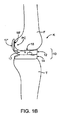
- FIG. 1B is a side view of the knee in extension and knee balancing device shown in FIG. 1A ;
- FIG. 1C is a side view of the knee and knee balancing device shown in FIGS. 1A and 1B , with the knee in a position of flexion;
- FIG. 1D is a side view of the knee and knee balancing device shown in FIGS. 1A-1C , with the knee balancing device adjusted to achieve a desired ligament tension balance according to one embodiment of the invention;
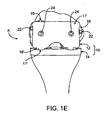
- FIG. 1E is a frontal view of the knee and knee balancing device shown in FIGS 1A-1D , with the knee balancing device adjusted to achieve a desired ligament tension balance according to one embodiment of the invention;
- FIG. 2A is a frontal view of a knee balancing device according to one embodiment of the present invention.
- FIG. 2B is a rear view of the knee balancing device shown in FIG. 2A ;
- FIG. 2C is a side view of the knee balancing device shown in FIGS. 2A and 2B ;
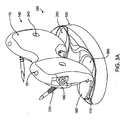
- FIG. 3A is a front-perspective view of a knee balancing device according to one embodiment of the present invention.
- FIG. 3B is a rear-perspective view of the knee balancing device shown in FIG. 2A ;
- FIG. 3C is a front-perspective view a knee balancing device according to another embodiment of the present invention.
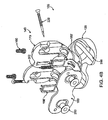
- FIG. 4A is a front-perspective, exploded view of a knee balancing device according to one embodiment of the present invention.
- FIG. 4B is a rear-perspective, exploded view of the knee balancing device shown in FIG. 4A .
- the present invention provides devices primarily intended for enhancing total knee arthroplasty (TKA) surgical procedures. Although these devices, systems and methods are used primarily in TKA, however, some embodiments may be used to enhance other knee surgery procedures.
- TKA total knee arthroplasty
- devices, systems and methods of the invention generally help a surgeon to balance ligament tension in a knee during a TKA procedure and thereby help the surgeon perform the TKA so as to achieve a desired ligament balance when the surgery is complete.
- the devices of the invention generally facilitate dynamic balancing of ligaments of the knee, such that these ligaments remain balanced through a range of motion about the knee. Oftentimes, such dynamic balancing helps create a prosthetic knee that has a desirable level of stability, patellar tracking and range of motion.
- a frontal view of a right knee K is shown in extension, with a knee balancing system 10 in place within the knee joint space.
- the anatomical components of the knee K that are pertinent to this description include a distal femur F, a proximal tibia T, a medial collateral ligament MCL, and a lateral collateral ligament LCL.
- Also labeled is the proximal fibula Fi, to which the LCL attaches.
- the knee K is shown without a patella or cruciate ligaments for clarity, but many embodiments may be used while the patella is in its anatomical position on the anterior aspect of the knee K.
- Fig. 1A a frontal view of a right knee K is shown in extension, with a knee balancing system 10 in place within the knee joint space.
- the anatomical components of the knee K that are pertinent to this description include a distal femur F, a proximal tibia T, a medial collateral ligament
- a portion of the distal end of the distal femur F and a portion of the proximal end of the proximal tibia T have been cut or shaved off, to create level surfaces on which to place femoral member 12 and a tibial member 14, respectively, of dynamic knee balancing system 10.
- a knee balancing device may be provided as only a femoral member, for example to be used with off-the-shelf tibial trial inserts.
- knee balancing system 10 comprising femoral member 12 and tibial member 14 is provided.
- femoral member 12 is adjustable to adjust tension in the MCL, the LCL, or both. Adjustability may be achieved by any suitable means, some of which are described in more detail above and below.
- one or more adjustment members 16, which may comprise screws, pins, levers, spring-loaded mechanisms, shape memory materials or the like, are coupled with femoral member 12 to provide adjustability.
- adjustment members 16 may be used for separately adjusting femoral member 12 on either side to separately adjust tension in the MCL or the LCL.
- femoral member 12, tibial member 14 and any of their component parts may be manufactured from any suitable material now known or hereafter discovered.
- femoral member 12 and/or tibial member 14 in some embodiments may be manufactured from one or more plastics, composites and/or metals, such as aluminum, stainless steel, composite, cobalt-chrome, titanium, or the like. These or any other suitable material(s) and combinations of materials may be used in various embodiments.
- knee balancing system 10 is typically disposed primarily within the joint space of knee K during a TKA surgery, thus providing for more convenient manipulation of the knee, anatomical positioning of the patella during surgery and the like.
- a knee balancing device or system could be engaged with the knee at a location external to the knee joint.
- the device may comprise an externally applied frame that performs the same functions as the devices described herein.
- some or all of the knee balancing device may be located external to the knee joint, thus not fitting within the knee joint space during the surgical procedure.
- femoral member 12 suitably comprises a stationary femoral member 18 and an adjustable femoral member 17.
- Stationary femoral member 18 is typically removably attached to a surface of the distal femur F, often a cut surface at the distal end of the distal femur F, and adjustable femoral member 17 is coupled with stationary femoral member 18.
- Stationary femoral member 18 includes at least one stationary posterior condylar member 18' extending posteriorly to contact at least one of the medial and lateral posterior condyles PC of the distal femur F.
- stationary femoral member 18 includes two stationary posterior condylar portions 18', one for each posterior condyle PC.
- adjustable femoral member 17 suitably includes one or more (in embodiments according to the invention two) adjustable posterior condylar portions 17' extending posteriorly emulate the two posterior condyles PC.
- posterior condylar portions 17', 18' allow femoral member 12 to be adjusted to balance ligament tension in the knee K and also allow knee balancing system 10 to remain in place within the joint space while the knee K is moved through a range of motion.
- stationary femoral member 18 and stationary posterior condylar portions 18' may be either multiple, couple parts or may be one piece or extrusion.
- adjustable femoral member 17 and adjustable posterior condylar portions 17' are all one piece or extrusion in some embodiments, but may alternative comprise multiple coupled parts.
- adjustable femoral member 17 is movably engageable with tibial member 14 to allow knee balancing system 10 to remain in place within the knee joint space while the knee K is moved through a range of motion.
- adjustable femoral member 17 and tibial member 14 are movably engaged with one another via force applied by the ligaments of the knee K, especially the MCL and LCL.
- femoral member 12 and tibial member 14 are two separate components which are brought together into a movable/slidable coupling by ligament force.
- ligament force may not be used for coupling femoral member 12 with tibial member 14, and instead a passive mechanical coupling may be used.
- knee balancing system 10 is shown with the knee K in flexion. It can be seen here that stationary posterior condylar member 18' and adjustable posterior condylar member 17' are slidably engageable with complementary grooves 20 on tibial member 14. Thus, knee balancing system 10 is movable/slidable through approximately a full range of motion of the knee K, from full extension to full flexion and vice versa.
- adjustable femoral member 17 is separately adjustable on either side to separately adjust tension in the MCL and/or the LCL.
- adjustment(s) may be achieved by any suitable means, such as manual adjustment via a screw or other adjustment member, self-adjustment via a spring-loaded mechanism, or the like.
- adjustment member 16 is adjusted to move adjustable femoral member 17 relative to stationary femoral member 18.
- adjustable femoral member 17 rotates relative to stationary femoral member 18, thus causing adjustable posterior condylar portion 17' to move away from stationary posterior condylar portion 18'.
- adjustable femoral member 17 may be caused to move anteriorly or posteriorly relative to stationary femoral member 18.
- adjustable femoral member 17 may be adjusted rotationally as well as in an anterior/posterior orientation.
- Adjustable femoral member 17 includes at least one positioning feature for providing positional information for facilitation the TKA procedure.
- the positioning feature(s) may include any of a number of different features, such as apertures, surface markers, embedded markers, fiducials, transmitters, transponders, transceivers, sensors and/or the like. These positioning features provide positional information that can then be used to facilitate the TKA procedure.
- apertures may act as drill bit guides for drilling holes to apply a cutting guide to the femur F to make subsequent bone cuts.
- apertures may contain fiducials or markers to provide information to a navigational system and/or robotic surgical system for positioning subsequent bone cuts or otherwise shaping the distal femur F via milling, burring or the like.
- Various embodiments have been fully described above, and any suitable positioning features and positional information may be used in various embodiments.
- adjustable femoral member 17 includes two apertures 24 as positioning features.
- Apertures 24 extend through adjustable femoral member 17 and also through stationary femoral member 18 such that apertures 24 may be used to guide a drill bit to form holes in the distal femur F.
- apertures 24 can serve any of a number of other functions, such as carrying fiducials, sensors, markers or the like.
- corresponding apertures in stationary femoral member 18 are large enough to allow for movement of apertures 24 on adjustable femoral member 17 such that apertures 24 extend all the way to the cut surface of the distal femur F.
- apertures 24 are used to drill holes for a cutting guide
- the balancing system 10 is removed, holes are used to attach a cutting guide to the distal femur F, and the cutting guide used to make subsequent bone cuts on the femur F.
- a femoral prosthetic component is typically placed on the cut distal end of the femur.
- positioning information may be used to orient/ position bone cuts by some other means (not using a cutting guide), such by guiding a saw blade, rotary cutter, bur or the like to make the actual bone cuts.
- position information may be used to guide a robotic surgical system, to enhance the procedure via a navigational system, or the like.
- FIG. 1E Also shown in Fig. 1E are two stationary femoral member attachment screws 22. These screws are used to removably attach stationary femoral member 18 to the distal femur F. Any other suitable attachment device(s) may be used instead of or in addition to attachment screws 22 to attach stationary femoral member 18 to the distal femur F For example, adhesives, pins and/or the like may be used in some embodiments.
- Figs. 2A-2C are anterior, posterior and side views, respectively, of an embodiment of femoral member 12. These figures show two screw holes 23 used for attaching stationary femoral member 18 to a distal femur. They also show drill guide apertures 24 which are formed by bushings 26 coupled with adjustable femoral member 17 and stationary femoral member 18. Bushings 26 move along slots 27 in stationary femoral member 17 as femoral member 12 is adjusted.
- Knee balancing system 100 suitably includes a femoral member 140 and a tibial member 120.
- Femoral member 140 may further include an adjustable femoral member 170 having adjustable posterior condylar members 170' and a stationary femoral member 180 having stationary posterior condylar members 180'.
- adjustable femoral member 170 and adjustable posterior condylar member 170' will be one unitary piece or extrusion, while in other embodiments they may be two or more coupled pieces.
- stationary femoral member 180 and stationary posterior condylar member 180' may comprise a one-piece construction or multiple pieces coupled together.
- stationary femoral member 180 comprises a distal femoral plate coupled with two stationary posterior condylar members 180'. Any suitable configuration, combination or manufacturing process may be used in various embodiments.
- Femoral member 140 may further include adjustment screw holes 161 for ingress/egress of adjustment screws (not shown), attachment screws 220, drill guide apertures 240, bushings 260, slots 270 and/or any other features described previously above.
- Tibial member 120 may suitably include two grooves 200 or depressions to provide for slidable coupling with femoral member 140. Generally, any of the features described above may be applied to knee balancing system 100.
- System 300 includes a tibial member 320 and a femoral member 340, the femoral member 340 including an adjustable member 370 coupled with a stationary member 380.
- Adjustable member 370 includes two adjustable posterior condylar members 370'
- stationary member 380 includes two stationary posterior condylar members 380'.
- one adjustment member 360a has been adjusted to move adjustable posterior condylar portion 370' away from stationary posterior condylar member 380' on that side, which would increase the height of the joint space on that side if the device were in a knee joint, and would also rotate adjustable femoral member 370 slightly relative to the distal femur.
- the pictured embodiment includes two apertures 345 as positioning features, and disposed within apertures 345 are two fiducials 390 (or markers, sensors or the like) for providing positional information to a computer navigation system or robotic surgery system. Such positional information, for example, may include a dynamically balanced orientation of the knee to make subsequent bone cuts on the femur F.
- stationary femoral member 180 may comprise three coupled parts--a stationary femoral member distal plate 180 and two stationary posterior condylar members 180'. Such parts may be coupled by any suitable means, such as pressure fitting, sandwiching condylar members 180' between plate 180 and adjustable femoral member 170, screws, adhesives, and/or the like.
- stationary femoral member 180 may comprise one unitary piece or extrusion.
- Bias spring may be incorporated into femoral member 140 to allow for rotation of adjustable femoral member 170 relative to stationary femoral member 180.
- Alternative embodiments of knee balancing system 100 may include any other suitable mechanism for allowing such rotation, anterior-posterior adjustment, and/or any other suitable adjustment(s).
- a femoral member is typically removably engaged with a distal femur of a knee.
- the distal femur will have been cut to form a surface for engaging the femoral member, but this is not required in all embodiments.
- a tibial member is also engaged with a proximal tibia of the knee, usually a cut horizontal surface of the tibia.
- This tibial member may be provided as part of a dynamic knee balancing system or may be an off-the-shelf tibial trial insert, in various embodiments. In different methods, the tibial member may be placed before the femoral member or vice versa.
- the femoral and tibial members are engaged with the femur and tibia while the knee is in full or nearly full extension, though in alternative embodiments they may be placed in flexion.
- the height, thickness, or overall shape of the tibial member may often be selected to provide a desired amount and balance of ligament tension while the knee is in extension.
- the knee is then moved from extension to flexion, and the femoral member is adjusted to adjust tension in the MCL, LCL, posterior cruciate ligament and/or other ligaments to achieve a desired ligament balance in flexion.
- the knee may then be moved through a range of motion, and one or more subsequent adjustments may be made to the femoral member to adjust and balance ligament tension through the range of motion.
- Such adjustments and movements may, in some methods, be possible while the patella of the knee remains in approximately its normal anatomical position over the knee. This is advantageous because patellar tracking, an important determinant of knee function, may be assessed and adjusted during the TKA procedure.
- the goal of the surgeon will be to achieve dynamic balancing of ligament tension through the range of motion of the knee.
- the positioning feature(s) on the adjustable femoral member provide positional information to a surgeon, computer, robotic system and/or the like, to help facilitate completion of the TKA procedure.
- subsequent cuts or drilling, burring or other shaping methods
- cuts/shaping determining how the femoral prosthetic component of the artificial knee joint will be positioned and oriented on the distal femur.
- the femoral prosthetic component is then placed accordingly.
- any of the devices, systems and methods described above may be incorporated with any suitable knee surgery procedures or systems currently used or discovered in the future.
- inventive devices, systems and methods may be readily incorporated with any number of different visualization, navigation and/or robotic systems for performing a knee surgery, such as image-guided systems for performing, planning or enhancing a TKA procedure, robotic surgery systems such as the da Vinci® Surgical System provided by Intuitive Surgical, Inc. (Sunnyvale, CA), or the like.
- Any suitable imaging or visualization modality and technique may be used with various embodiments of the devices, systems and methods of the invention, such as but not limited to infrared or ultrasound imaging.
- a measurement device may be included to measure ligament tension
- a display may additionally be included to display an amount of measured ligament tension to a user.
- an amount of ligament tension may be "dialed in” or otherwise entered into the device such that the device will apply that amount of ligament tension within the knee.
- Still other embodiments may include both tension measurement and tension dial-in capabilities.
- a further embodiment comprises a device for a surgical procedure on a knee, the device comprising:
- a further device has at least one stationary femoral member engageable with a cut surface at the distal end of the distal femur.
- the adjustment member comprises at least one lateral adjustment member for adjusting a lateral portion of the adjustable member; and at least one medial adjustment member for adjusting a medial portion of the adjustable member.
- the lateral and medial adjustment members are selected from the group consisting of screws, pins, levers, rods, springs, spring-loaded mechanisms and shape memory materials.
- distal femoral portion, the medial femoral posterior condylar portion, and the lateral femoral posterior condylar portion all comprise one piece or extrusion.
- the at least one stationary femoral member comprises at least one distal femoral plate (180) for coupling the distal femoral portion of the adjustable femoral member to the distal femur; and the posterior condylar member extends from the distal femoral portion to contact at least part of a medial posterior femoral condyle and a lateral posterior femoral condyle of the distal femur.
- distal femoral plate, the medial femoral posterior condylar member, and the lateral femoral posterior condylar member all comprise one piece or extrusion.
- the medial femoral posterior condylar portion of the adjustable femoral member is adjustable relative to the medial femoral posterior condylar member of the stationary femoral member
- the lateral femoral posterior condylar portion of the adjustable femoral member is separately adjustable relative to the lateral femoral posterior condylar member of the stationary femoral member.
- the adjustable femoral member is adjustable relative to the stationary femoral member to separately adjust tension in at least one of a medial collateral ligament and a lateral collateral ligament of the knee.
- the at least one adjustable femoral member comprises at least one adjusting member.
- the at least one self-adjusting member comprises at least one of a spring-loaded member and a shape memory member.
- the at least one adjusting member adjusts relative to the stationary femoral member to adjust tension in at least one of a medial collateral ligament and a lateral collateral ligament of the knee.
- the at least one adjustable femoral member comprises a plurality of pre-adjusted femoral members, each having a different asymmetry relative to the stationary member, wherein one of the pre-adjusted members is selected to provide a desired range of motion when the surgical procedure is completed.
- the adjustable femoral member comprises a positioning feature that identifies at least one position on the distal femur selected from the group consisting of an aperture, a drill bit guide, a surface marker, a measurement device, an embedded marker, a fiducial, a transponder, a transceiver and a sensor.
- the positioning feature permits at least one of placing a cutting guide on the distal femur for making bone cuts, making one or more bone cuts on the distal femur, and positioning a prosthetic femoral component on the distal femur.
- the positioning feature comprises at least two apertures (24).
- each of the at least two apertures is configured to guide a drill bit to form a hole in the distal femur for attaching a cutting guide to the femur.
- each of the at least two apertures are configured to receive at least one of a marker, a fiducial, a transponder, a transceiver or a sensor.
- the at least two apertures extend through the adjustable femoral member and through apertures in the stationary femoral member to the distal femur to provide access to the distal femur.
- the at least two apertures are positioned slightly asymmetrically on the adjustable femoral member .
- At least one of the adjustable femoral member and the adjustment member is asymmetrically oriented relative to the stationary member.
- one of the multiple adjustable femoral members is selected to provide a desired range of motion when the surgical procedure is completed.
- the tibial member comprises at least one shim, paddle, plate, bar, platform or rod.
- the tibial member comprises a plurality of tibial shims having different thicknesses or heights, any one of the plurality of shims may be selected for engaging with the cut surface of the proximal tibia to provide a desired amount of tension in the ligaments.
- the tibial member further comprises a plate for removably attaching to the cut surface of the proximal tibia, disposed between the cut surface and the selected tibial shim.
- the femoral member and the tibial member are configured to be movably coupled via force provided by the at least one ligament of or adjacent the knee.
- the femoral and tibial members when engaged with the distal femur and proximal tibia respectively, are disposed primarily within a joint space between the distal femur and the proximal tibia.
- a patella of the knee remains approximately in its anatomical position while the femoral and tibial members are engaged and the knee is moved through the range of motion.
Landscapes
- Health & Medical Sciences (AREA)
- Life Sciences & Earth Sciences (AREA)
- Surgery (AREA)
- General Health & Medical Sciences (AREA)
- Transplantation (AREA)
- Biomedical Technology (AREA)
- Heart & Thoracic Surgery (AREA)
- Engineering & Computer Science (AREA)
- Orthopedic Medicine & Surgery (AREA)
- Animal Behavior & Ethology (AREA)
- Veterinary Medicine (AREA)
- Public Health (AREA)
- Nuclear Medicine, Radiotherapy & Molecular Imaging (AREA)
- Molecular Biology (AREA)
- Physical Education & Sports Medicine (AREA)
- Medical Informatics (AREA)
- Cardiology (AREA)
- Oral & Maxillofacial Surgery (AREA)
- Vascular Medicine (AREA)
- Biophysics (AREA)
- Prostheses (AREA)
- Surgical Instruments (AREA)
Applications Claiming Priority (4)
| Application Number | Priority Date | Filing Date | Title |
|---|---|---|---|
| US10/773,608 US7442196B2 (en) | 2004-02-06 | 2004-02-06 | Dynamic knee balancer |
| US10/973,936 US7578821B2 (en) | 2004-02-06 | 2004-10-25 | Dynamic knee balancer with pressure sensing |
| EP05712204A EP1718232B1 (fr) | 2004-02-06 | 2005-02-01 | Dispositif d'equilibrage dynamique du genou |
| US11/149,944 US7837691B2 (en) | 2004-02-06 | 2005-06-09 | Dynamic knee balancer with opposing adjustment mechanism |
Related Parent Applications (1)
| Application Number | Title | Priority Date | Filing Date |
|---|---|---|---|
| EP05712204.6 Division | 2005-02-01 |
Publications (1)
| Publication Number | Publication Date |
|---|---|
| EP2567664A2 true EP2567664A2 (fr) | 2013-03-13 |
Family
ID=37872305
Family Applications (2)
| Application Number | Title | Priority Date | Filing Date |
|---|---|---|---|
| EP05712204A Expired - Lifetime EP1718232B1 (fr) | 2004-02-06 | 2005-02-01 | Dispositif d'equilibrage dynamique du genou |
| EP12006955A Withdrawn EP2567664A2 (fr) | 2004-02-06 | 2005-02-01 | Méthode de réglage d'une prothèse d'essai pour le genou |
Family Applications Before (1)
| Application Number | Title | Priority Date | Filing Date |
|---|---|---|---|
| EP05712204A Expired - Lifetime EP1718232B1 (fr) | 2004-02-06 | 2005-02-01 | Dispositif d'equilibrage dynamique du genou |
Country Status (5)
| Country | Link |
|---|---|
| US (5) | US7442196B2 (fr) |
| EP (2) | EP1718232B1 (fr) |
| AU (1) | AU2005213315B2 (fr) |
| CA (1) | CA2555283C (fr) |
| WO (3) | WO2005076834A2 (fr) |
Cited By (3)
| Publication number | Priority date | Publication date | Assignee | Title |
|---|---|---|---|---|
| US8715290B2 (en) | 2004-02-06 | 2014-05-06 | Synvasive Technology, Inc. | Dynamic knee balancer with pressure sensing |
| US8758355B2 (en) | 2004-02-06 | 2014-06-24 | Synvasive Technology, Inc. | Dynamic knee balancer with pressure sensing |
| US11357644B2 (en) | 2011-10-24 | 2022-06-14 | Synvasive Technology, Inc. | Knee balancing devices, systems and methods |
Families Citing this family (364)
| Publication number | Priority date | Publication date | Assignee | Title |
|---|---|---|---|---|
| US7468075B2 (en) | 2001-05-25 | 2008-12-23 | Conformis, Inc. | Methods and compositions for articular repair |
| US7534263B2 (en) | 2001-05-25 | 2009-05-19 | Conformis, Inc. | Surgical tools facilitating increased accuracy, speed and simplicity in performing joint arthroplasty |
| US8083745B2 (en) | 2001-05-25 | 2011-12-27 | Conformis, Inc. | Surgical tools for arthroplasty |
| US7635390B1 (en) | 2000-01-14 | 2009-12-22 | Marctec, Llc | Joint replacement component having a modular articulating surface |
| EP1389980B1 (fr) | 2001-05-25 | 2011-04-06 | Conformis, Inc. | Methodes et compositions d'arthroplastie |
| US8439926B2 (en) * | 2001-05-25 | 2013-05-14 | Conformis, Inc. | Patient selectable joint arthroplasty devices and surgical tools |
| US7708741B1 (en) | 2001-08-28 | 2010-05-04 | Marctec, Llc | Method of preparing bones for knee replacement surgery |
| US9155544B2 (en) * | 2002-03-20 | 2015-10-13 | P Tech, Llc | Robotic systems and methods |
| US20060147332A1 (en) | 2004-12-30 | 2006-07-06 | Howmedica Osteonics Corp. | Laser-produced porous structure |
| EP1418013B1 (fr) | 2002-11-08 | 2005-01-19 | Howmedica Osteonics Corp. | Surface poreuse produite par laser |
| US7837690B2 (en) | 2003-01-15 | 2010-11-23 | Biomet Manufacturing Corp. | Method and apparatus for less invasive knee resection |
| US8551100B2 (en) | 2003-01-15 | 2013-10-08 | Biomet Manufacturing, Llc | Instrumentation for knee resection |
| US7789885B2 (en) | 2003-01-15 | 2010-09-07 | Biomet Manufacturing Corp. | Instrumentation for knee resection |
| US7887542B2 (en) | 2003-01-15 | 2011-02-15 | Biomet Manufacturing Corp. | Method and apparatus for less invasive knee resection |
| US7559931B2 (en) | 2003-06-09 | 2009-07-14 | OrthAlign, Inc. | Surgical orientation system and method |
| US8057482B2 (en) | 2003-06-09 | 2011-11-15 | OrthAlign, Inc. | Surgical orientation device and method |
| EP1684672B1 (fr) | 2003-10-17 | 2020-03-25 | Smith & Nephew, Inc. | Implant articulaire a flexion elevee |
| US7488324B1 (en) | 2003-12-08 | 2009-02-10 | Biomet Manufacturing Corporation | Femoral guide for implanting a femoral knee prosthesis |
| US7641660B2 (en) * | 2004-03-08 | 2010-01-05 | Biomet Manufacturing Corporation | Method, apparatus, and system for image guided bone cutting |
| US7955357B2 (en) | 2004-07-02 | 2011-06-07 | Ellipse Technologies, Inc. | Expandable rod system to treat scoliosis and method of using the same |
| US20060142670A1 (en) * | 2004-12-29 | 2006-06-29 | Disilvestro Mark R | System and method for determining patient follow-up subsequent to an orthopaedic procedure |
| US7849751B2 (en) * | 2005-02-15 | 2010-12-14 | Clemson University Research Foundation | Contact sensors and methods for making same |
| US8979853B2 (en) * | 2005-02-17 | 2015-03-17 | Lucas Anissian | Method and system for determining resection guidelines for joint replacement surgical procedures |
| US7361196B2 (en) | 2005-02-22 | 2008-04-22 | Stryker Spine | Apparatus and method for dynamic vertebral stabilization |
| US20110213221A1 (en) | 2005-03-29 | 2011-09-01 | Roche Martin W | Method for Detecting Body Parameters |
| CA2600613C (fr) * | 2005-03-29 | 2016-10-25 | Martin Roche | Capteur de detection de parametres corporels et procede de detection de parametres corporels |
| US11457813B2 (en) | 2005-03-29 | 2022-10-04 | Martin W. Roche | Method for detecting body parameters |
| US20100249791A1 (en) * | 2009-03-26 | 2010-09-30 | Martin Roche | System and method for orthopedic measurement and alignment |
| US7615055B2 (en) * | 2005-03-31 | 2009-11-10 | Depuy Products, Inc. | Method and apparatus for use in balancing ligaments of a knee |
| US20060241638A1 (en) * | 2005-04-08 | 2006-10-26 | Zimmer Technology, Inc. | Anatomical landmark guide |
| US7695479B1 (en) | 2005-04-12 | 2010-04-13 | Biomet Manufacturing Corp. | Femoral sizer |
| US9301845B2 (en) | 2005-06-15 | 2016-04-05 | P Tech, Llc | Implant for knee replacement |
| JP4522343B2 (ja) * | 2005-08-26 | 2010-08-11 | ナカシマプロペラ株式会社 | 関節置換施術時に使用されるテンサー |
| DE102005044044B3 (de) * | 2005-09-14 | 2007-06-14 | Hjs Gelenk System Gmbh | Vorrichtung und Verfahren zur Bestimmung und Einstellung der optimalen Relativposition einer Funktionsfläche und dementsprechend gestalteten Implantat-Komponenten eines künstlichen Gelenkes |
| DE102005049851A1 (de) * | 2005-10-18 | 2007-04-26 | Plus Orthopedics Ag | Bänderspanngerät |
| US8109973B2 (en) | 2005-10-31 | 2012-02-07 | Stryker Spine | Method for dynamic vertebral stabilization |
| US8728387B2 (en) * | 2005-12-06 | 2014-05-20 | Howmedica Osteonics Corp. | Laser-produced porous surface |
| WO2007070859A2 (fr) * | 2005-12-15 | 2007-06-21 | Zimmer, Inc. | Prothese de genou femorale distale |
| EP2649951A3 (fr) | 2006-02-06 | 2013-12-25 | ConforMIS, Inc. | Dispositifs d'arthroplastie articulaire et outils chirurgicaux selectionnables par le patient |
| US8623026B2 (en) | 2006-02-06 | 2014-01-07 | Conformis, Inc. | Patient selectable joint arthroplasty devices and surgical tools incorporating anatomical relief |
| US9345548B2 (en) | 2006-02-27 | 2016-05-24 | Biomet Manufacturing, Llc | Patient-specific pre-operative planning |
| US8377066B2 (en) | 2006-02-27 | 2013-02-19 | Biomet Manufacturing Corp. | Patient-specific elbow guides and associated methods |
| US8608748B2 (en) | 2006-02-27 | 2013-12-17 | Biomet Manufacturing, Llc | Patient specific guides |
| US9907659B2 (en) | 2007-04-17 | 2018-03-06 | Biomet Manufacturing, Llc | Method and apparatus for manufacturing an implant |
| US9918740B2 (en) | 2006-02-27 | 2018-03-20 | Biomet Manufacturing, Llc | Backup surgical instrument system and method |
| US8407067B2 (en) | 2007-04-17 | 2013-03-26 | Biomet Manufacturing Corp. | Method and apparatus for manufacturing an implant |
| US9339278B2 (en) | 2006-02-27 | 2016-05-17 | Biomet Manufacturing, Llc | Patient-specific acetabular guides and associated instruments |
| US8241293B2 (en) | 2006-02-27 | 2012-08-14 | Biomet Manufacturing Corp. | Patient specific high tibia osteotomy |
| US8092465B2 (en) | 2006-06-09 | 2012-01-10 | Biomet Manufacturing Corp. | Patient specific knee alignment guide and associated method |
| US7967868B2 (en) | 2007-04-17 | 2011-06-28 | Biomet Manufacturing Corp. | Patient-modified implant and associated method |
| US9113971B2 (en) | 2006-02-27 | 2015-08-25 | Biomet Manufacturing, Llc | Femoral acetabular impingement guide |
| US8591516B2 (en) | 2006-02-27 | 2013-11-26 | Biomet Manufacturing, Llc | Patient-specific orthopedic instruments |
| US10278711B2 (en) | 2006-02-27 | 2019-05-07 | Biomet Manufacturing, Llc | Patient-specific femoral guide |
| US8133234B2 (en) | 2006-02-27 | 2012-03-13 | Biomet Manufacturing Corp. | Patient specific acetabular guide and method |
| US20150335438A1 (en) | 2006-02-27 | 2015-11-26 | Biomet Manufacturing, Llc. | Patient-specific augments |
| US9289253B2 (en) | 2006-02-27 | 2016-03-22 | Biomet Manufacturing, Llc | Patient-specific shoulder guide |
| US8535387B2 (en) | 2006-02-27 | 2013-09-17 | Biomet Manufacturing, Llc | Patient-specific tools and implants |
| US8070752B2 (en) | 2006-02-27 | 2011-12-06 | Biomet Manufacturing Corp. | Patient specific alignment guide and inter-operative adjustment |
| US8298237B2 (en) | 2006-06-09 | 2012-10-30 | Biomet Manufacturing Corp. | Patient-specific alignment guide for multiple incisions |
| US7780672B2 (en) * | 2006-02-27 | 2010-08-24 | Biomet Manufacturing Corp. | Femoral adjustment device and associated method |
| US8568487B2 (en) | 2006-02-27 | 2013-10-29 | Biomet Manufacturing, Llc | Patient-specific hip joint devices |
| US8858561B2 (en) | 2006-06-09 | 2014-10-14 | Blomet Manufacturing, LLC | Patient-specific alignment guide |
| US8282646B2 (en) * | 2006-02-27 | 2012-10-09 | Biomet Manufacturing Corp. | Patient specific knee alignment guide and associated method |
| US8473305B2 (en) | 2007-04-17 | 2013-06-25 | Biomet Manufacturing Corp. | Method and apparatus for manufacturing an implant |
| US8608749B2 (en) | 2006-02-27 | 2013-12-17 | Biomet Manufacturing, Llc | Patient-specific acetabular guides and associated instruments |
| US8864769B2 (en) | 2006-02-27 | 2014-10-21 | Biomet Manufacturing, Llc | Alignment guides with patient-specific anchoring elements |
| US9173661B2 (en) | 2006-02-27 | 2015-11-03 | Biomet Manufacturing, Llc | Patient specific alignment guide with cutting surface and laser indicator |
| US8603180B2 (en) | 2006-02-27 | 2013-12-10 | Biomet Manufacturing, Llc | Patient-specific acetabular alignment guides |
| US8323290B2 (en) * | 2006-03-03 | 2012-12-04 | Biomet Manufacturing Corp. | Tensor for use in surgical navigation |
| US7704253B2 (en) | 2006-03-06 | 2010-04-27 | Howmedica Osteonics Corp. | Single use resection guide |
| US8337508B2 (en) | 2006-03-20 | 2012-12-25 | Perception Raisonnement Action En Medecine | Distractor system |
| US8231631B2 (en) * | 2006-03-20 | 2012-07-31 | Perception Raisonnement Action En Medecine | Distractor system |
| US20070233267A1 (en) * | 2006-03-29 | 2007-10-04 | Farid Amirouche | Application of neural networks to prosthesis fitting and balancing in joints |
| US8141437B2 (en) | 2006-03-29 | 2012-03-27 | Ortho Sensing Technologies, Llc | Force monitoring system |
| US20070239165A1 (en) * | 2006-03-29 | 2007-10-11 | Farid Amirouche | Device and method of spacer and trial design during joint arthroplasty |
| US20100191068A1 (en) * | 2006-04-07 | 2010-07-29 | University Of Florida Research Foundation, Inc. | Spacer block with sensor for total knee arthroplasty |
| US8635082B2 (en) * | 2006-05-25 | 2014-01-21 | DePuy Synthes Products, LLC | Method and system for managing inventories of orthopaedic implants |
| US9795399B2 (en) | 2006-06-09 | 2017-10-24 | Biomet Manufacturing, Llc | Patient-specific knee alignment guide and associated method |
| US7678115B2 (en) * | 2006-06-21 | 2010-03-16 | Howmedia Osteonics Corp. | Unicondylar knee implants and insertion methods therefor |
| US7686812B2 (en) * | 2006-06-30 | 2010-03-30 | Howmedica Osteonics Corp. | Method for setting the rotational position of a femoral component |
| US8147861B2 (en) * | 2006-08-15 | 2012-04-03 | Howmedica Osteonics Corp. | Antimicrobial implant |
| PT2526876E (pt) * | 2006-10-11 | 2015-08-05 | Ignace Ghijselings | Dispositivo para a instalação da articulação do joelho da prótese do fémur |
| US7862502B2 (en) | 2006-10-20 | 2011-01-04 | Ellipse Technologies, Inc. | Method and apparatus for adjusting a gastrointestinal restriction device |
| US9168155B2 (en) * | 2007-03-01 | 2015-10-27 | Zimmer, Inc. | Modular femoral provisional |
| US8062364B1 (en) * | 2007-04-27 | 2011-11-22 | Knee Creations, Llc | Osteoarthritis treatment and device |
| WO2008157412A2 (fr) | 2007-06-13 | 2008-12-24 | Conformis, Inc. | Guide d'incision chirurgical |
| US20090005708A1 (en) * | 2007-06-29 | 2009-01-01 | Johanson Norman A | Orthopaedic Implant Load Sensor And Method Of Interpreting The Same |
| US20090018544A1 (en) * | 2007-07-13 | 2009-01-15 | Zimmer, Inc. | Method and apparatus for soft tissue balancing |
| WO2009014718A1 (fr) | 2007-07-24 | 2009-01-29 | Porex Corporation | Objets poreux frittés au laser |
| US8265949B2 (en) | 2007-09-27 | 2012-09-11 | Depuy Products, Inc. | Customized patient surgical plan |
| US8357111B2 (en) | 2007-09-30 | 2013-01-22 | Depuy Products, Inc. | Method and system for designing patient-specific orthopaedic surgical instruments |
| US9173662B2 (en) | 2007-09-30 | 2015-11-03 | DePuy Synthes Products, Inc. | Customized patient-specific tibial cutting blocks |
| US9786022B2 (en) | 2007-09-30 | 2017-10-10 | DePuy Synthes Products, Inc. | Customized patient-specific bone cutting blocks |
| US8398645B2 (en) | 2007-09-30 | 2013-03-19 | DePuy Synthes Products, LLC | Femoral tibial customized patient-specific orthopaedic surgical instrumentation |
| WO2011106399A1 (fr) | 2010-02-25 | 2011-09-01 | Depuy Products, Inc. | Blocs de coupe osseuse spécifiques à un patient personnalisés |
| US20090105756A1 (en) | 2007-10-23 | 2009-04-23 | Marc Richelsoph | Spinal implant |
| US20090112263A1 (en) | 2007-10-30 | 2009-04-30 | Scott Pool | Skeletal manipulation system |
| EP2242453B1 (fr) | 2008-02-20 | 2018-11-28 | Mako Surgical Corp. | Planification des implants utilisant des informations sur des mouvements articulaires capturés et corrigés |
| US11202707B2 (en) | 2008-03-25 | 2021-12-21 | Nuvasive Specialized Orthopedics, Inc. | Adjustable implant system |
| US8377073B2 (en) * | 2008-04-21 | 2013-02-19 | Ray Wasielewski | Method of designing orthopedic implants using in vivo data |
| US8197489B2 (en) | 2008-06-27 | 2012-06-12 | Depuy Products, Inc. | Knee ligament balancer |
| CA2731436C (fr) | 2008-07-24 | 2019-09-24 | OrthAlign, Inc. | Systemes et procedes pour le remplacement d'une articulation |
| NZ591206A (en) | 2008-08-20 | 2013-06-28 | Synvasive Technology Inc | Sensing force during partial and total knee replacement surgery |
| EP2158879A1 (fr) * | 2008-09-01 | 2010-03-03 | MMK Consulting GmbH | Maquette pour arthroplastie totale du genou |
| US9603629B2 (en) | 2008-09-09 | 2017-03-28 | Intelligent Implant Systems Llc | Polyaxial screw assembly |
| ES2750264T3 (es) | 2008-09-10 | 2020-03-25 | Orthalign Inc | Sistemas de cirugía de la cadera |
| US20100094305A1 (en) * | 2008-10-13 | 2010-04-15 | Arvin Chang | Spinal distraction system |
| US11241257B2 (en) | 2008-10-13 | 2022-02-08 | Nuvasive Specialized Orthopedics, Inc. | Spinal distraction system |
| US9439656B2 (en) | 2008-10-30 | 2016-09-13 | Synvasive Technology, Inc. | System for positioning a cutting guide in knee surgery |
| US20100198275A1 (en) | 2008-10-30 | 2010-08-05 | Synvavise Technology, Inc. | Force sensing distal femoral alignment system and method of use |
| US8845641B2 (en) | 2008-10-31 | 2014-09-30 | Zimmer, Inc. | Expandable arthroplasty plates |
| US8382756B2 (en) | 2008-11-10 | 2013-02-26 | Ellipse Technologies, Inc. | External adjustment device for distraction device |
| WO2010088262A2 (fr) * | 2009-01-27 | 2010-08-05 | University Of Washington | Système de surveillance d'un membre prothétique |
| US8197490B2 (en) | 2009-02-23 | 2012-06-12 | Ellipse Technologies, Inc. | Non-invasive adjustable distraction system |
| US8820173B2 (en) | 2009-03-06 | 2014-09-02 | Andrew C. Clark | Contact sensors and methods for making same |
| US8551023B2 (en) * | 2009-03-31 | 2013-10-08 | Depuy (Ireland) | Device and method for determining force of a knee joint |
| US8597210B2 (en) | 2009-03-31 | 2013-12-03 | Depuy (Ireland) | System and method for displaying joint force data |
| US8721568B2 (en) | 2009-03-31 | 2014-05-13 | Depuy (Ireland) | Method for performing an orthopaedic surgical procedure |
| US8740817B2 (en) * | 2009-03-31 | 2014-06-03 | Depuy (Ireland) | Device and method for determining forces of a patient's joint |
| US8556830B2 (en) * | 2009-03-31 | 2013-10-15 | Depuy | Device and method for displaying joint force data |
| BRPI1014917A2 (pt) | 2009-04-16 | 2016-04-19 | Conformis Inc | "dispositivos de artroplastia de junta específica para páciente para reparo de ligamento" |
| US9622792B2 (en) | 2009-04-29 | 2017-04-18 | Nuvasive Specialized Orthopedics, Inc. | Interspinous process device and method |
| KR101950377B1 (ko) * | 2009-05-29 | 2019-02-21 | 스미스 앤드 네퓨, 인크. | 슬관절 치환술을 수행하기 위한 방법 및 장치 |
| US9095275B2 (en) * | 2009-06-03 | 2015-08-04 | Andrew C. Clark | Contact sensors and methods for making same |
| US8679186B2 (en) | 2010-06-29 | 2014-03-25 | Ortho Sensor Inc. | Hermetically sealed prosthetic component and method therefor |
| US8516884B2 (en) | 2010-06-29 | 2013-08-27 | Orthosensor Inc. | Shielded prosthetic component |
| US8661893B2 (en) * | 2010-06-29 | 2014-03-04 | Orthosensor Inc. | Prosthetic component having a compliant surface |
| US8707782B2 (en) | 2009-06-30 | 2014-04-29 | Orthosensor Inc | Prosthetic component for monitoring synovial fluid and method |
| US9462964B2 (en) | 2011-09-23 | 2016-10-11 | Orthosensor Inc | Small form factor muscular-skeletal parameter measurement system |
| US8746062B2 (en) | 2010-06-29 | 2014-06-10 | Orthosensor Inc. | Medical measurement system and method |
| US8701484B2 (en) | 2010-06-29 | 2014-04-22 | Orthosensor Inc. | Small form factor medical sensor structure and method therefor |
| US8421479B2 (en) * | 2009-06-30 | 2013-04-16 | Navisense | Pulsed echo propagation device and method for measuring a parameter |
| US8714009B2 (en) | 2010-06-29 | 2014-05-06 | Orthosensor Inc. | Shielded capacitor sensor system for medical applications and method |
| US9839390B2 (en) | 2009-06-30 | 2017-12-12 | Orthosensor Inc. | Prosthetic component having a compliant surface |
| US8427176B2 (en) * | 2009-06-30 | 2013-04-23 | Orthosensor Inc | Pulsed waveguide sensing device and method for measuring a parameter |
| US20110160616A1 (en) * | 2009-06-30 | 2011-06-30 | Orthosensor | System and method for orthopedic load and location sensing |
| US20100331679A1 (en) * | 2009-06-30 | 2010-12-30 | Orthosensor | Pulsed echo sensing device and method for an orthopedic joint |
| US8826733B2 (en) | 2009-06-30 | 2014-09-09 | Orthosensor Inc | Sensored prosthetic component and method |
| US8696756B2 (en) | 2010-06-29 | 2014-04-15 | Orthosensor Inc. | Muscular-skeletal force, pressure, and load measurement system and method |
| US8720270B2 (en) | 2010-06-29 | 2014-05-13 | Ortho Sensor Inc. | Prosthetic component for monitoring joint health |
| US9259179B2 (en) | 2012-02-27 | 2016-02-16 | Orthosensor Inc. | Prosthetic knee joint measurement system including energy harvesting and method therefor |
| US20100331738A1 (en) * | 2009-06-30 | 2010-12-30 | Orthosensor | Integrated sensor and interconnect for measuring a parameter of the muscular-skeletal system |
| US9339226B2 (en) | 2010-01-21 | 2016-05-17 | OrthAlign, Inc. | Systems and methods for joint replacement |
| US8118815B2 (en) | 2009-07-24 | 2012-02-21 | OrthAlign, Inc. | Systems and methods for joint replacement |
| FR2948274B1 (fr) * | 2009-07-24 | 2011-09-16 | Tornier Sa | Instrumentation chirurgicale pour la preparation a la pose d'une prothese de genou |
| US10869771B2 (en) | 2009-07-24 | 2020-12-22 | OrthAlign, Inc. | Systems and methods for joint replacement |
| US10307256B2 (en) | 2009-07-27 | 2019-06-04 | Biomet Manufacturing, Llc | Knee replacement system and method for enabling natural knee movement |
| DE102009028503B4 (de) | 2009-08-13 | 2013-11-14 | Biomet Manufacturing Corp. | Resektionsschablone zur Resektion von Knochen, Verfahren zur Herstellung einer solchen Resektionsschablone und Operationsset zur Durchführung von Kniegelenk-Operationen |
| KR101792472B1 (ko) | 2009-09-04 | 2017-10-31 | 누베이시브 스페셜라이즈드 오소페딕스, 인크. | 뼈 성장 기구 및 방법 |
| FR2949660B1 (fr) * | 2009-09-08 | 2013-09-27 | Carine Genneson | Dispositif d'aide a la mise en place d'une prothese totale de genou |
| AU2010292136B2 (en) * | 2009-09-10 | 2013-07-04 | Advita Ortho, LLC. | Alignment guides for use in computer assisted orthopedic surgery to prepare a bone element for an implant |
| WO2011049637A1 (fr) * | 2009-10-23 | 2011-04-28 | Synvasive Technology, Inc. | Équilibrage de genou pour des interventions de révision |
| US9095352B2 (en) | 2009-11-02 | 2015-08-04 | Synvasive Technology, Inc. | Bone positioning device and method |
| WO2011053332A1 (fr) * | 2009-11-02 | 2011-05-05 | Synvasive Technology, Inc. | Appareil et méthode d'arthroplastie du genou |
| US8828013B2 (en) * | 2009-11-02 | 2014-09-09 | Synvasive Technology, Inc. | Bone positioning device and method |
| US10149722B2 (en) | 2010-02-25 | 2018-12-11 | DePuy Synthes Products, Inc. | Method of fabricating customized patient-specific bone cutting blocks |
| EP2538855A4 (fr) | 2010-02-25 | 2016-08-03 | Depuy Products Inc | Blocs de coupe tibiale spécifiques à un patient personnalisés |
| US8632547B2 (en) | 2010-02-26 | 2014-01-21 | Biomet Sports Medicine, Llc | Patient-specific osteotomy devices and methods |
| US20130023794A1 (en) * | 2010-03-26 | 2013-01-24 | Orthosensor Inc. | Distractor having a capacitive sensor array for measuring a force, pressure, or load applied by the muscular-skeletal system and method therefor |
| US9161717B2 (en) * | 2011-09-23 | 2015-10-20 | Orthosensor Inc. | Orthopedic insert measuring system having a sealed cavity |
| US9332943B2 (en) | 2011-09-23 | 2016-05-10 | Orthosensor Inc | Flexible surface parameter measurement system for the muscular-skeletal system |
| US8496704B2 (en) | 2010-04-13 | 2013-07-30 | Smith & Nephew, Inc. | Systems and methods for tensioning ligaments and other soft tissues |
| GB201006716D0 (en) * | 2010-04-22 | 2010-06-09 | Depuy Ireland | A composite trial prosthesis |
| US8979758B2 (en) | 2010-06-29 | 2015-03-17 | Orthosensor Inc | Sensing module for orthopedic load sensing insert device |
| US8939030B2 (en) | 2010-06-29 | 2015-01-27 | Orthosensor Inc | Edge-detect receiver for orthopedic parameter sensing |
| US9248043B2 (en) | 2010-06-30 | 2016-02-02 | Ellipse Technologies, Inc. | External adjustment device for distraction device |
| EP3332748B1 (fr) | 2010-07-24 | 2019-08-14 | Zimmer, Inc. | Composants tibiaux asymétriques pour une prothèse de genou |
| US8628580B2 (en) | 2010-07-24 | 2014-01-14 | Zimmer, Inc. | Tibial prosthesis |
| US8734488B2 (en) | 2010-08-09 | 2014-05-27 | Ellipse Technologies, Inc. | Maintenance feature in magnetic implant |
| WO2012034033A1 (fr) | 2010-09-10 | 2012-03-15 | Zimmer, Inc. | Composants tibiaux facilitant le mouvement pour une prothèse du genou |
| EP2588032B1 (fr) | 2010-09-10 | 2014-10-22 | Zimmer GmbH | Prothèse fémorale à rainure rotulienne |
| US9271744B2 (en) | 2010-09-29 | 2016-03-01 | Biomet Manufacturing, Llc | Patient-specific guide for partial acetabular socket replacement |
| US9968376B2 (en) | 2010-11-29 | 2018-05-15 | Biomet Manufacturing, Llc | Patient-specific orthopedic instruments |
| US9597090B2 (en) | 2010-12-17 | 2017-03-21 | Zimmer, Inc. | Cut guide attachment for use in tibial prosthesis systems |
| US8603101B2 (en) | 2010-12-17 | 2013-12-10 | Zimmer, Inc. | Provisional tibial prosthesis system |
| WO2012112396A2 (fr) | 2011-02-14 | 2012-08-23 | Ellipse Technologies, Inc. | Dispositif et méthode de traitement d'os fracturés |
| CH704563B1 (de) * | 2011-02-21 | 2015-04-30 | Microport Orthopedics Inc | Patientenspezifischer Proberepositionsblock. |
| US9241745B2 (en) | 2011-03-07 | 2016-01-26 | Biomet Manufacturing, Llc | Patient-specific femoral version guide |
| US8715289B2 (en) | 2011-04-15 | 2014-05-06 | Biomet Manufacturing, Llc | Patient-specific numerically controlled instrument |
| US9675400B2 (en) | 2011-04-19 | 2017-06-13 | Biomet Manufacturing, Llc | Patient-specific fracture fixation instrumentation and method |
| US8668700B2 (en) | 2011-04-29 | 2014-03-11 | Biomet Manufacturing, Llc | Patient-specific convertible guides |
| US8956364B2 (en) | 2011-04-29 | 2015-02-17 | Biomet Manufacturing, Llc | Patient-specific partial knee guides and other instruments |
| CH704354B1 (it) | 2011-05-17 | 2012-07-13 | Medacta Int Sa | Attrezzature per allineare e bilanciare i legamenti del ginocchio. |
| US8771347B2 (en) * | 2011-05-23 | 2014-07-08 | California Institute Of Technology | Accommodating intraocular lens |
| US8715345B2 (en) * | 2011-05-23 | 2014-05-06 | California Institute Of Technology | Accommodating intraocular lens |
| US8532807B2 (en) | 2011-06-06 | 2013-09-10 | Biomet Manufacturing, Llc | Pre-operative planning and manufacturing method for orthopedic procedure |
| US9084618B2 (en) | 2011-06-13 | 2015-07-21 | Biomet Manufacturing, Llc | Drill guides for confirming alignment of patient-specific alignment guides |
| US8551179B2 (en) * | 2011-06-16 | 2013-10-08 | Zimmer, Inc. | Femoral prosthesis system having provisional component with visual indicators |
| US9308095B2 (en) | 2011-06-16 | 2016-04-12 | Zimmer, Inc. | Femoral component for a knee prosthesis with improved articular characteristics |
| US9060868B2 (en) | 2011-06-16 | 2015-06-23 | Zimmer, Inc. | Femoral component for a knee prosthesis with bone compacting ridge |
| US8932365B2 (en) | 2011-06-16 | 2015-01-13 | Zimmer, Inc. | Femoral component for a knee prosthesis with improved articular characteristics |
| US8968412B2 (en) | 2011-06-30 | 2015-03-03 | Depuy (Ireland) | Trialing system for a knee prosthesis and method of use |
| US8764760B2 (en) | 2011-07-01 | 2014-07-01 | Biomet Manufacturing, Llc | Patient-specific bone-cutting guidance instruments and methods |
| US20130001121A1 (en) | 2011-07-01 | 2013-01-03 | Biomet Manufacturing Corp. | Backup kit for a patient-specific arthroplasty kit assembly |
| US8597365B2 (en) | 2011-08-04 | 2013-12-03 | Biomet Manufacturing, Llc | Patient-specific pelvic implants for acetabular reconstruction |
| US9295497B2 (en) | 2011-08-31 | 2016-03-29 | Biomet Manufacturing, Llc | Patient-specific sacroiliac and pedicle guides |
| US9066734B2 (en) | 2011-08-31 | 2015-06-30 | Biomet Manufacturing, Llc | Patient-specific sacroiliac guides and associated methods |
| GB201115411D0 (en) | 2011-09-07 | 2011-10-19 | Depuy Ireland | Surgical instrument |
| US9307929B2 (en) | 2011-09-12 | 2016-04-12 | Scipps Health | Apparatus and methods for balancing a joint |
| US8784339B2 (en) | 2011-09-23 | 2014-07-22 | Orthosensor Inc | Spinal instrument for measuring load and position of load |
| US9839374B2 (en) | 2011-09-23 | 2017-12-12 | Orthosensor Inc. | System and method for vertebral load and location sensing |
| US8945133B2 (en) | 2011-09-23 | 2015-02-03 | Orthosensor Inc | Spinal distraction tool for load and position measurement |
| EP2757947B1 (fr) * | 2011-09-23 | 2019-04-10 | Orthosensor | Dispositif de mesure de charge et d'emplacement de vertèbres |
| US9414940B2 (en) | 2011-09-23 | 2016-08-16 | Orthosensor Inc. | Sensored head for a measurement tool for the muscular-skeletal system |
| US8911448B2 (en) | 2011-09-23 | 2014-12-16 | Orthosensor, Inc | Device and method for enabling an orthopedic tool for parameter measurement |
| US9386993B2 (en) | 2011-09-29 | 2016-07-12 | Biomet Manufacturing, Llc | Patient-specific femoroacetabular impingement instruments and methods |
| US10743794B2 (en) | 2011-10-04 | 2020-08-18 | Nuvasive Specialized Orthopedics, Inc. | Devices and methods for non-invasive implant length sensing |
| US9301812B2 (en) | 2011-10-27 | 2016-04-05 | Biomet Manufacturing, Llc | Methods for patient-specific shoulder arthroplasty |
| WO2013062848A1 (fr) | 2011-10-27 | 2013-05-02 | Biomet Manufacturing Corporation | Guides glénoïdes spécifiques d'un patient |
| US9554910B2 (en) | 2011-10-27 | 2017-01-31 | Biomet Manufacturing, Llc | Patient-specific glenoid guide and implants |
| KR20130046337A (ko) | 2011-10-27 | 2013-05-07 | 삼성전자주식회사 | 멀티뷰 디바이스 및 그 제어방법과, 디스플레이장치 및 그 제어방법과, 디스플레이 시스템 |
| US9451973B2 (en) | 2011-10-27 | 2016-09-27 | Biomet Manufacturing, Llc | Patient specific glenoid guide |
| US10016220B2 (en) | 2011-11-01 | 2018-07-10 | Nuvasive Specialized Orthopedics, Inc. | Adjustable magnetic devices and methods of using same |
| US8690954B2 (en) | 2011-11-18 | 2014-04-08 | Zimmer, Inc. | Tibial bearing component for a knee prosthesis with improved articular characteristics |
| EP3037068B1 (fr) | 2011-11-21 | 2020-07-29 | Zimmer, Inc. | Plaque de base tibiale avec emplacement asymétrique des structures de fixation |
| AU2012368262B2 (en) | 2012-01-30 | 2017-06-29 | Zimmer, Inc. | Asymmetric tibial components for a knee prosthesis |
| US9237950B2 (en) | 2012-02-02 | 2016-01-19 | Biomet Manufacturing, Llc | Implant with patient-specific porous structure |
| US20140364857A1 (en) * | 2012-02-07 | 2014-12-11 | Conformis, Inc. | Joint Arthroplasty Devices, Systems, and Methods |
| US9364896B2 (en) | 2012-02-07 | 2016-06-14 | Medical Modeling Inc. | Fabrication of hybrid solid-porous medical implantable devices with electron beam melting technology |
| KR101184905B1 (ko) * | 2012-02-17 | 2012-09-20 | 주식회사 코렌텍 | 인공 슬관절 |
| US9844335B2 (en) | 2012-02-27 | 2017-12-19 | Orthosensor Inc | Measurement device for the muscular-skeletal system having load distribution plates |
| US9271675B2 (en) | 2012-02-27 | 2016-03-01 | Orthosensor Inc. | Muscular-skeletal joint stability detection and method therefor |
| US10004449B2 (en) * | 2012-02-27 | 2018-06-26 | Orthosensor Inc. | Measurement device for the muscular-skeletal system having alignment features |
| US9622701B2 (en) | 2012-02-27 | 2017-04-18 | Orthosensor Inc | Muscular-skeletal joint stability detection and method therefor |
| CA2866539C (fr) | 2012-03-09 | 2019-05-21 | Anthony K. Hedley | Dispositif et procede de positionnement d'os |
| US9381011B2 (en) | 2012-03-29 | 2016-07-05 | Depuy (Ireland) | Orthopedic surgical instrument for knee surgery |
| US20130261758A1 (en) * | 2012-03-30 | 2013-10-03 | Zimmer, Inc. | Tibial prosthesis systems, kits, and methods |
| US10206792B2 (en) | 2012-03-31 | 2019-02-19 | Depuy Ireland Unlimited Company | Orthopaedic surgical system for determining joint forces of a patients knee joint |
| US9545459B2 (en) | 2012-03-31 | 2017-01-17 | Depuy Ireland Unlimited Company | Container for surgical instruments and system including same |
| US10070973B2 (en) | 2012-03-31 | 2018-09-11 | Depuy Ireland Unlimited Company | Orthopaedic sensor module and system for determining joint forces of a patient's knee joint |
| US10098761B2 (en) | 2012-03-31 | 2018-10-16 | DePuy Synthes Products, Inc. | System and method for validating an orthopaedic surgical plan |
| US9180010B2 (en) | 2012-04-06 | 2015-11-10 | Howmedica Osteonics Corp. | Surface modified unit cell lattice structures for optimized secure freeform fabrication |
| US9135374B2 (en) | 2012-04-06 | 2015-09-15 | Howmedica Osteonics Corp. | Surface modified unit cell lattice structures for optimized secure freeform fabrication |
| US9486226B2 (en) | 2012-04-18 | 2016-11-08 | Conformis, Inc. | Tibial guides, tools, and techniques for resecting the tibial plateau |
| US9549742B2 (en) | 2012-05-18 | 2017-01-24 | OrthAlign, Inc. | Devices and methods for knee arthroplasty |
| US9675471B2 (en) | 2012-06-11 | 2017-06-13 | Conformis, Inc. | Devices, techniques and methods for assessing joint spacing, balancing soft tissues and obtaining desired kinematics for joint implant components |
| US20130338714A1 (en) | 2012-06-15 | 2013-12-19 | Arvin Chang | Magnetic implants with improved anatomical compatibility |
| US9050197B2 (en) | 2012-07-23 | 2015-06-09 | Biomet Manufacturing, Llc | Knee sizing and balancing instrument |
| CN103565438B (zh) * | 2012-08-06 | 2016-03-02 | 纳通生物科技(北京)有限公司 | 韧带平衡调节辅助装置及其膝关节弯曲与外旋角度计算方法 |
| US9649160B2 (en) | 2012-08-14 | 2017-05-16 | OrthAlign, Inc. | Hip replacement navigation system and method |
| CN104955421A (zh) | 2012-10-18 | 2015-09-30 | 史密夫和内修有限公司 | 对准装置及方法 |
| US9044281B2 (en) | 2012-10-18 | 2015-06-02 | Ellipse Technologies, Inc. | Intramedullary implants for replacing lost bone |
| CA2889769A1 (fr) | 2012-10-29 | 2014-05-08 | Ellipse Technologies, Inc. | Dispositifs ajustables pour traiter l'arthrite du genou |
| US20140135744A1 (en) | 2012-11-09 | 2014-05-15 | Orthosensor Inc | Motion and orientation sensing module or device for positioning of implants |
| US9204977B2 (en) | 2012-12-11 | 2015-12-08 | Biomet Manufacturing, Llc | Patient-specific acetabular guide for anterior approach |
| US9060788B2 (en) | 2012-12-11 | 2015-06-23 | Biomet Manufacturing, Llc | Patient-specific acetabular guide for anterior approach |
| US9179938B2 (en) | 2013-03-08 | 2015-11-10 | Ellipse Technologies, Inc. | Distraction devices and method of assembling the same |
| US9839438B2 (en) | 2013-03-11 | 2017-12-12 | Biomet Manufacturing, Llc | Patient-specific glenoid guide with a reusable guide holder |
| US9579107B2 (en) | 2013-03-12 | 2017-02-28 | Biomet Manufacturing, Llc | Multi-point fit for patient specific guide |
| US9498233B2 (en) | 2013-03-13 | 2016-11-22 | Biomet Manufacturing, Llc. | Universal acetabular guide and associated hardware |
| US9826981B2 (en) | 2013-03-13 | 2017-11-28 | Biomet Manufacturing, Llc | Tangential fit of patient-specific guides |
| US9517145B2 (en) | 2013-03-15 | 2016-12-13 | Biomet Manufacturing, Llc | Guide alignment system and method |
| US9408557B2 (en) | 2013-03-18 | 2016-08-09 | Orthosensor Inc. | System and method to change a contact point of the muscular-skeletal system |
| US11793424B2 (en) | 2013-03-18 | 2023-10-24 | Orthosensor, Inc. | Kinetic assessment and alignment of the muscular-skeletal system and method therefor |
| US10226242B2 (en) | 2013-07-31 | 2019-03-12 | Nuvasive Specialized Orthopedics, Inc. | Noninvasively adjustable suture anchors |
| US9801734B1 (en) | 2013-08-09 | 2017-10-31 | Nuvasive, Inc. | Lordotic expandable interbody implant |
| US9427336B2 (en) | 2013-08-23 | 2016-08-30 | Stryker Corporation | Intraoperative dynamic trialing |
| US9925052B2 (en) | 2013-08-30 | 2018-03-27 | Zimmer, Inc. | Method for optimizing implant designs |
| US9592133B2 (en) | 2013-09-23 | 2017-03-14 | Zimmer, Inc. | Spacer block |
| US9044273B2 (en) | 2013-10-07 | 2015-06-02 | Intelligent Implant Systems, Llc | Polyaxial plate rod system and surgical procedure |
| US10751094B2 (en) | 2013-10-10 | 2020-08-25 | Nuvasive Specialized Orthopedics, Inc. | Adjustable spinal implant |
| ES2721951T3 (es) * | 2013-10-15 | 2019-08-06 | Xpandortho Inc | Dispositivo de posicionamiento accionado para artroplastia |
| US20150112349A1 (en) | 2013-10-21 | 2015-04-23 | Biomet Manufacturing, Llc | Ligament Guide Registration |
| US9918845B2 (en) | 2013-11-13 | 2018-03-20 | Zimmer, Inc. | Augment system for an implant |
| TWM479734U (zh) * | 2014-02-27 | 2014-06-11 | United Orthopedic Corp | 堆疊式脛骨襯墊試件 |
| US10282488B2 (en) | 2014-04-25 | 2019-05-07 | Biomet Manufacturing, Llc | HTO guide with optional guided ACL/PCL tunnels |
| AU2015253313B9 (en) | 2014-04-28 | 2020-09-10 | Nuvasive Specialized Orthopedics, Inc. | System for informational magnetic feedback in adjustable implants |
| US9861491B2 (en) | 2014-04-30 | 2018-01-09 | Depuy Ireland Unlimited Company | Tibial trial system for a knee prosthesis |
| US9408616B2 (en) | 2014-05-12 | 2016-08-09 | Biomet Manufacturing, Llc | Humeral cut guide |
| US9561040B2 (en) | 2014-06-03 | 2017-02-07 | Biomet Manufacturing, Llc | Patient-specific glenoid depth control |
| US9839436B2 (en) | 2014-06-03 | 2017-12-12 | Biomet Manufacturing, Llc | Patient-specific glenoid depth control |
| US10130375B2 (en) | 2014-07-31 | 2018-11-20 | Zimmer, Inc. | Instruments and methods in performing kinematically-aligned total knee arthroplasty |
| US9833245B2 (en) | 2014-09-29 | 2017-12-05 | Biomet Sports Medicine, Llc | Tibial tubercule osteotomy |
| US9826994B2 (en) | 2014-09-29 | 2017-11-28 | Biomet Manufacturing, Llc | Adjustable glenoid pin insertion guide |
| CN107106209B (zh) | 2014-10-23 | 2020-07-14 | 诺威适骨科专科公司 | 骨骼生长装置和用于该骨骼生长装置的外部遥控 |
| KR20230116081A (ko) | 2014-12-26 | 2023-08-03 | 누베이시브 스페셜라이즈드 오소페딕스, 인크. | 신연을 위한 시스템 및 방법 |
| WO2016134326A2 (fr) | 2015-02-19 | 2016-08-25 | Nuvasive, Inc. | Systèmes et procédés pour ajustement vertébral |
| US10363149B2 (en) | 2015-02-20 | 2019-07-30 | OrthAlign, Inc. | Hip replacement navigation system and method |
| WO2016154489A1 (fr) * | 2015-03-24 | 2016-09-29 | XpandOrtho, Inc. | Dispositif d'équilibrage pour arthroplastie et procédés d'utilisation |
| US9820868B2 (en) | 2015-03-30 | 2017-11-21 | Biomet Manufacturing, Llc | Method and apparatus for a pin apparatus |
| CN107645943A (zh) | 2015-04-22 | 2018-01-30 | 塞恩瓦塞弗技术有限公司 | 用于医学应用的通用力传感器 |
| CN108040464A (zh) | 2015-05-28 | 2018-05-15 | 拜欧米特制造有限责任公司 | 灵活地计划的成套膝关节方案 |
| US10568647B2 (en) | 2015-06-25 | 2020-02-25 | Biomet Manufacturing, Llc | Patient-specific humeral guide designs |
| US10226262B2 (en) | 2015-06-25 | 2019-03-12 | Biomet Manufacturing, Llc | Patient-specific humeral guide designs |
| AU2016291299A1 (en) * | 2015-07-03 | 2018-02-01 | 360 Knee Systems Pty Ltd | Positioning guide system with sensor |
| US20170065438A1 (en) * | 2015-09-08 | 2017-03-09 | Brian G. Burnikel | Adjustable tibial trial |
| WO2017048921A1 (fr) | 2015-09-15 | 2017-03-23 | Sencorables Llc | Système de capteur de contact avec le sol et procédés pour l'utiliser |
| US10278827B2 (en) | 2015-09-21 | 2019-05-07 | Zimmer, Inc. | Prosthesis system including tibial bearing component |
| US10136997B2 (en) | 2015-09-29 | 2018-11-27 | Zimmer, Inc. | Tibial prosthesis for tibia with varus resection |
| BR112018007347A2 (pt) | 2015-10-16 | 2018-10-23 | Nuvasive Specialized Orthopedics, Inc. | dispositivos ajustáveis para o tratamento da artrite do joelho |
| US10537445B2 (en) | 2015-10-19 | 2020-01-21 | Depuy Ireland Unlimited Company | Surgical instruments for preparing a patient's tibia to receive an implant |
| US10195056B2 (en) | 2015-10-19 | 2019-02-05 | Depuy Ireland Unlimited Company | Method for preparing a patient's tibia to receive an implant |
| US10058393B2 (en) | 2015-10-21 | 2018-08-28 | P Tech, Llc | Systems and methods for navigation and visualization |
| AU2016368167B2 (en) | 2015-12-10 | 2021-04-22 | Nuvasive Specialized Orthopedics, Inc. | External adjustment device for distraction device |
| WO2017132646A1 (fr) | 2016-01-28 | 2017-08-03 | Nuvasive Specialized Orthopedics, Inc. | Systèmes de transport osseux |
| WO2017139548A1 (fr) | 2016-02-10 | 2017-08-17 | Nuvasive Specialized Orthopedics, Inc. | Systèmes et procédés de commande de variables chirurgicales multiples |
| WO2017185108A2 (fr) * | 2016-04-28 | 2017-11-02 | Medfit Beratungs-Und Beteiligunges.M.B.H | Système d'équilibrage dynamique de ligaments (dlb) |
| AU2017268038B2 (en) * | 2016-05-19 | 2020-01-30 | Knee Balancer IP Pty Ltd | An arrangement and method in the preparation of the distal femur and posterior femoral condyle proximal surfaces of the femur for the femoral component of a prosthetic knee joint |
| EP3474725A1 (fr) | 2016-06-24 | 2019-05-01 | Surgical Sensors BVBA | Mesure intégrée de contrainte des ligaments |
| US11291437B2 (en) | 2016-12-22 | 2022-04-05 | Orthosensor Inc. | Tilting surgical tensor to support at least one bone cut |
| US11266512B2 (en) | 2016-12-22 | 2022-03-08 | Orthosensor Inc. | Surgical apparatus to support installation of a prosthetic component and method therefore |
| US11185425B2 (en) | 2016-12-22 | 2021-11-30 | Orthosensor Inc. | Surgical tensor configured to distribute loading through at least two pivot points |
| US11284873B2 (en) | 2016-12-22 | 2022-03-29 | Orthosensor Inc. | Surgical tensor where each distraction mechanism is supported and aligned by at least two guide shafts |
| US10772640B2 (en) | 2016-12-22 | 2020-09-15 | Orthosensor Inc. | Surgical apparatus having a medial plate and a lateral plate and method therefore |
| CN106726023B (zh) * | 2016-12-30 | 2019-09-20 | 北京爱康宜诚医疗器材有限公司 | 关节位置校准装置 |
| US10524934B2 (en) * | 2016-12-30 | 2020-01-07 | Zimmer, Inc. | Shoulder arthroplasty trial device |
| EP3565468B1 (fr) | 2017-01-04 | 2024-05-15 | Activbody, Inc. | Dispositif de mesure de force |
| US11540928B2 (en) * | 2017-03-03 | 2023-01-03 | Engage Uni Llc | Unicompartmental knee arthroplasty |
| WO2018161119A1 (fr) | 2017-03-07 | 2018-09-13 | Q L Spacer Blocks Pty Ltd | Dispositif chirurgical |
| ES2878003T3 (es) | 2017-03-10 | 2021-11-18 | Zimmer Inc | Prótesis tibial con característica de afianzamiento para un componente de apoyo tibial |
| US10722310B2 (en) | 2017-03-13 | 2020-07-28 | Zimmer Biomet CMF and Thoracic, LLC | Virtual surgery planning system and method |
| WO2018169980A1 (fr) | 2017-03-14 | 2018-09-20 | OrthAlign, Inc. | Systèmes et procédés de mesure & d'équilibrage de tissu mou |
| AU2018236220A1 (en) | 2017-03-14 | 2019-09-26 | OrthAlign, Inc. | Hip replacement navigation systems and methods |
| US10393602B2 (en) | 2017-03-17 | 2019-08-27 | Joseph D'Sa | Tension measuring device |
| EP4487819B1 (fr) | 2017-05-12 | 2026-03-25 | Zimmer, Inc. | Prothèses fémorales présentant des capacités d'agrandissement et de réduction de taille |
| AU2018203479B2 (en) | 2017-05-18 | 2024-04-18 | Howmedica Osteonics Corp. | High fatigue strength porous structure |
| CN107242907B (zh) * | 2017-07-26 | 2020-09-04 | 北京易迈医疗科技有限公司 | 膝关节单髁压力测量装置及系统 |
| AU2017425028B2 (en) | 2017-07-28 | 2020-11-26 | Wright Medical Technology, Inc. | Joint osteotomy system and method |
| KR102019889B1 (ko) | 2017-08-24 | 2019-09-10 | 주식회사 코렌텍 | 스마트 인공관절 치환술용 수술기기 |
| US11534316B2 (en) | 2017-09-14 | 2022-12-27 | Orthosensor Inc. | Insert sensing system with medial-lateral shims and method therefor |
| US10543001B2 (en) * | 2017-09-20 | 2020-01-28 | Depuy Ireland Unlimited Company | Method and instruments for assembling a femoral orthopaedic prosthesis |
| US10537446B2 (en) * | 2017-09-20 | 2020-01-21 | Depuy Ireland Unlimited Company | Method and instruments for assembling an orthopaedic prosthesis |
| US10537341B2 (en) | 2017-09-20 | 2020-01-21 | Depuy Ireland Unlimited Company | Orthopaedic system and method for assembling prosthetic components |
| US11426282B2 (en) | 2017-11-16 | 2022-08-30 | Zimmer, Inc. | Implants for adding joint inclination to a knee arthroplasty |
| US10835380B2 (en) | 2018-04-30 | 2020-11-17 | Zimmer, Inc. | Posterior stabilized prosthesis system |
| US11051829B2 (en) | 2018-06-26 | 2021-07-06 | DePuy Synthes Products, Inc. | Customized patient-specific orthopaedic surgical instrument |
| US10980647B2 (en) | 2018-10-11 | 2021-04-20 | Warsaw Orthopedic, Inc. | Knee ligament balancer |
| US11000382B1 (en) * | 2018-11-15 | 2021-05-11 | Little Engine, LLC | Apparatus and method for joint characterization and treatment |
| KR102186308B1 (ko) * | 2019-01-28 | 2020-12-03 | 주식회사 코렌텍 | 스마트 인공관절 치환술용 수술기기 |
| WO2020163792A1 (fr) | 2019-02-07 | 2020-08-13 | 171Nuvasive Specialized Orthopedics, Inc. | Communication ultrasonore dans des dispositifs médicaux |
| US11589901B2 (en) | 2019-02-08 | 2023-02-28 | Nuvasive Specialized Orthopedics, Inc. | External adjustment device |
| US11337766B2 (en) | 2019-03-15 | 2022-05-24 | Mako Surgical Corp. | Robotic surgical system and methods utilizing a cutting bur for bone penetration and cannulation |
| US11432811B2 (en) | 2019-05-09 | 2022-09-06 | Mako Surgical Corp. | Joint gap balancing lever and methods of use thereof |
| US11666318B2 (en) | 2019-08-30 | 2023-06-06 | Mako Surgical Corp. | Distraction device with disposable force sensor pod |
| WO2021045946A1 (fr) | 2019-09-03 | 2021-03-11 | Nuvasive Specialized Orthopedics, Inc. | Rapport acoustique pour implants dynamiques |
| EP4033968B1 (fr) | 2019-09-24 | 2025-12-17 | MAKO Surgical Corp. | Système d'équilibrage de ligament à l'aide d'un dispositif maintenu de façon robotique |
| US11812978B2 (en) | 2019-10-15 | 2023-11-14 | Orthosensor Inc. | Knee balancing system using patient specific instruments |
| CN110772345B (zh) * | 2019-11-29 | 2021-01-15 | 段培君 | 一种骨科手术辅助装置 |
| US20210228377A1 (en) | 2020-01-29 | 2021-07-29 | Howmedica Osteonics Corp. | Load Sensor Balancer Instruments |
| CN111544080B (zh) * | 2020-05-16 | 2025-05-13 | 北京市春立正达医疗器械股份有限公司 | 一种膝关节置换术中软组织平衡装置及其使用方法 |
| CN111658241B (zh) * | 2020-06-19 | 2023-06-23 | 郑州大学第一附属医院 | 用于膝关节的可调假体骨件 |
| US12605192B2 (en) | 2020-07-15 | 2026-04-21 | Globus Medical, Inc. | Ultrasonic communication in adjustable implants |
| WO2022055678A1 (fr) | 2020-09-08 | 2022-03-17 | Nuvasive Specialized Orthopedics, Inc. | Module de commande à distance pour implants réglables |
| CN112294267B (zh) * | 2020-12-07 | 2025-02-25 | 唐杰 | 一种骨科膝关节交叉韧带检测系统 |
| US12090066B1 (en) * | 2021-01-31 | 2024-09-17 | Canary Medical Inc. | Multi-piece implantable joint prosthesis |
| EP4297674A1 (fr) | 2021-02-23 | 2024-01-03 | NuVasive Specialized Orthopedics, Inc. | Implant réglable, système et procédés |
| US11737787B1 (en) | 2021-05-27 | 2023-08-29 | Nuvasive, Inc. | Bone elongating devices and methods of use |
| EP4346562B1 (fr) | 2021-06-04 | 2025-12-31 | Zimmer, Inc. | Capteurs implantables indépendamment pour implants orthopédiques |
| US12023073B2 (en) | 2021-08-03 | 2024-07-02 | Nuvasive Specialized Orthopedics, Inc. | Adjustable implant |
| US11612503B1 (en) | 2022-06-07 | 2023-03-28 | Little Engine, LLC | Joint soft tissue evaluation method |
| US11602443B1 (en) | 2022-06-07 | 2023-03-14 | Little Engine, LLC | Knee evaluation and arthroplasty method |
| US11642118B1 (en) | 2022-06-07 | 2023-05-09 | Little Engine, LLC | Knee tensioner-balancer and method |
| US12551240B2 (en) | 2022-06-13 | 2026-02-17 | Nuvasive Inc. | Distraction loss magnet on-off mechanism |
| WO2024015814A2 (fr) | 2022-07-11 | 2024-01-18 | Depuy Ireland Unlimited Company | Systèmes de capteur peropératoire à couvercle de capteur réglable pour arthroplastie articulaire |
| WO2024015812A2 (fr) * | 2022-07-11 | 2024-01-18 | Depuy Ireland Unlimited Company | Systèmes et techniques de capteur peropératoire pour arthroplastie articulaire |
| WO2024015817A1 (fr) * | 2022-07-11 | 2024-01-18 | Depuy Ireland Unlimited Company | Équilibrage de charge d'arthroplastie du genou à l'aide d'un système de capteur peropératoire |
| WO2024015820A2 (fr) * | 2022-07-11 | 2024-01-18 | Depuy Ireland Unlimited Company | Arthroplastie du genou à l'aide de capteurs utilisant un système de capteurs peropératoire |
| US12458417B2 (en) | 2022-08-15 | 2025-11-04 | Nuvasive Specialized Orthopedics Inc. | Intermedullary lengthening implant with integrated load sensor |
| US12508058B2 (en) | 2022-10-07 | 2025-12-30 | Nuvasive Specialized Orthopedics, Inc. | Adjustable tether implant |
| US12558133B2 (en) | 2023-04-25 | 2026-02-24 | Nuvasive, Inc. | Flat plate mechanisms for bone lengthening |
| US12533164B2 (en) | 2023-05-03 | 2026-01-27 | Nuvasive Specialized Orthopedics, Inc. | Adjustable implant |
| US12295831B2 (en) | 2023-10-23 | 2025-05-13 | California Institute Of Technology | Liquid accommodating intraocular lens with an asymmetric chamber |
| US12491032B2 (en) | 2023-11-01 | 2025-12-09 | Dynamic Balancer Systems Llc | Knee arthroplasty method |
| US12303405B2 (en) | 2023-11-01 | 2025-05-20 | Dynamic Balancer Systems Llc | Knee arthroplasty method |
Family Cites Families (67)
| Publication number | Priority date | Publication date | Assignee | Title |
|---|---|---|---|---|
| US4220146A (en) | 1979-01-18 | 1980-09-02 | Cloutier Jean Marie | Biplanar joint distractor |
| US4211228A (en) * | 1979-01-24 | 1980-07-08 | Cloutier Jean Marie | Multipurpose tibial template |
| US4524766A (en) | 1982-01-07 | 1985-06-25 | Petersen Thomas D | Surgical knee alignment method and system |
| US4567886A (en) | 1983-01-06 | 1986-02-04 | Petersen Thomas D | Flexion spacer guide for fitting a knee prosthesis |
| US4501266A (en) | 1983-03-04 | 1985-02-26 | Biomet, Inc. | Knee distraction device |
| US5207711A (en) | 1990-01-08 | 1993-05-04 | Caspari Richard B | Knee joint prosthesis |
| US5163949A (en) * | 1990-03-02 | 1992-11-17 | Bonutti Peter M | Fluid operated retractors |
| US5197488A (en) * | 1991-04-05 | 1993-03-30 | N. K. Biotechnical Engineering Co. | Knee joint load measuring instrument and joint prosthesis |
| US5470354A (en) | 1991-11-12 | 1995-11-28 | Biomet Inc. | Force sensing apparatus and method for orthopaedic joint reconstruction |
| US5520695A (en) * | 1992-02-14 | 1996-05-28 | Johnson & Johnson Professional, Inc. | Instruments for use in knee replacement surgery |
| US5464406A (en) | 1992-12-09 | 1995-11-07 | Ritter; Merrill A. | Instrumentation for revision surgery |
| US5344461A (en) * | 1993-02-12 | 1994-09-06 | Zimmer, Inc. | Modular implant provisional |
| GB9314832D0 (en) * | 1993-07-16 | 1993-09-01 | Walker Peter S | Prostheses for knee replacement |
| US5489311A (en) * | 1994-01-21 | 1996-02-06 | Joint Medical Products Corporation | Prosthesis with orientable bearing surface |
| IT1269334B (it) * | 1994-04-19 | 1997-03-26 | Finmeccanica Spa Azienda Ansal | Metodo per la fabbricazione di catodi per celle a combustibile |
| US5597379A (en) | 1994-09-02 | 1997-01-28 | Hudson Surgical Design, Inc. | Method and apparatus for femoral resection alignment |
| US5630820A (en) | 1994-12-05 | 1997-05-20 | Sulzer Orthopedics Inc. | Surgical bicompartmental tensiometer for revision knee surgery |
| US5514183A (en) * | 1994-12-20 | 1996-05-07 | Epstein; Norman | Reduced friction prosthetic knee joint utilizing replaceable roller bearings |
| US5540696A (en) | 1995-01-06 | 1996-07-30 | Zimmer, Inc. | Instrumentation for use in orthopaedic surgery |
| US5735904A (en) | 1995-07-05 | 1998-04-07 | Pappas; Michael J. | Spacer for establishng prosthetic gap and ligamentous tension |
| US5649929A (en) | 1995-07-10 | 1997-07-22 | Callaway; George Hadley | Knee joint flexion-gap distraction device |
| US5656785A (en) | 1995-08-07 | 1997-08-12 | The Charles Stark Draper Laboratory, Inc. | Micromechanical contact load force sensor for sensing magnitude and distribution of loads and tool employing micromechanical contact load force sensor |
| FR2737967B1 (fr) * | 1995-08-24 | 1997-11-28 | Benoist Girard & Cie | Appareil de correction d'espaces pour prothese du genou |
| US5733292A (en) | 1995-09-15 | 1998-03-31 | Midwest Orthopaedic Research Foundation | Arthroplasty trial prosthesis alignment devices and associated methods |
| US5860090A (en) * | 1995-10-20 | 1999-01-12 | Informix Software, Inc. | Append-only storage in a disk array using striping and parity caching |
| GB2306653B (en) | 1995-10-23 | 1999-12-15 | Finsbury | Surgical tool |
| US5669914A (en) * | 1996-02-16 | 1997-09-23 | Board Of Regents Of The University Of Colorado | Rotation alignment instrument |
| GB9611074D0 (en) | 1996-05-28 | 1996-07-31 | Howmedica | Surgical apparatus |
| GB9611059D0 (en) * | 1996-05-28 | 1996-07-31 | Howmedica | Tibial element for a replacement knee prosthesis |
| US7618451B2 (en) * | 2001-05-25 | 2009-11-17 | Conformis, Inc. | Patient selectable joint arthroplasty devices and surgical tools facilitating increased accuracy, speed and simplicity in performing total and partial joint arthroplasty |
| EP0971638A4 (fr) | 1997-01-28 | 2003-07-30 | New York Society | Procede et appareil destines a une resection du femur |
| US5880976A (en) | 1997-02-21 | 1999-03-09 | Carnegie Mellon University | Apparatus and method for facilitating the implantation of artificial components in joints |
| US5814064A (en) * | 1997-03-06 | 1998-09-29 | Scimed Life Systems, Inc. | Distal protection device |
| GB2323034B (en) * | 1997-03-13 | 2001-07-25 | Zimmer Ltd | Prosthesis for knee replacement |
| US5860980A (en) * | 1997-09-15 | 1999-01-19 | Axelson, Jr.; Stuart L. | Surgical apparatus for use in total knee arthroplasty and surgical methods for using said apparatus |
| US5782925A (en) * | 1997-11-06 | 1998-07-21 | Howmedica Inc. | Knee implant rotational alignment apparatus |
| AT405903B (de) * | 1997-12-19 | 1999-12-27 | Grafinger Josef | Gelenk (kniegelenk) |
| US6022377A (en) | 1998-01-20 | 2000-02-08 | Sulzer Orthopedics Inc. | Instrument for evaluating balance of knee joint |
| US6090144A (en) * | 1998-05-12 | 2000-07-18 | Letot; Patrick | Synthetic knee system |
| US6056756A (en) | 1998-08-11 | 2000-05-02 | Johnson & Johnson Professional, Inc. | Femoral tensing and sizing device |
| US6096043A (en) | 1998-12-18 | 2000-08-01 | Depuy Orthopaedics, Inc. | Epicondylar axis alignment-femoral positioning drill guide |
| US6361564B1 (en) * | 1999-02-02 | 2002-03-26 | Aesculap | Total knee joint comprising an insert movable relative to a tenon |
| US6972039B2 (en) * | 1999-03-01 | 2005-12-06 | Biomet, Inc. | Floating bearing knee joint prosthesis with a fixed tibial post |
| US6702821B2 (en) * | 2000-01-14 | 2004-03-09 | The Bonutti 2003 Trust A | Instrumentation for minimally invasive joint replacement and methods for using same |
| US7104996B2 (en) * | 2000-01-14 | 2006-09-12 | Marctec. Llc | Method of performing surgery |
| US6770078B2 (en) * | 2000-01-14 | 2004-08-03 | Peter M. Bonutti | Movable knee implant and methods therefor |
| AU4034501A (en) | 2000-03-10 | 2001-09-17 | Smith & Nephew Inc | Apparatus for use in arthroplasty of the knees |
| US6296666B1 (en) * | 2000-03-13 | 2001-10-02 | Encore Medical Corporation | Mobile bearing knee with center post |
| JP4409784B2 (ja) * | 2000-05-29 | 2010-02-03 | ツィマー ゲーエムベーハー | 人工膝関節 |
| DE50104381D1 (de) | 2001-03-29 | 2004-12-09 | Ct Pulse Orthopedics Ltd | Spreizvorrichtung für Kniegelenke |
| EP1252870A1 (fr) * | 2001-04-25 | 2002-10-30 | Waldemar Link (GmbH & Co.) | Prothèse de genou avec un charnière à flêxion |
| US6632225B2 (en) | 2001-06-20 | 2003-10-14 | Zimmer, Inc. | Method and apparatus for resecting a distal femur and a proximal tibia in preparation for implanting a partial knee prosthesis |
| US20050119661A1 (en) * | 2001-11-14 | 2005-06-02 | Hodgson Antony J. | Methods and systems for intraoperative measurement of soft tissue constraints in computer aided total joint replacement surgery |
| DE10200263B4 (de) * | 2002-01-07 | 2007-01-25 | Plus Orthopedics Ag | Tibiakomponente einer Kniegelenkendoprothese |
| US7575602B2 (en) | 2002-03-19 | 2009-08-18 | The Board Of Trustees Of The University Of Illinois | System and method for prosthetic fitting and balancing in joints |
| US6758850B2 (en) | 2002-03-29 | 2004-07-06 | Depuy Orthopaedics, Inc. | Instruments and methods for flexion gap adjustment |
| US7632283B2 (en) * | 2002-09-30 | 2009-12-15 | Depuy Products, Inc. | Modified system and method for intraoperative tension assessment during joint arthroplasty |
| US7591854B2 (en) * | 2002-09-30 | 2009-09-22 | Depuy Products, Inc. | Apparatus, system and method for intraoperative performance analysis during joint arthroplasty |
| US7470288B2 (en) * | 2003-07-11 | 2008-12-30 | Depuy Products, Inc. | Telemetric tibial tray |
| FR2858547B1 (fr) * | 2003-08-05 | 2005-11-04 | Depuy France | Dispositif de mise sous tension dynamique d'une articulation naturelle ou prothetique de genou |
| US8758355B2 (en) * | 2004-02-06 | 2014-06-24 | Synvasive Technology, Inc. | Dynamic knee balancer with pressure sensing |
| US7442196B2 (en) | 2004-02-06 | 2008-10-28 | Synvasive Technology, Inc. | Dynamic knee balancer |
| JP4932496B2 (ja) | 2004-02-06 | 2012-05-16 | シンバシブ テクノロジー インコーポレイティッド | 動的膝バランサー |
| US7097662B2 (en) * | 2004-08-25 | 2006-08-29 | Ut-Battelle, Llc | In-vivo orthopedic implant diagnostic device for sensing load, wear, and infection |
| US20060081063A1 (en) * | 2004-10-11 | 2006-04-20 | Timo Neubauer | Ligament force detection system |
| EP1814471B1 (fr) | 2004-10-25 | 2010-03-03 | Synvasive Technology, Inc. | Dispositif d'equilibrage dynamique du genou avec detection de pression |
| EP2649951A3 (fr) * | 2006-02-06 | 2013-12-25 | ConforMIS, Inc. | Dispositifs d'arthroplastie articulaire et outils chirurgicaux selectionnables par le patient |
-
2004
- 2004-02-06 US US10/773,608 patent/US7442196B2/en not_active Expired - Lifetime
- 2004-10-25 US US10/973,936 patent/US7578821B2/en not_active Expired - Lifetime
-
2005
- 2005-02-01 EP EP05712204A patent/EP1718232B1/fr not_active Expired - Lifetime
- 2005-02-01 AU AU2005213315A patent/AU2005213315B2/en not_active Expired
- 2005-02-01 CA CA2555283A patent/CA2555283C/fr not_active Expired - Fee Related
- 2005-02-01 EP EP12006955A patent/EP2567664A2/fr not_active Withdrawn
- 2005-02-01 WO PCT/US2005/002670 patent/WO2005076834A2/fr not_active Ceased
- 2005-06-09 US US11/149,944 patent/US7837691B2/en active Active
- 2005-08-31 WO PCT/US2005/031127 patent/WO2006047005A2/fr not_active Ceased
-
2006
- 2006-06-08 WO PCT/US2006/022428 patent/WO2006135728A2/fr not_active Ceased
-
2009
- 2009-07-29 US US12/511,527 patent/US8715290B2/en active Active
-
2012
- 2012-09-14 US US13/619,269 patent/US8491589B2/en not_active Expired - Fee Related
Non-Patent Citations (2)
| Title |
|---|
| HOWE, RD; MATSUOKA, Y: "Robotics for Surgery", ANNU. REV. BIOMED. ENG., vol. 01, 1999, pages 211 - 240, XP008162087, DOI: doi:10.1146/annurev.bioeng.1.1.211 |
| MIHALKO, WH ET AL.: "Comparison of Ligament-Balancing Techniques During Total Knee Arthroplasty", JNL. BONE & JT. SURG., vol. 85-A, no. 4, 2003, pages 132 - 135, XP008099896 |
Cited By (5)
| Publication number | Priority date | Publication date | Assignee | Title |
|---|---|---|---|---|
| US8715290B2 (en) | 2004-02-06 | 2014-05-06 | Synvasive Technology, Inc. | Dynamic knee balancer with pressure sensing |
| US8758355B2 (en) | 2004-02-06 | 2014-06-24 | Synvasive Technology, Inc. | Dynamic knee balancer with pressure sensing |
| US9572588B2 (en) | 2004-02-06 | 2017-02-21 | Synvasive Technology, Inc. | Dynamic knee balancer with force or pressure sensing |
| US10555822B2 (en) | 2004-02-06 | 2020-02-11 | Synvasive Technology, Inc. | Dynamic knee balancer with force or pressure sensing |
| US11357644B2 (en) | 2011-10-24 | 2022-06-14 | Synvasive Technology, Inc. | Knee balancing devices, systems and methods |
Also Published As
| Publication number | Publication date |
|---|---|
| US7578821B2 (en) | 2009-08-25 |
| US20130013075A1 (en) | 2013-01-10 |
| CA2555283C (fr) | 2014-07-08 |
| AU2005213315B2 (en) | 2010-05-20 |
| US7442196B2 (en) | 2008-10-28 |
| EP1718232B1 (fr) | 2012-10-31 |
| WO2006047005A2 (fr) | 2006-05-04 |
| US20050267485A1 (en) | 2005-12-01 |
| WO2006135728A3 (fr) | 2007-12-13 |
| WO2006135728A2 (fr) | 2006-12-21 |
| US8715290B2 (en) | 2014-05-06 |
| US7837691B2 (en) | 2010-11-23 |
| WO2005076834A3 (fr) | 2006-09-08 |
| US20090287310A1 (en) | 2009-11-19 |
| US20050177170A1 (en) | 2005-08-11 |
| US8491589B2 (en) | 2013-07-23 |
| US20050177169A1 (en) | 2005-08-11 |
| AU2005213315A1 (en) | 2005-08-25 |
| EP1718232A2 (fr) | 2006-11-08 |
| WO2005076834A2 (fr) | 2005-08-25 |
| WO2006047005A3 (fr) | 2006-12-21 |
| EP1718232A4 (fr) | 2009-01-28 |
| CA2555283A1 (fr) | 2005-08-25 |
Similar Documents
| Publication | Publication Date | Title |
|---|---|---|
| EP1718232B1 (fr) | Dispositif d'equilibrage dynamique du genou | |
| US10555822B2 (en) | Dynamic knee balancer with force or pressure sensing | |
| CA2877645C (fr) | Dispositif d'equilibrage dynamique du genou a detection de pression | |
| US10485554B2 (en) | System for positioning a cutting guide in knee surgery | |
| EP2373235B1 (fr) | Système d'alignement fémoral distal pour détection de force | |
| US9468446B2 (en) | Combined measured resection methods and instruments for knee arthroplasty | |
| EP2567665A2 (fr) | Dispositif d'équilibrage dynamique du genou |
Legal Events
| Date | Code | Title | Description |
|---|---|---|---|
| PUAI | Public reference made under article 153(3) epc to a published international application that has entered the european phase |
Free format text: ORIGINAL CODE: 0009012 |
|
| AC | Divisional application: reference to earlier application |
Ref document number: 1718232 Country of ref document: EP Kind code of ref document: P |
|
| AK | Designated contracting states |
Kind code of ref document: A2 Designated state(s): AT BE BG CH CY CZ DE DK EE ES FI FR GB GR HU IE IS IT LI LT LU MC NL PL PT RO SE SI SK TR |
|
| RIN1 | Information on inventor provided before grant (corrected) |
Inventor name: HOWARD, MICHAEL Inventor name: FISHER, MICHAEL G. Inventor name: CORDES, KEVIN Inventor name: KATSUYA, TOSHINOBU Inventor name: HEDLEY, ANTHONY K. |
|
| STAA | Information on the status of an ep patent application or granted ep patent |
Free format text: STATUS: THE APPLICATION IS DEEMED TO BE WITHDRAWN |
|
| 18D | Application deemed to be withdrawn |
Effective date: 20130409 |