EP2568018A2 - Ensemble d'encres pour formation multicouche, procédé d'enregistrement à jet d'encre et matériau imprimé - Google Patents
Ensemble d'encres pour formation multicouche, procédé d'enregistrement à jet d'encre et matériau imprimé Download PDFInfo
- Publication number
- EP2568018A2 EP2568018A2 EP20120181976 EP12181976A EP2568018A2 EP 2568018 A2 EP2568018 A2 EP 2568018A2 EP 20120181976 EP20120181976 EP 20120181976 EP 12181976 A EP12181976 A EP 12181976A EP 2568018 A2 EP2568018 A2 EP 2568018A2
- Authority
- EP
- European Patent Office
- Prior art keywords
- ink
- ink composition
- component
- mass
- clear
- Prior art date
- Legal status (The legal status is an assumption and is not a legal conclusion. Google has not performed a legal analysis and makes no representation as to the accuracy of the status listed.)
- Granted
Links
- 0 CCNCC[C@@](C)* Chemical compound CCNCC[C@@](C)* 0.000 description 2
Images




Classifications
-
- C—CHEMISTRY; METALLURGY
- C09—DYES; PAINTS; POLISHES; NATURAL RESINS; ADHESIVES; COMPOSITIONS NOT OTHERWISE PROVIDED FOR; APPLICATIONS OF MATERIALS NOT OTHERWISE PROVIDED FOR
- C09D—COATING COMPOSITIONS, e.g. PAINTS, VARNISHES OR LACQUERS; FILLING PASTES; CHEMICAL PAINT OR INK REMOVERS; INKS; CORRECTING FLUIDS; WOODSTAINS; PASTES OR SOLIDS FOR COLOURING OR PRINTING; USE OF MATERIALS THEREFOR
- C09D11/00—Inks
- C09D11/30—Inkjet printing inks
- C09D11/40—Ink-sets specially adapted for multi-colour inkjet printing
-
- C—CHEMISTRY; METALLURGY
- C09—DYES; PAINTS; POLISHES; NATURAL RESINS; ADHESIVES; COMPOSITIONS NOT OTHERWISE PROVIDED FOR; APPLICATIONS OF MATERIALS NOT OTHERWISE PROVIDED FOR
- C09D—COATING COMPOSITIONS, e.g. PAINTS, VARNISHES OR LACQUERS; FILLING PASTES; CHEMICAL PAINT OR INK REMOVERS; INKS; CORRECTING FLUIDS; WOODSTAINS; PASTES OR SOLIDS FOR COLOURING OR PRINTING; USE OF MATERIALS THEREFOR
- C09D11/00—Inks
- C09D11/02—Printing inks
- C09D11/10—Printing inks based on artificial resins
- C09D11/101—Inks specially adapted for printing processes involving curing by wave energy or particle radiation, e.g. with UV-curing following the printing
-
- Y—GENERAL TAGGING OF NEW TECHNOLOGICAL DEVELOPMENTS; GENERAL TAGGING OF CROSS-SECTIONAL TECHNOLOGIES SPANNING OVER SEVERAL SECTIONS OF THE IPC; TECHNICAL SUBJECTS COVERED BY FORMER USPC CROSS-REFERENCE ART COLLECTIONS [XRACs] AND DIGESTS
- Y10—TECHNICAL SUBJECTS COVERED BY FORMER USPC
- Y10T—TECHNICAL SUBJECTS COVERED BY FORMER US CLASSIFICATION
- Y10T428/00—Stock material or miscellaneous articles
- Y10T428/24—Structurally defined web or sheet [e.g., overall dimension, etc.]
- Y10T428/24802—Discontinuous or differential coating, impregnation or bond [e.g., artwork, printing, retouched photograph, etc.]
Definitions
- the present invention relates to an ink set for forming a multilayer, an ink jet recording method, and a printed material.
- an image recording method in which an image is formed on a recording medium such as paper based on image data signals, there are an electrophotographic method, a sublimation type and a melt type thermal printing method, an ink jet recording method, and the like.
- ink jet methods printing devices are low-priced, no plates are needed when printing, and ink compositions may be efficiently used since an image is directly formed on a recording medium by discharging the ink composition to only necessary image parts, therefore, running costs are low especially in the case of small-lot productions.
- ink jet methods have low noise and are excellent imaging recording methods, and as a result, have been receiving attention in recent years.
- an ink composition for ink jet recording which is curable by irradiation of radiation such as ultraviolet light (a radiation curable ink composition for ink jet recording) is an excellent method in terms that it has an excellent drying property comparing to a solvent-based ink composition since most of the components of the ink composition are cured by irradiation of radiation such as ultraviolet light and can be printed on various recording media since the image is not readily bleed.
- JP2007-131755A discloses an active energy ray curable ink for ink set in which the polymerizable monomers contain 80 mass% to 99.99 mass% of a monofunctional monomer and 20 mass% to 0.01 mass% of a polyfunctional monomer with regard to the total monomers and also, the mass change ratio is 30 mass% or less when a cured film of the ink is immersed in the ink for 30 seconds.
- JP2008-100501A discloses an ink set for ink jet recording which includes at least a coloring liquid composition containing at least a polymerizable compound, a photopolymerization initiator and a coloring agent, and an undercoat liquid composition containing at least a polymerizable compound, a photopolymerization initiator, wherein the polymerizable compound included in the coloring liquid composition is made of at least one type of monofunctional monomer and at least one type of polyfunctional monomer, and the amount of the monofunctional monomer in the total coloring liquid composition is 10 mass% to 70 mass% and the amount of the polyfunctional monomer is 10 mass% to 50 mass%.
- JP2010-000788A discloses an ink jet printed material in which a transparent protective layer is formed on the surface for the purpose of obtaining an ink jet printed material with excellent weather resistance and durability and which includes a substrate and a pattern layer formed by an ink jet printing on the substrate, wherein the transparent protective layer is formed on the pattern layer, the pattern layer is made of ultraviolet ray curable resin ink cured by ultraviolet irradiation, and the transparent protective layer is made of an electron beam curable resin cured by irradiation of electrons.
- An object of the present invention is to provide an ink set for forming a multilayer which has excellent image quality and glossiness, gives a satisfactory surface condition, has excellent blocking resistance, and may form an image without basic color changes, to provide an ink jet recording method with a high productivity using the ink set, and to provide a printed material recorded by the ink jet recording method.
- gloss differences have sometimes occurred since a satisfactory surface condition cannot be obtained in a feeding width (swath) cycle of a substrate for a multi-path mode of a shuttle scan type printer.
- An ink set for forming a multilayer including a group of coloring ink compositions which include a yellow ink composition, a magenta ink composition, a cyan ink composition and a black ink composition, and a clear ink composition, wherein each of the coloring ink compositions contain a (component A) radical polymerizable compound, a (component B) radical polymerization initiator and a (component D) coloring agent, and contain a (component A-1) N-vinyl compound and a (component A-2) compound represented by Formula (a-2) as the component A, the clear ink composition contains a (component A 2 ) radical polymerizable compound, a (component B 2 ) acylphosphine oxide-based photoinitiator and a (component C) surfactant, and the relation of Formula (1) is satisfied when the content of the radical polymerization initiator in the clear ink composition is X and the content of the radical polymerization initiator included in the magent
- R 1 , R 2 and R 3 each independently, represent a hydrogen atom, a methyl group, or an ethyl group
- X 2 represents a single bond or a divalent linking group.
- ⁇ 4> The ink set for forming a multilayer according to any one of ⁇ 1> to ⁇ 3>, wherein the content of the initiator in the magenta ink composition is greater than or equal to 3 mass% and less than 12 mass% with regard to the total amount of the magenta ink composition and the content of the initiator in the clear ink composition is greater than or equal to 12 mass% and less than 20 mass% with regard to the total amount of the clear ink composition.
- each of the coloring ink compositions includes 50 mass% to 90 mass% of the monofunctional radical polymerization compound with regard to the total amount of the (component A) radical polymerization compound.
- magenta ink composition contains a bisacylphosphine oxide or a monoacylphosphine oxide as the (component B) radical polymerization initiator and the clear ink composition contains a monoacylphosphine oxide as the (component B 2 ) radical polymerization initiator.
- the ink set for forming a multilayer according to any one of ⁇ 1> to ⁇ 7>, wherein the clear ink composition contains 10 mass% to 80 mass% of a polyfunctional (meth)acrylate compound which contains one or more of an alkylene oxy group in a structural unit of the polyfunctional (meth)acrylate compound.
- An ink jet recording method using the ink set for forming a multilayer according to any one of ⁇ 1> to ⁇ 8> including an image forming step for applying each of the coloring ink compositions on the recording medium and forming color images and a clear ink layer applying step for applying the clear ink composition and forming a clear ink layer in this order.
- the ink jet recording method further including a scanning step for moving an ink jet head having a plurality of nozzle arrays including a first nozzle array with a plurality of nozzles discharging each of the coloring ink compositions are arranged and a second nozzle array with a plurality of nozzles discharging the clear ink composition are arranged toward a first direction with regard to the recording medium, a relative moving step for reciprocatively moving the recording medium toward a second direction which is not parallel to the first direction, a discharge control step for dividing the nozzle arrays in a plurality of areas toward the second direction and controlling the ink discharge of the ink jet head in each of the divided nozzle areas formed by the dividing of the nozzle arrays, and an active ray irradiating step for irradiating active rays on the ink discharged from the ink jet head by the discharge control step and adhered on the recording medium, wherein the active ray irradiating step is a step in
- ⁇ 12> The ink jet recording method according to ⁇ 10> or ⁇ 11>, wherein a minimum droplet volume of the nozzle discharging each of the coloring ink compositions is greater than or equal to 5 pL and less than 20 pL, and a minimum droplet volume of the nozzle discharging the clear ink composition is greater than or equal to 20 pL and less than or equal to 60 pL.
- an ink set for forming a multilayer which has excellent image quality and glossiness, gives a satisfactory surface condition, has excellent blocking resistance, and may form an image with small color changes when the clear ink layer is prepared may be provided, and furthermore, an ink jet recording method with a high productivity using the ink set and a printed material recorded by the ink jet recording method may be provided.
- Fig. 1 is a schematic diagram which shows a cross-sectional view of one example in which an image layer and a clear ink layer are formed on a recording medium using an ink set for forming a multilayer of the present invention.
- Fig. 2 is a perspective external view which shows one example of an ink jet recording device suitably used in the present invention.
- Fig. 3 is a perspective planar view which schematically shows one example of a paper transport path of the ink jet recording device shown in Fig. 2 .
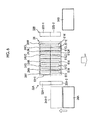
- Fig. 4 is a perspective planar view which shows one example of a disposition configuration of an ink jet head and an ultraviolet irradiating unit shown in Fig. 2 .
- Fig. 5 is a perspective view which shows a configuration example of a light source moving unit which moves the ultraviolet irradiating unit shown in Fig. 4 .
- Fig. 6 is an explanatory diagram which shows a configuration example of an ink jet head and a ultraviolet irradiating unit for forming an image shown in Fig. 1 .
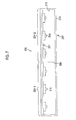
- Fig. 7 is a perspective side view which shows a configuration example of a preliminary curing light source unit used as a light source for preliminary curing of the present embodiment.
- Fig. 8 is a perspective planar view which shows the preliminary curing light source unit shown in Fig. 7 .
- Fig. 9 is a block diagram which shows a configuration example of an ink supply system of an ink jet recording device.
- Fig. 10 is a block diagram which shows a configuration of an ink jet recording device.
- An ink set for forming a multilayer of the present invention includes a group of coloring ink compositions which include a yellow ink composition, a magenta ink composition, a cyan ink composition and a black ink composition, and a clear ink composition
- each of the coloring ink compositions contain a (component A) radical polymerizable compound, a (component B) radical polymerization initiator and a (component D) coloring agent, and contain a (component A-1) N-vinyl compound and a (component A-2) compound represented by Formula (a-2) as the component A
- the clear ink composition contains a (component A 2 ) radical polymerizable compound, a (component B 2 ) acylphosphine oxide-based photoinitiator and a (component C) surfactant, and the relation of Formula (1) is satisfied when the content of the radical polymerization initiator in the clear ink composition is X, the content of the radical polymerization initiator included in the mag
- R 1 , R 2 and R 3 each independently, represent a hydrogen atom, a methyl group, and an ethyl group, X 2 represents a single bond or a divalent linking group.
- X to Y representing a numerical range has a same meaning as “greater than or equal to X and less than or equal to Y”.
- component A-1 the "(composition A-1) N-vinyl compound” and the like is referred to as “component A-1”.
- mass% has the same meaning as “weight%” and “parts by mass” has the same meaning as “parts by weight”.
- An ink set for forming a multilayer of the present invention forms an image layer by a group of coloring ink compositions which includes a yellow ink composition, a magenta ink composition, a cyan ink composition and a black ink composition, and forms a clear ink layer by a clear ink composition.
- Fig. 1 is a cross-sectional diagram which schematically shows one example in which an image layer 14 and a clear ink layer 16 are formed on a recording medium (supporting body or a substrate) 12 using an ink set for forming a multilayer of the present invention.
- an arrow V in the diagram represents a viewing direction (an observing direction) of an image.
- the image layer 14 may be formed after a white layer 18 is formed on the recording medium 12 when the recording medium 12 is transparent.
- the white layer 18 is not necessary when the recording medium 12 is reflective such as paper.
- the recording medium 12 is preferably light reflective and includes paper and synthetic paper as an example.
- the clear ink layer be at least prepared in an area in which the image is formed and preferably prepared as an approximately uniform layer in an area in which the image is formed or in a wider area.
- the present invention is not limited to an aspect in which two layers are formed and, for example, an aspect in which four layers of a white layer 18, an image layer 14, and two clear ink layers 16 and 16' are prepared on a recording medium 12 in this order, or an aspect with a structure of five layers in which a plurality of image layers 14 and a plurality of clear ink layers 18 are prepared on a reflective recording medium 12 in this order is exemplified.
- a compound represented by Formula (a-2) (also referred to as "CTFA" in the present invention) is the optimal monofunctional monomer as a component of the ink set for forming a multilayer of the present invention from the viewpoint of surface tension and polarity.
- CTFA has a low surface tension and serves to help wet spreading of the clear ink composition.
- monofunctional monomers with a low surface tension besides CTFA, however, many of them have a low polarity, therefore, are significantly susceptible to polymerization inhibition by oxygen on the surface of the image layer. As a result, defects in surface curing easily occur.
- the clear ink layer is prepared at the second layer, it is preferable that a surfactant which causes splashing of the clear ink be not included in ink of an undercoat image layer since the clear ink composition is required to reveal high gloss by sufficient wet spreading. From this point of view, suppression of the generation of swath line or craters shaped like orange peel is effective since wet spreading of the clear ink layer is secured by the component A-2 represented by CTFA included in color ink.
- a double layer of the image layer and the clear ink layer it is preferable that a first layer be formed and then a second layer be formed after a short time (for example, after a few seconds) from the viewpoint of productivity.
- a double layer may be formed by rewinding after drawing the image layer, and then drawing the clear ink layer, however, satisfactory surface (gloss) may not be obtained sometimes since a possibility of dust adhering during the rewinding step is increased.
- image quality or glossiness of the second layer is affected by a cured profile and the cured condition of the first layer.
- the ink set of the present invention when the double layer is formed, an image with excellent adhesion between substrate-ink and ink-ink, and also with excellent image quality, glossiness, and surface condition is obtained.
- a coloring ink composition used in the present invention contains an N-vinyl compound and CTFA.
- the N-vinyl compound and CTFA has a moderate polarity and CTFA gives a low surface tension to the coloring ink composition.
- the coloring ink composition does not yet have a sufficiently low polarity as a whole. As a result, surface curing by irradiation is not sufficient.
- polymerization inhibition by oxygen of the coloring ink composition may be prevented by lowering the polarity of the clear ink composition and overprinting this clear ink.
- banding is an uneven printing in a streak shape and refers to a phenomenon in which glossiness is different corresponding to a swath cycle by a multi-pass printing. If spread of the dots after an ink droplet ejection is insufficient, printing omission is not eliminated by the spread of dots resulting in an uneven printing in a streak shape.
- an image layer having a small amount of a polymerization initiator becomes a bottom layer and is wet and spread on the recording medium, and therefore, banding is suppressed. Also, the clear ink layer having a large amount of a polymerization initiator, therefore, having excellent curability is formed above the image layer, and the adhesion between ink-ink is improved.
- an ink composition including a component A and component B used in the present invention (hereinafter, also referred to as an "ink composition of the present invention") will be described in detail.
- the ink composition of the present invention is an oil-based ink composition curable by active radiation.
- Active radiation is radiation which can create energy generating initiating species in the ink composition by the irradiation and includes ⁇ -rays, ⁇ -rays, X-rays, visible light, infrared light, an electron beam and the like.
- ultraviolet light and an electron beam are preferable, and ultraviolet light is particularly preferable from the viewpoint a curing sensitivity and ease of availability of a device.
- the ink composition of the present invention is a radiation curable ink composition and is preferably a non-solvent and does not containing a highly volatile solvent since the ink composition is applied on the recording medium and then cured. This is since solvent resistance is degraded or a problem of VOC (Volatile Organic Compounds) in the remaining solvent occurs if a highly volatile solvent remains in the cured ink image.
- VOC Volatile Organic Compounds
- the ink composition of the present invention contains a (component A) radical polymerizable compound and the coloring ink composition contains the component A-1 and the component A-2 as the component A. In addition, it does not exclude the clear ink composition containing the component A-1 and the component A-2.
- the coloring ink composition of the present invention contains a (component A-1) N-vinyl compound as the (component A) radical polymerizable compound.
- N-vinyl lactams are preferable and compounds represented by Formula (a-1) are more preferable.
- n represents an integer of 1 to 5 and from the viewpoint of flexibility of the ink composition after being cured, adhesion to the recording medium, and availability of raw materials, n is preferably an integer of 2 to 4, n is more preferably 2 or 4, and n is particularly preferably 4, that is, N-vinyl caprolactam. N-vinyl caprolactam is preferable since it is excellent in safety, generally available with relatively low cost and satisfactory ink curability and adhesion of the cured film to the recording medium is obtained.
- the content of the component A-1 in the coloring ink composition of the present invention is preferably 5 mass% to 60 mass% with regard to the total amount of the coloring ink composition and more preferably 15 mass% to 35 mass%. If the content is 5 mass% or more, adhesion to the recording medium is excellent and if the content is 60 mass% or less, preservation stability is excellent.
- the coloring ink composition of the present invention contains a (component A-2) compound represented by Formula (a-2) as the (component A) radical polymerizable compound. If the coloring ink composition does not contain the component A-2, adhesion to the recording medium (polyvinyl chloride and polyethylene terephthalate (PET), and an acrylic resin, in particular) is reduced.
- the compound represented by Formula (a-2) has a low surface tension and is presumed to improve the wet spreading of the clear ink composition. In addition it has a moderate polarity and it is difficult for defects in surface curing to occur, therefore, cured substances (the image layer and the clear ink layer) with excellent adhesion are obtained.
- R 1 , R 2 and R 3 each independently, represent a hydrogen atom, a methyl group, or an ethyl group
- X 2 represents a single bond or a divalent linking group.
- R 1 a hydrogen atom or a methyl group is preferable and a hydrogen atom is more preferable.
- R 2 and R 3 each independently, a hydrogen atom or a methyl group is preferable, a hydrogen atom is more preferable, and a case in which both R 2 and R 3 are hydrogen atoms is the most preferable.
- the divalent linking group in X 2 is not particularly limited as long as it does not impair the effects of the present invention, however, a divalent hydrocarbon group or a divalent group combining a hydrocarbon group and an ether bond is preferable, a divalent hydrocarbon group, a poly(alkylene oxy) group, or a poly(alkylene oxy) alkyl group is more preferable.
- the number of carbon atoms in the divalent linking group is preferably 1 to 60 and more preferably 1 to 20.
- a single bond, a divalent hydrocarbon group or a divalent group combining a hydrocarbon group and an ether bond is preferable, a divalent hydrocarbon group having 1 to 20 carbon atoms is more preferable, a divalent hydrocarbon group having 1 to 8 carbon atoms is even more preferable, and a methylene group is particularly preferable.
- R represents a hydrogen atom or a methyl group.
- the component A-2 may preferably be a commercially available product and specific examples of the commercially available product include SR531 (manufactured by SARTOMER Company).
- the content of the component A-2 is preferably 1 mass% to 65 mass% with regard to the total mass of the coloring ink composition, more preferably 3 mass% to 60 mass%, even more preferably 5 mass% to 60 mass%, particularly preferably 5 mass% to 50 mass%, and most preferably 5 mass% to 40 mass% from the viewpoint of adhesion of the image with the recording medium.
- the ink composition (coloring ink composition and the clear ink composition) contain (component A-3) trimethylolpropane triacrylate as the (component A or component A 2 ) radical polymerizable compound.
- component A-3 being contained is preferable from the viewpoint of balancing curability and roll paper suitability (flexibility) of the output sample of the roll substrate.
- the content of the component A-3 is preferably 0.1 mass% to 10 mass% with regard to the total mass of the ink composition from the viewpoint of balancing curability and roll paper suitability (flexibility) of the output sample of the roll substrate.
- the ink composition of the present invention may contain other monofunctional (meth)acrylates besides the component A-2.
- a monofunctional (meth)acrylate having a (component A-4) aromatic hydrocarbon group may preferably be exemplified.
- the ink composition of the present invention contain a monofunctional (meth)acrylate having a (component A-4) aromatic hydrocarbon group.
- a molecular weight of the component A-4 is preferably 500 or less, and more preferably 300 or less.
- an aromatic monofunctional radical polymerizable compound disclosed in paragraphs 0048 to 0063 of JP2009-096985A may be included.
- a compound represented by Formula (a-4) is preferable as the monofunctional (meth)acrylate having an aromatic hydrocarbon group.
- R 1 represents a hydrogen atom or a methyl group
- X 1 represents a divalent linking group
- Ar represents an aromatic hydrocarbon group
- R 5 represents a substituent
- u represents an integer of 0 to 5
- u number of the R 5 s may be the same as or different from each other.
- R 1 is preferably a hydrogen atom.
- X 1 represents a divalent linking group and preferably an ether bond (-O-), an ester bond (-C(O)O- or -OC(O)-), an amide bond (-C(O)NR'- or -NR'C(O)-), a carbonyl group (-C(O)-), an amino group (-NR'-) or an alkylene group having 1 to 15 carbon atoms which may have a substituent, or a divalent group combining two or more of these.
- R' also represents a hydrogen atom, an alkyl group with a straight chain, a branched chain or a ring structure having 1 to 20 carbon atoms, or an alkylene group having 6 to 20 carbon atoms.
- a hydroxyl group or a halogen atom may be included.
- the end unit bonded to the aromatic hydrocarbon group of X 1 is preferably an oxygen atom and more preferably an etheric oxygen atom from the viewpoint of improving the affinity with a coloring agent.
- X1 in Formula (a-4) is preferably *-(LO) q -.
- * represents a bonding position with a carboxylate bond of Formula (a-4)
- q is an integer of 0 to 10
- L represents an alkylene group having 2 to 4 carbon atoms.
- q is preferably an integer of 0 to 4, more preferably an integer of 0 to 2, and even more preferably an integer of 1 or 2.
- (LO) q is preferably an ethylene oxide chain or a propylene oxide chain.
- Ar represents an aromatic hydrocarbon group.
- the aromatic hydrocarbon group a monocyclic or polycyclic aromatic hydrocarbon group having 1 to 4 rings and specifically, a group excluding one or more hydrogen atoms from benzene, naphthalene, anthracene, 1H-indene, 9H-fluorene, 1H-phenalene, phenanthrene, triphenylene, pyrene, naphthacene, tetraphenylene, biphenylene, as-indacene, s-indacene, acenaphthylene, fluoranthene, acephenanthrylene, aceanthrylene, chrysene, pleiadene or the like.
- a phenyl group or a naphthyl group is preferable in the present invention and a monocyclic aromatic hydrocarbon group, that is, a phenyl group is more preferable.
- R 5 s which are present in u number, each independently, are preferably a halogen atom, a carboxyl group, an acyl group having 1 to 10 carbon atoms, a hydroxyl group, a substituted or unsubstituted amino group, a thiol group, a siloxane group, or a hydrocarbon group having the total number of carbon atoms of 30 or less which may have further substituents or a heterocyclic group.
- substituents a hydroxyl group, an alkyl group having 1 to 10 carbon atoms, and an aryl group having 6 to 12 carbon atoms may be included.
- u represents an integer of 0 to 5 and is preferably 0.
- component A-4 includes those in [L-1] to [L-65].
- a compound having a phenyl group is preferable, 2-phenoxyethyl (meth)acrylate, benzyl (meth)acrylate is more preferable, 2-phenoxyethyl (meth)acrylate is even more preferable, and 2-phenoxyethyl acrylate is particularly preferable.
- the content of the component a-4 is preferably 1 mass% to 50 mass% with regard to the total mass of the ink composition, more preferably 3 mass% to 45 mass%, and even more preferably 5 mass% to 40 mass%.
- the ink composition of the present invention may contain other monofunctional (meth)acrylates besides the component A-2 and the component A-4.
- monofunctional (meth)acrylates besides the component A-2 and the component A-4 isoamyl (meth)acrylate, stearyl (meth)acrylate, lauryl (meth)acrylate, octyl (meth)acrylate, isooctyl (meth)acrylate, decyl (meth)acrylate, isoamylstearyl (meth)acrylate, isostearyl (meth)acrylata, 2-ethylhexyl diglycol (meth)acrylate, 2-hydroxybutyl (meth)acrylate, butoxyethyl (meth)acrylate, methoxy diethylene glycol (meth)acrylate, methoxy polyethylene glycol (meth)acrylate, methoxy propylene glycol (meth)acrylate, tetrahydrofurfuryl (meth)acrylate
- isobornyl (meth)acrylate, cyclopentenyl acrylate, dicyclopentenyloxyethyl acrylate, and t-butylcyclohexyl acrylate is preferable.
- a total content of the monofunctional radical polymerizable compound including the component A-1 and A-2 is preferably 50 mass% to 90 mass% with regard to the total amount of the (component A) radical polymerizable compound. If the content of the monofunctional radical polymerizable compound is within the range described above, an image with excellent adhesion between substrate-ink and ink-ink, and also with excellent flexibility is obtained.
- the content of the monofunctional radical polymerizable compound in the coloring ink composition is more preferably 50 mass% to 90 mass% with regard to the total amount of the component A and even more preferably 60 mass% to 80 mass%.
- a monofunctional polymerizable compound such as the component A-4 and other monofunctional (meth)acrylates described above are also included.
- a total content of the monofunctional radical polymerizable compound is preferably 0 mass% to 30 mass% with regard to the total amount of the (component A 2 ) radical polymerizable compound, more preferably 0 mass% to 25 mass% and even more preferably 0 mass% to 20 mass%. If the content of the monofunctional radical polymerizable compound in the clear ink is within the range described above, curability and a blocking property are excellent.
- the ink composition of the present invention may contain (component A-5) other polyfunctional (meth)acrylates besides the component A-3.
- An ink composition with high curability is obtained by the polyfunctional (meth)acrylate compound being contained.
- component A-5 include bis(4-acryloxy polyethoxy phenyl) propane, neopentyl glycol di(meth)acrylate, ethoxylated (2) neopentyl glycol di(meth)acrylate (a compound in which 2 mol adduct of neopentyl glycol ethylene oxide is diacrylated), propoxylated (2) neopentyl glycol di(meth)acrylate (a compound in which 2 mol adduct of neopentyl glycol propylene oxide is diacrylated), 1,6-hexanediol di(meth)acrylate, 1,9-nonanediol di(meth)acrylate, ethylene glycol di(meth)acrylate, diethylene glycol di(meth)acrylate, triethylene glycol di(meth)acrylate, tetraethylene glycol di(meth)acrylate, polyethylene glycol di(meth)acrylate, dipropylene glycol di
- the coloring ink composition contain propoxylated (2) neopentyl glycol di(meth) acrylate (a compound in which 2 mol adduct of neopentyl glycol propylene oxide is diacrylated) or tripropylene glycol di(meth)acrylate as the component A-5. It is preferable that the clear ink composition contain dipropylene glycol diacrylate or tricyclobutane dimethanol diacrylate as the component A-5.
- propoxylated (2) neopentyl glycol diacrylate, ethoxylated trimethylolpropane triacrylate, a combination of (component A-3) trimethylolpropane triacrylate and 1,6-hexanediol diacrylate, a combination of ethoxylated (3) trimethylolpropane triacrylate and 1,6-hexanediol diacrylate, or a combination of propoxylated (2) neopentyl glycol diacrylate and etholylated trimethylolpropane triacrylate may be included.
- the preferable polyfunctional (meth)acrylate in the coloring ink composition a combination of (component A-3) trimethylolpropane tri(meth)acrylate, propoxylated (2) neopentyl glycol di(meth)acrylate (a compound in which 2 mol adduct of neopentyl glycol propylene oxide is diacrylated) and tripropylene glycol di(meth)acrylate is preferable.
- a combination of the polyfunctional (meth)acrylates in the clear ink composition a combination of (component A-3) trimethylolpropane tri(meth)acrylate, dipropylene glycol di(meth)acrylate and tricyclobutane dimethanol diacrylate is particularly preferable.
- the ink composition of the present invention may contain an oligomer as the polyfunctional (meth)acrylate compound.
- This "oligomer” is generally a polymer having a structural unit based on a finite number of monomers (generally 5 to 100).
- the weight average molecular weight of the oligomer is preferably 400 to 10,000 and more preferably 500 to 5,000.
- the oligomer preferably has a (meth)acryloyl group as a functional group.
- the number of functional groups included in the oligomer is preferably 1 to 15 per molecule, more preferably 2 to 6, even more preferably 2 to 4, and particularly preferably 2 from the viewpoint of a balance between flexibility and curability.
- an oligo ester (meth)acrylate is preferable, a urethane acrylate or a polyester (meth)acrylate is more preferable among these, and a urethane (meth)acrylate is particularly preferable since an ink composition with excellent curability and adhesion is obtained.
- the oligomer may be used either alone or as a combination of two or more.
- urethane (meth)acrylate an aliphatic urethane (meth)acrylate, an aromatic urethane (meth)acrylate or the like may be included.
- Oligomer Handbook supervised by FURUKAWA Junji, The Chemical Daily Co., Ltd. may be used for reference.
- oligomer of urethane (meth)acrylate As the oligomer of urethane (meth)acrylate, U-2PPA, U-4HA, U-6HA, U-6LPA, U-15HA, U-324A, UA-122P, UA5201, UA-512 manufactured by Shin-Nakamura Chemical Co., Ltd.
- EB524, EB80, and EB81 manufactured by Daicel-Cytec Company, Ltd. CN550, CN501, and CN551 manufactured by Sartomer Company, GENOMER5275 manufactured by Rahn AG, or the like may be included.
- the content of the oligomer is preferably 0.3 mass% to 10 mass% with regard to the total mass of the ink composition, more preferably 0.5 mass% to 8 mass%, and even more preferably 1 mass% to 7 mass% from the viewpoint of a balance between curability and adhesion.
- the total content of the (component A-5) other multifunctional (meth)acrylates practically used is regarded from the viewpoint of improving thickening and curability when adjusting viscosity of the ink. Therefore, an appropriate mass% is different depending on the viscosity of each ink, however, is preferably 0 mass% to 30 mass% with regard to the total mass of the coloring ink composition, more preferably 0.5 mass% to 25 mass%, even more preferably 1 mass% to 20 mass%, and particularly preferably 3 mass% to 20 mass%.
- the total content of the (component A-5) other multifunctional (meth)acrylates is preferably 30 mass% to 97 mass% with regard to the total mass of the clear ink composition, more preferably 40 mass% to 95 mass%, and even more preferably 50 mass% to 90 mass%.
- the total content of the radical polymerizable compound is preferably 0 mass% to 30 mass% with regard to the total mass of the coloring ink composition, more preferably 1 mass% to 25 mass%, even more preferably 3 mass% to 20 mass%, and particularly preferably 5 mass% to 20 mass%.
- the total content of the radical polymerizable compound is preferably 30 mass% to 97 mass% with regard to the total mass of the clear ink composition, more preferably 40 mass% to 95 mass%, even more preferably 50 mass% to 93 mass%, and particularly preferably 55 mass% to 90 mass%.
- the ink composition in the present invention may contain a vinyl ether compounds as other radical polymerizable compounds.
- the vinyl ether compounds may be roughly divided into monovinyl ether compounds and di- or trivinyl ether compounds.
- the clear ink composition preferably contains a vinyl ether compound and particularly, preferably contains a di- or trivinyl ether compound, and more preferably contains a divinyl ether compound.
- a di- or trivinyl ether compound such as ethylene glycol divinyl ether, diethylene glycol divinyl ether, triethylene glycol divinyl ether, propylene glycol divinyl ether, dipropylene glycol divinyl ether, butanediol divinyl ether, hexanediol divinyl ether, cyclohexane dimethanol divinyl ether, trimethylolpropane trivinyl ether; a monovinyl ether compound such as ethylene glycol monovinyl ether, triethylene glycol monovinyl ether, hydroxyethyl monovinyl ether, ethyl vinyl ether, n-butyl vinyl ether, isobutyl vinyl ether, octadecyl vinyl ether, cyclohexyl vinyl ether; hydroxybutyl vinyl ether, 2-ethylhexyl vinyl ether
- the total content of the whole (component A) radical polymerizable compound in the ink composition is preferably 65 mass% to 99 mass% and more preferably 70 mass% to 90 mass%.
- the ink composition of the present invention contains a radical polymerization initiator.
- the ink set of the present invention satisfies the relation of Formula (1) when the content of the radical polymerization initiator included in the clear ink composition is X (mass%) and the content of the radical polymerization initiator included in the magenta ink composition is Y (mass%).
- the content of the radical polymerization initiator means the total content of an acylphosphine oxide-based radical polymerization initiator and other radical polymerization initiators included in the clear ink composition as core components. Equation 4 0.1 ⁇ Y X ⁇ 1
- Y/X is less than 0.1, sufficient curability of the magenta ink composition may not be obtained or the initiator sometimes clogs the filter within the printer since solubility of the initiator in the clear ink composition is poor. In addition, sometimes, storage stability is weakened or the cured film turns yellow. If Y/X is 1 or more, filter clogging within the printer, worsening of the preservation stability, and defects on the cured film occur like the clear ink described above.
- Y/X preferably satisfies 0.3 ⁇ (Y/X) ⁇ 1, more preferably 0.4 ⁇ (Y/X) ⁇ 1, and even more preferably 0.5 ⁇ (Y/X) ⁇ 1.
- the relation between the content of the radical polymerization initiator included in characteristic ink compositions is not particularly limited as long as at least the content of the radical polymerization initiator included in the magenta ink composition and the content of the radical polymerization initiator included in the clear ink composition are within the range described above.
- the content of the radical polymerization initiator (Y/X) be approximately the same as the magenta ink composition for the cyan ink composition, and be larger than the relation of Formula (1) for the yellow ink composition and the black ink composition.
- the content of the radical polymerization initiator included in the clear ink composition is X (mass%) and the content of the radical polymerization initiator included in the cyan ink composition is W (mass%)
- 0.1 ⁇ (W/X) ⁇ 1 is preferable
- 0.3 ⁇ (W/X) ⁇ 1 is more preferable
- 0.4 ⁇ (W/X) ⁇ 1 is even more preferable
- 0.5 ⁇ (W/X) ⁇ 1 is particularly preferable.
- the content of the radical polymerization initiator in the magenta ink composition is preferably greater than or equal to 3 mass% and less than 12 mass% and more preferably 5 mass% to 11 mass%.
- the content of the radical polymerization initiator in the clear ink composition is preferably 12 mass% to 20 mass% and more preferably 12 mass% to 18 mass%.
- the content of the radical polymerization initiator in the ink composition of other colors is preferably greater than or equal to 3 mass% and less than 12 mass% and more preferably 5 mass% to 11 mass%.
- radical polymerization initiator well-known radical polymerization initiators may be used.
- the radical polymerization initiator which may be used in the present invention may be used either alone or as a combination of two or more.
- the radical polymerization initiator and a cationic polymerization initiator may also be used as a combination.
- the radical polymerization initiator which may be used in the present invention is a compound generating a polymerization initiating species by absorbing external energy.
- the external energy used in order to initiate polymerization is roughly divided into thermal and active radiation, and a thermal polymerization initiator and a photopolymerization initiator are used, respectively.
- As the active radiation ⁇ -rays, ⁇ -rays, an electronic beam, ultraviolet light, visible light, and infrared light may be exemplified.
- radical polymerization initiator which may be used in the present invention, (a) aromatic ketones, (b) an acylphosphine compound, (c) an aromatic onium salt compound, (d) an organic peroxide compound, (e) a thio compound, (f) a hexaarylbiimidazole compound, (g) a ketoxime ester compound, (h) a borate compound, (i) an azinium compound, (j) a metallocene compound, (k) an active ester compound, (l) a compound having a carbon halogen bond, (m) an alkylamine compound and the like may be included.
- These radical polymerization initiators may be used as one or as a combination of two or more of the compounds (a) to (m).
- the radical polymerization initiator in the present invention is suitably used either alone or as a combination of two or more.
- component B in the present invention a (component B-1) bisacylphosphine compound and a (component B-2) monoacylphosphine compound are preferable.
- the (component B) radical polymerization initiator in the present invention the (component B-1) bisacylphosphine compound may be preferably included.
- bisacylphosphine oxide compounds and monoacylphosphine compounds disclosed in paragraphs 0080 to 0098 of JP2009-096985A may be included.
- the component B-1 preferably has a partial structure represented by Formula (b-1-1) in the structure of the compound.
- a compound represented by Formula (b-1-2) is particularity preferable.
- R 9 , R 10 , and R 11 represent an aromatic hydrocarbon group which may have a methyl group or an ethyl group as a substituent.
- R 9 to R 11 be a phenyl group which may have a methyl group as a substituent, and it is more preferable that R 11 be a phenyl group and R 9 and R 10 be a phenyl group having 1 to 3 methyl groups.
- bisacylphosphine oxide compound represented by Formula (b-1-2) bis(2,4,6-trimethylbenzoyl)phenylphosphine oxide (IRGACURE819, manufactured by BASF Japan Ltd.) is preferable.
- the (component B) radical polymerization initiator in the present invention the (component B-2) monoacylphosphine compound may be preferably included.
- the component B-2 preferably has a partial structure represented by Formula (b-2-1) in the structure of the compound.
- a compound represented by Formula (b-2-2) is particularly preferable.
- R 6 , R 7 , and R 8 represent an aromatic hydrocarbon group which may have a methyl group or an ethyl group as a substituent.
- R 6 to R 8 be a phenyl group which may have a methyl group as a substituent, and it is more preferable that R 7 and R 8 be a phenyl group and R 6 be a phenyl group having 1 to 3 methyl groups.
- the monoacylphosphine oxide compound represented by Formula (b-2-2) 2,4,6-trimethylbenzoyl diphenylphosphine oxide (Darocur TPO: manufactured by BASF Japan Ltd., Lucirin TPO: manufactured by BASF Group) is preferable.
- the coloring ink composition in the present invention including the magenta ink composition contain the (component B-1) bisacylphosphine oxide compound and/or the (component B-2) monoacylphosphine oxide compound.
- the coloring ink composition contain at least the (component B-1) bisacylphosphine oxide compound as the component B.
- component B-1 is contained, high sensitivity of the coloring ink composition may be obtained even when added in small amount.
- bisacylphosphine oxide is capable of improving the sensitivity of the ink even when added in small amount compared to the monoacylphosphine oxide, however, is not suitable for the clear ink since the printed material turns yellow. Therefore, a combination of the bisacylphosphine oxide and the monoacylphosphine oxide is preferable in the color ink in which a color change to yellow is less noticeable compared to the clear ink.
- the total amount of the component B-1 and B-2 is preferably 20 parts by mass or more when the total amount of the radical polymerization initiator is 100 parts by mass, more preferably 25 parts by mass or more, and even more preferably 30 parts by mass or more.
- the clear ink composition in the present invention contain the (component B-2) monoacylphosphine oxide compound as the (component B 2 ) radical polymerization initiator.
- the monoacylphosphine oxide compound being contained is preferable when the total amount of the radical polymerization initiator is 100 parts by mass, 60 parts by mass to 100 parts by mass is more preferable, 70 parts by mass to 100 parts by mass is even more preferable, and practically, 100 parts by mass is preferable.
- the ink composition of the present invention contain a (component B-3) thioxanthone compound and/or a thiochromanone compound.
- the coloring ink composition contain the component B-3 from the viewpoint of curability.
- the thioxanthone compound is preferably a compound represented by Formula (b-3-1).
- R 1 to R 8 each independently, represent a hydrogen atom, an alkyl group, a halogen atom, a hydroxy group, a cyano group, a nitro group, an amino group, an alkylthio group, an alkylamino group (including the case of monosubstituted or disubtituted), an alkoxy group, an alkoxycarbonyl group, an acyloxy group, an acyl group, a carboxyl group or a sulfo group.
- the number of carbon atoms of the alkyl part in the alkyl group, the alkylthio group, the alkylamino group, the alkoxy group, the alkoxycarbonyl group, the acyloxy group, and the acyl group is preferably 1 to 20, more preferably 1 to 8, and even more preferably 1 to 4.
- each adjacent two groups are bonded to each other and may form a ring.
- a ring structure when these form the ring a five-membered or a six-membered aliphatic ring, an aromatic ring or the like may be included, a heterocyclic ring including elements besides a carbon atom may be included, or a ring with two nuclei by further combining the rings formed, for example, a condensed ring, may be formed.
- the ring structure of these may further have substituents.
- a halogen atom a hydroxy group, a cyano group, a nitro group, an amino group, an alkylthio group, an alkylamino group, an alkoxy group, an alkoxycarbonyl group, an acyloxy group, an acyl group, a carboxyl group and a sulfo group may be included.
- the hetero atoms when the ring structure formed is a heterocyclic ring N, O, and S may be included.
- thioxanthone compound thioxanthone, 2-isopropylthioxanthone, 4-isopropylthioxanthone, 2-chlorothioxanthone, 2-dodecylthioxanthone, 2,4-diethylthioxanthone, 2,4-dimethylthioxanthone, 1-methoxycarbonylthioxanthone, 2-ethoxycarbonylthioxanthone, 3-(2-methoxyethoxycarbonyl)thioxanthone, 4-butoxycarbonylthioxanthone, 3-butoxycarbonyl-7-methylthioxanthone, 1-cyano-3-chlorothioxanthone, 1-ethoxycarbonyl-3-chlorothioxanthone, 1-ethoxycarbonyl-3-ethoxythioxanthone, 1-ethoxycarbonyl-3-aminothioxanthone, 1-ethoxycarbonyl-3-
- 2,4-diethylthioxanthone, 2-isopropylthioxanthone, and 4-isopropylthioxanthone are more preferable from the viewpoint of the ease of availability and curability.
- the thiochromanone compound is preferably a compound represented by Formula (b-3-2).
- R 1 , R 2 , R 3 , R 4 , R 5 , R 6 , R 7 and R 8 each independently, represent a hydrogen atom, an alkyl group, a halogen atom, a hydroxy group, a cyano group, a nitro group, an amino group, an alkylthio group, an alkylamino group, an alkoxy group, an alkoxycarbonyl group, an acyloxy group, an acyl group, a carboxyl group or a sulfo group.
- the number of carbon atoms of the alkyl part in the alkyl group, the alkylthio group, the alkylamino group, the alkoxy group, the alkoxycarbonyl group, the acyloxy group, and the acyl group is preferably 1 to 20, more preferably 1 to 8, and even more preferably 1 to 4.
- the acyloxy group may be an aryloxycarbonyl group and the acyl group may be an arylcarbonyl group.
- the number of carbon atoms of the aryl part is preferably 6 to 14 and more preferably 6 to 10.
- each adjacent two groups are bonded to each other, for example, condensed, and may form a ring.
- a ring structure when these form the ring a five-membered or a six-membered aliphatic ring, an aromatic ring or the like may be included, a heterocyclic ring including elements besides a carbon atom may be included, or a ring with two nuclei by further combining the rings formed, for example, a condensed ring, may be formed.
- the ring structure of these may further substituents.
- substituent those described in Formula (b-2-1) may be included.
- the hetero atoms when the ring structure formed is a heterocyclic ring N, O, and S may be included.
- the thiochromanone compound is preferably a compound having at least one substituent (an alkyl group, a halogen atom, a hydroxy group, a cyano group, a nitro group, an amino group, an alkylthio group, an alkylamino group, an alkoxy group, an alkoxycarbonyl group, an acyloxy group, an acyl group, a carboxyl group, a sulfo group or the like) in the ring structure of thiochromanone.
- substituent an alkyl group, a halogen atom, a hydroxy group, a cyano group, a nitro group, an amino group, an alkylthio group, an alkylamino group, an alkoxy group, an alkoxycarbonyl group, an acyloxy group, an acyl group, a carboxyl group, a sulfo group or the like
- an alkyl group, a halogen atom, a hydroxy group, an alkylthio group, an alkylamino group, an alkoxy group or an acyloxy group is preferable, an alkyl group having 1 to 20 carbon atoms and a halogen atom is more preferable, and an alkyl group having 1 to 4 carbon atoms and a halogen atom is even more preferable.
- the thiochromanone compound is preferably a compound having at least one substituent in each of the aromatic ring and the cyclohexanone ring.
- thiochromanone compound examples are preferably exemplified in the following (I-1) to (I-31). Among these, (I-14), (I-17) and (I-19) are more preferable, and (I-14) is particularly preferable.
- the ink composition of the present invention may contain other polymerization initiators besides the components B-1 to B-3.
- the other polymerization initiators a (component B-4) ⁇ -aminoalkylphenone compound is preferable.
- the ink composition of the present invention may contain the (component B-4) ⁇ -aminoalkylphenone compound. It is preferable that the coloring ink composition contain the component B-4.
- the component B-4 a compound represented by Formula (b-4-1) is preferable.
- R 1 , R 2 and R 3 each independently, represent a hydroxyl group, an alkyl group which may have a substituent, an alkoxy group which may have a substituent, or an amino group which may have a substituent
- X represents a hydrogen group, an amino group which may have a substituent, an alkylthio group which may have a substituent, or an alkyl group which may have a substituent.
- substituents may be bonded to each other and form a heterocyclic group when R 1 , R 2 , R 3 and X are amino groups.
- an alkyl group having 1 to 10 carbon atoms may be included.
- component B-4 a compound represented by any of Formula (b-4-2) and Formula (b-4-3) is preferable.
- R 4 , R 5 , R 6 and R 7 each represent an alkyl group which may have a substituent, and at least any of R 4 and R 5 , and R 6 and R 7 may be bonded to each other and form a heterocyclic group.
- R 1 , R 2 and a substituent are the same as R 1 , R 2 , and a substituent in Formula (b-4-1), respectively.
- R 8 represents an alkyl group which may have a substituent.
- R 1 , R 2 and a substituent are the same as R 1 , R 2 , and a substituent in Formula (b-4-1), and R 4 and R 5 are the same as R 4 , R 5 in Formula (b-4-2).
- the heterocyclic group is not particularly limited and is appropriately selected, however, for example, a morpholino group is preferable.
- ⁇ -aminoalkylphenone compound for example, commercially available IRGACURE 369 (manufactured by BASF Japan Ltd.), IRGACURE 907 (manufactured by BASF Japan Ltd.), or the like may be suitably included.
- the content of the ⁇ -aminoalkylphenone compound in the ink composition is preferably 0.1 mass% to 15 mass%, more preferably 0.5 mass% to 10 mass%, and even more preferably 1 mass% to 5 mass%.
- aromatic ketones an aromatic onium salt compound, an organic peroxide compound, a thio compound, a hexaarylbiimidazole compound, a ketoxime ester compound, a borate compound, an azinium compound, a metallocene compound, an active ester compound, a compound having a carbon halogen bond and the like may be included.
- the details of the polymerization initiator are well-known to those skilled in the art and, for example, are described in paragraphs 0090 to 0116 of JP2009-185186A .
- the clear ink composition in the present invention contains a surfactant.
- the coloring ink composition may contain a surfactant.
- the surfactant used in the present invention the following surfactants may be exemplified.
- those disclosed in each of JP1987-173463A ( JP-S62-173463 ) and JP1987-183457A ( JP-S62-183457 ) may be included.
- anionic surfactants such as dialkyl sulfosuccinate salts, alkylnaphthalene sulfonate salts, or fatty acids salts
- nonionic surfactants such as polyoxyethylene alkyl ethers, polyoxyethylene alkyl allyl ethers, acetylene glycols, or polyoxyethylene-polyoxypropylene block copolymers
- cationic surfactants such as alkyl amine salts or quaternary ammonium salts
- fluoro-organic compounds may also be used.
- the fluoro-organic compound is preferably hydrophobic.
- the fluoro-organic compounds include, for example, fluorine-based surfactants, oil-form fluorine-based compounds (for example, fluorine oil) and a solid-form fluorine compound resin (for example, a tetrafluoroethylene resin) and include those disclosed in each of JP1982-9053B ( JP-S57-9053B ) (paragraphs 8 to 17), JP1987-135826A ( JP-S62-135826A ).
- the surfactant used in the present invention is not limited to those described above and an additive which is capable of lowering the surface tension effectively with regard to the concentration after addition may be used.
- Silicon compounds may also be exemplified as the surfactant.
- a silicon compound having an ethylenic double bond within the molecule is preferable among the silicon compounds.
- silicon compound specifically, for example, BYK-300, BYK-302, BYK-306, BYK-307, BYK-310, BYK-315, BYK-320, BYK-322, BYK-323, BYK-325, BYK-330, BYK-331, BYK-333, BYK-337, BYK-344, BYK-370, BYK-375, BYK-377, BYK-UV3500, BYK-UV3510, BYK-UV3570 manufactured by BYK-Chemie GmbH; TEGO-Rad2100, TEGO-Rad2200N, TEGO-Rad2250, TEGO-Rad2300, TEGO-Rad2500, TEGO-Rad2600, TEGO-Rad2700 manufactured by Degussa GmbH; GLANOL 100, GLANOL 115, GLANOL 400, GLANOL 410, GLANOL 4
- An added amount of the surfactant is not particularly limited, however, it is preferably 0.05 mass% to 5 mass% of the total ink, more preferably 0.1 mass% to 3 mass%, and particularly preferably 0.3 mass% to 2 mass%.
- the coloring ink composition of the present invention contains a (component D) coloring agent corresponding to each color.
- the coloring agent which may be used in the present invention is not particularly limited and various well-known pigments and dyes are appropriately selected and used depending on the use.
- the coloring agent included in the coloring ink composition is preferably a pigment from the viewpoint of excellent light resistance, in particular.
- the pigment is not particularly limited and all commercially available organic pigments and inorganic pigments in general, and also those in which resin particles are dyed with a dye may be used.
- commercially available pigment dispersion products surface-treated pigments, for example, those in which a pigment is dispersed by an insoluble resin or the like as a dispersion medium, those in which a pigment of which a surface is grafted with a resin or the like may also be used as long as the effects of the present invention are not impaired.
- pigments disclosed in " Encyclopedia of Pigments” edited by ITO Seishiro (published in 2000), “Industrial Organic Pigments” by W. Herbst, K. Hunger , JP2002-12607A , JP2002-188025A , JP2003-26978A , or JP2003-342503A may be included.
- organic pigment and inorganic pigment which may be used in the present invention may include, for example, as pigments which exhibit yellow color, a monoazo pigment such as C. I. Pigment Yellow 1 (First Yellow G or the like) or C. I. Pigment Yellow 74; a disazo pigment such as C. I. Pigment Yellow 12 (disazo yellow AAA or the like), C. I. or Pigment Yellow 17; a non-benzidine-based azo pigment such as C. I. Pigment Yellow 180; an azo lake pigment such as C. I. Pigment Yellow 100 (tartrazine yellow lake); a condensed azo pigment such as C. I. Pigment Yellow 95 (condensed azo yellow GR or the like); an acidic dye lake pigment such as C. I.
- a monoazo pigment such as C. I. Pigment Yellow 1 (First Yellow G or the like) or C. I. Pigment Yellow 74
- a disazo pigment such as C. I. Pigment Yellow 12 (disazo yellow AAA or the like), C. I. or Pig
- Pigment Yellow 115 (quinoline yellow lake or the like); a basic dye lake pigment such as C. I. Pigment Yellow 18 (thioflavin lake or the like); an anthraqinone-based pigment such as flavanthrone yellow (Y-24); an isoindolinone pigment such as isoindolinone yellow 3RLT (Y-110); a quinophthalone pigment such as quinophthalone yellow (Y-138); an isoindoline pigment such as isoindoline yellow (Y-139); a nitroso pigment such as C. I. Pigment Yellow 153 (nickel nitroso yellow or the like); an azomethine metal complex salt pigment such as C. I. Pigment Yellow 117 (copper azomethine yellow or the like); or the like may be included.
- a basic dye lake pigment such as C. I. Pigment Yellow 18 (thioflavin lake or the like); an anthraqinone-based pigment such as flavanthrone yellow (Y-24); an iso
- pigments which exhibit red or magenta color for example, a monoazo-based pigment such as C. I. Pigment Red 3 (toluidine red or the like); a disazo pigment such as C. I. Pigment Red 38 (pyrazolone red B or the like); an azo lake pigment such as C. I. Pigment Red 53:1 (lake red C or the like) or C. I. Pigment Red 57:1 (brilliant carmine 6B); a condensed azo pigment such as C. I. Pigment Red 144 (condensed azo red BR or the like); an acidic dye lake pigment such as C. I. Pigment Red 174 (phloxin B lake or the like); a basic dye lake pigment such as C. I.
- Pigment Red 81 (rhodamine 6G' lake or the like); an anthraqinone-based pigment such as C. I. Pigment Red 177 (dianthraquinonyl red or the like); a thioindigo pigment such as C. I. Pigment Red 88 (thioindigo bordeaux or the like); a perinone pigment such as C. I. Pigment Red 194 (perinone red or the like); a perylene pigment such as C. I. Pigment Red 149 (perylene scarlet or the like); a quinacridone pigment such as C. I. Pigment Violet 19 (unsubstituted quinacridone), C. I.
- Pigment Red 122 (quinacridone magenta or the like); an isoindolinone pigment such as C. I. Pigment Red 180 (isoindolinone red 2BLT or the like); an alizarin lake pigment such as C. I. Pigment Red 83 (madder lake or the like); or the like may be included.
- pigments which exhibit blue or cyan color for example, a disazo-based pigment such as C. I. Pigment Blue 25 (dianisidine blue or the like); a phthalocyanine pigment such as C. I. Pigment Blue 15 (phthalocyanine blue or the like); an acidic dye lake pigment such as C. I. Pigment Blue 24 (peacock blue lake or the like); a basic dye lake pigment such as C. I. Pigment Blue 1 (Victoria pure blue BO lake or the like); an anthraquinone-based pigment such as C. I. Pigment Blue 60 (indanthrone blue or the like); an alkali blue pigment such as C. I. Pigment Blue 18 (alkali blue V-5:1); or the like may be included.
- a disazo-based pigment such as C. I. Pigment Blue 25 (dianisidine blue or the like); a phthalocyanine pigment such as C. I. Pigment Blue 15 (phthalocyanine blue or the like); an acidic dye lake pigment such as C. I.
- pigments which exhibit green color for example, a phthalocyanine pigment such as C. I. Pigment Green 7 (phthalocyanine green) or C. I. Pigment Green 36 (phthalocyanine green); an azo metal complex pigment such as C. I. Pigment Green 8 (nitroso green); or the like may be included.
- a phthalocyanine pigment such as C. I. Pigment Green 7 (phthalocyanine green) or C. I. Pigment Green 36 (phthalocyanine green)
- an azo metal complex pigment such as C. I. Pigment Green 8 (nitroso green); or the like
- pigments which exhibit orange color for example, an isoindoline-based pigment such as C. I. Pigment Orange 66 (isoindoline orange); an anthraquinone-based pigment such as C. I. Pigment Orange 51 (dichloropyranthrone orange) may be included.
- an isoindoline-based pigment such as C. I. Pigment Orange 66 (isoindoline orange); an anthraquinone-based pigment such as C. I. Pigment Orange 51 (dichloropyranthrone orange) may be included.
- pigments which exhibit black color for example, carbon black, titanium black, aniline black or the like may be included.
- white pigments basic lead carbonate (2PbCO 3 Pb(OH) 2 , so-called silver white), zinc oxide (ZnO, so-called zinc white), titanium oxide (TiO 2 , so-called titanium white), strontium titanate (SrTiO 3 , so-called titanium strontium white) or the like may be used.
- titanium oxide has a low specific gravity compared to other white pigments, a large refractive index, and is chemically and physically stable, masking abilities or tinting power is large as a pigment, and also resistance to acids, alkalis, and other environments is also excellent, as the white pigment, titanium oxide is preferably used.
- white pigments including pigments besides the white pigments listed above may be used as necessary.
- a dispersing device such as, for example, a ball mill, a sand mill, an attritor, a roll mill, a jet mill, a homogenizer, a paint shaker, a kneader, an agitator, a Henschel mixer, a colloid mill, an ultrasonic homogenizer, a pearl mill, a wet jet mill may be used.
- a dispersing agent such as a surfactant or the like may be added.
- a synergist depending on various coloring agents may be used as a dispersing aid when necessary. It is preferable that 1 parts by mass to 50 parts by mass of the dispersing aid be added with regard to the 100 parts by mass of the coloring agent.
- a solvent may be added or a polymerizable compound which is a low molecular weight component may be used with no solvent as the dispersion medium, however, the coloring ink composition is preferably an active energy ray curable ink composition and is preferably a non-solvent in order to cure after the coloring ink composition is applied on the recorded medium.
- the coloring ink composition is preferably an active energy ray curable ink composition and is preferably a non-solvent in order to cure after the coloring ink composition is applied on the recorded medium.
- VOC Volatile Organic Compounds
- An average particle diameter of the coloring agent used in the present invention is preferably 0.01 ⁇ m to 0.4 ⁇ m and more preferably is in the range of 0.02 ⁇ m to 0.2 ⁇ m since the finer the particles, the better the color forming property.
- the coloring agent, the dispersing agent, choice of the dispersion medium, dispersing condition, and filtering conditions are established so that the maximum particle diameter is preferably 3 ⁇ m or less and more preferably 1 ⁇ m or less.
- the particle diameter of the coloring agent may be measured using well-known measuring methods. Specifically, it may be measured by a centrifugal sedimentation light transmission method, an X-ray transmission method, a laser diffraction scattering method, or a dynamic light scattering method. In the present invention, a value obtained from the measurement using the dynamic light scattering method is employed.
- the content of the coloring agent is appropriately selected depending on the color and the purpose of the use, however, it is preferably 0.5 mass% to 30 mass% with regard to the mass of the total coloring ink composition, more preferably 1.0 mass% to 20 mass%, and particularly preferably 2.0 mass% to 10 mass%.
- the ink composition of the present invention may include a polymerization inhibitor, a sensitizing agent, a co-sensitizing agent, an ultraviolet absorber, an antioxidant, an antifading agent, conductive salts, solvent, a polymer compound, a basic compound, a leveling additive, a matting agent, a polyester resin for adjusting film properties, a polyurethane-based resin, a vinyl-based resin, an acrylic-based resin, a rubber-based resin, wax or the like. These are disclosed in JP2009-185186A and may be used in the present invention.
- the ink composition of the present invention preferably contains a polymerization inhibitor from the viewpoint of improving preservability.
- the ink composition When the ink composition is used as an ink composition for ink jet recording, it is preferable that it is discharged by heating in the range of 25°C to 80°C and lowering viscosity and adding the polymerization inhibitor in order to prevent the head clogging by thermal polymerization is preferable.
- the polymerization inhibitor may be used either alone or as a combination of two or more, however, using as a combination of two or more is preferable.
- a nitroso-based polymerization inhibitor As the polymerization inhibitor, a nitroso-based polymerization inhibitor, hydroquinone, benzoquinone, p-methoxyphenol, TEMPO, TEMPOL, cupferron Al, a hindered amine, or the like may be included, and a nitroso-based polymerization inhibitor, a hindered amine-based polymerization inhibitor, or a phenol-based polymerization inhibitor is preferable.
- a combination of polymerization inhibitor selected from a group consisting of the nitroso-based polymerization inhibitor, the hindered amine-based polymerization inhibitor and the phenol-based polymerization inhibitor is preferable and a combination of the hindered amine-based polymerization inhibitor and the phenol-based polymerization inhibitor is particularly preferable.
- nitroso-based polymerization inhibitor preferably used in the present invention are shown below, however, are not limited to these.
- FIRSTCURE ST-1 manufactured by First Chemical Corporation
- TINUVIN292 As commercially available products of the hindered amine-based polymerization inhibitor, TINUVIN292, TINUVIN770DF, TINUVIN765 or TINUVIN123 may be included.
- MEHQ 4-methoxyphenol
- the content of the polymerization inhibitor in the ink composition of the present invention is preferably 0.01 mass% to 5 mass%, more preferably 0.1 mass% to 4 mass%, and particularly preferably 0. 5 mass% to 4 mass%. If the content is within the range described above, clogging of an ink jet nozzle may be prevented since polymerization is suppressed during storage when the ink composition is prepared.
- the ink composition of the present invention preferably contains a dispersing agent. Particularly when the pigment is used, it is preferable that the ink composition contain a dispersing agent in order to stably disperse the pigment in the ink composition.
- a dispersing agent a polymer dispersing agent is preferable.
- the "polymer dispersing agent" in the present invention means a dispersing agent with a weight average molecular weight of 1,000 or more.
- the content of the dispersing agent in the ink composition is preferably 0.05 mass% to 15 mass% with regard to the mass of the total ink composition.
- the ink composition of the present invention have a viscosity of 40 mPa ⁇ s or less at 25°C considering a discharging property.
- a viscosity of 5 mPa ⁇ s to 40 mPa ⁇ s is more preferable and 7 mPa ⁇ s to 30 mPa ⁇ s is even more preferable.
- a viscosity at a discharging temperature (preferably 25 to 80°C and more preferably 25 to 50°C) is preferably 3 mPa ⁇ s to 15 mPa ⁇ s and more preferably 3 mPa ⁇ s to 13 mPa ⁇ s.
- the composition ratio of the ink composition of the present invention be adjusted for the viscosity to be within the range described above. Setting the viscosity to be high at room temperature is preferable since uncured monomers can be reduced by avoiding ink penetration into the recording medium even when a porous recording medium is used. In addition, it is preferable that quality of an image be improved as a result of suppressing smearing of the ink in the case of an ink droplet landing.
- viscosity is determined using an RE80 type viscometer manufactured by Toki Sangyo Co., Ltd.
- An RE80 type viscometer is a viscometer of a conical rotor/plate method corresponding to E type and the viscosity is measured at a revolutionary speed of 10 rpm using a rotor code No.1 rotor. If the viscosity is higher than 60 mPa ⁇ s, the revolutionary speed was varied to 5 rpm, 2.5 rpm, 1 rpm, 0.5 rpm and the like as necessary.
- a surface tension of the ink composition (preferably all the coloring ink compositions) of the present invention at 25°C is preferably 32 mN/m to 40 mN/m.
- a surface tension of 35 mN/m to 38 mN/m is more preferable. Glossiness is excellent if the surface tension is within this range.
- surface tension is measured by a Wilhelmy method at 25°C using commonly used surface tensiometers (for example, a surface tensiometer CBVP-Z manufactured by Kyowa Interface Science Co., Ltd.)
- the coloring ink composition of the present invention contains at least the yellow ink composition, the magenta ink composition, the cyan ink composition and the black ink composition, however, it may further contain ink compositions of other colors.
- a light cyan ink composition and a light magenta ink composition being further contained is preferable, and in this case, the coloring ink composition is made of a total of six colors of the yellow ink composition, the magenta ink composition, the cyan ink composition, the black ink composition, the light cyan ink composition and the light magenta ink composition.
- dark-coloring ink composition in the present invention means an ink composition in which the content of the coloring agent is greater than 1 mass% with regard to the total coloring ink composition.
- the coloring agent is not particularly limited and well-known coloring agents may be used, and also, pigments or dispersion dyes may be exemplified.
- the ink set of the present invention may contain a white ink composition in addition to the coloring ink composition and the clear ink composition.
- the white ink composition is an ink composition containing a white pigment.
- the white ink composition may be used as an undercoat layer of the Fig. 1 as described above.
- a printed material formed by the ink set preferably has a three-layer structure.
- the ink set for forming a multilayer of the present invention may be used for forming two layers of the image layer and the clear ink layer.
- an image layer in which the coloring ink is strictly made of two or more layers in an area where a secondary color is formed using each coloring ink composition of YMCB, an image layer in which the coloring ink is strictly made of two or more layers.
- An ink jet recording method of the present invention includes an image forming step for carrying out the formation of an image by discharging the coloring ink compositions and a clear ink layer applying step for applying the clear ink composition and forming a clear ink layer.
- the clear ink composition may be applied by being discharged from a nozzle or applied by coating and the applying method is not particularly limited.
- a device used for coating is not particularly limited and well-known coating devices may be appropriately selected depending on the purpose.
- an air doctor coater, a blade coater, a lot coater, a knife coater, a squeeze coater, an impregnation coater, a reverse roll coater, a transfer roll coater, a gravure coater, a kiss roll coater, a cast coater, a spray coater, a curtain coater, an extrusion coater or the like may be included.
- an order of the image forming step and the clear ink layer applying step may be appropriately decided depending on the image aimed for.
- the image forming step and the clear ink layer applying step be included in this order.
- the clear ink layer is preferably applied on top of the recorded medium and the image layer as a solid image including the whole area where the image is formed by the image forming step.
- the image forming step and the clear ink layer applying step is performed in this order for obtaining a printed material shown in Fig. 1 .
- a step for preparing a white layer 18 on top of the transparent recording medium 12 is arbitrary.
- the ink jet recording method particularly preferably used in the present invention is an ink jet recording method which includes a scanning step for moving an ink jet head having a plurality of nozzle arrays including a first nozzle array with a plurality of nozzles discharging the coloring ink compositions and a second nozzle array with a plurality of nozzles discharging the clear ink composition toward a first direction with regard to the recording medium, a relative moving step for reciprocatively moving the recording medium toward a second direction which is not parallel to the first direction, a discharge control step for dividing the nozzle arrays (the first nozzle array and the second nozzle array) into a plurality of areas along the second direction and controlling the ink discharge of the ink jet head in each of the divided nozzle areas, and an active ray irradiating step for irradiating active rays on the ink discharged from the ink jet head by the discharge control process and adhered on the recording medium, wherein the active ray irradiating step is a step in which
- Fig. 2 is an external perspective view which shows one example of an ink jet recording device 10 suitably used in the present invention.
- the ink jet recording device 10 is a wide format printer which forms a color image on the recording medium 12 using ultraviolet cured ink (UV cured ink).
- the wide format printer is a device very suitable to recording a wide range of pictures such as large posters and commercially painted walls. Here, those corresponding to A3 size or more are referred to as "wide-format".
- the ink jet recording device 10 is equipped with a device main body 20, a support leg 22 for supporting the device main body 20.
- a drop-on-demand ink jet head 24 for discharging the ink toward the recording medium (media) 12, a platen 26 for supporting the recording medium 12, a guide mechanism 28 as a moving means (scanning means) of the head, and a carriage 30 are provided.
- the guide mechanism 28 above the platen 26 is arranged to be perpendicular to the transport direction of the recording medium 12 (X direction) and so as to extend along the scanning direction (Y direction) parallel to the media support surface of the platen 26.
- the carriage 30 is supported to be capable of reciprocating to the Y direction along the guide mechanism 28.
- preliminary curing light sources (pinning light source) 32A and 32B and the main curing light sources (curing light source) 34A and 34B which irradiate ultraviolet light on the ink on the recording medium 12 were loaded, along with the ink jet head 24 being loaded.
- Preliminary curing light sources 32A and 32B are light sources which irradiate ultraviolet light after the ink droplets are discharged from the ink jet head 24 and are landed on the recording medium 12 to cure the ink so as for the adjacent droplets not to be united with each other.
- the main curing light sources 34A and 34B are light sources which irradiate ultraviolet light to ultimately cure the ink (main curing) completely, after additional exposure is performed after the preliminary curing. Details will be described later, however, one or both of the main curing light sources 34A and 34B is configured to be movable to the X direction to be parallel to Y direction with the ink jet head 24 and the preliminary curing light sources 32A and 32B.
- the ink jet head 24, the preliminary curing light sources 32A and 32B, and the main curing light sources 34A and 34B disposed on the carriage 30 move as one body (together) with the carriage 30 along the guide mechanism 28.
- the reciprocative moving direction of the carriage 30 (Y direction) is sometimes called “main scanning direction” and transport direction of the recording medium 12 called “sub-scanning direction” (X direction).
- the Y direction corresponds to a "first direction”
- the X direction corresponds to a "second direction”.
- a variety of media may be used as the recording medium 12 regardless of materials such as paper, non-woven fabric, vinyl chloride, synthetic chemical fiber, polyethylene, polyester or tarpaulin, and also, regardless of permeable medium or impermeable medium.
- the recording medium 12 is fed from the rear of the device in a roll paper state (see Fig. 3 ) and is wound around a take-up roll (not shown in Fig. 2 , sign 44 in Fig. 3 ) at the front side of the device after printing.
- Ink droplets are discharged on the recording medium 12 transported on the platen 26 from the ink jet head 24 and ultraviolet light is irradiated on the ink droplets adhered on the recording medium 12 from the preliminary curing light sources 32A and 32B, and the main curing light sources 34A and 34B.
- a mounting unit 38 of the ink cartridge 36 is provided at the front of the left side toward the front of the device main body 20.
- the ink cartridge 36 is an ink supplier (an ink tank) which is a replaceable material for storing ultraviolet curable ink.
- the ink cartridge 36 is provided corresponding to each color ink used in the ink jet recording device 10 of the present example.
- the ink cartridge 36 of each color is connected to the ink jet head 24 by the ink supply path, which is not shown, each independently formed.
- the ink cartridge 36 is replaced when residual amount of the ink of each color becomes low.
- a maintenance unit of the ink jet head 24 is provided at the right side toward the front of the device main body 20.
- a cap for preventing dryness of the ink jet head 24 when not printing, and a wiping member (blade, web, and the like) for cleaning the nozzle surface of the ink jet head 24 (ink discharge surface) are provided.
- an ink receiver for receiving the ink droplets discharged from the nozzle is provided for maintenance.
- Fig. 3 is an explanatory diagram which schematically shows the recording medium transport path in the ink jet recording device 10.
- the platen 26 is formed in a reverse gutter shape and the upper surface becomes a supporting surface of the recording medium 12 (medium supporting surface).
- a pair of nip rollers 40 which is recording medium transporting means for intermittently transporting the recording medium 12 is placed. This nip roller 40 moves the recording medium 12 to the recording medium transport direction on the platen 26.
- the recording medium 12 sent from a roll (sending supply roll) 42 of the supply side which configures the roll-to-roll type medium transporting means is intermittently transported toward the recording medium transport direction by the pair of nip rollers 40 provided at an entrance of the printing unit (the upstream side of the recording medium transport direction of the platen 26).
- the recording medium 12 reaching the printing unit directly below the ink jet head 24 is printed by the ink jet head 24 and is wound around the take-up roll 44 after printing.
- a guide 46 for the recording medium 12 is provided at the downstream side of the recording medium transport direction of the printing unit.
- a temperature control unit 50 for adjusting the temperature of the recording media 12 during printing is provided at the rear surface of the platen 26 positioned opposite to the ink jet head 24 (the surface opposite to the surface supporting the recording medium 12). If temperature of the recording medium 12 is adjusted to a predetermined temperature when printing, physical properties such as viscosity or surface tension of the ink droplets landed on the recording medium 12 becomes the value aimed for, therefore, a target dot diameter can be obtained.
- a pre-temperature control unit 52 may be provided at the upstream side of the temperature control unit 50 and an after-temperature control unit 54 may also be prepared at the downstream side of the temperature control unit 50, if necessary.
- Fig. 4 is a planar perspective view which shows an example of configuration of the ink jet head 24, the preliminary curing light sources 32A and 32B, and the main curing light sources 34A and 34B disposed on the carriage 30.
- nozzle arrays 61Y, 61M, 61C, 61K, 61LC, 61LM, 61CL, and 61W for discharging the ink of each color are provided for color ink of yellow (Y), magenta (M), cyan (C), black (K), light cyan (LC), light magenta (LM), clear (transparent) (CL), and white (W, arbitrary), respectively.
- the nozzle arrays are shown by the dotted line and the individual nozzle is not shown in Fig. 4 .
- nozzle arrays are sometimes represented by a sign 61 as a collective term for 61Y, 61M, 61C, 61K, 61LC, 61LM, 61CL, and 61W in the following description.
- Types of ink color (the number of colors) or a combination of colors is not limited to the present embodiment.
- a form in which nozzle arrays of LC and LM are omitted, a form in which nozzle array of W is omitted, a form in which a nozzle array of metal ink is added, a form in which a nozzle array discharging ink of special colors (special ink) ink is added, or the like, is possible.
- the disposition order of nozzle arrays of each color is not particularly limited. However, the configuration to dispose the ink with low curing sensitivity to ultraviolet light closer to the preliminary light sources 32A or 32B among a plurality of ink types is preferable.
- a head module is configured for a nozzle array 61 of each color, and a color ink jet head 24 in which color picture is possible may be configured by arranging these head modules.
- a head module 24Y having a nozzle array 61Y discharging yellow ink
- a head module 24M having a nozzle array 61M discharging magenta ink
- a head module 24C having a nozzle array 61C discharging cyan ink
- a head module 24K having a nozzle array 61K discharging black ink
- each head module 24LC, 24LM, 24CL and 24W having each nozzle array 61LC, 61LM, 61CL and 61W discharging ink of each color LC, LM, CL, and W are arranged at regular intervals to line up along the reciprocative moving direction of the carriage 30 (main scanning direction, Y direction ) is possible.
- a module group of head modules of each color 24Y, 24M, 24C, 24K, 24LC and 24LM may be interpreted as “ink jet head” and each module can also be interpreted as each "ink jet head”.
- Each nozzle array 61 is configured of a plurality of nozzles arranged in a row (linearly) at regular intervals along the recording medium transport direction (sub-scanning direction, X direction).
- a disposed pitch of the nozzle (a nozzle pitch) configuring each nozzle array 61 is 254 ⁇ m (100 dpi)
- the number of nozzles configuring one array of the nozzle array 61 is 256
- discharge frequency is 15 kHz and the discharge amount of the ink droplets can be divided into three classes of 10 pl, 20 pl, 30 pl by changing the drive waveform when the ink droplets are discharged.
- a method for causing flying of the ink droplets by a piezoelectric element (piezo actuator) (piezo jet method) is employed.
- the element generating discharge energy a method in which bubbles are generated by heating the ink using a heating body such as a heater (heating element) and use that pressure to fly the ink droplets (a thermal jet method) may also be employed, in addition to a method using the electrostatic actuator (an electrostatic actuator method).
- a piezo jet method with relatively high discharge power be employed when ultraviolet curable ink is used, since ultraviolet curable ink has high viscosity compared to solvent ink in general.
- a printing resolution can be changed by changing the number of printing paths since picture control of multi-path type is applied.
- a drawing mode of three types of a high-production mode, a standard mode and a high-definition mode is prepared and the printing resolution is different, respectively, in each mode.
- the drawing mode may be selected depending on the printing purposes and applications.
- the high-production mode printing is performed at a resolution of 600 dpi (main scanning direction) x 400 dpi (sub-scanning direction).
- the resolution of 600 dpi is achieved by two paths (scanning two times) for the main scanning direction.
- Dots are formed at a resolution of 300 dpi in the first scanning (outbound of the carriage 30).
- Dots in the second scanning (inbound) are formed so as to interpolate the middle of the dots formed in the first scanning (outbound) at 300 dpi, therefore, a resolution of 600 dpi is obtained with regard to the direction of the main scanning direction.
- the nozzle pitch is 100 dpi
- dots are formed at a resolution of 100 dpi in the sub-scanning direction by one-time main scanning (one path). Therefore, a resolution of 400 dpi is achieved by carrying out interpolation printing by four-path printing (scanning four times).
- the main scanning speed of the carriage 30 in the high-production mode is 1,270 mm/sec.
- printing is carried out at a resolution of 600 dpi x 800 dpi, and the resolution of 600 dpi x 800 dpi is obtained by a two-path printing for the main scanning direction and an eight path printing for the sub-scanning direction.
- printing is carried out at a resolution of 1,200 dpi x 1,200 dpi, and the resolution of 1,200 dpi x 1,200 dpi is obtained by a four path printing for the main scanning direction and a twelve path printing for the sub-scanning direction.
- each drawing condition for separate singling is fixed for each resolution setting. More specifically, a swath path is different depending on the width of the nozzle array of the ink jet head and the path number of the main scanning direction and the sub-scanning direction (the divided number of interlacing) since width of the discharging nozzle array of the ink jet head Lw (length of the nozzle array) is divided by the number of paths (the repeated number of scans) and is singling drawn. Details of the singling drawing by a multi-path method, for example, are disclosed in, for example, JP2004-306617A .
- the relationship between the number of paths by singling drawing and the swath width when QS-10 head (100 dpi, 256 nozzles) manufactured by FUJIFILM DIMATIX, Inc. is used is as shown in Table 5 (Equation 5).
- the swath width expected from the drawing is a value which divides a width of the nozzle array used by a product of the number of paths of the main scanning direction and the number of paths of the sub-scanning direction.
- the preliminary curing light sources 32A and 32B are disposed on both sides of left and right of the moving direction of the carriage of the ink jet head 24 (Y direction).
- the main curing light sources 34A and 34B are disposed on the downstream side of the recording medium transport direction of the ink jet head 24 (X direction).
- the main curing light sources 34A and 34B are disposed further outside (farther location) than the preliminary curing light sources 32A and 32B are toward the Y direction from the ink jet head 24.
- the main curing light sources 34A and 34B are configured to be movable toward the direction opposite to the recording medium transport direction (-X direction), therefore, can change disposition to align with the preliminary curing light sources 32A and 32B, and the ink jet head 24 along the moving direction of the carriage.
- the color ink droplets discharged from the nozzle for coloring ink composition (color ink) of the ink jet head 24 (the nozzle included in the nozzle arrays 61Y, 61M, 61C, 61K, 61LC, and 61LM) and landed on the recording medium 12 is ultraviolet irradiated for preliminary curing by the preliminary curing light unit 32A (or 32B) which passes above the color ink droplets immediately after landing.
- the ink droplets on the recording medium 12 which have passed through the printing area of the ink jet head 24 according to the intermittent transport of the recording medium 12 are ultraviolet irradiated for main curing by the main curing light sources 34A and 34B.
- landing interference may be prevented and deploying time of the dot (time for a dot to spread to a predetermined size) may be secured by first making the ink droplets be in the preliminary cured state, therefore, adhesion may be improved by facilitating interaction between the droplets and the medium as well as the height of the dot becoming uniform.
- the clear ink layer formed by the clear ink a dot resolution level of the image layer is not required since the clear ink layer is an overcoat layer of the image layer.
- the color ink requires pinning light for fixing the ejected position, however, in the clear ink layer, the need for pinning in the ejected position is not sufficient since the clear ink layer is making a surface layer. Rather, when the clear ink layer is formed, amount of pinning light is made to be off (0 mJ/cm 2 ). It is also preferable that the landed drops be not pinning by reducing the amount of irradiating light, and therefore, planarization and the uniformity of the layer is aimed for by creating a circumstance in which the ink is easily wet spread.
- a configuration in which ultraviolet light is not irradiated for preliminary curing for white ink drops discharged from the nozzle for arbitrary white ink (a nozzle included in the nozzle array 61W) and landed on the recording medium 12 is used, or a configuration in which a lower amount of ultraviolet light is irradiated than in the preliminary curing of the color ink even when irradiated is used.
- planarization and the uniformity of the layer may be improved by securing a time for the dot of the white ink landed on the recording medium to be spread.
- the clear ink discharged from the nozzle for the clear ink (a nozzle included in the 61CL nozzle array) and landed on the recording medium is irradiated by almost the same amount of ultraviolet light by the main curing light source 34A moved to the location in which ultraviolet radiation is possible in response to the discharge position of the clear ink.
- a curing process in which almost the same amount of activation energy as in the main curing process is applied be performed from when a film thickness of the clear ink is small (from immediately after the landing of the clear ink on the recording medium) since ultraviolet transmittance of the clear ink layer formed by the clear ink is low.
- the two light sources may be lit at the same time during the printing operation by the ink jet head 24, however, extending the lifetime of the light sources may be achieved by lighting the preliminary curing light source alone which is the rear side in the carriage movement of the main scanning direction.
- the main curing light sources 34A and 34B the two light sources are lit at the same time during the printing operation of the ink jet recording device 10. In the drawing mode with a slow scanning speed, the other one can be turned off and timing of the first light emission of the preliminary light sources 32A and 32B and the main curing light sources 34A and 34B may be at the same time or be different.
- Fig. 5 is a perspective view which shows a configuration example of a moving mechanism 35 of the main curing light source 34A (light source moving unit).
- the light source moving unit 35 shown in the diagram adopts a linear moving mechanism of the rack and pinion type. That is, the light source moving unit 35 is equipped with a shaft 35A fixed and disposed along the recording medium transport direction which is a moving direction of the main curing light source 34A, a rack 35B mounted on the case of the main curing light source 34A and formed dentate-shaped irregularities along the shaft 35A, a drive motor 35D in which a pinion gear 35C is attached to its rotation axis, and an optical position sensor 35F which detects the detection piece 35E formed at the end of the rack.
- the pinion gear 35C is rotated when the rotation axis of the drive motor 35D is rotated and the rack 35B moves along the shaft 35A by engaging the teeth of the rack 35B and the pinion gear 35C and then, the main curing light source 34A moves along the shaft 35A together with the rack 35B.
- the detection piece 35E provided at the tip of the rack 35B squeezes into the detection range of the position sensor 35F, rotation of the drive motor 35D is stopped, therefore, the main curing light source 34A is stopped at a predetermined position.
- the moving mechanism having the same configuration may also provided in the main curing light source 34B located at the opposite side of the main curing light source 34A across the ink jet head 24, and may be configured to be movable.
- the ink jet recording device 10 shown in the present example has a configuration in which an image of multi-layer structure is formed by stacking the image layer formed by color ink (Y, M, C, K, LC, LM and the like) (shown in Fig. 1 with a sign 14) and the clear ink layer formed by clear ink (shown in Fig. 1 with a sign 16).
- the amount of ultraviolet irradiation can be controlled depending on an order of layer formation and ultraviolet absorption characteristics of the ink (ink curing properties).
- a white ink composition of arbitrary components has a lower ultraviolet transmittance compared to that of the color ink and the clear ink since it contains titanium oxide, zinc oxide, or the like as a pigment, therefore, has a longer curing time when the same amount of ultraviolet light per unit volume as the color ink or the clear ink is irradiated.
- Ultraviolet irradiation is controlled so that the clear ink has more ultraviolet radiation per unit time than the color ink in order to reduce the difference in curing characteristics due to the ultraviolet transmission characteristics of the clear ink and the color ink. Specific examples of such an image formation will be described later.
- the black composition ink although classified as an ink with longer curing time from the viewpoint of ultraviolet transmittance, is classified as color ink since it is necessary to prevent ejection interference by preliminary curing immediately after ejection when used in forming the image layer.
- the clear ink layer which becomes the overcoat layer requires both a high-gloss mode (gloss mode) and a low-gloss mode (matt mode).
- gloss mode high-gloss mode
- matt mode low-gloss mode
- the matt mode is obtained relatively simply in the conventional system of a wide-format printer in which the clear layer is cured before wet spreading using pinning light immediately after ejection.
- the overcoat layer which is the clear ink layer does not require resolution in order to achieve high gloss.
- the undercoat color layer which requires high resolution or high-definition is pinning cured immediately after ejection, and the clear ink layer is either not pinning exposed immediately after ejection or is exposed with smaller amount of pinning light.
- drawing two layers at one time is preferable.
- the ink jet head and the pinning light source are preferably separated into upstream and downstream with respect to the substrate transport direction and controlled independently in order to achieve this.
- the discharge amount of the clear ink is preferably larger than the discharge amount of the ink jet head of the normal color ink since sufficient wet spreading is necessary. Details will be described later.
- the image layer is preferably irradiated immediately after ejection by pinning light with a light intensity of 1 mJ/cm 2 to 20 mJ/cm 2 per unit area, more preferably with 2 mJ/cm 2 to 6 mJ/cm 2 .
- the clear ink layer is preferably irradiated immediately after ejection by pinning light with a light intensity of 0 mJ/cm 2 to 4 mJ/cm 2 per unit area, more preferably with 0 mJ/cm 2 to 2 mJ/cm 2 .
- Pinning light is exposed from once to a plurality of times by a carriage scanning in order to avoid the droplet shape from being broken by unification or interference with other ink immediately after ejection, or to avoid the droplet from moving.
- Curing light refers to an exposure to fully cure the ink in which image is formed. Curing light is also irradiated a plurality of times by the carriage scanning. A total accumulated amount of exposure is from 200 mJ/cm 2 to 1,000 mJ/cm 2 to 3,000 mJ/cm 2 by the pinning exposure from once to a plurality of times and the curing exposure a plurality of times.
- Ink is cured by radical polymerization or cationic polymerization, preferably by radical polymerization since the tendency of the ink sensitivity is determined from the sensitivity with regard to the irradiation wavelength and the content of the initiator and the sensitizer which are included in the ultraviolet curable ink.
- an irradiated area of the preliminary curing light source is divided according to the divided nozzle area and light amount (distribution of light intensity) is adjusted for each of the irradiated areas so that appropriate pinning light in response to the picture range of the divided nozzle are which forms each layer such as a colors layer, a white paper layer, a transparent layer and the like. Details will be described later.
- each nozzle array 61 is divided into a plurality of areas with respect to the recording medium transport direction, each of the color ink or the clear ink is discharged, from certain areas divided, and the image layer or the clear ink layer (transparent layer) is formed.
- Divided number of the nozzle array 61 is the number of the image forming layer N.
- the recording medium 12 is intermittently transported in a one-way direction with a unit in which the length in the recording medium transport direction of the divided area of the nozzle array 61 is divided by the number of multi-paths (a unit calculated from (total length of the nozzle array Lw/the number of the image forming layers N)/the number of multi-paths) and is configured in which the clear ink layer discharged from the downstream side of the recording medium transport direction of the nozzle array 61 is stacked on top of the coloring ink layer discharged from the upstream side of the same.
- the "number of multi-paths" is defined by the product of the number of paths of the carriage scanning direction and the number of paths of the recording medium transport direction.
- the length in the recording medium transport direction of the irradiation area of the main curing light sources 34A and 34B and the length in the recording medium transport direction of the main curing light sources 34A and 34B is identical.
- the real length in the recording medium transport direction of the main curing light sources 34A and 34B is determined so that a predetermined irradiation area may be obtained with the spread of the irradiation area taking into account.
- "the number of image forming layers N" may sometimes be described as "divided number”.
- Fig. 6 is an explanatory diagram which schematically shows the configuration of the ink jet head 24 in order to form an image having a layer structure shown in Fig. 1 , and a disposition of the main curing light sources 34A and 34B.
- a recording medium transport direction (X direction) is downward from the top shown as the top-down arrow in the diagram and the reciprocative moving direction of the carriage 30 (Y direction) is left and right direction.
- each nozzle array 61 is divided into two areas of an upstream side area 61-1 and a downstream side area 61-2, the coloring ink composition is discharged only from the upstream side area 61-1 of nozzle array 61Y, 61M, 61C, 61K, 61LC, and 61LM and the clear ink composition is discharged only from the downstream side area 61-2 of nozzle array 61W. If image layer 14 (see Fig.
- the clear ink layer 16 is formed on top of the image layer 14 formed in advance by the clear ink composition discharged from the downstream side area 61-2 by moving the recording medium 12 in the recording medium transport direction as much as a distance ((Lw/2)/the number of multi-paths).
- the clear ink layer 16 is formed on top of the image layer 14, at a discharge position of the coloring ink of the upstream side of the recording medium transport direction adjacent to the discharge position of the clear ink, coloring ink is discharged only from the upstream side area 61-1 of the nozzle array 61CL. That is, formation of the next color image progresses simultaneously with the formation of the clear ink layer 16.
- the multi-path method described earlier is applied for discharging the clear ink forming the clear ink layer 16 and for discharging the coloring ink forming the image layer 14.
- Fig. 7 is a perspective side view which shows a configuration example of a preliminary curing light source unit used as the preliminary curing light sources 32A and 32B of the present embodiment.
- Fig. 8 is a perspective plane view thereof.
- the preliminary curing light source unit 210 relating to configurations shown in Fig. 7 and Fig. 8 has a box shape of approximate rectangular parallelepiped.
- the preliminary curing light source unit 210 has a configuration in which a plurality of ultraviolet light emitting diode elements (hereinafter, described as "UV-LED elements") 214 are housed within a housing made of aluminum 212 (fence), and a transmission type light diffusion plate 216 is disposed at the bottom surface unit of the housing 212.
- UV-LED elements ultraviolet light emitting diode elements
- a circuit board 220 in which the UV-LED elements are mounted is disposed at the upper unit of the housing 212 with a LED mounting surface 221 facing toward the light diffusion plate 216 (a state in which light-emitting surface of the UV-LED elements 214 is facing downward in Fig. 7 ).
- the Number of the UV-LED elements 214 mounted on the circuit board 220 is not particularly limited, however, a smallest possible number is preferable from the viewpoint of required UV irradiation width and costs.
- six UV-LED elements 214 are aligned in line on the circuit board 220.
- Six UV-LED elements 214 are arranged side by side in the recording medium transport direction in order to obtain a UV irradiation width with which UV irradiation can be carried out at one time with regard to the nozzle array width Lw along the recording medium transport direction (X direction) of the ink jet head 24 as described in Fig. 4 and Fig 6 .
- the horizontal direction of Fig. 7 is the recording medium transport direction (X direction), and the recording medium 12 is made to be transported from right to left of Fig. 7 .
- a metal board with enhanced heat dissipation and heat resistance is used as the circuit board 220.
- a detailed structure of the metal board is not shown, however, an insulating layer is formed on top of a metal plate such as aluminum or copper, and the UV-LED elements 214, circuit for LED drive (anode circuit and cathode circuit) and the like are formed on top of the insulating layer.
- a metal base board in which a circuit is formed on the base metal may be used and a metal core board in which a metal plate is embedded inside the board may also be used.
- a white resist of high reflectance having UV resistance is processed around the UV-LED elements 214 of the LED mounting surface 221 in the circuit board 220.
- Ultraviolet light may be reflected and scattered from the surface of the circuit board 220 and a light generated from the UV-LED elements 214 may be utilized in UV irradiation for preliminary curing by the white resist layer (not shown).
- the light diffusion plate 216 is a milky white plate formed by optical materials which diffuses the light while transmitting emitted from the UV-LED elements 214.
- a white acrylic plate in which white pigments (a light diffusion material) are dispersed is used as the light diffusion plate 216.
- An optical member molded by dispersing and mixing the fine particles for light diffusion in a transparent material such as glass may also be used without limiting to the white acrylic plate.
- Light diffusion plates with different transmittance and diffusion properties are obtained by changing the content and the average particle diameter of the light diffusion materials (such as white pigment).
- means to diffuse light as a transmission type light diffusing plate is not limited to means to disperse the silica powder to this acrylic resin, and other means such as a frosting process on the surface of the board made of fused quartz, a frosted glass process, a ground glass process, and the like may be used to easily achieve light diffusion.
- the transmission type light diffusion plate 216 such as this is disposed at the bottom of the housing 212 opposed to the LED mounting surface 221 of the circuit board 220.
- An underside of the light diffusion plate 216 (sign 217) in Fig. 7 is a light emitting surface facing the recording medium (not shown).
- an LED array in which six UV-LED elements 214 are lined up in the X direction is divided into two areas. That is, a plurality of UV-LED elements 214 arranged along the X direction is divided into two areas of an upstream side area 224-1 of the recording medium transport direction (X direction) and a downstream side area 224-2, and each divided area of 224-1 and 224-2 includes three UV-LED elements 214 each.
- a partition member 226 having a light-shielding property is provided inside the housing 212 as a range regulating member in order to partition areas of the LED element array divided into two, the housing has a structure in which light of the UV-LED element 214 of one area does not enter the area of the other.
- UV-LED element has a wide irradiation range and has a property to spread while propagating, however, as in the present example, irradiation area may be divided by a structure covering the periphery of the LED element by the partition member 226.
- light emitting amount of the UV-LED element 214 within each area can be controlled. For example, three UV-LED elements 214 belonging to the upstream side of the area 224-1 are turned off when the clear ink layer is formed and three UV-LED elements 214 belonging to the downstream side of the area 224-2 is turned on.
- ultraviolet irradiation area By dividing the light emission range by the partition member 226 such as this and combining light emission control UV-LED elements belonging to each area 224-1 and 224-2, ultraviolet irradiation area can be divided and light amount of each divided radiation area can be individually controlled.
- a configuration example shown in Fig 7 and Fig. 8 is an upward irradiation type LED light source unit in which the UV-LED element array is disposed at the upper unit of a light source box, and has a configuration to control the division point and the like in response of the irradiation lit area of LED to the divided area of the nozzle array of the ink jet head 24.
- Control of the amount of light includes current value control, pulse width modulation control, on-off control and the like.
- the configuration is not limited to the configuration exemplified in Fig. 7 and Fig. 8 , and, for example, by providing an aluminum plate of high reflectivity determining the irradiation area on undersurface of the housing 212 and shifting the frame of the aluminum plate, changing the irradiation area of the downstream/upstream is possible.
- As aspect which changes the irradiation region is also possible by replacing the frame of the aluminum plate of high reflectivity.
- this aluminum plate is equivalent to a "range control member" since the irradiation range is restricted by the aluminum plate of high reflectivity.
- Other aspects controlling the irradiation range by providing a mechanical shutter or a liquid crystal shutter which limits the light irradiation range are also possible.
- the image layer 14 is formed on the reflective recording medium 12 and the clear ink layer 16 is formed on the image layer 14.
- the image layer 14 can be visually recognized with a background of the reflective recording medium 12 or arbitrary white layer 18 when viewed from the V direction.
- the head used for forming the image layer uses a head of the upstream side of Y, M, C, K, LC and LM, and the light sources (32A-1 and 32B-1) on both sides thereof form the image layer with the lamp set to be ON.
- the head used to form the clear ink layer uses a head 61CL at the downstream side of CL, and the lamp of the light sources (32A-2 and 32B-2) on both sides thereof is set to be OFF, and as a result, time for wet spreading of the clear ink needed to achieve high gloss is sufficiently secured.
- the light sources 34A and 34B located further downstream are set to be ON, and the coloring ink and the clear ink are main cured.
- the head used for forming the image layer uses a head of the upstream side of Y, M, C, K, LC and LM, and the light sources (32A-1 and 32B-1) on both sides thereof form a color image with the lamp set to be ON.
- the head used to form the clear ink layer uses a head 61CL at the downstream side of CL, and the lamp of the light sources (32A-2 and 32B-2) on both sides thereof is set to be ON, and as a result, ink discharged is cured before wet spreading and the surface state becomes rough resulting in an image with low glossiness.
- the light sources 34A and 34B located further downstream are set to be ON, and the main curing is carried out.
- an ink amount discharged is preferably large in case of the high-gloss mode, an ink amount discharged is preferably small in case of low-gloss mode.
- Step 1 is a forming step of the image layer 14 in Fig. 1 .
- the preliminary curing light source on the left side is represented by a sign 32A and the main curing light source is represented by a sign 34A.
- the coloring ink is discharged on the recording medium 12 from the upstream region, including 61-1 including nozzle arrays 24Y, 24M, 24C, 24K, 24LC, and 24LM by scanning the carriage 30 to the carriage moving direction.
- ultraviolet light of low light amount (1 ⁇ 5 mJ/cm 2 per one scanning of the carriage of times) is irradiated and cured from the preliminary curing light sources 32A-1 and 32B-1 located next to nozzle arrays 24Y, 24M, 24C, 24K, 24LC, and 24LM by the one-time carriage scanning on the coloring ink immediately after landed on the recording medium 12, and made to be in a gel state.
- landing interference of the coloring ink is prevented.
- the recording medium 12 is moved to the recording medium transport direction as much as a distance ((Lw/2)/the number of multi-paths).
- Step 2 is a period in between the forming step of the image layer 14 and a forming step of the clear ink layer 16, and adhesion affinity with the recording medium 12 and the image layer 14 is increased by maintaining the preliminary curing state for a predetermined period of time, therefore reduction of Pyle height will be promoted along with promoting the spread of the dots of the clear ink, and the glossiness of the color image is also improved.
- Step 3 is the forming step of the clear ink layer 16 clear ink layer, and at a discharge position of the clear ink (locating on the image layer 14 formed in advance) located at the downstream side as much as (Lw/2) to the recording medium transport direction from the discharge position of the color ink of the recording medium 12, the carriage 30 (see Fig. 4 ) is scanned to the carriage moving direction and the clear ink is discharged on top of the image layer 14 in a preliminary cured state only from downstream side area 61-2 of the nozzle array 61CL.
- Spreading of clear ink may be obtained by preventing preliminary curing by setting the preliminary curing light sources 32B-1 and 32B-2 located next to the nozzle array 61CL to be OFF.
- Step 4 is a main curing process step and a main curing process is performed on the clear ink layer 16 and the image layer 14 using the main curing light sources 34A and 34B disposed at the downstream side of the recording medium transport direction of the ink jet head 24.
- Ultraviolet light amount in the curing process such as this is 10 mJ/cm 2 per scan of a single carriage.
- the present invention has an advantage of obtaining color images with different degrees of gloss depending on whether or not preliminary curing is carried out after discharging the clear ink.
- Fig. 9 is a block diagram which shows a configuration of an ink supply system of the ink jet recording device 10.
- the ink accommodated in the ink cartridge 36 is absorbed by a pump 70 and then sent to the ink jet head 24 through a sub-tank 72.
- a pressure adjusting unit 74 for adjusting the internal ink pressure is provided in the sub-tank 72.
- the pressure adjusting unit 74 is equipped with a vacuum pump 77 which communicates with the sub tank 72 through a valve 76, and a pressure gauge 78 provided between the valve 76 and the vacuum pump 77.
- the vacuum pump 77 moves to the direction which absorbs the ink in the sub-tank 72, and internal pressure of the ink jet head 24 and internal pressure of the sub-tank 72 are maintained at negative pressure.
- the vacuum pump 77 moves to the direction which pressurizes the ink in the sub-tank 72, and interior of the ink jet head 24 and interior of the sub-tank 72 are pressurized by force, therefore, the ink in the ink jet head 24 is discharged through a nozzle. Ink discharged from the ink jet head 24 by force is accommodated in the ink receiver of the cap described above (not shown).
- Fig. 10 is a block diagram which shows a configuration of the ink jet recording device 10.
- a control unit 102 is provided in the ink jet recording device 10 as controlling means.
- the control device 102 for example, a computer with central processing unit (CPU) or the like may be used.
- the control unit 102 functions as an operational unit which performs the various operations as well as functions as a control device which controls the whole of the ink jet recording device 10 according to a predetermined program.
- the control device 102 includes a recording medium transport control unit 104, a carriage drive control unit 106, a light source control unit 108, an image processing unit 110, a discharge control unit 112. Each of these parts is realized by a hardware circuit or software, or a combination of these.
- the recording medium transport control unit 104 controls a transport drive unit 114 for transporting the recording medium 12 (see Fig. 2 ).
- the transport drive unit 114 includes a drive motor which drives the nip rollers 40 shown in Fig. 3 and the drive circuit thereof.
- the recording medium 12 transported on the platen 26 (see Fig. 2 ) is intermittently transported to the sub-scanning direction in units of the swath width, in accordance with the reciprocative scanning to the main scanning direction (movement of the print path) by the ink jet head 24.
- the carriage drive control unit 106 shown in Fig. 10 controls a main scan drive unit 116 for moving the carriage 30 (see Fig. 2 ) to the main scanning direction.
- the main scan drive unit 116 includes a drive motor connecting to the moving mechanism of the carriage 30 and a control circuit thereof.
- the light source control unit 108 is control means to control the light emission of the main curing light sources 34A and 34B through a light source drive circuit 119 as well as to control the light emission of the preliminary curing light sources 32A and 32B through a light source drive circuit 118.
- a UV-LED element an ultraviolet LED element
- a UV lamp such as a metal halide lamp
- An input device 120 such as an operation panel and a display device 122 are connected to the control device 102.
- the input device 120 is means to input hand-operated external operation signals to the control device 102, and may employ various forms such as, for example, a keyboard, a mouse, a touch panel, and an operation button.
- As the display device 122 various forms such as a liquid crystal display, an organic EL display, and a CRT may be employed.
- An operator may select a drawing mode, input printing conditions, input and edit affiliated information by operating the input device 120, and may confirm a variety of information such as entries, search results and the like, through the display of the display device 122.
- an information storage unit 124 which stores a variety of information and an image input interface 126 which captures image data for printing are provided in the ink jet recording device 10.
- an image input interface a serial interface or a parallel interface may be applied. This part may have a buffer memory (not shown) for faster communication.
- Image data which is input through the image input interface 126 is converted to data for printing (dot data) by the image processing unit 110.
- Dot data in general, is generated by a color conversion process and a halftone process performed for multi-gradation image data.
- the color conversion process is a process to convert image data expressed in sRGB (for example, 8-bit image data for each color of RGB) to color data of each color ink used in the ink j et recording device 10.
- the halftone process is a process to convert the color data of each color ink generated by the color conversion process to dot data of each color by a process such as an error diffusion method or a threshold matrix.
- a process such as an error diffusion method or a threshold matrix.
- the halftone process generally converts a gray scale image data having a gray scale value of 3 or more to a gray scale image data having a gray scale value less than the original gray scale value.
- Converting to the binary dot image data (on-off dots) is the simplest case, however, performing multi-level quantization is also possible in response to the types of the dot size (for example, three types such as large dot, medium dot, and the small dot) in the halftone process.
- Binary or multi-level image data (dot data) obtained in this way is used either as drive (on)/non-drive (off) of each nozzle, or as ink discharge data (ejection control data) to control the amount of droplets (dot size) in case of the multi-level.
- the discharge control unit 112 generates a discharge control signal with regard to a head drive circuit 128 based on dot data generated in the image processing unit 110.
- the discharge control unit 112 includes a drive waveform generating unit (not shown).
- the drive waveform generating unit is means which generates drive voltage signals for driving a discharge energy generating element (in this example, a piezoelectric element) corresponding to each nozzle of the ink jet head 24.
- the waveform data of the drive voltage signal is stored in the information storage unit 124 in advance, and the waveform data used is output as necessary.
- the output signal from the drive waveform generating unit (drive waveform) is supplied to the head drive circuit 128.
- the output signal from the drive waveform generating unit may be digital waveform data or an analog voltage signal.
- the information storage unit 124 stores a program executed by CPU of the control device 102, a variety of data necessary for controlling and the like.
- the information storage unit 124 stores setting information of resolution depending on the drawing mode, the number of paths (the repetitions number of the scan), control information of the preliminary curing light sources 32A and 32B, and the main curing light sources 34A and 34B, and the like.
- An encoder 130 is mounted to the motor for driving of the main scan drive unit 116 and a motor for driving of the transport drive unit 114, outputs a pulse signal corresponding to the amount of rotation and the speed of rotation of the drive motor, and the pulse signal is sent to the control unit 102.
- a position of the carriage 30 and the position of the recording medium 12 is found based on the pulse signal output from the encoder 130.
- a sensor 132 is mounted to the carriage 30, the width of the recording medium 12 is found based on the sensor signal obtained from the sensor 132.
- the control unit 102 controls the operation of the light source moving unit 35 of the main curing light sources 34A and 34B. For example, when selected information of the image forming process or position information of the main curing light sources 34A and 34B is fed from the input device 120, the main curing light source 34A (34B) is moved to the position in response to the image forming process.
- the ink jet recording device and the image forming method having configurations as described above, appropriate curing process can be performed for each ink layer since the pinning exposure area can be separately controlled corresponding to the divided area of the nozzle array. Therefore, a banding phenomenon occurred in clear ink layer can be avoided. That is, spread of clear ink drops may be promoted, and planarization and the uniformity of the layer may be achieved by setting the pinning exposure to be off or lowering the amount of light for the discharge area of the clear ink. As a result, a circumstance of periodic stripes for each swath being visible (occurrence of banding) may be avoided.
- the clear ink in which high gloss is required high smoothness is achieved by not substantially curing by setting the pinning light amount to be off or irradiating ultraviolet light with small light amount from the preliminary curing light sources 32A and 32B immediately after discharge, therefore, securing sufficient time for wet spreading, and as a result, high glossiness is obtained.
- ultraviolet light of high intensity is irradiated by the main curing light sources 34A and 34B and cured, therefore, the amount of ultraviolet light amount (the amount of irradiation energy) is optimized by ink used in the drawing image, and as a result, an image formation in which two or more ink with different sensitivities are overlapped as a layer becomes possible.
- the clear ink is preliminary cured by being irradiated with ultraviolet light of small light amount from the preliminary curing light sources 32A and 32B immediately after discharge (landing on the recording medium), and is main cured by being irradiated with ultraviolet light of high intensity from the main curing light source 34A (34B) after dot spreading time is passed and after uniformization of the Pyle height is achieved. Therefore, taking larger dot gain is possible by taking the dot spreading time between the preliminary curing and the main curing, and graininess of the image is also further improved the by taking the time to uniformize the Pyle height.
- At least one of the main curing light sources 34A and 34B may be selectively disposed at discharge positions of the ink with low sensitivity to ultraviolet light and slow curing, as well as configured to be movable parallel to the recording medium transport direction.
- ultraviolet light of high intensity is selectively irradiated on the ink with low sensitivity to ultraviolet light and slow curing since an irradiation area of the main curing light sources 34A and 34B may be determined in response to discharge range of the ink with low sensitivity to ultraviolet light and slow curing (total length of the nozzle array Lw/ the number of image forming layer (divided number) N)), therefore, problems due to different curing time taken for each ink may be avoided.
- the recording medium used in the present invention is not particularly limited, and well-known recording media may be used.
- a non-absorbent recording medium is preferable and a plastic film or a paper is more preferable among others.
- a minimum droplet volume of the nozzle from which the coloring ink composition is discharged is preferably greater than or equal to 5 pL and less than 20 pL, and a minimum droplet volume of the nozzle from which the clear ink composition is discharged is preferably greater than or equal to 20 pL and less than or equal to 60 pL.
- the clear ink composition is intended to form an undercoat layer or an overcoat layer, therefore, high resolution is not required.
- the coloring ink composition requires high resolution since a color image is formed.
- an image forming device which may carry out insulation and heating may be preferably used from the ink composition supply tank to the ink jet head part in terms that maintaining the ink composition discharged at a constant temperature is preferable.
- a temperature control method is not particularly limited, however, for example, heating control depending on the flow of the ink composition and ambient temperature by providing a plurality of temperature sensors in each pipe site is preferable.
- the temperature sensor may be provided in the vicinity of the ink composition supply tank and the nozzle of the ink jet head.
- the head unit to be heated be shut out thermally or insulated so as for the device main body not to be affected by the temperature from outside air.
- the heat capacity of entire heating unit be smaller along with insulating from other sites, in order to shorten the printer start-up time required for heating, or to reduce the loss of heat energy.
- Radiation curable ink composition such as the ink composition of the present invention normally has higher viscosity than aqueous ink composition used as conventional ink composition for ink jet recording, therefore, viscosity variation due to temperature variation at the time of discharge is large.
- the viscosity variation of the ink composition has a significant impact on the change in the droplet size and change in rate of droplet discharge and, furthermore, causes degradation of the image quality. Therefore, it is preferable that temperature of the ink composition at the time of discharge be maintained at a constant temperature as possible. Therefore, the control width of the temperature of the ink composition is preferably ⁇ 5°C of the set temperature, more preferably ⁇ 2°C of the set temperature, even more preferably ⁇ 1°C of the set temperature.
- the ink compositions of the present invention has sufficient sensitivity, therefore, is cured sufficiently even with active radiation of low power.
- light intensity of the preliminary curing light source described above is preferably in the range of 100 mW/cm 2 to 800 mW/cm 2 .
- light intensity of the main curing light source is preferably 800 mW/cm 2 to 1,600 mW/cm 2 . If the light intensity is within the range, quality and productivity of image formed are excellent.
- the ink compositions of the present invention is preferably irradiated by ultraviolet light described above for 0.01 seconds to 2 seconds, more preferably 0.1 seconds to 1.5 seconds, and even more preferably 0.3 seconds to 1 seconds.
- Irradiation of active radiation is performed for a certain period of time (preferably 0.01 seconds to 0.5 seconds, more preferably 0.01 seconds to 0.3 seconds, even more preferably 0.01 seconds to 0.15 seconds) after landing of the ink composition.
- a certain period of time preferably 0.01 seconds to 0.5 seconds, more preferably 0.01 seconds to 0.3 seconds, even more preferably 0.01 seconds to 0.15 seconds.
- the components described above were stirred and a yellow mill base was obtained.
- preparation of the pigment mill base was made by placing the yellow mill base in a disperser motor mill M50 (manufactured by EIGER Machinery, Inc.) and dispersing at peripheral speed of 9 m/s for 8 hours using zirconia beads with diameters of 0.65 mm.
- Cyan pigment IRGALITE BLUE GLVO (manufactured by BASF Japan Ltd.) 30 parts by mass
- each ink composition was obtained by mixing and stirring the materials listed in Table 1 to Table 8.
- the figures in the tables represent a blending amount (parts by mass) of each component.
- the "monofunctional radical polymerizable compound” used in the present invention is referred to as the “monofunctional monomer” in the tables.
- the ink composition obtained was ejected on a sheet of coated paper (OK-TOP), irradiated by being passed under the light of ultraviolet light emitting diode (UV-LED), the ink was cured, and the printed material was obtained.
- an ink jet recording device having a piezo type ink jet head Q-class Sapphire QS-256/10 (manufactured by FUJIFILM DIMATIX, Inc, the number of nozzles is 256, the volume of droplet is 10 pL, 50 kHz, ink-affinity process: silicon oxide) was used to discharge the color ink and NC4U134 manufactured by Nichia Corporation was used as the light emitting diode (UV-LED) for curing.
- the LED outputs ultraviolet light with the wavelength of 385 nm from one chip.
- the head and the LED light source were separated and used so that the upstream side was to form the color layer and the downstream side was to form the clear ink layer with respect to the direction of the substrate being sent, as shown in Fig. 6 .
- the color layer was exposed by fixing the intensity of light on the substrate surface at 0.8 W/cm 2 immediately after landing, and by setting the exposure amount when one lamp passes through the upper part at 10 mJ/cm 2 by varying the transporting speed.
- the color layer was exposed after approximately 0.5 seconds from landing.
- the light source of 32B-2 was not actually lit and the clear ink layer was cured with light source of 34 alone.
- the clear layer was exposed by fixing the intensity of light on the substrate surface at 1,200 W/cm 2 and by setting the exposure amount when one lamp passes through the upper part at 30 mJ/cm 2 by varying the transporting speed.
- the inventors examined the results and found that a blocking property tends to be inferior when the clear layer is present. In the present embodiment, satisfactory blocking resistance was shown even for an image where the clear ink layer is overlapped on top of the color layer.
- Glossiness was evaluated using a Tri glossmeter manufactured by BYK-Chemie GmbH. Drawing was carried out by formimg two layers per one pass so that the clear ink layer was overlapped with regard to the undercoat of the color layer of 9 colors made of Y, M, C, K, R, G, B, 3CG (3 color gray made of YMC), 4CG (4 color gray made of YMCK). Drawing conditions of the color layer was resolution: 600 x 400 dpi, the number of paths: 8 path, printing mode: bi-direction. In addition, a discharge amount of ink in the ink layer was 30 picoliters and a discharge amount of ink in the clear ink layer was 50 picoliters. Also, conditions were appropriately adjusted so that the target amount of ink was discharged to all the lattices separated by a resolution. Glossiness was evaluated by averaging the gloss values of the clear ink layer on top of each 9 color.
- the sample of which glossiness was measured above was wound around a stick of 10 cm in diameter, and the reflection of fluorescent light (image clarity) was evaluated visually.
- the image quality was evaluated by a sensory evaluation by deciding the overall color changes in the manner shown below.
Landscapes
- Chemical & Material Sciences (AREA)
- Life Sciences & Earth Sciences (AREA)
- Engineering & Computer Science (AREA)
- Materials Engineering (AREA)
- Wood Science & Technology (AREA)
- Organic Chemistry (AREA)
- Inks, Pencil-Leads, Or Crayons (AREA)
- Ink Jet Recording Methods And Recording Media Thereof (AREA)
- Ink Jet (AREA)
Applications Claiming Priority (2)
| Application Number | Priority Date | Filing Date | Title |
|---|---|---|---|
| JP2011197566 | 2011-09-09 | ||
| JP2012009628A JP5425241B2 (ja) | 2011-09-09 | 2012-01-20 | 複層形成用インクセット、インクジェット記録方法、及び、印刷物 |
Publications (3)
| Publication Number | Publication Date |
|---|---|
| EP2568018A2 true EP2568018A2 (fr) | 2013-03-13 |
| EP2568018A3 EP2568018A3 (fr) | 2014-04-30 |
| EP2568018B1 EP2568018B1 (fr) | 2015-06-17 |
Family
ID=46851319
Family Applications (1)
| Application Number | Title | Priority Date | Filing Date |
|---|---|---|---|
| EP12181976.7A Active EP2568018B1 (fr) | 2011-09-09 | 2012-08-28 | Ensemble d'encres pour formation multicouche, procédé d'enregistrement à jet d'encre et matériau imprimé |
Country Status (4)
| Country | Link |
|---|---|
| US (1) | US8673431B2 (fr) |
| EP (1) | EP2568018B1 (fr) |
| JP (1) | JP5425241B2 (fr) |
| CN (1) | CN102993822B (fr) |
Cited By (8)
| Publication number | Priority date | Publication date | Assignee | Title |
|---|---|---|---|---|
| EP2813372A3 (fr) * | 2013-06-12 | 2015-04-22 | Fujifilm Corporation | Procédé de formation d'image, feuille décorative, procédé de moulage, produit moulé en feuille décorative, procédé de production d'article moulé et ledit article |
| EP3524649A3 (fr) * | 2018-02-07 | 2019-11-06 | Mimaki Engineering Co., Ltd. | Encre durcissable par rayonnement, matière déposée et procédé de production d'encre durcissable par rayonnement |
| EP3578338A4 (fr) * | 2017-03-06 | 2020-12-16 | Maxell Holdings, Ltd. | Jeu d'encres de matériau de modèle, composition de matériau de support, jeu d'encres, objet façonné tridimensionnel, et méthode de fabrication d'objet façonné tridimensionnel |
| CN112351612A (zh) * | 2020-10-29 | 2021-02-09 | Oppo广东移动通信有限公司 | 电子设备的外壳及其制造方法和电子设备 |
| CN114055935A (zh) * | 2020-07-30 | 2022-02-18 | 精工爱普生株式会社 | 喷墨方法及喷墨记录装置 |
| EP4046816A3 (fr) * | 2021-02-22 | 2022-08-31 | Seiko Epson Corporation | Procédé de production de matière enregistrée |
| CN117087346A (zh) * | 2022-05-18 | 2023-11-21 | 精工爱普生株式会社 | 记录物的制造方法 |
| EP4436784A4 (fr) * | 2021-11-24 | 2026-04-15 | Electronics For Imaging Inc | Stratifié liquide à allongement élevé imprimé par procédé d'impression à jet d'encre |
Families Citing this family (33)
| Publication number | Priority date | Publication date | Assignee | Title |
|---|---|---|---|---|
| US9308761B2 (en) * | 2010-08-11 | 2016-04-12 | Seiko Epson Corporation | Ink jet printing method, ink set, and printed matter |
| JP2014205246A (ja) * | 2013-04-10 | 2014-10-30 | セイコーエプソン株式会社 | 記録物製造用用紙および記録物 |
| JP2016533929A (ja) * | 2013-08-27 | 2016-11-04 | オセ−テクノロジーズ・ベー・ヴエーOce’−Nederland Besloten Vennootshap | Uv硬化性相変化インクを用いて画像を塗布する方法 |
| JP5939644B2 (ja) * | 2013-08-30 | 2016-06-22 | 富士フイルム株式会社 | 画像形成方法、インモールド成型品の製造方法、及び、インクセット |
| JP6322985B2 (ja) * | 2013-12-09 | 2018-05-16 | セイコーエプソン株式会社 | インクジェット記録方法及びインクジェット記録装置 |
| JP6343944B2 (ja) * | 2014-01-30 | 2018-06-20 | セイコーエプソン株式会社 | インクジェット記録方法及び記録装置 |
| JPWO2015194566A1 (ja) * | 2014-06-17 | 2017-04-20 | 株式会社ミマキエンジニアリング | インクジェットプリンター |
| JP6379912B2 (ja) * | 2014-09-17 | 2018-08-29 | カシオ計算機株式会社 | 表面平坦化方法、及び、表面平坦化装置 |
| JP6258520B2 (ja) * | 2014-11-05 | 2018-01-10 | 富士フイルム株式会社 | 画像記録方法及び画像記録物 |
| JP6365272B2 (ja) * | 2014-12-01 | 2018-08-01 | コニカミノルタ株式会社 | 画像形成方法 |
| US9849661B2 (en) | 2014-12-12 | 2017-12-26 | Xerox Corporation | System and method for protection of printed images formed on surfaces of three-dimensional printed objects |
| CN105818561A (zh) * | 2015-05-27 | 2016-08-03 | 中山市有道化工科技有限公司 | 一种印刷用信息记录片材 |
| US10730318B2 (en) * | 2015-08-07 | 2020-08-04 | Electronics For Imaging, Inc. | Spot gloss and gloss control in an inkjet printing system |
| US10015366B2 (en) * | 2016-03-04 | 2018-07-03 | Esko Software Bvba | Variable resolution lookup table for accelerated color conversion |
| WO2017188003A1 (fr) * | 2016-04-26 | 2017-11-02 | Dic株式会社 | Jeu d'encres durcissables par l'exposition à un rayonnement actinique destiné à l'enregistrement par jet d'encre |
| JP6531125B2 (ja) * | 2017-02-20 | 2019-06-12 | セーレン株式会社 | プリント物およびプリント物の製造方法 |
| JP2019099760A (ja) * | 2017-12-07 | 2019-06-24 | Dic株式会社 | 活性エネルギー線硬化型インクジェット記録用インク及び印刷物の製造方法 |
| US10807378B2 (en) * | 2018-03-08 | 2020-10-20 | Ricoh Company, Ltd. | Ink set and image forming device |
| JP2020062834A (ja) * | 2018-10-18 | 2020-04-23 | 株式会社ミマキエンジニアリング | 印刷装置、印刷方法、パウダリング装置、及びパウダリング方法 |
| JP7470286B2 (ja) | 2019-01-22 | 2024-04-18 | 株式会社リコー | インク、インクセット、インク容器、記録方法、及び、記録装置 |
| JP7302177B2 (ja) | 2019-01-22 | 2023-07-04 | 株式会社リコー | 硬化型クリアインク組成物、インクセット、収容容器、印刷方法、及び硬化物 |
| JP7243275B2 (ja) * | 2019-02-20 | 2023-03-22 | 株式会社リコー | 液体吐出装置、液体吐出装置における照射制御方法、及び照射制御プログラム |
| JP7372590B2 (ja) | 2019-07-26 | 2023-11-01 | セイコーエプソン株式会社 | インクセット及びインクジェット方法 |
| JP2021020401A (ja) | 2019-07-29 | 2021-02-18 | 株式会社リコー | 液体吐出装置、液体吐出方法、および液体吐出プログラム |
| JP7612989B2 (ja) * | 2019-09-05 | 2025-01-15 | セイコーエプソン株式会社 | インクセットおよびインクジェット方法 |
| JP2021161182A (ja) * | 2020-03-31 | 2021-10-11 | 大日本塗料株式会社 | インク組成物及び加飾体の形成方法 |
| CN115551960A (zh) | 2020-05-13 | 2022-12-30 | 富士胶片株式会社 | 油墨组、图像记录方法及记录物 |
| JP7543782B2 (ja) | 2020-08-28 | 2024-09-03 | セイコーエプソン株式会社 | インクセット及びインクジェット方法 |
| US20220195221A1 (en) * | 2020-12-21 | 2022-06-23 | Xerox Corporation | Ink composition and method of printing |
| CN113004795A (zh) * | 2021-03-02 | 2021-06-22 | 宝盛材料科技(苏州)有限公司 | 彩色光扩散油墨涂层 |
| JP7673424B2 (ja) * | 2021-03-02 | 2025-05-09 | 株式会社リコー | 液体を吐出する装置、印刷装置 |
| CN115155882B (zh) * | 2022-06-13 | 2023-05-09 | 福建闽威科技股份有限公司 | 一种色差管控技术的印刷设备 |
| CN116176151B (zh) * | 2022-09-08 | 2024-08-20 | 乐凯胶片股份有限公司 | 具有高光泽度的喷墨打印耗材和打印产品 |
Citations (14)
| Publication number | Priority date | Publication date | Assignee | Title |
|---|---|---|---|---|
| JPS579053B2 (fr) | 1978-01-09 | 1982-02-19 | ||
| JPS62135826A (ja) | 1985-12-09 | 1987-06-18 | Konishiroku Photo Ind Co Ltd | 熱現像感光材料 |
| JPS62173463A (ja) | 1986-01-28 | 1987-07-30 | Fuji Photo Film Co Ltd | 画像形成方法 |
| JPS62183457A (ja) | 1986-02-07 | 1987-08-11 | Fuji Photo Film Co Ltd | 画像形成方法 |
| JP2002012607A (ja) | 2000-06-28 | 2002-01-15 | Mitsubishi Chemicals Corp | 光重合性組成物、光重合性着色組成物およびカラーフィルター |
| JP2002188025A (ja) | 2000-10-10 | 2002-07-05 | Toyo Ink Mfg Co Ltd | 活性エネルギー線硬化型インクジェットインキ |
| JP2003026978A (ja) | 1998-09-08 | 2003-01-29 | Ricoh Co Ltd | 記録液体 |
| JP2003342503A (ja) | 2002-05-28 | 2003-12-03 | Konica Minolta Holdings Inc | インクジェット記録用ブラックインクおよび画像形成方法 |
| JP2004306617A (ja) | 1995-04-27 | 2004-11-04 | Seiko Epson Corp | 印刷装置および印刷方法 |
| JP2007131755A (ja) | 2005-11-11 | 2007-05-31 | Toyo Ink Mfg Co Ltd | 活性エネルギー線硬化型インクジェットインキ |
| JP2008100501A (ja) | 2006-09-19 | 2008-05-01 | Fujifilm Corp | インクジェット記録用インクセット及びインクジェット記録方法 |
| JP2009096985A (ja) | 2007-09-26 | 2009-05-07 | Fujifilm Corp | インク組成物、インクジェット記録方法及び印刷物 |
| JP2009185186A (ja) | 2008-02-07 | 2009-08-20 | Fujifilm Corp | インク組成物、インクジェット記録方法、印刷物、及び、成形印刷物 |
| JP2010000788A (ja) | 2009-05-21 | 2010-01-07 | Artec:Kk | インクジェット印刷物およびその製造方法 |
Family Cites Families (22)
| Publication number | Priority date | Publication date | Assignee | Title |
|---|---|---|---|---|
| JP2000186243A (ja) * | 1998-10-16 | 2000-07-04 | Canon Inc | インク、高分子化合物膜の形成方法及び画像形成方法 |
| EP1391301B1 (fr) * | 2001-04-24 | 2011-06-08 | Seiko Epson Corporation | Procede d'enregistrement par jet d'encre, accrochage d'encre, et matiere enregistree faisant appel a ces derniers |
| JP4234985B2 (ja) * | 2002-11-26 | 2009-03-04 | ポリマテック株式会社 | カラーデザイン画像を有する加飾成形体及びその製造方法 |
| JP2005178330A (ja) * | 2003-12-24 | 2005-07-07 | Konica Minolta Medical & Graphic Inc | インク及びインクジェット記録方法 |
| JP2006131837A (ja) * | 2004-11-09 | 2006-05-25 | Fuji Photo Film Co Ltd | インクジェット絵画作製方法及び絵画 |
| CN100509402C (zh) * | 2005-07-08 | 2009-07-08 | 佳能株式会社 | 喷墨记录装置和喷墨记录方法 |
| JP2007314610A (ja) * | 2006-05-23 | 2007-12-06 | Canon Inc | 活性エネルギー線硬化型水性インク、インクジェット記録方法、インクカートリッジ、記録ユニット及びインクジェット記録装置 |
| JP2008075067A (ja) * | 2006-08-22 | 2008-04-03 | Seiko Epson Corp | 光硬化型インクセット、これを用いた印刷方法、印刷装置及び印刷物 |
| DE602006013855D1 (de) * | 2006-12-21 | 2010-06-02 | Agfa Graphics Nv | Tintenstrahldruckverfahren und Tintensätze |
| EP1958994B1 (fr) * | 2007-01-31 | 2010-12-08 | FUJIFILM Corporation | Jeu d'encre pour une impression à jet d'encre et procédé d'impression à jet d'encre |
| US8857961B2 (en) * | 2007-06-21 | 2014-10-14 | Hewlett-Packard Development Company, L.P. | UV curable ink with improved adhesion |
| GB0719464D0 (en) * | 2007-10-04 | 2007-11-14 | Sun Chemical Bv | An ink jet and a method of ink jet printing |
| JP2010132788A (ja) * | 2008-12-05 | 2010-06-17 | Seiko Epson Corp | インク組成物、記録方法、インクセット、インクカートリッジおよびインクジェット記録装置 |
| JP5328336B2 (ja) * | 2008-12-25 | 2013-10-30 | 富士フイルム株式会社 | インク組成物及びそれを用いたインクジェット記録方法 |
| US20120077896A1 (en) * | 2009-06-05 | 2012-03-29 | Dnp Fine Chemicals Co Ltd | Active energy ray curable-type inkjet recording ink composition |
| GB0911015D0 (en) * | 2009-06-25 | 2009-08-12 | Sericol Ltd | Printing method |
| US9499703B2 (en) * | 2009-11-30 | 2016-11-22 | Konica Minolta, Inc. | Ink-jet image forming method and ink-jet ink set |
| JP5510641B2 (ja) * | 2010-02-22 | 2014-06-04 | セイコーエプソン株式会社 | 放射線硬化型インク組成物、ならびにインクジェット記録方法および記録物 |
| JP5525861B2 (ja) * | 2010-02-26 | 2014-06-18 | 日立マクセル株式会社 | クリア層形成用インク組成物及びそれを用いた印刷物 |
| JP5916280B2 (ja) * | 2010-05-07 | 2016-05-11 | セイコーエプソン株式会社 | 画像記録方法 |
| JP5276642B2 (ja) * | 2010-10-29 | 2013-08-28 | 富士フイルム株式会社 | インクジェット記録装置及び画像形成方法 |
| JP5546028B2 (ja) * | 2011-09-09 | 2014-07-09 | 富士フイルム株式会社 | 複層形成用インクセット、インクジェット記録方法、及び、印刷物 |
-
2012
- 2012-01-20 JP JP2012009628A patent/JP5425241B2/ja active Active
- 2012-08-28 US US13/596,702 patent/US8673431B2/en active Active
- 2012-08-28 EP EP12181976.7A patent/EP2568018B1/fr active Active
- 2012-08-29 CN CN201210311765.8A patent/CN102993822B/zh active Active
Patent Citations (14)
| Publication number | Priority date | Publication date | Assignee | Title |
|---|---|---|---|---|
| JPS579053B2 (fr) | 1978-01-09 | 1982-02-19 | ||
| JPS62135826A (ja) | 1985-12-09 | 1987-06-18 | Konishiroku Photo Ind Co Ltd | 熱現像感光材料 |
| JPS62173463A (ja) | 1986-01-28 | 1987-07-30 | Fuji Photo Film Co Ltd | 画像形成方法 |
| JPS62183457A (ja) | 1986-02-07 | 1987-08-11 | Fuji Photo Film Co Ltd | 画像形成方法 |
| JP2004306617A (ja) | 1995-04-27 | 2004-11-04 | Seiko Epson Corp | 印刷装置および印刷方法 |
| JP2003026978A (ja) | 1998-09-08 | 2003-01-29 | Ricoh Co Ltd | 記録液体 |
| JP2002012607A (ja) | 2000-06-28 | 2002-01-15 | Mitsubishi Chemicals Corp | 光重合性組成物、光重合性着色組成物およびカラーフィルター |
| JP2002188025A (ja) | 2000-10-10 | 2002-07-05 | Toyo Ink Mfg Co Ltd | 活性エネルギー線硬化型インクジェットインキ |
| JP2003342503A (ja) | 2002-05-28 | 2003-12-03 | Konica Minolta Holdings Inc | インクジェット記録用ブラックインクおよび画像形成方法 |
| JP2007131755A (ja) | 2005-11-11 | 2007-05-31 | Toyo Ink Mfg Co Ltd | 活性エネルギー線硬化型インクジェットインキ |
| JP2008100501A (ja) | 2006-09-19 | 2008-05-01 | Fujifilm Corp | インクジェット記録用インクセット及びインクジェット記録方法 |
| JP2009096985A (ja) | 2007-09-26 | 2009-05-07 | Fujifilm Corp | インク組成物、インクジェット記録方法及び印刷物 |
| JP2009185186A (ja) | 2008-02-07 | 2009-08-20 | Fujifilm Corp | インク組成物、インクジェット記録方法、印刷物、及び、成形印刷物 |
| JP2010000788A (ja) | 2009-05-21 | 2010-01-07 | Artec:Kk | インクジェット印刷物およびその製造方法 |
Non-Patent Citations (1)
| Title |
|---|
| W. HERBST; K. HUNGER: "Encyclopedia of Pigments", 2000, article "Industrial Organic Pigments" |
Cited By (9)
| Publication number | Priority date | Publication date | Assignee | Title |
|---|---|---|---|---|
| EP2813372A3 (fr) * | 2013-06-12 | 2015-04-22 | Fujifilm Corporation | Procédé de formation d'image, feuille décorative, procédé de moulage, produit moulé en feuille décorative, procédé de production d'article moulé et ledit article |
| EP3578338A4 (fr) * | 2017-03-06 | 2020-12-16 | Maxell Holdings, Ltd. | Jeu d'encres de matériau de modèle, composition de matériau de support, jeu d'encres, objet façonné tridimensionnel, et méthode de fabrication d'objet façonné tridimensionnel |
| US11945152B2 (en) | 2017-03-06 | 2024-04-02 | Maxell, Ltd. | Model material ink set, support material composition, ink set, three-dimensional shaped object, and method for manufacturing three-dimensional shaped object |
| EP3524649A3 (fr) * | 2018-02-07 | 2019-11-06 | Mimaki Engineering Co., Ltd. | Encre durcissable par rayonnement, matière déposée et procédé de production d'encre durcissable par rayonnement |
| CN114055935A (zh) * | 2020-07-30 | 2022-02-18 | 精工爱普生株式会社 | 喷墨方法及喷墨记录装置 |
| CN112351612A (zh) * | 2020-10-29 | 2021-02-09 | Oppo广东移动通信有限公司 | 电子设备的外壳及其制造方法和电子设备 |
| EP4046816A3 (fr) * | 2021-02-22 | 2022-08-31 | Seiko Epson Corporation | Procédé de production de matière enregistrée |
| EP4436784A4 (fr) * | 2021-11-24 | 2026-04-15 | Electronics For Imaging Inc | Stratifié liquide à allongement élevé imprimé par procédé d'impression à jet d'encre |
| CN117087346A (zh) * | 2022-05-18 | 2023-11-21 | 精工爱普生株式会社 | 记录物的制造方法 |
Also Published As
| Publication number | Publication date |
|---|---|
| JP2013067770A (ja) | 2013-04-18 |
| CN102993822A (zh) | 2013-03-27 |
| US20130065027A1 (en) | 2013-03-14 |
| US8673431B2 (en) | 2014-03-18 |
| CN102993822B (zh) | 2016-08-17 |
| JP5425241B2 (ja) | 2014-02-26 |
| EP2568018A3 (fr) | 2014-04-30 |
| EP2568018B1 (fr) | 2015-06-17 |
Similar Documents
| Publication | Publication Date | Title |
|---|---|---|
| EP2568018B1 (fr) | Ensemble d'encres pour formation multicouche, procédé d'enregistrement à jet d'encre et matériau imprimé | |
| EP2568020B1 (fr) | Ensemble d'encres pour formation multicouche, procédé d'enregistrement à jet d'encre et matériau imprimé | |
| EP2636709B1 (fr) | Ensemble d'encre de type durcissant au rayonnement actinique, procédé d'enregistrement à jet d'encre et matériau imprimé | |
| JP5228034B2 (ja) | インクジェット記録用インクセット、インクジェット記録方法及び印刷物 | |
| EP2813372B1 (fr) | Procédé de formation d'image, feuille décorative, procédé de moulage, produit moulé en feuille décorative, procédé de production d'article moulé et ledit article | |
| US8075123B2 (en) | Ink set for inkjet recording and inkjet recording method | |
| JP5395721B2 (ja) | インクジェット記録用インク組成物、インクジェット記録方法、及び、印刷物 | |
| JP5862040B2 (ja) | インクジェット用白色インク組成物及びインクジェット記録方法 | |
| JP5682750B2 (ja) | インクジェット記録装置およびインクジェット記録方法 | |
| JP2012140491A (ja) | インク組成物、インクジェット記録方法、及び、印刷物 | |
| WO2014051026A1 (fr) | Composition d'encre, procédé d'enregistrement à jet d'encre, objet imprimé, composé oxyde de bisacylphosphine, et composé oxyde de monoacylphosphine | |
| EP2412765A1 (fr) | Procédé d'enregistrement par jet d'encre et matériau imprimé | |
| JP2003191593A (ja) | 画像形成方法及び画像形成装置 | |
| EP2703171B1 (fr) | Procédé d'enregistrement par jet d'encre et matériau imprimé | |
| EP2415607A1 (fr) | Procédé d'enregistrement par jet d'encre et matériau imprimé | |
| JP2013203067A (ja) | 画像形成方法及び印画物 | |
| EP4112320A2 (fr) | Procédé de production de matière enregistrée | |
| JP5921286B2 (ja) | 画像形成方法 | |
| JP6015274B2 (ja) | 活性エネルギー線硬化性インク、材料セット、インクカートリッジ、インクジェット記録方法、及びインクジェット記録装置 | |
| JP5954552B2 (ja) | インクジェット記録装置およびインクジェット記録方法 | |
| JP6369584B2 (ja) | インクジェット記録方法 |
Legal Events
| Date | Code | Title | Description |
|---|---|---|---|
| PUAI | Public reference made under article 153(3) epc to a published international application that has entered the european phase |
Free format text: ORIGINAL CODE: 0009012 |
|
| AK | Designated contracting states |
Kind code of ref document: A2 Designated state(s): AL AT BE BG CH CY CZ DE DK EE ES FI FR GB GR HR HU IE IS IT LI LT LU LV MC MK MT NL NO PL PT RO RS SE SI SK SM TR |
|
| AX | Request for extension of the european patent |
Extension state: BA ME |
|
| PUAL | Search report despatched |
Free format text: ORIGINAL CODE: 0009013 |
|
| AK | Designated contracting states |
Kind code of ref document: A3 Designated state(s): AL AT BE BG CH CY CZ DE DK EE ES FI FR GB GR HR HU IE IS IT LI LT LU LV MC MK MT NL NO PL PT RO RS SE SI SK SM TR |
|
| AX | Request for extension of the european patent |
Extension state: BA ME |
|
| RIC1 | Information provided on ipc code assigned before grant |
Ipc: C09D 11/00 20140101AFI20140326BHEP Ipc: B41J 2/04 20060101ALI20140326BHEP Ipc: C09D 11/02 20140101ALI20140326BHEP |
|
| 17P | Request for examination filed |
Effective date: 20141020 |
|
| RBV | Designated contracting states (corrected) |
Designated state(s): AL AT BE BG CH CY CZ DE DK EE ES FI FR GB GR HR HU IE IS IT LI LT LU LV MC MK MT NL NO PL PT RO RS SE SI SK SM TR |
|
| GRAP | Despatch of communication of intention to grant a patent |
Free format text: ORIGINAL CODE: EPIDOSNIGR1 |
|
| INTG | Intention to grant announced |
Effective date: 20150213 |
|
| GRAS | Grant fee paid |
Free format text: ORIGINAL CODE: EPIDOSNIGR3 |
|
| GRAA | (expected) grant |
Free format text: ORIGINAL CODE: 0009210 |
|
| AK | Designated contracting states |
Kind code of ref document: B1 Designated state(s): AL AT BE BG CH CY CZ DE DK EE ES FI FR GB GR HR HU IE IS IT LI LT LU LV MC MK MT NL NO PL PT RO RS SE SI SK SM TR |
|
| REG | Reference to a national code |
Ref country code: GB Ref legal event code: FG4D |
|
| REG | Reference to a national code |
Ref country code: CH Ref legal event code: EP |
|
| REG | Reference to a national code |
Ref country code: AT Ref legal event code: REF Ref document number: 731932 Country of ref document: AT Kind code of ref document: T Effective date: 20150715 |
|
| REG | Reference to a national code |
Ref country code: IE Ref legal event code: FG4D |
|
| REG | Reference to a national code |
Ref country code: DE Ref legal event code: R096 Ref document number: 602012007988 Country of ref document: DE |
|
| PG25 | Lapsed in a contracting state [announced via postgrant information from national office to epo] |
Ref country code: LT Free format text: LAPSE BECAUSE OF FAILURE TO SUBMIT A TRANSLATION OF THE DESCRIPTION OR TO PAY THE FEE WITHIN THE PRESCRIBED TIME-LIMIT Effective date: 20150617 Ref country code: NO Free format text: LAPSE BECAUSE OF FAILURE TO SUBMIT A TRANSLATION OF THE DESCRIPTION OR TO PAY THE FEE WITHIN THE PRESCRIBED TIME-LIMIT Effective date: 20150917 Ref country code: FI Free format text: LAPSE BECAUSE OF FAILURE TO SUBMIT A TRANSLATION OF THE DESCRIPTION OR TO PAY THE FEE WITHIN THE PRESCRIBED TIME-LIMIT Effective date: 20150617 Ref country code: HR Free format text: LAPSE BECAUSE OF FAILURE TO SUBMIT A TRANSLATION OF THE DESCRIPTION OR TO PAY THE FEE WITHIN THE PRESCRIBED TIME-LIMIT Effective date: 20150617 |
|
| REG | Reference to a national code |
Ref country code: AT Ref legal event code: MK05 Ref document number: 731932 Country of ref document: AT Kind code of ref document: T Effective date: 20150617 |
|
| REG | Reference to a national code |
Ref country code: LT Ref legal event code: MG4D Ref country code: NL Ref legal event code: MP Effective date: 20150617 |
|
| PG25 | Lapsed in a contracting state [announced via postgrant information from national office to epo] |
Ref country code: BG Free format text: LAPSE BECAUSE OF FAILURE TO SUBMIT A TRANSLATION OF THE DESCRIPTION OR TO PAY THE FEE WITHIN THE PRESCRIBED TIME-LIMIT Effective date: 20150917 Ref country code: GR Free format text: LAPSE BECAUSE OF FAILURE TO SUBMIT A TRANSLATION OF THE DESCRIPTION OR TO PAY THE FEE WITHIN THE PRESCRIBED TIME-LIMIT Effective date: 20150918 Ref country code: RS Free format text: LAPSE BECAUSE OF FAILURE TO SUBMIT A TRANSLATION OF THE DESCRIPTION OR TO PAY THE FEE WITHIN THE PRESCRIBED TIME-LIMIT Effective date: 20150617 Ref country code: LV Free format text: LAPSE BECAUSE OF FAILURE TO SUBMIT A TRANSLATION OF THE DESCRIPTION OR TO PAY THE FEE WITHIN THE PRESCRIBED TIME-LIMIT Effective date: 20150617 |
|
| PG25 | Lapsed in a contracting state [announced via postgrant information from national office to epo] |
Ref country code: EE Free format text: LAPSE BECAUSE OF FAILURE TO SUBMIT A TRANSLATION OF THE DESCRIPTION OR TO PAY THE FEE WITHIN THE PRESCRIBED TIME-LIMIT Effective date: 20150617 |
|
| PG25 | Lapsed in a contracting state [announced via postgrant information from national office to epo] |
Ref country code: AT Free format text: LAPSE BECAUSE OF FAILURE TO SUBMIT A TRANSLATION OF THE DESCRIPTION OR TO PAY THE FEE WITHIN THE PRESCRIBED TIME-LIMIT Effective date: 20150617 Ref country code: IS Free format text: LAPSE BECAUSE OF FAILURE TO SUBMIT A TRANSLATION OF THE DESCRIPTION OR TO PAY THE FEE WITHIN THE PRESCRIBED TIME-LIMIT Effective date: 20151017 Ref country code: PL Free format text: LAPSE BECAUSE OF FAILURE TO SUBMIT A TRANSLATION OF THE DESCRIPTION OR TO PAY THE FEE WITHIN THE PRESCRIBED TIME-LIMIT Effective date: 20150617 Ref country code: CZ Free format text: LAPSE BECAUSE OF FAILURE TO SUBMIT A TRANSLATION OF THE DESCRIPTION OR TO PAY THE FEE WITHIN THE PRESCRIBED TIME-LIMIT Effective date: 20150617 Ref country code: RO Free format text: LAPSE BECAUSE OF NON-PAYMENT OF DUE FEES Effective date: 20150617 Ref country code: PT Free format text: LAPSE BECAUSE OF FAILURE TO SUBMIT A TRANSLATION OF THE DESCRIPTION OR TO PAY THE FEE WITHIN THE PRESCRIBED TIME-LIMIT Effective date: 20151019 Ref country code: ES Free format text: LAPSE BECAUSE OF FAILURE TO SUBMIT A TRANSLATION OF THE DESCRIPTION OR TO PAY THE FEE WITHIN THE PRESCRIBED TIME-LIMIT Effective date: 20150617 Ref country code: SK Free format text: LAPSE BECAUSE OF FAILURE TO SUBMIT A TRANSLATION OF THE DESCRIPTION OR TO PAY THE FEE WITHIN THE PRESCRIBED TIME-LIMIT Effective date: 20150617 |
|
| REG | Reference to a national code |
Ref country code: DE Ref legal event code: R097 Ref document number: 602012007988 Country of ref document: DE |
|
| PG25 | Lapsed in a contracting state [announced via postgrant information from national office to epo] |
Ref country code: MC Free format text: LAPSE BECAUSE OF FAILURE TO SUBMIT A TRANSLATION OF THE DESCRIPTION OR TO PAY THE FEE WITHIN THE PRESCRIBED TIME-LIMIT Effective date: 20150617 Ref country code: LU Free format text: LAPSE BECAUSE OF FAILURE TO SUBMIT A TRANSLATION OF THE DESCRIPTION OR TO PAY THE FEE WITHIN THE PRESCRIBED TIME-LIMIT Effective date: 20150828 |
|
| REG | Reference to a national code |
Ref country code: CH Ref legal event code: PL |
|
| PLBE | No opposition filed within time limit |
Free format text: ORIGINAL CODE: 0009261 |
|
| STAA | Information on the status of an ep patent application or granted ep patent |
Free format text: STATUS: NO OPPOSITION FILED WITHIN TIME LIMIT |
|
| PG25 | Lapsed in a contracting state [announced via postgrant information from national office to epo] |
Ref country code: CH Free format text: LAPSE BECAUSE OF NON-PAYMENT OF DUE FEES Effective date: 20150831 Ref country code: IT Free format text: LAPSE BECAUSE OF FAILURE TO SUBMIT A TRANSLATION OF THE DESCRIPTION OR TO PAY THE FEE WITHIN THE PRESCRIBED TIME-LIMIT Effective date: 20150617 Ref country code: LI Free format text: LAPSE BECAUSE OF NON-PAYMENT OF DUE FEES Effective date: 20150831 Ref country code: DK Free format text: LAPSE BECAUSE OF FAILURE TO SUBMIT A TRANSLATION OF THE DESCRIPTION OR TO PAY THE FEE WITHIN THE PRESCRIBED TIME-LIMIT Effective date: 20150617 |
|
| 26N | No opposition filed |
Effective date: 20160318 |
|
| REG | Reference to a national code |
Ref country code: IE Ref legal event code: MM4A |
|
| REG | Reference to a national code |
Ref country code: FR Ref legal event code: ST Effective date: 20160429 |
|
| PG25 | Lapsed in a contracting state [announced via postgrant information from national office to epo] |
Ref country code: IE Free format text: LAPSE BECAUSE OF NON-PAYMENT OF DUE FEES Effective date: 20150828 |
|
| PG25 | Lapsed in a contracting state [announced via postgrant information from national office to epo] |
Ref country code: FR Free format text: LAPSE BECAUSE OF NON-PAYMENT OF DUE FEES Effective date: 20150831 Ref country code: SI Free format text: LAPSE BECAUSE OF FAILURE TO SUBMIT A TRANSLATION OF THE DESCRIPTION OR TO PAY THE FEE WITHIN THE PRESCRIBED TIME-LIMIT Effective date: 20150617 |
|
| PG25 | Lapsed in a contracting state [announced via postgrant information from national office to epo] |
Ref country code: BE Free format text: LAPSE BECAUSE OF FAILURE TO SUBMIT A TRANSLATION OF THE DESCRIPTION OR TO PAY THE FEE WITHIN THE PRESCRIBED TIME-LIMIT Effective date: 20150617 |
|
| PG25 | Lapsed in a contracting state [announced via postgrant information from national office to epo] |
Ref country code: MT Free format text: LAPSE BECAUSE OF FAILURE TO SUBMIT A TRANSLATION OF THE DESCRIPTION OR TO PAY THE FEE WITHIN THE PRESCRIBED TIME-LIMIT Effective date: 20150617 |
|
| PG25 | Lapsed in a contracting state [announced via postgrant information from national office to epo] |
Ref country code: HU Free format text: LAPSE BECAUSE OF FAILURE TO SUBMIT A TRANSLATION OF THE DESCRIPTION OR TO PAY THE FEE WITHIN THE PRESCRIBED TIME-LIMIT; INVALID AB INITIO Effective date: 20120828 Ref country code: SM Free format text: LAPSE BECAUSE OF FAILURE TO SUBMIT A TRANSLATION OF THE DESCRIPTION OR TO PAY THE FEE WITHIN THE PRESCRIBED TIME-LIMIT Effective date: 20150617 |
|
| PG25 | Lapsed in a contracting state [announced via postgrant information from national office to epo] |
Ref country code: SE Free format text: LAPSE BECAUSE OF FAILURE TO SUBMIT A TRANSLATION OF THE DESCRIPTION OR TO PAY THE FEE WITHIN THE PRESCRIBED TIME-LIMIT Effective date: 20150617 Ref country code: CY Free format text: LAPSE BECAUSE OF FAILURE TO SUBMIT A TRANSLATION OF THE DESCRIPTION OR TO PAY THE FEE WITHIN THE PRESCRIBED TIME-LIMIT Effective date: 20150617 Ref country code: NL Free format text: LAPSE BECAUSE OF FAILURE TO SUBMIT A TRANSLATION OF THE DESCRIPTION OR TO PAY THE FEE WITHIN THE PRESCRIBED TIME-LIMIT Effective date: 20150617 |
|
| PG25 | Lapsed in a contracting state [announced via postgrant information from national office to epo] |
Ref country code: TR Free format text: LAPSE BECAUSE OF FAILURE TO SUBMIT A TRANSLATION OF THE DESCRIPTION OR TO PAY THE FEE WITHIN THE PRESCRIBED TIME-LIMIT Effective date: 20150617 |
|
| PG25 | Lapsed in a contracting state [announced via postgrant information from national office to epo] |
Ref country code: MK Free format text: LAPSE BECAUSE OF FAILURE TO SUBMIT A TRANSLATION OF THE DESCRIPTION OR TO PAY THE FEE WITHIN THE PRESCRIBED TIME-LIMIT Effective date: 20150617 |
|
| PG25 | Lapsed in a contracting state [announced via postgrant information from national office to epo] |
Ref country code: AL Free format text: LAPSE BECAUSE OF FAILURE TO SUBMIT A TRANSLATION OF THE DESCRIPTION OR TO PAY THE FEE WITHIN THE PRESCRIBED TIME-LIMIT Effective date: 20150617 |
|
| P01 | Opt-out of the competence of the unified patent court (upc) registered |
Effective date: 20230515 |
|
| PGFP | Annual fee paid to national office [announced via postgrant information from national office to epo] |
Ref country code: DE Payment date: 20250702 Year of fee payment: 14 |
|
| PGFP | Annual fee paid to national office [announced via postgrant information from national office to epo] |
Ref country code: GB Payment date: 20250703 Year of fee payment: 14 |