EP2569024B1 - Biokompatibles material und vorrichtung - Google Patents
Biokompatibles material und vorrichtung Download PDFInfo
- Publication number
- EP2569024B1 EP2569024B1 EP10851324.3A EP10851324A EP2569024B1 EP 2569024 B1 EP2569024 B1 EP 2569024B1 EP 10851324 A EP10851324 A EP 10851324A EP 2569024 B1 EP2569024 B1 EP 2569024B1
- Authority
- EP
- European Patent Office
- Prior art keywords
- shape
- filler particles
- composite
- polymer matrix
- biodegradable polymer
- Prior art date
- Legal status (The legal status is an assumption and is not a legal conclusion. Google has not performed a legal analysis and makes no representation as to the accuracy of the status listed.)
- Active
Links
Images


Classifications
-
- C—CHEMISTRY; METALLURGY
- C08—ORGANIC MACROMOLECULAR COMPOUNDS; THEIR PREPARATION OR CHEMICAL WORKING-UP; COMPOSITIONS BASED THEREON
- C08L—COMPOSITIONS OF MACROMOLECULAR COMPOUNDS
- C08L67/00—Compositions of polyesters obtained by reactions forming a carboxylic ester link in the main chain; Compositions of derivatives of such polymers
-
- A—HUMAN NECESSITIES
- A61—MEDICAL OR VETERINARY SCIENCE; HYGIENE
- A61L—METHODS OR APPARATUS FOR STERILISING MATERIALS OR OBJECTS IN GENERAL; DISINFECTION, STERILISATION OR DEODORISATION OF AIR; CHEMICAL ASPECTS OF BANDAGES, DRESSINGS, ABSORBENT PADS OR SURGICAL ARTICLES; MATERIALS FOR BANDAGES, DRESSINGS, ABSORBENT PADS OR SURGICAL ARTICLES
- A61L27/00—Materials for grafts or prostheses or for coating grafts or prostheses
- A61L27/40—Composite materials, i.e. containing one material dispersed in a matrix of the same or different material
- A61L27/44—Composite materials, i.e. containing one material dispersed in a matrix of the same or different material having a macromolecular matrix
- A61L27/46—Composite materials, i.e. containing one material dispersed in a matrix of the same or different material having a macromolecular matrix with phosphorus-containing inorganic fillers
-
- A—HUMAN NECESSITIES
- A61—MEDICAL OR VETERINARY SCIENCE; HYGIENE
- A61L—METHODS OR APPARATUS FOR STERILISING MATERIALS OR OBJECTS IN GENERAL; DISINFECTION, STERILISATION OR DEODORISATION OF AIR; CHEMICAL ASPECTS OF BANDAGES, DRESSINGS, ABSORBENT PADS OR SURGICAL ARTICLES; MATERIALS FOR BANDAGES, DRESSINGS, ABSORBENT PADS OR SURGICAL ARTICLES
- A61L27/00—Materials for grafts or prostheses or for coating grafts or prostheses
- A61L27/50—Materials characterised by their function or physical properties, e.g. injectable or lubricating compositions, shape-memory materials, surface modified materials
-
- A—HUMAN NECESSITIES
- A61—MEDICAL OR VETERINARY SCIENCE; HYGIENE
- A61L—METHODS OR APPARATUS FOR STERILISING MATERIALS OR OBJECTS IN GENERAL; DISINFECTION, STERILISATION OR DEODORISATION OF AIR; CHEMICAL ASPECTS OF BANDAGES, DRESSINGS, ABSORBENT PADS OR SURGICAL ARTICLES; MATERIALS FOR BANDAGES, DRESSINGS, ABSORBENT PADS OR SURGICAL ARTICLES
- A61L27/00—Materials for grafts or prostheses or for coating grafts or prostheses
- A61L27/50—Materials characterised by their function or physical properties, e.g. injectable or lubricating compositions, shape-memory materials, surface modified materials
- A61L27/58—Materials at least partially resorbable by the body
-
- C—CHEMISTRY; METALLURGY
- C08—ORGANIC MACROMOLECULAR COMPOUNDS; THEIR PREPARATION OR CHEMICAL WORKING-UP; COMPOSITIONS BASED THEREON
- C08L—COMPOSITIONS OF MACROMOLECULAR COMPOUNDS
- C08L67/00—Compositions of polyesters obtained by reactions forming a carboxylic ester link in the main chain; Compositions of derivatives of such polymers
- C08L67/04—Polyesters derived from hydroxycarboxylic acids, e.g. lactones
Definitions
- the present invention relates to biocompatible, biodegradable materials and devices, especially to composite materials and devices that are fabricated of biodegradable polymers, copolymers or polymer blends and that contain filler component.
- the invention also relates to a method to control shape transformation of biodegradable polymer composite material or device in physiological conditions.
- Shape-memory effect has been described for different material classes: polymers, metals and ceramics.
- First materials with shape-memory were metallic alloys.
- Shape-memory materials are stimuli-responsive materials and are used in different fields of industry, e.g in aircraft, piping, textiles, packaging, optometry and in medicine e.g. in orthopedics and minimally invasive surgery.
- shape memory polymers have, for example, the advantage of light weight, low cost, good processability, high shape deformability and shape recoverability.
- Shape-memory polymers are a class of smart and functional polymers. Shape-memory polymeric material may be biodegradable or non-biodegradable. Combination of shape-memory capability, biocompatibility, biodegradability and tailored mechanical properties can be mentioned to highlight the versatility of shape-memory polymers as biomaterials and their applicability in medical devices.
- Shape-memory is a material property where the deformed polymeric material has an ability to return from a deformed, temporary shape, towards the original, permanent shape.
- Shape-memory polymers and products made of them can change their shapes from a temporary shape to their original shapes under appropriate activation or external stimulus such as e.g. temperature, light, pH, solvent composition, specific ions or enzymes.
- a change in shape induced by a change in temperature is called thermally induced shape memory effect.
- Shape memory polymers generally contain two separate phases (like different components on molecular level): a fixing phase and a reversible phase.
- Fixing phase may contain physical or chemical cross-linking molecular structure (cross-linked polymer network) or crystalline phase and reversible phase may be amorphous.
- Shape-memory polymers have potential applications also in medical devices. If the medical device is not intended to be permanent it is possible to use biodegradable polymer(s). Promising fields are minimally invasive surgery and also scaffolding and suturing devices for assisting in tissue repair. Following publications describe the aforementioned and other applications and devices , e.g. Lendlein and Langer, Science 296 (2002) 1673-6 , U.S Pat No. 6,281,261 , EPO Pat no. 1,056,487 .
- shape-memory effect is typically thermally induced, which usually means temperatures above polymer glass transition temperature, T g , typically temperatures between 45° to 70°C.
- T g polymer glass transition temperature
- shape-memory composites and blends can be prepared, as described in Zheng et al., Biomaterials 27 (2006) 4288-4295 , Ohki et al., Composites: Part A 35 (2004) 1065-1073 .
- shape memory effect of these composites is also thermally induced, which may restrict their use in medical applications.
- Biodegradable medical devices which have shape-memory effect induced by physiological conditions at temperature of 37°C, are described in U.S Patent application 20090149856 WO2008129245 discloses shape memory material for biomedical uses, comprising biodegradable (co)polymers and inorganic ceramic particles.
- US2008234730 discloses medical devices comprising shape memory material based on biodegradable (co)polymers and inorganic fillers.
- Some objects of the present invention are to produce composites or devices with an adequate mechanical properties and whose shape transformation at physiological conditions can be controlled to obtain rapid and increased degree of the shape transformation. This may improve e.g. an initial and short term self-locking and fixation strength of the medical devices.
- Controlled dimensional change may be substantially immediate after exposure of the composite material or device in physiological conditions.
- a biodegradable composite material or a device which include at least one biodegradable polymer matrix material and at least one filler component.
- a composite material or device has an initial shape and at least one evolved shape.
- the evolved shape is different from the initial shape and the initial shape is adapted to change towards the evolved shape.
- Evolved shape is recovered under external stimulus given by physiological conditions.
- the filler blending advantageously accelerates and/or amplifies the transformation from the initial shape towards the evolved shape in the physiological conditions.
- a filler component may be hydrophilic enhancing water absorption. Due to the hydrophilic nature of a filler a water uptake of the composite may also be increased. Filler component may also have buffering capacity which will neutralize the acidic degradation products thus further enhancing the material biocompatibility. Filler component may also enhance visibility for example during surgical operation or imagining.
- polymer matrix consists of biodegradable polymer, copolymer and/or polymer alloy matrix.
- the initial shape is programmed to adapt towards a predetermined tension level and the device is capable of restoring this predetermined tension level by stress generation or relaxation.
- the amount of filler component is 0.5-50 or more weight-%, preferably 5-15 weight-% and most preferably 5-10 weight-%.
- a method to control the speed and degree of the change of the shape of a biodegradable polymer composite material or device comprises: selecting a biodegradable polymer matrix material, selecting a filler component, selecting the relative amount of the filler component in the mixture of the biodegradable polymer matrix material and the filler component, mixing the biodegradable polymer matrix material and the filler component in said relative amount by conventional melt processing to form a composite and programming of an initial shape in a deformation process of the said composite.
- the deformation process comprises orientation of the composite using predetermined draw ratio between 1.5-10, preferably between 3-5.
- Described is the ability of a composite material or device to change from initial shape towards the evolved shape (which is referred also as shape transformation or shape-memory effect herein after) in certain controlled and predetermined speed and to provide a predetermined stress and/or strain in tissue conditions which further generate substantially immediate self-locking and auto-compression of the device, such as nails, on the healing tissues, for example in the fracture fixation.
- shape transformation shape transformation
- stress generation and relaxation is designated as mechanically active shape-memory.
- the disclosure relates to a biocompatible, at least partially biodegradable composite material or medical device which is made of at least one biodegradable matrix material, which biodegradable matrix may be a synthetic or natural based or fully or partially degradable.
- At least one biodegradable matrix material may be selected from among polymers like homopolymers or copolymers.
- a polymeric matrix material may be an alloy of two or more polymers. In this application polymer alloy is referred also as a polymer blend.
- Biodegradable matrix material may also have a composition and/or structure which has shape-memory capability or potential to be programmed to have shape-memory.
- Biodegradable polymeric materials may be selected, for example, from among the following materials: polyglycolide (PGA), copolymers of glycolide, polylactides, copolymers of polylactide, unsymmetrically 3,6-substituted poly-1,4-dioxane-2,5 diones, poly- ⁇ -hydroxybutyrate (PHBA), PHBA/ ⁇ -hydroxyvalerate copolymers (PHBA/HVA), poly- ⁇ -hydroxypropionate (PHPA), poly-p-dioxanone (PDS), poly- ⁇ -valerolactone, poly- ⁇ -caprolactone, methylmethacrylate-N-vinyl pyrrolidine copolymers, polyesteramides, polyesters of oxalic acid, polydihydropyrans, polyalkyl-2-cyanoacrylates, polyurethanes (PU), polyvinylalcohol (PVA), polypeptides, poly- ⁇ -malic acid (PMLA), poly- ⁇ -alkan
- Copolymers of glycolide comprise, for example, glycolide/L-lactide copolymers (PGA/PLLA) and glycolide/trimethylene carbonate copolymers (PGA/TMC).
- Polylactides comprise, for example, poly-L-lactide (PLLA), poly-D-lactide (PDLA) and poly-DL-lactide (PDLLA).
- Copolymers of polylactide comprise, for example, L-lactide/DL-lactide copolymers, L-lactide/D-lactide copolymers, lactide/tetramethylglycolide copolymers, lactide/trimethylene carbonate copolymers, lactide/ ⁇ -valerolactone copolymer, lactide/ ⁇ caprolactone copolymer, polydepsipeptides (glycine-DL-lactide copolymer), polylactide/polyethylene oxide copolymers, glycolide/L-lactide (PGA/PLLA)/polyethylene glycol (PEG) copolymers and polylactide/polyethylene glycol (PEG) copolymers.
- L-lactide/DL-lactide copolymers L-lactide/D-lactide copolymers
- lactide/tetramethylglycolide copolymers lactide/trimethylene carbonate copo
- a biocompatible, biodegradable composite material or medical device consist of at least one polymeric matrix component, and at least one distinct constituent material or phase, on a scale larger than atomic.
- the matrix of a composite is preferably polymeric.
- Polymeric matrix enables the formation of oriented chain structure during orientation programming which further enables the mechanically active shape-memory behaviour of the composite material or device in the physiological conditions.
- Physiological condition means in this context an aqueous environment and temperature at the range of 35°C to 42°C. In vitro studies are performed to simulate the physiological conditions.
- a constituent phase may be a filler component, which may be at least one of the following: an organic material, a inorganic material, a synthetic material, a natural based material or any mixture of these.
- the constituent phase may contain only one type of filler component material or several types of component materials.
- the filler component may or may not have medical function or other effects to facilitate tissue healing and/or regeneration.
- the filler component preferably does not form essential chemical bonds with surrounding polymer matrix material.
- small cavities and/or voids are typically formed into the polymer matrix around filler component, during the further orientation programming process (solid state deformation).
- the composite material or device may have a structure which consists within polymer matrix a filler component and preferably small cavities around the filler component.
- different orientation ratio may be formed in the vicinity of the filler component, such as filler particles, comparing to that of in the polymeric regions lacking the particles.
- Small cavities may be beneficial in increasing a water absorption, which may further enhance a shape transformation rate of the composite material or device.
- a shape transformation rate is designated herein as a speed and/or a degree of a change of a shape of a composite material or device.
- Filler component may have different shapes such as 1) irregular, ellipsoidal, polyhedral, or spherical particle, with no long dimensions, 2) fibre, with one long dimension, and 3) platelet or lamina, with two long dimensions.
- Filler component may be also preferably at least partially rigid so that component is at least not in high extent deformed during manufacturing. Partially rigid component may interfere the composite orientation programming process (solid state deformation) and generate an heterogeneously oriented polymer matrix, where the polymer chains may have additional orientation in the vicinity of the filler component. Heterogeneously oriented structure may lead to an enhanced shape transformation rate of a composite material or a device.
- Filler component dimensions such as particle size and particle size distribution can be varied to tailor the composite structure and thus adjust the effect of filler component to shape-memory properties.
- Particle size and particle size distribution may affect on the size of the voids and/or cavities around the fillers particles as well as the orientation heterogeneity around the particles and thus either increase or decrease the degree of shape transformation and/or shape transformation speed towards the evolved shape.
- Filler component may have a hydrophilic nature.
- the hydrophilic component When the hydrophilic component is used as a filler material the water absorption of a composite or a device may be increased. Increased water uptake may further plasticize the polymeric structure of the composite and further enable deorientation of the polymer structure in physiological conditions. Deorientation means in this context relaxation of the oriented polymer chains. When the deorientation occurs polymer chains at least partially contract towards the non-orientated state. At the beginning of the deorientation there is no or at least no essential degradation of the molecular chains (chain scission). Thus devices and composites which have at least partially hydrophilic nature may have enhanced shape transformation rate.
- the composite material or device may also contain one or more biologically active molecules or additives, such as chemotherapeutic agent, anti-inflammatory agent, antibiotic or other drugs, growth factors, anticoagulants etc.
- biologically active molecules or additives such as chemotherapeutic agent, anti-inflammatory agent, antibiotic or other drugs, growth factors, anticoagulants etc.
- Such composite material or device are advantageous in clinical use, because they will further facilitate tissue healing and/or tissue generation or regeneration.
- active molecules or additives may or may not enhance the shape transformation rate.
- a composite material or device may be manufactured using blending and conventional melt processing techniques like extrusion, injection moulding, compression moulding etc, to form a non-programmed original shape.
- a composite material or device can be further processed (programmed), for example by means of solid state deformation process (orientation programming).
- This deformation process creates the mechanically active shape-memory capability and properties like maximum shape transformation capability and force the material is able to produce in tissue conditions of the composite or device.
- Deformation process is designated as programming or orientation programming.
- a shape of the composite material or device which is formed during programming is designated as a programmed or an initial shape.
- the composite material or device of the original shape is loaded with predetermined tension.
- the level of the predetermined tension may depend e.g. on the initial geometry of the sample, programming/deformation temperature, deformation speed, cooling speed and deformation ratio.
- the deformation ratio may also affect the degree of dimensional change and stress generation and relaxation of the composite material or medical device.
- the composite material or medical device may be manufactured and programmed so that it has the controlled and predetermined speed to change towards the evolved shape after activation in the physiological conditions.
- the polymeric phase of the composite material or device is deformed or programmed through solid state deformation processes, such as die-drawing, oriented polymer chain structure is created (programmed, initial shape).
- T g polymer's glass transition temperature
- T m melting temperature
- the deformed shape also called programmed or initial shape, becomes frozen or fixed. This initial shape is thus adapted and may have an ability to change towards the evolved shape.
- the shape transformation of the composite device may be determined by measuring the dimensions, such as a diameter and length, of the device of initial shape and changed shape. Dimensions of the changed shape may be measured as a function of time.
- the degree and/or speed of the dimensional change and thus shape transformation rate of a composite material or device may be predetermined in more controlled way by changing the polymer matrix composition and preferably changing the composition of a composite material by adding an particular amount of filler component.
- the filler component may be adapted to accelerate and/or amplify and thus to control the degree and/or speed of the shape transformation of the composite material or device.
- An addition of a filler component may generate more rapid and increased degree of shape transformation which is advantageous for example for initial and short term self-locking and fixation strength of medical devices made of these composite materials.
- initial means substantially immediate and occurring within a time period of hours and short term designates time period from days to months.
- the amount of filler component is at maximum 50 weight-% or more and at minimum 0.5 weight-%. However, as the person skilled in the art understands, there should be enough polymer matrix, which could form an oriented polymeric structure.
- the potential shape transformation (at maximum) of the composite material or device, which takes place during the change from initial shape towards the evolved shape depends on the orientation programming of the composite material. Some examples are given in table below. Table 1. Potential shape transformation.
- Non-programmed rod (diameter D2, mm)
- Draw-ratio Orientation programmed rod (diameter D1, mm)
- Potential shape transformation (%) (D2-D1)/D1*100% 16 10 5,1 216,2 16 8 5,7 182,8 16 6 6,5 145 16 4 8 100 16 2 11,3 41,4 6 10 1,9 216,2 6 8 2,1 182,8 6 6 2,5 145 6 4 3 100 6 2 4,2 41,4
- the mechanically active shape-memory effect and shape transformation of a composite or device may be based on the deorientation of the oriented, extra oriented (more extended polymer chains in the vicinity of the filler component, such as particles) and stressed polymer chains.
- the mechanically active shape-memory potential may also be dependent on the molecular structure, molecular weight and morphology of the polymer such as amorphous, crystalline or semicrystalline structure.
- orientation programming solid state deformation process
- This additional oriented structure means in this context that at least some of the polymer chains, which are oriented during the process, are more oriented (more extended) and have higher orientation ratio than the rest of the polymer chains. This may be due to the filler component like particles which interfere with the deforming process.
- P(L/D)LA 50L/50D and ⁇ -TCP are melt mixed in twin screw extruder and extruded into round rods having the diameter of 3 mm.
- the extruder temperatures are between 50°C and 280°C.
- the 3 mm rods are then die drawn into 1.5 mm rods with drawing temperatures between 60°C and 120°C and subsequently cooled down to room temperature.
- the draw ratio of the programmed rods is then 4.
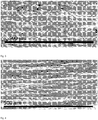
- Similar rods are made of pure P(L/D)LA 50L/50D. Internal structures of these materials are presented in Fig. 3 and Fig. 4 .
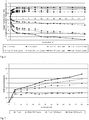
- the programmed P(L/D)LA 50L/50D- ⁇ TCP-composites have remarkably shorter latency time before the shape transformation starts, higher short term shape transformation and higher shape transformation speed than the pure P(L/D)LA 50L/50D copolymer processed similar way, as presented in Fig. 5A and 5 B .
- PLGA 85L/15G and ⁇ -TCP are melt mixed in twin screw extruder and extruded into round rods having the diameter of 5.5 mm.
- the extruder temperatures are between 50°C and 300°C.
- the 5.5 mm rods are then die drawn into 2.7 mm grooved surfaced rods with drawing temperatures between 60°C and 140°C and subsequently cooled down to room temperature.
- the draw ratio of the programmed rods is then 4.1.
- the programmed PLGA 85L/15G- ⁇ TCP-composites have remarkably shorter latency time before the shape transformation starts, higher short term shape transformation and shape transformation speed than the pure PLGA 85L/15G copolymer, as presented in Fig. 6 .
- Shape transformation ratio is according to the ⁇ -TCP concentration (0, 10, 15 and 20 wt-%) of the composite; the higher particle concentration the higher shape transformation ratio in the simulated body conditions.
- Fig 1 shows a schematic figure of a shape transformation and a change of a shape of a composite material or device when it has a shape-memory capability.
- the composite material or device of present invention have an ability to change from programmed initial shape 1 towards the evolved shape 2.
- the dimensions are presented as length L1 and diameter D1 for the programmed initial shape and length L2 and diameter D2 for evolved shape.
- the composite material or medical device has a programmed initial shape and at least one evolved shape.
- the initial programmed shape is adapted to change towards the evolved shape when the composite material or medical device is activated in physiological conditions or in conditions simulating the physiological conditions.
- the degree and/or speed of the shape transformation of the composite material or device may be adjusted by controlling the amount and type of the filler component.
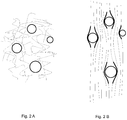
- Fig 2 shows a principle internal view of a composite material or device after conventional melt processing having a non-oriented, original structure (2 A) and after orientation programming process (solid state deformation) having an oriented (programmed), initial structure (2 B).
- Partially rigid components may interfere the composite solid state deformation process and generate an heterogeneously oriented polymer matrix, where the polymer chains may have additional orientation and higher orientation rate in the vicinity of the filler component (shown by darker line around the spheres). Heterogeneous orientation may further have influence on the transformation rate profile of the composite material or device.
- an initial internal structure of an orientation programmed composite, P(L/D)LA 50L/50D / ⁇ -TCP (10 wt-%), with draw ratio 4 is shown in Fig. 3 .
- FIG 5 A and B present the acceleration and amplification of the shape transformation rate in a well controlled manner by adding filler particles.
- the tests were carried out by immersing the samples in phosphate buffered saline at 37°C and periodically measuring the dimensions manually using a slide gauge.
- In vitro time (days) is presented in x-axis and shape transformation (%) in y-axis.
- the diameter of the composites which has 10 weight-% filler may be increased by 10 % in 2 days, whereas the length may be decreased by 18%, as presented in Fig. 5B .
- Pure copolymer P(L/D)LA 50L/50D has less shape transformation capability and normally 24 to 48 h time lag of shape transformation to occur at the beginning of exposure to physiological conditions. It is obvious that filler component and thus particle blending change the transformation rate profile of composites. The time lag diminishes and shape transformation rate can be adjusted to desired and predetermined level by varying the particle content. Increased shape transformation may be achieved also with relatively small particle content e.g. such as from 5 to 10 weight-%.
- Fig 6 shows a diagram of a shape transformation of a pure copolymer PLGA 85L/15G and composites of PLGA 85L/15G with ⁇ -tricalciumphosphate in physiological conditions until 84 days.
- the test is carried out by immersing the samples in phosphate buffered saline at 37°C and periodically measuring the dimensions manually using a slide gauge.
- In vitro time (days) is presented in x-axis and shape transformation (%) in y-axis.
- the dimensional change, both diameter and length is rapid at the beginning of the hydrolysis. For example by 7 days all the materials have reached most of the transformation of the sample length, which thereafter continues slow decrease until 84 days.
- the shape transformation rate of the composite materials or devices may thus be enhanced at the beginning of the immersion.
- Fig 7 shows a diagram on the weight change of pure copolymer PLGA 85L/15G and composites of PLGA 85L/15G with ⁇ -tricatciumphosphate particles in physiological conditions due to the water absorption.
- the test is carried out by immersing the samples in phosphate buffered saline at 37°C and periodically weighing the samples.
- In vitro time (days) are presented in x-axis and wet mass increase (%) in y-axis.
- the hydrophilic filler particles increase the wet mass of the composites during the whole period, 84 days.
- wet mass of a pure polymer is increased from 0.8 to 1.2 weight-% during 84 day follow up time whereas the wet mass of composite having 20 weight-% particles is increased from 1.3 to 3.6 weight-%.
- water absorption of composite materials or devices may be increased by adding a hydrophilic filler component into the polymer matrix.
Landscapes
- Health & Medical Sciences (AREA)
- Chemical & Material Sciences (AREA)
- Medicinal Chemistry (AREA)
- Epidemiology (AREA)
- Animal Behavior & Ethology (AREA)
- Veterinary Medicine (AREA)
- Dermatology (AREA)
- Public Health (AREA)
- Oral & Maxillofacial Surgery (AREA)
- Transplantation (AREA)
- General Health & Medical Sciences (AREA)
- Life Sciences & Earth Sciences (AREA)
- Chemical Kinetics & Catalysis (AREA)
- Polymers & Plastics (AREA)
- Organic Chemistry (AREA)
- Materials Engineering (AREA)
- Inorganic Chemistry (AREA)
- Engineering & Computer Science (AREA)
- Composite Materials (AREA)
- Materials For Medical Uses (AREA)
- Compositions Of Macromolecular Compounds (AREA)
Claims (7)
- Biologisch abbaubares Verbundmaterial für medizinische Vorrichtungen oder eine medizinische Vorrichtung, die ein solches Material umfasst, wobei das Material mindestens ein biologisch abbaubares Polymermatrixmaterial und Füllstoffpartikel umfasst und wobei das Material eine anfängliche Form und mindestens eine fortentwickelte Form aufweist, wobei sich die fortentwickelte Form von der anfänglichen Form unterscheidet, wobei die anfängliche Form dafür geeignet ist, sich zur fortentwickelten Form zu ändern, dadurch gekennzeichnet, dass die anfängliche Form in einem Verformungsvorgang eine ausrichtungsbasierte Programmierung mit einem vorbestimmten Verstreckungsverhältnis erfahren hat, sodass sie sich bis zu einem vorbestimmten Spannungsniveau anpasst und das vorbestimmte Spannungsniveau wieder abgibt, indem sie eine Belastung erzeugt oder sich entspannt, sowie dadurch, dass das Material eine Struktur umfasst, die aus Folgendem besteht:- biologisch abbaubarem Polymermatrixmaterial, welches aus L-Lactid/D-Lactid 50L/50D-Copolymer und 5 Gew.-% oder 10 Gew.-% an Füllstoffpartikeln aus β-Tricalciumphosphat besteht und das vorbestimmte Verstreckungsverhältnis von 4 aufweist, oder- biologisch abbaubarem Polymermatrixmaterial aus L-Lactid/Glycolid-Copolymer 85L/15G und 10 Gew.-%, 15 Gew.-% oder 20 Gew.-% an Füllstoffpartikeln aus β-Tricalciumphosphat, wobei es das vorbestimmte Verstreckungsverhältnis von 4,1 aufweist,und wobei die Struktur rundum die Füllstoffpartikel eine heterogene Ausrichtung der Polymerketten der biologisch abbaubaren Polymermatrix und Hohlräume aufweist, und wobei die Struktur die Umwandlung von der anfänglichen Form in die fortentwickelte Form beschleunigt oder verstärkt, wenn die äußere Anregung zur Umwandlung durch physiologische Bedingungen gegeben wird, sodass im Vergleich mit biologisch abbaubaren Polymermatrixmaterialien ohne die Füllstoffpartikel eine verkürzte Latenzzeit der Umwandlung oder eine verstärkte Umwandlung der Abmessungen des Materials oder der Vorrichtung ermöglicht wird.
- Verbundmaterial oder Vorrichtung gemäß Anspruch 1, dadurch gekennzeichnet, dass die Füllstoffpartikel hydrophil sind.
- Verbundmaterial oder Vorrichtung gemäß Anspruch 1, dadurch gekennzeichnet, dass die Füllstoffpartikel mit dem umgebenden biologisch abbaubarem Polymermatrixmaterial keine wesentliche Bindung eingehen.
- Verbundmaterial oder Vorrichtung gemäß Anspruch 1, dadurch gekennzeichnet, dass die Füllstoffpartikel puffernde Eigenschaften haben.
- Verbundmaterial oder Vorrichtung gemäß Anspruch 1, dadurch gekennzeichnet, dass mindestens einer der Füllstoffbestandteile die Sichtbarkeit beispielsweise während chirurgischer Eingriffe oder der Bildgebung verbessert.
- Verfahren zur Steuerung der Geschwindigkeit und des Ausmaßes der Veränderung der Form eines biologisch abbaubaren Polymerverbundmaterials für medizinische Vorrichtungen oder einer medizinischen Vorrichtung, die das Material umfasst, wobei das Verfahren Folgendes umfasst:Auswählen eines biologisch abbaubaren Polymermatrixmaterials, das aus L-Lactid/D-Lactid 50L/50D-Copolymer oder L-Lactid/Glycolid-Copolymer 85L/15G besteht;Auswählen von Füllstoffpartikeln, die aus β-Tricalciumphosphat bestehen;Vermischen des biologisch abbaubaren Polymermatrixmaterials aus L-Lactid/D-Lactid 50L/50D-Copolymer und der Füllstoffpartikel in einer relativen Menge von 5 oder 10 Gewichts-% durch herkömmliche Schmelzverarbeitung, um den Verbundstoff zu bilden, oderVermischen des biologisch abbaubaren Polymermatrixmaterials aus L-Lactid/Glycolid-Copolymer 85L/15G und der Füllstoffpartikel in einer relativen Menge von 10, 15 oder 20 Gewichts-% durch herkömmliche Schmelzverarbeitung, um den Verbundstoff zu bilden;ausrichtungsbasiertes Programmieren des Verbundstoffs in einem Vorgang der Verformung des Verbundstoffs unter Verwendung eines vorbestimmten Verstreckungsverhältnisses von 4 beziehungsweise 4,1, um eine anfängliche Form zu bilden, die rundum die Füllstoffpartikel heterogen ausgerichtete Polymerketten in der biologisch abbaubaren Polymermatrix und Hohlräume aufweist sowie ein vorbestimmtes Spannungsniveau und eine gesteuerte und vorbestimmte Geschwindigkeit zur Änderung der anfänglichen Form in eine fortentwickelte Form nach Aktivierung unter physiologischen Bedingungen, sodass im Vergleich mit biologisch abbaubaren Polymermatrixmaterialien ohne die Füllstoffpartikel eine verkürzte Latenzzeit der Umwandlung oder eine verstärkte Umwandlung der Abmessungen des Materials oder der Vorrichtung ermöglicht wird.
- Verfahren gemäß Anspruch 6, dadurch gekennzeichnet, dass das Verfahren eine ausrichtungsbasiertes Programmieren des Verbundstoffs in einem Verformungsvorgang in der Festphase umfasst, um die anfängliche Form bis zum vorbestimmten Spannungsniveau zu beladen, sowie ein Anpassen der Vorrichtung, sodass sie das vorbestimmte Spannungsniveau wieder abgibt, indem sie eine Belastung erzeugt oder sich entspannt.
Applications Claiming Priority (1)
| Application Number | Priority Date | Filing Date | Title |
|---|---|---|---|
| PCT/FI2010/050384 WO2011141615A1 (en) | 2010-05-11 | 2010-05-11 | Biocompatible material and device |
Publications (3)
| Publication Number | Publication Date |
|---|---|
| EP2569024A1 EP2569024A1 (de) | 2013-03-20 |
| EP2569024A4 EP2569024A4 (de) | 2014-06-11 |
| EP2569024B1 true EP2569024B1 (de) | 2018-12-05 |
Family
ID=44913998
Family Applications (1)
| Application Number | Title | Priority Date | Filing Date |
|---|---|---|---|
| EP10851324.3A Active EP2569024B1 (de) | 2010-05-11 | 2010-05-11 | Biokompatibles material und vorrichtung |
Country Status (3)
| Country | Link |
|---|---|
| US (1) | US9777148B2 (de) |
| EP (1) | EP2569024B1 (de) |
| WO (1) | WO2011141615A1 (de) |
Family Cites Families (13)
| Publication number | Priority date | Publication date | Assignee | Title |
|---|---|---|---|---|
| JPS6368155A (ja) * | 1986-09-11 | 1988-03-28 | グンゼ株式会社 | 骨接合ピン |
| FI81498C (fi) | 1987-01-13 | 1990-11-12 | Biocon Oy | Kirurgiska material och instrument. |
| EP0795336B1 (de) * | 1995-09-14 | 2003-06-11 | Takiron Co. Ltd. | Osteosynthetisches material, verbundwerkstoff für implantate und verfahren zu ihrer herstellung |
| FI954565A0 (fi) | 1995-09-27 | 1995-09-27 | Biocon Oy | Biolgiskt upploeslig av ett polymerbaserat material tillverkad implant och foerfarande foer dess tillverkning |
| BR9907968B1 (pt) | 1998-02-23 | 2009-12-01 | composição de polìmeros com memória de formato biodegradáveis e artigos compreendendo a mesma. | |
| AU4215299A (en) | 1998-06-01 | 1999-12-20 | Loctite Corporation | Flame-retardant uv curable silicone compositions |
| CN1330388C (zh) * | 2005-03-29 | 2007-08-08 | 胡金莲 | 抗菌形状记忆聚氨酯骨科矫形、固形康复板材及其制备方法 |
| ZA200902452B (en) | 2006-10-25 | 2010-07-28 | Takeda Pharmaceutical | Metastin derivatives and use thereof |
| AU2008230981A1 (en) | 2007-03-23 | 2008-10-02 | Smith & Nephew, Inc. | Fixation devices and method of repair |
| US9815240B2 (en) * | 2007-04-18 | 2017-11-14 | Smith & Nephew, Inc. | Expansion moulding of shape memory polymers |
| FI124190B (fi) * | 2007-12-05 | 2014-04-30 | Bioretec Oy | Lääketieteellinen väline ja sen valmistus |
| DE102009001356A1 (de) * | 2008-10-31 | 2010-05-12 | Gkss-Forschungszentrum Geesthacht Gmbh | Artikel mit mindestens einem thermo-programmierbaren Schaltabschnitt für Anwendungen in Kontakt mit Materialien mit hohen Wärmeübergangszahlen |
| CN101508772B (zh) * | 2009-03-13 | 2011-07-27 | 哈尔滨工业大学 | 聚酯型生物可降解形状记忆聚合物及其制备方法 |
-
2010
- 2010-05-11 WO PCT/FI2010/050384 patent/WO2011141615A1/en not_active Ceased
- 2010-05-11 EP EP10851324.3A patent/EP2569024B1/de active Active
- 2010-05-11 US US13/697,574 patent/US9777148B2/en active Active
Non-Patent Citations (1)
| Title |
|---|
| None * |
Also Published As
| Publication number | Publication date |
|---|---|
| US9777148B2 (en) | 2017-10-03 |
| EP2569024A4 (de) | 2014-06-11 |
| US20130211000A1 (en) | 2013-08-15 |
| WO2011141615A1 (en) | 2011-11-17 |
| EP2569024A1 (de) | 2013-03-20 |
Similar Documents
| Publication | Publication Date | Title |
|---|---|---|
| Cameron et al. | Synthetic bioresorbable polymers | |
| Matsusue et al. | In vitro and in vivo studies on bioabsorbable ultra‐high‐strength poly (l‐lactide) rods | |
| Middleton et al. | Synthetic biodegradable polymers as orthopedic devices | |
| CA2239776C (en) | Under tissue conditions degradable material and a method for its manufacturing | |
| Hasırcı et al. | Versatility of biodegradable biopolymers: degradability and an in vivo application | |
| Doyle et al. | In vitro and in vivo evaluation of polyhydroxybutyrate and of polyhydroxybutyrate reinforced with hydroxyapatite | |
| AU2002310552B2 (en) | Biodegradable polymer systems | |
| US6406498B1 (en) | Bioactive, bioabsorbable surgical composite material | |
| Nazhat et al. | Dynamic mechanical characterization of biodegradable composites of hydroxyapatite and polylactides | |
| US8722783B2 (en) | Fiber reinforced composite material | |
| Niemelä | Effect of β-tricalcium phosphate addition on the in vitro degradation of self-reinforced poly-l, d-lactide | |
| EP2852417B1 (de) | Resorbierbare biokeramische zusammensetzungen aus poly-4-hydroxybutyrat und copolymeren | |
| US20160361103A1 (en) | Medical Device and Its Manufacture | |
| AU2002310552A1 (en) | Biodegradable polymer systems | |
| JPH03103429A (ja) | 分解吸収性成型体および該成型体の製造方法 | |
| US20210122916A1 (en) | Biodegradable polymer blends for manufacturing medical devices | |
| Daculsi et al. | Osteoconductive properties of poly (96L/4D-lactide)/beta-tricalcium phosphate in long term animal model | |
| Demina et al. | Biodegradable nanostructured composites for surgery and regenerative medicine | |
| Niemelä et al. | Self-reinforced composites of bioabsorbable polymer and bioactive glass with different bioactive glass contents. Part II: In vitro degradation | |
| Delabarde et al. | Accelerated ageing and degradation in poly-L-lactide/hydroxyapatite nanocomposites | |
| EP1922091A2 (de) | Hochfeste vorrichtungen und komposite | |
| Saikku-Bäckström et al. | Intramedullary fixation of cortical bone osteotomies with absorbable self-reinforced fibrillated poly-96L/4D-lactide (SR-PLA96) rods in rabbits | |
| Laitinen et al. | Transmission electron microscopic visualization of the degradation and phagocytosis of a poly‐L‐lactide screw in cancellous bone: A long‐term experimental study | |
| EP2569024B1 (de) | Biokompatibles material und vorrichtung | |
| WO2007110611A1 (en) | Composite material |
Legal Events
| Date | Code | Title | Description |
|---|---|---|---|
| PUAI | Public reference made under article 153(3) epc to a published international application that has entered the european phase |
Free format text: ORIGINAL CODE: 0009012 |
|
| 17P | Request for examination filed |
Effective date: 20121211 |
|
| AK | Designated contracting states |
Kind code of ref document: A1 Designated state(s): AL AT BE BG CH CY CZ DE DK EE ES FI FR GB GR HR HU IE IS IT LI LT LU LV MC MK MT NL NO PL PT RO SE SI SK SM TR |
|
| DAX | Request for extension of the european patent (deleted) | ||
| RIC1 | Information provided on ipc code assigned before grant |
Ipc: A61L 27/58 20060101ALI20140423BHEP Ipc: A61L 31/14 20060101ALI20140423BHEP Ipc: A61L 27/50 20060101AFI20140423BHEP Ipc: A61L 27/44 20060101ALI20140423BHEP |
|
| A4 | Supplementary search report drawn up and despatched |
Effective date: 20140512 |
|
| STAA | Information on the status of an ep patent application or granted ep patent |
Free format text: STATUS: EXAMINATION IS IN PROGRESS |
|
| 17Q | First examination report despatched |
Effective date: 20170524 |
|
| GRAP | Despatch of communication of intention to grant a patent |
Free format text: ORIGINAL CODE: EPIDOSNIGR1 |
|
| STAA | Information on the status of an ep patent application or granted ep patent |
Free format text: STATUS: GRANT OF PATENT IS INTENDED |
|
| INTG | Intention to grant announced |
Effective date: 20180626 |
|
| GRAS | Grant fee paid |
Free format text: ORIGINAL CODE: EPIDOSNIGR3 |
|
| GRAA | (expected) grant |
Free format text: ORIGINAL CODE: 0009210 |
|
| RIN1 | Information on inventor provided before grant (corrected) |
Inventor name: PAAKINAHO, KAARLO Inventor name: TOERMAELAE, PERTTI Inventor name: HEINO, HARRI |
|
| GRAA | (expected) grant |
Free format text: ORIGINAL CODE: 0009210 |
|
| STAA | Information on the status of an ep patent application or granted ep patent |
Free format text: STATUS: THE PATENT HAS BEEN GRANTED |
|
| AK | Designated contracting states |
Kind code of ref document: B1 Designated state(s): AL AT BE BG CH CY CZ DE DK EE ES FI FR GB GR HR HU IE IS IT LI LT LU LV MC MK MT NL NO PL PT RO SE SI SK SM TR |
|
| REG | Reference to a national code |
Ref country code: GB Ref legal event code: FG4D |
|
| REG | Reference to a national code |
Ref country code: CH Ref legal event code: EP |
|
| REG | Reference to a national code |
Ref country code: AT Ref legal event code: REF Ref document number: 1072253 Country of ref document: AT Kind code of ref document: T Effective date: 20181215 |
|
| REG | Reference to a national code |
Ref country code: IE Ref legal event code: FG4D |
|
| REG | Reference to a national code |
Ref country code: DE Ref legal event code: R096 Ref document number: 602010055704 Country of ref document: DE |
|
| REG | Reference to a national code |
Ref country code: NL Ref legal event code: MP Effective date: 20181205 |
|
| REG | Reference to a national code |
Ref country code: AT Ref legal event code: MK05 Ref document number: 1072253 Country of ref document: AT Kind code of ref document: T Effective date: 20181205 |
|
| REG | Reference to a national code |
Ref country code: LT Ref legal event code: MG4D |
|
| PG25 | Lapsed in a contracting state [announced via postgrant information from national office to epo] |
Ref country code: BG Free format text: LAPSE BECAUSE OF FAILURE TO SUBMIT A TRANSLATION OF THE DESCRIPTION OR TO PAY THE FEE WITHIN THE PRESCRIBED TIME-LIMIT Effective date: 20190305 Ref country code: NO Free format text: LAPSE BECAUSE OF FAILURE TO SUBMIT A TRANSLATION OF THE DESCRIPTION OR TO PAY THE FEE WITHIN THE PRESCRIBED TIME-LIMIT Effective date: 20190305 Ref country code: HR Free format text: LAPSE BECAUSE OF FAILURE TO SUBMIT A TRANSLATION OF THE DESCRIPTION OR TO PAY THE FEE WITHIN THE PRESCRIBED TIME-LIMIT Effective date: 20181205 Ref country code: ES Free format text: LAPSE BECAUSE OF FAILURE TO SUBMIT A TRANSLATION OF THE DESCRIPTION OR TO PAY THE FEE WITHIN THE PRESCRIBED TIME-LIMIT Effective date: 20181205 Ref country code: LT Free format text: LAPSE BECAUSE OF FAILURE TO SUBMIT A TRANSLATION OF THE DESCRIPTION OR TO PAY THE FEE WITHIN THE PRESCRIBED TIME-LIMIT Effective date: 20181205 Ref country code: LV Free format text: LAPSE BECAUSE OF FAILURE TO SUBMIT A TRANSLATION OF THE DESCRIPTION OR TO PAY THE FEE WITHIN THE PRESCRIBED TIME-LIMIT Effective date: 20181205 Ref country code: AT Free format text: LAPSE BECAUSE OF FAILURE TO SUBMIT A TRANSLATION OF THE DESCRIPTION OR TO PAY THE FEE WITHIN THE PRESCRIBED TIME-LIMIT Effective date: 20181205 |
|
| PG25 | Lapsed in a contracting state [announced via postgrant information from national office to epo] |
Ref country code: AL Free format text: LAPSE BECAUSE OF FAILURE TO SUBMIT A TRANSLATION OF THE DESCRIPTION OR TO PAY THE FEE WITHIN THE PRESCRIBED TIME-LIMIT Effective date: 20181205 Ref country code: SE Free format text: LAPSE BECAUSE OF FAILURE TO SUBMIT A TRANSLATION OF THE DESCRIPTION OR TO PAY THE FEE WITHIN THE PRESCRIBED TIME-LIMIT Effective date: 20181205 Ref country code: GR Free format text: LAPSE BECAUSE OF FAILURE TO SUBMIT A TRANSLATION OF THE DESCRIPTION OR TO PAY THE FEE WITHIN THE PRESCRIBED TIME-LIMIT Effective date: 20190306 |
|
| PG25 | Lapsed in a contracting state [announced via postgrant information from national office to epo] |
Ref country code: NL Free format text: LAPSE BECAUSE OF FAILURE TO SUBMIT A TRANSLATION OF THE DESCRIPTION OR TO PAY THE FEE WITHIN THE PRESCRIBED TIME-LIMIT Effective date: 20181205 |
|
| PG25 | Lapsed in a contracting state [announced via postgrant information from national office to epo] |
Ref country code: IT Free format text: LAPSE BECAUSE OF FAILURE TO SUBMIT A TRANSLATION OF THE DESCRIPTION OR TO PAY THE FEE WITHIN THE PRESCRIBED TIME-LIMIT Effective date: 20181205 Ref country code: CZ Free format text: LAPSE BECAUSE OF FAILURE TO SUBMIT A TRANSLATION OF THE DESCRIPTION OR TO PAY THE FEE WITHIN THE PRESCRIBED TIME-LIMIT Effective date: 20181205 Ref country code: PL Free format text: LAPSE BECAUSE OF FAILURE TO SUBMIT A TRANSLATION OF THE DESCRIPTION OR TO PAY THE FEE WITHIN THE PRESCRIBED TIME-LIMIT Effective date: 20181205 Ref country code: PT Free format text: LAPSE BECAUSE OF FAILURE TO SUBMIT A TRANSLATION OF THE DESCRIPTION OR TO PAY THE FEE WITHIN THE PRESCRIBED TIME-LIMIT Effective date: 20190405 |
|
| PG25 | Lapsed in a contracting state [announced via postgrant information from national office to epo] |
Ref country code: SK Free format text: LAPSE BECAUSE OF FAILURE TO SUBMIT A TRANSLATION OF THE DESCRIPTION OR TO PAY THE FEE WITHIN THE PRESCRIBED TIME-LIMIT Effective date: 20181205 Ref country code: IS Free format text: LAPSE BECAUSE OF FAILURE TO SUBMIT A TRANSLATION OF THE DESCRIPTION OR TO PAY THE FEE WITHIN THE PRESCRIBED TIME-LIMIT Effective date: 20190405 Ref country code: RO Free format text: LAPSE BECAUSE OF FAILURE TO SUBMIT A TRANSLATION OF THE DESCRIPTION OR TO PAY THE FEE WITHIN THE PRESCRIBED TIME-LIMIT Effective date: 20181205 Ref country code: EE Free format text: LAPSE BECAUSE OF FAILURE TO SUBMIT A TRANSLATION OF THE DESCRIPTION OR TO PAY THE FEE WITHIN THE PRESCRIBED TIME-LIMIT Effective date: 20181205 Ref country code: SM Free format text: LAPSE BECAUSE OF FAILURE TO SUBMIT A TRANSLATION OF THE DESCRIPTION OR TO PAY THE FEE WITHIN THE PRESCRIBED TIME-LIMIT Effective date: 20181205 |
|
| REG | Reference to a national code |
Ref country code: DE Ref legal event code: R097 Ref document number: 602010055704 Country of ref document: DE |
|
| PLBE | No opposition filed within time limit |
Free format text: ORIGINAL CODE: 0009261 |
|
| STAA | Information on the status of an ep patent application or granted ep patent |
Free format text: STATUS: NO OPPOSITION FILED WITHIN TIME LIMIT |
|
| PG25 | Lapsed in a contracting state [announced via postgrant information from national office to epo] |
Ref country code: DK Free format text: LAPSE BECAUSE OF FAILURE TO SUBMIT A TRANSLATION OF THE DESCRIPTION OR TO PAY THE FEE WITHIN THE PRESCRIBED TIME-LIMIT Effective date: 20181205 Ref country code: SI Free format text: LAPSE BECAUSE OF FAILURE TO SUBMIT A TRANSLATION OF THE DESCRIPTION OR TO PAY THE FEE WITHIN THE PRESCRIBED TIME-LIMIT Effective date: 20181205 |
|
| 26N | No opposition filed |
Effective date: 20190906 |
|
| GBPC | Gb: european patent ceased through non-payment of renewal fee |
Effective date: 20190511 |
|
| PG25 | Lapsed in a contracting state [announced via postgrant information from national office to epo] |
Ref country code: MC Free format text: LAPSE BECAUSE OF FAILURE TO SUBMIT A TRANSLATION OF THE DESCRIPTION OR TO PAY THE FEE WITHIN THE PRESCRIBED TIME-LIMIT Effective date: 20181205 |
|
| REG | Reference to a national code |
Ref country code: BE Ref legal event code: MM Effective date: 20190531 |
|
| PG25 | Lapsed in a contracting state [announced via postgrant information from national office to epo] |
Ref country code: LU Free format text: LAPSE BECAUSE OF NON-PAYMENT OF DUE FEES Effective date: 20190511 |
|
| PG25 | Lapsed in a contracting state [announced via postgrant information from national office to epo] |
Ref country code: TR Free format text: LAPSE BECAUSE OF FAILURE TO SUBMIT A TRANSLATION OF THE DESCRIPTION OR TO PAY THE FEE WITHIN THE PRESCRIBED TIME-LIMIT Effective date: 20181205 |
|
| PG25 | Lapsed in a contracting state [announced via postgrant information from national office to epo] |
Ref country code: IE Free format text: LAPSE BECAUSE OF NON-PAYMENT OF DUE FEES Effective date: 20190511 Ref country code: GB Free format text: LAPSE BECAUSE OF NON-PAYMENT OF DUE FEES Effective date: 20190511 |
|
| PG25 | Lapsed in a contracting state [announced via postgrant information from national office to epo] |
Ref country code: BE Free format text: LAPSE BECAUSE OF NON-PAYMENT OF DUE FEES Effective date: 20190531 |
|
| PG25 | Lapsed in a contracting state [announced via postgrant information from national office to epo] |
Ref country code: FR Free format text: LAPSE BECAUSE OF NON-PAYMENT OF DUE FEES Effective date: 20190531 |
|
| PG25 | Lapsed in a contracting state [announced via postgrant information from national office to epo] |
Ref country code: CY Free format text: LAPSE BECAUSE OF FAILURE TO SUBMIT A TRANSLATION OF THE DESCRIPTION OR TO PAY THE FEE WITHIN THE PRESCRIBED TIME-LIMIT Effective date: 20181205 |
|
| PG25 | Lapsed in a contracting state [announced via postgrant information from national office to epo] |
Ref country code: HU Free format text: LAPSE BECAUSE OF FAILURE TO SUBMIT A TRANSLATION OF THE DESCRIPTION OR TO PAY THE FEE WITHIN THE PRESCRIBED TIME-LIMIT; INVALID AB INITIO Effective date: 20100511 Ref country code: MT Free format text: LAPSE BECAUSE OF FAILURE TO SUBMIT A TRANSLATION OF THE DESCRIPTION OR TO PAY THE FEE WITHIN THE PRESCRIBED TIME-LIMIT Effective date: 20181205 |
|
| PG25 | Lapsed in a contracting state [announced via postgrant information from national office to epo] |
Ref country code: MK Free format text: LAPSE BECAUSE OF FAILURE TO SUBMIT A TRANSLATION OF THE DESCRIPTION OR TO PAY THE FEE WITHIN THE PRESCRIBED TIME-LIMIT Effective date: 20181205 |
|
| PGFP | Annual fee paid to national office [announced via postgrant information from national office to epo] |
Ref country code: FI Payment date: 20250512 Year of fee payment: 16 |
|
| PGFP | Annual fee paid to national office [announced via postgrant information from national office to epo] |
Ref country code: DE Payment date: 20250520 Year of fee payment: 16 |
|
| PGFP | Annual fee paid to national office [announced via postgrant information from national office to epo] |
Ref country code: CH Payment date: 20250601 Year of fee payment: 16 |