EP2570492A2 - Méthode de detection de mutations de IL28B (RS8099917) et ITPA (RS1127354) - Google Patents
Méthode de detection de mutations de IL28B (RS8099917) et ITPA (RS1127354) Download PDFInfo
- Publication number
- EP2570492A2 EP2570492A2 EP12184426A EP12184426A EP2570492A2 EP 2570492 A2 EP2570492 A2 EP 2570492A2 EP 12184426 A EP12184426 A EP 12184426A EP 12184426 A EP12184426 A EP 12184426A EP 2570492 A2 EP2570492 A2 EP 2570492A2
- Authority
- EP
- European Patent Office
- Prior art keywords
- nucleotide
- probe
- oligonucleotide
- seq
- gene
- Prior art date
- Legal status (The legal status is an assumption and is not a legal conclusion. Google has not performed a legal analysis and makes no representation as to the accuracy of the status listed.)
- Granted
Links
Images

Classifications
-
- C—CHEMISTRY; METALLURGY
- C12—BIOCHEMISTRY; BEER; SPIRITS; WINE; VINEGAR; MICROBIOLOGY; ENZYMOLOGY; MUTATION OR GENETIC ENGINEERING
- C12Q—MEASURING OR TESTING PROCESSES INVOLVING ENZYMES, NUCLEIC ACIDS OR MICROORGANISMS; COMPOSITIONS OR TEST PAPERS THEREFOR; PROCESSES OF PREPARING SUCH COMPOSITIONS; CONDITION-RESPONSIVE CONTROL IN MICROBIOLOGICAL OR ENZYMOLOGICAL PROCESSES
- C12Q1/00—Measuring or testing processes involving enzymes, nucleic acids or microorganisms; Compositions therefor; Processes of preparing such compositions
- C12Q1/68—Measuring or testing processes involving enzymes, nucleic acids or microorganisms; Compositions therefor; Processes of preparing such compositions involving nucleic acids
- C12Q1/6876—Nucleic acid products used in the analysis of nucleic acids, e.g. primers or probes
- C12Q1/6881—Nucleic acid products used in the analysis of nucleic acids, e.g. primers or probes for tissue or cell typing, e.g. human leukocyte antigen [HLA] probes
-
- C—CHEMISTRY; METALLURGY
- C12—BIOCHEMISTRY; BEER; SPIRITS; WINE; VINEGAR; MICROBIOLOGY; ENZYMOLOGY; MUTATION OR GENETIC ENGINEERING
- C12Q—MEASURING OR TESTING PROCESSES INVOLVING ENZYMES, NUCLEIC ACIDS OR MICROORGANISMS; COMPOSITIONS OR TEST PAPERS THEREFOR; PROCESSES OF PREPARING SUCH COMPOSITIONS; CONDITION-RESPONSIVE CONTROL IN MICROBIOLOGICAL OR ENZYMOLOGICAL PROCESSES
- C12Q1/00—Measuring or testing processes involving enzymes, nucleic acids or microorganisms; Compositions therefor; Processes of preparing such compositions
- C12Q1/68—Measuring or testing processes involving enzymes, nucleic acids or microorganisms; Compositions therefor; Processes of preparing such compositions involving nucleic acids
- C12Q1/6876—Nucleic acid products used in the analysis of nucleic acids, e.g. primers or probes
- C12Q1/6883—Nucleic acid products used in the analysis of nucleic acids, e.g. primers or probes for diseases caused by alterations of genetic material
-
- C—CHEMISTRY; METALLURGY
- C12—BIOCHEMISTRY; BEER; SPIRITS; WINE; VINEGAR; MICROBIOLOGY; ENZYMOLOGY; MUTATION OR GENETIC ENGINEERING
- C12Q—MEASURING OR TESTING PROCESSES INVOLVING ENZYMES, NUCLEIC ACIDS OR MICROORGANISMS; COMPOSITIONS OR TEST PAPERS THEREFOR; PROCESSES OF PREPARING SUCH COMPOSITIONS; CONDITION-RESPONSIVE CONTROL IN MICROBIOLOGICAL OR ENZYMOLOGICAL PROCESSES
- C12Q1/00—Measuring or testing processes involving enzymes, nucleic acids or microorganisms; Compositions therefor; Processes of preparing such compositions
- C12Q1/68—Measuring or testing processes involving enzymes, nucleic acids or microorganisms; Compositions therefor; Processes of preparing such compositions involving nucleic acids
- C12Q1/6876—Nucleic acid products used in the analysis of nucleic acids, e.g. primers or probes
-
- C—CHEMISTRY; METALLURGY
- C12—BIOCHEMISTRY; BEER; SPIRITS; WINE; VINEGAR; MICROBIOLOGY; ENZYMOLOGY; MUTATION OR GENETIC ENGINEERING
- C12Q—MEASURING OR TESTING PROCESSES INVOLVING ENZYMES, NUCLEIC ACIDS OR MICROORGANISMS; COMPOSITIONS OR TEST PAPERS THEREFOR; PROCESSES OF PREPARING SUCH COMPOSITIONS; CONDITION-RESPONSIVE CONTROL IN MICROBIOLOGICAL OR ENZYMOLOGICAL PROCESSES
- C12Q2527/00—Reactions demanding special reaction conditions
- C12Q2527/101—Temperature
-
- C—CHEMISTRY; METALLURGY
- C12—BIOCHEMISTRY; BEER; SPIRITS; WINE; VINEGAR; MICROBIOLOGY; ENZYMOLOGY; MUTATION OR GENETIC ENGINEERING
- C12Q—MEASURING OR TESTING PROCESSES INVOLVING ENZYMES, NUCLEIC ACIDS OR MICROORGANISMS; COMPOSITIONS OR TEST PAPERS THEREFOR; PROCESSES OF PREPARING SUCH COMPOSITIONS; CONDITION-RESPONSIVE CONTROL IN MICROBIOLOGICAL OR ENZYMOLOGICAL PROCESSES
- C12Q2563/00—Nucleic acid detection characterized by the use of physical, structural and functional properties
- C12Q2563/107—Nucleic acid detection characterized by the use of physical, structural and functional properties fluorescence
-
- C—CHEMISTRY; METALLURGY
- C12—BIOCHEMISTRY; BEER; SPIRITS; WINE; VINEGAR; MICROBIOLOGY; ENZYMOLOGY; MUTATION OR GENETIC ENGINEERING
- C12Q—MEASURING OR TESTING PROCESSES INVOLVING ENZYMES, NUCLEIC ACIDS OR MICROORGANISMS; COMPOSITIONS OR TEST PAPERS THEREFOR; PROCESSES OF PREPARING SUCH COMPOSITIONS; CONDITION-RESPONSIVE CONTROL IN MICROBIOLOGICAL OR ENZYMOLOGICAL PROCESSES
- C12Q2600/00—Oligonucleotides characterized by their use
- C12Q2600/106—Pharmacogenomics, i.e. genetic variability in individual responses to drugs and drug metabolism
-
- C—CHEMISTRY; METALLURGY
- C12—BIOCHEMISTRY; BEER; SPIRITS; WINE; VINEGAR; MICROBIOLOGY; ENZYMOLOGY; MUTATION OR GENETIC ENGINEERING
- C12Q—MEASURING OR TESTING PROCESSES INVOLVING ENZYMES, NUCLEIC ACIDS OR MICROORGANISMS; COMPOSITIONS OR TEST PAPERS THEREFOR; PROCESSES OF PREPARING SUCH COMPOSITIONS; CONDITION-RESPONSIVE CONTROL IN MICROBIOLOGICAL OR ENZYMOLOGICAL PROCESSES
- C12Q2600/00—Oligonucleotides characterized by their use
- C12Q2600/156—Polymorphic or mutational markers
Definitions
- the present invention relates to a method for detecting mutations at IL28B (rs8099917) and ITPA (rs1127354), nucleic acid probes and a kit therefor.
- Hepatitis C is a viral hepatitis caused by infection with hepatitis C virus (HCV).
- HCV hepatitis C virus
- the number of patients suffering from HCV infection is about 2,000,000, and progression to chronic hepatitis occurs in 60 to 80% of HCV patients.
- progression to liver cirrhosis/liver cancer occurs in 30 to 40% of patients.
- antiviral therapies for removal of HCV include interferon therapy, whose treatment results have been improved by the combined use of ribavirin and the pegylation of interferon.
- Ribavirin-induced anemia is a major factor that forces anti-hepatitis C virus (HCV) therapy to be terminated or reduced ( Hepatol Res. 2010 Nov;40(11):1063-1071 ).
- HCV hepatitis C virus
- rs112735 which is a functional SNP in an ITPA exon, is a useful predictive factor for ribavirin-induced anemia ( Gastroenterology. 2010 Oct;139(4):1190-7. Epub 2010 Jul 14 ).
- PLoS One. 2010 Oct 29; 5(10): e13771 reports that mutation at IL28B (rs8099917) is strongly involved in the effect of the pegylated interferon/ribavirin combination therapy in hepatitis C patients, and detection of the presence/absence of a mutation at IL28B (rs8099917) was carried out by sequence analysis.
- Hepatology, Vol. 53, Issue 2, pages 415-421, 2011 reports that mutation at ITPA (rs1127354) is strongly involved in anemia during treatment with the pegylated interferon/ribavirin combination therapy, and detection of the presence/absence of a mutation at ITPA (rs1127354) was carried out by sequence analysis.
- JP 2002-119291 A describes a method wherein a nucleic acid probe labeled with a fluorescent dye is hybridized with a target nucleic acid and the amount of decrease in the luminescence from the fluorescent dye is measured.
- a nucleic acid probe labeled with a fluorescent dye is hybridized with a target nucleic acid and the amount of decrease in the luminescence from the fluorescent dye is measured, the sequence of the nucleic acid probe cannot be arbitrary and an appropriate sequence must be found for each mutation.
- the present invention aims to provide probes effective for detecting a polymorphism rs8099917 in the IL28B gene and a polymorphism rs11273 in the ITPA gene, to provide a method for detecting the polymorphism rs8099917 in the IL28B gene and the polymorphism rs1127354 in the ITPA gene, and a kit therefor.
- the present inventors discovered that, by designing probes based on a specific region comprising the polymorphism rs8099917 in the IL28B gene and a specific region comprising the polymorphism rs1127354 in the ITPA gene, and detecting changes in a signal due to formation of a hybrid of the probes with target nucleic acids or due to dissociation of the probes from target nucleic acids, mutations at these sites can be detected, thereby completing the present invention.
- the present invention is as follows.
- the probe of the present invention By including the probe of the present invention in a gene amplification system such as PCR and only carrying out Tm analysis after the gene amplification reaction, typing of the polymorphism rs8099917 in the IL28B gene and the polymorphism rs1127354 in the ITPA gene can be carried out. Further, since whole blood, an oral mucosa suspension and the like can be directly tested, the labour and the costs can be reduced.
- the probe of the present invention has high specificity. By using the method of the present invention, even in cases where PCR is carried out, the amplification product does not need to be extracted, so that there is hardly any risk of contamination. Further, since the method of the present invention can be carried out by a simple procedure, it can be easily automated.
- the polymorphism rs8099917 in the IL28B gene and the polymorphism rs1127354 in the ITPA gene can be simultaneously detected.
- the polymorphism rs8099917 in the IL28B gene and the polymorphism rs1127354 in the ITPA gene is of clinical significance, since the two polymorphisms are greatly involved in the effect of the therapy.
- the (P1) probe of the present invention is a probe for detecting the polymorphism rs8099917 in the IL28B gene, and is composed of an oligonucleotide comprising a nucleotide sequence of 7 to 28 consecutive nucleotides containing nucleotides 301 to 307 in SEQ ID NO:1 or a homologous sequence thereof, wherein the nucleotide corresponding to the nucleotide at position 307 is a cytosine and is labeled with a fluorescent dye.
- the homologous sequence is homologous to SEQ ID NO:1 or the recited portion of SEQ ID NO:1.
- the 7 to 28 nucleotides are all contained, consecutively in SEQ ID NO:1 or its homologous sequence.
- the (P1') probe of the present invention is a probe for detecting the polymorphism rs8099917 in the IL28B gene, and is composed of an oligonucleotide comprising a nucleotide sequence of 7 to 28 consecutive nucleotides containing nucleotides 301 to 307 in SEQ ID NO:1 or a nucleotide sequence which hybridizes with the complementary strand of SEQ ID NO: 1 under stringent conditions, wherein the nucleotide corresponding to the nucleotide at position 307 is a cytosine and is labeled with a fluorescent dye.
- the hybridizing sequence hybridizes with the complementary strand of SEQ ID NO:1 or the recited portion of SEQ ID NO:1.
- the 7 to 28 nucleotides are all contained, consecutively in SEQ ID NO:1 or the hybridizing sequence.
- the polymorphism rs8099917 in the IL28B gene described herein is located at nucleotide position 301 in SEQ ID NO:1.
- the rs number represents a registration number for the dbSNP database curated by the National Center for Biotechnology Information (//www.ncbi.nlm.nih.gov/projects/SNP/).
- the nucleotide at position 301 in SEQ ID NO:1 is represented as k, which represents T in the wild-type and G in the mutant type.
- the nucleotide at position 301 in SEQ ID NO:1 is G, which is the mutant type.
- the (P1) and (P1') probes of the present invention can be prepared in the same manner as the probe described in JP 2002-119291 A except that the probes of the present invention have the above-described specific sequence in the nucleotide sequence shown in SEQ ID NO:1.
- Examples of the length of the probes (P1) and (P1') include 7 to 48 consecutive nucleotides, 7 to 28 consecutive nucleotides, 7 to 23 consecutive nucleotides and 7 to 18 consecutive nucleotides.
- Examples of the nucleotide sequences of the (P1) and (P1') probes used in the present invention include 5'-ctgtgagcaatGtcaccc-3' (SEQ ID NO:3), and the nucleotide denoted by the upper case letter G corresponds to the nucleotide at position 301.
- the (P2) probe of the present invention is a probe for detecting the polymorphism rs1127354 in the ITPA gene, and is composed of an oligonucleotide comprising a complement of a nucleotide sequence of 13 to 28 consecutive nucleotides containing nucleotides 239 to 251 in SEQ ID NO:2 or a homologous sequence thereof, wherein the nucleotide corresponding (i.e. complementary) to the nucleotide at position 239 is a cytosine and is labeled with a fluorescent dye.
- the homologous sequence is homologous to SEQ ID NO:2 or the recited portion of SEQ ID NO:2 (i.e.
- the oligonucleotide comprises a complement of said homologous sequence).
- the 13 to 28 nucleotides are all contained, consecutively in SEQ ID NO:2 or its homologous sequence.
- the (P2') probe of the present invention is a probe for detecting the polymorphism rs1127354 in the ITPA gene, and is composed of an oligonucleotide comprising a nucleotide sequence which hybridizes with a nucleotide sequence of 13 to 28 consecutive nucleotides containing nucleotides 239 to 251 in SEQ ID NO:2 under stringent conditions, wherein the nucleotide corresponding (i.e.
- nucleotide at position 239 is a cytosine and is labeled with a fluorescent dye.
- the 13 to 28 nucleotides are all contained, consecutively in SEQ ID NO:2.
- the polymorphism rs1127354 in the ITPA gene described herein is located at nucleotide position 251 in SEQ ID NO:2.
- the nucleotide at position 251 in SEQ ID NO:2 is represented as v, which represents C in the wild-type and A in the mutant type.
- the (P2) or (P2') probe of the present invention is complementary to the nucleotide sequence shown in SEQ ID NO:2 wherein the nucleotide at position 251 is A, which corresponds to the mutant type.
- the (P2) and (P2') probes of the present invention can be prepared in the same manner as the quenching probe described in JP 2002-119291 A except that the probes of the present invention have the above-described specific sequence in the nucleotide sequence shown in SEQ ID NO:2.
- Examples of the length of the probes of the present invention include 13 to 48 consecutive nucleotides, 13 to 28 consecutive nucleotides, 13 to 23 consecutive nucleotides and 13 to 18 consecutive nucleotides.
- nucleotide sequences of the (P2) and (P2') probes used in the present invention include 5'-gcatgTaaacttatctcc-3' (SEQ ID NO:4), and the nucleotide denoted by the upper case letter T corresponds to (i.e. is complementary to) the nucleotide at position 251.
- the (P3) probe of the present invention is a probe for detecting the polymorphism rs1127354 in the ITPA gene, and is composed of an oligonucleotide comprising a nucleotide sequence of 6 to 42 consecutive nucleotides containing nucleotides 251 to 256 in SEQ ID NO:2 or a homologous sequence thereof, wherein the nucleotide corresponding to the nucleotide at position 256 is a cytosine and is labeled with a fluorescent dye.
- the homologous sequence is homologous to SEQ ID NO:2 or the recited portion of SEQ ID NO:2.
- the 6 to 42 nucleotides are all contained, consecutively in SEQ ID NO:2 or its homologous sequence.
- the (P3') probe of the present invention is a probe for detecting the polymorphism rs1127354 in the ITPA gene, and is composed of an oligonucleotide comprising a nucleotide sequence of 6 to 42 consecutive nucleotides containing nucleotides 251 to 256 in SEQ ID NO:2 or a nucleotide sequence which hybridizes with the complementary strand of SEQ ID NO: 2 under stringent conditions, wherein the nucleotide corresponding to the nucleotide at position 256 is a cytosine and is labeled with a fluorescent dye.
- the hybridizing sequence hybridizes with the complementary strand of SEQ ID NO:2 or the recited portion of SEQ ID NO:2.
- the 6 to 42 nucleotides are all contained, consecutively in SEQ ID NO:2 or the hybridizing sequence.
- the polymorphism rs1127354 in the ITPA gene described herein is located at nucleotide position 251 in SEQ ID NO:2.
- the nucleotide at position 251 in SEQ ID NO:2 is C, which is the wild-type nucleotide.
- the (P3) and (P3') probes of the present invention can be prepared in the same manner as the quenching probe described in JP 2002-119291 A except that the probes of the present invention have the above-described specific sequence in the nucleotide sequence shown in SEQ ID NO:2.
- Examples of the length of the probes of the present invention include 6 to 72 consecutive nucleotides, 6 to 42 consecutive nucleotides, 6 to 27 consecutive nucleotides and 6 to 22 consecutive nucleotides.
- nucleotide sequences of the (P3) and (P3') probes used in the present invention include 5'-tctaggagataagtttCcatgc-3' (SEQ ID NO 5), and the nucleotide denoted by the upper case letter C corresponds to the nucleotide at position 251.
- the fluorescent dye is not restricted, and examples of the fluorescent dye include fluorescein, phosphor, rhodamine and polymethine dye derivatives.
- Examples of commercially available fluorescent dyes include BODIPY FL (trademark; manufactured by Molecular Probes), FluorePrime (trade name; manufactured by Amersham Pharmacia), Fluoredite (trade name; manufactured by Millipore), FAM (manufactured by ABI), Cy3 and Cy5 (manufactured by Amersham Pharmacia) and TARMA (manufactured by Molecular Probes).
- BODIPY FL trademark; manufactured by Molecular Probes
- FluorePrime trade name; manufactured by Amersham Pharmacia
- Fluoredite trade name; manufactured by Millipore
- FAM manufactured by ABI
- Cy3 and Cy5 manufactured by Amersham Pharmacia
- TARMA manufactured by Molecular Probes
- the conditions for detection using the probe are not restricted, and may be appropriately determined depending on the fluorescent dye used.
- the detection may be carried out, for example, with a detection wavelength of 445 to 480 nm in the case of Pacific Blue, with a detection wavelength of 585 to 700 nm in the case of TAMRA, and with a detection wavelength of 520 to 555 nm in the case of BODIPY FL.
- a detection wavelength of 445 to 480 nm in the case of Pacific Blue with a detection wavelength of 585 to 700 nm in the case of TAMRA, and with a detection wavelength of 520 to 555 nm in the case of BODIPY FL.
- the "homologous sequence” in the present application means a nucleotide sequence having an identity of, for example, not less than 80%, 85%, 90%, 95%, 96%, 97%, 98% or 99% to a particular nucleotide sequence (e.g. SEQ ID NO: 1 or 2 or a recited portion thereof) or to the complementary strand (or recited portion thereof) of a specific nucleotide sequence.
- the identity may also be 100% in the present application.
- the hybridization described herein can be carried out according to a known method or a method corresponding thereto, such as the method described in Molecular Cloning 3rd (J. Sambrook et al., Cold Spring Harbor Lab. Press, 2001 ).
- hybridization is under stringent conditions.
- stringent conditions means conditions under which a specific hybrid is formed while nonspecific hybrids are not formed.
- Typical examples of stringent conditions include conditions under which hybridization is performed with a potassium concentration of about 25 mM to about 50 mM and a magnesium concentration of about 1.0 mM to about 5.0 mM.
- Examples of the conditions in the present invention include conditions under which hybridization is performed in Tris-HCl (pH 8.6), 25 mM KCl and 1.5 mM MgCl 2 , but the conditions are not limited thereto.
- Other examples of stringent conditions include those described in Molecular Cloning 3rd (J.
- oligonucleotide of the above fluorescently labeled oligonucleotide examples include oligonucleotides as well as modified oligonucleotides.
- constituent units of the above oligonucleotide include ribonucleotides, deoxyribonucleotides and artificial nucleic acids.
- the artificial nucleic acids include DNA; RNA; LNA (Locked Nucleic Acid), which is an RNA analogue; PNA (Peptide Nucleic Acid), which is a peptide nucleic acid; and BNA (Bridged Nucleic Acid), which is a bridged nucleic acid.
- the oligonucleotide may be constituted by either a single type of constituent unit or a plurality of types of constituent units among the above constituent units.
- Each of the (P1) and (P1') probes of the present invention has a sequence homologous to a nucleotide sequence of 7 to 28 consecutive nucleotides containing nucleotides 301 to 307 in SEQ ID NO:1, and has homology to SEQ ID NO:1. That is, each of the (P1) and (P1') probes of the present invention is homologous, but does not need to be completely identical, to the nucleotide sequence of 7 to 28 consecutive nucleotides containing nucleotides 301 to 307 in SEQ ID NO:1. Further, the nucleotide corresponding to position 307 is cytosine and fluorescently labeled.
- Each of the (P2) and (P2') probes of the present invention has homology to a complement of a nucleotide sequence of 13 to 28 consecutive nucleotides containing nucleotides 239 to 251 in SEQ ID NO:2. That is, each of the probes (P2) and (P2') of the present invention is complementary, but does not need to be completely complementary, to a nucleotide sequence of 13 to 28 consecutive nucleotides containing nucleotides 239 to 251 in SEQ ID NO:2. Further, the nucleotide corresponding to position 239 is a cytosine and is fluorescently labeled.
- Each of the (P3) and (P3') probes of the present invention has a sequence homologous to a nucleotide sequence of 6 to 42 consecutive nucleotides containing nucleotides 251 to 256 in SEQ ID NO:2, and has homology to SEQ ID NO:2. That is, each of the probes (P3) and (P3') of the present invention is homologous, but does not need to be completely identical, to the nucleotide sequence of 6 to 42 consecutive nucleotides containing nucleotides 251 to 256 in SEQ ID NO:2. Further, the nucleotide corresponding to position 256 is a cytosine and is fluorescently labeled.
- the fluorescence intensity of the fluorescently labeled oligonucleotide decreases (or the fluorescence is quenched) or increases when the oligonucleotide is hybridized with a complementary sequence, relative to the fluorescence intensity observed when the oligonucleotide is not hybridized with the complementary sequence.
- the fluorescence intensity of the fluorescently labeled oligonucleotide decreases when the oligonucleotide is hybridized with a complementary sequence, relative to the fluorescence intensity observed when the oligonucleotide is not hybridized with the complementary sequence.
- a probe that utilizes such fluorescence quenching phenomenon is generally called a guanine quenching probe, and is known as a QProbe (registered trademark).
- the probe is an oligonucleotide which is designed such that the oligonucleotide has C at its 3'-end or 5'-end and which is fluorescently labeled such that the emission decreases when the terminal C is close to G.
- the probe of the present invention is labeled at its 3'-end with a fluorescent dye.
- the 3'-end is regarded as the first position.
- nucleic acid comprising the polymorphism rs8099917 in the IL28B gene and/or the polymorphism rs1127354 in the ITPA gene is analyzed using a nucleic acid probe(s) labeled with a fluorescent dye(s) by measuring fluorescence from the fluorescent dye(s), and melting curve analysis is carried out, followed by detecting the polymorphism(s) based on the result of the melting curve analysis, which nucleic acid probe(s) is/are probe(s) of the present invention.
- the detection method of the present invention uses the probe of the present invention and comprises the following steps:
- the evaluation of the Tm value in (III) includes not only evaluation of the dissociation temperature of the hybridization complex but also evaluation of the differential value of the fluorescence signal, which fluctuates upon melting of the hybridization complex depending on the temperature. Based on the differential value, the abundance ratio of the nucleotide sequence (DNA) having the polymorphism can be evaluated.
- Examples of the method of nucleic acid amplification include methods using a polymerase, such as PCR, ICAN and LAMP.
- a polymerase such as PCR, ICAN and LAMP.
- the amplification may be carried out in the presence of the probe of the present invention.
- Those skilled in the art can easily control reaction conditions and the like of the amplification depending on the probe to be used.
- the detection can be carried out just by analyzing the Tm value of the probe after the amplification of the nucleic acid, so that the amplification product does not need to be handled after the reaction. Therefore, there is no risk of contamination of the amplification product.
- the detection can be carried out with the same apparatus as the one necessary for the amplification, it is not necessary to transfer the container. Therefore, automation can also be easily done.
- a conventional DNA polymerase may be used without any limitation.
- the DNA polymerase include GeneTaq (manufactured by Nippon Gene Co., Ltd.), PrimeSTAR Max DNA Polymerase (manufactured by Takara Bio Inc.) and Taq Polymerase.
- the amount of the polymerase to be used is not restricted as long as the polymerase is used at a concentration which is normally employed. For example, in cases where Taq polymerase is used, the concentration of the polymerase may be 0.01 U to 100 U per 50 ⁇ l of the reaction solution. Use of the polymerase in such an amount has an advantage, for example, in that a sufficient amount of amplified product can be obtained.
- the DNA in the sample may be either single-stranded DNA or double-stranded DNA.
- the step of dissociating the double-stranded DNA in the sample by heating may be included before the hybridization step.
- the ratio (molar ratio) of the probe of the present invention to be added with respect to the DNA in the sample is not restricted, and the ratio is, for example, not more than 1 or not more than 0.3 with respect to the DNA in the sample to ensure a sufficient detection signal.
- the DNA in the sample may be either: the sum of the target DNA, wherein the polymorphism to be detected is present, and non-target DNA, wherein the polymorphism to be detected is absent; or the sum of the amplification product containing the target sequence, wherein the polymorphism to be detected is present, and the amplification product containing the non-target sequence, wherein the polymorphism is absent.
- the ratio of the DNA to be detected relative to the DNA in the sample is usually not known, the ratio (molar ratio) of the probe to be added with respect to the DNA to be detected (the amplification product containing the sequence to be detected) is, for example, not more than 100, not more than 50, or not more than 30, as a result.
- the lower limit of the ratio is not restricted, and the ratio is, for example, not less than 0.001, not less than 0.01, or not less than 0.2.
- the ratio of the probe of the present invention to be added with respect to the DNA may be, for example, either the molar ratio with respect to the double-stranded DNA or the molar ratio with respect to the single-stranded DNA.
- the Tm value will now be described. Heating a solution containing double-stranded DNA causes an increase in absorbance at 260 nm. This is caused because the hydrogen bonds between the strands of the double-stranded DNA are broken by the heat and the double-stranded DNA is dissociated into single-stranded DNA (melting of DNA). When the double-stranded DNA is completely dissociated into single-stranded DNA, the absorbance is about 1.5-fold higher than the absorbance at the beginning of heating (absorbance for only the double-stranded DNA), and completion of the melting can be judged by such a change in absorbance. Based on this phenomenon, the melting temperature Tm is generally defined as the temperature at which the increase in absorbance reached 50% of the total increase in absorbance.
- measurement of the signal fluctuation due to the temperature change for determination of the Tm value can be carried out also by measuring absorbance at 260 nm based on the above-mentioned principle, but the measurement may be carried out based on a signal from a label added to the probe of the present invention, which signal fluctuates depending on the state of hybrid formation between the DNA and the probe. Therefore, for example, as the probe of the present invention, the above-mentioned labeled probe may be used.
- the labeled probe examples include a fluorescently labeled oligonucleotide probe which emits fluorescence when it is not hybridized with the target sequence, whose fluorescence intensity decreases (or the fluorescence is quenched) when the probe is hybridized with the target sequence, and a fluorescently labeled oligonucleotide probe which emits fluorescence when it is not hybridized with the target sequence, whose fluorescence intensity increases when the probe is hybridized with the target sequence.
- the probe shows no signal or shows a weak signal when it forms a hybrid (double-stranded DNA) with the sequence to be detected, while the probe shows a signal or the signal increases when the probe is released by heating.
- the probe shows a signal when forming a hybrid (double-stranded DNA) with the sequence to be detected, while the signal decreases (disappears) when the probe is released by heating. Therefore, by detecting the change in the signal from the label under conditions specific to the signal (by investigating absorbance or the like), the progress of melting and the Tm value can be determined in a similar manner to the measurement of absorbance at 260 nm.
- the labeling substance in the labeled probe is as mentioned above, and the probe may be labeled with a fluorescent dye.
- the method of the present invention for detecting a polymorphism will now be described focusing on the method of detection of changes in the signal from a fluorescent dye. It should be noted that the method of the present invention for detecting a polymorphism is characterized by the use per se of the probe for detection of a polymorphism, and other steps and conditions are not restricted.
- the range of the temperature at which fluctuation of the fluorescence intensity is measured is not restricted, and the starting temperature may be, for example, room temperature to 85°C, or 25°C to 70°C, and the end temperature may be, for example, 40°C to 105°C.
- the heating rate is not restricted, and may be, for example, 0.1°C/second to 20°C/second, or 0.3°C/second to 5°C/second.
- the fluctuation of the signal is then analyzed to determine the Tm value. More particularly, the differential value at each temperature (-d fluorescence intensity/dt) is calculated based on the obtained fluorescence intensity, and the temperature at which the value is lowest may be determined as the Tm value. Further, the point at which the amount of increase in the fluorescence intensity per unit time (the amount of increase in the fluorescence intensity/t) is largest may also be determined as the Tm value. In cases where, as the labeled probe, a probe with which the signal intensity increases upon hybrid formation is used instead of a quenching probe, the amount of decrease in the fluorescence intensity may be measured instead.
- the hybridization complex is heated and fluorescence signal fluctuation (for example, increase in the fluorescence intensity) due to the increase in the temperature is measured as described above, but, instead of employing this method, signal fluctuation upon formation of the hybrid may be measured, for example. That is, the fluorescence signal fluctuation caused by formation of the hybridization complex due to the decrease in the temperature of the sample to which the probe was added may be measured.
- fluorescence signal fluctuation for example, increase in the fluorescence intensity
- the fluorescence intensity is high upon addition of the probe to the sample since the probe is in the dissociated state, while the fluorescence decreases (or is quenched) upon formation of a hybridization complex due to the decrease in the temperature. Therefore, for example, the temperature of the heated sample may be gradually decreased, to measure the decrease in the fluorescence intensity due to the temperature decrease.
- the fluorescence intensity is low (or the fluorescence is quenched) upon addition of the probe to the sample since the probe is in the dissociated state, while the fluorescence intensity increases upon formation of a hybridization complex due to the decrease in the temperature. Therefore, for example, the temperature of the sample may be gradually decreased, to measure the increase in the fluorescence intensity due to the temperature decrease.
- the nucleic acid to be used as a template for carrying out the nucleic acid amplification is not restricted as long as it contains a nucleic acid, and examples of the nucleic acid include those derived from, or those which may be derived from, arbitrary biological origins such as blood; oral mucosal suspensions; somatic cells of nails, hair and the like; germ cells; milk; ascitic fluid; paraffin-embedded tissues; gastric juices; fluids obtained by gastric lavage; peritoneal fluid; amniotic fluid; and cell cultures.
- the nucleic acid as a template may be used as it is directly after being obtained from any of the above-described origins, or may be pretreated to modify properties of the sample before being used.
- genomic DNA isolation kit (trade name, GFX Genomic Blood DNA Purification kit; manufactured by GE Healthcare Bio-Sciences KK) or the like may be employed.
- the primer pair used in the PCR is not restricted as long as a region with which the probe of the present invention can be hybridized is amplified.
- Those skilled in the art can easily design such a primer pair based on the nucleotide sequences of SEQ ID NO:1 or SEQ ID NO:2.
- the length and the Tm value of each primer are usually 12-mer to 40-mer and 40 to 70°C, or 16-mer to 30-mer and 55 to 60°C, respectively.
- the primers in the primer pair do not need to have the same length, but the Tm values of these primers are almost the same (or the difference is not more than 5°C) , for example.
- the Tm analysis can be carried out in the same manner as the conventional method except that fluorescence from the fluorescent dye of the probe of the present invention is measured.
- the fluorescence can be measured using the excitation light having a wavelength dependent on the fluorescent dye, and measuring the light having the emission wavelength.
- the heating rate in the Tm analysis is usually 0.1 to 1°C/second.
- the composition of the reaction solution used for carrying out the Tm analysis is not restricted as long as the probe can hybridize with a nucleic acid having the complementary sequence of the nucleotide sequence of the probe, and usually, the concentration of monovalent cations is 1.5 to 5 mM, and the pH is 7 to 9. Since the reaction solution in an amplification method using a DNA polymerase, such as PCR, usually satisfies these conditions, the reaction solution after the amplification can be used as it is for the Tm analysis.
- Detection of the polymorphism rs8099917 in the IL28B gene and/or the polymorphism rs1127354 in the ITPA gene can be carried out based on the result of the Tm analysis, by a conventional method.
- the detection in the present invention includes detection of the presence/absence of a mutation. Since detection of the presence/absence of a mutation is possible by the method of the present invention using the probe of the present invention, the present invention also includes judgment (or prediction) of the pharmacological effect of a therapeutic agent against hepatitis C virus and judgment (or prediction) of tolerance to a therapeutic agent against hepatitis C virus.
- the pegylated interferon+ribavirin combination therapy is suggested to be effective, while in cases where rs8099917 has G, which corresponds to the mutant type (G/G or T/G), the therapy is suggested to be ineffective.
- the nucleotides at the polymorphism rs1127354 in the ITPA gene comprise A, which corresponds to the mutant type (A/A or C/A)
- it is suggested that severe anemia as a side effect of ribavirin is unlikely to occur and therefore administration of ribavirin at a high dose is possible.
- simultaneous detection of the polymorphism rs8099917 in the IL28B gene and the polymorphism rs1127354 in the ITPA gene is also possible.
- the kit of the present invention is a kit to be used for the detection method of the present invention.
- This kit comprises a nucleic acid probe labeled with a fluorescent dye whose fluorescence changes upon hybridization (e.g., quenching probe), which probe is composed of the above-described oligonucleotide.
- the kit of the present invention can also be used for judging (or predicting) the pharmacological effect of a therapeutic agent against hepatitis C virus and tolerance to a therapeutic agent against hepatitis C virus.
- the detection kit of the present invention may further comprise, in addition to the probe, reagents required for nucleic acid amplification in the detection method of the present invention, especially primers for amplification using a DNA polymerase.
- the primers of the present invention are primers for amplifying a region in the nucleotide sequence shown in SEQ ID NO:1 in the IL28B gene, which region comprises a sequence with which the P1 or P1' oligonucleotide hybridizes, and/or primers for amplifying a region in the nucleotide sequence shown in SEQ ID NO:2 in the ITPA gene, which region comprises a sequence with which the P2, P2', P3, or P3' oligonucleotide hybridizes.
- the detection kit of the present invention may comprise the probe, primers and other reagents separately or as a mixture(s) of a part of these components.
- the present invention is described more concretely by way of Examples below. However, these Examples are merely examples and the present invention is not limited to the Examples.
- matters described herein based on the complementary relationship between these sequences are applied to the respective sequences and also to the sequences complementary thereto unless otherwise specified.
- the sequence recognized by the complementary sequence is read as the sequence complementary to the corresponding sequence described in the present specification throughout the specification according to the common technical knowledge.
- the probe shown in Table 1 having C at its 3'-end was designed.
- the position of the probe is represented by nucleotide positions in the nucleotide sequence shown in SEQ ID NO:1.
- Labeling with BODIPY FL was carried out according to a conventional method.
- the sequences of the template oligonucleotides used as the subject sequences to be detected are shown in Table 1.
- each oligonucleotide is represented by nucleotide positions in the nucleotide sequence shown in SEQ ID NO:1.
- a mixture of the template oligonucleotides of SEQ ID NOs:10 and 11 at a ratio of 1:1 was used as a sample for studying the heterozygous sample.
- Template oligonucleotide Sequence (5' ⁇ 3') Position SEQ ID NO: mer Mutant type tggttccaatttgggtga C attgctcacagaaaggaa 319-283 10 37 Wild-type tggttccaatttgggtga A attgctcacagaaaggaa 319-283 11 37 *The nucleotides denoted by the upper case letters indicate the position of the mutation.
- Tm analysis was carried out to evaluate the performance of the fluorescently labeled oligonucleotide (SEQ ID NO:3).
- SEQ ID NO:3 fluorescently labeled oligonucleotide
- treatment was carried out at 95°C for 1 second and then at 40°C for 60 seconds, followed by increasing the temperature from 40°C to 85°C with a heating rate of 1°C/3 seconds, while measuring changes in the fluorescence intensity with time.
- the excitation wavelength and detection wavelength in the Tm analysis were 420 to 485 nm and 520 to 555 nm, respectively (BODIPY FL).
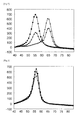
- the peak for BODIPY FL was found at about 55°C in the case of the wild-type oligonucleotide (squares), and at about 64°C in the case of the mutant type oligonucleotide (diamonds) ( Fig. 2 ).
- the heterozygous oligonucleotide (triangles) wherein the wild-type and the mutant type are mixed showed peaks for BODIPY FL at about 55°C and about 64°C ( Fig. 2 ).
- T/T wild-type
- T/G heterozygous type
- mutant type G/G
- the probe shown in Table 3 having C at its 3'-end was designed.
- the position of the probe is represented by nucleotide positions in the nucleotide sequence shown in SEQ ID NO:1.
- Labeling with BODIPY FL was carried out according to a conventional method.
- the sequences of the template oligonucleotides used as the subject sequences to be detected are shown in Table 3.
- each oligonucleotide is represented by nucleotide positions in the nucleotide sequence shown in SEQ ID NO:1.
- a mixture of the template oligonucleotides of SEQ ID NOs:13 and 14 at a ratio of 1:1 was used as a sample for studying the heterozygous sample.
- Template oligonucleotide Sequence (5' ⁇ 3') Position SEQ ID NO: mer Mutant type ttcctttctgtgagcaat G tcacccaaattggaacca 283-319 13 37 Wild-type ttcctttctgtgagcaat T tcacccaaattggaacca 283-319 14 37 *The nucleotides denoted by the upper case letters indicate the position of the mutation.
- Tm analysis was carried out to evaluate the performance of the fluorescently labeled oligonucleotide (SEQ ID NO:12).
- SEQ ID NO:12 fluorescently labeled oligonucleotide
- treatment was carried out at 95°C for 1 second and then at 40°C for 60 seconds, followed by increasing the temperature from 40°C to 85°C with a heating rate of 1°C/3 seconds, while measuring changes in the fluorescence intensity with time.
- the excitation wavelength and detection wavelength in the Tm analysis were 420 to 485 nm and 520 to 555 nm, respectively (BODIPY FL).
- the peak for BODIPY FL was found at about 56°C in the case of the wild-type oligonucleotide (squares), and at about 55°C in the case of the mutant type oligonucleotide (diamonds) ( Fig. 3 ).
- ⁇ of the Tm value i.e. the difference between the Tm values
- the heterozygous oligonucleotide (triangles) wherein the wild-type and the mutant type are mixed showed a peak for BODIPY FL only at about 56°C ( Fig. 3 ).
- the probe shown in Table 5 having C at its 3'-end was designed.
- the position of the probe is represented by nucleotide positions in the nucleotide sequence shown in SEQ ID NO:2.
- Labeling with TAMRA was carried out according to a conventional method.
- the sequences of the template oligonucleotides used as the subject sequences to be detected are shown in Table 5.
- each oligonucleotide is represented by nucleotide positions in the nucleotide sequence shown in SEQ ID NO:2.
- a mixture of the template oligonucleotides of SEQ ID NOs:15 and 16 at a ratio of 1:1 was used as a sample for studying the heterozygous sample.
- Template oligonucleotide Sequence (5' ⁇ 3') Position SEQ ID NO: mer Mutant type ggtcaattttctgtgccaccaaagtgcatgTaaacttatctcctagaatctgaacgacct 281-222 15 60 Wild-type ggtcaattttctgtgccaccaaagtgcatgGaaacttatctcctagaatctgaacgacct 281-222 16 60 *The nucleotides denoted by the upper case letters indicate the position of the mutation.
- Tm analysis was carried out to evaluate the performance of the fluorescently labeled oligonucleotide (SEQ ID NO:5).
- SEQ ID NO:5 fluorescently labeled oligonucleotide
- treatment was carried out at 95°C for 1 second and then at 40°C for 60 seconds, followed by increasing the temperature from 40°C to 85°C with a heating rate of 1°C/3 seconds, while measuring changes in the fluorescence intensity with time.
- the excitation wavelength and detection wavelength in the Tm analysis were 520 to 555 nm and 585 to 700 nm, respectively (TAMRA).
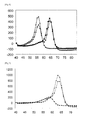
- the peak for TAMRA was found at about 64°C in the case of the wild-type oligonucleotide (squares), and at about 56°C in the case of the mutant type oligonucleotide (diamonds) ( Fig. 4 ).
- the heterozygous oligonucleotide (triangles) wherein the wild-type and the mutant type are mixed showed peaks for TAMRA at about 56°C and about 64°C ( Fig. 4 ). Therefore, it was revealed that the heterozygous type can be distinguished from the wild-type and the mutant type.
- the probe shown in Table 7 having C at its 3'-end was designed.
- the position of the probe is represented by nucleotide positions in the nucleotide sequence shown in SEQ ID NO:2.
- Labeling with TAMRA was carried out according to a conventional method.
- the sequences of the template oligonucleotides used as the subject sequences to be detected are shown in Table 7.
- each oligonucleotide is represented by nucleotide positions in the nucleotide sequence shown in SEQ ID NO:2.
- a mixture of the template oligonucleotides of SEQ ID NOs:18 and 19 at a ratio of 1:1 was used as a sample for studying the heterozygous sample.
- Template oligonucleotide Sequence (5' ⁇ 3') Position SEQ ID NO: mer Wild-type (ITPA-RG) tgGaaacttatctcctagaatctga 253-229 18 25 Mutant type (ITPA-RT) tgTaaacttatctcctagaatctga 253-229 19 25 *The nucleotides denoted by the upper case letters indicate the position of the mutation.
- Tm analysis was carried out to evaluate the performance of the fluorescently labeled oligonucleotide (SEQ ID NO:17).
- SEQ ID NO:17 fluorescently labeled oligonucleotide
- treatment was carried out at 95°C for 1 second and then at 40°C for 60 seconds, followed by increasing the temperature from 40°C to 75°C with a heating rate of 1°C/3 seconds, while measuring changes in the fluorescence intensity with time.
- the excitation wavelength and detection wavelength in the Tm analysis were 520 to 555 nm and 585 to 700 nm, respectively (TAMRA).
- the peak for TAMRA was found at about 63°C in the case of the wild-type oligonucleotide (triangles), and at about 59°C in the case of the mutant type oligonucleotide (squares) ( Fig. 5 ).
- the heterozygous oligonucleotide (diamonds) wherein the wild-type and the mutant type are mixed showed a peak for TAMRA only at about 64°C ( Fig. 5 ). Therefore, it was revealed that the heterozygous type produces only a single detection peak and hence cannot be distinguished from either the wild-type or the mutant type.
- Example 3 (Use of a Plurality of Probes for Detection from Purified Human Genomic DNA or Whole Blood)
- Polymorphic regions were amplified as described below from purified human genomic DNA or whole blood by PCR using the primers described below, and Tm analysis was carried out using the probes shown in SEQ ID NOs:3 and 4.
- the primers shown in Table 9 were designed based on the nucleotide sequence having the polymorphic site rs8099917 in the IL28B gene (SEQ ID NO:1), such that the polymorphic site can be amplified with the primers.
- the positions of the primers are represented by nucleotide positions in the nucleotide sequence shown in SEQ ID NO:1.
- the primers shown in Table 10 were designed based on the nucleotide sequence having the polymorphic site rs1127354 in the ITPA gene (SEQ ID NO:2), such that the polymorphic site can be amplified with the primers.
- the positions of the primers are represented by nucleotide positions in the nucleotide sequence shown in SEQ ID NO:2.
- PCR and Tm analysis were then carried out using a fully automatic SNPs testing device (trade name: i-densy IS-5310, manufactured by ARKRAY, Inc.).
- the composition of the PCR reaction solution was as described below.
- whole blood or purified human genomic DNA as described below was used.
- the PCR and Tm analysis were carried out under the following conditions: 95°C for 60 seconds ⁇ (95°C for 1 second-58°C for 30 seconds) ⁇ 50 cycles ⁇ 95°C for 1 second ⁇ 40°C for 60 seconds ⁇ (40°C ⁇ 85°C, 1°C/3 seconds).
- the excitation wavelength and detection wavelength in the Tm analysis were 420 to 485 nm and 520 to 555 nm, respectively (BODIPY FL), or 520 to 555 nm and 585 to 700 nm, respectively (TAMRA).
- Purified DNA was added as a template to the PCR reaction solution such that 100 copies/test of the DNA was contained therein.
- the purified human genomic DNA and the whole blood showed a single peak (48°C) and hence exhibited a unique pattern in respect of the amount of change in the fluorescence intensity.
- the probes of SEQ ID NOs:3 and 4 simultaneously, the IL28B gene polymorphism and the ITPA gene polymorphism can be detected simultaneously.
- probe of SEQ ID NO:5 is labeled at C at its 3'-end as in the case of the probe of SEQ ID NO:4 and the effect of the label has been demonstrated in Example 2, it is possible to simultaneously detect the IL28B gene polymorphism and the ITPA gene polymorphism also by simultaneous use of the probe of SEQ ID NO:5 and the probe of SEQ ID NO:3.
- the present invention can be suitably used in fields such as healthcare, diagnosis and research.
Landscapes
- Chemical & Material Sciences (AREA)
- Life Sciences & Earth Sciences (AREA)
- Proteomics, Peptides & Aminoacids (AREA)
- Health & Medical Sciences (AREA)
- Organic Chemistry (AREA)
- Wood Science & Technology (AREA)
- Analytical Chemistry (AREA)
- Zoology (AREA)
- Engineering & Computer Science (AREA)
- Genetics & Genomics (AREA)
- Immunology (AREA)
- Bioinformatics & Cheminformatics (AREA)
- Microbiology (AREA)
- Molecular Biology (AREA)
- Biotechnology (AREA)
- Biophysics (AREA)
- Biochemistry (AREA)
- Physics & Mathematics (AREA)
- General Engineering & Computer Science (AREA)
- General Health & Medical Sciences (AREA)
- Pathology (AREA)
- Cell Biology (AREA)
- Measuring Or Testing Involving Enzymes Or Micro-Organisms (AREA)
Applications Claiming Priority (1)
| Application Number | Priority Date | Filing Date | Title |
|---|---|---|---|
| JP2011202261 | 2011-09-15 |
Publications (3)
| Publication Number | Publication Date |
|---|---|
| EP2570492A2 true EP2570492A2 (fr) | 2013-03-20 |
| EP2570492A3 EP2570492A3 (fr) | 2013-03-27 |
| EP2570492B1 EP2570492B1 (fr) | 2014-07-16 |
Family
ID=46963483
Family Applications (1)
| Application Number | Title | Priority Date | Filing Date |
|---|---|---|---|
| EP12184426.0A Not-in-force EP2570492B1 (fr) | 2011-09-15 | 2012-09-14 | Méthode de detection de mutations de IL28B (RS8099917) et ITPA (RS1127354) |
Country Status (5)
| Country | Link |
|---|---|
| US (1) | US9057103B2 (fr) |
| EP (1) | EP2570492B1 (fr) |
| JP (1) | JP2013074888A (fr) |
| KR (1) | KR20130029748A (fr) |
| CN (1) | CN102994629A (fr) |
Cited By (2)
| Publication number | Priority date | Publication date | Assignee | Title |
|---|---|---|---|---|
| GB2524603A (en) * | 2013-10-30 | 2015-09-30 | Mast Group Ltd | Nucleic acid probe |
| EP3012326A4 (fr) * | 2013-03-26 | 2016-12-21 | Nippon Gene Co Ltd | Ensemble d'amorces et de sondes utilisé dans l'identification du polymorphisme génique, et son utilisation |
Families Citing this family (4)
| Publication number | Priority date | Publication date | Assignee | Title |
|---|---|---|---|---|
| JP6286904B2 (ja) * | 2013-07-11 | 2018-03-07 | 東洋紡株式会社 | SNP(rs8103142)を検出するためのプローブ |
| CN105543349A (zh) * | 2015-12-30 | 2016-05-04 | 广州金域检测科技股份有限公司 | 一种同时检测il28b和itpa基因多态性的引物及其方法 |
| CN105506100A (zh) * | 2015-12-30 | 2016-04-20 | 广州金域检测科技股份有限公司 | 一种同时检测il28b和itpa基因多态性的引物及其方法 |
| CN106868109A (zh) * | 2017-01-13 | 2017-06-20 | 中山大学 | 一种检测itpa94c>t基因多态性的引物及其pcr方法 |
Citations (1)
| Publication number | Priority date | Publication date | Assignee | Title |
|---|---|---|---|---|
| JP2002119291A (ja) | 2000-08-03 | 2002-04-23 | Japan Bioindustry Association | 核酸の測定方法、それに用いる核酸プローブ及びその方法によって得られるデータを解析する方法 |
Family Cites Families (7)
| Publication number | Priority date | Publication date | Assignee | Title |
|---|---|---|---|---|
| US6582908B2 (en) * | 1990-12-06 | 2003-06-24 | Affymetrix, Inc. | Oligonucleotides |
| CA2383939C (fr) | 2000-06-27 | 2009-12-01 | National Institute Of Advanced Industrial Science And Technology | Nouvelles sondes d'acides nucleiques et procedes d'essai d'acide nucleique par utilisation des memes |
| JP5213297B2 (ja) | 2000-08-11 | 2013-06-19 | ユニバーシティ オブ ユタ リサーチ ファウンデーション | 単一ラベルオリゴヌクレオチド・プローブ |
| CN102199662B (zh) | 2006-11-30 | 2013-10-23 | 爱科来株式会社 | Sult1a1基因扩增用引物对,含有其的sult1a1基因扩增用试剂及其用途 |
| JP4942508B2 (ja) * | 2007-02-20 | 2012-05-30 | アークレイ株式会社 | abl遺伝子変異の検出用プローブおよびその用途 |
| US20100316608A1 (en) | 2009-06-15 | 2010-12-16 | Vijayaprakash Suppiah | Method of Determining A Response To Treatment With Immunomodulatory Composition |
| JP2013500713A (ja) * | 2009-07-31 | 2013-01-10 | サントル オスピタリエ ウニヴェルシテール ヴォドア | Hcv感染患者においてc型肝炎の転帰を診断又は予測する方法 |
-
2012
- 2012-09-12 JP JP2012200972A patent/JP2013074888A/ja not_active Withdrawn
- 2012-09-14 US US13/617,591 patent/US9057103B2/en not_active Expired - Fee Related
- 2012-09-14 CN CN2012103532909A patent/CN102994629A/zh active Pending
- 2012-09-14 EP EP12184426.0A patent/EP2570492B1/fr not_active Not-in-force
- 2012-09-14 KR KR1020120102098A patent/KR20130029748A/ko not_active Ceased
Patent Citations (1)
| Publication number | Priority date | Publication date | Assignee | Title |
|---|---|---|---|---|
| JP2002119291A (ja) | 2000-08-03 | 2002-04-23 | Japan Bioindustry Association | 核酸の測定方法、それに用いる核酸プローブ及びその方法によって得られるデータを解析する方法 |
Non-Patent Citations (7)
| Title |
|---|
| GASTROENTEROLOGY, vol. 139, no. 4, 14 July 2010 (2010-07-14), pages 1190 - 7 |
| HEPATOL RES., vol. 40, no. 11, November 2010 (2010-11-01), pages 1063 - 1071 |
| HEPATOLOGY, vol. 53, no. 2, 2011, pages 415 - 421 |
| J. SAMBROOK ET AL.: "Molecular Cloning 3rd", 2001, COLD SPRING HARBOR LAB. PRESS |
| NATURE GENETICS, vol. 41, 2009, pages 1105 - 1109 |
| PLOS ONE, vol. 5, no. 10, 29 October 2010 (2010-10-29), pages E13771 |
| PLOS ONE, vol. 5, no. 10, 29 October 2010 (2010-10-29), pages EL3771 |
Cited By (3)
| Publication number | Priority date | Publication date | Assignee | Title |
|---|---|---|---|---|
| EP3012326A4 (fr) * | 2013-03-26 | 2016-12-21 | Nippon Gene Co Ltd | Ensemble d'amorces et de sondes utilisé dans l'identification du polymorphisme génique, et son utilisation |
| GB2524603A (en) * | 2013-10-30 | 2015-09-30 | Mast Group Ltd | Nucleic acid probe |
| US11111523B2 (en) | 2013-10-30 | 2021-09-07 | Mast Group Limited | Nucleic acid probe with single fluorophore label bound to internal cytosine for use in loop mediated isothermal amplification |
Also Published As
| Publication number | Publication date |
|---|---|
| EP2570492A3 (fr) | 2013-03-27 |
| EP2570492B1 (fr) | 2014-07-16 |
| JP2013074888A (ja) | 2013-04-25 |
| KR20130029748A (ko) | 2013-03-25 |
| US9057103B2 (en) | 2015-06-16 |
| CN102994629A (zh) | 2013-03-27 |
| US20130309663A1 (en) | 2013-11-21 |
Similar Documents
| Publication | Publication Date | Title |
|---|---|---|
| US9115391B2 (en) | Method of detecting a polymorphism at a polymorphism site | |
| JPWO2010071147A1 (ja) | 核酸増幅のコントロールの検出方法およびその用途 | |
| EP2570492B1 (fr) | Méthode de detection de mutations de IL28B (RS8099917) et ITPA (RS1127354) | |
| US8877910B2 (en) | Probe for detecting polymorphism in exon 12 of NPM1 gene and use thereof | |
| EP2578701A1 (fr) | Sonde, procédé de détection de polymorphisme, procédé d'évaluation de l'efficacité ou de la tolérance de médicaments et trousse de réactifs | |
| EP2450443B1 (fr) | Procédé d'amplification de séquences cibles, procédé de détection de polymorphisme, et réactifs convenant à ces procédés | |
| JP4228041B2 (ja) | 塩基多型の検出方法 | |
| EP2392676B1 (fr) | Procédé pour détecter un polymorphisme sur position de nucléotide -1639 de gène VKORC1 et sonde d'acide nucléique et kit associé | |
| EP2520663A1 (fr) | Sonde de détection de mutation génétique | |
| EP2615182A1 (fr) | Procédé de détection de polymorphisme de gène PON1 (Q192R) | |
| US9255298B2 (en) | Probe, and polymorphism detection method using the same | |
| EP2520665B1 (fr) | Sonde, procédé de détection de polymorphisme, procédé d'évaluation de l'efficacité ou de la tolérance de médicaments et trousse de réactifs | |
| EP2447377B1 (fr) | Ensemble d'amorces pour détecter le polymorphisme 21 de l'exon EGFR et application correspondante | |
| EP2407560B1 (fr) | Sonde pour la détection de polymorphisme dans le gène abl, et utilisation associée | |
| WO2011052754A1 (fr) | Sonde de détection de polymorphisme dans les gènes egfr et utilisation associée |
Legal Events
| Date | Code | Title | Description |
|---|---|---|---|
| PUAL | Search report despatched |
Free format text: ORIGINAL CODE: 0009013 |
|
| PUAI | Public reference made under article 153(3) epc to a published international application that has entered the european phase |
Free format text: ORIGINAL CODE: 0009012 |
|
| AK | Designated contracting states |
Kind code of ref document: A2 Designated state(s): AL AT BE BG CH CY CZ DE DK EE ES FI FR GB GR HR HU IE IS IT LI LT LU LV MC MK MT NL NO PL PT RO RS SE SI SK SM TR |
|
| AX | Request for extension of the european patent |
Extension state: BA ME |
|
| AK | Designated contracting states |
Kind code of ref document: A3 Designated state(s): AL AT BE BG CH CY CZ DE DK EE ES FI FR GB GR HR HU IE IS IT LI LT LU LV MC MK MT NL NO PL PT RO RS SE SI SK SM TR |
|
| AX | Request for extension of the european patent |
Extension state: BA ME |
|
| RIC1 | Information provided on ipc code assigned before grant |
Ipc: C12Q 1/68 20060101AFI20130219BHEP |
|
| 17P | Request for examination filed |
Effective date: 20130927 |
|
| RBV | Designated contracting states (corrected) |
Designated state(s): AL AT BE BG CH CY CZ DE DK EE ES FI FR GB GR HR HU IE IS IT LI LT LU LV MC MK MT NL NO PL PT RO RS SE SI SK SM TR |
|
| 17Q | First examination report despatched |
Effective date: 20131017 |
|
| GRAP | Despatch of communication of intention to grant a patent |
Free format text: ORIGINAL CODE: EPIDOSNIGR1 |
|
| INTG | Intention to grant announced |
Effective date: 20140423 |
|
| GRAS | Grant fee paid |
Free format text: ORIGINAL CODE: EPIDOSNIGR3 |
|
| GRAA | (expected) grant |
Free format text: ORIGINAL CODE: 0009210 |
|
| AK | Designated contracting states |
Kind code of ref document: B1 Designated state(s): AL AT BE BG CH CY CZ DE DK EE ES FI FR GB GR HR HU IE IS IT LI LT LU LV MC MK MT NL NO PL PT RO RS SE SI SK SM TR |
|
| REG | Reference to a national code |
Ref country code: GB Ref legal event code: FG4D |
|
| REG | Reference to a national code |
Ref country code: CH Ref legal event code: EP |
|
| REG | Reference to a national code |
Ref country code: IE Ref legal event code: FG4D |
|
| REG | Reference to a national code |
Ref country code: AT Ref legal event code: REF Ref document number: 677720 Country of ref document: AT Kind code of ref document: T Effective date: 20140815 |
|
| REG | Reference to a national code |
Ref country code: DE Ref legal event code: R096 Ref document number: 602012002430 Country of ref document: DE Effective date: 20140828 |
|
| REG | Reference to a national code |
Ref country code: NL Ref legal event code: VDEP Effective date: 20140716 |
|
| REG | Reference to a national code |
Ref country code: AT Ref legal event code: MK05 Ref document number: 677720 Country of ref document: AT Kind code of ref document: T Effective date: 20140716 |
|
| REG | Reference to a national code |
Ref country code: LT Ref legal event code: MG4D |
|
| PG25 | Lapsed in a contracting state [announced via postgrant information from national office to epo] |
Ref country code: ES Free format text: LAPSE BECAUSE OF FAILURE TO SUBMIT A TRANSLATION OF THE DESCRIPTION OR TO PAY THE FEE WITHIN THE PRESCRIBED TIME-LIMIT Effective date: 20140716 Ref country code: GR Free format text: LAPSE BECAUSE OF FAILURE TO SUBMIT A TRANSLATION OF THE DESCRIPTION OR TO PAY THE FEE WITHIN THE PRESCRIBED TIME-LIMIT Effective date: 20141017 Ref country code: SE Free format text: LAPSE BECAUSE OF FAILURE TO SUBMIT A TRANSLATION OF THE DESCRIPTION OR TO PAY THE FEE WITHIN THE PRESCRIBED TIME-LIMIT Effective date: 20140716 Ref country code: BG Free format text: LAPSE BECAUSE OF FAILURE TO SUBMIT A TRANSLATION OF THE DESCRIPTION OR TO PAY THE FEE WITHIN THE PRESCRIBED TIME-LIMIT Effective date: 20141016 Ref country code: LT Free format text: LAPSE BECAUSE OF FAILURE TO SUBMIT A TRANSLATION OF THE DESCRIPTION OR TO PAY THE FEE WITHIN THE PRESCRIBED TIME-LIMIT Effective date: 20140716 Ref country code: PT Free format text: LAPSE BECAUSE OF FAILURE TO SUBMIT A TRANSLATION OF THE DESCRIPTION OR TO PAY THE FEE WITHIN THE PRESCRIBED TIME-LIMIT Effective date: 20141117 Ref country code: FI Free format text: LAPSE BECAUSE OF FAILURE TO SUBMIT A TRANSLATION OF THE DESCRIPTION OR TO PAY THE FEE WITHIN THE PRESCRIBED TIME-LIMIT Effective date: 20140716 Ref country code: NO Free format text: LAPSE BECAUSE OF FAILURE TO SUBMIT A TRANSLATION OF THE DESCRIPTION OR TO PAY THE FEE WITHIN THE PRESCRIBED TIME-LIMIT Effective date: 20141016 |
|
| PG25 | Lapsed in a contracting state [announced via postgrant information from national office to epo] |
Ref country code: LV Free format text: LAPSE BECAUSE OF FAILURE TO SUBMIT A TRANSLATION OF THE DESCRIPTION OR TO PAY THE FEE WITHIN THE PRESCRIBED TIME-LIMIT Effective date: 20140716 Ref country code: RS Free format text: LAPSE BECAUSE OF FAILURE TO SUBMIT A TRANSLATION OF THE DESCRIPTION OR TO PAY THE FEE WITHIN THE PRESCRIBED TIME-LIMIT Effective date: 20140716 Ref country code: CY Free format text: LAPSE BECAUSE OF FAILURE TO SUBMIT A TRANSLATION OF THE DESCRIPTION OR TO PAY THE FEE WITHIN THE PRESCRIBED TIME-LIMIT Effective date: 20140716 Ref country code: AT Free format text: LAPSE BECAUSE OF FAILURE TO SUBMIT A TRANSLATION OF THE DESCRIPTION OR TO PAY THE FEE WITHIN THE PRESCRIBED TIME-LIMIT Effective date: 20140716 Ref country code: IS Free format text: LAPSE BECAUSE OF FAILURE TO SUBMIT A TRANSLATION OF THE DESCRIPTION OR TO PAY THE FEE WITHIN THE PRESCRIBED TIME-LIMIT Effective date: 20141116 Ref country code: PL Free format text: LAPSE BECAUSE OF FAILURE TO SUBMIT A TRANSLATION OF THE DESCRIPTION OR TO PAY THE FEE WITHIN THE PRESCRIBED TIME-LIMIT Effective date: 20140716 Ref country code: NL Free format text: LAPSE BECAUSE OF FAILURE TO SUBMIT A TRANSLATION OF THE DESCRIPTION OR TO PAY THE FEE WITHIN THE PRESCRIBED TIME-LIMIT Effective date: 20140716 |
|
| REG | Reference to a national code |
Ref country code: DE Ref legal event code: R097 Ref document number: 602012002430 Country of ref document: DE |
|
| PG25 | Lapsed in a contracting state [announced via postgrant information from national office to epo] |
Ref country code: SK Free format text: LAPSE BECAUSE OF FAILURE TO SUBMIT A TRANSLATION OF THE DESCRIPTION OR TO PAY THE FEE WITHIN THE PRESCRIBED TIME-LIMIT Effective date: 20140716 Ref country code: RO Free format text: LAPSE BECAUSE OF FAILURE TO SUBMIT A TRANSLATION OF THE DESCRIPTION OR TO PAY THE FEE WITHIN THE PRESCRIBED TIME-LIMIT Effective date: 20140716 Ref country code: MC Free format text: LAPSE BECAUSE OF FAILURE TO SUBMIT A TRANSLATION OF THE DESCRIPTION OR TO PAY THE FEE WITHIN THE PRESCRIBED TIME-LIMIT Effective date: 20140716 Ref country code: DK Free format text: LAPSE BECAUSE OF FAILURE TO SUBMIT A TRANSLATION OF THE DESCRIPTION OR TO PAY THE FEE WITHIN THE PRESCRIBED TIME-LIMIT Effective date: 20140716 Ref country code: CZ Free format text: LAPSE BECAUSE OF FAILURE TO SUBMIT A TRANSLATION OF THE DESCRIPTION OR TO PAY THE FEE WITHIN THE PRESCRIBED TIME-LIMIT Effective date: 20140716 Ref country code: LU Free format text: LAPSE BECAUSE OF FAILURE TO SUBMIT A TRANSLATION OF THE DESCRIPTION OR TO PAY THE FEE WITHIN THE PRESCRIBED TIME-LIMIT Effective date: 20140914 Ref country code: EE Free format text: LAPSE BECAUSE OF FAILURE TO SUBMIT A TRANSLATION OF THE DESCRIPTION OR TO PAY THE FEE WITHIN THE PRESCRIBED TIME-LIMIT Effective date: 20140716 |
|
| PLBE | No opposition filed within time limit |
Free format text: ORIGINAL CODE: 0009261 |
|
| STAA | Information on the status of an ep patent application or granted ep patent |
Free format text: STATUS: NO OPPOSITION FILED WITHIN TIME LIMIT |
|
| REG | Reference to a national code |
Ref country code: IE Ref legal event code: MM4A |
|
| 26N | No opposition filed |
Effective date: 20150417 |
|
| PG25 | Lapsed in a contracting state [announced via postgrant information from national office to epo] |
Ref country code: BE Free format text: LAPSE BECAUSE OF NON-PAYMENT OF DUE FEES Effective date: 20140930 |
|
| PG25 | Lapsed in a contracting state [announced via postgrant information from national office to epo] |
Ref country code: IE Free format text: LAPSE BECAUSE OF NON-PAYMENT OF DUE FEES Effective date: 20140914 |
|
| REG | Reference to a national code |
Ref country code: FR Ref legal event code: PLFP Year of fee payment: 4 |
|
| PGFP | Annual fee paid to national office [announced via postgrant information from national office to epo] |
Ref country code: DE Payment date: 20150922 Year of fee payment: 4 |
|
| PG25 | Lapsed in a contracting state [announced via postgrant information from national office to epo] |
Ref country code: SI Free format text: LAPSE BECAUSE OF FAILURE TO SUBMIT A TRANSLATION OF THE DESCRIPTION OR TO PAY THE FEE WITHIN THE PRESCRIBED TIME-LIMIT Effective date: 20140716 |
|
| PGFP | Annual fee paid to national office [announced via postgrant information from national office to epo] |
Ref country code: FR Payment date: 20150922 Year of fee payment: 4 |
|
| PGFP | Annual fee paid to national office [announced via postgrant information from national office to epo] |
Ref country code: IT Payment date: 20150930 Year of fee payment: 4 |
|
| REG | Reference to a national code |
Ref country code: CH Ref legal event code: PL |
|
| PG25 | Lapsed in a contracting state [announced via postgrant information from national office to epo] |
Ref country code: SM Free format text: LAPSE BECAUSE OF FAILURE TO SUBMIT A TRANSLATION OF THE DESCRIPTION OR TO PAY THE FEE WITHIN THE PRESCRIBED TIME-LIMIT Effective date: 20140716 |
|
| PG25 | Lapsed in a contracting state [announced via postgrant information from national office to epo] |
Ref country code: MT Free format text: LAPSE BECAUSE OF FAILURE TO SUBMIT A TRANSLATION OF THE DESCRIPTION OR TO PAY THE FEE WITHIN THE PRESCRIBED TIME-LIMIT Effective date: 20140716 |
|
| PG25 | Lapsed in a contracting state [announced via postgrant information from national office to epo] |
Ref country code: BE Free format text: LAPSE BECAUSE OF FAILURE TO SUBMIT A TRANSLATION OF THE DESCRIPTION OR TO PAY THE FEE WITHIN THE PRESCRIBED TIME-LIMIT Effective date: 20140716 Ref country code: LI Free format text: LAPSE BECAUSE OF NON-PAYMENT OF DUE FEES Effective date: 20150930 Ref country code: HR Free format text: LAPSE BECAUSE OF FAILURE TO SUBMIT A TRANSLATION OF THE DESCRIPTION OR TO PAY THE FEE WITHIN THE PRESCRIBED TIME-LIMIT Effective date: 20140716 Ref country code: HU Free format text: LAPSE BECAUSE OF FAILURE TO SUBMIT A TRANSLATION OF THE DESCRIPTION OR TO PAY THE FEE WITHIN THE PRESCRIBED TIME-LIMIT; INVALID AB INITIO Effective date: 20120914 Ref country code: TR Free format text: LAPSE BECAUSE OF FAILURE TO SUBMIT A TRANSLATION OF THE DESCRIPTION OR TO PAY THE FEE WITHIN THE PRESCRIBED TIME-LIMIT Effective date: 20140716 Ref country code: CH Free format text: LAPSE BECAUSE OF NON-PAYMENT OF DUE FEES Effective date: 20150930 |
|
| REG | Reference to a national code |
Ref country code: DE Ref legal event code: R119 Ref document number: 602012002430 Country of ref document: DE |
|
| GBPC | Gb: european patent ceased through non-payment of renewal fee |
Effective date: 20160914 |
|
| REG | Reference to a national code |
Ref country code: FR Ref legal event code: ST Effective date: 20170531 |
|
| PG25 | Lapsed in a contracting state [announced via postgrant information from national office to epo] |
Ref country code: FR Free format text: LAPSE BECAUSE OF NON-PAYMENT OF DUE FEES Effective date: 20160930 Ref country code: GB Free format text: LAPSE BECAUSE OF NON-PAYMENT OF DUE FEES Effective date: 20160914 Ref country code: DE Free format text: LAPSE BECAUSE OF NON-PAYMENT OF DUE FEES Effective date: 20170401 |
|
| PG25 | Lapsed in a contracting state [announced via postgrant information from national office to epo] |
Ref country code: IT Free format text: LAPSE BECAUSE OF NON-PAYMENT OF DUE FEES Effective date: 20160914 |
|
| PG25 | Lapsed in a contracting state [announced via postgrant information from national office to epo] |
Ref country code: MK Free format text: LAPSE BECAUSE OF FAILURE TO SUBMIT A TRANSLATION OF THE DESCRIPTION OR TO PAY THE FEE WITHIN THE PRESCRIBED TIME-LIMIT Effective date: 20140716 |
|
| PG25 | Lapsed in a contracting state [announced via postgrant information from national office to epo] |
Ref country code: AL Free format text: LAPSE BECAUSE OF FAILURE TO SUBMIT A TRANSLATION OF THE DESCRIPTION OR TO PAY THE FEE WITHIN THE PRESCRIBED TIME-LIMIT Effective date: 20140716 |