EP2570732B2 - Rapport de fréquence à réglage variable - Google Patents
Rapport de fréquence à réglage variable Download PDFInfo
- Publication number
- EP2570732B2 EP2570732B2 EP12184506.9A EP12184506A EP2570732B2 EP 2570732 B2 EP2570732 B2 EP 2570732B2 EP 12184506 A EP12184506 A EP 12184506A EP 2570732 B2 EP2570732 B2 EP 2570732B2
- Authority
- EP
- European Patent Office
- Prior art keywords
- temperature
- cooking
- phases
- fan
- standstill
- Prior art date
- Legal status (The legal status is an assumption and is not a legal conclusion. Google has not performed a legal analysis and makes no representation as to the accuracy of the status listed.)
- Active
Links
Images
Classifications
-
- F—MECHANICAL ENGINEERING; LIGHTING; HEATING; WEAPONS; BLASTING
- F24—HEATING; RANGES; VENTILATING
- F24C—DOMESTIC STOVES OR RANGES ; DETAILS OF DOMESTIC STOVES OR RANGES, OF GENERAL APPLICATION
- F24C7/00—Stoves or ranges heated by electric energy
- F24C7/08—Arrangement or mounting of control or safety devices
-
- F—MECHANICAL ENGINEERING; LIGHTING; HEATING; WEAPONS; BLASTING
- F24—HEATING; RANGES; VENTILATING
- F24C—DOMESTIC STOVES OR RANGES ; DETAILS OF DOMESTIC STOVES OR RANGES, OF GENERAL APPLICATION
- F24C15/00—Details
- F24C15/32—Arrangements of ducts for hot gases, e.g. in or around baking ovens
- F24C15/322—Arrangements of ducts for hot gases, e.g. in or around baking ovens with forced circulation
- F24C15/325—Arrangements of ducts for hot gases, e.g. in or around baking ovens with forced circulation electrically-heated
Definitions
- the invention relates to a method for cooking a food in a cooking appliance having a heater and a fan that can be operated at intervals.
- a method which includes an energy saving mode in which a fan can be switched to a standstill phase and yet the standby temperature in the cooking chamber is maintained.
- DE 10 2008 040 981 A1 describes a process in which a fan actively blows cold air onto a temperature sensor so that it measures a lower temperature than the actual temperature in the cooking chamber.
- the DE 20 2004 015 290 U1 describes a method and a device in which the energy input into the food to be cooked is to be carried out evenly by applying an air stream evenly to the food.
- the object of the invention is to further develop the cooking process so that a better, reproducible quality of the cooked food is achieved.
- the invention provides a method according to claim 1.
- a drying program for almonds can use a cycle time with long fan idle periods to ensure a quiet cooking chamber climate.
- the idle periods are only interrupted by short fan operating phases, which ensure minimum air circulation, thus ensuring sufficient energy input to the almonds.
- a cycle time with longer standstill phases can also be used. This ensures that the food doesn't dry out.
- Falling below the predetermined threshold indicates that the core temperature of the product to be cooked is approaching the setpoint, so that the proportion of phases during which energy is supplied to the cooking chamber can be reduced.
- the cycle rate therefore depends on the temperature. For example, at cooking temperatures below 100 °C, such as those used for drying food, longer standstill periods can be used. At temperatures above 240 °C, however, either short standstill periods or no standstill periods at all are used, since in these temperature ranges, maximum energy input into the food being cooked is essential, for which air circulation is advantageous.
- the proportion of idle periods increases as the cooking chamber temperature rises. A rise in the cooking chamber temperature indicates that sufficient energy is currently being supplied to the cooking chamber. This allows the fan to be temporarily switched off.
- the proportion of standstill phases is initially doubled, then the cooking chamber temperature profile is evaluated over a certain period of time, and then the proportion of standstill phases is doubled again if the cooking chamber temperature continues to rise.
- the cycle rate can be adapted very quickly to the respective requirements by extending the standstill phases in very large increments until the desired effect on the cooking chamber temperature is achieved.
- the cycle time can depend on the derivative of the measured temperature with respect to time, i.e., on the gradient of the temperature curve. This allows additional parameters to be used to adapt the currently used cooking program to the requirements. For example, if the gradient of the temperature curve is low and the measured If a temperature, for example the core temperature, is still far from the target value, the proportion of standstill phases should be reduced so that the cooking process does not take too long.
- the proportion of standstill phases can be reduced.
- negative values of the temperature derivative with respect to time indicate that the product is transferring heat to the cooking chamber.
- the cycle rate depends on the cooking appliance load.
- a high cooking appliance load leads to high heat dissipation in the cooking appliance, so a lower proportion of downtimes is generally advisable.
- the cycle rate can also be set to depend on the size of the products to be cooked in the cooking chamber. For example, a higher proportion of downtimes can be used for larger products, for example, by quadrupling the pause times.
- the core temperature can be evaluated over time. This can be easily integrated into intelligent cooking programs.
- the calibre of the products to be cooked can be taken into account by using a greater proportion of standstill phases when the calibre is above a predetermined threshold.
- the core temperature is also taken into account, meaning that the caliber-dependent extension of the standstill phases is only permitted once the core temperature has already risen. Otherwise, the cooking process would take too long.
- the heat loss in the cooking chamber is determined based on the temperature profile during a fan standstill phase. This eliminates disruptive factors, such as energy input from the fan.
- the proportion of idle phases is reduced.
- a higher proportion of fan operating phases ensures that a large amount of energy can be supplied to the cooking chamber, thus compensating for the high heat loss in the cooking chamber.
- the amount of energy required to supply the cooking chamber until a target temperature is reached again is determined, and that the proportion of downtime phases is subsequently reduced if the required energy was above a predetermined threshold. This also makes it possible to adapt the cycle rate to the heat consumption in the cooking chamber with minimal effort, thus achieving high, reproducible quality of the cooked products.
- an energy-saving button is provided on the cooking appliance, whereby the proportion of idle phases is increased, in particular doubled, when the energy-saving button is pressed. This allows an operator to influence the currently used cooking process in such a way that the focus is on energy savings, while, in return, an extension of the cooking time is tolerated.
- the operator can select a quieter operating phase, in which case the proportion of idle phases is increased. This allows a quieter operating mode to be temporarily selected if the operating noise generated by the cooking appliance is perceived as disturbing by the operator.
- the proportion of idle phases is reduced when the temperature in the electrical installation compartment of the cooking appliance is above a predetermined threshold. This ensures that a high proportion of fan idle phases, which are desirable for the current cooking program, does not lead to heat buildup in the electrical installation compartment of the cooking appliance.
- the fan can be operated with alternating directions of rotation, and standstill phases are synchronized with a change in the direction of rotation. This prevents the fan from restarting after a standstill phase and then, shortly thereafter, decelerating and then starting again in the opposite direction because the direction of rotation is reversed. Instead, in such a case, the fan would immediately start operating in the new direction of rotation.
- Two or more temperature sensors are evaluated, and the standstill phases are shortened or aborted if the difference between the temperatures detected by the two temperature sensors, particularly the shaft and cooking chamber temperatures, exceeds a threshold. Exceeding the threshold indicates an uneven temperature distribution in the cooking chamber, which is counteracted by longer fan operating phases.
- the method according to the invention provides that the fan's duty cycle, i.e. the ratio of operating to idle phases, can be variably adapted to the respective requirements.
- the main parameter that determines the selected duty cycle is the heat loss in the cooking chamber, i.e. the amount of heat absorbed by the food in the cooking chamber, the accessories located in the cooking chamber, and the boundaries of the cooking chamber (i.e. side walls, floor, ceiling, and door).
- the heat loss in the cooking chamber corresponds to the amount of energy that must be supplied to the cooking chamber to maintain a constant temperature.
- Other parameters that influence the duty cycle are the cooking chamber temperature, the food being cooked, the cooking program, and various temperature profiles.
- the cycle time can generally be freely adjusted. Examples include an on-time of 25 seconds and an off-time of 360 seconds, or an on-time of 15 seconds and an off-time of 1,000 seconds. Additionally, the fan speed can be varied during operation, either continuously or in predefined steps. The respective cycle time can be saved in the cooking appliance's control system and integrated into a cooking program or process as needed.
- the load quantity can be detected based on existing load detections (for example, based on the temperature drop after loading, based on the gradient of the temperature rise after loading or by weight measurement, customer input or other data input such as barcode scanning, moisture development in the cooking chamber, energy decrease and/or energy consumption).
- existing load detections for example, based on the temperature drop after loading, based on the gradient of the temperature rise after loading or by weight measurement, customer input or other data input such as barcode scanning, moisture development in the cooking chamber, energy decrease and/or energy consumption).
- half the cooking chamber load can be considered a standard value.
- a high load for example, halves the fan idle times, while a low load quadruples the fan idle times. In concrete terms, this could mean that a low load would result in an operating phase of 10 seconds followed by an idle phase of 440 seconds.
- Another parameter that influences the cycle rate is the type of food being cooked.
- the type of food being cooked For example, when roasting almonds or drying moist fruit slices, such as apple rings or orange slices, it is preferable to use a small proportion of idle phases at the beginning of the drying process to remove moisture from the food surface, allowing the moisture from the interior to flow in and then be removed.
- the fan To quickly remove the high moisture present at the beginning of a drying process, it is best to run the fan continuously.
- the limiting parameter for the drying speed is the moisture flow from the interior of the food. Therefore, during this phase the fan is reduced or operated in cycles, i.e. with a high proportion of idle phases, to maintain a stable cooking chamber climate. Only a small minimum proportion of fan operating phases is used, which ensures sufficient energy transfer but prevents overdrying of the food surface, which could lead to a porous structure.
- Another parameter that influences the cycle time is the cooking method.
- low-temperature cooking requires less air circulation, meaning a higher proportion of fan idle phases, to prevent the surface of the food from drying out.
- it is not necessary to constantly maintain an airflow on the surface of the product to be dried as moisture removal from the surface is limited by the water transport inside the cooking appliance, at least in an advanced drying phase. If a high airflow were to force a high level of moisture removal from the surface, this would lead to a brittle end product. Even with weight-saving cooking, it is desirable that the product being cooked does not dry out.
- a high proportion of fan idle phases is advantageous so as not to disturb the microclimate around the food.
- the user can save the timing ratios he has tested and found to be good and incorporate them into the cooking programs or processes, individually for each cooking program step.
- the cooking program currently in use also fundamentally influences the appropriate cycle ratio. For example, if steaming is used, a small proportion of fan standstill phases are used, as otherwise steam mixing in the cooking chamber cannot be guaranteed. During the searing and crusting phases of a cooking program, on the other hand, only short fan standstill phases are advisable in order to ensure maximum energy input into the product being cooked. During holding phases of a cooking program, however, long standstill phases can be inserted without this having a negative impact on the quality of the products being cooked. During a cleaning program, standstill phases can be used if excessive foaming is detected.
- the respective duty cycle is not linked to the switching on and off of the cooking appliance's heater. In other words, there is no mandatory coupling that requires the fan to be switched on when the heater is switched on, or that the heater must also be switched on when the fan is switched on.
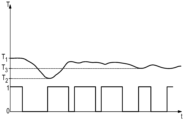
- the attached figure shows how the fan's timing changes depending on the heat dissipation in the cooking chamber.
- the lower part of the diagram shows the fan's operation; for simplicity, it is assumed that the fan is operating at a constant speed.
- the state changes between an operating phase (the curve has the value "1") and a standstill phase (the curve has the value "0").
- the cooking chamber temperature T is used here as a specific parameter that correlates with the heat dissipation in the cooking chamber.
- the temperature in the cooking chamber drops from temperature level T1 to temperature T2 . The difference between these two temperatures is detected as being above a predefined threshold.
- the timing ratio is changed so that longer operating phases and shorter standstill phases of the fan are used.
- a longer standstill phase is inserted, essentially as a test, to check the extent of the heat loss in the cooking chamber (and thus the temperature drop).
- the temperature in the cooking chamber has dropped to a value T3 , with the difference between the temperatures T1 and T3 being below a predetermined threshold. This tells the cooking appliance's control system that a cycle rate with a larger proportion of standstill phases can now be used.
- the clock cycle can be adjusted based on the amount of energy required to return to a target temperature after a standstill period.
- the fan is preferably operated continuously until the target temperature is reached again.
- the energy of the resulting moisture can also be determined by measuring the humidity in the cooking chamber and/or the evaporation rate. This moisture originates from the food. The fan is then controlled so that the heat loss is reduced by the heat of vaporization.
- Heat loss in the cooking chamber can also be determined by the core temperature. By measuring the core temperature, a heat gradient in the food can be determined. The lower the gradient, the less energy flows into the food. Therefore, heat loss in the cooking chamber must be reduced.
- Heat dissipation can also be adjusted for frozen products. If the appliance receives information that a frozen product is in the cooking chamber (this has lower thermal conductivity than a product with an initial temperature above freezing), the heat dissipation is reduced.
Landscapes
- Engineering & Computer Science (AREA)
- Chemical & Material Sciences (AREA)
- Combustion & Propulsion (AREA)
- Mechanical Engineering (AREA)
- General Engineering & Computer Science (AREA)
- Electric Stoves And Ranges (AREA)
Claims (9)
- Procédé de cuisson d'un produit alimentaire dans un appareil de cuisson qui présente un chauffage et une soufflante apte à être mise en marche par intervalles, le rapport entre des phases de marche et des phases d'arrêt de la soufflante (rapport cyclique) étant varié en fonction de la réduction de chaleur dans l'espace de cuisson de l'appareil de cuisson, le rapport cyclique dépendant du programme de cuisson, caractérisé en ce que la température au cœur d'un produit à cuire est surveillée et la part des phases d'arrêt est augmentée lorsque la différence entre la température au cœur réelle et la température d'espace de cuisson et/ou la température de tige d'un capteur de température tombe au-dessous d'une valeur seuil prédéterminée.
- Procédé selon la revendication 1, caractérisé en ce que des phases d'arrêt plus longues sont utilisées dans un programme de cuisson qui prévoit une cuisson sèche.
- Procédé selon la revendication 2, caractérisé en ce que des phases d'arrêt plus longues sont utilisées dans un programme de cuisson qui prévoit de longues phases d'interruption.
- Procédé selon l'une des revendications précédentes, caractérisé en ce que la quantité d'énergie devant être amenée vers l'espace de cuisson jusqu'à ce qu'une température de consigne est de nouveau atteinte est déterminée, et en ce que la part des phases d'arrêt est ensuite réduite lorsque l'énergie requise est supérieure à une valeur seuil prédéterminée.
- Procédé selon l'une des revendications précédentes, caractérisé en ce que la pente du profil de la température au cœur d'un produit à cuire est surveillée et en ce que la part des phases d'arrêt est réduite lorsque la pente pour un écart prédéterminé entre la température au cœur réelle et la température au cœur de consigne est inférieure à une valeur seuil prédéterminée.
- Procédé selon l'une des revendications précédentes, caractérisé en ce qu'il est prévu une touche d'économie d'énergie et en ce que la part des phases d'arrêt est augmentée, en particulier doublée lorsque la touche d'économie d'énergie est enfoncée.
- Procédé selon l'une des revendications précédentes, caractérisé en ce qu'il est possible de sélectionner une phase de marche silencieuse et en ce que la part des phases d'arrêt est augmentée lorsque la phase de marche silencieuse est sélectionnée.
- Procédé selon l'une des revendications précédentes, caractérisé en ce que la soufflante est apte à être mise en marche avec des sens de rotation alternants et en ce que des phases d'arrêt sont comparées avec un changement du sens de rotation.
- Procédé selon l'une des revendications précédentes, caractérisé en ce que deux capteurs de température ou plus sont évalués et en ce que les phases d'arrêt sont raccourcies ou interrompues lorsque la différence entre les températures saisies par les deux capteurs de température, en particulier la température de la tige et la température de l'espace de cuisson, dépassent une valeur seuil.
Applications Claiming Priority (1)
| Application Number | Priority Date | Filing Date | Title |
|---|---|---|---|
| DE102011113597A DE102011113597A1 (de) | 2011-09-16 | 2011-09-16 | Variabel einstellbares Taktverhältnis |
Publications (3)
| Publication Number | Publication Date |
|---|---|
| EP2570732A1 EP2570732A1 (fr) | 2013-03-20 |
| EP2570732B1 EP2570732B1 (fr) | 2021-04-21 |
| EP2570732B2 true EP2570732B2 (fr) | 2025-03-12 |
Family
ID=47010232
Family Applications (1)
| Application Number | Title | Priority Date | Filing Date |
|---|---|---|---|
| EP12184506.9A Active EP2570732B2 (fr) | 2011-09-16 | 2012-09-14 | Rapport de fréquence à réglage variable |
Country Status (2)
| Country | Link |
|---|---|
| EP (1) | EP2570732B2 (fr) |
| DE (1) | DE102011113597A1 (fr) |
Families Citing this family (5)
| Publication number | Priority date | Publication date | Assignee | Title |
|---|---|---|---|---|
| DE102013112150B4 (de) * | 2013-11-05 | 2023-07-06 | Rational Aktiengesellschaft | Verfahren zum Backen von kleinen Produkten mittels hohem Energieeintrags |
| DE102018100669A1 (de) * | 2018-01-12 | 2019-07-18 | Rational International Ag | Verfahren zur Bestimmung der Temperaturempfindlichkeit eines Gargutes sowie Gargerät |
| DE102018101467A1 (de) * | 2018-01-23 | 2019-07-25 | Rational Aktiengesellschaft | Verfahren zum Betreiben eines Gargeräts sowie Gargerät |
| US20240353114A1 (en) * | 2023-04-18 | 2024-10-24 | Haier Us Appliance Solutions, Inc. | Cooking appliance including multiple heating zones |
| DE102024207879A1 (de) | 2024-08-20 | 2026-02-26 | BSH Hausgeräte GmbH | Behandeln von Gargut in einem Garraum |
Citations (4)
| Publication number | Priority date | Publication date | Assignee | Title |
|---|---|---|---|---|
| DE102004040655A1 (de) † | 2004-08-20 | 2006-03-09 | Rational Ag | Verfahren zum Steuern eines Delta-T-Garprozesses |
| DE102005057585B3 (de) † | 2005-11-30 | 2007-03-08 | Miele & Cie. Kg | Garverfahren |
| EP2098788A2 (fr) † | 2008-03-03 | 2009-09-09 | Rational AG | Procédé destiné à la commande d'un processus de cuisson et appareil de cuisson correspondant |
| EP2233016A1 (fr) † | 2009-03-25 | 2010-09-29 | Convotherm Elektrogeräte GmbH | Procédé de cuisson de produit de cuisson avec un appareil de cuisson ainsi qu'amortisseur à air chaud destiné à l'exécution d'un tel procédé |
Family Cites Families (17)
| Publication number | Priority date | Publication date | Assignee | Title |
|---|---|---|---|---|
| DE2621927B2 (de) * | 1976-05-17 | 1981-02-26 | Bosch-Siemens Hausgeraete Gmbh, 7000 Stuttgart | Gargerät, insbesondere Backofen, zum Garen von Lebensmitteln, mittels umgewälzter Heißluft |
| DE2657929C3 (de) * | 1976-12-21 | 1980-03-20 | Bosch-Siemens Hausgeraete Gmbh, 7000 Stuttgart | Backofen, insbesondere mit Mitteln zur pyrolytischen Selbstreinigung |
| DE3411723C1 (de) * | 1984-03-29 | 1985-11-28 | Bosch-Siemens Hausgeräte GmbH, 7000 Stuttgart | Verfahren und Backofen zur Wärmebehandlung von Gargut |
| DE3510680A1 (de) * | 1985-03-23 | 1986-10-02 | Buderus Ag, 6330 Wetzlar | Verfahren zum langzeit-niedertemperatur-garen |
| US5171974A (en) * | 1987-10-29 | 1992-12-15 | Technology Licensing Corporation | Heating system for oven zone location |
| DE3824157A1 (de) * | 1988-07-16 | 1990-01-18 | Kueppersbusch | Umluftofen |
| DE4319613C1 (de) * | 1993-06-14 | 1994-06-30 | Bauknecht Hausgeraete | Verfahren zum Betreiben eines Elektrobackofens |
| KR0136055B1 (ko) | 1994-09-10 | 1998-04-25 | 구자홍 | 전자레인지의 그릴요리시 팬모터 제어방법 |
| US5688422A (en) * | 1995-04-28 | 1997-11-18 | Henny Penny Corporation | Programmable fan control method and apparatus for use in a food oven |
| US6730880B2 (en) | 2002-02-05 | 2004-05-04 | General Electric Company | Oven and methods for operating same |
| DE202004015290U1 (de) * | 2004-10-01 | 2006-02-09 | Klouda, Jaroslav | Vorrichtung zur Vergleichmäßigung des Energieeintrags in Gargut |
| PL2279682T3 (pl) | 2007-06-26 | 2013-08-30 | V Zug Ag | Przyrządzanie żywności z wykrywaniem uchodzenia pary |
| DE102008040981A1 (de) | 2008-08-05 | 2010-02-11 | BSH Bosch und Siemens Hausgeräte GmbH | Verfahren zum Steuern eines Garvorgangs |
| DE102009024546A1 (de) * | 2009-06-08 | 2010-12-09 | Convotherm Elektrogeräte GmbH | Gargerät, insbesondere Heißluftdämpfer, und Verfahren zum Steuern oder Regeln eines Gargeräts |
| ITTO20090611A1 (it) * | 2009-08-04 | 2011-02-05 | Indesit Co Spa | Metodo per controllare il funzionamento di un forno |
| US8709905B2 (en) | 2009-09-01 | 2014-04-29 | Manitowoc Foodservice Uk Limited | Cooking oven with energy saving mode and method |
| ES2386560B1 (es) * | 2009-11-25 | 2013-07-08 | BSH Electrodomésticos España S.A. | Procedimiento para accionar un aparato doméstico para preparar alimentos, y aparato doméstico de tal tipo. |
-
2011
- 2011-09-16 DE DE102011113597A patent/DE102011113597A1/de active Pending
-
2012
- 2012-09-14 EP EP12184506.9A patent/EP2570732B2/fr active Active
Patent Citations (4)
| Publication number | Priority date | Publication date | Assignee | Title |
|---|---|---|---|---|
| DE102004040655A1 (de) † | 2004-08-20 | 2006-03-09 | Rational Ag | Verfahren zum Steuern eines Delta-T-Garprozesses |
| DE102005057585B3 (de) † | 2005-11-30 | 2007-03-08 | Miele & Cie. Kg | Garverfahren |
| EP2098788A2 (fr) † | 2008-03-03 | 2009-09-09 | Rational AG | Procédé destiné à la commande d'un processus de cuisson et appareil de cuisson correspondant |
| EP2233016A1 (fr) † | 2009-03-25 | 2010-09-29 | Convotherm Elektrogeräte GmbH | Procédé de cuisson de produit de cuisson avec un appareil de cuisson ainsi qu'amortisseur à air chaud destiné à l'exécution d'un tel procédé |
Also Published As
| Publication number | Publication date |
|---|---|
| DE102011113597A1 (de) | 2013-03-21 |
| EP2570732A1 (fr) | 2013-03-20 |
| EP2570732B1 (fr) | 2021-04-21 |
Similar Documents
| Publication | Publication Date | Title |
|---|---|---|
| EP2570732B2 (fr) | Rapport de fréquence à réglage variable | |
| DE60104077T2 (de) | Ofen und Verfahren zu seiner Steuerung | |
| EP2469173A2 (fr) | Procédé de commande d'un procédé de cuisson dans un appareil de cuisson et appareil de cuisson | |
| EP1636530B1 (fr) | Refrigerateur a deshumidification commandee | |
| WO1998052418A1 (fr) | Dispositif et procede de cuisson au four | |
| EP2895652B1 (fr) | Sèche-linge à condensation à détermination de la charge ainsi que procédé pour son fonctionnement | |
| EP3437477B1 (fr) | Appareil de cuisson et méthode d'utilisation d'un appareil de cuisson | |
| CH705766A2 (de) | Backofen mit klimagesteuerter Temperaturbegrenzung. | |
| EP2662630B1 (fr) | Procédé destiné à la préparation d'un produit de cuisson et appareil de cuisson | |
| WO2013083444A1 (fr) | Appareil de traitement des aliments comprenant un espace de traitement pouvant être alimenté en humidité et soumis à une pression | |
| EP2379960A2 (fr) | Appareil frigorifique doté d'un chauffage de dégivrage | |
| WO1999033347A1 (fr) | Procede et dispositif de cuisson au four | |
| EP2174199B1 (fr) | Procédé pour la conduite économe en énergie d'un processus de traitement d'aliments ou d'un processus de nettoyage d'une chambre de traitement et appareil de cuisson correspondant | |
| WO2011020800A2 (fr) | Appareil frigorifique notamment appareil frigorifique ménager et procédé pour le faire fonctionner | |
| EP3858203B1 (fr) | Récipient de cuisson, système de cuisson et procédé de fonctionnement | |
| EP3437478B1 (fr) | Appareil de cuisson et procédé d'utilisation d'un appareil de cuisson | |
| CH711885B1 (de) | Trockner, insbesondere Trommeltrockner mit Raumlufttrocknungsfunktion. | |
| CH709751B1 (de) | Kühlgerät mit einem Nutzraum mit mehreren Temperaturzonen. | |
| DE102014103480A1 (de) | Gargerät und Verfahren zum Betreiben eines Gargerätes | |
| EP1855058A1 (fr) | Procédé et appareil de cuisson de plats à la vapeur | |
| EP2233016B1 (fr) | Procédé de cuisson de produit de cuisson avec un appareil de cuisson | |
| DE2659865A1 (de) | Vorrichtung zur waermebehandlung von nahrungsmitteln mit heissluft und wasserdampf | |
| EP3064638A1 (fr) | Procede de fonctionnement d'un sechoir dote d'une pompe a chaleur et sechoir approprie | |
| EP2860458B1 (fr) | Procédé de fonctionnement d'un appareil de cuisson sous la forme d'un cuiseur à vapeur combiné et appareil de cuisson destiné à la réalisation du procédé | |
| EP2220970B2 (fr) | Préparation d'un produit de cuisson avec détection de la vitesse de refroidissement |
Legal Events
| Date | Code | Title | Description |
|---|---|---|---|
| PUAI | Public reference made under article 153(3) epc to a published international application that has entered the european phase |
Free format text: ORIGINAL CODE: 0009012 |
|
| AK | Designated contracting states |
Kind code of ref document: A1 Designated state(s): AL AT BE BG CH CY CZ DE DK EE ES FI FR GB GR HR HU IE IS IT LI LT LU LV MC MK MT NL NO PL PT RO RS SE SI SK SM TR |
|
| AX | Request for extension of the european patent |
Extension state: BA ME |
|
| 17P | Request for examination filed |
Effective date: 20130507 |
|
| 17Q | First examination report despatched |
Effective date: 20151222 |
|
| STAA | Information on the status of an ep patent application or granted ep patent |
Free format text: STATUS: EXAMINATION IS IN PROGRESS |
|
| RAP1 | Party data changed (applicant data changed or rights of an application transferred) |
Owner name: RATIONAL AKTIENGESELLSCHAFT |
|
| GRAP | Despatch of communication of intention to grant a patent |
Free format text: ORIGINAL CODE: EPIDOSNIGR1 |
|
| STAA | Information on the status of an ep patent application or granted ep patent |
Free format text: STATUS: GRANT OF PATENT IS INTENDED |
|
| INTG | Intention to grant announced |
Effective date: 20201116 |
|
| GRAS | Grant fee paid |
Free format text: ORIGINAL CODE: EPIDOSNIGR3 |
|
| GRAA | (expected) grant |
Free format text: ORIGINAL CODE: 0009210 |
|
| STAA | Information on the status of an ep patent application or granted ep patent |
Free format text: STATUS: THE PATENT HAS BEEN GRANTED |
|
| AK | Designated contracting states |
Kind code of ref document: B1 Designated state(s): AL AT BE BG CH CY CZ DE DK EE ES FI FR GB GR HR HU IE IS IT LI LT LU LV MC MK MT NL NO PL PT RO RS SE SI SK SM TR |
|
| REG | Reference to a national code |
Ref country code: GB Ref legal event code: FG4D Free format text: NOT ENGLISH |
|
| REG | Reference to a national code |
Ref country code: CH Ref legal event code: EP |
|
| REG | Reference to a national code |
Ref country code: DE Ref legal event code: R096 Ref document number: 502012016731 Country of ref document: DE Ref country code: IE Ref legal event code: FG4D Free format text: LANGUAGE OF EP DOCUMENT: GERMAN |
|
| REG | Reference to a national code |
Ref country code: AT Ref legal event code: REF Ref document number: 1385023 Country of ref document: AT Kind code of ref document: T Effective date: 20210515 |
|
| REG | Reference to a national code |
Ref country code: LT Ref legal event code: MG9D |
|
| REG | Reference to a national code |
Ref country code: NL Ref legal event code: MP Effective date: 20210421 |
|
| PG25 | Lapsed in a contracting state [announced via postgrant information from national office to epo] |
Ref country code: BG Free format text: LAPSE BECAUSE OF FAILURE TO SUBMIT A TRANSLATION OF THE DESCRIPTION OR TO PAY THE FEE WITHIN THE PRESCRIBED TIME-LIMIT Effective date: 20210721 Ref country code: HR Free format text: LAPSE BECAUSE OF FAILURE TO SUBMIT A TRANSLATION OF THE DESCRIPTION OR TO PAY THE FEE WITHIN THE PRESCRIBED TIME-LIMIT Effective date: 20210421 Ref country code: NL Free format text: LAPSE BECAUSE OF FAILURE TO SUBMIT A TRANSLATION OF THE DESCRIPTION OR TO PAY THE FEE WITHIN THE PRESCRIBED TIME-LIMIT Effective date: 20210421 Ref country code: LT Free format text: LAPSE BECAUSE OF FAILURE TO SUBMIT A TRANSLATION OF THE DESCRIPTION OR TO PAY THE FEE WITHIN THE PRESCRIBED TIME-LIMIT Effective date: 20210421 Ref country code: FI Free format text: LAPSE BECAUSE OF FAILURE TO SUBMIT A TRANSLATION OF THE DESCRIPTION OR TO PAY THE FEE WITHIN THE PRESCRIBED TIME-LIMIT Effective date: 20210421 |
|
| PG25 | Lapsed in a contracting state [announced via postgrant information from national office to epo] |
Ref country code: IS Free format text: LAPSE BECAUSE OF FAILURE TO SUBMIT A TRANSLATION OF THE DESCRIPTION OR TO PAY THE FEE WITHIN THE PRESCRIBED TIME-LIMIT Effective date: 20210821 Ref country code: GR Free format text: LAPSE BECAUSE OF FAILURE TO SUBMIT A TRANSLATION OF THE DESCRIPTION OR TO PAY THE FEE WITHIN THE PRESCRIBED TIME-LIMIT Effective date: 20210722 Ref country code: LV Free format text: LAPSE BECAUSE OF FAILURE TO SUBMIT A TRANSLATION OF THE DESCRIPTION OR TO PAY THE FEE WITHIN THE PRESCRIBED TIME-LIMIT Effective date: 20210421 Ref country code: RS Free format text: LAPSE BECAUSE OF FAILURE TO SUBMIT A TRANSLATION OF THE DESCRIPTION OR TO PAY THE FEE WITHIN THE PRESCRIBED TIME-LIMIT Effective date: 20210421 Ref country code: SE Free format text: LAPSE BECAUSE OF FAILURE TO SUBMIT A TRANSLATION OF THE DESCRIPTION OR TO PAY THE FEE WITHIN THE PRESCRIBED TIME-LIMIT Effective date: 20210421 Ref country code: NO Free format text: LAPSE BECAUSE OF FAILURE TO SUBMIT A TRANSLATION OF THE DESCRIPTION OR TO PAY THE FEE WITHIN THE PRESCRIBED TIME-LIMIT Effective date: 20210721 Ref country code: PL Free format text: LAPSE BECAUSE OF FAILURE TO SUBMIT A TRANSLATION OF THE DESCRIPTION OR TO PAY THE FEE WITHIN THE PRESCRIBED TIME-LIMIT Effective date: 20210421 Ref country code: PT Free format text: LAPSE BECAUSE OF FAILURE TO SUBMIT A TRANSLATION OF THE DESCRIPTION OR TO PAY THE FEE WITHIN THE PRESCRIBED TIME-LIMIT Effective date: 20210823 Ref country code: ES Free format text: LAPSE BECAUSE OF FAILURE TO SUBMIT A TRANSLATION OF THE DESCRIPTION OR TO PAY THE FEE WITHIN THE PRESCRIBED TIME-LIMIT Effective date: 20210421 |
|
| REG | Reference to a national code |
Ref country code: DE Ref legal event code: R026 Ref document number: 502012016731 Country of ref document: DE |
|
| PLBI | Opposition filed |
Free format text: ORIGINAL CODE: 0009260 |
|
| PG25 | Lapsed in a contracting state [announced via postgrant information from national office to epo] |
Ref country code: CZ Free format text: LAPSE BECAUSE OF FAILURE TO SUBMIT A TRANSLATION OF THE DESCRIPTION OR TO PAY THE FEE WITHIN THE PRESCRIBED TIME-LIMIT Effective date: 20210421 Ref country code: EE Free format text: LAPSE BECAUSE OF FAILURE TO SUBMIT A TRANSLATION OF THE DESCRIPTION OR TO PAY THE FEE WITHIN THE PRESCRIBED TIME-LIMIT Effective date: 20210421 Ref country code: DK Free format text: LAPSE BECAUSE OF FAILURE TO SUBMIT A TRANSLATION OF THE DESCRIPTION OR TO PAY THE FEE WITHIN THE PRESCRIBED TIME-LIMIT Effective date: 20210421 Ref country code: SK Free format text: LAPSE BECAUSE OF FAILURE TO SUBMIT A TRANSLATION OF THE DESCRIPTION OR TO PAY THE FEE WITHIN THE PRESCRIBED TIME-LIMIT Effective date: 20210421 Ref country code: SM Free format text: LAPSE BECAUSE OF FAILURE TO SUBMIT A TRANSLATION OF THE DESCRIPTION OR TO PAY THE FEE WITHIN THE PRESCRIBED TIME-LIMIT Effective date: 20210421 Ref country code: RO Free format text: LAPSE BECAUSE OF FAILURE TO SUBMIT A TRANSLATION OF THE DESCRIPTION OR TO PAY THE FEE WITHIN THE PRESCRIBED TIME-LIMIT Effective date: 20210421 |
|
| PLAX | Notice of opposition and request to file observation + time limit sent |
Free format text: ORIGINAL CODE: EPIDOSNOBS2 |
|
| 26 | Opposition filed |
Opponent name: ELECTROLUX ROTHENBURG GMBH FACTORY AND DEVELOPMENT Effective date: 20220118 |
|
| REG | Reference to a national code |
Ref country code: CH Ref legal event code: PL |
|
| REG | Reference to a national code |
Ref country code: BE Ref legal event code: MM Effective date: 20210930 |
|
| GBPC | Gb: european patent ceased through non-payment of renewal fee |
Effective date: 20210914 |
|
| PG25 | Lapsed in a contracting state [announced via postgrant information from national office to epo] |
Ref country code: IS Free format text: LAPSE BECAUSE OF FAILURE TO SUBMIT A TRANSLATION OF THE DESCRIPTION OR TO PAY THE FEE WITHIN THE PRESCRIBED TIME-LIMIT Effective date: 20210821 Ref country code: MC Free format text: LAPSE BECAUSE OF FAILURE TO SUBMIT A TRANSLATION OF THE DESCRIPTION OR TO PAY THE FEE WITHIN THE PRESCRIBED TIME-LIMIT Effective date: 20210421 Ref country code: AL Free format text: LAPSE BECAUSE OF FAILURE TO SUBMIT A TRANSLATION OF THE DESCRIPTION OR TO PAY THE FEE WITHIN THE PRESCRIBED TIME-LIMIT Effective date: 20210421 |
|
| PLBB | Reply of patent proprietor to notice(s) of opposition received |
Free format text: ORIGINAL CODE: EPIDOSNOBS3 |
|
| PG25 | Lapsed in a contracting state [announced via postgrant information from national office to epo] |
Ref country code: LU Free format text: LAPSE BECAUSE OF NON-PAYMENT OF DUE FEES Effective date: 20210914 Ref country code: IT Free format text: LAPSE BECAUSE OF FAILURE TO SUBMIT A TRANSLATION OF THE DESCRIPTION OR TO PAY THE FEE WITHIN THE PRESCRIBED TIME-LIMIT Effective date: 20210421 Ref country code: IE Free format text: LAPSE BECAUSE OF NON-PAYMENT OF DUE FEES Effective date: 20210914 Ref country code: GB Free format text: LAPSE BECAUSE OF NON-PAYMENT OF DUE FEES Effective date: 20210914 Ref country code: FR Free format text: LAPSE BECAUSE OF NON-PAYMENT OF DUE FEES Effective date: 20210930 Ref country code: BE Free format text: LAPSE BECAUSE OF NON-PAYMENT OF DUE FEES Effective date: 20210930 |
|
| PG25 | Lapsed in a contracting state [announced via postgrant information from national office to epo] |
Ref country code: LI Free format text: LAPSE BECAUSE OF NON-PAYMENT OF DUE FEES Effective date: 20210930 Ref country code: CH Free format text: LAPSE BECAUSE OF NON-PAYMENT OF DUE FEES Effective date: 20210930 |
|
| REG | Reference to a national code |
Ref country code: AT Ref legal event code: MM01 Ref document number: 1385023 Country of ref document: AT Kind code of ref document: T Effective date: 20210914 |
|
| PG25 | Lapsed in a contracting state [announced via postgrant information from national office to epo] |
Ref country code: AT Free format text: LAPSE BECAUSE OF NON-PAYMENT OF DUE FEES Effective date: 20210914 |
|
| PG25 | Lapsed in a contracting state [announced via postgrant information from national office to epo] |
Ref country code: HU Free format text: LAPSE BECAUSE OF FAILURE TO SUBMIT A TRANSLATION OF THE DESCRIPTION OR TO PAY THE FEE WITHIN THE PRESCRIBED TIME-LIMIT; INVALID AB INITIO Effective date: 20120914 Ref country code: CY Free format text: LAPSE BECAUSE OF FAILURE TO SUBMIT A TRANSLATION OF THE DESCRIPTION OR TO PAY THE FEE WITHIN THE PRESCRIBED TIME-LIMIT Effective date: 20210421 |
|
| P01 | Opt-out of the competence of the unified patent court (upc) registered |
Effective date: 20230522 |
|
| PLAB | Opposition data, opponent's data or that of the opponent's representative modified |
Free format text: ORIGINAL CODE: 0009299OPPO |
|
| R26 | Opposition filed (corrected) |
Opponent name: ELECTROLUX ROTHENBURG GMBH FACTORY AND DEVELOPMENT Effective date: 20220118 |
|
| PG25 | Lapsed in a contracting state [announced via postgrant information from national office to epo] |
Ref country code: MK Free format text: LAPSE BECAUSE OF FAILURE TO SUBMIT A TRANSLATION OF THE DESCRIPTION OR TO PAY THE FEE WITHIN THE PRESCRIBED TIME-LIMIT Effective date: 20210421 |
|
| PG25 | Lapsed in a contracting state [announced via postgrant information from national office to epo] |
Ref country code: TR Free format text: LAPSE BECAUSE OF FAILURE TO SUBMIT A TRANSLATION OF THE DESCRIPTION OR TO PAY THE FEE WITHIN THE PRESCRIBED TIME-LIMIT Effective date: 20210421 |
|
| PG25 | Lapsed in a contracting state [announced via postgrant information from national office to epo] |
Ref country code: MT Free format text: LAPSE BECAUSE OF FAILURE TO SUBMIT A TRANSLATION OF THE DESCRIPTION OR TO PAY THE FEE WITHIN THE PRESCRIBED TIME-LIMIT Effective date: 20210421 |
|
| PUAH | Patent maintained in amended form |
Free format text: ORIGINAL CODE: 0009272 |
|
| STAA | Information on the status of an ep patent application or granted ep patent |
Free format text: STATUS: PATENT MAINTAINED AS AMENDED |
|
| 27A | Patent maintained in amended form |
Effective date: 20250312 |
|
| AK | Designated contracting states |
Kind code of ref document: B2 Designated state(s): AL AT BE BG CH CY CZ DE DK EE ES FI FR GB GR HR HU IE IS IT LI LT LU LV MC MK MT NL NO PL PT RO RS SE SI SK SM TR |
|
| REG | Reference to a national code |
Ref country code: DE Ref legal event code: R102 Ref document number: 502012016731 Country of ref document: DE |
|
| PGFP | Annual fee paid to national office [announced via postgrant information from national office to epo] |
Ref country code: DE Payment date: 20250919 Year of fee payment: 14 |