EP2573211A2 - Électrodes de diffusion gazeuse améliorées et procédé de fabrication - Google Patents
Électrodes de diffusion gazeuse améliorées et procédé de fabrication Download PDFInfo
- Publication number
- EP2573211A2 EP2573211A2 EP12185149A EP12185149A EP2573211A2 EP 2573211 A2 EP2573211 A2 EP 2573211A2 EP 12185149 A EP12185149 A EP 12185149A EP 12185149 A EP12185149 A EP 12185149A EP 2573211 A2 EP2573211 A2 EP 2573211A2
- Authority
- EP
- European Patent Office
- Prior art keywords
- oxygen
- electrode
- silver
- consuming
- finely divided
- Prior art date
- Legal status (The legal status is an assumption and is not a legal conclusion. Google has not performed a legal analysis and makes no representation as to the accuracy of the status listed.)
- Granted
Links
Images
Classifications
-
- C—CHEMISTRY; METALLURGY
- C25—ELECTROLYTIC OR ELECTROPHORETIC PROCESSES; APPARATUS THEREFOR
- C25B—ELECTROLYTIC OR ELECTROPHORETIC PROCESSES FOR THE PRODUCTION OF COMPOUNDS OR NON-METALS; APPARATUS THEREFOR
- C25B1/00—Electrolytic production of inorganic compounds or non-metals
- C25B1/01—Products
- C25B1/34—Simultaneous production of alkali metal hydroxides and chlorine, oxyacids or salts of chlorine, e.g. by chlor-alkali electrolysis
- C25B1/46—Simultaneous production of alkali metal hydroxides and chlorine, oxyacids or salts of chlorine, e.g. by chlor-alkali electrolysis in diaphragm cells
-
- C—CHEMISTRY; METALLURGY
- C25—ELECTROLYTIC OR ELECTROPHORETIC PROCESSES; APPARATUS THEREFOR
- C25B—ELECTROLYTIC OR ELECTROPHORETIC PROCESSES FOR THE PRODUCTION OF COMPOUNDS OR NON-METALS; APPARATUS THEREFOR
- C25B11/00—Electrodes; Manufacture thereof not otherwise provided for
- C25B11/02—Electrodes; Manufacture thereof not otherwise provided for characterised by shape or form
- C25B11/03—Electrodes; Manufacture thereof not otherwise provided for characterised by shape or form perforated or foraminous
- C25B11/031—Porous electrodes
-
- C—CHEMISTRY; METALLURGY
- C25—ELECTROLYTIC OR ELECTROPHORETIC PROCESSES; APPARATUS THEREFOR
- C25B—ELECTROLYTIC OR ELECTROPHORETIC PROCESSES FOR THE PRODUCTION OF COMPOUNDS OR NON-METALS; APPARATUS THEREFOR
- C25B11/00—Electrodes; Manufacture thereof not otherwise provided for
- C25B11/02—Electrodes; Manufacture thereof not otherwise provided for characterised by shape or form
- C25B11/03—Electrodes; Manufacture thereof not otherwise provided for characterised by shape or form perforated or foraminous
- C25B11/031—Porous electrodes
- C25B11/032—Gas diffusion electrodes
-
- C—CHEMISTRY; METALLURGY
- C25—ELECTROLYTIC OR ELECTROPHORETIC PROCESSES; APPARATUS THEREFOR
- C25B—ELECTROLYTIC OR ELECTROPHORETIC PROCESSES FOR THE PRODUCTION OF COMPOUNDS OR NON-METALS; APPARATUS THEREFOR
- C25B11/00—Electrodes; Manufacture thereof not otherwise provided for
- C25B11/04—Electrodes; Manufacture thereof not otherwise provided for characterised by the material
- C25B11/051—Electrodes formed of electrocatalysts on a substrate or carrier
- C25B11/073—Electrodes formed of electrocatalysts on a substrate or carrier characterised by the electrocatalyst material
- C25B11/091—Electrodes formed of electrocatalysts on a substrate or carrier characterised by the electrocatalyst material consisting of at least one catalytic element and at least one catalytic compound; consisting of two or more catalytic elements or catalytic compounds
-
- C—CHEMISTRY; METALLURGY
- C25—ELECTROLYTIC OR ELECTROPHORETIC PROCESSES; APPARATUS THEREFOR
- C25B—ELECTROLYTIC OR ELECTROPHORETIC PROCESSES FOR THE PRODUCTION OF COMPOUNDS OR NON-METALS; APPARATUS THEREFOR
- C25B11/00—Electrodes; Manufacture thereof not otherwise provided for
- C25B11/04—Electrodes; Manufacture thereof not otherwise provided for characterised by the material
- C25B11/051—Electrodes formed of electrocatalysts on a substrate or carrier
- C25B11/073—Electrodes formed of electrocatalysts on a substrate or carrier characterised by the electrocatalyst material
- C25B11/091—Electrodes formed of electrocatalysts on a substrate or carrier characterised by the electrocatalyst material consisting of at least one catalytic element and at least one catalytic compound; consisting of two or more catalytic elements or catalytic compounds
- C25B11/095—Electrodes formed of electrocatalysts on a substrate or carrier characterised by the electrocatalyst material consisting of at least one catalytic element and at least one catalytic compound; consisting of two or more catalytic elements or catalytic compounds at least one of the compounds being organic
-
- H—ELECTRICITY
- H01—ELECTRIC ELEMENTS
- H01M—PROCESSES OR MEANS, e.g. BATTERIES, FOR THE DIRECT CONVERSION OF CHEMICAL ENERGY INTO ELECTRICAL ENERGY
- H01M4/00—Electrodes
- H01M4/86—Inert electrodes with catalytic activity, e.g. for fuel cells
- H01M4/8605—Porous electrodes
-
- H—ELECTRICITY
- H01—ELECTRIC ELEMENTS
- H01M—PROCESSES OR MEANS, e.g. BATTERIES, FOR THE DIRECT CONVERSION OF CHEMICAL ENERGY INTO ELECTRICAL ENERGY
- H01M4/00—Electrodes
- H01M4/86—Inert electrodes with catalytic activity, e.g. for fuel cells
- H01M4/88—Processes of manufacture
- H01M4/8803—Supports for the deposition of the catalytic active composition
- H01M4/8807—Gas diffusion layers
-
- H—ELECTRICITY
- H01—ELECTRIC ELEMENTS
- H01M—PROCESSES OR MEANS, e.g. BATTERIES, FOR THE DIRECT CONVERSION OF CHEMICAL ENERGY INTO ELECTRICAL ENERGY
- H01M4/00—Electrodes
- H01M4/86—Inert electrodes with catalytic activity, e.g. for fuel cells
- H01M4/88—Processes of manufacture
- H01M4/8825—Methods for deposition of the catalytic active composition
- H01M4/886—Powder spraying, e.g. wet or dry powder spraying, plasma spraying
-
- H—ELECTRICITY
- H01—ELECTRIC ELEMENTS
- H01M—PROCESSES OR MEANS, e.g. BATTERIES, FOR THE DIRECT CONVERSION OF CHEMICAL ENERGY INTO ELECTRICAL ENERGY
- H01M4/00—Electrodes
- H01M4/86—Inert electrodes with catalytic activity, e.g. for fuel cells
- H01M4/90—Selection of catalytic material
- H01M4/9016—Oxides, hydroxides or oxygenated metallic salts
-
- H—ELECTRICITY
- H01—ELECTRIC ELEMENTS
- H01M—PROCESSES OR MEANS, e.g. BATTERIES, FOR THE DIRECT CONVERSION OF CHEMICAL ENERGY INTO ELECTRICAL ENERGY
- H01M4/00—Electrodes
- H01M4/86—Inert electrodes with catalytic activity, e.g. for fuel cells
- H01M4/90—Selection of catalytic material
- H01M4/9041—Metals or alloys
-
- H—ELECTRICITY
- H01—ELECTRIC ELEMENTS
- H01M—PROCESSES OR MEANS, e.g. BATTERIES, FOR THE DIRECT CONVERSION OF CHEMICAL ENERGY INTO ELECTRICAL ENERGY
- H01M4/00—Electrodes
- H01M4/86—Inert electrodes with catalytic activity, e.g. for fuel cells
- H01M4/90—Selection of catalytic material
- H01M4/9075—Catalytic material supported on carriers, e.g. powder carriers
-
- H—ELECTRICITY
- H01—ELECTRIC ELEMENTS
- H01M—PROCESSES OR MEANS, e.g. BATTERIES, FOR THE DIRECT CONVERSION OF CHEMICAL ENERGY INTO ELECTRICAL ENERGY
- H01M12/00—Hybrid cells; Manufacture thereof
- H01M12/04—Hybrid cells; Manufacture thereof composed of a half-cell of the fuel-cell type and of a half-cell of the primary-cell type
-
- H—ELECTRICITY
- H01—ELECTRIC ELEMENTS
- H01M—PROCESSES OR MEANS, e.g. BATTERIES, FOR THE DIRECT CONVERSION OF CHEMICAL ENERGY INTO ELECTRICAL ENERGY
- H01M12/00—Hybrid cells; Manufacture thereof
- H01M12/08—Hybrid cells; Manufacture thereof composed of a half-cell of a fuel-cell type and a half-cell of the secondary-cell type
-
- H—ELECTRICITY
- H01—ELECTRIC ELEMENTS
- H01M—PROCESSES OR MEANS, e.g. BATTERIES, FOR THE DIRECT CONVERSION OF CHEMICAL ENERGY INTO ELECTRICAL ENERGY
- H01M8/00—Fuel cells; Manufacture thereof
- H01M8/10—Fuel cells with solid electrolytes
- H01M2008/1095—Fuel cells with polymeric electrolytes
-
- Y—GENERAL TAGGING OF NEW TECHNOLOGICAL DEVELOPMENTS; GENERAL TAGGING OF CROSS-SECTIONAL TECHNOLOGIES SPANNING OVER SEVERAL SECTIONS OF THE IPC; TECHNICAL SUBJECTS COVERED BY FORMER USPC CROSS-REFERENCE ART COLLECTIONS [XRACs] AND DIGESTS
- Y02—TECHNOLOGIES OR APPLICATIONS FOR MITIGATION OR ADAPTATION AGAINST CLIMATE CHANGE
- Y02E—REDUCTION OF GREENHOUSE GAS [GHG] EMISSIONS, RELATED TO ENERGY GENERATION, TRANSMISSION OR DISTRIBUTION
- Y02E60/00—Enabling technologies; Technologies with a potential or indirect contribution to GHG emissions mitigation
- Y02E60/10—Energy storage using batteries
-
- Y—GENERAL TAGGING OF NEW TECHNOLOGICAL DEVELOPMENTS; GENERAL TAGGING OF CROSS-SECTIONAL TECHNOLOGIES SPANNING OVER SEVERAL SECTIONS OF THE IPC; TECHNICAL SUBJECTS COVERED BY FORMER USPC CROSS-REFERENCE ART COLLECTIONS [XRACs] AND DIGESTS
- Y02—TECHNOLOGIES OR APPLICATIONS FOR MITIGATION OR ADAPTATION AGAINST CLIMATE CHANGE
- Y02E—REDUCTION OF GREENHOUSE GAS [GHG] EMISSIONS, RELATED TO ENERGY GENERATION, TRANSMISSION OR DISTRIBUTION
- Y02E60/00—Enabling technologies; Technologies with a potential or indirect contribution to GHG emissions mitigation
- Y02E60/30—Hydrogen technology
- Y02E60/50—Fuel cells
Definitions
- the invention relates to an oxygen-consuming electrode, in particular for use in chloralkali electrolysis, with an improved catalyst coating and an electrolysis device.
- the invention further relates to a production method for the oxygen-consuming electrode and its use in the chloralkali electrolysis or fuel cell technology.
- the invention is based on known per se oxygen-consuming electrodes, which are formed as gas diffusion electrodes and usually comprise an electrically conductive support and a gas diffusion layer and a catalytically active component.
- Oxygen-consuming electrodes hereafter abbreviated to SVE, represent a form of gas diffusion electrodes.
- Gas diffusion electrodes are electrodes in which the three aggregate states - solid, liquid and gaseous - are in contact with each other and the solid, electron-conducting catalyst an electrochemical reaction between the liquid and the catalysed gaseous phase.
- the solid catalyst is usually compressed to a porous film, typically with a thickness of more than 200 microns.
- the oxygen-consuming electrode - also called SVE for short in the following - must meet a number of fundamental requirements in order to be usable in industrial electrolysers.
- the catalyst and all other materials used must be chemically stable to caustic soda of about 32% by weight and to pure oxygen at a temperature of typically 80-90 ° C.
- a high degree of mechanical stability is required that the electrodes are installed and operated in electrolyzers of a size of usually more than 2 m 2 surface (technical size). Further properties are: a high electrical conductivity, a small layer thickness, a high internal surface and a high electrochemical activity of the electrocatalyst.
- Suitable hydrophobic and hydrophilic pores and a corresponding pore structure for the conduction of gas and electrolyte are just as necessary as a tightness, so that gas and liquid space remain separated from each other.
- the Long-term stability and low production costs are further special requirements for a technically usable oxygen-consuming electrode.
- a further development direction for the use of the SVE technology in the chlor-alkali electrolysis is the zero gap technology dar.
- the SVE is in direct contact with the ion exchange membrane, which separates the anode from the cathode compartment in the electrolysis cell.
- a caustic soda gap is not present here.
- This arrangement is also commonly used in fuel cell technology.
- the disadvantage here is that the forming sodium hydroxide must be passed through the SVE to the gas side and then flows down to the SVE. It must not come to a clogging of the pores in the SVE by the sodium hydroxide or crystallization of caustic soda in the pores.
- a conventional oxygen-consuming electrode typically consists of an electrically conductive carrier element, to which the gas diffusion layer having a catalytically active component is applied.
- the hydrophobic component used is generally polytetrafluoroethylene (PTFE), which also serves as the polymeric binder of the catalyst.
- PTFE polytetrafluoroethylene
- silver acts as a hydrophilic component.
- the carrier used is a carbon having hydrophilic pores through which the liquid transport can take place.
- the catalyst is usually a metal, a metal compound, a non-metallic compound or a mixture of metal compounds or non-metallic compounds. But also known are metals applied to a carbon carrier, in particular metals of the platinum group.
- Platinum is used exclusively in supported form.
- Preferred carrier material is carbon. Carbon conducts electrical current to the platinum catalyst.
- the pores in the carbon particles can be made hydrophilic by oxidation of the surfaces and are thus suitable for the transport of water.
- Silver can also be used according to the prior art with carbon as support and also as finely divided metallic silver.
- the silver may be incorporated at least partially in the form of silver oxides, which are then reduced to metallic silver.
- the reduction takes place either in the initial phase of the electrolysis, in which there are already conditions for a reduction of silver compounds, or in a separate step before the electrode is put into operation by electrochemical, chemical or other manner known to those skilled in the art.
- the size of the silver particles is in the range of greater than 0.1 .mu.m to 100 .mu.m, common grain sizes are 1 .mu.m to 20 .mu.m.
- a precursor in the form of a paste or suspension containing fine silver particles and a polymeric component is used.
- Water is usually used as the suspending agent, but other liquids such as alcohols or their mixtures with water may also be used.
- surfactants may be added to increase their stability.
- the pastes are applied by screen printing or calendering on the carrier element, while the less viscous suspensions are usually sprayed onto the carrier element.
- the paste or suspension is gently dried after rinsing out the emulsifier and then sintered at temperatures in the range of the melting point of the polymer. Such a method is described for example in US20060175195 A1 described.
- the gas transport takes place in pores with hydrophobic surfaces. These are primarily the pores formed by the fluoropolymer matrix. However, hydrophobic pores are also present in carbon, unless it has been provided with a hydrophilic surface by special treatment.
- the liquid transport takes place in the pores with a hydrophilic surface. These are typically pores formed by the silver catalyst, but also pores in hydrophilic carbons, such as those used as catalysts for catalysts be used.
- the pores for gas transport preferably have a larger diameter than the pores for liquid transport. The latter fill up completely with liquid, the capillary forces counteract the gas pressure.
- the SVK should be tight at a pressure differential between the gas and liquid space in the range of 10 to 60 mbar.
- g mass of liquid
- pores of different size and distribution are formed.
- the size and distribution can be controlled by the selection and pretreatment of the polymers and catalysts and the manner of application to the support.
- pore-forming components can be added during the production of the oxygen-consuming electrode. For example, it is known to add ammonium carbonate powder to the mixture of catalyst and polymeric component which is driven off after heating the catalyst mixture by compressing the catalyst mixture.
- the flow resistance in the pores is inversely proportional to their diameter.
- pore distributions result, which ensure sufficient mass transfer.
- channels and cracks in the gas diffusion layer can occur, through which in turn gas can get into the liquid phase.
- Such channels and cracks may also form during operation of an oxygen-consuming electrode, thereby degrading performance over the service life.
- the object of the present invention is to provide an oxygen-consuming electrode for the oxygen reduction in the alkaline, for example for use in the chloralkali electrolysis, which overcomes the above disadvantages and allows a lower operating voltage in the chloralkali electrolysis.
- a specific object of the invention is to provide an oxygen-consuming electrode which has a low gas permeability than conventional electrodes.
- Another object of the invention is to provide a simple means for improving or repairing existing oxygen-consuming electrodes which have become leaky or insufficient in their performance.
- the object is achieved in that the known per se oxygen-consuming electrodes (SVE) are provided on the liquid or the ion exchange membrane side facing with a finely divided hydrophilic component, wherein the finely divided hydrophilic component in the form of a suspension in a removable by evaporation suspension means on the oxygen-consuming electrode is applied.
- SVE se oxygen-consuming electrodes
- the invention relates to an oxygen-consuming electrode, comprising at least one carrier in the form of a sheet and a coating with a gas diffusion layer and a catalytically active component, characterized in that the oxygen-consuming electrode on a side facing in the operation of the liquid or the ion exchange membrane (hereinafter also called liquid side for short) additionally has a finely divided hydrophilic component with an average particle diameter of 20-100 nm, preferably 40-80 nm, particularly preferably 50-70 nm.
- the finely divided hydrophilic component preferably has a specific surface area (occupancy by nitrogen according to BET DIN ISO 9277) in the range from 8 to 12 m 2 / g.
- a new oxygen-consuming electrode characterized in that the oxygen-consuming electrode has on its one, in the operation of the liquid side facing a finely divided hydrophilic component, which catalyzes the reduction of oxygen.
- the side of the oxygen-consuming electrode facing the liquid, after installation in an electrolytic cell, also faces the ion exchange membrane.
- the finely divided hydrophilic component is particularly preferably silver particles.
- the approach of the technical solution here is the diameter of oversized hydrophilic pores or cracks on the liquid side of the oxygen-consuming electrode by addition to reduce finely divided hydrophilic particles, but continue to ensure sufficient liquid transport and to provide additional catalytically active centers.
- the mean diameter of the finely divided hydrophilic particles is typically a factor of 2 to 10 below the mean diameter of the catalyst particles incorporated in the polymer matrix.
- the finely divided component has an average particle diameter in the range from 20 to 100 nm, preferably 40 to 80 nm, more preferably 50 to 70 nm. (The determination of the particle diameter is carried out by electron microscopy or more comparable methods).
- the preparation of comparable finely divided particles is basically known. Descriptions of the preparation of corresponding particles can be found for example in DE102006017696A1 or US7201888B2 , However, an application as in the present invention is not disclosed.
- the finely divided component is hydrophilic and is deposited on the likewise hydrophilic catalyst particles.
- Any material which has the appropriate particle size and a hydrophilic surface i. have a surface with a contact angle to water at standard conditions of less than 90 °.
- the finely divided hydrophilic component particularly preferably consists of substances which catalyze the reduction of oxygen.
- catalytically active substances When such catalytically active substances are used, the number of catalytically active centers in the three-phase region gas / liquid / solid is increased.
- the performance of the electrode improves, which is visible in a reduction of the operating voltage. Therefore, hydrophilic particles based on silver are particularly preferred.
- the new oxygen-consuming electrodes have a characteristic structure on the side facing the liquid phase.
- filigree agglomerations of small-particle particles can be seen on the surface, which are embedded in the spaces between the catalyst particles bound in the matrix and are in contact with them.
- the small particles form bridges between individual catalyst particles.
- the free area of the pores between the bound catalyst particles is reduced.
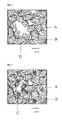
- FIG Fig. 1 and 2 A schematic representation of the surface of an oxygen-consuming electrode before and after treatment with the method according to the invention is shown in FIG Fig. 1 and 2 given.
- a new oxygen-consuming electrode per square meter of electrode surface are preferably 100 mg to 10 g, more preferably 1 g to 5 g of finely divided hydrophilic particles.
- the hydrophilic particles preferably deposited on the surface of the oxygen-consuming electrode in the openings of the hydrophilic pores, but do not penetrate deeper into the pores.
- the hydrophilic particles are in particular connected to each other and form part bridges between the catalyst particles bound in the matrix
- the hydrophilic particles cover part of the pore opening, preferably 5 to 80% of the entrance surface of the hydrophilic pores in the oxygen-consuming electrode are covered.
- the order of the finely divided hydrophilic component takes place in such a way that the fine hydrophilic particles are incorporated in the pores formed by the catalyst particles incorporated in the polymer matrix or attached to the catalyst particles.
- the application is preferably carried out in a suspension onto an oxygen-consuming electrode preformed from carrier, gas diffusion layer and catalytically active component.
- the concentration of the hydrophilic particles in the suspension is preferably 0.1 to 50 wt .-%, particularly preferably 1 to 20 wt .-%.
- the invention also provides a process for the production of oxygen-consuming electrodes, which is characterized in that a finely divided, hydrophilic component in a suspension with a concentration of 0.1 to 50 wt .-%, preferably 1 to 20 wt .-% to a planar raw electrode comprising at least one carrier in the form of a sheet and a coating with a gas diffusion layer and a catalytically active component is applied or sprayed on and that the suspending agent is subsequently removed by evaporation.
- the raw electrode used in the new process is a spent or leaky (i.e., having a stronger gas or liquid passage in operation) oxygen-consuming electrode.
- the suspending agent used may be the liquids suitable for the particular finely divided component.
- protic suspending agents such as water or alcohols or aprotic polar suspending agents such as acetone or dimethyl carbonate may be used.
- suspending agents having a high volatility and a boiling point of 50-150 ° C., preferably 60-100 ° C.
- alcohols particularly preferably i-propanol.
- mixtures of the abovementioned suspending agents can be added to the usual dispersing aids such as fatty acids or Polivinylpyrrolidon.
- the application of the suspension can be carried out by one of the generally known coating technologies such as application by means of a brush, a roller, a doctor blade or other tool, or by direct spraying or casting.
- the coating can be done in one operation or in several operations with intermediate removal of at least a portion of the solvent.
- It is preferably 100 mg to 10 g, preferably 1 to 5 g of finely divided hydrophilic component per square meter electrode surface applied.
- the drying of the applied suspension takes place according to techniques basically known from coating technology.
- the drying in a circulating air dryer wherein the evaporated solvent is recovered.
- the drying can be assisted by additional heating, for example by infrared radiators.
- the temperature and air or gas velocity are chosen so that no removal of the nanoparticles takes place with the gas stream.
- the temperature should be below the boiling point of the suspending agent, at least in the initial phase of the drying step, and after removal of over 90% of the suspending agent, the temperature may be raised to levels above the boiling point.
- the flow rate is preferably selected such that a laminar flow forms on the surface of the electrode. A flow rate of less than 0.45 m / sec is preferred.
- the electrode may be sintered by further heating after removal of the solvent.
- the sintering takes place in particular in the known from the production of the electrodes temperature range of 60 - 330 ° C.
- the electrode can be further compressed by pressing after removal of the solvent.
- the pressing can be done by means of a punch, a roller or other known pressing technique. Preference is given to compaction by means of rollers. Particular preference is given to applying a contact pressure of 0.01 to 7 kN / cm (line force).
- the application of the finely divided component preferably takes place on an electrode produced according to one of the known production methods in a downstream processing step.
- ready-to-use oxygen-consuming electrode is obtained according to the dry or wet production method known from the prior art. If these oxygen-consuming electrodes are treated, for example, by spraying on a suspension of silver having an average particle size of 20-100 nm, preferably 40-80 nm, more preferably 50-70 nm, electrodes are obtained after evaporation of the suspending agent and subsequent drying to the untreated electrodes have a significantly improved impermeability to oxygen and operate at a reduced operating voltage.
- the application of the finely divided component can be carried out before completion of the electrode.
- the finely divided component can be applied before the sintering step.
- the application of the finely divided hydrophilic component is applied to an oxygen-consuming electrode having, as the catalytically active component, silver, silver I oxide or silver II oxide, or mixtures of silver oxide and silver oxide.
- the silver content is 65 to 97 wt.% And 3 to 35 wt.% Of a non-soluble fluorinated polymer, in particular PTFE.
- the new oxygen-consuming electrode has mixtures containing as catalytically active component 70 to 95 wt .-% of silver oxide, in particular silver-I-oxide, and 0 - 15 wt .-% silver metal and 3-15 wt .-% of a non-soluble fluorinated polymers, in particular PTFE.
- the carrier element can be used in particular in the form of a net, fleece, foam, fabric, braid, knitted fabric, expanded metal or another permeable planar structure.
- a flexible textile structure is preferably used electrically conductive, in particular consisting of metal filaments.
- nickel and silver-coated nickel are particularly suitable.
- a further preferred embodiment of the new oxygen-consuming electrode is therefore characterized in that it has as a carrier element a flexible textile structure, in particular made of metal filaments, preferably of nickel or nickel coated with silver.
- the new oxygen-consuming electrode is preferably connected as a cathode, and is operated in particular in an electrolysis cell for the electrolysis of alkali metal chlorides, preferably of sodium chloride or potassium chloride, particularly preferably of sodium chloride.
- the subject of the invention is consequently also an electrolysis device, in particular for the chloralkali electrolysis, comprising a new oxygen-consuming electrode described above as an oxygen-consuming cathode.
- the oxygen-consuming electrode may preferably be switched as a cathode in a fuel cell.
- Another object of the invention is still the use of the new oxygen-consuming electrode for the reduction of oxygen in the alkaline, especially in the alkaline fuel cell, use in drinking water treatment, for example for the production of sodium hypochlorite or use in chlorine-alkali electrolysis, in particular for the electrolysis of LiCl, KCl or NaCl.
- the new oxygen-consuming electrode is particularly preferably used in the chlor-alkali electrolysis and here in particular in the sodium chloride (NaCl) electrolysis.
- per se known oxygen-consuming electrode can be improved or improved with regard to its gas-tightness by applying a finely divided component as described above.
- the invention therefore also relates to the use of suspensions of finely divided components for repairing, sealing or improving damaged or used oxygen-consuming electrodes.
- electrodes whose leak-tightness has diminished during operation and which subsequently have an increase in the operating voltage can be improved by applying a suspension of finely divided particles.
- freshly produced oxygen-consuming electrodes, in which an inadequate performance has been determined when checking the gas-tightness and / or the operating voltage can also be improved by applying a suspension of finely divided particles.
- An oxygenated electrode manufactured by the wet process was installed in an electrolysis half cell. At 4 kA / m 2 the electrode had a potential of - 400 mV (measured against an Ag / AgCl / electrode). The electrode allows visible amounts of oxygen at a pressure difference of 20 mbar between the gas side and the liquid side (formation of small gas bubbles)
- the oxygen-consuming electrode was removed, rinsed with deionized water and dried externally.
- 100 g / m 2 of a suspension of 1.4 g of nanoparticulate silver powder of type SP-7000-95 from Ferro Corporation, Cleveland, USA, (mean particle diameter 60 nm) in 100 g of i-propanol were sprayed on.
- the isopropanol was evaporated, the electrode was then dried for 30 min at 80 ° C in a drying oven and then re-installed in the electrolysis half-cell.
- the electrode had a potential of - 320 mV at 4 kA / m 2 and was tight at a pressure difference of 40 mbar between the gas side and the liquid side.
- the potential was improved by 80 mV and a significant gas and liquid tightness was generated.
- Fig. 1 shows schematically the liquid-facing surface of the oxygen-consuming electrode in a microscopic view before treatment with a finely divided silver particle-containing suspension.
- the catalyst particles B are held by the filamentary PTFE matrix A, an oversized pore D can break oxygen to the liquid side during operation.
- Fig. 2 shows the surface of the same oxygen-consuming electrode after treatment with a finely divided silver particle-containing suspension.
- the finely divided silver particles C have accumulated between the catalyst particles, the free area of the pore opening is reduced.
- the pore can hold the liquid better, a passage of oxygen into the liquid phase is difficult.
- the number of catalytically active sites in the phase boundary region has increased, which has an increased turnover result.
Landscapes
- Chemical & Material Sciences (AREA)
- Chemical Kinetics & Catalysis (AREA)
- Electrochemistry (AREA)
- Engineering & Computer Science (AREA)
- Materials Engineering (AREA)
- General Chemical & Material Sciences (AREA)
- Organic Chemistry (AREA)
- Metallurgy (AREA)
- Manufacturing & Machinery (AREA)
- Inorganic Chemistry (AREA)
- Electrodes For Compound Or Non-Metal Manufacture (AREA)
- Catalysts (AREA)
- Inert Electrodes (AREA)
- Hybrid Cells (AREA)
- Electrolytic Production Of Non-Metals, Compounds, Apparatuses Therefor (AREA)
Applications Claiming Priority (1)
| Application Number | Priority Date | Filing Date | Title |
|---|---|---|---|
| DE102011083314 | 2011-09-23 |
Publications (3)
| Publication Number | Publication Date |
|---|---|
| EP2573211A2 true EP2573211A2 (fr) | 2013-03-27 |
| EP2573211A3 EP2573211A3 (fr) | 2014-05-07 |
| EP2573211B1 EP2573211B1 (fr) | 2019-05-15 |
Family
ID=47018798
Family Applications (1)
| Application Number | Title | Priority Date | Filing Date |
|---|---|---|---|
| EP12185149.7A Active EP2573211B1 (fr) | 2011-09-23 | 2012-09-20 | Procédé de fabrication des électrodes de diffusion gazeuse |
Country Status (4)
| Country | Link |
|---|---|
| US (1) | US9714472B2 (fr) |
| EP (1) | EP2573211B1 (fr) |
| JP (2) | JP6343419B2 (fr) |
| CN (1) | CN103022507B (fr) |
Cited By (2)
| Publication number | Priority date | Publication date | Assignee | Title |
|---|---|---|---|---|
| WO2015135858A1 (fr) * | 2014-03-11 | 2015-09-17 | Bayer Materialscience Ag | Procédé de production de poudres catalytiquement actives constituées d'argent métal ou de mélanges d'argent métal et d'oxyde d'argent destinées à fabriquer des électrodes à diffusion de gaz |
| DE102024100515A1 (de) * | 2024-01-09 | 2025-07-10 | Ruhr-Universität Bochum, Körperschaft des öffentlichen Rechts | Mo-Ru-Katalysatormaterialien für die Wasserelektrolyse |
Families Citing this family (7)
| Publication number | Priority date | Publication date | Assignee | Title |
|---|---|---|---|---|
| AU2012382382A1 (en) | 2012-06-12 | 2015-01-15 | Aquahydrex Pty Ltd | Breathable electrode and method for use in water splitting |
| KR20160040614A (ko) * | 2013-07-31 | 2016-04-14 | 아쿠아하이드렉스 프로프라이어터리 리미티드 | 기체 확산 전극(들)을 가지는 전기-합성 또는 전기-에너지 전지 |
| CN106941180A (zh) * | 2017-04-21 | 2017-07-11 | 上海汉行科技有限公司 | 一种混合电池体系正极 |
| EP3418429A1 (fr) * | 2017-06-21 | 2018-12-26 | Covestro Deutschland AG | Électrode à diffusion de gaz destinée à réduire l'oxyde d'azote |
| CA3127358A1 (fr) | 2019-02-01 | 2020-08-06 | Aquahydrex, Inc. | Systeme electrochimique a electrolyte confine |
| TWI820501B (zh) * | 2021-10-27 | 2023-11-01 | 台灣奈米碳素股份有限公司 | 電極的製造方法及其催化層 |
| DE102023212300A1 (de) * | 2023-12-06 | 2025-06-12 | Siemens Energy Global GmbH & Co. KG | Membran-Elektroden-Einheit, Verfahren zu deren Herstellung sowie deren Verwendung |
Citations (4)
| Publication number | Priority date | Publication date | Assignee | Title |
|---|---|---|---|---|
| US20060175195A1 (en) | 2005-02-08 | 2006-08-10 | Permelec Electrode Ltd. | Gas diffusion electrode |
| EP1728896A2 (fr) | 2005-05-21 | 2006-12-06 | Bayer MaterialScience AG | Procede pour produire des électrodes a diffusion gazeuse |
| US7201888B2 (en) | 2003-10-07 | 2007-04-10 | Ferro Corporation | Nanosized silver oxide powder |
| DE102006017696A1 (de) | 2006-04-15 | 2007-10-18 | Bayer Technology Services Gmbh | Verfahren zur Herstellung von Metallpartikeln, hieraus hergestellte Metallpartikel und deren Verwendung |
Family Cites Families (12)
| Publication number | Priority date | Publication date | Assignee | Title |
|---|---|---|---|---|
| JPS5967381A (ja) * | 1982-10-07 | 1984-04-17 | Agency Of Ind Science & Technol | 水電解のための陽極及びその製法 |
| US4581116A (en) * | 1984-12-04 | 1986-04-08 | The Dow Chemical Company | Gas diffusion composite electrode having novel hydrophilic layer |
| US4568442A (en) | 1985-02-01 | 1986-02-04 | The Dow Chemical Company | Gas diffusion composite electrode having polymeric binder coated carbon layer |
| JPH0766812B2 (ja) * | 1985-07-24 | 1995-07-19 | 政廣 渡辺 | 燃料電池等のガス拡散電極 |
| JP2952584B2 (ja) * | 1998-03-03 | 1999-09-27 | 長一 古屋 | ガス拡散電極 |
| ATE294261T1 (de) | 2001-09-07 | 2005-05-15 | Akzo Nobel Nv | Elektrolysezelle |
| WO2008036962A2 (fr) * | 2006-09-22 | 2008-03-27 | Bar Ilan University | Agrégats poreux de poudre d'argent comprenant de l'oxyde de zirconium en tant que promoteur destinés à être utilisés en tant que catalyseur dans des électrodes à diffusion gazeuse et procédé pour la production de ceux-ci |
| JP5031336B2 (ja) * | 2006-11-21 | 2012-09-19 | ペルメレック電極株式会社 | 食塩電解用酸素ガス拡散陰極 |
| DE102008039072A1 (de) * | 2008-08-21 | 2010-02-25 | Bayer Materialscience Ag | Elektrodenmaterial, Elektrode und ein Verfahren zur Chlorwasserstoffelektrolyse |
| JP2010180440A (ja) * | 2009-02-04 | 2010-08-19 | Tosoh Corp | ガス拡散電極およびその製造方法並びにこれを用いた電解方法 |
| JP5517041B2 (ja) * | 2009-10-19 | 2014-06-11 | 株式会社豊田中央研究所 | ガス拡散電極の製造方法 |
| JP5178959B2 (ja) * | 2010-02-22 | 2013-04-10 | ペルメレック電極株式会社 | 酸素ガス拡散陰極、これを用いた電解槽、塩素ガスの製造方法、及び水酸化ナトリウムの製造方法 |
-
2012
- 2012-09-14 US US13/616,266 patent/US9714472B2/en not_active Expired - Fee Related
- 2012-09-20 EP EP12185149.7A patent/EP2573211B1/fr active Active
- 2012-09-21 JP JP2012208583A patent/JP6343419B2/ja not_active Expired - Fee Related
- 2012-09-24 CN CN201210356594.0A patent/CN103022507B/zh not_active Expired - Fee Related
-
2018
- 2018-04-02 JP JP2018070963A patent/JP6646704B2/ja not_active Expired - Fee Related
Patent Citations (4)
| Publication number | Priority date | Publication date | Assignee | Title |
|---|---|---|---|---|
| US7201888B2 (en) | 2003-10-07 | 2007-04-10 | Ferro Corporation | Nanosized silver oxide powder |
| US20060175195A1 (en) | 2005-02-08 | 2006-08-10 | Permelec Electrode Ltd. | Gas diffusion electrode |
| EP1728896A2 (fr) | 2005-05-21 | 2006-12-06 | Bayer MaterialScience AG | Procede pour produire des électrodes a diffusion gazeuse |
| DE102006017696A1 (de) | 2006-04-15 | 2007-10-18 | Bayer Technology Services Gmbh | Verfahren zur Herstellung von Metallpartikeln, hieraus hergestellte Metallpartikel und deren Verwendung |
Non-Patent Citations (2)
| Title |
|---|
| LIPP ET AL.: "J. Appl. Electrochem.", vol. 35, 2005, LOS ALAMOS NATIONAL LABORATORY, article "Peroxide formation during chlor-alkali electrolysis with carbon-based ODC", pages: 1015 |
| VON MOUSSALLEM ET AL.: "Chlor- Alkali Electrolysis with Oxygen Depolarized Cathodes: History, Present Status and Future Prospects", J. APPL. ELECTROCHEM., vol. 38, 2008, pages 1177 - 1194, XP019606285 |
Cited By (2)
| Publication number | Priority date | Publication date | Assignee | Title |
|---|---|---|---|---|
| WO2015135858A1 (fr) * | 2014-03-11 | 2015-09-17 | Bayer Materialscience Ag | Procédé de production de poudres catalytiquement actives constituées d'argent métal ou de mélanges d'argent métal et d'oxyde d'argent destinées à fabriquer des électrodes à diffusion de gaz |
| DE102024100515A1 (de) * | 2024-01-09 | 2025-07-10 | Ruhr-Universität Bochum, Körperschaft des öffentlichen Rechts | Mo-Ru-Katalysatormaterialien für die Wasserelektrolyse |
Also Published As
| Publication number | Publication date |
|---|---|
| EP2573211A3 (fr) | 2014-05-07 |
| JP2013067859A (ja) | 2013-04-18 |
| JP2018115393A (ja) | 2018-07-26 |
| JP6646704B2 (ja) | 2020-02-14 |
| EP2573211B1 (fr) | 2019-05-15 |
| CN103022507A (zh) | 2013-04-03 |
| US9714472B2 (en) | 2017-07-25 |
| CN103022507B (zh) | 2016-10-05 |
| JP6343419B2 (ja) | 2018-06-13 |
| US20130078536A1 (en) | 2013-03-28 |
Similar Documents
| Publication | Publication Date | Title |
|---|---|---|
| EP2573211B1 (fr) | Procédé de fabrication des électrodes de diffusion gazeuse | |
| EP2397578B1 (fr) | Électrode catalytique consommant de l'oxygène et son procédé de fabrication | |
| EP2398101B1 (fr) | Electrode de diffusion gazeuse et méthode de fabrication | |
| EP2410079B1 (fr) | Electrode catalytique consommant de l'oxygène | |
| EP3642391B1 (fr) | Procédé, utilisation et cellule électrolytique dotée d'une électrode à diffusion de gaz destinée à réduire l'oxyde d'azote | |
| EP1402587B1 (fr) | Procede pour la production d'electrodes a diffusion gazeuse | |
| EP2385996A2 (fr) | Électrode de diffusion de gaz structurée pour cellules électrolytiques | |
| DE102007033753B4 (de) | An seiner Oberfläche mit metallischen Nanopartikeln versehenes ultrahydrophobes Substrat, Verfahren zu dessen Herstellung und Verwendung desselben | |
| DE4438275B4 (de) | Elektrolysezelle und Verfahren zur Elektrolyse einer wässrigen Kochsalzlösung | |
| EP2461402B1 (fr) | Electrode catalytique consommant de l'oxygène et son procédé de fabrication | |
| EP3788184A1 (fr) | Électrode de diffusion gazeuse destinée au recyclage de dioxyde de carbone, son procédé de fabrication et cellule électrolytique dotée d'une électrode de diffusion gazeuse | |
| DE102006050090B4 (de) | Sauerstoff-Reduktions-Gasdiffusionskathode und Verfahren zur Durchführung einer Natriumchlorid-Elektrolyse in einer Elektrolysezelle | |
| EP2573212A2 (fr) | Electrode catalytique consommant de l'oxygène et son procédé de fabrication | |
| EP2609649B1 (fr) | Électrode consommant de l'oxygène et procédé de fabrication de ladite électrode | |
| DE102014204372A1 (de) | Verfahren zur Herstellung von katalytisch aktiven Pulvern aus metallischem Silber oder aus Mischungen aus von metallischem Silber mit Silberoxid zur Herstellung von Gasdiffusionselektroden | |
| DE3538043A1 (de) | Elektrochemische zelle mit elektrolytumlauf, verfahren zum herstellen einer gasdepolarisierten katode und elektrolyseverfahren | |
| EP2949784A1 (fr) | Électrode catalytique consommant de l'oxygene et son procede de fabrication | |
| EP2573210B1 (fr) | Electrode catalytique consommant de l'oxygène et son procédé de fabrication | |
| EP2573213B1 (fr) | Electrode catalytique consommant de l'oxygène et son procédé de fabrication | |
| DE102010042004A1 (de) | Verfahren zur Herstellung von transport- und lagerstabilen Sauerstoffverzehrelektroden | |
| DE102013213740A1 (de) | Verfahren zur Herstellung von transport- und lagerstabilen Sauerstoffverzehrelektroden | |
| EP2649222B1 (fr) | Procédé de montage d'électrodes consommant de l'oxygène dans des cellules électrochimiques et cellule électrochimique | |
| EP2663669B1 (fr) | Revêtement pour des matériaux métalliques d'élément de cellule d'une cellule électrolytique | |
| EP4575041A1 (fr) | Électrode à diffusion gazeuse et procédé de réduction de l'évolution d'hydrogène lors du fonctionnement d'une électrolyse à électrode à diffusion gazeuse | |
| DE102023107953A1 (de) | Elektrodenstruktur, Elektrolysezelle, Elektrolysebehälter, Verfahren zur Herstellung eines Elektrolysebehälters |
Legal Events
| Date | Code | Title | Description |
|---|---|---|---|
| PUAI | Public reference made under article 153(3) epc to a published international application that has entered the european phase |
Free format text: ORIGINAL CODE: 0009012 |
|
| AK | Designated contracting states |
Kind code of ref document: A2 Designated state(s): AL AT BE BG CH CY CZ DE DK EE ES FI FR GB GR HR HU IE IS IT LI LT LU LV MC MK MT NL NO PL PT RO RS SE SI SK SM TR |
|
| AX | Request for extension of the european patent |
Extension state: BA ME |
|
| PUAL | Search report despatched |
Free format text: ORIGINAL CODE: 0009013 |
|
| AK | Designated contracting states |
Kind code of ref document: A3 Designated state(s): AL AT BE BG CH CY CZ DE DK EE ES FI FR GB GR HR HU IE IS IT LI LT LU LV MC MK MT NL NO PL PT RO RS SE SI SK SM TR |
|
| AX | Request for extension of the european patent |
Extension state: BA ME |
|
| RIC1 | Information provided on ipc code assigned before grant |
Ipc: C25B 11/04 20060101ALI20140403BHEP Ipc: C25B 1/46 20060101AFI20140403BHEP Ipc: C25B 11/03 20060101ALI20140403BHEP Ipc: H01M 4/88 20060101ALI20140403BHEP Ipc: H01M 4/90 20060101ALI20140403BHEP |
|
| 17P | Request for examination filed |
Effective date: 20141107 |
|
| RBV | Designated contracting states (corrected) |
Designated state(s): AL AT BE BG CH CY CZ DE DK EE ES FI FR GB GR HR HU IE IS IT LI LT LU LV MC MK MT NL NO PL PT RO RS SE SI SK SM TR |
|
| 17Q | First examination report despatched |
Effective date: 20150803 |
|
| RAP1 | Party data changed (applicant data changed or rights of an application transferred) |
Owner name: COVESTRO DEUTSCHLAND AG |
|
| STAA | Information on the status of an ep patent application or granted ep patent |
Free format text: STATUS: EXAMINATION IS IN PROGRESS |
|
| GRAP | Despatch of communication of intention to grant a patent |
Free format text: ORIGINAL CODE: EPIDOSNIGR1 |
|
| STAA | Information on the status of an ep patent application or granted ep patent |
Free format text: STATUS: GRANT OF PATENT IS INTENDED |
|
| RIC1 | Information provided on ipc code assigned before grant |
Ipc: H01M 4/88 20060101ALI20181210BHEP Ipc: C25B 11/04 20060101ALI20181210BHEP Ipc: H01M 8/1018 20160101ALI20181210BHEP Ipc: H01M 4/86 20060101ALI20181210BHEP Ipc: H01M 4/90 20060101ALI20181210BHEP Ipc: H01M 12/08 20060101ALI20181210BHEP Ipc: H01M 12/04 20060101ALI20181210BHEP Ipc: C25B 1/46 20060101AFI20181210BHEP Ipc: C25B 11/03 20060101ALI20181210BHEP |
|
| INTG | Intention to grant announced |
Effective date: 20190115 |
|
| GRAS | Grant fee paid |
Free format text: ORIGINAL CODE: EPIDOSNIGR3 |
|
| GRAA | (expected) grant |
Free format text: ORIGINAL CODE: 0009210 |
|
| STAA | Information on the status of an ep patent application or granted ep patent |
Free format text: STATUS: THE PATENT HAS BEEN GRANTED |
|
| AK | Designated contracting states |
Kind code of ref document: B1 Designated state(s): AL AT BE BG CH CY CZ DE DK EE ES FI FR GB GR HR HU IE IS IT LI LT LU LV MC MK MT NL NO PL PT RO RS SE SI SK SM TR |
|
| REG | Reference to a national code |
Ref country code: CH Ref legal event code: EP Ref country code: GB Ref legal event code: FG4D Free format text: NOT ENGLISH |
|
| REG | Reference to a national code |
Ref country code: DE Ref legal event code: R096 Ref document number: 502012014774 Country of ref document: DE |
|
| REG | Reference to a national code |
Ref country code: IE Ref legal event code: FG4D Free format text: LANGUAGE OF EP DOCUMENT: GERMAN |
|
| REG | Reference to a national code |
Ref country code: NL Ref legal event code: MP Effective date: 20190515 |
|
| REG | Reference to a national code |
Ref country code: LT Ref legal event code: MG4D |
|
| PG25 | Lapsed in a contracting state [announced via postgrant information from national office to epo] |
Ref country code: AL Free format text: LAPSE BECAUSE OF FAILURE TO SUBMIT A TRANSLATION OF THE DESCRIPTION OR TO PAY THE FEE WITHIN THE PRESCRIBED TIME-LIMIT Effective date: 20190515 Ref country code: SE Free format text: LAPSE BECAUSE OF FAILURE TO SUBMIT A TRANSLATION OF THE DESCRIPTION OR TO PAY THE FEE WITHIN THE PRESCRIBED TIME-LIMIT Effective date: 20190515 Ref country code: PT Free format text: LAPSE BECAUSE OF FAILURE TO SUBMIT A TRANSLATION OF THE DESCRIPTION OR TO PAY THE FEE WITHIN THE PRESCRIBED TIME-LIMIT Effective date: 20190915 Ref country code: FI Free format text: LAPSE BECAUSE OF FAILURE TO SUBMIT A TRANSLATION OF THE DESCRIPTION OR TO PAY THE FEE WITHIN THE PRESCRIBED TIME-LIMIT Effective date: 20190515 Ref country code: NO Free format text: LAPSE BECAUSE OF FAILURE TO SUBMIT A TRANSLATION OF THE DESCRIPTION OR TO PAY THE FEE WITHIN THE PRESCRIBED TIME-LIMIT Effective date: 20190815 Ref country code: HR Free format text: LAPSE BECAUSE OF FAILURE TO SUBMIT A TRANSLATION OF THE DESCRIPTION OR TO PAY THE FEE WITHIN THE PRESCRIBED TIME-LIMIT Effective date: 20190515 Ref country code: ES Free format text: LAPSE BECAUSE OF FAILURE TO SUBMIT A TRANSLATION OF THE DESCRIPTION OR TO PAY THE FEE WITHIN THE PRESCRIBED TIME-LIMIT Effective date: 20190515 Ref country code: LT Free format text: LAPSE BECAUSE OF FAILURE TO SUBMIT A TRANSLATION OF THE DESCRIPTION OR TO PAY THE FEE WITHIN THE PRESCRIBED TIME-LIMIT Effective date: 20190515 Ref country code: NL Free format text: LAPSE BECAUSE OF FAILURE TO SUBMIT A TRANSLATION OF THE DESCRIPTION OR TO PAY THE FEE WITHIN THE PRESCRIBED TIME-LIMIT Effective date: 20190515 |
|
| PG25 | Lapsed in a contracting state [announced via postgrant information from national office to epo] |
Ref country code: LV Free format text: LAPSE BECAUSE OF FAILURE TO SUBMIT A TRANSLATION OF THE DESCRIPTION OR TO PAY THE FEE WITHIN THE PRESCRIBED TIME-LIMIT Effective date: 20190515 Ref country code: RS Free format text: LAPSE BECAUSE OF FAILURE TO SUBMIT A TRANSLATION OF THE DESCRIPTION OR TO PAY THE FEE WITHIN THE PRESCRIBED TIME-LIMIT Effective date: 20190515 Ref country code: BG Free format text: LAPSE BECAUSE OF FAILURE TO SUBMIT A TRANSLATION OF THE DESCRIPTION OR TO PAY THE FEE WITHIN THE PRESCRIBED TIME-LIMIT Effective date: 20190815 Ref country code: GR Free format text: LAPSE BECAUSE OF FAILURE TO SUBMIT A TRANSLATION OF THE DESCRIPTION OR TO PAY THE FEE WITHIN THE PRESCRIBED TIME-LIMIT Effective date: 20190816 |
|
| PG25 | Lapsed in a contracting state [announced via postgrant information from national office to epo] |
Ref country code: DK Free format text: LAPSE BECAUSE OF FAILURE TO SUBMIT A TRANSLATION OF THE DESCRIPTION OR TO PAY THE FEE WITHIN THE PRESCRIBED TIME-LIMIT Effective date: 20190515 Ref country code: EE Free format text: LAPSE BECAUSE OF FAILURE TO SUBMIT A TRANSLATION OF THE DESCRIPTION OR TO PAY THE FEE WITHIN THE PRESCRIBED TIME-LIMIT Effective date: 20190515 Ref country code: SK Free format text: LAPSE BECAUSE OF FAILURE TO SUBMIT A TRANSLATION OF THE DESCRIPTION OR TO PAY THE FEE WITHIN THE PRESCRIBED TIME-LIMIT Effective date: 20190515 Ref country code: RO Free format text: LAPSE BECAUSE OF FAILURE TO SUBMIT A TRANSLATION OF THE DESCRIPTION OR TO PAY THE FEE WITHIN THE PRESCRIBED TIME-LIMIT Effective date: 20190515 Ref country code: CZ Free format text: LAPSE BECAUSE OF FAILURE TO SUBMIT A TRANSLATION OF THE DESCRIPTION OR TO PAY THE FEE WITHIN THE PRESCRIBED TIME-LIMIT Effective date: 20190515 |
|
| REG | Reference to a national code |
Ref country code: DE Ref legal event code: R097 Ref document number: 502012014774 Country of ref document: DE |
|
| PG25 | Lapsed in a contracting state [announced via postgrant information from national office to epo] |
Ref country code: SM Free format text: LAPSE BECAUSE OF FAILURE TO SUBMIT A TRANSLATION OF THE DESCRIPTION OR TO PAY THE FEE WITHIN THE PRESCRIBED TIME-LIMIT Effective date: 20190515 |
|
| PLBE | No opposition filed within time limit |
Free format text: ORIGINAL CODE: 0009261 |
|
| STAA | Information on the status of an ep patent application or granted ep patent |
Free format text: STATUS: NO OPPOSITION FILED WITHIN TIME LIMIT |
|
| PG25 | Lapsed in a contracting state [announced via postgrant information from national office to epo] |
Ref country code: TR Free format text: LAPSE BECAUSE OF FAILURE TO SUBMIT A TRANSLATION OF THE DESCRIPTION OR TO PAY THE FEE WITHIN THE PRESCRIBED TIME-LIMIT Effective date: 20190515 |
|
| 26N | No opposition filed |
Effective date: 20200218 |
|
| PG25 | Lapsed in a contracting state [announced via postgrant information from national office to epo] |
Ref country code: PL Free format text: LAPSE BECAUSE OF FAILURE TO SUBMIT A TRANSLATION OF THE DESCRIPTION OR TO PAY THE FEE WITHIN THE PRESCRIBED TIME-LIMIT Effective date: 20190515 |
|
| PG25 | Lapsed in a contracting state [announced via postgrant information from national office to epo] |
Ref country code: MC Free format text: LAPSE BECAUSE OF FAILURE TO SUBMIT A TRANSLATION OF THE DESCRIPTION OR TO PAY THE FEE WITHIN THE PRESCRIBED TIME-LIMIT Effective date: 20190515 Ref country code: SI Free format text: LAPSE BECAUSE OF FAILURE TO SUBMIT A TRANSLATION OF THE DESCRIPTION OR TO PAY THE FEE WITHIN THE PRESCRIBED TIME-LIMIT Effective date: 20190515 |
|
| REG | Reference to a national code |
Ref country code: CH Ref legal event code: PL |
|
| PG25 | Lapsed in a contracting state [announced via postgrant information from national office to epo] |
Ref country code: CH Free format text: LAPSE BECAUSE OF NON-PAYMENT OF DUE FEES Effective date: 20190930 Ref country code: LI Free format text: LAPSE BECAUSE OF NON-PAYMENT OF DUE FEES Effective date: 20190930 Ref country code: LU Free format text: LAPSE BECAUSE OF NON-PAYMENT OF DUE FEES Effective date: 20190920 Ref country code: IE Free format text: LAPSE BECAUSE OF NON-PAYMENT OF DUE FEES Effective date: 20190920 |
|
| REG | Reference to a national code |
Ref country code: BE Ref legal event code: MM Effective date: 20190930 |
|
| PG25 | Lapsed in a contracting state [announced via postgrant information from national office to epo] |
Ref country code: BE Free format text: LAPSE BECAUSE OF NON-PAYMENT OF DUE FEES Effective date: 20190930 |
|
| GBPC | Gb: european patent ceased through non-payment of renewal fee |
Effective date: 20190920 |
|
| PG25 | Lapsed in a contracting state [announced via postgrant information from national office to epo] |
Ref country code: FR Free format text: LAPSE BECAUSE OF NON-PAYMENT OF DUE FEES Effective date: 20190930 Ref country code: GB Free format text: LAPSE BECAUSE OF NON-PAYMENT OF DUE FEES Effective date: 20190920 |
|
| REG | Reference to a national code |
Ref country code: AT Ref legal event code: MM01 Ref document number: 1133528 Country of ref document: AT Kind code of ref document: T Effective date: 20190920 |
|
| PG25 | Lapsed in a contracting state [announced via postgrant information from national office to epo] |
Ref country code: AT Free format text: LAPSE BECAUSE OF NON-PAYMENT OF DUE FEES Effective date: 20190920 |
|
| PG25 | Lapsed in a contracting state [announced via postgrant information from national office to epo] |
Ref country code: CY Free format text: LAPSE BECAUSE OF FAILURE TO SUBMIT A TRANSLATION OF THE DESCRIPTION OR TO PAY THE FEE WITHIN THE PRESCRIBED TIME-LIMIT Effective date: 20190515 |
|
| PG25 | Lapsed in a contracting state [announced via postgrant information from national office to epo] |
Ref country code: IS Free format text: LAPSE BECAUSE OF FAILURE TO SUBMIT A TRANSLATION OF THE DESCRIPTION OR TO PAY THE FEE WITHIN THE PRESCRIBED TIME-LIMIT Effective date: 20190915 |
|
| PG25 | Lapsed in a contracting state [announced via postgrant information from national office to epo] |
Ref country code: MT Free format text: LAPSE BECAUSE OF FAILURE TO SUBMIT A TRANSLATION OF THE DESCRIPTION OR TO PAY THE FEE WITHIN THE PRESCRIBED TIME-LIMIT Effective date: 20190515 Ref country code: HU Free format text: LAPSE BECAUSE OF FAILURE TO SUBMIT A TRANSLATION OF THE DESCRIPTION OR TO PAY THE FEE WITHIN THE PRESCRIBED TIME-LIMIT; INVALID AB INITIO Effective date: 20120920 |
|
| PG25 | Lapsed in a contracting state [announced via postgrant information from national office to epo] |
Ref country code: MK Free format text: LAPSE BECAUSE OF FAILURE TO SUBMIT A TRANSLATION OF THE DESCRIPTION OR TO PAY THE FEE WITHIN THE PRESCRIBED TIME-LIMIT Effective date: 20190515 |
|
| PGFP | Annual fee paid to national office [announced via postgrant information from national office to epo] |
Ref country code: DE Payment date: 20250819 Year of fee payment: 14 |
|
| PGFP | Annual fee paid to national office [announced via postgrant information from national office to epo] |
Ref country code: IT Payment date: 20250827 Year of fee payment: 14 |