EP2576314B1 - Verschluss für weichenstellvorrichtungen - Google Patents
Verschluss für weichenstellvorrichtungen Download PDFInfo
- Publication number
- EP2576314B1 EP2576314B1 EP11725887.1A EP11725887A EP2576314B1 EP 2576314 B1 EP2576314 B1 EP 2576314B1 EP 11725887 A EP11725887 A EP 11725887A EP 2576314 B1 EP2576314 B1 EP 2576314B1
- Authority
- EP
- European Patent Office
- Prior art keywords
- bolt
- guide
- locking
- tongue
- hinge
- Prior art date
- Legal status (The legal status is an assumption and is not a legal conclusion. Google has not performed a legal analysis and makes no representation as to the accuracy of the status listed.)
- Not-in-force
Links
- 210000002105 tongue Anatomy 0.000 claims 8
- 238000006073 displacement reaction Methods 0.000 claims 1
- 238000000034 method Methods 0.000 description 6
- 238000013459 approach Methods 0.000 description 1
- 238000010276 construction Methods 0.000 description 1
- 230000007935 neutral effect Effects 0.000 description 1
Images

Classifications
-
- E—FIXED CONSTRUCTIONS
- E01—CONSTRUCTION OF ROADS, RAILWAYS, OR BRIDGES
- E01B—PERMANENT WAY; PERMANENT-WAY TOOLS; MACHINES FOR MAKING RAILWAYS OF ALL KINDS
- E01B7/00—Switches; Crossings
- E01B7/20—Safety means for switches, e.g. switch point protectors, auxiliary or guiding rail members
-
- B—PERFORMING OPERATIONS; TRANSPORTING
- B61—RAILWAYS
- B61L—GUIDING RAILWAY TRAFFIC; ENSURING THE SAFETY OF RAILWAY TRAFFIC
- B61L5/00—Local operating mechanisms for points or track-mounted scotch-blocks; Visible or audible signals; Local operating mechanisms for visible or audible signals
- B61L5/10—Locking mechanisms for points; Means for indicating the setting of points
Definitions
- the invention relates to a closure for points setting devices, with a closure piece which forms a running in the adjustment direction of the switch guide slot and a transversely outgoing from the guide slot locking seat, a displaceable in the guide slot guide pin, connected to a remote switch blade hinge pin, and a bearing block, the is pivotable about the axis of the guide pin and in which the guide pin (and the hinge pin are mounted.
- Turnouts for rail vehicles have two switch points, which are pivotally located between so-called stock rails of a switch and can be adjusted in the direction transverse to the stock rails with the aid of the points setter.
- the adjacent tongue In each stationary state of the switch machine is one of the two switch blades on the associated stock rail. It is therefore called the adjacent tongue.
- the other switch tongue is referred to as a remote tongue, since its free end to the associated stock rail has a certain distance.
- the closure serves to positively block the adjacent switch blade in the adjacent position, so that they can not be moved away from the stock rail, as this could lead to derailment of the rail vehicle.
- the point setting device must therefore have an unlocking mechanism which unlocks the closure before the actual changeover process can begin.
- the object of the invention is to provide a novel closure for switches setting devices, which is characterized by a high reliability and a compact design.
- a hingedly connected to an adjacent switch blade locking lever carries at the remote from the switch blade end lockable on a locking lock pin
- the locking pin, the guide pin and the hinge pin are mounted in a triangular configuration in such a positional block that the locking pin and the hinge pin lie on opposite sides of the guide slot and the adjacent switch blades are closer than the guide pin, and that a spring biases the remote switch blade towards its remote position. If a force acting on the remote switch blade and thus on the hinge pin, which tends to move the remote switch blade into its adjacent position, the adjacent tongue remains initially blocked in its adjacent position, since the locking pin rests against the locking seat. On the bearing block then acts a torque which has the tendency to pivot the bearing block about the axis of the guide pin. Due to this pivoting movement of the locking pin enters the guide slot, so that it comes free from the locking seat.
- the spring can yield slightly during this process and thus makes it possible for the hinge pin to move in accordance with the pivoting movement of the bearing block.
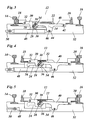
- a switch 10 for rail vehicles a closure 12 of an associated switch device are shown.
- the switch 10 has two stock rails 14, 16 and two switch blades 18, 20.
- the switch blade 18 is located on the stock rail 14 (adjacent tongue), while the switch blade 20 is moved away from the stock rail 16 (tongue off).
- the closure 12 has a stationary between the jaw rails 14, 16 arranged closure piece 22 which forms a transverse to the cheek rails guide slot 24.
- the guide slot 24 is formed by a straight on the largest part of its length in a wall of the closure piece 22 extending slot, which at one end, left in Fig. 1 is extended, so that a transversely of the guide slot 24 outgoing locking seat 26 is formed for a locking pin 28.
- the locking pin 28 is seated at the free end of a Z-shaped angled locking lever 30 which is connected at the other end by a hinge 32 with the adjacent switch blade 18.
- the locking lever 30 and the voltage applied to the locking seat 26 locking pin 28 thus ensure that the adjacent switch blade 18 is positively locked in the adjacent position. Since the axis of the hinge 32 is horizontal and the locking seat 26 is formed on the underside of the guide slot 24, the weight of the locking lever 30 contributes to the fact that the locking pin 28 reliably engages in the locking position.
- the locking pin 28 is held in a bearing block 34, which also receives a guide pin 36 and a hinge pin 38.
- the hinge pin 38 connects the bearing block 34 articulated to a connecting member 40, which in turn is connected via a hinge 42 with the remote switch blade 20.
- the axes of the locking pin 28, the guide pin 36 and the hinge pin 38 form a triangle.
- the guide pin 36 is slidably guided in the guide slot 24.
- the locking pin 28 and the hinge pin 38 are offset from the guide pin 36 to the adjacent switch blade 18 out and lie on opposite sides (below and above) of the central axis of the guide slot 24th
- the connecting member 40 has in the middle between the hinge pin 38 and the joint 42 on a downwardly projecting lug 44 on which a spring 46 engages via a hinge 46.
- the other end of the spring 48 is connected in the example shown here via a control rod 50 with a drive, not shown, of the point setting device.
- the entire closure 12 is housed in a box-shaped housing 52, which is arranged below the stock rails 14, 16 and in the area between the stock rails slightly higher drawn side walls, between which the closure piece 22 is held.
- the closure 12 has a total of a symmetrical structure, wherein the plane of symmetry by the locking lever 30 and the connecting member 40 is defined.
- the closure piece 22 has in plan a C-shaped configuration with lying symmetrically to the locking lever 30 side walls in which the slots are formed, which are the guide link 24 form.
- these slots can also be formed congruently in the walls of the housing 52, so that the housing 52 can be considered as part of the closure piece.
- the locking pin 28 passes through the entire housing 52. Its middle part is in Fig. 2 covered by the overlying hinge pin 38.
- the bearing block 34 and the guide pin 36 are each formed by two separate parts due to the symmetrical structure, which lie on both sides of the plane of symmetry. Each part of the guide pin 36 extends through the guide slot 24 and is mounted in the associated part of the bearing block 34.
- the hinge pin 38 connects the connecting member 40 with the two parts of the bearing block 34, but does not quite reach the walls of the closure piece 22, in which the guide slot 24 is formed.
- the spring 48 is formed by two symmetrically arranged spring elements which engage the common joint 46. The other ends of these spring elements are connected to the control rod 50 by a shaft 54 which is guided in slots (not shown) in the walls of the housing 52.
- the shutter 12 is unlocked when the switch is opened, ie, when a rail vehicle displaces the remote switch blade 20 in the direction of the associated stock rail 16.
- the spring 48 is a tension spring that can yield under this force, so that the joint 46 continues to the right in Fig. 1 can relocate.
- Also on the hinge pin 38 held in the bearing block 34 acts a rightward traction.
- the bearing block 34 can not yield to this force because it also supports the locking pin 28, which is still caught on the locking seat 26.
- the adjacent switch blade 18 thus initially remains blocked in its adjacent position.
- Fig. 3 the state is shown in which the bearing block 34 has been pivoted so far that the locking pin 28 is released from the locking seat 26 and lies in the guide slot 24.
- the exact contour of the locking seat 26 is therefore in Fig. 3 to recognize more clearly.
- the remote switch tongue 20 and the connecting member 40 have slightly to the right in Fig. 3 relocated.
- the link has been slightly pivoted about the hinge 42 because the bearing pin 38 has lifted.
- the hinge 46, on which the spring 48 engages, has also shifted slightly to the right. Since the control rod 50 was not actuated when driving the switch, the spring 48 has been pulled out slightly.
- Fig. 4 shows the state at the end of the drive-up process.
- the switch tongue 20 now bears against the stock rail 16, while the switch tongue 18 has moved away from the stock rail 14.
- the guide pin 36 has moved to the right end of the guide slot 24.
- the locking pin 28 lies with its ends on the rectilinear upper edge of the guide slot 24 and has thus prevented further pivoting of the bearing block 34, so that the bearing block 34 has carried out a pure translational movement.
- the spring 48 is extended and thus is under considerable tension.
- the switch can due to the restoring force of the spring 48 back into the in Fig. 1 return home position shown.
- the locking pin 28 Towards the end of this movement, the locking pin 28 again falls on the locking seat 26, partly because of the dead weight of the locking lever 30, but mainly because of the force exerted by the bearing pin 28 on the bearing block 34 torque, which now acts in the counterclockwise direction.
- this shape of the locking lever 30 has the consequence that the locking pin 28 must move slightly to the right during the unlocking process.
- the contour of the locking seat 26 may be selected so that on the one hand this movement allows, on the other hand, however, ensures the self-locking when the force is applied via the locking lever 30 and the locking pin is not raised by the pivotal movement of the bearing block 34.
- Fig. 5 illustrates the case that the switch is not driven up, but with the help of acting on the control rod 50 (not shown) actuator is actively converted by the control rod 50 to the right in Fig. 5 is moved.
- the spring 48 is in This example is designed to be in the initial state according to Fig. 1 is on block so she can transmit shear forces.
- the force of the control rod 50 is then transmitted by the spring 48 on the hinge 46 and further via the connecting member 40 on the bearing pin 38.
- the unlocking can then be effected in the same way as above in connection with Fig. 1 and 3 has been described.
- the switch blade 20 is then moved by means of the control rod 50 and the spring 48 in the applied position.
- a second shutter may be provided for the switch blade 20 that is identical in construction to the shutter 12 described herein, but (except for the spring 48 and the control rod 50) is disposed in mirror image relation thereto.
- the springs 48 should then be designed so that they are in the in Fig. 1 and Fig. 5 state not shown to be block, but be in the neutral position from which they can both be stretched and compressed, so that a departure of the switch is possible even if the switch blade 20 is the adjacent tongue.
Landscapes
- Engineering & Computer Science (AREA)
- Mechanical Engineering (AREA)
- Architecture (AREA)
- Civil Engineering (AREA)
- Structural Engineering (AREA)
- Seats For Vehicles (AREA)
- Lock And Its Accessories (AREA)
- Train Traffic Observation, Control, And Security (AREA)
Description
- Die Erfindung betrifft einen Verschluss für Weichenstellvorrichtungen, mit einem Verschlussstück, das eine in Verstellrichtung der Weiche verlaufende Führungskulisse und einen quer von der Führungskulisse abgehenden Verriegelungssitz bildet, einem in der Führungskulisse verschiebbaren Führungsbolzen, einem mit einer abliegenden Weichenzunge verbundenen Gelenkbolzen, und einem Lagerbock, der um die Achse des Führungsbolzens schwenkbar ist und in dem der Führungsbolzen (und der Gelenkbolzen gelagert sind.
- Ein solcher Verschluss ist aus
NL 7 704 379 A - Weichen für Schienenfahrzeuge weisen zwei Weichenzungen auf, die schwenkbar zwischen sogenannten Backenschienen einer Weiche liegen und mit Hilfe der Weichenstellvorrichtung in der Richtung quer zu den Backenschienen verstellt werden können. In jedem stationären Zustand der Weichenstellvorrichtung liegt eine der beiden Weichenzungen an der zugehörigen Backenschiene an. Sie wird deshalb als anliegende Zunge bezeichnet. Die andere Weichenzunge wird als abliegende Zunge bezeichnet, da ihr freies Ende zu der zugehörigen Backenschiene einen gewissen Abstand aufweist. Der Verschluss dient dazu, die anliegende Weichenzunge formschlüssig in der anliegenden Position zu blockieren, damit sie nicht von der Backenschiene abgerückt werden kann, da dies zu einem Entgleisen des Schienenfahrzeugs führen könnte. Die Weichenstellvorrichtung muss deshalb einen Entriegelungsmechanismus aufweisen, der den Verschluss entriegelt, bevor der eigentliche Umstellvorgang beginnen kann.
- Wenn sich ein Schienenfahrzeug der Weiche aus Richtung der Verzweigung nähert und die Weiche sich nicht in der richtigen Position für die Durchfahrt dieses Schienenfahrzeugs befindet, so kann die Weiche auch vom Schienenfahrzeug selbst umgestellt werden, indem die Räder des Schienenfahrzeugs die bisher abliegende Zunge in die anliegende Position verdrängen. Dieser Vorgang wird als "Auffahren" der Weiche bezeichnet. In diesem Fall muss der Entriegelungsmechanismus dafür sorgen, dass die Verriegelung für die zunächst anliegende Zunge rechtzeitig aufgehoben wird.
- Ein Beispiel eines bekannten Verschlusses, der diese Funktionen erfüllt, wird in
EP 0 984 882 B1 beschrieben. - Aufgabe der Erfindung ist es, einen neuartigen Verschluss für Weichenstellvorrichtungen zu schaffen, der sich durch eine hohe Funktionssicherheit und einen kompakten Aufbau auszeichnet.
- Diese Aufgabe wird erfindungsgemäß dadurch gelöst, dass ein gelenkig mit einer anliegenden Weichenzunge verbundener Verriegelungshebel am von der Weichenzunge entfernten Ende einen am Verriegelungssitz blockierbaren Arretierbolzen trägt, der Arretierbolzen, der Führungsbolzen und der Gelenkbolzen in einer Dreieckskonfiguration derart in dem Lagebock gelagert sind, dass der Arretierbolzen und der Gelenkbolzen auf entgegengesetzten Seiten der Führungskulisse liegen und der anliegenden Weichenzungen näher liegen als der Führungsbolzen, und dass eine Feder die abliegende Weichenzunge in Richtung auf ihre abliegende Position vorspannt. Wenn auf die abliegende Weichenzunge und damit auf dem Gelenkbolzen eine Kraft wirkt, die die Tendenz hat, die abliegende Weichenzunge in ihre anliegende Position zu verschieben, so bleibt die anliegende Zunge zunächst in ihrer anliegenden Position blockiert, da der Arretierbolzen an dem Verriegelungssitz anliegt. Auf den Lagerbock wirkt dann ein Drehmoment, das die Tendenz hat, den Lagerbock um die Achse des Führungsbolzens zu verschwenken. Aufgrund dieser Schwenkbewegung tritt der Arretierbolzen in die Führungskulisse ein, so dass er vom Verriegelungssitz frei kommt. Die Feder kann bei diesem Vorgang etwas nachgeben und ermöglicht es so, dass sich der Gelenkbolzen entsprechend der Schwenkbewegung des Lagerbockes bewegen kann.
- Wenn die ursprünglich anliegende Weichenzunge wieder in ihre anliegende Position zurückkehrt, sorgt die Feder dafür, dass der Lagerbock in entgegengesetzter Richtung verschwenkt wird. Auf diese Weise wird sichergestellt, dass der Arretierbolzen wieder am Verriegelungssitz einfällt und die anliegende Zunge wieder zuverlässig verriegelt.
- Vorteilhafte Ausgestaltungen der Erfindung sind in den Unteransprüchen angegeben.
- Im folgenden wird ein Ausfiihrungsbeispiel anhand der Zeichnung näher erläutert.
- Es zeigen:
- Fig. 1
- einen schematischen Schnitt durch eine Weiche und eine zugehörige Weichenstellvorrichtung;
- Fig. 2
- die Weichenstellvorrichtung nach
Fig. 1 in der Draufsicht; und - Fig. 3 bis 5
- Schnittdarstellungen analog zu
Fig. 1 , für unterschiedliche Betriebszustände der Weichenstellvorrichtung. - In
Fig. 1 sind eine Weiche 10 für Schienenfahrzeuge ein Verschluss 12 einer zugehörigen Weichenstellvorrichtung gezeigt. Die Weiche 10 weist zwei Backenschienen 14, 16 und zwei Weichenzungen 18, 20 auf. In dem inFig. 1 gezeigten Zustand liegt die Weichenzunge 18 an der Backenschiene 14 an (anliegende Zunge), während die Weichenzunge 20 von der Backenschiene 16 abgerückt ist (abliegende Zunge). - Der Verschluss 12 weist ein stationär zwischen den Backenschienen 14, 16 angeordnetes Verschlussstück 22 auf, das eine quer zu den Backenschienen verlaufende Führungskulisse 24 bildet. Die Führungskulisse 24 wird durch einen auf dem größten Teil ihrer Länge geradlinig in einer Wand des Verschlussstückes 22 verlaufenden Schlitz gebildet, der an einem Ende, links in
Fig. 1 , erweitert ist, so dass ein quer von der Führungskulisse 24 abgehender Verriegelungssitz 26 für einen Arretierbolzen 28 gebildet wird. Der Arretierbolzen 28 sitzt am freien Ende eines Z-förmig abgewinkelten Verriegelungshebels 30, der am anderen Ende durch ein Gelenk 32 mit der anliegenden Weichenzunge 18 verbunden ist. Der Verriegelungshebel 30 und der am Verriegelungssitz 26 anliegende Arretierbolzen 28 gewährleisten somit, dass die anliegende Weichenzunge 18 formschlüssig in der anliegenden Position verriegelt wird. Da die Achse des Gelenks 32 waagerecht verläuft und der Verriegelungssitz 26 an der Unterseite der Führungskulisse 24 ausgebildet ist, trägt auch das Eigengewicht des Verriegelungshebels 30 dazu bei, dass der Arretierbolzen 28 zuverlässig in der Verriegelungsposition einfällt. - Der Arretierbolzen 28 ist in einem Lagerbock 34 gehalten, der außerdem einen Führungsbolzen 36 sowie einen Gelenkbolzen 38 aufnimmt. Der Gelenkbolzen 38 verbindet den Lagerbock 34 gelenkig mit einem Verbindungsglied 40, das seinerseits über ein Gelenk 42 mit der abliegenden Weichenzunge 20 verbunden ist.
- Die Achsen des Arretierbolzens 28, des Führungsbolzens 36 und des Gelenkbolzens 38 bilden ein Dreieck. Der Führungsbolzen 36 ist verschiebbar in der Führungskulisse 24 geführt. Der Arretierbolzen 28 und der Gelenkbolzen 38 sind gegenüber dem Führungsbolzen 36 zur anliegenden Weichenzunge 18 hin versetzt und liegen auf entgegengesetzten Seiten (unterhalb und oberhalb) der Mittelachse der Führungskulisse 24.
- Das Verbindungsglied 40 weist in der Mitte zwischen dem Gelenkbolzen 38 und dem Gelenk 42 einen nach unten vorspringenden Ansatz 44 auf, an dem über ein Gelenk 46 eine Feder 48 angreift. Das andere Ende der Feder 48 ist im hier gezeigten Beispiel über eine Steuerstange 50 mit einem nicht gezeigten Antrieb der Weichenstellvorrichtung verbunden.
- Der gesamte Verschluss 12 ist in einem kastenförmigen Gehäuse 52 untergebracht, das unterhalb der Backenschienen 14, 16 angeordnet ist und im Bereich zwischen den Backenschienen etwas höher gezogene Seitenwände hat, zwischen denen das Verschlussstück 22 gehalten ist.
- Wie in der Grundrissdarstellung in
Fig. 2 zu erkennen ist, hat der Verschluss 12 insgesamt einen symmetrischen Aufbau, wobei die Symmetrieebene durch den Verriegelungshebel 30 und das Verbindungsglied 40 definiert wird. Das Verschlussstück 22 hat im Grundriss eine C-förmige Konfiguration mit symmetrisch zu dem Verriegelungshebel 30 liegenden Seitenwänden, in denen die Schlitze gebildet sind, die die Führungskulisse 24 bilden. Wahlweise können diese Schlitze auch deckungsgleich in den Wänden des Gehäuses 52 ausgebildet sein, so dass auch das Gehäuse 52 als Teil des Verschlussstückes betrachtet werden kann. - Der Arretierbolzen 28 durchgreift das gesamte Gehäuse 52. Sein Mittelteil ist in
Fig. 2 durch den darüberliegenden Gelenkbolzen 38 verdeckt. Der Lagerbock 34 und der Führungsbolzen 36 werden aufgrund des symmetrischen Aufbaus jeweils durch zwei getrennte Teile gebildet, die beiderseits der Symmetrieebene liegen. Jeder Teil des Führungsbolzens 36 erstreckt sich durch die Führungskulisse 24 und ist in dem zugehörigen Teil des Lagerbockes 34 gelagert. Der Gelenkbolzen 38 verbindet das Verbindungsglied 40 mit den beiden Teilen des Lagerbockes 34, reicht jedoch nicht ganz an die Wände des Verschlussstückes 22 heran, in denen die Führungskulisse 24 gebildet ist. - Auch die Feder 48 wird durch zwei symmetrisch angeordnete Federelemente gebildet, die an dem gemeinsamen Gelenk 46 angreifen. Die anderen Enden dieser Federelemente sind mit der Steuerstange 50 durch eine Welle 54 verbunden, die in Langlöchern (nicht gezeigt) in den Wänden des Gehäuses 52 geführt ist.
- Als nächstes soll erläutert werden, wie der Verschluss 12 entriegelt wird, wenn die Weiche aufgefahren wird, d.h., wenn ein Schienenfahrzeug die abliegende Weichenzunge 20 in Richtung auf die zugehörige Backenschiene 16 verdrängt. Über das Gelenk 42 wird dann eine nach rechts in
Fig. 1 gerichtete Zugkraft auf das Verbindungsglied 40 ausgeübt. Die Feder 48 ist eine Zugfeder, die unter dieser Kraft nachgeben kann, so dass sich das Gelenk 46 weiter nach rechts inFig. 1 verlagern kann. Auch auf den im Lagerbock 34 gehaltenen Gelenkbolzen 38 wirkt eine nach rechts gerichtete Zugkraft. Der Lagerbock 34 kann dieser Kraft jedoch nicht nachgeben, da er auch den Arretierbolzen 28 lagert, der noch an dem Verriegelungssitz 26 gefangen ist. Die anliegende Weichenzunge 18 bleibt somit zunächst in ihrer anliegenden Position blockiert. - Die auf den Gelenkbolzen 38 ausgeübte Zugkraft führt jedoch zu einem Drehmoment, das die Tendenz hat, den Lagerbock 34 im Uhrzeigersinn in
Fig. 1 zu schwenken. Da der Arretierbolzen 28 am Verriegelungssitz 26 gefangen ist und der Führungsbolzen 36, der gleichfalls in dem Lagerbock 34 gelagert ist, sich auf der unteren Flanke der Führungskulisse 24 abstützt, schwenken der Lagerbock 34 und der Gelenkbolzen 38 um die Achse des Führungsbolzens 36. Der Arretierbolzen 28 wird dabei nach oben aus dem Verriegelungssitz 26 herausgehebelt. Da der Führungsbolzen 36 in der Führungskulisse 24 verschiebbar ist, kann der Schwenkbewegung des Lagerbockes 34 eine Translation nach rechts inFig. 1 überlagert sein, so dass sich der Arretierbolzen 28 bei der Schwenkbewegung nicht nach links zu bewegen braucht, was durch den an der Weichenzunge 18 abgestützten Verriegelungshebel 30 verhindert würde. Gegebenenfalls kann ein gewisses Lagerspiel sowie ein gewisses Spiel des Führungsbolzens 36 in der Führungskulisse 24 dazu beitragen, dass es bei dem geschilderten Vorgang nicht zu einem Verklemmen des Lagerbockes 34 kommt. - In
Fig. 3 ist der Zustand gezeigt, in dem der Lagerbock 34 so weit verschwenkt wurde, dass der Arretierbolzen 28 vom Verriegelungssitz 26 freigekommen ist und in der Führungskulisse 24 liegt. Die genaue Kontur des Verriegelungssitzes 26 ist daher inFig. 3 deutlicher zu erkennen. Die abliegende Weichenzunge 20 und das Verbindungsglied 40 haben sich geringfügig nach rechts inFig. 3 verlagert. Außerdem ist das Verbindungsglied leicht um das Gelenk 42 geschwenkt worden, da sich der Lagerbolzen 38 angehoben hat. Das Gelenk 46, an dem die Feder 48 angreift, hat sich ebenfalls etwas nach rechts verlagert. Da beim Auffahren der Weiche die Steuerstange 50 nicht betätigt wurde, ist die Feder 48 geringfügig ausgezogen worden. - In dem in
Fig. 3 gezeigten Zustand ist nun die Verriegelung für die anliegende Weichenzunge 18 aufgehoben, so dass diese Weichenzunge im weiteren Verlauf des Auffahrvorgangs nach rechts mitgenommen werden kann. -
Fig. 4 zeigt den Zustand am Ende des Auffahrvorgangs. Die Weichenzunge 20 liegt nun an der Backenschiene 16 an, während die Weichenzunge 18 von der Backenschiene 14 abgerückt ist. Der Führungsbolzen 36 hat sich zum rechten Ende der Führungskulisse 24 verschoben. Der Arretierbolzen 28 liegt mit seinen Enden an der geradlinig verlaufenden oberen Kante der Führungskulisse 24 an und hat so ein weiteres Verschwenken des Lagerbockes 34 verhindert, so dass der Lagerbock 34 eine reine Translationsbewegung ausgeführt hat. Die Feder 48 ist weit ausgezogen und steht somit unter erheblicher Zugspannung. Wenn das Schienenfahrzeug die Weiche wieder verlassen hat, kann die Weiche aufgrund der Rückstellkraft der Feder 48 wieder in die inFig. 1 gezeigte Ausgangsposition zurückkehren. Gegen Ende dieser Bewegung fällt der Arretierbolzen 28 wieder am Verriegelungssitz 26 ein, teils wegen des Eigengewichts des Verriegelungshebels 30, hauptsächlich jedoch wegen des vom Lagerbolzen 28 auf den Lagerbock 34 ausgeübten Drehmoments, das nun in Gegenuhrzeigerrichtung wirkt. - Wenn der Arretierbolzen 28 wieder seine Verriegelungsstellung gemäß
Fig. 1 erreicht hat, liegt die Mittelachse dieses Arretierbolzens 28 geringfügig tiefer als die untere Kanter der Führungskulisse 24. Wenn von der Weichenzunge 18 eine nach rechts gerichtete Kraft auf den Arretierbolzen ausgeübt wird, kann dieser deshalb nicht über den Verriegelungssitz 26 hinweg gehoben werden, sondern er wird selbsthemmend am Verriegelungssitz 26 gehalten. Die Selbsthemmung wird im gezeigten Beispiel noch dadurch verstärkt, dass der Verriegelungshebel 30 eine Z-förmige Gestalt hat, so dass eine nach rechts gerichtete Kraft, die auf das Gelenk 32 wirkt, zusammen mit dem Widerstand des Verriegelungssitzes 26 ein Drehmoment im Uhrzeigersinn erzeugt, das den Arretierbolzen 28 tiefer in die Ausnehmung am Ende der Führungskulisse 24 drückt, die den Verriegelungssitz 26 bildet. Allerdings hat diese Form des Verriegelungshebels 30 zur Folge, dass sich der Arretierbolzen 28 beim Entriegelungsvorgang geringfügig nach rechts bewegen muss. Die Kontur des Verriegelungssitzes 26 kann so gewählt sein, dass sie einerseits diese Bewegung erlaubt, andererseits jedoch die Selbsthemmung gewährleistet, wenn die Krafteinleitung über den Verriegelungshebel 30 erfolgt und der Arretierbolzen nicht durch die Schwenkbewegung des Lagerbockes 34 angehoben wird. -
Fig. 5 illustriert den Fall, dass die Weiche nicht aufgefahren wird, sondern mit Hilfe des auf die Steuerstange 50 wirkenden (nicht gezeigten) Stellantriebs aktiv umgestellt wird, indem die Steuerstange 50 nach rechts inFig. 5 verschoben wird. Die Feder 48 ist in diesem Beispiel so gestaltet, dass sie in dem Ausgangszustand gemäßFig. 1 auf Block liegt, so dass sie Schubkräfte übertragen kann. Die Kraft der Steuerstange 50 wird dann durch die Feder 48 auf das Gelenk 46 und weiter über das Verbindungsglied 40 auf den Lagerbolzen 38 übertragen. Die Entriegelung kann dann auf die gleiche Weise bewirkt werden, wie oben in Zusammenhang mitFig. 1 und3 beschrieben wurde. Danach wird dann die Weichenzunge 20 mit Hilfe der Steuerstange 50 und der Feder 48 in die anliegende Position verschoben. - Mit dem hier gezeigten Verschluss 12 ist es allerdings nicht möglich, die Weichenzunge 20 in der anliegenden Position zu verriegeln. Wenn dies erwünscht ist, kann jedoch für die Weichenzunge 20 ein zweiter Verschluss vorgesehen sein, der mit dem hier beschriebenen Verschluss 12 baugleich ist, jedoch (bis auf die Feder 48 und die Steuerstange 50) spiegelbildlich dazu angeordnet ist. Die Federn 48 sollten dann allerdings so gestaltet sein, dass sie in dem in
Fig. 1 undFig. 5 gezeigten Zustand nicht auf Block liegen, sondern sich in der Neutralstellung befmden, aus der heraus sie sowohl gedehnt als auch komprimiert werden können, so dass ein Auffahren der Weiche auch dann möglich ist, wenn die Weichenzunge 20 die anliegende Zunge ist.
Claims (7)
- Verschluss für Weichenstellvorrichtungen, mit einem Verschlussstück (22), das eine in Verstellrichtung der Weiche verlaufende Führungskulisse (24) und einen quer von der Führungskulisse abgehenden Verriegelungssitz (26) bildet, einem in der Führungskulisse (24) verschiebbaren Führungsbolzen (36), einem mit einer abliegenden Weichenzunge (20) verbundenen Gelenkbolzen (38), und einem Lagerbock (34), der um die Achse des Führungsbolzens (36) schwenkbar ist und in dem der Führungsbolzen (36) und der Gelenkbolzen (38) gelagert sind, dadurch gekennzeichnet, dass ein gelenkig mit einer anliegenden Weichenzunge (18) verbundener Verriegelungshebel (30) am von der Weichenzunge (18) entfernten Ende einen am Verriegelungssitz (26) blockierbaren Arretierbolzen (28) trägt, der Arretierbolzen (28), der Führungsbolzen (36) und der Gelenkbolzen (38) in einer Dreieckskonfiguration derart in dem Lagebock (34) gelagert sind, dass der Arretierbolzen (28) und der Gelenkbolzen (38) auf entgegengesetzten Seiten der Führungskulisse (24) liegen und der anliegenden Weichenzungen (18) näher liegen als der Führungsbolzen (36), und dass eine Feder (48) die abliegende Weichenzunge (20) in Richtung auf ihre abliegende Position vorspannt.
- Verschluss nach Anspruch 1, bei dem ein Gelenk (32), das den Verriegelungshebel (30) mit der anliegenden Weichenzunge (18) verbindet, und der Arretierbolzen (28) auf entgegengesetzten Seiten der Mittelachse der Führungskulisse (24) liegen.
- Verschluss nach einem der vorstehenden Ansprüche, der einen in Bezug auf den Verriegelungshebel (30) symmetrischen Aufbau hat, mit beiderseits dieses Verriegelungselements (30) angeordneten Führungskulissen (24).
- Verschluss nach Anspruch 3, bei dem der Lagerbock (34) und der Führungsbolzen (36) jeweils durch zwei beiderseits der Symmetrieebene liegende Teile gebildet werden.
- Verschluss nach einem der vorstehenden Ansprüche, bei dem der Gelenkbolzen (38) mit der abliegenden Weichenzunge (20) durch ein Verbindungsglied (40) verbunden ist, an den die Feder (48) angreift.
- Verschluss nach Anspruch 5, bei dem die Feder (48) in einer gegenüber der Führungskulisse (24) versetzten Ebene angeordnet ist und an einem etwa mittig von dem Verbindungsglied (40) vorspringenden Ansatz (44) angreift.
- Verschluss nach einem der vorstehenden Ansprüche, bei dem die Feder (48) um ein Maß dehnbar ist, das dem Verstellweg der Weichenzungen (18, 20) entspricht.
Priority Applications (1)
| Application Number | Priority Date | Filing Date | Title |
|---|---|---|---|
| PL11725887T PL2576314T3 (pl) | 2010-05-28 | 2011-05-27 | Zamknięcie dla nastawczego napędu zwrotnicowego |
Applications Claiming Priority (2)
| Application Number | Priority Date | Filing Date | Title |
|---|---|---|---|
| DE202010005519U DE202010005519U1 (de) | 2010-05-28 | 2010-05-28 | Verschluss für Weichenstellvorrichtungen |
| PCT/EP2011/058723 WO2011147961A1 (de) | 2010-05-28 | 2011-05-27 | Verschluss für weichenstellvorrichtungen |
Publications (2)
| Publication Number | Publication Date |
|---|---|
| EP2576314A1 EP2576314A1 (de) | 2013-04-10 |
| EP2576314B1 true EP2576314B1 (de) | 2014-03-19 |
Family
ID=44543992
Family Applications (1)
| Application Number | Title | Priority Date | Filing Date |
|---|---|---|---|
| EP11725887.1A Not-in-force EP2576314B1 (de) | 2010-05-28 | 2011-05-27 | Verschluss für weichenstellvorrichtungen |
Country Status (12)
| Country | Link |
|---|---|
| US (1) | US20130068896A1 (de) |
| EP (1) | EP2576314B1 (de) |
| CN (1) | CN103003129A (de) |
| AU (1) | AU2011257172B2 (de) |
| BR (1) | BR112012030283A2 (de) |
| CL (1) | CL2012003297A1 (de) |
| DE (1) | DE202010005519U1 (de) |
| ES (1) | ES2460068T3 (de) |
| PL (1) | PL2576314T3 (de) |
| PT (1) | PT2576314E (de) |
| WO (1) | WO2011147961A1 (de) |
| ZA (1) | ZA201208879B (de) |
Families Citing this family (6)
| Publication number | Priority date | Publication date | Assignee | Title |
|---|---|---|---|---|
| US8684318B2 (en) * | 2010-09-16 | 2014-04-01 | Spx International Limited | Mechanical lock |
| CN108842534B (zh) * | 2018-08-16 | 2023-07-28 | 西南交通大学 | 一种用于空轨道岔的大扭矩弹性可变约束铰 |
| DE102020212273A1 (de) * | 2020-09-29 | 2022-03-31 | Siemens Mobility GmbH | Sperrvorrichtung und Sperrverfahren für einen Weichenantrieb sowie Weichenantrieb |
| CN112719998B (zh) * | 2020-12-24 | 2022-04-22 | 广东普拉迪科技股份有限公司 | 一种可自由移动的夹具 |
| JP7737331B2 (ja) * | 2022-03-16 | 2025-09-10 | 大同信号株式会社 | 電気転てつ機のロック状態検知装置 |
| DE102022203037A1 (de) * | 2022-03-28 | 2023-09-28 | Siemens Mobility GmbH | Weiche mit Auffahrmechanismus |
Family Cites Families (8)
| Publication number | Priority date | Publication date | Assignee | Title |
|---|---|---|---|---|
| SE397696B (sv) * | 1976-04-22 | 1977-11-14 | Personer Sparteknik Ab | Anordning vid sparvexel |
| DE29709420U1 (de) | 1997-05-30 | 1998-10-01 | Hanning & Kahl GmbH & Co., 33813 Oerlinghausen | Vorrichtung zum Verriegeln von beweglichen Weichenteilen |
| DE10000804A1 (de) * | 2000-01-11 | 2001-07-26 | Schreck Mieves Gmbh | Weichenverschluß für Weichenzungen |
| AT411047B (de) * | 2001-01-11 | 2003-09-25 | Vae Eisenbahnsysteme Gmbh | Einrichtung zum verriegeln der endlagen von beweglichen weichenteilen |
| ITSV20030006A1 (it) * | 2003-02-18 | 2004-08-19 | Alstom Transp Spa | Cassa di manovra per deviatori ferroviari tramviari o simili. |
| ITFI20030296A1 (it) * | 2003-11-19 | 2005-05-20 | Ge Transp Systems S P A | Cassa di manovra per scambi ferroviari |
| FR2905922B1 (fr) * | 2006-09-14 | 2008-12-05 | Vossloh Cogifer Sa | Mecanisme de manoeuvre d'aiguilles |
| CN201385684Y (zh) * | 2009-05-22 | 2010-01-20 | 新铁德奥道岔有限公司 | 道岔基尖轨锁闭装置 |
-
2010
- 2010-05-28 DE DE202010005519U patent/DE202010005519U1/de not_active Expired - Lifetime
-
2011
- 2011-05-27 WO PCT/EP2011/058723 patent/WO2011147961A1/de not_active Ceased
- 2011-05-27 PT PT117258871T patent/PT2576314E/pt unknown
- 2011-05-27 PL PL11725887T patent/PL2576314T3/pl unknown
- 2011-05-27 US US13/699,821 patent/US20130068896A1/en not_active Abandoned
- 2011-05-27 CN CN2011800272829A patent/CN103003129A/zh active Pending
- 2011-05-27 ES ES11725887.1T patent/ES2460068T3/es active Active
- 2011-05-27 AU AU2011257172A patent/AU2011257172B2/en not_active Ceased
- 2011-05-27 EP EP11725887.1A patent/EP2576314B1/de not_active Not-in-force
- 2011-05-27 BR BR112012030283A patent/BR112012030283A2/pt not_active IP Right Cessation
-
2012
- 2012-11-26 ZA ZA2012/08879A patent/ZA201208879B/en unknown
- 2012-11-26 CL CL2012003297A patent/CL2012003297A1/es unknown
Also Published As
| Publication number | Publication date |
|---|---|
| AU2011257172A1 (en) | 2012-12-20 |
| DE202010005519U1 (de) | 2011-10-05 |
| PL2576314T3 (pl) | 2014-08-29 |
| ES2460068T3 (es) | 2014-05-13 |
| CL2012003297A1 (es) | 2013-12-06 |
| EP2576314A1 (de) | 2013-04-10 |
| WO2011147961A1 (de) | 2011-12-01 |
| PT2576314E (pt) | 2014-04-30 |
| CN103003129A (zh) | 2013-03-27 |
| BR112012030283A2 (pt) | 2016-08-09 |
| ZA201208879B (en) | 2013-07-31 |
| AU2011257172B2 (en) | 2014-06-19 |
| US20130068896A1 (en) | 2013-03-21 |
Similar Documents
| Publication | Publication Date | Title |
|---|---|---|
| EP1497217B1 (de) | Vorrichtung zur betätigung und verriegelung von aufzugstüren mit mitnehmerkufen | |
| EP0222160B1 (de) | Betätigungsvorrichtung für ein Frachtladetor | |
| DE69813275T2 (de) | Schaltkasten für eisenbahn, strassenbahnweichen oder dergleichen vom sogenannten englischen typ | |
| DE102011087174B4 (de) | Fahrzeugsitz | |
| WO2009156256A2 (de) | Aufzugtürsystem mit kabinentürverriegelung | |
| EP2576314A1 (de) | Verschluss für weichenstellvorrichtungen | |
| EP2216204B1 (de) | Dachlastenträger für Kraftfahrzeuge | |
| DE3020788C2 (de) | Innenverschlußeinrichtung für einen Weichenantrieb | |
| DE102004049969B3 (de) | Modulare Scherenbrücke sowie Verlegeeinrichtung und Verfahren zum Verlegen zerlegbarer Brücken | |
| DE3905445A1 (de) | Vorderbacken fuer sicherheitsskibindungen | |
| EP3159452B1 (de) | Frontlader | |
| EP3861240B1 (de) | Abdeckvorrichtung für eine maschinenkabine | |
| DE102009016399B4 (de) | Öffnungsvorrichtung für Schwenkschiebetüren | |
| AT521511B1 (de) | Selbsteinziehvorrichtung | |
| DE102006004531B3 (de) | Rückenlehne für einen Fahrzeugsitz | |
| DE1905074C2 (de) | Verschlußvorrichtung | |
| EP4339062A1 (de) | Verfahren zum zentrieren bzw. auslenken vorzugsweise eines kupplungskopfs eines schienenfahrzeugs, sowie eine abstützvorrichtung zur durchführung des verfahrens | |
| EP1048513B2 (de) | Handhebelvorrichtung für eine Betätigungseinrichtung an einem Fahrzeugsitz | |
| WO2022069177A1 (de) | Sperrvorrichtung und sperrverfahren für einen weichenantrieb sowie weichenantrieb | |
| DE10018028C2 (de) | Ballastiervorrichtung | |
| DE102008064441B4 (de) | Fahrzeugsitzeinrichtung | |
| DE60318718T2 (de) | Betätigungsvorrichtung für ein öffnungsfähiges Fahrzeugdach | |
| EP1795677B1 (de) | Klappenanordnung eines Fahrzeuges mit einer Schließvorrichtung | |
| EP1414689A1 (de) | Bewegliche verriegelung für schiebewände | |
| EP2995525B1 (de) | Kupplungskopf für ein spurgeführtes fahrzeug |
Legal Events
| Date | Code | Title | Description |
|---|---|---|---|
| PUAI | Public reference made under article 153(3) epc to a published international application that has entered the european phase |
Free format text: ORIGINAL CODE: 0009012 |
|
| 17P | Request for examination filed |
Effective date: 20121120 |
|
| AK | Designated contracting states |
Kind code of ref document: A1 Designated state(s): AL AT BE BG CH CY CZ DE DK EE ES FI FR GB GR HR HU IE IS IT LI LT LU LV MC MK MT NL NO PL PT RO RS SE SI SK SM TR |
|
| DAX | Request for extension of the european patent (deleted) | ||
| GRAP | Despatch of communication of intention to grant a patent |
Free format text: ORIGINAL CODE: EPIDOSNIGR1 |
|
| INTG | Intention to grant announced |
Effective date: 20131002 |
|
| GRAS | Grant fee paid |
Free format text: ORIGINAL CODE: EPIDOSNIGR3 |
|
| GRAA | (expected) grant |
Free format text: ORIGINAL CODE: 0009210 |
|
| AK | Designated contracting states |
Kind code of ref document: B1 Designated state(s): AL AT BE BG CH CY CZ DE DK EE ES FI FR GB GR HR HU IE IS IT LI LT LU LV MC MK MT NL NO PL PT RO RS SE SI SK SM TR |
|
| REG | Reference to a national code |
Ref country code: GB Ref legal event code: FG4D Free format text: NOT ENGLISH |
|
| REG | Reference to a national code |
Ref country code: CH Ref legal event code: EP |
|
| REG | Reference to a national code |
Ref country code: AT Ref legal event code: REF Ref document number: 657469 Country of ref document: AT Kind code of ref document: T Effective date: 20140415 |
|
| REG | Reference to a national code |
Ref country code: IE Ref legal event code: FG4D Free format text: LANGUAGE OF EP DOCUMENT: GERMAN |
|
| REG | Reference to a national code |
Ref country code: SE Ref legal event code: TRGR |
|
| REG | Reference to a national code |
Ref country code: PT Ref legal event code: SC4A Free format text: AVAILABILITY OF NATIONAL TRANSLATION Effective date: 20140421 |
|
| REG | Reference to a national code |
Ref country code: NL Ref legal event code: T3 |
|
| REG | Reference to a national code |
Ref country code: DE Ref legal event code: R096 Ref document number: 502011002485 Country of ref document: DE Effective date: 20140508 |
|
| REG | Reference to a national code |
Ref country code: ES Ref legal event code: FG2A Ref document number: 2460068 Country of ref document: ES Kind code of ref document: T3 Effective date: 20140513 |
|
| REG | Reference to a national code |
Ref country code: NO Ref legal event code: T2 Effective date: 20140319 |
|
| PG25 | Lapsed in a contracting state [announced via postgrant information from national office to epo] |
Ref country code: LT Free format text: LAPSE BECAUSE OF FAILURE TO SUBMIT A TRANSLATION OF THE DESCRIPTION OR TO PAY THE FEE WITHIN THE PRESCRIBED TIME-LIMIT Effective date: 20140319 |
|
| PGFP | Annual fee paid to national office [announced via postgrant information from national office to epo] |
Ref country code: IE Payment date: 20140514 Year of fee payment: 4 |
|
| REG | Reference to a national code |
Ref country code: GR Ref legal event code: EP Ref document number: 20140400856 Country of ref document: GR Effective date: 20140625 |
|
| REG | Reference to a national code |
Ref country code: LT Ref legal event code: MG4D |
|
| PG25 | Lapsed in a contracting state [announced via postgrant information from national office to epo] |
Ref country code: CY Free format text: LAPSE BECAUSE OF FAILURE TO SUBMIT A TRANSLATION OF THE DESCRIPTION OR TO PAY THE FEE WITHIN THE PRESCRIBED TIME-LIMIT Effective date: 20140319 |
|
| PGFP | Annual fee paid to national office [announced via postgrant information from national office to epo] |
Ref country code: NO Payment date: 20140513 Year of fee payment: 4 Ref country code: FR Payment date: 20140530 Year of fee payment: 4 Ref country code: ES Payment date: 20140522 Year of fee payment: 4 Ref country code: SE Payment date: 20140519 Year of fee payment: 4 Ref country code: DE Payment date: 20140521 Year of fee payment: 4 Ref country code: IT Payment date: 20140531 Year of fee payment: 4 Ref country code: CZ Payment date: 20140519 Year of fee payment: 4 Ref country code: PT Payment date: 20140516 Year of fee payment: 4 Ref country code: FI Payment date: 20140516 Year of fee payment: 4 Ref country code: NL Payment date: 20140521 Year of fee payment: 4 Ref country code: RO Payment date: 20140519 Year of fee payment: 4 Ref country code: GR Payment date: 20140514 Year of fee payment: 4 |
|
| REG | Reference to a national code |
Ref country code: PL Ref legal event code: T3 |
|
| PG25 | Lapsed in a contracting state [announced via postgrant information from national office to epo] |
Ref country code: HR Free format text: LAPSE BECAUSE OF FAILURE TO SUBMIT A TRANSLATION OF THE DESCRIPTION OR TO PAY THE FEE WITHIN THE PRESCRIBED TIME-LIMIT Effective date: 20140319 Ref country code: RS Free format text: LAPSE BECAUSE OF FAILURE TO SUBMIT A TRANSLATION OF THE DESCRIPTION OR TO PAY THE FEE WITHIN THE PRESCRIBED TIME-LIMIT Effective date: 20140319 |
|
| PGFP | Annual fee paid to national office [announced via postgrant information from national office to epo] |
Ref country code: BE Payment date: 20140530 Year of fee payment: 4 Ref country code: LV Payment date: 20140523 Year of fee payment: 4 |
|
| PG25 | Lapsed in a contracting state [announced via postgrant information from national office to epo] |
Ref country code: BG Free format text: LAPSE BECAUSE OF FAILURE TO SUBMIT A TRANSLATION OF THE DESCRIPTION OR TO PAY THE FEE WITHIN THE PRESCRIBED TIME-LIMIT Effective date: 20140619 Ref country code: IS Free format text: LAPSE BECAUSE OF FAILURE TO SUBMIT A TRANSLATION OF THE DESCRIPTION OR TO PAY THE FEE WITHIN THE PRESCRIBED TIME-LIMIT Effective date: 20140719 Ref country code: EE Free format text: LAPSE BECAUSE OF FAILURE TO SUBMIT A TRANSLATION OF THE DESCRIPTION OR TO PAY THE FEE WITHIN THE PRESCRIBED TIME-LIMIT Effective date: 20140319 |
|
| PG25 | Lapsed in a contracting state [announced via postgrant information from national office to epo] |
Ref country code: SK Free format text: LAPSE BECAUSE OF FAILURE TO SUBMIT A TRANSLATION OF THE DESCRIPTION OR TO PAY THE FEE WITHIN THE PRESCRIBED TIME-LIMIT Effective date: 20140319 |
|
| PGFP | Annual fee paid to national office [announced via postgrant information from national office to epo] |
Ref country code: PL Payment date: 20140513 Year of fee payment: 4 |
|
| REG | Reference to a national code |
Ref country code: DE Ref legal event code: R097 Ref document number: 502011002485 Country of ref document: DE |
|
| PG25 | Lapsed in a contracting state [announced via postgrant information from national office to epo] |
Ref country code: LU Free format text: LAPSE BECAUSE OF FAILURE TO SUBMIT A TRANSLATION OF THE DESCRIPTION OR TO PAY THE FEE WITHIN THE PRESCRIBED TIME-LIMIT Effective date: 20140527 |
|
| REG | Reference to a national code |
Ref country code: CH Ref legal event code: PL |
|
| PLBE | No opposition filed within time limit |
Free format text: ORIGINAL CODE: 0009261 |
|
| STAA | Information on the status of an ep patent application or granted ep patent |
Free format text: STATUS: NO OPPOSITION FILED WITHIN TIME LIMIT |
|
| PG25 | Lapsed in a contracting state [announced via postgrant information from national office to epo] |
Ref country code: DK Free format text: LAPSE BECAUSE OF FAILURE TO SUBMIT A TRANSLATION OF THE DESCRIPTION OR TO PAY THE FEE WITHIN THE PRESCRIBED TIME-LIMIT Effective date: 20140319 Ref country code: MC Free format text: LAPSE BECAUSE OF FAILURE TO SUBMIT A TRANSLATION OF THE DESCRIPTION OR TO PAY THE FEE WITHIN THE PRESCRIBED TIME-LIMIT Effective date: 20140319 Ref country code: LI Free format text: LAPSE BECAUSE OF NON-PAYMENT OF DUE FEES Effective date: 20140531 Ref country code: CH Free format text: LAPSE BECAUSE OF NON-PAYMENT OF DUE FEES Effective date: 20140531 |
|
| 26N | No opposition filed |
Effective date: 20141222 |
|
| REG | Reference to a national code |
Ref country code: DE Ref legal event code: R097 Ref document number: 502011002485 Country of ref document: DE Effective date: 20141222 |
|
| PGFP | Annual fee paid to national office [announced via postgrant information from national office to epo] |
Ref country code: HU Payment date: 20140729 Year of fee payment: 4 |
|
| REG | Reference to a national code |
Ref country code: HU Ref legal event code: AG4A Ref document number: E022762 Country of ref document: HU |
|
| PG25 | Lapsed in a contracting state [announced via postgrant information from national office to epo] |
Ref country code: SI Free format text: LAPSE BECAUSE OF FAILURE TO SUBMIT A TRANSLATION OF THE DESCRIPTION OR TO PAY THE FEE WITHIN THE PRESCRIBED TIME-LIMIT Effective date: 20140319 |
|
| REG | Reference to a national code |
Ref country code: DE Ref legal event code: R119 Ref document number: 502011002485 Country of ref document: DE |
|
| REG | Reference to a national code |
Ref country code: PT Ref legal event code: MM4A Free format text: LAPSE DUE TO NON-PAYMENT OF FEES Effective date: 20151127 |
|
| REG | Reference to a national code |
Ref country code: NO Ref legal event code: MMEP |
|
| GBPC | Gb: european patent ceased through non-payment of renewal fee |
Effective date: 20150527 |
|
| PG25 | Lapsed in a contracting state [announced via postgrant information from national office to epo] |
Ref country code: FI Free format text: LAPSE BECAUSE OF NON-PAYMENT OF DUE FEES Effective date: 20150527 Ref country code: GR Free format text: LAPSE BECAUSE OF NON-PAYMENT OF DUE FEES Effective date: 20151208 Ref country code: IT Free format text: LAPSE BECAUSE OF NON-PAYMENT OF DUE FEES Effective date: 20150527 Ref country code: LV Free format text: LAPSE BECAUSE OF NON-PAYMENT OF DUE FEES Effective date: 20150527 Ref country code: NO Free format text: LAPSE BECAUSE OF NON-PAYMENT OF DUE FEES Effective date: 20150531 |
|
| REG | Reference to a national code |
Ref country code: NL Ref legal event code: MM Effective date: 20150601 |
|
| REG | Reference to a national code |
Ref country code: IE Ref legal event code: MM4A |
|
| REG | Reference to a national code |
Ref country code: FR Ref legal event code: ST Effective date: 20160129 |
|
| PG25 | Lapsed in a contracting state [announced via postgrant information from national office to epo] |
Ref country code: HU Free format text: LAPSE BECAUSE OF NON-PAYMENT OF DUE FEES Effective date: 20150528 Ref country code: PT Free format text: LAPSE BECAUSE OF NON-PAYMENT OF DUE FEES Effective date: 20151127 Ref country code: CZ Free format text: LAPSE BECAUSE OF NON-PAYMENT OF DUE FEES Effective date: 20150527 Ref country code: RO Free format text: LAPSE BECAUSE OF NON-PAYMENT OF DUE FEES Effective date: 20150527 Ref country code: SE Free format text: LAPSE BECAUSE OF NON-PAYMENT OF DUE FEES Effective date: 20150528 |
|
| REG | Reference to a national code |
Ref country code: GR Ref legal event code: ML Ref document number: 20140400856 Country of ref document: GR Effective date: 20151208 |
|
| PG25 | Lapsed in a contracting state [announced via postgrant information from national office to epo] |
Ref country code: MT Free format text: LAPSE BECAUSE OF FAILURE TO SUBMIT A TRANSLATION OF THE DESCRIPTION OR TO PAY THE FEE WITHIN THE PRESCRIBED TIME-LIMIT Effective date: 20140319 |
|
| PG25 | Lapsed in a contracting state [announced via postgrant information from national office to epo] |
Ref country code: GB Free format text: LAPSE BECAUSE OF NON-PAYMENT OF DUE FEES Effective date: 20150527 Ref country code: DE Free format text: LAPSE BECAUSE OF NON-PAYMENT OF DUE FEES Effective date: 20151201 Ref country code: IE Free format text: LAPSE BECAUSE OF NON-PAYMENT OF DUE FEES Effective date: 20150527 Ref country code: NL Free format text: LAPSE BECAUSE OF NON-PAYMENT OF DUE FEES Effective date: 20150601 Ref country code: SM Free format text: LAPSE BECAUSE OF FAILURE TO SUBMIT A TRANSLATION OF THE DESCRIPTION OR TO PAY THE FEE WITHIN THE PRESCRIBED TIME-LIMIT Effective date: 20140319 |
|
| PG25 | Lapsed in a contracting state [announced via postgrant information from national office to epo] |
Ref country code: FR Free format text: LAPSE BECAUSE OF NON-PAYMENT OF DUE FEES Effective date: 20150601 |
|
| PG25 | Lapsed in a contracting state [announced via postgrant information from national office to epo] |
Ref country code: TR Free format text: LAPSE BECAUSE OF FAILURE TO SUBMIT A TRANSLATION OF THE DESCRIPTION OR TO PAY THE FEE WITHIN THE PRESCRIBED TIME-LIMIT Effective date: 20140319 |
|
| PG25 | Lapsed in a contracting state [announced via postgrant information from national office to epo] |
Ref country code: PL Free format text: LAPSE BECAUSE OF NON-PAYMENT OF DUE FEES Effective date: 20150527 |
|
| REG | Reference to a national code |
Ref country code: ES Ref legal event code: FD2A Effective date: 20161125 |
|
| PG25 | Lapsed in a contracting state [announced via postgrant information from national office to epo] |
Ref country code: ES Free format text: LAPSE BECAUSE OF NON-PAYMENT OF DUE FEES Effective date: 20150528 |
|
| REG | Reference to a national code |
Ref country code: AT Ref legal event code: MM01 Ref document number: 657469 Country of ref document: AT Kind code of ref document: T Effective date: 20160527 |
|
| PG25 | Lapsed in a contracting state [announced via postgrant information from national office to epo] |
Ref country code: BE Free format text: LAPSE BECAUSE OF NON-PAYMENT OF DUE FEES Effective date: 20150531 |
|
| PG25 | Lapsed in a contracting state [announced via postgrant information from national office to epo] |
Ref country code: AT Free format text: LAPSE BECAUSE OF NON-PAYMENT OF DUE FEES Effective date: 20160527 |
|
| PG25 | Lapsed in a contracting state [announced via postgrant information from national office to epo] |
Ref country code: MK Free format text: LAPSE BECAUSE OF FAILURE TO SUBMIT A TRANSLATION OF THE DESCRIPTION OR TO PAY THE FEE WITHIN THE PRESCRIBED TIME-LIMIT Effective date: 20140319 |
|
| PG25 | Lapsed in a contracting state [announced via postgrant information from national office to epo] |
Ref country code: AL Free format text: LAPSE BECAUSE OF FAILURE TO SUBMIT A TRANSLATION OF THE DESCRIPTION OR TO PAY THE FEE WITHIN THE PRESCRIBED TIME-LIMIT Effective date: 20140319 |