EP2576439B1 - Kohlenstoff-lithiumübergangsmetallphosphat-verbundmaterial mit einem niedrigen kohlenstoffgehalt - Google Patents
Kohlenstoff-lithiumübergangsmetallphosphat-verbundmaterial mit einem niedrigen kohlenstoffgehalt Download PDFInfo
- Publication number
- EP2576439B1 EP2576439B1 EP11723034.2A EP11723034A EP2576439B1 EP 2576439 B1 EP2576439 B1 EP 2576439B1 EP 11723034 A EP11723034 A EP 11723034A EP 2576439 B1 EP2576439 B1 EP 2576439B1
- Authority
- EP
- European Patent Office
- Prior art keywords
- carbon
- composite material
- transition metal
- electrode
- material according
- Prior art date
- Legal status (The legal status is an assumption and is not a legal conclusion. Google has not performed a legal analysis and makes no representation as to the accuracy of the status listed.)
- Active
Links
Images

Classifications
-
- H—ELECTRICITY
- H01—ELECTRIC ELEMENTS
- H01M—PROCESSES OR MEANS, e.g. BATTERIES, FOR THE DIRECT CONVERSION OF CHEMICAL ENERGY INTO ELECTRICAL ENERGY
- H01M4/00—Electrodes
- H01M4/02—Electrodes composed of, or comprising, active material
- H01M4/13—Electrodes for accumulators with non-aqueous electrolyte, e.g. for lithium-accumulators; Processes of manufacture thereof
- H01M4/136—Electrodes based on inorganic compounds other than oxides or hydroxides, e.g. sulfides, selenides, tellurides, halogenides or LiCoFy
-
- C—CHEMISTRY; METALLURGY
- C01—INORGANIC CHEMISTRY
- C01B—NON-METALLIC ELEMENTS; COMPOUNDS THEREOF; METALLOIDS OR COMPOUNDS THEREOF NOT COVERED BY SUBCLASS C01C
- C01B25/00—Phosphorus; Compounds thereof
- C01B25/16—Oxyacids of phosphorus; Salts thereof
- C01B25/26—Phosphates
- C01B25/45—Phosphates containing plural metal, or metal and ammonium
-
- B—PERFORMING OPERATIONS; TRANSPORTING
- B82—NANOTECHNOLOGY
- B82Y—SPECIFIC USES OR APPLICATIONS OF NANOSTRUCTURES; MEASUREMENT OR ANALYSIS OF NANOSTRUCTURES; MANUFACTURE OR TREATMENT OF NANOSTRUCTURES
- B82Y30/00—Nanotechnology for materials or surface science, e.g. nanocomposites
-
- C—CHEMISTRY; METALLURGY
- C04—CEMENTS; CONCRETE; ARTIFICIAL STONE; CERAMICS; REFRACTORIES
- C04B—LIME, MAGNESIA; SLAG; CEMENTS; COMPOSITIONS THEREOF, e.g. MORTARS, CONCRETE OR LIKE BUILDING MATERIALS; ARTIFICIAL STONE; CERAMICS; REFRACTORIES; TREATMENT OF NATURAL STONE
- C04B35/00—Shaped ceramic products characterised by their composition; Ceramics compositions; Processing powders of inorganic compounds preparatory to the manufacturing of ceramic products
- C04B35/01—Shaped ceramic products characterised by their composition; Ceramics compositions; Processing powders of inorganic compounds preparatory to the manufacturing of ceramic products based on oxide ceramics
- C04B35/447—Shaped ceramic products characterised by their composition; Ceramics compositions; Processing powders of inorganic compounds preparatory to the manufacturing of ceramic products based on oxide ceramics based on phosphates, e.g. hydroxyapatite
-
- C—CHEMISTRY; METALLURGY
- C04—CEMENTS; CONCRETE; ARTIFICIAL STONE; CERAMICS; REFRACTORIES
- C04B—LIME, MAGNESIA; SLAG; CEMENTS; COMPOSITIONS THEREOF, e.g. MORTARS, CONCRETE OR LIKE BUILDING MATERIALS; ARTIFICIAL STONE; CERAMICS; REFRACTORIES; TREATMENT OF NATURAL STONE
- C04B35/00—Shaped ceramic products characterised by their composition; Ceramics compositions; Processing powders of inorganic compounds preparatory to the manufacturing of ceramic products
- C04B35/622—Forming processes; Processing powders of inorganic compounds preparatory to the manufacturing of ceramic products
- C04B35/626—Preparing or treating the powders individually or as batches ; preparing or treating macroscopic reinforcing agents for ceramic products, e.g. fibres; mechanical aspects section B
- C04B35/62605—Treating the starting powders individually or as mixtures
- C04B35/62625—Wet mixtures
- C04B35/62635—Mixing details
-
- C—CHEMISTRY; METALLURGY
- C04—CEMENTS; CONCRETE; ARTIFICIAL STONE; CERAMICS; REFRACTORIES
- C04B—LIME, MAGNESIA; SLAG; CEMENTS; COMPOSITIONS THEREOF, e.g. MORTARS, CONCRETE OR LIKE BUILDING MATERIALS; ARTIFICIAL STONE; CERAMICS; REFRACTORIES; TREATMENT OF NATURAL STONE
- C04B35/00—Shaped ceramic products characterised by their composition; Ceramics compositions; Processing powders of inorganic compounds preparatory to the manufacturing of ceramic products
- C04B35/622—Forming processes; Processing powders of inorganic compounds preparatory to the manufacturing of ceramic products
- C04B35/626—Preparing or treating the powders individually or as batches ; preparing or treating macroscopic reinforcing agents for ceramic products, e.g. fibres; mechanical aspects section B
- C04B35/62605—Treating the starting powders individually or as mixtures
- C04B35/62645—Thermal treatment of powders or mixtures thereof other than sintering
- C04B35/62655—Drying, e.g. freeze-drying, spray-drying, microwave or supercritical drying
-
- C—CHEMISTRY; METALLURGY
- C04—CEMENTS; CONCRETE; ARTIFICIAL STONE; CERAMICS; REFRACTORIES
- C04B—LIME, MAGNESIA; SLAG; CEMENTS; COMPOSITIONS THEREOF, e.g. MORTARS, CONCRETE OR LIKE BUILDING MATERIALS; ARTIFICIAL STONE; CERAMICS; REFRACTORIES; TREATMENT OF NATURAL STONE
- C04B35/00—Shaped ceramic products characterised by their composition; Ceramics compositions; Processing powders of inorganic compounds preparatory to the manufacturing of ceramic products
- C04B35/622—Forming processes; Processing powders of inorganic compounds preparatory to the manufacturing of ceramic products
- C04B35/626—Preparing or treating the powders individually or as batches ; preparing or treating macroscopic reinforcing agents for ceramic products, e.g. fibres; mechanical aspects section B
- C04B35/62605—Treating the starting powders individually or as mixtures
- C04B35/62645—Thermal treatment of powders or mixtures thereof other than sintering
- C04B35/6267—Pyrolysis, carbonisation or auto-combustion reactions
-
- C—CHEMISTRY; METALLURGY
- C04—CEMENTS; CONCRETE; ARTIFICIAL STONE; CERAMICS; REFRACTORIES
- C04B—LIME, MAGNESIA; SLAG; CEMENTS; COMPOSITIONS THEREOF, e.g. MORTARS, CONCRETE OR LIKE BUILDING MATERIALS; ARTIFICIAL STONE; CERAMICS; REFRACTORIES; TREATMENT OF NATURAL STONE
- C04B35/00—Shaped ceramic products characterised by their composition; Ceramics compositions; Processing powders of inorganic compounds preparatory to the manufacturing of ceramic products
- C04B35/622—Forming processes; Processing powders of inorganic compounds preparatory to the manufacturing of ceramic products
- C04B35/626—Preparing or treating the powders individually or as batches ; preparing or treating macroscopic reinforcing agents for ceramic products, e.g. fibres; mechanical aspects section B
- C04B35/62605—Treating the starting powders individually or as mixtures
- C04B35/62695—Granulation or pelletising
-
- C—CHEMISTRY; METALLURGY
- C04—CEMENTS; CONCRETE; ARTIFICIAL STONE; CERAMICS; REFRACTORIES
- C04B—LIME, MAGNESIA; SLAG; CEMENTS; COMPOSITIONS THEREOF, e.g. MORTARS, CONCRETE OR LIKE BUILDING MATERIALS; ARTIFICIAL STONE; CERAMICS; REFRACTORIES; TREATMENT OF NATURAL STONE
- C04B35/00—Shaped ceramic products characterised by their composition; Ceramics compositions; Processing powders of inorganic compounds preparatory to the manufacturing of ceramic products
- C04B35/622—Forming processes; Processing powders of inorganic compounds preparatory to the manufacturing of ceramic products
- C04B35/626—Preparing or treating the powders individually or as batches ; preparing or treating macroscopic reinforcing agents for ceramic products, e.g. fibres; mechanical aspects section B
- C04B35/628—Coating the powders or the macroscopic reinforcing agents
-
- C—CHEMISTRY; METALLURGY
- C04—CEMENTS; CONCRETE; ARTIFICIAL STONE; CERAMICS; REFRACTORIES
- C04B—LIME, MAGNESIA; SLAG; CEMENTS; COMPOSITIONS THEREOF, e.g. MORTARS, CONCRETE OR LIKE BUILDING MATERIALS; ARTIFICIAL STONE; CERAMICS; REFRACTORIES; TREATMENT OF NATURAL STONE
- C04B35/00—Shaped ceramic products characterised by their composition; Ceramics compositions; Processing powders of inorganic compounds preparatory to the manufacturing of ceramic products
- C04B35/622—Forming processes; Processing powders of inorganic compounds preparatory to the manufacturing of ceramic products
- C04B35/626—Preparing or treating the powders individually or as batches ; preparing or treating macroscopic reinforcing agents for ceramic products, e.g. fibres; mechanical aspects section B
- C04B35/628—Coating the powders or the macroscopic reinforcing agents
- C04B35/62802—Powder coating materials
- C04B35/62828—Non-oxide ceramics
- C04B35/62839—Carbon
-
- C—CHEMISTRY; METALLURGY
- C04—CEMENTS; CONCRETE; ARTIFICIAL STONE; CERAMICS; REFRACTORIES
- C04B—LIME, MAGNESIA; SLAG; CEMENTS; COMPOSITIONS THEREOF, e.g. MORTARS, CONCRETE OR LIKE BUILDING MATERIALS; ARTIFICIAL STONE; CERAMICS; REFRACTORIES; TREATMENT OF NATURAL STONE
- C04B35/00—Shaped ceramic products characterised by their composition; Ceramics compositions; Processing powders of inorganic compounds preparatory to the manufacturing of ceramic products
- C04B35/622—Forming processes; Processing powders of inorganic compounds preparatory to the manufacturing of ceramic products
- C04B35/626—Preparing or treating the powders individually or as batches ; preparing or treating macroscopic reinforcing agents for ceramic products, e.g. fibres; mechanical aspects section B
- C04B35/628—Coating the powders or the macroscopic reinforcing agents
- C04B35/62897—Coatings characterised by their thickness
-
- H—ELECTRICITY
- H01—ELECTRIC ELEMENTS
- H01M—PROCESSES OR MEANS, e.g. BATTERIES, FOR THE DIRECT CONVERSION OF CHEMICAL ENERGY INTO ELECTRICAL ENERGY
- H01M10/00—Secondary cells; Manufacture thereof
- H01M10/05—Accumulators with non-aqueous electrolyte
- H01M10/052—Li-accumulators
-
- H—ELECTRICITY
- H01—ELECTRIC ELEMENTS
- H01M—PROCESSES OR MEANS, e.g. BATTERIES, FOR THE DIRECT CONVERSION OF CHEMICAL ENERGY INTO ELECTRICAL ENERGY
- H01M4/00—Electrodes
- H01M4/02—Electrodes composed of, or comprising, active material
- H01M4/13—Electrodes for accumulators with non-aqueous electrolyte, e.g. for lithium-accumulators; Processes of manufacture thereof
- H01M4/139—Processes of manufacture
- H01M4/1397—Processes of manufacture of electrodes based on inorganic compounds other than oxides or hydroxides, e.g. sulfides, selenides, tellurides, halogenides or LiCoFy
-
- H—ELECTRICITY
- H01—ELECTRIC ELEMENTS
- H01M—PROCESSES OR MEANS, e.g. BATTERIES, FOR THE DIRECT CONVERSION OF CHEMICAL ENERGY INTO ELECTRICAL ENERGY
- H01M4/00—Electrodes
- H01M4/02—Electrodes composed of, or comprising, active material
- H01M4/36—Selection of substances as active materials, active masses, active liquids
- H01M4/362—Composites
- H01M4/364—Composites as mixtures
-
- H—ELECTRICITY
- H01—ELECTRIC ELEMENTS
- H01M—PROCESSES OR MEANS, e.g. BATTERIES, FOR THE DIRECT CONVERSION OF CHEMICAL ENERGY INTO ELECTRICAL ENERGY
- H01M4/00—Electrodes
- H01M4/02—Electrodes composed of, or comprising, active material
- H01M4/36—Selection of substances as active materials, active masses, active liquids
- H01M4/362—Composites
- H01M4/366—Composites as layered products
-
- H—ELECTRICITY
- H01—ELECTRIC ELEMENTS
- H01M—PROCESSES OR MEANS, e.g. BATTERIES, FOR THE DIRECT CONVERSION OF CHEMICAL ENERGY INTO ELECTRICAL ENERGY
- H01M4/00—Electrodes
- H01M4/02—Electrodes composed of, or comprising, active material
- H01M4/36—Selection of substances as active materials, active masses, active liquids
- H01M4/58—Selection of substances as active materials, active masses, active liquids of inorganic compounds other than oxides or hydroxides, e.g. sulfides, selenides, tellurides, halogenides or LiCoFy; of polyanionic structures, e.g. phosphates, silicates or borates
- H01M4/5825—Oxygenated metallic salts or polyanionic structures, e.g. borates, phosphates, silicates, olivines
-
- C—CHEMISTRY; METALLURGY
- C04—CEMENTS; CONCRETE; ARTIFICIAL STONE; CERAMICS; REFRACTORIES
- C04B—LIME, MAGNESIA; SLAG; CEMENTS; COMPOSITIONS THEREOF, e.g. MORTARS, CONCRETE OR LIKE BUILDING MATERIALS; ARTIFICIAL STONE; CERAMICS; REFRACTORIES; TREATMENT OF NATURAL STONE
- C04B2235/00—Aspects relating to ceramic starting mixtures or sintered ceramic products
- C04B2235/02—Composition of constituents of the starting material or of secondary phases of the final product
- C04B2235/30—Constituents and secondary phases not being of a fibrous nature
- C04B2235/32—Metal oxides, mixed metal oxides, or oxide-forming salts thereof, e.g. carbonates, nitrates, (oxy)hydroxides, chlorides
- C04B2235/3201—Alkali metal oxides or oxide-forming salts thereof
- C04B2235/3203—Lithium oxide or oxide-forming salts thereof
-
- C—CHEMISTRY; METALLURGY
- C04—CEMENTS; CONCRETE; ARTIFICIAL STONE; CERAMICS; REFRACTORIES
- C04B—LIME, MAGNESIA; SLAG; CEMENTS; COMPOSITIONS THEREOF, e.g. MORTARS, CONCRETE OR LIKE BUILDING MATERIALS; ARTIFICIAL STONE; CERAMICS; REFRACTORIES; TREATMENT OF NATURAL STONE
- C04B2235/00—Aspects relating to ceramic starting mixtures or sintered ceramic products
- C04B2235/02—Composition of constituents of the starting material or of secondary phases of the final product
- C04B2235/30—Constituents and secondary phases not being of a fibrous nature
- C04B2235/32—Metal oxides, mixed metal oxides, or oxide-forming salts thereof, e.g. carbonates, nitrates, (oxy)hydroxides, chlorides
- C04B2235/3262—Manganese oxides, manganates, rhenium oxides or oxide-forming salts thereof, e.g. MnO
-
- C—CHEMISTRY; METALLURGY
- C04—CEMENTS; CONCRETE; ARTIFICIAL STONE; CERAMICS; REFRACTORIES
- C04B—LIME, MAGNESIA; SLAG; CEMENTS; COMPOSITIONS THEREOF, e.g. MORTARS, CONCRETE OR LIKE BUILDING MATERIALS; ARTIFICIAL STONE; CERAMICS; REFRACTORIES; TREATMENT OF NATURAL STONE
- C04B2235/00—Aspects relating to ceramic starting mixtures or sintered ceramic products
- C04B2235/02—Composition of constituents of the starting material or of secondary phases of the final product
- C04B2235/30—Constituents and secondary phases not being of a fibrous nature
- C04B2235/32—Metal oxides, mixed metal oxides, or oxide-forming salts thereof, e.g. carbonates, nitrates, (oxy)hydroxides, chlorides
- C04B2235/327—Iron group oxides, their mixed metal oxides, or oxide-forming salts thereof
- C04B2235/3272—Iron oxides or oxide forming salts thereof, e.g. hematite, magnetite
-
- C—CHEMISTRY; METALLURGY
- C04—CEMENTS; CONCRETE; ARTIFICIAL STONE; CERAMICS; REFRACTORIES
- C04B—LIME, MAGNESIA; SLAG; CEMENTS; COMPOSITIONS THEREOF, e.g. MORTARS, CONCRETE OR LIKE BUILDING MATERIALS; ARTIFICIAL STONE; CERAMICS; REFRACTORIES; TREATMENT OF NATURAL STONE
- C04B2235/00—Aspects relating to ceramic starting mixtures or sintered ceramic products
- C04B2235/02—Composition of constituents of the starting material or of secondary phases of the final product
- C04B2235/30—Constituents and secondary phases not being of a fibrous nature
- C04B2235/32—Metal oxides, mixed metal oxides, or oxide-forming salts thereof, e.g. carbonates, nitrates, (oxy)hydroxides, chlorides
- C04B2235/327—Iron group oxides, their mixed metal oxides, or oxide-forming salts thereof
- C04B2235/3275—Cobalt oxides, cobaltates or cobaltites or oxide forming salts thereof, e.g. bismuth cobaltate, zinc cobaltite
-
- C—CHEMISTRY; METALLURGY
- C04—CEMENTS; CONCRETE; ARTIFICIAL STONE; CERAMICS; REFRACTORIES
- C04B—LIME, MAGNESIA; SLAG; CEMENTS; COMPOSITIONS THEREOF, e.g. MORTARS, CONCRETE OR LIKE BUILDING MATERIALS; ARTIFICIAL STONE; CERAMICS; REFRACTORIES; TREATMENT OF NATURAL STONE
- C04B2235/00—Aspects relating to ceramic starting mixtures or sintered ceramic products
- C04B2235/02—Composition of constituents of the starting material or of secondary phases of the final product
- C04B2235/30—Constituents and secondary phases not being of a fibrous nature
- C04B2235/32—Metal oxides, mixed metal oxides, or oxide-forming salts thereof, e.g. carbonates, nitrates, (oxy)hydroxides, chlorides
- C04B2235/327—Iron group oxides, their mixed metal oxides, or oxide-forming salts thereof
- C04B2235/3279—Nickel oxides, nickalates, or oxide-forming salts thereof
-
- C—CHEMISTRY; METALLURGY
- C04—CEMENTS; CONCRETE; ARTIFICIAL STONE; CERAMICS; REFRACTORIES
- C04B—LIME, MAGNESIA; SLAG; CEMENTS; COMPOSITIONS THEREOF, e.g. MORTARS, CONCRETE OR LIKE BUILDING MATERIALS; ARTIFICIAL STONE; CERAMICS; REFRACTORIES; TREATMENT OF NATURAL STONE
- C04B2235/00—Aspects relating to ceramic starting mixtures or sintered ceramic products
- C04B2235/02—Composition of constituents of the starting material or of secondary phases of the final product
- C04B2235/30—Constituents and secondary phases not being of a fibrous nature
- C04B2235/42—Non metallic elements added as constituents or additives, e.g. sulfur, phosphor, selenium or tellurium
- C04B2235/422—Carbon
-
- C—CHEMISTRY; METALLURGY
- C04—CEMENTS; CONCRETE; ARTIFICIAL STONE; CERAMICS; REFRACTORIES
- C04B—LIME, MAGNESIA; SLAG; CEMENTS; COMPOSITIONS THEREOF, e.g. MORTARS, CONCRETE OR LIKE BUILDING MATERIALS; ARTIFICIAL STONE; CERAMICS; REFRACTORIES; TREATMENT OF NATURAL STONE
- C04B2235/00—Aspects relating to ceramic starting mixtures or sintered ceramic products
- C04B2235/02—Composition of constituents of the starting material or of secondary phases of the final product
- C04B2235/30—Constituents and secondary phases not being of a fibrous nature
- C04B2235/42—Non metallic elements added as constituents or additives, e.g. sulfur, phosphor, selenium or tellurium
- C04B2235/422—Carbon
- C04B2235/425—Graphite
-
- C—CHEMISTRY; METALLURGY
- C04—CEMENTS; CONCRETE; ARTIFICIAL STONE; CERAMICS; REFRACTORIES
- C04B—LIME, MAGNESIA; SLAG; CEMENTS; COMPOSITIONS THEREOF, e.g. MORTARS, CONCRETE OR LIKE BUILDING MATERIALS; ARTIFICIAL STONE; CERAMICS; REFRACTORIES; TREATMENT OF NATURAL STONE
- C04B2235/00—Aspects relating to ceramic starting mixtures or sintered ceramic products
- C04B2235/02—Composition of constituents of the starting material or of secondary phases of the final product
- C04B2235/30—Constituents and secondary phases not being of a fibrous nature
- C04B2235/44—Metal salt constituents or additives chosen for the nature of the anions, e.g. hydrides or acetylacetonate
- C04B2235/447—Phosphates or phosphites, e.g. orthophosphate or hypophosphite
-
- C—CHEMISTRY; METALLURGY
- C04—CEMENTS; CONCRETE; ARTIFICIAL STONE; CERAMICS; REFRACTORIES
- C04B—LIME, MAGNESIA; SLAG; CEMENTS; COMPOSITIONS THEREOF, e.g. MORTARS, CONCRETE OR LIKE BUILDING MATERIALS; ARTIFICIAL STONE; CERAMICS; REFRACTORIES; TREATMENT OF NATURAL STONE
- C04B2235/00—Aspects relating to ceramic starting mixtures or sintered ceramic products
- C04B2235/02—Composition of constituents of the starting material or of secondary phases of the final product
- C04B2235/30—Constituents and secondary phases not being of a fibrous nature
- C04B2235/48—Organic compounds becoming part of a ceramic after heat treatment, e.g. carbonising phenol resins
-
- C—CHEMISTRY; METALLURGY
- C04—CEMENTS; CONCRETE; ARTIFICIAL STONE; CERAMICS; REFRACTORIES
- C04B—LIME, MAGNESIA; SLAG; CEMENTS; COMPOSITIONS THEREOF, e.g. MORTARS, CONCRETE OR LIKE BUILDING MATERIALS; ARTIFICIAL STONE; CERAMICS; REFRACTORIES; TREATMENT OF NATURAL STONE
- C04B2235/00—Aspects relating to ceramic starting mixtures or sintered ceramic products
- C04B2235/02—Composition of constituents of the starting material or of secondary phases of the final product
- C04B2235/50—Constituents or additives of the starting mixture chosen for their shape or used because of their shape or their physical appearance
- C04B2235/52—Constituents or additives characterised by their shapes
- C04B2235/5208—Fibers
- C04B2235/5216—Inorganic
- C04B2235/524—Non-oxidic, e.g. borides, carbides, silicides or nitrides
- C04B2235/5248—Carbon, e.g. graphite
-
- C—CHEMISTRY; METALLURGY
- C04—CEMENTS; CONCRETE; ARTIFICIAL STONE; CERAMICS; REFRACTORIES
- C04B—LIME, MAGNESIA; SLAG; CEMENTS; COMPOSITIONS THEREOF, e.g. MORTARS, CONCRETE OR LIKE BUILDING MATERIALS; ARTIFICIAL STONE; CERAMICS; REFRACTORIES; TREATMENT OF NATURAL STONE
- C04B2235/00—Aspects relating to ceramic starting mixtures or sintered ceramic products
- C04B2235/02—Composition of constituents of the starting material or of secondary phases of the final product
- C04B2235/50—Constituents or additives of the starting mixture chosen for their shape or used because of their shape or their physical appearance
- C04B2235/52—Constituents or additives characterised by their shapes
- C04B2235/5284—Hollow fibers, e.g. nanotubes
- C04B2235/5288—Carbon nanotubes
-
- C—CHEMISTRY; METALLURGY
- C04—CEMENTS; CONCRETE; ARTIFICIAL STONE; CERAMICS; REFRACTORIES
- C04B—LIME, MAGNESIA; SLAG; CEMENTS; COMPOSITIONS THEREOF, e.g. MORTARS, CONCRETE OR LIKE BUILDING MATERIALS; ARTIFICIAL STONE; CERAMICS; REFRACTORIES; TREATMENT OF NATURAL STONE
- C04B2235/00—Aspects relating to ceramic starting mixtures or sintered ceramic products
- C04B2235/02—Composition of constituents of the starting material or of secondary phases of the final product
- C04B2235/50—Constituents or additives of the starting mixture chosen for their shape or used because of their shape or their physical appearance
- C04B2235/54—Particle size related information
- C04B2235/5409—Particle size related information expressed by specific surface values
-
- C—CHEMISTRY; METALLURGY
- C04—CEMENTS; CONCRETE; ARTIFICIAL STONE; CERAMICS; REFRACTORIES
- C04B—LIME, MAGNESIA; SLAG; CEMENTS; COMPOSITIONS THEREOF, e.g. MORTARS, CONCRETE OR LIKE BUILDING MATERIALS; ARTIFICIAL STONE; CERAMICS; REFRACTORIES; TREATMENT OF NATURAL STONE
- C04B2235/00—Aspects relating to ceramic starting mixtures or sintered ceramic products
- C04B2235/02—Composition of constituents of the starting material or of secondary phases of the final product
- C04B2235/50—Constituents or additives of the starting mixture chosen for their shape or used because of their shape or their physical appearance
- C04B2235/54—Particle size related information
- C04B2235/5463—Particle size distributions
- C04B2235/5481—Monomodal
-
- C—CHEMISTRY; METALLURGY
- C04—CEMENTS; CONCRETE; ARTIFICIAL STONE; CERAMICS; REFRACTORIES
- C04B—LIME, MAGNESIA; SLAG; CEMENTS; COMPOSITIONS THEREOF, e.g. MORTARS, CONCRETE OR LIKE BUILDING MATERIALS; ARTIFICIAL STONE; CERAMICS; REFRACTORIES; TREATMENT OF NATURAL STONE
- C04B2235/00—Aspects relating to ceramic starting mixtures or sintered ceramic products
- C04B2235/60—Aspects relating to the preparation, properties or mechanical treatment of green bodies or pre-forms
- C04B2235/608—Green bodies or pre-forms with well-defined density
-
- Y—GENERAL TAGGING OF NEW TECHNOLOGICAL DEVELOPMENTS; GENERAL TAGGING OF CROSS-SECTIONAL TECHNOLOGIES SPANNING OVER SEVERAL SECTIONS OF THE IPC; TECHNICAL SUBJECTS COVERED BY FORMER USPC CROSS-REFERENCE ART COLLECTIONS [XRACs] AND DIGESTS
- Y02—TECHNOLOGIES OR APPLICATIONS FOR MITIGATION OR ADAPTATION AGAINST CLIMATE CHANGE
- Y02E—REDUCTION OF GREENHOUSE GAS [GHG] EMISSIONS, RELATED TO ENERGY GENERATION, TRANSMISSION OR DISTRIBUTION
- Y02E60/00—Enabling technologies; Technologies with a potential or indirect contribution to GHG emissions mitigation
- Y02E60/10—Energy storage using batteries
Definitions
- the mixture is sintered as described above in very particular preference at ⁇ 800 ° C., more preferably sintered at ⁇ 750 ° C., sintering preferably taking place under a protective gas atmosphere.
- pyrolytic carbon precursor compounds do not form graphite, but rather a continuous layer of pyrolytic carbon partially or entirely covering the lithium transition metal phosphate particles.
Landscapes
- Chemical & Material Sciences (AREA)
- Engineering & Computer Science (AREA)
- Manufacturing & Machinery (AREA)
- Ceramic Engineering (AREA)
- Inorganic Chemistry (AREA)
- Materials Engineering (AREA)
- Organic Chemistry (AREA)
- Structural Engineering (AREA)
- Chemical Kinetics & Catalysis (AREA)
- General Chemical & Material Sciences (AREA)
- Electrochemistry (AREA)
- Composite Materials (AREA)
- Physics & Mathematics (AREA)
- Crystallography & Structural Chemistry (AREA)
- Thermal Sciences (AREA)
- Nanotechnology (AREA)
- Combustion & Propulsion (AREA)
- Condensed Matter Physics & Semiconductors (AREA)
- General Physics & Mathematics (AREA)
- Battery Electrode And Active Subsutance (AREA)
- Secondary Cells (AREA)
Description
- Die vorliegende Erfindung betrifft ein Verbundmaterial enthaltend Partikel eines Lithiumübergangsmetallphosphats und Kohlenstoff mit einem Kohlenstoffgehalt von 0,5 bis 1,3 Gew%.
- Weiter betrifft die vorliegende Erfindung Elektroden für Sekundärlithiumionenbatterien enthaltend das erfindungsgemäße Verbundmaterial.
- Dotierte und nicht-dotierte gemischte Lithium-Metalloxide finden in letzter Zeit besondere Beachtung als Elektrodenmaterialien in sogenannten "Lithiumionenbatterien". Als Kathodenmaterial werden beispielsweise seit den Arbeiten von
Goodenough et al. (US 5,910,382 ) nicht-dotierte oder dotierte gemischte Lithiumübergangsmetallphosphate insbesondere als Kathodenmaterial in Elektroden von Sekundärlithiumionenbatterien verwendet. Zur Herstellung der Lithiumübergangsmetallphosphate werden sowohl Festkörpersynthesen wie auch sog. Hydrothermalsynthesen aus wässriger Lösung vorgeschlagen. Als Dotierungskationen sind aus dem Stand der Technik mittlerweile nahezu sämtliche Metall- und Übergangsmetallkationen bekannt. - So beschreibt die
WO 02/099913 - Die
EP 1 195 838 A2 beschreibt die Herstellung von Lithiumübergangsmetallphosphaten, insbesondere LiFePO4, mittels eines Festkörperverfahrens, wobei typischerweise Lithiumphosphat und Eisen(II)phosphat gemischt und bei Temperaturen von ungefähr 600 °C gesintert werden. - Weitere Verfahren zur Herstellung insbesondere von Lithiumeisenphosphat sind beispielsweise im Journal of Power Sources 119 bis 121 (2003) 247 bis 251, der
JP 2002-151082 A DE 103 53 266 A1 beschrieben worden. - Üblicherweise wird das so erhaltene dotierte bzw. nicht-dotierte Lithiumübergangsmetallphosphat mit Leitruß versetzt und zu Kathodenformulierungen verarbeitet. So beschreiben die
EP 1 193 784 A1 , dieEP 1 193 785 A1 sowie dieEP 1 193 786 A1 sog. Kohlenstoffkompositmaterialien aus LiFePO4 und amorphem Kohlenstoff, der bei der Herstellung des Eisenphosphats aus Eisensulfat, Natriumhydrogenphosphat auch als Reduktionsmittel für verbleibende Reste an Fe3+ im Eisensulfat sowie zur Verhinderung der Oxidation von Fe2+ zu Fe3+ dient. Die Zugabe von Kohlenstoff soll außerdem die Leitfähigkeit des Lithiumeisensphosphataktivmaterials in der Kathode erhöhen. So gibt insbesondere dieEP 1 193 786 A1 an, dass Kohlenstoff einen Gehalt von nicht weniger als 3 Gew.-% in dem Lithiumeisenphosphat-Kohlenstoffverbundmaterial enthalten sein muss, um die nötige Kapazität und entsprechende Zykluscharakteristika des Materials zu erreichen. - Das
EP 1 049 182 B1 schlägt vor, ähnliche Probleme durch die Beschichtung von Lithiumeisenphosphat mit amorphem Kohlenstoff zu lösen. -
WO 2009/122686 offenbart ein Li-Ferro-Phosphat-Material mit einer BET-Oberfläche von 6 bis 30 m2/g, einem Kohlenstoffgehalt von 0, 5 bis 8 Gew.-%, einem spezifischen Pulverwiderstand von 1 bis 1 x 10⁵ Ω x cm und einer Pressdichte von 2, 0 bis 2, 8 g/cm3. - Die heutigen zum Einsatz insbesondere auch in Automobilen vorgesehenen wiederaufladbaren Lithiumionenbatterien haben jedoch hohe Anforderungen, insbesondere im Bezug auf ihre Entladungszyklen sowie ihre Kapazität.
- Die bisher vorgeschlagenen Materialien bzw. Materialmischungen erreichen jedoch bislang noch nicht die erforderliche Elektrodendichte, da sie nicht die dazu nötige Pulverpressdichte aufweisen. Die Pressdichte des Materials kann dabei in etwa mit der Elektrodendichte bzw. der Dichte des sogenannten Aktivmaterials korreliert werden und weiter auch die Batteriekapazität. Je höher die Pressdichte ist, desto höher ist auch die Kapazität der Batterie.
- Aufgabe der vorliegenden Erfindung war es daher, ein verbessertes Elektrodenmaterial, insbesondere ein verbessertes Kathodenmaterial für Sekundärlithiumionenbatterien bereitzustellen, das gegenüber den Materialien des Standes der Technik insbesondere eine verbesserte Pressdichte aufweist.
- Die Aufgabe der vorliegenden Erfindung wird durch ein Verbundmaterial gelöst, enthaltend (i) Partikel eines Lithiumübergangsmetallphosphats, wobei das Übergangsmetall ausgewählt ist aus der Gruppe Fe, Co, Mn oder Ni oder Mischungen davon, und (ii) Kohlenstoff, wobei das Verbundmaterial einen Kohlenstoffgehalt von 0,5 bis 1, 3 Gew.%, eine BET-Oberfläche ≤ 12, 5 m2/g, ein Rüttelgewicht >600 g/l, einen Pulverwiderstand < 70 Ω'· cm und einen D50-Wert ≤ 0, 70 µm aufweist.
- Der Kohlenstoffgehalt beträgt 0,5 bis 1,3 Gew.-%, bevorzugter 0,7 bis 1,3 Gew.-% und in noch einer weiteren Ausführungsform mehr als 0,9 bis 1,3 Gew.-%.
- Überraschenderweise weist das erfindungsgemäße Verbundmaterial Pressdichten auf, die gegenüber den üblichen Elektrodenmaterialien des Standes der Technik eine Verbesserung von ca. 5 % und mehr aufweisen. Dieser Effekt dürfte, ohne an eine bestimmte Erklärung gebunden zu sein, auf den niedrigen Kohlenstoffgehalt zurückzuführen sein.
- Durch die Erhöhung der Pressdichte wird eine höhere Elektrodendichte ermöglicht, so dass sich die Kapazität einer Batterie (gemessen über die volumetrische Energiedichte der Kathode) bei Verwendung des erfindungsgemäßen Verbundmaterials als Aktivmaterial in der Kathode einer Sekundärlithiumionenbatterie auch ca. um den Faktor 5 % und mehr erhöht.
- Dieser Befund ist umso überraschender, da erfindungsgemäß weitaus geringere Mengen an Kohlenstoff in dem Verbundmaterial enthalten sind, als nach dem Stand der Technik bislang als notwendig für die Herstellung einer industriell einsetzbaren Elektrode enthaltend das Verbundmaterial angesehen wurde.
- Der Begriff "ein Lithiumübergangsmetallphosphat" bedeutet im Rahmen der vorliegenden Erfindung, dass das Lithiumübergangsmetallphosphat dotiert oder nicht-dotiert vorliegt.
- "Nicht-dotiert" heißt, dass reines, insbesondere phasenreines Lithiumübergangsmetallphosphat verwendet wird. Das Übergangsmetall ist dabei bevorzugt ausgewählt aus der Gruppe bestehend aus Fe, Co, Mn oder Ni oder Mischungen davon, weist also beispielsweise die Summenformeln LiFePO4, LiCoPO4, LiMnPO4 bzw. LiNiPO4 auf.
- Unter einem dotierten (anders ausgedrückt "gemischt substituierten") Lithiumübergangsmetallphosphat wird eine Verbindung der Formel LiM'yM"xPO4 verstanden, wobei M" = Fe, Co, Ni oder Mn ist, M' von M" verschieden ist und wenigstens ein Metallkation darstellt aus der Gruppe bestehend aus Co, Ni, Mn, Fe, Nb, Ti, Ru, Zr, B, Mg, Zn, Ca, Cu, Cr, Sr, Ir oder Kombinationen davon, bevorzugt aber Co, Ni, Mn, Fe, Ti, B, Mg, Zn und Nb darstellt, x ist eine Zahl < 1 und > 0,01 und y ist eine Zahl > 0,001 und < 0,99. Typische bevorzugte Verbindungen sind z.B. LiNbyFexPO4, LiMgyFexPO4 LiByFexPO4 LiMnyFexPO4, LiCoyFexPO4, LiMnzCoyFexPO4 mit 0 ≤ x, y, z ≤ 1).
- Weiter fallen in weiteren Ausführungsformen der Erfindung unter diesen Begriff Verbindungen der Formel
LiFexMn1-x-yMyPO4
- in der M ein zweiwertiges Metall aus der Gruppe Sn, Pb, Zn, Mg, Ca, Sr, Ba, Co, Ti und Cd ist und wobei gilt: x < 1, y < 0,3 und x + y < 1. Besonders bevorzugt ist bei dieser Verbindungsklasse als zweiwertiges Metall M Zn, Mg oder Ca, noch bevorzugter Zn und Mg.
- Die Dotierungsmetallionen sind bei allen vorgenannten gemischten Lithiumübergangsmetallphosphaten bevorzugt in einer Menge von 0,05 bis 3 Gew.-%, bevorzugt 1-3 Gew.-%, bezogen auf das gesamte Lithiumübergangsmetallphosphat vorhanden. Die Dotierungsmetallkationen belegen entweder die Gitterplätze des Metalls oder des Lithiums. Ausnahmen davon sind gemischte Fe, Co, Mn, Ni Mischphosphate, die mindestens zwei der vorgenannten Elemente enthalten, bei denen auch größere Mengen an Dotierungsmetallkationen vorhanden sein können, im Extremfall bis 50 Gew.-%.
- Der Kohlenstoff im Verbundmaterial kann erfindungsgemäß als reiner Pyrolysekohlenstoff und/oder elementarer Kohlenstoff vorliegen, wobei Pyrolysekohlenstoff bevorzugt wird.
- Der Begriff "elementarer Kohlenstoff" bedeutet vorliegend, dass Partikel aus reinem Kohlenstoff, die sowohl amorph wie auch kristallin sein können, jedoch diskrete Partikel (in Form von Kugeln, wie zB. Kugelgraphit, Flocken, Körner etc) bilden, verwendet werden können. Beispiele für amorphen Kohlenstoff sind z.B. Ketjenschwarz, Acetylenschwarz, Ruß etc. Jedoch wird im Rahmen der vorliegenden Erfindung in weiteren Ausführungsformen bevorzugt ein kristallines elementares Kohlenstoffallotrop verwendet. Beispiele hierfür sind Graphit, Kohlenstoffnanoröhrchen (sog. Kohlenstoffnanotubes) sowie die Verbindungsklasse der Fullerene und Mischungen davon. Ebenso bevorzugt wie die kristallinen Allotrope ist auch sogenannter VGCF Kohlenstoff (vapour grown carbon fibers).
- Der Begriff "Pyrolysekohlenstoff" bezeichnet im Rahmen der Erfindung das Vorhandensein einer durchgehenden, kontinuierlichen Schicht auf den Partikeln des Lithiumübergangsmetallphosphats aus nicht kristallinem Kohlenstoff, die keine diskreten Partikel aus Kohlenstoff enthält.
- Der Pyrolysekohlenstoff wird durch Erhitzen, d.h. Pyrolyse bei Temperaturen von unter 1500°C, bevorzugt unter 1200°C und weiter bevorzugt von unter 1000°C und am meisten bevorzugt von unter 800°C von Vorläuferverbindungen gewonnen. Bei höheren Temperaturen von insbesondere >1000°C tritt oftmals eine Agglomerierung der Partikel an den
Lithiumübergangsmetallphosphaten durch sogenannte "Versinterung" auf, was typischerweise zu einer schlechten Strombelastbarkeit des erfindungsgemäßen Verbundmaterials führt. Wichtig ist vorliegend nur, dass kein kristalliner geordneter synthetischer Graphit entsteht, dessen Herstellung Temperaturen von mindestens 2800°C bei Normaldruck erfordert. - Typische Vorläuferverbindungen sind beispielsweise Kohlenhydrate wie Laktose, Sucrose, Glucose, Stärke, Polymere wie beispielsweise Polystyrol-Butadien-Block-Copolymere, Polyethylen, Polypropylen, aromatische Verbindungen wie Benzol, Anthracen, Toluol, Perylen, höhere Alkohole wie Glykole und Polyglykole sowie alle weiteren dafür dem Fachmann an sich bekannten geeigneten Verbindungen.
- Die genaue Temperatur hängt auch von dem zu beschichtenden spezifischen gemischten Lithiumübergangsmetallphosphat ab, da sich einzelne Lithiumübergangsmetallphosphate bei Temperaturen um 800°C oftmals schon zu Phosphiden zersetzen.
- Die Schichtdicke der Beschichtung aus Pyrolysekohlenstoff beträgt vorteilhafterweise 2-15, bevorzugt 2-10 und ganz besonders bevorzugt 2-5 nm, wobei die Schichtdicke insbesondere durch die Art und Ausgangskonzentration des Vorläufermaterials, die genaue Temperaturwahl und Dauer des Erhitzens gezielt eingestellt werden kann.
- Wie schon vorstehend ausgeführt, ist es in bestimmten Ausführungsformen der Erfindung möglich, dass sowohl Pyrolysekohlenstoff, wie auch elementarer Kohlenstoff im erfindungsgemäßen Verbundmaterial vorliegt. Der Anteil der jeweiligen Kohlenstoffart beträgt dabei mindestens 10% des Gesamtkohlenstoffanteils.
- Das Rüttelgewicht des erfindungsgemäßen Verbundmaterials beträgt mehr als 600 g/l, in weiteren Ausführungsformen mehr als 650 g/l, in noch weiteren Ausführungsformen mehr als 700 g/l. Dies trägt zur Erhöhung der Pressdichte einer Elektrode enthaltend das erfindungsgemäße Verbundmaterial als Aktivmaterial bei und damit erhöht sich auch deren Kapazität. Es hat sich gezeigt, dass dieser Parameter besonders gut zur Charakterisierung von Elektrodenaktivmaterial geeignet ist.
- Die BET-Oberfläche des erfindungsgemäßen Verbundmaterials beträgt ≤ 12,5 m2/g (gemessen nach DIN ISO 9277:2003-05), wodurch bei seiner Verarbeitung zu einer Elektrode weniger Binder erforderlich ist, als bei einem Material mit höherer BET Oberfläche. Geringe BET-Oberflächen haben weiter den Vorteil, dass die Pressdichte und damit die Elektrodendichte, folglich auch die Kapazität einer Batterie erhöht wird.
- Die Pressdichte des erfindungsgemäßen Verbundmaterials beträgt > 2,2 g/cm3, bevorzugt liegt die Pressdichte in einem Bereich von 2,2 bis 3,5 g/cm3. Durch diese Werte für die Pressdichte resultieren deutlich höhere Elektrodendichten in einer Elektrode enthaltend das erfindungsgemäße Verbundmaterial als bei Materialien des Standes der Technik, so dass auch die Kapazität einer Batterie bei Verwendung einer derartigen Elektrode steigt.
- Mit einer monomodalen Partikelgrößenverteilung beträgt der D10-Wert des Verbundmaterials vorzugsweise ≤ 0,30 µm, der D50-Wert bevorzugt ≤ 0,70 µm und der D90-Wert ≤ 5,00 µm.
- Die kleine Teilchengröße des erfindungsgemäßen Verbundmaterials führt beim Einsatz als Aktivmaterial in einer Elektrode in einer Batterie wie schon vorstehend ausgeführt zu einer höheren Stromdichte und auch zu einer besseren Zyklenbeständigkeit. Natürlich kann das erfindungsgemäße Verbundmaterial auch noch weiter fein vermahlen werden, sofern dies für eine spezifische Anwendung nötig sein sollte. Der Mahlvorgang wird dabei mit dem Fachmann an sich bekannten Methoden durchgeführt.
- Der Pulverwiderstand des erfindungsgemäßen Verbundmaterials beträgt bevorzugt < 70 Ω·cm, ganz besonders bevorzugt < 50 Ω·cm, wodurch sich eine Batterie enthaltend eine Elektrode mit dem erfindungsgemäßen Verbundmaterial auch durch eine besonders hohe Strombelastbarkeit auszeichnet.
- Das erfindungsgemäße Verbundmaterial wird durch an sich bekannte Verfahren hergestellt umfassend die Schritte des
- a) Bereitstellens von Partikeln eines Lithiumübergangsmetallphosphats
- b) ggf. Zugebens einer Vorläuferverbindung für Pyrolysekohlenstoff und ggf. von Partikeln aus elementarem Kohlenstoff zur Bildung einer Mischung
- c) Kompaktierens der Mischung aus Schritt b)
- d) Erhitzens der kompaktierten Mischung.
- Wie vorstehend schon ausgeführt, kann das Lithiumübergangsmetallphosphat zur Verwendung im oben genannten Verfahren sowohl dotiert wie auch nicht-dotiert vorliegen.
- Erfindungsgemäß ist es unwesentlich, wie die Synthese des Lithiumübergangsmetallphosphats vor dem Einsatz in dem oben genannten Verfahren durchgeführt wurde. D.h. das Lithiumübergangsmetallphosphat kann sowohl im Rahmen einer Festkörpersynthese oder auch im Rahmen einer sog. Hydrothermalsynthese erhalten werden, oder auch über ein anderes beliebiges Verfahren.
- Es hat sich allerdings gezeigt, dass ein Lithiumübergangsmetallphosphat, das auf hydrothermalem Wege gewonnen wurde, im oben genannten Verfahren und im erfindungsgemäßen Verbundmaterial besonders bevorzugt eingesetzt wird, da dieses oftmals weniger Verunreinigungen aufweist als ein durch Festkörpersynthese gewonnenes.
- Als Vorläuferverbindungen für den Pyrolysekohlenstoff eignen sich - wie vorstehend schon erwähnt - nahezu sämtliche organische Verbindungen, die unter den Reaktionsbedingungen des oben genannten Verfahrens zu Kohlenstoff umsetzbar sind.
- Bevorzugt sind im Rahmen des oben genannten Verfahrens insbesondere Kohlenhydrate, wie Laktose, Sucrose, Glucose, Stärke bzw. deren Mischungen, ganz besonders bevorzugt Laktose, weiter höhere Alkohole wie Glykole, Polyglykole,
Polymere wie beispielsweise Polystyrol-Butadien-Block-Copolymere, Polyethylen, Polypropylen, aromatische Verbindungen wie Benzol, Anthracen, Toluol, Perylen sowie Mischungen davon und alle weiteren dafür dem Fachmann an sich bekannten geeigneten Verbindungen. - Im Falle des Einsatzes von Kohlenhydraten werden diese in bevorzugten Ausführungsformen in Form einer wässrigen Lösung eingesetzt, bzw. in einer vorteilhaften Weiterbildung der vorliegenden Erfindung wird nach Vermischen des Kohlenstoffs mit dem Lithiumübergangsmetallphosphat und/oder dem elementaren Kohlenstoff anschließend Wasser zugegeben, sodass eine Aufschlämmung erhalten wird, deren Weiterverarbeitung insbesondere aus produktionstechnischen und unter Emissionsgesichtspunkten gegenüber anderen Verfahrensvarianten bevorzugt ist.
- Andere Vorläufermaterialien wie beispielsweise Benzol, Toluol, Naphthalin, Polyethylen, Polypropylen etc. können entweder direkt als Reinstoff bzw. in einem organischen Lösungsmittel eingesetzt werden.
- Typischerweise wird im Rahmen des Verfahrens dabei eine Aufschlämmung gebildet, die anschließend vor Durchführung des Kompaktierens bei einer Temperatur von 100 bis 400°C getrocknet wird.
- Das Kompaktieren der trockenen Mischung selbst kann als mechanische Kompaktion z.B. mittels eines Walzenkompaktors oder einer Tablettenpresse erfolgen, es kann aber auch als Roll-, Aufbau- bzw. Feuchtgranulation oder mittels jeder anderen dem Fachmann hierzu geeignet erscheinenden technischen Methode erfolgen.
- Nach Kompaktieren der Mischung aus Schritt b), insbesondere der getrockneten Mischung, wird die Mischung wie schon vorstehend im Detail ausgeführt ganz besonders bevorzugt bei ≤ 800°C, noch bevorzugter bei ≤ 750°C gesintert, wobei das Sintern bevorzugt unter Schutzgasatmosphäre erfolgt. Unter den gewählten Bedingungen entsteht aus den Vorläuferverbindungen für Pyrolysekohlenstoff kein Graphit, sondern eine die Partikel aus dem Lithiumübergangsmetallphosphat teilweise oder zur Gänze bedeckende kontinuierliche Schicht aus Pyrolysekohlenstoff.
- Bei höheren Temperaturen während der Sinterung entsteht zwar immer noch über einen weiten Temperaturbereich
- Pyrolysekohlenstoff aus der Vorläuferverbindung, jedoch nimmt die Partikelgröße insbesondere der Partikel aus dem Lithiumübergangsmetall-phosphat durch Zusammensinterung zu, was die vorstehend geschilderten Nachteile mit sich bringt.
- Aus produktionstechnischen Gründen wird bei der Sinterung bzw. Pyrolyse als Schutzgas Stickstoff verwendet, jedoch können auch alle weiteren bekannten Schutzgase wie beispielsweise Argon etc. sowie Mischungen davon verwendet werden. Ebenso kann auch technischer Stickstoff mit geringen Sauerstoffanteilen verwendet werden. Nach Erhitzen wird das erhaltene Produkt noch fein vermahlen, um anschließend als Ausgangsprodukt für die Herstellung einer Elektrode Verwendung zu finden.
- Weiter wird die Aufgabe der vorliegenden Erfindung gelöst durch eine Elektrode, insbesondere eine Kathode für eine Sekundärlithiumionenbatterie enthaltend als Aktivmaterial das erfindungsgemäße Verbundmaterial. Durch die erhöhte Pressdichte des erfindungsgemäßen Verbundmaterials wird auch eine höhere Elektrodenaktivmassendichte in der Elektrode nach Formulierung erzielt.
- Typische weitere Bestandteile einer Elektrode sind neben dem Aktivmaterial noch Leitruße sowie ein Binder. Als Binder kann jeder dem Fachmann an sich bekannte Binder eingesetzt werden, wie beispielsweise Polytetrafluorethylen (PTFE), Polyvinylidendifluorid (PVDF), Polyvinylidendifluorid - Hexafluorpropylen Copolymere (PVDF-HFP), Ethylen-propylendien-ter-Polymere (EPDM), Tetrafluorethylen-Hexafluorpropylen Copolymere, Polyethylenoxide (PEO), Polyacrylnitrile (PAN), Polyacrylmethacrylate (PMMA), Carboxymethylcellulosen (CMC) deren Derivate und Mischungen davon.
- Typische Anteile der einzelnen Bestandteile des Elektrodenmaterials sind im Rahmen der vorliegenden Erfindung bevorzugt 80 bis 95 Gewichtsteile an Aktivmasse, d.h. des erfindungsgemäßen Verbundmaterials, 10 bis 2,5 Gewichtsteile Leitkohlenstoff und 10 bis 2,5 Gewichtsteile Binder.
- Durch das erfindungsgemäße Verbundmaterial, das schon Kohlenstoff enthält, kann insbesondere im vorliegenden Fall auch die Menge an Leitkohlenstoff in der Formulierung der Elektrode gegenüber den Lithiumübergangsmetallphosphat-Elektroden des Standes der Technik deutlich verringert werden. In noch weiteren Ausführungsformen der vorliegenden Erfindung ist es trotz des überraschend niedrigen Kohlenstoffgehalts des Verbundmaterials möglich, den Zusatz von sogenanntem Leitkohlenstoff in der Elektrodenformulierung zur Gänze zu vermeiden. Eine typische Elektrodenformulierung in diesem Falle beträgt 90 bis 95 Gewichtsteile Aktivmaterial und 10 bis 5 Gewichtsteile, bevorzugt 5 Gewichtsteile Binder.
- Die erfindungsgemäße Elektrode weist typischerweise eine Pressdichte von > 1,9 g/cm3, bevorzugt > 2,2 g/cm3, besonders bevorzugt > 2,3 g/cm3 auf. Die spezifische Kapazität einer erfindungsgemäßen Elektrode beträgt dabei ca. 150 mAh/g bei einer volumetrischen Energiedichte von >300 mAh/cm3, bevorzugter > 350 mAh/cm3. Werte bis 390 mAh/cm3 werden erfindungsgemäß ebenfalls erhalten.
- Die Aufgabe der vorliegenden Erfindung wird weiter durch eine Sekundärlithiumionenbatterie enthaltend eine erfindungsgemäße Elektrode als Kathode gelöst, so dass eine Batterie mit höherer Elektrodendichte (bzw. Dichte der Aktivmasse) erhalten wird, die eine höhere Kapazität als bisher bekannte Sekundärlithiumionenbatterien aufweisen, wodurch auch der Einsatz derartiger Lithiumionenbatterien insbesondere in Automobilen bei gleichzeitig kleineren Abmessungen der Elektrode bzw. der Batterie als Ganzes möglich ist. Kathoden-Anodenpaare die mit einer Kathode enthaltend als Aktivmaterial das erfindungsgemäße Verbundmaterial (im folgenden wird nur die Summenformel des Lithiumübergangsmetallphosphats angegeben) sind ohne als beschränkend verstanden zu werden z.B. LiFePO4 // Li4Ti5O12 mit einer Einzelzellspannung von ca. 1,9 V, welche gut als Substitut für Blei-Säure-Zellen geeignet ist oder LiCozMnyFexPO4 // Li4Ti5O12 mit erhöhter Zellspannung und verbesserter Energiedichte.
- Die Erfindung ist nachstehend anhand von Figuren und einiger Beispiele ausführlicher erläutert, die als nicht einschränkend für den Umfang der vorliegenden Erfindung verstanden werden sollen.
- Es zeigen:
- Figur 1:
- Die volumetrische Kapazität einer erfindungsgemäßen Elektrode in Abhängigkeit von der C-Rate verglichen mit einer Elektrode des Standes der Technik.
- Figur 2:
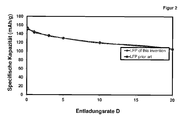
- Die spezifische Kapazität einer erfindungsgemäßen Elektrode verglichen mit einer Elektrode des Standes der Technik.
- Die Bestimmung der BET-Oberfäche erfolgte gemäß DIN ISO 9277:2003-05.
- Die Bestimmung der Partikelgrößenverteilung erfolgte mittels Lasergranulometrie mit einem Malvern Mastersizer 2000 Gerät gemäß ISO 13320:2009.
- Die Bestimmung der Pressdichte und des Pulverwiderstands erfolgte simultan an einem Mitsubishi MCP-PD51
- Tablettenpressgerät mit einem Loresta-GP MCP-T610 Widerstandsmeßgerät, die in einer mit Stickstoff beaufschlagten Glovebox installiert sind zur Ausschaltung potentiell störender Effekte von Sauerstoff und Feuchte. Die hydraulische Betätigung der Tablettenpresse erfolgte über eine manuelle Hydraulikpresse Enerpac PN80-APJ (max. 10.000 psi / 700 bar) .
- Die Messungen einer Probe von 4 g erfolgten bei den vom Hersteller empfohlenen Einstellungen.
- Der Pulverwiderstand berechnet sich anschließend gemäß der folgenden Gleichung:

- Der RCF-Wert ist ein geräteabhängiger Wert und wurde vorliegend gemäß den Werteinstellungen des Herstellers mit 2,758 angegeben.
- Die Pressdichte wird nach folgender Formel berechnet:

- Übliche Fehlertoleranzen liegen bei maximal 3 %. Bestimmung der Dichte des Aktivmaterials in einer Elektrode
- Zur Bestimmung der Materialdichte des Aktivmaterials (d.h. des erfindungsgemäßen Verbundmaterials) wurden Elektroden (Dicke ca. 60 µm) mit einer Zusammensetzung 90 % Aktivmaterial, 5 Gew.-% Leitruß und 5 Gew.-% Binder hergestellt. Dazu wurden
2,0 g 10%ige PVDF-Lösung in NMP (N-Methylpyrrolidon), 5,4 g NMP, 0,20 g Leitruß Super P Li (Fa. Timcal), 3,6 g erfindungsgemäßes Verbundmaterial aus den Beispielen 1 und 2 bzw. Vergleichsmaterial aus den Vergleichsbeispielen 1 bis 5 in ein 50 ml Schraubdeckelglas eingewogen und für 5 Minuten bei 600 Upm gemischt, für 1 min mit einem Ultraschallfinger Hielscher UP200S dispergiert und anschließend nach Zugabe von 20 Glasperlen des Durchmessers 4 mm und verschließen des Glases bei einer Drehzahl von 10 UpM auf einem Rolltisch für mindestens 15 Stunden rotiert. Zur Elektrodenbeschichtung wurde die so erhaltene homogene Suspension mit einer Laborrakel mit 200 µm Spaltweite und einer
Vorschubgeschwindigkeit von 20 mm/sec auf eine Aluminium-Trägerfolie aufgetragen. Nach Trocknen bei 80°C im Vakuumtrockenschrank wurden Elektroden von 13 mm Durchmesser aus der Folie ausgestochen und bei Raumtemperatur auf einer uniaxialen hydraulischen Laborpresse von Specac bei einer Last von 10 t für 60 sec mechanisch nachverdichtet. Zur Dichtebestimmung wurde das Netto-Elektrodengewicht aus dem Bruttogewicht und dem bekannten Flächengewicht der Trägerfolie bestimmt und die Netto-Elektrodendicke mit einer Mikrometerschraube abzüglich der bekannten Dicke der Trägerfolie bestimmt. - Die Aktivmassedichte in g/cm3 in der Elektrode berechnet sich daraus über

- 283,4 kg eines durch Hydrothermalsynthese (nach
WO 2005/051840 ) hergestellten frischen Filterkuchens aus Lithiumeisenphosphat (187,6 Trockengewicht bei 66,2 % Feststoffgehalt), 9,84 kg Laktose-Monohydrat entsprechend 52,5 g je kg Lithiumeisenphosphats wurden in einem horizontalen 5501 Pflugscharmischer des Herstellers EMT mit Messerkopf vorgelegt. Anschließend wurden 80 Liter entionisiertes Wasser über einen internen Sprühkopf zugegeben und das Mischen über 15 min bei einer Umdrehungszahl von 140 UPM der horizontalen Welle und 1500 UPM des Messerkopfes durchgeführt. - Anschließend wurde die Aufschlämmung zur Vermeidung von Agglomeraten durch einen Probst & Class Micronisator/Konusmühle passiert und in einem Stork & Bowen Trockner mit Zerstäuberdüse bei einer Gaseintrittstemperatur von 350°C und einer Austrittstemperatur von 125°C bei einem Zerstäubungsdruck von 6,0 bar sprühgetrocknet. Das Trocknungsprodukt wurde anschließend mechanisch granuliert. Dazu wurde ein Alexanderwerk Walzenkompaktor WP 50N/75 bei einem Walzendruck von 35 bar und einer Walzendrehzahl von 8 U/min und einer Drehzahl der Zuführschnecke von 30 U/min verwendet. Die kompaktierten Proben wurden in einer horizontalen Siebrotormühle mit 2,5 mm Siebeinsatz granuliert und auf einem Schwingsieb mit 0,6 mm Maschenweite vom Staubanteil getrennt.
- Das so erhaltene hellgraue Granulat wurde anschließend in einem gasdichten Linn Kammerofen unter Schutzgas bei einer Temperatur von 750° C und bei einer Aufheiz- und Haltezeit von je 3h unter Stickstoff kalziniert. Insgesamt ergibt sich ein Endkohlenstoffgehalt des gesamten Verbundmaterials von 1,14 Gew.-%.
- Die anschließende Vermahlung des nun schwarzen Granulats erfolgte auf einer Alpine AFG 200 Mahlanlage mit 5,0 mm Mahldüsen bei einem Mahldruck von 2,5 bar.
- Die Synthese des erfindungsgemäßen Verbundmaterials erfolgte wie in Beispiel 1, nur wurden 10,96 kg Laktose-Monohydrat zugegeben, um ein Produkt mit einem Gesamtkohlenstoffgehalt von 1,27 Gew.-% zu erhalten.
- 283,4 kg eines durch Hydrothermalsynthese (nach
WO 2005/051840 ) hergestellten frischen Filterkuchens aus Lithiumeisenphosphat (187,6 Trockengewicht bei 66,2 % Feststoffgehalt), 14,67 kg Laktose-Monohydrat entsprechend 78,3 g je kg Lithiumeisenphosphats bzw. ca. 1,7 Gew.-% resultierender Pyrolysekohlenstoff wurden in einem horizontalen 5501 Pflugscharmischer des Herstellers EMT mit Messerkopf vorgelegt. Anschließend wurden 80 Liter entionisiertes Wasser über einen internen Sprühkopf zugegeben und das Mischen über 15 min bei einer Umdrehungszahl von 140 UPM der horizontalen Welle und 1500 UPM des Messerkopfes durchgeführt. - Anschließend wurde die Aufschlämmung zur Vermeidung von Agglomeraten durch einen Probst & Class Micronisator/Konusmühle passiert und in einem Stork & Bowen Trockner mit Zerstäuberdüse bei einer Gaseintrittstemperatur von 350°C und einer Austrittstemperatur von 125°C bei einem Zerstäubungsdruck von 6,0 bar sprühgetrocknet. Das Trocknungsprodukt wurde anschließend mechanisch granuliert. Dazu wurde ein Alexanderwerk Walzenkompaktor WP 50N/75 bei einem Walzendruck von 35 bar und einer Walzendrehzahl von 8 U/min und einer Drehzahl der Zuführschnecke von 30 U/min verwendet. Die kompaktierten Proben wurden in einer horizontalen Siebrotormühle mit 2,5 mm Siebeinsatz granuliert und auf einem Schwingsieb mit 0,6mm Maschenweite vom Staubanteil getrennt.
- Das so erhaltene hellgraue Granulat wurde anschließend in einem gasdichten Linn Kammerofen unter Schutzgas bei einer Temperatur von 750° C und bei einer Aufheiz- und Haltezeit von je 3h unter Stickstoff kalziniert.
- Die anschließende Vermahlung des nun schwarzen Granulats erfolgte auf einer Alpine AFG 200 Mahlanlage mit 5,0 mm Mahldüsen bei einem Mahldruck von 2,5 bar.
- Als weitere Referenz zum erfindungsgemäßen Verbundmaterial aus Beispiel 1 wurde das Lithiumeisenphosphat wie in Beispiel 1 bzw. Vergleichsbeispiel 1 behandelt, aber mit 105 g Lactose-Monohydrat pro kg Lithiumeisenphosphat Trockenmasse vermischt, so dass der nach Kalzination resultierende Gesamtkohlenstoffgehalt 2,25 Gew.-% (als Pyrolysekohlenstoff) betrug.
- Die Vergleichsbeispiele 3 bis 5 wurden wie in der vorstehenden Synthese des Verbundmaterials der Beispiele und Vergleichsbeispiele durchgeführt, wobei die Menge an zugegebenem Laktose-Monohydrat so variiert wurde, um die in Tabelle 1 angegebenen Kohlenstoffgehalte für die jeweiligen Verbundmaterialien zu erhalten.
- Die physikalischen Parameter des erfindungsgemäßen Verbundmaterials aus Beispiel 1 sowie der Vergleichsbeispiele zusammen mit elektrischen Eigenschaften einer Elektrode enthaltend die Verbundmaterialien als Aktivmaterial sind in Tabelle 1 gezeigt.
Tabelle 1 Beispiel Kohlenstoff [Gew.-%] Rüttelgewicht (g/l) d10 [µm] d50 [µm] d90 [µm] BET [m2/g] Pulverwiderstand (Ω·cm) Pressdichte (g/cm3) Spezif. Kapazität C/12,25°C 2. 9 -4.0V (mAh/g) Volumet rische Energie dichte (mAh/cm 3) VB 4 0, 70 493 0,19 0,39 1,29 10,1 >107 1,77 97 172 VB 5 0.87 501 0,19 0,59 2,21 10,4 1035,84 1,79 149 267 1 1,14 711 0,21 0,56 2,03 11,4 44,47 2,40 150 360 2 1,27 737 0,22 0, 63 2,01 11,8 40,21 2,34 151 353 VB 3 1, 44 666 0.20 0,46 1, 96 12,5 27,61 2,31 151 349 VB 1 1, 70 653 0,19 0,46 2,13 12,8 24,97 2,15 152 327 VB 2 2,25 528 0,18 0,39 3,06 16,2 21,84 2,11 153 323 - Wie aus Tabelle 1 ersehen werden kann, weist das erfindungsgemäße Verbundmaterial der Beispiele 1 und 2 gegenüber den Vergleichsbeispielen eine signifikante Zunahme des Rüttelgewichts auf. Auffallend ist das Maximum im erfindungsgemäßen Bereich für den Kohlenstoffgehalt verglichen mit geringeren und höheren Kohlenstoffgehalten. Ebenso ist eine deutliche Erhöhung der Pressdichte (korreliert mit der Aktivmassedichte der Elektrode) ersichtlich.
- Die volumetrische Energiedichte einer Elektrode ist beim Einsatz erfindungsgemäßen Verbundmaterials als Elektrodenaktivmaterial ebenfalls am höchsten verglichen mit dem Material der Vergleichsbeispiele.
- Wie aus
Figur 2 ersichtlich ist, ist die spezifische Kapazität des Aktivmaterials aus erfindungsgemäßen Verbundmaterialien der Beispiele 1 und 2 verglichen mit dem Aktivmaterial einer Elektrode aus dem Material der Vergleichsbeispiele 1 bis 3 und 5 in etwa gleich. Die spezifische Kapazität steht nun bei einer noch weiteren Verringerung des Kohlenstoffgehalts (Vergleichsbeispiel 4). Die volumetrische Kapazität (Energiedichte) der Elektrode hingegen ist wie ausFigur 1 und den Werten der Tabelle 1 ersichtlich ist deutlich voneinander verschieden. - Die volumetrische Energiedichte berechnet sich gemäß der folgenden Gleichungen:


Claims (9)
- Verbundmaterial enthaltend (i)Partikel eines Lithiumübergangsmetallphosphats, wobei das Übergangsmetall ausgewählt ist aus der Gruppe Fe, Co, Mn oder Ni oder Mischungen davon, und (ii) Kohlenstoff, wobei das Verbundmaterial einen Kohlenstoffgehalt von 0,5 bis 1,3 Gew.%, eine BET-Oberfläche ≤ 12,5 m2/g, ein Rüttelgewicht >600 g/l, einen Pulverwiderstand < 70 Ω·cm und einen D50-Wert ≤ 0,70 µm aufweist.
- Verbundmaterial nach Anspruch 1, wobei das Lithiumübergangsmetallphosphat mit Fremdatomen dotiert ist.
- Verbundmaterial nach Anspruch 2, wobei die Fremdatome ausgewählt sind aus Mg, Zn, Ca, B, Bi, Nb, Ta, Zr, Ti, Hf, V, W, Mo, Ru, Cu, Ag, Au, Ir.
- Verbundmaterial nach einem der vorhergehenden Ansprüche, wobei der Kohlenstoff Pyrolysekohlenstoff und/oder elementarer Kohlenstoff ist.
- Verbundmaterial nach Anspruch 4, wobei der Pyrolysekohlenstoff in Form einer Beschichtung auf den Partikeln des Lithiumübergangsmetallphosphats vorliegt.
- Verbundmaterial nach Anspruch 5, wobei die Schichtdicke der Beschichtung aus Pyrolysekohlenstoff im Bereich von 2 bis 15 nm liegt
- Verbundmaterial nach Anspruch 4, wobei der elementare Kohlenstoff ein kristallines Allotrop des Kohlenstoffs ist, ausgewählt aus Graphit, Kohlenstoffnanoröhrchen, Fullerenen, sowie Mischungen davon oder VGCF Kohlenstoff ist.
- Elektrode für eine Sekundärlithiumionenbatterie mit einem Aktivmaterial enthaltend das Verbundmaterial gemäß einem der Ansprüche 1 bis 7
- Sekundärlithiumionenbatterie umfassend eine Elektrode nach Anspruch 8.
Applications Claiming Priority (2)
| Application Number | Priority Date | Filing Date | Title |
|---|---|---|---|
| DE102010021804A DE102010021804A1 (de) | 2010-05-27 | 2010-05-27 | Verbundmaterial enthaltend ein gemischtes Lithium-Metallphosphat |
| PCT/EP2011/058626 WO2011147907A1 (de) | 2010-05-27 | 2011-05-26 | Kohlenstoff -lithiumübergangsmetallphosphat -verbundmaterial mit einem niedrigen kohlenstoffgehalt |
Publications (2)
| Publication Number | Publication Date |
|---|---|
| EP2576439A1 EP2576439A1 (de) | 2013-04-10 |
| EP2576439B1 true EP2576439B1 (de) | 2016-08-24 |
Family
ID=44148978
Family Applications (1)
| Application Number | Title | Priority Date | Filing Date |
|---|---|---|---|
| EP11723034.2A Active EP2576439B1 (de) | 2010-05-27 | 2011-05-26 | Kohlenstoff-lithiumübergangsmetallphosphat-verbundmaterial mit einem niedrigen kohlenstoffgehalt |
Country Status (9)
| Country | Link |
|---|---|
| US (1) | US20130140497A1 (de) |
| EP (1) | EP2576439B1 (de) |
| JP (1) | JP5850923B2 (de) |
| KR (1) | KR101489712B1 (de) |
| CN (1) | CN103038162B (de) |
| CA (1) | CA2800654C (de) |
| DE (1) | DE102010021804A1 (de) |
| TW (1) | TW201204675A (de) |
| WO (1) | WO2011147907A1 (de) |
Families Citing this family (11)
| Publication number | Priority date | Publication date | Assignee | Title |
|---|---|---|---|---|
| JP6020580B2 (ja) * | 2012-09-28 | 2016-11-02 | Tdk株式会社 | リチウムイオン二次電池 |
| CN103337630A (zh) * | 2013-06-27 | 2013-10-02 | 彩虹集团公司 | 一种金属掺杂包碳磷酸铁锂及其制备方法 |
| KR101580030B1 (ko) | 2013-07-09 | 2015-12-23 | 주식회사 엘지화학 | 탄소 코팅 리튬 인산철 나노분말의 제조방법 |
| JP6231966B2 (ja) * | 2014-09-30 | 2017-11-15 | 住友大阪セメント株式会社 | 電極材料及びその製造方法、電極、並びにリチウムイオン電池 |
| CN104362314B (zh) * | 2014-10-22 | 2016-08-03 | 重庆工商大学 | 一种复合氧化物电极材料及其制备方法 |
| JP6288338B1 (ja) | 2017-03-24 | 2018-03-07 | 住友大阪セメント株式会社 | リチウムイオン二次電池用正極材料、リチウムイオン二次電池用正極、リチウムイオン二次電池 |
| JP6528886B1 (ja) | 2018-06-13 | 2019-06-12 | 住友大阪セメント株式会社 | 電極材料及びその製造方法 |
| US11967717B2 (en) | 2019-10-16 | 2024-04-23 | Hcm Co., Ltd. | Tungsten-doped lithium manganese iron phosphate-based particulate and tungsten-doped lithium manganese iron phosphate-based powdery material including the same |
| US11616232B2 (en) * | 2019-10-16 | 2023-03-28 | Hcm Co., Ltd. | Doped lithium manganese iron phosphate-based particulate, doped lithium manganese iron phosphate-based powdery material including the same, and method for preparing powdery material |
| CN112744800B (zh) * | 2019-10-30 | 2022-08-26 | 泓辰材料股份有限公司 | 用于锂离子电池的正极的经钨掺杂的磷酸锂锰铁颗粒、粉体材料及其制法 |
| WO2026071623A1 (ko) * | 2024-09-25 | 2026-04-02 | 주식회사 엘지화학 | 양극 활물질, 이를 포함하는 양극 및 리튬 이차전지 |
Citations (1)
| Publication number | Priority date | Publication date | Assignee | Title |
|---|---|---|---|---|
| WO2009122686A1 (ja) * | 2008-03-31 | 2009-10-08 | 戸田工業株式会社 | リン酸鉄リチウム粒子粉末の製造方法、オリビン型構造のリン酸鉄リチウム粒子粉末、該リン酸鉄リチウム粒子粉末を用いた正極材シート及び非水溶媒系二次電池 |
Family Cites Families (32)
| Publication number | Priority date | Publication date | Assignee | Title |
|---|---|---|---|---|
| US5910382A (en) | 1996-04-23 | 1999-06-08 | Board Of Regents, University Of Texas Systems | Cathode materials for secondary (rechargeable) lithium batteries |
| EP1094532A1 (de) * | 1999-04-06 | 2001-04-25 | Sony Corporation | Verfahren zur herstellung aktiver materialien einer positiven platte und verfahren zur herstellung nichtwässriger elektrolytischer sekundärzellen |
| CA2270771A1 (fr) | 1999-04-30 | 2000-10-30 | Hydro-Quebec | Nouveaux materiaux d'electrode presentant une conductivite de surface elevee |
| CA2320661A1 (fr) * | 2000-09-26 | 2002-03-26 | Hydro-Quebec | Nouveau procede de synthese de materiaux limpo4 a structure olivine |
| JP4491946B2 (ja) | 2000-09-29 | 2010-06-30 | ソニー株式会社 | 正極活物質の製造方法及び非水電解質電池の製造方法 |
| JP4734701B2 (ja) | 2000-09-29 | 2011-07-27 | ソニー株式会社 | 正極活物質の製造方法及び非水電解質電池の製造方法 |
| JP4734700B2 (ja) | 2000-09-29 | 2011-07-27 | ソニー株式会社 | 正極活物質の製造方法及び非水電解質電池の製造方法 |
| JP3921931B2 (ja) * | 2000-09-29 | 2007-05-30 | ソニー株式会社 | 正極活物質及び非水電解質電池 |
| JP2002117908A (ja) | 2000-10-06 | 2002-04-19 | Sony Corp | 非水電解液電池 |
| JP4491949B2 (ja) * | 2000-10-06 | 2010-06-30 | ソニー株式会社 | 正極活物質の製造方法及び非水電解質電池の製造方法 |
| JP4495336B2 (ja) | 2000-11-10 | 2010-07-07 | 株式会社Kri | 鉄リン酸リチウムの製造方法。 |
| JP4186507B2 (ja) * | 2001-05-15 | 2008-11-26 | 株式会社豊田中央研究所 | リチウム二次電池正極活物質用炭素含有リチウム鉄複合酸化物およびその製造方法 |
| EP1261050A1 (de) | 2001-05-23 | 2002-11-27 | n.v. Umicore s.a. | Lithium-Übergangsmetall-Phosphatpulver für wiederaufladbaren Batterien |
| JP2003203628A (ja) * | 2001-12-28 | 2003-07-18 | Sanyo Electric Co Ltd | 非水電解質電池及びその製造方法 |
| JP4252331B2 (ja) * | 2003-02-24 | 2009-04-08 | 住友大阪セメント株式会社 | リチウムイオン電池用正極活物質の製造方法 |
| DE10353266B4 (de) | 2003-11-14 | 2013-02-21 | Süd-Chemie Ip Gmbh & Co. Kg | Lithiumeisenphosphat, Verfahren zu seiner Herstellung und seine Verwendung als Elektrodenmaterial |
| US7534408B2 (en) * | 2003-12-23 | 2009-05-19 | Universite De Montreal | Process for preparing electroactive insertion compounds and electrode materials obtained therefrom |
| JP4794833B2 (ja) * | 2004-07-21 | 2011-10-19 | 日本コークス工業株式会社 | リチウムイオン二次電池用正極材料、その製造方法、及びリチウムイオン二次電池 |
| JP2006196234A (ja) * | 2005-01-12 | 2006-07-27 | Hitachi Industries Co Ltd | リチウム二次電池用負極材料とその製造方法及びリチウム二次電池 |
| JP5317390B2 (ja) * | 2006-02-09 | 2013-10-16 | 三洋電機株式会社 | 非水電解質二次電池 |
| CA2569991A1 (en) * | 2006-12-07 | 2008-06-07 | Michel Gauthier | C-treated nanoparticles and agglomerate and composite thereof as transition metal polyanion cathode materials and process for making |
| JP5036348B2 (ja) * | 2007-02-27 | 2012-09-26 | 三洋電機株式会社 | 非水電解質二次電池用正極活物質の製造方法 |
| CN100579899C (zh) * | 2007-08-10 | 2010-01-13 | 石家庄百思特电池材料有限公司 | 高压实密度优良粘结性的磷酸铁锂的制备方法 |
| JP5223281B2 (ja) * | 2007-09-28 | 2013-06-26 | Tdk株式会社 | リチウムイオン二次電池又はリチウム二次電池の正極用複合粒子、及びリチウムイオン二次電池又はリチウム二次電池 |
| CN101162776B (zh) * | 2007-10-26 | 2010-06-02 | 深圳市贝特瑞新能源材料股份有限公司 | 适用于高倍率动力电池用的磷酸铁锂及其制备方法 |
| CN101186290B (zh) * | 2007-12-11 | 2010-12-15 | 深圳市贝特瑞新能源材料股份有限公司 | 正极材料磷酸钒锂及其制备方法 |
| CA2614634C (en) * | 2007-12-14 | 2013-04-30 | Phostech Lithium Inc. | Lithium iron phosphate cathode materials with enhanced energy density and power performance |
| TWI369019B (en) * | 2007-12-27 | 2012-07-21 | Ind Tech Res Inst | Cathodal materials for lithium cells, methods for fabricating the same, and lithium secondary cells using the same |
| CA2638410A1 (en) * | 2008-07-28 | 2010-01-28 | Hydro-Quebec | Composite electrode material |
| JP5231171B2 (ja) * | 2008-10-30 | 2013-07-10 | パナソニック株式会社 | 非水電解質二次電池用正極活物質およびその製造方法 |
| WO2010129417A1 (en) * | 2009-05-04 | 2010-11-11 | Meecotech, Inc. | Electrode active composite materials and methods of making thereof |
| DE102009020832A1 (de) * | 2009-05-11 | 2010-11-25 | Süd-Chemie AG | Verbundmaterial enthaltend ein gemischtes Lithium-Metalloxid |
-
2010
- 2010-05-27 DE DE102010021804A patent/DE102010021804A1/de not_active Ceased
-
2011
- 2011-05-19 TW TW100117550A patent/TW201204675A/zh unknown
- 2011-05-26 CN CN201180026208.5A patent/CN103038162B/zh active Active
- 2011-05-26 KR KR1020127033632A patent/KR101489712B1/ko active Active
- 2011-05-26 EP EP11723034.2A patent/EP2576439B1/de active Active
- 2011-05-26 CA CA2800654A patent/CA2800654C/en not_active Expired - Fee Related
- 2011-05-26 WO PCT/EP2011/058626 patent/WO2011147907A1/de not_active Ceased
- 2011-05-26 US US13/700,312 patent/US20130140497A1/en not_active Abandoned
- 2011-05-26 JP JP2013511680A patent/JP5850923B2/ja active Active
Patent Citations (2)
| Publication number | Priority date | Publication date | Assignee | Title |
|---|---|---|---|---|
| WO2009122686A1 (ja) * | 2008-03-31 | 2009-10-08 | 戸田工業株式会社 | リン酸鉄リチウム粒子粉末の製造方法、オリビン型構造のリン酸鉄リチウム粒子粉末、該リン酸鉄リチウム粒子粉末を用いた正極材シート及び非水溶媒系二次電池 |
| EP2277828A1 (de) * | 2008-03-31 | 2011-01-26 | Toda Kogyo Corporation | Verfahren zur herstellung von lithiumeisenphosphatpulver, lithiumeisenphosphatpulver mit olivinstruktur, kathodenblech unter verwendung des lithiumeisenphosphatpulvers und sekundärbatterie mit nichtwässrigem lösungsmittel |
Also Published As
| Publication number | Publication date |
|---|---|
| JP2013527576A (ja) | 2013-06-27 |
| CA2800654A1 (en) | 2011-12-01 |
| DE102010021804A1 (de) | 2011-12-01 |
| CN103038162B (zh) | 2016-01-20 |
| WO2011147907A1 (de) | 2011-12-01 |
| JP5850923B2 (ja) | 2016-02-03 |
| KR20130040934A (ko) | 2013-04-24 |
| CA2800654C (en) | 2016-10-18 |
| KR101489712B1 (ko) | 2015-02-09 |
| CN103038162A (zh) | 2013-04-10 |
| US20130140497A1 (en) | 2013-06-06 |
| TW201204675A (en) | 2012-02-01 |
| EP2576439A1 (de) | 2013-04-10 |
Similar Documents
| Publication | Publication Date | Title |
|---|---|---|
| EP2430690B1 (de) | Verbundmaterial enthaltend ein gemischtes lithium-metalloxid | |
| EP2576439B1 (de) | Kohlenstoff-lithiumübergangsmetallphosphat-verbundmaterial mit einem niedrigen kohlenstoffgehalt | |
| DE102010032206A1 (de) | Gasphasenbeschichtetes Lithium-Übergangsmetallphosphat und Verfahren zu dessen Herstellung | |
| DE102010006083B4 (de) | Substituiertes Lithium-Mangan-Metallphosphat | |
| EP3011621B1 (de) | Elektrodenmaterial und dessen verwendung in lithium-ionen-batterien | |
| DE102008050692B4 (de) | Kohlenstoffbeschichteter Lithiumtitan-Spinell | |
| DE102010018041A1 (de) | Kohlenstoffhaltiges Verbundmaterial enthaltend eine sauerstoffhaltige Lithium-Übergangsmetallverbindung | |
| DE102010006077A1 (de) | Substituiertes Lithium-Mangan-Metallphosphat | |
| DE102021129277A1 (de) | Negativelektroden-aktivmaterial umfassend einen kern-schalen-verbundstoff und verfahren zur dessen herstellung | |
| DE112015004276T5 (de) | MSix-ENTHALTENDES SILICIUMMATERIAL (M IST ZUMINDEST EIN ELEMENT AUSGEWÄHLT AUS DEN GRUPPE 3 BIS 9 ELEMENTEN. 1/3 ≤ x ≤ 3) UND VERFAHREN ZUR HERSTELLUNG DAVON | |
| EP2529434A1 (de) | Leitmittelzusatzfreie elektrode für eine sekundärlithiumionenbatterie | |
| DE102021131605A1 (de) | Festkörperbatterie | |
| EP2146931A2 (de) | Verfahren zur herstellung von lithiumreichen metalloxiden | |
| DE102011088960A1 (de) | Zusammensetzungen und Verfahren zur Herstellung einer Kathode für einen Akkumulator | |
| DE102011106326B3 (de) | Verfahren zur Herstellung von nanopartikulären Lithiumübergangsmetallphosphaten; nanopartikuläres Lithiumübergangsmetallphosphat und Kathode damit | |
| EP2569813B1 (de) | Material für negative elektroden und negative elektroden sowie batterien umfassend dieses material und verfahren zur herstellung des materials | |
| DE102023131164A1 (de) | Verfahren zur Herstellung eines Silicium-Kohlenstoff-Kompositmaterials, Silicium-Kohlenstoff-Kompositmaterial, Verwendung eines Silicium-Kohlenstoff-Kompositmaterials und Batteriezelle | |
| DE102014106002A1 (de) | Elektrodenmaterial für Natrium-basierte elektrochemische Energiespeicher | |
| WO2012140035A1 (de) | Verfahren zur herstellung von lithiumtitan-spinell | |
| DE102021124853A1 (de) | Anodenaktivmaterial, verfahren zur herstellung eines ano-denaktivmaterials und lithium-ionen-batterie | |
| HK1170076A (en) | Composite material containing a mixed lithium-metal oxide |
Legal Events
| Date | Code | Title | Description |
|---|---|---|---|
| PUAI | Public reference made under article 153(3) epc to a published international application that has entered the european phase |
Free format text: ORIGINAL CODE: 0009012 |
|
| 17P | Request for examination filed |
Effective date: 20121127 |
|
| AK | Designated contracting states |
Kind code of ref document: A1 Designated state(s): AL AT BE BG CH CY CZ DE DK EE ES FI FR GB GR HR HU IE IS IT LI LT LU LV MC MK MT NL NO PL PT RO RS SE SI SK SM TR |
|
| DAX | Request for extension of the european patent (deleted) | ||
| TPAC | Observations filed by third parties |
Free format text: ORIGINAL CODE: EPIDOSNTIPA |
|
| 17Q | First examination report despatched |
Effective date: 20150324 |
|
| REG | Reference to a national code |
Ref country code: DE Ref legal event code: R079 Ref document number: 502011010514 Country of ref document: DE Free format text: PREVIOUS MAIN CLASS: C01B0025450000 Ipc: B82Y0030000000 |
|
| RAP1 | Party data changed (applicant data changed or rights of an application transferred) |
Owner name: JOHNSON MATTHEY PLC |
|
| GRAP | Despatch of communication of intention to grant a patent |
Free format text: ORIGINAL CODE: EPIDOSNIGR1 |
|
| RIC1 | Information provided on ipc code assigned before grant |
Ipc: H01M 10/052 20100101ALI20151214BHEP Ipc: C04B 35/626 20060101ALI20151214BHEP Ipc: C04B 35/447 20060101ALI20151214BHEP Ipc: H01M 4/136 20100101ALI20151214BHEP Ipc: C04B 35/628 20060101ALI20151214BHEP Ipc: H01M 4/58 20060101ALI20151214BHEP Ipc: C01B 25/45 20060101ALI20151214BHEP Ipc: B82Y 30/00 20110101AFI20151214BHEP Ipc: H01M 4/1397 20100101ALI20151214BHEP Ipc: H01M 4/36 20060101ALI20151214BHEP |
|
| INTG | Intention to grant announced |
Effective date: 20160114 |
|
| GRAS | Grant fee paid |
Free format text: ORIGINAL CODE: EPIDOSNIGR3 |
|
| GRAP | Despatch of communication of intention to grant a patent |
Free format text: ORIGINAL CODE: EPIDOSNIGR1 |
|
| INTG | Intention to grant announced |
Effective date: 20160613 |
|
| GRAA | (expected) grant |
Free format text: ORIGINAL CODE: 0009210 |
|
| AK | Designated contracting states |
Kind code of ref document: B1 Designated state(s): AL AT BE BG CH CY CZ DE DK EE ES FI FR GB GR HR HU IE IS IT LI LT LU LV MC MK MT NL NO PL PT RO RS SE SI SK SM TR |
|
| REG | Reference to a national code |
Ref country code: GB Ref legal event code: FG4D Free format text: NOT ENGLISH |
|
| REG | Reference to a national code |
Ref country code: CH Ref legal event code: EP |
|
| REG | Reference to a national code |
Ref country code: AT Ref legal event code: REF Ref document number: 822893 Country of ref document: AT Kind code of ref document: T Effective date: 20160915 |
|
| REG | Reference to a national code |
Ref country code: IE Ref legal event code: FG4D Free format text: LANGUAGE OF EP DOCUMENT: GERMAN |
|
| REG | Reference to a national code |
Ref country code: DE Ref legal event code: R096 Ref document number: 502011010514 Country of ref document: DE |
|
| REG | Reference to a national code |
Ref country code: LT Ref legal event code: MG4D |
|
| REG | Reference to a national code |
Ref country code: NL Ref legal event code: MP Effective date: 20160824 |
|
| PG25 | Lapsed in a contracting state [announced via postgrant information from national office to epo] |
Ref country code: RS Free format text: LAPSE BECAUSE OF FAILURE TO SUBMIT A TRANSLATION OF THE DESCRIPTION OR TO PAY THE FEE WITHIN THE PRESCRIBED TIME-LIMIT Effective date: 20160824 Ref country code: NL Free format text: LAPSE BECAUSE OF FAILURE TO SUBMIT A TRANSLATION OF THE DESCRIPTION OR TO PAY THE FEE WITHIN THE PRESCRIBED TIME-LIMIT Effective date: 20160824 Ref country code: IT Free format text: LAPSE BECAUSE OF FAILURE TO SUBMIT A TRANSLATION OF THE DESCRIPTION OR TO PAY THE FEE WITHIN THE PRESCRIBED TIME-LIMIT Effective date: 20160824 Ref country code: FI Free format text: LAPSE BECAUSE OF FAILURE TO SUBMIT A TRANSLATION OF THE DESCRIPTION OR TO PAY THE FEE WITHIN THE PRESCRIBED TIME-LIMIT Effective date: 20160824 Ref country code: NO Free format text: LAPSE BECAUSE OF FAILURE TO SUBMIT A TRANSLATION OF THE DESCRIPTION OR TO PAY THE FEE WITHIN THE PRESCRIBED TIME-LIMIT Effective date: 20161124 Ref country code: LT Free format text: LAPSE BECAUSE OF FAILURE TO SUBMIT A TRANSLATION OF THE DESCRIPTION OR TO PAY THE FEE WITHIN THE PRESCRIBED TIME-LIMIT Effective date: 20160824 Ref country code: HR Free format text: LAPSE BECAUSE OF FAILURE TO SUBMIT A TRANSLATION OF THE DESCRIPTION OR TO PAY THE FEE WITHIN THE PRESCRIBED TIME-LIMIT Effective date: 20160824 |
|
| PG25 | Lapsed in a contracting state [announced via postgrant information from national office to epo] |
Ref country code: SE Free format text: LAPSE BECAUSE OF FAILURE TO SUBMIT A TRANSLATION OF THE DESCRIPTION OR TO PAY THE FEE WITHIN THE PRESCRIBED TIME-LIMIT Effective date: 20160824 Ref country code: ES Free format text: LAPSE BECAUSE OF FAILURE TO SUBMIT A TRANSLATION OF THE DESCRIPTION OR TO PAY THE FEE WITHIN THE PRESCRIBED TIME-LIMIT Effective date: 20160824 Ref country code: GR Free format text: LAPSE BECAUSE OF FAILURE TO SUBMIT A TRANSLATION OF THE DESCRIPTION OR TO PAY THE FEE WITHIN THE PRESCRIBED TIME-LIMIT Effective date: 20161125 Ref country code: LV Free format text: LAPSE BECAUSE OF FAILURE TO SUBMIT A TRANSLATION OF THE DESCRIPTION OR TO PAY THE FEE WITHIN THE PRESCRIBED TIME-LIMIT Effective date: 20160824 Ref country code: PT Free format text: LAPSE BECAUSE OF FAILURE TO SUBMIT A TRANSLATION OF THE DESCRIPTION OR TO PAY THE FEE WITHIN THE PRESCRIBED TIME-LIMIT Effective date: 20161226 |
|
| PG25 | Lapsed in a contracting state [announced via postgrant information from national office to epo] |
Ref country code: EE Free format text: LAPSE BECAUSE OF FAILURE TO SUBMIT A TRANSLATION OF THE DESCRIPTION OR TO PAY THE FEE WITHIN THE PRESCRIBED TIME-LIMIT Effective date: 20160824 Ref country code: RO Free format text: LAPSE BECAUSE OF FAILURE TO SUBMIT A TRANSLATION OF THE DESCRIPTION OR TO PAY THE FEE WITHIN THE PRESCRIBED TIME-LIMIT Effective date: 20160824 |
|
| REG | Reference to a national code |
Ref country code: DE Ref legal event code: R097 Ref document number: 502011010514 Country of ref document: DE |
|
| PG25 | Lapsed in a contracting state [announced via postgrant information from national office to epo] |
Ref country code: CZ Free format text: LAPSE BECAUSE OF FAILURE TO SUBMIT A TRANSLATION OF THE DESCRIPTION OR TO PAY THE FEE WITHIN THE PRESCRIBED TIME-LIMIT Effective date: 20160824 Ref country code: PL Free format text: LAPSE BECAUSE OF FAILURE TO SUBMIT A TRANSLATION OF THE DESCRIPTION OR TO PAY THE FEE WITHIN THE PRESCRIBED TIME-LIMIT Effective date: 20160824 Ref country code: DK Free format text: LAPSE BECAUSE OF FAILURE TO SUBMIT A TRANSLATION OF THE DESCRIPTION OR TO PAY THE FEE WITHIN THE PRESCRIBED TIME-LIMIT Effective date: 20160824 Ref country code: SK Free format text: LAPSE BECAUSE OF FAILURE TO SUBMIT A TRANSLATION OF THE DESCRIPTION OR TO PAY THE FEE WITHIN THE PRESCRIBED TIME-LIMIT Effective date: 20160824 Ref country code: SM Free format text: LAPSE BECAUSE OF FAILURE TO SUBMIT A TRANSLATION OF THE DESCRIPTION OR TO PAY THE FEE WITHIN THE PRESCRIBED TIME-LIMIT Effective date: 20160824 Ref country code: BG Free format text: LAPSE BECAUSE OF FAILURE TO SUBMIT A TRANSLATION OF THE DESCRIPTION OR TO PAY THE FEE WITHIN THE PRESCRIBED TIME-LIMIT Effective date: 20161124 |
|
| PLBE | No opposition filed within time limit |
Free format text: ORIGINAL CODE: 0009261 |
|
| STAA | Information on the status of an ep patent application or granted ep patent |
Free format text: STATUS: NO OPPOSITION FILED WITHIN TIME LIMIT |
|
| 26N | No opposition filed |
Effective date: 20170526 |
|
| PG25 | Lapsed in a contracting state [announced via postgrant information from national office to epo] |
Ref country code: SI Free format text: LAPSE BECAUSE OF FAILURE TO SUBMIT A TRANSLATION OF THE DESCRIPTION OR TO PAY THE FEE WITHIN THE PRESCRIBED TIME-LIMIT Effective date: 20160824 Ref country code: LU Free format text: LAPSE BECAUSE OF NON-PAYMENT OF DUE FEES Effective date: 20170531 |
|
| REG | Reference to a national code |
Ref country code: CH Ref legal event code: PL |
|
| PG25 | Lapsed in a contracting state [announced via postgrant information from national office to epo] |
Ref country code: MC Free format text: LAPSE BECAUSE OF FAILURE TO SUBMIT A TRANSLATION OF THE DESCRIPTION OR TO PAY THE FEE WITHIN THE PRESCRIBED TIME-LIMIT Effective date: 20160824 |
|
| REG | Reference to a national code |
Ref country code: IE Ref legal event code: MM4A |
|
| PG25 | Lapsed in a contracting state [announced via postgrant information from national office to epo] |
Ref country code: CH Free format text: LAPSE BECAUSE OF NON-PAYMENT OF DUE FEES Effective date: 20170531 Ref country code: LI Free format text: LAPSE BECAUSE OF NON-PAYMENT OF DUE FEES Effective date: 20170531 |
|
| REG | Reference to a national code |
Ref country code: FR Ref legal event code: ST Effective date: 20180131 |
|
| PG25 | Lapsed in a contracting state [announced via postgrant information from national office to epo] |
Ref country code: LU Free format text: LAPSE BECAUSE OF NON-PAYMENT OF DUE FEES Effective date: 20170526 |
|
| PG25 | Lapsed in a contracting state [announced via postgrant information from national office to epo] |
Ref country code: IE Free format text: LAPSE BECAUSE OF NON-PAYMENT OF DUE FEES Effective date: 20170526 |
|
| PG25 | Lapsed in a contracting state [announced via postgrant information from national office to epo] |
Ref country code: FR Free format text: LAPSE BECAUSE OF NON-PAYMENT OF DUE FEES Effective date: 20170531 |
|
| REG | Reference to a national code |
Ref country code: AT Ref legal event code: MM01 Ref document number: 822893 Country of ref document: AT Kind code of ref document: T Effective date: 20170526 |
|
| PG25 | Lapsed in a contracting state [announced via postgrant information from national office to epo] |
Ref country code: AT Free format text: LAPSE BECAUSE OF NON-PAYMENT OF DUE FEES Effective date: 20170526 |
|
| PG25 | Lapsed in a contracting state [announced via postgrant information from national office to epo] |
Ref country code: MT Free format text: LAPSE BECAUSE OF FAILURE TO SUBMIT A TRANSLATION OF THE DESCRIPTION OR TO PAY THE FEE WITHIN THE PRESCRIBED TIME-LIMIT Effective date: 20160824 |
|
| PG25 | Lapsed in a contracting state [announced via postgrant information from national office to epo] |
Ref country code: AL Free format text: LAPSE BECAUSE OF FAILURE TO SUBMIT A TRANSLATION OF THE DESCRIPTION OR TO PAY THE FEE WITHIN THE PRESCRIBED TIME-LIMIT Effective date: 20160824 |
|
| PG25 | Lapsed in a contracting state [announced via postgrant information from national office to epo] |
Ref country code: HU Free format text: LAPSE BECAUSE OF FAILURE TO SUBMIT A TRANSLATION OF THE DESCRIPTION OR TO PAY THE FEE WITHIN THE PRESCRIBED TIME-LIMIT; INVALID AB INITIO Effective date: 20110526 |
|
| REG | Reference to a national code |
Ref country code: DE Ref legal event code: R082 Ref document number: 502011010514 Country of ref document: DE Representative=s name: MEWBURN ELLIS LLP, DE Ref country code: DE Ref legal event code: R082 Ref document number: 502011010514 Country of ref document: DE Representative=s name: BARDEHLE PAGENBERG PARTNERSCHAFT MBB PATENTANW, DE |
|
| PG25 | Lapsed in a contracting state [announced via postgrant information from national office to epo] |
Ref country code: CY Free format text: LAPSE BECAUSE OF NON-PAYMENT OF DUE FEES Effective date: 20160824 |
|
| PG25 | Lapsed in a contracting state [announced via postgrant information from national office to epo] |
Ref country code: MK Free format text: LAPSE BECAUSE OF FAILURE TO SUBMIT A TRANSLATION OF THE DESCRIPTION OR TO PAY THE FEE WITHIN THE PRESCRIBED TIME-LIMIT Effective date: 20160824 |
|
| PG25 | Lapsed in a contracting state [announced via postgrant information from national office to epo] |
Ref country code: TR Free format text: LAPSE BECAUSE OF FAILURE TO SUBMIT A TRANSLATION OF THE DESCRIPTION OR TO PAY THE FEE WITHIN THE PRESCRIBED TIME-LIMIT Effective date: 20160824 |
|
| PG25 | Lapsed in a contracting state [announced via postgrant information from national office to epo] |
Ref country code: IS Free format text: LAPSE BECAUSE OF FAILURE TO SUBMIT A TRANSLATION OF THE DESCRIPTION OR TO PAY THE FEE WITHIN THE PRESCRIBED TIME-LIMIT Effective date: 20161224 |
|
| REG | Reference to a national code |
Ref country code: GB Ref legal event code: 732E Free format text: REGISTERED BETWEEN 20220908 AND 20220914 |
|
| REG | Reference to a national code |
Ref country code: DE Ref legal event code: R081 Ref document number: 502011010514 Country of ref document: DE Owner name: JOHNSON MATTHEY PLC, GB Free format text: FORMER OWNER: JOHNSON MATTHEY PLC, LONDON, GB Ref country code: DE Ref legal event code: R081 Ref document number: 502011010514 Country of ref document: DE Owner name: EV METALS UK LTD., GB Free format text: FORMER OWNER: JOHNSON MATTHEY PLC, LONDON, GB Ref country code: DE Ref legal event code: R082 Ref document number: 502011010514 Country of ref document: DE Representative=s name: MEWBURN ELLIS LLP, DE Ref country code: DE Ref legal event code: R081 Ref document number: 502011010514 Country of ref document: DE Owner name: EPSILON CARBON PRIVATE LIMITED, IN Free format text: FORMER OWNER: JOHNSON MATTHEY PLC, LONDON, GB Ref country code: DE Ref legal event code: R082 Ref document number: 502011010514 Country of ref document: DE Representative=s name: WITHERS & ROGERS LLP, DE |
|
| REG | Reference to a national code |
Ref country code: BE Ref legal event code: PD Owner name: EV METALS UK LIMITED; GB Free format text: DETAILS ASSIGNMENT: CHANGE OF OWNER(S), ASSIGNMENT; FORMER OWNER NAME: JOHNSON MATTHEY PLC Effective date: 20221025 |
|
| REG | Reference to a national code |
Ref country code: GB Ref legal event code: 732E Free format text: REGISTERED BETWEEN 20230824 AND 20230831 |
|
| REG | Reference to a national code |
Ref country code: DE Ref legal event code: R081 Ref document number: 502011010514 Country of ref document: DE Owner name: JOHNSON MATTHEY PLC, GB Free format text: FORMER OWNER: EV METALS UK LTD., LONDON, GB Ref country code: DE Ref legal event code: R081 Ref document number: 502011010514 Country of ref document: DE Owner name: EPSILON CARBON PRIVATE LIMITED, IN Free format text: FORMER OWNER: EV METALS UK LTD., LONDON, GB |
|
| REG | Reference to a national code |
Ref country code: GB Ref legal event code: 732E Free format text: REGISTERED BETWEEN 20241107 AND 20241113 |
|
| PGFP | Annual fee paid to national office [announced via postgrant information from national office to epo] |
Ref country code: DE Payment date: 20250521 Year of fee payment: 15 |
|
| PGFP | Annual fee paid to national office [announced via postgrant information from national office to epo] |
Ref country code: GB Payment date: 20250516 Year of fee payment: 15 |
|
| PGFP | Annual fee paid to national office [announced via postgrant information from national office to epo] |
Ref country code: BE Payment date: 20250521 Year of fee payment: 15 |
|
| REG | Reference to a national code |
Ref country code: DE Ref legal event code: R081 Ref document number: 502011010514 Country of ref document: DE Owner name: EPSILON CARBON PRIVATE LIMITED, IN Free format text: FORMER OWNER: JOHNSON MATTHEY PLC, LONDON, GB Ref country code: DE Ref legal event code: R082 Ref document number: 502011010514 Country of ref document: DE Representative=s name: WITHERS & ROGERS LLP, DE |