EP1049182B1 - Matériaux d'électrode présentant une conductivité de surface élevée - Google Patents
Matériaux d'électrode présentant une conductivité de surface élevée Download PDFInfo
- Publication number
- EP1049182B1 EP1049182B1 EP00401207A EP00401207A EP1049182B1 EP 1049182 B1 EP1049182 B1 EP 1049182B1 EP 00401207 A EP00401207 A EP 00401207A EP 00401207 A EP00401207 A EP 00401207A EP 1049182 B1 EP1049182 B1 EP 1049182B1
- Authority
- EP
- European Patent Office
- Prior art keywords
- carbon
- complex oxide
- acid
- precursor
- carbonaceous material
- Prior art date
- Legal status (The legal status is an assumption and is not a legal conclusion. Google has not performed a legal analysis and makes no representation as to the accuracy of the status listed.)
- Expired - Lifetime
Links
Images

Classifications
-
- H—ELECTRICITY
- H01—ELECTRIC ELEMENTS
- H01M—PROCESSES OR MEANS, e.g. BATTERIES, FOR THE DIRECT CONVERSION OF CHEMICAL ENERGY INTO ELECTRICAL ENERGY
- H01M4/00—Electrodes
- H01M4/02—Electrodes composed of, or comprising, active material
- H01M4/13—Electrodes for accumulators with non-aqueous electrolyte, e.g. for lithium-accumulators; Processes of manufacture thereof
- H01M4/136—Electrodes based on inorganic compounds other than oxides or hydroxides, e.g. sulfides, selenides, tellurides, halogenides or LiCoFy
-
- H—ELECTRICITY
- H01—ELECTRIC ELEMENTS
- H01B—CABLES; CONDUCTORS; INSULATORS; SELECTION OF MATERIALS FOR THEIR CONDUCTIVE, INSULATING OR DIELECTRIC PROPERTIES
- H01B1/00—Conductors or conductive bodies characterised by the conductive materials; Selection of materials as conductors
- H01B1/20—Conductive material dispersed in non-conductive organic material
- H01B1/24—Conductive material dispersed in non-conductive organic material the conductive material comprising carbon-silicon compounds, carbon or silicon
-
- H—ELECTRICITY
- H01—ELECTRIC ELEMENTS
- H01G—CAPACITORS; CAPACITORS, RECTIFIERS, DETECTORS, SWITCHING DEVICES, LIGHT-SENSITIVE OR TEMPERATURE-SENSITIVE DEVICES OF THE ELECTROLYTIC TYPE
- H01G11/00—Hybrid capacitors, i.e. capacitors having different positive and negative electrodes; Electric double-layer [EDL] capacitors; Processes for the manufacture thereof or of parts thereof
- H01G11/22—Electrodes
- H01G11/30—Electrodes characterised by their material
- H01G11/32—Carbon-based
- H01G11/44—Raw materials therefor, e.g. resins or coal
-
- H—ELECTRICITY
- H01—ELECTRIC ELEMENTS
- H01G—CAPACITORS; CAPACITORS, RECTIFIERS, DETECTORS, SWITCHING DEVICES, LIGHT-SENSITIVE OR TEMPERATURE-SENSITIVE DEVICES OF THE ELECTROLYTIC TYPE
- H01G11/00—Hybrid capacitors, i.e. capacitors having different positive and negative electrodes; Electric double-layer [EDL] capacitors; Processes for the manufacture thereof or of parts thereof
- H01G11/22—Electrodes
- H01G11/30—Electrodes characterised by their material
- H01G11/48—Conductive polymers
-
- H—ELECTRICITY
- H01—ELECTRIC ELEMENTS
- H01G—CAPACITORS; CAPACITORS, RECTIFIERS, DETECTORS, SWITCHING DEVICES, LIGHT-SENSITIVE OR TEMPERATURE-SENSITIVE DEVICES OF THE ELECTROLYTIC TYPE
- H01G11/00—Hybrid capacitors, i.e. capacitors having different positive and negative electrodes; Electric double-layer [EDL] capacitors; Processes for the manufacture thereof or of parts thereof
- H01G11/84—Processes for the manufacture of hybrid or EDL capacitors, or components thereof
- H01G11/86—Processes for the manufacture of hybrid or EDL capacitors, or components thereof specially adapted for electrodes
-
- H—ELECTRICITY
- H01—ELECTRIC ELEMENTS
- H01G—CAPACITORS; CAPACITORS, RECTIFIERS, DETECTORS, SWITCHING DEVICES, LIGHT-SENSITIVE OR TEMPERATURE-SENSITIVE DEVICES OF THE ELECTROLYTIC TYPE
- H01G9/00—Electrolytic capacitors, rectifiers, detectors, switching devices, light-sensitive or temperature-sensitive devices; Processes of their manufacture
- H01G9/004—Details
- H01G9/04—Electrodes or formation of dielectric layers thereon
- H01G9/042—Electrodes or formation of dielectric layers thereon characterised by the material
-
- H—ELECTRICITY
- H01—ELECTRIC ELEMENTS
- H01M—PROCESSES OR MEANS, e.g. BATTERIES, FOR THE DIRECT CONVERSION OF CHEMICAL ENERGY INTO ELECTRICAL ENERGY
- H01M10/00—Secondary cells; Manufacture thereof
- H01M10/05—Accumulators with non-aqueous electrolyte
- H01M10/056—Accumulators with non-aqueous electrolyte characterised by the materials used as electrolytes, e.g. mixed inorganic/organic electrolytes
- H01M10/0564—Accumulators with non-aqueous electrolyte characterised by the materials used as electrolytes, e.g. mixed inorganic/organic electrolytes the electrolyte being constituted of organic materials only
- H01M10/0565—Polymeric materials, e.g. gel-type or solid-type
-
- H—ELECTRICITY
- H01—ELECTRIC ELEMENTS
- H01M—PROCESSES OR MEANS, e.g. BATTERIES, FOR THE DIRECT CONVERSION OF CHEMICAL ENERGY INTO ELECTRICAL ENERGY
- H01M4/00—Electrodes
- H01M4/02—Electrodes composed of, or comprising, active material
- H01M4/36—Selection of substances as active materials, active masses, active liquids
- H01M4/362—Composites
- H01M4/364—Composites as mixtures
-
- H—ELECTRICITY
- H01—ELECTRIC ELEMENTS
- H01M—PROCESSES OR MEANS, e.g. BATTERIES, FOR THE DIRECT CONVERSION OF CHEMICAL ENERGY INTO ELECTRICAL ENERGY
- H01M4/00—Electrodes
- H01M4/02—Electrodes composed of, or comprising, active material
- H01M4/36—Selection of substances as active materials, active masses, active liquids
- H01M4/48—Selection of substances as active materials, active masses, active liquids of inorganic oxides or hydroxides
-
- H—ELECTRICITY
- H01—ELECTRIC ELEMENTS
- H01M—PROCESSES OR MEANS, e.g. BATTERIES, FOR THE DIRECT CONVERSION OF CHEMICAL ENERGY INTO ELECTRICAL ENERGY
- H01M4/00—Electrodes
- H01M4/02—Electrodes composed of, or comprising, active material
- H01M4/36—Selection of substances as active materials, active masses, active liquids
- H01M4/48—Selection of substances as active materials, active masses, active liquids of inorganic oxides or hydroxides
- H01M4/485—Selection of substances as active materials, active masses, active liquids of inorganic oxides or hydroxides of mixed oxides or hydroxides for inserting or intercalating light metals, e.g. LiTi2O4 or LiTi2OxFy
-
- H—ELECTRICITY
- H01—ELECTRIC ELEMENTS
- H01M—PROCESSES OR MEANS, e.g. BATTERIES, FOR THE DIRECT CONVERSION OF CHEMICAL ENERGY INTO ELECTRICAL ENERGY
- H01M4/00—Electrodes
- H01M4/02—Electrodes composed of, or comprising, active material
- H01M4/36—Selection of substances as active materials, active masses, active liquids
- H01M4/48—Selection of substances as active materials, active masses, active liquids of inorganic oxides or hydroxides
- H01M4/50—Selection of substances as active materials, active masses, active liquids of inorganic oxides or hydroxides of manganese
-
- H—ELECTRICITY
- H01—ELECTRIC ELEMENTS
- H01M—PROCESSES OR MEANS, e.g. BATTERIES, FOR THE DIRECT CONVERSION OF CHEMICAL ENERGY INTO ELECTRICAL ENERGY
- H01M4/00—Electrodes
- H01M4/02—Electrodes composed of, or comprising, active material
- H01M4/36—Selection of substances as active materials, active masses, active liquids
- H01M4/48—Selection of substances as active materials, active masses, active liquids of inorganic oxides or hydroxides
- H01M4/52—Selection of substances as active materials, active masses, active liquids of inorganic oxides or hydroxides of nickel, cobalt or iron
-
- H—ELECTRICITY
- H01—ELECTRIC ELEMENTS
- H01M—PROCESSES OR MEANS, e.g. BATTERIES, FOR THE DIRECT CONVERSION OF CHEMICAL ENERGY INTO ELECTRICAL ENERGY
- H01M4/00—Electrodes
- H01M4/02—Electrodes composed of, or comprising, active material
- H01M4/36—Selection of substances as active materials, active masses, active liquids
- H01M4/58—Selection of substances as active materials, active masses, active liquids of inorganic compounds other than oxides or hydroxides, e.g. sulfides, selenides, tellurides, halogenides or LiCoFy; of polyanionic structures, e.g. phosphates, silicates or borates
-
- H—ELECTRICITY
- H01—ELECTRIC ELEMENTS
- H01M—PROCESSES OR MEANS, e.g. BATTERIES, FOR THE DIRECT CONVERSION OF CHEMICAL ENERGY INTO ELECTRICAL ENERGY
- H01M4/00—Electrodes
- H01M4/02—Electrodes composed of, or comprising, active material
- H01M4/36—Selection of substances as active materials, active masses, active liquids
- H01M4/58—Selection of substances as active materials, active masses, active liquids of inorganic compounds other than oxides or hydroxides, e.g. sulfides, selenides, tellurides, halogenides or LiCoFy; of polyanionic structures, e.g. phosphates, silicates or borates
- H01M4/5825—Oxygenated metallic salts or polyanionic structures, e.g. borates, phosphates, silicates, olivines
-
- H—ELECTRICITY
- H01—ELECTRIC ELEMENTS
- H01M—PROCESSES OR MEANS, e.g. BATTERIES, FOR THE DIRECT CONVERSION OF CHEMICAL ENERGY INTO ELECTRICAL ENERGY
- H01M4/00—Electrodes
- H01M4/02—Electrodes composed of, or comprising, active material
- H01M4/36—Selection of substances as active materials, active masses, active liquids
- H01M4/58—Selection of substances as active materials, active masses, active liquids of inorganic compounds other than oxides or hydroxides, e.g. sulfides, selenides, tellurides, halogenides or LiCoFy; of polyanionic structures, e.g. phosphates, silicates or borates
- H01M4/583—Carbonaceous material, e.g. graphite-intercalation compounds or CFx
-
- H—ELECTRICITY
- H01—ELECTRIC ELEMENTS
- H01M—PROCESSES OR MEANS, e.g. BATTERIES, FOR THE DIRECT CONVERSION OF CHEMICAL ENERGY INTO ELECTRICAL ENERGY
- H01M4/00—Electrodes
- H01M4/02—Electrodes composed of, or comprising, active material
- H01M4/62—Selection of inactive substances as ingredients for active masses, e.g. binders, fillers
- H01M4/621—Binders
- H01M4/622—Binders being polymers
-
- H—ELECTRICITY
- H01—ELECTRIC ELEMENTS
- H01M—PROCESSES OR MEANS, e.g. BATTERIES, FOR THE DIRECT CONVERSION OF CHEMICAL ENERGY INTO ELECTRICAL ENERGY
- H01M4/00—Electrodes
- H01M4/02—Electrodes composed of, or comprising, active material
- H01M4/62—Selection of inactive substances as ingredients for active masses, e.g. binders, fillers
- H01M4/624—Electric conductive fillers
- H01M4/625—Carbon or graphite
-
- H—ELECTRICITY
- H01—ELECTRIC ELEMENTS
- H01M—PROCESSES OR MEANS, e.g. BATTERIES, FOR THE DIRECT CONVERSION OF CHEMICAL ENERGY INTO ELECTRICAL ENERGY
- H01M10/00—Secondary cells; Manufacture thereof
- H01M10/05—Accumulators with non-aqueous electrolyte
- H01M10/052—Li-accumulators
-
- H—ELECTRICITY
- H01—ELECTRIC ELEMENTS
- H01M—PROCESSES OR MEANS, e.g. BATTERIES, FOR THE DIRECT CONVERSION OF CHEMICAL ENERGY INTO ELECTRICAL ENERGY
- H01M2300/00—Electrolytes
- H01M2300/0017—Non-aqueous electrolytes
- H01M2300/0065—Solid electrolytes
- H01M2300/0082—Organic polymers
-
- Y—GENERAL TAGGING OF NEW TECHNOLOGICAL DEVELOPMENTS; GENERAL TAGGING OF CROSS-SECTIONAL TECHNOLOGIES SPANNING OVER SEVERAL SECTIONS OF THE IPC; TECHNICAL SUBJECTS COVERED BY FORMER USPC CROSS-REFERENCE ART COLLECTIONS [XRACs] AND DIGESTS
- Y02—TECHNOLOGIES OR APPLICATIONS FOR MITIGATION OR ADAPTATION AGAINST CLIMATE CHANGE
- Y02E—REDUCTION OF GREENHOUSE GAS [GHG] EMISSIONS, RELATED TO ENERGY GENERATION, TRANSMISSION OR DISTRIBUTION
- Y02E60/00—Enabling technologies; Technologies with a potential or indirect contribution to GHG emissions mitigation
- Y02E60/10—Energy storage using batteries
-
- Y—GENERAL TAGGING OF NEW TECHNOLOGICAL DEVELOPMENTS; GENERAL TAGGING OF CROSS-SECTIONAL TECHNOLOGIES SPANNING OVER SEVERAL SECTIONS OF THE IPC; TECHNICAL SUBJECTS COVERED BY FORMER USPC CROSS-REFERENCE ART COLLECTIONS [XRACs] AND DIGESTS
- Y02—TECHNOLOGIES OR APPLICATIONS FOR MITIGATION OR ADAPTATION AGAINST CLIMATE CHANGE
- Y02E—REDUCTION OF GREENHOUSE GAS [GHG] EMISSIONS, RELATED TO ENERGY GENERATION, TRANSMISSION OR DISTRIBUTION
- Y02E60/00—Enabling technologies; Technologies with a potential or indirect contribution to GHG emissions mitigation
- Y02E60/13—Energy storage using capacitors
Definitions
- the present invention relates to electrode materials capable of redox reaction by exchange of alkaline ions and electrons with an electrolyte.
- the applications are in the field of primary or secondary electrochemical (battery) generators, supercapacitors and electrochromic light modulation systems.
- the insertion compounds (hereinafter also referred to as electroactive materials or redox materials) whose operation is based on the exchange of alkaline ions, in particular lithium ions, and the valence electrons of at least one element, are known. transition to ensure neutrality in the solid matrix.
- the partial or total maintenance of the structural integrity of the material allows the reversibility of the reaction. Redox reactions resulting from the formation of several phases are usually not reversible, or very little. It is also possible to carry out solid-phase reactions involving the reversible cleavage of sulfur-sulfur bonds or the redox reactions involved in the conversion of aromatic organic structures into quinone forms, in particular in the conjugated polymers.
- Insertion materials are the active ingredients of the electrochemical reactions used in particular in electrochemical generators, supercapacitors or modulation systems of light transmission (electrochromic).
- gel By gel is meant a polymer matrix, itself solvating or not, retaining a polar liquid and a salt, so as to confer on the assembly the mechanical properties of a solid while retaining at least a portion of the conductivity of the polar liquid.
- a liquid electrolyte and the electrode material can also be kept in contact by a small fraction of an inert polymer binder, i.e. not interacting with the solvent.
- EP-A-0612 117 describes batteries that have an anode whose active material is formed of particles of carbonaceous material.
- the particles are obtained by pyrolysis of a carbon precursor in the presence of fine particles of heart, consisting either of a metal compound or of a compound of such a metal.
- the core particles are introduced in the form of metal compound particles, said metal compound is decomposed before the carbon begins to deposit upon pyrolysis of the carbon precursor.
- the metal content is preferably from 0.005 to 10 atomic%, the content of carbonaceous material being from 90 to 0.095 atomic%.
- the goal is the development of carbon particles containing the smallest possible amount of non-electrochemically active material, the metal core of the particles being used only during the elaboration.
- US-A-5,789,114 discloses a material for a cathode, consisting of particles of a metal oxide coated with a carbon powder, in particular a manganese oxide and a lithium oxide and a second element selected from Mn, Ni , Fe and Co, or mixtures thereof.
- the composite particles are obtained by a process of mixing metal oxide particles and carbon powder having a specific surface area of at least 150 m 2 / g and applying pressure to the mixture to cover the surface of the individual particles. of metal oxide by the carbon powder so that at least 15% of the apparent surface area of the metal oxide particles is covered.
- the contact between the solid powders is a point contact, and the structural integrity is not preserved during charge / discharge cycles.
- a cathode consisting of Li 1-x CoO 2 (0 ⁇ x 1 1), the surface of which is covered with graphite, at 7-14 parts by weight per 100 parts by weight of Li 1-x CoO 2 is described in Patent Abstracts of Japan, vol. 015, No. 383 .
- the material is obtained by a mechanical application process, on LiCoO 2 , of highly oriented pyrolytic graphite (Highly Oriented Pyrolytic Graphite).
- the development of graphite HOPG type requires temperatures of at least 1000 ° C.
- the present invention relates to an electrode material according to claim 1.
- the conductive carbonaceous material is deposited on the surface of the material in a homogeneous manner so as to obtain a substantially regular distribution of the electric field at the surface of the grains of the material.
- the similarity of the ionic rays between oxygen, fluorine and nitrogen allows the mutual replacement of these elements as long as electroneutrality is maintained. For reasons of simplification, and considering that oxygen is used most frequently, these materials will be called complex oxides.
- Preferred transition metals include iron, manganese, vanadium, titanium, molybdenum, niobium, zinc and tungsten, alone or in mixtures.
- Non-preferred transition metals include magnesium or aluminum, and preferential non-metals include sulfur, selenium, phosphorus, arsenic, silicon, germanium, boron and tin. , alone or in mixtures.
- the final mass content of carbonaceous material is between 0.1 and 55%, and more preferably between 0.2 and 15%.
- the complex oxide comprises sulphates, phosphates, silicates, oxysulfates, oxyphosphates and oxysilicates, or mixtures thereof, of a transition metal and lithium, and mixtures thereof. It may be interesting, for reasons of structural stability, to partially substitute the transition metal with an element of the same ionic radius but inactive from the point of view of redox. For example, magnesium and aluminum, in preferential proportions of 1 to 25%.
- the invention further comprises an electrochemical cell in which at least one electrode is made from an electrode material according to the invention.
- the cell can operate as a primary or secondary battery, super capacity, or light modulation system, the primary or secondary battery being the preferred mode of operation.
- the present invention allows the realization of electrode materials of extremely varied compositions whose characteristic is to be coated on the surface, or on most of the surface, of a uniform coating of conductive carbonaceous material deposited by pyrolysis.
- the presence in the electrode materials of the invention of a uniform coating in comparison with the point contact obtained with the carbon powders or other conductive additives of the prior art allows a regular distribution of the electric field on the surface of the electrodes. grains of the electroactive material.
- ion concentration gradients are significantly decreased. This better distribution of the electrochemical reaction on the surface of the particles on the one hand preserves the structural integrity of the material, and on the other hand improves the kinetics, in terms of current density and available power at the electrode, thanks to the larger surface offered.
- carbon material is meant a solid polymer containing predominantly carbon, 60 to 100 mol%, and having an electronic conductivity greater than 10 -5 Scm -1 at room temperature, preferably greater than 10 -3 Scm -1 .
- Other elements present may be hydrogen, oxygen, nitrogen, as long as they do not interfere with the chemical inertia specific to carbon during electrochemical processes.
- the carbonaceous material can be obtained by thermal decomposition, eg, partial oxidation, of various organic compounds. In general, any material which, by a reaction or sequence of reactions, leads to a solid carbonaceous material having the desirable properties without affecting the stability of the complex oxide, represents an acceptable precursor.
- Acceptable precursors include, but are not limited to, hydrocarbons and their derivatives, particularly polycyclic aromatic species such as tar or pitch, perylene and its derivatives, polyhydric compounds such as sugars and carbohydrates, their derivatives, and the like.
- polymers include polyolefins, polybutadienes, polyvinyl alcohol, condensation products of phenols, including those obtained from reaction with aldehydes, polymers derived from furfuryl alcohol, polymers derived from styrene. divinylbenzene, naphthalene, perylene, acrylonitrile, and vinyl acetate; cellulose, starch and their esters and ethers, and mixtures thereof.
- the improvement in the grain surface conductivity obtained by the carbon material coating according to the present invention allows the satisfactory operation of electrodes containing electroactive materials whose electronic conductivity is insufficient to obtain acceptable performance.
- the choice of structures or phase mixtures having redox properties but whose electronic conductivity is too low, is much wider than that of the compounds of the prior art, mixed oxide type of transition metals and lithium.
- the redox structures include in the redox structures one or more of the elements chosen from non-metals (metalloids) such as sulfur, selenium, phosphorus, arsenic, silicon or germanium, the Greater electronegativity can modulate the redox potential of transition elements, but at the expense of electronic conductivity. A similar effect is obtained by a partial or total substitution of the oxygen atoms by fluorine or nitrogen.
- non-metals metallicoids
- Preferred oxides according to the present invention include those of the formulas Li 1 + x MP 1-x Si x O 4 ; Li 1 + xy MP 1-x Si x O 4-y F y ; Li 3-x + z M 2 (P 1- x 2 S x Si z O 4 ) 3 ; or Li 3 + ux + z V 2-zw Fe u Ti w (P 1-xz S x Si z O 4 ) 3 in which w ⁇ 2; 0 ⁇ x; y ⁇ 1; z ⁇ 1 and M comprises Fe or Mn.
- the carbonaceous coating is deposited by a preferred method which consists in pyrolyzing an organic material, preferably rich in carbon, in the presence of the redox material.
- organic material preferably rich in carbon
- redox material Especially advantageous are mesomolecules and polymers which can readily form, either mechanically or by impregnation from a solution or by in situ polymerization, a uniform layer on the surface of the grains of the redox material. Pyrolysis of the assembly makes it possible to obtain a thin and uniform layer of carbonaceous material on the surface of the grains of the redox material. So that the composition of the latter is not affected by the pyrolysis reaction, it is advisable to choose compositions whose oxygen pressure released by the material is low enough to prevent oxidation of the carbon formed by the pyrolysis.
- the oxygen activity of the compounds A a M m Z z O o N n F f can be controlled by the content of alkali metal, which itself determines the oxidation state of the transition elements or contained in the material and is an integral part of the invention.
- alkali metal which itself determines the oxidation state of the transition elements or contained in the material and is an integral part of the invention.
- compositions in which the coefficient "a" of the alkali metal content makes it possible to maintain the following oxidation states: Fe 2+ , Mn 2+ , V 2+ , V 3+ , Ti 2+ , Ti 3+ , Mo 3+ , Mo 4+ , Nb 3+ , Nb 4+ , W 4+ .
- the carbonaceous material can be thermodynamically stable with respect to the complex oxide.
- the complex oxide particles may be contacted with pure carbon monoxide or diluted with an inert gas, at temperatures ranging from 100 to 750 ° C, preferably from 300 to 650 ° C.
- the reaction is conducted in a fluidized bed technique, so as to have a large exchange surface between the gas phase and the solid phase.
- the elements and cations of the transition metals present in the complex oxide are catalysts of the disproportionation reaction. It may be advantageous to add small amounts of transition metal salts, preferably iron, nickel, cobalt on the surface of the grains, these elements being particularly active as a catalyst for the disproportionation reaction. It is also possible to use the decomposition of hydrocarbons in the gas phase, such as alkanes, or preferably those rich in carbon, such as alkene, alkynes or aromatic hydrocarbons.
- the deposition of carbonaceous material can be carried out simultaneously with a variation of the alkali metal composition A.
- a salt of an organic acid or polyacid is mixed with the complex oxide.
- Another possibility consists of starting from a monomer or a mixture of monomers which are polymerized in situ . By pyrolysis, the compound deposits a film of carbonaceous material on the surface and the alkali metal A is incorporated according to the equation: A a ' M m Z z O o N n F f + A a-a' C c O o R ' ⁇ A a M m Z z Y o N n F f R 'being any organic radical, possibly forming part of a polymer matrix.
- carboxylic acid salts such as the salts of oxalic, malonic, succinic, citric, polyacrylic, polymethacrylic, benzoic, phthalic, propiolic and acetylene dicarboxylic acids. , di- or tetracarboxylic naphthalene, perylene tetracarboxylic, diphenic.
- CY-CY + 2e - ⁇ -C C- + 2Y -
- Y represents a halogen or a pseudo-halogen.
- pseudo-halogen is meant an organic or inorganic radical which may exist in the form of Y - ion and form the corresponding proton compound HY.
- halogens and pseudo-halogens mention may be made in a nonlimiting manner of F, Cl, Br, I, CN, SCN, CNO, OH, N 3 , RCO 2 , RSO 3 where R represents H or an organic radical.
- the CY bond reduction formation is preferably carried out in the presence of reducing elements, for example hydrogen, zinc, magnesium, Ti 3+ , Ti 2+ , Sm 2+ , Cr 2+ , V 2+ , tetrakis (dialkylamino ethylene) or phosphines.
- reducing elements for example hydrogen, zinc, magnesium, Ti 3+ , Ti 2+ , Sm 2+ , Cr 2+ , V 2+ , tetrakis (dialkylamino ethylene) or phosphines.
- reducing elements for example hydrogen, zinc, magnesium, Ti 3+ , Ti 2+ , Sm 2+ , Cr 2+ , V 2+ , tetrakis (dialkylamino ethylene) or phosphines.
- These reagents can optionally be obtained or regenerated electrochemically.
- catalysts increasing the reduction kinetics.
- Particularly effective are the derivatives of palladium or nickel, especially in the form of complexe
- these compounds can be generated in the active form chemically in the presence of reducing agents, in particular those mentioned above, or electrochemically.
- reducing agents in particular those mentioned above, or electrochemically.
- perhalocarbons in particular in the form of polymers, hexachlorobutadiene, hexachlorocyclopentadiene.
- organic compounds comprising an equivalent number of hydrogen atoms and of Y groups, such as hydrohalocarbons, in particular in the form of polymers, such as polyfluoride, polychloride or polybromide or polyvinylidene acetate, carbohydrates.
- Dehydro (pseudo) halogenation can be achieved at low temperature, including ambient temperature, by the action of a base capable of reacting with the compound HY to form a salt.
- tertiary bases amines, amidines, guanidines, imidazoles, inorganic bases such as alkali hydroxides, and organometallic compounds which act as strong bases such as A (N (Si (CH 3 ) 3 ) 2 , LiN [CH (CH 3 ) 2 ] 2 or butyl lithium.
- This treatment allows an improvement of the structure or crystallinity of carbon.
- the treatment can be carried out at a temperature ranging from 100 to 1000 ° C., preferably from 100 to 700 ° C., which makes it possible to avoid any reduction of the complex oxide by the carbonaceous material.
- the thick coatings make it possible to obtain a conductivity sufficient for the binary mixture of the complex oxide grains coated with carbonaceous material with the electrolyte, liquid or polymer, or the macromolecular inert binder intended to be impregnated with electrolyte, to be conductive by simple contact between the particles. In general, this behavior can be observed at volume fractions of between 10 and 70%.
- the binary mixtures do not possibly have sufficient electronic conductivity to ensure electronic exchanges with the support of the electrode (current collector).
- a third electronic conductive component in the form of fine powder or fibers, makes it possible to obtain a satisfactory macroscopic conductivity and improves the electronic exchanges with the support of the electrode.
- the carbon blacks or the carbon fibers are particularly advantageous for this function, and give satisfactory results at volume levels which have little or no effect on the rheology during the implementation of the electrode because of the existence of an electronic conductivity at the grain surface of the electrode material.
- Voluminal fractions of 0.5 to 10% are particularly preferred.
- Black type carbon blacks from Shawinigan® or Ketjenblack® are preferred.
- the carbon fibers those obtained by pyrolysis of polymers such as pitch, tar, polyacrylonitrile and those obtained by "cracking" hydrocarbons are preferred.
- the electrolyte is preferably a polymer, solvating or non-solvating, optionally plasticized or gelled by a polar liquid containing in solution one or more metal salts, and preferably at least one lithium salt.
- the polymer is preferably formed from oxyethylene, oxypropylene, acrylonitrile, vinylidene fluoride, esters of acrylic or methacrylic acid, esters of itaconic acid with alkyl or oxaalkyl groups.
- the electrolyte may also be a polar liquid immobilized in a microporous separator such as a polyolefin, a polyester, nanoparticles of silica, alumina or LiAlO 2 lithium aluminate.
- polar liquids include cyclic or linear carbonates, alkyl formates, ⁇ - ⁇ alkylethers, oligoethylene glycols, N-methylpyrrolidinone, ⁇ -butyrolactone, tetraalkylsulfamides, and mixtures thereof.
- This example illustrates the synthesis of a material of the invention leading directly to an insertion material covered with a carbon deposit.
- Polypropylene powder was added in a proportion representing 3% of the weight of vivianite.
- the weighed amounts of each of the components as well as the polypropylene powder were thoroughly milled together in a zirconia ball mill.
- the mixture was then heated under an inert atmosphere of argon, initially at 350 ° C for 3 hours to dehydrate vivianite, and then the temperature was gradually raised to 700 ° C to crystallize the material and carbonize the polypropylene. .
- the temperature was maintained at 700 ° C for 7 hours.
- the structure of the material obtained was verified by RX and corresponds to that published for triphyllite.
- the percentage of carbon present in the sample was determined by elemental analysis. At the precision of the measurement, the carbon content is 0.56% in the example presented.
- a sample was prepared under the same conditions omitting the polypropylene powder. This sample also has a pure crystalline structure of LiFePO 4 type
- the prepared materials were tested in CR 2032 button cells at room temperature and at 80 ° C.
- the cathodes were prepared by mixing together the powder of the active material with carbon black (Ketjenblack®) to provide electronic exchange with the current collector and polyethylene oxide 400,000 mass used as a binder of a share and ionic conductor on the other hand. The proportions by weight are 35: 9: 56. Acetonitrile is added to the mixture to dissolve the polyethylene oxide. The homogenized mixture is then poured onto a 1.7 cm 2 stainless steel disc. The cathode is dried under vacuum and then transferred to Vacuum Atmosphere glove box under helium ( ⁇ 1 vpm H 2 O, O 2 ). A lithium sheet (27 ⁇ m) laminated on a nickel substrate was used as the anode.
- the polymer electrolyte was composed of polyethylene oxide of mass 5000000 and LiTFSI (lithium salt of bistrifluoromethanesulfonimide) in the oxygen proportions of the oxyethylene / lithium units of 20: 1.
- the electrochemical experiments were conducted at 80 ° C, at which temperature the ionic conductivity of the electrolyte is sufficient (2 x 10 -3 Scm -1 ).
- the electrochemical studies were carried out by slow voltammetry (20 mV.h -1 ) controlled by a battery cycler of Macpile® type. The batteries were charged and discharged between 3.7 and 3 volts.
- Figure 2 shows the first cycle obtained for the carbonaceous and non-carbon materials whose synthesis is described above.
- the oxidation and reduction phenomena extend over a wide range of potential.
- the peaks are better defined.
- the evolution of the two materials course of the first 5 cycles and very different ( Figure 3).
- the carbon-coated sample the oxidation and reduction kinetics are becoming faster, resulting in better and better defined peaks (higher peak currents and narrower peaks) .
- the kinetics appear more and more slowly.
- the evolution of the capacity of these two samples is shown in Figure 4. In the case of the carbon sample, the capacity exchanged is stable.
- the carbon sample was cycled in an intentiostatic mode between 3.8 and 3 V with fast charging and discharging regimes.
- the imposed currents correspond to a regime in C / 1, which means that all the capacity is exchanged in 1 hour.
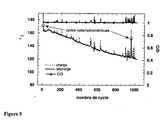
- Figure 5 The first 5 cycles were performed in voltammetric mode to activate the cathode and determine its capacity. In this case, 100% of the theoretical capacity was exchanged during the first voltammetric cycles and 96% during the first 80 intentiostatic cycles. Subsequently the capacity decreases slowly and after 1000 cycles, 70% of the capacity (120 mAh.g -1 ) is still exchanged at this regime. Cycling in potentiodynamic mode after 950 cycles shows that in fact 89% of initial capacity is still available at slower discharge regimes.
- LiFePO 4 material coated with a carbon deposit was also tested at room temperature.
- the composite cathode is prepared by mixing the active material with carbon black and EPDM (previously dissolved in cyclohexane) in the proportions 85: 5: 10. The mixture is spread over a 1.7 cm 2 disc-shaped stainless steel current collector, dried under vacuum and stored in a glove box under helium atmosphere. As before, lithium is used as anode. The two electrodes are separated by a Celgard TM 2400 porous membrane. The electrolyte used is a molar LiTFSI 0.8 solution in gamma-butyrolactone.
- This example illustrates that the improvement of the studied material, due to the presence of carbon deposition on the surface of the grains, relates to the kinetics, the capacity and cyclability. In addition, its role is independent of that of the added carbon during the preparation of composite cathodes.
- This example illustrates the formation of a conductive carbonaceous deposit from a hydrocarbon type gas.
- the synthesis described in Example 1 for the repair of lithium and iron double phosphate was repeated omitting the polypropylene powder and replacing the inert atmosphere of the heat treatment with a mixture of 1% propene in the nitrogen .
- propene decomposes to form a carbon deposit on the material being synthesized.
- the sample obtained contains 2.5% of carbon, determined by chemical analysis.
- a cyclic voltammetry performed under the conditions described in Example 1 on this sample shows an important phenomenon of activation during the first cycles (see Figure 7). The improvement in kinetics is accompanied in this case by an increase in the reversibly exchanged capacity.
- the initial capacity value of the LiFePO 4 sample prepared represents 77% of the theoretical capacity, taking into account the 2.5% electrochemically inactive carbon. After 5 cycles, this capacity reaches 91.4%.
- the observed activation phenomenon is related to the thickness of the possibly porous carbon layer coating the grains and can slow the diffusion of the cations.
- Examples 3-5 illustrate the treatment of the complex oxide, namely the LiFePO 4 lithium iron and lithium double phosphate, prepared independently thermally, so as to obtain a conductive carbon coating.
- the Trypinite LiFePO 4 sample as synthesized previously was analyzed. Its mass composition is: Fe 34.6%, Li 4.2%, P 19.2%, a stoichiometric difference of about 5%.
- the powder to be treated was impregnated with an aqueous solution of commercial sucrose and then dried. The amount of solution was chosen to correspond to 10% of the weight of sucrose relative to the weight of the material to be treated. The evaporation of the water to complete dryness was done with stirring to obtain a homogeneous distribution.
- the use of sugar is a preferred implementation because it melts before carbonizing, which allows to coat the grains well. Its relatively low carbon yield after pyrolysis is offset by its low price.
- the LiFePO 4 double phosphate of Example 3 was added with cellulose acetate as precursor of the carbon coating.
- This polymer is known to decompose with good carbonization yields, ie of the order of 24%. It decomposes between 200 and 400 ° C. Beyond this temperature, the amorphous carbon obtained is reorganized to give a graphite type structure which is favorable to obtaining coherent and highly conductive carbon deposits.
- the cellulose acetate was dissolved in acetone in a proportion corresponding to 5% of the weight of the material to be treated and dried before proceeding as described above. The content of the final carbon product is 1.5%.
- the heat treatment conducts in a manner similar to a black powder having surface electronic conductivity.
- Perylene and its derivatives are known to give, after pyrolysis, graphitic-type carbons because of the existence of condensed rings in the starting molecule.
- the anhydride of perylene-tetracarboxylic acid decomposes above 560 ° C giving very high carbon coatings.
- this product is present in very low solubility, and their intimate mixture with the complex oxide, also here LiFePO 4 according to Example 3, is difficult to put into practice.
- LiFePO 4 LiFePO 4 according to Example 3
- the oxyethylene segments are selected sufficiently long to act as solubilizing agents for the aromatic groups in the usual organic solvents.
- This polymer was dissolved in dichloromethane in a proportion corresponding to 5% of the weight of the material to be treated before proceeding as described in Examples 3 and 4.
- the content of the final product of carbon is 1%.
- the heat treatment leads as before to a black conductive powder.
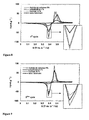
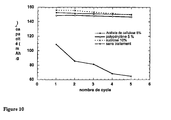
- Its electroactivity, as measured on the first cycle ( Figure 8) and the fifth cycle ( Figure 9) charge-discharge is 148 mAhg -1 and 146.9 mAhg -1 , 87.4% and 86.4% of the theory. These values are to be compared to those of the product not coated with the carbon deposit, which only 64% are electroactive during the first cycle. After 5 cycles, this value falls to 37.9% (see Figure 10).
- This example illustrates the use of an elimination reaction from a polymer to form a carbonaceous deposit according to the present invention.
- Fe 2 (SO 4 ) 3 ferric (ferric) sulphate having an orthorhombic "Nasicon” structure is obtained from commercial hydrated iron (III) sulphate (Aldrich) by dehydration at 450 ° C. under vacuum. Cooling and stirring, the powder is suspended in hexane and lithiated with a stoichiometric amount of 2M butyl lithium to give the composition Li 1.5 Fe 2 (SO 4 ) 3 .
- the material coated with the carbonaceous material was tested for its electrochemical activity in a lithium battery comprising a lithium metal electrode, 1M lithium bis (trifluoromethanesulfonimide) in a 50:50 mixture of ethylene-dimethoxyethane carbonate as an immobilized electrolyte in a separator of microporous polypropylene 25 ⁇ m.
- the cathode was obtained from the redox material prepared with carbon black (Ketjenblack TM ) and slurried in a solution of the ethylene-propylene-diene polymer, the solids content being 85: 10: 5.
- the mixture of the cathode is spread on an expanded aluminum mesh, and pressed to a ton / cm 2 to give a thickness of 230 microns.
- This button cell assembly is loaded (the tested material being the anode) at 1 mAcm -2 between potentials of 2.8 and 3.9 volts.
- the capacity of the material is 120 mAgh -1 , corresponding to 89% of the theoretical value.
- the average potential was obtained at 3.6 V vs. Li + : Li o .
- This example illustrates the use of a compound comprising nitrogen as the electrode material.
- Both manganous oxide MnO and lithium nitride powders are mixed in a dry box under a helium atmosphere in a ratio of 1: 1.
- the reagents are placed in a vitreous carbon crucible and treated under oxygen-free nitrogen ( ⁇ 1 vpm) at 800 ° C.
- 12 g of the resulting oxynitride having an anti-fluorite structure Li 3 MnNO are added to 0.7 g of a polyethylene powder having particles of the order of one micrometer, and mixed in a ball mixer under a helium atmosphere in a polyethylene container with dry heptane as a dispersing agent and 20 mg Brij TM 35 (ICI) as a surfactant.
- the filtered mixture is then treated under a stream of oxygen-free nitrogen in an oven at 750 ° C to decompose the polyethylene to carbon.
- the carbon-coated electrode material appears as a black powder rapidly hydrolysed in moist air. All subsequent manipulations are therefore conducted in a dry box in which a battery similar to that of Example 6 was constructed and tested for the electrochemical activity of the prepared material.
- the electrolyte in this case, is a mixture of commercial tetraethylsulfamide (Fluka) and dioxolane in a volume ratio of 40:60. Both solvents were purified by distillation in the presence of sodium hydride (under reduced pressure of 10 torr in the case of the sulfonamide). To this mixture of solvents is added lithium bis (trifluoromethanesulfonimide) (LiTFSI) to form a solution of 0.85 molar.
- the cell comprises a lithium electrode, an electrolyte immobilized in a porous polypropylene separator of 25 ⁇ m, and the material prepared in the same manner as in example 6.
- the cathode is obtained from the redox material prepared in admixture with the carbon black (Ketjenblack TM ) and pulped in an ethylene-polypropylene-diene polymer solution, the proportion of solids being 90: 5: 5.
- the cathode mixture is pressed onto an expanded copper mesh at 1 ton / cm 2 with a resultant thickness of 125 ⁇ m.
- the button cell assembly is charged at 0.5 mAcm -2 (the oxynitride being the anode) between potentials of 0.9 and 1.8 volts.
- the capacity of the materials is 370 mAgh -1 , ie, 70% of the theoretical value for two electrons per unit of the formula.
- the average potential was measured at 1.1 V vs. Li + : Li o .
- This material can be used as negative electrode materials in lithium ion batteries.
- An experimental cell of this type was constructed with the electrode material on a copper screen similar to that previously tested, and a positive electrode material obtained by the chemical delithiation of the iron and lithium phosphate of Example 1. presence of bromine in acetonitrile.
- the iron (III) phosphate obtained is pressed on an aluminum mesh to form the positive electrode and the 0.85 M solution of LiTFSI tetraethylsulfamide / dioxolane is used as the electrolyte.
- the average voltage of this cell is 2.1 volts and its energy density, based on the weight of the active materials, is 240 Wh / Kg.
- the lithium vanadium (III) phosphonosilicate Lh 3.5 V 2 (PO 4 ) 2.5 (SiO 4 ) 0.5 , having a Nasicon structure, is prepared in the following manner.
- Lithium carbonate (13.85 g), Li 2 SiO 3 lithium silicate (6.74 g), dihydrogen ammonium phosphate (43.2 g) and ammonium vanadate (35.1 g) are mixed with 250 ml of ethyl methyl ketone. and processed in a bead mixer comprising alumina beads and a thick-walled polyethylene container for 3 days. The resulting paste is filtered, dried and treated in a tubular oven under a stream of nitrogen comprising 10% hydrogen at 600 ° C for 12 hours. After cooling, 10 g of the resulting powder is introduced into a planetary ball mixer comprising tungsten carbide balls.
- the resulting powder is added to a solution of the polyaromatic polymer prepared in Example 5 (polyoxethylene-co-perylene tetracarboxylic diimide, 0.8 g in 5 mL of acetone), homogenized, and the solvent evaporated.
- the red-brown powder was thermolysed in an oxygen-free argon stream at 700 ° C for 2 hours to give a black powder after cooling after having a measurable surface conductivity.
- the material covered with the carbonaceous material has been tested for its electrochemical activity in a lithium-ion battery comprising a natural graphite electrode (NG7) coated with a copper current collector and corresponding to 24 mg / cm 2 , 1 M lithium hexafluorophosphate in a ethylene carbonate mixture: 50:50 dimethylcarbonate as immobilized electrolyte in a 25 ⁇ m microporous polypropylene separator.
- NG7 natural graphite electrode
- the cathode was obtained from lithium and vanadium phosphosilicate mixed with carbon black (Ketjenblack TM ) and pulverized in a solution of copolymer of vinylidene fluoride-hexafluoropropene in acetone, the solids proportions being 85: 10: 5.
- the mixture of the cathode is spread on an expanded foil mesh and pressed to a ton / cm 2 , resulting in a thickness of 190 ⁇ m corresponding to a load of active material of 35 mg / cm 2 .
- the button cell assembly is charged (the tested material being the anode) at 1 mAcm -2 between the potentials of 0 and 4.1 volts.
- the capacity of the carbon-coated material is 184 mAgh -1 , which corresponds to 78% of the theoretical value (3.5 lithium per formula unit), with a slight decrease after cycling.
- a similar cell constructed using an uncoated material, as obtained after mixing the heat treated inorganic precursor, but omitting the addition of the perylene polymer demonstrates a capacity of 105 mAgh -1 , which decreases rapidly with cycling.
- This example illustrates the formation of a carbonaceous coating by varying the alkali metal content in the redox material.
- the electrode material was tested for its capacity in a cell similar to that of Example 6 with the difference that the cell is first tested for discharge (the electrode material being the cathode), and then recharged.
- the voltages were between 2.8 and 3.7 volts.
- the experimental capacity during the first cycle was 190 mAgh -1 , which corresponds to 83% of the theoretical value.
- a cell with FeF 3 as electrode material and no carbon coating has a theoretical capacity of 246 mAgh -1 .
- the first discharge cycle obtained under conditions similar to that of the material of the invention is 137 mAgh -1 .
- This example also illustrates the formation of a carbonaceous coating by varying the alkali metal content in the redox materials.
- the resulting product contains, according to elemental analysis: Fe: 34%, P: 18.8%, Li: 4.4%, C: 3.2%.
- X-ray analysis confirmed the existence of pure LiFePO 4 triphyllite as the sole crystalline compound.
- the electrode material was tested for its capacity in a cell similar to that of Example 1 with a polyethylene oxide electrolyte, and then recharged. The voltages were chosen between 2.8 and 3.7 volts.
- the experimental capacity during the first cycle was 135 mAgh -1 , which corresponds to 77% of the theoretical value, which increases to 156 mAgh -1 (89%) when the definition of the peak has improved after several cycles. 80% of this capacity is accessible in the area of potential 3.3 - 3.6 volts vs. Li + : Li o .
- the LiCo 0 75 Mn 0.25 PO 4 compound was prepared by intimate grinding of cobalt oxalate dihydrate, manganese oxalate dihydrate and dihydrogenated ammonium phosphate by injecting air at 850 ° C for 10 hours.
- the resulting purple powder is mixed in a planetary ball mixer comprising tungsten carbide balls to obtain particles of the order of 4 microns.
- 10 g of this complex phosphate are triturated in a mortar with 10 ml of a 6% solution of the perylene polymer of Example 5 in methyl formate. The solvent evaporated rapidly.
- the resulting powder was treated under a stream of oxygen-free dry argon in a tubular furnace at 740 ° C for 3 hours, resulting in a black powder.
- the activity the electrochemical cell was tested in a lithium-ion battery similar to that of Example 6.
- the electrolyte was, in this case, lithium bis-fluoromethanesulfonimide (Li [FSO 2 ] 2 N) dissolved at a concentration 1M in dimethylamino-trifluoroethyl sulfamate CF 3 CH 2 OSO 2 N (CH 3 ) 2 , which is an oxidation-resistant solvent.
- Li + Li o .
- the battery could be cycled for 50 cycles of deep charges / discharges with less than 10% loss of capacity, thus showing the resistance of the electrolyte to high potentials.
- the Li 2 MnSiO 4 compound was prepared by calcining the gel resulting from the action of a stoichiometric mixture of lithium acetate dihydrate, manganese acetate tetrahydrate and tetraethoxysilane in an 80:20 ethanol / water mixture.
- the gel was dried in an oven at 80 ° C for 48 hours, reduced to powder and calcined in air at 800 ° C.
- 3.28 g of the resulting silicate and 12.62 g of the lithium iron phosphate of Example 3 were mixed in a planetary bead mixer similar to that of Example 11, and the powder was treated under a stream of dry argon without of oxygen in a tubular oven at 740 ° C for 6 hours.
- the complex oxide obtained after cooling has the formula Li 1.2 Fe 0.8 Mn 0.2 P 0.8 Si 0.2 O 4 .
- the powder was wetted with 3 mL of a 2% solution of cobalt acetate, and dried. This powder was treated in the same tubular furnace at 500 ° C under a flow of 1 mL / sec of a gas comprising 10% carbon monoxide in nitrogen for 2 hours. After cooling, the resulting black powder was tested for its electrochemical activity under conditions similar to those of Example 1. With a polyethylene oxide electrolyte at 80 ° C, the measured capacity, from a cyclic curve voltamogram at 185 mAgh -1 (88% of the theory) between the voltages of 2.8 and 3.9 volts vs. Li + : Li o . The uncovered material tested under similar conditions has a specific capacity of 105 mAgh -1 .
- a light modulation system (electrochromic window) was constructed as follows.
- the LiFePO 4 of Example 3 is mixed in a high-energy ball mixer to obtain particles of about 120 nm. 2 g of this powder are mixed with 1 ml of a 2% by weight solution of the perylene-co-polyoxyethylene polymer of Example 5 in methyl formate. The paste is triturated to ensure uniform distribution of the polymer on the surface of the particles, and the solvent is then evaporated. The dry powder obtained is treated under a stream of oxygen-free dry nitrogen in a tubular oven at 700 ° C for 3 hours, to yield a pale gray powder.
- This system turns blue in 30 seconds on application of a voltage (1.5 V, the LiFePO 4 side being the anode) and bleached in reverse voltage.
- the light transmission is modulated from 85% (whitened state) to 20% (colored state).
Landscapes
- Chemical & Material Sciences (AREA)
- Engineering & Computer Science (AREA)
- Chemical Kinetics & Catalysis (AREA)
- Electrochemistry (AREA)
- General Chemical & Material Sciences (AREA)
- Inorganic Chemistry (AREA)
- Power Engineering (AREA)
- Materials Engineering (AREA)
- Microelectronics & Electronic Packaging (AREA)
- Composite Materials (AREA)
- Dispersion Chemistry (AREA)
- Physics & Mathematics (AREA)
- Manufacturing & Machinery (AREA)
- Crystallography & Structural Chemistry (AREA)
- Spectroscopy & Molecular Physics (AREA)
- Condensed Matter Physics & Semiconductors (AREA)
- General Physics & Mathematics (AREA)
- Battery Electrode And Active Subsutance (AREA)
- Electric Double-Layer Capacitors Or The Like (AREA)
- Secondary Cells (AREA)
- Carbon And Carbon Compounds (AREA)
- Electrochromic Elements, Electrophoresis, Or Variable Reflection Or Absorption Elements (AREA)
- Primary Cells (AREA)
- Inorganic Compounds Of Heavy Metals (AREA)
- Compounds Of Iron (AREA)
- Silicon Compounds (AREA)
- Silicates, Zeolites, And Molecular Sieves (AREA)
Description
- La présente invention concerne des matériaux d'électrode capables de réaction rédox par échange d'ions alcalins et d'électrons avec un électrolyte. Les applications sont dans le domaine des générateurs électrochimiques (batteries) primaires ou secondaires, les supercapacités et les systèmes de modulation de la lumière de type électrochrome.
- On connaît les composés d'insertion (ci-après appelés aussi matériaux électroactifs ou matériaux rédox) dont le fonctionnement est basé sur l'échange d'ions alcalins, en particulier les ions lithium, et des électrons de valence d'au moins un élément de transition de manière à assurer la neutralité dans la matrice solide. Le maintien partiel ou total de l'intégrité structurale du matériau permet la réversibilité de la réaction. Les réactions rédox résultant de la formation de plusieurs phases ne sont habituellement pas réversibles, ou très peu. Il est aussi possible d'effectuer des réactions en phase solide en mettant en jeu la scission réversible de liaisons soufre-soufre ou les réactions rédox intervenant dans la transformation de structures organiques aromatiques en formes quinoniques, en particulier dans les polymères conjugués.
- Les matériaux d'insertion sont les ingrédients actifs des réactions électrochimiques utilisés en particulier dans les générateurs électrochimiques, les supercapacités ou les systèmes de modulation de la transmission de la lumière (électrochromes).
- La progression de la réaction d'échange ions-électrons requiert l'existence au sein du matériau d'insertion d'une double conductivité, simultanément par les électrons et les ions, en particulier les ions lithium, l'un ou l'autre de ces types de conductivité étant éventuellement trop faible pour assurer des cinétiques d'échanges requises pour l'utilisation du matériau, en particulier pour les générateurs électrochimiques ou les supercapacités. Une solution à ce problème est obtenue partiellement par l'utilisation d'électrodes dites "composites", dans lesquelles le matériau d'électrode est dispersé dans une matrice contenant l'électrolyte et un liant polymère. Dans le cas où l'électrolyte est un électrolyte polymère ou un gel fonctionnant en l'absence de solvant, le rôle de liant mécanique est assuré directement par la macromolécule. Par gel, on entend une matrice polymère, elle-même solvatante ou non, retenant un liquide polaire et un sel, de manière à conférer à l'ensemble les propriétés mécaniques d'un solide tout en retenant au moins une partie de la conductivité du liquide polaire. Un électrolyte liquide et le matériau d'électrode peuvent aussi être maintenus en contact par une faible fraction d'un liant polymère inerte, c'est-à-dire n'interagissant pas avec le solvant. Par l'un quelconque des moyens précités, chaque grain de matériau d'électrode est donc entouré d'électrolyte capable d'amener les ions en contact direct avec la quasi-totalité de la surface du matériau d'électrode. Pour faciliter les échanges électroniques, il est habituel, selon l'art antérieur, d'ajouter des particules d'un matériau conducteur à l'un des mélanges précités du matériau électrode et de l'électrolyte. Ces particules sont à l'état très divisé. Généralement, le choix se porte sur les matériaux carbonés, et tout spécialement sur les noirs de carbone (Shawinigan ou Ketjenblack®). Cependant, les fractions volumiques utilisées sont faibles car ce type de matériau modifie fortement la rhéologie des suspensions, spécialement dans les polymères, avec pour résultat une porosité excessive et une perte d'efficacité du fonctionnement de l'électrode composite, aussi bien en termes de fraction de la capacité utilisable que de la cinétique, i.e., de la puissance disponible. Aux faibles taux utilisés, les grains de carbone se structurent en chaînes, et les points de contact avec le matériau d'électrode proprement dit sont extrêmement réduits. Cette configuration a pour conséquence une mauvaise répartition du potentiel électrique au sein du matériau électroactif. En particulier, des surconcentrations ou des appauvrissements peuvent apparaître aux points de jonction triple:

- Ces variations excessives de la concentration locale en ions mobiles et les gradients résultant à l'intérieur du matériau électroactif sont très préjudiciables à la réversibilité du fonctionnement de l'électrode sur un nombre élevé de cycles. Ces contraintes, ou stress, chimiques et mécaniques se traduisent au niveau microscopique par une désintégration des grains de matériau électroactif, dont une partie est susceptible de perdre le contact avec les grains de carbone et de devenir ainsi inactifs électrochimiquement. La structure du matériau peut aussi être détruite, avec l'apparition de nouvelles phases et relargage éventuel des dérivés ou autres fragments de métaux de transition dans l'électrolyte. Ces phénomènes nuisibles apparaissent d'autant plus facilement lorsque la densité de courant ou la puissance demandée à l'électrode est plus grande.
-
EP-A-0612 117 décrit des batteries qui ont une anode dont la matière active est formée de particules de matériau carboné. Les particules sont obtenues par pyrolyse d'un précurseur de carbone en présence de fines particules de coeur, constituées soit par un composé métallique, soit par un composé d'un tel métal. Lorsque les particules de coeur sont introduites sous forme de particules de composé de métal, ledit composé de métal est décomposé avant que le carbone ne commence à se déposer lors de la pyrolyse du précurseur carboné. Dans les particules ainsi obtenues, la teneur en métal est de préférence de 0,005 à 10 % atomique, la teneur en matériau carboné étant dès lors de 90 à 0,095 % atomique. Le but recherché est l'élaboration de particules de carbone contenant la quantité la plus faible possible de matière non électrochimiquement active, le noyau métallique des particules ne servant que lors de l'élaboration. -
US-A-5 789 114 décrit un matériau pour une cathode, constitué par des particules d'un oxyde de métal revêtues par une poudre de carbone, en particulier d'un oxyde de manganèse et d'un oxyde de lithium et d'un second élément choisi parmi Mn, Ni, Fe et Co, ou leurs mélanges. Les particules composites sont obtenues par un procédé consistant à mélanger des particules d'oxyde de métal et une poudre de carbone ayant une surface spécifique d'au moins 150 m2/g et à appliquer une pression au mélange pour couvrir la surface des particules individuelles d'oxyde de métal par la poudre de carbone de sorte qu'au moins 15% de la surface apparente des particules d'oxyde de métal soit couverte. Dans un tel matériau, le contact entre les poudres solides est un contact ponctuel, et l'intégrité structurale n'est pas préservée lors des cycles charge/décharge. - Une cathode constituée par Li1-xCoO2 (0<x≤1) dont la surface est recouverte par du graphite, à raison de 7-14 parties en poids pour 100 parties en poids de Li1-xCoO2 est décrite dans Patent Abstracts of Japan, vol. 015, n° 383. Le matériau est obtenu par un procédé mécanique d'application, sur LiCoO2, de graphite pyrolytique hautement orienté (Highly Oriented Pyrolytic Graphite). L'élaboration de graphite de type HOPG nécessite des températures d'au moins 1000°C.
-
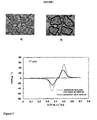
- La Figure 1 illustre la différence entre une électrode classique selon l'art antérieur (A) et une électrode selon l'invention dont les particules de matériau électroactif sont recouvertes d'un revêtement carboné (B).
- Les Figures 2 et 3 illustrent une comparaison d'un échantillon de LiFePO4 recouvert de carbone avec un échantillon témoin de LiFePO4 sans carbone. Ces résultats ont été obtenus par voltammètrie cyclique de piles LiFePO4 / POE20LiTFSI / Li cyclées à . 20 mV.h-1 entre 3 et 3.7 volts à 80°C. Le premier cycle est porté sur la Figure 2 et le cinquième sur la Figure 3.
- La Figure 4 illustre l'évolution de la capacité au cours du cyclage des piles réalisées avec l'échantillon de LiFePO4 carboné d'une part et le témoin non carboné d'autre part.
- La Figure 5 illustre les performances d'une pile contenant LiFePO4 carboné et cyclée en mode intentiostatique entre 3 et 3.8 Volts à 80°C avec une vitesse de charge et décharge correspondant à C/l.
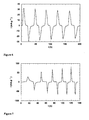
- La Figure 6 illustre l'évolution du courant en fonction du temps d'une pile LiFePO4 / γ-butyrolactone LiTFSI / Li contenant un échantillon carboné et cycié à 20 mV.h-1 entre 3 et 3.7 volts à température ambiante.
- La Figure 7 illustre l'évolution du courant en fonction du temps d'une pile LiFePO4 / POE20LiTFSI / Li contenant un échantillon carboné.
- Les Figures 8-9 présentent une comparaison d'échantillons de LiFePO4 recouverts de carbone avec un échantillon témoin de LiFePO4 avant traitement. Ces résultats ont été obtenus par voltammètrie cyclique de piles LiFePO4 / POE20LiTFSI / Li cyclées à 20 mV.h-1 entre 3 et 3.7 volts à 80°C. Le premier cycle est illustré sur la Figure 8 et le cinquième sur la Figure 9.
- La Figure 10 illustre l'évolution de la capacité au cours du cyclage des piles réalisées avec les échantillons de LiFePO4 carbonés d'une part et le témoin non carboné d'autre part.
- La présente invention concerne un matériau d'électrode selon la revendication 1.
- Le matériau carboné conducteur est déposé à la surface du matériau d'une manière homogène de façon à obtenir une distribution substantiellement régulière du champ électrique à la surface des grains du matériau. La similarité des rayons ioniques entre l'oxygène, le fluor et l'azote permet le remplacement mutuel de ces éléments en autant que l'électroneutralité est maintenue. Pour des raisons de simplification, et considérant que l'oxygène est utilisé le plus fréquemment, ces matériaux seront appelés des oxydes complexes. Les métaux de transition préférentiels comprennent le fer, le manganèse, le vanadium, le titane, le molybdène, le niobium, le zinc et le tungstène, seuls ou en mélanges. Les métaux autre qu'un métal de transition préférentiels comprennent le magnésium ou l'aluminium, et les non-métaux préférentiels comprennent le soufre, le sélénium, le phosphore, l'arsenic, le silicium, le germanium, le bore et l'étain, seuls ou en mélanges.
- Dans une mise en oeuvre préférentielle, la teneur massique finale en matériau carboné est comprise entre 0.1 et 55%, et plus préférablement entre 0.2 à 15%.
- Dans une autre mise en oeuvre préférentielle, l'oxyde complexe comprend les sulfates, phosphates, silicates, oxysulfates, oxyphosphates et oxysilicates, ou leurs mélanges, d'un métal de transition et de lithium, et leurs mélanges. Il peut être intéressant, pour des raisons de stabilité structurale, de substituer partiellement le métal de transition par un élément de même rayon ionique mais inactif au point de vue rédox. Par exemple, le magnésium et l'aluminium, dans des proportions préférentielles de 1 à 25%.
- L'invention comprend en outre une cellule électrochimique dans laquelle au moins une électrode est fabriquée à partir d'un matériau d'électrode selon l'invention. La cellule peut opérer comme batterie primaire ou secondaire, super capacité, ou système de modulation de la lumière, la batterie primaire ou secondaire étant le mode d'opération préférentiel.
- La présente invention permet la réalisation de matériaux d'électrode de compositions extrêmement variées dont la caractéristique est d'être revêtus en surface, ou sur la plus grande partie de la surface, d'un revêtement uniforme de matériau carboné conducteur déposé par pyrolyse. La présence dans les matériaux d'électrode de l'invention d'un revêtement uniforme en comparaison du contact ponctuel obtenu avec les poudres de carbone ou d'autres additifs conducteurs de l'art antérieur permet une distribution régulière du champ électrique à la surface des grains du matériau électroactif. De plus, les gradients de concentration des ions sont diminués considérablement. Cette meilleure distribution de la réaction électrochimique à la surface des particules permet d'une part de préserver l'intégrité structurale du matériau, et d'autre part améliore la cinétique, en terme de densité de courant et de puissance disponible à l'électrode, grâce à la plus grande surface offerte.
- Par matériau carboné, on entend un polymère solide contenant majoritairement du carbone, de 60 à 100% molaire, et possédant une conductivité électronique supérieure à 10-5 Scm-1 à température ambiante, de préférence supérieure à 10-3 Scm-1. Les autres éléments présents peuvent être l'hydrogène, l'oxygène, l'azote, en autant qu'ils n'interfèrent pas avec l'inertie chimique propre au carbone pendant les procédés électrochimiques. Le matériau carboné peut être obtenu par décomposition thermique, e.g., oxydation partielle, de divers composés organiques. En général, tout matériau menant, grâce à une réaction ou une séquence de réactions, à un matériau carboné solide ayant les propriétés souhaitables sans affecter la stabilité de l'oxyde complexe, représente un précurseur acceptable. Des précurseurs acceptables comprennent, sans limitation, les hydrocarbures et leurs dérivés, particulièrement les espèces polycycliques aromatiques telles que le goudron ou le brai, le pérylène et ses dérivés, les composés polyhydriques comme les sucres et les hydrates de carbone, leurs dérivés, et les polymères. Des exemples préférentiels de polymères incluent les polyoléfines, les polybutadiènes, l'alcool polyvinylique, les produits de condensation des phénols, y compris ceux obtenus à partir de réaction avec des aldéhydes, les polymères dérivés de l'alcool furfurylique, les polymères dérivés du styrène, du divinylbenzène, du naphtalène, du pérylène, de l'acrylonitrile, et de l'acétate de vinyle; la cellulose, l'amidon et leurs esters et éthers, et leurs mélanges.
- L'amélioration de la conductivité à la surface des grains obtenue par le revêtement de matériau carboné selon la présente invention permet le fonctionnement satisfaisant d'électrodes contenant des matériaux électroactifs dont la conductivité électronique est insuffisante pour obtenir des performances acceptables. Les oxydes complexes ayant des couples rédox situés dans des intervalles de voltage utiles et/ou comprenant des éléments peu dispendieux et non toxiques, mais dont la conductivité est trop basse pour des usages pratiques, deviennent utiles comme matériau d'électrode lorsque le revêtement conducteur est présent. Le choix des structures ou mélanges de phases possédant des propriétés rédox mais dont la conductivité électronique est trop faible, est beaucoup plus large que celui des composés de l'art antérieur, de type oxyde mixte de métaux de transition et de lithium. Il est en particulier possible d'inclure dans les structures rédox un ou plusieurs des éléments choisis parmi les non-métaux (métalloïdes) tels que le soufre, le sélénium, le phosphore, l'arsenic, le silicium ou le germanium, dont l'électronégativité plus grande permet de moduler le potentiel rédox des éléments de transition, mais au dépens de la conductivité électronique. Un effet similaire est obtenu par une substitution partielle ou totale des atomes d'oxygène par le fluor ou l'azote.
- Les matériaux d'électrode ou rédox sont ainsi décrits par la formule générale AaMmZzOoNnFf dans laquelle:
- A comprend un métal alcalin tels que Li, Na, K;
- M comprend au moins un métal de transition, et optionnellement un métal autre qu'un métal de transition, tel que le magnésium ou l'aluminium;
- Z comprend au moins un non-métal tel que S, Se, P, As, Si, Ge;
- O est l'oxygène;
- N est l'azote et F est le fluor, ces derniers éléments pouvant se substituer à l'oxygène dans l'oxyde complexe du fait des rayons ioniques voisins des ions F-, O2- et N3- et
- a > 0, m ≥ 0, z > 0, o > 0, n ≥ 0 et f ≥ 0, chacun des coefficients a, m, z, o, n et f étant choisi de façon indépendante, de manière à assurer l'électroneutralité du matériau.
- Les oxydes préférentiels selon la présente invention comprennent ceux de formules Li1+xMP1-xSixO4; Li1+x-yMP1-xSixO4-yFy; Li3-x+zM2(P1-x-zSxSizO4)3; ou Li3+ux+zV2-z-wFeuTiw(P1-x-zSxSizO4)3 dans lesquelles w ≤ 2; 0 ≤ x; y ≤ 1; z ≤ 1 et M comprend Fe ou Mn.
- Le revêtement carboné est déposé par une méthode préférée qui consiste à pyrolyser une matière organique, de préférence riche en carbone, en présence du matériau rédox. Sont particulièrement avantageux les mésomolécules et polymères susceptibles de former facilement, soit mécaniquement, soit par imprégnation à partir d'une solution ou par polymérisation in situ, une couche uniforme à la surface des grains du matériau rédox. Une pyrolyse de l'ensemble permet d'obtenir une couche fine et uniforme de matériau carboné à la surface des grains du matériau rédox. Afin que la composition de ce dernier ne soit pas affectée par la réaction de pyrolyse, il est judicieux de choisir des compositions dont la pression d'oxygène libérée par le matériau soit suffisamment faible pour éviter l'oxydation du carbone formé par la pyrolyse. L'activité de l'oxygène des composés AaMmZzOoNnFf peut être contrôlée par la teneur en métal alcalin, qui elle-même détermine l'état d'oxydation du ou des éléments de transition contenus dans le matériau et fait partie intégrale de l'invention. Sont particulièrement intéressants les compositions dans lesquelles le coefficient "a" de la teneur en métal alcalin permet de maintenir les états d'oxydation suivant: Fe2+, Mn2+, V2+, V3+, Ti2+, Ti3+, Mo3+, Mo4+, Nb3+, Nb4+, W4+. D'une manière générale, des pressions d'oxygène de l'ordre 10-20 bars à 0°C et de 10-10 bars à 900°C sont suffisamment faibles pour permettre le dépôt de carbone par pyrolyse, la cinétique de formation de carbone en présence de résidu hydrocarbonés dus à la pyrolyse étant plus rapide et moins fortement activée que la formation d'oxygène à partir du matériau rédox. Il est aussi possible et avantageux de choisir des matériaux dont la pression d'oxygène en équilibre avec le matériau soit inférieure à celle de l'équilibre
C + O2 ⇔ CO2
- Dans ce cas, le matériau carboné peut être thermodynamiquement stable vis-à-vis de l'oxyde complexe. Les pressions correspondantes sont obtenues par la formule suivante:
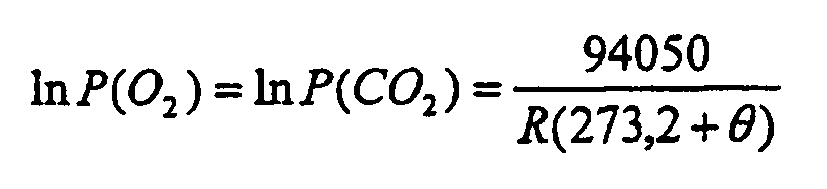
dans laquelle R est la constant des gaz parfaits (1,987 cal.mole-1.K-1); et
θ est la température en °C. - Le tableau suivant donne les valeurs des pressions d'oxygène pour quelques températures:
θ(°C) P(O2) P(CO2) P(CO2) = 1 atm P(CO2) = 10-5 atm 200 3.5 x 10-44 3.5 x 10-49 300 1.4 x 10-36 1.4 x 10-41 400 2.9 x 10⁻³¹ 2.9 x 10-36 500 2.5 x 10⁻²⁷ 2.5 x 10⁻³² 600 2.9 x 10⁻²⁴ 2.5 x 10⁻²⁹ 700 7.5 x 10⁻²² 7.5 x 10⁻²⁷ 800 7.0 x 10⁻²⁰ 7.0 x 10⁻²⁵ 900 3.0 x 10⁻¹⁸ 3.0 x 10⁻²³ - Il est aussi possible d'effectuer le dépôt carboné par la dismutation de l'oxyde de carbone à des températures inférieures à 800°C selon l'équation:
2CO ⇒ C + CO2
- Cette réaction est exothermique mais lente. Les particules d'oxyde complexe peuvent être mises en contact avec le monoxyde de carbone pur ou dilué par un gaz inerte, à des températures allant de 100 à 750°C, de préférence de 300 à 650°C. Avantageusement, la réaction est conduite en technique de lit fluidisé, de manière à avoir une grande surface d'échange entre la phase gazeuse et la phase solide. Les éléments et cations des métaux de transition présents dans l'oxyde complexe sont des catalyseurs de la réaction de dismutation. Il peut être intéressant d'ajouter des faibles quantités de sels de métaux de transition, préférablement le fer, nickel, cobalt à la surface des grains, ces éléments étant particulièrement actifs comme catalyseur de la réaction de dismutation. On peut aussi faire appel à la décomposition d'hydrocarbures en phase gazeuse, tel que les alcanes, ou de préférence ceux riches en carbone, tels que les alcène, les alcynes ou les hydrocarbures aromatiques.
- Dans une variante, le dépôt de matériau carboné peut être effectué simultanément à une variation de la composition en métaux alcalins A. Pour ce faire, un sel d'un acide ou d'un polyacide organique est mélangé avec l'oxyde complexe. Une autre possibilité consiste à partir d'un monomère ou d'un mélange de monomères qui sont polymérisés in situ. Par pyrolyse, le composé dépose un film de matériau carboné à la surface et le métal alcalin A est incorporé selon l'équation:
Aa'MmZzOoNnFf + Aa-a'CcOoR' ⇒ AaMmZzOoNnFf
R' étant un radical organique quelconque, éventuellement faisant partie d'une trame polymère. - Parmi les composés susceptibles de permettre cette réaction, on peut citer d'une manière non limitante les sels d'acide carboxyliques tels que les sels des acides oxalique, malonique, succinique, citrique, polyacrylique, polyméthacrylique, benzoique, phtalique, propiolique, acétylène dicarboxylique, naphtalène di- ou tétracarboxylique, pérylène tétracarboxylique, diphénique.
- Il est évident que la pyrolyse d'un matériau organique ne contenant pas d'élément alcalin et l'apport de ce dernier par un sel peuvent être combiné afin d'arriver à la stoechiométrie désirée de l'oxyde complexe.
- Il est aussi possible d'obtenir un dépôt de matériau carboné, spécialement à des températures basses ou moyennes, inférieures à 400°C par réduction de liaisons carbone-halogène selon l'équation:
CY-CY + 2e- ⇒ -C=C- + 2Y-
où Y représente un halogène ou un pseudo-halogène. Par pseudo-halogène, on entend un radical organique ou inorganique susceptible d'exister sous forme d'ion Y- et de former le composé protoné correspondant HY. Parmi les halogènes et pseudo-halogènes, on peut citer d'une manière non limitante F, Cl, Br, I, CN, SCN, CNO, OH, N3, RCO2, RSO3 où R représente H ou un radical organique. La formation par réduction de liaison CY est préférablement effectuée en présence d'éléments réducteurs, par exemple l'hydrogène, le zinc, le magnésium les ions Ti3+, Ti2+, Sm2+, Cr2+, V2+, les tétrakis(dialkylamino éthylène) ou les phosphines. Ces réactifs peuvent éventuellement être obtenus ou régénérés par voie électrochimique. Par ailleurs, il peut être avantageux d'utiliser des catalyseurs augmentant la cinétique de réduction. Sont particulièrement efficaces les dérivés du palladium ou du nickel, en particulier sous forme de complexes avec les phosphines ou les composés azotés tel la 2,2'-bipyridine. D'une manière similaire, ces composés peuvent être générés sous forme active par voie chimique en présence de réducteurs, en particulier ceux précités, ou par voie électrochimique. Parmi les composés susceptibles de générer du carbone par réduction, on peut citer les perhalocarbones, en particulier sous forme de polymères, l'hexachlorobutadiène, l'hexachlorocyclopentadiène. - Un autre moyen de libérer du carbone par un procédé à basse température consiste en l'élimination du composé hydrogéné HY, Y étant tel que défini ci-haut, selon l'équation :
-CH-CY- + B ⇒ -C=C- + BHY
- Parmi les composés susceptibles de générer du carbone par réduction, on peut citer les composés organiques comportant un nombre équivalent d'atomes d'hydrogène et de groupements Y, tels les hydrohalocarbones, en particulier sous forme de polymères, tel que le polyfluorure, polychlorure ou polybromure ou polyacétate de vinylidène, les hydrates de carbones. La déshydro(pseudo)halogénation peut être obtenue à basse température, incluant la température ambiante, par l'action d'une base susceptible de réagir avec le composé HY pour former un sel. À ce titre, on peut citer les bases tertiaires, amines, amidines, guanidines, imidazoles, les bases inorganiques telles que les hydroxydes alcalins, les composés organométalliques se comportant comme des bases fortes telles que A(N(Si(CH3)3)2, LiN[CH(CH3)2]2 ou le butyl lithium.
- Dans les deux dernières méthodes précitées, il peut être avantageux de recuire les matériaux après le dépôt de carbone. Ce traitement permet une amélioration de la structure ou de la cristallinité du carbone. Le traitement peut être effectué à une température variant entre 100 à 1000°C, de préférence entre 100 à 700°C, ce qui permet d'éviter une éventuelle réduction de l'oxyde complexe par le matériau carboné.
- D'une manière générale, il est possible d'obtenir des revêtements de matériau carboné uniformes, assurant une conductivité électronique suffisante, c'est-à-dire au moins du même ordre que la conductivité ionique dans le grain d'oxyde. Les revêtements épais permettent d'obtenir une conductivité suffisante pour que le mélange binaire des grains d'oxyde complexe enrobés de matériau carboné avec l'électrolyte, liquide ou polymère ou le liant inerte macromoléculaire destiné à être imbibé d'électrolyte, soit conducteur par simple contact entre les particules. En général, ce comportement peut s'observer à des fractions volumiques comprises entre 10 et 70%.
- Il peut être aussi avantageux de choisir des dépôts de matériau carboné suffisamment fin pour ne pas faire obstacle au passage des ions, tout en assurant la répartition du potentiel électrochimique à la surface du grain. Dans ce cas, les mélanges binaires ne possèdent éventuellement pas une conductivité électronique suffisante pour assurer les échanges électroniques avec le support de l'électrode (collecteur de courant). L'ajout d'un tiers composant conducteur électronique, sous forme de poudre fine ou de fibres, permet d'obtenir une conductivité macroscopique satisfaisante et améliore les échanges électroniques avec le support de l'électrode. Les noirs de carbone ou les fibres de carbone sont particulièrement avantageux pour cette fonction, et donnent des résultats satisfaisants à des taux volumiques n'affectant peu ou pas la rhéologie lors de la mise en oeuvre de l'électrode du fait de l'existence d'une conductivité électronique à la surface des grains du matériau d'électrode. Des fractions volumiques de 0.5 à 10% sont particulièrement préférées. Les noirs de carbone de type noir de Shawinigan® ou Ketjenblack® sont préférés. Parmi les fibres de carbone, celles obtenues par pyrolyse de polymères tels que le brai, le goudron, le polyacrylonitrile ainsi que celles obtenues par "cracking" d'hydrocarbures sont préférées.
- Il est intéressant, du fait de sa légèreté et de sa malléabilité, d'utiliser l'aluminium comme constituant des collecteurs de courant. Ce métal est néanmoins recouvert d'une couche isolante d'oxyde. Cette couche, qui protège le métal de la corrosion, peut dans certaines conditions augmenter d'épaisseur, ce qui amène une résistance accrue de l'interface, préjudiciable au bon fonctionnement de la cellule électrochimique. Ce phénomène peut être particulièrement gênant et rapide dans le cas où la conductivité électronique serait uniquement assurée, comme dans l'art antérieur, par des grains de carbone ayant un nombre de points de contacts limités. L'utilisation, en conjonction avec l'aluminium, des matériaux d'électrode recouverts d'une couche de matériau carboné conducteur permet d'augmenter la surface d'échange aluminium-électrode. Les effets d'une corrosion de l'aluminium sont ainsi annulés ou à tout le moins significativement minimisés. Il est possible d'utiliser soit des collecteurs d'aluminium sous forme de feuillards ou éventuellement sous forme de métal déployé ou expansé, ce qui permet un gain de poids. Du fait de propriétés des matériaux de l'invention, même dans le cas d'un métal déployé, les échanges électroniques au niveau du collecteur se font sans surcroît notable de la résistance.
- Lorsque les collecteurs de courant sont thermiquement stables, il est aussi possible d'effectuer la pyrolyse directement sur le collecteur, de manière à obtenir après dépôt de carbone, un film continu poreux qui peut être infiltré par un liquide conducteur ionique, ou bien par un monomère ou mélange de monomères dont la polymérisation in situ génère un électrolyte polymère. La formation de filins poreux dans lesquels le revêtement carboné forme une trame sont aisément obtenus dans le cadre de l'invention par pyrolyse d'un composite polymère-oxyde complexe déposé à l'état de film sur un support métallique.
- Lors de la mise en oeuvre du matériau d'électrode de la présente invention dans une cellule électrochimique, préférablement de type batterie primaire ou secondaire, l'électrolyte est un préférablement un polymère, solvatant ou non, optionnellement plastifié ou gélifié par un liquide polaire contenant en solution un ou plusieurs sels métalliques, et préférablement au moins un sel de lithium. Dans un tel cas, le polymère est préférablement formé à partir d'unités oxyéthylène, oxypropylène, acrylonitrile, fluorure de vinylidène, des esters de l'acide acrylique ou métacrylique, les esters de l'acide itaconique avec des groupements alkyles ou oxaalkyles. L'électrolyte peut également être un liquide polaire immobilisé dans un séparateur microporeux tels qu'une polyoléfine, un polyester, des nanoparticules de silice, d'alumine ou d'aluminate de lithium LiAlO2. Des exemples de liquides polaires comprennent les carbonates cycliques ou linéaires, les formiate d'alkyle, les α - ω alkylethers, oligoéthylène glycols, la N-méthylpyrrolidinone, la Υ-butyrolactone, les tétraalakylsulfamides, et leurs mélanges.
- Les exemples suivants sont fournis afin d'illustrer certaines mises en oeuvre préférentielles de l'invention, et ne doivent pas être considérés comme en limitant la portée.
- Cet exemple illustre la synthèse d'un matériau de l'invention conduisant directement à un matériau d'insertion recouvert d'un dépôt de carbone.
- Le matériau LiFePO4 recouvert d'un dépôt carboné a été synthétisé à partir de vivianite Fe3(PO4)2 • 8H2O et d'orthophosphate de lithium Li3PO4 en proportions stoechiométriques selon la réaction:
Fe3(PO4)2 • 8H2O + Li3PO4 => 3 LiFePO4
- Une poudre de polypropylène a été ajoutée dans une proportion représentant 3 % du poids de la vivianite. Les quantités pesées de chacun des composants ainsi que la poudre de polypropylène ont été intimement broyées ensemble dans un broyeur à billes de zircone. Le mélange a ensuite été chauffé sous atmosphère inerte d'argon, dans un premier temps à 350°C pendant 3 heures pour déshydrater la vivianite, puis la température a été élevée graduellement jusqu'à 700°C pour cristalliser le matériau et carboniser le polypropylène. La température a été maintenue à 700°C pendant 7 heures. La structure du matériau obtenue a été vérifiée par RX et correspond à celle publiée pour la triphyllite. Le pourcentage de carbone présent dans l'échantillon a été déterminé par analyse élémentaire. À la précision de la mesure, la teneur en carbone est de 0.56 % dans l'exemple présenté. Pour comparaison, un échantillon a été préparé dans les mêmes conditions en omettant la poudre de polypropylène. Cet échantillon présente également une structure cristalline pure de type LiFePO4
- Les matériaux préparés ont été testés dans des piles boutons du type CR 2032 à température ambiante et à 80°C.
- Les cathodes ont été préparées en mélangeant ensemble la poudre du matériau actif avec du noir de carbone (Ketjenblack®) pour assurer l'échange électronique avec le collecteur de courant et du polyoxyde d'éthylène de masse 400 000 utilisé comme agent liant d'une part et conducteur ionique d'autre part. Les proportions en poids sont 35:9:56. De l'acétonitrile est ajouté au mélange pour dissoudre le polyoxyde d'éthylène. Le mélange homogénéisé est ensuite coulé sur un disque d'acier inoxydable de 1.7 cm2. La cathode est séchée sous vide puis transférée en boîte à gants Vacuum Atmosphères, sous atmosphère d'hélium (< 1vpm H2O, O2). Une feuille de lithium (27 µm) laminée sur un substrat de nickel a été utilisée comme anode. L'électrolyte polymère était composé de polyoxyde d'éthylène de masse 5000000 et de LiTFSI (sel de lithium de la bistrifluorométhanesulfonimide) dans les proportions oxygène des unités oxyéthylène / lithium de 20 : 1.
- Les expériences électrochimiques ont été menées à 80°C, température à laquelle la conductivité ionique de l'électrolyte est suffisante, (2 x 10⁻³ Scm-1). Les études électrochimiques ont été réalisées par voltammétrie lente (20 mV.h-1) contrôlée par un cycleur de batterie de type Macpile®. Les batteries ont été chargées et déchargées entre 3.7 et 3 Volts.
- La Figure 2 présente le premier cycle obtenu pour les matériaux carbonés et non carbonés dont la synthèse est décrite précédemment. Pour l'échantillon non carboné les phénomènes d'oxydation et de réduction s'étendent sur une large plage de potentiel. Pour l'échantillon carboné, les pics sont mieux définis. L'évolution des 2 matériaux au cours des 5 premiers cycles et très différente (Figure 3). Pour l'échantillon recouvert d'un dépôt de carbone, les cinétiques d'oxydation et de réduction sont de plus en plus rapides, ce qui se traduit par des pics de mieux en mieux définis (courants de pics plus élevés et pics plus étroits). En revanche, pour l'échantillon non carboné, les cinétiques apparaissent de plus en plus lente. L'évolution de la capacité de ces deux échantillons est présentée sur la Figure 4. Dans le cas de l'échantillon carboné, la capacité échangée est stable. Elle représente de 94 à 100% de la capacité théorique (170 mAh.g-1) suivant les essais. La capacité initiale du matériau non carboné se situe aux alentours de 145 mAh.g-1 soit 85 % de la capacité théorique. Pour cet échantillon, la capacité échangée décroît rapidement. Après 5 cycles la batterie a perdu 20% de sa capacité initiale.
- L'échantillon carboné a été cyclé en mode intentiostatique entre 3.8 et 3 V avec des régimes de charge et de décharge rapide. Les courants imposés correspondent à un régime en C/1, ce qui signifie que toute la capacité est échangée en 1 heure. Ces résultats de cyclages sont présentés à la Figure 5. Les 5 premiers cycles ont été réalisés en mode voltampérométrique pour activer la cathode et déterminer sa capacité. Dans ce cas, 100% de la capacité théorique a été échangée durant les premiers cycles voltammétriques et 96% durant les 80 premiers cycles intentiostatiques. Par la suite la capacité décroît lentement et après 1000 cycles, 70% de la capacité (120 mAh.g-1) est encore échangée à ce régime. Le cyclage en mode potentiodynamique réalisé après 950 cycles montre qu'en fait, 89% de la capacité initiale est encore disponible à des régimes de décharges plus lents. Cette perte de puissance est associée à l'augmentation de la résistance d'interface lithium/électrolyte polymère. L'allure erratique du paramètre C/D (capacité passée en charge)/(capacité passée en décharge) en fin de cyclage laisse en effet présumer de la formation de dendrites. Ce paramètre est tracé sur la Figure 5.
- Le matériau LiFePO4 recouvert d'un dépôt de carbone a également été testé à température ambiante. Dans ce cas, la cathode composite est préparée en mélangeant le matériau actif avec du noir de carbone et de l'EPDM (préalablement dissout dans du cyclohexane) dans les proportions 85:5:10. Le mélange est étendu sur un collecteur de courant en acier inox en forme de disque de 1.7 cm2, séché sous vide et conservé en boîte à gants sous atmosphère d'hélium. Comme précédemment, le lithium est utilisé comme anode. Les deux électrodes sont séparées par une membrane poreuse de type Celgard™ 2400. L'électrolyte utilisé est une solution de LiTFSI 0.8 molale dans la gamma-butyrolactone.
- Les voltampérogrames présentés à la Figure 6 ont été réalisés à température ambiante avec une vitesse de balayage de 20 inV.h-1 entre 3 et 3.8 volts. Dans cette configuration, les cinétiques d'oxydation et de réduction apparaissent comme étant beaucoup plus lentes qu'à 80°C. De plus, la batterie perd légèrement en puissance au cours du cyclage. En revanche, la totalité de la capacité théorique est accessible (97.5% cycle 1, 99.4% cycle 5). Elle a été échangée sans perte sur la durée de l'expérience (5 cycles). Il n'est pas exclu que la faible puissance de cette batterie puisse provenir d'une mauvaise imprégnation de l'électrode par l'électrolyte, ce dernier ne mouillant pas le polymère utilisé comme agent liant.
- Cet exemple illustre donc que l'amélioration du matériau étudié, en raison de la présence du dépôt de carbone à la surface des grains, porte sur la cinétique, la capacité et la cyclabilité. De plus, son rôle est indépendant de celui du carbone ajouté lors de la préparation des cathodes composites.
- Cet exemple illustre la formation d'un dépôt conducteur carboné à partir d'un gaz de type hydrocarbure. La synthèse décrite dans l'exemple 1 pour la réparation du phosphate double de lithium et de fer a été reprise en omettant la poudre de polypropylène et en remplaçant l'atmosphère inerte du traitement thermique par un mélange de 1 % de propène dans l'azote. Lors du traitement thermique, le propène se décompose pour former un dépôt de carbone sur le matériau en cours de synthèse. L'échantillon obtenu contient 2.5% de carbone, déterminé par analyse chimique. Une voltammétrie cyclique réalisée dans les conditions décrites dans l'exemple 1 sur cet échantillon met en évidence un phénomène important d'activation au cours des premiers cycles (voir Figure 7). L'amélioration des cinétiques s'accompagne dans ce cas d'une augmentation de la capacité réversiblement échangée. Telle que mesurée lors de l'étape de décharge, la valeur de capacité initiale de l'échantillon de LiFePO4 préparé représente 77% de la capacité théorique en tenant compte des 2.5 % de carbone électrochimiquement inactif. Après 5 cycles, cette capacité atteint 91.4%. Le phénomène d'activation observé est relié à l'épaisseur de la couche de carbone éventuellement poreux enrobant les grains et pouvant ralentir la diffusion des cations.
- Les exemples 3-5 illustrent le traitement de l'oxyde complexe, en l'occurrence le phosphate double de fer et de lithium LiFePO4, préparé indépendamment par voie thermique, de manière à obtenir un revêtement carboné conducteur.
- L'échantillon de tryphilite LiFePO4 tel que synthétisé précédemment a été analysé. Sa composition massique est : Fe 34.6%, Li 4.2%, P 19.2%, soit un écart à la stoechiométrie d'environ 5%. La poudre à traiter a été imprégnée d'une solution aqueuse de sucrose commercial puis séchée. La quantité de solution a été choisie de manière à correspondre à 10 % du poids de sucrose par rapport au poids du matériau à traiter. L'évaporation de l'eau jusqu'à siccité complète a été faite sous agitation pour obtenir une répartition homogène. L'emploi du sucre représente une mise en oeuvre préférentielle, car il fond avant de se carboniser, ce qui permet de bien enrober les grains. Son rendement relativement faible en carbone après pyrolyse est compensé par son prix peu élevé.
- Les traitements thermiques ont été réalisés à 700°C sous atmosphère d'argon). La température a été maintenue pendant 3 heures. Une analyse élémentaire montre que ce produit contient 1.3 % en poids de carbone. Le traitement thermique précédemment décrit conduit à une poudre noire présentant une conductivité électronique de surface mesurable par un simple ohm-mètre commercial. Son éléctroactivité, telle que mesurée sur le 1 er cycle (Figure 8) et le 5ème cycle (Figure 9) de charge-décharge est de 155.9 mAhg-1 et 149.8 mAhg-1 respectivement, soit 91.7% et 88.1% de la théorie. Ces valeurs sont à comparer à celles du produit non revêtu du dépôt carboné, dont seulement 64% sont électroactifs lors du premier cycle. Après 5 cycles, cette valeur tombe à 37.0% (voir Figure 10).
- Le phosphate double LiFePO4 de l'exemple 3 a été additionné d'acétate de cellulose comme précurseur du revêtement carbone. Ce polymère est connu pour se décomposer avec de bons rendements de carbonisation, soit .de l'ordre de 24 %. Il se décompose entre 200 et 400°C. Au-delà de cette température, le carbone amorphe obtenu se réorganise pour donner une structure de type graphite ce qui est favorable à l'obtention de dépôts de carbone cohérents et très conducteurs. L'acétate de cellulose a été dissout dans de l'acétone dans une proportion correspondant à 5 % du poids de la matière à traiter et séché avant de procéder comme décrit plus haut. La teneur du produit final en carbone est de 1.5%. Le traitement thermique conduit d'une manière similaire à une poudre noire présentant une conductivité électronique de surface. Son éléctroactivité, telle que mesurée sur le 1er cycle (Figure 8) et le 5ème cycle (Figure 9) de charge-décharge est de 152.6 mAhg-1 et 150.2 mAhg-1 respectivement, soit 89.8% et 88.3 de la théorie. Ces valeurs sont à comparer à celles du produit non revêtu du dépôt carboné, dont seulement 64% sont électroactifs lors du premier cycle. Après 5 cycles, cette valeur tombe à 37.0% (voir Figure 10).
- Le pérylène et ses dérivés sont connus pour donner, après pyrolyse, des carbones de type graphitique du fait de l'existence de cycles condensés dans la molécule de départ. En particulier, l'anhydride de l'acide pérylène-tetracarboxylique se décompose au-delà de 560°C en donnant des revêtements de carbone très couvrants. Cependant, ce produit est présent en solubilité très faible, et leur mélange intime avec l'oxyde complexe, ici aussi LiFePO4 selon l'exemple 3, est difficile à mettre en pratique. Pour résoudre ce problème, a été synthétisé dans une première étape un polymère contenant les groupements pérylène séparés par une chaîne de polyoxyde d'éthylène. Les segments oxyethylène sont choisis suffisamment longs pour agir comme agents de solubilisation des groupements aromatiques dans les solvants organique habituels. Pour cela, on a fait réagir l'anhydride de l'acide 3,4,9,10-perylènetetracarboxylique commercial (Aldrich) est sur la Jeffamine 600 (Hunstmann, USA) à chaud, en suivant la réaction :

1≤p≤2; 10≤n≤14
La synthèse a été effectuée en 48 heures dans du diméthylacétamide au reflux (166°C). Le polymère formé est précipité dans l'eau, puis séparé par filtration. Il est purifié par une dissolution dans l'acétone, filtration, suivi d'une re-précipitation dans l'éther. Ce processus permet d'éliminer les produits de départ non réagi et les faibles masses. La poudre obtenue est finalement séchée. Le rendement de carbonisation de ce produit est de l'ordre de 20 %. - Ce polymère a été dissout dans du dichlorométhane dans une proportion correspondant à 5 % du poids de la matière à traiter avant de procéder comme décrit aux exemples 3 et 4. La teneur du produit final en carbone est de 1%. Le traitement thermique conduit comme précédemment à une poudre noire conductrice. Son éléctroactivité, telle que mesurée sur le 1 er cycle (Figure 8) et le 5ème cycle (Figure 9) de charge-décharge est de 148 mAhg-1 et 146.9 mAhg-1, soit 87.4% et 86.4% de la théorie. Ces valeurs sont à comparer à celles du produit non revêtu du dépôt carboné, dont seulement 64% sont électroactifs lors du premier cycle. Après 5 cycles, cette valeur tombe à 37.9 % (voir Figure 10).
- Cet exemple illustre l'utilisation d'une réaction d'élimination à partir d'un polymère pour former un dépôt carboné selon la présente invention.
- Du sulfate de fer (ferrique) Fe2(SO4)3 ayant une structure "Nasicon" orthorhombique est obtenu à partir de sulfate de fer (III) hydraté commercial (Aldrich) par déshydratation à 450°C sous vide. En refroidissant et sous agitation, la poudre est suspendue dans de l'hexane et lithiée avec une quantité stoechiométrique de butyl lithium 2M pour donner la composition Li1.5Fe2(SO4)3. 20 g de cette poudre blanche sont suspendus dans 100 ml d'acétone et 2.2 g de bromure de poly(vinylidene) (-CH2CBr2)n- sont ajoutés et le mélange est traité pendant 12 heures dans un mélangeur à billes comprenant des billes d'alumine. La suspension obtenue est séchée dans un évaporateur rotatif et broyée en une poudre grossière dans un mortier. Le solide est traité avec 3 g de diazabicyclo [5.4.0]unde-7-cène (DBU) dans l'acétonitrile sous reflux pour 3 heures. La poudre noire ainsi obtenue est filtrée pour retirer le bromure d'amine et l'excès de réactif, rincée avec de l'acétonitrile, et séchée sous vide à 60°C. Le dépôt carboné est recuit sous atmosphère d'argon dépourvu d'oxygène (< 1ppm) à 400° pendant 3 heures.
- Le matériau recouvert du matériau carboné a été testé pour son activité électrochimique dans une pile au lithium comprenant une électrode de lithium métal, du bis-(trifluorométhanesulfonimide) de lithium 1M dans un mélange 50:50 de carbonate d'éthylène-diméthoxyéthane comme électrolyte immobilisé dans un séparateur de polypropylène microporeux de 25µm. La cathode a été obtenue à partir du matériau rédox préparé avec du noir de carbone (Ketjenblack™) et mis en pâte dans une solution du polymère d'éthylène-propylène-diène, la proportion de solides étant 85:10:5. Le mélange de la cathode est épandu sur un grillage d'aluminium expansé, et pressé à une tonne/cm2 pour donner une épaisseur de 230 µm. Cet assemblage pile bouton est chargé (le matériau testé étant l'anode) à 1 mAcm-2 entre des potentiels de 2.8 et 3.9 volts. La capacité du matériau est de 120 mAgh-1, correspondant à 89% de la valeur théorique. Le potentiel moyen a été obtenu à 3.6 V vs. Li+:Lio.
- Cet exemple illustre l'utilisation d'un composé comprenant de l'azote comme matériau d'électrode.
- Des poudres d'oxyde manganeux MnO et de nitrure de lithium, tous deux commerciaux (Aldrich), sont mélangés dans une boîte sèche sous atmosphère d'hélium dans une proportion 1:1. Les réactifs sont placés dans un creuset de carbone vitreux et traités sous atmosphère d'azote dépourvu d'oxygène (≤ 1vpm) à 800°C. 12 g de l'oxynitrure résultante ayant une structure anti-fluorite Li3MnNO sont ajoutés à 0.7 g d'une poudre de polyéthylène ayant des particules de l'ordre du micromètre, et mélangés dans un mélangeur à billes sous atmosphère d'hélium dans un contenant en polyéthylène avec de l'heptane sec comme agent de dispersion et 20 mg de Brij™ 35 (ICI) comme surfactant. Le mélange filtré est ensuite traité sous un courant d'azote dépourvu d'oxygène dans un four à 750°C pour décomposer le polyéthylène en carbone.
- Le matériau d'électrode recouvert de carbone apparaît sous forme de poudre noire rapidement hydrolysée dans l'air humide. Toutes les manipulations subséquentes sont donc conduites dans une boîte sèche dans laquelle une pile similaire à celle de l'exemple 6 a été construite et testée pour l'activité électrochimique du matériau préparé. L'électrolyte, dans ce cas, est un mélange de tétraéthylsulfamide commercial (Fluka) et de dioxolane dans un rapport volumique 40:60. Les deux solvants ont été purifiés par distillation en présence d'hydrure de sodium (sous pression réduite de 10 torrs dans le cas de la sulfamide). À ce mélange de solvants, est ajouté le bis-(trifluorométhanesulfonimide) de lithium (LiTFSI) pour former une solution de 0.85 molaire. De la même façon que pour l'exemple 6, la cellule comprend une électrode de lithium, un électrolyte immobilisé dans un séparateur en polypropylène poreux de 25 µm, et le matériau préparé de la même manière que dans l'exemple 6.
- La cathode est obtenue à partir du matériau rédox préparé en mélange avec le noir de carbone (Ketjenblack™) et mis en pâte dans une solution de polymère éthylène-polypropylène-diène, la proportion de solides étant 90:5:5. Le mélange de la cathode est pressé sur un grillage de cuivre expansé à 1 tonne/cm2 avec une épaisseur résultante de 125 µm. L'assemblage pile bouton est chargé à 0.5 mAcm-2 (l'oxynitrure étant l'anode) entre des potentiels de 0.9 et 1.8 volts. La capacité des matériaux est de 370 mAgh-1, i.e., 70% de la valeur théorique pour deux électrons par unité de la formule. Le potentiel moyen a été mesuré à 1.1 V vs. Li+:Lio. Ce matériau peut être utilisé comme matériaux d'électrode négative dans des piles de type lithium-ion. Une cellule expérimentale de ce type a été construite avec le matériau d'électrode sur un grillage de cuivre similaire à celui testé précédemment, et un matériau d'électrode positive obtenu par la délithiation chimique du phosphate de fer et lithium de l'exemple 1 en présence de brome dans l'acétonitrile. Le phosphate de fer (III) obtenu est pressé sur un grillage d'aluminium pour former l'électrode positive et la solution de 0.85 M de LiTFSI tétraéthylsulfamide/dioxolane est utilisée comme électrolyte. Le voltage moyen de cette cellule est de 2.1 volts et sa densité d'énergie, basée sur le poids des matériaux actifs, est de 240 Wh/Kg.
- Le phosphosilicate de lithium vanadium (III) Lh3.5V2(PO4)2.5(SiO4)0.5, ayant une structure Nasicon, est préparé de la façon suivante.
- Du carbonate de lithium (13.85g), du silicate de lithium Li2SiO3 (6.74 g), du phosphate d'ammonium dihydrogène (43.2 g) et du vanadate d'ammonium (35.1 g) sont mélangés avec 250 mL d'éthylméthylcétone et traités dans un mélangeur à billes comprenant des billes d'alumine et un contenant de polyéthylène à parois épaisses pour 3 jours. La pâte résultante est filtrée, séchée et traitée dans un four tubulaire sous un courant d'azote comprenant 10% d'hydrogène, à 600°C pendant 12 heures. Après refroidissement, 10 g de la poudre résultante sont introduits dans un mélangeur à billes planétaires comprenant des billes de carbure de tungstène. La poudre résultante est ajoutée à une solution du polymère polyaromatique préparé à l'exemple 5 (polyoxoéthylène-co- pérylènetétracarboxylique diimide, 0.8 g dans 5 mL d'acétone), homogénéisé, et le solvant a été évaporé.
- La poudre rouge-brun a été thermolysée dans un courant d'argon dépourvu d'oxygène à 700°C pendant 2 heures, pour donner après refroidissement une poudre noire ayant une conductivité de surface mesurable. Le matériau recouvert du matériau carboné a été testé pour son activité électrochimique dans une pile lithium-ion comprenant une électrode de graphite naturel (NG7) recouverte d'un collecteur de courant de cuivre et correspondant à 24 mg/cm2, de l'hexafluorophosphate de lithium 1 M dans un mélange carbonate d'éthylène: diméthylcarbonate 50:50 comme électrolyte immobilisé dans un séparateur de polypropylène microporeux de 25 µm. La cathode a été obtenue à partir du phosphosilicate de lithium et vanadium mélangé avec du noir de carbone (Ketjenblack™) et mis en pâte dans une solution de copolymère de fluorure de vinylidène-hexafluoropropène dans l'acétone, les proportions de solides étant 85:10:5. Le mélange de la cathode est épandu sur un grillage d'aluminium expansé et pressé à une tonne/cm2, résultant en une épaisseur de 190 µm correspondant à une charge de matériau actif de 35 mg/cm2. L'assemblage pile bouton est chargé (le matériau testé étant l'anode) à 1 mAcm-2 entre les potentiels de 0 et 4.1 volts. La capacité du matériau recouvert de carbone est de 184 mAgh-1, ce qui correspond à 78% de la valeur théorique (3.5 lithium par unité de formule), avec une légère baisse après cyclage. De façon comparative, une cellule similaire construite en utilisant un matériau non recouvert, tel qu'obtenu après mélange du précurseur inorganique traité à la chaleur, mais en omettant l'ajout du polymère de pérylène, démontre une capacité de 105 mAgh-1, qui décroît rapidement avec le cyclage.
- Cet exemple illustre la formation d'un revêtement carboné en variant le contenu de métal alcalin dans le matériau redox.
- 13.54 g de fluorure de fer (III) commercial (Aldrich), 1.8 g de sel de lithium de l'acide hexa-2,4-dyine dicarboxylique sont mélangés dans un mélangeur à billes comprenant un récipient en polyéthylène à parois épaisses et des billes d'alumine, en présence de 100 mL d'acétonitrile. Après 12 heures, la pâte résultante est filtrée et la poudre séchée est traitée par un courant d'azote sec dépourvu d'oxygène dans un four tubulaire à 700°C pendant 3 heures. La poudre noire résultante contient selon l'analyse élémentaire: Fe: 47%, F: 46%, Li: 1.18%, C: 3.5%, ce qui correspond à la formule Li0.2FeF3C0.35. Le matériau d'électrode a été testé pour sa capacité dans une cellule similaire à celle de l'exemple 6 avec la différence que la cellule est d'abord testée en décharge (le matériau d'électrode étant la cathode), et ensuite rechargée. Les voltages étaient compris entre 2.8 et 3.7 volts. La capacité expérimentale lors du premier cycle était de 190 mAgh-1, ce qui correspond à 83% de la valeur théorique. En comparaison, une cellule avec FeF3 comme matériau d'électrode et aucun revêtement carboné possède une capacité théorique de 246 mAgh-1. En pratique, le premier cycle de décharge obtenu dans les conditions similaires à celle du matériau de l'invention est de 137 mAgh-1.
- Cet exemple illustre aussi la formation d'un revêtement carboné en variant le contenu de métal alcalin dans les matériaux redox.
- De l'acide polyacrylique commercial de poids moléculaire 15 000 a été dissout pour donner une solution 10% dans un mélange eau/méthanol, et titré avec l'hydroxyde de lithium à un pH de 7. 4 µL de cette solution ont été séchés dans un creuset à air thermogravimétrique à 80°C pour évaporer l'eau/méthanol. Le chauffage s'est poursuivi à 500°C, donnant un résidu de 0.1895 mg de carbonate de lithium calciné.
- 18.68 g de phosphate de fer (III) dihydraté commercial (Aldrich), 8.15 g d'oxalate de lithium (Aldrich), 39 mL d'une solution de polyacrylate de lithium, 80 mL d'acétone, et 40 mL de 2,2-diméthoxy acétone capable de piéger l'eau par réaction chimique, sont mélangés dans un mélangeur à billes comprenant un flacon en polyéthylène à parois épaisses et des billes d'alumine. Après 24 heures, la pâte résultante est filtrée et séchée. La poudre obtenue est traitée sous un courant d'azote sec dépourvu d'oxygène dans un four tubulaire à 700°C pendant trois heures, donnant ainsi une poudre noirâtre. Le produit résultant contient, selon l'analyse élémentaire: Fe: 34%, P: 18.8%, Li: 4.4%, C: 3.2%. Une analyse par rayons X a confirmé l'existence de la triphyllite LiFePO4 pure comme seul composé cristallin. Le matériau d'électrode a été testé pour sa capacité dans une cellule similaire à celle de l'exemple 1 avec un électrolyte d'oxyde de polyéthylène, et ensuite rechargé. Les voltages ont été choisis entre 2.8 et 3.7 volts. La capacité expérimentale durant le premier cycle a été de 135 mAgh-1, ce qui correspond à 77% de la valeur théorique, qui augmente à 156 mAgh-1 (89%) lorsque la définition du pic s'est améliorée après plusieurs cyclages. 80% de cette capacité est accessible dans le domaine de potentiel 3.3 - 3.6 volts vs. Li+: Lio.
- Le composé LiCo0 75Mn0.25PO4 a été préparé en broyant intimement l'oxalate de cobalt dihydraté, l'oxalate de manganèse dihydraté et le phosphate d'ammonium dihydrogéné en injectant de l'air à 850°C pendant 10 heures. La poudre mauve résultante est mélangée dans un mélangeur à billes planétaire comprenant des billes de carbure de tungstène jusqu'à obtention de particules de l'ordre de 4 µm. 10 g de ce phosphate complexe sont triturés dans un mortier avec 10 mL d'une solution 6% du polymère de pérylène de l'exemple 5 dans le formiate de méthyle. Le solvant s'est évaporé rapidement. La poudre résultante a été traitée sous un courant d'argon sec dépourvu d'oxygène dans un four tubulaire à 740°C pendant 3 heures, résultant en une poudre noire. L'activité électrochimique de la cellule a été testée dans une pile lithium-ion similaire à celle de l'exemple 6. L'électrolyte était, dans ce cas, le bis-fluorométhanesulfonimide de lithium (Li[FSO2]2N) dissout à une concentration de 1 M dans le diméthylamino-trifluoroéthyl sulfamate CF3CH2OSO2N(CH3)2, qui est un solvant résistant à l'oxydation. Lorsque chargée initialement, la cellule a montré une capacité de 145 mAgh-1 dans la fenêtre de voltage 4.2 - 4.95 V vs. Li+:Lio. La batterie a pu être cyclée pendant 50 cycles de profondes charges/décharges avec moins de 10% de perte de capacité, montrant ainsi la résistance de l'électrolyte aux hauts potentiels.
- Le composé Li2MnSiO4 a été préparé par la calcination du gel résultant de l'action d'un mélange stoichiométrique d'acétate de lithium dihydraté, d'acétate de manganèse tétrahydraté et de tétraéthoxysilane dans un mélange éthanol/eau 80:20. Le gel a été séché dans un four à 80°C pendant 48 heures, réduit en poudre et calciné à l'air à 800°C. 3.28 g du silicate résultant et 12.62 g du phosphate de lithium et fer de l'exemple 3 sont mélangés dans un mélangeur à billes planétaire similaire à celui de l'exemple 11, et la poudre a été traitée sous un courant d'argon sec dépourvu d'oxygène dans un four tubulaire à 740°C pendant 6 heures. L'oxyde complexe obtenu après refroidissement possède la formule Li1.2Fe0.8Mn0.2P0.8Si0.2O4. La poudre a été humidifiée avec 3 mL d'une solution 2% d'acétate de cobalt, et séchée. Cette poudre a été traitée dans le même four tubulaire à 500°C sous un courant de 1 mL/s d'un gaz comprenant 10% de monoxyde de carbone dans de l'azote pendant 2 heures. Après refroidissement, la poudre noire résultante a été testée pour son activité électrochimique dans des conditions similaires à celles de l'exemple 1. Avec un électrolyte d'oxyde de polyéthylène à 80°C, la capacité mesurée, à partir d'une courbe cyclique de voltamogramme à 185 mAgh-1 (88% de la théorie) entre les voltages de 2.8 et 3.9 volts vs. Li+:Lio. Le matériau non recouvert testé dans des conditions similaires possède une capacité spécifique de 105 mAgh-1.
- Sous argon, 3 g de phosphate de lithium et fer de l'exemple 3 sont suspendus dans 50 mL d'acétonitrile, auquel on ajoute 0.5 g d'hexachlorocyclopentadiène et 10 mg de tétrakis-(triphénylphosphine) nickel(0). Sous une agitation vigoureuse, 1.4 mL de tétrakis(diméthylamino)éthylène sont ajoutés goutte à goutte à la température ambiante. La solution a viré au bleu, et après l'ajout d'agent réducteur supplémentaire, au noir. La réaction est laissée sous agitation pendant 24 heures après la fin de l'addition. Le précipité noir résultant est filtré, lavé avec de l'éthanol et séché sous vide. La recuisson du dépôt de carbone a été réalisée à 400°C sous un courant de gaz dépourvu d'oxygène pendant 3 heures. La poudre noire résultante a été testée pour son activité électrochimique dans les conditions similaires à celles de l'exemple 1. La capacité mesurée entre les voltages de 2.9 et 3.7 volts vs. Li+:Lio est de 160 mAgh-1 (91% de la théorie). Le matériau non recouvert possède une capacité spécifique de 112 mAgh-1 dans les mêmes conditions expérimentales.
- Un système de modulation de la lumière (fenêtre électrochrome) a été construit de la façon suivante.
- Le LiFePO4 de l'exemple 3 est mélangé dans un mélangeur à billes de haute énergie jusqu'à obtention de particules de 120 nm environ. 2 g de cette poudre sont mélangés avec 1 mL d'une solution à 2% en poids du polymère de pérylène-co-polyoxyéthylène de l'exemple 5 dans le formiate de méthyle. La pâte est triturée pour s'assurer d'une distribution uniforme du polymère à la surface des particules, et le solvant est ensuite évaporé. La poudre sèche obtenue est traitée sous un courant d'azote sec dépourvu d'oxygène dans un four tubulaire à 700°C pendant 3 heures, pour mener à une poudre grise pâle.
- 1 g de cette poudre couverte de carbone est mis en pâte dans une solution de 1.2 g d'oxyde de polyéthylène-co-(2-méthylène)propane-1,3-diyl préparée selon J. Electrochem. Soc., 1994, 141(7), 1915 avec des segments d'oxyde d'éthylène d'un poids moléculaire de 1000, 280 mg de LiTFSI et 15 mg de diphénylbenzyle diméthyle acétale comme photoinitiateur dans 10 mL d'acétonitrile. La solution a été enduite en utilisant un procédé "doctor blade" sur un verre revêtu d'un oxyde d'indium-étain (20S-1□) jusqu'à une épaisseur de 8 µm. Après évaporation du solvant, le polymère a été polymérisé avec une lampe UV à 254 nm (200 mWcm-2) pendant 3 minutes.
- Du trioxyde de tungstène a été déposé par évaporation thermique sur un autre verre recouvert d'oxyde d'indium-étain (ITO) jusqu'à une épaisseur de 340 nm. Ce système a été obtenu en déposant une couche d'électrolyte d'oxyde de polyéthylène (120 µm) avec LiTFSI selon une proportion d'oxygène (du polymère)/sel de 12, précédemment enduit sur un feuillard de polypropylène et appliqué sur une électrode recouverte de WO3 en utilisant la technologie de transfert adhésif. Les deux électrodes de verre ont été pressées ensemble pour former la chaîne électrochimique:
- verre/ITO/WO3/PEO-LiTFSI/LiFePO4 électrode composite/ITO/verre
- Ce système vire au bleu en 30 secondes sur application d'un voltage (1.5 V, le côté LiFePO4 étant l'anode) et blanchi en voltage inverse. La transmission de lumière est modulée de 85% (état blanchi) à 20% (état coloré).
Claims (39)
- Matériau d'électrode réversible aux ions alcalins et capable de diffuser ces ions, comprenant un oxyde complexe correspondant à la formule générale
AaMmZzOoNnFf
dans laquelle :A représente un métal alcalin;M représente au moins un métal de transition, et optionnellement un métal autre qu'un métal de transition, ou leurs mélanges; 'Z représente au moins un non-métal;O est l'oxygène ;N est l'azote ; etF est le fluor ;caractérisé en ce que :- a > 0, m ≥ 0, z > 0, o>0, n ≥ 0 et f ≥ 0, les coefficients a, m, z, o, n et f étant choisi de manière à assurer l'électroneutralité de l'oxyde complexe ;- l'oxyde complexe comprend un dépôt de matériau carboné conducteur obtenu par pyrolyse d'une matière organique mise en contact avec l'oxyde complexe ou ses précurseurs, ledit revêtement étant différent d'un revêtement par contact ponctuel obtenu avec des poudres de carbone ;- ledit matériau carboné conducteur présente une intégrité structurale, lors de la réaction électrochimique subie par le matériau d'électrode. - Matériau selon la revendication 1, caractérisé en ce que l'élément non-métal est choisi parmi le soufre, le sélénium, le phosphore, l'arsenic, le silicium, le germanium, le bore, l'étain, et leurs mélanges.
- Matériau selon la revendication 2, caractérisé en ce que l'oxyde complexe est choisi parmi les sulfates, les phosphates, les silicates, les oxysulfates, les oxyphosphates et les oxysilicates d'un métal de transition et de lithium, et leurs mélanges.
- Matériau selon l'une des revendications 1 à 3, caractérisé en ce que le matériau carboné est un polymère solide contenant de 60 à 100% de carbone, les autres éléments présents étant éventuellement H, O ou N, ledit matériau ayant une conductivité supérieure à 10-5 Scm-1 à température ambiante.
- Matériau selon l'une des revendications 1 à 4, caractérisé en ce que la teneur en matériau carboné est comprise entre 0,1 et 15% en masse.
- Matériau selon l'une des revendications 1 à 5, caractérisé en ce que le métal de transition est choisi parmi le fer, le manganèse, le vanadium, le titane, le molybdène, le niobium, le zinc et le tungstène, et leurs mélanges.
- Matériau selon l'une des revendications 1 à 6, caractérisé en ce que le métal autre qu'un métal de transition est le magnésium ou l'aluminium.
- Matériau selon la revendication 3, caractérisé en ce que le métal de transition est remplacé partiellement par Al ou Mg, et en ce que Al ou Mg représente de 1 à 25%
- Matériau selon la revendication 1, caractérisé en ce que l'oxyde complexe répond à l'une des formules Li1+xMP1-xSixO4, Li1+x-yMP1-xSixO4-yFy, Li3-x+zM2(P1-x-zSxSizO4)3 ou Li3+u-x+zV2-z-wFeuTiw(P1-x-zSxSizO4)3 dans lesquelles w ≤ 2, 0 ≤ x, y ≤ 1, z ≤ 1 et M représente Fe ou Mn.
- Matériau selon la revendication 6, caractérisé en ce que l'indice a est tel que la teneur en métal alcalin A permet de maintenir les états d'oxydation pour le métal de transition M suivants: Fe2+, Mn2+, V2+, V3+, Ti2+, Ti3+, Mo3+, Mo4+, Nb3+, Nb4+, W4+.
- Matériau selon la revendication 1, caractérisé en ce qu'il est constitué de particules de LiFePO4 ayant un diamètre de 120 nm environ, comprenant un dépôt de matériau carboné.
- Matériau selon la revendication 11, caractérisé en ce qu'il permet une insertion ou une désinsertion totale d'ions lithium en 30 secondes.
- Matériau selon la revendication 1, caractérisé en ce qu'il contient en outre un composant conducteur électronique.
- Matériau selon la revendication 13, dans lequel le composant conducteur électronique est un noir de carbone ou une fibre de carbone.
- Matériau selon la revendication 14, dans lequel la teneur en noir de carbone ou en fibre de carbone est de 0,5 10% en volume.
- Procédé de préparation d'un matériau selon la revendication 1, caractérisé en ce qu'il consiste à mettre en contact un oxyde complexe AaMmZzOoNnFf avec une matière organique précurseur de matériau carboné, puis à soumettre le précurseur à une pyrolyse.
- Procédé selon la revendication 16, caractérisé en ce que la mise en contact est effectuée par imprégnation de l'oxyde complexe par une solution de mésomolécules ou de polymère.
- Procédé selon la revendication 16, caractérisé en ce que la mise en contact est effectuée par polymérisation in situ d'une mésomolécule.
- Procédé selon la revendication 16, caractérisé en ce que le précurseur est choisi parmi :● les hydrocarbures et leurs dérivés, par exemple les espèces polycycliques aromatiques telles que le goudron ou le brai,● le pérylène et ses dérivés,● les composés polyhydriques, par exemple les sucres et les hydrates de carbone, et leurs dérivés,● les polymères, par exemple les polyoléfines, les polybutadiènes, l'alcool polyvinylique, les produits de condensation des phénols, y compris ceux obtenus à partir de réaction avec des aldéhydes, les polymères dérivés de l'alcool furfurylique, les polymères dérivés du styrène, du divinylbenzène, du naphtalène, du pérylène, de l'acrylonitrile, et de l'acétate de vinyle,● la cellulose, l'amidon et leurs esters et éthers, et leurs mélanges.
- Procédé selon la revendication 16, caractérisé en ce que la pyrolyse est effectuée sous une pression d'oxygène générée par l'oxyde complexe AaMmZzOoNnFf allant de 10-20 bars à 0°C à 10-10 bars à 900°C.
- Procédé selon la revendication 16, caractérisé en ce que la pression d'oxygène générée par l'oxyde complexe en équilibre avec le matériau carboné est inférieure à la pression d'oxygène de l'équilibre C + O2 ⇔ CO2.
- Procédé selon la revendication 16, caractérisé en ce que le précurseur du matériau carboné est CO, et que la pyrolyse est une dismutation de CO à une température inférieure à 800°C, selon l'équation 2 CO ⇒ C+ CO2.
- Procédé selon la revendication 22, caractérisé en ce que CO est mis en contact avec l'oxyde complexe à l'état pur ou dilué par un gaz inerte.
- Procédé selon la revendication 22, caractérisé en ce qu'un sel de métal de transition est ajouté à l'oxyde complexe, comme catalyseur de dismutation.
- Procédé selon la revendication 16, caractérisé en ce que la pyrolyse est une décomposition thermique d'un précurseur en phase gazeuse, choisi parmi les alcanes, les alcènes, les alcynes et les hydrocarbures aromatiques.
- Procédé selon la revendication 16, caractérisé en ce que le précurseur est une sel d'un acide organique ou d'un polyacide organique du cation A+.
- Procédé selon la revendication 26, caractérisé en ce que le sel est un sel de A+ d'un acide choisi parmi l'acide oxalique, l'acide malonique, l'acide succinique, l'acide citrique, l'acide polyacrylique, l'acide polyméthacrylique, l'acide benzoïque, l'acide phtalique, l'acide propiolique, l'acide acétylène dicarboxylique, l'acide naphtalène di- ou tétracarboxylique, l'acide pérylène tétracarboxylique, et l'acide diphénique.
- Procédé selon la revendication 16, caractérisé en ce que le précurseur du matériau carboné comprend une liaison >CY-CY< dans lequel Y représente un halogène ou un pseudo-halogène, et la pyrolyse est une réaction représentée par l'équation CY-CY + 2e- ⇒ -C=C- + 2Y-, effectuée en présence d'un élément réducteur.
- Procédé selon la revendication 28, caractérisé en ce que Y est choisi dans le groupe constitué par F, Cl, Br, I, CN, SCN, CNO, OH, N3, RCO2, RSO3, R représentant H ou un radical organique.
- Procédé selon la revendication 28, caractérisé en ce que l'élément réducteur est choisi parmi l'hydrogène, le zinc, le magnésium, les ions Ti3+, Ti2+, Sm2+, Cr2+, et V2+, les tétrakis(dialkylamino éthylène) ou les phosphines.
- Procédé selon la revendication 29, caractérisé en ce que le précurseur du matériau carboné est un perhalocarbone.
- Procédé selon la revendication 16, caractérisé en ce que le précurseur du matériau carboné comprend une liaison >CH-CY< dans lequel Y représente un halogène ou un pseudo-halogène, et la pyrolyse est une réaction représentée par l'équation -CH-CY- + B ⇒ -C=C- + BHY, B étant une base.
- Procédé selon la revendication 32, caractérisé en ce que Y est choisi dans le groupe constitué par F, Cl, Br, I, CN, SCN, CNO, OH, N3, RCO2, RSO3, R représentant H ou un radical organique.
- Procédé selon la revendication 32, caractérisé en ce que la base B est une base tertiaire choisie parmi les amines, les amidines, les guanidines et les imidazoles, les bases inorganiques choisies parmi les hydroxydes alcalins, et les composés organométalliques choisis parmi AN[Si(CH3)3]2, LiN[CH(CH3)2]2 ou le butyl lithium.
- Procédé selon la revendication 32, caractérisé en ce que le précurseur du matériau carboné est un hydrohalocarbone.
- Procédé selon la revendication 16, caractérisé en ce qu'il consiste à partir d'un monomère ou d'un mélange de monomères et de les polymériser in situ.
- Procédé selon l'une des revendications 16 à 33, caractérisé en ce que l'oxyde complexe est préparé in situ, en présence de la matière organique précurseur du matériau carboné.
- Procédé selon la revendication 37, caractérisé en ce que l'oxyde complexe est LiFePO4.
- Cellule électrochimique dans laquelle au moins une électrode est constitué par un matériau selon l'une des revendications 1 à 15.
Priority Applications (1)
| Application Number | Priority Date | Filing Date | Title |
|---|---|---|---|
| EP07004289A EP1796189B1 (fr) | 1999-04-30 | 2000-05-02 | Matériaux d'électrode présentant une conductivité de surface élevée |
Applications Claiming Priority (2)
| Application Number | Priority Date | Filing Date | Title |
|---|---|---|---|
| CA2270771 | 1999-04-30 | ||
| CA002270771A CA2270771A1 (fr) | 1999-04-30 | 1999-04-30 | Nouveaux materiaux d'electrode presentant une conductivite de surface elevee |
Related Child Applications (1)
| Application Number | Title | Priority Date | Filing Date |
|---|---|---|---|
| EP07004289A Division EP1796189B1 (fr) | 1999-04-30 | 2000-05-02 | Matériaux d'électrode présentant une conductivité de surface élevée |
Publications (3)
| Publication Number | Publication Date |
|---|---|
| EP1049182A2 EP1049182A2 (fr) | 2000-11-02 |
| EP1049182A3 EP1049182A3 (fr) | 2004-02-11 |
| EP1049182B1 true EP1049182B1 (fr) | 2008-01-02 |
Family
ID=4163509
Family Applications (2)
| Application Number | Title | Priority Date | Filing Date |
|---|---|---|---|
| EP00401207A Expired - Lifetime EP1049182B1 (fr) | 1999-04-30 | 2000-05-02 | Matériaux d'électrode présentant une conductivité de surface élevée |
| EP07004289A Expired - Lifetime EP1796189B1 (fr) | 1999-04-30 | 2000-05-02 | Matériaux d'électrode présentant une conductivité de surface élevée |
Family Applications After (1)
| Application Number | Title | Priority Date | Filing Date |
|---|---|---|---|
| EP07004289A Expired - Lifetime EP1796189B1 (fr) | 1999-04-30 | 2000-05-02 | Matériaux d'électrode présentant une conductivité de surface élevée |
Country Status (5)
| Country | Link |
|---|---|
| US (12) | US6855273B2 (fr) |
| EP (2) | EP1049182B1 (fr) |
| JP (8) | JP5175011B2 (fr) |
| CA (1) | CA2270771A1 (fr) |
| DE (2) | DE60041896D1 (fr) |
Cited By (9)
| Publication number | Priority date | Publication date | Assignee | Title |
|---|---|---|---|---|
| WO2011092277A1 (fr) | 2010-01-28 | 2011-08-04 | Süd-Chemie AG | Électrode exempte d'additifs conducteurs pour une batterie au lithium-ion secondaire |
| WO2011092279A1 (fr) | 2010-01-28 | 2011-08-04 | Süd-Chemie AG | Électrode pour une batterie au lithium-ion secondaire |
| DE102010018041A1 (de) | 2010-04-23 | 2011-10-27 | Süd-Chemie AG | Kohlenstoffhaltiges Verbundmaterial enthaltend eine sauerstoffhaltige Lithium-Übergangsmetallverbindung |
| WO2011147907A1 (fr) | 2010-05-27 | 2011-12-01 | Süd-Chemie AG | Matériau composite carbone/phosphate de métal de transition lithié à faible teneur en carbone |
| DE102010032207A1 (de) | 2010-07-26 | 2012-01-26 | Süd-Chemie AG | Verfahren zur Verminderung von magnetischen und/oder oxidischen Verunreinigungen in Lithium-Metall-Sauerstoff-Verbindungen |
| WO2012013685A2 (fr) | 2010-07-26 | 2012-02-02 | Süd-Chemie AG | Phosphate de métaux de transition lithiés à revêtement de carbone et procédé de fabrication associé |
| WO2012140035A1 (fr) | 2011-04-12 | 2012-10-18 | Süd-Chemie AG | Procédé de fabrication de spinelles de titanate de lithium |
| WO2013004632A1 (fr) | 2011-07-01 | 2013-01-10 | Süd-Chemie AG | Procédé pour préparer des phosphates de métaux de transition lithiés nanoparticulaires |
| WO2013107861A1 (fr) | 2012-01-18 | 2013-07-25 | Clariant Produkte (Deutschland) Gmbh | Procédé de production de matériaux d'électrode de grande pureté |
Families Citing this family (399)
| Publication number | Priority date | Publication date | Assignee | Title |
|---|---|---|---|---|
| US6203946B1 (en) | 1998-12-03 | 2001-03-20 | Valence Technology, Inc. | Lithium-containing phosphates, method of preparation, and uses thereof |
| US6153333A (en) | 1999-03-23 | 2000-11-28 | Valence Technology, Inc. | Lithium-containing phosphate active materials |
| CA2270771A1 (fr) * | 1999-04-30 | 2000-10-30 | Hydro-Quebec | Nouveaux materiaux d'electrode presentant une conductivite de surface elevee |
| EP1569289B1 (fr) * | 1999-05-10 | 2018-07-25 | Hydro-Quebec | Nouveaux matériaux d'électrode avec insertion du lithium à base de dérivés d'orthosilicate |
| US7001690B2 (en) | 2000-01-18 | 2006-02-21 | Valence Technology, Inc. | Lithium-based active materials and preparation thereof |
| US6528033B1 (en) * | 2000-01-18 | 2003-03-04 | Valence Technology, Inc. | Method of making lithium-containing materials |
| JP4769995B2 (ja) * | 2000-03-06 | 2011-09-07 | ソニー株式会社 | 正極活物質の製造方法及び非水電解質電池の製造方法 |
| US6387568B1 (en) | 2000-04-27 | 2002-05-14 | Valence Technology, Inc. | Lithium metal fluorophosphate materials and preparation thereof |
| US8057769B2 (en) | 2000-04-27 | 2011-11-15 | Valence Technology, Inc. | Method for making phosphate-based electrode active materials |
| US6777132B2 (en) * | 2000-04-27 | 2004-08-17 | Valence Technology, Inc. | Alkali/transition metal halo—and hydroxy-phosphates and related electrode active materials |
| US7524584B2 (en) | 2000-04-27 | 2009-04-28 | Valence Technology, Inc. | Electrode active material for a secondary electrochemical cell |
| US6964827B2 (en) | 2000-04-27 | 2005-11-15 | Valence Technology, Inc. | Alkali/transition metal halo- and hydroxy-phosphates and related electrode active materials |
| CA2320661A1 (fr) * | 2000-09-26 | 2002-03-26 | Hydro-Quebec | Nouveau procede de synthese de materiaux limpo4 a structure olivine |
| JP3921931B2 (ja) * | 2000-09-29 | 2007-05-30 | ソニー株式会社 | 正極活物質及び非水電解質電池 |
| JP4734700B2 (ja) * | 2000-09-29 | 2011-07-27 | ソニー株式会社 | 正極活物質の製造方法及び非水電解質電池の製造方法 |
| JP4734701B2 (ja) * | 2000-09-29 | 2011-07-27 | ソニー株式会社 | 正極活物質の製造方法及び非水電解質電池の製造方法 |
| US7387851B2 (en) | 2001-07-27 | 2008-06-17 | A123 Systems, Inc. | Self-organizing battery structure with electrode particles that exert a repelling force on the opposite electrode |
| US7662265B2 (en) * | 2000-10-20 | 2010-02-16 | Massachusetts Institute Of Technology | Electrophoretic assembly of electrochemical devices |
| JP2004525481A (ja) | 2000-10-20 | 2004-08-19 | マサチューセッツ・インスティチュート・オブ・テクノロジー | 網状で、制御された有孔率の電池構造 |
| US6645452B1 (en) | 2000-11-28 | 2003-11-11 | Valence Technology, Inc. | Methods of making lithium metal cathode active materials |
| CA2327370A1 (fr) | 2000-12-05 | 2002-06-05 | Hydro-Quebec | Nouvelle methode de fabrication de li4ti5o12 pur a partir du compose ternaire tix-liy-carbone: effet du carbone sur la synthese et la conductivite de l'electrode |
| CA2750707A1 (fr) | 2001-04-06 | 2002-12-05 | Valence Technology, Inc. | Batteries a ions sodium |
| DE10117904B4 (de) * | 2001-04-10 | 2012-11-15 | Zentrum für Sonnenenergie- und Wasserstoff-Forschung Baden-Württemberg Gemeinnützige Stiftung | Binäre, ternäre und quaternäre Lithiumeisenphosphate, Verfahren zu ihrer Herstellung und ihre Verwendung |
| JP4619000B2 (ja) | 2001-07-27 | 2011-01-26 | マサチューセッツ インスティテュート オブ テクノロジー | 電池構造、自己組織化構造、及び関連方法 |
| ES2476290T3 (es) | 2001-07-31 | 2014-07-14 | Mitsui Engineering And Shipbuilding Co, Ltd. | Procedimiento de producción de materiales de cátodo de batería secundaria y batería secundaria |
| US6878487B2 (en) * | 2001-09-05 | 2005-04-12 | Samsung Sdi, Co., Ltd. | Active material for battery and method of preparing same |
| US6706445B2 (en) | 2001-10-02 | 2004-03-16 | Valence Technology, Inc. | Synthesis of lithiated transition metal titanates for lithium cells |
| US6720112B2 (en) | 2001-10-02 | 2004-04-13 | Valence Technology, Inc. | Lithium cell based on lithiated transition metal titanates |
| US6908710B2 (en) | 2001-10-09 | 2005-06-21 | Valence Technology, Inc. | Lithiated molybdenum oxide active materials |
| JP4154561B2 (ja) * | 2001-10-19 | 2008-09-24 | 日本電気株式会社 | 二次電池 |
| US7338734B2 (en) | 2001-12-21 | 2008-03-04 | Massachusetts Institute Of Technology | Conductive lithium storage electrode |
| US6815122B2 (en) | 2002-03-06 | 2004-11-09 | Valence Technology, Inc. | Alkali transition metal phosphates and related electrode active materials |
| JP2003272632A (ja) * | 2002-03-15 | 2003-09-26 | Mikuni Color Ltd | 炭素被覆リチウム遷移金属酸化物、2次電池正極材料及び2次電池 |
| US7482097B2 (en) * | 2002-04-03 | 2009-01-27 | Valence Technology, Inc. | Alkali-transition metal phosphates having a +3 valence non-transition element and related electrode active materials |
| US20030190527A1 (en) | 2002-04-03 | 2003-10-09 | James Pugh | Batteries comprising alkali-transition metal phosphates and preferred electrolytes |
| US7422823B2 (en) | 2002-04-03 | 2008-09-09 | Valence Technology, Inc. | Alkali-iron-cobalt phosphates and related electrode active materials |
| US20110052986A1 (en) * | 2002-04-04 | 2011-03-03 | Jeremy Barker | Sodium Ion Batteries |
| CA2483918C (fr) * | 2002-05-17 | 2007-01-09 | Valence Technology, Inc. | Synthese de composes metalliques utilises comme materiaux actifs cathodiques |
| CA2389555A1 (fr) | 2002-05-30 | 2003-11-30 | Hydro Quebec | Procede de preparation de poudres ceramiques en presence de carbone, poudres ainsi obtenues et leur utilisation |
| AU2003250847A1 (en) | 2002-06-21 | 2004-01-06 | Le Centre National De La Recherche Scientifique | Carbon-coated li-containing powders and process for production thereof |
| CA2394056A1 (fr) * | 2002-07-12 | 2004-01-12 | Hydro-Quebec | Particules comportant un noyau non conducteur ou semi conducteur recouvert d'un couche conductrice, leurs procedes d'obtention et leur utilisation dans des dispositifs electrochimiques |
| US7087348B2 (en) | 2002-07-26 | 2006-08-08 | A123 Systems, Inc. | Coated electrode particles for composite electrodes and electrochemical cells |
| US7763382B2 (en) | 2002-07-26 | 2010-07-27 | A123 Systems, Inc. | Bipolar articles and related methods |
| US7625671B2 (en) | 2002-10-01 | 2009-12-01 | Rutgers, The State University | Transition metal fluoride: carbon nanoamalgam rechargeable battery cell electrode material |
| US7390472B1 (en) * | 2002-10-29 | 2008-06-24 | Nei Corp. | Method of making nanostructured lithium iron phosphate—based powders with an olivine type structure |
| WO2004051772A2 (fr) * | 2002-11-27 | 2004-06-17 | Rutgers, The State University | Fluorures metalliques utilises en tant que matieres pour electrodes |
| FR2848549B1 (fr) * | 2002-12-16 | 2005-01-21 | Commissariat Energie Atomique | Procede de preparation de composes d'insertion d'un metal alcalin, materiaux actifs les contenant, et dispositifs comprenant ces materiaux actifs |
| ATE433202T1 (de) * | 2002-12-19 | 2009-06-15 | Valence Technology Inc | Aktives elektrodenmaterial und verfahren zur herstellung desselben |
| US7326494B2 (en) * | 2003-01-30 | 2008-02-05 | T/J Technologies, Inc. | Composite material and electrodes made therefrom |
| CN1833328B (zh) | 2003-01-31 | 2012-01-04 | 三井造船株式会社 | 蓄电池的阴极材料,生产方法和蓄电池 |
| US20070141468A1 (en) * | 2003-04-03 | 2007-06-21 | Jeremy Barker | Electrodes Comprising Mixed Active Particles |
| US7041239B2 (en) * | 2003-04-03 | 2006-05-09 | Valence Technology, Inc. | Electrodes comprising mixed active particles |
| US20040202935A1 (en) * | 2003-04-08 | 2004-10-14 | Jeremy Barker | Cathode active material with increased alkali/metal content and method of making same |
| US7008566B2 (en) * | 2003-04-08 | 2006-03-07 | Valence Technology, Inc. | Oligo phosphate-based electrode active materials and methods of making same |
| US7318982B2 (en) | 2003-06-23 | 2008-01-15 | A123 Systems, Inc. | Polymer composition for encapsulation of electrode particles |
| FR2860925A1 (fr) * | 2003-10-14 | 2005-04-15 | Commissariat Energie Atomique | Microbatterie dont au moins une electrode et l'electrolyte comportent chacun le groupement [xy1y2y3y4] et procede de fabrication d'une telle microbatterie. |
| CN100573981C (zh) * | 2003-10-27 | 2009-12-23 | 三井造船株式会社 | 用于二次电池的正极材料、其生产方法以及二次电池 |
| KR20050041888A (ko) * | 2003-10-30 | 2005-05-04 | 니폰 파이오니쿠스 가부시키가이샤 | 절연막 성막용 원료 및 그것을 이용한 성막 방법 |
| JP4761239B2 (ja) * | 2003-10-31 | 2011-08-31 | 日立マクセルエナジー株式会社 | 非水二次電池の電極材料およびその製造方法、並びにそれを用いた非水二次電池 |
| JP2005191425A (ja) * | 2003-12-26 | 2005-07-14 | Tdk Corp | キャパシタ用電極の製造方法 |
| US7008726B2 (en) * | 2004-01-22 | 2006-03-07 | Valence Technology, Inc. | Secondary battery electrode active materials and methods for making the same |
| US20050163699A1 (en) * | 2004-01-23 | 2005-07-28 | Jeremy Barker | Fluorosulfate-based electrode active materials and method of making the same |
| FR2865576B1 (fr) * | 2004-01-28 | 2006-04-28 | Commissariat Energie Atomique | Procede de preparation de materiaux composites comprenant un compose actif d'electrode et un compose conducteur electronique tel que le carbone notamment pour accumulateurs au lithium |
| US7338647B2 (en) * | 2004-05-20 | 2008-03-04 | Valence Technology, Inc. | Synthesis of cathode active materials |
| JP5043290B2 (ja) * | 2004-06-08 | 2012-10-10 | パナソニック株式会社 | 非水電解質二次電池用正極活物質、その製造方法、およびそれを用いた非水電解質二次電池 |
| JP2006032321A (ja) * | 2004-06-16 | 2006-02-02 | Matsushita Electric Ind Co Ltd | 活物質材料、その製造方法、およびそれを含む非水電解質二次電池 |
| KR100725705B1 (ko) * | 2004-07-16 | 2007-06-07 | 주식회사 엘지화학 | 리튬 이차 전지용 전극 활물질 |
| JP4794833B2 (ja) * | 2004-07-21 | 2011-10-19 | 日本コークス工業株式会社 | リチウムイオン二次電池用正極材料、その製造方法、及びリチウムイオン二次電池 |
| JP4941623B2 (ja) * | 2004-07-28 | 2012-05-30 | 株式会社Gsユアサ | 電気化学デバイス用電極材料及びその製造方法、並びに、電気化学デバイス用電極及び電気化学デバイス |
| US20060088768A1 (en) * | 2004-10-25 | 2006-04-27 | Fang Jang C | Electrode structure of lithium battery |
| US7282301B2 (en) * | 2004-11-02 | 2007-10-16 | T/J Technologies, Inc. | Method for making a composite electrode material |
| US20060091362A1 (en) * | 2004-11-02 | 2006-05-04 | Wixom Michael R | Composite electrochemical material |
| CN100508270C (zh) * | 2005-01-26 | 2009-07-01 | 国立大学法人京都大学 | 锂电池及其制备方法 |
| US7842420B2 (en) * | 2005-02-03 | 2010-11-30 | A123 Systems, Inc. | Electrode material with enhanced ionic transport properties |
| WO2006086156A2 (fr) * | 2005-02-08 | 2006-08-17 | Valence Technology, Inc. | Methode et appareil pour dissiper la chaleur generee par une pile electrochimique secondaire |
| CA2506104A1 (fr) | 2005-05-06 | 2006-11-06 | Michel Gauthier | Composes redox a surface modifiee et electrode composite obtenue au moyen de ceux-ci |
| US7824581B2 (en) * | 2007-06-18 | 2010-11-02 | Advanced Lithium Electrochemistry Co., Ltd. | Cocrystalline metallic compounds and electrochemical redox active material employing the same |
| CN101278422B (zh) * | 2005-05-16 | 2012-05-30 | 通用汽车环球科技运作公司 | 用于燃料电池电极的催化剂 |
| JP2008547157A (ja) * | 2005-06-01 | 2008-12-25 | ボード・オブ・リージエンツ,ザ・ユニバーシテイ・オブ・テキサス・システム | 再充電できるリチウムイオン電池用のカソード |
| JP2008544545A (ja) * | 2005-06-24 | 2008-12-04 | ユニバーサル・スーパーキャパシターズ・エルエルシー | 電気二重層電気化学キャパシタ、並びに該電気二重層電気化学キャパシタの電極及び集電体 |
| CA2612636C (fr) * | 2005-06-24 | 2013-10-15 | Samvel Avakovich Kazaryan | Supracondensateur electrochimique heterogene et procede de fabrication |
| WO2007001201A1 (fr) * | 2005-06-24 | 2007-01-04 | Universal Supercapacitors Llc | Collecteur de courant pour des condensateurs electrochimiques a double couche electrique et son procede de fabrication |
| CN103303892A (zh) * | 2005-06-29 | 2013-09-18 | 尤米科尔公司 | 制备结晶的LiFePO4粉末的方法 |
| US7609146B2 (en) * | 2005-07-27 | 2009-10-27 | Lear Corporation | System and method for controlling a function using a variable sensitivity receiver |
| US8158090B2 (en) | 2005-08-08 | 2012-04-17 | A123 Systems, Inc. | Amorphous and partially amorphous nanoscale ion storage materials |
| US7939201B2 (en) * | 2005-08-08 | 2011-05-10 | A123 Systems, Inc. | Nanoscale ion storage materials including co-existing phases or solid solutions |
| US8323832B2 (en) * | 2005-08-08 | 2012-12-04 | A123 Systems, Inc. | Nanoscale ion storage materials |
| US7964118B2 (en) | 2005-09-21 | 2011-06-21 | Kanto Denka Kogyo Co., Ltd. | Positive electrode active material and method of producing the same and nonaqueous electrolyte battery having positive electrode containing positive electrode active material |
| JP5098146B2 (ja) | 2005-10-14 | 2012-12-12 | 株式会社Gsユアサ | 非水電解質二次電池用正極材料の製造方法およびそれを備える非水電解質二次電池 |
| US20070160752A1 (en) * | 2006-01-09 | 2007-07-12 | Conocophillips Company | Process of making carbon-coated lithium metal phosphate powders |
| EP1989747B1 (fr) * | 2006-02-14 | 2017-04-12 | Dow Global Technologies LLC | Materiau positif de phosphate de lithium manganese pour batterie secondaire au lithium |
| WO2007100918A2 (fr) | 2006-02-28 | 2007-09-07 | Primet Precision Materials, Inc. | Compositions formées de nanoparticules d'un composé à base de lithium, et leur procédé de formation |
| FR2898885B1 (fr) * | 2006-03-27 | 2008-05-30 | Commissariat Energie Atomique | Compose a base de disphosphate de titane et de carbone, procede de preparation et utilisation comme materiau actif d'une electrode pour accumulateur au lithium. |
| US7696729B2 (en) * | 2006-05-02 | 2010-04-13 | Advanced Desalination Inc. | Configurable power tank |
| JP5235282B2 (ja) * | 2006-06-16 | 2013-07-10 | 国立大学法人九州大学 | 非水電解質二次電池用正極活物質及び電池 |
| US7265891B1 (en) * | 2006-06-20 | 2007-09-04 | Eclipse Energy Systems | Electrochromic device with self-forming ion transfer layer and lithium-fluoro-nitride electrolyte |
| US8236450B2 (en) | 2006-08-21 | 2012-08-07 | Lifesize Ab | Lithium insertion electrode materials based on orthosilicates derivatives |
| DE102006041762A1 (de) * | 2006-09-04 | 2008-03-06 | Daimler Ag | Vorrichtung und Verfahren zum Befeuchten eines zu einer Brennstoffzelle strömenden Gasstroms |
| EP2067198A2 (fr) | 2006-09-25 | 2009-06-10 | Board of Regents, The University of Texas System | Cathodes d'oxyfluorure et d'oxyde de spinelle à substituants cationiques pour batteries au lithium |
| CA2566906A1 (fr) * | 2006-10-30 | 2008-04-30 | Nathalie Ravet | Stockage et manipulation de lifeo4 recouvert de carbone |
| US8197719B2 (en) * | 2006-11-17 | 2012-06-12 | American Lithium Energy Corp. | Electroactive agglomerated particles |
| US20080153002A1 (en) * | 2006-11-27 | 2008-06-26 | Nazar Linda Faye | Mixed Lithium/Sodium Ion Iron Fluorophosphate Cathodes for Lithium Ion Batteries |
| CA2677888C (fr) | 2006-11-27 | 2013-07-09 | Universal Supercapacitors Llc | Electrode concue pour des condensateurs electrochimiques a double couche electrique possedant des parametres extremement specifiques |
| CA2569991A1 (fr) | 2006-12-07 | 2008-06-07 | Michel Gauthier | Nanoparticules traitees au c, agglomerat et composite comportant ces nanoparticules comme materiaux pour cathode a polyanion de matal de transition et procede pour les fabriquer |
| WO2008081944A1 (fr) | 2006-12-28 | 2008-07-10 | Gs Yuasa Corporation | Matériau d'électrode positive pour une batterie secondaire à électrolyte non aqueux, batterie secondaire à électrolyte non aqueux comprenant celui-ci et son procédé de fabrication |
| US7824802B2 (en) * | 2007-01-17 | 2010-11-02 | The United States Of America As Represented By The Secretary Of The Army | Method of preparing a composite cathode active material for rechargeable electrochemical cell |
| WO2008103681A1 (fr) * | 2007-02-19 | 2008-08-28 | Universal Supercapacitors Llc | Collecteur de courant d'électrode négative pour condensateur électromécanique hétérogène et procédé de fabrication de celui-ci |
| WO2008105490A1 (fr) * | 2007-02-28 | 2008-09-04 | Santoku Corporation | Composé présentant une structure de type olivine, électrode positive pour batterie secondaire à électrolyte non aqueux et batterie secondaire à électrolyte non aqueux |
| US20080241645A1 (en) * | 2007-03-26 | 2008-10-02 | Pinnell Leslie J | Lithium ion secondary batteries |
| US20080248375A1 (en) * | 2007-03-26 | 2008-10-09 | Cintra George M | Lithium secondary batteries |
| US20080240480A1 (en) * | 2007-03-26 | 2008-10-02 | Pinnell Leslie J | Secondary Batteries for Hearing Aids |
| US8349217B2 (en) * | 2007-03-27 | 2013-01-08 | Tokyo Institute Of Technology | Method for producing positive electrode material for secondary battery |
| JP4317239B2 (ja) * | 2007-04-27 | 2009-08-19 | Tdk株式会社 | 電極用複合粒子の製造方法 |
| US7594703B2 (en) * | 2007-05-14 | 2009-09-29 | Hall David R | Pick with a reentrant |
| US20090202903A1 (en) | 2007-05-25 | 2009-08-13 | Massachusetts Institute Of Technology | Batteries and electrodes for use thereof |
| US20080305256A1 (en) * | 2007-06-08 | 2008-12-11 | Conocophillips Company | Method for producing lithium vanadium polyanion powders for batteries |
| US20080303004A1 (en) * | 2007-06-08 | 2008-12-11 | Conocophillips Company | Method for producing lithium transition metal polyanion powders for batteries |
| JP4843582B2 (ja) * | 2007-08-17 | 2011-12-21 | 株式会社アルバック | リン酸リチウム焼結体の製造方法およびスパッタリングターゲット |
| WO2009038577A1 (fr) * | 2007-09-19 | 2009-03-26 | Utc Power Corporation | Substrat d'électrode à conductivité thermique élevée |
| JP5223281B2 (ja) * | 2007-09-28 | 2013-06-26 | Tdk株式会社 | リチウムイオン二次電池又はリチウム二次電池の正極用複合粒子、及びリチウムイオン二次電池又はリチウム二次電池 |
| KR20090041947A (ko) * | 2007-10-25 | 2009-04-29 | 삼성전기주식회사 | 바나듐 산화물 나노입자 제조방법 |
| DE102007058674A1 (de) | 2007-12-06 | 2009-07-02 | Süd-Chemie AG | Nanopartikuläre Zusammensetzung und Verfahren zu deren Herstellung |
| JP5470700B2 (ja) | 2007-12-10 | 2014-04-16 | 住友大阪セメント株式会社 | 電極材料およびその製造方法、並びに、電極および電池 |
| TWI369019B (en) * | 2007-12-27 | 2012-07-21 | Ind Tech Res Inst | Cathodal materials for lithium cells, methods for fabricating the same, and lithium secondary cells using the same |
| TWI466370B (zh) | 2008-01-17 | 2014-12-21 | A123 Systems Inc | 鋰離子電池的混合式金屬橄欖石電極材料 |
| CA2623407A1 (fr) * | 2008-02-28 | 2009-08-28 | Hydro-Quebec | Materiau d'electrode composite |
| EP2098483A1 (fr) | 2008-03-05 | 2009-09-09 | High Power Lithium S.A. | Synthèse de nanocomposites de phosphate/carbone métallique au lithium avec acide phytique |
| DE102008001113B4 (de) * | 2008-04-10 | 2014-10-30 | Sineurop Nanotech Gmbh | Elektrodenmaterial, Verwendung eines Elektrodenmaterials und Verfahren zur Herstellung eines Elektrodenmaterials |
| TW201010944A (en) * | 2008-04-17 | 2010-03-16 | Basf Se | Process for the preparation of crystalline lithium-, iron-and phosphate-comprising materials |
| TW200951066A (en) | 2008-04-17 | 2009-12-16 | Basf Se | Process for the preparation of crystalline lithium-, iron-and phosphate-comprising materials |
| CN102144323B (zh) * | 2008-07-15 | 2014-03-26 | 陶氏环球技术公司 | 用于电池电极的无机粘合剂及其水法流程 |
| CA2638410A1 (fr) * | 2008-07-28 | 2010-01-28 | Hydro-Quebec | Materiau d'electrode composite |
| PL216549B1 (pl) * | 2008-08-19 | 2014-04-30 | Univ Jagielloński | Sposób wytwarzania przewodzących warstw węglowych na nośnikach proszkowych |
| DE102008050692B4 (de) | 2008-10-07 | 2014-04-03 | Süd-Chemie Ip Gmbh & Co. Kg | Kohlenstoffbeschichteter Lithiumtitan-Spinell |
| JP5273655B2 (ja) * | 2008-11-28 | 2013-08-28 | 独立行政法人産業技術総合研究所 | リチウム電池またはハイブリットキャパシタ用三成分系電極材用粒子及びその製造方法 |
| CN102317348A (zh) | 2009-02-11 | 2012-01-11 | 陶氏环球技术有限责任公司 | 延性聚合物粘合剂和使用其的电池组元件 |
| KR20110121725A (ko) * | 2009-03-31 | 2011-11-08 | 미츠비시 쥬고교 가부시키가이샤 | 리튬 이온 2차 전지 및 전지 시스템 |
| DE102009020832A1 (de) * | 2009-05-11 | 2010-11-25 | Süd-Chemie AG | Verbundmaterial enthaltend ein gemischtes Lithium-Metalloxid |
| KR101356970B1 (ko) | 2009-05-22 | 2014-02-03 | 샤프 가부시키가이샤 | 정극 활물질, 정극 및 비수 이차 전지 |
| WO2010139060A1 (fr) | 2009-06-01 | 2010-12-09 | Phostech Lithium Inc. | Procédé pour induire la polymérisation d'un polymère organique électroniquement conducteur |
| JP5886193B2 (ja) * | 2009-06-24 | 2016-03-16 | ビーエーエスエフ ソシエタス・ヨーロピアBasf Se | LiFePO4−炭素合成物を製造するための方法 |
| JP5480544B2 (ja) * | 2009-07-01 | 2014-04-23 | 三井造船株式会社 | 磁性不純物の生成抑制方法 |
| WO2011013652A1 (fr) | 2009-07-31 | 2011-02-03 | 戸田工業株式会社 | Matériau actif pour électrode positive de batterie secondaire à électrolyte non aqueux, et batterie secondaire à électrolyte non aqueux |
| CN102714315A (zh) | 2009-08-09 | 2012-10-03 | 美洲锂能公司 | 电活性颗粒及由其组成的电极和电池 |
| CN102576855B (zh) | 2009-08-24 | 2015-11-25 | 赛昂能源有限公司 | 用于电化学电池的剥离系统 |
| KR101865419B1 (ko) | 2009-08-25 | 2018-06-07 | 에이일이삼 시스템즈, 엘엘씨 | 개선된 비용량 및 에너지 밀도를 갖는 리튬 이온 배터리를 위한 혼합된 금속 감람석 전극 물질 |
| US8137841B2 (en) * | 2009-08-31 | 2012-03-20 | 3M Innovative Properties Company | Cathode compositions for lithium-ion electrochemical cells |
| CA2678540A1 (fr) | 2009-09-15 | 2011-03-15 | Hydro-Quebec | Materiau constitue de particules composites d'oxyde, procede pour sa preparation, et son utilisation comme matiere active d'electrode |
| CN102695760B (zh) * | 2009-09-18 | 2014-12-24 | A123系统公司 | 磷酸铁及其制备方法 |
| US9660267B2 (en) | 2009-09-18 | 2017-05-23 | A123 Systems, LLC | High power electrode materials |
| JP5594007B2 (ja) * | 2009-09-29 | 2014-09-24 | Tdk株式会社 | リチウムイオン二次電池用活物質の製造方法及びリチウムイオン二次電池の製造方法 |
| JP5489627B2 (ja) | 2009-10-02 | 2014-05-14 | トヨタ自動車株式会社 | リチウム二次電池 |
| CA2784686C (fr) * | 2009-12-17 | 2018-02-20 | Phostech Lithium Inc. | Procede pour ameliorer les performances electrochimiques d'un materiau d'electrode pour oxyanion metallique alcalin et materiau d'electrode pour oxyanion metallique alcalin obtenu a partir de celui-ci |
| CN102770989B (zh) * | 2009-12-22 | 2016-01-13 | 石原产业株式会社 | 钛酸锂、其制造方法、所述制造方法中所用的浆料、含有所述钛酸锂的电极活性材料和使用所述电极活性材料的锂二次电池 |
| US9269950B2 (en) | 2010-01-28 | 2016-02-23 | Johnson Matthey Public Limited Company | Procedure to optimize materials for cathodes and cathode material having enhanced electrochemical properties |
| CA2691265A1 (fr) * | 2010-01-28 | 2011-07-28 | Phostech Lithium Inc. | Materiau de cathode optimise pour une batterie de technologie lithium metal polymere |
| US20120319655A1 (en) * | 2010-01-28 | 2012-12-20 | Nathalie Ravet | Method for reducing activation of lithium secondary battery and lithium secondary battery having reduced activation |
| JP5544981B2 (ja) * | 2010-03-31 | 2014-07-09 | 住友大阪セメント株式会社 | 電極活物質の製造方法 |
| AU2011201595A1 (en) * | 2010-04-12 | 2011-10-27 | Belenos Clean Power Holding Ag | Transition metal oxidenitrides |
| US9318741B2 (en) | 2010-04-28 | 2016-04-19 | Semiconductor Energy Laboratory Co., Ltd. | Positive electrode active material of power storage device, power storage device, electrically propelled vehicle, and method for manufacturing power storage device |
| KR101084076B1 (ko) | 2010-05-06 | 2011-11-16 | 삼성에스디아이 주식회사 | 리튬 이차 전지용 양극 활물질 및 이를 포함하는 리튬 이차 전지 |
| US9972421B2 (en) | 2010-05-12 | 2018-05-15 | Nexans | FEP modification to reduce skew in data communications cables |
| US20110300446A1 (en) * | 2010-06-03 | 2011-12-08 | Hon Hai Precision Industry Co., Ltd. | Lithium battery cathode composite material |
| KR101393651B1 (ko) * | 2010-06-09 | 2014-05-13 | 주식회사 루트제이제이 | 리튬 이차전지용 양극 활 물질, 그 제조방법 및 이를 포함하는 리튬 이차전지 |
| US9373844B2 (en) | 2010-07-01 | 2016-06-21 | Sharp Kabushiki Kaisha | Positive electrode active substance containing lithium-containing metal oxide |
| JP5271975B2 (ja) * | 2010-07-01 | 2013-08-21 | シャープ株式会社 | 正極活物質、正極及び非水電解質二次電池 |
| CN103069624B (zh) | 2010-07-01 | 2016-06-22 | 夏普株式会社 | 正极活性材料、正极和非水二次电池 |
| JP5698929B2 (ja) * | 2010-07-09 | 2015-04-08 | シャープ株式会社 | 正極活物質、正極及び非水二次電池 |
| JP5132727B2 (ja) | 2010-07-12 | 2013-01-30 | シャープ株式会社 | 正極活物質、正極及び非水電解質二次電池 |
| KR20130048764A (ko) | 2010-07-15 | 2013-05-10 | 포스테크 리디움 인코포레이션 | 배터리 등급 캐소드 코팅 제제 |
| KR101219395B1 (ko) * | 2010-07-15 | 2013-01-11 | 전자부품연구원 | 리튬이차전지용 양극재료 및 그의 제조방법 |
| JP5476246B2 (ja) * | 2010-07-26 | 2014-04-23 | 日立ビークルエナジー株式会社 | 非水電解質二次電池及び正極合剤の製造方法 |
| EP2609647B1 (fr) | 2010-08-24 | 2017-03-15 | Sion Power Corporation | Electrolytes utilisees dans des cellules electrochimiques |
| CN101950683B (zh) * | 2010-09-09 | 2012-07-11 | 江西财经大学 | 超级电容器半球状活性炭电极材料的制备方法 |
| KR101253319B1 (ko) * | 2010-09-10 | 2013-04-10 | 국립대학법인 울산과학기술대학교 산학협력단 | 리튬 이차 전지용 양극 활물질, 이의 제조방법 및 이를 포함하는 리튬 이차 전지 |
| US20120138867A1 (en) * | 2010-11-11 | 2012-06-07 | Phostech Lithium Inc. | Carbon-deposited alkali metal oxyanion electrode material and process for preparing same |
| CA2821882A1 (fr) | 2010-12-17 | 2012-06-21 | Sumitomo Osaka Cement Co., Ltd. | Materiau d'electrode et son procede de production |
| TWI441779B (zh) * | 2010-12-20 | 2014-06-21 | Ind Tech Res Inst | 摻雜磷之尖晶石結構鋰鈦氧化物材料及其製備方法 |
| DE102011003125A1 (de) | 2011-01-25 | 2012-07-26 | Chemische Fabrik Budenheim Kg | Eisen(III)orthophosphat-Kohlenstoff-Komposit |
| WO2012105637A1 (fr) * | 2011-02-02 | 2012-08-09 | 古河電気工業株式会社 | Mélange de microparticules, matériau actif d'électrode positive, électrode positive, cellule secondaire, et procédé pour produire ceux-ci |
| US20120212941A1 (en) * | 2011-02-22 | 2012-08-23 | Jomar Reschreiter | Cordless, portable, rechargeable food heating lamp |
| US9643842B2 (en) * | 2011-03-14 | 2017-05-09 | Imra America, Inc. | Nanoarchitectured multi-component electrode materials and methods of making the same |
| JP5451671B2 (ja) | 2011-03-23 | 2014-03-26 | シャープ株式会社 | 正極活物質、正極及び非水系二次電池 |
| RU2453950C1 (ru) * | 2011-03-28 | 2012-06-20 | Открытое акционерное общество "Завод автономных источников тока" | Катодный активный материал на основе литированного фосфата железа с модифицирующей добавкой марганца |
| EP2693538A4 (fr) * | 2011-03-28 | 2015-05-06 | Univ Hyogo | Matériau d'électrode pour batterie rechargeable, procédé de production de matériau d'électrode pour batterie rechargeable et batterie rechargeable |
| US9065093B2 (en) | 2011-04-07 | 2015-06-23 | Massachusetts Institute Of Technology | Controlled porosity in electrodes |
| US9577249B2 (en) | 2011-04-28 | 2017-02-21 | Showa Denko K.K. | Cathode material for lithium secondary battery, and method of producing said cathode material |
| JP5731278B2 (ja) * | 2011-05-24 | 2015-06-10 | 株式会社オハラ | 全固体リチウムイオン電池 |
| JP5736965B2 (ja) * | 2011-05-27 | 2015-06-17 | 日立金属株式会社 | リチウム二次電池用正極活物質とその製造方法、リチウム二次電池用正極、及びリチウム二次電池 |
| JP5741685B2 (ja) * | 2011-06-01 | 2015-07-01 | トヨタ自動車株式会社 | 電極活物質の製造方法 |
| KR20190139340A (ko) | 2011-06-03 | 2019-12-17 | 가부시키가이샤 한도오따이 에네루기 켄큐쇼 | 정극, 리튬 이온 이차 전지, 전기 자동차, 하이브리드 자동차, 이동체, 시스템, 및 전자 기기 |
| US9218916B2 (en) | 2011-06-24 | 2015-12-22 | Semiconductor Energy Laboratory Co., Ltd. | Graphene, power storage device, and electric device |
| EP2731177A4 (fr) * | 2011-07-06 | 2014-12-31 | Showa Denko Kk | Électrode pour batteries secondaires au lithium, batterie secondaire au lithium et procédé de production d'électrode pour batteries secondaires au lithium |
| JP5594247B2 (ja) * | 2011-07-25 | 2014-09-24 | トヨタ自動車株式会社 | 非水電解液リチウム空気二次電池の正極およびその製造方法 |
| JP5649068B2 (ja) * | 2011-08-03 | 2015-01-07 | 太平洋セメント株式会社 | リチウムイオン電池用正極活物質及びその製造法 |
| JP5660539B2 (ja) * | 2011-08-12 | 2015-01-28 | 独立行政法人産業技術総合研究所 | リチウムイオン二次電池用電極、リチウムイオン二次電池、および電気機器 |
| US9249524B2 (en) | 2011-08-31 | 2016-02-02 | Semiconductor Energy Laboratory Co., Ltd. | Manufacturing method of composite oxide and manufacturing method of power storage device |
| DE102011112948B3 (de) * | 2011-09-13 | 2012-12-06 | Gottfried Wilhelm Leibniz Universität Hannover | Verfahren zur Verbesserung der elektrischen Leitfähigkeit von anorganischen Partikeln und deren Verwendung |
| CN103814464B (zh) * | 2011-09-13 | 2018-04-17 | 野猫技术开发公司 | 用于电池的正极 |
| US9099735B2 (en) | 2011-09-13 | 2015-08-04 | Wildcat Discovery Technologies, Inc. | Cathode for a battery |
| JP5621740B2 (ja) | 2011-09-22 | 2014-11-12 | 住友大阪セメント株式会社 | 電極材料及び電極並びに電極材料の製造方法 |
| KR102120603B1 (ko) | 2011-09-30 | 2020-06-08 | 가부시키가이샤 한도오따이 에네루기 켄큐쇼 | 그래핀 및 축전 장치, 및 이들의 제작 방법 |
| US10763490B2 (en) | 2011-09-30 | 2020-09-01 | Ppg Industries Ohio, Inc. | Methods of coating an electrically conductive substrate and related electrodepositable compositions including graphenic carbon particles |
| US9870844B2 (en) | 2012-11-27 | 2018-01-16 | Ppg Industries Ohio, Inc. | Methods of coating an electrically conductive substrate and related electrodepositable compositions |
| US9150736B2 (en) | 2012-11-27 | 2015-10-06 | Ppg Industries Ohio, Inc. | Methods of coating an electrically conductive substrate and related electrodepositable compositions |
| US12421118B2 (en) | 2011-09-30 | 2025-09-23 | Ppg Industries Ohio, Inc. | Graphenic carbon particles |
| CA2754372A1 (fr) * | 2011-10-04 | 2013-04-04 | Hydro-Quebec | Materiau d'electrode positive pour batterie secondaire au lihium-ion et methode de production connexe |
| CN103035922B (zh) | 2011-10-07 | 2019-02-19 | 株式会社半导体能源研究所 | 蓄电装置 |
| DE102011115693A1 (de) * | 2011-10-12 | 2013-04-18 | Heraeus Quarzglas Gmbh & Co. Kg | Verfahren zur Herstellung einer Kompositstruktur aus porösem Kohlenstoff und elektrochemischem Aktivmaterial |
| JP5591205B2 (ja) * | 2011-10-24 | 2014-09-17 | ハイドロ−ケベック | オルトシリケート誘導体に基づく新規なリチウム挿入電極材料 |
| US9487880B2 (en) | 2011-11-25 | 2016-11-08 | Semiconductor Energy Laboratory Co., Ltd. | Flexible substrate processing apparatus |
| JP6016597B2 (ja) | 2011-12-16 | 2016-10-26 | 株式会社半導体エネルギー研究所 | リチウムイオン二次電池用正極の製造方法 |
| US9099716B2 (en) | 2011-12-22 | 2015-08-04 | Belenos Clean Power Holding Ag | Coating and lithiation of inorganic oxidants by reaction with lithiated reductants |
| EP2634845B1 (fr) | 2012-02-29 | 2020-09-16 | Belenos Clean Power Holding AG | Revêtement et lithiation d'oxydants inorganiques par réaction des réducteurs lithiés |
| KR101394016B1 (ko) * | 2011-12-27 | 2014-05-13 | 충북대학교 산학협력단 | 금속산화물과 탄소재의 복합체의 제조방법과 그에 의한 복합체 및 상기 복합체를 이용한 축전식 수처리 전극 |
| JP6216965B2 (ja) | 2012-01-31 | 2017-10-25 | 住友大阪セメント株式会社 | 電極材料と電極板及びリチウムイオン電池並びに電極材料の製造方法、電極板の製造方法 |
| KR101443680B1 (ko) | 2012-02-09 | 2014-09-26 | 전자부품연구원 | 레독스 플로우 이차 전지 |
| FR2987498B1 (fr) * | 2012-02-29 | 2017-08-11 | Univ Picardie | Sulfates utiles comme materiaux d'electrode |
| JP5631346B2 (ja) * | 2012-02-29 | 2014-11-26 | 三菱重工業株式会社 | リチウムイオン二次電池の製造方法及びリチウムイオン二次電池 |
| JP5719859B2 (ja) | 2012-02-29 | 2015-05-20 | 株式会社半導体エネルギー研究所 | 蓄電装置 |
| WO2013138541A1 (fr) * | 2012-03-15 | 2013-09-19 | Imra America, Inc. | Phosphates de fer en tant que matériaux d'électrode négative pour dispositifs de stockage d'énergie aqueux rechargeables à ions sodium |
| US9090476B2 (en) | 2012-03-22 | 2015-07-28 | Chun-Chieh Chang | Direct deposition of graphene on substrate material |
| US9059466B2 (en) | 2012-03-22 | 2015-06-16 | Chun-Chieh Chang | Direct synthesis of lithium ion battery electrode materials using graphene treated raw materials as the reactant |
| GB201205170D0 (en) * | 2012-03-23 | 2012-05-09 | Faradion Ltd | Metallate electrodes |
| US20150140431A1 (en) | 2012-04-05 | 2015-05-21 | Hitachi Metals, Ltd. | Method for producing positive electrode active material for nonaqueous secondary batteries, positive electrode for nonaqueous secondary batteries, and nonaqueous secondary battery |
| EP2811569B1 (fr) | 2012-04-17 | 2017-08-16 | LG Chem, Ltd. | Batterie rechargeable au lithium présentant une excellente performance |
| CA2776205A1 (fr) | 2012-05-08 | 2013-11-08 | Hydro-Quebec | Batterie secondaire lithium-ion et son procede de production |
| CA2873451C (fr) | 2012-05-25 | 2021-07-13 | Bathium Canada Inc. | Materiau d'electrode pour cellules electrochimiques au lithium |
| TW201405920A (zh) | 2012-05-29 | 2014-02-01 | Clariant Canada Inc | 製備晶形電極材料的方法及由之獲致的材料 |
| JP5819782B2 (ja) * | 2012-06-01 | 2015-11-24 | 日本電信電話株式会社 | リチウム二次電池用正極材料の製造方法 |
| US9225003B2 (en) | 2012-06-15 | 2015-12-29 | Semiconductor Energy Laboratory Co., Ltd. | Method for manufacturing storage battery electrode, storage battery electrode, storage battery, and electronic device |
| US9692039B2 (en) | 2012-07-24 | 2017-06-27 | Quantumscape Corporation | Nanostructured materials for electrochemical conversion reactions |
| DE102012107199B4 (de) * | 2012-08-06 | 2022-05-12 | Westfälische Wilhelms-Universität Münster | Verfahren zur Herstellung kohlenstoffbeschichteter metalldotierter Zinkoxid-Partikel, kohlenstoffbeschichtete metalldotierte Zinkoxid-Partikel, deren Verwendung, sowie Elektrodenmaterial, Elektrode und Elektrochemische Energiespeichervorrichtung |
| WO2014034635A1 (fr) * | 2012-08-28 | 2014-03-06 | 電気化学工業株式会社 | Matière d'électrode destinée à des batteries rechargeables au lithium-ion, son procédé de production et batterie rechargeable au lithium-ion |
| JP6143216B2 (ja) | 2012-08-29 | 2017-06-07 | 株式会社デンソー | 非水電解質二次電池用正極活物質の製造方法 |
| JP5838934B2 (ja) | 2012-08-30 | 2016-01-06 | 株式会社デンソー | 非水電解質二次電池用正極活物質の製造方法 |
| CA2794290A1 (fr) | 2012-10-22 | 2014-04-22 | Hydro-Quebec | Procede de production de materiau d'electrode pour accumulateur lithium-ion et accumulateur lithium-ion utilisant un tel materaiu |
| JP6159228B2 (ja) | 2012-11-07 | 2017-07-05 | 株式会社半導体エネルギー研究所 | 非水系二次電池用正極の製造方法 |
| US9666857B2 (en) * | 2012-11-30 | 2017-05-30 | The Regents Of The University Of California | Low-temperature continuous process to derive size-controlled lithium ion anodes and cathodes |
| US9461341B2 (en) | 2012-12-26 | 2016-10-04 | Semiconductor Energy Laboratory Co., Ltd. | Power storage device and method for charging the same |
| JP5861650B2 (ja) | 2013-01-29 | 2016-02-16 | 住友大阪セメント株式会社 | 電極材料及び電極並びにリチウムイオン電池 |
| US9673454B2 (en) | 2013-02-18 | 2017-06-06 | Semiconductor Energy Laboratory Co., Ltd. | Sodium-ion secondary battery |
| JP5932688B2 (ja) * | 2013-03-14 | 2016-06-08 | 三井造船株式会社 | 電極材料の製造方法 |
| WO2014144167A1 (fr) | 2013-03-15 | 2014-09-18 | Wildcat Discovery Technologies, Inc. | Matériaux à haute énergie destinés à une pile et leurs procédés de fabrication et d'utilisation |
| JP2016511517A (ja) | 2013-03-15 | 2016-04-14 | ビーエイエスエフ・ソシエタス・エウロパエアBasf Se | 保護電極構造 |
| US9159999B2 (en) * | 2013-03-15 | 2015-10-13 | Nano One Materials Corp. | Complexometric precursor formulation methodology for industrial production of fine and ultrafine powders and nanopowders for lithium metal oxides for battery applications |
| JP2014179291A (ja) | 2013-03-15 | 2014-09-25 | Sumitomo Osaka Cement Co Ltd | 電極材料及び電極並びにリチウムイオン電池 |
| US20140272595A1 (en) | 2013-03-15 | 2014-09-18 | Basf Se | Compositions for use as protective layers and other components in electrochemical cells |
| US9728768B2 (en) | 2013-03-15 | 2017-08-08 | Sion Power Corporation | Protected electrode structures and methods |
| US9755222B2 (en) | 2013-03-15 | 2017-09-05 | Johnson Matthey Public Limited Company | Alkali metal oxyanion electrode material having a carbon deposited by pyrolysis and process for making same |
| WO2014144179A1 (fr) | 2013-03-15 | 2014-09-18 | Wildcat Discovery Technologies, Inc. | Matières de haute énergie pour une batterie et procédés de réalisation et d'utilisation |
| JP6042754B2 (ja) * | 2013-03-20 | 2016-12-14 | 東洋自動機株式会社 | エアバッグ付き袋への気体封入方法及び気体封入装置 |
| US9490472B2 (en) | 2013-03-28 | 2016-11-08 | Semiconductor Energy Laboratory Co., Ltd. | Method for manufacturing electrode for storage battery |
| DE102013206007A1 (de) | 2013-04-04 | 2014-10-09 | Chemische Fabrik Budenheim Kg | Amorphisiertes Eisen(III)phosphat |
| JP5861661B2 (ja) | 2013-04-26 | 2016-02-16 | 住友大阪セメント株式会社 | 電極材料及び電極並びにリチウムイオン電池 |
| CN105164054B (zh) | 2013-05-10 | 2019-05-14 | 株式会社半导体能源研究所 | 锂锰复合氧化物、二次电池及它们的制造方法 |
| CN105409034A (zh) | 2013-05-15 | 2016-03-16 | 三井造船株式会社 | 二次电池用正极材料、二次电池用正极材料的生产方法及二次电池 |
| CN105210216B (zh) | 2013-05-16 | 2017-07-14 | 住友大阪水泥股份有限公司 | 碳包覆活性物质复合体及锂离子电池 |
| JP6159585B2 (ja) * | 2013-06-14 | 2017-07-05 | 日清紡ホールディングス株式会社 | 多孔質炭素触媒及びその製造方法並びに電極及び電池 |
| ES2798309T3 (es) | 2013-07-09 | 2020-12-10 | Dow Global Technologies Llc | Material activo positivo mixto que comprende óxido metálico de litio y fosfato metálico de litio |
| US9293236B2 (en) | 2013-07-15 | 2016-03-22 | Semidonconductor Energy Laboratory Co., Ltd. | Lithium—manganese composite oxide, secondary battery, and electric device |
| CN103400983B (zh) * | 2013-07-29 | 2015-07-08 | 海门容汇通用锂业有限公司 | 一种常压水相合成纳米无结晶水磷酸亚铁锂的方法 |
| HUE042280T2 (hu) | 2013-10-02 | 2019-06-28 | Umicore Nv | Szénbevonatos, elektrokémiailag aktív por |
| KR102406423B1 (ko) | 2013-10-04 | 2022-06-08 | 가부시키가이샤 한도오따이 에네루기 켄큐쇼 | 리튬 망가니즈 복합 산화물, 이차 전지, 및 전자 기기, 및 층의 형성 방법 |
| US9865867B2 (en) | 2013-10-04 | 2018-01-09 | Semiconductor Energy Laboratory Co., Ltd. | Lithium manganese composite oxide, secondary battery, and electrical device |
| JP6097198B2 (ja) | 2013-10-30 | 2017-03-15 | 住友大阪セメント株式会社 | 電極材料及び電極並びにリチウムイオン電池 |
| JP2014067718A (ja) * | 2013-11-01 | 2014-04-17 | Hydro Quebec | オルトシリケート誘導体に基づく新規なリチウム挿入電極材料 |
| JP5790745B2 (ja) | 2013-11-28 | 2015-10-07 | 住友大阪セメント株式会社 | リチウムイオン二次電池用電極材料およびその製造方法 |
| WO2015079372A1 (fr) | 2013-11-29 | 2015-06-04 | Semiconductor Energy Laboratory Co., Ltd. | Oxyde composite au lithium-manganèse et batterie secondaire |
| DE102013226011A1 (de) | 2013-12-16 | 2015-06-18 | Robert Bosch Gmbh | Elektrodenmaterial für eine Lithium-Zelle |
| WO2015130831A1 (fr) | 2014-02-25 | 2015-09-03 | Quantumscape Corporation | Électrodes hybrides comportant à la fois une matière d'intercalation et une matière de conversion |
| CN106463699B (zh) | 2014-05-09 | 2019-08-27 | 株式会社半导体能源研究所 | 锂离子二次电池及电子装置 |
| JP6745587B2 (ja) | 2014-05-29 | 2020-08-26 | 株式会社半導体エネルギー研究所 | 電極の製造方法 |
| KR101847429B1 (ko) * | 2014-06-19 | 2018-04-10 | 후지필름 가부시키가이샤 | 감방사선성 또는 감활성광선성 수지 조성물과 그것을 이용한 레지스트막, 마스크 블랭크, 레지스트 패턴 형성 방법, 전자 디바이스의 제조 방법, 및 전자 디바이스 |
| JP5743012B1 (ja) | 2014-06-27 | 2015-07-01 | 住友大阪セメント株式会社 | 電極材料、電極用ペースト及びリチウムイオン電池 |
| JP5743011B1 (ja) | 2014-06-27 | 2015-07-01 | 住友大阪セメント株式会社 | 電極材料、電極用ペースト及びリチウムイオン電池 |
| EP3178785B1 (fr) * | 2014-08-04 | 2019-10-23 | National Institute for Materials Science | Procédé de fabrication d'une poudre de base ayant une couche de nano-revêtement de carbone, batterie au lithium-ion et procédé de fabrication d'un matériau d'électrode positive de batterie au lithium-ion, et procédé de fabrication d'un photocatalyseur |
| US10326135B2 (en) | 2014-08-15 | 2019-06-18 | Quantumscape Corporation | Doped conversion materials for secondary battery cathodes |
| TWI633698B (zh) | 2014-09-26 | 2018-08-21 | 日商太平洋水泥股份有限公司 | Positive electrode active material for secondary battery and method of producing the same |
| JP6231966B2 (ja) | 2014-09-30 | 2017-11-15 | 住友大阪セメント株式会社 | 電極材料及びその製造方法、電極、並びにリチウムイオン電池 |
| US10675819B2 (en) | 2014-10-03 | 2020-06-09 | Massachusetts Institute Of Technology | Magnetic field alignment of emulsions to produce porous articles |
| US10569480B2 (en) | 2014-10-03 | 2020-02-25 | Massachusetts Institute Of Technology | Pore orientation using magnetic fields |
| JP5822017B1 (ja) | 2014-11-27 | 2015-11-24 | 住友大阪セメント株式会社 | 電極材料、電極用ペースト及びリチウムイオン電池 |
| ES2872008T3 (es) | 2014-12-18 | 2021-11-02 | Dow Global Technologies Llc | Batería de iones de litio con estabilidad térmica mejorada |
| JP5888400B1 (ja) | 2014-12-26 | 2016-03-22 | 住友大阪セメント株式会社 | 電極材料及びその製造方法 |
| JP6693736B2 (ja) | 2014-12-26 | 2020-05-13 | 株式会社半導体エネルギー研究所 | 蓄電装置 |
| JP5892270B1 (ja) | 2015-01-30 | 2016-03-23 | 住友大阪セメント株式会社 | リチウムイオン二次電池用正極材料の製造方法、リチウムイオン二次電池用正極材料、リチウムイオン二次電池用正極、リチウムイオン二次電池 |
| US11646405B2 (en) | 2015-03-09 | 2023-05-09 | Taiheiyo Cement Corporation | Positive electrode active substance for secondary cell and method for producing same |
| KR102385969B1 (ko) | 2015-03-26 | 2022-04-14 | 다이헤이요 세멘토 가부시키가이샤 | 이차전지용 양극 활물질 및 그 제조방법 |
| EP3276712B1 (fr) | 2015-03-26 | 2020-09-16 | Taiheiyo Cement Corporation | Matière active d'électrode positive pour batterie secondaire, et procédé de fabrication de celle-ci |
| KR20170134335A (ko) * | 2015-04-03 | 2017-12-06 | 니폰 케미콘 가부시키가이샤 | 하이브리드 커패시터 및 하이브리드 커패시터용 세퍼레이터 |
| JP6500578B2 (ja) | 2015-04-27 | 2019-04-17 | 株式会社デンソー | 非水電解質二次電池用電極活物質及びその製造方法、並びに非水電解質二次電池 |
| CN105219387B (zh) * | 2015-07-31 | 2017-07-25 | 江苏师范大学 | 一种锰掺杂的钛酸盐基红色发光材料及其制备方法和应用 |
| US10903483B2 (en) | 2015-08-27 | 2021-01-26 | Wildcat Discovery Technologies, Inc | High energy materials for a battery and methods for making and use |
| JP5999240B1 (ja) | 2015-09-30 | 2016-09-28 | 住友大阪セメント株式会社 | リチウムイオン二次電池用電極材料およびその製造方法 |
| JP6128181B2 (ja) | 2015-09-30 | 2017-05-17 | 住友大阪セメント株式会社 | リチウムイオン二次電池用電極材料、リチウムイオン二次電池用電極材料の製造方法、リチウムイオン二次電池用電極およびリチウムイオン二次電池 |
| CN105355859B (zh) * | 2015-12-21 | 2017-10-13 | 宁波高新区锦众信息科技有限公司 | 一种锂离子电池用镁、钡掺杂磷酸铁锂正极材料的制备方法 |
| US10026995B2 (en) | 2016-01-15 | 2018-07-17 | Nanotek Instruments, Inc. | Method of producing alkali metal or alkali-ion batteries having high volumetric and gravimetric energy densities |
| JP6065133B1 (ja) | 2016-02-26 | 2017-01-25 | 住友大阪セメント株式会社 | リチウムイオン二次電池用正極材料、リチウムイオン二次電池用正極、リチウムイオン二次電池 |
| JP6156537B1 (ja) | 2016-03-28 | 2017-07-05 | 住友大阪セメント株式会社 | リチウムイオン二次電池用電極材料、リチウムイオン二次電池用電極およびリチウムイオン二次電池 |
| JP6243946B2 (ja) * | 2016-03-28 | 2017-12-06 | 太平洋セメント株式会社 | 非水電解質二次電池用活物質含有粒子混合物及びその製造方法 |
| US10734642B2 (en) | 2016-03-30 | 2020-08-04 | Global Graphene Group, Inc. | Elastomer-encapsulated particles of high-capacity anode active materials for lithium batteries |
| KR101705856B1 (ko) | 2016-05-20 | 2017-02-10 | 한국에너지기술연구원 | 알루미늄 이온 커패시터 및 이의 용도 |
| KR102481149B1 (ko) | 2016-07-05 | 2022-12-23 | 가부시키가이샤 한도오따이 에네루기 켄큐쇼 | 양극 활물질, 양극 활물질의 제작 방법, 및 이차 전지 |
| JP6168218B1 (ja) * | 2016-08-31 | 2017-07-26 | 住友大阪セメント株式会社 | リチウムイオン二次電池用電極材料およびその製造方法 |
| US12308421B2 (en) | 2016-09-12 | 2025-05-20 | Semiconductor Energy Laboratory Co., Ltd. | Electrode and power storage device comprising graphene compound |
| CN116454360A (zh) | 2016-10-12 | 2023-07-18 | 株式会社半导体能源研究所 | 正极活性物质粒子以及正极活性物质粒子的制造方法 |
| KR20190072667A (ko) | 2016-11-14 | 2019-06-25 | 리락 솔루션즈, 인크. | 코팅된 이온 교환 입자를 이용한 리튬 추출 |
| US11495792B2 (en) | 2017-02-16 | 2022-11-08 | Global Graphene Group, Inc. | Method of manufacturing a lithium secondary battery having a protected high-capacity anode active material |
| US10840502B2 (en) | 2017-02-24 | 2020-11-17 | Global Graphene Group, Inc. | Polymer binder for lithium battery and method of manufacturing |
| US11978904B2 (en) | 2017-02-24 | 2024-05-07 | Honeycomb Battery Company | Polymer binder for lithium battery and method of manufacturing |
| US10985373B2 (en) | 2017-02-27 | 2021-04-20 | Global Graphene Group, Inc. | Lithium battery cathode and method of manufacturing |
| US11742475B2 (en) | 2017-04-03 | 2023-08-29 | Global Graphene Group, Inc. | Encapsulated anode active material particles, lithium secondary batteries containing same, and method of manufacturing |
| US10483533B2 (en) * | 2017-04-10 | 2019-11-19 | Global Graphene Group, Inc. | Encapsulated cathode active material particles, lithium secondary batteries containing same, and method of manufacturing |
| US10862129B2 (en) | 2017-04-12 | 2020-12-08 | Global Graphene Group, Inc. | Lithium anode-protecting polymer layer for a lithium metal secondary battery and manufacturing method |
| CN119943936A (zh) | 2017-05-12 | 2025-05-06 | 株式会社半导体能源研究所 | 正极活性物质粒子 |
| KR102932867B1 (ko) | 2017-05-19 | 2026-02-27 | 가부시키가이샤 한도오따이 에네루기 켄큐쇼 | 양극 활물질, 양극 활물질의 제작 방법, 및 이차 전지 |
| CN118335885A (zh) | 2017-06-26 | 2024-07-12 | 株式会社半导体能源研究所 | 正极活性物质的制造方法及二次电池 |
| US11253848B2 (en) * | 2017-08-02 | 2022-02-22 | Lilac Solutions, Inc. | Lithium extraction with porous ion exchange beads |
| EP3661620A4 (fr) | 2017-08-02 | 2021-05-12 | Lilac Solutions, Inc. | Système d'échange d'ions pour extraction de lithium |
| US10804537B2 (en) | 2017-08-14 | 2020-10-13 | Global Graphene Group, Inc. | Protected particles of anode active materials, lithium secondary batteries containing same and method of manufacturing |
| US10964951B2 (en) | 2017-08-14 | 2021-03-30 | Global Graphene Group, Inc. | Anode-protecting layer for a lithium metal secondary battery and manufacturing method |
| EP3679613B1 (fr) * | 2017-09-07 | 2024-02-28 | Washington State University | Batteries avec anodes de silicium macro-poreux revêtu de carbone |
| US10648090B2 (en) | 2018-02-17 | 2020-05-12 | Lilac Solutions, Inc. | Integrated system for lithium extraction and conversion |
| US10573894B2 (en) | 2018-02-21 | 2020-02-25 | Global Graphene Group, Inc. | Protected particles of anode active materials for lithium batteries |
| US10601034B2 (en) | 2018-02-21 | 2020-03-24 | Global Graphene Group, Inc. | Method of producing protected particles of anode active materials for lithium batteries |
| JP6939636B2 (ja) * | 2018-02-22 | 2021-09-22 | トヨタ自動車株式会社 | 電解液およびリチウムイオン電池 |
| US11721832B2 (en) | 2018-02-23 | 2023-08-08 | Global Graphene Group, Inc. | Elastomer composite-encapsulated particles of anode active materials for lithium batteries |
| AR114412A1 (es) | 2018-02-28 | 2020-09-02 | Lilac Solutions Inc | Reactor de intercambio iónico con trampas de partículas para la extracción de litio |
| US10964936B2 (en) | 2018-03-02 | 2021-03-30 | Global Graphene Group, Inc. | Conducting elastomer composite-encapsulated particles of anode active materials for lithium batteries |
| US10971722B2 (en) | 2018-03-02 | 2021-04-06 | Global Graphene Group, Inc. | Method of manufacturing conducting elastomer composite-encapsulated particles of anode active materials for lithium batteries |
| US11251430B2 (en) | 2018-03-05 | 2022-02-15 | The Research Foundation For The State University Of New York | ϵ-VOPO4 cathode for lithium ion batteries |
| US11005094B2 (en) | 2018-03-07 | 2021-05-11 | Global Graphene Group, Inc. | Electrochemically stable elastomer-encapsulated particles of anode active materials for lithium batteries |
| US10818926B2 (en) | 2018-03-07 | 2020-10-27 | Global Graphene Group, Inc. | Method of producing electrochemically stable elastomer-encapsulated particles of anode active materials for lithium batteries |
| US11539047B2 (en) | 2018-03-12 | 2022-12-27 | Tdk Corporation | Positive electrode and lithium ion secondary battery |
| JP6892407B2 (ja) * | 2018-03-23 | 2021-06-23 | 株式会社東芝 | 電極、二次電池、電池パック、及び車両 |
| JP6497461B1 (ja) | 2018-03-30 | 2019-04-10 | 住友大阪セメント株式会社 | リチウムイオン二次電池用電極材料、リチウムイオン二次電池用電極材料造粒体、リチウムイオン二次電池用電極、リチウムイオン二次電池 |
| US11043694B2 (en) | 2018-04-16 | 2021-06-22 | Global Graphene Group, Inc. | Alkali metal-selenium secondary battery containing a cathode of encapsulated selenium particles |
| US10971723B2 (en) | 2018-04-16 | 2021-04-06 | Global Graphene Group, Inc. | Process for alkali metal-selenium secondary battery containing a cathode of encapsulated selenium particles |
| CN112106160B (zh) * | 2018-05-07 | 2022-11-04 | 松下知识产权经营株式会社 | 电化学器件及其制造方法 |
| JP6528886B1 (ja) | 2018-06-13 | 2019-06-12 | 住友大阪セメント株式会社 | 電極材料及びその製造方法 |
| US10978698B2 (en) | 2018-06-15 | 2021-04-13 | Global Graphene Group, Inc. | Method of protecting sulfur cathode materials for alkali metal-sulfur secondary battery |
| US11121398B2 (en) | 2018-06-15 | 2021-09-14 | Global Graphene Group, Inc. | Alkali metal-sulfur secondary battery containing cathode material particulates |
| US10862157B2 (en) | 2018-06-18 | 2020-12-08 | Global Graphene Group, Inc. | Alkali metal-sulfur secondary battery containing a conductive electrode-protecting layer |
| US10978744B2 (en) | 2018-06-18 | 2021-04-13 | Global Graphene Group, Inc. | Method of protecting anode of a lithium-sulfur battery |
| US10854927B2 (en) | 2018-06-18 | 2020-12-01 | Global Graphene Group, Inc. | Method of improving cycle-life of alkali metal-sulfur secondary battery |
| US10957912B2 (en) | 2018-06-18 | 2021-03-23 | Global Graphene Group, Inc. | Method of extending cycle-life of a lithium-sulfur battery |
| US11276852B2 (en) | 2018-06-21 | 2022-03-15 | Global Graphene Group, Inc. | Lithium metal secondary battery containing an elastic anode-protecting layer |
| US12288883B2 (en) | 2018-06-21 | 2025-04-29 | Honeycomb Battery Company | Method of improving cycle-life of a lithium metal secondary battery |
| US12609344B2 (en) | 2018-06-21 | 2026-04-21 | Honeycomb Battery Company | Method of improving the cycle stability and energy density of a lithium metal secondary battery |
| US12218346B2 (en) | 2018-06-21 | 2025-02-04 | Honeycomb Battery Company | Method of extending cycle-life of a lithium metal secondary battery |
| US10777810B2 (en) | 2018-06-21 | 2020-09-15 | Global Graphene Group, Inc. | Lithium metal secondary battery containing a protected lithium anode |
| KR20250048814A (ko) | 2018-06-22 | 2025-04-10 | 가부시키가이샤 한도오따이 에네루기 켄큐쇼 | 양극 활물질, 양극, 이차 전지, 및 양극의 제작 방법 |
| US10873088B2 (en) | 2018-06-25 | 2020-12-22 | Global Graphene Group, Inc. | Lithium-selenium battery containing an electrode-protecting layer and method of improving cycle-life |
| US11239460B2 (en) | 2018-08-22 | 2022-02-01 | Global Graphene Group, Inc. | Method of producing electrochemically stable elastomer-encapsulated particles of cathode active materials for lithium batteries |
| US11043662B2 (en) | 2018-08-22 | 2021-06-22 | Global Graphene Group, Inc. | Electrochemically stable elastomer-encapsulated particles of cathode active materials for lithium batteries |
| US10886528B2 (en) | 2018-08-24 | 2021-01-05 | Global Graphene Group, Inc. | Protected particles of cathode active materials for lithium batteries |
| US11223049B2 (en) | 2018-08-24 | 2022-01-11 | Global Graphene Group, Inc. | Method of producing protected particles of cathode active materials for lithium batteries |
| WO2020045634A1 (fr) * | 2018-08-30 | 2020-03-05 | 株式会社Gsユアサ | Procédé de fabrication d'électrolyte solide de sulfure, électrolyte solide de sulfure, batterie entièrement solide et procédé de sélection de composé de matière première utilisé pour fabriquer un électrolyte solide de sulfure |
| JP6593511B1 (ja) | 2018-09-28 | 2019-10-23 | 住友大阪セメント株式会社 | リチウムイオン二次電池用電極材料、リチウムイオン二次電池用電極、リチウムイオン二次電池 |
| EP3659967A3 (fr) * | 2018-10-11 | 2020-08-05 | Samsung Electronics Co., Ltd. | Conducteur mixte, dispositif électrochimique et procédé de préparation de conducteur mixte |
| US10971724B2 (en) | 2018-10-15 | 2021-04-06 | Global Graphene Group, Inc. | Method of producing electrochemically stable anode particulates for lithium secondary batteries |
| US10629899B1 (en) | 2018-10-15 | 2020-04-21 | Global Graphene Group, Inc. | Production method for electrochemically stable anode particulates for lithium secondary batteries |
| US12444744B2 (en) | 2018-10-15 | 2025-10-14 | Honeycomb Battery Company | Electrochemically stable anode particulates for lithium secondary batteries |
| WO2020090344A1 (fr) | 2018-11-02 | 2020-05-07 | 日産化学株式会社 | Composition pour formation de corps composite de matière active, et corps composite de matière active ainsi que procédé de fabrication de celui-ci |
| KR102943001B1 (ko) | 2018-12-17 | 2026-03-23 | 가부시키가이샤 한도오따이 에네루기 켄큐쇼 | 양극 활물질 및 이차 전지 |
| US11791450B2 (en) | 2019-01-24 | 2023-10-17 | Global Graphene Group, Inc. | Method of improving cycle life of a rechargeable lithium metal battery |
| US10971725B2 (en) | 2019-01-24 | 2021-04-06 | Global Graphene Group, Inc. | Lithium metal secondary battery containing elastic polymer foam as an anode-protecting layer |
| KR102195187B1 (ko) * | 2019-02-18 | 2020-12-28 | 주식회사 에스엠랩 | 양극활물질, 이의 제조방법 및 이를 포함하는 양극을 포함한 리튬이차전지 |
| WO2020171075A1 (fr) | 2019-02-21 | 2020-08-27 | 日産化学株式会社 | Matériau de batterie |
| JPWO2020171072A1 (ja) | 2019-02-21 | 2021-12-16 | 日産化学株式会社 | 電池材料 |
| JPWO2020171074A1 (ja) | 2019-02-21 | 2021-12-16 | 日産化学株式会社 | 電池材料および電極材料 |
| JP2020145108A (ja) | 2019-03-07 | 2020-09-10 | 住友大阪セメント株式会社 | 電極材料、該電極材料の製造方法、電極、及びリチウムイオン電池 |
| CN110648849B (zh) * | 2019-09-26 | 2021-12-14 | 宇启材料科技南通有限公司 | 一种阀金属多孔体涂层电极箔及制作方法和电解电容器 |
| WO2021106834A1 (fr) | 2019-11-29 | 2021-06-03 | 学校法人早稲田大学 | Matériau d'électrode |
| EP4087825A4 (fr) | 2020-01-09 | 2024-01-24 | Lilac Solutions, Inc. | Procédé de séparation de métaux indésirables |
| JP2023529444A (ja) | 2020-06-09 | 2023-07-10 | ライラック ソリューションズ,インク. | スケール物質存在下におけるリチウム抽出 |
| EP4247759A1 (fr) | 2020-11-20 | 2023-09-27 | Lilac Solutions, Inc. | Production de lithium avec de l'acide volatil |
| CN112701287A (zh) * | 2020-12-28 | 2021-04-23 | 中国科学院过程工程研究所 | 一种FeF3基复合正极材料、其制备方法和锂离子电池 |
| CN113054195B (zh) * | 2021-03-16 | 2022-05-03 | 河北九丛科技有限公司 | 一种磷酸盐正极材料的后处理方法 |
| WO2022226219A1 (fr) | 2021-04-23 | 2022-10-27 | Lilac Solutions, Inc. | Dispositifs d'échange d'ions pour l'extraction de lithium |
| US20220352565A1 (en) * | 2021-05-03 | 2022-11-03 | Blue Current, Inc. | Solid-state lithium-ion battery cell conditioning process and composition |
| CN113745515A (zh) * | 2021-08-19 | 2021-12-03 | 湖州南木纳米科技有限公司 | 一种含锂材料 |
| WO2023192192A1 (fr) | 2022-03-28 | 2023-10-05 | Lilac Solutions, Inc. | Extraction de lithium améliorée par une phase alternative |
| WO2023192623A2 (fr) | 2022-04-01 | 2023-10-05 | Lilac Solutions, Inc. | Extraction de lithium avec des additifs chimiques |
| US20250006998A1 (en) * | 2022-05-16 | 2025-01-02 | Lg Energy Solution, Ltd. | Non-Aqueous Electrolyte and Lithium Secondary Battery Including the Same |
| CN119678284A (zh) * | 2022-06-30 | 2025-03-21 | 米特拉未来科技股份有限公司 | 用于制造高容量阴极的混合SiO4和PO4体系 |
| JP2025523245A (ja) * | 2022-08-12 | 2025-07-17 | エルジー エナジー ソリューション リミテッド | 非水電解質およびそれを含むリチウム二次電池 |
| EP4542712A4 (fr) * | 2022-08-12 | 2026-02-25 | Lg Energy Solution Ltd | Électrolyte non aqueux et batterie secondaire au lithium le comprenant |
| CN119497917B (zh) * | 2022-11-11 | 2026-01-13 | 宁德时代新能源科技股份有限公司 | 正极材料组合物、正极极片及其制备方法、电池及用电装置 |
| WO2024116785A1 (fr) | 2022-11-29 | 2024-06-06 | パナソニックIpマネジメント株式会社 | Matériau actif d'électrode pour batteries secondaires et batterie secondaire |
| EP4649054A1 (fr) * | 2023-01-10 | 2025-11-19 | Ignis Lithium Inc. | Procédé de fusion pour la préparation de compositions de life1-xmnxpo4 |
| TWI838175B (zh) * | 2023-03-21 | 2024-04-01 | 台灣立凱電能科技股份有限公司 | 碳包覆磷酸鋰鐵材料的製造方法 |
| KR102791161B1 (ko) * | 2023-09-21 | 2025-04-07 | 주식회사 엘지에너지솔루션 | 리튬 이차전지 |
| US20260112698A1 (en) * | 2023-09-21 | 2026-04-23 | Lg Energy Solution, Ltd. | Lithium Secondary Battery |
| WO2025069996A1 (fr) | 2023-09-29 | 2025-04-03 | パナソニックIpマネジメント株式会社 | Électrode positive pour batteries rechargeables, et batterie rechargeable |
| CN121889894A (zh) | 2023-09-29 | 2026-04-17 | 松下知识产权经营株式会社 | 正极活性物质和二次电池 |
| WO2025070418A1 (fr) | 2023-09-29 | 2025-04-03 | パナソニックIpマネジメント株式会社 | Matière active d'électrode positive, et batterie secondaire |
| CN117175023A (zh) * | 2023-10-31 | 2023-12-05 | 宁德时代新能源科技股份有限公司 | 一种电池单体的制备工艺、电池单体、电池及用电装置 |
Family Cites Families (41)
| Publication number | Priority date | Publication date | Assignee | Title |
|---|---|---|---|---|
| US2079674A (en) * | 1933-12-21 | 1937-05-11 | Bell Gilbert | Machine for recording textile constructions or designs |
| US4018943A (en) * | 1970-08-24 | 1977-04-19 | Universal Oil Products Company | Method of forming a conducting material for a conducting device |
| US3940509A (en) * | 1973-12-19 | 1976-02-24 | Universal Oil Products Company | Semi-conducting materials and a method for the manufacture thereof |
| US4136213A (en) * | 1975-10-16 | 1979-01-23 | Exxon Research & Engineering Co. | Carbon article including electrodes and methods of making the same |
| JPS59100145A (ja) * | 1982-12-01 | 1984-06-09 | Denki Kagaku Kogyo Kk | 導電性組成物 |
| JPS60195014A (ja) * | 1984-03-16 | 1985-10-03 | Res Dev Corp Of Japan | 炭素皮膜の製造方法 |
| US4686116A (en) * | 1985-08-01 | 1987-08-11 | Northrop Corporation | Process for coating small refractory particles |
| JPH03152880A (ja) * | 1989-11-08 | 1991-06-28 | Matsushita Electric Ind Co Ltd | リチウム二次電池 |
| JP2911949B2 (ja) | 1990-03-06 | 1999-06-28 | 花王株式会社 | 熱分解炭素皮膜の生成方法 |
| US5079674A (en) | 1990-12-24 | 1992-01-07 | Motorola, Inc. | Supercapacitor electrode and method of fabrication thereof |
| JP2643035B2 (ja) * | 1991-06-17 | 1997-08-20 | シャープ株式会社 | 非水系二次電池用炭素負極およびその製造方法 |
| JP2999085B2 (ja) * | 1992-02-04 | 2000-01-17 | シャープ株式会社 | 炭素複合体電極材料およびその炭素複合体電極材料の製造方法 |
| JP2991884B2 (ja) * | 1993-02-16 | 1999-12-20 | シャープ株式会社 | 非水系二次電池 |
| JP3126007B2 (ja) | 1993-03-26 | 2001-01-22 | 日本電信電話株式会社 | 非水電解質電池 |
| US6174623B1 (en) * | 1994-03-08 | 2001-01-16 | Valence Technology, Inc. | Conductive-polymer-coated electrode particles |
| JPH0864203A (ja) * | 1994-08-25 | 1996-03-08 | Ricoh Co Ltd | 電極、電極の製造方法および該電極を用いた二次電池 |
| JP3601124B2 (ja) * | 1995-09-22 | 2004-12-15 | 株式会社デンソー | 非水溶液を用いる二次電池の正極活物質、および正極。 |
| JP3484003B2 (ja) * | 1995-11-07 | 2004-01-06 | 日本電信電話株式会社 | 非水電解質二次電池 |
| JP3523397B2 (ja) * | 1995-11-07 | 2004-04-26 | 日本電信電話株式会社 | 非水電解質二次電池 |
| JP3319258B2 (ja) | 1995-12-21 | 2002-08-26 | ソニー株式会社 | リチウム二次電池用正極活物質の製造方法及びリチウム二次電池の製造方法 |
| US5910382A (en) * | 1996-04-23 | 1999-06-08 | Board Of Regents, University Of Texas Systems | Cathode materials for secondary (rechargeable) lithium batteries |
| JPH09293509A (ja) * | 1996-04-25 | 1997-11-11 | Nikkiso Co Ltd | 非水電解質二次電池用正極材料及びその製造方法 |
| JPH09293510A (ja) * | 1996-04-25 | 1997-11-11 | Nikkiso Co Ltd | 非水電解質二次電池用正極材料及びその製造方法 |
| JP3920411B2 (ja) * | 1996-06-28 | 2007-05-30 | Tdk株式会社 | 電極材料の製造方法 |
| JP3577907B2 (ja) * | 1996-11-06 | 2004-10-20 | 株式会社デンソー | 非水電解液二次電池用正極の製造方法 |
| EP0917223A4 (fr) * | 1997-02-04 | 2006-10-04 | Mitsubishi Chem Corp | Accumulateur secondaire a ions lithium |
| JP3633257B2 (ja) | 1997-02-04 | 2005-03-30 | 三菱化学株式会社 | リチウムイオン二次電池 |
| US6037095A (en) | 1997-03-28 | 2000-03-14 | Fuji Photo Film Co., Ltd. | Non-aqueous lithium ion secondary battery |
| US5766796A (en) * | 1997-05-06 | 1998-06-16 | Eic Laboratories, Inc. | Passivation-free solid state battery |
| JPH1140153A (ja) * | 1997-07-18 | 1999-02-12 | Hitachi Ltd | 電 池 |
| JPH11283623A (ja) * | 1998-03-31 | 1999-10-15 | Sanyo Electric Co Ltd | リチウムイオン電池及びその製造方法 |
| JP2000030709A (ja) * | 1998-07-15 | 2000-01-28 | Nissan Motor Co Ltd | マンガン系リチウムイオン電池 |
| JP2000058040A (ja) * | 1998-08-04 | 2000-02-25 | Toyota Central Res & Dev Lab Inc | リチウム二次電池用正極材料 |
| JP2000138063A (ja) * | 1998-11-02 | 2000-05-16 | Japan Storage Battery Co Ltd | 非水電解質二次電池 |
| CA2270771A1 (fr) * | 1999-04-30 | 2000-10-30 | Hydro-Quebec | Nouveaux materiaux d'electrode presentant une conductivite de surface elevee |
| CA2625896A1 (fr) | 1999-04-30 | 2000-10-30 | Hydro-Quebec | Nouveaux materiaux d'electrode presentant une conductivite de surface elevee |
| CA2320661A1 (fr) * | 2000-09-26 | 2002-03-26 | Hydro-Quebec | Nouveau procede de synthese de materiaux limpo4 a structure olivine |
| US6878487B2 (en) * | 2001-09-05 | 2005-04-12 | Samsung Sdi, Co., Ltd. | Active material for battery and method of preparing same |
| AU2003250847A1 (en) * | 2002-06-21 | 2004-01-06 | Le Centre National De La Recherche Scientifique | Carbon-coated li-containing powders and process for production thereof |
| CA2411695A1 (fr) * | 2002-11-13 | 2004-05-13 | Hydro-Quebec | Electrode recouverte d'un film obtenu a partir d'une solution aqueuse comportant un liant soluble dans l'eau, son procede de fabrication et ses utilisations |
| CA2534276A1 (fr) * | 2006-01-26 | 2007-07-26 | Hydro Quebec | Melange cobroye d'un materiau actif et d'un materiau de conduction, ses procedes de preparation et ses applications |
-
1999
- 1999-04-30 CA CA002270771A patent/CA2270771A1/fr not_active Abandoned
-
2000
- 2000-05-01 JP JP2000132779A patent/JP5175011B2/ja not_active Expired - Lifetime
- 2000-05-02 EP EP00401207A patent/EP1049182B1/fr not_active Expired - Lifetime
- 2000-05-02 EP EP07004289A patent/EP1796189B1/fr not_active Expired - Lifetime
- 2000-05-02 DE DE60041896T patent/DE60041896D1/de not_active Expired - Lifetime
- 2000-05-02 DE DE60037609T patent/DE60037609T2/de not_active Expired - Lifetime
-
2002
- 2002-06-21 US US10/175,794 patent/US6855273B2/en not_active Expired - Lifetime
-
2003
- 2003-12-22 US US10/740,449 patent/US6962666B2/en not_active Expired - Lifetime
-
2005
- 2005-11-04 US US11/266,339 patent/US7344659B2/en not_active Expired - Lifetime
-
2008
- 2008-02-19 US US12/033,636 patent/US7815819B2/en not_active Expired - Fee Related
- 2008-02-22 JP JP2008041303A patent/JP5497990B2/ja not_active Expired - Lifetime
-
2010
- 2010-10-06 US US12/899,067 patent/US8257616B2/en not_active Expired - Fee Related
- 2010-11-22 US US12/951,335 patent/US8173049B2/en not_active Expired - Fee Related
-
2012
- 2012-05-04 US US13/449,135 patent/US8506851B2/en not_active Expired - Fee Related
- 2012-05-04 US US13/449,156 patent/US8506852B2/en not_active Expired - Fee Related
-
2013
- 2013-07-18 US US13/945,713 patent/US20130302673A1/en not_active Abandoned
- 2013-10-02 JP JP2013207009A patent/JP2014017268A/ja not_active Withdrawn
- 2013-10-25 JP JP2013221829A patent/JP6006709B2/ja not_active Expired - Lifetime
-
2015
- 2015-01-22 US US14/603,204 patent/US20150132660A1/en not_active Abandoned
-
2016
- 2016-01-29 JP JP2016028381A patent/JP2016106370A/ja active Pending
-
2017
- 2017-05-10 JP JP2017093896A patent/JP2017139240A/ja not_active Withdrawn
- 2017-10-20 US US15/789,343 patent/US20180040877A1/en not_active Abandoned
-
2018
- 2018-06-18 JP JP2018115540A patent/JP2018142555A/ja not_active Withdrawn
- 2018-07-26 US US16/046,619 patent/US20180342731A1/en not_active Abandoned
-
2019
- 2019-07-31 JP JP2019140658A patent/JP2019192652A/ja not_active Withdrawn
Cited By (16)
| Publication number | Priority date | Publication date | Assignee | Title |
|---|---|---|---|---|
| WO2011092277A1 (fr) | 2010-01-28 | 2011-08-04 | Süd-Chemie AG | Électrode exempte d'additifs conducteurs pour une batterie au lithium-ion secondaire |
| WO2011092279A1 (fr) | 2010-01-28 | 2011-08-04 | Süd-Chemie AG | Électrode pour une batterie au lithium-ion secondaire |
| DE102010006082A1 (de) | 2010-01-28 | 2011-08-18 | Süd-Chemie AG, 80333 | Leitmittelzusatzfreie Elektrode für eine Sekundärlithiumionenbatterie |
| DE102010006076A1 (de) | 2010-01-28 | 2011-08-18 | Süd-Chemie AG, 80333 | Elektrode für eine Sekundärlithiumionenbatterie |
| DE102010018041A1 (de) | 2010-04-23 | 2011-10-27 | Süd-Chemie AG | Kohlenstoffhaltiges Verbundmaterial enthaltend eine sauerstoffhaltige Lithium-Übergangsmetallverbindung |
| WO2011131553A2 (fr) | 2010-04-23 | 2011-10-27 | Süd-Chemie AG | Matériau composite carboné contenant un composé métal de transition-lithium oxygéné |
| WO2011147907A1 (fr) | 2010-05-27 | 2011-12-01 | Süd-Chemie AG | Matériau composite carbone/phosphate de métal de transition lithié à faible teneur en carbone |
| DE102010021804A1 (de) | 2010-05-27 | 2011-12-01 | Süd-Chemie AG | Verbundmaterial enthaltend ein gemischtes Lithium-Metallphosphat |
| DE102010032207A1 (de) | 2010-07-26 | 2012-01-26 | Süd-Chemie AG | Verfahren zur Verminderung von magnetischen und/oder oxidischen Verunreinigungen in Lithium-Metall-Sauerstoff-Verbindungen |
| WO2012013685A2 (fr) | 2010-07-26 | 2012-02-02 | Süd-Chemie AG | Phosphate de métaux de transition lithiés à revêtement de carbone et procédé de fabrication associé |
| WO2012013454A1 (fr) | 2010-07-26 | 2012-02-02 | Süd-Chemie AG | Procédé de réduction d'impuretés magnétiques et/ou oxydiques dans des composés lithium métallique-oxygène |
| DE102010032206A1 (de) | 2010-07-26 | 2012-04-05 | Süd-Chemie AG | Gasphasenbeschichtetes Lithium-Übergangsmetallphosphat und Verfahren zu dessen Herstellung |
| WO2012140035A1 (fr) | 2011-04-12 | 2012-10-18 | Süd-Chemie AG | Procédé de fabrication de spinelles de titanate de lithium |
| DE102011016836A1 (de) | 2011-04-12 | 2012-10-18 | Süd-Chemie AG | Verfahren zur Herstellung von Lithiumtitan-Spinell |
| WO2013004632A1 (fr) | 2011-07-01 | 2013-01-10 | Süd-Chemie AG | Procédé pour préparer des phosphates de métaux de transition lithiés nanoparticulaires |
| WO2013107861A1 (fr) | 2012-01-18 | 2013-07-25 | Clariant Produkte (Deutschland) Gmbh | Procédé de production de matériaux d'électrode de grande pureté |
Also Published As
Similar Documents
| Publication | Publication Date | Title |
|---|---|---|
| EP1049182B1 (fr) | Matériaux d'électrode présentant une conductivité de surface élevée | |
| EP2478580B1 (fr) | Matériau constitue de particules composites d'oxyde, procédé pour sa préparation, et son utilisation comme matière active d' électrode | |
| EP2362467B1 (fr) | Procédé de synthèse de matériaux rédox enrobés de carbone à taille contrôlée | |
| CA2307119C (fr) | Nouveaux materiaux d'electrode presentant une conductivite de surface elevee | |
| FR3071362B1 (fr) | Procede de fabrication d'une electrode pour accumulateur lithium-soufre a surface active importante |
Legal Events
| Date | Code | Title | Description |
|---|---|---|---|
| PUAI | Public reference made under article 153(3) epc to a published international application that has entered the european phase |
Free format text: ORIGINAL CODE: 0009012 |
|
| AK | Designated contracting states |
Kind code of ref document: A2 Designated state(s): AT BE CH CY DE DK ES FI FR GB GR IE IT LI LU MC NL PT SE |
|
| AX | Request for extension of the european patent |
Free format text: AL;LT;LV;MK;RO;SI |
|
| PUAL | Search report despatched |
Free format text: ORIGINAL CODE: 0009013 |
|
| AK | Designated contracting states |
Kind code of ref document: A3 Designated state(s): AT BE CH CY DE DK ES FI FR GB GR IE IT LI LU MC NL PT SE |
|
| AX | Request for extension of the european patent |
Extension state: AL LT LV MK RO SI |
|
| RIC1 | Information provided on ipc code assigned before grant |
Ipc: 7H 01M 4/48 A Ipc: 7H 01M 4/58 B Ipc: 7H 01M 4/04 B Ipc: 7H 01M 4/62 B |
|
| 17P | Request for examination filed |
Effective date: 20040811 |
|
| AKX | Designation fees paid |
Designated state(s): DE FR GB IT |
|
| 17Q | First examination report despatched |
Effective date: 20041206 |
|
| 17Q | First examination report despatched |
Effective date: 20041206 |
|
| GRAP | Despatch of communication of intention to grant a patent |
Free format text: ORIGINAL CODE: EPIDOSNIGR1 |
|
| GRAS | Grant fee paid |
Free format text: ORIGINAL CODE: EPIDOSNIGR3 |
|
| GRAA | (expected) grant |
Free format text: ORIGINAL CODE: 0009210 |
|
| AK | Designated contracting states |
Kind code of ref document: B1 Designated state(s): DE FR GB IT |
|
| REG | Reference to a national code |
Ref country code: GB Ref legal event code: FG4D Free format text: NOT ENGLISH |
|
| REF | Corresponds to: |
Ref document number: 60037609 Country of ref document: DE Date of ref document: 20080214 Kind code of ref document: P |
|
| RAP2 | Party data changed (patent owner data changed or rights of a patent transferred) |
Owner name: ACEP INC. |
|
| RAP2 | Party data changed (patent owner data changed or rights of a patent transferred) |
Owner name: UNIVERSITE DE MONTREAL Owner name: ACEP INC. Owner name: CNRS |
|
| GBT | Gb: translation of ep patent filed (gb section 77(6)(a)/1977) |
Effective date: 20080331 |
|
| PLBE | No opposition filed within time limit |
Free format text: ORIGINAL CODE: 0009261 |
|
| STAA | Information on the status of an ep patent application or granted ep patent |
Free format text: STATUS: NO OPPOSITION FILED WITHIN TIME LIMIT |
|
| 26N | No opposition filed |
Effective date: 20081003 |
|
| REG | Reference to a national code |
Ref country code: FR Ref legal event code: PLFP Year of fee payment: 17 |
|
| REG | Reference to a national code |
Ref country code: FR Ref legal event code: PLFP Year of fee payment: 18 |
|
| REG | Reference to a national code |
Ref country code: FR Ref legal event code: PLFP Year of fee payment: 19 |
|
| PGFP | Annual fee paid to national office [announced via postgrant information from national office to epo] |
Ref country code: IT Payment date: 20190418 Year of fee payment: 20 Ref country code: DE Payment date: 20190418 Year of fee payment: 20 |
|
| PGFP | Annual fee paid to national office [announced via postgrant information from national office to epo] |
Ref country code: FR Payment date: 20190418 Year of fee payment: 20 |
|
| PGFP | Annual fee paid to national office [announced via postgrant information from national office to epo] |
Ref country code: GB Payment date: 20190423 Year of fee payment: 20 |
|
| REG | Reference to a national code |
Ref country code: DE Ref legal event code: R071 Ref document number: 60037609 Country of ref document: DE |
|
| REG | Reference to a national code |
Ref country code: GB Ref legal event code: PE20 Expiry date: 20200501 |
|
| PG25 | Lapsed in a contracting state [announced via postgrant information from national office to epo] |
Ref country code: GB Free format text: LAPSE BECAUSE OF EXPIRATION OF PROTECTION Effective date: 20200501 |