EP2576531B1 - Enantiomerisch reine Amine - Google Patents
Enantiomerisch reine Amine Download PDFInfo
- Publication number
- EP2576531B1 EP2576531B1 EP11721698.6A EP11721698A EP2576531B1 EP 2576531 B1 EP2576531 B1 EP 2576531B1 EP 11721698 A EP11721698 A EP 11721698A EP 2576531 B1 EP2576531 B1 EP 2576531B1
- Authority
- EP
- European Patent Office
- Prior art keywords
- prot
- formula
- compound
- iii
- sss
- Prior art date
- Legal status (The legal status is an assumption and is not a legal conclusion. Google has not performed a legal analysis and makes no representation as to the accuracy of the status listed.)
- Active
Links
- 0 *C(N[C@](CC[C@]1SC(c2ccccc2)=O)C[C@]1O)=O Chemical compound *C(N[C@](CC[C@]1SC(c2ccccc2)=O)C[C@]1O)=O 0.000 description 4
- VUSWCWPCANWBFG-LURJTMIESA-N OC([C@H]1CC=CCC1)=O Chemical compound OC([C@H]1CC=CCC1)=O VUSWCWPCANWBFG-LURJTMIESA-N 0.000 description 1
Images


Classifications
-
- C—CHEMISTRY; METALLURGY
- C07—ORGANIC CHEMISTRY
- C07C—ACYCLIC OR CARBOCYCLIC COMPOUNDS
- C07C271/00—Derivatives of carbamic acids, i.e. compounds containing any of the groups, the nitrogen atom not being part of nitro or nitroso groups
- C07C271/06—Esters of carbamic acids
- C07C271/08—Esters of carbamic acids having oxygen atoms of carbamate groups bound to acyclic carbon atoms
- C07C271/24—Esters of carbamic acids having oxygen atoms of carbamate groups bound to acyclic carbon atoms with the nitrogen atom of at least one of the carbamate groups bound to a carbon atom of a ring other than a six-membered aromatic ring
-
- C—CHEMISTRY; METALLURGY
- C07—ORGANIC CHEMISTRY
- C07C—ACYCLIC OR CARBOCYCLIC COMPOUNDS
- C07C211/00—Compounds containing amino groups bound to a carbon skeleton
- C07C211/33—Compounds containing amino groups bound to a carbon skeleton having amino groups bound to carbon atoms of rings other than six-membered aromatic rings
- C07C211/39—Compounds containing amino groups bound to a carbon skeleton having amino groups bound to carbon atoms of rings other than six-membered aromatic rings of an unsaturated carbon skeleton
- C07C211/40—Compounds containing amino groups bound to a carbon skeleton having amino groups bound to carbon atoms of rings other than six-membered aromatic rings of an unsaturated carbon skeleton containing only non-condensed rings
-
- C—CHEMISTRY; METALLURGY
- C07—ORGANIC CHEMISTRY
- C07C—ACYCLIC OR CARBOCYCLIC COMPOUNDS
- C07C231/00—Preparation of carboxylic acid amides
- C07C231/12—Preparation of carboxylic acid amides by reactions not involving the formation of carboxamide groups
-
- C—CHEMISTRY; METALLURGY
- C07—ORGANIC CHEMISTRY
- C07C—ACYCLIC OR CARBOCYCLIC COMPOUNDS
- C07C231/00—Preparation of carboxylic acid amides
- C07C231/14—Preparation of carboxylic acid amides by formation of carboxamide groups together with reactions not involving the carboxamide groups
-
- C—CHEMISTRY; METALLURGY
- C07—ORGANIC CHEMISTRY
- C07C—ACYCLIC OR CARBOCYCLIC COMPOUNDS
- C07C233/00—Carboxylic acid amides
- C07C233/57—Carboxylic acid amides having carbon atoms of carboxamide groups bound to carbon atoms of rings other than six-membered aromatic rings
- C07C233/63—Carboxylic acid amides having carbon atoms of carboxamide groups bound to carbon atoms of rings other than six-membered aromatic rings having the nitrogen atom of at least one of the carboxamide groups bound to a carbon atom of a hydrocarbon radical substituted by carboxyl groups
-
- C—CHEMISTRY; METALLURGY
- C07—ORGANIC CHEMISTRY
- C07C—ACYCLIC OR CARBOCYCLIC COMPOUNDS
- C07C247/00—Compounds containing azido groups
- C07C247/20—Compounds containing azido groups with azido groups acylated by carboxylic acids
- C07C247/22—Compounds containing azido groups with azido groups acylated by carboxylic acids with the acylating carboxyl groups bound to hydrogen atoms, to acyclic carbon atoms or to carbon atoms of rings other than six-membered aromatic rings
-
- C—CHEMISTRY; METALLURGY
- C07—ORGANIC CHEMISTRY
- C07C—ACYCLIC OR CARBOCYCLIC COMPOUNDS
- C07C265/00—Derivatives of isocyanic acid
- C07C265/10—Derivatives of isocyanic acid having isocyanate groups bound to carbon atoms of rings other than six-membered aromatic rings
-
- C—CHEMISTRY; METALLURGY
- C07—ORGANIC CHEMISTRY
- C07C—ACYCLIC OR CARBOCYCLIC COMPOUNDS
- C07C269/00—Preparation of derivatives of carbamic acid, i.e. compounds containing any of the groups, the nitrogen atom not being part of nitro or nitroso groups
- C07C269/04—Preparation of derivatives of carbamic acid, i.e. compounds containing any of the groups, the nitrogen atom not being part of nitro or nitroso groups from amines with formation of carbamate groups
-
- C—CHEMISTRY; METALLURGY
- C07—ORGANIC CHEMISTRY
- C07C—ACYCLIC OR CARBOCYCLIC COMPOUNDS
- C07C269/00—Preparation of derivatives of carbamic acid, i.e. compounds containing any of the groups, the nitrogen atom not being part of nitro or nitroso groups
- C07C269/06—Preparation of derivatives of carbamic acid, i.e. compounds containing any of the groups, the nitrogen atom not being part of nitro or nitroso groups by reactions not involving the formation of carbamate groups
-
- C—CHEMISTRY; METALLURGY
- C07—ORGANIC CHEMISTRY
- C07C—ACYCLIC OR CARBOCYCLIC COMPOUNDS
- C07C323/00—Thiols, sulfides, hydropolysulfides or polysulfides substituted by halogen, oxygen or nitrogen atoms, or by sulfur atoms not being part of thio groups
- C07C323/23—Thiols, sulfides, hydropolysulfides or polysulfides substituted by halogen, oxygen or nitrogen atoms, or by sulfur atoms not being part of thio groups containing thio groups and nitrogen atoms, not being part of nitro or nitroso groups, bound to the same carbon skeleton
- C07C323/39—Thiols, sulfides, hydropolysulfides or polysulfides substituted by halogen, oxygen or nitrogen atoms, or by sulfur atoms not being part of thio groups containing thio groups and nitrogen atoms, not being part of nitro or nitroso groups, bound to the same carbon skeleton at least one of the nitrogen atoms being part of any of the groups, X being a hetero atom, Y being any atom
- C07C323/40—Y being a hydrogen or a carbon atom
- C07C323/41—Y being a hydrogen or an acyclic carbon atom
-
- C—CHEMISTRY; METALLURGY
- C07—ORGANIC CHEMISTRY
- C07C—ACYCLIC OR CARBOCYCLIC COMPOUNDS
- C07C323/00—Thiols, sulfides, hydropolysulfides or polysulfides substituted by halogen, oxygen or nitrogen atoms, or by sulfur atoms not being part of thio groups
- C07C323/23—Thiols, sulfides, hydropolysulfides or polysulfides substituted by halogen, oxygen or nitrogen atoms, or by sulfur atoms not being part of thio groups containing thio groups and nitrogen atoms, not being part of nitro or nitroso groups, bound to the same carbon skeleton
- C07C323/39—Thiols, sulfides, hydropolysulfides or polysulfides substituted by halogen, oxygen or nitrogen atoms, or by sulfur atoms not being part of thio groups containing thio groups and nitrogen atoms, not being part of nitro or nitroso groups, bound to the same carbon skeleton at least one of the nitrogen atoms being part of any of the groups, X being a hetero atom, Y being any atom
- C07C323/43—Y being a hetero atom
-
- C—CHEMISTRY; METALLURGY
- C07—ORGANIC CHEMISTRY
- C07C—ACYCLIC OR CARBOCYCLIC COMPOUNDS
- C07C327/00—Thiocarboxylic acids
- C07C327/20—Esters of monothiocarboxylic acids
- C07C327/30—Esters of monothiocarboxylic acids having sulfur atoms of esterified thiocarboxyl groups bound to carbon atoms of hydrocarbon radicals substituted by nitrogen atoms, not being part of nitro or nitroso groups
-
- C—CHEMISTRY; METALLURGY
- C07—ORGANIC CHEMISTRY
- C07C—ACYCLIC OR CARBOCYCLIC COMPOUNDS
- C07C61/00—Compounds having carboxyl groups bound to carbon atoms of rings other than six-membered aromatic rings
- C07C61/16—Unsaturated compounds
- C07C61/22—Unsaturated compounds having a carboxyl group bound to a six-membered ring
-
- C—CHEMISTRY; METALLURGY
- C07—ORGANIC CHEMISTRY
- C07D—HETEROCYCLIC COMPOUNDS
- C07D303/00—Compounds containing three-membered rings having one oxygen atom as the only ring hetero atom
- C07D303/02—Compounds containing oxirane rings
- C07D303/36—Compounds containing oxirane rings with hydrocarbon radicals, substituted by nitrogen atoms
-
- C—CHEMISTRY; METALLURGY
- C07—ORGANIC CHEMISTRY
- C07C—ACYCLIC OR CARBOCYCLIC COMPOUNDS
- C07C2601/00—Systems containing only non-condensed rings
- C07C2601/12—Systems containing only non-condensed rings with a six-membered ring
- C07C2601/14—The ring being saturated
-
- C—CHEMISTRY; METALLURGY
- C07—ORGANIC CHEMISTRY
- C07C—ACYCLIC OR CARBOCYCLIC COMPOUNDS
- C07C2601/00—Systems containing only non-condensed rings
- C07C2601/12—Systems containing only non-condensed rings with a six-membered ring
- C07C2601/16—Systems containing only non-condensed rings with a six-membered ring the ring being unsaturated
-
- Y—GENERAL TAGGING OF NEW TECHNOLOGICAL DEVELOPMENTS; GENERAL TAGGING OF CROSS-SECTIONAL TECHNOLOGIES SPANNING OVER SEVERAL SECTIONS OF THE IPC; TECHNICAL SUBJECTS COVERED BY FORMER USPC CROSS-REFERENCE ART COLLECTIONS [XRACs] AND DIGESTS
- Y02—TECHNOLOGIES OR APPLICATIONS FOR MITIGATION OR ADAPTATION AGAINST CLIMATE CHANGE
- Y02P—CLIMATE CHANGE MITIGATION TECHNOLOGIES IN THE PRODUCTION OR PROCESSING OF GOODS
- Y02P20/00—Technologies relating to chemical industry
- Y02P20/50—Improvements relating to the production of bulk chemicals
- Y02P20/55—Design of synthesis routes, e.g. reducing the use of auxiliary or protecting groups
Definitions
- the present invention relates to enantiomerically pure amines, such as amino and thio protected hydroxy-mercapto-cyclohexyl amines and production processes thereof.
- Organic compounds such as cyclohexyl amines containing an asymmetric carbon atom may exist in the form of enantiomers, diastereoisomers and mixtures thereof, e.g. racemates. Such compounds may exist in the (R)-, (S)- or (R,S)-configuration.
- an active compound comprising an asymmetric carbon atom in one of the enantiomerically pure forms, since one isomer may differ, e.g. in several aspects from another isomer, e.g. one isomer may be more active than the other isomer. Separation of isomers is often burdensome. Chromatography which, for example, may be useful for isomeric separation, is on technical scale not easy to carry out and often needs sophisticated and expensive means.
- Enantiomerically pure amino and thio protected hydroxy-mercapto-cyclohexyl amines according to the present invention were found to be important intermediates for the production of enantiomerically pure hydroxy-mercapto-cyclohexyl amines, which are attached to a pleuromutilin, e.g. which are attached via a thiomethylcarbonyl group to a mutilin, e.g. which are attached via a thiomethylcarbonyl group to the oxygen in position 14 of the mutilin ring.
- Pleuromutilins comprising such enantiomerically pure hydroxy-mercapto-cyclohexyl amines have been found to be pharmaceutically interesting, such as 14-O- ⁇ [4-amino-2-hydroxy-cyclohexyl)sulfanyl]-acetyl ⁇ -mutilins, as disclosed in WO2008/113089 which are described to be useful for treating microbial diseases.
- the present invention provides a compound of formula wherein
- Amine protecting groups PROT and PROT' are known and may be obtained as appropriate, e.g. according to a method as conventional.
- PROT and PROT' together with the nitrogen atom to which they are attached form a heterocyclic ring, e.g. the nitrogen atom together with PROT and PROT' to which they are attached is part of a phthalimido ring; removable, e.g. by treatment with hydrazine.
- Groups PROT or PROT', respectively, are removable under acidic, basic, hydrogenating, oxidative or reductive conditions, e.g. by hydrogenolysis, treatment with an acid, a base, a hydride, a sulfide.
- PROT' is hydrogen
- PROT is, e.g. selected from
- PROT is an amine protecting group and PROT' is hydrogen.
- PROT is tert -butoxycarbonyl (BOC) or ethoxycarbonyl or trifluoroacetyl and PROT' is hydrogen, most preferably PROT is trifluoroacetyl and PROT' is hydrogen.
- a group PROT includes a group of formula -CO-R, wherein R together with CO to which it is attached is an amine protecting group, e.g. a electron withdrawing group, e.g. a leaving group, such as (C 1-8 )alkoxy, e.g. tert -butoxy or ethoxy; or (C 1-8 X 1-17 )alkyl, wherein X is halogen, such as trihaloalkyl, e.g. CF 3 ; or C 612 aryl, e.g. phenyl, e.g. including phenyl-carbonyloxy-methyl-phenyl, e.g. of formula preferably in one aspect R is tert -butoxy, ethoxy or CF 3 and PROT' preferably is hydrogen, most preferably R is CF 3 and PROT' is hydrogen.
- R is tert -butoxy, ethoxy or CF 3
- PROT' preferably is hydrogen,
- amine protecting groups e.g. are described in T. W. Greene, P. G. M. Wuts, Protective Groups in Organic Synthesis, Wiley-Interscience, 4th Edition, 2007, particularly p. 696-868 .
- PROT is a thiol protecting group, e.g. including
- PROT is benzoyl or trityl, most preferably PROT" is benzoyl.
- a compound of formula I comprises a compound of formula wherein PROT is as defined above; and in another aspect the present invention provides a compound of formula Is, wherein PROT is an amine protecting group.
- a compound of formula Is comprises a compound of formula wherein R is as defined above; and in a further aspect the present invention provides a compound of formula I ss , wherein R is as defined above.
- a compound of formula I ss comprises a compound of formula and in a further aspect the present invention provides a compound of formula I sss .
- the present invention provides ⁇ (1 R ,2 R ,4 R )-4-[( tert -butoxycarbonyl)-amino]-2-hydroxy-cyclohexyl ⁇ -benzene-carbothioate, in crystalline form, e.g. which is characterized by an X-ray powder diffraction pattern with peaks 2-theta at (degrees, ⁇ 0.2, inter alia):
- the present invention provides ⁇ (1 R ,2 R ,4 R )-4-[(2,2,2-trifluoro-acetyl)-amino]-2-hydroxy-cyclohexyl ⁇ -benzene-carbothioate, in crystalline form, e.g. which is characterized by an X-ray powder diffraction pattern with peaks 2-theta at (degrees, ⁇ 0.2, inter alia ):
- a compound of formula I may be obtained by oxiran ring opening under introduction of a sulfur group in the side chain of the cyclohexyl ring in a compound of formula wherein PROT and PROT' are as defined above; e.g. by reaction with an optionally activated PROT"-thiol, wherein PROT" is defined as above.
- a compound of formula I s may be obtained by oxiran ring opening under introduction of a sulfur group in the side chain of the cyclohexyl ring in a compound of formula wherein PROT is as defined above.
- a compound of formula I ss may be obtained by oxiran ring opening under introduction of a sulfur group in the side chain of the cyclohexyl ring in a compound of formula wherein R is as defined above.
- a compound of formula I sss may be obtained by oxiran ring opening under introduction of a sulfur group in the side chain of the cyclohexyl ring in a compound of formula
- Oxiran ring opening under introduction of a sulfur group in the side chain of the cyclohexyl ring in any of the compounds II, II S , II SS or II SSS , respectively, per se is a known reaction and may be performed as appropriate, e.g. according, e.g. analogously to a method as conventional, or as described herein.
- ring opening is carried out by reacting a compound of formula II, II S , II SS or II SSS , respectively, with a sulfur donating group, optionally in the presence of an activating agent, such as tetrabutylammonium chloride or a base, such as 1,5-diazabicyclo[4.3.0]non-5-ene (DBN) or 1,8-diazabicyclo[5.4.0]undec-7-ene (DBU), in a solvent, e.g. organic solvent such as halogenated hydrocarbon, e.g. chlorobenzene, aromatic hydrocarbon, e.g. toluene or a nitrile, e.g. acetonitrile.
- an activating agent such as tetrabutylammonium chloride or a base, such as 1,5-diazabicyclo[4.3.0]non-5-ene (DBN) or 1,8-diazabicyclo[5.4.0]undec-7-
- a sulfur donating group which is useful in a process for oxiran ring opening according to the present invention includes e.g.
- compounds of formula I, I S , I SS or I SSS respectively may be obtained separated from the respective regioisomer of formula IR, IR S , IR SS , or IR SSS , respectively wherein PROT and PROT', PROT" and R are as defined above, in high yield and high chemical purity.
- the present invention its was surprisingly found that with optimization of the process conditions, e.g. volumes and/or equivalents, the yield of a compound of formula I S , wherein PROT is BOC, is significantly enhanced compared to the procedure described in WO2008/113089 .
- the enhancement of yield obtained via crystallization according to the present invention compared to the process described in WO2008/113089 is indicated.
- the achieved chemical purity is surprisingly high, e.g. ⁇ 95, even. ⁇ 97%.
- Separation of the regioisomers may be carried out via crystallization from a solvent, such as an organic solvent, e.g. an aromatic solvent, such as toluene or chlorobenzene, optionally via addition of an antisolvent, such as an apolar organic solvent, e.g. an aliphatic hydrocarbon, such as heptane and treating the crystalline solid obtained with a solvent mixture, e.g.
- a solvent such as an organic solvent, e.g. an aromatic solvent, such as toluene or chlorobenzene
- an antisolvent such as an apolar organic solvent, e.g. an aliphatic hydrocarbon, such as heptane
- the present invention provides a compound of formula II, II S , II SS or II SSS wherein PROT, PROT' and R are as defined above, preferably selected from the group consisting of tert-butyl (1R,3R,6S)-(7-oxa-bicyclo[4.1.0]hept-3-yl)-carbamate, and 2,2,2-trifluoro-N-(1R3R6S)-(7-oxa-bicyclo[4.1.0]hept-3-yl)-acetamide, and more preferably is trifluoro-N-(IR,3R,6S)-(7-oxa-bicyclo[4.1.0]hept-3-yl)-acetamide.
- a compound of formula II, II S , II SS or II SSS may be obtained by epoxidation of the double bond in a compound of formula respectively, wherein PROT and PROT' and R are as defined above, and isolating a compound formula II, II S , II SS or II SSS , wherein PROT, PROT' and R are as defined above, obtained from the reaction mixture.
- Epoxidation per se is a known process and may be carried out as appropriate, e.g. according, e.g. analogously to a method as conventional, or as described herein, e.g. by use of an oxidation agent, such as peracid, e.g. 3-chloroperbenzoic acid or peracetic acid in a solvent, e.g. organic solvent, such as CH 2 Cl 2 , chlorobenzene or toluene.
- an oxidation agent such as peracid, e.g. 3-chloroperbenzoic acid or peracetic acid
- a solvent e.g. organic solvent, such as CH 2 Cl 2 , chlorobenzene or toluene.
- the present invention provides a process for the production of a compound of formula II, II S , II SS or II SSS , respectively, wherein PROT, PROT' and R are as defined above, comprising epoxidizing the double bond in a compound of formula III, III S , III SS or III SSS , respectively, wherein PROT and PROT' and R are as defined above, and isolating a compound of formula II, II S , II SS or II SSS , respectively, obtained from the reaction mixture.
- Compounds of formula III, III S or III SS may be obtained as appropriate, e.g. according, e.g. analogously, to a method as conventional or as described herein, e.g. by protecting the amine group in a compound of formula respectively, optionally in salt form, e.g. in the form of a hydrochloride,
- Compounds of formula III, III S , III SS or III SSS may also be obtained by a Curtius rearrangement from a compound of formula by treating a compound of formula V with an azidoylation agent, namely an agent which is able to form an azidocarbonyl group from a carboxyl group, such as diphenylphosphoryl azide (DPPA), in the presence of a base, e.g. an amine, such as (C 2 H 5 ) 3 N, to form the azido carbonyl of formula respectively, which under loss of nitrogen, rearranges to an isocyanate of formula by treatment in organic solvent, such as halogenated hydrocarbon, e.g.
- an azidoylation agent namely an agent which is able to form an azidocarbonyl group from a carboxyl group, such as diphenylphosphoryl azide (DPPA)
- a base e.g. an amine, such as (C 2 H 5 ) 3 N
- organic solvent such as
- tert -butoxycarbonyl BOC
- R is C 1-8 alkoxy, e.g. including C 1-6 alkoxy, such as tert -butoxy
- X is halogen, such as a trihalogenacetic acid, e.g. including CF 3 COOH
- a compound of formula V may be obtained from a compound of formula by enantiomeric separation e.g. via diastereomeric salts.
- Separation of enantiomers of 3-cyclohexene carboxylic acid of formula VIII may be carried out by reaction with a chirally pure amine, e.g. reaction with (R)-(+)- ⁇ -methylbenzylamine to obtain 3-cyclohexene-1S-carboxylic acid, or with (S)-(-)- ⁇ -methylbenzylamine to obtain 3-cyclohexene-1R-carboxylic acid.
- the salt product obtained in such separation may be subjected to one or more recrystallizations until a required optical rotation ( 20 [ ⁇ ] D > +40° for 3-cyclohexene-1 R -carboxylic acid ( S )-(-)- ⁇ -methylbenzylamine salt and 20 [ ⁇ ] D > -40° for 3-cyclohexene-1 S -carboxylic acid ( R )-(+)- ⁇ -methylbenzylamine salt) is achieved.
- the carboxylic acid of formula V may be provided by salt release under acidic conditions.
- a compound of formula V, cyclohex-3-ene-1( R )-carboxylic acid may be obtained in analogy to the method disclosed in Schwartz, H. M.; et al. JACS 1978, 100, 5199-5203 .
- a compound of formula III, III S , III SS or III SSS in a pure stereoisomeric form may also be obtained from a carboxylic acid of formula V by reaction with an acid halogenide, e.g. acid chloride forming agent, e.g. (COCl) 2 to obtain the carboxylic acid chloride of formula
- the acid chloride obtained may be further reacted with NaN 3 to obtain the corresponding acyl azide of formula VI.
- the acyl azide of formula VI obtained may be subjected to a Curtius rearrangement to obtain the corresponding isocyanate of formula VII.
- the isocyanate of formula VII obtained may be hydrolyzed, e.g. in the presence of an aqueous acid, e.g. HCl, to obtain a corresponding free amine, optionally in the form of a salt, such as an acid addition salt, e.g. a hydrochloride of formula IV or addition to the isocyanate may be carried out in the presence of an alcohol and optionally CuCl, to obtain a carboxylated amine of formula III, III S or III SS , respectively; e.g.
- tert -butyl alcohol is present as an alcohol the tert -butoxycarbonyl protected amine is obtained, e.g. if ethanol is present as an alcohol, the ethoxycarbonyl protected amine is obtained, in which amine or carboxylated amine is an amine or carboxylated amine according to the present invention of formula III S , wherein PROT is tert -butoxycarbonyl or ethoxycarbonyl; or of formula III SS , wherein R is tert -butoxy or ethyloxy; or the isocyanate of formula VII obtained may be reacted with an strong organic acid, such as (C 1-8 X 117 )alkylCOOH wherein X is halogen, such as a trihalogenacetic acid, e.g.
- an organic acid such as (C 1-8 X 117 )alkylCOOH wherein X is halogen, such as a trihalogenacetic acid, e.g.
- the present invention provides a process for the preparation of a compound of formula I, I S , I SS or I SSS , respectively, wherein PROT, PROT" and R as defined above and PROT' is hydrogen comprising
- reaction a) to e) is performed in a single solvent or solvent system, such as toluene or chlorobenzene, if a compound of formula III, III S , III SS or III SSS is prepared from a compound of formula V via an azidoyl forming agent to obtain a compound of formula VI; and after Curtius rearrangement obtaining the isocyanate of formula VII which is further reacted with a strong acid or alcohol.
- a solvent or solvent system such as toluene or chlorobenzene
- the above processes starting from a compound of formula V may provide a compound of formula I, I S , I SS or I SSS , respectively, starting from a compound of formula V, without the necessity to use any chromatography and is therefore particularly useful in large scale manufacturing.
- the use of a single solvent or solvent system starting from a compound of formula V to obtain the desired compounds of formula I, I S , I SS or I SSS , respectively make the above processes extremely useful and minimizes the waste of chemicals i.e. solvents. All the described processes including the processes of the present invention are highly compatible for large scale manufacture.
- Steps herein designates a form wherein the compound shows a diastereomeric or enantiomeric excess of ⁇ 90% of the indicated stereochemistry.
- the present invention provides the use of a compound of formula II", III", IV, V, VI, VII or IX for the production of a compound of formula I".
- Compounds of formula I" are useful for the production of pharmaceutically active compounds, e.g. as disclosed in WO2008/113089 .
- a compound of formula I" may be obtained from a compound of formula II'', III'', IV, V, VI, VII or IX, respectively as an intermediate without chromatography which constitutes an enormous advantage, e.g. particularly in a production process on technical scale.
- Preferred compounds of the present invention include compounds selected from the group consisting of tert -Butyl (1 R ,3 R ,6 S )-(7-oxa-bicyclo[4.1.0]hept-3-yl)-carbamate, ⁇ (1 R ,2 R ,4 R )-4-[( tert -Butoxycarbonyl)-amino]-2-hydroxy-cyclohexyl ⁇ -benzene-carbothioate, 2,2,2-Trifluoro-N-(1 R ,3 R ,6 S )-(7-oxa-bicyclo[4.1.0]hept-3-yl)-acetamide, ⁇ (1 R ,2 R ,4 R )-4-[(2,2,2-Trifluoro-acetyl)-amino]-2-hydroxy-cyclohexyl ⁇ -benzene-carbothioate, tert -Butyl [(1 R ,3 R ,4 R )-3-hydroxy
- Particularly preferred compounds of the present invention include compounds selected from the group consisting of tert -Butyl (1 R ,3 R ,6 S )-(7-oxa-bicyclo[4.1.0]hept-3-yl)-carbamate, ⁇ (1 R ,2 R ,4 R )-4-[( tert -Butoxycarbonyl)-amino]-2-hydroxy-cyclohexyl ⁇ -benzene-carbothioate, 2,2,2-Trifluoro-N-(1 R ,3 R ,6 S )-(7-oxa-bicyclo[4.1.0]hept-3-yl)-acetamide, and ⁇ (1 R ,2 R ,4 R )-4-[(2,2,2-Trifluoro-acetyl)-amino]-2-hydroxy-cyclohexyl ⁇ -benzene-carbothioate.
- Most preferred compounds of the present invention include compounds selected from the group consisting of 2,2,2-Trifluoro-N-(1 R ,3 R ,6 S )-(7-oxa-bicyclo[4.1.0]hept-3-yl)-acetamide, and ⁇ (1 R ,2 R ,4 R )-4-[(2,2,2-Trifluoro-acetyl)-amino]-2-hydroxy-cyclohexyl ⁇ -benzene-carbothioate.
- Any compound provided by the present invention is also designated herein as “a compound(s) of (according to) the present invention” and any process provided by the present invention is designated herein as “a process(es) of (according to) the present invention”.
- a "strip weight assay" as indicated in the examples is defined as follows: The content of an aliquot of a batch or of the whole batch is determined by removing the solvent and determining the content by HPLC or NMR using an internal or external standard and/or subtracting known impurities from the compound. In case of taking an aliquot a back extrapolation to the total mass/volume is performed.
- a "line rinse” as indicated in the examples is a system rinse using an appropriate solvent to minimize losses of product and input materials.
- Step A Salt Formation of cyclohex-3-ene-1-carboxylic acid
- Step B was repeated until a required optical rotation ( 20 [ ⁇ ] D > 40°) was achieved.
- Step C Salt break to obtain cyclohex-3-ene-1( R )-carboxylic acid
- Step D Curtius Rearrangement to obtain tert -Butyl cyclohex-3-enyl-1(R)-carbamate
- the crude tert -butyl cyclohex-3-enyl-1( R )-carbamate obtained was subjected to chromatography.
- the column was packed with 1.5 Kg silica gel, using 2.5 L of cyclohexane, and topped with sand.
- the crude product was loaded in 0.8 L of 5% EtOAc/cyclohexane.
- the column was flashed with the following gradient system, a discrete fraction being collected each time:
- Step D1 In alternative to Step D1 above Step D2 below was carried out:
- Step D2 Curtius Rearrangement via acid chloride to obtain tert -Butyl cyclohex-3-enyl-1(R)-carbamate
- the mixture obtained was stirred at 0 to 5 °C for 2 h and followed by HPLC until reaction completion. Upon reaction completion the mixture obtained was warmed to 15 to 25°C, the phases obtained were separated, and the upper organic layer obtained was dried over anhydrous MgSO 4 . MgSO 4 was removed by filtration, the filtrate obtained was returned to a vessel and 125.5 mg of CuCl was added followed by 7.35 g of tert -butanol. The mixture obtained was stirred at 20 to 25 °C overnight. To the mixture obtained a further portion of 7.35 g of tert -butanol was added and the mixture obtained was stirred once more overnight to ensure completion of the reaction.
- Step E Epoxidation to obtain tert -Butyl (1R,3R,6S)-(7-oxa-bicyclo[4.1.0]hept-3-yl)-carbamate
- Step F Epoxide Ring Opening to obtain ⁇ (1R,2R,4R)-4-[( tert -Butoxycarbonyl)-amino]-2-hydroxy-cyclohexyl ⁇ -benzene-carbothioate and ⁇ (1S,2S,5R)-5-[( tert- Butoxycarbonyl)-amino]-2-hydroxy-cyclohexyl ⁇ -benzene-carbothioate
- the unwanted regioisomer ⁇ (1 S ,2 S ,5 R )-5-[( tert -Butoxycarbonyl)-amino]-2-hydroxycyclohexyl ⁇ -benzene-carbothioate, which remains in solution can be isolated via conventional methods, i.e. isolation via chromatography.
- Step A Curtius Rearrangement to obtain tert-butyl cyclohex-3-enyl-1(R)-carbamate
- the phases obtained were separated and the upper layer was washed again with 1500 mL of 20% aqueous K 2 CO 3 solution, again giving three layers which were separated.
- the combined middle phases obtained were extracted with 300 mL of chlorobenzene, the upper layer then being combined with the previous upper layer and washed with 1500 mL of 20% aqueous K 2 CO 3 solution.
- the organic layer obtained was washed with 0.5 M H 3 PO 4 (2 x 1500 mL) followed by 1500 mL of 5% aqueous NaCl solution.
- the content of the step A product tert -Butyl cyclohex-3-enyl-1(R)-carbamate in solution is determined via NMR or HPLC.
- Step B Epoxidation to obtain tert-butyl (1R,3R,6S)-(7-oxa-bicyclo[4.1.0]hept-3-yl)-carbamate
- reaction mixture Upon completion, the reaction mixture was cooled to -5 to 0 °C, filtered and rinsed through with chlorobenzene (2 x 95 mL), warmed to 15 to 25 °C and washed with 10 % aqueous sodium thiosulfate solution (2 x 946.5 mL) followed by 5 % aqueous NaHCO 3 solution (3 x 946.5 mL) and finally H 2 O (2 x 946.5 mL).
- the content of the step B product tert-butyl (1 R ,3 R ,6 S )-(7-oxa-bicyclo[4.1.0]hept-3-yl)-carbamate in solution is determined via NMR or HPLC.
- Step C Epoxide Ring-Opening to obtain ⁇ (1 R ,2 R ,4 R )-4-[( tert -butoxycarbonyl)-amino]-2-hydroxy-cyclohexyl ⁇ -benzene-carbothioate
- the mixture obtained was concentrated at less than 45 °C to approximately 6.8 volumes and stirred at 20 to 25 °C until crystallization initiated.
- 333 mL of heptane was added dropwise and the mixture obtained was stirred for a further 30 min.
- 333 mL of heptane was added dropwise, followed by a further 30 min stirring at 20 to 25 °C, and a final heptane charge of 333 mL was added.
- the mixture obtained was stirred at 20 to 25 °C for ca. 13 h.
- the 1 H NMR pattern confirms the structure of ⁇ (1 R ,2 R ,4 R )-4-[( tert -butoxycarbonyl)-amino]-2-hydroxy-cyclohexyl ⁇ -benzene-carbothioate.
- the NMR pattern for ⁇ (1 R ,2 R ,4 R )-4-[( tert -Butoxycarbonyl)-amino]-2-hydroxy-cyclohexyl ⁇ -benzene-carbothioate is described in example 1, step F.
- Step A Curtius Rearrangement via DPPA to obtain N-(cyclohex-3-en-1(R)-yl)-2,2,2-trifluoro-acetamide
- the layers obtained were separated and the upper organic layer obtained was washed again with 50 ml of 20% aqueous K 2 CO 3 solution.
- the combined aqueous layers obtained were back extracted with 10 ml of chlorobenzene and the combined organic phases were washed with 50 ml of 25 % aqueous NaCl solution, 2 x 50 ml of 0.5M H 3 PO 4 and 50 ml of 5 % aqueous NaCl solution.
- Solvent was removed in vacuo to give a light brown solid.
- Step A2 as described below was carried out:
- Step B Epoxidation to obtain 2,2,2-Trifluoro-N-(1R,3R,6S)-(7-oxa-bicyclo[4.1.0]hept-3-yl)-acetamide
- the mixture obtained was heated to 38 to 42 °C for 2 h until reaction completion and cooled to 0 to -5 °C, stirred for 30 min and the solid precipitate (mCBA) was filtered off and washed through with 2 x 3 ml of chlorobenzene.
- the resultant filtrate was washed with 30 ml of 10% sodium thiosulfate solution to remove peroxides, 2 x 30 ml of 5% NaHCO 3 solution to ensure an pH of aqueous phase of > 7, and 30 ml of H 2 O.
- the mixture obtained was concentrated to dryness.
- Step C Epoxide Ring Opening to obtain ⁇ (1R,2R,4R)-4-[(2,2,2-Trifluoro-acetyl)-amino]-2-hydroxy-cyclohexyl ⁇ -benzene-carbothioate
- the mixture obtained was heated to 40-45 °C, stirred and the reaction was followed by TLC determination until completion. Upon completion of the reaction, the mixture obtained was cooled to 15 to 25 °C, filtered, the filter cake obtained was washed with 10 ml of chlorobenzene and dried in vacuo at ⁇ 40 °C.
- Step A N-(Cyclohex-3-en-1( R )-yl)-2,2,2-trifluoro-acetamide
- the mixture obtained was filtered through celite to remove the residual solid and the solid was washed with 50 ml of chlorobenzene.
- the layers obtained were separated and the combined lower aqueous layers obtained were then back extracted with 250 ml of chlorobenzene, separated, and the combined organic phases obtained were washed with 500 ml of 0.5 M H 3 PO 4 .
- the aqueous layer obtained was back extracted with 300 ml of chlorobenzene and the combined organic phases obtained were washed with 500 ml of 5 % aqueous NaCl solution.
- a strip weight assay was carried out to determine the N-(cyclohex-3-en-1( R )-yl)-2,2,2-trifluoro-acetamide content.
- the chlorobenzene solution contained 69.52 g of N-(cyclohex-3-en-1( R )-yl)-2,2,2-trifluoro-acetamide and was used in the following epoxidation step (Step B below).
- the 1 H NMR pattern confirms the structure of N-(cyclohex-3-en-1( R )-yl)-2,2,2-trifluoroacetamide.
- the NMR pattern and the MS for N-(cyclohex-3-en-1( R )-yl)-2,2,2-trifluoro-acetamide are described in example 3, step A1.
- Step B 2,2,2-Trifluoro-N-(1 R ,3 R ,6 S )-(7-oxa-bicyclo[4.1.0]hept-3-yl)-acetamide
- the resultant filtrate was then washed with 347.6 ml of 10% sodium thiosulfate solution to remove peroxides, and the resultant aqueous layer was back extracted with 208.6 ml of chlorobenzene.
- the combined organic layers obtained were washed with 347.6 ml of 5% NaHCO 3 solution to ensure a pH of > 7 in the aqueous phase and the resultant aqueous layer was back extracted with 208.6 ml of chlorobenzene.
- the combined organic layers obtained were washed with 347.6 ml of H 2 O.
- a strip weight assay was carried out to determine the 2,2,2-Trifluoro-N-(1 R ,3 R ,6 S )-(7-oxa-bicyclo[4.1.0]hept-3-yl)-acetamide content for use in ring-opening step (Step C).
- the chlorobenzene solution contained 58.64 g of 2,2,2-Trifluoro-N-(1 R ,3 R ,6 S )-(7-oxa-bicyclo[4.1.0]hept-3-yl)-acetamide containing approximately 11% of anti (trans) epoxide.
- the 1 H NMR pattern confirms the structure of 2,2,2-trifluoro-N-(1 R ,3 R ,6 S )-(7-oxa-bicyclo[4.1.0]hept-3-yl)-acetamide.
- Step C ⁇ (1 R ,2 R ,4 R )-4-[(2,2,2-Trifluoro-acetyl)-amino]-2-hydroxy-cyclohexyl ⁇ -benzene-carbothioate
- the chlorobenzene solution containing 58.64 g of 2,2,2-trifluoro-N-(1 R ,3 R ,6 S )-(7-oxa-bicyclo[4.1.0]hept-3-yl)-acetamide was concentrated to approximately 5 volumes based upon epoxide.
- the concentrate obtained was degassed at 15-25°C with argon for 30 min and the temperature was adjusted to 15 to 20 °C.
- To the mixture obtained 58.1 g ofthiobenzoic acid (90 %) was added dropwise ensuring a temperature below 30 °C. 17.6 ml of chlorobenzene was then charged to the vessel as a line rinse.
- the 1 H NMR pattern confirms the structure of ⁇ (1 R ,2 R ,4 R )-4-[(2,2,2-Trifluoro-acetyl)-amino]-2-hydroxy-cyclohexyl ⁇ -benzene-carbothioate.
- the NMR pattern and the MS for ⁇ (1 R ,2 R ,4 R )-4-[(2,2,2-Trifluoro-acetyl)-amino]-2-hydroxy-cyclohexyl ⁇ -benzene-carbothioate are described in example 3, step C.
- Step A Curtius Rearrangement via DPPA to obtain Ethyl cyclohex-3-enyl-1(R)-carbamate
- the resulting three layers were separated and the upper organic layer obtained was washed with 50 ml of 20% aqueous K 2 CO 3 solution.
- the combined middle layers obtained were back extracted with 10 ml of chlorobenzene and the combined upper phases obtained were washed with 50 ml of 25 % aqueous NaCl solution, 2 x 50 ml of 0.5 M H 3 PO 4 and 50 ml of 5 % aqueous NaCl solution. From the mixture obtained solvent was removed in vacuo.
- Step A1 Alternatively to Step A1 above Step A2 below was carried out.
- the 1 H and 13 C NMR pattern confirm the structure of ethyl cyclohex-3-enyl-1(R)-carbamate.
- the NMR spectra and the MS for ethyl cyclohex-3-enyl-1(R)-carbamate are described in example 5, step A1.
Landscapes
- Chemical & Material Sciences (AREA)
- Organic Chemistry (AREA)
- Chemical Kinetics & Catalysis (AREA)
- Organic Low-Molecular-Weight Compounds And Preparation Thereof (AREA)
- Pharmaceuticals Containing Other Organic And Inorganic Compounds (AREA)
- Indole Compounds (AREA)
Claims (14)
- Enantiomerenreine Verbindung der Formel
 PROT eine Aminoschutzgruppe und PROT' Wasserstoff ist, oderPROT und PROT' gemeinsam mit dem Stickstoffatom, an das sie gebunden sind einen heterocyclischen Ring als Aminoschutzgruppe bilden, undPROT" eine Thiolschutzgruppe ist.
 - Verbindung nach Anspruch 1der Formel I, worin
PROT ausgewählt ist aus- tert-Butoxycarbonyl, oder- Ethoxycarbonyl, oder- 2,2,2-Trifluoroacetyl, undPROT' Wasserstoff ist. - Verbindung nach Anspruch 1, worin PROT and PROT' gemeinsam mit dem Stickstoffatom, an das sie gebunden sind Phthalimido-N-yl bilden.
- Verbindung nach einem der Ansprüche 1 bis 3, worin PROT" Benzoyl oder Trityl ist.
- Verbindung nach einem der Ansprüche 1, 2 oder 4, worin die Verbindung die Formel

- Verbindung nach Anspruch 5 der Formel

- Verbindung nach einem der Ansprüche 1, 2 oder 4 bis 6, ausgewählt aus der Gruppe bestehend aus
{(1R,2R,4R)-4-[(tert-Butoxycarbonyl)-amino]-2-hydroxy-cyclohexyl}-phenyl-carbothioat,
{(1R,2R,4R)-4-[(2,2,2-Trifluoro-acetyl)-amino]-2-hydroxy-cyclohexyl}-phenyl-carbothioat,
tert-Butyl [(1R,3R,4R)-3-hydroxy-4-tritylsulfanyl-cyclohexyl]-carbamat, und 2,2,2-Trifluoro-N-((1R,3R,4R)-3-hydroxy-4-tritylsulfanyl-cyclohexyl)-acetamid. - Verbindung nach einem der Ansprüche 1, 2 oder 4 bis 7 der Formel

- Verfahren zur Herstellung einer Verbindung der Formel I, IS, ISS oder ISSS nach einem der Ansprüche 1, 5, 6 oder 8, worin PROT, PROT', PROT" und R wie in einem der Ansprüche 1 bis 8 definiert sind, umfassend
Oxiranringöffnung in einer Verbindung der Formel


worin gegebenenfalls eine Verbindung der Formel II, IIS, IISS oder IISSS durch Epoxidierung der Doppelbindung in einer Verbindung der Formel
Isolieren einer Verbindung der Formel II, IIS, IISS oder IISSS, worin PROT, PROT' und R wie in einem der Ansprüche 1 bis 8 definiert sind, aus der Reaktionsmischung. - Eine Verbindung der Formel II, IIS, IISS oder IISSS nach Anspruch 9, ausgewählt aus der Gruppe bestehend aus
tert-Butyl (1R,3R,6S)-(7-oxa-bicyclo[4.1.0]hept-3-yl)-carbamat, und 2,2,2-Trifluoro-N-(1R,3R,6S)-(7-oxa-bicyclo[4.1.0]hept-3-yl)-acetamid. - Verfahren zur Herstellung einer Verbindung der Formel I, IS, ISS oder ISSS nach einem einem der Ansprüche 1, 5, 6 oder 8, worin PROT, PROT" und R wie in einem der Ansprüche 1 bis 8 definiert sind, und PROT' Wasserstoff bedeutet, umfassenda) entweder eine Reaktion einer Verbindung der Formel

oder eine Reaktion einer Verbindung der Formel V mit einem Säurechloridformenden Agens, gegebenenfalls Oxalylchlorid oder Thionylchloride, wie Oxalylchlorid, zum Erhalt einer Verbindung der Formel IX
 b) Unterwerfung des Acylazids der Formel VI einer Curtius Umlagerung zum Erhalt eines Isocyanates der Formel
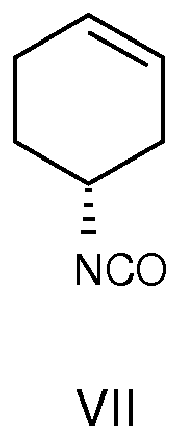 c) entweder Reaktion des Isocyanates der Stufe b) entweder durch Addition eines Alkohols, oder durch eine Reaktion mit einer starken organischen Säure und gegebenenfalls in Gegenwart vonCuCl,
oder Unterwerfung einer Verbindung der Formel VII der Hydrolyse mit nachfolgendem Verlust von Kohlendioxid zum Erhalt einer Verbindung der Formel IV
zum Erhalt einer Verbindung der Formel III, IIIS, IIISS oder IIISSS, respektive, gemäß Anspruch 9, worin PROT und R wie in einem der Ansprüche 1 bis 8 definiert sind, und PROT' Wasserstoff bedeutet,d) Unterwerfung einer Verbindung der Formel III, IIIS, IIISS or IIISSS, respektive, wie im Anspruch 9 definiert, der Epoxidation durch Verwendung eines Oxidationagens zum Erhalt eines korrespondierenden Oxirans der Formel I, IIS, IISS oder IISSS, respektive, gemäß Anspruch 9, worin PROT, PROT' und R wie in einem der Ansprüche 1 bis 8 definiert sind, in Lösung,e) Unterwerfung einer Verbindung, die in Stufe d) erhalten wurde der Oxiranringöffnung unter Einführung einer Schwefgelgrupped in die Seitenkette des Cyclohexylrings durch ein Schwefel-lieferndes Agens, undf) direkte Isolierung einer Verbindung der Formel I, IS, ISS oder ISSS nach einem der Ansprüche 1, 5, 6 oder 8, worin PROT, PROT" und R wie in einem der Ansprüche 1 bis 8 definiert sind, und PROT' Wasserstoff bedeuetet, gegebenenfalls durch Zugabe eines geeigneten Antisolvens,wobei gegebenenfalls die Reaktionen a) bis e) in einem einzigen Lösungsmittel oder Lösungsmittelsystem durchgeführt werden, und/oder wobei keines der Intermediate, die in a) bis d) erhalten werden, isoliert wird,
und Isolieren einer Verbindung der Formel I, IS, ISS oder ISSS in der Form eines kristallinen Feststoffs aus der Reaktionsmischung. - Verfahren nach Anspruch 11, worin keines der Intermediate, die in a) bis d) erhalten werden, isoliert wird.
- Verfahren nach einem der Ansprüche 11 oder 12, worin die Reaktionen a) bis e) in in einem einzigen Lösungsmittel oder Lösungsmittelsystem durchgeführt werden.
- Verwendung einer Verbindung der Formel II IIS, IISS, IISSS, III, IIIS, IIISS, oder IIISSS nach Anspruch 9, worin PROT, PROT' und R wie in einem der Ansprüche 1 bis 8 definiert sind, oder die Verwendung einer Verbindung der Formel IV, V, VI, VII und/oder IX gemäß Anspruch 11, worin eine Verbindung der Formel IV gegebenenfalls in Salzform, gegebenenfalls in der Form eines Hydrochlorids vorliegt; für die Herstellung einer Verbindung der Formel I, IS, ISS oder ISSS nach einem der Ansprüche 1, 5, 6 oder 8, worin PROT, PROT' und R wie in einem der Ansprüche 1 bis 8 definiert sind und PROT" Wasserstoff bedeutet, oder wie in einem der Ansprüche 1 bis 8 definiert ist.
Priority Applications (1)
| Application Number | Priority Date | Filing Date | Title |
|---|---|---|---|
| EP11721698.6A EP2576531B1 (de) | 2010-05-26 | 2011-05-23 | Enantiomerisch reine Amine |
Applications Claiming Priority (3)
| Application Number | Priority Date | Filing Date | Title |
|---|---|---|---|
| EP10450093A EP2390245A1 (de) | 2010-05-26 | 2010-05-26 | Enantiomerisch reine Amine |
| PCT/AT2011/000236 WO2011146953A1 (en) | 2010-05-26 | 2011-05-23 | Enantiomerically pure amines |
| EP11721698.6A EP2576531B1 (de) | 2010-05-26 | 2011-05-23 | Enantiomerisch reine Amine |
Publications (2)
| Publication Number | Publication Date |
|---|---|
| EP2576531A1 EP2576531A1 (de) | 2013-04-10 |
| EP2576531B1 true EP2576531B1 (de) | 2014-08-13 |
Family
ID=43128359
Family Applications (2)
| Application Number | Title | Priority Date | Filing Date |
|---|---|---|---|
| EP10450093A Withdrawn EP2390245A1 (de) | 2010-05-26 | 2010-05-26 | Enantiomerisch reine Amine |
| EP11721698.6A Active EP2576531B1 (de) | 2010-05-26 | 2011-05-23 | Enantiomerisch reine Amine |
Family Applications Before (1)
| Application Number | Title | Priority Date | Filing Date |
|---|---|---|---|
| EP10450093A Withdrawn EP2390245A1 (de) | 2010-05-26 | 2010-05-26 | Enantiomerisch reine Amine |
Country Status (9)
| Country | Link |
|---|---|
| US (1) | US8987498B2 (de) |
| EP (2) | EP2390245A1 (de) |
| JP (2) | JP6023701B2 (de) |
| KR (1) | KR101864805B1 (de) |
| CN (1) | CN103003256B (de) |
| DK (1) | DK2576531T3 (de) |
| ES (1) | ES2521017T3 (de) |
| TW (1) | TWI547466B (de) |
| WO (1) | WO2011146953A1 (de) |
Families Citing this family (7)
| Publication number | Priority date | Publication date | Assignee | Title |
|---|---|---|---|---|
| JP2002518077A (ja) | 1998-06-19 | 2002-06-25 | マリンクロット・インコーポレイテッド | アーチファクトを排除した無呼吸検出器 |
| EP2390245A1 (de) * | 2010-05-26 | 2011-11-30 | Nabriva Therapeutics AG | Enantiomerisch reine Amine |
| CN103382162B (zh) * | 2012-10-25 | 2015-02-25 | 乐山师范学院 | 一种酰基叠氮化合物的制备方法 |
| TWI762573B (zh) | 2017-02-10 | 2022-05-01 | 奧地利商納畢瓦治療有限責任公司 | 截短側耳素之純化 |
| CN111099989B (zh) * | 2019-12-27 | 2022-08-05 | 郑州手性药物研究院有限公司 | S-3-环己烯甲酸及其精制方法 |
| CN111170893B (zh) * | 2020-01-19 | 2022-04-26 | 郑州依米花手性药物研究有限公司 | Lefamulin的中间体化合物及其在Lefamulin制备中的应用 |
| CN118894800A (zh) * | 2024-06-27 | 2024-11-05 | 福建省微生物研究所 | 一种Lefamulin中间体化合物的制备方法 |
Family Cites Families (9)
| Publication number | Priority date | Publication date | Assignee | Title |
|---|---|---|---|---|
| US4353922A (en) * | 1981-03-13 | 1982-10-12 | Syntex (U.S.A.) Inc. | Anticholinergic bronchodilators |
| WO1997020789A1 (en) * | 1995-12-06 | 1997-06-12 | Japan Science And Technology Corporation | Process for preparating optically active compounds |
| GB9916647D0 (en) * | 1999-07-15 | 1999-09-15 | Imperial College | Compounds |
| WO2007041855A1 (en) * | 2005-10-13 | 2007-04-19 | Waratah Pharmaceuticals, Inc. | Scyllo-inositol derivatives and their use in the treatment of diseases characterised by abnormal protein folding or aggregation or amyloid formation, deposition, accumulation or persistence |
| CA2666624C (en) * | 2006-10-19 | 2015-12-29 | Signal Pharmaceuticals, Llc | Heteroaryl compounds, compositions thereof, and use thereof as protein kinase inhibitors |
| BRPI0721169A2 (pt) * | 2006-12-15 | 2014-03-18 | Janssen Pharmaceutica Nv | Inibidores de benzimidazol trpv1 |
| EP1972618A1 (de) * | 2007-03-20 | 2008-09-24 | Nabriva Therapeutics AG | Pleuromutilin-Derivate zur Behandlung von Krankheiten vermittelt durch Mikroben |
| CA2682676A1 (en) * | 2007-04-19 | 2008-10-30 | Novartis Ag | Nicotinic acid derivatives as modulators of metabotropic glutamate receptor-5 |
| EP2390245A1 (de) * | 2010-05-26 | 2011-11-30 | Nabriva Therapeutics AG | Enantiomerisch reine Amine |
-
2010
- 2010-05-26 EP EP10450093A patent/EP2390245A1/de not_active Withdrawn
-
2011
- 2011-05-23 WO PCT/AT2011/000236 patent/WO2011146953A1/en not_active Ceased
- 2011-05-23 US US13/699,585 patent/US8987498B2/en active Active
- 2011-05-23 ES ES11721698.6T patent/ES2521017T3/es active Active
- 2011-05-23 JP JP2013511475A patent/JP6023701B2/ja active Active
- 2011-05-23 CN CN201180036299.0A patent/CN103003256B/zh active Active
- 2011-05-23 KR KR1020127030732A patent/KR101864805B1/ko active Active
- 2011-05-23 TW TW100117949A patent/TWI547466B/zh active
- 2011-05-23 EP EP11721698.6A patent/EP2576531B1/de active Active
- 2011-05-23 DK DK11721698.6T patent/DK2576531T3/da active
-
2016
- 2016-08-05 JP JP2016154875A patent/JP2017008075A/ja active Pending
Also Published As
| Publication number | Publication date |
|---|---|
| TWI547466B (zh) | 2016-09-01 |
| WO2011146953A1 (en) | 2011-12-01 |
| DK2576531T3 (da) | 2014-11-03 |
| KR20130079407A (ko) | 2013-07-10 |
| ES2521017T3 (es) | 2014-11-12 |
| TW201209018A (en) | 2012-03-01 |
| EP2390245A1 (de) | 2011-11-30 |
| CN103003256A (zh) | 2013-03-27 |
| EP2576531A1 (de) | 2013-04-10 |
| US8987498B2 (en) | 2015-03-24 |
| HK1183298A1 (en) | 2013-12-20 |
| JP6023701B2 (ja) | 2016-11-09 |
| JP2013531626A (ja) | 2013-08-08 |
| KR101864805B1 (ko) | 2018-06-05 |
| JP2017008075A (ja) | 2017-01-12 |
| US20130072711A1 (en) | 2013-03-21 |
| CN103003256B (zh) | 2016-08-03 |
Similar Documents
| Publication | Publication Date | Title |
|---|---|---|
| EP2576531B1 (de) | Enantiomerisch reine Amine | |
| RU2433122C2 (ru) | Синтез ациламиноалкениленамидов, пригодных в качестве антагонистов вещества р | |
| DE602004011767T2 (de) | Cyclohexylsulfone als gamma-sekretase-inhibitoren | |
| US7317040B2 (en) | Nitric oxide synthase inhibitor phosphate salt | |
| JP6038021B2 (ja) | プレウロムチリンを調製するためのプロセス | |
| RU2478620C2 (ru) | Спироциклические нитрилы в качестве ингибиторов протеазы | |
| ZA200006847B (en) | Nitric oxide synthase inhibitors. | |
| AU673824B2 (en) | Cyclopentane- and -pentene-beta-amino acids | |
| US20260109669A1 (en) | Synthesis of (2s,5r)-5-(2-chlorophenyl)-1-(2'-methoxy-[1,1'-biphenyl]-4- carbonyl)pyrrolidine-2-carboxylic acid | |
| HK1183298B (en) | Enantiomerically pure amines | |
| US9745266B2 (en) | Indoline alkaloid compounds | |
| RU2388747C2 (ru) | Способы получения производных бицикло [3.1.0]гексана и промежуточные соединения для этой цели | |
| US6197811B1 (en) | Cytokine production inhibitors | |
| HK1253006B (en) | Process for the preparation of pleuromutilins | |
| JPH04356460A (ja) | 光学活性なビシクロ(2.2.1)ヘプタン−2,3−ジカルボン酸誘導体 | |
| JPS60104077A (ja) | 新規なγ‐アミノ酪酸アミノ基転移酵素抑制剤およびその製法 |
Legal Events
| Date | Code | Title | Description |
|---|---|---|---|
| PUAI | Public reference made under article 153(3) epc to a published international application that has entered the european phase |
Free format text: ORIGINAL CODE: 0009012 |
|
| 17P | Request for examination filed |
Effective date: 20121023 |
|
| AK | Designated contracting states |
Kind code of ref document: A1 Designated state(s): AL AT BE BG CH CY CZ DE DK EE ES FI FR GB GR HR HU IE IS IT LI LT LU LV MC MK MT NL NO PL PT RO RS SE SI SK SM TR |
|
| DAX | Request for extension of the european patent (deleted) | ||
| GRAP | Despatch of communication of intention to grant a patent |
Free format text: ORIGINAL CODE: EPIDOSNIGR1 |
|
| INTG | Intention to grant announced |
Effective date: 20131017 |
|
| REG | Reference to a national code |
Ref country code: HK Ref legal event code: DE Ref document number: 1183298 Country of ref document: HK |
|
| GRAS | Grant fee paid |
Free format text: ORIGINAL CODE: EPIDOSNIGR3 |
|
| GRAP | Despatch of communication of intention to grant a patent |
Free format text: ORIGINAL CODE: EPIDOSNIGR1 |
|
| INTG | Intention to grant announced |
Effective date: 20140307 |
|
| GRAA | (expected) grant |
Free format text: ORIGINAL CODE: 0009210 |
|
| AK | Designated contracting states |
Kind code of ref document: B1 Designated state(s): AL AT BE BG CH CY CZ DE DK EE ES FI FR GB GR HR HU IE IS IT LI LT LU LV MC MK MT NL NO PL PT RO RS SE SI SK SM TR |
|
| REG | Reference to a national code |
Ref country code: GB Ref legal event code: FG4D |
|
| RIN1 | Information on inventor provided before grant (corrected) |
Inventor name: HEILMAYER, WERNER Inventor name: BULUSU, ATCHYUTA, RAMA, CHANDRA, MURTY Inventor name: RIEDL, ROSEMARIE Inventor name: SPENCE, LEE |
|
| REG | Reference to a national code |
Ref country code: AT Ref legal event code: REF Ref document number: 682166 Country of ref document: AT Kind code of ref document: T Effective date: 20140815 Ref country code: CH Ref legal event code: EP |
|
| REG | Reference to a national code |
Ref country code: IE Ref legal event code: FG4D |
|
| REG | Reference to a national code |
Ref country code: DE Ref legal event code: R096 Ref document number: 602011009074 Country of ref document: DE Effective date: 20140925 |
|
| REG | Reference to a national code |
Ref country code: CH Ref legal event code: NV Representative=s name: BOHEST AG, CH |
|
| REG | Reference to a national code |
Ref country code: DK Ref legal event code: T3 Effective date: 20141030 |
|
| REG | Reference to a national code |
Ref country code: ES Ref legal event code: FG2A Ref document number: 2521017 Country of ref document: ES Kind code of ref document: T3 Effective date: 20141112 |
|
| REG | Reference to a national code |
Ref country code: SE Ref legal event code: TRGR |
|
| REG | Reference to a national code |
Ref country code: NL Ref legal event code: T3 |
|
| REG | Reference to a national code |
Ref country code: HK Ref legal event code: GR Ref document number: 1183298 Country of ref document: HK |
|
| REG | Reference to a national code |
Ref country code: LT Ref legal event code: MG4D |
|
| PG25 | Lapsed in a contracting state [announced via postgrant information from national office to epo] |
Ref country code: PT Free format text: LAPSE BECAUSE OF FAILURE TO SUBMIT A TRANSLATION OF THE DESCRIPTION OR TO PAY THE FEE WITHIN THE PRESCRIBED TIME-LIMIT Effective date: 20141215 Ref country code: NO Free format text: LAPSE BECAUSE OF FAILURE TO SUBMIT A TRANSLATION OF THE DESCRIPTION OR TO PAY THE FEE WITHIN THE PRESCRIBED TIME-LIMIT Effective date: 20141113 Ref country code: FI Free format text: LAPSE BECAUSE OF FAILURE TO SUBMIT A TRANSLATION OF THE DESCRIPTION OR TO PAY THE FEE WITHIN THE PRESCRIBED TIME-LIMIT Effective date: 20140813 Ref country code: BG Free format text: LAPSE BECAUSE OF FAILURE TO SUBMIT A TRANSLATION OF THE DESCRIPTION OR TO PAY THE FEE WITHIN THE PRESCRIBED TIME-LIMIT Effective date: 20141113 Ref country code: LT Free format text: LAPSE BECAUSE OF FAILURE TO SUBMIT A TRANSLATION OF THE DESCRIPTION OR TO PAY THE FEE WITHIN THE PRESCRIBED TIME-LIMIT Effective date: 20140813 Ref country code: GR Free format text: LAPSE BECAUSE OF FAILURE TO SUBMIT A TRANSLATION OF THE DESCRIPTION OR TO PAY THE FEE WITHIN THE PRESCRIBED TIME-LIMIT Effective date: 20141114 |
|
| PG25 | Lapsed in a contracting state [announced via postgrant information from national office to epo] |
Ref country code: RS Free format text: LAPSE BECAUSE OF FAILURE TO SUBMIT A TRANSLATION OF THE DESCRIPTION OR TO PAY THE FEE WITHIN THE PRESCRIBED TIME-LIMIT Effective date: 20140813 Ref country code: LV Free format text: LAPSE BECAUSE OF FAILURE TO SUBMIT A TRANSLATION OF THE DESCRIPTION OR TO PAY THE FEE WITHIN THE PRESCRIBED TIME-LIMIT Effective date: 20140813 Ref country code: HR Free format text: LAPSE BECAUSE OF FAILURE TO SUBMIT A TRANSLATION OF THE DESCRIPTION OR TO PAY THE FEE WITHIN THE PRESCRIBED TIME-LIMIT Effective date: 20140813 Ref country code: CY Free format text: LAPSE BECAUSE OF FAILURE TO SUBMIT A TRANSLATION OF THE DESCRIPTION OR TO PAY THE FEE WITHIN THE PRESCRIBED TIME-LIMIT Effective date: 20140813 Ref country code: IS Free format text: LAPSE BECAUSE OF FAILURE TO SUBMIT A TRANSLATION OF THE DESCRIPTION OR TO PAY THE FEE WITHIN THE PRESCRIBED TIME-LIMIT Effective date: 20141213 |
|
| PG25 | Lapsed in a contracting state [announced via postgrant information from national office to epo] |
Ref country code: SK Free format text: LAPSE BECAUSE OF FAILURE TO SUBMIT A TRANSLATION OF THE DESCRIPTION OR TO PAY THE FEE WITHIN THE PRESCRIBED TIME-LIMIT Effective date: 20140813 Ref country code: RO Free format text: LAPSE BECAUSE OF FAILURE TO SUBMIT A TRANSLATION OF THE DESCRIPTION OR TO PAY THE FEE WITHIN THE PRESCRIBED TIME-LIMIT Effective date: 20140813 Ref country code: CZ Free format text: LAPSE BECAUSE OF FAILURE TO SUBMIT A TRANSLATION OF THE DESCRIPTION OR TO PAY THE FEE WITHIN THE PRESCRIBED TIME-LIMIT Effective date: 20140813 Ref country code: EE Free format text: LAPSE BECAUSE OF FAILURE TO SUBMIT A TRANSLATION OF THE DESCRIPTION OR TO PAY THE FEE WITHIN THE PRESCRIBED TIME-LIMIT Effective date: 20140813 |
|
| REG | Reference to a national code |
Ref country code: DE Ref legal event code: R097 Ref document number: 602011009074 Country of ref document: DE |
|
| PG25 | Lapsed in a contracting state [announced via postgrant information from national office to epo] |
Ref country code: PL Free format text: LAPSE BECAUSE OF FAILURE TO SUBMIT A TRANSLATION OF THE DESCRIPTION OR TO PAY THE FEE WITHIN THE PRESCRIBED TIME-LIMIT Effective date: 20140813 |
|
| PLBE | No opposition filed within time limit |
Free format text: ORIGINAL CODE: 0009261 |
|
| STAA | Information on the status of an ep patent application or granted ep patent |
Free format text: STATUS: NO OPPOSITION FILED WITHIN TIME LIMIT |
|
| 26N | No opposition filed |
Effective date: 20150515 |
|
| PG25 | Lapsed in a contracting state [announced via postgrant information from national office to epo] |
Ref country code: SI Free format text: LAPSE BECAUSE OF FAILURE TO SUBMIT A TRANSLATION OF THE DESCRIPTION OR TO PAY THE FEE WITHIN THE PRESCRIBED TIME-LIMIT Effective date: 20140813 |
|
| PG25 | Lapsed in a contracting state [announced via postgrant information from national office to epo] |
Ref country code: MC Free format text: LAPSE BECAUSE OF FAILURE TO SUBMIT A TRANSLATION OF THE DESCRIPTION OR TO PAY THE FEE WITHIN THE PRESCRIBED TIME-LIMIT Effective date: 20140813 Ref country code: LU Free format text: LAPSE BECAUSE OF FAILURE TO SUBMIT A TRANSLATION OF THE DESCRIPTION OR TO PAY THE FEE WITHIN THE PRESCRIBED TIME-LIMIT Effective date: 20150523 |
|
| REG | Reference to a national code |
Ref country code: FR Ref legal event code: PLFP Year of fee payment: 6 |
|
| PG25 | Lapsed in a contracting state [announced via postgrant information from national office to epo] |
Ref country code: MT Free format text: LAPSE BECAUSE OF FAILURE TO SUBMIT A TRANSLATION OF THE DESCRIPTION OR TO PAY THE FEE WITHIN THE PRESCRIBED TIME-LIMIT Effective date: 20140813 |
|
| REG | Reference to a national code |
Ref country code: FR Ref legal event code: PLFP Year of fee payment: 7 |
|
| PG25 | Lapsed in a contracting state [announced via postgrant information from national office to epo] |
Ref country code: HU Free format text: LAPSE BECAUSE OF FAILURE TO SUBMIT A TRANSLATION OF THE DESCRIPTION OR TO PAY THE FEE WITHIN THE PRESCRIBED TIME-LIMIT; INVALID AB INITIO Effective date: 20110523 Ref country code: SM Free format text: LAPSE BECAUSE OF FAILURE TO SUBMIT A TRANSLATION OF THE DESCRIPTION OR TO PAY THE FEE WITHIN THE PRESCRIBED TIME-LIMIT Effective date: 20140813 |
|
| PG25 | Lapsed in a contracting state [announced via postgrant information from national office to epo] |
Ref country code: TR Free format text: LAPSE BECAUSE OF FAILURE TO SUBMIT A TRANSLATION OF THE DESCRIPTION OR TO PAY THE FEE WITHIN THE PRESCRIBED TIME-LIMIT Effective date: 20140813 |
|
| REG | Reference to a national code |
Ref country code: DE Ref legal event code: R082 Ref document number: 602011009074 Country of ref document: DE Representative=s name: GRAPE & SCHWARZENSTEINER, DE Ref country code: DE Ref legal event code: R081 Ref document number: 602011009074 Country of ref document: DE Owner name: NABRIVA THERAPEUTICS GMBH, AT Free format text: FORMER OWNER: NABRIVA THERAPEUTICS AG, WIEN, AT |
|
| REG | Reference to a national code |
Ref country code: CH Ref legal event code: PFA Owner name: NABRIVA THERAPEUTICS GMBH, AT Free format text: FORMER OWNER: NABRIVA THERAPEUTICS AG, AT |
|
| REG | Reference to a national code |
Ref country code: BE Ref legal event code: FP Effective date: 20141022 Ref country code: BE Ref legal event code: PD Owner name: NABRIVA THERAPEUTICS GMBH; AT Free format text: DETAILS ASSIGNMENT: CHANGE OF OWNER(S), CHANGEMENT DE FORME JURIDIQUE; FORMER OWNER NAME: NABRIVA THERAPEUTICS AG Effective date: 20180314 |
|
| REG | Reference to a national code |
Ref country code: FR Ref legal event code: PLFP Year of fee payment: 8 |
|
| REG | Reference to a national code |
Ref country code: ES Ref legal event code: PC2A Owner name: NABRIVA THERAPEUTICS GMBH Effective date: 20180605 Ref country code: ES Ref legal event code: PC2A Effective date: 20180605 |
|
| REG | Reference to a national code |
Ref country code: NL Ref legal event code: PD Owner name: NABRIVA THERAPEUTICS GMBH; AT Free format text: DETAILS ASSIGNMENT: CHANGE OF OWNER(S), CHANGE OF LEGAL ENTITY; FORMER OWNER NAME: NABRIVA THERAPEUTICS AG Effective date: 20180426 |
|
| PG25 | Lapsed in a contracting state [announced via postgrant information from national office to epo] |
Ref country code: MK Free format text: LAPSE BECAUSE OF FAILURE TO SUBMIT A TRANSLATION OF THE DESCRIPTION OR TO PAY THE FEE WITHIN THE PRESCRIBED TIME-LIMIT Effective date: 20140813 |
|
| REG | Reference to a national code |
Ref country code: FR Ref legal event code: CD Owner name: NABRIVA THERAPEUTICS GMBH, AT Effective date: 20180919 Ref country code: FR Ref legal event code: CJ Effective date: 20180919 |
|
| PG25 | Lapsed in a contracting state [announced via postgrant information from national office to epo] |
Ref country code: AL Free format text: LAPSE BECAUSE OF FAILURE TO SUBMIT A TRANSLATION OF THE DESCRIPTION OR TO PAY THE FEE WITHIN THE PRESCRIBED TIME-LIMIT Effective date: 20140813 |
|
| REG | Reference to a national code |
Ref country code: AT Ref legal event code: PC Ref document number: 682166 Country of ref document: AT Kind code of ref document: T Owner name: NABRIVA THERAPEUTICS GMBH, AT Effective date: 20180924 |
|
| PGFP | Annual fee paid to national office [announced via postgrant information from national office to epo] |
Ref country code: NL Payment date: 20250428 Year of fee payment: 15 |
|
| PGFP | Annual fee paid to national office [announced via postgrant information from national office to epo] |
Ref country code: DE Payment date: 20250430 Year of fee payment: 15 |
|
| PGFP | Annual fee paid to national office [announced via postgrant information from national office to epo] |
Ref country code: GB Payment date: 20250430 Year of fee payment: 15 Ref country code: DK Payment date: 20250428 Year of fee payment: 15 Ref country code: ES Payment date: 20250603 Year of fee payment: 15 |
|
| PGFP | Annual fee paid to national office [announced via postgrant information from national office to epo] |
Ref country code: BE Payment date: 20250428 Year of fee payment: 15 Ref country code: IT Payment date: 20250520 Year of fee payment: 15 |
|
| PGFP | Annual fee paid to national office [announced via postgrant information from national office to epo] |
Ref country code: FR Payment date: 20250428 Year of fee payment: 15 |
|
| PGFP | Annual fee paid to national office [announced via postgrant information from national office to epo] |
Ref country code: CH Payment date: 20250601 Year of fee payment: 15 |
|
| PGFP | Annual fee paid to national office [announced via postgrant information from national office to epo] |
Ref country code: AT Payment date: 20250429 Year of fee payment: 15 |
|
| PGFP | Annual fee paid to national office [announced via postgrant information from national office to epo] |
Ref country code: IE Payment date: 20250429 Year of fee payment: 15 |
|
| PGFP | Annual fee paid to national office [announced via postgrant information from national office to epo] |
Ref country code: SE Payment date: 20250428 Year of fee payment: 15 |