EP2576871B1 - Procédé de placage d'acier inoxydable et matériau plaqué associé - Google Patents
Procédé de placage d'acier inoxydable et matériau plaqué associé Download PDFInfo
- Publication number
- EP2576871B1 EP2576871B1 EP11731063.1A EP11731063A EP2576871B1 EP 2576871 B1 EP2576871 B1 EP 2576871B1 EP 11731063 A EP11731063 A EP 11731063A EP 2576871 B1 EP2576871 B1 EP 2576871B1
- Authority
- EP
- European Patent Office
- Prior art keywords
- stainless steel
- plating
- layer
- metal layer
- steel substrate
- Prior art date
- Legal status (The legal status is an assumption and is not a legal conclusion. Google has not performed a legal analysis and makes no representation as to the accuracy of the status listed.)
- Not-in-force
Links
Images


Classifications
-
- C—CHEMISTRY; METALLURGY
- C25—ELECTROLYTIC OR ELECTROPHORETIC PROCESSES; APPARATUS THEREFOR
- C25D—PROCESSES FOR THE ELECTROLYTIC OR ELECTROPHORETIC PRODUCTION OF COATINGS; ELECTROFORMING; APPARATUS THEREFOR
- C25D5/00—Electroplating characterised by the process; Pretreatment or after-treatment of workpieces
- C25D5/60—Electroplating characterised by the structure or texture of the layers
- C25D5/615—Microstructure of the layers, e.g. mixed structure
- C25D5/619—Amorphous layers
-
- C—CHEMISTRY; METALLURGY
- C23—COATING METALLIC MATERIAL; COATING MATERIAL WITH METALLIC MATERIAL; CHEMICAL SURFACE TREATMENT; DIFFUSION TREATMENT OF METALLIC MATERIAL; COATING BY VACUUM EVAPORATION, BY SPUTTERING, BY ION IMPLANTATION OR BY CHEMICAL VAPOUR DEPOSITION, IN GENERAL; INHIBITING CORROSION OF METALLIC MATERIAL OR INCRUSTATION IN GENERAL
- C23C—COATING METALLIC MATERIAL; COATING MATERIAL WITH METALLIC MATERIAL; SURFACE TREATMENT OF METALLIC MATERIAL BY DIFFUSION INTO THE SURFACE, BY CHEMICAL CONVERSION OR SUBSTITUTION; COATING BY VACUUM EVAPORATION, BY SPUTTERING, BY ION IMPLANTATION OR BY CHEMICAL VAPOUR DEPOSITION, IN GENERAL
- C23C28/00—Coating for obtaining at least two superposed coatings either by methods not provided for in a single one of groups C23C2/00 - C23C26/00 or by combinations of methods provided for in subclasses C23C and C25C or C25D
- C23C28/02—Coating for obtaining at least two superposed coatings either by methods not provided for in a single one of groups C23C2/00 - C23C26/00 or by combinations of methods provided for in subclasses C23C and C25C or C25D only coatings only including layers of metallic material
-
- C—CHEMISTRY; METALLURGY
- C23—COATING METALLIC MATERIAL; COATING MATERIAL WITH METALLIC MATERIAL; CHEMICAL SURFACE TREATMENT; DIFFUSION TREATMENT OF METALLIC MATERIAL; COATING BY VACUUM EVAPORATION, BY SPUTTERING, BY ION IMPLANTATION OR BY CHEMICAL VAPOUR DEPOSITION, IN GENERAL; INHIBITING CORROSION OF METALLIC MATERIAL OR INCRUSTATION IN GENERAL
- C23C—COATING METALLIC MATERIAL; COATING MATERIAL WITH METALLIC MATERIAL; SURFACE TREATMENT OF METALLIC MATERIAL BY DIFFUSION INTO THE SURFACE, BY CHEMICAL CONVERSION OR SUBSTITUTION; COATING BY VACUUM EVAPORATION, BY SPUTTERING, BY ION IMPLANTATION OR BY CHEMICAL VAPOUR DEPOSITION, IN GENERAL
- C23C28/00—Coating for obtaining at least two superposed coatings either by methods not provided for in a single one of groups C23C2/00 - C23C26/00 or by combinations of methods provided for in subclasses C23C and C25C or C25D
- C23C28/02—Coating for obtaining at least two superposed coatings either by methods not provided for in a single one of groups C23C2/00 - C23C26/00 or by combinations of methods provided for in subclasses C23C and C25C or C25D only coatings only including layers of metallic material
- C23C28/028—Including graded layers in composition or in physical properties, e.g. density, porosity, grain size
-
- C—CHEMISTRY; METALLURGY
- C25—ELECTROLYTIC OR ELECTROPHORETIC PROCESSES; APPARATUS THEREFOR
- C25D—PROCESSES FOR THE ELECTROLYTIC OR ELECTROPHORETIC PRODUCTION OF COATINGS; ELECTROFORMING; APPARATUS THEREFOR
- C25D5/00—Electroplating characterised by the process; Pretreatment or after-treatment of workpieces
- C25D5/10—Electroplating with more than one layer of the same or of different metals
-
- C—CHEMISTRY; METALLURGY
- C25—ELECTROLYTIC OR ELECTROPHORETIC PROCESSES; APPARATUS THEREFOR
- C25D—PROCESSES FOR THE ELECTROLYTIC OR ELECTROPHORETIC PRODUCTION OF COATINGS; ELECTROFORMING; APPARATUS THEREFOR
- C25D5/00—Electroplating characterised by the process; Pretreatment or after-treatment of workpieces
- C25D5/10—Electroplating with more than one layer of the same or of different metals
- C25D5/12—Electroplating with more than one layer of the same or of different metals at least one layer being of nickel or chromium
- C25D5/14—Electroplating with more than one layer of the same or of different metals at least one layer being of nickel or chromium two or more layers being of nickel or chromium, e.g. duplex or triplex layers
-
- C—CHEMISTRY; METALLURGY
- C25—ELECTROLYTIC OR ELECTROPHORETIC PROCESSES; APPARATUS THEREFOR
- C25D—PROCESSES FOR THE ELECTROLYTIC OR ELECTROPHORETIC PRODUCTION OF COATINGS; ELECTROFORMING; APPARATUS THEREFOR
- C25D5/00—Electroplating characterised by the process; Pretreatment or after-treatment of workpieces
- C25D5/34—Pretreatment of metallic surfaces to be electroplated
-
- C—CHEMISTRY; METALLURGY
- C25—ELECTROLYTIC OR ELECTROPHORETIC PROCESSES; APPARATUS THEREFOR
- C25D—PROCESSES FOR THE ELECTROLYTIC OR ELECTROPHORETIC PRODUCTION OF COATINGS; ELECTROFORMING; APPARATUS THEREFOR
- C25D5/00—Electroplating characterised by the process; Pretreatment or after-treatment of workpieces
- C25D5/34—Pretreatment of metallic surfaces to be electroplated
- C25D5/36—Pretreatment of metallic surfaces to be electroplated of iron or steel
-
- C—CHEMISTRY; METALLURGY
- C25—ELECTROLYTIC OR ELECTROPHORETIC PROCESSES; APPARATUS THEREFOR
- C25D—PROCESSES FOR THE ELECTROLYTIC OR ELECTROPHORETIC PRODUCTION OF COATINGS; ELECTROFORMING; APPARATUS THEREFOR
- C25D5/00—Electroplating characterised by the process; Pretreatment or after-treatment of workpieces
- C25D5/48—After-treatment of electroplated surfaces
- C25D5/50—After-treatment of electroplated surfaces by heat-treatment
-
- C—CHEMISTRY; METALLURGY
- C25—ELECTROLYTIC OR ELECTROPHORETIC PROCESSES; APPARATUS THEREFOR
- C25D—PROCESSES FOR THE ELECTROLYTIC OR ELECTROPHORETIC PRODUCTION OF COATINGS; ELECTROFORMING; APPARATUS THEREFOR
- C25D7/00—Electroplating characterised by the article coated
-
- Y—GENERAL TAGGING OF NEW TECHNOLOGICAL DEVELOPMENTS; GENERAL TAGGING OF CROSS-SECTIONAL TECHNOLOGIES SPANNING OVER SEVERAL SECTIONS OF THE IPC; TECHNICAL SUBJECTS COVERED BY FORMER USPC CROSS-REFERENCE ART COLLECTIONS [XRACs] AND DIGESTS
- Y10—TECHNICAL SUBJECTS COVERED BY FORMER USPC
- Y10T—TECHNICAL SUBJECTS COVERED BY FORMER US CLASSIFICATION
- Y10T428/00—Stock material or miscellaneous articles
- Y10T428/12—All metal or with adjacent metals
- Y10T428/12493—Composite; i.e., plural, adjacent, spatially distinct metal components [e.g., layers, joint, etc.]
- Y10T428/12771—Transition metal-base component
- Y10T428/12861—Group VIII or IB metal-base component
- Y10T428/12944—Ni-base component
Definitions
- the present invention relates to a method of plating a surface of a stainless steel and a plated material therefor, and particularly to a method of plating a highly corrosion-resistant stainless steel and a plated material.
- plating films such as zinc, nickel, and chromium to reduce corrosion of the steel substrate.
- plating films such as zinc, nickel, and chromium to reduce corrosion of the steel substrate.
- steel is generally coated with zinc plating or the like that provides sacrificial corrosive effect.
- simply applying plating with the sacrificial corrosive effect may not sufficiently prevent progress of corrosion of the steel substrate.
- JP 2004-205059 describes a method of plating a stainless steel substrate, in which a phosphorus-containing nickel film is deposited on the surface of a ferritic or austenitic stainless steel plate by electroless plating and subsequently the phosphorus-containing nickel is diffused into the interior thereof by heat treatment.
- nickel of the phosphorus-containing nickel film (nickel plating layer) crystallizes by the heat treatment, since the nickel plating layer is coated over the surface of the stainless steel, the corrosion resistance of the stainless steel is improved.
- JP 2004-205059 even if a plating layer such as a nickel plating layer is provided over the surface of the stainless steel as disclosed in JP 2004-205059 , the plating layer may corrode if it is exposed to a strongly acidic environment at, for example a pH of 2-3 for a long period.
- JP 2007-254848 A likewise in the article by Z. Abdel Hamit et al: "Enhancement of the properties of austenitic stainless steel by nickel diffusion coatings", Anti-Corrosion Methods and Materials, vol. 50, no. 2, 1 January 2003, pages 115-120 , a pure nickel plating layer forming a Ni-Fe diffusion layer is disclosed, wherein no corrosion resistance is obtained.
- pinholes small holes that extend from the surface of the plating layer of nickel or the like to the interior, which is referred to as pinholes, are slightly formed in such a plating layer.
- a corrosive liquid such as an acid solution infiltrates via the pinholes. Pitting corrosion may thereby occur in the stainless steel substrate (base material) as described above.
- the present invention provides a method of plating a stainless steel substrate which can prevent pitting corrosion of the stainless steel substrate in a harsh corrosive environments is reduced and plated material therefor.
- the objects are achieved by a method according to claim 1, and a plated material according to claim 8.
- Preferred embodiments are subject of dependent claims.
- a first aspect of the present invention relates to a method of plating a stainless steel.
- the method of plating includes: coating a first plating metal layer over a stainless steel; forming an interdiffusion layer in which elements of the stainless steel and elements of the first plating metal layer interdiffuse, by applying a heat treatment to the stainless steel coated by the first plating metal layer; and coating a second plating metal layer over the stainless steel having the interdiffusion layer formed therein.
- the first plating metal layer is first coated over the stainless steel (member made of stainless steel).
- the interdiffusion layer is next formed by use of the first plating metal layer.
- the heat treatment is applied to the stainless steel coated with the first plating metal layer, thereby the elements of the first plating metal layer diffuse from the interface to the stainless steel to the interior of the stainless steel, and the elements (Fe, Cr, C, and so forth) of the stainless steel also diffuse from the interface of the first plating metal layer to the interior of the first plating metal layer.
- the layer having the elements of both the materials interdiffused therein is referred to as the interdiffusion layer.
- the second plating metal layer is next coated over the stainless steel having the interdiffusion layer formed therein.
- the metals that form the interdiffusion layer are baser metals (metals having higher ionization tendencies) than the metals that form the second plating metal layer, and thus the interdiffusion layer serves as a sacrificial corrosive layer. Accordingly, the interdiffusion layer corrodes before corrosion progresses to the base material made of stainless steel. As a result, corrosion progresses in the direction along the surface of the base material made of stainless steel, and corrosion in the thickness direction of the base material made of stainless steel, that is, pitting corrosion of the base material made of stainless steel can be thus prevented.
- platting metal layer is a layer whose main material is a metallic material.
- the elements of the stainless steel can be diffused into the first plating metal layer by heat treatment so that a part or all of the first plating metal layer becomes the interdiffusion layer.
- the elements of the stainless steel in the above-described method of plating stainless steel, can be diffused to the surface of the first plating metal layer in the forming of the interdiffusion layer.
- the method is that the elements of the stainless steel are diffused throughout the first plating metal layer.
- the elements of the stainless steel are diffused to the surface of the first plating metal layer, iron is present in this surface (the surface of the interdiffusion layer). Accordingly, the adhesive strength of the second plating metal layer coated over this surface is further improved compared to a plating metal layer having no iron on its surface.
- the passivation film (a chromium oxide film specific to stainless steels, which is formed by oxidation in the atmosphere) before coating the first plating metal layer.
- the passivation film formed on the surface of the stainless steel may be removed by electrolytic plating, and a plating metal layer of the same kind of plating metal as the first plating metal layer may be also coated over the surface from which the passivation film has been removed, before coating the first plating metal layer.
- the passivation film can be removed in the same plating bath by electrolytic plating, and the plating metal layer (strike plating layer) of the same kind as the first plating metal layer can be coated. Accordingly, since the stainless steel is not exposed to the atmosphere after the removal of the passivation film, the plating metal layer with high adhesive strength (strike plating layer) can be formed in a state in which the passivation film is hindered from forming again. Further, since the plating metal layer of the same kind is formed, the adhesive strength of the first plating metal layer can be also improved.
- plating metal of the same kind as the plating metal of the first plating metal layer means that the metal to be the main material is the same.
- the first plating metal layer may be nickel-based metals (i.e. nickel or compounds having nickel as their main material). In this case, the plating metal to be plated is a nickel-based metal.
- the plating metal of the first plating metal layer is not specifically limited if the plating metal does not melt in the heat treatment for forming the interdiffusion layer and the elements that form the metal diffuse into the stainless steel, but is preferably a nobler metal (metals having lower ionization tendencies) than the stainless steel.
- examples of the plating metal of the first plating metal layer are nickel, chromium, tin, palladium, alloy metals of those, and so forth.
- the plating metal of the first plating metal layer may be a nickel-based metal. Nickel based metals (nickel and compounds having nickel as their main material) are more versatile than other metals, and can diffuse nickel into stainless steel without melting in the heat treatment for forming the interdiffusion layer and further without sensitization of stainless steel.
- the stainless steel is not specifically limited, but may be a ferritic stainless steel, austenitic stainless steel, martensitic stainless steel, or the like.
- the temperature condition of the heat treatment is not specifically limited if the elements of the stainless steel and the elements of the first plating metal layer can interdiffuse.
- the stainless steel may be an austenitic stainless steel.
- the heat treatment can be applied by heating the stainless steel at a temperature in the range of 800°C to 1100°C.
- intergranular corrosion or the like by acids can be prevented by the use of an austenitic stainless steel, and sensitization of the stainless steel can be also prevented by heating the austenitic stainless steel in such a heat treatment condition.
- the heat treatment temperature is from 600°C to lower than 800°C
- Cr carbide deposits in the austenite grain boundary, and a Cr-depleted layer is formed in a vicinity of the grain boundary, resulting in sensitization of the stainless steel. Accordingly, the stainless steel after the heat treatment becomes prone to intergranular corrosion.
- the heat treatment temperature exceeding 1100°C may also result in a similar phenomenon.
- the second plating metal layer is preferably a nobler metal than the metal of the interdiffusion layer, for example, a highly corrosion-resistant metal such as Ni, Cr, Ti, W, or Sn (simple substance or alloy) that forms a strong oxidation film on its surface or an inert metal or the like such as Au, Pd, Ag, Pt, or Rh that is referred to as noble metal.
- the plating metal of the second plating metal layer may be phosphorus containing nickel, and the stainless steel may be heated at 300°C or lower after the second plating metal layer is coated. The stainless steel may be heated at 150°C or higher.
- the phosphorus-containing nickel (Ni-P) obtained by plating is highly corrosion-resistant since it is amorphous metal.
- the temperature of the heating condition exceeds 300°C, crystallization of the phosphorus containing nickel (Ni-P) progresses, and such crystallization may result in a reduction in corrosion resistance of the second plating metal layer.
- the lower limit of the heating temperature may be 150°C or higher. Accordingly, the above-described effect can be more appropriately provided.
- Etching may be applied the stainless substrate having the interdiffusion layer before the second plating layer is deposited. Accordingly, oxides or the like on the surface of the plating layer can be removed, and adhesion of the second plating metal layer in later steps can be enhanced.
- a second aspect of the present invention relates to a plated material in which a stainless steel is plated.
- a plated material in accordance with the second aspect of the present invention is a plated material in which a stainless steel is plated and which includes an interdiffusion layer having elements of the stainless steel and elements of the plating metal layer interdiffused therein, which is formed between the stainless steel and the plating metal layer.
- the interdiffusion layer since the interdiffusion layer is formed between the stainless steel and the plating metal layer, the interdiffusion layer serves as a sacrificial corrosive layer. Accordingly, since the interdiffusion layer corrodes first, corrosion progresses in the direction along the surface of the base material made of stainless steel. Corrosion in the thickness direction of the base material made of stainless steel, that is, pitting corrosion of the base material made of stainless steel can be thus prevented.
- the plating metal layer may be formed of a nickel-based metal, and a layer of amorphous phosphorus containing nickel may be formed on at least a surface layer of the plating metal layer.
- the corrosion resistance of the plated material can be improved.
- the stainless steel of the plated material may be an austenitic stainless steel.
- Use of the austenitic stainless steel allows prevention of intergranular corrosion or the like, and thus allows further improvement of the corrosion resistance of the plated material.
- the thickness of the interdiffusion layer may be greater than the maximum height of surface roughness of the stainless steel. Accordingly, the interdiffusion layer can uniformly cover the surface of the stainless steel.
- the method of plating and plated material in accordance with the aspects of the present invention enable prevention of pitting corrosion of a stainless steel in a harsh corrosive environment.
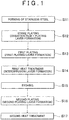
- FIG. 1 is a flowchart explaining each step of a method of plating on a stainless steel substrate in accordance with the embodiment of the present invention.
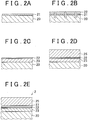
- FIGs. 2A through 2E are schematic cross-sectional views of the stainless steel substrate in the steps shown in FIG. 1 .
- FIG. 2A is a view illustrating a strike plating step.
- FIG. 2B is a cross-sectional view of the stainless steel substrate after a first plating step.
- FIG. 2C is a cross-sectional view of the stainless steel substrate after a first heat treatment.
- FIG. 2D is a cross-sectional view after a second plating step.
- FIG. 2E is a cross-sectional view after a second heat treatment.
- the steps in FIG. 1 will be described hereinafter with the respective cross-sectional views of the stainless steel substrate in FIGs. 2A-2E .
- a forming step S 11 for the stainless steel substrate is first conducted. Specifically, as the stainless steel to be plated, a raw material made of austenitic stainless steel (for example, JIS (Japanese Industrial Standards): SUS304, SUS316, or other) is prepared, and this stainless steel substrate may be formed into a desired product shape by press forming or the like.
- JIS Japanese Industrial Standards
- a strike plating step S12 is next conducted as chemical plating.
- the stainless steel substrate may be dipped into a nickel plating bath containing a strong acid solution (for example, hydrochloric acid) having nickel dissolved therein. Electric current of a specified current value is applied thereto for a specified period by electrolytic plating, thereby removing a passivation film (oxidation film) on the surface of the stainless steel substrate.
- a strong acid solution for example, hydrochloric acid
- electrolytic plating As shown in FIG. 2A , an electrolytic nickel strike plating layer 21 is at the same time deposited over the surface of a stainless steel substrate 20. Subsequently, the stainless steel substrate is washed with water and dried.
- a first plating step S 13 is next conducted.
- electroless nickel-boron (Ni-B) plating is conducted as chemical plating.
- the stainless steel substrate is dipped into a plating liquid containing nickel sulfate, DMBA, organic acid, and other additives, and, as shown in FIG. 2B , a nickel-boron plating layer (first plating metal layer) 22 is coated over the surface of the electrolytic nickel strike plating layer 21.
- vibration may be applied to the stainless steel substrate while the stainless steel substrate is dipped into the plating liquid. This allows prevention of formation of pinholes due to hydrogen gas produced in the layer during the formation of the first plating metal layer 22.
- a first heat treatment step S 14 is next conducted. Specifically, the stainless steel substrate over which the nickel-boron plating layer (first plating metal layer) made of a boron-containing nickel alloy is washed by water and dried. Subsequently, the heat treatment is applied to the stainless steel substrate in a heating condition of vacuum atmosphere at temperature of 800-1100°C for several hours (for example, a heating condition of 1080°C for 6 hours).
- nickel of the electrolytic nickel strike plating layer 21 and the first plating metal layer 22 diffuses from the interface of the stainless steel substrate into the interior thereof, and Fe, Cr, C, and others of the stainless steel substrate 20 diffuse from the interfaces of the electrolytic nickel strike plating layer 21 and the first plating metal layer 22 into the interiors thereof.
- an interdiffusion layer 23 in which the elements of the stainless steel substrate 20 and the elements of first plating metal layer 22 interdiffuse is formed between the stainless steel substrate 20 and the first plating metal layer 22.
- the interdiffusion layer 23 is preferably formed such that the layer thickness of the interdiffusion layer 23 exceeds at least the maximum height of surface roughness of the stainless steel substrate 20. Accordingly, the interdiffusion layer 23 can uniformly cover the surface of the stainless steel substrate 20.
- the elements of the stainless steel may be diffused throughout the interior of the first plating metal layer 22. This allows not only uniform coverage of the surface of the stainless steel substrate 20 by the interdiffusion layer but also diffusion of the element (Fe) of the stainless steel to the surface of the first plating metal layer 22. As a result, adhesion strength of the second plating metal layer that is coated over the surface where iron is present can be enhanced compared to a surface shown in FIG. 2C where no iron is present.
- An etching step S 15 is next conducted. Specifically, the stainless steel substrate having the interdiffusion layer formed therein is sequentially washed by water, dipped into a hydrochloric acid solution, washed by water, and dried. Accordingly, oxides or the like on the surface of the plating layer can be removed, and adhesion of the second plating metal layer in later steps can be enhanced.
- a second plating step S16 is next conducted.
- electroless nickel-phosphorus (Ni-P) plating is conducted as chemical plating.
- the stainless steel substrate is dipped into a plating liquid containing nickel sulfate, sodium hypophosphite, organic acid, and other additives, and, as shown in FIG. 2D , a nickel-phosphorus plating layer (second plating metal layer) 25 made of amorphous phosphorus-containing nickel (Ni-P) is coated over the surface of the first plating metal layer 22 to a thickness of several tens ⁇ m.
- vibration may be applied to the stainless steel substrate while the stainless steel substrate is dipped into the plating liquid.
- a second heat treatment step S 17 is finally conducted.
- the stainless steel substrate after the second plating is washed by water and dried, and subsequently the second heat treatment is applied to the stainless steel substrate in a heating condition of a temperature of 300°C or less for several hours (for example, a condition of 280°C for 1 hour).
- a diffusion layer 27 having nickel and phosphorus of the second plating metal layer 25 diffused therein can be formed with preventing crystallization of amorphous phosphorus-containing nickel and keeping its amorphous state. Further, this allows a reduction in corrosion due to pinholes formed in each of the plating layers 22, 25, the interdiffusion layer 23, and diffusion layer 27.
- the series of steps described above allows obtainment of a plated material 2 having the interdiffusion layer 23 in which, as shown in FIG. 2E , Fe, Cr, and C of the stainless steel and nickel of the first plating metal layer (nickel-boron plating layer) 22 interdiffuse between the austenitic stainless steel substrate 20 and the second plating metal layer (nickel-phosphorus plating layer) 25.
- the alloy metal containing Fe, Cr, and Ni that form the interdiffusion layer 23 is a baser metal (metal having a higher ionization tendency) than nickel of the second plating metal layer 25, and thus the interdiffusion layer 23 serves as a sacrificial corrosive layer. Accordingly, the interdiffusion layer 23 first corrodes before corrosion progresses to the stainless steel substrate 20. As a result, since corrosion progresses in the direction along the surface of the stainless steel substrate 20, corrosion in the thickness direction of the stainless steel substrate 20, that is, pitting corrosion of the stainless steel substrate 20 can be prevented.
- Example 1 A plated material (test sample) in which plating was applied to a stainless steel was fabricated as described in the following.
- Ni-B plating liquid (Okuno Chemical Industries Co., Ltd.: Top Chem Alloy 66-LF) made of 25 g/L of nickel sulfate, several g/L of DMBA, 10 g/L of organic acid, and other additives was adjusted to Ni concentration of 5.5-6.5 g/L, pH of 6.0-6.5, at temperature of 64°C, and in this solution an electroless Ni-B plating layer (first plating metal layer) was coated over the surface of the stainless steel substrate with vibration applied to the stainless steel substrate until the layer thickness reaches 3 ⁇ m. The stainless steel substrate was then washed by water and hot water and dried.
- Ni-B plating liquid (Okuno Chemical Industries Co., Ltd.: Top Chem Alloy 66-LF) made of 25 g/L of nickel sulfate, several g/L of DMBA, 10 g/L of organic acid, and other additives was adjusted to Ni concentration of 5.5-6.5 g/L, pH of 6.0-6.5
- electroless Ni-P plating was conducted as a second plating step.
- an electroless Ni-P plating liquid (Okuno Chemical Industries Co., Ltd.: Top Nicoron NAC) made of 25 g/L of nickel sulfate, 15 g/L of sodium hypophosphite, 10 g/L of organic acid, and other additives was adjusted to Ni concentration of 5.2-6.8 g/L, pH of 4.4-4.8, at temperature of 84°C, and in this solution an electroless Ni-P plating layer (second plating metal layer) is coated over the plating layer (interdiffusion layer) with vibration applied to the stainless steel substrate until the layer thickness reaches 30 ⁇ m. Subsequently, the stainless steel substrate was washed by water and hot water.
- an electroless Ni-P plating liquid (Okuno Chemical Industries Co., Ltd.: Top Nicoron NAC) made of 25 g/L of nickel sulfate, 15 g/L of sodium hypophosphite,
- Example 2 A plated material was fabricated in a manner similar to Example 1. This plated material differs from Example 1 in that an austenitic stainless steel (JIS: SUS316) further containing Mo was used as the stainless steel substrate and a strike plating step was conducted instead of the passivation film removal step. Specifically, the stainless steel was dipped into a solution of Ni concentration of 60 g/L and hydrochloric acid concentration of 35 g/L and underwent removal of passivation films by application of electric current of 1.5 A/dm 2 for 5 minutes at room temperature. The surface of the stainless steel substrate from which the passivation films had been removed was coated with an electrolytic strike plating layer to a thickness of 0.3 ⁇ m.
- JIS: SUS316 austenitic stainless steel
- Comparative Example 1 A stainless steel (JIS: SUS304) same as Example 1 was prepared and used as a test sample. In other words, in Comparative Example 1, plating was not applied to the stainless steel substrate.
- Comparative Example 2 A stainless steel (JIS: SUS316) same as Example 2 was prepared and used as a test sample. In other words, in Comparative Example 2, plating was not applied to the stainless steel substrate.
- Comparative Example 3 A stainless steel same as Example 1 was prepared. In the plating on this stainless steel substrate, only the passivation film removal step, the second plating step, and the second heat treatment of Example 1 were conducted. In other words, Comparative Example 3 differs from example 1 in that the first plating and the first heat treatment were not conducted (no interdiffusion layer was formed.)
- FIGs. 3A and 3B are cross-sectional views of the plated material in accordance with Example 1 after an anticorrosion test.
- FIG. 3A is a cross-sectional photograph of a vicinity of a corrosion hole.
- FIG. 3B is an enlarged photograph of FIG. 3A .
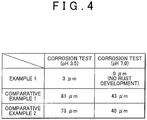
- Corrosion test liquids at pHs of 3.5 and 7.0 which are mixture of hydrochloric acid and sulfuric acid solutions were prepared. Each test sample of Example 1, Comparative Examples 1 and 2 was dipped into the solutions warmed to 90°C for 6 hours. Those test samples were then taken out, cooled for 1 hour, and left in the atmosphere in wet states for 17 hours. Setting these steps as 1 cycle, the test was carried out for continuous 8 cycles (8 days). Subsequently, the maximum corrosion depths in the stainless steels (base materials) after the test were measured. FIG. 4 shows the results. The maximum corrosion depths are the maximum value of corrosion depth from the interface between the interdiffusion layer and the stainless steel base material in Example 1 and the maximum values of corrosion depth from the interface between the passivation films and the stainless steel base materials in Comparative Examples 1 and 2.
- the alloy metal containing Fe, Cr, and Ni that form the interdiffusion layer is a baser metal (metal having a higher ionization tendency) than nickel in the second plating metal layer in the test sample of Example 1, the interdiffusion layer served as a sacrificial corrosive layer, and thus the interdiffusion layer first corroded before corrosion progressed to the stainless steel (base material). As a result, it is considered that corrosion progressed in the direction along the surface of the stainless steel, thus preventing pitting corrosion in the stainless steel.
- the first and second plating steps are conducted by electroless plating.
- Electroless plating is effective to uniformly coat the plating layer in a case that the stainless steel has a complicated shape.
- electrolytic plating may be used in a case that the stainless steel has a simple shape (plate shape or the like).
- all plating is conducted by wet plating.
- the plating enables formation of the interdiffusion layer, obtainment of corrosion resistance of the plating layer, and prevention of intergranular corrosion of the stainless steel, at least a part of the plating may be conducted by dry-process plating or the like such as hot dip coating, sputtering, or vapor deposition.
Landscapes
- Chemical & Material Sciences (AREA)
- Organic Chemistry (AREA)
- Engineering & Computer Science (AREA)
- Chemical Kinetics & Catalysis (AREA)
- Materials Engineering (AREA)
- Metallurgy (AREA)
- Electrochemistry (AREA)
- Mechanical Engineering (AREA)
- Crystallography & Structural Chemistry (AREA)
- Electroplating Methods And Accessories (AREA)
- Chemically Coating (AREA)
- Solid-Phase Diffusion Into Metallic Material Surfaces (AREA)
- Other Surface Treatments For Metallic Materials (AREA)
Claims (10)
- Procédé de placage d'un acier inoxydable, comprenant :le dépôt d'une première couche de métal de placage (22) sur un substrat en acier inoxydable (20), la première couche de métal de placage (22) étant formée d'une couche de placage de nickel-bore constituée d'un alliage de nickel contenant du bore ;la formation d'une couche d'interdiffusion (23) dans laquelle au moins le fer et le chrome du substrat en acier inoxydable et le nickel et le bore de la première couche de métal de placage s'interdiffusent, par application d'un traitement thermique au substrat en acier inoxydable revêtu par la première couche de métal de placage (22) ; etle dépôt d'une seconde couche de métal de placage (25) sur le substrat en acier inoxydable (20) dans lequel est formée la couche d'interdiffusion, la seconde couche de métal de placage (25) étant formée d'une couche de placage de nickel-phosphore constituée de nickel contenant du phosphore amorphe.
- Procédé selon la revendication 1,
dans lequel les éléments du substrat en acier inoxydable (20) se diffusent à travers l'ensemble de la première couche de métal de placage (22) lors de la formation de la couche d'interdiffusion (23). - Procédé selon la revendication 1 ou 2, comprenant en outre :le retrait d'un film de passivation qui est formé sur une surface du substrat en acier inoxydable (20) par placage électrolytique et le dépôt d'une couche de métal de placage (21) ayant le même type de métal de placage que la première couche de métal de placage (22) avant le dépôt de la première couche de métal de placage (22).
- Procédé selon l'une quelconque des revendications 1 à 3,
dans lequel le substrat en acier inoxydable (20) est formé d'un acier inoxydable austénitique, et le traitement thermique est appliqué par chauffage du substrat en acier inoxydable (20) à une température dans une plage de 800°C à 1100°C lors de la formation de la couche d'interdiffusion. - Procédé selon l'une quelconque des revendications 1 à 4,
dans lequel le substrat en acier inoxydable (20) est chauffé à 300°C ou moins après dépôt de la seconde couche de métal de placage. - Procédé selon la revendication 5,
dans lequel le substrat en acier inoxydable (20) est chauffé à 150°C ou plus. - Procédé selon l'une quelconque des revendications 1 à 6, comprenant en outre :le décapage du substrat en acier inoxydable (20) présentant la couche d'interdiffusion (23) avant le dépôt de la seconde couche de placage (25).
- Matériau plaqué qui est un substrat en acier inoxydable (20) revêtu d'une couche de métal de placage, le matériau plaqué comprenant :une couche d'interdiffusion (23) dans laquelle s'interdiffusent au moins du fer et du chrome du substrat en acier inoxydable (20) et du nickel et du bore de la couche de métal de placage (22), qui est formée entre le substrat en acier inoxydable (20) et la couche de métal de placage (22),dans lequel la couche de métal de placage (22) est formée d'un alliage de nickel contenant du bore, et une couche de nickel contenant du phosphore amorphe (25) est formée sur au moins une couche de surface de la couche de métal de placage (22).
- Matériau plaqué selon la revendication 8,
dans lequel le substrat en acier inoxydable (20) est formé à partir d'un acier inoxydable austénitique. - Matériau plaqué selon la revendication 8 ou 9,
dans lequel l'épaisseur de la couche d'interdiffusion (23) est supérieure à la hauteur maximale de rugosité de surface du substrat en acier inoxydable (20).
Applications Claiming Priority (2)
| Application Number | Priority Date | Filing Date | Title |
|---|---|---|---|
| JP2010118208A JP5581805B2 (ja) | 2010-05-24 | 2010-05-24 | ステンレス鋼材へのめっき方法及びそのめっき材 |
| PCT/IB2011/001098 WO2011148242A2 (fr) | 2010-05-24 | 2011-05-23 | Procédé de placage d'acier inoxydable et matériau plaqué associé |
Publications (2)
| Publication Number | Publication Date |
|---|---|
| EP2576871A2 EP2576871A2 (fr) | 2013-04-10 |
| EP2576871B1 true EP2576871B1 (fr) | 2017-01-25 |
Family
ID=44628310
Family Applications (1)
| Application Number | Title | Priority Date | Filing Date |
|---|---|---|---|
| EP11731063.1A Not-in-force EP2576871B1 (fr) | 2010-05-24 | 2011-05-23 | Procédé de placage d'acier inoxydable et matériau plaqué associé |
Country Status (5)
| Country | Link |
|---|---|
| US (1) | US9347145B2 (fr) |
| EP (1) | EP2576871B1 (fr) |
| JP (1) | JP5581805B2 (fr) |
| CN (1) | CN102906311B (fr) |
| WO (1) | WO2011148242A2 (fr) |
Families Citing this family (25)
| Publication number | Priority date | Publication date | Assignee | Title |
|---|---|---|---|---|
| JP6091145B2 (ja) * | 2012-10-10 | 2017-03-08 | 日新製鋼株式会社 | 表面改質ステンレス鋼板およびその製造方法 |
| WO2014111616A1 (fr) * | 2013-01-15 | 2014-07-24 | Savroc Ltd | Procédé de production d'un revêtement de chrome sur un substrat métallique |
| TWI510362B (zh) | 2013-04-30 | 2015-12-01 | Nippon Steel & Sumitomo Metal Corp | 鍍Ni鋼板及鍍Ni鋼板之製造方法 |
| JP6078022B2 (ja) * | 2013-07-12 | 2017-02-08 | ミネベア株式会社 | スピンドルモータ及びハードディスク装置 |
| US10294568B2 (en) | 2013-09-20 | 2019-05-21 | Toyo Kohan Co., Ltd. | Metal plate coated stainless material and method of producing metal plate coated stainless material |
| EP3094764B1 (fr) | 2014-01-15 | 2024-10-09 | Savroc Ltd | Procédé pour la production de revêtement multicouche contenant du chrome et objet revêtu |
| BR112016016106B1 (pt) | 2014-01-15 | 2023-04-04 | Savroc Ltd | Método para produção de um revestimento de cromo sobre um objeto por trivalente cromagem |
| EP3167100B1 (fr) | 2014-07-11 | 2020-02-26 | Savroc Ltd | Revêtement contenant du chrome et objet revêtu |
| JP6499925B2 (ja) * | 2015-06-02 | 2019-04-10 | タツタ電線株式会社 | フレキシブルプリント配線板、フレキシブルプリント配線板用補強部材、及びフレキシブルプリント基板 |
| CN105483761A (zh) * | 2015-12-09 | 2016-04-13 | 上海大学 | 提高316不锈钢抗晶间腐蚀能力的工艺 |
| US11091850B2 (en) | 2017-01-23 | 2021-08-17 | Nitto Denko Corporation | Producing method of wired circuit board |
| WO2019131433A1 (fr) * | 2017-12-26 | 2019-07-04 | パナソニックIpマネジメント株式会社 | Film métallique, composant électronique pourvu d'un film métallique et procédé de production de film métallique |
| JP7056145B2 (ja) * | 2017-12-26 | 2022-04-19 | 株式会社デンソー | グロープラグ及びその製造方法 |
| CN111936664A (zh) | 2018-03-19 | 2020-11-13 | 应用材料公司 | 在航空航天部件上沉积涂层的方法 |
| US11015252B2 (en) | 2018-04-27 | 2021-05-25 | Applied Materials, Inc. | Protection of components from corrosion |
| WO2020044714A1 (fr) * | 2018-08-29 | 2020-03-05 | Jfeスチール株式会社 | Tôle d'acier pour canettes et son procédé de production |
| KR102201135B1 (ko) * | 2019-02-27 | 2021-01-12 | 주식회사 수영프리텍 | 내부식성 및 수명 향상을 위한 금속 체결구의 표면 도금방법 |
| EP3959356A4 (fr) | 2019-04-26 | 2023-01-18 | Applied Materials, Inc. | Procédés de protection d'éléments aérospatiaux contre la corrosion et l'oxydation |
| US11794382B2 (en) | 2019-05-16 | 2023-10-24 | Applied Materials, Inc. | Methods for depositing anti-coking protective coatings on aerospace components |
| US11697879B2 (en) | 2019-06-14 | 2023-07-11 | Applied Materials, Inc. | Methods for depositing sacrificial coatings on aerospace components |
| US11466364B2 (en) | 2019-09-06 | 2022-10-11 | Applied Materials, Inc. | Methods for forming protective coatings containing crystallized aluminum oxide |
| US11519066B2 (en) | 2020-05-21 | 2022-12-06 | Applied Materials, Inc. | Nitride protective coatings on aerospace components and methods for making the same |
| CN115734826A (zh) | 2020-07-03 | 2023-03-03 | 应用材料公司 | 用于翻新航空部件的方法 |
| CN112501668B (zh) * | 2020-08-04 | 2024-04-05 | 上海船舶工艺研究所(中国船舶集团有限公司第十一研究所) | 一种与涂层高附着的不锈钢表面处理方法 |
| CN120443185B (zh) * | 2025-07-08 | 2025-10-21 | 江苏甬金金属科技有限公司 | 一种不锈钢堰门外框及其制备方法 |
Citations (1)
| Publication number | Priority date | Publication date | Assignee | Title |
|---|---|---|---|---|
| US6555178B2 (en) * | 2000-04-11 | 2003-04-29 | Toshiba Tec Kabushiki Kaisha | Process and apparatus for nickel plating and nickel-plated product |
Family Cites Families (25)
| Publication number | Priority date | Publication date | Assignee | Title |
|---|---|---|---|---|
| CA1038245A (fr) * | 1974-03-14 | 1978-09-12 | Lars Ramqvist | Methode pour ameliorer les qualites anticorrosives de l'acier revetu de nickel ou de cobalt |
| US4485148A (en) * | 1983-07-08 | 1984-11-27 | United Technologies Corporation | Chromium boron surfaced nickel-iron base alloys |
| JP2000026992A (ja) * | 1989-08-31 | 2000-01-25 | Katayama Tokushu Kogyo Kk | Niメッキ鋼板 |
| JP2991379B2 (ja) * | 1989-08-31 | 1999-12-20 | 片山特殊工業株式会社 | Niメッキ鋼板からなる成型品の製造法、Niメッキ鋼板の製造法およびNiメッキ鋼板 |
| US5277228A (en) * | 1990-11-02 | 1994-01-11 | Usui Kokusai Sangyo Kaisha Limited | Welded pipe with excellent corrosion resistance inner surface |
| JP3176405B2 (ja) * | 1991-12-02 | 2001-06-18 | 臼井国際産業株式会社 | 内面の耐食性に優れた溶接管及びその製造方法 |
| JP3045612B2 (ja) * | 1992-06-22 | 2000-05-29 | 東洋鋼鈑株式会社 | 高耐食性ニッケルめっき鋼帯およびその製造法 |
| JP2746014B2 (ja) * | 1992-10-30 | 1998-04-28 | 住友金属工業株式会社 | 金属二重管の製造方法 |
| JP2758338B2 (ja) | 1993-02-16 | 1998-05-28 | 積水樹脂株式会社 | 高耐食性道路反射鏡 |
| JP3073656B2 (ja) * | 1994-07-11 | 2000-08-07 | 東洋鋼鈑株式会社 | 光沢性と加工耐食性に優れた透明樹脂フイルム被覆めっき鋼板 |
| JPH08290213A (ja) * | 1995-04-20 | 1996-11-05 | Sumitomo Metal Ind Ltd | 金属二重管の製造方法 |
| JP4079476B2 (ja) * | 1997-03-27 | 2008-04-23 | 日新製鋼株式会社 | 耐溶融塩腐食性に優れたAl−Ni被覆ステンレス鋼板及びその製造方法 |
| JPH11287227A (ja) | 1998-03-31 | 1999-10-19 | Nitto Seiko Co Ltd | ステンレス鋼製タッピンねじ |
| DE19937271C2 (de) * | 1999-08-06 | 2003-01-09 | Hille & Mueller Gmbh & Co | Verfahren zur Herstellung von tiefzieh- oder abstreckziehfähigem, veredeltem Kaltband, sowie Kaltband, vorzugsweise zur Herstellung von zylindrischen Behältern und insbesondere Batteriebehältern |
| JP2001269346A (ja) | 2000-03-27 | 2001-10-02 | Fuji Photo Optical Co Ltd | 内視鏡用鉗子及びその製造方法 |
| JP4009424B2 (ja) * | 2000-04-10 | 2007-11-14 | コニカミノルタホールディングス株式会社 | 被切削加工用被覆体 |
| JP4808834B2 (ja) * | 2000-08-04 | 2011-11-02 | 東洋鋼鈑株式会社 | 電池ケース用表面処理鋼板 |
| CN1132964C (zh) * | 2001-04-26 | 2003-12-31 | 上海交通大学 | 耐腐蚀耐磨梯度膜及其制备方法 |
| JP2004205059A (ja) | 2002-12-20 | 2004-07-22 | Toyo Radiator Co Ltd | 高耐蝕性熱交換器の製造方法 |
| DE10316612B4 (de) * | 2003-04-11 | 2006-06-29 | Hille & Müller GMBH | Elektrolytisch beschichtetes Kaltband, Verfahren zur Beschichtung desselben sowie Batteriehülse |
| JP2005155673A (ja) | 2003-11-20 | 2005-06-16 | Nippon Densan Corp | 軸受機構の製造方法、軸受機構、モータおよびディスク駆動装置 |
| JP2006163147A (ja) * | 2004-12-09 | 2006-06-22 | Canon Inc | 帯電ローラ、帯電方法、プロセスカートリッジ及び電子写真装置 |
| JP4612573B2 (ja) * | 2006-03-24 | 2011-01-12 | 新日本製鐵株式会社 | 複層Ni拡散メッキ鋼板の製造方法 |
| US20080308425A1 (en) * | 2007-06-12 | 2008-12-18 | Honeywell International, Inc. | Corrosion and wear resistant coating for magnetic steel |
| CN101709463B (zh) * | 2009-11-30 | 2011-04-27 | 华南理工大学 | 一种改善奥氏体不锈钢壳体耐磨耐蚀性的表面处理方法 |
-
2010
- 2010-05-24 JP JP2010118208A patent/JP5581805B2/ja active Active
-
2011
- 2011-05-23 EP EP11731063.1A patent/EP2576871B1/fr not_active Not-in-force
- 2011-05-23 US US13/699,489 patent/US9347145B2/en not_active Expired - Fee Related
- 2011-05-23 CN CN201180024965.9A patent/CN102906311B/zh active Active
- 2011-05-23 WO PCT/IB2011/001098 patent/WO2011148242A2/fr not_active Ceased
Patent Citations (1)
| Publication number | Priority date | Publication date | Assignee | Title |
|---|---|---|---|---|
| US6555178B2 (en) * | 2000-04-11 | 2003-04-29 | Toshiba Tec Kabushiki Kaisha | Process and apparatus for nickel plating and nickel-plated product |
Non-Patent Citations (1)
| Title |
|---|
| T.S.N.SANKARA NARAYANAN ET AL: "Electroless Ni-P/Ni-B duplex coatings: preparation and evaluation of microhardness, wear and corrosion resistance", MATERIALS CHEMISTRY AND PHYSICS, vol. 82, no. 3, 1 December 2003 (2003-12-01), pages 771 - 779, XP055167181, ISSN: 0254-0584, DOI: 10.1016/S0254-0584(03)00390-0 * |
Also Published As
| Publication number | Publication date |
|---|---|
| CN102906311B (zh) | 2015-07-08 |
| US9347145B2 (en) | 2016-05-24 |
| US20130071688A1 (en) | 2013-03-21 |
| EP2576871A2 (fr) | 2013-04-10 |
| JP2011246739A (ja) | 2011-12-08 |
| CN102906311A (zh) | 2013-01-30 |
| JP5581805B2 (ja) | 2014-09-03 |
| WO2011148242A8 (fr) | 2012-02-16 |
| WO2011148242A3 (fr) | 2012-04-05 |
| WO2011148242A2 (fr) | 2011-12-01 |
Similar Documents
| Publication | Publication Date | Title |
|---|---|---|
| EP2576871B1 (fr) | Procédé de placage d'acier inoxydable et matériau plaqué associé | |
| EP1405934B1 (fr) | Couche d'alliage modifiée par diffusion de zinc pour la protection contre la corrosion et la chaleur | |
| JP5845563B2 (ja) | 容器用鋼板の製造方法 | |
| JP5754099B2 (ja) | 容器用鋼板の製造方法 | |
| JP5251078B2 (ja) | 容器用鋼板とその製造方法 | |
| CHEN et al. | Deposition of electroless Ni-P/Ni-WP duplex coatings on AZ91D magnesium alloy | |
| JP2009001854A (ja) | 容器用鋼板 | |
| JPH0518903B2 (fr) | ||
| WO2002004701A2 (fr) | Dépôt autocatalytique de platine | |
| US20100215840A1 (en) | METHOD AND COMPOSITION TO ENHANCE CORROSION RESISTANCE OF THROUGH HOLE COPPER PLATED PWBs FINISHED WITH AN IMMERSION METAL COATING SUCH AS Ag OR Sn | |
| Hamid et al. | Process and performance of hot dip zinc coatings containing ZnO and Ni–P under layers as barrier protection | |
| US6669997B2 (en) | Acousto-immersion coating and process for magnesium and its alloy | |
| JP5353253B2 (ja) | 高耐食性めっき鋼材 | |
| JPS64467B2 (fr) | ||
| TWI806422B (zh) | 高耐蝕層狀結構及其製備方法 | |
| TWI745036B (zh) | 積層體及其製造方法 | |
| JPH04221098A (ja) | 亜鉛めっきステンレス鋼材の製造方法 | |
| CN110777316A (zh) | 一种稀土合金热浸镀层钢板及其生产方法 | |
| JP2020193387A (ja) | 金属部品の製造方法、および、金属部品 | |
| JPH04221053A (ja) | 溶融亜鉛めっきステンレス鋼材の製造方法 | |
| JP2003213459A (ja) | 耐食性及びスポット溶接性に優れた表面処理鋼板及びその製造方法 | |
| JPS642195B2 (fr) | ||
| JP2003082447A (ja) | 溶融亜鉛アルミニウムめっき方法 | |
| JPS6244564A (ja) | 片面溶融アルミニウムめつき鋼板の製造方法 | |
| WO2005080635A1 (fr) | Feuille d'acier plaquee par immersion a chaud comprenant un alliage sn-zn |
Legal Events
| Date | Code | Title | Description |
|---|---|---|---|
| PUAI | Public reference made under article 153(3) epc to a published international application that has entered the european phase |
Free format text: ORIGINAL CODE: 0009012 |
|
| 17P | Request for examination filed |
Effective date: 20121107 |
|
| AK | Designated contracting states |
Kind code of ref document: A2 Designated state(s): AL AT BE BG CH CY CZ DE DK EE ES FI FR GB GR HR HU IE IS IT LI LT LU LV MC MK MT NL NO PL PT RO RS SE SI SK SM TR |
|
| DAX | Request for extension of the european patent (deleted) | ||
| 17Q | First examination report despatched |
Effective date: 20150210 |
|
| GRAP | Despatch of communication of intention to grant a patent |
Free format text: ORIGINAL CODE: EPIDOSNIGR1 |
|
| RIC1 | Information provided on ipc code assigned before grant |
Ipc: C23C 26/00 20060101ALI20160701BHEP Ipc: C25D 5/14 20060101AFI20160701BHEP Ipc: C25D 5/34 20060101ALI20160701BHEP Ipc: C23C 28/02 20060101ALI20160701BHEP Ipc: C25D 5/50 20060101ALI20160701BHEP Ipc: C25D 5/26 20060101ALI20160701BHEP Ipc: C25D 5/24 20060101ALI20160701BHEP Ipc: C23C 10/60 20060101ALI20160701BHEP Ipc: C25D 5/36 20060101ALI20160701BHEP |
|
| INTG | Intention to grant announced |
Effective date: 20160811 |
|
| RIN1 | Information on inventor provided before grant (corrected) |
Inventor name: BESSHO, TAKESHI |
|
| STAA | Information on the status of an ep patent application or granted ep patent |
Free format text: STATUS: GRANT OF PATENT IS INTENDED |
|
| GRAS | Grant fee paid |
Free format text: ORIGINAL CODE: EPIDOSNIGR3 |
|
| GRAA | (expected) grant |
Free format text: ORIGINAL CODE: 0009210 |
|
| STAA | Information on the status of an ep patent application or granted ep patent |
Free format text: STATUS: THE PATENT HAS BEEN GRANTED |
|
| AK | Designated contracting states |
Kind code of ref document: B1 Designated state(s): AL AT BE BG CH CY CZ DE DK EE ES FI FR GB GR HR HU IE IS IT LI LT LU LV MC MK MT NL NO PL PT RO RS SE SI SK SM TR |
|
| REG | Reference to a national code |
Ref country code: GB Ref legal event code: FG4D |
|
| REG | Reference to a national code |
Ref country code: CH Ref legal event code: EP |
|
| REG | Reference to a national code |
Ref country code: AT Ref legal event code: REF Ref document number: 864200 Country of ref document: AT Kind code of ref document: T Effective date: 20170215 |
|
| REG | Reference to a national code |
Ref country code: IE Ref legal event code: FG4D |
|
| REG | Reference to a national code |
Ref country code: DE Ref legal event code: R096 Ref document number: 602011034666 Country of ref document: DE |
|
| REG | Reference to a national code |
Ref country code: DE Ref legal event code: R084 Ref document number: 602011034666 Country of ref document: DE |
|
| REG | Reference to a national code |
Ref country code: LT Ref legal event code: MG4D |
|
| REG | Reference to a national code |
Ref country code: NL Ref legal event code: MP Effective date: 20170125 |
|
| REG | Reference to a national code |
Ref country code: AT Ref legal event code: MK05 Ref document number: 864200 Country of ref document: AT Kind code of ref document: T Effective date: 20170125 |
|
| PG25 | Lapsed in a contracting state [announced via postgrant information from national office to epo] |
Ref country code: NL Free format text: LAPSE BECAUSE OF FAILURE TO SUBMIT A TRANSLATION OF THE DESCRIPTION OR TO PAY THE FEE WITHIN THE PRESCRIBED TIME-LIMIT Effective date: 20170125 |
|
| PG25 | Lapsed in a contracting state [announced via postgrant information from national office to epo] |
Ref country code: FI Free format text: LAPSE BECAUSE OF FAILURE TO SUBMIT A TRANSLATION OF THE DESCRIPTION OR TO PAY THE FEE WITHIN THE PRESCRIBED TIME-LIMIT Effective date: 20170125 Ref country code: LT Free format text: LAPSE BECAUSE OF FAILURE TO SUBMIT A TRANSLATION OF THE DESCRIPTION OR TO PAY THE FEE WITHIN THE PRESCRIBED TIME-LIMIT Effective date: 20170125 Ref country code: GR Free format text: LAPSE BECAUSE OF FAILURE TO SUBMIT A TRANSLATION OF THE DESCRIPTION OR TO PAY THE FEE WITHIN THE PRESCRIBED TIME-LIMIT Effective date: 20170426 Ref country code: NO Free format text: LAPSE BECAUSE OF FAILURE TO SUBMIT A TRANSLATION OF THE DESCRIPTION OR TO PAY THE FEE WITHIN THE PRESCRIBED TIME-LIMIT Effective date: 20170425 Ref country code: HR Free format text: LAPSE BECAUSE OF FAILURE TO SUBMIT A TRANSLATION OF THE DESCRIPTION OR TO PAY THE FEE WITHIN THE PRESCRIBED TIME-LIMIT Effective date: 20170125 Ref country code: IS Free format text: LAPSE BECAUSE OF FAILURE TO SUBMIT A TRANSLATION OF THE DESCRIPTION OR TO PAY THE FEE WITHIN THE PRESCRIBED TIME-LIMIT Effective date: 20170525 |
|
| PG25 | Lapsed in a contracting state [announced via postgrant information from national office to epo] |
Ref country code: LU Free format text: LAPSE BECAUSE OF NON-PAYMENT OF DUE FEES Effective date: 20170531 Ref country code: PT Free format text: LAPSE BECAUSE OF FAILURE TO SUBMIT A TRANSLATION OF THE DESCRIPTION OR TO PAY THE FEE WITHIN THE PRESCRIBED TIME-LIMIT Effective date: 20170525 Ref country code: SE Free format text: LAPSE BECAUSE OF FAILURE TO SUBMIT A TRANSLATION OF THE DESCRIPTION OR TO PAY THE FEE WITHIN THE PRESCRIBED TIME-LIMIT Effective date: 20170125 Ref country code: LV Free format text: LAPSE BECAUSE OF FAILURE TO SUBMIT A TRANSLATION OF THE DESCRIPTION OR TO PAY THE FEE WITHIN THE PRESCRIBED TIME-LIMIT Effective date: 20170125 Ref country code: ES Free format text: LAPSE BECAUSE OF FAILURE TO SUBMIT A TRANSLATION OF THE DESCRIPTION OR TO PAY THE FEE WITHIN THE PRESCRIBED TIME-LIMIT Effective date: 20170125 Ref country code: RS Free format text: LAPSE BECAUSE OF FAILURE TO SUBMIT A TRANSLATION OF THE DESCRIPTION OR TO PAY THE FEE WITHIN THE PRESCRIBED TIME-LIMIT Effective date: 20170125 Ref country code: AT Free format text: LAPSE BECAUSE OF FAILURE TO SUBMIT A TRANSLATION OF THE DESCRIPTION OR TO PAY THE FEE WITHIN THE PRESCRIBED TIME-LIMIT Effective date: 20170125 Ref country code: BG Free format text: LAPSE BECAUSE OF FAILURE TO SUBMIT A TRANSLATION OF THE DESCRIPTION OR TO PAY THE FEE WITHIN THE PRESCRIBED TIME-LIMIT Effective date: 20170425 Ref country code: PL Free format text: LAPSE BECAUSE OF FAILURE TO SUBMIT A TRANSLATION OF THE DESCRIPTION OR TO PAY THE FEE WITHIN THE PRESCRIBED TIME-LIMIT Effective date: 20170125 |
|
| REG | Reference to a national code |
Ref country code: DE Ref legal event code: R097 Ref document number: 602011034666 Country of ref document: DE |
|
| PG25 | Lapsed in a contracting state [announced via postgrant information from national office to epo] |
Ref country code: SK Free format text: LAPSE BECAUSE OF FAILURE TO SUBMIT A TRANSLATION OF THE DESCRIPTION OR TO PAY THE FEE WITHIN THE PRESCRIBED TIME-LIMIT Effective date: 20170125 Ref country code: IT Free format text: LAPSE BECAUSE OF FAILURE TO SUBMIT A TRANSLATION OF THE DESCRIPTION OR TO PAY THE FEE WITHIN THE PRESCRIBED TIME-LIMIT Effective date: 20170125 Ref country code: RO Free format text: LAPSE BECAUSE OF FAILURE TO SUBMIT A TRANSLATION OF THE DESCRIPTION OR TO PAY THE FEE WITHIN THE PRESCRIBED TIME-LIMIT Effective date: 20170125 Ref country code: CZ Free format text: LAPSE BECAUSE OF FAILURE TO SUBMIT A TRANSLATION OF THE DESCRIPTION OR TO PAY THE FEE WITHIN THE PRESCRIBED TIME-LIMIT Effective date: 20170125 Ref country code: EE Free format text: LAPSE BECAUSE OF FAILURE TO SUBMIT A TRANSLATION OF THE DESCRIPTION OR TO PAY THE FEE WITHIN THE PRESCRIBED TIME-LIMIT Effective date: 20170125 |
|
| PG25 | Lapsed in a contracting state [announced via postgrant information from national office to epo] |
Ref country code: SM Free format text: LAPSE BECAUSE OF FAILURE TO SUBMIT A TRANSLATION OF THE DESCRIPTION OR TO PAY THE FEE WITHIN THE PRESCRIBED TIME-LIMIT Effective date: 20170125 Ref country code: DK Free format text: LAPSE BECAUSE OF FAILURE TO SUBMIT A TRANSLATION OF THE DESCRIPTION OR TO PAY THE FEE WITHIN THE PRESCRIBED TIME-LIMIT Effective date: 20170125 |
|
| PLBE | No opposition filed within time limit |
Free format text: ORIGINAL CODE: 0009261 |
|
| STAA | Information on the status of an ep patent application or granted ep patent |
Free format text: STATUS: NO OPPOSITION FILED WITHIN TIME LIMIT |
|
| REG | Reference to a national code |
Ref country code: CH Ref legal event code: PL |
|
| 26N | No opposition filed |
Effective date: 20171026 |
|
| GBPC | Gb: european patent ceased through non-payment of renewal fee |
Effective date: 20170523 |
|
| PG25 | Lapsed in a contracting state [announced via postgrant information from national office to epo] |
Ref country code: MC Free format text: LAPSE BECAUSE OF FAILURE TO SUBMIT A TRANSLATION OF THE DESCRIPTION OR TO PAY THE FEE WITHIN THE PRESCRIBED TIME-LIMIT Effective date: 20170125 |
|
| REG | Reference to a national code |
Ref country code: IE Ref legal event code: MM4A |
|
| PG25 | Lapsed in a contracting state [announced via postgrant information from national office to epo] |
Ref country code: LI Free format text: LAPSE BECAUSE OF NON-PAYMENT OF DUE FEES Effective date: 20170531 Ref country code: SI Free format text: LAPSE BECAUSE OF FAILURE TO SUBMIT A TRANSLATION OF THE DESCRIPTION OR TO PAY THE FEE WITHIN THE PRESCRIBED TIME-LIMIT Effective date: 20170125 Ref country code: CH Free format text: LAPSE BECAUSE OF NON-PAYMENT OF DUE FEES Effective date: 20170531 |
|
| REG | Reference to a national code |
Ref country code: FR Ref legal event code: ST Effective date: 20180131 |
|
| PG25 | Lapsed in a contracting state [announced via postgrant information from national office to epo] |
Ref country code: LU Free format text: LAPSE BECAUSE OF NON-PAYMENT OF DUE FEES Effective date: 20170523 |
|
| REG | Reference to a national code |
Ref country code: BE Ref legal event code: MM Effective date: 20170531 |
|
| PG25 | Lapsed in a contracting state [announced via postgrant information from national office to epo] |
Ref country code: IE Free format text: LAPSE BECAUSE OF NON-PAYMENT OF DUE FEES Effective date: 20170523 Ref country code: GB Free format text: LAPSE BECAUSE OF NON-PAYMENT OF DUE FEES Effective date: 20170523 |
|
| PG25 | Lapsed in a contracting state [announced via postgrant information from national office to epo] |
Ref country code: FR Free format text: LAPSE BECAUSE OF NON-PAYMENT OF DUE FEES Effective date: 20170531 |
|
| PG25 | Lapsed in a contracting state [announced via postgrant information from national office to epo] |
Ref country code: BE Free format text: LAPSE BECAUSE OF NON-PAYMENT OF DUE FEES Effective date: 20170531 |
|
| PG25 | Lapsed in a contracting state [announced via postgrant information from national office to epo] |
Ref country code: MT Free format text: LAPSE BECAUSE OF NON-PAYMENT OF DUE FEES Effective date: 20170523 |
|
| PG25 | Lapsed in a contracting state [announced via postgrant information from national office to epo] |
Ref country code: HU Free format text: LAPSE BECAUSE OF FAILURE TO SUBMIT A TRANSLATION OF THE DESCRIPTION OR TO PAY THE FEE WITHIN THE PRESCRIBED TIME-LIMIT; INVALID AB INITIO Effective date: 20110523 |
|
| PG25 | Lapsed in a contracting state [announced via postgrant information from national office to epo] |
Ref country code: CY Free format text: LAPSE BECAUSE OF NON-PAYMENT OF DUE FEES Effective date: 20170125 |
|
| PG25 | Lapsed in a contracting state [announced via postgrant information from national office to epo] |
Ref country code: MK Free format text: LAPSE BECAUSE OF FAILURE TO SUBMIT A TRANSLATION OF THE DESCRIPTION OR TO PAY THE FEE WITHIN THE PRESCRIBED TIME-LIMIT Effective date: 20170125 |
|
| PG25 | Lapsed in a contracting state [announced via postgrant information from national office to epo] |
Ref country code: TR Free format text: LAPSE BECAUSE OF FAILURE TO SUBMIT A TRANSLATION OF THE DESCRIPTION OR TO PAY THE FEE WITHIN THE PRESCRIBED TIME-LIMIT Effective date: 20170125 |
|
| PG25 | Lapsed in a contracting state [announced via postgrant information from national office to epo] |
Ref country code: AL Free format text: LAPSE BECAUSE OF FAILURE TO SUBMIT A TRANSLATION OF THE DESCRIPTION OR TO PAY THE FEE WITHIN THE PRESCRIBED TIME-LIMIT Effective date: 20170125 |
|
| PGFP | Annual fee paid to national office [announced via postgrant information from national office to epo] |
Ref country code: DE Payment date: 20220329 Year of fee payment: 12 |
|
| P01 | Opt-out of the competence of the unified patent court (upc) registered |
Effective date: 20230427 |
|
| REG | Reference to a national code |
Ref country code: DE Ref legal event code: R119 Ref document number: 602011034666 Country of ref document: DE |
|
| PG25 | Lapsed in a contracting state [announced via postgrant information from national office to epo] |
Ref country code: DE Free format text: LAPSE BECAUSE OF NON-PAYMENT OF DUE FEES Effective date: 20231201 |