EP2581342A2 - Procédé servant à produire un engrais et CO2 - Google Patents
Procédé servant à produire un engrais et CO2 Download PDFInfo
- Publication number
- EP2581342A2 EP2581342A2 EP20130151208 EP13151208A EP2581342A2 EP 2581342 A2 EP2581342 A2 EP 2581342A2 EP 20130151208 EP20130151208 EP 20130151208 EP 13151208 A EP13151208 A EP 13151208A EP 2581342 A2 EP2581342 A2 EP 2581342A2
- Authority
- EP
- European Patent Office
- Prior art keywords
- base
- fertilizer
- reacting
- carbonate product
- product
- Prior art date
- Legal status (The legal status is an assumption and is not a legal conclusion. Google has not performed a legal analysis and makes no representation as to the accuracy of the status listed.)
- Withdrawn
Links
Images


Classifications
-
- C—CHEMISTRY; METALLURGY
- C05—FERTILISERS; MANUFACTURE THEREOF
- C05C—NITROGENOUS FERTILISERS
- C05C1/00—Ammonium nitrate fertilisers
-
- C—CHEMISTRY; METALLURGY
- C01—INORGANIC CHEMISTRY
- C01B—NON-METALLIC ELEMENTS; COMPOUNDS THEREOF; METALLOIDS OR COMPOUNDS THEREOF NOT COVERED BY SUBCLASS C01C
- C01B32/00—Carbon; Compounds thereof
- C01B32/50—Carbon dioxide
-
- C—CHEMISTRY; METALLURGY
- C05—FERTILISERS; MANUFACTURE THEREOF
- C05B—PHOSPHATIC FERTILISERS
- C05B7/00—Fertilisers based essentially on alkali or ammonium orthophosphates
-
- C—CHEMISTRY; METALLURGY
- C05—FERTILISERS; MANUFACTURE THEREOF
- C05G—MIXTURES OF FERTILISERS COVERED INDIVIDUALLY BY DIFFERENT SUBCLASSES OF CLASS C05; MIXTURES OF ONE OR MORE FERTILISERS WITH MATERIALS NOT HAVING A SPECIFIC FERTILISING ACTIVITY, e.g. PESTICIDES, SOIL-CONDITIONERS, WETTING AGENTS; FERTILISERS CHARACTERISED BY THEIR FORM
- C05G1/00—Mixtures of fertilisers belonging individually to different subclasses of C05
Definitions
- the present invention relates to a method for the combined production of (i) a fertilizer selected from the group consisting of ammonium nitrate, ammonium phosphates or a combination thereof and (ii) a concentrated stream of CO 2 through an indirect neutralization of ammonia with an acid selected from the group consisting of nitric acid, phosphoric acid, a salt thereof and a combination thereof.
- Fertilizers are used in large volumes of millions of tons per year. They are used all over the globe and throughout most of the year. Some of said fertilizers are salts produced by direct neutralization of an acid and a base.
- the main examples are ammonium nitrate, which is usually formed by the direct reaction of ammonia and nitric acid, and ammonium phosphates, usually formed in a reaction between phosphoric acid and ammonia. This direct reaction produces neutralization energy. The number of applications for said neutralization energy is limited.
- Calcium oxide is manufactured by heating limestone (CaCO 3 ), coral, sea shells, or chalk, which are mainly CaCO 3 , to drive off carbon dioxide according to the reaction: CaCO 3 ⁇ 500-600°C ⁇ CaO+CO 2 This reaction is reversible; calcium oxide will react with carbon dioxide to form calcium carbonate. Yet, the reaction is driven to the right by flushing carbon dioxide from the mixture as it is released, When calcium oxide is mixed with water, it forms calcium hydroxide according to the reaction: CaO + H 2 O ⁇ Ca(OH) 2 .
- An object of the present invention is to combine the production of (i) a fertilizer selected from the group consisting of ammonium nitrate and ammonium phosphates; and (ii) a concentrated stream of CO 2 .
- Another object is to produce the fertilizer through indirect neutralization of ammonia with an acid selected from the group consisting of nitric acid, phosphoric acid and a combination thereof.
- a further object is to utilize the driving force associated with the production of the fertilizer, which is available in large amounts, in many locations and through most of the year, for the production of carbon compounds from carbon dioxide containing gases.
- Still another object of the present invention is to reduce air pollution caused by CO 2 .
- Another object of the present invention is to provide an alternative process for the traditional process of calcium oxide/ calcium hydroxide production from limestone, an environmentally friendly one, in order to produce calcium oxide with the production of a relatively clean stream of CO 2 of commercial value without the need for the high energy consumption presently required in the prior art processes.
- a method for the combined production of (i) a fertilizer selected from the group consisting of ammonium nitrate, ammonium phosphates or a combination thereof and (ii) a concentrated stream of CO 2 through an indirect neutralization of ammonia with an acid selected from the group consisting of nitric acid, phosphoric acid, a salt thereof and a combination thereof, said method comprising:
- the carbon dioxide containing gas used is step (a) could result from various industrial productions involving the combustion of hydrocarbons, production of iron and steel, but of the highest interest is the use of flue gas from combustion of oil and coal.
- the carbon dioxide containing gas is contacted, preferably after removal of flying ash and temperature adjustment.
- the concentration of the carbon dioxide in said carbon dioxide containing gas in step (a) is less than 30% and said condensed and relatively concentrated carbon dioxide stream formed in step (c) is a stream of at least 70% CO 2 , preferably a gas stream.
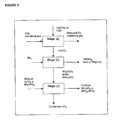
- the carbon dioxide containing gas is contacted with ammonia (see Figure 1 ) and liquor is added, whereby a carbonate-containing product is formed and the resulting gas has a reduced CO 2 content.
- the ammonia can be introduced in solution or in a gaseous form.
- the liquor could be water or an aqueous solution, including a recycled stream containing ammonium carbonate, ammonium bicarbonate, ammonium sulfate, ammonium sulfite, a stream formed in a following step, such as a mother liquor from the separation in step (c), or a stream from another process, such as the bleed stream from a limestone wet scrubbing (LWS) plant.
- LWS limestone wet scrubbing
- step (a) The product containing carbonate formed in step (a), which can be a solid or liquid, is reacted with a reagent selected from the group consisting of nitric acid, phosphoric acid, and a mixture thereof.
- the reaction forms said fertilizer and a concentrated stream of carbon dioxide gas.
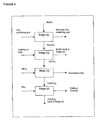
- the carbon dioxide containing gas is contacted with a base other than ammonia in the first step, (see Figure 2 and 3 ). However, in a later step of the process the base is swapped to form the said ammonium carbonate product.
- the selected base in these preferred embodiments is one that is characterized by very low solubility in an aqueous solution, thus, it can be easily separated from the solution of ammonium salt in the later step.
- Said base is selected from the group consisting of Ca(OH) 2 , CaO, and a mixture thereof, a solid sorbent, or an organic base (with a limited solubility in an aqueous phase).
- the functional groups of said solid sorbent and said organic base are selected from the group consisting of a primary amine, a secondary amine, a tertiary amine and a combination thereof.
- Said aqueous solution could be water or an aqueous solution, including a recycled stream containing ammonium carbonate, ammonium bicarbonate, ammonium sulfate, ammonium sulfite, ammonium nitrate, calcium nitrate, a stream formed in a following step, such as a mother liquid from the separation in step (c), or a stream from another process, such as the bleed stream from a limestone wet scrubbing (LWS) plant.
- a recycled stream containing ammonium carbonate, ammonium bicarbonate, ammonium sulfate, ammonium sulfite, ammonium nitrate, calcium nitrate a stream formed in a following step, such as a mother liquid from the separation in step (c), or a stream from another process, such as the bleed stream from a limestone wet scrubbing (LWS) plant.
- LWS limestone wet scrubbing
- Step (b) the carbonate product is reacting first with a reagent selected from the group consisting of nitric acid, phosphoric acid, a salt thereof and a mixture thereof to form condensed CO 2 and an intermediate product that is formed by the reaction between the base (in Step (a)) and the reagent.
- a reagent selected from the group consisting of nitric acid, phosphoric acid, a salt thereof and a mixture thereof to form condensed CO 2 and an intermediate product that is formed by the reaction between the base (in Step (a)) and the reagent.
- Step (c) the above intermediate product is then reacted (in Step (c)) with ammonia to form the said fertilizer and thereby regenerates at least a portion of the said base
- some of the reactions in this step could be presented as: (10) Ca(NO 3 ) 2 +NH 4 + OH - ⁇ NH 4 NO 3 + Ca(OH) 2 ; (11) R 3 NH + - NO 3 solid + NH 4 + OH - ⁇ NH 4 NO 3 + R 3 N solid ; and (12) R 3 NH + - NO 3 organic + NH 4 + OH - ⁇ NH 4 NO 3 + R 3 N organic .
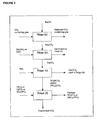
- step (b) and (c) of the above embodiment is switched (see Figure 3 ).
- a carbon dioxide containing gas is contacted with a said base (Step (a)), whereby a carbonate product is formed and the resulting gas has a reduced CO 2 content.
- the carbonate product is reacting with ammonia to form an ammonium salt selected from the group of ammonium carbonate, ammonium bicarbonate and a mixture thereof and thereby regenerating at least portion of the said base.
- Step (c) The above ammonium salt is then reacted (in Step (c)) with a reagent selected from the group consisting of nitric acid, phosphoric acid, a salt thereof and a mixture thereof to form condensed CO 2 and the said fertilizer.
- a reagent selected from the group consisting of nitric acid, phosphoric acid, a salt thereof and a mixture thereof to form condensed CO 2 and the said fertilizer.
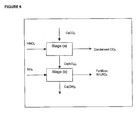
- the formation of calcium carbonate in stage (a) occurs naturally and the process uses mined calcium carbonate.
- mined calcium carbonate is reacted with nitric acid to form Ca(NO 3 ) 2 and CO 2 wherein at least a portion thereof is separated in a condensed and relatively concentrated stream.
- the formed Ca(NO 3 ) 2 is reacted with ammonia to form the fertilizer, NH 4 NO 3 , and Ca(OH) 2 .
- an additional base named as a first base is added to the process.
- said base that is selected from the group consisting of Ca(OH) 2 , CaO, and a mixture thereof is named as the second base.
- Said first base is selected from the group of NaOH, KOH, a primary amine soluble in aqueous solution, a secondary amine soluble in aqueous solution, a tertiary amine soluble in aqueous solution or combination thereof.
- the first base is acting as a stimulator for the absorption of the CO 2 .
- step (a) NaOH is reacted in an aqueous solution with CO 2 to form sodium salt of sodium carbonate, sodium bicarbonate or a mixture thereof.
- step (b) calcium hydroxide is reacted with said sodium salt to form calcium carbonate and thereby regenerating the first base that is recycled to step (a).
- said calcium carbonate is contacted with said reagent to form condensed CO 2 and an intermediate product formed by the reaction between said second base and the reagent, and, in a separate step said intermediate product is reacted with ammonia to form said fertilizer and thereby regenerates at least a portion of said second base that is recycled back.
- the sequence of these last two steps are switched.
- the formed CaCO 3 is contacted with ammonia to form an ammonium carbonate product and thereby regenerates at least a portion of said second base, Ca(OH) 2 , which is recycled.
- This step is followed by reacting said ammonium carbonate product with a reagent selected from the group consisting of nitric acid, phosphoric acid, a salt thereof, and a mixture thereof to form CO 2 , and said fertilizer.
- an additional base is added to the process (first base ) the first and the second base are added in one stage, whereby, step (a) and step (b), as demonstrated in equations (13) and (14), are in fact conducted in one stage.
- the present invention also provides a process for the combined production of (i) a fertilizer selected from the group consisting of ammonium nitrate, ammonium phosphates or a combination thereof and (ii) a concentrated stream of CO 2 through an indirect neutralization of ammonia with an acid selected from the group consisting of nitric acid, phosphoric acid, a salt thereof, and a combination thereof; said method comprising:
- a fertilizer selected from the group of ammonium nitrate, ammonium phosphate, ammonium biphosphate and a mixture thereof is produced.
- a technique that is widely used in industry to remove CO 2 from gas streams that contain carbon dioxide in a low concentration is separating the CO 2 by using a solution of an amine such as monoethanolamine, diethanolamine, triethanolamine, diglycolamine, methyldiethanolamine, and diisopropanolamine.
- an amine such as monoethanolamine, diethanolamine, triethanolamine, diglycolamine, methyldiethanolamine, and diisopropanolamine.
- Such patents are U.S. Pat. No. 1,783,901 and U.S. Pat. No. 1,934,472 .
- This reaction is reversible, allowing the solution to be regenerated by heating.
- a disadvantage of such a process is that the energy required for the regeneration of the solvent is high (1.0 to 2.0 MJ/kg CO 2 ).
- the carbon dioxide stream obtained after solvent regeneration is at low pressure.
- U.S. patent 6,447,437 describes a method for converting CO 2 , CO, NO x , and SO x emissions into carbonate-containing-fertilizers, mainly NH 4 HCO 3 and/or (NH 2 ) 2 CO 3 , plus a small fraction of NH 4 NO 3 and (NH 4 ) 2 SO 4 .
- the final product in the process described in US patent 6,447,437 , is NH 4 HCO 3 and/or (NH 2 ) 2 CO that contains a small fraction of NH 4 NO 3 and (NH 4 ) 2 SO 4 .
- the NH 4 HCO 3 formed in the process presented in the present invention is only an intermediate product while the final products are (i) a fertilizer selected from the group consisting of ammonium nitrate, ammonium phosphates or a combination thereof, and (ii) a concentrated stream of CO 2 .
- US Patent 6,447,437 differs from the present invention in the type of the reaction for the formation of NH 4 HCO 3 .
- the US Patent 6,447,437 focuses on condensation reactions of N 2 with CO 2 with the presence of additives. These reactions are characterized by high activation energy, thus, a catalyst is required where the preferred catalysts include nanometer-structured and/or hybridized metallocatalysts of Ru, Os, W, Fe, Pt, Pd, and Ni, and/or hybridized metallocatalysts of Ru, Os, W, Fe, Pt, Pd, and Ni.
- the SO 2 system is totally different from that of the CO 2 system, and therefore, one system does not teach the other.
- Carbonic acid is a relatively weak acid with a pKa1 of 6.35 and a pKa2 of 10.33, while the first and the second pKa of sulfurous acid are 1.85 and 7.2, respectively.
- These systems are very different especially when the reacted base is a weak one, such as ammonia (ammonium pKa is of about 9 which is lower than the pKa2 of carbonic acid).
- ammonium carbonate is an unstable salt that decomposes at relatively low temperature, about 60°C at atmospheric conditions, to form ammonia and CO 2 .
- the low stability of ammonium carbonate salt at relatively low temperature is a critically important issue especially in the case of CO 2 absorption from flue gases, which are emitted at temperatures of about 200-400°C.
- ammonia is introduced into one of the steps and an acid, such as nitric, phosphoric or a combination thereof, is introduced into another step which is a totally separate step.
- An ammonium fertilizer is formed,
- the overall process related to equation (1) could be presented in a simplified form as: (17) 2CO 2 + 2NH 3 + 2H 2 O ⁇ 2NH 4 HCO 3 (1) 2NH 4 HCO 3 + H 3 PO 4 ⁇ (NH 4 ) 2 HPO 4 + 2CO 2 + 2H 2 O (18) 2NH 3 + H 3 PO 4 ⁇ (NH 4 ) 2 HPO 4
- a product salt or at least a part of it, is formed from the base, ammonia, and the acid, which are introduced at separate steps of the process.
- their reaction is indirect and the energy of neutralization is not evolved as thermal energy in whole or in part. Instead, through the process, this energy, in some cases along with other energies, such as crystallization energy, provides the driving force for CO 2 separation from the gas containing it.
- the fertilizer formed in the process of the present invention could be used in solution or in a crystallized form. Energy for water evaporation could result from the thermal energy of the flue gas. NH 4 HCO 3 presence in fertilizer solutions or crystals is possible since that NH 4 HCO 3 acts itself as a carbonate-containing fertilizer.
- a gaseous mixture of 95% nitrogen and 5% CO 2 at 15°C is bubbled through a column filled with a concentrated aqueous solution containing ammonia.
- the CO 2 content of the gas at the outlet of the column is reduced by more than one-half, and the resulting solution, contains a mixture of (NH 4 ) 2 CO 3 and NH 4 HCO 3 .
- a gaseous mixture of 95% nitrogen and 5% CO 2 at 15°C is bubbled through a column filled with a concentrated aqueous solution containing NaOH.
- the CO 2 content of the gas at the outlet of the column is reduced by more than one-half, and the resulting solution, contains NaHCO 3 crystals.
- a gaseous mixture of 95% nitrogen and 5% CO 2 at 15°C is bubbled through a column filled with an aqueous suspension of Ca(OH) 2 .
- the CO 2 content of the gas at the outlet of the column is reduced by more than one-half, and the resulting solution, contains CaCO 3 crystals.
- a gaseous mixture of 88% nitrogen, 10% CO 2 and 2% SO 2 is bubbled through a column filled with a concentrated aqueous solution containing ammonia.
- the CO 2 and SO 2 content of the gas at the outlet of the column is reduced by more than one-half, and the resulting solution, contains NH 4 HCO 2 , (NH 4 ) 2 CO 2 and (NH 4 ) 2 SO 3 .
- This solution is reacted with Ca(NO 3 ) 2 to form NH 4 NO 3 , insoluble CaCO 3 and CaSO 3 crystals.
- the remaining aqueous solution, containing ammonium nitrate is transferred to an evaporator crystallizer to recover the equivalent amount of ammonium nitrate.
- a gas composed of about 73% N 2 , 13% CO 2 , 10% H 2 O, 4% O 2 and 0.3% SO 2 at 15°C is bubbled slowly through a column containing ammonia solution. More than 50% of the CO 2 and 90% of the SO 2 in the incoming gas is adsorbed.
- a gas composed of about 73% N 2 , 13% CO 2 , 10% H 2 O, 4% O 2 and 0.3% SO 2 at 25°C is bubbled through a column containing aqueous suspension of Ca(OH) 2 . More than 50% of the CO 2 and 90% of the SO 2 in the incoming gas is adsorbed.
- Example 3 Part of the solution formed in Example 3 is reacted with a solution of 30% nitric acid.
- the relative volumes of the solutions are selected so that the molar ratio of nitric acid to (ammonia + ammonium ions) is 1.1 to 1.0. Ammonium nitrate is formed and most of the CO 2 and SO 2 is released.
Landscapes
- Chemical & Material Sciences (AREA)
- Organic Chemistry (AREA)
- Chemical Kinetics & Catalysis (AREA)
- Inorganic Chemistry (AREA)
- Life Sciences & Earth Sciences (AREA)
- Pest Control & Pesticides (AREA)
- Fertilizers (AREA)
- Treating Waste Gases (AREA)
- Carbon And Carbon Compounds (AREA)
Applications Claiming Priority (2)
| Application Number | Priority Date | Filing Date | Title |
|---|---|---|---|
| IL17023905 | 2005-08-11 | ||
| EP06766197A EP1922288A2 (fr) | 2005-08-11 | 2006-07-31 | Procede servant a produire un engrais et co2 |
Related Parent Applications (2)
| Application Number | Title | Priority Date | Filing Date |
|---|---|---|---|
| EP06766197.5 Division | 2006-07-31 | ||
| EP06766197A Division EP1922288A2 (fr) | 2005-08-11 | 2006-07-31 | Procede servant a produire un engrais et co2 |
Publications (2)
| Publication Number | Publication Date |
|---|---|
| EP2581342A2 true EP2581342A2 (fr) | 2013-04-17 |
| EP2581342A3 EP2581342A3 (fr) | 2015-05-27 |
Family
ID=37433683
Family Applications (2)
| Application Number | Title | Priority Date | Filing Date |
|---|---|---|---|
| EP13151208.9A Withdrawn EP2581342A3 (fr) | 2005-08-11 | 2006-07-31 | Procédé servant à produire un engrais et CO2 |
| EP06766197A Withdrawn EP1922288A2 (fr) | 2005-08-11 | 2006-07-31 | Procede servant a produire un engrais et co2 |
Family Applications After (1)
| Application Number | Title | Priority Date | Filing Date |
|---|---|---|---|
| EP06766197A Withdrawn EP1922288A2 (fr) | 2005-08-11 | 2006-07-31 | Procede servant a produire un engrais et co2 |
Country Status (10)
| Country | Link |
|---|---|
| US (1) | US8608821B2 (fr) |
| EP (2) | EP2581342A3 (fr) |
| JP (1) | JP2009504551A (fr) |
| KR (1) | KR101433780B1 (fr) |
| CN (1) | CN101277901B (fr) |
| AU (1) | AU2006277606B2 (fr) |
| CA (1) | CA2618625C (fr) |
| NO (1) | NO20080760L (fr) |
| RU (1) | RU2449949C2 (fr) |
| WO (1) | WO2007017860A2 (fr) |
Families Citing this family (12)
| Publication number | Priority date | Publication date | Assignee | Title |
|---|---|---|---|---|
| US8795405B1 (en) * | 2009-06-08 | 2014-08-05 | Shaw Intellectual Property Holdings, Llc | Beneficial use of carbon |
| JP2011142284A (ja) * | 2009-12-10 | 2011-07-21 | Hitachi Chem Co Ltd | Cmp研磨液、基板の研磨方法及び電子部品 |
| JP5088452B2 (ja) * | 2009-12-10 | 2012-12-05 | 日立化成工業株式会社 | Cmp研磨液、基板の研磨方法及び電子部品 |
| NL2004884C2 (en) * | 2010-06-14 | 2011-12-15 | Stichting Energie | Method for determining the ratio of biomass-derived and fossil-derived co2 in a flue gas stream. |
| CN103958444B (zh) | 2011-11-30 | 2018-02-06 | 比-恩公司 | 流体离子化组合物、其制备方法和用途 |
| JP5861890B2 (ja) * | 2012-08-23 | 2016-02-16 | 清水建設株式会社 | 被圧液体中の溶存気体量の測定方法 |
| CN105800574B (zh) * | 2016-04-14 | 2017-11-21 | 云南云天化股份有限公司 | 一种含硫磷铵的制备方法 |
| MY194352A (en) * | 2018-06-05 | 2022-11-29 | Mitsubishi Heavy Ind Eng Ltd | Fertilizer production plant and fertilizer production method |
| CN113692397A (zh) * | 2019-03-14 | 2021-11-23 | 麻省理工学院 | 涉及酸和/或碱的化学反应装置,以及相关的系统和方法 |
| CA3189689A1 (fr) * | 2020-07-22 | 2022-01-27 | Sublime Systems, Inc. | Procedes d'extraction de co2 a partir de carbonates metalliques et leur utilisation |
| CN112705029A (zh) * | 2020-11-30 | 2021-04-27 | 河北工程大学 | 燃煤电厂二氧化碳资源化辅助农业一体化利用系统 |
| EP4313906A4 (fr) | 2021-03-22 | 2025-02-19 | Sublime Systems, Inc. | Mélanges de ciment décarbonés |
Citations (8)
| Publication number | Priority date | Publication date | Assignee | Title |
|---|---|---|---|---|
| US1783901A (en) | 1930-10-07 | 1930-12-02 | Girdler Corp | Process for separating acidic gases |
| US1934472A (en) | 1930-10-30 | 1933-11-07 | Albert S Allen | Method of separating carbon dioxide from a gas mixture |
| US3625720A (en) | 1966-10-24 | 1971-12-07 | Nippon Steel Corp | Method of producing highly gas-permeable refractory material having open pores |
| WO1994001203A1 (fr) | 1992-07-02 | 1994-01-20 | Nederlandse Organisatie Voor Toegepast-Natuurwetenschappelijk Onderzoek Tno | Procede d'extraction et de recuperation du gaz carbonique compris dans un flux gazeux |
| US5624649A (en) | 1995-04-26 | 1997-04-29 | General Electric Co. | Process for reduction of sulfur dioxide emission from combustion gases combined with production of potassium sulfate |
| US6344066B1 (en) | 1997-08-26 | 2002-02-05 | Clue | Process for the preparation of fertilizers and sulfur compounds |
| US6447437B1 (en) | 2000-03-31 | 2002-09-10 | Ut-Battelle, Llc | Method for reducing CO2, CO, NOX, and SOx emissions |
| JP2002293537A (ja) | 2001-04-02 | 2002-10-09 | Okutama Kogyo Co Ltd | 炭酸カルシウムの製造方法 |
Family Cites Families (24)
| Publication number | Priority date | Publication date | Assignee | Title |
|---|---|---|---|---|
| NL16550C (fr) * | 1923-09-06 | |||
| US1916980A (en) * | 1931-05-22 | 1933-07-04 | Gerald J Horvitz | Process for the recovery of acid gas |
| US2087325A (en) * | 1933-09-13 | 1937-07-20 | Solvay Process Co | Process for the production of urea and ammonium salts |
| GB436369A (en) * | 1933-10-18 | 1935-10-03 | Gerald Joseph Horvitz | Improvements in process and apparatus for the recovery of acid gases |
| DE700553C (de) * | 1937-05-05 | 1940-12-23 | Bayerische Stickstoff Werke Ak | Verfahren zur Trennung von Ammoniak und Kohlendioxyd |
| US2852340A (en) * | 1954-08-09 | 1958-09-16 | Paul O Tobeler | Method of producing ammonium nitrate and magnesium hydroxide |
| NL258424A (fr) * | 1960-12-08 | |||
| US3518073A (en) * | 1967-01-23 | 1970-06-30 | Chemical Construction Corp | Solvent extraction process for the production of ammonium nitrate fertilizer product and phosphoric acid mixed with nitric acid |
| SE322639B (fr) * | 1967-09-15 | 1970-04-13 | Fosfatbolaget Ab | |
| US3939254A (en) * | 1974-12-30 | 1976-02-17 | Olin Corporation | Process for preparing alkali metal orthophosphates and ammonia |
| JPS51114378A (en) * | 1975-03-31 | 1976-10-08 | Kobe Steel Ltd | A method of removing sulphur oxide and nitrogen from waste gas and of wtilizing the same |
| JPS51114398A (en) * | 1975-03-31 | 1976-10-08 | Kobe Steel Ltd | Method of removing and effectively utilizing sulphur oxides and nitrog en oxides in waste gas |
| FR2391953A1 (fr) * | 1976-11-02 | 1978-12-22 | Ugine Kuhlmann | Procede de traitement d'effluents nitriques |
| US4174379A (en) * | 1978-04-13 | 1979-11-13 | Foster Wheeler Energy Corporation | Manufacture of ammonium nitrate |
| CN1045085A (zh) * | 1989-11-23 | 1990-09-05 | 门伟 | 磷酸二氢钾、硫酸钾的生产方法 |
| IL103153A (en) * | 1992-09-13 | 1996-10-16 | Hamit Energy As | Method for reducing atmospheric pollution caused by CO2 |
| IL103918A (en) * | 1992-11-29 | 1996-10-16 | Hamit Energy As | Method for reducing atmospheric pollution caused by SO2 |
| CN1108412C (zh) * | 1995-07-11 | 2003-05-14 | 安德里兹公司 | 从石灰和白泥中分离杂质的方法以及两步法苛化含有杂质如硅的绿液的方法 |
| DE19529246A1 (de) * | 1995-08-09 | 1997-02-13 | Thomas Weimer | Verfahren zur Kohlendioxidabreinigung aus Gasgemischen |
| JP3349346B2 (ja) * | 1996-05-28 | 2002-11-25 | 三菱重工業株式会社 | 脱硫脱炭酸プロセス |
| US6638342B2 (en) * | 2001-11-28 | 2003-10-28 | Marsulex Environmental Technologies | Process and facility for removing metal contaminants from fertilizer streams |
| US20050238563A1 (en) * | 2004-03-08 | 2005-10-27 | Eighmy T T | Method for sequestering carbon dioxide |
| US7361324B2 (en) * | 2004-06-21 | 2008-04-22 | J. M. Huber Corporation | Precipitated calcium carbonate |
| JP2006225175A (ja) * | 2005-02-15 | 2006-08-31 | Sumitomo Chemical Co Ltd | 透明液体肥料の製造方法 |
-
2006
- 2006-07-31 CN CN2006800349073A patent/CN101277901B/zh not_active Expired - Fee Related
- 2006-07-31 EP EP13151208.9A patent/EP2581342A3/fr not_active Withdrawn
- 2006-07-31 KR KR1020087005887A patent/KR101433780B1/ko not_active Expired - Fee Related
- 2006-07-31 JP JP2008525716A patent/JP2009504551A/ja active Pending
- 2006-07-31 CA CA2618625A patent/CA2618625C/fr active Active
- 2006-07-31 EP EP06766197A patent/EP1922288A2/fr not_active Withdrawn
- 2006-07-31 WO PCT/IL2006/000882 patent/WO2007017860A2/fr not_active Ceased
- 2006-07-31 US US12/063,429 patent/US8608821B2/en not_active Expired - Fee Related
- 2006-07-31 AU AU2006277606A patent/AU2006277606B2/en not_active Ceased
- 2006-07-31 RU RU2008104324/05A patent/RU2449949C2/ru not_active IP Right Cessation
-
2008
- 2008-02-12 NO NO20080760A patent/NO20080760L/no not_active Application Discontinuation
Patent Citations (8)
| Publication number | Priority date | Publication date | Assignee | Title |
|---|---|---|---|---|
| US1783901A (en) | 1930-10-07 | 1930-12-02 | Girdler Corp | Process for separating acidic gases |
| US1934472A (en) | 1930-10-30 | 1933-11-07 | Albert S Allen | Method of separating carbon dioxide from a gas mixture |
| US3625720A (en) | 1966-10-24 | 1971-12-07 | Nippon Steel Corp | Method of producing highly gas-permeable refractory material having open pores |
| WO1994001203A1 (fr) | 1992-07-02 | 1994-01-20 | Nederlandse Organisatie Voor Toegepast-Natuurwetenschappelijk Onderzoek Tno | Procede d'extraction et de recuperation du gaz carbonique compris dans un flux gazeux |
| US5624649A (en) | 1995-04-26 | 1997-04-29 | General Electric Co. | Process for reduction of sulfur dioxide emission from combustion gases combined with production of potassium sulfate |
| US6344066B1 (en) | 1997-08-26 | 2002-02-05 | Clue | Process for the preparation of fertilizers and sulfur compounds |
| US6447437B1 (en) | 2000-03-31 | 2002-09-10 | Ut-Battelle, Llc | Method for reducing CO2, CO, NOX, and SOx emissions |
| JP2002293537A (ja) | 2001-04-02 | 2002-10-09 | Okutama Kogyo Co Ltd | 炭酸カルシウムの製造方法 |
Non-Patent Citations (1)
| Title |
|---|
| RESNIK; KEVIN P. RESNIK; JAMES T. YEH; HENRY W. PENNIINE: "Aqua Ammonia for Simultaneous Removal of C02 , S02 and Nox", INTERNATIONAL JOURNAL OF ENVIRONMENTAL TECHNOLOGY MANAGEMENT, vol. 4, no. 1/2, 2004 |
Also Published As
| Publication number | Publication date |
|---|---|
| AU2006277606B2 (en) | 2012-03-08 |
| WO2007017860A2 (fr) | 2007-02-15 |
| WO2007017860B1 (fr) | 2008-04-03 |
| NO20080760L (no) | 2008-03-04 |
| RU2449949C2 (ru) | 2012-05-10 |
| US8608821B2 (en) | 2013-12-17 |
| EP1922288A2 (fr) | 2008-05-21 |
| WO2007017860A3 (fr) | 2008-02-14 |
| KR101433780B1 (ko) | 2014-08-25 |
| CA2618625C (fr) | 2014-03-25 |
| EP2581342A3 (fr) | 2015-05-27 |
| CA2618625A1 (fr) | 2007-02-15 |
| AU2006277606A1 (en) | 2007-02-15 |
| JP2009504551A (ja) | 2009-02-05 |
| RU2008104324A (ru) | 2009-09-20 |
| CN101277901B (zh) | 2013-01-23 |
| KR20080073283A (ko) | 2008-08-08 |
| CN101277901A (zh) | 2008-10-01 |
| US20100132422A1 (en) | 2010-06-03 |
Similar Documents
| Publication | Publication Date | Title |
|---|---|---|
| US5958353A (en) | Method for reducing atmospheric pollution | |
| US8608821B2 (en) | Method for the production of fertilizer and CO2 | |
| EP3369707A1 (fr) | Procédé de fabrication de carbonate de sodium intégré à l'absorption de dioxyde de carbone par un processus d'ammoniac | |
| US6344066B1 (en) | Process for the preparation of fertilizers and sulfur compounds | |
| EP1954650B1 (fr) | Procédé destiné à la production combinée d'un produit renfermant de l'oxyde de soufre et d'un engrais | |
| IL103153A (en) | Method for reducing atmospheric pollution caused by CO2 |
Legal Events
| Date | Code | Title | Description |
|---|---|---|---|
| PUAI | Public reference made under article 153(3) epc to a published international application that has entered the european phase |
Free format text: ORIGINAL CODE: 0009012 |
|
| 17P | Request for examination filed |
Effective date: 20130114 |
|
| AC | Divisional application: reference to earlier application |
Ref document number: 1922288 Country of ref document: EP Kind code of ref document: P |
|
| AK | Designated contracting states |
Kind code of ref document: A2 Designated state(s): AT BE BG CH CY CZ DE DK EE ES FI FR GB GR HU IE IS IT LI LT LU LV MC NL PL PT RO SE SI SK TR |
|
| PUAL | Search report despatched |
Free format text: ORIGINAL CODE: 0009013 |
|
| AK | Designated contracting states |
Kind code of ref document: A3 Designated state(s): AT BE BG CH CY CZ DE DK EE ES FI FR GB GR HU IE IS IT LI LT LU LV MC NL PL PT RO SE SI SK TR |
|
| RIC1 | Information provided on ipc code assigned before grant |
Ipc: C05G 1/00 20060101ALI20150422BHEP Ipc: C05C 1/00 20060101ALI20150422BHEP Ipc: C05B 7/00 20060101ALI20150422BHEP Ipc: C01B 31/20 20060101AFI20150422BHEP |
|
| STAA | Information on the status of an ep patent application or granted ep patent |
Free format text: STATUS: THE APPLICATION IS DEEMED TO BE WITHDRAWN |
|
| 18D | Application deemed to be withdrawn |
Effective date: 20180201 |