EP2581532B1 - Eckumlenkung für einen Treibstangenbeschlag eines Fensters - Google Patents
Eckumlenkung für einen Treibstangenbeschlag eines Fensters Download PDFInfo
- Publication number
- EP2581532B1 EP2581532B1 EP12187656.9A EP12187656A EP2581532B1 EP 2581532 B1 EP2581532 B1 EP 2581532B1 EP 12187656 A EP12187656 A EP 12187656A EP 2581532 B1 EP2581532 B1 EP 2581532B1
- Authority
- EP
- European Patent Office
- Prior art keywords
- housing
- blocking element
- drive rod
- corner
- guide
- Prior art date
- Legal status (The legal status is an assumption and is not a legal conclusion. Google has not performed a legal analysis and makes no representation as to the accuracy of the status listed.)
- Active
Links
Images


Classifications
-
- E—FIXED CONSTRUCTIONS
- E05—LOCKS; KEYS; WINDOW OR DOOR FITTINGS; SAFES
- E05C—BOLTS OR FASTENING DEVICES FOR WINGS, SPECIALLY FOR DOORS OR WINDOWS
- E05C9/00—Arrangements of simultaneously actuated bolts or other securing devices at well-separated positions on the same wing
- E05C9/24—Means for transmitting movements between vertical and horizontal sliding bars, rods or cables for the fastening of wings, e.g. corner guides
-
- E—FIXED CONSTRUCTIONS
- E05—LOCKS; KEYS; WINDOW OR DOOR FITTINGS; SAFES
- E05F—DEVICES FOR MOVING WINGS INTO OPEN OR CLOSED POSITION; CHECKS FOR WINGS; WING FITTINGS NOT OTHERWISE PROVIDED FOR, CONCERNED WITH THE FUNCTIONING OF THE WING
- E05F7/00—Accessories for wings not provided for in other groups of this subclass
- E05F7/08—Means for transmitting movements between vertical and horizontal sliding bars, rods, or cables
Definitions
- the invention relates to a corner deflection for a drive rod fitting of a window, a window door or the like with a housing having two housing legs, with a flexible deflection member mounted in the housing, with drive rod sections attached to the ends of the deflection element and with a latching hook attached to the housing retaining latching tongue for fastening the housing in a fitting groove of the window, the window door or the like, with a blocking element being arranged on the side of the latching tongue facing away from the latching hook, which from a release position in which the latching tongue is freely movable into a blocking position in which the movement of the locking hook is blocked, can be transferred, the respective housing leg of the housing having the locking hook having a guide for the blocking element, that the guide is arranged parallel to the drive rod section and that the blocking element is slidably guided in the guide is.
- the DE 71 44 753 U discloses a corner drive for espagnolette fittings in which an angle guide has laterally protruding strips. The strips are pushed lengthways into a guide channel in the window. The bars reach under hook-shaped webs of the guide channel. This type of joining of the components can, of course, only be done on one side with the corner drive. For the other side a filler piece is provided which is perpendicular to the.
- the DE 71 44 753 U discloses a corner drive for espagnolette fittings in which an angle guide has laterally protruding strips. The strips are pushed lengthways into a guide channel in the window. The bars reach under hook-shaped webs of the guide channel. This type of joining of the components can, of course, only be done on one side with the corner drive.
- a filler piece is provided for the other side, which is inserted into the other side perpendicular to the joining direction of the angle guide.
- the DE 81 06 157 U1 discloses a corner drive in which a leg can be inserted perpendicularly into a profile groove of the window. To prevent the leg from falling out of the profile groove, a U-shaped bracket is provided which engages behind the end sections of angle or hook webs. In addition, the U-shaped bracket is locked to the leg. This means that the leg is connected to the window only indirectly via the bracket.
- a corner drive consisting of two housing parts, the housing parts being arranged one behind the other in the longitudinal extent.
- flexible force deflection means guided displaceably in the housing parts, with both housing parts having rigidly protruding fastening strips on both sides, which are inserted in the longitudinal direction under hook-shaped webs of the guide channel and can be connected to one another by a fastening element.
- the fastening element is arranged on one housing part and can be inserted into a recess on the other housing part. In the inserted and secured position of the fastening element, the movement of the fastening strips is blocked.
- Such a corner drive is for example from DE 20 15 723 C3 known.
- This corner drive has a pin or a screw as a blocking element to be mounted separately.
- the pin or screw is mounted on the side of the locking tongue facing away from the locking hook and prevents the locking tongue from being pushed back.
- the latching hook is thus blocked in a position in which the corner deflection is held on the window.
- the disadvantage of this corner deflection is that the separate assembly of pins or screws, in particular in the case of several locking hooks, requires a very high structural effort. Corner drives are often held with eight locking hooks. Therefore eight pins or screws have to be installed.
- the invention is based on the problem of developing a corner deflection of the type mentioned at the outset in such a way that it has a particularly simple structure and has a particularly small number of components.
- At least one of the drive rod sections is designed as a blocking element.
- the blocking element is held in the guide and can therefore be installed with the corner drive in the fitting groove in the window.
- the blocking element is then moved and thus blocks the movement of the locking hooks.
- the corner drive according to the invention is particularly simple.
- the blocking element preferably has lead-in bevels.
- the corner drive according to the invention has a particularly small number of components since at least one of the drive rod sections is designed as a blocking element.
- the latching tongue is blocked in one position of the drive rod section and released in another position. Therefore, in the assembled state of the corner drive, the release position can be placed on a locking position of the drive rod fitting.
- the blocking position of the blocking element can be placed on the other positions of the connecting rod fitting in which the corner drive is accessible from the outside.
- the latching hook can simply be optionally blocked or released if the blocking element is a separate, is independent of the deflecting member displaceable component.
- the blocking element can easily be moved between the blocking position and the release position if the housing has an opening for the passage of a tool in the area of movement of the blocking element.
- unintentional removal of the blocking element from the blocking position can be reliably avoided if the blocking element, which is designed as a separate component, is held in the blocking position by clamping means or by latching means.
- the clamping means could for example be an interference fit.
- the latching means could be designed as resilient latching elements pretensioned by or against the blocking element.
- the end of the drive rod section protruding into the housing could control the release or blocking of the latching tongue.
- the release position can simply be placed on the intended position of the drive rod fitting if the at least one drive rod section has a recess for receiving the latching tongue in the release position.
- the guide in the housing is designed to guide both components of the blocking element and the drive rod section.
- the housing has a base to cover the fitting groove and legs protruding into the fitting groove and if two locking tongues are formed opposite one another by sections of the legs.
- Figure 1 shows a window with a sash 2 that can be pivoted against a frame 1 and with a connecting rod fitting 3.
- the connecting rod fitting 3 has a drive rod 5 that can be driven by a handle 4 and a corner deflection 6 for deflecting the movement of the drive rod 5 controlled.
- FIG. 11 shows, on an enlarged scale, a sectional illustration along the line II-II through a partial area of the wing 2 from FIG Figure 1 with the corner drive 6 and a part of the drive rod 5 that can be displaced perpendicular to the plane of the drawing.
- the corner drive 6 is locked in a fitting groove 8 of the wing 2 on two paragraphs 9.
- FIG 3 shows the corner drive 6 in perspective Figure 1 .
- the corner deflection 6 has two drive rod sections 10, 11 which are connected to one another via a deflection element concealed in a curved guide 12. Furthermore, the corner deflection 6 has a housing 13 made of plastic with latching tongues 14, 15 with latching hooks arranged thereon 16, 17. The locking hooks 16, 17 are each used for locking with the in Figure 2 illustrated paragraphs 9 of the fitting groove 8.
- the corner deflection 6 has two housing legs 18, 19, with locking tongues 14, 14 ', 15, 15' and locking hooks 16, 16 ', 17, 17' arranged thereon being constructed in the same way.
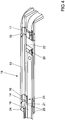
- Figure 4 shows one of the housing legs 18 of the corner drive 6 from Figure 3 .
- the locking tongues 14, 15 are arranged transversely to the direction of movement of the drive rod section 10 guided in this housing leg 18.
- the locking hooks 16, 17 can be pivoted into the housing 13 and the locking tongues 14, 15 can be elastically deformed.
- the corner drive 6 in the Figure 2 Fitting groove 8 shown can be mounted by simply pushing it in.
- the latching hooks 16, 17 engage behind the paragraphs 9.
- the corner deflection 6 also has blocking elements 21, 22 which can be displaced in a common guide 20 with the drive rod section 10.
- One of the blocking elements 22 is arranged freely movable in the guide 20 of the housing 13 and can be guided behind one of the locking tongues 15.
- this blocking element 22 is held in the guide 20 with a force fit.
- the other of the blocking elements 21 is attached to the drive rod section 10.
- the blocking element 21 has a recess 23 for receiving the latching tongues 14 during the assembly of the corner drive 6 in the fitting groove 8.
- the recess 23 can be moved out of the pivoting range of the latching tongues 14, so that the locking tongues 14 are blocked.
- the latching hooks 16 cannot be pressed into the housing 13.
- the movement of the other blocking element 22 can by means of of the drive rod section 10 or the housing 13 has an opening, which is covered in this view, for the passage of a tool.
- the housing 13 is U-shaped in cross section with a base 24 for covering the fitting groove 8 Figure 2 and legs 25 projecting into the fitting groove 8.
- the latching tongues 14 ′, 15 are produced by dividing the legs 25.
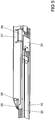
- Figure 5 shows a further embodiment of the corner deflection 6 with a plurality of locking hooks 28, 29 arranged on locking tongues 26, 27 for engaging behind the shoulders 9 of the fitting groove 8 Figure 1 .
- the locking tongues 26, 27 are shown here in the position blocked by the blocking elements 30, 31.
- Latching tongues 26 arranged at the free end of the housing 13 of the corner deflection 6 are arranged parallel to the direction of movement of the drive rod fitting 3. Otherwise, this embodiment of the corner drive 6 is like that from Figure 4 built up.
Landscapes
- Engineering & Computer Science (AREA)
- Mechanical Engineering (AREA)
- Power-Operated Mechanisms For Wings (AREA)
- Casings For Electric Apparatus (AREA)
- Window Of Vehicle (AREA)
- Joining Of Corner Units Of Frames Or Wings (AREA)
Description
- Die Erfindung betrifft eine Eckumlenkung für einen Treibstangenbeschlag eines Fensters, einer Fenstertür oder dergleichen mit einem zwei Gehäuseschenkel aufweisenden Gehäuse, mit einem biegsamen, in dem Gehäuse montierten Umlenkglied, mit an den Enden des Umlenkgliedes befestigten Treibstangenabschnitten und mit einer an dem Gehäuse befestigten, einen Rasthaken halternden Rastzunge zur Befestigung des Gehäuses in einer Beschlagnut des Fensters, der Fenstertür oder dergleichen, wobei an der den Rasthaken abgewandten Seite der Rastzunge ein Blockierelement angeordnet ist, welches von einer Freigabestellung, in der die Rastzunge frei beweglich ist, in eine Blockierstellung, in der die Bewegung der Rasthaken blockiert ist, überführbar ist, wobei der jeweilige, den Rasthaken aufweisende Gehäuseschenkel des Gehäuses eine Führung für das Blockierelement hat, dass die Führung parallel zu dem Treibstangenabschnitt angeordnet ist und dass das Blockierelement verschieblich in der Führung geführt ist.
- Die
DE 71 44 753 U offenbart eine Eckumlenkung für Treibstangenbeschläge bei dem eine Winkelführung seitlich abstehende Leisten hat. Die Leisten werden längs in einen Führungskanal des Fensters eingeschoben. Dabei untergreifen die Leisten hakenförmige Stege des Führungskanals. Diese Art der Fügung der Bauteile kann naturgemäß bei der Eckumlenkung nur an einer Seite erfolgen. Für die andere Seite ist ein Füllstück vorgesehen, welches senkrecht zur DieDE 71 44 753 U offenbart eine Eckumlenkung für Treibstangenbeschläge bei dem eine Winkelführung seitlich abstehende Leisten hat. Die Leisten werden längs in einen Führungskanal des Fensters eingeschoben. Dabei untergreifen die Leisten hakenförmige Stege des Führungskanals. Diese Art der Fügung der Bauteile kann naturgemäß bei der Eckumlenkung nur an einer Seite erfolgen. Für die andere Seite ist ein Füllstück vorgesehen, welches senkrecht zur Fügerichtung der Winkelführung in die andere Seite eingeschoben wird. - Die
DE 81 06 157 U1 offenbart eine Eckumlenkung, bei der ein Schenkel senkrecht in eine Profilnut des Fensters eingesetzt werden kann. Um ein Herausfallen des Schenkels aus der Profilnut zu verhindern, ist ein U-förmiger Bügel vorgesehen, welcher Endabschnitte von Winkel- oder Hakenstegen hintergreift. Zudem ist der U-förmige Bügel mit dem Schenkel verrastet. Damit erfolgt die Verbindung des Schenkels mit dem Fenster nur mittelbar über den Bügel. - Fügerichtung der Winkelführung in die andere Seite eingeschoben wird.
- Aus der
DE 24 11 114 A1 ist eine aus zwei Gehäuseteilen bestehenden Eckumlenkung bekannt, wobei die Gehäuseteile in der Längserstreckung hintereinander angeordnet sind. Mit in den Gehäuseteilen verschiebbar geführten flexiblen Kraft-Umlenkmitteln, wobei beide Gehäuseteile zu beiden Seiten starr abstehende Befestigungsleisten aufweisen, die unter hakenförmige Stege des Führungskanals in Längsrichtung eingeschoben werden und durch ein Befestigungselement miteinander verbunden werden können. Das Befestigungselement ist an einem Gehäuseteil angeordnet und in eine Ausnehmung an dem anderen Gehäuseteil einführbar. In der eingeführten und gesicherten Stellung des Befestigungselements sind die Befestigungsleisten in der Bewegung blockiert. - Eine solche Eckumlenkung ist beispielsweise aus der
DE 20 15 723 C3 bekannt. Diese Eckumlenkung weist einen Stift oder eine Schraube als separat zu montierendes Blockierelement auf. Der Stift oder die Schraube wird auf der dem Rasthaken abgewandten Seite der Rastzunge montiert und verhindert, dass die Rastzunge zurückgedrückt wird. Damit ist der Rasthaken in einer Stellung blockiert, in der die Eckumlenkung an dem Fenster gehalten ist. Nachteilig bei dieser Eckumlenkung ist jedoch, dass die separate Montage von Stiften oder Schrauben insbesondere bei mehreren Rasthaken einen sehr hohen baulichen Aufwand erfordern. Häufig sind Eckumlenkungen mit acht Rasthaken gehalten. Daher ist dann auch die Montage von acht Stiften oder Schrauben erforderlich. - Weiterhin ist aus der
DE 199 62 152 A1 eine Eckumlenkung bekannt geworden, bei der Rastelemente von Federelementen in eine Position unter einem Hinterschnitt vorgespannt sind oder verschwenkt werden. Auch diese Gestaltung führt zu einem hohen baulichen Aufwand. - Der Erfindung liegt das Problem zugrunde, eine Eckumlenkung der eingangs genannten Art so weiter zu bilden, dass sie besonders einfach aufgebaut ist und eine besonders geringe Anzahl von Bauteilen aufweist.
- Dieses Problem wird erfindungsgemäß dadurch gelöst, dass zumindest einer der Treibstangenabschnitte als Blockierelement ausgebildet ist.
- Durch diese Gestaltung ist das Blockierelement in der Führung gehalten und kann daher mit der Eckumlenkung in der Beschlagnut im Fenster montiert werden. Anschließend wird das Blockierelement verschoben und blockiert damit die Bewegung der Rasthaken. Hierdurch ist die erfindungsgemäße Eckumlenkung besonders einfach aufgebaut. Zur Vereinfachung des Führens hinter die Rastzunge hat das Blockierelement vorzugsweise Einführschrägen. Die erfindungsgemäße Eckumlenkung weist eine besonders geringe Anzahl an Bauteilen auf, da zumindest einer der Treibstangenabschnitte als Blockierelement ausgebildet ist. Durch diese Gestaltung ist die Rastzunge in einer Stellung des Treibstangenabschnitts blockiert und in einer anderen Stellung freigegeben. Daher kann im montierten Zustand der Eckumlenkung die Freigabestellung auf eine Verriegelungsstellung des Treibstangenbeschlages gelegt werden. Die Blockierstellung des Blockierelementes kann auf die anderen Stellungen des Treibstangenbeschlages, in der die Eckumlenkung von außen zugänglich ist, gelegt werden.
- Der Rasthaken lässt sich gemäß einer anderen vorteilhaften Weiterbildung der Erfindung einfach wahlweise blockieren oder freigeben, wenn das Blockierelement ein separates, unabhängig von dem Umlenkglied verschiebbares Bauteil ist.
- Das Blockierelement lässt sich gemäß einer anderen vorteilhaften Weiterbildung einfach zwischen der Blockierstellung und der Freigabestellung verschieben, wenn das Gehäuse im Bewegungsbereich des Blockierelementes eine Öffnung zur Durchführung eines Werkzeuges hat.
- Ein unbeabsichtigtes Entfernen des Blockierelementes aus der Blockierstellung lässt sich gemäß einer anderen vorteilhaften Weiterbildung der Erfindung zuverlässig vermeiden, wenn das als separates Bauteil ausgebildete Blockierelement durch Klemmmittel oder durch Rastmittel in der Blockierstellung gehalten ist. Die Klemmmittel könnten beispielsweise eine Presspassung sein. Die Rastmittel könnten als federnde, von dem oder gegen das Blockierelement vorgespannte Rastelemente ausgebildet sein.
- Im einfachsten Fall könnte das in das Gehäuse hineinragende Ende des Treibstangenabschnitts die Freigabe oder Blockierung der Rastzunge steuern. Die Freigabestellung lässt sich jedoch gemäß einer anderen vorteilhaften Weiterbildung der Erfindung einfach auf die vorgesehene Stellung des Treibstangenbeschlages legen, wenn der zumindest eine Treibstangenabschnitt eine Ausnehmung zur Aufnahme der Rastzunge in der Freigabestellung hat.
- Der Einsatz von Werkzeug zur Bewegung des Blockierelementes in die Blockierstellung lässt sich einfach vermeiden, wenn die Position des Blockierelementes von der Stellung des nächsten Treibstangenabschnitts derart steuerbar ist, dass in der Endstellung des Treibstangenabschnitts das Blockierelement in der Blockierstellung liegt. Durch diese Gestaltung lässt sich die erfindungsgemäße Eckumlenkung einfach in die Beschlagnut einsetzen und der Treibstangenabschnitt in die Endstellung bewegen. Dabei wird das Blockierelement verschoben, so dass die Eckumlenkung in der Beschlagnut fixiert ist. Werkzeug ist daher nur für eine unwahrscheinliche Demontage der Eckumlenkung erforderlich.
- Zur weiteren Vereinfachung des konstruktiven Aufbaus der erfindungsgemäßen Eckumlenkung trägt es bei, wenn die Führung im Gehäuse zur Führung beider Bauteile des Blockierelementes und des Treibstangenabschnitts gestaltet ist.
- Zur weiteren Vereinfachung des konstruktiven Aufbaus der erfindungsgemäßen Eckumlenkung trägt es bei, wenn das Gehäuse eine Basis zur Abdeckung der Beschlagnut und in die Beschlagnut hineinragende Schenkel hat und wenn jeweils zwei Rastzungen einander gegenüberstehend von Abschnitten der Schenkel gebildet sind.
- Die Erfindung lässt zahlreiche Ausführungsformen zu. Zur weiteren Verdeutlichung ihres Grundprinzips ist eine davon in der Zeichnung dargestellt und wird nachfolgend beschrieben. Diese zeigt in
- Fig. 1
- ein Fenster mit einem Treibstangenbeschlag,
- Fig. 2
- eine Schnittdarstellung durch einen Teilbereich des Fensters aus
Figur 1 entlang der Linie II - II, - Fig. 3
- perspektivisch eine Eckumlenkung des Treibstangenbeschlages aus
Figur 1 , - Fig. 4
- eine vergrößerte Darstellung eines Gehäuseschenkels der Eckumlenkung aus
Figur 3 , - Fig. 5
- eine weitere Ausführungsform eines Gehäuseschenkels der Eckumlenkung.
-
Figur 1 zeigt ein Fenster mit einem gegen einen Rahmen 1 schwenkbaren Flügel 2 und mit einem Treibstangenbeschlag 3. Der Treibstangenbeschlag 3 hat eine von einer Handhabe 4 antreibbare Treibstange 5 und eine Eckumlenkung 6 zur Umlenkung der Bewegung der Treibstange 5. Über die Treibstange 5 werden mehrere Verschlüsse 7 angesteuert. -
Figur 2 zeigt vergrößert eine Schnittdarstellung entlang der Linie II - II durch einen Teilbereich des Flügels 2 ausFigur 1 mit der Eckumlenkung 6 und einem senkrecht zur Zeichenebene verschiebbaren Teil der Treibstange 5. Die Eckumlenkung 6 ist in einer Beschlagnut 8 des Flügels 2 an zwei Absätzen 9 verrastet. -
Figur 3 zeigt perspektivisch die Eckumlenkung 6 ausFigur 1 . Die Eckumlenkung 6 hat zwei Treibstangenabschnitte 10, 11, welche über ein in einer Bogenführung 12 verdecktes Umlenkglied miteinander verbunden sind. Weiterhin hat die Eckumlenkung 6 ein aus Kunststoff gefertigtes Gehäuse 13 mit daran angeordneten Rastzungen 14, 15 mit Rasthaken 16, 17. Die Rasthaken 16, 17 dienen jeweils zur Verrastung mit den inFigur 2 dargestellten Absätzen 9 der Beschlagnut 8. Die Eckumlenkung 6 hat zwei Gehäuseschenkel 18, 19, wobei darauf angeordnete Rastzungen 14, 14' 15, 15'und Rasthaken 16, 16', 17, 17' jeweils gleich aufgebaut sind. -
Figur 4 zeigt vergrößert einen der Gehäuseschenkel 18 der Eckumlenkung 6 ausFigur 3 . Die Rastzungen 14, 15 sind quer zur Bewegungsrichtung des in diesem Gehäuseschenkel 18 geführten Treibstangenabschnitts 10 angeordnet. In der dargestellten Stellung der Eckumlenkung 6 lassen sich die Rasthaken 16, 17 in das Gehäuse 13 hinein verschwenken und dabei die Rastzungen 14, 15 elastisch verformen. In dieser Stellung kann die Eckumlenkung 6 in die inFigur 2 dargestellte Beschlagnut 8 durch einfaches Hineindrücken montiert werden. Die Rasthaken 16, 17 rasten dabei hinter den Absätzen 9 ein. Die Eckumlenkung 6 hat zudem in einer gemeinsamen Führung 20 mit dem Treibstangenabschnitt 10 verschiebliche Blockierelemente 21, 22. Eines der Blockierelemente 22 ist frei verschieblich in der Führung 20 des Gehäuses 13 angeordnet und lässt sich hinter die einen Rastzungen 15 führen. Um eine selbständige Verschiebung zu vermeiden, ist dieses Blockierelement 22 kraftschlüssig in der Führung 20 gehalten. Das andere der Blockierelemente 21 ist an dem Treibstangenabschnitt 10 befestigt. Das Blockierelement 21 hat hierzu eine Ausnehmung 23 zur Aufnahme der Rastzungen 14 während der Montage der Eckumlenkung 6 in der Beschlagnut 8. Durch Verschiebung des Blockierelementes 21 beispielsweise zusammen mit dem Treibstangenabschnitt 10, lässt sich die Ausnehmung 23 aus dem Schwenkbereich der Rastzungen 14 heraus bewegen, so dass die Rastzungen 14 blockiert sind. In dieser Stellung des Blockierelementes 21 können die Rasthaken 16 nicht in das Gehäuse 13 hineingedrückt werden. Die Bewegung des anderen Blockierelementes 22 kann mittels des Treibstangenabschnitts 10 erfolgen oder das Gehäuse 13 hat eine in dieser Ansicht verdeckte Öffnung zur Durchführung eines Werkzeugs. Das Gehäuse 13 ist im Querschnitt U-förmig gestaltet mit einer Basis 24 zur Abdeckung der Beschlagnut 8 ausFigur 2 und in die Beschlagnut 8 hineinragenden Schenkeln 25. Die Rastzungen 14', 15 sind durch Unterteilung der Schenkel 25 erzeugt. -
Figur 5 zeigt eine weitere Ausführungsform der Eckumlenkung 6 mit mehreren, auf Rastzungen 26, 27 angeordneten Rasthaken 28, 29 zur Hintergreifung der Absätze 9 der Beschlagnut 8 ausFigur 1 . Die Rastzungen 26, 27 sind hier jeweils in der von Blockierelementen 30, 31 blockierten Stellung dargestellt. An dem freien Ende des Gehäuses 13 der Eckumlenkung 6 angeordnete Rastzungen 26 sind parallel zur Bewegungsrichtung des Treibstangenbeschlages 3 angeordnet. Ansonsten ist diese Ausführungsform der Eckumlenkung 6 wie die ausFigur 4 aufgebaut.
Claims (8)
- Eckumlenkung (6) für einen Treibstangenbeschlag (3) eines Fensters, einer Fenstertür oder dergleichen mit einem zwei Gehäuseschenkel (18, 19) aufweisenden Gehäuse (13), mit einem biegsamen, in dem Gehäuse (13) montierten Umlenkglied, mit an den Enden des Umlenkgliedes befestigten Treibstangenabschnitten (10, 11) und mit einer an dem Gehäuse (13) befestigten, einen Rasthaken (16, 17, 28, 29) halternden Rastzunge (14, 15, 26, 27) zur Befestigung des Gehäuses (13) in einer Beschlagnut (8) des Fensters, der Fenstertür oder dergleichen, wobei an der den Rasthaken (16, 17, 28, 29) abgewandten Seite der Rastzunge (14, 15, 26, 27) ein Blockierelement (21, 22, 30, 31) angeordnet ist, welches von einer Freigabestellung, in der die Rastzunge (14, 15, 26, 27) frei beweglich ist, in eine Blockierstellung, in der die Bewegung der Rasthaken (16, 17, 28, 29) blockiert ist, überführbar ist, wobei der jeweilige, den Rasthaken (16, 17, 28, 29) aufweisende Gehäuseschenkel (18, 19) des Gehäuses (13) eine Führung (20) für das Blockierelement (21, 22, 30, 31) hat, dass die Führung (20) parallel zu dem Treibstangenabschnitt (10, 11) angeordnet ist und dass das Blockierelement (21, 22, 30, 31) verschieblich in der Führung (20) geführt ist, dadurch gekennzeichnet, dass zumindest einer der Treibstangenabschnitte (10, 11) als Blockierelement (21, 30) ausgebildet ist.
- Eckumlenkung nach Anspruch 1, dadurch gekennzeichnet, dass das Blockierelement (21, 22, 30, 31) ein separates, unabhängig von dem Umlenkglied verschiebbares Bauteil ist.
- Eckumlenkung nach Anspruch 1 oder 2, dadurch gekennzeichnet, dass das Gehäuse (13) im Bewegungsbereich des Blockierelementes (21, 22, 30, 31) eine Öffnung zur Durchführung eines Werkzeuges hat.
- Eckumlenkung nach Anspruch 2, dadurch gekennzeichnet, dass das als separates Bauteil ausgebildete Blockierelement (21, 22, 30, 31) durch Klemmmittel oder durch Rastmittel in der Blockierstellung gehalten ist.
- Eckumlenkung nach einem der Ansprüche 1 bis 4, dadurch gekennzeichnet, dass der zumindest eine Treibstangenabschnitt (10) eine Ausnehmung (23) zur Aufnahme der Rastzunge (14) in der Freigabestellung hat.
- Eckumlenkung nach einem der Ansprüche 1 bis 5, dadurch gekennzeichnet, dass die Position des Blockierelementes (22, 31) von der Stellung des nächsten Treibstangenabschnitts (10, 11) derart steuerbar ist, dass in der Endstellung des Treibstangenabschnitts (10, 11) das Blockierelement (22, 31) in der Blockierstellung liegt.
- Eckumlenkung nach einem der Ansprüche 1 bis 6, dadurch gekennzeichnet, dass die Führung (20) im Gehäuse (13) zur Führung beider Bauteile des Blockierelementes (21, 22, 30, 31) und des Treibstangenabschnitts (10, 11) gestaltet ist.
- Eckumlenkung nach einem der Ansprüche 1 bis 7, dadurch gekennzeichnet, dass das Gehäuse (13) eine Basis (24) zur Abdeckung der Beschlagnut (8) und in die Beschlagnut (8) hineinragende Schenkel (25) hat und dass jeweils zwei Rastzungen (14, 15, 26, 27) einander gegenüberstehend von Abschnitten der Schenkel (25) gebildet sind.
Applications Claiming Priority (1)
| Application Number | Priority Date | Filing Date | Title |
|---|---|---|---|
| DE102011084470A DE102011084470A1 (de) | 2011-10-13 | 2011-10-13 | Eckumlenkung für einen Treibstangenbeschlag eines Fensters |
Publications (3)
| Publication Number | Publication Date |
|---|---|
| EP2581532A2 EP2581532A2 (de) | 2013-04-17 |
| EP2581532A3 EP2581532A3 (de) | 2017-07-19 |
| EP2581532B1 true EP2581532B1 (de) | 2020-08-12 |
Family
ID=47080262
Family Applications (1)
| Application Number | Title | Priority Date | Filing Date |
|---|---|---|---|
| EP12187656.9A Active EP2581532B1 (de) | 2011-10-13 | 2012-10-08 | Eckumlenkung für einen Treibstangenbeschlag eines Fensters |
Country Status (3)
| Country | Link |
|---|---|
| EP (1) | EP2581532B1 (de) |
| DE (1) | DE102011084470A1 (de) |
| ES (1) | ES2818924T3 (de) |
Citations (1)
| Publication number | Priority date | Publication date | Assignee | Title |
|---|---|---|---|---|
| DE2411114A1 (de) * | 1974-03-08 | 1975-09-25 | Gretsch Unitas Gmbh | Eckumlenkung fuer fenster, tueren u. dgl. |
Family Cites Families (4)
| Publication number | Priority date | Publication date | Assignee | Title |
|---|---|---|---|---|
| DE7144753U (de) * | 1971-11-27 | 1972-02-24 | Siegenia Frank Kg | Eckbeschlag für fenster und türen od dgl, insbesondere eckumlenkung für treibstangenbeschläge |
| DE8106157U1 (de) * | 1981-03-05 | 1981-07-23 | Siegenia-Frank Kg, 5900 Siegen | Eckumlenkung fuer treibstangenbeschlaege an fenstern, tueren o.dgl. |
| DE19962152A1 (de) | 1998-12-22 | 2000-07-06 | Esco Metallbaubeschlag Handel Gmbh | Schieberstangenumlenkung |
| DE102008041083A1 (de) * | 2008-08-07 | 2010-02-11 | Aug. Winkhaus Gmbh & Co. Kg | Beschlagteil eines Treibstangenbeschlages |
-
2011
- 2011-10-13 DE DE102011084470A patent/DE102011084470A1/de not_active Withdrawn
-
2012
- 2012-10-08 ES ES12187656T patent/ES2818924T3/es active Active
- 2012-10-08 EP EP12187656.9A patent/EP2581532B1/de active Active
Patent Citations (1)
| Publication number | Priority date | Publication date | Assignee | Title |
|---|---|---|---|---|
| DE2411114A1 (de) * | 1974-03-08 | 1975-09-25 | Gretsch Unitas Gmbh | Eckumlenkung fuer fenster, tueren u. dgl. |
Also Published As
| Publication number | Publication date |
|---|---|
| DE102011084470A1 (de) | 2013-04-18 |
| ES2818924T3 (es) | 2021-04-14 |
| EP2581532A2 (de) | 2013-04-17 |
| EP2581532A3 (de) | 2017-07-19 |
Similar Documents
| Publication | Publication Date | Title |
|---|---|---|
| EP1817983A1 (de) | Vorrichtung zur Beeinflussung der Bewegung von relativ zueinander bewegbaren Möbelteilen und Schubladenführung sowie Verfahren zu deren Herstellung | |
| DE202017106376U1 (de) | Wohnwagenfenster und Öffnungsmechanismus dafür | |
| DE202015105127U1 (de) | Fenster- und/oder Türsicherung | |
| EP1865135B1 (de) | Führungsbeschlag eines Schiebetürbeschlags | |
| DE102013104809A1 (de) | Armlehne, insbesondere für einen Bürostuhl | |
| EP2790958B1 (de) | Sitztiefenverstellung, insbesondere für einen fahrzeugsitz | |
| DE202015100014U1 (de) | Verriegelungsvorrichtung eines beidseitig ausziehbaren Schubladenschrankes | |
| DE102007021979B3 (de) | Gleitvorrichtung für Schiebe- oder Abstellschiebeflügel | |
| EP2762664B1 (de) | Zur Befestigung in einer Hinterschneidungen aufweisenden Führungsnut eines Flügels vorgesehene Eckumlenkung | |
| EP2444574B1 (de) | Halteelement eines beschlagteils eines treibstangenbeschlages | |
| EP2607583B1 (de) | Beschlagteil für einen treibstangenbeschlag | |
| EP3194690B1 (de) | Beschlag für fenster, türen oder dergleichen | |
| EP4074931A1 (de) | Beschlag mit einem durch längsschieben arretierbaren rasthaken | |
| EP3626916B1 (de) | Treibstangenbeschlag | |
| EP2149660B1 (de) | Antriebsgehäuse für einen Treibstangenbeschlag | |
| EP3246499B1 (de) | Zur montage in einer einen hinterschnitt aufweisenden beschlagnut vorgesehenes beschlagteil | |
| EP2581532A2 (de) | Eckumlenkung für einen Treibstangenbeschlag eines Fensters | |
| EP2957693B1 (de) | Halteelement für ein beschlagteil eines treibstangenbeschlages | |
| EP2930294B1 (de) | Befestigungselement | |
| EP2871313A1 (de) | Verriegelungsvorrichtung | |
| DE2411114C3 (de) | Beschlag für einen aus profilierten Rahmenteilen bestehenden Flügel von Fenstern, Türen od. dgl. | |
| EP2444573B1 (de) | Halteelement eines Beschlagteils eines Treibstangenbeschlages | |
| EP2543803B1 (de) | Treibstange für einen Treibstangenbeschlag | |
| EP2835481B1 (de) | Kulissenanordnung eines Ecklagers | |
| EP3287042B1 (de) | Auszugsführung für möbelteile |
Legal Events
| Date | Code | Title | Description |
|---|---|---|---|
| PUAI | Public reference made under article 153(3) epc to a published international application that has entered the european phase |
Free format text: ORIGINAL CODE: 0009012 |
|
| AK | Designated contracting states |
Kind code of ref document: A2 Designated state(s): AL AT BE BG CH CY CZ DE DK EE ES FI FR GB GR HR HU IE IS IT LI LT LU LV MC MK MT NL NO PL PT RO RS SE SI SK SM TR |
|
| AX | Request for extension of the european patent |
Extension state: BA ME |
|
| PUAL | Search report despatched |
Free format text: ORIGINAL CODE: 0009013 |
|
| AK | Designated contracting states |
Kind code of ref document: A3 Designated state(s): AL AT BE BG CH CY CZ DE DK EE ES FI FR GB GR HR HU IE IS IT LI LT LU LV MC MK MT NL NO PL PT RO RS SE SI SK SM TR |
|
| AX | Request for extension of the european patent |
Extension state: BA ME |
|
| RIC1 | Information provided on ipc code assigned before grant |
Ipc: E05F 7/08 20060101ALI20170613BHEP Ipc: E05C 9/24 20060101AFI20170613BHEP |
|
| STAA | Information on the status of an ep patent application or granted ep patent |
Free format text: STATUS: REQUEST FOR EXAMINATION WAS MADE |
|
| 17P | Request for examination filed |
Effective date: 20171218 |
|
| RBV | Designated contracting states (corrected) |
Designated state(s): AL AT BE BG CH CY CZ DE DK EE ES FI FR GB GR HR HU IE IS IT LI LT LU LV MC MK MT NL NO PL PT RO RS SE SI SK SM TR |
|
| STAA | Information on the status of an ep patent application or granted ep patent |
Free format text: STATUS: EXAMINATION IS IN PROGRESS |
|
| 17Q | First examination report despatched |
Effective date: 20191007 |
|
| GRAP | Despatch of communication of intention to grant a patent |
Free format text: ORIGINAL CODE: EPIDOSNIGR1 |
|
| STAA | Information on the status of an ep patent application or granted ep patent |
Free format text: STATUS: GRANT OF PATENT IS INTENDED |
|
| INTG | Intention to grant announced |
Effective date: 20200324 |
|
| GRAS | Grant fee paid |
Free format text: ORIGINAL CODE: EPIDOSNIGR3 |
|
| GRAA | (expected) grant |
Free format text: ORIGINAL CODE: 0009210 |
|
| STAA | Information on the status of an ep patent application or granted ep patent |
Free format text: STATUS: THE PATENT HAS BEEN GRANTED |
|
| AK | Designated contracting states |
Kind code of ref document: B1 Designated state(s): AL AT BE BG CH CY CZ DE DK EE ES FI FR GB GR HR HU IE IS IT LI LT LU LV MC MK MT NL NO PL PT RO RS SE SI SK SM TR |
|
| REG | Reference to a national code |
Ref country code: GB Ref legal event code: FG4D Free format text: NOT ENGLISH |
|
| REG | Reference to a national code |
Ref country code: CH Ref legal event code: EP |
|
| REG | Reference to a national code |
Ref country code: DE Ref legal event code: R096 Ref document number: 502012016282 Country of ref document: DE |
|
| REG | Reference to a national code |
Ref country code: IE Ref legal event code: FG4D Free format text: LANGUAGE OF EP DOCUMENT: GERMAN |
|
| REG | Reference to a national code |
Ref country code: AT Ref legal event code: REF Ref document number: 1301699 Country of ref document: AT Kind code of ref document: T Effective date: 20200915 |
|
| REG | Reference to a national code |
Ref country code: LT Ref legal event code: MG4D |
|
| REG | Reference to a national code |
Ref country code: NL Ref legal event code: MP Effective date: 20200812 |
|
| PG25 | Lapsed in a contracting state [announced via postgrant information from national office to epo] |
Ref country code: SE Free format text: LAPSE BECAUSE OF FAILURE TO SUBMIT A TRANSLATION OF THE DESCRIPTION OR TO PAY THE FEE WITHIN THE PRESCRIBED TIME-LIMIT Effective date: 20200812 Ref country code: BG Free format text: LAPSE BECAUSE OF FAILURE TO SUBMIT A TRANSLATION OF THE DESCRIPTION OR TO PAY THE FEE WITHIN THE PRESCRIBED TIME-LIMIT Effective date: 20201112 Ref country code: HR Free format text: LAPSE BECAUSE OF FAILURE TO SUBMIT A TRANSLATION OF THE DESCRIPTION OR TO PAY THE FEE WITHIN THE PRESCRIBED TIME-LIMIT Effective date: 20200812 Ref country code: LT Free format text: LAPSE BECAUSE OF FAILURE TO SUBMIT A TRANSLATION OF THE DESCRIPTION OR TO PAY THE FEE WITHIN THE PRESCRIBED TIME-LIMIT Effective date: 20200812 Ref country code: FI Free format text: LAPSE BECAUSE OF FAILURE TO SUBMIT A TRANSLATION OF THE DESCRIPTION OR TO PAY THE FEE WITHIN THE PRESCRIBED TIME-LIMIT Effective date: 20200812 Ref country code: GR Free format text: LAPSE BECAUSE OF FAILURE TO SUBMIT A TRANSLATION OF THE DESCRIPTION OR TO PAY THE FEE WITHIN THE PRESCRIBED TIME-LIMIT Effective date: 20201113 Ref country code: NO Free format text: LAPSE BECAUSE OF FAILURE TO SUBMIT A TRANSLATION OF THE DESCRIPTION OR TO PAY THE FEE WITHIN THE PRESCRIBED TIME-LIMIT Effective date: 20201112 |
|
| PG25 | Lapsed in a contracting state [announced via postgrant information from national office to epo] |
Ref country code: PL Free format text: LAPSE BECAUSE OF FAILURE TO SUBMIT A TRANSLATION OF THE DESCRIPTION OR TO PAY THE FEE WITHIN THE PRESCRIBED TIME-LIMIT Effective date: 20200812 Ref country code: RS Free format text: LAPSE BECAUSE OF FAILURE TO SUBMIT A TRANSLATION OF THE DESCRIPTION OR TO PAY THE FEE WITHIN THE PRESCRIBED TIME-LIMIT Effective date: 20200812 Ref country code: NL Free format text: LAPSE BECAUSE OF FAILURE TO SUBMIT A TRANSLATION OF THE DESCRIPTION OR TO PAY THE FEE WITHIN THE PRESCRIBED TIME-LIMIT Effective date: 20200812 Ref country code: LV Free format text: LAPSE BECAUSE OF FAILURE TO SUBMIT A TRANSLATION OF THE DESCRIPTION OR TO PAY THE FEE WITHIN THE PRESCRIBED TIME-LIMIT Effective date: 20200812 Ref country code: IS Free format text: LAPSE BECAUSE OF FAILURE TO SUBMIT A TRANSLATION OF THE DESCRIPTION OR TO PAY THE FEE WITHIN THE PRESCRIBED TIME-LIMIT Effective date: 20201212 |
|
| REG | Reference to a national code |
Ref country code: ES Ref legal event code: FG2A Ref document number: 2818924 Country of ref document: ES Kind code of ref document: T3 Effective date: 20210414 |
|
| PG25 | Lapsed in a contracting state [announced via postgrant information from national office to epo] |
Ref country code: CZ Free format text: LAPSE BECAUSE OF FAILURE TO SUBMIT A TRANSLATION OF THE DESCRIPTION OR TO PAY THE FEE WITHIN THE PRESCRIBED TIME-LIMIT Effective date: 20200812 Ref country code: DK Free format text: LAPSE BECAUSE OF FAILURE TO SUBMIT A TRANSLATION OF THE DESCRIPTION OR TO PAY THE FEE WITHIN THE PRESCRIBED TIME-LIMIT Effective date: 20200812 Ref country code: EE Free format text: LAPSE BECAUSE OF FAILURE TO SUBMIT A TRANSLATION OF THE DESCRIPTION OR TO PAY THE FEE WITHIN THE PRESCRIBED TIME-LIMIT Effective date: 20200812 Ref country code: SM Free format text: LAPSE BECAUSE OF FAILURE TO SUBMIT A TRANSLATION OF THE DESCRIPTION OR TO PAY THE FEE WITHIN THE PRESCRIBED TIME-LIMIT Effective date: 20200812 Ref country code: RO Free format text: LAPSE BECAUSE OF FAILURE TO SUBMIT A TRANSLATION OF THE DESCRIPTION OR TO PAY THE FEE WITHIN THE PRESCRIBED TIME-LIMIT Effective date: 20200812 |
|
| REG | Reference to a national code |
Ref country code: DE Ref legal event code: R097 Ref document number: 502012016282 Country of ref document: DE |
|
| PG25 | Lapsed in a contracting state [announced via postgrant information from national office to epo] |
Ref country code: AL Free format text: LAPSE BECAUSE OF FAILURE TO SUBMIT A TRANSLATION OF THE DESCRIPTION OR TO PAY THE FEE WITHIN THE PRESCRIBED TIME-LIMIT Effective date: 20200812 |
|
| REG | Reference to a national code |
Ref country code: CH Ref legal event code: PL |
|
| PLBE | No opposition filed within time limit |
Free format text: ORIGINAL CODE: 0009261 |
|
| STAA | Information on the status of an ep patent application or granted ep patent |
Free format text: STATUS: NO OPPOSITION FILED WITHIN TIME LIMIT |
|
| PG25 | Lapsed in a contracting state [announced via postgrant information from national office to epo] |
Ref country code: LU Free format text: LAPSE BECAUSE OF NON-PAYMENT OF DUE FEES Effective date: 20201008 Ref country code: MC Free format text: LAPSE BECAUSE OF FAILURE TO SUBMIT A TRANSLATION OF THE DESCRIPTION OR TO PAY THE FEE WITHIN THE PRESCRIBED TIME-LIMIT Effective date: 20200812 Ref country code: SK Free format text: LAPSE BECAUSE OF FAILURE TO SUBMIT A TRANSLATION OF THE DESCRIPTION OR TO PAY THE FEE WITHIN THE PRESCRIBED TIME-LIMIT Effective date: 20200812 |
|
| 26N | No opposition filed |
Effective date: 20210514 |
|
| GBPC | Gb: european patent ceased through non-payment of renewal fee |
Effective date: 20201112 |
|
| PG25 | Lapsed in a contracting state [announced via postgrant information from national office to epo] |
Ref country code: CH Free format text: LAPSE BECAUSE OF NON-PAYMENT OF DUE FEES Effective date: 20201031 Ref country code: SI Free format text: LAPSE BECAUSE OF FAILURE TO SUBMIT A TRANSLATION OF THE DESCRIPTION OR TO PAY THE FEE WITHIN THE PRESCRIBED TIME-LIMIT Effective date: 20200812 Ref country code: LI Free format text: LAPSE BECAUSE OF NON-PAYMENT OF DUE FEES Effective date: 20201031 |
|
| PG25 | Lapsed in a contracting state [announced via postgrant information from national office to epo] |
Ref country code: IE Free format text: LAPSE BECAUSE OF NON-PAYMENT OF DUE FEES Effective date: 20201008 |
|
| PG25 | Lapsed in a contracting state [announced via postgrant information from national office to epo] |
Ref country code: GB Free format text: LAPSE BECAUSE OF NON-PAYMENT OF DUE FEES Effective date: 20201112 |
|
| PGFP | Annual fee paid to national office [announced via postgrant information from national office to epo] |
Ref country code: AT Payment date: 20211019 Year of fee payment: 10 Ref country code: ES Payment date: 20211117 Year of fee payment: 10 |
|
| PGFP | Annual fee paid to national office [announced via postgrant information from national office to epo] |
Ref country code: IT Payment date: 20211029 Year of fee payment: 10 Ref country code: FR Payment date: 20211021 Year of fee payment: 10 Ref country code: BE Payment date: 20211021 Year of fee payment: 10 |
|
| PG25 | Lapsed in a contracting state [announced via postgrant information from national office to epo] |
Ref country code: IS Free format text: LAPSE BECAUSE OF FAILURE TO SUBMIT A TRANSLATION OF THE DESCRIPTION OR TO PAY THE FEE WITHIN THE PRESCRIBED TIME-LIMIT Effective date: 20201212 Ref country code: TR Free format text: LAPSE BECAUSE OF FAILURE TO SUBMIT A TRANSLATION OF THE DESCRIPTION OR TO PAY THE FEE WITHIN THE PRESCRIBED TIME-LIMIT Effective date: 20200812 Ref country code: MT Free format text: LAPSE BECAUSE OF FAILURE TO SUBMIT A TRANSLATION OF THE DESCRIPTION OR TO PAY THE FEE WITHIN THE PRESCRIBED TIME-LIMIT Effective date: 20200812 Ref country code: CY Free format text: LAPSE BECAUSE OF FAILURE TO SUBMIT A TRANSLATION OF THE DESCRIPTION OR TO PAY THE FEE WITHIN THE PRESCRIBED TIME-LIMIT Effective date: 20200812 |
|
| PG25 | Lapsed in a contracting state [announced via postgrant information from national office to epo] |
Ref country code: MK Free format text: LAPSE BECAUSE OF FAILURE TO SUBMIT A TRANSLATION OF THE DESCRIPTION OR TO PAY THE FEE WITHIN THE PRESCRIBED TIME-LIMIT Effective date: 20200812 |
|
| PG25 | Lapsed in a contracting state [announced via postgrant information from national office to epo] |
Ref country code: PT Free format text: LAPSE BECAUSE OF FAILURE TO SUBMIT A TRANSLATION OF THE DESCRIPTION OR TO PAY THE FEE WITHIN THE PRESCRIBED TIME-LIMIT Effective date: 20200812 |
|
| REG | Reference to a national code |
Ref country code: AT Ref legal event code: MM01 Ref document number: 1301699 Country of ref document: AT Kind code of ref document: T Effective date: 20221008 |
|
| P01 | Opt-out of the competence of the unified patent court (upc) registered |
Effective date: 20230515 |
|
| REG | Reference to a national code |
Ref country code: BE Ref legal event code: MM Effective date: 20221031 |
|
| PG25 | Lapsed in a contracting state [announced via postgrant information from national office to epo] |
Ref country code: FR Free format text: LAPSE BECAUSE OF NON-PAYMENT OF DUE FEES Effective date: 20221031 Ref country code: AT Free format text: LAPSE BECAUSE OF NON-PAYMENT OF DUE FEES Effective date: 20221008 |
|
| PG25 | Lapsed in a contracting state [announced via postgrant information from national office to epo] |
Ref country code: BE Free format text: LAPSE BECAUSE OF NON-PAYMENT OF DUE FEES Effective date: 20221031 |
|
| PG25 | Lapsed in a contracting state [announced via postgrant information from national office to epo] |
Ref country code: IT Free format text: LAPSE BECAUSE OF NON-PAYMENT OF DUE FEES Effective date: 20221008 |
|
| REG | Reference to a national code |
Ref country code: ES Ref legal event code: FD2A Effective date: 20231127 |
|
| PG25 | Lapsed in a contracting state [announced via postgrant information from national office to epo] |
Ref country code: ES Free format text: LAPSE BECAUSE OF NON-PAYMENT OF DUE FEES Effective date: 20221009 |
|
| PG25 | Lapsed in a contracting state [announced via postgrant information from national office to epo] |
Ref country code: ES Free format text: LAPSE BECAUSE OF NON-PAYMENT OF DUE FEES Effective date: 20221009 |
|
| REG | Reference to a national code |
Ref country code: DE Ref legal event code: R081 Ref document number: 502012016282 Country of ref document: DE Owner name: AUG. WINKHAUS SE & CO. KG, DE Free format text: FORMER OWNER: AUG. WINKHAUS GMBH & CO. KG, 48291 TELGTE, DE Ref country code: DE Ref legal event code: R081 Ref document number: 502012016282 Country of ref document: DE Owner name: AUG. WINKHAUS SE, DE Free format text: FORMER OWNER: AUG. WINKHAUS GMBH & CO. KG, 48291 TELGTE, DE |
|
| REG | Reference to a national code |
Ref country code: DE Ref legal event code: R081 Ref document number: 502012016282 Country of ref document: DE Owner name: AUG. WINKHAUS SE, DE Free format text: FORMER OWNER: AUG. WINKHAUS SE & CO. KG, 48291 TELGTE, DE |
|
| PGFP | Annual fee paid to national office [announced via postgrant information from national office to epo] |
Ref country code: DE Payment date: 20251020 Year of fee payment: 14 |