EP2584091B1 - Papiermacher-Gewebe, insbesondere ein Formiersieb - Google Patents
Papiermacher-Gewebe, insbesondere ein Formiersieb Download PDFInfo
- Publication number
- EP2584091B1 EP2584091B1 EP11008488.6A EP11008488A EP2584091B1 EP 2584091 B1 EP2584091 B1 EP 2584091B1 EP 11008488 A EP11008488 A EP 11008488A EP 2584091 B1 EP2584091 B1 EP 2584091B1
- Authority
- EP
- European Patent Office
- Prior art keywords
- threads
- binder
- woven
- thread
- fabric
- Prior art date
- Legal status (The legal status is an assumption and is not a legal conclusion. Google has not performed a legal analysis and makes no representation as to the accuracy of the status listed.)
- Active
Links
Images


Classifications
-
- D—TEXTILES; PAPER
- D03—WEAVING
- D03D—WOVEN FABRICS; METHODS OF WEAVING; LOOMS
- D03D15/00—Woven fabrics characterised by the material, structure or properties of the fibres, filaments, yarns, threads or other warp or weft elements used
-
- D—TEXTILES; PAPER
- D03—WEAVING
- D03D—WOVEN FABRICS; METHODS OF WEAVING; LOOMS
- D03D11/00—Double or multi-ply fabrics not otherwise provided for
-
- D—TEXTILES; PAPER
- D21—PAPER-MAKING; PRODUCTION OF CELLULOSE
- D21F—PAPER-MAKING MACHINES; METHODS OF PRODUCING PAPER THEREON
- D21F1/00—Wet end of machines for making continuous webs of paper
- D21F1/0027—Screen-cloths
- D21F1/0036—Multi-layer screen-cloths
- D21F1/0045—Triple layer fabrics
Definitions
- Woven papermaker fabrics are intended to be used in the sections of a paper making machine as a support for the paper web. They are endless woven fabrics or fabrics made endless by means of a seam which circulate in the paper making machine.
- forming fabrics are used, on the top strand of which a paper pulp is disposed at the start, and the latter is dewatered through the forming fabric such as to form a paper web, wherein the dewatering is supported in particular by suction boxes disposed on the under or inner side of the fabric.
- a papermaker fabric must have a fine structure on the paper side in order to support and retain a high percentage of the deposited paper fibers.
- the machine side of such a fabric must be durable enough to withstand wear and give adequate life, strong enough to resist tensile forces and open enough to provide drainage. Meeting these criteria generally requires that at least two fabric layers are superimposed utilizing threads of different size and/or count per cm and differing weave patterns.
- a first type is constructed of an upper and a lower layer out of transverse threads, the threads of both layers are superposed in pairs.
- the fabric layers are connected by longitudinal threads mostly interwoven in the upper layer and only a portion of them additionally interwoven in the lower layer, the threads of which are preferably of a larger thickness than the longitudinal threads.
- Such kind of forming fabrics are commonly called double-layer fabrics.
- the second type of fabrics is created from two distinct fabrics, one having the qualities desired for the paper side and the other the qualities desired for the machine side.
- the two fabrics are stitched or bound together by additional or independent binding yarns, which do not belong to the recurring woven fabric repeats formed by the longitudinal and transverse threads of both layers.
- This type of papermaker fabric is commonly called a triple-layer fabric.
- the third type of papermaker fabric is based on the second type, i.e. has two distinct fabric layers comprising longitudinal and transverse threads interwoven with one another respectively. Unlike the triple-layer fabrics, this type of fabric has no additional or independent binder threads. The connection of the two layers is made of their own threads, i.e. by so-called "structural", “intrinsic” or “fabric-born” threads. These are threads which are an integral part of the weave pattern of the fabric or its woven fabric repeats. Composite fabrics of these types are commonly called SSB (sheet support binder) fabrics.
- SSB sheet support binder
- Papermaker fabrics of the SSB composite type are known, wherein the connection between the two layers is achieved by a number of structural binding thread pairs, the binding of the one binding thread in one layer is continued by the other binding thread of the binding thread pair, if the one binding thread changes from one layer to the other layer in a symmetrical manner ( US 5,152,326 , US 2008/0035230 A1 , EP 1 605 095 A1 and EP 1 365 066 A1 ).
- a papermaker fabric having a first woven fabric layer provided for the paper side and made of first longitudinal and first transverse threads interwoven with one another and having a second woven fabric layer provided for the machine side made of second longitudinal and second transverse threads interwoven with one another.
- the two woven fabric layers are connected to one another by binder threads at binder points formed by structural second threads running along and below associated first threads. Both the binder threads and the associated first threads bind first threads of the first woven fabric layer running transversely thereto at the binder points on their paper side wherein the binder threads and also the first threads form knuckles at the binder points.
- the knuckles of the binder threads have peaks on their paper side, all of which constitute a peak plane parallel to the paper side.
- the knuckles of the associated first threads have concave inner bends, the points of which lying nearest to the paper side constitute an inner plane parallel to the paper side.
- the tension of the first thread extending transversely to the binder threads is such that the inner plane as defined above is nearer to the paper side or at most in the same level as the peak plane so that respectively, the binder threads and the associated first threads are forming superimposed pairs also at the binder points.
- the tension of the first threads extending transversely to the binder threads is such that the peak plane is nearer to the paper side than the inner plane thereby causing oscillating lateral deflections of at least one of the first threads running adjacently to the respective binder thread in the region of the binder points. It is therefore the basic idea of the invention to lift the knuckles of the binder threads by exerting an appropriate tension to the first threads extending transversely to the binder threads such that the knuckles of the binder threads push aside at least one of the adjacent first threads at the binder points thereby causing oscillating lateral deflections of these threads. Thereby, the binder threads are exposed to the paper side and impart a significantly higher resistance to drainage flow thus creating a significant improvement in web formation.
- the lateral deflections of the first threads should cover a path length ranging from at least 10 % to at most 90 % of the overall woven repeat length in the running direction of these first threads. Moreover, at least some of the lateral deflections of the first threads is up to 100 % of the width of the binder threads in the fabric plane, particularly at least 10 % thereof.
- the second threads particularly the binder threads, should have a greater cross-sectional area in particular a greater diameter than the first threads.
- the basic idea of the invention can also be realized if the cross-sectional area of the first and second threads is equal or reverse.
- Suitable materials for the threads are all of the synthetics which are generally used with woven papermaker fabrics, and in particular forming fabrics. It is advantageous that the threads extending in the provided running direction of the woven papermaker fabric are made of polyethyleneterephthalate (PET), polyethylenenaphtha-late (PEN) or of mixtures or copolymers of these materials.
- PET polyethyleneterephthalate
- PEN polyethylenenaphtha-late
- the threads extending transversely to the provided running direction should be made of PET, polyamide (PA) or mixtures or copolymers of these materials or blends of these materials with polyurethane (PU).
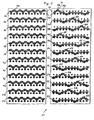
- Figures 1 and 2 show a papermaker fabric 31 for the use as a forming fabric having a first woven fabric layer 32 forming a paper side at its outside and a second woven fabric layer 33 forming a machine side at its outside.
- the first woven fabric layer 32 has transverse first threads in one overall pattern, which are marked with even numbers 2 to 24. These transverse first threads 2, 4, 6 ... 24 are interwoven with longitudinal first threads 34 to 45 in a plain weave as recognizable also in figure 2 .
- the longitudinal first threads 34 to 45 are provided with reference numbers only at binder points.
- the second woven fabric layer 33 is composed of transverse second threads marked with odd numbers 1 to 23. These second threads 1, 3, 5 ... 23 are interwoven with longitudinal second threads 46 to 57 the course of which is shown in the right half of figure 1 .
- the transverse second threads 1, 3, 5 ... 23 have - as the transverse first threads 2, 4, 6 ... 24 - a round cross-section with a greater diameter than the diameter of the transverse first threads 2, 4, 6 ... 24.
- the number of the transverse first threads 2, 4, 6 ... 24 is equal to the number of the transverse second threads 1, 3, 5 ... 23 and each transverse second thread 1, 3, 5 ... 23 extends vertically stacked below a transverse first thread 2, 4, 6 ... 24, respectively.
- the course of the longitudinal second threads 46 to 57 is such that one longitudinal second thread 46 to 57 floats over five consecutive transverse second threads 1, 3, 5 ... 23, then binds one transverse second thread 1, 3, 5 ... 23 forming a knuckle on the machine side, floats above two consecutive transverse second threads 1, 3, 5 ... 23 and then binds one transverse first thread 2, 4, 6 ... 24 forming a knuckle 58 to 69 on the paper side at a binder point respectively. Thereafter, this longitudinal second thread 46 to 57 floats over two consecutive transverse second threads 1, 3, 5 ... 23 and then binds another transverse second thread 1, 3, 5 ... 23 on the machine side. Since all of the longitudinal second threads 1, 3, 5 ... 23 bind transverse first threads 2, 4, 6 ... 24, they all function as binder threads.
- one transverse second thread 1, 3, 5 ... 23 floats in one repeat under five longitudinal second threads 46 to 57 on the machine side, then binds one longitudinal second thread 46 to 57 on the other side and then floats under five longitudinal second threads 46 to 57.
- the longitudinal second threads 46 to 57 are characterized only by the reference numbers of their knuckles 58 to 69 at the binder points.
- each longitudinal first thread 34 to 45 is extending above a longitudinal second thread 46 to 57 respectively forming pairs (34 and 46, 35 and 47, etc.) consisting of one longitudinal second thread 46 to 57 forming a binder thread and one longitudinal first thread 34 to 45.
- one longitudinal second thread 46 to 57 binds a transverse first thread 2, 4, 6 ... 24 on the paper side together side by side with one longitudinal first thread 34 to 45.
- longitudinal second thread 46 binds the transverse first thread 4 forming a knuckle 58 together with the associated longitudinal first thread 34 forming a knuckle 70.
- this situation is recognizable of the second cross-section counted from above showing the transverse first thread 4 and the transverse second thread 3.
- Figure 4 shows the paper side of the papermaker fabric 31.
- the first woven fabric layer 32 is composed of the transverse first threads 2, 4, 6 ... 24 interwoven with longitudinal first threads 34 to 45.
- longitudinal second threads 46 to 57 run over one transverse first thread 2 to 24 respectively forming knuckles 58 to 69 thereby pushing the associated longitudinal first threads 34 to 45 laterally so that the longitudinal second threads 46 to 57 are exposed to the paper side imparting a resistance to drainage flow and supporting the web formation.
- the longitudinal first threads 34 to 45 oscillate forming lateral deflections in the surrounding of a binder point.
- Figure 5 shows a similar papermaker fabric 81 in the same cross-section plane as the first cross-section in figure 2 counted from above. It has a first woven fabric layer 82 forming a paper side at its outside and a second woven fabric layer 83 forming a machine side at its outside.
- the first woven fabric layer 82 has transverse first threads 84, which are interwoven with longitudinal first threads 85 to 96 in a plain weave.
- the second woven fabric layer 83 is composed of transverse second threads 97 and of longitudinal second threads 98 to 109, which are interwoven in the same manner as in the second woven fabric layer 33 of the papermaker fabric 31 according to figures 1 to 4 .
- the number of the longitudinal first threads 85 to 96 is equal to the number of the longitudinal second threads 98 to 109.
- the longitudinal first threads 85 to 96 are disposed offset to the longitudinal second threads 98 to 109, i.e. they are not vertically stacked. All the longitudinal second threads 98 to 109 form binder threads binding the transverse first threads 84 in the same manner as in the papermaker fabric 31 so that the course of the longitudinal second threads 98 to 109 is the same as disclosed on the right half of figure 1 .
- the longitudinal first thread 92 is not pushed aside by the longitudinal second thread 105.
- the reason is the offset of the two fabric layers 82, 83. This causes that the float of the transverse first thread 84 under the longitudinal first and second threads 92, 105 is extended resulting in pushing aside the longitudinal first thread 91 running invertedly with respect to the longitudinal first thread 92 laterally from its normal position in a position almost above the longitudinal second thread 104. This repeats at each binder point, where the first and second longitudinal threads 92, 105 bind a transverse first thread.
Landscapes
- Engineering & Computer Science (AREA)
- Textile Engineering (AREA)
- Paper (AREA)
- Woven Fabrics (AREA)
Claims (15)
- Gewebtes Papiermacherband (31, 81), insbesondere ein Formierband, mit einer ersten Gewebelage (32, 82), die an der Außenseite des Bandes (31, 81) eine Papierseite bildet und aus miteinander verwebten ersten Fäden (2, 4, 6 ... 24; 34 bis 45; 84 bis 96) hergestellt ist, welche sich wiederholende erste Geweberapporte und eine papierseitige Ebene (72, 113) bilden, und mit einer zweiten Gewebelage (33, 83), die an der Außenseite des Bandes eine Maschinenseite bildet und aus miteinander verwebten zweiten Fäden (1, 3, 5 ... 23; 46 bis 57, 97 bis 109) hergestellt ist, welche sich wiederholende zweite Geweberapporte bilden, wobei die beiden Gewebelagen (32, 33; 82, 83) zusammen einen gesamten Geweberapport des Bandes (31, 81) bilden und durch Bindefäden, die aus strukturellen zweiten Fäden (46 bis 57, 98 bis 109) gebildet sind, die zu den zweiten Geweberapporten gehören, an Bindepunkten miteinander verbunden sind, wo ein Bindefaden und ein erster Faden (34 bis 45; 85 bis 96), die benachbart zueinander in derselben Richtung verlaufen, einen ersten Faden (2, 4, 6 ... 24; 84) binden, die jeweils quer dazu Seite an Seite auf ihrer Papierseite verlaufen, wobei die Bindefäden Kröpfungen (58 bis 69; 110) an den Bindepunkten ausbilden, die auf ihrer Papierseite Spitzen haben, welche eine Spitzenebene (74) parallel zu einer papierseitigen Ebene (72, 113) ausbilden, und wobei die ersten Fäden Kröpfungen (73, 111) auf der Papierseite mit konkaven inneren Krümmungen ausbilden, wobei die Punkte der Krümmungen, die am nächsten zu der papierseitigen Ebene (72, 113) liegen, eine innere Ebene (75, 114) parallel zu der papierseitigen Ebene (72, 113) bilden, dadurch gekennzeichnet, dass die Spannung der ersten, sich quer zu den Bindefäden erstreckenden Fäden (2, 4, 6 ... 24; 84) derart ist, dass die Spitzenebene (74) näher an der papierseitigen Ebene (72, 113) liegt als die innere Ebene (75, 114), wodurch hin- und hergehende, seitliche Ablenkungen zumindest eines der ersten Fäden (34 bis 45; 85 bis 96) bewirkt werden, der benachbart zu und in der gleichen Richtung wie der jeweilige Bindefaden im Bereich der Bindepunkte verläuft.
- Gewebtes Papiermacherband nach Anspruch 1, dadurch gekennzeichnet, dass die Bindefäden jeweils unterhalb eines ersten Fadens (34 bis 45) vertikal gestapelt zueinander angeordnet sind, der sich in der gleichen Richtung erstreckt, vorzugsweise dass diese ersten Fäden (34 bis 45) die Querfäden Seite an Seite mit dem korrespondierenden Bindefaden an Bindepunkten einbinden, wodurch besagte seitliche Ablenkungen im Bereich der Bindepunkte erzeugt werden.
- Gewebtes Papiermacherband nach Anspruch 1, dadurch gekennzeichnet, dass die Bindefäden und die ersten Fäden (85 bis 96), die sich in der gleichen Richtung erstrecken, zueinander versetzt angeordnet sind, vorzugsweise dass an den Bindepunkten die ersten Fäden (85 bis 96), die sich in die gleiche Richtung wie die Bindefäden und benachbart zu diesen auf derjenigen Seite erstrecken, die gegenüberliegend zu der Seite ist, wo die benachbarten ersten Fäden (85 bis 96), die in Richtung der Bindefäden verlaufen, die ersten Querfäden auf ihrer Papierseite binden und unter diesen ersten Querfäden verlaufen, wodurch besagte seitliche Ablenkungen in den Bereichen der Bindepunkte erzeugt werden.
- Gewebtes Papiermacherband nach einem der Ansprüche 1 bis 3, dadurch gekennzeichnet, dass besagte seitliche Ablenkungen der ersten Fäden (34 bis 45; 85 bis 96) eine Wegstrecke einnehmen, die sich von zumindest 10% bis höchstens 90% der Gesamtlänge des Geweberapports in der Verlaufsrichtung dieser ersten Fäden (35 bis 45; 85 bis 96) erstrecken.
- Gewebtes Papiermacherband nach einem der Ansprüche 1 bis 4, dadurch gekennzeichnet, dass zumindest einige der besagten seitlichen Ablenkungen der ersten Fäden (34 bis 45; 85 bis 96) bis zu 100% der Breite der Bindefäden in der Bandebene einnehmen, insbesondere zumindest 10% davon.
- Gewebtes Papiermacherband nach einem der Ansprüche 1 bis 5, dadurch gekennzeichnet, dass zumindest einige der zweiten Fäden (1, 3, 5 ... 23; 46 bis 57; 97 bis 109), insbesondere die Bindefäden eine größere Querschnittsfläche haben als die ersten Fäden (2, 4, 6 bis 24; 34 bis 45; 84 bis 96).
- Gewebtes Papiermacherband nach einem der Ansprüche 1 bis 6, dadurch gekennzeichnet, dass die Bindefäden nur einen einzigen ersten Faden (2, 4, 6 ... 24; 84) in jedem gesamten Geweberapport einbinden.
- Gewebtes Papiermacherband nach einem der Ansprüche 1 bis 7, dadurch gekennzeichnet, dass sämtliche zweite Fäden (46 bis 57; 98 bis 109), die sich in einer Richtung erstrecken, als Bindefäden eingewebt sind.
- Gewebtes Papiermacherband nach einem der Ansprüche 1 bis 8, dadurch gekennzeichnet, dass die ersten Fäden (34 bis 45; 85 bis 96), die sich in die gleiche Richtung wie die Bindefäden und/oder quer (2, 4, 6 ... 24; 84) zu diesen erstrecken, in einer Fadenanzahl vorhanden sind, die zumindest so groß wie die Anzahl der zweiten Fäden (46 bis 57, 97 bis 109) ist, die sich in die gleiche Richtung wie diese erstrecken, insbesondere das Verhältnis der Fadenanzahlen dieser ersten und zweiten Fäden (34 bis 45; 2, 4, 6 ... 24; 46 bis 57; 85 bis 109) 4:3, 3:2, 2:1, 1:1, 1:2, 2:3, 3:4 ist.
- Gewebtes Papiermacherband nach einem der Ansprüche 1 bis 9, dadurch gekennzeichnet, dass die ersten Fäden (2, 4, 6 ... 24; 34 bis 45; 84 bis 96) in einer Leinwandbindung miteinander verwebt sind.
- Gewebtes Papiermacherband nach einem der Ansprüche 1 bis 10, dadurch gekennzeichnet, dass die Bindefäden zumindest zwei zweite Fäden (1, 3, 5 ... 23; 97), die sich quer zu den Bindefäden erstrecken, in jedem gesamten Geweberapport binden, insbesondere ein Köpergewebe oder ein Atlasgewebe bilden.
- Gewebtes Papiermacherband nach einem der Ansprüche 1 bis 11, dadurch gekennzeichnet, dass das gewebte Papiermacherband (31, 81) zumindest achtschaftig, insbesondere maximal hundertschaftig gewebt ist.
- Gewebtes Papiermacherband nach einem der Ansprüche 1 bis 12, dadurch gekennzeichnet, dass sich die Bindefäden in der vorgesehenen Laufrichtung des gewebten Papiermacherbandes (31, 81) erstrecken.
- Gewebtes Papiermacherband nach einem der Ansprüche 1 bis 13, dadurch gekennzeichnet, dass die Bindefäden als Kettfäden eingewebt sind.
- Gewebtes Papiermacherband nach einem der Ansprüche 1 bis 4, dadurch gekennzeichnet, dass die Fäden (34 bis 45; 46 bis 57; 85 bis 96; 98 bis 109), die sich in der vorgesehenen Laufrichtung des gewebten Papiermacherbandes (31; 81) erstrecken, aus PET, PEN oder Mischungen oder Copolymeren dieser Materialien und/oder die Fäden (1, 3, 5 ... 23; 2, 4, 6 ... 24; 84, 97), die sich quer zu der vorgesehenen Laufrichtung erstrecken, aus PET, PA oder Mischungen oder Copolymeren dieser Materialien oder Verschnitten dieser Materialien mit PU bestehen und/oder dass Fäden mit einer Beschichtung vorhanden sind, insbesondere hergestellt aus Urethan oder Acryl und/oder unter Verwendung von Nanopartikeln.
Priority Applications (8)
| Application Number | Priority Date | Filing Date | Title |
|---|---|---|---|
| PT110084886T PT2584091E (pt) | 2011-10-22 | 2011-10-22 | Tecido de fabricante de papel tecido, em particular uma tela de formação |
| EP11008488.6A EP2584091B1 (de) | 2011-10-22 | 2011-10-22 | Papiermacher-Gewebe, insbesondere ein Formiersieb |
| ES11008488.6T ES2464049T3 (es) | 2011-10-22 | 2011-10-22 | Tela tejida de fabricación de papel, en particular tela de formación |
| KR1020120100389A KR101476614B1 (ko) | 2011-10-22 | 2012-09-11 | 특히, 성형 직물인, 직조 제지기 직물 |
| JP2012223089A JP5674742B2 (ja) | 2011-10-22 | 2012-10-05 | 抄紙機用織物 |
| BR102012026699-7A BR102012026699B1 (pt) | 2011-10-22 | 2012-10-18 | tela tecida para fabricar papel, em particular uma tela formadora |
| US13/655,018 US8640741B2 (en) | 2011-10-22 | 2012-10-18 | Woven papermaker fabric, in particular a forming fabric |
| CN201210448550.0A CN103061191B (zh) | 2011-10-22 | 2012-10-22 | 机织造纸织物,具体是成型织物 |
Applications Claiming Priority (1)
| Application Number | Priority Date | Filing Date | Title |
|---|---|---|---|
| EP11008488.6A EP2584091B1 (de) | 2011-10-22 | 2011-10-22 | Papiermacher-Gewebe, insbesondere ein Formiersieb |
Publications (2)
| Publication Number | Publication Date |
|---|---|
| EP2584091A1 EP2584091A1 (de) | 2013-04-24 |
| EP2584091B1 true EP2584091B1 (de) | 2014-04-02 |
Family
ID=45094357
Family Applications (1)
| Application Number | Title | Priority Date | Filing Date |
|---|---|---|---|
| EP11008488.6A Active EP2584091B1 (de) | 2011-10-22 | 2011-10-22 | Papiermacher-Gewebe, insbesondere ein Formiersieb |
Country Status (8)
| Country | Link |
|---|---|
| US (1) | US8640741B2 (de) |
| EP (1) | EP2584091B1 (de) |
| JP (1) | JP5674742B2 (de) |
| KR (1) | KR101476614B1 (de) |
| CN (1) | CN103061191B (de) |
| BR (1) | BR102012026699B1 (de) |
| ES (1) | ES2464049T3 (de) |
| PT (1) | PT2584091E (de) |
Families Citing this family (3)
| Publication number | Priority date | Publication date | Assignee | Title |
|---|---|---|---|---|
| EP2584091B1 (de) * | 2011-10-22 | 2014-04-02 | Heimbach GmbH & Co. KG | Papiermacher-Gewebe, insbesondere ein Formiersieb |
| CN106460332A (zh) * | 2016-03-23 | 2017-02-22 | 许长云 | 一种经线自绑定成形网 |
| US11339534B2 (en) * | 2019-09-18 | 2022-05-24 | Huyck Licensco Inc. | Multi-layer warp bound papermaker's forming fabrics |
Family Cites Families (29)
| Publication number | Priority date | Publication date | Assignee | Title |
|---|---|---|---|---|
| JPS4910281B1 (de) | 1967-03-27 | 1974-03-09 | ||
| JPS4910281A (de) | 1972-05-26 | 1974-01-29 | ||
| FR2346489A1 (fr) * | 1976-04-02 | 1977-10-28 | Martel Catala Et Cie Sa Ets | Perfectionnements aux toiles pour machines a papier et a leurs procedes de fabrication |
| FI64825C (fi) * | 1981-03-11 | 1986-12-01 | Cofpa | Pappersmaskinfilt speciellt foer dess vaotparti |
| DE3305713C1 (de) | 1983-02-18 | 1984-04-19 | Hermann Wangner Gmbh & Co Kg, 7410 Reutlingen | Verbund-Gewebe als Bespannung fuer den Blattbildungsteil einer Papiermaschine |
| US4564051A (en) | 1983-07-16 | 1986-01-14 | Andreas Kufferath Gmbh & Co. Kg | Multiple ply dewatering screen particularly for a web forming part of a paper making machine |
| JPS6278294A (ja) | 1985-10-02 | 1987-04-10 | 日本フイルコン株式会社 | 製紙用無端二層織物 |
| JPS6297994A (ja) * | 1985-10-21 | 1987-05-07 | 日本フイルコン株式会社 | 製紙用2重織物 |
| DE3634134A1 (de) * | 1986-10-07 | 1988-04-21 | Wangner Gmbh Co Kg Hermann | Bespannung fuer den blattbildungsteil einer papiermaschine |
| US5052448A (en) | 1989-02-10 | 1991-10-01 | Huyck Corporation | Self stitching multilayer papermaking fabric |
| DE3938159A1 (de) | 1989-11-16 | 1991-05-23 | Oberdorfer Fa F | Verbundgewebe fuer papiermaschinensiebe |
| US5937914A (en) * | 1997-02-20 | 1999-08-17 | Weavexx Corporation | Papermaker's fabric with auxiliary yarns |
| PT889160E (pt) | 1997-07-02 | 2003-06-30 | Kufferath Andreas Gmbh | Filtro para uma maquina de papel |
| JP4584402B2 (ja) * | 2000-03-03 | 2010-11-24 | 日本フイルコン株式会社 | 製紙用2層織物 |
| JP2002013087A (ja) * | 2000-06-30 | 2002-01-18 | Nippon Felt Co Ltd | 製紙用二層織物 |
| JP3900037B2 (ja) * | 2002-08-01 | 2007-04-04 | 日本フイルコン株式会社 | 工業用二層織物 |
| US7108019B2 (en) | 2002-05-24 | 2006-09-19 | Nippon Filcon Co. | Industrial two-layer fabric |
| EP1473404B1 (de) * | 2003-04-30 | 2009-07-01 | Voith Patent GmbH | Papiermacherfilz mit Verbindungsnaht |
| US7243687B2 (en) | 2004-06-07 | 2007-07-17 | Weavexx Corporation | Papermaker's forming fabric with twice as many bottom MD yarns as top MD yarns |
| CA2579591C (en) | 2004-09-30 | 2009-09-01 | Astenjohnson, Inc. | Double layer forming fabric with high centre plane resistance |
| TWI391549B (zh) * | 2005-05-24 | 2013-04-01 | Albany Int Corp | 用於抵銷以經紗接結方式所形成之織物中之捲曲的單纖及用於形成具阻抗邊緣捲曲之多層經紗接結造紙機布的方法 |
| JP4896685B2 (ja) * | 2006-11-29 | 2012-03-14 | 日本フイルコン株式会社 | 防汚性工業用織物 |
| JP2010511805A (ja) * | 2006-12-08 | 2010-04-15 | フォイト パテント ゲゼルシャフト ミット ベシュレンクテル ハフツング | シート材料特に紙又は厚紙を製造する機械のための製織布 |
| WO2009044914A1 (ja) * | 2007-10-05 | 2009-04-09 | Nippon Filcon Co., Ltd. | 工業用二層織物 |
| JP5143709B2 (ja) | 2008-11-28 | 2013-02-13 | 日本フイルコン株式会社 | 工業用二層織物 |
| JP5281877B2 (ja) | 2008-11-28 | 2013-09-04 | 日本フイルコン株式会社 | 工業用二層織物 |
| PT2230352E (pt) * | 2009-03-20 | 2012-12-05 | Heimbach Gmbh & Co Kg | Faixa em tecido para circulação numa máquina |
| ES2392127T3 (es) * | 2009-10-23 | 2012-12-04 | Heimbach Gmbh & Co.Kg | Tela tejida de máquina papelera |
| EP2584091B1 (de) * | 2011-10-22 | 2014-04-02 | Heimbach GmbH & Co. KG | Papiermacher-Gewebe, insbesondere ein Formiersieb |
-
2011
- 2011-10-22 EP EP11008488.6A patent/EP2584091B1/de active Active
- 2011-10-22 ES ES11008488.6T patent/ES2464049T3/es active Active
- 2011-10-22 PT PT110084886T patent/PT2584091E/pt unknown
-
2012
- 2012-09-11 KR KR1020120100389A patent/KR101476614B1/ko active Active
- 2012-10-05 JP JP2012223089A patent/JP5674742B2/ja active Active
- 2012-10-18 BR BR102012026699-7A patent/BR102012026699B1/pt active IP Right Grant
- 2012-10-18 US US13/655,018 patent/US8640741B2/en active Active
- 2012-10-22 CN CN201210448550.0A patent/CN103061191B/zh active Active
Also Published As
| Publication number | Publication date |
|---|---|
| CN103061191B (zh) | 2015-04-22 |
| BR102012026699B1 (pt) | 2021-01-19 |
| KR101476614B1 (ko) | 2014-12-26 |
| ES2464049T3 (es) | 2014-05-30 |
| EP2584091A1 (de) | 2013-04-24 |
| US20130098497A1 (en) | 2013-04-25 |
| PT2584091E (pt) | 2014-05-27 |
| JP5674742B2 (ja) | 2015-02-25 |
| JP2013087409A (ja) | 2013-05-13 |
| US8640741B2 (en) | 2014-02-04 |
| BR102012026699A2 (pt) | 2014-02-25 |
| CN103061191A (zh) | 2013-04-24 |
| KR20130044143A (ko) | 2013-05-02 |
Similar Documents
| Publication | Publication Date | Title |
|---|---|---|
| US7007722B2 (en) | Forming fabric | |
| EP2213787B1 (de) | Zweischichtiges industriegewebe | |
| CA2759358C (en) | Industrial two-layer fabric | |
| EP2314762B1 (de) | Gewebte Papiermaschinenbespannung | |
| WO2003093573A1 (en) | Paper machine fabric | |
| EP1724382A1 (de) | Zweilagiges technisches Gewebe | |
| JP2006144145A (ja) | 工業用二層織物 | |
| CA2516903C (en) | Industrial two-layer fabric | |
| EP2899311B1 (de) | Papiermaschinenbespannung | |
| CA2698917C (en) | Industrial two-layer fabric | |
| EP1734177A1 (de) | Zweilagiges technisches Gewebe | |
| CA2516610C (en) | Industrial two-layer fabric | |
| EP2458048B1 (de) | Zweischichtiges Industriegewebe | |
| EP2584091B1 (de) | Papiermacher-Gewebe, insbesondere ein Formiersieb | |
| EP2631360B1 (de) | Gewebe zur Formung einer Papierbahn mit geprägter Oberfläche | |
| JP4743780B2 (ja) | 工業用二層織物 | |
| JP4841410B2 (ja) | 縦溝が形成された工業用二層織物 |
Legal Events
| Date | Code | Title | Description |
|---|---|---|---|
| PUAI | Public reference made under article 153(3) epc to a published international application that has entered the european phase |
Free format text: ORIGINAL CODE: 0009012 |
|
| 17P | Request for examination filed |
Effective date: 20120418 |
|
| AK | Designated contracting states |
Kind code of ref document: A1 Designated state(s): AL AT BE BG CH CY CZ DE DK EE ES FI FR GB GR HR HU IE IS IT LI LT LU LV MC MK MT NL NO PL PT RO RS SE SI SK SM TR |
|
| AX | Request for extension of the european patent |
Extension state: BA ME |
|
| GRAP | Despatch of communication of intention to grant a patent |
Free format text: ORIGINAL CODE: EPIDOSNIGR1 |
|
| INTG | Intention to grant announced |
Effective date: 20140109 |
|
| GRAS | Grant fee paid |
Free format text: ORIGINAL CODE: EPIDOSNIGR3 |
|
| GRAA | (expected) grant |
Free format text: ORIGINAL CODE: 0009210 |
|
| AK | Designated contracting states |
Kind code of ref document: B1 Designated state(s): AL AT BE BG CH CY CZ DE DK EE ES FI FR GB GR HR HU IE IS IT LI LT LU LV MC MK MT NL NO PL PT RO RS SE SI SK SM TR |
|
| REG | Reference to a national code |
Ref country code: GB Ref legal event code: FG4D |
|
| REG | Reference to a national code |
Ref country code: CH Ref legal event code: EP Ref country code: AT Ref legal event code: REF Ref document number: 660238 Country of ref document: AT Kind code of ref document: T Effective date: 20140415 |
|
| REG | Reference to a national code |
Ref country code: IE Ref legal event code: FG4D |
|
| REG | Reference to a national code |
Ref country code: DE Ref legal event code: R096 Ref document number: 602011005823 Country of ref document: DE Effective date: 20140522 |
|
| REG | Reference to a national code |
Ref country code: PT Ref legal event code: SC4A Free format text: AVAILABILITY OF NATIONAL TRANSLATION Effective date: 20140519 |
|
| REG | Reference to a national code |
Ref country code: ES Ref legal event code: FG2A Ref document number: 2464049 Country of ref document: ES Kind code of ref document: T3 Effective date: 20140530 |
|
| REG | Reference to a national code |
Ref country code: NL Ref legal event code: T3 |
|
| REG | Reference to a national code |
Ref country code: SE Ref legal event code: TRGR |
|
| REG | Reference to a national code |
Ref country code: LT Ref legal event code: MG4D |
|
| PG25 | Lapsed in a contracting state [announced via postgrant information from national office to epo] |
Ref country code: IS Free format text: LAPSE BECAUSE OF FAILURE TO SUBMIT A TRANSLATION OF THE DESCRIPTION OR TO PAY THE FEE WITHIN THE PRESCRIBED TIME-LIMIT Effective date: 20140802 Ref country code: BG Free format text: LAPSE BECAUSE OF FAILURE TO SUBMIT A TRANSLATION OF THE DESCRIPTION OR TO PAY THE FEE WITHIN THE PRESCRIBED TIME-LIMIT Effective date: 20140702 Ref country code: NO Free format text: LAPSE BECAUSE OF FAILURE TO SUBMIT A TRANSLATION OF THE DESCRIPTION OR TO PAY THE FEE WITHIN THE PRESCRIBED TIME-LIMIT Effective date: 20140702 Ref country code: CY Free format text: LAPSE BECAUSE OF FAILURE TO SUBMIT A TRANSLATION OF THE DESCRIPTION OR TO PAY THE FEE WITHIN THE PRESCRIBED TIME-LIMIT Effective date: 20140402 Ref country code: GR Free format text: LAPSE BECAUSE OF FAILURE TO SUBMIT A TRANSLATION OF THE DESCRIPTION OR TO PAY THE FEE WITHIN THE PRESCRIBED TIME-LIMIT Effective date: 20140703 Ref country code: CZ Free format text: LAPSE BECAUSE OF FAILURE TO SUBMIT A TRANSLATION OF THE DESCRIPTION OR TO PAY THE FEE WITHIN THE PRESCRIBED TIME-LIMIT Effective date: 20140402 Ref country code: LT Free format text: LAPSE BECAUSE OF FAILURE TO SUBMIT A TRANSLATION OF THE DESCRIPTION OR TO PAY THE FEE WITHIN THE PRESCRIBED TIME-LIMIT Effective date: 20140402 |
|
| PG25 | Lapsed in a contracting state [announced via postgrant information from national office to epo] |
Ref country code: PL Free format text: LAPSE BECAUSE OF FAILURE TO SUBMIT A TRANSLATION OF THE DESCRIPTION OR TO PAY THE FEE WITHIN THE PRESCRIBED TIME-LIMIT Effective date: 20140402 Ref country code: LV Free format text: LAPSE BECAUSE OF FAILURE TO SUBMIT A TRANSLATION OF THE DESCRIPTION OR TO PAY THE FEE WITHIN THE PRESCRIBED TIME-LIMIT Effective date: 20140402 Ref country code: HR Free format text: LAPSE BECAUSE OF FAILURE TO SUBMIT A TRANSLATION OF THE DESCRIPTION OR TO PAY THE FEE WITHIN THE PRESCRIBED TIME-LIMIT Effective date: 20140402 Ref country code: RS Free format text: LAPSE BECAUSE OF FAILURE TO SUBMIT A TRANSLATION OF THE DESCRIPTION OR TO PAY THE FEE WITHIN THE PRESCRIBED TIME-LIMIT Effective date: 20140402 |
|
| REG | Reference to a national code |
Ref country code: DE Ref legal event code: R097 Ref document number: 602011005823 Country of ref document: DE |
|
| PG25 | Lapsed in a contracting state [announced via postgrant information from national office to epo] |
Ref country code: DK Free format text: LAPSE BECAUSE OF FAILURE TO SUBMIT A TRANSLATION OF THE DESCRIPTION OR TO PAY THE FEE WITHIN THE PRESCRIBED TIME-LIMIT Effective date: 20140402 Ref country code: SK Free format text: LAPSE BECAUSE OF FAILURE TO SUBMIT A TRANSLATION OF THE DESCRIPTION OR TO PAY THE FEE WITHIN THE PRESCRIBED TIME-LIMIT Effective date: 20140402 Ref country code: RO Free format text: LAPSE BECAUSE OF FAILURE TO SUBMIT A TRANSLATION OF THE DESCRIPTION OR TO PAY THE FEE WITHIN THE PRESCRIBED TIME-LIMIT Effective date: 20140402 Ref country code: EE Free format text: LAPSE BECAUSE OF FAILURE TO SUBMIT A TRANSLATION OF THE DESCRIPTION OR TO PAY THE FEE WITHIN THE PRESCRIBED TIME-LIMIT Effective date: 20140402 |
|
| PLBE | No opposition filed within time limit |
Free format text: ORIGINAL CODE: 0009261 |
|
| STAA | Information on the status of an ep patent application or granted ep patent |
Free format text: STATUS: NO OPPOSITION FILED WITHIN TIME LIMIT |
|
| 26N | No opposition filed |
Effective date: 20150106 |
|
| REG | Reference to a national code |
Ref country code: DE Ref legal event code: R097 Ref document number: 602011005823 Country of ref document: DE Effective date: 20150106 |
|
| PG25 | Lapsed in a contracting state [announced via postgrant information from national office to epo] |
Ref country code: LU Free format text: LAPSE BECAUSE OF FAILURE TO SUBMIT A TRANSLATION OF THE DESCRIPTION OR TO PAY THE FEE WITHIN THE PRESCRIBED TIME-LIMIT Effective date: 20141022 Ref country code: RS Free format text: LAPSE BECAUSE OF FAILURE TO SUBMIT A TRANSLATION OF THE DESCRIPTION OR TO PAY THE FEE WITHIN THE PRESCRIBED TIME-LIMIT Effective date: 20141119 Ref country code: MC Free format text: LAPSE BECAUSE OF FAILURE TO SUBMIT A TRANSLATION OF THE DESCRIPTION OR TO PAY THE FEE WITHIN THE PRESCRIBED TIME-LIMIT Effective date: 20140402 |
|
| PG25 | Lapsed in a contracting state [announced via postgrant information from national office to epo] |
Ref country code: BE Free format text: LAPSE BECAUSE OF NON-PAYMENT OF DUE FEES Effective date: 20141031 |
|
| REG | Reference to a national code |
Ref country code: IE Ref legal event code: MM4A |
|
| PG25 | Lapsed in a contracting state [announced via postgrant information from national office to epo] |
Ref country code: SI Free format text: LAPSE BECAUSE OF FAILURE TO SUBMIT A TRANSLATION OF THE DESCRIPTION OR TO PAY THE FEE WITHIN THE PRESCRIBED TIME-LIMIT Effective date: 20140402 |
|
| PGRI | Patent reinstated in contracting state [announced from national office to epo] |
Ref country code: BE Effective date: 20150507 |
|
| REG | Reference to a national code |
Ref country code: FR Ref legal event code: PLFP Year of fee payment: 5 |
|
| PG25 | Lapsed in a contracting state [announced via postgrant information from national office to epo] |
Ref country code: IE Free format text: LAPSE BECAUSE OF NON-PAYMENT OF DUE FEES Effective date: 20141022 |
|
| PG25 | Lapsed in a contracting state [announced via postgrant information from national office to epo] |
Ref country code: SM Free format text: LAPSE BECAUSE OF FAILURE TO SUBMIT A TRANSLATION OF THE DESCRIPTION OR TO PAY THE FEE WITHIN THE PRESCRIBED TIME-LIMIT Effective date: 20140402 |
|
| PG25 | Lapsed in a contracting state [announced via postgrant information from national office to epo] |
Ref country code: MT Free format text: LAPSE BECAUSE OF FAILURE TO SUBMIT A TRANSLATION OF THE DESCRIPTION OR TO PAY THE FEE WITHIN THE PRESCRIBED TIME-LIMIT Effective date: 20140402 Ref country code: TR Free format text: LAPSE BECAUSE OF FAILURE TO SUBMIT A TRANSLATION OF THE DESCRIPTION OR TO PAY THE FEE WITHIN THE PRESCRIBED TIME-LIMIT Effective date: 20140402 Ref country code: HU Free format text: LAPSE BECAUSE OF FAILURE TO SUBMIT A TRANSLATION OF THE DESCRIPTION OR TO PAY THE FEE WITHIN THE PRESCRIBED TIME-LIMIT; INVALID AB INITIO Effective date: 20111022 |
|
| REG | Reference to a national code |
Ref country code: FR Ref legal event code: PLFP Year of fee payment: 6 |
|
| REG | Reference to a national code |
Ref country code: FR Ref legal event code: PLFP Year of fee payment: 7 |
|
| PG25 | Lapsed in a contracting state [announced via postgrant information from national office to epo] |
Ref country code: MK Free format text: LAPSE BECAUSE OF FAILURE TO SUBMIT A TRANSLATION OF THE DESCRIPTION OR TO PAY THE FEE WITHIN THE PRESCRIBED TIME-LIMIT Effective date: 20140402 |
|
| REG | Reference to a national code |
Ref country code: FR Ref legal event code: PLFP Year of fee payment: 8 |
|
| PG25 | Lapsed in a contracting state [announced via postgrant information from national office to epo] |
Ref country code: AL Free format text: LAPSE BECAUSE OF FAILURE TO SUBMIT A TRANSLATION OF THE DESCRIPTION OR TO PAY THE FEE WITHIN THE PRESCRIBED TIME-LIMIT Effective date: 20140402 |
|
| P01 | Opt-out of the competence of the unified patent court (upc) registered |
Effective date: 20230404 |
|
| P02 | Opt-out of the competence of the unified patent court (upc) changed |
Effective date: 20230517 |
|
| PGFP | Annual fee paid to national office [announced via postgrant information from national office to epo] |
Ref country code: AT Payment date: 20230928 Year of fee payment: 13 |
|
| REG | Reference to a national code |
Ref country code: AT Ref legal event code: MM01 Ref document number: 660238 Country of ref document: AT Kind code of ref document: T Effective date: 20241022 |
|
| PG25 | Lapsed in a contracting state [announced via postgrant information from national office to epo] |
Ref country code: AT Free format text: LAPSE BECAUSE OF NON-PAYMENT OF DUE FEES Effective date: 20241022 |
|
| REG | Reference to a national code |
Ref country code: CH Ref legal event code: U11 Free format text: ST27 STATUS EVENT CODE: U-0-0-U10-U11 (AS PROVIDED BY THE NATIONAL OFFICE) Effective date: 20251101 |
|
| PGFP | Annual fee paid to national office [announced via postgrant information from national office to epo] |
Ref country code: NL Payment date: 20251026 Year of fee payment: 15 |
|
| PGFP | Annual fee paid to national office [announced via postgrant information from national office to epo] |
Ref country code: PT Payment date: 20251006 Year of fee payment: 15 |
|
| PGFP | Annual fee paid to national office [announced via postgrant information from national office to epo] |
Ref country code: DE Payment date: 20251029 Year of fee payment: 15 |
|
| PGFP | Annual fee paid to national office [announced via postgrant information from national office to epo] |
Ref country code: GB Payment date: 20251027 Year of fee payment: 15 |
|
| PGFP | Annual fee paid to national office [announced via postgrant information from national office to epo] |
Ref country code: FI Payment date: 20251027 Year of fee payment: 15 Ref country code: IT Payment date: 20251021 Year of fee payment: 15 |
|
| PGFP | Annual fee paid to national office [announced via postgrant information from national office to epo] |
Ref country code: FR Payment date: 20251027 Year of fee payment: 15 |
|
| PGFP | Annual fee paid to national office [announced via postgrant information from national office to epo] |
Ref country code: BE Payment date: 20251027 Year of fee payment: 15 |
|
| PGFP | Annual fee paid to national office [announced via postgrant information from national office to epo] |
Ref country code: SE Payment date: 20251027 Year of fee payment: 15 Ref country code: CH Payment date: 20251101 Year of fee payment: 15 |
|
| PGFP | Annual fee paid to national office [announced via postgrant information from national office to epo] |
Ref country code: ES Payment date: 20251103 Year of fee payment: 15 |