EP2631360B1 - Gewebe zur Formung einer Papierbahn mit geprägter Oberfläche - Google Patents
Gewebe zur Formung einer Papierbahn mit geprägter Oberfläche Download PDFInfo
- Publication number
- EP2631360B1 EP2631360B1 EP12156912.3A EP12156912A EP2631360B1 EP 2631360 B1 EP2631360 B1 EP 2631360B1 EP 12156912 A EP12156912 A EP 12156912A EP 2631360 B1 EP2631360 B1 EP 2631360B1
- Authority
- EP
- European Patent Office
- Prior art keywords
- threads
- transverse
- longitudinal
- paper side
- woven fabric
- Prior art date
- Legal status (The legal status is an assumption and is not a legal conclusion. Google has not performed a legal analysis and makes no representation as to the accuracy of the status listed.)
- Not-in-force
Links
- 239000004744 fabric Substances 0.000 title claims description 91
- 239000002759 woven fabric Substances 0.000 claims description 100
- 238000004049 embossing Methods 0.000 claims description 54
- 239000000463 material Substances 0.000 claims description 20
- 230000000149 penetrating effect Effects 0.000 claims description 11
- 238000005299 abrasion Methods 0.000 claims description 9
- 239000011230 binding agent Substances 0.000 claims description 3
- 239000010410 layer Substances 0.000 description 93
- 229920000139 polyethylene terephthalate Polymers 0.000 description 7
- 239000005020 polyethylene terephthalate Substances 0.000 description 7
- -1 polyethylene terephthalate Polymers 0.000 description 6
- 229920001577 copolymer Polymers 0.000 description 4
- 238000001035 drying Methods 0.000 description 4
- 238000004519 manufacturing process Methods 0.000 description 4
- 239000004952 Polyamide Substances 0.000 description 3
- 229920002647 polyamide Polymers 0.000 description 3
- 229920000728 polyester Polymers 0.000 description 3
- 239000004734 Polyphenylene sulfide Substances 0.000 description 2
- 229920001707 polybutylene terephthalate Polymers 0.000 description 2
- 239000011112 polyethylene naphthalate Substances 0.000 description 2
- 229920000069 polyphenylene sulfide Polymers 0.000 description 2
- 229920002215 polytrimethylene terephthalate Polymers 0.000 description 2
- 239000002356 single layer Substances 0.000 description 2
- 239000004743 Polypropylene Substances 0.000 description 1
- 239000004433 Thermoplastic polyurethane Substances 0.000 description 1
- 239000011248 coating agent Substances 0.000 description 1
- 238000000576 coating method Methods 0.000 description 1
- 230000000694 effects Effects 0.000 description 1
- 230000001815 facial effect Effects 0.000 description 1
- 239000000835 fiber Substances 0.000 description 1
- 230000005484 gravity Effects 0.000 description 1
- 238000009434 installation Methods 0.000 description 1
- 239000000203 mixture Substances 0.000 description 1
- 229920003207 poly(ethylene-2,6-naphthalate) Polymers 0.000 description 1
- 229920001155 polypropylene Polymers 0.000 description 1
- 239000004814 polyurethane Substances 0.000 description 1
- 229920002635 polyurethane Polymers 0.000 description 1
- 238000000926 separation method Methods 0.000 description 1
- 239000003381 stabilizer Substances 0.000 description 1
- 229920002803 thermoplastic polyurethane Polymers 0.000 description 1
Images

Classifications
-
- D—TEXTILES; PAPER
- D03—WEAVING
- D03D—WOVEN FABRICS; METHODS OF WEAVING; LOOMS
- D03D1/00—Woven fabrics designed to make specified articles
-
- D—TEXTILES; PAPER
- D21—PAPER-MAKING; PRODUCTION OF CELLULOSE
- D21F—PAPER-MAKING MACHINES; METHODS OF PRODUCING PAPER THEREON
- D21F1/00—Wet end of machines for making continuous webs of paper
- D21F1/0027—Screen-cloths
- D21F1/0036—Multi-layer screen-cloths
-
- D—TEXTILES; PAPER
- D03—WEAVING
- D03D—WOVEN FABRICS; METHODS OF WEAVING; LOOMS
- D03D11/00—Double or multi-ply fabrics not otherwise provided for
-
- D—TEXTILES; PAPER
- D21—PAPER-MAKING; PRODUCTION OF CELLULOSE
- D21F—PAPER-MAKING MACHINES; METHODS OF PRODUCING PAPER THEREON
- D21F11/00—Processes for making continuous lengths of paper, or of cardboard, or of wet web for fibre board production, on paper-making machines
- D21F11/006—Making patterned paper
-
- D—TEXTILES; PAPER
- D21—PAPER-MAKING; PRODUCTION OF CELLULOSE
- D21F—PAPER-MAKING MACHINES; METHODS OF PRODUCING PAPER THEREON
- D21F7/00—Other details of machines for making continuous webs of paper
Definitions
- the invention relates to a fabric for forming a fibrous paper web having an embossed surface, the fabric comprising longitudinal and transverse threads interwoven with one another in a weave repeat unit defining a machine side and a paper side, wherein longitudinal threads form embossing threads having projecting paper side floats on the paper side of the fabric passing over transverse threads, and wherein the fabric (1, 12, 14, 16, 21) comprises a first woven fabric layer (2, 22) forming the paper side on its outside and having longitudinal and transverse first threads (4, 5, 24, 25) interwoven with one another and a second woven fabric layer (3, 23) forming the machine side on its outside and having longitudinal and transverse second threads (6, 7, 8, 27, 28, 29) interwoven with one another.
- fabrics for the manufacture of patterned paper like tissue products such as facial and bath tissue and paper towels or of other non-woven materials, it is known to use fabrics in the paper making machine being employed in making embossed or patterned paper webs products.
- One type of these fabrics are designed to be installed in the wet forming section of a paper making machine, where a fibrous pulp is deposited onto the paper side outer surface of this fabric (hereby called the paper side) of the forming fabric and is dewatered through the fabric with the help of gravity and suction boxes.
- the so formed paper web is transferred to a dryer section, where the paper web is dried by applying heat and air streams.
- a forming fabric for making embossed paper webs is disclosed in US 6,237,644 B1 .
- the fabric is embodied as a single layer weave having longitudinal or machine direction and transverse or cross machine direction threads interwoven with one another defining a machine side and a paper side. Some or all of the longitudinal threads form embossing threads having projecting paper side floats on the paper side passing over two or more successive transverse threads.
- the fabric can be embodied also as a multi-layer weave, US 6,237,644 B1 does not disclose any example thereof.
- Another fabric for the use in the wet forming section of a paper making machine is disclosed in EP 0 232 715 A1 .
- This fabric consists of two superimposed weaves.
- the first woven fabric layer forming the paper side on its outside is embodied as a fine plain weave, while the fabric layer forming the machine side on its outside is designed coarser.
- the two layers are connected by additional binding threads or by structural (intrinsic) longitudinal and/or transverse threads of the first woven fabric layer.
- the first fabric layer is drawn to the second fabric layer thereby forming recesses in a desired pattern. These recesses cause according projections of high volume in the paper web on the surface adjacent to the paper side of the fabric.
- a through-drying fabric for the drying section of a paper making machine which is intended to manufacture embossed paper webs, too.
- the fabric is designed as a single layer weave having longitudinal and transverse threads interwoven with one another. Some of the longitudinal threads form floats on the paper side passing over several transverse threads and thus forming elongated projecting paper side floats disposed in a parallel array and providing valleys between the floats. These floats and valleys form a reverse embossing into the adjacent surface of the paper web when dried in the drying section of the paper making machine.
- the fabric comprises two superimposed fabric layers having longitudinal and transverse threads interwoven with one another, respectively.
- the two fabric layers are connected by structural (intrinsic) longitudinal yarns of the first fabric layer forming the paper side on its outside at selected binding points.
- Some or all of the longitudinal first threads form projecting paper side floats in a desired pattern causing valleys between the floats.
- the so structured paper side of the first fabric results in reversed embossings on the side of the paper web adjacently to the paper side of the fabric.
- the longitudinal second threads form embossing threads, which penetrate the first woven fabric layer for forming the paper side floats and connect the two woven fabric layers.
- the general idea of this invention is to form the paper side floats not by longitudinal threads of the first woven fabric layer, but of the second woven fabric layer.
- the longitudinal second threads penetrate the first woven fabric layer, pass over transverse threads and then penetrate again the first woven fabric layer in order to bind again to the second woven fabric layer, thereby connecting the two woven fabric layers.
- the first advantage of this design is that no additional threads are necessary for connecting the two fabric layers, because the connection is effected by structural or intrinsic threads of the second woven fabric layer, which are part of this fabric layer and its weave repeat and which are the embossing threads as well.
- the second advantage of the fabric according to the invention is that the embossing threads do not belong to the first woven fabric layer and hence, are supported by the entire first woven fabric layer which results in paper side floats projecting more than compared with known fabrics of that kind. Therefore, it is possible to weave the first woven fabric layer using fine threads, which is in general desired for supporting the paper web and retain paper fibers particularly in the wet forming section.
- the weave pattern of the first woven fabric layer there is no restriction with respect to the weave pattern of the first woven fabric layer. It can be adapted to the respective requirements in a wide range. For example it may be embodied as a plain weave, twill, broken twill, corduroy or satin with no restriction on the weave and the number of harnesses or sheds.
- the total open area may be more than 5% and lower than 80%, calculated based on TAPPI standard for Open Area.
- a two-layer design for a fabric like this is in general designed so that the threads forming the second woven fabric layer have a greater cross section than the threads used for the first woven fabric layer, because the second woven fabric layer is in general intended to bear the load applied to the fabric in the paper making machine particularly in longitudinal direction.
- the embossing threads according to the invention have a corresponding cross section resulting in deep recesses between the paper side floats and in according embossings in the paper web.
- the longitudinal second threads form a longitudinal first thread group with outer longitudinal second threads and a longitudinal second thread group with inner longitudinal second threads and that only the outer longitudinal second threads define the outer side of the second woven fabric layer by forming machine side floats crossing at least one transverse second thread, wherein at least some of the inner longitudinal second threads form the embossing threads. Therefore, at least three longitudinal thread groups are formed, the first and the second longitudinal thread group and the second transverse thread forming the second woven fabric layer, and the third longitudinal thread group serving to form the first woven fabric layer. This concept is described in detail in US 2010/0236742 A1 .
- the advantage of this concept is that all of the longitudinal thread groups can be adapted optimally to their respective functions with regard to their binding into the woven fabric layers, their materials and their cross sections.
- the arrangement of the second longitudinal threads to outer and inner longitudinal threads enable a functional separation in the sense that by being guided principally on the outer side of the second woven fabric layer, the outer longitudinal second threads can essentially serve to provide a high volume for abrasion resistance, whereas the inner longitudinal second threads essentially determine the tensile strength of the entire fabric and are thus protected from contact with machine elements and so from abrasion.
- the wear arising due to the circulation of the woven fabric with the outer longitudinal second threads has less of an effect upon the overall tensile strength of the woven fabric because the tensile forces are largely absorbed by the inner longitudinal second threads. Consequently, the tensile strength of the entire fabric is largely maintained due to the protected extension of the inner second longitudinal threads over the operating time of the fabric.
- the abrasion resistance of the material of the outer longitudinal second threads is preferentially greater than that of the material of which the inner longitudinal second threads are made.
- Polyamide materials for example, have particularly high abrasion resistance.
- copolymers as known for example from US 5,169,711 A , is also very advantageous.
- monofilaments which comprise a mixture of 60 to 90% by weight polyethylene terephthalate polyester (PET polyester) and 40 to 10% by weight thermoplastic polyurethane (PU) and a hydrolyses stabilizer and are characterized by high abrasion resistance.
- PET polyester polyethylene terephthalate polyester
- PU thermoplastic polyurethane
- hydrolyses stabilizer a hydrolyses stabilizer
- it is also possible to use other abrasion-resistant materials such as polyester or polypropylene.
- the foregoing design opens up the possibility of using for the inner longitudinal threads and hence for the embossing threads, a material, the tensile strength of which is greater than that of the material from which the outer longitudinal second threads are made.
- a material the tensile strength of which is greater than that of the material from which the outer longitudinal second threads are made.
- Particularly advantageous are the materials polyethylene terephthalate (PET) and/or polyethylenenaphthalate (PEN) or copolymers, using at least one of these materials.
- PET polyethylene terephthalate
- PEN polyethylenenaphthalate
- the materials generally used for this can be considered, preferable - as with the inner longitudinal second threads - PET, PEN or copolymers using at least one of these two materials.
- the longitudinal first threads also have a high degree of tensile strength. Since in particular when using the fabric in the paper making machine they are not subjected to any abrasion, their contribution to the tensile strength of the fabric as a whole remains largely unchanged over the operating time.
- the material for the transverse threads for the intended purpose of the woven fabric is selected from the following group of materials consisting of polyethylene terephthalate (PET), polyamide (PA), polybutylene terephthalate (PBT), polytrimethylene terephthalate (PTT), polyphenylene sulfide (PPS) or copolymers can be considered, using at least one of the aforementioned materials. Other materials may be possible.
- adjacent paper side floats are offset or staggered across the width of the weave repeat unit in order to produce an according pattern of embossings.
- adjacent paper side floats can partially overlap each other passing over at least one and the same transverse thread, respectively, or more than one and the same transverse first threads.
- transverse third threads are provided extending over the paper side and that the paper side floats are supported by the transverse third threads. These third threads enable to create a distance between the first woven fabric layer and the paper side floats thereby enlarging the projection of these floats and the recesses between the floats, particularly if the transverse threads have a cross section selected to create a free distance between the first woven fabric layer and the paper side floats. This can be reached for example by transverse third threads having a cross section being greater than that of the transverse first threads. At least some of the transverse third threads can be laid onto the paper side of the first woven fabric layer.
- the transverse third threads are interwoven with the longitudinal first threads of a weave repeat unit provided that their cross section is big enough to create a distance between the first woven fabric layer and the paper side floats. Also a combination of these two kinds of transverse third threads is possible. Moreover, as a variation of this feature within the first woven fabric layer, the transverse first threads are omitted where the transverse third threads are laid onto the paper side of the first woven fabric layer of a weave repeat unit. Also in this case, the transverse third threads should have a cross section supporting the paper side floats rather than the transverse first threads.
- each paper side float is supported by at least two transverse third threads, wherein said floats are offset or staggered such that one transverse third thread supports one paper side float at the end, where the respective embossing thread forming this paper side float penetrates the first woven fabric layer in direction to the second woven fabric layer, and the adjacent paper side float at the end, where the embossing thread forming this float penetrates the first woven fabric layer in direction to the paper side, respectively.
- at least some of the transverse third threads are distributed in such that they support the paper side floats at their middle.
- transverse third threads are woven as binder threads connecting into the two woven fabric layers by penetrating the fabric layers to the machine side and binding to at least one of the longitudinal second threads at a binding point, preferable where the longitudinal second threads float under at least one or more transverse second threads on their paper side.
- transverse third threads are disposed between two adjacent transverse first threads.
- the embossing threads can pass under at least one transverse first threads for penetrating the first woven fabric layer to its paper side.
- An analogous design can be made after penetrating the first woven fabric layer from its paper side so that the embossing threads pass under at least one transverse first thread before returning to the second woven fabric layer.
- a square cross section can be used instead of a round cross section.
- flat threads are particularly suitable. These flat threads have a cross section the extension of which in the transverse direction of the woven fabric - i.e. at right angles to the designated running direction - is greater than in the thickness direction of the latter, i.e. perpendicularly to the plane of the woven fabric.
- the longitudinal second thread can, for example, have an oval cross section but are advantageously rectangular in form, for example with a side ratio of 1.1:1, 1.2:1, 1.3:1, 1.4:1 ... 4:1.
- the preferred cross sections of height x width [mm] are 0.12 x 0.19, 0.25 x 0.3, 0.25 x 0.33, 0.30 x 0.45 or 0.3 x 0.6.
- the longitudinal second yarns may have a round profile and diameters ranging from 0.10 mm to 0.60 mm. Alternatively, they may have a different profile like a square one having a diameter of 0.1 mm + 0.2 mm, 0.2 mm + 0.3 mm or 0.2 mm + 0.4 mm.
- the number of the longitudinal first and second threads in each woven fabric layer may range from four up to sixty per longitudinal repeat unit.
- the longitudinal first yarns may be vertically aligned with the longitudinal second yarns not being the embossing yarns or may be offset. Ratio of longitudinal first yarn may be equal to, greater than, or less than the longitudinal first yarns.
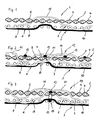
- the fabric 1 illustrated in figure 1 has a first woven fabric layer 2 forming a paper side on its outside and a second woven fabric layer 3 forming a machine side on its outside. Both woven fabric layers 2, 3 are superimposed one over the other.
- the first woven fabric layer 2 comprises longitudinal first threads 4 and transverse first threads - for example identified by 5 - extending at right angles to the latter, which both have a circular cross-section.
- the longitudinal first threads 4 and the transverse first threads 5 are interwoven with one another to form a plain weave, i.e. the longitudinal first threads 4 respectively bind a transverse first thread 5 on the outer or paper side and the subsequent transverse first thread 5 on the inner side.
- the second woven fabric layer 3 is woven from outer longitudinal second threads 6 - depicted black in color - and longitudinal embossing threads 7, one of which is shown only, and from transverse second threads - identified for example by 8. Threads 7, 8 have circular cross-section, while the longitudinal second threads 6 have a rectangular cross-section. The outer longitudinal second threads 6 and the embossing threads 7 alternate according to a ratio 1:2.
- the outer longitudinal second threads 6 form long machine side floats 9, 10 interrupted by repeatedly binding two adjacent transverse second threads 8 at their inner side.
- the machine side floats 9, 10 define on their wear side the machine side of the fabric 1.
- the embossing threads 7 bind two adjacent transverse second threads 8 on their outside with distance to the plane defined by the machine side, pass between two adjacent transverse first threads 5 and transverse second threads 8, i.e. between the two woven fabric layers 2, 3, then penetrate the first woven fabric layer 2 between two adjacent transverse first threads 5 and then pass over the paper side of the first woven fabric layer 2 forming paper side floats 11 extending over four transverse first threads 5, respectively. Thereafter, the embossing threads 7 penetrate again the first woven fabric layer 2 in machine direction, pass between two adjacent transverse first threads 5 and transverse second threads 8 and then bind two adjacent transverse second threads 8 on the machine side again, thereby connecting both of the woven fabric layers 2, 3.
- the embossing threads 7 are made of relatively thick monofilaments compared with the longitudinal first threads 4, the paper side floats 11 project significantly over the paper side of the first woven fabric layer 2.
- the gaps in the first woven fabric layer 2, where the embossing threads 7 penetrate it, are sufficient so that the longitudinal and transverse first threads 4, 5 enclosing these openings are not deflected by the penetrating parts of the embossing threads 7.
- these openings may be smaller than the dimension of the embossing threads 7 resulting in compressing or deflecting the transverse first threads 5 and/or the longitudinal first threads 4.
- the invention is not limited with respect to the length of the paper side floats 11, they may extend about more than four transverse first threads 5.
- the embossing threads 7 may bind under one transverse first thread 5 preferable in the middle of the paper side float 11 thus forming a short interruption of this float 11.
- the second embodiment of the invention shown in figure 2 has a similar structure as to the fabric 1 illustrated in figure 1 .
- the same reference numbers are used for the second fabric 12, and it is made reference to the description of the first fabric 1 with respect to the parts provided with the same reference numbers.
- FIG 2 not only one embossing thread 7 is shown but two embossing threads 7 extending adjacently and being offset to one another about three transverse first and second threads 5, 8 such that one transverse first thread 5 is enclosed by two adjacent embossing threads 7, one of which is penetrating in the direction to the paper side and one of which is penetrating in the direction to the second woven fabric layer 3.
- first fabric 1 and the second fabric 12 The only difference between the first fabric 1 and the second fabric 12 is that additional transverse third threads 13 are laid over the paper side of the first woven fabric layer 2 between two adjacent transverse first threads 5 respectively.
- the transverse third threads 13 pass under paper side floats 11 of the embossing threads 7 thereby supporting the paper side floats 11 in their middle. Since the transverse third threads 13 are projecting over the paper side of the first woven fabric layer 2, the paper side floats 11 are projecting more than the paper side floats 11 in the fabric 1 shown in figure 1 thereby forming recesses between each other.
- Figure 3 illustrates a fabric 14 designed in the same manner as the fabric 1 shown in figure 1 and fabric 12 shown in figure 2 . So also in this case, the same reference numbers are used for the same parts of fabric 14, and for describing these parts it is referred to the description of fabric 1 shown in figure 1 .
- fabric 12 (second embodiment) and fabric 14 (third embodiment) is that two adjacent embossing threads 7 are staggered only about two transverse first threads 5 and that the transverse third threads 13 are located so that one and the same transverse third thread 13 supports one paper side float 11 at the end, where the embossing thread 7 forming this paper side float 11 penetrates the first woven fabric layer 2 in direction to the second woven fabric layer 3, and the adjacent paper side float 11 at the end, where the embossing thread 7 forming this paper side float 11 penetrates the first woven fabric layer 2 in direction to the paper side, respectively.
- transverse third threads 13 are woven as binder threads connecting the two woven fabric layers 2, 3 by repeatedly penetrating the woven fabric layers 2, 3 to the machine side and binding one outer longitudinal second thread 6 at binding points 15 between two transverse second threads 8 where the outer longitudinal second thread 6 passes over two transverse second threads 8. Consequently, the two woven fabric layers 2, 3 are connected not only by the embossing threads 7, but also by the transverse third threads 13 thereby providing a stronger connection as in case of the first and second embodiments, where the connection between the two woven fabric layers 2, 3 is caused only by the embossing threads 7.
- FIG 4 shows fabric 16 according to the fourth embodiment of the invention.
- the fabric 16 is designed similar to the fabrics 1, 12, 14 as shown in the foregoing figures. So, the same reference numbers are used for the according parts of these fabrics 1, 12, 14, and for describing these parts it is referred to the description of the fabrics 1, 12 and 14.
- Transverse third threads 13 are provided with transverse third threads 13, however in this case replacing every sixth transverse first thread 5, being laid onto the first woven fabric layer 2 and hence, not being bound therein. Consequently, all the longitudinal first threads 4 pass under the inner side of the longitudinal third threads 13 thus forming recesses for them.
- the transverse third threads 13 have an overall cross-section being much thicker than the cross-sections of the transverse first threads 5.
- the paper side floats 11 of the embossing threads 7 extend first over one transverse third thread 13 after penetrating the first woven fabric layer 2, then pass over five transverse first threads 5 and over the next transverse third thread 13 and then penetrates the first woven fabric layer 2 between this transverse third thread 13 and the next transverse first thread 5 in the direction to the second woven fabric layer 3.
- Two adjacent embossing threads 7 are offset so that they bind one transverse third thread 13 in such a way that the one embossing thread 7 penetrates the first woven fabric layer 2 in the direction to the paper side and the other embossing thread 7 penetrates the first woven fabric layer 2 in the direction to the second woven fabric layer 3. Due to the thickness of the transverse third threads 13, the paper side floats 11 are elevated from the paper side of the first woven fabric layer 2.
- Figure 5 shows another fabric 21 (fifth embodiment) having a first woven fabric layer 22 and a second woven fabric layer 23 superimposed one over the other.
- the first woven fabric layer 22 comprises longitudinal first threads 24 and transverse threads, namely transverse first threads - for example identified by 25 - and transverse third threads - for example identified by 26 -, all of which have circular cross-sections.
- the transverse first threads 25 alternate with the transverse third threads 26.
- the longitudinal first threads 24 on the one hand and the transverse first and third threads 25, 26 on the other hand are interwoven with one another to form a plain weave, i.e. one longitudinal first thread 24 binds a transverse first thread 25 on its paper side and a subsequent transverse third thread 26 on its inner side, while the adjacent longitudinal first thread 24 binds a transverse first thread 25 on its inner side and a subsequent transverse third thread 26 on its paper side.
- the second woven fabric layer 23 is woven from outer longitudinal second threads 27 and longitudinal embossing threads 28 and from transverse second threads - identified for example by 29.
- the outer longitudinal second threads 27 form long machine side floats 30 crossing twelve adjacent transverse second threads 29 on their machine side and interrupted by repeatedly binding two adjacent transverse second threads 29 at their inner side.
- the machine side floats 30 define on their outside the machine side of the fabric 21.
- the embossing threads 28 cross three adjacent transverse second threads 29 on their outside with distance to the level defined by the machine side, pass between the two woven fabric layers 22, 23, then penetrate the first woven fabric layer 22 between a transverse first thread 25 and transverse third thread 26. Thereafter, the embossing threads 28 extend over four transverse third threads 26, thereby supported by these transverse third threads 26 in a significant distance to the transverse first threads 25 and forming paper side floats 31. Thereafter, the embossing threads 28 penetrate again the first woven fabric layer 22 in machine direction, pass between the two woven fabric layers 22, 23 and then bind three adjacent transverse second threads 29 on the machine side again. Thereby both of the woven fabric layers 22, 23 are connected.
- the transverse third threads 26 are interwoven into the first woven fabric layer 22 and hence, belong to the repeat pattern of this layer 22. Since the diameter of the transverse third threads 26 is much bigger than that of the transverse first threads 25, the paper side floats 31 formed by the embossing threads 28 are supported only by the transverse third threads 26 projecting accordingly.
Landscapes
- Engineering & Computer Science (AREA)
- Textile Engineering (AREA)
- Paper (AREA)
- Machines For Manufacturing Corrugated Board In Mechanical Paper-Making Processes (AREA)
- Woven Fabrics (AREA)
- Sanitary Thin Papers (AREA)
Claims (12)
- Bespannung (1, 12, 14, 16, 21) zur Ausbildung einer faserigen Papierbahn mit geprägter Oberfläche, wobei die Bespannung (1, 12, 14, 16, 21) Längs- und Querfäden (4-8; 24-28) aufweist, die miteinander in einem Geweberapport verwebt sind, definierend eine Maschinenseite und eine Papierseite, bei der einige der Längsfäden Prägefäden (7, 28) mit vorstehenden papierseitigen Flottierungen (11, 31) auf der Papierseite der Bespannung (1, 12, 14, 16, 21) bilden, welche sich über mehr als einen Querfaden (5, 25) erstrecken, und wobei die Bespannung (1, 12, 14, 16, 21) eine erste Gewebelage (2, 22), die an ihrer Außenseite die Papierseite bildet und erste Längs- und Querfäden (4, 5, 24, 25) aufweist, die miteinander verwoben sind, und eine zweite Gewebelage (3, 23) aufweist, die an ihrer Außenseite die Maschinenseite bildet und zweite Längs- und Querfäden (6, 7, 8, 27, 28, 29) aufweist, die miteinander verwebt sind, dadurch gekennzeichnet, dass zumindest einige der zweiten Längsfäden Prägefäden (7, 28) bilden, die die erste Gewebelage (2, 22) zur Ausbildung der papierseitigen Flottierungen (11, 31) durchsetzen und die beiden Gewebelagen (2, 3, 22, 23) verbinden.
- Bespannung nach Anspruch 1, dadurch gekennzeichnet, dass die zweiten Längsfäden (6, 7, 27, 28) eine erste Längsfadengruppe mit äußeren zweiten Längsfäden (6, 27) und eine zweite Längsfadengruppe mit inneren zweiten Längsfäden (7, 28) bilden und dass nur die äußeren zweiten Längsfäden (6, 27) die Außenseite der zweiten Gewebelage (3, 23) durch Ausbilden von maschinenseitigen Flottierungen (9, 30) definieren, die zumindest einen zweiten Querfaden (8, 29) kreuzen, wobei zumindest einige der inneren zweiten Längsfäden die Prägefäden (7, 28) bilden, insbesondere dass der Abriebwiderstand des Materials, aus dem die äußeren zweiten Längsfäden (6, 27) bestehen, größer ist als der des Materials, aus dem die inneren zweiten Längsfäden (7, 28) bestehen und/oder dass die Zugfestigkeit des Materials, aus dem inneren zweiten Längsfäden (7, 28) bestehen, größer ist als die des Materials, aus dem die äußeren zweiten Längsfäden (6, 27) bestehen.
- Bespannung nach Anspruch 1 oder 2, dadurch gekennzeichnet, dass benachbarte papierseitige Flottierungen (11, 31) über die Breite des Geweberapports zueinander versetzt sind, insbesondere dass die benachbarten papierseitigen Flottierungen (11, 31) sich teilweise einander überlappen, wobei sie sich jeweils über zumindest einen und denselben ersten Querfaden (5, 25) erstrecken.
- Bespannung nach einem der Ansprüche 1 bis 3, dadurch gekennzeichnet, dass dritte Querfäden (13, 26) vorgesehen sind, die sich über die Papierseite erstrecken, und dass die papierseitigen Flottierungen (11, 31) durch die dritten Querfäden (13, 26) abgestützt sind, vorzugsweise dass die dritten Querfäden (13, 26) einen Querschnitt aufweisen, der gewählt ist, um einen Abstand zwischen der ersten Gewebelage (2, 22) und der papierseitigen Flottierungen (11, 31) zu bewirken, insbesondere dass der Querschnitt größer ist als der der ersten Querfäden (5, 25).
- Bespannung nach Anspruch 4, dadurch gekennzeichnet, dass zumindest einige der dritten Querfäden (13) über die Papierseite der ersten Gewebelage (2) gelegt sind und/oder dass zumindest einige der dritten Querfäden (26) mit den ersten Längsfäden (24) eines Geweberapports verwebt sind.
- Bespannung nach Anspruch 5, dadurch gekennzeichnet, dass innerhalb der ersten Gewebelage (2) die ersten Querfäden (5) dort weggelassen sind, wo die dritten Querfäden (13) über die Papierseite der ersten Gewebelage (2) eines Geweberapports gelegt sind.
- Bespannung nach einem der Ansprüche 4 bis 6, dadurch gekennzeichnet, dass jede papierseitige Flottierung (11, 31) durch zumindest zwei dritte Querfäden (13, 26) unterstützt ist, wobei diese Flottierungen (11, 31) derart versetzt sind, dass jeweils ein dritter Querfaden (13, 26) eine papierseitige Flottierung (11, 31) an demjenigen Ende unterstützt, wo der Prägefaden (7, 28), der diese papierseitige Flottierung (11, 31) bildet, die erste Gewebelage (2, 22) in Richtung auf die zweite Gewebelage (3, 23) durchsetzt, und die benachbarte papierseitige Flottierung (11, 31) an demjenigen Ende unterstützt, wo der Prägefaden (7, 28), der diese Flottierung (11, 31) bildet, die erste Gewebelage (2, 22) in Richtung auf die Papierseite durchsetzt.
- Bespannung nach einem der Ansprüche 4 bis 7, dadurch gekennzeichnet, dass zumindest einige der dritten Querfäden (13) derart verteilt sind, dass sie die papierseitigen Flottierungen (11) in ihrer Mitte unterstützen.
- Bespannung nach einem der Ansprüche 4 bis 8, dadurch gekennzeichnet, dass zumindest einige der dritten Querfäden (13) als Bindefäden eingewebt sind, die die beiden Gewebelagen (2, 3) mittels Durchsetzen der Gewebelagen (2, 3) in Richtung auf die Maschinenseite und durch Einbinden zumindest eines der zweiten Längsfäden (6) an einem Bindepunkt (15) verbinden, vorzugsweise wo die zweiten Längsfäden (6) über zumindest einen oder mehrere zweite Querfäden (8) auf der Papierseite flottieren.
- Bespannung nach einem der Ansprüche 4, 9, dadurch gekennzeichnet, dass zumindest einige der dritten Querfäden (13, 26) zwischen zwei benachbarten ersten Querfäden (5, 25) angeordnet sind.
- Bespannung nach einem der Ansprüche 1 bis 10, dadurch gekennzeichnet, dass sich die Prägefäden (7, 31) unter zumindest einen ersten Querfaden (5, 25) erstrecken, bevor sie die erste Gewebelage (2, 22) zu ihrer Papierseite und/oder wonach sie die erste Gewebelage (2, 22) von ihrer Papierseite her durchsetzen.
- Bespannung nach einem der Ansprüche 1 bis 11, dadurch gekennzeichnet, dass die äußeren zweiten Längsfäden (6, 27) mit zumindest einem, vorzugsweise mit zwei oder mehr aufeinander folgenden zweiten Querfäden (8, 29) innerhalb eines Geweberapports verwebt sind.
Priority Applications (6)
| Application Number | Priority Date | Filing Date | Title |
|---|---|---|---|
| ES12156912.3T ES2478972T3 (es) | 2012-02-24 | 2012-02-24 | Tela para formar una banda de papel que tiene una superficie gofrada |
| EP12156912.3A EP2631360B1 (de) | 2012-02-24 | 2012-02-24 | Gewebe zur Formung einer Papierbahn mit geprägter Oberfläche |
| PT121569123T PT2631360E (pt) | 2012-02-24 | 2012-02-24 | Tela para formação de uma teia de papel tendo uma superfície gravada |
| KR1020130001027A KR101417850B1 (ko) | 2012-02-24 | 2013-01-04 | 엠보싱 표면을 갖는 종이 웹을 형성하기 위한 직물 |
| US13/766,307 US8875745B2 (en) | 2012-02-24 | 2013-02-13 | Fabric for forming a paper web having an embossed surface |
| CN201310054917.5A CN103290589B (zh) | 2012-02-24 | 2013-02-20 | 用于形成具有压花表面的纸幅的织物 |
Applications Claiming Priority (1)
| Application Number | Priority Date | Filing Date | Title |
|---|---|---|---|
| EP12156912.3A EP2631360B1 (de) | 2012-02-24 | 2012-02-24 | Gewebe zur Formung einer Papierbahn mit geprägter Oberfläche |
Publications (2)
| Publication Number | Publication Date |
|---|---|
| EP2631360A1 EP2631360A1 (de) | 2013-08-28 |
| EP2631360B1 true EP2631360B1 (de) | 2014-05-14 |
Family
ID=45656687
Family Applications (1)
| Application Number | Title | Priority Date | Filing Date |
|---|---|---|---|
| EP12156912.3A Not-in-force EP2631360B1 (de) | 2012-02-24 | 2012-02-24 | Gewebe zur Formung einer Papierbahn mit geprägter Oberfläche |
Country Status (6)
| Country | Link |
|---|---|
| US (1) | US8875745B2 (de) |
| EP (1) | EP2631360B1 (de) |
| KR (1) | KR101417850B1 (de) |
| CN (1) | CN103290589B (de) |
| ES (1) | ES2478972T3 (de) |
| PT (1) | PT2631360E (de) |
Families Citing this family (4)
| Publication number | Priority date | Publication date | Assignee | Title |
|---|---|---|---|---|
| KR102407405B1 (ko) * | 2016-09-30 | 2022-06-10 | 킴벌리-클라크 월드와이드, 인크. | 비평면 부직포 직물 및 그 제조 방법 |
| CN108867083A (zh) * | 2018-08-10 | 2018-11-23 | 无锡宝强工业织造有限公司 | 用于耐高温橡胶输送带的浸胶帆布 |
| EP3653374A1 (de) * | 2018-11-13 | 2020-05-20 | IFG Exelto NV | Verdunkelungsschirm |
| DE102022117300B3 (de) * | 2022-07-12 | 2023-10-12 | Voith Patent Gmbh | Gewebeband |
Family Cites Families (21)
| Publication number | Priority date | Publication date | Assignee | Title |
|---|---|---|---|---|
| FR323392A (fr) | 1902-08-01 | 1903-03-05 | Ruediger Ernst | Feutre sécheur pour machines à carton et à papier |
| DE3600530A1 (de) | 1986-01-10 | 1987-07-16 | Wangner Gmbh Co Kg Hermann | Verwendung einer papiermaschinenbespannung zur herstellung von tissue-papier oder poroesem vlies und dafuer geeignete papiermaschinenbespannung |
| US4921750A (en) | 1988-05-25 | 1990-05-01 | Asten Group, Inc. | Papermaker's thru-dryer embossing fabric |
| US5169711A (en) | 1988-08-05 | 1992-12-08 | Jwi Ltd. | Paper makers forming fabric |
| DE4302031C1 (de) * | 1993-01-26 | 1993-12-16 | Heimbach Gmbh Thomas Josef | Trockensieb sowie Verfahren zu dessen Herstellung |
| US5429686A (en) | 1994-04-12 | 1995-07-04 | Lindsay Wire, Inc. | Apparatus for making soft tissue products |
| US5544678A (en) | 1995-04-14 | 1996-08-13 | Jwi Ltd. | Composite forming fabric woven with an Nx2N machine side layer |
| GB9520516D0 (en) | 1995-10-05 | 1995-12-13 | Scapa Group Plc | Fabric |
| GB9604602D0 (en) * | 1996-03-04 | 1996-05-01 | Jwi Ltd | Composite papermaking fabric with paired weft binder yarns |
| US5713397A (en) | 1996-08-09 | 1998-02-03 | Wangner Systems Corporation | Multi-layered through air drying fabric |
| US6110324A (en) | 1998-06-25 | 2000-08-29 | The Procter & Gamble Company | Papermaking belt having reinforcing piles |
| US6237644B1 (en) | 1998-09-01 | 2001-05-29 | Stewart Lister Hay | Tissue forming fabrics |
| US7114529B2 (en) * | 2001-07-09 | 2006-10-03 | Astenjohnson, Inc. | Multilayer through-air dryer fabric |
| MX2007013592A (es) * | 2005-05-05 | 2008-01-24 | Astenjohnson Inc | Tejidos de formacion mejoradores de volumen. |
| CA2645298A1 (en) * | 2006-03-10 | 2007-09-20 | Astenjohnson, Inc. | Double layer papermakers fabric with pockets for bulk enhancement |
| WO2008073301A2 (en) * | 2006-12-08 | 2008-06-19 | Astenjohnson, Inc. | Machine side layer weave design for composite forming fabrics |
| WO2009042634A1 (en) * | 2007-09-25 | 2009-04-02 | Astenjohnson, Inc. | Papermaker's fabric to develop caliper and topography in paper products |
| PT2230352E (pt) | 2009-03-20 | 2012-12-05 | Heimbach Gmbh & Co Kg | Faixa em tecido para circulação numa máquina |
| CN201520923U (zh) | 2009-07-31 | 2010-07-07 | 安徽华宇网业有限公司 | 一种双层造纸网 |
| EP2314762B1 (de) | 2009-10-23 | 2012-09-26 | Heimbach GmbH & Co.KG | Gewebte Papiermaschinenbespannung |
| US20110236742A1 (en) | 2010-03-23 | 2011-09-29 | Deng Ping-Hua | Fault protection bateery cover assembly |
-
2012
- 2012-02-24 ES ES12156912.3T patent/ES2478972T3/es active Active
- 2012-02-24 PT PT121569123T patent/PT2631360E/pt unknown
- 2012-02-24 EP EP12156912.3A patent/EP2631360B1/de not_active Not-in-force
-
2013
- 2013-01-04 KR KR1020130001027A patent/KR101417850B1/ko not_active Expired - Fee Related
- 2013-02-13 US US13/766,307 patent/US8875745B2/en not_active Expired - Fee Related
- 2013-02-20 CN CN201310054917.5A patent/CN103290589B/zh not_active Expired - Fee Related
Also Published As
| Publication number | Publication date |
|---|---|
| EP2631360A1 (de) | 2013-08-28 |
| ES2478972T3 (es) | 2014-07-23 |
| KR20130097648A (ko) | 2013-09-03 |
| US8875745B2 (en) | 2014-11-04 |
| KR101417850B1 (ko) | 2014-07-09 |
| CN103290589A (zh) | 2013-09-11 |
| PT2631360E (pt) | 2014-07-18 |
| US20130220475A1 (en) | 2013-08-29 |
| CN103290589B (zh) | 2015-01-14 |
Similar Documents
| Publication | Publication Date | Title |
|---|---|---|
| US5555917A (en) | Sixteen harness multi-layer forming fabric | |
| US7007722B2 (en) | Forming fabric | |
| RU2347019C2 (ru) | Многослойная формовочная ткань, состоящая из двух систем основных нитей с трехниточным соединением | |
| US9169599B2 (en) | Paper machine fabric | |
| KR960007934A (ko) | 개량된 섬유질 서포트를 구비한 3중층 제지 패브릭 | |
| US8181673B2 (en) | Woven fabric band for circulation in a machine | |
| FI109428B (fi) | Paperikoneen kangas | |
| US9745696B2 (en) | Paper maker fabric | |
| US8875745B2 (en) | Fabric for forming a paper web having an embossed surface | |
| JP4869767B2 (ja) | 繊維により高度に支持された安定な形成布 | |
| US11505897B2 (en) | Industrial textile for manufacturing a fibrous web | |
| US20170275823A1 (en) | Dryer fabric | |
| EP4019696B1 (de) | Industriefaser | |
| RU2384662C1 (ru) | Формующая сетка бумагоделательной машины | |
| EP2584091B1 (de) | Papiermacher-Gewebe, insbesondere ein Formiersieb | |
| US10633792B2 (en) | Papermaking fabric | |
| JP5115557B2 (ja) | 乾燥機ファブリック | |
| FI92080C (fi) | Paperikoneen märkäpään viirakudoksena käytettävä kaksoiskudos |
Legal Events
| Date | Code | Title | Description |
|---|---|---|---|
| PUAI | Public reference made under article 153(3) epc to a published international application that has entered the european phase |
Free format text: ORIGINAL CODE: 0009012 |
|
| 17P | Request for examination filed |
Effective date: 20120731 |
|
| AK | Designated contracting states |
Kind code of ref document: A1 Designated state(s): AL AT BE BG CH CY CZ DE DK EE ES FI FR GB GR HR HU IE IS IT LI LT LU LV MC MK MT NL NO PL PT RO RS SE SI SK SM TR |
|
| AX | Request for extension of the european patent |
Extension state: BA ME |
|
| GRAP | Despatch of communication of intention to grant a patent |
Free format text: ORIGINAL CODE: EPIDOSNIGR1 |
|
| RIC1 | Information provided on ipc code assigned before grant |
Ipc: D21F 11/00 20060101ALI20130930BHEP Ipc: D03D 1/00 20060101ALI20130930BHEP Ipc: D21F 1/00 20060101AFI20130930BHEP |
|
| INTG | Intention to grant announced |
Effective date: 20131015 |
|
| GRAS | Grant fee paid |
Free format text: ORIGINAL CODE: EPIDOSNIGR3 |
|
| GRAA | (expected) grant |
Free format text: ORIGINAL CODE: 0009210 |
|
| AK | Designated contracting states |
Kind code of ref document: B1 Designated state(s): AL AT BE BG CH CY CZ DE DK EE ES FI FR GB GR HR HU IE IS IT LI LT LU LV MC MK MT NL NO PL PT RO RS SE SI SK SM TR |
|
| REG | Reference to a national code |
Ref country code: GB Ref legal event code: FG4D |
|
| REG | Reference to a national code |
Ref country code: AT Ref legal event code: REF Ref document number: 668409 Country of ref document: AT Kind code of ref document: T Effective date: 20140615 |
|
| REG | Reference to a national code |
Ref country code: IE Ref legal event code: FG4D |
|
| REG | Reference to a national code |
Ref country code: DE Ref legal event code: R096 Ref document number: 602012001629 Country of ref document: DE Effective date: 20140626 |
|
| REG | Reference to a national code |
Ref country code: NL Ref legal event code: T3 |
|
| REG | Reference to a national code |
Ref country code: SE Ref legal event code: TRGR |
|
| REG | Reference to a national code |
Ref country code: PT Ref legal event code: SC4A Free format text: AVAILABILITY OF NATIONAL TRANSLATION Effective date: 20140710 |
|
| REG | Reference to a national code |
Ref country code: ES Ref legal event code: FG2A Ref document number: 2478972 Country of ref document: ES Kind code of ref document: T3 Effective date: 20140723 |
|
| REG | Reference to a national code |
Ref country code: LT Ref legal event code: MG4D |
|
| PG25 | Lapsed in a contracting state [announced via postgrant information from national office to epo] |
Ref country code: IS Free format text: LAPSE BECAUSE OF FAILURE TO SUBMIT A TRANSLATION OF THE DESCRIPTION OR TO PAY THE FEE WITHIN THE PRESCRIBED TIME-LIMIT Effective date: 20140914 Ref country code: NO Free format text: LAPSE BECAUSE OF FAILURE TO SUBMIT A TRANSLATION OF THE DESCRIPTION OR TO PAY THE FEE WITHIN THE PRESCRIBED TIME-LIMIT Effective date: 20140814 Ref country code: LT Free format text: LAPSE BECAUSE OF FAILURE TO SUBMIT A TRANSLATION OF THE DESCRIPTION OR TO PAY THE FEE WITHIN THE PRESCRIBED TIME-LIMIT Effective date: 20140514 Ref country code: GR Free format text: LAPSE BECAUSE OF FAILURE TO SUBMIT A TRANSLATION OF THE DESCRIPTION OR TO PAY THE FEE WITHIN THE PRESCRIBED TIME-LIMIT Effective date: 20140815 Ref country code: CY Free format text: LAPSE BECAUSE OF FAILURE TO SUBMIT A TRANSLATION OF THE DESCRIPTION OR TO PAY THE FEE WITHIN THE PRESCRIBED TIME-LIMIT Effective date: 20140514 |
|
| PG25 | Lapsed in a contracting state [announced via postgrant information from national office to epo] |
Ref country code: HR Free format text: LAPSE BECAUSE OF FAILURE TO SUBMIT A TRANSLATION OF THE DESCRIPTION OR TO PAY THE FEE WITHIN THE PRESCRIBED TIME-LIMIT Effective date: 20140514 Ref country code: LV Free format text: LAPSE BECAUSE OF FAILURE TO SUBMIT A TRANSLATION OF THE DESCRIPTION OR TO PAY THE FEE WITHIN THE PRESCRIBED TIME-LIMIT Effective date: 20140514 Ref country code: RS Free format text: LAPSE BECAUSE OF FAILURE TO SUBMIT A TRANSLATION OF THE DESCRIPTION OR TO PAY THE FEE WITHIN THE PRESCRIBED TIME-LIMIT Effective date: 20140514 Ref country code: PL Free format text: LAPSE BECAUSE OF FAILURE TO SUBMIT A TRANSLATION OF THE DESCRIPTION OR TO PAY THE FEE WITHIN THE PRESCRIBED TIME-LIMIT Effective date: 20140514 |
|
| PG25 | Lapsed in a contracting state [announced via postgrant information from national office to epo] |
Ref country code: CZ Free format text: LAPSE BECAUSE OF FAILURE TO SUBMIT A TRANSLATION OF THE DESCRIPTION OR TO PAY THE FEE WITHIN THE PRESCRIBED TIME-LIMIT Effective date: 20140514 Ref country code: RO Free format text: LAPSE BECAUSE OF FAILURE TO SUBMIT A TRANSLATION OF THE DESCRIPTION OR TO PAY THE FEE WITHIN THE PRESCRIBED TIME-LIMIT Effective date: 20140514 Ref country code: EE Free format text: LAPSE BECAUSE OF FAILURE TO SUBMIT A TRANSLATION OF THE DESCRIPTION OR TO PAY THE FEE WITHIN THE PRESCRIBED TIME-LIMIT Effective date: 20140514 Ref country code: DK Free format text: LAPSE BECAUSE OF FAILURE TO SUBMIT A TRANSLATION OF THE DESCRIPTION OR TO PAY THE FEE WITHIN THE PRESCRIBED TIME-LIMIT Effective date: 20140514 Ref country code: SK Free format text: LAPSE BECAUSE OF FAILURE TO SUBMIT A TRANSLATION OF THE DESCRIPTION OR TO PAY THE FEE WITHIN THE PRESCRIBED TIME-LIMIT Effective date: 20140514 |
|
| REG | Reference to a national code |
Ref country code: DE Ref legal event code: R097 Ref document number: 602012001629 Country of ref document: DE |
|
| PLBE | No opposition filed within time limit |
Free format text: ORIGINAL CODE: 0009261 |
|
| STAA | Information on the status of an ep patent application or granted ep patent |
Free format text: STATUS: NO OPPOSITION FILED WITHIN TIME LIMIT |
|
| 26N | No opposition filed |
Effective date: 20150217 |
|
| REG | Reference to a national code |
Ref country code: DE Ref legal event code: R097 Ref document number: 602012001629 Country of ref document: DE Effective date: 20150217 |
|
| PG25 | Lapsed in a contracting state [announced via postgrant information from national office to epo] |
Ref country code: SI Free format text: LAPSE BECAUSE OF FAILURE TO SUBMIT A TRANSLATION OF THE DESCRIPTION OR TO PAY THE FEE WITHIN THE PRESCRIBED TIME-LIMIT Effective date: 20140514 |
|
| PG25 | Lapsed in a contracting state [announced via postgrant information from national office to epo] |
Ref country code: LU Free format text: LAPSE BECAUSE OF FAILURE TO SUBMIT A TRANSLATION OF THE DESCRIPTION OR TO PAY THE FEE WITHIN THE PRESCRIBED TIME-LIMIT Effective date: 20150224 |
|
| PG25 | Lapsed in a contracting state [announced via postgrant information from national office to epo] |
Ref country code: MC Free format text: LAPSE BECAUSE OF FAILURE TO SUBMIT A TRANSLATION OF THE DESCRIPTION OR TO PAY THE FEE WITHIN THE PRESCRIBED TIME-LIMIT Effective date: 20140514 |
|
| REG | Reference to a national code |
Ref country code: IE Ref legal event code: MM4A |
|
| REG | Reference to a national code |
Ref country code: FR Ref legal event code: PLFP Year of fee payment: 5 |
|
| PG25 | Lapsed in a contracting state [announced via postgrant information from national office to epo] |
Ref country code: IE Free format text: LAPSE BECAUSE OF NON-PAYMENT OF DUE FEES Effective date: 20150224 |
|
| PG25 | Lapsed in a contracting state [announced via postgrant information from national office to epo] |
Ref country code: MT Free format text: LAPSE BECAUSE OF FAILURE TO SUBMIT A TRANSLATION OF THE DESCRIPTION OR TO PAY THE FEE WITHIN THE PRESCRIBED TIME-LIMIT Effective date: 20140514 |
|
| REG | Reference to a national code |
Ref country code: FR Ref legal event code: PLFP Year of fee payment: 6 |
|
| PG25 | Lapsed in a contracting state [announced via postgrant information from national office to epo] |
Ref country code: HU Free format text: LAPSE BECAUSE OF FAILURE TO SUBMIT A TRANSLATION OF THE DESCRIPTION OR TO PAY THE FEE WITHIN THE PRESCRIBED TIME-LIMIT; INVALID AB INITIO Effective date: 20120224 Ref country code: BG Free format text: LAPSE BECAUSE OF FAILURE TO SUBMIT A TRANSLATION OF THE DESCRIPTION OR TO PAY THE FEE WITHIN THE PRESCRIBED TIME-LIMIT Effective date: 20140514 Ref country code: SM Free format text: LAPSE BECAUSE OF FAILURE TO SUBMIT A TRANSLATION OF THE DESCRIPTION OR TO PAY THE FEE WITHIN THE PRESCRIBED TIME-LIMIT Effective date: 20140514 |
|
| PG25 | Lapsed in a contracting state [announced via postgrant information from national office to epo] |
Ref country code: TR Free format text: LAPSE BECAUSE OF FAILURE TO SUBMIT A TRANSLATION OF THE DESCRIPTION OR TO PAY THE FEE WITHIN THE PRESCRIBED TIME-LIMIT Effective date: 20140514 |
|
| REG | Reference to a national code |
Ref country code: FR Ref legal event code: PLFP Year of fee payment: 7 |
|
| PG25 | Lapsed in a contracting state [announced via postgrant information from national office to epo] |
Ref country code: MK Free format text: LAPSE BECAUSE OF FAILURE TO SUBMIT A TRANSLATION OF THE DESCRIPTION OR TO PAY THE FEE WITHIN THE PRESCRIBED TIME-LIMIT Effective date: 20140514 |
|
| PG25 | Lapsed in a contracting state [announced via postgrant information from national office to epo] |
Ref country code: AL Free format text: LAPSE BECAUSE OF FAILURE TO SUBMIT A TRANSLATION OF THE DESCRIPTION OR TO PAY THE FEE WITHIN THE PRESCRIBED TIME-LIMIT Effective date: 20140514 |
|
| PGFP | Annual fee paid to national office [announced via postgrant information from national office to epo] |
Ref country code: GB Payment date: 20220125 Year of fee payment: 11 Ref country code: FI Payment date: 20220215 Year of fee payment: 11 Ref country code: DE Payment date: 20220125 Year of fee payment: 11 Ref country code: CH Payment date: 20220221 Year of fee payment: 11 Ref country code: AT Payment date: 20220204 Year of fee payment: 11 |
|
| PGFP | Annual fee paid to national office [announced via postgrant information from national office to epo] |
Ref country code: SE Payment date: 20220221 Year of fee payment: 11 Ref country code: PT Payment date: 20220218 Year of fee payment: 11 Ref country code: NL Payment date: 20220204 Year of fee payment: 11 Ref country code: IT Payment date: 20220228 Year of fee payment: 11 Ref country code: FR Payment date: 20220125 Year of fee payment: 11 Ref country code: ES Payment date: 20220318 Year of fee payment: 11 Ref country code: BE Payment date: 20220125 Year of fee payment: 11 |
|
| REG | Reference to a national code |
Ref country code: DE Ref legal event code: R119 Ref document number: 602012001629 Country of ref document: DE |
|
| REG | Reference to a national code |
Ref country code: CH Ref legal event code: PL |
|
| REG | Reference to a national code |
Ref country code: SE Ref legal event code: EUG |
|
| REG | Reference to a national code |
Ref country code: NL Ref legal event code: MM Effective date: 20230301 |
|
| REG | Reference to a national code |
Ref country code: AT Ref legal event code: MM01 Ref document number: 668409 Country of ref document: AT Kind code of ref document: T Effective date: 20230224 |
|
| REG | Reference to a national code |
Ref country code: BE Ref legal event code: MM Effective date: 20230228 |
|
| GBPC | Gb: european patent ceased through non-payment of renewal fee |
Effective date: 20230224 |
|
| PG25 | Lapsed in a contracting state [announced via postgrant information from national office to epo] |
Ref country code: SE Free format text: LAPSE BECAUSE OF NON-PAYMENT OF DUE FEES Effective date: 20230225 Ref country code: PT Free format text: LAPSE BECAUSE OF NON-PAYMENT OF DUE FEES Effective date: 20230824 Ref country code: LI Free format text: LAPSE BECAUSE OF NON-PAYMENT OF DUE FEES Effective date: 20230228 Ref country code: FI Free format text: LAPSE BECAUSE OF NON-PAYMENT OF DUE FEES Effective date: 20230224 Ref country code: CH Free format text: LAPSE BECAUSE OF NON-PAYMENT OF DUE FEES Effective date: 20230228 Ref country code: AT Free format text: LAPSE BECAUSE OF NON-PAYMENT OF DUE FEES Effective date: 20230224 |
|
| PG25 | Lapsed in a contracting state [announced via postgrant information from national office to epo] |
Ref country code: NL Free format text: LAPSE BECAUSE OF NON-PAYMENT OF DUE FEES Effective date: 20230301 |
|
| PG25 | Lapsed in a contracting state [announced via postgrant information from national office to epo] |
Ref country code: GB Free format text: LAPSE BECAUSE OF NON-PAYMENT OF DUE FEES Effective date: 20230224 |
|
| PG25 | Lapsed in a contracting state [announced via postgrant information from national office to epo] |
Ref country code: IT Free format text: LAPSE BECAUSE OF NON-PAYMENT OF DUE FEES Effective date: 20230224 Ref country code: GB Free format text: LAPSE BECAUSE OF NON-PAYMENT OF DUE FEES Effective date: 20230224 Ref country code: FR Free format text: LAPSE BECAUSE OF NON-PAYMENT OF DUE FEES Effective date: 20230228 Ref country code: DE Free format text: LAPSE BECAUSE OF NON-PAYMENT OF DUE FEES Effective date: 20230901 |
|
| PG25 | Lapsed in a contracting state [announced via postgrant information from national office to epo] |
Ref country code: BE Free format text: LAPSE BECAUSE OF NON-PAYMENT OF DUE FEES Effective date: 20230228 |
|
| PG25 | Lapsed in a contracting state [announced via postgrant information from national office to epo] |
Ref country code: ES Free format text: LAPSE BECAUSE OF NON-PAYMENT OF DUE FEES Effective date: 20230225 |
|
| REG | Reference to a national code |
Ref country code: ES Ref legal event code: FD2A Effective date: 20240426 |
|
| PG25 | Lapsed in a contracting state [announced via postgrant information from national office to epo] |
Ref country code: ES Free format text: LAPSE BECAUSE OF NON-PAYMENT OF DUE FEES Effective date: 20230225 |