EP2593507B1 - Witterungsstabilisierte styrolcopolymer formmassen - Google Patents
Witterungsstabilisierte styrolcopolymer formmassen Download PDFInfo
- Publication number
- EP2593507B1 EP2593507B1 EP11729102.1A EP11729102A EP2593507B1 EP 2593507 B1 EP2593507 B1 EP 2593507B1 EP 11729102 A EP11729102 A EP 11729102A EP 2593507 B1 EP2593507 B1 EP 2593507B1
- Authority
- EP
- European Patent Office
- Prior art keywords
- weight
- component
- molding compositions
- formula
- compound
- Prior art date
- Legal status (The legal status is an assumption and is not a legal conclusion. Google has not performed a legal analysis and makes no representation as to the accuracy of the status listed.)
- Active
Links
- 0 CCC(CC(C)(C1)*C(C)(C)CC1OC(C(C)(C)CCC(C)(C)C(OC1CC(C)(C)*CCC(C)(C)C1)=O)=*)*(C)=C Chemical compound CCC(CC(C)(C1)*C(C)(C)CC1OC(C(C)(C)CCC(C)(C)C(OC1CC(C)(C)*CCC(C)(C)C1)=O)=*)*(C)=C 0.000 description 5
Classifications
-
- C—CHEMISTRY; METALLURGY
- C08—ORGANIC MACROMOLECULAR COMPOUNDS; THEIR PREPARATION OR CHEMICAL WORKING-UP; COMPOSITIONS BASED THEREON
- C08L—COMPOSITIONS OF MACROMOLECULAR COMPOUNDS
- C08L25/00—Compositions of, homopolymers or copolymers of compounds having one or more unsaturated aliphatic radicals, each having only one carbon-to-carbon double bond, and at least one being terminated by an aromatic carbocyclic ring; Compositions of derivatives of such polymers
- C08L25/02—Homopolymers or copolymers of hydrocarbons
- C08L25/04—Homopolymers or copolymers of styrene
- C08L25/08—Copolymers of styrene
-
- C—CHEMISTRY; METALLURGY
- C08—ORGANIC MACROMOLECULAR COMPOUNDS; THEIR PREPARATION OR CHEMICAL WORKING-UP; COMPOSITIONS BASED THEREON
- C08L—COMPOSITIONS OF MACROMOLECULAR COMPOUNDS
- C08L51/00—Compositions of graft polymers in which the grafted component is obtained by reactions only involving carbon-to-carbon unsaturated bonds; Compositions of derivatives of such polymers
- C08L51/04—Compositions of graft polymers in which the grafted component is obtained by reactions only involving carbon-to-carbon unsaturated bonds; Compositions of derivatives of such polymers grafted on to rubbers
-
- C—CHEMISTRY; METALLURGY
- C08—ORGANIC MACROMOLECULAR COMPOUNDS; THEIR PREPARATION OR CHEMICAL WORKING-UP; COMPOSITIONS BASED THEREON
- C08K—Use of inorganic or non-macromolecular organic substances as compounding ingredients
- C08K5/00—Use of organic ingredients
- C08K5/01—Hydrocarbons
-
- C—CHEMISTRY; METALLURGY
- C08—ORGANIC MACROMOLECULAR COMPOUNDS; THEIR PREPARATION OR CHEMICAL WORKING-UP; COMPOSITIONS BASED THEREON
- C08K—Use of inorganic or non-macromolecular organic substances as compounding ingredients
- C08K5/00—Use of organic ingredients
- C08K5/16—Nitrogen-containing compounds
- C08K5/315—Compounds containing carbon-to-nitrogen triple bonds
-
- C—CHEMISTRY; METALLURGY
- C08—ORGANIC MACROMOLECULAR COMPOUNDS; THEIR PREPARATION OR CHEMICAL WORKING-UP; COMPOSITIONS BASED THEREON
- C08K—Use of inorganic or non-macromolecular organic substances as compounding ingredients
- C08K5/00—Use of organic ingredients
- C08K5/16—Nitrogen-containing compounds
- C08K5/34—Heterocyclic compounds having nitrogen in the ring
- C08K5/3412—Heterocyclic compounds having nitrogen in the ring having one nitrogen atom in the ring
- C08K5/3415—Five-membered rings
-
- C—CHEMISTRY; METALLURGY
- C08—ORGANIC MACROMOLECULAR COMPOUNDS; THEIR PREPARATION OR CHEMICAL WORKING-UP; COMPOSITIONS BASED THEREON
- C08K—Use of inorganic or non-macromolecular organic substances as compounding ingredients
- C08K5/00—Use of organic ingredients
- C08K5/16—Nitrogen-containing compounds
- C08K5/34—Heterocyclic compounds having nitrogen in the ring
- C08K5/3412—Heterocyclic compounds having nitrogen in the ring having one nitrogen atom in the ring
- C08K5/3432—Six-membered rings
- C08K5/3435—Piperidines
-
- C—CHEMISTRY; METALLURGY
- C08—ORGANIC MACROMOLECULAR COMPOUNDS; THEIR PREPARATION OR CHEMICAL WORKING-UP; COMPOSITIONS BASED THEREON
- C08K—Use of inorganic or non-macromolecular organic substances as compounding ingredients
- C08K5/00—Use of organic ingredients
- C08K5/16—Nitrogen-containing compounds
- C08K5/34—Heterocyclic compounds having nitrogen in the ring
- C08K5/3467—Heterocyclic compounds having nitrogen in the ring having more than two nitrogen atoms in the ring
- C08K5/3477—Six-membered rings
- C08K5/3492—Triazines
-
- C—CHEMISTRY; METALLURGY
- C08—ORGANIC MACROMOLECULAR COMPOUNDS; THEIR PREPARATION OR CHEMICAL WORKING-UP; COMPOSITIONS BASED THEREON
- C08L—COMPOSITIONS OF MACROMOLECULAR COMPOUNDS
- C08L25/00—Compositions of, homopolymers or copolymers of compounds having one or more unsaturated aliphatic radicals, each having only one carbon-to-carbon double bond, and at least one being terminated by an aromatic carbocyclic ring; Compositions of derivatives of such polymers
- C08L25/02—Homopolymers or copolymers of hydrocarbons
- C08L25/04—Homopolymers or copolymers of styrene
- C08L25/08—Copolymers of styrene
- C08L25/12—Copolymers of styrene with unsaturated nitriles
-
- C—CHEMISTRY; METALLURGY
- C08—ORGANIC MACROMOLECULAR COMPOUNDS; THEIR PREPARATION OR CHEMICAL WORKING-UP; COMPOSITIONS BASED THEREON
- C08L—COMPOSITIONS OF MACROMOLECULAR COMPOUNDS
- C08L51/00—Compositions of graft polymers in which the grafted component is obtained by reactions only involving carbon-to-carbon unsaturated bonds; Compositions of derivatives of such polymers
-
- C—CHEMISTRY; METALLURGY
- C08—ORGANIC MACROMOLECULAR COMPOUNDS; THEIR PREPARATION OR CHEMICAL WORKING-UP; COMPOSITIONS BASED THEREON
- C08L—COMPOSITIONS OF MACROMOLECULAR COMPOUNDS
- C08L51/00—Compositions of graft polymers in which the grafted component is obtained by reactions only involving carbon-to-carbon unsaturated bonds; Compositions of derivatives of such polymers
- C08L51/003—Compositions of graft polymers in which the grafted component is obtained by reactions only involving carbon-to-carbon unsaturated bonds; Compositions of derivatives of such polymers grafted on to macromolecular compounds obtained by reactions only involving unsaturated carbon-to-carbon bonds
-
- C—CHEMISTRY; METALLURGY
- C08—ORGANIC MACROMOLECULAR COMPOUNDS; THEIR PREPARATION OR CHEMICAL WORKING-UP; COMPOSITIONS BASED THEREON
- C08L—COMPOSITIONS OF MACROMOLECULAR COMPOUNDS
- C08L55/00—Compositions of homopolymers or copolymers, obtained by polymerisation reactions only involving carbon-to-carbon unsaturated bonds, not provided for in groups C08L23/00 - C08L53/00
- C08L55/02—ABS [Acrylonitrile-Butadiene-Styrene] polymers
-
- C—CHEMISTRY; METALLURGY
- C08—ORGANIC MACROMOLECULAR COMPOUNDS; THEIR PREPARATION OR CHEMICAL WORKING-UP; COMPOSITIONS BASED THEREON
- C08K—Use of inorganic or non-macromolecular organic substances as compounding ingredients
- C08K5/00—Use of organic ingredients
- C08K5/16—Nitrogen-containing compounds
- C08K5/34—Heterocyclic compounds having nitrogen in the ring
- C08K5/3467—Heterocyclic compounds having nitrogen in the ring having more than two nitrogen atoms in the ring
- C08K5/3477—Six-membered rings
- C08K5/3492—Triazines
- C08K5/34926—Triazines also containing heterocyclic groups other than triazine groups
Definitions
- the present invention relates to thermoplastic molding compositions of high-gloss, weather-resistant acrylonitrile copolymers, especially for automotive exterior applications.
- Stabilized thermoplastic molding compositions of various types are known and widely used due to their favorable for many applications property profile.
- the DE-A-103 16 198 discloses stabilizer mixtures for a wide variety of types of thermoplastic polymers, exemplified by polypropylene.
- the stabilizer mixtures are ternary mixtures.
- Stabilizer mixtures which also contain compounds of the formulas (VI), (VII) and (VIII) of the present application are described as only one of many possibilities.
- Each of the three stabilizer components may preferably be present in amounts of from 0.05 to 1% by weight, based on the organic material.
- a disadvantage of this embodiment is the strong color change during weathering and the decrease in gloss.
- the weight ratio of component C to component D is generally in the range from 4: 1 to 0.25: 1, preferably 4: 1 to 1: 1, particularly preferably 3: 1 to 1: 1.
- the weight ratio of component D to E is usually in the range of 2: 1 to 0.5: 1.
- Component A is a compound having Component A:
- the thermoplastic molding compositions according to the invention contain one or more acrylonitrile copolymers.
- any suitable comonomers can be present in the copolymers in addition to acrylonitrile. It is preferably a styrene-acrylonitrile copolymer, an alpha-methylstyrene-acrylonitrile copolymer, an N-phenylmaleimide-styrene copolymer or N-phenylmaleimide-styrene-acrylonitrile terpolymer.
- component A are in principle all known to those skilled and described in the literature styrene-acrylonitrile copolymers, ⁇ -methylstyrene-acrylonitrile copolymers, N-phenylmaleimide-styrene-acrylonitrile terpolymer or mixtures thereof, provided that their mixtures have a viscosity number VZ (measured according to DIN 53727 at 25 ° C as 0.5% strength by weight solution in dimethylformamide, this method of measurement also applies to all viscosity numbers VZ mentioned below which are equal to or less than 85 ml / g.
- Preferred components A are composed of 50 to 90 wt .-%, preferably 60 to 85 wt .-%, in particular 65 to 81 wt .-%, styrene and 10 to 50 wt .-%, preferably 20 to 40 wt .-% , in particular 19 to 35 wt .-%, acrylonitrile and 0 to 5 wt .-%, preferably 0 to 4 wt .-%, in particular 0 to 3 wt .-%, further monomers, wherein the wt .-% are each based to the weight of component A and together give 100 wt .-%.
- Further preferred components A are composed of 50 to 90 wt .-%, preferably 60 to 80 wt.%, In particular 65 to 78 wt .-%, ⁇ -methylstyrene and 10 to 50 wt .-%, preferably 20 to 40 wt. -%, in particular 22 to 35 wt .-%, acrylonitrile and 0 to 5 wt .-%, preferably 0 to 4 wt .-%, in particular 0 to 3 wt .-%, further monomers, wherein the wt .-% in each case are based on the weight of component A and together give 100 wt .-%.
- Also preferred components A are composed of 50 to 90 wt .-%, preferably 60 to 80 wt.%, In particular 65 to 78 wt .-%, N-phenylmaleimide and 10 to 50 wt .-%, preferably 20 to 40 wt. %, in particular 22 to 35 wt .-%, styrene or acrylonitrile and 0 to 5 wt .-%, preferably 0 to 4 wt .-%, in particular 0 to 3 wt .-%, further monomers, wherein the wt. % each are based on the weight of component A and together give 100% by weight.
- Also preferred components A are mixtures of these styrene-acrylonitrile copolymers, ⁇ -methylstyrene-acrylonitrile copolymers, N-phenylmaleimide-styrene copolymers and N-phenylmaleimide-acrylonitrile-styrene terpolymers.
- all copolymerizable monomers can be used, for example p-methylstyrene, t-butylstyrene, vinylnaphthalene, alkylacrylates and / or alkylmethacrylates, for example those with C 1 - to C 8 -alkyl radicals, N-phenylmaleimide or mixtures thereof.
- the copolymers of component A can be prepared by known methods. You can z. B. by radical polymerization, in particular by emulsion, suspension, solution or bulk polymerization.
- Component B is a compound having Component B:
- thermoplastic molding compositions according to the invention contain one or more compounds of the formulas (I), (II), (III), (IV) and / or (V).
- These compounds can be prepared with the aid of a co-reagent of acrylonitrile with styrene or ⁇ -methylstyrene. Their preparation is known to the person skilled in the art and described in the literature ( Schellenberg et al., Macromolecular Chemistry (1992), 193, 3063-3071 ). They can also be obtained in a continuously operated mass / solution polymerization of styrene or ⁇ -methylstyrene from the back monomer / solvent mixture ( Schellenberg et al., Applied Macromolecular Chemistry (1991), 3138, 123-134 )
- Component C of the molding compositions of the invention is a compound of the formula (VI):
- component D of the molding compositions of the invention a mixture of the formula (VII) is used:
- Component E of the molding compositions of the invention may be a compound of the formula (VIII):
- This sterically hindered amine (CAS number 101357-37-3) and its preparation are known to the person skilled in the art and described in the literature (see, for example, US Pat US-A-5 208 132 and the references cited therein). It is sold by ADEKA under the name Adeka Stab ® LA-68.
- a compound of the formula (X) can be used:
- This sterically hindered amine (CAS number 192268-64-7) and its preparation are known to those skilled in the art and described in the literature (see, for example EP-A-782994 and the references cited therein). It is sold by BASF under the name Chimassorb ® 2020.
- the molding compositions according to the invention may contain one or more additives or additives which are different from the components C, D and E and which are typical and customary for plastic mixtures.
- additives or additives may be mentioned, for example: dyes, pigments, colorants, antistatic agents, antioxidants, stabilizers to improve the thermal stability, to increase the light stability, to increase the resistance to hydrolysis and chemical resistance, anti-heat decomposition agents and in particular the lubricants / lubricants , which are useful for the production of moldings or moldings.
- the dosing of these other additives can be done at any stage of the manufacturing process, but preferably at an early stage, to take advantage of the stabilizing effects (or other specific effects) of the additive at an early stage.
- Heat stabilizers or antioxidants are usually metal halides (chlorides, bromides, iodides), which are derived from metals of Group I of the Periodic Table of the Elements (such as Li, Na, K, Cu).
- Stabilizers which are suitable as component F are the customary hindered phenols, but also "vitamin E” or compounds of analogous construction. Benzophenones, resorcinols, salicylates, benzotriazoles and other compounds are also suitable. These are usually used in amounts of 0 to 2 wt .-%, preferably 0.01 to 2 wt .-% (based on the total weight of the molding compositions of the invention).
- Suitable lubricants and mold release agents are stearic acids, stearyl alcohol, stearic acid esters or generally higher fatty acids, their derivatives and corresponding fatty acid mixtures having 12 to 30 carbon atoms.
- the amounts of these additives are - if present - in the range of 0.05 to 1 wt .-% (based on the total weight of the molding compositions of the invention).
- silicone oils, oligomeric isobutylene or similar substances are suitable as additives, the usual amounts are - if present - 0.05 to 5 wt .-% (based on the total weight of the molding compositions of the invention).
- Pigments, dyes, colorants such as ultramarine blue, phthalocyanines, titanium dioxide, cadmium sulfides, derivatives of perylenetetracarboxylic acid are also useful.
- Processing aids and stabilizers, lubricants and antistatic agents are usually used in amounts of 0 to 2 wt .-%, preferably 0.01 to 2 wt .-% (based on the total weight of the molding compositions of the invention).
- the molding compositions of the invention can be prepared by any of the known methods. Preferably, however, the mixing of the components by melt mixing, for example, common extrusion, kneading or rolling of the components, z. At temperatures in the range of 160 to 400 ° C, preferably from 180 to 280 ° C, wherein the components, in a preferred embodiment, have previously been partially or completely isolated from the reaction mixtures obtained in the respective manufacturing steps
- the molding compositions of the invention can be processed into films or moldings. These films or moldings are particularly suitable for use in the automotive exterior, i. under the influence of the weather, suitable.
- These films or moldings can be prepared by the known methods of thermoplastic processing from the molding compositions of the invention.
- the production can be carried out by extrusion or injection molding.
- the molding compositions of the invention have over the known stabilized molding compositions again improved weathering resistance, i. a further improved heat, light and / or oxygen resistance on.
- the change in the color space ⁇ E according to DIN 52 336 was calculated from ⁇ L, ⁇ A and ⁇ B according to DIN 6174.
- the components A, B, C and D (respective parts by weight see Table 1) were homogenized in a twin-screw extruder ZSK53 Fa. Werner & Pfleiderer at 250 ° C and extruded into a water bath. The extrudates were granulated and dried. From the granules were prepared on an injection molding machine at 250 ° C melt temperature and 60 ° C mold surface temperature test specimens ago and determined the properties listed in Table 1.
- Table 1 Composition and properties of the molding compositions (examples preceded by V are comparative examples) example 1 2 3 4 5 6 V-7 V-8 V-9 V-10 V-11 composition Ai 96.2 96.2 96.2 96.2 97 96.7 Ai 96.55 96.55 86.97 VA-iii 100 VA-iv 99.8 Bi 0.8 0.8 0.8 0.8 0 0.3 B-ii 12:45 0.45 VB-iii 10.53 Ci: 0.5 0.5 0.5 0.5 0.5 0.5 0.5 0.1 0.5 0.5 VC-ii 0.5 di 0.5 0.5 0.25 0.25 0.25 0.25 0.5 0.5 0.5 egg 0.25 12:25 0.1 egg 0.25 E-iii 0.25 Fi 2 2 F-ii 2 2 2 2 2 2 2 2 2 2 2 2 2 2 2 2 2 2 2 2 2 2 2 2 2 2 2 2 2 2 2 2 2 properties Shine after 0 h BWZ 101 103 101 102 101 104 102 101 102 101 99 1000 h BWZ
- the examples show that the molding compositions according to the invention compared to the known stabilized molding compositions again improved weather resistance, ie again improved heat, light, and / or oxygen resistance.
- the composition is given in parts by weight and the abbreviation BWZ stands for weathering time.
Landscapes
- Chemical & Material Sciences (AREA)
- Health & Medical Sciences (AREA)
- Chemical Kinetics & Catalysis (AREA)
- Medicinal Chemistry (AREA)
- Polymers & Plastics (AREA)
- Organic Chemistry (AREA)
- Compositions Of Macromolecular Compounds (AREA)
Description
- Die vorliegende Erfindung betrifft thermoplastische Formmassen aus hochglänzenden, witterungsbeständigen Acrylnitrilcopolymeren insbesondere für automobile Außenanwendungen. Stabilisierte thermoplastische Formmassen unterschiedlichster Art sind bekannt und aufgrund ihres für viele Anwendungen günstigen Eigenschaftsprofils breit einsetzbar.
- Beispielsweise werden in der
US-A-4 877 826 bewitterbare Styrolpolymer-blends aus gepropften EPDM bzw. Acrylatkautschuken in Styrolacrylnitrilcopolymeren beschrieben, die mit Polyalkylglycol stabilisiert werden. Nachteilig an dieser Ausführungsform ist der geringe Anfangsglanz und die geringe Witterungsbeständigkeit. - In der
US-A-5 580 928 werden Mischungen aus Maleinsäureanhydrid-Olefin-copolymeren und Styrolacrynitrilcopolymeren für den automobilen Außenbereich offenbart. Nachteilig an dieser Ausführungsform ist die starke Vergilbung der Formmassen und ihre geringe Witterungsstabilität. - Aus der
US-A-4,692,486 sind Stabilisatormischungen enthaltend Verbindungen der Formeln (VI) und (VIII) der vorliegenden Anmeldung für Polypropylen, Polyurethan und Polystyrol bekannt, wobei die eingesetzten Mengen der einzelnen Stabilisatorkomponenten kleiner oder gleich 0,1 Gew.-% ist. - Die
DE-A-103 16 198 offenbart Stabilisatorgemische für die unterschiedlichsten Arten von thermoplastischen Polymeren, exemplarisch hervorgehoben wird Polypropylen. Bei den Stabilisatorgemischen handelt es sich um Dreistoffgemische. Für die drei Komponenten dieses Stabilisatorgemischs werden jeweils eine Vielzahl möglicher generischer und spezieller Verbindungen beschrieben. Als lediglich eine von vielen Möglichkeiten werden auch Stabilisatorgemische beschrieben, die auch Verbindungen der Formeln (VI), (VII) und (VIII) der vorliegenden Anmeldung enthalten. Jede der drei Stabilisatorkomponenten kann dabei bevorzugt in Mengen von 0,05 bis 1 Gew.-%, bezogen auf das organische Material, vorliegen. Nachteilig an dieser Ausführungsform ist die starke Farbänderung während der Bewitterung und die Abnahme des Glanzes. - Der vorliegenden Erfindung lag daher die Aufgabe zugrunde, verbesserte hochglänzende Formmassen auf der Basis von Acrylnitrilcopolymeren bereitzustellen.
- Demgemäß wurden neue und verbesserte thermoplastische Formmasse gefunden, enthaltend:
- a) 77,7 bis 99,7 Gew.-% eines oder mehrerer Styrolcopolymere als Komponente A
- b) 0,1 bis 10% Gew.-% der Verbindungen der Formeln I, II, III, IV und V oder deren Isomeren als Komponente B.


- c) 0,2 bis 0,9 Gew.-% einer Verbindung der Formel (VI) als Komponente C:

- d) 0,2 bis 0,7 Gew.-% eines Gemisches der Formel (VII) als Komponente D:

- e) 0 bis 0,5 Gew.-% einer Verbindung der Formel (VIII) als Komponente E:


- f) 0 bis 10 Gew.-% eines oder mehrerer Zusatzstoffe, die von den Komponenten B, C,D und E verschieden sind, als Komponente F, wobei die Gew.-% jeweils auf das Gesamtgewicht der Komponenten A bis F bezogen sind und zusammen 100 Gew.-% ergeben. Durch die Auswahl jeder einzelnen Komponente und ihrer Mengenanteile weisen die erfindungsgemäßen Formmassen gegenüber den bekannten stabilisierten Formmassen eine nochmals verbesserte Witterungsbeständigkeit, d.h. eine nochmals verbesserte Wärme-, Licht- und/oder Sauerstoffbeständigkeit, auf.
- Die erfindungsgemäßen Gegenstände, Verfahren und Verwendungen werden im Folgenden beschrieben.
- Die erfindungsgemäßen Formmassen enthalten, bezogen auf das Gesamtgewicht der Komponenten A, B, C, D, E, und F welches insgesamt 100 Gew.-% ergibt,
- a) 77,7 bis 99,7 Gew.-%, bevorzugt 80 bis 99,2 Gew.-%, besonders bevorzugt 96,2 bis 99,2 Gew.-% der Komponente A
- b) 0,1 bis 10 Gew.-%, bevorzugt 0,1 bis 5 Gew.-%, besonders bevorzugt 0,2 bis 2 Gew.-% der Komponente B,
- c) 0,2 bis 0,9 Gew.-%, bevorzugt 0,2 bis 0,7 Gew.-%, besonders bevorzugt 0,2 bis 0,6 Gew.-% der Komponente C,
- d) 0,2 bis 0,7 Gew.-%, bevorzugt 0,2 bis 0,4 Gew.-% der Komponente D, mit der Maßgabe, wenn Komponente D 0 Gew.-% beträgt (also keine Komponente D vorhanden ist), die Komponente E 0,01 bis 0,5 Gew.-%, bevorzugt 0,1 bis 0,5 Gew.-%, besonders bevorzugt 0,2 bis 0,5 Gew.-% einer der Verbindungen VIII, IX, X oder XI beträgt,
- e) 0 bis 0,5 Gew.-%, bevorzugt 0,1 bis 0,5 Gew.-%, besonders bevorzugt 0,2 bis 0,4 Gew.-% der Komponente E
- f) 0 bis 10 Gew.-%, bevorzugt 0 bis 8 Gew.-%, besonders bevorzugt 0 bis 5 Gew.-% der Komponente F, und
- Das Gewichtsverhältnis Komponente C zu Komponente D liegt in der Regel im Bereich von 4:1 bis 0,25:1, bevorzugt 4:1 bis 1:1, besonders bevorzugt 3:1 bis 1:1.
- Das Gewichtsverhältnis Komponente D zu E liegt in der Regel im Bereich von 2:1 bis 0,5:1.
- Als Komponente A enthalten die erfindungsgemäßen thermoplastischen Formmassen ein oder mehrere Acrylnitrilcopolymere. Dabei können in den Copolymeren neben Acrylnitril beliebige geeignete Comonomere vorliegen. Bevorzugt handelt es sich um ein Styrol-Acrylnitril-Copolymer, ein alpha-Methylstyrol-Acrylnitril-Copolymer, ein N-Phenylmaleinimid-StyrolCopolymer oder N-Phenylmaleinimid-Styrol-Acrylnitril-Terpolymer.
- Als Komponente A sind grundsätzlich alle dem Fachmann bekannten und in der Literatur beschriebenen Styrol-Acrylnitril-Copolymere, α-Methylstyrol-Acrylnitril-Copolymere, N-Phenylmaleinimid-Styrol-Acrylnitril-Terpolymer oder deren Mischungen einsetzbar, sofern deren Mischungen eine Viskositätszahl VZ (gemessen nach DIN 53727 bei 25 °C als 0,5 gew.-%ige Lösung in Dimethylformamid; diese Messmethode gilt auch für alle im folgenden genannten Viskositätszahlen VZ) gleich oder kleiner als 85 ml/g haben.
- Bevorzugte Komponenten A sind aufgebaut aus 50 bis 90 Gew.-%, bevorzugt 60 bis 85 Gew.-%, insbesondere 65 bis 81 Gew.-%, Styrol und 10 bis 50 Gew.-%, bevorzugt 20 bis 40 Gew.-%, insbesondere 19 bis 35 Gew.-%, Acrylnitril sowie 0 bis 5 Gew.-%, bevorzugt 0 bis 4 Gew.-%, insbesondere 0 bis 3 Gew.-%, weitere Monomere, wobei die Gew.-% jeweils bezogen sind auf das Gewicht der Komponente A und zusammen 100 Gew.-% ergeben.
- Weiterhin bevorzugte Komponenten A sind aufgebaut aus 50 bis 90 Gew.-%, bevorzugt 60 bis 80 Gew.%, insbesondere 65 bis 78 Gew.-%, α-Methylstyrol und 10 bis 50 Gew.-%, bevorzugt 20 bis 40 Gew.-%, insbesondere 22 bis 35 Gew.-%, Acrylnitril sowie 0 bis 5 Gew.-%, bevorzugt 0 bis 4 Gew.-%, insbesondere 0 bis 3 Gew.-%, weitere Monomere, wobei die Gew.-% jeweils bezogen sind auf das Gewicht der Komponente A und zusammen 100 Gew.-% ergeben.
- Ebenfalls bevorzugte Komponenten A sind aufgebaut aus 50 bis 90 Gew.-%, bevorzugt 60 bis 80 Gew.%, insbesondere 65 bis 78 Gew.-%, N-Phenylmaleinimid und 10 bis 50 Gew.-%, bevorzugt 20 bis 40 Gew.-%, insbesondere 22 bis 35 Gew.-%, Styrol bzw. Acrylnitril sowie 0 bis 5 Gew.-%, bevorzugt 0 bis 4 Gew.-%, insbesondere 0 bis 3 Gew.-%, weitere Monomere, wobei die Gew.-% jeweils bezogen sind auf das Gewicht der Komponente A und zusammen 100 Gew.-% ergeben.
- Ebenfalls bevorzugte Komponenten A sind Mischungen dieser Styrol-Acrylnitril-Copolymere, α-Methylstyrol-Acrylnitril-Copolymere, N-Phenylmaleinimid-Styrol-Copolymere und N-Phenylmaleinimid-Acrylnitril-Styrol-Terpolymere.
- Als oben genannte weitere Monomere sind alle copolymerisierbaren Monomere einsetzbar wie beispielsweise p-Methylstyrol, t-Butylstyrol, Vinylnaphthalin, Alkylacrylate und/oder Alkylmethacrylate, beispielsweise solche mit C1- bis C8-Alkylresten, N-Phenylmaleinimid oder deren Mischungen.
- Die Copolymere der Komponente A lassen sich nach bekannten Methoden herstellen. Sie lassen sich z. B. durch radikalische Polymerisation, insbesondere durch Emulsions-, Suspensions-, Lösungs- oder Massepolymerisation herstellen.
- Als Komponente B enthalten die erfindungsgemäßen thermoplastischen Formmassen ein oder mehrere Verbindungen der Formeln (I), (II), (III), (IV) und/oder (V).


- Diese Verbindungen lassen sich mit Hilfe eines Co-Reagenzes aus Acrylnitril mit Styrol beziehungsweise α-Methylstyrol darstellen. Ihre Herstellung ist dem Fachmann bekannt und in der Literatur beschrieben (Schellenberg et al., Makromolekulare Chemie (1992), 193, 3063-3071). Sie lassen sich auch in einer kontinuierlich betriebenen Masse-/Lösungspolymerisation von Styrol bzw. α-Methylstyrol aus dem Rückmonomer/Lösungsmittelgemisch gewinnen (Schellenberg et al., Angewandte Makromolekulare Chemie (1991), 3138, 123-134)
- Als Komponente C der erfindungsgemäßen Formmassen wird eine Verbindung der Formel (VI) eingesetzt:

- Dieses sterisch gehinderte Amin (CAS Nummer 52829-07-9) und seine Herstellung sind dem Fachmann bekannt und in der Literatur beschrieben (s. beispielsweise
US-A-4 396 769 und den darin zitierten Literaturstellen). Vertrieben wird es von BASF SE unter der Bezeichnung Tinuvin® 770. - Als Komponente D der erfindungsgemäßen Formmassen wird eine Gemisch der Formel (VII) eingesetzt:

- Dieses sterisch gehinderte Amin (CAS Nummer 167078-06-0) und seine Herstellung aus 2,2,6,6-tetramethyl-4-piperinol und Stearin beziehungsweise Palmitinsäure sind dem Fachmann bekannt und in der Literatur beschrieben (Carlsson et al., Can. Journal of Polymer Science, Polymer Chemistry Edition (1982), 20(2), 575-82). Vertrieben wird es von Cytec Industries unter der Bezeichnung Cyasorb® 3853.
- Als Komponente E der erfindungsgemäßen Formmassen kann eine Verbindung der Formel (VIII) eingesetzt werden:

- Dieses sterisch gehinderte Amin (CAS Nummer 71878-19-8) und seine Herstellung sind dem Fachmann bekannt und in der Literatur beschrieben (s. beispielsweise
EP-A-93 693 - Als weitere Komponente E der erfindungsgemäßen Formmassen kann eine Verbindung der Formel (IX) eingesetzt werden:

- Dieses sterisch gehinderte Amin (CAS Nummer 101357-37-3) und seine Herstellung sind dem Fachmann bekannt und in der Literatur beschrieben (s. beispielsweise
US-A-5 208 132 und den darin zitierten Literaturstellen). Vertrieben wird es von ADEKA unter der Bezeichnung Adeka Stab® LA-68. - Als weitere Komponente E der erfindungsgemäßen Formmassen kann eine Verbindung der Formel (X) eingesetzt werden:

- Dieses sterisch gehinderte Amin (CAS Nummer 82451-48-7) und seine Herstellung sind dem Fachmann bekannt und in der Literatur beschrieben (s. beispielsweise
US-A-4 331 586 und den darin zitierten Literaturstellen). Vertrieben wird es von der Cytec Industries unter der Bezeichnung Cyasorb® UV-3346. - Als weitere Komponente E der erfindungsgemäßen Formmassen kann eine Verbindung der Formel (XI) eingesetzt werden:

- Dieses sterisch gehinderte Amin (CAS Nummer 192268-64-7) und seine Herstellung sind dem Fachmann bekannt und in der Literatur beschrieben (s. beispielsweise
EP-A-782 994 - Neben den Komponenten A, B, C, D und E können die erfindungsgemäßen Formmassen einen oder mehrere, von den Komponenten C, D und E verschiedene Zusatzstoffe bzw. Additive, die für Kunststoffmischungen typisch und gebräuchlich sind, enthalten.
- Als solche Zusatzstoffe bzw. Additive seien beispielsweise genannt: Farbstoffe, Pigmente, Färbemittel, Antistatika, Antioxidantien, Stabilisatoren zur Verbesserung der Thermostabilität, zur Erhöhung der Lichtstabilität, zum Anheben der Hydrolysebeständigkeit und der Chemikalienbeständigkeit, Mittel gegen die Wärmezersetzung und insbesondere die Schmier-/Gleitmittel, die für die Herstellung von Formkörpern bzw. Formteilen zweckmäßig sind. Das Eindosieren dieser weiteren Zusatzstoffe kann in jedem Stadium des Herstellungsprozesses erfolgen, vorzugsweise jedoch zu einem frühen Zeitpunkt, um frühzeitig die Stabilisierungseffekte (oder anderen speziellen Effekte) des Zusatzstoffes auszunutzen. Wärmestabilisatoren bzw. Oxidationsverzögerer sind üblicherweise Metallhalogenide (Chloride, Bromide, Iodide), die sich von Metallen der Gruppe I des Periodensystems der Elemente ableiten (wie Li, Na, K, Cu).
- Als Komponente F geeignete Stabilisatoren sind die üblichen gehinderten Phenole, aber auch "Vitamin E" bzw. analog aufgebaute Verbindungen. Auch Benzophenone, Resorcine, Salicylate, Benzotriazole und andere Verbindungen sind geeignet. Diese werden üblicherweise in Mengen von 0 bis 2 Gew.-%, bevorzugt 0,01 bis 2 Gew.-% (bezogen auf das Gesamtgewicht der erfindungsgemäßen Formmassen) verwendet.
- Geeignete Gleit- und Entformungsmittel sind Stearinsäuren, Stearylalkohol, Stearinsäureester bzw. allgemein höhere Fettsäuren, deren Derivate und entsprechende Fettsäuregemische mit 12 bis 30 Kohlenstoffatomen. Die Mengen dieser Zusätze liegen -sofern vorhanden - im Bereich von 0,05 bis 1 Gew.-% (bezogen auf das Gesamtgewicht der erfindungsgemäßen Formmassen).
- Auch Siliconöle, oligomeres Isobutylen oder ähnliche Stoffe kommen als Zusatzstoffe in Frage, die üblichen Mengen betragen - sofern vorhanden - 0,05 bis 5 Gew.-% (bezogen auf das Gesamtgewicht der erfindungsgemäßen Formmassen). Pigmente, Farbstoffe, Farbaufheller, wie Ultramarinblau, Phthalocyanine, Titandioxid, Cadmiumsulfide, Derivate der Perylentetracarbonsäure sind ebenfalls verwendbar.
- Verarbeitungshilfsmittel und Stabilisatoren, Schmiermittel und Antistatika werden üblicherweise in Mengen von 0 bis 2 Gew.-%, bevorzugt 0,01 bis 2 Gew.-% (bezogen auf das Gesamtgewicht der erfindungsgemäßen Formmassen) verwendet.
- Die Herstellung der erfindungsgemäßen Formmassen aus den Komponenten kann nach jeder beliebigen Weise nach allen bekannten Methoden erfolgen. Vorzugsweise erfolgt jedoch das Abmischen der Komponenten durch Schmelzevermischung, beispielsweise gemeinsames Extrudieren, Kneten oder Verwalzen der Komponenten, z. B. bei Temperaturen im Bereich von 160 bis 400°C, bevorzugt von 180 bis 280°C, wobei die Komponenten, in einer bevorzugten Ausführungsform, zuvor aus den bei den jeweiligen Herstellschritten erhaltenen Reaktionsmischungen teilweise oder vollständig isoliert worden sind
- Die erfindungsgemäßen Formmassen können zu Folien oder Formkörpern verarbeitet werden. Diese Folien oder Formkörpern sind insbesondere für den Einsatz im Automobilaußenbereich, d.h. unter Witterungseinfluß, geeignet.
- Diese Folien oder Formkörpern können nach den bekannten Verfahren der Thermoplastverarbeitung aus den erfindungsgemäßen Formmassen hergestellt werden. Insbesondere kann die Herstellung durch Extrudieren, oder Spritzgießen erfolgen.
- Die erfindungsgemäßen Formmassen weisen gegenüber den bekannten stabilisierten Formmassen eine nochmals verbesserte Witterungsbeständigkeit, d.h. eine nochmals verbesserte Wärme-, Licht- und/oder Sauerstoffbeständigkeit, auf.
- Die Erfindung wird anhand der nachfolgenden Beispiele näher erläutert.
- Als ein Maß für die Witterungsbeständigkeit wurde an Prüfkörpern (60 x 60 x 2mm, hergestellt nach ISO 294 in einem Familienwerkzeug, bei einer Massetemperatur von 260°C und einer Werkzeugtemperatur von 60°C) eine Bewitterung gemäß Xenontest nach ISO 4892/2, Verfahren A, außen, durchgeführt. Nach den in Tabelle 1 genannten Bewitterungszeiten erfolgten die Messung des Oberflächenglanzes aller Proben nach DIN 67530 bei 60° Betrachtungswinkel.
- Als weiteres Maß für die Witterungsbeständigkeit wurde die Änderung im Farbraum ΔE nach DIN 52 336 aus ΔL, ΔA und ΔB nach DIN 6174 berechnet.
- Komponenten oder Produkte mit vorangestelltem "V-" sind nicht erfindungsgemäß und dienen zum Vergleich.
- Als Komponente A (bzw. V-A zum Vergleich) wurden eingesetzt:
- A-i:
- ein Styrol-Acrylnitril-Copolymer mit 35% Acrylnitril (CAS Nummer 107-13-1) und 65% Styrol (CAS Nummer 100-42-5) mit einem Molekulargewicht von 104.000 gemessen mit Hilfe von SEC-MALLS (Chi-san Wu, Handbook of size exclusion chromatography and related techniques, Volume 91, Chapter 21, Page 19).
- A-ii:
- ein alpha-Methylstyrol-Acrylnitril-Copolymer mit 30.5% Acrylnitril und 69.5% alpha-Methylstyrol (CAS Nummer 98-83-9) mit einem Molekulargewicht von 92.000 gemessen mit Hilfe von SEC-MALLS (Chi-san Wu, Handbook of size exclusion chromatography and related techniques, Page 19).
- V-A-iii:
- ein Maleinsäureanhydrid-isopren-copolymer mit einem Gew.-Verhältnis von 1:1 beider Komponenten in einem Blend mit einem Styrolacrynitrilcopolymer mit 25% Acrylnitril und 75% Styrol. Das Maleinsäureanhydrid-isopren-copolymer und das Styrolacrylnitrilcopolymer liegen jeweils zu 50 Gew.-% vor. Das Styrolacrylnitrilcopolymer hat ein Molekulargewicht von 171.000 gemessen mit Hilfe von SEC-MALLS.
- V-A-iv:
- ein von der BASF SE unter der Bezeichnung Polystyrol® 158K kommerziell vertriebenes Polystyrol.
- Als Komponente B (bzw. V-B zum Vergleich) wurden eingesetzt:
- B-i:
- Verbindung der Formeln (III) zu Verbindung der Formel (IV) zu Verbindung der Formel (V) im Verhältnis von 1:2:60
- B-ii:
- Verbindung der Formel (I) zu Verbindung der Formel (II) Im Verhältnis 3:1
- V-B-iii
- Verbindungen der Formeln I,II, III, IV und V im Verhältnis 3:1:7:70:20
- Als Komponente C (bzw. V-C zum Vergleich) wurde eingesetzt:
- C-i:
- eine Verbindung der Formel (VI), kommerziell vertrieben von BASF SE unter der Bezeichnung Tinuvin® 770.
- V-C-ii:
- eine Verbindung der Formel (XII), kommerziell vertrieben von BASF SE unter der Bezeichnung Tinuvin® 765.

- Als Komponente D (bzw. V-D zum Vergleich) wurde eingesetzt:
- D-i:
- eine Verbindung der Formel (VII), kommerziell vertrieben von Cytec Industries unter der Bezeichnung Cyasorb® 3853.
- Als Komponente E (bzw. V-E zum Vergleich) wurde eingesetzt:
- E-i:
- eine Verbindung der Formel (VIII), kommerziell vertrieben von BASF SE unter der Bezeichnung Chimassorb® 944.
- E-ii:
- eine Verbindung der Formel (IX), kommerziell vertrieben von Adeka unter der Bezeichnung Adeka Stab® LA-68.
- E-iii:
- eine Verbindung der Formel (X), kommerziell vertrieben von Cytec Industries unter der Bezeichnung Cyasorb® UV-3346.
- Als Komponente F (bzw. V-F zum Vergleich) wurde eingesetzt:
- F-i: Ruß Typ Black Pearls 880, kommerziell vertrieben von Cabot Corporation
- F-ii: Anthrachinon und Pyrazolongelb im Verhältnis (2:1)
- Die Komponenten A, B, C und D (jeweilige Gewichtsteile siehe Tabelle 1) wurden in einem Zweischneckenextruder ZSK53 von Fa. Werner & Pfleiderer bei 250°C homogenisiert und in ein Wasserbad extrudiert. Die Extrudate wurden granuliert und getrocknet. Aus den Granulaten stellte man auf einer Spritzgussmaschine bei 250°C Schmelzetemperatur und 60°C Werkzeugoberflächentemperatur Prüfkörper her und bestimmte die in Tabelle 1 genannten Eigenschaften.
Tabelle 1: Zusammensetzung und Eigenschaften der Formmassen (Beispiele mit vorangestelltem V sind Vergleichsbeipiele) Beispiel 1 2 3 4 5 6 V-7 V-8 V-9 V-10 V-11 Zusammensetzung A-i 96,2 96,2 96,2 96,2 97 96,7 A-i 96,55 96,55 86,97 V-A-iii 100 V-A-iv 99,8 B-i 0,8 0,8 0,8 0,8 0 0,3 B-ii 0.45 0,45 V-B-iii 10,53 C-i: 0,5 0,5 0,5 0,5 0,5 0,5 0,1 0,5 0,5 V-C-ii 0,5 D-i 0,5 0,5 0,25 0,25 0,25 0,25 0,5 0,5 0,5 E-i 0,25 0.25 0,1 E-i 0,25 E-iii 0,25 F-i 2 2 F-ii 2 2 2 2 2 2 2 2 Eigenschaften Glanz nach 0 h BWZ 101 103 101 102 101 104 102 101 102 101 99 1000 h BWZ 91 103 94 93 92 103 0,5 7 60 53 57 1500 h BWZ 62 101 63 62 65 99 1 1 7 4 2 ΔE 0 h BWZ 0 0 0 0 0 0 0 0 0 0 0 1000 h BWZ 0,5 0,4 0,5 0,6 0,6 0,4 9,1 3,8 6,3 7,4 6,8 1500 h BWZ 0,8 0,5 0,9 0,8 1,0 0,5 13,5 7,9 11,4 12,4 11,7 - Die Beispiele belegen, dass die erfindungsgemäßen Formmassen gegenüber den bekannten stabilisierten Formmassen eine nochmals verbesserte Witterungsbeständigkeit, d.h. eine nochmals verbesserte Wärme-, Licht-, und/oder Sauerstoffbeständigkeit, aufweisen. Die Zusammensetzung ist in Gewichtsanteilen gegeben und die Abkürzung BWZ steht für Bewitterungszeit.
Claims (8)
- Thermoplastische Formmassen enthaltenda) 77,7 bis 99,7 Gew.-% eines oder mehrerer Styrolcopolymere als Komponente A, wobei man als Komponente A ein Copolymerisat aus Acrylnitril, Styrol und/oder α-Methylstyrol, Phenylmaleinimid, Methacrylsäuremethylester oder deren Mischungen einsetzt,b) 0,1 bis 10 Gew.-% der Verbindungen der Formeln I, II, III, IV und V oder deren Isomeren als Komponente B:

 c) 0,2 bis 0,9 Gew.-% einer Verbindung der Formel (VI) als Komponente C:
 d) 0,2 bis 0,7 Gew.-% eines Gemisches der Formel (VII) als Komponente D:
 e) 0 bis 0,5 Gew.-% einer Verbindung der Formel (VIII) als Komponente E: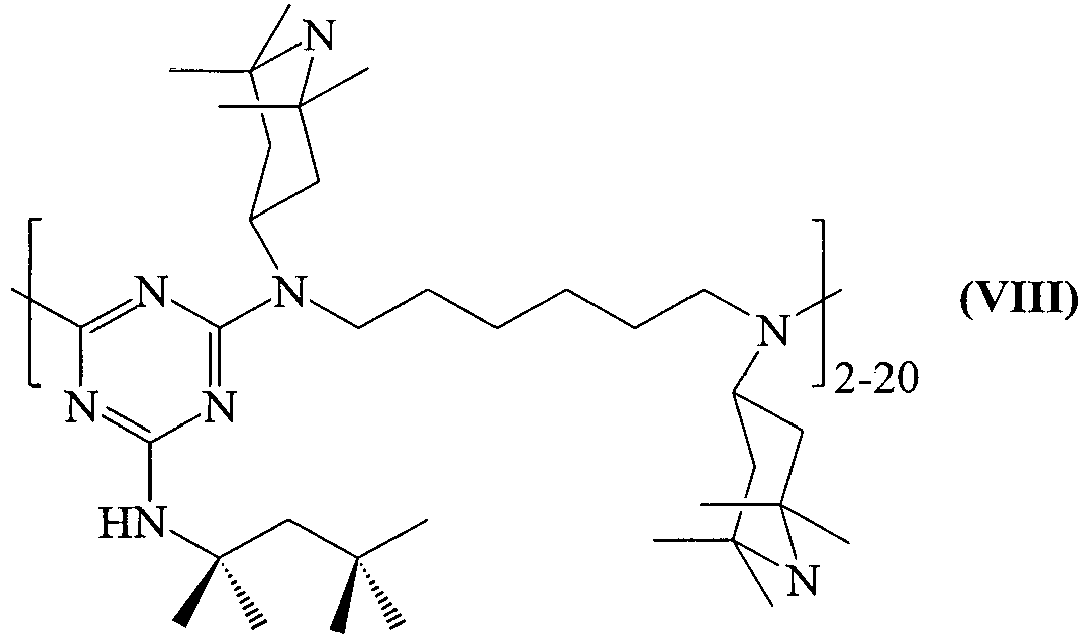


 f) 0 bis 10 Gew.-% eines oder mehrerer Zusatzstoffe, die von den Komponenten C,D und E verschieden sind, als Komponente F,wobei die Gew.-% jeweils auf das Gesamtgewicht der Komponenten A bis F bezogen sind und zusammen 100 Gew.-% ergeben.
 - Thermoplastische Formmassen nach Anspruch 1, dadurch gekennzeichnet, dass die Komponente E 0,1 bis 0,5 Gew.-% einer der Verbindungen VIII, IX, X oder XI beträgt, wobei die Gew.-% jeweils auf das Gesamtgewicht der Komponenten A bis F bezogen sind und zusammen 100 Gew.-% ergeben.
- Thermoplastische Formmassen nach Anspruch 1, dadurch gekennzeichnet, dass die Komponente E 0,2 bis 0,5 Gew.-% eine oder mehrere der Verbindungen VIII, IX, X oder XI beträgt, wobei die Gew.-% jeweils auf das Gesamtgewicht der Komponenten A bis G bezogen sind und zusammen 100 Gew.-% ergeben.
- Thermoplastische Formmassen nach einem der Ansprüche 1 bis 3, dadurch gekennzeichnet, dass der Gewichtsanteil von Acrylnitril bezogen auf Komponente A mindestens 15% und höchstens 40% beträgt.
- Thermoplastische Formmassen nach einem der Ansprüche 1 bis 4, dadurch gekennzeichnet, dass der Gewichtsanteil von B 0,1 bis 5 Gew.-% beträgt.
- Thermoplastische Formmassen nach einem der Ansprüche 1 bis 4, dadurch gekennzeichnet, dass der Gewichtsanteil von B 0,2 bis 2 Gew.-% beträgt.
- Thermoplastische Formmassen nach einem der Ansprüche 1 bis 6, dadurch gekennzeichnet, dass man die Komponenten D zu C im Gewichtsverhältnis von 3:1 bis 1:1 und Komponenten D zu E im Gewichtsverhältnis von 2:1 bis 0,5:1 einsetzt.
- Verwendung der thermoplastischen Formmassen nach einem der Ansprüche 1 bis 7 zur Herstellung von Formteilen mit hochglänzender, chemikalienresistenter Oberfläche für den Außenbereich von Kraftfahrzeugen.
Priority Applications (1)
| Application Number | Priority Date | Filing Date | Title |
|---|---|---|---|
| EP11729102.1A EP2593507B8 (de) | 2010-07-12 | 2011-06-27 | Witterungsstabilisierte styrolcopolymer formmassen |
Applications Claiming Priority (7)
| Application Number | Priority Date | Filing Date | Title |
|---|---|---|---|
| EP10169257 | 2010-07-12 | ||
| EP10169250 | 2010-07-12 | ||
| EP10169245 | 2010-07-12 | ||
| EP10169243 | 2010-07-12 | ||
| EP11151249 | 2011-01-18 | ||
| PCT/EP2011/060727 WO2012007270A1 (de) | 2010-07-12 | 2011-06-27 | Witterungsstabilisierte acrylnitrilcopolymer formmassen |
| EP11729102.1A EP2593507B8 (de) | 2010-07-12 | 2011-06-27 | Witterungsstabilisierte styrolcopolymer formmassen |
Publications (3)
| Publication Number | Publication Date |
|---|---|
| EP2593507A1 EP2593507A1 (de) | 2013-05-22 |
| EP2593507B1 true EP2593507B1 (de) | 2017-01-25 |
| EP2593507B8 EP2593507B8 (de) | 2017-05-03 |
Family
ID=45468950
Family Applications (3)
| Application Number | Title | Priority Date | Filing Date |
|---|---|---|---|
| EP11729605.3A Active EP2593512B1 (de) | 2010-07-12 | 2011-06-27 | Stabilisierte acrylnitril/styrol/acrylester formmassen |
| EP11730930.2A Active EP2593510B1 (de) | 2010-07-12 | 2011-06-27 | Stabilisierte acrylnitril/styrol/butadien formmassen |
| EP11729102.1A Active EP2593507B8 (de) | 2010-07-12 | 2011-06-27 | Witterungsstabilisierte styrolcopolymer formmassen |
Family Applications Before (2)
| Application Number | Title | Priority Date | Filing Date |
|---|---|---|---|
| EP11729605.3A Active EP2593512B1 (de) | 2010-07-12 | 2011-06-27 | Stabilisierte acrylnitril/styrol/acrylester formmassen |
| EP11730930.2A Active EP2593510B1 (de) | 2010-07-12 | 2011-06-27 | Stabilisierte acrylnitril/styrol/butadien formmassen |
Country Status (8)
| Country | Link |
|---|---|
| EP (3) | EP2593512B1 (de) |
| KR (3) | KR101829083B1 (de) |
| CN (3) | CN103080214B (de) |
| ES (3) | ES2621607T3 (de) |
| HU (1) | HUE029008T2 (de) |
| MX (3) | MX2013000443A (de) |
| PL (1) | PL2593512T3 (de) |
| WO (3) | WO2012007269A1 (de) |
Cited By (3)
| Publication number | Priority date | Publication date | Assignee | Title |
|---|---|---|---|---|
| US11225570B2 (en) | 2017-07-05 | 2022-01-18 | Ineos Styrolution Group Gmbh | Thermoplastic resin composition with improved UV resistance |
| US11525052B2 (en) | 2017-07-05 | 2022-12-13 | Ineos Styrolution Group Gmbh | Thermoplastic styrene copolymer resin composition with improved UV resistance |
| US11549008B2 (en) | 2017-07-05 | 2023-01-10 | Ineos Styrolution Group Gmbh | Thermoplastic resin composition with improved UV resistance |
Families Citing this family (11)
| Publication number | Priority date | Publication date | Assignee | Title |
|---|---|---|---|---|
| CN105254789B (zh) * | 2015-10-20 | 2019-02-05 | 佳易容相容剂江苏有限公司 | 一种交联共聚树脂及其制备方法 |
| KR20210021319A (ko) | 2018-06-18 | 2021-02-25 | 이네오스 스티롤루션 그룹 게엠베하 | 개선된 uv 내성을 갖는 열가소성 조성물 |
| KR102311951B1 (ko) * | 2018-12-21 | 2021-10-14 | 주식회사 엘지화학 | 열가소성 수지 조성물 |
| KR102396611B1 (ko) | 2019-07-31 | 2022-05-10 | 롯데케미칼 주식회사 | 열가소성 수지 조성물 및 이를 이용한 성형품 |
| US20240117171A1 (en) * | 2019-10-15 | 2024-04-11 | Ineos Styrolution Group Gmbh | Black styrene copolymer compositions for high gloss exterior applications |
| US12545779B2 (en) | 2019-10-15 | 2026-02-10 | Ineos Styrolution Group Gmbh | Styrenic copolymer composition with PMMA and improved weathering resistance |
| WO2021074151A1 (en) * | 2019-10-15 | 2021-04-22 | Ineos Styrolution Group Gmbh | Weathering-resistant styrene copolymer molding compositions with reduced mold deposit formation for high gloss applications |
| KR20220084334A (ko) * | 2019-10-15 | 2022-06-21 | 이네오스 스티롤루션 그룹 게엠베하 | 고광택 적용을 위한 감소된 모울드 침착물 형성을 갖는 스티렌 코폴리머 성형 조성물 |
| WO2021191192A1 (de) * | 2020-03-24 | 2021-09-30 | Ineos Styrolution Group Gmbh | Asa-polymerzusammensetzung mit optimierter uv-stabilität sowie gutem zähigkeits-steifigkeits-verhältnis |
| CN119403875A (zh) | 2022-04-29 | 2025-02-07 | 英力士苯领集团股份公司 | 抗紫外线性能改进的丙烯腈苯乙烯丙烯酸酯共聚物组合物 |
| KR20250004002A (ko) | 2022-04-29 | 2025-01-07 | 이네오스 스티롤루션 그룹 게엠베하 | 감소된 uv 흡수제 함량으로 우수한 uv 저항성을 갖는 아크릴로니트릴 스티렌 아크릴레이트(asa) 공중합체 조성물 |
Family Cites Families (28)
| Publication number | Priority date | Publication date | Assignee | Title |
|---|---|---|---|---|
| DE1260135B (de) | 1965-01-05 | 1968-02-01 | Basf Ag | Schlagfeste thermoplastische Formmassen |
| JPS5352560A (en) * | 1976-07-01 | 1978-05-13 | Mitsui Toatsu Chem Inc | Resin compositions |
| DE2826925A1 (de) | 1978-06-20 | 1980-01-17 | Basf Ag | Witterungsbestaendige, schlagzaehe thermoplastische massen mit guter einfaerbbarkeit |
| US4331586A (en) | 1981-07-20 | 1982-05-25 | American Cyanamid Company | Novel light stabilizers for polymers |
| EP0080431B1 (de) | 1981-10-16 | 1986-09-24 | Ciba-Geigy Ag | Synergistisches Gemisch von niedermolekularen und hochmolekularen Polyalkylpiperidinen |
| DE3149357A1 (de) | 1981-12-12 | 1983-06-16 | Basf Ag, 6700 Ludwigshafen | Verbessertes verfahren zur herstellung von beta-chlor-isobuttersaeure |
| DE3227555A1 (de) | 1982-07-23 | 1984-01-26 | Basf Ag, 6700 Ludwigshafen | Thermoplastische formmasse |
| DE3149358A1 (de) | 1981-12-12 | 1983-06-16 | Basf Ag, 6700 Ludwigshafen | Thermoplastische formmasse |
| US4396769A (en) | 1982-02-11 | 1983-08-02 | Ciba-Geigy Corporation | Process for preparing crystalline, non-dusting bis(2,2,6,6-tetramethylpiperidin-4-yl) sebacate |
| US4492791A (en) | 1982-05-04 | 1985-01-08 | Ciba-Geigy Corporation | Process for the preparation of polyaminotriazines |
| DE3414118A1 (de) | 1984-04-14 | 1985-10-24 | Basf Ag, 6700 Ludwigshafen | Thermoplastische formmassen |
| JP2582385B2 (ja) * | 1987-12-11 | 1997-02-19 | 旭電化工業株式会社 | 安定化された合成樹脂組成物 |
| US4877826A (en) | 1988-10-05 | 1989-10-31 | The Dow Chemical Company | Weatherable styrenic polymer blend comprising polyalkylene glycol |
| DE4011162A1 (de) | 1990-04-06 | 1991-10-10 | Basf Ag | Thermoplastische formmasse |
| JPH0816215B2 (ja) | 1990-06-18 | 1996-02-21 | 株式会社松井色素化学工業所 | フォトクロミック材料 |
| DE4131728A1 (de) | 1991-09-24 | 1993-03-25 | Basf Ag | Teilchenfoermiges pfropfcopolymerisat mit kern/schale-aufbau |
| DE4132497A1 (de) | 1991-09-30 | 1993-04-01 | Basf Ag | Mehrschaliges pfropfcopolymerisat |
| US5580928A (en) | 1994-11-30 | 1996-12-03 | Tosoh Corporation | Resin composition |
| EP0782994B1 (de) | 1995-12-04 | 2003-02-05 | Ciba SC Holding AG | 2,2,6,6-Tetramethyl-4-piperidylgruppen enthaltende Blockoligomere als Stabilisatoren für organische Materialien |
| CN1055099C (zh) * | 1997-06-02 | 2000-08-02 | 奇美实业股份有限公司 | 苯乙烯系树脂组成物 |
| DE19728629A1 (de) | 1997-07-04 | 1999-01-07 | Basf Ag | Thermoplastische Formmassen mit geringer Eigenfarbe |
| DE10037280A1 (de) | 2000-07-28 | 2002-02-07 | Basf Ag | Verfahren zur Agglomeration dispergierter Kautschuke |
| US6949607B2 (en) | 2000-12-27 | 2005-09-27 | Techno Polymer Co., Ltd. | Thermoplastic resin composition and its molded articles |
| US20030225191A1 (en) * | 2002-04-12 | 2003-12-04 | Francois Gugumus | Stabilizer mixtures |
| JP2004346237A (ja) * | 2003-05-23 | 2004-12-09 | Umg Abs Ltd | 熱可塑性樹脂組成物および成形物 |
| TWI247021B (en) * | 2003-08-21 | 2006-01-11 | Chi Mei Corp | Flame retardant styrenic resin composition |
| WO2008031719A1 (de) * | 2006-09-11 | 2008-03-20 | Basf Se | Uv-stabilisatoren für kunststoffe |
| CN101709133A (zh) * | 2009-11-20 | 2010-05-19 | 苏州旭光聚合物有限公司 | 一种优良的耐老化abs复合材料及其制备方法 |
-
2011
- 2011-06-27 MX MX2013000443A patent/MX2013000443A/es unknown
- 2011-06-27 EP EP11729605.3A patent/EP2593512B1/de active Active
- 2011-06-27 WO PCT/EP2011/060725 patent/WO2012007269A1/de not_active Ceased
- 2011-06-27 KR KR1020137003247A patent/KR101829083B1/ko active Active
- 2011-06-27 ES ES11729102.1T patent/ES2621607T3/es active Active
- 2011-06-27 ES ES11730930.2T patent/ES2613736T3/es active Active
- 2011-06-27 KR KR1020137003243A patent/KR20130130686A/ko not_active Ceased
- 2011-06-27 CN CN201180034508.8A patent/CN103080214B/zh not_active Expired - Fee Related
- 2011-06-27 MX MX2013000447A patent/MX363645B/es unknown
- 2011-06-27 PL PL11729605.3T patent/PL2593512T3/pl unknown
- 2011-06-27 EP EP11730930.2A patent/EP2593510B1/de active Active
- 2011-06-27 MX MX2013000392A patent/MX345365B/es active IP Right Grant
- 2011-06-27 HU HUE11729605A patent/HUE029008T2/en unknown
- 2011-06-27 CN CN201180034507.3A patent/CN103080223B/zh active Active
- 2011-06-27 WO PCT/EP2011/060723 patent/WO2012007268A1/de not_active Ceased
- 2011-06-27 ES ES11729605.3T patent/ES2573410T3/es active Active
- 2011-06-27 KR KR1020137003244A patent/KR101829487B1/ko active Active
- 2011-06-27 CN CN201180034509.2A patent/CN103080202B/zh active Active
- 2011-06-27 WO PCT/EP2011/060727 patent/WO2012007270A1/de not_active Ceased
- 2011-06-27 EP EP11729102.1A patent/EP2593507B8/de active Active
Cited By (3)
| Publication number | Priority date | Publication date | Assignee | Title |
|---|---|---|---|---|
| US11225570B2 (en) | 2017-07-05 | 2022-01-18 | Ineos Styrolution Group Gmbh | Thermoplastic resin composition with improved UV resistance |
| US11525052B2 (en) | 2017-07-05 | 2022-12-13 | Ineos Styrolution Group Gmbh | Thermoplastic styrene copolymer resin composition with improved UV resistance |
| US11549008B2 (en) | 2017-07-05 | 2023-01-10 | Ineos Styrolution Group Gmbh | Thermoplastic resin composition with improved UV resistance |
Also Published As
| Publication number | Publication date |
|---|---|
| EP2593512B1 (de) | 2016-04-20 |
| MX2013000443A (es) | 2013-05-01 |
| MX345365B (es) | 2017-01-27 |
| CN103080214A (zh) | 2013-05-01 |
| CN103080202B (zh) | 2014-09-24 |
| EP2593510B1 (de) | 2016-12-21 |
| CN103080202A (zh) | 2013-05-01 |
| KR101829487B1 (ko) | 2018-02-19 |
| EP2593507A1 (de) | 2013-05-22 |
| ES2613736T3 (es) | 2017-05-25 |
| CN103080223A (zh) | 2013-05-01 |
| MX363645B (es) | 2019-03-29 |
| MX2013000392A (es) | 2013-04-24 |
| CN103080223B (zh) | 2015-07-22 |
| WO2012007268A1 (de) | 2012-01-19 |
| HUE029008T2 (en) | 2017-01-30 |
| WO2012007270A1 (de) | 2012-01-19 |
| EP2593512A1 (de) | 2013-05-22 |
| ES2621607T3 (es) | 2017-07-04 |
| CN103080214B (zh) | 2015-07-15 |
| KR20130130688A (ko) | 2013-12-02 |
| MX2013000447A (es) | 2013-05-01 |
| PL2593512T3 (pl) | 2016-10-31 |
| EP2593510A1 (de) | 2013-05-22 |
| KR20130130686A (ko) | 2013-12-02 |
| KR20130130687A (ko) | 2013-12-02 |
| EP2593507B8 (de) | 2017-05-03 |
| KR101829083B1 (ko) | 2018-02-13 |
| WO2012007269A1 (de) | 2012-01-19 |
| ES2573410T3 (es) | 2016-06-07 |
Similar Documents
| Publication | Publication Date | Title |
|---|---|---|
| EP2593507A1 (de) | Witterungsstabilisierte acrylnitrilcopolymer formmassen | |
| EP2150581B1 (de) | Eingefärbte zusammensetzung mit erhöhter spannungsrissbeständigkeit | |
| EP2150582B1 (de) | Zusammensetzung mit erhöhter spannungsrissbeständigkeit | |
| EP2268731B1 (de) | Flammfeste pmma-formmasse | |
| US9701813B2 (en) | Weathering-stabilized acrylonitrile copolymer molding compositions | |
| DE60200414T3 (de) | Schwerentflammbare Polyolefinzusammensetzungen | |
| EP4127059B1 (de) | Asa-polymerzusammensetzung mit optimierter uv-stabilität sowie gutem zähigkeits-steifigkeits-verhältnis | |
| EP3214128B1 (de) | Flammhemmende thermoplastische harzzusammensetzung mit ausgezeichneter thermischer stabilität, herstellungsverfahren dafür und daraus hergestelltes formprodukt | |
| EP3133104B1 (de) | Polyamidzusammensetzungen | |
| EP2760926A1 (de) | Stabilisierte polycarbonat acrylnitril/styrol/acrylester formmassen | |
| EP2760935A1 (de) | Stabilisierte formmassen aus polyamid und asa-copolymeren | |
| DE69911684T2 (de) | Propylenharzzusammensetzung | |
| EP0051770B1 (de) | Polyvinylchlorid-Formmasse | |
| EP0845013B1 (de) | Verwendung von piperidinverbindungen | |
| EP0971978B1 (de) | Transparente, schlagzähmodifizierte thermoplastische formmassen | |
| DE2317652C3 (de) | Schlagfeste PVC-Mischungen | |
| DE2222230A1 (de) | Thermoplastische formmassen | |
| DE3332327A1 (de) | Thermoplastische formmasse | |
| DE102017122751A1 (de) | Innen-/aussenverkleidungskomponente für ein kraftfahrzeug | |
| DE69311120T2 (de) | Piperidinverbindungen und diese enthaltende stabilisierte Polymerzusammensetzungen | |
| WO2001098400A1 (de) | Verwendung von zusammensetzungen enthaltend harnstoffderivate der cyanessigsäure und harnstoff als stabilisatoren für chlorhaltige thermoplastische kunststoffe |
Legal Events
| Date | Code | Title | Description |
|---|---|---|---|
| PUAI | Public reference made under article 153(3) epc to a published international application that has entered the european phase |
Free format text: ORIGINAL CODE: 0009012 |
|
| 17P | Request for examination filed |
Effective date: 20130207 |
|
| AK | Designated contracting states |
Kind code of ref document: A1 Designated state(s): AL AT BE BG CH CY CZ DE DK EE ES FI FR GB GR HR HU IE IS IT LI LT LU LV MC MK MT NL NO PL PT RO RS SE SI SK SM TR |
|
| DAX | Request for extension of the european patent (deleted) | ||
| RAP1 | Party data changed (applicant data changed or rights of an application transferred) |
Owner name: STYROLUTION EUROPE GMBH |
|
| 17Q | First examination report despatched |
Effective date: 20151109 |
|
| GRAP | Despatch of communication of intention to grant a patent |
Free format text: ORIGINAL CODE: EPIDOSNIGR1 |
|
| INTG | Intention to grant announced |
Effective date: 20160909 |
|
| GRAS | Grant fee paid |
Free format text: ORIGINAL CODE: EPIDOSNIGR3 |
|
| GRAA | (expected) grant |
Free format text: ORIGINAL CODE: 0009210 |
|
| AK | Designated contracting states |
Kind code of ref document: B1 Designated state(s): AL AT BE BG CH CY CZ DE DK EE ES FI FR GB GR HR HU IE IS IT LI LT LU LV MC MK MT NL NO PL PT RO RS SE SI SK SM TR |
|
| RAP1 | Party data changed (applicant data changed or rights of an application transferred) |
Owner name: INEOS STYROLUTION GROUP GMBH |
|
| REG | Reference to a national code |
Ref country code: GB Ref legal event code: FG4D Free format text: NOT ENGLISH |
|
| REG | Reference to a national code |
Ref country code: CH Ref legal event code: EP |
|
| REG | Reference to a national code |
Ref country code: AT Ref legal event code: REF Ref document number: 864103 Country of ref document: AT Kind code of ref document: T Effective date: 20170215 |
|
| REG | Reference to a national code |
Ref country code: IE Ref legal event code: FG4D Free format text: LANGUAGE OF EP DOCUMENT: GERMAN |
|
| GRAT | Correction requested after decision to grant or after decision to maintain patent in amended form |
Free format text: ORIGINAL CODE: EPIDOSNCDEC |
|
| REG | Reference to a national code |
Ref country code: DE Ref legal event code: R096 Ref document number: 502011011595 Country of ref document: DE |
|
| RAP2 | Party data changed (patent owner data changed or rights of a patent transferred) |
Owner name: INEOS STYROLUTION EUROPE GMBH |
|
| REG | Reference to a national code |
Ref country code: DE Ref legal event code: R082 Ref document number: 502011011595 Country of ref document: DE Representative=s name: PATENTANWAELTE ISENBRUCK BOESL HOERSCHLER LLP, DE Ref country code: DE Ref legal event code: R082 Ref document number: 502011011595 Country of ref document: DE Representative=s name: PATENTANWAELTE ISENBRUCK BOESL HOERSCHLER PART, DE |
|
| REG | Reference to a national code |
Ref country code: NL Ref legal event code: FP |
|
| RAP2 | Party data changed (patent owner data changed or rights of a patent transferred) |
Owner name: INEOS STYROLUTION EUROPE GMBH |
|
| REG | Reference to a national code |
Ref country code: LT Ref legal event code: MG4D |
|
| REG | Reference to a national code |
Ref country code: FR Ref legal event code: PLFP Year of fee payment: 7 |
|
| REG | Reference to a national code |
Ref country code: ES Ref legal event code: FG2A Ref document number: 2621607 Country of ref document: ES Kind code of ref document: T3 Effective date: 20170704 |
|
| PG25 | Lapsed in a contracting state [announced via postgrant information from national office to epo] |
Ref country code: FI Free format text: LAPSE BECAUSE OF FAILURE TO SUBMIT A TRANSLATION OF THE DESCRIPTION OR TO PAY THE FEE WITHIN THE PRESCRIBED TIME-LIMIT Effective date: 20170125 Ref country code: HR Free format text: LAPSE BECAUSE OF FAILURE TO SUBMIT A TRANSLATION OF THE DESCRIPTION OR TO PAY THE FEE WITHIN THE PRESCRIBED TIME-LIMIT Effective date: 20170125 Ref country code: GR Free format text: LAPSE BECAUSE OF FAILURE TO SUBMIT A TRANSLATION OF THE DESCRIPTION OR TO PAY THE FEE WITHIN THE PRESCRIBED TIME-LIMIT Effective date: 20170426 Ref country code: IS Free format text: LAPSE BECAUSE OF FAILURE TO SUBMIT A TRANSLATION OF THE DESCRIPTION OR TO PAY THE FEE WITHIN THE PRESCRIBED TIME-LIMIT Effective date: 20170525 Ref country code: LT Free format text: LAPSE BECAUSE OF FAILURE TO SUBMIT A TRANSLATION OF THE DESCRIPTION OR TO PAY THE FEE WITHIN THE PRESCRIBED TIME-LIMIT Effective date: 20170125 Ref country code: NO Free format text: LAPSE BECAUSE OF FAILURE TO SUBMIT A TRANSLATION OF THE DESCRIPTION OR TO PAY THE FEE WITHIN THE PRESCRIBED TIME-LIMIT Effective date: 20170425 |
|
| PG25 | Lapsed in a contracting state [announced via postgrant information from national office to epo] |
Ref country code: PL Free format text: LAPSE BECAUSE OF FAILURE TO SUBMIT A TRANSLATION OF THE DESCRIPTION OR TO PAY THE FEE WITHIN THE PRESCRIBED TIME-LIMIT Effective date: 20170125 Ref country code: BG Free format text: LAPSE BECAUSE OF FAILURE TO SUBMIT A TRANSLATION OF THE DESCRIPTION OR TO PAY THE FEE WITHIN THE PRESCRIBED TIME-LIMIT Effective date: 20170425 Ref country code: LV Free format text: LAPSE BECAUSE OF FAILURE TO SUBMIT A TRANSLATION OF THE DESCRIPTION OR TO PAY THE FEE WITHIN THE PRESCRIBED TIME-LIMIT Effective date: 20170125 Ref country code: SE Free format text: LAPSE BECAUSE OF FAILURE TO SUBMIT A TRANSLATION OF THE DESCRIPTION OR TO PAY THE FEE WITHIN THE PRESCRIBED TIME-LIMIT Effective date: 20170125 Ref country code: RS Free format text: LAPSE BECAUSE OF FAILURE TO SUBMIT A TRANSLATION OF THE DESCRIPTION OR TO PAY THE FEE WITHIN THE PRESCRIBED TIME-LIMIT Effective date: 20170125 Ref country code: PT Free format text: LAPSE BECAUSE OF FAILURE TO SUBMIT A TRANSLATION OF THE DESCRIPTION OR TO PAY THE FEE WITHIN THE PRESCRIBED TIME-LIMIT Effective date: 20170525 |
|
| REG | Reference to a national code |
Ref country code: DE Ref legal event code: R097 Ref document number: 502011011595 Country of ref document: DE |
|
| PG25 | Lapsed in a contracting state [announced via postgrant information from national office to epo] |
Ref country code: SK Free format text: LAPSE BECAUSE OF FAILURE TO SUBMIT A TRANSLATION OF THE DESCRIPTION OR TO PAY THE FEE WITHIN THE PRESCRIBED TIME-LIMIT Effective date: 20170125 Ref country code: EE Free format text: LAPSE BECAUSE OF FAILURE TO SUBMIT A TRANSLATION OF THE DESCRIPTION OR TO PAY THE FEE WITHIN THE PRESCRIBED TIME-LIMIT Effective date: 20170125 Ref country code: RO Free format text: LAPSE BECAUSE OF FAILURE TO SUBMIT A TRANSLATION OF THE DESCRIPTION OR TO PAY THE FEE WITHIN THE PRESCRIBED TIME-LIMIT Effective date: 20170125 Ref country code: CZ Free format text: LAPSE BECAUSE OF FAILURE TO SUBMIT A TRANSLATION OF THE DESCRIPTION OR TO PAY THE FEE WITHIN THE PRESCRIBED TIME-LIMIT Effective date: 20170125 |
|
| PG25 | Lapsed in a contracting state [announced via postgrant information from national office to epo] |
Ref country code: DK Free format text: LAPSE BECAUSE OF FAILURE TO SUBMIT A TRANSLATION OF THE DESCRIPTION OR TO PAY THE FEE WITHIN THE PRESCRIBED TIME-LIMIT Effective date: 20170125 Ref country code: SM Free format text: LAPSE BECAUSE OF FAILURE TO SUBMIT A TRANSLATION OF THE DESCRIPTION OR TO PAY THE FEE WITHIN THE PRESCRIBED TIME-LIMIT Effective date: 20170125 |
|
| PLBE | No opposition filed within time limit |
Free format text: ORIGINAL CODE: 0009261 |
|
| STAA | Information on the status of an ep patent application or granted ep patent |
Free format text: STATUS: NO OPPOSITION FILED WITHIN TIME LIMIT |
|
| 26N | No opposition filed |
Effective date: 20171026 |
|
| PG25 | Lapsed in a contracting state [announced via postgrant information from national office to epo] |
Ref country code: MC Free format text: LAPSE BECAUSE OF FAILURE TO SUBMIT A TRANSLATION OF THE DESCRIPTION OR TO PAY THE FEE WITHIN THE PRESCRIBED TIME-LIMIT Effective date: 20170125 |
|
| REG | Reference to a national code |
Ref country code: CH Ref legal event code: PL |
|
| PG25 | Lapsed in a contracting state [announced via postgrant information from national office to epo] |
Ref country code: SI Free format text: LAPSE BECAUSE OF FAILURE TO SUBMIT A TRANSLATION OF THE DESCRIPTION OR TO PAY THE FEE WITHIN THE PRESCRIBED TIME-LIMIT Effective date: 20170125 |
|
| REG | Reference to a national code |
Ref country code: IE Ref legal event code: MM4A |
|
| PG25 | Lapsed in a contracting state [announced via postgrant information from national office to epo] |
Ref country code: CH Free format text: LAPSE BECAUSE OF NON-PAYMENT OF DUE FEES Effective date: 20170630 Ref country code: IE Free format text: LAPSE BECAUSE OF NON-PAYMENT OF DUE FEES Effective date: 20170627 Ref country code: LI Free format text: LAPSE BECAUSE OF NON-PAYMENT OF DUE FEES Effective date: 20170630 Ref country code: LU Free format text: LAPSE BECAUSE OF NON-PAYMENT OF DUE FEES Effective date: 20170627 |
|
| REG | Reference to a national code |
Ref country code: FR Ref legal event code: PLFP Year of fee payment: 8 |
|
| REG | Reference to a national code |
Ref country code: AT Ref legal event code: MM01 Ref document number: 864103 Country of ref document: AT Kind code of ref document: T Effective date: 20170627 |
|
| PG25 | Lapsed in a contracting state [announced via postgrant information from national office to epo] |
Ref country code: MT Free format text: LAPSE BECAUSE OF FAILURE TO SUBMIT A TRANSLATION OF THE DESCRIPTION OR TO PAY THE FEE WITHIN THE PRESCRIBED TIME-LIMIT Effective date: 20170125 |
|
| PG25 | Lapsed in a contracting state [announced via postgrant information from national office to epo] |
Ref country code: AT Free format text: LAPSE BECAUSE OF NON-PAYMENT OF DUE FEES Effective date: 20170627 |
|
| PG25 | Lapsed in a contracting state [announced via postgrant information from national office to epo] |
Ref country code: HU Free format text: LAPSE BECAUSE OF FAILURE TO SUBMIT A TRANSLATION OF THE DESCRIPTION OR TO PAY THE FEE WITHIN THE PRESCRIBED TIME-LIMIT; INVALID AB INITIO Effective date: 20110627 |
|
| PG25 | Lapsed in a contracting state [announced via postgrant information from national office to epo] |
Ref country code: CY Free format text: LAPSE BECAUSE OF NON-PAYMENT OF DUE FEES Effective date: 20170125 |
|
| PG25 | Lapsed in a contracting state [announced via postgrant information from national office to epo] |
Ref country code: MK Free format text: LAPSE BECAUSE OF FAILURE TO SUBMIT A TRANSLATION OF THE DESCRIPTION OR TO PAY THE FEE WITHIN THE PRESCRIBED TIME-LIMIT Effective date: 20170125 |
|
| PG25 | Lapsed in a contracting state [announced via postgrant information from national office to epo] |
Ref country code: TR Free format text: LAPSE BECAUSE OF FAILURE TO SUBMIT A TRANSLATION OF THE DESCRIPTION OR TO PAY THE FEE WITHIN THE PRESCRIBED TIME-LIMIT Effective date: 20170125 |
|
| PG25 | Lapsed in a contracting state [announced via postgrant information from national office to epo] |
Ref country code: AL Free format text: LAPSE BECAUSE OF FAILURE TO SUBMIT A TRANSLATION OF THE DESCRIPTION OR TO PAY THE FEE WITHIN THE PRESCRIBED TIME-LIMIT Effective date: 20170125 |
|
| P01 | Opt-out of the competence of the unified patent court (upc) registered |
Effective date: 20230515 |
|
| PGFP | Annual fee paid to national office [announced via postgrant information from national office to epo] |
Ref country code: ES Payment date: 20250718 Year of fee payment: 15 |
|
| PGFP | Annual fee paid to national office [announced via postgrant information from national office to epo] |
Ref country code: IT Payment date: 20250630 Year of fee payment: 15 |
|
| PGFP | Annual fee paid to national office [announced via postgrant information from national office to epo] |
Ref country code: GB Payment date: 20260623 Year of fee payment: 16 |
|
| PGFP | Annual fee paid to national office [announced via postgrant information from national office to epo] |
Ref country code: DE Payment date: 20260629 Year of fee payment: 16 |
|
| PGFP | Annual fee paid to national office [announced via postgrant information from national office to epo] |
Ref country code: BE Payment date: 20260622 Year of fee payment: 16 |
|
| PGFP | Annual fee paid to national office [announced via postgrant information from national office to epo] |
Ref country code: NL Payment date: 20260622 Year of fee payment: 16 |
|
| PGFP | Annual fee paid to national office [announced via postgrant information from national office to epo] |
Ref country code: FR Payment date: 20260622 Year of fee payment: 16 |