EP2597452A1 - Procédé de prédiction de la performance d'un pneu et procédé de conception d'un pneu - Google Patents
Procédé de prédiction de la performance d'un pneu et procédé de conception d'un pneu Download PDFInfo
- Publication number
- EP2597452A1 EP2597452A1 EP11809721.1A EP11809721A EP2597452A1 EP 2597452 A1 EP2597452 A1 EP 2597452A1 EP 11809721 A EP11809721 A EP 11809721A EP 2597452 A1 EP2597452 A1 EP 2597452A1
- Authority
- EP
- European Patent Office
- Prior art keywords
- snow
- tire
- model
- alone
- performance prediction
- Prior art date
- Legal status (The legal status is an assumption and is not a legal conclusion. Google has not performed a legal analysis and makes no representation as to the accuracy of the status listed.)
- Granted
Links
Images




Classifications
-
- G—PHYSICS
- G06—COMPUTING OR CALCULATING; COUNTING
- G06F—ELECTRIC DIGITAL DATA PROCESSING
- G06F30/00—Computer-aided design [CAD]
- G06F30/20—Design optimisation, verification or simulation
-
- G—PHYSICS
- G01—MEASURING; TESTING
- G01M—TESTING STATIC OR DYNAMIC BALANCE OF MACHINES OR STRUCTURES; TESTING OF STRUCTURES OR APPARATUS, NOT OTHERWISE PROVIDED FOR
- G01M17/00—Testing of vehicles
- G01M17/007—Wheeled or endless-tracked vehicles
- G01M17/02—Tyres
- G01M17/027—Tyres using light, e.g. infrared, ultraviolet or holographic techniques
-
- B—PERFORMING OPERATIONS; TRANSPORTING
- B60—VEHICLES IN GENERAL
- B60C—VEHICLE TYRES; TYRE INFLATION; TYRE CHANGING; CONNECTING VALVES TO INFLATABLE ELASTIC BODIES IN GENERAL; DEVICES OR ARRANGEMENTS RELATED TO TYRES
- B60C99/00—Subject matter not provided for in other groups of this subclass
- B60C99/006—Computer aided tyre design or simulation
-
- G—PHYSICS
- G01—MEASURING; TESTING
- G01M—TESTING STATIC OR DYNAMIC BALANCE OF MACHINES OR STRUCTURES; TESTING OF STRUCTURES OR APPARATUS, NOT OTHERWISE PROVIDED FOR
- G01M17/00—Testing of vehicles
- G01M17/007—Wheeled or endless-tracked vehicles
- G01M17/02—Tyres
-
- G—PHYSICS
- G06—COMPUTING OR CALCULATING; COUNTING
- G06F—ELECTRIC DIGITAL DATA PROCESSING
- G06F30/00—Computer-aided design [CAD]
- G06F30/10—Geometric CAD
- G06F30/15—Vehicle, aircraft or watercraft design
-
- G—PHYSICS
- G06—COMPUTING OR CALCULATING; COUNTING
- G06F—ELECTRIC DIGITAL DATA PROCESSING
- G06F30/00—Computer-aided design [CAD]
- G06F30/20—Design optimisation, verification or simulation
- G06F30/23—Design optimisation, verification or simulation using finite element methods [FEM] or finite difference methods [FDM]
-
- G—PHYSICS
- G01—MEASURING; TESTING
- G01M—TESTING STATIC OR DYNAMIC BALANCE OF MACHINES OR STRUCTURES; TESTING OF STRUCTURES OR APPARATUS, NOT OTHERWISE PROVIDED FOR
- G01M17/00—Testing of vehicles
- G01M17/007—Wheeled or endless-tracked vehicles
- G01M17/06—Steering behaviour; Rolling behaviour
-
- G—PHYSICS
- G06—COMPUTING OR CALCULATING; COUNTING
- G06F—ELECTRIC DIGITAL DATA PROCESSING
- G06F2111/00—Details relating to CAD techniques
- G06F2111/10—Numerical modelling
Definitions
- the present invention relates to a tire performance prediction method of predicting tire performance on a snowy road surface and to a tire designing method.
- the tire performance can be obtained through simulation.
- the performance of a tire on a pavement surface can be obtained through simulation by performing analysis on the load applied by the tire to a rigid road surface and the rolling motion of the tire.
- Non-patent Literature 1 various methods are proposed for predicting tire performance on a snowy road surface through simulation (for example, Non-patent Literature 1).
- the traction performance of an automobile on a snowy road surface is evaluated, and a relation between a normal stress applied to snow and the shear strength of the snow is obtained. There is shown a finding that this relation can be expressed in an almost linear representation, irrespective of the difference in types of automobiles, tires, and snowy road surfaces (Non-patent Literature 2).
- Non-patent Literature 1 Shoop, S., Kestler, K., and Haehnel, R., "Finite Element Modeling of Tires on Snow", “Tire Science and Technology, TSTCA, Volume 34, Issue 1, pp.2-37, March, 2006
- Non-patent Literature 2 CRREL REPORT 90-9 (USA Cold Regions Research and Engineering Laboratory, CRREL Report 90-9, "Wheels and Tracks in Snow Validation Study of CRREL Shallow Snow Mobility Model)
- CRREL REPORT 90-9 USA Cold Regions Research and Engineering Laboratory
- CRREL Report 90-9 "Wheels and Tracks in Snow Validation Study of CRREL Shallow Snow Mobility Model
- the simulation of tire performance on a snowy road surface faces the following problem. Specifically, in numerical modeling of snow and interaction analysis of the snow model and a tire, it is not easy to improve the precision of tire performance prediction. In other words, the problem is that in the simulation of tire performance on a snowy road surface, tire designing-evaluation cycles utilizing numerical analysis techniques are inefficient.
- a tire performance prediction method is used for predicting performance of a tire on a snowy road surface based on a physical quantity generated in at least any one of a tire model and a snow model, by using the tire model having a tread pattern deformable by at least one of ground contact and rolling and a snow model representing a snowy road surface to be in contact with the tire model.
- the snow model is summarized as to be modeled as an elasto-plastic body or a plastic model, to represent non-linearity of a volume compaction property of snow by a relation between a density of the snow or a volume strain of the snow and a pressure on the snow, and to represent a shear property of the snow by a relation between a yield stress of the snow and a pressure on the snow.
- the non-linearity of the volume compaction property of the snow may be expressed as a polynomial equation or a piecewise-linear continuous function which is based on the relation between the density of the snow or the volume strain of the snow and the pressure on the snow.
- the shear property of the snow may be expressed as a linear function based on the relation between the yield stress of the snow and the pressure on the snow.
- the snow model may be created by the steps of: stratifying a snow alone according to at least one of a hardness of the snow alone and a temperature of the snow alone, under a test condition which allows a deformation speed of snow to be substantially the same as that in a tire use condition through an indoor test of snow alone; and determining parameters for specifying the volume compaction property and the shear property of the snow by using the stratified snow alone.
- tomographic images of the snow alone taken by an internal three-dimensional image analysis device and three-dimensional information which is a result of processing on the tomographic images may be used as a microscopic structure of the snow alone.
- the present invention is summarized as a method of designing tire comprising the steps of: predicting performance of a tire on a snowy road surface through numerical analysis by using the tire performance prediction method; modifying a design draft of the tire targeted for the tire performance prediction method, based on the predicted tire performance; and re-predicting performance of a tire, which is based on the modified design draft, on the snowy road surface through numerical analysis.
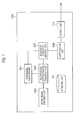
- Fig. 1 is a diagram showing the function block configuration of a tire performance prediction system 100 configured to execute the tire performance prediction method according to this embodiment.
- the tire performance prediction system 100 is configured to predict the performance of a tire on a snowy road by using a tire model 200 and a snow model 310 (see Fig. 4 ).
- the tire performance prediction system 100 includes a tire model creation unit 101, a snow model creation unit 103, a snowy-road-surface model creation unit 105, a boundary-condition setting unit 107, a computation unit 109, a storage unit 111, and an output unit 113.
- the tire model creation unit 101 is configured to create the tire model 200.
- Fig.4 shows the tire model 200 and a snowy-road-surface model 300 represented by use of the snow model 310.
- the tire model 200 has a tread pattern 210 deformable by at least one of contact with the ground and rolling.
- the snow model creation unit 103 is configured to create the snow model 310.
- the snow model 310 represents a snowy road to be in contact with the tire model 200, or specifically, with the tread pattern 210.
- the snow model 310 is modeled as an elasto-plastic body or a plastic body.
- the snow model 310 represents non-linearity of the volume compaction property of snow by a relation between the density of the snow or the volume strain of the snow and a pressure on the snow.
- the snow model 310 also represents the shear property of the snow by a relation between the yield stress of the snow and a pressure on the snow.
- the snowy-road-surface model creation unit 105 is configured to create the snowy-road-surface model 300.
- the non-linearity of the volume compaction property of snow is represented by a polynomial equation or a piecewise-linear continuous function, which is based on a relation between the density of the snow or the volume strain of the snow and the pressure on the snow.
- the shear property of snow is represented by a linear function which is based on a relation between the yield stress of the snow and the pressure on the snow.
- the boundary-condition setting unit 107 is configured to set various conditions such as a friction coefficient, external force and restriction applied to the tire model 200 and the snowy-road-surface model 300.
- the computation unit 109 is configured to execute computation (simulation) of tire performance by using the tire model 200 and the snowy-road-surface model 300. Specifically, the computation unit 109 executes various computations by using the tire model 200 and the snow model 310, and predicts the performance of a tire on a snowy road based on a physical amount produced in at least one of the snow model 310.
- the storage unit 111 is configured to store various tire models 200 and snowy-road-surface models 300.
- the storage unit 111 is also configured to store various pieces of data used by the boundary-condition setting unit 107 and computation results obtained by the computation unit 109.
- the output unit 113 is configured to output a result of tire performance simulation computed by the computation unit 109.
- Fig. 2 shows the flow of creating the snow model 310.
- Step S10 by performing an indoor test using real snow alone, the tire performance prediction system 100 determines test conditions which allow a deformation speed of snow to be substantially the same as in the tire's use conditions. Also, the tire performance prediction system 100 stratifies the snow alone according to the hardness of the snow alone, the temperature of the snow alone, or the microscopic structure of the snow.
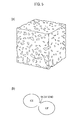
- tomographic images of the snow alone taken by an internal three-dimensional image analysis device and three-dimensional information which is obtained by performing processing on the tomographic images can be used as the microscopic structure of snow alone.
- Fig. 5(a) shows a three-dimensional analysis image of snow obtained by taking tomographic images of the snow by use of an X-ray CT scanner and then reconstructing the internal three-dimensional information of the snow by use of a computer
- Fig. 5(b) shows an image of snow structure.
- the internal three-dimensional image analysis device such as an X-ray CT scanner
- the microscopic structure of the snow can be accurately obtained, and therefore can be used for snow quality stratification.
- Such a method for internal three-dimensional image analysis is not limited to the X-ray CT imaging.
- MRI magnetic resonance imaging
- an imaging technique using neutrons can also be used.
- Step S20 the tire performance prediction system 100 uses the snow alone thus stratified to determine parameters for specifying the volume compaction property of the snow alone and the shear property of the snow.
- Step S30 the tire performance prediction system 100 creates the snow model 310 using the snow along stratified and the parameters determined. The details of the snow model 310 will be described later.
- Fig. 3 shows a flow of tire performance prediction and a flow of designing tire.
- the tire designing flow according to this embodiment includes the steps of: predicting the performance of a tire on a snowy road surface through numerical analysis by using the tire performance prediction method which uses the tire model 200 and the snowy-road-surface model 300; modifying a design draft of the tire targeted for the tire performance prediction method, based on the predicted tire performance; and re-predicting the performance of a tire, which is based on the modified design draft, on a snowy road surface through numerical analysis.
- a detailed description is given below using Fig. 3 .
- Step 110 the tire performance prediction system 100 creates the tire model 200.
- the tire model 200 can be created using the method described in the above-mentioned patent literature (Japanese Patent No. 4437884 ).
- Step S120 the tire performance prediction system 100 creates the snowy-road-surface model 300. Details of the snowy-road-surface model 300 will be described later.
- Step S130 the tire performance prediction system 100 sets boundary conditions for the tire model 200 and the snowy-road-surface model 300.
- Step S140 the tire performance prediction system 100 uses the tire model 200 and the snowy-road-surface model 300 to execute calculation of tire-snow interaction.
- Step S150 the tire performance prediction system 100 determines whether the calculation of tire-snow interaction is completed or not.
- Step S160 the tire performance prediction system 100 outputs a simulation result of the tire performance which is based on the interaction calculation.
- Step S170 the tire performance prediction system 100 evaluates the simulation result of the tire performance. Specifically, the tire performance prediction system 100 evaluates whether the obtained simulation result shows desired tire performance or not.
- Step S180 the tire performance prediction system 100 determines whether the tire performance based on the simulation result is favorable or not.
- the tire performance prediction system 100 adopts the tire design draft employed for the tire model 200 used in the simulation.
- Step S190 the tire design draft employed in the creation of the tire model 200 is modified, and the processing from Steps S100 to S170 is repeated.
- the snow model 310 is modeled as an elasto-plastic body or a plastic body.
- the snow model 310 represents the non-linearity of the volume compaction property of snow by the relation between the density of the snow or the volume strain of the snow and a pressure on the snow.
- the snow model 310 also represents the shear property of the snow by the relation between the yield stress of the snow and the pressure on the snow.
- the snow model 310 When receiving a load, snow undergoes a change in its internal structure (structure formed by cavities and ice crystals) and thus deforms, but does not restore its initial form even if the load is removed. Accordingly, to represent such a characteristic as a numerical model, the snow model 310 is formed as a plastic body. Further, a character of an elastic body is given to the snow model 310 if needed so that the snow model 310 is modeled to exert an appropriate reactive force when receiving a load.
- the reason why the volume compaction property of snow represents the non-linearity by the relation between the density of the snow or the volume strain of the snow and the pressure on the snow is as follows. As shown in Figs. 5(a) and 5(b) , snow has a structure formed by cavities and ice crystals. Accordingly, as long as snow remains snow, the density of snow never exceeds that of ice (920 kg/cm 3 ) no matter how much it is compacted, and therefore there is an upper limit of the snow density in a volume compaction process where the snow is hard-compacted by pressure.
- snow is mainly subjected to creep deformation when the deformation speed is low, and to brittle fracture when the deformation speed is high.
- Tire-snow interaction occurs in an area experiencing a high deformation speed. Accordingly, to accurately measure the fracture strength of the snow bonds, the physical property of snow must be measured with a sufficiently high deformation speed, which is related to the tire-snow interaction.
- the non-linearity of the volume compaction property of snow is expressed by a polynomial equation or a piecewise-linear continuous function which is based on a relation between the density of the snow or the volume strain of the snow and the pressure on the snow.
- the non-linearity of the volume compaction property of snow is unique to the conditions of snow to be measured. Accordingly, to improve the accuracy of the snow model 310, it is necessary to accurately stratify the snow, to precisely measure the volume compaction property of the snow, and to faithfully reflect the result in the snow model 310.
- the snow model 310 matching with the conditions of snow can be created with high accuracy.
- the measurement result of the volume compaction property of snow should preferably be expressed by a polynomial equation of three or more terms. More preferably, the measurement result of the volume compaction property of snow should be expressed by a polynomial equation of four or more terms. Alternatively, the measurement result of the volume compaction property of snow may be expressed by a Fourier series.
- a continuous function should preferably be sectioned in a unit of 0.1 MPa or smaller in a section closer to the ground contact surface of the tire, i.e., in a section where a stress of 0.5 MPa or smaller is applied to snow.
- the continuous function should preferably be sectioned in a unit of 0.05 MPa or smaller in a section where a stress of 0.5 MPa or smaller is applied to snow.
- the continuous function should preferably be sectioned in a unit of 0.3 MPa or smaller or 1.0 MPa or smaller according to a piece where the volume compaction property is representable, for example, the strength of the non-linearity of the volume compaction property.
- the shear property of snow is represented by a linear function which is based on the relation between the yield stress of the snow and the pressure on the snow.
- the shear property of snow is strongly dependent on the fracture strength of the snow bonds, and is therefore strongly dependent on the microscopic structure of snow. Accordingly, in order to improve the accuracy of the snow model 310, the snow model 310 matching with the conditions of snow can be precisely created by making the snow model 310 represent the relation between the yield stress of the snow and the pressure on the snow.
- the snowy-road-surface model 300 is created by the steps of: (i) through an indoor test of snow alone, stratifying the snow alone according to its hardness or temperature under test conditions which allow a deformation speed of snow to be substantially the same as in the tire's use conditions and (ii) by use of the stratified snow alone, determining parameters for specifying the volume compaction property of the snow alone and the shear property of the snow.
- the volume compaction property and the shear property of snow are strongly dependent on the conditions of the snow. Further, precise measurement of parameters for them is essential in order to improve the accuracy of the snow model 310.
- the hardness of snow and the temperature of snow are used as the conditions of snow, and the experiment is carried out under these conditions. Thereby, a repeated experiment with high reproducibility can be carried out under the conditions of snow which can be considered as substantially the same conditions; therefore, accurate parameters can be determined.
- a compaction tester (a CTI Compaction Gauge manufactured by Smitheres in the United States), a Kinoshita-style hardness gauge (a utility model proposed by Seiichi Kinoshita), a rammsonde (a ram hardness gauge), or the like can be used.
- a penetration force into snow and the resistance of the snow against the penetration may be successively measured.
- thermometer For quantification of the temperature of snow, the surface temperature of the snow, the internal temperature of the snow, the room temperature of the laboratory whose temperature is controlled to have a constant value, or the like may be used.
- thermometer a thermocouple, a resistance thermometer, a radiation thermometer, or the like can be used.
- a sample of snow is put in a cylindrical container, and a compaction force is applied evenly to the entire sample with the container being fixed (see Fig. 6 ), and the relation between the density of the snow and the pressure applied thereto is measured.
- the density can be measured from the ratio between the initial volume and the volume after deformation and from the weight excluding the container.
- the density may be replaced with the volume strain of snow.
- Fig. 6 shows the volume compaction property (density-pressure relation) of example snow (hard compacted, -6°C).
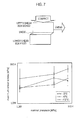
- a direct shear test of snow can be used (see Fig. 7 ).
- shear box test For quantification of the shear property of snow, a direct shear test of snow (shear box test) can be used (see Fig. 7 ).
- shear box test For quantification of the shear property of snow, a direct shear test of snow (shear box test) can be used (see Fig. 7 ).
- shear box test For quantification of the shear property of snow, a direct shear test of snow (shear box test) can be used (see Fig. 7 ).
- shear box test For quantification of the shear property of snow, Fig. 7 ).
- shear box test shear box test
- shear box test shear box test
- Figs. 8(a) and 8(b) show a change in the density which is caused by a high-speed compaction of the snow.
- a spring-loaded impact body is used to give high-speed compaction deformation to hard compacted snow.
- the snow density before deformation was 450kg/m 3
- the density immediately under the impact body increased to 750kg/m 3 .
- the snow bonds are fractured in the surface layer of the snow immediately under the impact body.
- contact between fractured ice particles makes it hard for the density in a lower layer to increase.
- the high density part is concentrated in the surface layer in an area immediately under the impact body. This is an example indicating that the deformation speed of snow strongly affects the physical property and the deformation result of the snow. When the deformation speed is low, the layer under the impact body is evenly compressed. Accordingly, the high density part is not concentrated in the surface layer.
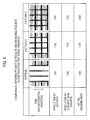
- the rim and internal pressure of a tire according to the example were set according to an applicable rim and a correspondence table between pneumatic pressure and load capability which correspond to the size of a radial-ply tire and are specified in JATMA (Japan Automobile Tyre Manufacturers Association Specification) YEAR BOOK (2009 ).
- Tires of the example have a size of 195/65R15 and different tread patterns in their center three land portions: Pattern 1 has neither grooves nor sipes, Pattern 2 has grooves and no sipes, and Pattern 3 has both grooves and sipes.
- Fig. 9 shows a comparison between actual measurement results and tire performance prediction results obtained by the above-described tire performance prediction method.
- "Conventional Example” shows results of prediction based on the tire performance prediction method described in the above-mentioned patent literature (Japanese Patent No. 4437884 ).
- Actual Measurement the prototype sample tires were attached to a rim of 6J-15, given an internal pressure of 200MPa, and were mounted on an automobile. Then, the tires were run for a startup test on a snowy road.
- the snow model 310 is modeled as an elasto-plastic body or a plastic body.
- the snow model 310 represents non-linearity of the volume compaction property of snow by the relation between the density of the snow or the volume strain of the snow and a pressure on the snow, and represents the shear property of snow by the relation between the yield stress of the snow and a pressure on the snow.
- tire performance simulation can be carried out with conditions well matched with the actual snow properties.
- the precision of predicting the tire performance on a road surface can be improved.
- the tire designing-evaluation cycle can be efficiently performed by using such a tire performance prediction method.
- the snow model 310 is created by an indoor test using snow alone in the above-described embodiment, the snow model 310 does not necessarily have to be created through an indoor test using snow alone.
- a tire performance prediction method which can improve the precision of predicting tire performance on a snowy road surface and allow efficient tire designing-evaluation cycle can be provided.
- a method of designing tire using the tire performance prediction method can also be provided.
Landscapes
- Engineering & Computer Science (AREA)
- Physics & Mathematics (AREA)
- Theoretical Computer Science (AREA)
- General Physics & Mathematics (AREA)
- Geometry (AREA)
- General Engineering & Computer Science (AREA)
- Computer Hardware Design (AREA)
- Evolutionary Computation (AREA)
- Mechanical Engineering (AREA)
- Automation & Control Theory (AREA)
- Aviation & Aerospace Engineering (AREA)
- Computational Mathematics (AREA)
- Mathematical Analysis (AREA)
- Mathematical Optimization (AREA)
- Pure & Applied Mathematics (AREA)
- Tires In General (AREA)
Applications Claiming Priority (2)
| Application Number | Priority Date | Filing Date | Title |
|---|---|---|---|
| JP2010166096 | 2010-07-23 | ||
| PCT/JP2011/066659 WO2012011551A1 (fr) | 2010-07-23 | 2011-07-22 | Procédé de prédiction de la performance d'un pneu et procédé de conception d'un pneu |
Publications (3)
| Publication Number | Publication Date |
|---|---|
| EP2597452A1 true EP2597452A1 (fr) | 2013-05-29 |
| EP2597452A4 EP2597452A4 (fr) | 2015-07-15 |
| EP2597452B1 EP2597452B1 (fr) | 2019-07-10 |
Family
ID=45496969
Family Applications (1)
| Application Number | Title | Priority Date | Filing Date |
|---|---|---|---|
| EP11809721.1A Active EP2597452B1 (fr) | 2010-07-23 | 2011-07-22 | Procédé de prédiction de la performance d'un pneu et procédé de conception d'un pneu |
Country Status (4)
| Country | Link |
|---|---|
| US (1) | US9285293B2 (fr) |
| EP (1) | EP2597452B1 (fr) |
| JP (1) | JP5808744B2 (fr) |
| WO (1) | WO2012011551A1 (fr) |
Families Citing this family (6)
| Publication number | Priority date | Publication date | Assignee | Title |
|---|---|---|---|---|
| US9188518B2 (en) | 2013-08-19 | 2015-11-17 | Bridgestone Americas Tire Operations, Llc | Ground compaction images |
| US10019827B2 (en) * | 2013-12-31 | 2018-07-10 | Disney Enterprises, Inc. | Material point method for simulation of granular materials |
| US10210287B2 (en) | 2013-12-31 | 2019-02-19 | Disney Enterprises, Inc. | Augmented material point method for simulating phase changes and varied materials |
| CN108334698A (zh) * | 2018-02-05 | 2018-07-27 | 山东理工大学 | 一种轮毂驱动系统一体化集成优化设计方法 |
| JP7246631B2 (ja) * | 2019-02-04 | 2023-03-28 | 新東工業株式会社 | パラメータの取得方法 |
| EP3946983B1 (fr) | 2019-04-01 | 2024-10-30 | Bridgestone Americas Tire Operations, LLC | Système et procédé de modélisation et de rétroaction de performances d'un pneu de véhicule |
Family Cites Families (7)
| Publication number | Priority date | Publication date | Assignee | Title |
|---|---|---|---|---|
| DE60205187T2 (de) | 2001-09-18 | 2006-06-14 | Sumitomo Rubber Ind | Verfahren zur Simulation eines rollenden Reifens |
| JP3305706B1 (ja) | 2001-12-26 | 2002-07-24 | 住友ゴム工業株式会社 | タイヤの走行シミュレーション方法 |
| JP4437884B2 (ja) | 2001-11-26 | 2010-03-24 | 株式会社ブリヂストン | タイヤ性能予測方法、流体シミュレーション方法、タイヤ設計方法、記録媒体及びタイヤ性能予測プログラム |
| JP4394866B2 (ja) * | 2002-07-02 | 2010-01-06 | 住友ゴム工業株式会社 | タイヤの走行シミュレーション方法 |
| US20040107081A1 (en) * | 2002-07-12 | 2004-06-03 | Akio Miyori | Method of simulating tire and snow |
| JP2004042832A (ja) | 2002-07-12 | 2004-02-12 | Sumitomo Rubber Ind Ltd | タイヤの雪上シミュレーション方法 |
| JP4746293B2 (ja) | 2004-08-09 | 2011-08-10 | 株式会社ブリヂストン | タイヤ性能予測方法、圃場シミュレーション方法、タイヤ設計方法、記録媒体及びタイヤ性能予測プログラム |
-
2011
- 2011-07-22 EP EP11809721.1A patent/EP2597452B1/fr active Active
- 2011-07-22 JP JP2012525429A patent/JP5808744B2/ja active Active
- 2011-07-22 US US13/811,556 patent/US9285293B2/en active Active
- 2011-07-22 WO PCT/JP2011/066659 patent/WO2012011551A1/fr not_active Ceased
Also Published As
| Publication number | Publication date |
|---|---|
| EP2597452A4 (fr) | 2015-07-15 |
| US20130124172A1 (en) | 2013-05-16 |
| JP5808744B2 (ja) | 2015-11-10 |
| EP2597452B1 (fr) | 2019-07-10 |
| US9285293B2 (en) | 2016-03-15 |
| JPWO2012011551A1 (ja) | 2013-09-09 |
| WO2012011551A1 (fr) | 2012-01-26 |
Similar Documents
| Publication | Publication Date | Title |
|---|---|---|
| EP2597452B1 (fr) | Procédé de prédiction de la performance d'un pneu et procédé de conception d'un pneu | |
| Yang | Finite element analysis and experimental investigation of tyre characteristics for developing strain-based intelligent tyre system | |
| EP1674848B1 (fr) | Procédé de simulation de pneus roulants | |
| Ghoreishy | A state of the art review of the finite element modelling of rolling tyres | |
| JP4782392B2 (ja) | タイヤ摩耗のシミュレーション方法、装置、プログラム及び媒体 | |
| Mohsenimanesh et al. | Stress analysis of a multi-laminated tractor tyre using non-linear 3D finite element analysis | |
| JP4699682B2 (ja) | タイヤ経時変化予測方法、装置、プログラム及び媒体 | |
| JP4469172B2 (ja) | タイヤのシミュレーション方法 | |
| Behroozinia et al. | An investigation towards intelligent tyres using finite element analysis | |
| Wei et al. | Simulation of tyre rolling resistance generated on uneven road | |
| Whicker et al. | A thermomechanical approach to tire power loss modeling | |
| JP4486420B2 (ja) | タイヤ経時変化予測方法、装置、プログラム及び媒体 | |
| Li et al. | An integrated approach for friction and wear simulation of tire tread rubber. Part I: friction test, characterization, and modeling | |
| Mundl et al. | Friction mechanism of tread blocks on snow surfaces | |
| JP4437884B2 (ja) | タイヤ性能予測方法、流体シミュレーション方法、タイヤ設計方法、記録媒体及びタイヤ性能予測プログラム | |
| Li et al. | An implicit to explicit FEA solving of tire F&M with detailed tread blocks | |
| Hall et al. | Finite element simulation of a rolling automobile tyre to understand its transient macroscopic behaviour | |
| Wei | A finite element based approach to characterising flexible ring tire (FTire) model for extended range of operating conditions | |
| JP6039210B2 (ja) | タイヤの耐久性の予測方法 | |
| JP6312975B2 (ja) | タイヤの耐久性評価方法及びこれを用いた設計方法 | |
| Gheshlaghi et al. | Developing an analytical model for prediction of tyre rolling resistance on moist soils | |
| Fathi | Modeling and analysis of all-season passenger car tire using finite element analysis | |
| Aboelsaoud et al. | Comparative analysis of Hydroplaning in Electric and ICE Vehicles | |
| Bastiaan | Design of a smart tire sensor system | |
| Assaad et al. | Rubber comprehensive constitutive equation and the prediction of tire temperature and rolling resistance |
Legal Events
| Date | Code | Title | Description |
|---|---|---|---|
| PUAI | Public reference made under article 153(3) epc to a published international application that has entered the european phase |
Free format text: ORIGINAL CODE: 0009012 |
|
| 17P | Request for examination filed |
Effective date: 20130125 |
|
| AK | Designated contracting states |
Kind code of ref document: A1 Designated state(s): AL AT BE BG CH CY CZ DE DK EE ES FI FR GB GR HR HU IE IS IT LI LT LU LV MC MK MT NL NO PL PT RO RS SE SI SK SM TR |
|
| DAX | Request for extension of the european patent (deleted) | ||
| RIC1 | Information provided on ipc code assigned before grant |
Ipc: G01M 17/02 20060101AFI20150604BHEP Ipc: G06F 17/50 20060101ALI20150604BHEP Ipc: G01M 17/06 20060101ALI20150604BHEP Ipc: B60C 99/00 20060101ALI20150604BHEP |
|
| RA4 | Supplementary search report drawn up and despatched (corrected) |
Effective date: 20150612 |
|
| STAA | Information on the status of an ep patent application or granted ep patent |
Free format text: STATUS: EXAMINATION IS IN PROGRESS |
|
| 17Q | First examination report despatched |
Effective date: 20171103 |
|
| GRAP | Despatch of communication of intention to grant a patent |
Free format text: ORIGINAL CODE: EPIDOSNIGR1 |
|
| STAA | Information on the status of an ep patent application or granted ep patent |
Free format text: STATUS: GRANT OF PATENT IS INTENDED |
|
| INTG | Intention to grant announced |
Effective date: 20190122 |
|
| GRAS | Grant fee paid |
Free format text: ORIGINAL CODE: EPIDOSNIGR3 |
|
| GRAA | (expected) grant |
Free format text: ORIGINAL CODE: 0009210 |
|
| STAA | Information on the status of an ep patent application or granted ep patent |
Free format text: STATUS: THE PATENT HAS BEEN GRANTED |
|
| AK | Designated contracting states |
Kind code of ref document: B1 Designated state(s): AL AT BE BG CH CY CZ DE DK EE ES FI FR GB GR HR HU IE IS IT LI LT LU LV MC MK MT NL NO PL PT RO RS SE SI SK SM TR |
|
| REG | Reference to a national code |
Ref country code: GB Ref legal event code: FG4D |
|
| REG | Reference to a national code |
Ref country code: CH Ref legal event code: EP Ref country code: AT Ref legal event code: REF Ref document number: 1154093 Country of ref document: AT Kind code of ref document: T Effective date: 20190715 |
|
| REG | Reference to a national code |
Ref country code: DE Ref legal event code: R096 Ref document number: 602011060389 Country of ref document: DE |
|
| REG | Reference to a national code |
Ref country code: IE Ref legal event code: FG4D |
|
| REG | Reference to a national code |
Ref country code: CH Ref legal event code: NV Representative=s name: SERVOPATENT GMBH, CH |
|
| REG | Reference to a national code |
Ref country code: NL Ref legal event code: MP Effective date: 20190710 |
|
| REG | Reference to a national code |
Ref country code: LT Ref legal event code: MG4D |
|
| REG | Reference to a national code |
Ref country code: AT Ref legal event code: MK05 Ref document number: 1154093 Country of ref document: AT Kind code of ref document: T Effective date: 20190710 |
|
| PG25 | Lapsed in a contracting state [announced via postgrant information from national office to epo] |
Ref country code: FI Free format text: LAPSE BECAUSE OF FAILURE TO SUBMIT A TRANSLATION OF THE DESCRIPTION OR TO PAY THE FEE WITHIN THE PRESCRIBED TIME-LIMIT Effective date: 20190710 Ref country code: SE Free format text: LAPSE BECAUSE OF FAILURE TO SUBMIT A TRANSLATION OF THE DESCRIPTION OR TO PAY THE FEE WITHIN THE PRESCRIBED TIME-LIMIT Effective date: 20190710 Ref country code: AT Free format text: LAPSE BECAUSE OF FAILURE TO SUBMIT A TRANSLATION OF THE DESCRIPTION OR TO PAY THE FEE WITHIN THE PRESCRIBED TIME-LIMIT Effective date: 20190710 Ref country code: NL Free format text: LAPSE BECAUSE OF FAILURE TO SUBMIT A TRANSLATION OF THE DESCRIPTION OR TO PAY THE FEE WITHIN THE PRESCRIBED TIME-LIMIT Effective date: 20190710 Ref country code: HR Free format text: LAPSE BECAUSE OF FAILURE TO SUBMIT A TRANSLATION OF THE DESCRIPTION OR TO PAY THE FEE WITHIN THE PRESCRIBED TIME-LIMIT Effective date: 20190710 Ref country code: NO Free format text: LAPSE BECAUSE OF FAILURE TO SUBMIT A TRANSLATION OF THE DESCRIPTION OR TO PAY THE FEE WITHIN THE PRESCRIBED TIME-LIMIT Effective date: 20191010 Ref country code: LT Free format text: LAPSE BECAUSE OF FAILURE TO SUBMIT A TRANSLATION OF THE DESCRIPTION OR TO PAY THE FEE WITHIN THE PRESCRIBED TIME-LIMIT Effective date: 20190710 Ref country code: PT Free format text: LAPSE BECAUSE OF FAILURE TO SUBMIT A TRANSLATION OF THE DESCRIPTION OR TO PAY THE FEE WITHIN THE PRESCRIBED TIME-LIMIT Effective date: 20191111 Ref country code: BG Free format text: LAPSE BECAUSE OF FAILURE TO SUBMIT A TRANSLATION OF THE DESCRIPTION OR TO PAY THE FEE WITHIN THE PRESCRIBED TIME-LIMIT Effective date: 20191010 |
|
| PG25 | Lapsed in a contracting state [announced via postgrant information from national office to epo] |
Ref country code: AL Free format text: LAPSE BECAUSE OF FAILURE TO SUBMIT A TRANSLATION OF THE DESCRIPTION OR TO PAY THE FEE WITHIN THE PRESCRIBED TIME-LIMIT Effective date: 20190710 Ref country code: LV Free format text: LAPSE BECAUSE OF FAILURE TO SUBMIT A TRANSLATION OF THE DESCRIPTION OR TO PAY THE FEE WITHIN THE PRESCRIBED TIME-LIMIT Effective date: 20190710 Ref country code: RS Free format text: LAPSE BECAUSE OF FAILURE TO SUBMIT A TRANSLATION OF THE DESCRIPTION OR TO PAY THE FEE WITHIN THE PRESCRIBED TIME-LIMIT Effective date: 20190710 Ref country code: GR Free format text: LAPSE BECAUSE OF FAILURE TO SUBMIT A TRANSLATION OF THE DESCRIPTION OR TO PAY THE FEE WITHIN THE PRESCRIBED TIME-LIMIT Effective date: 20191011 Ref country code: ES Free format text: LAPSE BECAUSE OF FAILURE TO SUBMIT A TRANSLATION OF THE DESCRIPTION OR TO PAY THE FEE WITHIN THE PRESCRIBED TIME-LIMIT Effective date: 20190710 Ref country code: IS Free format text: LAPSE BECAUSE OF FAILURE TO SUBMIT A TRANSLATION OF THE DESCRIPTION OR TO PAY THE FEE WITHIN THE PRESCRIBED TIME-LIMIT Effective date: 20191110 |
|
| PG25 | Lapsed in a contracting state [announced via postgrant information from national office to epo] |
Ref country code: TR Free format text: LAPSE BECAUSE OF FAILURE TO SUBMIT A TRANSLATION OF THE DESCRIPTION OR TO PAY THE FEE WITHIN THE PRESCRIBED TIME-LIMIT Effective date: 20190710 |
|
| REG | Reference to a national code |
Ref country code: BE Ref legal event code: MM Effective date: 20190731 |
|
| PG25 | Lapsed in a contracting state [announced via postgrant information from national office to epo] |
Ref country code: RO Free format text: LAPSE BECAUSE OF FAILURE TO SUBMIT A TRANSLATION OF THE DESCRIPTION OR TO PAY THE FEE WITHIN THE PRESCRIBED TIME-LIMIT Effective date: 20190710 Ref country code: PL Free format text: LAPSE BECAUSE OF FAILURE TO SUBMIT A TRANSLATION OF THE DESCRIPTION OR TO PAY THE FEE WITHIN THE PRESCRIBED TIME-LIMIT Effective date: 20190710 Ref country code: EE Free format text: LAPSE BECAUSE OF FAILURE TO SUBMIT A TRANSLATION OF THE DESCRIPTION OR TO PAY THE FEE WITHIN THE PRESCRIBED TIME-LIMIT Effective date: 20190710 Ref country code: DK Free format text: LAPSE BECAUSE OF FAILURE TO SUBMIT A TRANSLATION OF THE DESCRIPTION OR TO PAY THE FEE WITHIN THE PRESCRIBED TIME-LIMIT Effective date: 20190710 |
|
| PG25 | Lapsed in a contracting state [announced via postgrant information from national office to epo] |
Ref country code: SK Free format text: LAPSE BECAUSE OF FAILURE TO SUBMIT A TRANSLATION OF THE DESCRIPTION OR TO PAY THE FEE WITHIN THE PRESCRIBED TIME-LIMIT Effective date: 20190710 Ref country code: CZ Free format text: LAPSE BECAUSE OF FAILURE TO SUBMIT A TRANSLATION OF THE DESCRIPTION OR TO PAY THE FEE WITHIN THE PRESCRIBED TIME-LIMIT Effective date: 20190710 Ref country code: SM Free format text: LAPSE BECAUSE OF FAILURE TO SUBMIT A TRANSLATION OF THE DESCRIPTION OR TO PAY THE FEE WITHIN THE PRESCRIBED TIME-LIMIT Effective date: 20190710 Ref country code: IS Free format text: LAPSE BECAUSE OF FAILURE TO SUBMIT A TRANSLATION OF THE DESCRIPTION OR TO PAY THE FEE WITHIN THE PRESCRIBED TIME-LIMIT Effective date: 20200224 Ref country code: BE Free format text: LAPSE BECAUSE OF NON-PAYMENT OF DUE FEES Effective date: 20190731 Ref country code: MC Free format text: LAPSE BECAUSE OF FAILURE TO SUBMIT A TRANSLATION OF THE DESCRIPTION OR TO PAY THE FEE WITHIN THE PRESCRIBED TIME-LIMIT Effective date: 20190710 |
|
| REG | Reference to a national code |
Ref country code: DE Ref legal event code: R097 Ref document number: 602011060389 Country of ref document: DE |
|
| REG | Reference to a national code |
Ref country code: CH Ref legal event code: PCAR Free format text: NEW ADDRESS: WANNERSTRASSE 9/1, 8045 ZUERICH (CH) |
|
| PLBE | No opposition filed within time limit |
Free format text: ORIGINAL CODE: 0009261 |
|
| STAA | Information on the status of an ep patent application or granted ep patent |
Free format text: STATUS: NO OPPOSITION FILED WITHIN TIME LIMIT |
|
| PG2D | Information on lapse in contracting state deleted |
Ref country code: IS |
|
| PG25 | Lapsed in a contracting state [announced via postgrant information from national office to epo] |
Ref country code: IE Free format text: LAPSE BECAUSE OF NON-PAYMENT OF DUE FEES Effective date: 20190722 |
|
| 26N | No opposition filed |
Effective date: 20200603 |
|
| PG25 | Lapsed in a contracting state [announced via postgrant information from national office to epo] |
Ref country code: SI Free format text: LAPSE BECAUSE OF FAILURE TO SUBMIT A TRANSLATION OF THE DESCRIPTION OR TO PAY THE FEE WITHIN THE PRESCRIBED TIME-LIMIT Effective date: 20190710 |
|
| GBPC | Gb: european patent ceased through non-payment of renewal fee |
Effective date: 20191010 |
|
| PG25 | Lapsed in a contracting state [announced via postgrant information from national office to epo] |
Ref country code: GB Free format text: LAPSE BECAUSE OF NON-PAYMENT OF DUE FEES Effective date: 20191010 |
|
| PG25 | Lapsed in a contracting state [announced via postgrant information from national office to epo] |
Ref country code: CY Free format text: LAPSE BECAUSE OF FAILURE TO SUBMIT A TRANSLATION OF THE DESCRIPTION OR TO PAY THE FEE WITHIN THE PRESCRIBED TIME-LIMIT Effective date: 20190710 |
|
| PG25 | Lapsed in a contracting state [announced via postgrant information from national office to epo] |
Ref country code: HU Free format text: LAPSE BECAUSE OF FAILURE TO SUBMIT A TRANSLATION OF THE DESCRIPTION OR TO PAY THE FEE WITHIN THE PRESCRIBED TIME-LIMIT; INVALID AB INITIO Effective date: 20110722 Ref country code: MT Free format text: LAPSE BECAUSE OF FAILURE TO SUBMIT A TRANSLATION OF THE DESCRIPTION OR TO PAY THE FEE WITHIN THE PRESCRIBED TIME-LIMIT Effective date: 20190710 |
|
| PG25 | Lapsed in a contracting state [announced via postgrant information from national office to epo] |
Ref country code: MK Free format text: LAPSE BECAUSE OF FAILURE TO SUBMIT A TRANSLATION OF THE DESCRIPTION OR TO PAY THE FEE WITHIN THE PRESCRIBED TIME-LIMIT Effective date: 20190710 |
|
| P01 | Opt-out of the competence of the unified patent court (upc) registered |
Effective date: 20230606 |
|
| PGFP | Annual fee paid to national office [announced via postgrant information from national office to epo] |
Ref country code: LU Payment date: 20250721 Year of fee payment: 15 |
|
| PGFP | Annual fee paid to national office [announced via postgrant information from national office to epo] |
Ref country code: DE Payment date: 20250722 Year of fee payment: 15 |
|
| PGFP | Annual fee paid to national office [announced via postgrant information from national office to epo] |
Ref country code: IT Payment date: 20250724 Year of fee payment: 15 |
|
| PGFP | Annual fee paid to national office [announced via postgrant information from national office to epo] |
Ref country code: FR Payment date: 20250725 Year of fee payment: 15 |
|
| PGFP | Annual fee paid to national office [announced via postgrant information from national office to epo] |
Ref country code: CH Payment date: 20250801 Year of fee payment: 15 |