EP2607319A1 - H4V3O8, ein neues Vanadium-(IV)oxid elektroaktives Material für wässrige und nicht wässrige Batterien - Google Patents
H4V3O8, ein neues Vanadium-(IV)oxid elektroaktives Material für wässrige und nicht wässrige Batterien Download PDFInfo
- Publication number
- EP2607319A1 EP2607319A1 EP11195376.6A EP11195376A EP2607319A1 EP 2607319 A1 EP2607319 A1 EP 2607319A1 EP 11195376 A EP11195376 A EP 11195376A EP 2607319 A1 EP2607319 A1 EP 2607319A1
- Authority
- EP
- European Patent Office
- Prior art keywords
- electroactive
- aqueous
- compound
- electroactive material
- cathode
- Prior art date
- Legal status (The legal status is an assumption and is not a legal conclusion. Google has not performed a legal analysis and makes no representation as to the accuracy of the status listed.)
- Granted
Links
Images



Classifications
-
- H—ELECTRICITY
- H01—ELECTRIC ELEMENTS
- H01M—PROCESSES OR MEANS, e.g. BATTERIES, FOR THE DIRECT CONVERSION OF CHEMICAL ENERGY INTO ELECTRICAL ENERGY
- H01M4/00—Electrodes
- H01M4/02—Electrodes composed of, or comprising, active material
- H01M4/36—Selection of substances as active materials, active masses, active liquids
- H01M4/48—Selection of substances as active materials, active masses, active liquids of inorganic oxides or hydroxides
- H01M4/485—Selection of substances as active materials, active masses, active liquids of inorganic oxides or hydroxides of mixed oxides or hydroxides for inserting or intercalating light metals, e.g. LiTi2O4 or LiTi2OxFy
-
- C—CHEMISTRY; METALLURGY
- C01—INORGANIC CHEMISTRY
- C01G—COMPOUNDS CONTAINING METALS NOT COVERED BY SUBCLASSES C01D OR C01F
- C01G31/00—Compounds of vanadium
-
- H—ELECTRICITY
- H01—ELECTRIC ELEMENTS
- H01M—PROCESSES OR MEANS, e.g. BATTERIES, FOR THE DIRECT CONVERSION OF CHEMICAL ENERGY INTO ELECTRICAL ENERGY
- H01M4/00—Electrodes
- H01M4/02—Electrodes composed of, or comprising, active material
- H01M4/04—Processes of manufacture in general
- H01M4/0402—Methods of deposition of the material
- H01M4/0404—Methods of deposition of the material by coating on electrode collectors
-
- H—ELECTRICITY
- H01—ELECTRIC ELEMENTS
- H01M—PROCESSES OR MEANS, e.g. BATTERIES, FOR THE DIRECT CONVERSION OF CHEMICAL ENERGY INTO ELECTRICAL ENERGY
- H01M4/00—Electrodes
- H01M4/02—Electrodes composed of, or comprising, active material
- H01M4/04—Processes of manufacture in general
- H01M4/049—Manufacturing of an active layer by chemical means
-
- H—ELECTRICITY
- H01—ELECTRIC ELEMENTS
- H01M—PROCESSES OR MEANS, e.g. BATTERIES, FOR THE DIRECT CONVERSION OF CHEMICAL ENERGY INTO ELECTRICAL ENERGY
- H01M4/00—Electrodes
- H01M4/02—Electrodes composed of, or comprising, active material
- H01M4/13—Electrodes for accumulators with non-aqueous electrolyte, e.g. for lithium-accumulators; Processes of manufacture thereof
- H01M4/131—Electrodes based on mixed oxides or hydroxides, or on mixtures of oxides or hydroxides, e.g. LiCoOx
-
- H—ELECTRICITY
- H01—ELECTRIC ELEMENTS
- H01M—PROCESSES OR MEANS, e.g. BATTERIES, FOR THE DIRECT CONVERSION OF CHEMICAL ENERGY INTO ELECTRICAL ENERGY
- H01M4/00—Electrodes
- H01M4/02—Electrodes composed of, or comprising, active material
- H01M4/62—Selection of inactive substances as ingredients for active masses, e.g. binders, fillers
- H01M4/624—Electric conductive fillers
- H01M4/625—Carbon or graphite
-
- C—CHEMISTRY; METALLURGY
- C01—INORGANIC CHEMISTRY
- C01P—INDEXING SCHEME RELATING TO STRUCTURAL AND PHYSICAL ASPECTS OF SOLID INORGANIC COMPOUNDS
- C01P2002/00—Crystal-structural characteristics
- C01P2002/20—Two-dimensional structures
-
- C—CHEMISTRY; METALLURGY
- C01—INORGANIC CHEMISTRY
- C01P—INDEXING SCHEME RELATING TO STRUCTURAL AND PHYSICAL ASPECTS OF SOLID INORGANIC COMPOUNDS
- C01P2002/00—Crystal-structural characteristics
- C01P2002/70—Crystal-structural characteristics defined by measured X-ray, neutron or electron diffraction data
- C01P2002/72—Crystal-structural characteristics defined by measured X-ray, neutron or electron diffraction data by d-values or two theta-values, e.g. as X-ray diagram
-
- C—CHEMISTRY; METALLURGY
- C01—INORGANIC CHEMISTRY
- C01P—INDEXING SCHEME RELATING TO STRUCTURAL AND PHYSICAL ASPECTS OF SOLID INORGANIC COMPOUNDS
- C01P2002/00—Crystal-structural characteristics
- C01P2002/70—Crystal-structural characteristics defined by measured X-ray, neutron or electron diffraction data
- C01P2002/76—Crystal-structural characteristics defined by measured X-ray, neutron or electron diffraction data by a space-group or by other symmetry indications
-
- C—CHEMISTRY; METALLURGY
- C01—INORGANIC CHEMISTRY
- C01P—INDEXING SCHEME RELATING TO STRUCTURAL AND PHYSICAL ASPECTS OF SOLID INORGANIC COMPOUNDS
- C01P2002/00—Crystal-structural characteristics
- C01P2002/70—Crystal-structural characteristics defined by measured X-ray, neutron or electron diffraction data
- C01P2002/77—Crystal-structural characteristics defined by measured X-ray, neutron or electron diffraction data by unit-cell parameters, atom positions or structure diagrams
-
- C—CHEMISTRY; METALLURGY
- C01—INORGANIC CHEMISTRY
- C01P—INDEXING SCHEME RELATING TO STRUCTURAL AND PHYSICAL ASPECTS OF SOLID INORGANIC COMPOUNDS
- C01P2002/00—Crystal-structural characteristics
- C01P2002/80—Crystal-structural characteristics defined by measured data other than those specified in group C01P2002/70
- C01P2002/88—Crystal-structural characteristics defined by measured data other than those specified in group C01P2002/70 by thermal analysis data, e.g. TGA, DTA, DSC
-
- C—CHEMISTRY; METALLURGY
- C01—INORGANIC CHEMISTRY
- C01P—INDEXING SCHEME RELATING TO STRUCTURAL AND PHYSICAL ASPECTS OF SOLID INORGANIC COMPOUNDS
- C01P2004/00—Particle morphology
- C01P2004/01—Particle morphology depicted by an image
- C01P2004/03—Particle morphology depicted by an image obtained by SEM
-
- C—CHEMISTRY; METALLURGY
- C01—INORGANIC CHEMISTRY
- C01P—INDEXING SCHEME RELATING TO STRUCTURAL AND PHYSICAL ASPECTS OF SOLID INORGANIC COMPOUNDS
- C01P2004/00—Particle morphology
- C01P2004/10—Particle morphology extending in one dimension, e.g. needle-like
-
- C—CHEMISTRY; METALLURGY
- C01—INORGANIC CHEMISTRY
- C01P—INDEXING SCHEME RELATING TO STRUCTURAL AND PHYSICAL ASPECTS OF SOLID INORGANIC COMPOUNDS
- C01P2006/00—Physical properties of inorganic compounds
- C01P2006/40—Electric properties
-
- H—ELECTRICITY
- H01—ELECTRIC ELEMENTS
- H01M—PROCESSES OR MEANS, e.g. BATTERIES, FOR THE DIRECT CONVERSION OF CHEMICAL ENERGY INTO ELECTRICAL ENERGY
- H01M10/00—Secondary cells; Manufacture thereof
- H01M10/05—Accumulators with non-aqueous electrolyte
- H01M10/052—Li-accumulators
-
- H—ELECTRICITY
- H01—ELECTRIC ELEMENTS
- H01M—PROCESSES OR MEANS, e.g. BATTERIES, FOR THE DIRECT CONVERSION OF CHEMICAL ENERGY INTO ELECTRICAL ENERGY
- H01M10/00—Secondary cells; Manufacture thereof
- H01M10/05—Accumulators with non-aqueous electrolyte
- H01M10/052—Li-accumulators
- H01M10/0525—Rocking-chair batteries, i.e. batteries with lithium insertion or intercalation in both electrodes; Lithium-ion batteries
-
- Y—GENERAL TAGGING OF NEW TECHNOLOGICAL DEVELOPMENTS; GENERAL TAGGING OF CROSS-SECTIONAL TECHNOLOGIES SPANNING OVER SEVERAL SECTIONS OF THE IPC; TECHNICAL SUBJECTS COVERED BY FORMER USPC CROSS-REFERENCE ART COLLECTIONS [XRACs] AND DIGESTS
- Y02—TECHNOLOGIES OR APPLICATIONS FOR MITIGATION OR ADAPTATION AGAINST CLIMATE CHANGE
- Y02E—REDUCTION OF GREENHOUSE GAS [GHG] EMISSIONS, RELATED TO ENERGY GENERATION, TRANSMISSION OR DISTRIBUTION
- Y02E60/00—Enabling technologies; Technologies with a potential or indirect contribution to GHG emissions mitigation
- Y02E60/10—Energy storage using batteries
Definitions
- the present invention concerns a new electroactive cathode material suitable for non-aqueous and aqueous rechargeable batteries.
- Aqueous lithium ion batteries are currently being developed and present several advantages over conventional alkaline, nickel metal hydride (NiMH) or lead acid batteries [1].
- NiMH nickel metal hydride
- the pH of the electrolyte used in aqueous lithium batteries is close to 7, which makes these systems inherently safer.
- non aqueous lithium ion batteries have a better energy density because of the higher voltage available in organic electrolytes, they are hazardous, expensive and contain highly toxic chemicals in their current state. In comparison, an aqueous lithium battery is safe, cheap and environmentally friendly.
- Aqueous mixed lithium/proton batteries offer the perspective of storing more energy than proton or lithium batteries do independently [2].
- Synthetic or natural vanadium(IV) oxide compounds are of interest in fundamental research [3] and for industrial applications [4] because of their structural peculiarities and their extended redox properties.
- H 2 V 3 O 8 is a known compound that has already been described in 1970 [5] and that was structurally analyzed in 1990 [6]. Its composition and structure has been modified in several ways in order to improve its use as electrode material in batteries. However, only the compounds obtained by oxidation to an all vanadium(V) oxohydroxide in which part of the hydrogen has been substituted by alcaline metal cations have been described so far [7]. So far practically no compounds obtained by reduction of H 2 V 3 O 8 , in which the oxidation states of the vanadium are mixed 4+/5+, only 4+ or 4+/3+, have been characterized. One exception is [8], in which Li x H 2 V 3 O 8 phases are described.
- a V(IV) compound is known in the form of the mineral doloresite [9] that is a hydrated form of VO 2 .
- Doloresite can be formulated as V 3 O 4 (OH) 4 or H 4 V 3 O 8 .
- the electroactive cathode material is manifested by the features that it is H 4 V 3 O 8 , obtainable from the precursor H 2 V 3 O 8 (Pnma), optionally in one of its loaded/deloaded states.
- Such electroactive cathode material based on H 4 V 3 O 8 and encompassing loaded and deloaded states may also be described as Li x H y V 3 O 8 with 2 ⁇ x+y ⁇ 6.8 and 0 ⁇ x ⁇ 4 and 0.5 ⁇ y ⁇ 6, with the proviso that it is not the precursor H 2 V 3 O 8 (Pnma).
- the electroactive cathode material is manifested by the features that it is H 4 V 3 O 8 in the form of a layered compound with a structure belonging to the space group Pnma (n62).
- the electroactive material of the present invention is suitable for rechargeable batteries and non rechargeable batteries as well.
- the H 4 V 3 O 8 of the present invention is structurally closely related to H 2 V 3 O 8 (Pnma). Contrary thereto the mineral doloresite [9], although its formula may be written as V 3 O 4 (OH) 4 or H 4 V 3 O 8 , possesses a different crystal structure and different physico-chemical properties and therefore is easily distinguishable from the compound of the present invention. Thus, in order to clearly distinguish doloresite from the compound of the present invention, the formula of doloresite will further on be referred to as V 3 O 4 (OH) 4 and the one of the present invention as H 4 V 3 O 8 .
- H 4 V 3 O 8 is obtainable by reduction of H 2 V 3 O 8 according to the following reaction: H 2 V 3 O 8 + 2e + 2H+ ⁇ H 4 V 3 O 8
- H 4 V 3 O 8 can be synthesized starting from H 2 V 3 O 8 , a proton source and a reducing agent.
- the reaction is suitably carried out in a solvent, preferentially water, and preferably in water at a pH of, or close to, 7.
- the temperature can be varied in a broad range of usually 90 to 10°C but is preferably performed in a range of 20 to 30 °C, most preferred at about 25 °C.
- any proton source can be used in combination with any strong reducing agent.
- suitable proton sources and reducing agents are
- a base may be added such as aqueous NH 4 OH.
- An additional benefit of the materials of the present invention is that they can be used for forming the electroactive material coating of a current collector or guidewire (further on referred to as current collector only) in mere admixture with conductive carbon, e.g. Super P® Li carbon black (TIMCAL®), i.e. no binder is necessary to provide a sufficiently stable coating.
- conductive carbon e.g. Super P® Li carbon black (TIMCAL®)
- TIMCAL® Super P® Li carbon black
- the electroactive material of the present invention is in the form of nanoparticles, in particular nanofibers or microfibers, i.e. elongated particles with one dimension exceeding the other dimensions for at least about 20 times.
- Preferred dimensions of nanofibers/microfibers are a width of less than 200 nm, preferably about 100 nm and a length of up to about 100 ⁇ m, preferably about 10 ⁇ m.
- Usual particle sizes for non elongated particles e.g. the conductive particles such as the conductive carbon black and - if the optional conductive binder particles are present - the binder particles are e.g. ⁇ 500 nm, in particular nanoparticles having an average particle size in the range of 5 to 500 nm, preferably in the range of 5 to 400 nm, more preferred in the range of 20 to 300 nm.
- the basic material of the invention is H 4 V 3 O 8 obtainable from H 2 V 3 O 8 , in particular by a method comprising treating H 2 V 3 O 8 with a proton source and a reducing agent in a solvent.
- Suitable proton sources and the reducing agents are e.g.
- a suitable and preferred solvent is water, in particular water at a pH of 5 to 8, much preferred close to 7.
- the reaction temperature may practically vary from 100 °C to 0 °C, preferably 80 to 10 °C, however the treatment is usually performed at a temperature of 20 to 30 °C, in particular about 25 °C.
- the H 4 V 3 O 8 produced as mentioned above is in the form of fibers having a width of less than 200 nm, preferably about 100 nm and a length of up to about 100 ⁇ m, preferably about 10 ⁇ m.
- Such H 4 V 3 O 8 may be subjected to lithiation/delithiation and/or protonation/deprotonation thereby resulting in a compound that may be described by the general formula Li x H y V 3 O 8 , wherein 2 ⁇ x+y ⁇ 6.8 and 0 ⁇ x ⁇ 4 and 0.5 ⁇ y ⁇ 6.
- Such compound is e.g. obtainable by electrochemistry.
- H 4 V 3 O 8 as well as Li x H y V 3 O 8 , wherein 2 ⁇ x+y ⁇ 6.8 and 0 ⁇ x ⁇ 4 and 0.5 ⁇ y ⁇ 6 may be used as electroactive material in aqueous and non aqueous rechargeable and non rechargeable batteries.
- the presently preferred starting material for producing an electrode is H 4 V 3 O 8 . Indeed, as the cell parameters change only very little as the result of the lithium intercalation/deintercalation, this material has a good stability over various intercalation/deintercalation cycles since few mechanical work has to be performed and therefore the electrode coating remains intact.
- the electroactive material after synthesis may be gently pestled before use. Gently in this connection means that the pestling conditions shall be chosen such that the particle sizes are reduced to the desired sizes only. Suitable conditions can easily be determined by the skilled person.
- the electroactive material is used in mixture with nanoparticulate conductive material, in particular conductive carbon black.
- nanoparticulate binder may be present, however since a mixture consisting of electroactive material and conductive carbon black proved to be sufficiently stable to be used without usual binder component, such binary composition is preferred.
- Suitable binders are e.g. polyvinylidene fluoride, or an electrically conducting nanoparticulate binder, such as PEDOT (Poly(3,4-ethylenedioxythiophene).
- PEDOT Poly(3,4-ethylenedioxythiophene).
- H 4 V 3 O 8 may be produced from H 2 V 3 O 8 by a method wherein H 2 V 3 O 8 is treated with a proton source and a reducing agent in a solvent. Preferred conditions have already been defined above.
- H 4 V 3 O 8 may be obtained electrochemically from H 2 V 3 O 8 , e.g. at 100A/kg in an aqueous electrolyte (e.g. 3 M NH 4 Cl) and with e.g. Zn as anode.
- an aqueous electrolyte e.g. 3 M NH 4 Cl
- Zn e.g. Zn as anode.
- an electroactive cathode material containing or consisting of an electroactive compound as defined above and a nanoparticulate conductive material, in particular conductive carbon black and a cathode comprising a current collector coated with such electroactive cathode material.
- Such cathode may be produced in that electroactive material as defined above is mixed and homogenized with conductive carbon black, optionally followed by gentle pestling and/or solvent evaporation to obtain desired fibre dimensions and viscosity, coating a current collector and drying.
- Good mechanical stability is e.g. obtained by mixing the electroactive material with conductive carbon black, e.g. Super P® Li conductive carbon black (TIMCAL), in a 7:3 weight-ratio in a solvent, for example tetrahydrofuran (THF).
- a solvent for example tetrahydrofuran (THF).
- Suitable solvents can be organic as well as inorganic, protic as well as aprotic.
- Homogenization may occur during mixing or subsequent to the mixing, e.g. by ultrasound. Such homogenization usually is only performed for from a few seconds to a few minutes. Indeed, mixing for too long can damage the material.
- a coating composition that may be used for coating a current collector
- some of the solvent e.g. THF may be evaporated during pestling.
- a suitable current collector is a titanium current collector, although other inert conductive materials may be used.
- the coating or the electrode, respectively may be dried in air, pressed by hand to further compact the coating and to improve the drying, and further dried in vacuum.
- the environment gas phase
- the time usually needed for the final drying with the mentioned minimal number of purges usually is around 30 minutes
- Such electrodes are suitable for being used in non aqueous or aqueous lithium batteries.
- a suitable electrolyte for a non aqueous lithium battery is e.g. an electrolyte consisting of 1 M LiPF 6 in a mixture of ethylene carbonate and dimethyl carbonate (e.g. 1:1 or 2:1 by weight).
- Such preferred nitrides and carbides are generally referred to as interstitial nitrides and carbides.
- Suitable separators are e.g. polymer fibre sheet materials such as microporous polypropylene sheets.
- suitable separators are e.g. a Celgard® polypropylene separator and/or a silica foam separator and/or a nylon sheet material.
- the cathode may be prepared as described above and then further processed into a cell by covering the electrode with at least one separator and then filling the cell with electrolyte, completing the cell with an anode and then tightly closing the cell.
- a suitable electrolyte for an aqueous lithium and proton battery is e.g. an electrolyte comprising a soluble lithium salt like LiCl, LiNO 3 or LiOH, or an acid, e.g. an electrolyte consisting of either 3M LiCl or 5M LiNO 3 or 3M NH 4 Cl, for a lithium ion cell or a proton cell, respectively.
- the electrolyte solutions preferably are degassed, e.g. by ultrasound.
- a zinc plate may be used as anode and reference electrode.
- Other suitable anodes are Manganese, Aluminium, Iron, Chromium or another element with a reduction potential smaller than -0.3 Volt.
- the cathode may be prepared as described above.
- Such electrode may be further processed into a cell by covering the electrode with at least one separator (see above) and then filling the cell with electrolyte, completing the cell with an anode and then tightly closing the cell.
- H 4 V 3 O 8 was synthesized from H 2 V 3 O 8 , a proton source and a reducing agent.
- the reaction was carried out in a solvent, preferentially water, at a variable range of temperature, preferably at 25 °C.
- H 2 V 3 O 8 200 mg were dispersed in 100 ml deionized water. The resulting suspension was stirred vigorously until the suspension turned to a black-green colour indicating completion of the reaction. The pH of the suspension was brought to 9-10 by the addition of N 2 H 4 ⁇ H 2 O. Immediately afterwards, the reaction mixture was neutralized by ascorbic acid. The green solid turned dark brown upon addition of ascorbic acid. The brown product was collected by filtration, washed twice with deionized water and once with acetonitrile. After vacuum drying for 4h at 25 °C, H 4 V 3 O 8 was kept in an argon-filled glove box. Approximately 20% by weight of the solid H 2 V 3 O 8 dissolved during the reaction and could not be recovered.
- H 2 V 3 O 8 200 mg were dispersed in 100 ml deionized water. The resulting suspension was stirred vigorously until completion of the reaction (see method #1). 500 mg of ascorbic acid were added to the suspension. After 5 min, the pH was adjusted to 7 with 0.2 ml of 25% NH 4 OH. The resulting mixture was warmed to 80 °C on a hotplate until the solid had turned brown, i.e. for approximately 30 min. The brown product was collected by filtration, washed twice with deionized water and once with acetonitrile. After vacuum drying for 4h at 25 °C, H 4 V 3 O 8 was kept in an argon-filled glove box. The reaction was quantitative.
- H 4 V 3 O 8 samples submitted for elemental analysis contained amounts of carbon and nitrogen below 0.4% by weight.
- the hydrogen content was found to lie between 1.3% by weight and 1.5% by weight, which is consistent with the expectation value of 1.4% by weight for H 4 V 3 O 8 .
- 0.7% by weight was found in H 2 V 3 O 8 .
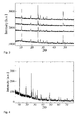
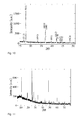
- the XRD (CuKa) powder pattern of H 4 V 3 O 8 was measured.
- the pattern looks related to H 2 V 3 O 8 but different.
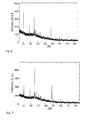
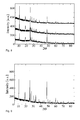
- the patterns for different chemical synthesis and synthesis by electrochemical protonation did not differ (see Fig. 2 , 3 , 4 , 9 , and 11 )
- XRD pattern of differently protonated H 4 V 3 O 8 synthesized electrochemically at 100 A/kg (NH4Cl aqueous electrolyte and zinc anode) are shown in Fig. 6 to 8 , wherein Fig. 6 shows the XRD pattern of H 5 V 3 O 8 , Fig. 7 of H 6 V 3 O 8 , and Fig. 8 a comparison of the XRD pattern of H 4 V 3 O 8 , H 5 V 3 O 8 , and H 6 V 3 O 8 (from top to bottom).
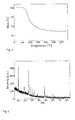
- the mass loss was 13% by weight, which is consistent with the loss of two water molecules per H 4 V 3 O 8 formula unit.
- the DTA shows an exothermic peak at 430°C.
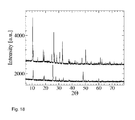
- the residue was analyzed by XRD powder diffraction (see Fig. 10 ). All the reflexes matched the pattern of VO 2 (ICSD 15889).
- H 4 V 3 O 8 can be successively lithiated and protonated (in any order) by changing the composition of the electrolyte (from LiCl to NH 4 Cl or to organic electrolyte) to Li x H y V 3 O 8 with 2 ⁇ x+y ⁇ 6.8 and 0 ⁇ x ⁇ 4 and 0.5 ⁇ y ⁇ 6.
- the procedure implies disassembling the cell, rinsing the Li x H y V 3 O 8 cathode and reassembling a cell with a fresh anode and the selected electrolyte.
- the galvanostatic measurements were performed in two electrodes cells connected to a potentiostat. Lithium metal was used as anode and reference electrode.
- the electrolyte consisted of 1 M LiPF 6 in a mixture of ethylene carbonate and dimethyl carbonate (1:1 by weight).
- a Celgard® polypropylene separator and a silica foam separator were used.
- the cathode was prepared by mixing the electroactive material with Super P®Li conductive carbon black (TIMCAL) in a 7:3 weight-ratio in THF. The mixture was homogenised a few seconds by ultrasound. Subsequently, the suspension was poured in a mortar and gently pestled until enough THF had evaporated, in order to transfer the wet solid onto a titanium current collector. The electrodes were dried in air, pressed by hand, and further dried in a transfer chamber for 2 hours in vacuum (with a minimum of 3 purges) while being transferred in said transfer chamber to an argon-filled glove box.
- TIMCAL Super P®Li conductive carbon black
- Such electrode may be further processed into a cell by covering the electrode with at least one separator and then filling the cell with electrolyte, completing the cell with an anode and then tightly closing the cell.
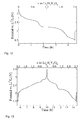
- FIG. 12 A galvanostatic discharge curve of H 4 V 3 O 8 in such non aqueous lithium battery setup at 50 A/kg is shown in Fig. 12 and galvanostatic charge-discharge of Li 2.8 H 4 V 3 O 8 in such non aqueous lithium battery setup at 50 A/kg in Fig. 13 .
- the galvanostatic measurements were performed in two electrode cells connected to a potentiostat.
- a zinc plate was used as anode and reference electrode.
- the electrolyte consisted of either 3M LiCl or a 3M NH 4 Cl, for a lithium ion cell or a proton cell, respectively.
- the electrolyte solutions were degassed by ultrasound.
- the cathode was prepared by mixing the electroactive material with Super P® Li conductive carbon black (TIMCAL®) in a 7:3 weight-ratio in THF. The mixture was homogenised a few seconds by ultrasound. Subsequently, the suspension was poured in a mortar and gently pestled until enough THF had evaporated, in order to transfer the wet solid onto a titanium current collector. The electrodes were dried in air, pressed by hand, and further dried at least 30 min in vacuum (with a minimum of 2 purges).
- TIMCAL® Super P® Li conductive carbon black
- Such electrode may be further processed into a cell by covering the electrode with at least one separator see non aqueous lithium battery above) and then filling the cell with electrolyte, completing the cell with an anode and then tightly closing the cell.
- a galvanostatic discharge-charge curve of H 2 V 3 O 8 to H 6 V 3 O 8 at 100 A/kg in aqueous electrolyte (3M NH 4 Cl and Zn anode) is shown in Fig. 14
- a galvanostatic discharge curve of Li 2.8 H 2 V 3 O 8 to Li 2.8 H 3.9 V 3 O 8 in aqueous electrolyte (3M NH4Cl and Zn anode) is shown in Fig. 16 .
Landscapes
- Chemical & Material Sciences (AREA)
- General Chemical & Material Sciences (AREA)
- Chemical Kinetics & Catalysis (AREA)
- Electrochemistry (AREA)
- Engineering & Computer Science (AREA)
- Inorganic Chemistry (AREA)
- Organic Chemistry (AREA)
- Manufacturing & Machinery (AREA)
- Materials Engineering (AREA)
- Battery Electrode And Active Subsutance (AREA)
Priority Applications (2)
| Application Number | Priority Date | Filing Date | Title |
|---|---|---|---|
| EP11195376.6A EP2607319B1 (de) | 2011-12-20 | 2011-12-22 | H4V3O8, ein neues Vanadium-(IV)oxid elektroaktives Material für wässrige und nicht wässrige Batterien |
| US13/712,119 US9023527B2 (en) | 2011-12-20 | 2012-12-12 | H4V3O8, a new vanadium(IV) oxide electroactive material for aqueous and non aqueous batteries |
Applications Claiming Priority (2)
| Application Number | Priority Date | Filing Date | Title |
|---|---|---|---|
| EP11194585 | 2011-12-20 | ||
| EP11195376.6A EP2607319B1 (de) | 2011-12-20 | 2011-12-22 | H4V3O8, ein neues Vanadium-(IV)oxid elektroaktives Material für wässrige und nicht wässrige Batterien |
Publications (2)
| Publication Number | Publication Date |
|---|---|
| EP2607319A1 true EP2607319A1 (de) | 2013-06-26 |
| EP2607319B1 EP2607319B1 (de) | 2015-02-25 |
Family
ID=45463351
Family Applications (1)
| Application Number | Title | Priority Date | Filing Date |
|---|---|---|---|
| EP11195376.6A Active EP2607319B1 (de) | 2011-12-20 | 2011-12-22 | H4V3O8, ein neues Vanadium-(IV)oxid elektroaktives Material für wässrige und nicht wässrige Batterien |
Country Status (2)
| Country | Link |
|---|---|
| US (1) | US9023527B2 (de) |
| EP (1) | EP2607319B1 (de) |
Cited By (2)
| Publication number | Priority date | Publication date | Assignee | Title |
|---|---|---|---|---|
| EP2919298A1 (de) | 2014-03-12 | 2015-09-16 | Belenos Clean Power Holding AG | Si/C-Kompositanoden für Lithium-Ionen-Batterien mit anhaltender hoher Kapazität pro Flächeneinheit |
| US10374223B2 (en) | 2013-01-23 | 2019-08-06 | Toray Industries, Inc. | Positive electrode active material/graphene composite particles, positive electrode material for lithium ion cell, and method for manufacturing positive electrode active material/graphene composite particles |
Families Citing this family (7)
| Publication number | Priority date | Publication date | Assignee | Title |
|---|---|---|---|---|
| EP2747175B1 (de) | 2012-12-21 | 2018-08-15 | Belenos Clean Power Holding AG | Selbst zusammengestellter Verbundstoff aus Grafenoxid und H4V3O8 |
| RU2579445C2 (ru) * | 2014-05-21 | 2016-04-10 | Общество с ограниченной ответственностью "Литион" | Электрод для источника электрического тока и способ его получения |
| EP3031798B1 (de) | 2014-12-10 | 2017-09-27 | Belenos Clean Power Holding AG | Neuartiger Vernetzer zur Herstellung einer neuen Familie einzelner Ionenleitungspolymere für elektrochemische Vorrichtungen und diese Polymere |
| WO2016197236A1 (en) * | 2015-06-08 | 2016-12-15 | Adams Brian D | Electrode materials for rechargeable zinc cells and batteries produced therefrom |
| EP3163655B1 (de) * | 2015-10-28 | 2019-02-27 | Renata AG | Elektroaktives material einer kathode für primärbatterie |
| CN115763723A (zh) * | 2022-10-20 | 2023-03-07 | 河南师范大学 | 一种基于nh4v3o8的无机-有机杂化材料在锌离子电池中的应用 |
| CN118748245B (zh) * | 2024-06-27 | 2025-05-16 | 南京航空航天大学 | 一种耐膨胀性能优异的电极材料及其制备方法和应用 |
Citations (3)
| Publication number | Priority date | Publication date | Assignee | Title |
|---|---|---|---|---|
| US4457161A (en) | 1980-10-09 | 1984-07-03 | Hitachi, Ltd. | Gas detection device and method for detecting gas |
| WO1995025355A1 (en) | 1994-03-16 | 1995-09-21 | Ovonic Battery Company, Inc. | An aqueous lithium-hydrogen ion rechargeable battery |
| EP2445049A1 (de) * | 2010-10-22 | 2012-04-25 | Belenos Clean Power Holding AG | Verbesserung der Leistung einer Elektrode (Anode und Kathode) mittels Verbundstoffbildung mit Graphenoxid |
Family Cites Families (1)
| Publication number | Priority date | Publication date | Assignee | Title |
|---|---|---|---|---|
| FR2876997B1 (fr) * | 2004-10-22 | 2007-01-19 | Batscap Sa | Oxyde de lithium et de vanadium, procede pour sa preparation |
-
2011
- 2011-12-22 EP EP11195376.6A patent/EP2607319B1/de active Active
-
2012
- 2012-12-12 US US13/712,119 patent/US9023527B2/en active Active
Patent Citations (3)
| Publication number | Priority date | Publication date | Assignee | Title |
|---|---|---|---|---|
| US4457161A (en) | 1980-10-09 | 1984-07-03 | Hitachi, Ltd. | Gas detection device and method for detecting gas |
| WO1995025355A1 (en) | 1994-03-16 | 1995-09-21 | Ovonic Battery Company, Inc. | An aqueous lithium-hydrogen ion rechargeable battery |
| EP2445049A1 (de) * | 2010-10-22 | 2012-04-25 | Belenos Clean Power Holding AG | Verbesserung der Leistung einer Elektrode (Anode und Kathode) mittels Verbundstoffbildung mit Graphenoxid |
Non-Patent Citations (8)
| Title |
|---|
| "Doctoral and Habilitation Thesis No.19382", 14 May 2011, EIDGENÖSSISCHE TECHNISCHE HOCHSCHULE ETH ZÜRICH, Zürich, article YOANN PATRICE METTAN: "H2V3O8-electroactive material for lithium batteries and -template for the synthesis of functional nanomaterials", pages: xiv - xix, XP055029650 * |
| HOWARD T.; EVANS JR.; MARY E. MROSE, ACTA CRYSTALLOGRAPHICA, vol. 11, 1957, pages 56 |
| N.F. MOTT, REVIEW OF MODERN PHYSICS, vol. 40, no. 4, 1968, pages 677 |
| OKA Y.; T. YAO; N. YAMAMOTO, JOURNAL OF SOLID STATE CHEMISTRY, vol. 89, no. 2, 1990, pages 372 |
| THEOBALD F.; CABALA R., COMPTES RENDUS HEBDOMADAIRES DE L'ACADÉMIE DES SCIENCES, vol. 270, no. 26, 1970, pages 2138 |
| V. LEGAGNEUR; A. LE GAL LA SALLE; A. VERBAERE; Y. PIFFARD; D. GUYOMARD, ELECTROCHIMICA ACTA, vol. 47, 2002, pages 1153 |
| VANESSA LEGAGNEUR ET AL: "New layered vanadium oxides MyH1-yV3O8*nH2O (M=Li, Na, K) obtained by oxidation of the precursor H2V3O8", JOURNAL OF MATERIALS CHEMISTRY, THE ROYAL SOCIETY OF CHEMISTRY, CAMBRIDGE, GB, vol. 10, no. 12, 6 November 2000 (2000-11-06), pages 2805 - 2810, XP002636962, ISSN: 0959-9428, [retrieved on 20001106], DOI: 10.1039/B005559J * |
| WU LI; J. R. DAHN; D. S. WAINWRIGHT, SCIENCE, vol. 264, no. 5162, 1994, pages 1115 |
Cited By (3)
| Publication number | Priority date | Publication date | Assignee | Title |
|---|---|---|---|---|
| US10374223B2 (en) | 2013-01-23 | 2019-08-06 | Toray Industries, Inc. | Positive electrode active material/graphene composite particles, positive electrode material for lithium ion cell, and method for manufacturing positive electrode active material/graphene composite particles |
| EP2950374B1 (de) * | 2013-01-23 | 2019-08-28 | Toray Industries, Inc. | Aktivmaterial für positivelektrode/graphenkompositteilchen, positivelektrodenmaterial für lithiumionenzelle und verfahren zur herstellung von aktivmaterial für positivelektrode/graphenkompositteilchen |
| EP2919298A1 (de) | 2014-03-12 | 2015-09-16 | Belenos Clean Power Holding AG | Si/C-Kompositanoden für Lithium-Ionen-Batterien mit anhaltender hoher Kapazität pro Flächeneinheit |
Also Published As
| Publication number | Publication date |
|---|---|
| US9023527B2 (en) | 2015-05-05 |
| EP2607319B1 (de) | 2015-02-25 |
| US20130157138A1 (en) | 2013-06-20 |
Similar Documents
| Publication | Publication Date | Title |
|---|---|---|
| US9023527B2 (en) | H4V3O8, a new vanadium(IV) oxide electroactive material for aqueous and non aqueous batteries | |
| JP6162402B2 (ja) | 高い比容量および優れたサイクルを有する積層リチウムリッチ錯体金属酸化物 | |
| US10128489B2 (en) | Surface modifications for electrode compositions and their methods of making | |
| JP4680637B2 (ja) | リチウム二次電池 | |
| JP5073164B2 (ja) | リチウム二次電池用正極活物質の製造方法、及びその製造方法によって製造されたリチウム二次電池用正極活物質 | |
| CN1947283B (zh) | 电化学特性改善的负极活性材料和包括该材料的电化学装置 | |
| US10020493B2 (en) | Coating compositions for electrode compositions and their methods of making | |
| CN103190026A (zh) | 具有额外锂的锂离子电池 | |
| KR20050079782A (ko) | 리튬 이차 전지용 양극 활물질, 그의 제조 방법 및 그를포함하는 리튬 이차 전지 | |
| JP2013539594A (ja) | リチウムリッチカソード材料を用いたリチウムイオン電池の非常に長期のサイクリング | |
| EP2784853B1 (de) | Übergangsmetall-Lithiumtitanat mit einer Spinell-Struktur, Herstellungsmethode, Verwendung und Lithium-Ionen-Batterie. | |
| KR20180044285A (ko) | 비수계 전해질 이차 전지용 정극 활물질과 그의 제조 방법 및 비수계 전해질 이차 전지 | |
| CN105103348A (zh) | 用于钠离子蓄电池的阴极组合物及其制备方法 | |
| KR20010091887A (ko) | 리튬 이차 전지용 양극 활물질 및 그 제조방법 | |
| KR101746188B1 (ko) | 이차 전지용 전극 합제 첨가제, 이의 제조 방법, 이를 포함하는 이차 전지용 전극 및 이차 전지 | |
| WO2018090097A1 (en) | Electrochemical cell | |
| JP2008091236A (ja) | 非水電解質二次電池 | |
| KR100307165B1 (ko) | 리튬 이차 전지용 양극 활물질 조성물 및 그를 포함하는 리튬이차 전지 | |
| JP2005281128A (ja) | リチウム含有オキシ水酸化鉄の製造方法およびその製造方法で得られたリチウム含有オキシ水酸化鉄を含む電極を用いた非水電解質電気化学セル | |
| KR20160121833A (ko) | 리튬 이차 전지용 인산염계 양극활물질 및 그 제조방법 | |
| KR101490406B1 (ko) | 불소 화합물이 코팅된 리튬 이차 전지용 양극 활물질 및 이의 제조 방법 | |
| Poyraz et al. | Synthesis of cation and water free Cryptomelane type OMS-2 cathode materials: The impact of tunnel water on electrochemistry | |
| KR101660172B1 (ko) | 티타늄산화물이 코팅된 리튬이온전지용 양극활물질 및 이의 제조방법 | |
| EP2884565A1 (de) | Lithium-interkalierendes Elektrodenmaterial | |
| KR20160061498A (ko) | 리튬 이온으로 이온교환된 제올라이트 함유 전극 활물질 및 이를 이용한 전기화학소자 |
Legal Events
| Date | Code | Title | Description |
|---|---|---|---|
| AK | Designated contracting states |
Kind code of ref document: A1 Designated state(s): AL AT BE BG CH CY CZ DE DK EE ES FI FR GB GR HR HU IE IS IT LI LT LU LV MC MK MT NL NO PL PT RO RS SE SI SK SM TR |
|
| AX | Request for extension of the european patent |
Extension state: BA ME |
|
| PUAI | Public reference made under article 153(3) epc to a published international application that has entered the european phase |
Free format text: ORIGINAL CODE: 0009012 |
|
| 17P | Request for examination filed |
Effective date: 20140102 |
|
| RBV | Designated contracting states (corrected) |
Designated state(s): AL AT BE BG CH CY CZ DE DK EE ES FI FR GB GR HR HU IE IS IT LI LT LU LV MC MK MT NL NO PL PT RO RS SE SI SK SM TR |
|
| 17Q | First examination report despatched |
Effective date: 20140317 |
|
| GRAP | Despatch of communication of intention to grant a patent |
Free format text: ORIGINAL CODE: EPIDOSNIGR1 |
|
| INTG | Intention to grant announced |
Effective date: 20141110 |
|
| GRAS | Grant fee paid |
Free format text: ORIGINAL CODE: EPIDOSNIGR3 |
|
| GRAA | (expected) grant |
Free format text: ORIGINAL CODE: 0009210 |
|
| AK | Designated contracting states |
Kind code of ref document: B1 Designated state(s): AL AT BE BG CH CY CZ DE DK EE ES FI FR GB GR HR HU IE IS IT LI LT LU LV MC MK MT NL NO PL PT RO RS SE SI SK SM TR |
|
| REG | Reference to a national code |
Ref country code: GB Ref legal event code: FG4D |
|
| REG | Reference to a national code |
Ref country code: CH Ref legal event code: EP |
|
| REG | Reference to a national code |
Ref country code: CH Ref legal event code: NV Representative=s name: ICB INGENIEURS CONSEILS EN BREVETS SA, CH |
|
| REG | Reference to a national code |
Ref country code: IE Ref legal event code: FG4D |
|
| REG | Reference to a national code |
Ref country code: DE Ref legal event code: R096 Ref document number: 602011013948 Country of ref document: DE Effective date: 20150409 |
|
| REG | Reference to a national code |
Ref country code: AT Ref legal event code: REF Ref document number: 711788 Country of ref document: AT Kind code of ref document: T Effective date: 20150415 |
|
| REG | Reference to a national code |
Ref country code: NL Ref legal event code: VDEP Effective date: 20150225 |
|
| REG | Reference to a national code |
Ref country code: AT Ref legal event code: MK05 Ref document number: 711788 Country of ref document: AT Kind code of ref document: T Effective date: 20150225 |
|
| REG | Reference to a national code |
Ref country code: LT Ref legal event code: MG4D |
|
| PG25 | Lapsed in a contracting state [announced via postgrant information from national office to epo] |
Ref country code: ES Free format text: LAPSE BECAUSE OF FAILURE TO SUBMIT A TRANSLATION OF THE DESCRIPTION OR TO PAY THE FEE WITHIN THE PRESCRIBED TIME-LIMIT Effective date: 20150225 Ref country code: HR Free format text: LAPSE BECAUSE OF FAILURE TO SUBMIT A TRANSLATION OF THE DESCRIPTION OR TO PAY THE FEE WITHIN THE PRESCRIBED TIME-LIMIT Effective date: 20150225 Ref country code: NO Free format text: LAPSE BECAUSE OF FAILURE TO SUBMIT A TRANSLATION OF THE DESCRIPTION OR TO PAY THE FEE WITHIN THE PRESCRIBED TIME-LIMIT Effective date: 20150525 Ref country code: LT Free format text: LAPSE BECAUSE OF FAILURE TO SUBMIT A TRANSLATION OF THE DESCRIPTION OR TO PAY THE FEE WITHIN THE PRESCRIBED TIME-LIMIT Effective date: 20150225 Ref country code: FI Free format text: LAPSE BECAUSE OF FAILURE TO SUBMIT A TRANSLATION OF THE DESCRIPTION OR TO PAY THE FEE WITHIN THE PRESCRIBED TIME-LIMIT Effective date: 20150225 Ref country code: SE Free format text: LAPSE BECAUSE OF FAILURE TO SUBMIT A TRANSLATION OF THE DESCRIPTION OR TO PAY THE FEE WITHIN THE PRESCRIBED TIME-LIMIT Effective date: 20150225 |
|
| PG25 | Lapsed in a contracting state [announced via postgrant information from national office to epo] |
Ref country code: IS Free format text: LAPSE BECAUSE OF FAILURE TO SUBMIT A TRANSLATION OF THE DESCRIPTION OR TO PAY THE FEE WITHIN THE PRESCRIBED TIME-LIMIT Effective date: 20150625 Ref country code: RS Free format text: LAPSE BECAUSE OF FAILURE TO SUBMIT A TRANSLATION OF THE DESCRIPTION OR TO PAY THE FEE WITHIN THE PRESCRIBED TIME-LIMIT Effective date: 20150225 Ref country code: LV Free format text: LAPSE BECAUSE OF FAILURE TO SUBMIT A TRANSLATION OF THE DESCRIPTION OR TO PAY THE FEE WITHIN THE PRESCRIBED TIME-LIMIT Effective date: 20150225 Ref country code: AT Free format text: LAPSE BECAUSE OF FAILURE TO SUBMIT A TRANSLATION OF THE DESCRIPTION OR TO PAY THE FEE WITHIN THE PRESCRIBED TIME-LIMIT Effective date: 20150225 Ref country code: GR Free format text: LAPSE BECAUSE OF FAILURE TO SUBMIT A TRANSLATION OF THE DESCRIPTION OR TO PAY THE FEE WITHIN THE PRESCRIBED TIME-LIMIT Effective date: 20150526 |
|
| PG25 | Lapsed in a contracting state [announced via postgrant information from national office to epo] |
Ref country code: NL Free format text: LAPSE BECAUSE OF FAILURE TO SUBMIT A TRANSLATION OF THE DESCRIPTION OR TO PAY THE FEE WITHIN THE PRESCRIBED TIME-LIMIT Effective date: 20150225 |
|
| PG25 | Lapsed in a contracting state [announced via postgrant information from national office to epo] |
Ref country code: EE Free format text: LAPSE BECAUSE OF FAILURE TO SUBMIT A TRANSLATION OF THE DESCRIPTION OR TO PAY THE FEE WITHIN THE PRESCRIBED TIME-LIMIT Effective date: 20150225 Ref country code: CZ Free format text: LAPSE BECAUSE OF FAILURE TO SUBMIT A TRANSLATION OF THE DESCRIPTION OR TO PAY THE FEE WITHIN THE PRESCRIBED TIME-LIMIT Effective date: 20150225 Ref country code: DK Free format text: LAPSE BECAUSE OF FAILURE TO SUBMIT A TRANSLATION OF THE DESCRIPTION OR TO PAY THE FEE WITHIN THE PRESCRIBED TIME-LIMIT Effective date: 20150225 Ref country code: RO Free format text: LAPSE BECAUSE OF FAILURE TO SUBMIT A TRANSLATION OF THE DESCRIPTION OR TO PAY THE FEE WITHIN THE PRESCRIBED TIME-LIMIT Effective date: 20150225 Ref country code: SK Free format text: LAPSE BECAUSE OF FAILURE TO SUBMIT A TRANSLATION OF THE DESCRIPTION OR TO PAY THE FEE WITHIN THE PRESCRIBED TIME-LIMIT Effective date: 20150225 |
|
| REG | Reference to a national code |
Ref country code: FR Ref legal event code: PLFP Year of fee payment: 5 |
|
| REG | Reference to a national code |
Ref country code: DE Ref legal event code: R097 Ref document number: 602011013948 Country of ref document: DE |
|
| PG25 | Lapsed in a contracting state [announced via postgrant information from national office to epo] |
Ref country code: PL Free format text: LAPSE BECAUSE OF FAILURE TO SUBMIT A TRANSLATION OF THE DESCRIPTION OR TO PAY THE FEE WITHIN THE PRESCRIBED TIME-LIMIT Effective date: 20150225 |
|
| PG25 | Lapsed in a contracting state [announced via postgrant information from national office to epo] |
Ref country code: IT Free format text: LAPSE BECAUSE OF FAILURE TO SUBMIT A TRANSLATION OF THE DESCRIPTION OR TO PAY THE FEE WITHIN THE PRESCRIBED TIME-LIMIT Effective date: 20150225 |
|
| PLBE | No opposition filed within time limit |
Free format text: ORIGINAL CODE: 0009261 |
|
| STAA | Information on the status of an ep patent application or granted ep patent |
Free format text: STATUS: NO OPPOSITION FILED WITHIN TIME LIMIT |
|
| 26N | No opposition filed |
Effective date: 20151126 |
|
| PG25 | Lapsed in a contracting state [announced via postgrant information from national office to epo] |
Ref country code: SI Free format text: LAPSE BECAUSE OF FAILURE TO SUBMIT A TRANSLATION OF THE DESCRIPTION OR TO PAY THE FEE WITHIN THE PRESCRIBED TIME-LIMIT Effective date: 20150225 |
|
| PG25 | Lapsed in a contracting state [announced via postgrant information from national office to epo] |
Ref country code: BE Free format text: LAPSE BECAUSE OF FAILURE TO SUBMIT A TRANSLATION OF THE DESCRIPTION OR TO PAY THE FEE WITHIN THE PRESCRIBED TIME-LIMIT Effective date: 20150225 |
|
| PG25 | Lapsed in a contracting state [announced via postgrant information from national office to epo] |
Ref country code: MC Free format text: LAPSE BECAUSE OF FAILURE TO SUBMIT A TRANSLATION OF THE DESCRIPTION OR TO PAY THE FEE WITHIN THE PRESCRIBED TIME-LIMIT Effective date: 20150225 Ref country code: LU Free format text: LAPSE BECAUSE OF FAILURE TO SUBMIT A TRANSLATION OF THE DESCRIPTION OR TO PAY THE FEE WITHIN THE PRESCRIBED TIME-LIMIT Effective date: 20151222 |
|
| GBPC | Gb: european patent ceased through non-payment of renewal fee |
Effective date: 20151222 |
|
| REG | Reference to a national code |
Ref country code: IE Ref legal event code: MM4A |
|
| PG25 | Lapsed in a contracting state [announced via postgrant information from national office to epo] |
Ref country code: IE Free format text: LAPSE BECAUSE OF NON-PAYMENT OF DUE FEES Effective date: 20151222 Ref country code: GB Free format text: LAPSE BECAUSE OF NON-PAYMENT OF DUE FEES Effective date: 20151222 |
|
| REG | Reference to a national code |
Ref country code: FR Ref legal event code: PLFP Year of fee payment: 6 |
|
| PG25 | Lapsed in a contracting state [announced via postgrant information from national office to epo] |
Ref country code: HU Free format text: LAPSE BECAUSE OF FAILURE TO SUBMIT A TRANSLATION OF THE DESCRIPTION OR TO PAY THE FEE WITHIN THE PRESCRIBED TIME-LIMIT; INVALID AB INITIO Effective date: 20111222 Ref country code: BG Free format text: LAPSE BECAUSE OF FAILURE TO SUBMIT A TRANSLATION OF THE DESCRIPTION OR TO PAY THE FEE WITHIN THE PRESCRIBED TIME-LIMIT Effective date: 20150225 Ref country code: SM Free format text: LAPSE BECAUSE OF FAILURE TO SUBMIT A TRANSLATION OF THE DESCRIPTION OR TO PAY THE FEE WITHIN THE PRESCRIBED TIME-LIMIT Effective date: 20150225 |
|
| PG25 | Lapsed in a contracting state [announced via postgrant information from national office to epo] |
Ref country code: CY Free format text: LAPSE BECAUSE OF FAILURE TO SUBMIT A TRANSLATION OF THE DESCRIPTION OR TO PAY THE FEE WITHIN THE PRESCRIBED TIME-LIMIT Effective date: 20150225 |
|
| PG25 | Lapsed in a contracting state [announced via postgrant information from national office to epo] |
Ref country code: MT Free format text: LAPSE BECAUSE OF FAILURE TO SUBMIT A TRANSLATION OF THE DESCRIPTION OR TO PAY THE FEE WITHIN THE PRESCRIBED TIME-LIMIT Effective date: 20150225 |
|
| REG | Reference to a national code |
Ref country code: FR Ref legal event code: PLFP Year of fee payment: 7 |
|
| PG25 | Lapsed in a contracting state [announced via postgrant information from national office to epo] |
Ref country code: MK Free format text: LAPSE BECAUSE OF FAILURE TO SUBMIT A TRANSLATION OF THE DESCRIPTION OR TO PAY THE FEE WITHIN THE PRESCRIBED TIME-LIMIT Effective date: 20150225 Ref country code: PT Free format text: LAPSE BECAUSE OF FAILURE TO SUBMIT A TRANSLATION OF THE DESCRIPTION OR TO PAY THE FEE WITHIN THE PRESCRIBED TIME-LIMIT Effective date: 20150225 Ref country code: TR Free format text: LAPSE BECAUSE OF FAILURE TO SUBMIT A TRANSLATION OF THE DESCRIPTION OR TO PAY THE FEE WITHIN THE PRESCRIBED TIME-LIMIT Effective date: 20150225 |
|
| PG25 | Lapsed in a contracting state [announced via postgrant information from national office to epo] |
Ref country code: AL Free format text: LAPSE BECAUSE OF FAILURE TO SUBMIT A TRANSLATION OF THE DESCRIPTION OR TO PAY THE FEE WITHIN THE PRESCRIBED TIME-LIMIT Effective date: 20150225 |
|
| REG | Reference to a national code |
Ref country code: CH Ref legal event code: U11 Free format text: ST27 STATUS EVENT CODE: U-0-0-U10-U11 (AS PROVIDED BY THE NATIONAL OFFICE) Effective date: 20260101 |
|
| PGFP | Annual fee paid to national office [announced via postgrant information from national office to epo] |
Ref country code: DE Payment date: 20251126 Year of fee payment: 15 |
|
| PGFP | Annual fee paid to national office [announced via postgrant information from national office to epo] |
Ref country code: FR Payment date: 20251120 Year of fee payment: 15 |
|
| PGFP | Annual fee paid to national office [announced via postgrant information from national office to epo] |
Ref country code: CH Payment date: 20260101 Year of fee payment: 15 |