EP2607582A2 - Hangschloss - Google Patents
Hangschloss Download PDFInfo
- Publication number
- EP2607582A2 EP2607582A2 EP12450052.1A EP12450052A EP2607582A2 EP 2607582 A2 EP2607582 A2 EP 2607582A2 EP 12450052 A EP12450052 A EP 12450052A EP 2607582 A2 EP2607582 A2 EP 2607582A2
- Authority
- EP
- European Patent Office
- Prior art keywords
- padlock
- bracket
- data
- electrode
- capacitive
- Prior art date
- Legal status (The legal status is an assumption and is not a legal conclusion. Google has not performed a legal analysis and makes no representation as to the accuracy of the status listed.)
- Granted
Links
- 230000008878 coupling Effects 0.000 claims description 30
- 238000010168 coupling process Methods 0.000 claims description 30
- 238000005859 coupling reaction Methods 0.000 claims description 30
- 230000005540 biological transmission Effects 0.000 claims description 12
- 238000001514 detection method Methods 0.000 claims description 7
- 238000011156 evaluation Methods 0.000 claims description 7
- 238000013475 authorization Methods 0.000 claims description 2
- 108010085603 SFLLRNPND Proteins 0.000 description 5
- 238000010586 diagram Methods 0.000 description 2
- 230000000007 visual effect Effects 0.000 description 2
- 239000003990 capacitor Substances 0.000 description 1
- 238000010276 construction Methods 0.000 description 1
- 230000001808 coupling effect Effects 0.000 description 1
- 238000011161 development Methods 0.000 description 1
- 230000005684 electric field Effects 0.000 description 1
- 239000000446 fuel Substances 0.000 description 1
- 238000013095 identification testing Methods 0.000 description 1
- 230000013011 mating Effects 0.000 description 1
- 239000002184 metal Substances 0.000 description 1
- 238000012544 monitoring process Methods 0.000 description 1
Images

Classifications
-
- E—FIXED CONSTRUCTIONS
- E05—LOCKS; KEYS; WINDOW OR DOOR FITTINGS; SAFES
- E05B—LOCKS; ACCESSORIES THEREFOR; HANDCUFFS
- E05B67/00—Padlocks; Details thereof
- E05B67/38—Auxiliary or protective devices
- E05B67/383—Staples or the like for padlocks; Lock slings; Arrangements on locks to cooperate with padlocks
-
- E—FIXED CONSTRUCTIONS
- E05—LOCKS; KEYS; WINDOW OR DOOR FITTINGS; SAFES
- E05C—BOLTS OR FASTENING DEVICES FOR WINGS, SPECIALLY FOR DOORS OR WINDOWS
- E05C19/00—Other devices specially designed for securing wings, e.g. with suction cups
- E05C19/08—Hasps; Hasp fastenings; Spring catches therefor
-
- G—PHYSICS
- G07—CHECKING-DEVICES
- G07C—TIME OR ATTENDANCE REGISTERS; REGISTERING OR INDICATING THE WORKING OF MACHINES; GENERATING RANDOM NUMBERS; VOTING OR LOTTERY APPARATUS; ARRANGEMENTS, SYSTEMS OR APPARATUS FOR CHECKING NOT PROVIDED FOR ELSEWHERE
- G07C9/00—Individual registration on entry or exit
- G07C9/00174—Electronically operated locks; Circuits therefor; Nonmechanical keys therefor, e.g. passive or active electrical keys or other data carriers without mechanical keys
- G07C9/00182—Electronically operated locks; Circuits therefor; Nonmechanical keys therefor, e.g. passive or active electrical keys or other data carriers without mechanical keys operated with unidirectional data transmission between data carrier and locks
-
- E—FIXED CONSTRUCTIONS
- E05—LOCKS; KEYS; WINDOW OR DOOR FITTINGS; SAFES
- E05B—LOCKS; ACCESSORIES THEREFOR; HANDCUFFS
- E05B17/00—Accessories in connection with locks
- E05B17/10—Illuminating devices on or for locks or keys; Transparent or translucent lock parts; Indicator lights
-
- E—FIXED CONSTRUCTIONS
- E05—LOCKS; KEYS; WINDOW OR DOOR FITTINGS; SAFES
- E05B—LOCKS; ACCESSORIES THEREFOR; HANDCUFFS
- E05B47/00—Operating or controlling locks or other fastening devices by electric or magnetic means
- E05B2047/0048—Circuits, feeding, monitoring
- E05B2047/0067—Monitoring
-
- E—FIXED CONSTRUCTIONS
- E05—LOCKS; KEYS; WINDOW OR DOOR FITTINGS; SAFES
- E05B—LOCKS; ACCESSORIES THEREFOR; HANDCUFFS
- E05B41/00—Locks with visible indication as to whether the lock is locked or unlocked
-
- E—FIXED CONSTRUCTIONS
- E05—LOCKS; KEYS; WINDOW OR DOOR FITTINGS; SAFES
- E05B—LOCKS; ACCESSORIES THEREFOR; HANDCUFFS
- E05B67/00—Padlocks; Details thereof
-
- G—PHYSICS
- G07—CHECKING-DEVICES
- G07C—TIME OR ATTENDANCE REGISTERS; REGISTERING OR INDICATING THE WORKING OF MACHINES; GENERATING RANDOM NUMBERS; VOTING OR LOTTERY APPARATUS; ARRANGEMENTS, SYSTEMS OR APPARATUS FOR CHECKING NOT PROVIDED FOR ELSEWHERE
- G07C2209/00—Indexing scheme relating to groups G07C9/00 - G07C9/38
- G07C2209/60—Indexing scheme relating to groups G07C9/00174 - G07C9/00944
- G07C2209/63—Comprising locating means for detecting the position of the data carrier, i.e. within the vehicle or within a certain distance from the vehicle
- G07C2209/65—Comprising locating means for detecting the position of the data carrier, i.e. within the vehicle or within a certain distance from the vehicle using means for sensing the user's hand
Definitions
- the invention relates to a padlock with a lock body and a bracket, which is movable relative to the lock body between an open position and a closed position, wherein the lock body has a locking mechanism for locking the bracket in the closed position.
- the invention further relates to a locking device comprising a mop trap with a preferably U-shaped bracket and a cap part and a hang in the preferably U-shaped bracket padlock.
- the bracket with the lock body is usually inextricably linked.
- the bracket In the unlocked state, however, the bracket can be moved between the open position and the closed position. In the closed position, the bracket and the lock body together form a closed loop, for example, to secure two parts together.
- the locking mechanism comprises a lock cylinder which is rotationally actuated by means of a mating key.
- the locking mechanism may include a driver and / or a latch.
- a typical field of application for padlocks are locking devices comprising a muzzle trap with a U-shaped bracket and a cap part.
- Such Studentssch fallen are often found to complete cellar compartments and the like.
- the cap part in this case has a mostly slot-shaped recess through which passes through the U-shaped bracket in the closed state of the mucking trap.
- the box is blocked by hanging in the U-shaped bracket of the bracket of a padlock and the padlock is blocked. For example, if the cap piece is attached to a door leaf and the U-shaped bracket is attached to an associated door frame, locking the padlock will prevent the casket from being opened nondestructively, so that the doorway through the door can not be entered.
- padlocks with a detection unit for detecting the closed position of the bracket. From the detection unit, a signal can be generated which indicates the closed state of the padlock. This may in particular be a visual indication on the padlock. However, it is also conceivable to transmit the signals wirelessly to a central administration or monitoring station in which, if necessary, the closed state of a large number of padlocks is detected.
- the present invention therefore aims to develop a padlock and a locking device of the type mentioned in that in a simple manner, a check can be made whether the padlock was properly hung or whether the locking device was properly locked using the padlock.
- the invention provides in a padlock of the type mentioned above, that the padlock has a capacitive proximity sensor whose measuring electrode is formed by the bracket or a part thereof.
- a bracket or a part of the same is used as the measuring electrode of an integrated in the padlock capacitive proximity sensor, a padlock can be equipped with great effort without the construction of a proximity sensor.
- the proximity sensor is suitable for detecting the proximity of a particular metallic part to the measuring electrode, i. to detect the temple of the padlock.
- the correct hanging of the padlock can hereby be most easily determined by the fact that the capacitive proximity sensor responds to the presence of a U-shaped bracket of a rollover trap or a preferably conductive connected to this part.
- Capacitive proximity sensors are known in various embodiments. It uses the changing when approaching an object electrical capacitance of a measuring electrode to the environment or to a reference electrode. Such sensors usually work with an oscillator whose frequency-determining capacity is partially formed by the object to be detected or the environment.
- a capacitive proximity sensor in the sense of the present invention also means any electrical circuit in which there is a capacitive coupling between the measuring electrode of the padlock and an external coupling electrode whose coupling property depends on the distance of the measuring electrode of the padlock from said coupling electrode.
- a preferred embodiment of the padlock according to the invention provides that the lock body or a part thereof forms a reference electrode of the proximity sensor.
- a detection unit is provided for detecting the closed position of the bracket.
- a proximity sensor thereby achieves complete control of the correct obstruction of a locking device in which a padlock is used, since not only can be checked whether the bracket of the padlock in the closed position, but in addition, whether the padlock properly is mounted.
- the locking mechanism of the padlock preferably comprises a mechanical and / or electronic key query.
- Key mechanical queries are widespread in the context of padlocks, for example in the form of lock cylinders. It is particularly preferred in the present case with regard to the fact that the inventively provided capacitive proximity sensor anyway requires a power supply, an electronic key query.
- the electronic key request comprises an electronic reading unit for reading out identification data from a data carrier.
- a data carrier a number of known electronic keys in the form of ident media and the like. Be used. Both passive identification media, such as RFID tags or actively working ID media with their own power supply are conceivable.
- the electronic key request is preferably carried out such that the padlock has an evaluation circuit for determining the access authorization on the basis of the received identification data, wherein the evaluation circuit interacts with the locking mechanism for selectively releasing or locking the bracket.
- the approximate data determined by the capacitive proximity sensor are preferably further processed in the padlock so that a signal is generated based on the measured data, which indicates the correct mounting of the padlock.
- the signal can be displayed for example by a visual display device on the padlock itself.
- a transmitting unit is provided for the wireless transmission of data, in particular the measured data of the proximity sensor and / or the detection unit.
- the transmitting unit is designed to transmit the data by means of capacitive coupling.
- the capacitive data transmission can be used here in order to realize the inventively provided function of the capacitive proximity sensor.
- the proximity sensor is formed in such a case, for example, as an evaluation circuit, which detects the presence or the strength of the capacitive coupling of the measuring electrode of the padlock with an external electrode.
- a preferred embodiment of the locking device provides that the measuring electrode of the padlock as a coupling electrode of a coupling capacitance in one for the capacitive data transmission configured transmitting / receiving circuit of the padlock is included and that the Matterfalle comprises at least one capacitive coupling surface, which is incorporated in a set up for the capacitive data transmission transmission / reception circuit of the Kochschfalle, so closes when approaching the padlock to the Matterschfalle an AC circuit over The data can be transmitted between the padlock and the pigeonhole by means of capacitive coupling.
- the capacitive data transmission can also be used in a preferred manner to perform an identification test to determine in this way, whether that padlock, which was previously associated with the respective locking device, actually comes in the course of obstruction of the device used.
- the electrode arrangement is preferably made in such a way that the collecting rack is assigned a plate-shaped coupling component which comprises a first electrode forming the capacitive coupling surface and a second electrode.
- the plate-shaped coupling component can be connected in this case conductively connected to the bracket of the padlock.
- an energy converter is provided in or on the padlock with which mechanical energy can be converted into electrical energy.
- an energy store is provided in the padlock, which can be fed, for example, by the mentioned energy converter.
- the energy converter can be designed, for example, vibrations, movements of the bracket of the padlock, movements of the padlock, which occur when it opens, or to turn the rotation of a key in the padlock into electrical energy.
- the energy supply can alternatively be ensured by means of a battery, fuel cell and / or a solar cell.
- FIG. 1 the padlock invention
- Fig. 2 a mock trap, which can be blocked with the help of the padlock
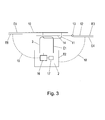
- Fig. 3 a simplified equivalent circuit diagram of the capacitive data transmission device used in the locking device.
- a conventional padlock 1 is shown, the lock body is denoted by 2 and the bracket 3.
- the padlock 1 is in Fig. 1 shown in the closed state, in which a schematically indicated locking mechanism 4 secures the bracket 3 against opening.
- the locking device 4 has a bolt, not shown, which can interact positively in the locking position with a trained in the bracket 3 recess 5.
- the locking mechanism includes, for example, a lock cylinder, not shown, which can be operated by means of a mechanical key.
- the locking mechanism 4 comprises an electrically adjustable or releasable latch which engages in the recess 5.
- the electrically adjustable or releasable latch acts here with an electronic working key query having a reading device for reading an identification code from an electronic key, such as a ID medium.
- the lock of the bracket 3 is released, so that the bracket can be pulled in the direction of arrow 6 from the lock body 2 and swung to the side in sequence.
- a door leaf 7 is shown, which can be pivoted or moved relative to a fixed part, such as a door frame 8.
- a rollover trap 9 is provided which has a fixed to the door panel 7 plate-shaped member 10 with a U-shaped bracket 11 and a door frame 8 mounted plate-shaped member 12, on which a cap part 14 via a Hinge 13 is pivotally mounted.
- the cap part 14 has a slot-shaped recess 15, which in the in Fig. 2 shown closed state of the muck trap 9 is penetrated by the bracket 11. If now in the bracket 11 of the bracket 3 of in Fig. 1 shown hang lock 1 is mounted and the padlock 1 is blocked, the mucking 9 can not be opened by unauthorized persons.
- Fig. 3 a simplified equivalent circuit diagram of the capacitive proximity circuit used in the invention is shown. It can be seen that the bracket 3 of the padlock 1 is formed as an electrode E1 and the lock body 2 an electrode E2 or acts as electrode E2.
- the electrodes E1 and E2 are incorporated in a transmitting / receiving circuit 16 and preferably in a resonant circuit of the transmitting / receiving circuit 16, which is fed by a power supply 17.
- two schematically illustrated electrodes E3 and E4 are now arranged or formed on the plate-shaped part 12, which are electrically insulated from each other and together form a coupling capacitance.
- electrodes E5 and E6 can also be arranged or formed on the plate-shaped component 10, which together form a further coupling capacitance.
- the electrode E1 is connected in the correctly suspended state of the padlock 1 conductive or via a capacitive coupling to the bracket 11, so that an AC circuit via the electrode E1, the coupling capacitor formed by the electrodes E3 and E4 or formed by the electrodes E5 and E6 Coupling capacity and can conclude about the schematically indicated electric field 18 or 19 to the electrode E2.
- the strength of the coupling in this case depends on how close the padlock 1 is in the described coupling capacities of the mending trap 9, so that a corresponding evaluation of the coupling provides information about whether the padlock 1 was properly hung in the closed muzzle trap 9.
- the coupling between the electrodes E5 and E6 with the electrodes E3 and E4 can additionally be used as a kind of door contact, since with the door closed (preferably in the case of metal doors) the coupling is significantly better than when the door is open.
Landscapes
- Engineering & Computer Science (AREA)
- Mechanical Engineering (AREA)
- Computer Networks & Wireless Communication (AREA)
- Physics & Mathematics (AREA)
- General Physics & Mathematics (AREA)
- Electronic Switches (AREA)
- Lock And Its Accessories (AREA)
- Switches That Are Operated By Magnetic Or Electric Fields (AREA)
Abstract
Description
- Die Erfindung betrifft ein Hangschloss mit einem Schlosskörper und einem Bügel, der bezüglich des Schlosskörpers zwischen einer Öffnungsstellung und einer Schließstellung bewegbar ist, wobei der Schlosskörper einen Verriegelungsmechanismus zum Verriegeln des Bügels in der Schließstellung aufweist.
- Die Erfindung betrifft weiters eine Verriegelungseinrichtung umfassend eine Überwurffalle mit einem vorzugsweise U-förmigen Bügel und einem Überwurfteil und ein in den vorzugsweise U-förmigen Bügel einhängbares Hangschloss.
- Bei einem Hangschloss der eingangs genannten Art ist der Bügel mit dem Schlosskörper in der Regel unlösbar verbunden. In entriegeltem Zustand kann der Bügel jedoch zwischen der Öffnungsstellung und der Schließstellung bewegt werden. In der Schließstellung bilden der Bügel und der Schlosskörper gemeinsam eine geschlossene Schlaufe, beispielsweise um zwei Teile aneinander zu sichern. Mittels des Verriegelungsmechanismus kann der Bügel in der Schließstellung verriegelt werden, um ein unbefugtes Öffnen zu verhindern. Typischerweise umfasst der Verriegelungsmechanismus einen Schließzylinder, der mittels eines passenden Schlüssels drehbetätigt wird. Außerdem kann der Verriegelungsmechanismus einen Mitnehmer und/oder einen Riegel umfassen.
- Ein typisches Anwendungsgebiet für Hangschlösser sind Verriegelungseinrichtungen, die eine Überwurffalle mit einem U-förmigen Bügel und einem Überwurfteil umfassen. Solche Überwurffallen findet man oft zum Abschließen von Kellerabteilen und dgl. Das Überwurfteil weist hierbei eine meist schlitzförmige Ausnehmung auf, durch welche der U-förmige Bügel im geschlossenen Zustand der Überwurffalle hindurchtritt. Die Überwurffalle wird dadurch versperrt, dass in den U-förmigen Bügel der Bügel eines Hangschlosses eingehängt und das Hangschloss versperrt wird. Wenn das Überwurfteil beispielsweise an einem Türblatt und der U-förmige Bügel beispielsweise an einem zugehörigen Türrahmen befestigt sind, bewirkt das Versperren des Hangschlosses, dass die Überwurffalle nicht zerstörungsfrei geöffnet und der durch die Tür betretbare Raum daher nicht betreten werden kann.
- Es ist bekannt, Hangschlösser mit einer Detektionseinheit zum Detektieren der Schließstellung des Bügels auszustatten. Von der Detektionseinheit kann ein Signal generiert werden, das den Schließzustand des Hangschlosses anzeigt. Dabei kann es sich insbesondere um eine optische Anzeige am Hangschloss handeln. Denkbar ist aber auch eine drahtlose Übermittlung der Signale an eine zentrale Verwaltungs- oder Überwachungsstelle, in der ggf. der Schließzustand einer Vielzahl von Hangschlössern erfasst wird.
- Mit den bekannten Detektionseinrichtungen ist es jedoch nicht möglich, festzustellen, ob das Hangschloss ordnungsgemäß eingehängt wurde, zum Beispiel in den U-förmigen Bügel einer Überwurffalle.
- Die vorliegende Erfindung zielt daher darauf ab, ein Hangschloss sowie eine Verriegelungseinrichtung der eingangs genannten Art dahingehend weiterzubilden, dass in einfacher Weise eine Überprüfung vorgenommen werden kann, ob das Hangschloss ordnungsgemäß eingehängt wurde bzw. ob die Verriegelungseinrichtung mit Hilfe des Hangschlosses ordnungsgemäß versperrt wurde.
- Zur Lösung dieser Aufgabe sieht die Erfindung bei einem Hangschloss der eingangs genannten Art vor, dass das Hangschloss einen kapazitiven Näherungssensor aufweist, dessen Messelektrode von dem Bügel oder einem Teil desselben gebildet ist. Dadurch, dass ein Bügel oder ein Teil desselben als Messelektrode eines in das Hangschloss integrierten kapazitiven Näherungssensors mitverwendet wird, kann ein Hangschloss ohne großen baulichen Aufwand mit der Funktion eines Näherungssensors ausgestattet werden. Der Näherungssensor ist dazu geeignet, die Nähe eines insbesondere metallischen Teils zur Messelektrode, d.h. den Bügel des Hangschlosses zu detektieren. Das ordnungsgemäße Einhängen des Hangschlosses kann hierbei am einfachsten dadurch festgestellt werden, dass der kapazitive Näherungssensor auf die Anwesenheit eines U-förmigen Bügels einer Überwurffalle oder eines bevorzugt leitend mit diesem verbundenen Teils anspricht.
- Kapazitive Näherungssensoren sind in verschiedenen Ausführungsformen bekannt. Er nutzt die sich bei Annäherung eines Gegenstandes ändernde elektrische Kapazität einer Messelektrode zur Umgebung oder zu einer Referenzelektrode aus. Solche Sensoren arbeiten meist mit einem Oszillator, dessen frequenzbestimmende Kapazität teilweise vom zu detektierenden Gegenstand bzw. der Umgebung gebildet wird.
- Unter einem kapazitiven Näherungssensor im Sinne der vorliegenden Erfindung ist aber auch jede elektrische Schaltung zu verstehen, bei der eine kapazitive Kopplung zwischen der Messelektrode des Hangschlosses und einer externen Koppelelektrode vorhanden ist, deren Kopplungseigenschaft vom Abstand der Messelektrode des Hangschlosses von der genannten Koppelelektrode abhängt.
- Eine bevorzugte Ausbildung des erfindungsgemäßen Hangschlosses sieht vor, dass der Schlosskörper oder ein Teil desselben eine Referenzelektrode des Näherungssensors ausbildet. Das Vorsehen einer zweiten Elektrode im Hangschloss, die von der Messelektrode elektrisch isoliert ist, verbessert die Messeigenschaften des Näherungssensors.
- Wie bereits eingangs erwähnt, ist es vorteilhaft, wenn eine Detektionseinheit zum Detektieren der Schließstellung des Bügels vorgesehen ist. In Kombination mit dem erfindungsgemäß vorgesehenen Näherungssensor gelingt dadurch eine vollständige Kontrolle des korrekten Versperrens einer Verriegelungseinrichtung, bei der ein Hangschloss zum Einsatz gelangt, da nicht nur überprüft werden kann, ob der Bügel des Hangschlosses in der Schließstellung ist, sondern zusätzlich, ob das Hangschloss ordnungsgemäß eingehängt ist.
- Der Verriegelungsmechanismus des Hangschlosses umfasst bevorzugt eine mechanische und/oder elektronische Schlüsselabfrage. Mechanische Schlüsselabfragen sind im Zusammenhang mit Hangschlössern beispielsweise in der Form von Schließzylindern weit verbreitet. Besonders bevorzugt ist im vorliegenden Fall mit Rücksicht auf den Umstand, dass der erfindungsgemäß vorgesehene kapazitive Näherungssensor ohnehin eine Energieversorgung benötigt, eine elektronische Schlüsselabfrage. Eine bevorzugte Weiterbildung sieht hierbei vor, dass die elektronische Schlüsselabfrage eine elektronische Leseeinheit zum Auslesen von Identifikationsdaten aus einem Datenträger umfasst. Als Datenträger kann hierbei eine Reihe von bekannten elektronischen Schlüsseln in Form von Identmedien und dgl. zum Einsatz kommen. Sowohl passiv arbeitende Identmedien, wie beispielsweise RFID-Tags oder aktiv arbeitende Identmedien, die über eine eigene Stromversorgung verfügen, sind hierbei denkbar. Die elektronische Schlüsselabfrage erfolgt hierbei bevorzugt derart, dass das Hangschloss eine Auswerteschaltung zur Feststellung der Zutrittsberechtigung auf Grund der empfangenen Identifikationsdaten aufweist, wobei die Auswerteschaltung mit dem Verriegelungsmechanismus zum wahlweisen Freigeben oder Verriegeln des Bügels zusammenwirkt.
- Die vom kapazitiven Näherungssensor ermittelten Näherungsdaten werden im Hangschloss bevorzugt so weiterverarbeitet, dass auf Grundlage der Messdaten ein Signal generiert wird, welches das korrekte Einhängen des Hangschlosses anzeigt. Das Signal kann beispielsweise durch eine optische Anzeigevorrichtung am Hangschloss selbst angezeigt werden. Alternativ oder zusätzlich kann vorgesehen sein, dass eine Sendeeinheit zur drahtlosen Übermittlung von Daten, insbesondere der Messdaten des Näherungssensors und/oder der Detektionseinheit vorgesehen ist. Besonders bevorzugt ist die Sendeeinheit zur Übermittlung der Daten mittels kapazitiver Kopplung ausgebildet. Die kapazitive Datenübermittlung kann hierbei mitverwendet werden, um die erfindungsgemäß vorgesehene Funktion des kapazitiven Näherungssensors zu realisieren. Der Näherungssensor ist in einem solchen Fall beispielsweise als Auswerteschaltung ausgebildet, welche das Vorhandensein oder die Stärke der kapazitiven Kopplung der Messelektrode des Hangschlosses mit einer externen Elektrode erfasst.
- In diesem Zusammenhang sieht eine bevorzugte Ausführung der erfindungsgemäßen Verriegelungseinrichtung vor, dass die Messelektrode des Hangschlosses als Koppelelektrode einer Koppelkapazität in einen für die kapazitive Datenübertragung eingerichteten Sende-/Empfangsschaltkreis des Hangschlosses eingebunden ist und dass die Überwurffalle wenigstens eine kapazitive Koppelfläche umfasst, die in einen für die kapazitive Datenübertragung eingerichteten Sende-/Empfangsschaltkreis der Überwurffalle eingebunden ist, sodass sich bei Annäherung des Hangschlosses an die Überwurffalle ein Wechselstromkreis schließt, über den Daten zwischen dem Hangschloss und der Überwurffalle mittels kapazitiver Kopplung übertragen werden können.
- Die kapazitive Datenübertragung kann in bevorzugter Weise auch dazu verwendet werden, eine Identifikationsprüfung vorzunehmen, um auf diese Art und Weise festzustellen, ob dasjenige Hangschloss, das zuvor der jeweiligen Verriegelungseinrichtung zugeordnet wurde, im Zuge der Versperrung der Einrichtung tatsächlich zum Einsatz gelangt.
- Die Elektrodenanordnung ist hierbei bevorzugt derart getroffen, dass der Überwurffalle ein plattenförmiger Koppelbauteil zugeordnet ist, der eine erste, die kapazitive Koppelfläche ausbildende Elektrode und eine zweite Elektrode umfasst. Der plattenförmige Koppelbauteil kann hierbei leitend mit dem Bügel des Hangschlosses verbunden sein.
- In einer weiteren bevorzugten Ausführungsform ist vorgesehen, dass im oder am Hangschloss ein Energiewandler vorgesehen ist, mit welchem mechanische Energie in elektrische Energie umgewandelt werden kann. In einer weiteren bevorzugten Ausführungsform ist vorgesehen, dass ein Energiespeicher im Hangschloss vorgesehen ist, der z.B. vom erwähnten Energiewandler gespeist sein kann. Der Energiewandler kann ausgebildet sein, um beispielsweise Erschütterungen, Bewegungen des Bügels des Hangschlosses, Bewegungen des Hangschlosses, die bei dessen Öffnen auftreten, oder die Drehung eines Schlüssels im Hangschloss in elektrische Energie umzuwandeln.
- Die Energieversorgung kann alternativ mittels einer Batterie, Brennstoffzelle und/oder einer Solarzelle sichergestellt werden.
- Die Erfindung wird nachfolgend anhand eines in der Zeichnung schematisch dargestellten Ausführungsbeispiels näher erläutert. In dieser zeigen
Fig. 1 das erfindungsgemäße Hangschloss,Fig. 2 eine Überwurffalle, die mit Hilfe des Hangschlosses versperrt werden kann undFig. 3 ein vereinfachtes Ersatzschaltbild der bei der Verriegelungseinrichtung zum Einsatz kommenden kapazitiven Datenübertragungsvorrichtung. - In
Fig. 1 ist ein herkömmliches Hangschloss 1 dargestellt, dessen Schlosskörper mit 2 und dessen Bügel mit 3 bezeichnet ist. Das Hangschloss 1 ist inFig. 1 im geschlossenen Zustand dargestellt, in dem ein schematisch angedeuteter Verriegelungsmechanismus 4 den Bügel 3 gegen Öffnen sichert. Zum Verriegeln der Schließstellung des Bügels 3 weist die Verriegelungsvorrichtung 4 einen nicht näher dargestellten Riegel auf, der in der Verriegelungsstellung formschlüssig mit einer im Bügel 3 ausgebildeten Ausnehmung 5 zusammenwirken kann. Der Verriegelungsmechanismus umfasst beispielsweise einen nicht dargestellten Schließzylinder, der mit Hilfe eines mechanischen Schlüssels betätigt werden kann. Alternativ umfasst der Verriegelungsmechanismus 4 einen elektrisch verstellbaren oder freigebbaren Riegel, der in die Ausnehmung 5 eingreift. Der elektrisch verstellbare oder freigebbare Riegel wirkt hierbei mit einer elektronisch arbeitenden Schlüsselabfrage zusammen, die eine Leseeinrichtung zum Auslesen eines Identifikationscodes aus einem elektronischen Schlüssel, wie beispielsweise einem Identmedium, aufweist. - Wenn aufgrund der Schlüsselabfrage ein berechtigter mechanischer oder elektronischer Schlüssel erkannt wurde, wird die Verriegelung des Bügels 3 freigegeben, sodass der Bügel in Richtung des Pfeils 6 aus dem Schlosskörper 2 herausgezogen und in der Folge zur Seite verschwenkt werden kann.
- In
Fig. 2 ist ein Türblatt 7 dargestellt, das relativ zu einem ortsfesten Teil, wie beispielsweise einem Türrahmen 8, verschwenkt oder verschoben werden kann. Zur Verriegelung des Türblattes 7 in der verschlossenen Stellung ist eine Überwurffalle 9 vorgesehen, die einen an dem Türblatt 7 befestigten plattenförmigen Bauteil 10 mit einem U-förmigen Bügel 11 sowie einen am Türstock 8 angebrachten plattenförmigen Bauteil 12 aufweist, an dem ein Überwurfteil 14 über ein Scharnier 13 schwenkbar befestigt ist. Das Überwurfteil 14 weist eine schlitzförmige Ausnehmung 15 auf, welche im inFig. 2 dargestellten verschlossenen Zustand der Überwurffalle 9 von dem Bügel 11 durchsetzt wird. Wenn nun in den Bügel 11 der Bügel 3 des inFig. 1 dargestellten Hangschlosses 1 eingehängt wird und das Hangschloss 1 versperrt wird, kann die Überwurffalle 9 durch unberechtigte Personen nicht geöffnet werden. - In
Fig. 3 ist nun ein vereinfachtes Ersatzschaltbild der im Rahmen der Erfindung zum Einsatz gelangenden kapazitiv arbeitenden Näherungsschaltung dargestellt. Es ist ersichtlich, dass der Bügel 3 des Hangschlosses 1 als Elektrode E1 ausgebildet ist und der Schlosskörper 2 eine Elektrode E2 aufweist oder als Elektrode E2 fungiert. Die Elektroden E1 und E2 sind in eine Sende-/Empfangsschaltung 16 und bevorzugt in einen Schwingkreis der Sende-/Empfangsschaltung 16 eingebunden, der von einer Stromversorgung 17 gespeist ist. Um zu detektieren, ob das Hangschloss 1 ordnungsgemäß in die geschlossene Überwurffalle 9 eingehängt wurde, sind nun am plattenförmigen Teil 12 zwei schematisch dargestellte Elektroden E3 und E4 angeordnet bzw. ausgebildet, die voneinander elektrisch isoliert sind und gemeinsam eine Koppelkapazität ausbilden. Ergänzend können auch am plattenförmigen Bauteil 10 Elektroden E5 und E6 angeordnet oder ausgebildet sein, die gemeinsam eine weitere Koppelkapazität ausbilden. Die Elektrode E1 ist im korrekt eingehängten Zustand des Hangschlosses 1 leitend oder über eine kapazitive Kopplung mit dem Bügel 11 verbunden, sodass sich ein Wechselstromkreis über die Elektrode E1, die von den Elektroden E3 und E4 gebildete Koppelkapazität oder die von den Elektroden E5 und E6 gebildete Koppelkapazität und über das schematisch angedeutete elektrische Feld 18 oder 19 zur Elektrode E2 schließen kann. Die Stärke der Kopplung hängt hierbei davon ab, wie nahe sich das Hangschloss 1 bei den beschriebenen Koppelkapazitäten der Überwurffalle 9 befindet, sodass eine entsprechende Auswertung der Kopplung Aufschluss darüber gibt, ob das Hangschloss 1 ordnungsgemäß in die verschlossene Überwurffalle 9 eingehängt wurde. - Weiters kann die Kopplung zwischen den Elektroden E5 und E6 mit den Elektroden E3 und E4 zusätzlich als eine Art Türkontakt benützt werden, da bei geschlossener Türe (vorzugsweise bei Metalltüren) die Kopplung deutlich besser ist als bei geöffneter Türe.
Claims (13)
- Hangschloss mit einem Schlosskörper und einem Bügel, der bezüglich des Schlosskörpers zwischen einer Öffnungsstellung und einer Schließstellung bewegbar ist, wobei der Schlosskörper einen Verriegelungsmechanismus zum Verriegeln des Bügels in der Schließstellung aufweist, dadurch gekennzeichnet, dass das Hangschloss (1) einen kapazitiven Näherungssensor aufweist, dessen Messelektrode (E1) von dem Bügel (3) oder einem Teil desselben gebildet ist.
- Hangschloss nach Anspruch 1, dadurch gekennzeichnet, dass der Schlosskörper (2) oder ein Teil desselben eine Referenzelektrode (E2) des Näherungssensors ausbildet.
- Hangschloss nach Anspruch 1 oder 2, dadurch gekennzeichnet, dass eine Detektionseinheit zum Detektieren der Schließstellung des Bügels (3) vorgesehen ist.
- Hangschloss nach Anspruch 1, 2 oder 3, dadurch gekennzeichnet, dass der Verriegelungsmechanismus (4) eine mechanische und/oder elektronische Schlüsselabfrage umfasst.
- Hangschloss nach Anspruch 4, dadurch gekennzeichnet, dass die elektronische Schlüsselabfrage eine elektronische Leseeinheit zum Auslesen von Identifikationsdaten aus einem Datenträger umfasst.
- Hangschloss nach Anspruch 5, dadurch gekennzeichnet, dass das Hangschloss (1) eine Auswerteschaltung zur Feststellung der Zutrittsberechtigung auf Grund der empfangenen Identifikationsdaten aufweist, wobei die Auswerteschaltung mit dem Verriegelungsmechanismus (4) zum wahlweisen Freigeben oder Verriegeln des Bügels (3) zusammenwirkt.
- Hangschloss nach einem der Ansprüche 1 bis 6, dadurch gekennzeichnet, dass eine Sendeeinheit zur drahtlosen Übermittlung von Daten, insbesondere der Messdaten des Näherungssensors und/oder der Detektionseinheit vorgesehen ist.
- Hangschloss nach Anspruch 7, dadurch gekennzeichnet, dass die Sendeeinheit zur Übermittlung der Daten mittels kapazitiver Kopplung ausgebildet ist.
- Verriegelungseinrichtung umfassend eine Überwurffalle (9) mit einem vorzugsweise U-förmigen Bügel (11) und einem Überwurfteil (14) und ein in den vorzugsweise U-förmigen Bügel (11) einhängbares Hangschloss (1) nach einem der Ansprüche 1 bis 8.
- Verriegelungseinrichtung nach Anspruch 9, dadurch gekennzeichnet, dass die Messelektrode des Hangschlosses (1) als Koppelelektrode einer Koppelkapazität in einen für die kapazitive Datenübertragung eingerichteten Sende-/Empfangsschaltkreis (16) des Hangschlosses (1) eingebunden ist und dass die Überwurffalle (9) wenigstens eine kapazitive Koppelfläche umfasst, die in einen für die kapazitive Datenübertragung eingerichteten Sende-/Empfangsschaltkreis (16) der Überwurffalle (9) eingebunden ist, sodass sich bei Annäherung des Hangschlosses (1) an die Überwurffalle (9) ein Wechselstromkreis schließt, über den Daten zwischen dem Hangschloss (1) und der Überwurffalle (9) mittels kapazitiver Kopplung übertragen werden können.
- Verriegelungseinrichtung nach Anspruch 10, dadurch gekennzeichnet, dass die Überwurffalle (9) und/oder das Hangschloss (1) einen Speicher für Identifikationsdaten aufweist, der mit dem Sende-/Empfangsschaltkreis (16) zum Übermitteln der Identifikationsdaten an eine Auswerteschaltung des jeweils anderen Teils verbunden ist, die zur Feststellung einer Zuordnung auf Grund der empfangenen Identifikationsdaten eingerichtet ist.
- Verriegelungseinrichtung nach einem der Ansprüche 9 bis 11, dadurch gekennzeichnet, dass der Überwurffalle (9) ein plattenförmiger Koppelbauteil (10, 12) zugeordnet ist, der eine erste, die kapazitive Koppelfläche ausbildende Elektrode (E3, E5) und eine zweite Elektrode (E4, E6) umfasst.
- Verriegelungseinrichtung nach Anspruch 12, dadurch gekennzeichnet, dass der plattenförmige Koppelbauteil (10) leitend mit dem Bügel (3) des Hangschlosses (1) verbunden ist.
Applications Claiming Priority (1)
| Application Number | Priority Date | Filing Date | Title |
|---|---|---|---|
| ATA1853/2011A AT512180B1 (de) | 2011-12-20 | 2011-12-20 | Hangschloss |
Publications (3)
| Publication Number | Publication Date |
|---|---|
| EP2607582A2 true EP2607582A2 (de) | 2013-06-26 |
| EP2607582A3 EP2607582A3 (de) | 2017-04-12 |
| EP2607582B1 EP2607582B1 (de) | 2019-04-10 |
Family
ID=47519966
Family Applications (1)
| Application Number | Title | Priority Date | Filing Date |
|---|---|---|---|
| EP12450052.1A Not-in-force EP2607582B1 (de) | 2011-12-20 | 2012-12-11 | Hangschloss |
Country Status (3)
| Country | Link |
|---|---|
| EP (1) | EP2607582B1 (de) |
| AT (1) | AT512180B1 (de) |
| ES (1) | ES2732302T3 (de) |
Cited By (5)
| Publication number | Priority date | Publication date | Assignee | Title |
|---|---|---|---|---|
| US20160047142A1 (en) * | 2014-08-18 | 2016-02-18 | Fuz Designs LLC | Wireless locking device |
| US9679429B2 (en) | 2012-12-03 | 2017-06-13 | 13876 Yukon Inc. | Wireless portable lock system |
| US9728022B2 (en) | 2015-01-28 | 2017-08-08 | Noke, Inc. | Electronic padlocks and related methods |
| CN108150068A (zh) * | 2017-12-25 | 2018-06-12 | 宁波艾霏文化创意设计有限公司 | 一种带有自锁防盗功能的商业安全门 |
| US11352817B2 (en) | 2019-01-25 | 2022-06-07 | Noke, Inc. | Electronic lock and interchangeable shackles |
Families Citing this family (1)
| Publication number | Priority date | Publication date | Assignee | Title |
|---|---|---|---|---|
| DE102019113184B4 (de) * | 2019-05-17 | 2021-08-12 | ABUS August Bremicker Söhne Kommanditgesellschaft | Mobiles elektronisches Schloss |
Family Cites Families (6)
| Publication number | Priority date | Publication date | Assignee | Title |
|---|---|---|---|---|
| GB9103408D0 (en) * | 1991-02-19 | 1991-04-03 | Racal Chubb Prod | Security fittings |
| DE9318894U1 (de) * | 1993-12-09 | 1994-02-10 | Bornmann, Manfred, Dr.-Ing., 01309 Dresden | Sicherungssystem für ortsveränderliche Objekte mit Diebstahlwarnanlage |
| DE4344890A1 (de) * | 1993-12-29 | 1995-07-06 | Beer Manfred Dipl Ing Fh | Elektronisch aktives Bügelschloß mit Diebstahlerkennung |
| JP2002206361A (ja) * | 2001-01-12 | 2002-07-26 | Nippon Telegr & Teleph Corp <Ntt> | 生体情報認証錠 |
| US20070126551A1 (en) * | 2005-09-11 | 2007-06-07 | Slevin Richard S | Biometric padlock |
| US8149119B2 (en) * | 2010-02-09 | 2012-04-03 | Ekstrom Industries, Inc. | Utility meter tamper monitoring system and method |
-
2011
- 2011-12-20 AT ATA1853/2011A patent/AT512180B1/de not_active IP Right Cessation
-
2012
- 2012-12-11 EP EP12450052.1A patent/EP2607582B1/de not_active Not-in-force
- 2012-12-11 ES ES12450052T patent/ES2732302T3/es active Active
Cited By (10)
| Publication number | Priority date | Publication date | Assignee | Title |
|---|---|---|---|---|
| US9679429B2 (en) | 2012-12-03 | 2017-06-13 | 13876 Yukon Inc. | Wireless portable lock system |
| US20160047142A1 (en) * | 2014-08-18 | 2016-02-18 | Fuz Designs LLC | Wireless locking device |
| US9747739B2 (en) * | 2014-08-18 | 2017-08-29 | Noke, Inc. | Wireless locking device |
| US10176656B2 (en) | 2014-08-18 | 2019-01-08 | Noke, Inc. | Wireless locking device |
| US10319165B2 (en) | 2014-08-18 | 2019-06-11 | Noke, Inc. | Wireless locking device |
| US9728022B2 (en) | 2015-01-28 | 2017-08-08 | Noke, Inc. | Electronic padlocks and related methods |
| US10210686B2 (en) | 2015-01-28 | 2019-02-19 | Noke, Inc. | Electronic padlocks and related methods |
| US10713868B2 (en) | 2015-01-28 | 2020-07-14 | Noke, Inc. | Electronic locks with duration-based touch sensor unlock codes |
| CN108150068A (zh) * | 2017-12-25 | 2018-06-12 | 宁波艾霏文化创意设计有限公司 | 一种带有自锁防盗功能的商业安全门 |
| US11352817B2 (en) | 2019-01-25 | 2022-06-07 | Noke, Inc. | Electronic lock and interchangeable shackles |
Also Published As
| Publication number | Publication date |
|---|---|
| EP2607582B1 (de) | 2019-04-10 |
| ES2732302T3 (es) | 2019-11-21 |
| EP2607582A3 (de) | 2017-04-12 |
| AT512180B1 (de) | 2013-06-15 |
| AT512180A4 (de) | 2013-06-15 |
Similar Documents
| Publication | Publication Date | Title |
|---|---|---|
| EP2607582B1 (de) | Hangschloss | |
| EP2978914B1 (de) | Sensorsystem für eine schliessanlage und verfahren zum detektieren von manipulationen an einer schliessanlage | |
| DE102008022276A1 (de) | Sensorsystem bestehend aus einem elektronischen Kompass und einen Rotationssensor zur Bestimmung des Verschluss- und Verriegelungszustandes | |
| EP2053744A2 (de) | Kapazitive Sensorik | |
| DE102020114708A1 (de) | Türgriff für ein Fahrzeug | |
| EP2163713B1 (de) | Verriegelungseinheit für Fenster- oder Türflügel | |
| EP3159464B1 (de) | Verrieglungsvorrichtung mit anordnung zur verschlussüberwachung | |
| DE102012221016A1 (de) | Schließeinheit, Schließvorrichtung und Verfahren zum Entriegeln und/oder Verriegeln eines Schlosses | |
| EP4041969B1 (de) | Schaltschrank mit einer einen türstatussensor aufweisenden schaltschranktür | |
| DE202009010418U1 (de) | Tür | |
| EP2112676B1 (de) | Vorrichtung zur magnetischen Positionsüberwachung | |
| DE102016112423A1 (de) | Türaußengriff für ein Fahrzeug | |
| DE102007035069A1 (de) | Verfahren und Vorrichtung zum Nutzen eines Senders mit einer Bereichsbegrenzung, um eine bewegliche Barrierenbedienvorrichtung zu steuern | |
| DE102010056352B4 (de) | Schließanlage für eine Tür eines Gebäudes | |
| DE102016112418A1 (de) | Türaußengriff für ein Fahrzeug | |
| EP1801328B1 (de) | Fenster oder dergleichen mit einer überwachbaren Verriegelungsanordnung und Verfahren zum Betrieb einer solchen Verriegelungsanordnung. | |
| DE102013100571B4 (de) | Verfahren zum Freigeben eines Funkschlosses mit einem Funkschlüssel | |
| DE102016107868B3 (de) | Vorrichtung zur Lageermittlung eines Magneten | |
| WO2005006261A1 (de) | Elektronische zugangskontrollvorrichtung, sowie verfahren zur zugangskontrolle | |
| EP4047162B1 (de) | Fensteralarmsystem | |
| EP1043461A1 (de) | Vorrichtung zur Verschlussüberwachung einer Verriegelungseinrichtung, insbesondere für Türen oder Fenster | |
| DE202006009541U1 (de) | Meßvorrichtung zur Überwachung der Korrosion einer Stahlarmierung | |
| DE102011110850A1 (de) | Anordnung zur Überwachung von Verschlusselementen | |
| DE202026001243U1 (de) | Automatisches Türassistenzsystem mit Nahbereichserkennung eines autorisierten Identifikationsgebers | |
| EP2245249B1 (de) | Verfahren zur schlüssellosen zugangs- und/oder betätigungsberechtigungsprüfung für insbesondere kraftfahrzeuge und zugehörige zugangs- und/oder betätigungseinrichtung |
Legal Events
| Date | Code | Title | Description |
|---|---|---|---|
| AK | Designated contracting states |
Kind code of ref document: A2 Designated state(s): AL AT BE BG CH CY CZ DE DK EE ES FI FR GB GR HR HU IE IS IT LI LT LU LV MC MK MT NL NO PL PT RO RS SE SI SK SM TR |
|
| AX | Request for extension of the european patent |
Extension state: BA ME |
|
| PUAI | Public reference made under article 153(3) epc to a published international application that has entered the european phase |
Free format text: ORIGINAL CODE: 0009012 |
|
| PUAL | Search report despatched |
Free format text: ORIGINAL CODE: 0009013 |
|
| AK | Designated contracting states |
Kind code of ref document: A3 Designated state(s): AL AT BE BG CH CY CZ DE DK EE ES FI FR GB GR HR HU IE IS IT LI LT LU LV MC MK MT NL NO PL PT RO RS SE SI SK SM TR |
|
| AX | Request for extension of the european patent |
Extension state: BA ME |
|
| RIC1 | Information provided on ipc code assigned before grant |
Ipc: E05B 47/00 20060101ALI20170308BHEP Ipc: E05B 67/00 20060101AFI20170308BHEP Ipc: E05B 17/22 20060101ALI20170308BHEP |
|
| STAA | Information on the status of an ep patent application or granted ep patent |
Free format text: STATUS: REQUEST FOR EXAMINATION WAS MADE |
|
| 17P | Request for examination filed |
Effective date: 20170828 |
|
| RBV | Designated contracting states (corrected) |
Designated state(s): AL AT BE BG CH CY CZ DE DK EE ES FI FR GB GR HR HU IE IS IT LI LT LU LV MC MK MT NL NO PL PT RO RS SE SI SK SM TR |
|
| STAA | Information on the status of an ep patent application or granted ep patent |
Free format text: STATUS: EXAMINATION IS IN PROGRESS |
|
| 17Q | First examination report despatched |
Effective date: 20180328 |
|
| GRAP | Despatch of communication of intention to grant a patent |
Free format text: ORIGINAL CODE: EPIDOSNIGR1 |
|
| STAA | Information on the status of an ep patent application or granted ep patent |
Free format text: STATUS: GRANT OF PATENT IS INTENDED |
|
| INTG | Intention to grant announced |
Effective date: 20181130 |
|
| GRAS | Grant fee paid |
Free format text: ORIGINAL CODE: EPIDOSNIGR3 |
|
| GRAA | (expected) grant |
Free format text: ORIGINAL CODE: 0009210 |
|
| STAA | Information on the status of an ep patent application or granted ep patent |
Free format text: STATUS: THE PATENT HAS BEEN GRANTED |
|
| AK | Designated contracting states |
Kind code of ref document: B1 Designated state(s): AL AT BE BG CH CY CZ DE DK EE ES FI FR GB GR HR HU IE IS IT LI LT LU LV MC MK MT NL NO PL PT RO RS SE SI SK SM TR |
|
| REG | Reference to a national code |
Ref country code: GB Ref legal event code: FG4D Free format text: NOT ENGLISH |
|
| REG | Reference to a national code |
Ref country code: AT Ref legal event code: REF Ref document number: 1118844 Country of ref document: AT Kind code of ref document: T Effective date: 20190415 Ref country code: CH Ref legal event code: EP |
|
| REG | Reference to a national code |
Ref country code: IE Ref legal event code: FG4D Free format text: LANGUAGE OF EP DOCUMENT: GERMAN |
|
| REG | Reference to a national code |
Ref country code: DE Ref legal event code: R096 Ref document number: 502012014585 Country of ref document: DE |
|
| REG | Reference to a national code |
Ref country code: NL Ref legal event code: FP |
|
| REG | Reference to a national code |
Ref country code: SE Ref legal event code: TRGR |
|
| REG | Reference to a national code |
Ref country code: LT Ref legal event code: MG4D |
|
| PG25 | Lapsed in a contracting state [announced via postgrant information from national office to epo] |
Ref country code: FI Free format text: LAPSE BECAUSE OF FAILURE TO SUBMIT A TRANSLATION OF THE DESCRIPTION OR TO PAY THE FEE WITHIN THE PRESCRIBED TIME-LIMIT Effective date: 20190410 Ref country code: AL Free format text: LAPSE BECAUSE OF FAILURE TO SUBMIT A TRANSLATION OF THE DESCRIPTION OR TO PAY THE FEE WITHIN THE PRESCRIBED TIME-LIMIT Effective date: 20190410 Ref country code: NO Free format text: LAPSE BECAUSE OF FAILURE TO SUBMIT A TRANSLATION OF THE DESCRIPTION OR TO PAY THE FEE WITHIN THE PRESCRIBED TIME-LIMIT Effective date: 20190710 Ref country code: PT Free format text: LAPSE BECAUSE OF FAILURE TO SUBMIT A TRANSLATION OF THE DESCRIPTION OR TO PAY THE FEE WITHIN THE PRESCRIBED TIME-LIMIT Effective date: 20190910 Ref country code: LT Free format text: LAPSE BECAUSE OF FAILURE TO SUBMIT A TRANSLATION OF THE DESCRIPTION OR TO PAY THE FEE WITHIN THE PRESCRIBED TIME-LIMIT Effective date: 20190410 Ref country code: HR Free format text: LAPSE BECAUSE OF FAILURE TO SUBMIT A TRANSLATION OF THE DESCRIPTION OR TO PAY THE FEE WITHIN THE PRESCRIBED TIME-LIMIT Effective date: 20190410 |
|
| REG | Reference to a national code |
Ref country code: ES Ref legal event code: FG2A Ref document number: 2732302 Country of ref document: ES Kind code of ref document: T3 Effective date: 20191121 |
|
| PG25 | Lapsed in a contracting state [announced via postgrant information from national office to epo] |
Ref country code: PL Free format text: LAPSE BECAUSE OF FAILURE TO SUBMIT A TRANSLATION OF THE DESCRIPTION OR TO PAY THE FEE WITHIN THE PRESCRIBED TIME-LIMIT Effective date: 20190410 Ref country code: LV Free format text: LAPSE BECAUSE OF FAILURE TO SUBMIT A TRANSLATION OF THE DESCRIPTION OR TO PAY THE FEE WITHIN THE PRESCRIBED TIME-LIMIT Effective date: 20190410 Ref country code: RS Free format text: LAPSE BECAUSE OF FAILURE TO SUBMIT A TRANSLATION OF THE DESCRIPTION OR TO PAY THE FEE WITHIN THE PRESCRIBED TIME-LIMIT Effective date: 20190410 Ref country code: GR Free format text: LAPSE BECAUSE OF FAILURE TO SUBMIT A TRANSLATION OF THE DESCRIPTION OR TO PAY THE FEE WITHIN THE PRESCRIBED TIME-LIMIT Effective date: 20190711 Ref country code: BG Free format text: LAPSE BECAUSE OF FAILURE TO SUBMIT A TRANSLATION OF THE DESCRIPTION OR TO PAY THE FEE WITHIN THE PRESCRIBED TIME-LIMIT Effective date: 20190710 |
|
| PG25 | Lapsed in a contracting state [announced via postgrant information from national office to epo] |
Ref country code: IS Free format text: LAPSE BECAUSE OF FAILURE TO SUBMIT A TRANSLATION OF THE DESCRIPTION OR TO PAY THE FEE WITHIN THE PRESCRIBED TIME-LIMIT Effective date: 20190810 |
|
| REG | Reference to a national code |
Ref country code: DE Ref legal event code: R097 Ref document number: 502012014585 Country of ref document: DE |
|
| PG25 | Lapsed in a contracting state [announced via postgrant information from national office to epo] |
Ref country code: RO Free format text: LAPSE BECAUSE OF FAILURE TO SUBMIT A TRANSLATION OF THE DESCRIPTION OR TO PAY THE FEE WITHIN THE PRESCRIBED TIME-LIMIT Effective date: 20190410 Ref country code: CZ Free format text: LAPSE BECAUSE OF FAILURE TO SUBMIT A TRANSLATION OF THE DESCRIPTION OR TO PAY THE FEE WITHIN THE PRESCRIBED TIME-LIMIT Effective date: 20190410 Ref country code: SK Free format text: LAPSE BECAUSE OF FAILURE TO SUBMIT A TRANSLATION OF THE DESCRIPTION OR TO PAY THE FEE WITHIN THE PRESCRIBED TIME-LIMIT Effective date: 20190410 Ref country code: DK Free format text: LAPSE BECAUSE OF FAILURE TO SUBMIT A TRANSLATION OF THE DESCRIPTION OR TO PAY THE FEE WITHIN THE PRESCRIBED TIME-LIMIT Effective date: 20190410 Ref country code: EE Free format text: LAPSE BECAUSE OF FAILURE TO SUBMIT A TRANSLATION OF THE DESCRIPTION OR TO PAY THE FEE WITHIN THE PRESCRIBED TIME-LIMIT Effective date: 20190410 |
|
| PGFP | Annual fee paid to national office [announced via postgrant information from national office to epo] |
Ref country code: SE Payment date: 20191227 Year of fee payment: 8 Ref country code: NL Payment date: 20191226 Year of fee payment: 8 |
|
| PLBE | No opposition filed within time limit |
Free format text: ORIGINAL CODE: 0009261 |
|
| STAA | Information on the status of an ep patent application or granted ep patent |
Free format text: STATUS: NO OPPOSITION FILED WITHIN TIME LIMIT |
|
| PG25 | Lapsed in a contracting state [announced via postgrant information from national office to epo] |
Ref country code: SM Free format text: LAPSE BECAUSE OF FAILURE TO SUBMIT A TRANSLATION OF THE DESCRIPTION OR TO PAY THE FEE WITHIN THE PRESCRIBED TIME-LIMIT Effective date: 20190410 Ref country code: IT Free format text: LAPSE BECAUSE OF FAILURE TO SUBMIT A TRANSLATION OF THE DESCRIPTION OR TO PAY THE FEE WITHIN THE PRESCRIBED TIME-LIMIT Effective date: 20190410 |
|
| PGFP | Annual fee paid to national office [announced via postgrant information from national office to epo] |
Ref country code: FR Payment date: 20191226 Year of fee payment: 8 |
|
| 26N | No opposition filed |
Effective date: 20200113 |
|
| PG25 | Lapsed in a contracting state [announced via postgrant information from national office to epo] |
Ref country code: TR Free format text: LAPSE BECAUSE OF FAILURE TO SUBMIT A TRANSLATION OF THE DESCRIPTION OR TO PAY THE FEE WITHIN THE PRESCRIBED TIME-LIMIT Effective date: 20190410 |
|
| PGFP | Annual fee paid to national office [announced via postgrant information from national office to epo] |
Ref country code: DE Payment date: 20191231 Year of fee payment: 8 Ref country code: ES Payment date: 20200102 Year of fee payment: 8 Ref country code: GB Payment date: 20191227 Year of fee payment: 8 |
|
| PG25 | Lapsed in a contracting state [announced via postgrant information from national office to epo] |
Ref country code: SI Free format text: LAPSE BECAUSE OF FAILURE TO SUBMIT A TRANSLATION OF THE DESCRIPTION OR TO PAY THE FEE WITHIN THE PRESCRIBED TIME-LIMIT Effective date: 20190410 |
|
| PGFP | Annual fee paid to national office [announced via postgrant information from national office to epo] |
Ref country code: CH Payment date: 20191231 Year of fee payment: 8 |
|
| REG | Reference to a national code |
Ref country code: BE Ref legal event code: MM Effective date: 20191231 |
|
| PG25 | Lapsed in a contracting state [announced via postgrant information from national office to epo] |
Ref country code: MC Free format text: LAPSE BECAUSE OF FAILURE TO SUBMIT A TRANSLATION OF THE DESCRIPTION OR TO PAY THE FEE WITHIN THE PRESCRIBED TIME-LIMIT Effective date: 20190410 |
|
| PG25 | Lapsed in a contracting state [announced via postgrant information from national office to epo] |
Ref country code: IE Free format text: LAPSE BECAUSE OF NON-PAYMENT OF DUE FEES Effective date: 20191211 Ref country code: LU Free format text: LAPSE BECAUSE OF NON-PAYMENT OF DUE FEES Effective date: 20191211 |
|
| REG | Reference to a national code |
Ref country code: CH Ref legal event code: PFUS Owner name: EVVA SICHERHEITSTECHNOLOGIE GMBH, AT Free format text: FORMER OWNER: EVVA SICHERHEITSTECHNOLOGIE GMBH, AT |
|
| PG25 | Lapsed in a contracting state [announced via postgrant information from national office to epo] |
Ref country code: BE Free format text: LAPSE BECAUSE OF NON-PAYMENT OF DUE FEES Effective date: 20191231 |
|
| REG | Reference to a national code |
Ref country code: AT Ref legal event code: MM01 Ref document number: 1118844 Country of ref document: AT Kind code of ref document: T Effective date: 20191211 |
|
| PG25 | Lapsed in a contracting state [announced via postgrant information from national office to epo] |
Ref country code: AT Free format text: LAPSE BECAUSE OF NON-PAYMENT OF DUE FEES Effective date: 20191211 Ref country code: CY Free format text: LAPSE BECAUSE OF FAILURE TO SUBMIT A TRANSLATION OF THE DESCRIPTION OR TO PAY THE FEE WITHIN THE PRESCRIBED TIME-LIMIT Effective date: 20190410 |
|
| REG | Reference to a national code |
Ref country code: DE Ref legal event code: R119 Ref document number: 502012014585 Country of ref document: DE |
|
| PG25 | Lapsed in a contracting state [announced via postgrant information from national office to epo] |
Ref country code: HU Free format text: LAPSE BECAUSE OF FAILURE TO SUBMIT A TRANSLATION OF THE DESCRIPTION OR TO PAY THE FEE WITHIN THE PRESCRIBED TIME-LIMIT; INVALID AB INITIO Effective date: 20121211 Ref country code: MT Free format text: LAPSE BECAUSE OF FAILURE TO SUBMIT A TRANSLATION OF THE DESCRIPTION OR TO PAY THE FEE WITHIN THE PRESCRIBED TIME-LIMIT Effective date: 20190410 |
|
| REG | Reference to a national code |
Ref country code: CH Ref legal event code: PL |
|
| REG | Reference to a national code |
Ref country code: SE Ref legal event code: EUG |
|
| REG | Reference to a national code |
Ref country code: NL Ref legal event code: MM Effective date: 20210101 |
|
| GBPC | Gb: european patent ceased through non-payment of renewal fee |
Effective date: 20201211 |
|
| PG25 | Lapsed in a contracting state [announced via postgrant information from national office to epo] |
Ref country code: NL Free format text: LAPSE BECAUSE OF NON-PAYMENT OF DUE FEES Effective date: 20210101 |
|
| PG25 | Lapsed in a contracting state [announced via postgrant information from national office to epo] |
Ref country code: FR Free format text: LAPSE BECAUSE OF NON-PAYMENT OF DUE FEES Effective date: 20201231 |
|
| PG25 | Lapsed in a contracting state [announced via postgrant information from national office to epo] |
Ref country code: DE Free format text: LAPSE BECAUSE OF NON-PAYMENT OF DUE FEES Effective date: 20210701 Ref country code: CH Free format text: LAPSE BECAUSE OF NON-PAYMENT OF DUE FEES Effective date: 20201231 Ref country code: GB Free format text: LAPSE BECAUSE OF NON-PAYMENT OF DUE FEES Effective date: 20201211 Ref country code: SE Free format text: LAPSE BECAUSE OF NON-PAYMENT OF DUE FEES Effective date: 20201212 Ref country code: LI Free format text: LAPSE BECAUSE OF NON-PAYMENT OF DUE FEES Effective date: 20201231 |
|
| REG | Reference to a national code |
Ref country code: ES Ref legal event code: FD2A Effective date: 20220222 |
|
| PG25 | Lapsed in a contracting state [announced via postgrant information from national office to epo] |
Ref country code: ES Free format text: LAPSE BECAUSE OF NON-PAYMENT OF DUE FEES Effective date: 20201212 |
|
| PG25 | Lapsed in a contracting state [announced via postgrant information from national office to epo] |
Ref country code: MK Free format text: LAPSE BECAUSE OF FAILURE TO SUBMIT A TRANSLATION OF THE DESCRIPTION OR TO PAY THE FEE WITHIN THE PRESCRIBED TIME-LIMIT Effective date: 20190410 |