EP2607625A1 - Turbomaschine und Turbomaschinenstufe - Google Patents
Turbomaschine und Turbomaschinenstufe Download PDFInfo
- Publication number
- EP2607625A1 EP2607625A1 EP11194433.6A EP11194433A EP2607625A1 EP 2607625 A1 EP2607625 A1 EP 2607625A1 EP 11194433 A EP11194433 A EP 11194433A EP 2607625 A1 EP2607625 A1 EP 2607625A1
- Authority
- EP
- European Patent Office
- Prior art keywords
- blade
- gap region
- contour
- grid
- radially
- Prior art date
- Legal status (The legal status is an assumption and is not a legal conclusion. Google has not performed a legal analysis and makes no representation as to the accuracy of the status listed.)
- Granted
Links
Images


Classifications
-
- F—MECHANICAL ENGINEERING; LIGHTING; HEATING; WEAPONS; BLASTING
- F01—MACHINES OR ENGINES IN GENERAL; ENGINE PLANTS IN GENERAL; STEAM ENGINES
- F01D—NON-POSITIVE DISPLACEMENT MACHINES OR ENGINES, e.g. STEAM TURBINES
- F01D5/00—Blades; Blade-carrying members; Heating, heat-insulating, cooling or antivibration means on the blades or the members
- F01D5/12—Blades
- F01D5/14—Form or construction
- F01D5/141—Shape, i.e. outer, aerodynamic form
- F01D5/142—Shape, i.e. outer, aerodynamic form of the blades of successive rotor or stator blade-rows
- F01D5/143—Contour of the outer or inner working fluid flow path wall, i.e. shroud or hub contour
-
- F—MECHANICAL ENGINEERING; LIGHTING; HEATING; WEAPONS; BLASTING
- F01—MACHINES OR ENGINES IN GENERAL; ENGINE PLANTS IN GENERAL; STEAM ENGINES
- F01D—NON-POSITIVE DISPLACEMENT MACHINES OR ENGINES, e.g. STEAM TURBINES
- F01D9/00—Stators
-
- F—MECHANICAL ENGINEERING; LIGHTING; HEATING; WEAPONS; BLASTING
- F05—INDEXING SCHEMES RELATING TO ENGINES OR PUMPS IN VARIOUS SUBCLASSES OF CLASSES F01-F04
- F05D—INDEXING SCHEME FOR ASPECTS RELATING TO NON-POSITIVE-DISPLACEMENT MACHINES OR ENGINES, GAS-TURBINES OR JET-PROPULSION PLANTS
- F05D2250/00—Geometry
- F05D2250/10—Two-dimensional
- F05D2250/18—Two-dimensional patterned
- F05D2250/184—Two-dimensional patterned sinusoidal
-
- F—MECHANICAL ENGINEERING; LIGHTING; HEATING; WEAPONS; BLASTING
- F05—INDEXING SCHEMES RELATING TO ENGINES OR PUMPS IN VARIOUS SUBCLASSES OF CLASSES F01-F04
- F05D—INDEXING SCHEME FOR ASPECTS RELATING TO NON-POSITIVE-DISPLACEMENT MACHINES OR ENGINES, GAS-TURBINES OR JET-PROPULSION PLANTS
- F05D2250/00—Geometry
- F05D2250/60—Structure; Surface texture
- F05D2250/61—Structure; Surface texture corrugated
- F05D2250/611—Structure; Surface texture corrugated undulated
-
- Y—GENERAL TAGGING OF NEW TECHNOLOGICAL DEVELOPMENTS; GENERAL TAGGING OF CROSS-SECTIONAL TECHNOLOGIES SPANNING OVER SEVERAL SECTIONS OF THE IPC; TECHNICAL SUBJECTS COVERED BY FORMER USPC CROSS-REFERENCE ART COLLECTIONS [XRACs] AND DIGESTS
- Y02—TECHNOLOGIES OR APPLICATIONS FOR MITIGATION OR ADAPTATION AGAINST CLIMATE CHANGE
- Y02T—CLIMATE CHANGE MITIGATION TECHNOLOGIES RELATED TO TRANSPORTATION
- Y02T50/00—Aeronautics or air transport
- Y02T50/60—Efficient propulsion technologies, e.g. for aircraft
Definitions
- the present invention relates to a turbomachine, in particular a gas turbine, preferably an aircraft engine gas turbine, with at least one turbomachine stage, in particular a compressor or turbine stage, with a guide and a playpens, and such a turbo machine stage.
- a turbomachine in particular a gas turbine, preferably an aircraft engine gas turbine, with at least one turbomachine stage, in particular a compressor or turbine stage, with a guide and a playpens, and such a turbo machine stage.
- a turbo machine stage includes a walker with rotating blades and an upstream and / or downstream guide grid.
- the blades end at the foot end in a radially outer blade platform.
- a radially outer blade platform may be provided on the tip side, for example as a shroud.
- the object of the present invention is to improve the efficiency of a turbomachine, in particular an aircraft engine gas turbine.
- a turbomachine stage according to the preamble of claim 1 is further developed by its characterizing feature.
- Claim 10 provides a turbomachine with one or more such turbomachinery stages under protection, the dependent claims relate to advantageous developments.
- a turbomachine stage according to the invention has a plurality of, preferably equidistantly distributed over the circumference, blades on the foot or rotor side with radially inner blade platforms connected, in particular integrally formed. Tip or housing side, the blades can be connected to radially outer blade platforms, in particular integrally formed. Blades may be individually or in groups detachably or permanently attached to a rotor (part) of the turbomachine, in particular integrally formed therewith.
- Upstream and / or downstream of the runner formed by these blades are a plurality, preferably equidistantly distributed over the circumference, guide vanes releasably or permanently attached to a housing (part) of the turbomachine, in particular integrally formed therewith.
- the guide vanes are connected on the foot or on the housing side with radially outer blade platforms, in particular integrally formed. Tip or rotor side, the vanes can be connected to radially inner blade platforms, in particular integrally formed.
- Guiding and / or moving blade platforms in the circumferential direction of adjacent blades can be detachably or non-detachably connected to one another, in particular integrally formed.
- the blade platforms may protrude axially upstream and / or downwardly beyond these grid regions or blade leading and trailing edges, respectively. These regions of the blade platforms define an axial gap extending axially between the guide and the playpens, and are therefore collectively referred to below as gap regions of the blade platforms .
- a paddle platform may have radially outer split sections with multiple sections.
- the radially outer blade platforms of a guide or play screen may have one or more radial shoulders whose lateral surfaces radially bound the axial gap and the end faces of which axially delimit the axial gap.
- the following explanations may relate to one or more, in particular all sections of a gap region. If, for example, a variation of a radially outer gap region in the radial or axial direction is mentioned, can For example, the contours of one or more lateral surfaces in the radial direction or one or more end faces in the axial direction vary.
- the housing part in which the recess is formed can form a radially outer gap region of the guide blade platforms in the sense of the present invention.
- a radially outer blade platform which may be arranged in particular in a housing-side recess, form a gap region in the sense of the present invention.
- the contour of the axial gap between the running and guide grille - optionally together with other contours - radially and / or axially limited, a radially outer gap region of a blade platform in the sense of present invention.
- a contour of one or more of these gap regions varies over the circumference in the radial and / or axial direction.
- a variation in the radial direction is in the usual way in particular an outer radius R of the contour understood that varies in polar coordinates with the circumferential angle ⁇ to the axis of rotation of the turbomachine stage, under a variation in the axial direction corresponding in particular an axial coordinate X of the contour, with the Circumferential angle varies.
- the contour varies periodically, in particular sinusoidally:
- R ⁇ R 0 + .DELTA.R ⁇ sin ⁇ R ⁇ ⁇ + ⁇ R and or
- R ⁇ X 0 + .DELTA.X ⁇ sin ⁇ X ⁇ ⁇ + ⁇ X . in which ⁇ ⁇ 0 ⁇ ° . 360 ⁇ ° ;
- R 0 . .DELTA.R . X 0 . .DELTA.X . ⁇ R . ⁇ X . ⁇ R . ⁇ X const , or asymmetrical.
- this variation which is also referred to below as waviness, can be formed exclusively in the radial direction, exclusively in the axial direction or also in both the axial and radial direction.
- the contour of a cylindrical gap region with flat end face and corrugated lateral surface varies exclusively in the radial direction, that of a cylindrical gap region with corrugated end face and planar lateral surface exclusively in the axial direction and that of a cylindrical gap region with corrugated end face and corrugated lateral surface as well as that of a conical gap region with corrugated surface in both the axial and radial directions.
- the ripple may be formed exclusively at one or more nip areas of radially outer vane platforms, exclusively at one or more nip areas of radially outer blade platforms, or at one or more nip areas of radially outer vane and blade platforms.
- a ripple may additionally be formed at one or more gap regions of radially inner vane platforms and / or at one or more gap regions of radially inner rotor blade platforms.
- a contour of a gap region of a blade platform of one of the guide and the playpens and one of these axially and / or radially opposite contour of a gap region of a blade platform of the other of the guide and the playpens over the circumference preferably similar, in particular parallel or with a phase shift, which is preferably at least 45 °, in particular at least 90 °, preferably at least 135 ° and / or preferably at most 270 °, in particular at most 210 ° and preferably at most 180 °.
- a gap region has two opposing contours, such as, for example, an inner and an outer peripheral surface of an annular flange, in particular a shroud extension or on a housing, these two opposing contours may vary over the circumference, preferably different or similar, in particular parallel or with a phase offset, the preferably at least 45 °, in particular at least 90 °, preferably at least 135 ° and / or preferably at most 270 °, in particular at most 210 ° and preferably at most 180 °. If the two contours vary in parallel, the wall thickness remains This gap region of the blade platform constant. Equally, it may be provided that, in the case of opposing contours, only one contour, with an annular flange-type shroud extension, preferably the radially inner contour, varies, while the other is constant over the circumference.
- an entire contour of a gap region for example the entire inner circumferential surface of an annular flange, can vary over the circumference.
- a radial variation of a contour of a gap region of a blade platform of a grid can be constant in the axial direction, so that wave troughs or tips are aligned parallel to the axis of rotation of the turbomachine stage.
- a radial variation of a contour of a gap region of a blade platform of a grid can also vary in the axial direction, so that wave troughs or peaks extend obliquely to the axis of rotation.
- an axial variation of a contour of a gap region of a blade platform of a grid in the radial direction may be constant so that troughs or tips are oriented perpendicular to the axis of rotation of the turbomachine stage.
- an axial variation of a contour of a gap region of a blade platform of a grid can also vary in the radial direction, so that troughs or peaks are inclined obliquely to the axis of rotation.
- the grating region of the blade platform in addition to at least one gap region, also varies, at least in sections, over the circumference in one of the previously explained types.
- a gap region, the contour of which varies over the circumference then smoothly transitions into this grid region, in particular such that a wave valley of the gap region contour merges into a wave valley of the grid region, a wave tip of the gap region contour into a wave tip of the grid region.
- a smooth transition in particular a transition without sharp edges or kinks is referred to in the usual way, preferably with a continuous curvature.
- an extremal, i. maximum or minimum extension of a radially varying contour of a gap region of a blade platform of a grid in the circumferential direction in the pressure side half of the segment between two adjacent blade leading edges or in the suction side half of the segment between two adjacent blade trailing edges of the grid arranged so as to induce the pressure increases there or . compensate for sinks.
- two blade leading and trailing edges of a guide or walkway define therebetween a segment which extends circumferentially and is divided into two halves by the channel center.
- the segment half which is adjacent to the pressure side of the blade, is referred to as the pressure-side half, the other corresponding to suction side half.
- These halves define over the circumference an angular range in which in the above preferred embodiment an extremal extent of a varying contour is arranged. Since the varying contour is not axially equal to this segment itself, this segment can be thought to be displaced parallel to an extension of the blade's skeleton line to place the extremal extent.
- a maximum variation in the radial direction of a gap region of a blade platform of a grid is at most 50%, in particular at most 40%, of the blade pitch of the grid.
- an extreme, ie maximum or minimal extension of an axially varying contour of a gap region in the circumferential direction in the region of a blade edge, in particular in the circumferential direction, can not exceed 25%
- a maximum extent in the axial direction of a Leitgitterschaufelt preferably extends axially towards the playpens, a maximum extent in the axial direction of a playpens platform according to preferably axially towards the guide grid out.
- a maximum variation in the axial direction of a gap region of a blade platform of a grid is at most 50 °, in particular at most 40%, of the blade pitch of the grid.
- Fig. 1 shows from an axis of rotation, ie seen from radially inside, a development of a portion of a gas turbine stage according to the invention with a fixed guide grid with vanes 1 and a rotating counter rotating lattice with blades 2.
- the rotation is indicated by a solid vertical arrow, the flow of working fluid through an empty arrow in the area of the guide grid.
- This configuration is illustrative only, the present invention may equally be used in turbine and compressor stages be, in which the guide grid is arranged upstream and / or downstream of the playpen.
- each blade can have its own blade platform, it can also be several or all blades of a grid connected to the same blade platform, in particular integrally formed, which can then be divided within the meaning of the present invention mentally into individual, the individual blades associated blade platforms. Therefore, in Fig. 1 no blade platform boundaries in the circumferential direction (vertical in Fig. 1 ).
- the radially outer blade platforms of the guide vanes 1 may be, for example, a, in particular integral, part of a gas turbine (stages) housing or attached to such.
- the radially outer blade platforms of the rotor blades 2 may be, for example, in particular interconnected, shrouds.
- This gap region 10.2T or 20.2L essentially has the shape of a radial shoulder, whose lateral surface facing the lattice and its end face facing the respective other lattice radially or axially delimit a radially inner axial gap A between the guide lattice and the guide lattice.
- this gap region 10.2T or 20.2L in particular its end face facing the respective other grid, varies in the axial direction, as in the development of Fig. 1 recognizable, over the circumference, ie in Fig. 1 in the vertical direction. That is, generators of the end face extending from the rotational axis of the turbomachine to the peripheral edge of the radial shoulder have different axial positions, so that the end face in the axial direction at selected circumferential positions a maximum axial extent A max 10 and A max 20 to each other gratings, measured from an axially farthest from the other grating remote generatrix.
- the generators can perpendicular to the Rotation axis of the turbomachine or with respect to this inclined by the same or a circumferentially varying angle.
- the generatrices are perpendicular to the axis of rotation, their axial position sinusoidally varies over the circumference so that maximum axial extensions A max 20 of the gap region 20.2L of the blade platforms are in the vicinity of the leading edges of the blades 2, maximum axial extent seen in the circumferential direction A max 10 of the gap region 10.2T of the guide vane platforms in each case in the vicinity of the trailing edges of the guide vanes 1.
- the maximum extensions A max 10 and A max 20 are each 50% of the respective blade pitch.
- Fig. 2A, 2B each show a meridian section at different circumferential positions of a gas turbine stage according to the invention with a guide and playpens with radially outer blade platforms, the gap range contour varies in the radial direction over the circumference.
- gas turbine stage act, so that a ripple in the radial and axial directions are combined. Therefore, reference will be made below to the foregoing description and will be discussed below only on the aspects of radial ripple.
- Fig. 2A shows a meridian section in a circumferential position, in which the lateral surface of the gap region 20.2L has a minimal radial extent radially outwardly, ie away from the rotor
- Fig. 2B corresponding to a meridian section in a circumferential position in which the lateral surface of the gap region 20.2L has a maximum radial extent.
- the positions in the circumferential direction can be thought to be displaced parallel to the extension of the skeleton line to the respective axial position.
- this radial waviness of the gap region 20. 2 merges smoothly into a corresponding waviness of the mesh region 20. 1 between the rotor blades 2.
- the nip area 10.2T of the vane platforms facing the playpen can additionally or alternatively to the axial waviness explained above (cf. Fig. 1 ) have a radial waviness, as explained above with respect to the gap region 20.2 of the blade platforms.
- this trailing-edge gap region is annular-flange-shaped and thus has two surfaces (radially opposite one another at the top, bottom in FIG Fig. 2 ) having.
- a radial ripple may be on one, in particular the radially inner surface (bottom in Fig. 2 ), or be provided on both surfaces, wherein they then vary preferably similar, so that the wall thickness of the annular flange remains constant.
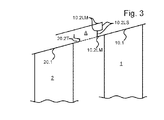
- Fig. 3 shows in Fig. 2 corresponding representation of a part of a gas turbine stage according to a modified embodiment of the present invention.
- Corresponding elements are denoted by identical reference numerals, so that reference is made in full to the above explanations and will be discussed below only on the differences in the modification.
- the radially outer blade platforms are inclined against the turbine axis to represent a divergent flow channel.
- the explanations also apply in the same way to convergent flow channels (not shown), in particular in compressor or compressor stages.
- the radially outer blade platform in the form of a shroud in its trailing edge gap region 20.2T an annular flange with radially opposite lateral surfaces, as already described above with respect to the trailing edge gap region 10.2T of the guide vane 1 of Fig. 1 was explained.
- the trailing edge gap portion 20.2T can on its radially inner (bottom in Fig. 3 ) and / or outer lateral surface have, in particular the same, waviness.
- the leading edge gap region includes a radially inner annular flange in a radially outer groove-like recess of the gas turbine housing. Accordingly, the leading edge gap region has three lateral surfaces 10.2LM, the radially inner and the outer lateral surface of the annular flange and the lateral surface of the recess itself, and two end surfaces 10.LS, that of the annular flange and that of the recess itself.
- Each of these sections 10.2LM, 10.2LS can each have a ripple in radial (10.2LM) or axial (10.2LS) direction.
- Several, in particular all sections of the gap region can also have a waviness.
- the modification of the Fig. 3 in a representation show different variants where a contour of a gap region in the radial and / or axial direction can vary over the circumference.
Landscapes
- Engineering & Computer Science (AREA)
- Physics & Mathematics (AREA)
- Fluid Mechanics (AREA)
- Mechanical Engineering (AREA)
- General Engineering & Computer Science (AREA)
- Structures Of Non-Positive Displacement Pumps (AREA)
- Turbine Rotor Nozzle Sealing (AREA)
Abstract
Description
- Die vorliegende Erfindung betrifft eine Turbomaschine, insbesondere eine Gasturbine, vorzugsweise eine Flugtriebwerk-Gasturbine, mit wenigstens einer Turbomaschinenstufe, insbesondere einer Kompressor- oder Turbinenstufe, mit einem Leit- und einem Laufgitter, sowie eine solche Turbomaschinenstufe.
- Eine Turbomaschinenstufe weist ein Laufgitter mit rotierenden Laufschaufeln sowie ein stromauf- und/oder -abwärts benachbartes Leitgitter auf. Die Laufschaufeln enden fußseitig in einer radial äußeren Schaufelplattform. Auch bei Leitschaufeln kann spitzenseitig eine radial äußere Schaufelplattform vorgesehen sein, etwa als Deckband.
- Zwischen Leit- und Laufgitter ist ein Axialspalt ausgebildet. Bei rotierendem Laufgitter werden in diesem Druckgradienten induziert, die über den Umfang variieren und Sekundärströmungen verursachen. Beispielsweise kann ein rotierendes Turbinenlaufgitter auf seiner Druckseite Arbeitsfluid in den Axialspalt drücken und umgekehrt auf seiner Saugseite aus dem Spalt fördern, was zu einer Ausgleichsströmung führt. Dies verschlechtert den Wirkungsgrad der Turbomaschine.
- Aus der
EP 2 372 102 A2 ist eine Gasturbine mit deckbandfreien Laufschaufeln bekannt. Für radial innere Schaufelplattformen von Leit- und Laufschaufeln wird eine nicht-axialsymmetrische, insbesondere radial und/oder axial wellenförmige, Kontur vorgeschlagen. - Aufgabe der vorliegenden Erfindung ist es, den Wirkungsgrad einer Turbomaschine, insbesondere einer Flugtriebwerk-Gasturbine, zu verbessern.
- Zur Lösung dieser Aufgabe ist eine Turbomaschinenstufe nach dem Oberbegriff des Anspruchs 1 durch dessen kennzeichnendes Merkmal weitergebildet. Anspruch 10 stellt eine Turbomaschine mit einer oder mehrerer solcher Turbomaschinenstufen unter Schutz, die Unteransprüche betreffen vorteilhafte Weiterbildungen.
- Eine erfindungsgemäße Turbomaschinenstufe weist mehrere, vorzugsweise äquidistant über den Umfang verteilte, Laufschaufeln auf, die fuß- bzw. rotorseitig mit radial inneren Schaufelplattformen verbunden, insbesondere integral ausgebildet sind. Spitzen- bzw. gehäuseseitig können die Laufschaufeln mit radial äußeren Schaufelplattformen verbunden, insbesondere integral ausgebildet sein. Laufschaufeln können einzeln oder in Gruppen lösbar oder unlösbar an einem Rotor(teil) der Turbomaschine befestigt, insbesondere integral mit diesem ausgebildet sein.
- Stromauf- und/oder -abwärts des durch diese Laufschaufeln gebildeten Laufgitters sind mehrere, vorzugsweise äquidistant über den Umfang verteilte, Leitschaufeln lösbar oder unlösbar an einem Gehäuse(teil) der Turbomaschine befestigt, insbesondere integral mit diesem ausgebildet. Hierzu sind die Leitschaufeln fuß- bzw. gehäuseseitig mit radial äußeren Schaufelplattformen verbunden, insbesondere integral ausgebildet. Spitzen- bzw. rotorseitig können die Leitschaufeln mit radial inneren Schaufelplattformen verbunden, insbesondere integral ausgebildet sein.
- Leit- und/oder Laufschaufelplattformen in Umfangsrichtung benachbarter Schaufeln können miteinander lösbar oder unlösbar verbunden, insbesondere integral ausgebildet sein.
- Bereiche der Schaufelplattformen, die sich axial zwischen Schaufelvorder- und -hinterkante und in Umfangsrichtung zwischen benachbarten Schaufeln erstrecken, definieren zusammen mit den Schaufeln selber sowie gegebenenfalls Gehäuse- bzw. Rotoroberflächenbereichen Strömungskanäle für das Arbeitsfluid und somit das Lauf- bzw. Leitgitter. Diese Bereiche der Schaufelplattformen werden daher im Folgenden als Gitterbereiche bezeichnet.
- Die Schaufelplattformen können jedoch axial stromauf- und/oder abwärts über diese Gitterbereiche bzw. Schaufelnvorder- bzw. Hinterkanten hinausragen. Diese Bereiche der Schaufelplattformen begrenzen einen Axialspalt, der sich axial zwischen dem Leit- und dem Laufgitter erstreckt, sie werden daher im Folgenden zusammenfassend als Spaltbereiche der Schaufelplattformen bezeichnet.
- Eine Schaufelplattform kann radial äußere Spaltbereiche mit mehreren Abschnitten aufweisen. Beispielsweise können die radial äußeren Schaufelplattformen eines Leit- oder Laufgitters einen oder mehrere radiale Absätze aufweisen, deren Mantelflächen den Axialspalt radial begrenzen und deren Stirnseiten den Axialspalt axial begrenzen. Bei solchen radial äußeren Spaltbereichen mit mehreren Abschnitten können sich die nachfolgenden Erläuterungen auf einen oder mehrere, insbesondere alle Abschnitte eines Spaltbereichs beziehen. Wenn also beispielsweise von einer Variation eines radial äußeren Spaltbereichs in radialer bzw. axialer Richtung die Rede ist, können zum Beispiel die Konturen einer oder mehrerer Mantelflächen in radialer Richtung bzw. einer oder mehrerer Stirnseiten in axialer Richtung variieren.
- Wenn in einer bevorzugten Ausführung Laufschaufelspitzen oder -deckbänder, insbesondere dichtend, in einer gehäuseseitigen Aussparung angeordnet sind, kann der Gehäuseteil, in dem die Aussparung ausgebildet ist, einen radial äußeren Spaltbereich der Leitschaufelplattformen im Sinne der vorliegenden Erfindung bilden. Gleichermaßen kann eine radial äußere Laufschaufelplattform, die insbesondere in einer gehäuseseitigen Aussparung angeordnet sein kann, einen Spaltbereich im Sinne der vorliegenden Erfindung bilden.
- Allgemein kann insbesondere ein radial außen mit wenigstens einer Leit- oder Laufschaufel verbundenes oder integrales Bauteil, dessen Kontur den Axialspalt zwischen Lauf- und Leitgitter - gegebenenfalls zusammen mit weiteren Konturen - radial und/oder axial begrenzt, ein radial äußerer Spaltbereich einer Schaufelplattform im Sinne der vorliegenden Erfindung sein.
- Erfindungsgemäß variiert eine Kontur eines oder mehrerer dieser Spaltbereiche über den Umfang gesehen in radialer und/oder axialer Richtung. Unter einer Variation in radialer Richtung wird in fachüblicher Weise insbesondere ein Außenradius R der Kontur verstanden, der in Polarkoordinaten mit dem Umfangswinkel ϕ um die Rotationsachse der Turbomaschinenstufe variiert, unter einer Variation in axialer Richtung entsprechend insbesondere eine axiale Koordinate X der Kontur, die mit dem Umfangswinkel variiert. Vorzugsweise variiert die Kontur periodisch, insbesondere sinusartig:

und/oder
wobei
oder auch asymmetrisch. - Wie vorstehend ausgeführt kann diese Variation, die nachfolgend auch als Welligkeit bezeichnet wird, ausschließlich in radialer Richtung, ausschließlich in axialer Richtung oder auch sowohl in axialer als auch radialer Richtung ausgebildet sein. Beispielsweise variiert die Kontur eines zylinderförmigen Spaltbereiches mit ebener Stirnseite und gewellter Mantelfläche ausschließlich in radialer Richtung, diejenige eines zylinderförmigen Spaltbereiches mit gewellter Stirnseite und ebener Mantelfläche ausschließlich in axialer Richtung und diejenige eines zylinderförmigen Spaltbereiches mit gewellter Stirnseite und gewellter Mantelfläche ebenso wie diejenige eines kegelförmigen Spaltbereiches mit gewellter Mantelfläche sowohl in axialer als auch radialer Richtung.
- Die Welligkeit kann ausschließlich bei einem oder mehreren Spaltbereichen von radial äußeren Leitschaufelplattformen, ausschließlich bei einem oder mehreren Spaltbereichen von radial äußeren Laufschaufelplattformen oder auch sowohl bei einem oder mehreren Spaltbereichen von radial äußeren Leit- und Laufschaufelplattformen ausgebildet sein. In einer bevorzugten Weiterbildung kann eine Welligkeit zusätzlich bei einem oder mehreren Spaltbereichen von radial inneren Leitschaufelplattformen und/oder bei einem oder mehreren Spaltbereichen von radial inneren Laufschaufelplattformen ausgebildet sein.
- In einer bevorzugten Ausführung kann eine Kontur eines Spaltbereiches einer Schaufelplattform von einem von dem Leit- und dem Laufgitter und eine dieser axial und/oder radial gegenüberliegende Kontur eines Spaltbereiches einer Schaufelplattform von dem anderen von dem Leit- und dem Laufgitter über den Umfang vorzugsweise gleichartig, insbesondere parallel oder mit einem Phasenversatz variieren, der bevorzugt wenigstens 45°, insbesondere wenigstens 90°, vorzugsweise wenigstens 135° beträgt und/oder bevorzugt höchstens 270°, insbesondere höchstens 210° und vorzugsweise höchstens 180° beträgt.
- Wenn ein Spaltbereich zwei gegenüberliegende Konturen aufweist wie beispielsweise eine Innen- und eine Außenumfangsfläche eines Ringflansches wie insbesondere einer Deckbandverlängerung oder an einem Gehäuse, können diese beiden gegenüberliegenden Konturen über den Umfang variieren, vorzugsweise verschieden- oder gleichartig, insbesondere parallel oder mit einem Phasenversatz, der bevorzugt wenigstens 45°, insbesondere wenigstens 90°, vorzugsweise wenigstens 135° beträgt und/oder bevorzugt höchstens 270°, insbesondere höchstens 210° und vorzugsweise höchstens 180° beträgt. Variieren die beiden Konturen parallel, bleibt die Wandstärke dieses Spaltbereiches der Schaufelplattform konstant. Gleichermaßen kann vorgesehen sein, dass bei gegenüberliegenden Konturen auch nur eine Kontur, bei einer ringflanschartigen Deckbandverlängerung vorzugsweise die radial innenliegende Kontur, variiert, während die andere über den Umfangs konstant ist.
- Allgemein kann eine gesamte Kontur eines Spaltbereiches, beispielsweise die gesamte Innenmantelfläche eines Ringflansches, über den Umfang variieren. Gleichermaßen ist es auch möglich, dass nur ein Teilabschnitt der Kontur eine Welligkeit aufweist, beispielsweise die Innenmantelfläche eines Ringflansches nur in einem oder mehreren axialen Abschnitten in radialer Richtung variiert oder eine Stirnfläche nur in einem oder mehreren radialen Abschnitten in axialer Richtung variiert.
- Eine radiale Variation einer Kontur eines Spaltbereichs einer Schaufelplattform eines Gitters kann in axialer Richtung konstant sein, so dass Wellentäler bzw. -spitzen parallel zur Rotationsachse der Turbomaschinenstufe ausgerichtet sind. Gleichermaßen kann eine radiale Variation einer Kontur eines Spaltbereichs einer Schaufelplattform eines Gitters auch in axialer Richtung variieren, so dass Wellentäler bzw. -spitzen schräg zur Rotationsachse verlaufen. Insbesondere kann ein Phasenversatz vorgesehen sein, der sich mit der axialen Position x, vorzugsweise linear, ändert:

- Gleichermaßen kann eine axiale Variation einer Kontur eines Spaltbereichs einer Schaufelplattform eines Gitters in radialer Richtung konstant sein, so dass Wellentäler bzw. -spitzen senkrecht zur Rotationsachse der Turbomaschinenstufe ausgerichtet sind. Gleichermaßen kann eine axialer Variation einer Kontur eines Spaltbereichs einer Schaufelplattform eines Gitters auch in radialer Richtung variieren, so dass Wellentäler bzw. -spitzen schräg zur Rotationsachse geneigt sind. Auch hier kann insbesondere ein Phasenversatz vorgesehen sein, der sich mit der radialen Position r, vorzugsweise linear, ändert:

- In einer bevorzugten Ausführung variiert zusätzlich zu wenigstens einem Spaltbereich auch der Gitterbereich der Schaufelplattform, wenigstens abschnittsweise, über den Umfang in einer der vorstehend erläuterten Arten. In einer vorteilhaften Weiterbildung geht dann ein Spaltbereich, dessen Kontur über den Umfang variiert, glatt in diesen Gitterbereich über, insbesondere derart, dass ein Wellental der Spaltbereichkontur in ein Wellental des Gitterbereichs übergeht, eine Wellenspitze der Spaltbereichkontur in eine Wellenspitze des Gitterbereichs. Unter einem glatten Übergang wird dabei in fachüblicher Weise insbesondere ein Übergang ohne scharfe Kanten oder Knicke bezeichnet, vorzugsweise mit einer stetigen Krümmung.
- In einer bevorzugten Ausführung ist eine extremale, d.h. maximale oder minimale Erstreckung einer in radialer Richtung variierenden Kontur eines Spaltbereichs einer Schaufelplattform eines Gitters in Umfangsrichtung in der druckseitigen Hälfte des Segmentes zwischen zwei benachbarten Schaufelvorderkanten oder in der saugseitigen Hälfte des Segmentes zwischen zwei benachbarten Schaufelhinterkanten des Gitters angeordnet, um so die dort induzierten Druckerhöhungen bzw. -senken auszugleichen.
- Allgemein definieren zwei Schaufelvorder- bzw. -hinterkanten eines Leit- oder Laufgitters zwischen sich ein Segment, welches sich in Umfangsrichtung erstreckt und durch die Kanalmitte in zwei Hälften geteilt wird. Die Segmenthälfte, die an die Druckseite der Schaufel angrenzt, wird als druckseitige Hälfte bezeichnet, die andere entsprechend als saugseitige Hälfte. Diese Hälften definieren über den Umfang einen Winkelbereich, in dem in der vorstehenden bevorzugten Ausführung eine extremale Erstreckung einer variierenden Kontur angeordnet ist. Da die variierende Kontur axial nicht auf Höhe dieses Segmentes selber liegt, kann dieses Segment parallel zu einer Verlängerung der Skelettlinie der Schaufel verschoben gedacht werden, um die extremale Erstreckung anzuordnen.
- Vorzugsweise beträgt eine maximale Variation in radialer Richtung eines Spaltbereichs einer Schaufelplattform eines Gitters höchstens 50%, insbesondere höchstens 40% der Schaufelteilung des Gitters.
- Zusätzlich oder alternativ zu der vorgenannten Anordnung extremaler radialer Erstreckungen über dem Umfang kann in einer bevorzugten Ausführung eine extremale, d.h. maximale oder minimal Erstreckung einer in axialer Richtung variierenden Kontur eines Spaltbereichs in Umfangsrichtung im Bereich einer Schaufelkante, insbesondere in Umfangsrichtung nicht weiter als 25% der Schaufelteilung von der Schaufelkante entfernt angeordnet sein. Auch hier wird wieder auf das Segment zwischen zwei benachbarten Schaufelkanten Bezug genommen, dessen Bogenlänge die Schaufelteilung definiert, und das parallel zur Verlängerung der Skelettlinie der Schaufel verschoben gedacht werden kann. Eine maximale Erstreckung in axialer Richtung einer Leitgitterschaufelplattform erstreckt sich vorzugsweise axial zum Laufgitter hin, eine maximale Erstreckung in axialer Richtung einer Laufgitterschaufelplattform entsprechend vorzugsweise axial zum Leitgitter hin.
- Vorzugsweise beträgt eine maximale Variation in axialer Richtung eines Spaltbereichs einer Schaufelplattform eines Gitters höchstens 50°, insbesondere höchstens 40% der Schaufelteilung des Gitters.
- Weitere Merkmale und Vorteile ergeben sich aus den Unteransprüchen und den Ausführungsbeispielen. Hierzu zeigt, teilweise schematisiert:
- Fig. 1:
- eine Abwicklung eines Teils einer erfindungsgemäßen Gasturbinenstufe mit einem Leit- und Laufgitter mit radial äußeren Schaufelplattformen, deren Spaltbereichskonturen in axialer Richtung über den Umfang variieren;
- Fig. 2A, 2B:
- Meridianschnitte an unterschiedlichen Umfangspositionen einer erfindungsgemäßen Gasturbinenstufe mit einem Leit- und Laufgitter mit radial äußeren Schaufelplattformen, deren Spaltbereichskontur in radialer Richtung über den Umfang variiert; und
- Fig. 3:
- einen Meridianschnitt einer erfindungsgemäßen Gasturbinenstufe mit einem Spaltbereich einer radial äußeren Leitschaufelplattform, in dem eine Aussparung zur Aufnahme von radial äußeren Laufschaufelplattformen ausgebildet ist, in
Fig. 2 entsprechender Darstellung. -
Fig. 1 zeigt von einer Drehachse aus, d.h. von radial innen gesehen, eine Abwicklung eines Teils einer erfindungsgemäßen Gasturbinenstufe mit einem feststehenden Leitgitter mit Leitschaufeln 1 und einem demgegenüber rotierenden Laufgitter mit Laufschaufeln 2. Die Rotation ist durch einen ausgefüllten vertikalen Pfeil angedeutet, die Durchströmung mit Arbeitsfluid durch einen leeren Pfeil im Bereich des Leitgitters. Diese Konfiguration ist rein exemplarisch zur Erläuterung, die vorliegende Erfindung kann gleichermaßen bei Turbinen- und Kompressorstufen eingesetzt werden, bei denen das Leitgitter stromauf und/oder stromab vom Laufgitter angeordnet ist. - Integral mit den Schaufeln 1, 2 sind radial äußere Schaufelplattformen ausgebildet, auf die man in
Fig. 1 von oben, d.h. von der Drehachse der Gasturbinenstufe aus gesehen, blickt. Dabei kann jede Schaufel eine eigene Schaufelplattform aufweisen, es können auch mehrere oder alle Schaufeln eines Gitters mit derselben Schaufelplattform verbunden, insbesondere integral ausgebildet sein, die dann im Sinne der vorliegenden Erfindung gedanklich in einzelne, den einzelnen Schaufeln zugeordnete Schaufelplattformen aufgeteilt werden können. Daher sind inFig. 1 keine Schaufelplattformgrenzen in Umfangsrichtung (vertikal inFig. 1 ) dargestellt. Die radial äußeren Schaufelplattformen der Leitschaufeln 1 können beispielsweise ein, insbesondere integraler, Teil eines Gasturbinen(stufen)gehäuses oder an einem solchen befestigt sein. Die radial äußeren Schaufelplattformen der Laufschaufeln 2 können beispielsweise, insbesondere miteinander verbundene, Deckbänder sein. - Axial zwischen Vorder- (links in
Fig. 1 ) und Hinterkante (rechts inFig. 1 ) erstreckt sich jeweils ein Gitterbereich 10.1 bzw. 20.1 der Leit- bzw. Laufschaufelplattformen, der inFig. 1 durch eine von links oben nach rechts unten fallende Schraffierung angedeutet ist. - Dieser geht jeweils in einen axial über die Leitschaufelhinter- bzw. Laufschaufelvorderkanten hinausragenden Schaufelplatten-Spaltbereich 10.2T bzw. 20.2L über, der in
Fig. 1 durch eine von links unten nach rechts oben steigende Schraffierung angedeutet ist. Dieser Spaltbereich 10.2T bzw. 20.2L weist im Wesentlichen die Form eines radialen Absatzes auf, dessen den Gittern zugewandte Mantelfläche und dessen dem jeweils anderen Gitter zugewandte Stirnfläche einen radial inneren Axialspalt A zwischen Lauf- und Leitgitter radial bzw. axial begrenzen. - Die Kontur dieses Spaltbereiches 10.2T bzw. 20.2L, insbesondere dessen dem jeweils anderen Gitter zugewandte Stirnfläche, variiert in axialer Richtung, wie in der Abwicklung der
Fig. 1 erkennbar, über den Umfang, d.h. inFig. 1 in vertikaler Richtung. D.h., Erzeugende der Stirnfläche, die sich von der Rotationsachse der Turbomaschine zur Umfangskante des radialen Absatzes erstrecken, weisen unterschiedliche axiale Positionen auf, so dass die Stirnfläche in axialer Richtung an ausgewählten Umfangspositionen eine maximale axiale Erstreckung Amax10 bzw. Amax20 zum jeweils anderen Gitter hin aufweist, gemessen von einer axial am weitesten von dem jeweils anderen Gitter entfernten Erzeugenden. Die Erzeugenden können dabei senkrecht zur Rotationsachse der Turbomaschine oder gegenüber dieser um denselben oder einen in Umfangsrichtung variierenden Winkel geneigt sein. Im Ausführungsbeispiel stehen die Erzeugenden senkrecht zur Rotationsachse, ihre axiale Position variiert über den Umfang sinusartig so, dass maximalen axialen Erstreckungen Amax20 des Spaltbereichs 20.2L der Laufschaufelplattformen sich in Umfangsrichtung gesehen jeweils in der Nähe der Vorderkanten der Laufschaufeln 2 befinden, maximalen axialen Erstreckungen Amax10 des Spaltbereichs 10.2T der Leitschaufelplattformen jeweils in der Nähe der Hinterkanten der Leitschaufeln 1. Die maximalen Erstreckungen Amax10 bzw. Amax20 betragen jeweils 50% der jeweiligen Schaufelteilung. - Bezüglich der Position in Umfangsrichtung kann statt der parallel zur Rotationsachse verschobenen Position von Schaufelkanten, Kanalmitte und dergleichen auch auf eine hierzu mit der Verlängerung der Skelettlinie der jeweiligen Schaufel parallel verschobene Position Bezug genommen werden. Hierzu ist in
Fig. 1 die Verlängerung der Skelettlinie 2.1 der Laufschaufeln 2 strichpunktiert eingezeichnet. Man erkennt, dass die maximalen axialen Erstreckungen Amax20 des Spaltbereichs 20.2L der Laufschaufelplattformen sich in Umfangsrichtung auch jeweils noch in der Nähe der solcherart verschobenen Positionen der Vorderkanten der Laufschaufeln 2 befinden. -
Fig. 2A, 2B zeigen jeweils einen Meridianschnitt an unterschiedlichen Umfangspositionen einer erfindungsgemäßen Gasturbinenstufe mit einem Leit- und Laufgitter mit radial äußeren Schaufelplattformen, deren Spaltbereichskontur in radialer Richtung über den Umfang variiert. Hierbei kann es sich insbesondere um die vorstehend mit Bezug aufFig. 1 erläuterte Gasturbinenstufe handeln, so dass eine Welligkeit in radialer und axialer Richtung kombiniert sind. Daher wird nachfolgend auf die vorangehende Beschreibung Bezug genommen und nachfolgend nur auf die Aspekte der radialen Welligkeit eingegangen. Gleichermaßen ist es auch möglich, nur eine axiale Welligkeit wie vorstehend mit Bezug aufFig. 1 erläutert, oder nur eine radiale Welligkeit, wie sie nachfolgend erläutert wird, vorzusehen. -
Fig. 2A zeigt einen Meridianschnitt in einer Umfangsposition, in der die Mantelfläche des Spaltbereichs 20.2L eine minimale radiale Erstreckung radial nach außen, d.h. vom Rotor weg, aufweist,Fig. 2B entsprechend einen Meridianschnitt in einer Umfangsposition, in der die Mantelfläche des Spaltbereichs 20.2L eine maximale radiale Erstreckung aufweist. Man erkennt, dass die Mantelfläche des Spaltbereichs 20.2L in Umfangsrichtung sinusartig mit einer Amplitude ΔR = (Rmax20+Rmin20)/2 variiert. Dabei befindet sich die maximale positive Amplitude, d.h. die maximale radiale Erstreckung Rmax20 radial nach außen, in Umfangsrichtung in der druckseitigen Hälfte des Segments zwischen zwei aufeinanderfolgenden Laufschaufelvorderkanten. Wiederum können hierbei die Positionen in Umfangsrichtung parallel zur Verlängerung der Skelettlinie bis zur jeweiligen axialen Position verschoben gedacht werden. - Man erkennt, dass die radiale Welligkeit nicht nur über den Umfang (vgl.
Fig. 2A gegenüberFig. 2B ), sondern auch in axialer Richtung (vgl. horizontale Richtung inFig. 2A, 2B ) variiert, so dass die Wellentäler bzw. -spitzen schräg zur Rotationsachse geneigt sind. Insbesondere erkennt man inFig. 2A das in Stromrichtung steigende Wellental Rmin20, inFig. 2B die in Stromrichtung abfallenden Wellenspitzen Rmax20. - Man erkennt zudem, dass diese radiale Welligkeit des Spaltbereichs 20.2 glatt in eine entsprechende Welligkeit des Gitterbereichs 20.1 zwischen den Laufschaufeln 2 übergeht.
- Obwohl nicht dargestellt, kann auch der dem Laufgitter zugewandte Spaltbereich 10.2T der Leitschaufelplattformen zusätzlich oder alternativ zu der oben erläuterten axialen Welligkeit (vgl.
Fig. 1 ) eine radiale Welligkeit aufweisen, wie sie vorstehend mit Bezug auf den Spaltbereich 20.2 der Laufschaufelplattformen erläutert wurde. - Man erkennt in
Fig. 2 , dass dieser Hinterkanten-Spaltbereich ringflanschförmig ausgebildet ist und somit zwei einander radial gegenüberliegende Oberflächen (oben, unten inFig. 2 ) aufweist. Eine radiale Welligkeit kann auf einer, insbesondere der radial inneren Oberfläche (unten inFig. 2 ), oder auf beiden Oberflächen vorgesehen sein, wobei sie dann vorzugsweise gleichartig variieren, so dass die Wandstärke des Ringflansches konstant bleibt. -
Fig. 3 zeigt inFig. 2 entsprechender Darstellung einen Teil einer Gasturbinenstufe nach einer abgewandelten Ausführung der vorliegenden Erfindung. Einander entsprechende Elemente sind durch identische Bezugszeichen bezeichnet, so dass auf die vorstehenden Erläuterungen vollinhaltlich Bezug genommen und nachfolgend nur auf die Unterschiede in der Abwandlung eingegangen wird. - Zum Einen zeigt
Fig. 3 die stromabwärtige Hinterkante einer Laufschaufel 2 und die stromaufwärtige Vorderkante einer nachfolgenden Leitschaufel 1. Entsprechend sind die radial äußeren Spaltbereiche mit 20.2T (für "Trailing edge" bzw. Hinterkante) und 10.2L (für "Leading edge" bzw. Vorderkante) bezeichnet, um exemplarisch aufzuzeigen, dass die Erläuterungen sich gleichermaßen auf Vorder- als auch Hinterkantenbereiche von Lauf- bzw. Leitschaufelplattformen beziehen können. - Zum Anderen sind die radial äußeren Schaufelplattformen gegen die Turbinenachse geneigt, um einen divergenten Strömungskanal darzustellen. Die Erläuterungen gelten in gleicher Weise auch für (nicht dargestellte) konvergente Strömungskanäle, insbesondere in Kompressor- bzw. Verdichterstufen.
- Des Weiteren weist die radial äußere Laufschaufelplattform in Form eines Deckbandes in ihrem Hinterkanten-Spaltbereich 20.2T einen Ringflansch mit einander radial gegenüberliegenden Mantelflächen auf, wie dies vorstehend bereits mit Bezug auf den Hinterkanten-Spaltbereich 10.2T der Leitschaufel 1 der
Fig. 1 erläutert wurde. Auch der Hinterkanten-Spaltbereich 20.2T kann auf seiner radial inneren (unten inFig. 3 ) und/oder äußeren Mantelfläche eine, insbesondere die gleiche, Welligkeit aufweisen. - Der Vorderkanten-Spaltbereich umfasst einen radial inneren Ringflansch in einer radial äußeren nutartigen Aussparung des Gasturbinengehäuses. Entsprechend weist der Vorderkanten-Spaltbereich drei Mantelflächen 10.2LM auf, die radial innere und die äußere Mantelfläche des Ringflansches und die Mantelfläche der Aussparung selber, sowie zwei Stirnflächen 10.LS, diejenige des Ringflansches und diejenige der Aussparung selber.
- Jeder dieser Abschnitte 10.2LM, 10.2LS kann jeweils eine Welligkeit in radialer (10.2LM) bzw. axialer (10.2LS) Richtung aufweisen. Es können auch mehrere, insbesondere alle Abschnitte des Spaltbereichs eine Welligkeit aufweisen. Insofern soll die Abwandlung der
Fig. 3 in einer Darstellung verschiedene Varianten aufzeigen, wo eine Kontur eines Spaltbereichs in radialer und/oder axialer Richtung über den Umfang variieren kann. -
- 1
- Leitschaufel
- 2
- Laufschaufel
- 2.1
- Verlängerung der Skelettlinie
- 10.1/20.1
- Gitterbereich der radial äußeren Schaufelplattform des Leit/Laufgitters
- 10.2T
- Hinterkanten ("Trailing edge")-Spaltbereich der radial äußeren Schaufelplattform des Leitgitters10.2LM Mantelflächenabschnitt des Vorderkanten-Spaltbereich der radial äußeren Schaufelplattform des Leitgitters
- 10.2LS
- Stirnflächenabschnitt des Vorderkanten-Spaltbereich der radial äußeren Schaufelplattform des Leitgitters
- 20.2T
- Hinterkanten-Spaltbereich der radial äußeren Schaufelplattform des Leitgitters
- 20.2L
- Vorderkanten ("Leading edge")-Spaltbereich der radial äußeren Schaufelplattform des Leitgitters
- A
- Axial spalt
Claims (10)
- Turbomaschinenstufe mit Leitschaufeln (1), radial inneren und/oder radial äußeren Schaufelplattformen, die zusammen ein Leitgitter bilden, und mit Laufschaufeln (2), radial inneren und/oder radial äußeren Schaufelplattformen, die zusammen ein dem Leitgitter benachbartes Laufgitter bilden, wobei radial äußere Schaufelplattformen Gitterbereiche (10.1, 20.1), die sich zwischen in Umfangsrichtung benachbarten Schaufeln erstrecken, und Spaltbereiche (10.2L, 10.2T, 20.2L, 20.2T) aufweisen, die einen Axialspalt (A) radial und/oder axial begrenzen, der sich axial zwischen dem Leit- und dem Laufgitter erstreckt,
dadurch gekennzeichnet, dass
eine Kontur wenigstens eines dieser Spaltbereiche in radialer und/oder axialer Richtung über den Umfang, insbesondere periodisch, variiert. - Turbomaschinenstufe nach Anspruch 1, dadurch gekennzeichnet, dass eine Kontur eines Spaltbereiches (10.2T) einer Schaufelplattform von einem von dem Leit- und dem Laufgitter und eine dieser axial und/oder radial gegenüberliegende Kontur eines Spaltbereiches (20.2L) einer Schaufelplattform von dem anderen von dem Leit- und dem Laufgitter über den Umfang, insbesondere gleichartig, variieren.
- Turbomaschinenstufe nach einem der vorhergehenden Ansprüche, dadurch gekennzeichnet, dass zwei radial gegenüberliegende, über den Umfang variierende Konturen eines Spaltbereiches (10.2L, 20.2T) über den Umfang, insbesondere gleichartig, variieren.
- Turbomaschinenstufe nach einem der vorhergehenden Ansprüche, dadurch gekennzeichnet, dass eine radiale Variation einer Kontur eines Spaltbereichs einer Schaufelplattform eines Gitters in axialer Richtung variiert oder konstant ist.
- Turbomaschinenstufe nach einem der vorhergehenden Ansprüche, dadurch gekennzeichnet, dass ein Spaltbereich (20.2L) einer Schaufelplattform eines Gitters, dessen Kontur über den Umfang variiert, glatt in den Gitterbereich (20.1) der Schaufelplattform übergeht, dessen Kontur in radialer und/oder axialer Richtung über den Umfang wenigstens abschnittsweise variiert.
- Turbomaschinenstufe nach einem der vorhergehenden Ansprüche, dadurch gekennzeichnet, dass eine extremale Erstreckung (Rmax20; Rmin20) einer in radialer Richtung variierenden Kontur eines Spaltbereichs (20.2L) einer Schaufelplattform eines Gitters in Umfangsrichtung in der druckseitigen Hälfte des Segmentes zwischen zwei benachbarten Schaufelvorderkanten oder in der saugseitigen Hälfte des Segmentes zwischen zwei benachbarten Schaufelhinterkanten des Gitters angeordnet ist.
- Turbomaschinenstufe nach einem der vorhergehenden Ansprüche, dadurch gekennzeichnet, dass eine maximale Variation (Rmax20; Rmin20) in radialer Richtung eines Spaltbereichs einer Schaufelplattform eines Gitters höchstens 50%, insbesondere höchstens 40% der Schaufelteilung des Gitters beträgt.
- Turbomaschinenstufe nach einem der vorhergehenden Ansprüche, dadurch gekennzeichnet, dass eine extremale Erstreckung (Amax10, Amax20) einer in axialer Richtung variierenden Kontur eines Spaltbereichs in Umfangsrichtung im Bereich einer Schaufelkante, insbesondere nicht weiter als 25% der Schaufelteilung von der Schaufelkante entfernt, angeordnet ist.
- Turbomaschinenstufe nach einem der vorhergehenden Ansprüche, dadurch gekennzeichnet, dass eine maximale Variation (Amax10, Amax20) in axialer Richtung eines Spaltbereichs einer Schaufelplattform eines Gitters höchstens 50%, insbesondere höchstens 40% der Schaufelteilung des Gitters beträgt.
- Turbomaschine, insbesondere Gasturbine, vorzugsweise Flugtriebwerk-Gasturbine, mit wenigstens einer Turbomaschinenstufe, insbesondere einer Kompressor- oder Turbinenstufe, nach einem der vorhergehenden Ansprüche.
Priority Applications (3)
| Application Number | Priority Date | Filing Date | Title |
|---|---|---|---|
| EP11194433.6A EP2607625B1 (de) | 2011-12-20 | 2011-12-20 | Turbomaschine und turbomaschinenstufe |
| ES11194433T ES2891562T3 (es) | 2011-12-20 | 2011-12-20 | Turbomaquinaria y etapa de turbomaquinaria |
| US13/687,789 US20130156562A1 (en) | 2011-12-20 | 2012-11-28 | Turbomachine and turbomachine stage |
Applications Claiming Priority (1)
| Application Number | Priority Date | Filing Date | Title |
|---|---|---|---|
| EP11194433.6A EP2607625B1 (de) | 2011-12-20 | 2011-12-20 | Turbomaschine und turbomaschinenstufe |
Publications (2)
| Publication Number | Publication Date |
|---|---|
| EP2607625A1 true EP2607625A1 (de) | 2013-06-26 |
| EP2607625B1 EP2607625B1 (de) | 2021-09-08 |
Family
ID=45442918
Family Applications (1)
| Application Number | Title | Priority Date | Filing Date |
|---|---|---|---|
| EP11194433.6A Not-in-force EP2607625B1 (de) | 2011-12-20 | 2011-12-20 | Turbomaschine und turbomaschinenstufe |
Country Status (3)
| Country | Link |
|---|---|
| US (1) | US20130156562A1 (de) |
| EP (1) | EP2607625B1 (de) |
| ES (1) | ES2891562T3 (de) |
Cited By (1)
| Publication number | Priority date | Publication date | Assignee | Title |
|---|---|---|---|---|
| EP2990600A1 (de) * | 2014-08-29 | 2016-03-02 | MTU Aero Engines GmbH | Gasturbinen-Baugruppe |
Families Citing this family (6)
| Publication number | Priority date | Publication date | Assignee | Title |
|---|---|---|---|---|
| US20140140822A1 (en) * | 2012-11-16 | 2014-05-22 | General Electric Company | Contoured Stator Shroud |
| EP3369892B1 (de) * | 2017-03-03 | 2020-08-19 | MTU Aero Engines GmbH | Konturierung einer schaufelgitterplattform |
| KR102000281B1 (ko) * | 2017-10-11 | 2019-07-15 | 두산중공업 주식회사 | 압축기 및 이를 포함하는 가스 터빈 |
| GB201820400D0 (en) * | 2018-12-14 | 2019-01-30 | Rolls Royce Plc | Ice crystal protection for a gas turbine engine |
| FR3106627B1 (fr) * | 2020-01-24 | 2023-03-17 | Safran Aircraft Engines | Basculement en vagues aux entrefers rotor-stator dans un compresseur de turbomachine |
| US12442304B1 (en) | 2025-03-12 | 2025-10-14 | General Electric Company | Gas turbine engine with bow wave mitigation |
Citations (8)
| Publication number | Priority date | Publication date | Assignee | Title |
|---|---|---|---|---|
| EP1067273A1 (de) * | 1999-07-06 | 2001-01-10 | ROLLS-ROYCE plc | Deckbandkonfiguration für Turbinenschaufeln |
| WO2004113685A1 (de) * | 2003-06-21 | 2004-12-29 | Alstom Technology Ltd | Seitenwandgestaltung eines umlenkenden strömungskanals |
| EP1515000A1 (de) * | 2003-09-09 | 2005-03-16 | ALSTOM Technology Ltd | Beschaufelung einer Turbomaschine mit konturierten Deckbändern |
| US20070128021A1 (en) * | 2005-04-01 | 2007-06-07 | General Electric Company | Turbine nozzle with purge cavity blend |
| EP2003292A2 (de) * | 2007-06-14 | 2008-12-17 | Rolls-Royce Deutschland Ltd & Co KG | Schaufeldeckband mit Überstand |
| EP2136033A1 (de) * | 2007-03-29 | 2009-12-23 | IHI Corporation | Wand einer turbomaschine und turbomaschine |
| EP2369138A1 (de) * | 2010-03-23 | 2011-09-28 | United Technologies Corporation | Gasturbinenmotor mit nicht-axialsymmetrischer, oberflächenkonturierter Schaufelplattform |
| EP2372102A2 (de) | 2010-04-02 | 2011-10-05 | United Technologies Corporation | Laufschaufelplattform einer Gasturbine |
-
2011
- 2011-12-20 EP EP11194433.6A patent/EP2607625B1/de not_active Not-in-force
- 2011-12-20 ES ES11194433T patent/ES2891562T3/es active Active
-
2012
- 2012-11-28 US US13/687,789 patent/US20130156562A1/en not_active Abandoned
Patent Citations (8)
| Publication number | Priority date | Publication date | Assignee | Title |
|---|---|---|---|---|
| EP1067273A1 (de) * | 1999-07-06 | 2001-01-10 | ROLLS-ROYCE plc | Deckbandkonfiguration für Turbinenschaufeln |
| WO2004113685A1 (de) * | 2003-06-21 | 2004-12-29 | Alstom Technology Ltd | Seitenwandgestaltung eines umlenkenden strömungskanals |
| EP1515000A1 (de) * | 2003-09-09 | 2005-03-16 | ALSTOM Technology Ltd | Beschaufelung einer Turbomaschine mit konturierten Deckbändern |
| US20070128021A1 (en) * | 2005-04-01 | 2007-06-07 | General Electric Company | Turbine nozzle with purge cavity blend |
| EP2136033A1 (de) * | 2007-03-29 | 2009-12-23 | IHI Corporation | Wand einer turbomaschine und turbomaschine |
| EP2003292A2 (de) * | 2007-06-14 | 2008-12-17 | Rolls-Royce Deutschland Ltd & Co KG | Schaufeldeckband mit Überstand |
| EP2369138A1 (de) * | 2010-03-23 | 2011-09-28 | United Technologies Corporation | Gasturbinenmotor mit nicht-axialsymmetrischer, oberflächenkonturierter Schaufelplattform |
| EP2372102A2 (de) | 2010-04-02 | 2011-10-05 | United Technologies Corporation | Laufschaufelplattform einer Gasturbine |
Cited By (2)
| Publication number | Priority date | Publication date | Assignee | Title |
|---|---|---|---|---|
| EP2990600A1 (de) * | 2014-08-29 | 2016-03-02 | MTU Aero Engines GmbH | Gasturbinen-Baugruppe |
| US9822706B2 (en) | 2014-08-29 | 2017-11-21 | MTU Aero Engines AG | Gas turbine subassembly |
Also Published As
| Publication number | Publication date |
|---|---|
| EP2607625B1 (de) | 2021-09-08 |
| US20130156562A1 (en) | 2013-06-20 |
| ES2891562T3 (es) | 2022-01-28 |
Similar Documents
| Publication | Publication Date | Title |
|---|---|---|
| EP2806102B1 (de) | Schaufelgitter einer Strömungsmaschine und zugehörige Strömungsmaschine | |
| EP2746533B1 (de) | Schaufelgitter und Strömungsmaschine | |
| DE102008055824B4 (de) | Dampfturbine | |
| EP2696029B1 (de) | Schaufelgitter mit Seitenwandkonturierung und Strömungsmaschine | |
| EP2927503B1 (de) | Gasturbinenverdichter, Flugtriebwerk und Auslegungsverfahren | |
| EP2025945B1 (de) | Strömungsarbeitsmaschine mit Ringkanalwandausnehmung | |
| EP2789802B1 (de) | Schaufelgitter für eine Turbomaschine und zugehöriges Herstellungsverfahren | |
| EP2607625B1 (de) | Turbomaschine und turbomaschinenstufe | |
| EP1632662B1 (de) | Strömungsarbeitsmaschine mit Fluidentnahme | |
| EP3225781B1 (de) | Schaufelkanal, schaufelgitter und strömungsmaschine | |
| EP2835499B1 (de) | Schaufelgitter und zugehörige Strömungsmaschine | |
| EP2299124A1 (de) | Verdichterlaufschaufel für einen Axialverdichter | |
| EP2294286B1 (de) | Rotor und laufschaufeln mit deckband einer strömungsmaschine | |
| CH697806A2 (de) | Turbinenschaufel-Deckbandkantenprofil. | |
| EP2787172A2 (de) | Schaufelgitter mit Seitenwandkonturierung und Strömungsmaschine | |
| EP2626514A1 (de) | Strömungsmaschine | |
| EP2558685B1 (de) | Leitschaufel | |
| EP2626512A1 (de) | Strömungsmaschine | |
| EP2505851B1 (de) | Stator einer Axialverdichterstufe einer Turbomaschine | |
| EP2607626B1 (de) | Turbomaschine und Turbomaschinenstufe | |
| DE102015206384A1 (de) | Deckbandanordnung einer Schaufelreihe von Stator- oder Rotorschaufeln | |
| EP2696042B1 (de) | Strömungsmaschine mit mindestens einem Leitschaufelkranz | |
| EP2597257B1 (de) | Beschaufelung | |
| EP3358135B1 (de) | Konturierung einer schaufelgitterplattform | |
| EP2410131A2 (de) | Rotor einer Turbomaschine |
Legal Events
| Date | Code | Title | Description |
|---|---|---|---|
| 17P | Request for examination filed |
Effective date: 20120924 |
|
| AK | Designated contracting states |
Kind code of ref document: A1 Designated state(s): AL AT BE BG CH CY CZ DE DK EE ES FI FR GB GR HR HU IE IS IT LI LT LU LV MC MK MT NL NO PL PT RO RS SE SI SK SM TR |
|
| AX | Request for extension of the european patent |
Extension state: BA ME |
|
| PUAI | Public reference made under article 153(3) epc to a published international application that has entered the european phase |
Free format text: ORIGINAL CODE: 0009012 |
|
| RAP1 | Party data changed (applicant data changed or rights of an application transferred) |
Owner name: MTU AERO ENGINES AG |
|
| 17Q | First examination report despatched |
Effective date: 20140722 |
|
| STAA | Information on the status of an ep patent application or granted ep patent |
Free format text: STATUS: EXAMINATION IS IN PROGRESS |
|
| RIN1 | Information on inventor provided before grant (corrected) |
Inventor name: MAHLE, INGA Inventor name: ENGEL, KARL Inventor name: KOERBER, KAI Inventor name: GIER, JOCHEN |
|
| GRAP | Despatch of communication of intention to grant a patent |
Free format text: ORIGINAL CODE: EPIDOSNIGR1 |
|
| STAA | Information on the status of an ep patent application or granted ep patent |
Free format text: STATUS: GRANT OF PATENT IS INTENDED |
|
| INTG | Intention to grant announced |
Effective date: 20210330 |
|
| GRAS | Grant fee paid |
Free format text: ORIGINAL CODE: EPIDOSNIGR3 |
|
| GRAA | (expected) grant |
Free format text: ORIGINAL CODE: 0009210 |
|
| STAA | Information on the status of an ep patent application or granted ep patent |
Free format text: STATUS: THE PATENT HAS BEEN GRANTED |
|
| AK | Designated contracting states |
Kind code of ref document: B1 Designated state(s): AL AT BE BG CH CY CZ DE DK EE ES FI FR GB GR HR HU IE IS IT LI LT LU LV MC MK MT NL NO PL PT RO RS SE SI SK SM TR |
|
| REG | Reference to a national code |
Ref country code: GB Ref legal event code: FG4D Free format text: NOT ENGLISH |
|
| REG | Reference to a national code |
Ref country code: CH Ref legal event code: EP Ref country code: AT Ref legal event code: REF Ref document number: 1428769 Country of ref document: AT Kind code of ref document: T Effective date: 20210915 |
|
| REG | Reference to a national code |
Ref country code: DE Ref legal event code: R096 Ref document number: 502011017224 Country of ref document: DE |
|
| REG | Reference to a national code |
Ref country code: IE Ref legal event code: FG4D Free format text: LANGUAGE OF EP DOCUMENT: GERMAN |
|
| REG | Reference to a national code |
Ref country code: LT Ref legal event code: MG9D |
|
| REG | Reference to a national code |
Ref country code: NL Ref legal event code: MP Effective date: 20210908 |
|
| REG | Reference to a national code |
Ref country code: ES Ref legal event code: FG2A Ref document number: 2891562 Country of ref document: ES Kind code of ref document: T3 Effective date: 20220128 |
|
| PG25 | Lapsed in a contracting state [announced via postgrant information from national office to epo] |
Ref country code: HR Free format text: LAPSE BECAUSE OF FAILURE TO SUBMIT A TRANSLATION OF THE DESCRIPTION OR TO PAY THE FEE WITHIN THE PRESCRIBED TIME-LIMIT Effective date: 20210908 Ref country code: SE Free format text: LAPSE BECAUSE OF FAILURE TO SUBMIT A TRANSLATION OF THE DESCRIPTION OR TO PAY THE FEE WITHIN THE PRESCRIBED TIME-LIMIT Effective date: 20210908 Ref country code: RS Free format text: LAPSE BECAUSE OF FAILURE TO SUBMIT A TRANSLATION OF THE DESCRIPTION OR TO PAY THE FEE WITHIN THE PRESCRIBED TIME-LIMIT Effective date: 20210908 Ref country code: NO Free format text: LAPSE BECAUSE OF FAILURE TO SUBMIT A TRANSLATION OF THE DESCRIPTION OR TO PAY THE FEE WITHIN THE PRESCRIBED TIME-LIMIT Effective date: 20211208 Ref country code: FI Free format text: LAPSE BECAUSE OF FAILURE TO SUBMIT A TRANSLATION OF THE DESCRIPTION OR TO PAY THE FEE WITHIN THE PRESCRIBED TIME-LIMIT Effective date: 20210908 Ref country code: BG Free format text: LAPSE BECAUSE OF FAILURE TO SUBMIT A TRANSLATION OF THE DESCRIPTION OR TO PAY THE FEE WITHIN THE PRESCRIBED TIME-LIMIT Effective date: 20211208 Ref country code: LT Free format text: LAPSE BECAUSE OF FAILURE TO SUBMIT A TRANSLATION OF THE DESCRIPTION OR TO PAY THE FEE WITHIN THE PRESCRIBED TIME-LIMIT Effective date: 20210908 |
|
| PG25 | Lapsed in a contracting state [announced via postgrant information from national office to epo] |
Ref country code: LV Free format text: LAPSE BECAUSE OF FAILURE TO SUBMIT A TRANSLATION OF THE DESCRIPTION OR TO PAY THE FEE WITHIN THE PRESCRIBED TIME-LIMIT Effective date: 20210908 Ref country code: GR Free format text: LAPSE BECAUSE OF FAILURE TO SUBMIT A TRANSLATION OF THE DESCRIPTION OR TO PAY THE FEE WITHIN THE PRESCRIBED TIME-LIMIT Effective date: 20211209 |
|
| PG25 | Lapsed in a contracting state [announced via postgrant information from national office to epo] |
Ref country code: IS Free format text: LAPSE BECAUSE OF FAILURE TO SUBMIT A TRANSLATION OF THE DESCRIPTION OR TO PAY THE FEE WITHIN THE PRESCRIBED TIME-LIMIT Effective date: 20220108 Ref country code: SM Free format text: LAPSE BECAUSE OF FAILURE TO SUBMIT A TRANSLATION OF THE DESCRIPTION OR TO PAY THE FEE WITHIN THE PRESCRIBED TIME-LIMIT Effective date: 20210908 Ref country code: SK Free format text: LAPSE BECAUSE OF FAILURE TO SUBMIT A TRANSLATION OF THE DESCRIPTION OR TO PAY THE FEE WITHIN THE PRESCRIBED TIME-LIMIT Effective date: 20210908 Ref country code: RO Free format text: LAPSE BECAUSE OF FAILURE TO SUBMIT A TRANSLATION OF THE DESCRIPTION OR TO PAY THE FEE WITHIN THE PRESCRIBED TIME-LIMIT Effective date: 20210908 Ref country code: PT Free format text: LAPSE BECAUSE OF FAILURE TO SUBMIT A TRANSLATION OF THE DESCRIPTION OR TO PAY THE FEE WITHIN THE PRESCRIBED TIME-LIMIT Effective date: 20220110 Ref country code: PL Free format text: LAPSE BECAUSE OF FAILURE TO SUBMIT A TRANSLATION OF THE DESCRIPTION OR TO PAY THE FEE WITHIN THE PRESCRIBED TIME-LIMIT Effective date: 20210908 Ref country code: NL Free format text: LAPSE BECAUSE OF FAILURE TO SUBMIT A TRANSLATION OF THE DESCRIPTION OR TO PAY THE FEE WITHIN THE PRESCRIBED TIME-LIMIT Effective date: 20210908 Ref country code: EE Free format text: LAPSE BECAUSE OF FAILURE TO SUBMIT A TRANSLATION OF THE DESCRIPTION OR TO PAY THE FEE WITHIN THE PRESCRIBED TIME-LIMIT Effective date: 20210908 Ref country code: CZ Free format text: LAPSE BECAUSE OF FAILURE TO SUBMIT A TRANSLATION OF THE DESCRIPTION OR TO PAY THE FEE WITHIN THE PRESCRIBED TIME-LIMIT Effective date: 20210908 Ref country code: AL Free format text: LAPSE BECAUSE OF FAILURE TO SUBMIT A TRANSLATION OF THE DESCRIPTION OR TO PAY THE FEE WITHIN THE PRESCRIBED TIME-LIMIT Effective date: 20210908 |
|
| REG | Reference to a national code |
Ref country code: DE Ref legal event code: R097 Ref document number: 502011017224 Country of ref document: DE |
|
| PLBE | No opposition filed within time limit |
Free format text: ORIGINAL CODE: 0009261 |
|
| STAA | Information on the status of an ep patent application or granted ep patent |
Free format text: STATUS: NO OPPOSITION FILED WITHIN TIME LIMIT |
|
| PG25 | Lapsed in a contracting state [announced via postgrant information from national office to epo] |
Ref country code: MC Free format text: LAPSE BECAUSE OF FAILURE TO SUBMIT A TRANSLATION OF THE DESCRIPTION OR TO PAY THE FEE WITHIN THE PRESCRIBED TIME-LIMIT Effective date: 20210908 Ref country code: DK Free format text: LAPSE BECAUSE OF FAILURE TO SUBMIT A TRANSLATION OF THE DESCRIPTION OR TO PAY THE FEE WITHIN THE PRESCRIBED TIME-LIMIT Effective date: 20210908 |
|
| REG | Reference to a national code |
Ref country code: CH Ref legal event code: PL |
|
| 26N | No opposition filed |
Effective date: 20220609 |
|
| PG25 | Lapsed in a contracting state [announced via postgrant information from national office to epo] |
Ref country code: SI Free format text: LAPSE BECAUSE OF FAILURE TO SUBMIT A TRANSLATION OF THE DESCRIPTION OR TO PAY THE FEE WITHIN THE PRESCRIBED TIME-LIMIT Effective date: 20210908 |
|
| REG | Reference to a national code |
Ref country code: BE Ref legal event code: MM Effective date: 20211231 |
|
| PG25 | Lapsed in a contracting state [announced via postgrant information from national office to epo] |
Ref country code: LU Free format text: LAPSE BECAUSE OF NON-PAYMENT OF DUE FEES Effective date: 20211220 Ref country code: IE Free format text: LAPSE BECAUSE OF NON-PAYMENT OF DUE FEES Effective date: 20211220 |
|
| PG25 | Lapsed in a contracting state [announced via postgrant information from national office to epo] |
Ref country code: BE Free format text: LAPSE BECAUSE OF NON-PAYMENT OF DUE FEES Effective date: 20211231 |
|
| PG25 | Lapsed in a contracting state [announced via postgrant information from national office to epo] |
Ref country code: LI Free format text: LAPSE BECAUSE OF NON-PAYMENT OF DUE FEES Effective date: 20211231 Ref country code: CH Free format text: LAPSE BECAUSE OF NON-PAYMENT OF DUE FEES Effective date: 20211231 |
|
| PG25 | Lapsed in a contracting state [announced via postgrant information from national office to epo] |
Ref country code: IT Free format text: LAPSE BECAUSE OF FAILURE TO SUBMIT A TRANSLATION OF THE DESCRIPTION OR TO PAY THE FEE WITHIN THE PRESCRIBED TIME-LIMIT Effective date: 20210908 |
|
| REG | Reference to a national code |
Ref country code: AT Ref legal event code: MM01 Ref document number: 1428769 Country of ref document: AT Kind code of ref document: T Effective date: 20211220 |
|
| PG25 | Lapsed in a contracting state [announced via postgrant information from national office to epo] |
Ref country code: AT Free format text: LAPSE BECAUSE OF NON-PAYMENT OF DUE FEES Effective date: 20211220 |
|
| PG25 | Lapsed in a contracting state [announced via postgrant information from national office to epo] |
Ref country code: HU Free format text: LAPSE BECAUSE OF FAILURE TO SUBMIT A TRANSLATION OF THE DESCRIPTION OR TO PAY THE FEE WITHIN THE PRESCRIBED TIME-LIMIT; INVALID AB INITIO Effective date: 20111220 Ref country code: CY Free format text: LAPSE BECAUSE OF FAILURE TO SUBMIT A TRANSLATION OF THE DESCRIPTION OR TO PAY THE FEE WITHIN THE PRESCRIBED TIME-LIMIT Effective date: 20210908 |
|
| PGFP | Annual fee paid to national office [announced via postgrant information from national office to epo] |
Ref country code: GB Payment date: 20231220 Year of fee payment: 13 |
|
| PGFP | Annual fee paid to national office [announced via postgrant information from national office to epo] |
Ref country code: FR Payment date: 20231219 Year of fee payment: 13 Ref country code: DE Payment date: 20231214 Year of fee payment: 13 |
|
| PGFP | Annual fee paid to national office [announced via postgrant information from national office to epo] |
Ref country code: ES Payment date: 20240118 Year of fee payment: 13 |
|
| PG25 | Lapsed in a contracting state [announced via postgrant information from national office to epo] |
Ref country code: MK Free format text: LAPSE BECAUSE OF FAILURE TO SUBMIT A TRANSLATION OF THE DESCRIPTION OR TO PAY THE FEE WITHIN THE PRESCRIBED TIME-LIMIT Effective date: 20210908 |
|
| PG25 | Lapsed in a contracting state [announced via postgrant information from national office to epo] |
Ref country code: MT Free format text: LAPSE BECAUSE OF FAILURE TO SUBMIT A TRANSLATION OF THE DESCRIPTION OR TO PAY THE FEE WITHIN THE PRESCRIBED TIME-LIMIT Effective date: 20210908 |
|
| REG | Reference to a national code |
Ref country code: DE Ref legal event code: R119 Ref document number: 502011017224 Country of ref document: DE |
|
| GBPC | Gb: european patent ceased through non-payment of renewal fee |
Effective date: 20241220 |
|
| PG25 | Lapsed in a contracting state [announced via postgrant information from national office to epo] |
Ref country code: DE Free format text: LAPSE BECAUSE OF NON-PAYMENT OF DUE FEES Effective date: 20250701 |
|
| PG25 | Lapsed in a contracting state [announced via postgrant information from national office to epo] |
Ref country code: GB Free format text: LAPSE BECAUSE OF NON-PAYMENT OF DUE FEES Effective date: 20241220 |
|
| PG25 | Lapsed in a contracting state [announced via postgrant information from national office to epo] |
Ref country code: FR Free format text: LAPSE BECAUSE OF NON-PAYMENT OF DUE FEES Effective date: 20241231 |
|
| PG25 | Lapsed in a contracting state [announced via postgrant information from national office to epo] |
Ref country code: TR Free format text: LAPSE BECAUSE OF FAILURE TO SUBMIT A TRANSLATION OF THE DESCRIPTION OR TO PAY THE FEE WITHIN THE PRESCRIBED TIME-LIMIT Effective date: 20210908 |
|
| REG | Reference to a national code |
Ref country code: ES Ref legal event code: FD2A Effective date: 20260202 |
|
| PG25 | Lapsed in a contracting state [announced via postgrant information from national office to epo] |
Ref country code: ES Free format text: LAPSE BECAUSE OF NON-PAYMENT OF DUE FEES Effective date: 20241221 |