EP2611277B1 - Mittiges rückwärtiges entladedeck - Google Patents
Mittiges rückwärtiges entladedeck Download PDFInfo
- Publication number
- EP2611277B1 EP2611277B1 EP10856798.3A EP10856798A EP2611277B1 EP 2611277 B1 EP2611277 B1 EP 2611277B1 EP 10856798 A EP10856798 A EP 10856798A EP 2611277 B1 EP2611277 B1 EP 2611277B1
- Authority
- EP
- European Patent Office
- Prior art keywords
- engagement
- cutter
- belt
- gear
- rotation
- Prior art date
- Legal status (The legal status is an assumption and is not a legal conclusion. Google has not performed a legal analysis and makes no representation as to the accuracy of the status listed.)
- Active
Links
Images


Classifications
-
- A—HUMAN NECESSITIES
- A01—AGRICULTURE; FORESTRY; ANIMAL HUSBANDRY; HUNTING; TRAPPING; FISHING
- A01D—HARVESTING; MOWING
- A01D34/00—Mowers; Mowing apparatus of harvesters
- A01D34/01—Mowers; Mowing apparatus of harvesters characterised by features relating to the type of cutting apparatus
- A01D34/412—Mowers; Mowing apparatus of harvesters characterised by features relating to the type of cutting apparatus having rotating cutters
- A01D34/63—Mowers; Mowing apparatus of harvesters characterised by features relating to the type of cutting apparatus having rotating cutters having cutters rotating about a vertical axis
- A01D34/71—Mowers; Mowing apparatus of harvesters characterised by features relating to the type of cutting apparatus having rotating cutters having cutters rotating about a vertical axis with means for discharging mown material
-
- A—HUMAN NECESSITIES
- A01—AGRICULTURE; FORESTRY; ANIMAL HUSBANDRY; HUNTING; TRAPPING; FISHING
- A01D—HARVESTING; MOWING
- A01D34/00—Mowers; Mowing apparatus of harvesters
- A01D34/01—Mowers; Mowing apparatus of harvesters characterised by features relating to the type of cutting apparatus
- A01D34/412—Mowers; Mowing apparatus of harvesters characterised by features relating to the type of cutting apparatus having rotating cutters
- A01D34/63—Mowers; Mowing apparatus of harvesters characterised by features relating to the type of cutting apparatus having rotating cutters having cutters rotating about a vertical axis
- A01D34/73—Cutting apparatus
-
- A—HUMAN NECESSITIES
- A01—AGRICULTURE; FORESTRY; ANIMAL HUSBANDRY; HUNTING; TRAPPING; FISHING
- A01D—HARVESTING; MOWING
- A01D34/00—Mowers; Mowing apparatus of harvesters
- A01D34/01—Mowers; Mowing apparatus of harvesters characterised by features relating to the type of cutting apparatus
- A01D34/412—Mowers; Mowing apparatus of harvesters characterised by features relating to the type of cutting apparatus having rotating cutters
- A01D34/63—Mowers; Mowing apparatus of harvesters characterised by features relating to the type of cutting apparatus having rotating cutters having cutters rotating about a vertical axis
- A01D34/64—Mowers; Mowing apparatus of harvesters characterised by features relating to the type of cutting apparatus having rotating cutters having cutters rotating about a vertical axis mounted on a vehicle, e.g. a tractor, or drawn by an animal or a vehicle
- A01D34/66—Mowers; Mowing apparatus of harvesters characterised by features relating to the type of cutting apparatus having rotating cutters having cutters rotating about a vertical axis mounted on a vehicle, e.g. a tractor, or drawn by an animal or a vehicle with two or more cutters
-
- A—HUMAN NECESSITIES
- A01—AGRICULTURE; FORESTRY; ANIMAL HUSBANDRY; HUNTING; TRAPPING; FISHING
- A01D—HARVESTING; MOWING
- A01D34/00—Mowers; Mowing apparatus of harvesters
- A01D34/01—Mowers; Mowing apparatus of harvesters characterised by features relating to the type of cutting apparatus
- A01D34/412—Mowers; Mowing apparatus of harvesters characterised by features relating to the type of cutting apparatus having rotating cutters
- A01D34/63—Mowers; Mowing apparatus of harvesters characterised by features relating to the type of cutting apparatus having rotating cutters having cutters rotating about a vertical axis
- A01D34/76—Driving mechanisms for the cutters
Definitions
- the present disclosure relates to vehicles, and in particular, to vehicles configured for lawn maintenance including cutting grass (see e.g. FR-A- 1500062 and US 6176071 B1 ).
- Grass is commonly maintained with lawn care machinery such as, for example, walk behind lawn mowers, riding lawn mowers, lawn tractors, and/or the like.
- Riding lawn mowers provide the convenience of a riding vehicle and a larger cutting deck than typical walk-behind lawn mowers.
- Riding lawn mowers are also generally configured with center rear discharge decks or side discharge decks.
- center rear discharge (“CRD”) decks use two to three blades to cut grass and propel grass clippings out the center/rear of the deck.
- the grass clippings are propelled to the center/rear of the deck by having the left most (with respect to operator seating position) blade rotate clockwise and the right most blade rotating counter clockwise.
- the counter rotating blades along with housing shape, push air and grass clippings towards the center rear of the deck.
- the blades are driven by a belt with a clockwise rotating engine.
- the left blade is usually driven with the inside of the belt causing it to rotate in a first direction.
- the right hand blade is usually driven by the outside of the belt causing it to rotate in a second direction.
- a center rear discharge deck system comprises a belt, a first cutter, a gearbox and a second cutter.
- the belt comprises a first side and a second side.
- the second side may be configured with a plurality of grooves or teeth to engage the first cutter and the second cutter.
- the first cutter may comprise one blade.
- the second cutter may comprise one blade or two blades.
- the gear box may further comprise a rotatable belt engagement.
- the rotatable belt engagement may be configured to operate as a clutching mechanism and/or a belt tensioning system. Where the rotatable belt engagement is configured as a clutching system, the first cutter and the second cutter may be engaged and disengaged, based on user input.
- the center rear discharge deck may further comprise a housing and a discharge.
- the housing may be configured to at least partially enclose the first cutter and the second cutter, such that clippings produced by the first cutter and the second cutter are retained and conducted to the discharge.
- the riding lawnmower may comprise a center rear discharge deck, a frame and a motor.
- the center rear discharge deck may comprise a belt, a second cutter and a second engagement.
- the second cutter may be rotatable in a second direction of rotation in response to movement from the belt.
- the second engagement may be coupled to the second cutter, such that the second engagement is configured to engage the belt at a first position and disengage the belt at a second position.
- the center rear discharge deck may be coupled to the frame.
- the motor may also be coupled to the frame and may be configured to provide power and a first movement in a first direction of rotation to the belt.
- the lawnmower may further comprise a gear box operatively coupled to the second engagement.
- the gear box may comprise an engagement gear configured to move in the first direction of rotation and a drive gear configured to move in the second direction of rotation, in response to a movement of the engagement gear.
- the second engagement of the lawnmower may be configured as a belt tensioning system and/or a clutching system, such that the first cutter and second cutter can be engaged and disengaged in response to a user input.
- An exemplary method for operating a lawnmower may comprise tensioning a belt to a power transfer mechanism of a motor and a second engagement, in response to a user input.
- the method also includes rotating the second engagement by the belt in a first direction of rotation, wherein the second engagement is coupled to a gear box comprising an engagement gear operatively engaged with a drive gear, and wherein the engagement gear is configured to rotate in the first direction of rotation and the drive gear is configured to rotate in a second direction of rotation.
- the method further includes rotating a second cutter by the drive gear in the second direction of rotation, wherein the second cutter is at least partially enclosed by a housing.
- the method further includes rotating a first cutter by the belt at a first engagement in the first direction of rotation, wherein the first cutter is at least partially enclosed by the housing.
- the method further includes conducting clippings from the first cutter and the second cutter through the housing to a center rear discharge.
- any reference to attached, fixed, connected or the like may include permanent, removable, temporary, partial, full and/or any other possible attachment option.
- the terms “coupled”, “coupling,” or any other variation thereof are intended to cover a physical connection, an electrical connection, a magnetic connection, an optical connection, a communicative connection, a functional connection, and/or any other connection.
- Principles of the present disclosure reduce and/or eliminate problems with prior center/rear discharge decks for riding lawnmowers. For example, by eliminating the need for complicated pulley arrangements, and electro-mechanical clutching systems, a CRD deck may be produced in a more cost effective manner. The reliability of a CRD deck is improved by reducing the number of mechanical and/or electro-mechanical components. Similarly, the maintenance of a CRD deck is reduced by reducing the number of mechanical and/or electro-mechanical components.
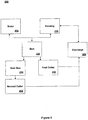
- a CRD deck 200 may be any mechanical or electro-mechanical system configured to cut vegetation or other items.
- CRD deck 200 may comprise a housing 210, a belt 220, a gearbox 230, a first cutter 240, a second cutter 250, and/or a discharge 260.
- CRD deck 200 may also be configured to interface with a motor 205.
- CRD deck 200 may be configured to transfer power from motor 205 at belt 220 to first cutter 240.
- Belt 220 may also be configured to transfer power to gearbox 230, which in turn provides power to second cutter 250.
- belt 220 may be configured to provide power to first cutter 240 and second cutter 250, such that the cutters rotate in opposing directions.
- First cutter 240 and second cutter 250 may be operatively coupled within housing 210.
- First cutter 240 and second cutter 250 may also be configured to conduct clippings (e.g. grass clippings, and/or vegetation clippings) within the volume of housing 210 to discharge 260.
- Discharge 260 may be configured to exhaust the clippings from housing 210 into a mowed area or into a suitable clipping capture mechanism (e.g. a grass catcher).
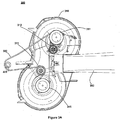
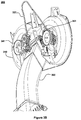
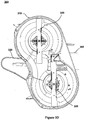
- a CRD deck 300 may be any suitable mechanical and/or electro-mechanical structure configured to cut vegetation when used with a riding lawnmower.
- CRD 300 may be configured to receive power from a motor configured with a motor power output mechanism 305.
- CRD deck 300 may comprise a housing 310, a belt 320, a gearbox 330, a first belt engagement 341, and a second belt engagement 351.
- Gearbox 330 may be coupled to housing 310.
- First belt engagement 341 may also be coupled housing 310.
- Second belt engagement 351 may be configured to engage gearbox 330 and may be coupled to housing 310.
- Belt 320 may be configured to couple with motor power output mechanism 305 and conduct power from a generator to the various components of CRD deck 300.
- belt 320 may be configured to engage first belt engagement 341 and second belt engagement 351, such that the power and corresponding movement provided from motor power output mechanism 305 to belt 320 causes movement of second belt engagement 351 and movement of gearbox 330.
- Motor power output mechanism 305 any suitable transfer mechanism coupled to any suitable generator configured to provide output power.
- Motor power output mechanism 305 may include, for example, a shaft, a gear, a fly wheel, and/or the like.
- the generator may be an internal combustion engine, an electric motor, or any other suitable power generator.
- Housing 310 may be any suitable structure configured to contain and conduct a substantial portion of grass clippings to a discharge. Housing 310 may define a volume. The volume may be any suitable shape for retaining and conducting a substantial portion of clippings. Housing 310 may be made of metal, plastic, composite, or any other suitable material that is durable enough for use in lawn maintenance equipment.
- Housing 310 may be monolithic. Housing 310 may comprise multiple components coupled together. Moreover, housing 310 may be cast, pressed, sintered, die-cut, machined, stamped, bonded, laminated, polished, smoothed, bent, rolled, molded, plated, coated, and/or otherwise shaped and/or formed via any suitable method and/or apparatus.
- Belt 320 may be any mechanism suitably configured to conduct power.
- Belt 320 comprises a first side and a second side.
- the first side may be substantially smooth such that it freely passes over a transfer mechanism, such as for example a pulley.
- the second side may comprise a friction mechanism or a friction surface (e.g. grooves, teeth and/or the like).
- Belt 320 may be operatively coupled to motor power output mechanism 305 at, for example, a shaft, fly wheel, or other suitable engagement point. Further, belt 320 may operatively couple to engagement mechanisms operatively coupled to first cutter 340 and gearbox 330.
- gearbox 330 may be any suitable power transfer mechanism.
- Gearbox 330 may be configured as a system of two or more gears, a worm drive, and/or any other suitable power transfer mechanism.
- Gearbox 330 may comprise an engagement gear 331 and a drive gear 332.
- Engagement gear 331 may be operatively coupled to second engagement 351.
- Engagement gear 331 may be configured to rotatable couple to or otherwise engage drive gear 332. This configuration causes second engagement 351 and engagement gear 331 to rotate in the same direction as the power transfer mechanism of motor power output mechanism 305.
- engagement gear 331 and drive gear 332 causes the gears to rotate in opposing directions, such that drive gear 332 rotates in the opposite direction of the power transfer mechanism of motor power output mechanism 305.
- drive gear 332 may couple to and drive a shaft.
- the shaft may be couple to second cutter 350.
- second engagement 351 may be configured to transfer power and a resulting torque from belt 320 to engagement gear 331.
- engagement gear 331 causes drive gear 332 to rotate.
- first engagement 341, second engagement 351, engagement gear 331, and drive gear 332 may each be any suitable size.
- First engagement 341, second engagement 351, engagement gear 331, and drive gear 332 may be proportionally sized to achieve a desired rotational relationship between first cutter 340 and second cutter 350.
- first engagement 341, second engagement 351, engagement gear 331, drive gear 332 may be sized such that first cutter 340 and second cutter 350 rotate at substantially the same rotational speed (e.g. substantially the same rpm).
- Second engagement 351 and gearbox 330 may be configured as a belt tensioning system.
- drive gear 332 may be coupled to and drive a shaft.
- the shaft may be coupled to second cutter 350 and causes second cutter 350 to rotate when belt 320 engages second engagement 351.
- Second engagement 351 may also be configured to rotate about or with respect to the shaft such that belt 320 is loosened or tightened depending on a user selected operating condition.
- second engagement 351 may be coupled to a belt tensioning mechanism 321.
- Belt tensioning mechanism 321 may be any suitable mechanism or assembly configured to accept a user input and cause the position of at least one first engagement 341 and second engagement 351 to change position in response to the user input.
- belt tensioning mechanism may include various linkage assemblies, cables, springs, fasteners, force transfer mechanisms, assemblies, and the like.
- belt 320 is loosened based on a user input at the belt tensioning mechanism 321, belt 320 blossoms (e.g. loosens such that belt 320 does not engage and/or rotate the first engagement 341 and/or second engagement 351) and the motor is able to run and otherwise drive the riding lawnmower without first cutter 340 or second cutter 350 rotating.
- the user may provide an input to the belt tensioning mechanism, which causes belt 320 to rotate, such that belt 320 tightens about second engagement 351. The rotation and resulting tightening cause belt 320 to engage and drive first engagement 340 and second engagement 351, which in turn drives first cutter 340 or second cutter 350.
- the configuration and rotation of second engagement 351 also acts as a clutching system. As discussed above, this clutching system allows the user to select whether to operate first cutter 340 and second cutter 350, while still being able to drive a riding lawn mower under the power of the motor.
- This configuration also reduces the need for expensive components and a complicated electromechanical system, including for example, idler pulleys, and a motor clutching system.
- the configuration of engagement gear 331 and drive gear 332 provide a rotational movement to second cutter 350 in the opposite direction as the rotation of motor power output mechanism 305.
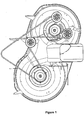
- the idler puller (as shown in Figure 1 ) is no longer needed because appropriate tension may be applied to belt 320 using second engagement 351.
- the motor clutching system (which is typically employed with a system like that shown in Figure 1 ) is also no longer needed because of the rotating functionality of second engagement 351, which allows the user to engage and disengage first cutter 340 and second cutter 350.
- CRD 300 may further comprise one of more pulleys, including for example pulley 311 and/or pulley 312.
- Pulley 311 and/or pulley 312 may be coupled to housing 310.
- pulley 311 and/or pulley 312 may be configured to freely rotate, while maintaining their respective position on housing 310.
- Pulley 311 may be configured to slidably engage and direct belt 320.
- pulley 312 may be configured to slidably engage and direct belt 320.
- Pulley 311 and/or pulley 312 may be configured to engage the first side of belt 320.
- pulley 311 and/or pulley 312 are configured to allow belt 320 to freely pass over pulley 311 and/or pulley 312 with minimal friction.
- pulley 311 and/or pulley 312 may each be any suitable size. Pulley 311 and/or pulley 312 may be proportionally sized to achieve a desired rotational relationship between first cutter 340 and second cutter 350. For example, pulley 311 and/or pulley 312 may be sized such that first cutter 340 and second cutter 350 rotate at substantially the same rotational speed (e.g. substantially the same rpm).
- CRD deck 300 may further comprise a first cutter 340 and a second cutter 350.
- First cutter 340 may couple to first engagement 341.
- first cutter may be rotated to belt 320 in the same direction as motor power output mechanism 305.
- Second cutter 350 may couple to drive gear 332. As such, second cutter 350 rotates in the opposite direction of the motion of both first cutter 340 and motor power output mechanism 305.
- first cutter 340 and second cutter 350 may not overlap (e.g. the distance between centers of first cutter 340 and second cutter 350 are more than twice the blade radius).
- First cutter 340 and second cutter 350 the cutters may be transversely offset by, for example, approximately 10 degrees to 30 degrees so that no track of uncut grass is left between first cutter 340 and second cutter 350.
- First cutter 340 may be any structure or mechanism configured to cut vegetation or other items.
- First cutter 340 may comprise at least one blade.
- first cutter 340 may comprise more than one blade.
- first cutter 340 may comprise more than one blade.
- First cutter 340 may also be coupled to a shaft, such that first cutter 340 is able to rotate.
- a first cutter 340 is driven by belt 320 at a belt engagement mechanism, wherein the second side of the belt drives the engagement mechanism.
- the belt engagement mechanism may couple directly to the shaft, and as such first cutter 340 may be rotated in the same direction as the drive mechanism.
- second cutter 350 may be any structure or mechanism configured to cut vegetation.
- Second cutter 350 may comprise at least one blade.
- second cutter 350 may comprise more than one blade.
- Second cutter 350 may also be coupled to a shaft, such that second cutter 350 is able to rotate.
- a second cutter 350 is driven by belt 320 at a belt engagement mechanism through gearbox 330, wherein the second side of the belt drives the engagement mechanism.
- the belt engagement mechanism may couple to a first gear in the gearbox which rotates in the same direction as the drive mechanism.
- the first gear may interface with a second gear.
- the second gear may be coupled to the shaft which supports second cutter 350. Further, the first gear may drive the second gear, causing the second gear to rotate in a direction that is opposite of the rotation of the drive mechanism. As such, second cutter 350 may be rotated in a direction that is opposite of the rotation of the drive mechanism.
- First cutter 340 may have a substantially rectangular shape, having two long sides and two shorter ends. Additionally, first cutter 340 may include various balancing and/or tuning mechanisms and/or structures, including for example, tabs at each end of first cutter 340. First cutter 340 may be configured with at least one substantially tapered (e.g. substantially sharp) edge along the leading long side (e.g. the long side which engages vegetation based on the direction of rotation of first cutter 340). In various embodiments, first cutter 340 may be configured with a substantially tapered (e.g. substantially sharp) edge along each long side, which allows first cutter 340 to more effectively cut various thickness or vegetation and produce a smaller (e.g. more finely chopped) clipping. Moreover, first cutter 340 may be configured with one or more blades as described above.
- first cutter 340 may be configured with one or more blades as described above.
- second cutter 350 may have a substantially rectangular shape, having two long sides and two shorter ends. Additionally, second cutter 350 may include various balancing and/or tuning mechanisms and/or structures, including for example, tabs at each end of second cutter 350. Second cutter 350 may be configured with at least one substantially tapered (e.g. substantially sharp) edge along the leading long side (e.g. the long side which engages vegetation based on the direction of rotation of second cutter 350). Second cutter 350 may be configured with substantially tapered (e.g. substantially sharp) edge along each long side, which allows second cutter 350 to more effectively cut various thickness or vegetation and produce a smaller (e.g. more finely chopped) clipping. Moreover, second cutter 350 may be configured with one or more blades as described above.
- discharge 360 may be any structure suitable for conducting clippings from housing 310.
- Discharge 360 may be coupled to housing 310.
- discharge 360 may be a chute, conduit, tube, or any other suitable structure.
- Discharge 360 may couple at or near the center of housing 310 between first cutter 340 and second cutter 350.
- discharge 360 may be configured to exhaust clippings from the back of a riding lawn mower (e.g. away from the direction of travel of the mower).
- the CRD deck 400 may be provided as a component of a mowing system.
- CRD deck 400 may be coupled to or installed on a riding lawnmower 460.
- Riding lawnmower 460 may be any suitable lawnmower or lawn-tractor suitably configured to accept a rear discharge deck.
- Riding lawnmower 460 may be configured to accept and obtain power from motor 405.
- the riding lawnmower may comprise a frame 461, a body 462, wheels 463, a steering system 464 and various other components, including for example, gauges, lights, a fuel tank, a starting system, and/or the like.
- Riding lawnmower 460 may be configured with any type of steering system 464, including for example, zero-turn steering, a standard steering configuration, or any other suitable configuration now known or hereinafter devised. Moreover, riding lawnmower 460 may employ any accessory available or otherwise configured to interface with CRD deck 400 including for example, a vacuum system, a bagging system, a blower system, or any other system now known or hereinafter devised.
- the terms "comprises,” “comprising,” or any other variation thereof, are intended to cover a non-exclusive inclusion, such that a process, method, article, or apparatus that comprises a list of elements does not include only those elements but may include other elements not expressly listed or inherent to such process, method, article, or apparatus.
Landscapes
- Life Sciences & Earth Sciences (AREA)
- Environmental Sciences (AREA)
- Harvester Elements (AREA)
Claims (12)
- Mittiges rückwärtiges Auswurfdecksystem (300), das Folgendes umfasst:einen Riemen (320), der eine erste Seite und eine zweite Seite umfasst;ein erstes Schneidwerkzeug (340), das durch die zweite Seite des Riemens (320) in Wirkeingriff genommen wird;ein Getriebe (330), das ein Antriebszahnrad (332) und ein Eingriffszahnrad (331), das mit dem Antriebszahnrad (332) in Wirkeingriff steht, umfasst, wobei das Eingriffszahnrad (331) dazu konfiguriert ist, sich in einer ersten Drehrichtung zu drehen, und das Antriebszahnrad (332) dazu konfiguriert ist, sich in einer zweiten Drehrichtung zu drehen, und wobei die erste und die zweite Drehrichtung entgegengesetzte Drehrichtungen sind;ein zweites Schneidwerkzeug (350), das mit dem Antriebszahnrad (332) gekoppelt ist, so dass sich das erste Schneidwerkzeug (340) und das zweite Schneidwerkzeug (350) als Reaktion auf eine Bewegung des Riemens (320) in entgegengesetzten Richtungen drehen;ein Eingriffsstück (351), das mit dem Eingriffszahnrad (331) gekoppelt ist, so dass das Eingriffsstück (351) dazu konfiguriert ist, durch den Riemen (320) in der ersten Drehrichtung gedreht zu werden;dadurch gekennzeichnet, dass das Getriebe (330) durch die zweite Seite des Riemens (320) in Wirkeingriff genommen wird und wobei das Eingriffsstück (351) und das Eingriffszahnrad (331) dazu konfiguriert sind, aus einer ersten Position, in der der Riemen (320) in Eingriff genommen wird, in eine zweite Position, in der der Riemen (320) außer Eingriff gelangt, bewegt zu werden.
- System nach Anspruch 1, das ferner eine Riemenspannvorrichtung (321) zum Bewegen des Eingriffsstücks (351) aus der ersten Position in die zweite Position umfasst.
- System nach einem vorhergehenden Anspruch, wobei das Eingriffsstück (351) eine Riemenscheibe (312) umfasst, die mit dem Eingriffszahnrad (331) verbunden ist, und wobei die Riemenscheibe (312) dahingehend mit dem Riemen (320) gekoppelt ist, das Eingriffszahnrad (331) zu drehen, wenn sich das Eingriffsstück (351) in der ersten Position befindet.
- System nach einem vorhergehenden Anspruch, wobei das zweite Schneidwerkzeug (350) mit einer Welle gekoppelt ist und die Welle auch mit dem Antriebszahnrad (332) gekoppelt ist, so dass sich das zweite Schneidwerkzeug (350) bei Drehung des Antriebszahnrads (332) auch dreht.
- System nach einem vorhergehenden Anspruch, wobei das Eingriffsstück (351) mit dem Eingriffszahnrad (331) entlang einer gemeinsamen Welle gekoppelt ist, so dass sich das Eingriffszahnrad (331) und das Eingriffsstück (351) in derselben Richtung drehen.
- System nach einem vorhergehenden Anspruch, wobei das drehbare Riemeneingriffsstück (351) als ein Kupplungssystem konfiguriert ist, so dass das erste Schneidwerkzeug (340) und das zweite Schneidwerkzeug (350) basierend auf einer Benutzereingabe eingerückt und ausgerückt werden können.
- Rasenmäher (460), der Folgendes umfasst:ein mittiges rückwärtiges Auswurfdeck (300), das Folgendes umfasst:einen Riemen (320),ein zweites Schneidwerkzeug (350), das als Reaktion auf eine Bewegung des Riemens (320) bewegbar ist;ein Eingriffszahnrad (331), das dazu konfiguriert ist, sich in einer ersten Drehrichtung zu drehen;ein Antriebszahnrad (332), das mit dem Eingriffszahnrad (331) und dem zweiten Schneidwerkzeug (350) in Wirkeingriff steht;ein Eingriffsstück (351), das mit dem Eingriffszahnrad (331) gekoppelt und mit dem zweiten Schneidwerkzeug (350) drehbar gekoppelt ist;einen Rahmen (461), wobei das mittige rückwärtige Auswurfdeck (300) mit dem Rahmen (461) gekoppelt ist; undeinen Motor (405), der mit dem Rahmen gekoppelt ist, wobei der Motor (405) dazu konfiguriert ist, Energie und eine erste Bewegung in einer ersten Drehrichtung für den Riemen (320) bereitzustellen;dadurch gekennzeichnet, dass das Eingriffsstück (351) dazu konfiguriert ist, durch Drehen um das Antriebszahnrad (332) in einer ersten Position mit dem Riemen in Eingriff zu gelangen, und in einer zweiten Position mit dem Riemen (320) außer Eingriff zu gelangen.
- Rasenmäher nach Anspruch 7,
wobei das Eingriffsstück (351) und das Eingriffzahnrad (331) an einer ersten gemeinsamen Welle angebracht sind und sich in einer ersten Drehrichtung drehen,
wobei das zweite Schneidwerkzeug (350) und das Antriebszahnrad (332) an einer zweiten gemeinsamen Welle angebracht sind,
wobei das Antriebszahnrad (332) dahingehend mit dem Eingriffszahnrad (331) gekoppelt ist, sowohl das Antriebszahnrad (332) als auch das zweite Schneidwerkzeug (350) in einer zweiten Drehrichtung zu drehen, und
wobei die erste und die zweite Drehrichtung im Wesentlichen entgegengesetzt sind. - Rasenmäher nach Anspruch 8, der ferner ein erstes Schneidwerkzeug (340) umfasst, das als Reaktion auf eine Bewegung des Riemens (320) in der ersten Drehrichtung bewegbar ist, wobei der Riemen (320) eine erste Seite und eine zweite Seite umfasst und wobei die erste Seite eine im Wesentlichen glatte Fläche umfasst und wobei die zweite Seite mehrere Nuten oder mehrere Zähne umfasst.
- Verfahren zum Betrieb eines Rasenmähers, das Folgendes umfasst:Spannen eines Riemens (320) auf einen Energieübertragungsmechanismus eines Motors (405) und ein zweites Eingriffsstück (351) als Reaktion auf eine Benutzereingabe, wobei das zweite Eingriffsstück (351) über eine Welle mit einem Eingriffszahnrad (331) gekoppelt ist und wobei das Eingriffszahnrad (331) mit einem Antriebszahnrad (332) in Wirkeingriff steht ;Drehen des zweiten Eingriffsstücks (351) durch den Riemen (320) in einer ersten Drehrichtung, wodurch das Eingriffzahnrad (331) in der ersten Drehrichtung gedreht wird und das Antriebszahnrad (332) in einer zweiten Drehrichtung gedreht wird;Drehen eines zweiten Schneidwerkzeugs (350) durch das Antriebszahnrad (332) in der zweiten Drehrichtung, wobei das zweite Schneidwerkzeug (350) zumindest zum Teil von einem Gehäuse (310) umgeben wird; undDrehen eines ersten Schneidwerkzeugs (340) durch den Riemen (320) an einem ersten Eingriffsstück (341) in der ersten Drehrichtung, wobei das erste Schneidwerkzeug (340) zumindest zum Teil von dem Gehäuse (310) umgeben wird,wobei das zweite Eingriffsstück (351) dazu konfiguriert ist, aus einer ersten Position in eine zweite Position bewegt zu werden, wobei die erste Position dem Ineingriffbringen des Riemens (320) mit dem zweiten Eingriffsstück (351) entspricht und wobei die zweite Position dem Außereingriffbringen des Riemens (320) mit dem zweiten Eingriffsstück (351) entspricht.
- Verfahren nach Anspruch 10, wobei das zweite Eingriffsstück (351) und das Eingriffzahnrad (331) an einer ersten gemeinsamen Welle angebracht sind und sich in einer ersten Drehrichtung drehen, wobei das zweite Schneidwerkzeug (350) und das Antriebszahnrad (332) an einer zweiten gemeinsamen Welle angebracht sind, wobei das Antriebszahnrad (332) dahingehend mit dem Eingriffszahnrad (331) gekoppelt ist, sowohl das Antriebszahnrad (332) als auch das zweite Schneidwerkzeug (350) in einer zweiten Drehrichtung zu drehen.
- Verfahren nach Anspruch 10 oder 11, das ferner Leiten von Schnittgut von dem ersten Schneidwerkzeug (340) und dem zweiten Schneidwerkzeug (350) durch das Gehäuse (310) zu einem mittigen hinteren Auswurf umfasst und wobei die erste Drehrichtung zu der zweiten Drehrichtung im Wesentlichen entgegengesetzt ist.
Applications Claiming Priority (1)
| Application Number | Priority Date | Filing Date | Title |
|---|---|---|---|
| PCT/US2010/047235 WO2012030325A1 (en) | 2010-08-31 | 2010-08-31 | Center rear discharge deck |
Publications (3)
| Publication Number | Publication Date |
|---|---|
| EP2611277A1 EP2611277A1 (de) | 2013-07-10 |
| EP2611277A4 EP2611277A4 (de) | 2015-09-09 |
| EP2611277B1 true EP2611277B1 (de) | 2018-03-21 |
Family
ID=45773166
Family Applications (1)
| Application Number | Title | Priority Date | Filing Date |
|---|---|---|---|
| EP10856798.3A Active EP2611277B1 (de) | 2010-08-31 | 2010-08-31 | Mittiges rückwärtiges entladedeck |
Country Status (6)
| Country | Link |
|---|---|
| US (1) | US8635841B2 (de) |
| EP (1) | EP2611277B1 (de) |
| CN (1) | CN103188928B (de) |
| AU (1) | AU2010359872B2 (de) |
| CA (1) | CA2809235C (de) |
| WO (1) | WO2012030325A1 (de) |
Families Citing this family (16)
| Publication number | Priority date | Publication date | Assignee | Title |
|---|---|---|---|---|
| ES2707155T3 (es) | 2006-03-17 | 2019-04-02 | Irobot Corp | Confinamiento de robot |
| JP2014060940A (ja) * | 2012-09-20 | 2014-04-10 | Honda Motor Co Ltd | 乗用芝刈機 |
| WO2015153109A1 (en) | 2014-03-31 | 2015-10-08 | Irobot Corporation | Autonomous mobile robot |
| US9510505B2 (en) | 2014-10-10 | 2016-12-06 | Irobot Corporation | Autonomous robot localization |
| US9516806B2 (en) | 2014-10-10 | 2016-12-13 | Irobot Corporation | Robotic lawn mowing boundary determination |
| US9420741B2 (en) | 2014-12-15 | 2016-08-23 | Irobot Corporation | Robot lawnmower mapping |
| US9538702B2 (en) | 2014-12-22 | 2017-01-10 | Irobot Corporation | Robotic mowing of separated lawn areas |
| JP6386388B2 (ja) * | 2015-01-30 | 2018-09-05 | 株式会社クボタ | 草刈機 |
| US11115798B2 (en) | 2015-07-23 | 2021-09-07 | Irobot Corporation | Pairing a beacon with a mobile robot |
| US10034421B2 (en) | 2015-07-24 | 2018-07-31 | Irobot Corporation | Controlling robotic lawnmowers |
| US10021830B2 (en) | 2016-02-02 | 2018-07-17 | Irobot Corporation | Blade assembly for a grass cutting mobile robot |
| US10459063B2 (en) | 2016-02-16 | 2019-10-29 | Irobot Corporation | Ranging and angle of arrival antenna system for a mobile robot |
| JP2017163872A (ja) * | 2016-03-15 | 2017-09-21 | 本田技研工業株式会社 | 芝刈機 |
| JP2017163871A (ja) * | 2016-03-15 | 2017-09-21 | 本田技研工業株式会社 | 芝刈機 |
| US11470774B2 (en) | 2017-07-14 | 2022-10-18 | Irobot Corporation | Blade assembly for a grass cutting mobile robot |
| JP7193415B2 (ja) * | 2019-05-21 | 2022-12-20 | 株式会社クボタ | モーアユニット |
Family Cites Families (7)
| Publication number | Priority date | Publication date | Assignee | Title |
|---|---|---|---|---|
| FR1500062A (fr) * | 1966-06-21 | 1967-11-03 | Heywang Ets | Faucheuse rotative |
| JP3025618B2 (ja) | 1993-11-19 | 2000-03-27 | ユニッタ株式会社 | 動力伝達ベルト、およびこの動力伝達ベルトに用いる心線と帆布 |
| US5669213A (en) | 1995-11-03 | 1997-09-23 | Allied Products Corporation | Counterrotation mulching mower |
| JPH09187140A (ja) | 1996-01-05 | 1997-07-22 | Honda Motor Co Ltd | 芝刈機のカッタブレード駆動装置 |
| US6176071B1 (en) * | 1999-09-10 | 2001-01-23 | Deere & Company | Tensioning idler assembly for mower deck belt drive |
| JP4096701B2 (ja) | 2002-11-06 | 2008-06-04 | 井関農機株式会社 | 草刈装置 |
| CN201243488Y (zh) * | 2008-05-23 | 2009-05-27 | 无锡职业技术学院 | 多功能遥控草坪机 |
-
2010
- 2010-08-31 EP EP10856798.3A patent/EP2611277B1/de active Active
- 2010-08-31 AU AU2010359872A patent/AU2010359872B2/en active Active
- 2010-08-31 WO PCT/US2010/047235 patent/WO2012030325A1/en not_active Ceased
- 2010-08-31 CN CN201080069921.3A patent/CN103188928B/zh not_active Expired - Fee Related
- 2010-08-31 CA CA2809235A patent/CA2809235C/en not_active Expired - Fee Related
- 2010-08-31 US US13/819,780 patent/US8635841B2/en active Active
Non-Patent Citations (1)
| Title |
|---|
| None * |
Also Published As
| Publication number | Publication date |
|---|---|
| US8635841B2 (en) | 2014-01-28 |
| CA2809235A1 (en) | 2012-03-08 |
| EP2611277A4 (de) | 2015-09-09 |
| CA2809235C (en) | 2017-10-24 |
| AU2010359872A1 (en) | 2013-03-14 |
| CN103188928A (zh) | 2013-07-03 |
| EP2611277A1 (de) | 2013-07-10 |
| CN103188928B (zh) | 2017-05-10 |
| US20130152538A1 (en) | 2013-06-20 |
| AU2010359872B2 (en) | 2014-12-18 |
| WO2012030325A1 (en) | 2012-03-08 |
Similar Documents
| Publication | Publication Date | Title |
|---|---|---|
| EP2611277B1 (de) | Mittiges rückwärtiges entladedeck | |
| US6604348B2 (en) | Mower with engine-driven blade and electrical propulsion | |
| AU2019201017B2 (en) | All wheel drive, walk behind mower | |
| US6948299B2 (en) | Hybrid power equipment | |
| US10897845B2 (en) | Cutter housing assembly for a lawnmower, lawnmower having same, and convertible lawnmower | |
| CN107846842A (zh) | 具有多个刀片的电动割草机 | |
| US11006573B2 (en) | Cutter housing assembly for a lawnmower, lawnmower having same, and convertible lawnmower | |
| US9032701B2 (en) | Grass collection system with through-shaft PTO | |
| EP1457103B1 (de) | Drosselklappe | |
| EP1597956A1 (de) | Handgeführter Mäher mit Kupplung | |
| EP2966969B1 (de) | Antriebssystem für handgeführten mäher | |
| JP2003158907A (ja) | 乗用芝刈装置 | |
| US10641363B2 (en) | Disengagement mechanism for a walk behind mower | |
| KR20170054067A (ko) | 승용타입 예취기용 보조예취기 | |
| JPH04299910A (ja) | 草刈機 | |
| JPH05219816A (ja) | 歩行型芝刈機 | |
| JPH04293415A (ja) | 草刈機 |
Legal Events
| Date | Code | Title | Description |
|---|---|---|---|
| PUAI | Public reference made under article 153(3) epc to a published international application that has entered the european phase |
Free format text: ORIGINAL CODE: 0009012 |
|
| 17P | Request for examination filed |
Effective date: 20130315 |
|
| AK | Designated contracting states |
Kind code of ref document: A1 Designated state(s): AL AT BE BG CH CY CZ DE DK EE ES FI FR GB GR HR HU IE IS IT LI LT LU LV MC MK MT NL NO PL PT RO SE SI SK SM TR |
|
| DAX | Request for extension of the european patent (deleted) | ||
| RAP1 | Party data changed (applicant data changed or rights of an application transferred) |
Owner name: HUSQVARNA AB |
|
| REG | Reference to a national code |
Ref country code: DE Ref legal event code: R079 Ref document number: 602010049417 Country of ref document: DE Free format text: PREVIOUS MAIN CLASS: A01D0034840000 Ipc: A01D0034710000 |
|
| RA4 | Supplementary search report drawn up and despatched (corrected) |
Effective date: 20150807 |
|
| RIC1 | Information provided on ipc code assigned before grant |
Ipc: A01D 34/71 20060101AFI20150803BHEP Ipc: A01D 34/76 20060101ALI20150803BHEP |
|
| 17Q | First examination report despatched |
Effective date: 20170331 |
|
| GRAP | Despatch of communication of intention to grant a patent |
Free format text: ORIGINAL CODE: EPIDOSNIGR1 |
|
| INTG | Intention to grant announced |
Effective date: 20171004 |
|
| RIN1 | Information on inventor provided before grant (corrected) |
Inventor name: CHAPMAN, SETH Inventor name: FISER, JAKE |
|
| GRAJ | Information related to disapproval of communication of intention to grant by the applicant or resumption of examination proceedings by the epo deleted |
Free format text: ORIGINAL CODE: EPIDOSDIGR1 |
|
| GRAR | Information related to intention to grant a patent recorded |
Free format text: ORIGINAL CODE: EPIDOSNIGR71 |
|
| GRAS | Grant fee paid |
Free format text: ORIGINAL CODE: EPIDOSNIGR3 |
|
| GRAA | (expected) grant |
Free format text: ORIGINAL CODE: 0009210 |
|
| INTC | Intention to grant announced (deleted) | ||
| AK | Designated contracting states |
Kind code of ref document: B1 Designated state(s): AL AT BE BG CH CY CZ DE DK EE ES FI FR GB GR HR HU IE IS IT LI LT LU LV MC MK MT NL NO PL PT RO SE SI SK SM TR |
|
| INTG | Intention to grant announced |
Effective date: 20180212 |
|
| REG | Reference to a national code |
Ref country code: GB Ref legal event code: FG4D |
|
| REG | Reference to a national code |
Ref country code: CH Ref legal event code: EP |
|
| REG | Reference to a national code |
Ref country code: AT Ref legal event code: REF Ref document number: 980075 Country of ref document: AT Kind code of ref document: T Effective date: 20180415 |
|
| REG | Reference to a national code |
Ref country code: IE Ref legal event code: FG4D |
|
| REG | Reference to a national code |
Ref country code: DE Ref legal event code: R096 Ref document number: 602010049417 Country of ref document: DE |
|
| REG | Reference to a national code |
Ref country code: FR Ref legal event code: PLFP Year of fee payment: 9 |
|
| REG | Reference to a national code |
Ref country code: NL Ref legal event code: MP Effective date: 20180321 |
|
| PG25 | Lapsed in a contracting state [announced via postgrant information from national office to epo] |
Ref country code: NO Free format text: LAPSE BECAUSE OF FAILURE TO SUBMIT A TRANSLATION OF THE DESCRIPTION OR TO PAY THE FEE WITHIN THE PRESCRIBED TIME-LIMIT Effective date: 20180621 Ref country code: LT Free format text: LAPSE BECAUSE OF FAILURE TO SUBMIT A TRANSLATION OF THE DESCRIPTION OR TO PAY THE FEE WITHIN THE PRESCRIBED TIME-LIMIT Effective date: 20180321 Ref country code: HR Free format text: LAPSE BECAUSE OF FAILURE TO SUBMIT A TRANSLATION OF THE DESCRIPTION OR TO PAY THE FEE WITHIN THE PRESCRIBED TIME-LIMIT Effective date: 20180321 Ref country code: CY Free format text: LAPSE BECAUSE OF FAILURE TO SUBMIT A TRANSLATION OF THE DESCRIPTION OR TO PAY THE FEE WITHIN THE PRESCRIBED TIME-LIMIT Effective date: 20180321 Ref country code: FI Free format text: LAPSE BECAUSE OF FAILURE TO SUBMIT A TRANSLATION OF THE DESCRIPTION OR TO PAY THE FEE WITHIN THE PRESCRIBED TIME-LIMIT Effective date: 20180321 |
|
| REG | Reference to a national code |
Ref country code: LT Ref legal event code: MG4D |
|
| REG | Reference to a national code |
Ref country code: AT Ref legal event code: MK05 Ref document number: 980075 Country of ref document: AT Kind code of ref document: T Effective date: 20180321 |
|
| PG25 | Lapsed in a contracting state [announced via postgrant information from national office to epo] |
Ref country code: GR Free format text: LAPSE BECAUSE OF FAILURE TO SUBMIT A TRANSLATION OF THE DESCRIPTION OR TO PAY THE FEE WITHIN THE PRESCRIBED TIME-LIMIT Effective date: 20180622 Ref country code: LV Free format text: LAPSE BECAUSE OF FAILURE TO SUBMIT A TRANSLATION OF THE DESCRIPTION OR TO PAY THE FEE WITHIN THE PRESCRIBED TIME-LIMIT Effective date: 20180321 Ref country code: SE Free format text: LAPSE BECAUSE OF FAILURE TO SUBMIT A TRANSLATION OF THE DESCRIPTION OR TO PAY THE FEE WITHIN THE PRESCRIBED TIME-LIMIT Effective date: 20180321 Ref country code: BG Free format text: LAPSE BECAUSE OF FAILURE TO SUBMIT A TRANSLATION OF THE DESCRIPTION OR TO PAY THE FEE WITHIN THE PRESCRIBED TIME-LIMIT Effective date: 20180621 |
|
| PG25 | Lapsed in a contracting state [announced via postgrant information from national office to epo] |
Ref country code: PL Free format text: LAPSE BECAUSE OF FAILURE TO SUBMIT A TRANSLATION OF THE DESCRIPTION OR TO PAY THE FEE WITHIN THE PRESCRIBED TIME-LIMIT Effective date: 20180321 Ref country code: EE Free format text: LAPSE BECAUSE OF FAILURE TO SUBMIT A TRANSLATION OF THE DESCRIPTION OR TO PAY THE FEE WITHIN THE PRESCRIBED TIME-LIMIT Effective date: 20180321 Ref country code: AL Free format text: LAPSE BECAUSE OF FAILURE TO SUBMIT A TRANSLATION OF THE DESCRIPTION OR TO PAY THE FEE WITHIN THE PRESCRIBED TIME-LIMIT Effective date: 20180321 Ref country code: IT Free format text: LAPSE BECAUSE OF FAILURE TO SUBMIT A TRANSLATION OF THE DESCRIPTION OR TO PAY THE FEE WITHIN THE PRESCRIBED TIME-LIMIT Effective date: 20180321 Ref country code: ES Free format text: LAPSE BECAUSE OF FAILURE TO SUBMIT A TRANSLATION OF THE DESCRIPTION OR TO PAY THE FEE WITHIN THE PRESCRIBED TIME-LIMIT Effective date: 20180321 Ref country code: NL Free format text: LAPSE BECAUSE OF FAILURE TO SUBMIT A TRANSLATION OF THE DESCRIPTION OR TO PAY THE FEE WITHIN THE PRESCRIBED TIME-LIMIT Effective date: 20180321 Ref country code: RO Free format text: LAPSE BECAUSE OF FAILURE TO SUBMIT A TRANSLATION OF THE DESCRIPTION OR TO PAY THE FEE WITHIN THE PRESCRIBED TIME-LIMIT Effective date: 20180321 |
|
| PG25 | Lapsed in a contracting state [announced via postgrant information from national office to epo] |
Ref country code: CZ Free format text: LAPSE BECAUSE OF FAILURE TO SUBMIT A TRANSLATION OF THE DESCRIPTION OR TO PAY THE FEE WITHIN THE PRESCRIBED TIME-LIMIT Effective date: 20180321 Ref country code: SM Free format text: LAPSE BECAUSE OF FAILURE TO SUBMIT A TRANSLATION OF THE DESCRIPTION OR TO PAY THE FEE WITHIN THE PRESCRIBED TIME-LIMIT Effective date: 20180321 Ref country code: AT Free format text: LAPSE BECAUSE OF FAILURE TO SUBMIT A TRANSLATION OF THE DESCRIPTION OR TO PAY THE FEE WITHIN THE PRESCRIBED TIME-LIMIT Effective date: 20180321 Ref country code: SK Free format text: LAPSE BECAUSE OF FAILURE TO SUBMIT A TRANSLATION OF THE DESCRIPTION OR TO PAY THE FEE WITHIN THE PRESCRIBED TIME-LIMIT Effective date: 20180321 |
|
| PG25 | Lapsed in a contracting state [announced via postgrant information from national office to epo] |
Ref country code: PT Free format text: LAPSE BECAUSE OF FAILURE TO SUBMIT A TRANSLATION OF THE DESCRIPTION OR TO PAY THE FEE WITHIN THE PRESCRIBED TIME-LIMIT Effective date: 20180723 |
|
| REG | Reference to a national code |
Ref country code: DE Ref legal event code: R097 Ref document number: 602010049417 Country of ref document: DE |
|
| PLBE | No opposition filed within time limit |
Free format text: ORIGINAL CODE: 0009261 |
|
| STAA | Information on the status of an ep patent application or granted ep patent |
Free format text: STATUS: NO OPPOSITION FILED WITHIN TIME LIMIT |
|
| PG25 | Lapsed in a contracting state [announced via postgrant information from national office to epo] |
Ref country code: DK Free format text: LAPSE BECAUSE OF FAILURE TO SUBMIT A TRANSLATION OF THE DESCRIPTION OR TO PAY THE FEE WITHIN THE PRESCRIBED TIME-LIMIT Effective date: 20180321 |
|
| 26N | No opposition filed |
Effective date: 20190102 |
|
| PG25 | Lapsed in a contracting state [announced via postgrant information from national office to epo] |
Ref country code: MC Free format text: LAPSE BECAUSE OF FAILURE TO SUBMIT A TRANSLATION OF THE DESCRIPTION OR TO PAY THE FEE WITHIN THE PRESCRIBED TIME-LIMIT Effective date: 20180321 |
|
| REG | Reference to a national code |
Ref country code: CH Ref legal event code: PL |
|
| GBPC | Gb: european patent ceased through non-payment of renewal fee |
Effective date: 20180831 |
|
| PG25 | Lapsed in a contracting state [announced via postgrant information from national office to epo] |
Ref country code: LI Free format text: LAPSE BECAUSE OF NON-PAYMENT OF DUE FEES Effective date: 20180831 Ref country code: CH Free format text: LAPSE BECAUSE OF NON-PAYMENT OF DUE FEES Effective date: 20180831 Ref country code: LU Free format text: LAPSE BECAUSE OF NON-PAYMENT OF DUE FEES Effective date: 20180831 |
|
| REG | Reference to a national code |
Ref country code: BE Ref legal event code: MM Effective date: 20180831 |
|
| PG25 | Lapsed in a contracting state [announced via postgrant information from national office to epo] |
Ref country code: SI Free format text: LAPSE BECAUSE OF FAILURE TO SUBMIT A TRANSLATION OF THE DESCRIPTION OR TO PAY THE FEE WITHIN THE PRESCRIBED TIME-LIMIT Effective date: 20180321 |
|
| PG25 | Lapsed in a contracting state [announced via postgrant information from national office to epo] |
Ref country code: BE Free format text: LAPSE BECAUSE OF NON-PAYMENT OF DUE FEES Effective date: 20180831 |
|
| PG25 | Lapsed in a contracting state [announced via postgrant information from national office to epo] |
Ref country code: GB Free format text: LAPSE BECAUSE OF NON-PAYMENT OF DUE FEES Effective date: 20180831 |
|
| PG25 | Lapsed in a contracting state [announced via postgrant information from national office to epo] |
Ref country code: MT Free format text: LAPSE BECAUSE OF NON-PAYMENT OF DUE FEES Effective date: 20180831 |
|
| PG25 | Lapsed in a contracting state [announced via postgrant information from national office to epo] |
Ref country code: TR Free format text: LAPSE BECAUSE OF FAILURE TO SUBMIT A TRANSLATION OF THE DESCRIPTION OR TO PAY THE FEE WITHIN THE PRESCRIBED TIME-LIMIT Effective date: 20180321 |
|
| PG25 | Lapsed in a contracting state [announced via postgrant information from national office to epo] |
Ref country code: HU Free format text: LAPSE BECAUSE OF FAILURE TO SUBMIT A TRANSLATION OF THE DESCRIPTION OR TO PAY THE FEE WITHIN THE PRESCRIBED TIME-LIMIT; INVALID AB INITIO Effective date: 20100831 |
|
| PG25 | Lapsed in a contracting state [announced via postgrant information from national office to epo] |
Ref country code: IE Free format text: LAPSE BECAUSE OF NON-PAYMENT OF DUE FEES Effective date: 20180831 Ref country code: MK Free format text: LAPSE BECAUSE OF NON-PAYMENT OF DUE FEES Effective date: 20180321 |
|
| PG25 | Lapsed in a contracting state [announced via postgrant information from national office to epo] |
Ref country code: IS Free format text: LAPSE BECAUSE OF FAILURE TO SUBMIT A TRANSLATION OF THE DESCRIPTION OR TO PAY THE FEE WITHIN THE PRESCRIBED TIME-LIMIT Effective date: 20180721 |
|
| P01 | Opt-out of the competence of the unified patent court (upc) registered |
Effective date: 20230419 |
|
| PGFP | Annual fee paid to national office [announced via postgrant information from national office to epo] |
Ref country code: DE Payment date: 20250708 Year of fee payment: 16 |
|
| PGFP | Annual fee paid to national office [announced via postgrant information from national office to epo] |
Ref country code: FR Payment date: 20250707 Year of fee payment: 16 |