EP2617802B1 - Antioxidationszusammensetzung und schmierölzusammensetzung damit - Google Patents
Antioxidationszusammensetzung und schmierölzusammensetzung damit Download PDFInfo
- Publication number
- EP2617802B1 EP2617802B1 EP11824962.2A EP11824962A EP2617802B1 EP 2617802 B1 EP2617802 B1 EP 2617802B1 EP 11824962 A EP11824962 A EP 11824962A EP 2617802 B1 EP2617802 B1 EP 2617802B1
- Authority
- EP
- European Patent Office
- Prior art keywords
- group
- antioxidant
- carbon atoms
- branched
- lubricating oil
- Prior art date
- Legal status (The legal status is an assumption and is not a legal conclusion. Google has not performed a legal analysis and makes no representation as to the accuracy of the status listed.)
- Active
Links
Classifications
-
- C—CHEMISTRY; METALLURGY
- C10—PETROLEUM, GAS OR COKE INDUSTRIES; TECHNICAL GASES CONTAINING CARBON MONOXIDE; FUELS; LUBRICANTS; PEAT
- C10M—LUBRICATING COMPOSITIONS; USE OF CHEMICAL SUBSTANCES EITHER ALONE OR AS LUBRICATING INGREDIENTS IN A LUBRICATING COMPOSITION
- C10M141/00—Lubricating compositions characterised by the additive being a mixture of two or more compounds covered by more than one of the main groups C10M125/00 - C10M139/00, each of these compounds being essential
- C10M141/06—Lubricating compositions characterised by the additive being a mixture of two or more compounds covered by more than one of the main groups C10M125/00 - C10M139/00, each of these compounds being essential at least one of them being an organic nitrogen-containing compound
-
- C—CHEMISTRY; METALLURGY
- C09—DYES; PAINTS; POLISHES; NATURAL RESINS; ADHESIVES; COMPOSITIONS NOT OTHERWISE PROVIDED FOR; APPLICATIONS OF MATERIALS NOT OTHERWISE PROVIDED FOR
- C09K—MATERIALS FOR MISCELLANEOUS APPLICATIONS, NOT PROVIDED FOR ELSEWHERE
- C09K15/00—Anti-oxidant compositions; Compositions inhibiting chemical change
- C09K15/04—Anti-oxidant compositions; Compositions inhibiting chemical change containing organic compounds
- C09K15/06—Anti-oxidant compositions; Compositions inhibiting chemical change containing organic compounds containing oxygen
- C09K15/08—Anti-oxidant compositions; Compositions inhibiting chemical change containing organic compounds containing oxygen containing a phenol or quinone moiety
-
- C—CHEMISTRY; METALLURGY
- C09—DYES; PAINTS; POLISHES; NATURAL RESINS; ADHESIVES; COMPOSITIONS NOT OTHERWISE PROVIDED FOR; APPLICATIONS OF MATERIALS NOT OTHERWISE PROVIDED FOR
- C09K—MATERIALS FOR MISCELLANEOUS APPLICATIONS, NOT PROVIDED FOR ELSEWHERE
- C09K15/00—Anti-oxidant compositions; Compositions inhibiting chemical change
- C09K15/04—Anti-oxidant compositions; Compositions inhibiting chemical change containing organic compounds
- C09K15/16—Anti-oxidant compositions; Compositions inhibiting chemical change containing organic compounds containing nitrogen
- C09K15/18—Anti-oxidant compositions; Compositions inhibiting chemical change containing organic compounds containing nitrogen containing an amine or imine moiety
-
- C—CHEMISTRY; METALLURGY
- C09—DYES; PAINTS; POLISHES; NATURAL RESINS; ADHESIVES; COMPOSITIONS NOT OTHERWISE PROVIDED FOR; APPLICATIONS OF MATERIALS NOT OTHERWISE PROVIDED FOR
- C09K—MATERIALS FOR MISCELLANEOUS APPLICATIONS, NOT PROVIDED FOR ELSEWHERE
- C09K15/00—Anti-oxidant compositions; Compositions inhibiting chemical change
- C09K15/04—Anti-oxidant compositions; Compositions inhibiting chemical change containing organic compounds
- C09K15/26—Anti-oxidant compositions; Compositions inhibiting chemical change containing organic compounds containing nitrogen and sulfur
-
- C—CHEMISTRY; METALLURGY
- C10—PETROLEUM, GAS OR COKE INDUSTRIES; TECHNICAL GASES CONTAINING CARBON MONOXIDE; FUELS; LUBRICANTS; PEAT
- C10M—LUBRICATING COMPOSITIONS; USE OF CHEMICAL SUBSTANCES EITHER ALONE OR AS LUBRICATING INGREDIENTS IN A LUBRICATING COMPOSITION
- C10M101/00—Lubricating compositions characterised by the base-material being a mineral or fatty oil
- C10M101/02—Petroleum fractions
-
- C—CHEMISTRY; METALLURGY
- C10—PETROLEUM, GAS OR COKE INDUSTRIES; TECHNICAL GASES CONTAINING CARBON MONOXIDE; FUELS; LUBRICANTS; PEAT
- C10M—LUBRICATING COMPOSITIONS; USE OF CHEMICAL SUBSTANCES EITHER ALONE OR AS LUBRICATING INGREDIENTS IN A LUBRICATING COMPOSITION
- C10M101/00—Lubricating compositions characterised by the base-material being a mineral or fatty oil
- C10M101/04—Fatty oil fractions
-
- C—CHEMISTRY; METALLURGY
- C10—PETROLEUM, GAS OR COKE INDUSTRIES; TECHNICAL GASES CONTAINING CARBON MONOXIDE; FUELS; LUBRICANTS; PEAT
- C10M—LUBRICATING COMPOSITIONS; USE OF CHEMICAL SUBSTANCES EITHER ALONE OR AS LUBRICATING INGREDIENTS IN A LUBRICATING COMPOSITION
- C10M103/00—Lubricating compositions characterised by the base-material being an inorganic material
- C10M103/04—Metals; Alloys
-
- C—CHEMISTRY; METALLURGY
- C10—PETROLEUM, GAS OR COKE INDUSTRIES; TECHNICAL GASES CONTAINING CARBON MONOXIDE; FUELS; LUBRICANTS; PEAT
- C10M—LUBRICATING COMPOSITIONS; USE OF CHEMICAL SUBSTANCES EITHER ALONE OR AS LUBRICATING INGREDIENTS IN A LUBRICATING COMPOSITION
- C10M105/00—Lubricating compositions characterised by the base-material being a non-macromolecular organic compound
-
- C—CHEMISTRY; METALLURGY
- C10—PETROLEUM, GAS OR COKE INDUSTRIES; TECHNICAL GASES CONTAINING CARBON MONOXIDE; FUELS; LUBRICANTS; PEAT
- C10M—LUBRICATING COMPOSITIONS; USE OF CHEMICAL SUBSTANCES EITHER ALONE OR AS LUBRICATING INGREDIENTS IN A LUBRICATING COMPOSITION
- C10M105/00—Lubricating compositions characterised by the base-material being a non-macromolecular organic compound
- C10M105/08—Lubricating compositions characterised by the base-material being a non-macromolecular organic compound containing oxygen
- C10M105/22—Carboxylic acids or their salts
-
- C—CHEMISTRY; METALLURGY
- C10—PETROLEUM, GAS OR COKE INDUSTRIES; TECHNICAL GASES CONTAINING CARBON MONOXIDE; FUELS; LUBRICANTS; PEAT
- C10M—LUBRICATING COMPOSITIONS; USE OF CHEMICAL SUBSTANCES EITHER ALONE OR AS LUBRICATING INGREDIENTS IN A LUBRICATING COMPOSITION
- C10M105/00—Lubricating compositions characterised by the base-material being a non-macromolecular organic compound
- C10M105/08—Lubricating compositions characterised by the base-material being a non-macromolecular organic compound containing oxygen
- C10M105/22—Carboxylic acids or their salts
- C10M105/24—Carboxylic acids or their salts having only one carboxyl group bound to an acyclic carbon atom, cycloaliphatic carbon atom or hydrogen
-
- C—CHEMISTRY; METALLURGY
- C10—PETROLEUM, GAS OR COKE INDUSTRIES; TECHNICAL GASES CONTAINING CARBON MONOXIDE; FUELS; LUBRICANTS; PEAT
- C10M—LUBRICATING COMPOSITIONS; USE OF CHEMICAL SUBSTANCES EITHER ALONE OR AS LUBRICATING INGREDIENTS IN A LUBRICATING COMPOSITION
- C10M105/00—Lubricating compositions characterised by the base-material being a non-macromolecular organic compound
- C10M105/08—Lubricating compositions characterised by the base-material being a non-macromolecular organic compound containing oxygen
- C10M105/22—Carboxylic acids or their salts
- C10M105/26—Carboxylic acids or their salts having more than one carboxyl group bound to an acyclic carbon atom or cycloaliphatic carbon atom
-
- C—CHEMISTRY; METALLURGY
- C10—PETROLEUM, GAS OR COKE INDUSTRIES; TECHNICAL GASES CONTAINING CARBON MONOXIDE; FUELS; LUBRICANTS; PEAT
- C10M—LUBRICATING COMPOSITIONS; USE OF CHEMICAL SUBSTANCES EITHER ALONE OR AS LUBRICATING INGREDIENTS IN A LUBRICATING COMPOSITION
- C10M105/00—Lubricating compositions characterised by the base-material being a non-macromolecular organic compound
- C10M105/08—Lubricating compositions characterised by the base-material being a non-macromolecular organic compound containing oxygen
- C10M105/22—Carboxylic acids or their salts
- C10M105/28—Carboxylic acids or their salts having only one carboxyl group bound to a carbon atom of a six-membered aromatic ring
-
- C—CHEMISTRY; METALLURGY
- C10—PETROLEUM, GAS OR COKE INDUSTRIES; TECHNICAL GASES CONTAINING CARBON MONOXIDE; FUELS; LUBRICANTS; PEAT
- C10M—LUBRICATING COMPOSITIONS; USE OF CHEMICAL SUBSTANCES EITHER ALONE OR AS LUBRICATING INGREDIENTS IN A LUBRICATING COMPOSITION
- C10M129/00—Lubricating compositions characterised by the additive being an organic non-macromolecular compound containing oxygen
- C10M129/02—Lubricating compositions characterised by the additive being an organic non-macromolecular compound containing oxygen having a carbon chain of less than 30 atoms
- C10M129/04—Hydroxy compounds
- C10M129/10—Hydroxy compounds having hydroxy groups bound to a carbon atom of a six-membered aromatic ring
-
- C—CHEMISTRY; METALLURGY
- C10—PETROLEUM, GAS OR COKE INDUSTRIES; TECHNICAL GASES CONTAINING CARBON MONOXIDE; FUELS; LUBRICANTS; PEAT
- C10M—LUBRICATING COMPOSITIONS; USE OF CHEMICAL SUBSTANCES EITHER ALONE OR AS LUBRICATING INGREDIENTS IN A LUBRICATING COMPOSITION
- C10M133/00—Lubricating compositions characterised by the additive being an organic non-macromolecular compound containing nitrogen
- C10M133/02—Lubricating compositions characterised by the additive being an organic non-macromolecular compound containing nitrogen having a carbon chain of less than 30 atoms
- C10M133/04—Amines, e.g. polyalkylene polyamines; Quaternary amines
- C10M133/12—Amines, e.g. polyalkylene polyamines; Quaternary amines having amino groups bound to a carbon atom of a six-membered aromatic ring
-
- C—CHEMISTRY; METALLURGY
- C10—PETROLEUM, GAS OR COKE INDUSTRIES; TECHNICAL GASES CONTAINING CARBON MONOXIDE; FUELS; LUBRICANTS; PEAT
- C10M—LUBRICATING COMPOSITIONS; USE OF CHEMICAL SUBSTANCES EITHER ALONE OR AS LUBRICATING INGREDIENTS IN A LUBRICATING COMPOSITION
- C10M2203/00—Organic non-macromolecular hydrocarbon compounds and hydrocarbon fractions as ingredients in lubricant compositions
- C10M2203/10—Petroleum or coal fractions, e.g. tars, solvents, bitumen
- C10M2203/1006—Petroleum or coal fractions, e.g. tars, solvents, bitumen used as base material
-
- C—CHEMISTRY; METALLURGY
- C10—PETROLEUM, GAS OR COKE INDUSTRIES; TECHNICAL GASES CONTAINING CARBON MONOXIDE; FUELS; LUBRICANTS; PEAT
- C10M—LUBRICATING COMPOSITIONS; USE OF CHEMICAL SUBSTANCES EITHER ALONE OR AS LUBRICATING INGREDIENTS IN A LUBRICATING COMPOSITION
- C10M2205/00—Organic macromolecular hydrocarbon compounds or fractions, whether or not modified by oxidation as ingredients in lubricant compositions
- C10M2205/02—Organic macromolecular hydrocarbon compounds or fractions, whether or not modified by oxidation as ingredients in lubricant compositions containing acyclic monomers
- C10M2205/028—Organic macromolecular hydrocarbon compounds or fractions, whether or not modified by oxidation as ingredients in lubricant compositions containing acyclic monomers containing aliphatic monomers having more than four carbon atoms
- C10M2205/0285—Organic macromolecular hydrocarbon compounds or fractions, whether or not modified by oxidation as ingredients in lubricant compositions containing acyclic monomers containing aliphatic monomers having more than four carbon atoms used as base material
-
- C—CHEMISTRY; METALLURGY
- C10—PETROLEUM, GAS OR COKE INDUSTRIES; TECHNICAL GASES CONTAINING CARBON MONOXIDE; FUELS; LUBRICANTS; PEAT
- C10M—LUBRICATING COMPOSITIONS; USE OF CHEMICAL SUBSTANCES EITHER ALONE OR AS LUBRICATING INGREDIENTS IN A LUBRICATING COMPOSITION
- C10M2207/00—Organic non-macromolecular hydrocarbon compounds containing hydrogen, carbon and oxygen as ingredients in lubricant compositions
- C10M2207/02—Hydroxy compounds
- C10M2207/023—Hydroxy compounds having hydroxy groups bound to carbon atoms of six-membered aromatic rings
- C10M2207/024—Hydroxy compounds having hydroxy groups bound to carbon atoms of six-membered aromatic rings having at least two phenol groups but no condensed ring
-
- C—CHEMISTRY; METALLURGY
- C10—PETROLEUM, GAS OR COKE INDUSTRIES; TECHNICAL GASES CONTAINING CARBON MONOXIDE; FUELS; LUBRICANTS; PEAT
- C10M—LUBRICATING COMPOSITIONS; USE OF CHEMICAL SUBSTANCES EITHER ALONE OR AS LUBRICATING INGREDIENTS IN A LUBRICATING COMPOSITION
- C10M2207/00—Organic non-macromolecular hydrocarbon compounds containing hydrogen, carbon and oxygen as ingredients in lubricant compositions
- C10M2207/02—Hydroxy compounds
- C10M2207/023—Hydroxy compounds having hydroxy groups bound to carbon atoms of six-membered aromatic rings
- C10M2207/026—Hydroxy compounds having hydroxy groups bound to carbon atoms of six-membered aromatic rings with tertiary alkyl groups
-
- C—CHEMISTRY; METALLURGY
- C10—PETROLEUM, GAS OR COKE INDUSTRIES; TECHNICAL GASES CONTAINING CARBON MONOXIDE; FUELS; LUBRICANTS; PEAT
- C10M—LUBRICATING COMPOSITIONS; USE OF CHEMICAL SUBSTANCES EITHER ALONE OR AS LUBRICATING INGREDIENTS IN A LUBRICATING COMPOSITION
- C10M2215/00—Organic non-macromolecular compounds containing nitrogen as ingredients in lubricant Compositions
- C10M2215/02—Amines, e.g. polyalkylene polyamines; Quaternary amines
- C10M2215/06—Amines, e.g. polyalkylene polyamines; Quaternary amines having amino groups bound to carbon atoms of six-membered aromatic rings
- C10M2215/064—Di- and triaryl amines
-
- C—CHEMISTRY; METALLURGY
- C10—PETROLEUM, GAS OR COKE INDUSTRIES; TECHNICAL GASES CONTAINING CARBON MONOXIDE; FUELS; LUBRICANTS; PEAT
- C10M—LUBRICATING COMPOSITIONS; USE OF CHEMICAL SUBSTANCES EITHER ALONE OR AS LUBRICATING INGREDIENTS IN A LUBRICATING COMPOSITION
- C10M2215/00—Organic non-macromolecular compounds containing nitrogen as ingredients in lubricant Compositions
- C10M2215/02—Amines, e.g. polyalkylene polyamines; Quaternary amines
- C10M2215/06—Amines, e.g. polyalkylene polyamines; Quaternary amines having amino groups bound to carbon atoms of six-membered aromatic rings
- C10M2215/064—Di- and triaryl amines
- C10M2215/065—Phenyl-Naphthyl amines
-
- C—CHEMISTRY; METALLURGY
- C10—PETROLEUM, GAS OR COKE INDUSTRIES; TECHNICAL GASES CONTAINING CARBON MONOXIDE; FUELS; LUBRICANTS; PEAT
- C10N—INDEXING SCHEME ASSOCIATED WITH SUBCLASS C10M RELATING TO LUBRICATING COMPOSITIONS
- C10N2020/00—Specified physical or chemical properties or characteristics, i.e. function, of component of lubricating compositions
- C10N2020/01—Physico-chemical properties
- C10N2020/02—Viscosity; Viscosity index
-
- C—CHEMISTRY; METALLURGY
- C10—PETROLEUM, GAS OR COKE INDUSTRIES; TECHNICAL GASES CONTAINING CARBON MONOXIDE; FUELS; LUBRICANTS; PEAT
- C10N—INDEXING SCHEME ASSOCIATED WITH SUBCLASS C10M RELATING TO LUBRICATING COMPOSITIONS
- C10N2030/00—Specified physical or chemical properties which is improved by the additive characterising the lubricating composition, e.g. multifunctional additives
- C10N2030/10—Inhibition of oxidation, e.g. anti-oxidants
-
- C—CHEMISTRY; METALLURGY
- C10—PETROLEUM, GAS OR COKE INDUSTRIES; TECHNICAL GASES CONTAINING CARBON MONOXIDE; FUELS; LUBRICANTS; PEAT
- C10N—INDEXING SCHEME ASSOCIATED WITH SUBCLASS C10M RELATING TO LUBRICATING COMPOSITIONS
- C10N2040/00—Specified use or application for which the lubricating composition is intended
- C10N2040/02—Bearings
-
- C—CHEMISTRY; METALLURGY
- C10—PETROLEUM, GAS OR COKE INDUSTRIES; TECHNICAL GASES CONTAINING CARBON MONOXIDE; FUELS; LUBRICANTS; PEAT
- C10N—INDEXING SCHEME ASSOCIATED WITH SUBCLASS C10M RELATING TO LUBRICATING COMPOSITIONS
- C10N2040/00—Specified use or application for which the lubricating composition is intended
- C10N2040/04—Oil-bath; Gear-boxes; Automatic transmissions; Traction drives
-
- C—CHEMISTRY; METALLURGY
- C10—PETROLEUM, GAS OR COKE INDUSTRIES; TECHNICAL GASES CONTAINING CARBON MONOXIDE; FUELS; LUBRICANTS; PEAT
- C10N—INDEXING SCHEME ASSOCIATED WITH SUBCLASS C10M RELATING TO LUBRICATING COMPOSITIONS
- C10N2040/00—Specified use or application for which the lubricating composition is intended
- C10N2040/08—Hydraulic fluids, e.g. brake-fluids
-
- C—CHEMISTRY; METALLURGY
- C10—PETROLEUM, GAS OR COKE INDUSTRIES; TECHNICAL GASES CONTAINING CARBON MONOXIDE; FUELS; LUBRICANTS; PEAT
- C10N—INDEXING SCHEME ASSOCIATED WITH SUBCLASS C10M RELATING TO LUBRICATING COMPOSITIONS
- C10N2040/00—Specified use or application for which the lubricating composition is intended
- C10N2040/12—Gas-turbines
-
- C—CHEMISTRY; METALLURGY
- C10—PETROLEUM, GAS OR COKE INDUSTRIES; TECHNICAL GASES CONTAINING CARBON MONOXIDE; FUELS; LUBRICANTS; PEAT
- C10N—INDEXING SCHEME ASSOCIATED WITH SUBCLASS C10M RELATING TO LUBRICATING COMPOSITIONS
- C10N2040/00—Specified use or application for which the lubricating composition is intended
- C10N2040/14—Electric or magnetic purposes
- C10N2040/16—Dielectric; Insulating oil or insulators
-
- C—CHEMISTRY; METALLURGY
- C10—PETROLEUM, GAS OR COKE INDUSTRIES; TECHNICAL GASES CONTAINING CARBON MONOXIDE; FUELS; LUBRICANTS; PEAT
- C10N—INDEXING SCHEME ASSOCIATED WITH SUBCLASS C10M RELATING TO LUBRICATING COMPOSITIONS
- C10N2040/00—Specified use or application for which the lubricating composition is intended
- C10N2040/20—Metal working
-
- C—CHEMISTRY; METALLURGY
- C10—PETROLEUM, GAS OR COKE INDUSTRIES; TECHNICAL GASES CONTAINING CARBON MONOXIDE; FUELS; LUBRICANTS; PEAT
- C10N—INDEXING SCHEME ASSOCIATED WITH SUBCLASS C10M RELATING TO LUBRICATING COMPOSITIONS
- C10N2040/00—Specified use or application for which the lubricating composition is intended
- C10N2040/20—Metal working
- C10N2040/24—Metal working without essential removal of material, e.g. forming, gorging, drawing, pressing, stamping, rolling or extruding; Punching metal
-
- C—CHEMISTRY; METALLURGY
- C10—PETROLEUM, GAS OR COKE INDUSTRIES; TECHNICAL GASES CONTAINING CARBON MONOXIDE; FUELS; LUBRICANTS; PEAT
- C10N—INDEXING SCHEME ASSOCIATED WITH SUBCLASS C10M RELATING TO LUBRICATING COMPOSITIONS
- C10N2040/00—Specified use or application for which the lubricating composition is intended
- C10N2040/25—Internal-combustion engines
-
- C—CHEMISTRY; METALLURGY
- C10—PETROLEUM, GAS OR COKE INDUSTRIES; TECHNICAL GASES CONTAINING CARBON MONOXIDE; FUELS; LUBRICANTS; PEAT
- C10N—INDEXING SCHEME ASSOCIATED WITH SUBCLASS C10M RELATING TO LUBRICATING COMPOSITIONS
- C10N2040/00—Specified use or application for which the lubricating composition is intended
- C10N2040/30—Refrigerators lubricants or compressors lubricants
-
- C—CHEMISTRY; METALLURGY
- C10—PETROLEUM, GAS OR COKE INDUSTRIES; TECHNICAL GASES CONTAINING CARBON MONOXIDE; FUELS; LUBRICANTS; PEAT
- C10N—INDEXING SCHEME ASSOCIATED WITH SUBCLASS C10M RELATING TO LUBRICATING COMPOSITIONS
- C10N2050/00—Form in which the lubricant is applied to the material being lubricated
- C10N2050/10—Form in which the lubricant is applied to the material being lubricated semi-solid; greasy
-
- C—CHEMISTRY; METALLURGY
- C10—PETROLEUM, GAS OR COKE INDUSTRIES; TECHNICAL GASES CONTAINING CARBON MONOXIDE; FUELS; LUBRICANTS; PEAT
- C10N—INDEXING SCHEME ASSOCIATED WITH SUBCLASS C10M RELATING TO LUBRICATING COMPOSITIONS
- C10N2070/00—Specific manufacturing methods for lubricant compositions
- C10N2070/02—Concentrating of additives
Definitions
- the present invention relates to an antioxidant composition capable of providing a lubricating oil having a long shelf life, and a lubricating oil composition containing the antioxidant composition.
- a lubricating oil is usually blended with an antioxidant for the purposes of improving shelf life or product stability.
- an antioxidant for the antioxidant, phenol based, amine based, sulfur based and phosphorus based types of antioxidants exist.
- phenol or amine based antioxidants are usually used.
- due to the increase in high performance of machinery requiring lubricating oil there has been an increase in demand for high temperature lubricating oils and a reduction of the amount of waste oil treated which has led to the need for lubricating oils with even longer shelf lives, thus the marketplace has placed high demands on improved performance antioxidants.
- Patent Document 1 discloses a long life fuel saving engine oil composition characterized in that a mineral oil and/or a synthetic base oil contains an amine-based antioxidant and a phenol-based antioxidant at 1.2 mass% or more in total, in which a mass ratio (N/O) of a nitrogen content (N) of the amine-based antioxidant to an oxygen content (O) of the phenol-based antioxidant is 0.06 to 0.5, and contains zinc dialkyldithiophosphate (ZnDTP) at 0.02 to 0.06 mass% in terms of phosphorus (P), and further contains molybdenum dithiocarbamate (MoDTC) at 0.045 mass% or more in terms of molybdenum (Mo) .
- a mineral oil and/or a synthetic base oil contains an amine-based antioxidant and a phenol-based antioxidant at 1.2 mass% or more in total, in which a mass ratio (N/O) of a nitrogen content (N) of the amine-based antioxidant to an oxygen content (O) of the
- Patent Document 2 discloses a lubricant composition containing a natural and/or synthetic lubricating base oil, a first antioxidant formed of a particular secondary diarylamine, a second antioxidant formed of a particular substituted p-phenylenediamine, and a third antioxidant formed of a particular substituted phenol.
- Patent Document 3 discloses an antioxidant composition characterized by it containing an organic molybdenum compound and a lubricating oil base oil having a total aromatic content of 20 to 100 mass%.
- Patent Document 4 discloses an antioxidant composition for a lubricating oil, characterized by containing a particular amine compound and a phenol compound containing one or more ester groups.
- Patent Document 4 and the like there are cases in which high anti-oxidation performance may not be obtained depending on the temperatures of use.
- Patent Document 3 and the like there is the problem that as lubricating oil is mixed with metal atoms, there is heavy environmental cost in its disposal.
- many attempts have been made to improve anti-oxidation performance by combining existing antioxidants that do not contain metal atoms such as in Patent Documents 1 and 2 and the like.
- US 2009/0005478 A1 discloses highly stable styrenated phenolic compositions that are liquids at room temperature, and polymer articles and lubricant compositions containing such styrenated phenolic compositions.
- EP 1669436 A1 discloses a gear oil lubricant composition and method of operating a vehicle with a composition.
- the composition comprises a first olefinic lubricant having a viscosity ranging from about 80 centistokes to about 150 centistokes at 100 °C; a second olefinic lubricant having a viscosity ranging from about 2 centistokes to about 15 centistokes at 100 °C, wherein a ratio of the first olefinic lubricant to the second olefinic lubricant ranges from about 2:1 to about 8:1; an alkylated naphtalen base oil; a boronated ashless dispersant; an antioxidant composition comprising at least one hindered phenol antioxidant and at least one alkylated diphenylamine antioxidant; and a gear oil additive package, wherein the gear oil lubricant composition contains less than about 0.1 percent by weight antioxidant composition based on a total lubricant composition, and has
- WO 2009/009293 A1 discloses lubricant compositions that comprise a lubricant, at least a first antioxidant and an optional second antioxidant, the first antioxidant being a styrenated phenolic antioxidant and optional second antioxidant a secondary diaryl amine for synergistic antioxidant action.
- the problem that the present invention attempts to solve is to provide an antioxidant composition not containing a metal element by which a lubricating oil with a longer shelf life can be realized, and a lubricating oil composition containing this antioxidant composition. More specifically, to provide an antioxidant composition which displays excellent anti-oxidization performance as a result of the synergistic effects of combining a specific phenol-based compound with a general amine-based or phenol-based antioxidant, and a lubricating oil composition containing this antioxidant composition.
- the inventors of the present invention have made extensive studies. As a result, the inventors have found an antioxidant composition which has high anti-oxidation performance and does not impair the stability of a lubricating oil composition even when dissolved in a base oil, leading to the present invention.
- an antioxidant composition including: a compound (A) represented by the following general formula (1); and an amine-based antioxidant (B) and a phenol-based antioxidant (C) represented by the following general formula (4) wherein R represents a hydrogen atom or an alkyl group having 1 to 4 carbon atoms, and n represents a number from 1 to 3. wherein R 5 and R 6 each independently represent a hydrogen atom or an alkyl group having 1 to 4 carbon atoms, R 7 represents a hydrocarbon group having 1 to 20 carbon atoms which may contain an ester group, and m represents a number from 1 to 4.
- R 5 or R 6 must represent an alkyl group having 1 to 4 carbon atoms wherein a ratio of the compound (A) to the amine-based antioxidant (B) and the phenol-based antioxidant (C) is 30/70 to 99/1 in terms of weight ratio.
- An effect of the present invention is the provision of an antioxidant composition free of any metal element by which a lubricating oil having a longer shelf life can be realized, and a lubricating oil composition containing this antioxidant composition.
- a compound (A) to be used in the present invention may be represented by the following general formula (1): (wherein R represents a hydrogen atom or an alkyl group having 1 to 4 carbon atoms, and n represents a number from 1 to 3.)
- R represents a hydrogen atom or an alkyl group having 1 to 4 carbon atoms .
- alkyl group having 1 to 4 carbon atoms include a methyl group, an ethyl group, a propyl group, a branched propyl group, a butyl group, and a branched butyl group.
- a hydrogen atom or a methyl group is preferred as R, and a hydrogen atom is more preferred, because of inexpensive cost and easy availability.
- n a number from 1 to 3. Depending on number of n, several different isomers can be obtained.
- R represents a hydrogen atom and n represents 1
- the compound represented by the general formula (1) is any one of 1-styrenated phenol, 2-styrenated phenol, and 3-styrenated phenol.
- n represents 2
- the compound represented by the general formula (1) is anyone of 1, 2-distyrenated phenol, 1,3-distyrenated phenol, 1,4-distyrenated phenol, 1,5-distyrenated phenol, 2,3-distyrenated phenol, 2,4-distyrenatedphenol, and 2, 5-distyrenated phenol.
- the compound represented by the general formula (1) is any one of 1,2,3-tristyrenated phenol, 1,2,4-tristyrenated phenol, 1,2,5-tristyrenated phenol, 1,3,4-tristyrenated phenol, 1,3,5-tristyrenated phenol, and 2,3,4-tristyrenated phenol.
- the compound (A) represented by the general formula (1) may be a single compound or a mixture of two or more kinds of compounds, and preferably is a compound in which n represents 2 or contains the compound in which n represents 2 as a main component because of the high synergistic effect of anti-oxidation and high solubility in a base oil, more preferably it is a distyrenated phenol or contains a distyrenated phenol as a main component from the viewpoint of economic efficiency.
- An amine-based antioxidant (B) to be used in an antioxidant composition of the present invention may be any known amine-based antioxidant.
- Examples thereof include: naphthylamine-based antioxidants such as 1-naphtylamine, phenyl-1-naphthylamine, p-octylphenyl-1-naphthylamine, p-nonylphenyl-1-naphthylamine, p-dodecylphenyl-1-napythylamine, and phenyl-2-naphthylamine; phenylenediamine-based antioxidants such as N,N'-diisopropyl-p-phenylenediamine, N,N'-diisobutyl-p-phenylenediamine, N,N'-diphenyl-p-phenylenediamine, N,N'-di- ⁇ -naphthyl-p-phenyl
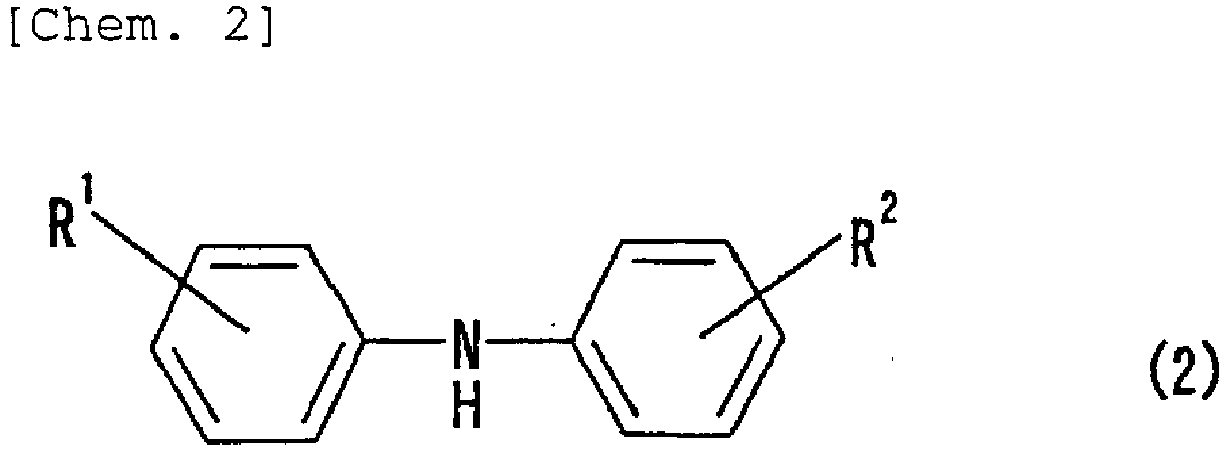
- a compound represented by the following general formula (2) or general formula (3) is preferred because of its good anti-oxidation performance.
- R 1 and R 2 each independently represent a hydrogen atom or an aliphatic hydrocarbon group having 1 to 18 carbon atoms.
- R 3 and R 4 each independently represent a hydrogen atom or an aliphatic hydrocarbon group having 1 to 18 carbon atoms.
- R 1 to R 4 each independently represent a hydrogen atom or an aliphatic hydrocarbon group having 1 to 18 carbon atoms.
- the aliphatic hydrocarbon group having 1 to 18 carbon atoms include: alkyl groups such as a methyl group, an ethyl group, a propyl group, a branched propyl group, a butyl group, a branched butyl group, a hexyl group, a branched hexyl group, a pentyl group, a branched pentyl group, a heptyl group, a branched heptyl group, an octyl group, a branched octyl group, a 2-ethylhexyl group, a nonyl group, a branched nonyl group, a decyl group, a branched decyl group, a dode
- a phenol-based antioxidant (C) to be used in the antioxidant composition of the present invention is a compound represented by the following general formula (4) because of its good anti-oxidation performance.
- R 5 and R 6 each independently represent a hydrogen atom or an alkyl group having 1 to 4 carbon atoms
- R 7 represents a hydrocarbon group having 1 to 20 carbon atoms which may contain an ester group
- m represents a number from 1 to 4.
- R 5 or R 6 must represent an alkyl group having 1 to 4 carbon atoms.
- R 5 and R 6 each independently represent a hydrogen atom or an alkyl group having 1 to 4 carbon atoms .
- alkyl group having 1 to 4 carbon atoms include a methyl group, an ethyl group, a propyl group, a branched propyl group, a butyl group, a branched butyl group, and a tertiary butyl group.
- R 5 and R 6 must not simultaneously represent hydrogen atoms, and either one or both of the substituents must be an alkyl group having 1 to 4 carbon atoms, because of the good anti-oxidation properties, it is preferred that both of R 5 and R 6 be alkyl groups having 1 to 4 carbon atoms, and it is more preferred that both of R 5 and R 6 be a tertiary butyl group.
- R 7 represents a hydrocarbon group having 1 to 20 carbon atoms which may contain an ester group, and m represents a number of 1 to 4.
- R 7 is, for example: an alkyl group such as a methyl group, an ethyl group, a propyl group, a branched propyl group, a butyl group, a branched butyl group, a hexyl group, a branched hexyl group, a pentyl group, a branched pentyl group, a branched pentyl group, a heptyl group, a branched heptyl group, an octyl group, a branched octyl group, a 2-ethylhexyl group, a nonyl group, a branched nonyl group, a decyl group, a branched decyl group, a dodecyl group, a
- group containing an ester group is, for example, represented by the following general formula (5): -R 8 COOR 9 (5) (wherein R 8 represents an alkylene group having 1 to 6 carbon atoms, and R 9 represents a hydrocarbon group having 1 to 20 carbon atoms.)
- R 8 is, for example, a methylene group, an ethylene group, a propylene group, a butylene group, a pentylene group, or a hexylene group. Of these, an ethylene group is preferred because of the easy availability of the raw material.
- R 9 is, for example: an alkyl group such as a methyl group, an ethyl group, a propyl group, a branched propyl group, a butyl group, a branched butyl group, ahexyl group, a branched hexyl group, a pentyl group, a branched pentyl group, a heptyl group, a branched heptyl group, an octyl group, a branched octyl group, a 2-ethylhexyl group, a nonyl group, a branched nonyl group, a decyl group, a branched decyl group, a dodecyl group, a branched dodecyl group, a tridecyl group, a branched tridecyl group, a tetradecyl group, a branched t
- R 7 is, for example, an alkylene group such as a methylene group, an ethylene group, a propylene group, a butylene group, a pentylene group, a hexylene group, a heptylene group, an octylene group, a nonylene group, a decylene group, a dodecylene group, a tetradecylene group, a hexadecylene group, or an octadecylene group.
- the group containing an ester group is, for example, given by the following general formula (6). (wherein R 10 , R 11 and R 12 each independently represent an alkylene group having 1 to 16 carbon atoms.)
- R 10 , R 11 and R 12 may be, for example, a methylene group, an ethylene group, an propylene group, a butylene group, a pentylene group, a hexylene group, a heptylene group, an octylene group, a nonylene group, a decylene group, a docecylene group, a tetradecylene group, or a hexadecylene group.
- R 7 is, for example, given by the following general formula (7) or general formula (8).
- R 7 is, for example, given by the following general formula (9) or general formula (10).
- R 13 to R 15 each independently represent an alkylene group having 1 to 6 carbon atoms.
- R 16 to R 18 each independently represent an alkylene group having 1 to 6 carbon atoms.
- R 19 to R 22 each independently represent an alkylene group having 1 to 6 carbon atoms.
- R 23 represents an alkylene group having 1 to 6 carbon atoms.
- R 13 to R 23 in the compounds with the general formulae (7) to (10) may be, for example, a methylene group, an ethylene group, a propylene group, a butylene group, a pentylene group, or a hexylene group.
- an ethylene group is preferred because of the easy availability of the raw material.
- a composition obtained by adding the amine-based antioxidant (B) and the phenol-based antioxidant (C) to the compound (A) represented by the general formula (1) has improved anti-oxidation performance due to synergistic effect of the components. Irrespective of the blending ratio of each of the components, these synergistic effects occur at any blending ratio, but the ratio of the compound (A) to the amine-based antioxidant (B) and the phenol-based antioxidant (C) is 30/70 to 99/1 (mass ratio), preferably 50/50 to 97/3, more preferably 70/30 to 95/5 as higher effects can be expected.
- the addition amount of the compound (A) is too large, the synergistic effect of anti-oxidation performance may not be sufficiently demonstrated.
- the addition amount of the compound (A) is too small, the dispersion performance of the compound (A) may not be sufficiently demonstrated, or the synergistic effect may not be sufficiently demonstrated.
- the lubricating oil composition of the present invention is a composition including a base oil and the antioxidant composition of the present invention as essential components .
- Any base oil which may be used as a base oil of a lubricating oil may be used as the base oil.
- Examples of these include: synthetic oils such as poly- ⁇ -olefin, an ethylene- ⁇ -olefin copolymer, polybutene, an alkylbenzene, an alkylnaphthalene, a polyalkylene glycol, polyphenyl ether, an alkyl-substituted diphenyl ether, a polyol ester, a dibasic acid ester, a carbonic acid ester, or gas to liquids (GTL); and a paraffinic mineral oil, a naphthenic mineral oil, or a refined mineral oil thereof.
- base oils may each be used alone or may be used as a mixture.
- base oils it is preferable to use a base oil having a viscosity index of 100 or more, and it is more preferable to use poly- ⁇ -olefin, GTL, or a refined mineral oil having a viscosity index of 100 or more, because the range of applications as a lubricating oil is wide and the color tone of the base oil is almost colorless and transparent.
- the lubricating oil composition of the present invention includes grease.
- the thickener which is an essential component of grease, a soap-based or complex soap-based thickener, an organic non-soap-based thickener, an inorganic non-soap-based thickener, and a mixture thereof.
- soap-based thickener examples include soaps each obtained by allowing a higher fatty acid such as lauric acid, myristic acid, palmitic acid, stearic acid, 12-hydroxystearic acid, arachic acid, behenic acid, zoomaric acid, oleic acid, linoleic acid, linolenic acid, or ricinoleic acid to react with a base of aluminum, barium, calcium, lithium, sodium, potassium, or the like; complex soap thickeners obtained by further allowing acetic acid, benzoic acid, sebacic acid, azelaic acid, phosphoric acid, boric acid, or the like to react with the fatty acid and the base.
- a higher fatty acid such as lauric acid, myristic acid, palmitic acid, stearic acid, 12-hydroxystearic acid, arachic acid, behenic acid, zoomaric acid, oleic acid, linoleic acid, linolenic acid, or
- organic non-soap-based thickener examples include a terephthalate-based thickener, a urea-based thickener, and a fluorine-based thickener such as polytetrafluoroethylene or a fluorinated ethylene-propylene copolymer.
- Examples of the urea-based thickener include a monourea-based compound obtained by a reaction of a monoisocyanate and a monoamine, a diurea-based compound obtained by a reaction of a diisocyanate and a monoamine, a ureaurethane-based compound obtained by a reaction of a diisocyanate, a monoamine, and a monool, and a tetraurea-based compound obtained by a reaction of a diisocyanate, a diamine, and a monoisocyanate.
- Examples given for the inorganic non-soap-based thickener include montmorillonite, bentonite, silica aerogel, and boron nitride.
- the blending amount of each of these thickeners is not particularly limited. The blending amount has only to be generally 3 to 40 mass%, preferably 5 to 20 mass%, with respect to the total amount of the grease composition.
- the blending amount of the antioxidant composition of the present invention to be added to the lubricating oil composition of the present invention is 0.01 to 10 mass%, preferably 0.05 to 5 mass%, more preferably 0.1 to 3 mass%, with respect to the total amount of the lubricating oil composition.
- the blending amount is less than 0.01 mass%, a sufficient anti-oxidation effect may not be obtained.
- the blending amount is more than 10 mass%, an effect proportionate to the addition amount may not be obtained, or the product stability of the lubricating oil composition may deteriorate.
- a known lubricating oil additive may be added to the lubricating oil composition of the present invention depending on the intended purpose.
- a friction modifier, an anti-wear agent, an extreme-pressure agent, an oiliness agent, a detergent, a dispersant, a viscosity index improver, a pour point depressant, a rust inhibitor, a corrosion inhibitor, or an anti-foaming agent may be added as long as the effect of the present invention is not impaired.
- Examples of the friction modifier include organic molybdenum compounds such as a sulfurized oxymolybdenum dithiocarbamate and a sulfurized oxymolybdenum dithiophosphate.
- the blending amount of each of those friction reducers is 30 to 2,000 mass ppm, more preferably 50 to 1,000 mass ppm in terms of molybdenum content, with respect to the total amount of the lubricating oil composition.
- a sulfurized oxymolybdenum dithiocarbamate rather than a sulfurized oxymolybdenum dithiophosphate containing a phosphorus atom, and it is more preferable to use a sulfurized oxymolybdenum dithiocarbamate having an alkyl group having 8 to 13 carbon atoms.
- anti-wear agent examples include a compound represented by the following general formula (11): (wherein A represents one of the following general formulae (12) to (14), R 29 to R 36 each independently represent a hydrogen atom or an alkyl group having 1 to 3 carbon atoms, and n represents a number from 1 to 10.)
- R 29 to R 36 each independently represent a hydrogen atom or an alkyl group having 1 to 3 carbon atoms.
- the alkyl group having 1 to 3 carbon atoms include a methyl group, an ethyl group, and a propyl group.
- a hydrogen atom and a methyl group are preferred because of good anti-wear performance.
- the blending amount of each of these anti-wear agents is preferably 0.01 to 5 mass%, more preferably 0.1 to 3 mass%, with respect to the total amount of the lubricating oil composition.
- the extreme-pressure agent examples include: sulfur-based additives such as a sulfurized oil and fat, olefin polysulfide, and dibenzyl sulfide; phosphorus-based compounds such as monooctyl phosphate, tributyl phosphate, triphenyl phosphite, tributyl phosphite, a thiophosphoric acid ester, and zinc dithiophosphate; and organic metal compounds such as a metal salt of thiophosphoric acid, a metal salt of thiocarbamic acid, and a metal salt of an acidic phosphoric acid ester.
- the blending amount of each of these extreme-pressure agents is preferably 0.01 to 2 mass%, more preferably 0.05 to 1 mass% with respect to the total amount of the lubricating oil composition.
- oiliness agent examples include: higher alcohols such as oleyl alcohol and stearyl alcohol; fatty acids such as oleic acid and stearic acid; esters such as oleyl glycerin ester, stearyl glycerin ester, and lauryl glycerin ester; amides such as lauryl amide, oleyl amide, and stearyl amide; amines such as laurylamine, oleylamine, and stearylamine; and ethers such as lauryl glycerin ether and oleyl glycerin ether.
- the blending amount of each of these oiliness agents is preferably 0.1 to 5 mass%, more preferably 0.2 to 3 mass% with respect to the total amount of the lubricating oil composition.
- Examples of the detergent include sulfonates, phenates, salicylates, and phosphates of calcium, magnesium, and barium, and perbasic salts thereof. Of these, perbasic salts are preferred. Of the perbasic salts, a perbasic salt having a total basic number (TBN) of 30 to 500 mgKOH/g is more preferred. A salicylate-based detergent free of phosphorus and sulfur atoms is even more preferred.
- the blending amount of each of these detergents is preferably 0.5 to 10 mass%, more preferably 1 to 8 mass% with respect to the total amount of the lubricating oil composition.
- dispersant examples include succinimide, a succinic acid ester, and benzylamine to each of which an alkyl group or an alkenyl group has been added and each of which has a weight-average molecular weight of about 500 to 3,000, and boron-denatured products thereof.
- the blending amount of each of these dispersants is preferably 0.5 to 10 mass%, more preferably 1 to 8 mass% with respect to the total amount of the lubricating oil composition.
- viscosity index improver examples include poly (C1 to C18)alkyl methacrylates, (C1 to C18)alkyl acrylate/(C1 to C18)alkyl methacrylate copolymers, diethylaminoethyl methacrylate/(C1 to C18)alkyl methacrylate copolymers, ethylene/(C1 to C18)alkyl methacrylate copolymers, polyisobutylenes, polyalkylstyrenes, ethylene/propylene copolymers, styrene/maleic acid ester copolymers, and styrene/isoprene hydrogenated copolymers.
- a dispersion-type or multi-functional viscosity index improver to which dispersing performance has been imparted may be used. Its weight-average molecular weight may be about 10,000 to 1, 500, 000, preferably about 30, 000 to 1, 000, 000.
- the blending amount of each of these viscosity index improvers is preferably 0.1 to 20 mass%, more preferably 0.3 to 15 mass% with respect to the total amount of the lubricating oil composition.
- pour point depressant examples include polyalkyl methacrylates, polyalkyl acrylates, polyalkylstyrenes, and polyvinyl acetates. Its weight-average molecular weight may be about 1,000 to 100,000, preferably about 3,000 to 80,000.
- the blending amount of each of these pour point depressants is preferably 0.005 to 3 mass%, more preferably 0.01 to 2 mass%, with respect to the total amount of the lubricating oil composition.
- rust inhibitor examples include sodium nitrite, oxidized paraffin wax calcium salts, oxidized paraffin wax magnesium salts, beef tallow fatty acid alkali metal salts, alkaline earth metal salts, or amine salts, alkenyl succinic acids or alkenyl succinic acid half esters (the molecular weight of the alkenyl group is about 100 to 300), sorbitan monoesters, nonylphenol ethoxylates, and calcium salts of lanolin fatty acids.
- the blending amount of each of these rust inhibitors is blended preferably 0.01 to 3 mass%, more preferably 0.02 to 2 mass% with respect to the total amount of the lubricating oil composition.
- corrosion inhibitor examples include benzotriazole, benzimidazole, benzothiazole and tetraalkylthiuram disulfide.
- the blending amount of each of these corrosion inhibitors is preferably 0.01 to 3 mass%, more preferably 0.02 to 2 mass% with respect to the total amount of the lubricating oil composition.
- anti-foaming agent examples include polydimethylsilicones, trifluoropropylmethylsilicone, colloidal silica, polyalkyl acrylates, polyalkyl methacrylates, alcohol ethoxy/propoxylate, fatty acid ethoxy/propoxylate, and sorbitan partial fatty acid esters.
- the blending amount of each of these anti-foaming agents is preferably 0.001 to 0.1 mass%, more preferably 0.001 to 0.01 mass% with respect to the total amount of the lubricating oil composition.
- the lubricating oil composition of the present invention may be used for any of general lubricating oil application, for example, applications such as engine oils, gear oils, turbine oils, hydraulic oils, fire-resistant hydraulic fluids, refrigerating machine oils, compressor oils, vacuum pump oils, bearing oils, insulating oils, slideway oils, rock drill oils, metal working oils, plastic working oils, heat treatment oils and greases, and is preferably used for applications which require high anti-oxidation performance, such as engine oils, turbine oils, metal working oils and greases.
- test samples 1 to 11 were blended in accordance with the formulations in Table 1.
- the resultant test samples were used for an anti-oxidation property test and a stability test. It should be noted that the samples (D-1) and (D-2) are solvents for comparison with the compound (A). Further, each of test samples 1 to 11 was a transparent liquid at normal temperature.
- Table 1 Formulation table Test sample 1 2 3 4 5 6 7 8 9 10 11 A-1 80 80 80 80 90 A-2 80 A-3 80 B-1 20 B-2 20 20 20 20 20 C-1 20 C-2 20 10 20 20 D-1 80 80 D-2 80 80 *The blending amounts in the table are on a mass basis.
- the test was carried out in conformity with a method of JIS K-2514. Specifically, 50 g of a specimen, 5 g of water, and 3 m of a copper wire as a catalyst rolled into a compact size and having a diameter of 1.6 mm are loaded into a pressure-resistant cylinder equipped with a pressure meter and having a volume of 100 ml. After sealing, oxygen is injected into the cylinder until the internal pressure of the cylinder reaches 620 kPa. The cylinder is rotated at 100 rpm in a thermostat bath at 150°C while being kept at an angle of 30°C. The internal pressure of the cylinder initially increases with an increase in temperature.
- the internal pressure of the cylinder decreases owing to the absorption of oxygen when oxidative degradation starts.
- the pressure was measured over time, and the time period required for a decrease from the highest pressure to 175 kPa was determined.
- the time period was defined as an induction period for oxidative degradation.
- a specimen showing a longer induction period has more satisfactory anti-oxidation performance. It should be noted that specimens obtained by adding the test samples prepared in accordance with the formulation table at 0.5 mass% to the following base oils were used. Further, the samples themselves used for comparison were also subjected to the test. Also in the test of the samples themselves, specimens obtained by adding the samples at 0.5 mass% to the following base oil 1 or 2 were used.
- Base oil 1 mineral oil-based base oil having dynamic viscosities of 4.24 mm 2 /sec (100°C) and 19.65 mm 2 /sec (40°C), and a viscosity index of 126
- Base oil 2 poly- ⁇ -olefin having dynamic viscosities of 4.0 mm 2 /sec (100°C) and 18.4 mm 2 /sec (40°C), and a viscosity index of 119
Landscapes
- Chemical & Material Sciences (AREA)
- Organic Chemistry (AREA)
- Oil, Petroleum & Natural Gas (AREA)
- Chemical Kinetics & Catalysis (AREA)
- General Chemical & Material Sciences (AREA)
- Engineering & Computer Science (AREA)
- Materials Engineering (AREA)
- Health & Medical Sciences (AREA)
- Emergency Medicine (AREA)
- Metallurgy (AREA)
- Lubricants (AREA)
- Anti-Oxidant Or Stabilizer Compositions (AREA)
Claims (3)
- Antioxidanszusammensetzung, bestehend aus:eine Verbindung (A), die durch die folgende allgemeine Formel (1) repräsentiert ist;ein aminbasiertes Antioxidans (B); undein phenolbasiertes Antioxidans (C), das durch die folgende allgemeine Formel (4) repräsentiert ist:


- Antioxidanszusammensetzung nach Anspruch 1, wobei das aminbasierte Antioxidans (B) eine Verbindung umfasst, die durch die folgende allgemeine Formel (2) oder allgemeine Formel (3) repräsentiert ist:

- Schmierölzusammensetzung, umfassend:die Antioxidanszusammensetzung nach einem der Ansprüche 1 bis 2; undein Basisöl, wobei eine Mischungsmenge der Antioxidanszusammensetzung 0,01 bis 10 Masse-% beträgt, bezogen auf eine Gesamtmenge der Schmierölzusammensetzung.
Applications Claiming Priority (2)
| Application Number | Priority Date | Filing Date | Title |
|---|---|---|---|
| JP2010205547A JP5721983B2 (ja) | 2010-09-14 | 2010-09-14 | 酸化防止剤組成物及びそれを含有する潤滑油組成物 |
| PCT/JP2011/069253 WO2012035954A1 (ja) | 2010-09-14 | 2011-08-26 | 酸化防止剤組成物及びそれを含有する潤滑油組成物 |
Publications (3)
| Publication Number | Publication Date |
|---|---|
| EP2617802A1 EP2617802A1 (de) | 2013-07-24 |
| EP2617802A4 EP2617802A4 (de) | 2015-04-22 |
| EP2617802B1 true EP2617802B1 (de) | 2019-09-18 |
Family
ID=45831426
Family Applications (1)
| Application Number | Title | Priority Date | Filing Date |
|---|---|---|---|
| EP11824962.2A Active EP2617802B1 (de) | 2010-09-14 | 2011-08-26 | Antioxidationszusammensetzung und schmierölzusammensetzung damit |
Country Status (6)
| Country | Link |
|---|---|
| US (1) | US9382498B2 (de) |
| EP (1) | EP2617802B1 (de) |
| JP (1) | JP5721983B2 (de) |
| KR (1) | KR101810276B1 (de) |
| CN (1) | CN103097502B (de) |
| WO (1) | WO2012035954A1 (de) |
Families Citing this family (11)
| Publication number | Priority date | Publication date | Assignee | Title |
|---|---|---|---|---|
| CA2906986C (en) * | 2013-04-22 | 2023-05-16 | Ethox Chemicals, Llc | Additives to resin compositions for improved impact strength and flexibility |
| JP6085219B2 (ja) * | 2013-04-26 | 2017-02-22 | 昭和シェル石油株式会社 | 真空ポンプ油 |
| JP6744708B2 (ja) * | 2015-01-21 | 2020-08-19 | セイコーインスツル株式会社 | 転がり軸受用グリース、転がり軸受、転がり軸受装置及び情報記録再生装置 |
| WO2016143807A1 (ja) * | 2015-03-09 | 2016-09-15 | Jxエネルギー株式会社 | グリース組成物 |
| KR101659318B1 (ko) * | 2015-11-24 | 2016-09-23 | 주식회사 루브캠코리아 | 윤활 그리스 조성물 및 이의 제조 방법 |
| JP6590442B2 (ja) * | 2016-02-25 | 2019-10-16 | 出光興産株式会社 | 潤滑油組成物 |
| CN109415647A (zh) | 2016-06-29 | 2019-03-01 | 株式会社Adeka | 内燃机用润滑油组合物 |
| CN109065210A (zh) * | 2018-07-24 | 2018-12-21 | 晶锋集团股份有限公司 | 一种强效导电抗氧化的电缆及其制备方法 |
| CN109280499A (zh) * | 2018-09-10 | 2019-01-29 | 天长市永泰密封材料有限公司 | 一种强效抗氧化的环氧粘合剂及其制备方法 |
| KR102534592B1 (ko) * | 2020-10-14 | 2023-05-22 | 주식회사 지러스트 | 방청 볼트캡 |
| US12152216B2 (en) | 2020-12-23 | 2024-11-26 | The Lubrizol Corp tion | Benzazepine compounds as antioxidants for lubricant compositions |
Family Cites Families (8)
| Publication number | Priority date | Publication date | Assignee | Title |
|---|---|---|---|---|
| JP2002348586A (ja) | 2001-05-23 | 2002-12-04 | Citizen Watch Co Ltd | 潤滑油組成物およびそれを用いた精密部品および軸受け |
| JP4078345B2 (ja) * | 2004-10-19 | 2008-04-23 | 新日本石油株式会社 | 酸化防止剤組成物及びそれを用いた潤滑油組成物 |
| US20060122073A1 (en) * | 2004-12-08 | 2006-06-08 | Chip Hewette | Oxidation stable gear oil compositions |
| US7704931B2 (en) * | 2004-12-10 | 2010-04-27 | Chemtura Corporation | Lubricant compositions stabilized with multiple antioxidants |
| JP5078116B2 (ja) * | 2006-10-20 | 2012-11-21 | Jx日鉱日石エネルギー株式会社 | 長寿命省燃費型エンジン油組成物 |
| US20090011961A1 (en) * | 2007-07-06 | 2009-01-08 | Jun Dong | Lubricant compositions stabilized with styrenated phenolic antioxidant |
| US7902280B2 (en) * | 2007-02-26 | 2011-03-08 | Chemtura Corporation | Liquid styrenated phenolic compositions and processes for forming same |
| JP5248137B2 (ja) * | 2008-02-21 | 2013-07-31 | 株式会社Adeka | 潤滑油用酸化防止剤組成物及びそれを含有する潤滑油組成物 |
-
2010
- 2010-09-14 JP JP2010205547A patent/JP5721983B2/ja active Active
-
2011
- 2011-08-26 WO PCT/JP2011/069253 patent/WO2012035954A1/ja not_active Ceased
- 2011-08-26 CN CN201180044250.XA patent/CN103097502B/zh not_active Expired - Fee Related
- 2011-08-26 US US13/822,494 patent/US9382498B2/en not_active Expired - Fee Related
- 2011-08-26 KR KR1020137005638A patent/KR101810276B1/ko not_active Expired - Fee Related
- 2011-08-26 EP EP11824962.2A patent/EP2617802B1/de active Active
Non-Patent Citations (1)
| Title |
|---|
| None * |
Also Published As
| Publication number | Publication date |
|---|---|
| EP2617802A1 (de) | 2013-07-24 |
| JP2012062348A (ja) | 2012-03-29 |
| CN103097502B (zh) | 2015-07-22 |
| US20130184190A1 (en) | 2013-07-18 |
| KR20130108544A (ko) | 2013-10-04 |
| EP2617802A4 (de) | 2015-04-22 |
| WO2012035954A1 (ja) | 2012-03-22 |
| US9382498B2 (en) | 2016-07-05 |
| JP5721983B2 (ja) | 2015-05-20 |
| CN103097502A (zh) | 2013-05-08 |
| KR101810276B1 (ko) | 2017-12-19 |
Similar Documents
| Publication | Publication Date | Title |
|---|---|---|
| EP2617802B1 (de) | Antioxidationszusammensetzung und schmierölzusammensetzung damit | |
| CA2302933C (en) | Lubricating composition | |
| JP5793221B2 (ja) | 潤滑剤ブレンド組成物 | |
| JP4201902B2 (ja) | 潤滑性組成物 | |
| CN109415646B (zh) | 润滑性组合物及包含该润滑性组合物的机油组合物 | |
| EP2584026A1 (de) | Schmiermittelzusammensetzung für verbrennungsmotoren | |
| EP2554643A1 (de) | Schmiermittelzusatz und schmiermittelzusammensetzung mit dem schmiermittelzusatz | |
| EP2610331A1 (de) | Schmiermittelzusammensetzung für verbrennungsmotoren | |
| JP2003221588A (ja) | 潤滑性組成物 | |
| JP7556678B2 (ja) | アクリレート共重合体からなる有機モリブデン化合物の基油への溶解分散安定化剤、潤滑油組成物及び有機モリブデン化合物の基油への溶解分散安定性を向上させる方法 | |
| US11193081B2 (en) | Seal swell agents for lubricating compositions | |
| JP7520001B2 (ja) | アクリレート系共重合体、該共重合体の製造方法、該共重合体からなる摩擦抑制剤及び該摩擦抑制剤を含有する潤滑油組成物 | |
| JP2000192066A (ja) | 潤滑性組成物 | |
| EP4663722A1 (de) | Basisschmieröl | |
| JP2022048706A (ja) | 潤滑油組成物 | |
| JP4351764B2 (ja) | エンジン油用潤滑性組成物 | |
| JP4351765B2 (ja) | エンジン油用潤滑剤およびエンジン油用潤滑性組成物 | |
| JP5419377B2 (ja) | 難燃性潤滑油組成物 | |
| JP2024140976A (ja) | 潤滑油組成物 | |
| JP5546398B2 (ja) | 潤滑油用酸化防止剤及びそれを含有する潤滑油組成物 | |
| JP2022061754A (ja) | 潤滑油組成物 | |
| JP2000008068A (ja) | エーテル系潤滑油添加剤及び潤滑油組成物 | |
| JPH11302678A (ja) | 酸化防止性潤滑油添加剤 |
Legal Events
| Date | Code | Title | Description |
|---|---|---|---|
| PUAI | Public reference made under article 153(3) epc to a published international application that has entered the european phase |
Free format text: ORIGINAL CODE: 0009012 |
|
| 17P | Request for examination filed |
Effective date: 20130315 |
|
| AK | Designated contracting states |
Kind code of ref document: A1 Designated state(s): AL AT BE BG CH CY CZ DE DK EE ES FI FR GB GR HR HU IE IS IT LI LT LU LV MC MK MT NL NO PL PT RO RS SE SI SK SM TR |
|
| DAX | Request for extension of the european patent (deleted) | ||
| RA4 | Supplementary search report drawn up and despatched (corrected) |
Effective date: 20150325 |
|
| RIC1 | Information provided on ipc code assigned before grant |
Ipc: C10N 40/12 20060101ALI20150319BHEP Ipc: C09K 15/08 20060101ALI20150319BHEP Ipc: C10M 133/12 20060101ALI20150319BHEP Ipc: C10N 40/25 20060101ALI20150319BHEP Ipc: C10M 141/06 20060101ALI20150319BHEP Ipc: C09K 15/18 20060101ALI20150319BHEP Ipc: C09K 15/26 20060101ALI20150319BHEP Ipc: C10M 129/10 20060101AFI20150319BHEP Ipc: C10N 40/20 20060101ALI20150319BHEP Ipc: C10N 30/10 20060101ALI20150319BHEP |
|
| STAA | Information on the status of an ep patent application or granted ep patent |
Free format text: STATUS: EXAMINATION IS IN PROGRESS |
|
| 17Q | First examination report despatched |
Effective date: 20180801 |
|
| GRAP | Despatch of communication of intention to grant a patent |
Free format text: ORIGINAL CODE: EPIDOSNIGR1 |
|
| STAA | Information on the status of an ep patent application or granted ep patent |
Free format text: STATUS: GRANT OF PATENT IS INTENDED |
|
| INTG | Intention to grant announced |
Effective date: 20190409 |
|
| GRAS | Grant fee paid |
Free format text: ORIGINAL CODE: EPIDOSNIGR3 |
|
| GRAA | (expected) grant |
Free format text: ORIGINAL CODE: 0009210 |
|
| STAA | Information on the status of an ep patent application or granted ep patent |
Free format text: STATUS: THE PATENT HAS BEEN GRANTED |
|
| AK | Designated contracting states |
Kind code of ref document: B1 Designated state(s): AL AT BE BG CH CY CZ DE DK EE ES FI FR GB GR HR HU IE IS IT LI LT LU LV MC MK MT NL NO PL PT RO RS SE SI SK SM TR |
|
| REG | Reference to a national code |
Ref country code: GB Ref legal event code: FG4D |
|
| REG | Reference to a national code |
Ref country code: CH Ref legal event code: EP |
|
| REG | Reference to a national code |
Ref country code: DE Ref legal event code: R096 Ref document number: 602011062208 Country of ref document: DE |
|
| REG | Reference to a national code |
Ref country code: AT Ref legal event code: REF Ref document number: 1181307 Country of ref document: AT Kind code of ref document: T Effective date: 20191015 |
|
| REG | Reference to a national code |
Ref country code: IE Ref legal event code: FG4D |
|
| REG | Reference to a national code |
Ref country code: NL Ref legal event code: MP Effective date: 20190918 |
|
| PG25 | Lapsed in a contracting state [announced via postgrant information from national office to epo] |
Ref country code: BG Free format text: LAPSE BECAUSE OF FAILURE TO SUBMIT A TRANSLATION OF THE DESCRIPTION OR TO PAY THE FEE WITHIN THE PRESCRIBED TIME-LIMIT Effective date: 20191218 Ref country code: SE Free format text: LAPSE BECAUSE OF FAILURE TO SUBMIT A TRANSLATION OF THE DESCRIPTION OR TO PAY THE FEE WITHIN THE PRESCRIBED TIME-LIMIT Effective date: 20190918 Ref country code: NO Free format text: LAPSE BECAUSE OF FAILURE TO SUBMIT A TRANSLATION OF THE DESCRIPTION OR TO PAY THE FEE WITHIN THE PRESCRIBED TIME-LIMIT Effective date: 20191218 Ref country code: FI Free format text: LAPSE BECAUSE OF FAILURE TO SUBMIT A TRANSLATION OF THE DESCRIPTION OR TO PAY THE FEE WITHIN THE PRESCRIBED TIME-LIMIT Effective date: 20190918 Ref country code: HR Free format text: LAPSE BECAUSE OF FAILURE TO SUBMIT A TRANSLATION OF THE DESCRIPTION OR TO PAY THE FEE WITHIN THE PRESCRIBED TIME-LIMIT Effective date: 20190918 Ref country code: LT Free format text: LAPSE BECAUSE OF FAILURE TO SUBMIT A TRANSLATION OF THE DESCRIPTION OR TO PAY THE FEE WITHIN THE PRESCRIBED TIME-LIMIT Effective date: 20190918 |
|
| REG | Reference to a national code |
Ref country code: LT Ref legal event code: MG4D |
|
| PG25 | Lapsed in a contracting state [announced via postgrant information from national office to epo] |
Ref country code: AL Free format text: LAPSE BECAUSE OF FAILURE TO SUBMIT A TRANSLATION OF THE DESCRIPTION OR TO PAY THE FEE WITHIN THE PRESCRIBED TIME-LIMIT Effective date: 20190918 Ref country code: GR Free format text: LAPSE BECAUSE OF FAILURE TO SUBMIT A TRANSLATION OF THE DESCRIPTION OR TO PAY THE FEE WITHIN THE PRESCRIBED TIME-LIMIT Effective date: 20191219 Ref country code: RS Free format text: LAPSE BECAUSE OF FAILURE TO SUBMIT A TRANSLATION OF THE DESCRIPTION OR TO PAY THE FEE WITHIN THE PRESCRIBED TIME-LIMIT Effective date: 20190918 Ref country code: LV Free format text: LAPSE BECAUSE OF FAILURE TO SUBMIT A TRANSLATION OF THE DESCRIPTION OR TO PAY THE FEE WITHIN THE PRESCRIBED TIME-LIMIT Effective date: 20190918 |
|
| REG | Reference to a national code |
Ref country code: AT Ref legal event code: MK05 Ref document number: 1181307 Country of ref document: AT Kind code of ref document: T Effective date: 20190918 |
|
| PG25 | Lapsed in a contracting state [announced via postgrant information from national office to epo] |
Ref country code: ES Free format text: LAPSE BECAUSE OF FAILURE TO SUBMIT A TRANSLATION OF THE DESCRIPTION OR TO PAY THE FEE WITHIN THE PRESCRIBED TIME-LIMIT Effective date: 20190918 Ref country code: PL Free format text: LAPSE BECAUSE OF FAILURE TO SUBMIT A TRANSLATION OF THE DESCRIPTION OR TO PAY THE FEE WITHIN THE PRESCRIBED TIME-LIMIT Effective date: 20190918 Ref country code: EE Free format text: LAPSE BECAUSE OF FAILURE TO SUBMIT A TRANSLATION OF THE DESCRIPTION OR TO PAY THE FEE WITHIN THE PRESCRIBED TIME-LIMIT Effective date: 20190918 Ref country code: PT Free format text: LAPSE BECAUSE OF FAILURE TO SUBMIT A TRANSLATION OF THE DESCRIPTION OR TO PAY THE FEE WITHIN THE PRESCRIBED TIME-LIMIT Effective date: 20200120 Ref country code: IT Free format text: LAPSE BECAUSE OF FAILURE TO SUBMIT A TRANSLATION OF THE DESCRIPTION OR TO PAY THE FEE WITHIN THE PRESCRIBED TIME-LIMIT Effective date: 20190918 Ref country code: RO Free format text: LAPSE BECAUSE OF FAILURE TO SUBMIT A TRANSLATION OF THE DESCRIPTION OR TO PAY THE FEE WITHIN THE PRESCRIBED TIME-LIMIT Effective date: 20190918 Ref country code: AT Free format text: LAPSE BECAUSE OF FAILURE TO SUBMIT A TRANSLATION OF THE DESCRIPTION OR TO PAY THE FEE WITHIN THE PRESCRIBED TIME-LIMIT Effective date: 20190918 Ref country code: NL Free format text: LAPSE BECAUSE OF FAILURE TO SUBMIT A TRANSLATION OF THE DESCRIPTION OR TO PAY THE FEE WITHIN THE PRESCRIBED TIME-LIMIT Effective date: 20190918 |
|
| PG25 | Lapsed in a contracting state [announced via postgrant information from national office to epo] |
Ref country code: IS Free format text: LAPSE BECAUSE OF FAILURE TO SUBMIT A TRANSLATION OF THE DESCRIPTION OR TO PAY THE FEE WITHIN THE PRESCRIBED TIME-LIMIT Effective date: 20200224 Ref country code: CZ Free format text: LAPSE BECAUSE OF FAILURE TO SUBMIT A TRANSLATION OF THE DESCRIPTION OR TO PAY THE FEE WITHIN THE PRESCRIBED TIME-LIMIT Effective date: 20190918 Ref country code: SK Free format text: LAPSE BECAUSE OF FAILURE TO SUBMIT A TRANSLATION OF THE DESCRIPTION OR TO PAY THE FEE WITHIN THE PRESCRIBED TIME-LIMIT Effective date: 20190918 Ref country code: SM Free format text: LAPSE BECAUSE OF FAILURE TO SUBMIT A TRANSLATION OF THE DESCRIPTION OR TO PAY THE FEE WITHIN THE PRESCRIBED TIME-LIMIT Effective date: 20190918 |
|
| REG | Reference to a national code |
Ref country code: DE Ref legal event code: R097 Ref document number: 602011062208 Country of ref document: DE |
|
| PLBE | No opposition filed within time limit |
Free format text: ORIGINAL CODE: 0009261 |
|
| STAA | Information on the status of an ep patent application or granted ep patent |
Free format text: STATUS: NO OPPOSITION FILED WITHIN TIME LIMIT |
|
| PG2D | Information on lapse in contracting state deleted |
Ref country code: IS |
|
| PG25 | Lapsed in a contracting state [announced via postgrant information from national office to epo] |
Ref country code: DK Free format text: LAPSE BECAUSE OF FAILURE TO SUBMIT A TRANSLATION OF THE DESCRIPTION OR TO PAY THE FEE WITHIN THE PRESCRIBED TIME-LIMIT Effective date: 20190918 Ref country code: IS Free format text: LAPSE BECAUSE OF FAILURE TO SUBMIT A TRANSLATION OF THE DESCRIPTION OR TO PAY THE FEE WITHIN THE PRESCRIBED TIME-LIMIT Effective date: 20200119 |
|
| 26N | No opposition filed |
Effective date: 20200619 |
|
| PG25 | Lapsed in a contracting state [announced via postgrant information from national office to epo] |
Ref country code: SI Free format text: LAPSE BECAUSE OF FAILURE TO SUBMIT A TRANSLATION OF THE DESCRIPTION OR TO PAY THE FEE WITHIN THE PRESCRIBED TIME-LIMIT Effective date: 20190918 |
|
| PG25 | Lapsed in a contracting state [announced via postgrant information from national office to epo] |
Ref country code: MC Free format text: LAPSE BECAUSE OF FAILURE TO SUBMIT A TRANSLATION OF THE DESCRIPTION OR TO PAY THE FEE WITHIN THE PRESCRIBED TIME-LIMIT Effective date: 20190918 |
|
| REG | Reference to a national code |
Ref country code: CH Ref legal event code: PL |
|
| GBPC | Gb: european patent ceased through non-payment of renewal fee |
Effective date: 20200826 |
|
| PG25 | Lapsed in a contracting state [announced via postgrant information from national office to epo] |
Ref country code: LU Free format text: LAPSE BECAUSE OF NON-PAYMENT OF DUE FEES Effective date: 20200826 Ref country code: LI Free format text: LAPSE BECAUSE OF NON-PAYMENT OF DUE FEES Effective date: 20200831 Ref country code: CH Free format text: LAPSE BECAUSE OF NON-PAYMENT OF DUE FEES Effective date: 20200831 |
|
| REG | Reference to a national code |
Ref country code: BE Ref legal event code: MM Effective date: 20200831 |
|
| PG25 | Lapsed in a contracting state [announced via postgrant information from national office to epo] |
Ref country code: FR Free format text: LAPSE BECAUSE OF NON-PAYMENT OF DUE FEES Effective date: 20200831 |
|
| PG25 | Lapsed in a contracting state [announced via postgrant information from national office to epo] |
Ref country code: IE Free format text: LAPSE BECAUSE OF NON-PAYMENT OF DUE FEES Effective date: 20200826 Ref country code: GB Free format text: LAPSE BECAUSE OF NON-PAYMENT OF DUE FEES Effective date: 20200826 Ref country code: BE Free format text: LAPSE BECAUSE OF NON-PAYMENT OF DUE FEES Effective date: 20200831 |
|
| PG25 | Lapsed in a contracting state [announced via postgrant information from national office to epo] |
Ref country code: TR Free format text: LAPSE BECAUSE OF FAILURE TO SUBMIT A TRANSLATION OF THE DESCRIPTION OR TO PAY THE FEE WITHIN THE PRESCRIBED TIME-LIMIT Effective date: 20190918 Ref country code: MT Free format text: LAPSE BECAUSE OF FAILURE TO SUBMIT A TRANSLATION OF THE DESCRIPTION OR TO PAY THE FEE WITHIN THE PRESCRIBED TIME-LIMIT Effective date: 20190918 Ref country code: CY Free format text: LAPSE BECAUSE OF FAILURE TO SUBMIT A TRANSLATION OF THE DESCRIPTION OR TO PAY THE FEE WITHIN THE PRESCRIBED TIME-LIMIT Effective date: 20190918 |
|
| PG25 | Lapsed in a contracting state [announced via postgrant information from national office to epo] |
Ref country code: MK Free format text: LAPSE BECAUSE OF FAILURE TO SUBMIT A TRANSLATION OF THE DESCRIPTION OR TO PAY THE FEE WITHIN THE PRESCRIBED TIME-LIMIT Effective date: 20190918 |
|
| PGFP | Annual fee paid to national office [announced via postgrant information from national office to epo] |
Ref country code: DE Payment date: 20220819 Year of fee payment: 12 |
|
| P01 | Opt-out of the competence of the unified patent court (upc) registered |
Effective date: 20230522 |
|
| REG | Reference to a national code |
Ref country code: DE Ref legal event code: R119 Ref document number: 602011062208 Country of ref document: DE |
|
| PG25 | Lapsed in a contracting state [announced via postgrant information from national office to epo] |
Ref country code: DE Free format text: LAPSE BECAUSE OF NON-PAYMENT OF DUE FEES Effective date: 20240301 |